‘Every picture tells a story,’ luidt het gezegde. Indien deze stelling klopt, wat zijn dan de waarde en het belang van een degelijk en gefundeerd filmboek? Welke verdoken verhalen, groot en klein, waardevolle achtergrond en historische inzichten kunnen we dan terugvinden in filmboeken die zich toespitsen op de geschiedenis van de zevende kunst? Vandaar, ook al heeft niemand erom gevraagd, volgt hier een overzicht van filmboeken die, althans volgens ondergetekende, van hoogstaand niveau zijn en/of een onmiskenbare meerwaarde betekenen inzake hun collectieve filmhistorische bijdrage. Het zijn de pakweg 1.800 filmboeken waarover we beschikken, die van hieruit als researchmiddel worden gebruikt, en die de voorbije decennia gaandeweg werden aangeschaft.
De bijhorende beschrijving is geen review, maar wel de reproductie die vermeld wordt op de flappen van de dust jacket, of in geval van een softcover uitgave, de info die de uitgever op de achterzijde van het boek heeft vermeld. Uitzonderlijk, bij gebrek aan beide zijn, met de correcte vermelding, enkele paragrafen uit het voorwoord, introductie, of uit een hoofdstuk overgenomen om de toon van het boek te verduidelijken. Hoe dan ook zijn het steeds vrij accurate impressies van het boek, vergelijkbaar met de trailer van een film. In hun geheel overstijgen ze met vérve hetgeen Google of Wikipedia te bieden heeft.
De boeken zijn alfabetisch gerangschikt, te beginnen met “About John Ford” (1999, van auteur en filmmaker Lindsay Anderson), tot en met “Zorina” (actrice Vera Zorina’s autobiografie uit 1986) als afsluiter; de volledige lijst is eveneens beschikbaar op deze blog.
About John Ford (Lindsay Anderson)
 The career of John Ford, America’s greatest film director, spanned nearly half a century. With masterpieces that range from The Iron Horse in 1924 to The Informer in 1935, from Stagecoach and The Grapes of Wrath in 1939 to The Searchers in 1956, he was one of the world’s most popular film makers, and one of the most universally admired. About John Ford is a critical appreciation and personal tribute. Its comprehensive survey of Ford’s work has the authority of a writer who was himself a distinguished film maker, and the portrait which emerges has the vividness and warmth of friendship.
Lindsay Anderson was a young critic and apprentice film maker when he met John Ford for the first time in 1951. He was also a devotee of Ford’s work, and his early writings were the first to draw serious attention to his films. An odd, abrasive relationship developed, and their paths continued to cross until they met for the last time when Anderson visited Ford at his home in Palm Desert, shortly before he died in 1973. During these years, with films like If… and O Lucky Man!, and with a succession of theater productions in London and New York, Lindsay Anderson himself became a director of international reputation. But he never lost his admiration for Ford and his obsessive enthusiasm for his work. This book is the result.
About John Ford is not a work of hagiography. As well as recording Anderson’s meetings with Ford, it contains key pieces of criticism never before published in book form and contains an altogether new assessment of Ford’s later work, together with an interpretation of his achievement as an artist. The book is rounded off by full and illuminating letters from Ford’s principal writing collaborators (Dudley Nichols, Frank Nugent and Nunnally Johnson); and by conversations with four actors who knew him well and worked with him, Henry Fonda, Harry Carey, Jr., Robert Montgomery and Donald Donnelly.
In its combination of personal fondness and understanding with authorative critical assessment, About John Ford is a unique contribution to the literature of the cinema.
Softcover – 256 pp., index – Dimensions 24,5 x 19 cm (9,7 x 7,5 inch) – Weight 644 g (22,7 oz) – PUBLISHER Plexus, London, 1999 – ISBN 0-85965-014-6
Above the Line: Conversations About the Movies (Lawrence Grobel)
 Above the Line is a dazzling gathering of insights and anecdotes from all corners of the film industry – interviews that reveal the skills, intelligence, experiences, and emotions of eleven key players who produce, write, direct, act in, and review the movies: Oliver Stone, Anthony Hopkins, Jodie Foster, Robert Evans, Lily Tomlin, Jean-Claude Van Damme, Harrison Ford, Robert Towne, Sharon Stone, and Gene Siskel and Roger Ebert. Witty, scathing, gossipy, generous, the interviewees show what just make the movies work from “above the line” – from the perspective of those whose names go above the title. Each of these gifted individuals represents a piece of the puzzle that gives rise to some of the best in moviemaking today.
LAWRENCE GROBEL has been a free-lance writer for more than thirty years and has written for the New York Times, Rolling Stone, Entertainment Weekly, Playboy, Movieline, and many other periodicals. Playboy called him “the interviewer’s interviewer” after his historic interview with Marlon Brando; more recently he made news as a result of his controversial interview with Governor Jesse Ventura. Grobel has written several books, including Conversations with Capote, Talking with Michener, and The Hustons. He lives in Los Angeles.
Softcover – 398 pp., index – Dimensions 23 x 15 cm (9,1 x 5,9 inch) – Weight 558 g (19,7 oz) – PUBLISHER Da Capo Press, New York, New York, 2000 – ISBN 0-306-80978-8
Academy Awards: An Ungar Reference Index (compiled by Richard Shale)
 This is the most complete book on the subject ever published. It tells you quickly who won, who was nominated, and when – and much more. It gives you three different ways to find information on the awards: by category, by year, by name (as listed in the only complete index of its kind).
If you know only the category (who won an Oscar, or two, for best director or for cinematography or special effects), you can check the entries under Directing (or other categories) for an overview of all nominees and all winners. If you know only the year (were there any winners in Special Effects in 1945), the entries in the Chronological listing will tell you promptly. If you know only the name (did Johnny Mercer ever win an Oscar for one of his songs, and did he write the words or the music), see the comprehensive Index and find out whether Mercer was ever nominated (he was if he’s listed), and the page that will tell you whether he won.
And there is more. Nominating and voting procedures are explained for each category, even those no longer in existence. A concise essay on the history of the Academy, including the ten-year labor struggle in Hollywood that nearly destroyed it. A fully annotated bibliography. And, of course some interesting illustrations that highlight behind-the-scene figures as well as movie stills.
Who will use this definitive Academy Awards? Everyone curiously interested in film history. Critics, journalists, students, for whom it will be a mine of accurate information. And you movie buffs or nostalgia devotees – this is your book. An Ungar Film Library classic, and it belongs in everyone’s personal film library.
RICHARD SHALE put this book together. Needless to say, he is an avid moviegoer. Aside from this avocation, he has a Ph.D. in American culture from the University of Michigan and teaches in the English Department of Youngstown State University, Ohio. His articles on aspects of the movies have appeared in several film periodicals.
Softcover – 615 pp., index – Dimensions 23,5 x 15,5 cm (9,3 x 6,1 inch) – Weight 883 g (31,1 oz) – PUBLISHER Frederick Ungar Publishing Co., New York, New York, 1978 – ISBN 0-8044-6860-5
Accidentally on Purpose: An Autobiography (Michael York)
Autographed copy For Bob, with every good wish, Michael York
 Being a professional actor was like progressing through an archipelago of islands that represented the chain of disconnected jobs. Sometimes the wind and current were strong, making interisland sailing quick and straightforward; at others, you could be becalmed, and then suddenly storm-tossed with no friendly port in view. Often fog descended and, disoriented, you could find yourself sailing in the wrong direction. But when the sun shone and the fair wind followed there was no more exhilarating way of exploring this extraordinary world.
Accidentally on Purpose tells the story of Michael York’s career from his days as an amateur, when he showed early promise both in Michael Croft’s fledging Youth Theatre and at Oxford. He made his professional debut in rep, then moved on to Laurence Olivier’s newly formed National Theatre. There he worked with Franco Zeffirelli, who was to provide York with his film debut in The Taming of the Shrew, opposite Elizabeth Taylor and Richard Burton. Since then, York’s talents have taken him all over the world and into virtually every acting medium. Highlights of his career include Accident, Romeo and Juliet, The Three Musketeers and, of course, Cabaret.
This is the story of a love affair with the most capricious of professions, a rare glimpse of the glory–and grit–off camera and behind the scenes. It is also the story of a life as rich with drama and poignancy as the many roles this classically trained actor has brought to the screen and stage. York writes movingly of his marriage to photographer Pat McCallum, a happily-ever-after romance played out against an ever-changing backdrop of exotic locales. And he tells of the kaleidoscope of friendships – with Tennessee Williams, John Gielgud, Derek Jacobi, and Cary Grant, among others – that his talent and travels have brought him.
Accidentally on Purpose mines rich seams of experience, bringing to light the creativity, humor, and excitement that are the true repertoire of this modern-day “travelling player.” From the dimming of lights to curtain down, it is a memorable performance.
MICHAEL YORK lives with his wife, Pat, in Los Angeles, California
Hardcover, dust jacket – 432 pp., index – Dimensions 24 x 15,5 cm (9,5 x 6,1 inch) – Weight 756 g (26,7 oz) – PUBLISHER Simon & Schuster, New York, New York, 1991 – ISBN 0-671-68940-1
Acte de Présence: Mijn Leven en Werk (Willeke Van Ammelrooy, with Wienke Swierstra)
 In het jaar dat ze vijfenzestig wordt, blikt Willeke van Ammelrooy, al sinds begin jaren zeventig een van de meest besproken persoonlijkheden van ons land, terug op haar leven. Het is niet voor niks dat ze juist in de afgelopen maanden besloot om aan de hand van vergeelde foto’s en memorabilia uit de dozen bij haar op zolder herinneringen op te halen aan vijfenzestig jaar succes, teleurstelling, glamour, liefde en verdriet. Aan de tumor die werd geconstateerd, en de zware operatie die noodzakelijk bleek. Maar vooral ook aan een nieuwe stroom filmsuccessen die ze beleeft in de nazomer van haar indrukwekkende loopbaan.
In gesprek met Nienke Swierstra vertelt Willeke uiterst openhartig over de grote en kleine liefdes in haar leven en over trouw blijven aan jezelf. Ze gaat in op loyaliteit, misleiding en integriteit in de filmwereld, de haat-liefdeverhouding met de pers, de kunst van het (film)acteren en op het veelbewogen jaar dat achter haar ligt en dat haar sterker maakte dan ooit.
WILLEKE VAN AMMELROOY (1944) behoort al decennia tot de top van de Nederlandse filmwereld. Rollen in producties als Mira, Lijmen / Het been, The Lake House en Antonia, in 1996 bekroond met een Oscar, bezorgden haar ook succes in het buitenland. Voor haar werk ontving Van Ammelrooy in 2008 de Rembrandt Oeuvre Award en in 2009 werd ze benoemd tot erelid van de NBF, de beroepsvereniging van film- en televisiemakers. NIENKE SWIERSTRA (1963) is freelance journaliste en tekstschrijfster.
Softcover – 264 pp., index – Dimensions 21 x 13,5 cm (8,3 x 5,3 inch) – Weight 411 g (14,5 oz) – PUBLISHER Uitgeverij L. J. Veen, Amsterdam / Antwerpen, The Netherlands / Belgium, 2009 – ISBN 978-90-204-0988-8
The Actors’ Director: Richard Attenborough Behind the Camera (Andy Dougan; introduction by Steven Spielberg)
 Richard Attenborough is one of the world’s greatest film directors. Throughout the world he has the respect and admiration of his peers. Yet Britain’s greatest living director, and arguably the most successful ever, is almost a prophet without honor in his own land.
Although he has been honored by his country for his services to the industry over more than 50 years, the establishment critics lie in wait for his every film. From his directing debut 25 years ago with Oh! What A Lovely War, he has attracted in equal measure both brickbats and bouquets. His film Shadowlands confounded the critics, attracting glowing praise and setting house records all over the world. Shadowlands won the award for Best British Film at this year’s BAFTA awards. Attenborough himself received a special award in thanks and recognition of his service to the British Academy of Film and Television Arts.
To mark his silver anniversary as a director, Lord Attenborough speaks at length for the first time about his career behind the camera. He tells how he knew ‘bugger all’ about being a director when Sir John Mills gave him the script for Oh! What A Lovely War. From there he has gone on to taste the Oscar-winning triumph of Gandhi and the critical disaster of A Chorus Line. He tells of his anger at the way A Chorus Line was received and how he was virtually blackmailed into directing the World War II epic A Bridge Too Far.
The Actors’ Director features an introduction by the world’s biggest Attenborough fan, Steven Spielberg. There are also contributions from some of the biggest names in the movies, including fellow Oscar-winner Sir Anthony Hopkins, Kevin Kline, Sir John MilIs, Ann-Margret, Robert Downey, Jr., and Simon Ward.
ANDY DOUGAN is the film reviewer of the Evening Times newspaper in Glasgow. He has his own movie programme on Radio Clyde and broadcasts regularly on BBC Scotland. He has been a lifelong movie fan since his father took him to see The Magnificent Seven, The Alamo and El Cid in the space of ten days at the tender age of five. His fascination with the films of Richard Attenborough began when he saw A Bridge Too Far in 1977 and was astonished that any man could tell a moving and coherent story in spite of the presence of so many star names. The Actors’ Director is his first book.
Hardcover, dust jacket – 192 pp., index – Dimensions 25 x 19 cm (9,8 x 7,5 inch) – Weight 753 g (26,6 oz) – PUBLISHER Mainstream Publishing, London, 1994 – ISBN 1-85158-672-5
Actors on Red Alert: Career Interviews With Five Actors & Actresses affected by the Blacklist (Anthony Slide)
 The anti-Communist hysteria that began in the 1930s became a political cause célèbre in 1938 when the House of Representatives established the House Committee on Un-American Activities. Soon thereafter, the creation of the blacklist in the late 1940s brought the Hollywood film and television community into the fold. Provocatively capturing the controversy and sentiments surrounding this period of political imbalance, Actors on Red Alert explores the repercussions of the blacklist through career interviews with five prominent actors and actresses: Phil Brown, Rose Hobart, Marsha Hunt, Marc Lawrence, and Doris Nolan.
ANTHONY SLIDE has published many books and articles on the performing arts. He is a highly respected scholar of film history, and has authored such books as The New Historical Dictionary of the American Film Industry (1998), On Actors and Acting (1998), and Ravished Armenia and the Story of Aurora Mardiganian (1997).
Hardcover, dust jacket – 172 pp., index – Dimensions 22 x 14,5 cm (8,7 x 5,7 inch) – Weight 359 g (12,7 oz) – PUBLISHER The Scarecrow Press, Inc., Lanham, Maryland, 1999 – ISBN 0-8180-3649-1
Actress: Postcards From the Road (Elizabeth Ashley, with Ross Firestone)
 The raw power and honest toughness of this memoir sets it apart from any other Broadway-Hollywood story ever written. Elizabeth Ashley’s portrayal of the conflict between personal integrity and the success system doesn’t defer to the rules of the game – any more than her life does.
At twenty-three, Ashley had already achieved what most actresses spend decades striving for. Starring on Broadway in Barefoot in the Park, a play that Neil Simon had written for her, she was a Tony Award-winner, heading for a promising career in Hollywood. Ten years and two husbands later, Ashley was a has-been, a dirty word among Hollywood power brokers, desperate to find any acting job that would support her and her child. She had talent, ambition, beauty and intelligence – what had gone wrong?
In Actress you’ll meet the players in the dirtiest game in town – the theatrical casting game – as you’ve never seen them before. Ashley writes with hard-nosed and sometimes shocking insight into what it means to be a determined woman, dedicated to her craft, driven to success and yet filled with the needs and fears of any woman. Her account of the making and breaking of her Hollywood marriage to actor George Peppard, her struggle to regain her career, and her personal escapades provide one of the most realistic pictures we’ve ever been given of the actress-woman-survivor and the world in which she lives.
ELIZABETH ASHLEY’s long list of Broadway and Hollywood credits includes Take Her, She’s Mine, Barefoot in the Park, the American Shakespeare Festival’s production of Cat On a Hot Tin Roof, Shaw’s Caesar and Cleopatra with Rex Harrison, Ship of Fools, The Carpetbaggers, The War Between the Tates and Coma. ROSS FIRESTONE is a free-lance writer and editor whose special interests are the theater and movies.
Hardcover, dust jacket – 252 pp. – Dimensions 21,5 x 14,5 cm (8,5 x 5,5 inch) – Weight 520 g (18,3 oz) – PUBLISHER M. Evans & Company, New York, New York, 1978 – ISBN 0-87131-264-6
The Address Book: Direct Access to Over 3,000 Celebrities, Corporate Execs, and Other VIPS (Michael Levine)
 Do you know how to reach: Cindy Crawford, Magic Johnson, H. Ross Perot, Demi Moore, Michelle Pfeiffer, Michael Douglas, Luke Perry, Garth Brooks, John F. Kennedy Jr., the Princess of Wales, Gloria Steinem, Michael Jordan, and Ann Richards? WeIl, you can find all of their mailing addresses in The Address Book, now in its latest, sixth edition. Used by everyone from the White House staff to Barbara Walters, this remarkable book contains confidential addresses of thousands of the world’s most powerful, popular, and influential people. Completely revised and updated to include the addresses of the people you’ll most want to contact, The Address Book is a must for every home and office.
Regarded as one of Hollywood’s brightest business executives, author MICHAEL LEVINE heads a major entertainment public relations firm with offices in Los Angeles, New York, Las Vegas, and London, representing more than a hundred top celebrities. Mr. Levine lives in Los Angeles.
Softcover – 279 pp. – Dimensions 21 x 13,5 cm (8,3 x 5,3 inch) – Weight 309 g (10,9 oz) – PUBLISHER Putnam Publishing Group, New York, New York, 1993 – ISBN 0-399-51793-6
Adventures of a Hollywood Secretary: Her Private Letters from Inside the Studios of the 1920s – Letters of Valeria Belletti (edited by Cari Beauchamp; foreword by Samuel Goldwyn, Jr.)
 Adventures of a Hollywood Secretary is an insider’s view of the film studios of the 1920s – and the first from a secretary’s perspective. Rich in gossip, it is also an eyewitness report of Hollywood in transition. In the summer of 1924, Valeria Belletti and her friend Irma visited California, but instead of returning home to New York, the twenty-six-year-old Valeria decided to stay in Los Angeles. She moved into the YWCA, landed a job as Samuel Goldwyn’s personal and social secretary and proceeded to trip over history in the making. As she recounts in her dozens of letters to Irma, Valeria Belletti encountered every type of Hollywood player in the course of her working day: moguls, directors, stars, writers, and hopeful extras. She shares news about Valentino’s affairs, Sam Goldwyn’s bootlegger, the development of the “talkies,” her own role in helping to cast Gary Cooper in his first major part and much more – often in hilarious detail. She writes of her living and working conditions, her active social life, and her hopes for the future – all the everyday concerns of a young working woman during the jazz age. Alternating sophistication with naiveté, Valeria’s letters intimately document a personal journey while giving us a unique portrait of a fascinating era.
Hardcover – 231 pp., index – Dimensions 21,5 x 14 cm (8,5 x 5,5 inch) – Weight 414 g (14,6 oz) – PUBLISHER University of California Press, Berkeley, California, 2006 – ISBN 0-520-24551-2
Adventures With D. W. Griffith (Karl Brown; edited and with an introduction by Kevin Brownlow)
 Karl Brown, who became a famous cameraman (The Covered Wagon) and film director (Stark Love, the lyrical silent film about North Carolina mountaineers), was in his youth an eyewitness to and participant in the momentous occasions in the history of Hollywood films – the production of D.W. Griffith’s The Birth of a Nation and Intolerance. Having been employed as an assistant to G.W. Bitzer, he was on the firing line of all the major Griffith films until Broken Blossoms. As the introduction says, “His extraordinary story represents the most exciting, and the most perceptive, volume of reminiscence ever published in cinema.”
When he went to work in 1914, in the Griffith studio at the corner of Sunset and Hollywood Boulevards, Karl Brown was still a teenager, with a sharp and penetrating eye. Recently discovered in obscure retirement in Hollywood, he was persuaded by Kevin Brownlow to set down his story. His memory proved to be astonishing: he has provided so much new and detailed information on this early period that the published sources have become outdated. Brownlow calls this narrative “a dramatic, and often hilarious, story of a boy trying to cope with a complex technical process, and helping to make history… Everyone who loves films should be grateful that, when D.W. Griffith was working on his greatest pictures, Karl Brown was there – on our behalf.”
KEVIN BROWNLOW, film director and author of the widely praised film book, The Parade’s Gone By, has edited the text and written the introduction. There is a generous selection of photographs, many of them provided by Karl Brown, as well as a few diagrams and maps he has drawn.
Hardcover, dust jacket – 252 pp., index – Dimensions 23,5 x 15,5 cm (9,3 x 6,1 inch) – Weight 624 g (22 oz) – PUBLISHER Farrar, Strauss and Giroux, New York, New York, 1973 – ISBN 0-374-10093-4
Adventures With D. W. Griffith (Karl Brown; edited and with an introduction by Kevin Brownlow)
 Karl Brown, the 16-year-old kid who fast-talked his way into D.W. Griffith’s film company, was a keen observer of and participant in two of the most momentous occasions in film history – the production of The Birth of a Nation and of Intoterance. Discovered in retirement by film director and author Kevin Brownlow, who has also contributed the introduction to this book, he was persuaded to tell the story of his beginnings on Griffith’s crew. What emerges is a detailed and highly personal eyewitness account of D.W. Griffith, his world, and a bygone era of filmmaking.
Griffith’s unique contribution to cinema resulted from his extraordinary gift for knowing what an audience wanted: “Make them laugh, make them cry, and make them wait.” He had the ability to construct powerful dramatic effects in his imagination, but he was dependent on the wizardry of his technicians to translate his visions into reality.
Through Brown, we meet the men who have remained nameless until now: Joe Aller and Abe Scholtz, who spent their careers processing Griffith’s films, “Fireworks” Wilson, the one-armed pyrotechnics expert who managed the battlefield explosions in The Birth of a Nation, and “Spec” Hall, who designed and supervised the construction of the mammoth Babylonian sets of Intolerance.
And there are intimate glimpses of Griffith himself at work. Accounts of production problems are juxtaposed with Griffith’s eccentricities – running footraces with his crew, dancing with Lillian Gish, singing an aria, or speaking in verse under the influence of one poet or another. Thirty-six pages of photographs and sketches give us behind-the-scenes pictures of Hollywood: a street corner with California bungalows in the foreground and the towers of Intolerance looming in the distance; a shot of the demolished set taken by Brown himself; and, sporting a coolie hat, as he directed through a megaphone – Griffith, launching an art and an industry.
As Brownlow states in his introduction, “Everyone who loves films should be grateful that, when D.W. Griffith was working on his greatest pictures, Karl Brown was there – on our behalf.”
KARL BROWN was second cameraman, under the famous G.W. (Billy) Bitzer, on Intolerance. He later became chief cameraman on the historical spectacle The Covered Wagon. In 1927, he directed the classic semi-documentary, Stark Love. From 1938 to 1942, he wrote scripts for Boris Karloff’s Columbia pictures. KEVIN BROWNLOW is a film director and the author of the widely praised book, The Parade’s Gone By.
Softcover – 252 pp., index – Dimensions 22,5 x 14,5 cm (8,9 x 5,7 inch) – Weight 434 g (15,3 oz) – PUBLISHER Da Capo Press, New York, New York, 1976 – ISBN 0-306-80032-2
An Affair to Remember: The Remarkable Love Story of Katharine Hepburn and Spencer Tracy (Christopher Andersen)
 She was a living legend, a symbol of fierce independence who defied convention to live life on her own terms. He was the greatest screen actor of all time, the personification of the rock-solid American male. During their twenty-six years together, Katharine Hepburn and Spencer Tracy mesmerized the world with their famous on-screen chemistry like no other couple. Yet their private love affair – which ended only with Tracy’s death in 1967 – remained shrouded in secrecy.
Now, as Hepburn turns ninety, international best-selling author Christopher Andersen draws on his own extensive conversations with Kate – as well as those who knew the legendary duo intimately – to paint the first full, inspiring portrait of these beloved American icons and the life they shared. As Andersen did in Jack and Jackie, in An Affair to Remember he reveals the strength, wit, and dignity that characterized this historic partnership – and offers stunning new revelations, including new information about Hepburn’s pre-Tracy affairs with Howard Hughes and others; the five family suicides that haunted Kate her entire life – and ultimately shaped her approach to the man she loved; Tracy’s other women – from Joan Crawford and Loretta Young to Gene Tierney and Grace Kelly; why Kate never forgave Ingrid Bergman for having a secret romance with Spencer; the true, shocking extent of Tracy’s alcoholism and undiagnosed depression; his erratic, often violent behavior, and how Kate bravely tried to tame the demons that drove him; how J. Edgar Hoover came close to destroying their careers; never-before-told details of their physical relationship – including how Kate helped him to overcome impotency; the real reason why Tracy would not divorce his wife, Louise, and marry Kate – and what Kate would have said had he asked her.
An Affair to Remember is, first and foremost, a poignant love story – the often funny, sometimes heartbreaking, always captivating portrait of a Great American Romance.
CHRISTOPHER ANDERSEN is the critically acclaimed author of seventeen books, which have been translated into more than twenty languages worldwide. A former contributing editor of Time and senior editor of People, Andersen has also written hundreds of articles for a wide range of publications including Life magazine and The New York Times.
Hardcover, dust jacket – 336 pp., index – Dimensions 24 x 16 cm (9,5 x 6,3 inch) – Weight 711 g (25,1 oz) – PUBLISHER William Morrow & Company, Inc., New York, New York, 1997 – ISBN 0-688-15311-9
Afterglow: A Last Conversation with Pauline Kael (Francis Davis)
 In September of 2001 movie lovers lost one of their greatest friends – a friend who never tired of championing the best that the movies could offer and didn’t shrink from taking to task any film, director, or actor she thought had it coming. Pauline Kael’s insight and bitting wit won her singular respect in both movie and literary circles, as well as a passionate following for her New Yorker columns and her inimitably titled collections such as I Lost It at the Movies and Kiss Kiss Bang Bang.
Shortly before her death, Kael sat down with Francis Davis to chat for a series of conversations about her life and work – and, of course, the movies. Among the many things she talks about are her childhood, her early days as a critic, her career at the New Yorker, the directors she knew (for better or worse), her disappointments on recent cinema, and her renewed interest in television. It’s funny, it’s controversial, it’s right-on-the-mark – and time and again you realize that no one would have dared to say that in just that way, except Pauline Kael.
FRANCIS DAVIS is a contributing editor of the Atlantic Monthly and writes regularly for the New York Times and The New Yorker. He is the author of Like Young and the forthcoming Francis Davis Reader, which Da Capo will publish in fall 2008. He lives in Philadelphia.
Hardcover, dust jacket – 134 pp., index – Dimensions 21 x 12,5 cm (8,3 x 4,9 inch) – Weight 270 g (9,5 oz) – PUBLISHER Da Capo Press, Cambridge, Massachusetts, 2002 – ISBN 0-306-81192-8
After Midnight: The Life and Death of Brad Davis (Susan Bluestein Davis, with Hilary de Vries)
 Brad Davis lived a life that mirrored the intensity of his star-making performance in the film Midnight Express. Filled with hope after defeating the alcohol and drug addiction that almost destroyed his career, he was then devastated to learn, in 1985, that he was HIV-positive. He soon discovered that behind the red ribbons of Hollywood was an unforgiving world, and recognized the irony of what he had to do to survive as an actor: he had to live a lie.
Susan Bluestein Davis, Brad’s wife and partner for twenty years, is keenly aware of the realities of today’s Hollywood that demand this heart-wrenching story be told. With an affecting voice, she reveals the highs and lows of an explosive career, the nightmare of addiction, and the heartbreak of AIDS: caring for a loved one who is dying, combating rumours that are almost as corrosive as the disease, and keeping the most important element of your life a secret. A startling take on the entertainment world, After Midnight is also a powerful chronicle of Susan and Brad’s enduring love, the kind that provides comfort and hope against great challenges.
They met in New York in the mid-1970s: Susan, a young agent in training for Broadway’s hottest agency; and Brad, a handsome, ambitious kid armed with a drawl and a raw talent for dazzling both the sexes – a James Dean sprung from the imagination of Tennessee Williams. Their bond, tested by Brad’s incendiary moods and promiscuous appetites, carried them from the off-Broadway theater world to Hollywood. Every success lived in the shadow of his addictions, until he went into recovery. But nothing prepared Brad and Susan for the ultimate exile of the AIDS-infected actor in a town where image is all; together, they chose to hide his condition from the Hollywood community – until the moment his suffering finally ended.
Harboring no illusions about the complicated life she shared with Brad, or even his own responses during and after his death, Susan Bluestein Davis tells an unflinchingly honest story. For anyone who has ever been tempted to walk way from life’s adversities, After Midnight is a powerful remembrance that must be read.
SUSAN BLUESTEIN DAVIS is an Emmy Award-winning casting director. She lives with her and Brad’s daughter, Alexandra, in California. HILARY DE VRIES has written about Hollywood for the Los Angeles Times, the New York Times, and the Washington Post. She lives in Los Angeles.
Hardcover, dust jacket – 299 pp. – Dimensions 24 x 16 cm (9,5 x 6,3 inch) – Weight 654 g (23,1 oz) – PUBLISHER Pocket Books, New York, New York, 1997 – ISBN 0-671-79672-0
The Age of McCartyism: A Brief History with Documents (Ellen Schrecker)
 Incorporating important recent scholarship, this popular supplement combines a comprehensive essay on the history of McCarthyism with compelling documents that trace the course of anti-Communist furor in the U.S. The volume’s 95-page essay follows the campaign against domestic subversion from its origins in the 1930s through its escalation in the 1940s to its decline in the 1950s. The second part includes over 47 original documents (including 6 new sources) – congressional transcripts, FBI reports, speeches, and letters – that chronicle the anti-Communist crusade. The essay and documents have been thoroughly updated to reflect new scholarship and recently revealed archival evidence of Soviet spying in the U.S. Also included are headnotes to the documents, 15 black-and-white photographs, a glossary, a chronology of McCarthyism, a revised bibliographical essay, and an index.
ELLEN SCHRECKER (Ph.D., Harvard University) is associate professor of history at Yeshiva University, where she has taught since 1987. Her book, No Ivory Tower: McCarthyism and the Universities (1986), won the History of Education Society’s Outstanding Book Award for 1987. Schrecker is the author of numerous publications about various aspects of the McCarthy era. She is currently writing a general history of McCarthyism.
Softcover – 274 pp., index – Dimensions 21 x 13,5 cm (8,3 x 5,3 inch) – Weight 298 g (10,5 oz) – PUBLISHER Bedford Books, New York, New York, 1994 – ISBN 0-312-08349-1
The Age of Movies: Selected Writings of Pauline Kael (edited by Sanford Schwartz)
 Pauline Kael’s I Lost It At the Movies (1965) marked the emergence of a major modern critic: fearless, impassioned, caustically funny, alert to the nuance of the smallest detail. “Film criticism is exciting just because there is no formula to apply,” she observed, “just because you must use everything you are and everything you know.” Between 1968 and 1991, as regular film reviewer for The New Yorker, Kael used those formidable tools to shape the tastes of a generation, enthralling readers with her gift for capturing, with force and fluency, the essence of an actor’s gesture or the full implication of a cinematic image. Kael called movies “the most total and encompassing art form we have,” and she made her reviews a platform for considering both film and the worlds it engages, crafting in the process a prose style of extraordinary wit, precision, and improvisatory grace.
To read The Age of Movies is to be swept up into an endlessly revealing and entertaining dialogue with Kael at her witty, exhilarating, and opinionated best. She was, in the words of editor Sanford Schwartz, “a romantic and a visionary” who “believed that movies could feed our imaginations in intimate and immediate – and liberating, even subversive – ways that literature and plays and other arts could not.” Coming into her own as a writer during a time of cultural turmoil and remarkable cinematic accomplishment, she became one of the great chroniclers of that time and of the movies that were so central to it.
Her ability to evoke the essence of a great artist – an Orson Welles or a Robert Altman – or to celebrate the way even seeming trash could tap deeply into our emotions was matched by her unwavering eye for the scams and self-deceptions of a corrupt movie industry. Coming into her own as a writer during a time of cultural turmoil and remarkable cinematic accomplishment, she became one of the great chroniclers of that time and of the movies that were so central to it. Here are her appraisals of the films that defined an era – among them Breathless, Bonnie and Clyde, The Leopard, The Godfather, Last Tango in Paris, Nashville – along with many others, some awaiting rediscovery, all providing the occasion for masterpieces of observation and insight, alive on every page.
SANFORD SCHWARTZ, editor, writes for The New York Review of Books. His essays and reviews have been collected in The Art Presence and Artists and Writers, and he is the author of critical biographies of the nineteenth-century Danish painter Christen Købke and the twentieth-century English artist William Nicholson. He and Pauline Kael were friends for many years.
Hardcover, dust jacket – 828 pp., index – Dimensions 24 x 16 cm (9,5 x 6,3 inch) – Weight 1.015 g (35,8 oz) – PUBLISHER The Library of America, 2011 – ISBN 978-1-59853-109-1
Alec Guinness: The Authorised Biography (Piers Paul Read)
 Sir Alec Guinness was one of the greatest actors of the twentieth century. With a talent recognized by discerning critics from the very first appearance on the stage, he gained a world-wide reputation playing roles on screen such as Fagin in Oliver Twist and The Man in the White Suit. His performance as Colonel Nicholson in Bridge on the River Kwai won him an Oscar and, in later years, he captivated a new generation of admirers as George Smiley in Tinker, Tailor, Soldier, Spy and Ben Kenobi in Star Wars.
Guinness was a man who vigorously guarded his privacy and, despite publishing an autobiography and two volumes of his diaries, he remained an enigma to the general public and a mystery even to his family and closest friends.
After his death in August 2000, his widow Merula asked the author Piers Paul Read, who had been a friend of her husband, to write his authorised biography. Given full co-operation by the Guinness family and free access to Sir Alec’s papers, including his private and unpublished diaries, Read has written an enjoyable, yet penetrating and perceptive account of an intriguing and complex man.
Read shows how Guinness’s quirks of character and genius had roots in the circumstances of his early life. His marriage to Merula Salaman, a young actress of great promise, is chronicled by the many hundred letters Guinness wrote to her when serving in the Navy during World War II, while his post-war diaries reveal that readjustment to civilian life was traumatic, with doubts about his talent and a confusion about his sexual nature leading to bouts of severe depression.
Guinness’s conversion to Catholicism in 1956 partly exorcised his demons but he never wholly escaped the contradictions in his life – his domestic ties vying with wayward passions, a yearning for holiness with an intolerance of constraint, a raw sensitivity to the feelings of others with an irascible and domineering nature. Yet from the diaries and letters to his friends quoted extensively in this biography, there emerges a man of great compassion, generosity, wit and charm – intellectually curious, a talented writer, a great gossip, bon viveur and munificent host.
PIERS PAUL READ is the author of thirteen acclaimed novels, most recently Alice in Exile, and four works of non-fiction, among them a history of the crusading order, The Templars and the international best-seller Alive! Past novels have won the Hawthornden Prize and the Geoffrey Faber, Somerset Maugham and James Tait Black Awards. He lives in London.
Hardcover, dust jacket – 632 pp., index – Dimensions 24 x 16 cm (9,5 x 6,3 inch) – Weight 977 g (34,5 oz) – PUBLISHER Simon & Schuster UK Ltd., London, 2003 – ISBN 0-7432-0729-7
Alexander Korda: The Man Who Could Work Miracles (Karol Kulik)
 More than any other man, the Hungarian film producer-director, Sir Alexander Korda was considered the saviour of the British film industry in the 1930s. He had worked in Paris, Berlin, Vienna and Hollywood before settling in London. Twice in his 40-year career he created empires of international influence, and for a time was hailed as the biggest film producer and star-maker outside Hollywood. His charm, intellect and flamboyant style were legendary long before his death in 1956, and he became the world’s first film knight. Films like The Four Feathers, The Thief of Bagdad, The Scarlet Pimpernel, Rembrandt and The Private Life of Henry VIII confirmed that for 25 years Alex Korda was the most imaginative and courageous man at work in the British films. This masterly biography is full of anecdote and critical insight, and contains a full filmography, bibliography and index.
KAROL KULIK was born and raised in California. She received a BA in Film from UCLA in 1969 and a postgraduate diploma from the Slade School of Fine Art in 1971. From 1976 to 1981 she worked at the National Film and Television School, and created and ran the London Market, a media trade fair, between 1981 and 1986. Since 1988 she has been President of Euro Aim, an EEC initiative in audio-visual distribution. Karol Kulik researched this book for five years, at the Slade Film Unit, in Budapest and Vienna, with access to many of Korda’s friends and associates. It is the standard work on Korda.
Softcover – 407 pp., index – Dimensions 21,5 x 13,5 cm (8,5 x 5,3 inch) – Weight 597 g (21,1 oz) – PUBLISHER Virgin Books, London, 1990 – ISBN 0-86369-446-2
Alfred Hitchcock and the Making of Psycho (Stephen Rebello)
 Here, for the first time, is the complete inside story of the making of Psycho. The author takes us behind the scenes to witness the creation of one of the cinema’s boldest and most influential films. From Hitchcock’s private files, in-depth interviews with the stars, writers and technical crew, we get a unique picture of the master at work.
Psycho came close to not being produced. The reader’s report said, ‘impossible to film.’ Paramount refused to produce the film. However, Hitchcock personally bought the film rights to Robert Bloch’s novel. He then decided to finance the picture himself, but with no blockbuster stars, no exotic locations, no top screen writers, no big budget and to film it himself in black and white.
Using newly-discovered material, the author shows how Hitchcock overcame studio politics, censorship and feisty collaborators. Along with other unique insights – including an account of Bernard Herrmann’s breathtaking film score – the author gives a day-by-day inside view of the master director at work, creating one of cinema’s most daring, ground-breaking and dark thrillers.
STEPHEN REBELLO is a film journalist and the author of Reel Art – Great Posters from the Golden Age of the Silver Screen and several screenplays. He contributed to magazines such as American Film, Cinéfantastique, Playboy and many others. The book contains 16 pages of photographs highlighting dramatic scenes from Psycho.
Hardcover, dust jacket – 224 pp., index – Dimensions 23,5 x 15,5 cm (9,3 x 6,1 inch) – Weight 489 g (17,6 oz) – PUBLISHER Marion Boyard Publisers, Ltd., London, 1990 – ISBN 0-7145-2915-X
Alfred Hitchcock: Een compleet overzicht van al zijn films (Paul Duncan)
 “Aan het begin van zijn filmcarrière kwam Alfred Hitchcock regelmatig met een paar vrienden bijeen om te klagen over de mensen en gebeurtenissen in de filmindustrie. Ze noemden zichzelf ‘The Hate Club.’ Het was voor hen een informele manier om hun frustraties te uiten, maar ook een nuttige manier om van elkaar te leren. Tijdens een ontmoeting moesten ze allemaal de volgende vraag beantwoorden: “Voor wie maak je films?” De andere filmmakers zeiden “de distributeurs” of “het publiek,” maar Hitchcock was terughoudend met zijn antwoord. Uiteindelijk zei hij: “Voor de pers.” Hij redeneerde dat de pers het publiek beïnvloedde, wat weer de distributeurs en filmhuizen beïnvloedde. Ook zei Hitchcock: “Wij [de regisseurs] maken een film succesvol. De naam van de regisseur moet door het publiek worden geassocieerd met kwaliteit. Acteurs komen en gaan, maar de naam van de regisseur moet in het geheugen van het publiek zijn geprent.”
Hitchcock handelde zijn gehele carrière volgens deze overtuiging en nam regelmatig filmrecensenten mee uit eten, gaf openhartige interviews en schreef meer dan zestig artikelen voor filmbladen en andere publicaties. (Tijdens een van die diners verontschuldigde een recensent zich voor een slechte recensie een paar weken eerder. Hitchcock zei haar zich geen zorgen te maken, omdat zij haar werk moest doen, net zoals hij het zijne.) Zijn vasthoudende en professionele manier van zelfpromotie – zijn naam verscheen altijd boven de titel van zijn films, hij speelde vaak een klein rolletje in zijn eigen films en presenteerde in de jaren 50 de langlopende televisieserie Alfred Hitchcock Presents – zorgde ervoor dat hij een van de bekendste filmmakers van zijn generatie werd. Ook gebruikten filmrecensenten en -theoretici films als Rear Window, Vertigo, North by Northwest en Psycho als voorbeelden, omdat, zoals David Thomson zei, deze films “veel zeggen over de manier waarop we verhalen bekijken en erop reageren… Hitchcock werd een manier om de film te definiëren, een man die zich verdiepte in het bewegende beeld en de dwangmatige emoties van de kijker.”
In een interview legde Hitchcock enthousiast uit hoe zijn werk praktisch en technisch in elkaar zat. Jules Dassin, die Hitchcocks technieken op de set van Mr. & Mrs. Smith bestudeerde, herinnerde zich dat Hitchcock tijdens een lunch de camerastandpunten en andere filmtechnieken uitlegde door ze op servetten voor Dassin uit te tekenen.” – From The Introduction.
Softcover – 192 pp. – Dimensions 25 x 20 cm (9,8 x 7,9 inch) – Weight 866 g (30,5 oz) – PUBLISHER Taschen GmbH, Köln, Germany, 2003 – ISBN 3-8228-2695-2
Alfred Hitchcock: Interviews (edited by Sidney Gottlieb)
 Even twenty years after his death and nearly fifty or more years after his creative peak, Alfred Hitchcock (1899-1980) is still arguably the most instantly recognizable film director in name, appearance, vision, and voice. Long ago, through a combination of timing, talent, genius, energy, and publicity, he made the key transition from proper noun to adjective that confirms celebrity and true stature. It is a rare filmwatcher indeed who cannot define ‘Hitchcockian.’
Such films as Psycho, North by Northwest, Spellbound, Vertigo, Rear Window, To Catch a Thief, Notorious, and The Birds, made the Hitchcock imprint synonymous with both stylish, sophisticated suspense and mordant black comedy. He was one of the most interviewed directors in the history of film. Among the hundreds of interviews he gave, those in this collection catch Hitchcock at key moments of transition in his long career – as he moved from silent to sound pictures, from England to America, from thrillers to complex romances, and from director to producer-director.
These conversations dramatize his shifting attitudes on a variety of cinematic matters that engaged and challenged him, including the role of stars in a movie, the importance of story, the use of sound and color, his relationship to the medium of television, and the attractions and perils of realism. His engaging wit and intelligence are on display here, as are his sophistication, serious contemplation, and playful manipulation of the interviewer.
SIDNEY GOTTLIEB, a professor of English at Sacred Heart University in Fairfield, Connecticut, is the editor of Hitchcock on Hitchcock: Selected Writings and Interviews.
Softcover – 218 pp., index – Dimensions 23 x 15 cm (9 x 6 inch) – Weight 430 g (15,2 oz) – PUBLISHER University Press of Mississippi, Jackson, Mississippi, 2003 – ISBN 1-57806-562-3
Alice Faye: A Life Beyond the Silver Screen (Jane Lenz Elder)
 Alice Faye’s sweet demeanor, sultry glances, and velvety voice were her signatures. Her haunting rendition of “You’ll Never Know” has never been surpassed by any other singer. Fans adored her in such films as Alexander’s Ragtime Band, Rose of Washington Square, Tin Pan Alley, Week End in Havana, and Hello, Frisco, Hello.
In the 1930s and 1940s she reigned as queen of 20th Century Fox musicals. She co-starred with such legends as Shirley Temple, Tyrone Power, Carmen Miranda, and Don Ameche and was voted the number-one box-office attraction of 1940, placing ahead of Bette Davis and Myrna Loy. To a select cult, she remains a beloved star.
In 1945 at the pinnacle of her career she chose to walk out on her Fox contract. This remarkable episode is unlike any other in the heyday of the big-studio system. Her daring departure from films left Fox mogul Darryl F. Zanuck and the rest of the movie industry flabbergasted. For years she had skirmished with him over her roles, her health, and her private life. His heavy-handed film editing of her fine work in Otto Preminger’s drama Fallen Angel, a role she had fought for, relegated Faye to the shadows so that Zanuck could showcase the younger Linda Darnell.
After leaving Fox, Faye (1915-1998) devoted herself to her marriage to radio star Phil Harris, to motherhood, and to a second career on radio in the Phil Harris – Alice Faye Show, broadcast for eight years. She happily gave up films in favor of the independence and self-esteem that she discovered in private life. She willingly freed herself of the “star-treatment” that debilitated so many of her contemporaries. In the 1980s she emerged as a spokeswoman for Pfizer Pharmaceuticals, touring America to encourage senior citizens to make their lives more meaningful and vital.
Before Betty Grable, before Marilyn Monroe – Alice Faye was first in the lineup of 20th Century Fox blondes. This book captures her special essence, her work in film, radio, and popular music, and indeed her graceful survival beyond the silver screen.
JANE LENZ ELDER, a librarian at Southern Methodist University, is the author of Across the Plains to Santa Fe and The Literature of Beguilement: Promoting America from Columbus to Today. She is co-editor of Trading in Santa Fe: John M. Kingsbury’s Correspondence with James Josiah Webb, 1853-1861.
Hardcover, dust jacket – 313 pp., index – Dimensions 20,5 x 15,5 cm (8,1 x 6,1 inch) – Weight 628 g (22,2 oz) – PUBLISHER The University Press of Mississippi, Jackson, Mississippi, 2008 – ISBN 1-57806-210-1
All About All About Eve (Sam Staggs)
 All About Eve – the title evokes all that’s witty and bitchy and wonderful in classic Hollywood movies. To millions of fans this movie means more than most: it turns up on everyone’s ten-best lists and appeals not only to mainstream movie lovers but to a rabid cult audience as well.
All About Eve is one of the most entertaining movies ever made. It’s full of old-fashioned larger-than-life stars – Bette Davis, Marilyn Monroe, Gary Merrill, Anne Baxter, George Sanders, Thelma Ritter, Celeste Holm – and it’s the source of dozens of famous lines, including the immortal “Fasten your seat belts, it’s going to be a bumpy night.”
But there’s more – much more – to know about All About Eve. Now, for the first time, the full story is told. Sam Staggs has written the definitive account of the making of this fascinating movie and its enormous influence both in film and popular culture. He tells readers all about the picture and all about those who made it – nothing short of everything.
Everything about the famous European actress who Bette Davis’s Margo Channing was based on – and why Tallulah Bankhead was wrong, but not entirely, in suspecting that Margo was based on her. Everything about the hot-blooded romance that developed between Bette Davis and Gary Merrill almost from the first day of shooting and the stormy marriage that resulted. Everything, too, about George Sanders, whose jealous wife Zsa Zsa Gabor forbade him to speak to Marilyn Monroe on the set or off. And, of course, everything about Marilyn Monroe, whose career might have run out of gas without the rush it got from All About Eve.
Then there’s Joseph L. Mankiewicz, who wrote and directed the movie and whose career after Eve careened from one artistic obituary to another. And Edith Head, who designed that unforgettable off-the-shoulder cocktail dress for Bette Davis. And, of course, everything about Bette herself, on screen and off; she claimed that All About Eve resurrected her from the dead. All About All About Eve is not only full of rich detail about the movie, the director, and the stars, but also about the audience who loved it when it came out and adore it to this day.
SAM STAGGS’s first book was MMII: The Return of Marilyn Monroe. He has also written for a number of magazines, including Vanity Fair, Architectural Digest, and Art News. He lives in Dallas, Texas.
Hardcover, dust jacket – 388 pp., index – Dimensions 21,5 x 14 cm (8,5 x 5,5 inch) – Weight 629 g (22,2 oz) – PUBLISHER St. Martin’s Press, New York, New York, 2000 – ISBN 0-312-25268-4
The All-Americans (James Robert Parish, Don E. Stanke)
 It may be hard to believe, but it was only a few decades ago that Hollywood’s films were considered ambassadors for the American way of life. Those motion pictures featured many fine actors who represented the best the United States had to offer – among them, seven outstanding male performers. Somehow or other, these seven men captured the essence of America. Was it their laconic, low-key, almost shy, but strong emotion? Or was it the sort of screen role they typically played: a hero without heroics, quietly going about his business? Just what was the secret of their “All-American” cinema presence?
The All-Americans provides expansive career studies of these seven actors, detailed filmographies, and penetrating accounts of their off-camera lives. The result is a long overdue chronicle of seven Hollywood worthies representing the clean-cut American guy who could always be depended upon in films to do the right thing, and still head off into the sunset with the heroine. The seven wholesome leading men profiled in The All-Americans are: Gary Cooper – “That fellow is the world’s greatest actor.” – John Barrymore. Henry Fonda; an ageless picture of integrity. William Holden – “He is beyond acting. You never doubt or question what he is.” – Billy Wilder. Rock Hudson, the very handsome leading man who, surprisingly, had superb acting talents. Fred MacMurray, for decades, his perfected double-take and patented smile kept him at the top of his professional game. Ronald Reagan – did studio mogul Jack L. Warner know he was responsible for his star’s integrity and future entry into politics? James Stewart, a magical capacity for sincerity and believability. This then is the impressive line-up featured in The All-Americans.
Softcover – 448 pp., index – Dimensions 27,5 x 21,5 cm (10,8 x 8,5 inch) – Weight 1.035 g (36,5 oz) – PUBLISHER Rainbow Books, Carlstadt, New Jersey, 1977 – ISBN 0-89508-011-7
Allan Dwan: The Last Pioneer (Peter Bogdanovich)
 “There will never again be a movie career like Allan Dwan’s. Over fifty years, he directed at least 400 pictures, and produced, wrote or supervised as many more. Film history being the mess it is, his exact total is not likely to be known, but certainly two-thirds of that opus – almost the whole silent period – is virtually lost forever. The few examples that remain from those more carefree times make it clear that the years before 1929 – when he had the most independence – were his most creative, valuable and successful.
This is not necessarily to diminish his talkies, but after the coming of sound the assignments were so often unworthy of him and the restrictions such that it is amazing he was able to produce as many good films as he did. Through it all, his professionalism, humour and enjoyment in the actual job of picture-making never lessened. The movies have been his vocation, and he has been true to that calling.
To follow Dwan’s career is to watch the evolution of an art. He came into pictures in 1909, less than a year after Griffith made his first film. Sixteen months later, he was directing. Three Million Dollars (1911), shot in his fifth month as a director (and already close to his fortieth one-reeler), reflects the primitive beginnings. The technique is still not much different from Edwin S. Porter’s The Great Train Robbery (1903): the camera records the entire action of each scene from one set-up – usually a medium long-shot – without cutting it up. Though the pacing of actors is pretty fast (they are generally natural, too), and the locations all look real, Dwan obviously had not yet been exposed to Griffith’s work, by which he admits being profoundly influenced.” – From The Introduction.
Hardcover, dust jacket – 200 pp. – Dimensions 17 x 15,5 cm (6,7 x 6,1 inch) – Weight 352 g (12,4 oz) – PUBLISHER Praeger Publishers, Inc., New York, New York, 1971
All My Yesterdays: An Autobiography (Edward G. Robinson, with Leonard Spigelgass)
 Edward G. Robinson, one of the most celebrated film stars of all time, was born in Bucharest, Rumania, and his family emigrated to America when he was nine. He was educated at public schools in New York and, briefly, at C.C.N.Y. before training for the stage, when he changed his name from Emanuel Goldenberg to Edward G. Robinson.
Starting in stock, he shifted to road companies and finally played five different roles in Under Fire for the Selwyns – all for one salary. He proceeded through more than forty plays to become a Broadway star. In the late 1920s he met Gladys Lloyd, who was appearing with Fred Astaire in Funny Face, and eventually married her. Meanwhile, he was cultivating his other loves – art and music – and soon built a great collection of original paintings which was later valued at over $ 3 million.
Robinson at first despised movies, but economic pressures persuaded him to go to Hollywood. He made one silent film, then hit the jackpot with his brilliant portrayal of the vicious gang leader in Little Caesar. It was followed by many other great movies such as Five Star Final, Double Indemnity, and Dr. Ehrlich’s Magic Bullet. During all this activity he identified with political and social causes, putting his reputation on the line for anything that had to do with peace, democracy, and the betterment of minorities. This resulted in his being blacklisted as a Communist sympathizer. He fought back in every conceivable way and finally returned to the theater for two hit plays: Darkness at Noon and The Middle of the Night.
Meanwhile, the marriage to Gladys, who gave him a son, Edward G. Robinson, Jr., brought its special torments and ended in divorce and a property settlement that saw the breakup of the art collection. However, he found love and peace again with his second wife, Jane, and together they began and completed another picture collection. In a period when most actors retire, Robinson kept working in films only to be felled by a heart attack in Africa and, later, a near-fatal auto accident in Beverly Hills. In the last years he weathered one bout with cancer but succumbed to the second.
Though he did not live to receive the Honorary Oscar for his major contribution to the film industry, it didn’t matter, for in his seventy-nine years he had had almost every other honor that man is capable of having – and every other grief.
LEONARD SPIGELGASS and EDWARD G. ROBINSON were friends for more than forty years and enjoyed many mutual interests – social, political, and gastronomic. In the course of a spectacular literary career, Spigelgass has written seventy-five movies, five plays, and four books and is currently a full professor at the University of Southern California. His most successful movies include I Was A Male War Bride and Gypsy, which starred Rosalind Russell and Natalie Wood. Among his Broadway hits were A Majority of One and Dear Me, The Sky Is Falling.
Hardcover, dust jacket – 344 pp., index – Dimensions 24 x 16 cm (9,5 x 6,3 inch) – Weight 873 g (30,8 oz) – PUBLISHER Hawthorn Books, Inc., New York, New York, 1973
All the Stars in Heaven: Louis B. Mayer’s M-G-M (Gary Carey)
 To his admirers he was “L.B.” or “Louie.” To his detractors his bad qualities were summed up by Bosley Crowther’s epithet Hollywood Rajah. But to friend and foe alike, Mayer was a human dynamo. “I’ll go down on my knees and kiss the ground talent walks on,” was a staple of his conversational repertoire. Like his slogan, Mayer seems corny today, a bit overblown and old-fashioned: precisely the qualities that now attract us to many of the movies his studio produced during the quarter century of his tenure.
During the reign of Louis B. Mayer, MGM boasted of “more stars than there are in heaven.” An exaggeration, but not without some truth. This was the era when the leading Hollywood studios were turning out forty to fifty pictures a year. It was a time when people went to the movies for fun and to see how their current screen favorites were getting along; to see whether Tracy had finally succeeded in cutting Hepburn down to size; to check out Norma Shearer’s latest wardrobe or Andy Hardy’s latest romance; to gaze at their heroes and heroines, the great majority of whom resided at MGM: Fred Astaire, Lucille Ball, John and Lionel Barrymore, Wallace Beery, Lon Chaney, Joan Crawford, Clark Gable, Greta Garbo, Ramon Navarro, Lana Turner…
However much the Thalbergs and the Selznicks may have dazzled us with their creative brilliance, their continued existence was predicated on men like Mayer, whose simple but basic values and sheer enthusiasm for talent and movies fostered the emergence of that naïve thrill that is, after all, what Hollywood is all about.
In this definitive – and fair – appraisal of Mayer and the studio that bears his name, distinguished film biographer Gary Carey traces a classic American success story, the story of a young second-generation Jewish boy whose name was synonymous with big-time Hollywood.
GARY CAREY is the well-known author of many books on film, including Doug and Mary and Katharine Hepburn. Now teaching Shakespeare and modern drama at the School of Visual Arts in New York, he is a past member of the staff of the Museum of Modern Art’s film department. He lives in Brooklyn with his family.
Hardcover, dust jacket – 320 pp., index – Dimensions 24 x 16 cm (9,5 x 6,3 inch) – Weight 737 g (26,0 oz) – PUBLISHER Dutton Publishing Co., Inc., New York, New York, 1981 – ISBN 0-525-05245-3
All Those Tomorrows: An Autobiography (Mai Zetterling)
 From Stockholm’s slums to the glitter of Hollywood, Mai Zetterling traversed a road that brought the Swedish movie star full circle from sexy blonde to award-winning feminist film director acclaimed in a man’s world. She tells the story of this journey – at once magical, moving, hilarious and incredible – in an autobiography written with stunning honesty and piercing self-awareness.
Mai Zetterling grew up a street kid in the tough part of town, wretched, unloved and virtually illiterate, her adolescence marked by sordid sexual encounters, until at age sixteen she was set on the path to the stage by a teacher who changed her life. Then came her start at The National Theatre of Sweden, followed by a seven-year film contract in England which first brought her to international attention.
Hollywood beckoned with a co-starring role with Peter Sellers in Only Two Can Play, but Mai and Tinseltown made a poor match. She felt like a creature from another planet and refused to conform. As a survivor of the sex-crazed, pin-up-hungry world of Hollywood in the forties and fifties, Mai paints a devastatingly corrosive portrait of the movie capital she refused to be consumed by. When she turned down a chance to make a film with Gregory Peck in favor of returning to the London stage to star in an Ibsen play, she was thought to be certifiably insane.
Mai Zetterling takes us through each stage of her life as wife to two husbands and a mother. With unusual candor she recounts her relationship with her lovers, including Herbert Lom, Peter Finch, and Tyrone Power, with whom she had a much publicized and passionate affair. Strong-willed, determined, and highly gifted, Mai Zetterling describes how she learned to make her way in a man’s world to finally become a success on her own terms without losing her warmth, strength and relentless love of life. All Those Tomorrows is an inspiring book about a woman for whom nothing came easy but for whom everything is possible.
MAI ZETTERLING is the author of two novels, Night Games and Birds of Passage, a collection of short stories, Shadow of the Sun, and a children’s book, The Cat’s Tale.
Hardcover, dust jacket – 230 pp., index – Dimensions 21 x 14 cm (8,3 x 5,5 inch) – Weight 405 g (14,3 oz) – PUBLISHER Grove Press, Inc., New York, New York, 1985 – ISBN 0-394-55602-X
All-Time Movie Favourites (Joel W. Finler; introduction by Dustin Hoffman)
 Comedies, thrillers, epics, musicals, musicals, love stories, westerns, war films, and others.
200 of the screen’s greatest hits from the beginning of cinema history to the present day are featured in this book. The stories of how these films were made, the reasons for their fame, and the influence of the stars and producers involved are described in detail. The revealing ideas and criticisms of many directors and actors are quoted throughout and add a new dimension to the drama of twentieth century film making which is unfolded in this comprehensive and fascinating survey.
Hardcover, dust jacket – 189 pp., index – Dimensions 28,5 x 22 cm (11,2 x 8,7 inch) – Weight 969 g (34,2 oz) – PUBLISHER Sundial Books Limited, London, 1975 – ISBN 0 9044230 13 9
Alma Hitchcock: The Woman Behind the Man (Pat Hitchcock, with Laurent Bouzereau)
 Alfred Hitchcock’s films are a testament to his perfectionism and his autonomy. But although he was a true auteur, there was still one person whose ideas and advice he valued above all others: his wife, Alma. Who was the woman behind the most famous film director in the world? What was her impact on one of the most creative and successful collaborations in film history?
Alfred and Alma’s daughter, Pat Hitchcock O’Connell, now offers rare insight into the life and career of her mother and father, and finally reveals Alma’s extraordinary contribution to the Hitchcock legacy. A film cutter at England’s Twickenham Studio, she quickly became adept at all aspects of film production. But it wasn’t until she crossed paths with a certain young director that her future in the industry was set – as a devoted wife and culinary master, loving mother, and long-time advisor on Hitchcock’s films. From scriptwriting and casting to editing and assistant directing, Alma Hitchcock became a revered source of artistic inspiration to her husband for more than half a century.
Filled with fascinating personal anecdotes, Alma Hitchcock is also Pat Hitchcock’s story – that of a young girl growing up in Hollywood, and her own on-set experiences in such films as Psycho and Strangers on a Train. With behind-the-scenes stories, moving testimonies from friends and family, and never-before-seen personal photos from the Hitchcock family album – as well as some of her mother’s favorite recipes – Pat Hitchcock O’Connell generously illuminates the astounding lives and careers of her parents as only a daughter could.
PAT HITCHCOCK O’CONNELL is the only child of Alfred and Alma Hitchcock. Her credits as an actress include Psycho, Strangers on a Train, and Stage Fright. She has also appeared in several episodes of the television series Alfred Hitchcock Presents. She lives in California. LAURENT BOUZEREAU is an author and documentary filmmaker. He lives in Los Angeles, California.
Hardcover, dust jacket – 289 pp. – Dimensions 21,5 x 13,5 cm (8,5 x 5,3 inch) – Weight 456 g (16,1 oz) – PUBLISHER Berkley Books, New York, New York, 2003 – ISBN 0-425-19005-6
À l’ombre de moi-même: Carnets de tournage et entretien avec Pascal Bonitzer (Catherine Deneuve)
 Vous préparer au moindre. Des petits cahiers, journaux de tournage intimes, compagnons de mes doutes, écrits presque toujours à l’étranger, certains il y a longtemps. Solitaires, exaltés, découragés, critiques. Bruts. Quelques remords mais pas de regrets. – Catherine Deneuve.
Pour la première fois de sa vie, Catherine Deneuve publie six carnets de tournage, les seuls qu’elle ait tenus en quarante ans de carrière, de Tristana de Luis Buñuel à Dancer in the Dark de Lars von Trier. On y découvre une femme au travail, parfois en détresse, toujours passionnée et assez solitaire. Jamais une actrice ne se sera livrée ainsi avec autant d’honnêteté et de modestie, mais surtout de vérité: ces carnets n’étaient pas destinés à la publication lors de leur écriture.
Afin de les mettre en lumière et en perspective, un entretien exclusif avec le cinéaste et scénariste Pascal Bonitzer clôt ce livre qui ne ressemble décidément à aucun autre. Ni complaisant ni condescendant, on n’y entend ni ragots ni commérages, mais le son d’une voix brisée, entêtante, qui nous raconte le cinéma.
Softcover – 281 pp., index – Dimensions 17,5 x 11 cm (6,9 x 4,3 inch) – Weight 177 g (6,2 oz) – PUBLISHER Editions Stock, 2004 – ISBN 2-253-11090-6
Al Pacino: In Conversation With Lawrence Grobel (Lawrence Grobel; foreword by Al Pacino)
 For more than a quarter century, Al Pacino has spoken freely and deeply with acclaimed journalist and best-selling author Lawrence Grobel on subjects as diverse as childhood, acting, and fatherhood. Here, for the first time, are the complete conversations and shared observations between the actor and the writer; the result is an intimate and revealing look at one of the most accomplished, and private, artists in the world.
Pacino grew up sharing a three-room apartment in the Bronx with nine people in what he describes as his ‘New York Huckleberry Finn’ childhood. Raised mostly by his grandparents and his mother, Pacino began drinking at age thirteen. Shortly after he was admitted to the renowned High School for Performing Arts, his classmates nicknamed him ‘Marlon,’ after Marlon Brando, even though Pacino didn’t know who Brando was. Renowned acting coach Charlie Laughton saw Pacino when he was nineteen in the stairwell of a Bronx tenement, and the first words out of Laughton’s mouth were ‘You are going to be a star.’ And so began a fabled, lifelong friendship that nurtured Al through years of not knowing where his next meal would come from until finally – at age twenty-six – he landed his first salaried acting job.
Grobel and Pacino leave few stones unturned, touching on the times when Pacino played piano in jazz clubs until four a.m. before showing up on the set of Scarecrow a few hours later for a full day’s work; when he ate Valium like candy at the Academy Awards; and when he realized he had been in a long pattern of work and drink.
As the pivotal character in The Godfather trilogy and the cult classic Scarface, Pacino has enshrined himself in film history. He’s worked with most of Hollywood’s brightest luminaries such as Francis Ford Coppola, Sidney Lumet, Michael Mann, Norman Jewison, Brian De Palma, Marlon Brando, Robert De Niro, Gene Hackman, Sean Penn, Johnny Depp, Michelle Pfeiffer, Hilary Swank, and Robin Williams, among many others. He was nominated for eight Academy Awards before winning the Oscar for Best Actor for his role in Scent of a Woman. Pacino still seems to prefer his work onstage to film and, if he’s moved by a script or play, is quick to take parts in independent productions.
Al Pacino is an intensely personal window into the life of an artist concerned more with the process of his art than with the fruits of his labor, a creative genius at the peak of his artistic powers who, after all these years, still longs to grow and learn more about his craft. And, for now, it’s as close to a memoir as we’re likely to get.
LAWRENCE GROBEL is the New York Times best-selling co-author with Montel Williams of Climbing Higher, as well as the author of the national best-seller Conversations With Capote and Conversations with Brando. A contributing editor at Playboy and Movieline’s Hollywood Life, he has written for the New York Times, Rolling Stone, Details, Entertainment Weekly, and many others. The winner of a PEN Special Achievement Award, he is also the author of The Art of the Interview. He teaches at UCLA.
Hardcover, dust jacket – 245 pp., index – Dimensions 23,5 x 15,5 cm (9,3 x 6,1 inch) – Weight 563 g (19,9 oz) – PUBLISHER Simon Spotlight Entertainment / Simon & Schuster, New York, New York, 2006 – ISBN 978-1-4169-1211-8
Always Home: 50 Years of the USO, The Official Photographic History (Frank Coffey; special foreword by Hob Hope)
 An emotionally evocative trip down memory lane, Always Home is the official photographic history of the United Service Organizations – the nonprofit group that has served the special needs of America’s transient military personnel and families since 1941. Whether it be donuts in a railway station, a cold drink and conversation in a canteen, or an all-star show, the USO has meant – and continues to mean – a little bit of home in a faraway place. Where we have gone, the USO has followed.
Always Home is a stunning words-and-pictures celebration of fifty years of American history and popular culture. Written and compiled by noted screenwriter Frank Coffey, it features Bob Hope, Marilyn Monroe, Sammy Davis Jr., John Wayne, Loretta Lynn, James Stewart, Elizabeth Taylor, Danny Kaye, Steve Martin, Jay Leno, and a cast of thousands – of USO volunteers.
From the steamy hell of Guadalcanal to the frozen mountains of Korea, from the jungles of Vietnam to the deserts of Saudi Arabia, the USO has always been there. Produced with the USO, this official photographic history is a tribute to the millions of GIs the USO has served – and to the stars and ordinary Americans who have served them through the USO.
FRANK COFFEY, a former book and magazine editor, is the author of four novels as well as numerous magazine and newspaper pieces. The son of a decorated World War II B-26 pilot, he has had a lifelong interest in military history. Now a screenwriter and journalist, he lives in New York City.
Hardcover, dust jacket – 174 pp. – Dimensions 28,5 x 22 cm (11,2 x 8,7 inch) – Weight 978 g (34,5 oz) – PUBLISHER Brassey’s, Inc., New York, New York, 1991 – ISBN 0-08-040576-2
American Cinema: One Hundred Years of Filmmaking (Jeanine Basinger)
 This extraordinary book, published to commemorate the centennial celebration of the birth of American film and a 10-part television series to be aired on the 320 PBS stations beginning in January 1995, surveys the phenomenon that is Hollywood, past and present.
The movies, like no other art form, are deeply embedded in the American psyche. They are our heritage and our entertainment. In a text as epic in scope as its subject, and drawing on exclusive interviews with actors and filmmakers conducted specifically for the American Cinema project, author Jeanine Basinger presents the evolution of the Hollywood saga, from its early roots in rural California to an industry that has adapted to – and thrived during – such metamorphoses as the advent of sound, the “threat” of foreign films and of television, and even the age of the conglomerate.
Basinger examines in depth the language of film-focusing on the nature of the art form during the “golden age” as well as in the age of television – and its power, in Hollywood’s skilled hands, to keep you in your seat and forever coming back for more. With more than 300 illustrations from the world’s leading film archives, including some never before published, this book celebrates the best of American films, from the glamorous defining films of Hollywood in such favorite genres as the screwball comedy and the western to today’s blockbusters and film-school generation of directors, Martin Scorsese, Steven Spielberg, Brian De Palma, George Lucas, and Francis Ford Coppola. Also included are the new filmmakers redefining the Hollywood film today.
JEANINE BASINGER Is Chair of the Film Studies program and Corwin-Fuller Professor of Film Studies at Wesleyan University and the author of A Woman’s View and The “It’s a Wonderful Life” Book.
Hardcover, dust jacket – 304 pp., index – Dimensions 29 cm x 26 cm (11,4 x 10,2 cm) – Weight 1.820 g (64,2 oz) – PUBLISHER Rizzoli International Publications, Inc., New York, New York, 1994 – ISBN 0-8478-1814-4
American Film Directors: A Library of Criticism (compiled and edited by Stanley Hochman)
 American Film Directors, the first in a projected new series, puts together from many often inaccessible sources a remarkable survey of what film critics – and others interested in films – have been writing about American film directors and their work since the heyday of the silents. Represented are sixty-five major film-makers whose reputations were made by the mid-1960s, and almost 300 critics, American and European. Each director’s career is assessed in generous excerpts drawn from specialized periodicals, general publications, collections of criticism, histories of the movies, and books on specific directors. All selections are arranged chronologically under each director’s name; full bibliographical reference is supplied for each excerpt to facilitate further study.
The plan of the book makes it possible to follow the development, or decline and fall, of individual directors. The reader is rewarded with fascinating insights into changing standards of taste and into the response of film-makers and critics to technical innovations such as sound, color, and the wide screen.
Much of the material gathered here is all but unavailable to the average student of film buff; for example, the selections from treasured and tattered volumes of Photoplay, National Board of Review, Vanity Fair, Révue du Cinéma, New Masses, Sight and Sound, New York Dramatic Mirror, World Film News, etc., as well as from classic studies such as Louis Delluc’s Cinéma & Cie, or Maurice Bardèche and Robert Brasillach’s The History of Motion Pictures. This book includes such critical surprises as novelist Theodor Dreiser on Mack Sennett, actor Harry Bauer on D.W. Griffith, playwright Robert E. Sherwood on Rex Ingram, and poet Louise Bogan on F.W. Murnau. There are also film-makers commenting on one another: Pare Lorentz on Frank Capra, or Farnk Capra on Henry King, Gregory LaCava and others.
Important contemporary critics such as Pauline Kael, Richard Schickel, Dwight Macdonald, Andrew Sarris, John Simon, and Stanley Kauffmann are represented, as are such interesting critics of the past as James Shelley Hamilton, Burns Mantle, Mordaunt Hall, and Richard Griffith. In addition, attention is directed to the work of the many fine critics who now and in the past have contributed to our understanding of an art still in its relative infancy.
The volume concludes with extensive filmographies for the individual directors, and a detailed index of critics and film titles. A Library of Film Criticism should prove to be indispensable for reference, and unmatched for browsing. Students, journalists, librarians, and devoted moviegoers will find it one of the most compete and valuable of all books on film.
STANLEY HOCHMAN received his M.A. from Columbia University and studied abroad at the Sorbonne in Paris, where he first began attending ciné clubs, and at the University of Florence. His publications include translations from both French and Italian, several of them – including Émile Zola’s Germinal – done in conjunction with his wife, Eleanor. He contributed extensively to the recent Encyclopedia of World Drama.
[Essays on Frank Borzage, Richard Brooks, Clarence Brown, Tod Browning, Frank Capra, John Cassavetes, Charles Chaplin, James Cruze, George Cukor, Michael Curtiz, Cecil B. DeMille, William Dieterle, Allan Dwan, Robert J. Flaherty, Victor Fleming, John Ford, John Frankenheimer, D.W. Griffith, Henry Hathaway, Howard Hawks, Alfred Hitchcock, John Huston, Thomas H. Ince, Rex Ingram, Elia Kazan, Buster Keaton, Henry King, Stanley Kramer, Stanley Kubrick, Gregory La Cava, Fritz Lang, Mervyn LeRoy, Anatole Litvak, Frank Lloyd, Pare Lorentz, Ernst Lubitsch, Sidney Lumet, Leo McCarey, Rouben Mamoulian, Joseph L. Man kiewicz, Lewis Milestone, Vincente Minnelli, F.W. Murnau, Mike Nichols, Arthur Penn, Edwin S. Porter, Otto Preminger, Robert Rossen, Victor Seastrom [Victor Sjöström], Mack Sennett, Josef von Sternberg, George Stevens, Erich von Stroheim, John Sturges, Preston Sturges, Maurice Tourneur, W.S. Van Dyke, King Vidor, Raoul Walsh, Andy Warhol, Orson Welles, William A. Wellman, Billy Wilder, William Wyler, Fred Zinnemann]
Hardcover, dust jacket – 590 pp., index – Dimensions 24 x 16 cm (9,5 x 6,3 inch) – Weight 1.055 g (37,2 oz) – PUBLISHER Frederick Ungar Publications, Inc., New York, New York, 1974 – ISBN 0-8044-3120-5
The American Film Industry (edited by Tino Balio)
 This, the first systematic and unified history of the American movie industry, will be welcomed by students, scholars, and all with a lively interest in the film. Tino Balio has searched out key prepublished materials from a wide variety of sources spanning more than seventy-five years, and has enlisted other contributions written especially for this collection, in order to give the reader an opportunity to discover how the movie industry has really worked, from its beginnings as a novelty right up to the present day of conglomerate corporation control.
Unlike all other American art forms, film has always had a great number of constraints influencing it. These influences, say Ballo, must be understood in order to gain a truer understanding and appreciation of the art of the medium, for no art exists in a vacuum – least of all, film. In these pages, Balio guides the reader in an exploration of the effects of technological invention and development, financing, studio organization and procedures, distribution and exhibition trade practices, economic forces, and changing legal restraints. Each, as the reader will discover, left its indelible mark on the screen.
The American Film Industry is divided into four sections, each covering a specific time period from the industry’s birth in 1896 to the present. Balio has written introductory historical surveys of each period, placing in helpful perspective the articles which follow. The articles themselves cover such subjects as the kinetoscope, the star system, the coming of sound, the structure of the industry and competition practices, censorship, foreign markets, the influence of television, 1950s blacklisting, anti-trust actions, and recent trends.
Prepublished articles, selected for their liveliness as well as their accuracy, include those from Fortune, Sight and Sound, and other scholarly and industry journals and monographs. Among those articles written especially for this survey are Censorship: From The Miracle to Deep Throat, by Richard S. Randall (author of Censorship of the Movies, Wisconsin, 1968), The Coming of the Talkies: Invention, Innovation, and Diffusion, by J. Douglas Gomery, Hollywood’s International Market, by Thomas H. Guback (author of The International Film Industry, Indiana, 1969), and Nickelodeon Theaters, 1905-1914: Building an Audience for the Movies, by Russell Merritt. Editor Balio contributes an article on the founding of United Artists during the rise of the star system, which is based largely upon the unique United Artists collection now housed in the Wisconsin Center for Film and Theater Research, at Madison.
As a classroom text and as an interesting and useful volume for film buffs, The American Film Industry offers a highly readable and inclusive history of the industry available nowhere else.
TINO BALIO, Professor in the Department of Communication Arts and Director of the Wisconsin Center for Film and Theater Research at the University of Wisconsin – Madison, is the author of United Artists: The Company Built by the Stars (Wisconsin, 1975) and the co-author, with Lee Norvelle, of The History of the National Theatre Conference (Theatre Arts Books, 1970).
Softcover – 499 pp., index – Dimensions 22,5 x 15 cm (8,9 x 5,9 inch) – Weight 693 g (24,4 oz) – PUBLISHER The University of Wisconsin Press, Madison, Wisconsin, 1976 – ISBN 0-299-07004-2
The American Film Institute Catalog of Motion Pictures Produced in the United States, Film Beginnings 1893-1910, Film Entries
 “As the twentieth century in America has advanced, so has the art of film. A hundred years ago, some saw film as an amusing toy with a doubtful future. But when technology was married to artistry, then film began its march through the century. On the 100th anniversary of film, we welcome an opportunity to look back at its origins. With the American Film Institute’s publication Film Beginnings, 1893-1910, we have that opportunity.
Of the 17,000 films scrupulously recorded in this catalog, film preservationists estimate that about ten percent are known to survive. Perhaps many hundreds remain to be found. The first film Thomas Edison made in his “Black Maria” studio in 1893 still exists: Fred Ott’s famous sneeze. From that moment in time, film developed rapidly and its classic genres were defined early: narratives such as The Adventures of Dollie (1908); adaptations such as Camille (1910); documentaries such as Carriers at Work, U.S.P.O (1903) and travel and nature films.
The hand-cranked camera began its ubiquitous penetration of every aspect of public and private life. It created a record of the times and historical figures, from Admiral Dewey (1899) to the electrocution of a rogue elephant on Coney Island in 1903. The names of famous directors began to appear: D.W. Griffith, and Edwin S. Porter and the face of one who might be called the first movie star, Florence Lawrence, ‘The Biograph Girl,’ became familiar to viewers. As the compilers of this pioneering catalog tell us, the early industry was not as primitive as was hitherto understood.
The journey initiated by the American Film Institute in 1967 has been long. The chronicle of early films now takes its place beside those of the 1910s, 1920s, 1930s and the 1960s. The institute’s Catalog of Motion Pictures Produced in the United States is indispensable to scholars, a treasure for film students, and a major resource for the public. We are proud to be a partner with the American Film Institute as it records in sophisticated and accessible form the history and documentation of the moving image in the United States. These films are a series of windows through which we can catch a glimpse of yesterday, examine our history and see the face of the present reflected and illuminated in images of the past.” – Foreword by Jane Alexander.
Hardcover – 1.217 pp. – Dimensions 28,5 x 22 cm (11,2 x 8,7 inch) – Weight 2.630 g (92,8 oz) – PUBLISHER The Scarecrow Press, Inc., Metuchen, New Jersey, 1995 – ISBN 0-8352-0440-5
The American Film Institute Catalog of Motion Pictures Produced in the United States, Film Beginnings 1893-1910, Indexes
“Film Beginnings, 1893-1910 has seven separate indexes to assist the researcher. Readers familiar with indexes in other volumes of the AFI Catalog will notice some differences here. Previous AFI Catalog volumes have indexed film titles chronologically by year, then alphabetically within each year. Because of the importance of the evolution of the medium of motion pictures during the period covered by Film Beginnings, it was decided that for this volume films should be listed chronologically, according to the specific date, rather than year of release. Thus, the reader will find that films released in 1907, for example, can be traced from 5 January through 30 December. Films for which the year of release and the month are known, but with undetermined day of release are listed at the beginning of a specific month. Films for which neither the exact day, month or year of release have been determined, are listed at the end. In cases in which two or more films share the same release date, titles are arranged alphabetically.
While each of the indexes adopts this same basic arrangement, please consult the brief Introduction to each index for specific information on that index. Following the indexes, a Selected Bibliography of books mentioned within the entries is provided. As many of the books listed in the Selected Bibliography are cited by title within the Film Beginnings text volume, books are arranged alphabetically by title.” – The Introduction to the Index Volume.
Hardcover – 547 pp. – Dimensions 28,5 x 22 cm (11,2 x 8,7 inch) – Weight 1.390 g (49,0 oz) – PUBLISHER The Scarecrow Press, Inc., Metuchen, New Jersey, 1995 – ISBN 0-8352-0440-5
The American Film Institute Catalog of Motion Pictures Produced in the United States, Feature Films 1911-1920, Film Entries
 “When the American Film Institute was established in 1967, the newly formed Board of Trustees identified the preservation of our national film heritage as its first priority. But as the institute set about the task of organizing a national preservation effort, progress was hindered by the lack of a reliable, comprehensive source of information detailing the production of the American film industry.
In 1968, the AFI launched an ambitious documentation project: The American Film Institute Catalog of Motion Pictures. This series will eventually provide complete cataloging on every feature, short, and newsreel produced by the American film industry since 1893. The first volume, listing American features from 1921 to 1930, was published in 1971. In 1976, a second volume covering 1961-1970 appeared. The current volume has been in preparation since 1983, and research is well along on volumes documenting 1931-1940 and the pre-teen era.
To produce an AFI Catalog volume means years of arduous, painstaking work. Our staff of film scholars and historians examine and compare films, books, journals, and public, corporate and personal records to achieve the most accurate, comprehensive documentation possible. This commitment to quality in creating the national filmographic record would not be possible without equal commitment and generosity on the part of our benefactors. The National Endowment for the Humanities has played a leadership role in supporting the Catalog since its inception. The David and Lucile Packard Foundation and the National Endowment for the Arts also have provided support, encouragement, and understanding throughout the project that have allowed us to achieve our goals.
And, over the years, the effort has been enormously rewarding. The author, historian, and Librarian of Congress Emeritus Daniel J. Boorstin called the Catalog ‘an unequalled guide to the film sources of our history,’ and the historian Arthur Schlesinger, Jr., said of the twenties volume, ‘The AFI twenties Catalog is not only a triumph of exact scholarship; it is also endlessly absorbing as an excursion into cultural history and national memory.’
As the institute enters its third decade, we are proud to present the third volume of the AFI Catalog, documenting American feature films produced between 1911 and 1920. In the years since the inception of the Catalog project, the field of film studies has made tremendous advances. The teens volume has benefited from this development and will unlock the period for film scholars. Although the teens was an enormously significant decade for film, it has been neglected because of the scarcity of accurate information and the inaccessibility of the films. And while there is a tendency to view the teens as the infancy of the movies, we know today that cinema during the period was already a mature art and a highly developed industry.
The teens saw the rise of feature-length film and the consequent development of a cinematic language and narrative forms. The star system came into being in the teens; D.W. Griffith, Thomas H. Ince, and Cecil B. DeMille became household names, and the first generation of cinema ‘moguls’ created the studios that have since dominated American film. The balance of film production shifted from the East Coast to a Southern California town whose name would soon become synonymous with American film: HoIlywood. And while this expanding industry was creating entertainment at a feverish pace, the movies did not turn away from the great social ferment of the era. Changes in American society involving morality and institutions, the Great War, and our national identity – changes that affected every facet of life – were captured by the cinema.
The preservation of our film heritage remains the Institute’s first priority. In the twenty years since our establishment, we have seen the field expand from a handful of archives to an ever-growing network of institutions concerned with the preservation, study and sharing of our motion picture heritage. As a result of NEA Chairman Frank Hodsoll’s commitment to film and television preservation, the National Endowment for the Arts and the AFI established the National Center for Film and Video Preservation at the AFI in 1983 to provide national focus and coordination for the archival community. Work on the AFI Catalog resumed and the National Moving Image Database project was initiated. These programs, along with the administration of the NEA Preservation Grants program, continue the American Film Institute’s dedication to preserving our national film and television heritage.
In the AFI Catalog of Feature Films, 1911-1920, scholars, historians, and film lovers have a new tool for exploring our collective past. We are very proud of this latest contribution to America’s cultural history and national memory.” – The Preface by Jean Firstenberg.
Hardcover – 1.081 pp. – Dimensions 28,5 x 22 cm (11,2 x 8,7 inch) – Weight 2.830 g (99,8 oz) – PUBLISHER University of California Press, Berkeley, California, 1988 – ISBN 0-520-06301-5
The American Film Institute Catalog of Motion Pictures Produced in the United States, Feature Films 1911-1920, Film Entries
“When the American Film Institute was established in 1967, the newly formed Board of Trustees identified the preservation of our national film heritage as its first priority. But as the institute set about the task of organizing a national preservation effort, progress was hindered by the lack of a reliable, comprehensive source of information detailing the production of the American film industry.
In 1968, the AFI launched an ambitious documentation project: The American Film Institute Catalog of Motion Pictures. This series will eventually provide complete cataloging on every feature, short, and newsreel produced by the American film industry since 1893. The first volume, listing American features from 1921 to 1930, was published in 1971. In 1976, a second volume covering 1961-1970 appeared. The current volume has been in preparation since 1983, and research is well along on volumes documenting 1931-1940 and the pre-teen era.
To produce an AFI Catalog volume means years of arduous, painstaking work. Our staff of film scholars and historians examine and compare films, books, journals, and public, corporate and personal records to achieve the most accurate, comprehensive documentation possible. This commitment to quality in creating the national filmographic record would not be possible without equal commitment and generosity on the part of our benefactors. The National Endowment for the Humanities has played a leadership role in supporting the Catalog since its inception. The David and Lucile Packard Foundation and the National Endowment for the Arts also have provided support, encouragement, and understanding throughout the project that have allowed us to achieve our goals.
And, over the years, the effort has been enormously rewarding. The author, historian, and Librarian of Congress Emeritus Daniel J. Boorstin called the Catalog ‘an unequalled guide to the film sources of our history,’ and the historian Arthur Schlesinger, Jr., said of the twenties volume, ‘The AFI twenties Catalog is not only a triumph of exact scholarship; it is also endlessly absorbing as an excursion into cultural history and national memory.’
As the institute enters its third decade, we are proud to present the third volume of the AFI Catalog, documenting American feature films produced between 1911 and 1920. In the years since the inception of the Catalog project, the field of film studies has made tremendous advances. The teens volume has benefited from this development and will unlock the period for film scholars. Although the teens was an enormously significant decade for film, it has been neglected because of the scarcity of accurate information and the inaccessibility of the films. And while there is a tendency to view the teens as the infancy of the movies, we know today that cinema during the period was already a mature art and a highly developed industry.
The teens saw the rise of feature-length film and the consequent development of a cinematic language and narrative forms. The star system came into being in the teens; D.W. Griffith, Thomas H. Ince, and Cecil B. DeMille became household names, and the first generation of cinema ‘moguls’ created the studios that have since dominated American film. The balance of film production shifted from the East Coast to a Southern California town whose name would soon become synonymous with American film: HoIlywood. And while this expanding industry was creating entertainment at a feverish pace, the movies did not turn away from the great social ferment of the era. Changes in American society involving morality and institutions, the Great War, and our national identity – changes that affected every facet of life – were captured by the cinema.
The preservation of our film heritage remains the Institute’s first priority. In the twenty years since our establishment, we have seen the field expand from a handful of archives to an ever-growing network of institutions concerned with the preservation, study and sharing of our motion picture heritage. As a result of NEA Chairman Frank Hodsoll’s commitment to film and television preservation, the National Endowment for the Arts and the AFI established the National Center for Film and Video Preservation at the AFI in 1983 to provide national focus and coordination for the archival community. Work on the AFI Catalog resumed and the National Moving Image Database project was initiated. These programs, along with the administration of the NEA Preservation Grants program, continue the American Film Institute’s dedication to preserving our national film and television heritage.
In the AFI Catalog of Feature Films, 1911-1920, scholars, historians, and film lovers have a new tool for exploring our collective past. We are very proud of this latest contribution to America’s cultural history and national memory.” – The Preface by Jean Firstenberg.
Hardcover – 1.081 pp. – Dimensions 28,5 x 22 cm (11,2 x 8,7 inch) – Weight 2.830 g (99,8 oz) – PUBLISHER University of California Press, Berkeley, California, 1988 – ISBN 0-520-06301-5
The American Film Institute Catalog of Motion Pictures Produced in the United States, Feature Films 1911-1920, Indexes
“The AFI Catalog of Feature Films, 1911-1920 has seven separate indexes to assist the researcher. Unlike the previous two volumes of the Catalog, the teens volume separates personal name and corporate entries into two indexes. In addition, we have provided a complete chronological list of film titles, a Genre Index, and a Geographic Index which were not in previous Catalogs. A Subject Index and a Literary and Dramatic Source Index are also provided.
We have indexed all elements of the catalog following the same basic arrangement: alphabetical heading followed by a chronological, then an alphabetical, list of film titles. An asterisk following a film title indicates that the credit is mentioned in the note rather than in the main body of the entry for that film.
A brief explanation is provided for the user at the beginning of each index. Following the Geographic Index we provide a bibliography of books for further research.” – The Introduction to the Index Volume.
“In this index films are listed alphabetically under the year of release. Films whose release dates may have been in either of two years, for example 1914 or 1915, are listed between the entries for the two years. Films whose release dates cannot be determined are listed at the end under 19–.” – Chronological Index of Film Titles.
Hardcover – 476 pp. – Dimensions 28,5 x 22 cm (11,2 x 8,7 inch) – Weight 1.470 g (51,9 oz) – PUBLISHER University of California Press, Berkeley, California, 1988 – ISBN 0-520-06301-5
The American Film Institute Catalog of Motion Pictures Produced in the United States, Feature Films 1911-1920, Indexes
“The AFI Catalog of Feature Films, 1911-1920 has seven separate indexes to assist the researcher. Unlike the previous two volumes of the Catalog, the teens volume separates personal name and corporate entries into two indexes. In addition, we have provided a complete chronological list of film titles, a Genre Index, and a Geographic Index which were not in previous Catalogs. A Subject Index and a Literary and Dramatic Source Index are also provided.
We have indexed all elements of the catalog following the same basic arrangement: alphabetical heading followed by a chronological, then an alphabetical, list of film titles. An asterisk following a film title indicates that the credit is mentioned in the note rather than in the main body of the entry for that film.
A brief explanation is provided for the user at the beginning of each index. Following the Geographic Index we provide a bibliography of books for further research.” – The Introduction to the Index Volume.
“In this index films are listed alphabetically under the year of release. Films whose release dates may have been in either of two years, for example 1914 or 1915, are listed between the entries for the two years. Films whose release dates cannot be determined are listed at the end under 19–.” – Chronological Index of Film Titles.
Hardcover – 476 pp. – Dimensions 28,5 x 22 cm (11,2 x 8,7 inch) – Weight 1.470 g (51,9 oz) – PUBLISHER University of California Press, Berkeley, California, 1988 – ISBN 0-520-06301-5
The American Film Institute Catalog of Motion Pictures Produced in the United States, Feature Films 1921-1930, Film Entries
 “When the history of the twentieth century in America is written it will include as one of its highlights the growth and flowering of a new art form – one which began as a kind of toy and grew into a device for communication, art, and industry whose dimensions and significance continue to expand. In fact, in the early days, films grew so fast that there was little time for looking back. Allan Dwan, a director of the 20s and 30s, wrote me recently saying that he never dreamed that another generation would have an interest in his work and consequently he kept no prints or scripts of his films. So records of this past have been sparse, and so too the surviving films.
More than half of the pictures made in the United States had been lost or destroyed and two-thirds of the twentieth century had passed when the American Film Institute came into being in 1967. One task of the Institute is to recover the surviving films – nearly 4,500 are already in the AFI Collection at the Library of Congress – and another is to recover and organize the data which can document the history of an art. The present volume is the centerpiece of a comprehensive reference work on American cinema. Though not the first in the order in which the complete set of volumes will stand on the shelf, it is nevertheless a fine choice to introduce the work. It describes films of a decade that witnessed the zenith of the silent film and the introduction of sound.
The Credit Index chronicles the founding of thousands of careers in meticulous detail. Every credit of men and women like William A. Wellman, Mary Pickford, Frank Capra, and Harold Lloyd is listed whether the credit was as actor or writer, as director or assistant. And every career is included whether the assistant remained an assistant or went on to greater things. This information has been compiled by a small staff that has been rigorous in its attention to accuracy and completeness of information; no credit is too small, no career too brief. The same is true of the corporate structures that came into being. The giants are here – MGM, Fox, Paramount, United Artists – with every film they produced, and so are hundreds of will-o’-the-wisp companies that failed to survive their first film and vanished without a trace except the film that bears their name.
This volume reflects a great era in human creativity. A decade of adventure for thousands of artists and craftsmen who invested their lives to creating moving pictures. They did it well. It is to their memory that this volume is dedicated.” – Foreword by George Stevens, Jr.
Hardcover – 936 pp. – Dimensions 28,5 x 22 cm (11,2 x 8,7 inch) – Weight 2.120 g (74,8 oz) – PUBLISHER University of California Press, Berkeley, California, 1971 – ISBN 0-520-20969-9
The American Film Institute Catalog of Motion Pictures Produced in the United States, Feature Films 1921-1930, Indexes
“All personal and institutional or corporate names credited in this Catalog with any aspect of film production and distribution, the performance of film roles, and authorship of original literary, dramatic, and other works from which the films were derived are listed in this Credit Index. Each unique name, whether personal or institutional, appears only once; and subordinated to it, as explained below in detail, the films credited to the name are listed. Literary and dramatic source credits are separately listed beginning on page 1449.
In the interest of historical accuracy the compilers have endeavored, insofar as possible or feasible, to render the name credits exactly as expressed, contemporaneously, for the films concerned. Allowing for misspellings or inconsistencies in the sources used – and these discrepancies the compilers have been at pains to reconcile – there still results in the production of an index of this proportion by computer methodology the separation of the data subjoined to each variation in the rendering of the same name. It is believed, however, that film scholarship will more greatly benefit from such separation than it would have benefited from an arbitrary decision on the part of the compilers to establish an ‘authority’ list to which all names in the descriptive entries, and by extension in the index, would be made to conform.
Nevertheless, especially for the benefit of the novice in film research, appropriate cross-references are provided from one variation to all others whenever there is no reasonable doubt about the same identity. Special pains have been taken to separate data relating to two or more persons known by exactly the same name, but here again film scholarship, it is to be hoped, will recognize the difficulty of making a determination of this kind without great risk of error. In consequence, it remains for the researcher himself to establish, for whatever purpose, the extent to which any unique name in this Credit Index actually identifies two or more persons of that same name.
In the alphabetization of personal names having capitalized prefixes (such as De, Du, La, or Van), the prefix governs the arrangement; and it should be noted that in the descriptive entries themselves, and in consequence in this Credit Index, the compilers have consistently capitalized such prefixes and (with the exception of Me, Mac, and Le in the context LeRoy) spaced between the prefix and the surname. This procedure may offend the purist, but in no other way could a single identity – rendered, say, variously as DeMille, De Mille, deMille, and de Mille – be retrieved under one heading.
Production and distributing companies are, insofar as possible, given the names they employed at the time of film release, and no attempt has been made to cross-reference these names to reflect their corporate histories. The user will find, for example, data separately presented under the headings Metro Pictures, Metro-Goldwyn Pictures, Metro-Goldwyn-Mayer Corp., and Metro-Goldwyn-Mayer Pictures. For corporate or firm names the name-reversal technique is not employed – Norma Talmadge Productions, for instance, is entered under N – but each such name is cross-referenced, as necessary, from the appropriate surname.
The films credited to each unique name are listed chronologically by year of release (or, if release date has not been determined, the year of production or of copyright), then alphabetically by film title. Though no page references are given, the descriptive entries may be readily found in the alphabetically arranged Catalog or, perhaps more conveniently, by means of the entry number following each title.” – The Credit Index.
Hardcover – 717 pp. – Dimensions 28,5 x 22 cm (11,2 x 8,7 inch) – Weight 1.695 g (59,8 oz) – PUBLISHER University of California Press, Berkeley, California, 1971 – ISBN 0-520-20969-9
The American Film Institute Catalog of Motion Pictures Produced in the United States, Feature Films 1931-1940, Film Entries A-L
 “It is a pleasure to welcome the publication of another volume of The American Film Institute Catalog of Motion Pictures Produced in the United States. This reference work presents the record of the film industry during the 1930s, an era many of us associate with the Depression, but a period that was marked by extraordinary creativity in filmmaking. There were excellent productions of well-loved classics, such as Pride and Prejudice and David Copperfield, and the period produced classics of its own, such as Mr. Smith Goes to Washington and A Star Is Born. These are the years that gave us The Grapes of Wrath, Gone With the Wind and The Wizard of Oz. This is the time when Hollywood began producing hit musicals like Top Hat, which brought song and dance and a new group of talented stars to enthusiastic audiences.
The world of 1930s filmmaking is still very accessible. Several generations have had the opportunity to view the standard repertory of film history via television or videocassette, and to become acquainted with screenplays, actors, actresses, and directors. Many thirties film plots have been revived and refilmed for later audiences, but the originals are still viewed over and over again. We can safely assume that even though fashions in dress and automobiles will continue to change, the appeal of these works will endure.
As a reference source, the thirties Catalog is invaluable. The staff members who produced it are veterans of many hours of research in film libraries and archives nationwide, and they have adhered to exacting standards of description and verification. Going beyond the films themselves, they have searched contemporary printed sources for authoritative information on each title, from the relatively obscure to the well-known. The resulting Catalog will provide assistance to a wide audience of users. Casual browsers will want to read the plot summaries and make notes for later viewing. Those who wish to follow their favorite stars or types of films will be able to locate them using the comprehensive indexes. Students and scholars who are interested in such topics as the studio system and the work of well-known directors can use the catalog as a point of entry into the literature. The Catalog will provide them with the citations to other relevant printed sources that are necessary to facilitate research.
For many disciplines of the humanities that use films as art or evidence, the AFI Catalog series provides the definitive record of our motion picture heritage. At the National Endowment for the Humanities, we are proud to be able to support the Catalog as a significant resource for understanding modern American culture.” – The Foreword by Lynne V. Cheyney.
Hardcover – 1.265 pp. – Dimensions 28,5 x 22 cm (11,2 x 8,7 inch) – Weight 2.815 g (99,3 oz) – PUBLISHER University of California Press, Berkeley, California, 1993 – ISBN 0-520-07908-6
The American Film Institute Catalog of Motion Pictures Produced in the United States, Feature Films 1931-1940, Film Entries M-Z
 “The National Endowment for the Arts is proud to support the careful research and superb scholarship that is the hallmark of The American Film Institute Catalog of Motion Pictures Produced in the United States. Viewing and cataloging more than 5,000 features produced during the 1930s is a monumental undertaking, one that the staff of the AFI Catalog has accomplished with diligence and remarkable skill. Now, for the first time in film history, scholars and researchers have a comprehensive and authoritative guide to every American feature made during that decade.
When one thinks of the films of the 1930s, classics such as Gone With the Wind, 42nd Street, It Happened One Night and The Philadelphia Story come to mind. But these are just a few of the thousands of feature films made during the decade. One thing is certain: the 1930s were a golden age in American motion picture history. With the publication of this latest volume of the AFI Catalog, covering the years 1931-1940, we have a wonderful opportunity as never before to explore this era of our film heritage.
Preserving America’s filmic past is a multifaceted task, and the National Endowment for the Arts is committed to the full spectrum of projects undertaken by the National Center for Film and Video Preservation at AFI. Among them are: the AFI / NEA Film Preservation Program, which for nearly two decades has provided grants for film preservation at archives across the country, and the National Moving Image Database (NAMID), which will make information from both the AFI Catalog and the physical holdings of American archives available on a computerized database.
In this volume of the AFI Catalog, the films of the 1930s come into focus as never before. With the invaluable information gathered in this volume, scholars, researchers, and film lovers can gain insight and knowledge into this fascinating era in the history of America’s indigenous art form.” – Foreword by John E. Frohnmayer.
Hardcover – 1.343 pp. – Dimensions 28,5 x 22 cm (11,2 x 8,7 inch) – Weight 2.945 g (103,9 oz) – PUBLISHER University of California Press, Berkeley, California, 1993 – ISBN 0-520-07908-6
The American Film Institute Catalog of Motion Pictures Produced in the United States, Feature Films 1931-1940, Indexes
“The AFI Catalog of Feature Films, 1931-40 has ten separate indexes to assist the researcher. Unlike the first two volumes of the Catalog, the 1910s and 1930s volumes separate personal name and corporate entries into two indexes. In addition, the user is provided with a complete Chronological List of Film Titles, a Genre Index, a Geographic Index, a Subject Index and a Literary and Dramatic Credit Index. New to the 1930s Catalog are a Songwriters and Composers Index, reflective of all music composition credits, a Series Index, which indexes all films made during the decade as parts of series, such as Blondie or The Three Mesquiteers. and a Foreign Language Index for films made in languages other than English.
All elements of the Catalog are indexed following the same basic arrangment: alphabetical heading followed by a chronological, then an alphabetical list of film titles. An asterisk (*) following a film title indicates that the credit is mentioned in the note rather than in the main body of the entry for that film, but is from a contemporary source. A [Note] indicates that the name in the note is either from a modern source or is in some peripheral way connected to the film. An [App] indicates that the film is included in the Appendix, rather than the main section of the film entries volumes.
A brief explanation is provided for the user at the beginning of each index. Following the Literary and Dramatic Credit Index, a select bibliography of books for further research is provided.” – From The Introduction to the Index Volume.
Hardcover – 1.181 pp. – Dimensions 28,5 x 22 cm (11,2 x 8,7 inch) – Weight 2.615 g (92,2 oz) – PUBLISHER University of California Press, Berkeley, California, 1991 – ISBN 0-520-07908-6
The American Film Institute Catalog of Motion Pictures Produced in the United States, Feature Films 1941-1950, Film Entries A-L
 “Old movies are like old friends: their companionship is always welcome. For the generation of Americans who came of age during the 1940s, the AFI Catalog of Feature Films, 1941-1950 will provide a special trip down memory lane. For those who grew up later, the Catalog will serve as a unique window on American attitudes and customs of the decade.
The National Endowment for the Humanities is proud to sponsor AFI’s book series documenting the history of American motion pictures. Begun thirty years ago to establish a permanent record of American film history, the series entails an ongoing, gargantuan research effort by a small but dedicated team at AFI. Thanks to their work, the nation is acquiring a first-rate reference tool that is of enormous benefit to historians and general audiences alike. In this present volume, you will find detailed information – plot summaries, producers, actors and actresses, and background material – for 4,316 films made during the 1940s.
Do you want to see how Hollywood portrayed World War II during the decade in which the war occurred? Check out the war-film genre, including the entries for Thirty Seconds Over Tokyo, Bataan, Action in the North Atlantic and Twelve O’Clock High.
How about life on the homefront? Take a look at the entries for Since You Went Away, Tender Comrades and Hail the Conquering Hero. Post-war life? Try The Best Years of Our Lives, Home of the Brave, Till the End of Time and It Happened on 5th Avenue. Interested in the hit musicals of the period? Look up Meet Me in St. Louis, State Fair and Take Me Out to the Ball Game. It’s all right here, and more. You are sure to find what you are looking for, and the Endowment is proud to be associated with this impressive work.” – Foreword by William R. Ferris.
Hardcover – 1.438 pp. – Dimensions 28,5 x 22 cm (11,2 x 8,7 inch) – Weight 3.610 g (127,3 oz) – PUBLISHER University of California Press, Berkeley, California, 1999 – ISBN 0-520-21521-4
The American Film Institute Catalog of Motion Pictures Produced in the United States, Feature Films 1941-1950, Film Entries M-Z
“Movies have had an important influence on my life. Like most Americans, I spent countless Saturday afternoons at the local movie theater, mesmerized by Westerns, war and gangster films, and of course, cartoons. Today, as an adult, I can see how films, particularly of the 1940s, mirrored many of the changes taking place in American society at that time, as our nation moved from the brink of World War II to the advent of the Cold War.
With the AFI Catalog of Feature Films, 1941-1950, the American Film Institute has provided American film buffs, historians and interested moviegoers alike with an invaluable snapshot of American motion pictures – and of our nation. American film, that creative merging of theater and technology, is one of the most significant and influential art forms, and the decade of the 1940s produced some of our nation’s most memorable classics – Citizen Kane, Casablanca, Meet Me in St. Louis, It’s a Wonderful Life and Fantasia. The era was also noted for advancing and perfecting such innovative techniques as the flashback, the ‘subjective’ camera, realism and Technicolor. The films of the 1940s, and the technology used to make them, are an indelible part of our artistic heritage.
The films are made even more meaningful with the knowledge that those times were extremely challenging for the American film industry. Toward the end of the decade, our society experienced a population shift to the suburbs, the break-up of studio-owned theater chains, the rise of television and the beginning of blacklisting and McCarthyism in Hollywood. American culture can be eternally grateful to those artists who continued to produce such extraordinary artistic creations under such difficult circumstances.
The National Endowment for the Arts is proud to support this project and the valuable work of AFI to document and preserve this very significant part of America’s cultural heritage.” – Foreword by Bill Ivey.
Hardcover – 1.438 pp. – Dimensions 28,5 x 22 cm (11,2 x 8,7 inch) – Weight 3.585 g (126,5) – PUBLISHER University of California Press, Berkeley, California, 1999 – ISBN 0-520-21521-4
The American Film Institute Catalog of Motion Pictures Produced in the United States, Feature Films 1941-1950, Indexes
“The AFI Catalog of Feature Films has nine separate indexes to assist the researcher: a Chronological Index of film titles, a Personal Name Index, a Corporate Index, a Subject Index, a Genre Index, a Series Index, a Songwriter and Composer Index and a Literary and Dramatic Source Index. Entries within all of the indexes have the same basic arrangement: alphabetical headings followed by chronological, then alphabetical listings of film titles.” – From ‘The Introduction to the Indexes.’
“In this index, films are listed alphabetically under the year of release. Films that may have been released in either of two years, for example 1944 or 1945, are listed only once, under the first possible year of release. The same would be true for films that were released in blocks that began in one year and ended in another, for example, films released between December 1941 and February 1942, would be listed under 1941. Films for which release dates cannot be definitively determined are listed under the most likely release year, followed by a question mark, for example, 1948?” – From ‘Chronological Index of Film Titles.’
Hardcover – 1.115 pp. – Dimensions 28,5 x 22 cm (11,2 x 8,7 inch) – Weight 2.910 g (102,6 oz) – PUBLISHER University of California Press, Berkeley, California, 1999 – ISBN 0-520-21521-4
The American Film Institute Catalog of Motion Pictures Produced in the United States, Feature Films 1961-1970, Film Entries
 “This, the second volume of The American Film Institute Catalog to be published, is concerned exclusively with feature-length films which were released and exhibited commercially in the United States between 1 January 1961 and 31 December 1970. To reflect the international nature of filmmaking during the decade and to indicate the extensive financial and artistic involvement of the United States in the production of films abroad, as well as the impact of foreign filmmaking upon American filmmakers and audiences, we have expanded our coverage to include not only those productions for which United States participation could be documented, but all films meeting the above criteria of length and release, regardless of country of origin. To be included in the Catalog a film must have been exhibited commercially in a motion picture theater, or, in the case of various ‘experimental’ or independent films, in places where a price of admission was required. Furthermore, to be accepted for inclusion each film had to have a running time of 45 minutes or more and had to be available with English-language soundtrack or subtitles. Not found in this volume are films made for television and not theatrically released; foreign language films released only in original language version; films shown only at academic institutions, museums, or festivals; and educational, industrial, or government films not given commercial exhibition.
We have compiled the information contained in the Catalog from a multiplicity of sources in many languages. Among the bodies of records consulted were film periodicals and books, including numerous monographs; reviews of films in the press; the motion picture records of the U.S. Copyright Office; pressbooks, press sheets, and other studio and distributor publicity material; the records of the Maryland State Board of Censors; film catalogs issued by many organizations, including the Canyon Cinema Cooperative, the Center Cinema Cooperative, the Film-Makers’ Cooperative, the Film-Makers’ Distribution Center, the Independent Film Importers and Distributors of America, and the National Association of Theatre Owners; program notes from a variety of sources, including the Film-Makers’ Cinematheque and the Museum of Modern Art Department of Film; film festival programs; directories and catalogs of national production from many countries; published and unpublished screenplays; company records; and, in many cases, the films themselves and individuals involved in their production and distribution. Among the most essential of our reference sources were Boxoffice, the British Film Institute Film Title Index, The Film Daily Year Book of Motion Pictures, Filmens hvem-hvad-hvor, Filmfacts, Index de la Cinématographie française, Monthly Film Bulletin, Motion Picture Exhibitor, The New York Times Film Reviews, Screen World, and Variety.” – From The Introduction.
Hardcover – 1.268 pp. – Dimensions 28,5 x 22 cm (11,2 x 8,7 inch) – Weight 2.710 g (95,6 oz) – PUBLISHER University of California Press, Berkeley, California, 1976 – ISBN 0-520-20970-2
The American Film Institute Catalog of Motion Pictures Produced in the United States, Feature Films 1961-1970, Indexes
“All personal, group, institutional, and corporate names credited in the Catalog with any aspect of film production and distribution or with the performance of film roles are listed in the Credit Index. The arrangement of the names is alphabetical, and the films credited to each name are listed chronologically by years of release in the United States, then alphabetically by film title. Each title is accompanied by an entry number, which also follows the film title in the descriptive entry and may be used as a finding aid.
We have endeavored to render the name credits exactly as expressed in our sources for the film concerned. Because of the size of the index and the number of variations in the rendering of names by our reference sources, we have not been able to identify in every instance variant credits representing the same person or individual names that may be shared by more than one person. As far as our sources have permitted, however, we have appended qualifiers to distinguish two or more persons known by exactly the same name and have provided cross-references to identify persons known under multiple names. We have not attempted to uncover the identity of persons who worked only under pseudonyms; but in the case of foreign productions, cross-references are provided to identify pseudonyms used in United States release versions.
In the alphabetization of personal names with prefixes, the following rules have been applied as consistently as possible. English: indexed under the prefix; Mc and Mac file as Mac. Afrikaans, Dutch and Flemish: indexed under the prefix (Van, Van der). French: indexed under the prefix if the prefix consists of an article or a contraction of an article and a preposition (Le, La, Des); under the part of the name following the preposition if the prefix consists of a preposition or a preposition followed by an article. German: indexed under the part of the name following the prefix if the prefix consists of a preposition or a preposition followed by an article (von, von der). Italian: indexed under the prefix (De, Del, DeUa). Portuguese: indexed under the part of the name following the prefix (da, dos). Scandinavian languages: indexed under the part of the name following the prefix (von, af). Spanish: generally indexed under the part of the name following the prefix (de, de la, del); when the prefix consists only of an article, indexed under the article. (For each country involved in production, we have relied on film reference sources originating in that country for the indexing of names: and individual variations have been accepted in preference to these general rules. In all cases where the name is indexed under a prefix, the prefix is capitalized in the descriptive entry.) – The Credit Index.
Hardcover – 976 pp. – Dimensions 28,5 x 22 cm (11,2 x 8,7 inch) – Weight 2.155 g (76 oz) – PUBLISHER University of California Press, Berkeley, California, 1976 – ISBN 0-520-20970-2
American Film Now: The People, the Power, the Money, the Movies (James Monaco)
 Hollywood movies today are bigger – but are they better than ever? In this major examination of modern American cinema, one of our leading film critics ponders this question – and produces a wide-screen picture of the answer.
Here in detail are the careers and creative milestones of the new “Whiz Kids” of Hollywood – such glittering names as Martin Scorsese, Brian De Palma, George Lucas, Steven Spielberg, Robert Altman, Paul Mazursky, and Francis Ford Coppola. Here are the new masters of comedy – Neil Simon, Mel Brooks, Woody Allen. Here are the blockbusters that made fiscal history – Jaws, The Exorcist, The Godfather, Star Wars, Close Encounters of the Third Kind, Nashville, Superman, and all the others. Here, too, are the masterpieces that passed unnoticed, and the disasters that Hollywood would like to forget. Here are the new writers turning out novelizations of screenplays and screenplays of novels, and the current and rising stars who collectively represent America’s vision of glamour and aristocracy. Above all, here is a bottom-line report on the new economics that have turned Hollywood from an old-fashioned industry centered on making movies into a “leisure-time” business obsessed with making money for corporate owners.
Add to this a complete rundown of the top critics’ choices for the best films of the decade, and a comprehensive “Who’s Who” in current American filmmaking, and you have American Film Now – the definitive guide to the film industry as it is today and as it will be tomorrow.
Softcover – 536 pp., index – Dimensions 23 x 16 cm (9,1 x 6,3 inch) – Weight 802 g (28,3 oz) – PUBLISHER New American Library, New York, New York, 1979
American Film Studios: An Historical Encyclopedia (Gene Fernett)
 “It would have been impossible to include herewith all the American theatrical film studios. If that had been attempted, this volume would have been far too unwieldy. For this reason you will find no study of the Durango Production Company, organized in 1915 by James Jarvis and W. Goff Black, the outfit which in 1918 filmed a version of General Custer’s last stand, employing backgrounds around Dolores, Colorado. There is no mention, either, of the branch studio operated by Selig Polyscope of Chicago at Canon City, Colorado, which in 1912 and 1913 operated in the 300 block of Main Street and later at Fourth and Main, with film players Tom Mix, Myrtle Stedman, William Duncan, and Joe Ryan playing in Selig productions made there. When Selig withdrew that company to Prescott, Arizona, in the fall of 1913, the studio at Fourth and Main was taken over by a newly home-grown firm, Colorado Photo-Play Company, which induced former Selig actress Josephine West, as well as producer-director O.B. Thayer and cameraman Owen Carter to remain in Canon City. Dreadfully underfinanced, Colorado Photo-Play was quickly destroyed in an expensive lawsuit involving the accidental drowning of Grace McCue while she was appearing in a scene along the Arkansas River, just west of Canon City.
G.M. (“Broncho Billy”) Anderson came from Essanay in Chicago to film the first of his westerns near Boulder, Colorado, but after he and his crew had barely begun the series, they pulled out, continuing on to California for completion of their weekly film releases.
Yet the state of Colorado, blessed as it is with awesomely beautiful scenery, has remained a favorite destination for “location shooting” of scenes for such films as Secret of Convict Lake (1951), Viva Zapata! (1952) and the Clark Gable picture Across the Wide Missouri (1951). The neighboring state of Texas has figured more than peripherally in theatrical film production, beginning as long ago as 1913 when the Satex firm was organized, its studio and offices in a decrepit warehouse at 13th and Lavaca streets in Austin. That firm seems to have produced no more than a single picture, a three-reeler titled Their Lives by a Slender Thread. It is obvious why such firms as Satex aren’t explored at length in this volume.
Of course many on-location sequences for numerous theatrical features have been shot in Texas, perhaps most ambitious and expensive of which was John Wayne’s production The Alamo, much of which was filmed in and around a full-scale reproduction of the Alamo, Wayne’s expensive money-loser having been made near the town of Brackettville, about 120 miles west of San Antonio. You will find no mention in the text of this volume regarding the Nola Film Company, the 1915 New Orleans studio at which actress Leatrice Joy is said to have made her first screen appearances, nor is there mention of 1914’s Esperanto Pictures, which played out its one year of life, during which its titular head, J.A. Servis, grandly held his headquarters at 1613 Dime Bank Building, Detroit.
In Southern California alone there were no fewer than 49 motion picture studios in 1921, according to a count by an enthusiastic Los Angeles Chamber of Commerce. Exactly why it was that the American film industry chose to gravitate westward to California is not clear even at this date. Arizona, after all, made many attempts at getting itself established as the nation’s center for production of theatrical pictures. Selig Polyscope, Eclair (a French firm with main studios in the U.S. at Ft. Lee, N.J.), Lubin (Philadelphia) and others tried their hands at operating branch studios in Arizona, but none chose to make the state its main headquarters. The delightfully bogus “Colonel” William N. Selig, whose studio headquarters was in Chicago, invested so much in real estate around the city of Prescott, Arizona, that his “Diamond S” ranch evolved from a place where Selig westerns were made, to the status of a movie site within a working cattle ranch, the branding irons of which were a likeness of the Selig motion picture logo.
Tom Mix, as bogus a cowboy as “Colonel” Selig was a military man, not only came to screen fame as a Selig “cowboy,” but eventually purchased a ranch near the Diamond S.
Real estate prices were reasonable and land plentiful in Arizona in those days; however that was also true of California, a state with a greater variety of scenery. California won out. Thus it was that Southern California by 1921 had such film studios as Morosco, Chester Comedies, Pallas, Selig, Bronx Studios, William S. Hart Company, Willis & Inglis, Brentwood Film Corporation, Berwilla, Reelcraft, Francis Ford Studios, Clermont Photoplays, Hollywood Studios, and the busy sprawling lot that in that year was still the Robert Brunton Studios and which now is Paramount.
All those were in operation in those days, though there was some evidence that there were simply too many studios there: one at 651 Fairview in Los Angeles and one situated at Nat Goodwin Pier, Santa Monica, were closed down. Thoroughly bewildering as this array of studios undoubtedly seems to the reader, it does not touch upon those studios which are given fairly detailed coverage in one of the major entries in this book. The reader will note that at times this author was forced to use photos and illustrations of substandard quality. While this is regrettable, it is my belief that it is more important to use them to depict the studios, sets and actors, etc., that were a part of motion picture history. However poor some may be, they still aid in the understanding of this book.” – From The Foreword.
The business of filmmaking began with the Thomas Edison Studio in West Orange, New Jersey. Many studios have come and gone since then. From the little guys like feisty Mark Dintenfass and his 1905 “Actophone” unit (an unlicensed Pathé camera furtively grinding out films in defiance of the Motion Picture Patents Company) to heavyweights like Samuel Goldwyn and MGM, 66 studios of all sizes and specialties are covered in this book. The culmination of many years of exhaustive research, these detailed histories discuss films, stars, successes, and catastrophes. Numerous rare photographs are included.
GENE FERNETT spent many years in the motion picture industry, working as a director and scriptwriter. He was also a college professor, author, and big band leader. He lived in Ingram, Texas.
Hardcover – 295 pp., index – Dimensions 23,5 x 15,5 cm (9,3 x 6,1 inch) – Weight 589 g (20,8) – PUBLISHER McFarland & Company, Inc., Publishers, Jefferson, North Carolina, 1988 – ISBN 0-89550-250-4
American Original: A Life of Will Rogers (Ray Robinson)
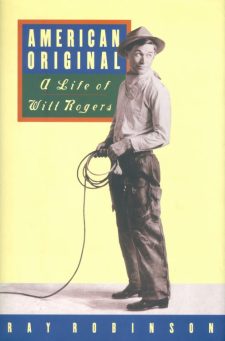 Hailed by The New York Times as “America’s Aristophanes,” Will Rogers was one of this century’s most astute and beloved humorists. If, as he often remarked, that he never met a man he didn’t like, it is also true that Rogers never met a man he didn’t like to make fun of. Everyone from congressmen and Presidents to Hollywood movie moguls and wealthy industrialists bore the brunt of his gently lacerating wit – and seemed, mostly, to be charmed in the process. So popular did Rogers become – through dozens of films, a daily column that ran for nine years in newspapers across the country, and countless lectures and stage performances – that he was often urged to run for Congress and even the Presidency. Upon receiving a mock appointment as Congressman-at-Large for the whole United States, Rogers protested, “I regret the disgrace that’s been thrust upon me here tonight. I’ve tried to live my whole life so that I would never become a congressman.”
In American Original, Ray Robinson chronicles the trajectory of Will Rogers’ remarkable life. Written with engaging immediacy and filled with a wealth of delightful anecdotes, this lively portrait follows Rogers from his childhood in the Indian Territory of what is now Oklahoma, to his first spellbinding lariat performances in the Wild West shows (where he would often lasso prominent audience members and drag them on stage), to his stardom in vaudeville and the Ziegfeld Follies, to his early silent movies and the later “talkies,” and finally to his astonishing influence as a “cowboy philosopher” columnist read by over 40 million Americans. Far more than other biographers, Robinson excels at conveying Rogers’ impact as a political commentator (“I belong to no organized political party. I am a Democrat.”) and his great success as an actor in Hollywood, where he was the leading star of Fox Films. And along the way, Robinson paints a vibrant portrait of one of America’s most colorful eras. We follow the early evolution of modern entertainment, enjoy vivid snapshots of W.C. Fields, Charlie Chaplin, Florenz Ziegfeld, Eddie Cantor, Samuel Goldwyn, Shirley Temple, and John Ford, and, perhaps most important, witness the major political events of the era through Will Rogers’ uniquely perceptive eyes.
American Original succeeds most appealingly in bringing Will Rogers before us with all the spontaneity, intimacy, and honesty of a live performance. In it we are given front row seats to the life of a character unabashedly American and unforgettably original.
RAY ROBINSON is a veteran magazine editor and sportswriter. He is the author of the widely acclaimed biography Iron Horse: Lou Gehrig in His Time, Oh, Baby, I Love It!, with Tim McCarver, and Matty: An American Hero. He lives in New York City.
Hardcover, dust jacket – 288 pp., index – Dimensions 24 x 16 cm (9,5 x 6,3 inch) – Weight 578 g (20,4 oz) – PUBLISHER Oxford University Press, New York, New York, 1996 – ISBN 0-19-508693-7
American Prince: A Memoir (Tony Curtis, with Peter Golenbock)
Autographed copy Tony Curtis
 “All my life I had one dream and that was to be in the movies.”
He was the Golden Boy of the Golden Age. A prince of the silver screen. Dashing and debonair, Tony Curtis arrived on the scene in a blaze of bright lights and celluloid. His good looks, smooth charm, and natural talent earned him fame, women, and adulation – Elvis copied his look and the Beatles put him on their Sgt. Pepper album cover. But the Hollywood life of his dreams brought both invincible highs and debilitating lows. Now, in his captivating, no-holds-barred autobiography, Tony Curtis shares the agony and ecstasy of a private life in the public eye.
No simple tell-all, American Prince chronicles Hollywood during its heyday. Curtis revisits his immense body of work – including the unforgettable classics Houdini, Spartacus, and Some Like It Hot – and regales readers with stories of his associations with Frank Sinatra, Laurence Olivier, director Billy Wilder, and film industry heavyweight Lew Wasserman, as well as paramours Natalie Wood and Marilyn Monroe, among others.
As forthright as he is enthralling, Tony Curtis offers intimate glimpses into his succession of failed marriages (and the one that has endured), his destructive drug addiction, and his passion as a painter. Written with humor and grace, American Prince is a testament to the power of living the life of one’s dreams.
TONY CURTIS is one of Hollywood’s greatest stars. Today, he lives with his wife, Jill, outside of Las Vegas, where he continues to create paintings that have made him famous as a visual artist the world over. They are the founders of the Shiloh Horse Rescue and Sanctuary, a nonprofit foundation that rehabilitates abused and neglected horses for adoption. Visit them at ShilohHorseRescue.com. PETER GOLENBOCK has written six New York Times best-sellers over a thirty-year career. In 2006 he co-wrote the best-selling Idiot with then-Boston Red Sox, now-New York Yankee outfielder Johnny Damon. His book, Seven, about Mickey Mantle, was publsihed in 2007.
Hardcover, dust jacket – 364 pp., index – Dimensions 24 x 16 cm (9,5 x 6,3 inch) – Weight 688 g (24,3 oz) – PUBLISHER Harmony Books, New York, New York, 2008 – ISBN 978-0-307-40849-5
America’s Queen: The Life of Jacqueline Kennedy Onassis (Sarah Bradford)
 Jacqueline Kennedy Onassis has captivated the American public for more than five decades. From her introduction to the world as “debutante of the year” in 1947 to her death in 1994, she truly remained America’s answer to royalty. In America’s Queen, the acclaimed biographer of Queen Elizabeth and Princess Grace presents the real Jackie in a sympathetic but frank portrait of an amazing woman who has dazzled us since her teenage years.
Sarah Bradford has written a timely celebration of a life that was more private than commonly supposed. The range of her interviews is extraordinary. We hear from people from every era of Jackie’s life, including many who have never spoken in such depth on record before – childhood intimates, Bouvier and Auchincloss relations, Kennedy family members and friends, Washington insiders, observers of the Onassis years, and admirers and colleagues from her professional life in New York. Using the insights gained from these remarkable reminiscences, Bradford is able to make a coherent picture out of the otherwise disparate and puzzling chapters of Jackie’s life, from the aristocratic milieu of Newport and East Hampton to political Washington, the Greek isles, and New York’s publishing community.
Jackie’s privileged upbringing instilled rigid self control while her expedient marriage into the overwhelming Kennedy clan consolidated her determination. Revealing new testimony from many of the couple’s friends shows the profound complexities both of this apparently very public relationship and of her controversial marriage to Aristotle Onassis. Here is the private Jackie – neglected wife, vigilant mother, and working widow.
Complete with rare and previously unseen photographs from the private collections of Jackie’s friends and family, America’s Queen portrays the woman behind the public persona – resourceful, controversial, loving, demanding, giving – in the most complete, and completely convincing, life story yet written.
SARAH BRADFORD is a historian and biographer. She is the best-selling author of several biographies, including Disraeli, selected as a New York Times Notable Book of the Year, George VI; Princess Grace, and The New York Times best-seller Elizabeth. Married to the Viscount Bangor, she lives in London.
Hardcover, dust jacket – 500 pp., index – Dimensions 24 x 16 cm (9,5 x 6,3 inch) – Weight 826 g (29,1 oz) – PUBLISHER Viking, New York, New York, 2000 – ISBN 0-670-89191-6
Among the Rugged Peaks: An Intimate Biography of Carla Laemmle (Rick Atkins)
Autographed copy Carla Laemmle
 “Some movie fans may ask, who is Carla Laemmle? Let’s begin at the beginning. Nearly 100 years ago she was born Rebekah Isabelle Laemmle, the only daughter of Joseph and Carrie “Belle” Norton Laemmle, who were residents of Chicago, Illinois. It is this period of American history that sets her story apart from other film bios, for Rebekah Isabelle, or Carla as she became known, is the niece of the late movie mogul, Carl Laemmle, founder of Universal Pictures Corporation.
Carl Laemmle and his older brother, Joseph, were German immigrants who had successfully made “good” in America. However, as Joseph advanced in years, his brother, Carl, asked that he and his family relocate to California. In January 1921, at the age of 11, young Carla with her parents and maternal grandmother, Emogene Isabelle Norton, made the big move from Chicago to Universal City, California, a fledgling six-year-old incorporated community on 230 acres of land in Lankershim Township, which is on the north side of the Hollywood Hills. Mr. Laemmle purchased it for $ 165,000,00. Universal City was dedicated solely to the making of motion pictures.
Carla had studied dance since the age of six and won notoriety in Chicago as a prodigious success. Upon arrival in California, she was enrolled in the Ernest Belcher School of Dance. At the age of 16, then known as Beth Laemmle, she was cast in a small part as the Prima Ballerina in the 1925 Universal production, The Phantom of the Opera starring Lon Chaney, “the man of a thousand faces.”
Growing up at Universal was a life-changing experience for Miss Laemmle. She witnessed the filming of several of her uncle’s classic movie productions, many of which took place on the backlot. A small part in a 1931 Universal movie would earn Carla Laemmle a cult following. The movie was Dracula, which starred Bela Lugosi.” – From the Prologue.
Softcover – 220 pp., index – Dimensions 23 x 15 cm (9,1 x 5,9 inch) – Weight 390 g (13,8 oz) – PUBLISHER Midnight Marquee Press, Inc., Baltimore, Maryland, 2009 – ISBN 978-1-887664-91-2
Andrzej Wajda: History, Politics, and Nostalgia in Polish Cinema (Janina Falkowska)
 The work of Andrzej Wajda, one of the world s most important filmmakers, shows remarkable cohesion in spite of the wide ranging scope of his films, as this study of his complete output of feature films shows. Not only do his films address crucial historical, social and political issues; the complexity of his work is reinforced by the incorporation of the elements of major film and art movements such as Socialist Realism, Italian Neorealism, the documentary tradition, French New Wave, Surrealism, the grotesque, the theater of the absurd, propaganda film, Polish Romantic tradition and many other artistic phenomena (jazz, Polish student subculture). It is the reworking of all these different elements by Wajda, as the author shows, which give his films their unique visual and aural qualities.
JANINA FALKOWSKA is Professor in the Film Studies Department at the University of Western Ontario in London, Ontario, Canada, specializing in East-Central and Western European cinemas. Her publications include The Political Films of Andrzej Wajda (Berghahn Books 1996), National Cinemas in Post-War East-Central Europe (ed.), and, co-authored with Marek Halthof, The New-Polish Cinema (Flick Books 2003).
Hardcover – 340 pp., index – Dimensions 23,5 x 15 cm (9,3 x 5,9 inch) – Weight 626 g (22,1 oz) – PUBLISHER Berghahn Books, New York, New York, 2007 – ISBN 1-84545-225-9
And the Show Goes On: Broadway and Hollywood Adventures (Sheldon Leonard; foreword by Andy Griffith)
 In a career that has spanned more than 60 years, Sheldon Leonard, among his many other accomplishments, has never lost his sense of humor. It is this quality that provides the driving force of his memoir, recapturing those antic moments and the comic routines, the gags and the pratfalls, and the enormous joie de vivre that have marked his wonderfully creative and eventful life.
Born in New York City, Leonard spent his first decade in show business on Broadway, appearing in such smash comedy hits of the 30s as Three Men on a Horse, Having Wonderful Time, and Kiss the Boys Goodbye. But when he answered the call from Hollywood, it wasn’t long before he dropped the comic mask to assume his most enduring movie image, the gun man / gangster who was to share the screen with William Powell, Myrna Loy, Humphrey Bogart and Lauren Bacall, as well as Abbott and Costello – and to menace them all. Though he appeared in memorable films like Tortilla Flat, It’s a Wonderful Life, and Guys and Dolls, he was almost always typecast as the heavy. And so, as the 50s began, it was time for his career to change direction, heading first for radio and then for the advancing ice floe known as television.
And, of course, in television Leonard has made his greatest contribution to popular entertainment. Occasionally as actor, more often as writer, but mainly – and resoundingly – as producer and director, his credits include some of the most successful and beloved TV series of our time, among them The Danny Thomas Show, The Andy Griffith Show, The Dick Van Dyke Show, Gomer Pyle, U.S.M.C., and I Spy. Leonard’s account of how these series were created and sustained is in many ways the heart of his memoir. In this strange new world his close encounters with actors, writers, sponsors, and networks are vividly and often hilariously recalled, and his pioneering work in location shooting for I Spy yields a worldwide travelogue, from Mexico to Morocco, with stops in Italy, Hong Kong, Greece (during a revolution), China, and the Soviet Union.
Leonard’s enviable record and his remarkable multifaceted career are recalled to life here with gusto, honesty, barbed wit, and no regrets. How can there be any regrets when Leonard continues his 63-year love affair with his wife Frankie, when his co-workers and friends have ranged from Clare Booth Luce and Jack Benny to Charles Laughton and Bill Cosby, when his golf handicap is down and the blue marlin are running – and when his 87 years have been filled with laughter? Laughter that he is only too happy to share.
Hardcover, dust jacket – 229 pp. – Dimensions 23,5 x 15 cm (9,3 x 5,9 inch) – Weight 561 g (19,8 oz) – PUBLISHER Limelight Editions, 1995 – ISBN 0-87910-184-9
Angela Lansbury: A Life on Stage and Screen (Rob Edelman, Audrey E. Kupferberg)
 To millions of television viewers both here and abroad Angela Lansbury is Jessica Fletcher, mystery-writer sleuth on the long-running hit television series Murder, She Wrote. But in fact Ms. Lansbury is much more than that. She earned renown as a character actress in films in the 1940s and added luster with stardom on Broadway before achieving fame on the small screen.
Angela Lansbury: A Life on Stage and Screen is an up-close and intimate portrait of one of America’s most popular and admired actresses. It follows her career from its beginning in such films as Gaslight, The Picture of Dorian Gray, State of the Union, and The Manchurian Candidate to her conquest of Broadway. There she won additional kudos and cemented for all time her status as show business legend by starring in the smash-hit musical Mame. No Great White Way one-shot, she went on to win three other Tony Awards after Mame – in Gypsy, Dear World, and Sweeney Todd. In the 1990s, she introduced herself to a whole new generation in her role as Mrs. Potts in the animated feature Beauty and the Beast.
Lansbury’s life has been a fascinatingly active one. At an age when most young women are thinking about proms and Saturday night dates, Lansbury was already an MGM contract player. And this was after a brief career as a chanteuse in a Montreal nightclub. When others her age were deciding on a college major, she had already received two Academy Award nominations. Today, in her early seventies, she is a vital spirit who relishes each new creative endeavor.
Still, Lansbury’s career has had its share of failures and frustrations. In her twenties she was usually cast as “the other woman” or a middle-aged heavy. And her life, off camera, while mainly happy and fulfilled, has been touched by high drama. Her much-loved father passed away when she was only nine years old, and she came to America as a refugee from the London blitz. Her first marriage, to actor Richard Cromwell, was brief and controversial. Although her second marriage to Peter Shaw has been lasting and gratifying, their two children temporarily became victims of the 1960s drug culture.
Ultimately, this book is a warm, deeply human portrait of a woman who continues to respond to the triumphs and tragedies of an extraordinary life.
ROB EDELMAN is contributing editor to Leonard Maltin’s Movie and Video Guide and director of programming at Home Film Festival, which rents select videotapes by mail throughout the country. His work appears in several books, and he has written for dozens of periodicals (from American Film to the Washington Post). AUDREY E. KUPFENBERG is a film consultant, archivist, and appraiser. She is the former director of the Yale Film Study Center, assistant director of the National Center for Film and Video Preservation at the American Film Institute, and project director of the American Film Institute Catalogue. She and Mr. Edelman are married and live in upstate New York.
Hardcover, dust jacket – 287 pp., index – Dimensions 23,5 x 16 cm (9,3 x 6,3 inch) – Weight 674 g (23,8 oz) – PUBLISHER Birch Lane Press, New York, New York, 1996 – ISBN 1-55972-327-0
De Animatiefilm Vóór en Na Walt Disney: Een Historisch-Artistiek Panorama (Robert Vrielynck)
 Weinig of niets van wat door mensen wordt ondernomen, is alomvattend en volmaakt. Deze waarheid ervaart ook degene, die over animatiefilm schrijft en aldus poogt dit medium dichter bij het publiek te brengen. Ofschoon door velen nog steeds als marginaal beschouwd, was de animatiefilm reeds het voorwerp van een onoverzichtelijke hoeveelheid publicaties allerhande. Het kon dan ook geenszins de bedoeling zijn hier nu de som van dit alles te brengen en al het voorheen gepresteerde overbodig te maken.
De enige overmoed die werd opgebracht bestond erin waar nodig historische of chronologische rechtzettingen te doen en waar mogelijk nieuwe visies te ontwikkelen met de bedoeling een juist inzicht in de behandelde stof te bewerkstelligen. Bovendien werd gewillig rekening gehouden met de wens van de uitgever om naar een algemeen en jeugdig publiek toe te schrijven, omdat zulks een uitstekende gelegenheid bood belangstelling te wekken bij oningewijden en ze meteen een werk van blijvende waarde te bezorgen.
Om de leesbaarheid maximaal te vergroten, wordt in een glossarium toelichting verschaft over de gebruikte termen en worden de belangrijkste procédés beschreven. Tevens worden de biografieën van een aantal vooraanstaande cineasten op overzichtelijke wijze in een lexicon samengebracht. Specialisten en kenners hoeven dus de wenkbrauwen niet te fronsen; zowel schrijver als uitgever vonden het jammer niet uitgebreider en vollediger te kunnen zijn. De opdracht liet zulks niet toe. Niettemin zullen beiden zich gelukkig prijzen wanneer blijkt dat weer eens ruimere belangstelling is ontstaan voor de animatiefilm, die door haar veelzijdige aspecten jong en oud kan boeien.
Hardcover, dust jacket – 210 pp. – Dimensions 26,5 x 21,5 cm (10,4 x 8,5 inch) – Weight 1.080 g (38,1 oz) – PUBLISHER Meddens, 1981
Anita Loos: A Biography (Gary Carey)
 Although it was her slice-of-flapper-life novel, Gentlemen Prefer Blondes, that made her an international celebrity in 1925, Anita’s output – of screenplays, stories, plays, articles and more – was enormous, and her career spanned seventy years. She was a celebrated Hollywood figure until her death in 1981; she moved in the literary circles of the twenties, thirties and forties; and on the 100th anniversary of her birth, she remains the enduring symbol of the Age of the Flapper. And yet, Anita Loos was a much more complicated woman than her work suggests. Now, drawn on previously unpublished diaries, letters and scrapbooks, Gary Carey – author of highly praised biographies of Douglas Fairbanks and Mary Pickford, and of Louis B. Mayer – gives us the first full-scale life.
Anita Loos was as much a product of the Victorian era in which she was born (1888) as the flaming-youth decade in which she made her name. Her diaries reveal a woman who was disciplined, resilient, and morally fastidious. And though she enjoyed the company of the hustlers, kept ladies, and con men she immortalized in her writing, it was her very difference from them that enabled her to portray them with such insight and humor. It was her mixture of the raffish and the bourgeois that made for her – and her work – a unique and lasting place within our culture.
We see her as a teenager in San Diego taking bit parts in local productions to please her father, whom she adored and through whom she got her first taste of life among the roués. We see her, as her family finances shrink, becoming a dependable provider at nineteen, beginning to write – by age twenty-four she had sold four filmscripts to D.W. Griffith’s Biograph Company.
We see her writing scripts for Fairbanks and Pickford (The New York Hat), Jean Harlow (it was Anita who created the concept of the Blonde Bombshell), William Randolph Hearst (for his mistress Marion Davies)… beginning to publish stories in Vanity Fair.
We witness the birth of Gentlemen Prefer Blondes – as she writes it to amuse her pal H.L. Mencken – and the furor that surrounded its publication; the first edition selling out immediately without benefit of reviews, and numbering among its earliest fans William Faulkner, James Joyce, and Aldous Huxley… and we see how the book became its author’s entrée into the world of cultural “demigods” she had admired since girlhood. We follow her friendships with Lillian and Dorothy Gish, Constance Talmadge, Huxley, Chaplin, The Cole Porters, Cecil Beaton, and Helen Hayes. We see her writing for Broadway (Gigi, Chéri, Blondes) and Hollywood (Red-Headed Woman, Riffraff, San Francisco, The Women, Susan and God, A Tree Grows in Brooklyn, and many others). And we follow the long, rocky course of her mostly unhappy marriage John Emerson, a producer much less successful than, and very jealous of, his wife.
And throughout, beneath the mask of independence and insouciance that Anita Loos showed the world, we see the shy, deeply reserved woman who worked exceptionally hard not only to earn recognition as a writer but to be as witty, amusing, and worldy-wise as the characters she so brilliantly created.
Anita Loos is a revelation of a true American original.
GARY CAREY was born in Chester, Pennsylvania, and graduated from Columbia University. He is the author os All the Stars in Heaven, Doug and Mary, Katharine Hepburn: A Hollywood Yankee, Marlon Brando: The Only Contender and Judy Holliday: An Intimate Life Story. He lives in Brooklyn, New York, with his wife and son.
Hardcover, dust jacket – 331 pp., index – Dimensions 24,5 x 16 cm (9,7 x 6,3 inch) – Weight 791 g (27,9 oz) – PUBLISHER Alfred A. Knopf, New York, New York, 1988 – ISBN 0-394-53127-2
Anita Loos Rediscovered: Film Treatments and Fiction by Anita Loos, Creator of Gentlemen Prefer Blondes (edited and annotated by Cari Beauchamp, Mary Anita Loos)
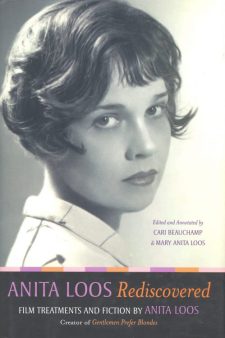 Anita Loos (1888-1981) was one of Hollywood’s most respected and prolific screenwriters, as well as an acclaimed novelist and playwright. This unique collection of previously unpublished film treatments, short stories, and one-act plays spans fifty years of her creative writing and showcases the breadth and depth of her talent. Beginning in 1912 with the stories she sent from her San Diego home to D.W. Griffith, through her collaboration years later with Colette on the play Gigi, Anita Loos wrote almost every day for the screen or stage, or for book or magazine publication. The list of stars for whom she created unforgettable roles includes Mary Pickford, Jean Harlow, Clark Gable, Audrey Hepburn, and Carol Channing.
This collection was personally selected by Anita’s niece and close friend, the best-selling author Mary Anita Loos, together with the acclaimed film historian Cari Beauchamp. Their essays are laced throughout the volume, providing fascinating introductions to Anita’s writings and offering previously untold insights and behind-the-scenes stories about Anita – her life, her friendships, and her times.
CARI BEAUCHAMP is the author of Without Lying Down: Frances Marion and the Powerful Women of Early Hollywood (California, 1998) and Hollywood on the Riviera: The Inside Story of the Cannes Film Festival (1992). Mary Anita Loos is the author of A Pride of Lovers (1981), The Barstow Legend (1978), Belinda (1976), and The Beggars Are Coming (1974).
Hardcover, dust jacket – 310 pp., index – Dimensions 23,5 x 15,5 cm (9,3 x 6,1 inch) – Weight 636 g (22,4 oz) – PUBLISHER University of California Press, Berkeley, California, 2003 – ISBN 0-520-22894-4
Anjelica Huston: The Lady and Her Legacy (Martha Harris)
 Hollywood has never seen a dynasty like the Hustons. Three generations of the Huston clan have made film history by twice winning dual Oscars. First John Huston won an Academy Award by directing his father, Walter, in the Oscar-winning role of the old prospector in The Treasure of the Sierra Madre. Then, almost forty years later, John won himself another Oscar for directing daughter Anjelica in her Academy Award-winning role of Maerose Prizzi in Prizzi’s Honor.
Although Anjelica may have inherited a legacy of theatrical talent, her quest for fame and success got off to a rocky start. The daughter of the hell-raising, philandering, and brilliantly talented director John Huston and his fourth wife, the ballerina Enrica Soma, Anjelica grew up in a sheltered lrish castle. At sixteen, Anjelica was suddenly thrust into the limelight when her father cast her in a leading role in A Walk With Love and Death. The film was a critical and commercial disaster; Anjelica felt as if she had let her father down. And then, just as Anjelica was faced with unflattering reviews of her screen debut, her mother died in a fatal car accident.
Slowly, but with an iron will, Anjelica has persevered on a course that has won her respect and acclaim. From the modeling career that was launched when Richard Avedon’s photographs of her were featured in Vogue, to her fifteen-year relationship with Jack Nicholson, to her highly praised performances in Garden of Stone and The Dead, Anjelica has proven that she can accomplish whatever she desires.
Some stars are “discovered,” but Anjelica climbed to the top by herself and made the whole world take notice. This absorbing, detailed biography of the Academy Award-winning actress tells how she did it.
MARTHA HARRIS lives in Baton Rouge, Louisiana.
Hardcover, dust jacket – 206 pp., index – Dimensions 21,5 x 14 cm (8,5 x 5,5 inch) – Weight 386 g (13,6 oz) – PUBLISHER St. Martin’s Press, New York, New York, 1989 – ISBN 0-312-02541-6
Anna May Wong: From Laundryman’s Daughter to Hollywood Legend (Graham Russell Gao Hodges)
 Anna May Wong is, undoubtedly, the most luminous Chinese American actresses ever to grace the silver screen. Between 1919 and 1960 she starred in over fifty films and shared equal billing with Douglas Fairbanks Sr., Marlene Dietrich, and Warner Oland. But her life, though glamorous, is almost the prototypical story of an immigrant’s difficult path through America. Born in Los Angeles in 1905, she was the second daughter of eight children born to a laundry-man and his wife. Growing up in Los Angeles fuelled her fascination with Hollywood, and in 1919 she secured a small part in her first film, The Red Lantern with Alla Nazimova. Her most famous film roles were in Toll of the Sea, Piccadilly, The Thief of Bagdad, Daughter of the Dragon, and, most importantly, Shanghai Express, opposite Marlene Dietrich. Anna May Wong was an international celebrity whose friendships with intellectuals and artists included the famed Chinese actress Butterfly Wu, Walter Benjamin, Carl Van Vechten, Paul Robeson, Edward Steichen, and Mei Lan Fan. Even though Anna May Wong made many landmark films, discrimination against Asians in Hollywood insured that she was passed over for the lead role in the film version of Pearl Buck’s The Good Earth. Apparently Wong was “too Asian” for the role. The British Film Institute recently released a newly restored version of Wong’s classic film Piccadilly and the world will, once again, thrill to the artistry of this great actress. Graham Hodges’ biography of Anna May Wong rediscovers one of Hollywood’s most legendary actresses and is a must for film lovers.
GRAHAM RUSSELL GAO HODGES is Professor of History at Colgate University and is the author of many books on New York City and African American history.
Hardcover, dust jacket – 284 pp., index – Dimensions 24 x 16 cm (9,5 x 6,3 inch) – Weight 643 g (22,7 oz) – PUBLISHER Palgrave MacMillan, New York, New York, 2004 – ISBN 0-312-29319-4
Ann-Margret: My Story (Ann-Margret with Todd Gold)
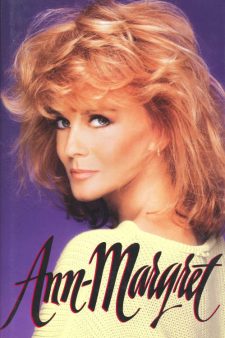 Ann-Margret has dazzled screen and stage audiences as few entertainers in our time. Her appearance in movies such as Bye Bye Birdie, Carnal Knowledge, and Tommy, and in the acclaimed television miniseries The Two Mrs. Grenvilles and Queen, and her recent record-breaking shows at Radio City Music Hall have made her a woman loved and admired, not just for her beauty and her legend, but for herself.
Yet until now the public has known only Ann-Margret the star. Finally we hear from Ann-Margret the woman.
For years the Hollywood gossip mills portrayed her as self-destructive, an actress of bristling nerves, a wife controlled by a Svengali husband, and finally, a tragic heroine. For the first time, Ann-Margret opens the door to her private world, in a memoir that tells her life as it really was. Relentlessly honest, these pages are filled with warmth, wit, poignancy, and truth.
Readers wil learn of her moving, longtime relationship with Elvis Presley; her battle with and inspiring recovery from alcohol abuse; her loss and reclamation of her self-esteem; and her harrowing twenty-two-foot fall onstage, after which doctors feared she would never dance again. Readers will also learn the story behind her twenty-nine-year love affair with husband Roger Smith, and of his battle with myasthenia gravis, a disease that forced Ann-Margret, who had always been protected by her husband and family, to take control of not only her life but her husband’s as well. Here, too, are wonderful behind-the-scenes tales about co-stars Bette Davis, George Burns, John Wayne, Jack Nicholson, and Steve McQueen, to name a few.
But Ann-Margret: My Story is ultimately about this remarkably candid woman herself, finding her own way, seeking independence, becoming an accomplished actress and – more important – a woman of guts, humor, energy, and inspiration.
ANN-MARGRET lives with her husband and business partner, Roger Smith, in Beverly Hills. TODD GOLD, the co-author of numerous best-selling autobiographies, lives in Los Angeles.
Hardcover, dust jacket – 336 pp., index – Dimensions 24 x 16 cm (9,5 x 6,3 inch) – Weight 753 g (26,6 oz) – PUBLISHER Orion Books, Ltd., London, 1994 – ISBN 1-85798-366-6
Anne Baxter: A Bio-Bibliography (Karin J. Fowler)
 Actress Anne Baxter made her Broadway debut at age thirteen and won an Academy Award for Best Supporting Actress in films at age twenty-three. In a long and successful career on stage, screen, radio, and television, she played her most memorable roles as Sophie MacDonald in The Razor’s Edge (1946) and as Eve Harrington in All About Eve (1950), two enduring film classics. Baxter also led a diverse personal life, including an arduous and lonely stint as a pioneer wife in the Australian outback, which was related in her best-selling memoir, Intermission: A True Story (1976).
This bio-bibliography describes her life and career in a biography and chronology, and details her achievements in the different production media, with full credits, synopses, and review sources provided for the films and plays. An extensive bibliography notes focused and passing treatment of Baxter in a wide variety of books and periodicals.
Hardcover – 296 pp., index – Dimensions 24 x 15,5 cm (8,5 x 5,7 inch) – Weight 664 g (23,4 oz) – PUBLISHER Greenwood Press, Westport, Connecticut, 1991 – ISBN 0-313-27543-2
Anthony Hopkins: Too Good to Waste (Quentin Falk)
 Now 52 of age, Anthony Hopkins is enjoying the most successful period of his acting career, having created a string of memorable roles – on film, stage and television – including King Lear, Donald Campbell, Captain Bligh, Quasimodo, Pierre in War and Peace, Lambert Le Roux in David Hare’s Pravda and culminating in the tragically and ironically lovelorn Rene Gallimard in M. Butterfly, the phenomenal Broadway and West End stage hit.
Yet success has not come easily. Dogged by insecurity stemming from a lonely childhood and underachievement at school, Hopkins started to drink heavily just as his acting career seemed poised to take off. He put his professional reputation in jeopardy by arguing with directors and storming out of the National Theatre, and left his first wife and baby daughter for the indulgences of a Hollywood career.
In 1975, he woke up in a hotel room in Phoenix, Arizona, with no recollection of how he had got there. He suddenly found divinely inspired strength to declare his alcoholism openly and make a fresh start. For this, the first-ever authorized biography, QUENTIN FALK has interviewed family, friends, colleagues and critics about this remarkable actor’s life and career – a career that was, as Hopkins eventually admitted to himself, too good to waste.
Softcover – 210 pp., index – Dimensions 23,5 x 15 cm (9,3 x 5,9 inch) – Weight 458 g (16,2 oz) – PUBLISHER Virgin Books, London, 1995 – ISBN 0-352-32663-8
Anthony Mann (Jeanine Basinger)
 Director of such often-revived films as Winchester ’73, The Glenn Miller Story, and El Cid, Anthony Mann enjoyed a lasting and important career as one of Hollywood’s premier filmmakers. Mann’s Westerns, noir pictures, and epics are admired and studied by fans and scholars alike, and he was an expert in the fundamental elements of cinema (movement and placement of the camera, composition in the frame, and careful editing). Jeanine Basinger’s Anthony Mann, which places the director’s visual style at the center of its analysis, was among the first formal studies of any filmmaker, and it set a standard in the field over twenty-five years ago. Long out of print and much in demand, this pioneering book is now available again, featuring complete coverage of those Mann films not discussed in the original work, as well as over fifty rare film stills. Wesleyan is proud to issue this expanded edition of an essential text, making it available to new generations of filmgoers and readers.
JEANINE BASINGER is Corwin-Fuller Professor of Film Studies at Wesleyan University, founder and curator of the Wesleyan Cinema Archives, and the author of nine books on film, including Silent Stars (1999) and The Star Machine (2007). She is a trustee of the National Board of Review and a trustee emeritus of the American Film Institute.
Softcover – 215 pp., index – Dimensions 22,5 x 15 cm (8,9 x 5,9 inch) – Weight 358 g (12,6 oz) – PUBLISHER Wesleyan University Press, Middletown, Connecticut, 2007 – ISBN 0-8195-6845-7
The Apu Trilogy (Robin Wood; edited by Ian Cameron)
 “One likes to begin a book with a bit of controversy, punching a few critical noses and offering one’s own for the return poke or smash that all too seldom comes. The reader always enjoys finding a few insults bandied around: aside from the dubious pleasure of sharing in a probably quite unjustified feeling of superiority, it gives him the sense that there must be some issue at stake for him to make up his own mind about. Alas, in the case of Satyajit Ray, it is next to impossible to achieve this desirable effect: there seems never to have been any controversy about him.
This certainly does not mean that there is uniformity of opinion about the value of his work: the critics with whom my own name has most often been linked, the founders and authors of Movie, reject him to a man. But then ‘reject’ is altogether too strong a word. Rather, they offer him the insult that is beyond insult: they ignore him. One once told me that Pather Panchali ‘seemed quite a nice little film,’ which seems to be about the maximum enthusiasm Ray’s films have aroused in those quarters. Critics who detest Jean-Luc Godard and Ingmar Bergman usually find them sufficiently interesting and stimulating to be worth the bother of attacking, but Ray appears to provoke in his detractors nothing more intense than apathy. Where most of Godard’s detractors wouldn’t dream of missing a new Godard film, there is a general sense among Ray’s that Mahanagar and Charulata wouldn’t be worth the time and bus fare. The corollary is that Ray’s admirers (in print at least) tend to be critics of the conservative Establishment. Film enthusiasts who don’t know Ray’s war well at first hand probably build up a mental image of it as the sort of primitive and literary cinema that has a solid, dull worthiness but is difficult spontaneously to enjoy or get excited about.
I propose to begin by attempting to do the detractors’ work for them: to elaborate, out of the shrug of indifference which is the most those hostile to his work seem willing to offer, a case against Ray (in order, naturally, refute it); to imagine, that is, the obstacles that interfere with other people’s response to films that have always communicated very directly and movingly to me.” – From The Introduction.
Satyajit Ray’s Panther Panchali was the first Indian film to gain much critical acclaim abroad. The remaining films in the trilogy, Aparajito (The Unvanquished) and The World of Apu, confirmed, even increased Ray’s reputation. This volume analyses the three films which remain Ray’s best-known work.
Softcover – 95 pp. – Dimensions 16,5 x 15 cm (6,5 x 5,9 inch) – Weight 133 g (4,7 oz) – PUBLISHER November Books, Ltd., London, 1972 – SBN 85631 002 6
Are the Stars Out Tonight? The Story of the Famous Ambassador Hotel and Cocoanut Grove, “Hollywood’s Hotel” (Margaret Tante Burk)
 “Two points I want to make. The first, the story of the great Ambassador Hotel had to be told. For it was and is a vital cog, a veritable chronological moving part and motivation in the wheels of Los Angeles and Hollywood, then and now. A Los Angeles that keeps exploding with its newness and uniqueness, and a Hollywood that is legend second only to Camelot itself… a kingdom like Oz, a glory such as Greece, and a grandeur not unlike Rome.
And in the Ambassador that is home to both, this dazzling past, the hotel’s famous and beauteous people’s astonishing stories had never been recorded for posterity. Would that I could have had this warehouse of plots when I was penning stories for films and magazines. It’s safe to say that millions of features, articles and columns have been written but no real honest-to god book. Dramatic and historical data yes, but so voluminous with its thousands of characters and events, that no one dared tackle it until she came face to face, ear to ear and eye to eye with it. She? That’s the second point.
Every once in a while you see somebody and think, ‘Ah, there’s somebody I’d like to meet!’
And not often, but once in a while, you meet that person and say to yourself, ‘Now, this is someone I’d like to know better!’ And then every day, month or year you are glad you met her and richly delighted as you know her better. Having set that all down, then comes to me first of anybody, very clearly the name Margaret Burk. Of course, obviously since Mrs. Burk is the famed and coast to coast and border to border popular public relations executive, including in her portfolio the great and unequalled Ambassador Hotel, she has known and been loved by and leaned on by all the famous stars of every walk of life who have lived for five minutes or five years at the Ambassador. I want to put this down very carefully and clearly…
I have never known any woman so truly kind and so utterly without self-aggrandizement in my life. She is always thinking about you… about your needs or want… never about herself.
Because of these rare qualities she has been confided in… talked to… sought out… by all the greats that pass through this internationally loved hotel… and I should say with the greatest guest list of any hotel in America. Her mind being both dramatic and sensitive she has been told and remembered tales only she has heard. How she manages to be top in her field and retain such dignity… I don’t know. But she does. And it is we who are hoping she will enjoy and keep us under her wing. She has aided the Ambassador in becoming one of the really rare places.
As a journalist friend of mine Jane Gilman wrote, ‘The six most valuable words in many an Angelino’s vocabulary are: “I’m a friend of Margaret Burk’s.’ These may lead you into an interview on a television show, a recording contract, an art exhibit, a meeting with a celebrity or main attraction of an event that attracts thousands. ‘She thrives on challenge and hospitality, and when the phone rings in her plaque and trophy decorated office at the Ambassador, she is ready to help… whether business or no.’ You see what kind of a person I’m telling you about? And the natural outcome of the two coming together was Are the Stars Out Tonight? You’ll be titillated reading about the famous elegant hotel in the very middle of the picture industry all these years. But also about the Social Elite and the Literary Lions and the Financial Fraternity who are her friends seeking both her advice and company. I know I have. Gosh, l’m glad I know her! And can sign myself her loving and admiring friend, Adela Rogers St. Johns.” – From The Introduction.
Hardcover – 192 pp. – Dimensions 28 x 21 cm (11 x 8,3 inch) – Weight 616 g (21,7 oz) – PUBLISHER Round Table West, Los Angeles, California, 1980 – ISBN 0-937806-00-5
Arletty: Confidences à son secrétaire (Michel Souvais)
 Arletty est née en 1898. Elle a connu deux siècles, deux guerres, l’occupation, le music-hall, la gloire, la peur, les femmes, les hommes. Elle a fréquenté des hommes politiques, des philosophes, des nobles, des comédiens, des dramaturges, des peintres et des écrivains. Elle s’est faite rebelle, froide, câline, spirituelle, piquante, amante, humaine, odieuse: insaisissable. Comme le prouve cette biographie.
Secrétaire particulier d’Arletty de 1978 à 1990, Michel Souvais est devenu bien plus que l’ami de la Grande Dame. Il est devenue son confident. Aujourd’hui, il revient sur le destin hors normes de l’une des figures les plus populaires et les plus légendaires de la scène et du grand écran.
Une biographie touchante et des anecdotes pleines de sensibilité et sans aucun voyeurisme, témoignage du respect profond et sincère de l’auteur pour elle dont il a partagé les dernières années.
Comédien, artiste-teintre et écrivain, MICHEL SOUVAIS, arrière-petit-fils de la Goulue, est né à Paris, dans l’êle de la Cité en 1946.
Softcover – 206 pp. – Dimensions 22,5 x 14 cm (8,9 x 5,5 inch) – Weight 293 g (10,3 oz) – PUBLISHER Éditions Publibook, Paris, 2006 – ISBN 274833224-5
Arnold: An Unauthorized Biography (Wendy Leigh)
 He’s “Arnold” to millions of fans around the world. Bodybuilding legend. Box-office superstar. Kennedy family member. But until now the real story of Arnold Schwarzenegger has never been told.
At the time of his fairy-tale marriage to Maria Shriver, his fans believed they knew all there was to know about this phenomenally successful self-made man. At twenty-one, he’d come to America from an obscure village in Austria, armed with little more than a perfectly muscled body and a fierce ambition. Nevertheless, he’d gone on to win the Mr. Olympia crown an unprecedented seven times, transforming bodybuilding into an internationally recognized sport. Then, despite a thick accent and little acting experience, he’d tackled Hollywood and emerged a major hit in such movies as Conan the Barbarian, The Terminator, Predator, and, later, Twins, becoming a millionaire many times over along the way. And, of course, he’d been linked with numerous beautiful women. Now his dazzling alliance with the Kennedy clan seemed to be the ultimate prize in a stunning rags-to-riches tale.
But what the public knows is only part of the truth. Arnold: An Unauthorized Biography tells the whole story. Based on two years of research on both sides of the Atlantic and scores of personal interviews with Arnold’s colleagues, lovers, relatives, childhood companions, friends, and rivals, the portrait that emerges is often startling. Complex, intelligent, driven, sometimes ruthless, often manipulative, Arnold is a man who has allowed little to stand in the way of his meteoric rise to success.
Journalist Wendy Leigh goes beyond the public image and explores Arnold’s troubled boyhood, his tortured relationship with his father, his sexual exploits, and his lifelong penchant for often-cruel practical jokes – jokes from which not even Maria is spared. From mentor Joe Weider to friend Kurt Waldheim, from the longstanding feud with Sylvester Stallone to the love affair with Brigitte Nielsen, from small-town gyms to celebrity mansions, the story of Arnold Schwarzenegger is a fascinating chronicle of talent, drive, bravado, charm, and opportunism.
WENDY LEIGH is an international journalist who began her career at BBC Television in London and whose articles have appeared in publications such as New Woman, Woman, US, People, Elle, and Cosmopolitan. She and her husband, Stephen Karten, who worked on this book, live in New York City.
Hardcover, dust jacket – 320 pp., index – Dimensions 24 x 16 cm (9,5 x 6,3 inch) – Weight 716 g (25,3 oz) – PUBLISHER Congdon & Weed, Inc., Chicago, Illinois, 1990 – ISBN 0-86553-216-8
L’Art du cinéma (Pierre Lherminier)
 Que le cinéma, le plus jeune des arts, apparaisse comme un pur divertissement ou une forme d’expression artistique aussi noble que la peinture, la musique ou les lettres, on ne peut nier l’importance qu’il a dans le monde entier. Derrière les images et les sons, la pensée de l’artiste (qu’il soit metteur en scène, comédien, scénariste, opérateur, monteur…) est présente et effective. Quelle est cette pensée, quels problèmes se posent à ces artistes, quelles solutions leur donnent-ils d’un film à l’autre ?…
A toutes ces questions répond l’anthologie. L’art du cinéma. Pierre Lherminier y a recueilli les textes capitaux, les propos les plus significatifs de tous ceux à qui le cinéma doit d’être un Art et non une simple industrie. Tous ceux qui ont fait eux-mêmes le cinéma s’expriment ici en hommes de métier sur ce métier et sur leur art.
Hardcover, dust jacket – 628 pp., index – Dimensions 21,5 x 14 cm (8,5 x 5,5 inch) – Weight 770 g (27,2 oz) – PUBLISHER Edition Seghers, 1960
The Art of Living Well: Looking Good, Feeling Great (Joan Collins)
Autographed copy Joan Collins
 Joan Collins is one of the most glamorous women in the world, and in The Art of Living Well she reveals the secrets of how to look amazing, whatever your age. In her latest book, Joan shares many of her life experiences and the methods she has learned about how to deal with the bad and the good things in life. She will show you how to feel better about yourself inside and consequently you will look better.
The book includes glamour and how to achieve it: Joan writes about the women she admires including Audrey Hepbum, Catherine Zeta-Jones, Ava Gardner, Marlene Dietrich and her own mother; exercise: Joan’s program is suitable for all women. She is photographed step-by-step as she works out with her daughter Katy. Looking good takes discipline and organization and Joan does these exercises several times a week wherever she is in the world. Joan’s makeup secrets: Joan is photographed from bare faced to fully made up. This chapter includes tricks she learned from leading Hollywood make-up artist Whitey Snyder, who also worked closely with Marilyn Monroe. Joan’s top tips on eating super-healthily for super-youth and super-energy. This chapter also includes recipes from her favorite restaurants around the world.
Relationships, love and sex: Joan talks frankly about “everyone’s favorite subject,” including her relationship and marriage with Percy Gibson, tips on finding the right man and her views on sexual freedom for women. Skincare secrets, including Joan’s secrets for great skin.
Assertiveness: how to speak your mind, how to say no and mean it and how to avoid being manipulated. Also, Joan’s views on financial independence and how she handles difficult people and situations. Entertaining: Joan has thrown many parties in her life and a chapter is devoted to entertaining in her unique and individual style, including the full story of her wedding. Dressing for yourself and your lifestyle: clothes to suit all body shapes. Joan is photographed in a series of classic outfits to form a basic wardrobe of 20 pieces. How to mix couture with high street and her advice on being well dressed.
Happiness: everyone’s ultimate goal. Joan has seen many highs and lows in her life and she reveals what makes her happy, how she handles conflict and bad times and her personal advice for happiness. Exclusive pictures by celebrity photographer Brian Aris, who photographed Joan’s marriage to Percy Gibson. Plus pictures from Joan’s private collection, all previously unpublished. Frank, insightful and delightfully entertaining, Joan Collins will show you how, as the years go by, you can be glamorous and stylish, look stunning, be sexy and have masses of energy… you can be just like Joan!
JOAN COLLINS is one of the most recognizable women in the world. As an actress she has appeared in over 55 films and 50 TV shows, excluding the internationally renowned Dynasty, which not only ran for nine years on prime-time television, but still plays worldwide and has made Joan, as Alexis Carrington Colby, an icon of glamour and an inspiration to many women. She has starred on Broadway and in the West End and amassed dozens of glittering awards, including the Golden Globe for Best Actress and the People’s Choice Award for Favorite Actress. Joan has published ten books, six inspirational and autobiographical, and four novels, including her recent best-seller, Star Quality. She was honored by the Queen in 1997 with an OBE for services to drama.
Hardcover, dust jacket – 224 pp., index – Dimensions 24 x 19,5 cm (9,5 x 7,7 inch) – Weight 939 g (33,1 oz) – PUBLISHER Sourcebooks, Inc., Naperville, Illinois, 2007 – ISBN 978-1-4022-0942-0
The Art of the American Film 1900-1971 (Charles Higham)
 If any art form can properly be associated with America, surely it is the motion picture. The collected body of American film has succeeded in entertaining people throughout the world, as well as producing an admittedly smaller body that be called works of art. It is these films, and the artistic elements of other films, that are the subject of Charles Higham’s sweeping study, the first step-up-to-date history of the American film since 1939.
Basing his survey on close first-hand study of the films themselves, the author begins by discussing the evolution of the medium in the hands of such pioneers as Griffith and Ince. His fresh critical approach is intentionally at odds with the despressingly standardized analyses of most historians. Higham’s discussion moves from the directors whose work is of a largely rural bent – from Griffith in a direct line through Henry King, King Vidor and John Ford – to the school of urban sophistication fathered by Lubitsch and DeMille and continuing in Cukor, Wyler, and Capra. He shows how the gradual urbanization of the whole of American society in this century gradually destroyed the rich vein of pastoral cinema.
Higham richly illuminates the complex texture of the American film by separating out various schools, lines of influence, and development of styles. Above all, he is concerned to show how, in spite of the monolithic hardness of “the industry,” art and artists have miraculously managed to survive. No major figure is omitted, and many films thought to have been lost are discussed here at length. Through these pages, the reader can see how, in a mere seventy years, the American cinema has developed as an indigenous form, sharing with American literature and painting its humanists and anti-humanists, its sophisticated and its primitives, its pessimists and its optimists. And the collective nature of the medium is fully explored, showing the various contributions of the cinematographer, writer and actor to each film in turn.
Poet, teacher, critic, CHARLES HIGHAM brings an especially sensitive eye to bear on American film. For this major study, he worked closely with archives on both coasts, including the Library of Congress and George Eastman House. He is the author of Hollywood in the Forties, Hollywood Cameramen, and The Films of Orson Welles, and has been Regents Professor, teaching poetry and film, at the University of California, Santa Cruz.
Hardcover, dust jacket – 322 pp., index – Dimensions 24 x 16 cm (9,5 x 6,3 inch) – Weight 921 g (32,5 oz) – PUBLISHER Anchor Press / Doubleday, Garden City, New York, 1973 – ISBN 0-385-06935-9
As I Am: An Autobiography (Patricia Neal, with Richard Deneut)
 Patricia Neal’s story is the stuff that legends have been made of: The American Mother Courage with the rich molasses voice and the smoldering eyes who has been through it all and beaten the odds to become the fiery inspiration for living life to its fullest. From a triumphant career as a Tony- and Academy Award-winning actress, she has faced devastating challenges and losses – sometimes privately, sometimes before an audience of millions: a notorious and passionate long-running love affair with Gary Cooper; the brain-damaging injury of her young son, Theo, followed with tragic speed by the death of her little daughter, Olivia; a crushing series of three near-fatal strokes and a miraculous recovery that made headlines around the world; and then, as the world continued listening to fairy-tale stories of her marriage to writer Roald Dahl, the wrenching and fruitless battle to keep her husband.
It was only at that point, when she believed she had lost everything, that Patricia Neal began to write… and in the process, to face her greatest challenge yet: to remember it all; to take stock and make sense of the turbulent events of her life, a life full of unimaginable heartache and joy. It was a five-year struggle, which she confronted, characteristically, with heroic strength, anger, and humor – a process of head-on confrontation with the ghosts and demons from her past and present. Once again, she has emerged victorious, with As I Am, one of the most stunning autobiographies you will ever read.
Many have spoken and written about Patricia Neal and her valiant battles against adversity. Now, she speaks for herself, correcting the record and telling for the first time her own story of a life that has been even more dramatic than we have ever realized. She writes, brilliantly and candidly, about her relationship with Gary Cooper, which now takes its rightful place as one of the legendary Hollywood romances; about her as one of our most sensational and celebrated actresses; about the special terror and grief of helplessly watching her son and daughter in danger; about having to learn to walk, talk, and even think all over again after her stroke, and then grappling to regain the will to live; all about her tempestuous marriage to Dahl, a man who loved her and ignored her, hurt her and helped her by turns, and who finally left her; and in the face of all this, about managing to come back unbeaten again and again through the power of faith and spirit, in the process growing into the very definition of the word ‘survivor.’
And it is all written with the full force of her legendary personality, at once gutsy, witty, heartbreaking, and brutally honest, with a bad girl’s bravado and an earth mother’s compassion. Here is Patricia Neal in her greatest role, as the indomitable heroine of her own incredible real-life story. The supporting players are some of the most remarkable figures of our time, including Ernest Hemingway, Ronald Reagan, Laurence Olivier and Vivien Leigh, Lillian Hellman and Dashiell Hammett, Paul Newman, John Wayne, Jack L. Warner, Elia Kazan and Eugene O’Neill.
Even the multitudes of her admirers who have followed each courageous step of Patricia Neal’s life will be thrilled and surprised by the portrait that appears in this extraordinary work – a larger-than-life, but at the same time touchingly human and downright earthy woman. As I Am is every bit as unforgettable as Patricia Neal herself.
Hardcover, dust jacket – 372 pp., index – Dimensions 21,5 x 14,5 cm (8,5 x 5,7 inch) – Weight 541 g (19,1 oz) – PUBLISHER Simon & Schuster, New York, New York, 1988
Astaire: The Man, The Dancer (Bob Thomas)
 In January of 1933 a young Broadway star named Fred Astaire entered the RKO studios for a screen test. “Can’t act. Slightly bald. Also dances,” was the reaction of one official. Thus began the amazing film career of one of the world’s most celebrated dancers. Born Frederick Austerlitz, the son of an Austrian immigrant, Astaire soon traveled to New York with his mother and sister Adele. Together, the two young children would survive the grueling life of vaudeville road shows to become the biggest stage stars of the day, glorified and adored on both sides of the Atlantic. Starring in such hits as Lady Be Good, Funny Face, and The Band Wagon, the two worked directly with such artists as Irving Berlin, Fritz Kreisler, and George and Ira Gershwin. However, their success as a team would come to an end in 1932, after Adele quit the stage to marry the English nobleman Lord Charles Cavendish. Left to go it alone, “Moaning Minnie,” as his sister affectionately dubbed him, approached the Broadway stage with apprehension. And, just as he had feared, critics lamented the loss of Adele: “An Astaire must dance and still does very well – but not for the general good is he now sisterless.”
Undaunted by his sister’s departure and his poor screen test, Fred returned to Hollywood to be paired with another young dancer, Ginger Rogers. Rogers, who was concentrating on moving away from dancing and into straight acting, was against the idea of playing next to Astaire. However, their first attempt as a team, Flying Down to Rio, would prove to be the beginning of the most successful and dynamic partnership Hollywood has ever produced. Astaire and Rogers embodied a new kind of romance, supremely sophisticated yet accessible to everyone. Together they would go on to star in such memorable films as The Gay Divorcee, Roberta, Top Hat, Swing Time, and Shall We Dance?
In Astaire: The Man, The Dancer, Bob Thomas draws upon his forty-year friendship with Astaire in recreating the life and work of the man whose characteristic grace and style were admired for generations. Always hesitant to talk about himself, Astaire, for the first time, comments on his early youth; how he and the great choreographer Hermes Pan created his famous dance routines; each of his twenty-one dance partners, including Joan Crawford, Rita Hayworth, the erratic Judy Garland, Audrey Hepburn, Leslie Caron, Cyd Charisse, and Barrie Chase; and his passion for horse racing. He discusses how the devotion of his fans has brought him out of retirement several times; his marriage to his first wife Phyllis and her untimely death; and his love affair and marriage with a woman forty-four years his junior, jockey Robyn Smith.
Astaire: The Man, The Dancer captures the elegance and mystique of the most recognized and loved figure ever to dance across the silver screen. During nearly eighty years in every major entertainment medium, he has persevered and excelled. He never quit, never passed up an opportunity to push himself and the dance to new levels of achievement. Astaire: The Man, The Dance – the first complete, up-to-date biography – is a fitting tribute to the man and his art.
BOB THOMAS has known Fred Astaire for over forty years and interviewed him many times. Thomas is the author of over twenty books, including biographies of Brando, Disney, and Joan Crawford. His most recent book, Golden Boy: The Untold Story of William Holden, was published by St. Martin’s Press in 1983. He lives in Encino, California.
Hardcover, dust jacket – 340 pp., index – Dimensions 24 x 16 cm (9,5 x 6,3 inch) – Weight 701 g (24,7 oz) – PUBLISHER St. Martin’s Press, New York, New York, 1984 – ISBN 0-312-05783-0
As Time Goes By: Memoirs of a Writer (Howard Koch)
 Howard Koch first came to the attention of the American public on October 30, 1938, when his radio script for The War of the Worlds caused thousands of people to believe that an interplanetary battle had begun in Grovers Mill, New Jersey. Fear and panic spread throughout the East as multitudes phoned the police, sought refuge in shelters, or prayed for deliverance from aliens.
When the dust finally settled on the East Coast, there were neither Martians nor Howard Koch – he had moved to California to become one of Hollywood’s outstanding screenwriters. His screen career spans three major Hollywood studios and two decades, including his scripts for such movies as The Sea Hawk, The Letter, Sergeant York, Mission to Moscow, Letter From an Unknown Woman, and his Oscar-winning script for Casablanca, perhaps the most popular movie of all time.
Howard Koch’s memoirs include stories and anecdotes on the making of all these movies and on their stars, from Bette Davis, Ingrid Bergman, and Joan Fontaine to Humphrey Bogart, Errol Flynn, and Gary Cooper. But the book also details his work for Broadway stage, his childhood in upstate New York, and much, much more, for Howard Koch’s career almost came to an end when Hollywood in the 1950s suddenly found itself the subject of one of the most devastating witch-hunts in U.S. history.
Koch was exiled from Hollywood and forced to go to Europe to find work. The book details the intricacies of the McCarthy politics in the fifties, Koch’s flight overseas with his family, and his eventual victory in having his name removed from the blacklist that halted his career. Koch returned to the United States to write movies for Steve McQueen, Susannah York, and Sandy Dennis.
Today HOWARD KOCH lives with his wife, Anne, in Woodstock, New York, where he is still writing for both Hollywood and Broadway.
Hardcover, dust jacket – 220 pp. – Dimensions 21,5 x 14,5 cm (8,5 x 5,7 inch) – Weight 474 g (16,7 oz) – PUBLISHER Harcourt Brace Jovanovich Inc., New York, New York, 1979 – ISBN 0-15-109769-0
Audrey: An Intimate Collection (Bob Willoughby)
 His eyes for a bankable behind-the-scenes story, and personal treatment of his subjects, made Bob Willoughby one of the most successful magazine photographers in the United States.
Living in Hollywood, his first assignments were generally centred around the world of film making. One of the first of these was with a young actress names Audrey Hepburn, the fresh-faced star of William Wyler’s 1953 film, Roman Holiday, and his intimate collection of photographs maps the friendship that developed between the photographer and the woman that so enchanted him.
As Willoughby’s career took off so did Audrey’s, his lens capturing her rise to iconic status from behind the closed-set doors of films such as Green Mansions, The Children’s Hour, Paris When It Sizzles and My Fair Lady. Bob also recorded cherished personal moments between Audrey, husband Mel Ferrer and son Sean Hepburn Ferrer, as well as the succession of animals that became part of her extended family. As only such a personal anthology could, Willoughby’s photographs capture Audrey’s natural, unaffected joie de vivre, and add another dimension to an on-screen persona that had the power to touch the hearts of everybody who saw her perform.
Softcover, dust jacket – 216 pp. – Dimensions 30,5 x 24 cm (12 x 9,5 inch) – Weight 1.305 g (46 oz) – PUBLISHER Vision On Publishing, Ltd., London, 2002 – ISBN 1-903399-26-2
Audrey Hepburn (Barry Paris)
 She was the most beautiful film and fashion statement of her era, with or without the Givenchy designs. She was a ballet dancer, who never performed in a ballet. She was the world’s highest-paid film actress, who never took an acting lesson. She was Audrey Hepburn, and she had the aura of a beloved real-life princess.
With unprecedented access to family and friends, never-before-published photographs and meticulous research, biographer Barry Paris gives us a vibrant new portrait of Hepburn. Beginning with her childhood in Nazi-occupied Holland, he weaves the tale of her storybook career, its dizzying launch after the liberation, her title role on Broadway in Gigi, and her Oscar- and Tony-winning performances within the same year of her arrival in America. In the late 1950s and the 1960s, her star shone brighter with leads in Sabrina, The Nun’s Story, Breakfast at Tiffany’s, Wait Until Dark and My Fair Lady.
Over the years, Hepburn kept herself remote from Hollywood and the international filmmaking set. Some regarded her as a snob. But her isolation grew largely from her need to overcome a desperate sense of insecurity. Her son Sean Ferrer says it related back to “the loss of her father to the war, and to the fear that never left her… of having to perform, of the fact that she wasn’t as beautiful as other women, and therefore, she had to work harder… than anyone else.”
In 1980 she met and fell in love with Rob Wolders, the widower of Merle Oberon. With his assistance, from 1988 until the end of her life, Hepburn became special ambassador for the United Nations Children’s Fund. Her trips to Ethiopia and Somalia demonstrated her whole-hearted and tireless commitment. Never before had so great a star so vigorously lent herself to such a crusade.
Audrey Hepburn had a lasting influence on the way women look, dress and play the female role. In more than forty years, she starred in only twenty films, yet as Barry Paris deftly illustrates, she became the lady women have emulated for over half a century.
BARRY PARIS is the author of the acclaimed biographies Louise Brooks and Garbo. His articles have appeared in The New Yorker, Vanity Fair and American Film. He lives in Pittsburgh with his wife, the actress and singer Myrna Paris, and their children.
Hardcover, dust jacket – 452 pp., index – Dimensions 24 x 16 cm (9,5 x 6,3 inch) – Weight 896 g (31,6 oz) – PUBLISHER G.P. Putnam’s Sons, New York, New York, 1996 – ISBN 0-399-14056-5
Audrey Hepburn: A Bio-Bibliography (David Hofstede)
 Though starring in only some twenty films and two engagements on Broadway, Audrey Hepburn earned her reputation through the quality of her work rather than the quantity of her performances. She was never driven by her career, and took years off between movies to spend with her family. As a child growing up in Arnhem when the Nazis invaded Holland, Hepburn witnessed the tragedy of war first-hand, and the impact of her experiences led her to a strong devotion to humanitarian causes.
This book chronicles the career of Audrey Hepburn and sheds light on her private and enigmatic life. The brief biography included in the volume overviews her experiences and provides a context for her work as a performer. The entries that follow are devoted to her individual performances and include cast and credit information, plot synopses, excerpts from reviews, and critical commentary on her work. Entries are grouped in chapters devoted to her stage, film, radio, and television appearances, while appendices list her awards. An annotated bibliography lists and describes sources of additional information about this enchanting performer.
Hardcover – 237 pp., index – Dimensions 24 x 15,5 cm (8,5 x 5,7 inch) – Weight 581 g (20,5 oz) – PUBLISHER Greenwood Press, Westport, Connecticut, 1994 – ISBN 0-313-28909-3
Audrey Hepburn: A Life in Pictures (edited by Yann-Brice Dherbier; foreword by Hubert de Givenchy)
 There is no need to introduce Audrey Hepburn. She has become such an icon of cinema and fashion with her timeless style, the epitome of beauty, chic and glamour, that her image is now imprinted upon the collective consciousness. Audrey was always immaculate, whatever she wore. Whether it was just a ‘little black dress’ or an haute couture gown by Givenchy, she wore it with grace and elegance. Awarded an Oscar for her role in Roman Holiday in 1954, she became a legend with Breakfast at Tiffany’s in 1961. But behind the style and the glamour of the big screen lay a sensitive woman who never forgot her childhood experience of war, and who selflessly gave her time to the famine sufferers of Africa as an ambassador for UNESCO.
It is this rare, exceptional woman that we rediscover in Audrey Hepburn: A Life in Pictures.
Hardcover, dust jacket – 192 pp. – Dimensions 21 x 18 cm (8,3 x 7,1 inch) – Weight 800 g (28,2 oz) – PUBLISHER Anova Books Company Ltd., London, 2009 – ISBN 978 186205 828 6
Audrey Hepburn, An Elegant Spirit: A Son Remembers (Sean Hepburn Ferrer)
Autographed copy For Leo, that you … (unclear) this undying effort for our business… and for my mother… All the Best, Sean Hepburn Ferrer (signature)
 ‘My mother’s life was a success; she was graced with good choices. The first choice she made was her career. Then she chose her family. And when we, her children, were grown and started our lives, she chose the less fortunate children of the world. She chose to give back. In that important choice lay the key to healing and understanding something that had affected her throughout her entire life: the sadness that had always been there.’
In an era of Hollywood icons, no star shined brighter than Audrey Hepburn. Her charm, her grace, her frail humanity and, of course, her stunning face delighted moviegoers across the world. On-screen and onstage she dazzled millions as Gigi, Eliza Doolittle and Holly Golightly. But to her son Sean she was simply ‘Mummy’.
In the first insider portrait of Audrey Hepburn, Sean Hepburn Ferrer offers an intimate glimpse into the life of Hollywood’s most celebrated actress. In this emotional and candid memoir, Sean tells his mother’s remarkable story, from her childhood in war-torn Holland to the height of her fame to her autumn years far from the camera and the crush of the paparazzi. It is a rare look at Audrey not from the photographer’s lens, but through the eyes of the son who adored her.
Audrey Hepburn, An Elegant Spirit features nearly three hundred photographs, documents and artwork by Audrey herself, many of which have previously been unavailable. In this unprecedented memoir, Sean Hepburn Ferrer remembers the actress the world adored as only a son can.
More than a Hollywood biography, Audrey Hepburn, An Elegant Spirit is about the relationship between a son and his mother. Sean introduces us to an Audrey who was as profoundly sad as she was beautiful. Helpless to change the cruelties of the world and powerless against her own insecurities, Audrey was a devoted mother to Sean – “my best friend,” he calls her – and his brother Luca. When they were older, they were proud to see her mother use her fame to help the children of the world who were in need. As the spokeswoman for UNICEF, Audrey brought worldwide attention to the tragic lives of millions of impoverished children. And now Sean Hepburn Ferrer continues that work with the Audrey Hepburn Children’s Fund (www.audreyhepburn.com), to which he has donated his proceeds from this book.
SEAN HEPBURN FERRER was born in films. His mother is Audrey Hepburn, his father Mel Ferrer. He has worked in all aspects of motion picture development, production, post-production and marketing. Sean founded the Audrey Hepburn Children’s Fund to continue his mother’s legacy to helping children in need all over the world. Educated in Europe and fluent in French, Italian, Spanish, English and Portuguese, he lives in Santa Monica and Tuscany with his wife and two children.
Hardcover, dust jacket – 230 pp. – Dimensions 26 x 20,5 cm (10,2 x 8,1 inch) – Weight 1.075 g (37,9 oz) – PUBLISHER Atria Books, New York, New York, 2003 – ISBN 0-671-02478-7
Audrey: Her Real Story (Alexander Walker)
 Alexander Walker’s Audrey: Her Real Story is a triumph of research and insight, distinguished by the shrewd empathy that made his previous biographies best-sellers.
Drawing on his thirty-years acquaintance with Audrey, interviews with her closest associates and original documents in Hollywood, Britain, Ireland and Holland, Walker shows us the hopes, dreams, and darkest fears of a woman whose entire life was overshadowed by a terrible family secret. It was a secret which could have destroyed Audrey’s career, which was frequently on the very edge of discovery, but which she carried unspoken to her grave. In this book, the real story is told for the first time.
Audrey was beautiful, graceful, warm, effervescent. Without breaking her spell, Walker analyses her ascent to power and world fame, tracing the extraordinary combination of luck and talent that allowed a fragile little girl from a broken family, who nearly died in Hitler’s occupied Europe, to conquer, in one miraculous year, both the New York stage (as the impish Gigi) and the Hollywood screen (as the truant princess in Roman Holiday).
Through a broken engagement, two failed marriages and an ill-fated affair with William Holden, the family life Audrey desperately yearned for always eluded her. Then finally, she found her purpose. In a heartbreaking reflection of her own war-torn childhood, she devoted her last years to an unflinching campaign to help the starving children of Africa, even while her own life was being drained away. Audrey was unique, a star utterly unlike the others. Her story will move you to tears.
ALEXANDER WALKER is the author of nearly twenty books about the cinema and its stars, including best-selling biographies of Elizabeth Taylor, Greta Garbo, Joan Crawford, Bette Davis, Marlene Dietrich and Vivien Leigh, and the authorized life of Peter Sellers, as well as standard works on the coming of the Talkies, a monograph on Stanley Kubrick and the fullest account to date of the British film history from 1960 to 1985. He has been the London Evening Standard‘s influential film critic since 1960, has twice been named ‘Critic of the Year’ in the annual British press awards and is a Chevalier de l’Ordre des Arts et des Lettres. A prolific broadcaster on television and on radio, he wrote and narrated four series of Film Star for the BBC. He was born in Ireland, and educated there, on the continent and in the United States. He lives in London and between writing, reading and viewing makes skiing his obsession.
Hardcover, dust jacket – 319 pp., index – Dimensions 24 x 16 cm (9,5 x 6,3 inch) – Weight 724 g (25,5 oz) – PUBLISHER Weidenfeld and Nicolson, London, 1994 – ISBN 0 297 81437 0
Audrey Hepburn: The Captivating Story of Hollywood’s Princess (Ian Woodward)
 She was ‘enchanting,’ ‘moon-kissed,’ ‘elfin’ – a star possessed of an indefinable magic that could never be tarnished by success. And yet the irresistible actress who won an Academy Award at twenty-four had only wanted to be a dancer…
As a child Audrey Hepburn lived in luxury, until the Nazi occupation of Holland turned her into a street-wise waif. How she survived the war, and the penniless years that followed, is as amazing as her meteoric rise to fame. In this fully illustrated biography Ian Woodward examines Hepburn’s many stage and film successes, including Gigi, Breakfast at Tiffany’s, My Fair Lady and Roman Holiday. She has starred with the most illustrious men, from Gregory Peck to Sean Connery, and is today a twice-divorced multi-millionairess. Yet Audrey Hepburn retains the humility of one who learnt at an early age that ‘human relationships are the most important thing of all.’
Softcover – 312 pp., index – Dimensions 23,5 x 15 cm (9,3 x 5,9 inch) – Weight 551 g (19,4 oz) – PUBLISHER W. H. Allen & Co, Ltd., London, 1984 – ISBN 0-86379-057-7
Autobiografie (Rutger Hauer, with Patrick Quinlan, Monique Brandt; originally titled All Those Moments)
 Rutger Hauer is niet weg te denken uit de Nederlandse film- en televisiegeschiedenis, met de succesvolle Nederlandse serie Floris en de films Turks Fruit en Soldaat van Oranje. Zijn acteertalent bleef ook internationaal niet onopgemerkt, waardoor het Rutger Hauer lukte wat vele acteurs niet lukte: doorbreken in Hollywood.
Dit is het indrukwekkende levensverhaal van een eigenzinnige vijftienjarige die uitgroeide tot en acteur van wereldformaat. Rutger Hauer vertelt openhartig over zijn visie op Amerika en Nederland en de roerige filmindustrie. Daarnaast neemt hij ons mee naar de filmsets van de klassieke sciencefictionfilm Blade Runner, de roemruchte films Flesh + Blood, Buffy, Batman Begins, Mentor en dé cultfilm van 2005, Sin City.
RUTGER HAUER zet zich met zijn Starfish Association in voor met HIV besmette kinderen en zwangere vrouwen. De opbrengsten van dit boek komen ten goede aan deze organisatie.
Softcover – 216 pp. – Dimensions 23 x 15 cm (9 x 6 inch) – Weight 429 g (15,1 oz) – PUBLISHER De Boekerij bv, Amsterdam, The Netherlands, 2007 – ISBN 978-90-225-4728-1
The Autobiography of Cecil B. DeMille (Cecil B. DeMille; edited by Donald Hayne)
 The name of Cecil B. DeMille has become a household word to generations of moviegoers throughout the world. It has been linked with great accomplishment – and controversy – in the popular arts. Now the man himself steps out of the myth in his own vigorous, entertaining life-story that may well become one of the most significant and widely-read autobiographies of his time. His outspoken, often moving book reveals the humor, the imagination and the faith that made him a master of his industry and of his craft.
Writing with all the customary clarity and force, the author takes you back in time to a nostalgic earlier day of the American theatre. You meet, through his eyes, the men and women who have become the legends of our stage… Maude Adams, riding gaily on 8-year old Cecil’s sled… Evelyn Nesbitt, already a beauty at sixteen, at Mrs. Henry DeMille’s boarding school, pursued by the impetuous John Barrymore who left love letters for her on the tennis court… David Belasco, director and impressario, who lived with the DeMille family… E.H. Sothern and Charles Frohman, who, with Belasco, molded the author’s early career as actor and playwright… Mary Pickford, the idol of the silent films.
Cecil B. DeMille now reveals how Hollywood began… the amusing last-minute decision on the station platform at Flagstaff, Arizona, that brought them out to California… how his first film, The Squaw Man, was made in a stable with the stalls doubling as dressing rooms. Here is the inside story of the struggles, the mishaps, the pitfalls and dangers of the early days of Hollywood… the struggle to survive against “the Trust” and its hired strong-arm men… the attempted sabotage of DeMille’s precious film… the two attempts, from ambush, on the author’s life.
You’ll never forget the hair-raising scenes that occurred offstage and that threatened to destroy the infant company, such as the time a demented manager who came to shoot DeMille was hired as a stunt man… or the time when an enraged bull tossed, then charged, the matador of Carmen while the others helplessly looked on. You, too, will hold your breath with the crew and the cast of The Virginian as an escaped rattlesnake coils under the legs of the star. You’ll witness the disastrous showing of The Squaw Man that threatened DeMille with bankruptcy and failure.
Moviegoers will enjoy the author’s informative and authoritative asides on movie-making techniques – the problems of shooting, editing, casting, directing and acting, and the special effects of which DeMille was a master.
DeMille’s book reveals how the Bible exerted an unwavering influence on his personal and professional life… and how through his great religious films, The King of Kings and The Ten Commandments, he came to be called “a prophet in celluloid” by Billy Graham. Here is the inside story of DeMille’s historical refusal to pay a one-dollar assessment to a union’s political treasury and how this changed the course of his later years.
Here, too, are the memorable stories behind his epical films, such as The Plainsman, The Buccaneer, Union Pacific, North West Mounted Police, Reap the Wild Wind, The Story of Dr. Wassell, Samson and Delilah, The Greatest Show on Earth.
A novel based on DeMille’s life would seem incredible. Yet every moment of this drama lived by this creator of drama who was also a businessman, banker, aviator, and fighter for his beliefs, is true – a vivid, swift-moving, inspiring story of a dynamic, many-sided human being.
Hardcover, dust jacket – 465 pp., index – Dimensions 23,5 x 16 cm (9,3 x 6,3 inch) – Weight 1.045 g (36,9 oz) – PUBLISHER Prentice-Hall, Inc., Englewood Cliffs, New Jersey, 1959
The Autobiography of Will Rogers (Will Rogers; selected by and edited by Donald Day; foreword by Jim Rogers, Will Rogers, Jr.)
 Will Rogers always said that he never met a man he did not like. Certainly he himself was one of the most universally beloved Americans of our century. Now Will tells his own story in his own words – the remarkable and revealing story of his life, his times, his experiences, his travels, and the many famous people who were his friends.
Will’s story covers the full span of his life, from his childhood and the days when he was a real cowboy riding the range, on through the exciting and eventful years during which his name became familiar all over the world. He tells about his modest beginnings, his part-Cherokee Indian heritage, his rodeo adventures, his first engagements in vaudeville, and then his Broadway triumph. From there the path of his career broadened and his popularity was unlimited as an entertainer and lecturer, as a newspaper and magazine columnist, and as a star of radio and motion pictures.
He visited every State of the Union and more than once circled the globe. Among his host of friends were such notables as Charlie Chaplin, Babe Ruth, Eddie Cantor, Al Smith, and two Presidents, Woodrow Wilson and Calvin Coolidge. And Will’s salty, colorful, perceptive impressions of the places he saw and the people he knew are all here in his Autobiography.
Best of all, here are the cream of Will’s unforgettable comments, observations, jokes, sayings, and opinions on just about everything and everyone – Democrats, Republicans, Hollywood, Disarmament, Russia, women’s clothes, diplomats, flying, city people vs. small town people, banquets, politicians, newspapers, war and peace, and anything else that was on his lively and searching and well-informed mind. Full of wit and wisdom, of common sense and sound advice, Will’s words, like his personality, are part of our American heritage.
Certainly we will remember Will’s wonderful movie characters, such as David Harum, Judge Priest, a Connecticut Yankee. But what we remember best about Will Rogers is Will himself – his homely philosophy, his delightful humor, his honest and unaffected concern for the truth and for the rights and happiness of his fellow citizens.
Here is your chance, in the pages of this book, to hear Will speak again, to meet with him and learn from him and, above all to enjoy the warmth of his personality and the refreshment of his words. They are words which are as timely today as when Will was alive, and because the story of his life and his thoughts is also the story of the years just past, his book has added value as a history of those years and as a guide for our future.
One of Will’s most famous sayings was: “It’s great to be great but it’s greater to be human.” His Autobiography is proof of his own humanity, of his greatness. And the fact that the American public has quickly lifted his story to best-seller heights of popularity is proof that Will is still very much alive in our hearts and minds.
Hardcover, dust jacket – 395 pp. – Dimensions 20,5 x 14 cm (8,1 x 5,5 inch) – Weight 499 g (17,6 oz) – PUBLISHER People’s Book Club, Chicago, Illinois, 1935, 1949
Ava (Charles Higham)
 Her husbands and lovers included Frank Sinatra, Artie Shaw, and Mickey Rooney, Howard Hughes, Howard Duff, and bullfighter Luis Miguel Dominguin. She was one of the last of the great Hollywood sex goddesses, studio packaged – her personal and screen lives deeply intertwined in a way that happened only in America in the heyday of the movies. She became one of the first of the liberated women, making her own life rules, choosing her own men. She was, and is, Ava – Ava Gardner – and in this penetrating biography, based in large part on interviews with those who knew her best, those who worked with her and those who lived with her, we get a definitive picture of a flamboyant, obsessive, compelling woman.
Ava Gardner got to Hollywood as the result of a silent screen test: her southern accent was too strong to be transmitted. She was 18; she knew nothing about acting; her motions were clumsy. But she projected sex: as MGM’s publicist said, there wasn’t a man who saw that test who wouldn’t have liked to take her to bed.
She learned how to move, how to act, how to speak – and she learned of her power over others. She had made a bet that within a year of reaching Hollywood, she would marry the biggest movie star in the world. And she did: Mickey Rooney.
Here is their story and that of the other men in her life: her husbands, her lovers, her special friends – including Ernest Hemingway and Robert Graves. And here are the behind-the-scenes stories of the movies that made her a star: The Killers, The Snows of Kilimanjaro, Mogambo, The Barefoot Contessa, Bhowani Junction, Night of the Iguana. The result is not just a biography, but a colorful story of the heyday of moviemaking.
CHARLES HIGHAM is Hollywood correspondent for The New York Times and the author of eight previous hooks on Hollywood. He makes his home in Los Angeles.
Hardcover, dust jacket – 267 pp., index – Dimensions 21,5 x 14,5 cm (8,5 x 5,7 inch) – Weight 487 g (17,2 oz) – PUBLISHER Delacorte Press, New York, New York, 1974 – ISBN 0-440-01394-1
Ava Gardner: “Love Is Nothing” (Lee Server)
 Men, literally, had to prop themselves against buildings when she walked by – she was that beautiful. She was the sex symbol who dazzled all the other sex symbols. She was the temptress who drove Frank Sinatra to the brink of suicide and haunted him to the end of his life. Ernest Hemingway saved one of her kidney stones as a sacred memento, and Howard Hughes begged her to marry him but she knocked out his front teeth instead.
Her charismatic presence, jaw-dropping beauty, and fabulous, scandalous adventures fueled the legend that Ava Gardner became: one of the great icons in Hollywood history – star of The Killers, The Barefoot Contessa, and The Night of the Iguana – one of the few stars whose actual life was grander and more colorful than any movie.
Ava Gardner: “Love Is Nothing” is the first complete biography of this extraordinary figure, the barefoot farm girl from North Carolina who became a Hollywood goddess. Prodigiously researched, the book is filled with fresh insight from hundreds of exclusive interviews with Ava’s colleagues, close friends, and lovers. Written with great style and a sense of time and place, it is a vivid recreation of a life of incredible glamor, hedonism, and self-destruction, a life painted in bold colors on a spectacular public canvas: big-studio Hollywood in the forties and fifties; MGM musicals and the birth of film noir; exotic locations from Pakistan, East Africa, and tropical Mexico to Sinatra’s Las Vegas, the Rome of La Dolce Vita, and the Spain of fearless bullfighters and murderous dictators.
But no less a spectacle is Ava’s tumultuous private life and inner torment, the price she paid for her great fame and beauty, and her lifelong, darkly romantic search for love. Lee Server’s account of the Gardner-Sinatra romance and marriage is the most detailed yet of this legendary pairing and full of new and sometimes shocking information about their passionate, stormy relationship.
Gardner’s last years were spent in London, and Server’s chapters about that solitary time in her life, when disease sprang up and attention died down, are raw and moving. Ava Gardner: “Love Is Nothing” is both an exceptional work of biography and a richly entertaining read – colorful, outlandish, and surprising. This is the definitive biography of Hollywood’s most glamorous, restless, and uninhibited star.
LEE SERVER is a writer, biographer, and chronicler of pop culture. His previous biography, Robert Mitchum: “Baby, I Don’t Care,” was named a Best Book of the Year by the Los Angeles Times.
Hardcover, dust jacket – 551 pp., index – Dimensions 24 x 15,5 cm (9,5 x 6,1 inch) – Weight 997 g (35,2 oz) – PUBLISHER St. Martin’s Press, New York, New York, 2006 – ISBN 0-312-31209-1
Ava: My Story (Ava Gardner)
 “If I don’t tell my side of the story,” Ava Gardner said, “it’ll be too late, and then some self-appointed biographer will step in and add to the inaccuracies, the inventions and the abysmal lies that already exist.
I want to tell the truth… about the three men I loved and married: Mickey Rooney, Artie Shaw and Frank Sinatra. I want to write about the Hollywood I knew from the early forties when I arrived wide-eyed from the cotton and tobacco fields of North Carolina, about the films I made, many in exotic settings all over the world, and the real behind-the-scenes stories, often a damn sight more dramatic than the movies themselves.
I want to remember it all, the good and bad times, the late nights, the boozing, the dancing into dawns, and all the great and not-so-great people I met and loved in those years.”
Over a period of more than two years, Ava Gardner filled some ninety tapes with the memories of her life as a sharecropper’s daughter turned legendary screen star, completing the last tape just a few months before her sudden death in January 1990. And here, now, is her story, as only Ava can tell it, as straightforward, irreverent and exciting as the woman herself.
The seventh child of a kindly farmer and his gregarious wife, she grew up a risk-taking tomboy who was happiest running barefoot through the fields. She was a pretty girl who knew what it was like to be dirt poor, and in 1940, at the age of eighteen, she was about to be transformed overnight from North Carolina hillbilly to MGM starlet. Within six months she was socializing with stars such as Lana Turner, Elizabeth Taylor and Peter Lawford, dancing at Ciro’s and the Trocadero and married to Mickey Rooney, the most popular entertainer in America. And that was only the beginning.
Over the next four decades Ava Gardner would dazzle the world with memorable roles in such film classics as Show Boat, The Bible and The Night of the Iguana. Here, she recalls the early days, from posing for cheesecake photos ‘sultry enough to melt the North Pole’, to battling stage fright with a shot of bourbon; from making The Snows of Kilimanjaro and The Barefoot Contessa, movies that brought her international fame, to her Oscar-nominated performance in Mogambo, playing opposite her screen idol, Clark Gable.
Here, too, with characteristic candour, Ava reveals her tempestuous private life: the three stormy marriages that ended in divorce; the passionate affairs with matadors and movie stars; the complex twenty-year friendship with eccentric multi-millionaire Howard Hughes; the romantic dreams, the doubts, the battles off screen and on; the wild times, and later, the quiet times of a hard-living, hard-loving screen siren who was rightly called the most irresistible woman in the world.
Hardcover, dust jacket – 315 pp., index – Dimensions 24 x 16 cm (9,5 x 6,3 inch) – Weight 653 g (23,0 oz) – PUBLISHER Bantam Press, London, 1990 – ISBN 0-593-2191-6
Avec ces yeux-là (Michèle Morgan)
 De bonnes fées ont présidé à la naissance de Michèle Morgan. Comment en douter? A cinq ans, un astrologue lui prédit un destin exceptionnel. A dix ans, chaque fois qu’on lui demande ce qu’elle veut faire plus tard, elle répond invariablement: “du cinéma.” Huit ans plus tard, lors-qu’elle apparaît dans Le quai des brumes, son regard fait chavirer le cœur de la France entière et entre à jamais dans la légende.
Toutefois, les astres ne sont pas les seuls artisans de cette réussite éclatante, ni ce regard célèbre qui a fait dire à Jean Gabin: Avec ces yeux-là… Son destin, Michèle Morgan a été la première à y croire et à le vouloir, donc à le forger. La chance a fait le reste: une carrière qui, de Gribouille au Chat et la Souris – soixante films en tout – a fait de Michèle Morgan I’un des personnages-clés du cinéma français.
Cependant, les peines et les larmes ne l’ont pas ménagée. Michéle Morgan a connu toutes les épreuves qu’une femme peut rencontrer sur sa route. Elle a dû mener deux combats harassants et dramatiques: le premier pour reconquérir Mike, le fils de son premier mariage avec l’Américain Bill Marshall; le second pour tenter vainement d’arracher son second mari, Henri Vidal, à un terrible fléau…
Aujourd’hui, Michèle Morgan a retrouvé l’équilibre et la joie de vivre auprès de deux hommes: l’auteur et réalisateur Gérard Oury, et Mike, marié, et grâce à qui elle est devenue aussi la plus belle des grand-mères.
Softcover – 330 pp. – Dimensions 24 x 15,5 cm (9,5 x 6,1 inch) – Weight 575 g (20,3 oz) – PUBLISHER Éditions Robert Laffont-Opera Mundi, Paris, 1977
A-Z of Silent Film Comedy: An Illustrated Companion (Glenn Mitchell; foreword by Kevin Brownlow)
 Silent film comedy is not just Charlie Chaplin, Harold Lloyd, Buster Keaton and the Keystone Cops – though all of these illustrious names are thoroughly covered in Glenn Mitchell’s encyclopedic treatment of the subject.
Silent comedy is not exclusively American – although American acts familiar and unfamiliar are fully covered, from Mack Swain and Anita Garvin to John Bunny, Winsor McCay and the hitherto obscure Snakeville Comedies. Women are not forgotten – such as Gale Henry, Alice Howell, and Mabel Normand. Acts from outside the USA include Britain’s popular Fred Evans (‘Pimple’) and France’s Andre Deed. Pioneer comedy filmmakers such as George Albert Smith are also given extensive coverage.
Our view today of the silent era is a distorted one, in which few names bulk large and many others are forgotten. Glenn Mitchell unearths many lost gems of a bygone era – the era when audiences first learned how to laugh.
GLENN MITCHELL is an internationally recognized authority on early cinema comedy. He is a film journalist and a specialist in all forms of comedy, animation and music-hall. His previous publications, The Laurel & Hardy Encyclopedia, The Marx Brothers Encyclopedia and The Charlie Chaplin Encyclopedia are best-sellers.
Softcover – 256 pp. – Dimensions 25 x 18,5 cm (9,8 x 7,3 inch) – Weight 699 g (24,7 oz) – PUBLISHER B. T. Batsford, Ltd., London, 1998 – ISBN 0-7134-7939-6
Babe: The Life of Oliver Hardy (John McCabe)
 This fascinating biography traces the life and times of one of the best loved film comics of all time. Through a frustrating boyhood to wordwide renown as half of the greatest comedy team in the history of Hollywood, Babe Hardy’s interest in films and filmmaking developed as he began to watch some of the comedies that were being made. In 1913 at the age of twenty-one, he moved to Jacksonville, Florida, to join Lubin Motion Pictures and launch a long and hilarious career.
However, Babe’s life was not all laughter and fun. Despite many thrilling moments of professional triumph, his performance was overshadowed by a depressing paradox: all his life he despised being overweight, yet his comic identity relied on him remaining that way. It was only in the last part of his life that he found comfort and contentment which he had sought throughout the years.
This definitive biography does full justice to Oliver Hardy’s genius, bringing to brilliant life a colorful career and an extraordinary man.
JOHN McCABE is an established writer on theatet and cinema in America, and is the authorized biographer of Laurel and Hardy. Of his book Mr. Laurel and Mr. Hardy, the Times Literary Supplement said: ‘Remarkable… positively miraculous… apart from the rather greedy wish for more of everything, it is difficult to see how this book could be improved upon.’ His biography of Stan Laurel – The Comedy World of Stan Laurel – received similar praise. The author divides his time between two homes, one in New York and the other in Michigan.
Hardcover, dust jacket – 224 pp., index – Dimensions 21,5 x 14 cm (8,5 x 5,5 inch) – Weight 486 g (17,1 oz) – PUBLISHER Citadel Press Book, New York, New York, 1989 – ISBN 0-8065-1187-7
Baby Doll: An Autobiography (Carroll Baker)
 Carroll Baker found stardom curled up in a crib and sucking her thumb in Baby Doll. 1956 also saw the release of Giant in which she played the daughter of Elizabeth Taylor and Rock Hudson, a girl of wealth and breeding – the antithesis of Baby Doll. Not only was she hailed worldwide for her beauty and sensuality, but esteemed critics acclaimed her as the ‘best new dramatic actress in motion pictures’.
During her next eight fame-packed years, Carrol Baker reaffirmed the accolades with a series of excellent performances. In 1964, her passionate portrayal of the sexually aggressive bombshell in The Carpetbaggers resulted in mass hysteria to proclaim her as a Love Goddess. After Silvia and Harlow, she was places on the Sex Symbol pedestal shared by such beauties as Marilyn Monroe and Lana Turner. Then, in 1967, Carroll Baker suddenly disappeared from Hollywood. Whatever happened to Baby Doll?
In this refreshingly honest autobiography, Carroll Baker reveals the woman behind the doll – a story of triumph and tragedy, fame and infamy. She courageously shines the spotlights into the corners of her life telling the story of her tumultuous marriages, her emotional collapse and hard-earned recovery. There are marvellous stories, too, of the people she has worked with – among them Robert Mitchum, James Dean, Elizabeth Taylor, Debbie Reynolds and Elia Kazan.
CARROLL BAKER lives in London with her actor husband, Donald Burton. She continues to work in television and films both in this country and America.
Hardcover, dust jacket – 335 pp., index – Dimensions 24 x 16 cm (9,5 x 6,3 inch) – Weight 767 g (27,1 oz) – PUBLISHER W. H. Allen & Co., Ltd., London, 1984 – ISBN 0 491 03452 0
Back Lot : Growing Up With the Movies (Maurice Rapf)
 Because of the glamor of the movie business and its tendency to attract attention from the press, much of its past is shrouded in fabrication and skewed by the Hollywood publicity machine. This book tells the story of the heyday of MGM from one who was there: Maurice Rapf tells what it was like to grow up as the son of a great Hollywood producer – Harry Rapf, one of the founders of MGM – and to be on the lots, seeing the way the movie business really worked.
Rapf went on to write screenplays and be blacklisted during the 1950s – providing a fascinating account of another key era of American film. Part autobiography, part history, this book is a priceless glimpse into the development of the twentieth century’s most important art form.
MAURICE RAPF grew up in Hollywood and worked as a screenwriter from 1936 to 1947. He has credits on thirteen movies, his last produced assignments for Walt Disney including Song of the South, So Dear to My Heart, and Cinderella. In 1966 Rapt returned to his alma mater, Dartmouth College, and founded the school’s film studies program. He is now director emeritus of film studies and an adjunct professor who teaches Writing for the Screen every winter term. His autobiography was written aboard a Blue Star freighter traveling between Los Angeles, Australia, New Zealand, Fiji, and Seattle.
Hardcover, dust jacket – 210 pp., index – Dimensions 22 x 14 cm (8,7 x 5,5 inch) – Weight 444 g (15,7 oz) – PUBLISHER The Scarecrow Press, Inc., Lanham, Maryland, 1999 – ISBN 0-8108-3583-5
Backstory: Interviews With Screenwriters of Hollywood’s Golden Age (edited and with an introduction by Patrick McGilligan)
 “Backstory” is a screenwriter’s term for what happens in a plot before the screen story begins. In this volume a delightfully acute and articulate band of screenwriters tell their side of what happened, on and off the set, before the cameras rolled. Their reminiscences are both entertaining and instructive for anyone who cares about the art of film – past or present. Together, the interviews comprise an affectionate group portrait of movie writers at work.
The illustrious line-up includes Alfred Hitchcock’s collaborator Charles Bennett; the novelists Niven Busch, W.R. Burnett, and James M. Cain; the fixer-upper Lenore Coffee; the comedy writers Julius J. Epstein and Norman Krasna; the sophisticated husband-and-wife team Frances Goodrich and Albert Hackett; the Fred Astaire-Ginger Rogers writer Allan Scott and the James Bond interpreter Richard Maibaum; that witty gentleman Donald Ogden Stewart; and three of Hollywood’s best adaptors: Philip Dunne, John Lee Mahin, and Casey Robinson.
Writers who came to Hollywood met severe demands in the early years of sound film. Among the new “talk experts” imported from the East Coast were playwrights, journalists, essayists, songwriters, advertising copywriters, and press agents. But whatever their backgrounds, their Hollywood mission was to strike a balance between the old visual dominance and the new requirements of dialogue – which had to be expressive, playable, interesting, even witty, yet stay within the morality of the Hayes Code office. And their stories had to have the structural clarity and strength to play for vast millions of weekly viewers. The writers of the thirties created the basic rules that screenwriters still abide by today.
If the newcomers had a certain sameness on the surface, they were disparate under the skin and not necessarily comradely with one another. Cliques and claques emerged – old-timers who did not mix with the young blood, originators who sneered at dialogue specialists, social realists who belittled comedy, liberals who challenged reactionaries, and so on. But the best of the writers in all categories managed to earn an embarrassingly good living and even to impart something of themselves to the films they wrote. Surprisingly often, their work lives on – on the late show, in videocassette, and in the memories of viewers.
Their often acid commentaries help round out the history of screenwriting, give fascinating background on the creation of screen classics, and offer the reader valuable insight into many tricks of the trade.
PAT McGILLIGAN has been a staff critic and arts reporter for the Boston Globe, arts editor of The Real Paper in Boston, contributing editor of American Film, and senior editor of Playgirl. He has written for The Velvet Light Trap, Take One, Focus on Film, Film Quarterly, Film Comment, and Sight and Sound; the best-known of his books is Cagney: The Actor as Auteur. He is now writing a biography of the director Robert Altman for St. Martin’s Press.
[Interviews with Charles Bennett, W.R. Burnett, Niven Busch, James M. Cain, Lenore Coffee, Philip Dunne, Julius J. Epstein, Frances Goodrich, Albert Hackett, Norman Krasna, John Lee Mahin, Richard Maibaum, Casey Robinson, Allan Scott, Donald Ogden Stewart]
Hardcover, dust jacket – 382 pp., index – Dimensions 23,5 x 15,5 cm (9,3 x 6,1 inch) – Weight 722 g (25,5 oz) – PUBLISHER University of California Press, Berkeley, California, 1986 – ISBN 0-520-05666-3
Backstory 2: Interviews with Screenwriters of the 1940s and 1950s (edited and with an introduction by Pat McGilligan)
 “Backstory” is the screenwriter’s term for what happens in a plot before the screen story begins. In this companion volume to McGilligan’s widely praised Backstory: Interviews with Screenwriters of Hollywood’s Golden Age, fourteen studio scribes active in later decades rail and reminisce about their fifty-plus years of inventing and scripting movies.
The 1940s were a period of transition for the motion picture industry, from an era of hope and glory and the upheavals of World War II to a postwar era of caution and confusion. The 1950s brought a great decline in the number of films produced and led to the extinction of that peculiar creature, the contract writer.
The survivors of Hollywood’s most productive years remain wonderfully talkative, however. In this lively collection of interviews they contribute useful writing tips, radical correctives to screen history and industry folklore, and just plain fascinating gossip. As a whole, the interviews provide a compelling biographical close-up of an entire generation of men and women whose talent, vision, and tenacity were critical to the institution we know as “Hollywood.”
PAT McGILLIGAN writes regularly for American Film, Film Comment, Film Quarterly, and Sight and Sound. His books include a definitive biography, Cagney: The Actor as Auteur, and notable biographies of directors Robert Altman and George Cukor. He lives with his wife and two children in Milwaukee, Wisconsin.
[Interviews with Leigh Bracket, Richard Brooks, Betty Comden, Adolph Green, Garson Kanin, Dorothy Kingsley, Arthur Laurents, Ben Maddow, Daniel Mainwaring, Walter Reisch, Curt Siodmak, Daniel Taradash, Philip Yordan]
Hardcover, dust jacket – 417 pp., index – Dimensions 23,5 x 15,5 cm (9,3 x 6,1 inch) – Weight 736 g (26 oz) – PUBLISHER University of California Press, Berkeley, California, 1991 – ISBN 0-520-07169-7
Backstory 3: Interviews With Screenwriters of the 60s (edited and with an introduction by Patrick McGilligan)
 The Backstory series of unique “oral histories” chronicles the lives and careers of notable Hollywood screenwriters – in their own words. The first Backstory: Interviews with Screenwriters of Hollywood‘s Golden Age focused on the early sound era and the 1930s. Backstory 2 featured Interviews with Screenwriters of the 1940s and 1950s. Backstory 3 takes up the history of American screenwriting in the 1960s, through the experiences of fourteen key scenarists. These lively interviews, conducted by Pat McGilligan and others, feature Jay Presson Allen, George Axelrod, Walter Bernstein, Horton Foote, Walon Green, Charles B. Griffith, John Michael Hayes, Ring Lardner Jr., Richard Matheson, Wendell Mayes, Irving Ravetch and Harriet Frank Jr., Arnold Schulman, Stirling Silliphant, and Terry Southern.
The series has proven useful and edifying for film students, scholars, and historians, for screenwriters and other professionals, and for film buffs in general. Applauded by reviewers and named among the “100 essential film books” by a Los Angeles Times-appointed panel, it is cited often and quoted in many film histories.
PATRICK McGILLIGAN, a resident of Milwaukee, Wisconsin, has written acclaimed biographies of James Cagney, Robert Altman, George Cukor, Jack Nicholson, and a new biography of director Fritz Lang, called Fritz Lang: The Nature of the Beast. His Backstory series for the University of California Press, like the Nicholson biography, has been translated into several foreign languages.
[Interviews with Jay Presson Allen, George Axelrod, Walter Bernstein, Horton Foote, Walon Green, Charles B. Griffith, John Michael Hayes, Ring Lardner Jr., Richard Matheson, Wendell Mayes, Irving Ravetch, Harriet Frank Jr., Arnold Schulman, Stirling Silliphant, Terry Southern]
Softcover – 428 pp., index – Dimensions 23 x 15 cm (9,1 x 5,9 inch) – Weight 668 g (23,6 oz) – PUBLISHER University of California Press, Berkeley, California, 1997 – ISBN 0-520-20427-1
Backstory 4: Interviews With Screenwriters of the 1970s and 1980s (edited and with an introduction by Patrick McGilligan)
 Continuing Patrick McGilligan’s highly acclaimed series on Hollywood screenwriters, these engrossing, informative, provocative interviews give wonderfully detailed and personal stories from veteran screenwriters of the seventies and eighties focusing on their craft, their lives, and their profession. Backstory 4 is a riveting insider’s look at how movies get made; a rich perspective on many of the great movies, directors, and actors of the seventies and eighties; and an articulate, forthright commentary on the art and the business of screenwriting.
The screenwriters interviewed for this volume include well-known Oscar winners as well as cult filmmakers, important writers who were also distinguished directors, and key practitioners of every commercial genre. These writers have worked with Steven Spielberg, Woody Allen, Peter Bogdanovich, George Lucas, Francis Ford Coppola, Robert Altman, Clint Eastwood, and other film giants of the so-called New Hollywood. The stories of their collaborations – some divine, some disastrous – provide some of the most fascinating material in this volume. They also discuss topics including how they got started writing screenplays, their working routines, their professional relationships, their influences, and the work of other major writers and directors.
[Interview with Robert Benton, Larry Cohen, Blake Edwards, Walter Hill, Ruth Prawer Jhabvala, Lawrence Kasdan, Elmore Leonard, Paul Mazursky, Nancy Meyers, John Milius, Frederic Raphael, Alvin Sargent, Donald E. Westlake]
Hardcover – 424 pp., index – Dimensions 23,5 x 15 cm (9,3 x 5,9 inch) – Weight 818 g (28,9 oz) – PUBLISHER University of California Press, Berkeley, California, 2006 – ISBN 0-520-21459-5
Backstory 5: Interviews With Screenwriters of the 1990s (edited and with an introduction by Patrick McGilligan)
Patrick McGilligan continues his celebrated interviews with exceptional screenwriters in Backstory 5, focusing on the 1990s. The thirteen featured writers – Albert Brooks, Jean-Claude Carrière, Nora Ephron, Ronald Harwood, John Hughes, David Koepp, Richard LaGravenese, Barry Levinson, Eric Roth, John Sayles, Tom Stoppard, Barbara Turner, and Rudy Wurlitzer – are not confined to the 1990s, but their engrossing, detailed, and richly personal stories create, in McGilligan’s words, “a snapshot of a profession in motion.” Emphasizing the craft of writing and the process of collaboration, this new volume looks at how Hollywood is changing to meet new economic and creative challenges.
Backstory 5 explores how these writers come up with their ideas, how they go about adapting a stage play or work of fiction, how they organize and structure their work, and much more.
[Interviews with Albert Brooks, Jean-Claude Carrière, Nora Ephron, Ronald Harwood, John Hughes, David Koepp, Richard LaGravenese, Barry Levinson, Eric Roth, John Sayles, Tom Stoppard, Barbara Turner, Rudy Wurlitzer]
Hardcover – 252 pp., index – Dimensions 23,5 x 15 cm (9,3 x 5,9 inch) – Weight 543 g (19,2 oz) – PUBLISHER University of California Press, Berkeley, California, 2010 – ISBN 978-0-520-25105-2
Ball of Fire: The Tumultuous Life and Comic Art of Lucille Ball (Stefan Kanfer)
 For over fifty years Lucille Ball has been one of television’s most recognizable faces, an iconic figure of American comedy whose best work is rightly compared to Charlie Chaplin’s.
To viewers all over the world, Ball remains the ultimate screwball housewife, getting in and out of outlandish scrapes with hilarious finesse. But now Stefan Kanfer’s biography looks behind the image, tracing Ball’s comedic genius to its beginnings in a lonely childhood in upstate New York. She yearned to make people laugh, to attain stardom and love. For a while she had nothing to show save for a string of bit parts and disappointing affairs. And then a Cuban bandleader called Desi Arnaz came into her life to make her wealthy and famous – and nearly destroyed her in the process.
En route Kanfer chronicles the runaway success of the sitcom I Love Lucy, the fiery marriage and eventual split from Desi, and Ball’s struggles to manage both a business empire and her own rebellious children.
Ball of Fire is a moving, entertaining, and definitive study of the most popular woman in television history.
STEFAN KANFER is the author of The Eighth Sin, A Summer World, The Last Empire, Seriouys Business and Groucho: The Life and Times of Julius Henry Marx. He was a writer and editor for Time magazine for more than twenty years. He lives in New York and on Cape Cod.
Hardcover, dust jacket – 361 pp., index – Dimensions 24 x 16 cm (9,5 x 6,3 inch) – Weight 651 g (23 oz) – PUBLISHER Faber and Faber Limited, London, 2005 – ISBN 0-571-22030-4
Barbara Stanwyck (Al DiOrio)
 Nominated for the Oscar four times and the recipient of an honorary award in 1982 for her lifetime career achievement, Barbara Stanwyck is one of the last great thirties’ stars. She has always had the reputation of a tough-as-nails dame, a total pro, but her millions of fans do not know that this self-reliant exterior hides a life of heartbreak and hardship.
Born Ruby Stevens in Brooklyn, Barbara Stanwyck was orphaned in early childhood, raised by an older sister, and left school at thirteen to work in a department store. But she trained herself as a dancer and won a spot with the Ziegfeld Follies. In 1928, Barbara moved to HoIlywood where she began an exceptionally productive career, starring in such films as Stella Dallas, The Lady Eve, Ball of Fire, Double Indemnity, Sorry Wrong Number and Executive Suite. She was also seen by millions on television in the popular Big Valley, and – more recently – in the massively successful adaptation of The Thorn Birds.
The great love of Barbara’s life was the extraordinarily handsome Robert Taylor, whom she married in 1939. Their marriage ended in a shattering divorce. There were other romances, an estrangement from her son, and a reclusive retirement that almost rivals Garbo’s for secrecy.
Barbara Stanwyck tells the untold story of a great star, a liberated woman in an unliberated time. With a full filmography and sixteen pages of photographs, this volume will make a handsome addition to every film buff’s collection.
AL DIORIO works for an advertising agency in Manhattan, and lives in Philadelphia. He is also the author of Little Girl Lost, a biography of Judy Garland.
Hardcover, dust jacket – 231 pp. – Dimensions 24 x 16 cm (9,5 x 6,3 inch) – Weight 536 g (18,9 oz) – PUBLISHER W.H. Allen & Co., Inc., London, 1983 – ISBN 0 491 03373 7
Barbra: A Biography of Barbra Streisand (Donald Zec, Anthony Fowles)
 She’s a star. No qualifications, a star. Larger than life, greater than the sum of her parts, attracting not just attention but a crowd. On the screen, on stage, singing, shopping, in love and at home, she’s news.
She’s difficult, impossible even. She demands complete control – direction, writing, lighting, camerawork, hairdressing. She costs a fortune. Working with her can be hell. She’s rude, overbearing, unrelenting, loud. A perfectionist, without respect for feelings or reputations. And she’s right.
Because these are the top entertainment awards: in films, the Oscar; in television, the Emmy; for records, the Grammy; in the theatre, the Tony. And only one person has ever won them all: Barbra Streisand. By the age of 27. Follow that!
And the book? ‘Absorbing and disturbing,’ Newcastle Journal; ‘Written with masterly care,’ Manchester Evening News; ‘Fascinating,’ The Times.
Softcover – 384 pp., index – Dimensions 17,5 x 11 cm (6,9 x 4,3 inch) – Weight 255 g (9 oz) – PUBLISHER New English Library, London, 1981 – ISBN 0-450-05398-9
Barbra, The First Decade: The Films and Career of Barbra Streisand (James Spada)
 “Barbra Streisand’s first decade in show business has been one of unparalleled success. In ten short years, and before her thirtieth birthday, she had conquered Broadway, London, the recording industry, the concert circuit, television and finally and most triumphantly Hollywood. A superstar in a generation otherwise without them, she is a star in the great tradition of stars, inspiring fierce loyalty and worship not seen since the days of Marilyn Monroe and Judy Garland.
Under any circumstances, Barbra’s magnificent talents – a beautiful, pure singing voice and marvellous comedic timing – would have made her a star. That she has transcended that designation can be traced to many diverse elements of her personality, and the public’s. Streisand’s story is the epitome of the American Dream. She is the homely, awkward, lonely outsider with pent-up talent who has to fight rebuffs, scepticism and outright rejections in order just to be heard, and whose determination and faith in herself keep her going until she makes it to the pinnacle of success. This Cinderella tale, told by Barbra with a flair after her initial Broadway successes, struck a responsive chord in the American public, and it helped to make her an object of cult-worship by millions. She was the embodiment of their dreams, their one hope that they too might succeed against the odds, and they became her loyal partisans.
But unlike Cinderella, Barbra Streisand stayed a Princess. Or rather, she evolved into one. By the time she made her first film, Funny Girl, the homely and awkward young girl was being called beautiful and graceful, and she was. It wasn’t the beauty which left-handed compliments had called ‘the beauty of her talent,’ it was true beauty, and while certainly not in the classic Hollywood mold, it was nonetheless real. Like so many of the great stars before her, Barbra Streisand has screen presence: that indescribable magic which makes it virtually impossible to watch anyone else when she is on screen. Her personality comes across beautifully on celluloid. She is alternately vulnerable, coy, charming, sexy, glamorous and endearing. She can thus at the same time make women want to emulate her and men want to protect her. Most of all, she makes people want to see her: in an era of which it has been said, ‘There are no stars anymore; today, the plot’s the star,’ Barbra Streisand is, in the words of Pauline Kael, ‘a complete reason for going to a movie.’” – From The Introduction.
Softcover – 224 pp. – Dimensions 27,5 x 21 cm (10,8 x 8,3 inch) – Weight 620 g (21,9 oz) – PUBLISHER The Citadel Press, Secaucus, New Jersey, 1974 – ISBN 0-8065-0515-X
Bardot: An Intimate Biography (Willi Frischauer)
 “When Brigitte Bardot says, ‘I will not be held to what I said last year – or yesterday,’ I suspect that she may not want to be held to that statement either. A creature of moods who lives for the moment, she has never revealed more of herself than what she thought and felt at the time, and much of what she has said over the years was colored by the demands of publicity and image-building. While rejecting the Bardot legend, she has astutely helped to perpetuate the Bardot myth, and, for someone so anxious not to be tied down, has been remarkably consistent in this respect.
Because I set out to discover the reality behind the legend and myth I have concentrated on what Brigitte did rather than on what she said and have quoted her only to put her words into the context of her actions, Although I do not entirely accept the simplistic view that Bardot is a creation of the media, the running commentaries which have accompanied her from her beginnings are an integral part of her story. The world’s most photographed woman, her face and her body have been implanted on our minds by a generation of film and press cameramen but these images are not always a reliable mirror of her personality.
First on the scene with a deep analysis of the Bardot phenomenon was Simone de Beauvoir, Jean-Paul Sartre’s companion. In her apotheosis, Brigitte Bardot and the Lolita Syndrome, she defended Brigitte against philistine attacks, but has since denounced ‘women who have the misfortune to find sex with men so pleasurable that they become more or less dependent on them’ – which sounds like a stem criticism of the Bardot ethos.” – From The Introduction.
Softcover – 214 pp., index – Dimensions 17,5 x 10,5 cm (6,9 x 4,1 inch) – Weight 149 g (5,3 oz) – PUBLISHER Sphere Books, Ltd., London, 1978
Bardot, Deneuve, Fonda: The Memoirs of Roger Vadim (Roger Vadim)
 “This book is dedicated to my future grandchildren. If one day they should feel the impulse to discover what their grandfather or grandmother was like, I shudder to think of the image they would piece together from the thousands of articles, stories and biographies that have appeared in more than fifty countries over the past three decades.
What has been published about Brigitte Bardot, Catherine Deneuve, Jane Fonda and Roger Vadim isn’t always inaccurate; it’s just that the spotlight often distorts the truth. Even worse is the distortion caused by our gluttonous, information-stuffed society’s habit of labelling or pigeonholing everyone. I don’t like the idea of being buried without having the chance to set the record straight.
But there is one other reason for this book: the need to speak of the joys, the pleasures, the sorrows and the wild times I have known at the sides of three remarkable women. I was unable to resist the desire to open the coffer of the past in which so many unique treasures have been stored. I didn’t want to end my life as a miser hoarding these wonderful memories and images – fairy-tale images which will, one day, have vanished with me to the land where all is erased.
Brigitte, Catherine and Jane: three modern fairy-tale princesses. But fairy tales are also tales of cruelty, although fortunately they usually have happy endings. I want to speak of these adolescents, these young girls, and who they were before they became fairy-tale princesses. I knew them well, these future stars with whom I shared life before they went on to sparkle on screens all over the world. It is their astonishing transformation – often painful, always fascinating – that I am going to tell you about.” – The Preface.
Softcover – 352 pp., index – Dimensions 18 x 11 cm (7,1 x 4,3 inch) – Weight 218 g (7,7 oz) – PUBLISHER New English Library, London, 1987 – ISBN 0-450-40797-7
Bardot la légende (Henry-Jean Servat)
 Petite-fille de son siècle, Brigitte Bardot nous a appris à aimer, plusieurs décennies durant, le cinéma, la grâce, la fraîcheur, la drôlerie, l’amour, l’irrespect, l’engagement et la lutte. Avec, parfois, des excès mais aussi un débordement de franchise, d’honnêteté et d’inconscience qui continuent, plus d’une demi-siècle après ses débuts, à la rendre attachante, originale, insolente, moderne et inclassable. Brigitte Bardot a distillé des mots, régenté une mode, organisé un monde qui n’est plus, après son passage, le même qu’avant. Voilà déjà 36 ans, qu’un beau soir de l’année 1973, Bardot a décidé d’arrêter le cinéma et de ne plus jamais montrer sa tête face à une caméra dans un film, mais il y a eu et il y aura, de toute éternité, sur la planète, “les années Bardot”, prouvant que Brigitte n’a pas fait son temps mais a bel et bien façonné son époque.
HENRY-JEAN SERVAT rend hommage à la star d’un cinéma de rêves, à la militante de la cause animale, à l’une des plus belles femmes de tous les temps, à celle que des millions d’hommes ont désirées dans ce grand et bel ouvrage illustré de photos rares, d’affiches de films, de couvertures de magazines, de lettres personelles, jalonné d’interviews inédits (Alain Delon, Jean-Paul Belmondo, Sylvie Vartan, Michèle Morgan) et de souvenirs affectueux.
Softcover – 176 pp., index – Dimensions 34,5 x 27,5 cm (13,7 x 10,8 inch) – Weight 1.155 g (40,7 oz) – PUBLISHER Hors Collection, 2009 – ISBN 978-2-258-07057-8
Bardot l’indomptable (Alain Wodrascka, François Bagnaud; photos commentées par Brigitte Bardot)
 Belle et libre, Brigitte Bardot qui deviendra en 1956 “le rêve impossible des hommes mariés” – selon la prédiction de Roger Vadim, son premier mari et Pygmalion – s’est hissée en vingt en un ans de carrière au rang des artists françaises les plus renommées de la planète. À son actif, 46 films et plus 80 chansons. Actrice instinctive, ella tourné pour les plus grands réalisateurs: Godard, Clouzot, Malle, Autant-Lara, Vadim… Et alors qu’elle donne la réplique à Jean Gabin, Marcello Mastroianni, Jeanne Moreau, Annie Girardot ou Jean-Pierre Cassel, la muse provocante des années 50 inspire d’immenses auteurs-compositeurs, à commencer par Serge Gainsbourg, qui écriront pour elle des chansons mythiques.
De l’éducation stricte et bourgeoise de son enfance à son statut incostesté de “star,” jusqu’à sa décision en 1973 d’arrêter sa carrière pour se consacrer aux animaux, B.B., la rebelle, est une femme engagée, amoureuse et souvent incomprise. Icône des sixties, elle incarne dans l’imaginaire collectif une certaine idée de la beauté française et fait rêver le monde entier à la seule évocation de ses initiales. Bardot l’indomptable, sex-symbol qui bouleversa les mœurs de son époque, scintille au firmament des étoiles éternelles.
Véritable odysée dans la mythologie de la star, cette biographie riche de 250 photos et documents souvent inédits et pour partie commentés par Brigitte Bardot elle-même, retrace ce parcours flamboyant et atypique.
Écrivain et parolier, ALAIN WODRASCKA est un biographe de référence en matière de chanson française. Passionné, il découvre très tôt Marie Lafôret, France Gall, avant de rencontrer Barbara, puis Claude Nougaro avec qui entretiendra une longue amitié. Auteur d’une trentaine d’ouvrages, il a notamment publié des biographies consacrées à: Barbara, Nougaro, Ferré, Souchon / Voulzy, Gainsbourg, Johnny Hallyday, Brel, Bashung, France Gall, Véronique Sanson… et tout récemment Renaud. FRANÇOIS BAGNAUD, admirateur et ami de Brigitte Bardot, a collaboré avec elle à ses quatre best-sellers. Fort de cette expérience enrichissante, il devient conseiller littéraire en 1997 et participe à la supervision de nombreux ouvrages, ceux consacrés à B.B. mais aussi des biographies de Barbara, Colette Renard, Marilyn Monroe, Tino Rossi, Martine Carol…
Softcover – 160 pp. – Dimensions 29 x 22,5 cm (11,4 x 8,9 inch) – Weight 951 g (33,5 oz) – PUBLISHER Hugo & Cie, Paris, 2011 – ISBN 9782755608717
The Barrymores: The Royal Family in Hollywood (James Kotsilibas-Davis)
 When Lionel Barrymore made his first film in 1912 in a seedy loft in lower Manhattan, the Barrymores were already the first family of Broadway. These were theater people, serious actors, artists. For them, making films was dirty work and the only stimulant for mucking around in the movies was the obvious one – money. Yet when the film business moved west to that godforsaken wasteland known as Hollywood, so did the Barrymores. Despite disdain, “disgrace” and often denial, the Barrymores left us hundreds of monumental movie triumphs, culminating in Rasputin and the Empress, in which John, Lionel, and Ethel each had starring roles.
The Barrymores: The Royal Family in Hollywood chronicles the films of each Barrymore in fascinating detail, but this book is much more than a mere film story. Here also are the personal lives of each: we live the superlative success and gaudy decline of Jack; we experience the myriad talents as well as the personal frustrations of Lionel, we relish the biting wit and indomitable spirit of Ethel. Finally, we witness the rarely studied lives of Barrymore children and grandchildren, especially Diana and John, Jr., who most profoundly experienced both the gifts and the blows of the remarkable Barrymore legacy.
Woven into the glittery Barrymore tapestry are rich anecdotes of other Hollywood kings and queens including Greta Garbo, Clark Gable, Katharine Hepburn, Myrna Loy, Jean Harlow, John Gilbert, Irving G. Thalberg, George Cukor, Douglas Fairbanks, and Mary Pickford, to mention only a few. In a panorama even D.W. Griffith would approve, here is the greatest of Hollywood stories and the history of America’s quintessential theatrical family.
JAMES KOTSILIBAS-DAVIS has harbored an interest in the theater – and particularly the Barrymores – since his childhood days in Worcester, Massachusetts. His first book, Great Times, Good Times: The Odyssey of Maurice Barrymore, the romantic, engrossing story of the founding father, garnered fine reviews and served as the roots for this book, which completes the saga of the Barrymore dynasty. In addition to writing for Life magazine for many years, Mr. Kotsilibas-Davis has also served as the film critic for Penthouse magazine. He lives in Manhattan and on Cape Cod.
Hardcover, dust jacket – 376 pp., index – Dimensions 24 x 19,5 cm (9,5 x 7,7 inch) – Weight 1.125 g (39,7 oz) – PUBLISHER Crown Publishers, Inc., New York, New York, 1981 – ISBN 0-517-528967
Bébé: The Films of Brigitte Bardot (Tony Crawley)
 “Brigitte Bardot is no creation – more a recreation. No manufactured, Svengali dream-wish fulfilment, not of Vadim, nor anyone else. She is a state of mind, body and spirit. An attitude of body, as critic Raymond Durgnat specified; and a delight in it. A product, not entirely rare, of her time – not ours. Of Paris under the Nazi heel, of the Occupation and the preoccupation with treacherous Vichy politicking, black-market bitterness and the post-’45 French youthful delight in slick American commercialism. In order to sell by demand, first a demand has to be created – and that is where Roger Vadim strolled in. With him, and in the company of several like-minded attitudinists, the lucidly amoral, splendidly disdainful creature to be labelled BB was already self-established before Vadim drew it into the light of cinema projection. For some, the myth has stilled; the attitude remains, however, having drastically liberated much of the world’s mores and, thereby, its tensions. She is past 40 now, an almost sacrilegious statement, not that many will, or can, believe it to be true. Attitudes do not age as fast as flesh. ‘I am Brigitte Bardot,’ says she. ‘And that Brigitte Bardot – the one I see in the magazines and the newspapers, the one up on the screen, that Brigitte Bardot will never, for example, be 60.’ Nor she will.
Her devastating image – and note, she mentioned the press media version of it before the screen’s – is time encapsulated for ever. Like Greta Garbo – yet more blatantly, courageously; living dangerously in the ever-staring public eye – Bardot is untouched by age or reason and endures for her most ardent or even lukewarming devotees, the same as she always was, and surely, always will be. The essence of youth. Ageless youth. Her youth; our youth. A hank of hair, lank of leg, never considered classically beautiful (whatever that may mean), but with a mouth, a male chauvinist pig’s dream of a mouth, and an androgynous figure of unbridled, and suggestively ambiguous, sensuality. This is the girl who washed away the pimples of global adolescence… while still struggling with eczema herself. She made growing up a distinct pleasure, chasing off post-war restraints and attacking the ruling-class hypocrisy with a warming, thrilling gusto. That girl is now a woman, she could be a grandmother before the end of this decade; yet the image, the mouth, the perfectly proportioned frame, reek no less of sexual musk. She remains no less a siren, no less a fond dream of an entire generation… or three.” – From the chapter ‘Bébé Doll: the fesses that launched a thousand strips.’
Softcover – 256 pp. – Dimensions 27,5 x 21 cm (10,8 x 8,3 inch) – Weight 903 g (31,9 oz) – PUBLISHER LSP Books, London, 1975 – ISBN 0 85321 068 3
Been There, Done That: An Autobiography (Eddie Fisher, with David Fisher)
 Eddie sang at local fairs, talent contests, and bar mitzvahs, until at age fourteen, he got a job singing on Philadelphia radio shows for twenty-five dollars a week. A few years later, a stint at the Copacabana launched him into Dreamland. Suddenly the Jewish kid from Philly and his golden sound were sending millions of fans screaming to their feet. More than just the music, it was his personality, his great charm, the exuberance with which he lived his life, that attracted hordes of screaming teenage girls, the bobby-soxers. By the time he was twenty-one he was one of the most popular entertainers in America, bigger even than Frank Sinatra, with an income in the millions. His life quickly evolved into a whirl of women, money, and fame. It was the quintessentiatial American success story, the rise and rise of “the Coca-Cola Kid.”
For the next two decades he ran with the best and brightest, seeing it all, doing it all, seeing it all done to everyone. Eddie’s story is more than just an entertainer’s memoir: it’s the insider tale of two decades of American pop culture and celebrity royalty. Here is a man who romanced, charmed, seduced, and married Debbie Reynolds, Connie Stevens, and Elizabeth Taylor. He drank and caroused far into the night with the likes of Dean Martin and Sammy Davis, Jr. His affairs with women from Ann-Margret to Mamie Van Doren were legendary. He shared mistresses with John F. Kennedy, Sam Giancana, and Frank Sinatra, and was welcomed everywhere from the White House to Las Vegas, back when such a thing actually meant something.
Eddie’s a natural storyteller, with a captivating story to tell, of beautiful women and fascinating men, wild parties and cool nightclubs, and the American dream seen through the blazing Technicolor lens of the sixties and seventies. It’s Eddie’s life, and for the first time, it’s all here.
EDDIE FISHER is a singer and entertainer. He was previously married three times, to Debbie Reynolds, Elizabeth Taylor, and Connie Stevens. He now lives happily with his wife Betty Lin in San Francisco and remains close to his children, including Carrie Fisher and Joely Fisher. DAVID FISHER is an author and journalist who has written books for Ed McMahon, George Burns, Leslie Nielsen, and several top sports figures.
Hardcover, dust jacket – 341 pp., index – Dimensions 24 x 16 cm (9,5 x 6,3 inch) – Weight 699 g (24,7 oz) – PUBLISHER St. Martin’s Press, New York, New York, 1999 – ISBN 0-312-20972-X
Before Hollywood: Turn-Of-the-Century American Film (various authors)
 Before Hollywood presents a fascinating survey of the first two decades of American cinema. From 1895 to 1915 filmmakers began to explore and define the limits and resources of their new medium. Before Hollywood, based on research in America’s leading film archives, examines a selection of sixty-nine rare surviving silent films, many of which have not been seen since their initial release. Shot at Vitagraph, Biograph, Edison, and other early studios in New York, New Jersey, Pennsylvania, and along the Eastern seaboard, as well as at some of the pioneering studies on the West Coast, the films range from several seconds to ninety minutes long, and all provide provocative insights into turn-of-the-century American values.
Among the genres represented are animations, documentaries, travelogues, comedies, dramas and melodramas, Westerns, and serials, some by such celebrated innovators as D.W. Griffith and Cecil B. DeMille. Also represented are such stars as Mary Pickford, Blanche Sweet, Mabel Normand, and William S. Hart. The authors provide individual commentaries on the sixty-nine films (each illustrated by a frame still), some including quotes from reviews of the period. In addition, Before Hollywood features nine intriguing essays on film preservation and various aspects of early American cinema such as scene design, images of women, the changing status of the film actor, dream visions, and cinematography. The book is richly illustrated with period photographs depicting film production, theaters, advertising, and more. With a bibliography and index, Before Hollywood is a resource of lasting importance.
Hardcover, dust jacket – 169 pp., index – Dimensions 30 x 22,5 cm (11,8 x 8,9 inch) – Weight 984 g (34,7 oz) – PUBLISHER Hudson Hills Press, New York, New York, 1987 – ISBN 0-933920-91-1
Before I Forget: An Autobiography (James Mason)
 James Mason first won fame as the charismatic star of such classic films as The Seventh Veil and Fanny by Gaslight, going on to become an American idol and England’s most popular actor. His successes include such sensational box-office smashes as A Star Is Born, Rommel – The Desert Fox, North by Northwest, and the controversial Lolita. He has acted with Judy Garland, Margaret Lockwood, Ann Todd, Cary Grant and Peter Sellers.
His performance and character on and off-screen have won him the praise and scorn of Hollywood’s sharpest critics.
But this is not just the record of a brilliant and controversial film actor: it is also the story of a determined Yorkshire boy who worked his way through English provincial theatre companies to the boards of the Old Vic. Before I Forget is a frank and fascinating self-portrait of one of the greatest stage and screen actors of our time.
JAMES MASON has been an outstanding star of the British and American screen for nearly forty years.
Softcover – 466 pp., index – Dimensions 17,5 x 10,5 cm (6,9 x 4,1 inch) – Weight 250 g (8,8 oz) – PUBLISHER Sphere Books, Ltd., London, 1981 – ISBN 0-7221-5763-0
Before, In and After Hollywood; The Autobiography of Joseph E. Henabery (edited by Anthony Slide)
 “Late in life, I came to realize that my movie career started long before I ever entered a studio. Today, I am positive that the events of my very early days, the period of my business life, and the total experience of twenty-five years of living before I started in pictures contributed greatly to my success.” – From Part 1 of Before, In and After Hollywood.
In 1914, a young midwesterner quit his railroad job to break into the Hollywood motion picture boom. Starting as a crowd extra, Joseph Henabery landed the coveted role of Lincoln in D.W. Griffith’s Birth of a Nation. Impressed by Henabery’s energy and honesty, Griffith made him his assistant for Intolerance. Later, as a director, Henabery worked at the major studios with stars such as Douglas Fairbanks and Rudolph Valentino and knew Cecil B. DeMille, Erich von Stroheim, and Louis B. Mayer, among others. His silent-film career was crowned by the Paramount production of The Stranger, based on a John Galsworthy story. He pioneered sound short-subjects for Vitaphone Studios in Brooklyn and later directed World War II training films for the Army Signal Corps in Astoria.
Between 1915 and the introduction of sound more than a decade later, silent film was a work in progress. Henabery, described by Griffith scholar Richard Schickel as an extraordinarily versatile and free-spoken man, contributed to the development of film, not only as a director, but also as a researcher, writer, makeup artist, actor, mechanic, architect, scenic designer, special effects innovator, and photographer. His autobiography, Before, In and After Hollywood, was completed in 1975 shortly before his death. Film students, historians, and scholars will find that it contains unique documentation of a fascinating era in film.
Hardcover, dust jacket – 345 pp., index – Dimensions 22,5 x 14 cm (8,9 x 5,5 inch) – Weight 623 g (22,0 oz) – PUBLISHER The Scarecrow Press, Inc., Lanham, Maryland, 1997 – ISBN 0-8108-3200-3
Behind the Mask of Innocence – Sex, Violence, Prejudice, Crime: Films of Social Conscience in the Silent Era (Kevin Brownlow)
 During the first twenty years of this century, crime, drugs, alcohol, prostitution, venereal disease, abortion, poverty, racism – all the problems that torment America today – were rampant, disrupting the lives of millions. Many contemporary silent films depicted a society shielded by ‘a mask of innocence’; but there were others – hundreds of them, both serious and exploitative – that went behind that mask, to reveal the deep rents these problems tore in the social fabric. A tragic number of these films have been lost, but almost all of them are vividly re-created for us in this definitive study. Cinema historian Kevin Brownlow has delved deeply into contemporary sources to describe the context, creation, plot, and reception of the movies that showed America its true face – extraordinary documents that still have the power to move us, although we can know many only through this book.
This is the final segment of Kevin Brownlow’s trilogy, of which the first two volumes were The Parade’s Gone By… (1968, about the entertainment movies of the Twenties) and The Way, the West, and the Wilderness (1979).
KEVIN BROWNLOW is a film historian whose other books include Hollywood: The Pioneers and Napoleon. He is a documentary filmmaker and has recently completed a trilogy of films on Charlie Chaplin, Buster Keaton and Harold Lloyd. He lives in London.
Hardcover, dust jacket – 579 pp., index – Dimensions 26 x 18,5 cm (10,2 x 7,3 inch) – Weight 1.675 g (59,1 oz) – PUBLISHER Jonathan Cape, Ltd., London, 1990 – ISBN 0-224-02903-7
Behind the Scenes of Otto Preminger (Willi Frischauer)
 Otto Preminger is one of the very few film directors whose name is as famous as those of his stars. He has had a phenomenal career directing a string of famous films. In recent years, he has acquired recognition as one of the cinema’s outstanding stylists.
From his early days in Vienna, Preminger was stagestruck. Eventually he became a protégé of Max Reinhardt. As a brilliant young producer he directed many plays and one film in Vienna. In 1935 he left Austria for America and a new career. Beginning, unhappily, at Twentieth Century-Fox, he returned to Broadway for a time as a director. His first Hollywood success, Laura, was followed by dozens of movies, some famous, some forgotten.
Preminger made a specialty of films on controversial subjects: The Man With the Golden Arm (drugs), Anatomy of a Murder (sex crime), Advice and Consent (political corruption, homosexuality). He himself is a thoroughly controversial character. His rages are famous, and he has personally involved himself in bitter controversy over such films as Exodus and The Cardinal, never afraid of making enemies, and all too often succeeding.
WILLI FRISCHAUER was born in Vienna (1906), the youngest of five sons of a famous lawyer. After studying at Vienna and London Universities, he joined the family weekly, Wiener Sonn-und-Montags-Zeitung, in Vienna, becoming Acting Editor at the age of 23. In 1935 he was appointed press representative of the Austrian Chancellor in London, where he settled finally in 1938. Since then Frishauer has been a special features writer for Odhams Press in London, and he has traveled widely as a war correspondent and on other assignments covering Europe, Africa, the Middle East and the United States. Mr. Frischauer has written many books including Twilight in Vienna, Houghton Mifflin, 1938; The Rise and Fall of Herman Goering, Houghton Mifflin, 1950; Himmler, Beacon Press, 1952; Grand Hotels of Europe, Coward, McCann, 1966; Onassis, Meredith, 1968; The Aga Khans, Hawthorn, 1970; David Frost, Hawthorn, 1971. Willi Frischauer has known Preminger for more than forty years, since they were both young men in Vienna. He has painted a fascinating picture of his old – if not always warmest – friend, a picture which is neither flattering nor hostile, but intimate and truthful.
Hardcover, dust jacket – 279 pp., index – Dimensions 21,5 x 14 cm (8,5 x 5,5 inch) – Weight 496 g (17,5 oz) – PUBLISHER William Morrow & Company, Inc., New York, New York, 1974 – ISBN 0-688-00262-5
Behind the Scenes: The Making of… (Rudy Behlmer)
 This is a rare “behind-the-scenes” view of all the machinations, foibles, triumphs and happy accidents that were the making of some of America’s greatest films. The author follows each film from nascent story ideas through the screenplay, the studio politics, the shoot, the edit, the censorship quarrels, and finally, into theatrical release.
Mr. Behlmer’s research into original source materials offers the reader a meticulously accurate “backstory” on each of the sixteen films, and a fascinating study of Hollywood in the heyday of the great American movie. This expanded edition of America’s Favorite Movies: Behind the Scenes is an invaluable source book for both the serious film student and the casual film buff.
Author-producer-director Rudy Behlmer has been involved with film and television for thirty-five years. He has lectured on film and related subjects at Cal State University, Northridge, Art Center College of Design, and USC. He is the author of Inside Warner Bros. and Memo from David O. Selznick, and the co-author of The Films of Errol Flynn and Hollywood‘s Hollywood. This book includes the making of The Maltese Falcon, Singin’ in the Rain, Snow White and the Seven Dwarfs, Stagecoach, A Streetcar Named Desire, Tarzan and His Mate, The Adventures of Robin Hood, The African Queen, All About Eve, Casablanca, Frankenstein, The Grapes of Wrath, Gunga Din, High Noon, Laura, Lost Horizon.
Softcover – 343 pp., index – Dimensions 23 x 15,5 cm (9,1 x 6,1 inch) – Weight 595 g (21,0 oz) – PUBLISHER Samuel French, Hollywood, California, 1990 – ISBN 0-573-60600-5
Behind the Screen (Samuel Goldwyn)
 “It was something more than nine years ago that I walked into a little motion-picture theatet on Broadway. I paid ten cents admission. As I took my seat, a player-piano was digging viciously into a waltz. Upon the floor a squalid statuette lay under its rain of peanut-shells.
And all around me men, women, and children were divided between the sustained comfort of chewing-gum and the sharp, fleeting rapture of the nut. Only a decade ago! Yet this was a representative setting and audience for motion-pictures. Likewise typical was the film itself. For, as were practically all productions of that day, this was only one or two reels. And, faithful to the prevailing tradition, the drama of tonight was Western. I looked at the cowboys galloping over the Western plains, and in their place there rose before me Henry Esmond crossing swords with the Young Pretender, wiry young D’Artagnan riding out from Gascony on his pony to the Paris of Richelieu, Carmen on her way to the bull-fight where Don Jose waited to stab her.
Why not? Here was the most wonderful medium of expression in the world. Through it every great novel, every great drama, might be uttered in the one language that needs no translation. Why get nothing from this medium save situations which were just about as fresh and unexpected as the multiplication tables? When I went into that theater I had no idea of ever going into the film business. When I went out I was glowing with the sudden realisation of my way to fortune. I could hardly wait until I told my idea to my brother-in-law, Jesse L. Lasky. ‘Lasky, do you want to make a fortune?” With these words I burst in upon him that evening. Lasky, who was at that time in the vaudeville business, indicated that he had no morbid dread of the responsibility of great wealth. ‘Very well, then,’ I continued. ‘Put up some money.’ ‘In what?’ ‘In motion-pictures,’ I answered. ‘Motion-pictures!’ scoffed he. ‘You and I would be a fine pair in that business – me, a vaudeville man, and you, a glove salesman! What do we know about the game? Besides, how about the trust?’ His last words touched upon a vital issue in the screen industry of that period. The truth of it was that motion-picture theaters throughout the country were practically at the mercy of ten companies which, for the privilege of showing pictures, collected a weekly license fee of two dollars each, from fifteen thousand theaters. I shall not enter here into the argument by which the combine justified their taxation. I shall merely remark that the existent system presented an obstacle worthy of consideration. However, all the way home I had been preparing an answer to this protest of Lasky’s, and now I eagerly put it forth. ‘Give the public fine pictures,’ I urged. ‘Show them something different from Western stuff and slap-stick comedies and you’ll find out what will become of the trust. And why should your entertainment have to be so short? If it’s a good story there’s no reason why it couldn’t run through five reels. I tell you the possibilities of the motion-picture business have never been touched. We could sell good films and long films all over the world.’ – From chapter 1.
This work, written by one of the founders of Metro-Goldwyn-Mayer production company, discusses some of the more important actors and actresses that made Hollywood famous. Goldwyn was known for employing famous writers and actors for films and is one of the most important founders of modern film making today. Includes such actors and actresses as Mary Pickford, Fanny Ward, Charlie Chaplin, Mary Garden, Jackie Coogan, Rudolph Valentino, Pola Negri, Mae Murray, and many others.
Hardcover – 263 pp. – Dimensions 22 x 15,5 cm (8,7 x 6,1 inch) – Weight 620 g (21,9 oz) – PUBLISHER George H. Doran Company, New York, New York, 1923
Behind the Screen: How Gays and Lesbians Shaped Hollywood 1910-1969 (William J. Mann)
 William J. Mann’s Behind the Screen is a thoughtful and eye-opening look at the totality of the gay experience in studio-era Hollywood. Much has been written about how gays have been portrayed in the movies, but until now, no book has looked at their influence behind the screen. Whether out of or in the closet, gays and lesbians have played a significant role in shaping Hollywood from the very beginning. Gay actors – from the screen’s first matinee idol, J. Warren Kerrigan, through Ramon Novarro, Marlene Dietrich, Clifton Webb, and Rock Hudson – have defined movie stardom. Gay directors and producers – such as George Cukor, James Whale, Dorothy Arzner, and Ross Hunter – have long been among the most popular filmmakers. In fact, gay set and costume designers – Adrian, Travis Banton, Orry-Kelly, and George James Hopkins, among many more – created the very look of Hollywood.
Based on seven years of exacting research – scrupulously documented – Behind the Screen chronicles an era never before seriously or thoroughly considered. With a historian’s precision, Mann sets the story of Hollywood’s gays in context with their times – from the free-loving Roaring Twenties through the conservative Depression years to the progressive flowering of World War II and the turbulent backlash of the McCarthy era. He describes which fields offered gays the most freedom and which de facto barred their entrance.
Mann examines not only the working conditions of Hollywood’s gays but also their after-hours’ pursuit of Los Angeles’s rowdy gay underground. With the recollections of dozens of survivors, Mann has woven together unpublished memoirs, personal correspondence, oral histories, and scrapbooks to assemble the first thoughtful analysis of the gay experience during cinema’s initial fifty years.
While always concious and sensitive to the shifting social construction of homosexual desire and identity, Behind the Screen remains a platform for a whole new way of seeing both the Golden Age of Hollywood and the history of gay men and lesbians. It is destined to become a classic of film literature.
MICHAEL J. MANN is the critically acclaimed author of Wisecracker: The Life and Times of William Haines, Hollywood’s First Openly Gay Star, as well as the novels The Men from the Boys and The Biograph Girl. He lives in Provincetown, Massachusetts.
Hardcover, dust jacket – 422 pp. – Dimensions 24 x 16 cm (9,5 x 6,3 inch) – Weight 680 g (24 oz) – PUBLISHER Viking, New York, New York, 2001 – ISBN 0-670-03017-1
Being and Becoming (Myrna Loy, with James Kotsibilas-Davis)
 Myrna Loy’s ravishingly witty portrayal of Nora Charles in The Thin Man movies of the 1930s and 1940s elevated her to near-icon status as the wife every man wanted and every woman wanted to be: she created one of the most loved and timelessly entertaining characters in film history and became, herself, one of the most popular Hollywood actresses ofher time. (A poll of twenty million fans crowned her Queen of the Movies; women flocked to plastic surgeons to be given “the nose”; in the laboratories of the Manhattan Project, where uranium was code-named Tuballoy, thorium became Myrnaloy.) Now, with candor and warmth, this most private of stars takes us from the Montana of her girlhood (Gary Cooper lived down the street) to her beginnings in the Hollywood of the 1920s, and beyond. We see this red-haired cattleman’s daughter, because of her unique beauty – Charles Laughton would later describe her as “Venus de Milo at the intersection of Hollywood and Vine” – cast as every kind of exotic. We follow her from silents to sound as her career is catapulted, in 1934, into the highest orbit by the first of six Thin Man movies she made with William Powell. She perceptively profiles Rudolph Valentino, who discovered her, and Joan Crawford, Clark Gable, Leslie Howard, Tyrone Power, Jean Harlow, Montgomery Clift, Paul Newman, and the others with whom she worked, played, and formed lasting friendships. We see her on the sets of her early movies and at the social center of Hollywood, New York, and Washington, with the fascinating but often troublesome men she married.
With the onset of World War II she develops the activist in herself while working for the Red Cross and carrying on a long-distance mutual infatuation with F.D.R. Over the years she would support the United Nations, fight the onslaught of Joseph McCarthy and the witch hunts of the 1950S, and serve on civil rights commissions. She participates in the presidential campaigns of Adlai Stevenson, John F. Kennedy, and Eugene McCarthy, works with Harry Truman, Dean Acheson, and Eleanor Roosevelt – and shares with us her astute perceptions of them all. We see her career enter a new phase, as she moves to more mature roles with unusual grace and success; and she gamely tries television and theater at a time of life when most performers would be content to rest on their laurels.
Interspersed with Loy’s lively and revealing narrative are the words of friends from her childhood and youth as well as reminiscences by colleagues such as William Powell (“Even my best friends never fail to tell me that the smartest thing I ever did was to marry Myrna Loy on the screen”), Loretta Young, Rosalind Russell, Spencer Tracy, Burt Reynolds, and Cary Grant, who said that Loy acted with “a supreme naturalness that had the effect of distilled dynamite.”
What emerges from this book – a personal account as direct as it is entertaining – is the portrait of a talented, spirited, indomitable woman: in other words, the real Myrna Loy.
JAMES KOTSILIBAS-DAVIS met MYRNA LOY when he was a writer / reporter for Life while working on a story about celebrities in politics. Their friendship prospered during the years when he wrote his two-volume Barrymore saga (Great Times, Good Times: The Odyssey of Maurice Barrymore and The Barrymores: The Royal Family in Hollywood), and ultimately led to their collaboration on this book.
Hardcover, dust jacket – 372 pp., index – Dimensions 24 x 16 cm (9,5 x 6,3 inch) – Weight 989 g (34,9 oz) – PUBLISHER Alfred A. Knopf, New York, New York, 1987 – ISBN 0-394-55593-7
Being Red: A Memoir (Howard Fast)
 From 1944 to 1957, Howard Fast was a member of the Communist party. Begun with patriotic and idealistic zeal, ending with dismay at ideological rigidity and the appalling revelations about the Stalinist era in Khrushchev’s famous “secret” speech, it was a political affiliation destined to affect Fast’s life beyond politics, often beyond reason.
Author of such internationally acclaimed best sellers as The Last Frontier, Citizen Tom Paine, and Freedom Road, Fast was at the peak of his career when he joined the Party, fresh from a stint as writer and originator of the wartime Voice of America. But the years that followed – what Fast calls the “mini-terror” – were the years of the McCarthy witch-hunt and the blacklist, of paranoia and betrayal, one of the most shameful periods in American history. Fast’s life became one of tapped phones, FBI surveillance, thwarted attempts to publish, and even a prison sentence for refusing to give names to the HUAC.
Being Red is an intimate memoir of that extraordinary time and one of the most revealing looks we have had yet at the workings of the Communist Party in America. It is the story of one man’s rise from poverty, his courage in the face of a hostile government, his struggles of conscience, and the terrible price paid for good intentions. Here is a remarkable personal story that sheds new light on a dark time.
Hardcover, dust jacket – 370 pp., index – Dimensions 23,5 x 15,5 cm (9,3 x 6,1 inch) – Weight 696 g (24,6 oz) – PUBLISHER Houghton Mifflin Company, Boston, Massachusetts, 1990 – ISBN 0-395-55130-7
Bekoorlijk: Het Leven van Audrey Hepburn (Donald Spoto; originally titled Enchanting)
 Bekoorlijk is de biografie die Audrey Hepburn verdient: een levendige en gedetailleerde beschrijving van een turbulent leven en wereldwijde roem. Nooit eerder kreeg een biograaf rechtstreeks toegang tot al haar intimi, haar recent ontdekte brieven en persoonlijk archief. Het levert een adembenemend portret op van Audrey’s jeugd tijdens de Tweede Wereldoorlog in Arnhem, de moeizame relatie met haar moeder en vader, de jaren als actrice in Londen en haar doorbaak in Hollywood. Ook wordt ons een inkijkje vergund in haar stormachtige huwelijk met Mel Ferrer en haar vele liefdesaffaires.
Audrey Hepburn werd wereldberoemd om haar elegantie, stijl en filmtalent. Ze schitterde in films als Breakfast at Tiffany’s, Sabrina en Roman Holiday met hoofdrolspelers als Gregory Peck, Humphrey Bogart en Cary Grant. Alles wat ze aanraakte veranderde in goud. Desondanks verlaat ze op het hoogtepunt van haar roem Hollywood om tot haar dood in haar geliefde Afrika voor UNICEF te werken.
DONALD SPOTO is een gerenommeerd auteur van succesvolle biografieën, onder andere over Jacky Kennedy Onassis, Marilyn Monroe, Coco Chanel en Ingrid Bergmann. Donald Spoto woont in Denemarken.
Softcover – 343 pp. – Dimensions 21 x 13 cm (8,3 x 5,1 inch) – Weight 525 g (18,5 oz) – PUBLISHER Uitgeverij Archipel, Amsterdam, The Netherlands, 2006 – ISBN 90 6305 245 6
Beneath Mulholland: Thoughts on Hollywood and Its Ghosts (David Thomson)
 David Thomson is at his incomparable best in this stunning collection of essays on Hollywood films – their stars and the illusions they create. He explores a sort of twilight zone where film actors and the characters they play become part of our reality, as living beings and as ghosts, residing on or buried beneath Mulholland Drive, or wandering among us.
Like all of Thomson’s writing on the movies, Beneath Mulholland is rich in its understanding of Hollywood, laced with irony, thoroughly provocative and brilliantly creative. There is also a steady fascination with love, sex, death, voyeurism, money and glory, all the preoccupations of Los Angeles – or of that movie L.A. whose initials, Thomson says, stand for Lies Allowed.
He writes about James Stewart in Vertigo, Jack Nicholson in Chinatown, Cary Grant (“Having fun, perched somewhere between skill and exhilaration, Grant is both the deft director of the circus and a kid in love with the show”), Greta Garbo (“She knows that she is a latent force that works in the minds of audiences she will never meet”) and about stardom in general: “The star is adored but not liked: that is the consequence of a religious respect that enjoys no ordinary relations with the object of its desire.”
Entering another dimension, we meet James Dean at age 50 – he survived the car crash – and discover how his career developed (and how it affected Paul Newman’s). We see what happened to Tony Manero (John Travolta) after Saturday Night Fever ended and how Susie Diamand (Michelle Pfeiffer) moved on when The Fabulous Baker Boys was over. We are given a rollicking but instructive version of how Sony learned to live and die in Hollywood. We learn the 20 Things People Like to Forget About Hollywood (“All People in Hollywood Are Dysfunctional” is the first). And there is insight into How People Die in Movies – “the empire of bang bang.”
Dazzling in its range, its style and its wisdom, Beneath Mulholland immeasurably enlarges and enriches our already undying memories of, and pleasure in, the Hollywood movie.
DAVID THOMSON is the author of A Biographical Dictionary of Film (three editions), Showman: The Life of David 0. Selznick, Rosebud: The Story of Orson Welles and three works of fiction: Suspects, Silver Light and Warren Beatty and Desert Eyes. His writing has appeared in Film Comment, Movieline, Vanity Fair, The New Republic and Esquire, to which he contributes a monthly column on the movies. Thomson lives in San Francisco with his wife and their two sons.
Hardcover, dust jacket – 268 pp. – Dimensions 24 x 16,5 cm (9,5 x 6,5 inch) – Weight 619 g (21,8 oz) – PUBLISHER Alfred A. Knopf, Inc., New York, New York, 1997 – ISBN 0-679-45115-3
The Bennett Playbill (Joan Bennett, with Lois Kibbee)
 This is the story of a star and her equally famous family. Joan Bennett writes of her own life and recalls the fame of five generations of acting tradition – a tradition that spanned two continents and 200 years of theater history.
The family tree begins with great-great-grandfather, Will Wood, who was a strolling player in eighteenth-century England and branches out to include all the generations, most especially Joan’s father. Richard Bennett’s career in the American theater is legendary. Handsome, high-spirited and unpredictable, he was constantly in and out of newspaper headlines. But he was also a brilliant actor who enriched Broadway’s Golden Era of Frohman, Belasco, the Barrymores, and Maude Adams by introducing Eugene O’Neill’s first full length play to the New York stage. The three Bennett daughters – Constance, Barbara and Joan – inherited the celebrated Bennett temperament and produced their own headlines during Hollywood’s most dazzling era.
Joan Bennett became one of Hollywood’s most prominent stars soon after her first movie in 1929. Her screen career was abruptly ended 22 years and 65 films later by the personal disaster of the Walter Wanger / Jennings Lang shooting in 1951. She salvaged her career by turning to legitimate theater, and is now seen daily by millions on the daytime serial, Dark Shadows.
Miss Bennett writes of her personal dramas and those of her volatile family with honesty, humor and candor. She speaks frankly about her marriages, her children, her career, her full life that was sometimes turbulent, sometimes sad, but always rich with the sense of commitment to life. The Joan Bennett who emerges from this autobiography is a resilient, mature woman of style.
LOIS KIBBEE is an actress, director and writer. She has appeared in 300 plays and has directed 50 stage productions. This is her second book collaboration and she is currently working on a third.
Hardcover, dust jacket – 332 pp. – Dimensions 21,5 x 14,5 cm (8,5 x 5,7 inch) – Weight 645 g (22,8 oz) – PUBLISHER Holt, Rinehart and Winston, New York, New York, 1970 – SBN 03-081840-0
The Best of MGM (Elizabeth Miles Montgomery)
 It would be hard to imagine Hollywood without the studios of MGM. From 1924, when their first hit, He Who Gets Slapped, starring John Gilbert, Norma Shearer and Lon Chaney, was produced, Metro-Goldwyn-Mayer films have included many of the all-time greats. Here are silent favorites such as Greed and The Big Parade, horror movies such as Freaks and Dr. Jekyll and Mr. Hyde with Spencer Tracy, war movies such as 30 Seconds Over Tokyo and Mrs. Miniver, musicals such as Seven Brides for Seven Brothers and An American in Paris, as well as blockbusters such as Dinner at Eight, A Night at the Opera, The Wizard of Oz, It’s Always Fair Weather, Ben-Hur, 2001: A Space Odyssey, and of course, Gone With the Wind.
The claim of ‘more stars than there are in heaven’ was not an idle boast. Beginning with Lillian Gish and Buster Keaton in the twenties, the MGM roster included such as luminaries as Greta Garbo, Clark Gable, Joan Crawford, Ronald Colman, Katharine Hepburn, Spencer Tracy, Judy Garland and Mickey Rooney. The only movie made by Alfred Lunt and Lynn Fontanne, The Guardsman, was made by MGM, as was the only film with all three Barrymores, Rasputin and the Empress.
More recently there have been such diverse films as Dr. Zhivago, with Omar Sharif and Julie Christie; The Sunshine Boys, with Walter Matthau and George Burns, and Network, with Faye Dunaway and Peter Finch. MGM has also made great compilations of their own best musicals – That’s Entertainment, Parts I and II, and their latest, That’s Dancing.
Lavishly illustrated with more than 240 stills and posters in color and black and white, The Best of MGM is a nostalgic compilation of Hollywood’s finest movies made by Hollywood’s finest studio. It is a must for every film buff, and for everyone who ever wanted to meet Judy Garland in St. Louis, Thank Heaven for Little Girls with Maurice Chevalier in Gigi, or go Singin’ in the Rain with Gene Kelly.
ELIZABETH MILES MONTGOMERY was born in New York and saw her first movie, a revival of Steamboat Round the Bend (1935), starring Will Rogers, at the age of six. While attending the Rockland County Day School in Congers, New York, she took advantage of early dismissal on Fridays to spend the afternoon at the movies. She holds a BA in history from Hollins College in Virginia, where she also showed films for the student activities office. Mrs. Montgomery has worked for National Education Television, in advertising and, for the last ten years, in publishing in New York, London and Connecticut. She currently lives in Noroton, Connecticut, with her husband. She still knows how to thread a 16-mm projector and has seen Zulu (1964) 23 times.
Hardcover, dust jacket – 192 pp., index – Dimensions 31 x 23 cm (12,2 x 9,1 inch) – Weight 1.260 g (44,4 oz) – PUBLISHER Hamlyn Publishing Group, Twickenham, Middlesex, 1986 – ISBN 0-600-50261-9
Bette Davis: A Biography (Barbara Leaming)
 Bette Davis was one of the greatest acting talents the screen has ever known, yet no previous book has gone beyond the glittering Davis legend to explore the real woman. In the first major biography of Davis since her death, Barbara Leaming tells the full, extraordinary story, with objectivity and passion.
Bette Davis has always aroused controversy: her famous legal battle with Warner Bros., her four husbands, the shocking book written by her daughter B.D. Hyman. Yet she has always been seen as the heroine – until now. In this revelatory book, Barbara Leaming gives us a bracing cautionary tale of the dark side of power in Hollywood, and how a woman who amassed more power than any Hollywood actress before or since used that power to destroy others, her own family, and – in the end – herself. It is a story of abandonment, alcoholism, domestic violence, obsessive-compulsive behavior, religious fanaticism, and insanity.
Barbara Leaming has drawn on hundreds of hours of conversation with Davis’s friends, lovers, professional associates, and family members. In addition, she has combed through thousands of documents, including Davis’s personal diaries, scrapbooks, unpublished letters, and copiously annotated scripts. The result is a compelling portrait that redefines one of Hollywood’s most misunderstood legends.
BARBARA LEAMING is the author of Orson Welles: A Biography and If This Was Happiness: A Biography of Rita Hayworth. She lives in Connecticut.
Hardcover, dust jacket – 397 pp., index – Dimensions 24 x 16 cm (9,5 x 6,3 inch) – Weight 752 g (26,5 oz) – PUBLISHER Simon & Schuster, New York, New York, 1992 – ISBN 0-671-70955-0
Bette Davis: An Intimate Memoir (Roy Moseley)
 Bette Davis has always been the subject of controversy. From her tumultuous relationships with her co-stars and her family to the dramas of her public persona, she captured the imagination and the adoration of fans around the world.
Roy Moseley was first star-struck by Bette Davis when, as an adolescent he watched her on the big silver screen. Years later, in a remarkable series of coincidences, he met his idol and went on to form a deep friendship with her that could have led him to the altar as her fifth husband.
Here he writes of the glamorous, fiery Bette Davis as she has never been revealed – up close, in shockingly intimate detail – as he records their fifteen years together. That tour takes them from London to New York to Ms. Davis’ house in Westport, Connecticut, to the boulevards of Hollywood.
Their relationship, which survived the tempest that followed Bette Davis wherever she went, is captured fully in this touching, warm, and at times funny memoir that gives unique insight into what life day-by-day was like with a living legend. Here, revealed for the first time, is the truth behind the stories told by Bette Davis, her daughter B.D. and other close friends, as well as Bette Davis’ opinions of her fellow stars and the world she knew so well.
This memoir, originally published in England just before Miss Davis’ death in August 1989, contains an afterword written especially for the American edition recounting Miss Davis’ reaction to the truth of her life and her long-time companion recorded it.
ROY MOSELEY is an internationally known theatrical agent and author of show-business biographies, including those of Rex Harrison and Roger Moore, and (co-authored with Charles Higham) Merle Oberon and Cary Grant. He makes his home both in the United Kingdom and in Los Angeles.
Hardcover, dust jacket – 192 pp., index – Dimensions 23,5 x 15,5 cm (9,3 x 6,1 inch) – Weight 526 g (18,6 oz) – PUBLISHER Donald I. Fine, Inc., New York, New York, 1990 – ISBN 1-55611-218-1
Bette Davis Speaks (Boze Hadleigh)
 Bette Davis’s career boasted both quality and quantity. She was a box-office superstar and consummate actress. And since her death, het cult has grown with a new generation of fans fascinated by the strong female behind the iconoclastic performer whose Hollywood career spanned the early 1930s and the late eighties.
Bette Davis Speaks is the first interview book with the late legend. Unlike the spate of prior biographies, in Bette Davis Speaks the leading lady and woman-ahead-of-her-time speaks for herself in more than a dozen interviews conducted by journalist and author Boze Hadleigh from the mid-1970s on.
Davis candidly discusses her “lonely life” with four husbands and several beaux, her costars and rivals, and other leading ladies. She dishes on friends and associates and shares her regrets over failed relationships, flop movies, the “hell” of growing old.
Davis was looked on by some as a demanding woman and hard to deal with, but the work was always the thing for her, the movie. With her acid tongue and wit, she did not mind ruffling feathers if it meant a better film. Ultimately, putting her craft above all else is what made her such a compelling actress.
Bette Davis Speaks also features mini-interviews with people in Davis’s life, which shed greater perspective on its starry subject. Among them are Bette’s fourth husband, Gary Merrill; her pal Joan Blondell; her female costar Agnes Moorehead; her male costar Peter Lawford; her Baby Jane director Robert Aldrich.
BOZE HADLEIGH’s eight previous books include two interview collections, Hollywood Lesbians and the gay-themed Conversations With My Elders. Also the best-selling Hollywood, Babble On. He divides his time between Beverly Hills and Sydney, Australia.
Hardcover, dust jacket – 256 pp., index – Dimensions 23,5 x 15,5 cm (9,3 x 6,1 inch) – Weight 536 g (18,9 oz) – PUBLISHER Barricade Books, New York, New York, 1996 – ISBN 1-56980-066-9
Bette, Rita, and the Rest of My Life: An Autobiography (Gary Merrill)
 For ten years he was turbulently married to one American legend, Bette Davis. For the next four he was the lover of another, Rita Hayworth. Handsome, kind, funny, and casual, actor Gary Merrill has a reputation as a hard-drinking, boisterous Hollywood bad boy. No doubt he is eccentric: a very masculine man who wears a skirt as he plays golf with some of the world’s most famous actors, politicians, and socialites.
He is also a distinguished actor of stage, screen, TV, and radio – from the movie masterpieces All About Eve and Twelve O’Clock High to his present career, in his seventies, as one of the most sought-after voices for television advertising. But Gary Merrill also has a side that few of his fans know about: a passionate commitment to social justice that saw him marching with Martin Luther King at Selma, protesting the war in Vietnam, and being a witness for peace in Nicaragua.
And this is the man who, twenty-five years after his marriage to Bette Davis ended, ran ads in The New York Times and other newspapers urging people not to buy the book attacking Bette which was written by her ungrateful daughter B.D.
As Bette Davis writes: “Gary had enormous gifts.” One is a gift for telling stories. He has assembled many of them here with the help of his old friends, writers John and Jean Cole. Besides the revelations about Bette and Rita, there are stories of Laurence Olivier, Marilyn Monroe, and a cast of superstars from the thirties through the eighties. Gary Merrill, most of all, is an original. His vivid personality has sometimes made his life more difficult; his individualism has also been his salvation. He has been true to himself.
Bette and B.D. and others have written their books. Now Gary, with his typical honesty, sets the record straight.
Hardcover, dust jacket – 272 pp. – Dimensions 23,5 x 15,5 cm (9,3 x 6,1 inch) – Weight 696 g (24,6 oz) – PUBLISHER Lance Taplay, Augusta, Maine, 1988 – ISBN 0-912769-13-0
Betty Garrett and Other Songs: A Life on Stage and Screen (Betty Garrett, with Ron Rapoport)
Autographed copy For Leo, with love and admiration, Betty Garrett, April 2004
 During her sixty years in show business, Betty Garrett has sung with Frank Sinatra and Ethel Merman, danced with Gene Kelly and Martha Graham, acted with Orson Welles and Jack Lemmon, and traded one-liners with Carroll O’Connor and Penny Marshall. But none of her plays, movies, or television roles can match the drama of her life. Betty Garrett and Other Songs is the story of a woman who became one of Broadway’s biggest stars, made several classic MGM musicals, married a handsome movie star, had two children, and could scarcely believe her happiness and good fortune. Then one day the House Un-American Activities Committee came to call.
In this hilarious, moving, bawdy, and ultimately triumphant memoir, Betty Garrett tells how she and her husband, Larry Parks, rebuilt their lives and careers after falling victim to the Hollywood blacklist and how, after Parks’ tragic death at the age of sixty, she went on to achieve some of her greatest personal and professional satisfaction. Betty Garrett’s experiences with many of the finest actors, writers, composers, and directors of this century – and with movie moguls like Louis B. Mayer and Harry Cohn – provide a compelling inside look at a Broadway and a Hollywood that no longer exist. Hers is a story of a great American life.
“Betty Garrett is not a survivor,” a critic once noted, “she is as prevailer.”
BETTY GARRETT starred on Broadway in Call Me Mister and in such classic movie musicals as On the Town and My Sister Eileen. She also played Irene Lorenzo in the television series All in the Family and Edna Babish-DeFazio in the television hit Laverne and Shirley. RON RAPOPORT is a writer, an editor at the Chicago Sun-Times, and a sports commentator on National Public Radio’s Weekend Edition with Scott Simon.
Hardcover, dust jacket – 306 pp., index – Dimensions 23,5 x 15,5 cm (9,3 x 6,1 inch) – Weight 705 g (24,9 oz) – PUBLISHER Madison Books, New York, New York, 1998 – ISBN 1-56833-098-7
Between Flops: A Biography of Preston Sturges (James Curtis)
 “Preston Sturges is the foremost filmmaker ever developed by the American film industry / art... Between Flops recounts with compassion and wit the story of Preston’s wild, shoot-the-rapids life… James Curtis’s book is a lamentably overdue and richly merited tribute to Preston Sturges, Master.” – Garson Kanin
In the decade of the 1940s, a remarkable string of vibrant and original films captivated America. Many were commercial as well as critical successes. All bore the distinctive imprint of their maker, a man as colorful as his most memorable characters.
Preston Sturges set a new standard for creativity in Hollywood. He not only wrote such films as The Lady Eve, Sullivan’s Travels, The Palm Beach Story, and The Miracle of Morgan’s Creek, he also directed them, at the rate of two a year. He opened the door for an entire generation of writers-turned-directors and made some of the most popular comedies of the sound era. At his peak, he earned the third-highest salary in the country. He was an inventor, songwriter, actor, playwright, restaurateur, industrialist, and winner of an Academy Award. He even owned a production company, with his temperamental equal Howard Hughes.
Yet, barely ten years after it began, it was over. Alienated by his reckless zeal for perfection, the studios turned away from him. Unable to work, Sturges took his young family to Europe, where he struggled desperately in growing obscurity for a chance to work the old magic just one more time.
Drawn from interviews, letters, and other primary source materials, this is the first full-length biography of a legendary American filmmaker, a man who made and lost two fortunes and whose genius shown brightly, as he put it, “between flops.”
JAMES CURTIS, born in Los Angeles, works in the areas of instructional design and technical and promotional writing. He is the author of a book on director James Whale. Mr. Curtis is married and lives in Placentia, California.
Hardcover, dust jacket – 339 pp., index – Dimensions 24 x 15,5 cm (9,5 x 6,1 inch) – Weight 845 g (29,8 oz) – PUBLISHER Harcourt Brace Jovanovich, New York, New York, 1982 – ISBN 0-15-111932-5
Beverly Hills: An Illustrated History Featuring Interviews With Celebrity Residents (Genevieve Davis)
 From an agricultural beginning to “hometown to the stars,” Beverly Hills has thrilled and delighted the rest of the country as the most celebrated west coast enclave of the rich and famous. Originally settled by magnates and businesspeople such as oilmen Kirk B. Johnson and Max Whittier, in 1920 the character of Beverly Hills was changed forever. That was the year that Douglas Fairbanks and Mary Pickford took up residence at Pickfair, starting a trend that continues today, making Beverly Hills one of the nation’s best-known communities. Simultaneously, Beverly Hills’ Rodeo Drive began to compete with and surpass other shopping districts for the title of the most fashionable retail center in metropolitan Los Angeles. Likewise, the city’s downtown has become an important center for professional and business offices as well.
This fascinating story of Beverly Hills is written by Genevieve Davis, author of three historical romance novels. The magic and sparkle of Beverly Hills’ past is made to come alive as never before. In addition, this handsome volume is enhanced by more than 250 photographs, many never before published.
The vibrant historical narrative and the unique illustrations are only part of the Beverly Hills story. Beverly Hills’ colorful past, as well as the city’s dynamic present, is brought to life through an exciting series of interviews with many of Beverly Hills’ resident luminaries. Charlton Heston, Glenn Ford, Ann Miller, and Irving Stone are but a few of the personalities represented in this section, titled “That Fabled Place.” The interviews are conducted by Kathleen MacKay, former People magazine staffer.
There is an additional special section, “Partners in Progress,” that highlights the diverse businesses and organizations that provide the economic life of Beverly Hills. This chapter is researched and written by Robert Kelly, local writer and business historian.
Beverly Hills: An Illustrated History is a unique look, from the inside as well as the outside, at one of the west coast’s most famous communities. This interesting and informative book is sure to be a treasured volume in personal libraries everywhere for years to come.
GENEVIEVE DAVIS is the author of three historical romances: A Passion in the Blood (Simon and Schuster), Children of Passion (Pinnacle), and Fancy (Jove). In a review of her first book, the Los Angeles Times observed, “Historical novelists should have a special kind of empathy, almost a form of ESP, to bring alive, in their own time, historical figures as convincing characters. Genevieve Davis possesses this trait, applies it persuasively…” Ms. Davis brings an extra measure of enthusiasm to the writing of this comprehensive and authoritative chronicle of Beverly Hills, combining her passion for history and for this magical city. She lives a “rural” life on three acres in Beverly Hills, where she grows her own vegetables, dabbles in medieval cookery, and occasionally sallies forth to Rodeo Drive. Ms. Davis is married and has two daughters. Business historian ROBERT J. KELLY is co-founder, vice-president, and treasurer of Kelly, Peck Associates, Inc., a Southern California communications firm that publishes a local financial / business newspaper. A veteran writer, Kelly has ghost-written several articles on corporate financial planning techniques that have appeared in national and regional journals such as Pacific Banker, the ABA Banking Journal, and The Journal of Commercial Bank Lending. He was also Business Historian for Windsor Publications’ Pasadena: Crown of the Valley and Burbank: An Illustrated History.
Hardcover, dust jacket – 206 pp., index – Dimensions 31 x 23 cm (12,2 x 9,1 inch) – Weight 1.215 g (42,9 oz) – PUBLISHER Windsor Publications, Inc., Northridge, California, 1988 – ISBN 0-89781-238-7
Beverly Hills 1930-2005 (Marc Wanamaker)
 Nowhere on earth are sequels and the success that fosters them more apparent than in Hollywood’s bejeweled bedroom, Beverly Hills. This continuation of the history begun in Arcadia Publishing’s Images of America: Early Beverly Hills presents a compendium of vintage photographs depicting America’s one community that’s most synonymous with wealth. However, the Great Depression hit here, too, and the book depicts that as well as the subsequent recovery and boom years, homes of the stars, influence of the close proximity to Hollywood, and the chic shops and restaurants that keep the tourists coming. From the Brown Derby to the Beverly Theatre, from the Harold Lloyd Estate to Jack L. Warner’s digs, from the Beverly Hills Hotel’s changes to those that created a new Beverly Hills Civic Center, these are the Beverly Hills facts that have been the bases for all of those Hollywood fictions.
The Images of America series celebrates the history of neighborhoods, towns, and cities across the country. Using archival photographs, each title presents the distinctive stories from the past that shape the character of the community today. Arcadia is proud to play a part in the preservation of local heritage, making history available to all.
MARC WANAMAKER owns Bison Archives, one of Southern California’s largest repositories of historic photographs, from which he selected these rare images. A consultant on more than 100 documentaries and the author of Arcadia Publishing’s Early Beverly Hills, Hollywood: Past and Present, and other books, Wanamaker is a founding board member of the Beverly Hills Historical Society.
Softcover – 126 pp. – Dimensions 23,5 x 16 cm (9,3 x 6,3 inch) – Weight 326 g (11,5 oz) – PUBLISHER Arcadia Publishing, San Francisco, California, 2006 – ISBN 0-7385-4659-3
Beyond Paradise: The Life of Ramon Novarro (André Soares)
 Ramon Novarro was for years one of the top actors in Hollywood – the first Latin American performer to become a Hollywood superstar. Born Ramón Samaniego to a prominent Mexican family, Novarro arrived in Hollywood in 1916 as a refugee from the civil wars that rocked Mexico in the early twentieth century. By the mid-1920s, he had become one of MGM’s most important leading men, going on to star in a series of new-classic films, including The Student Prince, Mata Hari, and the original version of Ben-Hur. He shared the screen with the era’s most important leading ladies, such as Greta Garbo, Myrna Loy, Joan Crawford, and Norma Shearer, and became Rudolph Valentino’s main rival in the “Latin Lover” category. But despite his considerable professional accomplishments, Novarro’s most enduring claim to fame is his tragic death – his bloodied corpse was found in his house on Halloween 1968 in what has become one of the most infamous scandals in the vast lore of Hollywood.
Novarro was a lifelong bachelor who had carefully cultivated his image as a man deeply devoted to his family and to his religious convictions. His murder shattered that image as news reports revealed to the general public that the dashing screen hero had not only been homosexual, but had been killed by two young male hustlers. Since then, his death has achieved near mythic proportions. Increasingly outlandish stories have become accepted as truth, obscuring Novarro’s notable professional legacy.
Beyond Paradise presents for the first time a full picture of the man who made motion picture history – from his amazing rise to stardom to the destructive conflicts faced by this traditional Catholic Mexican man who was also a gay film star. Compellingly told and impressively researched – including original interviews with Novarro’s surviving friends, family, co-workers, and the two men convicted of his murder – Beyond Paradise provides unique insights into the ground-breaking life and career of one of the most important early Hollywood stars – a man whose myth continues to fascinate today.
ANDRÉ SOARES was born and raised in Rio de Janeiro, Brazil. He is a graduate of Loyola Marymount University and currently operates a translation business, working for numerous major American corporations. He is the author of several screenplays and lives in Los Angeles, California.
Hardcover, dust jacket – 400 pp., index – Dimensions 24 x 16 cm (9,5 x 6,3 inch) – Weight 777 g (27,4 oz) – PUBLISHER St. Martin’s Press, New York, New York, 2002 – ISBN 0-312-28231-1
Big Screen, Little Screen (Rex Reed)
 Rex Reed, one of the wittiest and most important writers on the entertainment scene today, is distinguished as a critic who is greatly concerned with the quality of visual mass media, as a dynamic adversary of pretentiousness, vulgarity, and mindlessness in the cinema, and as an interviewer / actor who is familiar with the motion picture industry from the inside. His humor is wickedly hilarious, his sarcasm rapier-sharp, his social commentary relevant and often devastating – whether he is discussing the merits of a motion picture, reporting on the hectic, zany events at Cannes, searingly criticizing underground and pornographic movies, or giving a wildly funny tongue-in-cheek rundown of television’s Saturday morning cartoons.
Collectively, these articles provide fresh insights into the workings of the “fabulous” film industry and a lively overview of the entertainment scene in general over the past two years. Big Screen, Little Screen should be read by all movie and TV enthusiasts – and by anyone concerned with the medium – and the future – of motion pictures and television.
Big Screen, Little Screen: a highly readable collection of reviews and articles (originally written for Women’s Wear Daily, Holiday; and The New York Times, from 1968 to the present) on a great variety of subjects.
Rex Reed speaks out on the Big Screen:
On Barbra Streisand: No more cracks about Barbra Streisand’s nose. After Funny Girl, they’ll be as obsolete as Harold Teen comics… In the most remarkable screen debut I will probably ever see in my lifetime, the toadstool from Erasmus High School has been turned into a truffle.
On movies: Hollywood is currently being buried with a spectacular kind of death rattle, made by men who are running scared… I don’t often stand on soap boxes, but after observing at close range a three-ring circus like Myra Breckinridge, I am convinced that if American films are to have any future at all, they must be made on relatively little money…
On Truffaut’s The Wild Child: The Miracle Worker with escargot on its breath…
On The Prime of Miss Jean Brodie: Maggie Smith has the face and the voice of a thousand-page novel… She is the actress of the year, the freshest, most creative force to happen to movies in a very long time.
On Andy Warhol: … it has recently been brought to my shocked attention that there are enough fools Out There still willing to pay three bucks and sometimes more to see his peep shows… The only shocking thing about these stag movies is that… Andy and his Super-jerks haven’t been turned in to the Better Business Bureau.
Rex Reed speaks out on the Little Screen:
On commercials: I wonder what Dick Cavett’s early-morning consumers thought when, after interviewing Christine Jorgensen, he broke for a Niagara Starch commercial called “The First Drag Race for Women”?
On Saturday morning cartoons: In last Saturday’s lineup I counted 37 brain concussions, 25 felonies, 40 criminal assaults, and 20 brutal murders. Fine heritage of stalwart virility we’re teaching to the people in whom we’re placing the future hopes of our country, right, all you guys at the networks?
On the youth market: Television’s stubborn insistence on outdating itself has never seemed more flagrant than in the new Saturday morning Archie Andrews kiddie show on CBS… The only thing wrong with this show is it comes about fifteen years too late. It’s probably a lot healthier for kids than all the vampires and lesbian warriors from outer space on the other Saturday morning kiddie shows, but just as unreal. This gang is as antiquated as Fritzi Ritz in wedgies.
On Angela Lansbury: Though her appearances are rare, Angela Lansbury blossoms on the television screen like a bright yellow chrysanthemum in a season of drought.
Hardcover, dust jacket – 433 pp., index – Dimensions 24 x 16 cm (9,5 x 6,3 inch) – Weight 835 g (29,5 oz) – PUBLISHER The Macmillan Company, New York, New York, 1968
Billy Bitzer: His Story – The Autobiography of D. W. Griffith’s Master Cameraman (Billy Bitzer; introduction by Beaumont Newhall)
 Johann Gottlob Wilhelm Bitzer – Billy Bitzer to the film world – was one of the first and greatest men to stand behind a movie camera. The early Biograph films, one of the high marks in the history of photography, were his work. Bitzer, who was at Biograph before D.W. Griffith, taught the novice director and learned from him; together they made an unbeatable team. With Griffith, Bitzer went on to the superb, Brady-like Civil War camera work of The Birth of a Nation, the spectacular photography of Intolerance, and later triumphs.
Despite his German name, Billy Bitzer was as American as apple pie. A native of Roxbury, Massachusetts, he was first a silversmith and then an employee of the Magic Introduction Company, a novelty firm, which soon got involved in the infant movie business through William Kennedy Dickson, an associate of Edison’s. This group founded The Biograph Company, and Bitzer aided them in the construction of one of the first film cameras, weighing almost a ton. Bitzer not only mastered the rudiments of photography, but soon became a veteran photographer of hundreds of films. It was the combination of Griffith’s imagination and Bitzer’s technical knowledge that provided the basis for the early grammar of film.
In the 1930’s Bitzer joined the staff of the Film Library of the Museum of Modern Art, and died in California in April 1944. His autobiography, which has never before been published, is presented as he wrote it, vivid and straightforward in expression, expert in the knowledge and lore of a craft in which he was a pioneer, and a pleasure to read. Beaumont Newhall, curator emeritus of photography at Eastman House in Rochester, has written an introduction. The appendix contains the first complete Bitzer filmography. Billy Bitzer: His Story is an authentic document and a basic source book in the history of American films.
Hardcover, dust jacket – 266 pp., index – Dimensions 23,5 x 16 cm (9,3 x 6,3 inch) – Weight 603 g (21,3 oz) – PUBLISHER Farrar, Straus and Giraux, New York, New York, 1973 – ISBN 0-374-11294-0
Billy Wilder in Hollywood (Maurice Zolotow)
 Billy Wilder is, to his biographer Maurice Zolotow, one of the most sophisticated and sharp-witted men about Hollywood, an exuberant creative spirit, a volatile, outspoken and rebellious character. He is also one of filmland’s most successful citizens – a winner of six Oscars, an extremely talented producer, director and writer.
His story takes us behind the scenes of his films, into the social life of Hollywood and inside the power struggles of the studios. It tells of his dynamite-laden experiences with Marilyn Monroe, his weird encounters with Erich von Stroheim and Otto Preminger, his rapid-fire game of on-set badinage with Walter Matthau, his creative build-up of Jack Lemmon, and contains stories of the many stars and personalities whose lives have intersected his.
This is a fast and funny book because Billy Wilder’s that way: fast, furious, devastatingly amusing, with a wit that transforms mundaneity into sheer hilarity. His co-operation with Maurice Zolotow has insured that the essence of his personality comes through to make this book great reading, great entertainment.
MAURICE ZOLOTOW has been called ‘the Boswell of Broadway and Hollywood’, and has specialised in portraits of men and women of the American theater, films and television. He is the author of eight previous books which include Marilyn Monroe (translated into nine languages and considered a masterpiece of film biography) and Shooting Star, a biography of John Wayne.
Hardcover, dust jacket – 364 pp., index – Dimensions 21,5 x 15 cm (8,5 x 5,9 inch) – Weight 674 g (23,8 oz) – PUBLISHER W.H. Allen & Co., Ltd., London, 1977 – ISBN 0 491 02291 3
Billy Wilder: Interviews (edited by Robert Horton)
 “When somebody turns to his neighbor and says, ‘My, that was beautifully directed,’ we have proof that it was not.”
Always daring Hollywood censors’ limits on content, Billy Wilder directed greats such as Marilyn Monroe, Jack Lemmon, Ginger Rogers, Marlene Dietrich, Kirk Douglas, Audrey Hepburn, and Gary Cooper. Billy Wilder: Interviews follows the filmmaking career of one of Hollywood’s most honored and successful writer-directors and spans over fifty years.
Wilder, born in 1906, fled from Nazi Germany and established himself in America. In collected interviews this book traces his progress from his Oscar-winning heyday of the 1940s to the 1990s, in which he is still witty, caustic, and defiant.
He tells the stories behind his brilliant direction of such classics as Double Indemnity (1944), The Lost Weekend (1945), Sunset Boulevard (1950), Stalag 17 (1953), Sabrina (1954), The Seven Year Itch (1955), Some Like It Hot (1959), and The Apartment (1960), among others.
A dazzling raconteur, Wilder spins marvelous anecdotes on the subject of show business, Wilder also delivers penetrating and instructive observations on his craft. On screen, his special blend of cynicism and romanticism was always expressed in a style that avoided showiness.
ROBERT HORTON is the film critic for The Herald in Everett, Washington. His work has been published in Film Comment, New York Newsday, American Film, and the Seattle Weekly.
Softcover – 200 pp., index – Dimensions 23 x 15 cm (9 x 6 inch) – Weight 378 g (13,3 oz) – PUBLISHER University Press of Mississippi, Jackson, Mississippi, 2001 – ISBN 1-57806-444-9
The Biograph Girl: A Novel of Hollywood Then and Now (William J. Mann)
 Grab your seat for a wild rollercoaster ride through the 20th century, led by a sassy, chain-smoking 107-year-old actress named Florence Lawrence. From her vaudeville childhood as “Baby Flo, The Child Wonder Whistler” to the snowy Bronx backlot where she shot her first motion picture, the lovely Florence Lawrence commanded – and demanded – attention. By 1910, she was the legendary, enegmatic Biograph Girl, hounded by shrieking fans and blinding flashbulbs – the world’s very first movie star.
Yet, inevitably, the rabid interest in her faded – far too soon for a girl whose true identity had been lost amidst the glamorous trappings of Hollywood’s golden dawn. Reduced to MGM walk-on roles, a bedraggled, forgotten Florence Lawrence finally ended her life in 1938 with a lethal ingestion of ant paste… or did she?
Sixty years later, the fiercely competitive Sheehan twin brothers, Richard and Ben, discover a fiesty, mysterious old lady named Flo Bridgewood telling tales of the McKinley assassination and the sinking of the Titanic. The twins share little more in common than identical features and a burning ambition to succeed. Muscular golden boy Richard is a gay journalist with too many credit cards and an unproduced screenplay in his drawer. Rebellious Ben is a notorious womanizer and independent filmmaker whose one success a decade ago was supposed to be his ticket to fame. Neither suspects that a chance meeting is about to launch them into a mystery-shrouded journey that spans not just an entire century, but one woman’s remarkable life – and supposed death.
But what of the girl they buried in 1938, whom the Beverly Hills Hospital identified as Florence Lawrence? What was Flo’s connection to her death? The questions begin to mount. How – and why – did Flo stage her own death sixty years before? What other secrets does The Biograph Girl hold – and will her current turn in the spotlight end with the same kind of tragedy as the last?
Like Christopher Bram’s Father of Frankenstein, The Biograph Girl takes a little-known but significent historical character and brings her back to full-fleshed life. With a supporting cast of characters that include D.W. Griffith, Clark Gable, Mary Pickford, Greta Garbo, John Waters, Rosie D’Donnell and Oprah Winfrey, The Biograph Girl is truly a chronicle of the 20th century – a sweeping epic packed with history, wisdom, humor, passion, and the golden age of movies.
WILLIAM J. MANN is the author of the best-selling novel The Men from the Boys, as well as the Lambda Literary Award-winning Wisecracker. Presently at work on a study of the Hollywood studio era, he lives in Provincetown, Massachusetts.
Hardcover, dust jacket – 457 pp. – Dimensions 23,5 x 16 cm (9,3 x 6,3 inch) – Weight 805 g (28,4 oz) – PUBLISHER Kensington Books, New York, New York, 2000 – ISBN 1-57566-559-X
The Birth of a Nation Story (Roy E. Aitken, as told to Al P. Nelson)
 “The Birth of a Nation motion picture, produced in 1915 and directed by the talented David Wark Griffith, was the first twelve reel motion picture ever made. This Civil War and Reconstruction period film with its stirring battle scenes and portrayal of the confused, tragic postwar years, has been viewed by more than 100,000,000 Americans. The picture has been acclaimed for its stirring, panoramic sweep, its artistry and the introduction of many new movie techniques.
Some persons and groups bemoan the continued exhibition of the picture due to the racial problems in the story, which is adapted from Thomas Dixon’s novel, The Clansman. The co-authors of the Birth of a Nation story, especially Roy E. Aitken, who owns controlling interest in the Birth of a Nation film, have clung tenaciously to the facts in relating the dramatic events surrounding the producing of this American epic, and its exhibition over a period of almost fifty years.
The record reveals that many minority groups have persistently and vigorously boycotted the showing of this motion picture, claiming that it creates racial problems. Perhaps it is the misfortune of the Negro race that certain members of it are shown to disadvantage in the Birth of a Nation film. History has shown that the minority of the liberated Negroes who were involved politically in the turbulent Reconstruction period were usually spurred to action and dominated by unscrupulous white carpetbaggers.
The white man, the red man, the yellow man, and the brown man have no monopoly on cruelty, hate, greed, rape or any other human failing. This has often been demonstrated in newspaper and magazine articles, in plays, short stories and novels. When the factual or fictional spotlight turns upon the Negro, as it does in some measure in the Birth of a Nation movie, he has no choice but to bear the scrutiny and the ignominy of it. In company with his white, red, yellow and brown brothers, he can only hang his head in shame. From such universal shame, perhaps Man will identify and study his family racial problem and begin to try to solve it.
This is said to be the age of inquiry and scientific approach. We ask readers of this book to regard this reportorial account of the Birth of a Nation story as an account of the impact of a great motion picture upon three generations of Americans. If the Birth of a Nation movie has a little dust on its garments and mud on its feet, these have inevitably been gathered by following realistic characters who almost always have feet of clay.
That the Birth of a Nation evidences much historical accuracy, and also dramatic truth, is attested by the many requests that come annually from colleges, universities, museums, private art and film groups, and others, to show the picture. Recently, parts of this historic film were shown on the British Broadcasting System and on the National Broadcasting System.
In a lengthy opinion on the Birth of a Nation in 1915, the National Board of Censorship said, in part, ‘If the picture tends to aggravate serious social questions and should therefore be wholly forbidden, that is a matter for the action of those who act on similar tendencies when they are expressed in books, newspapers or on the stage. On what basis of reasoning should a film play be repressed whose subject matter has already been allowed the freest circulation both in a novel and in a play?’” – The Foreword
“My brother Harry Aiten and I were viewing television in our family home in Waukesha, Wisconsin, one warm spring evening in April 1954, when the telephone rang. Harry answered as I turned down the television sound. ‘Hollywood calling,’ said the operator in a carefully measured tone. ‘I have a call for Harry Aitken. Is he there?’ ‘This is he,’ Harry said quietly, and waited. An assured, confident voice boomed over the wires. ‘Hello, Mr. Aitken. Are you the Aitken who owns controlling interest in the Birth of a Nation movie?’
‘I am.’ Harry was not overly excited. We often received phone calls from people connected with theaters, universities, museums, and film societies wanting to show this famous Civil War period movie. For such is the interest in this, the most controversial motion picture of all time, which we, Harry and I, initially financed in 1913-14 and have been distributing ever since. A picture which Variety Magazine reported two hundred movie critics voted the greatest motion picture produced during the first fifty years of the industry.
‘I’m Phil Ryan,’ the HolIywood caller said. ‘I represent a group of bankers and movie executives who are interested in remaking the Birth of a Nation as an entirely new picture.’ Harry was taken aback and did not answer for a moment. This was the kind of production offer we had been working and hoping for ever since sound had been put on the old silent movie, back in the 1930s. ‘Hello-Hello-‘ came back Ryan. ‘Did you hear me, Aitken?’
‘I heard you,’ Harry finally replied. ‘You wanted to know if we’d deal on our rights to the Birth, Yes, we would. But we’d want a sizable sum – perhaps three-quarters of a million dollars. It’s a great picture. Still playing after forty years in this country and in Europe. No one knows which Civil War picture grossed more – the Birth or Gone With the Wind. They’re both top-notchers.’ ‘I know that,’ said Ryan, ‘but the Birth would have to be remade carefully and at a great cost to become a big box-office attraction again. When can we get together in Milwaukee to talk about a deal? My backers want action.’
Harry and Ryan talked for several more minutes. They finally agreed for Harry and me to confer with Ryan two days later at the Plankinton Hotel in Milwaukee. I saw that Harry’s hands were trembling as he put the receiver back on the cradle, and I’ll confess that my heart was pounding, too. Was this the big deal we had looked for through the lean income years since 1930?
The Birth’s lush earnings had lasted from 1915 through 1926 – an estimated gross of $ 60,000,000 paid by more than 100,000,000 movie patrons anxious to see the popular picture that had revolutionized the making of movies. All this despite bitter censorship battles, vigorous minority groups’ opposition, picketing, and even political interference. Controversial? Yes, even today. No other motion picture has won more lavish praise, or been more bitterly condemned. And this is the exciting photoplay to which Harry and I have played nursemaid and guardian for almost fifty years. Harry died in 1956. Today I am the sole guardian of the great picture, which, despite its stepped-up film speed in the sound version, still creates tremendous excitement wherever it is exhibited.
Controversial, too, was the ownership of the picture when it was first produced in 1914. D.W. Griffith, although he was our director and his salary was paid by our Majestic Film Company, let it be known, intentionally or unintentionally, that he owned the picture. He did not, and he later had to backtrack on his claim. The truth is that the Birth of a Nation should be credited to a triumvirate. Thomas Dixon, the author and a Baptist preacher, wrote the books, The Leopard’s Spots and The Clansman, on which the photoplay was based. David Wark Griffith directed the picture masterfully. And my brother Harry and I raised the initial $ 59,000 to finance the picture and have always held controlling interest in Epoch Producing Corporation, the company which owns the copyright.
Griffith’s name is plastered all over the prints of the film and was featured in newspaper and magazine advertisements. He is entitled to that glory, perhaps, because he reached artistic heights in that movie which brought the motion picture to maturity. But Griffith, although he had many opportunities to do so, never gave author Dixon much credit or recognition, nor did he credit Harry and me for our herculean efforts in obtaining the original financing to put the Birth into production.
Why he did not, we never knew. But Thomas Dixon smarted under the slight for many years and frequently told Harry and me so. We felt as Dixon did that the great Griffith could have been a bit more gracious to his associates – to put it mildly.” – From chapter 1, ‘An Offer Is Made.’
Hardcover – 96 pp. – Dimensions 28,5 x 22 cm (11,2 x 8,7 inch) – Weight 567 g (20 oz) – PUBLISHER William W. Denlinger, Middleburg, Virginia, 1965
Birth of the Motion Pictures (Emmanuelle Toulet)
 One evening in December 1895, a crowd of Parisians gathered to see the world change: it was the first public presentation of a device called the cinématographe.
Unimpressed, the audience watched as the image of a street was projected onto a screen.
But when a horse suddenly came into view, pulling a cart, they were stunned. They knew they had seen the future. The motion picture had been born.
EMMANUELLE TOULET is a curator in the Department of Entertainment Arts at the Bibliothèque Nationale in Paris, where she is in charge of the film collection. She has published several articles, principally on the history of French silent films and on safeguarding our cinematographic heritage.
Softcover – 175 pp., index – Dimensions 17,5 x 12 cm (6,9 x 4,7 inch) – Weight 258 g (9,1 oz) – PUBLISHER Harry N. Abrams, Inc., Publishers, New York, New York, 1995 – ISBN 0-8109-2874-4
Blackface to Blacklist: Al Jolson, Larry Parks and “The Jolson Story” (Doug McClelland)
 The Jolson Story, a landmark Hollywood musical biography, brought has-been blackface singer Al Jolson one of show business’ great comebacks, made a star of Larry Parks, the young “B” movie actor who played him, and spawned a sequel. For the first time, McClelland tells the story of how these films were made. Subsequently, in the anti-Communist climate of 1951 America, Larry Parks’s career was destroyed when he admitted he had been a Communist. The story of Parks’s downfall is a major section of the book, as is the graphic portrayal of that dark period in American history. With biographical profiles of all significant contributors to the Jolson sagas and many rare photos.
Hardcover – 284 pp. – Dimensions 22 x 14 cm (8,7 x 5,5 inch) – Weight 491 g (17,3 oz) – PUBLISHER The Scarecrow Press, Inc., Metuchen, New Jersey, 1987 – ISBN 1 86105 947 7
Blacklisted: The Film Lover’s Guide to the Hollywood Blacklist (Paul Buhle, Dave Wagner)
 In Blacklisted, Buhle and Wagner have put together the definitive guide to the films, directors, stars, writers, designers, producers and anyone else who was blacklisted by the House Un-American Activities Committee during the notorious Hollywood blacklist era.
With over 2000 entries, including such films as Roman Holiday and Bridge on the River Kwai, Blacklisted is the ultimate film lover’s guide to Hollywood’s darkest days.
PAUL BUHLE founded the Oral History of the American Left archive at New York University. DAVE WAGNER has co-authored a number of books with Paul Buhle, including the recent Radical Hollywood and Hide in Plain Sight (Palgrave Macmillan, 2003).
Softcover – 255 pp. – Dimensions 23 x 19 cm (9,1 x 7,5 inch) – Weight 599 g (21,1 oz) – PUBLISHER Palgrave Macmillan, New York, New York, 2003 – ISBN 1-4039-6145-X
Blind In One Ear (Patrick Macnee, with Marie Cameron)
Autographed copy Patrick Macnee
 With mischievous and irreverent humor, Patrick Macnee, star of the 1960s TV series The Avengers, shows that life is stranger than fiction. His wealth of adventurous anecdotes includes heroic deeds, like his rescue of eight chimps from the burning home of a Hollywood animal trainer, and some not so heroic, like his eighteen-vodka airplane ride with Richard Burton.
But his best stories are about the characters from his childhood in a lunatic, upper-class household. At an early age, his eccentric and beautiful mother took him to live with her lesbian lover, “Uncle Evelyn,” whose neighboring mansion housed quite a harem. Despite her dislike of little boys, Evelyn paid for Patrick’s education until he was expelled from Eton for his activities as a bookie and seller of pornography. His father, an alcoholic racehorse trainer, provided for Patrick by giving him the inside tips for his book.
Needless to say, the rest of his life was not dull, perfect training for the imperturbable John Steed! Macnee takes us from his not-so-humble beginnings to his well-known role in The Avengers, which is now being made into a major motion picture with Mel Gibson.
PATRICK MACNEE has worked in theater throughout the world since 1939, interrupted only by service in the Royal Navy in the Second World War. He appeared, notably, on Broadway in the award-winning play Sleuth. His movie career includes The Elusive Pimpernel, A Christmas Carol, The Sea Wolves, and A View to a Kill. Macnee has just completed So Long My Prince for director Andrew McLaglen. He currently lives in Southern California with his wife, Baba.
Hardcover, dust jacket – 298 pp., index – Dimensions 22 x 14 cm (8,7 x 5,5 inch) – Weight 535 g (18,9 oz) – PUBLISHER Mercury House, Incorporated, San Francisco, California, 1989 – ISBN 0-916515-58-3
Bob Hope: Portrait of a Superstar (Charles Thompson)
 Bob Hope on Hollywood: “It is the only industry in the world where people refuse to get out of their swimming pools until conditions improve.” On women: “I never give them a second thought – my first thought covers everything.” On golfing with Gerald Ford: “He draws a big crowd – you know how people gather at the scene of an accident.”
Charles Thompson explores the life behind the wisecracks of the man who came from the London suburbs of Eltham to become the world’s most endearing and enduring superstar.
CHARLES THOMPSON was born in London in 1945. He has worked in public relations and in journalism, and as a radio and television producer with the BBC and Thames Television. He has known Bob Hope for more than ten years and has handled Hope’s media and press affairs in Britain, as well as producing radio and television programmes about him. Charles Thompson is also the author of The Complete Crosby.
Softcover – 250 pp., index – Dimensions 18 x 10,5 cm (7,1 x 4,1 inch) – Weight 158 g (5,6 oz) – PUBLISHER Fontana / Collins, England, 1981 – ISBN 0-00-636431-4
Bob Rafelson: Hollywood Maverick (Jay Boyer)
 Through the years Bob Rafelson has resisted the designation of auteur, arguing that the films he makes reflect his desire to go where his interests lead him. Although he does not bring to his work the single, overwhelming presence of an auteur, his films – Head (1968), Five Easy Pieces (1970), The King of Marvin Gardens (1972), Stay Hungry (1976), The Postman Always Rings Twice (1981), Black Widow (1985), Mountains of the Moon (1990), and Man Trouble (1992) – reveal a consistency of concerns and methods. The recognition of identity – the yearning to locate ourselves in time and space – is paramount in a Rafelson film, which invariably imposes the question, “How do we become who we are?” Another consistency in Rafelson films is the means by which the question is resolved: confrontation. “Confrontation is what defines a person,” Rafelson has said. “If you’re not able to do that, then you’re unable to be tender. With confrontation you are constantly discovering who you are. I’d hate to think I knew who I was and was content to be that. There’s always another aspect of yourself to discover. It’s not religious, really. Although I am, I hesitate to say, spiritual. Just say I’m questing.”
In this in-depth analysis of Bob Rafelson’s eight films, Jay Boyer discusses the ideas and technique of this maverick director, whose Five Easy Pieces has long been cited by cultural historians as encapsulating the conflicted, cynical mood of the Vietnam-era generation. Boyer takes a particularly close look at the search for identity that seems to consume most of Rafelson’s characters, from the members of the media-created musical group the Monkees in Rafelson’s first film, Head, to the British explorer Sir Richard Burton in Mountains of the Moon, which Rafelson considers his best film. Boyer offers provocative discussions of The King of Marvin Gardens, which has been hailed for the extraordinary performances Rafelson was able to elicit from his actors, and The Postman Always Rings Twice, the casting and making of which became something of a Hollywood cause célèbre. Boyer also examines the long artistic relationship the director has had with actor Jack Nicholson, who served as the inspiration for several Rafelson characters (most notably Bobby Dupea in Five Easy Pieces), and with various cinematographers, including Laszlo Kovacs.
JAY BOYER teaches courses in American film and literature at Arizona State University.
Hardcover, dust jacket – 143 pp., index – Dimensions 22 x 14 cm (8,7 x 5,5 inch) – Weight 348 g (12,3 oz) – PUBLISHER Twayne Publishers, New York, New York, 1996 – ISBN 0-8057-4612-9
Bogart: A Life in Hollywood (Jeffrey Meyers)
 “When a man’s partner’s killed, he’s supposed to do something about it.” “Of all the gin joints in all the towns in all the world, she walks into mine!” “Louis, I think this is the beginning of a beautiful friendship.” The voice is unmistakable. Humphrey Bogart, the most popular American actor of the twentieth century, appealed equally to men and women. Jeffrey Meyers has written the most complete, the most discerning, and the most authoritative life. His powerful research has tracked down all sorts of material previously unknown.
Humphrey Bogart was the scion of a rich and socially prominent New York family. His father was a surgeon who in later years declined into drug addiction; his mother, a successful portrait painter who used her obedient son as a model. Humphrey was a poor student and welcomed the interruption to his education of World War I. He played dozens of roles in Broadway plays in the 1920s, mostly in short runs, until he created Duke Mantee in The Petrified Forest, which typecast him in Warner Brothers gangster films for a decade. He broke through to stardom after he teamed up with John Huston in The Maltese Falcon, and took his place in the Hollywood firmament with the legendary acting ensemble of Casablanca. He survived three tempestuous and childless marriages (his third wife, Mayo Methot, whom he nicknamed “Sluggy,” went so far as to stab him), but at the height of his career he found happiness, and children, with the youthful Lauren Bacall.
Jeffrey Meyers, the distinguished literary biographer, enlarges the scope of his biographical gift by concentrating on an actor. He cuts through Hollywood hype and gossip to get at the human and artistic qualities that made Bogart great. The biographer of Hemingway sees in Bogart many of the characteristics shared by the supreme novelist and treats Bogart as a professional actor, conveying his ways of working, his dedication and concentration on the set, his love of privacy, his caustic wit and plain life as well as his stoical and tragic way of dying.
JEFFREY MEYERS has written lives of Katherine Mansfield, Wyndham Lewis, Ernest Hemingway, Robert Lowell and his circle, D.H. Lawrence, Joseph Conrad, Edgar Allan Poe, F. Scott Fitzgerald, Edmund Wilson, and Robert Frost. He lives in Berkeley, California, and is now writing a life of Gary Cooper.
Hardcover, dust jacket – 369 pp., index – Dimensions 24 x 16 cm (9,5 x 6,3 inch) – Weight 724 g (25,5 oz) – PUBLISHER Houghton Mifflin Company, New York, New York, 1997 – ISBN 0-395-77399-7
Bogart & Bacall (Joe Hyams)
 “Later Bogie would say that it was Betty’s height that first impressed him, that and the way she moved with catlike grace. After being married to her for eleven years he would remark that of all the women he knew she had the most class. ‘A lot of broads in this town, but I married a lady with class,’ he would say of her admiringly in that distinctive voice of his that mated with hers so perfectly.
Even today, seeing her from a distance on a city street striding easily, with head thrown back, you would know why she interested him from the day they met, when she was only nineteen and he was forty-four. She was no ordinary girl then, just as today she is an extraordinary woman. Many things would change in the nearly two decades since his death, but even today, when she is fifty, seen close-up and without make-up, her face has not lost its distinctive line, but it is her eyes that rivet you. Feline, clear, gray, unwavering, penetrating, studying and sometimes mocking, making no attempt to hide the fact that they are evaluating, judging and assessing you. And if you are found wanting or ordinary or dull they will shut you off.
But the most formidable thing about her today is her presence. She is never just anyplace, she dominates her surroundings, be they a party or a stage. She had immediate impact in the first film she made with Bogie, but success and maturity have added the element of charisma. After Bogart’s death in 1957 she would go through tortured times trying to find her place in life, seeking a replacement for the irreplaceable man who molded, shaped and made her into the woman she is today. Much of him rubbed off on her: the loyalty to old friends, the belief in morality and goodness, the dedication to being professional.
But not all that rubbed off is pleasant in a woman. The hard-boiled, sardonic attitude that was part of his character and hers, when she was young, is not always charming in an older woman. But it is as much a part of her as it was a part of him because they were, in the final analysis, mirror images of each other.
This book is not about Betty today, however. It is about the Lauren Bacall of thirty years ago, when she first went to Hollywood as an unknown, a teenager, and fell in love with Humphrey Bogart, the most popular film star of his time. Mostly it is about the two people whose romance and marriage captured the imagination of people the world over and has endured beyond his death to become a legend in our time.” – The Prologue.
“If you want anything, just whistle,” Lauren Bacall said that to Humphrey Bogart on the set of To Have and Have Not. The phrase was to echo across America as a love affair was begun on-screen and off. The 44-year-old movie tough guy and the 19-year-old model from New York turned make-believe into reality with a successful marriage that lasted ‘until death did them part.’
JOE HYAMS, who knew both Bogie and Betty intimately, tells their story. He goes ‘behind the glamor of the legends,’ says the San Diego Union, and ‘seems to get inside the two stars.’
Softcover – 245 pp., index – Dimensions 18 x 10,5 cm (7,1 x 4,1 inch) – Weight 165 g (5,8 oz) – PUBLISHER Warner Books, Inc., New York, New York, 1975
Bogart: In Search of My Father (Steven Bogart; foreword by Lauren Bacall)
 Bogart: In Search of My Father is an intimate biography of the world’s biggest movie star, written by his son.
Humphrey Bogart is one the world’s most enduring stars. When he died in 1957, he left behind a treasure trove of unforgettable movies such as The Maltese Falcon, Casablanca, and The African Queen, a famous widow, Lauren Bacall, a daughter Leslie and a son, Stephen.
Stephen, who was only ten years old, felt overwhelmed by his father’s legend, a father he never had time to know. For many years he tried to ignore the relationship and forge his own identity, until, now a father himself, he decided to confront his past – to explore his memories of the man Humphrey Bogart was and to search for the deeper legacy he left his son.
In doing so, he was helped by friends of his father, like Katharine Hepburn, Peter Ustinov and Sybil Burton, and the children of people who knew him, such as Angelica Huston and Liza Minnelli. He also talked to Hollywood old-timers – agents, camera men, writers. With candour, wisdom and insight, Stephen explores his father’s story and reveals a stratling new portrait of the human side of Humphrey Bogart.
STEPHEN BOGART is a television producer for Court TV. He also writes crime novels, the first of which, Play It Again, is published by Pan. He is married and has three children.
Hardcover, dust jacket – 286 pp., index – Dimensions 24 x 16 cm (9,5 x 6,3 inch) – Weight 603 g (21,3 oz) – PUBLISHER Sidgwick & Jackson, London, 1995 – ISBN 0 283 06255 X
Bogey: The Films of Humphrey Bogart (Clifford McCarty)
 “He was featured in a long series of crime pictures, prompting one reviewer to write that ‘guns and Bogart go together like July and Jap beetles.’ Occasionally, as in Stand-In and Dark Victory, he was given a chance to act without a gun up his sleeve, but usually he was cast as the heavy, by picture’s end dead or in prison. During his years in gangster parts he fought continually with Jack L. Warner for better roles, not unaware that most of those assigned him were beneath his ability.
‘I’m known as the guy who always squawks about roles, but never refuses to play one,’ he once said. ‘I’ve never forgotten a piece of advice Holbrook Blinn gave me when I was a young squirt and asked him how I could get a reputation as an actor. He said, ‘Just keep working.’ The idea is that if you’re always busy, sometime somebody is going to get the idea that you must be good.’ He even culled a certain amount of enjoyment from his type casting: ‘When the heavy, full of crime and bitterness, grabs his wounds and talks about death and taxes in a husky voice, the audience is his and his alone.’
Bogart’s career reached a turning-point with High Sierra. He was still a gangster, but this time a sympathetic one, and the public demanded to see more of the dynamic man who was a real actor. With his next picture, The Wagons Roll at Night, Bogart received top billing, and thereafter never got anything less. In 1941 he brought private-eye Sam Spade brilliantly to life in the ‘sleeper’ of the year – The Maltese Falcon. Perfectly cast, with John Huston’s taut script and direction, it remains to this day the finest mystery film ever made. One more picture like the Falcon was all Bogart needed.
What he got was Casablanca. Warners’ masterly production, the work of Bogart and the stunning cast, and the incredible timeliness of the picture made it one of the biggest money-makers in the company’s history. With Casablanca, Bogart reached a level of popularity that he maintained for seven years: from 1943 to 1949 he ranked among the top ten money-making stars. In 1945 he married his leading lady in To Have and Have Not, Lauren Bacall, after a well-publicized courtship. Their second film together, The Big Sleep, was advertised as ‘the picture they were born for.’ Bogart was now at the peak of his popularity and was the highest-paid actor in the world. In 1947 he formed his own company, Santana Pictures, and made four films as his own employee. In 1948 he starred in John Huston’s memorable allegory of greed, riches and disaster, The Treasure of the Sierra Madre. He received high praise from the critics for his performance as the paranoid prospector, but the public resented his change of character. He returned to the familiar Bogart role in Key Largo, one of his most successful films. It may even be said to be the last of the ‘Bogart pictures’ in the sense that the character he played fell into the mold established by Casablanca.” – From The Introduction.
Softcover – 201 pp. – Dimensions 27,5 x 21 cm (10,8 x 8,3 inch) – Weight 652 g (23 oz) – PUBLISHER The Citadel Press, Secaucus, New Jersey, 1973 – SBN 8065-0001-8
Bogie: The Authorised Biography of Humphrey Bogart (Joe Hyams; introduction by Lauren Bacall)
 “Bogie used to say rather wistfully that as a kid he always felt a bit cheated that because he was born on Christmas Day he never had a birthday. And now he has one every day.
There is not a good friend or acquaintance of Humphrey Bogart’s whose life was not better for having known him and whose life is now less good because he’s not around. There are few people in one’s life that leave much of a mark – a lasting one. Bogie surely did and, remarkably, Bogie does. No one who knew him, even a little, could forget him – neither could those who never knew him at all. And no one would ever want to. One had to recognize his respect for human dignity – the balloons he pricked were always overblown. He was able to cope with the world he lived in, no matter what it was, because of his purity of thought. He is the only man I have ever known who truly and completely belonged to himself. That was one of his major attractions for other men, I think. In the motion picture business – the goldfish bowl as he called it, in which he lived with all the temptations and attractions of easy, high living; the acceptance of glamor as reality; shading of the truth – he had absolute clarity of purpose. His friends, the most talented and intelligent of them, were in awe of his concepts. ‘How did he do it all and how did he do it without being a bore, without sacrificing his wit, humor, his magic as a man?’ He did it because his convictions about life, work, and people were so strong they were unshakable. Nothing – no one – could make him lower his standards, lessen his character.” – From The Introduction by Lauren Bacall.
Off-screen as tough a guy as on, always larger than life, Bogie was Hollywood’s sweet-water dose of late-night rum, who at the darkest hour would intoxicate an entire culture and by a generation’s dreams earn himself immortality. He married four times: most violently to Mayo Methot, who tried to carve him up with a kitchen knife; most happily to Lauren Bacall, 25 years his junior. This is his story, the real legend of Bogie.
Softcover – 189 pp. – Dimensions 17,5 x 10,5 cm (6,9 x 4,1 inch) – Weight 167 g (5,9 oz) – PUBLISHER Mayflower Books, Ltd., Frogmore, 1966
Boris Karloff: A Bio-Bibliography (Beverley Bare Buehrer)
 This reference work on British-born screen actor Boris Karloff (1887-1969, born William Henry Pratt) presents a comprehensive record of the life and career of this famous performer.
The volume begins with a biography, which succinctly presents the facts of Karloff’s life. A chronology of his significant achievements follows. The remaining chapters overview Karloff’s broad career.
Chapters document and comment upon his film, stage, radio, and television performances. A discography is included as well. The book concludes with an annotated bibliography of books and articles about Boris Karloff, along with a comprehensive index.
Hardcover – 283 pp., index – Dimensions 24 x 15,5 cm (8,5 x 5,7 inch) – Weight 659 g (23,2 oz) – PUBLISHER Greenwood Press, Westport, Connecticut, 1993 – ISBN 0-313-27715-X
Boris Karloff: A Gentleman’s Life (Scott Allen Nollen; with the participation of and foreword by Sara Jane Karloff)
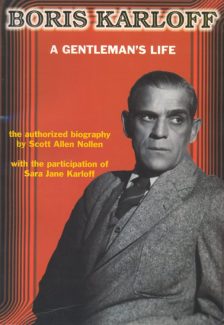 “When Scott Allen Nollen first approached me about doing another Karloff book, I must admit that my first reaction was ‘Why another? So many have been done.’ And I knew my father’s reaction would have been ‘What’s the big fuss? Local boy makes good. So what?’
Since his death in 1969, wonderful books about my father have been written. Some cover just his career, while others blend the man and his work. That, of course, is the case with my godmother Cynthia Lindsay’s warm and loving family-authorized Dear Boris.
However, after reading Nollen’s book Boris Karloff: A Gentleman’s Life, I realized just how beautifully he has captured the essence of my father. Nollen’s lifelong study of Boris Karloff, his extensive research, combined with his use of heretofore unseen photographs and untold family anecdotes, has made this book the ultimate Boris Karloff biography. I was particularly delighted to see that my mother, Dorothy Stine Karloff, is given her place alongside my father during the very important years of 1930-46. And what glorious years those were.
Boris Karloff was revered by his fellow actors, who referred to him as ‘the consummate professional,’ ‘the actor’s actor.’ Nollen’s book Boris Karloff: A Gentleman’s Life reminds those of us who knew and loved Boris Karloff just how lucky we were to have had him touch our lives. Thank you, Daddy. Thank you, Scott Allen Nollen.” – From The Foreword by Sara Jane Karloff.
Softcover – 355 pp., index – Dimensions 25 x 17,5 cm (9,8 x 6,9 inch) – Weight 627 g (22,1 oz) – PUBLISHER Midnight Marquee Press, Inc., Baltimore, Maryland, 1999 – ISBN 1-887664-23-8
Boris Karloff: The Man Remembered (Gordon B. Shriver)
 Since his death in 1969, Boris Karloff remains one of Hollywood’s most famous figures. He is still revered for his talent, his many qualities that earned him admiration and respect, and, of course, his landmark role as the Monster in the 1931 movie classic Frankenstein.
This biography, the result of many years of interviews and extensive research, examines Karloff the person, as well as the actor. His work (which lasted more than half a century) in films, radio, television, and the theater is covered in detail, highlighted with accounts by many who knew him and worked with him. Among the contributors are Robert Anderson, Peter Bogdanovich, Ray Bradbury, Julie Harris, Tony Randall, Ronald Reagan, Eli Wallach, and Jonathan Winters. With the support of the Karloff family, Gordon Shriver pays tribute to this much-loved performer who will never be forgotten.
A native of Ridgewood, New Jersey, GORDON SHRIVER’s interest in Boris Karloff has spanned more than thirty years. At San Francisco State University, he received a bachelor’s degree in broadcasting, and went on to work in radio news. He has written for Cult Movies and Famous Monsters of Filmland. He lives in Norcross, Georgia.
Softcover – 208 pp. – Dimensions 22,5 x 15 cm (8,9 x 5,9 inch) – Weight 298 g (10,5 oz) – PUBLISHER PublishAmerica, Baltimore, Maryland, 2004 – ISBN 1-4137-1049-2
Born to Lose: The Gangster Film in America (Eugene Roscow)
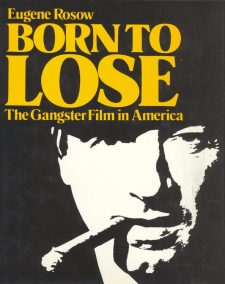 A lavishly illustrated, definitive study of American gangster movies, this intriguing history shows how the genre developed out of American culture and reflected it. Film, history, and nostalgia buffs will welcome its recreation of an era – the names, the faces, the headlines, the glamour, the lawless excitement – that have made crime pay, and pay handsomely, at the box-office. The author believes that gangster pictures are more than simple, action-packed dramas about violent criminals driven by dreams of success. The recurring characters, stories, themes, motifs, and iconography, he says, are actually a self-image of American capitalist and urban society. Indeed, the rise and development of gangster films parallels that of organized crime in America.
Rosow’s behind-the-camera saga begins in the early 1900s with the amazing nickelodeon. He talks about the early gangland films (The Musketeers of Pig Alley in 1912, The Gangster and the Girl in 1914) and the true emergence of the gangster movie with Underworld in the roaring ’20s. Gangsters became associated with money, sex, booze, gambling, style, and the high living that made cities such sinful and attractive places in the popular imagination. Then came the ’30s and Depression when people flocked to movies of the underworld to watch cocky, confident, assured people forcing the breaks to come their way.
Although much of the book concentrates on the Prohibition Era and the Depression and the classic gangster films that emerged in those periods – Little Caesar, Public Enemy, Scarface, and others – Rosow also deals with organized crime, with its Mafia aspects, big business techniques, and its strong links with government, especially during the Nixon Administration.
Parading through this full-blooded and often bloody history are celebrated names: the legendary stars (Joan Blondell, James Cagney, Edward G. Robinson, Humphrey Bogart, Spencer Tracy, etc.); the powerful banks who invested in and then dominated Hollywood; real-life gangsters (Lansky, Siegal, Capone); movie moguls, some of whom had started out as gangsters themselves. It’s a rousing tale of business espionage, legal muscle, strong-arm thugs, gang raids; of film stolen, pirated, and smuggled with all the ingenuity of today’s drug runners.
An important feature of the book is the “filmography”: brief descriptions, plots, and credits for nearly 80 significant gangster films from Little Caesar to the two Godfather films. The author’s brilliant selection of illustrations (378 in all) add enormously to the authenticity and reference value of this highly entertaining book. EUGENE ROSCOW is a filmmaker-historian and free-lance writer.
Hardcover, dust jacket – 422 pp., index – Dimensions 24 x 19 cm (9,5 x 7,5 inch) – Weight 1.015 g (35,8 oz) – PUBLISHER The Oxford University Press, New York, New York, 1978 – ISBN 0-19-502382-X
Brando: A Life in Our Times (Richard Schickel)
 Brando brooding. It was a sight never before seen in the movies. In films like A Streetcar Named Desire, The Wild One, On The Waterfront he redefined the nature of screen heroism, redefined the standards of screen acting and helped the entire post-war generation to define itself. In the process he became something more than a star; he became a cultural icon, one of those rare figures whose public life permanently invades, and in some measure shapes, our private reveries.
A distinguished critic recalling. Richard Schickel is a member of that generation that came of age as Marlon Brando entered his first claims on the world’s attention. In this book he recreates the excitement, the danger, the controversy of the years when Marlon Brando challenged, and upended, everyone’s ideals of heroic performance and everyone’s ideas of how a movie star’s life should be lived. More than that, the author recreates the era in which Brando came of age: Hollywood in crisis, America addled by anxious prosperity and Cold War conformities, and an alien culture – youth – forming within the larger one.
A life that is more than a ‘life.’ Marlon Brando was the product of an archetypal American adolescence – at once rebellious and dutiful. In his young manhood he knew fame and achievement as everyone dreams of it – vast, sudden, overwhelming. In maturity he alternately despised and embraced his own gifts and the gifts the world insisted on pressing upon him. In age, his life has been touched by tragedy. In tracing this life, as notable for its enigmas and its refusals as it is for its ambiguous triumphs, Richard Schickel has provided the first serious, deeply considered analysis of all of Marlon Brando’s movies, offering fresh and often surprising judgements on his work and the conditions under which it was performed.
Writing in a unique tone – at once intimate and ironic – drawing on his remarkable sense of film and social history, the author places the films firmly within the context of their times. More importantly, he also places the troubled, troubling life of his subject in the context of our lives, showing how Brando has reflected and refracted the hopes of his own theatrical generation, influenced the aspirations of those who have followed him, helped determine the relationship of celebrities to their own fame and, above all, defined his public’s relationship with the movies, with stardom and with the life of the times they have shared with Marlon Brando.
The text is illustrated with 90 quintessential black and white images of Brando.
RICHARD SCHICKEL combines three careers – as a film critic, as an author and as a writer-producer of television specials. He began writing film reviews for Life in 1965, and switched to Time in 1972 where he continues to contribute a weekly review. He has written many books, the majority of which deal with films and filmmaking. They include The Disney Version, the definitive study of the life, times and art of Walt Disney, and The Men Who Made the Movies, interviews with distinguished American movie directors as well as monographs on Cary Grant and James Cagney. His masterly biography of D.W. Griffith received the British Film Institute Book Award. Richard Schickel has also made a number of documentary films about the movies and these include three films about the making of George Lucas’ Star Wars saga as well as portraits of James Cagney and Gary Cooper. His articles, numbering in the hundreds, have appeared in most of America’s leading magazines.
Hardcover, dust jacket – 218 pp., index – Dimensions 24 x 16 cm (9,5 x 6,3 inch) – Weight 583 g (20,6 oz) – PUBLISHER Pavilion Books, Ltd., London, 1991 – ISBN 1-85145-047-5
Brando: A Life in Our Times (Richard Schickel)
 Brando brooding. It was a sight never before seen in the movies. In films like A Streetcar Named Desire, The Wild One, On The Waterfront he redefined the nature of screen heroism, redefined the standards of screen acting and helped the entire post-war generation to define itself. In the process he became something more than a star; he became a cultural icon, one of those rare figures whose public life permanently invades, and in some measure shapes, our private reveries.
A distinguished critic recalling. Richard Schickel is a member of that generation that came of age as Marlon Brando entered his first claims on the world’s attention. In this book he recreates the excitement, the danger, the controversy of the years when Marlon Brando challenged, and upended, everyone’s ideals of heroic performance and everyone’s ideas of how a movie star’s life should be lived. More than that, the author recreates the era in which Brando came of age: Hollywood in crisis, America addled by anxious prosperity and Cold War conformities, and an alien culture – youth – forming within the larger one.
A life that is more than a ‘life.’ Marlon Brando was the product of an archetypal American adolescence – at once rebellious and dutiful. In his young manhood he knew fame and achievement as everyone dreams of it – vast, sudden, overwhelming. In maturity he alternately despised and embraced his own gifts and the gifts the world insisted on pressing upon him. In age, his life has been touched by tragedy. In tracing this life, as notable for its enigmas and its refusals as it is for its ambiguous triumphs, Richard Schickel has provided the first serious, deeply considered analysis of all of Marlon Brando’s movies, offering fresh and often surprising judgements on his work and the conditions under which it was performed.
Writing in a unique tone – at once intimate and ironic – drawing on his remarkable sense of film and social history, the author places the films firmly within the context of their times. More importantly, he also places the troubled, troubling life of his subject in the context of our lives, showing how Brando has reflected and refracted the hopes of his own theatrical generation, influenced the aspirations of those who have followed him, helped determine the relationship of celebrities to their own fame and, above all, defined his public’s relationship with the movies, with stardom and with the life of the times they have shared with Marlon Brando.
RICHARD SCHICKEL combines three careers – as a film critic, as an author and as a writer-producer of television specials. He began writing film reviews for Life in 1965, and switched to Time in 1972 where he continues to contribute a weekly review. He has written many books, the majority of which deal with films and filmmaking. They include The Disney Version, the definitive study of the life, times and art of Walt Disney, and The Men Who Made the Movies, interviews with distinguished American movie directors as well as monographs on Cary Grant and James Cagney. His masterly biography of D.W. Griffith received the British Film Institute Book Award. Richard Schickel has also made a number of documentary films about the movies and these include three films about the making of George Lucas’ Star Wars saga as well as portraits of James Cagney and Gary Cooper. His articles, numbering in the hundreds, have appeared in most of America’s leading magazines.
Softcover – 221 pp., index – Dimensions 20 x 12 cm (7,9 x 4,7 inch) – Weight 354 g (12,5 oz) – PUBLISHER Pavilion Books, Ltd., London, 1991 – ISBN 1-85793-275-7
Brando for Breakfast (Anna Kashfi, with E.P. Stein)
 Marlon Brando and Anna Kashfi’s life together was doomed. His kinky sexuality, his contempt for his life as an actor, the torment of a mind muddled with immature philosophical speculations, his wild and funny-sad eccentricity were too much for Anna Kashfi and their marriage. But during the years of their long courtship, Marlon Brando poured out his feelings; acted out his neuroses; flaunted his sexual compulsions; talked of the universe, of brothels, of acting technique and actors, of his overreaching ambitions.
In this highly intelligent and gracefully written book you will be able to see how the roles Brando created intertwined with the man he was: the slob of A Streetcar Named Desire; the existential hell-raiser of The Wild One; the sexual oddball of Last Tango in Paris; the idealist manqué of On the Waterfront; the outlaw tyrant of The Godfather.
ANNA KASHFI and E.P. STEIN have written much more than a Hollywood memoir. There is compassion in Brando for Breakfast, and there is anger. Anna Kashfi shows the ability to admire Brando’s greatness even as she rails against his imperfections. She also shows an understanding of her own failures, which drove her, almost fatally, to seek solace in drink, drugs, and madness.
Hardcover, dust jacket – 273 pp. – Dimensions 23,5 x 15,5 cm (9,3 x 6,1 inch) – Weight 626 g (22,1 oz) – PUBLISHER Crown Publishers, Inc., New York, New York, 1979 – ISBN 0-517-536862
Brando: Songs My Mother Taught Me (Marlon Brando, with Robert Lindsey)
 This is Marlon Brando’s own story, and his reason for telling it is best revealed in his own words: “I have always considered my life a private affair and the business of no one beyond my family and those I love. Except for moral and political issues that aroused in me a desire to speak out, I have done my utmost throughout my life, for the sake of my children and myself, to remain silent… But now, in my seventieth year, I have decided to tell the story of my life as best as I can, so that my children can separate the truth from the myths that others have created about me, as myths are created about everyone swept up in the turbulent and distorting maelstrom of celebrity in our culture.”
To date there have been over a dozen books written about Marlon Brando, and almost half of them have been inaccurate, based on hearsay, sensationalist or prurient in tone. Now, at last, fifty years after his first appearance on stage in New York City, the actor has told his life story, with the help of Robert Lindsey. The result is an extraordinary book, at once funny, moving, absorbing, ribald, angry, self-deprecating and completely frank account of the career, both on-screen and off, of the greatest actor of our time. Anyone who has enjoyed a Brando film, will relish this book.
Co-author ROBERT LINDSEY, Chief West Coast correspondent for The New York Times, is the author of The Falcon and the Snowman, A Gathering of Saints and other books, and also collaborated with Ronald Reagan on his autobiography, An American Life.
Hardcover, dust jacket – 468 pp. – Dimensions 24 x 16 cm (9,5 x 6,3 inch) – Weight 992 g (35,0 oz) – PUBLISHER Random House, New York, New York, 1994 – ISBN 09679-41013-9
Brass Diva: The Life and Legends of Ethel Merman (Caryl Flinn)
 Broadway star Ethel Merman’s voice was a mesmerizing force and her vitality was legendary, yet the popular perception of La Merm as the irrepressible wonder falls far short of all that she was and all that she meant to Americans over so many decades. This marvelously detailed biography is the first to tell the full story of how the stenographer from Queens, New York, became the queen of the Broadway musical in its golden age. Mining official and unofficial sources, including her personal scrapbooks and, for the first time, interviews with Merman’s son, Caryl Flinn unearths new details of Merman’s life and finds that behind the high-octane personality was a remarkably pragmatic woman who never lost sight of her roots.
Brass Diva takes us from Merman’s working-class beginnings through the extraordinary career that was launched in 1930 when, playing a secondary role in a Gershwin Brothers’ show, she became an overnight sensation singing I Got Rhythm. From there, we follow Merman’s hits on Broadway, her uneven successes in Hollywood, and her afterlife as a beloved camp icon. In this definitive work on the phenomenon that was Ethel Merman, Publishers Weekly says, “Flinn masterfully analyzes Merman’s work on stage, screen and TV with a sophisticated eye for detail that will delight theater buffs.”
CARYL FLINN lives and works in Tuscon, where she is Professor of Women’s Studies and Media Arts at the University of Arizona. She is the author of The New German Cinema: Music, History, and the Matter of Style (UC Press) and Stains of Utopia: Gender, Nostalgia, and Hollywood Film Music, as well as co-editor, with James Buhler and David Neumeyer, of Music and Cinema.
Hardcover, dust jacket – 542 pp., index – Dimensions 23,5 x 15,5 cm (9,3 x 6,1 inch) – Weight 937 g (33,1 oz) – PUBLISHER University of California Press, Berkeley, California, 2007 – ISBN 978-0520-22942-6
Brigitte Bardot (beschreven door Françoise Sagan; gefotografeerd door Ghislain Dussart)
 Deze beelden, door Françoise Sagan op haar eigen scherpzinnige wijze van een boeiend en analytisch commentaar voorzien, weerspiegelen tien jaar van het leven van Brigitte Bardot, als vrouw en als actrice.
Een zeer hechte en broederlijke vriendschap met La Bardot heeft Ghislain Bussart in staat gesteld deze oogst van grappige, ontroerende, verrassende, maar bovenal schitterende foto’s voor u te vergaren. Zij doen de mythe Bardot vervagen om in ruil hiervoor de buitengewone schoonheid te tonen van een vrouw die zichzelf omschrijft als wispelturig maar niet onberekenbaar, arrogant maar o zo verlegen, vrolijk maar een beetje te gevoelig, weemoedig maar met gevoel voor humor.
Brigitte Bardot werd op 28 september 1934 te Parijs geboren. Op achttienjarige leeftijd had zij reeds carrière gemaakt als fotomodel. Het was Marc Allégret die haar in de filmwereld introduceerde (Futures vedettes, 1954) en in contact bracht met zijn assistent, de voormalige Paris-Match-journalist Roger Vadim. Onder regie van Vadim maakte Brigitte Bardot haar eerste grote film (Ét Dieu créa la femme, 1956) die haar ster tot ongekende hoogten deed rijzen. Vele beroemde films volgden, zoals La vérité, Vie privée, Le mépris, Boulevard du Rhum, Viva Maria en Les pétroleuses. De laatste jaren doet Brigitte Bardot het met filmen wat kalmer aan en houdt zij zich hoofdzakelijk bezig met maatschappelijke activiteiten van uiteenlopende aard.
FRANÇOISE SAGAN werd op 21 juni 1935 te Carjac als Françoise Quoirez geboren. Ook zij begon haar carrière op achttienjarige leeftijd. Haar romandebuut Bonjour Tristesse was meteen een wereldsucces. Hoofdthema in het boek en ook in de latere romans en toneelstukken is de levenswijze van een nieuwe generatie jonge mensen, wier bestaan zich afspeelt binnen de kleine wereld van de decadente bourgeoisie, waar liefde het voornaamste tijdverdrijf vormt, een wereld die zij op zeer lucide manier beschrijft. Françoise Sagan heeft naast een aantal toneelstukken onder meer op haar naam staan Un certain sourire, Aimez-vous Brahms?, La chamade, Un peu de soleil dans l’eau froide, Des bleus à l’âne, Un profil perdu en Réponses. Binnenkort zal zij haar debuut als filmregisseuse maken.
Hardcover, dust jacket – 122 pp. – Dimensions 33,5 x 24,5 cm (13,2 x 9,7 inch) – Weight 1.150g (40,6 oz) – PUBLISHER Elsevier, Amsterdam (The Netherlands) / Brussels (Belgium), 1974 – ISBN 90 10 01538 1
Brigitte Bardot (Sam Lévin)

Hardcover – 106 pp., index – Dimensions 25 x 22 cm (9,8 x 8,7 inch) – Weight 674 g (23,8 oz) – PUBLISHER Éditions PC, Paris, 2001 – ISBN 2-912683-01-7
Brigitte Bardot: Le mythe éternel (Dominique Choulant)
 “Je n’arrive pas toujours à imaginer que je suis Bardot. Je me force même à ne pas y penser. Parce que, tu sais, être Bardot, c’est une foutue responsabilité. (…) Parfois, j’ai des moments de révolte et je me dis que je suis Brigitte, une femme comme les autres. Et ce n’est pas vrai. (…) Je ne peux rien faire comme les autres femmes, moi: entrer dans un tabac pour acheter des cigarettes, me promener dans la rue, aller au cinéma… Tout ça, c’est exclu. Alors, tu penses bien que face à un homme, le problème est gratiné. Parce que, si j’arrive parfois à oublier que je suis Bardot, lui il ne l’oublie jamais!”
Icône incontestée du 7e art, idéal féminin, sex-symbol international, mais aussi fervente ambassadrice de la cause animale, Brigitte Bardot n’a jamais fait de compromis. Les actes ont toujours suivi les paroles. Au début de sa carrière au cinéma, elle annonçait déjà qu’elle arrêterait dès qu’elle n’éprouverait plus le plaisir de jouer, et effectivement elle le fit.
Brigitte Bardot, le mythe éternel reprend les événements les plus marquants de la vie de la star, les moments de bonheur intense et de gloire comme ceux d’extrême vulnérabilité et de tristesse, tout en laissant une large place à la voix de BB. En effet, celle-ci déroule, tout au long du récit, sa pensée, ses ressentis, les hommes qu’elle a aimés, les films qui l’ont rendue célèbre, les rencontres avec les plus grands, ainsi que les lieux fameux, Saint-Tropez et La Madrague, qui ont jalonné son parcours exceptionnel.
Mais cet ouvrage est bien plus que cela encore. Bienavant le drame de la mort de Lady Di, il pointe du doight les débuts d’une certaine presse, dite “à scandale”, et le rôle grandissant des paparazzi, représentants des dérives d’une société sand frontieère morale.
DOMINIQUE CHOULANT, né en 1963, résidant à Toulouse, est un cinéphile passionné depuis de son plus jeune âge. Il a déjà publié deux autres biographies: de Martine Carol (en 1997) et de Marilyn Monroe (en 2006), ainsi qu’un roman d’amour, Même si… (en 2004).
Softcover – 295 pp. – Dimensions 24 x 15 cm (9,5 x 5,9 inch) – Weight 456 g (16,1 oz) – PUBLISHER Autres Temps Éditions, Paris, 2009 – ISBN 978-2-84521-373-9
Brigitte Bardot: Plein de Vue (Marie-Dominique Lelièvre)
 Elle était la plus belle. Elle a éclipsé toutes les autres. Vadim lui a offert la célébrité, Godard un chef-d’œuvre, Gunter Sachs sa fortune, Kate Moss et Beauvoir leur admiration. Son énergie fracassante, sa franchise et ses amours tissent sa légende.
Elle est avant tout une petite fille mal aimée qui ne tenait pas spécialement à faire du cinéma. Une jeune bourgeoise devenue une star à son corps défendant. A mi-parcours, elle a sabordé sa carrière pour se mettre au service des animaux. Il y a un mystère Bardot.
La plus célèbre des Françaises reste une inconnue. S’appuyant sur des témoignages inédits, l’enquête de Marie-Dominique Lelièvre en dresse un portrait neuf.
Softcover – 345 pp. – Dimensions 22 x 14,5 cm (8,7 x 5,7 inch) – Weight 396 g (14 oz) – PUBLISHER Flammarion, Paris, 2012 – ISBN 978-2-0812-4624-9
Brigitte Bardot: Un hommage photographique (Suzanne Lander; préface de Henry-Jean Servat)
 Belle et rebelle… Brigitte Bardot en trois cents citations et autant de photos.
Belle, insolente, libre, Brigitte Bardot a toujours été insaisissable. Trois cents photos et autant de citations de proches ou d’elle-même témoignent ici du parcours exceptionnel de la femme et de l’actrice. Roger Vadim, Serge Gainsbourg, Michèle Morgan, Paco Rabanne, Pierre Arditi et bien d’autres encore disent toute l’admiration qu’ils portent à celle qu’ils ont bien connue et qui a profondément marqué son temps.
Retour en images et en mots sur une légende du cinéma.
Hardcover – 541 pp., index – Dimensions 13,5 x 18 cm (5,3 x 7,1 cm) – Weight 1.085 g (38,3 oz) – PUBLISHER Éditions Hors Collection, Paris, 2011 – ISBN 978-2-258-08956-3
Brigitte Bardot: Vies privées (entretien avec Henry-Jean Servat)
 Brigitte Bardot a accepté pour la première fois de nous parler à cœur ouvert de sa vie. Un récit intime et très personnel qui dessine un visage méconnu de la star qui se révèle comme une femme blessée, attachante et généreuse. Une femme fidèle à elle-même, bien loin des polémiques médiatiques et des engagements politiques qu’on lui a récemment attribués. Dans ce livre, elle exprime ses fêlures, ses peines et ses combats alors que son image aura été sa pire ennemie.
Brigitte Bardot revient avec nostalgie sur son enfance bourgeoise et préservée, sur ses amours nombreuses, mais toujours sincères (de Vadim à Bernard d’Ormale, en passant par Trintignant, Charrier, Sacha Distel…), ainsi que sur sa carrière au cinéma, qu’elle considère avoir arrêté juste à temps pour sauver sa peau, contrairement à son amie Romy Schneider et à Marilyn Monroe…
HENRY-JEAN SERVAT, l’ami et le confident, a tissé au fil des années des liens privilégiés avec Brigitte Bardot et nos offre cette interview exclusive et intime.
Hardcover, dust jacket – 138 pp. – Dimensions 25,5 x 25,5 cm (10 x 10 inch) – Weight 998 g (35,20 oz) – PUBLISHER Éditions Albin Michel, Paris, 2006 – ISBN 2-226-15205-9
Brigitte Bardot: Vue par Léonard de Raemy (avec la collaboration de François Bagnaud)
 Brigitte Bardot, en légendant plus de 110 photos, pour la plupart inédites ou rarement vues, a souhaité rendre hommage à son ami Léonard de Raemy qui, durant plus de 25 années de collaboration, a su la photographier avec talent et respect lors de tournages des films, de présentations de mode et de reportages plus intimes.
Son fils, Marc de Raemy a voulu témoigner de l’admiration qu’l porte à son père, en sélectionnant parmi des milliers de photographes, celles concernant Brigitte Bardot, star internationalle et sex-symbol des années 60. François Bagnaud les a commentées avec passion et admiration.
Hardcover, dust jacket – 139 pp. – Dimensions 29,5 x 29,5 cm (11,6 x 11,6 inch) – Weight 1.230 g (43,4 oz) – PUBLISHER Éditions Didier Carpentier, Paris, 2011
Brigitte Helm: Der Vamp der deutschen Films (Daniel Semler)
 Sie hieß eigentlich Brigitte Eva Gisela Schittenhelm und wollte Astronomin werden. Aber ihre verwitwete Mutter sieht in ihr schon früh einen Filmstar und schafft es, Thea von Harbou und Fritz Lang für Brigitte zu interessieren. Da ist sie eine knapp siebzehnjährige Internatsschülerin. Sie macht Probeaufnahmen für das Ufa-Großprojekt METROPOLIS, bekommt die weibliche Doppelrolle der Maria, bewältigt die Drehzeit von 17 Monaten offenbar ohne Schaden und wird 1927 aus dem Stand heraus ein deutscher Weltstar.
Sie kriegt von der Ufa einen Zehnjahresvertrag, dreht mit Karl Grune (Am Rande der Welt, 1927), Georg Wilhelm Pabst (Die Liebe der Jeanne Ney, 1927), Henrik Galeen (Alraune, 1928). Ihr Image wird der deutsche Vamp mit der statuenhaften Schönheit. Weil sie mit diesem Klischee unzufrieden ist, prozessiert sie (vergeblich) gegen die Ufa, um andere Rollenangebote zu bekommen. Sie schafft den Übergang zum Tonfilm (Die Singende Stadt, 1930), spielt noch einmal die Alraune (unter Richard Oswald, 1930), dreht in England (The Blue Danube, 1932), verkörpert in Karl Hartls Die Gräfin von Monte Christo (1932) eine Filmkomparsin, die zuerst zur Hochstaplerin und dann zum Star wird. Ihr letzter Film hat den Titel Ein Idealer Gatte (1935). Dann zieht sie sich vom Film zurück und heiratet einen reichen Unternehmer.
So erzählt, ist das die Geschichte einer kurzen, heftigen Karriere mit einem zweifelhaften Happyend. Aber der Brigitte Helm-Mythos gibt mehr her. Er handelt von einer Branche, die sich damals radikal verändert, von einem Land, das in den Abgrund einer rassistischen Diktatur gerät, von Frauenbildern, die zu verkörpern einer Schauspielerin Lust und Frust bereiten kann, von Regisseuren, Produzenten, Kameraleuten, Schauspielpartnern, von denen sie gehasst oder geliebt wird, die ihr aber nicht nahe kommen können.
Das ist eine Menge Stoff für einen Biografen, und Daniel Semler hat sich tief in die Archive vergraben. Weil er dort viele Fundstücke gemacht hat, versteckt er sich über weite Strecken hinter all den wunderbaren Texten und Zitaten, die er entdeckt hat. Insofern ist dieses Buch vor allem eine Dokumentation jener spannenden zehn Jahre zwischen 1925 und 1935, in denen Brigitte Helm Objekt der publizistischen Begierde war und sich viele an ihr abgearbeitet haben: Arnheim, Eisner und Kracauer, aber auch die Filmkritiker und Gesellschaftsreporter, deren Namen heute keiner mehr kennt. Schön und zugleich schrecklich sind die Geschichten ihrer Leidenschaft für schnelle Autos, die mit zwei schweren von ihr verschuldeten Verkehrsunfällen endete.
Es gibt keine Autobiografie von Brigitte Helm, sie hatte keine Fernsehauftritte, ging in keine Talkshow, gab keine Interviews. Sie starb am 11. Juni 1996. Ihr Rückzug aus der Öffentlichkeit besitzt eine Garbo-Dimension. Und wenn man die vielen Szenenfotos, die faksimilierten Zeitschriftenartikel und die Illustriertenporträts dieses Buches betrachtet, wundert man sich, dass es nicht schon früher erschienen ist. Denn es erzählt uns von deutscher Filmgeschichte, deutscher Zeitgeschichte, deutscher Kulturgeschichte und deutscher Frauengeschichte. Aber so ein Buch braucht seine Zeit.
In die Gestaltung und den Druck dieses Bandes hat der Verleger viel Mühe investiert. Am Ende weiß man, dass dies auch ein Fanbuch ist, das nur einer wie Michael Farin zustande bringen kann. Und man verzeiht ihm wieder einmal, dass er so lange gebraucht hat, ein Versprechen einzulösen.
Softcover – 336 pp., index – Dimensions 24 x 17 cm (9,5 x 6,7 inch) – Weight 692 g (24,4 oz) – PUBLISHER Doubleday, New York, New York, 1999 – ISBN 978-3-93-6298-56-7
Bring On the Empty Horses (David Niven)
 Here is Niven at his best. He and Errol Flynn were filming The Charge of the Light Brigade for a director, Michael Curtiz, ‘whose Hungarian-orientated English was a joy to us all.’ High on the rostrum he decided the moment had come to order the arrival on the scene of a hundred riderless chargers. “Okay,” he yelled into a megaphone, “Bring on the empty horses!”
Bring on the Empty Horses is the second part of David Niven’s internationally best-selling autobiography, following the superbly entertaining The Moon’s a Balloon. Both books were highly acclaimed by the critics and remain as wonderful reminders of a much-loved actor who epitomised, for many, the essential British gent, even when surrounded by the stars of Hollywood.
DAVID NIVEN was an English actor and novelist. He wrote four books. The first, Round the Rugged Rocks, was a novel which appeared in 1951 and was forgotten almost at once. In 1971, he published his autobiography, The Moon’s a Balloon, which was well-received, selling over five million copies. He followed this with Bring On the Empty Horses in 1975, a collection of highly entertaining reminiscences from Hollywood’s “Golden Age” in the 1940s. It now appears that Niven recounted many incidents from a first person perspective which actually happened to other people, and which he borrowed and embroidered. In 1981, Niven published a second and much more successful novel, Go Slowly, Come Back Quickly, which was set during and after World War II, and drew on his experiences during the war and in Hollywood. He was working on a third novel when his health failed in 1983.
Softcover – 352 pp., index – Dimensions 17,5 x 11 cm (6,9 x 4,3 inch) – Weight 215 g (7,6 oz) – PUBLISHER Hodder and Sougton, Ltd., Sevenoaks, Kent, 1975 – ISBN 0 340 20915 1
British Film Actors’ Credits, 1895-1987 (Scott Palmer)
 “In writing this book I have attempted to list virtually every British actor or actress who could be considered to have worked in films, with complete filmographies through December 1987. My primary rule was to include performers who made at least three films; however there are forty or so that I have listed who appear in two films. These exceptions were made because the person either was in an important film or played a key role; I also believe that some of these people appeared in other films I could not trace. I am aware that to list every actor and every film is not possible, nevertheless this is what I have attempted to do.
There are nearly 5,000 performers listed here, along with a quarter of a million film titles. The entire range of films is covered from 1895. The book is divided into two parts: the sound era, which has most of the entries, and the silent era, with about 700 names. Actors listed in this second section made no appearances after 1928. Actors whose careers spanned both talking films (which began in Britain in 1929) and silents are listed in the larger first section.
Scottish, Irish, Welsh, Australian, Canadian, South African, and other British Commonwealth performers are included; British-born actors whose films were made outside the United Kingdom (as in Hollywood) are also, as well as those born in foreign countries who filmed in Britain. Birth and death dates are given when they could be traced. Because there are so many small-part players listed, there are a number whose vital dates could not be found. A brief character description is followed by the list of films, in chronological order. I have tried to give the year the film was completed and also the original title; I beg the reader’s indulgence if any errors have occurred. A great number of television films have been included; they are not specifically indicated, however. In a number of cases, television films have turned up in the cinema when crossing the Atlantic. I have also given the year of each actor’s first stage appearance if I could find it, as the great majority of these people began their careers on the stage. There are also a few special features in this book including a section on those people bestowed titles, a list of those players who have 100 or more films to their credit, and a section on awards (British and American Academy).” – From The Preface.
Hardcover – 917 pp. – Dimensions 23,5 x 15,5 cm (9,3 x 6,1 inch) – Weight 1.395 g (49,2 oz) – PUBLISHER St. James Press, London, 1988 – ISBN 1-558-62166-0
British Film Institute: Film and Television Handbook 1992
 “As we move towards the establishment of the single European market after 1992, the BFI is determined to ensure that Britain’s audiovisual industries are fully informed of all the new opportunities that will be on offer. In order to unravel some of the accompanying complexities, this latest edition of the BFI’s Handbook contains for the first time a comprehensive overview of European film and television, together with a useful reference section listing the relevant organisations active in Europe.
However, despite the imminent single European market, many in this country who seek funding for their work within the moving image culture face increasingly difficult times and the BFI is committed to helping them in every possible way. The Downing Street seminar in June 1990, described in the Handbook’s wide-ranging review of the year, is just one of the high profile initiatives designed to help remedy this situation. On a smaller scale, we hope that the section on funding (another new feature of the Handbook) will clarify some possible routes through this difficult terrain.
Other innovations in this publication include a look back at the year in radio, a medium which, of course, bears directly on the BFI’s broadcasting interests. We have also addressed the issue of access to the cinema for people with disabilities, in line with our commitment to equal opportunities for all. In addition to these invaluable new features, the 1992 BFI Handbook also contains all the usual comprehensive reference sections which those who use it regularly have come to depend upon over the years and which also accurately reflect the scope of the BFI’s activities and concerns.” – The Foreword by BFI’s Chairman Sir Richard Attenborough.
Softcover – 332 pp., index – Dimensions 24 x 17 cm (9,5 x 6,7 inch) – Weight 552 g (19,5 oz) – PUBLISHER British Film Institute, London, 1991 – ISBN 0-85170-317-8
A British Picture: An Autobiography (Ken Russell; foreword by Melvyn Bragg)
 The autobiography of Britain’s most controversial film director, the maker of Women in Love, The Devils, The Music Lovers, Tommy and The Rainbow, is as unconventional and brilliant as his best films. Moving with astonishing assurance through time and space, Russell recreates his life in a series of interconnected episodes – his thirties childhood in Southampton, his first sexual experience watching Disney’s Pinocchio, his schooldays at the Nautical College, Pangbourne and early careers in the Merchant Marines and the Royal Air Force, dancing days at the Sheperd’s Bush Ballet Club and of course his career as a filmmaker beginning with an extraordinary interview with Huw Wheldon, for a job on Monitor. Full of marvellously funny anecdotes and fascinating insights, this is a remarkable autobiography.
“I owe my autobiography to all who denigrate me or don’t understand me. Maybe they’ll understand me even less. But I think it’ll contain some sort of truth about me that isn’t contained in crude assessments. It’s about somebody who doesn’t, on the face of it, seem too political, too committed, or press his working class background. I can’t be fitted in any of those pigeonholes. My autobiography’s a dismissal of all that crap. It’s a picture if imagery and bizarre happening and fun and contradiction and crazy dialogue. It’s a montage, it’s an event, but it’s not conventional.” – Ken Russell
Softcover – 310 pp. – Dimensions 23,5 x 15,5 cm (9,3 x 6,1 inch) – Weight 510 g (18 oz) – PUBLISHER Southbank Publishing, London, 1989 – ISBN 978-1-904915-32-4
Broadway Anecdotes (Peter Hay)
 In this marvelously entertaining collection of stories, Peter Hay takes us along that sparkling thoroughfare known as the Great White Way. Called the Street of the Midnight Sun by “Diamond Jim” Brady and immortalized by Walter Winchell and Damon Runyon as the Hardened Artery or Main Stem – Broadway is the embodiment of the history of live entertainment in America, and Peter Hay has captured it in all its dazzling diversity.
Everything that Broadway is known for is here: the “legitimate” theater, its stars and famous shows, the musicals, producers, hangouts, nightclubs, columnists, agents, vaudeville and burlesque, off-Broadway and the road. From the first time Americans took to the stage in the colonies in the 1660s to the tragic decline of the acting career of Edwin Booth (brother of John Wilkes), and from the trouble with nude dancing in Oh Calcutta! to the dry wit of Tallulah Bankhead’s comment to Tennessee Williams on the film version of Orpheus Descending (“Darling, they’ve absolutely ruined your perfectly dreadful play”), Broadway Anecdotes throws a unique, theatrical spotlight on American history. We learn how Marilyn Monroe managed to remain anonymous on New York City streets simply by changing her walk, how Mae West whiled away her time in jail on an obscenity conviction, and that even the incomparable Katharine Hepburn suffered setbacks early in her career. (Dorothy Parker wrote of one of her performances: “Miss Hepburn played the gamut from A to B.”)
A delightful collection of verbal snapshots of this vibrant world, Broadway Anecdotes is packed with the legends and lore, the humor and philosophy of a place where understudies still stand by with dreams of overnight stardom, shows still close before they open, and people keep singing in the rain. Anyone who has ever been touched by the magic of Broadway will treasure it.
PETER HAY has taught drama at several universities and is founding artistic director and dramaturge at First Stage, a non-profit theater group in Los Angeles. He is the author of Ordinary Heroes and several anecdote books including Theatrical Anecdotes.
Hardcover, dust jacket – 395 pp., index – Dimensions 24 x 16 cm (9,5 x 6,3 inch) – Weight 772 g (27,2 oz) – PUBLISHER Oxford University Press, Inc., New York, New York, 1989 – ISBN 0-19-504621-8
Broken Silence: Conversations With 23 Silent Film Stars (Michael G. Ankerich)
 “Stirring up and recording memories is what this book is all about. Over a four-year period, I sought out and interviewed twenty-three individuals who worked in silent films. Lina Basquette was the first interview (1987), Dorothy Janis the last (1991). All of the quoted material in each chapter is from these interviews unless there is an indication otherwise. The biographical text I have supplied in addition is partly from these interviews and partly simply factual material from a variety of standard sources.
To understand the silent era better, I approached a group of former film players who enjoyed various levels of success, played a wide range of roles, appeared with some of the era’s leading directors and players, and worked at a variety of studios, on both the East and West coasts. Most importantly, I wanted to talk with those who were enthusiastic about sharing memories of their lives and careers with me. Many of my subjects were at first just names I came across in film encyclopedias or learned about through conversation. Each was an individual with experience before the camera in silent films. Some, like Douglas Fairbanks, Jr., Eleanor Boardman, Ethlyne Clair, and Muriel Ostriche, had no real ambition of becoming film stars; others, like Lew Ayres, Dorothy Gulliver, Marion Mack, and George Lewis, had burning motivations and could close their eyes and see their names in lights.
A number of them – Joyce Compton, Frank “Junior” Coghlan, Maxine Elliott Hicks, Baby Marie Osborne, and Lois Moran, for instance – were led into the business by their parents. Several – Gladys Walton, Patsy Ruth Miller and Dorothy Janis, for example – were discovered while visiting Hollywood. Their experiences, their motivations, their circumstances made up a story I wanted to help them tell.
Of the three interview methods I used – in person, phone, and mail – the most effective was the in-person interview where I sat face-to-face in my subject’s home or another meeting place. The conversation flowed better, and the responses were much more spontaneous. The in-person interviews provided the opportunity to record atmosphere, and much was learned from facial expressions and body language.
The mail interviews (where the subject answered questions sent through the mail) allowed careful thought and consideration to the questions under sometimes less strenuous conditions than face-to-face encounters. However, they gave little opportunity to follow up on a question. Additional questions were asked later by phone or during subsequent visits. A filmography – arranged alphabetically by year – follows each chapter.
Why write a book about individuals who worked in films so long ago? That question haunted me in the beginning, but with the passage of time, the answer began to be clear. Writing this book could be viewed as a race against time, a race that was quickly taking the memories away. Even before this manuscript was finished, five of my subjects (Madge Bellamy, Marion Mack, Lois Moran, Muriel Ostriche, and Eddie Quillan) were gone. Considering this book was the first – and in several cases the last – opportunity many of these twenty-three people had to muse in print about their past, think how useful this collection of memories could be in fifty years when a film enthusiast comes across one of these names and wants to know more. The photographs are from my collection except as noted.” – From The Preface.
This is a collection of 23 original interviews with stars of the silent screen, with biographical information and a filmography included for each.
MICHAEL G. ANKERICH is a writer whose work focuses on the silent film era of Hollywood. A former newspaper reporter, he has written extensively for Classic Images, Films of the Golden Age, and Hollywood Studio Magazine, which featured his interview with Butterfly McQueen (Prissy) on the 50th anniversary of the release of Gone With The Wind. He can be reached at his website michaelgankerich.com
[Interviews with Lew Ayres, William Bakewell, Lina Basquette, Madge Bellamy, Eleanor Boardman, Ethlyne Clair, Frank “Junior” Coghlan, Joyce Compton, Douglas Fairbanks Jr., Dorothy Gulliver, Maxine Elliott Hicks, Dorothy Janis, George Lewis, Marion Mack, Patsy Ruth Miller, Lois Moran, Baby Marie Osborne, Muriel Ostriche, Eddie Quillan, Esther Ralston, Dorothy Revier, David Rollins, Gladys Walton]
Hardcover – 319 pp., index – Dimensions 23,5 x 15,5 cm (9,3 x 6,1 inch) – Weight 634 g (22,4 oz) – PUBLISHER McFarland & Company, Inc., Publishers, Jefferson, North Carolina, 1993 – ISBN 0-89950-835-9
Budd Schulberg: A Bio-Bibliography (Nicholas Beck)
 For more than six decades, Budd Wilson Schulberg has known success in virtually every category of American writing. Raised in the Hollywood of the 1920s as the privileged son of a pioneer studio mogul, Schulberg achieved fame as novelist, short story writer, playwright, Oscar-winning screenwriter, and boxing historian.
Schulberg also became a central figure in the entertainment industry’s political turmoil of the 1940s and 50s, fleeing first from the Communist Party’s attempts to control his writing, then testifying as a co-operating witness before the House Committee on Un-American Activities, and finally emerging as a leader of the nation’s non-Communist Left. Schulberg chronicled these events in the country’s leading newspapers and intellectual journals.
He has also been acquainted with and written about many other American writers and their difficulties in maintaining or recapturing early success: F. Scott Fitzgerald, Ernest Hemingway, Nathanael West, William Saroyan, John Steinbeck, William Faulkner, John O’Hara, Irwin Shaw and many others. Budd Schulberg: A Bio-Bibliography is the first overview of Schulberg’s career from 1937 to 2000 (his autobiography, Moving Pictures, covers his life only to age seventeen).
NICHOLAS BECK is a retired professor of journalism, which he taught at California State University, Los Angeles. He also worked as a general assignment reporter for United Press International.
Hardcover – 197 pp., index – Dimensions 22 x 14 cm (8,7 x 5,5 inch) – Weight 404 g (14,3 oz) – PUBLISHER The Scarecrow Press, Inc., Lanham, Maryland, 2001 – ISBN 0-8108-4035-9
Bullets over Hollywood: The American Gangster Picture from the Silents to The Sopranos (John McCarty)
 Back-alley Bogart… Brando the dealmaker… Speakeasies and tommy guns and the St. Valentine’s Day massacre…
Dark, ambiguous, and exciting, the gangster movie has never waned in popularity – and the allure of the gangster as anti-hero remains as powerful as the days of the Prohibition were long. From Scarface to Carlito’s Way, from The Godfather to The Road to Perdition, from Once Upon a Time in America to Chicago, gangland on the screen is as seductive as ever.
In Bullets over Hollywood, film scholar John McCarty traces the history of mob flicks and reveals why the films are so beloved by Americans. As McCarty demonstrates, the themes, characters, landscapes, and stories of the gangster genre have proven resilient enough to be updated, reshaped, and expanded upon to connect even with today’s young audiences. Packed with revelatory behind-the-scenes anecdotes and information about real-life hoods and their cinematic alter egos, illuminating analysis, and a solid historical perspective, Bullets over Hollywood will be the definitive book on the gangster movies for years to come.
JOHN MCCARTY is an adjunct professor of cinema in the Department of Theatre at SUNY, and the author of more than thirty books, including The Fearmakers, The Sleaze Merchants, and The Films of Mel Gibson. He lives in upstate New York.
Hardcover, dust jacket – 323 pp., index – Dimensions 23,5 x 15,5 cm (9,3 x 6,1 inch) – Weight 598 g (21,1 oz) – PUBLISHER Da Capo Press, New York, New York, 2004 – ISBN 0-306-81301-7
Burt Lancaster (Robert Windeler)
 A star since his very first film, The Killers, in 1946, Burt Lancaster at the age of seventy-one and after seventy-one films is still one of Hollywood’s most durable and bankable actors. A self-admitted ‘difficult and exasperating man,’ Lancaster has fought with virtually every director, producer and co-star in his pursuit of an astonishing variety of roles. In the process, he has cared little about the idea of a consistent public image. From his early work in Gunfight at the OK Corral, From Here to Eternity and his Oscar-winning portrayal of Elmer Gantry, to his recent roles in Atlantic City, Local Hero and The Osterman Weekend, Lancaster has consistently cast himself against type.
He has been weak, heroic, romantic, deadbeat, a con man, a courtier, a killer and the killed – whatever seemed right to him at the time. And his leading ladies have ranged from Ava Gardner, Katharine Hepburn and Deborah Kerr, to Claudia Cardinale and Nastassia Kinski.
One director he has worked with, Luchino Visconti (The Leopard), said of Burt that he was ‘very complex, at times autocratic, rude, strong, romantic, understanding, sometimes even stupid, and above all mysterious.’
Here for the first time are all the Burt Lancasters: New York’s East Harlem kid and the cultured art collector, opera buff and cooker of pasta, who has lived in Rome part-time for two decades; the dedicated family man, the staunch, outspoken proponent of liberal political principles; the Depression-era acrobat who swung his way up from three dollars a week to the big-time big-top; and the movie star who started at the top and stayed there.
ROBERT WINDELER is the author of the best-selling Sweetheart: The Story of Mary Pickford and of biographies of Shirley Temple and Julie Andrews, all published by W.H. Allen. His weekly Hollywood column appears in 375 newspapers in North America with a readers hip of 30 million. He lives in California.
Hardcover, dust jacket – 217 pp., index – Dimensions 24 x 16 cm (9,5 x 6,3 inch) – Weight 537 g (18,9 oz) – PUBLISHER W.H. Allen & Co., Ltd., Londen, 1984 – ISBN 0 491 03172 6
Burt Lancaster: An American Life (Kate Buford)
 Startlingly handsome, witty, fanatically loyal, charming, scary, and intensely sexual, Burt Lancaster was the quintessential bête du cinéma, one of Hollywood’s great stars. He was, as well, an intensely private man, and he authorized no biographies in his lifetime. Kate Buford is the first writer to win the co-operation of Lancaster’s widow, close friends, and colleagues, and her book is a revelation.
Here is Lancaster the man, from his teenage years, bolting the Depression-era immigrant neighborhood of East Harlem where he grew up for the life of a circus acrobat – then the electric New York theater of the 1930s, then the dying days of vaudeville. We see his production company – Hecht-Hill-Lancaster – become the biggest independent of the 1950s, a bridge between the studio era and modern filmmaking. With the power he derived from it we see him gain a remarkable degree of control, which he used to become the auteur of his own career. His navigation through the anti-Communist witch-hunts made him an example of a star who tweaked the noses of HUAC and survived. His greatest roles – in Sweet Smell of Success, Elmer Gantry, Birdman of Alcatraz, The Swimmer, Atlantic City – kept to the progressive edge that had originated in the tolerant, diverse, reforming principles of his childhood. And in the extraordinary complete roster of his films – From Here to Eternity, Gunfight at the O.K. Corral, Judgment at Nuremberg, The Leopard, 1900, and Field of Dreams, among many others – he proved to be both a master of commercial movies that pleased a worldwide audience and an actor who pushed himself beyond stardom into cinematic art. Kate Buford has written a dynamic biography of a passionate and committed star, the first full-scale study of one of the last great unexamined Hollywood lives.
KATE BUFORD has been a commentator for National Public Radio’s Morning Edition since 1994 and has written for the New York Times and Architectural Digest. She is the author of several articles on the movies for Film Comment, including the first retrospective analysis of Burt Lancaster’s career – the project that launched this biography. She has two children, Lucy and Will, and lives in Irvington-on-Hudson, New York.
Hardcover, dust jacket – 447 pp., index – Dimensions 24 x 16 cm (9,5 x 6,3 inch) – Weight 869 g (30,7 oz) – PUBLISHER Alfred A.Knopf, New York, New York, 2000 – ISBN 0-679-44603-6
Burt Reynolds (Sylvia Safran Resnick)
 Here, at last, is the authorised biography of one of today’s biggest box office superstars whose boyish charm and daredevil sexiness have won him the adulation of millions. Burt Reynolds turned to a career in acting only after a serious car accident shattered his dreams of professional football fame. Starting as a stuntman, he eventually landed a part in the television series Gunsmoke and has now appeared in over twenty-five films including Deliverance, Smokey and the Bandit, Starting Over and The Best Little Whorehouse in Texas.
His controversial appearance as a nude centrefold in Cosmopolitan magazine had a strong impact on his career; as did his marriage to Judy Carne of Laugh-In fame, and his affairs with Dinah Shore, Sally Field and Lonnie Anderson. His own views on his work and his relationships are revealed here with amusing candour. What emerges in this lavishly illustrated biography is an intimate, affectionate portrait of an ambitious, hard-working actor and director; a warm-hearted, honest man who has always shown considerable respect for his adoring fans, and who has always been prepared to give them more.
Softcover – 222 pp. – Dimensions 28 x 20,5 cm (11 x 8,1 inch) – Weight 793 g (28 oz) – PUBLISHER W. H. Allen & Co., Ltd., London, 1983 – ISBN 0-86379-000-3
The Busby Berkeley Book (Tony Thomas, Jim Terry, with Busby Berkeley; foreword by Ruby Keeler)
 “I met Buzz [Busby Berkeley] for the first time when I was brought from New York to Hollywood in 1932 to appear in 42nd Street. Buzz had a reputation as a man who created fantastic musical numbers on Broadway and had already made a few movies. But it was what he did in 42nd Street that made his name. Until then movie musicals had not been particularly impressive. The advent of sound had touched off a deluge of celluloid musicals, but the public quickly tired of seeing photographed singing and dancing. Producer Darryl F. Zanuck had to talk Warner’s into doing 42nd Street; he believed that a lavishly made musical with the best talent and proper presentation would bring the public to the box office in droves. What he needed was a brilliantly imaginative man to create and stage the musical numbers. Busby Berkeley was that man.
It was a fabulous era. Buzz created a wonderful world of his own, full of photographic trickery and hordes of pretty girls performing amazing routines. He was wild and daring and made his own rules, and in doing so he made music. All through the 1930s he dominated Warner Brothers’ musical world with his fanciful geometric patterns, his bizarre montages of camera angles, his famous overhead shots, his kaleidoscopic effects, his cascades of design – in short, with his highly cinematic imagination.” – From The Foreword by Ruby Keeler.
Softcover – 192 pp., index – Dimensions 30 x 22,5 cm (11,8 x 8,9 inch) – Weight 830 g (29,3 oz) – PUBLISHER A & W Visual Library, New York, New York, 1973 – ISBN 0-89104-005-6
Buster Keaton: Cut to the Chase (Marion Meade)
 Joseph Frank “Buster” Keaton, one of the most distinguished filmmakers in cinematic history, was a brilliant comedian whose films seem untouched by time. A complete artist, Buster Keaton conceived, wrote, directed, acted and even edited most of his ten feature films and nineteen short comedies, which represent some of the finest silent films ever made. With a face of stone that could impart a thousand nuances of hapless despair and a mind that engineered some of the most intricate moments of slapstick comedy ever captured on celluloid, Keaton became an icon of the American cinema.
Marion Meade’s biography goes behind the scenes at the making of Keaton’s masterpice The General, selected by the American Film Institute as one of the five best silent films of all time; details his experiences acting with Charlie Chaplin in the film Limelight; reveals his role in one of Hollywood’s most infamous sex scandals involving Roscoe “Fatty” Arbuckle.
Meade’s portrait of this brilliant artist also goes beyond the legend to reveal more details about the private Keaton than any previous work: the anguish of child abuse, his lifelong struggle to conceal the lack of his most educational skills, the alcoholism that practically ended his career and life, the women and the marriages.
Buster Keaton is based on four years of research and more than two hundred interviews with people who knew, worked with, and loved him, including Billy Wilder, Leni Riefenstahl, Gene Kelly, Douglas Fairbanks, Jr., Irene Mayer Selznick, and Bill Cosby, as well as members of Keaton’s family, some of whom had refused to speak to biographers and journalists up until now. The book also has never-before-seen photographs, contributed by Keaton’s estate. No lover of cinema should miss this startling, moving account of a great man and his troubled life.
MARION MEADE is the author of several biographgies, including Dorothy Parker: What Fesh Hell Is This? She studied at Northwestern University and later received a master’s degree in journalism from Columbia University. She lives in New York City.
Hardcover, dust jacket – 440 pp., index – Dimensions 24 x 15,5 cm (9,5 x 6,1 inch) – Weight 839 g (29,6 oz) – PUBLISHER HarperCollins Publishers, New York, New York, 1995 – ISBN 0-06-017337-8
Buster Keaton: Der Augen-Blick des Schweigens (Robert Renayoun)
 “Die Unsterblichkeit Buster Keatons liegt in seinem Blick… Sein tiefdunkles Auge, bewundernswert starr und noch träumerischer, schwermütiger und unbeweglicher als sein berühmtes Leinwandantlitz, durchdringt uns sagittal aus der Großaufnahme seiner Existenz heraus. Das Gesicht Keatons ist häufig bewegt, Gefühle huschen darüber hinweg, sein Mund ist beweglich, willensstark, von Grübchen umgeben, die bei aller Unterdrückung des Lächelns Andeutungen von Trotz, Ungeduld und selbst manche Nuancen des Vergnügens umschreiben.
Mit seiner Gesichtsstruktur, in der sich Schatten und Licht verfingen, mit tief eingelegten Flächen und hageren Backenknochen, umhüllt sich Keaton selbst mit jener Düsternis, die van ihm ausgeht, wie dies in ihrer jeweiligen Glanzzeit auch Rudolph Valentino, Marlene Dietrich, Gary Cooper, Conrad Veidt, Peter Lorre, Louise Brooks und Jean Shrimpton gelang.
Für die Komik ist Keaton das, was die Garbo für den Liebesfilm war: eine Art Brücke, die in die Unendlichkeit strebt.” – Robert Benayoun
Hardcover, dust jacket – 205 pp. – Dimensions 30,5 x 24 cm (12 x 9,5 inch) – Weight 1.265 g (44,6 oz) – PUBLISHER BAHIA Verlag GmbH, München, Germany, 1983 – ISBN 3-922699-18-9
Buster Keaton: Interviews (edited by Kevin W. Sweeney)
 With his trademark porkpie hat, floppy shoes, and deadpan facial expression, Buster Keaton (1895-1966) is one of the most iconic stars of Hollywood’s silent and early sound eras. His elaborate sets, careful camerawork, and risky pratfalls have been mimicked by film comedians for generations. His short films, including One Week and Cops, and his feature-length comedies, such as Sherlock Jr., Go West, and The General, routinely appear on critics’ lists of the greatest films of all time.
Buster Keaton: Interviews collects interviews from the beginning of his career in the 1920s to the year before his death. The pieces here provide a critical perspective on his acting and cinematic techniques. Although the collection begins in the 1920s, at the height of Keaton’s career, they also give insight on his work in Hollywood and television throughout the 1950s and 1960s. Including pieces by Studs Terkel and Rex Reed, as well as a French interview that has never before appeared in English, the book is a valuable resource on one of cinema’s early geniuses.
KEVIN W. SWEENEY is associate professor of philosophy at the University of Tampa.
Softcover – 242 pp., index – Dimensions 23 x 15 cm (9 x 6 inch) – Weight 416 g (14,7 oz) – PUBLISHER University Press of Mississippi, Jackson, Mississippi, 2007 – ISBN 978-1-57806-963-7
Buster Keaton Remembered (Eleanor Keaton, with Jeffrey Vance)
 Known for his legendary “stone face” and incredible physical gags, Buster Keaton (1895-1966) is one of the greatest artists in film history, a comic genius who conceived, directed and acted in nineteen short films and ten silent features that today remain unsurpassed marvels of comic invention and technical precision.
Yet Keaton saw his role as simply to make people laugh. “No man,” he said, “can be a genius in slap-shoes and a flat hat.” But then, no one could turn out masterpieces such as Our Hospitality (1923), Sherlock, Jr. (1924), The Navigator (1924), The General (1926), and Steamboat Bill, Jr. (1928).
Buster Keaton Remembered is a unique illustrated survey of Keaton’s life and films, recalled by his wife of twenty-six years, the late Eleanor Keaton, and film historian Jeffrey Vance. Keaton’s career was fascinating and dramatic, spanning the history of twentieth-century American comedy. An intuitive artist who learned his craft in vaudeville, he possessed perfect comic timing and was an inspired inventor of mechanical gags. Locomotives, steamships, prefabricated houses, and other inanimate objects came to life as characters in Keaton’s celluloid world.
Drawing on personal and professional papers, produced and unproduced scripts, studio records, and scrapbooks, as well as Eleanor Keaton’s memories and anecdotes, the book provides a vivid, behind-the-scenes account of Keaton’s movie making – where he found his ideas, how he developed his elaborate stunts, the innovative techniques he and his crew employed. Lively commentaries on each of the films are accompanied by classic stills and never-before-published photographs from the Buster Keaton Collection of the Academy of Motion Picture Arts and Sciences.
“Buster Keaton’s comedy endures,” according to Vance, “not just because he had a face that belongs on Mount Rushmore, at once hauntingly immovable and classically American, but because that face was attached to one of the most gifted actors and directors to ever grace the screen.” Today, a new generation is discovering the timeless appeal of Keaton’s hilarious, whirlwind comedy, set against visually stunning backdrops and locations, and masked behind an unflinching, stoic veneer.
ELEANOR KEATON (1918-1998) was born and raised in Hollywood. She worked at virtually every major film studio as a dancer in musicals. In 1938 she met Buster Keaton during a game of bridge; they were married two years later. The couple worked together in theater and on television for the next twenty-five years, until Buster died in 1966. Eleanor Keaton finished working on this book just before her death in October 1998. JEFFREY VANCE is a film archivist and an authority on silent-film comedy. He collaborated on two books on Chaplin: Wife of the Life of the Party with Lita Grey Chaplin and Making Music With Charlie Chaplin with Eric James. Vance has been involved in the restoration of many silent films, including the Buster Keaton films released as The Art of Buster Keaton. He earned an M.A. degree in English literature from Boston University and lives in Los Angeles.
Hardcover, dust jacket – 238 pp., index – Dimensions 31 x 24 cm (12,2 x 9,5 inch) – Weight 1.610 g (56,8 oz) – PUBLISHER Harry N. Abrams, Inc., Publishers, New York, New York, 2001 – ISBN 0-8109-4227-5
Buster Keaton: Tempest in a Flat Hat (Edward McPherson)
 This fresh biography by an accomplished young writer who spent more than a year and a half repeatedly watching and admiring more than 60 Buster Keaton films traces Keaton’s career from his early days in vaudeville – where, as a rambunctious five-year-old, his father threw him around the stage – to his becoming one of the brightest stars of silent film’s Golden Age.
Taking what he knew from vaudeville – ingenuity, athleticism, audacity, and wit – Keaton applied his hand to the new medium of film, proving himself a prodigious acrobat and brilliant writer, gagman, director, and actor. Between 1920 and 1929, he rivaled Roscoe “Fatty” Arbuckle, Harold Lloyd, and even Charlie Chaplin as the master of silent comedy by writing, directing, and starring in more than 30 films. This book celebrates Keaton in his prime – as an antic genius, equal parts auteur, innovator, prankster, and dare devil – while also revealing the pressures in his personal and professional life that led to a collapse into drunkenness and despair before his triumphant second act as a television pioneer and Hollywood player in everything from beach movies to Beckett. McPherson describes the life of Keaton – in front of the camera and behind the scenes – with the kind of exuberance and narrative energy displayed by the shrewd, madcap films themselves.
EDWARD McPHERSON is a writer who has contributed to such publications as The New York Times Magazine, The New York Observer, I.D., and Esopus. He grew up in Texas. He saw his first Buster Keaton film in a class at Williams College, but the obsession didn’t bloom until he moved to New York to work for Talk magazine. Buster Keaton: Tempest in a Flat Hat is his first book. He lives in Brooklyn, New York.
Hardcover, dust jacket – 288 pp., index – Dimensions 23 x 15,5 cm (9,1 x 6,1 inch) – Weight 549 g (19,4 oz) – PUBLISHER Newmarket Press, New York, New York, 2004 – ISBN 1-55704-665-4
By All Means Keep On Moving (Marilu Henner, with Jim Jerome)
 From her hilarious television debut as Elaine Nardo on the landmark comedy Taxi to her work with Burt Reynolds on the beloved Evening Shade to Malibu, her current talk show, Marilu Henner has become one of America’s favorite – and most outspoken – actresses. Now, Marilu gathers her incredible energy, refreshing wit, and uninhibited style to tell a Hollywood success story as it has never been told before. Whether she’s talking about life on the set or her passionate affairs, recounting hilarity or heartbreak, or chatting about John Travolta, Steve Martin, Michael Keaton, Danny DeVito, or Richard Gere, the sexy, brash Marilu pulls no punches. With an irrepressible appetite for life and a generous spirit, Marilu brings us her unique tale… and her inspirational prescription for fun and happiness.
As a kid in Chicago, Marilu didn’t want to just be a performer, she yearned for stardom. And her large Catholic Polish-Greek family was just eccentric enough to nurture such crazy dreams – her mother ran a dancing school in the garage and regularly took the nuns bra shopping at Vassarette. From her church singing debut at age three to a part in the original community theater production of Grease, Marilu always knew she preferred cabaret to catechism. But before her first big break, she endured a tragedy that forever changed her life: her father’s death of a heart attack at age fifty-two under shocking circumstances. It began an ebb and flow of sadness and joy in Marilu’s life: not long after the funeral, she was in rehearsals for the national company of Grease, bonding with a kindret spirit who would figure prominently in her life thereafter – the young John Travolta.
Marilu has always indulged her lust for life, whether it meant seizing the moment with Johnny or jetting off to Venice to immortalize a phrase “ring around the collar” in one of the many commercials that paid her early rent. But it was with the career-making role of Elaine Nardo on Taxi that the world first came to love Marilu’s sultry lunacy. So did her co-stars Tony Danza and Judd Hirsch, and Marilu writes candidly about the relationships ignited on the set of Taxi. Along the way, she weathered a tempestuous marriage to actor Frederic Forrest. There would be many more adventures before she found her soulmate.
Still extremely close to all her brothers and sisters, Marilu cherishes her family even more since the early deaths of her parents. Now happily married to director-producer Robert Lieberman, she is the proud and ecstatic mother of baby Nicky (“Pregnancy after forty – what a cliffhanger!”). She has found an internal harmony that has given her a whole new energy. Looking and feeling her all-time best, Marilu lives life with a passion that will strike a chord with every woman – and man – who has ever chased a dream.
Hardcover, dust jacket – 308 pp. – Dimensions 24 x 16 cm (9,5 x 6,3 inch) – Weight 676 g (23,8 oz) – PUBLISHER Softcover Books / Simon & Schuster, New York, New York, 1994 – ISBN 0-671-78446-3
By a Stroke of Luck! An Autobiography (Donald Ogden Stewart)
 The active career of Donald Ogden Stewart spans over thirty of the most important years in American cultural history. Boyhood in ‘Middle America’, the cultural flamboyance of Paris in the twenties, the excitement of Hollywood in the thirties, and political activism in the forties – Donald Ogden Stewart calls it all just A Stroke of Luck.
Stewart was born in 1894 in Columbus, Ohio, and attended the Phillips Exeter Academy and Yale University. For a few years after his graduation he pursued a business career that was singularly unrewarding, both financially and intellectually. With typical modesty he says that in 1921 he had his first major bit of luck. On the recommendation of F. Scott Fitzgerald he showed a literary parody to Edmund Wilson, then assistant editor of Vanity Fair. Wilson laughed aloud – and the real career of Donald Ogden Stewart was launched.
In his life story he recalls his relationships with the most stimulating people of his time. Account of his friendships with Scott Fitzgeral, Clark Gable, Ernest Hemingway, Dorothy Parker, Edmund Wilson, Charles Chaplin, Robert Benchley and John Dos Passos, among others, provide the reader with a vast array of insights and anecdotes.
The Philadelphia Story and A Woman’s Face are just two of the many movies which film devotees will know and remember well. His political conscience and anti-fascist activities ultimately made him a victim of the notorious witch hunts of the early fifties. He and his wife, Ella Winter, have lived in London since 1952.
This very professional story-teller writes his autobiography with all the wit and verve of his other works. Anyone fascinated with the literary world of the twenties, the Hollywood of the thirties and forties, and the American political shame of the fifties will be enchanted by this warm life story.
Hardcover, dust jacket – 302 pp. – Dimensions 24 x 16 cm (9,5 x 6,3 inch) – Weight 713 g (25,2 oz) – PUBLISHER Paddington Press, Ltd., New York, New York, 1975 – ISBN 0-8467-0063-8
By Myself (Lauren Bacall)
 No more intriguing, exciting or lovable figure had ever dazzled Hollywood when Lauren Bacall lifted her eyes towards Humphrey Bogart in To Have and Have Not and said, ‘You know how to whistle, don’t you, Steve?’ Only one year after the funny, ambitious, stage-struck New York Jewish girl left her life as theater usherette, model, worshipper of Bette Davis and bit-part actress on Broadway, she was being hailed as a glorious combination of all that was best in Greta Garbo, Marlene Dietrich, Mae West and Katharine Hepburn. The eighteen-year-old innocent who nervously wondered how a virgin might manage to look sexy, who created ‘the look’ because she couldn’t stop her head from trembling on the first day of shooting except by keeping her chin firmly glued to her chest, had Bogie and the world at her feet.
‘No one has ever written a romance better than we lived it,’ she says of her life with Bogie. It went from furtive, often hilarious rendezvous required to keep the wrath of director Howard Hawks and Bogie’s wife at bay, to their farmhouse wedding which was only officially sealed when Bogie turned to his bride and said, ‘Hello, Baby’; and the birth of their first child, Stephen, whom Bogie almost immediately wanted to put at the helm of his sailboat and take off to Romanoff’s for lunch. It is a love story full of what the author calls ‘every hokey, sentimental, funny, profound feeling there was to have’.
It is little wonder that when Bogie’s long and heart-breaking battle with cancer was finally lost, an unfillable void seemed to open up before the 31-year-old widow. An exciting, if ill-fated and over-publicized affair with the unpredictable Frank Sinatra led merely to emotional disaster. Marriage to Jason Robards was destined never to work – badly timed – too soon – too emotional – impossible. But Lauren Bacall has never been, and will never be, a quitter. It is to the love of an extraordinary mother and family, and to Humphrey Bogart’s uncompromising values which always forced her professional standards higher, that she attributes her determination to rise again in her career. After leaving Hollywood, she was next to conquer the Broadway stage, where she won the Tony Award for Best Actress in Applause.
Close friends like Spencer Tracy, Katharine Hepburn, Adlai Stevenson and David Niven have given her their unfailing support. And certainly she has given to them – and to countless others all over the world – more humor, sanity, warmth and vitality than can ever be measured. This book is witness to those qualities – as full of love, laughter and honesty as Lauren Bacall herself.
Hardcover, dust jacket – 377 pp. – Dimensions 24 x 16 cm (9,5 x 6,3 inch) – Weight 813 g (28,7 oz) – PUBLISHER Jonathan Cape, Ltd., London, 1979 – ISBN 0 224 01692 X
By Myself and Then Some (Lauren Bacall)
Autographed copy Lauren Bacall
 The epitome of grace, independence, and wit, Lauren Bacall continues to astound generations with her audacious spirit and on-screen excellence. Together with Humphrey Bogart she produced some of the most electric scenes in movie history, and their romance on and off screen made them Hollywood’s most celebrated couple.
But when Bogart died of cancer in 1957, Bacall and their children had to take everything he had taught them and grow up fast. In a time of postwar communism, Hollywood blacklisting, and revolutionary politics, she mixed with the legends: Ernest Hemingway, Laurence Olivier, Vivien Leigh, Katharine Hepburn, Robert Kennedy, and Gregory Peck. She was engaged to Frank Sinatra and had a turbulent second marriage to Jason Robards. But Bacall never lost sight of the strength that made her a superstar, and she never lost sight of Bogie.
Now, on the silver anniversary of its original publication, Bacall brings her inspiring memoir up to date, chronicling the events of the past twenty-five years, including her recent films and Broadway runs, and her fond memories of many close lifelong friendships. As one of the greatest actresses of all time turns eighty, By Myself and Then Some reveals the legend in her own beautiful frank words – encapsulating a story that even Hollywood would struggle to reproduce.
LAUREN BACALL was spotted by Howard Hawks when she was on the cover of Harper’s Bazaar at eighteen. Her distinctive title – The Look – followed her first film To Have and Have Not with Humphrey Bogart, and together they had one of the greatest love affairs of all time. Bacall went on to make more than fifty films and continues to be a major presence in the industry. She is the recipient of many lifetime achievement awards, two Tony awards, two Golden Globes, and an Oscar nomination. She is the mother of Stephen, Leslie, and Sam, and continues to live in New York City with her beloved papillon, Sophie. “She’s a real Joe. You’ll fall in love with her like everybody else.” – Humphrey Bogart
Hardcover, dust jacket – 506 pp. – Dimensions 24 x 16 cm (9,5 x 6,3 inch) – Weight 915 g (32,3 oz) – PUBLISHER HarperCollins Publishers, New York, New York, 2005 – ISBN 0-06-075535-0
Cagney by Cagney (James Cagney)
 ‘Here are some reminiscences that might add up to a book,’ writes James Cagney in the introduction to his autobiography. They certainly do – Cagney by Cagney is an exhilarating account of the great man and an absorbing record of the people he has encountered throughout his long and eventful life. Indeed, as he says, ‘People fascinate the hell out of me.’
Cagney was born at the turn of this century in New York City, a sickly child, not expected to live. The family was poor and life was tough for all the Cagney children; they soon learned the vital art of self-defence. The early training in street fighting was to be put to good use later in Hollywood where, incidentally, he was careful to fake his punches.
In 1918 he joined the Student Army Training Corps at Columbia University where he was able to continue his life-long interest in art. He also failed oral reading – he spoke too quickly! – and was the only member of the band who was unable to read music.
Cagney’s first show-business experience was in drag as a chorus girl in a production called Every Sailor. After this any regular job was tedious. In his next musical show he met the girl he later married, Frances Willard Vernon, with whom he has hived happily ever since and about whom he writes with great affection. On the recommendation of Al Jolson he went to Hollywood in the early thirties with a three week guarantee. He stayed for thirty-one years, making six pictures in the first forty weeks. However life for an up-and-coming star was far from glamorous, it was very dangerous, particularly at the time before safe ‘exploding’ bullets had been invented and genuine bullets were fired.
So for those who see Cagney only as a fast talking, quick-shooting gangster, the hero and villain of so many movies, here is the complete and authentic story, from the streets of New York to stardom and reverence.
Hardcover, dust jacket – 202 pp. – Dimensions 21 x 13,5 cm (8,3 x 5,3 inch) – Weight 489 g (17,2 oz) – PUBLISHER New English Library, London, 1976
Call Me Lucky: Bing Crosby’s Own Story (Bing Crosby, as told to Pete Martin; introduction by Gary Gibbins)
 Bing Crosby once said, when asked to explain his successes, “Every man who sees one of my movies or who listens to my records or who hears me on the radio, believes firmly that he sings as well as I do, especially when he is in the bathroom shower.” And it’s not surprising that his classic autobiography, Call Me Lucky, is written in the casual, confident tone of a man singing in the shower. In these pages, Bing tells us how he developed his unique style to produce an unequalled string of hit jazz and pop records, and shares memories about music, horses, golf, movies, and contemporaries – Bob Hope, Bix Beiderbecke, Louis Armstrong, to name just a few. Writing at the apex of his fame, Crosby looks back on a rich and absorbing life and – a phenomenal career – and says with Bingian modesty, hey, Call Me Lucky.
PETE MARTIN was a writer for the Saturday Evening Post; he co-wrote Bob Hope’s autobiography, Have Tux, Will Travel. GARY GIDDINS is an award-winning critic, writer, and columnist for The Village Voice. His books include Celebrating Bird, Rhythm-a-Ning, Riding on a Blue Note, Satchmo, and, most recently, Bing Crosby: A Pocketful of Dreams – The Early Years, 1903-1940.
Softcover – 344 pp., index – Dimensions 21,5 x 13,5 cm (8,5 x 5,3 inch) – Weight 402 g (14,2 oz) – PUBLISHER Da Capo Press, Cambridge, Massachusetts, 2001 [reprint of the 1953 edition] – ISBN 0-306-81087-5
Camera Over Hollywood: Photographs by John Swope 1936-1938 (introduction by Dennis Hopper; essay by Graham Howe)
 “Swope shows us Hollywood as a working town full of hope, struggle, and success in unequal proportions. He sees the men and women who make the movies as regular folk be they his friends, the stars, or the would-be actors, extras, and grips wailing for their unemployment checks. But the ironies of Hollywood did not escape Swope. He saw clearly that all these very real people were in the business of creating an elaborate unreality.” – Graham Howe
While working as an assistant producer, photographer John Swope (1908-1979) captured behind-the-scenes images of 1930s Hollywood. His photographs give a peek into the working-day lives of film stars, extras, and crew members – the creators of Hollywood’s golden era. Among the luminaries photographed by Swope were his close friends James Stewart and Henry Fonda, as well as Norma Shearer, Burgess Meredith, Olivia de Havilland, Charles Boyer, and W.C. Fields. Camera Over Hollywood is a unique, vintage portrait of Hollywood as it really was.
Hardcover – 143 pp. – Dimensions 28,5 x 26 cm (11,2 x 10,2 inch) – Weight 1.165 g (41,1 oz) – PUBLISHER Art Publishers, Inc., New York, New York, 1999 – ISBN 1-891024-08-6
Cancer Schmancer (Fran Drescher)
 “Dear Friend, All I’ve got to say is, to hell with cancer! This book’s about schmancer! Laughing at the crazy things life offers even when it’s biting you in the ass. And diligence that pays off. Here I’ll be telling it like it was – and is – so you won’t have to go through what I did.
Who knew when I was a chubby kid from Queens what a roller coaster my life was going to be! After The Nanny ended, I divorced my husband, started living on my own, and began dating for the first time since high school. I wanted to feel free as a bird, but instead was weighed down by troubling symptoms. And so began my two-year, eleven-doctor odyssey in search of a diagnosis and cure. Don’t let what happened to me happen to you. Every doctor I saw held a different view. More than one told me I had a premenopausal condition common in middle-aged women (middle-WHAT???). Finally, after insisting an more tests, I proved that my body was telling the truth – something was terribly wrong. Doctors are fallible, so open your mouth! Thank God I did, because my attitude saved my life.
Just as I was getting serious with a man sixteen years my junior (What’s the matter? He’s very mature!) my worst fears were confirmed. I was told I had cancer and would need a radical hysterectomy. Was I going to die? Would I require radiation? How much does a uterus weigh? Maybe I wouldn’t need that diet after all…
What I learned about myself, the depth of my relationships, and cancer – tests, treatment, recovery, and follow-up – could fill a book. So here it is. All of it: the laughter, the sorrow, the happiness and the horror. Everything that I learned the hard way and then some. So pour yourself a cup of tea, put your feet up and let’s dish… Luv, Fran”
FRAN DRESCHER was a co-creator, executive producer, writer, director, and star of the Emmy-winning hit series The Nanny. The New York Times best-selling author of Enter Whining, she has starred in such films as The Beautician and the Beast, Doctor Detroit, and Cadillac Man. She had featured roles in many other films, including This Is Spinal Tap, Ragtime, Saturday Night Fever, and Jack. Ms. Drescher lives by the beach and has been cancer-free for the past two years. A Patient Advocate on the External Advisory Board for the M.D. Anderson Cancer Center in Houston, Ms. Drescher is also the 2002 recipient of the Public Service Award from the Gynecologic Cancer Foundation.
Hardcover, dust jacket – 236 pp. – Dimensions 24 x 15 cm (9,5 x 5,9 inch) – Weight 453 g (16 oz) – PUBLISHER Warner Books, Inc., New York, New York, 2002 – ISBN 0-446-53019-0
Carole Landis: A Most Beautiful Girl (Eric Gans)
 Despite appearing in twenty-eight movies in little over a decade, Carole Landis (1919-1948) never quite became the major Hollywood star her onscreen presence should have afforded her. Although she acted in such enduring films as A Scandal in Paris and Moon over Miami, she was most often relegated to supporting roles. Even when she played the major role in a feature, as she did in The Powers Girl and the film noir I Wake Up Screaming!, she was billed second or third behind other actors.
This biography traces Landis’s life, chronicling her beginnings as a dance hall entertainer in San Francisco, her career in Hollywood and abroad, her USO performances, and ultimately her suicide. Using interviews with actors who worked with Landis, contemporary movie magazines and journals, and correspondence, biographer Eric Gans reveals a tragic figure whose life was all too brief.
Landis’s big break came in 1940 with Hal Roach’s One Million B.C. She appeared in thirteen Twentieth Century-Fox pictures between 1941 and 1946. In 1942-43, Landis entertained troops in England and North Africa in the only all-female USO tour. The trip led to her memoir, Four Jills in a Jeep, and a Fox movie of the same title. After her last American film in 1947, she completed two projects in England while having an affair with married actor Rex Harrison. Tormented by a love that could not lead to matrimony and depressed about growing older, she took a fatal drug overdose on July 5, 1948.
ERIC GANS is professor of French at University of California, Los Angeles. He is the author of numerous books including most recently The Scenic Imagination: Originary Thinking from Hobbes to the Present Day, and his articles have appeared in many periodicals.
Hardcover, dust jacket – 282 pp., index – Dimensions 21 x 15,5 cm (8,3 x 6,1 inch) – Weight 585 g (20,6 oz) – PUBLISHER The University Press of Mississippi, Jackson, Mississippi, 2008 – ISBN 978-1-60473-013-5
Carole Lombard (Leonard Maltin)
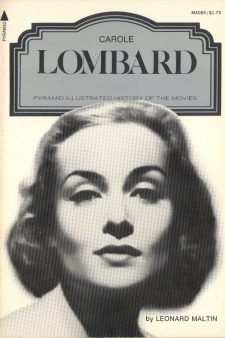 “Categorizing Carole Lombard as a comedienne – as most latterday writers and fans have done – is doing an injustice to one of the brightest talents that ever graced a Hollywood film. Lombard was a superb actress (as well as a great beauty), and her success in screwball-comedy roles tended to obscure the fact that she was often seen to equal advantage in dramatic films.
The image of Lombard as a “screwball” was enhanced by her off-screen shenanigans, which were legendary. An enthusiastic prankster and party-goer (as well as an imaginative party-giver), Carole was known to millions of fans for her unscripted antics through the pages of Photoplay and other fan magazines, creating an impression almost as strong as the one forged by her screen appearances.
Comedy gave Lombard also her greatest career break, after years of humdrum roles as nominal leady to most of Paramount’s male stars. The very idea of so beautiful a woman tackling wacky comedy endeared her to thirties audiences, who then demanded that she appear in such film exclusively. When the actress bolted and sought greater variety, her popularity slipped, even though her choice of dramatic vehicles was quite sound. Then Lombard moved into another role – as one of the reigning queen of Hollywood, the wife of movieland’s undisputed “King,” Clark Gable. Their seemingly perfect marital union added yet another dimension to Lombard’s public image – and to her private personality.
It’s nearly impossible to find a Hollywood colleague of Lombard’s with a bad word to say about her. A girl who grew up in the movie world, she earned the love and respect of all who knew her, for her forthrightness, her beauty, her contagious sense of fun, and her enormous talent, although not necessarily in that order. She swore like a sailor, looked like a million bucks, and when given the chance, outclassed and outacted all the glamour girls and trained actresses in Hollywood. There was only one Carole Lombard.” – From The Introduction by Leonard Maltin.
One of the screen’s most beautiful and scintillating actresses, Carole Lombard was equally adept at playing boisterous comedy and poignant drama. In his amply illustrated book, Leonard Maltin covers the tragically brief life and career of this unforgettable star, and discusses, with warmth and perception, the movies that glowed with her presence.
The Pyramid Illustrated History of the Movies is a series of volumes that offers a comprehensive overview of – and brings a fresh perspective to – the influential figures, forms, and styles in the development of motion pictures. Each lavishly illustrated volume has been designed to stimulate the interest of the student for whom film is an art, and to stir the memories of the fan for whom “going to the movies” will always be an exhilarating experience.
Softcover – 157 pp., index – Dimensions 19 x 13 cm (7,5 x 5,1 inch) – Weight 154 g (5,4 oz) – PUBLISHER Pyramid Publications, New York, New York, 1976
Carole Lombard: The Hoosier Tornado (Wes D. Gehring; foreword by Scott Robert Olson)
 For millions of fans during the 1930s, an actress from Fort Wayne, Indiana, personified the madcap adventures of their favorite farm of screen comedy-screwball. Nicknamed “The Hoosier Tornado” for her energetic personality, Carole Lombard did as much as anyone to define the genre, delighting audiences with her zany antics in such films as Twentieth Century, My Man Godfrey, Nothing Sacred, and To Be or Not to Be. She also captured America’s attention through her romance with and eventual marriage to screen idol Clark Gable.
In this inaugural volume in the Indiana Historical Society Press’s Indiana Biography Series, Wes D. Gehring, a noted authority on film comedy, examines Lombard’s legacy, focusing on both the public and private figure from her early days as merely beautiful window dressing in Mack Sennett silent films, to her development as the leading motion-picture comedienne of her time, to her tragic death in a January 1942 plane crash following a successful war-bond rally in Indianapolis. He also explores the rapport this sometimes “Profane Angel” (Lombard swore like a sailor) enjoyed with not only directors, but also the blue-collar workers who toiled on movie sets. The biography also features a foreword written by Scott Robert Olson, dean of the college of communications, information, and media, and professor of communication studies at Ball State University.
In her comedic roles, Gehring states in the book, Lombard offered the life lesson that “the irrational mind – crazy Carole – stood a much better chance of surviving in the equally irrational modern world.” Lombard’s film persona continues to survive in the public’s collective conscious. “Her screwball herome is as significant for modern audiences as yesteryear’s more traditional literary figures,” Gehring writes.
Nationally respected for its publication program, the Indiana Historical Society Press has always excelled particularly in one area: telling the life and times of those who have had an impact on the Hoosier State. The Press continues this tradition with its new Indiana Biography Series, which pairs writers with Indiana subjects of note. Future volumes in the series will highlight such personalities as Jonathan Jennings, Gus Grissom, Thomas Marshall, James Dean, Meredith Nicholson, Susan Wallace, David L. Chambers, and Cleo Blackburn.
WES D. GEHRING is a professor of film at Ball State University and an associate media editor for USA Today magazine, for which he also writes the column Reel World. Gehring is an award-winning author of nineteen books, the majority of which are biographies. These include works on Charlie Chaplin, W.C. Fields, the Marx Brothers, Robert Benchley, Leo McCarey, Laurel and Hardy, Red Skelton, and Irene Dunne (forthcoming). His other books include eight volumes of genre criticism and a humor text, Film Classics Reclassified. Gehring’s articles, comic essays, and poems have appeared in numerous journals.
Hardcover, dust jacket – 264 pp. – Dimensions 19,5 x 13,5 cm (7,7 x 5,3 inch) – Weight 418 g (14,7 oz) – PUBLISHER Indiana Historical Society Press, Indianapolis, Indiana, 2003 – ISBN 0-87195-167-3
Le Carré de Pluton: Mémoires (Brigitte Bardot)
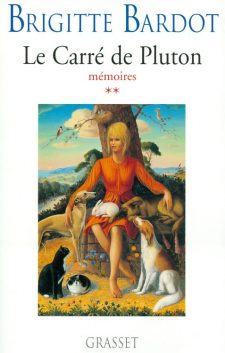 Je venais d’avoir 39 ans… A peine sortie du tourbillon de la vie d’une star, Brigitte Bardot se lance dans un combat sans merci contre l’injustice et la cruauté envers les animaux. Elle dénonce tous les excès, toutes les horreurs, prenant tous les risques comme dans sa campagne pour les bébés phoques ou contre les sacrifices sanglants et illégaux de l’Aïd-el-Kébir.
Mais ce second volume est avant tout le récit de la vie d’une femme qui se bat contre la solitude, les faux-semblants, qui essaie de préserver ses choix, ses goûts. Les amitiés et les amours se mêlent aux déceptions et aux trahisons. L’alcool, les nuits blanches n’ont plus le même sens…
Brigitte Bardot raconte tout avec cette formidable vitalité, avec ce même talent dans le récit qui animait Initiales B.B., cette même voix inimitable, cette même violence dans les passions et dans les peines.
Souvent l’humour reparaît. Portraits féroces, démêlés avec ses gardiens, la vie quotidienne à Saint-Tropez. Portraits tendres, ses parents, ses fidèles compagnons à quatre pattes, ses amies, le long défilé des êtres chers qui disparaissent. Les hommes de ce deuxième versant de sa vie, sans oublier les périodes noires, celles qui font que ce livre s’appelle Le Carré de Pluton*.
* Le Carré de Pluton: configuration astrale, confrontation avec les forces de possession, synonyme de destruction et de renouveau.
Softcover – 396 pp., index – Dimensions 24 x 15,5 cm (9,5 x 6,1 inch) – Weight 869 g (30,7 oz) – PUBLISHER Éditions Grasset & Fasquelle, 1999 – ISBN 2 246 59501 0
Cary Grant: Een Dubbelleven (Charles Higham, Roy Moseley; originally titled Cary Grant: The Lonely Heart)
 In een onderzoek naar de geschiedenis van Hollywood noemde People Magazine in 1987 Cary Grant, samen met Greta Garbo, de grootste der sterren. Zeker is, dat geen enkele acteur, of het zou Clark Gable moeten zijn, de romantische aantrekkingskracht van Cary Grant heeft kunnen evenaren; in de kunst van de romantische komedie kent Grant zijn gelijke niet. Zijn leven lijkt één lange opeenstapeling van benijdenswaardige minzaamheid, ongeëvenaarde glamour, puissante rijkdom en een even gevarieerd als gepassioneerd liefdesleven.
Andere sterren van het witte doek, het podium of uit de politiek, verbleken bij de overrompelende uitstraling van zijn uiterlijk en persoonlijkheid. Supermannen als Frank Sinatra, Ronald Reagan, Bob Hope en Jack Benny benijdden hem om zijn sophistication.
Maar wie was de werkelijke Cary Grant? Deze autobiografie onthult welke verscheurde persoonlijkheid schuil ging onder het bedrieglijke pantser van de gelukkige superster. Grant blijkt vooral een vat vol tegenstrijdigheden te zijn geweest. Hij bezat huizen in Beverly Hills, Malibu en Palm Springs, was eigenaar van twee Rolls Royces, liet al zijn kleren – en zelfs schoenen – speciaal voor hem maken. Toch bleef hij in zijn hart altijd een ‘working class hero’ uit het Amerikaanse Westen. Ook al dichtten miljoenen hem het comfortabele, onbekommerde bestaan van de aanbeden ster toe, een groot deel van Grants leven was vol pijn soms zelfs een marteling. Hoewel hij trouwde met een handvol aantrekkelijke vrouwen, was hij bisexueel en had hij affaires met grote mannen als de multimiljonair Howard Hughes en Randolph Scott.
Zijn moeder, Elsie Maria Leach, was wreed en streng en verpestte zijn jeugd. Bovendien zijn er sterke aanwijzingen dat zij niet zijn echte moeder was. Dat zou een zekere Lilian zijn geweest, een joodse vrouw. Mogelijk verklaart dat waarom Grant zich in 1904, toen dat nog nauwelijks werd gedaan, liet besnijden.
Als acteur kon Grant tijdens opnamen het ene moment de lieveling van elke regisseur zijn en een toonbeeld van meegaandheid, om het volgende moment de hele set tot wanhoop te brengen door eindeloos te zeuren over futiliteiten. Ook kon hij uit gemakzucht zijn prachtige huizen verslonzen om zich dan redeloos op te winden over de kleur van een deurknop. Het fascinerende levensverhaal van Cary Grant is dus veel minder een onafgebroken komedie dan tot voor kort werd aangenomen. Charles Higham en Roy Moseley hebben de tragikomedie van Grants leven met geschiedkundige precisie en vol vaart beschreven.
Softcover – 304 pp. – Dimensions 22,5 x 15 cm (8,9 x 5,9 inch) – Weight 553 g (19,5 oz) – PUBLISHER Centerboek, Weesp, The Netherlands, 1989 – ISBN 90-5087-079-1
Casablanca (edited by Richard J. Anobile)
 “Here is the complete Casablanca. Not just a script with a few meaningless stills bound into the center, but the entire film reconstructed through the use of over 1,400 frame blow-ups. The basic shortcoming of those plentiful script books which clutter bookstore shelves is that it is very unnatural to read dialogue and camera directions of a film already produced. The characterizations brought to the film by the actors are lost along with the subtle remarks of the director’s camera. Here, almost every aspect of the film is presented to give you a complete record of Casablanca in book form. I am pleased to be able to add Casablanca to the Film Classics Library and am grateful to have been able to have had a conversation with Ms. Ingrid Bergman. I hope the interview will give you an interesting insight into the making of this film.” – From The Introduction by Richard J. Anobile.
This book is the most accurate and complete reconstruction of Casablanca in book form with over 1,500 frame blow-up photos shown sequentially and coupled with the complete dialogue from the original soundtrack, allowing you to recapture this film classic in its entirety.
Softcover – 256 pp. – Dimensions 28 x 21 cm (11 x 8,3 inch) – Weight 745 g (26,3 oz) – PUBLISHER Pan Books, Ltd., London, 1974 – ISBN 0 330 24214 8
Casablanca: As Time Goes By… 50th Anniversary Commemorative (Frank Miller)
 The leading lady was the producer’s second choice. The leading man avoided his co-star between love scenes for fear of his wife’s jealousy. Two of the stars didn’t want to be in the movie in the first place. And nobody knew how the picture would end until the day they shot the final scene. Yet out of this chaos came one of the most enduring film favorites of all time – Casablanca.
For the first time, here is the whole story of Warner Bros. Production No. 410, from the original play that laid its foundations, through casting, writing, shooting, and post-production, to the series of lucky breaks that created one of the most everlastingly popular films of the last fifty years.
At every step along the road to Casablanca, the picture’s creators had to make choices that meant the difference between triumph and flop. Ronald Reagan was initially announced to play one of the male leads. Producer Hal Wallis considered Ella Fitzgerald as Sam the piano player. Composer Max Steiner tried to cut ‘As Time Goes By.’ And sometimes the participants managed to make the right choices in spite of themselves.
Lavishly illustrated with a collection of photos, memos, blueprints and posters never before assembled in one book, Casablanca: As Time Goes By… paints the most complete picture ever of a movie that has mesmerised film-lovers and romantics for half a century.
FRANK MILLER first discovered the world of the silver screen at age six when an aunt took him to one of the last cinema screenings of The Wizard of Oz. On his own personal trip down the yellow brick road, he acquired some other favourite films – Citizen Kane, The Thing (From Another World), The Lady Eve, In a Lonely Place, The Bandwagon, Surf Nazis Must Die – and a Ph.D. in dramatic literature and criticism. He also hosted a radio show in Tennessee, reviewing film and television, and has written for television. In the theater he has directed productions of Henry V, Fallen Angels and Lend Me a Tenor and has built a reputation as a respected acting teacher in America.
Hardcover, dust jacket – 224 pp., index – Dimensions 28,5 x 22,5 cm (11,2 x 8,9 inch) – Weight 1.205 g (42,5 oz) – PUBLISHER Virgin Books, London, 1992 – ISBN 1-85227-411-5
Casablanca: Behind the Scenes – The Illustrated History of One of the Favorite Films of All Time (Harlan Lebo; foreword by Julius Epstein)
 The scene is burned into the memory of every film fan – a fogbound airport, a pair of desperate refugees struggling to escape to freedom, the one man who can save them, and a diabolical Nazi trying to stop them.
The scene comes from the closing moments of Casablanca, which starred Humphrey Bogart in his greatest role, along with Ingrid Bergman, Paul Henreid, and Claude Rains. Casablanca has become the proudest achievement of Warner Bros. Pictures, a film for the ages that has been called “the best Hollywood movie of all time.”
But the real-life story behind the making of Casablanca proved to be as dramatic as the action depicted on the screen, as Hollywood’s most dynamic studio was caught up in the real-life drama of America’s first terrifying days of involvement in World War II. The whole story of how this classic was put together – both onscreen and backstage – is captured in Casablanca and includes rarely seen interviews with the stars of Casablanca and behind-the-scenes details about the making of the film; never-before-published candid photographs, confidential correspondence from the Warner files, and notes and records from the production; the complete cast list, production credits, and reviews of the film.
HARLAN LEBO is director of communications for the College of Letters and Science at UCLA. His first book, Citizen Kane: The Fiftieth Anniversary Album, was described as “the definitive work on America’s greatest film.” Lebo lives in Los Angeles.
Softcover – 224 pp., index – Dimensions 23,5 x 18,5 cm (9,3 x 7,3 inch) – Weight 457 g (16,1 oz) – PUBLISHER Fireside, New York, New York, 1992 – ISBN 0-671-76981-2
Cassell’s Movie Quotations (Nigel Rees)
 In Cassell’s Movie Quotations, Nigel Rees draws on a lifetime’s passion for the cinema to bring together a hugely entertaining and breathtakingly comprehensive collection of over 4,000 quotes. Great and memorable lines from the movies are uniquely coupled with quotable comments by and about filmmakers and film-goers. The book also celebrates the language of cinema – its catchphrases and titles, its slogans and clichés. Above all, Cassell’s Movie Quotations quotes the professionals – the actors, directors, producers and the critics – and tell us what they love, loathe and lament about the business, the pictures, the players – and each other.
NIGEL REES is an author whose most recent books are the Cassell Companion to Quotations and the Cassell Dictionary of Humerous Quotations. He is the deviser and presenter of BBC Radio 4’s enduringly popular series Quote… Unquote, through which he has become an authority on the popular use of language in quotations, idioms, slogans, catchphrases and clichés. He lives in Notting Hill, London.
Hardcover, dust jacket – 432 pp., index – Dimensions 25 x 19,5 cm (9,8 x 7,7 inch) – Weight 1.365 g (48,1 oz) – PUBLISHER Cassell & Co., London, 2000 – ISBN 0-304-35369-8
The Casting Couch and Me: The Inhibited Memoirs of a Young Actress (Joan Wood)
 Joan Felicity Wood is an actress. How she became one, where she started, and what she went through to get there are all told with candor and frankness in The Casting Couch and Me.
“Casting couch creeps want nothing more than a quick release. Supply-and-demand. Give-and-take. Buyers and sellers.” The bastions of show biz, these “creeps” can make or break a young actress. Enthusiastic and vulnerable, portfolio in hand, tempted by grandeurs of elusive stardom, the young actresses have one thing in common: a constant glimmer of hope.
With no elusiveness, and portfolio in hand, Joan Wood tells her story. Humorous at times, sad at others, she recalls those trying tromps through the streets from one audition to another, one office to another, one small role to another, always competing for that one “big chance.” And when it comes knowing it’s just the beginning. She remembers those Broadway “producers” who audition their young hopefuls on seedy casting couches; the “managers” who are really pimps for visiting VIP’s; the “photographers” who specialize in getting into the act.
JOAN WOOD’s story is her own, but also that of a thousand others. Names have been changed to protect the innocent, but innocence is hardly their specialty. Her’s is a story about those precocious, uninhibited nymphets who yearn to become stars and what happens when their dreams collide with the facts of life. Some make it, some don’t.
Hardcover, dust jacket – 216 pp. – Dimensions 21,5 x 14,5 cm (8,5 x 5,7 inch) – Weight 413 g (14,6 oz) – PUBLISHER Walker and Company, New York, New York, 1975 – ISBN 0-8027-0452-2
A Cast of Killers (Sidney D. Kirkpatrick)
 On February 1, 1922, the distinguished silent-film director William Desmond Taylor was shot to death in his Los Angeles bungalow by an unknown assailant. Reports of strange activities at the scene of the crime circulated soon after. When the police arrived, was the head of Paramount Studios burning a bundle of papers in the fireplace, and was a well-known actress searching the house for letters she claimed were hers? Despite a full-scale investigation, the case was never solved; for sixty years it has remained a lingering Hollywood scandal.
In 1967, more than forty years after Taylor’s death, the great King Vidor, whose directing credits include Northwest Passage, The Fountainhead, Duel in the Sun, and War and Peace, determined to solve the mystery, which had haunted him throughout his career, in order to make a film about it. Through his intimate knowledge of both the studios and the stars, he succeeded, where dozens of professional detectives had failed, in discovering the identity of the murderer. But because his findings were so explosive, he decided he could never go public and locked his evidence away.
After Vidor’s death in 1982, Sidney D. Kirkpatrick, Vidor’s authorized biographer, gained access to the evidence and reconstructed the amazing story of Taylor’s murder and Vidor’s investigation. With a cast of suspects that includes the actress Mabel Normand, a reputed drug addict; the beautiful ingenue, Mary Miles Minter; Mary’s domineering mother, Charlotte Shelby; Taylor’s homosexual houseman; and Taylor’s secretary, who bore an uncanny resemblance to Taylor’s mysteriously elusive brother, this true crime story has all the elements of a classic murder mystery. Covered up for more than half a century, the full story can now be told in all its riveting, shocking detail.
SIDNEY KIRKPATRICK has an M.F.A. in film from New York University. A journalist and an award-winning documentary filmmaker, he lives with his wife in Los Angeles.
Hardcover, dust jacket – 301 pp. – Dimensions 24 x 16 cm (9,5 x 6,3 inch) – Weight 692 g (24,4 oz) – PUBLISHER E.P. Dutton, New York, New York, 1986 – ISBN 0-525-24390-9
Cast of Thousands: A Pictorial Memoir of the Most Glittering Stars of Hollywood and the Most Dazzling of the World’s Literary and Social Lights (Anita Loos)
 Anita Loos… known, loved, and wooed by the greatest celebrities of our time, creator of Lorelei Lee in Gentlemen Prefer Blondes, author of A Girl Like I, Kiss Hollywood Good-by, and the screenplay for Gigi, now shares her collection of memories, photos, and anecdotes of a life spanning over 80 years, roaming from New York to Hollywood to Paris to Berlin to Rome. It features an all-star cast of the most famous and fabulous personalities of the stage and screen – including Carol Channing, Helen Hayes, Greta Garbo, Audrey Hepburn, Harpo Marx, Clark Gable.
Sparkling stories about her friends and admirers and intimate behind-the-scenes glimpses of the stars are counterpointed by striking, sometimes surprising, candid photos of the great and famous on and off their guard. You’ll be privy to a firsthand glimpse of the early days of movie-making as Miss Loos spins tales of her years writing scenarios for D.W. Griffith and risqué gags for Mack Sennett. You’ll share with her the first rush of fame after Gentlemen Prefer Blondes became a classic. And you’ll hobnob with the many celebrities who have been her friends and co-conspirators in the great adventure of a career filled with glamour and excitement.
Anita Loos’ life has truly starred a cast of thousands, and as the ultimate star of her own saga, she has made Cast of Thousands one of the most dazzling books to emerge from Hollywood… or from anywhere.
Hardcover, dust jacket – 279 pp., index – Dimensions 27 x 24 cm (10,6 x 9,5) – Weight 1.635 g (57,7 oz) – PUBLISHER Grosset & Dunlap, Publishers, New York, New York, 1977 – ISBN 0-448-12264-2
Cecil B. DeMille (Charles Higham)
 Cecil B. DeMille. His name alone conjures up extravagant Biblical epics like The Ten Commandments, The King of Kings, Samson and Delilah, and The Sign of the Cross, full of teeming crowd scenes, half-naked revelers worshiping golden idols, Christians bravely facing lions, and other grandiose visions. While most regard him simply as an exploitative cynic who craved commercial success at any cost, Higham shows us a much deeper and more complex portrait. The DeMille who emerges here is a true artist gradually overwhelmed by financial pressures. A moralist and perfectionist, stubborn, decent, loyal, and ruthless when he had to be, DeMille believed devoutly in the Bible, and made films with missionary zeal to uplift the masses in an age of materialism and hedonism. We see how DeMille struggled throughout his career with powerful studio magnates (e.g., Adolph Zukor of Paramount) and with the star mannerisms of his leading ladies including Mary Pickford, Claudette Colbert, Gloria Swanson, Hedy Lamarr, and Paulette Goddard – not to mention the very real physical dangers of making many spectacular scenes. DeMille’s larger-than-life career and films typify the American dream, and thus continue to touch the hearts of millions.
CHARLES HIGHAM is a frequent Hollywood correspondent for The New York Times, and the author of Ziegfeld, The Films of Orson Welles, and The Celluloid Muse: Hollywood Directors Speak, among other books about the movies.
Softcover – 335 pp., index – Dimensions 22,5 x 15 cm (8,9 x 5,9 inch) – Weight 528 g (18,6 oz) – PUBLISHER Da Capo Press, Inc., New York, New York, 1973 – ISBN 0-306-80131-0
Cecil B. DeMille: A Life in Art (Sam Louvish)
 Cecil B. DeMille is Hollywood’s most enduring legend, remembered, and often reviled, for his grandiose biblical sagas, such as Samson and Delilah and his 1956 version of The Ten Commandments, with its cast of tens of thousands before computer graphics made the modern epic mundane. Many judged DeMille a dinosaur both for his movies and his ultraconservative politics. But in his vision of the Bible as an American frontier narrative he recast this old trend in American culture as a cinematic precursor of the “neoconservatism” of our own times.
The paradox of DeMille goes deeper, as despite his fame, most of his seventy films, of which fifty were silent pictures, remain unknown even to avid film fans, though his first 1923 version of The Ten Commandments and his 1927 tale of Jesus Christ, King of Kings, linger in the imagination. A founder-pioneer of Hollywood as an industry, DeMille was an unsung auteur, a master of increasingly bizarre narratives, with tales of adultery and divorce, hedonism and sin, in an age in which modernity, the consumer society, and the pursuit of money made America a battlefield of clashing values and temptations.
SIMON LOUVISH tells the tale of Cecil B. DeMille through his work: a major reexamination of Hollywood’s most monumental founder. Savant or sinner, artist or hack, defender of freedom or a hypocritical opportunist who embraced the golden calf of sheer commercialism, DeMille is a pervasive puzzle – a mirror of the larger puzzle and contradictions of America itself.
Hardcover, dust jacket – 507 pp., index – Dimensions 24 x 16 cm (9,5 x 6,3 inch) – Weight 801 g (28,3 oz) – PUBLISHER Thomas Dunne Books / St. Martin’s Press, New York, New York, 2007 – ISBN 978-0-312-37733-5
Cecil B. DeMille and American Culture: The Silent Era (Sumiko Higashi)
 Cecil B. DeMille and American Culture shows that the director best remembered today for overblown biblical epics was in fact one of the most remarkable pioneers in the film industry during the Progressive Era. In an innovative work that illustrates the intersection of cultural history with cultural studies, Sumiko Higashi describes how DeMille artfully introduced cinema – yet to achieve legitimacy as an art form – into middle-class culture. He accomplished this by emphasizing the function of spectacle in public venues such as stage melodramas, department store displays, Orientalist world’s fairs, civic pageantry, and lantern slide lectures, as well as in elaborate parlor games.
DeMille established his signature as a film author by articulating middle-class ideology across class and ethnic lines. In addition, he became a trendsetter in the 1920s with set and costume designs that transformed the sentimental heroine into the “new woman.” His work strongly influenced advertisers to mold a consumer culture based on female desire. Drawing on untapped material in the DeMille Archives and other collections, Higashi provides imaginative readings of DeMille’s early feature films. She explores them in relation to the dynamics of social change and demonstrates the extent to which the emergence of popular culture was linked to the genteel tradition.
SUMIKO HIGASHI is Associate Professor of History at the State University of New York, Brockport, and author of Cecil B. DeMille: A Guide to References and Resources (1985).
Softcover, dust jacket – 264 pp., index – Dimensions 23 x 15 cm (9,1 x 5,9 inch) – Weight 461 g (16,3 oz) – PUBLISHER University of California Press, Berkeley, California, 1994 – ISBN 0-520-08557-4
A Celebration of Gone With the Wind (Adrian Turner)
 Gone With the Wind is the most commercially successful film ever made and consistently tops polls as everybody’s favorite movie. Now 50 years old, the film retains all the excitement, romance and glamor that captivated audiences in America in 1939 and in Britain in 1940, when millions poured into cinemas to see it during the Blitz. In this lavishly-illustrated book, we go behind the scenes to see how the film was made – the inspired determination by its producer, David O. Selznick, the hiring and firing of directors, cameramen and scriptwriters, the casting of Clark Gable as Rhett Butler and the year-long search to find the perfect Scarlet O’Hara. And then there was the agony of the editing, the first sneak previews, the sneers from the Hollywood trade press, and at long last, the triumphs of the Atlanta premiere and ten Academy Awards.
For the first time, color frame enlargements have been produced to enable readers to follow the entire film virtually scene-by-scene with captions drawn largely from direct quotes from the soundtrack. This is a unique pictorial record of a motion picture that sums up both the madness and the genius of the Hollywood system, and the men and women who made Gone With the Wind.
ADRIAN TURNER is the author of Journey Down Sunset Boulevard: The Films of Billy Wilder and Hollywood 1950s. His reviews, interviews and features have appeared in the Guardian, The Times, the Observer, Radio Times and Time Out, for which he currently reviews the films on television. A former programme officer and now consultant of the National Film Theatre, London, he also co-scripted four series of BBC-TV’s Film Buff of the Year.
Hardcover, dust jacket – 189 pp. – Dimensions 31,5 x 25,5 cm (12,4 x 10 inch) – Weight 1.550 g (54,7 oz) – PUBLISHER Gallery Books, New York, New York, 1990 – ISBN 0-8317-3913-4
Celebrity Circus (Charles Higham)
 Welcome to noted Hollywood reporter Charles Higham’s spectacular circus – a rich collection of his most outstanding interviews with celebrities on both sides of the camera.
Here are the personal actions of some of the greatest stars of Hollywood. Katharine Hepburn: “It was my idea for Chanel to say ‘Shit!’ in Coco…” Roman Polanski: “Sharon Tate’s sister called. She’s hemorrhaging. She’s ill, alone, and frightened. Oh God, what’s wrong with young people today?” Mae West: “When I’m dead, won’t you come up and see me sometime?” Dina Shore: “I was stricken with polio as a child. I lad to learn to walk twice over. I’ve been shy and withdrawn ever since.” Paul Newman: “I want to live in the Australian outback. With little food and water. Wouldn’t that be a good life for a son of a bitch?” Robert Blake: “The networks are run by deadheads. The script is crap. Television is impotent. American men are impotent.” Lucille Ball: “I was gored by a bull. My nose caught fire. I smashed the cast on my leg…” Orson Welles and Francis Ford Coppola: “Please dear New York Times, don’t publish Charles Higham’s articles on us…”
And more from an all-star cast including Julie Andrews, Mary Pickford, Kirk Douglas, Robert Young, Edward G. Robinson, Gene Kelly, Christopher Isherwood, and Paul Anka.
Called by the Seattle Post-Intelligencer “a one-man revolution in writing about movies,” CHARLES HIGHAM proved it with his brilliant and controversial The Films of Orson Welles. Since then he has written the best-seller Kate: The Life of Katharine Hepburn and hit biographies of Marlene Dietrich, Charles Laughton, Ava Gardner, Cecil B. DeMille, and Flo Ziegfeld. For nine years he has profiled stars in The New York Times. He lives in Los Angeles and is currently working on a new biography of Errol Flynn.
[Interviews with Katharine Hepburn, Mae West, Jerry Lewis, Dinah Shore, Robert Blake, Tom Ewell, Julie Andrews, Joan Blondell, Kirk Douglas, Gene Kelly, Lucille Ball, Paul Anka, John Cassavetes, Gena Rowlands, Mary Miles Minter, Robert Wagner, Robert Young, David Steinberg, Mercedes McCambridge, Paul Newman, Mary Pickford, Tiny Tim, Edward G. Robinson, Francis Ford Coppola, William Peter Blatty, Robert Aldrich, Don Siegel, Brian De Palma, Christopher Isherwood, King Vidor, Alfred Hitchcock, Roger Vadim, George Sidney, Paul Schrader, William Wyler, Roman Polanski, Robert Wise, Maria Rasputin, Ralph Bakshi, Raoul Walsh, François Truffaut, Orson Welles]
Hardcover, dust jacket – 322 pp. – Dimensions 23,5 x 15,5 cm (9,3 x 6,1 inch) – Weight 674 g (23,8 oz) – PUBLISHER Delacorte Press, New York, New York, 1979 – ISBN 0-440-01210-4
Celebrity Circus (Charles Higham)
 “Katharine Hepburn opens the front door herself. ‘You must come and look at my Christmas wreath,’ she says, as, together with her secretary, a gentle English lady called Phyllis, she ushers me into the living room of her West Hollywood cottage. She walks over to the sparkling winter fire, picks up the green wreath, and shows me its intricately woven leaves. ‘I made it myself, I’m as proud of it as anything I’ve done.’
She so often plays embittered, broken-down old women on the screen it’s a relief to find her as alive with enthusiasm as a young girl, cheeks ruddy with sunburn, movements quick and precise, her figure almost as attractively skinny as it was when she played The Philadelphia Story more than thirty years ago.
Her living room has the leathery simplicity of an old sea captain’s. Above the cheerful fire welcoming the visitor on a chilly, foggy California afternoon, stands a handsome model of an antique sailing ship, and on the walls sparkling landscapes of Cuba, exquisitely painted by Hepburn herself. She curls up contentedly as a cat in a big black chair, looking affectionately around the room as though seeing it for the first time: reflected flames flickering on brassware, wood rubbed to a fine polish.
At sixty-four, the star has the same agreeable shiny, well-worn look, an Alice-Sit-by-the-Fire with the fine lines of a Connecticut gentlewoman, cheekbones delicately chiseled, nose sharply patrician, jaw strong and determined, and a mind of piercing sharpness which can throw cold water on all pretentiousness. Only the smoky, blue-green eyes suggest the pain she obviously still feels after the death of her adored companion, Spencer Tracy.” – From the interview with Katharine Hepburn.
[Interviews with Katharine Hepburn, Mae West, Jerry Lewis, Dinah Shore, Robert Blake, Tom Ewell, Julie Andrews, Joan Blondell, Kirk Douglas, Gene Kelly, Lucille Ball, Paul Anka, John Cassavetes, Gena Rowlands, Mary Miles Minter, Robert Wagner, Robert Young, David Steinberg, Mercedes McCambridge, Paul Newman, Mary Pickford, Tiny Tim, Edward G. Robinson, Francis Ford Coppola, William Peter Blatty, Robert Aldrich, Don Siegel, Brian De Palma, Christopher Isherwood, King Vidor, Alfred Hitchcock, Roger Vadim, George Sidney, Paul Schrader, William Wyler, Roman Polanski, Robert Wise, Maria Rasputin, Ralph Bakshi, Raoul Walsh, François Truffaut, Orson Welles]
Softcover – 348 pp. – Dimensions 17,5 x 10,5 cm (6,9 x 4,1 inch) – Weight 224 g (7,9 oz) – PUBLISHER Dell Publishing Co., Inc., New York, New York, 1979 – ISBN 0-440-11210-9
Celia Johnson: A Biography (Kate Fleming)
 Dame Celia Johnson is possibly best remembered for her role as Laura Jesson in David Lean’s classic film, Brief Encounter. In fact, her acting career spanned more than fifty years before her death in 1982. This was one of the finest periods of British acting and she appeared with many of the greatest names, like Marie Tempest, Gerald du Maurier and Nigel Playfair. She began her film career during the Second World War when she was chosen by Noël Coward to play his wife in In Which We Serve. This Happy Breed followed and then Brief Encounter, the final few days’ filming of which was interrupted by VE Day celebrations.
In 1935 Celia Johnson married Peter Fleming, brother of Ian, a brilliant travel writer and essayist. Now their daughter, Kate Fleming, has written this personal biography, drawing on her own memories of her mother, on reminiscences of friends and colleagues, and on her parents’ letters. The result is an engrossing portrait of one of Britain’s best-loved stars, and a vivid picture of the golden age of British film.
KATE FLEMING is the elder daughter of Celia Johnson. She read Russian at Oxford University and has written a book on the Churchill family. She and her husband, John Grimond, have three daughters. They live in London but spend school holidays in Orkney and Oxfordshire.
Hardcover, dust jacket – 244 pp., index – Dimensions 24 x 16 cm (9,5 x 6,3 inch) – Weight 613 g (21,6 oz) – PUBLISHER Weidenfeld and Nicolson, London, 1991 – ISBN 0 297 81188 6
The Celluloid Muse: Hollywood Directors Speak (Charles Higham, Joel Greenberg)
 The Celluloid Muse is a series of self-portraits of fifteen of the directors who helped to make the American cinema great. Each is based on taped interviews, and each has an introduction in which Charles Higham and Joel Greenberg take the reader into the world behind the Hollywood façade and describe the director’s milieu and personality.
Among the subjects are Alfred Hitchcock, describing with characteristic cynicism the making of his thrillers; Fritz Lang, talking of his obsession with man’s predestined fate; John Frankenheimer, conveying a remarkable tension as he tells how he cleared his way through the television and motion picture jungle; Vincente Minnelli, recalling the making of such celebrated musicals as Meet Me in St. Louis and An American in Paris; Rouben Mamoulian, disclosing the secret of the famous one-take transformation of Fredric March as Dr. Jekyll into Mr. Hyde in his 1932 film; Billy Wilder, acidly and incorrigibly misanthropic; George Cukor, sophisticated director of women stars; Robert Aldrich, King Vidor, Lewis Milestone, and many others.
For sheer range of inside information on the making of many famous motion pictures, The Celluloid Muse is perhaps unequaled in the literature of the cinema. There are numerous illustrations, as well as filmographies of the directors, and a special preface setting the Hollywood scene.
CHARLES HIGHAM was born in London in 1931, the son of the well-known advertising magnate of the thirties, Sir Charles Frederick Higham. He has published four volumes of poetry, the latest being Noonday Country (1969) but is better known as a writer on film for such periodicals as Sight and Sound, the London Magazine, and the Hudson Review. Film critic of the Sydney Morning Herald since 1968, he has recently been Regents Professor, teaching film and literature, at the University of California. Co-author with Joel Greenberg of Hollywood in the Forties (1968), he has also written a recently published controversial study of Orson Welles. JOEL GREENBERG, born in Jerusalem in 1934, has written extensively of film for a number of publications including Sight and Sound and Film Journal, of which he was for a time co-editor. He is also a freelance writer and co-author with Charles Higham of Hollywood in the Forties.
[Interviews with Robert Aldrich, Curtis Bernhardt, George Cukor, John Frankenheimer, Alfred Hitchcock, Fritz Lang, Rouben Mamoulian, Lewis Milestone, Vincente Minnelli, Jean Negulesco, Irving Rapper, Mark Robson, Jacques Tourneur, King Vidor, Billy Wilder]
Hardcover, dust jacket – 268 pp., index – Dimensions 23,5 x 15 cm (9,3 x 5,9 inch) – Weight 648 g (22,9 oz) – PUBLISHER Henry Regnery Company, Chicago, Illinois, 1969
Celluloid Skyline: New York and the Movies (James Sanders)
 A tale of two cities, both called “New York.”
The first is a real city, an urban agglomeration of millions. The second is a mythic city, so rich in memory and association and sense of place that to people everywhere it has come to seem real: the New York of films such as 42nd Street, Rear Window, King Kong, Dead End, The Naked City, Ghostbusters, Annie Hall, Taxi Driver, and Do the Right Thing – a magical city of the imagination that is as complex, dynamic, and familiar as its namesake of stone and steel.
As James Sanders shows in this deeply original work, the dream city of the movies – created by more than a century of films, since the very dawn of the medium itself – may hold the secret to the glamour of its real counterpart. Here are the cocktail parties and power lunches, the subway chases and opening nights, the playground rumbles and observation-deck romances. Here is an invented Gotham, a place designed specifically for action, drama, and adventure, a city of bright avenues and mysterious sidestreets, of soaring towers and intimate corners, where remarkable people do exciting, amusing, romantic, scary things. Sanders takes us from the tenement to the penthouse, from New York to Hollywood and back again, from 1896 to the present, all the while showing how the real and mythic cities reflected, changed, and taught each other.
Lavishly illustrated with scores of rare and unusual production images culled from Sanders’ s decade-long research in studio archives and private collections around the country, Celluloid Skyline offers a new way to see not only America’s greatest metropolis, but also cities the world over.
JAMES SANDERS, an architect, is the co-writer with Ric Burns of the seven-part, fourteen-and-a- half-hour PBS series New York: A Documentary Film – which received an Emmy Award and an Alfred I. duPont-Columbia University Silver Baton Award – and co-author with Burns and Lisa Ades of its companion volume, New York: An Illustrated History. He has written for the New York Times, the Los Angeles Times, Vanity Fair, Architectural Record, and Interiors, and has produced exhibitions on New York housing and the urban heritage of 42nd Street. Mr. Sanders, who maintains a design practice in Manhattan, has completed projects for the Port Authority of New York and New Jersey, the Parks Council, the Landmarks Preservation Commission, and other civic groups and commercial clients in New York and California.
Hardcover, dust jacket – 495 pp., index – Dimensions 26 x 21 cm (10,2 x 8,3 inch) – Weight 1.685 g (59,4 oz) – PUBLISHER Alfred A. Knopf, New York, New York, 2002 – ISBN 0-394-57062-6
Change Lobsters – and Dance: An Autobiography (Lilli Palmer)
Autographed copy Lilli Palmer
 From her teens when her promising acting career in Germany was cut short by Hitler’s rise to power, to her cabaret acts as a refugee in Paris, small parts in British films, marriage to Rex Harrison, Hollywood and Broadway stardom, scandal and divorce, remarriage and new career, Lilli Palmer’s life has been a constant “changing of lobsters,” of picking up the pieces and continuing the dance. With amazing candor and humor – often at her own expense – Miss Palmer tells about her life, both public and private, and the many fascinating personalities she has met along the way.
Lilli Palmer shares her deeply personal childhood memories and recalls the close family ties in her 1920’s bourgeois Berlin home; her debut as a seventeen-year-old at the Darmstadt State Theater and the shock of discovery that as a Jew she would not be permitted to continue her career; work with her sister as refugees in Paris, literally singing for their supper in cabarets and strip clubs in homemade dresses of green taffeta; her persistent attempts to break into British films while facing daily threats of deportation until her “discovery” by Alexander Korda; her meeting with and marriage to Rex Harrison, which had such promising beginnings but ended under tragic circumstances.
With insight and always with warmth and understanding, Miss Palmer tells about her arrival with Rex in Hollywood and the endless rounds of parties and drinking and dallying that culminated in the sensational Carole Landis suicide and the subsequent departure of the Harrisons from Hollywood. Miss Palmer’s fantastic Broadway successes, her visit with George Bernard Shaw, her friendship with the Windsors and Greta Garbo climaxed by the hilarious Portofino harbor dunking party, her meeting with Helen Keller, her friendships with Noël Coward and Laurence Olivier, her return to Broadway, the breakup of her marriage and divorce that enabled Harrison to marry the dying Kay Kendall, and her remarriage to actor / author Carlos Thompson – all are told with wit and charm and are marked by a refreshing frankness seldom found in the memoirs of an actress. But Miss Palmer is much more than an actress: she is also an accomplished painter whose works have been shown in major galleries, a producer and host of European television programs, and finally, an author, whose book has topped European best-seller lists for nine months.
During her colorful career, LILLI PALMER came in contact with numerous famous personalities. There’s Fritz Lang, her first Hollywood director and stern taskmaster; Gary Cooper, who helped her feel at ease; the unrelenting Hedda Hopper; and Clark Gable, Humphrey Bogart and Lauren Bacall, Fred Astaire, William Holden, David Niven, Ronald Colman. And there are the plays and movies: The Four Poster; Bell, Book and Candle; Body and Soul; Counterfeit Traitor; Cloak and Dagger. But above all, there is… Lilli Palmer.
Hardcover, dust jacket – 320 pp. – Dimensions 24 x 16 cm (9,5 x 6,3 inch) – Weight 844 g (29,8 oz) – PUBLISHER Macmillian Publishing Co., Inc., New York, New York, 1975 – ISBN 0-02-594610-2
The Chaplin Encyclopedia (Glenn Mitchell)
 The Charlie Chaplin Encyclopedia is the definitive A-Z guide to cinema’s greatest comedian. Glenn Mitchell includes rare treasures for all Chaplin fans: seldom-seen footage from Chaplin’s early years in Hollywood, unpublished stage material from 1906-1910, and a fascinating eyewitness account of Chaplin’s earliest days with Fred Karno.
Aside from such Chaplin esoterica, the Encyclopedia contains full information on all Chaplin’s films from the earliest short silents and the feature-length classics of the twenties and thirties, to The Great Dictator, Limelight and other Chaplin talkies. Full details are included on the “lost” movies such as The Professor and How to Make Movies, as well as a wealth of hitherto uncollected anecdote.
Also included is information on newsreels, stage work, Chaplin’s collaborators, and much more. Full, detailed credits are given for all of Chaplin’s films.
GLENN MITCHELL is an internationally recognized authority on cinema comedy of the early twentieth century. He is a film journalist and a specialist in all forms of comedy, animation and music-hall. His previous publications, The Laurel & Hardy Encyclopedia and The Marx Brothers Encyclopedia, are best-sellers.
Softcover – 288 pp. – Dimensions 25 x 18,5 cm (9,8 x 7,3 inch) – Weight 871 g (30,7 oz) – PUBLISHER B. T. Batsford, Ltd., London, 1997 – ISBN 0-7134-7938-8
Chaplin: Genius of the Cinema (Jeffrey Vance)
 Charlie Chaplin (1889-1977) was the first global cinema star and one of the greatest comedy geniuses the world has ever known. His creation, the Tramp, remains to this day the most universal representation of humanity in the history of film. “You know this fellow is many-sided,” wrote Chaplin of his character, “a tramp, a gentleman, a poet, a dreamer, a lonely fellow, always hopeful of romance and adventure.”
The Tramp’s relentless pursuit of the fruits of abundance and happiness and his righteous battles against those who bar his way, reflect the same struggles that consumed Chaplin throughout most of his life. Indeed, Chaplin’s description of his multi-dimensional screen character is also fitting of the artist himself: an actor, writer, director, producer, editor, and composer with more than seventy-five years of creative accomplishment.
Produced with full access to the Chaplin family archives, this book chronicles his entire complex life story in 500 photographs – many of them recently discovered and never before published – newly printed from the original negatives especially for this volume. Author Jeffrey Vance draws on exhaustive research and interviews with those who knew Chaplin to produce this definitive illustrated account, describing in lively detail the atmosphere on Chaplin’s film sets and his relations with the cast and crew, his first attempts at comedy sequences that later became famous, the development of his scenarios and characters, and the main themes and ideas that persist through the major Chaplin films: The Kid (1921), The Gold Rush (1925), The Circus (1928), City Lights (1931), Modern Times (1936), The Great Dictator (1940), Monsieur Verdoux (1947), and Limelight (1952).
Chaplin’s enthralling rags-to-riches life story is also represented in these pages, every stage of which is documented in pictures: his poverty-stricken childhood in late-Victorian London, where he began his career as an entertainer in the music halls; his unparalleled success in Hollywood, from the rough-and-tumble Keystone shorts to the feature-length masterpieces made under his complete artistic control; his numerous romances and four marriages; his political persecution during the anti-communist witch hunts; and his happy years of quiet, self-imposed exile in Switzerland. Chaplin: Genius of the Cinema is the essential volume on the extraordinary life and career of the incomparable comedian, groundbreaking filmmaker, and multifaceted public figure who left an indelible imprint on cinema and culture.
JEFFREY VANCE is a film historian and an authority on silent-film comedy. He is the author of Abrams’ Buster Keaton Remembered and Harold Lloyd: Master Comedian. He collaborated on two previous books on Chaplin: Wife of the Life of the Party with Lita Grey Chaplin and Making Music With Charlie Chaplin with Eric James. Vance has been involved in the presentation and the restoration of many silent films, including archiving Chaplin’s own film materials on behalf of the Chaplin family’s Roy Export Company Establishment. He earned an M.A. degree in English literature from Boston University and lives in Los Angeles.
Hardcover, dust jacket – 397 pp., index – Dimensions 30,5 x 23 cm (12 x 9,1 inch) – Weight 2.310 g (81,5 oz) – PUBLISHER Harry N. Abrams, Inc., New York, New York, 2003 – ISBN 0-8109-4532-0
Chaplin: His Life and Art (David Robinson)
 This is the authorized, definitive biography of the man who has often been called the greatest comic genius the world has ever seen. The author has obtained the authorization of Chaplin’s widow, Lady Oona, for unprecedented access to Charles Chaplin’s closely guarded archive of private papers, records, letters, and photographs.
Chaplin was a man plagued by loneliness and driven by the search for artistic perfection. His life was an extraordinary dramatic one, and David Robinson explores the often tragic story of Chaplin’s alcoholic father; his mentally disturbed mother; his marriages to very young women, including the legendary film star Paulette Goddard; the “white slavery” case against him; and his persecution by anti-Communist forces during the McCarthy era, including the FBI, which ultimately forced Chaplin to leave America.
Chaplin contains many provocative revelations and previously unknown and unpublished information about Chaplin’s private life, romances and business dealings – and about the making of his magical films. The book vividly recreates the different worlds in which Chaplin moved: from Victorian and Edwardian London, through the glamorous birth and sad decline of Hollywood’s studio system, to the nightmare of McCarthyism, after which America once again came to adore the “Little Tramp,” the hero of the underdog, the drol genius who could make America laugh during the Depression when nothing else but bootleg gin could.
Illustrated with eigthy pages of rare photographs from the Chaplin family albums, Chaplin contains a detailed chronology, filmography, list of theater tours, list of important people in Chaplin’s life, index, and bibliography. This is a major work on a fascinating subject.
DAVID ROBINSON is the film critic for The Times of London; before that he was the film critic for the Financial Times in the United Kingdom. He is the only journalist to have been given access to the private Chaplin archive. Mr. Robinson’s collections of pre-cinema apparatus and film posters have been the subject of a number of exhibitions throughout Europe. His previous books include World Cinema, Hollywood in the Twenties, The Great Funnies and Buster Keaton.
Hardcover, dust jacket – 792 pp., index – Dimensions 23,5 x 15,5 cm (9,3 x 6,1 inch) – Weight 1.350 g (47,6 oz) – PUBLISHER McGraw-Hill Book Company, New York, New York, 1985 – ISBN 0-07-053181-1
Chaplin’s Girl: The Life and Times of Virginia Cherrill (Miranda Seymour)
 In 1931, City Lights introduced Charlie Chaplin’s new female star to the world. The film – defiantly silent in the age of talkies – was an immediate and international hit. The actress who played the romantic lead had never been on screen or stage before. Chaplin’s film turned her into the most famous girl in the world. And, like Rhett Butler, the most famous girl in the world didn’t give a damn.
Virginia Cherrill was the beautiful daughter of an Illinois rancher, who ran away to live through some of Hollywood’s wildest years. She was the adoring first wife who broke Cary Grant’s heart when she left him; who turned down the gloriously eligible Maharajah of Jaipur to befriend his wife and rescue her from purdah. Virginia Cherrill presided, during the thirties, over one of England’s loveliest houses, as the Countess of Jersey. Everybody sought her friendship. All that eluded her was love. And when she found it, she gave up all she had to marry a handsome and penniless Polish flying ace, whose dream it was to become a cowboy.
In this glorious, and undiscovered story of Hollywood, international high society, wartime drama and romance, Miranda Seymour works from unpublished sources to recapture the personality of a woman so vividly enchanting that none could resist her. This is the story of Cinderalla in reverse: of the poor girl who won everything – and gave up all for love. Breathtakingly romantic, exquisitely written, this is the stuff that dreams are made of …
MIRANDA SEYMOUR, author of the award-winning In My Father’s House has written many acclaimed novels and biographies, including lives of Mary Shelley, Robert Graves, Ottoline Morrell and Helle Nicen the Bugatti Queen.
Hardcover, dust jacket – 369 pp., index – Dimensions 22 x 14 cm (8,7 x 5,5 inch) – Weight 476 g (16,8 oz) – PUBLISHER Simon & Schuster UK Ltd., London, 2009 – ISBN 978-1-84737-125-6
Chaplin: The Tramp’s Odyssey (Simon Louvish)
 An Everyman who expressed the defiant spirit of freedom, Charlie Chaplin was first lauded and later reviled in the America that made him Hollywood’s richest man. He was a figure of multiple paradoxes. Simon Louvish’s new book, following his five major biographies of comedy’s classic stars, from W.C. Fields to Laurel and Hardy and Mae West, looks afresh at the “mask behind the man.”
Louvish charts the tale of the Tramp himself through his films, from the early Mack Sennett shorts through the major features (The Gold Rush, City Lights, Modern Times, The Great Dictator, et al.). He retrieves Chaplin as the iconic London street kid who carried the “surreal” antics of early British music hall triumphantly onto the Hollywood screen. Louvish also looks anew at Chaplin’s and the Tramp’s social and political ideas – the challenge to fascism, defiance of the McCarthyite witch hunts, eventual “exile,” and last mature disguises as the serial killer Monsieur Verdoux and the dying English clown Calvero in Limelight.
This book is an epic journey, summing up the roots of comedy and its appeal to audiences everywhere, who reveled in the clown’s raw energy, his ceaseless struggle against adversity, and his capacity to represent our own fears, foibles, dreams, inner demons and hopes.
SAM LOUVISH was born in Glasgow in 1947 and grew up in Israel. Later he decamped to the London School of Film Technique, where he became involved in the production of a series of independent documentary films. He also published a memoir of his Israeli days as well as a series of novels set mainly in the Middle East. Since 1979, he has also been teaching film at the London Film School and writing for various newspapers and magazines. Louvish is the author of definitive biographies of the great clowns of screen comedy, including Man on the Flying Trapeze: The Story of W.C. Fields, Monkey Business: The Lives and Legends of the Marx Brothers, and Stan and Ollie: The Roots of Comedy. Further film biographies include Keystone: The Life and Clowns of Mack Sennett, Mae West: It Ain’t No Sin, and Cecil B. DeMille: A Life in Art.
Hardcover, dust jacket – 123 pp., index – Dimensions 21,5 x 14,5 cm (8,5 x 5,7 inch) – Weight 553 g (19,5 oz) – PUBLISHER Thomas Dunne Books / St. Martin’s Press, New York, New York, 2009 – ISBN 978-0-312-58169-5
Character People (Ken D. Jones, Arthur F. McClure, Alfred E. Twomey)
 “In this book we have attempted to rescue a part of the artistic achievements of the ‘character people’ in the American motion picture. Almost certainly some critic will label our effort a ‘nonbook’. We make no apologies, however, and offer this book to readers to share in our admiration for these overlooked professional actors who often labored in an unfair anonymity. The effects of their participation in American film for more than four decades speak for itself. (…) We have been guided by the principle that as historians we should be concerned with breaking through the formalism of written history and record a distinctive aspect of American experience.” – From The Preface.
[Short biographies and stills of character actors including Pedro Armendariz, Donald ‘Red’ Barry, Robert Benchley, Hobart Bosworth, Hume Cronyn, George Dolenz, Louise Dresser, Jack Elam, Sessue Hayakawa, Eileen Heckart, Walter Huston, Mercedes McCambridge, Strother Martin, Butterfly McQueen, Adolphe Menjou, Frank Morgan, Carroll O’Connor, Osgood Perkins, Irving Pichel, Jason Robards Sr., Dame Margaret Rutherford, George Sidney, Carl ‘Alfalfa’ Switzer, Lee Van Cleef, Ray Walston, Joe Yule]
Softcover – 209 pp. – Dimensions 28 x 21 cm (11 x 8,3 inch) – Weight 678 g (23,9 oz) – PUBLISHER A. S. Barnes & Co., New York, New York, 1979 – ISBN 0-8065-0701-2
Charles Boyer: The Reluctant Lover (Larry Swindell)
 Charles Boyer, the “great lover,” was the definition of polished European virility in the thirties and forties, and mesmerized his co-stars with the same masterful ease that he wooed his fans into theaters. Larry Swindell shows here that although this consummate actor, son of the French bourgeoisie, always retained a balanced perspective in the face of his worldwide celebrity, the public, understandably, did not. The Boyer myth grew to such proportion that it achieved a life of its own. Much like Bogart’s “Play it again, Sam,” Boyer’s “Come wiz mee to zee casbah,” was never spoken by him except in the popular imagination.
In this richly detailed biography, Larry Swindell dispels the myths and reveals the professional and personal contrasts of a man whose career began in ways more fabulous than the imaginings of any studio publicity department: he rose from obscurity to become the overnight sensation of Parisian theater when on twenty-four hours’ notice he replaced the ailing lead in a major production. A dazzling survivor in an industry of notorious failures, he was passionately devoted to his art, his country, and his wife.
With the Golden Age of Hollywood as a backdrop, Boyer’s personal and professional lives are explored; his reputation as the “great louvair,” (enhanced as much by his real-life romance with his wife as by the casting of such leading ladies as Marlene Dietrich, Greta Garbo, and Katharine Hepburn), his involvement with the French Resistance movement, and his friendships with such Hollywood greats as Henry Fonda, David Niven, and Ingrid Bergman.
LARRY SWINDELL is the author of The Last Hero: A Biography of Gary Cooper, Spencer Tracy, Body And Soul: John Garfield, and Screwball: Carole Lombard.
Hardcover, dust jacket – 280 pp., index – Dimensions 21,5 x 13,5 cm (8,5 x 5,3 inch) – Weight 434 g (15,3 oz) – PUBLISHER Doubleday & Company, Inc., Garden City, New York, 1983 – ISBN 0-385-17052-1
Charles Bronson Superstar (Steven Whitney)
 “When director John Sturges was given the chore of directing a rip-off version of Akiro Kurosawa’s Japanese classic The Seven Samurai, his first job was to locate seven actors with enough charm and panache to carry the drama. He succeeded brilliantly, so well, in fact, that his The Magnificent Seven reached even greater world-wide popularity than Kurosawa’s film. Granted, the critics for the most part still lambasted it as a poor imitation of the original, yet audiences seemed to prefer the two hours it took Sturges to tell the story over the three hours and twenty minutes it took Kurosawa to relate his.
Perhaps the major differences between the films were also indicative of the differences between the film industries of two nations. Sturges apparently felt the prime ingredient was the charm of the actors. Yul Brynner, enormously popular at the time, was cast in the lead, and although none the other six actors rounding out the seven was a star, five of them would become stars before the decade ended. Steve McQueen, who had made such a good impression in Never So Few, was back, and this film really turned the tide for him. Horst Buchholz was a young leading man in Europe, and on strength of his performance here he was able to get starring parts for the next few years. Robert Vaughan, although sometimes looking out of place in the hills of Cuernavaca, was around the corner from his successful The Man from U.N.C.L.E. television series. James Coburn was to play a succession of toughs early in the 1960s, only to have a comic role in The Americanization of Emily to win him stardom. And Charles Bronson, who was to wait, characteristically, longest for his fame. Even Eli Wallach, who played the villanous Mexican bandit Calvera, was to achieve a modicum of film success over the following years. Of the original magnificent seven, only Brad Dexter failed to gain greater roles in films or television.” – From chapter 7, ‘Bronson.’
Softcover – 316 pp. – Dimensions 17,5 x 11 cm (6,9 x 4,3 inch) – Weight 197 g (6,9 oz) – PUBLISHER Hodder and Soughton, Sevenoaks, Kent, 1980 – ISBN 0 340 24854 8
Charles Laughton: A Difficult Actor (Simon Callow)
 He worked with Cecil B. DeMille, Alexander Korda, Alfred Hitchcock, Jean Renoir, Tyrone Guthrie, David Lean, and Billy Wilder. He collaborated with Berthold Brecht and Joseph Losey on the first production of Galileo. His career spanned fifty films and forty stage roles. And his Hunchback, Henry VIII, and Captain Bligh remain the stock-in-trade of countless mimics.
No previous account of the difficult, ugly, magnetic genius of Charles Laughton has approached the depth and quality of Simon Callow’s magnificent biography, which spans the actor’s early years in England at his parents’ seaside hotel, through the West End, Hollywood, and Broadway, to his final climatic assumption of the role of Lear at Stratford.
As a fellow actor, Callow is able to recreate each of Laughton’s performances, however eccentric or mundane, with complete understanding. Callow’s empathy with Laughton embraces both his professional struggles and his lifelong battle to come to terms with his homosexuality and his thirty-year marriage to Elsa Lanchester. Writing with wit and passion, Callow packs the book with the fascinating fruits of his research – conversations with surviving friends and lovers, contemporary articles and reviews, and illuminating assessments of Laughton’s craft based on the study of every extant foot of film. Callow gets right inside the skin of Laughton and shows us the truth behind this legend in his own lifetime who nonetheless counted himself a failure.
“Simon Callow is a phenomenon among actors,” writes director Peter Hall. “He is not only a brilliant and exuberant performer; he is a writer – and a very good one too. His biography of Laughton is an excellent and entertaining read, movingly told.” Still in his thirties, the London-born SIMON CALLOW has played an astonishing range of parts in the theater, translated (Cocteau and Kundera), directed opera as well as plays, and appeared on television and in, among others, the films Amadeus, A Room with a View, and, most recently, Maurice. He is also the author of the widely praised earlier book, Being an Actor.
Hardcover, dust jacket – 318 pp., index – Dimensions 24 x 16 cm (9,5 x 6,3 inch) – Weight 674 g (23,8 oz) – PUBLISHER Grove Press, New York, New York, 1987 – ISBN 0-8021-1047-9
Charlie Chaplin (John McCabe)
 Here at last is the definitive Chaplin biography – a magnificent new portrait of the artist by noted film historian John McCabe.
The published accounts of Chaplin’s life, by himself and others, differ widely – and John McCabe has set out to find the truth behind the endless legends, misconceptions, and errors surrounding Chaplin’s extraordinary odyssey, both public and private.
McCabe, the biographer of Stan Laurel and George M. Cohan, has drawn not only from the available record but also from personal interviews, including his remarkable conversations with Stan Laurel, who knew Chaplin in his formative years on the English music hall stage.
And McCabe has brought to this work his own affectionate and probing insights into the elusive character and overpowering artistry of Charles Spencer Chaplin. The result is a warm and richly illuminating look at a true phenomenon of our times – at an enormously complicated man, born and raised in the slums of Victorian London, who turned the straightforward craft of slapstick into an art that astonished the world. With twenty-nine black-and-white illustrations, including a number of rare photographs; a select bibliography, filmography; and index.
Like Gaul, JOHN McCABE’s career is divided into three parts. He began professional life as a child actor, appearing through the years with various companies until as an adult he became director/producer of his own stock company at the Milford Playhouse, Milford, Pennsylvania. After obtaining the Ph.D. degree from the Shakespeare Institute, Stratford-upon-Avon, England, he entered academic theater, teaching acting at City College of New York, Wayne State University, Interlochen Arts Academy, and New York University. At New York University he headed the Department of Dramatic Art. In recent years he has become a show business biographer, writing among other books Mr. Laurel and Mr. Hardy; George M. Cohan: The Man Who Owned Broadway, and The Comedy World of Stan Laurel. John McCabe lives with his wife and three children on Mackinac Island in northern Michigan.
Hardcover, dust jacket – 297 pp., index – Dimensions 21,5 x 14,5 cm (8,5 x 5,7 inch) – Weight 458 g (16,2 oz) – PUBLISHER Doubleday & Company, Inc., Garden City, New York, 1978 – ISBN 0-385-11445-1
Charlie Chaplin (John McCabe)
 Perhaps no artist of this century has been as assessed and analyzed as Charlie Chaplin – or so little understood as a human being. Film historian John McCabe has at last given us the first major biography of both Chaplin the man – deeply shy, heartily gregarious, politically controversial, and incurably romantic – and Chaplin the artist – the greatest comedian-actor of the century.
JOHN McCABE’s career is divided into three parts. Entering the theater as a child, he was a professional actor into adulthood, ultimately directing his own repertory company. After graduating from the University of Detroit and gaining a Master of Arts, in 1951 he came to England where he studied for three years at The Shakespeare Institute, Stratford-upon-Avon. There he received a Ph.D. in English Literature and returned to the United States to teach. In recent years McCabe has become the biographer of Stan Laurel and George M. Cohan. In writing this biography of Charlie Chaplin he has drawn not only on the available records but also on personal interviews, including his remarkable conversations with Stan Laurel, who knew Chaplin in his formative years on the English music hall stage. He has brought to this work his own affectionate and probing insights into the elusive character and overpowering artistry of Charles Spencer Chaplin. John McCabe lives with his wife and three children on Mackinac Island in northern Michigan.
Softcover – 297 pp., index – Dimensions 17,5 x 11 cm (6,9 x 4,3 inch) – Weight 197 g (6,9 oz) – PUBLISHER A Magnum Book, London, 1978 – ISBN 0 417 03340 0
Charlie Chaplin (Ronald M. Hahn, Volker Jansen)
 “In siebzig Jahren wird es ein Filmmuseumgeben, und die Filmleute werden manchmal hineingehen und sich im kühlen Vorjührungsraum, wo die besten Jahrgänge lagern, einen alten Meister zeigen lassen, der durch eine Expertise von Geheimrat Coogan als eigenhändig erklärt und im Kunsthandel auf hunderttausend Mark geschätzt ist; da werden sie eine Stunde auf ihren Sitzen zappeln und dann mit verdrehten Augen auf die Strafte torkeln wie betrunkene Enten, und dann werden sie mit fehlerfrei synchronisierter sowie verschleierter Stimme einander ins wulstige Ohr flüstern: Kunststück, ein echter Chaplin!” – Rudolf Arnheim in Die Weltbühne, Nr. 27, vom 2.7.1929
Dieser Bursche ist sehr vielseitig; er ist ein Tramp, ein Gentleman, ein Dichter, ein Träumer und ein einsamer Bursche. Immer hofft er, es möge ihm etwas Romantisches und Abenteuerliches begegnen. Er möchte die Menschen glauben machen, er sei ein Wissenschaftler, ein Musiker, ein Herzog oder ein Polospieler. Und dabei ist er durchaus imstande, fortgeworfene Zigarettenstummel aufzuheben oder einem Säugling einen Lutscher wegzunehmen. Ja, wenn die Gelegenheit es verlangt, wird er sogar einer Dame einen Tritt in den Allerwertesten versetzen.
Softcover – 149 pp. – Dimensions 29,5 x 22 cm (11,6 x 8,7 inch) – Weight 726 g (25,6 oz) – PUBLISHER Taco Verlagsgesellschaft und Agentur mbH, Berlin, Germany, 1987 – ISBN 3-89268-023-X
Charlie Chaplin: Interviews (edited by Kevin J. Hayes)
 “All I need to make a comedy is a park, a policeman, and a pretty girl.”
In late 1914, Charlie Chaplin’s name first began appearing on marquees. By the end of the following year, moviegoers couldn’t get enough of him and his iconic persona, the Little Tramp. Perpetually outfitted with baggy pants, a limp cane, and a dusty bowler hat, the character became so beloved that Chaplin was mobbed by fans, journalists, and critics at every turn.
Although he never particularly liked giving interviews, he accepted the demands of his stardom, giving detailed responses about his methods of making movies. He quickly progressed from making two-reel shorts to feature-length masterpieces such as The Gold Rush, City Lights, and Modern Times.
Charlie Chaplin: Interviews offers a complex portrait of perhaps the world’s greatest cinematic comedian and a man who is considered to be one of the most influential screen artists in movie history. The interviews he granted, performances in and of themselves, are often as well crafted as his films. Unlike the Little Tramp, Chaplin the interviewee comes across as melancholy and serious, as the titles of some early interviews – “Beneath the Mask: Witty, Wistful, Serious Is the Real Charlie” or “The Hamlet-Like Nature of Charlie Chaplin” – make abundantly clear.
His first sound feature, The Great Dictator, is a direct condemnation of Hitler. His later films such as Monsieur Verdoux and Limelight obliquely criticize American policy and consequently generated mixed reactions from critics and little response from moviegoers. During this late period of his filmmaking, Chaplin granted interviews less often. The three later interviews included here are thus extremely valuable, offering long, contemplative analyses of the man’s life and work.
KEVIN J. HAYES is a professor of English at the University of Central Oklahoma. His previous books include Poe and the Printed Word, Folklore and Book Culture, and An American Cycling Odyssey, 1887, among others. He has been published in Film Criticism, Literature / Film Quarterly, Cinema Journal, and other periodicals.
Softcover – 150 pp., index – Dimensions 23 x 15 cm (9 x 6 inch) – Weight 298 g (10,5 oz) – PUBLISHER University Press of Mississippi, Jackson, Mississippi, 2005 – ISBN 1-57806-702-2
Charlie Chaplin: Intimate Close-Ups (Georgia Hale; edited with an introduction and notes by Heather Kiernan)
 In her eighties Georgia Hale presented a slightly disconcentring figure, with her elaborate maquillage, flowing blonde hair, and eyelashes of extravagant length. But within minutes of meeting her, you quite forgot this somewhat incongruous mask and saw only the fine dark eyes of the sweet, wise, loyal, honest, plucky woman who for so long – and understandably – held the affections of Charles Chaplin.
Her book is a touching, frank self-portrait, relating a life handicapped to the end by the lack of confidence ingrained in childhood by her discouraging father, yet always inspired by an undivided devotion to Chaplin that began long before she met him and continued to the end of both their lives. It is a real and profound love story, even if for much of the time it was unilateral. Nor does the intensity of her passion ever blind her: her picture of the two aspects of her hero – Charlie and Mr. Chaplin – is shrewdly realistic. It is fortunate for film history that this singular and delicate memoir is now available; and even more satisfying that Georgia has found an editor who so well succeeds in combining a scholar’s rigour with manifest affection for her author. – David Robinson, historian and former critic of The Times, London
HEATHER KIERNAN, a freelance writer and editor, was educated at Toronto and Cambridge, England.
Softcover – 215 pp., index – Dimensions 22,5 x 15 cm (8,9 x 5,9 inch) – Weight 443 g (15,6 oz) – PUBLISHER The Scarecrow Press, Inc., Lanham, Maryland, 1999 – ISBN 1-57886-004-0
Charlie Chaplin: The Art of Comedy (David Robinson)
 “My own concept of humor is… the subtle discrepancy we discern in what appears to be normal behavior. In other words, through humor we see in what seems rational, the irrational; in what seems important, the unimportant. It also heightens our sense of survival and preserves our sanity. Because of humor we are less overwhelmed by the vicissitudes in life. It activates our sense of proportion and reveals to us that in an overstatement of seriousness lurks the absurd.” – Charles Chaplin in My Autobiography (1964).
In 1914 Charlie Chaplin emerged from the costume shed at Hollywood’s Keystone’s studios wearing baggy pants, and ill-fitting jacket and a small bowler hat – and so the tramp, the character the whole world knows and loves, was born. Here is the story of Charlie Chaplin: his brilliant career as actor, writer, producer and director, as well as his often troubled private life – his love affairs, his pursuit by the FBI and his break with the United States. An acute observer of human nature and the comic possibilities of everyday life, Chaplin changed the course of filmmaking for ever.
Softcover – 143 pp., index – Dimensions 17,5 x 12,5 cm (6,9 x 4,9 inch) – Weight 216 g (7,6 oz) – PUBLISHER Thames and Hudson, London, 1996 – ISBN 0 500 300631
Charlie en Oona Chaplin: Een leven vol liefde (Frederick Sands; originally titled Charlie and Oona: The Story of a Marriage)
 Weinig mensen weten hoeveel verdriet Charlie Chaplin tijdens zijn leven heeft gehad. Over die ‘onbekende’ Charles Spencer Chaplin schrijft Frederick Sands, jarenlang vriend én buurman van de Chaplins.
Charlie en Oona Chaplin: Een leven vol liefde vertelt over het huwelijk van Charlie Chaplin en Oona O’Neill. Hoe een man van vierenvijftig – die reeds drie keer gehuwd was geweest – en een beeldschoon meisje van achttien verliefd op elkaar werden, trouwden en acht kinderen kregen.
Voor Oona betekende deze verbintenis een breuk met haar vader en het einde van haar eigen filmcarriére. Na een huwelijk van drieëndertig ‘stralende, gelukkige jaren’ zorgt Oona thans voor de laatste periode van Chaplins leven.
Charlie en Oona Chaplin: Een leven vol liefde is de geschiedenis van twee zeer bijzondere mensen.
Softcover – 206 pp. – Dimensions 23 x 15 cm (9,1 x 5,9 inch) – Weight 386 g (13,6 oz) – PUBLISHER Teleboek bv, Amsterdam, The Netherlands, 1978 – ISBN 90 6122 466 7
Charlton Heston’s Hollywood: 50 Years in American Film (Charlton Heston, with Jean-Pierre Isbouts)
 Charlton Heston has been making Hollywood history for the past fifty years. He is one of the few living actors who has worked with so many of this century’s great directors: Cecil B. DeMille, Orson Welles, William Wyler, James Cameron, and many more in between. Heston’s story reflects the evolution of postwar Hollywood. At every pivotal juncture, from the birth of nationwide TV, to the advent of today’s new media, Heston has been in the lead – at the forefront of the entertainment field.
Charlton Heston’s Hollywood offers and in-depth and up-to-the-minute look at this legendary actor’s long and illustrious career. It features behind-the-scenes accounts from every one of Heston’s major films, with inside stories about the cast and crew, anecdotes from the shoot, and notes on how the film fared upon release. It also includes countless recollections about the many great actors, directors, and producers that Heston worked with, including James Stewart, Gary Cooper, Susan Hayward, Marlene Dietrich, Janet Leigh, Gregory Peck, Yul Brynner, Hal Wallis, Sam Zimbalist, Richard D. Zanuck, Laurence Olivier, Sophia Loren, David Niven, Ava Gardner, Sam Peckinpah, Anthony Mann, John Gielgud, Edward G. Robinson, Arnold Schwarzenegger, Raquel Welch, Faye Dunaway, David Carradine, Kim Basinger, Vanessa Redgrave, Henry Fonda, and Kenneth Branagh.
The book also chronicles Heston’s behind-the-scenes efforts, including his work on behalf of the civil rights movement and the troops in Vietnam, as well as for the Screen Actors Guild, the American Film Institute, and the National Endowment of the Arts.
Packed with over 200 photographs, many of which have never been published, sketches drawn by Heston on the sets of his films, and a complete filmography, Charlton Heston’s Hollywood is a must-have for Heston fans and for movie buffs of every stripe.
CHARLTON HESTON is a best-selling author of In the Arena, An Actor’s Life, Beijing Diaries, Charlton Heston Presents the Bible, and To Be a Man: Letters to My Grandson. JEAN-PIERRE ISBOUTS is an award-winning screenwriter and producer who specializes in historical and cultural programming. In 1995 he wrote and produced Charlton Heston’s Voyage Through the Bible on CD-ROM.
Hardcover, dust jacket – 222 pp., index – Dimensions 28,5 x 22,5 cm (11,2 x 8,9 inch) – Weight 1.100 g (38,8 oz) – PUBLISHER GT Publishing, New York, New York, 1998 – ISBN 157719357-1
Charlton Heston: The Actor’s Life – Journals 1956-1976 (Charlton Heston)
 ‘Through the book we come to know a different Charlton Heston: a loving family man of great decency, talent and humor: a hard-working real-life twentieth-century hero’ – Chicago Post-Tribune
Charlton Heston remembers it all, from the cold-water flat in a New York slum to the top of the greatest show on earth – Hollywood. He opens his heart, soul and personal diaries in The Actor’s Life. Here are twenty years of insight and experience with directors Cecil B. DeMille, William Wyler, Orson Welles, George Stevens, Sam Peckinpah; stars Gary Cooper, Edward G. Robinson, Lawrence Olivier, Sophia Loren, Ava Gardner.
Also his movies such as Ben-Hur, Khartoum, Planet of the Apes, Earthquake; and, with his family, the hard-won accomplishments of a solid marriage and beloved children that make Heston’s one of the truly original Hollywood stories – on camera and off.
Softcover – 482 pp. – Dimensions 20 x 12,5 cm (7,9 x 4,9 inch) – Weight 305 g (10,8 oz) – PUBLISHER Penguin Books, Middlesex, 1977
Chevalier: The Films and Career of Maurice Chevalier (Gene Ronggold, DeWitt Bodeen; foreword by Rouben Mamoulian)
 “At 83, Maurice Chevalier was much too young to die. He still possessed an amazing amount of creative energy and a youth’s enthusiasm for his art. He was born the year the Eiffel Tower was built, and like it he became the symbol of Paris. Unlike it, he could travel and sing. He appeared in films and in person in most countries of the world and was embraced by every nation as partly their own. There are singers, actors, entertainers, but there is only one Chevalier. He is unique, and being unique, he is indestructible. As a performer, he was totally integrated and the whole of him was much bigger than the sum of his various talents. His stylized silhouette, the saucy angle of his straw hat, his smile, the way he moved, sang and talked was not only artistically perfect, but spiritually uplifting to young and old. He radiated optimism, good will and above all the joie de vivre that every human being longs for.
Yet, when I first knew him, these qualities seemed to belong only to Chevalier, the entertainer, not the man. This was forty years ago, when I directed him in Love Me Tonight. I had never witnessed such a sharp schism in any performer before. He would come on the set, slouching, sit in a corner looking as unhappy and worried as a homeless orphan. When I called him to shoot the first song, I thought it would be a disaster. He shuffled to his position, drooping head, frowning, dejected. We started the camera, I said: ‘Action!’ and then a complete transformation took place – there he was: happy, debonaire, truly filled with that joy of living. The take was perfect. Then, as I said ‘Cut,’ the light went out of him. He walked back to his corner like a tired man, looking hopelessly miserable, as before. Through Love Me Tonight we became very good friends. As a person, I found him insecure and old in spirit; yet, in a way, he was also like a schoolboy in need of affection, encouragement and friendship. Consciously or unconsciously, he seemed to hold the Hellenistic principle that friendship is superior to love.” – From The Foreword by Rouben Mamoulian.
Softcover – 245 pp. – Dimensions 27,5 x 21 cm (10,8 x 8,3 inch) – Weight 891 g (31,4 oz) – PUBLISHER The Citadel Press, Secaucus, New Jersey, 1973 – ISBN 0-8065-0483-8
Child Star: An Autobiography (Shirley Temple Black)
 For the first time, Shirley Temple Black – the quintessential child star of the 1930s and 1940s – tells in her own words the colorlul story of her life as an actress. In this long-awaited autobiography, she reveals that for the captivating girl who seemed to have everything, all was not always well aboard the ‘Good Ship Lollipop’.
Born in 1928 in Southern California, Shirley Temple was a phenomenon from the start. She began acting at the extraordinarily early age of three, often in exploitative films directed and produced by abusive studio executives. But Shirley’s talent and perseverance could not be thwarted, and she soon entered a fruitful relationship with Twentieth Century-Fox. Before long, she was making films with the top stars of the day including Gary Cooper, Carole Lombard, Lionel Barrymore, Joel McCrea, Ginger Rogers, Cary Grant, Joseph Cotten, Claudette Colbert and Bill ‘Bojangles’ Robinson.
There was something magical about Shirley Temple that transcended barriers of race and nationality. Her worldwide popularity was second to none; her winsome spirit charmed everyone she met from the President of the United States, Franklin D. Roosevelt, downwards – as did her astonishing performances in over forty films, including such classics as Stand Up and Cheer, Baby Take a Bow, Bright Eyes (in which she sang ‘On the Good Ship Lollipop’), Curly Top, The Littlest Rebel, and Wee Willie Winkie. In Child Star, Shirley Temple Black reveals the whole story, the ups and downs of life as a Hollywood prodigy – including numerous kidnap threats and even a murder attempt against her. She writes about her relationship with her parents – and discloses how her complex finances were managed. Shirley also tells of her fairy-tale marriage, at the age of seventeen, to the handsome soldier Jack Agar – the dream that soon turned into a nightmare when she discovered her husband’s dalliances with alcohol and other women. But Shirley was destined to meet and fall in love with Charlie Black, a former naval officer. She has been happily married to him for thirty-eight years.
Child Star is perhaps the most authentic and honest account to date by a major celebrity about what it was like to live and work in the golden era of Hollywood. Filled with revelations and personal anecdotes, Child Star is at once candid, funny and poignant. Every page until its inspiring finale reflects the warm, bright, indomitable spirit that has entranced the world for over fifty years.
SHIRLEY TEMPLE BLACK was United States Ambassador to the Republic of Ghana and a United States representative to the United Nations. She has three children and a granddaughter and lives with her husband in northern California.
Hardcover, dust jacket – 547 pp., index – Dimensions 24 x 16 cm (9,5 x 6,3 inch) – Weight 965 g (34 oz) – PUBLISHER Headline Book Publishing PLC, London, 1988 – ISBN 0-7472-0143-9
Christmas at the Movies: Images of Christmas in American, British and European Cinema (edited by Mark Connelly)
 Cinema and Christmas are intertwined. Cinema has helped to make Christmas the international festival it is now, with movies, from It’s a Wonderful Life and Miracle on 34th Street to Home Alone or When Harry Met Sally, contributing to the contemporary definition of Christmas as a social not a religious occasion.
Christmas at the Movies explores the great Christmas films of American and European cinema, as well as some of the lesser-known ones that highlight the ways in which Christmas has been celebrated, perceived and presented in American society and cinema. The contributors look at the various versions of A Christmas Carol, examine the wartime Christmas of British and American cinema and reinterpret It’s a Wonderful Life in the context of an America in the aftermath war. They show how French Christmas movies can veer from nostalgic longing to raw realism and how Russian cinema has broken free from Christmas clichés. They uncover the dark side of Christmas in the Christmas horror movie and explore the mix of Christmas and violence in such films as Lethal Weapon and Home Alone. They revisit the ‘traditional’ English family Christmas and present a radical rethink of Santa Claus himself.
Entertaining and illuminating, providing a brand new perspective on Christmas and the rituals that the celluloid world has given us, this is a gift of a book for everyone interested in cinema.
MARK CONNELLY is Reuters Lecturer in Media and Propaganda History at the University of Kent and Canterbury and is the author of Christmas: A Social History (I.B. Tauris).
Hardcover, dust jacket – 396 pp., index – Dimensions 21,5 x 14,5 cm (8,5 x 5,7 inch) – Weight 669 g (23,6 oz) – PUBLISHER Doubleday & Company, Inc., Garden City, New York, 1979 – ISBN 1 86064 397 3
Christmas in July: The Life and Art of Preston Sturges (Diane Jacobs)
 In this first critical biography of Preston Sturges, Diane Jacobs brings to life the great comic filmmaker whose career Andrew Sarris described as “one of the most brilliant and bizarre bursts of creation in the history of the American cinema.” Sturges’s life was as feverishly paced and as filled with galvanizing changes in luck as any of his films. Jacobs draws on a wealth of letters and manuscripts – some never before revealed – and interviews with people who knew Sturges – including three of his wives – to portray this fascinating, contradictory man. In addition to discussing the major films, she examines heretofore uncirculated plays, film scripts and stories. Jacobs shows that Sturges was highly creative even near the end of his life, when many believed he had lost his touch.
Sturges secured his place in film history as the creator of such Hollywood classics as The Lady Eve, Sullivan’s Travels, and The Palm Beach Story. Another of his films, Christmas in July, provides an apt title for the story of his feast-to-famine career. After his first Broadway success with the play Strictly Dishonorable, Sturges followed the Algonquin set to Hollywood in the early thirties. In 1939 he became the first screenwriter to win the right to direct his own script – the result was the Oscar-winning The Great McGinty.
Creator of some of America’s most popular films, including Unfaithfully Yours, The Miracle of Morgan’s Creek, and Hail the Conquering Hero, Sturges was the third highest-paid man in the United States by the late 1940s. He owned a swank Hollywood restaurant and enjoyed the reputation of an ebullient raconteur as well as a world-famous filmmaker. A little over a decade later, Sturges died in New York, impoverished and rejected by Hollywood.
The euphoria of success, the fitfulness of luck, and the promise and poignancy of the American Dream – the themes of Sturges’s work also marked his life. In chronicling his remarkable career, Diane Jacobs illuminates the contributions and complexities of a great American film artist.
DIANE JACOBS has been a frequent contributor to The New York Times and The Village Voice. She is the author of Hollywood Renaissance (Delta 1977) and “… but we need the eggs”: The Magic of Woody Allen (St. Martin’s Press 1982).
Hardcover, dust jacket – 525 pp., index – Dimensions 23,5 x 15,5 cm (9,3 x 6,1 inch) – Weight 1.045 g (36,9 oz) – PUBLISHER University of California Press, Berkeley, California, 1992 – ISBN 0-520-07926-4
Cinema: A Critical Dictionary – The Film-Makers, Volume One [Aldrich to King] (edited by Richard Roud)
 Rarely does a work appear matching historical facts with breadth and depth of critical appraisal on the scale offered in this book. Richard Roud, himself a distinguished writer on film, has drawn together an authorship of outstanding international film critics, including Andrew Sarris, Penelope Houston, Henri Langlois, Arlene Croce, John Russell Taylor and Gavin Millar. Their combined insight and expertise has produced an astounding compendium, in which a groundwork of fact leads on to vivid descriptions of films and their making, and to intriguing and authoritative assessments of directors, genres and schools, each seen against a background of politics, personalities, commerce or art. In these two volumes there are over 200 articles, every one supplemented by Richard Roud’s own comments, which are sometimes controversial, always perceptive, and in each case underpinned by a selective bibliography. Each volume is copiously illustrated with stills chosen by the editor, many of them not previously released and all calculated to sharpen either memories or curiosity.
The result is a publishing landmark: a work essential both to the student of film and to the critical cinemagoer – a book that will challenge received opinion and offer its own idiosyncratic views.
RICHARD ROUD is Director of the New York Film Festival, and former programme director of the National Film Theatre and the London Film Festival. A regular contributor to Sight and Sound, he has also written for the New York Times, Cahiers du Cinéma, Encore, Encounter, etc. From 1963-70 he was film critic of the Guardian, for which he is now Roving Arts Critic. He is the author of two volumes, Jean-Luc Godard and Jean-Marie Straub, in the Cinema One series published by Secker & Warburg. He is now preparing a biography of the late Henri Langlois.
Hardcover, dust jacket – 550 pp. – Dimensions 25 x 17 cm (9,8 x 6,7 inch) – Weight 1.230 g (43,4 oz) – PUBLISHER Martin Secker & Warburg Limited, 1980
Cinema: A Critical Dictionary – The Film-Makers, Volume Two [Kinugasa to Zanussi] (edited by Richard Roud)
 Rarely does a work appear matching historical facts with breadth and depth of critical appraisal on the scale offered in this book. Richard Roud, himself a distinguished writer on film, has drawn together an authorship of outstanding international film critics, including Andrew Sarris, Penelope Houston, Henri Langlois, Arlene Croce, John Russell Taylor and Gavin Millar. Their combined insight and expertise has produced an astounding compendium, in which a groundwork of fact leads on to vivid descriptions of films and their making, and to intriguing and authoritative assessments of directors, genres and schools, each seen against a background of politics, personalities, commerce or art. In these two volumes there are over 200 articles, every one supplemented by Richard Roud’s own comments, which are sometimes controversial, always perceptive, and in each case underpinned by a selective bibliography. Each volume is copiously illustrated with stills chosen by the editor, many of them not previously released and all calculated to sharpen either memories or curiosity.
The result is a publishing landmark: a work essential both to the student of film and to the critical cinemagoer – a book that will challenge received opinion and offer its own idiosyncratic views.
RICHARD ROUD is Director of the New York Film Festival, and former programme director of the National Film Theatre and the London Film Festival. A regular contributor to Sight and Sound, he has also written for the New York Times, Cahiers du Cinéma, Encore, Encounter, etc. From 1963-70 he was film critic of the Guardian, for which he is now Roving Arts Critic. He is the author of two volumes, Jean-Luc Godard and Jean-Marie Straub, in the Cinema One series published by Secker & Warburg. He is now preparing a biography of the late Henri Langlois.
Hardcover, dust jacket – 570 pp., index (for volumes one and two) – Dimensions 25 x 17 cm (9,8 x 6,7 inch) – Weight 1.275 g (45 oz) – PUBLISHER Martin Secker & Warburg Limited, 1980
The Cinema of Carl Dreyer (Tom Milne)
 “Perhaps the most perfect epitaph in the entire history of the cinema comes in the last scene of Dreyer’s last film, when Gertrud, now old and grey and solitary and awaiting death in the security of her memories, murmurs with the majestic quietude of complete self-fulfilment. ‘I have known love.’ Not, one notices, ‘I have loved’ or ‘I have been loved,’ but the all-embracing, almost Olympian splendor of ‘I have known love.’ No better phrase could be found to define the profound involvement that bound Dreyer to the cinema in a relationship which spanned nearly fifty years but only fourteen films, each one painfully squeezed out of reluctant financiers while millions were being squandered in Hollywood, in Paris, in London, and each one quietly adding its chapter to the greatest and most loving voyage of exploration of the human soul the cinema has yet witnessed.
I only met Dreyer once, at the Venice Film Festival of 1965, less than three years before his death and only nine months after the disastrous world premiere of Gertrud in Paris, when the whole pack of French critics united to heap insult upon scorn and incomprehension. Somehow, although Gertrud was well on the way towards rehabilitation by then, Dreyer’s participation in the Festival reflected his curiously ambivalent position in the cinema as the filmmaker everybody nominally reserves as one of the true great, but whom few people actually admire or make any effort to understand.” – From The Introduction.
Softcover – 191 pp. – Dimensions 16 x 13,5 cm (6,3 x 5,3 inch) – Weight 200 g (7,1 oz) – PUBLISHER A. S. Barnes & Co., New York, New York, 1971 – SBN 498 07711 X
The Cinema of Edward G. Robinson (James Robert Parish, Alvin H. Marill)
 The Cinema of Edward G. Robinson covers the famed actor’s spectacularly successful film career from The Bright Shawl (1923), through classics of the gangster genre like Little Caesar (the 1931 film is still the one most people associate with Robinson), his superbly polished performance as poker player Lancey Howard in The Cincinnati Kid, through his latest role to date in The Song of Norway (1970).
The authors have provided a complete filmography – containing casts, credits, and character names), plus a synopsis of each film and rare photos for each of EGR’s 86 feature films to date. In addition, contemporary reviews have been provided for the feature films. A compendium of the actor’s stage, radio, and television performances has also been included.
In an extensive introductory essay, the authors have traced Robinson’s rise as a noted Broadway actor in the 1910s and 1920s, then continue on to his film career, which reached a spectacular peak with Little Caesar and has continued onward at high momentum right up to the present.
Although Robinson is best known for his gangster roles (and to this day a Robinson “gangster” imitation is standard repertoire for nearly every impressionist in show business), he is far more versatile than this. Only about a quarter of his roles have called for gangster portrayals. “In about an equal number,” the authors note, “he was the unswerving, if occasionally unappreciated, upholder of law and order. He also limned five ‘real’ people, appearing in two of the finest biographical films ever made; he won and lost the girl an equal number of times (nine); and he confronted Humphrey Bogart five times… four as the good guy.”
The authors have also quoted extensively from Robinson himself, including interviews especially for this book, which helps to give an additional insight into the actor’s approach to his career and his ability to overcome his handicaps. (“If I were just a bit taller and I was a little more handsome or something like that,” he has admitted, “I could have played all the roles I have played, and played many more.”)
The Cinema of Edward G. Robinson is an outstanding book of its kind. Thorough, well-researched, accurate, it is a fitting tribute to one of the screen’s most talented, versatile, and successful leading men.
JAMES ROBERT PARISH, a New York-based free-lance writer, was born near Boston on April 21, 1944. He attended the University of Pennsylvania and graduated as a Phi Beta Kappa with a degree in English. A graduate of the University of Pennsylvania Law School, he is a member of the New York Bar. During the mid-1960s, he was a publicist at the Cape Playhouse in Dennis, Massachusetts. As president of Entertainment Copyright Research Co., Inc., he headed one of the major researching facilities in the United States for the film and television industries. Later he was a film interviewer-reviewer for Motion Picture Daily and Variety. He has also worked as a film publicist in New York. He has been responsible for such reference volumes as The American Movies Reference Book: The Sound Era, TV Movies, The Emmy Awards: A Pictorial History, The Fox Girls, and The Great Movie Series. In the works is a book tentatively titled The Slapstick Queens. Mr. Parish is a frequent contributor to the entertainment journals here and abroad. ALVIN H. MARILL is a life-long cinema student and credit-watcher. In his home town of Brockton, Massachusetts, he had the distinction of attending the closing performances of four of the city’s six movie houses and was a spectator when another burned to the ground. A graduate of Boston University, he has been a writer-producer in radio, both in Boston and in New York, was a free-lance critic for the Quincy (Massachusetts) Patriot-Ledger, and has reviewed films for Radio New York Worldwide. He is a frequent contributor to a number of serious cinema publications and is co-author of a series of screen personality books, including Boris Karloff: A Pictorial Study and Errol Flynn: A Pictorial Study.
Hardcover, dust jacket – 270 pp. – Dimensions 28,5 x 22 cm (11,2 x 8,7 inch) – Weight 922 g (32,5 oz) – PUBLISHER A. S. Barnes & Co., Inc., Cranbury, New Jersey, 1972 – ISBN 0-498-07875-2
The Cinema of Ernst Lubitsch: The Hollywood Films (Leland A. Poague)
 In 1946 Ernst Lubitsch was honored by the Academy of Motion Pictures Arts and Sciences for his “distinguished contributions to the art of the motion picture.” Lubitsch excelled as a director of historical epics, tart social satires, fluid and elegant musicals, and marvelously witty and inventive comedies. In The Cinema of Ernst Lubitsch Leland A. Poague extends the investigation of Hollywood comedy that he began in The Cinema of Frank Capra. In this study he offers a detailed analysis of Lubitsch’s Hollywood films, paying particular attention to the changing relationship of style to theme as evidenced in Lubitsch’s best-known works.
The first chapter, “Time and the Man,” compares The Marriage Circle to The Shop Around the Corner, pointing out that the former film is the more ingenious stylistically and thematically, and that the latter film is more good-natured and hopeful, embodying a more humane version of life and time.
The second chapter, “Frivolity and Responsability,” attends to the relationship between satire and romance in Lubitsch. In Lady Windermere’s Fan, for example, Lubitsch bears down on the disharmony between social decorum and personal integrity. In The Student Prince he again considers the conflict of social duty and individual desire, but tends to emphasize the tragedy of lost innocence rather than satirize the circumstances that require innocence to yield to experience. Finally, in The Merry Widow, Lubitsch extends his critique into the realm of romantic, musical-comedy myth.
The third chapter, “Self-Aware Illusions,” considers the relation of illusion to reality as evidenced in One Hour With You, Trouble in Paradise, and To Be or Not To Be. All three films are concerned with characters who manipulate appearances, for good or for ill.
In chapter four, “Love Paradise (Uncertain Feelings),” So This Is Paris, The Love Parade, and Ninotchka are discussed by Dr. Poague as evincing a gradual change in Lubitsch’s attitudes toward love, marriage, and sexual relationships. From an emphasis on upper-class marriages gone awry, Lubitsch shifts focus to look at the dynamics of rejuvenation in marital relationships.
The final chapter, “Age Shall Not Wither,” concentrates in detail on the last two films that Lubitsch saw through to conclusion: Heaven Can Wait and Cluny Brown. Both films, according to Dr. Poague, are deeply concerned with time, morality, and the kind of responsible actions people can take in the face of the inevitable.
Born December 15, 1948, in San Francisco, California, LELAND A. POAGUE teaches literature and film criticism at the State University College at Geneseo, New York. He holds degrees from San Jose State College and the University of Oregon, and has contributed articles on literature, film, and popular culture to Modern Drama, Film Quarterly, Literature / Film Quarterly, and The Journal of Aesthetic Education, among others. He has published a full-length study of Frank Capra, and he is currently writing studies of Billy Wilder and Leo McCarey. Dr. Poague is married and is the father of a recently born daughter, Amy Elizabeth.
Hardcover, dust jacket – 183 pp., index – Dimensions 24 x 17 cm (9,5 x 6,7 inch) – Weight 454 g (16,0 oz) – PUBLISHER A. S. Barnes & Co., New York, New York, 1978 – ISBN 0-498-01958-6
The Cinema of John Frankenheimer (Gerald Pratley)
 “I think anyone who is a responsible individual, is concerned with getting a point across in a film. Although the first responsibility of anyone who makes a film is to involve the audience, I believe films are much more than a popular entertainment. The represent the most universal means of communication in the world today, with the possible exception of music. Certainly much greater than television, which is comparatively local. When you make a film, you know there is every chance it will be shown throughout the world. Through the medium of film we try to communicate with all kinds of people and get certain ideas across in the most artistic way we know. I have had very few restrictions placed in my way when it comes to expressing myself. I think talent finds its own level in life and those who are recognized, deserve to be recognized and those who are not, don’t deserve to be.” – Preface by John Frankenheimer.
Softcover – 240 pp. – Dimensions 16,5 x 13,5 cm (6,5 x 5,3 inch) – Weight 259 g (9,1 oz) – PUBLISHER A. S. Barnes & Co, Ltd., New York, New York, 1969 – SBN 498 07413 4
The Cinema of Joseph Losey (James Leahy)
 “I like theater, I like films, these two things are my life, and almost entirely my life, and they are so concentrated and involved that they very often seriously interfere with, if not exclude, private life; but they also make private life possible. But nothing could be worth the anguish and the hard work and the distress of work in those mediums that are combinations of the commercial and the free unless you are dealing successfully enough with problems to disturb people. And this again comes back to that hideous business which has been a kind of byword of film finance and film distribution and exhibition: ‘It’s entertainment,’ or ‘Is it entertainment?’ or ‘It’s not entertainment.’ What is entertainment? Entertainment, to me, is anything that is so engrossing, so involves an audience single or en masse that their lives for that moment are totally arrested, and they are made to think and feel in areas and categories and intensities which aren’t part of their normal life. And anything that can arrest me to that degree – whether it’s music, painting, a human being, a landscape, the sensation of being alive in various ways – is entertainment, is something that lifts life a little bit out of its rut into some other category, temporarily or permanently a little bit further. But entertainment simply for the sake of oblivion is like all the other ways of getting through life and wasting time. What’s the horrible phrase everybody uses? Killing time, killing time, as if time were there to be killed, which it isn’t.” – From The Introduction by Joseph Losey.
Softcover – 175 pp. – Dimensions 16 x 13,5 cm (6,3 x 5,3 inch) – Weight 184 g (6,5 oz) – PUBLISHER A. S. Barnes & Co., New York, New York, 1967
The Cinema of Martin Scorsese (Lawrence S. Friedman)
 Martin Scorsese is undeniably one of the most accomplished and successful filmmakers of our time. He is at the vanguard of the sixties’ generation of filmschool students, which include Francis Ford Coppola, George Lucas, Brian DePalma, and Steven Spielberg.
From the urban violence and psychosis of Mean Streets, Taxi Driver, and Goodfellas, to the romanticism of The Age of Innocence, the drama of Raging Bull, and the supremely provocative Last Temptation of Christ, Scorsese has not compromised his vision. Kundun, just completed, promises another transcendent film experience.
Scorsese has wrestled with his ambivalence over both his Catholicism and his Sicilian-American heritage. By considering each of Scorsese’s films and studying them thematically, Lawrence S. Friedman reveals the unique patterns of the popular moviemaker’s career.
LAWRENCE S. FRIEDMAN is author of Understanding Isaac Bashevis Singer, Understanding Cynthia Ozick and Understanding William Goldig.
Softcover – 200 pp., index – Dimensions 23 x 15 cm (9,1 x 5,9 inch) – Weight 326 g (11,5 oz) – PUBLISHER The Continuum Publishing Company, New York, New York, 1997 – ISBN 0-8264-1077-4
The Cinema of Max Ophuls: Magistral Vision and the Figure of Woman (Susan M. White)
 Max Ophuls (1902-1957), long considered to be a major influence on the French New Wave, was an extraordinarily profilic director, with more than 200 plays and 21 feature-length films, made in five countries, to his credit. In The Cinema of Max Ophuls, Susan White considers the entire span of Ophuls’ career in cinema from a perspective made possible by recent theoretical advances in film studies. White offers an unparalleled look at the noted director’s work, and demonstrates that the concerns of film authorship and spectatorship are not mutually exclusive.
Drawing upon current scholarship on auteurism, spectatorship, and gender difference, Susan White re-examines particular strands in European and American film history from 1932 to 1955, with a central concern for the positioning of women in Ophuls’ films. The Cinema of Max Ophuls explores the representation of women as commodoties, the tension between movement and statis, the question of voice and its relation to visuals, Ophuls’ response to the plight of European Jewry, and his critique of bourgois society.
Illustrated with almost fifty frame enlargments and film publicity shots, The Cinema of Max Ophuls is the most comprehensive, up-to-date volume on this great director’s work. In this combination of film analysis, theory and criticism, it uniquely transects the fields of European and American film history and feminist cultural studies.
SUSAN M. WHITE is Associate Professor of Film and Literature in the Department of English at the University of Arizona. She is the the film editor for Arizona Quarterly.
Softcover – 384 pp., index – Dimensions 22,5 x 15 cm (8,9 x 5,9 inch) – Weight 685 g (24,2 oz) – PUBLISHER Columbia University Press, New York, New York, 1995 – ISBN 978-0-231-10113-4
The Cinema of Otto Preminger (Gerald Pratley)
 “I live in the United States. I originally was born in Vienna, and lived there a long time. In the United States, one of the most precious rights we have is the right of free expression. I have had trouble with censorship, with the small movie, The Moon Is Blue, because in 1953 people objected to the word ‘virgin,’ which is hard to believe. I could have easily made a few cuts and compromised, but I feel that in our own fields, as motion picture directors, newspapermen, writers, whatever we are, we have not only the right, but the duty to defend this right of free expression. Because if this right detoriates, that is the first step to dictatorship, to totalitarian government, and no totalitarian government, whether on the Right or on the Left, could ever exist with its citizens having the right to speak freely. I think it is very important for us to fight for this right and that is why I have always fought censorship and won. There is no censorship in the United States. I hope it will stay like this. This is my answer to questions about censorship. My views have never changed.” – From The Introduction – Otto Preminger, Ontario Film Theatre, Toronto, October 1970.
Otto Preminger is one of the American cinema’s most eminent figures. From dramatic entertainments like Laura and Anatomy of a Murder to films touching the larger issues of the post-war world like Exodus and Advise and Consent, he has proved his thoughtfulness and versatility. This lively guide to his work has been compiled by GERALD PRATLEY, the distinguished Canadian critic.
Softcover – 192 pp. – Dimensions 16 x 13,5 cm (6,3 x 5,3 inch) – Weight 206 g (7,3 oz) – PUBLISHER A. S. Barnes & Co, Ltd., New York, New York, 1971 – SBN 498 07860 4
The Cinema of Robert De Niro (James Cameron-Wilson)
 Robert De Niro is an enigma. A box-office superstar, his face known to millions, De Niro manages to keep his personal life out of the news. An intensely private man, he is dedicated to his art. So dedicated that he will put on sixty pounds to portray and ageing boxer (Raging Bull), teach himself to play the saxophone (New York, New York), acquire a perfect Sicilian accent (The Godfather, Part II), learn the Catholic Mass by heart (True Confessions), or spend two weeks driving a yellow cab around New York’s seediest districts (Taxi Driver).
De Niro is perhaps the most respected and versatile actor of our age, an actors’ actor as well as a favorite amongst the fans. His involvement in his art is total and his policy of turning down the ‘big bucks’ in order to make films which interest him personally, has resulted in some of the most critically acclaimed films of recent cinema history, including 1900, Once Upon a Time in America, and The Mission.
But, as author James Cameron-Wilson describes in his book, De Niro’s films are not merely a success from the critic’s point of view. He has also participated in some of the biggest money-spinners of all time, such as The Godfather, Part II and The Deer Hunter. De Niro is both cult figure and box-office success; a consummate actor and a screen idol. Yet this double Oscar winner is perhaps the best known and least understood actor of our time. So who is Robert De Niro?
As Cameron-Wilson investigates and examines the career of De Niro, through meticulous research and candid interviews with De Niro’s colleagues, what emerges is the first in-depth profile on De Niro, the Man.
The Cinema of Robert De Niro, fully illustrated with over seventy photographs, provides a fascinating and revealing insight into one of the contemporary cinema’s most ambitious and charismatic performers.
Softcover – 156 pp. – Dimensions 22,5 x 15 cm (8,9 x 5,9 inch) – Weight 342 g (12,1 oz) – PUBLISHER Zomba Books, London, 1986 – ISBN 0-946391-80-7
The Cinema of Roman Polanski (Ivan Butler)
 This study of Roman Polanski and his films to date was already approaching completion when his wife, Sharon Tate, whom he married in 1968, met her death in circumstances which shocked the world. A tragedy so appalling and so meaningless, and following so closely on the equally untimely death of his close friend Krzysztof Komeda, composer for almost all his films, might well have broken a man of weaker calibre and lesser courage. As the book goes to press, however, Roman Polanski is already well advanced on his next film.
“Roman Polanski was born to Polish parents in Paris on August 18, 1933; three years later the family returned to Poland and settled in Krakow. During the war, when he was eight years old, both his parents were taken away to a Nazi concentration camp and he was left entirely on his own, surviving as best he could with a succession of Polish families. During this terrible ‘wartime’ period, he says, the ‘pictures’ were an escape and a refuge.” – From chapter 1, ‘The Man.’
The contents of this book are: The man; The shorts; Knife in the Water; Repulsion; Cul-de-Sac; Dance of the Vampires; Rosemary’s Baby; The director.
Softcover – 190 pp. – Dimensions 16 x 13,5 cm (6,3 x 5,3 inch) – Weight 203 g (7,2 oz) – PUBLISHER A. S. Barnes & Co., New York, New York, 1970 – SBN 498 07712 8
Cinema Sequels and Remakes, 1903-1987 (Robert A. Nowlan, Gwendolyn Wright Nowlan)
 “The motion picture industry has wholeheartedly endorsed the adage ‘Imitation is the sincerest form of flattery’ by returning again and again to stories which had already been filmed – sometimes successfully, sometimes not. The new productions have not always been faithful re-creations as in the case of 1952’s The Prisoner of Zenda which was a scene-for-scene remake of the 1937 classic. Just as often, the setting has been completely changed as is the case with the caper classic The Asphalt Jungle (1950) which in 1958 showed up as the western The Badlanders.
Other examples of remaking movies include the production of a musical version of a previously filmed story as with 1948’s Summer Holiday, a tuneful retelling of Eugene O’Neill’s Ah, Wilderness! which was filmed in 1935. Then there are movies which are not so much remakes as the telling of the same basic story from a different point of view. For instance, My Darling Clementine and Gunfight at the OK Corral, both westerns, deal with the showdown between Wyatt Earp and Doc Holliday, and the Clanton gang.
In terms of sequels, a popular device has been to revisit a story by introducing a son or daughter faced with similar problems as were their parents in earlier movies. Examples include Son of Monte Cristo and Dracula’s Daughter. Sequels also are designed to follow the further adventures of a character as in the case of The Bells of St. Mary’s, which allowed audiences to further enjoy Bing Crosby’s performance as the charming Catholic priest introduced in Going My Way. If this device is used more than once or twice, what we have is a series. The basic difference between a sequel and one film in a series is that in the former, the story of a previous movie is continued in some way, whereas in the case of the latter, there is no real connection between the films, save some central characters who reappear. In the James Bond movies, for instance, 007, Miss Moneypenny, M and Q have for the most part been constants.
While sources exist which list remakes and sequels of certain movies, the sheer number of such entries seemingly has forced the authors of these materials to merely give the most basic information about the movies, the source of their story, their year of release and production company or country of origin. This book will include such information, but in addition will provide a description of the story of the movies and their remakes or sequels, a comparison of the productions, and for each movie featured, its director, screenwriter, main characters and the leading performers in the films.
To produce a source with so much information makes it necessary to limit the number of primary films in one volume, leaving other pictures and their remakes and sequels for a second or even third volume to be produced at a later time. Having made this decision, we adopted the following guiding definition of which movies will be included in this first volume. All films, silent or sound, from the genres of drama, action-adventure, romance, comedy or thriller, which have at least one English-speaking sound remake or sequel, will be treated as primary films, and together with their remakes and sequels will be featured. The entries in the book will be an alphabetical listing of the movies, with listings of remakes and sequels giving a reference to the primary film where they are discussed.
Although many genres for primary films have been excluded for this volume, the book does include certain musicals, westerns, horror and science fiction films when these are remakes or sequels to some given primary film. Every effort has been made to include every primary film and remake or sequel which satisfies our criteria, but we are certain that some of our readers will feel that we have omitted a movie which meets our definition. If so, the omission is merely an oversight and we would be happy to learn of such instances. On occasion, we found claims of remakes or sequels of movies mentioned in one or another of our sources which was never corroborated by any other authority. Rather than to repeat what may be a fiction, we have chosen not to honor any claim of remakes or sequels unless it is made in more than one reliable source.
Readers will note that the extent of the commentary for the various entries varies greatly. This is deliberate, with greater discussion being given to movies which have had the greatest impact on the motion picture industry. This doesn’t mean that they are the authors’ personal selection for the best movies – only that we feel there is more that can and should be said about the particular movies.” – From The Introduction.
Hardcover – 954 pp., index – Dimensions 23,5 x 15,5 cm (9,3 x 6,1 inch) – Weight 1.435 g (50,6 oz) – PUBLISHER St. James Press, London, 1989 – ISBN 1-55862-102-4
Cinema ’79 (edited by David Castell)
 “Identity is the most fashionable theme in movies just now, whether it’s the identity problems of Gena Rowlands in Opening Night and Dirk Bogarde in Despair or the identity changes between Robert Altman’s Three Women and between Ellen Burstyn and Melina Mercouri in A Dream of Passion.
With fewer people going to the cinema, but more people seeing films than ever before, the cinema has an identity crisis of its own. How should it square up to the formidable combined challenge of television and home cassettes? Were this year’s films the ones audiences wanted to see? And did we need cinemas to see them?” – From chapter 1, ‘Can This Be a Golden Period for the Silver Screen?’
Softcover – 141 pp., index – Dimensions 30 x 21 cm (11,8 x 8,3 inch) – Weight 471 g (16,6 oz) – PUBLISHER BCW Publishing, Ltd., Isle of Wight, 1978 – ISBN 0 904159 50 7
City Boys: Cagney, Bogart, Garfield (Robert Sklar)
 Beginning with The Public Enemy, produced by Warner Bros. in 1931, James Cagney established a new cultural type on the American screen and in the world’s imagination. That “type”, later developed by Humphrey Bogart and John Garfield, was the urban tough guy – small, wiry, savvy, and street-smart. Often presented as a gangster, newspaper reporter, or private eye, the “city boy” seemed the quintessential product of urban America, although he was more a model for his audience than a mirror of social actuality. While blending the stories of the professional and political lives of Cagney, Bogart, and Garfield into one fascinating narrative, Robert Sklar probes the cultural forces that produced this vivid cultural icon and examines its power over masculine self-definition.
Cagney and Bogart, whose legends have grown over time, and Garfield, whose work has been unfortunately neglected, are portrayed here in relation not only to their films and their screen personas but also to their working environment. Sklar gives a real sense of the intensity with which each of them struggled to control his own work in the face of the power of Warner Bros., whose effort to produce socially concious movies did not prevent the company from exploiting its stars. The book also describes the involvement of the three stars with political causes and their response to attacks mounted by right-wing elements against “leftists” in the entertainment industry. Moving beyond conventional film criticism, which has largely ignored the importance of performance, City Boys reveals the inseparability of actors’ professional lives, American societal struggles, and media representations.
ROBERT SKLAR is Professor of Cinema Studies at New York University. Among his works are Movie-Made America: A Cultural History of American Movies (Random House) and Prime-Time America: Life On and Behind the Television Screen (Oxford).
Hardcover, dust jacket – 311 pp. – Dimensions 24 x 16 cm (9,5 x 6,3 inch) – Weight 713 g (25,2 oz) – PUBLISHER Princeton University Press, Princeton, New Jersey, 1992 – ISBN 0-691-04795-2
City of Dreams: The Making and Remaking of Universal Pictures (Bernard F. Dick)
 Horror films. Deanna Durbin musicals. Francis the talking mule. Ma and Pa Kettle. Ross Hunter weepies. Theme parks. E.T. Apollo 13. These are only a few of the many faces of Universal Pictures.
In February 1906, Carl Laemmle, German immigrant and former clothing store manager, opened his first nickelodeon in Chicago. He quickly moved from exhibition to distribution and soon entered the realm of film production. A master of publicity and promotions, within ten years “Uncle Carl” had moved his entire operation to southern California, founded a city, and established Universal Pictures as one of the major Hollywood studios.
His son took over in 1929 and the quality of the Universal product improved. In time Universal found its niche in horror films featuring Boris Karloff and Bela Lugosi, comedies starring Abbott and Costello and W.C. Fields, and low-budget musicals. But Carl Laemmle, Jr. proved less adept than his father at empire building. Eventually he was forced out by financial difficulties, opening the way for a string of studio heads who entered and exited one after another.
Thus the age of corporate Hollywood arrived at Universal Pictures earlier than at other studios. The Universal-International merger in 1946, Decca’s stock takeover in the early 1950s, and MCA’s buyout in 1962 all presaged today’s Hollywood, where the art of the deal often eclipses the art of making movies.
So what makes Universal unique? The studio as “city,” the fascination with backlot tours, today’s theme park slogan, “Ride the Movies,” all emphasize Universal’s strong sense of place. Stars and executives have come and gone, shaping and reshaping the studio’s image, but through it all Universal’s revolving globe logo has remained on movie screens around the world. And, unlike several other studios of Hollywood’s golden age, Universal still makes movies today.
BERNARD F. DICK, director of the School of Communication Arts at Fairleigh Dickinsen University, Teaneck Campus, is the author of a number of film studies, including The Star-Spangled Screen: Hollywood and the World War II Film and Columbia Pictures: Portrait of a Studio.
Hardcover, dust jacket – 249 pp., index – Dimensions 23,5 x 15,5 cm (9,3 x 6,1 inch) – Weight 684 g (24,1 oz) – PUBLISHER The University Press of Kentucky, Lexington, Kentucky, 1997 – ISBN 0-8131-2016-0
Clara Bow: Runnin’ Wild (David Stenn)
 She was the legendary “It” Girl, the embodiment of the Roaring Twenties. She was the hottest box-office draw during Hollywood’s Golden Silent Era, a time when a hundred million people went to the movies every week. Se was gorgeous, sexy and wild, “someone to stir every pulse in the nation.” Her numerous lovers (including Gary Cooper and Victor Fleming) shocked even the sexually promiscuous Hollywood movie colony. She was a breathtakingly talented actress who broke all the rules of Tinsel Town… until she herself was finally broken. She was only twenty-five years old.
Clara Bow was born in Brooklyn in 1905, into a family beset by poverty, violence and insanity. She won her first movie part through a Fame and Fortune Contest, infuriating her jealous mother, who tried to slit her throat with a butcher knife. Clara escaped to Hollywood, where she began turning out movies that soon made her one of America’s most popular stars. In one month she set a record of 45,000 fan letters. But fame didn’t spare her years of reckless mismanagement by producer B.P. Schulberg, one of many men who ruthlessly exploited her. At the peak of her career, Clara was the film industry’s most overworked and underpaid superstar. Her increasingly erratic personal life left her socially ostracized and she was, as Photoplay wrote, “on a toboggan.” Scandals involved gambling, sexual misconduct, and embezzlement made by headlines that were to devastate her. By 1931, she said, “This ain’t no life. The fun’s all gone.” Verging on collapse, Clara was devoured by the vicious and insatiable press, and spent the rest of her life in isolation and sickness.
Riveting and tragic as any screenplay, Clara Bow: Runnin’ Wild is the real-life story of a doomed woman whose eight-year reign as America’s foremost screen actress and subsequent disintegration is at once harrowing and heroic. No other book so poignantly captures the glitter and glamour of Hollywood in the twenties, and the woman who symbolized it.
DAVID STENN was born in Chicago, graduated from Yale in 1983, and moved to Hollywood, where he wrote scripts of Hill Street Blues and Alfred Hitchcock Presents, and worked under exclusive contract to Universal Studios. He now lives in New York.
Hardcover, dust jacket – 338 pp. – Dimensions 24 x 16 cm (9,5 x 6,3 inch) – Weight 705 g (24,9 oz) – PUBLISHER Doubleday, New York, New York, 1988 – ISBN 0-385-24125-9
Clark Gable: A Personal Portrait (Kathleen Gable)
Autographed copy Dear Eleanor, Happy Holidays. Fondly, Kathleen Gable. 1962
 The widow of America’s most beloved screen idol presents a warm, tender portrait of Clark Gable – the man, the husband, the star – as only she could tell it.
Here in fascinating text and a rich array of photographs – many never before published – are scenes and stories of Clark and Kay at home, on location, on hunting trips… flashbacks to Clark’s boyhood, early career and rise to fame… along with pictures of the Gable ranch and candid photos of John Clark Gable, born too late to see his famous father.
Kay Gable tells of her first meeting with Clark; their memorable, first date, their courtship and elopement, and their happy years of marriage. She shares with you little-known facts about her husband: though he loved the challenge of the outdoors and was an outstanding sportsman, he was an avid reader of Shakespeare and enjoyed a wide variety of books. He was a friend to the friendless, and always had time to lend a helping hand to novice actors on the movie set. He formed his friendships on each person’s individual merits.
More than a personal portrait of a great screen star, or the life of Clark and Kay Gable as husband and wife, here is the tender revelation of a woman and her wise philosophy for all women who have been, or hope to be, in love.
This handsome volume will be treasured for years to come, as a lasting tribute in words and pictures to a great man and a gifted actor.
KATHLEEN GABLE, born in Erie, Pennsylvania, only 60 miles from Clark’s birthplace, was a leading model and actress before their marriage. She first met Clark in 1942 and though they lost track of each other for awhile, they renewed their friendship to marry in 1955.
Hardcover, dust jacket – 153 pp. – Dimensions 25 x 18 cm (9,8 x 7,1 inch) – Weight 544 g (19,2 oz) – PUBLISHER Prentice-Hall, Inc., Englewood Cliffs, New Jersey, 1961
Claude Rains: An Actor’s Voice (David J. Skal, Jessica Rains)
Autographed copy David J. Skal, Jessica Rains
 Late in Claude Rains’s distinguished career, a reverent film journalist wrote that Rains “was as much a cinematic institution as the medium itself.” Given his childhood speech impediments and his origins in a destitute London neighborhood, the ascent of Claude Rains (1889-1967) to the stage and screen is remarkable. Rains’s difficulties in his formative years provided reserves of gravitas and sensitivity, from which he drew inspiration for acclaimed performances in The Invisible Man (1933), Mr. Smith Goes to Washington (1939), Casablanca (1942), Notorious (1946), Lawrence of Arabia (1962), and other classic films.
In Claude Rains: An Actor’s Voice, noted Hollywood author / writer David J. Skal draws on more than thirty hours of newly released Rains interviews to create the first full-length biography of the actor who was nominated multiple times for an Academy Award for Best Supporting Actor. Skal’s portrait of the gifted actor also benefits from the insights of Jessica Rains, who provides firsthand accounts of the enigmatic man behind her father’s refined screen presence and genteel public persona.
As Skal shows, numerous contradictions informed the life and career of Claude Rains. He possessed an air of nobility and became an emblem of sophistication, but he never shed the insecurities that traced back to his upbringing in an abusive and poverty-stricken family. Though deeply self-conscious about his short stature, Rains drew notorious ardor from female fans and was married six times. His public displays of dry wit and good humor masked inner demons that drove Rains to alcoholism and its devastating consequences.
Skal’s layered depiction of Claude Rains reveals a complex, almost inscrutable man whose nuanced characterizations were, in no small way, based on the more shadowy parts of his psyche. With unprecedented access to episodes from Rains’s private life, Skal tells the full story of the consummate character actor of his generation. Claude Rains: An Actor’s Voice gives voice to the struggles and innermost concerns that influenced Rains’s performances and helped him become a universally accepted Hollywood legend.
DAVID J. SKAL is the author of numerous books about film and popular culture, including Hollywood Gothic and The Monster Show. A frequent lecturer and talk-show guest, Skal has produced over a dozen documentaries about Hollywood history, including special-edition DVDs about Claude Rains’s The Invisible Man and Phantom of the Opera. He welcomes reader responses at his official website, monstershow.net. JESSICA RAINS, the only child of Claude Rains, is a producer and actress whose performance credits include The Sting, Pete and Tillie, Islands in the Stream, and Portnoy’s Complaint.
Hardcover, dust jacket – 290 pp., index – Dimensions 24 x 16 cm (9,5 x 6,3 inch) – Weight 725 g (25,6 oz) – PUBLISHER The University Press of Kentucky, Lexington, Kentucky, 2008 – ISBN 978-0-8131-2432-2
Claudette Colbert (William K. Everson)
 “In the Hollywood of the thirties and the forties, dominated by elegance, glamour, production expertise and lush escapism, Claudette Colbert was one of its most representative stars. Despite her natural skills and theatrical background, she – or the image that came to be Claudette Colbert – was essentially a Hollywood product. She was sleek, svelte, sophisticated and chic – far more so than any real woman had the ability or opportunity to be. But she was also warm, vivacious and possessed of both charm and a sense of humor – qualities that can’t be mass produced, no matter how complex the machinery. She used these qualities to transcend the image that Hollywood created for her, and then she used the image, instead of letting it use her.” – From chapter 1, ‘The Colbert Mystique.’
Madcap heiresses. Tenacious wives. Understanding mothers. In a long and remarkable film career, Claudette Colbert has played them all – and more – with her own inimitable charm and finesse. William K. Everson’s book combines a discerning text and many memory-jogging photographs to capture the special quality of an actress cherished by moviegoers.
The Pyramid Illustrated History of the Movies is a series of volumes that offers a comprehensive overview of – and brings a fresh perspective to – the influential figures, forms, and styles in the development of motion pictures. Each lavishly illustrated volume has been designed to stimulate the interest of the student for whom film is an art, and to stir the memories of the fan for whom “going to the movies” will always be an exhilarating experience.
Softcover – 158 pp., index – Dimensions 19 x 13 cm (7,5 x 5,1 inch) – Weight 164 g (5,8 oz) – PUBLISHER Pyramid Publications, New York, New York, 1976
Claudette Colbert: She Walked in Beauty (Bernard F. Dick)
 Claudette Colbert’s mixture of beauty, sophistication, wit, and vivacity quickly made her one of the film industry’s most famous and highest-paid stars of the 1930s and 1940s. Though she began her career on the New York stage, she was beloved for her roles in such films as Preston Sturges’s The Palm Beach Story, Cecil B. DeMille’s Cleopatra, and Frank Capra’s It Happened One Night, for which she won an Academy Award. She showed remarkable prescience by becoming one of the first Hollywood stars to embrace television, and she also returned to Broadway in her later career.
Claudette Colbert: She Walked in Beauty is the first major biography of Colbert (1903-1996) published in over twenty years. Bernard F. Dick chronicles Colbert’s long career, but also explores her early life in Paris and New York. Along with discussing how she left her mark on Broadway, Hollywood, radio, and television, the book explores Colbert’s lifelong interests in painting, fashion design, and commercial art. Using correspondence, interviews, periodicals, film archives, and other research materials, the biography reveals a smart, talented actress who conquered Hollywood and remains one of America’s most captivating screen icons.
BERNARD F. DICK is professor of communication and English at Fairleigh Dickinson University and is the author of Hal Wallis: Producer to the Stars; Engulfed: The Death of Paramount Pictures and the Birth of Corporate Hollywood; Forever Mame: The Life of Rosalind Russell (University Press of Mississippi); and other books.
Hardcover, dust jacket – 329 pp., index – Dimensions 20,5 x 15,5 cm (8,1 x 6,1 inch) – Weight 660 g (23,3 oz) – PUBLISHER The University Press of Mississippi, Jackson, Mississippi, 2008 – ISBN 978-1-60473-087-6
Climbing the Mountain: My Search for Meaning (Kirk Douglas)
 With the simple power and astonishing candor that made his 1988 autobiography, The Ragman’s Son, a number one international best-seller, Kirk Douglas now shares his quest for spirituality and Jewish identity – and his heroic fight to overcome crippling injuries and a devastating stroke.
On February 13, 1991, at the age of seventy-four, Kirk Douglas, star of such major motion-picture classics as Champion, Spartacus, and Paths of Glory, was in a helicopter crash, in which two people died and he himself sustained severe back injuries with debilitating long-term effects. As he lay in the hospital recovering, haunted by the tragedy, he kept wondering: why had two younger men, whose lives were in front of them, died, while he, who had already lived his life fully, survived? The question drove this son of a Russian-Jewish ragman to a search for his roots and on a long journey of self-discovery – a quest not only for the meaning of life and his own relationship with God, but for his own identity as a Jew. Through the study of Torah, Kirk Douglas found a new spirituality and purpose to life. His newfound faith deeply enriched his relationship with his own children and taught him – a man who had always been famously demanding and impatient – to listen to others and, above all, to hear his own inner voice.
With the narrative skill that has made him a successful novelist, Kirk Douglas not only takes the reader through his own near-death experience but tells the story of his stubborn struggle to make sense of his own life, to come to terms with the reality of death, and to answer the ‘big questions’ that eventually confront us all. What is the meaning of life? Why are we here? Who is God? It is a story that takes him from his harsh childhood of poverty in Amsterdam, New York, through a life of unexpected blessings – fame, success, artistic achievement, love, wealth – to Israel, in search of the deeper meaning of his heritage, and into his own heart and soul, to discover who he is and why he is still alive.
His story is rich with wonderful anecdotes about those who have shared his life, from the famous, like his old friend Burt Lancaster, to the many unknown strangers who came forward to help him, teach him, and support him during his physical struggle to regain movement and speech. It is a story about a man who has everything and discovers, in old age, that there is much more – a story about human courage, divine grace, and the real blessings of life, and a story that has meaning for every one of us, man and woman, Jew and Gentile, young and old.
Unsparing, frank, deeply passionate, Climbing the Mountain is also an unflinching, moving, and intimate account of Douglas’s courageous fight to recover from a stroke that left him unable to speak. He tells the reader just what it is like for a great actor to lose his vehicle of self-expression, and of the long, difficult task of learning to talk again, by means of laborious exercises – a struggle that he made public in his triumphant appearance at the 1996 Academy Awards ceremony to receive a Lifetime Achievement Award before an audience of millions.
Told with warmth, wit, much humor, and deep passion, Climbing the Mountain is inspirational in the very best sense of the word.
KIRK DOUGLAS, born Issur Danielovitch, is one of Hollywood’s greatest stars, with more than eighty films to his credit. He lives in Beverly Hills, California.
Hardcover, dust jacket – 269 pp., index – Dimensions 21,5 x 14 cm (8,5 x 5,5 inch) – Weight 369 g (13 oz) – PUBLISHER Simon & Schuster, New York, New York, 1997 – ISBN 0-684-84415-X
Clint: A Retrospective (Richard Schickel; introduction by Clint Eastwood)
 Clint Eastwood has achieved an iconic status unmatched in the history of cinema. For more than six decades, he has been making outstanding films, first as a leading actor and subsequently as an intellingent and questening director.
This sumptuous retrospective – filled with more than two hundred essential photographs – offers an intimate insight into Clint Eastwood as a filmmaker who has made history both in front of and behind the camera. His remarkably prolific and varied career is appraised by the distinguished writer and award-winning documentary filmmaker Richard Schickel, while Eastwood himself provides a personal introduction.
Clinton Eastwood, Jr., was born in 1930. His father, a victim of the Depression, moved frequently around California seeking work, and the young boy was always the new kid in school. A reluctant draftee into the army, the holder of a string of different jobs, Clift drifted into acting. He made his name as the heartthrob in the TV western Rawhide, which ran for seven years, then took a risk with Sergio Leone’s A Fistful of Dollars (1964), which, as the first of the “Spaghetti Westerns,” reinvented a genre.
It was his portrayal of the tough ironic cop touched by loneliness in Dirty Harry (1971) that made Clint a superstar. His directorial debut – Play Misty for Me, a thriller about obsession – was released that same year. Several now-classic films soon followed: High Plains Drifter (1973), Thunderbolt and Lightfoot (1974), The Outlaw Josey Wales (1976) – regarded by many, including Clint, as one of his best – Every Which Way But Loose (1978), and the first two Dirty Harry sequels.
Having collaborated with Clint over the years, Richard Schickel is especially qualified not only to review Clint’s career as an actor and director but also to consider the themes that have emerged in his work. Nearly every character Clint has played on screen is working-class and an outsider, right up to Walt Kowalski in Gran Torino (2008); and his filmmaking style is working-class too – simple, direct, low-budget. Then there is his obsession with families, including the drunken, dying blues singer of Honkytonk Man (1982) who becomes an unlikely father figure, and the shattering family portrait in Mystic River (2003). He has also addressed what it means to be male and American in the modern world in films such as Tightrope (1984) and the anti-Western Unforgiven (1992), in which he questions the nature of heroic behavior.
Complete with a comprehensive filmography, this book is a fitting tribute to a movie icon whose achievements have enriched our culture and illuminated the times in which we have lived.
RICHARD SCHICKEL is a documentary filmmaker, movie historian, and film critic who has published more than thirty books and produced, written and directed more than thirty films for television. Among his recent films are You Must Remember This, a five-part history of Warner Bros.; Charlie: The Life and Art of Charles Chaplin; Woody Allen: A Life in Film; Scorsese on Scorsese; Watch the Skies!, a history of the 1950s science fiction; and Ron Howard: 50 Years in Film, which is the twentieth in the series of portraits of great American filmmakers he has been making in the past four decades. His many books about film include You Must Remember This, the companion volume to the television series; Film on Paper, a collection of essays; Elia Kazan: A Biography; The Essential Chaplin, an anthology of critical writings about the great comedian; The Disney Version, a study of the life, times and art of Walt Disney; D.W. Griffith: An American Life; Brando: A Life in Our Times; Clint Eastwood: A Biography; and Good Morning, Mr. Zip Zip Zip, a memoir of his formative movie going years. Schickel was a film critic for Life and Time for forty-three years, received an honoray doctorate from the American Film Institute, and has held a Guggenheim Fellowship. His many awards include the British Film Institute Book Prize, the Maurice Bessy Prize for film criticism, the National Board of review’s William K. Everson Award, and the Telluride Film Festival Silver Medal for his contributions to film history.
Hardcover, dust jacket – 288 pp. – Dimensions 30 x 25 cm (11,8 x 9,8 inch) – Weight 2.335 g (82,6 oz) – PUBLISHER Sterling Publishing Company, New York, New York, 2010 – ISBN 978-1-4027-7472-0
Clint Eastwood: A Biography (Richard Schickel)
 For thirty years Clint Eastwood has been at the top of his profession, first as an actor and more recently as a director. But despite his vast fame, he remains either little known or misunderstood. Richard Schickel’s biography, the first to tell his story with the kind of intimacy only Eastwood’s co-operation could provide, explores the contradictions between the generally perceived image of the man and the realities of his personality and career.
Through extensive, exclusive interviews with Eastwood (and the friends and colleagues of a lifetime), Richard Schikel has penetrated a complex character who has always been understood too quickly, too superficially. We see restless adolescence lead to his tentative days as a Hollywood studio contract player; an unexpected break in the TV series Rawhide; the gamble of making spaghetti Westerns, the high-impact Dirty Harry movies that reinforce his screen identity; the increasingly respected directorial career; the critical breakthroughs of The Oulaw Josey Wales, Bronco Billy and Tightrope, and the Oscar-winning success of Unforgiven and a place of honour as both an American icon and one of the most admired figures in his profession.
Here, Eastwood’s monumental reserve is pierced to reveal the anger and the shyness, the shrewdness and the brutal frankness, the self-deprecating humour and the powerful will, the radical independence and the contradictory communal impulse that have helped him forge a remarkable bond with an ever-widening audience.
RICHARD SCHICKEL, film critic of Time magazine for the last two decades, is the author of twenty books, including the definitive study of Walt Disney and biographies of D.W. Griffith, Cary Grant, James Cagney and Marlon Brando. He has made a large number of television documentaries on the movies and has taught film history and criticism at Yale and USC. He has known Clint Eastwood for fifteen years.
Hardcover, dust jacket – 557 pp., index – Dimensions 24 x 16 cm (9,5 x 6,3 inch) – Weight 925 g (32,6 oz) – PUBLISHER Jonathan Cape, London, 1996 – ISBN 0-224-03811-7
Clint Eastwood: All-American Anti-Hero (David Downing, Gary Herman)
 Clint Eastwood is the world’s biggest cinema’s box-office star. Today, the man whose fame is built on his ability to speak volumes by saying nothing, is modern legend. Eastwood began his film career as a Hollywood extra, getting his first big break as Rowdy Yates in the classic TV Western Rawhide.
He became a symbol of the free-wheeling sixties, playing the violent anti-hero of a series of Italian Westerns, before returning to Hollywood as a superstar. In the seventies, he emerged in a different but no less successful role as the rogue cop hero of the Dirty Harry trilogy.
Here at last is an authorative and perceptive account of this film phenomenom. Lavishly illustrated with stills and other photographs and including an up-to-date filmography.
Softcover – 144 pp. – Dimensions 25,5 x 18 cm (10 x 7,1 inch) – Weight 346 g (12,2 oz) – PUBLISHER Omnibus Press, London, 1977 – ISBN 0 86001 412 6
Clint Eastwood: Interviews (edited by Robert E. Kapsis, Kathie Coblentz)
 Clint Eastwood (b. 1930) is the only popular American dramatic star to have shaped his own career almost entirely through films of his own producing, frequently under his own direction. Few other actors have directed themselves so often. He is also one of the most prolific filmmakers, directing thirty-three features since 1971.
As a star, Clint Eastwood is often recalled primarily for two early roles – the ‘Man with No Name’ of three European-made Westerns, and ‘Dirty’ Harry Callahan, the uncompromising cop who spoke softly and carried a big gun in five movies. But like few other stars, Eastwood has shaped his career by appearing almost exclusively in films he produced or co-produced, frequently under his own direction. No other contemporary dramatic star has directed films so often.
His acclaim as a director began in the late 1970s and reached a peak with the 1992 release of his Oscar-winning Unforgiven. Eastwood has steered a remarkable course as an independent filmmaker. He is a film industry insider who works through the Hollywood establishment system, yet he remains an outsider by steadfastly refusing to heed cultural and aesthetic trends in film production and style.
Films he directed have examined artists’ lives (Honkytonk Man, 1982; Bird, 1988; White Hunter, Black Heart, 1990) and called into question his own star image (The Gauntlet, 1977; Bronco Billy, 1980; Unforgiven, 1992) while remaining accessible to a popular audience.
The interviews collected here range over the nearly three decades of Eastwood’s directorial career. The emphasis is on practical filmmaking issues and on his philosophy of filmmaking. Nearly half are from British and European sources. The latter, appearing in English for the first time, show how Europeans were praising him as a director while many American critics had not yet acknowledged him as an actor of merit.
ROBERT E. KAPSIS, author of Hitchcock: The Making of a Reputation, is a professor of sociology and film studies at Queens College, CUNY. Since 1995 he has been executive producer of American Film Masters. KATHIE COBLENTZ is a special collections cataloguer at the New York Public Library. She also works on the American Film Masters series.
Hardcover, dust jacket – 247 pp., index – Dimensions 23 x 15,5 cm (9,1 x 6,1 inch) – Weight 679 g (24 oz) – PUBLISHER University Press of Mississippi, Jackson, Mississippi, 2005 – ISBN 1-57806-069-9
Cloris: My Autobiography (Cloris Leachman, with George Englund)
Autographed copy Cloris Leachman
 She’s one of the most acclaimed, and unpredictable, actresses of our time. Transforming herself with every role, Cloris Leachman has been dazzling audiences for decades with her unusual gift for both comedy and drama. She’s appeared in 11 Broadway plays, 57 films, and 137 television shows – and has earned 16 awards and 23 nominations. Now, for the first time, the incomparable Cloris Leachman reflects on her amazing life and illustrious career.
From her hometown in Des Moines, Iowa (where she first saw Katharine Hepburn perform on stage, never imagining they would one day do Shakespeare together), to the bright lights of Broadway (where she had to work up the nerve to sing for Rodgers and Hammerstein to get the lead in South Pacific) to the television studios of L.A. (where she hopped on producer James Brooks’s lap to land the role of Phyllis), Cloris’s journey has been filled with laughter and tears, marriage and motherhood, tragedy and triumph.
With surprising candor, she talks about her experiences at the Actor’s Studio, her “Peck’s bad boy” behavior on the set of The Mary Tyler Moore Show, her work with Mel Brooks and other filmmakers, her return to sitcoms with The Ellen Show and Malcolm in the Middle, and her difficulty shaking oft the roles she immerses herself in. She shares wonderfully revealing anecdotes about her co-stars and friends: Marlon Brando, Meryl Streep, Diane Keaton, Sissy Spacek, Paul Newman, Steve McQueen, and the Kennedy family. She reveals her source of inspiration behind High Anxiety (giant fake breasts) and The Last Picture Show (a disturbing childhood incident). Finally, she speaks frankly about being a celebrity icon, trying to balance her family, career, and boundless creativity energy. This is the real Cloris Leachman as you’ve never seen her before.
CLORIS LEACHMAN is an award-winning star of stage, screen, and television. Recently she won her ninth Emmy, the most ever earned by an actor, and became a great-grandmother, an event that has given her an interesting new perspective on life. GEORGE ENGLUND is a producer, director, and writer. He is also the author of The Way It’s Never Been Done Before: My Friendship with Marlon Brando. He currently lives in California.
Hardcover, dust jacket – 281 pp. – Dimensions 23,5 x 15,5 cm (9,3 x 6,1 inch) – Weight 543 g (19,2 oz) – PUBLISHER Kensington Books, New York, New York, 2009 – ISBN 978-07582-2963-2
Close-Up on Sunset Boulevard: Billy Wilder, Norma Desmond and the Dark Hollywood Dream (Sam Staggs)
 Billy Wilder’s Sunset Boulevard, a classic film noir and also a damning dissection of the Hollywood dream factory, evokes the glamour and ruin of the stars who subsist on that dream. It’s also one long in-joke about the movie industry and those who made it great – and who were, in turn, destroyed by it. One of the most critically admired films of the twentieth century, Sunset Boulevard is also famous as silent star Gloria Swanson’s comeback picture.
Close-Up on Sunset Boulevard tells the story of this extravagant work, from the writing, casting and filming to the disastrous previews that made Paramount consider shelving it. It’s about the writing team of Billy Wilder and Charles Brackett – sardonically called “the happiest couple in Hollywood” – and their raucous professional relationship. It’s about the art direction and the sets, the costumes, the props, the lights, and the cameras, and the personalities who used those tools to create a cinematic work of art.
Staggs goes behind the scenes to reveal: William Holden, endlessly attacked by his bitter wife and already drinking too much; Nancy Olsen, the cheerful ingenue who had never heard of the great Gloria Swanson; the dark genius Erich von Stroheim; the once-famous but long-forgotten “Waxworks”; and, of course, Swanson herself, who – just like Norma Desmond – had once been “the greatest star of them all.”
But the story of Sunset Boulevard doesn’t end with the movie’s success and acclaim at its release in 1950. There’s much more, and Staggs layers this stylish book with fascinating detail, following the actors and Wilder into their post-Sunset careers and revealing Gloria Swanson’s never-ending struggle to free herself from the clutches of Norma Desmond.
Close-Up on Sunset Boulevard also chronicles the making of Andrew Lloyd Webber’s musical production of Sunset Boulevard and the explosive diva controversies that dogged it. The book ends with a shocking example of Hollywood life imitating Hollywood art. By the last page of this rich narrative, readers will conclude: We are those “wonderful people out there in the dark.”
SAM STAGGS is the author of the acclaimed All About “All About Eve” and a novel, MMII: The Return of Marilyn Monroe. He lives in Dallas, Texas.
Hardcover, dust jacket – 420 pp., index – Dimensions 21,5 x 14,5 cm (8,5 x 5,7 inch) – Weight 638 g (22,5 oz) – PUBLISHER St. Martin’s Press, New York, New York, 2002 – ISBN 0-312-27453-X
Colleen Moore: Silent Star Talks About Her Hollywood (Colleen Moore)
 “I was the spark that lit up Flaming Youth,” wrote F. Scott Fitzgerald, “Colleen Moore was the torch. What little things we are to have caused all that trouble.”
In 1926, the heyday of Mary Pickford, Douglas Fairbanks and Charlie Chaplin, the number one box-office attraction in the country was a spirited young actress named Colleen Moore, and the “trouble” she caused began with the most fateful haircut since Samson’s. A few years earlier, in order to wangle a part in a movie, she had bobbed her hair. When she appeared on the screen with her shorn locks, audiences gasped. Filmdom’s first flapper was born.
When Colleen Moore first stepped in front of the camera in 1917, Hollywood was little more than a citrus grove. She grew up with the movies, and in this wonderfully gossipy memoir she tells the story of Hollywood’s silent era – from oranges to cheesecake, from sunlight to klieg, and from the carefree days of youth and innocence to the scandal-packed days of the Twenties and Thirties. She also tells her own story, in itself a drama of ever-increasing fame and fortune in her career, measured against the relentless heartbreak of her private life.
And because Colleen Moore knew everyone who was anyone in that golden age she drops more names than Grauman has foorprints in front of his Chinese Theater: Tom Mix, Lillian Gish, D.W. Griffith, Gloria Swanson, John Barrymore, Clara Bow, Theda Bara, Greta Garbo – the list goes on and on.
Providing her own version of numerous scandals which rocked Hollywood in the early days, she digs behind the dirt and innuendoes. In frank, appraising glimpses, she reveals the real story of Jean Harlow’s marriage to Paul Bern, the facts behind the rumors of John Gilbert’s downfall, the pathetic truth of the Fatty Arbuckle tragedy, and the off-screen life of Rudolph Valentino.
But Colleen Moore needs no supporting cast. Star of such films as Flaming Youth, Sally, Oh Kay, Lilac Time, Naughty But Nice, ans So Big, as well as being the prototype of the flapper in the John Held cartoons, she has achieved in her life the unbeatable combination she once attributed to another – humor, heart, and box-office.
Hardcover, dust jacket – 262 pp. – Dimensions 24 x 16 cm (9,5 x 6,3 inch) – Weight 639 g (22,5 oz) – PUBLISHER Doubleday & Company, Inc., Garden City, New York, 1968
Columbia Pictures: Portrait of a Studio (edited by Bernard F. Dick)
 The recent $ 3.4 billion purchase of Columbia Pictures by Sony Corporation focused attention on a studio that had survived one of Hollywood’s worst scandals under David Begelman, as well as ownership by Coca-Cola and David Puttnam’s misguided attempt to bring back the studio’s glory days. Columbia Pictures: Portrait of a Studio traces Columbia’s history from its beginnings as the CBC Film Sales Company (nicknamed “Corned Beef and Cabbage”) through the regimes of Harry Cohn and his successors, and concludes with a vivid portrait of today’s corporate Hollywood, with its investment bankers, entertainment lawyers, agents, and financiers.
Bernard F. Dick’s highly readable studio chronicle is followed by thirteen original essays by leading film scholars, writing about the stars, films, genres, writers, producers, and directors responsible for Columbia’s emergence from Poverty Row status to world class. This is the first attempt to integrate film history with film criticism of a single studio.
Both the historical introduction and the essays draw on previously untapped archival material – budgets that kept Columbia in the black during the 1930s and 1940s, letters that reveal the rapport between Depression audiences and director Frank Capra, and an interview with Oscar-winning screenwriter Daniel Taradash. The book also offers new perspectives on the careers of Rita Hayworth and Judy Holliday, a discussion of Columbia’s unique brands of screwball comedy and film noir, and analyses of such classics as The Awful Truth, Born Yesterday, From Here to Eternity, On the Waterfront, Anatomy of a Murder, Easy Rider, Taxi Driver, The Big Chill, Lawrence of Arabia, and The Last Emperor.
Amply illustrated with film stills and photos of stars and studio heads, Columbia Pictures includes a brief chronology and a complete 1920-1991 filmography. Designed for both the film lover and the film scholar, the book is ideal for film history courses.
BERNARD F. DICK is professor of English and comparative literature at Fairleigh Dickinson University, Teaneck. His many books on film include Radical Innocence: A Critical Study of the Hollywood Ten.
Hardcover, dust jacket – 293 pp., index – Dimensions 24 x 16 cm (9,5 x 6,3 inch) – Weight 656 g (23,1 oz) – PUBLISHER The University Press of Kentucky, Lexington, Kentucky, 1992 – ISBN 0-8131-1769-0
Come by Sunday: The Fabulous, Ruined Life of Diana Dors (Damon Wise)
 Diana Dors, shamelessly peroxided and breathtakingly cantilevered, was synthetic vulgarity personified in Britain during the 1950s.
She made dozens of indifferent ‘glamour’ films yet is remembered as an actress for only one role – that of a plain condemned woman in Yield to the Night. She scandalized tabloids and society alike, she mixed with criminals – including the Kray twins – and other forms of low life. As often as she rose and glittered, she plunged and failed. But in high times and low she remained cheerfully unrepentant and against the odds she was, and remains, an icon – someone people genuinely loved.
Her legend and all her peroxide paradoxes are properly explored for the first time here in Come by Sunday. How did mousey Diana Fluck – with her terrifyingly manipulative mother and a pubescent penchant for the GIs stationed near Swindon – become a bombshell which Britons were proud to compare with Marilyn Monroe? Why did the disastrous marriages, hopeless assaults on Hollywood, numerous brushes with the law, excesses, bankruptcies, widespread disdain of her tacky, tawdry ‘taste’ do nothing to tarnish her glow in a pinched and glamour-starved 1950s and why, how, did she restrain such affection?
Damon Wise, with immaculate research and in conversation with many of her friends and fellow actors, scrutinizes the questions and provides a marvellous, thoughtful portrait of a life which should seem tragic, closing as it did after protracted cancer followed by a near-immediate suicide of her heart-broken reckless husband, Alan Lake. Hardly a charmed life, despite the Rank Charm School grounding, yet the story of Diana Dors is one of life-affirming bravery, good humour and brilliant style.
‘Miss Tits and Lips’ has at last received the loving care and attention she deserves – a junk shop Venus no more.
DAMON WISE is film editor of Neon. He lives in London. This is his first book.
Hardcover, dust jacket – 312 pp., index – Dimensions 22 x 14 cm (8,7 x 5,5 inch) – Weight 518 g (18,3 oz) – PUBLISHER Sidgwick & Jackson, London, 1998 – ISBN 0 283 06305 X
The Comedy World of Stan Laurel (John McCabe)
 The Comedy World of Stan Laurel is a vivid and intimate biography of one of the all-time masters of comedy. John McCabe follows Stan Laurel’s career from his early days in British variety, his arrival in the United States, the first films, to his teaming up with Oliver Hardy in 1936 and their meteoric rise to fame.
Arthur Stanley Jefferson (Stan Laurel) was born on June 16, 1890 in Ulverston in North Lancashire (presently Cumbria), England. Stan’s first professional theatrical engagement was as a boy-comedian at the Britannia Theater in Glasgow. He would become a film legend, and one-half of the world-famous comedy team of Laurel & Hardy. Stan Laurel’s film career spanned 35 years and 182 pictures. The official teaming of Stan Laurel and Oliver Hardy took place in 1927 with the release of Duck Soup. Laurel & Hardy made 117 films together between 1926 and 1952. “The Music Box” won the 1932 Oscar for Best Live Action Short Subject. It was the only Laurel & Hardy film to win such an award.
In 1961, Stan was honored by the Academy of Motion Picture Arts and Sciences with an Oscar for his creative pioneering in the field of comedy. Stan’s only regret was that Oliver was not there to share in the recognition. Stan Laurel passed away on February 23, 1965, after suffering a heart attack.
Based on the author’s many conversations with Laurel and those close to him, this biography paints an appealing portrait of a warm and generous man – a man who left a rich but simple legacy to millions: laughter.
Softcover – 221 pp., index – Dimensions 21,5 x 13,5 cm (8,5 x 5,3 inch) – Weight 343 g (12,1 oz) – PUBLISHER Robson Books, Ltd., London, 1975 – ISBN 0-86051-635-0
The Committee: The Extraordinary Career of the House Committee on Un-American Activities (Walter Goodman; foreword by Richard H. Rovere)
 “If the House Committee on Un-American Activities had not been invented, there would be no good reason for it to exist. But exist it does, and this chronicle is designed neither as polemic nor, emphatically, as apologetics. That is not to suggest that I am lacking in opinions about the Committee and all that it has represented for three decades; the reader will have to go no great distance before he can clear me of that crime at least. But while I would be dismayed at a charge of indifference, it was never my principal intention to produce a document for service in the fitful campaign for abolition. Such documents have been produced, on both sides of the case, and whatever their individual merits, all are hobbled by constraints endemic to the form. Still, a reader approaching a book on so controversial a subject is entitled to know something of the author’s stance. As a liberal – I confess it, though I fear to think what the word may convey to any given reader – I find myself fraternally troubled by the dilemma which the Committee has from the first constituted for liberals in this country. The Communists, despising us, have exploited our good names for their own interests. The hunters of Communists, despising us, have offended our dearest beliefs and attacked our cherished causes. We can, it seems to me, do nothing but bear up – continue to oppose the Committee, continue to champion the political freedoms of persons who, we know, mock us for soft-headedness, and make clear that we are doing so not out of misplaced affection for totalitarians of the left but out of reverence for liberty. How liberals have reacted to the Committee’s recurrent challenges is one theme of this book, but not the theme. That is not so readily summarized. I began my research in the belief that the Committee’s activities have a good deal to tell us about the nation that has endured them for thirty years, the system that has sustained them, and the times to which they have lent inimitable color. I complete the writing with the hope that some of this may be found in these pages.” – Walter Goodman
Probably no institution in American life has aroused more angry opposition or more fervent support than the House Committee on Un-American Activities. And few have reflected so symptomatically the changing political currents of the past three decades – from the last days of the New Deal to the waning of the Cold War.
This engrossing book is the first attempt to look at the Committee’s long, turbulent career with a cold eye, and to tell its history not as friend or enemy, but as concerned observer. Here is the whole panoply of memorable events and characters: the anti-Nazi Sam Dickstein, the Committee’s founding father; the shrewd back-country demagogue Martin Dies; the ineffable John Rankin and the egregious J. Parnell Thomas; Hiss and Chambers in their dramatic confrontation; the Hollywood Ten; Richard Nixon and Eleanor Roosevelt; Harry Dexter White and G. Racey Jordan; Bishop Oxnam and Harold Velde; Francis Walter and Arthur Miller; the Klan’s Robert Shelton and Joe Pool; the crowded gallery of “Fifth Amendment” witnesses. In short, all the people who have run the Committee or collided with it over the years. Mr. Goodman also assesses the sources of the Committee’s power, the issues it has raised for civil liberties, its accomplishments (such as they were), and the anguished response of the liberal community.
As Richard H. Rovere writes in his Foreword: “The Committee is far more than a history of the Committee. It is a work that contributes greatly to our understanding of the American Left in the mid-twentieth century and also, to a slightly lesser extent, of the American Right. Mr. Goodman deals sharply with both these movements, and I suspect that some of his younger readers will be impatient with him for the even-handedness of his contempt for the Stalinist Left and the yahoo Right. These of us who want Jefferson’s America to survive and perhaps in time prevail will find guidance and a fortifying good humor in this admirable book.”
WALTER GOODMAN was born in New York City and received his B.A. degree in Economics from Syracuse University and his M.A. in Philosophy from Reading University in England. His reviews and articles have appeared in numerous periodicals, including The New York Times Magazine, Life, The New Republic, Commentary, Redbook, and The American Scholar. He is the author of two earlier books about contemporary American life: The Clowns of Commerce, a report on the world of advertising, and All Honorable Men, a study of ethics in big business, politics, and the mass media. Mr. Goodman lives with his wife and two sons in Greenburgh, New York.
Hardcover, dust jacket – 564 pp., index – Dimensions 24 x 15 cm (9,5 x 5,9 inch) – Weight 1.040 g (38,4 oz) – PUBLISHER Farrar, Straus and Giroux, New York, New York, 1968
Company of Heroes: My Life as an Actor in the John Ford Stock Company (Harry Carey, Jr.)
Autographed copy All the best to you and Yanzi – Harry Carey Jr. 7-’95
 When Harry Carey, Sr., died in 1947, director John Ford cast Carey’s 26 year-old son, Harry, Jr. in the role of The Abilene Kid in 3 Godfathers. Ford and the elder Carey had filmed an earlier version of the story, and Ford dedicated the Technicolor remake to his memory.
Company Of Heroes is the story of the making of that film, as well as the eight subsequent Ford classics. In it, Harry Carey, Jr., casts a remarkably observant eye on the process of filming Westerns by one of the true masters of the form. From She Wore A Yellow Ribbon and Wagonmaster to The Searchers and Cheyenne Autumn, he shows the care, tedium, challenge, and exhilaration of movie-making at it’s highest level. It is the most intimate look of John Ford at work ever written.
He also gives us insightful and original portraits of the men and women who were part of Ford’s vision of America: John Wayne, Richard Widmark, Henry Fonda, Maureen O’Hara, Ward Bond, Victor McLaglen, and Ben Johnson. Funny, insightful, and brutally honest, Company Of Heroes is a rip-roaring good read that presents the remarkable life story of Harry Carey, Jr., and his many and continuing fine performances.
HARRY CAREY, Jr. was born in Saugus, Califomia. He has appeared in over 100 feature films and scores of television shows. His screen credits include 3 Godfathers, The Searchers, Wagonmaster, She Wore A Yellow Ribbon, and five other John Ford films. His recent films include The Long Riders, The Whales Of August, Crossroads and Tombstone. He and his wife Marilyn live in Durango, Colorado. Company Of Heroes is his first book.
Hardcover, dust jacket – 218 pp., index – Dimensions 22 x 14 cm (8,7 x 5,5 inch) – Weight 508 g (18,3 oz) – PUBLISHER The Scarecrow Press, Metuchen, New Jersey, 1994 – ISBN 0-8108-2865-0
Complete Encyclopedia of Television Programs 1947-1979 (Vincent Terrace)
 The only complete, photographic guide to all network and syndicated TV shows, both prime-time and all other times, including “soaps,” children’s shows, game shows, cartoons, talk shows, etc., as well as prime-time adventure shows, spies, Westerns, comedies, crime and police shows, and all other categories.
“Here, at last is the definitive historical compendium of network and syndicated television programs and series from the dim days of the mid-forties to last season. Vincent Terrace has labored arduously to present a worthwhile reference work, one that is entertaining as well. He has succeeded.” – Berkeley Independent / Gazette
“The Complete Encyclopedia of Television Programs 1947-1979 is an invaluable reference work, a delight to leaf through, and an absolute must for the true TV fan. Besides that, it’ll make you an expert the next time you get into a trivia battle with a friend.” – Albuquerque Journal
Softcover – 589 pp., index – Dimensions 25 x 17,5 cm (9,8 x 6,9 inch) – Weight 1.020 g (36 oz) – PUBLISHER A.S. Barnes & Company, New York, New York, 1980
The Complete Films of Frank Capra (Victor Scherle, William Turner Levy)
 “In 1939, after winning five Academy Awards (one more was yet to come), Capra left Columbia Pictures for total independence as a filmmaker. Then from 1942 through 1945, he served the people of the United States in a very special way, by making orientation films for the armed forces. His success won him the respect of Franklin D. Roosevelt, Winston Churchill, even of Marshal Stalin – and, more importantly for him, the friendship of a great American, General George C. Marshall.
Capra returned to a changed Hollywood, made several estimable pictures, including his own all-time favorite, It’s a Wonderful Life, four science films for television, and a film for New York’s 1964-65 World’s Fair, and then retired. Retired? Not quite. He wrote his autobiography and now fills his days attending showings of his films and answering questions about their making – all over the world. Chiefly, he enjoys spreading the doctrine of optimism to American college students; but in Canada, Britain, France, India, Iran – everywhere – he answers the call of young people, of film festivals, of the State Department. An ambassador of American verve and a symbol of the American dream come true, Frank Capra continues to serve his nation and his art.
This, then, is the record of the work of a man who felt that no two pictures were alike, that each was a living part of his perception. He was inseparably bound to the world celluloid made possible, and he could function best in the vortex that is directing – a general in charge of a technical army that assisted him in creating a unique result. He sought the right themes: ‘Drama has to do with a man striving to make a choice. Which way will it go? When we want to know that,’ he said to the authors, ‘we’re involved.’
He added, ‘And actors are the only way directors can communicate with the audience. I remember countless inspired moments when an actor’s character would really come alive because the actor added that extra something a director couldn’t foresee. I loved them for that!’” – From the chapter ‘Frank Capra’s Wonderful Life.’
Softcover – 278 pp., index – Dimensions 27,5 x 21 cm (10,8 x 8,3 inch) – Weight 942 g (33,2 oz) – PUBLISHER The Citadel Press, Secaucus, New Jersey, 1992 – ISBN 0-8065-1296-2
The Complete Films of Laurence Olivier (Jerry Vermilye)
 “Was he really, in his lifetime, the greatest living actor? Quite likely he was. It would be a hard title to disprove. Nevertheless, it would seem that Laurence Olivier did it all. Blessed in his prime with the sort of striking good looks that, coupled with an excellent speaking voice and physique, can assure an actor of longevity as a leading man of all the entertainment media, Laurence Olivier was not satisfied to ride to success on his surface attributes. Unimpressed by his own appearance (long-standing dissatisfaction with his nose moved him to sport a wide succession of false ones in many of his roles), the actor had no wish to ride to beckoning Hollywood fame in his youth as a second-string Ronald Colman, despite a remote resemblance to the older British actor. Instead, he realized the more fascinating challenges of so-called ‘character’ acting and, by the early forties, this barely thirty-plus young movie star was already portraying middle-aged romantic roles in hit movies like Rebecca (1940) and That Hamilton Woman (1941), as well as such foreign-accented younger parts as the French-Canadian trapper of 49th Parallel (1941) and the visiting Russian engineer of The Demi-Paradise (1943). In Carrie (1952), Olivier had his first American role, and in The Beggar’s Opera (1953), he raised his own, untrained singing voice in a costume musical. At thirty-seven, with a thorough background in Shakespearean theatre, Olivier moved into territory where no predecessor had succeeded – not only starring in a major film version of the Bard’s Henry V (1944) but directing it as well – and all of this accomplished under the most difficult and challenging of times, for Britain was, of course, embroiled in World War II.
An outwardly modest man of sound breeding and well-controlled temperament, Laurence Olivier was nevertheless forced to contend with the praise and acclaim attendant on a multitude of acting awards, apart from the signal honor of knighthood at forty, and a peer of the realm, earning the (unprecedented for an actor) title of Lord Olivier in 1970, aged sixty-three.
Despite three marriages – all to actresses – and four children, acting remained, if not his greatest love, his eternal mistress. And, when the tribulations of age, disease, and physical infirmity precluded the repetitive demands of stage performance, Olivier shifted his thespian commitments exclusively to films and television. There, despite a paucity of parts worthy of his talents, he continued to work, painful and debilitating illness notwithstanding. To inquisitive interviewers, he said he did it for the money – that he needed it to support his young, second family. But those who knew him best realized that it was the work that kept him going – that, absolutely refusing to retire, helped him reach the ripe age of eighty-two.
Most probably, Laurence Olivier’s greatest acting accomplishments occurred in the living theatre. But, of course, those performances are dust, remaining only in the mortal memories of those who were present at the time. We have only the old theatrical programs and production photographs as evidence that such events ever happened. Otherwise, the wide spectrum of Olivier’s incredible talent, range, and professional daring continues to be available for evaluation as long as the existence of film and video.” – From the chapter ‘Laurence Olivier.’
Softcover – 287 pp. – Dimensions 27,5 x 21 cm (10,8 x 8,3 inch) – Weight 936 g (33 oz) – PUBLISHER Carol Publishing Group, New York, New York, 1992 – ISBN 0-8065-1302-0
Complicated Women: Sex and Power in Pre-Code Hollywood (Mick LaSalle)
 Between 1929 and 1934, women in American cinema were modern. They took lovers, had babies out of wedlock, got rid of cheating husbands, enjoyed their sexuality, led unapologetic careers, and, in general, acted the way many think women acted only after 1968.
Before then, women on screen had come in two varieties – good or bad – sweet ingenue or vamp. Then two stars came along and blasted away these stereotypes. Garbo turned the femme fatale into a woman whose capacity for love and sacrifice made all other human emotions seem pale. Meanwhile, Norma Shearer succeeded in taking the ingenue to a place she’d never been: the bedroom. Garbo and Shearer took the stereotypes and made them complicated.
In the wake of these complicated women came others, a deluge of indelible stars – Constance Bennett, Ruth Chatterton, Mae Clarke, Claudette Colbert, Marlene Dietrich, Kay Francis, Ann Harding, Jean Harlow, Miriam Hopkins, Dorothy Mackaill, Barbara Stanwyck, Mae West, and Loretta Young – who all came into their own during the pre-Code era. These women pushed the limits and shaped their images along modern lines.
Then, in July 1934, the draconian Production Code became the law in Hollwood and these modern women of the screen were banished, not to be seen again until the Code was repealed three decades later.
Mick LaSalle, film critic for the San Francisco Chronicle, takes readers on a tour of pre-Code films and reveals how this was the true Golden Age of women’s films, and how the movies of the pre-Code are still worth watching. The bold, pioneering, and complicated women of the pre-Code era are about to take their place in the pantheon of film history, and America is about to reclaim a rich legacy.
MICK LASALLE is the film critic for the San Francisco Chronicle and teaches a class at the University of California at Berkeley on pre-Code film. He lives in San Francisco, California.
Hardcover, dust jacket – 293 pp., index – Dimensions 24 x 16 cm (9,5 x 6,3 inch) – Weight 647 g (22,82 oz) – PUBLISHER St. Martin’s Press, New York, New York, 2000 – ISBN 0-312-25207-2
Concious Creation: Directing Energy to Get the Life You Want (Dee Wallace)
 One of Hollywood’s most beloved actresses, Dee Wallace shares her amazing journey to healing and happiness in her groundbreaking work, Conscious Creation. Best known for her role as the mother in E.T. – The Extraterrestrial, Wallace relates her inspiring story of finding the path “back home.”
We are all creating. Every thought, belief and action is a creation, but most of us are not creating consciously. From the commercials of disease and remedies that we are inundated with to conversations of lack and fear we have over coffee, most of us are unconsciously focusing our energy to create the very things we don’t want. When we say, “I am ___,” it directs the Universe to create that statement. It is time we became victors, not victims. Conscious Creation is easy: when we consciously choose to love ourselves, live in love, celebrate our power, demonstrate our abundance, and contribute positively to the creative force, there is nothing we cannot experience as joy and success. We are created magnificent. Choose to know that. Choose to be conscious of creating your life. Choose. Love. Demonstrate. Celebrate. You are here to be happy.
DEE WALLACE is an international actress, speaker, and healer. Known for her starring role as the mother in E.T. – The Extra-Terrestrial, her credits include more than one hundred films and several television series. Wallace has appeared on numerous talk shows including Oprah, The O’Reilly Factor and Good Morning America.
Hardcover, dust jacket – 132 pp., index – Dimensions 23,5 x 16 cm (9,3 x 6,3 inch) – Weight 402 g (14,18 oz) – PUBLISHER iUniverse, Bloomington, Indiana, 2008 – ISBN 978-0-595-50714-6
Confessions of an Actor: An Autobiography (Laurence Olivier)
 In this long-awaited autobiography, Laurence Olivier describes his eventful public and private life as only he can. The most admired and daring performer of his age, Olivier is naturally best remembered for his great classic roles at the Old Vic, and for his magnificent Shakespearean films Henry V, Hamlet and Richard III, but it was with Rebecca and Wuthering Heights that he also became an international film star of the first rank – a position he has constantly reaffirmed in contemporary roles, from Archie Rice in The Entertainer to Lord Marchmain in Brideshead Revisited. In farce, melodrama and comedy, too, his mercurial brilliance has been recognizable behind an astonishing variety of disguises. His pre-eminence and commanding presence have made him the foremost actor of our day.
Yet, while his autobiography is a compelling and wonderfully illuminating account of a unique and triumphant professional life, full of deep insights and wonderful show business anecdotes about Olivier’s many decades of work in the theater and films, it is also a profoundly moving and passionately personal account of his own emotional life – his childhood; his first marriage, to Jill Esmond; the tempestuous relationship with Vivien Leigh; and his deeply fulfilling marriage to Joan Plowright. Advance reviewers have hailed the book for its “startlingly frank revelations” – particularly the details of the long stormy love affair and marriage of Olivier and Vivien Leigh.
Seldom has any great figure of the theater written with such passion, affection, candor and wit about his countless friends and colleagues. Most of his close relationships have grown from his work. He first met his lifelong friends Ralph Richardson and Noël Coward at rehearsals more than fifty years ago. He recalls, too, all the great stars of stage and screen he has known, including the Lunts, Edith Evans, John Gielgud, Charlie Chaplin, Greta Garbo, Danny Kaye, John Mills, Marilyn Monroe and Alfred Hitchcock.
With insight and humor, Olivier retells the story of his glittering sixty-year career – as an actor, as a filmmaker whose revolutionary innovations in motion picture technique have made Shakespeare a living experience for countless moviegoers, as a director and producer whose stewardship of the National Theatre of England renewed a noble tradition and introduced some of the greatest modern masterpieces into the English repertoire.
Confessions of an Actor is the story of a life that has combined the heights of artistic endeavor with the rivalry and glamour of show business in a way that is unique. No other classical actor has been such a dazzling star. No other star has been such a magnificent actor. His memoirs are filled with “an unabashed self-delight that remains undimmed at 75.”
Hardcover, dust jacket – 348 pp. – Dimensions 22 x 14,5 cm (8,7 x 5,7 inch) – Weight 573 g (20,2 oz) – PUBLISHER Simon and Schuster, New York, New York, 1982 – ISBN 0-671-41701-0
Confessions of a Sex Kitten (Eartha Kitt)
 Orson Welles called her “The most exciting woman in the world.” He was talking about the legendary Eartha Kitt – the pioneer black entertainer who broke race and sex barriers while shocking and seducing audiences around the world.
In these pages, this stunning, sexy, fiercely independent woman relates the story of her extraordinary life. It’s a life in which she was closely involved with personalities as varied as Sammy Davis Jr., Orson Welles and her “soulmate,” James Dean. In forceful articulate prose, Ms. Kitt reveals how a combination of talent, steel nerves and occasional visits from a lady named Luck lifted her from a childhood split between rural poverty in South Carolina and Harlem. “I have no idea how old I am,” she writes. “Believe it or not, I have no paper that says I was ever born. Maybe that’s why they call me a legend, because I don’t really exist.” A self-made Cinderella, this orphan from the backwoods takes us on an unforgettable journey of her often harrowing life. Each success seemed to be shadowed by tragedies including treacherous lovers, jealous rivals, and crooked night-club owners.
She suffered – and, as she readily acknowledges, sometimes enjoyed – the conflicts of a great talent tucked into the body of the classic “sex kitten” – a role she played with gusto, as when she appeared as the Catwoman on the Batman television series.
Eartha Kitt involved herself in taking what she saw as “the right path” – an uncompromising integrity that led her into conflict with the Black Panthers, when she supported the non-violence movement of the Rev. Martin Luther King Jr., and with Lyndon B. Johnson, when she took a very public, very early stance against the Vietnam War. When she spoke out at a White House lunch hosted by Lady Bird Johnson in January 1968, her remarks were heard around the world. In return, she was branded a “sadistic nymphomaniac ” by the CIA.
For years after that incident, she had difficulty in getting work in the American entertainment industry. Still she persevered. She recorded gold records and Number #1 hits, among them classics such as Santa Baby, Old Fashioned Girl and I’m Still Here. She taught herself to sing in ten languages including Turkish and Hebrew – and when she wanted to learn about the new physics, she tracked down Albert Einstein in Princeton for a one-on-one interview.
Blacklisted by Lyndon Johnson and the CIA, she survived by becoming a headliner all over again in England – but never gave up her American residency or citizenship. Today Eartha Kitt has come into her own. She is acclaimed one of the world’s best all-around female entertainers of any color. She has won awards and nominations for her work on stage and in film, both as an actress and as a singer, And when you read her compelling story in Confessions of a Sex Kitten, you’ll understand how she got that way and why she is very different and never dull.
Hardcover, dust jacket – 280 pp., index – Dimensions 24 x 16 cm (9,5 x 6,3 inch) – Weight 672 g (23,7 oz) – PUBLISHER Barricade Books, Inc., London, 1989 – ISBN 0-942637-33-X
Contemporary Spanish Cinema and Genre (edited by Jay Beck, Vicente Rodríguez Ortega)
 This volume is the first English-language collection exclusively dedicated to the study of genre in relation to Spanish cinema. Providing a variety of critical perspectives, the collection gives the reader a thorough account of the relationship between Spanish cinema and genre, drawing on case studies of several of the most remarkable Spanish films in recent years.
The book analyses the significant changes in the aesthetics, production and reception of Spanish film from 1990 onwards. It brings together European and North American scholars to establish a critical dialogue on the topics under discussion, while providing multiple perspectives on the concepts of national cinemas and genre theory.
In recent years film scholarship has attempted to negotiate the tension between the nationally specific and the internationally ubiquitous in discussing how globalisation has influenced film making and surrounding cultural practice. These broader social concerns have prompted scholars to emphasise a redefinition of national cinemas beyond strict national boundaries and to pay attention to the transnational character of any national site of film production and reception. Paying close attention to the specifics of the Spanish cinematic and social panorama, the essays investigate the transnational economic, cultural and aesthetic forces at play in shaping Spanish film genres today.
JAY BECK is Assistant Professor of Media and Cinema Studies in the College of Communication at DePaul University. VICENTE RODRÍGUEZ ORTEGA is a Visiting Professor in the Department of Drama and Film at Vassar College.
Hardcover, dust jacket – 310 pp., index – Dimensions 22 x 14 cm (8,7 x 5,5 inch) – Weight 527 g (18,6 oz) – PUBLISHER Manchester University Press, Manchester, 2008 – ISBN 978 07190 7775 3
The Continental Actress: European Film Stars of the Postwar Era – Biographies, Criticism, Filmographies, Bibliographies (Kerry Segrave, Linda Martin)
 Table of contents – Italian actresses; Anna Magnani, Silvana Mangano, Giulietta Masina, Pier Angeli, Gina Lollobrigida, Elsa Martinelli, Virna Lisi, Claudia Cardinale, Monica Vitti, Laura Antonelli.
Greek actresses: Irene Papas, Melina Mercouri.
French actresses: Simone Signoret, Jeanne Moreau, Anouk Aimée, Leslie Caron, Brigitte Bardot, Capucine, Françoise Dorléac, Marie-France Pisier, Maria Schneider, Dominique Sanda, Isabelle Hupert, Isabelle Adjani, Marie-Christine Barrault, Fanny Ardant.
German actresses: Maria Schell, Romy Schneider, Senta Berger, Elke Sommer, Hanna Schygulla, Nastassja Kinski.
Scandinavian actresses: Ingrid Thulin, Harriet Anderson, Bibi Andersson, Liv Ullman, Anita Ekberg, Britt Ekland.
Hardcover – 314 pp., index – Dimensions 23,5 x 15,5 cm (9,3 x 6,1 inch) – Weight 603 g (21,3 oz) – PUBLISHER McFarland & Company, Inc., Publishers, Jefferson, North Carolina, 1990 – ISBN 0-89950-510-4
Controlling Hollywood: Censorship and Regulation in the Studio Era (edited and introduced by Matthew Bernstein)
 “We currently take for granted the fact that most films made in Hollywood today are created and shown without hindrance. It was not always so. Throughout the history of American movies, there have been countless, often furious struggles to control or influence what could be produced and what could be seen. The cinema has been the most frequent target of the censoring impulse in this century because partly film was the first visual and aural mass entertainment form of the twentieth century, and its power seemed overwhelming. Moreover, film was the most popular mass medium during its first fifty years.
This volume explores some of these many efforts at censorship and self-regulation, in the belief that Americans should neither forget nor dismiss the colorful and varied history of attempts to control the film industry simply because today other media (television, rap music, the internet) occupy what was film’s hotly contested position. Movies still generate vigorous controversy from time to time as part of what has come to be called “the culture wars.” Moreover, we know a great deal about those historic efforts concerning movies, which have many similarities – and enormous relevance – to current debate about those media. And, of course, we have much more to learn.
Scholars usually distinguish broadly between two kinds of control over movie content. One is external to the film industry. Historically, it took the official form of state and city censors (the film industry called this “local” or “political” censorship), who to some degree reflected a consensus of values and attitudes held by a dominant group in that locale. In cinema’s earliest years, official censorship could involve theater licensing. But beginning with Chicago in 1907, it entailed a government body that assessed the moral qualities of particular films – the “prurient” sexuality of Jane Russell’s character in The Outlaw (1942 and 1946), for example, or the unsettling “social equality among the races” in Lost Boundaries (1949).
Often such boards were created in response to public protests against the films, either nationally or locally. Be they women’s committees of the teens in the 1920s, the Catholic Legion of Decency from the 1930s to the 1960s, or diverse “cultural identity” groups of the 1980s, protest groups could and did bring varying degrees of pressure and persuasion to bear on the movie studios in an attempt to regulate their movie content.” – From The Introduction.
Hardcover – 292 pp., index – Dimensions 23,5 x 15,5 cm (9,3 x 6,1 inch) – Weight 613 g (21,6 oz) – PUBLISHER Rutgers University Press, New Brunswick, New Jersey, 1999 – ISBN 0-8135-2706-6
Conversations in the Raw: Dialogues, Monologues, and Selected Short Subjects (Rex Reed)
 “I don’t know what people expect her to be like from the roles she plays, but she’s no fading Colette heroine. She’s no femme fatale either. The tender qualities she showed in her early films are only youthful memories now. Her manner is tough. There’s a rough, fruit-peel texture to her skin. A hard smile braces the edges of her mouth… her hair is rinsed into an unstylish mop with a mind of its own, and maybe it’s my imagination, but the air around her table seems slightly blue, possibly from being sprayed with so many four-letter words.”
The description is of Simone Signoret, and there’s only one interviewer in the world who could have written it: Rex Reed. Reed, whom Time magazine calls “the most entertaining new journalist in America,” completely revolutionized the old game of interviewing celebrities with his unblinkingly candid and often savage portraits that have appeared in The New York Times, Esquire, Cosmopolitan, and in his earlier best-selling book, Do You Sleep in the Nude?
Whether it’s Bette Davis opening up about her problems with men, or Oskar Werner confessing his own superiority; whether it’s Patty Duke describing her childhood, or Leslie Caron fending off Warren Beatty’s telephone interruptions by telling him to walk around the block; whether it’s Jon Voight talking about male hustlers in the 42nd Street area trying to pick him up, or Patricia Neal reliving the nightmare of three near-fatal strokes… all the close-ups in this book have one thing in common: Rex Reed has managed to capture his subjects in those oft-guard moments when they are most truly themselves.
Read Conversations in the Raw and pick your own favorites. Discover why the Boston Globe has said: “Reading Rex Reed is like going to a party where he’s the host and half the celebrities are loathsome. half are lovely, and the lot is pretty damned lively.”
[Interviews with Bette Davis, Ruth Gordon, Jane Wyman, Ingrid Bergman, Myrna Loy, Uta Hagen, Simone Signoret, Patricia Neal, Zoe Caldwell, Oskar Werner, Colleen Dewhurst, Irene Papas, Paul Newman, Joanne Woodward, Joseph Losey, Omar Sharif, Albert Finney, Jean Seberg, Mart Crowley, Leslie Caron, Burt Bacharach, George Sanders, James Earl Jones, China Machado, Oliver Reed, Jon Voight, Carol White, Leonard Whiting, Olivia Hussey, Patty Duke]
Hardcover, dust jacket – 312 pp. – Dimensions 22 x 15 cm (8,7 x 5,9 inch) – Weight 554 g (19,5 oz) – PUBLISHER The World Publishing Company, New York, New York, 1969
Conversations With Capote (Lawrence Grobel; foreword by James A. Michener)
 In these extraordinary conversations, recorded over the last two years of Truman Capote’s life, the genius that elevated talk to art and gossip to literature lives on. The unique voice that emerges from these pages will capture you instantly, hold you bedazzled to the last razor-tipped barb and brilliant insight, and like the finest of Capote’s writings, leave you both exhilarated and moved.
Only Capote could divulge what he does in the way that he does about such figures as John F. Kennedy, Jacqueline Kennedy, Norman Mailer, Montgomery Clift, André Gide, Marilyn Monroe, Lee Radziwill, Tennessee Williams, Lee Harvey Oswald, J.D. Salinger, and Elizabeth Taylor, to mention but a few of the rich, the famous, the powerful, and the notorious whom Capote captures in often shocking – and always revealing – anecdotes and personal opinions.
Equally candid and illuminating are Capote’s revelations about himself – his childhood and early fame, his difficulties with drugs and alcohol, his homosexuality, his assessment of his talent and his work, including the story of the writing of In Cold Blood and its aftermath. Here, too, are his hard-as-diamond views of what makes writing good, who among his fellow writers have attained that standard, and who he thinks the biggest phonies are.
Between July 16, 1982, when he first met Truman Capote, and August 25, 1984, when Capote died, writer Lawrence Grobel had many sessions with Capote for what they both agreed would be the definitive in-depth interview with the great writer. Tragically, it also turned out to be his last. Here, published for the first time, is the remarkable result of those conversations. As startling, candid, and controversial as the man himself, Conversations With Capote takes its place as a key part of the Capote legacy. People will be reading and talking about this book for a long time to come.
LAWRENCE GROBEL has been called “The Interviewer’s Interviewer” by Playbay magazine, for which he has done 15 interviews, including ones with Marlon Brando, Al Pacino, Barbra Streisand, Henry Fonda, Patricia Hearst, Joan Collins, and John Huston. In addition, he is the author of stories, articles, and screenplays, and has recently completed a novel. He lives with his wife and two daughters in Los Angeles.
Hardcover, dust jacket – 244 pp., index – Dimensions 21,5 x 14,5 cm (8,5 x 5,7 inch) – Weight 454 g (16 oz) – PUBLISHER New American Library, New York, New York, 1985 – ISBN 0-453-00494-6
Conversations With Joan Crawford (Roy Newquist; introduction by John Springer)
 From 1962, when they first met, until the last few months of her life, author Roy Newquist interviewed Joan Crawford on more than twenty occasions. In 1977 he secured her assistance in editing a portion of their interviews for a McCall’s Magazine feature. She was of great help in preparing the story, but died before the issue appeared.
In the complete interviews Joan Crawford emerges as a woman who will surprise those familiar with her life and career, to say nothing of the countless readers who relished her daughter’s revelations in Mommie Dearest. Without fear or inhibition, Miss Crawford discusses her career in depth, the films she respects and those she acknowledges as “bombs.” She speaks in detail about her husbands, all four of them, and her lovers (including her marathon friendship with Clark Gable, a relationship which continued until his death). She talks frankly about her days at Metro-Goldwyn-Mayer and at Warner Bros., about her fellow players and her leading men, which included almost every male star in the Hollywood roster. She talks about her children, providing the background for her daughter’s treatment of her in Mommie Dearest. She talks about her days with her last husband, Alfred Steele, and the loneliness of her final years in her east side New York apartment.
The portrait we see is that of an honest, strong-willed, tough woman, a loyal friend and an implacable enemy. Her longtime friendships were legendary. She even replied personally to every Christmas card sent her. When they last met, just a few months before her death, Newquist told her about the forthcoming McCall’s feature. She shrugged and asked, “Why bother? The only important parts of me are on film.” Newquist does not believe she was entirely correct. And when you read this book, neither will you.
ROY NEWQUIST has been a prolific feature writer for such diverse publications as the Chicago Tribune and the Palm Springs Life. In the course of a long career he has interviewed dozens of film stars as well as social, political and sports luminaries. When Katharine Hepburn and Spencer Tracy filmed Guess Who’s Coming To Dinner?, Newquist was on the set almost every day of shooting. His interviews with the stars were published in a successful book, A Very Special Friendship. Mr. Newquist now works and lives on the West Coast.
Hardcover, dust jacket – 175 pp. – Dimensions 23,5 x 15 cm (9,3 x 5,9 inch) – Weight 511 g (18 oz) – PUBLISHER The Citadel Press, Secaucus, New Jersey, 1980 – ISBN 0-8065-0720-9
Conversations With John Schlesinger (Ian Buruma)
 The British director John Schlesinger was one of the cinema’s most dynamic and influential artists. Now, in Conversations With John Schlesinger, acclaimed writer Ian Buruma, Schlesinger’s nephew, reveals the director’s private world in a series of in-depth interviews conducted in the later years of the director’s life.
Here they discuss the impact of Schlesinger’s personal life on his art. As his films so readily demonstrate, Schlesinger is a wonderful storyteller, and he serves up fascinating and provocative recollections of growing up in a Jewish family during World War II, his sexual coming-of-age as a gay man in conformist 1950s England, his emergence as an artist in the “Swinging 60s,” and the roller-coaster ride of his career as one of the most prominent Hollywood directors of his time.
Schlesinger also discusses his artistic philosophy and approach to filmmaking, recounting stories from the sets of his masterpieces, including Midnight Cowboy; Sunday, Bloody Sunday; Marathon Man; and The Day of the Locust. He shares what it was like to direct such stars as Dustin Hoffman, John Voight, Sean Penn, Madonna, and Julie Christie (whom Schlesinger is credited with discovering) and offers his thoughts on the fickle nature of fame and success in Hollywood.
Packed with wit and keen insight into the artistic mind, Conversations With John Schlesinger is not just the candid story of a dynamic and eventful life but the true measure of an extraordinary person.
Softcover – 177 pp. – Dimensions 20 x 13 cm (7,9 x 5,1 inch) – Weight 171 g (6,0 oz) – PUBLISHER Random House, New York, New York, 2006 – ISBN 0-375-75763-5
Conversations With Marilyn (W. J. Weatherby)
 “Most of this book is based on two dusty, fading old shorthand notebooks that contained long accounts of conversations I had with Marilyn Monroe toward the end of her life.
I first met her in Reno in 1960, two years before she died, when she was making what was to be her last movie, The Misfits. I was a newspaper reporter covering the event. She knew then that we were meeting so that I could write about her, and she was suitably cautious – or as cautious as she ever was. But later, when I came to know her better in New York, we met on the understanding that we were talking privately and that I wouldn’t write about it, at least not then, and she was more relaxed and forthcoming.
We used to meet in a bar on Eighth Avenue, a plain place for real drinkers who liked their money’s worth in the glass and didn’t care much about the surroundings; not a place where you would expect to find a movie star. She was invariably in disguise, usually wearing a head scarf, a blouse, sloppy pants, and no makeup. I hadn’t recognized her the first time I saw her dressed that way in Reno, and she was seldom recognized in New York when I was with her.” – From chapter 1.
Softcover – 229 pp. – Dimensions 20,5 x 13,5 cm (8,1 x 5,3 inch) – Weight 307 g (10,8 oz) – PUBLISHER Paragon House, New York, New York, 1992 – ISBN 1-55778-512-0
Conversations With Marlon Brando (Lawrence Grobel)
 In 1978, Lawrence Grobel achieved the impossible: he secured an interview with Marlon Brando. Not only that – he was invited to spend ten days on Brando’s Pacific island where guarded conversation soon relaxed into freewheeling discussion round a surprisingly diverse range of topics, from bad directing to women. A portion of this extraordinarily candid material was used in a Playboy article at the time, but until now the full interview has not been published. It forms, together with subsequent conversations with Brando and Grobel’s own astute observations of the man, the actor, the husband, the father in crisis, a unique insight into the towering talent and the ferociously private man.
Brando reveals how and why he came to be so reclusive, what he hates about myth-making, stars who endorse politicians and the ‘monster’ Charlie Chaplin. He also explains what he respects about the American Indian, slapstick comedy and Elia Kazan. His opinions on books, God, suing people, drugs (which he doesn’t take), fatherhood and the ‘crazy viscosity of some people’s saliva’ turn an exclusive interview into a spectacularly unpredictable one. Also well captured are tranquil picnics, games with children, and ham-radio evenings on the island.
Marlon Brando emerges as a fascinating hybrid – of the serious and the impish, the intellectual and the intuitive, the solitary and the hugely public. Above all, he is reluctant and roguish but superbly incisive communicator.
LAWRENCE GROBEL is the author of The Hustons, of which Frederic Raphael wrote in the Sunday Times, ‘a delicious, wicked guide’ and which J.P. Donleavy thought ‘quite marvellous,’ and Conversations With Capote for which he was given a special achievement award by the Los Angeles Chapter of Pen. Grobel lives in Los Angeles.
Hardcover, dust jacket – 176 pp. – Dimensions 22 x 14 cm (8,7 x 5,5 inch) – Weight 450 g (15,9 oz) – PUBLISHER Bloomsbury Publishing, Ltd., London, 1991 – ISBN 0 7475 0816 X
Conversations With the Great Moviemakers of Hollywood’s Golden Age at the American Film Institute (George Stevens, Jr.)
 The first book to bring together the interviews of master moviemakers from the American Film Institute’s renowned seminars – a series that has been in existence for almost forty years, since the founding of the Institute itself. Here are the legendary directors, producers, cinematographers and writers – the great pioneers, the great artists – whose work led the way in the early days of moviemaking and still survives from what was the twentieth century’s art form. The book is edited – with commentaries – by George Stevens, Jr., founder of the American Film Institute and the AFI Center for Advanced Film Studies’ Harold Lloyd Master Seminar series. Here talking about their work, their art – picture making in general – are directors from King Vidor, Howard Hawks and Fritz Lang (“I learned only from bad films”) to William Wyler, George Stevens and David Lean. Here, too, is Hal B. Wallis, one of Hollywood’s great motion picture producers; legendary cinematographers Stanley Cortez, who shot, among other pictures, The Magnificent Ambersons, Since You Went Away and Shock Corridor and George Folsey, who was the cameraman on more than 150 pictures, from Animal Crackers and Marie Antoinette to Meet Me in St. Louis and Adam’s Rib; and the equally celebrated James Wong Howe. Here is the screenwriter Ray Bradbury, who wrote the script for John Huston’s Moby Dick; Fahrenheit 451 and The Illustrated Man, and the admired Ernest Lehman, who wrote the screenplays for Sabrina, Who’s Afraid of Virginia Woolf? and North by Northwest (“One day Hitchcock said, ‘I’ve always wanted to do a chase across the face of Mount Rushmore.”‘). And here, too, are Ingmar Bergman and Federico Fellini (“Making a movie is a mathematical operation. It’s absolutely impossible to improvise”).
The conversations gathered together – and published for the first time – are full of wisdom, movie history and ideas about picture making, about working with actors, about how to tell a story in words and movement. A sample of what the moviemakers have to teach us: Elia Kazan, on translating a play to the screen: “With A Streetcar Named Desire we worked hard to open it up and then went back to the play because we’d lost all the compression. In the play, these people were trapped in a room with each other. As the story progressed, I took out little flats, and the set got smaller and smaller.” Ingmar Bergman on writing: “For half a year I had a picture inside my head of three women walking around in a red room with white clothes. I couldn’t understand why these damned women were there, I tried to throw it away… find out what they said to each other because they whispered. It came out that they were watching another woman dying. Then the screenplay started – but it took about a year. The script always starts with a picture.” Jean Renoir on actors: “The truth is, if you discourage an actor you may never find him again. An actor is an animal, extremely fragile. You get a little expression, it is not exactly what you wanted, but it’s alive. It’s something human.” And Alfred Hitchcock – on Hitchcock: “Give [the audience] pleasure, the same pleasure they have when they wake up from a nightmare.”
GEORGE STEVENS, Jr., is an award-winning writer, director and producer, and founder of the American Film Institute. He has received eleven Emmys, two Peabody Awards and seven Writers Guild of America Awards for his television productions, including the annual Kennedy Center Honors, The Murder of Mary Phagan and Separate but Equal. His production The Thin Red Line was nominated for seven Academy Awards, including best picture. He worked with his father, acclaimed director George Stevens, on his productions of Shane, Giant and The Diary of Anne Frank and in 1962 was named head of the United States Information Agency’s motion picture division by Edward R. Murrow. Stevens was director of the AFI from 1967 until 1980, before returning to film and television production. He lives in Washington, D.C.
[Interviews with Ray Bradbury, Richard Brooks, Frank Capra, William Clothier, Stanley Cortez, George Cukor, Federico Fellini, George Folsey, Howard Hawks, Alfred Hitchcock, James Wong Howe, John Huston, Elia Kazan, Gene Kelly, Stanley Kramer, Fritz Lang, David Lean, Ernest Lehman, Mervyn LeRoy, Harold Lloyd, Rouben Mamoulian, Satyajit Ray, Jean Renoir, George Stevens, King Vidor, Hal B. Wallis, Raoul Walsh, Billy Wilder, Robert Wise, William Wyler, Fred Zinnemann]
Hardcover, dust jacket – 710 pp., index – Dimensions 24 x 16 cm (9,5 x 6,3 inch) – Weight 1.190 g (42 oz) – PUBLISHER Alfred A. Knopf, New York, New York, 2006 – ISBN 1-4000-4054-X
Coppola (Peter Cowie)
 No director expresses the drive and invention of the new American cinema so brilliantly as Francis Coppola. At the age of 32 he became a superstar in Hollywood with his gangster movie, The Godfather, which rapidly climbed to the top of the all-time box-office hits. Two years later, he won the coveted Palme d’Or at the Cannes Festval for The Conversation, and his savage epic of the Vietnam war, Apocalypse Now, established Coppola as the most visionary and charismatic film-maker of his generation.
This first major portrait of Coppola, the man and the movie-maker, goes behind the cameras to track the creative and financial turmoil involved in his productions. Peter Cowie has spent three years researching this project, interviewing Coppola’s friends and colleagues, analyzing a man who by 1982 had won five personal Academy Awards and was over $ 20 million in debt following the desastrous failure of One From the Heart.
A superb director of actors, Coppola has introduced such talents as Frederic Forrest, Matt Dillon, Nicolas Cage, Talia Shire, and Tom Cruise. Many of the greatest screen actors of the past twenty years have done their finest work in his films: Brando in The Godfather, Gene Hackman in The Conversation, Martin Sheen in Apocalypse Now, Jeff Bridges in Tucker, Robert Duvall in just about everything.
Peter Cowie paints a vivid and penetrating portrait of a man whose films have a strange knack of mirrowing his own dramatic, sometimes tempestuous, life.
PETER COWIE is founding editor of International Film Guide, the author of books on Orson Welles and Ingmar Bergman, as well as histories of film-making in various European countries. He contributes to newspapers and magazines around the world, including The New York Times, The Los Angeles Times, the London Sunday Times and Observer, and Sight and Sound. Peter Cowie is sometime Regents’ Lecturer in Film Studies at University of California, Santa Barbara. He was born in the same year as Francis Coppola.
Hardcover, dust jacket – 270 pp., index – Dimensions 24 x 16 cm (9,5 x 6,3 inch) – Weight 739 g (26,1 oz) – PUBLISHER André Deutsch, Ltd., London, 1989 – ISBN 0233 98333 3
Un cri dans le silence: Révolte et nostalgie (Brigitte Bardot)
 Ce livre choc, sans concession, que Brigitte Bardot a souhaité écrire, seule, à La Madrague, entourée de ses animaux, exprime ses états d’âme actuels: sa révolte face à un monde en perdition et ses illusions perdues.
Sa révolte, car aujourd’hui, la liberté, qu’elle a si bien incarnée dans les années 60, est mise en cage, maltraitée, comme celle des animaux qu’elle défend avec passion. Notre éternelle “star” française, légende vivante, fustige avec ce franc-parler qui la caractérise, notre société, ses lâchetés et ses dérives ; la complicité devant l’injustice, les profiteurs du système, le nivellement par le bas de nos traditions et des valeurs de la France.
Et puis sa nostalgie, car Brigitte, enfin libre et sereine, se souvient de ce temps où, adulée par tous, elle décida que “réussir sa vie”, ce n’était pas seulement “réussir dans la vie” et elle choisissait en solitaire, avec courage et sans regrets, de s’investir dans un combat difficile: la protection animale. Pour retrouver des valeurs essentielles bafouées par l’Etre humain: l’amour et la compassion, le respect et l’harmonie.
Ce cri, son Cri dans le silence, est un formidable appel au bon sens, à la liberté d’expression et à un retour nécessaire vers la confiance et l’espérance.
Softcover – 171 pp. – Dimensions 22,5 x 14 cm (8,9 x 5,5 inch) – Weight 249 g (8,78 oz) – PUBLISHER Éditions du Rocher, Monaco, 2003 – ISBN 2 268 04725
Crucified Heroes: The Films of Sam Peckinpah (Terence Butler)
 Sam Peckinpah is so well-known as a director of Westerns that critics have tended to class him as simply another exponent of the American tough guy ethos. Yet far from subscribing wholeheartedly to this, Peckinpah’s work exposes an underlying drama of loneliness and despair. Examining his achievement from this perspective, Terence Butler sees Peckinpah as standing in the forefront of a peculiarly American struggle against a repressive puritanism.
The director’s controversial fascination with violence is seen as the expression of a struggle to transcend isolation. His commitment to a frontier ideal of freedom, while romantic, has contemporary relevance in showing how society can function in order to break people.
TERENCE BUTLER is a teacher of Modern Languages in London and he has written on films for Movie magazine.
Softcover – 125 pp. – Dimensions 20,5 x 15 cm (8,1 x 5,9 inch) – Weight 298 g (10,5 oz) – PUBLISHER Gordon Fraser, London, 1979 – ISBN 0 86092 009 7
Cruel City: The Dark Side of Hollywood’s Rich & Famous (Marianne Ruuth)
 Hollywood. The name itself has been a beacon for the ambitious since the world of film first established itself in the California hills. For generations, the young, the beautiful and the talented have flocked to the coast of California to bask in the sun and seek fame and fortune in the movies. Few – very few – became stars.
In Cruel City, Marianne Ruuth writes of those few, particularly of their disappointments, their despairs and their disasters. Early in the history of the film industry – capitalizing on many filmgoers’ beliefs that Hollywood stars are the characters they portray – Hollywood’s leaders set themselves – and their stars – to adhering to that illusion, aided by a press corps easily as ambitious and manipulated as the stars themselves.
The relationship between Hollywood film studios and the press has, at best, always been an uneasy “marriage of convenience.” Some private lives were laid bare, while others were carefully shielded. Against this sordid panorama, “Fatty” Arbuckle would be crucified by a vehement press: the “Black Dahlia” would be dismembered in a vacant lot; William Desmond Taylor would be murdered and Clara Bow would watch her name dragged across the face of the tabloids to enable her studio to break her contract.
These are the stories Marianne Ruuth has to tell.
Cruel City is the first book of its kind to reveal the control once exerted by the industry, and by the press itself, on the lives and careers of the film greats. Included are the true stories, some harrowing and some saddening, of Inger Stevens, Marilyn Monroe, Jayne Mansfield, D.W. Griffith, Bob Crane, James Dean, Natalie Wood and many others.
Today, the film industry is, for the most part, run by corporate boards of directors with little personal interest in the people who turn out their product beyond the bottom line of the profit and loss statements. In today’s climate of the television blitz, the press is no longer considered a valid manipulative tool.
Marianne Ruuth has created a doorway into yesterday that will present the reader with a slashing, vicious glance at a world that once existed under the Hollywood sun.
MARIANNE RUUTH is the author of The Supremes: Triumph and Tragedy and more than a dozen other books. Formerly president of the Hollywood Foreign Press Association, she has been widely published in the United States and Europe. A contributing uniter and researcher for The Chronicle of the Twentieth Century and The Chronicle of America, Ms. Ruuth chaired Women In Film International and is a member of MENSA. She resides in Hollywood.
Hardcover, dust jacket – 160 pp. – Dimensions 24 x 16 cm (9,5 x 6,3 inch) – Weight 555 g (19,6 oz) – PUBLISHER Roundtable Publishing, Inc., Malibu, California, 1991 – ISBN 0-915677-48-2
Culver City (Julie Lugo Cerra)
 Part Mayberry and part Peyton Place, Culver City has provided the backdrop for Gone With the Wind, Citizen Kane, The Wizard of Oz, Men In Black, Jerry Maguire, The Andy Griffith Show, Batman, Lassie, and the films of Laurel & Hardy. Gwen Verdon grew up here, and so did The Little Rascals. Gene Kelly sang in the rain. Harrison Ford commanded Air Force One. But before glitz and glamour set up shop, the open fields of Culver City were peacefully inhabited by the Gabrielino Indians. Spanish grazing grants of 1819 set the stage for development, and in 1913, Harry Culver announced his ambition to found a city. Two years later, Thomas H. Ince broke ground on Culver City’s first major studio. A star was born.
Images of America: Culver City guides you on a VIP back lot tour of a movie town’s pioneering moments.
The Images of America series celebrates the history of neighborhoods, towns, and cities across the country. Using archival photographs, each title presents the distinctive stories from the past that shape the character of the community today. Arcadia is proud to play a part in the preservation of local heritage, making history available to all.
JULIE LUGO CERRA, the honorary city historian for Culver City, is a sixth-generation Californian with family ties dating back to the founding of the pueblo of Los Angeles. Her previous book, Culver City: Heart of Screenland, is in its second printing.
Softcover – 128 pp. – Dimensions 23,5 x 16 cm (9,3 x 6,3 inch) – Weight 324 g (11,5 oz) – PUBLISHER Arcadia Publishing, San Francisco, California, 2004 – ISBN 978-0-7385-2893-9
Culver City: The Heart of Screenland (Julie Lugo Cerra)
 The band of native warriors rowed down the mighty river. The year was 1915, and real estate man Harry Culver was watching Thomas H. Ince film a Western. Fascinated, Culver convinced Ince to relocate his motion picture studio to prime property in fledgling Culver City.
The real natives of this area, the Gabrielino Indians, were long gone. Los Angeles was in the midst of a glitzy, decades-long real estate boom. And Harry Culver, dreamer and entrepreneur, was developing the balanced residential / commercial community that would become known as “The Heart of Screenland.”
In this bright new history of Culver City, author Julie Lugo Cerra captures the community’s past in a narrative brought to life by colorful personalities, events, and facts. Culver City: The Heart of Screenland pans across the decades, with close-ups on the region’s earliest inhabitants, Harry Culver’s city – building efforts, the studios of MGM, Hal Roach, and Thomas H. Ince, and the growth of a contemporary community.
The author’s text is illuminated by more than a hundred black-and-white historical photos and twelve pages of colorful, contemporary plates. A final chapter written by Cynthia Simone spotlights some of the individuals and organizations who have contributed to the building of Culver City and the publication of this commemorative book.
JULIE LUGO CERRA has been collecting data for years about one of her favorite subjects – Culver City. In addition to actively raising funds for community projects, she is a founder of the Culver City Historical Society and has served as president of the society, the Board of Education, and other organizations. She has been honored with numerous community service awards. The author’s dedication to her city grows from deep roots: she is a second-generation native of the city and a sixth-generation Californian descended from the Lugos, a Spanish landgrant family. She is also the owner of a local business, Cerra Enterprises, a communications consulting firm. Julie Lugo Cerra has developed a number of historical tours of the area and is the author of short histories for schools and the historical society. She is the author of the historical overview accompanying the society’s “Game of Culver City.” The author holds a bachelor’s degree in sociology from California State University, Northridge, and has also studied at the University of California, Los Angeles. About the corporate historian, CYNTHIA SIMONE is a business writer specializing in corporate and marketing communications. As an editor, writer, and photographer, her professional experience includes working with a variety of industries. Through Simone Communications, which she established in Orange County in 1982, she provides creative editorial services for clients, many of whom have international interests. Before starting her business, Simone was public relations specialist and senior editor for Chevron Corporation in San Francisco. Her articles have been published in a number of magazines and newspapers. Cynthia Simone is a graduate of the University of Michigan with a bachelor’s degree in journalism. In addition, she has studied photography at the University of California, Irvine, and international business at the University of Southern California.
Hardcover, dust jacket – 164 pp., index – Dimensions 29 x 22 cm (11,4 x 8,7 inch – Weight 894 g (31,5 oz) – PUBLISHER Windsor Publications, Inc., Chatsworth, California, 1999 – ISBN 0-89781-441-X
Cut, Print and That’s a Wrap: A Hollywood Memoir (Paul A. Helmick)
 Over the course of his 50 years in the industry, Paul A. Helmick worked behind the camera with some of the biggest names in Hollywood – from directors Howard Hawks and John Ford to movie stars John Wayne, Cary Grant, and Marilyn Monroe. Serving as an assistant director on such films as Monkey Business, Rio Bravo, Gentlemen Prefer Blondes, How Green Was My Valley, and The Defiant Ones, he recalls the people he worked with at their best, their worst, and their quirkiest, and he relates with wit his career as a major-studio hired gun.
Brimming with anecdotes and photos, this memoir invites the reader behind the scenes of more than two dozen feature films.
Retired from a career in TV and film, PAUL A. HELMICK lives in Grenada Hills, California.
Softcover – 240 pp., index – Dimensions 22,5 x 15 cm (8,9 x 5,9 inch) – Weight 340 g (12 oz) – PUBLISHER McFarland & Company, Inc., Publishers, Jefferson, North Carolina, 2001 – ISBN 0-7864-0845-6
Cybill Disobedience (Cybill Shepherd, with Aimee Lee Ball)
Autographed copy Cybill Shepherd
 Few women in the past three decades have lit up the American imagination like Cybill Shepherd. From wholesome beauty queen to saucy cover girl, from heartbreaking movie star (The Last Picture Show) to one of television’s most beloved comediennes (Moonlighting and Cybill), she has imbued each of her roles – right down to her current passions as devoted mother of three, champion of women’s issues, and sultry cabaret singer – with an indomitable spirit that has made her, at fifty, a female icon to an entire generation. Now in her much-anticipated memoir, she tells her remarkable story with humor, pathos, and more highlights than her famously blond hair. Cybill has absorbed the lessons of Southern womanhood, including the whispered message about sex: wait until you’re married, then you won’t enjoy it, and certainly never speak of it. She gleefully disobeyed these and other rules of decorum in a career laced with controversy, featuring unforgettable cameos by Martin Scorsese, Peter Bogdanovich, Orson Welles, Robert De Niro, and Jeff Bridges. Whether stepping on Elvis’s blue suede shoes or going toe-to-toe with Bruce Willis, Cybill has never held anything back, and it’s all in Cybill Disobedience, including: the night a network executive tried to barter thirteen episodes for a horizontal tour of Cybill’s bedroom; why she’ll never be invited back to Ryan O’Neal’s beach house or Marlon Brando’s island; the time she greeted David Letterman in nothing but a towel; the real reason two of television’s most popular and acclaimed series died premature deaths; how she made Richard Nixon blush for the first and only time in his life.
From her Memphis roots to her insider’s track in Hollywood, Cybill Shepherd is a woman who has weathered every onslaught and withstood every rebuke to emerge as a luminous model of endurance, courage, and an insatiable lust for life.
AIMEE LEE BALL has co-authored several books including No Time to Die with Liz Tilberis. She has written about health, politics, business, and the arts for many national magazines including New York, GQ, Harper’s Bazaar, and the New York Times. She lives in New York City.
Hardcover, dust jacket – 294 pp. – Dimensions 24 x 16 cm (9,5 x 6,3 inch) – Weight 662 g (23,4 oz) – PUBLISHER HarperCollins Publishers, Inc., New York, New York, 2000 – ISBN 0-06-019350-6
The Dame in the Kimono: Hollywood, Censorship and the Production Code from the 1920s to the 1960’s (Leonard J. Leff, Jerold L. Simmons)
 In 1929 the Jazz Age ended and American morals turned conservative. Threatened with official censorship, the movie moguls opted to police themselves before the government did it for them.
The Production Code, administered by strong-willed Joseph I. Breen, began as the studios’ ‘silent partner’, both defending movies from the censors and making sure Hollywood behaved. But all too often the producers and directors who had welcomed the Code found themselves pitted against its inflexible guidelines, and self-protection gave way to a debate over the limits of artistic freedom – a debate that mirrored America’s own changing mores.
The Dame in the Kimono is the first in-depth history of the Production Code and film censorship, focusing on some of Hollywood’s most controversial films: from Mae West’s early sex comedies and Gone With the Wind to such milestones as A Streetcar Named Desire, Lolita and Who’s Afraid of Virginia Woolf? Funny, insightful and beautifully written, The Dame in the Kimono reveals the Production Code as a not-so-silent partner which strongly influenced screen content for nearly half a century.
LEONARD J. LEFF is professor of English at Oklahoma State University, and the author of Hitchcock and Selznick, which won the British Film Institute Book of the Year Award in 1988. JEROLD L. SIMMONS teaches American history at the University of Nebraska.
Hardcover, dust jacket – 350 pp., index – Dimensions 24 x 16 cm (9,5 x 6,3 inch) – Weight 765 g (27,0 oz) – PUBLISHER Weidenfeld & Nicolson, London, 1990
A Damned Serious Business: My Life in Comedy (Rex Harrison; postscript by Maggie Smith)
 For more than sixty-five years his self-deprecating wit, impeccable timing, and upper-crust elegance made Rex Harrison the reigning king of high comedy. In plays and films such as My Fair Lady, Doctor Dolittle, and Anne of the Thousand Days, he charmed audiences throughout the world – and he did so with such enormous ease one would think he wasn’t acting at all.
Now, in a warm and wonderfully humorous memoir completed shortly before his death, Rex Harrison reveals the secrets behind his comedic success. From mangling Shakespeare in Richard III to starring in a history-making Broadway triumph, this fascinating man’s career is proof positive that comedy is… A Damned Serious Business.
“Go into your father’s business, do anything, but don’t go on with acting,” said the director of the Liverpool Repertory Theatre to sixteen-year-old Rex Harrison. But instead of quitting, the bumbling boy who kept flubbing his lines went on to win international acclaim, three Tony Awards, an Oscar, and, in 1989, a knighthood.
While Harrison drew great pleasure from wine, women, and song – as well as country weekends with Laurence Olivier, Vivien Leigh, David Niven, and Orson Welles – his greatest passion was acting. Here he describes the hardship of the early touring days, playing in one grim little town after another; the elation of winning a part in the biggest comedy of the thirties; and the satisfaction of becoming and honest-to-goodness household word as everyone from royalty to café society came to see him perform.
After serving in the RAF in World War II, Harrison was lured to Hollywood to make films, including Anna and the King of Siam and The Ghost and Mrs. Muir. But the sunny, monied land was not to his liking and he soon escaped back to a stage career in London and New York. His theatrical immortality was assured in 1956, when, after grueling rehearsals and terrifying tryouts, the curtain rose on the extraordinary musical, My Fair Lady.
Rex Harrison’s portrayal of Professor Henry Higgins made theater history, and My Fair Lady itself went on to set Broadway musical box-office records. Here is the inside story of how this incredible show was made – and how close Harrison came to turning down the role. Here, too, are Harrison’s heart-wrenching memories of the tragedy that was playing out at home while he was wowing them onstage.
A consummate professional, Rex Harrison continued to give great performances well into his ninth decade. When he died in June 1990, he was starring on Broadway in The Circle, working up to the very end as he’d always wished. “Nobody’s as interesting to spend an evening with as a really good part,” he said. Now, for everyone who has ever been enchanted by the suave and engaging Rex Harrison, here are the actor’s own reminiscences of all those interesting evenings.
Hardcover, dust jacket – 288 pp., index – Dimensions 23,5 x 15,5 cm (9,3 x 6,1 inch) – Weight 701 g (24,7 oz) – PUBLISHER Bantam Books, New York, New York, 1991 – ISBN 0-553-07341-9
Dance While You Can (Shirley MacLaine)
 “On the deepest, most personal level, I needed to work out who my parents were and what they had been to me. I knew that I couldn’t get on with my work and the rest of my life until I had. I had written so much about inner peace, balance, and harmony in cosmic terms, when all of it really came down to fallout from Mom and Dad on this earth. What a joke. You think you have a handle on God, the Universe, and the Great White Light until you go home for Thanksgiving. In an hour, you realize how far you’ve got to go and who is the real turkey.”
At the age of fifty-seven, after nearly four decades in Hollywood, Academy Award-winning actress and entertainer Shirley MacLaine is still moving us to laughter and tears in major film roles, still high-kicking on stage in live performances – and still searching for the truth within herself. In this, her most intimate memoir yet, she examines with courage and candor her feelings about aging, relationships, work, her parents, her daughter, and her own future as an artist and as a woman.
“There was a hidden agenda in our family. Warren and I were not only driven to fulfill our parents’ unrealized dreams but, in the process, to prove Mother correct in her aspirations for us in spite of our father’s fears and his harshly critical attitude toward our efforts… We had to do it. We had to be there. We couldn’t disappoint her, or the audience, or ourselves… In other words, there was no way Warren and I wouldn’t become stars.”
In Dance While You Can, Shirley examines the powerful familial forces that have shaped her life, legacies of a strong-willed mother whose own longing to be acknowledged propelled Shirley and her brother, Warren Beatty, to success, and of a father whose fear of failure inspired her always to prepare for the worst. She reflects on her relationship with her daughter, Sachi, and their separation during some of Sachi’s childhood years spent in Japan with her father. With affection and humor she recalls her own formative years in a Hollywood that made magic, not just money, learning her craft beside legendary stars like Lana Turner, Elizabeth Taylor, Ava Gardner, Grace Kelly, Joan Crawford, and Debbie Reynolds, whose life in part inspired Shirley’s bravura role in Postcards from the Edge.
Finally, Shirley writes with honesty and incisive detail about her decision to return to the stage with a new show. Finding it both frightening and liberating, she reveals how it felt to lose her footing, and her confidence, when a series of devastating injuries forced her into knee surgery – and how she grew from the insecurity of aging and emotional anguish to stand on her own two feet with a new, more mature and centered perspective.
Illustrated with thirty-two pages of personal family photographs, here is a rich, revealing look at a woman in the prime of her life and at the height of her powers as an artist. Astonishingly frank about what it is to be alone at this time in her life, her sexual identity and sometimes wobbly self-esteem, how she has struggled to cope with fears of success and failure; how she deals with creative pressures, and her constant quest for understanding her deeper identity – this is the down-to-earth book Shirley MacLaine’s readers have long awaited.
SHIRLEY MacLAINE’s accounts of her professional and personal journeys have each been national and international best-sellers, beginning with the publication of Don’t Fall Off the Mountain in 1970. Five additional autobiographical works have followed: You Can Get There from Here (1975), Out on a Limb (1983), Dancing in the Light (1985), It’s All in the Playing (1987), and most recently, Going Within (1989).
Hardcover, dust jacket – 303 pp. – Dimensions 23,5 x 15,5 cm (9,3 x 6,1 inch) – Weight 574 g (20,2 oz) – PUBLISHER Bantam Press, New York, New York, 1992 – ISBN 0-593-02446-X
Dancing in the Dark: Words by Howard Dietz (Howard Dietz; foreword by Alan Jay Lerner)
 A major figure from the golden era of American entertainment, has written his own book in his own inimitable way. The liveliest memoir since Moss Hart, Howard Dietz writes with all the humor and charm that made him the celebrated wit of Broadway and Hollywood.
“Dancing in the Dark,” “Give Me Something to Remember You By,” “Alone Together,” “I Guess I’ll Have to Change My Plan,” “If There Is Someone Lovelier Than You,” “By Myself,” “That’s Entertainment,” are but a few of the hits from the 20’s, 30’s and beyond, written with music by Arthur Schwartz, that have become a permanent part of American popular music. As Alan Jay Lerner says in his introduction, “they have that special grace, that warm elegant glow that hangs a smile around you.”
His stories will hang a smile around you too. Howard Dietz, who lived a double life as lyric writer for musical shows and as chief of publicity and advertising for MGM, worked and played with the most gifted, famous, difficult and amusing figures of stage and screen. The gifted were very gifted – Vivien Leigh, George and Ira Gershwin, Jerome Kern, Judy Garland, Fred Astaire, Beatrice Lillie, Ethel Merman. The famous and sometimes difficult were those Hollywood legends – Jean Harlow, Greta Garbo, Clark Gable, Spencer Tracy, Aileen Pringle, Samuel Goldwyn, Louis B. Mayer, Nicholas Schenck, Irving G. Thalberg. The amusing were delightful – such famous wits as Robert Benchley, Dorothy Parker, Harpo Marx, George Kaufman, Alexander Woollcott, Mrs. Patrick Campbell.
No one was or is more entertaining than Howard Dietz himself, the man who said “A day away from Tallulah is like a month in the country,” or “Louella Parsons can spell everything but words.” “I went to the Algonquin,” he writes of his early literary days, “and watched the Round Table eat.” His publicity stunts were inspired. He made “I want to be alone” the Garbo hallmark, had Leo the MGM lion flown coast-to-coast by one of the first transatlantic pilots, planned mass hysteria for the 1939 premiere of Gone With the Wind in Atlanta.
At the same time, he was writing lyrics and librettos for 32 Broadway musicals. (The full lyrics to 30 of his best-known songs are included here.) Such shows as, The Little Show, The Band Wagon, At Home Abroad, Inside U.S.A. brought the revue form to a peak of perfection unrivaled before or since (Brooks Atkinson wrote about The Band Wagon – “The musical theater will never be the same again”), and Dietz’s remarks on its development and on lyric writing are fresh and unique.
Dietz was not only a master of the popular song – he was also commissioned by The Metropolitan Opera to write new English lyrics for Die Fledermaus and La Bohème and his deft treatment reflects the versatility of his talent.
HOWARD DIETZ has enjoyed the first 77 years of his remarkable life immensely. With Dancing in the Dark, you will too.
Hardcover, dust jacket – 370 pp., index – Dimensions 24 x 16 cm (9,5 x 6,3 inch) – Weight 876 g (30,9 oz) – PUBLISHER Quadrangle / The New York Times Book Co., New York, New York, 1974 – ISBN 0-8129-0439-7
Dancing in the Light (Shirley MacLaine)
 Now, at a turning point in her life, comes her most revealing and exciting book yet. Outspoken, controversial, talented, and perceptive Shirley MacLaine now takes us on an intimate and fascinating personal odyssey. In 1984 she won an Oscar, starred on Broadway, wrote the best-selling Out on a Limb – and turned fifty years old. At this special time, in this special year, she was now ready to resume the spiritual journey she had begun in her early forties. In Dancing in the Light, Shirley MacLaine bares her innermost self and explores the lives, both past and present, which touched and affected her own. She sheds new light on her loves, her losses, her childhood, her passions, and her inner drives and ambitions. She asks poignant questions and finds surprising answers. She challenges her beliefs and confronts her conflicts. Ultimately, she takes us with her through a life-altering experience that provides a stunning new vision of herself, her future… and the fate of our world.
SHIRLEY MacLAINE is an Academy Award-winning American film and theater actress, well-known not only for her acting, but for her devotion to her belief in reincarnation. She is also the writer of a large number of autobiographical works, many dealing with her new age beliefs, such as solipsism, as well as her Hollywood career. She is the older sister of Warren Beatty.
Softcover – 405 pp. – Dimensions 17,5 x 10,5 cm (6,9 x 4,1 inch) – Weight 212 g (7,5 oz) – PUBLISHER Bantam Books, New York, New York, 1985 – ISBN 0-553-17312-X
Dancing on the Ceiling: Stanley Donen and His Movies (Stephen M. Silverman; introduction by Audrey Hepburn)
 The first book to explore the life and extraordinary work of the legendary moviemaker who directed Singin’ in the Rain, On the Town, and Funny Face, from the author of David Lean (“Silverman has captured one of the world’s truly great filmmakers” – Billy Wilder). Stanley Donen is the man who forever changed the Hollywood musical, moving it away from the Busby Berkeley extravagance to a felt integration of the songs and dances. He is also the man who helped shape the sophisticated romance exemplified by Indiscreet and Charade.
The author, with Donen’s cooperation, has brilliantly revealed Donen’s fifty-year career – first in the theater, next in Hollywood, and then abroad. We see Donen’s collaborations with Fred Astaire, Cary Grant, Gene Kelly, and Frank Sinatra. And we see his work with Rodgers and Hart, Alan Lerner, Comden and Green, Roger Edens, Arthur Freed, Michael Kidd, and Bob Fosse.
We watch Donen growing up in the South in the 1930s, seeking refuge at movies, watching Fred Astaire dance on the screen, and forever changed by it. And then at sixteen, fleeing to New York, where he lands his first job in the chorus of the groundbreaking musical Pal Joey, directed by George Abbott, starring Gene Kelly… and appearing next in Best Foot Forward.
We follow Donen west, to MGM (first he was a chorus boy, then assistant choreographer)… next embellishing Anchors Aweigh, dreaming up the almost technically impossible notion of having its star, Gene Kelly, dance next decade making one great musical after another. We hear Donen’s recollections of life and work on the sets of Singin’ in the Rain, Royal Wedding, Funny Face, Seven Brides for Seven Brothers, On the Town, The Pajama Game, Indiscreet, Charade, Two for the Road, Arabesque, Bedazzled, and other movies he directed. We see him through the eyes of more than one hundred of his contemporaries whom, in addition to Donen himself, Silverman has interviewed at length, from Kay Thompson and Billy Wilder to Deborah Kerr, Audrey Hepburn, Debbie Reynolds, Gregory Peck, and Cyd Charisse.
Dancing on the Ceiling gives, close up, a great director and a lost Hollywood on whose silver screen wit and charm abounded.
STEPHEN M. SILVERMAN has taught at the Columbia University School of Journalism. He is the author of four books. His articles have appeared in Vogue, Mirabella, The London Times Magazine, and Travel & Leisure. He lives in New York City.
Hardcover, dust jacket – 390 pp., index – Dimensions 24 x 16 cm (9,5 x 6,3 inch) – Weight 758 g (26,7 oz) – PUBLISHER Alfred A. Knopf, New York, New York, 1996 – ISBN 0-679-41412-6
Dangerous Friends: At Large with Huston and Hemingway in the Fifties (Peter Viertel)
 Ernest Hemingway kept warning the young Peter Viertel to “stop whoring for Hollywood.” But Hemingway was not a young man beckoned by the promise of travel to Paris, Africa, Spain; by the lure of money; by the exciting life in the film world among the most brilliant stars and directors of his time.
Peter Viertel, whose first novel was published to glowing reviews when he was only eighteen, and who had just returned from the fighting in World War II, was a handsome writer born of parents of the European intelligentsia, exiles from Hitler’s Europe. Brought up in Hollywood, in a household where Greta Garbo (his mother’s closest friend), Bertolt Brecht, Thomas and Heinrich Mann, and Franz Werfel were constant guests, young Peter yearned to be an American. In need of money to support writing novels and his wife, Jigee, Viertel turned to writing scripts for Hollywood, where he soon found himself in the orbit of John Huston, the legendary director of The Maltese Falcon.
Huston’s appetites were voracious, his personality larger than life. He acquired women and horses with equal gusto, and roamed the world looking for adventure. It was at this time that Viertel also met his idol Hemingway, who admired and encouraged the younger writer’s fiction. Throughout the fifties, “Papa” Hemingway, exhorting Peter to turn his back on Hollywood’s glamour and concentrate on novel writing, and Huston, representing Hollywood’s mania and excess, vied for Peter’s soul.
In these entertaining and revealing memoirs, Peter Viertel offers us a rare and candid glimpse of these “dangerous friends” and of the other remarkable personalities he came to know. There is Luis Miguel Dominguín, the famous Spanish bullfighter, who introduced Peter to the excitement and perils of the ring. There are Orson Welles, always searching for funds for his idiosyncratic films, and the irrepressible Slim Keith. And there are Peter’s romances, full of joy and scandal, with the movie star Ava Gardner, the highly sought-after model Bettina Graziani (who left Peter for Aly Khan), and Deborah Kerr, the beautiful screen actress who became his second wife.
Peter Viertel evokes this lost era – when shipboard romances on Atlantic crossings were de rigueur and the term “jet set” had not yet been coined – with wit and an eye for the telling detail. But this is also the powerful story of a man’s search for clues to his identity, a man trying to learn from, without being consumed by, his “dangerous friends.”
PETER VIERTEL is the author of six novels, among them White Hunter, Black Heart, which was based on his experiences with John Huston during the filming of The African Queen; it was recently turned into a feature film starring Clint Eastwood. His most recent novel is American Skin, which was published in 1984. He divides his time between Klosters, Switzerland, and Marbella, Spain.
Hardcover, dust jacket – 285 pp., index – Dimensions 24 x 16 cm (9,5 x 6,3 inch) – Weight 770 g (27,2 oz) – PUBLISHER Doubleday, New York, New York, 1992 – ISBN 0-385-26046-6
Danielle Darrieux: 80 ans de carrière (Christian Dureau)
 Ingénue dans les années 30, femme fatale durant les sixties, mamie aujourd’hui, Danielle Darrieux a traversé l’histoire du cinéma telle une merveilleuse étoile brillant au firmament.
Discrète au quotidien mais omniprésente dans son métier, belle toujours, exigeante aussi, elle restera à jamais l’une des plus grandes stars françaises de l’écran.
D’une longévité exceptionnelle, nulle part au monde égalée, elle va fêter cette année ses 80 ans de carrière.
Un événement qu’on se doit d’honorer par ce livre-souvenir qui se veut un hommage avant tout.
Hardcover – 142 pp. – Dimensions 24,5 x 17 cm (9,7 x 6,7 inch) – Weight 593 g (20,9 oz) – PUBLISHER Éditions Didier Carpentier, Paris, 2011 – ISBN 978-2-84167-741-2
Dark Carnival: The Secret World of Tod Browning, Hollywood’s Master of the Macabre (David J. Skal, Elias Savada)
 One of the most original and unsettling filmmakers of all time – the creator of the horror classics Dracula and Freaks, among others – Tod Browning is also one of the most enigmatic directors who ever worked in Hollywood. A complicated, troubled, and fiercely private man, he confounded would-be biographers hoping to penetrate his secret, obsessive world – both during his lifetime and afterward.
Now, film historians David J. Skal and Elias Savada, using newly discovered family documents and revealing unpublished interviews with friends and colleagues, join forces for the first full-length biography of the man who earned a reputation as “the Edgar Allan Poe of the cinema.” The authors chronicle Browning’s turn-of-the-century flight from an eccentric Louisville family into the world of carnival sideshows (where he began his career literally buried alive) and vaudeville, his disastrous first marriage, his rapid climb to riches in the burgeoning silent film industry, and the alcoholism that would plague him throughout his life. Browning’s legendary collaborations with Lon Chaney, Sr., and Bela “Dracula” Lugosi are explored in depth, along with the studio politics that ended his career after the bizarre circus drama Freaks – a cult classic today – proved to be one of the biggest box-office disasters of the early thirties.
Illustrated throughout with rare photographs, Dark Carnival is both an artful, often shocking portrait of a singular film pioneer and an illuminating study of the evolution of horror, essential to an understanding of our continuing fascination with the macabre.
DAVID J. SKAL is the author of Hollywood Gothic, “The ultimate book on Dracula” (Newsweek) and The Monster Show: A Cultural History of Horror. His writing has appeared in the New York Times and other publications, and on the television series Biography. ELIAS SAVADA, a film historian, copyright researcher, and archival programming consultant, is director of the Motion Picture Information Service in Bethesda, Maryland. He recently compiled The American Film Institute Catalog: Film Beginnings, 1893-1910.
Hardcover, dust jacket – 359 pp., index – Dimensions 24 x 16 cm (9,5 x 6,3 inch) – Weight 721 g (25,4 oz)) – PUBLISHER Anchor Books, New York, New York, 1995 – ISBN 0-3858-47406-7
Dark City: The Film Noir (Spencer Selby)
 “Film noir is a historical, stylistic and thematic trend that took place primarily, but not exclusively, within the generic complex of the American crime film of the forties and fifties. The term was first introduced by French cinéaste Nino Frank in 1946. For many years it was known only to the French, who seemed to be the only ones equipped (critically or otherwise) to grapple with its definition and / or historical implications. The high water mark of this period of film criticism came with the publication of Borde and Chaumeton’s Panorama du Film Noir Americain in 1955. After that not much was heard about film noir from the French or anyone else. Then in the late sixties, the term began cropping up in English and American criticism. Higham and Greenberg’s Hollywood in the Forties, published in 1968, was the first book in English to devote an entire chapter to “black cinema.” This landmark was followed by Raymond Durgnat’s The Family Tree of Film Noir, published in 1970. And while Durgnat’s description of eleven film noir themes represented the first important attempt in English criticism to define noir, the article actually created almost as many confusions as it resolved about the subject.” – From The Introduction.
The most complete reference to the dark 40s and 50s stylistic dramas, the first section has a lengthy analytical essay as well as detailed plot descriptions and credits for 25 classics – such as The Maltese Falcon, Laura, and Detective Story. The second section is an annotated filmography including major credits and short descriptions of nearly 500 films. Also included are appendices listing every film noir by both director and chronological order, off-genre noirs, and other films bearing important relationships to the noir cycle.
SPENCER SELBY lives in Oakland, California.
Hardcover – 255 pp., index – Dimensions 23,5 x 15,5 cm (9,3 x 6,1 inch) – Weight 527 g (18,6 oz) – PUBLISHER St. James Press, London, 1984 – ISBN 1-55862-099-0
Dark Lady of the Silents: My Life in Early Hollywood (Miriam Cooper, with Bonnie Herndon)
 More than the memoirs of one of the greatest actresses of silent films – an intimate of D.W. Griffith who played leading roles in both Birth of a Nation and Intolerance – more than the autobiography of a dazzling public personality who knew all the greats of her era from the Duke of Windsor to William Randolph Hearst, this is the spellbinding story of a spirited, highly intelligent woman who grew up with America’s favorite industry – motion pictures.
When Miriam Cooper started making movies, there was no Hollywood. There were only a few small studios in New York, and there was D.W. Griffith. Miriam Cooper was lucky enough – and beautiful and talented enough – to begin working with the best. She became part of Griffith’s company and stayed with him until she married one of his assistants, Raoul Walsh, who went on to become another of Hollywood’s greatest directors.
Griffith was the top; no one ever questioned it. “Once you worked for Griffith, you compared everybody with him.” And here, in Miriam Cooper’s vivid memories, is Griffith the artist and Griffith the man – a consummate technician, a great creator, and a very human person. (Mae Marsh tabbed him Mr. Heinz. He was always adding new actresses to the company, and she insisted he had 57 varieties.)
But D.W. Griffith is only one of the host of greats who passed in and out of Miriam Cooper’s life and about whom she is more than outspoken. Charlie Chaplin: “One of the most depressing people I ever knew.” Erich von Stroheim: “A foul-mouthed, terrible man.” John Barrymore: “To me The Great Profile was just another lecherous drunk.” Theda Bara: “She was overweight, coarse, and unattractive. She kept walking into cameras.” And Roscoe ‘Fatty’ Arbuckle (here for the first time is the true story behind the scandal that ruined him): “Even for a comedian he was particularly vulgar.”
And there are hundreds of others: Douglas Fairbanks and Mary Pickford were just the nice couple down the block who gave terrific but strictly nonalcoholic parties. Carole Lombard was a great practical joker who, after seeing Gable in a film, sent him a large ham. And Valentino was merely a polite house guest.
All these people were part of an industry, an industry that Miriam Cooper, like the rest of America, fell in love with. But unlike the rest of America, Miriam Cooper knew it from the inside and watched it grow and change. Sometimes the change was for the better, as when the once “disreputable” movie people began to find social acceptance and were even invited to the White House to meet President Wilson. But mostly the changes were, in Miriam Cooper’s opinion, tragic. In place of the great artists like D.W. Griffith stood the businessmen of the industry – moguls who cared less about the quality of a film than about how much money it would gross; promoters who drove the stars as “hot properties” to be fully exploited before their popularity waned. It was a glittering world, a glamorous world, but for many who were beaten down by the system, it became a harsh and hellish world.
Miriam Cooper was not one of those fatalities. She loved the movies and appreciated all they made possible for her. She lived a full life both in and out of films. Now she has written the warm and witty and very human story of that life.
BONNIE HERNDON, wife of author Booton Herndon, is a freelance writer and researcher. For many years she was a columnist for the Charlotte Daily Progress.
Hardcover, dust jacket – 256 pp., index – Dimensions 23,5 x 15,5 cm (9,3 x 6,1 inch) – Weight 624 g (22 oz) – PUBLISHER The Bobbs-Merrill Company, Inc., New York, New York, 1973 – ISBN 0-672-51725-6
Dark Lover: The Life and Death of Rudolph Valentino (Emily W. Leider)
 Emily W. Leider takes an in-depth look at the silver-screen legend who forever changed America’s idea of the leading man: a frightened young fellow who became the cinematic sex-god of his day.
Tango pirate, gigolo, powder duff, Adonis – all have been used to describe the silent-film icon known as Rudolph Valentino. From his early days as Rudolfo Guglielmi, a taxi dancer in New York City, to his near apotheosis as the ultimate Hollywood heart-throb, Valentino (often to his distress) occupied a space squarely at the centre of controversy. In this thoughtful retelling of Valentino’s short and tragic life – the first fully documented biography of the star – Emily W. Leider looks at the Great Lover’s life and legacy, and explores the events and issues that made him emblematic of the Jazz Age. Valentino’s androgynous sexuality was a lightning rod for fiery and contradictory impulses that ran the gamut from swooning adoration to lashing resentment. He was reviled in the press for being too feminine for a man; yet he also brought to the screen the alluring, savage lover who embodied women’s darker, forbidden sexual fantasies.
In tandem, Leider explores notions of the outsider in American culture as represented by Valentino’s experience as an immigrant who became a celebrity. As the silver screen’s first dark-skinned romantic hero, Valentino helped to redefine and broaden American masculine ideals, ultimately coming to represent a graceful masculinity that trumped the deeply ingrained status quo of how a man should look and act.
EMILY W. LEIDER is the author of Rapid Eye Movement and Other Poems, California’s Daughter: Gertrude Atherton and Her Times, and Becoming Mae West. She also edited Yesterday: The Memoir of a Russian-Jewish Family. She lives in San Francisco.
Hardcover, dust jacket – 514 pp., index – Dimensions 24 x 16 cm (9,5 x 6,3 inch) – Weight 936 g (33 oz) – PUBLISHER Faber and Faber, London, 2003 – ISBN 0-571-21818-0
Dark Star: The Untold Story of the Meteoric Rise and Fall of the Legendary John Gilbert (Leatrice Gilbert Fountain, with John R. Maxim; introduction by Garson Kanin)
 John Gilbert is often remembered for his scorching love scenes with Greta Garbo in silent films, as well as a costly failure in “talkies” who died young because of alcohol and a broken heart. The truth is far different, as his daughter Leatrice Gilbert Fountain reveals for the first time. She interviewed hundreds of people who worked with and respected her father – directors, writers, cameramen, actors, and actresses – and they remember a much different John Gilbert: not just a romantic idol, but one of the most innovative and admired stars of his day. As the fledgling MGM’s biggest star, he had hit after hit: He Who Gets Slapped, The Merry Widow, The Big Parade – huge critical as well as commercial successes. Box-office records were set and then broken when Gilbert co-starred with Greta Garbo (his off-screen lover as well) in Flesh and the Devil, Love, and A Woman of Affairs.
Gilbert’s career declined not because of his unsuitability for talking pictures (he spoke in a light baritone), but because of the implacable hatred of Louis B. Mayer, the tyrannical head of MGM. Gilbert and Mayer clashed repeatedly over artistic and personal differences. As a result, Mayer swore to destroy the studio’s biggest star: he cast Gilbert in third-rate movies and spread false stories about his drinking and unreliability. He may even have tampered with the soundtrack of Gilbert’s first talkie to make his voice sound laughably high-pitched.
John Gilbert, both a creator and victim of the movie industry, in many ways symbolizes the potent magic of Hollywood. Dark Star restores his reputation as one of the most gifted stars of the silent era and ensures that his work will live on.
LEATRICE GILBERT FOUNTAIN is John Gilbert’s daughter. She lives in Riverside, Connecticut. JOHN R. MAXIM is a novelist living in Westport, Connecticut.
Hardcover, dust jacket – 287 pp., index – Dimensions 24 x 16 cm (9,5 x 6,3 inch) – Weight 595 g (21 oz) – PUBLISHER St. Martin’s Press, New York, New York, 1985 – ISBN 0-312-18275-9
A Darling of the Twenties (Madge Bellamy; introduction by Kevin Brownlow)
 “Madge Bellamy is revealing her turbulent life not simply to warn the embers of memory in her old age. She is trying to confront the strange and willful personality that was hers – sixty years ago.
You may not have heard from Madge Bellamy. That’s not her fault. Her films have mostly disappeared, and the handful that survived are seldom revived. But she was an important Hollywood star of the twenties. She also had the reputation of being hard to handle. She was unconventional, impulsive, and extremely beautiful; it’s suprising that no one has made a film about her. Once this book is out, maybe they will.
Madge Bellamy – her real name is Margaret Philpott – was born in the last year of the nineteenth century. (…) We can look back on the silent era as a period of astonishing achievement, but the Hollywood system had its victims. This is the dramatic and touching case history of one of them.” – From The Introduction by Kevin Brownlow.
Softcover – 201 pp., index – Dimensions 27,5 x 21,5 cm (10,8 x 8,5 inch) – Weight 692 g (24,4 oz) – PUBLISHER The Vestal Press, Ltd., Vestal, New York, 1989 – ISBN 0-911572-75-9
David Janssen: My Fugitive (Ellie Janssen, as told to J.D. Michael Phelps)
 Here is a touching and revealing account of Ellie Janssen’s tumultuous 12-year marriage to one of the nation’s most admired actors. Offered is a behind-the-scenes view of TV’s original Emmy-winning Fugitive.
Readers are treated to a candid and close-up look of the celebrities – and their love interests – Hollywood, Las Vegas and Palm Springs, from the mid-50s through the early 70s. It sheds light on the private lives of those who take up the limelight and center-stage of the fast-paced entertainment world.
David Janssen is Dr. Richard Kimble, fugitive on the run from the law. It’s 1963 and the first episode of the hit-TV show has him sentenced to death for murdering his wife. He becomes America’s favorite man on the lam, running straight to the top of the ratings charts. The series ends in 1967 with a record-breaking result: 72% of the nation’s sets are captively tuned in as he clears his name. Long before Harrison Ford’s blockbuster adaptation, David Janssen was “Mr. Prime-time.”
Off-camera David Janssen was very different than the person America idolized. He was chronically in fear of being unemployed. He drank to excess, had numerous affairs and ironically, walked out on his first wife, Ellie, during a star-studded party celebrating their tenth wedding anniversary.
For Ellie it was a roller-coaster ride from the day she arrived in Las Vegas and started dating Frank Sinatra. She reveals publicly, for the first time, her unwanted pregnancy and abortion (Sinatra wasn’t told) during this steamy romantic relationship. Ellie first met David Janssen during a Halloween party in Hollywood while he starred in the Richard Diamond Private Eye series. She describes in vivid detail life with a star – and of a marriage gone bad. When sultry Suzanne Pleshette is hired as a guest star on the series, David begins an illicit affair with her. Ellie remains faithful though she feels betrayed. There were many affairs, including a fling with Angie Dickinson, shortly before her stardom on TV’s Police Woman.
By the time the longest playing divorce in California court history wraps up (Ellie hired noted divorce attorney Marvin Mitchelson), David had all the money and a new bride – Dani Greco. Ellie wound up with a nervous breakdown. A month after declaring his intent on divorcing Dani to “save his sanity,” David Janssen was dead. The rumors and suspicions about his sudden death at age 48 are covered in detail and Ellie explains how this man who was adored by millions, could no longer run from himself.
ELLIE JANSSEN, David’s first wife, lives in Hollywood, CA. She speaks out now so the public can appreciate the man behind the legendary actor. She wants to correct an often distorted tabloid record of their lives. Ellie also wants to expose the truth about Hollywood’s true friends – and its back-stabbers. J.D. MICHAEL PHELPS works as a paralegal and Chief Investigator in a Miami, FL, law firm specializing in criminal defense.
Hardcover, dust jacket – 149 pp. – Dimensions 24 x 16 cm (9,5 x 6,3 inch) – Weight 439 g (15,5 oz) – PUBLISHER Lifetime Books, Hollywood, California, 1994 – ISBN 0-8119-0797-X
David Lean (Kevin Brownlow)
 The life and its biographer provide a landmark work on the cinema. Emerging from a childhood of nearly Dickensian darkness, David Lean found his first great success as a director of the appropriately titled Great Expectations.
There followed his legendary black-and-white films of the 1940s and his four-film movie collaboration with Noël Coward. Lean’s 1955 film Summertime took him from England to the world of international moviemaking and the stunning series of spectacular color epics that would gain for his work twenty-seven Academy Awards and fifty-six Academy Award nominations. All are classic, including The Bridge on the River Kwai, Lawrence of Arabia, Doctor Zhivago and A Passage to India.
Kevin Brownlow, a film editor in his own right and author of the seminal silent film trilogy initiated with The Parade’s Gone By…, brings to David Lean’s biography an exhaustive knowledge of the art and the industry.
The vastness of his scholarly and entertaining enterprise is augmented by sixteen pages of scenes from Lean’s color films, thirty-two pages from his black-and-white movies, and throughout the text a vast number of photographs from his life and location work.
KEVIN BROWNLOW, who lives in London, is a historian of silent films, which he began collecting at the age of eleven. He has written about them in The Parade’s Gone By…; The War, the West, and the Wilderness; Behind the Mask of Innocence; Hollywood: The Pioneers; and Napoleon: Abel Gance’s Classic Film.
Hardcover, dust jacket – 809 pp., index – Dimensions 25,5 x 17,5 cm (10 x 6,9 inch) – Weight 1.665 g (58,7 oz) – PUBLISHER St. Martin’s Press, New York, New York, 1996 – ISBN 0-312-16810-1
David Lean: An Intimate Portrait (Sandra Lean, with Barry Chattington)
 From lowly beginnings in the film industry as a tea boy at Gaumont-British Studios, David Lean quickly became the most sought after editor in the business berore moving behind the camera. His first taste of directing came with Noël Coward on the wartime classic In Which We Serve. It was the launch of a monumental directorial career. Fifteen further films followed, from This Happy Breed to A Passage to India, which among them garnered a phenomenal fifty-seven Academy Award nominations, winning twenty-eight. He twice received the award for best director, first for A Bridge on the River Kwai and then for a film that is still as popular as it was on its release, Lawrence of Arabia. David Lean was also responsible for launching many distinguished cinematic careers among them those of Alec Guinness, Peter O’Toole and Omar Sharif.
In this individual, yet objective account of David Lean’s life and work, his wife, Sandra Lean, and Barry Chattington shed light on the many aspects of the director’s personality. So often his films reflected his own character traits: his hopes, his fears and his contradictions. He was a complex and demanding man for whom cinema was all: fiercely loyal to his film “family” yet often estranged from his blood relations. With an outstanding collection of images that reveals so much about his life both on and off the film set, David Lean: An Intimate Portrait is an essential book for any fan of his films. Filled with the often poignant memories of Sandra Lean it is a fascinating portrait of a flawed yet hugely talented and inspirational director.
SANDRA LEAN was born and educated in the North of England. She studied dance and theatre and then went on to study languages in France and Spain. She lived in Portugal for eight years before returning to become an art dealer of old master paintings. She had been doing this for fourteen years when she met David Lean. They spent seven years together and married in 1990. BARRY CHATTINGTON started his career as a film editor, before becoming a director. For two years he was chairman of the Directors Guild of Great Britain. He now divides his time between writing, running a film production company and an interactive multimedia company. He lives in London.
Hardcover, dust jacket – 240 pp., index – Dimensions 25 x 26 cm (9,8 x 10,2 inch) – Weight 1.485 g (52,4 oz) – PUBLISHER Universe Publishing, New York, New York, 2001 – ISBN 0-7893-0626-3
Deadly Illusions: Jean Harlow and the Murder of Paul Bern (Samuel Marx, Joyce Vanderveen)
 In 1932, Paul Bern, one of Metro-Goldwyn-Mayer’s top producers, was found shot to death in his Beverly Hills home just two months after marrying Jean Harlow, motion pictures’ newest, most beautiful and most glamorous star.
Samuel Marx was the MGM story editor at the time. He knew both Bern and Harlow intimately. In fact, along with Irving G. Thalberg and Louis B. Mayer, he was one of the first people at the house that morning – even before the police. The scene gave every indication that it was a suicide. There was a bizzare note apparently addressed to Jean Harlow, who was said to have spent the night at her mother’s house.
The studio’s version that Bern had taken his own life because he was impotent was accepted at face value. Even a staged inquest supported such a conclusion.
But after years of investigation – discovering lost grand jury files and interviewing people who knew Bern, Harlow and the inner workings of MGM – Samuel Marx and Joyce Vanderveen have reconstructed this absorbing account of how Paul Bern really met his death. It involves a powerful studio determined not to let scandal destroy its most important new property, a district attorney who could look the other way, and the secret life of a man who thought he had buried his past forever.
With an extraordinary cast of characters that ranges from Mayer himself to F. Scott Fitzgerald, Deadly Illusions rips the lid off the studio cover-up with compelling evidence that Bern was murdered – and why.
SAMUEL MARX was MGM story editor for many years and produced films as well as several books on Hollywood, including Mayer and Thalberg. JOYCE VANDERVEEN was a prima ballerina and has acted in television and film. They both live in the Los Angeles area.
Hardcover, dust jacket – 271 pp., index – Dimensions 24 x 16 cm (9,5 x 6,3 inch) – Weight 623 g (22 oz) – PUBLISHER Random House, New York, New York, 1990 – ISBN 0-394-58218-7
Dean & Me (A Love Story) (Jerry Lewis, with James Kaplan)
 They were the unlikeliest of pairs – a handsome crooner and a skinny monkey, an Italian from Steubenville, Ohio, and a Jew from Newark, New Jersey. Before they teamed up, Dean Martin seemed destined for a mediocre career as a nightclub singer, and Jerry Lewis was dressing up as Carmen Miranda and miming records onstage. But the moment they got together, something clicked – something miraculous – and audiences saw it at once.
Before long, they were as big as Elvis or the Beatles would be after them, creating hysteria wherever they went and grabbing an unprecedented hold over every entertainment outlet of the era: radio, television, movies, stage shows, and nightclubs. Martin and Lewis were a national craze, an American institution. The millions (and the women) flowed in, seemingly without end – and then, on July 24, 1956, ten years from the day when the two men joined forces, it all ended.
After that traumatic day, the two wouldn’t speak again for twenty years. And while both went on to forge triumphant individual careers – Martin as a movie and television star, recording artist, and nightclub luminary (and charter member of the Rat Pack); Lewis as the groundbreaking writer, producer, director, and star of a series of hugely successful movie comedies – their parting left a hole in the national psyche, as well as in each man’s heart.
In a memoir by turns moving, tragic, and hilarious, Jerry Lewis recounts with crystal clarity every step of a fifty-year friendship, from the springtime 1945 afternoon when the two vibrant young performers destined to conquer the world together met on Broadway and Fifty-Fourth Street, to their tragic final encounter in the 1990s, when Lewis and his wife ran into Dean Martin, a broken and haunted old man. In Dean & Me, Jerry Lewis makes a convincing case for Dean Martin as one of the great – and most underrated-comic talents of our era. But what comes across most powerfully in this definitive memoir is the depth of love Lewis felt, and still feels, for his partner, and which his partner felt for him: truly a love to last for all time.
JERRY LEWIS and Dean Martin sandwiched sixteen money-making films in between nightclub engagements, recording sessions, radio shows, and television bookings during their ten-year partnership. Over the following years Lewis remained in the spotlight as the creator and star of a series of hugely successful movie comedies, and scored triumphs in stage appearances in Europe, where he has been hailed as one of the greatest director-comedians of the twentieth century. He was nominated for the Nobel Peace Prize, and has received numerous other honors for his tireless efforts in the fight against the forty neuromuscular diseases. JAMES KAPLAN has written novels, essays, and reviews, as well as over a hundred major profiles for many magazines, including The New Yorker, the New York Times Magazine, Vanity Fair, Esquire, Entertainment Weekly, and New York. In 2002, Kaplan co-authored the autobiography of John McEnroe, You Cannot Be Serious, which was an international best-seller (and #1 on the New York Times list). He lives in Westchester, New York, with his wife and three sons.
Hardcover, dust jacket – 340 pp., index – Dimensions 24 x 16 cm (9,5 x 6,3 inch) – Weight 628 g (22,2 oz) – PUBLISHER Doubleday, New York, New York, 2005 – ISBN 0-7679-2086-4
Dear Boris: The Life of William Henry Pratt a.k.a. Boris Karloff (Cynthia Lindsay)
 He scared us witless, and he won our hearts. He was Frankenstein’s Monster, rising to stardom encased in sixty-five pounds of putty and padding. No matter how horrific the roles (in The Mummy, The Ghoul, The Mask of Fu Manchu, The Body Snatcher, and scores of others), he made them as vulnerable – almost human – as they were frightening, and softened our fear even as he sparked it. He was Boris Karloff: the epitome of horror, one of Hollywood’s greatest and most productive stars.
But Boris himself – private, even secretive – has eluded his biographers and his fans. Now one of his closest friends for more than thirty-five years gives us a book that at last reveals the fascinating and complex man behind the makeup, a man whose nature was completely at odds with the roles that made him famous, a man who was always “dear Boris” to his friends.
We follow him from the days when he was still Billy Pratt, a young émigré from establishment England, working in the backwoods of Canada as a ditch digger, coal shoveler, horse trainer; then, when he realized he “had” to be an actor, joining touring stock companies from Karloops, British Columbia, to Minot, North Dakota, and hitting almost every small town in between. (At twenty-seven – even then he was heavily made up – he played a sixty-year-old banker, his hair covered with cornstarch, his face wrinkled by streetcar paint.) On to Hollywood (the small, lazy town fast becoming the capital of the silents), where he nearly starved rather than give up acting. His first job: one day as a walk-on in Pavola’s full-length feature, The Dumb Girl of Portici).
Then the years of up-and-down work as an extra and bit-player – until 1931 (talking pictures are here to stay) and Boris gets his first big break in Howard Hawks’s The Criminal Code (Hawks later claimed that this movie gave Karloff his “face”). A few months later, he grabs a part spurned by half a dozen actors (including Bela Lugosi), all unwilling to have their faces contorted by makeup and hidden from the camera – and Karloff becomes the Frankenstein Monster and the Monster becomes (and stays) world famous. Dozens of offers to play every kind of monster, villain, and creep pour in to one of Hollywood’s gentlest and most generous actors.
His astonishingly prolific career encompassed more than 160 movies, numerous stage roles (in Peter Pan, The Lark, and, of course, Arsenic and Old Lace), radio and television shows (he was host of the popular “Thriller Theater” and was a regular on “Information Please”), recordings for children and for the blind. Even in his final years, weak and ill, always with the support of his wife, Evie, he went on working – a legend, recognized and loved by millions.
Then there was the ultra-private private life – the early secret marriages and divorces, his wives themselves never really knowing how many Mrs. Karloffs had preceded them – and never really minding. (Asked about Boris’s previous wives, one Mrs. Karloff remarked, “I’m sure Boris would have told me if I asked… One doesn’t ask people about their pasts…”) And his fatherhood (the author of this book is godmother to Boris’s only child, Sara Jane). And his great gift for friendship.
With the full cooperation of the Karloff family and of his many friends, CYNTHIA LINDSAY has written a rich and personal portrait of the outstanding man and actor. She has compiled the most complete Karloff filmography ever assembled, plus stills (many never published before) from his films. And in addition, there are many photographs that until now have been in the private possession of the Karloff family.
Hardcover, dust jacket – 273 pp. – Dimensions 24 x 19,5 cm (9,5 x 7,7 inch) – Weight 955 g (33,7 oz) – PUBLISHER Alfred A. Knopf, New York, New York, 1975 – ISBN 0-394-47579-8
Dear Cary: My Life With Cary Grant (Dyan Cannon)
Autographed copy All love, Dyan Cannon
 He was the most charming, handsome, romantic, and famous leading man in the world… what could possibly go wrong?
With unparalleled honesty, Dyan Cannon shares the heartwarming and heartbreaking story of her magical romance and stormy marriage to screen legend Cary Grant.
He was the ultimate star, defining Hollywood glamour as well as cinematic achievement. She was a bright new actress, beautiful and funny, who would one day prove her talent by being the first woman to receive Academy Award nominations for her work on-screen and behind the camera.
When he asked to meet Dyan, she assumed it was for an acting part, but he had a different role in mind for her… and so began a storybook romance that brought her to dizzying heights. On his arm, she found herself traveling in the inner circles of power and glamour in which Cary Grant was king, with friends such as Noël Coward, Jimmy Stewart, Frank Sinatra, Audrey Hepburn, and so many others considered Hollywood royalty.
Behind closed doors, she discovered a Cary no one knew. A thoughtful, caring, and private person, with dark family secrets that weighed heavily on him. He was a man contending with the swan song of an astonishing film career while her career was just beginning. Despite the age difference, they fell in love, got married, and had a beautiful daughter together. Happily Ever After still proved elusive, and their relationship was beset with tragic twists and turns. It took a tremendous toll on Dyan as she struggled to keep her heart and mind intact.
With rare photos and never-before-seen letters and notes from Cary Grant, Dear Cary is told with poignancy and hard-won wisdom. For anyone who has ever loved and lost, Dyan Cannon’s memoir is an exploration of what love means, and an inspirational story of surviving life’s slings and arrows.
DYAN CANNON is an award-winning film and television actress, director, screenwriter, editor and producer. She is the first woman in the history of the Academy of Motion Picture, Arts and Sciences to be nominated for Oscars both as an actress and as a filmmaker. She has matched those two honors with two Golden Globe award nominations for her acting, and won one, to which she added a New York Film Critics award. Dyan Cannon lives in Hollywood and is at courtside for every Los Angeles Lakers home game.
Hardcover, dust jacket – 344 pp. – Dimensions 23,5 x 15,5 cm (9,3 x 6,1 inch) – Weight 592 g (20,9 oz) – PUBLISHER HarperCollins Publishers, New York, New York, 2011 – ISBN 978-0-06-196140-3
Dear Me (Peter Ustinov)
 Of Russian, French and – somewhat in the wings – Ethiopian origin, Peter Ustinov was born in London and was educated at Westminster School. It was difficult for a boy in the 1930s to be called von Ustinov, have a father and an uncle who had flown in the German Air Force, and, to be plunged into an English public school. He was not exactly at home anywhere and yet is the swiftest man to adapt himself to new people and new backgrounds, He can take on the coloring, accent, mannerisms of people he meets and reproduce them within seconds. This side is very familiar to his world-wide public to whom he is well known as brilliant playwright, versatile actor, director, set and costume designer, and an entertainer of wide and diversified talent. There is also Peter Ustinov, C.B.E., Rector of Dundee University for six years, tireless worker and propagandist for UNICEF, and thoughtful, philosophical citizen of the world.
In his memoirs he tells us about his extraordinary background and antecedents, his remarkable parents, his early experiences in the theater, his rather un-martial years as a private in the British army and his post-war success as playwright and stage and screen actor. There are many excellent stories, some hilarious and others which are moving or very revealing of both the people he is writing about and about himself. Not unexpectedly Dear Me (the author frequently addresses himself throughout the book in this manner to point out his own failings, inconsistencies, or omissions) is as unique as is Peter Ustinov himself.
Hardcover, dust jacket – 288 pp., index – Dimensions 24 x 16 cm (9,5 x 6,3 inch) – Weight 717 g (25,3 oz) – PUBLISHER William Heinemann, Ltd., London, 1977 – ISBN 0 434 81711 2
Dear Me (Peter Ustinov)
 Peter Ustinov had his first acting lessons from a parrot, spent much of his childhood as a motor car, and played his first stage role as a pig (when his performance was deemed ‘adequate’). Since then he has become the playwright, actor, author, designer, director, film star and entertainer par excellence so familiar to his world-wide public. He is also Sir Peter Ustinov Kt., CBE, Chancellor of Durham University, tireless worker and propagandist for UNICEF, and thoughtful, philosophical citizen of the world.
Comic, controversial and full of anecdotes about the rich and famous, Peter Ustinov’s autobiography reveals a courageous and exquisitely funny man, engaged in a lifelong search for truth.
PETER USTINOV was born in London in 1921, of Russian, French and Ethiopian descent. During the war he served with the Royal Sussex Regiment and the RAOC, and he wrote his first play, House of Regrets, which was produced in 1942. His other plays include Romanoff and Juliet, Photo Finish and The Love of Four Colonels. He directed and acted in the award-winning Billy Budd and was the author and co-director of School for Secrets. His acting roles have ranged from Nero to Hercule Poirot. He has produced operas and his books include novels, short stories and My Russia (1983). He was the Rector of Dundee University for six years and is a member of the Académie des Beaux-Arts. For many years he has worked on behalf of UNICEF and in 1974 he was awarded the Order of the Smile for dedication to the idea of international assistance to children. He was awarded the CBE in 1975 and he was knighted in 1990. He lives in Switzerland.
Softcover – 374 pp., index – Dimensions 17,5 x 11 cm (6,9 x 4,3 inch) – Weight 245 g (8,6 oz) – PUBLISHER Mandarin Softcovers, London, 1977 – ISBN 0-7493-1311-0
The Death of James Dean: The Untold Story Behind the Mystery (Warren Newton Beath)
 On September 30, 1955, James Dean was awakened at 7:30 in the morning in his home in Sherman Oaks, California, outside Los Angeles. He had entered the air races at the Salinas airport and planned to drive the 300 miles in his new Porsche 550 Spyder, along with his mechanic. A little more than ten hours later, Dean was dead, killed in a violent car crash only 70 miles from his destination.
Since that day thirty years ago, countless rumors and conflicting reports have obscured the truth of what happened in that crash, and the mystery surrounding Dean’s death has never been fully explained. Now, using previously unpublished information including the transcript of the inquest into the accident, Warren Beath has pieced together the first hour-by-hour account of all the events that led to Dean’s death, providing the most thorough and accurate picture yet published. What really happened on that fall day in 1955? How fast was James Dean going when he collided with that other car on old Highway 466? Was he in fact behind the wheel at the time? Did he die instantly, or was he conscious for those few moments before the end? Did the driver of the other car see Dean coming? Who was to blame for the accident? And was the inquest into Dean’s death a cover-up?
In answering these and many more questions, Beath creates a spine-tingling mystery story that teases the truth out of the welter of contradictory evidence. By focusing on the stories of some of the fans whose lives revolve around the dead movie star, Beath also reveals the makings of the powerful mythology that keeps hundreds of thousands around the world enthralled and obsessed with every detail of his hero’s brief life. In its chillingly real account that follows Dean to his rendezvous with death, and its perceptive portrait of the cult that was born after it, The Death of James Dean creates a deeply moving collage of the legacy of passion – the rage to live and the rage to die – of which James Dean is the supreme symbol.
WARREN BEATH was born in California in 1951. He graduated from Fresno State University and has always lived in or around Bakersfield, California, where many of the events in The Death of James Dean take place. He became interested in James Dean about seventeen years ago and owns one of the largest private collections of James Dean memorabilia, including autographs, movie stills, documents and photos. He is currently researching 1950s country music figures from around the Bakersfield area.
Hardcover, dust jacket – 202 pp. – Dimensions 24 x 16 cm (9,5 x 6,3 inch) – Weight 492 g (17,4 oz) – PUBLISHER Grove Press, Inc., New York, New York, 1986 – ISBN 0-394-55758-1
Death on the Cheap: The Lost B Movies of Film Noir (Arthur Lyons; foreword by Gerald Petievich)
 Robert Mitchum once said about his movies of the 1940s and 1950s: “Hell, we didn’t know what film noir was in those days. We were just making movies. Cary Grant and all the big stars at RKO got all the lights. We lit our sets with cigarette butts.”
Film noir was made to order for the “B,” or low-budget, part of the movie double bill. It was cheaper to produce because it made due with less lighting, smaller casts, limited sets, and compact story lines. In Death on the Cheap, Arthur Lyons entertainingly looks at the history of the B movie and how it led to the genre that would come to be called noir, a genre that decades later would be transformed in such “neo-noir” films as Pulp Fiction, Fargo, and L.A. Confidential. The book, loaded with movie stills, also features a witty and informative filmography (including video sources) of B films that have largely been ignored or neglected – “lost” to the general public but now restored to their rightful place in movie history thanks to Death on the Cheap.
ARTHUR LYONS is the author of eighteen fiction and non-fiction books, including The Dead Are Discreet and other mysteries featuring the private eye Jacob Asch. He lives in Palm Springs, California.
Softcover – 212 pp., index – Dimensions 23 x 15 cm (9,1 x 5,9 inch) – Weight 346 g (12,2 oz) – PUBLISHER Da Capo Press, New York, New York, 2000 – ISBN 0-306-80996-6
Debbie: My Life (Debbie Reynolds, with David Patrick Columbia)
 Everyone called her “the kid.” The kid sister. The kid with personality. The kid with guts. She came from an impoverished Texas and California background and wanted to be a gym teacher. She was a Girl Scout who entered a beauty contest because she wanted a free scarf and blouse. And then, at sixteen, Mary Frances Reynolds won a Miss Burbank contest title and a Warner Brothers screen test. That kid became Debbie Reynolds.
Debbie: My Life is the autobiography of one of America’s most dynamic legends. It is the personal story of a young girl thrown headfirst into the massive Hollywood moviemaking machine. It is the story of a survivor, who, through a long and checkered career, lives on in such classic movies as Singin’ in the Rain, How the West Was Won, Tammy and the Bachelor, Mary, Mary, and The Unsinkable Molly Brown. And it is the story of her widely publicized and envied marriage to Eddie Fisher, which blew apart when he embarked on a scandalous love affair with Elizabeth Taylor. Debbie Reynolds was part of the Hollywood others only dreamed about. And when it was gone she continued to forge a career in nightclubs, television, and theater that culminated with her Broadway appearance as Irene – for which she was nominated for a Tony before the show had even opened. Today, happily married to real-estate developer Richard Hamlett, Debbie Reynolds continues to be as vital and endearing an entertainer as she was in her earliest film roles.
Frank Sinatra, Bette Davis, Gene Kelly, Shelley Winters, Glenn Ford, Robert Wagner, Fred Astaire – Debbie Reynolds knew them all. Debbie: My Life is her story – a vivid remembrance of the Golden Age of Hollywood and of the devastating price of success. From her turbulent second marriage to the gambling, womanizing businessman Harry Karl to her hard-won and enduring relationship with her daughter, actress Carrie Fisher, and her son, Todd Fisher, Debbie: My Life is an act of courage from a woman who has touched us all with performances that will never be forgotten.
DAVID PATRICK COLUMBIA is a Los Angeles-based writer who has always had an avid curiosity about the personalities who inhabit the Dream Factory. This is his first published book.
Hardcover, dust jacket – 446 pp., index – Dimensions 24 x 16 cm (9,5 x 6,3 inch) – Weight 833 g (29,4 oz) – PUBLISHER William Morrow and Company, Inc., New York, New York, 1988 – ISBN 0-688-06633-X
Deborah Kerr (Eric Braun)
 “Sweet virgin, you have a very spiritual face!”
This pronouncement by Gabriel Pascal, the legendary Hungarian film producer, heralded the rise to fame and stardom of Britain’s best-loved gift to Hollywood Deborah Kerr. The description took a lot of living down, and Deborah, a star in her second film and her first West End play, arrived in America with the reputation of being only a “lady,” but, in the words of Sir Laurence Olivier, “unreasonably chaste” as well. She exemplified both qualities on the screen with enormous success for years, until the “perfect English rose” image was shattered by her inspired performance of a nymphomaniac in From Here to Eternity.
From then on her incredible versatility and drawing power on both sides of the Atlantic made her friends wherever she went. One such friend is the present biographer, Eric Braun, who has followed her life and career ever since working on one of her early British hits, and with whom she has cooperated fully in this fascinating and colorful story. The result is an engaging, delightful, and revealing account of one of the most personable women ever to appear on stage or screen.
ERIC BRAUN, a British M.A. and compulsive cyclist, has, for most of his adult life, specialized in writing about the entertainment scene. Born within the sound of Bow Bells and educated at the Oratory and St. Edmund’s College, Ware, he ran away to see six films a day – his personal record at the present time – and entered the film industry as a fourth assistant director (actually ‘runner’) in his early teens by lying about his age, a habit which still persists.
Emerging to take a degree in English Literature at Christ’s College, Cambridge, he went into publicity with Anna Matthews, representing such stars as Dorothy Dickson, Michael Denison, Dulcie Gray, Peter Sellers, Michael Bentine, Ruby Murray and Beryl Reid. Prompted by an abhorrence of motorized vehicles he dedicated himself to two wheels in early youth: travels abroad include trips to interview Marlene Dietrich in Paris, Gracie Fields in Capri and Jean Sablon in the South of France. Since 1951 he has covered 210,000 miles awheel and contributed exclusive articles on such stars as Joan Crawford, Myrna Loy, Fredric March, Veronica Lake and Mae West; the present book is the result of a reunion with Deborah Kerr on behalf of Films and Filming, for which he has been a regular critic since the late sixties.
Hardcover, dust jacket – 264 pp., index – Dimensions 24 x 16 cm (9,5 x 6,3 inch) – Weight 577 g (20,4 oz) – PUBLISHER St. Martin’s Press, New York, New York, 1977 – ISBN 0-312-18895-1
A Deed of Death: The Story of the Unsolved Murder of Hollywood Director William Desmond Taylor (Robert Giroux)
 Who killed William Desmond Taylor? In 1922 he was a top director at Paramount – responsible for the huge success of the films of one of the great stars of the day, Mary Miles Minter, who was madly in love with him (she was twenty, he was fifty). But he loved Mabel Normand, a star at the Goldwyn studio, a drug addict who asked his help in fighting her addiction. His murder was a sensation in its day and has remained an unsolved mystery. Robert Giroux has uncovered and reveals for the first time what probably happened.
A Deed of Death, beautifully written and lavishly illustrated, brings back almost forgotten aspects of the early days of movie-making – the post-World War I drug culture and the boomtown atmosphere, with its mixture of naiveté and quasi-sophisticated decadence, that so strongly colored the HoIlywood of silent films.
ROBERT GIROUX is a bookman-editor, publisher, writer, and reader. He has been associated with Farrar, Straus & Giroux since 1955 and has worked with some of the most eminent writers of our time. In 1987 he received the National Book Critics Circle Award “for his distinguished contributions to American literature as editor and publisher.” In the same year he received the Alexander Hamilton Medal from Columbia University. He is also the author of The Book Known as Q: A Consideration of Shakespeare’s Sonnets.
Hardcover, dust jacket – 275 pp., index – Dimensions 24 x 14,5 cm (9,5 x 5,7 inch) – Weight 589 g (20,8 oz) – PUBLISHER Alfred A. Knopf, New York, New York, 1990 – ISBN 0-394-58075-3
Dennis Hopper: Movie Top Ten (edited by Jack Hunter)
 Dennis Hopper is one of the most talented but controversial actors of recent decades, almost as notorious for his off-screen hell-raising as he is for his roles in such powerful movies as his self-directed The Last Movie, David Lynch’s Blue Velvet, and Tim Hunter’s River’s Edge.
Jack Hunter (author of film studies Inside Teradome and Eros in Hell) has selected his own chronological Top Ten of Dennis Hopper’s movies, which are analyzed in illustrated, in-depth essays by some of the best cutting-edge film critics of today. The result is both an incisive overview of Dennis Hopper as an actor, and an anthology of films by some of the leading cult directors of recent decades such as Wim Wenders, Tobe Hooper, David Lynch, Tim Hunter, Henry Jaglom, Curtis Harrington, and Dennis Hopper himself.
Featured films are Easy Rider, Blue Velvet, The Last Movie, River’s Edge, Out of the Blue, Paris Trout, Tracks, Night Tide, The American Friend, Texas Chainsaw Massacre 2.
Softcover – 152 pp., index – Dimensions 24,5 x 17 cm (9,7 x 6,7 inch) – Weight 412 g (14,5 oz) – PUBLISHER Creation Books, 1999 – ISBN 1-871592-86-0
Depardieu: Biografie (Marianne Gray)
 Het turbulente leven van Gérard Depardieu zou het onderwerp kunnen zijn van een boeiende speelfilm. Hij werd geboren in 1948 als zoon van een metaalbewerker in een saai provinciestadje in Midden-Frankrijk, en was al op twaalfjarige leeftijd even groot als nu. School was niet erg aan hem besteed en hij begon een zwervend bestaan door Europa te leiden tot hij op zestienjarige leeftijd door een vriend mee naar Parijs werd genomen om toneellessen te volgen.
De schrijfster Marguerite Duras ontdekte Depardieu en gaf hem een rol in haar film Nathalie Granger. Zes maanden later toonde hij zijn dierlijke aantrekkingskracht overduidelijk in Les valseuses van Bertrand Blier. Sindsdien speelde Depardieu hoofdrollen in tientallen kwaliteitsfilms, zoals Camille Claudel, Danton, Cyrano de Bergerac en Columbus: 1492.
Deze actuele biografie geeft een levendig en inzichtelijk beeld van een fascinerende persoonlijkheid.
MARIANNE GRAY is filmcriticus en heeft een eigen filmmaatschappij: The Opera House Ltd.
Softcover – 202 pp. – Dimensions 22 x 14 cm (8,7 x 5,5 inch) – Weight 386 g (13,6 oz) – PUBLISHER De Kern, Baarn, The Netherlands, 1991 – ISBN 90-325-0410-X
The Detective in Film: A Pictorial Treasury of the Screen Sleuth From 1930 to the Present (William K. Everson)
 “The detective story, already confusing and defiant of categorizing in the literary field, presents a great morass to the motion picture scholar. Obviously, there is no debate where the filmed adventures of the great detectives of fiction are concerned: the ‘official’ detectives – from Sherlock Holmes through Philo Vance, Charlie Chan and Sam Spade up to Mike Hammer – belong. But what, then, of the comic strips or boys’ dime novel heroes – from Britain’s Sexton Blake and Dick Barton to America’s Dick Tracy? And where does one draw the line between a Dick Tracy and a superhero like Batman, who certainly uses the superficial paraphernalia of the classic scientific detective, even if his deductions are mainly a matter of the scriptwriters feeding him the right inspiration at precisely the right moment. For that matter, many of the more ‘respectable’ detectives of film and fiction – including those British stalwarts, Sir Nayland Smith (Fu Manchu’s perennial nemesis) and James Bond – are likewise men of action first and sleuths second, operating on infallible intuition and on anticipating, and outguessing, the next moves of their opponents.” – From The Introduction.
Softcover – 247 pp., index – Dimensions 27,5 x 21 cm (10,8 x 8,3 inch) – Weight 852 g (30,0 oz) – PUBLISHER The Citadel Press, Secaucus, New Jersey, 1972 – ISBN 0-8065-0448-X
De Toth on De Toth: Putting the Drama in Front of the Camera (edited by Anthony Slide)
 André De Toth is a ‘director’s director,’ a special category that speaks for itself. – Martin Scorsese
In Fragments, André De Toth took his readers on a roller-coaster ride through his films. He gave scant mention to his film work.
In De Toth on De Toth, he redresses the balance and expounds – in his own exuberant style – on his filmmaking career. The cast of characters includes his wife – the luminous Veronica Lake – as well as stars such as Gary Cooper, Barbara Stanwyck, David Niven, Vincent Price, Dick Powell, as well as John Ford, Jack L. Warner and a whole host of others in the Hollywood firmament.
De Toth speaks about the heroic skills of stunt men, describes his work on Lawrence of Arabia and on Superman, and reveals how a one-eyed director could make the 3-D masterpiece, House of Wax. Above all, this book is addressed to the directors of the future and provides invaluable guidance and practical advice to those who aspire to become filmmakers themselves.
Softcover – 182 pp., index – Dimensions 23,5 x 16 cm (9,3 x 6,3 inch) – Weight 263 g (9,3 oz) – PUBLISHER Faber and Faber, London, 1996 – ISBN 0-571-17730-1
Detour: A Hollywood Story (Cheryl Crane, with Cliff Jahr)
 It was one of Hollywood’s most shocking and scandalous tragedies – the Good Friday 1958 slaying of screen goddess Lana Turner’s mobster boyfriend, Johnny Stompanato, by Turner’s fourteen-year-old daughter, Cheryl Crane. Now, thirty years later, Cheryl finally tells what really happened that terrible night, offering a searing, moving, and always gripping account, not just of the Stompanato stabbing, but of what led up to it and what came after. It is, as she puts it, the story of how a “young life of promise and privilege made a detour through hell.”
In Detour: A Hollywood Story, Cheryl Crane vividly recalls the phenomenal pleasures and brutal pains of growing up as a Hollywood “star baby” in the 1940s and 1950s – a time when the glamour factories were at their peak. She remembers playing in the backyard with Liza Minnelli and being serenaded by Frank Sinatra. But she also recalls a movie-star mother willing to give everything but her time, and a series of “uncles” and stepfathers, some of whom ignored her, others of whom lied to her – and one of whom repeatedly raped her.
Cheryl’s unhappy young life really began to unravel the night of April 5, 1958. Though a coroner’s jury ruled the Stompanato killing justifiable homicide and Cheryl was never charged with any crime, the tragedy sent her spinning on a downward spiral of head-line-grabbing custody fights, desperate runaway attempts, reform-school incarcerations, and mind-numbing drugs. By the time Cheryl was seventeen, she was institutionalized, straightjacketed in a padded cell.
But though she was brutally victimized, Cheryl Crane refused to remain a victim. A determined young woman, she fought and ultimately overcame the anguish and notoriety of her horrific childhood, going on to a brilliant business career and, more important, eventually achieving a loving reconciliation with her famous mother. The dictionary defines a detour as “a roundabout way temporarily replacing part of a route.” That’s how Cheryl looks at the horrors of her past – as a temporary interruption that love and determination finally overcame.
In Detour, she summons up a vanished world of elegant nightclubs, wild parties, and unrivaled luxury – a world where manufactured dreams too often turned into inescapable nightmares – to tell an intensely personal story that is both compelling and ultimately inspiring.
CHERYL CRANE lives in San Francisco. CLIFF JAHR has written for numerous national magazines.
Hardcover, dust jacket – 306 pp. – Dimensions 21,5 x 14,5 cm (8,5 x 5,7 inch) – Weight 467 g (16,5 oz) – PUBLISHER Abdor House / William Morrow, New York, New York, 1988
Diaries: Volume One, 1939-1945 (Christopher Isherwood; edited and introduced by Katherine Bucknell)
 In 1939 Christopher Isherwood and W.H. Auden emigrated together to the United States. These diaries, covering the period up to 1960, describe Isherwood’s search for a new life in California, where he eventually settled.
The diaries tell how Isherwood became a disciple of the Hindu monk Swami Prabhavananda; about his pacifism during World War II; about his work as a screenwriter in Hollywood and his friendships with such gifted artists and intellectuals as Greta Garbo, Charlie Chaplin, Thomas Mann, Bertolt Brecht, Igor Stravinsky, Aldous Huxley, John Gielgud, Laurence Olivier, Richard Burton, Charles Laughton, and David O. Selznick – many of whom were émigrés like himself.
Throughout this period, Isherwood continued to write novels and sustain his literary friendships – with E.M. Forster, Somerset Maugham, Gore Vidal, Tennessee Williams, and others. He turned to his diary several times a week to record jokes and gossip, observations about his adopted country, philosophy and mystical insights. His devotion to his diary was a way of accounting for himself; he used it as both a discipline and a release. In spare, luminous prose, he also revealed his most intimate and passionate relationships, particularly with Bill Caskey and later with the very young Don Bachardy.
CHRISTOPHER ISHERWOOD, among the most celebrated writers of his generation, was born in Cheshire, England, in 1904. He left Cambridge without graduating, briefly studied medicine, and then turned to writing his early novels, All the Conspirators (1928) and The Memorial (1932). Between 1929 and 1939, he lived mostly abroad, the first four years in Berlin and then elsewhere in Europe, where he wrote The Last of Mr. Norris (1935) and Goodbye to Berlin (1939), which later inspired the musical Cabaret.
Following his move to the United States (he became an American citizen in 1946), Isherwood wrote five more novels, including Down There On a Visit and A Single Man, a travel book about South America, and a biography of the great Indian mystic Ramakrishna.
During the 1970s, he began producing a series of autobiographical books: Kathleen, Christopher and His Kind, My Cum and His Disciple and October, an excerpt from his diary with drawings by Don Bachardy. Isherwood died in January 1986.
KATHERINE BUCKNELL received her Ph.D. from Columbia University and was a Junior Research Fellow at Worcester College, Oxford. She edited and introduced W.H. Auden’s Juvenilia: Poems 1922-1928 (Princeton University Press, 1994) and also introduced The Mortmere Stories by Christopher Isherwood and Edward Upward (Enitharmon Press, 1994). She is co-editor, with Nicholas Jenkins, of the Auden Studies series (Oxford University Press) and is a founder of the W.H. Auden Society. She lives in London with her husband and their two children.
Hardcover, dust jacket – 1.048 pp., index – Dimensions 24 x 16 cm (9,5 x 6,3 inch) – Weight 1.540 g (54,3 oz) – PUBLISHER HarperCollins Publishers, New York, New York, 1996 – ISBN 0-06-118000-9
Dino: The Dean Martin Story (Michael Freedland)
 Born in Steubenville, Ohio, in 1917, Dino Paul Crocetti started life wanting to be a boxer. But his ‘manager’ never even taught him how to bind his hands beneath the boxing gloves, and they have borne the scars ever since. This made him think twice when asked to be a croupier in the local casino. But he was good at it – and he was well-liked, particularly by the women
who said the tunes he hummed as he rolled the wheel brought them luck. More truthfully, they found his voice very sexy.
This entertaining biography of Dean Martin tells of his legendary partnership with Jerry Lewis; of his lifelong friendship with ‘ol blue eyes Frank Sinatra; of his film career in which he has played alongside such stars as Marilyn Monroe, Marlon Brando and John Wayne in such films as The Young Lions, Some Came Running and Rio Bravo; and of his own TV series in the sixties on which everybody who was anybody appeared. It also tells the story of his three marriages and hints at the possible reconciliation with his second wife, Jeanne.
But Dean Martin is essentially a private and complex man – few people know about his chronic claustrophobia, and his manic fear of hospitals. Here, for the first time, is the whole story – as colorful and witty as the man himself.
MICHAEL FREEDLAND has written many biographies of international entertainment personalities including such well-known names as Al Jolson, Irving Berlin, James Cagney, Fred Astaire, Sophie Tucker, Errol Flynn, Gregory Peck, Peter O’Toole and Katharine Hepburn. As a journalist he writes regularly for a variety of newspapers and magazines both in England and abroad, and he has his own BBC radio programme. He is married and lives in Elstree, Hertfordshire, and in Bournemouth.
Hardcover, dust jacket – 191 pp., index – Dimensions 24 x 16 cm (9,5 x 6,3 inch) – Weight 473 g (16,7 oz) – PUBLISHER W. H. Allen & Co, Inc., London, 1984 – ISBN 0 491 13263 3
Dino: The Life and Films of Dino De Laurentiis (Tullio Kezich, Alessandra Levantesi; originally titled Dino: De Laurentiis, la vita e i film)
 In a career that has spanned six decades, Dino De Laurentiis has walked the cutting edge of filmmaking. He has personified the powerful, visionary Hollywood producer for one reason: he invented the role. Dino: The Life and Films of Dino De Laurentiis celebrates this living legend and his passionate, exhilarating life in the pictures. How a kid from the Neapolitan sticks managed to compile such an impressive resume is itself a fascinating tale.
De Laurentiis was born not far from Naples in 1919. His father owned a small pasta factory, and the teenage Dino roamed the peninsula as a sales representative. He then became an apprentice actor who gravitated towards the least celebrated aspect of movie making: producing. From the beginning of his career, Dino was determined to transform the provincial Italian cinema into a world famous industry. Borrowing money left and right, forming and dissolving a famous partnership with Carlo Ponti – who married Italian film goddess Sophia Loren – De Laurentiis built a production empire and an enormous studio complex named, appropriately, Dinocittà (Dino’s city). In Italy, he worked with Federico Fellini, Roberto Rossellini, and Vittorio De Sica, resulting in groundbreaking films – La Strada, Dov’è la libertà and The Bandit. Knowing no English, the unstoppable De Laurentiis later sailed to the United States and went on to produce American classics: Serpico, Three Days of the Condor, Ragtime – and hundreds more. His killer instincts for art and commerce have never abandoned him, nor has his sheer enthusiasm: “I love my work,” he insists. ”I’ve always believed that you can’t make movies if you don’t passionately love the cinema.”
Based on extensive interviews with De Laurentiis, his family, and his colleagues and filled with extraordinary photographs, this sweeping biography by Italian film critics Tullio Kezich and Alessandra Levantesi takes us from Italy to Hollywood and back, exposing the inner workings of the silver screen and luminaries including Roberto Rossellini; Vittorio De Sica; Robert Altman; Ridley Scott; Martin Scorsese; Roman Polanski; and many more. Recently updated for an American audience, Dino: The Life and Films of Dino De Laurentiis is a chronicle of high art, entrepreneurial daring, box-office savvy, and that peculiarly Italian zest for la dolce vita.
Dino De Laurentiis has produced over 600 films including the latest Hannibal Lecter film Red Dragon. He is currently producing Baz Luhrmann’s epic film Alexander the Great starring Leonardo DiCaprio. He divides his time between Italy and California.
Hardcover, dust jacket – 352 pp. – Dimensions 24 x 16 cm (9,5 x 6,3 inch) – Weight 721 g (25,4 oz) – PUBLISHER Miramax Books, New York, New York, 2004 – ISBN 078686902-X
Directed by Vincente Minnelli (Stephen Harvey; foreword by Liza Minnelli)
 In a career spanning over thirty years from World War II to the 1970s, Vincente Minnelli was one of the most honored directors in the history of the American screen. The acknowledged master of the movie musical (Cabin in the Sky, Meet Me in St. Louis, Yolanda and the Thief, The Pirate, An American in Paris, The Band Wagon, Gigi), Minnelli also triumphed at everything from sophisticated comedy (Father of the Bride, The Long Long Trailer, Designing Woman, The Courtship of Eddie’s Father), to period biography (Lust for Life) and melodrama (The Clock, Madame Bovary, The Bad and the Beautiful, Some Came Running, Home from the Hill, Two Weeks in Another Town).
While astonishingly varied in their range, Minnelli’s films express a style and sensibility that are unique and unmistakable. His assured and innovative use of color, his exceptionally fluid camerawork, and his extraordinary eye to detail are the hallmarks of a director who, more than any of his colleagues of comparable status, flourished within the confines of the studio system. Yet beneath their surface beauty his films, often as not, conveyed an underlying melancholy far removed from the cheery optimism that marked the standard MGM fare during his tenure there. It is Minnelli’s enduring achievement to have explored these contradictions; in so doing, he brought vigor, eloquence, and taste to the popular values of his time.
In Directed by Vincente Minnelli, author and film critic Stephen Harvey chronicles this outstanding director’s career with comprehensive descriptions of the making of each of his thirty-four films and an in-depth look at the operations of MGM during its heyday. With skill, insight, and humor, Harvey examines both Minnelli’s working methods and his professional rapport with stars such as Kirk Douglas, Katharine Hepburn, Gregory Peck, Gene Kelly, Elizabeth Taylor, Spencer Tracy, Fred Astaire, Lucille Ball, Frank Sinatra, Robert Mitchum, and Barbra Streisand, as well as his relationships on and off the set with his wife Judy Garland and daughter Liza Minnelli.
Handsomely designed, Directed by Vincente Minnelli is illustrated throughout with 50 full-color and 166 black-and-white film stills, set shots, design sketches, and photographs from the Minnelli family’s personal collection, many of which have never been before published. Stephen Harvey had the full cooperation of MGM, the Turner Entertainment Co., Liza Minnelli, and the director himself prior to his death in 1986.
STEPHEN HARVEY is Associate Curator in the Department of Film of The Museum of Modern Art. His previous books include a monograph on Fred Astaire; and his essays on film have appeared in such volumes as Jean Cocteau and the French Scene, Anna Magnani, and Rediscovering French Film. He has contributed articles to the New York Times, the Village Voice, Newsday, The Nation, Film Comment, Premiere, and American Film. Harvey also wrote the documentary film Sanford Meisner: The Theater’s Best-Kept Secret. In 1985, the government of France named him a Chevalier in the Order of Arts and Letters.
Hardcover, dust jacket – 315 pp. – Dimensions 28,5 x 22 cm (11,2 x 8,7 inch) – Weight 1.475 g (52,0 oz) – PUBLISHER The Museum of Modern Art / Harper & Row, Publishers, New York, New York, 1989 – ISBN 0-87070474-5
Directing the Film: Film Directors on Their Art (Eric Sherman)
 In Directing the Film, seventy-five important European and American directors explore film from the director’s chair. Gathered from seminars and oral histories sponsored by the American Film Institute, sensitively arranged by Eric Sherman, here are the words of professionals dissecting every aspect of their trade: casting, budgets, who uses a storyboard and why, the relative importance of script and improvisation, working with actors, staging cameras, special effects, editing, and much more.
The range and diversity of directors represented amounts almost to an embarrassment of riches: Howard Hawks, Stan Brakhage, Federico Fellini, George Cukor, John Cassavetes, King Vidor, Bernardo Bertolucci, Samuel Fuller, Arthur Penn, Alfred Hitchcock, Roman Polanski, Miloš Forman, John Huston, Costa-Gavras, Roger Corman, Louis Malle, Roberto Rossellini, etc. Since “there have evolved nearly as many theories of film directing as there are directors,” these men and women reveal instructive disparities in the way they approach their art or craft (itself a bone of contention). In reminiscing about their own films, they also produce an array of flavorful anecdotes, such as the rationale behind the enigmatic last shot of Greta Garbo in Queen Christina; how Cassavetes’s Shadows was funded by radio appeal; how the chase scene in The French Connection was cut to an unheard rock song.
Eric Sherman’s framing comments and interpolated essays further clarify the differences in directors’ scope of vision and methodological style, which contribute so materially to the effect of finished films. As a storehouse of practical wisdom on every aspect of making films, and as a rich mine of film tore, Directing the Film is an invaluable resource for film students, would-be directors, and buffs.
ERIC SHERMAN is the son of Hollywood director Vincent Sherman, a graduate of Yale University, and the co-author (with Martin Rubin) of The Director’s Event. He has written extensively for film periodicals, and has written, directed, and produced documentaries on philosopher Paul Weiss and jazz musician Charles Lloyd. He lives in Malibu, California.
Hardcover, dust jacket – 352 pp., index – Dimensions 24 x 16 cm (9,5 x 6,3 inch) – Weight 783 g (27,6 oz) – PUBLISHER Little, Brown and Company, Boston, Massachusetts, 1976 – ISBN 0-316-78541-5
Directors Close-Up: Interviews with Directors Nominated for Best Film by the Directors Guild of America (moderated and edited by Jeremy Kagan)
 Since 1992, the Directors Guild of America has hosted annual seminars featuring its nominees for outstanding film directing. Since its inception, film and television director Jeremy Kagan has moderated these sessions, in which the finest contemporary directors weigh in on every aspect of the filmmaking process. In this second edition of Directors Close Up, Kagan has culled the most insightful and entertaining responses from these acclaimed directors. From script development through pre-production, production, and post-production, they offer personal insights into every step of the creative process, including their takes on the best and worst aspects of their profession. In addition to those featured in the previous edition, this volume includes all participants from 2000 through 2005 and contains personal materials from many of the directors, including storyboards, script notes, sketches, and on-the-set photos. Directors Close Up will be of interest to both professional and aspiring directors, as well as film fans who enjoy behind-the-scenes glimpses into movie making.
Jeremy Kagan works as a director, writer, and producer in feature films and television. His credits include such films as Heroes, The Chosen, and The Journey of Natty Gann. He won an Emmy in 1996 for directing an episode of the series Chicago Hope. He is a professor at the University of Southern California, has served as the Artistic Director at the Sundance Institute, and is on the National Board of the Directors Guild.
[Interviews with Roberto Benigni, James L. Brooks, James Cameron, Sofia Coppola, Cameron Crowe, Stephen Daldry, Frank Darabont, Andrew Davis, Clint Eastwood, Marc Forster, Mel Gibson, Taylor Hackford, Curtis Hanson, Scott Hicks, Ron Howard, Peter Jackson, Spike Jonze, Neil Jordan, Ang Lee, Mike Leigh, Barry Levinson, Baz Luhrmann, John Madden, Michael Mann, Rob Marshall, Sam Mendes, Anthony Minghella, Mike Newell, Christopher Nolan, Alexander Payne, Roman Polanski, Michael Radford, Rob Reiner, Gary Ross, Martin Scorsese, Ridley Scott, M. Night Shyamalan, Steven Soderberg, Oliver Stone, Barbra Streisand, Quentin Tarantino, Gus Van Sant, Peter Weir, Robert Zemeckis]
Softcover – 340 pp., index – Dimensions 25 x 17,5 cm (9,8 x 6,9 inch) – Weight 758 g (26,7 oz) – PUBLISHER The Scarecrow Press, Inc., Lanham, Maryland, 2006 – ISBN 0-8108-5712-X
The Director’s Event: Interviews with Five American Film-Makers (Eric Sherman, Martin Rubin)
 The American film industry is changing. The old order – the Hollywood-based studio production – is breaking down. The new order – independent companies and independent projects – is rising. Rising with it is a new generation that looks to film as a means of creative expression. Eric Sherman, in his foreword to the book, writes about why this shift occurred: “We either like a film or dislike it according to the feelings it gives us. The nature of these feelings determines the ultimate emotional power of any film… We believe that the feelings in a film come from its director. Sometimes, we begin to get similar feelings and perceive similar ideas throughout several films directed by one person. The more we see his films, the more we realize that he is not telling separate and unrelated stories. We sense that he is expressing the same personal ideas – images infused with themes – throughout his works. Because of his films’ consistencies, we sense that at some level, he is no longer concerned with isolated effects, but with expressing his own unique view of the world.”
This book examines the forerunners of this new order by studying the careers of five American film artists.
Abraham Polonsky, blacklisted in 1949, will introduce a new movie, Tell Them Willie Boy Is Here, already the subject of articles in The New York Times and various film magazines.
Budd Boetticher directed a series of Randolph Scott Westerns in the 1950’s that have achieved a “cult” status among film buffs.
Peter Bogdanovich, author of books on John Ford and Alfred Hitchcock, has become the first American film critic to direct his own features.
Arthur Penn’s depiction of conflict and violence in Bonnie and Clyde, as well as his comment on the hippy scene in Alice’s Restaurant, speaks directly to our time.
Samuel Fuller’s career has been a constant war against studio control. He has won a Venice Film Festival Award (Pickup on South Street) and the reverence of students of cinema art from Godard to Sherman and Rubin.
While an undergraduate at Yale University, where he was Executive Director of the Yale Film Society, ERIC SHERMAN made an hour-long documentary film on Charles Lloyd, shown at the 1969 New York Film Festival. Following his graduation in 1968, he made a feature-length film inspired by Thomas Mann’s “Mario and the Magician.” Mr. Sherman is currently filming a documentary about the folk-rock musical, Hair. MARTIN RUBIN served as the New Journal‘s movie review editor and was Chairman of the Yale Film Society. His next project is a book on the American filmmaker Douglas Sirk.
[Interviews with Abraham Polonsky, Budd Boetticher, Peter Bogdanovich, Arthur Penn, Samuel Fuller]
Hardcover, dust jacket – 200 pp. – Dimensions 21,5 x 16 cm (8,5 x 6,3 inch) – Weight 621 g (21,9 oz) – PUBLISHER Atheneum, New York, New York, 1969
A Directors Guild of America Oral History: Byron Haskin (interviewed by Joe Adamson)
 “Byron Haskin belonged to that small group of filmmakers who began work before the studio system fully defined an industrial pattern for the production of motion pictures and remained active from silent film into the era of filmed television. His experience is a microcosm of Hollywood’s salad days.
These pages vibrate with life, for Byron Haskin had the greatest gift to which a director can aspire: he was a storyteller. The reader will see that he was modest about even his most impressive achievements (he never bothers to mention his Academy Award or nominations) and critics are probably correct when they describe Byron Haskin as a highly gifted craftsman rather than as an auteur who carried a personal vision from one project to the next. Nonetheless, this is a wonderful book because of Haskin’s insight into human nature, his astonishing recollection of detail, his vivid language and his wise perspective on a career of immense and varied accomplishment. This oral history also benefits from empathy between the subject and his interviewer. Joe Adamson had authored three books of film history, written a television special and a low-budget feature, and produced an award-winning short; however, he had never met Mr. and Mrs. Haskin when I sent him to Montecito in quest of a consent to tape. All barriers of age tumbled and as they spoke, they became close friends.
The Oral History of Byron Haskin was transcribed and edited by Adele Field. Joe Adamson continued to extend close attention at every stage, and Mr. Haskin did much of the polish work for the published version, reading and approving page proofs less than two weeks before his death on April 16, 1984. To Terry Haskin, herself a published novelist, we extend ten thousand thanks for as many good ideas and amenities.” – From The Introduction by David H. Shepard.
Hardcover – 314 pp., index – Dimensions 22 x 14 cm (8,7 x 5,5 inch) – Weight 539 g (19 oz) – PUBLISHER The Directors Guild of America / The Scarecrow Press, Inc., Metuchen, New Jersey, 1984 – ISBN 0-8108-1740-3
A Directors Guild of America Oral History: Curtis Bernhardt (interviewed by Mary Kiersch)
 “From 1924 to 1964, Curtis Bernhardt directed over forty films with consistent talent, imagination and innovation. Many were completed in the face of obstacles and pressures which might have defeated a director of less energy and resourcefulness: miniscule budgets (War), Nazi oppression (The Tunnel), technological change (The Last Company), and studio politics from Berlin to Hollywood. Bernhardt was not afraid to take personal or professional risks, and the national cinemas of Germany, France and America are significantly richer for his contributions.
After brief military service in World War I, Bernhardt trained as an actor. He worked his way up through regional theaters to become a leading actor on the stage of Berlin’s avant-garde Renaissance Theatre. During that cultural apotheosis known as ‘Berlin in the Twenties,’ Bernhardt enjoyed both success and scandal. Soon he was directing plays, and it wasn’t long before Bernhardt was challenged by an art form with which he was refreshingly inexperienced and unfamiliar. War, his first film, was shot in 1924-25 and financed by the German Communist Party. Made for the slight sum of 16,000 marks, it utilized actual combat footage and a “taxi-driven” camera to drive home its strong anti-war message. Paradoxically, another of his early films was financed and supervised by the Catholic Church!
Bernhardt directed eight silent films with contributors of extraordinary stature: Carl Zuckmayer, Béla Balázs, Lupu Plek, William Dieterle, Albert Steinrück, Fritz Rasp and Fritz Kortner. He fought with his producers and persuaded them to let him cast Marlene Dietrich in her first starring screen role; The Woman Every Man Desires was made over a year before von Sternberg “discovered” her unique talents. Three nascent directors gained their initial experience with Curtis Bernhardt: Henry Koster, Robert Siodmak and John Brahm.
In 1928, Joe May recruited Bernhardt to direct The Last Company, ‘the first sound film of any artistic significance made by the UFA’ (Kurt Riess). After the premiere, the head of UFA proclaimed Bernhardt ‘the young genius of the film industry.’ Barely thirty and working with such diverse and formidable talents as Carl Mayer, Asta Nielsen and Luis Trenker, Bernhardt was one of the three most-in-demand directors in Germany. But the enormous popularity of The Rebel proved a mixed blessing for the young Jewish ‘upstart,’ Goebbels publicly announced his admiration for the picture, adding that flit could never have been conceived in the degenerate mind of a Jew. Within hours, Bernhardt was on his way to Paris, where he hoped to work in safety on The Tunnel, a story of workers digging an undersea route between England and France.
Instead, the French producers ordered him to Munich for the shooting of the film’s German version. All guarantees had been given by the German Ministry of Propaganda for his safety. So, in 1933, Bernhardt was the only Jewish director allowed to work in Germany. He was harassed officially and unofficially by the Nazis throughout the production. The instant that shooting was completed, an arrest order was issued. This time, Bernhardt’s escape was more expensive and more dangerous. When he arrived back in Paris, he knew that his career in Germany was over.
His films made during the French-English period often reflect the predicament of a refugee. His characters suffer from a painful and involuntary alienation from the past, a tormented and transient present, and only a half-hearted belief in a viable future. In The Beloved Vagabond, Maurice Chevalier wanders through Europe after an unhappy love affair. Charles Vanel in Carrefour plays an amnesiac trying to reconcile a criminal past with a respectable, bourgeois present.
When Germany signed a non-aggression pact with Russia in 1939, Bernhardt realized that he must get out of Europe. Wanted as a Jew in Germany, as a German in France, and facing internment in England, his only option was America. Bernhardt made his way to Hollywood by the most remarkable luck and the constant support of Henry Koster – his only friend in the film capital. Screenings of Carrefour brought him offers from MGM and Warner Bros. He signed a seven-year contract with the latter, and so began his long and stormy relationship with Jack L. Warner in 1939.
Bernhardt directed nine films (and one ‘loanout’) for Warner in the forties. Juke Girl (1942) with Ann Sheridan and Ronald Reagan remains a classic of the proletarian genre for which the studio was renowned. For Conflict (1944), he drew atypical performances from Humphrey Bogart and Sydney Greenstreet in this story of a wife killer and the psychiatrist who frames his confession. On Million Dollar Baby Bernhardt met the young writer, Jerry Wald. Both at Warner and after, the two worked together as much as possible in a professionally and personally felicitous relationship.
The little critical attention which Bernhardt has received in this country rests mainly on his postwar ‘film noir.’ In A Stolen Life, Bette Davis plays the demanding dual role of twins with opposing temperaments. To increase the realism on this technically challenging project, Bernhardt helped to invent a matte system which allowed the twins to be photographed together with a moving camera, to touch each other within the shot, and to cast naturalistic shadows on each other. For Possessed, where Joan Crawford plays a comatose schizophrenic, Bernhardt also devised the most extraordinary series of subjective shots and environments to get the audience inside the mind and feelings of the character. After Warner Bros., Bernhardt continued in the noir mood at MGM with High Wall. It remains another technically fascinating film, one of the most intense and artful depictions of the traumas facing the returning G.I. At RKO, he made Payment on Demand with Bette Davis. A film which dispassionately observes the American institutions of marriage and divorce, its use of translucent sets was both daring and evocative.
After Warner, Bernhardt was happy for his independence. He eschewed a contract offer from Samuel Goldwyn to be a top director at Goldwyn Studios, and began to work at MGM on a film-to-film basis. With the exception of Universal, Bernhardt worked at every major studio in Hollywood during the fifties, and he met every technical novelty within the industry with considerable taste and tolerance. Miss Sadie Thompson remains the only ‘ungimmicky’ 3-D opus in existence. Beau Brummell and Interrupted Melody demonstrate a rare understanding of the increased visual and narrative possibilities with CinemaScope. His version of The Merry Widow is one of the lavish, graceful and amusing operettas of that era. After working overseas from Italy to Brazil, Bernhardt returned to Warner to direct Kisses for My President in 1964.
Bernhardt married for the first time in 1936. His wife, Pearl Argyle, was the former prima ballerina with the Sadlers-Wells Company in England. Steven Bernhardt, their elder son, is a producer and is a member of the Directors Guild of America. Tony Bernhardt, their younger son, is a scientist in Northern California. In 1963, Bernhardt married Anne-Maria Wickert, a stage actress in Munich, Berlin and Düsseldorf. Until Mr. Bernhardt’s death in 1981, the couple made their home in Pacific Palisades, California, where Mrs. Bernhardt still resides. In 1970, the German Ministry of the Interior cited Bernhardt for his ‘long years and extraordinary work in the German film industry’ at a special ceremony at the Berlin Festival.” – From ‘Curtis Bernhardt, An Introduction by Mary Kiersch.’
Hardcover – 194 pp., index – Dimensions 22 x 14 cm (8,7 x 5,5 inch) – Weight 384 g (13,5 oz) – PUBLISHER The Directors Guild of America / The Scarecrow Press, Inc., Metuchen, New Jersey, 1986 – ISBN 0-808-1870-1
A Directors Guild of America Oral History: David Butler (interviewed by Irene Kahn Atkins)
 The continuing Directors Guild of America Oral History series records the achievements and personal insights of pioneers in the fields of film, television, and radio. The present volume, compiled from interviews conducted by Irene Kahn Atkins, documents the outstanding career of David Butler, a multi-talented filmmaker whose career began as an actor with D.W. Griffith, King Vidor, and other silent film luminaries.
After becoming a distinguished director in his own right, Mr. Butler went on to direct over sixty features, as well as numerous television episodes. David Butler’s story is a revealing and entertaining journey through behind-the-scenes Hollywood from its early beginnings to the days of the “baby boomer” generation’s favorite filmed TV shows in the 1950s and 1960s.
The late IRENE KAHN ATKINS, daughter of famed lyricist Gus Kahn, was a music editor and conducted oral histories of craftsmen in music and sound for the American Film Institute and Yale University, as well as for the Directors Guild of America (her other oral histories in this series include Henry Koster and Arthur Jacobson). She also published Source Music in Motion Pictures (Fairleigh Dickinson).
Hardcover, dust jacket – 309 pp., index – Dimensions 22 x 14,5 cm (8,7 x 5,7 inch) – Weight 572 g (20,2 oz) – PUBLISHER The Directors Guild of America / The Scarecrow Press, Inc., Metuchen, New Jersey, 1993 – ISBN 0-8108-2705-0
A Directors Guild of America Oral History: Henry Hathaway (interviewed by Polly Platt; edited, and introduction by Rudy Behlmer)
 “Colorful and anecdote rich, director Henry Hathaway was certainly a ripe subject for an extended oral history when Polly Platt broached the subject in 1973. Hathaway was just one film short of retiring from an exceptionally long career in the business – starting as a child actor in films in 1911 under Allan Dwan’s direction at the American Film Company. He became a property man at Universal in the teens (along with propman John Ford), at Goldwyn in 1920, and at Paramount in the early 1920s. He graduated to assistant director at Paramount in 1924, making many films with renowned directors such as Josef von Sternberg, Victor Fleming, and William K. Howard.
Hathaway finally became a director at Paramount in 1932, making the popular Zane Grey Westerns featuring Randolph Scott. Soon, he was making big important successes such as The Lives of a Bengal Lancer (1935), The Trail of the Lonesome Pine (1936), and Spawn of the North (1938) before leaving Paramount for a long-term contract with Twentieth Century-Fox, where he worked with studio head Darryl F. Zanuck on such films as Kiss of Death (1947), Call Northside 777 (1948), The Desert Fox (1951), and Niagara (1953). In 1960, he started to freelance, directing How the West Was Won (1962) and True Grit (1969), among a variety of other films in various genres.
Hathaway had a reputation of being a tough, no-nonsense, and rather obsessed director. But he was always a thorough professional. His recollections about working on several occasions over the years with his friends Gary Cooper and John Wayne and his experiences directing the still budding Marilyn Monroe, little Shirley Temple, Lucille Ball, James Stewart, and the brilliant but exasperating Orson Welles are particularly colorful and insightful.
Polly Platt, who conducted the interviews, is the first woman to become a production designer in the Art Directors Guild. Some of her feature film credits as a production and costume designer include The Last Picture Show, Paper Moon, What’s Up Doc?, The Bad News Bears, The Witches of Eastwick, and Terms of Endearment (for which she was an Academy Award nominee). She wrote the story and screenplay for Louis Malle’s Pretty Baby, was the executive producer on James L. Brooks’s Broadcast News, and was the producer of Say Anything, Bottle Rocket, and The War of the Roses. She served as co-producer on Evening Star, the sequel to Terms of Endearment. Platt also worked closely with her first husband, Peter Bogdanovich, on his 1971 documentary Directed by John Ford and on his interview books with Ford and director Allan Dwan. Her background and frame of reference provide an added dimension to the interviews.
Although she always intended to edit the oral history, Polly Platt’s increasingly busy schedule over the years prevented this. A few years ago, Adele Field, at the Directors Guild of America (DGA) – special projects department, asked if I would be interested in editing and annotating the long-dormant interviews, which were originally conducted under the auspices of the American Film Institute’s oral history program and were later transferred to the DGA when its oral history program was set up by David Shepard. After reading the transcript and realizing the historical significance and vast span of Hathaway’s reminiscences, I readily accepted. I am indebted to my wife, Stacey, for her considerable help with the many supplementary sections.
In 1999 Zack Reed, then national executive in charge of special projects at the DGA, met with Tony Slide of Scarecrow Press and me and activated arrangements to have the work published in book form. The Guild’s Pamela Kile was very helpful in preparing the manuscript for publication and Luisa Ribeiro carefully prepared the index.
Within these pages, Hathaway takes us through the studio systems of the times, and because he came up from the ranks, his behind-the-scenes perspective is particularly illuminating.” – From The Introduction by Rudy Behlmer.
This collection of interviews traces the career of filmmaker Henry Hathaway from his beginnings as a child actor for the American Film Company in 1911 through his directorial triumphs How the West Was Won (1962) and True Grit (1969). Begun as a special project for the American Film Institute, this oral history has now been edited and is being released for the first time in book form.
POLLY PLATT, production designer, screenwriter, and producer of such films as Broadcast News, Pretty Baby, and The War of the Roses conducted the interviews and intended to edit them herself, but her busy career prevented her from completing the project. Now edited for release, this collection contains Hathaway’s fascinating reflections about the studio system and working with such Hollywood luminaries as John Wayne, Marilyn Monroe, James Stewart, and Shirley Temple. A must for any Hollywood history buff.
Hardcover – 280 pp., index – Dimensions 22 x 13,5 cm (8,7 x 5,3 inch) – Weight 431 g (15,2 oz) – PUBLISHER The Scarecrow Press, Inc., Lanham, Maryland, 2001 – ISBN 8108-3972-5
A Directors Guild of America Oral History: Henry Koster (interviewed by Mary Kiersch)
 “Although I had seen many films that Henry Koster had directed and his name was a familiar one to me, I had never met him before we started the interviews for this oral history. It seemed that he would be a good oral history subject for several reasons: he had written and directed many European films before making a very smooth transition to a long career of filmmaking in Hollywood; he had directed in a variety of film genres, both silent and with sound, from advertising cartoons to CinemaScope epics; he had been associated with some of Hollywood’s most distinguished and interesting personalities – actors and actresses, writers and producers.
As the interview progressed, it was evident that Mr. Koster was, indeed, a good oral history interviewee. He had an excellent recall of what he – and I, too – considered important in the day to day, year by year, chronicle of a director at work. Most of his anecdotes reflect the satisfaction of cooperative working experiences and the achievement of many fine dramatic moments in his films.
Mr. Koster made every effort to assist me in my research, especially concerning most of the European films, for which credits and other records are scarce or nonexistent. His son Robert also helped with titles and cast lists. Helpful, too, were the screenings of fifteen Henry Koster pictures at the Directors Guild offices. Although Mr. Koster was invited to these, he declined, saying he knew the movies backwards and forwards, which I am sure is true. All the interviews took place in the Kosters’ home, in a relaxed, leisurely atmosphere. Although the drive from my home to the Kosters’ home in Camarillo was a rather long and arduous one for me, Mr. Koster was most co-operative about scheduling our meetings to avoid peak traffic hours on the Ventura Freeway. Since our interviews took place from January through April 1982, the drive gave me a chance to enjoy the lengthening days and the greening of the hills of the San Fernando Valley. For those Easterners who still grumble that there are no seasons in Southern California, springtime on the Ventura Freeway should be a required excursion.” – From ‘Interview History’ by Irene Kahn Atkins
Hardcover – 178 pp., index – Dimensions 22 x 14 cm (8,7 x 5,5 inch) – Weight 368 g (13 oz) – PUBLISHER The Directors Guild of America / The Scarecrow Press, Inc., Metuchen, New Jersey, 1987 – ISBN 0-8108-1983-X
A Directors Guild of America Oral History: King Vidor (interviewed by Nancy Dowd, David Shepard)
 “When The American Film Institute’s oral history project was active in the early 1970s under sponsorship of the Louis B. Mayer Foundation, King Vidor was among the most significant artists chosen for interviews. Vidor’s autobiography, A Tree Is A Tree, had appeared in 1953; however, AFI wanted to supplement the book. Not only had Vidor completed years of subsequent professional activity; MGM had completed a restoration program which made it possible to discuss most of his best films in the stimulating environment of a fresh look. I recommended that Nancy Dowd, who had become interested in Vidor’s work when a student at UCLA, be commissioned as oral historian, and I witnessed the excitement when they viewed films like Happiness, Wild Oranges, and Show People – she for the first time, he for the first time in almost half a century. The freshness and immediacy of the interview is due in large part to those screening opportunities provided by AFI with the cooperation of MGM and other producers. Before the project was completed, Nancy Dowd and AFI parted company, AFI’s oral documentation program changed direction, and the 46 completed tapes gathered dust for years before Ms. Dowd delivered them to the Directors Guild of America for finishing into the present volume. In the edited transcript, Mr. Vidor’s remarks were somewhat rearranged to reflect the chronology of his career, rather than the random order of the original film screenings which stimulated the interview sessions. The inevitable trailings and inconsistencies of transcribed speech have been silently corrected, and many isolated reflections on various subjects have been moved to locations to which they seemed more logically suited. As the Nancy Dowd interview ended with King Vidor’s last commercially produced motion picture, I recorded a final session early in 1980 summarizing Mr. Vidor’s career and discussing his personal films produced since 1959. The transcribing of interviews was accomplished under Directors Guild auspices while Edward Schilling and Adele Field did all of the organizing, checking and editing. I functioned as general editor throughout the project; however, readers should note that while we have made the manuscript error-free to the best of our collective ability, neither King Vidor nor Nancy Dowd passed final judgment on this written record.” – Introduction by David Shepard.
King Vidor died peacefully at his ranch in Paso Robles on November 1, 1982. As his family subsequently gathered his belongings from various homes and storerooms, it became clear that he had preserved an amazing collection of personal and professional papers. One small trunk became the basis for Sidney Kirkpatrick’s best-selling book A Cast of Killers (1986), and the entire collection was subsequently donated to the University of Southern California where it is available to researchers. Other collections of Vidor papers may be found at the UCLA Research Library and at Brigham Young University in Provo, Utah. The volume of material is daunting, but would make possible a definitive biography of a pioneer film artist who was also a beautiful and extraordinary human being.
Hardcover – 309 pp., index – Dimensions 22 x 14 cm (8,7 x 5,5 inch) – Weight 558 g (19,7 oz) – PUBLISHER The Directors Guild of America / The Scarecrow Press, Inc., Metuchen, New Jersey, 1988 – ISBN -08108-2161-3
The Directors – Take One (Robert J. Emery)
 Based on the Silver Plaque-winning Encore documentary series, The Directors – Take One is a fascinating compilation of thirteen profiles of today’s most-acclaimed directors, based on extensive interviews with them and the stars who worked with them.
In this remarkable volume, writer / director Robert Emery has assembled a veritable who’s who of Hollywood directors, from Robert Wise and Sidney Lumet to Ron Howard and Spike Lee, to discuss the intricacies of their craft. Providing brief informative introductions for each director, Emery then lets the directors speak for themselves, taking the reader on an unforgettable tour of their careers and behind the scenes of their landmark films. The array of directors provides something for everybody: Robert Wise’s early editing work with Orson Welles and uncredited direction on The Magnificent Ambersons; Norman Jewison’s determination to make the controversial In the Heat of the Night in 1966; the financial and societal pressures on Spike Lee during the filming of Malcolm X; William Shatner’s indelible influence on John Carpenter’s Halloween; and James Cameron’s titanic battle to make what became the most successful film in history. Complete with a full filmography and list of awards for each director, The Directors is an essential addition to any movie fan’s library.
[Interviews with Robert Wise, Ron Howard, Sydney Pollack, James Cameron, Spike Lee, Richard Donner, Norman Jewison, John Carpenter, John Frankenheimer, Lawrence Kasdan, Mark Rydell, David Zucker, Jerry Zucker, Jim Abrahams, Sidney Lumet]
Softcover – 414 pp., index – Dimensions 22,5 x 15 cm (8,9 x 5,9 inch) – Weight 573 g (20,2 oz) – PUBLISHER TV Books, New York, New York, 1999 – ISBN 1-57500-087-3
The Directors – Take Two (Robert J. Emery)
 Based on the award-winning documentary series, The Directors – Take Two is a fascinating compilation of thirteen profiles of today’s most acclaimed directors, based on extensive interviews with them and the stars who worked with them.
In this remarkable second volume of The Directors, writer / director Robert Emery assembles a veritable who’s who of Hollywood directors discussing the intricacies of their craft. Providing an informative introduction for each, Emery then lets the directors – from Rob Reiner and Alan J. Pakula to Garry Marshall and John Badham – speak for themselves, taking the reader on an unforgettable tour of their careers and behind the scenes of their landmark films. The array of directors offers something for everybody: Terry Gilliam on shooting Monthy Python and the Holy Grail in four and a half weeks on a minimal budget in the highlands of Scotland; Joel Schumacher on the cast of St. Elmo’s Fire and how they became the “Brat Pack”; and Robert Zemeckis, who emerged with Back to the Future from behind a stack of rejection letters, box-office busts, and the critique that “nobody is interested in time travel.” Complete with a full filmography and list of awards for each director, The Directors – Take Two is an essential addition to any film fan’s library.
[Interviews with Rob Reiner, Joel Schumacher, Robert Zemeckis, Alan J. Pakula, John G. Avildsen, Garry Marshall, John McTiernan, Martha Coolidge, Herbert Ross, William Friedkin, Arthur Hiller, Terry Gilliam, John Badham]
Softcover – 238 pp. – Dimensions 22,5 x 15 cm (8,9 x 5,9 inch) – Weight 534 g (18,8 oz) – PUBLISHER TV Books, New York, New York, 2000 – ISBN 1-57500-129-2
The Disney Films (Leonard Maltin)
 A fascinating tribute to the talent and genius of the man who brought more joy to the motion picture screen than any other, The Disney Films documents Walt Disney’s monumental contribution to both movies and television – his enormous creativity and innovative ability. From the groundbreaking cartoon The Three Little Pigs to the smash hit Mary Poppins, this delightful and informative book covers Walt Disney’s greatest achievements, including the metamorphosis of the simple animated cartoon into a new and uniquely expressive art form.
In this comprehensive volume Leonard Maltin also provides biographical notes that trace Disney’s rise from commercial artist to producer of his first Mickey Mouse cartoon, Plane Crazy, through more than thirty years of phenomenal worldwide acclaim. Everything Disney undertook blossomed under his careful guidance – early silent cartoons, talking cartoons, live-action short subjects, over eighty feature films, hundreds of television shows, even a wealth of public-service and wartime films. Why they succeeded, how Disney himself felt about his work, and why the public was so eager to pay him homage is carefully examined and explained by the author.
Much of the book is devoted to Disney’s most significant work, the feature films. Leonard Maltin provides a brief plot summary for each, as well as keen critical commentary. In addition, he includes smaller chapters on the short subjects, the television shows, and the films released since his death.
Now the wonders of Disney’s magical world are completely captured; everyone can relive these memorable moments from the past or experience them for the first time in these pages: the antics of the seven dwarfs as they welcome Snow White; Pinocchio’s terrors inside the giant whale Monstro; Fess Parker’s vivid portrayal of Davy Crockett; Alice at the tea party with the Mad Hatter and the March Hare; the majesty of The Living Desert. Here are all of Walt Disney’s most unforgettable feature films, including Fantasia, Peter Pan, The Shaggy Dog, 20,000 Leagues Under the Sea, Cinderella, and scores more.
The Disney Films is a brilliant testimonial that will prove invaluable not only to cinema lovers and students but to all who want to know more about the genius and talent of the man whose impact on movies and on the world will be felt forever.
LEONARD MALTIN is one of the country’s leading film historians, having written five books on film, and edited Film Fan Monthly for the past seven years. His articles have appeared in Esquire, Variety, TV Guide, Film Comment, and other leading publications, and he is currently editor of the Curtis Film Series. He also writes on another pet topic, jazz, for Down Beat and The Village Voice.
Hardcover, dust jacket – 312 pp., index – Dimensions 28,5 x 22 cm (11,2 x 8,7 inch) – Weight 1.330 g (46,9 oz) – PUBLISHER Crown Publishers, Inc., New York, New York, 1973 – ISBN 0-517-500469
Distinguished Company (John Gielgud)
 ‘In my childhood, boyhood and adolescence I was not only stagestruck, but obsessed by the fascination of the many great theatrical personalities of the day, memories which have obstinately remained most vividly with me ever since.’
In this book one of our greatest actors recalls with affectionate nostalgia the renowned theater figures in the early decades of this century, many of whom he knew and acted with in later life.
Sir John’s ‘distinguished company’ includes Mrs Patrick Campbell, Sir Charles Hawtrey, Marie Tempest, Sir Cedric Hardwicke, Charles Laughton, Gertrude Lawrence, not forgetting – among his own famous relatives – the legendary Ellen Terry, her brilliant son Edward Gordon Craig, and many more ‘immortals’. He recalls their artistry, their wit, and eccentricity (tragic or comic) with a sure instinct for revealing intimate detail, and, in doing so, richly evokes the flavour of the period and the magic of its artistic life.
The author’s infectious warmth for his subject is evident throughout, making this a highly entertaining and absorbing book. The text is perfectly matched by sixteen pages of photographs.
Hardcover, dust jacket – 123 pp., index – Dimensions 22,5 x 14,5 cm (8,9 x 5,7 inch) – Weight 347 g (12,2 oz) – PUBLISHER Heibemann, London, 1972 – ISBN 0 435 18353 2
DK Eyewitness Travel Guides: California (edited by Slaney Begley, Joanne Levêque, Zoë Ross)
 The DK Eyewitness Travel Guide: California is your indispensable guide to this beautiful part of the world. The fully updated guide includes unique cutaways, floorplans and reconstructions of the must-see sites, plus street-by-street maps of all the fascinating cities and towns. The new-look guide is also packed with photographs and illustrations leading you straight to the best attractions on offer.
The DK Eyewitness Travel Guide: California will help you to discover everything region-by-region; from local festivals and markets to day trips around the state. Detailed listings will guide you to the best hotels, restaurants, bars and shops for all budgets, whilst detailed practical information will help you to get around, whether by train, bus or car. Plus, DK’s excellent insider tips and essential local information will help you explore every corner of California effortlessly.
DK Eyewitness Travel Guide: California showing you what others only tell you.
Softcover – 632 pp. – Dimensions 22 x 13 cm (8,7 x 5,1 inch) – Weight 872 g (30,8 oz) – PUBLISHER Dorling Kindersley, Ltd., London, 2004 – ISBN 0-7513-4811-4
Donna Reed: A Bio-Bibliography (Brenda Scott Royce)
 Donna Reed has been called everyone’s favorite mother and her recognition as such has stood the test of time. But before she became known as the ultimate mom for her role on The Donna Reed Show, Miss Reed was already a veteran film actress with almost forty films to her credit. Among these are her performances in It’s a Wonderful Life and From Here to Eternity. Her role in the latter garnered her a Best Supporting Actress Oscar. This book is a comprehensive reference to the life and work of Donna Reed for use by researchers as well as fans.
Performing arts researcher Brenda Scott Royce has compiled a self-contained reference work to Donna Reed’s career and life. A brief biography begins the book, followed by detailed examinations of Miss Reed’s work in motion pictures, television, and radio. Also listed are media reviews of her work, a listing of awards and nominations, and a chronology of major events in her life. An annotated bibliography follows these sections, and it lists all articles and other items about Donna Reed that appeared in major magazines, fan magazines, books, and newspapers. The entries in each section are cross-referenced for easy referral by the reader. This bio-bibliography will be an important addition to libraries with a performing arts collection, students of media arts, and Donna Reed fans.
Hardcover – 143 pp., index – Dimensions 24 x 15,5 cm (8,5 x 5,7 inch) – Weight 454 g (16 oz) – PUBLISHER Greenwood Press, Westport, Connecticut, 1990 – ISBN 0-313-26806-1
“Don’t Fall Off the Mountain” (Shirley MacLaine)
 “I’ve always felt that I would never develop into a really fine actress because I cared more about life beyond the camera than the life in front of it. Over the years my search became broader and broader. After two months on a picture my car seemed to veer toward the airport of its own accord. I still loved acting and enjoyed it. I was a professional, but basically I was more interested in the people I played than the movies I played them in…” – Shirley MacLaine.
An outspoken thinker, a keen observer, a truly independent woman, SHIRLEY MacLAINE takes us on a remarkable journey into her life and her inner self. From her Virginia roots, to stardom, marriage, motherhood and her enlightening travels to mysterious corners of the world, her story is exciting and poetic, moving and humorous – the varied and life-changing experiences of a talented, intelligent and extraordinary woman.
Softcover – 292 pp. – Dimensions 17,5 x 10,5 cm (6,9 x 4,1 inch) – Weight 164 g (5,8 oz) – PUBLISHER Bantam Books, New York, New York, 1970
Don’t Mind If I Do (George Hamilton, with William Stadiem)
Autographed copy George Hamilton
 Don’t let that tanned, handsome, charming surface fool you. Beneath the bronzed façade is a mischievous mind with a wicked wit. George Hamilton doesn’t miss a thing. With a front row seat for classic Hollywood’s biggest secrets and scandals, George has the intelligence, heart, and unflappable spirit to tell his story, and the story of Tinseltown’s heyday, with great good humor and delicious candor – as only he can. From Where the Boys Are to Dancing With the Stars; from Mary Pickford to Elizabeth Taylor; from small-town Arkansas to the capitals of Europe – it’s all here, and George has lived to tell and to laugh about it.
As the child of a Dartmouth-educated band-leader father and a glamorous Southern debutante mother whose marriage crumbled early on, George had a childhood filled with misadventures and challenges that his mother always seemed able to turn from tragedy to comedy. Her idea of changing the family’s fortunes involved a trip cross-country with three sons and a poodle in a Lincoln Continental, making stops along the way to search for husband / father number three. And she was quick to recognize that George’s potential success lay in Hollywood.
George starved nobly for his art in the late 1950s, but was soon starring in major motion pictures directed by the likes of Vincente Minnelli and Louis Malle. He has forgotten more about Hollywood than most movie experts will ever know and shares intimate and hugely entertaining stories of his friendships with Cary Grant; Brigitte Bardot; Robert Mitchum; Merle Oberon; Mae West; Sammy Davis, Jr.; and Judy Garland – not to mention Lyndon B. Johnson and Elvis’s Colonel Tom Parker as well as the King himself – among others. The world is Hamilton’s oyster, and this ultimate insider is ready to share it with us. So fasten your seat belt. We’ll tell you when it’s safe to move about the cabin again.
GEORGE HAMILTON received a seven-year contract from MGM in 1958. During the 1960s he appeared in films alongside legends Kirk Douglas, Olivia de Havilland, and Natalie Wood and in 1969 began his television career with Lana Turner on The Survivors. Hamilton later starred in movies such as the classic comedy Love at First Bite and The Godfather, Part III as well as television’s Dancing With the Stars and Broadway’s Chicago. He lives in Los Angeles. WILLIAM STADlEM is the co-author of the New York Times best-sellers Mr. S and Marilyn Monroe Confidential.
Hardcover, dust jacket – 305 pp. – Dimensions 23,5 x 15,5 cm (9,3 x 6,1 inch) – Weight 509 g (18 oz) – PUBLISHER Touchstone / Simon & Schuster, Inc., New York, New York, 2008 – ISBN 978-1-4165-4502-6
Don’t Say Yes Until I Finish Talking: A Biography of Darryl F. Zanuck (Mel Gussow)
 Darryl F. Zanuck is a living relic, the last of the great movie moguls. In the course of nearly five decades, he has been involved with well over 600 films. As head of production, first at Warner Brothers, then at 20th Century-Fox, he retained personal control over every film at the studio, from original concept to final cut. Through financial crises and personal crises, through changes in the structure of the film industry and changes in the taste of the film audience, he has remained a major power.
The elements that made his most remarkable successes and his most spectacular failures, the unusual talents that gained him wide respect in the film community, and the real person behind the larger-than-life legend – all the facets of the man and his career are examined in this fascinating portrait of a bold, brilliant, and enigmatic man.
Mel Gussow has filled the book with candid, revealing comments drawn from extensive interviews with Zanuck himself, with his family and friends, and with many of the writers, directors, actors and actresses who have worked with him – as well as from memos and letters and Gussow’s own keen analysis of many Zanuck pictures. The result is a thorough, absorbing biography that captures all the color and complexity of the individual who is Darryl F. Zanuck.
MEL GUSSOW is a reviewer and reporter on cultural affairs for The New York Times. His articles and reviews have appeared in Esquire, Playboy, McCall’s, New York, and other national magazines.
Hardcover, dust jacket – 318 pp., index – Dimensions 21,5 x 14,5 cm (8,5 x 5,7 inch) – Weight 538 g (19 oz) – PUBLISHER Doubleday & Company, Inc., Garden City, New York, 1971
Don’t Shoot, It’s Only Me (Bob Hope, with Melville Shavelson)
 “The terrible thing about growing older is that it lasts so long. You start telling jokes to make a living and one morning you wake up and find you’ve written the history of half a century. Or your writers have. Accidentally, I have no regrets. I’ve known most of the great personalities of our time, in politics, sports, and show business. I’ve flown a few million miles and been fortunate enough to meet thousands of our men and women in uniform, in war and peace, and have had as guests on my shows some of the most beautiful women in the world. If I had my life to live over again, I wouldn’t have the strength. But I’d like to try.
Writing this book is as close as I can get to living it all again. Maybe it will help you to remember, too. As I look back at all the jokes I have told over the years, some good and some that I wrote myself, I realize now that what they are really about is America. They are about what has happened to this country in this critical, tumultuous, crazy, terrible, wonderful half century we’ve just stumbled through.
I’m only an adopted son. I was born in England and left as soon as I realized I couldn’t become king. My mother took all her children on a boat to the New World. It wasn’t first class, but we had a lot of fun playing with the cattle. Of course, when we got here, we had to learn the language. And then, in this country, I fell in love. Sometimes I do my best to hide it, but I’ve got a real crush on America. Nobody ever had a girl like her. Nobody ever gave me as much affection, as much honor, or as much real estate. In a way, in this most democratic of democracies, I sometimes feel like a king.
How did it happen? Why me? I come from a family of seven boys, and the only thing we all had in common was that none of us ever won the Academy Award. Of course, the others weren’t really trying. Did some giant iron claw in the sky drop me into the one place in history where a fellow who barely got out of high school would have a school at Yale named after him? Where three wars in rapid succession would give him a captive audience of fighting men and women who were so glad to be alive they were ready to laugh at anything to prove it?
I’m no philosopher. I’m no historian. Maybe those who are will find some hidden depths in this story I’m going to tell, simply the story of what the United States of America was laughing at in the past fifty or so years, before getting up the next morning and going out to battle with the enemies all of us have to face: Yesterday, Today, and Tomorrow. This is a love song to my girl: America, warts and all.” – From The Preface.
He’s been shelled, bombed and shot at on battlefields from North Africa to Europe, the South Pacific to Korea, Vietnam and the Persian Gulf. In Don’t Shoot, It’s Only Me Bob Hope says thanks for the memories – which all began in Britain in 1903.
Moving to America aged four, he was a vaudeville dancer in his 20s, went on to become a star of radio, stage and screen and from 1940 started a career which was to take over his life and take him all over the world – entertaining the troops – and rubbing shoulders along the way with Bing Crosby, Jack Benny, Jayne Mansfield, Zsa Zsa Gabor, Winston Churchill, several US Presidents and millions of G.I.s. His autobiography is a barrage of quick fire wit.
Softcover – 315 pp. – Dimensions 18 x 11 cm (7,1 x 4,3 inch) – Weight 230 g (8,1 oz) – PUBLISHER Pan Books, Ltd., London, 1991 – ISBN 0-330-31829-2
Don’t Tell Dad: A Memoir (Peter Fonda)
 In a rip-roaring ride through the ’60s and up to the present day, Peter Fonda – son of Henry Fonda, sister of Jane Fonda and father of Bridget Fonda – boldly recalls his turbulent life, sharing with readers for the first time the true stories behind the legends, famous and infamous, surrounding himself and his family.
Everyone knows Peter Fonda as the star of Easy Rider, the quintessential ’60s film he co-wrote and acted in with Dennis Hopper. But now the public is treated to the real Peter Fonda – the man behind the legend who has never been revealed. He spares no details about his cold and distant father (who was consumed by his career and many marriages), his mother’s suicide (which his family tried to hide), and their effects on him and his sisters. He provides many anecdotes about growing up with Jane, their coming of age exploits, and the many ups and downs of their life with their father.
Fonda also includes vivid tales of his own escapes – riding motorcycles with Marlon Brando in Rome, stories about his step-grandfather Oscar Hammerstein, getting acting tips from James Caan, his first on-screen kiss with Sandra Dee, hanging out with Salvador Dali, taking acid with the Beatles, youthful acting experiences with Warren Beatty, and his first introduction with pot. He describes the darker times as well: his friend Bridget Hayward’s suicide, his doomed first marriage, his best friend Stormy’s suicide, and the nightmare that would haunt him for life. There are never-before-told details about the making of Easy Rider with Dennis Hopper and Jack Nicholson: how “monkee money” financed the project, and how he convinced Bob Dylan to allow them to use his songs in the movie.
Peter Fonda’s memoir is as much a poignant personal story as it is the story of one of the greatest Hollywood families – one of which the country has often seen its own reflection. From abysmal experiences in boarding school to his childhood attempts to understand his stern father to his own daughter’s success in Hollywood, Peter Fonda tells the tale with the humor and compelling frankness of a natural storyteller.
PETER FONDA is currently involved in independent filmmaking as an actor and director. His most recent film was Ulee’s Gold. He lives with his wife in Montana.
Hardcover, dust jacket – 498 pp. – Dimensions 24 x 16 cm (9,5 x 6,3 inch) – Weight 939 g (33,1 oz) – PUBLISHER Hyperion, New York, New York, 1998 – ISBN 0-7868-6111-8
Doris Day: Her Own Story (A.E. Hotchner)
 This unusual collaboration in the form of an autobiography brings together a highly skilled professional writer and the film superstar who never enjoyed being thought of as Miss Coody Two-shoes. For the first time, Doris Day tells the story behind the headlines of her private life – three marriages, real and rumored affairs, and professional triumphs countered by personal tragedies.
At thirteen Doris was in a car hit by a train, and for a while she expected to be crippled for life. At sixteen she was earning her living on the road singing with bands. At seventeen she married a man who turned out to be a psychopathic sadist. She talks of many other things she never told anyone before, and her book is as compelling as it is honest. Mr. Hotchner, the author of Papa Hemingway: A Personal Memoir, has enriched her story with candid interviews with her son, Terry Melcher; her mother; her friends, and many of the people she has worked with including Bob Hope, James Garner, and Jack Lemmon. In this perceptive book, “the girl next door” turns out to be an inspiring woman of unique courage and strength.
A.E. HOTCHNER is the author of over 350 articles and short stories in national magazines. He has written two novels, The Dangerous American and Treasure. His three nonfiction books are Papa Hemingway, King of the Hill, and Looking for Miracles. Papa Hemingway was a main selection of the Book-of-the-Month Club and it has been published in twenty-five foreign editions and eighteen different languages. He is the author of a play, The White House, which was performed on Broadway in 1964 with Helen Hayes in the lead. He has written original dramas for Playhouse 90 and other major dramatic programs. Mr. Hotchner was born in St. Louis, Missouri. After obtaining A.B. and LL.B. degrees from Washington University, he was admitted to the Missouri bar and practiced law in St. Louis. During World War II he served with the 13th Wing, A.A.F. Antisubmarine Command, and also on the staff of Air Force magazine. He now lives in Westport, Connecticut.
Hardcover, dust jacket – 305 pp. – Dimensions 24 x 16 cm (9,5 x 6,3 inch) – Weight 762 g (26,9 oz) – PUBLISHER Wiliam Morrow & Company, Inc., New York, New York, 1975 – ISBN 0-688-02968-X
Dorothy Parker: A Bio-Bibliography (Randall Calhoun)
 Journalist, poet, prose and fiction writer, and well-known wit, the inimitable Dorothy Parker (1893-1967) had something to say about virtually all her contemporaries among the literati, and they returned the favor in full measure. This well articulated primary and secondary bibliography covers the complete canon and its critical reaction, with illuminating annotations complemented by a biographical sketch.
Included also are three personal views of Parker – by Joseph Bryan, III, Richard Lauterbach, and Wyatt Cooper. The accumulated evidence suggests that Parker should be considered a major figure in American letters not just America’s wittiest woman who happened to write.
Dorothy Parker’s screenplays include A Star Is Born (1937), Sweethearts (1938), Saboteur (1942) and The Fan (1949) .
Hardcover – 174 pp., index – Dimensions 24 x 15,5 cm (8,5 x 5,7 inch) – Weight 456 g (16,1 oz) – PUBLISHER Greenwood Press, Westport, Connecticut, 1993 – ISBN 0-313-26507-0
Dorothy Parker: What Fresh Hell Is This? A Biography (Marion Meade)
 “I was just a little Jewish girl trying to be cute.” So Dorothy Parker described herself at the end of her life. That self-deprecating comment sums up her flamboyant life with remarkable understatement.
Before the age of thirty-five, Dorothy Parker was known as the wittiest woman in America. Her most casual remarks were repeated and printed. In fact, there was scarcely a bon mot of the day that was not attributed to her. She lived with hedonistic flair: luncheons with George S. Kaufman, Alexander Woolcott, and Franklin P. Adams; evenings at the theater and later a tour of fashionable speakeasies and brothels with Robert Benchley; weekends at the Long Island house parties that Fitzgerald would memorialize in The Great Gatsby; vacations in France with Sara and Gerald Murphy. During the Depression, she and her husband were earning $ 5,200 a week in Hollywood, where her friends and fellow writers included Lillian Hellman, S.J. Perelman, Nathanael West, and William Faulkner. Her commitment to left-wing politics added higher drama to her life during the 1930s and later during the McCarthy period.
Superficially, at least, she seemed to have everything worth having and to know everyone worth knowing. Yet behind the wisecracks, the dazzling wordplay, and the whirlwind of high living was a wealth of private sadness: two broken marriages and a succession of lacerating love affairs, a string of suicide attempts and abortions, heavy debts, and even heavier drinking. The rage behind her wit had indeed turned in on her. She became a victim of her own neuroses, not unlike her friend Zelda Fitzgerald.
Dorothy Parker: What Fresh Hell Is This? is the definitive biography of a unique colorful woman and a glittering portrait of her times. This is an enthralling, authoritative, and entertaining study of an extremely complex woman who was at the epicenter of an electrifying age.
MARION MEADE has written a widely acclaimed biography Eleanor of Aquitaine, and a novel entitled Stealing Heaven: The Love Story of Eloise and Abelard. She lives in Manhattan.
Hardcover, dust jacket – 458 pp., index – Dimensions 24 x 16 cm (9,5 x 6,3 inch) – Weight 947 g (33,4 oz) – PUBLISHER Villard Books, New York, New York, 1988 – ISBN 0-394-54440-4
Douglas Fairbanks (Jeffrey Vance)
 This deft amalgam of biography, film history, and analysis is a superb portrait of a true pioneer who was critically important to the creation of cinema as the defining art form of the twentieth century. Douglas Fairbanks (1883-1939) was not only one of the first film superstars, he was also a screenwriter, a major independent producer during the silent film era, a founder of United Artists, and a founder and the first president of the Academy of Motion Picture Arts and Sciences. The optimism, energy, and huge success during the 1920s of his best-remembered films – The Mark of Zorro, Douglas Fairbanks in Robin Hood, The Thief of Bagdad, and The Black Pirate – made Fairbanks a popular hero throughout the world and showcased his talents as a creative producer whose work set the standard for excellence.
Douglas Fairbanks takes the full measure of the star’s remarkable life. Jeffrey Vance bases his portrait on a rich array of sources, including Fairbanks’s personal and professional papers and scrapbooks, newly available documents and rediscovered films, and his own extensive interviews with those who knew or worked with Fairbanks. Engagingly written and sumptuously designed, with 237 photographs, the book goes behind Fairbanks’s public persona to thoroughly explore his art and his far-reaching influence.
JEFFREY VANCE is a film historian, producer, archivist, and lecturer as well as the author of an acclaimed trilogy of books on the great triumvirate of silent-film comedy: Chaplin: Genius of the Cinema, Harold Lloyd: Master Comedian (with Suzanne Lloyd), and Buster Keaton Remembered (with Eleanor Keaton). Silent Partners, formed with Tony Mazietta, is his production company. He lives in Los Angeles.
Hardcover, dust jacket – 368 pp., index – Dimensions 24 x 16 cm (9,5 x 6,3 inch) – Weight 1.225 g (43,2 oz) – PUBLISHER University of California Press, Berkeley/Los Angeles, California, 2008 – ISBN 978-0-520-25667-5
Douglas Fairbanks: The First Celebrity (Richard Schickel)
 In 1915 the great film director D.W. Griffith was uncertain about how to use the young actor his studio had just plucked from a successful career in light comedy on Broadway. He was not an outstanding actor, but during the next fifteen years Douglas Fairbanks, with his extraordinary athletic prowess, charm, gaiety and good humor, would become one of the first and best-loved celebrities of the silent era. His heroic and mock-heroic roles (from Robin Hood to Zorro to the Thief of Bagdad); his marriage to the foremost female star ‘America’s Sweetheart’ Mary Pickford; the glitter of life at their palatial home ‘Pickfair’ high in Beverly Hills; their formation, with Charlie Chaplin, of United Artists; their worldwide, whirlwind tours – all added lustre to the image. The Fairbanks’ cavalcade was held bouyant by an ever eager and demanding public. But such adulation was short-lived, as with the arrival of the Talkies, Hollywood changed for ever and the fickle public turned to new idols.
Richard Schickel, in his profile of Douglas Fairbanks, examines the actor against the background of his time and considers the implications on our society of the early days of cinema and the ‘star’ system they created. At a time when the proliferation of celebrities, hailed for their well-knownness and not for any skill or triumph, is the plague of the media age, it is clear that Fairbanks and his contemporaries taught us how to worship at this temple of false gods.
RICHARD SCHICKEL was the film critic for Life magazine until it ceased publication in 1972. He is now an arts critic on Time and writes and directs for television. His previous books include The Disney Version and The Fairbanks Album.
Hardcover, dust jacket – 160 pp., index – Dimensions 24 x 15 cm (9,5 x 5,9 inch) – Weight 461 g (16,3 oz) – PUBLISHER Elm Tree Books, London, 1976 – SBN 241 89443 3
Douglas Fairbanks: The Making of a Screen Character (Alistair Cooke)
 Originally published in 1940, Douglas Fairbanks: The Making of a Screen Character was the second in a monographic series conceived by The Museum of Modern Art’s founding film curator, Iris Barry, to provide historical and aesthetic perspective on key film collections in the Museum’s care. They were part of a coordinated program of activities that included the acquisition, restoration, and public exhibition of films, research and writing on the cinema, and the distribution of artistically important films to educational institutions. World War II ended this series of books just as it was beginning, making instant collector’s items of the original limited editions, The present facsimile edition makes this sought-after publication again available to fans and scholars of the early film.
This volume first appeared in conjunction with the Museum’s landmark exhibition The Career of the Late Douglas Fairbanks. The retrospective was the first to feature the career of a famous screen star, and was the Museum’s most successful film series of its day. This book, by the distinguished journalist and broadcaster Alistair Cooke, analyzes the combination of showmanship, super-hero athletics, and all-Americanism that made Douglas Fairbanks, Sr., an internationally admired Hollywood star.
Douglas Fairbanks: The Making of a Screen Character is reissued as it first
appeared in 1940, both as a companion piece to the first volume in the series, Iris Barry’s D.W. Griffith: American Film Master, and as an enduring study of one of that era’s most remarkable pop icons.
Hardcover – 35 pp., index – Dimensions 26 x 19 cm (10,2 x 7,5 inch) – Weight 314 g (11,1 oz) – PUBLISHER The Museum of Modern Art, New York, New York, 1940 (2002 reprint) – ISBN 0-87070-684-5
Down the Yellow Brick Road: The Making of The Wizard of Oz (Doug McClelland)
 What fun it is to travel behind the scenes with Doug McClelland, to discover how they made the movie everyone cherishes. Combining a diverting text with more than 100 wonderful photographs – many published for the first time – the author takes us “over the rainbow” with Dorothy and her friends on that timeless journey down the Yellow Brick Road.
Here is the story behind The Wizard of Oz, showing how the production, the cast and the glorious music all joined to create the legendary movie that remains a joy forever.
DOUG McCLELLAND grew up in Newark, New Jersey, where he became assistant theater editor of The Newark Evening News. Later, as editor, he was one of the founders of Record World Magazine in New York. Today a freelance writer on film, McClelland has authored two previous books, The Unkindest Cuts and Susan Hayward: The Divine Bitch. He has written for such periodicals as After Dark, Film Fan Monthly, Films and Filming, Screen Facts, Films in Review, Filmograph and Quirck’s Reviews, is further represented in the anthologies The Real Stars, The Real Stars # 2 and Hollywood Kids. In addition, he has been research consultant on many volumes dealing with motion pictures. McClelland says that he has realized a life-long ambition with Down the Yellow Brick Road: The Making of The Wizard of Oz, to wit: writing a book concerning his favorite musical comedy star, Judy Garland.
Softcover – 158 pp. – Dimensions 27,5 x 21,5 cm (10,8 x 8,5 inch) – Weight 473 g (16,7 oz) – PUBLISHER Pyramid Communications, Inc., New York, New York, 1976
Drama Queens: Wild Women of the Silver Screen (Autumn Stephens)
 Hollywood. “A place of mad night life, riotous living, orgies, careers that shot up like meteors and crashed down like lead, uncontrolled extravagances, unbridled love affairs and – in a word – SIN,” silent film star Louise Brooks once wrote. SIN, of course, was what that scandalous sex goddess lived for, and the Tinseltown she described was her kind of town… until the Paramount powers-that-be tried to clue her in to the concept of the work ethic.
Like Brooks, myriad other feminine free spirits have flocked to our famous film capital over the years. Some, of course, have been lured by the decadent attractions of a realm where playing make-believe is a way of life, and fantasy objects are notoriously free to pursue their own fantasies. (The kind, needless to say, that would never play in Peoria.). Others have coolly assessed the career options available to persons without penises, and concluded that their faces – or other flawless body parts – really are their fortunes.
Then, too, before the rise of the infamously sexist studio system in the mid-1920s, few other venues offered the tremendous opportunities available to women writers, directors, producers, and other professionals who starred behind the camera. (Believe it or not, women ruled the movie-making industry prior to 1920 – not only did they outnumber men, but their work was considered superior.)
From erotic icons to ball-busting deal-makers, from self-made vamps to congenital tramps, from gnarly non-conformists to flaming crusaders, some of this century’s most outrageous scene-makers have called Hollywood home. Here are their sexy, shocking, inspiring – and, yes, deliciously SIN-ful stories.
Softcover – 224 pp., index – Dimensions 17,5 x 17,5 cm (6,9 x 6,9 inch) – Weight 357 g (12,6 oz) – PUBLISHER Corani Press, Berkeley, California, 1998 – ISBN 1-57324-136-9
A Dreadful Man: A Personal Intimate Book About George Sanders (Brian Aherne, with George Sanders, Benita Hume)
 In 1972, Broadway and movie actor George Sanders committed suicide at the age of 65 because, he wrote in a note he left, “I am bored.” Brian Aherne, himself a famous and distinguished actor, was one of Sanders’s close friends. In this intimate biography, he takes us into the private life of an amazingly talented star whose unpredictable behavior and brash temperament often led the author to joke that he was “a dreadful man,” but who was nonetheless capable of genuine kindness and compassion.
Sanders was undeniably a remarkable character. As a young man in the Argentine, he shot a man in a duel. While living in California, he was offered the lead in the Broadway production of South Pacific after spending $ 5,000 to make a record of himself singing Some Enchanted Evening and sending it to Rodgers and Hammerstein, only to turn the role down. Always obsessed with escaping taxes, he turned his life into a continual worldwide excursion and lost over a million dollars in speculative business deals.
Aherne recalls Sanders’s brief, stormy and often hilarious marriage to Zsa Zsa Gabor, his long and happy marriage to Benita Colman, his sad deterioration and tragic death. A Dreadful Man is a splendid examination of a complex and fascinating personality. At the same time, it is a touching and extraordinary book about the friendships in a group of exceptionally gifted, talented and charming people: Sanders, mercurial, quixotic and moody; Benita Hume, Ronald Colman’s widow, who eventually married Sanders; and Brian Aherne himself, not to mention a cast of equally distinguished players, who move through this brilliant narrative and those remarkable, lively and fascinating letters with wit and con brio. Brian Aherne is one of England’s most notable contributions to the theatrical world. In the fifty years that cover his remarkable career, he has starred in thirty-seven motion pictures and countless radio and television shows, and the impressive list of his theater appearances in three countries is very long. His autobiography, A Proper Job, was greeted with enthusiasm by readers and critics alike. His account of his successful and marvelously varied life has the vitality, humor and polish that mark the man. Surely it is one of the most literate, intelligent and charming books ever written about the stage and screen by a distinguished actor.
Mr. Aherne now brings these rare qualities again to A Dreadful Man, which tells the story of his close relationship with Mr. and Mrs. George Sanders through many years and experiences both grave and gay. It is embellished with fascinating letters from both of them, which reveal not only themselves but many unsuspected aspects of the international scene in show business.
He was one of the original members of the Aircraft Owners and Pilots Association – and has held a flying license since 1934. He was nominated for an Academy Award (Oscar) for his portrayal of the Emperor Maximilian in Juarez (1938). He is an honorary Texas Ranger and received the honorary degree of LL.D. from Baylor University (Texas, 1951). He is now retired and lives in Vevey, Switzerland.
Hardcover, dust jacket – 224 pp. – Dimensions 22 x 14 cm (8,7 x 5,5 inch) – Weight 455 g (16 oz) – PUBLISHER Simon & Schuster, New York, New York, 1979 – ISBN 0-671-24797-2
A Dream Is a Wish Your Heart Makes: My Story (Annette Funicello, with Patricia Romanowski)
 Whether as a Mouseketeer or a Top-Forty singing idol, the reigning sweetheart of the classic Beach Party films, or the familiar “Skippy Mom” of TV commercials, Annette Funicello has been a beloved star for nearly four decades. In her charming autobiography, A Dream Is a Wish Your Heart Makes, the wholesomely sexy (and eternally youthful) girl next door looks back with equal parts of wit, wistfulness, and wonder on her remarkable career, and gives us a privileged look behind the scenes at some of the most cherished landmarks of our popular culture and of her life.
At the peak of her career Annette chose marriage and motherhood, and for over twenty years appeared only occasionally in films and TV shows. By the late 1980s, however, she was eager to perform again. It was during this triumphal comeback period, after she experienced a series of puzzling symptoms, that she discovered she had multiple sclerosis. Her subsequent struggles with her condition, and her ultimate decision to make it public, bring A Dream Is a Wish Your Heart Makes to a poignant and inspiring conclusion – one that will draw her even closer to the millions of fans who, from the start have dreamed along with her.
PATRICIA ROMANOWSKI has co-authored numerous celebrity memoirs, including the biographies of Mary Wilson and LaToya Jackson.
Softcover – 235 pp. – Dimensions 23,5 x 15,5 cm (9,3 x 6,1 inch) – Weight 471 g (16,6 oz) – PUBLISHER Hyperion, New York, New York, 1994 – ISBN 0-7868-8092-9
Dream Lovers: The Magnificent Shattered Lives of Bobby Darin and Sandra Dee (Dodd Darin, with Maxine Paetro)
 For a generation those words evoke memories of a happier, more innocent time, when Bobby Darin electrified America and Sandra Dee was everybody’s sweetheart. When they became husband and wife, the marriage looked like the picture-perfect culmination of an American dream. But was it?
In this intensely personal biography, the son of Bobby Darin and Sandra Dee goes far beyond the ordinary celebrity bio, revealing the real story behind his parents’ shining image – their troubled childhoods, up-and-down careers, brief marriage, and tumultuous lives together and apart.
Bobby Cassotto was a manic, fast-talking street kid from New York who scratched and clawed his way into the music business. But his charm was fueled by an illness that he knew would shorten his life and the secret scandal of his true mother’s identity.
Sandra Douvan was the sweet, wispy-thin teenage model from New Jersey who seemed to rise to fame without effort. But Sandra had her own dark secrets: a lifelong obsession with food and dieting, and sexual abuse at the hands of her stepfather. At sixteen she had never been kissed, and found herself in love with twenty-four-year-old Bobby Darin.
Bobby’s career was still rising as he restlessly reinvented himself from a pop crooner to an acclaimed actor, music producer, and blockbuster nightclub performer. Twelve years later Bobby was dead, Sandy was beginning a life as a Hollywood shut-in, and America was changed forever.
Drawing on the words of those who knew them – from George Burns to Dick Clark and members of Bobby’s and Sandy’s family, as well as conversations with Sandra Dee herself – Dodd Darin separates truth from myth. He tells a moving story not of two dream lovers but of two flesh-and-blood people who came from humble origins to find glittering fame and each other. Surrounded by the celebrities of a tumultuous era, they were to learn hard lessons about ambition, success, and the things we leave behind when we reach the top. Now their son looks at their lives – and in doing so, shows us the web of heartstrings and family bonds that hold us all.
DODD DARIN was born in 1961. He owns a publishing company and lives in Malibu with his wife, Audrey. MAXINE PAETRO, co-writer, writes both novels and nonfiction. Dream Lovers is her first collaboration.
Hardcover, dust jacket – 370 pp. – Dimensions 23,5 x 15,5 cm (9,3 x 6,1 inch) – Weight 659 g (23,2 oz) – PUBLISHER SWarner Books, New York, New York, 1994 – ISBN 0-446-51768-2
Dream Palaces of Hollywood’s Golden Age (David Wallace; photography by Juergen Nogai)
 Since the days of silent film, American movie stars have been known to live lavishly, their carefully hidden homes and the exclusive places to which they go to see and be seen often epitomizing spectacular, over-the-top design. In his latest book to consider the ever-fascinating legend and lore of Hollywood, best-selling author and Hollywood historian David Wallace takes us on an all-access tour of 25 of golden age Hollywood’s most enchanting homes, restaurants, hotels, and theaters – each selected for having recently been restored to its original stunning grandeur.
Voyeurs and design idea-seekers alike will find much to pour over, including the Sowden-Hodel Residence (Frank Lloyd Wright, Jr.’s masterful exercise in indoor-outdoor living and the site of the Black Dahlia murder), the sexy Streamline Moderne spread of actor Wallace Beery, Cecil B. DeMille’s extravagant Mediterranean Revival house, the spectacle that is the EI Capitan Theatre, and Modern-era master Richard Neutra’s nature-embracing Holiday House Motel, where Marilyn Monroe and John F. Kennedy were said to have connected during the 1960 Democratic convention.
Illuminated by 200 new color pictures by Juergen Nogai, the book also distinguishes itself through Wallace’s revealing of the titillating histories of each place – which stars really lived there, what likely went on behind closed doors, and exactly how the place survived all the merrymaking. It’s a wonderfully rewarding journey for anyone curious about Hollywood history and its inventive architecture.
DAVID WALLACE is a journalistic veteran and a nationally recognized Hollywood historian. He is the author of the best-selling Lost Hollywood and Hollywoodland. Wallace resides in Palm Springs, California. JUERGEN NOGAI is an architectural and fine arts photographer based in Santa Monica, California. He is the author, with Julius Shulman, of Abrams’ Malibu: A Century of Living by the Sea.
Hardcover, dust jacket – 239 pp., index – Dimensions 25 x 30 cm (9,8 x 11,8 inch) – Weight 1.470 g (51,9 oz) – PUBLISHER Harry N. Abrams, Inc., New York, New York, 2006 – ISBN 0-8109-5543-1
Dreams for Sale: The Rise and Fall of the Triangle Film Corporation (Kalton C. Lahue)
 While Hollywood has known many turbulent times since the movie industry settled in Southern California, none have been so filled with raw creative energy (or have been so financially profitable) as the World War I era, when men with little more than vision set about to mold the fantastic potential of moving strips of celluloid into vast personal fortunes. Although a few were successful, most were left by the wayside in the struggle. Dreams for Sale is the story of one man whose vision far exceeded his achievements, and in a sense tells the story of all those who failed in their bid to bring order from the chaos of early moviemaking.
Master showman, financial wizard and successful promoter, Harry Aitken catapulted overnight from the presidency of the Mutual Film Corporation to his own Triangle Films, almost solely on the strength of his foresight in backing D.W. Griffith’s The Birth of a Nation. A revolutionary creature in the industry, the $5 million Triangle Film Corporation was created to uplift the Dreams for Sale, which audiences bought in increasing quantities; and yet, within a year, this fortuitous combination of the best talents in the business – D.W. Griffith, Thomas H. Ince and Mack Sennett – was virtually bankrupt.
Historians have credited Triangle with hastening the consolidation within the film industry and acknowledged its powerful star roster, but have sadly neglected the reasons for its failure. Author Kalton C. Lahue is the first to part the curtains of time and delve into the cause behind the collapse of a company that virtually all of its contemporaries agreed possessed the potential to dominate the entire industry, and in doing so sheds a new insight on the ethical and business practices that accompanied the growth of the movies from an arcade attraction to one of the largest industries in the United States.
Out of the ashes of Triangle’s remains came many of the stars who would dominate the screen during the rest of the silent era – William S. Hart, Douglas Fairbanks, Norma Talmadge, Lillian Gish, Roy Stewart, Bessie Love, Dorothy Dalton, and many others. The careers of Griffith, Ince and Sennett escaped unscathed and went on to new glory, but Harry Aitken paid the price for his vision and returned home to Wisconsin, the victim of his own dream.
New England Yankee transplanted to California, KALTON C. LAHUE is the author of a rapidly expanding list of cinema histories. Living next door to a theater as a small boy, Mr. Lahue grew up with motion pictures, eventually entering theater business for a time before the U.S. Army borrowed him for active duty as a combat photographer in Korea during the 1950-53 hostilities. A graduate of both the University of Vermont and San Jose State College with a deep and abiding interest in the medium as an entertainment form, Mr. Lahue turned to the silent cinema for a hobby which became first an obsession and then a profession, taking more and more of his time away from the field of innovative education. A member of The Society for Cinema Studies, he now resides in Hollywood, with his wife Julie, a talented research assistant in her own right, and son Kevin Carlyle, also an avid movie fan. He is also the author of Bound and Gagged, Clown Princes and Court Jesters, and Winners of the West.
Hardcover, dust jacket – 216 pp., index – Dimensions 26 x 17,5 cm (10,2 x 6,9 inch) – Weight 642 g (22,6 oz) – PUBLISHER A. S. Barnes & Company, Inc., New York, New York, 1971 – ISBN 0-498-07684-9
Drew Barrymore: The Biography (Lucy Ellis, Bryony Sutherland)
 In this book, accomplished biographers Lucy Ellis and Bryony Sutherland turn their attention to the much-loved child star of E.T. – The Extra-Terrestrial. Heir to the impressive Barrymore acting dynasty, Drew was born to John Barrymore, Jr. and his wife, Ildyko Jaid. John was an irresponsible, abusive drunk whom Jaid was forced to leave before Drew was born. With Jaid working all hours as a single parent, Drew felt abandoned by her mother and rejected by her father.
At just eleven months she made her first commercial, for dog food, and a year-and-a-half later Drew appeared in a television movie. At six, she starred in E.T., capturing viewers’ hearts in a way that no other child actress had since Shirley Temple. Before reaching puberty, Drew was both a movie star and an international icon.
But her burgeoning career was soon eclipsed by her offscreen antics. She took her first drink at nine, progressed to marijuana eighteen months later and began using cocaine aged thirteen. Drew had inherited her family’s tragic legacy of substance abuse and became known as a wild party girl. By 1988, Drew was in rehab; she finally emerged clean a year later, after a relapse and failed suicide attempt.
Drew Barrymore might well have lived out the rest of her years as another washed-up child star. But after a two-year absence, she reinvented herself as a vampy sex symbol and returned to the big screen in Poison Ivy and, later, Batman Forever. In 1996, she underwent another image transformation, from slut to sweetheart, and appeared in a string of films, including Woody Allen’s Everyone Says I Love You, Ever After, The Wedding Singer, and Riding In Cars With Boys. Drew formed her own production company, Flower Films, and has achieved success as an actor and producer in films such as Never Been Kissed, Charlie’s Angels, Donnie Darko, Charlie’s Angels: Full Trottle and the upcoming romantic comedy Duplex.
With her career back on track, Drew’s personal life has continued to be eventful. Her marriage at nineteen to Welsh bar owner Jeremy Thomas lasted less than three weeks. Five years later, she supported her boyfriend, anarchic comedian Tom Green, through testicular cancer. After several hoaxes, the couple finally wed in 2001, but filed for divorce six months later. Drew was rumored to be walking down the aisle a third time in 2003 with a new beau Fabrizio Moretti, drummer with rock band the Strokes.
This intriguing biography tells the whole story of Drew Barrymore’s short but colorful life.
LUCY ELLIS and BRYONY SUTHERLAND are both married and live in London. They formed the freelance journalism partnership Atomic in 1996 and are the authors of Julie Walters: Seriously Funny, Nicole Kidman: The Biography (Aurum Press), Kylie Minogue: Showgirl, Annie Lennox: The Biography, Tom Jones: Close-Up and The Complete Guide to the Music of George Michael and Wham! Ellis and Sutherland also regularly contribute celebrity features to various websites and magazines.
Hardcover, dust jacket – 292 pp., index – Dimensions 24 x 15,5 cm (9,5 x 6,1 inch) – Weight 641 g (22,6 oz) – PUBLISHER Aurum Press, Ltd., London, 2003 – ISBN 1-85410-922-7
Driving Under the Affluence (Julia Phillips)
 In a sequel to her international best-seller, Julia Phillips extends the laser light of her brutal wit and frank observation beyond the electric-gated, celebrity-studded world of You’ll Never Eat Lunch In This Town Again to shine relentlessly on all of Los Angeles – particularly the dark corners.
What’s it like to be admired, acknowledged, admonished, reviled, and fired by Kim Basinger, Tom Wolfe, Goldie Hawn, Don Henley, and David Geffen in a single 24-hour period? What’s it like to fight fire, flood, earthquakes, mudslides, riots, and power failures when on a deadline? What’s it like to be the only reporter covering the Dress Rehearsal for The End of The World?
Grinding her teeth and ferociously lane-changing through gridlock, Julia Phillips takes readers on an exhilarating – and often hilarious – ride through the city of Los Angeles, from Brentwood to the barrio. The City of Angels is portrayed as a dying ember in the fire of an essentially decadent post-war pop-cultural American Dream Machine.
Pedal to the metal, Phillips negotiates acts of God, parenthood, root canal, liposuction, back surgery, instant infamy, IRS collectors, and the undying enmity of a humorless, unforgiving Male Hollywood Establishment. She describes Those Boys / Those Girls, the hyphenates who populate Los Angeles – the addicted nurse, the abused bodyguard, the bisexual trainer, the sober bartender, and the model-waiter who delivers left-behind glasses to a favored customer.
JULIA PHILLIPS is the author of the controversial best-seller You’ll Never Eat Lunch In This Town Again. She lives in Beverly Hills, California.
Hardcover, dust jacket – 321 pp. – Dimensions 24 x 16 cm (9,5 x 6,3 inch) – Weight 571 g (20,1 oz) – PUBLISHER William Heinemann, Ltd., London, 1996 – ISBN 0 434 00287 9
Dudley Moore: An Informal Biography (Jeff Lenburg)
 Dudley Moore is Hollywood’s hottest star, but perhaps even more important to the often ribald “Cuddly Dudley” is his role as filmdom’s most unlikely sex symbol.
This double crowning of King Dudley is the pinnacle of a long, tough climb to success. He first unleashed his irreverent wit in the legendary stage shows Beyond the Fringe and Good Evening, went on to woo Bo Derek in the film smash 10, launched a laugh riot in Arthur, all the while playing his beloved piano and lavishing his lovely ladies.
Dudley Moore: An Informal Autobiography is the exciting, handsomely illustrated first biography of everyone’s favorite funnyman.
Softcover – 143 pp. – Dimensions 28 x 21 cm (11 x 8,3 inch) – Weight 482 g (17 oz) – PUBLISHER The Putnam Publishing Group, New York, New York, 1982 – ISBN 0-933328-56-7
Dustin Hoffman (Ronald Bergan)
 Dustin Hoffman has established a unique place in the annals of cinema history. From his first screen success as Benjamin Braddock in The Graduate to his astonishing tour de force in Rain Man, the name and face of this remarkable actor have stayed firmly in the public eye.
But stardom has not come easily. Competitive and passionate, Hoffman had to struggle against the notion that only the glamorous and good-looking could succeed in Hollywood. And his perfectionism has won him a legendary reputation for being hard to work with – so much so that he has seldom worked with any director more than once.
Ronald Bergan’s frank and wide-ranging biography draws on extensive interviews with Hoffman, his directors and colleagues to reveal the reality behind the many masks. Bergan traces Hoffman’s story from the insecurities of childhood, through an early love of music – the career he almost followed – to the eventual choice of acting and the fight for recognition. Above all, he shows how Hoffman’s life is tied up inextricably with his work. He drew on his relationship with his salesman father for his brilliant portrayal of Willy Loman in Death of a Salesman; the trauma of his mother’s death prompted the creation of Dorothy Michaels in Tootsie; and the pain of divorce fuelled his Oscar-winning performance in Kramer vs Kramer.
But this is not only the story of a man who devotes everything to his craft. Ronald Bergan’s powerful study makes it clear that Hoffman’s relentless pursuit of control over every aspect of his work has shaped not only the work itself, but also the life and major relationships of this leading star of our time.
RONALD BERGAN was born in South Africa and was educated there, in England and in the USA. After teaching English in London and working in repertory theater in Kent, he took up a post at the British Institute in Paris, where he lectured on English literature, theater and film. During his ten years in France he also lectured at the Sorbonne and the University of Lille, as well as writing articles and reviews. Since returning to England, apart from being a contributor to various journals, Ronald Bergan has published a number of books including Sports in the Movies, The A-Z of Movie Directors, Glamorous Musicals, The United Artists Story and The Great Theatres of London. His most recent book is Beyond the Fringe... and Beyond (also published by Virgin), a four-part biography of Jonathan Miller, Peter Cook, Dudley Moore and Alan Bennett which received critical acclaim. Ronald Bergan is married and lives in St Albans, Hertfordshire.
Hardcover, dust jacket – 278 pp., index – Dimensions 24 x 16 cm (9,5 x 6,3 inch) – Weight 606 g (21,4 oz) – PUBLISHER Virgin Books, London, 1991 – ISBN 1-85227-378-X
D. W. Griffith: American Film Master (Iris Barry)
 Originally published in 1940, D.W. Griffith: American Film Master was the first in a monographic series conceived by The Museum of Modern Art’s founding film curator, Iris Barry, to provide historical and aesthetic perspectives on key film collections in the Museum’s care. The books were part of a coordinated program of activities that included the acquisition, restoration, and public exhibition of films, research and writing on the cinema, and the distribution of artistically important films to educational institutions. World War II ended this series of books just as it was beginning, making instant collector’s items of the original limited editions. The present facsimile edition makes this sought-after publication again available to fans and scholars of the silent film.
This volume first appeared in conjunction with the Museum’s landmark film exhibition, D.W. Griffith: The Art of the Motion Picture. Both the book and the film program were groundbreaking efforts to present Griffith as a major artist of the twentieth century as well as the seminal artist of the cinema; on both counts the project has proven to be an unqualified success.
D.W. Griffith: American Film Master is reissued as it first appeared in 1940, both to serve as a companion piece to the second volume in the series, Alistair Cooke’s Douglas Fairbanks: The Making of a Screen Character, and to honor Iris Barry’s prodigious achievement as a pioneer film researcher, writer, and exhibition curator.
Hardcover – 40 pp., index – Dimensions 26 x 19 cm (10,2 x 7,5 inch) – Weight 328 g (11,6 oz) – PUBLISHER The Museum of Modern Art, New York, New York, 1940 (2002 reprint) – ISBN 0-87070-683-7
D. W. Griffith and the Birth of Film: A Biography (Richard Schickel)
 Griffith! Before him, the movies were a nickelodeon novelty; after him, they were an international art form and a powerful, glamorous American industry. He was the first to codify the rules and techniques of screen story-telling; the first to establish the conventions by which the movies’ unique capacities for both sweeping spectacle and profound intimacy could be employed in long, complex narratives; the first to assert the director’s claim to primary authorship of a film. His story is, in huge measure, the story of how the movies as we know them came to be.
But D.W. Griffith and the Birth of Film is more than one man’s story. His life intertwined with the lives of almost every great figure in the formative years of Hollywood. Louis B. Mayer cheated him; Lillian Gish loved him; Erich von Stroheim, Mack Sennett and Raoul Walsh learned from him; Mary Pickford, Douglas Fairbanks and Charlie Chaplin were his business partners; Lionel and John Barrymore were his friends; W.C. Fields and Alfred Lunt co-starred for him; Adolph Zukor tried to rescue his career; Anita Loos and Stephen Vincent Benet wrote for him; Jean Renoir was his admirer. And the crowded canvas of his life stretched from Jack London’s San Francisco to Woodrow Wilson’s White House; from the trenches of the First World War to William Randolph Hearst’s San Simeon; from 10 Downing Street to Weimar Germany and Mussolini’s Italy.
In a work of scrupulous scholarship, brilliant critical insight and powerful historical narrative, Richard Schickel, Time film critic, has captured this life in all its vivid dimensions. This long-awaited and definitive biography is the first and only book worthy of its subject, which is not only Griffith himself, but the birth and rise of the art form that, more than any other, has shaped the way we see the world in our times.
RICHARD SCHIKEL combines three careers – as a film critic, as an author and as a writer-producer of television specials. He began writing film reviews for Life in 1965, and switched to Time in 1972, where he continues to contribute a weekly review. He has written many books, the majority of which deal with films and filmmaking. They include The Disney Version, the definitive study of the life, times, art and commerce of Walt Disney; His Picture in the Papers, a life of Douglas Fairbanks Sr., and The Men Who Made the Movies, interviews with distinguished American movie directors. The latter was drawn from his highly acclaimed television series of the same name, which he wrote, directed and produced. His other television credits include Life Goes to the Movies, James Cagney: That Yankee Doodle Dandy and three films about the making of George Lucas’ Star Wars saga. His first novel, Another I, Another You, appeared in 1978 and his latest biography of Cary Grant was published in 1983. His articles, numbering in the hundreds, have appeared in most of America’s leading magazines and he has held the Guggenheim Fellowship as well as a Rockefeller Foundation grant.
Hardcover, dust jacket – 672 pp., index – Dimensions 24 x 16,5 cm (9,5 x 6,5 inch) – Weight 1.020 g (36 oz) – PUBLISHER Pavilion Books, Ltd., London, 1995 – ISBN 0907516 47 5
D. W. Griffith: His Life and Work (Robert M. Henderson)
 It has been said that after Griffith nothing new has been added to the motion picture. The one-time Kentucky farmboy, high school drop-out and itinerant stock company actor revolutionizing the movie industry; transforming a fledgling attraction into the world’s most powerful entertainment medium. D.W. Griffith produced and directed The Birth of a Nation, Intolerance, Broken Blossoms, and Orphans of the Storm. He launched the screen careers of Mary Pickford, Lillian and Dorothy Gish, and Lionel Barrymore. From the ranks of his assistants came Erich von Stroheim, Raoul Walsh and Mack Sennett. Yet the man who was known as “The Master” and “The Belasco of the Screen” ended his career in obsurity, unemployed and ignored by the industry he helped create.
With compassion and clarity, this book traces the rise and fall of David Wark Griffith. It presents a fully-faceted portrait of a theatrical personality who lived by grandiloquent gestures and practiced exaggerated southern gentility. Dr. Henderson traces Griffith’s Confederate background; describes his early years on the stage as an actor and aspiring playwright, and then details his film career from the first directorial assignments at Biograph Films, where he made more than four hundred one-and-two-reel movies in five years, to the pathetic final years on the fringes of Hollywood. Griffith’s faults are observed, his genius is explored, his financial difficulties are explained, and the infant colossus that was Hollywood in the days prior to the First World War is brought vividly to life.
D.W. Griffith’s two masterpieces, The Birth of a Nation and Intolerance, influenced a generation, or more, of filmmakers, notably the Soviet giant Sergei Eisenstein. Between 1908 and 1915, Griffith invented the basic syntax of the motion picture. He demonstrated, or devised, the dramatic use of the close-up, the fade-out, the scenic long shot, and above all, the use of film editing. His series of feature films, in widely different styles, remain anchor points in any examination of cinema art. This eloquent biography details the full story of Griffith’s achievements. It is a masterful life-and-times study of the pioneer movie mogul who became the seminal figure in American film.
ROBERT MORTON HENDERSON is Chief of the General Library and Museum of the Performing Arts at Lincoln Center. He has taught at New York University, Adelphi University, and the American University, Washington, D.C., and is the author of D.W. Griffith: The Biograph Years.
Hardcover, dust jacket – 326 pp., index – Dimensions 23 x 15,5 cm (9,1 x 6,1 inch) – Weight 812 g (28,6 oz) – PUBLISHER Oxford University Press, New York, New York, 1972
D. W. Griffith’s Intolerance: Its Genesis and Its Vision (William M. Drew)
 “On a night in late summer, 1916, under the approaching shadow of war, D.W. Griffith first presented his epic motion picture, Intolerance, to the public at the Liberty Theatre in New York City. Prodigious in its dimensions, Griffith’s masterpiece was the most spectacular achievement of the new medium of the cinema, perfecting every existing film technique into a dynamic, innovative structure.
A milestone in the history of the arts, Intolerance is a culmination of Griffith’s cinematic genius which transformed the motion picture from an inventor’s toy into a new art form. Unlike many of his other major works such as The Birth of a Nation, Intolerance is an original conception which does not derive from any direct literary source. Because of its advanced cinematic techniques, it became a paradigm for filmmakers throughout the world. At the same time, its power in projecting a social-historical vision provided a precedent for world epic cinema. Griffith’s vision evolved not only from the facts of history and his previous works, but also from his knowledge of the arts. Thus, Intolerance climaxes a century of artistic activity in music, painting, theater, poetry and fiction even as it points the way toward the new experimental artistic language of the twentieth century.
In its interpretation of human events, the 1916 epic vividly reflects the social and political thought of its day. The film is imbued with the spirit of the Progressive movement which sought to fulfill the democratic promise of America set forth in Jeffersonianism. Indeed, the film’s subsequent fate in the United States and in foreign nations provides a barometer of the social and political currents of the early twentieth century. Upon the film’s release, Archibald Henry Sayce, a distinguished scholar of ancient civilization, wrote the director: ‘I had the pleasure of seeing Intolerance last night. It is an astounding piece, and it is not wonderful that it should have been so successful. I do not think that anything comparable to it has ever been staged before; it appeals equally to the historian, the poet and the student of modern sociology. Indeed, its appeal to the feelings is one of the most remarkable things about it.’ Years later, noted film historian Theodore Huff was equally enthusiastic, describing Intolerance as ‘the greatest motion picture ever produced. In its original form and properly presented, it is a masterpiece of creative conception and execution which ranks with such works of art as Beethoven’s Ninth Symphony, Rembrandt’s Descent from the Cross, Da Vinci’s Mona Lisa, the sculptures of the Parthenon, or with works of literature such as Tolstoy’s War and Peace, the poetry of Walt Whitman or Shakespeare’s Hamlet.’
Despite these accolades, some writers over the years have tended to disparage the film, acknowledging its technical importance but viewing its structure as unwieldy and its theme as confused. What has been lacking is a more extensive study of the film’s meaning and intellectual lineage. Although there are innumerable accounts of the facts surrounding the production of Intolerance, facts which have become legendary in the annals of the cinema, there has been no detailed study of Griffith’s treatment of historic events, the artistic and political influences that formed his vision, or the thematic relationship of the 1916 epic to his other works. Since this film is the key to Griffith’s entire work, crystallizing themes featured in his other films, and a landmark in man’s efforts at self-expression, it is the purpose of this study to discover, through a comprehensive analysis of its background, the true significance of Intolerance in the history of the arts.” – From The Introduction.
A critical study of the background of D.W. Griffith’s film masterpiece, the 1916 epic Intolerance. The most expensive ($ 2,000,000) film made prior to 1920, Intolerance was critically acclaimed and is now considered a classic. The book traces the artistic and political influences that shaped the director’s vision, discusses the influences of the Progressive movement, and connects the film to the social and political climate of the early 20th century.
WILLIAM M. DREW has co-directed and lectured for numerous film series at DeAnza College and editor and film reviewer for an entertainment quarterly. His articles on film history have appeared in various journals including Take One and American Classic Screen. He lives in Santa Clara, California.
Hardcover – 197 pp. – Dimensions 23,5 x 15,5 cm (9,3 x 6,1 inch) – Weight 452 g (15,9 oz) – PUBLISHER McFarland & Co., Inc., Publishers, Jefferson, North Carolina, 1986 – ISBN 0-89950-171-0
Each Man in His Time: The Life Story of a Director (Raoul Walsh)
 “Raoul Walsh’s autobiography has it all, with laughter prevailing throughout. There isn’t much to laugh about these days, but reading this book I guffawed again and again as I visualized my scamp friend, Raoul, fighting his way out of situations that were always of his own concoction.
I think it was John Paul Jones who said, ‘I intend to place myself in the way of danger.’ And we know he did just that. And that also seems to have been my friend Raoul’s life-plan since his early teens. A promise of things to come occurred one night when he and his brother, George, prevailed on the stableman to hitch up the team to his father’s brand new sleigh and permit them to drive it out on a busy New York street, with about one-quarter-of-an-inch of snow covering the cobblestones. Once outside, they whipped up the horses and went flying down Ninth Avenue, leaving a trail of sparks from the steel runners that illuminated the entire area. Somehow Papa – Big Tom Walsh – disapproved, and whipped the hell out of them the next morning. And Raoul has been going just as hell-bent ever since.
The deep-seated Irish desire for excitement and fun seems to have governed Raoul’s life. The pictures we did together were fun, with each day its quota of laughs. The day’s work was never neglected, as his films attest.
Each Man in His Time is really an exciting book, and my affectionate memories remain intact.” – James Cagney
Hardcover, dust jacket – 385 pp., index – Dimensions 23 x 15,5 cm (9,1 x 6,1 inch) – Weight 768 g (27,1 oz) – PUBLISHER Farrar, Straus and Giroux, New York, New York, 1974
Early American Cinema (Anthony Slide)
 “Just as it was memorable in 1915 to make sweeping statements about the cinema, so today it is even more difficult, looking back to that time. It is equally difficult, indeed almost impossible, to compile a complete history of the early days of the American cinema. Too many films have disappeared completely, and even more remain as just titles in trade papers. The sheer number of films produced during the first ten to twelve years of this century daunts any would-be film historian. D.W. Griffith alone directed over five hundred films during his sejourn with American Biograph.
No one can put forward concrete claims for any individual or company as inventor of the close-up, the tracking shot, montage or any other technical or artistic innovation. Even when it is possible to view these early productions, one can never be positive that the print one is seeing is exactly as its maker intended it to be seen; has not been re-edited or in any other been tampered with at some later date. One example is Porter’s The Great Train Robbery (1903), which according to Terry Ramsaye, was 800 ft. in length, yet the seemingly complete print in the National Film Archive in London is only 586 ft. Could it be that the latter print has been re-edited and more closely cut for re-release later? A glaring example of this type of re-editing is Kalem’s 1912 production, From the Manger to the Cross, re-edited in 1937 by Brian Hession, who also inserted faked close-up shots. No copy of this film as it was originally shown, exists.” – From Chapter 1, ‘Beginnings: Edison and Lubin.’
Softcover – 192 pp., index – Dimensions 16 x 13,5 cm (6,3 x 5,3 inch) – Weight 207 g (7,3 oz) – PUBLISHER A. S. Barnes & Co., New York, New York, 1970 – SBN 0-498-07717-9
Early Beverly Hills (Marc Wanamaker)
 Way before Rodeo Drive and the “pink palace” of the Beverly Hills Hotel were built, way before the namesake hillbillies, its zip code, and Eddie Murphy’s detective techniques reaffirmed its place in popular culture, and way before its 1,001 mansions, Beverly Hills was comprised of wild canyons and ranchlands. Burton Green, one of the three original land developers of the Rancho Rodeo de las Aguas, named this place of severe terrain after Beverly Farms, Massachusetts, a 19th-century spa. Since its establishment in 1907, Beverly Hills, California, has been a crossroads for the great movers and shakers of the entertainment industry as well as the tycoons, world leaders, and flotsam and jetsam magnetized by the limelight. The vintage photographs in this provocative volume illustrate Beverly Hills’s early transition from cow pastures to Hollywood’s extremely illustrious bedroom community.
The Images of America series celebrates the history of neighborhoods, towns, and cities across the country. Using archival photographs, each title presents the distinctive stories from the past that shape the character of the community today. Arcadia is proud to play a part in the preservation of local heritage, making history available to all.
MARC WANAMAKER owns Bison Archives, one of Southern California’s largest repositories of vintage photographs, from which he selected these rare and evocative images. A consultant on more than 100 documentaries and the author of Hollywood: Now and Then and other books, Wanamaker is a founding board member of the Beverly Hills Historical Society.
Softcover – 128 pp. – Dimensions 23,5 x 16 cm (9,3 x 6,3 inch) – Weight 325 g (11,5 oz) – PUBLISHER Arcadia Publishing, San Francisco, California, 2005 – ISBN 978-0-7385-3068-0
Ecstasy and Me: My Life As a Woman (Hedy Lamarr)
 For one breath-taking decade, Hedy Lamarr reigned supreme. Acclaimed “the most beautiful woman of the century,” she was transformed by MGM mogul Louis B. Mayer into the last great superstar of the prewar Hollywood empire.
But Hedy Lamarr’s real story had begun earlier than that… earlier even than Ecstasy, the Gold Medal winner at the Prague Film Festival with the “nude” scenes that shocked the world. Here, after more than ten years of preparation, is the complete story, told in Miss Lamarr’s own uninhibited style, and in unashamed detail.
Here are the motion pictures that earned her some thirty million dollars… and the poverty that came after. Here are the six spectacular marriages… and the six tragic divorces. Here are all the dramatic headlines… and the secrets behind those headlines.
Ecstasy and Me is not a Hollywood fan book, not a social documentary, not a psychiatric case history (although its absorbing pages probe all those areas as well). It is the flesh-and-blood autobiography of an amazing woman who has known the heights and the depths of life… and whose own words will now take you along to those heights and depths with her. Most of the photographs in Ecstasy and Me are from Miss Lamarr’s private scrapbooks, and many have never before been published.
Hardcover, dust jacket – 318 pp. – Dimensions 21 x 15 cm (8,3 x 5,9 inch) – Weight 548 g (19,3 oz) – PUBLISHER Bartholomew House, 1966
Edge of Midnight: The Life of John Schlesinger – The Authorized Biography (William J. Mann)
 John Schlesinger’s extraordinary career in cinema, stage, opera, and television spanned half a century. It was, however, his films that made him famous, including such classics as Midnight Cowboy, Sunday Bloody Sunday, Marathon Man, Billy Liar, Darling, and Day of the Locust, to The Falcon and the Snowman, Madame Sousatzka, Pacific Heights, Cold Comfort Farm, Separate Tables, and An Englishman Abroad.
In Edge of Midnight, best-selling author and historian William J. Mann chronicles Schlesinger’s life and career, from his early documentary days at BBC, to his emergence as one of the four Angry Young Men of British film in the 1960s (along with Lindsay Anderson, Karel Reisz, and Tony Richardson) who sought to bring working class issues to the screen, to his Academy Award for the X-rated Midnight Cowboy, to his glittering nights as a Hollywood host, to his death on July 24, 2003, brought on by a massive stroke two years earlier.
An iconoclast whose early films, especially, focused on humanistis stories, Schlesinger’s directorial efforts will most be remembered for his intellectual middle-class perspective, his interest in other cultures and races, and his commitment to filmmaking that dealt with “the problems of trying to face compromise in one’s life and relationships.” Of particular note in Schlesinger’s films was his focus on homosexual characters in a gay-hostile society, where gay characters were portayed as “norman, loving human beings with real lives, real careers, real feelings filled with compassion” rather than as “tortured, suicidal, mean, bitchy, dishonorable, or tragic” stereotypes.
In writing this authorized biography, Mann received the full corporation of Schlesinger himself, as well as that of his family and his companion of 36 years, Michael Childers. In addition, he was granted complete access to tapes, diaries, production notes, and correspondence, as well as interviews with many of the actors, crew members, friends, and colleagues who shared their thoughts and memories, including Eileen Atkins, the late Sir Alan Bates, Alan Bennett, Julie Christie, Sir Tom Courtney, Placido Domingo, Robert Evans, Melanie Griffith, Sir Peter Hall, Ed Harris, Dustin Hoffman, Shirley MacLaine, Ali MacGraw, Sir Ian McKellen, Lynn Redgrave, Vanessa Redgrave, Nicolas Roeg, Isabella Rossellini, Roy Scheider, Martin Sheen, Kiefer Sutherland, Dame Kiri Te Kanawa, Lily Tomlin, Brenda Vaccaro, Jon Voight, Robert Wagner, Billy Williams, Michael York, and Franco Zeffirelli, leading to revelatory, often hilarious anecdotes about a range of stars, from Sir Laurence Olivier, Glenda Jackson, and Dirk Bogarde, to Sean Penn, Sally Field, Rupert Everett, and Madonna.
WILLIAM J. MANN is the best-selling author of two acclaimed books on film history, Wisecracker: The Life and Times of William Haines and Behind the Screen: How Gays and Lesbians Shaped Hollywood, 1910-1969, and four novels: The Men from the Boys, The Biograph Girl, Where the Boys Are, and All American Boy. In addition, he has given lectures and presentations on the social and cultural history of Hollywood, as well as workshops on creative writing and publishing. He can be reached through his website http://www.williamjmann.com. He lives in Provincetown, Massachusetts.
Hardcover, dust jacket – 628 pp., index – Dimensions 24 x 16 cm (9,3 x 6,1 inch) – Weight 1.060 g (37,4 oz) – PUBLISHER Billboard Books, New York, New York, 2005 – ISBN 0-8230-8366-7
Edmund Goulding’s Dark Victory: Hollywood’s Genius Bad Boy (Matthew Kennedy; foreword by Kevin Brownlow)
 Edmund Goulding’s Dark Victory: Hollywood’s Genius Bad Boy is the first biography ever written about this eccentric genius of early-twentieth-century filmmaking. Goulding (1891–1959) was by turns a writer, producer, composer, and actor, but it is as a director that he made an indelible impression. He is most remembered today as the director of Grand Hotel, the great Event Movie of the Depression.
At the dawn of sound, he wrote the story for the Academy Award-winning musical The Broadway Melody and collaborated memorably with Gloria Swanson and Joseph Kennedy for The Trespasser. He excelled at anti-war drama (White Banners, The Dawn Patrol, We Are Not Alone), fantastic Bette Davis weepies (Dark Victory, The Old Maid, The Great Lie), lilting romantic dramas (The Constant Nymph, Claudia), big-budget literary adaptations (The Razor’s Edge), and even film noir (Nightmare Alley).
The London-born Goulding was a complicated and contradictory man whose notorious orgies, bisexuality, drinking, and drug addictions were whispered about in Hollywood for years. Yet his well-crafted plots and compelling characters set a new standard in American cinema and had a profound influence on the future of filmmaking.
MATTHEW KENNEDY teaches anthropology at City College of San Francisco and film history at the San Francisco Conservatory of Music. He has written for numerous publications, including the San Francisco Chronicle, Performing Arts, Bright Lights Film Journal, and the Gay & Lesbian Review Worldwide, and is the author of Marie Dressler: A Biography.
Hardcover, dust jacket – 331 pp., index – Dimensions 23,5 x 15,5 cm (9,3 x 6,1 inch) – Weight 612 g (21,6 oz) – PUBLISHER The University Press of Wisconsin, Madison, Wisconsin, 2004 – ISBN 0-299-19777-0
Edward G. Robinson (Foster Hirsch)
 “‘The squat frame, the moon-face, the rubbery lips that were ever consuming a $ 1 cigar, the metallic voice that landed like a tattoo of blows’ – Edward G. Robinson was the least likely of movie stars. He was short and swarthy and hefty. His eyes were sad and puffy. His mouth drooped. With age, his deeply lined face sagged and he looked more dyspeptic. (…) Nature surely intended him to be a supporting actor, but Robinson was that rare case, a character actor who became a star. And he was that even more singular phenomenon – a star who remained a star for forty years. In the fifties and the sixties, Robinson was not given the kind of role in the kind of movie that had sustained him for almost twenty years after the success of Little Caesar. But he worked almost continuously, and he always got prominent billing. Unlike many of the actors who started in early sound films, Robinson was active right up to his death. In some of his later parts, in the sixties, he played old-time gangsters whose lingo and manner of dress had nostalgic echoes, but Robinson was never reduced to being a museum piece. For forty years he held his own.” – From The Introduction.
From Little Caesar to Doctor Ehrlich, from murderous mobsters to benign oldsters, Edward G. Robinson was much imitated but never surpassed for his vigorous, powerful performances in nearly ninety films. Foster Hirsch’s profusely illustrated book offers an astute evaluation of the remarkable actor who loomed large on the screen for over four decades.
The Pyramid Illustrated History of the Movies is a series of volumes that offers a comprehensive overview of – and brings a fresh perspective to – the influential figures, forms, and styles in the development of motion pictures. Each lavishly illustrated volume has been designed to stimulate the interest of the student for whom film is an art, and to stir the memories of the fan for whom “going to the movies” will always be an exhilarating experience.
Softcover – 158 pp., index – Dimensions 19 x 13 cm (7,5 x 5,1 inch) – Weight 171 g (6 oz) – PUBLISHER Pyramid Publications, New York, New York, 1975
Eighty Odd Years in Hollywood: Memoir of a Career in Film and Television (John Meredyth Lucas; foreword by Cari Beauchamp)
 John Meredyth Lucas, son of silent screen star and screenwriter Bess Meredyth (Ben-Hur, The Sea Beast, When a Man Loves, Don Juan) and stepson of renowned Hungarian-born director Michael Curtiz (Casablanca, Mildred Pierce, Yankee Doodle Dandy, Life with Father), came of age in Hollywood during the 1930s. Lucas went on to an impressive career of his own as a writer-producer-director. He made films with Hal B. Wallis, Ross Hunter, Walt Disney, and others, and he wrote, produced, and directed such classic television series as Mannix, The Fugitive and Star Trek.
Completed shortly before his death in 2002, Lucas’ memoir is filled with never-before-told recollections of many Hollywood greats and features previously unpublished photographs. With Lucas, we go behind the scenes, onto the studio lots and into the parties with family friends John Barrymore, Joan Crawford, Errol Flynn and Jack L. Warner, to name just a few. It’s a boy’s-eye-view of Hollywood in a time of glamour, decadence, and the golden years of filmmaking.
The late JOHN MEREDYTH LUCAS was a writer, producer and director whose Hollywood career spanned eight decades.
Softcover – 311 pp., index – Dimensions 22,5 x 15 cm (8,9 x 5,9 inch) – Weight 446 g (15,7 oz) – PUBLISHER McFarland & Company, Inc., Publishers, Jefferson, North Carolina, 2004 – ISBN 0-7864-1838-9
Eighty Silent Film Stars: Biographies and Filmographies of the Obscure to the Well Known (George A. Katchmer; foreword by Samuel K. Rubin)
 “In this book you will not find the ‘big’ name stars like Douglas Fairbanks, Mary Pickford, Lon Chaney, Lillian Gish, Rudolph Valentino and others of the top echelon, simply because they have been introduced time and again in various books. Nor will you find stars of the Western genre like Tom Mix, Buck Jones, Jack Holt and a few others for the same reason. You will read instead of the unsung but recurring face, the face that does not conjure up a name but is remembered as the villain or sidekick opposite Hoot Gibson, Jack Hoxie, William Desmond and others in countless two-reelers, such as Jim Corey or Nelson McDowell. In some cases only their movies remain, as there is no birth certificate or obituary to identify them.
In this book you will find Joe Bonomo, the strongman; J.P. McGowan, man of many talents; Tom Santschi, another talented but somewhat obscure actor; William Duncan, the serial star; Jack Hoxie, Art Acord, Hoot Gibson, Lefty Flynn, Neal Hart, Fred Thomson, Harry Carey and others of like ilk who made up the cowboy action stars. You will also read about stars like the Farnum brothers, William and Dustin, great actors of the stage whose films combined outdoor action with dramas and melodramas.
Also included in this book are comedians like Johnny Hines, Slim Summerville, Ben Turpin, and Reginald Denny; character actors Francis McDonald, J. Farrell MacDonald, Ernest Torrence, Raymond Hatton, Tully Marshall, Russell Simpson, and Eugene Pallette; matinee idols such as Richard Dix, Rod La Rocque, Milton Sills, House Peters, Conway Tearle, Conrad Nagel and others; top villains Fred KohIer, Bob Kortman, Montagu Love, Jean Hersholt; and some others that cannot be included in this short description of the book.
A filmography is included for each actor. These filmographies were compiled by Richard E. Braff, who in his research was able to update some of the information that appeared in my biographical sketches. For this reason, in any discrepancy between the text and the filmographies, the filmographies should be regarded as definitive. The foreword is by Samuel K. Rubin, former editor of Classic Images, who read and published earlier versions of every biography presented in this book.” – The Introduction.
Eighty good-sized biographies of significant silent-era players hard to find in other reference works, and almost nowhere at this length: the villains and sidekicks of two-reelers (Jim Corey, Nelson McDowell), cowboy action stars (Jack Hoxie, Art Acord, Hoot Gibson, et al.), comedians, character actors, matinee idols and other talented and reliable performers. A comprehensive filmography (compiled for this book by Richard E. Braff and listing year, studio, director, screenplay, story or author, length and cast) accompanies each entry. The biographies are revised and edited versions of a series that ran in the film periodical Classic Images.
GEORGE A. KATCHMER worked as a coach, educator, and columnist. He lived in Millersville, Pennsylvania.
[Content: Art Acord, George Bancroft, Richard Barthelmess, Warner Baxter, Noah Beery Sr., Wallace Beery, Monte Blue, Joe Bonomo, Hobart Bosworth, William Boyd, Harry Carey, Edmund Cobb, Jim Corey, Fred Kohler, Bob Kortman, Ricardo Cortez, Donald Crisp, Reginald Denny, William Desmond, Richard Dix, William Duncan, Dustin Farnum, Franklyn Farnum, William Farnum, Lefty Lynn, Francis Ford, Robert Frazer, Hoot Gibson, Alan Hale, Kenneth Harlan, Neal Hart, Raymond Hatton, Jean Hersholt, Johnny Hines, Jack Hoxie, J. Warren Kerrigan, Norman Kerry, Rod La Rocque, George Larkin, Montagu Love, Francis McDonald, J. Farrell MacDonald, Nelson McDowell, Slim Summerville, Ernest Torrence, J.P. McGowan, Victor McLaglen, Tully Marshall, Ken Maynard, Frank Mayo, Thomas Meighan, Walter Miller, Ruth Mix, Antonio Moreno, Pete Morrison, Jack Mulhall, Conrad Nagel, Warner Oland, Eugene Pallette, Jack Perrin, House Peters, Eddie Polo, Herbert Rawlinson, Ruth Roland, Albert Roscoe, William Russell, Tom Santschi, Milton Sills, Russell Simpson, Lewis Stone, Richard Talmadge, Conway Tearle, Fred Thomson, Ben Turpin, Tom Tyler, George Walsh, H.B. Warner, Bryant Washburn, Guinn “Big Boy” Williams]
Hardcover – 1.067 pp., index – Dimensions 23,5 x 15,5 cm (9,3 x 6,1 inch) – Weight 1.315 g (46,4 oz) – PUBLISHER McFarland & Company, Inc., Publishers, Jefferson, North Carolina, 1991 – ISBN 0-89950-494-9
Eleanor Powell: A Bio-Bibliography (Margie Schultz)
 Eleanor Powell began her notable career at age 12, with an appearance at a supper show at an Atlantic City hotel. As a teenager, she moved to vaudeville and Broadway, where producers insisted that the classically trained dancer study tap. With minimal training, she became the queen of tap dancing in the 1930s and 1940s, with MGM casting her in some of the best-loved musicals of all time. This book details her life and career.
A concise biography overviews the principal events in the life and work of Eleanor Powell. The chapters that follow are devoted to her work in particular media, such as film, radio, and television.
Each chapter contains entries for her productions, which provide cast and credit information, plot synopses, criticism, and excerpts from reviews. Appendices provide additional information about her life, and an annotated bibliography summarizes the many writings by and about her.
Hardcover – 335 pp., index – Dimensions 24 x 15,5 cm (8,5 x 5,7 inch) – Weight 656 g (23,1 oz) – PUBLISHER Greenwood Press, Westport, Connecticut, 1994 – ISBN 0-313-28110-6
The Elephant to Hollywood (Michael Caine)
Autographed copy Michael Caine
 After performing in dozens of films, Michael Caine believed his glamorous, rags-to-riches Hollywood career had come to an end. The scripts being sent his way grew worse and worse. When one script really disappointed, he called the producer to complain about the part. The producer said, “No, no, we don’t want you for the lover, we want you for the father.”
In desperation, he broke his own rule (“If you’re going to do a bad movie, at least do it in a great location”) and found himself shooting films where “the work was freezing my brain and the weather was freezing my arse.” At a new low, Caine feared he’d seen the last of his movie star days.
This is the story of how a now iconic actor, born in the slums of London’s Elephant and Castle, went from little Maurice Micklewhite to Sir Michael Caine, two-time Academy Award winner and loving husband, father, and grandfather, and from out-of-work movie star back to success.
Charming, engaging, and surprisingly forthright, Michael Caine gives us his insider’s view of Hollywood – the successes (from Alfie to Educating Rita and more) – the fun (working with everyone from Jack Nicholson and Sir Laurence Olivier to Woody Allen and Jude Law) – and the embarrassments (from a producer trying to fire him from Alfie to movies like The Swarm). He recalls the films, the legendary stars, and the offscreen moments with a comic’s precision timing and the storytelling appeal of a natural raconteur. The Elephant to Hollywood tells the story of a man who’s played everyone, yet always remained himself.
SIR MICHAEL CAINE has won two Academy Awards during his distinguished five-decade career on screen. Knighted in 2000, Caine served in the British army before landing his first film role in Zulu (1964). His films include The Ipcress File, Hannah and Her Sisters, Deathtrap, and Harry Brown. He is the author of the best-selling What’s It All About? He lives in Surrey with his wife of nearly forty years.
Hardcover, dust jacket – 304 pp., index – Dimensions 24 x 16 cm (9,5 x 6,3 inch) – Weight 619 g (21,8 oz) – PUBLISHER Henry Holt and Company, LLC, New York, New York, 2010 – ISBN 978-0-8050-9390-2
Elia Kazan: A Biography (Richard Schickel)
 Few figures in film and theater history tower like Elia Kazan. Born in 1909 to Greek parents in Istanbul, Turkey, he arrived in America with incomparable vision and drive, and by the 1950s he was the most important and influential director of the nation, simultaneously dominating both theater and films. His productions of “A Streetcar Named Desire” and “Death of a Salesman” reshaped the values of the stage. His films – most notably On the Waterfront – brought a new realism and intensity of performance to the movies. Kazan’s career spanned times of enormous change in his adopted country, and his work affiliated him with many of America’s great artistic moments and figures, from New York City’s Group Theatre of the 1930s to the rebellious forefront of 1950s Hollywood; from Katharine Hepburn and Spencer Tracy to Marlon Brando and James Dean.
Ebullient and secretive, bold and self-doubting, beloved yet reviled for “naming names” before the House Un-American Activities Committee, Kazan was an individual as complex and fascinating as any he directed. He has long deserved a biography as shrewd and sympathetic as this one.
In the electrifying Elia Kazan, noted film historian and critic Richard Schickel illuminates much more than a single astonishing life and life’s work: he pays discerning tribute to the power of theater and film, and casts a new light on six crucial decades of American history.
RICHARD SCHICKEL has written many books about film, including The Disney Version, D.W. Griffith: An American Life, Brando: A Life in Our Times, and Clint Eastwood: A Biography. He is the producer-writer-director of more than thirty documentary films about figures such as Charlie Chaplin, Woody Allen, Martin Scorsese – and Elia Kazan. He is a film critic for Time.
Hardcover, dust jacket – 510 pp., index – Dimensions 23,5 x 15,5 cm (9,3 x 6,1 inch) – Weight 891 g (31,4 oz) – PUBLISHER HarperCollins Publishers, New York, New York, 2005 – ISBN 0-06-019579-7
Elia Kazan: A Life (Elia Kazan)
 “This is the best autobiography I’ve read by a prominent American in I don’t know how many years. It is endlessly absorbing and I believe this is because it concerns a man who is looking to find a coherent philosophy that will be tough enough to contain all that is ugly in his person and his experience, yet shall prove sufficiently compassionate to give honest judgment on himself and others. Somehow, the author brings this off. Elia Kazan: A Life has that candor of confession which is possible only when the deepest wounds have healed and honesty can achieve what honesty so rarely arrives at – a rich and hearty flavor. By such means, a famous director has written a book that offers the kind of human wealth we find in a major novel.” – Norman Mailer
In this amazing autobiography, Kazan at seventy-eight brings to the undiluted telling of his story – and revelation of himself – all the passion, vitality, and truth, the almost outrageous honesty, that have made him so formidable a stage director (A Streetcar Named Desire, Death of a Salesman, All My Sons, Cat on a Hot Tin Roof, Tea and Sympathy), film director (On the Waterfront, East of Eden, Gentleman’s Agreement, Splendor in the Grass, Baby Doll, The Last Tycoon, A Face in the Crowd), and novelist (the number-one best-seller The Arrangement).
Kazan gives us his sense of himself as an outsider (a Greek rug merchant’s son born in Turkey, an immigrant’s son raised in New York and educated at Williams College). He takes us into the almost accidental sojourn at the Yale Drama School that triggered his commitment to theater, and his edgy, exciting apprenticeship with the new and astonishing Group Theatre, as stagehand and stage manager – and as actor (Waiting for Lefty, Golden Boy); his first nervous and then successful attempts at directing for theater and movies (The Skin of Our Teeth, A Tree Grows in Brooklyn); his return to New York to co-found the Actors Studio (and his long and ambivalent relationship with Lee Strasberg); his emergence as premier director on both coasts.
With his director’s eye for the telling scene, Kazan shares the joys and complications of production, his unique insights on acting, directing, and producing. He makes us feel the close presence of the actors, producers, and writers he’s worked with – James Dean, Marlon Brando, Tennessee Williams, Vivien Leigh, Tallulah Bankhead, Sam Spiegel, Darryl F. Zanuck, Harold Clurman, Arthur Miller, Budd Schulberg, James Baldwin, Clifford Odets, and John Steinbeck among them. He gives us a frank and affectionate portrait of Marilyn Monroe. He talks with startling candor about himself as husband and – in the years when he obsessively sought adventure outside marriage – as lover. For the first time, he discusses his Communist Party years and his wrenching decision in 1952 to be a cooperative witness before HUAC. He writes about his birth as a writer.
The pace and organic drama of his narrative, his grasp of the life and politics of Broadway and Hollywood, the keenness with which he observes the men and women and worlds around him, and, above all, the honesty with which he pursues and captures his own essence, make this one of the most fascinating autobiographies of our time.
Hardcover, dust jacket – 848 pp., index – Dimensions 24 x 16,5 cm (9,5 x 6,5 inch) – Weight 1.480 g (52,2 oz) – PUBLISHER Alfred A. Knopf, Inc., New York, New York, 1988 – ISBN 0-394-55953-3
Elizabeth Taylor (Donald Spoto)
 Over half a century after her movie debut at the age of ten, Elizabeth Taylor is the only star from Hollywood’s Golden Age who continues to hit the headlines. After nine marriages, numerous affairs, thirty operations, two Academy Awards and frequent sojourns in drug and alcohol rehabilitation clinics, she has now reinvented herself as businesswoman, AIDS campaigner and diamond collector, while extending her career into television and the theater.
But, until now, this most public of lives has always maintained a certain element of mystery. The sheer volume of coverage she has attracted over the years has inevitably led to a degree of inconsistency, and Taylor herself as been reticent about many aspects of her incredible life. Her early years in London, supervised with almost regimental discipline by her mother; her stage début at the age of four; and the harrowing circumstances of the family’s escape to California at the outbreak of World War II – formative experiences which Donald Spoto now assesses in full, examining the way in which she was robbed of a normal childhood and exploring the effects of her rapid ascent into adulthood, among them her mutually sympathetic rapport with Michael Jackson.
For years Elizabeth Taylor’s life fluctuated between disaster and triumph, and – not at all conincidentally – along the way she became one of America’s finest screen actresses. Outspoken, lusty, mercurial, she is quicksilver incarnate; generous and compassionate, also totally self-absorbed and egocentric. In other words, she is the ultimate celebrity – both as achiever and casualty.
With comprehensive and perceptive insight into her movie career, and exploiting a wealth of new material concerning her stormy relationship with Richard Burton, Donald Spoto’s peerless biography offers the fullest coverage yet of this most fascinating of Hollywood lives.
DONALD SPOTO is the author of thirteen books, among them internationally best-selling biographies of Alfred Hitchcock, Tennessee Williams, Lotte Lenya, Laurence Olivier, Marlene Dietrich and Marilyn Monroe. Monarchy, an epic family history of the British Royal Family, will be published in autumn 1995. Donald Spoto earned a Ph.D degree from Forham University, has taught and lectured worldwide, and now lives in Bronxville, a green and quiet village not far from New York City.
Hardcover, dust jacket – 401 pp., index – Dimensions 24 x 15 cm (9,5 x 5,9 inch) – Weight 851 g (30 oz) – PUBLISHER Little, Brown and Company, New York, New York, 1995 – ISBN 0 316 91451 7
Elizabeth Taylor: Her Life, Her Lovers, Her Future (Ruth Waterbury, Gene Arceri)
 “When I started to write this book, I had no idea what a prolonged and sometimes frantic adventure it would be. I worked on it for nearly three years and delivered the original manuscript to my publishers late in the winter of 1962. Then I flew off to Egypt to interview two new stars named Peter O’Toole and Omar Sharif. It was there that I received a worried call: the Burton-Taylor story had broken in Rome. What was I going to do about the ending of my book, which carefully proved that Eddie Fisher was the one true love of Miss Taylor’s life?
I said I guessed we’d just have to wait, as the rest of the world waited. Finally, in the spring of 1963, the end seemed clear enough to put down on paper. Publication was announced for June, whereupon a request came from London, where the Taylors and Burton were living, for galley proofs. They were sent at once by my publishers. Weeks passed.
On August 7, 1963, the phone rang in my house in Hollywood and Richard Hanley, Elizabeth Taylor’s secretary and an old friend, said: ‘I think it would be smart for you to come over here and discuss your book. There are some small points at issue, but with you here in person, I’m pretty sure it can be straightened out. Could you come immediately?’
I was startled, and the timing couldn’t have been worse. I had magazine assignments, and I was due to work in Louella Parsons’ office for a month, a stint I do every summer. I had to get a passport in two days, pack, get travelers’ checks and all the rest – and fly over the Pole to London and back within a week.
But I went, and with high hopes. I thought I could correct any errors that Elizabeth or her mother had found within three days. I never saw Elizabeth, and saw Sara Taylor, who was charming, for only a few minutes. I had no opportunity to discuss these corrections with anyone. My phone calls were not answered. Dick Hanley, after one cordial lunch, seemed to be avoiding me. Presently, after nearly three days in the Dorchester Hotel, luxurious but not a home away from home, I took stock of the situation and decided I must return to America. After all, I had other things to do. A few weeks later my publishers had a letter from Elizabeth’s lawyers. They said the Taylors objected to certain passages in my book, but that perhaps if I were to go to London to talk the matter over, it could all be adjusted.
My publishers wrote back, pointing out that I had been on that merry-go-round already. Presently we got the galleys back. Mrs. Taylor had made some changes, and so had Elizabeth. They were generally minor and quite understandable, and we made them. Now it’s clear, for instance, that it was Francis Taylor, and not Sara, who cooked the scrumptious hot dogs at the picnic at which Elizabeth met Glenn Davis. That and a few other important mistakes have been straightened out, and the lawyers have corrected my style here and there.
So here, after nearly five years, is my book. I have wanted to tell not only a true and significant story of this most beautiful and controversial woman of our time but also something of the anatomy of stardom – the talent, beauty, temperament, and intelligence it takes to reach it, and the resistance to pressures necessary to stay there.” – The Introduction.
Here is Elizabeth Taylor as you have never seen her before: the eternal child with a woman’s face, inspired by her mother to stardom; the teenager with the courage, nerve and stamina to succeed beyond her mother’s wildest dreams. The woman: gorgeous, generous, very human, fiercely loyal; wife, mother, lover, friend; the husbands she adored with passionate abandon, the children she nearly died to bear. The legend whose staggering beauty conquered the world, whose incorruptible honesty nearly lost it all in scandal; the fighting spirit who came back from great illness and near-death time and time again. The star from National Velvet and stardom at twelve through an embattled career that has included two Oscars and her triumphant Broadway debut at 49 in The Little Foxes.
Softcover – 293 pp. – Dimensions 17,5 x 10,5 cm (6,9 x 4,1 inch) – Weight 175 g (6,2 oz) – PUBLISHER Bantam Books, New York, New York, 1982 – ISBN 0-553-22613-4
Elsa Lanchester: Herself (Elsa Lanchester)
 Being known as “The Bride of Frankenstein” is an unusual form of fame, but for Elsa Lanchester the unusual comes naturally. Born to radical socialist parents who made civil disobedience a way of life, Elsa attended a Summerhill-like all-boys school and later “studied” in Paris with Isadora Duncan. She returned to London at age thirteen to dance and give lessons in the new style. At seventeen, she opened her own theater, The Cave of Harmony, which was frequented by people such as H.G. Wells, Aldous Huxley, and Evelyn Waugh. She began performing with and then fell in love with an up-and-coming young actor named Charles Laughton. Soon after their marriage he revealed his homosexuality. Though it made their union shaky at times, it did not overshadow their common love of art, music, and nature, and their marriage endured for thirty-six years until Laughton’s death.
Elsa and Charles were paired in many plays, including Peter Pan and The Tempest. They began to appear in films and soon Hollywood beckoned. After making two films for MGM, Elsa was loaned to Universal Studios in 1935 for the role that would win her the most enduring fame: The Bride of Frankenstein.
Elsa Lanchester: Herself presents the story of a woman ahead of her time: independent, iconoclastic, liberated. It is the chronicle of a life filled with famous people (from Bertolt Brecht to Henry Fonda), and of a career that spanned almost seven decades, encompassing stage, screen, television, nightclubs, recordings, and books. It is also a warm, truthful account of a very special marriage. Witty and wise, Elsa Lanchester’s account of her life and times is a delight.
ELSA LANCHESTER, now in her eighties, is alive, well, and living in her Hollywood home, from where she still fills requests for autographed photos of The Bride.
Hardcover, dust jacket – 327 pp., index – Dimensions 24 x 16 cm (9,5 x 6,3 inch) – Weight 690 g (24,3 oz) – PUBLISHER St. Martin’s Press, New York, New York, 1983 – ISBN 0-312-24376-6
Elvis (Albert Goldman)
 “Though democracy is ostensibly the opposite of monarchy, the mass culture that is American democracy has betrayed in every age a deep atavistic yearning for royalty. From the days of ‘King’ Andrew Jackson to those of the ‘Kingfish,’ Huey Long; from the era of the Robber Barons to the age of the movie ‘kings’ and ‘queens’; from the first black demagogues, Marcus Garvey and Father Divine, to the ‘Prophet,’ Elijah Muhammad; from the earliest Mafia chief-tains to the bowing, kneeling and hand-kissing of The Godfather; from the regal F.D.R. to the ‘Imperial Presidency’ of John F. Kennedy to the Great Pretender, Richard Nixon (who ordered the White House police costumed in the Graustarkian uniforms of European palace guards), Americans have fulfilled their craving for royalty and the trappings of royalty in so many ways that the impulse to set up kings and worship them must be reckoned one of the basic features of the national character. In this long history of infatuation with self-anointed but indubitably powerful and charismatic sovereigns, no figure looms larger than Elvis Aaron Presley.
Elvis received his title, King of Rock ‘n’ Roll, as early in life and with the same sense of divine right as any hereditary monarch. For many years, however, he comforted himself less like a king than a prince: one of those spoiled Arab princelings who throw around their money and recruit their harems in Hollywood or St. Tropez, until the sad day comes when they are summoned home to assume their duties as chief of the tribe. Though he was acclaimed in the fifties, it was not until the seventies that Elvis finally laid claim to his royal prerogatives, the tardiness of his coronation being balanced by its extravagance. Indeed, once Elvis felt the crown upon his brow, he could never get enough of the perquisites of royalty, each new claim to princely prerogative or assertion of kingly privilege leading immediately to an even more audacious feat of self-aggrandizement. As King Elvis contrived his costumes and elaborated his rituals, as he enlarged his court and extended his largesse, as he viewed himself ever more fixedly as a man with a vast if ill-defined mission, his people responded by according him more and more of the honor and glory owing to a king. The immense crowds that gathered everywhere he appeared, the fanatical devotion, amounting to worship, with which he was adored, the mad passion to make contact with the royal body – a mania he sought to gratify by tossing sweat-stained scarves to his people – make it obvious that his regal posturings were as much a fulfillment of his public’s deepest longings as they were expressions of his own megalomania.” – From The Prologue (‘The Royal American’).
His voice of electric honey embodied the dreams of a whole generation and his strange, potent magic reached the whole world round. Now, in Albert Goldman’s compulsive biography, the real Elvis is revealed, and so too is the role played by Colonel Parker, his manager, in organizing the greatest show business phenomenon ever known.
Softcover – 727 pp., index – Dimensions 17,5 x 10,5 cm (6,9 x 4,1 inch) – Weight 363 g (12,8 oz) – PUBLISHER Penguin Books, Middlesex, 1982 – ISBN 0 14 00 6202 5
Elvis Presley (Bobbie Ann Mason)
 When Bobbie Ann Mason first heard Elvis Presley on the family radio, she recognized him as “one of us… a country person who spoke our language.” She understood the roots of his powerful, startling music. In Elvis Presley, the author of the modern American classics Shiloh and Other Stories and In Country captures all the vibrancy and tragedy of this mythic figure.
With a novelist’s insight, Mason depicts the amazing life of the first rock-and-roll superstar, whose music shattered barriers and changed the boundaries of American culture. Elvis the charismatic, impassioned singer embraced the celebrity brought him by a host of hit records and movies. But Elvis the soft-spoken, working-class Southern youth could not be prepared for the unprecedented magnitude of his success – or for the fiery controversies he would arouse. His riveting story lies close to the heart of the American dream.
BOBBIE ANN MASON is the author of Shiloh and Other Stories, winner of the PEN / Hemingway Award; Feather Crowns and Zigzagging Down a Wild Trail, both of which won the Southern Book Award, and the best-selling novel In Country, which was made into a film starring Bruce Willis. Her memoir, Clear Springs, was one of three finalists for the Pulitzer Prize. Her short fiction has appeared in publications such as The New Yorker, The Atlantic Monthly, and Harper’s. Mason is currently writer-in-residence at the University of Kentucky.
Hardcover, dust jacket – 178 pp. – Dimensions 19,5 x 13,5 cm (7,7 x 5,3 inch) – Weight 293 g (10,3 oz) – PUBLISHER Penguin Group, New York, New York, 2003 – ISBN 0-670-03174-7
Elvis: The Films and Career of Elvis Presley (Steven Zmijewsky, Boris Zmijewsky)
 “Shortly after noon on January 8, 1935, twin sons were born to a teenage sewing-machine operator named Gladys Smith Presley, wife of farm worker Vernon Elvis Presley. The mirror-image twins were named Elvis Aron and Jesse Garon. Jesse Garon died within six hours and was buried the next day in an unmarked grave in the Priceville Cemetery, Tupelo, Mississippi. The other twin, Elvis Aron, lived for some twenty years in relative obscurity and poverty before becoming the single biggest attraction in the history of popular music. And in the following twenty years he became the country’s most enduring and, successful show business personality. His first name became better known than any two names in the world.
He sold over 300 million records, starred in thirty-three films, earned hundreds of millions of dollars, and became the idol of a generation of adolescents all over the world. For he was and is Elvis Presley – King of Rock ‘n’ Roll. In January of 1972, he gave a live concert that was televised via satellite to 500 million viewers all over the world.
Elvis didn’t begin life as a superstar, but as a not particularly handsome child of dirt-poor sharecroppers. There was no indication of anything extraordinary or exceptional in the child’s face. He had huge intelligent eyes, a seemingly flattened nose, drooping lips, and looked round and soft. As an only child he was as spoiled as the meager family budget could afford. As Elvis remembered: ‘I never felt poor. There was always shoes to wear and food to eat – yet, I knew there were things my parents did without just to make sure I was clothed and fed.’ His mother, Gladys, thought he was the greatest thing ever to happen and treated him accordingly from the day he was born to the day she died.
The Presleys were poor, God-fearing folk that taught the young Elvis good manners and a strict brand of Christianity. He was always polite and well-mannered, never failing to add ‘sir’ or ‘ma’am’ when speaking to his elders, never interrupting or arguing, always standing up when elders entered a room. At the zenith of his popularity, even his worst critics said Elvis was, if nothing else, polite. His ‘Southern manners’ were always a sharp contrast to his public image of unrepressed sexuality and near-pagan arrogance on stage.
Elvis’s first introduction to music came from church gospel singing. His mother once told the story of Elvis sliding off her lap, running down the aisle of the First Assembly of God Church, and scrambling up to the platform. He would stand looking up at the choir and try to sing along. But he was too little to know the words; he could only carry the tune. Years later, when asked where he got his wiggle, which sent hordes of teenage girls into near-orgiastic fits, Elvis responded: ‘We used to go to these religious singin’s all the time. There were these singers, perfectly fine singers, but nobody responded to them. Then there was the preacher and they cut up all over the place, jumpin’ on the piano, movin’ ever’ which way. The audience liked ‘em. I guess I learned from them.’” – From the chapter ‘In the beginning…’
Softcover – 224 pp. – Dimensions 27,5 x 21 cm (10,8 x 8,3 inch) – Weight 634 g (22,4 oz) – PUBLISHER The Citadel Press, Secaucus, New Jersey, 1976 – ISBN 0-8065-0655-5
Emeric Pressburger: The Life and Death of a Screenwriter (Kevin Macdonald; foreword by Billy Wilder)
 A Hungarian Jew who lived and worked in half a dozen European countries before arriving in Britain in 1935, Pressburger’s reputation rests on the series of strikingly original films he made in collaboration with Michael Powell under the banner of The Archers. The Red Shoes, A Matter of Life and Death, Black Narcissus and The Life and Death of Colonel Blimp all bear the unique credit ‘Written, Produced and Directed by Michael Powell and Emeric Pressburger’.
Frequently controversial, always experimental, The Archers suffered a long period of neglect before being rediscovered by such prominent admirers as Martin Scorsese, Derek Jarman and Francis Ford Coppola. But even now Pressburger remains a shadowy figure, often ignored, or demoted to being merely ‘Michael Powell’s screenwriter’.
Written by his grandson, and containing extracts from private diaries and correspondence, this biography defends the notion of film as a collaborative art and illuminates the adventurous life and work of the film-maker who brought continental grace, with and style to British cinema.
Softcover – 467 pp., index – Dimensions 21,5 x 13,5 cm (8,5 x 5,3 inch) – Weight 380 g (13,4 oz) – PUBLISHER Faber and Faber, London, 1994 – ISBN 0-571-17829-4
Emma: The Many Facets of Emma Thompson (Chris Nickson)
 “I’ve always thought of Emma as our generation’s Katharine Hepburn: the poise, the professionalism, the ability to perform comedy or drama with equal skill, the ability to create female characters we know and recognize and whose personalities begin with their minds rather than with their cleavage.” – Screenwriter Martin Bergman
In the decade since she began acting in serious dramas Emma Thompson has received virtually every acting award possible, including a Best Actress Oscar for her performance in the Merchant-Ivory production of E.M. Forster’s Howards End. She is considered by some critics to be nothing less than an acting deity. Her writing talents also recently garnered critical acclaim when she won an Oscar for Best Screenplay with her adaptation of Jane Austen’s Sense and Sensibility – making Emma the first person in Academy Award history to win Oscars in the categories of both acting and screenwriting. The film itself for which Emma was also nominated for Best Actress, captured the hearts of millions.
Emma: The Many Facets of Emma Thompson is the first in-depth biography that seeks to truly understand this enigmatic and multitalented woman. From her childhood growing up in a theatrical family that encouraged creativity and self-discovery to her education at Cambridge and her early years as a comedic actress, author Chris Nickson unravels Emma’s history to reveal the origins of her magnificent and wide-ranging talents.
Nickson also discusses Emma’s much publicized private life with Kenneth Branagh. While Emma had no formal acting training, Branagh had attended the Royal Academy of Dramatic Arts and was intensely pursuing his career. The two had a long courtship, married, and were soon being referred to as the “Golden Couple” by the British press, appearing together in such films as Henry V, Dead Again, Much Ado About Nothing, and Peter’s Friends. Emma slowly managed to shed the “Mrs. Branagh” label, however, as she began to garner more critical acclaim and award nominations for roles in films independent of him. Emma’s Academy Award for Howards End put her quickly in demand, and soon the busy actors’ frequent projects left them with little time for each other. But the marriage really began to crumble when rumors of infidelities began to circulate.
In addition to examining her broken marriage to Branagh, the author discusses Emma’s self-consciousness about her looks, her interest in politics, and the extreme closeness of the Thompson family, as well as other aspects of her personal life. Emma: The Many Facets of Emma Thompson is an insightful and honest portrait that admirers of this heroine will both appreciate and cherish.
CHRIS NICKSON was born and raised in England. He works as a freelance music journalist and has written several biographies on such stars as Denzel Washington, Brad Pitt, and Melissa Etheridge. He currently lives in Seattle, Washington.
Hardcover, dust jacket – 261 pp., index – Dimensions 24 x 16 cm (9,5 x 6,3 inch) – Weight 618 g (21,8 oz) – PUBLISHER Taylor Publishing Company, Dallas, Texas, 1997 – ISBN 0-87833-965-5
An Empire of Their Own: How the Jews Invented Hollywood (Neal Gabler)
 From noted film critic Neal Gabler comes a provocative, original, and richly entertaining group biography of the Jewish immigrants who founded and came to dominate the American film industry. These men – Adolph Zukor, Carl Laemmle, Louis B. Mayer, the Warner brothers, Harry Cohn – created an image of America out of their own idealism, a vision that proved so powerful that it ultimately came to shape the myths, values, traditions, and archetypes of America itself.
This spellbinding social history of Hollywood reaches beyond the commonplace stereotypes to examine the psychology of the movie moguls, and the political, religious, and economic milieu of the town and industry they built. For these men, prevented from entering the real corridors of gentility and power in America, cut their lives to the pattern of American respectability as they interpreted it. In the process they created a new country, an “empire of their own,” and colonized the American imagination to such an extent that this country came to be largely defined by its movies.
In prose as vivid as Tinseltown itself, Neal Cabler paints a mesmerizing portrait of the human face of Hollywood. Richly entertaining, dramatic, and impeccably researched, An Empire of Their Own is, finally, the powerful story of the men who gave us America and wound up losing themselves.
NEAL GABLER was co-host of the national movie preview program, Sneak Previews, on PBS, and has appeared on numerous television and radio programs, including Good Morning America and Entertainment Tonight. Mr. Gabler’s articles and reviews have been published in the New York Times, The Nation, American Film, Child magazine, Oui, Signature, and many other magazines. He holds advanced degrees in film and American culture and has taught at the University of Michigan and at Pennsylvania State University. He was born in Chicago and lives with his wife and two daughters in Brooklyn Heights, New York.
Hardcover, dust jacket – 502 pp., index – Dimensions 24 x 16 cm (9,5 x 6,3 inch) – Weight 992 g (35 oz) – PUBLISHER Crown Publishers, Inc., New York, New York, 1988 – ISBN 0-517-56808-X
The Encyclopedia of Orson Welles (Chuck Berg, Tom Erskine; foreword by Ruth Warrick)
 The Great Filmmakers series provides detailed A-to-Z references about filmmakers who have advanced the art of cinema, pioneered new technical processes, and captivated the imaginations of audiences around the world.
Larger-than-life director Orson Welles began his career in New York City theater and radio in the 1930s, attracting national attention with his 1936 Harlem stage production of a voodoo-themed Macbeth and his 1938 radio broadcast of The War of the Worlds, so realistic that it duped the nation into frenzied fear of a Martian attack. By 1941, at the age of 26, Welles had co-written, produced, directed, and starred in Citizen Kane, regarded by many as the greatest motion picture ever made. Yet, the story of his subsequent career marks a series of declines, frustrations, and near-misses. His is the classic Hollywood story of the fate of the maverick artist within the American studio system.
The Encyclopedia of Orson Welles is a complete guide to Welles’s extraordinary career as filmmaker, performer, and entrepreneur. Entries cover his work in theater, film, radio, and television; key figures in his life and work, including collaborators, actors, producers, screenwriters, composers, and critics; film theory, criticism, and documentaries; and in-depth discussion of significant topics. Subjects include Berthold Brecht, Citizen Welles Inc., Joseph Cotten, Marion Davies, Federal Theatre Project, Graham Greene, Rita Hayworth, William Randolph Hearst, Bernard Herrmann, John Houseman, Herman Mankiewicz, RKO Radio Pictures Inc., RKO 281 (1999), “Rosebud.”
And among Welles’s productions, from his early days with the Mercury Theatre radio group to his classic films, are the following: The Hearts of Age (1934), Cradle Will Rock (play, 1937), Julius Caesar (play, 1937), The Shadow (radio, 1937-1938), The War of the Worlds (radio, 1938), The Campbell Playhouse (radio, 1938-1940), Citizen Kane (1941), The Magnificent Ambersons (1942), The Stranger (1946), Macbeth (1948), The Third Man (1949), Othello (play, 1951), Touch of Evil (1958), Chimes at Midnight (1966), F for Fake (1973), and many more.
Special features include a remembrance of Welles as told by Ruth Warrick, who played opposite him in Citizen Kane; and more than 70 photographs and illustrations. The Encyclopedia of Orson Welles is a valuable reference for students, researchers, and film buffs alike.
CHUCK BERG is a professor of film and associate chair of the department of theater and film at the University of Kansas. He holds a Ph.D. in film and media arts from the University of Iowa. He has written articles and reviews for such publications as Journal of Film and Video, Cinema Journal, The Hollywood Reporter, Jazz Times, Jazz Educators Journal, Journal of Popular Film, and many others. His books include An Investigation of the Motives for and Realization of Music to Accompany American Silent Films, 1896-1927 and Lookout Farm: A Case Study of Improvisation for Small Jazz Group (with David Liebman). Berg is also a jazz saxophonist and critic and a voting member of the National Association of Recording Arts and Sciences, which presents the Grammy awards. He lives in Lawrence, Kansas. TOM ERSKINE is a professor of English at Salisbury University and founding editor of the academic journal Literature / Film Quarterly. A three-time Fulbright scholar, Erskine is co-editor of the Dickinson Literature to Film and the Rutgers University Press Women Short Story Writers series, as well as co-author of Video Versions series.
Hardcover – 467 pp., index – Dimensions 24 x 18,5 cm (9,5 x 7,3 inch) – Weight 1.120 g (39,5 oz) – PUBLISHER Fact on File, Inc., New York, New York, 2003 – ISBN 0-8160-4390-6
The End of Romance: A Memoir of Love, Sex and the Mystery of the Violin (Norma Barzman)
Autographed copy For Leo, With all my best, Norma Barzman
 The great violinist Yehudi Manuhin went to his grave asking himself what was the real story behind the Cremonese violin the Amatis, the Guarneris, and Stradivarius. Why did Cremona, a provincial backwater in Lombardy, Italy, produce this sublime instrument?
In 1973, during the rise of the Red Brigades and the resurgence of fascism in Italy, Norma Barzman, a blacklisted screenwriter living in Southern France, travels to Cremona with her cousin, Henry Myers, the writer of the legendary Marlene Dietrich / James Stewart movie Destry Rides Again. Henry, a natural bon vivant and the love of Norma’s life, is nursing his diminished talent in deathly isolation in New York. To bring him back to life, Norma persuades Henry to write his long dreamt-of novel on Cremona.
Their adventure opens Pandora’s box of long-suppressed emotions, and forces each to reassess their feelings towards each other. Importantly, Norma – who becomes entangled with a young violin maker – stumbles upon the mysterious origins of the violin which unveils the suppressed history of Cremona, whose sun-bleached walls hide dangerously threatening secrets, intrigues and the shameful history of anti-semitism in Italy. In doing so, she raises the ire of local fascists, thus putting her life in jeopardy.
NORMA BARZMAN is a screenwriter and novelist who lives in Beverly Hills. She is the author of the celebrated memoir The Red and the Blacklist. She has worked for the Los Angeles Examiner, the Los Angeles Herald Examiner, and the Los Angeles Times Syndicate. She was the wife of blacklisted screenwriter Ben Barzman.
Softcover – 285 pp. – Dimensions 21 x 13,5 cm (8,3 x 5,3 inch) – Weight 284 g (10 oz) – PUBLISHER Nation Books, New York, New York, 2006 – ISBN 1-56025-813-6
Engulfed: The Death of Paramount Pictures and the Birth of Corporate Hollywood (Bernard F. Dick)
 In the golden age of Hollywood, Paramount was one of the Big Five studios. Gulf + Western’s 1966 takeover of the studio signaled the end of one era and heralded a new way of doing business in Hollywood.
Bernard Dick reconstructs the battle that culminated in the reduction of the studio to a mere corporate commodity. Using previously unexamined sources, he traces Paramount’s devolution from free-standing studio to subsidiary – first of Gulf + Western, then Paramount Communications, and currently Viacom-CBS.
Dick portrays the new Paramount as a paradigm of today’s Hollywood, where the only real art is the art of the deal. Former merchandising executives find themselves in charge of production, on the assumption that anyone who can sell a movie can make one. CEOs exit in disgrace from one studio only to emerge in triumph at another. Corporate raiders vie for power and control through the buying and selling of film libraries, studio property, television stations, book publishers, and more.
The history of Paramount is filled with larger-than-life personae, including Billy Wilder, Adolph Zukor, Sumner Redstone, Sherry Lansing, Robert Evans, Barry Diller, Michael Eisner, Jeffrey Katzenberg, and others. From Double Indemnity to The Godfather, the stories behind some of the greatest films ever made pale beside the story of the studio that made them.
BERNARD F. DICK, professor of communications and English at Fairleigh Dickinson University, is the author of numerous books on film history, including City of Dreams: The Making and Remaking of Universal Pictures and Radical Innocence: A Critical Study of the Hollywood Ten.
Hardcover, dust jacket – 269 pp., index – Dimensions 23,5 x 15,5 cm (9,3 x 6,1 inch) – Weight 679 g (24 oz) – PUBLISHER The University Press of Kentucky, Lexington, Kentucky, 2001 – ISBN 0-8131-2202-3
Enigma: David Puttnam, The Story So Far… (Andrew Yule)
 David Puttnam is the most consistently successful producer and charismatic figure ever to emerge from the British film industry. “I believe that at the end of the day, if anyone assesses who or what I am, it only has any relevance in terms of its effect on other people’s lives,” he told biographer Andrew Yule in Hollywood. “I would like to be judged by what I’ve meant to others.”
Yule has taken this as the theme of this major biography, for which he has interviewed members of Puttnam’s family, together with over one hundred friends, foes and colleagues, to present a frank, unflinching and glittering mosaic of a brilliant, complex individual. The author probes deep into the psyche of the North London ‘blitz baby’ who clawed his way up through the advertising and photographic worlds of the Swinging Sixties to reach his goal of producing films. After establishing himself with the semiautobiographical That’ll Be The Day, he ran into a barrage of criticism over the controversial Midnight Express. He exorcised the process with his own breakthrough film, Chariots of Fire, a paean to the ideals he aspires to, and an Oscar-laden triumph. The conscience of the world was stirred by his dramatic portrayal of a country in the agony of genocide, in The Killing Fields.
But what of the man himself and the demons that drive him? His wife Patsy stood by him in circumstances under which many marriages would have collapsed. When he cast himself as the great white hope of the British film industry, the detractors multiplied. “With every triumph,” said one, “there are a thousand small betrayals in his wake.”
Lured to run Columbia Pictures Puttnam chose to attack the Hollywood community head-on, fighting entrenched attitudes and in the process alienating some of the most powerful and dangerous players in the American film industry. Uniquely placed as an eyewitness to the dramatic end of Puttnam’s Columbia reign, Yule uncompromisingly tells the whole, no-holds-barred story in a narrative filled with insight, candour and wit. He takes us behind the scenes with the moviemakers in Britain and Hollywood on a truly remarkable biographical journey through the fascinating enigma that is David Puttnam.
ANDREW YULE is married, with two children and lives in Kilmarnock, Scotland. He has written articles for the Singapore Standard, Glasgow Herald and The Observer of London and is the author of The Best Way to Walk and 1987’s highly-acclaimed book on the film industry, Hollywood A-Go-Go, published by Sphere Books.
Hardcover, dust jacket – 480 pp., index – Dimensions 24 x 16 cm (9,5 x 6,3 inch) – Weight 1.075 g (37,9 oz) – PUBLISHER Mainstream Publishing, Edinburgh, 1988 – ISBN 1985158-127-8
The Entertainers: Portraits of Stardom in the 20th Century (Timothy White)
 Candid, insightful, and penetrating, Timothy White’s timeless profiles of more than two dozen of the twentieth century’s brightest stars are compiled for the first time ever in The Entertainers. First published in major national publications such as The New York Times Magazine, Rolling Stone, Cosmopolitan, and Harper’s Bazaar, these acclaimed pieces appear here in specially expanded form, and include previously unseen material deleted from the original features as well as new forewords written especially for this collection.
The Entertainers is truly unique in its expansive, in-depth, behind-the-scenes personality profiles that reflect a bygone era in American journalism. As today’s entertainment elite achieve a degree of media penetration far in excess of what was once even imagined, the upper echelon of celebrity no longer need to provide the press with the extent of access granted in the past. As a result, Timothy White’s incisive portraits of legendary figures such as Johnny Carson, Muhammad Ali, James Cagney, Susan Sarandon, John Travolta and the cast of Star Wars – culled from days, weeks, or months of extended interview sessions – are written from the rare intimate perspective of an insider reporting from the subjects’ workplaces, homes, haunts, and private refuges.
Complete with unforgettable black-and-white visuals by photographers such as Annie Leibovitz and David Burnett, The Entertainers offers a unique look at the history of popular entertainment in the twentieth century as seen by many of the stars who made it.
TIMOTHY WHITE, Editor-in-Chief of Billboard magazine, has been a vital source of analysis and information about the entertainment industry for over 25 years. A former Senior Editor of Rolling Stone and three-time winner of the ASCAP-Deems Taylor Award for Excellence in Music Journalism, he has written such critically acclaimed books as Catch a Fire: The Life of Bob Marley; Rock Lives: Profiles and Interviews; The Nearest Faraway Place: Brian Wilson, The Beach Boys, and the Southern California Dream; and Music to My Ears: The Billboard Essays – Portraits of Popular Music in the ’90s.
[Portraits of James Cagney, Hume Cronyn, Jessica Tandy, Dudley Moore, Andy Kaufman, Julie Andrews, Marie Osmond, Johnny Carson, Alan Alda, Michael O’Donoghue, Walter Cronkite, Dan Rather, Muhammad Ali, Raquel Welch, John Travolta, Goldie Hawn, Bette Midler, Susan Sarandon, Bill Murray]
Hardcover, dust jacket – 432 pp., index – Dimensions 24 x 16 cm (9,5 x 6,3 inch) – Weight 875 g (30,9 oz) – PUBLISHER Billboard Books, New York, New York, 1998 – ISBN 0-8230-7606-7
Ernie: The Autobiography (Ernest Borgnine)
Autographed copy Ernest Borgnine
 We wept at his Oscar-winning role in Marty… we gasped when he took on Frank Sinatra in From Here to Eternity… we were riveted by his compelling performances in The Dirty Dozen, Bad Day at Black Rock, and Ice Station Zebra… and we laughed at his television sitcom McHale’s Navy.
We loved all of Ernest Borgnine’s many portrayals, but what did we know about the man behind the famous roles? Now for the first time, Ernest Borgnine tells us in his own words the fascinating story of his life in this witty, candid, and revealing memoir.
For more than fifty years, Ernest – or “Ernie” as he’s known to his friends – has been one of the most recognized, celebrated stars in Hollywood as well as a respected, talented actor, and a living legend. From his childhood as the son of Italian immigrants to a spectacular career that is still thriving in his 91st year, from the early days of live TV to the voiceovers for The Simpsons and SpongeBob SquarePants, he tells of the trials and tribulations on his road to fame, the friendships he shared with some of the silver screen’s biggest stars, and the glamorous leading ladies he loved.
Acclaimed for his ability to play sensitive and tough-guy roles equally well, he was also famous for squaring off against some of Hollywood’s most formidable actresses – including Bette Davis in A Catered Affair and Joan Crawford in Johnny Guitar. Recalling his experiences starring in classics such as The Poseidon Adventure, The Wild Bunch, and Escape from New York, he reveals personal insights and irresistible stories about cinema’s greatest icons – including Spencer Tracy, James Stewart, Kirk Douglas, Montgomery Clift, Gary Cooper, Janet Leigh, Raquel Welch, Gene Hackman, Rock Hudson, Sammy Davis, Jr., Tony Curtis, Alan Ladd, Glenn Ford, and Burt Lancaster. And with characteristic frankness, he also talks about bis off-screen loves and passions.
A must for every film buff, Ernie: The Autobiography is a fascinating memoir – filled with secrets, well-remembered details, and never-before-told stories – of a star who has thrived in the changing world of Hollywood for more than half a century, and endeared himself to legions of fans everywhere.
ERNEST BORGNINE is an Academy Award-winning actor whose film and TV career has spanned more than sixty years. He lives in Los Angeles with his wife, Tova.
Hardcover, dust jacket – 256 pp., index – Dimensions 23,5 x 15,5 cm (9,3 x 6,1 inch) – Weight 484 g (17,1 oz) – PUBLISHER Citadel Press Books, New York, New York, 2008 – ISBN 978-0-8065-2941-7
Ernst Lubitsch: Laughter in Paradise – A Biography (Scott Eyman)
 “None of us thought we were making anything but entertainment for the moment. Only Ernst Lubitsch knew we were making art.” – John Ford
This tribute to one of cinema’s greatest artists by one of its greatest artists is unique testament to the respect in which Ernst Lubitsch was held by his contemporaries – a respect that continues to this day. When movie buffs speak of “the Lubitsch touch,” they refer to a sense of style and taste, humor and humanity, that defined the films of one of Hollywood’s all-time great directors. In the history of the medium, no one has ever quite equaled his unique talent.
In this first ever full-length biography of Lubitsch, undeniably one of the most important and influential film directors and artists of all time, critic and biographer Scott Eyman examines not just the films Lubitsch created, but explores as well the life of the man, a life full of both great successes and overwhelming insecurities. The result is a fascinating look at a man and an era – Hollywood’s Golden Age.
Born in Berlin and trained first in the German theater, Lubitsch made the transfer to film quickly, as well as his move from actor to director. Transported to Hollywood in the 1920s with the help of Mary Pickford, Lubitsch brought with him a level of sophistication and subtlety previously unknown to American movie audiences, especially when it involved the cinematic treatment of sex. In the world Lubitsch created by films such as Love Parade, Trouble in Paradise and The Merry Widow, sex was a given, an automatic part of the social contract, a game whose rules were understood by all parties. He immediately made his mark on the fledgling industry and was quickly established as a director of unique quality and distinction.
Lubitsch’s accomplishments as a filmmaker were many and significant. In films such as The Merry Widow, he virtually created the movie musical, and in the process greatly helped to establish the careers of Jeanette MacDonald and Maurice Chevalier. In wickedly sophisticated films such as Trouble in Paradise and Design for Living, Lubitsch enchanted audiences with his unique “touch,” creating a world of fantasy in which men are tall and handsome (unlike Lubitsch himself) and humorously adept at getting women into bed, and where all the women are beautiful and charming and capable of giving as well as receiving love. He revived the flagging career of Marlene Dietrich and, in Ninotchka, crafted Greta Garbo’s most successful film. He became the Production Head of Paramount Pictures, an accomplishment unique in an industry that traditionally preferred that the actual filmmakers have no say in running the business.
Written with the cooperation of an extraordinary ensemble of eyewitnesses, and unprecedented access to the files of Paramount Pictures, Ernst Lubitsch: Laughter in Paradise is a biography as rich and diverse as its subject. The result is a book that is sure to please film buffs of all stripes and to especially delight the thousands who champion Lubitsch as the greatest filmmaker ever.
SCOTT EYMAN is the Books Editor for The Palm Beach Post. He has won awards for his journalism, his criticism, and his television writing. His previous biography, Mary Pickford: America’s Sweetheart, was hailed by critics in America and Europe as the definitive account of the silent screen’s foremost woman star. Eyman lives in Wilton Manors, Florida.
Hardcover, dust jacket – 414 pp., index – Dimensions 24 x 16 cm (9,5 x 6,3 inch) – Weight 752 g (26,5 oz) – PUBLISHER Simon and Schuster, New York, New York, 1993 – ISBN 0-671-74936-6
Errol Flynn: The Untold Story (Charles Higham)
 Errol Flynn could have been tried for treason. The world-famous star could have ended his life on the hangman’s noose. In this astonishing statement, best-selling author Charles Higham sums up a theme of his major new biography of the superstar.
Behind the fame, the magical movie career that made Flynn a symbol of heroism and patriotic adventure, there was a hidden horrifying secret: he was a spy for the Gestapo, working in harness with a leading SS man, Dr. Hermann F. Erben.
CHARLES HIGHAM is an author and poet. Higham is a recipient of the Prix des Créateurs of the Académie Française and the Poetry Society of London Prize.
Softcover – 585 pp., index – Dimensions 17,5 x 10,5 cm (6,9 x 4,1 inch) – Weight 309 g (10,9 oz) – PUBLISHER Dell Publishing Co., Inc., New York, New York, 1980 – ISBN 0-440-12307-0
Ethics and Social Criticism in the Hollywood Films of Erich von Stroheim, Ernst Lubitsch, and Billy Wilder (Nora Henry)
 This study of Erich von Stroheim, Ernst Lubitsch, and Billy Wilder focuses on what the common ethical themes in their Hollywood films unveil about the cultural and intellectual heritage of these German and Austrian emigres and their influence on American culture. Aware of the influential power of their films, these filmmakers strove to raise the intellectual standard and the positive educational value of the American film. Brief individual biographies describe their heritage, major influences, and goals and draw connections among the three filmmakers in their preference for German and Austrian literature, which focuses on social criticism, ethics, and the problem of identity. Detailed analyses of their individual styles of filmmaking and readings of selected films reveal how they put their philosophies into practice and to what extent they influenced one another. Films analyzed include The Merry Widow, The Wedding March, Heaven Can Wait, To Be or Not to Be, Sunset Boulevard, and The Fortune Cookie among others. By delineating their contributions to the development of modern film, this research explores the filmmakers’ impact on film and cultural history.
The convergence of social and philosophical inquiry film history in this study of Lubitsch, Wilder, and von Stroheim will appeal to scholars of film, of German literature and culture, and of American cultural history. Separate chapters discuss each filmmaker and his movies. A glossary of technical terms and a selected filmography are included.
Hardcover – 225 pp., index – Dimensions 24 x 16 cm (9,5 x 6,3 inch) – Weight 594 g (21 oz) – PUBLISHER Praeger, Westport, Connecticut, 2001 – ISBN 0-275-96450-7
Evergreen: Victor Saville in His Own Words (Roy Moseley; foreword by Sir John Woolf)
 A founding father of British filmmaking, Victor Saville created such classics as I Was a Spy, Evergreen, Goodbye, Mr. Chips, The Mortal Storm, A Woman’s Face, and Green Dolphin Street. Completed by Saville’s collaborator, Hollywood biographer Roy Moseley, in the years following Saville’s death in 1979, Evergreen: Victor Saville in His Own Words presents the esteemed filmmaker’s memories of the development of the film industry in England and the United States, from the silent screen to “talkies,” from black-and-white to Technicolor, from the golden age of Hollywood to the rise of television.
Born in Birmingham in 1897, Saville started small in the film business after being discharged from his unit in World War I following an injury. Working first for a distribution company, Saville was exposed to the earliest British silent films as well as imported “blockbusters” such as The Birth of a Nation and Intolerance by D.W. Griffith. In 1922 he ventured to Hollywood to persuade silent film star Betty Compson to star in his first film, Woman to Woman, ultimately made with the assistance of Alfred Hitchcock in his first film job as assistant art director. Perhaps Saville’s most winning partnership was with Jessie Matthews, whom he directed in The Good Companions, Evergreen, First a Girl, and Friday the Thirteenth. He came to Hollywood permanently in 1941 when Louis B. Mayer invited him to work for Metro-Goldwyn-Mayer, whereupon Saville broke MGM’s questionable ties with Berlin, at a shocking time, by making The Mortal Storm.
Saville’s memoir provides an intimate and detailed look at Saville’s long relationships with studio moguls Mayer and Alexander Korda and his work with an impressive list of film stars, including Robert Donat, Greer Garson, Spencer Tracy, Katharine Hepburn, Joan Crawford, Hedy Lamarr, Margaret Sullavan, Ingrid Bergman, Jeanette MacDonald, Lana Turner, Deborah Kerr, Elizabeth Taylor, Errol Flynn, and Paul Newman.
While making Tonight and Every Night, Saville recalls telling the young and unknown actress Shelley Winters that she was unlikely to ever utter a line in any film. Saville also recounts the strangely wonderful experience of shooting Rudyard Kipling’s Kim in India one year after the country’s independence, as well as star Errol Flynn’s amorous adventures in the palace of the Majarajah of Jaipur. Later in his career, he recognized the appeal of the gritty novels of Mickey Spillane, ultimately bringing Mike Hammer to the big screen in the film noir classic Kiss Me Deadly.
With Alfred Hitchcock, Michael Balcon, and Herbert Wilcox, Saville was a cornerstone of the early British film industry. Owing to Roy Moseley’s expert crafting, Evergreen: Victor Saville in His Own Words takes the reader behind the scenes of film’s golden age to reveal the tensions and power plays involved in studio filmmaking and struggles with stars, studios, and, many times, film censors, as well as the intricacies of early production, direction, and distribution methods.
Victor Saville gave ROY MOSELEY his chance to become a writer by allowing him to co-author his autobiography in 1974, when Moseley was working in the theater with Laurence Olivier. Moseley emerged as a leading show business journalist of his time in England. After the success of his first book, My Stars and Other Friends, Moseley wrote an intimate memoir of his life with Bette Davis and the first biography of Rex Harrison. He also collaborated on definitive biographies of Queen Elizabeth and Prince Philip, Merle Oberon, and Cary Grant. Moseley has worked extensively in the United States where his books have appeared on the New York Times best-sellers list. He presently lives and works in Los Angeles.
Hardcover, dust jacket – 227 pp. – Dimensions 23,5 x 15,5 cm (9,3 x 6,1 inch) – Weight 638 g (22,50 oz) – PUBLISHER Southern Illinois University Press, Carbondale, Illinois, 2000 – ISBN 0-8903-2315-X
Every Frenchman Has One (Olivia de Havilland)
Autographed copy [review copy from publisher Random House] For Anita, with much affection, Olivia [with the stamp ‘From The Estate of Anita Loos’]
 Olivia de Havilland planted her standard on the Left Bank of the River Seine in late October of 1953, and it has been fluttering on both Left and Right Banks with considerable joy and gaiety from that moment on. She married a Frenchman, took on all his compatriots, and has been the heroine of a love affair ever since.
Her skirmishes with French traffic, French maids, French salesladies, French holidays, French law, French doctors, above all, French language, are here set forth in a delightful and amusing record.
Paraphrasing Caesar, Miss de Havilland says, “I came, I saw, I conquered.”
A characteristic discussion of a fine legal point from Every Frenchman Has One: After dinner the lawyer and the Cabinet Minister drew me aside and said it was their duty to inform me the rights I would enjoy, married to a Frenchman and living in France. “Now,” said they, “if Pierre should be unfaithful, and if, in spite of your Anglo-Saxon heritage, a flash of Latin passion should overcome you, and you should shoot him, you will have nothing to worry about – you are perfectly certain to be let off free. But,” they continued, noting my reassured expression, “if you marry a second Frenchman, and if he should be unfaithful, and if you should shoot him, then in that case it won’t be quite so easy!”
A characteristic comment on cultural differences in Every Frenchman Has One: In Hollywood the most important look for a woman to have is the “sexy look.” The sexy dress begins just below the knee and is of a striking color and a glossy fabric. Satin, taffeta, moiré – any cloth which catches the light and molds. Design, cut, pleats, buttons, belts – details of any kind are of no concern; it’s the outline that is underlined. The dress must cling to, sculpture, and emphasize the thighs, hips and waist, and stop at the sternum – in the front, I mean, not the back. And en route it must strain itself over an oversized bust. If the lady wearing the dress doesn’t have an oversized bust, she must buy one.
Of course, when I arrived in France I found that the prevailing mode had nothing whatever to do with the look I left behind me. In fact, the sexy look had never been heard of. In France it’s assumed that if you’re a woman you are sexy, and you don’t have to put a dress on to prove it.
Hardcover, dust jacket – 203 pp. – Dimensions 21 x 14,5 cm (8,3 x 5,7 inch) – Weight 417 g (14,7 oz) – PUBLISHER Random House, New York, New York, 1962
Every Other Inch a Lady: An Autobiography (Beatrice Lillie, with James Brough; aided and abetted by John Philip)
 From time to time, I have been asked whether, in fact, I was born balmy. To answer this, and other pressing questions, Beatrice Lillie has composed these memoirs.
With the irrepressible wit and disarming candor that have endeared her to hundreds of thousands of fans, she recounts the ups and downs of her life: her childhood in Toronto and youthful performances in the backwoods of Ontario; her early success in London and New York in André Charlot’s revues; her marriage to Sir Robert Peel and the tragic loss of her only son during World War II; her widely acclaimed shows and films, and her deserved reputation as “the funniest woman in the world.”
And here, in a series of delightful anecdotes, are some of her friends, acquaintances, and co-workers: Noël Coward, Gertrude Lawrence, Michael Arlen, Julie Andrews, Marc Connelly, Fanny Brice, Charlie Chaplin, Ethel Barrymore, Bert Lahr, Alexander Woollcott, Helen Hayes, the Duke of Windsor (in his earlier role, the Prince of Wales), Elsa Maxwell (“whom I regarded as 39 of my most intimate friends”), and too many more to drop here.
Hilarious, informative and surprisingly touching, this book reflects all the varied facets of Beatrice Lillie, every other inch a lady, and over all a uniquely talented and universally admired woman.
JOHN PHILIP has appeared in many stage musical productions, starting with a tour of Oklahoma. He first met Beatrice Lillie in Inside U.S.A. in 1949, and has been increasingly associated with her as a performer, director, and producer. JAMES BROUGH began his writing career as a newspaper reporter and foreign correspondent; he is now a well-known magazine writer who has collaborated with several celebrities on their memoirs, including Hedda Hopper’s The Whole Truth and Nothing But, Keenan Wynn’s Ed Wynn’s Son, and Sir Cedric Hardwick’s A Victorian in Orbit. His most recent book is a novel, Princess Vic. Mr. Brough, his wife and three children live in Connecticut.
Hardcover, dust jacket – 360 pp. – Dimensions 21,5 x 14,5 cm (8,5 x 5,7 inch) – Weight 595 g (21 oz) – PUBLISHER Doubleday & Company, Garden City, New York, 1972
Everything and Nothing: The Dorothy Dandridge Tragedy (Dorothy Dandridge, with Earl Conrad)
 In Everything and Nothing, Dorothy Dandridge, our first black movie star, describes the effects of segregation more movingly than more militant black writers will ever do. For she tells of her own heartbreaks, caused by social prejudice that lies too deep to be touched by civil rights legislation.
A poor, hungry child, Miss Dandridge rose to fame as an actress and singer. Hollywood producers, society Wasps, a Brazilian financier, and even gangsters adored her. Happiness often seemed within the reach of this beautiful and lonely woman. But she was not white. Men wanted her as a secret mistress but never as the respected wife she longed to be. In reading Everything and Nothing, you will live through rejection, the guilt of bearing a retarded child, and financial loss. At times, you will feel that Miss Dandridge is talking with you as to a dear friend. At times, she seemingly tries to display an education she never had the time and money to acquire. At still other times, her emotions flow out in the uncensored language of the shanty town where she was born.
But Miss Dandridge’s warm heart shows through every word, tape-recorded in the heat of emotion. After her death in 1965, Earl Conrad prepared the tapes for publication. Everything and Nothing will make you laugh and cry. But, if you deplore segregation, it will also challenge you to erase every thought that sanctions any form of rejection.
EARL CONRAD has published more books on black themes than any other white writer in America. Even more significant, however – black readers highly respect his books, which include Harriet Tubman, The Invention of the Negro, and many novels and poems showing his understanding of black people and their problems. “Home is all America,” Mr. Conrad says (who lives with one foot in San Francisco and the other in New York). All America is indeed his field, covered in his more-than-twenty books of biography, history, criticism, and fiction. His poem Battle New York: Mural of the Metropolis, reminds critics of Whitman and Sandhurg. A novel, Rock Bottom, was called “the most controversial book of the year.” Prodded by The Public School System, New York changed its educational program. My Wicked, Wicked Ways, written for Errol Flynn, made book-sales history. His early autobiography, Scottsboro Boy, is among the seven Conrad books recently reprinted on popular demand. In completing Dorothy Dandridge’s autobiography, Everything and Nothing, Mr.
Conrad has combined his concern with the segregation tragedy and his sympathy with famous entertainers. But his interests are both broad and deep. He is now writing a king-sized novel that will interpret American life in a new, penetrating way.
Hardcover, dust jacket – 215 pp. – Dimensions 21,5 x 14,5 cm (8,5 x 5,7 inch) – Weight 479 g (16,9 oz) – PUBLISHER Abelard-Schuman Limited, New York, New York, 1970 – ISBN 0 200 71690 5
Everything Is Cinema: The Working Life of Jean-Luc Godard (Richard Brosy)
 When Jean-Luc Godard, exemplary director of the French New Wave, wed the ideals of filmmaking to the realities of autobiography and current events, he changed the nature of cinema. Among the greatest cinematic innovations, Godard’s films shift fluidly from fiction to documentary, from criticism to art. Similarly, his persona projects shifting images – cultural hero, impassioned loner, shrewd businessman. Hailed by filmmakers as a – if not the – key influence, Godard has entered the modern canon, a figure as mysterious as he is indispensable.
In Everything Is Cinema, critic Richard Brody has amassed hundreds of interviews with friends, family, and collaborators to demystify the elusive director and paint the fullest picture yet of his life and work. Paying as much attention to Godard’s revolutionary technical inventions as to the political and emotional forces of the postwar world, Brody traces an arc from the director’s early critical writing, through his popular success with Breathless and Contempt, to the grand vision of his later years. He vividly depicts Godard’s wealthy, conservative family, his fluid and often disturbing politics, his tumultuous dealings with fellow filmmakers, and his troubled relations with women.
Lively, original, and epic, Everything Is Cinema confirms the greatness of Jean-Luc Godard and shows decisively that his films have left their mark on all screens, everywhere.
RICHARD BRODY is a film critic and editor at The New Yorker. Everything Is Cinema is his first book. He lives in New York City.
Hardcover, dust jacket – 396 pp., index – Dimensions 21,5 x 14,5 cm (8,5 x 5,7 inch) – Weight 669 g (23,6 oz) – PUBLISHER Doubleday & Company, Inc., Garden City, New York, 1979 – ISBN 978-0-8050-6886-3
Exiles in Hollywood (David Wallace)
 Fleeing Nazi persecution, many of Europe’s creative talents, including screen legend Greta Garbo and composer Igor Stravinsky, were, in Arnold Schoenberg’s words, “driven into paradise,” settling in Los Angeles. It was the greatest flight of European cultural and intellectual talent in history and for a time made Los Angeles an international cultural capital. The arrival of these émigrés changed many things, but the most enduring change was to the movies, as they brought the nihilistic cultural ambience of pre-World War II Berlin to film, creating the brooding film noir style.
David Wallace, author of the national best-seller Lost Hollywood, here tells the dramatic stories of these brilliant refugees. His profiles include filmmakers Billy Wilder, Fritz Lang, Jean Renoir, and Alfred Hitchcock, writers Aldous Huxley and Thomas Mann, screenwriter Salka Viertel and her controversial relationship with Greta Garbo, the bizarre life of the beautiful actress Hedy Lamarr, the deeply conflicted actor Charles Laughton, and many more. The result is a delectably entertaining, page-turning look at an era, its triumphs and tragedies, its gossip and hidden facts, and its larger-than-life personalities.
For more than twenty-five years, critically acclaimed author DAVID WALLACE was a journalist covering celebrities for publications including People, Los Angeles Times, and Life. He is the author of Hollywoodland, Lost Hollywood, and Dream Palaces of Hollywood’s Golden Age. He lives in Palm Springs, California.
Softcover – 246 pp., index – Dimensions 23 x 15 cm (9 x 6 inch) – Weight 446 g (15,7 oz) – PUBLISHER Limelight Editons, Pompton Plains, New Jersey, 2006 – ISBN 978-0-87910-329-9
Fabulous Boulevard (Ralph Hancock)
 Wilshire Boulevard has been called the Fifth Avenue of the West, Highway to Hollywood, Champs Élysées of the Western Hemisphere, Glamour Boulevard of America. It is all of these, for it is the show window of Los Angeles, “Paradise on Parade,” and a cross-section of all America. But Wilshire Boulevard is more than these. Once it was the main-traveled Indian trail connecting the coastal villages of prehistoric times. Later, it was the road over which the romantic Spanish rancheros drove their cattle in the annual rodeo, and, at the turn of the century, it was the horse-and-buggy road connecting the boom town Los Angeles with the beach. Now it is the ultra-sophisticated commercial center serving eleven communities in the Los Angeles basin. In its sixteen miles are the world’s most beautiful department stores, most modern office buildings, most famous restaurants, oldest night club, and, in the La Brea asphalt pits, a visible link with the ancient geologic past. Here, side by side, stand the oldest and the newest in hundreds of contrasts.
Los Angeles began as a mud village of 44 souls in 1781, doubled its population every ten years until it now contains 2,250,000 people. If it continues to follow this pattern, it will be the world’s largest city by 1970. It is already the world’s largest in area. The romantic and fantastic history of this city is told here as the life story of a boulevard, the main street in the world’s most extraordinary city.
Here are all the picturesque personalities, strange events, peculiar economic pressures, unusual industrial developments, and hodgepodge of American population that have made a great boulevard the most talked-about portion of this most publicized town.
RALPH HANCOCK began writing for newspapers in St. Louis, moved on to Los Angeles and Santa Barbara, and then to Latin America where he was for many years foreign correspondent for American press services and director of publicity for TACA Airways. He is the author of many magazine articles and stories, and of twelve other books – most recently The Magic Land: Mexico; The Rainbow Republics: Central America, and Opportunities in Latin America. A widely-known lecturer and photographer, he took the color photographs of Wilshire Boulevard which appear on the covers and jacket of this book.
Hardcover, dust jacket – 322 pp., index – Dimensions 23 x 15,5 cm (9,1 x 6,1 inch) – Weight 601 g (21,2 oz) – PUBLISHER Funk & Wagnalls Company, New York, New York, 1949
Fade Out: The Calamitous Final Days of MGM (Peter Bart)
 “What we face here is a once-in-a-lifetime opportunity – the chance to save a great studio,” Frank Yablans intoned gravely. “Kirk Kerkorian has given me an open checkbook. I can make any deal, go after any project!…”
“This is his last shot,” Yablans explained. “If we succeed, it’s back to the halcyon days.”
“And if not?…”
“Kirk locks up the studio and throws away the key.” – From Fade Out
It took Kirk Kerkorian nearly twenty years to wheel and deal to the point where all that remained of MGM was the faint meow of Leo the Lion. But the descent of that once regal movie powerhouse was occasioned by no small amount of glamour, humor and greed. And fortunately, author Peter Bart was in the thick of it all through some of the most exemplary years of MGM’s demise.
In Fade Out, we are treated to the big picture of a world-class studio over the past twenty years: a time of mergers and junk bond offerings, corporate musical chairs (with Kerkorian the only constant), the selling off of the whole film library (twice) and the company back lot. Even the historic sets and wardrobes of many of the MGM classics went on the block. Meanwhile, MGM produced a succession of movies: some of them successful, some sleazy, too many of them flops.
The close-up shots in the book focus on the Frank Yablans regime, of which Peter Bart was a part beginning in 1983. In those days the studio was thriving again, with potential blockbusters in development: a big western with Jack Nicholson and Lauren Hutton, a romance with Nick Nolte, a sequel to 2001: A Space Odyssey, a love story featuring Diane Keaton and Mel Gibson. Two years later the studio was left facing a sea of red ink along one of the most embarrassing breach of contract suits in Hollywood history.
The path of these unmitigated disasters was, fortunately for us, strewn with wonderful stories involving Hollywood’s biggest names, both on and off the screen.
This is not only a bizarre drama of colorful characters propelled across an Alice-in-Wonderland landscape littered with dashed hopes and bitter betrayals, but also a powerful story of corporate demolition in the 1980s.
PETER BART was a senior vice-president of MGM/UA, and has also served as a senior production executive at two other major studios. He has been a reporter for The New York Times and The Wall Street Journal. He is the author of two published novels and is currently the editor of Variety. Peter Bart lives in New York City.
Hardcover, dust jacket – 306 pp., index – Dimensions 24 x 16 cm (9,5 x 6,3 inch) – Weight 588 g (20,7 oz) – PUBLISHER Simon & Schuster, New York, New York, 1990 – ISBN 0-671-71060-5
Fame in the 20th Century (Clive James)
 The rise of the media in the twentieth century changed the nature of fame: before people had been famous for what they had done; in the twentieth century many have become famous just for who they are. Film footage and modern fame began together, and what began as a flood has become a torrent: hundreds of thousands of images that have shaped reality and perhaps distorted it.
In this book, which accompanies his major eight-part tv series, the writer and television presenter Clive James looks at the nature of fame in the twentieth century, giving it his own unique interpretation – original, illuminating and funny. All the key international figures – from politics, art, literature, science, sport and crime – are here, starting with that strange but crucial turn of events by which Captain Scott, who got to the South Pole second, became a hundred times more famous than the man who got there first, thus inaugurating the peculiar nature of modern fame by which the coverage of an event alters its reality.
The screen stars, both on film and television, are a major presence. James Dean became a god without ever needing to become a man in the first place. Fame and an early death have kept him young. Was fame what Marilyn Monroe died of? And Elvis Presley?
In Fame In The Twentieth Century we have the excitement of watching the legends grow, and the satisfaction of finding out how. The reader will be entertained, enlightened, and maybe better able to face a world in which fame and its techniques are likely to grow more pervasive, not less.
CLIVE JAMES was educated at Sydney University and Cambridge, where he was President of Footlights. In addition to his runaway best-sellers Unreliable Memoirs and Unreliable Memoirs II & III: Falling Towards England and May Week Was In June, he has published three novels, Brilliant Creatures, The Remake and Brrm! Brrm!; four mock-epic poems; Flying Visits (about air travel); four books of literary criticism, and his collected poems, Other Passports: Poems 1958-1985. Between 1972 and 1982 he was the television critic for The Observer. The three volumes of selections from his column are Visions Before Midnight, The Crystal Bucket and Glued To The Box. There is an omnibus volume, On Television. Clive James appears regularly on BBC Television. In addition to the Fame In The Twentieth Century series, his programmes have included documentary Postcards from nine of the world’s capital cities, four series of his weekly entertainment show Saturday Night Clive, two series of The Talk Show With Clive James and a series of The Clive James Interview. His two-hour review of the decade Clive James On The 80s won the BAFTA Award for Best Light Entertainment Programme in 1989. In 1992 he was awarded the Order of Australia.
Hardcover, dust jacket – 256 pp., index – Dimensions 25,5 x 19,5 cm (10 x 7,7 inch) – Weight 910 g (32,1 oz) – PUBLISHER BCA, London, 1993
Famous Hollywood Locations: Descriptions and Photographs of 382 Sites Involving 289 Films and 103 Television Series (Leon Smith)
 “The title of this book refers to the physical locations in and near the city of Los Angeles and the country of Mexico used to film segments of motion pictures and television series. All locations listed in this publication have been identified through review of films, videotapes, still photographs taken at the time of filming and printed matter relating to the motion picture and television series production. To confirm the authenticity of each site, I have personally visited all locations included in this book. The research for this book encompassed vast stretches of Los Angeles city and county, from the far reaches of the San Fernando Valley to the southern section of the city, and from the Pacific Ocean to East Los Angeles. Some of the material in this book has previously appeared in four other books written by this author (A Guide to Laurel and Hardy Movie Locations and Following the Comedy Trail, published by G.J. Enterprises in 1982 and 1984 respectively, and Following the Comedy Trail: A Compilation and Hollywood Goes on Location, both published by Pornegranate Press in 1988).
If you visit these locations, please remember that most of the residences are occupied and, of course, are private and that many of the commercial properties restrict entry without express permission. So please use discretion and courtesy. Do not trespass on private property or disturb the privacy of any person.
Also keep in mind that many locations are close to other locations. So to avoid backtracking, review the locations before a visit. For example, in downtown Los Angeles two War of the Worlds sites are just across the street from an L.A. Law site; the theater seen in La Bamba is close to the Carnation Building (the lobby of the Daily Planet from The Adventures of Superman television series) which, in turn, is very close to “ground zero” seen in Miracle Mile; the house seen in television’s Leave It to Beaver is only a few blocks from the house seen in Laurel and Hardy’s 1927 classic comedy Love ‘Em and Weep; the Culver City site of Barfly is but across the street from a location seen in A Nightmare on Elm Street 5: The Dream Child.
Additionally, many films begin at one location and end at another. Occasionally other locations are used in between. In such instances, the location first seen in the film will be the primary film location, with additional film locations listed in the narrative portion and cross-referenced in the appropriate sections of this book.
Take your time and plan your visit well. To provide as much assistance as I can, especially to visitors from out of the city of Los Angeles or the state of California – or the United States for that matter – I’ve grouped the sites geographically, beginning with the city of Los Angeles, followed by Hollywood, with the remaining communities listed in alphabetical order. The Thomas Brothers Map references listed throughout this text refer to coordinates in the current edition of the Thomas Brothers Guide, Los Angeles County Street Atlas and Directory, which is on sale at most Los Angeles stationery shops and bookstores, or can be ordered by mail from Thomas Brothers Maps and Books, 603 West Seventh Street, Los Angeles, CA 90017.
Note: After 76 years, Thomas Brothers redesigned their Los Angeles map books. The revisions begin with the 1992 edition and are included in the present work, as are page numbers and grids from previous Thomas Brothers map books for convenient reference. For the serious film buff, I have included a synopsis of each film, with applicable Academy Award nominations and Oscar winners. In addition, a comprehensive index containing names, places, monuments, landmarks, studios, films and television series is found at the back of the book.” – From The Preface.
Did you ever wonder where Beaver Cleaver’s house was? How about the mountain where King Kong had his hideaway? Or Mr. Roark’s mansion and lagoon on Fantasy Island? Of course, all were in Hollywood. This is a photographic guide to 382 sites in and around Los Angeles that have been used in film and television. Some are well known (Mann’s Chinese Theater, the Hollywood Bowl, the Los Angeles Zoo); others are obscure (such as the Hollywood Hills house used in Double Indemnity, the garden from Dark Shadows and the Indian head rock seen in Noah’s Ark). The sites are grouped geographically, and each entry includes the exact address and photographs of what the location looks like today. A brief plot background is also provided.
LEON SMITH was a retired Los Angeles Police Department detective.
Hardcover – 354 pp., index – Dimensions 23,5 x 15,5 cm (9,3 x 6,1 inch) – Weight 660 g (23,3 oz) – PUBLISHER McFarland & Company, Inc., Publishers, Jefferson, North Carolina, 1993 – ISBN 0-89550-886-3
Fanny Brice: The Original Funny Girl (Herbert G. Goldman)
 “I’ve done everything in the theatre except marry a property man,” Fanny Brice once boasted. “I’ve acted for Belasco and I’ve laid ’em out in the rows at the Palace. I’ve doubled as an alligator; I’ve worked for the Shuberts; and I’ve been joined to Billy Rose in the holy bonds. I’ve painted the house boards and I’ve sold tickets and I’ve been fired by George M. Cohan. I’ve played in London before the king and in Oil City before miners with lanterns in their caps.” Fanny Brice was indeed show business personified, and in this luminous volume, Herbert G. Goldman, acclaimed biographer of Al Jolson, illuminates the life of the woman who inspired the spectacularly successful Broadway show and movie Funny Girl, the vehicle that catapulted Barbara Streisand to super stardom.
In a work that is both glorious biography and captivating theater history, Goldman illuminates Fanny’s remarkable career on stage and radio – ranging from her first triumph as “Sadie Salome” to her long run as radio’s “Baby Snooks” – and her less-than-triumphant personal life. He reveals a woman who was a curious mix of elegance and earthiness, of high and low class, a lady who lived like a duchess but cursed like a sailor. She was probably the greatest comedienne the American stage has ever known as well as our first truly great torch singer, the star of some of the most memorable Ziegfeld Follies in the 1910s and 1920s, and Goldman covers her theatrical career and theater world in vivid detail. But her personal life, as Goldman shows, was less successful. The great love of her life, the gangster Nick Arnstein, was dashing, handsome, sophisticated, but at bottom, a loser who failed at everything from running a shirt hospital to manufacturing fire extinguishers, and who spent a good part of their marriage either hiding out, awaiting trial, or in prison. Her first marriage was over almost as soon as it was consummated, and her third and last marriage, to Billy Rose, the “Bantam Barnum,” ended acrimoniously when Rose left her for swimmer Eleanor Holm. As she herself remarked, “I never liked the men I loved, and I never loved the men I liked.” Through it all, she remained unaffected, intelligent, independent, and, above all, honest.
Goldman’s biography of Al Jolson has been hailed by critics, fellow biographers, and entertainers alike. Now, with Fanny Brice, Goldman provides an equally accomplished portrait of the greatest woman entertainer of that illustrious era, a volume that will delight every lover of the stage.
HERBERT G. GOLDMAN is a free-lance writer who lives in New York City. He is currently working on a biography of Eddie Cantor.
Hardcover, dust jacket – 308 pp., index – Dimensions 24 x 16 cm (9,5 x 6,3 inch) – Weight 752 g (26,5 oz) – PUBLISHER Oxford University Press, New York, New York, 1992 – ISBN 0-19-505725-2
Farber on Film: The Complete Film Writings of Manny Farber (edited by Robert Polito)
 Manny Farber (1917-2008) was a unique figure among American movie critics. Champion of what he called “termite art” (focused, often eccentric virtuosity as opposed to “white elephant” monumentality), master of a one-of-a-kind prose style whose jazz-like phrasing and incandescent twists and turns made every review an adventure, he has long been revered by his peers. Susan Sontag called him “the liveliest, smartest, most original film critic this country ever produced”; for Peter Bogdanovich, he was “razor-sharp in his perceptions” and “never less than brilliant as a writer.”
Farber was an early discoverer of many filmmakers later acclaimed as American masters: Val Lewton, Preston Sturges, Samuel Fuller, Raoul Walsh, Anthony Mann. A prodigiously gifted painter himself, he brought to his writing an artist’s eye for what was on the screen. Alert to any filmmaker, no matter how marginal or unsung, who was “doing go-for-broke art and not caring what comes of it,” he was uncompromising in his contempt for pretension and trendiness – for, as he put it, directors who “pin the viewer to the wall and slug him with wet towels of artiness and significance.”
The excitement of his criticism, however, has less to do with his particular likes and dislikes than with the quality of attention he paid to each film as it unfolds, to the “chains of rapport and intimate knowledge” in its moment-to-moment reality. To transcribe that knowledge he created a prose that, in Robert Polito’s words, allows for “oddities, muddies, crises, contradictions, dead ends, multiple alternatives, and divergent vistas.” The result is critical essays that are themselves works of art.
Farber on Film contains this extraordinary body of work in its entirety for the first time, from his early and previously uncollected weekly reviews for The New Republic and The Nation to his brilliant later essays (some written in collaboration with his wife, Patricia Patterson) on Godard, Fassbinder, Herzog, Scorsese, Altman, and others. Featuring an introduction by editor Robert Polito that examines in detail the stages of Farber’s career and his enduring significance as writer and thinker, Farber on Film is a landmark volume that will be a classic in American criticism.
ROBERT POLITI, editor, is a poet, biographer, and critic whose books include Doubles, Hollywood & God, A Reader’s Guide to James Merrill’s The Changing Light at Sandover, and Savage Art: A Biography of Jim Thompson, for which he received the National Book Critics Circle Award. He directs the Graduate Writing Program at the New School in New York City.
Hardcover, dust jacket – 824 pp., index – Dimensions 24 x 15,5 cm (9,5 x 6,1 inch) – Weight 1.170 g (41,3 oz) – PUBLISHER The Library of America, New York, New York, 2009 – ISBN 978-1-59853-050-6
Father Goose: The Story of Mack Sennett (Gene Fowler)
 “Mack Sennett may never have heard of Shakespeare’s admonition to suit action to the word. All the rollicking comedies sponsored by him showed superlative disdain for the word which embellishes or cloaks action. Motion pictures, to him, were entirely visual, a kaleidoscope of images which, unaided by literary devices, carried their own meaning. Sennett was scornful of the written word, as such. He depended largely on happy improvisations for his early pictures. His far-flung enterprises at length precluded a hit-and-miss dependence upon inspirations. There were as many as nineteen comedies in the process of being filmed simultaneously. The time would come when the five hundred French farces he had accumulated and revamped would be exhausted. If the most inventive dramatic chef threw these five hundred Gallic plots into a single casserole and let it simmer a fortnight, the result would be – Cinderella.
When high-salaried comedians were kept idle, due to lack of story material, Sennett’s blood-pressure mounted with the overhead. He had no recourse but to turn to the scriveners. “I don’t want what they write,” he rationalized. “I want the brains that are behind their writing.” Sennett’s distrust of the written word need not be taken for a gross illiteracy. He was convinced that authors seduced themselves with their own phrases. Besides, he was positive that a story gains more in the telling than in the writing. What cannot be remembered as oral narrative is not worth remembering. He clinched his argument beyond rebuttal by unexpectedly citing Homer and the Old Testament as monumental examples of word-of-mouth masterpieces.
It was fortunate that someone had provided him with such classic precedents, for it was on this ruling that he denied the appeals of his authors for typewriters and quills. These toolless artisans had to produce their plots and character studies vocally and extemporaneously. When any newcomer among the scribes pleaded for a sheet of paper or a pencil, Sennett would say: ‘Don’t write the story – tell it. You’ll always find people more willing to listen than to read.’
The telling of a tale is, at best, an ephemeral accomplishment. Its moment is brief; it is a child of the present, and it dies as it creates its effect. In the Sennett scheme, all stories were a compilation of fragments contributed under the exigencies of necessity and the flare of inspiration. No one man could claim fatherhood to the ultimate screen story. The work was all anonymous and communal. Thus was founded a new school of fragmentary writers – the gag-men. This inelegant title in no way indicates the vital contribution to motion pictures from these resourceful and sparkling artists. In every crisis they are called upon to perform miracles on moribund productions. Nowhere else in Hollywood did the gag-men enjoy such prestige as prevailed at Sennett’s Edendale studio. A miscellany of wags, bonded together by the loose camaraderie of contempt, made Mack ponder on human ingratitude. To instill a grain of esprit de corps and to create a semblance of organization, Sennett housed them in a bungalow of their own and sought for someone, in the role of ‘scenario editor,’ who could harness these unbroken colts. He experimented with several Führers. Craig Hutchinson was one of the early incumbents. When Hampton Del Ruth received a call, as a gag-man, he pondered over his qualifications. ‘What could you do with a fellow like me?’ he asked Hutchinson. ”I’m a playwright.’ ‘Don’t worry,’ replied Hutchinson confidently. ‘What we want is dramatists – men who can write drama tilted a bit. Put the silk hat on cock-eyed.’” – From Chapter 19, ‘Fiddlers Tree.’
Hardcover – 407 pp. – Dimensions 21,5 x 15 cm (8,5 x 5,9 inch) – Weight 712 g (25,1 oz) – PUBLISHER Covici Friede Pulishers, New York, New York, 1934
Featured Player: An Oral Autobiography of Mae Clarke (edited with and introduction by James Curtis)
 When Mae Clarke arrived in Los Angeles in 1929, she was a headliner in vaudeville who preferred the New York stage to acting in movies. She went to work for Fox and planned to stay just long enough to fulfill het contract. Her stay lasted 63 years.
After distinguishing herself as Molly Malloy in Howard Hughes’ production of The Front Page, Mae Clarke took a two-day job at Warner Bros. that changed her life. In an unbilled part, she allowed James Cagney to grind a grapefruit in her face and, at the age of 20, achieved a kind of fame that would haunt her for the rest of her life.
This isn’t the story of a star, but rather a featured player – a talented actress who supported herself in movies and television for almost 40 years. Though hampered by failed marriages, bad luck, and a bout of mental illness, Mae Clarke managed to appear in 90 feature films, including such classics as Waterloo Bridge, Frankenstein, Lady Killer, Singin’ in the Rain, Pat and Mike, and Throughly Modern Millie.
Drawn from 32 hours of recordings made between 1990 and 1992, Featured Player is a fascinating first-person picture of Hollywood without the glamour. It is also Mae Clarke’s intensely personal story of survival and triumph.
MAE CLARKE (1910-1992) made her Broadway debut at the age of 15. She married dancer-comedian Lew Brice in 1928, and came to Hollywood the following year. Although she became famous for the grapefruit scene in The Public Enemy (1931), she was a versatile and respected actress who worked opposite James Cagney, Boris Karloff, Jean Harlow, Colin Clive, Pat O’Brien, Ralph Bellamy, John Gilbert, Lew Ayres, Lionel Barrymore, Bette Davis, Lee Tracy, Jack Holt, John Wayne, Chester Morris, and Edward G. Robinson. In 1951 she entered television and appeared on Dragnet, The Loretta Young Show, Hallmark Hall of Fame, Playhouse 90, Perry Mason, Ben Casey, F Troop, and Batman. She began work on Featured Player in 1990 and finished it shortly before her death at the age of 81. JAMES CURTIS is a marketing executive and consultant to the computer and health care industries. He is the author of Between Flops, an acclaimed biography of Preston Sturges, and A World of Gods and Monsters, the forthcoming biography of James Whale.
Hardcover, dust jacket – 295 pp., index – Dimensions 22 x 14 cm (8,7 x 5,5 inch) – Weight 543 g (19,2 oz) – PUBLISHER Scarecrow Press, Lanham, Maryland, 1996 – ISBN 0-8108-3044-2
Federico Fellini: Een compleet overzicht van al zijn films (Chris Wiegand)
 “Op 29 maart 1993 kreeg Federico Fellini zijn vijfde Oscar, een beeldje ter ere van zijn gehele oeuvre, dat werd toegevoegd aan het viertal dat hij al had voor Beste Buitenlandse Film voor La Strada (The Road, 1954), Le notti di Cabiria (The Nights of Cabiria, 1957), 8 1/2 (Otto e mezzo, 1963) en Amarcord (I Remember, 1973). De reis naar California voor de ceremonie viel de 73-jarige regisseur, die aan acute artritis leed, zwaar. Hij kwam aan bij het Dorothy Chandler Pavilion vergezeld en gesteund door onder andere Giulietta Masina, zijn vrouw en muze, en Marcello Mastroianni, de acteur die al geruime tijd bekendstond als zijn alter ego op het witte doek. Het gezelschap werd belaagd door horden fotografen, cameralieden en journalisten. Het tafereel zou niet hebben misstaan in La dolce vita (1960), het caleidoscopische meesterwerk dat Fellini in één klap internationale faam bracht en hem in zijn eigen land de titel il maestro bezorgde.
Fellini ontving de prijs uit handen van Sophia Loren, die hem beschreef als “een van de meestervertellers van het witte doek” – een toepasselijke titel voor een regisseur die ook journalist, cartoonist, gagman en scriptschrijver was geweest. Fellini, die zichzelf poppenspeler, circusbaas en uitvinder noemde, was tijdens die beroepen vóór alles meesterverteller. De vele journalisten die hem in Cinecittà interviewden, zullen dat bevestigen. Net als alle grote verhalenvertellers was hij ook een bedreven leugenaar. De mysterieuze regisseur, met zijn neiging tot zelfmythologisering en liefde voor ambiguïteit, wees de cinéma vérité af ten gunste van wat hij “cine-leugenachtigheid” noemde. Zijn commentaren liepen uiteen van raadselachtig tot gekmakend. Als Fellini il maestro was, was hij ook il imago: een begaafd goochelaar die niet alleen fascinerende verhalen op het scherm vertelde, maar ook magische draden omtrent zijn eigen leven spinde. “Ik heb mezelf volledig uitgevonden”, beweerde hij. “Een kindertijd, een persoonlijkheid, verlangens, dromen en herinneringen, allemaal om ze te kunnen vertellen.”
Bijgevolg bevinden Fellini’s biografen zich vaak in troebel water. In diverse interviews komen dezelfde verhalen terug, maar met andere data, personen die verdwijnen en details die onduidelijk worden. Voor Fellini waren echte herinneringen en filmfantasieën duidelijk inwisselbaar. Als we aan de regisseur denken, worden we herinnerd aan de woorden van Kris Kristofferson die worden geciteerd in Taxi Driver (1976), geregisseerd door een groot fan van Fellini, Martin Scorsese.” – From chapter 1, ‘Van Rimini naar Rome, 1920-1950.’
Softcover – 191 pp. – Dimensions 25 x 20 cm (9,8 x 7,9 inch) – Weight 864 g (30,5 oz) – PUBLISHER Taschen GmbH, Keulen, Germany, 2003 – ISBN 3-8228-2696-0
Federico Fellini: His Life and Work (Tullio Kezich; originally titled Federico)
 In 1963, with the revolutionary 8 1/2, Federico Fellini put his deepest desires and anxieties before the lens, permanently impacting the art of cinema in the process. Now, more than forty years later, film critic and Fellini confidant Tullio Kezich has written the work against which all other biographies of the filmmaker will be measured. In this moving and intimately revealing account of a lifetime spent in pictures, Kezich utilises his friendship with Fellini to step outside the frame of myth and anecdote that surrounds him – much of which, it turns out, is of the director’s own making.
A great lover of women and a meticulous observer of dreams, Fellini, perhaps more than any other director of the twentieth century, created films that embodied a thoroughly modern sensibility, eschewing traditional narrative along with religious and moral precepts. His is an art of delicate pathos, of episodic films that directly address the intersection of reality, fantasy, and desire that existed as a product of mid-century Italy – a country that was reeling from a Fascist regime as it struggled with an outmoded Catholic national identity. As Kezich reveals, the dilemmas Fellini presents in his movies reflect not only his personal battles but also those of Italian society. The result is a biography that explores both the machinations of cinema and the man who most grandly embraced the full spectrum of its possibilities, leaving his mark on it forever.
TULLIO KEZICH is the film critic for Corriere della Sera. The author of numerous books on cinema, as well as other subjects, he is also a playwright whose work is widely performed throughout Europe.
Hardcover, dust jacket – 444 pp., index – Dimensions 23,5 x 16 cm (9,3 x 6,3 inch) – Weight 774 g (27,3 oz) – PUBLISHER Faber and Faber, New York, New York, 2006 – ISBN 978-0-571-21168-5
Femme Noir: Bad Girls of Film (Karen Burroughs Hannsberry)
 What could be more unsettling than the steely look on Gene Tierney’s face as she watches her young brother-in-law drown in Leave Her to Heaven? Or Barbara Stanwyck’s voice in Double Indemnity as she coolly tells her lover that it is straight down the line for both of us in their plot to murder her husband. Though often thought of as primarily male vehicles, films noirs offered some of the most complex female roles of any movies of the 1940s and 1950s. Stars such as Barbara Stanwyck, Gene Tierney and Joan Crawford produced some of their finest performances in noir, while such lesser known actresses as Peggie Castle, Hope Emerson and Helen Walker made a lasting impression on moviegoers with their roles in the genre. These six women and forty-three others who were most frequently featured in films noirs are profiled here, focusing primarily on their work in the genre and its impact on their careers. A filmography of all noir appearances is provided for each actress.
KAREN BURROUGHS HANNSBERRY is editor of the bimonthly film noir newsletter The Dark Pages and has written about the actors of film noir. She lives in Chicago.
[Portraits on Lauren Bacall, Joan Bennett, Ann Blyth, Peggie Castle, Jeanne Crain, Joan Crawford, Peggy Cummins, Rosemary DeCamp, Yvonne DeCarlo, Faye Emerson, Hope Emerson, Rhonda Fleming, Nina Foch, Sally Forrest, Ava Gardner, Gloria Grahame, Coleen Gray, Jane Greer, Jean Hagen, Dorothy Hart, Signe Hasso, Susan Hayward, Rita Hayworth, Virginia Huston, Adele Jergens, Evelyn Keyes, Veronica Lake, Ida Lupino, Dorothy Malone, Marilyn Monroe, Agnes Moorehead, Carthy O’Donnell, Dorothy Patrick, Jean Peters, Ella Raines, Ruth Roman, Gail Russell, Jane Russell, Lizabeth Scott, Barbara Stanwyck, Jan Sterling, Gene Tierney, Audrey Totter, Claire Trevor, Lana Turner, Helen Walker, Marie Windsor, Shelley Windsor, Loretta Young]
Hardcover – 633 pp., index – Dimensions 23,5 x 15,5 cm (9,3 x 6,1 inch) – Weight 967 g (34,1 oz) – PUBLISHER McFarland & Company, Inc., Publishers, Jefferson, North Carolina, 1998 – ISBN 0-7864-0429-9
Fifth Avenue, 5 A.M.: Audrey Hepburn, Breakfast at Tiffany’s, and the Dawn of the Modern Woman (Sam Wasson)
 Audrey Hepburn is an icon like no other, yet the image many of us have of Audrey – dainty, immaculate – is anything but true to life. Here, for the first time, Sam Wasson presents the woman behind the little black dress that rocked the nation in 1961. The first complete account of the making of Breakfast at Tiffany’s, Fifth Avenue, 5 A.M. reveals little-known facts about the cinema classic: Truman Capote desperately wanted Marilyn Monroe for the leading role; director Blake Edwards filmed multiple endings; Hepburn herself felt very conflicted about balancing the roles of mother and movie star. With a colorful cast of characters including Truman Capote, Edith Head, Givenchy, “Moon River” composer Henry Mancini, and, of course, Hepburn herself, Wasson immerses us in the America of the late fifties before Woodstock and birth control, when a not-so-virginal girl by the name of Holly Golightly raised eyebrows across the country, changing fashion, film, and sex for good. Indeed, cultural touchstones like Sex and the City owe a debt of gratitude to Breakfast at Tiffany’s.
In this meticulously researched gem of a book, Wasson delivers us from the penthouses of the Upper East Side to the pools of Beverly Hills, presenting Breakfast at Tiffany’s as we have never seen it before – through the eyes of those who made it. Written with delicious prose and considerable wit, Fifth Avenue, 5 A.M. shines new light on a beloved film and its incomparable star.
SAM WASSON studied film at Wesleyan University and the USC School of Cinematic Arts. He is the author of A Splurch in the Kisser: The Movies of Blake Edwards, and the forthcoming Paul on Mazursky. He lives in Los Angeles.
Hardcover, dust jacket – 123 pp., index – Dimensions 21,5 x 14,5 cm (8,5 x 5,7 inch) – Weight 368 g (13 oz) – PUBLISHER HarperCollins Publishers, New York, New York, 2010 – ISBN 978-0-06-177415-7
50 Major Film-Makers (edited by Peter Cowie)
 In the past fifteen years the work of the film director has been analyzed and discussed as never before. Not only the “fashionable” European filmmakers have found their reputations thus enhanced; Hollywood veterans from Hitchcock to Kazan have been studied in books and magazines throughout the world. During the vital period 1964-1973, International Film Guide, founded primarily to focus on the personal vision in cinema, selected “Five Directors of the Year” for each of its annual editions.
Now for the first time these essays have been gathered together in one remarkable volume, and form a valuable introduction to the most exciting (and often unfamiliar) names in modern cinema. All the material has been brought up to date, and each monograph is illustrated with attractive new stills.
The directors, who come from sixteen countries, are (in alphabetical order): Lindsay Anderson, Michelangelo Antonioni, Ingmar Bergman, Bernardo Bertolucci, Sergey Bondarchuk, Robert Bresson, Richard Brooks, Luis Buñuel, Claude Chabrol, Jacques Demy, Jörn Donner, Mark Donskoy, Federico Fellini, Milos Forman, Georges Franju, Milos Forman, John Frankenheimer, Bert Haanstra, Alfred Hitchcock, Kon Ichikawa, Joris Ivens, Miklos Jancso, Elia Kazan, Grigori Kozintsev, Stanley Kubrick, Akira Kurosawa, Joseph Losey, Sidney Lumet, Dusan Makavejev, Louis Malle, Jean-Pierre Melville, Jan Nemec, Nagisa Oshima, Pier Paolo Pasolini, Arthur Penn, Roman Polanski, Satyajit Ray, Alain Resnais, Eric Rohmer, Francesco Rosi, John Schlesinger, Evald Schorm, Jerzy Skolimowski, Jacques Tati, Leopoldo Torre Nilsson, François Truffaut, Jan Troell, Luchino Visconti, Andrzej Wajda, Orson Welles, Bo Widerberg.
PETER COWIE is founder and editor of the annual International Film Guide, which is now sold and reviewed in some sixty countries around the world. Now 35, Mr. Cowie has written and broadcast on films for the past fifteen years. Among his hooks are Seventy Years of Cinema, Antonioni-Bergman-Resnais, A Ribbon of Dreams: The Cinema of Orson Welles, and a two-volume history of Swedish cinema.
Hardcover, dust jacket – 287 pp., index – Dimensions 28,5 x 22 cm (11,2 x 8,7 inch) – Weight 948 g (33,4 oz) – PUBLISHER A. S. Barnes and Company, New York, New York, 1975 – SBN 0-904208-00-1
The Fifty-Year Decline and Fall of Hollywood (Ezra Goodman)
 From its fade-in on D.W. Griffith guzzling gin and grabbing at a blonde, to its fade-out to the fat, succulent chicken soup that immortalizes the name of Louis B. Mayer at the MGM commissary – here is the real story of Hollywood.
Shocking, absorbing, explosive, venomous, this is a deadly serious book, not to be confused with cinematic nostalgia or fan-magazine hokum. It is a history of the movies that almost becomes an obituary. It is a book that names names and points the finger of blame at the men who have led Hollywood into what may well be its death agony.
The author feels that, far from being brought down by TV, Hollywood has been in decline for decades. Its period of genius, of experiment, of brilliance was the time of the giants – D.W. Griffith, Mack Sennett, Charlie Chaplin.
One whole chapter of this verbal autopsy is devoted to Griffith; another, by contrast, to Marilyn Monroe. One chapters pillory Louella Parsons, Hedda Hopper, and the kept press, the publicity-proud, talent-shy directors, the stars. No one is spared the author’s merciless, probing pen, and no one comes off well except the technicians, the little people – and some of the old-timers.
Here, in sum, is the full, fabulous and fascinating story of what happened to part of the American dream.
EZRA GOODMAN was born and educated in New York City. In the past twenty years, he has worked as publicity and advertising director at the 55th Street Playhouse, New York, as publicist for Warner Brothers, as Hollywood columnist for the New York Morning Telegraph and as Hollywood columnist and motion picture critic for the Los Angeles Daily News. In the early 1950s he became cinema critic for Time Magazine in New York, then Hollywood correspondent for the same publication. He has written feature articles on the movies for many other newspapers and magazines. In 1958 Mr. Goodman took a six-month trip around the world. His subsequent time has been spent writing this book, which is his first.
Hardcover, dust jacket – 465 pp., index – Dimensions 21,5 x 15 cm (8,5 x 5,9 inch) – Weight 710 g (25 oz) – PUBLISHER Simon & Schuster, New York, New York, 1961
Le fil bleu: Le roman de ma famille (Michèle Morgan)
 Michèle Morgan a déjà raconté dans Avec ces yeux-là sa vie de star.
Aujourd’hui, c’est le roman de sa famille depuis la Révolution française qu’elle nous livre, à partir des récits de légende qui ont bereé son enfance.
Puisant dans ses souvenirs, fouillant archives et documents, sollicitant généalogistes et chereheurs, sa quête a duré dix ans.
Le résultat est une fresque passionnée, un grand roman d’aventures d’hommes et de femmes pris dans le tourbillon d’un siècle et demi d’histoire de France.
Plus de cinquante personnages, soldats de la Révolution, colonels d’empire, bourgeois du XIXe siècle, grands médecins, Mères-Courage, belles amoureuses, et artistes en vogue formet cet album de famille, raconté comme une saga où la vie devient roman.
“Familles, je vous hais,” clamait Gide.
“Familles, je vous aime,” lui répond Michèle Morgan dans ce livre où les Français retrouveront une part de notre passé commun, à travers une famille qui, par son histoire, peu à peu devient ici la nôtre.
Softcover – 377 pp. – Dimensions 24 x 15,5 cm (9,5 x 6,1 inch) – Weight 526 g (18,6 oz) – PUBLISHER Librairie Plon, 1993 – ISBN 2-259-02680-X
The File on Robert Siodmak in Hollywood: 1941-1951 (Joseph Greco)
 Robert Siodmak, who is considered the master of film noir thrillers and crime melodramas, has long been seen as a mere “assignment director,” never an artist in complete control of his work.
Joseph Greco’s study of Siodmak’s Hollywood career dispels this view and presents a unique perspective on the studio system and the director who used cunning to get his own way within it. He incorporates both archival evidence and stylistic analysis to show a distinct correlation between the production histories of Siodmak’s studio films and the director’s central artistic purpose.
Shedding new light on the career of this important film maker, this book is worthwhile reading for the film scholar, the lover of film noir, and the fan of Siodmak’s work.
Softcover – 223 pp. – Dimensions 21,5 x 14 cm (8,5 x 5,5 inch) – Weight 310 g (10,9 oz) – PUBLISHER Dissertation.com, 1999 – ISBN 1-58112-081-8
Film Actors Guide (compiled and edited by Steven A. LuKanic)
 “The Second Edition of the Film Actors Guide represents a quantum leap in credits heretofore unavailable to the reader unless you were willing to spend hours – or days – of research time trying to get this information from agents or the Screen Actors Guild. Now in one, albeit huge, volume, you can find the credits for over 5,400 working actors and actresses.
Due to the overwhelming response of our readers, we have made the following improvements and enhancements. You can now look up credits in the index. There are over 42,000 separate index entries. As Steven A. LuKanic so aptly notes, this index does not list every film made, nor does it list every actor or actress in every film. If an actor has died, then chances are, his or her credits are not contained in the index. We just don’t have enough room. It is, however, an index to every film and actor listed in this book. Now if you can’t remember the name of the other actors who were in An Officer and A Gentleman, you don’t have to despair… you can find it in the Index.
Steven has taken great pains to include all actors who have speaking parts in films – not just big films or big actors. So, don’t be surprised when you find credits for Rockets Redglare in addition to those for Robert Redford. Another enhancement is a listing showing actors and their agents. Producers, directors and studio executives have told us they would like a quick cross-reference of actors and their agents, and so here it is. It will make brainstorming for casting ideas a lot more fruitful. The one draw-back, if Steven couldn’t find your agent, or your agent wasn’t willing to give us information about whom they represent, then an actor’s name won’t appear here. This should be a warning to all actors. Please keep us advised of your agent so we can update this information. Remember, you can’t get hired if no one can find you!
The Academy Award information is a godsend for movie buffs as well as for those professionals in the industry. How terrific to not only be able to look up information by year, but also by person. And Katharine Hepburn’s record is still unbroken.
The Third Edition of Film Actors Guide will most likely be available on-line as well as in print. We will be adding photos. For those of you who are interested, please drop us a note and we will send information to you about having your photo included. As always, we welcome all comments, pro and con.” – ‘Letter from the Publishers’
Softcover – 680 pp. – Dimensions 28 x 21 cm (11 x 8,3 inch) – Weight 1.615 g (57 oz) – PUBLISHER Lone Eagle Publishing Co., Los Angeles, California, 1995 – ISBN 0-943-728-63-0
Film begrijpen (Ronald Bergen; originally titled Isms… Understanding Cinema)
 Film begrijpen is de nieuwste uitgave in een reeks waarin eerder Kunst begrijpen, Architectuur begrijpen, Mode begrijpen en Religies begrijpen zijn verschenen. Op overzichtelijke wijze zijn de belangrijkste klassieke films en regisseurs gerangschikt naar genre. Dit boek, dat begint met het tijdperk van de stomme film, volgt de geschiedenis van de film vanaf het gouden Hollywoodtijdperk en de Franse nouvelle vague tot het eigentijdse Aziatisch minimalisme en alles wat daar tussenin ligt.
De belangrijkste genres worden afzonderlijk belicht, waarbij wordt ingegaan op het ontstaan ervan en de historische context. Naast de belangrijkste regisseurs worden de meest representatieve films genoemd. Er wordt aandacht geschonken aan bekende meesterwerken en acteurs, specifieke genrekenmerken en baanbrekende ontwikkelingen. Ook de carrières van enkele internationaal befaamde regisseurs, zoals Akira Kurosawa, Federico Fellini en Pedro Almodóvar worden besproken. Dit boek maakt de geschiedenis van de film toegankelijk door de verschillende genres, van het vooroorlogse expressionisme en screwballisme tot het naoorlogse teenagisme helder te definiëren en aan de hand van sprekende voorbeelden in een groter verband te plaatsen.
Softcover – 160 pp., index – Dimensions 20 x 13,5 cm (7,9 x 5,3 inch) – Weight 353 g (12,5 oz) – PUBLISHER Librero b.v., Kerkdriel, The Netherlands, 2011 – ISBN 978-90-8998-094-6
Film Crazy: Interviews With Hollywood Legends (Patrick McGilligan)
 Patrick McGilligan, the acclaimed biographer of George Cukor, Robert Altman, Jack Nicholson and Fritz Lang, has interviewed many of Hollywood’s biggest stars and most important directors. In Film Crazy, McGilligan shares some of his finest interviews with film luminaries from his salad days as a young journalist working the Hollywood beat. He rides the presidential campaign bus with Ronald Reagen, visits Alfred Hitchcock during the making of the Master of Suspense’s last film, Family Plot, meets George Stevens at the Brown Derby, and conducts the last interview with the director of Shane and Giant. Other interview subjects captured for prosterity include rough-and-ready pioneer directors William A. Wellman and Raoul Walsh, likable actor Joel McCrea, actress – and the only female director of her era – Ida Lupino, French legend Rene Clair, and lowly-contract-writer-turned-studio-mogul Dore Schary. Film Crazy is a must for film students, scholars, and professionals.
PATRICK McGILLIGAN is the editor of the Popular Backstory series. A resident of Milwaukee, Wisconsin, he is also the author of several biographies on noted filmmakers George Cukor, Robert Altman, and Fritz Lang, the last of which was named a Notable Book of The Year by the New York Times.
[Interviews with Raoul Walsh, Clarence Brown, René Clair, George Stevens, Joel McCrea, Sheridan Gibney, Ronald Reagan, Dore Schary, Robert Stevenson, Ida Lupino, William A. Wellman, Alfred Hitchcock]
Hardcover, dust jacket – 279 pp., index – Dimensions 21,5 x 14,5 cm (8,5 x 5,7 inch) – Weight 464 g (16,4 oz) – PUBLISHER St. Martin’s Press, New York, New York, 2002 – ISBN 0-312-26131-4
Film: Criticism and Caricatures 1943-53 (Richard Winnington; selected with an introduction by Paul Rotha)
 Richard Winnington was News Chronicle film critic from 1943 until his death in 1953 – a momentous period in cinema history which saw the rise of French, Italian and British cinema simultaneously with the late heyday of Hollywood. Winnington’s enthusiasms, at preview after preview, lit on a major proportion of what are now generally agreed to be the most important films of the period. At the same time, his column reminds today’s cinema-lover of some forgotten films of outstanding quality.
Winnington is to be ranked as a film critic with James Agee, Eric Knight, Otis Ferguson, André Bazin and Louis Delluc. His masterly economy of style, his persuasiveness and wit make his reviews devastating and compulsive reading two and three decades after they were written. The caricatures that accompanied them are no mere satirical likenesses. His figures, with their air of witless gaiety (or tragedy), wide-eyed glare and glitter, and melting simplicity – and his settings too, Georgian manor or Arizona desert – point eloquently and unerringly to the mood, the moral, and the ultimate quality of a film.
A strong thread of continuity runs through all Winnington’s criticism, both in words and drawings. This quintessential radical, critic of society, scourge of cant, compromise and phoneyism, saw each film as an honest critic should – in perspective with the growth of the cinema as an art form, undeflected by the outlook of promoters who cared only for monetary gain.
No one could be better qualified to make the present selection of Winnington’s work than Paul Rotha, whose own place in film history is assured. A close friend of Winnington, he gives in his introduction a vivid personal insight into the man and, quoting reminiscences of a number of his former colleagues, his always forceful impact on others. His selection comprises a choice from the earlier collection Drawn and Quartered (1948), further material from the News Chronicle from 1948 to 1953, and some longer pieces from other sources. Rotha does not neglect Winnington’s expressed aim, for the benefit of the addict, of ‘preserving from oblivion the contemporaneous lunacy of the out and out bad film.’
PAUL ROTHA, one of the leading pioneers of the British film industry, is internationally known for the numerous films that he scripted, directed and edited, such as Contact (1933), The Fourth Estate (1940), A City Speaks (1946), The World Is Rich (1948), No Resting Place (1950), The Life of Adolf Hitler (1961) and The Silent Raid (1963). Among his publications are The Film Till Now (1930, 1967), Documentary Film (1936, 1970), Movie Parade (1936, 1950) and Documentary Diary (1973). He is the only filmmaker to have been made an honorary member of the Critics’ Circle. His films have won frequent international awards.
Hardcover, dust jacket – 196 pp., index – Dimensions 24 x 15,5 cm (9,5 x 6,1 inch) – Weight 596 g (21 oz) – PUBLISHER Paul Elek, London, 1975 – ISBN 0 236 40007 X
Film Directors: A Complete Guide (compiled and edited by Michael Singer)
 “With the anniversary of ten years in business (1982-1992) and nine years of publishing the venerable Film Directors: A Complete Guide, we thought it was time to give this book a slight facelift. Most of the changes are cosmetic, as our readers seem to be extremely happy with the content of the book. You will find all the sections you have come to know and love including a new one which will help in selecting from a group of foreign-based directors.
“A computer in every office,” seems to be as popular as the old, “a chicken in every pot,” of yesteryear. You have asked for computerization of our directories – this one in particular. It is being worked on, but judiciously. In our ten years in business, we have seen many companies come and go who have promised to provide the information we do, only “better, faster, more computerized, etc.” Admittedly, it has made us a little nervous thinking all our good work would be for nought. But then, one by one, we have seen the companies go out of business for a myriad of reasons: “it is too much work,” “not enough profit,” “Lone Eagle does it better,” etc. Of course, we agree with all their reasons, but like the third one best. As we have strived to bring you the best in the written word, we will also strive to bring you the best in terms of computerized information. We won’t be the first on the block to do it, but hopefully, when we do, we will be the best.
On another area of computerization, we have had requests for categorization of directors (and others) in terms of “action,” “comedy,” “horror,” etc. As Michael has so aptly stated in his introduction, we have steadfastly refused to comply with that request. Creativity does not seem to be spawned in pigeonholes. If we began, where would we end? Our one exception this year was to include a breakdown of countries with the names of the directors who have worked there. Because of strict guidelines regarding American directors working in foreign countries and vice versa, this seemed like a request we could satisfy.
We thank the entertainment industry for its overwhelming approval of our work and look forward to (at least) another ten years! And, as always, tell us where you are and/or who your agent is. You never know who is looking for you!” – ‘Letter from the Publishers’
Hardcover – 560 pp. – Dimensions 28,5 x 21,5 cm (11,2 x 8,5 inch) – Weight 1.955 g (69 oz) – PUBLISHER Lone Eagle Publishing Co., Los Angeles, California, 1992 – ISBN 0-943728-46-0
Film Dope, issues 1 – 10
 Issue # 1 (December 1972), interview with Nestor Almendros; portraits [1] George Abbott – [53] Fred Astaire (52 pp.)
Issue # 2 (March 1973), interview with John G. Avildson; portraits [54] Mary Astor – [95] Lionel Barrymore (50 pp.)
Issue # 3 (August 1973), interview with Saul Bass; portraits [96] Richard Bartelmess – [145] Noel Black (50 pp.)
Issue # 4 (March 1974), interview with Daniel Boulanger; portraits [146] Alessandro Blasetti – [191] Pierre Brasseur (50 pp.)
Issue # 5 (July 1974), interview with Sir Arthur Bliss; portraits [192] Michael Brault – [231] Niven Busch (54 pp.)
Issue # 6 (November 1974), portraits of [232] David Butler [278] Borden Chase (54 pp.)
Issue # 7 (April 1975), portraits of [279] Paddy Chayefsky – [316] Alfio Contini (54 pp.)
Issue # 9 (April 1976), portraits of [348] James Cruze – [374] Henri Dacaë (54 pp.)
Issue # 10 (September 1976), interview with Jacques Demy; portraits of [375] Cécile Decugis – [389] Robert De Niro (50 p.)
Hardcover – 414 pp. – Dimensions 30 x 21 cm (11,8 x 8,3 inch) – Weight 1.555 g (54,9 oz) – 1972-1976
Film Dope, issues 11 – 20
 Issue # 11 (January 1977), interview with Thorold Dickinson; portraits [390] Charles Denner – [405] Carlo di Palma (50 pp.)
Issue # 12 (June 1977), portraits of [406] George E. Diskant – [418] Gordon Douglas (46 pp.)
Issue # 13 (January 1978), interview with Max Douy; portraits of [419] Kirk Douglas – [438] Shelley Duvall (50 pp.)
Issue # 14 (March 1978), portraits of [439] Julien Duvivier – [464] Bernard Evein (50 pp.)
Issue # 15 (September 1978), portraits of [465] Tom Ewell – [488] W.C. Fields (50 pp.)
Issue # 16 (February 1979), interview with Gerry Fisher; portraits of [489] Gabriel Figueros – [504] George J. Folsey (50 pp.)
Issue # 17 (April 1979), portraits of [505] Henry Fonda – [535] Hugo Fregonese (54 pp.)
Issue # 18 (September 1979), portraits of [536] Fritz Freleng – [559] Tay Garnett (50 pp.)
Issue # 19 (December 1979), portraits of [560] Greer Garson – [587] Bert Glennon (50 pp.)
Issue # 20 (April 1980), portraits of [588] Rochus Gliese – [616] Lee Grant (46 pp.)
Hardcover – 496 pp. – Dimensions 30 x 21 cm (11,8 x 8,3 inch) – Weight 1.645 g (58 oz) – 1977-1980
Film Dope, issues 21 – 30
Issue # 21 (October 1980), portraits of [617] Kjell Grede [633] Loyal Griggs (54 pp.)
Issue # 22 (March 1981), interview with Paul Grimault; portraits of [634] – Paul Grimault [622] Tony Hancock (50 pp.)
Issue # 23 (September 1981), portraits of [663] Susumu Hani – [696] Susan Hayward (50 pp.)
Issue # 24 (March 1982), portraits of [697] Rita Hayworth [727] Winton C. Hoch (42 pp.)
Issue # 25 (November 1982), interview with Seth Holt; portraits of [728] Werner Hochbaum [755] Rock Hudson (46 pp.)
Issue # 26 (January 1983), portraits of [756] Clair Huffaker – [774] Thomas H. Ince (46 pp.)
Issue # 27 (July 1983), interview with Pat Jackson; portraits of [775] William Inge – [796] Maurice Jaubert (46 pp.)
Issue # 28 (December 1983), interview with Evan Jones; portraits of [797] Lionel Jeffries [814] Alfred Jungs (42 pp.)
Issue # 29 (March 1984), portraits of Pavel Jurášek [843] Ray Kellogg (46 pp.)
Issue # 30 (September 1984), interview with Michel Kelber; portraits of [844] Gene Kelly [860] Klaus Kinski (46 pp.)
Hardcover – 468 pp. – Dimensions 30 x 21 cm (11,8 x 8,3 inch) – Weight 1.650 g (58,2 oz) – 1980-1984
Film Dope, issues 31 – 40
Issue # 31 (January 1985), portraits of [861] Nastassja Kinski – [887] Günther Krampf (46 pp.)
Issue # 32 (March 1985), portraits of [888] Robert Krasker – [912] John Landis (42 pp.)
Issue # 33 (November 1985), portraits of [913] Charles B. Lang [939] Richard Leacock (46 pp.)
Issue # 34 (March 1986), portraits of [940] David Lean – [963] Alan Jay Lerner (46 pp.)
Issue # 35 (September 1985), portraits of [964] Carl Lerner – [990] Harold Lloyd (46 pp.)
Issue # 36 (February 1987), portraits of [991] Andrew Lloyd Webber – [1013] George Lucas (46 pp.)
Issue # 37 (June 1987), portraits of [1014] Bela Lugosi – [1039] Shirley MacLaine (46 pp.)
Issue # 38 (December 1987), portraits of [1040] Norman McLaren – [1068] Jean Marais (46 pp.)
Issue # 39 (March 1988) addition sand corrections to entries [1] George Abbott – [69] Charles Aznavour (42 pp.)
Issue # 40 (January 1989), portraits of [1069] Charles Aznavour – [1090] Raymond Massey (46 pp.)
Hardcover – 452 pp. – Dimensions 30 x 21 cm (11,8 x 8,3 inch) – Weight 1.570 g (55,4 oz) – 1985-1989
Film Dope, issues 41 – 50
Issue # 41 (March 1989), portraits of [1091] Richard Massingham – [1115] Daryush Mehrjui (66 pp.)
Issue # 42 (October 1989), portraits of [1116] Gaston Méliès – [1132] Russ Meyer (46 pp.)
Issue # 43 (January 1990), portraits of [1133] Sidney Meyers – [1157] Paul Misraki (46 pp.)
Issue # 44 (March 1990), portraits of [1158] Robert Mitchum – [1172] Colleen Moore (42 pp.)
Issue # 45 (September 1990), interview with Oswald Morris; portraits of [1173] Dudley Moore – [1185] Vic Morrow (44 pp.)
Issue # 46 (March 1991), portraits of [1186] Zero Mostel – [1206] Patricia Neal (46 pp.)
Issue # 47 (December 1991), portraits of [1207] Ronald Neame – [1231] Jack Nitsche (46 pp.)
Issue # 48 (July 1992), portraits of [1232] David Niven – [1255] Bulle Ogier (46 pp.)
Issue # 49 (June1993), interview with Alun Owen; portraits of [1256] Gerry O’Hara – [1280] Fedor Ozep (46 pp.)
Issue # 50 (April 1994), portraits of [1281] Yasujiro Ozu – [1304] Christine Pascal] (46 pp.)
Hardcover – 474 pp. – Dimensions 30 x 21 cm (11,8 x 8,3 inch) – Weight 1.910 g (67,4 oz) – 1989-1994
Film Factfinder (edited by Camilla Rockwood)
 Packed with fascinating information, Chambers Film Factfinder is a lively, informative collection of reference lists, biographies, film trivia and facts on a wide range of film-related topics. Individual examinations of film-producing countries from Australia to Zimbabwe give an international perspective on the industry, while coverage of 25 major film categories, genres and franchises ensures something to interest film fans of all types. Accessible but authoritative, Chambers Film Factfinder is perfect for new fans and serious film buffs alike.
Contents include people in film, film categories and genres, film-producing countries, 100 notable films, and film reference.
Contributors include Katie Brooks, Allan Hunter, Hannah McGill, Alan Morrison, Michael Munro, Alison Pickering, Camilla Rockwood and Liam Roger.
Softcover – 474 pp., index – Dimensions 20 x 13 cm (7,9 x 5,1 inch) – Weight 537 g (18,9 oz) – PUBLISHER Chambers Harrap Publishers, Ltd., Edinburgh, 2006 – ISBN 978 0 550 10197 6
Film Facts (Allan Hunter)
 “Have you ever sat trying to recall the names of all the actors who formed The Magnificent Seven, or pondered just how many sequels have been made to Dirty Harry and what their titles were? Perhaps watching Basic Instinct has prompted a desire to know what other films Sharon Stone has appeared in or a crossword puzzle demands to know who provided the voice of Snow White in Disney’s animated classic. All this information and more can be found in the pages of Film Facts.
Film Facts is a user-friendly reference volume packed with information on 65 years of world cinema conveniently classified under three sections devoted to films, actors and directors. From Al Jolson’s cry of ‘wait a minute, wait a minute, you ain’t heard nothing yet’ in The Jazz Singer of 1927, the book comes right up to date with such recent titles as Howard’s End, The Crying Game and Scent Of A Woman. The broad sweep of material covered within the volume ranges from the major Oscar winners and biggest box-offices successes of each year to enduring cult classics and the cream of international productions.
A readily accessible volume, the book should satisfy puzzle fans, film buffs and those in pursuit of reliable information, whether trivial or otherwise. Comments, queries, suggestions and corrections will be welcomed care of the publishers.
Softcover – 467 pp. – Dimensions 19,5 x 13 cm (7,7 x 5,1 inch) – Weight 420 g (14,8 oz) – PUBLISHER Chambers Harrap, Ltd., Edinburgh, 1993 – ISBN 0-550-17257-2
Filmfront (a reprint edition annotated by Anthony Slide; new introduction by David Platt)
 Reprinted here are all five issues of Filmfront, originally published by the National Film and Photo League between December 1934 and March 1935. The content provides modern readers with an insight into the socialist/communist approach to cinema in the United States during the Depression, with articles by Leo Seltzer, Sidney Marshall, Dziga Vertov, among others. Prominent space is given to Devil Dogs of the Air, The President Vanishes, The Wandering Jew, and some Hollywood films which might appear innocuous to the casual observer.
The volume opens with a new introduction, written at the age of eighty-two, by Filmfront‘s original editor, David Platt, the long-time film critic of The Daily Worker. The book is edited and annotated by prominent film historian Anthony Slide.
Hardcover, dust jacket – 146 pp., index – Dimensions 22,5 x 14 cm (8,9 x 5,5 inch) – Weight 347 g (12,2 oz) – PUBLISHER The Scarecrow Press, Inc., Metuchen, New Jersey, 1986 – ISBN 0-8108-1849-3
Film: Geschiedenis • Genres • A-Z van Regisseurs • Film Top 100 (Ronald Bergan; originally titled Eyewitness Companions – Film)
 “In de VS waren in de jaren ’90 van de 19de eeuw de eerste films te zien in winkels met kinetoscopen. Je gooide een cent in een gleuf en kon door een kijkgat Fatima, de buikdansende sensatie van de Wereldtentoonstelling van 1896, zien bewegen. Wie had ooit kunnen denken dat dit nieuwe medium uiteindelijk de omvangrijkste amusementsindustrie ter wereld zou worden en tot de nieuwe kunstvorm van de 20e eeuw zou uitgroeien?
Vanaf het allereerste begin heeft de film miljoenen mensen over de hele wereld romantiek en escapisme geboden. Als op een vliegend tapijt voerde de film hen weg uit de harde realiteit. Het was een wondermiddel tijdens de depressie in de VS, opium voor het volk gedurende de Tweede Wereldoorlog, en ook de decennia daarna bleef het een middel om aan de werkelijkheid te ontsnappen. Uiteindelijk zou Hollywood uitgroeien tot de ‘droomfabriek’ die het meeste ‘materiaal waaruit onze dromen bestaan’ ging leveren.
Zoals uit de volgende bladzijden blijkt, heeft Hollywood vanaf de jaren ’20 van de 20e eeuw de filmindustrie wereldwijd gedomineerd. Toch is het niet de enige ‘speler’ op de mondiale filmmarkt. Dat film bij uitstek een internationale kunstvorm is, blijkt wel uit het grote aantal films uit ruim 50 landen; films die net zo divers zijn als de culturen waar ze uit voortkomen. Uit landen die lange tijd als filmlanden werden genegeerd, komen steeds vaker films die in het internationale circuit meedraaien.
Vooral de afgelopen decennia heeft de filmkunst zich vanuit de VS en Europa verbreid naar Midden- en Oost-Azië en naar de ontwikkelingslanden, met Iran als misschien wel het meest verbazingwekkende voorbeeld. Regisseurs met een unieke verbeeldingskracht, zoals Ousmane Sembene en Souleymane Cissé, zijn uit Afrika afkomstig. China, Hongkong, Taiwan en Korea hebben films voorgebracht met spectaculaire visuele effecten en een fascinerende inhoud. In Spanje en in de Latijns-Amerikaanse landen heeft een enorme heropleving plaatsgevonden. In Denemarken, dat sinds de belangrijke regisseur Carl Dreyer filmisch amper nog meetelde, kwam eind jaren ’80 van de 20e eeuw een vernieuwingsbeweging op gang.
De grenzen tussen de Engelstalige films en die uit de rest van de wereld vervagen steeds meer; zoals blijkt uit de culturele kruisbestuiving tussen sterren en regisseurs. Een kind in de VS heeft evenveel kans een Japanse animatiefilm te zien als een Walt Disney tekenfilm en westerse jongeren zijn even bekend met Aziatische vechtsportfilms of Bollywoodfilms als het publiek in het Oosten met Amerikaanse films. Maar de film voorziet de wereld niet alleen maar van amusement, ze staat ook bekend als de ‘zevende kunst’. Al in 1916 beschreef de Duitse psychiater Hugo Münsterberg onder meer het unieke vermogen van de film om met tijd en ruimte te spelen.” – From the Introduction.
Softcover – 510 pp., index – Dimensions 22 x 13 cm (8,7 x 5,1 inch) – Weight 865 g (30,5 oz) – PUBLISHER Focus / Unieboek bv, Houten, The Netherlands, 2007 – ISBN 978-90-475-0026-1
The Filmgoer’s Companion: 6th Edition (Leslie Halliwell)
 This edition of Halliwell’s Filmgoers Companion continues to provide an unmatched wealth of information on thousands of American, British, and European actors, directors, writers and producers, from the earliest pioneers of cinema to today’s hottest box-office stars. In its pages, movie buffs will find biographies, filmographies and a complete listing of Academy and European film award winners.
In addition, unlike its competitors, this remarkable resource also contains special features such as entertaining quotes from actors, directors and critics from around the world; entries on fictional characters and popular film themes; the Halliwell “rosette,” which recognizes the outstanding achievers of the industry; a brief chronological history of the cinema; and a specially selected list of recommended books on film history.
Now in its 6th edition, Halliwell’s Filmgoers Companion has been in continuous publication since its first edition in 1965, and its reputation as the most comprehensive and authoritative reference on the film industry is well deserved. It is a must for movie fans, students, teachers, critics and anyone else who loves the magic of the silver screen.
Softcover – 825 pp. – Dimensions 23 x 16,5 cm (9,1 x 6,5 inch) – Weight 692 g (24,4 oz) – PUBLISHER Avon Books, New York, New York, 1977 – ISBN 0-380-50419-7
Film in het juiste perspectief (Philip Kemp; foreword by Christopher Frayling; originally titled Cinema: The Whole Story)
 Cinema heeft na een stormachtige ontwikkeling een belangrijke plaats in onze samenleving verworven. Een verslag van onze huidige tijd maken, meer te weten komen over de levens van anderen en ontsnappen aan de realiteit van alledag, zijn belangrijke menselijke drijfveren. Cinema heeft zich onder invloed van verschillende maatschappelijke en culturele omstandigheden op geheel eigen wijze ontwikkeld. Waarom besloot men die allereerste films te maken? Welke films hebben culturele verschillen overbrugd en zijn wereldwijde iconen geworden? Waarom is een bepaalde regisseur of acteur zo belangrijk geweest?
Film in het juiste perspectief begint met een diepgravend historisch overzicht waarin de ontwikkeling van film en de context van de maatschappelijke en culturele veranderingen worden geplaatst. De tekst, die chronologisch is ingedeeld, beschrijft de ontwikkeling van de cinema, van de allereerste voorstellingen en de gouden eeuw van het filmtheater tot drive-in bioscopen en gigantische bioscoopcomplexen. De rijk geïllustreerde, diepgravende tekst beschrijft elk filmgenre, van de allereerste stomme films, propagandacinema en nieuwsfilmpjes tot grootschalige musicalproducties, Hollywood- en Bollywoodblockbusters, cultfilms, verrassende arthouse-successen en klassieke komedies. In dit boek besteden we ook aandacht aan de ideeën en werken van schrijvers, regisseurs en acteurs.
Individuele meesterwerken die de hoofdkenmerken van elk genre of elke tijdsperiode vertegenwoordigen, worden uitvoerig besproken. Alles wordt uitgelegd, van camera- en acteertechnieken tot animatiestijlen en het maatschappelijk belang van de film. Zo krijgt u een goede indruk van de beroemdste films aller tijden. Ontdek wat van een film een klassieker maakt, waarom sommige acteurs een sterrenstatus verwerven en waarom de meest veelbelovende scripts soms een teleurstellende flop opleveren.
PHILIP KEMP is filmcriticus en -historicus en schrijft voor Sight and Sound, Total Film en DVD Review. Hij doceert filmjournalistiek aan Leicester University en Middlesex University en is de schrijver van Lethal Innocence: The Cinema of Alexander Mackendrick. SIR CHRISTOPHER FRAYLING was rector aan het Royal College of Art en voorzitter van de Arts Council England en de Design Council. Hij is een gerenommeerd historicus, criticus en presentator en heeft achttien boeken en talloze artikelen en essays over diverse aspecten van onze culturele geschiedenis geschreven, met name over film.
Hardcover, dust jacket – 576 pp., index – Dimensions 25 x 17,5 cm (9,8 x 6,9 inch) – Weight 1.950 g (68,8 oz) – PUBLISHER Librero bv, Kerkdriel, The Netherlands, 2011 – ISBN 978-90-8998-156-1
Film Journal (Eve Arnold)
 Throughout her career, Eve Arnold alternated between serious documentary photography and working behind the scenes on numerous films. At a time when Hollywood studios controlled every aspect of their actors’ image, Arnold’s candid photographs showed actors at their most intimate and their most compelling: Marilyn Monroe sharing a private moment with Arthur Miller, Marlene Dietrich, uncharacteristically girlish in the recording studio, Michael Caine and Candice Bergen doing an impromptu tango number and an exhausted Richard Attenborough stealing a nap in between shooting.
Eve Arnold: Film Journal is a collection of these famous film stills along with the notes and impressions made by Arnold during the shoot. As her camera revealed the unseen sides of Hollywood legends, Arnold also became privy to their private lives. In her Film Journal, she writes memorably about the tensions and dramas on the film sets, of Marilyn Monroe combing her pubic hair during an interview, Simone Signoret discussing her husband Yves Montand’s infidelities, Joan Crawford sneaking in vodka in a Pepsi cooler, and Marlene Dietrich recounting her night with John F. Kennedy.
With eighty previously unpublished photographs, including many old favorites, Eve Arnold: Film Journal is a classic from one of the great photographers of our time.
EVE ARNOLD was born in Philadelphia, Pennsylvania. A full-time member of Magnum since 1955, she is a Fellow of the Royal Photographic Society and was selected ‘Master Photographer’ by New York’s International Center of Photography, the world’s most prestigious honour. Eve Arnold lives in London.
Hardcover, dust jacket – 255 pp., index – Dimensions 25,5 x 18,5 cm (10 x 7,3 inch) – Weight 919 g (32,4 oz) – PUBLISHER Bloomsbury Publishing Plc, London, 2002 – ISBN 0 7475 5917 1
Film Noir (Alain Silver, James Ursini; editor Paul Duncan)
 “Hoe kon een Amerikaanse filmcyclus een van de invloedrijkste bewegingen in de filmgeschiedenis worden? Tijdens de klassieke periode van de film noir, die duurde van 1941 tot 1958, werd dit soort films door de toenmalige critici belachelijk gemaakt. Lloyd Shearer, die een stuk schreef voor het zondagsmagazine van The New York Times (“Crime Certainly Does Pay,” 5 augustus 1945), karikaturiseerde ‘misdaadfilms’ als ‘moordzuchtig, ‘wellustig’ en ‘vol bloederig geweld.’ De grootste filmmaatschappijen – Paramount, Twentieth Century Fox, MGM en Warner Bros. – gaven hun ‘misdaaadfilms’ meestal de B-status en brachten ze tegelijk met een andere, belangrijkere film in roulatie. De andere grote maatschappijen, RKO, Universal, United Artists en Columbia, en Poverty Row studio’s als de Producers Releasing Corporation (PCR), deden niets anders dan aan de lopende band dit soort films produceren. Er waren natuurlijk prestigieuze uitzonderingen, bijvoorbeeld The Maltese Falcon (1941, Warner Brothers), Laura (1944, Twentieth Century Fox) en Double Indemnity (1944, Paramount) die genomineerd werden voor een Oscar, maar ook al kregen deze films belangrijke onderscheidingen, filmcritici deden er toch geringschattend over. Sterker nog, Shearer richt zijn pijlen in bovengenoemd artikel vooral op Double Indemnity.
Hoe kwam het dan dat films waar de pers zo’n afkeer van had en die de filmindustrie minachtend afdeed als commercieel oninteressant, het predikaat ‘film noir’ meekregen? Hoe konden ze zo’n grote invloed uitoefenen op de twee daaropvolgende generaties filmmakers, waaronder Roman Polanski, Francis Ford Coppola, François Truffaut, Martin Scorsese, Claude Chabrol, Lawrence Kasdan, Luc Besson, Quentin Tarantino, Takeshi Kitano, David Fincher, Bertrand Tavernier, Stephen Frears, Spike Lee, Bryan Singer en Neil Jordan? Hoe komt het dat deze beweging, die ‘neo-noir’ heet, na meer dan dertig jaar nog springlevend is? Neo-noir is een uitdrukking die voor het eerst werd gebruikt en uitgebreid werd besproken door Todd Erickson in de tweede uitgave van Film Noir: An Encyclopedic Reference to the American Style (1987). Deze periode begon met films als Polanski’s Chinatown (1974), Coppola’s The Conversation (1974), Scorsese’s Taxi Driver (1976) en Kasdan’s Body Heat (1981) en de beweging brengt nog steeds films voort, bijvoorbeeld Jordan’s Mona Losa (1986), Tarantino’s Reservoir Dogs (1992) en Pulp Fiction (1994), Finchers Seven (1995), Singers The Usual Suspects (1995) en Frears’ The Grifters (1990) en Dirty Pretty Things (2003). Hoe komt het dat de oorspronkelijke Franse woorden film noir ingebed zijn geraakt in hedendaagse Engelse woordenboeken en onderdeel zijn geworden van het lexicon van iedere zichzelf respecterende jonge filmmaker?” – From chapter 1, “Wat is ‘noir’?”
Softcover – 192 pp. – Dimensions 25 x 20 cm (9,8 x 7,9 inch) – Weight 867 g (30,6 oz) – PUBLISHER Taschen GmbH, Köln, Germany, 2004 – ISBN 3-8228-3580-3
Film Review 1985-6, Including Video Releases (F. Maurice Speed)
 This year sees the forty-first edition of F. Maurice Speed’s Film Review. In addition to the Review’s regular features – including reviews of the year’s film releases, the ‘Letter from Hollywood’ by Anthony Slide, an appraisal of the ‘new faces’, listings of film awards and festivals, an ‘In Memoriam’ section and reviews of film books of the year – there is a complete listing of the year’s video releases. Also included are features on the Australian cinema and Hollywood sequels and remakes.
Readers both old and new will find in Film Review an invaluable reference source and an enjoyable read, complemented by a generous selection of movie stills. ‘Mr. Speed’s formula could not fail to please most of the people most of the time; despite having spent an estimated six years of his life in cinemas viewing films, his enthusiasm never seems to flag and every entry constitutes a well thought-out, concise critique of the film in question. The tone is intimate but never esoteric. As befits a book dealing with a largely visual medium, it is lavishly illustrated.’ – This is London. ‘Mr. Speed’s review of the year is a joy to browse through – an absolute must for any true film buff. Here is a critic with an obvious love of this most seductive of art forms.’ – South Wales Evening Post.
MAURICE SPEED began his working life as an apprentice on the Harrow Observer. His work has usually shown a bias towards cinema topics, and he has spent an estimated six years of his life in viewing cinemas. For many years he was associated with What’s On in London. He has also contributed to Reynolds News, the News of the World and the Los Angeles Times. His books include the pre-war Movie Cavalcade, the Western Film and TV Annual and a
thriller entitled They Rubbed Him Out. Mr. Speed is currently resident in Wimbledon.
Hardcover, dust jacket – 192 pp., index – Dimensions 28 x 20,5 cm (11 x 8,1 inch) – Weight 798 g (28,1 oz) – PUBLISHER Columbus Books, London, 1985 – ISBN 0-86287-230-8
The Films In My Life (François Truffaut; translated by Leonard Mayhew)
 One of the most prolific and influential of today’s film directors, François Truffaut has chosen from among his critical writings articles and reviews that illuminate the imagination and the evolution of the art of filmmaking. The director of The Four Hundred Blows, Stolen Kisses, Jules and Jim, and Adèle H., shares not only his vast experience and technical knowledge but his passionate involvement in and his unabashed love for his métier.
In this illuminating, strict yet tolerant book, Truffaut shows how to look at and what to look for in his movies, how to relive the making of films, how to think about them in a new way. Intended for the student of films as well as the general movie-going public, this volume includes sections on American and “Hollywood” directors, forgotten films by important directors, the New Wave, Japanese filmmakers, and the most important European directors. And the great French director pays tribute to his heroes – Orson Welles, Charlie Chaplin, Luis Buñuel, Ingmar Bergman, Alfred Hitchcock, Carl Dreyer, Jean Vigo, Jean Cocteau.
[Chapters on Robert Aldrich, Alexandre Astruc, Claude Autant-Lara, Ingmar Bergman, Jacques Becker, Claude Berri, Budd Boetticher, Humphrey Bogart, Robert Bresson, Luis Buñuel, Frank Capra, Claude Chabrol, Charlie Chaplin, René Clément, Henri-Georges Clouzot, Jean Cocteau, George Cukor, Jules Dassin, James Dean, Jacques Doillon, Carl Dreyer, Federico Fellini, John Ford, Samuel Fuller, Abel Gance, Jean-Luc Godard, Sacha Guitry, Howard Hawks, Alfred Hitchcock, Albert Lamorisse, Fritz Lang, Elia Kazan, Keisuke Kinoshita, Stanley Kubrick, Charles Laughton, Mervyn LeRoy, Anatole Litvak, Joshua Logan, Ernst Lubitsch, Sidney Lumet, Joseph L. Mankiewicz, Kenzi Mizoguchi, Yasushi Nakahira, Louis Malle, Anthony Mann, Jean-Pierre Melville, Jean-Pierre Mocky, Robert Mulligan, Max Ophuls, Otto Preminger, Nicholas Ray, Jean Renoir, Alain Resnais, Jacques Rivette, Roberto Rossellini, Claude Sautet, Douglas Sirk, Josef von Sternberg, Laszlo Szabo, Frank Tashlin, Jacques Tati, Edgar Ulmer, Roger Vadim, Agnès Varda, Charles Vidor, Jean Vigo, Orson Welles, Billy Wilder, Robert Wise]
Hardcover, dust jacket – 358 pp., index – Dimensions 24 x 16 cm (9,5 x 6,3 inch) – Weight 679 g (24,0 oz) – PUBLISHER Simon and Schuster, New York, New York, 1978 – ISBN 0-671-22919-2
The Films of Alan Ladd (Marilyn Henry and Ron DeSourdis; introduction by Lloyd Nolan)
 Alan Ladd appeared in more than thirty motion pictures, playing either “bit” or extra roles, before an astute producer recognized his enormous appeal and introduced him to the former actress Sue Carol, then an emerging talent agent.
The result was the leading role in Paramount’s screen version of This Gun For Hire and screen history.
Born in Arkansas in 1913, Alan Ladd moved with his family to the San Fernando Valley in California while he was a teenager. An excellent aquatic performer, Ladd became the swimming and diving champion of his high school and even aspired to the Olympic team. After graduation he held a series of odd jobs, finally becoming a “grip” at Warner Bros. He then took acting lessons at the Ben Bard School of Acting and worked his way into screen roles.
His success as a Sue Carol star led to his divorcing his wife and Miss Carol’s divorcing her husband. She became not only his wife and agent but the guiding light behind what became one of the legendary screen careers. For years Alan Ladd headed the Hollywood top ten box office attraction list. His career waned for several seasons until his best-remembered role, that of the retired gunfighter in Shane, again catapulted him to the top. After Shane another decline in good roles eclipsed his career, and his final screen role in The Carpetbaggers was a secondary lead. He died under peculiar circumstances on January 29th, 1964. He was fifty-three years old.
This book is the complete record of Alan Ladd’s life and career. Hundreds of stills from all of his films illustrate the text and each film is presented with synopsis, cast, credits and selected reviews. The authors, Marilyn Henry and Ron DeSourdis, spent years in preparing this volume and finding the rare candid photographs illustrating Alan Ladd’s off-screen life. The Alan Ladd they present in their intimate biographical study emerges as a far different personality from the tough guy image which was the actor’s major screen persona. Lloyd Nolan, one of Ladd’s closest friends and a frequent co-star, offers a trenchant introduction.
Nebraska-born MARILYN HENRY spent much of her childhood in movie houses. An early talent for art gave her her first ambition: the designing of movie star paper dolls. From this she graduated to the advertising field, where she spent twenty years doing copy, layout, and design, and was practically a one-woman department. For the past several years Mrs. Henry has been a host on her local Evansville, Indiana, PBS television station, WNIN-TV, where she introduces and discusses old films in a program called Superstar Movies. She is also a weekly contributor to the movie buff magazine Classic Images. Mrs. Henry lives in Evansville with her husband and two sons. RON DeSOURDIS, who lives in Massachusetts, has also been a movie buff since childhood. He is an avid collector of movie memorabilia.
Hardcover, dust jacket – 254 pp. – Dimensions 28,5 x 22 cm (11,2 x 8,7 inch) – Weight 1.080 g (38,1 oz) – PUBLISHER The Citadel Press, Secaucus, New Jersey, 1981 – ISBN 0-8065-7036-5
The Films of Alfred Hitchcock (Robert A. Harris, Michael S. Lasky)
 “He’s a man who always looks like he’s just come from a funeral. His rotund Santa Claus body is never without a dark navy blue suit, white shirt, and banker’s tie. His face, in public, is usually void of any distinct expression. A man of mystery – an enigma. But for Alfred Hitchcock, the Master of Suspense, this seems right, doesn’t it?
As French director François Truffaut once said in the auteur magazine he helped found, Cahiers du Cinema, ‘Hitchcock revels in being misunderstood, more so because it is on misunderstandings that he has constructed his life. Hitchcock is a Hitchcockian character; he loathes having to explain himself. He must realize, however, that one day he will have to behave like his characters who assure their salvation by admitting this. But to admit that he is a genius is difficult, particularly when it is true. We can never dispute the formal genius of Hitchcock even though we are still squabbling over his responsibility for the scenarios he shoots.’
Hitchcock sparkles with menacing glee, especially when he has pulled off one of the practical jokes he delights in. Hitchcock’s humor is with him constantly. He feels his pièce de résistance was achieved by what he did to the hundreds of millions of people who viewed Psycho, many of whom were afraid to take showers for weeks after. But it’s probably the Hitchcock of television fame that most people have come to know: a man unperturbed by anything short of a world holocaust. His public persona then, whether shaped intentionally or naturally, is one of an obese Englishman who is cool, calm, and collected. Another practical joke? Perhaps.
In 1973 Hitchcock was to receive an honorary degree from Columbia University. He agreed to speak to a group of film students for the occasion. His latest film, Frenzy, had just been released, and some clever students got the idea of creating a table decoration consisting of a bag of potatoes and a striped tie – the two important motifs of the picture. The table was placed directly in front of the director’s chair so there would be no way of its being overlooked. The students anxiously waited to assay his reaction, but not once during the entire proceedings did he give the slightest indication of recognition. Perhaps it’s because Hitchcock thinks he has been irreversibly typed. ‘It has been said of me,’ he notes, ‘that if I made Cinderella, the audience would start looking for a body in the pumpkin coach. That’s true. If an audience sees one of my productions with no spine-tingling, they’re disappointed.’
Even when Alfred Hitchcock stood up in his box at New York’s Avery Fisher Hall on April 29, 1974, and accepted the loving applause of the 2,700-odd people that had come to the gala evening in his honor, he didn’t seem to be visibly affected. The Film Society of Lincoln Center in New York created an entire evening devoted to his career of expert filmmaking, and at the end of what seemed to be a too-short selection of highlights from his fifty-three films, the entire audience rose en masse to show their gratitude. After many minutes he raised his hand to still the crowd, and in his inimitable monotone said, ‘As you have seen on the screen, scissors are the best way.’ This was a reference to the murder scene from Dial M for Murder that had particularly shocked the black-tie and evening-gown gathering. That’s all he said except for a brief filmed section at the end of the clips in which he declared how deeply touched he was at the honor. Like a drowning man, he had just seen his whole life flash before his eyes, he stated, but this time without so much as getting his feet wet.” – From the chapter ‘People Think I’m a Monster.’
Softcover – 248 pp. – Dimensions 27,5 x 21 cm (10,8 x 8,3 inch) – Weight 754 g (26,6 oz) – PUBLISHER The Citadel Press, Secaucus, New Jersey, 1976 – ISBN 0-8065-0619-9
The Films of Anthony Quinn (Alvin H. Marrill; foreword by Arthur Kennedy)
 One of the most successful and highly respected motion picture actors, internationally acclaimed in his profession, is Anthony Quinn. Quinn was fourteen years old when he preached sermons for Aimee Semple McPherson in her Angelus Temple in Los Angeles; at sixteen he was a sparring partner for Primo Carnera; a year later he engaged in occasional duets with the legendary Chaliapin. Before he had reached his twenty-first birthday Quinn had acted with Mae West and shared drinks with John Barrymore.
For the first quarter-century of his acting life Quinn’s career was fairly uneventful. His early screen roles seemed equally divided among slick-haired hoodlums, angry Indians, and sullen gigolos. Few of these performances drew critical attention, though many audiences responded to the menacing quality of his character projections. Eventually the power of his acting ability was revealed. Vivid and often memorable characterizations in Lust tor Life, La Strada, Ride Vaquero and, of course, Zorba the Greek earned him the applause of his peers and public acceptance as a major artist.
This book is a complete wrap-up of Anthony Quinn’s career, including his powerful interpretations on the stage in A Streetcar Named Desire and Beckett. Every film in which Quinn appeared is described, along with casts, credits, synopses and reviews of the important films. More than 400 photographs, including rare candids, illustrate the volume.
The sympathetic and revealing biography of Quinn as both man and artist bears out the perceptive foreword by Arthur Kennedy, who writes of his friend as a “man who lives life to the fullest.”
Hardcover, dust jacket – 256 pp. – Dimensions 28,5 x 22 cm (11,2 x 8,7 inch) – Weight 941 g (33,2 oz) – PUBLISHER The Citadel Press, Secaucus, New Jersey, 1975 – ISBN 0-8065-0470-6
The Films of Bing Crosby (Robert Bookbinder)
 An international legend was born in Tacoma, Washington, in 1904 when Catherine Harrigan Crosby gave birth to Harry Lillis Crosby. The family moved to Spokane during the boy’s childhood and it was during his student days at Gonzaga High School, and later Gonzaga University, that he acquired the nickname “Bing.” After leaving school, he worked as a ranch hand, a lumberjack, a janitor and a newspaper carrier before discovering that his future was in music and entertainment.
His first partner was Al Rinker (Al on the piano, Bing at the drums and doing the vocals), and the duo did well enough to catch the eye of the then King of Jazz, Paul Whiteman, who hired them for his band. A third member was soon added to the team, and the Rhythm Boys were born. The trio (Harry Barris was the third member) was so successful that Whiteman featured them not only with the band but in his first major film, King of Jazz. After leaving Whiteman, the trio worked briefly for Gus Arnheim, another stellar band of the period, before disbanding in 1931. Bing Crosby had commenced his solo career!
Crosby’s career is unique in the annals of American entertainment. He has conquered every medium save one (the Broadway stage) and recently he has even rectified that by playing a limited run concert at the Uris Theatre in New York. A top recording star, a sell-out star when he made personal appearances at movie palaces, a major radio and television personality, Crosby made more than fifty feature motion pictures from King of Jazz in 1931 through the made-for-TV Dr. Cock’s Garden in 1971. Of these films, twenty-three were among the top ten box office hits of their release years, and he won an Oscar for one of them, Going My Way. Crosby’s versatility has been demonstrated by the enormous range of his ability… from the inspired foolishness of the Bob Hope-partnered Road pictures to the tragedy of The Country Girl.
The Films of Bing Crosby has captured the complete career of this protean star. Every film in which he appeared is documented with casts, credits, synopses and author comments. More than 400 photographs, many extremely rare, illustrate the text. And the biographical introduction presents a revealing portrait of the private and public Bing Crosby, the man who had two happy families. After the death of his first wife, actress Dixie Lee (when his four sons were grown), he remarried and founded another family with actress Katherine Grant.
ROBERT BOOKBINDER is a graduate of the University of San Francisco who dabbled in college theater before turning his attention to his primary field of interest, film history. Now teaching cinema studies at the University, he recently taught classes dealing with the classic horror films of Universal studios, the great Warner Bros. movies of the thirties and forties, and the motion picture career of Humphrey Bogart.
The Films of Bing Crosby involved two years research preparation and is Mr. Bookbinder’s first published book.
Hardcover, dust jacket – 256 pp. – Dimensions 28,5 x 22 cm (11,2 x 8,7 inch) – Weight 1.135 g (40,0 oz) – PUBLISHER The Citadel Press, Secaucus, New Jersey, 1977 – ISBN 0-8065-0598-2
The Films of Boris Karloff (Richard Bojarski, Kenneth Beals)
 One of the twentieth century’s most versatile and dedicated actors was Boris Karloff, who literally became a legend during his long and fruitful lifetime.
Born of a respected British family, most of whose men followed careers in the military or diplomatic services, Karloff early decided to become an actor. He emigrated to Canada, where he changed his name from Charles Edward Pratt to the more dramatic one with which he was identified the rest of his life. Karloff’s early days in the theater were grueling. He had difficulty finding work and frequently joined traveling theatrical companies, playing a variety of roles in one-night stands in small towns. Eventually he found himself in New York, and his roles on the Broadway stage led back to Hollywood, where he had played extra bits during the early days of silent pictures.
Karloff’s extraordinary career ran the gamut from those silent days to his enormous successes in the Frankenstein films and over 80 other roles on screen, as well as an extensive series of appearances on the Broadway stage and in television. His range of versatility saw him play everything from pathetic monsters to the evil executioner of The Tower of London to his jolly, pseudo-frightening Captain Hook in Peter Pan on the stage.
This book is the complete record of Boris Karloff’s career, covering his films, his radio and television performances, and his theater roles. Every film in which he appeared in more than 50 years of performing is discussed. There are complete screen credits, synopses and reviews of the major films. The book is illustrated with more than 400 photographs, including many candid shots and pictures from the late star’s private collection.
RICHARD BOJARSKI is a freelance artist and writer. A graduate of New York City’s School of Industrial Art, he has been interested in films since childhood. A member of many film societies in Manhattan, he has written many articles for national film magazines in the fantasy field. He has also narrated a portion of a feature film called The Mystery of Hanged Man’s Cove. KENNETH BEALS, now residing in California, is a longtime film buff.
Hardcover, dust jacket – 287 pp. – Dimensions 28,5 x 21,5 cm (11,2 x 8,5 inch) – Weight 1.240 g (43,7 oz) – PUBLISHER The Citadel Press, Secaucus, New Jersey, 1974 – ISBN 0-8065-0396-3
The Films of Boris Karloff (Richard Bojarski, Kenneth Beals)
One of the twentieth century’s most versatile and dedicated actors was Boris Karloff, who literally became a legend during his long and fruitful lifetime.
Born of a respected British family, most of whose men followed careers in the military or diplomatic services, Karloff early decided to become an actor. He emigrated to Canada, where he changed his name from Charles Edward Pratt to the more dramatic one with which he was identified the rest of his life. Karloff’s early days in the theater were grueling. He had difficulty finding work and frequently joined traveling theatrical companies, playing a variety of roles in one-night stands in small towns. Eventually he found himself in New York, and his roles on the Broadway stage led back to Hollywood, where he had played extra bits during the early days of silent pictures.
Karloff’s extraordinary career ran the gamut from those silent days to his enormous successes in the Frankenstein films and over 80 other roles on screen, as well as an extensive series of appearances on the Broadway stage and in television. His range of versatility saw him play everything from pathetic monsters to the evil executioner of The Tower of London to his jolly, pseudo-frightening Captain Hook in Peter Pan on the stage.
This book is the complete record of Boris Karloff’s career, covering his films, his radio and television performances, and his theater roles. Every film in which he appeared in more than 50 years of performing is discussed. There are complete screen credits, synopses and reviews of the major films. The book is illustrated with more than 400 photographs, including many candid shots and pictures from the late star’s private collection.
RICHARD BOJARSKI is a freelance artist and writer. A graduate of New York City’s School of Industrial Art, he has been interested in films since childhood. A member of many film societies in Manhattan, he has written many articles for national film magazines in the fantasy field. He has also narrated a portion of a feature film called The Mystery of Hanged Man’s Cove. KENNETH BEALS, now residing in California, is a longtime film buff.
Hardcover, dust jacket – 287 pp. – Dimensions 28,5 x 21,5 cm (11,2 x 8,5 inch) – Weight 1.240 g (43,7 oz) – PUBLISHER The Citadel Press, Secaucus, New Jersey, 1974 – ISBN 0-8065-0396-3
The Films of Carole Lombard (Frederick W. Ott; introduction by Charles Champlin)
 “To think about Carole Lombard now, nearly thirty years after her death in a Nevada plane crash, is to be reminded again that the movies are unique among all the arts in the strange and often unsettling things they do to our perceptions of time and reality. Old movies may fade, literally, but in a curious sense they never really die and they seldom really age. They preserve action eternally, so that their endlessly repeating events are always happening now, before our very eyes.
And so it is that watching yesterday’s films, like those of the lady celebrated in this book, can be a profoundly affecting and even disturbing experience, because we are seeing them in a kind of multiple perspective. They are now, and yet were long ago, and were perhaps a distant day’s make-believing about an even more distant day. We watch with a sad, keen awareness of what the fates, savage or benign, have long since visited upon the handsome young players gesturing there before us on the screen. We are reminded of their mortality – and of our own – but we are reminded also of the special magic which the movies have bestowed upon them, enabling them to go on dazzling us, perky and vibrant and imperishable, in the days after tomorrow just as in the dimming days before yesterday.
The trickeries of time and film seem never so haunting to me as in the interrupted life of Carole Lombard. She would have been sixty-one as I write this, and would I daresay have remained a remarkably alluring adornment in our day. It was clear that her lithe figure and the superb face with those unforgettably sculpted cheekbones would have lent themselves to maturity with matchless grace. And it takes no great effort to imagine for her an age-defying, soul-deep romantic élan, infused now as then with a kind of intelligent sensuality.
I suppose it is true to say that she died at the peak of her beauty, powers and fame, yet it may be even truer to say that her greatest achievements were still to come. I say this not out of easy sentiment but from a feeling that, as prototypical of her time as she was, she was also well ahead of her time. She was all Woman and all Liberated, a third of a century before the ladies began to demand full and unfettered citizenship.” – The Introduction by Charles Champlin.
Softcover – 192 pp. – Dimensions 27,5 x 21 cm (10,8 x 8,3 inch) – Weight 648 g (22,9 oz) – PUBLISHER The Citadel Press, Secaucus, New Jersey, 1972 – ISBN 0-8065-0449-8
The Films of Cary Grant (Donald Deschner; introduction by Charles Champlin)
 “The commissary at Shepperton Studios on the fringe of London. A raw and wind-whipped day outside. A pleased and excited burble of lunchtime conversations inside. An Academy Award-winning actress lunches with her director and with her young co-star, who would soon have an Academy nomination of her own. Nearby sits the male star of a phenomenally successful American television series.
Shepperton is in full swing – the storm before the lull of the late Sixties – and in the commissary is an almanac’s – worth of the famous and near-famous from both sides of the camera. Suddenly a wave of silence, as tangible as a draft, moves forward from the door. The Oscar-holding actress stops in mid-sentence. The debonair television star stares at the visitor like a bleacherite at a Hollywood premiere. Cary Grant, the well-silvered hair touseled by the wind, collar up against the chill, an untidy folder of business papers under his arm, a secretary scurrying to keep up, has popped in to see an associate.
He strides through the room, trying to be unaware of the paralyzing effect he has had on all other activity, giving half-embarrassed smiles and nods to familiar faces, looking for all the world like a Hitchcock hero on the lam and bluffing his way through a party he’s crashed in hopes of eluding pursuers. He joins his friends, and the lunchtime murmurations resume. But he doesn’t stay long, and another watchful hush follows him to the door and out into the gray English winter afternoon.
The memory is indelible, because no other actor could have had anything like so stunning an effect on an audience of fellow professionals who had, after all, watched many a star rise and wane and many a talent blossom and fade. There is another memory. A warm summer night at Malibu. The designer Jean Louis and his wife Maggie are giving a party for their house guests, Rudolf Nureyev and Dame Margot Fonteyn. The guest list ranges from Anouk Aimée to Loretta Young. The Rolls-Royces it laid end to end would have stretched halfway to Santa Barbara, and, as I remember, they did. Toward three in the morning, Shirley MacLaine is frugging with Nureyev to the four-piece rock group. Cary Grant and Dyan Cannon wander in from a stroll on the beach (they plunged into matrimony a few days later) and pass through the rooms amidst a cone of awed silence and turned heads. They watch the dancing.
‘I don’t know,’ says Grant, grinning. ‘When I dance with a girl, I like to hold her. I mean, that’s the pleasure of it.’ He gazes at the floor space between the dancers and lifts his eyebrows in the look of startled, innocent disbelief which generations of light comic actors have tried hard to duplicate. ‘Uhn-uhn. Don’t like it,’ Grant was saying. ‘And another thing. Bucket seats. Bucket seats are an abomination.’ His hands measure the vast, incommunicable gulf between bucket seats. ‘I don’t know what the world is coming to.’ He grins again, wraps his arm around Miss Cannon and they move off to say good night to their hostess.” – From The Introduction by Charles Champlin.
Softcover – 277 pp. – Dimensions 27,5 x 21 cm (10,8 x 8,3 inch) – Weight 803 g (28,3 oz) – PUBLISHER The Citadel Press, Secaucus, New Jersey, 1973 – ISBN 0-8065-0500-1
The Films of Charlie Chaplin (Gerald D. McDonald, Michael Conway, Mark Ricci)
 “Upon the completion of Charlie Chaplin’s first film, the officers of the Keystone Company were pessimistic, Mack Sennett was bewildered, and Henry Lehrman, the director of the film, was furious with the new actor. Chaplin himself was wondering if it would not be wiser to return to the stage.
Some months before this, Mack Sennett and Mabel Normand had seen Fred Karno’s London Comedians in ‘A Night in an English Music Hall.’ When Ford Sterling later gave notice that he was leaving the Keystone Company, they both thought of the funny man who had played the ‘Inebriated Swell’ in this skit. He seemed a likely replacement for Sterling, but they did not remember his name or know where he was then playing. Eventually, Charles Spencer Chaplin was located and signed at $ 150 a week. Through the gates of the Keystone Studio the twenty-five-year-old comedian entered the movies. This event, which has turned out to be so important to motion pictures and to our culture, occurred more than a half-century ago. Chaplin, who was to become ‘the greatest theatrical artist of our time,’ the ‘most familiar human figure in the world,’ first appeared in films early in the year 1914. As the villain of a one-reel comedy, his costume was distinguished by a frock coat, a top hat, a drooping mustache, and a monocle. The film, called Making a Living, was a typical Keystone comedy of frenzied disorder, an exercise in skul-duggery which inevitably led to a chase. It was made with a minor cast, except for Chester Conklin in a small role, and with a director who already considered the film to be a flop.
A New York writer for the Moving Picture World was assigned to review Making a Living. Chaplin’s name was unknown to him; his name, unfortunately, is unknown to us. But he should be honored as the author of the first published appraisal of Chaplin as a film actor. The anonymous writer spotted a new performer on the screen, an agile rogue who kept up a running fire of comic business aided by his monocle, cane, and detachable cuffs. It was all ‘fresh and unexpected fun’ to him. ‘The clever actor who takes the role of the nervy and very nifty sharper in this picture,’ he wrote, ‘is a comedian of the first water, who acts like one of Nature’s own naturals.’
Before this extraordinary review could bring comfort to the studio or exert any influence to have the characterization repeated in further films, the Little Tramp had come upon the scene. From his memories of men seen on London streets and on the stages of its music halls, Chaplin had a moment of inspiration which we can accept but cannot explain. From it came the invention of his screen character: what he was to wear; how he was to walk; what were to be his reactions to the outrageous fortunes of the comic world. Somehow he was able to settle this by the time he made his second film, Kid Auto Races at Venice.” – From the chapter ‘Charlie: One of Nature’s Own Naturals.’
Softcover – 224 pp., index – Dimensions 27,5 x 21 cm (10,8 x 8,3 inch) – Weight 732 g (25,8 oz) – PUBLISHER The Citadel Press, Secaucus, New Jersey, 1965 – ISBN 0-8065-0241-X
The Films of Charlton Heston (Jeff Rovin)
 “Charlton Carter was born in Evanston Hospital in Evanston, Illinois, on October 4, 1923, the son of Lilla and Russell Whitford Carter. While the boy was still young, Mrs. Carter, whose maiden name was Charlton, and her son took the surname of Lilla’s second husband, Heston. A mill-operator, Mr. Heston moved his family to St. Helens, a town in the upper Michigan woods. Years later, his stepson would note, ‘I loved it up there. I did all my schooling in a one-room schoolhouse.’ There, he picked up the acting bug. There was little companionship in this Michigan town, a community of a hundred-odd people, so Chuck learned to amuse himself by acting out the stories his father read to him. He did his first job of public acting in a school play at the age of five, playing Santa Claus. ‘Since it was a one-room schoolhouse with an enrollment of thirteen, landing the role was hardly due to unusual talent on my part.’ After almost ten years of isolation in the ‘sticks,’ the Hestons returned to the big city, to Winnetka, Illinois, a Chicago suburb, where he attended New Trier High School. ‘I was very unhappy,’ Heston admits. ‘It was so remote in Michigan that when I first returned I remember actually being scared to death of the automobile traffic and the noise and everything else that goes with a big city.’
Speaking of his new home, Heston continues, ‘I now went to a social kind of school, and I had never even learned to dance. And kids are the most conventional people in the world. It is more important than anything else for them to conform, and I was a kind of oddball. I was driven into being independent. I was very, very unhappy.’ Too, Heston was small for his age until he was sixteen, when he shot to six-foot-two. After graduating from high school, Heston won a scholarship to Northwestern University, where he majored in speech and theatre, and played leads in many of the shows presented by the school’s famous theater department. ‘I knew then that this was what I wanted,’ he says, ‘and I’ve never wanted anything else.’” – From the chapter ‘Charlton Heston: Introduction to the Man.’
Softcover – 224 pp. – Dimensions 27,5 x 21 cm (10,8 x 8,3 inch) – Weight 639 g (22,5 oz) – PUBLISHER The Citadel Press, Secaucus, New Jersey, 1977 – ISBN 0-8065-0741-1
The Films of Clark Gable (Gabe Essoe; foreword by Charles Champlin)
 “The tales they were spinning might be – often were – the silliest kind of cotton candy nonsense. But whatever they were saying, the movies from the beginning could not help telling a good deal about all of us as well. Their heroes and heroines reflected the real if improbable aspirations of vast numbers of moviegoers, dreams of courage, wit, wealth, security, adventure, desirability and love. And even though Hollywood’s heroes and heroines might be large magnifications of reality, they also at some basic level reflected the audience’s vision of itself. The stars’ priorities as displayed on the screen were the audience’s priorities. And this rough parallel was, as indeed it still is, a prerequisite for stardom.
Clark Gable was the greatest heroic male star of his time, and to think about him now, at the beginning of the 1970s, is to realize with sorrow and a double sense of loss how much we and the world have changed and how distant and uncomplicated his time already seems. He was unabashed virility, but the world moves toward unisex. He was an outdoorsman, but the outdoors is being macadamized in our day. He portrayed men of action and instinct, and we survivors feel paralyzed by numbers, rules, costs and awareness. To think about Gable now is to experience an almost unutterable nostalgia, not only for the gruff and dashing figure he was but for the unsubtle and straightforward period in which he moved.
No small part of Gable’s great charm and attractiveness was that he always seemed to view Gable the Film Star with a kind of half-amused, half-chagrined detachment, as if parading before cameras was not quite the sort of thing a grown man ought to be doing. In fact he worked very hard at his craft, but our impression of his bemusement made the roles somehow seem all the more virile and credible. No one after him has played the raffish, roguish male nearly so well; it is a lost art, as it is a lost breed.
Although they were contemporaries, Gable and Humphrey Bogart, for example, already seem to have arisen in different eras: Bogart anticipated the later day of the faintly or heavily neurotic sophisticate who was likely to be anti-heroic if not actively villainous. Bogie was heroic, but he tended to be the abashed or reluctant hero. Gable, the unabashed hero was reluctant to be drawn into the very modern world (witness the rebellious adman in The Hucksters or, far more tellingly and impressively, the cowboy born out of his time in The Misfits).
It is not quite right, for once, to say that an era died with Clark Gable. The truth is that an era had predeceased him. The kingdom of film over which he reigned for so long had begun to crumble and change a decade at least before his death. But more than that, the kind of hero-figure Gable was has come to seem an impossible dream in our days – not undesirable but unachievable. And this, of course, is a commentary not on Gable but on all of us, tethered by the paper chains of circumstance and vibrating to the hum of computers.
Gable the King – impudent, free, rascally, courageous, resourceful, direct, uncomplicated, charming, all-male but without need to over-assert it, sane and self-reliant, gallant and natural – remains what we would wish to be, but what we sense we can now fully be only in spirit. We make do with lesser and more brittle gods.” – The Foreword by Charles Champlin.
Softcover – 255 pp. – Dimensions 27,5 x 21 cm (10,8 x 8,3 inch) – Weight 719 g (25,4 oz) – PUBLISHER The Citadel Press, Secaucus, New Jersey, 1970 – ISBN 0-8065-0273-8
The Films of Elizabeth Taylor (Jerry Vermilye, Mark Ricci)
 “Elizabeth Taylor. Her name has long been a household word. She is one of the great beauties of our time, which makes her any photographer’s dream. But more often than not, it’s been her devil-may-care, unorthodox lifestyle that’s captured the attention of a public, if not disapproving of her behavior, only too ready to purchase the next periodical featuring her on its cover or offering to reveal hidden secrets about her private life.
As a child in the Hollywood limelight, she was already in many ways a woman. At twelve, her voluptuous figure yet unformed, she faced movie cameras with the cool assurance of a pro and the uncanny facial beauty of an adult. Casting such an unusual-looking child was not always easy, but Elizabeth Taylor was fortunate enough to be under contract, throughout the years of her physical and thespian development (1943-1960), to that king of Hollywood studios, Metro-Goldwyn-Mayer. It was a luxurious hothouse environment that nurtured her metamorphosis from beautiful child to stunning adolescent to full-blown actress in a series of films which, while largely undeserving of time-capsule preservation, were nevertheless shrewdly devised stepping-stones to a career that might not otherwise have developed.
Elizabeth’s persistent mother set her on the performing trail. Studio executives cannily exploited her natural attractions and kept her there. To date, the thirty-three years of the actress’s career have been sparked with rumors of retirement, of forsaking her career for a life of luxurious relaxation, commuting between her many homes far-flung about the western world. Her gradual development as a movie queen of skill as well as beauty helped keep her there. So did her need for the means with which to maintain her lifestyle. And with the realization that she did have some talents as a performer, Elizabeth Taylor came to enjoy acting, no longer as a mere showcase for pretty clothes against Technicolored backgrounds.” – From the chapter ‘The Star.’
Softcover – 256 pp. – Dimensions 27,5 x 21 cm (10,8 x 8,3 inch) – Weight 708 g (25 oz) – PUBLISHER The Citadel Press, Secaucus, New Jersey, 1976 – ISBN 0-8065-0656-3
The Films of Errol Flynn (Tony Thomas, Rudy Behlmer, Clifford McCarthy; foreword by Greer Garson)
 “Dear Reader – Surprised to find Mrs. Miniver between the covers with Don Juan and Robin Rood? So am I. Usually the foreword to a book is written by an authority on either the subject or the author. I cannot qualify on either count. The honor fell to me mainly, I suspect, because my screen image contrasts piquantly with that of Errol Flynn.
But please accept a brief word, anyhow, from one who has found this book most interesting reading. I think you will enjoy it, too, as a definitive record of a film star’s unique career, and a correlated and perceptive portrait of the real-life personality as it differed from or duplicated his alter ego on the screen. The paradox of the actor is always an intriguing study. Those in the audience who stop to think about it at all must wonder how often is the laughing Pagliacci hiding a broken heart? And is it possible that our swashbuckling screen hero in real life is an insecure, lonely and unhappy man…?
Personally, I believe the contrast is seldom that absolute. Actors, like other people, are not usually sharply schizophrenic so much as a complex of overlapping and interrelated qualities, both active and latent. Consider this book for example… it could well have been titled The Mask and the Man, for while Errol Flynn will be remembered by movie fans as the handsome, confident cavalier, the romantic conqueror in boudoir and battlefield, his friends and companions also will remember facets totally at variance with the heroic illusion. But they will remember, too, his wit and charm, his lifelong love of ocean and sailing ships, his fascination with sagas of buccaneers and soldiers of fortune, and his desire to live life fully as a gay, daring adventure – and these were characteristics which reconciled the man and the image.
Surely no actor could impersonate so splendidly Robin Hood, Don Juan, Captain Blood and the rest, unless he had some of their potential within himself. Unfortunately, he had little satisfaction in playing these roles and felt frustrated by continually being typecast. What a pity he couldn’t thoroughly enjoy playing the dashing hero, knowing that he was nonpareil in this field, and that he was able to make a unique contribution by bringing into our careful, regimented world a bright flash of poetry-in-action and deeds of derring-do.
The reminiscences collected from many people for this book are revealing and, interestingly enough, quite consistent; maybe, after all, we are pretty good at seeing through each other’s disguises! I remember my own impression when I met Errol Flynn for the first time, except for casual encounters at social and industry events, when we were co-starred in That Forsyte Woman at MGM. We greeted each other warily on the first day of shooting, in an electric atmosphere of mutual apprehension, while gleeful columnists and set-siders waited breathlessly for the predicted clash between MGM’s Nice Lady and Warners’ Bad Boy. It never came. Instead, there was swift rapport, easy friendship, and a deal of harmless fun and laughter… happy memories of a picture that wasn’t much, I am afraid, for the audience, but was a ball for the cast and crew that made it.
I found Errol much more objective and modest than many performers. He was satirically deprecating about himself as a screen idol and as the target of scandal journalists and night-club comedians. In our picture he tackled a new type of role and revealed an unsuspected and admirable talent for characterization. ‘Thank Heaven – at last an escape from cloak and dagger stuff!’ he remarked. If he had lived longer – and more temperately – he would probably have emerged as the serious actor he longed to be, although I think eventually he would have preferred to earn a reputation as a writer. Another irony: the celebrated Casanova was no doubt a great man with the ladies (although I am sure he never bothered any woman who didn’t want to be bothered), but he probably preferred the company of men and fellow roisterers. I think women baffled him. He was going through the break-up of his second marriage at the time the picture was being filmed, and he was deeply disturbed about it. He never discussed his personal problems, but any passing references to his ex-wives and his children were always courteous, humorous but without malice, and with an unmistakable underlying feeling of affection and rueful regret.
Soon afterwards, he left for England, hoping to unwind and relax by putting some distance between himself and his then current difficulties. He was facing a blue phase of personal loneliness and professional uncertainty, and he knew it, but he took leave of us all with his customary debonair insouciance. I met him a few years later at a friend’s party in New York, and for one startled moment I didn’t recognize him, he looked so ill and changed. His life was one of highs and lows, and he burned himself out much too soon. In thinking of him, let us remember, above all, that to millions of people the world over he brought exhilarating and joyous entertainment, and lifted their imagination and their spirits out of the doldrums and tensions of day-to-day living with a glorious vision of adventure, chivalry and romance.” – The Foreword by Greer Garson.
Softcover – 221 pp. – Dimensions 27,5 x 21 cm (10,8 x 8,3 inch) – Weight 643 g (22,7 oz) – PUBLISHER The Citadel Press, Secaucus, New Jersey, 1969 – ISBN 0-8065-0237-1
The Films of Fay Wray (Roy Kinnard, Tony Crnkovich)
 Fay Wray’s film career encompassed much more than her memorable turns as a damsel in distress. Wray appeared in 77 feature films between 1925 and 1958, playing leading roles in 67. Sadly, the true breadth of her career is not readily apparent today, as many of her films, including her entire silent film output, have been lost or are available only on a limited archival basis.
This heavily illustrated filmorgraphy of Wray’s work at last makes obvious her sizeable contribution to the film industry. Following a career overview, it covers first her early silent feature film appearances; then her “leading lady” period in popular horror thrillers and other films in the sound era; and finally her later-day supporting roles. Appendices document her theatrical film shorts and television appearances. Commentary throughout includes first-person interviews with Fay Wray.
Researcher ROY KINNARD is also the author of McFarland’s Science Fiction Serials (1998) and Horror in Silent Films (1999) and editor of McFarland’s “The Lost World” of Wiullis O’Brien (1993). Commercial artist TONY CRNKOVICH has written for Classic Images. They both live in Chicago.
Hardcover – 181 pp., index – Dimensions 26 x 17 cm (10,2 x 6,7 inch) – Weight 542 g (19,1 oz) – PUBLISHER McFarland & Company, Inc., Publishers, Jefferson, North Carolina, 2005 – ISBN 0-7864-2129-0
The Films of Frank Sinatra (Gene Ringgold, Clifford McCarty)
 “Frank Sinatra’s legendary career has been so all encompassing it is impossible to chronicle all aspects of it in one book. And although his talent remains as potent as it was during his reign as ‘The Voice’ it seems the ideal time to reflect on his career as a motion picture star now that he has announced his ‘retirement’ plans.
No other show business personality, past or present, has had quite the success, notoriety, or public involvement in his career as the phenomenon known as Frank Sinatra. Other singers of popular songs have been more highly regarded but are certainly less durable. Other actors are more talented and sought after but few of them can match the charm, ease, competence, and professionalism which generates audience interest in all his performances. Other recording stars have sold more records and made much more money at it but none have enjoyed the longevity and high calibre of artistry which almost all Sinatra platters contain. Surely no other superstar has aroused so many mixed feelings about his private as well as his public image.
It’s not surprising that he has rightly been named ‘The Chairman of the Board’ of all show business. Who else but a man of his total talent deserves to be so called?” – From The Introduction.
Softcover – 249 pp. – Dimensions 27,5 x 21 cm (10,8 x 8,3 inch) – Weight 706 g (24,9 oz) – PUBLISHER The Citadel Press, Secaucus, New Jersey, 1971 – ISBN 0-8065-0384-X
The Films of Fredric March (Lawrence J. Quirk)
 “Fredric March has been an actor for fifty-one years, forty-two of them on the screen. Behind him are seventy movies, a score of Broadway plays, radio and television appearances, narrations of documentaries, dramatic readings, tours for the State Department. He has been married for forty-four years to the talented actress Florence Eldridge, and has two children, now grown, and several grandchildren.
One of America’s most respected and admired stars, March’s career has brought him two Academy Awards as well as a number of nominations; several Antoinette Perry Awards; numerous citations and degrees: and a variety of plaques sufficient to fill the guest-house walls his New Milford, Connecticut estate. The Marches have always cultivated a many-sided life, involving years of busy creative labor (often as co-stars) and much travel all over the world.
In addition to his well-deserved acclaim for solid dramatic triumphs in all media over five decades, March is also a symbol of the romancing, swashbuckling, glamorours Hollywood of the golden days of the thirties and forties, in which he ranked with such male stars as Clark Gable, Gary Cooper, Errol Flynn, Cary Grant, Spencer Tracy, Leslie Howard, and Paul Muni. But though March’s screen career was fully as vital and romantic as theirs, his private life was notably more stable than most.
He has appeared opposite a dazzling roster of great feminine stars of screen and stage, including Greta Garbo, Norma Shearer, Joan Crawford, Katharine Hepburn, Claudette Colbert, Olivia de Havilland, Loretta Young, Veronica Lake, Merle Oberon, Carole Lombard, Barbara Stanwyck, Myrna Loy, Ruth Chatterton, Ann Harding, Constance Bennett, Sylvia Sidney, Janet Gaynor, Kay Francis, Miriam Hopkins, Margaret Sullavan, Kim Novak, Sophia Loren, Tallulah Bankhead and Helen Hayes. Though March’s references to these ladies are kind, his favorite co-star is Florence Eldridge, with whom he has appeared in all media for forty-five years.
Equally adept in comedy and drama, in costume romance and modern-dress, March as an artist has displayed a thousand faces. He has played Christopher Columbus; Mark Twain; Benvenuto Cellini; pirate Jean Lafitte; Anna Karenina’s Vronsky; Mary of Scotland’s Earl of Bothwell; the President of the United States; Eugene O’Neill’s father; Jean Valjean; Robert Browning; the Angel of the Lord; Death; Arthur Miller’s Willy Loman; Joan Crawford’s husband in Susan and God; Thornton Wilder’s Mr. Antrobus; Tolstoy’s idealistic Prince Dmitri; George Kaufman’s Tony Cavendish; tired businessmen; ambitious corporate executives; returned World War II veterans; Doctor Jekyll and Mr. Hyde; intrepid World War I aviators; smug politicians; Philip of Macedonia; inspired clergymen; anti-Nazi refugees; Joseph Conrad heroes; and fading movie star Norman Maine – no variety of characterization has escaped his interpretation.” – From the chapter ‘Fredric March: His Life and Career.’
Softcover – 255 pp. – Dimensions 27,5 x 21 cm (10,8 x 8,3 inch) – Weight 856 g (30,2 oz) – PUBLISHER The Citadel Press, Secaucus, New Jersey, 1971 – ISBN 0-8065-0413-7
The Films of Fred Zinnemann: Critical Perspectives (edited by Arthur Nolletti, Jr.)
 Fred Zinnemann, celebrated director of such classic films as High Noon, From Here to Eternity, and A Man for All Seasons, is studied here in a book-length work for the first time. Zinnemann’s fifty-year career includes twenty-two feature films, which are characterized by an unshakable belief in human dignity, a preoccupation with moral and social issues, a warm and sympathetic treatment of character, and consummate technical artistry. In discussing such issues as the role of Zinnemann s documentary aesthetic throughout his career, the relationship between his life and his art, his use and construction of history, and the central importance of women characters in his films, The Films of Fred Zinnemann lends new perspectives to the work of a major filmmaker and makes a significant contribution to the study of American cinema.
ARTHUR NOLLETTI, Jr. is Professor English at Framingham State College. He is co-editor, with David Desser, of Reframing Japanese Cinema: Authorship, Genre, History.
Hardcover – 286 pp., index – Dimensions 23,5 x 15 cm (9,3 x 5,9 inch) – Weight 565 g (20 oz) – PUBLISHER State University of New York, Albany, New York, 1999 – ISBN 0-7914-4225-X
The Films of Gary Cooper (Homer Dickens)
 “Of all the men who have acted in motion pictures, none has come as close to portraying the embodiment of the American man as Gary Cooper. The image he projected from the screen was the personification of the ideal American, i.e., the tall, handsome, soft-spoken gentleman with unswerving integrity and sincerity, overcoming adversity regardless of the odds – or the situation. He was popular with men and women alike, and was the hero of children.
Cooper had a way of injecting his own likeable self into whatever he did or with whomever he played. For the most part, it seemed to work. Some consider him the greatest of natural screen actors; others, however, think of him only as a ‘personality star.’ During his peak period, 1935-1945, he proved, even to his detractors, that he was an actor of subtlety and depth. While he was never known for his loquacity, neither was ‘yup’ and ‘nope’ his total vocabulary, although no one enjoyed kidding about this more than he did. This ‘man of few words’ myth came about through his natural shyness with strangers, but close friends like Ernest Hemingway, the Duke and Duchess of Windsor, Jack Benny, Jock Whitney, and James Stewart knew better.
Cooper possessed a keen business mind and an uncanny intuitive sense about what was theatrically right. He seemed to know when and where to make the right move, much to the consternation of those around him. A simple man at heart, he was as much at home sitting on the hard ground by a campfire as he was on a plush sofa in an elegant drawing room.
Hollywood, sometimes a cruel master, didn’t seem to affect Cooper. He was always the same person. His friend Richard Arlen once said, ‘Some people are just nice guys, and nothing – not even Hollywood – can change it. Coop just likes people; it’s as simple as that.” From the chapter ‘Gary Cooper, The American Man.’
Softcover – 281 pp. – Dimensions 27,5 x 21 cm (10,8 x 8,3 inch) – Weight 819 g (28,9 oz) – PUBLISHER The Citadel Press, Secaucus, New Jersey, 1970 – ISBN 0-8065-0279-7
The Films of Gene Kelly: Song and Dance Man (Tony Thomas; introduction by Fred Astaire)
 “Writing a foreword about Gene Kelly is not all that easy for me. I mean there would naturally be some opinions – ‘Oh, of course, he had to say that.’ Many people think of dancers as being too aware or jealous of one another. Such is not the case here. I think I know Gene pretty well. He has his easier, lighter moods and also his very serious moments, which are only natural with an artistic temperament.
I worked with him in one movie – a massive MGM production, Ziegfeld Follies, filmed in 1944-45. We got along fine with the many discussions, not particularly arguments, that are bound to occur when you’re in rehearsal together on a creative basis. It’s ‘How about this?’ or ‘No – not that’ sort of thing that goes on, but I don’t recall that we ran into any particular obstacles. I had heard that he was sometimes tough to work with, being a perfectionist and all that. And when you have two so-called perfectionists belting away at each other, you might get some kind of fireworks when it applies to a couple of hoofers. That gave me some concern.
However, Gene was not tough with me. He was very respectful – maybe because of my seniority in years. Besides, I was doing my utmost not to be objectionable because I was aware of the fact that he was a very strong and gymnastic young man. I had seen him pick up Ed Sullivan once and carry him off stage like a suitcase. Well – joking aside, as I said there were really no obstacles that deterred us from arriving at what I think proved to be an enjoyable and successful song-and-dance version of a number called The Babbitt and the Bromide, which was originally written by the Gershwins, George and Ira, for my sister Adele and me in our Broadway stage production musical comedy Funny Face in 1927.
Doing that number with Gene in a totally different form was, of course, a challenge for both of us but we always felt that it did work out well, largely due to his creative contributions, and I feel that it became somewhat of a memorable screen musical item. That was the only thing we did together. Kelly is a man of multiple talents – dancer-singer-actor-director-producer – completely engulfed when at his work. His many successes speak for themselves. Gene is also a devoted family man. My respect for him as a person and an artist is unbounded.” – The Introduction by Fred Astaire.
Softcover – 243 pp. – Dimensions 27,5 x 21 cm (10,8 x 8,3 inch) – Weight 715 g (25,2 oz) – PUBLISHER The Citadel Press, Secaucus, New Jersey, 1974 – ISBN 0-8065-0543-5
The Films of Gina Lollobrigida (Maurizio Ponzi)
 “It is by no means a simple matter to write about Gina Lollobrigida the actress. It is much easier to write about Gina Lollobrigida the star. But, can the two be separated? In Hollywood there would be little point, whereas in Italy they appear to be antithetical, though before going any further we perhaps should define the terms better. Is Alberto Sordi a star? Was Anna Magnani an actress? Or Toto an actor / star? If such terms are applied to Nino Manfredi or Ugo Tognazzi, or even to Jean Gabin, then they immediately seem to take on a derogatory tone. On the other hand, it is quite normal to apply them to certain social phenomena. Gina Lollobrigida is such a social phenomenon. In the Italian cinema, the difference between the actor of a theatrical background and the one whose career began on the screen has always been greater than elsewhere, especially during the early post-war years and indeed up until the end of the 1960s.
Neo-realism’s dictate that ‘actors be taken from the street’ derives essentially from the many dialects that exist in the Italian language, dialects that were absent from the language spoken by stage actors, who were widely employed, too widely perhaps, in pre-war Italian cinema. The ‘nouveIle vague’ in Italy was really looking for faces whose physiognomy and expressiveness corresponded to a particular dialect. In fact, even though the criteria by which Vittorio De Sica chose Franco Interlenghi for Sciuscià and Lamberto Maggiorani for The Bicycle Thief were different from those of Mario Costa when he approached Franca Marzi on a train and Gina Lollobrigida in Via Margutta. Both directors were prompted by the same motives when they engaged professional voices to dub their ‘finds.’ Actors or actresses, as the case may be, who were to prove all the more successful wherever they managed to identify with a distinct ‘type.’ The voice had to complement the screen persona. And Gina Lollobrigida is Italy’s pre-eminent film star (Sophia Loren follows her, at least in chronological order), although throughout her career she tried tenaciously to gain recognition as an actress. We must, therefore, speak of both the star and the actress. We must analyze why this is such a typically Italian phenomenon, and why sometimes the two amalgamate offering Lollobrigida her greatest opportunities.
What triggered the Lollobrigida phenomenon? ‘La Lollo,’ as she was affectionately called, saw her career commence in a way totally different from the usual Hollywood method of personality building. There was no advance planning, no publicity campaign, little professional advice. On the contrary, she was exploited, first hesitantly, then with increasing momentum, until her exploiters suddenly realized that she was like an untapped gold mine.
Gina’s career began during the rebirth of the Italian cinema in the early post-war years. Many of the Italian actresses acquired fame and some international celebrity during the period. Few survived as ‘names’ in the ensuing 20 years. Alida Valli, beautiful and mysterious, scored nicely in several Italian films before shining briefly for David O. Selznick in Hollywood; Isa Miranda, ‘femme fatale,’ had a quick moment as star of both Italian and American films; and Valentina Cortese, the lovely and witty actress, also had a brief Hollywood career. Then there were the others, whose careers were even shorter. The luminous Luisa Ferida met with an early death. Clara Calamai, Mariella Lotti, Dina Sassoli and Elli Parvo were quickly neglected. Forgotten too were Lilia Silvi, Irasema Dilian, Maria Denis and Adrianna Benetti. Of the male stars Amadeo Nazzari, Gino Servi, Massimo Girotti, Andrea Chocchi and, of course, Vittorio De Sica (both as actor and director) were to become internationally famous. Anna Magnani, Sophia Loren, Marcello Mastroianni, Vittorio Gassman and the comedian Toto made their screen debuts in late post-war years. The Italian cinema needed new names for the ‘nouvelle vague,’ in which there was considerable scope for women. Women who had experienced the war, the resistance. But there was scope for beauty, too, for the girl whose beauty blazed her way to independence. Behind the beauty competition phenomenon, this chimera which hid an ages-old ideal (woman as a creature to admire and exploit), the young Italian girls were beginning to make a stand. Finally they could put into practice the things they had seen, and continued to see, in American films, a society model that even fascism had adopted. The bikini and the household appliance, the swimming pool and the health resort, the big city and the talent scout, the front cover of a glossy magazine and travel to romantic places, a scantily covered bosom and a black ‘combinaison.’ These were the ingredients. some imported, some endemic, used to frame the florid, gushing beauty of the many starstruck young girls who aspired to a screen career.” – From the chapter ‘La Lollo.’
MAURIZIO PONZI was born in Rome on May 8, 1939. From 1962 to 1968, he was an editor of the magazine Filmcritica and has been co-editor of Cinema & Film and a contributor to Cinema 60 and Cahiers du Cinema. In 1968, he directed his first film, The Visionary, which was followed by Equinox (1971) and Raoul’s Case (1975). In 1972, he directed and edited, in collaboration with Pier Paolo Pasolini, December 12th. For television he has directed, among others, Stefano Junior (1969), Eternal Day (1970), The Voice of Torture (1973), The Lost Years (1978) and Hedda Gabler (1979). In the past decade, he directed a half-dozen successful films. This is his first book.
Softcover – 143 pp. – Dimensions 27,5 x 21 cm (10,8 x 8,3 inch) – Weight 483 g (17 oz) – PUBLISHER The Citadel Press, Secaucus, New Jersey, 1982 – ISBN 0-8056-1093-5
The Films of Ginger Rogers (Homer Dickens)
 “Few motion-picture stars have projected what could be termed an ‘American image,’ as well as Ginger Rogers. Ginger’s evolution as a screen actress grew out of a native humor and an instinctual sense of what was right. Her straightforwardness, honesty, and naturalness of playing made her a favorite with moviegoers over four decades. Despite her years in vaudeville and on the stage, Ginger is a product of the motion picture, where she nurtured, and eventually perfected, a style all her own.
Her humor was never forced, her emotional scenes were believable, and her singing and dancing, while not spectacular, were good. Her teaming with Fred Astaire in 1933 proved to be a lucky break for them both. Ginger’s career had reached a virtual standstill while Astaire, a brilliant stage dancer, knew nothing about screen technique or the projection of a screen personality. It has been said that she gave him sex appeal and he gave her class; whatever it was, they clicked.
Life magazine described Ginger this way: ‘Ginger has become an American favourite – as American as apple pie – because Americans can identify themselves with her. She could easily be the girl who lives across the street. She is not uncomfortably beautiful. She is just beautiful enough. She is not an affront to other women. She gives them hope that they can be like her. She can wisecrack from the side of her mouth, but she is clearly an idealist. Her green eyes shine with self-reliance. She believes in God and love and a hard day’s work. She is a living affirmation of the holiest American legend: the success story.’
In an article written in 1966 for Films in Review, she was quoted as saying, ‘My first picture was Kitty Foyle. It was my mother who made all those pictures with Fred Astaire.’ Ginger never said that line; it was pure fiction. But the fact that she might have said it is of more importance. This is the kind of humor that Ginger Rogers has been delighting audiences with since she was fourteen. Making comparisons, Time magazine once wrote: ‘Less eccentric than Carole Lombard, less worldly-wise than Myrna Loy, less impudent than Joan Blondell, she has a careless self-sufficiency which they lack.” – From the chapter ‘Ginger Rogers: The American Girl.’
Softcover – 256 pp. – Dimensions 27,5 x 21 cm (10,8 x 8,3 inch) – Weight 733 g (25,9 oz) – PUBLISHER The Citadel Press, Secaucus, New Jersey, 1975 – ISBN 0-8065-0681-4
The Films of Gregory Peck (John Griggs; introduction by Judith Crist)
 “They had faces then, the men who took over the still-silver screen during and after World War II, providing proper role models for the boys and romance for the girls and, in some cases, satisfying performances and rewarding, even enduring, portraits and perceptions for grown-ups. Like the idols who had their worshippers in the thirties and forties, that new generation of male movie stars (in contrast to our contemporary box-office stars) came – and went – with the final glory days of the great studios. Only a handful endured. But it is not his durability – a continuing career that has yielded 49 films in 37 years – that has given Gregory Peck his stature. Neither is it the face – that handsome Abe Lincoln look in features and stance, that clean-cut ‘strength’ in the matinee-idol countenance – that provides his timeless intergenerational appeal. Nor is it the vast variety of more than 40 different characters he has played that offers the major interest in Gregory Peek’s film work.
Certainly there is that solidity – and stolidity – of personality that holds our confidence, that sense of integrity and righteousness that is inherent in his every portrait, be it of hero or of villain. Somewhere within that man we know is the best of us, in fact or aspiration. And as John Griggs’s biography makes clear, it is a characteristic maintained on and off the screen. What is interesting about his work, beyond its variety and scope, is that Peck created a series of prototypes or, indeed, role models and model roles that transcended, in some cases, the film itself and remain memorable beyond the context. These go beyond his being the Hemingway hero twice over, with The Macomber Affair and The Snows of Kilimanjaro; his bridging of time in Captain Horatio Hornblower; the wartime derring-doing of Twelve O’Clock High or The Guns of Navarone.
He came to his image of virtue early in his career, with Elia Kazan’s Gentleman’s Agreement, as the magazine writer exploring anti-Semitism among middle-class and professional folk. Given the naiveté the novel and film imposed upon the character, Peck nevertheless created the enduring image of the restrained and cool but obviously caring investigative reporter. Three years later, in Henry King’s 1950 The Gunfighter, in what remains one of his great performances, he gave us the ideal and ultimate portrayal of the malaise of the professional gunslinger, of the inner turmoil of a man risking his life for a reunion with his estranged wife and child with a dream of a new life, making clear to us the tragedy of a ‘hero’ whose time has gone. Peck showed us the end of a legend and gave posthumous grandeur to a wasted life.
Think of the romantic older-man-younger-woman escapade, of the charmer with ulterior motives losing his heart and knowing the futility thereof, and instantly there’s the image of Peck in William Wyler’s 1953 Roman Holiday, with Peck the American newsman and Audrey Hepburn, in her screen debut, the exquisite runaway princess. Peck set a standard for the romantic hero-heartbreaker who suffers the heartbreak, a model all-American (versus the Cary Grant) sophisticate. And after another three years, amid the suds-and-soap of Nunnally Johnson’s 1956 The Man in the Gray Flannel Suit, Peck became the prototype of the man of sensibility and responsibility who finally says ‘shove Madison Avenue!’ and asserts human values over those of the executive suite.
But it was in 1963, with the reverse coin of The Gunfighter, that Peck gave us his greatest role model, his portrait of Atticus Finch, in Robert Mulligan’s To Kill a Mockingbird. As a widower and lawyer raising his two children in a small Alabama town in the thirties, Peck faced the dual task of controlling his inner wrath in fighting racial injustice and of evidencing both that restraint and passion to the youngsters. Peck’s portrayal of a man of compassion, of strength and of intelligence in both his public and private aspects is unforgettable – a triumph of performance, let alone of not letting the two children, and a third who joins them in their escapades, steal the movie right out from under him.
These are Peck’s outstanding archetypical roles in my memory, crowded with other characters he made his own. The variety still astounds – but it is the ‘face’ – all its aspects – that endures.” – The Introduction by Judith Crist.
Softcover – 239 pp. – Dimensions 27 x 19,5 cm (10,6 x 7,7 inch) – Weight 766 g (27 oz) – PUBLISHER Columbus Books, Ltd., London, 1984 – ISBN 0-86287-362-2
The Films of Greta Garbo (Michael Conway, Dion McGregor, Mark Ricci; introduction by Parker Tyler)
 “Garbo. This will not be a drooling piece about her. But just to speak her name, or write it, is to evoke what I would call, after much brooding on the subject, a presence in a Madame Tussaud’s of the imagination. The world we live in, where fame is a white heat perpetuated by a labyrinth of mirrors, engenders that sort of imagination in all of us… in all of us except, perhaps, Garbo. Greta Garbo would never undergo the hot-wax masking that makes for lifelike accuracy if your image is going into Tussaud’s. For all I know, her image is already there, although I don’t recall seeing it during my first and only visit to that attraction. Since Tussaud’s is the most horrible place in which I’ve ever seen the human being imitated at full length and in clean three dimensions, I soon fled in disgust. When, on a flight of stairs, I ducked under the rope regulating upgoing and downgoing traffic, a guard standing by was so shocked he tried to restore the proper order of things. But I was adamant. Tussaud’s is the world reincarnated as surface truth and nothing but.
This is the scandal of Tussaud’s; whether regarding fame or notoriety: its total, alienating worship of surface facts. It is a world meticulously purged of all humor. Garbo was a woman who had everything but – yet the ‘but’ does not imply she lacked humor. Surface signs in anyone, even false eyelashes, a beard, the roles assumed by actors, are mere indications of things within; they never represent only flesh, hair, face powder, lipstick, fashion ‘accessories.’ However much artifice is present, it is ‘trued’ by the apparent aim. Garbo as an actress was a fabulous chameleon. Notice, in this book, how much a hairdo alone can transform her in person and in mood; also, how much severity is communicated by her profile in contrast with her fullface. With a younger woman facing her, she automatically assumes an extra, rather masculine, dignity: something removed and enigmatic. This characteristic may be enhanced by the corners of her mouth, which take a deep dip when she assumes a solemn expression. Yet how much girlishness she could call into her face, as so many illustrations here attest! In her last film, Two-Faced Woman, she looks at times like a matron who has decided to reduce – and succeeded. Yet even at this last stage of her acting career, she could call forth youth, at will, from face and body.
Moral and emotional aims have their own transitions in individuals. Part of the art of acting is to reflect the difficulty of these changes, which raise important questions in human affairs despite the individual’s identity, including his sexual identity. At a crucial moment of Shakespeare’s Hamlet, its hero makes a complex play on terms of identification when King Claudius calls himself, ‘thy loving father, Hamlet.’ Hamlet catches him up: ‘My mother-father and mother is man and wife, man and wife is one flesh; and so, my mother.’ Notice the singular verb – the only verb in the sentence although the subjects are plural and of different sexes. No bagatelle, that paradox… Kenneth Tynan paid it considerable heed when he announced to the reading (and seeing) public that Garbo – Mr. Tynan said it with obvious relish – is ‘a girl.’” – From the chapter ‘The Garbo Image’ by Parker Tyler.
Softcover – 155 pp. – Dimensions 27,5 x 21 cm (10,8 x 8,3 inch) – Weight 452 g (15,9 oz) – PUBLISHER The Citadel Press, Secaucus, New Jersey, 1968 – ISBN 0-8065-0148-0
The Films of Hedy Lamarr (Christopher Young)
 “During the 1930s and 1940s, Hollywood was truly the great dream factory. From the sound stages and production lots of its studios, the directors, movie stars, and technicians who labored on this gigantic production line sent forth a series of packaged dreams that seemed endless. In those years of Depression and war, they were products we needed badly. And on this talented production line, not one of those packagers of dreams was more beautiful or exciting than Hedy Lamarr. Hers was the beauty and excitement that once made a Paris audience gasp ‘Ecstasy!’ and so named her most famous movie.
But after a galaxy of headaches and heartaches caused by six ill-starred marriages, the loss of a fortune, and a well-publicized arrest on a shoplifting charge, Hedy Lamarr still believes that her beauty brought on most of her troubles. ‘Everywhere I find men who pay homage to my beauty and show no interest in me,’ she complained once. One foolish young man even killed himself when she refused to marry him, and her first husband was so jealous of her that he locked her up in his palace.
When she arrived in the United States, Ed Sullivan wrote in his column that she was the most beautiful woman of the century. Few could dispute that assertion. When you looked at the raven hair and sensuous mouth, the upturned nose and tranquil dark eyes, you were transfixed by what you saw. ‘The most beautiful girl in all Europe,’ Max Reinhardt, the great director and impresario, called her. ‘She is conceded by most artists to be the outstanding beauty of the decade, and she is also one of the most vivacious and interesting,’ said famed cover photographer Paul Hesse of the Hedy Lamarr he knew at the height of her Hollywood popularity. ‘She is stimulating, witty, breezy, and altogether fascinating.’ In Ziegfeld Girl, Tony Martin sang You Stepped Out of a Dream to her. It seems an apt description of the Viennese beauty who graced thirty European and American movies between 1930 and 1957.
She was born Hedwig Eva Maria Kiesler on November 9, 1914 in Vienna, Austria. Her parents were Emil and Gertrud Kiesler. Her father was the well-to-do manager of the Kreditanstalt Bankverein, one of the leading banks in Vienna, who had come from Lemberg in the West Ukraine. Frau Kiesler was the former Gertrud Lichtwitz, born in Budapest and fifteen years younger than her husband. She had had aspirations of becoming a concert pianist but gave up the idea when her daughter was born. From that time on, all of her attention was focused on her daughter.” – From the chapter ‘Hedy Lamarr: You Stepped Out of a Dream.’
Softcover – 256 pp. – Dimensions 27,5 x 21 cm (10,8 x 8,3 inch) – Weight 833 g (29,4 oz) – PUBLISHER The Citadel Press, Secaucus, New Jersey, 1978 – ISBN 0-8065-0698-9
The Films of Ingrid Bergman (Lawrence J. Quirk)
 International stage and screen star, Academy Award-winner Ingrid Bergman is as much at home on the stage in Paris or Stockholm as she is before the Hollywood cameras.
Miss Bergman has had a dazzling career. And this book is the complete record of that career, which has spanned more than thirty years of stardom. Every film Miss Bergman made is recaptured in this book, complete with casts, credits, synopses, and reviews. The volume also includes the actress’ stage career and her triumphs both in New York and abroad. In addition there is a perceptive and revealing biographical study which throws new light on Miss Bergman both as an actress and a woman.
More than four hundred photographs illustrate the book, including many family and candid shots from the star’s private collection, some of which have never been previously reproduced.
LAWRENCE J. QUIRK, whose Films of Joan Crawford was nationally successful, is one of the country’s foremost film authorities. He has written innumerable film pieces for various magazines and is now at work on filmographies of Paul Newman and Fredric March, as well as a biographical study of his late uncle, James R. Quirk, who was the founder and long-time mentor of Photoplay magazine, most successful of the film fan monthlies.
Hardcover, dust jacket – 224 pp. – Dimensions 28,5 x 22 cm (11,2 x 8,7 inch) – Weight 993 g (35,0 oz) – PUBLISHER The Citadel Press, Secaucus, New Jersey, 1970 – ISBN 0-8065-0212-6
The Films of Jack Lemmon (Joe Baltake; introduction by Judith Christ, tribute by Walter Matthau)
 Equally at home in dramatic and comedy roles, Jack Lemmon has ranged from such dissimilar roles as the straitjacketed alcoholic in Days of Wine and Roses to the more domesticated partner in The Odd Couple – “the man with clenched hair.”
Winner of an Academy Award for his powerful performance in Save the Tiger, Lemmon will soon have completed his first quarter-century as a stage and screen star. This book is the complete record of that career, covering in depth every play, film and television show in which the actor appeared. It contains casts, credits and detailed synopses as well as comments by Lemmon himself on most of the roles he essayed. Nearly four hundred photographs illustrate the text, including many rare candid shots and snapshots from the actor’s private collection.
Boston-born, Harvard-educated Lemmon was cooperative and revealingly frank in his sessions with author Joe Baltake, which helped him make the biographical study a warm and revealing portrait of the actor and the man.
JOE BALTAKE has been first-string film critic for the Philadelphia Daily News ever since his graduation from Rutgers University in 1968. An avid movie buff and film historian, he has contributed articles to Films in Review and is co-founder and co-chairman of the National Society of Film Historians. He is currently putting the finishing touches on an original screenplay, The Apple-Tree Waiting Room.
Hardcover, dust jacket – 255 pp. – Dimensions 28,5 x 22 cm (11,2 x 8,7 inch) – Weight 1.135 g (40,0 oz) – PUBLISHER The Citadel Press, Secaucus, New Jersey, 1977 – ISBN 0-8065-0560-5
The Films of James Cagney (Homer Dickens)
 “From the time Cagney was a small boy in the sweltering streets of New York, he yearned for the country. ‘I had an aunt who lived out at Sheepshead Bay. We used to go out there; I saw them making those early movies in Brooklyn with John Bunny and Flora Finch.’ Of those sojourns to the ‘wild’ country of Brooklyn, he later stated: ‘I’m so thoroughly happy in the country and so thoroughly unhappy in the city,’ and added. ‘Like most city kids I was country-crazy. I still am.’
He is an expert on soil conservation, and much of his movie wealth has been invested in scientific farm research. He used to claim that the best way to keep from going Hollywood was to stay away from it between pictures. Said Cagney at the height of his career: ‘Give me a couple of days on a farm branding cattle, fixing fences or milking cows and I can recharge my batteries completely.’ In the thirties, the Cagneys paid $ 85,000 for a house that was built in 1728 in Edgartown on Martha’s Vineyard, the resort island off the coast of Massachusetts.
Jimmy is a gentleman farmer in the truest sense of the phrase. He is also reportedly a millionaire, with four farms that pay for themselves, a home in Beverly Hills and a New York City apartment.
Two of his farms are in California. In the East, he owns a 700-acre dairy farm near Millbrook (Dutchess County), New York, where he crossbreeds Scots Highland cattle with Shorthorns and Herefords. He has a milk herd of Friesian-Holstein cows and sells more than 1,000 quarts of milk daily. He and Billie, his wife of fifty years, divide most of their time between their farm near Millbrook and the place on Martha’s Vineyard. Their adopted son, James, Jr., married a girl he met while in the Marine Corps named Jilly Lisbeth Inness, of South Portland, Maine, in 1962. Cagney’s daughter Cathleen (“Casey”) is now Mrs. Jack Thomas. The Cagneys are proud grandparents.
Cagney was once asked to address the students of the University of Maine concerning soil conservation, and he has narrated many radio programs on this subject during the past few years. He came out fighting to preserve the Hudson Valley from Consolidated Edison’s proposed power plant at Storm King Mountain in the mid-sixties. He identified himself in his telegrams to Robert F. Kennedy (N.Y.), Thomas H. Kuchel (Cal.) and Rep. Richard L. Ottinger (N.Y.) as a long-time conservationist joining other Hudson Valley residents in fighting particularly to preserve the spawning grounds of striped bass. Which only goes to prove that James Cagney may have retired from films, but he never retired from life.” – From the Introduction.
Softcover – 249 pp. – Dimensions 27,5 x 21 cm (10,8 x 8,3 inch) – Weight 724 g (25,5 oz) – PUBLISHER The Citadel Press, Secaucus, New Jersey, 1972 – ISBN 0-8065-0412-9
The Films of James Mason (Clive Hirschhorn; with some second thoughts by James Mason)
 James Mason, one of the most distinctive of all male film personalities, has made over ninety pictures. Starting in 1935, in Late Extra in which he played a newspaper reporter, his career on both sides of the Atlantic has been a series of scintillating successes and forgettable flops. But always the distinctive Mason voice and persona have given countless hours of pleasure to millions of cinemagoers the world over.
As the man women loved to hate in such films as The Man in Grey, Fanny by Gaslight and The Seventh Veil, he soared to stardom and success, finding himself at the top of the Motion Picture Popularity Poll in 1945. A year later, after making Odd Man Out for Carol Reed, he received the Daily Mail‘s ‘Oscar’. In the same year, he and Margaret Lockwood were voted the country’s most popular stars.
James Mason is very much a personality off the screen as well as on it, and, while he has not actually taken a whip to anyone in the manner of his sadistic Lord Rohan in The Man in Grey, in the forties he lashed the British film industry and the men in charge of it with words and articles hardly guaranteed to enhance his popularity within the business. Finally, in 1948, after completing The Upturned Glass, he and his wife Pamela (the actress, Pamela Kellino) left for the United States where he went on to make such films as Rommel – Desert Fox, Five Fingers, Julius Caesar, A Star Is Born and 20,000 Leagues Under the Sea. In 1960 he returned to Britain to make a delightful comedy called A Touch of Larceny. A brief period in American television, a couple of years later, gave him a decided taste for character work, after which he went on to distinguish himself in such roles as Timonides in The Fall of the Roman Empire, Bob Conway in The Pumpkin Eater, Gentleman Brown in Lord Jim, Trigorin in The Sea Gull, Mr. Leamington in Georgy Girl and Rafe Compton in Spring And Port Wine. The book brings his career up-to-date with his most recent films, including The Mackintosh Man and The Marseille Contract.
The Films of James Mason is the first comprehensive study of this controversial actor’s work, and offers the reader a fascinating survey of his career. And as Mason’s career spans nearly forty years of film-making, the book is also an invaluable source of reference to the film-buff interested in the changing face of the motion-picture industry.
CLIVE HIRSHHORN was born in 1940 in Johannesburg, South Africa. He obtained a B.A. degree at the University of the Witwatersrand, and, after arriving in Britain in 1963, became a story-editor for ABC TV at Teddington. After a brief spell as a pop columnist on the Daily Mail, he joined the Sunday Express as a profile writer. From 1966 to 1970 he was that paper’s film critic, and is now their theater critic and show business interviewer.
Hardcover, dust jacket – 256 pp. – Dimensions 28,5 x 22 cm (11,2 x 8,7 inch) – Weight 1.160 g (40,9 oz) – PUBLISHER LSP Books, Ltd., London, 1975 – ISBN 0 85321 063 2
The Films of Jean Harlow (Michael Conway, Mark Ricci)
 “Jean Harlow was born Harlean Carpenter on March 3, 1911 in Kansas City, Missouri. Her parents were Montclair Carpenter, a Kansas City dentist, and the farmer Jean Harlow. (Although Harlean did not assume her mother’s maiden name until the beginning of her film work, I shall hereafter refer to her as Jean Harlow.) She began her education at Miss Barstow’s School for Girls in Kansas City, but after her parents divorced, ten-year-old Jean moved to Los Angeles with her mother. Three years later, they returned to Kansas City to be near Jean’s maternal grandparents. Her mother married Marino Bello and Jean enrolled as a student at Ferry Hall in Lake Forest, Illinois.
While she was attending this school, she eloped with a young businessman, Charles F. McGrew. When the couple moved to Los Angeles, sixteen-year-old Mrs. McGrew fell in with the Hollywood crowd. A girl friend who was playing bit parts in films gave her the idea of working as an extra. Having obtained a card from the Central Casting Bureau, she found the first of her many extra jobs in a Fox film, and Harlean Carpenter McGrew became Jean Harlow. Jean’s mother and stepfather were near enough to watch over and assist her then, as they did throughout her career.
It should be brought out at this point that Jean was not the usual star-struck teenager who wanted to make it big in films. She did the extra work as a lark. McGrew, however, did not particularly care for his wife’s hobby. Neither did Jean’s grandfather, S.D. Harlow, a wealthy real estate man in Kansas City. Jean had signed a contract in August, 1928, to appear in Hal Roach’s comedy short subjects. This was a step up from extra work, but she only appeared in two productions, because her grandfather made known his disapproval of films and threatened to disinherit her. He even came to Hollywood, but his ruffled feathers were smoothed and Jean’s name stayed in his will.
Jean went back to doing extra work in films, but she and McGrew dissolved their marriage in June, 1929. She got a small role and her first billing in Paramount’s Saturday Night Kid, after which she went back to playing bits for a short time. (See the summary of Jean’s early work for titles of films she appeared in.) Whether she wanted it or not, Jean’s big break came. Howard Hughes was producing a three-million-dollar film, Hell’s Angels, about air warfare during the first World War. Greta Nissen had been signed for the female lead as the lascivious Helen, but her Swedish accent was not suited to this film, and Hughes was looking for a replacement. Jean met Hughes, and he placed her under contract to his Caddo Company and gave her the part of Helen.
Hell’s Angels is today regarded as a classic. Although the critics of the day considered the film to be superior technically, they found the acting inadequate and could not accept the three leading players as British. Still, it should be remembered that all film actors had suddenly been confronted with the sound medium and were working at a disadvantage. Many silent film stars faded into oblivion, while stage actors were becoming the new stars in Hollywood.
Jean was singled out by some critics for a particular blast; yet, despite the adverse criticism, she achieved immediate fame. The public was less concerned with her acting ability because she had what few others did – star quality. Star quality may seem to be an expression that only fan magazines use, but it is meaningful in many cases. Marilyn Monroe had this quality and she was a big hit with the public because of it, even when she had small roles in films. Films about gangsters and the prohibition era were growing in popularity. When Little Caesar was released, it was an immediate hit. Every studio got on the bandwagon, and when Howard Hughes lent Jean to other studios, she appeared first as a good bad girl in MGM’s The Secret Six. Because Jean was able to show some softness in her part, her performance was better. Billed seventh in the cast was Clark Gable, who was to work again with Jean a year and a half later, when he reached stardom.” – From the chapter ‘Jean Harlow, Filmography and Commentary.’
Softcover – 152 pp. – Dimensions 27,5 x 21 cm (10,8 x 8,3 inch) – Weight 468 g (16,5 oz) – PUBLISHER The Citadel Press, Secaucus, New Jersey, 1965 – ISBN 0-8065-0147-2
The Films of Joan Crawford (Lawrence J. Quirk)
 “Joan Crawford is a typically American film star. She is American in that she projects enterprise, resiliency, and drive in her performances. She is also American in that she hangs on to her gains. She has been a leading cinema personality for forty-three years through eighty films – and for ten of those years she has also been a successful businesswoman.
Among her on-screen images: the shop girl who aspires to better things; the ambitious prostitute who seeks respectability – and the man to help her get it; the lady-thief who assumes the manners and mores of the aristocrats she is fleecing; the stenographer who wants to rise from a drab life on a ladder of men; the stranded carnival girl who seeks a haven; the man-shark who steals the husbands of less aggressive women.
Miss Crawford is also expert at portraying screen characters in the throes of romantic passion. She has gone colorfully mad because her love was not returned. She has been hurt because she chose to love a heel. She has been a factory girl entranced by a seedy chiseler. She has been a hard-boiled, emotionally insulated stage star softened by love.
Other Crawford roles: a physically afflicted woman who must learn the rules of life and love from the ground up; an unloving wife who prizes her well-kept house above her husband; an overly indulgent mother who makes an emotional monster of her child; a rich widow with a penchant for handsome beach bums; a lonely spinster who marries too hastily and discovers her young husband is a psychotic; a self-centered magazine editor in love with a married man; a domineering, sadistic head nurse in a mental hospital; an ex-mental hospital inmate suspected of axe murders.
In the 1925-1927 period, she was little more than a big-eyed MGM ingenue who won Charleston contests in her off-hours. By 1928 she was box-office. By 1939 she had developed first-class acting skills. And in 1945 she won an Academy Award, followed in subsequent years by a number of Best Actress Oscar nominations.
In 1938 she was labeled ‘box-office poison.’ From 1943 to 1945 she was out of a job. She weathered other career slumps in 1948 and 1954. She was divorced thrice, widowed once – and has not tried marriage again in nearly a decade. Along the way, she has raised four adopted children to adulthood.
There are six periods in the Crawford film career. The jazz baby and peppy ingenue (1925-1929); the modern girl, languorous, cynical, world-weary (1930-1933); the sophisticated, hollow-cheeked clotheshorse (1934-1940); the accomplished dramatic actress (1941-1952) ; the seasoned, adaptable veteran (1953-1957); and the star emeritus who divides her time between film roles and a New York business career (1958 to date).” – From the chapter ‘Joan Crawford: The Actress and the Woman.’
Softcover – 222 pp. – Dimensions 27,5 x 21 cm (10,8 x 8,3 inch) – Weight 649 g (22,9 oz) – PUBLISHER The Citadel Press, Secaucus, New Jersey, 1973 – ISBN 0-8065-0008-5
The Films of John Frankenheimer, Forty Years in Film: John Frankenheimer Talks About His Life in the Cinema (Gerald Pratley)
 This book traces the career of the maverick American director John Frankenheimer from his early days in television and his debut film, The Young Stranger in 1956, to Birdman of Alcatraz, The Manchurian Candidate, Grand Prix and The Fixer, to the most recent projects for HBO and his latest film, Ronin.
Author Gerald Pratley, the film critic and commentator, has assembled over the years interviews with Frankenheimer in which the director talks both informatively and entertainingly about his career. The result is a book which not only examines the films in detail but also provides commentary from the director himself, thus making this a very personal study of a filmmaker and his work. Pratley also offers fascinating first-hand ‘On Location’ reports for many of the films.
In a series of recollections, the director talks openly about his career, its highlights and successes as well as its failures and low points. He gives graphic descriptions of how his films were made, who he worked with and how he has survived through the rapidly growing and changing film industry in America.
Over the years, Frankenheimer has worked with many actors and maintained particular working relations with stars such as Burt Lancaster who appeared in several of Frankenheimer’s earlier films such as Birdman of Alcatraz, The Train, and Gypsy Moths; and Alan Bates who starred in The Fixer. In more recent years, Frankenheimer has worked with respected actors such as Raul Julia and Kyle MacLachlan in his films for HBO, which is now a major force in the making of films for television in the United States.
It’s not just the stars who are discussed in Frankenheimer’s recollections but many of the director’s colleagues in the making of the films. The producers, the script writers, the photographers and editors all contribute to his vivid account. The director talks frankly and sometimes critically about his relationship with the studios, about the American film industry as a whole, and about the personalities he has encountered over his long career in the industry.
This is the definitive book on Frankenheimer, a director whose work has in turn been daring, extravagant, innovative and always interesting. This book is also about being an American film director during the past four decades – it speaks clearly of the very particular world that makes the most extraordinary demands on individuals and will be of interest to those who want to know more about not just Frankenheimer but also the mechanics of film-making and about the American film industry of recent times.
GERALD PRATLEY was born and educated in London, and moved to Canada in 1946 when he joined the Canadian Broadcasting Corporation (CBC) as a writer-producer. Between 1948 and 1975, he worked extensively as a critic and commentator on the cinema for CBC. He has taught Canadian and international cinema at various universities in Canada and the United States. He was director of the Stratford International Film Festival (1971-76). He has written books on Otto Preminger, David Lean, and John Huston. In 1984, Gerald Pratley was made a member of the Order of Canada. Until 1990, he was director of the Ontario Film Institute, which he founded in 1968. He currently teaches Film History at Ryerson Polytechnic University in Toronto.
Hardcover, dust jacket – 294 pp., index – Dimensions 26,5 x 20,5 cm (10,4 x 8,1 inch) – Weight 1.035 g (36,5 oz) – PUBLISHER Cygnus Arts, London, 1998 – ISBN 0 934223 47 5
The Films of John Garfield (Howard Gelman; introduction by Abraham Polonsky)
 “I met John Garfield when I went to see him and his partner, Robert Roberts, to tell them the story of Body and Soul. A new friend, Arnold Manoff, had just come to work at Paramount Pictures, just a few blocks away from Enterprise Studios. Manoff had been trying to make something of the Barney Ross story, but somehow he wasn’t getting anywhere, and since he found me numb with Paramount, he suggested that I go over and see what I could do with some sort of prizefighter story for Garfield. But first, we had lunch at Lucey’s. The match game was going on all around us, but Manoff was telling me about John Garfield and Enterprise. He made it sound like an ironic dream. It was.
Arnold Manoff is one of the best short-story writers of the depression years. That world of want, poor New York Jews, the Enlightenment, and Utopian Socialism, the Life of Reason haunting the glorious future, was the heart of Body and Soul. It is Romance with Rebellion. Clifford Odets, of course, was an electric part of this literary movement, and his plays were their enchanting vision, but Garfield was the star for the whole world, the romantic Rebel himself. In a way, I found the ambiguity of the movies much like the souls of Odets and Garfield when I got there after the war. John McNulty was at Paramount when I turned up. ‘What was I doing there?’ he asked me. I belonged back in New York. The race track was the only real thing around. The whole place was a fraud. He himself was just hanging in to get enough money to go back to the city, and he cursed Los Angeles, the sunlight, the palm trees, and the movies. He took me onto a set, the first I saw before the Paulette Goddard one, and he showed me Alan Ladd standing on a box for a tight two-shot in a love scene. ‘This is it,’ he said. ‘Go home.’ He never went home, but the Blacklist sent Garfield and me back to New York.” – From The Introduction by Abraham Polonsky.
Softcover – 224 pp. – Dimensions 27,5 x 21 cm (10,8 x 8,3 inch) – Weight 663 g (23,4 oz) – PUBLISHER The Citadel Press, Secaucus, New Jersey, 1975 – ISBN 0-8065-0620-2
The Films of John Wayne (Mark Ricci, Boris Zmijewski, Steve Zmijewsky)
 “Wayne is as rough and tough and as kind and gentle and as resourceful as any American who ever crossed the country in a covered wagon. I wonder if any of those men of the Old West could match him, when it comes to guts or shooting a horse. This guy is a throwback to the old days. The clue to Wayne is that he is by taste and by way of life, typical of the ruggedly individualistic nineteenth century frontiersman he portrays so persuasively. Like his screen image, he believes in Abe Lincoln, gallantry to women, a patriarchal family life and ‘rough, lusty wild guys who can change into heroes for the cause of liberty.’
Wayne surrounds himself with tokens of American folklore. He has some of the most comprehensive private collections: paintings, sculpture and rare books on the American Indian and cowboy. Here is a man who takes bigger risks in real life than does the one-dimensional screen image he portrays. ‘I’m not the sort to back away from a fight. I don’t believe in shrinking from anything. It’s not my speed. I’m a guy who meets adversities head on,’ remarked Wayne.
His discovery was inevitable. He had what the guys in central casting call ‘the natural look.’ That means he shot it out with the forces of evil; when he roamed the badlands in search of purity or when he rode triumphant into the sunset, he placed between image and audience a shadow of honest reality. John Wayne is Hollywood’s most misunderstood man and underestimated talent. In his forty years Hollywood’s most durable money-making star (total film grosses are estimated at 400 million), he has shown only a few facets of his volatile and complex personality.” – From The Introduction.
Softcover – 288 pp. – Dimensions 27,5 x 21 cm (10,8 x 8,3 inch) – Weight 685 g (24,2 oz) – PUBLISHER The Citadel Press, Secaucus, New Jersey, 1970 – ISBN 0-8065-0286-7
The Films of Josef von Sternberg (Andrew Sarris)
 Josef von Sternberg’s career and reputation from 1925 to the present are critically estimated in this first comprehensive survey of all of the director’s eighteen films. His contributions to cinema, his concern with style, his pictorial sense and his views of romantic love are described in detail. The essential aesthetic elements in Sternberg’s work are defined; and to dispel the widely accepted premise that his art is subordinate to the mystique of Marlene Dietrich, Mr. Sarris reveals the broader currents that have often obscured the remarkable evolution of the director’s own innovations. The extensive notes on each of the films provide incisive analyses of the elements that gravitated Sternberg’s individual artistic concepts from his first films (Salvation Murders, Underworld, The Lost Command) and his glittering association with Marlene Dietrich in seven films (The Blue Angel, Morocco, Dishonored, Shanghai Express, Blonde Venus, The Scarlet Empress, The Devil Is a Woman) to his later work (Shanghai Gesture, Anatahan).
All of the films reflect his preoccupation with the production arts and physical reality. Sternberg preferred the artificial setting to the real one, contrived lighting and special effects to natural lighting, camera movement and slow dissolves to montage. Since the same qualities were common to the silent German cinema, Sternberg has sometimes been associated with it – even though he was born in Vienna (1894) and learned his craft in American studios. It is Mr. Sarris’ thesis that in a sense Sternberg was ahead of his time in that he is less concerned with storytelling and more with elemental human relations. The text is supplemented by full film credits and illustrations.
ANDREW SARRIS is film critic for The Village Voice, free-lance writer of articles on the motion picture for periodicals, lecturer and panelist, and is a member of the Program Committee for the fourth New York Film Festival at Lincoln Center. He has his own weekly program, Films in Focus, for radio station WBAI in New York.
Hardcover, dust jacket – 56 pp. – Dimensions 24 x 21 cm (9,5 x 8,3 inch) – Weight 434 g (15,3 oz) – PUBLISHER The Museum of Modern Art, New York, New York, 1966
The Films of Katharine Hepburn (Homer Dickens)
 “In its years of churning out movies, Hollywood has had its share of rebels and, upon occasion, has even been known to employ the services of a few ladies, in the true aristocratic sense of the word. Yet, in 1932, the Hollywood community was hardly prepared for – or ready to accept – the strong-minded, extremely promising, and much too frank Katharine Hepburn, a rebellious lady par excellence.
Perhaps more than any other profession, the motion picture industry has required its practitioners to expose their private lives to the gaze of an overly inquisitive public. The studios’ reasons for this policy, not at all groundless, were primarily to cultivate the continued interest of the attending public. Stars were to be generous to the public at large in such matters as granting interviews, signing autographs, and so on. This conduct was, in other words, the name of the game in Hollywood society.
Miss Hepburn, who swiftly became a celebrity, fought in her inherently thoroughbred style to distinguish between her private and her professional life, declaiming, ‘My privacy is my own and I am the one to decide when it shall be invaded.’ She was tremendously eager to make good as an actress and, even though innately shy, she possessed enough good New England horse sense, dauntless enthusiasm, boundless energy, and brash bravado to give her plenty of speed. Her angular looks, high-bred Connecticut ‘accent’ (which was likened by some to a buzz saw), and complete candor increased her detractors ten to one in those early years. In her general unwillingness to adhere to the rules of the game, Kate hired a Rolls-Royce to take her about the film capital, dressed casually in slacks and sandals, wore little or no make-up, refused to coo in the established starlet manner, avoided nosy fan-magazine writers, and paraded around with her pet gibbon monkey while her contemporaries were accompanied by sleek and sassy Russian wolfhounds.
Despite all this – and perhaps a little because of it – Katharine Hepburn brought a distinguished touch of class to her movies and projected a magic all her own. Although more of a unique personality than a versatile actress, she never gave a bad account of herself in any of her performances. Even when, on frequent occasions, the material was less than stimulating, she more often than not inspired others to give more of themselves for a total effect. Any general unevenness in her performances seems merely to give rise to differences in the estimation and evaluation of her work.” – From the chapter ‘Rebellious Lady.’
Softcover – 244 pp. – Dimensions 27,5 x 21 cm (10,8 x 8,3 inch) – Weight 753 g (26,6 oz) – PUBLISHER The Citadel Press, Secaucus, New Jersey, 1971 – ISBN 0-8065-0361-0
The Films of Kirk Douglas (Tony Thomas; introduction by Vincente Minnelli)
 “Working with Kirk Douglas in the three films we made together was for me the most rewarding and stimulating collaboration within my memory. Lust for Life was the second of our pictures. My mind goes back to that especially because Vincent Van Gogh was one of the most controversial, contradictory and complex of men. A terrible and maddened genius, often sublime, sometimes grotesque. Fortunately, he left behind some five volumes of letters to his brother Theo, in which he discusses with great emotion his way of life at the moment, his views on paintings and other painters, and an enormous variety of subjects. But, the letters are maddening because he wilt argue with passion and conviction the affirmative of an idea, and then, often in the same letter, turn around and just as convincingly take the negative point of view.
One comes away with one’s own conviction of how he would have behaved under certain conditions. It is any man’s guess, and that is what makes the analysis so challenging. There may be many ways of conceiving the subject, and many of them can be right. That is the extraordinary thing about our relationship on the picture, that we so often agreed and saw it the same way. We started in France. I had been on another picture, and the day after finishing I flew to Arles in Southern France where they had been keeping a wheat field alive chemically for me to stage the suicide of Van Gogh. He was painting his last picture ‘Wheatfield with Crows’ when he had his last attack and shot himself.
I had very little time to work with the producer and author, except on the more broad aspects of the story, and had to make up for it now as we started the shooting in Arles. ‘The Yellow House’ had to be rebuilt on the original site because it had been bombed out during the war, I was embarrassed to learn, by the Americans. Most of our shooting was done in Europe in the actual places where Van Gogh had lived and worked during his tempestuous life. Arles, St. Rémy (the actual asylum where he was incarcerated), the Borinage district in Belgium where he was assigned as lay minister to the coal miners, the Dutch countryside, his father’s house, and the tiny church where his father was minister. Aubers, about twenty miles outside of Paris (where he had gone to be treated by Dr. Gachet), in the inn where he had died across from the Marie, which he painted. Also, Amsterdam, where, besides our location shooting, we also shot in the studio Van Gogh painting ‘The Potato Eaters’ and ‘The Weaver’ series, so it was necessary to redramatize many of the scenes and incorporate new ones as these locations gave us a whole different vision of the events.
Fortunately, the producer of the picture, John Houseman, was with us at all times. He is also a writer of great imagination and great taste, and it was here that Kirk proved an enormous contributing ally. Many of the touches in the film were based on his ideas. There is no more exciting thing for a director than the search with an actor for the meaning of an illusive and challenging character. Kirk is blessed with tireless energy, a willingness to try anything, and a complete disregard as to how he looks. He could not care less about being the handsome hero. His enthusiasm and devotion to the project is contagious and transmits itself to the crew, the cast, and everyone connected with the picture.
Also, Van Gogh was a painter and painters have usually been notoriously unconvincing on the screen. Together we studied the paintings and drawings in the books and museums and analyzed the way Van Gogh must have painted, passionately and brutally, with every nerve alive in his body and with the same ferocious energy with which he gave his friendship and his love and the way he met every happening in his short and tragic life.
Aside from his astonishing likeness to Van Gogh (he is depicted in various scenes with some of Vincent’s many self-portraits), Kirk Douglas achieved a moving and memorable portrait of the artist – a man of massive creative power, triggered by severe emotional stress, the fear and horror of madness. In my opinion, Kirk should have won the Academy Award for which he was nominated. So here’s to Kirk, with affection, admiration, and amazement.” – The Introduction by Vincente Minnelli.
Softcover – 255 pp. – Dimensions 27,5 x 21 cm (10,8 x 8,3 inch) – Weight 727 g (25,6 oz) – PUBLISHER The Citadel Press, Secaucus, New Jersey, 1972 – ISBN 0-8065-0501-X
The Films of Lana Turner (Lou Valentino; foreword by Mervyn LeRoy)
 “What a vivid recollection I have of my first meeting with Lana. Billy Wilkerson, the publisher of the Hollywood Reporter, had spotted her in a little soda place and sent her to Solly Baiano, a casting director for Warner Bros. At the time I was producing and directing pictures for Warner Bros., and I was looking for a sexy young girl to play a small but important part in a picture I was about to do called They Won’t Forget. The problem was that she had to be more than just sexy; she had to be seductive and desirable, yes, but innocent and untouched by life as well.
I had already tested thirty girls and I was getting irascible. The combination of sex appeal and innocence is hard to find, believe me! Anyway, the phone rang and it was Solly. ‘Mervyn,’ he said, ‘I think we have the girl you are looking for. I’ll send her over. Her name is Judy Turner.’ I was sure that this Judy Turner would be just another disappointment. My secretary buzzed me. ‘A Miss Turner is here,’ she said. ‘Send her in,’ I said. I shuffled the pages on my desk, looking for a scene from the picture for her to read. She was supposed to be a teen-aged innocent who is murdered in the first few minutes of the picture. I looked up. A girl with dark hair stood in the doorway, so nervous her hands were shaking. She had on a blue cotton dress. Her hair was impossible. It looked as if she had never put a comb through it. She wasn’t wearing any make-up and she was so shy she could hardly look me in the face. Yet there was something so endearing about her that I knew she was the right girl. She had tremendous appeal, which I knew the audience would feel. The first thing I said to her was, ‘Do you want to sign a contract?’ ‘I’ll have to ask my mother,’ she answered. It was only when I had a contract drawn up putting Julia Jean Mildred Frances Turner under personal contract that she knew it wasn’t all a dream.
The first day before the camera, she came through just as I knew she would. I felt sorry for her, and I knew audiences would too. Her shyness – and Lana was painfully shy – made me want to help her. She was an untutored kid, but she had a wonderful personality. Lana always had a bubbling, irrepressible sense of humor. She had it then, and she has it today. In those days, her humor showed itself by a carefree attitude. She wasn’t conscious of the tremendous break that had come her way. She wanted to play and have fun like most youngsters. But I was taking her career seriously even if she wasn’t. I knew she had great possibilities. The first thing I did was to suggest that she change her name. And what a lucky name it turned out to be for her. I tried to help Lana in other ways too. Although her mother worked hard to provide her with shelter and clothes, there was very little room in their budget for luxuries. I recall once when Lana couldn’t go to this big function that was being attended by everyone who was anyone in Hollywood because she didn’t have a formal dress. I bought her one. I knew it was important that she be seen by all the right people.
As time went on I saw Lana mature. She had a mind that literally soaked up knowledge. She wanted to learn and she wanted to be a star. When I left Warners to go to Metro, I took her with me, but I gave her her release so she would be free to sign with Metro. I wanted her to find herself, to be somebody. Needless to say, she surpassed my wildest expectations. By the time we did films like Johnny Eager and Homecoming together, I could see how much Lana had learned about the business. Sure, luck played a big part in Lana’s success story. But let me tell you about luck. It only happens to those who are ready for it. Success is never an accident.
Hollywood couldn’t give talent if it wasn’t already there, inside them, waiting to be developed, to be nurtured. What Hollywood could do was to bring that talent out into the open… so far out into the open that it could be projected on a screen sixty feet high.
Some years back, I wrote a book called It Takes More Than Talent. In it, I tried to tell how much more it takes to achieve success in Hollywood than mere talent. Star quality is a necessary ingredient, to be sure, but I have always maintained that you can’t be a really fine actor or actress without heart. You also have to possess the ability to project that heart, that feeling and emotion. And you’ve got to have a good amount of determination and courage. Gable had it. So did Tracy and Harlow and all our truly great stars. Lana? Yes, Lana had all of these qualities. And she still has them.” – The Foreword by Mervyn LeRoy.
Softcover – 288 pp. – Dimensions 27,5 x 21 cm (10,8 x 8,3 inch) – Weight 809 g (28,5 oz) – PUBLISHER The Citadel Press, Secaucus, New Jersey, 1976 – ISBN 0-8065-0724-1
The Films of Laurel and Hardy (William K. Everson)
 “It has suddenly become the ‘in’ thing to be Laurel & Hardy admirers. The spectacular, but labored and only intermittently funny comedy ‘special’ The Great Race (1965) was dedicated to Laurel & Hardy, which was a nice and doubtless sincerely meant tribute, although it’s a pity that it couldn’t have been a film more worthy of them. The controversial and not wholly successful The Loved One, also from 1965, actually had far more kinship with some aspects of their comedy, and I suspect that, given a choice, they would have preferred their dedication on that film.
The cult worship that so often follows the belated discovery, or rediscovery, of unrecognized stars (or for that matter directors or writers) can be a both annoying and dangerous thing. Annoying because most of the analyses and tributes were made earlier, albeit in less pretentious terms. Dangerous because over-adulation can often build up a wall of resentment against its objects, who are usually wholly innocent of any involvement in or promotion of a cult movement, often dislike it, and usually refuse to take it seriously. There’s danger too in that the object of sudden hero-worship may begin to take his disciples too seriously and try to live up to the interpretations they have imposed on his work. For a while, in the 20s, this happened to Charlie Chaplin. More recently, William Wyler, Alfred Hitchcock, Robert Wise, Joseph Losey and George Stevens are just a few of the fine film craftsmen who put their best and most cinematic work behind them when their cults insisted (perhaps rightly, but at the wrong time) that they were artists and geniuses of the first magnitude.
What a pity it is that most cultists are sheep, unwilling to express their enthusiasm until it is fashionable to do so and until time has proven them right beyond any possibility of contradiction. If the cults have any value at all, it would be when the targets of their bouquets are still young, fresh, and experimental. Then the prestige of cult-support might warrant really important properties being tossed their way when they are creatively best equipped to handle them.
Now Laurel & Hardy are a cult. It’s a trifle grating (not that they don’t warrant the widest acclaim and a position on the same pedestal with Buster Keaton and Charlie Chaplin) and the immediate reaction to all of the Johnny-come-lately critics is, ‘Fine, but where were you when the boys were making all of these films that you now analyze in such minute detail?’ The answer, of course, is that they were either too young (hardly their fault, although it doesn’t excuse the rather egocentric attitude that their generation is the first really to appreciate Laurel & Hardy), or that they were too busy building other and then more fashionable cults – to Lubitsch, perhaps, or to the Marx Brothers.
Fortunately, Laurel & Hardy will survive all this. So many of the ‘best’ cults are based on general unavailability of the films, thus having a snob value as well. It’s easy to foster a Louise Brooks cult (no slight intended, for the lady is a good friend of mine, a perceptive film critic, and certainly one of the most magnetic of all movie personalities) when her films can only be seen by those fortunate enough to have entry to the archives, and when the written words and hymns of praise cannot be disputed. The Laurel & Hardy films are around more than ever – in their original form, in the fine compilations constructed by Robert Youngson, on television, in theatres, even in 16mm and 8mm home movie form for the permanent delight of both student and plain admirer. Furthermore, almost all of their films have been preserved, only three or four of the earlier ones apparently having vanished, and even these may well turn up eventually. Too, the cult-worship comes too late to affect their wonderful performing style and unique film grammar; at worst it can only send the imitation Laurel & Hardy merchants off on the wrong track, a fate they richly deserve.
Cults don’t last too long. Ingmar Bergman and Jean-Luc Godard have already ‘had it.’ Michelangelo Antonioni and Alain Resnais should get the axe next. Maybe in a year or two the Laurel & Hardy cult will die too, perhaps when the Wheeler and Woolsey or Jack Benny movies of the 30s become the new ‘in’ thing. Then all that will be left will be those of us who love their work, and have always loved it. And of course, the Laurel & Hardy films, where even the flaws and weaknesses are somehow part of a consistent pattern.
I don’t think any comedians have ever brought more laughter to the world than Laurel & Hardy. Keaton was wittier and cleverer, Chaplin a greater overall artist and dramatist. But in terms of sheer laugh content and brilliance of comic invention and construction, Laurel & Hardy take second place to no one. Their humor is universal and timeless, and inevitably – owing to the dearth of original comedy creators in the field today – their comedies must seem even funnier as time goes on. So I suppose it’s useless to complain about the Laurel & Hardy ‘cult.’ There’s bound to be another one in 2036, with perhaps a special one-hundredth anniversary screening of Our Relations; and another renaissance a few hundred years later. And who knows what the prints will be like by then? (Some of them aren’t so good even now!) Let’s just enjoy them while we can.” – The Introduction.
Softcover – 223 pp. – Dimensions 27,5 x 21 cm (10,8 x 8,3 inch) – Weight 659 g (23,2 oz) – PUBLISHER The Citadel Press, Secaucus, New Jersey, 1967 – ISBN 0-8065-0146-4
The Films of Mack Sennett: Credit Documentation from the Mack Sennett Collection at the Margaret Herrick Library (compiled and edited by Warren M. Sherk)
 Mack Sennett will always be remembered as the “King of Comedy” as well as for the Keystone Kops, the custard pie, and the Sennett Bathing Beauties. In 1951 he donated his career papers and photographs to the Academy of Motion Pictures Arts and Sciences’ Margaret Herrick Library. The files in the Mack Sennett Collection contain script material, cutting room sheets, preview notes, main title and subtitle (intertitle) sheets, complete production reports, final synopses, and stills for Sennett films produced between 1912 and 1933. The Films of Mack Sennett contains credits for 855 films as well as appendixes of sample material from the collection, a chronological index of film titles, and a list of working titles and production numbers.
This invaluable reference tool provides an unprecedented source of credits; gleaned from primary source material, for actors, directors, cinematographers, and writers who worked for Sennett. The Films of Mack Sennett is an important contribution to the documentation of the history of silent film comedy.
WARREN M. SHERK is a special collections archivist at the Academy of Motion Pictures Arts and Sciences’ Margaret Herrick Library.
Hardcover – 320 pp., index – Dimensions 23 x 15,5 cm (9,1 x 6,1 inch) – Weight 656 g (23,1 oz) – PUBLISHER The Scarecrow Press, Lanham, Maryland, 1998 – ISBN 0-8108-3443-X
The Films of Mae West (Jon Tuska; introduction by Parker Tyler)
 This book mirrors the remarkable career of a remarkable woman – Mae West. Her career in entertainment began when she was seven and it is still flourishing today. It is a career without parallel on both stage and screen. Mae West’s career reflects not only the changes in entertainment and the arts of the past half-century, but also the almost complete revolution in American sexual morality.
Born in Brooklyn before the turn of the century, Mae West scored her first Broadway success in a musical comedy called A la Broadway. The show failed, but recognition was given to Miss West’s scenes, and she worked steadily from that time on in featured acts on the vaudeville circuit and in leading roles in Broadway shows starring such luminaries as Ed Wynn, Al Jolson, Leon Errol, and Charles King. She even had Harry Richman as her accompanist in some of her vaudeville engagements.
The fame which brought her fortune – and also notoriety and a brief prison stay – began in earnest with the series of plays she wrote and sometimes starred in – Pleasure Man, Sex, The Constant Sinner, and Diamond Lil. The plays brought her headlines, an international reputation, and, in 1932, a Hollywood debut in one of the new talking films, called Night After Night. Thus Mae West’s film career was launched and, though brief, it glowed with an incandescence no other performer brought to the screen.
From her first film to her (thus far) last appearance in Myra Breckinridge, this book covers in depth every motion picture in which Mae West has played. Her sensational successes, She Done Him Wrong and I’m No Angel, are analyzed and interpreted, as is My Little Chickadee, Miss West’s only film with W.C. Fields. This should have been a hilarious comedy, and the author probes the reason why it was only intermittently amusing.
This book has been intensively researched and covers every aspect of Mae West’s appearances in vaudeville, on the stage and screen, on radio, in night-clubs – wherever – including her never-to-be-forgotten Las Vegas act, “Mae West and Her Muscle Men.” Hundreds of rare photographs document this first complete record of Mae West’s career, along with stills from all the films.
Here is a chance to look back at the “shocking” Mae West, who dared to poke fun at sex at a time when even the word was taboo.
JON TUSKA, who devoted two full years to the preparation of this book, is the executive editor of Views and Reviews, one of the nation’s foremost film magazines. The Films of Mae West is the first published book.
Hardcover, dust jacket – 190 pp. – Dimensions 28,5 x 22 cm (11,2 x 8,7 inch – Weight 964 g (34,0 oz) – PUBLISHER The Citadel Press, Secaucus, New Jersey, 1973 – ISBN 0-8065-0377-7
The Films of Marilyn Monroe (Michael Conway, Mark Ricci; tribute by Lee Strasberg, introduction by Mark Harris)
 “Marilyn Monroe was a legend. In her own lifetime she created a myth of what a poor girl from a deprived background could attain. For the entire world she became a symbol of the eternal feminine. But I have no words to describe the myth and the legend. I did not know this Marilyn Monroe.
We, gathered here today, knew only Marilyn – a warm human being, impulsive and shy, sensitive and in fear of rejection, yet ever avid for life and reaching out for fulfillment. I will not insult the privacy of your memory of her – a privacy she sought and treasured – by trying to describe her whom you knew to you who knew her. In our memories of her she remains alive, not only a shadow on a screen or a glamorous personality.
For us Marilyn was a devoted and loyal friend, a colleague constantly reaching for perfection. We shared her pain and difficulties and some of her joys. She was a member of our family. It is difficult to accept the fact that her zest for life has been ended by this dreadful accident.
Despite the heights and brilliance she had attained on the screen, she was planning for the future; she was looking forward to participating in the many exciting things which she planned. In her eyes and in mine her career was just beginning. The dream of her talent, which she had nurtured as a child, was not a mirage. When she first came to me I was amazed at the startling sensitivity which she possessed and which had remained fresh and undimmed, struggling to express itself despite the life to which she had been subjected. Others were as physically beautiful as she was, but there was obviously something more in her, something that people saw and recognized in her performances and with which they identified.
She had a luminous quality – a combination of wistfulness, radiance, yearning – to set her apart and yet make everyone wish to be part of it, to share in the childish naivete which was at once so shy and yet so vibrant. This quality was even more evident when she was on the stage. I am truly sorry that the public who loved her did not have the opportunity to see her as we did, in many of the roles that foreshadowed what she would have become. Without a doubt she would have been one of the really great actresses of the stage.
Now it is all at an end. I hope that her death will stir sympathy and understanding for a sensitive artist and woman who brought joy and pleasure to the world. I cannot say goodby. Marilyn never liked goodbys, but in the peculiar way she had of turning things around so that they faced reality – I will say au revoir. For the country to which she has gone, we must all some day visit.” – Tribute delivered by Lee Strasberg at the funeral of Marilyn Monroe, Thursday, August 9, 1962.
Softcover – 160 pp. – Dimensions 27,5 x 21 cm (10,8 x 8,3 inch) – Weight 548 g (19,3 oz) – PUBLISHER The Citadel Press, Secaucus, New Jersey, 1964 – ISBN 0-8065-0145-6
The Films of Marlene Dietrich (Homer Dickens)
 “Marlene Dietrich is a woman. But don’t let an apparently simple statement mislead you. It is a woman’s nature to be complex and simple at will, whichever pleases her at the moment. Perhaps this is why they have fascinated men – and members of their own sex – since the beginning of time. There are no two alike. Despite all you have read, heard, or thought about her, it is Dietrich the woman who today survives the golden age of Hollywood, a splendiferous era of star-making, the likes of which we shall never again see.
Nowadays, there are no shadows cast by great studios, and businessmen sit where once ruled men of creativeness and imagination. Yet, at a time when she makes very few film appearances, Marlene Dietrich still commands attention wherever she goes and whatever she does. What is it that can still a noisy room to utter silence? Certainly not just a glamorous appearance. Few of her contemporaries possessed this quality, which has enabled Dietrich to appeal to the moviegoers of today as she did to those of yesterday. The future, too, seems to be hers, for the quality I speak of is not confined to any particular medium or time and thus it is twice as difficult to define – if, indeed, it can be defined at all.
Dietrich seems to possess an inner magic (for want of a better word) which she, as a woman, knows how to utilize to its fullest extent. This is coupled with a wisdom acquired over the years – from her acting, her associates, her friends, and a strong will to improve upon what she already has. Thus, she has become more than just a ‘body.’ She has become a mind and body. As a performer she senses what audiences need and want, knows just what of herself to give, and when to break off, leaving them not only enriched but longing for more. This is why Dietrich the woman is stressed, not the actress, the entertainer, the chanteuse, the authoress – she is all of these and more, but they are only a small part of the enigma which was created solely for the movies and has confounded all by its infinite variety and seemingly endless longevity.
Upon her arrival in the United States in mid-1930, the publicity hawks at Paramount Studios began to veil her background in mystery and half-truths, thus hoping to create a ‘Paramount Garbo.’ (Her creator, Josef von Sternberg, undoubtedly commanded this campaign to satisfy his urge to be responsible for a sublime ‘creation’). Comparisons between Garbo and Dietrich, to set the record straight, had actually begun in Germany as early as 1929. At first, Dietrich gave no interviews and would only be seen in the company of von Sternberg. It soon became apparent to studio executives that comparison to Metro’s lady was absurd. Dietrich could hold her own – and did.
Although she disliked participating in publicity of any kind, her mentor assured her this was a neccessary evil and advised her to go along with the campaign as best she could. The public, he reminded her, determined whether or not a studio’s player became a star. Soon she began admitting nothing – letting her publicity releases speak for themselves. And what a useless barrage of ‘facts’ they were. Her birthplace was changed. Her father and stepfather changed places and sometimes merged into one. Dates ran together. Even her age – not that it really ever mattered – was never the same twice in a row. Anywhere between 1898 and 1904 was given, preferably the latter. In 1964 Marlene Dietrich’s birth certificate was reportedly located in an East Berlin registry and sent to West Berlin officials. Perhaps even this document’s authenticity can be challenged. Who knows?
But, anyway, this scrap of paper tells us that Maria Magdalene Dietrich was born on December 27, 1901, in the West Berlin district of Schöneberg. She was the second daughter born to Louis Erich Otto Dietrich, an officer in the Royal Prussian Police, and his wife, the former Wilhelmina Elisabeth Josephine Felsing, daughter of Conrad Felsing (then head of the famous Felsing jewelry firm in Berlin). The Dietrichs maintained a strict German household. They were of that middle-class aristocracy whose ancestors had enjoyed not only wealth but position – leaving their descendants with a tradition to live up to. Little Maria Magdalene gained a tremendous self-discipline from the severity of this early upbringing, but at the same time a strong-willed nature was being nurtured. She and her older sister Elizabeth were taught proper etiquette and, from a governess, gained a workable knowledge of French and English.
Not long after the Dietrichs moved to Weimar, the capital of the Grand Duchy of Saxe-Weimar-Eisenach, Herr Dietrich died. Although they were very young, the girls missed their father. Their mother, having a penchant for military men, soon met and later married Edouard von Losch, of the highly respected Regiment of Grenadiers. In the role of stepfather to the girls, von Losch won their immediate love and respect.
Frau von Losch noticed a musical talent in her younger daughter at an early age, and soon Maria Magdalene was taking both piano and violin lessons. In her late teens she made remarkable strides in her violin studies, and by 1921 her mother, now a widow a second time (Herr von Losch had died at the Russian front during the final months of World War I), managed to enroll Maria Magdalene in Berlin’s highly acclaimed Hochschule für Musik, the
State musical academy.
Her future looked bright as a concert artist. Maria Magdalene approached her studies with fantastic vigor and spent many hours daily practicing her lessons over and over until perfection was reached. But a concert career was not to be hers. It was soon discovered that over-practice had produced a large ganglion on the primary nerve of her left wrist, which left but one alternative: stop the study of the violin at once, or suffer serious consequences.” – From the chapter ‘The Legend Lives On.’
Softcover – 223 pp. – Dimensions 27,5 x 21 cm (10,8 x 8,3 inch) – Weight 720 g (25,4 oz) – PUBLISHER The Citadel Press, Secaucus, New Jersey, 1968 – ISBN 0-8065-0007-7
The Films of Marlon Brando (Tony Thomas)
 “On the evening of December 3, 1947, just before the curtain rose on the opening performance of A Streetcar Named Desire at the Ethel Barrymore Theatre in New York, Marlon Brando received a telegram from the author of the play: ‘Ride out boy and send it solid. From the greasy Polack you will someday arrive at the gloomy dane. For you have something that makes the theatre a world of great possibilities. Ever gratefully, Tennessee Williams.’
Brando has never played Hamlet and it seems unlikely he ever will. Despite his success and his fame, and wide recognition as a great actor, Brando has shown little enjoyment in his ability to act. More often than not he has deprecated the craft of acting, claiming it as a talent within the range of almost every human and minimizing his own achievements on the stage and on the screen: ‘This business of being a successful actor. What’s the point if it doesn’t evolve into anything. All right, you’re a success. You’re accepted, welcomed everywhere. But that’s all there is to it.’
Marlon Brando’s opinions run counter to those of his admirers. He has, as Shakespeare put it, had fame thrust upon him, and unlike almost all other actors, the gift has made him uncomfortable in the attention it has brought him. For most of his life Brando appears to have been at odds with the world, and perhaps with himself. He was a lonely boy who grew into a solitary man, withdrawn and brooding, seemingly unfriendly and yet, as Elia Kazan observes, ‘He is one of the gentlest people I’ve ever known. Possibly the gentlest.’ Brando has refused to play the role of superstar, although he is precisely that. He loathes publicity and generally avoids interviews with the press, and on those occasions when it has been necessary for him to talk to reporters, he has flatly refused to discuss any area of his private life.” – From the Introduction.
Softcover – 246 pp. – Dimensions 27,5 x 21 cm (10,8 x 8,3 inch) – Weight 720 g (25,4 oz) – PUBLISHER The Citadel Press, Secaucus, New Jersey, 1973 – ISBN 0-8065-0481-1
The Films of Martin Ritt: Fanfare for the Common Man (Gabriel Miller)
 The first in-depth critical analysis of Ritt’s films and a justification of his renown as America’s premier social-issues filmmaker.
In a Hollywood career that spanned more than thirty years, Martin Ritt (1914-1990) directed twenty-six films. Among them were some of Hollywood’s most enduring works – Hud, Hombre, The Spy Who Came in from the Cold, The Molly Maguires, The Front, and Norma Rae.
In addition to displaying a passionate commitment to social issues, Ritt’s body of work represents a sustained exploration of the American myth and American national character. This study of his films shows how his work articulates the communal, agrarian ideal and its perversion as industrialism and urbanism have denatured the landscape.
Encompassing a hundred years of American life, these films follow the common man through the chronology of social history, including the arrival of the railroads in the West, coal mining in nineteenth-century Pennsylvania, Jack Johnson’s rise as the first black heavyweight champion of the boxing world, the television blacklist, spying and the Cold War, trade unions, and the war in Vietnam. The subjects he treats project a cultural framework for examining what America means as a nation and as an experience.
The sixties was the decade of Ritt’s most sustained achievement. This period culminated in his masterpiece, The Molly Maguires, perhaps the finest film ever made on the subject of American labor. In the first detailed analysis of this great realistic film, The Films of Martin Ritt: Fanfare for the Common Man shows that its greatness lies in Ritt’s complex interweaving of love and friendship, the labor struggle, the story of the immigrant dream, and the ideal of upward mobility.
The book includes analyses of all twenty-six films, including such early works as Edge of the City and The Long Hot Summer, as well as such later successes as Norma Rae, Sounder, and Murphy’s Romance. Ritt’s work in theater, notably in the Group Theatre, which he joined in 1937, and his being blacklisted from television during the 1950s, informed his directorial philosophy throughout his career. Many recognize him as America’s finest director of social films.
GABRIEL MILLER is chair of the English department at Rutgers University, Newark. He is the author of Screening the Novel (1980), John Irving (1982), and Clifford Odets (1989).
Hardcover – 240 pp., index – Dimensions 23,5 x 15 cm (9,3 x 5,9 inch) – Weight 545 g (19,2 oz) – PUBLISHER University Press of Mississippi, Jackson, Mississippi, 2000 – ISBN 1-57806-276-4
The Films of Nicholas Ray (Geoff Andrew)
 Nicholas Ray, a director at odds with the American film-making establishment for most of his career, made over 20 films including such cult classics as They Live by Night, Johnny Guitar and Rebel Without a Cause. He was a major source of inspiration to the French critics of the 1950s, who became the directors of the nouvelle vague, and in their own turn an important influence on later filmmakers. His deeply felt disillusionment, both with American life in general and with the American movie establishment in particular, manifested itself in films that were for the most part, profoundly personal contributions to what was something of a factory conveyer-belt.
The Films of Nicholas Ray is one of the first in a new series of companions to the work of a wide range of controversial filmmakers written with a keen cinema-goer mind.
Softcover – 226 pp., index – Dimensions 21,5 x 13,5 cm (8,5 x 5,3 inch) – Weight 338 g (11,9 oz) – PUBLISHER Charles Letts & Co., Ltd., London, 1991 – ISBN 1 85238 165 5
The Films of Norma Shearer (Jack Jacobs, Myron Braum)
 “Norma Shearer reminds me of a very precious jewel in a glamorous setting of fame. Her tapes try of life has been brilliantly shaded with exciting experiences, dramatic episodes, and outstanding successes, both here and abroad. She was and still is the personification of femininity and charm – she possesses a certain spiritual quality and a sweet sincerity in manner that have entranced all who have been privileged to know her.
Our paths crossed often, professionally and socially, during the luxurious star-studded era of Hollywood, when stars were presented like royalty. In all the years I knew Norma, I never heard her speak one word of criticism of anyone. Norma was one of the few motion-picture stars who dressed with excellent taste off-screen as well as in her productions. She possessed a unique chic and a certain scintillating quality that, coupled with her talent and beauty, captivated her audiences throughout the world. Her exquisite gowns and costumes for her glamorous roles were designed by Adrian, the world-renowned MGM fashion designer and artist, whose creations were works of art, and Norma Shearer knew how to wear them with dignity and grace.
After her marriage to Irving G. Thalberg, the genius, director-producer of MGM Studios, Norma seemed to increase her fame and, through his direction and inspiration, she further developed her many talents. As Angelo Patri expressed it, ‘Behind each great achievement there is usually a friend… who stirs the ashes of our spent dreams… to him all honor, all love is due.’ Norma Shearer will always shine as a brilliant star in the Hall of Fame. – Peggy Hamilton.
I truly feel someone of more importance than I should write the foreword to a book about Norma Shearer. It should be one of her peers, one of the movie greats, not someone she discovered. Not that I am not honored. My feelings about Miss Shearer are very deep, and I am always proud to share them. As a child she gave me great enjoyment through all of her motion pictures. She is an idol, with her talent, her beauty, her glamor, and more important, her warmth and love as a person. She was responsible for my discovery, she made it possible for me to have a chance: she opened a whole new world for me. I love her. I love her because she is a beautiful person. I don’t know how to express my appreciation for a human being any better than that. – Janet Leigh” – The Foreword.
Softcover – 250 pp. – Dimensions 27,5 x 21 cm (10,8 x 8,3 inch) – Weight 731 g (25,8 oz) – PUBLISHER The Citadel Press, Secaucus, New Jersey, 1976 – ISBN 0-8065-0606-7
The Films of Paul Newman (Lawrence J. Quirk)
 “Paul Newman is the most successful and envied male film star of his era. At forty-six he gets a million dollars a picture, and he has his own film company with a percentage of the profits. He has for thirteen years been married to a beautiful actress who is as talented as he is and who has the balance and unselfishness to complement rather than combat him. He has six children of two marriages, ranging in age from twenty to five, of whom he is deeply proud. He has had four Academy Award nominations and has won numerous other acting awards, and is highly respected, as of 1971, for his scandal-free private life and his genuine and sincere concern for liberal political aims and humanitarian ideals. He also lives a common-sense, disciplined life, and in his own nonsentimental, practical way cares deeply about people.
Newman started off as an actor of comparatively narrow range and through quiet persistence and channeled energy has expanded the horizons of his talent to the point where the mannered, gimmicky style of his early years has given way to a mellow, balanced, underplayed acting technique that surpasses in essential eloquence the image of his more flamboyant years.
When he first came to widespread public notice in his first film, The Silver Chalice, in 1954, he was dismissed as a Brando lookalike, another also-ran Actors Studio product from TV and the theater. He then undertook a slew of film roles that won him increasing respect in Hollywood and with the film public: the character actor of Somebody Up There Likes Me, the tormented introvert of The Rack, the glamorous gangster of The Helen Morgan Story, the matinee idol of Until They Sail and The Long Hot Summer, the young-man-on-the-make-for-love-and-success of The Young Philadelphians and From the Terrace.
He tended to get lost in splashy epics like Exodus but when handed an intimate story about an obsessed pool-shark, as in The Hustler, or a sensitive man probing his own complex inner depths, as in Cat on a Hot Tin Roof, or a beach boy mourning the passing of youth as in Sweet Bird of Youth, he proved his creative mettle, and in spades. Always at his weakest in comedy, he did develop, with patient efforts through the years, a reasonable facility in this genre, though neither Newman nor anyone else expected he would ever catch up with Cary Grant.
Always, he has sought out creative people – producers, directors, writers, other gifted actors – and has spurred them on to solid accomplishment in partnerships which led to fine pictures like Hud, Cool Hand Luke, Rachel, Rachel and Butch Cassidy and the Sundance Kid. In Hud he gave a classic portrayal of a thoroughly amoral man. In Cool Hand Luke he delineated with telling impact the anguished-but-stubborn defiance of a prison camp loner. In Rachel, Rachel he spread his wings as a director for the first time and guided Joanne Woodward through a sensitive study of the buried life in a heart-hungry woman.” – From the chapter ‘Paul Newman: The Actor and the Man.’
Softcover – 224 pp. – Dimensions 27,5 x 21 cm (10,8 x 8,3 inch) – Weight 653 g (23 oz) – PUBLISHER The Citadel Press, Secaucus, New Jersey, 1971 – ISBN 0-8065-0385-8
The Films of Rita Hayworth: The Legend and Career of a Love Goddess (Gene Ringgold)
 “Of all the beautiful women of Hollywood’s world of make-believe who can be regarded as examples of that commodity called the manufactured ‘movie star,’ Rita Hayworth is certainly among the most memorable, based solely on her accomplishments, personal and professional, against what may justly be called overwhelming odds. Now, decades after her finest hours, her name still conjures up a glorious memory of the movies’ golden age of glamor.
The creation of Rita Hayworth, from the unlikely foundation of one Marguerita Carmen Cansino, surpassed the expectations of even her most impassioned mentors and attracted a legion of devotees who worshipped her as unstintingly as if her charisma had been a genuine rather than an acquired aura. Even the films of her legendary years, when she was the silver screen’s Technicolored Love Goddess, are fairly forgettable except for her endowment of them with innate sexuality, a natural inner sensuality and an undefinable glamor that did much more than titillate audiences. Instead, her image suggested, none too subtly, that she was willing to fulfill and enjoy the promise of surrender that her face, her voice and her entire bearing proclaimed to every male she enchanted. Women found in her brash, bold-faced performances an honest and seductive sophistication that each of them secretly wished she had or could emulate.
This true Hayworth image was apparent only in isolated moments in a handful of her early films. It was actually her appearance in Rouben Mamoulian’s 1941 Technicolor remake of Blood and Sand that led to her international stardom. Rouben Mamoulian was actually Miss Hayworth’s first director to be keenly aware of her screen potential and astute enough to take full advantage of it. And in summing up her basic appeal he said: ‘Rita Hayworth was never the most beautiful woman to grace the screen. And when I first encountered her she was not even an especially resourceful actress. But all this is beside the point. Many women, much more beautiful, haven’t the least idea of how to deport themselves in front of a camera or to even suggest that there is a remote possibility that they could learn to act. And some rather ordinary-looking actresses, with truly remarkable talent, are totally incapable of even suggesting they possess a quality of beauty. But Rita Hayworth is different. She made you believe in both her beauty and her ability whenever she was on screen. I did a test of her and instead of attempting to convey wanton lust with just her eyes or even her entire face, she used her entire body to do it – and do it with an animal grace that no actress I have ever known has come close to equaling.’” – From the chapter ‘Rita Hayworth Superstar.’
Softcover – 256 pp. – Dimensions 27,5 x 21 cm (10,8 x 8,3 inch) – Weight 836 g (29,5 oz) – PUBLISHER The Citadel Press, Secaucus, New Jersey, 1974 – ISBN 0-8065-0574-5
The Films of Robert Taylor (Lawrence J. Quirk)
 ”Visits with Robert Taylor at his Mandeville Canyon ranch were always among the more pleasurable highlights of my annual Hollywood trips. He was a true gentleman and a finer artist than he would admit to himself or to others. He was well-educated, socially tactful, kind, and highly intelligent. I don’t think he was a great actor, but he is missed more than many of the great men and great actors I have known. His was a solid journeyman’s talent, and he made the most of it during his thirty-five years before the cameras. The exceptional handsomeness which helped him become a star at twenty-four was, in his view, always more of a liability than an asset, and, as Lloyd Nolan and other co-workers of Taylor have reminded us, Taylor didn’t seem to realize that good looks were an important aspect of the acting profession, aesthetically pleasing to the female audience that adored him and to the male audience that increasingly came to identify with him after his romantic roles of the 1930s gave way to more rugged, adventurous parts in the 1940s and 1950s.
In those thirty-five years (1934-1969), Robert Taylor never got within shouting distance of an Academy Award, though many of his admirers felt that such films as Above and Beyond (1953) and The Last Hunt (1956) entitled him to at least a nomination. He was modest and philosophical about this. ‘I was just a guy gifted with looks I had done nothing to earn, who fell into a career that I was never overly ambitious about. I did what I was told, tried to give my best at all times, kept one foot moving in front of the other, and the years and the work piled up,’ he told me.
In line with his gentlemanly code, he never revealed his more personal relationships to the press. Of the domineering, hard-driving Barbara Stanwyck, he would only say, when asked why their marriage broke up, ‘I never talk about a lady. Let’s just say Barbara is a very strong personality. I respect her deeply and treasure her friendship, which has always remained constant.’ And he added, ‘I always felt her talent was far greater than my own; it came easier to her, and she made the most of her gifts, as her many Oscar nominations prove.’
Nor would he discuss his mother Ruth, a neurotic hypochondriac who waxed increasingly possessive over her only child after Taylor’s father died and whose devouring obsession with him and endless attempts to interfere in his life throughout his adulthood brought him much sorrow and tension. Job-like, Taylor would only say, ‘She was my mother; she was widowed and ill and alone. I’ve done the best I could for her and I don’t regret it.’
For his female co-stars – and he acted with the greats, including Greta Garbo, Joan Crawford, Norma Shearer, Hedy Lamarr, Greer Garson, Barbara Stanwyck, Irene Dunne, Margaret Sullavan, Vivien Leigh, Jean Harlow, Myrna Loy, Katharine Hepburn – he had only kind and gracious words, and when he had reservations about them, he either said nothing at all or edited his remarks with considerate tact. But when he felt someone he admired was being unfairly maligned, he was quick to spring to the defense.
For instance, in a 1965 published magazine interview with me he said of Jean Harlow, ‘She was warm, outgoing, deeply kind, not at all the monster some writers have made of her.’ Of Norma Shearer: ‘A perfectionist.’ Of Joan Crawford: ‘Fun to work with. Driving. Ambitious. And wonderfully generous and kind to people she really liked.’ Of Margaret Sullavan: ‘Enchanting. Her talent warranted a much bigger career than Hollywood ever allowed her.’ Of Shelley Winters: ‘Warm, human, a genuine talent in the great tradition.’ Of Greta Garbo and Camille he said in that same interview, ‘Working with [her] was a magical experience. I was just a scared kid of twenty-five and she was thirty-one and in full bloom, already a fantastic legend. Some people tell me it’s my best performance, and if it is, I can thank her and director George Cukor. You can’t work with a woman like that without catching a spark from her, and Cukor is an expert at bringing out the best in actors.’
And when Louis B. Mayer was under posthumous attack from several writers and stars, Taylor sprang to his old boss’s defense, and his words, quoted from another of my interviews with him, attracted much attention in the Hollywood Reporter in 1964: ‘Some writers have implied that L.B. was tyrannical and abusive and a male prima donna who outacted his actors. As I knew him he was kind, fatherly, understanding and protective. He gave me picture assignments up to the level my abilities could sustain at the time, and was always there when I had problems. I just wish the young guys today had a studio and boss like I had in those days; it made us stars. We were groomed carefully, kept busy in picture after picture, thus getting exposure, and my memories of L.B. will always be pleasant.’ Incidentally, Joan Crawford was one of the few other stars whose success Mayer had made possible, who publicly defended him after his death. When I asked Taylor why he had not kicked up more of a fuss over the pedestrian roles handed him at MGM in the 1930s through the 1950s, he laughed and said, ‘I never did see the sense in endless quarreling with studio bosses and energy-draining displays of temperament. My way was right for me. My metabolism doesn’t lend itself to the Davis-Cagney brand of high-pressure careering. I stayed with one studio (MGM) for twenty-four years, did my work, took what they gave me to do, and while I wasn’t happy with everything, I scored pretty well.” – From The Introduction.
Softcover – 223 pp. – Dimensions 27,5 x 21 cm (10,8 x 8,3 inch) – Weight 638 g (22,5 oz) – PUBLISHER The Citadel Press, Secaucus, New Jersey, 1975 – ISBN 0-8065-0667-9
The Films of Ronald Colman (Lawrence J. Quirk)
 “When Ronald Colman was coaxed from the London stage in 1917 to do his first English film, a two-reeler called The Live Wire, he was twenty-six years old, knew nothing about the technique of camera acting, and though he was nominally the leading man, he was deputized to help the crew move furniture and props amidst primitive and elementary production conditions. He was green, shy and unsure of himself, and awkward physically because of a limp from a 1914 war wound; a casting bureau later put in its records the words: ‘He doesn’t screen well.’
When he made his last film, The Story of Mankind, in 1957, he was sixty-six years old and world-famous, a veteran of forty years in the cinema and fifty-six movies. Appropriately cast in that final movie as The Spirit of Man, he radiated even in his twilight period the full-blown effulgence of a screen persona that was distinctive and inimitable.
Gracious, mellow, benign, sophisticated and consummately wise, he bowed out, in that movie and in that year of 1957, with all his old world courtesy and polished grace unimpaired – neither withered by age nor rendered stale by custom.
Colman was a type – the archetypal English gentleman – that was much admired in the 1920s and 1930s when civilized, well-bred, polished screen heroes were held in high regard and universally admired. Leslie Howard, Clive Brook, the young David Niven and the early Laurence Olivier, Herbert Marshall – these fitted his category – but none approached the master. Colman alone gave the world, through the medium of his films, that combination of exceptional good looks, poetic grace and a strong tinge of mysticism in his aura that enchanted and intrigued millions.
In the idealistic, climb-the-highest-mountain, dare-to-dream-and-do, reach-for-the-unattainable-star cinema that flourished in the 1920s and 1930s, Colman was the greatest idealist and dreamer-doer of them all.” – From The Introduction.
Softcover – 255 pp. – Dimensions 27,5 x 21 cm (10,8 x 8,3 inch) – Weight 723 g (25,5 oz) – PUBLISHER The Citadel Press, Secaucus, New Jersey, 1977 – ISBN 0-8065-0675-X
The Films of Shirley MacLaine (Patricia Erens)
 Ever since Shirley MacLaine, an unknown understudy in the chorus line of The Pajama Game, stepped forward on a moment’s notice to replace Carol Haney, MacLaine has been a show business legend. For over two decades she has danced, sung, and clowned her way across the American screen delighting audiences in such memorable films as The Apartment. The Children’s Hour, Irma la Douce, and Sweet Charity. As a performer of rare talents, MacLaine is one of the few female stars to survive the transition from ingenue to mature woman and to retain her popularity through the 1970s when so many actresses have faded from the scene.
Patricia Erens’s The Films of Shirley MacLaine traces MacLaine’s career from her childhood in Arlington, Virginia, filled with tomboy pranks and ballet lessons, to the struggling years in New York as a hoofer in several Broadway musicals. It covers her big break, which led to a starring role in Alfred Hitchcock’s The Trouble with Harry through to her newest film, The Turning Point. In between, the book chronicles MacLaine’s offbeat antics as one of Hollywood’s most nonconformist stars, including her political activities, her foreign travels, her open marriage, her liberal commitments, and her efforts to establish herself as an independent woman in the hard-nosed male world of film business.
Most particularly, The Films of Shirley MacLaine takes a close look at the films themselves. Each chapter gives a complete plot summary, production information, critical response, and an analysis of MacLaine’s unique contribution. Ms. Erens charts the growth and development of the MacLaine persona warm-hearted, dumb broad who is used and abused by men. Ms. Erens shows how MacLaine’s private life contradicts this image and points out films that offer another perspective on this versatile actress. Seen as a whole, MacLaine’s career reveals her talents as both a fine dramatic actress as well as a zany comedienne.
The book ends with Macl.aine’s recent projects – her trip to Nationalist China, the documentary on this event, the disastrous television series Shirley’s World, her spectacular triumph on the Broadway stage, and her long-awaited return to the movies.
Included in the text are filmographies for all of MacLaine’s films and a comprehensive bibliography on her career. Profusely illustrated, The Films of Shirley MacLaine is a delightful and important document about an engaging woman. Throughout, MacLaine’s vibrant personality shines through to reveal a unique star, one of Hollywood’s most talented.
PATRICIA ERENS grew up in Washington, D.C., and attended The Washington School of Ballet with Shirley MacLaine. She received her master’s degree from The University of Chicago and is completing her doctorate in film studies at Northwestern University. Ms. Erens has taught at Northwestern University, The University of Chicago, and Rosary College. In addition, she is the author of Sexual Stratagems: The World of Women in Film and Akira Kurosawa: A Film Reference Guide. In recent years she has written film articles for numerous publications, including Variety, Film Comment, Sight and Sound, and Women & Film.
Hardcover, dust jacket – 202 pp., index – Dimensions 28,5 x 22 cm (11,2 x 8,7 inch) – Weight 910 g (32,1 oz) – PUBLISHER A. S. Barnes & Co., Inc., New York, New York, 1978 – ISBN 0-498-01993-4
The Films of Shirley Temple (Robert Windeler)
 “Without possibility of argument she was the most famous child in the world. The image of her very public childhood belongs to the ages, although she never made a single motion picture that she or anybody else thought was really any good. Starting in movies at the age of three, Shirley Temple was just playing games, and so, in a sense, were the tens of millions in her audience. The chief game was called “Beat the Depression” (a harsh reality never visible in any of Shirley’s fantastical films), and more than any other person, she did just that – at least according to Franklin D. Roosevelt, who presided over the United States of America for all the years she was a child star.
In the 1930s, six-year-olds of all ages made Shirley Temple box-office queen of the world for a record four years running, when she was aged seven to ten (although her parents and the studio lied that she was six to nine). She was Time‘s ‘cinemoppet,’ and the youngest person ever to appear on the magazine’s cover; the youngest person ever listed in Who’s Who; and the youngest ever to get an Academy Award.
Not only was she a kind of midget folk heroine, she was also an attraction for the world’s great, who also beat a path to her dressing room door. Eleanor Roosevelt, Noël Coward, J. Edgar Hoover and Thomas Mann left the soundstages of 20th Century-Fox (as all her prominent visitors did) proudly wearing a Shirley Temple Police Force badge. Her official eighth birthday (really her ninth) brought more than 135,000 presents from around the world, including a baby kangaroo from Australia and a prize Jersey calf from a class of schoolchildren in Oregon. In 1938 her income was the seventh highest in America (the top six were industrialists, including MGM’s Louis B. Mayer), at $ 307,014, and that was just before she started earning $ 300,000 per picture, and making three or four a year.
Others had paved the way for the possibility of a Shirley Temple. Principally, they were Mary Pickford (who, while in her twenties and thirties, played children of ten or twelve in silent features), Jackie Coogan (who played The Kid with Charlie Chaplin in 1920, and Peek’s Bad Boy and Oliver Twist), and Hal Roach, with his Our Gang series beginning in 1921. But they had worked their magic in combinations of drama, melodrama and mayhem in silent movies. Shirley was born in 1928, the year sound films really took over, and she made her first one-reelers in 1932, the year Pickford retired. Shirley had a brand new medium in which both more and less were required of a child. There was less acting, certainly, but more singing, dancing, shaking the finger, bowing the mouth to actually say something – like ‘oh, my goodness’ – and, above all, dimpling. And no one did any of those things better or more appealingly than Shirley.
The child stars who came after her were different too. Mickey Rooney and Judy Garland were really adolescents with other kinds of situations in their films, and Judy’s musicals – albeit escapist – had more lasting merit than Shirley’s and were made in Technicolor, something Shirley experienced only briefly. Tiny Margaret O’Brien in the 1940s was more of an actress than Shirley, and at her most brilliant in scary circumstances. World War II brought more serious subject matter to films. As realism overtook fantasy in the movies in the 1950s there was no longer a place for child stars. Brandon de Wilde and Hayley Mills were the two exceptions in the 1950s and 1960s. In 1974 ten-year-old Tatum O’Neal won an Oscar as the con-child in Paper Moon. But as Buddy Ebsen, Shirley’s dancing partner in 1936’s Captain January groused, ‘That’s no child, that’s a hoodlum. Where did they go?’
Where indeed. But while she lasted, little Shirley Temple was an original. As Bill ‘Bojangles’ Robinson, her most famous dancing partner, put it: ‘God made her just all by herself – no series, just one.’ When she got to be a gangly thirteen-year-old, Shirley wisely retired from movies, to go to school for the first time. She came back with limited success for a series of roles as a teenager, and quit the film world for good in 1949. She was twenty-one, just at the age most people start working for a living, and her self-earned fortune of between three and four million dollars was intact.
At that age she had already survived her young marriage to John Agar, and the divorce from him that had created the only scandal of her life. She was the mother of a year-old daughter and ready to try marriage and motherhood all over again. More importantly, she survived the whole of her early life and emerged as a sane and contributing human being. Whatever reservations others may have had about Shirley Temple as an adult, she herself had none.” – From The Introduction.
Softcover – 256 pp. – Dimensions 27,5 x 21 cm (10,8 x 8,3 inch) – Weight 836 g (29,5 oz) – PUBLISHER The Citadel Press, Secaucus, New Jersey, 1978 – ISBN 0-8065-0725-X
The Films of Sophia Loren (Tony Crawley)
 “Sophia Loren is Horatio Alger, Italian style. In an industry created to manufacture dreams and spew out old players for new with relentless regurgitation, she has survived 25 years, from lowly ‘extra’ to luminous legend, living out the biggest drama of all: scunizzi, or street-urchin, into the world’s most durable and desired movie queen and actress.
Born into Mussolini’s fascist Italy, she has grown in beauty, stature, style – above all, that commanding style – personality and years to see her sister marry the ex-Duce’s son; brought up a ferry ride from the glistening Capri, too poor ever to afford the trip, she returned to be guided around the enchanting isle by no less a cinematic god than Clark Gable; raised in a hell and hail of bombs, blood, tears and miseria, she has drawn upon and from that most bitter childhood to win the first Hollywood Oscar ever awarded to a foreign actress in a foreign-language film; and battling both her nation and her church, she finally married the one man she loved and then, due to the formidable riches both attained in their fantasy-filled world of cinema, she was able to give birth to the children that it had seemed for so long she was physically incapable of carrying and bearing.
CindereIla, Italian style, then. Which, aptly enough, became the British title for one of her films napoletana. The project, a fairy story starring a genuine fairy story, lost its magic charm at the box-office; but there is no more suitable subtitle for the life of Loren. From sharing a bed with two grandparents and a maiden aunt to owning several plush homes scattered around Europe, including a veritable palace in her sumptuous 50-roomed, 16th-century villa at Marino, near Rome, is pure Cinders copy. With her voluptuous shape – a face and frame she admits to be ‘a unity of irregularities’; legs that talk; Etruscan eyes that sigh; and all-over Vesuvian contours, only out-deafened in their clarion call to arms by the over-generous appeal to the senses when the complete equipment is viewed in a vision of motion – she is, most definitely, definitively, Italian: Neapolitan. As for style… ah. If only they could bottle it. She is truly gifted in all facets of the kind of stellar style already trickling out of screen fashion when she was an extra, and which she, alone among the post-war superlegends, continues to imp art – in her own incandescent, shimmering way.” – From The Introduction.
Softcover – 256 pp. – Dimensions 27,5 x 21 cm (10,8 x 8,3 inch) – Weight 722 g (25,5 oz) – PUBLISHER The Citadel Press, Secaucus, New Jersey, 1974 – ISBN 0-8056-0700-4
The Films of Spencer Tracy (Donald Deschner; introduction by William O. Douglas; contribution by Stanley Kramer)
 “I can’t explain why I was never able to say to him what I wanted to say: that he was a great actor. Everyone else said it a thousand times over, but I never managed it. Once I told him I loved him. That came quite easily, and he believed me and was emotional about it. But I was afraid to say, ‘Spencer, you’re a great actor.’ He’d only say, ‘Now what the hell kind of thing is that to come out with?’ He wanted to know it; he needed to know it. But he didn’t want you to say it – just think it. And maybe that was one of the reasons he was a great actor. He thought and listened better than anyone in the history of motion pictures. A silent close-up reaction of Spencer Tracy said it all.
Those who know say that nobody – but nobody – could drink or fight or cause more trouble than Tracy in his early days in Hollywood. He came to California out of a smash success on Broadway as Killer Mears in The Last Mile and started a one-man rebellion. The studio publicity departments kept a lot more out of the papers than they put in. But he did Captains Courageous and Boys Town and a lot of other great things. And he looked and behaved like Everyman. Clark Gable was taller and more handsome and more of a sex symbol, but in Test Pilot all the men and half the women in the audience wanted Tracy to get Myrna Loy.
He was full of surprises. He never stopped rebelling, but he did stop drinking. And who could have forecast that the red hair would turn pure white? Or that he would rent a house on a hillside and, instead of going out every night, never go out at all? His intimate friends came to him, a few people at a time, on the hillside where he held court and exchanged gossip and news and conversation: Chester Erskine from The Last Mile, the Kanins, Katharine Hepburn, George Cukor, and Jean Negulesco from the full years, Abe Lastfogel, his agent. I brought up the rear like a chapter titled ‘The Last Decade.’ No matter what play or performance or book might be discussed, nothing could match his insatiable desire for plain gossip. What went on at the Daisy Club was really a fascination. He announced and savored as a choice tidbit each new pairing off of the jet set. I never understood his sources – most of the time I thought he made it all up – but usually he was right.” – From the chapter ‘Film-Making With Spencer Tracy’ by Stanley Kramer.
Softcover – 255 pp. – Dimensions 27,5 x 21 cm (10,8 x 8,3 inch) – Weight 734 g (25,9 oz) – PUBLISHER The Citadel Press, Secaucus, New Jersey, 1968 – ISBN 0-8065-0272-X
The Films of the Forties: The Most Treasured Films Of One Of the Great Decades in Motion Picture History, 1940-1950 (Tony Thomas)
 “Perhaps I should begin with a few words about what this book is and what it isn’t. This is a personal assessment of one hundred major feature films produced in Hollywood in the 1940s. I have hoped to give a comprehensive account of just one level of creativity in those years – Hollywood’s upper level. However, there were many other areas of great productivity – B-pictures, cartoons, shorts, newsreels, and the trailers. I hope this book may inspire someone to cover those other celluloid regions, populated by Blondie, the Bowery Boys, Dr. Kildare, Maisie, Charlie Chan, Sherlock Holmes, Tarzan, James Fitzpatrick, Joe McDoaks, the Wolf Man, and Westbrook Van Vorhees’ stentorian narration of The March of Time. They were all as much a part of movie programming in the forties as the main features. (…) The forties were, with room for academic argument, the years of Hollywood’s greatest productivity and its last great decade. The decade began with feelings of uncertainly – Hollywood was ever subject to the tremors of doubts and fears – as the Second World War caused the movie markets to diminish, and it ended with even greater doubts and fears. By the end of 1949 it was obvious that television would become a major entertainment industry and draw millions away from their moviegoing habits. Also, to Hollywood’s grief the U.S. government finally exercised its antitrust laws and forced the studios to divest themselves of their chains of theaters, which had given them block-booking distribution and almost automatic profits. Adding to the miseries of the moguls were the severe demands of the trade unions, which would drastically increase the costs of production. and the political witchhunts that brought feelings of disgust and dissent. The forties spelled the end of the old Hollywood, but between the extremes of 1940 and 1949 came a canyon of plenty.
I can only hope that my selection from this boom period will please others as much as it pleases me.” – From chapter 1, ‘Explaining the choice.’
[Films reviewed are, from 1940: Of Mice and Men, Broadway Melody of 1940, Rebecca, Waterloo Bridge, Pride and Prejudice, Strike Up the Band, Spring Parade, The Philadelphia Story, The Mark of Zorro, Kitty Foyle, Meet John Doe, The Sea Wolf, The Lady Eve, Love Crazy; 1941: Moon Over Miami, Texas, Smilin’ Through, They Died With Their Boots On, Suspicion, How Green Was My Valley, Two-Faced Woman, Woman of the Year; 1942: King’s Row, This Gun For Hire, My Favorite Blonde, My Gal Sal, Now Voyager, The Road to Morocco, The Palm Beach Story; 1943: Shadow of a Doubt, The Hard Way, The Ox-Bow Incident, The Constant Nymph, Holy Matrimony, The Phantom of the Opera, Heaven Can Wait, Corvette K-225, The Gang’s All Here, Lassie Come Home; 1944: The Lodger, Jane Eyre, Going My Way, Double Indemnity, Gaslight, The Adventures of Mark Twain, Two Girls and a Sailor, Summer Storm, Meet Me in St. Louis, Laura, National Velvet; 1945: The Suspect, The Woman in the Window, A Song to Remember, Murder My Sweet, The Picture of Dorian Gray, Anchors Aweigh, Mildred Pierce, Roughly Speaking, State Fair, The Lost Weekend, Kitty; 1946: The Spiral Staircase, The Postman Always Rings Twice, To Each His Own, Anna and the King of Siam, The Big Sleep, The Killers, The Al Jolson Story, My Darling Clementine, The Razor’s Edge; 1947: Boomerang, The Farmer’s Daughter, Duel in the Sun, The Ghost and Mrs. Muir, The Miracle on 34th Street, Life With Father, The Secret Life of Walter Mitty, Crossfire, The Hucksters, Kiss of Death; 1948: Call Northside 777, A Double Life, I Remember Mama, Summer Holiday, Four Faces West, A Foreign Affair, Red River, Sorry Wrong Number, Johnny Belinda, The Adventures of Don Juan; 1949: A Letter to Three Wives, Portrait of Jennie, The Great Gatsby, White Heat, Intruder in the Dust, She Wore a Yellow Ribbon, Samson and Delilah, All the King’s Men, The Heiress, Twelve O’Clock High]
Softcover – 279 pp. – Dimensions 28 x 21 cm (11 x 8,3 inch) – Weight 941 g (33,2 oz) – PUBLISHER The Citadel Press, Secaucus, New Jersey, 1975 – ISBN 0-8065-0571-0
Films of the Golden Age, issues 1-5
Issue # 1 (Summer 1995) includes articles on Patricia Neal, Vivien Leigh, Ona Munson, The Costumes of Gone With the Wind, Lafe McKee, Lois Moran, Stella Stevens, A Movie Lover’s Guide to Hollywood Cemeteries, Marguerite Clark, Aline MacMohan, Hollywood Babylon Babylon, Daredevils of the West (92 pp.)
Issue # 2 (Fall 1995) includes articles on James Dean, Helen Kane, Noël Coward, Kathleen Freeman, Judy Garland, Leonid Kinskey, Brian Aherne, Billy Batson, Gary Cooper, Anita Page, Heroines of the B Western (100 pp.)
Issue # 3 (Winter 1995-1996) includes articles on Mystery of the Wax Museum, Myrna Loy, Gloria Grahame, Rex Allen, Mickey Rooney, Mae Marsh, Hollywood Dream Factories, W.S. Van Dyke, Kay Francis, The Great Waltz, Yakima Canutt, James Cagney, The Eagle’s Talons, Deanna Durbin (100 pp.)
Issue # 4 (Spring 1996) includes articles on Flirting With Love, Jeanette MacDonald, Patric Knowles, Ann Rutherford, Royal Dano, Hollywood Dream Factories part II, Carole Landis, Priscilla Bonner, Butterfly McQueen, Dorothy Provine, Billie Burke, C. Aubrey Smith, Zorro (serial), Craig Reynolds, Barbara Pepper (100 pp.)
Issue # 5 (Summer 1996) includes articles on George O’Brien, Don Gallery, Nelson Eddy, Nita Naldi, Ben Johnson, Singers Acting in Films, Cleo Moore, Kent Taylor, Heather Angel, The Big Parade, Peg Entwistle, Mitchell Leisen, Sunset Carson (100 pp.)
Hardcover – 492 pp. – Dimensions 28 x 22 cm (11 x 8,7 inch) – Weight 1.075 g (37,9 oz) – PUBLISHER Muscatine Journal / Lee Enterprises, Inc., Iowa, 1995-1996
Films of the Golden Age, issues 6-10
Issue # 6 (Fall 1996) includes articles on Grace Bradley Boyd, Holalong Cassidy, John Wayne, Jack Buchanan, Diana Serra Cary, Cathy O’Donnell, Hollywood Hot Spots, Stephanie Bachelor, Sabu, Sheree North, Una O’Connor (100 pp.)
Issue # 7 (Winter 1996-1997) includes articles on Dorothy Lamour, Antonio Moreno, Stephanie Bachelor, John Payne, Hollywood Hot Spots part II, Mary Astor, Clark Gable, Sam Wood, Lash LaRue, Maureen O’Hara, Donald Curtis (100 pp.)
Issue # 8 (Spring 1997) includes articles on Rosina Lawrence, James Lydon, Robert Stevenson, Humphrey Bogart, Margaret Sullavan, Singers Acting in Films part II, Yakima Canutt, Mabel Paige, Hollywood High Alumni Museum, Milton Sills, Wayne Morris (100 pp.)
Issue # 9 (Summer 1997) includes articles on Jean Parker, Alice White, William Powell, Paul Fix, Albert Rogell, Henry Walthall, Andrew Stone, Robert Stack, Hollywood Cemeteries part II, Alice Terry, The Lone Ranger, Pamela Tiffin (100 pp.)
Issue # 10 (Fall 1997) includes articles on Dracula, Lew Ayres, Sharon Tate, Ruth Chatterton, Gene Kelly, Evelyn Ankers, Jack Padjan, Nancy Kelly, Renie Riano, Esther Williams, William Wyler, Robert Mitchum (100 pp.)
Hardcover – 500 pp. – Dimensions 28 x 22 cm (11 x 8,7 inch) – Weight 1.100 g (38,8 oz) – PUBLISHER Muscatine Journal / Lee Enterprises, Inc., Iowa, 1996-1997
Films of the Golden Age, issues 11-15
Issue # 11 (Winter 1997-1998) includes articles on Constance Bennett, Tommy Bond, Tyrone Power, Marilyn Harris (The Flower Girl from Frankenstein), Nancy Kelly part II, Travis Banton, Harold Lloyd, Susannah York, Jack Larson, The Birds (100 pp.)
Issue # 12 (Spring 1998) includes articles on Helen Chandler, Mervyn LeRoy, Maris Wrixon, Judy Canova, Eleanor Parker, Errol Flynn, Artie Shaw, Ben Lyon, Miklos Rozsa (100 pp.)
Issue # 13 (Summer 1998) includes articles on Veronica Lake, Fay McKenzie, Edna May Oliver, Vincent Sherman, Maris Wrixon part II, Aldo Ray, Judy Tyler, Joe Ryan (100 p.)
Issue # 14 (Fall 1998) includes articles on Anna Lee, Jimmy Durante, Evelyn Venable, Tallulah Bankhead, Ken Annakin, Irene Dunne, Richard Todd (100 pp.)
Issue # 15 (Winter 1998-1999) includes articles on Norma Shearer, Marian Marsh, Jack Elam, First National Pictures, Fredric March, Gertrude Michael, Dorothy Dandridge (100 pp.)
Hardcover – 500 pp. – Dimensions 28 x 22 cm (11 x 8,7 inch) – Weight 1.110 g (39,2 oz) – PUBLISHER Muscatine Journal / Lee Enterprises, Inc., Iowa, 1997-1999
Films of the Golden Age, issues 16-20
Issue # 16 (Spring 1999) includes articles on Virginia Mayo, Joan Caulfield, Philip Trent, Rouben Mamoulian, Lex Barker, Colleen Moore, Katherine Emery, Carol Lynley (100 pp.)
Issue # 17 (Summer 1999) includes articles on Born to Kill, Robert Taylor, Peggy Hopkins Joyce, Elsa Lanchester, Joan O’Brien, Wynne Gibson, Nancy Drexel, Michael Curtiz, Betty Hutton, Jill Esmond (100 pp.)
Issue # 18 (Fall 1999) includes articles on Written On the Wind, Judy Holliday, Alice Faye, Henry Hathaway, Tala Birell, William Eythe, Luana Walters, Interrupted Melody, Joan Leslie (100 pp.)
Issue # 19 (Winter 1999-2000) includes articles on Audrey Long, Leslie Howard, Mary Nolan, Leatrice Joy, Gale Storm, The Cisco Kid, Jack Haley (100 pp.)
Issue # 20 (Spring 2000) includes articles on Lost Horizon, Barbara Whiting, Audrey Long part II, John Garfield, Johnny Mercer, Sally Forrest, George Formby, Errol Flynn (100 pp.)
Hardcover – 500 pp. – Dimensions 28 x 22 cm (11 x 8,7 inch) – Weight 1.120 g (39,5 oz) – PUBLISHER Muscatine Journal / Lee Enterprises, Inc., Iowa, 1999-2000
Films of the Golden Age, issues 21-25
Issue # 21 (Summer 2000) includes articles on Earth vs. Flying Saucers, Maureen O’Sullivan, Shirley Temple, Henry Koster, Barbara Whiting part II, Michael York, Eleanore Witney, Clifton Webb (100 pp.)
Issue # 22 (Fall 2000) includes articles on Planet of the Apes, Olivia de Havilland, Joan Fontaine, Allyn Joslyn, Zita Johann, Nancy Carroll, Samuel Marx, Quicksands, Phyllis Haver, Signe Hasso (100 pp.)
Issue # 23 (Winter 2000-2001) includes articles on Ann Sothern, George Sanders, Marguerite Chapman, Allyn Joslyn part II, Carol Reed, Robert Young (100 pp.)
Issue # 24 (Spring 2001) includes articles on Linda Darnell, Van Johnson, Olga Baclanova, Una Merkel, Laraine Day, Susan Hayward (100 pp.)
Issue # 25 (Summer 2001) includes articles on The House on 92nd Street, Carole Lombard, Edward Morris, Dana Andrews, Douglas Fairbanks Jr., The Aitken Brothers [Harry Aitken, Roy Aitken] (100 pp.)
Hardcover – 500 pp. – Dimensions 28 x 22 cm (11 x 8,7 inch) – Weight 1.130 g (39,9 oz) – PUBLISHER Muscatine Journal / Lee Enterprises, Inc., Iowa, 2000-2001
Films of the Golden Age, issues 26-30
Issue # 26 (Fall 2001) includes articles on With a Song In My Heart, Ida Lupino, Mitzi Gaynor, Red Skelton, Robert Newton, Marta Mitrovich (100 pp.)
Issue # 27 (Winter 2001-2002) includes articles on Frances Dee, Mitzi Gaynor part II, Robert Walker, Kathryn Grayson, Kurt Krueger (100 pp.)
Issue # 28 (Spring 2002) includes articles on The Grapes of Wrath, Lana Turner, Herbert Marshall, Dick Simmons, Denny Miller, Detour (100 pp.)
Issue # 29 (Summer 2002) includes articles on Alexander’s Ragtime Band, Lizabeth Scott, Efrem Zimbalist Jr., Jane Greer, Ray Milland, Richard Whiting (100 pp.)
Issue # 30 (Fall 2002) includes articles on Joan Blondell, Columbia’s Crime Doctor Series, Edmund Gwenn, Janet Munro, Helena Carter, The Motion Picture and Television Fund’s Hospital and Health Center (100 pp.)
Hardcover – 500 pp. – Dimensions 28 x 22 cm (11 x 8,7 inch) – Weight 1.115 g (39,3 oz) – PUBLISHER Muscatine Journal / Lee Enterprises, Inc., Iowa, 2001-2002
Films of the Golden Age, issues 31-35
Issue # 31 (Winter 2002-2003) includes articles on Cara Williams, Evelyn Keyes, Robert Donat, Susan Hayward, Irene Manning, Charley Grapewin (100 pp.)
Issue # 32 (Spring 2003) includes articles on Hedy Lamarr, The Roaring Twenties and the Hollywood Gangster Film, June Allyson, Natalie Paley, A Tour Guide’s Hollywood, The Films of Preston Sturges (100 pp.)
Issue # 33 (Summer 2003) includes articles on Greer Garson, Clara Bow, Virginia Bruce, Walter Catlett, Ben Turpin, The Rise and Fall of the Movie Musical 1927-1972 (100 pp.)
Issue # 34 (Fall 2003) includes articles on Merle Oberon, Glenn Strange, Vera Vague, Executive Suite, Our Favorite Films of the Golden Age, Nan Leslie, Jane Nigh, Paula Corday (100 pp.)
Issue # 35 (Winter 2003-2004) includes articles on Alan Curtis, Jane Wyman, John Bowers, Allen Jenkins, Goodbye My Fancy, Big House USA, The Man on the Flying Trapeze (100 pp.)
Hardcover – 500 pp. – Dimensions 28 x 22 cm (11 x 8,7 inch) – Weight 1.090 g (38,4 oz) – PUBLISHER Muscatine Journal / Lee Enterprises, Inc., Iowa, 2002-2004
Films of the 1920s (Richard Dyer MacCann)
 Contains essays and articles from seventeen noted film studies experts, including Lewis Jacobs, Tom Milne, John Tibbetts, Gaylord Carter, Robert and Helen Merrell Lynd, and Anthony Slide. Chapters provide the reader with a well-rounded view of the societal influences that inspired the films and the techniques that directors, filmmakers, and actors used to portray the world around them. Appendixes list studio activity in the 1920s, give listings of the titles and directors noted in all five volumes of the series, and provide annotations for each film.
RICHARD DYER MacCANN is the author of well over forty published articles and twelve books. He has served as the Hollywood correspondent for the Christian Science Monitor and as editor of Cinema Journal. He has produced five works on film and two video series, which include half-hour lectures that coordinate with the books in this series.
Hardcover, dust jacket – 130 pp., index – Dimensions 22 x 14,5 cm (8,7 x 5,7 inch) – Weight 361 g (12,7 oz) – PUBLISHER The Scarecrow Press, Lanham, Maryland, in association with Image & Idea, Inc., Iowa City, Iowa, 1996 – ISBN 0-8108-3255-0
The Films of Warren Beatty (Lawrence J. Quirk)
 “Warren Beatty has always been an actor who doesn’t like to act. He has made only fifteen movies in seventeen years. He has detoured on several occasions to produce the films in which he has starred (Bonnie and Clyde, 1967; Shampoo, 1975), and produced and directed his 1978 release, Heaven Can Wait. Politics and women have taken up as much of his attention over the years as has his acting career. He lives his own life his own way, and at forty-one (as of March 30, 1978) he has never married. But he is canny about money, and has made many millions from his carefully arranged percentage deals. In his teens he told a high school sweetheart, now Mrs. Ann Colgan of Ardsley, New York, that ‘the only reason he would marry would be to have a child and that would be to satisfy his ego.’ And when sister Shirley MacLaine told an interviewer, ‘Warren’s very much into money,’ his comeback was: ‘In our system there’s nothing foolish about money, so when you have made a lot of money they take you seriously.’
Beatty has never troubled himself unduly about being liked or disliked, and has been termed: ‘A very private man who only incidentally toils in a very public business.’ He has had perhaps as busy a sex life as any man in films, and with a wide variety of female partners, some of them well-publicized dalliances, but resolutely refuses to discuss this aspect of his life. ‘Not only is it bad taste, but there are others involved, so I would be betraying their privacy as well as my own,’ he answers when pressed on more personal matters.” – From the chapter ‘Warren Beatty: Actor and Man.’
Softcover – 222 pp. – Dimensions 27,5 x 21 cm (10,8 x 8,3 inch) – Weight 726 g (25,6 oz) – PUBLISHER The Citadel Press, Secaucus, New Jersey, 1979 – ISBN 08065-0758-6
The Films of William Holden (Lawrence J. Quirk)
 William Holden has been a film star for 34 years and has made close to 60 films. Over the years he has reaped many rewards, both artistic and monetary, including an Academy Award, and he has been admired by his peers for the consistent level of his work.
A native Californian, Holden began his career playing bit parts at Paramount. It was actually his Paramount test which led Rouben Mamoulian to select him for the lead in the film version of Clifford Odets’ Golden Boy. From 1938 to the present Holden has played in a wide spectrum of roles in films ranging from program comedies to such critical and financial successes as The Bridge on the River Kwai, Sunset Boulevard and Stalag 17.
This book is not only the complete pictorial record of Holden’s career but, as well, a penetrating biographical study of a youth who went from “typical, all-American boy” to a much-travelled, widely-involved and sophisticated man whose avocations now take precedence over his acting career. Holden owns a safari club and game preserve in Kenya and has been a force in the movement to preserve birds and other game in Africa.
More than 400 photographs illustrate the book, including dozens of rare candid pictures.
LAWRENCE J. QUIRK, an acknowledged film historian, has contributed articles on motion pictures to The New York Times, Variety, Motion Picture Daily, and Art Films, among others. He is the author of The Films of Joan Crawford, The Films of Fredric March, The Films of Ingrid Bergman and The Films of Paul Newman.
Hardcover, dust jacket – 255 pp. – Dimensions 28 x 22 cm (11 x 8,7 inch) – Weight 939 g (33,1 oz) – PUBLISHER The Citadel Press, Secaucus, New Jersey, 1975 – ISBN 0-8065-0375-0
Film Stars: A Book of 30 Postcards
 When audiences heard Bobbie Gordon, the child actor playing Al Jolson as a boy in The Jazz Singer, they were enthralled. The talkies had arrived , and with them a new era of glamor and stardom. Many actors and actresses never crossed over to the talkies, and for some it was touch and go. MGM held their breath as audiences waited a full thirty minutes into the film Anna Christie for the Swedish-born actress, Greta Garbo, to say her first lines in English. In the event, her low voice and thick accent confirmed her enigmatic image and her stardom. She was up against many greats – Marlene Dietrich as the cabaret singer in Morocco, Barbara Stanwyck, Margaret Sullavan, Myrna Loy, and Joan Crawford who said of Norma Shearer, “How can I compete with her, when she sleeps with the boss?”
[Postcards of Mickey Rooney, Norma Talmadge, Rudolph Valentino, Marlene Dietrich, Errol Flynn, Irene Dunne, Ivan Lebedeff, Robert Mitchum, Greta Garbo, Joan Crawford, Margaret Sullavan, Gloria Swanson, Viola Dana, Mary Pickford, Pearl White, Antonio Morena, Betty Blythe, Mary Brian, Frank Lawton, Katharine Hepburn, Douglas Fairbanks Jr., Maureen O’Sullivan, Lois Wilson, Carole Lombard, Myrna Loy, James Cagney, Jean Harlow, Clark Gable, Bing Crosby, Maurice Chevalier]
Softcover – Dimensions 15,5 x 10,5 cm (6,1 x 4,1 inch) – Weight 152 g (5,4 oz) – PUBLISHER Magna Books, Leicester – ISBN 1-85422-383-6
De Films van John Wayne (Ivan Scheldeman)
 “Lang geleden, toen ik nog een broekvent was, kreeg ik een kick telkens iemand op de televisie John Wayne (bijna) perfect nabootste: rauwe, slepende stem, de ene schouder hoger voorovergeduwd dan de andere, en vooral die onnavolgbare beroemde gang van hem. Net alsof hij met bijeengeknepen knieën naar het toilet moest. Nu, als volwassene, betekent die held uit mijn kinderjaren, die “goeie” cowboy, een steracteur en een fenomeen waarvoor mijn bewondering en respect met de dag toenemen: John “Duke” Wayne.
Over Duke schrijven is net een handschoen oprapen, de uitdaging aanvaarden en een ware nek-aan-nek race beginnen met een springlevende geest in een stervend of dood lichaam. John Wayne films bespreken is hetzelfde werk-, adem-, eet-, rusttempo, kortom leeftempo aannemen als deze reus. Of hij aan allerlei slepende ziektes lijdt, of als een abonnee tussen ziekenhuizen en filmstudio’s heen en weer pendelt, of hij bij het ter perse gaan van dit werk al dan niet overleden is, biologisch althans, het doet er allemaal niet toe. Ik vind het haast vanzelfsprekend dat Duke onsterfelijk is. Toch was hij in zijn laatste levensjaren een schaduw geworden van wat hij ooit was, de kaarsrechte, imposante cowboy. In zijn laatste prenten zien we een vergrijsde Duke de Held overeind houden. De berg Wayne afgebrokkeld tot een rimpelig vet lichaam. Maar met een duivels genoegen sleepte hij zich verder door zijn één of twee nieuwe films per jaar en kondigde hij zijn fans een nieuw John Wayne decennium aan.
Je vraagt je af welk ‘appeal’ er nog overblijft om fans te doen blijven komen kijken naar zijn films. Wellicht diezelfde ‘screen presence’ die hem boven water hield in zijn B westerns en hem ten slotte naar de roem leidde. Of misschien omdat John Wayne negeren hetzelfde betekent als ‘the American Dream’ opgeven. Of gewoon omdat er nu eenmaal geen betere film is als een goeie John Wayne film.” – The Foreword.
Softcover – 130 pp. – Dimensions 22,5 x 15,5 cm (8,9 x 6,1 inch) – Weight 272 g (9,6 oz) – PUBLISHER Cinema Magazine, Borgerhout, Belgium, 1979
Final Cut (Steven Bach)
 Heaven’s Gate is probably the most discussed, least seen film in modern movie history. Its notoriety is so great that its title has become a generic term for disaster, for ego run rampant, for epic mismanagement, for wanton extravagance. It was also the film that brought down one of Hollywood’s major studios – United Artists, the company founded in 1919 by Douglas Fairbanks, Mary Pickford, D. W. Griffith, and Charlie Chaplin. Steven Bach was senior vice president and head of worldwide production for United Artists at the time of the filming of Heaven’s Gate, and apart from the director and producer, the only person to witness the film’s evolution from beginning to end. Combining wit, extraordinary anecdotes, and historical perspective, he has produced a landmark book on Hollywood and its people, and in so doing, tells a story of human absurdity that would have made Chaplin proud.
This is the intimate, inside story of how a group of brilliant corporate executives and a genius movie director overcame all obstacles to create Hollywood’s greatest flop and destroy one of Hollywood’s great studios. A combination of comedy and tragedy, low farce and drama in high places, this incredible account is written by one who was deeply connected with the disaster – and who survived to tell the tale that could have happened only in the spheres of big-buck movie-making today.
Softcover – 479 pp., index – Dimensions 17,5 x 10,5 cm (6,9 x 4,1 inch) – Weight 267 g (9,4 oz) – PUBLISHER New American Library, New York, New York, 1985 – ISBN 0-451-40036-4
The Final Victim of the Blacklist: John Howard Lawson, Dean of the Hollywood Ten (Gerald Horne)
 Before he attained notoriety as Dean of the Hollywood Ten – the blacklisted screenwriters and directors persecuted because of their varying ties to the Communist Party – John Howard Lawson had become one of the most brilliant, successful, and intellectual screenwriters on the Hollywood scene in the 1930s and 1940s, with several hits to his credit including Blockade, Sahara, and Action in the North Atlantic. After his infamous, almost violent, 1947 hearing before the House Un-American Activities Committee, Lawson spent time in prison and his lucrative career was effectively over. Studded with anecdotes and based on previously untapped archives, this first biography of Lawson brings alive his era and features many of his prominent friends and associates, including John Dos Passos, Theodore Dreiser, F. Scott Fitzgerald, Charles Chaplin, Gene Kelly, Edmund Wilson, Ernest Hemingway, Humphrey Bogart, Dalton Trumbo, Ring Lardner, Jr., and many others. Lawson’s life becomes a prism through which we gain a clearer perspective on the evolution and machinations of McCarthyism and anti-Semitism in the United States, on the influence of the left on Hollywood, and on a fascinating man whose radicalism served as a foil for launching the political careers of two Presidents: Richard Nixon and Ronald Reagan. In vivid, marvelously detailed prose, Final Victim of the Blacklist restores this major figure to his rightful place in history as it recounts one of the most captivating episodes in twentieth century cinema and politics.
Hardcover – 360 pp., index – Dimensions 23,5 x 15 cm (9,3 x 5,9 inch) – Weight 654 g (23,1 oz) – PUBLISHER University of California Press, Los Angeles, California, 2006 – ISBN 0-520-24372-2
Finding My Way: A Hollywood Memoir (Martha Hyer Wallis)
 Actress Martha Hyer’s struggle to “be somebody” brought her a rewarding career in Hollywood and an enduring marriage. But it also brought her terrifyingly close to the brink of spiritual and financial bankruptcy. With wit and honesty, Hyer chronicles her Depression-era childhood in Fort Worth, Texas, her rise from hopeful starlet to respected supporting actress during the heyday of the big studios, and her final spiritual awakening.
Hyer appeared in 65 films from the late forties to the mid-sixties, including Sabrina, Houseboat, Some Came Running (for which she was nominated by the Motion Picture Academy for Best Supporting Actress), The Carpetbaggers, and Ice Palace. She was happily married to producer Hal B. Wallis until his death in 1986. Finding My Way provides a surprising glimpse of a little-known Hollywood – “where ordinary life goes on,, where people whose faces are known worldwide buy extension cords in hardware stores and stop at the convenience store for a carton of milk on the way home” – and affectionate anecdotes about Hyer’s friends and co-stars such as Katharine Hepburn, William Holden, and Cary Grant.
Along the way Hyer’s dream of worldly success became a nightmare as her efforts to maintain the lifestyle expected of one of Hollywood’s great couples trapped her in a secret spiral of debt and deceit. Hitting rock bottom, she surrendered her life to God and experienced an enlightenment that has become the center of her life. The works of spiritual teacher Joel Goldsmith illuminated her path and explained her new sense of God’s grace.
Candidly told, and including 12 pages of photos from her own collection, Hyer’s account of her journeys, both outward and inward, offers a unique and intriguing perspective on the pursuit of fame and the ultimate meaning of living well.
Hardcover, dust jacket – 133 pp. – Dimensions 21,5 x 14 cm (8,5 x 5,5 inch) – Weight 351 g (12,4 oz) – PUBLISHER HarperCollins Publishers, Inc., New York, New York, 1990 – ISBN 0-06-250938-1
The First Century of Film: Career Profiles of Who Was Who in the American Film Industry (Martin S. Quigley)
 “The biographies in this book are of those motion picture figures whose primary work was in the American film industry, and who passed away prior to August 31, 1994. For biographies of living figures, the reader is directed to current editions of the International Motion Picture Almanac. The majority of the career profiles in this book appear as they were originally published in the International Motion Picture Almanacs 1929-1994, Quigley Publishing Co., Inc. The biographies in the Motion Picture Almanac were and are annually submitted directly to the person profiled for any necessary corrections and approval. Biographies have been edited for current usage and accuracy. Some additional biographies of motion picture pioneers have been written by the editorial staff for this volume.
We have tried, with much effort, to include biographies of as many significant personnel as space would allow. Any omissions are in no way a commentary on someone’s contributions to the motion picture industry. Nor do the sizes of those entries that do appear reflect a person’s importance. Several of the leading studio and distribution decision makers’ careers are summed up in only four or five lines because their position, which they may have held for several decades, can be elaborated upon no further. However, these individuals’ contributions to the film industry over that period of time may have been vast.” – From the Editors Notes.
Hardcover – 319 pp. – Dimensions 26 x 18 cm (10,2 x 7,1 inch) – Weight 1.140 g (40,2 oz) – PUBLISHER Quigley Publishing Company, Ltd., New York, New York, 1995 – ISBN 0-900610-54-9
The First Film Makers (Richard Dyer MacCann)
 Again Richard Dyer MacCann has brought his editorial skills to the task of presenting for the student and the general reader what movie making was like in the earliest days in America. This time he tells the stories of the lives, works and fortunes of the most talented and prolific early American directors. Not only did they express themselves as artists. They also became popular, rich, and famous.
Through autobiographical writings and the appraisals of contemporaries and more recent historians, provides the reader with a background for understanding how Thomas H. Ince, William S. Hart, D.W. Griffith, and Erich von Stroheim did their work. He also reveals some of the conflicts in critical views about them, past and present.
Many teachers will agree that these hard-to-find selections are invaluable source materials to go along with more traditional texts. From the latest scholarship on Edwin S. Porter and Alice Guy Blaché to the little-known “realist manifesto” of Thomas H. Ince and the latest judgments on the value of Griffith’s later works as art – the reader will find rewards and surprises here.
Dr. MacCann’s introductory essays also provide new ways of looking at the philosophy and motivations of these early creative titans. His view of Erich von Stroheim will cause some controversy among traditional supporters of that temperamental man, and his analysis of D.W. Griffith’s relations with his associates, especially Lillian Gish, may give pause to pure auteurists.
Professor RICHARD DYER MacCANN’s degrees are from Kansas, Stanford, and Harvard, and he has taught at USC, Kansas, and Iowa. From 1951 to 1960 he was Hollywood correspondent for The Christian Science Monitor, and from 1967 to 1976 was editor of Cinema Journal. He is the author of forty published articles and eight books, including Hollywood in Transition, Film: A Montage of Theories, and The People’s Films. He has produced a number of works on film and videotape, including a series of 12 half-hour illustrated lectures coordinate with the titles of the books in this series.
Hardcover, dust jacket – 313 pp., index – Dimensions 22 x 14,5 cm (8,7 x 5,7 inch) – Weight 547 g (19,3 oz) – PUBLISHER The Scarecrow Press, Inc., Metuchen, New Jersey, in association with Image & Idea, Inc., Iowa City, Iowa, 1989 – ISBN 0-8108-2229-6
The First Lady of Hollywood: A Biography of Louella Parsons (Samantha Barbas)
 Hollywood celebrities feared her. William Randolph Hearst adored her. Between 1915 and 1960, Louella Parsons was America’s premier movie gossip columnist and in her heyday commanded a following of more than forty million readers. This first full-length biography of Parsons tells the story of her reign over Hollywood during the studio era, her lifelong alliance with her employer, William Randolph Hearst, and her complex and turbulent relationships with such noted stars, directors, and studio executives as Orson Welles, Joan Crawford, Louis B. Mayer, Ronald Reagan, and Frank Sinatra – as well as her rival columnists Hedda Hopper and Walter Winchell. Loved by fans for her “just folks,” small-town image, Parsons became notorious within the film industry for her involvement in the suppression of the 1941 film Citizen Kane and her use of blackmail in the service of Hearst’s political and personal agendas. As she traces Parsons’s life and career, Samantha Barbas situates Parsons’s experiences in the broader trajectory of Hollywood history, charting the rise of the star system and the complex interactions of publicity, journalism, and movie-making. Engagingly written and thoroughly researched, The First Lady of Hollywood is both an engrossing chronicle of one of the most powerful women in American journalism and film, and a penetrating analysis of celebrity culture and Hollywood power politics.
SAMANTHA BARBAS has a Ph.D. in American History from the University of California, Berkeley, and is the author of Movie Crazy: Fans, Stars, and the Cult of Celebrity (2001).
Hardcover, dust jacket – 417 pp., index – Dimensions 23 x 15,5 cm (9,1 x 6,1 inch) – Weight 748 g (26,4 oz) – PUBLISHER University Press of California, Berkeley, California, 2005 – ISBN 0-520-24312-0
The First Time (Cher, as told to Jeff Coplon)
 Cher. There’s really no one quite like her. She’s been a pop star, a TV star, a movie star, and a wife and a mother, yet as The New York Times has written, she’s still “a funny, gutsy woman” who is also “genuine” and “down to earth.”
And, in The First Time, Cher tells about the important first-ever events in her life: memories of her mother; the first movie, Dumbo, at age four, when she peed in her pants rather than to go the bathroom and miss anything; her first public performance (a fifth grade production of Oklahoma!); the first time she met her father (at age 11); the first taste to feel good; her first bra; her first kiss; her first boyfriend; the first time with Sony Bono (at age 16, in a platonic arrangement in which she cleaned his apartment); the first time in a recording studio (singing backup for Phil Spector); the first hit record (“I Got You, Babe”); the first time she met the Rolling Stones; the first time she felt like a star; the first fall from grace (when her records stopped selling); her first Bob Mackie gown; the first “Sonny & Cher” TV show; her first tattoo; her first bad boy (Greg Allman); her first solo stage show; the first apology from Sonny; the first Academy Award nomination (Silkwood); her first fight with a director (Peter Bogdanovich, director of Mask); her reunion with Sonny (on the “David Letterman Show,” 1987); first mook from Queens (Rob Camiletti); her first Academy Award (Moonstruck); her first extramarital affair; her first infomercial; the first time she realized her daughter was gay; and her eulogy for Sonny.
And much, much more – the true story of the events that shaped Cher’s life, told in her own inimitable way, with dozens of photographs, most from her own albums. The First Time is frank, funny, surprising, occasionally outrageous, sometimes sad, and always completely honest – like Cher herself.
Hardcover, dust jacket – 270 pp. – Dimensions 24 x 18,5 cm (9,5 x 7,3 inch) – Weight 831 g (29,3 oz) – PUBLISHER Simon & Schuster, New York, New York, 1998 – ISBN 0-684-80900-1
The First Tycoons (Richard Dyer MacCann)
 The fascinating story of the silent screen in America (1896-1926) has been told by many voices in a hundred books. In The First Tycoons, Richard Dyer MacCann has brought some of those voices together with the cumulative effect of a connected narrative.
It is focused on the businessmen and production executives who made possible the inventive artists and the works of art of those first thirty years. Adolph Zukor, Marcus Loew, William Fox, Carl Laemmle, Jesse L. Lasky, and Samuel Goldwyn were also interesting in their own right – the earliest of those bosses we talk about today as “real showmen.”
There are 46 selections, with Lasky, Goldwyn, and Zukor (founders of the company which became Paramount Pictures) prominent among the 28 different authors, along with such well-known film historians as Terry Ramsaye, Benjamin Hampton, Kenneth Macgowan, Arthur Mayer, and Arthur Knight. Some of these selections are: ‘The Nickelodeon,’ ‘The Trust Fight,’ ‘The Growth of Universal,’ ‘The Coming of the Feature Film,’ ‘The Battle of the Theaters,’ ‘The Origins of United Artists,’ ‘The Saga of Ben-Hur.’
The First Tycoons is a source book for students and teachers and a treasury for general readers and classic film fans. It is intended as the first of five anthologies which will include silent-era directors, stars, comedians, and films, emphasizing contemporary observers, autobiographies, and evaluations by historians.
Professor RICHARD DYER MacCANN has taught at USC, Kansas, and Iowa, and was for ten years editor of Cinema Journal for the Society for Cinema Studies. From 1951 to 1960 he was Hollywood correspondent for The Christian Science Monitor. He has produced a number of works on radio, film, and videotape, including Degas: Master of Motion at USC and the Iowa “Quiet Channel” series, and is the author of forty published articles and six books, including Hollywood in Transition, Film: A Montage of Theories, and The People’s Films. The University of Iowa Video Center has produced a series of 12 half-hour illustrated lectures by Dr. MacCann, coordinated with the books in this series and with the same titles. Programs number 2 and 3, like this volume, are about “the first tycoons.”
Hardcover, dust jacket – 259 pp. – Dimensions 22 x 14,5 cm (8,7 x 5,7 inch) – Weight 482 g (17 oz) – PUBLISHER The Scarecrow Press, Inc., Metuchen, New Jersey, in association with Image & Idea, Iowa City, Iowa, 1987 – ISBN 0-8108-1949-X
Five for Hollywood: Their Friendship, Their Fame, Their Tragedies (John Parker)
 When the Golden Age of Hollywood was over and the 1950s dawned, the door stood open for a fresh generation of stars. Five young actors took their new places on screen and became sensations. They were five for Hollywood: Elizabeth Taylor, Rock Hudson, Natalie Wood, Montgomery Clift and James Dean.
In their different ways each epitomized the mood and ambitions of the youth of their day. Sexy, rebellious, alluring, these five young stars emerged as idols of their generation, and through their work and mutual friendship, through love and tragedy, they became intimately bound up with one another. But their lives were ultimately torn apart – in many ways by the system that created them – and today only one of them, Elizabeth Taylor, is still alive. They left behind a legacy of classic films like Rebel Without a Cause, Giant and Suddenly, Last Summer. This fascinating and extensively researched book follows the dreams, struggles, achievements and anguish of these influential and perennially popular stars. In their entangled stories biographer John Parker encapsulates the entire mystique of Hollywood during an era that witnessed the disintegration of the studio system, the advent of television, the nightmare of McCarthyism and the realism of postwar America – a period of stunning glamour and fatal delusion, spectacular hype and scandalous hypocrisy.
Through firsthand accounts of co-stars and friends, Five for Hollywood provides a unique and penetrating view of the film industry during a crucial period of change. And in the drama of these lives and careers, it unfolds an irresistible and searing story no Hollywood scriptwriter could have imagined.
JOHN PARKER has been a journalist all his working life and has always had a special interest in film. His previous books are King of Fools, a biography of the Duke of Windsor, and The Princess Royal, a biography of Princess Anne. He lives in England.
Hardcover, dust jacket – 297 pp., index – Dimensions 23,5 x 15,5 cm (9,3 x 6,1 inch) – Weight 738 g (26 oz) – PUBLISHER Lyle Stuart, New York, New York, 1991 – ISBN 0-8184-0539-2
500 Best British and Foreign Films to Buy, Rent or Videotape (edited by Jerry Vermilye; selected by the National Board of Review of Motion Pictures, and the editors of Films in Review)
 The rapid growth of the home-video phenomenon has left the movie viewer bewildered by an array of options. 500 Best British and Foreign Films to Buy, Rent or Videotape narrows these choices down to the best films and is an essential guide for both the serious connoisseur and the weekend buff – anyone who wants to make an informed decision about what to see.
Selected by some of the most renowned film authorities in the United States, this complete, alphabetical listing includes the year of release, running time, director(s), and leading players. A concise synopsis of each movie’s story line and history heightens the viewer’s enjoyment.
Included are such classics as The Browning Version, The Lady Vanishes, M, and Goodbye, Mr. Chips, and more contemporary movies such as Tom Jones, Das Boot, 8 1/2, A Man for All Seasons, The French Lieutenant’s Woman, Dr. Zhivago, the early James Bond movies, The Man Who Fell to Earth, Kiss of the Spider Woman, The Living Daylights, and Prick Up Your Ears, to name a few.
The National Board of Review of Motion Pictures was begun in 1909 to combat censorship and is the oldest film organization in the world. lts periodical, Films in Review, published since 1950, has been the industry’s magazine of record, currently circulating in over sixty countries.
JERRY VERMILYE is the author of ten film-related books. For twenty years he has been the Movie / Opera Listing Editor for TV Guide.
Softcover – 526 pp. – Dimensions 23,5 x 15,5 cm (9,3 x 6,1 inch) – Weight 772 g (27,2 oz) – PUBLISHER William Morrow, New York, New York, 1988 – ISBN 0-688-06897-9
Flashback: Nora Johnson on Nunnally Johnson (Nora Johnson)
 Here is an entertaining, moving, and often hilarious life of Nunnally Johnson – newspaperman, short-story writer, playwright, screenwriter, movie producer and director. Johnson was one of the bright young men Hollywood attracted in the thirties – and one of the few who prospered and flourished there right from the start, beginning a distinguished career that would continue well into the sixties.
It’s all recounted with charm and humor and insight by Nunnally’s daughter Nora – herself a noted novelist and screenwriter. With affection and utter frankness she has created the memorable portrait of a man who was, by turns, a dedicated craftsman, a devoted family man, a hard drinker, a womanizer, a quiet tyrant, and a loving friend.
Johnson did classic work in Hollywood. He adapted Steinbeck’s The Grapes of Wrath for the screen; he wrote and directed the films The Man in the Gray Flannel Suit and The Three Faces of Eve. He knew many of the movie greats as friends – everyone from Groucho Marx and Darryl F. Zanuck to Lauren Bacall and Humphrey Bogart. He is best remembered by those close to him for his stern professionalism, his uninsistent style, and his legendary off-the-cuff wit.
This book, by one of the people who knew him best, offers a delightful glimpse of Nunnally Johnson in all his guises – from his freewheeling days at the city desk to his last years in Hollywood. It is a labor of love – a memoir and a celebration of a most remarkable man.
NORA JOHNSON is the author of the novel The World of Henry Orient, and she co-wrote the script for the screen version with her father – who later wrote the book for a musical adaptation, Henry, Sweet Henry. Her other books include Pat Loud: A Woman’s Story, and she has also written several screenplays on her own. Her articles and short stories have appeared in The New Yorker, McCalls, and numerous other national publications. Ms. Johnson lives in New York City.
Hardcover, dust jacket – 369 pp., index – Dimensions 21 x 14 cm (8,3 x 5,5 inch) – Weight 530 g (18,7 oz) – PUBLISHER Doubleday & Company, Inc., Garden City, New York, 1979 – ISBN 0-385-13406-1
Florence Lawrence, The Biograph Girl: America’s First Movie Star (Kelly R. Brown)
 Florence Lawrence’s film career began just as the cinema was being born. She recognized the wonder and appeal of the fledgling industry, and her early work with the Vitagraph company gained her a legion of fans and a reputation as a willing and hard working actress. In 1908 she appeared in Romeo and Juliet – America’s very first screen Juliet. By 1909, she was working steadily for the Biograph studio – she was dubbed “the Biograph girl” – and was being praised for her “personal attractions” and “very fine dramatic ability.” But just as Lawrence was the first movie star in the industry, she was also one of the first to be undone by it. Hindered by setbacks, grueling work schedules, self-imposed retirements, three marriages, repeatedly unsuccessful comeback attempts, Lawrence finally committed suicide in 1938.
This impressively researched piece of film history represents the first full-length biography of Florence Lawrence, also called “The Girl of a Thousand Faces.” Among the photographs are some never before published. A complete filmography of Lawrence’s entire career is provided. A summary chapter includes comments from various critics and historians, addressing how Lawrence is important to film history.
Journalist and film researcher KELLY R. BROWN lives in Statesville, North Carolina
Hardcover – 216 pp., index – Dimensions 23,5 x 15 cm (9,3 x 5,9 inch) – Weight 499 g (17,6 oz) – PUBLISHER McFarland & Company, Inc., Publishers, Jefferson, North Carolina, 1999 – ISBN 0-7864-0627-5
Focus on Orson Welles (edited by Ronald Gottesman)
 Not only has Orson Welles given us such major works as Citizen Kane, The Magnificent Ambersons, Touch of Evil, and Chimes at Midnight, but he has also been a prime influence on such modern directors as Stanley Kubrick, Louis Malle, Roman Polanski, and Robert Aldrich, says Ronald Gottesman, editor of this volume.
In this book, Gottesman presents articles by such noted film commentators as Joseph McBride, Stephen Farber, and Peter Bogdanovich that examine the films of Orson Welles. The articles offer instructive insights into Welles’ innovative use of film, ranging from an overview of Welles’ directorial career by Richard T. Jameson to an analysis of his unorthodox use of sound by Phyllis Goldfarb. Although Orson Welles has been the source of controversy for the past three decades, says Gottesman, little has been known authoritatively about his life or the intellectual, political, or economic circumstances that shaped the form and content of his films. Now, through this book, readers will be able to further understand the cinematic genius of Orson Welles.
RONALD GOTTESMAN is Director of the Humanities Center for Advanced Interdisciplinary Studies and Professor of English at the University of Southern California. He is the editor of Focus on Citizen Kane and co-general editor for the Film Focus series (Prentice-Hall).
Hardcover, dust jacket – 218 pp., index – Dimensions 21 x 14,5 cm (8,3 x 5,7 inch) – Weight 382 g (13,5 oz) – PUBLISHER Prentice-Hall, Inc., Englewood Cliffs, New Jersey, 1976 – ISBN 0-13-949214-3
Fonda: My Life (Henry Fonda, as told to Howard Teichmann)
 The triumphs and tragedies of Henry Fonda’s private life are as dramatic and astounding as his celebrated career. He has had five wives, two of whom, Frances Brokaw, mother of Jane and Peter, and movie star Margaret Sullavan, committed suicide. His friends number among the greats of Hollywood, Broadway, and Washington and include James Stewart, Lucille Ball, and the Kennedys. His stage and screen career has spanned over five memorable decades, and he is unquestionably one of America’s greatest actors.
Now for the first time, Henry Fonda tells the extraordinary story of his life and loves, his films and plays, his children and friends – in a frank, revealing, anecdotal book drawn from 200 incredible hours of candid conversation with noted biographer and playwright Howard Teichmann. With great warmth and affection, he speaks of his youth in Nebraska (where Marlon Brando’s mother induced him to take up acting), of being down and almost out in Depression-stricken New York with roommate James Stewart, and of his experiences in the Navy during World War II. With him, we relive the highlights of his fabulous career, his glory days in Hollywood and Broadway, and his unforgettable performances – such as the roles he played in Mister Roberts, The Grapes of Wrath, Young Mr. Lincoln, War and Peace, and even his newest movie, On Golden Pond, with Katharine Hepburn (whom he had never met before) and daughter Jane. He talks with candor and tenderness about the five women he married – the two whose lives ended so tragically; Susan, mother of his adopted daughter, Amy; Afdera, his ltalian “Countess”; and the lovely Shirlee, his present wife. He looks with pride upon Jane and Peter, who have become stars in their own right despite their stormy upbringing, and frankly reveals what they felt toward him as children and what they feel now.
Audiences identify Henry Fonda with total integrity. Fellow professionals revere his craftsmanship and commitment. These powerful qualities come to play in this spellbinding autobiography of a multidimensional figure who has become a legend in his own time. Fonda: My Life is as honest, as thoughtful, as fascinating, as wryly witty, as entertaining as the man himself. It is irresistible reading.
HENRY FONDA was born in 1905 in Grand Island, Nebraska. His most recent starring role is in the film On GoIden Pond. He and his wife, Shirlee, live in Bel Air, California. HOWARD TEICHMANN is author of Alice: The Life and Times of Alice Roosevelt Longworth; Smart Aleck: The Wit, Word and Life of Alexander Woolcott; and George S. Kaufman: An Intimate Portrait. He lives in New York City with his wife, Evelyn.
Hardcover, dust jacket – 372 pp., index – Dimensions 23,5 x 15,5 cm (9,3 x 6,1 inch) – Weight 798 g (28,1 oz – PUBLISHER New English Library, New York, New York, 1981 – ISBN 0-453-00402-4
The Fondas (Gerald Cole, Wes Farrell)
 With films like The Grapes of Wrath, Coming Home, Easy Rider and On Golden Pond, the Fonda family have blazed a unique trail across the world’s cinema screens, provoking adulation and envy, excitement and controversy in near equal measure. But their uniqueness does not lie in their exceptional individual talents as both Hollywood stars and respected dramatic actors. It does not lie in their considerable success at the box-office, nor even in the extraordinary fact that a single family should boast such an array of gifts. What makes Henry, Jane and Peter unique is their remarkable ability – exercised over fifty years – to embody, both in their lives and their acting, values and aspirations that chime almost uncannily with those of the America they know and knew.
Henry Fonda, who died in 1982, made a hero of the common man, transforming himself into America’s liberal conscience and lending enormous appeal to the honesty, decency and simplicity of his mid-western upbringing. Born into stormier times, Jane has turned from sex symbol to revolutionary to committed political activist, dedicated to producing work that is as controversial as it is entertaining. Peter gave voice to the disaffected youth of the sixties and created a vision of a decade that stands among the classics of the cinema.
In this superbly illustrated book Gerald Cole and Wes Farrell provide a comprehensive survey of the Fondas’ achievements, with stills from all their major triumphs. It will appeal to all students of the Fonda phenomenon, and every film fan.
GERALD COLE is the author of Gregory’s Girl, Britannia Hospital and Clint Eastwood. WES FARRELL has long been an admirer of the Fondas.
Hardcover, dust jacket – 192 pp. – Dimensions 25 x 19 cm (9,8 x 7,5 inch) – Weight 763 g (26,9 oz) – PUBLISHER W. H. Allen & Co., Ltd., London, 1984 – ISBN 0 491 03153 X
The Fondas: The Films and Careers of Henry, Jane and Peter Fonda (John Springer; with appreciations by John Steinbeck, Joshua Logan, Robert Ryan)
 “In 1967, that celebrated raconteur, bon vivant and sometime publisher, Bennett Cerf, phoned Henry Fonda, his voice concerned. ‘Hank, I’ve just read the manuscript of a novel that an affiliate of ours is going to publish. It’s just about the most scurrilous thing I’ve ever read – about an actor and his daughter – and the writer has done everything possible to identify the characters with you and Jane.’ ‘Does it refer to us by name?’ ‘No, he hasn’t gone quite that far – but nobody will have any doubts about with whom he expects the characters to be associated. I wanted you to know we are severing all connections with the publisher, but I think you ought to read the book and see your lawyer.’
Fonda, as always, was calm. ‘I don’t want to read the book. I don’t have time for crap like that. And there’s not much point in seeing my lawyer – there have been enough scandal stories about us all which actually have used our names in connection with all kinds of lies. It used to infuriate me but I don’t give a damn anymore. Anybody who knows us – anybody we care about – knows what is true about us. The others – well, if they get their kicks out of thinking those things are true, there’s not much we can do except ignore them. We’re not about to dignify them with any attention at all.’
The novel came out – a wretched thing written by someone safely using a pseudonym, although coyly admitting his real identity when the book achieved some notoriety. We won’t advertise author or book by naming them here. The Fondas made no protest, issued no statements, paid no attention at all. The few column items, which tried to start a controversy, soon ceased.
There are a lot of stories they tell about the Fondas. Some of them were enthusiastically aided by Jane Fonda in her earlier interviews, when she eagerly promoted the image of an unconventional and uninhibited girl, and later by Peter in his era as the ‘spokesman’ for the rebellious younger generation. Henry has consistently refused to comment on any of them or to answer any of the more outrageous interviews given by his offspring. In spite of those stories you hear, the Fondas could not be closer as a family. Jane and Peter stay at Henry’s house when they are in New York and all three are constantly on the long-distance telephone to each other when they are separated. Any estrangement – and there have been a few – is no more serious than a normal family argument, and is over as quickly. A recent magazine article had some pretty rough items about the family in quotes from Peter Fonda. Peter admitted that he had, indeed, said all of these things but claimed that they had been taken out of context from an interview he had given some years before when he thought it was the thing to turn on that most convenient target of the Establishment, his father. The Fondas were all hurt by the article but neither Henry nor Jane made any public comment about it. Peter did but only to admit his own blame and explain how the situation had changed. But people would much rather hear about a juicy family feud than read about a warm and close family relationship.
Here we deal only with the careers of this present-day first family of Broadway and Hollywood – careers unmatched by any other parent and children in the American theater.
There have been others, most notably Douglas Fairbanks, Sr. and Jr.; the well-known character actors, Tyrone Power and Jason Robards, and their even better-known sons; Maureen O’Sullivan and Mia Farrow; Robert Montgomery and Elizabeth; Judy Garland and Liza Minnelli; Osgood and Anthony Perkins; Maurice Costello and his daughters, Dolores and Helene; Bing Crosby, Frank Sinatra, Joan Crawford, Nancy Carroll (Patricia Kirkland), Robert Sterling and Ann Sothern (Tisha Sterling), Helen Hayes (James MacArthur), June Walker (John Kerr), Ruth Taylor (Buck Henry), Joel McCrea, Jennifer Jones and Robert Walker, Loretta Young (Judy Lewis), Lila Lee (James Kirkwood), Mickey Katz (Joel Grey), and others – all of whom have produced children who have been variously successful in the show business world. Perhaps the family closest to the Fondas in celebrity for both parent and progeny are the British Redgraves. And, of course, the successful siblings range all the way from the Barrymores to Warren Beatty and Shirley MacLaine.
But, in America, the family Fonda seems to stand alone. Almost every story about them has referred to them with the same cliché. But why not? It has a nice, lilting, alliterative sound and it’s true. Henry, Jane, Peter – they really do rate the designation of The Fabulous Fondas.” – From The Introduction.
Softcover – 279 pp. – Dimensions 27,5 x 21 cm (10,8 x 8,3 inch) – Weight 976 g (34,4 oz) – PUBLISHER The Citadel Press, Secaucus, New Jersey, 1970 – ISBN 0-8065-0383-1
Forever Liesl: A Memoir of The Sound of Music (Charmian Carr, with Jean A. S. Strauss)
 The Sound of Music is more than a classic movie. It is a cultural phenomenon. Its magic lives on in the minds and hearts of everyone it has touched. Now, one of the members of the 1965 film’s cast tells what it was really like to be a part of the phenomenon. Charmian Carr, who captivated moviegoers as Liesl “Sixteen Going on Seventeen” von Trapp, shares her memories of making the movie that shaped her life and captures just why The Sound of Music means so much to so many.
Forever Liesl brims with heartwarming anecdotes and funny moments, from romances on the set to wild nights at the Bristol Hotel in Salzburg. Charmian recounts how she won her role with no acting experience, the near disaster as they filmed the dance in the gazebo, and her relationships – then and now – with her six celluloid siblings. She answers the question she is asked most often: What was Julie Andrews really like? Charmian also offers some of her favorite stories from fans and friends of the film, as well as a delightful treasury of photographs. And she reveals why she left acting for motherhood and a new career in interior design (with clients including Sound of Music devotee Michael Jackson), what she learned when she met the real von Trapp children, and how The Sound of Music has helped her get through stormy times in her own life.
Forever Liesl celebrates the spirit of the movie and what it stands for: family love, romance, inspiration, nostalgia, and the joy and power of music. A must-have for any Sound of Music fan, Forever Liesl is sure to be one of your favorite things.
CHARMIAN CARR was twenty-one when she played Liesl von Trapp in The Sound of Music, which won five Academy Awards, ran for almost five years in its initial release, has been seen by an estimated one billion people, was named one of the three most popular films of all time by the People’s Choice Awards, and became the longest-running video best-seller in history. Now an interior designer, Carr continues to promote the movie on special occasions. In addition to her extensive work in commercials, she has made numerous television appearances, including hosting a segment of the A&E special about Rodgers and Hammerstein. She lives in Encino, California. JEAN A.S. STRAUSS is the author of Birthright (Penguin), has two sons, and lives in Claremont, California, where her husband is a college president. Charmian and Jean met at an event at the Hollywood Bowl in 1998.
Hardcover, dust jacket – 245 pp. – Dimensions 24 x 16 cm (9,5 x 6,3 inch) – Weight 505 g (17,8 oz) – PUBLISHER Viking, New York, New York, 2000 – ISBN 0-670-88908-3
Forever Mame: The Life of Rosalind Russell (Bernard F. Dick)
 When it comes to living life to its fullest, Rosalind Russell’s character Auntie Mame is still the silver screen’s exemplar. And Mame, the role Russell (1907-1976) will always be remembered for, embodies the rich and rewarding life Bernard F. Dick reveals in his biography of this Golden Age star, Forever Mame: The Life of Rosalind Russell.
Drawing on personal interviews and information from the archives of Russell and her producer-husband Frederick Brisson, Dick begins with Russell’s childhood in Waterbury, Connecticut, and chronicles her early attempts to achieve recognition after graduating from the American Academy of Dramatic Arts. Frustrated by her inability to land a lead in a Broadway show, she headed for Hollywood in 1934 and two years later played her first starring role, the title character in Craig’s Wife.
All of her films are discussed along with her triumphal return to Broadway, first in the musical Wonderful Town and later in Auntie Mame. Forever Mame details Russell’s social circle of such stars as Loretta Young, Cary Grant, and Frank Sinatra. It traces an extraordinary career, ending with Russell’s courageous battle against the two diseases that eventually caused her death: rheumatoid arthritis and cancer. Russell devoted her last years to campaigning for arthritis research. So successful was she in her efforts to alert lawmakers to this crippling disease that a leading San Francisco research center is named after her.
BERNARD F. DICK is a professor of communication and English at Fairleigh Dickinson University and is the author of Hal Wallis: Producer to the Stars and Engulfed: The Death of Paramount Pictures and the Birth of Corporate Hollywood.
Hardcover, dust jacket – 288 pp., index – Dimensions 21 x 15,5 cm (8,3 x 6,1 inch) – Weight 540 g (19 oz) – PUBLISHER University Press of Mississippi, Jackson, Mississippi, 2006 – ISBN 978-1-57806-890-6
Forever Young: The Life, Loves and Enduring Faith of a Hollywood Legend – The Authorized Biography of Loretta Young (Joan Wester Anderson)
 Joan Wester Anderson paints an honest portrait of Loretta Young, a woman dedicated to her family, to her career, but above all, dedicated to her God. In Forever Young, Anderson reveals the actress’ passion for unforgettable performances on-screen, but whose proudest accomplishment was helping others at street shelters as she grew older. Forever Young is the inspirational story of Loretta Young, whose life expressed all the frailty of the human condition, but whose faith shone brightly, giving her the indelible mark of a star.
Miss Young made an impressive 100 films in just twenty-five years. She worked with Frank Capra (Platinum Blonde, 1931), John Ford (Four Men and a Prayer, 1938), and Orson Welles (The Stranger, 1946). She co-starred with Grant Withers, Clark Gable, Spencer Tracy, Cary Grant, Gary Cooper, Douglas Fairbanks Jr., William Holden, Tyrone Power, and James Cagney. She won an Oscar in 1948 for her portrayal of a Swedish maid in The Farmer’s Daughter, beating out Rosalind Russell (Mourning Becomes Electra). Five years later, Young moved to television, becoming the queen of Eisenhower-era matrons in The Loretta Young Show, which ran for an impressive eight years.
In 1994, Loretta Young’s “adopted” daughter, Judy Lewis, announced that Young and Clark Gable were her biological parents – a claim that Young, who had co-starred in The Call of the Wild (1935) with the then-married actor, has now answered definitely in Forever Young: The Life, Loves and Enduring Faith of a Hollywood Legend. This is Loretta Young’s remarkable story.
JOAN WESTER ANDERSON, author of the best-selling Where Angels Walk, was born in Evanston, Illinois. She began her writing career in 1973 with a series of family humor articles for local newspapers and parenting magazines. She was a monthly columnist for two national magazines during the 1980s and has published more than one thousand articles and short stories in a variety of publications, including Woman’s Day, Modern Bride, Virtue, Reader’s Digest, and the New York Times Syndicate. Her thirteen books include Where Angels Walk: True Stories of Heavenly Visitors, which was on the New York Times best-seller list for over a year, has sold almost 2 million copies, and has been translated into fourteen languages. Published in fall of 1994 were the sequel to Angels, titled Where Miracles Happen, and for children, An Angel to Watch Over Me. Both books were written in response to suggestions from readers, and both appeared frequently on Publisher’s Weekly‘s Religion best-seller list. Her eleventh book, Where Wonders Prevail, was published in November 1996; her twelfth, Angels We Have Heard on High, in November 1997. Her most recent, The Power of Miracles, was released in November 1998. Joan and her husband have five adult children and one grandchild.
Hardcover, dust jacket – 285 pp. – Dimensions 23,5 x 15,5 cm (9,3 x 6,1 inch) – Weight 686 g (24,2 oz) – PUBLISHER Thomas More Publishing, Allen, Texas, 2000 – ISBN 0-88347-467-0
For My Eyes Only: John Glen, Director of Five James Bond Films (John Glen; foreword by Roger Moore)
 For My Eyes Only gives the inside story behind the making of eight Bond movies with candid and often hilarious behind-the-scene stories of the stars and crew that made the Bond name. During the 1980s John Glen directed all five Bond movies, including For Your Eyes Only, Octopussy, A View to a Kill, The Living Daylights and License to Kill. But Glen’s Bond association goes back further, having been closely involved in the making of On Her Majesty’s Secret Service, The Spy Who Loved Me and Moonraker. The filming details of some of the most memorable stunts ever committed to celluloid are published here for the first time, along with unseen stills and storyboards.
But more than this, For My Eyes Only is the story of a life in film. A career that ranged from groundbreaking television shows Danger Man and Man in a Suitcase through film classics The Third Man, The Italian Job and Superman, to big-budget films with Marlon Brando and Richard Burton.
An entertaining read and an enlightening look at the filmmaking process, this is a book for all Bond fans, film enthusiasts and film students.
JOHN GLEN was born in Sunbury-on-Thames in 1932. After an exciting childhood dodging World War II bombs he started working at Shepperton Studios as a messenger. Graduating to the cutting rooms, he eventually became a film editor. His career as a director started with shooting close shots of gadgets and car chases for TV series. Legendary producer Albert “Cubby” Broccoli noticed his editing work on the Bond films and invited him to become the director on For Your Eyes Only, starring Roger Moore. John is still active in the film industry but now takes time to travel with his wife, Janine, between homes in London and Western Australia.
Hardcover, dust jacket – 240 pp., index – Dimensions 25,5 x 19,5 cm (10 x 7,7 inch) – Weight 979 g (34,5 oz) – PUBLISHER B.T. Batsford, London, 2001 – ISBN 0-7134-8671-6
Forties Film Talk: Oral Histories of Hollywood, with 120 Lobby Posters (Doug McClelland)
 “To start, a word or two thousand about Evelyn Keyes. In late April, 1991, Miss Keyes, who has appeared in some of Hollywood’s biggest films from Gone With the Wind to The Jolson Story to Around the World in 80 Days, came to New York City to promote the second volume of her memoirs titled I’ll Think About That Tomorrow. Since she was one of the most active and talented stars of the 1940s, the screen’s great golden decade and the subject of this book, I decided to venture forth from my home on the New Jersey seashore and interview her.
Jennifer Romanello, the publicity woman from Miss Keyes’ publisher, E. P. Dutton, arranged our meeting for what turned out to be a warm, sunny spring afternoon at Manhattan’s Regency Hotel, where the Los Angeles-based Miss Keyes was staying during this stop on her hectic, multicity book tour. So far so good. When I arrived at the Regency at the appointed hour, three o’clock, a message was waiting for me to call another publicity person at Dutton.
Oh-oh, I thought, Miss Keyes has been detained at some other interview and is cancelling our session – after I’ve come all the way into New York expressly for this purpose. Just off the lobby I found a pay phone over which my latest Dutton contact explained, ‘Miss Keyes has had an accident. At first we thought we’d have to cancel the interview, but she has just informed us that she still wants to see you.’ I was given the number of her room and went up.
Miss Keyes, holding a hand towel with ice in it to her forehead, opened the door while publicity woman Romanello tended to business on the phone. ‘What happened?’ I asked immediately. Smiling, the thin but still vivacious septuagenarian explained, ‘I’m such a klutz. I fell!’ It seems that only an hour and a half before, the Misses Keyes and Romanello were leaving the building where the star had just done a television interview when suddenly, for whatever reason, Miss Keyes tripped and fell on the sidewalk, hitting her forehead above the right eye. She was taken to the emergency room of a local hospital, but cut that short to return to the Regency. She was now waiting for the hotel doctor to arrive.
She was in excellent spirits, though, bouncing in and out of her chair and moving quickly and energetically around the small accommodations. I said, ‘I can’t possibly add to your stress by asking you to do an interview now, Miss Keyes.’ ‘Sit right down,’ she quickly instructed, adjusting her impromptu icepack. ‘Of course we’ll do the interview. I’m all right. It’s Jennifer over there I’ve been worried about. She was hysterical when the accident occurred. Weren’t you?’ A much paler Jennifer, still on the phone, smiled sickly.
So we began the interview, my admiration for this cheerful, chatting, wounded actress soon to know no bounds. About half-way through, the doctor arrived. By then, Miss Keyes had a welt the size of an egg above her temple. Furthermore, it was rapidly turning a shiny black that was spreading down to the area around her right eye. The doctor asked her some questions, said it didn’t appear to be a fracture and put a small dressing on the slight skin laceration. He told her what to watch for in case of complications. When he realized he was treating a Hollywood actress, however, he became so grinningly effusive, almost giggly, that I thought he was going to ask her to autograph a prescription pad.
He left and the interview continued. Whenever I looked up from my notebook scribblings, I could literally see the skin around Miss Keyes’ eye darkening. Conscience-stricken at my imposition, I ended the interview somewhat earlier than I’d planned. Departing, I advised the ever-smiling and congenial patient to rest. ‘Oh, I’m going to the theater tonight,’ she chirped. A couple of days later, as scheduled, she was off to Boston, the next stop on her book tour. Evelyn Keyes, with her courage and spirit and dedication to the job at hand, was the living embodiment of the old adage ‘The show must go on’ that was prominent in many vintage Hollywood films. In fact, the incident related here makes her seem the perfect representative of the screen’s most lustrous epoch, the 1940s. Films then had warmth and vitality, were adventurous and accomplished, moved well and entertained – all qualities shared with the peripatetic, irrepressible Evelyn Keyes.
As New York Post columnist Cindy Adams commented when she reported on Miss Keyes’ accident and subsequent stalwart behavior during our interview, ‘They don’t make ’em like that anymore.’ For those who might still ask, ‘What made the forties so special?’ there were several factors. Film techniques had become more fluid and skillful. During the early days of sound, ushered in by the great success of 1927’s The Jazz Singer, starring Al Jolson, microphones were sometimes hidden in flower arrangements. Actors supposed to whisper sweet nothings into the ears of their leading ladies instead had to direct their terms of endearment to the inevitable floral spreads on nearby tables. And rolling cameras, so noisy in the beginning, had to be wrapped in large, soundproof cases to prevent them from being heard on the soundtracks. By 1939, the kinks had been ironed out to such an extent that we often hear that year – which produced such films as Gone With the Wind, The Wizard of Oz, Ninotchka and Stagecoach – called the screen’s greatest. (And 1946 was often called the screen’s last great year.) In the wake of 1939 came Hollywood’s most prosperous, productive and creative decade: the forties.
The moguls, or studio bosses, were at the peak of their might. Erstwhile junk dealers, glove salesmen, furriers and song-pluggers, who in some cases had become the nation’s highest salaried men, ruled the dozen or so Hollywood studios then, and did so with a sometimes crude but always genuine love for movies. They sought out and hired the best talent in the world to work behind and in front of the cameras. As World War II loomed, many of the great European stars, directors, writers, cinematographers and craftsmen fled the Holocaust for Hollywood. All of this provided a rare amalgam of talent that helped to enrich the American film as never before or since. For instance, the German filmmakers’ predilection for chiaroscuro played a major role in the creation of a new and popular Hollywood genre, the ‘film noir’ (usually urban melodrama enacted on dark, dank streets). Also standing out among the Westerns, dramas, musicals, comedies, costume sagas, biographies and swashbuckling epics were the social commentaries. For the first time, Hollywood seriously tackled the problems of racial prejudice, mental illness and alcoholism. Hungry for escapism, wartime audiences, especially, flocked to the films of that time in greater number than at any other time in motion picture history. And the star system, eventually to wilt during the breakdown of the nurturing old studio contract system, was still in full flower.
In the latter half of the decade, storm warnings went up. Washington’s House Committee on Un-American Activities began its reinvestigation of alleged Communist infiltration and subversion of the American film industry. In the ensuing hysteria that reached a climax in the fifties, a number of film people were jailed and or blacklisted. Some deaths were even attributed to the pernicious aftermath of committee investigation. Meanwhile, the government, claiming antitrust violations, forced the Hollywood studios to divest themselves of their film theater chains. The biggest blow of all, though, was the new entertainment medium called television, first gawked at in shop windows but soon attracting the moviegoing audience in alarming proportions. Hollywood and the quality of films were never the same again.” – From The Preface.
[Interviews with Iris Adrian, June Allyson, Robert Arthur, Lew Ayres, John Beal, Ralph Bellamy, Joan Bennett, Eddie Bracken, Lucille Bremer, Vanessa Brown, MacDonald Carey, Marguerite Chapman, Nancy Coleman, Luther Davis, Laraine Day, Rosemary DeCamp, Myrna Dell, Julius J. Epstein, Joan Evans, Alice Faye, Geraldine Fitzgerald, Rhonda Fleming, Nina Foch, Susanna Foster, Kathryn Grayson, Jane Greer, Signe Hasso, Celeste Holm, Victoria Horne, Marsha Hunt, Ruth Hussey, Gloria Jean, Evelyn Keyes, Andrea King, Kurt Kreuger, Priscilla Lane, Janet Leigh, Joan Leslie, Viveca Lindfors, Dorothy McGuire, Catherine McLeod, Irene Manning, Victor Mature, Virginia Mayo, Constance Moore, Dick Moore, Dennis Morgan, Dorothy Morris, Janis Paige, David Raksin, Ann Richards, Lina Romay, Elizabeth Russell, Ellis St. Joseph, Richard Sale, Ann Savage, Risë Stevens, James Stewart, Barry Sullivan, Audrey Totter, William Travilla, Claire Trevor, Ruth Warrick, Barbara Whiting, Robert Wise, Alan Young]
Hardcover – 447 pp., index – Dimensions 26 x 17 cm (10,2 x 6,7 inch) – Weight 1.065 g (37,6 oz) – PUBLISHER McFarland & Company, Inc., Publishers, Jefferson, North Carolina, 1992 – ISBN 0-89950-672-0
Forty Days With Marilyn (Hans Jørgen Lembourn)
 On the first day, she did not even keep their appointment. It was on the fourth day that they finally met. On the tenth day they became lovers. This is the story of a love affair, between a Danish author and journalist and the legendary Marilyn Monroe. Hans Jørgen Lembourn wanted to write a film for her. Instead, for forty days of his life, he lived with her or in the shadow of her elusive personality. He is frank about their love, about her attitude to men, to her husbands, to herself, about her drinking and about the pills she relied on, about her private life and her career.
‘I wouldn’t mind if you wrote about me sometime,’ she said. ‘You’re welcome to tell it all sometime. But not until after I’m dead.’ It has taken the author nearly twenty years to bring himself to do so. The result is not only a touching evocation of an affair, but a tender, understanding portrait of Marilyn Monroe which at last brings her alive as a puzzled, enchanting, contradictory human being.
HANS JØRGEN LEMBOURN is a Danish author, journalist, teacher, politician. He was a war reporter in Greece during the civil war in 1947, and for a number of years he worked in Africa, the USA and the Far East. He has written for Danish newspapers and periodicals, is the author of many novels and works of non-fiction, and was a Member of Parliament from 1964 to 1977. Since 1973 he has been married to Ellen Winther Lembourn, the Danish opera-
singer.
Hardcover, dust jacket – 214 pp. – Dimensions 21,5 x 13 cm (8,5 x 5,1 inch) – Weight 376 g (13,3 oz) – PUBLISHER Hutchinson of London, London, 1979 – ISBN 0 09 139010 9
Four Fabulous Faces: Gloria Swanson, Greta Garbo, Joan Crawford, Marlene Dietrich (Larry Carr; introduction by Adela Rogers St. Johns)
 “Why these four fabulous faces? Why this choice? Because, more than any other of their contemporaries, these lour living legends have lasted longest, endured best and still are outstanding and shining examples of beauty and glamour, continuing to possess those qualities which attract and fascinate, and which command attention, enthusiasm and approbation.
Gloria Swanson, Greta Garbo, Joan Crawford and Marlene Dietrich have been written about, talked about, photographed and painted more often than any other woman of the 20th century. During their long careers and public lives, all four have undergone a gradual metamorphosis, reflecting both personal and social change, which mirrored and helped set the style and look of succeeding decades. They have exerted a tremendous influence on women all over the world who copied their clothes, style and makeup. When Swanson bobbed her hair in the early 20s, millions of women rushed to imitate her. Remember Garbo’s long bob, Empress Eugenie hat and her famous slouch? And Crawford’s enormous mouth and eyes, broad shoulders and “Letty Lynton” dress? And Dietrich’s famous slacks and mannish apparel, her cock leathers and boas, fishtail skirts and flesh-like gowns? They are part of our fashion heritage.” – From the Preface.
“A return to a glamorous past when times in art often seem to speak another language, scientific, mediocre, ugly and grim, is the secret yearning of many hearts. When romance has vanished in favor of so-called realism – as though the rose were not as real as the manure – I find even the young peering back to see what it was like then.
With Hollywood giving off the same aura as Pompeii, with the big studios no longer in existence, with absurd costs and considerable lack of talent sending the younger producers and stars in all directions for new fields, we still have a desire to know what it was like then. Then – in the old days of making Gone with the Wind, the old days of John Gilbert and Greta Garbo, of Humphrey Bogart and Ingrid Bergman at their peak, of Bette Davis bringing Elizabeth the Great to life in one of her never-equaled performances, of The Movie Star, Gloria Swanson wedding the first Title, of Marlene Dietrich becoming – actually – a star overnight in a picture called The Blue Angel, of Joan Crawford sweeping all before her from Our Modern Maidens to Mildred Pierce.
These I have let flow from this battered typewriter without second thought, for they are things I remember with love, with, I hope, a kind of loyalty, and certainly with that tragically abused word nostalgia – and it is tragically abused because even with the help of Roget’s Thesaurus I can think of no other. I want to see again what I once knew so well – the glamorous romantic pioneer days of The Movies. The days when indeed A Movie Star was the ONLY all – encompassing star except maybe Babe Ruth. When Lon Chaney’s death stopped the telephone company’s switchboards for hours with weeping prayers and disbelief. When Tom Mix created the Western. When the talkies came it was to us rather like Sherman marching through Georgia. And the little old California town, streets lined with orange trees and peppers and adobe mansions, was the Capital of the Film Art and Industry.” – From the Introduction by Adela Rogers St. Johns.
Softcover – 492 pp. – Dimensions 27,5 x 21,5 cm (10,8 x 8,5 inch) – Weight 1.635 g (57,7 oz) – PUBLISHER Penguin Books, Ltd., Harmondsworth, Middlesex, 1970 – ISBN 014 00 4988 6
The Fox That Got Away: The Last Days of the Zanuck Dynasty at Twentieth Century Fox (Stephen M. Silverman)
 A powerful man and his determined son, an internationally famous dream factory where money is no object, and a battle between giant egos staged on the most lavish playgrounds in the world. This is the inside story of a family and a corporation torn from within by greed, envy and a blind need to control.
Movie mogul Darryl F. Zanuck believed that the kingdom he had built – 20th Century-Fox – was impregnable to outside conquest. Little did he dream that the power who would eventually dethrone him in one of the nastiest battles of Hollywood history would be none other than his own son, Richard D. Zanuck. In the best Hollywood tradition, this drama was played out on a larger than life scale against a glamorous international setting. There is a cast of supporting players that formed the Zanuck coterie – from their innumerable “yes men” to the old man’s many mistresses. Darryl F. Zanuck emerges from these pages as the prototypical arrogant, womanizing, autocratic movie mogul: a throwback to the lavish days of Hollywood past. When faced with opposition from his son Richard and his wife Virginia, he reacted the only way he knew how – he set out to destroy them. The irony is that in the new Hollywood, Darryl F. Zanuck was as much of an anachronism as the early talkies that were the basis of his empire.
The Fox That Got Away is filled with high drama. It is a story that will not be soon forgotten, and a look at the workings of an industry that never fails to fascinate.
STEPHEN M. SILVERMAN, for years chief entertainment correspondent for The New York Post, has also written for nearly every major American publication. A previous book, Public Spectacles, was published by E. P. Dutton in 1981. He is currently at work on a biography of David Lean. Mr. Silverman lives in New York City.
Hardcover, dust jacket – 356 pp., index – Dimensions 24 x 16 cm (9,5 x 6,3 inch) – Weight 742 g (26,2 oz) – PUBLISHER Lyle Stuart, Inc., Secaucus, New Jersey, 1988 – ISBN 0-8184-0485-X
Fragments: Portraits from the Inside (André de Toth; foreword by Martin Scorsese, preface by Bertrand Tavernier)
 “I regard Fragments not merely as a Hollywood memoir (though it is a fine one), but as a unique record of a remarkable man’s journey through some of the most significantly shaping events of this century… his work acquires a poignance, a bold humor and an enthralling narrative drive that I found irresistible” – Richard Schickel, Time. “de Toth is an unsing hero” – Martin Scorsese.
André de Toth’s remarkable, eccentric and utterly compelling memoir opens amidst the enchanted café society of pre-war Budapest. With a novelist’s sense of time and place, he propels the reader through a series of snapshots from his fantastically eventful life, from Vienna, Paris and London to Hollywood – where he encountered many of the legendary figures of cinema’s golden age.
Ever the maverick, de Toth avoids the anodyne clichés of the show biz biography. Brutally honest and frequently self-deprecating, Fragments is a memoir with bite.
ANDRÉ DE TOTH now lives in Los Angeles where he is finishing his third novel. His motto is: “Don’t be careful – have fun! I did!”
Hardcover, dust jacket – 466 pp. – Dimensions 24 x 16 cm (9,5 x 6,3 inch) – Weight 958 g (33,8 oz) – PUBLISHER Faber and Faber, London, 1994 – ISBN 0-571-17222-9
Frame-Up! The Untold Story of Roscoe “Fatty” Arbuckle (Andy Edmonds)
 He was the hot new favorite of the silver screen – he was called “The Balloonatic” and “The Prince of Whales.” In 1921, Roscoe “Fatty” Arbuckle was the highest-paid film comedian of the day. He had three films in the can, was happily married, and was at the peak of his success. Yet today, many people remember him only as a purported rapist. What they do not know is that the truth of his story has remained untold for seventy years and that he was completely innocent.
On September 5, 1921, Arbuckle threw an “open house” to celebrate his new $ 3 million Paramount contract. It was a noisy party with booze and dancing, which ended abruptly when a starlet named Virginia Rappé let out a horrifying scream. One account claims that when the police arrived Arbuckle threw something out of the window and said, “There goes the evidence.” And from that moment on, so did the truth behind one of Hollywood’s most shocking scandals.
It has been said that Arbuckle assaulted Rappé with a champagne bottle. Others maintain he was nowhere near her when she screamed. One fact, however, overwhelmed everything else in the hurly-burly: Rappé died five days after the incident. Arbuckle was then charged with with first-degree murder and was rail-roaded through three rails before finally being acquitted. By this time his million-dollar career was devastated, his life in ruins.
Andy Edmonds, one of America’s top investigative reporters, now reopens the case of Roscoe “Fatty” Arbuckle and recreates California’s glittering Roaring Twenties. Edmonds presents completely new, “lost,” suppressed, heretofore-unrevealed evidence to determine what really happened behind the scenes at Fatty’s infamous party. And using evidence from Arbuckle’s court testimony, and personal interviews with Arbuckle’s first wife and the Paramount staff, she makes a compelling case against the Hollywood moguls who created Arbuckle and then systematically destroyed him. Edmonds finds answers to such devastating questions as: Why did the key witness at the trail lie and then escape perjury charges? What sinister role was played by Paramount chief Adolph Zukor? What was the personal toll on a talented actor who ended as an innocent victim in a nefarious frame-up?
ANDY EDMONDS’s Frame-Up! is a fascinating look at the make-believe world of Charlie Chaplin, Mack Sennett, Mabel Normand, D.W. Griffith, Buster Keaton, Douglas Fairbanks, and Mary Pickford, as well as Roscoe “Fatty” Arbuckle, America’s funniest man, for whom it all became deal real.
Hardcover, dust jacket – 335 pp., index – Dimensions 24 x 16 cm (9,5 x 6,3 inch) – Weight 686 g (24,2 oz) – PUBLISHER William Morrow and Company, Inc., New York, New York, 1991 – ISBN 0-688-09129-6
François Truffaut: Een compleet overzicht van zijn al films (Robert Ingram; edited by Paul Duncan)
 “‘Ik ben iemand van de dialoog, alles in mij is in conflict en vol tegenstrijdigheden. Herinneringen vertellen nooit meer dan de halve waarheid, hoe zorgvuldig je ook op zoek gaat naar de waarheid: alles is altijd gecompliceerder dan je denkt. Misschien dat je in een roman de waarheid dichter kunt benaderen.’
Met deze woorden vatte de 20e-eeuwse schrijver André Gide kort en krachtig het dilemma samen waar autobiografen mee worstelen. Fictie heeft minder beperkingen dan de autobiografie. Auteurs zijn waarschijnlijk beter in staat de werkelijkheid te benaderen, aangezien zij niet gebonden zijn aan waarheid. Truffaut kwam al vroeg in zijn carrière tot deze conclusie.
Details van zijn privé-leven, zelfs intieme details, verwerkte hij in zijn films: soms direct, bijvoorbeeld als het personage Antoine Doinel in Antoine et Colette een appartement betrekt tegenover Colette, waarmee Truffaut aan zijn eigen verhuizing refereerde naar het huis tegenover dat van Liliane Litvin. Ook het grimmige “het is mijn moeder, meneer, zij is dood” is een spijbelsmoes die Antoine in Les quatre cents coups en Truffaut in zijn jeugd gebruikte. Soms veranderde in de film alleen de plaats van handeling. Zo ontmoette Antoine Colette tijdens een concert, terwijl François Liliane in de Cinémathèque ontmoette. De geschiktheid en de impact van de gebeurtenis waren voor het verhaal doorslaggevend. Op die manier “lagen elementen uit Truffauts (…) jeugd en adolescentie in zijn films niet op het niveau van het verhalende detail, maar op dat van de onderliggende structuren en thema’s, hetgeen verdergaat dan alleen het persoonlijke.”
Het was niet alleen in de films uit de Doinel-cyclus of La nuit américaine dat het autobiografische detail voor stof zorgde. “Ik had altijd de indruk, en hij zei dat ook zelf, dat Truffaut in zijn aanpassingen evenveel over zichzelf zei als in zijn originele scenario’s,” schreef Suzanne Schiffman. Een film als Jules et Jim, naar de roman van Henri-Pierre Roché, zegt net zoveel over Truffaut als een Doinel-film. De roman van Roché trok de aandacht van Truffaut, omdat hij aspecten in het leven van de auteur herkende. Truffaut lichtte juist die ervaringen, karakters en ideeën uit de roman die met die van hemzelf overeenkwamen.” – From the Introduction.
Softcover – 192 pp. – Dimensions 25 x 20 cm (9,8 x 7,9 inch) – Weight 863 g (30,4 oz) – PUBLISHER Taschen GmbH, Köln, Germany, 2002 – ISBN 3-8228-3582-X
François Truffaut: Letters (François Truffault; edited by Gilles Jacob and Claude de Givray; translated and edited by Gilbert Adair; foreword by Jean-Luc Godard; originally titled François Truffaut Correspondence)
 The letters of François Truffaut represent the testimony of one of the best-loved filmmakers of our time.
With the characteristic variety of mood and tone so evident in his films, these letters document the development of Truffaut from a rebellious boy to a mature filmmaker in the last years of his life, and reveal the warmth, humanity, idealism and sharp wit of a man whose work was his lifelong passion.
His correspondents include other celebrated filmmakers like Alfred Hitchcock and Louis Malle, and here is also a first-hand account of his famous argument and subsequent break with Jean-Luc Godard. But there are also letters to his real intimates, friends from his boyhood days.
Films were Truffaut’s life. He felt they sould be personal works of art, intimate, funny and humane. The energy and clarity of mind which he employed to identify these aspects of film are reflected in the qualities of the man himself, and as the letters show, a man who was a constant and loyal friend.
Hardcover, dust jacket – 589 pp., index – Dimensions 24 x 16 cm (9,5 x 6,3 inch) – Weight 1.110 g (39,2 oz) – PUBLISHER Faber and Faber Limited, London, 1989 – ISBN 0-571-14121-8
Frank Borzage (Hervé Dumont; foreword by Martin Scorsese; originally titled Frank Borzage, Sarastro à Hollywood)
 This work brings to readers of English a comprehensive and engaging treatment of one of America’s greatest, if largely forgotten, film directors. Originally published in 1993 study, Dumont’s celebrated study has been translated from the French by Canadian Jonathan Kaplansky.
Here is complete coverage of Borzage’s entire career – the more than 100 films he made and the effect of those films on movie audiences, especially between 1920 and 1940. Lavishly illustrated with 120 photographs, the book also contains a complete filmography, a chronological bibliography, and an index.
HERVÉ DUMONT is the director of the Swiss National Film Archive (Cinémathèque Suisse) and the author of several works on film history. His History of Swiss Cinema (Lausanne 1987) earned the Jean Mitry Award, and Frank Borzage, Sarastro à Hollywood (the French edition of the present work, Paris-Milan 1993) received the Prix Simone Genevois. He lives in Lausanne, Switserland. JONATHAN KAPLANSKY has also translated novels, poetry, and short fiction, as well as other biographies. His articles have appeared in Palimpsestes and Circuit. He lives in Ottawa, Canada.
Hardcover – 420 pp., index – Dimensions 26 x 18 cm (10,2 x 7,1 inch) – Weight 929 g (32,8 oz) – PUBLISHER McFarland & Company, Inc., Publishers, Jefferson, North Carolina, 2006 – ISBN 0-7864-2187-8
Frank Capra: Interviews (edited by Leland Poague)
 Few Hollywood directors had a higher profile in the 1930s than Frank Capra (1897-1991). He served as president of the Academy of Motion Picture Arts and Sciences and of the Screen Directors Guild. He won three Academy Awards as best director and was widely acclaimed as the man most responsible for making Columbia Pictures a success.
This popularity was established and sustained by films that spoke to and for the times – It Happened One Night, Mr. Deeds Goes to Town, Meet John Doe, and Mr. Smith Goes to Washington. These replicated the nation’s hopes and dreams for a national community. He worked with some of the brightest stars in Hollywood – James Stewart, Clark Gable, Jean Arthur, Gary Cooper, Barbara Stanwyck, Claudette Colbert, Bette Davis, Donna Reed, and Ann-Margret.
Capra’s interviews express his connection to the national audience and explore his own story. He was a Sicilian immigrant boy who survived rough-and-tumble beginnings to become Hollywood’s most bankable director. In reflecting on his life, almost every one of his films was a parable of acclaim verging on disaster. He spent much of the 1940s in uniform while making films for the War Department. Although Capra was an optimist, World War II and his series of Why We Fight films called his legendary optimism into question. His postwar film It’s a Wonderful Life (1946) gave an answer to those questions with an astonishing directness Capra never equaled again.
In 1971 he published his autobiography, The Name Above the Title. Many of the interviews collected here come from this period when, as an elder statesman of motion picture art and history, he reflected on his long career. The interviews portray the Capra legend vividly and demonstrate why the warm relations between Capra and his audiences continue to inspire acclaim and admiration.
LELAND POAGUE, a professor of English at Iowa State University, is the editor of Conversations with Susan Sontag (University Press of Mississippi). He is the author of Another Frank Capra and The Cinema of Frank Capra: An Approach to Film Comedy.
Softcover – 207 pp., index – Dimensions 23 x 15 cm (9 x 6 inch) – Weight 406 g (14,3 oz) – PUBLISHER University Press of Mississippi, Jackson, Mississippi, 2004 – ISBN 1-57806-617-4
Frank Capra: The Catastrophe of Success (Joseph McBride)
 Frank Capra: The Catastrophe of Success is the first major biography of one of the greatest directors in Hollywood history, the man behind such classic films as It Happened One Night, Mr. Deeds Goes to Town, You Can’t Take It With You, Mr. Smith Goes to Washington, and It’s a Wonderful Life. In the typical Frank Capra film, the hero is a man of the people who faces a tremendous challenge and finds the optimism, faith, and courage to emerge triumphant. Capra’s films are idealistic, patriotic, full of human comedy, and often sentimental – so much so that skeptics have called them “Capracorn.” His best work is rich in social commitment; as Graham Greene once wrote, Capra had a “sense of responsibility… a kinship with his audience, a sense of common life, a morality.”
Moviegoers, encouraged by Capra himself, often assumed that his own life was like one of his movie fairy tales, this immigrant from Sicily was “an inspiration to those who believe in the American Dream,” in the words of John Ford. But as Joseph McBride reveals in this meticulously researched biography, Capra was a much more complex man than the public ever realized. McBride examines in detail the evolution of Capra’s great films, his troubled collaboration with such screenwriters as Robert Riskin and Sidney Buchman, and his work with such stars as Clark Gable, Gary Cooper, and James Stewart; Barbara Stanwyck, Claudette Colbert, and Jean Arthur. He analyzes the long and fruitful working relationship between Capra and Harry Cohn of Columbia Pictures, where Capra made nearly all his major films.
Hollywood’s spokesman for the “common man” repaid his debt to his adopted country by making Army propaganda films during World War II, yet as the Red Scare shook the film industry in the postwar years, Capra panicked when his loyalty was questioned. The elements of social criticism in his films and his personal and professional associations with leftists and liberals cast suspicion on him in that era, despite his record of deeply felt patriotism. In the most surprising revelation in the book, McBride shows how far Capra was willing to go to clear his name.
Frank Capra:. The Catastrophe of Success is the result of more than seven years of work. It is drawn from extensive archival research and interviews with 175 people who knew or worked with Capra, as well as many hours of interviews with Capra himself. In this biography, Joseph McBride gives us the definitive portrait of one of our greatest filmmakers.
JOSEPH McBRIDE is a reporter and reviewer who has covered the film industry for Daily Variety in Los Angeles since the early 1970s. An internationally known film historian and critic, he is the author of such books as Orson Welles, John Ford (with Michael Wilmington), and Hawks on Hawks. His scriptwriting credits include the American Film Institute Life Achievement Award television specials honoring James Stewart, Fred Astaire, John Huston, Lillian Gish, and Frank Capra, for which he received a Writers Guild of America Award and two Emmy nominations. Mr. McBride is married to Dr. Ruth O’Hara and has two children, Jessica and John.
Hardcover, dust jacket – 768 pp., index – Dimensions 24 x 16 cm (9,5 x 6,3 inch) – Weight 1.220 g (43 oz) – PUBLISHER Simon & Schuster, New York, New York, 1992 – ISBN 0-671-73494-6
Frankly, My Dear: Gone With the Wind Revisited (Molly Haskell)
 How and why has the saga of Scarlett O’Hara kept such a tenacious hold on our national imagination for almost three-quarters of a century? In the first book ever to deal simultaneously with Margaret Mitchell’s beloved novel and David O. Selznick’s spectacular film version of Gone with the Wind, film critic Molly Haskell seeks the answers. By all industry predictions, the film should never have worked. What makes it work so amazingly well are the fascinating and uncompromising personalities that Haskell dissects here: Margaret Mitchell, David O. Selznick, and Vivien Leigh. As a feminist and onetime Southern adolescent, Haskell understands how the story takes on different shades of meaning according to the age and eye of the beholder. She explores how it has kept its edge because of Margaret Mitchell’s (and our) ambivalence about Scarlett and because of the complex racial and sexual attitudes embedded in a story that at one time or another has offended almost everyone.
Haskell imaginatively weaves together disparate strands, conducting her story as her own inner debate between enchantment and disenchantment. Sensitive to the ways in which history and cinema intersect, she reminds us why these characters, so riveting to Depression audiences, continue to fascinate seventy years later.
MOLLY HASKELL is a writer and a film critic. She has lectured widely on the role of women in film and is the author of From Reverence to Rape: The Treatment of Women in the Movies.
Hardcover, dust jacket – 244 pp., index – Dimensions 21,5 x 14,5 cm (8,5 x 5,7 inch) – Weight 449 g (15,8 oz) – PUBLISHER Yale University Press, New Haven, Connecticut, 2009 – ISBN 978-0-300-11752-3
Frank Sinatra, My Father (Nancy Sinatra)
Autographed copy Scott – Thank you for everything. Love, Nancy Sinatra, January ’87
 Even more than a daughter’s marvelous, surprising biography of her legendary father, this is Sinatra on Sinatra – a vivid, loving portrait by a star about a superstar. Taking the reader backstage into the glowing, at times painful world both have shared – as well as inside their unique family – this lavish volume is actually two books in one: a glorious album of glamorous and rare photographs, plus an intimate, understanding memoir that only Nancy Sinatra could have written.
Nancy has spent well over fifteen years preparing her book, and the result is a sumptuous feast for the eye and the heart. Here she gives us her own special inside story of her father: from his birth and boyhood in Hoboken, through the first big breaks in showbiz, to the heights and depths of Hollywood, Washington, New York, London, Hawaii, Brazil, and the world. And as she gives us the story of The Voice through many other voices as well (among them Cary Grant, Bing Crosby, Rosalind Russell, Mia Farrow, Tommy Thompson, Garson Kanin, Sammy Davis, Jr., Nancy Reagan, Gregory Peck) – and, frequently, in the voice of Frank Sinatra himself – we come to know the tempestuous, generous, controversial, charismatic, and complex man behind the elusive image.
Through the years, much has been written about the legend. Now for the first time, many of the truths behind the tales, the anecdotes, the agonies, and the triumphs of Francis Albert Sinatra are revealed. With over 400 rare and classic color and black-and-white photographs – as well as appendices, bibliography, a selective illustrated discography and filmography – Frank Sinatra, My Father is the celebrity book of the decade – one that will touch and be treasured by readers around the world.
NANCY SINATRA, first-born child of a fifty-year-phenomenon, long had a view of her father as that of a young man “in a black bow tie and black patent leather shoes who was always going away.” She was brought up as a somewhat protected Hollywood kid, studied music, made hit records, toured Vietnam, starred in movies, performed on the road with her father, and today continues to be vitally occupied in public and private life.
Hardcover, dust jacket – 340 pp. – Dimensions 28 x 23,5 cm (11 x 9,3 inch) – Weight 1.780 g (62,8 oz) – PUBLISHER Doubleday & Company, Inc., Garden City, New York, New York, 1985 – ISBN 0-385-18294-5
Fred Astaire (Roy Pickard)
 Anyone who deserves the title “all-time Hollywood great” more than Fred Astaire would be difficult to find. He was and is an original, one of the twentieth century’s incomparable entertainers. Producers had only to give him a tune, an idea, and a prop and he would come up with something magical. He would dance with shoes that seemed to come alive, bring an amusement arcade to sparkling life, perform with a hatstand, even, given half the chance, dance on the ceiling!
This lavishly illustrated book presents the full story of both Fred Astaire the man and Fred Astaire the dancer. It covers his early years on Broadway and the London stage with his sister Adele, his early Hollywood days at RKO, the golden years at MGM in the 1940s and 1950s, and his later career on television and in more dramatic roles in movies.
Astaire lived through and was an essential part of the most exciting age the cinema has ever known. The magic and glamour of that golden age is captured within the pages of this sumptuous book which recalls all of his greatest films, the stories behind the making of these movies, the filming of his dance routines with his famous leading ladies, and his constant striving for perfection.
Comments from the great American composers who wrote for him, the actresses who starred with him, and the directors who worked with him enrich each chapter and contribute to a portrait of Astaire – a portrait of an elegant man dressed in top hat, white tie and tails who became the supreme song and dance man of this century.
ROY PICKARD is a well-known film journalist, author, and broadcaster. A contributor to numerous film and video magazines, he has written some dozen books on the cinema, including the best-selling The Oscar Movies, The Hollywood Studios, and Who Played Who in the Movies. He has also co-written Horrors: A History of Horror Movies. He works regularly for BBC Radio and has scripted several prestigious series devoted to movies, including The Golden Age of Hollywood, a twenty-four part history of the film capital narrated by James Mason, a ten-hour tribute to Walt Disney entitled When You Wish Upon a Star, and The Million Dollar Musicals. He has been a regular broadcaster on radio for several years, has his own film series on the BBC World Service and has appeared regularly on Radio 2’s Around Midnight and Night Ride and Radio 4’s Kaleidoscope.
Hardcover, dust jacket – 192 pp., index – Dimensions 30,5 x 22,5 cm (12 x 8,9 inch) – Weight 1.280 g (45,2 oz) – PUBLISHER Crescent Books, New York, New York, 1975 – ISBN 0-517-458047
The Fred Astaire & Ginger Rogers Book (Arlene Croce)
 Fred and Ginger! Ginger and Fred! To delicious songs from America’s greatest popular composers, they danced a chain of love duets across the thirties that remain today the untouchable standard for American theatrical dancing. In The Fred Astaire & Ginger Rogers Book, Arlene Croce gathers together a thousand faces and production details about the nine (plus one) Ascaire-Rogers movies and marries them to a dazzling, comprehensive analysis of all the Fred and Ginger numbers from those films. Lavishly keyed into the text at appropriate points are over one hundred related photographs plus two flip sequences: Waltz in Swing Time, and Let Yourself Go. Here is the definitive book on a memorable alliance. Fred and Ginger are together again – forever.
ARLENE CROCE, the renowned dance critic, was born in Providence, R.I. She started writing about the movies when she moved to New York in the fifties. She founded Ballet Review in 1965, and contributed articles on dance to various publications until she became dance critic of The New Yorker in 1973. She is the author of three collections of dance criticism: Afterimages, Going to the Dance, and Sight Lines.
Softcover – 191 pp. – Dimensions 21 x 18 cm (8,3 x 7,1 inch) – Weight 357 g (12,6 oz) – PUBLISHER E.P. Dutton, New York, New York, 1987 – ISBN 0-525-48371-3
Fred Astaire: His Friends Talk (Sarah Giles)
 Flying Down to Rio, Shall We Dance?, The Band Wagon, Daddy Long Legs, Funny Face, That’s Entertainment – for seven decades, with a dozen different partners, on the stage, on the screen, on television, Fred Astaire was the heart and soul of dance. He was perfection. He was class. He was irresistible. But who was he really, behind the top hat and tails?
For the first time, Fred Astaire comes to life in the words of the people who knew him best and loved him most. In order to discover the personal side of this intensely private man, Sarah Giles traveled all over the world talking to his family, his friends, his peers. She spoke with Audrey Hepburn, Alfred Vanderbilt, Ginger Rogers, Rudolf Nureyev, Leslie Caron, Peter Duchin, and seventy-five others, including Freds foot doctor, his grocer, and the maître d’ at his favorite restaurant. Even the Queen Mother, the Rajmata of Jaipur, and First Lady Nancy Reagan consented to express their feelings about the legend whom everyone adored.
In this unusual book, Freds nearest and dearest reminisce about his likes and dislikes, his habits, his energy and perfectionism, and his humor. His former housekeeper tells what he liked for breakfast, lunch, and dinner. His colleagues and friends describe his feelings for his wild sister and his two very different wives. His beloved daughter, Ava, reveals Fred Astaire as the doting father.
Accompanied by over 200 photographs, many never before seen, Fred Astaire is the quintessential personal album of the man who bewitched us with his feet and beguiled us with his charm.
SARAH GILES, who is English, was raised in Paris, and currently resides in New York. She is Vanity Fair magazine’s editor-at-large and was formerly features editor at the London Tatler. This is her first book.
Hardcover, dust jacket – 210 pp., index – Dimensions 28,5 x 21,5 cm (11 x 8,5 inch) – Weight 1.140 g (40,2 oz) – PUBLISHER Doubleday, New York, New York, 1988 – ISBN 0-385-247471-9
Fred Zinnemann: An Autobiography (Fred Zinnemann)
 Fred Zinnemann has written a unique eyewitness account, recalling fifty years of film-making and more than twenty major films. Here, in the director’s own voice, is the story of the making of such films as High Noon, From Here to Eternity, Oklahoma!, A Man for All Seasons, The Day of the Jackal, Julia and The Nun’s Story.
Zinnemann tells it all with generosity and a wry sense of humour, he is aided by more than 400 superb photographs which, in a novel way, form a visual narrative of his life and work.
He believes that a director should be an optimist with a strong instinct for taking chances: working in the heart of the film industry, he was known as a maverick disregarding, time and again, the established wisdom of the movie business. He was one of the first to insist on authentic locations and mix stars with ‘civilians’ when assembling his actors. And, although the casting of Deborah Kerr ‘against type’ with Burt Lancaster in From Here to Eternity caused a stir, the film received eight Oscars.
Zinnemann was responsable for the screen debuts of Montgomery Clift, Marlon Brando and Meryl Streep. Other actors and actresses he has worked with read like a Who’s Who of the movie business: Spencer Tracy, Gary Cooper, Orson Welles, Deborah Kerr, Grace Kelly, Audrey Hepburn, Vanessa Redgrave, Frank Sinatra and Sean Connery among them. His autobiography will be seen as a key work in understanding the history of cinema in its classic period.
FRED ZINNEMANN was born in Austria in 1907. At the age of twenty-two he left for America and, having directed his first film, The Wave, in 1934 for the Mexican government, he made more than twenty major films during the following fifty years. Among his professional awards are a US Congressional Award, four Oscars, nine Oscar nominations, five New York Film Critics’ Awards, Fellowships of the British Film Academy (BAFTA) and the British Film Institute (BFI), The Order of Arts and Letters (France), the Donatello Award (Italy) and others of equal distinction. Fred Zinnemann lives in London most of the time with his English wife, Renée. They have one son, Tim, and three grandchildren.
Hardcover, dust jacket – 256 pp., index – Dimensions 26,5 x 21 cm (10,4 x 8,3 inch) – Weight 1.240 g (43,7 oz) – PUBLISHER Bloomsbury Publishing Ltd., London, 1992 – ISBN 0-7475-1131-4
Fred Zinnemann: Interviews (edited by Gabriel Miller)
 “I just like to do films that are positive in the sense that they deal with the dignity of human beings.”
Fred Zinnemann (1907-1997) was one of Hollywood’s most honored directors. In a career that spanned fifty years, he won four Academy Awards, and directed such classic movies as From Here to Eternity, A Man for All Seasons, The Day of the Jackal, and High Noon.
Covering over thirty years of conversations, Fred Zinnemann: Interviews provides a revealing glimpse into the director’s vision as he discusses in his cultivated, elegant voice his varied experiences as a filmmaker. He defends himself against charges that his films are too objective or unemotional. He reminisces about his experiences with independent director Robert Flaherty and his early years in the American studios, and recounts his disappointment and frustration over his abortive attempt to film Man’s Fate. Filled with intelligent commentary and recollections about all of his important work, the interviews disclose an artist committed to his craft, his vision, and the human enterprise.
Despite the range of genres in which he worked – the Western, the musical, film noir, and the “social problem” film – Zinnemann was aesthetically committed to social realism. Due in part to his training under Flaherty and his upbringing in Austria, where he witnessed firsthand the rise of fascism, Zinnemann was always drawn to stories that highlighted the testing of conscience in people caught up in a historical moment. World War II provided the backdrop to much of his work. As he put it, “I have always been concerned with the problem of the individual who struggles to preserve personal integrity and self-respect.”
GABRIEL MILLER is a professor of English at Rutgers University, Newark, and has written several other books on film and theater.
Softcover – 161 pp., index – Dimensions 23 x 15 cm (9 x 6 inch) – Weight 320 g (11,3 oz) – PUBLISHER University Press of Mississippi, Jackson, Mississippi, 2005 – ISBN 1-57806-698-0
The Friedkin Connection: A Memoir (William Friedkin)
Autographed copy To Leo – With best wishes, William Friedkin 7/22/2013
 With such seminal movies as The Exorcist and The French Connection, Academy Award-winning director William Friedkin secured his place as a great filmmaker. A maverick from the start, Friedkin joined other young directors who ushered in Hollywood’s second Golden Age during the 1970s. Now, in his long-awaited memoir, Friedkin provides a candid portrait of an extraordinary life and career.
His own success story has the makings of a classic American film. He was born in Chicago, the son of Russian immigrants. Immediately after high school, he found work in the mailroom of a local television station , and patiently worked his way into the directing booth during the heyday of live TV. An award-winning documentary brought him attention as a talented new filmmaker, as well as an advocate for justice, and it caught the eye of producer David L. Wolper, who brought Friedkin to Los Angeles. There he moved from television (one of the last episodes of The Alfred Hitchcock Hour) to film (The Birthday Party, The Boys in the Band), displaying a versatile stylistic range. Released in 1971, The French Connection won five Academy Awards, including Best Picture and Best Director, and two years later, The Exorcist received ten Oscar nominations and catapulted Friedkin’s career to stardom.
Penned by the director himself, The Friedkin Connection takes readers on a journey through the numerous chance encounters and unplanned occurrences that led a young man from a poor neighborhood to success in one of the most competitive industries and art forms in the world.
From the streets of Chicago to the executive suites of Hollywood, from star-studded movie sets to the precision of the editing room, from the passionate new artistic life as a renowned director of operas and his most recent tour de force, Killer Joe, William Friedkin has much to say about the world of moviemaking and his place within it.
Written with the narrative drive of one of his finest films, The Friedkin Connection is a wonderfully engaged look at an artist and an industry that has transformed who we are – and how we see ourselves.
WILLIAM FRIEDKIN lives in Los Angeles, California.
Hardcover, dust jacket – 497 pp., index – Dimensions 24 x 16 cm (9,5 x 6,3 inch) – Weight 860 g (30,3 oz) – PUBLISHER Harper, New York, New York, 2013 – ISBN 978-0-06-177512-3
Fritz Lang: Interviews (edited by Barry Keith Grant)
 “When I write a scene, sometimes I close my eyes and sketch out the movements, the faces… I live a long time with my characters before I begin shooting.”
The films of Fritz Lang (1890-1976) spanned six decades – from the silent era through the golden age of German Expressionism of the 1920s and the classic studio system in Hollywood to the rise of the international co-production. In Hollywood he worked for every major studio except Disney. He made blockbusters, modest B movies, and everything in between. Among his films are classics of German cinema – including Metropolis and the Kafkaesque M. In America he made some of the most notable crime movies (Fury), noir films (The Big Heat), and Westerns (The Return of Frank James) of the studio era. Despite the different time periods, nations, and genres in which he worked, his films remain stylistically consistent.
Lang, notoriously difficult, granted relatively few interviews apart from short publicity exchanges in the promotion of his films. This fascinating collection covers his conversations about his life and his works during a momentous period of film history. They reveal how cinema for Lang was an intensely personal art. “For me,” he said, “cinema is a vice. I love it intimately. I’ve often written that it is the art form of our century.”
BARRY KEITH GRANT, a professor of film studies and popular culture at Brock University in St. Catharines, Ontario, Canada, is the author of Voyages of Discovery: The Cinema of Frederick Wiseman, co-author of The Film Studies Dictionary, and editor of The Dread of Difference: Gender and the Horror Film, Documenting the Documentary: Close Readings of Documentary Film and Video, and Film Genre Reader.
Softcover – 195 pp., index – Dimensions 23 x 15 cm (9 x 6 inch) – Weight 380 g (13,4 oz) – PUBLISHER University Press of Mississippi, Jackson, Mississippi, 2003 – ISBN 1-57806-577-1
Fritz Lang: The Nature of the Beast (Patrick McGilligan)
 Fritz Lang is the visionary director of Metropolis, M, Fury, The Big Heat and over thirty other memorable films. But what lurks behind this legendary genius?
Did Fritz Lang murder his first wife, who died mysteriously after discovering him in the arms of his scriptwriter (and then became his second wife and a leading figure in Nazi cinema)? Did Lang really refuse an offer from Hitler to become the Third Reich’s ‘Führer of Film’ before he fled to the United States? Was he a sensitive artist or a sado-masochist whose cruel on-set behaviour was mirrored in a sordid love life crowded with prostitutes and mistresses?
During his life Lang was a master storyteller who embroidered the details of his life with great invention. He encouraged publicity, but discouraged the truth. Patrick McGilligan has spent four years interviewing Lang’s few remaining contemporaries, researching government and cinema archives and investigating the myths created by Lang. In this definitive biography, McGilligan reconstructs the fascinating, flawed human being behind the monster with the monocle.
PATRICK McGILLIGAN is the author of George Cukor: A Double Life, Robert Altman: Jumping off the Cliff, Cagney: The Actor as Auteur and a biography of Jack Nicholson, Jack’s Life. He lives in Milwaukee, Wisconsin, with his wife and children.
Hardcover, dust jacket – 548 pp., index – Dimensions 24 x 16 cm (9,5 x 6,3 inch) – Weight 958 g (33,8 oz) – PUBLISHER Faber and Faber, London, 1997 – ISBN 0-571-19175-4
From Caligari to California: Eric Pommer’s Life in the International Film Wars (Ursula Hardt)
 Erich (later Eric) Pommer (1889-1966), a native of Germany, was one of the great producers and promoters of film in this century. He had a life-long commitment to German film despite his emigration in 1933 and his work in France, Britain, and the United States during the Hitler years. As German producer, studio executive, and film politician in the pre-Hitler era, he was an innovator and pioneer – a vital force in leading German cinema to international acclaim with successes such as The Cabinet of Dr. Caligari, The Nibelungen, and The Blue Angel. As Motion Picture Control Officer of the U.S. Military Government he undertook, from 1946-49, the difficult task of rebuilding West Germany’s film industry from the ashes of the Second World War. He succeeded brilliantly, but not without paying the hefty price of becoming embroiled in the turmoil of postwar German politics, which made him many friends, but also many enemies. This book is the first detailed account in English of the remarkable career of Pommer, who became a legend in his own lifetime.
Hardcover – 256 pp., index – Dimensions 22 x 14 cm (8,7 x 5,5 inch) – Weight 481 g (17 oz) – PUBLISHER Berghahn Books, Providence, Rhode Island, 1996 – ISBN 1-57181-025-0
From Hollywood With Love: An Autobiography of Bessie Love (Bessie Love; introduction by Kevin Brownlow)
 Born Juanita Horton in Texas at the turn of the century, Bessie Love began her career in 1915 in the film studio of D.W. Griffith. She possessed an extraordinary beauty and an acting ability which rapidly established her as a major star of the silent era, playing opposite such leading men as Douglas Fairbanks and William S. Hart. Despite her popularity, employment was by no means constant, and when the talkies arrived she was playing vaudeville. It proved to be the best thing she could have done; the talkies needed people with stage experience, and she was getting plenty. In 1928 Metro-Goldwyn-Mayer featured her in Broadway Melody and a new career began.
She came to England in the mid-1930s. Denied acting jobs by the closure of the theaters at the outbreak of war, she became an assistant at Ealing Studios. Since then she has sustained such an active life that old age has quite forgotten to claim her. Her object is to act, and while she cheerfully plays cameo parts, some of her recent roles have been substantial – notably her brilliant and moving performance as Vanessa Redgrave’s mother in Isadora.
Bessie Love was a very remarkable girl. Who else would have inspired Irving G. Thalberg to make an emergency hundred-mile dash to rescue her ailing father, only to remember when it was too late that he was, after all, Irving G. Thalberg, in charge of an enormous studio, and that it was pay day and only he could sign the cheques. She remains a remarkable woman, and her autobiography is graced with the warmth, sparkle and straightforwardness which have characterized her life.
The daughter of a cowboy, BESSIE LOVE was born Juanita Horton, in Texas. She was brought up in Los Angeles and in 1915, about to leave school, she decided to take a look for a summer job. With the sparkle and straightforwardness which were to characterize her acting career, she arrived at the studio of D.W. Griffith, the most influential director of the time, insisted she had an appointment, and soon found herself face to face with the great man. Griffith was immediately struck by her extraordinary beauty and before the day was over, Bessie Love found herself in the rehearsal room of Intolerance surrounded by famous actors, undergoing the ordeal of an audition. When the rehearsal was over, Griffith instructed her to return the following Monday for a test. Bessie Love said she couldn’t. She’d be at school…
Hardcover, dust jacket – 160 pp., index – Dimensions 24 x 16 cm (9,5 x 6,3 inch) – Weight 480 g (16,9 oz) – PUBLISHER Elm Tree Books, Ltd., London, 1977 – ISBN 241 89342 9
From Quasimodo to Scarlett O’Hara: A National Board of Review Anthology 1920-1940 (edited by Stanley Hochman; introduction by Robert Giroux)
 A veritable cinémathèque between covers, here is a mouth-watering collection of vintage reviews, articles, and rare photographs from the classic but hard-to-find 1920 to 1940 issues of the National Board of Review Magazine. Now everybody who loves the movies (is there anyone who doesn’t?) can relive the Golden Age of prewar American and European filmmaking.
To fight censorship by promoting good films, the National Board of Review Magazine covered in loving detail American movies ranging from Maurice Tourneur’s The Last of the Mohicans and Rex Ingram’s Scaramouche to Alfred Hitchcock’s Rebecca and Victor Fleming’s Gone With the Wind. European films, often scanted in American publications, were represented by reports on such masterpieces as Sergei Eisenstein’s Alexander Nevsky, Marcel Pagnol’s The Baker’s Wife, Julien Duvivier’s Poil de Carotte, Fritz Lang’s Metropolis, and Jean Renoir’s La bête humaine [The Human Beast], among others.
Signed or unsigned, the reviews and articles were the work of critics such as Alistair Cooke, Iris Barry, Gilbert Seldes, Richard Griffith, Jay Leyda, H.A. Potamkin, Isabel Bolten (writing as Mary Miller), Nigel Dennis, James Shelley Hamilton, Evelyn Gerstein, and Frances T. Patterson – it was she who gave the first course on film at Columbia University. Writing clearly and without jargon, these men and women revealed a sophisticated understanding of film that was not to be equaled until André Bazin assembled the staff of his Cahiers du Cinéma.
The articles include analyses of their art by directors Jean Cocteau, Robert Flaherty, Fritz Lang, and Alfred Hitchcock; a discussion of montage by Slavko Vorkapic; and an investigation into the role of the screenwriter by Dudley Nichols. The collection concludes with a roundup of “Fifty Years of Films” by Richard Griffith, who was to succeed Iris Barry as head of the Museum of Modern Art’s innovative film department. There are over 100 illustrations.
ROBERT GIROUX, the future editor and publisher who joined the National Board of Review Board in the 1920s, provides an introductory memoir that sets this wealth of material in its historical perspective. STANLEY HOCHMAN is General Editor of the Ungar Film Library. His publications include American Film Directors and translations of Eric Rohmer and Claude Chabrol’s Hitchcock and André Bazin’s French Cinema of the Occupation and Resistance.
Hardcover, dust jacket – 432 pp., index – Dimensions 26 x 18 cm (10,2 x 7,1 inch) – Weight 1.135 g (40,0 oz) – PUBLISHER Frederick Ungar Publishing Co., New York, New York, 1982 – ISBN 0-8044-2381-4
From Scarface to Scarlett: American Films in the 1930s (Roger Dooley)
 The publication of this definitive, all-inclusive history of American films in the 1930s marks and honors the 50th anniversary of the golden decade of the silver screen. In this lively, literate showcase of masterpieces from Hollywood’s heyday, Roger Dooley discusses the films, the genres and trends, the stars and studios, the directors and the myths that contributed to America’s daydreams during the bleakest hours of the Depression, 1930-1939.
“Those ten phenomenal years seem ever more incredible as they recede in time,” writes DooIey in his Prologue. “Granted that movies were then a giant industry, whose aim was to make the biggest profit by pleasing the widest public, the wonder is how many really fine pictures were produced within, or in spite of, the system. Even the most routine ‘B’ films still show an unself-conscious verve, pace and vitality, a crisp professionalism all too seldom seen today…
“Indeed, never in theatrical history was such an abundance and variety of acting, writing, directing and designing skills concentrated in one place… However mercenary their motives, the movies’ moguls played Medicis to many of the finest artists of their time.”
One of the most mammoth books ever written about Hollywood, From Scarface to Scarlett is the first to examine the film output of the ’30s in its entirety – 5,000 films, of which the author has seen over 3,000 and read reviews of all the others! By dividing them into fifty distinct genres, he covers such well-known categories as gangster and prison films, horror and spy movies, musicals and screwball comedies as well as such less often recognized groups as films about kept women, campus life, religious figures, and sections on millionaires, doctors, lawyers, and journalists. Included is a rare view of screen censorship through actual excerpts from the famous 1930s Motion Picture Production Code.
The book concludes with a chapter on films released in 1939, a year considered by many as the dazzling zenith Hollywood was never again to attain. The year in which exactly 365 feature films were released included The Wizard of Oz, Dark Victory, Gunga Din, Goodbye Mr. Chips, Destry Rides Again, Ninotchka, Babes in Arms, Wuthering Heights, Mr. Smith Goes to Washington, Intermezzo, The Women, Stagecoach and in December 1939, as the culminating cinematic event of the decade, Gone With the Wind.
Roger Dooley’s writing is as filled with fun and anecdotes as it is with impeccable scholarship. His blending of astute film criticism, a wealth of facts and trivia about behind-the-scenes particulars, and the perspective of a social historian make this a work that will be indispensable to film libraries, collectors, and scholars, and a delight for nostalgia and movie buffs – a monumental work that will never be supplanted as the essential volume on the greatest film era and its unforgettable legacy.
ROGER DOOLEY is a professor of English who has also conducted courses on films of the 1930s. The author of five novels, he has worked on From Scarface to Scarlett: American Films in the 1930s for ten years. He lives in New York City.
Hardcover, dust jacket – 648 pp., index – Dimensions 25,5 x 19 cm (10 x 7,5 inch) – Weight 1.775 g (62,6 oz) – PUBLISHER Harcourt Brace Jovanovich Publishers, New York, New York, 1979 – ISBN 0-15-133789-6
From Under My Hat: The Fun and Fury of a Stage, Screen and Column Career (Hedda Hopper)
Autographed copy To Mervin Hauser Gose, Hedda Hopper
 “I’ve written and talked about everybody and everything in Hollywood. Now I’m going to give me a plug. For the last two years I’ve been stealing a day here a weekend there away from my desk to write a book. Now, by golly, From Under My Hat has actually been published. Until I saw an advance copy I didn’t believe I’d done it, but here it is in print with pictures yet. My life, like it or not, for which I can blame no one. Joe Hergesheimer once said that writing a book was like having a baby. If that be true, I’ve had two children. But it looks right purty. If this be boasting, make the most of it – ’cause I am.”
Hedda Hopper was making pictures when Fort Lee, New Jersey, was a busier production center than Hollywood and a producer named Sam Goldfish hadn’t yet changed his name to Goldwyn. And Hedda has been mixed up with the movies and their fabulous breed ever since. Few shenanigans and even fewer important scoops have escaped her, and she’s kept her eyes sharp and her pen sharper to report them all for you.
Hedda has come a long way from the days in Altoona, Pennsylvania, when, as Elda Furry, she used to hack up sides of beef in her father’s butcher shop. Marriage to the formidable De Wolf Hopper started Hedda on the way to her present position of spectacularly hatted eminence. She spent her time with the leading figures of the theatrical world and the literary circle centering around New York’s Algonquin Hotel. In a sense it was a wonderful education for her; many famous people of the day learned to depend on her wit and common sense and her bold and forthright way of making the best of any situation.
In this completely disarming book Hedda tells her stories with devastating relish. She takes you on a week-end trip to San Simeon with Marion Davies and William Randolph Hearst. She ushers you behind the cameras to watch Paulette Goddard feed juicy sandwiches to the crew during the filming of The Women. She invites you to sit with her at Vilma Banky’s eye-popping wedding ceremony – to visit the Hollywood Canteen to see Marlene Dietrich land a haymaker on a publicity-hogging movie queen – to the number-one table at Romanoff’s to witness a peace pipe being smoked by herself and Louella Parsons before a roomful of stunned celebrities – to a dinner party at Marie Dressler’s bungalow where the menu included gin and vanilla ice cream cocktails with corned beef and cabbage – to a state function at Pickfair when Joan Crawford fled in embarrassment after the butler stepped on her train and ripped it off – to a hospital room where Hedda and Florabel Muir tried to kidnap Joan Barry, the center of the Charlie Chaplin paternity trial maelstrom – to a stag party where Tallulah Bankhead turned cartwheels to earn a steamboat ticket to England and success. Hedda describes her trips abroad, her brief flyer in the beauty business with the indomitable Elizabeth Arden, her start as a newspaper columnist, and her first experiences as a radio commentator, all with her boundless humor and candor.
HEDDA HOPPER is a potent force in America today. Her daily column, “Hedda Hopper’s Hollywood,” appears in all parts of the country, and her radio audience is nationwide as well. Recently she has embarked on yet another career, that of lecturer, so her influence has spread far beyond the boundaries of Hollywood, where she is firmly entrenched as arbiter, crusader, and confidante.
Hardcover, dust jacket – 311 pp. – Dimensions 21,5 x 14 cm (8,5 x 5,5 inch) – Weight 496 g (17,5 oz) – PUBLISHER Doubleday & Company, Garden City, New York, 1952
The Fun Factory: The Keystone Film Company and the Emergence of Mass Culture (Rob King)
 From its founding in 1912, the short-lived Keystone Film Company – home of the frantic, bumbling Kops and Mack Sennett’s Bathing Beauties – made an indelible mark on American popular culture with its high-energy comedy shorts. Even as Keystone brought “lowbrow” comic traditions to the screen, the studio also played a key role in reformulating those traditions for a new, cross-class audience. In The Fun Factory, Rob King explores the dimensions of that process, arguing for a new understanding of working-class sensibilities within early cinematic mass culture. Interdisciplinary in its approach, The Fun Factory offers a unique studio history that views the changing politics of early films through the sociology of laughter.
ROB KING is Assistant Professor of Cinema Studies and History at the University of Toronto.
Softcover – 355 pp., index – Dimensions 22,5 x 15 cm (8,9 x 5,9 inch) – Weight 611 g (21,6 oz) – PUBLISHER University of California Press, Los Angeles, California, 2009 – ISBN 978-0-520-25538-8
Fun in a Chinese Laundry (Josef von Sternberg; foreword by Gary Cooper)
 Josef von Sternberg is best known as the director who found Marlene Dietrich for The Blue Angel, an association that led them to Hollywood and six more films. This autobiography is generally accepted as the most combative, irreverent and ruthlessly honest book ever to be written about films, the stars and the money-men.
‘Half-autobiography, half vitriol, a compendium of wicked portraits from Jannings to Laughton… a quite unforgivable book; and I couldn’t stop reading it and laughing over it.’ Dilys Powell, Sunday Times. ‘Von Sternberg has been a unique creator; only belatedly have we discovered just how individual was his gift for extracting thrilling, dense sensual qualities from the cold, two-dimensional image. However prejudiced by anger, by the amour-propre and frustrations of a too-sensitive artist fighting, on wholly unequal terms, the machine of the film industry, his opinions on the methods and aesthetics of cinema are worth hearing… His opinions on actors at large – his magnificent scorn of the race and his conviction that only vanity and severe psychological deprivation lead them into such a demeaning trade – are real anthology pieces, sovereign antidotes to the sort of softening adulation on which actors are generally fed.’ David Robinson, Financial Times. “Fascinating and educative musings on the aesthetics of the cinema.’ Gerald Kaufman, Listener.
Softcover – 384 pp., index – Dimensions 21,5 x 13,5 cm (8,5 x 5,3 inch) – Weight 443 g (15,6 oz) – PUBLISHER Columbus Books, London, 1965 (1987 reprint) – ISBN 0-86287-380-0
Gandhi: Fotobiografie (Gerald Gold; afterword by Richard Attenborough; originally titled Gandhi: A Pictorial Biography)
 Deze fotobiografie bevat het materiaal dat Richard Attenborough gebruikte bij het maken van zijn film Gandhi. Een groot deel van deze foto’s is afkomstig uit Indiase archieven en het Gandhi Museum en is nooit eerder in het westen gepubliceerd.
Richard Attenborough is 20 jaar bezig geweest met de voorbereiding van zijn film, die een indrukwekkend eerbewijs is geworden aan de man, die als geen ander zijn stempel heeft gedrukt op onze eeuw.
De begeleide tekst is geschreven door New York Times redacteur GERALD GOLD en RICHARD ATTENBOROUGH schreef het nawoord, waarin hij uitlegt hoe hij gebruik maakte van het materiaal en dit illustreert door historische foto’s te vergelijken met opnames uit de film.
Softcover – 188 pp. – Dimensions 23 x 18 cm (9,1 x 7,1 inch) – Weight 419 g (14,8 oz) – PUBLISHER Suirius en Siderius, Den Haag, The Netherlands, 1983 – ISBN 90 6441 050X
Garbo and Gilbert in Love: Hollywood’s First Great Celebrity Couple (Colin Shindler)
 In 1926 John Gilbert was the greatest male film star in the world. Millions of women were in love with him. But once he met his new co-star, a young Swedish actress still struggling to speak English, on the set of Flesh and the Devil, there would only ever be one true love in his life. Her name was Greta Garbo.
Many expected sparks to fly between the two contrasting characters – the icy, homesick Garbo with a need for privacy and the publicity-hungry Gilbert. Instead, there was an explosion of passion as, in front of the cast and crew, Garbo and Gilbert fell madly in love. Gilbert spent vast fortunes on making his Hollywood mansion suitable for her, building a waterfall and log cabin in his grounds to remind her of her home country. When she accepted his proposal of marriage, it was to be the biggest wedding in Tinseltown’s short story.
But Garbo left him at the altar, and when sound revolutionised the movie business, their careers began to diverge. She went on to become one of the most famous screen legends of all time, while Gilbert fell out with the vengeful head of MGM Louis B. Mayer and into the bottom of the bottle. Could their love survive?
Garbo and Gilbert in Love is one of Hollywood’s great untold love stories. Set in the era of jazz and Prohibition, this tale of a celebrity couple caught in the full glare of the media spotlight and unable to escape is as relevant today as it was then.
COLIN SHINDLER was born and raised in Manchester. After graduating from Cambridge University, he went on to complete his PhD thesis on Hollywood and the Great Depression. He wrote the screenplay for the movie Buster, and has written and produced television series such as Lovejoy, Madson and Wish Me Luck, while his production of A Little Princess won a BAFTA. He is the author of three previous books of non-fiction, including the highly acclaimed memoir, Manchester United Ruined My Life. He lectures on film history in Cambridge and lives in north London.
Hardcover, dust jacket – 296 pp. – Dimensions 24 x 15,5 cm (9,5 x 6,1 inch) – Weight 612 g (21,6 oz) – PUBLISHER Orion Books, London, 2005 – ISBN 0 75287 174 9
Garbo: A Portrait (Alexander Walker)
 “As in the case of many books, the desire to write this one arrived long before the opportunity. What I had in mind could not have been written without a fortuitous meeting with Frank E. Rosenfelt. In the course of half-an-hour’s drive with this shrewd, amiable man down to Pinewood Studios – where he was going to view the shooting of one of his company’s films and I to interview its director – I found the President and Chief Executive of Metro-Goldwyn-Mayer, Inc. to be an ardent movie buff as well as a corporation head. He told me how, one evening, he had taken some of the Greta Garbo files out of the studio archives, to check some point that was relevant to contemporary projects, and sat engrossed till well past his suppertime just turning back through all the contracts, letters, cables and memoranda between studio executives and craftsmen who had the custody, care and tensions of Garbo’s career as their responsibility. ‘Would you ever,’ I said, ‘let a film historian look over your shoulder … ?’
Within weeks, a letter from MGM, at Culver City on the American west coast, indicated that I would be a welcome researcher – and there was no need to go in for over-the-shoulder ‘kibbitzing.’ Every bit of Garbo material still in the studio’s possession was brought at my request, willingly and surprisingly dust-free. Before I even sought the answers to questions I had formulated, one thing impressed me: the care that a major studio like MGM has taken to preserve what could be called its corporate memory in the shape of records that went back in this case nearly sixty years. Even when I unexpectedly called for files on Mauritz Stiller or John Gilbert, they were produced without delay. I had freedom to read through them and make notes from them in the MGM law library, almost next door to the famous office where Louis B. Mayer held court and from which, periodically, Frank Rosenfelt would emerge, padding by to the conference room, but drawn in magnetically to peer over my shoulder and ask, ‘What have you found .. what have you found ?’ The idea that a studio spurns its past unless there is profit to be made from it is not one that has any place at MGM.” – From the Introduction.
Softcover – 190 pp., index – Dimensions 28 x 21,5 cm (11 x 8,5 inch) – Weight 699 g (24,7 oz) – PUBLISHER Sphere Books, Ltd., London, 1980 – ISBN 0 7221 8867 6
Garbo: Her Story (Antoni Gronowicz; afterword by Richard Schickel)
 Behind that most fabulous of faces was always a mystery. In this extraordinary book the real Garbo is revealed for the first time as the very human woman she was.
Here, at last, is Antoni Gronowicz’s long-awaited, controversial, and unauthorized memoir of Garbo, based on a long and intimate friendship. Here are the haunting, candid details of her childhood; of her passionate affair with Mauritz Stiller, her discoverer, mentor, and lover, who brought her to Hollywood in 1925 – at the invitation of Louis B. Mayer – where her career took her to a stardom which has never been equaled, while his own fortunes collapsed; of her long and not always happy years as the greatest and most reluctant of movie queens.
Here are Garbo’s own memories, as reported by Gronowicz, of those fabulous years – of the films (which included Anna Christie, Grand Hotel, Camille, and Ninotchka), the friends, and the men in her life: John Gilbert, Robert Montgomery, Robert Taylor, Charles Boyer, Melvyn Douglas…
As well, here are the stories she told him of her relationships with the men who loved her and played the largest roles in her emotional life: Stiller himself, the great conductor Leopold Stokowski, millionaire George Schlee, diet guru Gayelord Hauser, and her dear friend, famed photographer Cecil Beaton.
Here, too, we hear about the often rumored fact that “women pursued [her] more often and more persistently” than did men, and about her friendships with women from Marie Dressler to Mercedes de Acosta (about whom Gronowicz recalls her saying, “Looking back, I can see that my relationship with her gave me not only new sexual experience and spiritual peace for a time, but above all the foundation on which to base my interpretation of [Queen Christina]”).
Haunting, vast, compelling, the book is written through Garbo’s eyes, as she searches for the thread of her personal life to understand her own emotional history, trying to recall the young girl for whom reality seemed a pale alter-image of her own dream life, looking back in a cold, dispassionate light over a life of fame and endless manipulation.
Garbo: Her Story is completely intimate, frankly revealing, yet never sensationalistic. Candid but never exploitative; finely and exhaustively detailed, yet tantalizing, Gronowicz’s book, like Garbo herself, is mysterious in the best sense of the word – full of extraordinary, moving, and sometimes passionate revelations. No reader can doubt that what is presented here is the truth about a complex, fascinating, and remarkable woman.
ANTONI GRONOWICZ, the late, acclaimed poet and novelist, first met Garbo in 1938. Over the course of their friendship, he came to know her well. Gronowicz wrote more than a dozen books, including works on Chopin, Tchaikovsky, Rachmaninoff, and Paderewski. Of his novel An Orange Full of Dreams, lsaac Bashevis Singer wrote, “Beautiful! This novel shows a great knowledge of women and their many sides.’
Hardcover, dust jacket – 476 pp., index – Dimensions 24 x 16 cm (9,5 x 6,3 inch) – Weight 949 g (33,5 oz) – PUBLISHER Simon & Schuster, New York, New York, 1990 – ISBN 0-671-22523-5
Garbo: Private Portraits From Her Collection (Scott Reisfeld, Robert Dance)
 Famously elusive, Greta Garbo shunned publicity, guarded her privacy, and rejected the Hollywood limelight. Offscreen, she was known to her adoring public primarily through studio portraits. Though ambivalent about her fame, Garbo saved the publicity photographs presented to her by MGM – works by photographers Clarence Sinclair Bull, Ruth Harriet Louise, Edward Steichen, Nikolas Murray, and George Hurrell, among others.
Published here for the first time is a selection of prints culled from Garbo’s collection – impeccably reproduced in tritone, one more beautiful than the next. In addition, the book features family pictures, press and publicity photographs, and informal candid shots.
Scott Reisfield provides an intimate portrait of his great aunt, spanning well beyond her career in the public eye – from her early days in Sweden when she would sneak through the back door of the theater to see actors rehearse, to her later years in New York when she traveled solely through back entrances, side doors, and secret elevators.
Co-author Robert Dance’s essay traces the evolution of Garbo’s image – from the ingenue of her first publicity shots to the icon that she became – while an illustrated film production history documents her entire career focusing on the still and portrait photographers with whom she worked.
This collection of photographs, long treasured by her immediate family alone, and the essays that accompany them, are a spectacular tribute to Garbo, the woman and the myth, on the eve of her centennial.
SCOTT REISFIELD is Greta Garbo’s grand-nephew. ROBERT DANCE is a private art dealer in New York specializing in old master painting and drawing. He is the author of several essays on the history of silent film and co-author of Ruth Harriet Louise and Hollywood Glamour Photography.
Hardcover, dust jacket – 255 pp. – Dimensions 32,5 x 22 cm (12,8 x 8,7 inch) – Weight 1.785 g (63 oz) – PUBLISHER Rizzoli International Publictaions, Inc., New York, New York, 2005 – ISBN 0-8478-2724-0
The Garden of Allah (Sheilah Graham)
 The Garden of Allah in Hollywood was a prison and a playground, a sanctuary and a glorified whorehouse, where the greats of Hollywood’s golden years could carry on their private lives unobserved by the public eye. In her new book, the celebrated columnist Sheilah Graham takes readers behind the walls of this fabled hideaway to bring them the inside story of the madcap existence of its inhabitants.
As the author notes, “In the thirty-two year span of its life, the Garden would witness robbery, murder, drunkenness, despair, divorce, marriage, orgies, pranks, fights, suicides, frustration, and hope. Yet intellectuals and celebrities from all over the world were to find it a convenient haven and a fascinating home.”
“I refuse to believe that such a place exists,” Thomas Wolfe wrote to F. Scott Fitzgerald, who lived there during his final assault on Hollywood. It was an oasis for the intellectuals from the East – the Algonquin Round Table of the West. The registers of its notable guests included Somerset Maugham, Ernest Hemingway, Fitzgerald, Robert Benchley, Dorothy Parker, John O’Harah, Jascha Heifetz, Mischa Elman, Rachmaninoff, Katharine Hepburn, Garbo, John Barrymore, Errol Flynn, Humphrey Bogart and Lauren Bacall.
With twenty-five bungalows, surrounding a lotus-shaped swimming pool, the Garden was a private place whose doors were open day and far into the night for anyone who belonged, but to no one else. It was a crazy, unconventional, uninhibited hotel that awakened at the cocktail hour and went to sleep at dawn.
The entertainment was provided by the inmates – Benchley imitating a Mississippi steamboat, tooting around the pool into which Barrymore fell with clocklike regularity… You could look at your bedroom window at five in the morning and catch Tallulah Bankhead whizzing by stark naked… or Garbo before she wanted to be alone… or Charles Laughton during the filming of The Hunchback of the Notre Dame, floating in the pool with a great hump on his back. There was something for everyone: Hemingway making impassioned speeches for Loyalist Spain… John Carradine being chased by his wife as he recited Shakespeare to the adjacent hills… the betting on the battles between Bogart and Meyo Methot… the noisy fights between Errol Flynn and Pat Wymore.
Miss Graham makes her readers a part of this incredible scene. You will play “The Game” with Marc Connelly, Alexander Woolcott, George S. Kaufman, and the Marx Brothers. You will be a guest at the strangest of grand hotels where the hotel was the star and the famous guest were the supporting players.
SHEILAH GRAHAM is the person most qualified to write this book. During her thirty-three years as a Hollywood columnist she knew the Garden of Allah well, especially in the Golden Years of its tempestuous existence. It was here in Robert Benchley’s apartment that she met F. Scott Fitzgerald. She lived at the Garden for a while in the villa next door to Errol Flynn. She was present at the parties, including the last party before the Garden and its ghosts were bulldozed into the earth, leaving nothing behind except the memory of what happened there. She has brought it all to life in a vivid yet sometimes poignant panorama of a world that outdid even the most glamorous and bizarre films of Hollywood’s greatest era.
Hardcover, dust jacket – 258 pp., index – Dimensions 23 x 15,5 cm (9,1 x 6,1 inch) – Weight 577 g (20,4 oz) – PUBLISHER Crown Publishers, Inc., New York, New York, 1970
Gary Cooper: An Intimate Biography (Hector Arce)
 Clara Bow: “I like him very much. He always lets me take my dog in the tub when he gives me my bath in the morning.” Stuart Heisler: “Coop was probably the greatest cocksman that ever lived.” Mrs. Jack L. Warner: “Countess Dorothy di Frasso sponsored him. He went to Rome looking like a cowboy. She introduced him to European society, and he came back looking like a prince.” Lupe Velez: “I would have done anything in the world for him. His mother! I hope she never cries the tears I have cried. She said I wasn’t good enough for Gary. She told him I wasn’t faithful to him.” Gary Cooper’s mother: “Perhaps I have not entirely approved of any of the women with whom Gary has been romantically involved.”
Cecil B. DeMille – “No one is to leave the set without my permission,” he ordered on the first day of shooting. “Please, sir,” said Gary Cooper, meekly raising his hand. “May I leave the room?” Mrs. Ernest Hemingway: “Coop and Ernest were hunting friends and dining friends. But their politics were diametrically opposed. Cooper was conservative and rightish. Of course, we were leftish, so we simply never discussed politics.” King Vidor: “Cooper and Patricia Neal fell immediately in love with each other. It was a big, terrific romance.”
Roberta Hayes – “Don’t be upset if I don’t make a pass at you,” Cooper told his Return to Paradise leading lady. The medication he was taking, he explained, was making him impotent. “That was a strange remark,” Roberta Haynes said, “because I never expected him to make a pass at me. He didn’t want to run his own life, and he was happier giving over power to somebody else.”
Gary Cooper was the most paradoxical figure in Hollywood. He originated the strong silent type – and yet he ran with the giddy international set. A highly conservative member in good standings with the Beverly Hills-Holmby Hills-Bel Air power elite, he nonetheless rocked the movie colony with a series of violent love affairs. He was a symbol of courage and power, and he caved in when Senator McCarthy attacked Hollywood as Communist. He was shrewd enough to create a myth that made him rich, but he turned down the role of Rhett Butler.
Young Cooper’s tempestuous affair with the tragic Clara Bow was followed by an even wilder romance with the passionate Lupe Velez, Mexican spitfire. Then came the powerful Countess Dorothy di Frasso, a rich, older woman who helped him get his foot in the door of society. Finally, there is his Southampton socialite wife Rocky, and his ill-starred romance with the touching Patricia Neal.
All the aspects of the complicated human being who projected America’s favorite image of itself are explored in this authoritative biography. It is based on interviews with those who knew Cooper – co-stars Theresa Wright, Esther Ralston, Colleen Moore, Charles Buddy Rogers, and Roberta Haynes, and Mrs. Edie Goetz, daughter of Louis B. Mayer, Mrs. Jack L. Warner, King Vidor, and Mrs. Ernest Hemingway.
What emerges is the richest, wittiest, and most moving Hollywood portrait since Tracy and Hepburn.
HECTOR ARCE, who lives in North Hollywood, wrote the best-selling Secret Life of Tyrone Power. He is also the author of Groucho, the authorized biography of Groucho Marx, and I Remember It Well, with Vincente Minnelli. He has written for Women’s Wear Daily.
Hardcover, dust jacket – 288 pp. – Dimensions 24 x 16 cm (9,5 x 6,3 inch) – Weight 622 g (21,9 oz) – PUBLISHER William Morrow and Company, Inc., New York, New York, 1979 – ISBN 0-688-03604-X
A Gaudy Spree: Literary Hollywood When the West Was Fun (Samuel Marx)
 Hollywood in the thirties was the place to be. On New Year’s Day, 1930, Samuel Marx, a young New York magazine editor, accepted an invitation from Irving G. Thalberg to join him there. When Marx walked into the MGM offices in Culver City, Thalberg offered him, on the spot, the job of head story editor. He accepted. Thus started Samuel Marx, and all of Hollywood, on a riotous fling. The Depression raging all around them, the zany denizens of Hollywood lived it up. As Herman Mankiewicz cabled Ben Hecht back in Chicago: “Millions are to be made out here, and your only competition is idiots.”
Heeding that advice, writers flocked to the studios from all over the globe. Talents as disparate as William Faulkner and Lillian Hellman, Dorothy Parker and Clifford Odets, F. Scott Fitzgerald and William Saroyan were among those who served with honor, and sometimes without. Riding herd on them, coping with lunacy from above and below, was Samuel Marx. His job: to turn the dreams of unpredictable and powerful executives into shootable scripts from screenplays written by equally unpredictable and often irascible writers.
In A Gaudy Spree, he demonstrates again the keen eye for detail and sharp ear for dialogue that kept these movie titans happy. The tumult and joy of Hollywood in the thirties is here in living, breathing color, rendered with affection and insight: the triumphs, the pranks, the debacles, the feuds, the politics, the blockbusters, and the bombs. Flaws, like every other human attribute, are magnified in Hollywood, and Marx is unstintingly honest in chronicling the foibles of his employers and colleagues. Yet, above all else, Sam Marx pays homage to the humanity and talent of the people who made the dream factory work. Charming and lively, A Gaudy Spree gives us an endearing close-up of the stars, writers, and executives who fashioned the film classics of Hollywood’s Golden Age.
SAMUEL MARX is also the author of Mayer and Thalberg: The Make-Believe Saints, Rodgers and Hart, and The Queen of the Ritz. He lives in Los Angeles and has produced numerous film classics for MGM, as well as having been story editor for Irving G. Thalberg, Louis B. Mayer, Samuel Goldwyn, and Harry Cohn in the thirties.
Hardcover, dust jacket – 217 pp., index – Dimensions 23,5 x 15 cm (9,3 x 5,9 inch) – Weight 511 g (18 oz) – PUBLISHER Franklin Watts, New York, New York, 1987 – ISBN 0-531-15008-9
Gene Kelly (Clive Hirschhorn)
 Gene Kelly is an indelible part of the history of the Hollywood musical. Whether tapping with his ‘alter ego’ in Cover Girl, teaching a reluctant Jerry Mouse to dance in Anchors Aweigh, coaxing a group of French kids to sing Gershwin in An American in Paris, making heavenly music out of a piece of newspaper and a squeaky floor board in Summer Stock, dancing from the Brooklyn docks to the top of the Empire State Building in On the Town, hoofing down a New York street attached to a dustbin in It’s Always Fair Weather or splashing his way through a Californian cloudburst in Singin’ in the Rain, Kelly liberated the musical and infused it with an infectious joie de vivre.
Yet Gene Kelly did not spring full blown to stardom, and Clive Hirschhorn, in his compelling biography of one of Hollywood’s few remaining living legends, traces his extraordinary career from its modest beginnings in an Irish neighbourhood in Pittsburgh to the fifth annual Kennedy Centre Honors in Washington D.C, in December 1982, when President Ronald Reagan presented him with an award for a Lifetime Achievement in the Performing Arts.
Clive Hirschhorn has spent a great deal of time with Gene Kelly in Hollywood, and has interviewed the major personalities who have played a part in his life. He writes about Kelly’s triumphs as well as his failures with insight and a complete understanding of the glamorous milieu in which the story takes place. In all, this is a moving, witty, shrewd account of the life and work of one of Hollywood’s true aristocrats.
CLIVE HIRSCHHORN was born in Johannesburg, South Africa. He obtained a B.A. degree at the University of the Witwatersrand, and after arriving in London in 1963, became a story editor for ABC TV at Teddington. After a brief spell as a pop columnist on the Daily Mail, he joined the Sunday Express as a profile writer. From 1966 to 1970 he was that paper’s film critic and is now their theater critic and video columnist. He has written extensively for the cinema and his other books include The Warner Bros Story, The Films of James Mason, The Hollywood Musical and The Universal Story.
Hardcover, dust jacket – 296 pp., index – Dimensions 24 x 16 cm (9,5 x 6,3 inch) – Weight 699 g (24,7 oz) – PUBLISHER W.H. Allen & Co., Inc., London, 1984 – ISBN 0 491 03182 3
The Genius: A Memoir of Max Reinhardt (Gottfried Reinhardt)
 His imagination, inspiration and energy transformed the stage. The most dazzling man of the theater the twentieth century has known – inspired director, producer, innovator, interpreter, impresario, passionate devotee – is brilliantly portrayed in this book by his son: a book that is both an intensely personal memoir and a glittering evocation of the theatrical world in Europe and America through half a century. Most important, it is the most intimate revelation we have of what it was, in Max Reinhardt’s life and in his work, that earned him his accolade: The Genius.
On Friday, September 24, 1943, Max Reinhardt, seventy years old, an exile in America from Hitler, on the verge of mounting what promised – after many reverses – to be a great Broadway success, suffered a paralyzing stroke. For the next five weeks, his son Gottfried, who was constant companion to the father he knew was dying, found release of his own feelings in a nightly diary, heartbreaking in its immediacy, that detailed his father’s last days, and all they revealed of him as a man. The diary he kept shapes this narrative. Between the entries, Gottfried interweaves his memories of his father’s life as he witnessed and shared it, moving backwards and forwards across time to build a biography of the man and his era.
He gives us, vividly and definitively, the phenomenon that was Max Reinhardt, from his birth near Vienna in 1873. We see the young man, stage-struck at 17, joining his first company, being “discovered” within two years and taken to Berlin, where he becomes one of the consummate character actors of his age… We see how, over the next eight years, his restless energies turn him from mastery of a part to the gradual mastery of the play as a whole, until he is running his own theater, evolving his own style as a director (working against the naturalistic grain of the time), emphasizing mood and psychology, drawing extraordinary intensity from his actors, audaciously experimenting with light and color – all the hallmarks of the Reinhardt magic. By 1903, his smash-hit production of Gorki’s The Lower Depths makes him the leading figure in the German theater. By 1905, his A Midsummer Night’s Dream is famous throughout Europe. We see him adored by the public, revered – and reviled – by the critics, a magnet drawing the leading performers, musicians, conductors, artists, and designers of the day into participating in his productions. Soon he is running ten theaters in Berlin alone, embracing every genre, from ballet, pantomime, and opera (he creates the première of Der Rosenkavalier) to the morality play. By 1911, age 38, he is the dominant force in world theater.
From then onwards, from Europe’s last heyday before World War I until the thirties, Reinhardt gives himself in an unending flow of creative innovation and delight. Vienna, Salzburg (where he founds the Festival), London, Scandinavia, Moscow, New York – all invite his companies, all are marked by his vision. A whole generation of his theatrical “children” will go on to transform Hollywood – from Ernst Lubitsch, George Cukor and Billy Wilder to a host of actors, including Marlene Dietrich and Peter Lorre. His friendships embrace everyone from Thomas Mann, Aldous Huxley and Bertolt Brecht, to Arthur Rubinstein and Arturo Toscanini, to S. N. Behrman, John Huston, Jack L. Warner, Lady Diana Cooper, Noel Coward, Eleanor Roosevelt, to European charlatans and miracle workers, aristocrats of birth, aristocrats of wit, style, elegance – in his private and public life he sweeps them all into a kind of grand and whirling waltz of surprise encounters (often deliciously comical) and impromptu partnerships.
This is the life gradually strangled by the rise of Nazism. Forced out of Germany, then Austria, to refuge in America – a new career in a strange language at too great an age – he enters the darker years. Broadway and Hollywood bring him frustrations and failures as well as the famous successes. He does not live to see the war’s end. Gottfried Reinhardt, who worked with his father in the theater, makes us understand the forces that Reinhardt was able to set free upon a stage. More, he brings back the vertiginous charm of the man, his richness of personality, and the love he generated in those whose lives he touched, a feeling summed up in a simple tribute from a longtime admirer, Albert Einstein: “A man like your father, the world will not see again so soon.”
GOTTFRIED REINHARDT, the younger son of Max Reinhardt, was born in Berlin on March 20, 1913, and educated at the French Gymnasium. While a student at the University of Berlin he began his career in theatrical production and mounted the première, in 1931, of Erich Kästner’s Pünktchen and Anton. In 1932 he left Germany for America. After working as Ernst Lubitsch’s assistant in Hollywood, he spent twenty years at Metro-Goldwyn-Mayer as script writer and then producer of, among other films, Comrade X, Rage in Heaven, Two-Faced Woman, The Red Badge of Courage, and Town Without Pity. On Broadway, he wrote the books for both Rosalinda and Helen Goes to Troy. Since the fifties, he has also directed and produced both plays and films in Europe. He divides his time between California and Salzburg, Austria.
Hardcover, dust jacket – 420 pp., index – Dimensions 24 x 16 cm (9,5 x 6,3 inch) – Weight 914 g (32,2 oz) – PUBLISHER Alfred A. Knopf, New York, New York, 1979 – ISBN 0-394-49085-1
The Genius and the Goddess (Jeffrey Meyers)
 The Genius and the Goddess, based on Jeffrey Meyers’ long friendship with Arthur Miller and extensive archival research from Washington to Los Angeles, is a portrait of a marriage. The greatest American playwright of the twentieth century and the most popular American actress both complemented and wounded one another.
Marilyn Monroe was a doomed personality whose tragic end was inevitable. Miller experienced creative agony with her. Their five-year marriage, from 1956 to 1961, coincided with the creative peak of her career, yet private and public conflict caused both of them great anguish.
This book explains why they married, what sustained them for five years and what destroyed them; the effect of the anti-Communist witch-hunts on their marriage; and the impact of Marilyn on Miller’s life and art. The fascinating cast of characters includes Marilyn’s co-stars: Sir Laurence Olivier, Yves Montand and Clark Gable; her leading directors: John Huston, Billy Wilder and George Cukor; and her literary friends: Dame Edith Sitwell, Saul Bellow and Vladimir Nabokov.
Meyers offers an incisive account of the making and meaning of The Misfits, which destroyed their marriage. But Marilyn remained Miller’s tragic muse and her character, exalted and tormented, lived on, for the next forty years, in his work.
JEFFREY MEYERS is a Fellow of the Royal Society of Literature, and has recently been given an Award in Literature by the American Academy of Arts and Letters. He has written extensively on literature, film and art; his books have been published on all six continents, and twenty-five of them have been translated into twelve languages. His biography of Samuel Johnson appeared in 2008. He lives in Berkeley, California.
Hardcover, dust jacket – 345 pp., index – Dimensions 24 x 15,5 cm (9,5 x 6,1 inch) – Weight 652 g (23 oz) – PUBLISHER Hutchinson, London, 2009 – ISBN 9780091925449
The Genius of the System: Hollywood Film-Making in the Studio Era (Thomas Schatz; preface by Steven Bach)
 “My first job in the movie business was in the studio system that is the main subject of this book. I was at MGM as the sixties turned into the seventies. Leo the Lion was wheezing his last Ars Gratia Artis grasp, but remnats of the studio’s structure and one-time glory lingered, if only in reproach. The first picture I ever worked on was photographed by William Daniels, who had been Greta Garbo’s great cinematographer and was still under studio contract in 1969; editing was overseen by the legendary and formidable Margaret Booth, who had worked for Irving G. Thalberg and edited pictures such as Camille and the originalMutiny on the Bounty. Within months, MGM’s props, sets, costumes, and much of the magic they represented (incluing Dorothy’s ruby slippers from The Wizard of Oz) were on the auction block, placed there by a newly installed chief executive from televison known as “the smiling cobra.” Later, as the seventies became the eighties, I was myself production head of a major production company, United Artists.” – From the preface of The Genius of the System: Hollywood Film-Making in the Studio Era by Steven Bach
At a time when the Hollywood studios were stronger than they have ever been during their eighty-year history, film historian Thomas Schatz provides an indispensable account of Hollywood’s traditional blend of business and art.
The book lays to rest the persistant myth that studio executives and producers stifle artistic talent, and reveals instead the genius of a system of collaboration and conflict. Working from industry documents, Schatz traces the development of house styles, the rise and fall of careers and the making, and unmaking, of movies, from Frankenstein to Casablanca to Hitchcock’s Notorious – and how it all collapsed in the face of television.
The Genius of the System gives the definitive view of the workings of the Old Hollywood and the foundation of the New.
Softcover – 514 p., index – Dimensions 23,5 x 15,5 cm (9,3 x 6,1 inch) – Weight 751 g (26,5 oz) – PUBLISHER Faber and Faber, London, 1988 – ISBN 0-571-19596-2
George Cukor: A Double Life (Patrick McGilligan)
 One of the highest-paid studio contract directors of his time, George Cukor was nominated five times for an Academy Award as Best Director. In publicity and mystique he was dubbed the “women’s director” for guiding the most sensitive leading ladies to immortal performances, including Greta Garbo, Ingrid Bergman, Judy Garland, and – in ten films, among them The Philadelphia Story and Adam’s Rib – his lifelong friend and collaborator Katharine Hepburn. But behind the “women’s director” label lurked the open secret that set Cukor apart from a generally macho fraternity of directors: he was a homosexual, a rarity among the top echelon. Patrick McGilligan’s biography reveals how Cukor persevered within a system fraught with bigotry while becoming one of Hollywood’s consummate filmmakers.
PATRICK McGILLIGAN is the author of Clint and one of America’s pre-eminent film biographers. He has written the life stories of directors George Cukor and Fritz Lang – both New York Times “Notable Books” – and the Edgar-nominated Alfred Hitchcock: A Life in Darkness and Light. His books have been translated into ten languages. He lives in Milwaukee, Wisconsin.
Hardcover, dust jacket – 404 pp., index – Dimensions 24 x 16 cm (9,5 x 6,3 inch) – Weight 810 g (28,6 oz) – PUBLISHER Faber and Faber, London, 1991 – ISBN 0-571-16502-8
George Cukor: Interviews (edited by Robert Emmet Long)
 For investing movies with an image of style and glamour George Cukor (1899-1983) is considered one of the founding fathers of the Golden Age of Hollywood. The roll call of the great films he made and the stars he directed validates his rank as one of cinema’s greatest moviemakers.
“The only really important thing I have to say about George Cukor,” Katharine Hepburn proclaimed, “is that all the other directors I have worked with starred themselves. But George ‘starred’ the actor. He didn’t want people to say, ‘this great director.’ He wanted them to say ‘this great actor.’”
Along with introducing Hepburn and Greta Garbo to American audiences, he worked with many of the most acclaimed movie actresses of his day, including Vivien Leigh, Olivia de Havilland, Jean Harlow, Elizabeth Taylor, Joan Crawford, Ingrid Bergman, Ava Gardner, Claudette Colbert, Angela Lansbury, Judy Holliday, Audrey Hepburn, and Marilyn Monroe. In his cornucopia of films are Holiday (1938), The Philadelphia Story (1940), Adam’s Rib (1949), Born Yesterday (1950), A Star Is Born (1954), Let’s Make Love (1960), and My Fair Lady (1964).
These interviews are a pleasure to read because Cukor is so immersed in his subject and so forthright in his observations. He comes to life immediately with disarming candor and infectious enthusiasm for cinema and the people who make it.
In addition to discussing his romantic comedies, Cukor talks about his famous screen adaptations of classic novels and plays, including Little Women (1933) and David Copperfield (1935). His experience of being fired by producer David O. Selznick partway through the shooting of Gone With the Wind (1939) surfaces in nearly every interview. Instead of having his career derailed by this dismissal, however, he continued his rise as one of America’s premier directors.
Cukor was a man of myriad dimensions. In his last years he opened up about his private life and his previously undisclosed homosexuality. He was ardent in his friendships and single-minded in his devotion to making quality movies for a popular audience.
ROBERT EMMET LONG, a literature and film scholar and writer living in Fulton, New York, is the author or editor of more than forty books, including John Huston: Interviews (University Press of Mississippi, 2001).
Softcover – 191 p., index – Dimensions 23 x 15 cm (9 x 6 inch) – Weight 394 g (13,9 oz) – PUBLISHER University Press of Mississippi, Jackson, Mississippi, 2001 – ISBN 1-57806-387-6
George Cukor: Master of Elegance (Emanuel Levy)
 Katharine Hepburn, Claudette Colbert, Audrey Hepburn, Rex Harrison, Anthony Quinn and Candice Bergen are among the many movie stars, colleagues, and friends who talk about a favorite director in George Cukor, Master of Elegance. This is the definitive biography of this man, one of Hollywood’s greatest directors, whose film work assets to its classic nature and timeless appeal. In a career spanning half a century and fifty features, George Cukor was one of Hollywood’s most accomplished and important filmmakers. He won a much deserved directorial Oscar in 1965 for My Fair Lady, which also won Best Picture. Cukor’s best films, including Little Women, David Copperfield, The Philadelphia Story, and his masterpiece, A Star Is Born, boast elegance, sophistication, intelligence, and distinctive style.
Unfairly stereotyped as a women’s director for his work with Greta Garbo, Ingrid Bergman, Judy Garland, Judy Holliday, Ava Gardner, and Marilyn Monroe, Cukor also directed Cary Grant, Jimmy Stewart, Spencer Tracy, and Rex Harrison in their most memorable roles. Still, his special rapport with actresses was a chief source of conflict with Clark Gable on the set of Gone With the Wind – Gable feared that under his direction the film would be weighted in favor of Vivien Leigh. However, Cukor was dismissed from the movie not because of Gable, but because of a major power struggle with its producer, David O. Selznick.
George Cukor, Master of Elegance describes in great detail the intriguing interplay between Cukor’s life and professional career. The book places Cukor in the Hollywood studio system and shows the costs and rewards of working in such a structure. It also explains which of Cukor’s films have withstood the test of time, the ultimate criterion of any art, and reappraises his contribution to classic American cinema.
In a rare interview, Katharine Hepburn, whose career was launched by Cukor, summed up his magical touch: “In life, you either star yourself or you star somebody else. George Cukor starred the actor.” Now, with Cukor’s personal correspondence dating from the 1930s and the shooting scripts of the films, as well as the thirty-five rare photographs and over a hundred in-depth interviews with over a hundred legendary Hollywood figures who knew him well as an artist and a person, George Cukor, Master of Elegance finally stars… George Cukor.
EMANUEL LEVY is a professor of film and sociology at Arizona State University and a member of the L.A. Film Critics Association. He has written six books on theater and film, including And the Winner Is: The History and Politics of the Oscar Award. He divides his time between Phoenix and Los Angeles.
Hardcover, dust jacket – 464 p., index – Dimensions 24 x 16 cm (9,5 x 6,3 inch) – Weight 832 g (29,3 oz) – PUBLISHER William Morrow and Company, Inc., New York, New York, 1994 – ISBN 0-688-11246-3
The George Gershwin Reader (Robert Wyatt, John Andrew Johnson)
 George Gershwin is one of the giants of American music, unique in that he was both a brilliant writer of popular songs (Swanee, I Got Rhythm, They Can’t Take That Away From Me) and of more serious music, including Rhapsody in Blue, An American in Paris, and Porgy and Bess. Now, in The George Gershwin Reader, music lovers are treated to a spectacular celebration of this great American composer. The Reader offers a kaleidoscopic collection of writings by and about Gershwin, including more than eighty pieces of superb variety, color, and depth. There is a who’s who of famous commentators: bandleader Paul Whiteman; critics Robert Benchley, Alexander Woollcott, and Brooks Atkinson; fellow composers Irving Berlin, Jerome Kern, Alec Wilder (who analyzes the songs That Certain Feeling and A Foggy Day), Leonard Bernstein, and the formidable modernist composer Arnold Schoenberg (who was Gershwin’s tennis partner in Hollywood). Some of the most fascinating and important writings here deal with the critical debate over Gershwin’s concert pieces, especially Rhapsody in Blue and An American in Paris, and there is a complete section devoted to the controversies over Porgy and Bess, including correspondence between Gershwin and DuBose Heyward, the opera’s librettist (a series of excerpts which illuminate the creative process), plus unique interviews with the original Porgy and Bess – Todd Duncan and Anne Brown. Sprinkled throughout the bock are excerpts from Gershwin’s own letters, which offer unique insight into this fascinating and charming man. Along with a detailed chronology of the composer’s life, the editors provide informative introductions to each entry.
Here then is a book for anyone interested in American music. Scholars, performers, and Gershwin’s legions of fans will find it an irresistible feast.
ROBERT WYATT is a concert pianist and Gershwin authority who is now Executive Director of the Cape Cod Conservatory of Music. JOHN ANDREW JOHNSON is Assistant Professor of Musicology in the Department of Fine Arts at Syracuse University.
Hardcover, dust jacket – 354 pp., index – Dimensions 24 x 16 cm (9,5 x 6,3 inch) – Weight 667 g (23,5 oz) – PUBLISHER Oxford University Press, Inc., New York, New York, 2004 – ISBN 0-19-513019-7
George Raft (Lewis Yablonsky)
 “Let me confess at the outset that I am an enormous admirer of George Raft. Raft – the movie star of the thirties and forties – had an effect on my life in the same way he has had on millions of people around the world. Many of my early heroic images of manhood were shaped by the immense figure of Raft on the giant screen. To me he was ‘the man’: as a gangster (and he was a magnificent hood), a detective, a dancer, a spy, or a man trying to correct an injustice who fought against big odds; whether he won or lost, he did so with poise and style.
George Raft has always struck me as a more interesting personality than many of his contemporaries in Hollywood, because his personal life had an intrinsic and peculiar link with the consistent image he projected from the screen, no matter the part he played. An intriguing aspect of the man was his diversity. Indeed, there were and are many George Rafts: the world-famous dancer, ex-fighter, movie star, sportsman, alleged friend of the underworld, gambler, and fabulous ladies’ man.
My principal motivation in undertaking his biography was to capture the man in all his roles, to trace a life which touched so many areas of American life and encompassed several landmark decades. In addition to George’s story, the book touches other themes: the making and meaning of a ‘star’ or public personality; the studio system and behind-the-scene battles: the complex relationship between a star’s personal life and his screen image; and a portrait and assessment of the powerful impact the golden years of Hollywood have had on American society.” – From the Preface.
Hardcover – 288 pp., index – Dimensions 23,5 x 14,5 cm (9,3 x 5,7 inch) – Weight 654 g (23,1 oz) – PUBLISHER McGraw-Hill Book Company, New York, New York, 1974 – ISBN 0-07-072235-8
George Sanders: An Exhausted Life (Richard VanDerBeets)
 “When a man says he has exhausted life, you may be sure that life has exhausted him.” – Oscar Wilde, The Picture of Dorian Gray
George Sanders was the screen’s greatest cad. In such classic films as The Picture of Dorian Gray, Rebecca, The Moon and Sixpence, and Forever Amber, his characters – always elegantly mannered and exquisitely dressed – dripped verbal venom and oozed malice. His portrayal of the cynical and seductive theater critic Addison DeWitt in All About Eve won him an Academy Award in 1951.
Sanders wore the same world-weary mask off screen. Born in Russia, raised and educated in England, Sanders migrated to Hollywood in 1936. He married four times. His second marriage, a tumultuous union with Zsa Zsa Gabor, was broken up by Latin playboy Porfirio Rubirosa. His third marriage was to Ronald Coleman’s widow, Benita Hurne, his fourth to Zsa Zsa’s sister, Magda Gabor. Among his many love affairs were encounters with Hedy Lamarr, Dolores Del Rio, Gene Tierney, and Lucille Ball.
George Sanders: An Exhausted Life examines the intertwining of his screen persona and his personality. We see how the mask of The Cad gradually converged with his own personality under the pressures of his career, and how the ultimate failure of the mask affected his personal life. In 1972, after several bad business ventures and a series of strokes, Sanders committed suicide. He left a note in keeping with his public persona. “I am leaving because I am bored… I am leaving you with your worries in this sweet cesspool… ” Disclosed here for the first time are the contents of a second note giving the real reasons for his suicide.
Author Richard VanDerBeets was granted access to Sanders’ private papers and interviewed friends, family, and former wives. In this sensitive yet unsparing portrait, he goes behind the public facade to reveal a gifted but troubled man: urbane and erudite, aloof, introspective, insecure.
Dr. RICHARD VANDERBEETS teaches literature and film at San Jose State University. He is the author of several books on American literature and cultural history. A native Californian, he lives in Aptos, California.
Hardcover, dust jacket – 271 pp., index – Dimensions 23 x 15 cm (9,1 x 5,9 inch) – Weight 631 g (22,3 oz) – PUBLISHER Madison Books, Lanham, Maryland, 1990 – ISBN 0-8191-7806-3
George Sidney: A Bio-Bibliography (Eric Monder)
 George Sidney directed a number of popular Hollywood films, such as Anchors Aweigh, Show Boat, Kiss Me Kate, and Bye Bye Birdie. His revisions of traditional Hollywood product resulted in films that remain surprisingly modern, and his work continues to influence popular culture. But despite the popularity of his films, Sidney has been a largely unheralded figure in film history. This book is the first serious, full-length study of Sidney’s life and work.
A critical introduction to the volume explains how Sidney was given a minor place in film history, despite his many significant achievements. The book examines Sidney’s canon in relation to the work of his contemporaries and reveals how he was both a Hollywood insider and an iconoclast who created mainstream films with strikingly modern sensibility. The detailed filmography provides thorough documentation for Sidney’s many features, short subjects, screen tests, documentaries, and uncredited sequences in other directors’ films. By drawing upon interviews with former co-workers, archival material, and rare stills and photographs, Monder reassesses Sidney’s career.
Hardcover – 340 pp., index – Dimensions 24 x 15,5 cm (8,5 x 5,7 inch) – Weight 735 g (25,9 oz) – PUBLISHER Greenwood Press, Westport, Connecticut, 1994 – ISBN 0-313-28457-1
George Stevens 1904-1975 (Erik Backer, Sandra van Beek)
 De Amerikaanse regisseur George Stevens, maker van films als A Place in the Sun, Shane, Giant en The Diary of Anne Frank, is minder bekend dan zijn films. In deze monografie staat de persoon van Stevens centraal. Beschreven wordt hoe hij begon als cameraman bij Laurel en Hardy, komedies maakte in Hollywoods Gouden Tijd, de bevrijding van Europa filmde en de top bereikte als meest onderscheiden regisseur in de jaren vijftig.
Aan de hand van de onderwerpen van Stevens’ films en zijn opvattingen over het vak wordt de carrière geschetst van een van de weinige regisseurs die alle facetten van het filmmaken beheerste. Deze Hollywood-gigant was op de set voor veel acteurs en actrices vanwege zijn stoïcijns gedrag een raadsel. Toch zijn er maar weinig die zulke grote acteerprestaties hebben geleverd als juist die acteurs en actrices toen zij onder Stevens werkten – Katharine Hepburn, Elizabeth Taylor. James Dean, Ginger Rogers, Fred Astaire, Cary Grant, Irene Dunne, Jean Arthur, Shelley Winters…
Softcover – 64 pp. – Dimensions 21 x 14,5 cm (8,3 x 5,7 inch) – Weight 110 g (3,9 oz) – PUBLISHER Nederlands Filmmuseum / Melkweg, Amsterdam, The Netherlands, 1986
The Gershwin Years (Edward Jablonski, Lawrence D. Stewart)
 The Gershwin Years is both the definitive biography of George and Ira Gershwin and the chronicle of an era. Born of Russian immigrant parents and brought up on New York’s Lower East Side, the Gershwins reftected in their music the vitality of an exciting time and place. Their inspiration came from many sources: the bitter-sweet litany of the American negro for Porgy and Bess, the frantic sophistication of the twenties for such musical comedies as Lady, Be Good! and Funny Face, the hurly-burly of American politics for Of Thee I Sing.
This book tells the whole story – from George’s early days as a song plugger and Ira’s first attempts at lyric writing while he was a steam-bath attendant, to their subsequent conquest of Broadway and Hollywood. There are pictures and anecdotes about such associates and friends as Irving Berlin, Jerome Kern, Fred Astaire, Adele Astaire, Gertrude Lawrence and Maurice Ravel, scenes from musicals and films, snapshots from the family album, sketches and paintings by both George and Ira. A critical bibliography is also included, as well as a comprehensive listing of all the Gershwins’ compositions, complete with show sources and dates of first performances, and an ‘informal discography.’
EDWARD JABLONSKI began his friendship with a letter to Ira Gershwin while still at high school in Bay City, Michigan. He has written widely on the Gershwins, as well as on Irving Berlin, Harold Arlen, and Bartok, Vaughan Williams and Stravinsky, among others. Aviation is another interest, and he has produced several books on this subject too. He lives in New York – ‘Gershwin country’ – with his wife and three teenage children, and is currently at work on An Encyclopedia of American Music. LAWRENCE D. STEWART was born in Champaign, Illinois. He taught for a while at the University of California and, beginning in 1955, worked for fourteen years with Ira Gershwin organizing the Gershwin Archives. Recently he returned to teaching as Associate Professor of English at California State University at Northridge. He now lives in Beverly Hills, and recently completed a book on the American composer-author Paul Bowles.
Hardcover, dust jacket – 416 pp., index – Dimensions 26,5 x 18 cm (10,4 x 7,1 inch) – Weight 1.250 g (44,1 oz) – PUBLISHER Robson Books, Ltd., London, 1974 – ISBN 0 903895 19 6
Get Happy: The Life of Judy Garland (Gerald Clarke)
 Judy Garland. The girl with the pigtails, the symbol of innocence in The Wizard of Oz. Judy Garland. The brightest star of the Hollywood musical and an entertainer of almost magical power. Judy Garland. The woman of a half-dozen comebacks, a hundred heartbreaks, and countless thousands of headlines. Yet much of what has previously been written about her is either inaccurate or incomplete, and the Garland the world thought it knew was merely a sketch for the astonishing woman Gerald Clarke portrays in Get Happy. Here, more than thirty years after her death, is the real Judy.
To tell her story, Clarke took ten years, travelled thousands of miles across two continents, conducted hundreds of interviews, and dug through mountains of documents, many of which were unavailable to other biographers. In a Tennessee courthouse, he came across a thick pack of papers, unopened for ninety years, that laid out the previously hidden background of Judy’s beloved father, Frank Gumm. In California, he found the unpublished memoir of Judy’s makeup woman and closest confidante, a memoir centered almost entirely on Judy herself. Get Happy is, however, more than the story of one woman, remarkable as she was. It is the saga of a time and a place that now seem as far away, and as clouded in myth and mystery, as Camelot – the golden age of Hollywood. Combining a novelist’s skill and a movie director’s eye, Clarke re-creates that era with cinematic urgency, bringing to vivid life the unforgettable characters who played leading roles in the unending drama of Judy Garland: Louis B. Mayer, the patriarch of the world’s greatest fantasy factory, Metro-Goldwyn-Mayer. Arthur Freed, the slovenly producer who revolutionized the movie musical and gave Judy her best and most enduring parts. Sexy Lana Turner, Judy’s friend and idol, who had a habit of trying to snatch away any man Judy expressed interest in.
And what men they were! Oscar Levant, the wit’s wit, whose one-liners could all but kill. Artie Shaw, whose sweet and satiny clarinet had a whole nation dancing. Handsome Tyrone Power, who caused millions of hearts to pound every time he looked out from the screen with his understanding eyes. Orson Welles, Hollywood’s boy genius and the husband of a movie goddess, Rita Hayworth. Brainy Joseph L. Mankiewicz, who knew everything there was to know about women, but who confessed that he was baffled by Judy. Vincente Minnelli, who showed what wonders Judy could perform in front of a camera and who fathered her first child, Liza – but who also, with an act of shocking betrayal, caused her first suicide attempt. Charming, brawling Sid Luft, who gave her confidence, then took it away. And the smooth and seductive David Begelman, who stole her heart so he could steal her money.
Toward the end of her life, Garland tried to tell her own story, talking into a tape recorder for hours at a time. With access to those recordings – and to her unfinished manuscript, which offers a revelation on almost every page – Clarke is able to tell Judy’s story as she herself might have told it. “It’s going to be one hell of a great, everlastingly great book, with humor, tears, fun, emotion and love,” Judy promised of the autobiography she did not live to complete. But she might just as well have been describing Get Happy. For here at last – told with humor, tears, fun, emotion and love – is the true, unforgettable story of Judy Garland.
GERALD CLARKE is the author of Capote, the much acclaimed, best-selling biography of Truman Capote. He has also written for many magazines, including Esquire, Architectural Digest, and Time, where for many years he was a senior writer. A native of Los Angeles and a graduate of Yale, he now lives in Bridgehampton, in eastern Long Island, New York.
Hardcover, dust jacket – 510 pp., index – Dimensions 24 x 16 cm (9,5 x 6,3 inch) – Weight 903 g (31,9 oz) – PUBLISHER Random House, New York, New York, 2000 – ISBN 0-375-50378-1
Giant: George Stevens, A Life on Film (Marilyn Ann Moss)
 Marilyn Moss’s Giant examines the life of one of the most influential directors to work in Hollywood from the 1930s to the 1960s. George Stevens directed such popular and significant films as Giant, A Place in the Sun, and The Diary of Anne Frank. He was the first to pair Katharine Hepburn and Spencer Tracy on film in Woman of the Year. Through the study of Stevens’s life and his production history, Moss also presents a glimpse of the workings of the classic Hollywood studio system in its glory days.
Moss documents Stevens’s role as a powerful director who often had to battle the heads of major studios to get his films made his way. For four decades, from the 1930s to the 1960s, Stevens was a major Hollywood player and icon. His career is traced from his earliest days at the Hal Roach Studios – where he learned to be a cameraman, writer, and director for Laurel and Hardy features – up to his later career when his films made millions at the box-office and actors clamored to work in his movies. Over the years, Stevens’s films were graced with stars such as Elizabeth Taylor, James Dean, Alan Ladd, and Montgomery Clift.
MARILYN ANN MOSS is a film historian who also holds a doctorate in American literature. A television critic for The Hollywood Reporter, she lives in Los Angeles. She is currently working on a book on William Wyler.
Hardcover, dust jacket – 327 pp., index – Dimensions 23,5 x 15,5 cm (9,3 x 6,1 inch) – Weight 596 g (21 oz) – PUBLISHER The University of Wisconsin Press, Madison, Wisconsin, 2004 – ISBN 0-299-20430-8
Ginger, Loretta and Irene Who? (George Eells)
 This is a story of the advantages and disadvantages of stardom, its triumphs and defeats, as reflected in the careers of six Hollywood actresses of the 1930s: Ginger Rogers, Miriam Hopkins, Ruth Etting, Loretta Young, Kay Francis and Irene Bentley. Tough women of diverse talents and widely different temperaments, they all possessed the driving ambition to make it to the top in Hollywood. In this truly original book, George Eells describes what happened to these six women in their pursuit of the ultimate American dream.
New Year’s Eve, 1933, is the point of departure. On that date, each actress was featured in a major motion picture playing in New York, her name emblazoned in the neon lights of Broadway. Each appeared on the verge of sudden fame, wealth, and personal happiness. What did they actually find when Hollywood catapulted them to stardom?
For Loretta Young and Ginger Rogers the years brought ongoing fame and fortune; for Kay Francis and Miriam Hopkins, wide renown followed by a painful decline; for Ruth Etting, involvement in violence and scandal, yet later, a measure of peace the others missed; and for Irene Bentley, a brief moment in the sun, then a fall into oblivion.
Through intimate portraits of these six women, George Eells reveals the interaction of studio and star, of personality and corporate power, which characterized Hollywood’s Golden Era. He demonstrates how the wastefulness inherent in the “big-studio system” produced its inevitable victims and survivors. The book includes an extensive filmography of each actress.
Ginger, Loretta and Irene Who? is six stories, and it is one story of six women who on New Year’s Eve, 1933, had every reason to be optimistic.
Hardcover, dust jacket – 393 pp., index – Dimensions 22 x 15 cm (8,7 x 5,9 inch) – Weight 678 g (23,9 oz) – PUBLISHER G. P. Putnam’s Sons, New York, New York, 1976 – SBN 399-11822-5
Ginger: My Story (Ginger Rogers)
Autographed copy To Caroline, Blessings from Ginger Rogers. 1991
 Ginger Rogers is an entertainment legend. She has danced her way into the hearts of millions and has starred in both comedy and drama on both stage and screen. Now, for the first time, she tells her story.
“My mother told me I was dancing before I was born,” Ginger Rogers writes. Born in Independence, Missouri, in 1911, she debuted in vaudeville at age fourteen. In 1930 she starred on Broadway in Girl Crazy, introducing the classic Gershwin tunes “Embraceable You” and “But Not for Me.” Then she went to Hollywood, and the rest is history.
Ginger Rogers and Fred Astaire formed one of the most magical screen partnerships the world has ever seen. They made ten films together, including the classics Top Hat, Swing Time, and Shall We Dance, enrapturing the nation with their incandescent dance numbers and unique chemistry. Rogers displayed her deft comic touch in Stage Door, The Major and the Minor, and Monkey Business, and won the 1940 Oscar for Best Actress for her dramatic role in Kitty Foyle.
Ginger sparkles with Ginger Rogers’s wry, sometimes offbeat sense of humor and glows with her warmth and humanity. Once, to land a role, Rogers invented the persona of the aristocratic British actress “Lady Ainsley” – co-star Katharine Hepburn was not amused. In 1936, Ginger was invited to the White House for FDR’s birthday party, and the president asked her to do an impromptu dance number. All went well until she caught a heel on the carpet, stumbled, and the top of her dress almost came down in front of the distinguished company.
Lavishly illustrated with rare photographs from her personal collection, Ginger is full of stories that only Ginger Rogers could tell – the joys and heartbreaks of her five marriages, including one to romatic idol Lew Ayres; her romances with Cary Grant, Jimmy Stewart, Hollywood attorney Greg Bautzer, Howard Hughes, and George Gershwin; and her encounters with such figures as Lucille Ball, Harry Truman, Henry Fonda, Dwight Eisenhower, Marilyn Monroe, Juan Perón, Noël Coward, Richard Nixon, Judy Garland, Henry Kissinger, David Niven, the Shah of Iran, David O. Selznick, Irving Berlin, and Ronald Reagan. Rogers also writes of her abiding religious conviction, which has seen her through many difficult times.
For fans of stage and screen – and for lovers of the special brand of magic that is Ginger Rogers’s own – Ginger is an irresistible treat, a behind-the-scenes account of life during Hollywood’s golden age by one of its most enduring stars.
GINGER ROGERS has starred in seveny-three films. Today, she divides her time between Oregon and California. She travels widely and is a popular international performer.
Hardcover, dust jacket – 450 pp., index – Dimensions 24 x 16 cm (9,5 x 6,3 inch) – Weight 924 g (32,6 oz) – PUBLISHER HarperCollins Publishing, New York, New York, 1991 – ISBN 0-06-018308-X
Ginger: My Story (Ginger Rogers)
 The long-awaited autobiography of one of the greatest stars of Hollywood’s golden age, Ginger Rogers.
Ginger Rogers is one of Hollywood’s most enduring legends. As the exquisite film partner of Fred Astaire, she danced her way into the hearts of people all over the world, starring in such classic films as Top Hat. But she was also a serious dramatic actress, winning an Oscar for her performance in Kitty Foyle in 1940. Now, for the first time, Ginger tells her story.
Beginning with the colorful vaudeville circuit of the twenties, she traces her career from the stage to the big screen. Arriving in Hollywood in 1931, she quickly became a film star for RKO, where the partnership she forged with Fred Astaire led to some of the most magical moments the screen has ever seen.
Ginger tells the true and, at times, sad story of her five marriages – the first when only seventeen to vaudevillian Jack Pepper; and of her performing partners – James Stewart, Fred Astaire, Cary Grant, Henry Fonda, Katharine Hepburn. Ginger Rogers’ heart-warming and revealing memoirs paint a vivid portrait of a much-loved actress; and of a glittering Hollywood era, now vanished.
GINGER ROGERS has starred in seveny-three films. Today, she divides her time between Oregon and California. She travels widely and is a popular international performer.
Hardcover, dust jacket – 402 pp., index – Dimensions 24 x 16 cm (9,5 x 6,3 inch) – Weight 775 g (27,3 oz) – PUBLISHER Headline Book Publishing PLC, London, 1991 – ISBN 0-7472-0429-2
A Girl Like I: An Autobiography (Anita Loos)
 The name Anita Loos is legend to us all, but there are some who may wonder about the woman behind the legend. To begin with, she is the author of over two hundred screenplays – including the classic Gentlemen Prefer Blondes. In Hollywood, she wrote scenarios for D.W. Griffith, Douglas Fairbanks, and Constance Talmadge. In fact, Anita’s first attempt at screen writing, called The New York Hat, became one of Griffith’s early films and starred Lionel Barrymore, Mary Pickford, and the Gish sisters. Anita Loos practically invented the movies.
But more than that, she helped to create an era. The friend of Clark Gable and Elsa Maxwell, of Sherwood Anderson and Joe Frisco, she knew everyone there was to know. Today she can tell a new story about H. L. Mencken, or Alice B. Toklas, or Aldous Huxley, and it will be the best story you have ever heard. From New York to London, she was everywhere there was to be. Her name appeared daily in the columns. Her opinion was sought on all matters – and it was heeded, too. When she whacked off her hair, the world did the same, and thus the windblown bob was born. Anita was the original flapper. She was the social and literary handmaiden to an age. This book is her autobiography.
When she was a schoolgirl in California, Anita made a resolution never to be bored. Years later, to offset the tedium of a train trip in the company of a witless blonde, she scribbled a sketch about a gold-haired girl from Little Rock named Lorelei Lee. The sketch grew into the book Gentlemen Prefer Blondes – which became so prodigious a best-seller it was even serialized in Chinese. Lorelei Lee is the immortal mouthpiece of such wisdom as “Kissing your hand can make a girl feel very good but a diamond bracelet lasts forever.” Fate, as Lorelei said, has always kept on happening to Anita. It was inevitable that Hollywood in its infancy should grab her talent; it was equally inevitable that she would escape the place whenever possible in favor of less idiotic surroundings. In New York she enjoyed the bibulous era of Prohibition because she had no taste for liquor but a great deal for laughter. Her abhorrence for boredom and her highly individual point of view shine through this autobiography. It is a privilege to meet, at long last, the unhelpless brunette with brains who made a historic institution out of a dumb blonde.
Hardcover, dust jacket – 273 pp. – Dimensions 21,5 x 14 cm (8,5 x 5,5 inch) – Weight 494 g (17,4 oz) – PUBLISHER The Viking Press, New York, New York, 1966
The Girl Next Door… And How She Grew (Jane Powell)
 Jane Powell appeared in only nineteen movies, yet she is one of the best-known and most affectionately remembered actresses from the golden era of Metro-Goldwyn-Mayer musicals. The Girl Next Door… and How She Grew is a vivid and compelling account of her life. As a small child she had a startlingly beautiful voice, and began performing at the age of two. She was encouraged and supported by her hardworking parents, who made many sacrifices to provide her with dancing, singing, and acting lessons, in the hope she would become the next Shirley Temple. At fourteen, little Suzanne Burce, the Victory Bond Girl from Oregon, was spotted by a talent scout, signed to a seven-year MGM contract, and given the name Jane Powell.
Powell’s peers at MGM included such mythic figures as Elizabeth Taylor, June Allyson, Judy Garland, and Debbie Reynolds. She also acted alongside stars like Gene Nelson, Walter Pidgeon. Louis Calhern, George Brent, Ann Sothern, Jeanette MacDonald, and the incomparable Fred Astaire, with whom she made the classic Royal Wedding. All these stars come to life in the pages of this book.
The Girl Next Door… and How She Grew is also the story of a girl who never had a normal life, who, paying a price for all the glamour, never had a real friend, a true confidante, or a deeply loving relationship until she was in her middle fifties, despite four marriages and the births of three children. Beneath the dazzle and glitter and excitement of stardom lay loneliness and confusion.
Finally having reshaped her life, Powell confronted her past and became active with a number of projects: television appearances, musical tours, and her nationally acclaimed one-woman show called The Girl Next Door and How She Grew.
JANE POWELL’s films include Seven Brides for Seven Brothers and Royal Wedding. Hit the Deck, Three Sailors and a Girl, and Rich, Young and Pretty are among others still revered today. Since her movie career ended, she has appeared on Broadway in Irene, and has toured with a number of musicals, including South Pacific, Oklahoma, The Sound of Music, and My Fair Lady. She recently appeared on the daytime TV drama Loving, and has a highly successful video exercise tape for arthritis patients.
Hardcover, dust jacket – 253 pp. – Dimensions 24 x 16 cm (9,5 x 6,3 inch) – Weight 577 g (20,4 oz) – PUBLISHER William Morrow and Company, Inc., New York, New York, 1988 – ISBN 0-688-06757-3
Girl Singer: An Autobiography (Rosemary Clooney, with Joan Barthel)
 Rosemary Clooney made her first public appearance at the age of three, on the stage of the Russell Theater in her tiny hometown of Maysville, Kentucky, singing “When Your Hair Has Turned to Silver,” an odd but perhaps prophetic choice for one so young. She has been singing ever since: on local radio; with Tony Pastor’s orchestra; in big-box-office Hollywood films; at the Hollywood Bowl, the London Palladium, and Carnegie Hall; on her own television series;
and at venues large and small across the country and around the world. The list of Rosemary Clooney’s friends and intimates reads like a who’s who of show business royalty: Bing Crosby, Frank Sinatra, Marlene Dietrich, Tony Bennett, Janet Leigh, Humphrey Bogart, and Billie Holiday, to name just a few. She’s known enormous professional triumphs and deep personal tragedies.
At the age of twenty-five, Rosemary Clooney married the erudite and respected actor José Ferrer, sixteen years her senior and light-years more sophisticated. Trouble started almost immediately when, on her honeymoon, she discovered that he had already been unfaithful. Finally, after having five children while she almost single-handedly supported the entire family and endured Ferrer’s numerous, unrepentant infidelities, she filed for divorce. From there her life spiraled downward into depression, addiction to various prescription drugs, and then, in 1968, a breakdown and hospitalization.
After years spent fighting her way back to the top, Rosemary Clooney is now married to one of her first and long-lost loves – a true fairy tale with a happy ending. She’s been nominated for four Grammys in six years and has had two albums at the top of the Billboard charts. In the words of one of Stephen Sondheim’s Follies showgirls, she could well be singing, triumphantly, ‘I’m still here!”
When not performing elsewhere, ROSEMARY CLOONEY makes her home in Beverly Hills, California, and Augusta, Kentucky. JOAN BARTHEL is the author of several award-winning nonfiction books, including A Death in Canaan. She lives in St. Louis, Missouri.
Hardcover, dust jacket – 336 pp., index – Dimensions 24 x 16 cm (9,5 x 6,3 inch) – Weight 684 g (24,2 oz) – PUBLISHER Doubleday, New York, New York, 1999 – ISBN 0-385-49334-7
The Girls: Sappho Goes to Hollywood (Diana McLellan)
 The Girls lifts the veil on the private lives of early Hollywood’s most powerful and unihibited goddesses…
The most unforgettable women of Hollywood’s golden era thrilled to a hidden world of exciting secrets. In The Girls, Diana McLellan reveals the complex and intimate connections that roiled behind the public personae of Great Garbo, Marlene Dietrich, Tallulah Bankhead, and the women who loved them. Private correspondence, long-secret FBI files, and a trove of unpublished documents reveal a chain of lesbian affairs that moved from the theater world of New York through the heights of chic society to embed itself in the power structure of the movie business.
Why did Garbo and Dietrich deny knowing each other to the bitter end? The Girls documents the swoon that started their ill-started amour. How did Garbo-worshipper Tallulah Bankhead save Dietrich’s career? FBI files make it clear how an intervention with J. Edgar Hoover helped. When was Marlene Dietrich first married? Not when her official biography claims she was – an early marriage to a sexy, smoky Communist was hushed up; The Girls shows how and why.
From the unhinited appeal of lover-to-the-stars Mercedes de Acosta to the role of Salka Viertel in torpedoing her lover Garbo’s career, from the Sapphic world of silent star Alla Nazimova to Rudolph Valentino’s lesbian brides, The Girls serves up a rich stew of film, politics, sexuality, psychology and stardom.
DIANA MCLELLAN is the author of Ear on Washington, a survey of gossip in our nation’s capital. Her column, “The Ear,” appeared for ten years in The Washgington Star, Post, and then Times, and was syndicated nationally. A prize-winning reporter, she is the former Washington editor of The Washingtonian and a contributing editor of Ladies’ Home Journal.
Hardcover, dust jacket – 440 pp., index – Dimensions 24 x 16 cm (9,5 x 6,3 inch) – Weight 785 g (27,7 oz) – PUBLISHER St. Martin’s Press, New York, New York, 2000 – ISBN 0-312-24647-1
Glenn Ford: A Life (Peter Ford; foreword by Patrick McGilligan)
Autographed copy To Leo, Bless you my dear friend. Without you I don’t think this book would have been possible. Please come back to the United States to visit us – Peter Ford 05/01/2011
 Glenn Ford – star of such now-classic films as Gilda, Blackboard Jungle, The Big Heat, 3:10 to Yuma, and The Rounders – had rugged good looks, a long and successful career, and a glamorous Hollywood life. Yet the man who could be accessible and charming on screen retreated to a deeply private world he created behind closed doors.
Glenn Ford: A Life chronicles the volatile life, relationships, and career of the renowned actor, beginning with his first move from Canada to California and his initial discovery of the theater. It follows Ford’s career in diverse media – from film to television to radio – and shows how Ford shifted effortlessly between genres, playing major roles in dramas, noir, westerns, and romances.
This biography by Glenn Ford’s son, Peter Ford, offers an intimate view of a star’s private and public life. Included are exclusive interviews with family, friends, and professional associates, and snippets from the Ford family collection of diaries, letters, audiotapes, unpublished interviews, and rare candid photos. This biography tells a cautionary tale of Glenn Ford’s relentless infidelities and long, slow fade-out, but it als embraces his talent-driven career. The result is an authentic Hollywood story that isn’t afraid to reveal the truth.
PETER FORD appeared in eight films with his father, Glenn Ford, as well as many other movies, television shows, and stage productions. He lives in Beverly Hills, California.
Softcover – 345 pp., index – Dimensions 23 x 15 cm (9 x 6 inch) – Weight 526 g (18,6 oz) – PUBLISHER The University of Wisconsin Press, 2011 – ISBN 978-029928154-0
Gloria and Joe: The Star-Crossed Love Affair of Gloria Swanson and Joe Kennedy (Axel Madsen)
 She was a genuine screen goddess – to movie audiences of the 1920s, the embodiment of beauty, wealth, and sophistication. She was also ambitious, smart, and eager to produce her own pictures. He was the prototypical Wall Street wheeler-dealer – the shrewd, upwardly mobile banker out of South Boston by way of Harvard, patriarch of what would become the preeminent American political dynasty of the twentieth century, dazzled by what he saw as the fortunes to be made in movies. Together, Gloria Swanson and Joseph P. Kennedy, Sr., were a formidable couple – and their reckless, three-year love affair at the tail end of the Roaring Twenties was the stuff of legends.
As Axel Madsen tells it in Gloria and Joe, everything was against their impossible romance. They were both married – she to her third husband, a charming but penniless French marquis; he to the formidable Rose Fitzgerald, the daughter of his political patron, the genially corrupt former mayor of Boston known to everyone as Honey Fitz. When Gloria and Joe first met, he struck her as representing everything she hated about the money men who were coming to dominate the picture business. To him, she was the most powerful woman in movies, someone who could be possessed but never owned. Public people both, in a Hollywood reeling from a series of sex scandals, they had to keep their relationship a secret. They never saw each other socially during the day; they never went anywhere but his mansion at night – until, that is, Joe decided to take both Gloria and his wife to Europe.
Gloria was Joe Kennedy’s one grand passion; Joe was the one man Gloria Swanson ever let herself trust. For three years, these two remarkable people loved, fought, and made movies together. Gloria and Joe is their larger-than-life story as it’s never been told before.
AXEL MADSEN is the author of thirteen books, including biographies of directors Billy Wilder, William Wyler, and John Huston.
Hardcover, dust jacket – 328 pp., index – Dimensions 23,5 x 15,5 cm (9,3 x 6,1 inch) – Weight 641 g (22,6 oz) – PUBLISHER Arbor House / William Morrow, New York, New York, 1988 – ISBN 0-87795-946-3
Gloria Swanson (Richard M. Hudson, Raymond Lee)
 Rescued from Mack Sennett’s wild slapstickers by Cecil B. DeMille, monarch of the bathtub, boudoir, and the blasé, the doll-like Gloria Swanson was molded into a living symbol of glamour, who excited and fascinated movie fans around the world with her pioneer silents. She reigned as the screen’s most charming and alluring queen in such dramas as Why Change Your Wife, Don’t Change Your Husband, and For Better, For Worse.
Criticized as a clothes-horse (she set styles from Kansas City to Calcutta, Moscow to Paris) Gloria demanded the opportunity to prove she was an actress. Leaving DeMille’s direction with his blessing, under Paramount-Artcraft she made the best of her chance and ripped out the clothes-horse label with such dynamic performances as a Parisian Gamine-Apache in The Humming Bird, a pathetic shopworn girl in Manhandled; and in The Coast of Folly she played the difficult dual role of mother and daughter.
The inimitable star bridged the media and had a fair success on the legitimate stage and television. She also proved herself an excellent businesswoman with her successful adventures in food, clothes, and cosmetic enterprises.
Touring Russia with her health foods, she carried a print of Sunset Boulevard. Whenever it was shown she received a standing ovation, a nostalgic reminder of the Oscar she lost to Judy Holliday, with the wry comment: “My dear, couldn’t you have waited. You have so much ahead of you, so many years, and this was my only chance.” It was ironically Judy Holliday’s also, as she later lost her life to cancer. Authors Raymond Lee and Richard M. Hudson have captured in words and pictures a revealing summation of this amazing and incomparable woman. There are more than 300 remarkable photographs – stills from her films, candid shots, and portraits – which show many different facets of the star. In the accompanying text, the authors have assembled all the basic facts of Gloria’s career; the complete filmography lists each of the pictures Gloria Swanson made, and includes the year, cast, and director whenever possible.
But as the authors readily admit, no one could ever really encompass in print the body and soul of La Swanson. For example, she once remarked, “I not only believe in divorce, I sometimes think I don’t believe in marriage.” This from a woman who married five times and mothered three children.
For almost 50 years this controversial daughter of an army officer has fought bigger battles than her father ever did and won out against all odds. Time and age gave up long ago. Recently she declared, “There must be another great role in some scriptwriter’s head… for me.” Her fans of yesterday and those who will become fans perusing this striking pictorial tribute are sure to agree with her.
RICHARD M. HUDSON has been collecting motion picture material as a hobby for the past 15 years, including old movie magazines. The major part of the collection includes glossy photographs, which the author files by personality. He finds that an interesting phase of the collecting is attempting to locate at least one still from every film the various stars have appeared in. In addition he rents films and has screenings for his friends once a month. RAYMOND LEE has been one of filmland’s leading historians for the past 20 years. An ex-child star, he has acted with most of the silent screen’s greatest personalities. Retiring from movie life in 1936, he began writing plays, radio scripts, short stories, and articles. After a 2 1/2 year hitch in the Air Corps during World War II, he returned to Hollywood and became the editor of Offbeat Magazine and also wrote the “Movie Memories” column. He is the author of Fit for the Chase, a history of movie cars, and Not So Dumb, a history of movie animals. He is the co-author, with Clarence Bull, of Faces of Hollywood, and the co-author, with Manuel Weltman, of Pearl White: The Peerless, Fearless Girl.
Hardcover, dust jacket – 269 pp. – Dimensions 26 x 17 cm (10,2 x 6,7 inch) – Weight 647 g (22,8 oz) – PUBLISHER Castle Books, New York, New York, 1970
Going Within: A Guide to Inner Transformation (Shirley MacLaine)
 In three international bestsellers, Out on a Limb, Dancing in the Light, and It’s All in the Playing, multitalented Shirley MacLaine described her own ongoing spiritual journey in search of inner harmony and self-transcendence. Now this celebrated actress, social activist, and outspoken thinker shares an enlightened program of spiritual techniques and mental exercises to become healthier, happier, and more attuned to the natural harmony of the world around – and within – ourselves.
In Going Within, Shirley MacLaine answers many of the most challenging and important questions she has been asked about her experiences in seminars and interviews she has conducted from coast to coast. Transformation is at the heart of her profound and inspiring message – the power to shape our lives, to find inner peace and awareness, and to reach our highest potential in relationships, at work, and at home.
Candid, often controversial, and always courageous, Shirley MacLaine opens the doors to an irresistible journey of discovery and revelation. By going within, she shows us how to reach a new level of love and harmony, reduce stress, release fear, and discover the joys of a new – and better – way of living.
Use light, sound, crystals, and visualizations to increase your personal energy; explore the power of meditation to align body, mind, and spirit; understand and communicate with your hidden self; learn the secrets of sexual fulfillment in a new age of commitment; experience the stunning mysteries of psychic surgery and much more!
Softcover – 317 pp. – Dimensions 17,5 x 10,5 cm (6,9 x 4,1 inch) – Weight 193 g (6,8 oz) – PUBLISHER Bantam Books, New York, New York, 1989 – ISBN 0-553-28331-6
Gold Digger: The Outrageous Life and Times of Peggy Hopkins Joyce (Constance Rosenblum)
 One of America’s most talked-about personalities during the Jazz Age, Peggy Hopkins Joyce was the quintessential gold digger, the real-life Lorelei Lee. Married six times, to several millionaires and even a count, Joyce had no discernible talent except self-promotion. A barber’s daughter from Norfolk, Virginia, who rose to become a Ziegfeld Girl and, briefly, a movie star, Joyce was the precursor of the modern celebrity – a person famous for being famous – and her story reveals a great deal not only about the gaudy and glittery age in which she lived but also about the workings of modern-day fame and the media’s role in creating it.
The new breed of tabloid journalists adored the classy blonde draped in pearls who never failed to provide sensational copy, and audiences hungered for the lavish comforts and infinite possibilities her life seemed to promise. Peggy’s fame grew as the papers continued to chronicle her scandalous exploits – from spending a million dollars in a week to conducting torrid love affairs with the likes of Charlie Chaplin and Walter Chrysler. Her responses were priceless and provided even more grist. When a reporter shot at her, “I hear you got a bundle out of that last divorce,” Peggy gamely replied, “I have earned that money, you know. I may be expensive but I do deliver the goods.”
The perfect emblem of the age of speculation, Joyce was as adept as any stockbroker at turning nothing into something. Her march across Broadway, Hollywood, and the nation’s front pages was slowed only by the true nemesis of the glamour girl: old age. She died in 1957, alone and forgotten – until now. In prose as vibrant as its subject, Gold Digger brings to life the woman who singularly epitomized this confident and hedonistic era.
CONSTANCE ROSENBLUM is the editor of the City section at The New York Times. For many years she ran the paper’s Arts and Leisure section. She also teaches at the Columbia University Graduate School of Journalism. Rosenblum lives in Brooklyn with her husband and their daughter.
Hardcover, dust jacket – 293 pp., index – Dimensions 23,5 x 15,5 cm (9,3 x 6,1 inch) – Weight 594 g (21 oz) – PUBLISHER Metropolitan Books / Henry Holt and Co., New York, New York, 2000 – ISBN 0-8050-5089-2
The Golden West: Hollywood Stories (Daniel Fuchs)
 In the spring of 1937, Brooklyn’s Daniel Fuchs, twenty-seven years old and already the author of three remarkable novels of Brooklyn tenement life, came to Hollywood to bang out a treatment of one of his short stories. His thirteen-week contract turned into a permanent residence – and a lifelong love affair. “Working for the movies was fine,” he would later recall, “the freedom and the fun, the hard work,” but even finer were the movies themselves – team built, mass-market miracles, “brisk and full of urgent meaning.” Finest of all were the people – hustling producers, inscrutable directors, cracker-jack screenwriters, and charismatic stars – their virtues and flaws and egos and disappointments all visible in high relief “because the sunlight over everything was so clear and brilliant.”
Fuchs worked with the best: Warners and Metro and RKO, Wilder and Huston and Joe Pasternak, William Faulkner and Irwin Shaw, Raft and Cagney and Doris Day. He spent his days crafting screenplays, but off the lot he continued to write prose, mainly stories for The New Yorker and Collier’s and “Letters from Hollywood” for Commentary. The Golden West collects, for the first time, the best of Fuch’s writings about studio life, from a novice screenwriter’s anxious first impressions (1937-39) to a fifty-year veteran’s mellow memoirs (1989). The centerpiece of the book is “West of the Rockies,” a haunting short novel, set in the late 1950s, about a half-mad woman, immature and incapable, who is, almost despite herself, a star, “a quantity indefinable, ephemeral, everlastingly elusive – Hollywood’s chief stock in trade.” It is also a bitter portrait of the star’s agent, a grifter who is tempted to use her and her weaknesses to his own ends.
Fuchs loved Hollywood, but his affection didn’t blind him to the town’s Babylon aspect: he never blinked when depicting the conniving and the treachery, the dysfunction and the waste. He saw life as it is, gold and tinsel both, and described it without falling into easy sentiment or condescending laughter. He is the Bellow of the Brown Derby, the Chekhov of the back lot.
DANIEL FUCHS was born in New York City in 1909. He published four novels and dozens of short stories, essays and articles. He also wrote screenplays, and in 1955 received an Academy Award for his work on Love Me or Leave Me. He died in Los Angeles in 1993.
Hardcover, dust jacket – 258 pp. – Dimensions 23,5 x 15,5 cm (9,3 x 6,1 inch) – Weight 567 g (20 oz) – PUBLISHER Black Sparrow Books, Jaffrey, New Hampshire, 2005 – ISBN 1-57423-205-3
Goldie: A Lotus Grows in the Mud (Goldie Hawn, with Wendy Holden)
 In this candid and unconventional memoir, Goldie Hawn invites us to join her in a look back at the remarkable people and events that have touched her. It is a joyous – and sometimes surprising – spiritual journey of the heart in search of enlightenment.
With the effervescent humor and generosity that are familiar to everyone, Goldie talks about the lessons she’s learned, and the wisdom she feels she’s been given, in the hope of giving something back. Not a Hollywood tell-all, A Lotus Grows in the Mud is rather a very personal look at moments both private and powerful and the ways these moments have helped carry her through life: the delight in her father’s spirited spontaneity; the confidence instilled by her mother’s courage; the unexpected gifts of comfort from strangers miles from home; and the joy of being a daughter, a sister, a parent and a lover.
Goldie describes her growing up in suburbia with dreams of becoming a ballerina, her go-go dancing years in 1960s New York, her success on TV’s Rowan & Martin’s Laugh-In, and Hollywood stardom in such films as the Oscar-winning Cactus Flower, and Swing Shift and Private Benjamin. She writes intimately about the challenges of love, anger and fear, and the vital importance of compassion and integrity; about her partner, Kurt Russell; her children, Kate Hudson, Oliver Hudson, Wyatt Russell and Boston Russell; about her growing faith, her curiosity about what she doesn’t know and her unquenchable thirst for knowledge and understanding.
Most of all, A Lotus Grows in the Mud is an unforgettable trip through a life well lived by a woman well loved.
WENDY HOLDEN has been a journalist with the London Daily Telegraph, and is a co-author of several autobiographies and the author of the forthcoming novel The Scent of Paper. She lives in England.
Hardcover, dust jacket – 446 pp. – Dimensions 23,5 x 15,5 cm (9,3 x 6,1 inch) – Weight 815 g (28,7 oz) – PUBLISHER G.P. Putman’s Sons, New York, New York, 2005 – ISBN 0-399-15285-7
Goldwyn (A. Scott Berg)
 The legendary Samuel Goldwyn – Hollywood pioneer and independent film producer – is the subject of this compelling life story, a fabulous tale about creativity, ambition, money and drive.
A. Scott Berg – winner of the American Book Award for his first book, Max Perkins: Editor of Genius – was invited by the Goldwyn family to write this powerful saga of “the American dream”. He devoted eight years to the project. With unrestricted access to the movie mogul’s private papers – and after conducting 250 interviews – he has produced the ultimate Hollywood biography.
This is the story of a poor boy from Warsaw who found fame and fortune in the motion picture industry.
At the age of 16 Schmuel Gelbfisz left his native town and made his way to New York. Here, as Samuel Goldfish, he worked as a gloves salesman until a Bronco Billy western inspired him to enter the film business. In 1916 he formed the Goldwyn Picture Corporation and changed his name again to Samuel Goldwyn.
He built – and was expelled – from companies that later became Paramount and MGM. He hired the most accomplished writers of his time and made such films as Wuthering Heights, The Little Foxes, and The Best Years of Our Lives. He battled with the great directors of the day (John Ford, King Vidor, William Wyler) and discovered and developed such actors as Ronald Colman, Cary Cooper, David Niven and Merle Oberon.
We also learn the story of the private man, the lonely tyrant whom the most talented people in Hollywood wanted – and hated – to work for, his marriage to the beautiful and ambitious Frances Howard and his complex relationship with his children. Goldwyn is a brilliant portrait of the central figure of the golden era of Hollywood and the world in which he lived.
A. SCOTT BERG was born in Connecticut and graduated from Princeton University in 1971. He now lives in Los Angeles.
Hardcover, dust jacket – 579 p., index – Dimensions 24 x 16 cm (9,5 x 6,3 inch) – Weight 1.160 g (40,9 oz) – PUBLISHER Hamish Hamilton, London, 1989 – ISBN 0-241-12832-3
Goldwyn: A Biography of the Man Behind the Myth (Arthur Marx)
 The story of Samuel Goldwyn is as much the history of Hollywood and the motion picture business as it is the story of one man. For not only was Goldwyn responsable for forming two studios that evolved into Paramount and MGM, but with his first partners, Jesse L. Lasky and Cecil B. DeMille, he produced one of the first feature films, The Squaw Man, to be made in the United States.
Yet to many, the man who went on to make such award-winning films as Arrowsmith, Wuthering Heights, The Little Foxes, and The Best Years Of Our Lives was simply a buffoon, better qualified for coining malapropisms than for being a producer.
As Arthur Marx writes, Goldwyn was a highly complex and puzzling individual whose character was one huge mass of contradictions. He had no formal education, but was smart enough to have climbed from penniless immigrant to multimillionaire by the time he died in 1974 at the age of ninety-one. What he knew about art, music and literature could fill a thimble, but most of his pictures were made with artistry and good taste, which critics lauded as having The Goldwyn Touch. His pictures were extremely moralistic, but he was known to cheat his friends at cards and croquet, and beautiful actresses claimed it wasn’t safe to be alone with him in his office when he was interviewing them for a part. And, finally, he loved personal publicity, but he’d rather lie than reveal any facts about his personal life.
Author Marx has supplied in abundance the famous Goldwynisms – and a good many stories never before printed. The book is rich in anecdotal detail about Goldwyn’s personal life and about his business life, which was filled with one spectacular battle after another with every big name in the industry, from Mabel Normand (whom he secretly loved) to Bette Davis, from Adolph Zukor to Louis B. Mayer, whose funeral he attended “just to make certain he is really dead.”
Ironically, Sam fought most bitterly with the creative people who were responsable for his greatest successes – William Wyler, Lillian Hellman, George Kaufman, Ben Hecht and Charles MacArthur. But as Sam himself once said, “Just because I disagree with you doesn’t mean I’m disagreeable.”
Goldwyn was a perfectionist. Everything centered around his current production, and he expected everyone else to be just as interested. But if he was a hard and frequently unreasonable taskmaster, that’s how he attained perfection. That he attained it more often than he failed can be attested by his long string of successful films, which won a total of fifteen Oscars. Goldwyn himself won the two highest awards the movie industry can bestow on a producer – the Irving Thalberg Award, for quality achievement over the years, and the Jean Hersholt Humanitarian Award.
Hardcover, dust jacket – 376 p., index – Dimensions 24 x 16 cm (9,5 x 6,3 inch) – Weight 766 g (27 oz) – PUBLISHER W. W. Norton & Company, New York, New York, 1976 – ISBN 0-393-07497-8
The Goldwyn Touch: A Biography of Sam Goldwyn (Michael Freedland)
 Sam Goldwyn, the former gloves salesman who discovered that he could make films in style few others possessed and who ran an independent company in the days of the big studios, symbolized the American dream come true.
Sam Goldwyn discovered Gary Cooper and Danny Kaye; brought tears with The Best Years of Our Lives; personally financed Frank Sinatra in Guys and Dolls and Sidney Poitier and Sammy Davis Junior in Porgy and Bess. He was almost more famous as a ‘word mangler’ than a film producer and, in his fractured English, came out with such classics as, ‘a verbal contract isn’t worthy the paper it’s written on.’
Based on interviews with actors, directors, agents, producers, and musicians who worked for him, Michael Freedland has written an absorbing biography which tells of the demands Goldwyn made on his family, the rows with writers and the theories of the so-called ‘casting couch’.
MICHAEL FREEDLAND is regarded as an authority on the history of films and the film industry. This is his nineteenth book , all of which have been about star personalities in the history of entertainment, including Al Jolson, Irving Berlin, Errol Flynn, Peter O’Toole, Katharine Hepburn, Danny Kaye and Shirley MacLaine. His previous book for Harrap was The Warner Brothers. He writes regularly for newspapers and magazines on both sides of the Atlantic and has made his own BBC weekly radio programme. Michael Freedland is married with three children and lives in Elstree, Hertfordshire, and Bournemouth.
Hardcover, dust jacket – 264 pp., index – Dimensions 24 x 16 cm (9,5 x 6,3 inch) – Weight 543 g (19,2 oz) – PUBLISHER Harrap, Ltd., London, 1986 – ISBN 0 245-54262-0
Gone Hollywood: The Movie Colony in the Golden Age (Christopher Finch, Linda Rosenkrantz)
 From the days when Hollywood Boulevard was a dirt road, and one studio provided a stagecoach to take its employees to work, through the heyday of the studio system, Christopher Finch and Linda Rosenkrantz conduct the reader on a tour of the glamorous movie colony. This book is a reconstruction of Hollywood’s Golden Age, as it was experienced by those who lived and worked and played there. Tuesday nights at the Cocoanut Grove and Sunday nights at the Trocadero; Hedda Hopper and Louella Parsons on the warpath; the hoodlums who loved the stars and held the studios for ransom; romance on the set and drama in the divorce courts; the real-life good guys and bad guys of Hollywood. A lost world of glamorous parties, gambling ships, family dynasties, showmanship, and hokum. With more than 100 rare photographs.
Here is a different kind of Hollywood book. Christopher Finch and Linda Rosenkrantz look behind the legends to discover what it was really like to live and work in the movie colony during the Golden Age of the studio system. Gone Hollywood is a book about moguls and mobsters, about parties and politics, barroom brawls and boardroom bargains. Never before has a book dealt so comprehensively with both the surface glitter and the often startling world that lay beneath it, a world that stretched from the stars dancing at the Mocambo to desperate extras living in shanties between jobs.
Gone Hollywood looks at the way glamour was created and disseminated, how much the stars earned and how they spent it. lts almanac format encompasses informative essays on such subjects as agents, crime, fan magazines and gossip columnists, mothers, love, marriage and divorce, politics and publicity, as well as lively entries on extravagance, fights, nicknames, pets, phobias, pranks, and spy systems.
Covering the movie capital from its beginnings to the decline of glamour at the outbreak of World War II, Gone Hollywood is full of information that will be of immeasurable value to students of the American film. At the same time, it is packed with anecdotes guaranteed to delight anyone who loves movies.
[Includes stories on John Barrymore, Lionel Barrymore, Constance Bennett, Joan Bennett, Humphrey Bogart, James Cagney, Charlie Chaplin, Harry Cohn, Claudette Colbert, Gary Cooper, Joan Crawford, Bing Crosby, Marion Davies, Bette Davis, Cecil B. DeMille, Marlene Dietrich, Irene Dunne, Douglas Fairbanks, Errol Flynn, Clark Gable, Greta Garbo, Judy Garland, John Gilbert, Samuel Goldwyn, Gone With the Wind, Cary Grant, Jean Harlow, Howard Hawks, William Randolph Hearst, Katharine Hepburn, Miriam Hopkins, Hedda Hooper, Howard Hughes, Buster Keaton, Hedy Lamarr, Harold Lloyd, Carole Lombard, Myrna Loy, Jeanette MacDonald, Louis B. Mayer, Louella Parsons, Mary Pickford, William Powell, George Raft, Edward G. Robinson, David O. Selznick, Norma Shearer, Gloria Swanson, Elizabeth Taylor, Lana Turner, Rudolph Valentino, Lupe Velez, Jack L. Warner, Loretta Young, Darryl F. Zanuck]
CHRISTOPHER FINCH and LINDA ROSENKRANTZ are married and live, with their daughter, in New York City. Christopher Finch is the author of two highly successful books about the movies: The Art of Walt Disney and Rainbow, a biography of Judy Garland. Linda Rosenkrantz is a novelist and former editor of Auction magazine.
Hardcover, dust jacket – 396 pp., index – Dimensions 21,5 x 14,5 cm (8,5 x 5,7 inch) – Weight 669 g (23,6 oz) – PUBLISHER Doubleday & Company, Inc., Garden City, New York, 1979
The Good, the Bad, and Me: In My Anecdotage (Eli Wallach)
 The sparkling memoir of a movie icon’s life in the footlights and on camera, The Good, the Bad, and Me tells the extraordinary story of Eli Wallach’s many years dedicated to his craft. Beginning with his early days in Brooklyn and his college years in Texas, where he dreamed of becoming an actor, this book follows his career as one of the earliest members of the famed Actors Studio and as a Tony Award winner for his work on Broadway. Wallach has worked with such stars as Marlon Brando, Paul Newman, Marilyn Monroe, Gregory Peck, and Henry Fonda, and his many movies include The Magnificent Seven, How the West Was Won, the iconic The Good, the Bad and the Ugly, and, most recently, Mystic River. For more than fifty years, Eli Wallach has held a special place in film and theater, and in a tale rich with anecdotes, wit, and remarkable insight, he recounts his magical life in a world unlike any other.
ELI WALLACH was born in Brooklyn, and he and his wife of fifty-seven years, Anna Jackson, were recently named King and Queen of Brooklyn. Eli Wallach remains active in film and theater and lives in New York City.
Hardcover, dust jacket – 312 pp., index – Dimensions 23,5 x 16 cm (9,3 x 6,3 inch) – Weight 583 g (20,6 oz) – PUBLISHER Harcourt, Inc., New York, New York, 2005 – ISBN 978-01050489-6
The Good, the Bad, and the Dolce Vita: The Adventures of an Actor in Hollywood, Paris, and Rome (Mickey Knox; preface by Norman Mailer)
 Who is Mickey Knox? To a small group of aficionados, he is the genius behind the unforgettable English dialogue in Sergio Leone’s cult classic The Good, the Bad, and the Ugly. But for many years, living in semi-exile in Italy, this hardboiled actor was known as the unofficial “Mayor of Rome” – a friend and confidant to Norman Mailer, Anna Magnani, Anthony Quinn, Burt Lancaster, Sergio Leone and many others.
Now Mickey Knox has put his own remarkable life story to paper and The Good, The Bad, and the Dolce Vita is the sparkling result. Born and raised in Coney Island, Brooklyn with a street fighter’s instinct and sharp Jewish wit, Knox’s passion for acting was inspired by John Garfield and James Cagney. Having served three years in World War II – where London was his stage and Paris was his mistress – Knox moves to Hollywood to work for Hal Wallis, the legendary producer of Casablanca. At first he seems set for stardom, appearing on screen with Mickey Rooney, Burt Lancaster, Clark Gable, and Kirk Douglas, but the rise of McCarthyism puts an abrupt end to his career. Knox debarks to France and Italy to work in European cinema. It turns out to be the best move in his life.
With a wry smile and an eye for the incidental detail, Knox details the fables and foibles of the stars, directors, writers, and producers with whom he works over the next four decades. From arguments over politics with John Wayne and Clark Gable, trying to teach Luciano Pavarotti to articulate English, driving cross-country with Norman Mailer, and getting lost in Spain with a very hungry Orson Welles. The Good, the Bad, and the Dolce Vita is an intimate and compelling portrait of one’s man extraordinary life.
MICKEY KNOX has appeared in numerous films including The City Across the River, White Heat, I Walk Alone, Killer McCoy, Any Number Can Play, Knock on Any Door, The Tenth Victim, and G.I. Blues. Knox also worked as a screenwriter, most famously writing the English adaptation of Sergio Leone’s Once Upon a Time in the West.
Softcover – 359 pp., index – Dimensions 23 x 15 cm (9,1 x 5,9 inch) – Weight 516 g (18,2 oz) – PUBLISHER Nation Books, New York, New York, 2004 – ISBN 1-56025-575-7
The Good, the Bad & the Very Ugly: A Hollywood Journey (Sondra Locke)
Autographed copy To Tonia. Thanks, Sondra Locke
 Sondra Locke’s fairy-tale story took her from a small town in Tennessee to the impossible height of Hollywood. And as in a fairy tale, she found herself on the arms of Prince Charming – Clint Eastwood, one of the film world’s biggest stars. But this story turned dark when their high-profile breakup became ugly. Now, for the first time, she writes openly and emotionally about their relationship and how it ended; about how she came to Hollywood; her years there as an actress and director, and what these experiences have taught her.
Sondra Locke’s Southern childhood of books and dreams of becoming an actress seemed to come true overnight when she won a nationwide talent search to play the coveted role of “Mick Kelly” in the screen adaptation of Carson McCullers’s The Heart Is a Lonely Hunter. In an amazing and often hilarious journey through many auditions orchestrated by her high school sweetheart and soon-to-become-husband, Gordon, Locke was “discovered” and catapulted into another world. The result was an acclaimed performance that was so luminous it immediately made her the talk of the industry, and led to an Academy Award nomination for her first film.
Her early days in Hollywood were filled with other starring roles opposite such stars as Robert Shaw, Sally Kellerman, Ernest Borgnine, Elsa Lanchester, and Bruce Davison, opposite whom she played in the cult-classic rat movie Willard. But it was on the set of the Western Outlaw Josey Wales that she met and fell in love with Clint Eastwood, beginning a relationship that would last thirteen years. Together, Locke and Eastwood went on to make numerous films, including The Gauntlet, Every Which Way But Loose, Bronco Billy, Any Which Way You Can, and Sudden Impact. Eventually Locke launched her own directing career with such enthusiastically received films as Ratboy and Impulse.
lt was Locke’s personal relationship with Eastwood, however, that made headlines in 1989 when he suddenly changed the lock on their home and began pretending that their relationship had never even existed. As part of their first settlement, the powerful Eastwood agreed to set up a directing deal for her at Warner Bros. – a deal that turned out to he phony. In an incredible show of courage, Locke took her case to court and triumphed. She won an even greater triumph against the breast cancer that was discovered shortly after her breakup with Eastwood. And woven throughout is a fascinating look at Locke’s encounter with the spiritual through her unique, lifelong relationship with Gordon. In this wise and engrossing book, she takes us through it all.
SONDRA LOCKE is a natural storyteller, and he has a great story to tell. She lives in Los Angeles.
Hardcover, dust jacket – 371 pp. – Dimensions 24 x 16 cm (9,5 x 6,3 inch) – Weight 746 g (26,3 oz) – PUBLISHER William Morrow and Company, Inc., New York, New York, 1997 – ISBN 0-688-15462-X
The Gordon File: A Screenwriter Recalls Twenty Years of FBI Surveillance (Bernard Gordon)
 For twenty-six years, the FBI devoted countless hours of staff time and thousands of U.S. taxpayer dollars to the surveillance of an American citizen named Bernard Gordon. Given the lavish use of resources, one might assume this man was a threat to national security or perhaps a kingpin of organized crime – not a Hollywood screenwriter whose most subversive act was joining the Communist Party during the 1940s when we were allied with the USSR in a war against Germany. For this honest act of political dissent, Gordon came to be investigated by the House Committee on Un-American Activities in 1952, blacklisted by the Hollywood film industry, and tailed by the FBI for over two decades.
In The Gordon File, Bernard Gordon tells the compelling, cautionary story of his life under Bureau surveillance. Drawing on his FBI file of over 300 pages, which he obtained under the Freedom of Information Act, he traces how the Bureau followed him from Hollywood to Mexico, Paris, London, Rome, and even aboard a Dutch freighter as he created an unusually successful, albeit uncredited, career as a screenwriter and producer during the blacklist years. Comparing his actual activities during that time to records in the file, he pointedly and often humorously underscores how often the FBI got it wrong, from the smallest details of his life to the main fact of his not being a threat to national security.
Most important, Gordon links his personal experience to the headlines of today, when the FBI is again assuming broad powers to monitor political dissidents it deems a threat to the nation. “Is it possible,” he asks, “that books like this will help to move our investigative agencies from the job of blackmailing those who are critical of our imperfect democracy to arresting those who are truly out to destroy us?”
BERNARD GORDON wrote or produced more than twenty motion pictures, including The Battle of the Bulge, 55 Days at Peking, The Thin Red Line, Krakatoa East of Java, Day of the Triffids, Earth vs. the Flying Saucers, and Horror Express. Still active in struggles for democratic values, he helped lead the fight against the Academy of Motion Picture Arts and Sciences Life Achievement Award to Elia Kazan, who co-operated with the House Committee on Un-American Activities during the blacklist era. Bernard Gordon lives in Los Angeles.
Hardcover, dust jacket – 344 pp. – Dimensions 23 x 16 cm (9,1 x 6,3 inch) – Weight 717 g (25,3 oz) – PUBLISHER University of Texas Press, Austin, Texas, 2004 – ISBN 0-292-72843-3
Gotta Sing, Gotta Dance: A Pictorial History of Film Musicals (John Kobal)
 Movies learned to sing and dance even before they learned to talk. For years before the arrival of sound, Joan Crawford and other flappers had been dancing the Charleston on the silent screen. Then musical soundtracks were adopted, providing the first ‘sounds’ of sound films. Later still, and some say by accident, came the talkies. It is said that Al Jolson, while doing the song recording for The Jazz Singer, cried out in a burst of enthusiasm ‘You ain’t heard nothing yet, folks! Listen to this!’ And talking pictures were born.
Purists will limit the film musical genre to the half dozen or so that finally fulfilled the highest criteria of cinematic art. But John Kobal is no purist. He is interested in all the torch songs by femmes fatales, the high kicks and shuffles of the chorus cuties. the extravagant set-pieces which relied more on spectacle than on musical talent. He is also more interested than anyone in the great personalities of the musical, such as Fred Astaire, Judy Garland, Gene Kelly, Jeanette MacDonald, Busby Berkeley.
But his most valuable contributions to cinema lore are the special interviews with, among others, Rene Clair, Vincente Minnelli, Rouben Mamoulian, Charles Walters, Kathryn Grayson, Bebe Daniels, Bessie Love, Joan BlondelI, Mae West and Jessie Matthews.
This unique and highly entertaining book is illustrated with over 670 photographs from the author’s collection. Most of these will be new to the reader and many are rare and unknown even to the most knowledgeable students of the genre. The photographs speak – even dance – for themselves. If there is a book anywhere that can do justice to the exhilarating spirit of the musical, then this is it.
JOHN KOBAL is the author of a biographical study of Marlene Dietrich and co-author of another on Greta Garbo. He has been a regular contributor on cinema to BBC radio. He edited and revised the 1969 edition of A Pictorial History of the Talkies, which also appears under the Hamlyn imprint.
Hardcover, dust jacket – 320 pp., index – Dimensions 28 x 21,5 cm (11 x 8,5 inch) – Weight 1.385 g (48,9 oz) – PUBLISHER The Hamlyn Publishing Group, Ltd., London, 1971 – ISBN 0 600 03126 8
Grace (Robert Lacey)
 Long before she became a princess, Grace Kelly was a legend, a fabled movie star whose aloof and aristocratic bearing belied a deep sensuality within. Grace the icon and Grace the woman were two very different creatures, and now celebrated biographer Robert Lacey has managed to unearth the secrets beneath her serene surface. In Grace, he presents the first balanced portrait of a complex, deeply conflicted actress, wife, and mother who dared to make her dreams come true.
Lacey, who has written definitive books on Queen Elizabeth II, the Kingdom of Saudi Arabia, and the Ford family, gained unprecedented access to Grace’s friends and colleagues. He weaves an extraordinary story that begins in Philadelphia, where Grace’s father, an Olympic athlete and local hero, often shunned his shy and sickly daughter. Grace was determined to win the attention of her father and the world. While carefully cultivating the image of the white-gloved young lady, she became a surprisingly brazen, even reckless, young woman. She fell into bed with her best friend’s husband, her drama teacher, and some of the most glamorous film stars of her era, including Clark Gable and William Holden.
By the time Grace met her prince, she had flirted repeatedly with the altar, only to have her parents veto her choices. Rainier, however, won over Grace and her family in a whirlwind courtship, cemented by a secret correspondence. Lacey writes of Grace’s joy at her wedding and her gradual disenchantment with her cloistered palace life. He reveals that after ten years of marriage to Rainier, Grace was deeply wounded by his arrogance, petulance, and autocratic treatment of her. As she approached middle age, the princess found herself living a separate life from Rainier in Paris, battling with her headstrong and willful daughters, and seeking the affection she craved from a succession of handsome young men.
To her public, however, Grace always maintained the image of Her Serene Highness, the adored princess who had achieved perfect happiness. She worked hard at her official and charitable duties and was devoted to her people. Grace was deeply mourned when her car careened off a narrow road in September 1982. Lacey provides revealing new details about the accident and the circumstances surrounding Grace’s medical care and death. Grace is a haunting tale of a beloved tragic heroine.
ROBERT LACEY is the best-selling author of twelve books, including Majesty, The Kingdom, Princess, and Ford: The Men and the Machine. He lives in Florida with his wife, Sandi, and their younger son, Bruno.
Hardcover, dust jacket – 463 pp., index – Dimensions 24 x 16 cm (9,5 x 6,3 inch) – Weight 947 g (33,4 oz) – PUBLISHER G. P. Putnam’s Sons, New York, New York, 1994 – ISBN 0-399-13872-2
Grace Kelly: The Secret Lives of a Princess (James Spada; introduction by Mary Kenny)
 The public image of Grace Kelly – first as a movie star, then as a Princess – was a triumph of myth over reality. She was presented to us as the product of a loving, supporting family, a chaste young actress often referred to as the “Ice Queen.” Her 1956 marriage to Prince Rainier of Monaco – “the wedding of the century” – was perceived as a whirlwind love story that resulted, as all good fairy tales should, in happiness ever after.
The “truth,” as an acting teacher who became one of Grace’s lovers says, “is far more interesting.” While researching this book, James Spada discovered that many of Grace’s intimates were now willing, years after her death, to speak with stunning frankness about her. It soon became clear that Grace Kelly’s life was far more removed from a fairy tale.
Based on dozens of exclusive interviews – with members of Grace’s family, her lovers and friends, and colleagues such as Cary Grant, James Stewart, and Gore Vidal – and unprecedented access to personal correspondence and other source material, this book is the first to reveal the real Grace Kelly: the woman behind the myth.
This is a Grace Kelly we have never seen before. It paints a compassionate portrait of a creative, talented, intelligent woman whose entire life was devoted to living up to the expectations of others, and whose repeated attempts to find a lasting love left her more and more disillusioned.
This special edition of James Spada’s revealing book includes a new introduction by Mary Kenny, who remembers Princess Grace’s time in Ireland and the iconic figure she was for Irish women at the time when glamour was in short supply here.
JAMES SPADA is the author of eleven books, including the best-sellers Streisand: The Woman and the Legend and Monroe: Her Life in Pictures. He lives in Los Angeles.
Hardcover, dust jacket – 319 pp. – Dimensions 21 x 12,5 cm (8,3 x 4,9 inch) – Weight 426 g (15 oz) – PUBLISHER Sidgwick & Jackson Ltd., London, 1987 – ISBN 1751-0945
Grace van Monaco (Martine Bartolomei; originally titled Grace de Monaco)
 Van Philadelphia naar Hollywood, van de filmstudio’s naar de hofbals, Grace Kelly gaf aanleiding tot vele dromen. De vrouw achter het masker van onverstoorbare kalmte, dat ze droeg als actrice en daarna als prinses, bleef een ondoorgrondelijk mysterie. Alfred Hitchcock had oog voor de dualistische persoonlijkheid van de ster – het vuur onder het ijs – en buitte deze uit. De pers was geboeid door de prinses, die verscheurd werd door haar hang naar de filmwereld en haar verplichtingen als prinses.
Martine Bartolomei presenteert hier een geheel nieuwe invalshoek, een andere gespletenheid: de kloof tussen een levensideaal waarin het streven naar perfectie centraal staat en de beperkingen van een tijd die ongetwijfeld te triviaal was naar de smaak van het Ierse meisje van de Oostkust. Het is misschien wel deze spanning tussen verbeelding en werkelijkheid die het einde betekende van een ogenschijnlijk zo rooskleurig bestaan.
MARTINE BARTOLOMEI is schrijfster en journaliste. Voor deze serie schreef ze ook de biografie van Romy Schneider. Verder heeft ze bijdragen geleverd aan verschillende tijdschriften, zoals Elle, Madame Figaro, en Figaro Magazine.
Hardcover, dust jacket – 175 pp. – Dimensions 31 x 26,5 cm (12,2 x 10,4 inch) – Weight 1.280 g (45,2 oz) – PUBLISHER Rebo Productions, Lisse, The Netherlands, 1993 – ISBN 90-366-1002-8
The Graham Greene Film Reader: Reviews, Essays, Interviews & Film Stories (edited by David Parkinson)
 “Many still consider his [Graham Greene’s] most significant contributions to film culture to have been the scripts of such British classics as Brighton Rock, The Fallen Idol and The Third Man. Yet he had been one of the finest film critics of the 1930s – indeed, simply one of the finest film critics – and, on a number of occasions, he had even tried his hand at producing.” – From the Introduction.
Essays and articles include ‘The average film’; ‘The province of the film with past mistakes and future hopes’; ‘A film technique with rhythms of space and time’; ‘A film principle with sound and silence’; ‘Film aesthetic, its distinction for drama and the province of the screen’; ‘The Middlebrow film’; ‘The genius of Peter Lorre’; ‘Is this criticism?’; ‘Subjects and stories’; ‘Film lunch’; ‘Ideas in the cinema’; ‘Movie parade 1937’; ‘Preface to The Third Man‘; ‘Preface to The Fallen Idol‘; ‘Charlie Chaplin: an open letter’; ‘London diary’; ‘A tribute to Alexander Korda’; ‘Ballade for the wedding’; ‘The novelist and the cinema, a personal experience’; ‘Memories of a film critic’; ‘Preface to Three Plays‘; ‘Film fragments’; ‘My worst film’; ‘Screen dreams.’
Other chapters include film reviews, book reviews, interviews and lectures, letters, film stories and treatments.
Softcover – 738 pp., index – Dimensions 22 x 14 cm (8,7 x 5,5 inch) – Weight 1.125 g (39,7) – PUBLISHER Applause Books, New York, New York, 1993 – ISBN 1-55783-249-8
A Great Lady: Sonya Levien, A Life of the Screenwriter (Larry Ceplair)
 Sonya Levien left behind a glittering record of credits and awards that will never be equaled. She possessed a remarkable ability to adapt stories, plays and novels into entertaining, filmable movie scripts, as well as a willingness to make all scripts changes that her supervisors directed. These qualities contributed to her rise from an immigrant factory girl on the Lower East Side of New York to one of Hollywood’s highest-paid and most respected writers.
Her success came at a price. As her career grew, Levien was forced to jettison the political radicalism of her youth and measure the effect that each step on the professional ladder had on her family. She was forced to maintain a very political posture in Hollywood, and she carefully refrained from infiltrating politically radical characters into her scripts. She also abandoned her desire for a large nuclear family, although she compensated somewhat by nurturing a loyal group of friends and extended family. In this way, A Great Lady offers readers not only a glimpse into the world of a screenwriter, but a rare look at the experience of being a woman behind the scenes in Hollywood’s early days.
Sonya Levien was among the most successful and respected Hollywood screenwriters. Her career spanned four decades, from 1919 to 1960. During that time, Levien worked on well over 100 screen stories and scripts for comedies, melodramas, epics, and musicals including Guns Along the Mohawk, Oklahoma! and Ziegfeld Girl. A Great Lady details the course of her exceptional career at Fox and M-G-M. It also examines her relation to the important political and labor movements that affected the motion picture industry. Wile recounting Levien’s illustrious career, Larry Ceplair explores the compromises and choices she and other female screenwriters had to make to succeed in an industry that offered little room for radical political gender consciousness.
LARRY CEPLAIR received his bachelor’s degree from the University of California, Los Angeles, and his master’s and doctorate from the University of Wisconsin. He currently teaches history at Santa Monica College. He is the co-author of The Inquisition of Hollywood (Anchor Doubleday, 1980), author of The Public Years of Sarah and Angelina Grimké (Columbia University Press, 1989), and editor of Charlotte Perkins Gilman: A Nonfiction Reader (Columbia University Press, 1991).
Hardcover, dust jacket – 160 pp., index – Dimensions 22 x 14 cm (8,7 x 5,5 inch) – Weight 366 g (12,9 oz) – PUBLISHER The Scarecrow Press, Inc., Lanham, Maryland, 1996 – ISBN 0-8093-2387-7
Great Lovers of the Movies (Jane Mercer)
 Gary Cooper alone on a street at High Noon. Clark Gable wise-cracking with a good-time girl on the China Seas, and Steve McQueen, gliding, taking off from The Thomas Crown Affair. Humphrey Bogart remembering lost love in a smoky nightclub in Casablanca. And Paul Newman and those blue, blue eyes. Images that live on in the mind – food for fantasy.
This is a book crammed full of the moments that made Hollywood’s heart-throbs. Swashbuckler, Latin lover, rugged hero, loner – styles change, but always the screen needs men we can build our dreams upon. And here, in text, pictures and filmography, the story of some of the greatest is told.
[Portraits of Douglas Fairbanks, Rudolph Valentino, Ramon Navarro, John Barrymore, John Gilbert, Ronald Colman, Leslie Howard, Gary Cooper, Clark Gable, Cary Grant, Charles Boyer, Errol Flynn, Humphrey Bogart, Robert Taylor, Alan Ladd, Tyrone Power, Robert Mitchum, Rock Hudson, Marlon Brando, Paul Newman, Steve McQueen, Robert Redford, Clint Eastwood]
JANE MERCER was born in Pretoria, South Africa, in 1942. In 1970 she joined the British Film Institute as its press officer and her work includes looking after press, public relations and advertising not only for the Institute as a whole, but also for its various departments (notably the National Film Theatre) and for the London Film Festival which is held annually at the NFT. Before that she worked in television (as a secretary), in publishing (as a dogsbody), at the Central Office of Information (as a reference writer) and for the Reader’s Digest (as a researcher). She writes occasional reviews and articles for Film and is the resident critic for Sounds New, London Broadcasting’s arts review programme. She is married (to another press officer) and she and her husband live in West London.
Hardcover, dust jacket – 176 pp. – Dimensions 30,5 x 22,5 cm (12 x 8,9 inch) – Weight 1.055 g (37,2 oz) – PUBLISHER The Hamlyn Publishing Group, Ltd., London, 1975 – ISBN 0 600 34454 1
The Great Movie Comedians: From Charlie Chaplin to Woody Allen (Leonard Maltin)
 Since the birth of motion pictures, audiences around the world have looked to the great movie comedians for the welcome laughter and the comic view of life their films provide. Today a new generation is discovering the same films that made people laugh forty, fifty, even sixty years ago, learning that great comedy is timeless. Now film historian Leonard Maltin, whose earlier subjects have ranged from Walt Disney to Our Gang, provides fascinating new insights to the great movie comedians – what made each unique, how their careers developed, which films stand out among their work and why. His cogent essays are spiced with memorable incidents from the films and fresh anecdotes and observations on their creation. Each critique is accompanied by an exhaustive filmography and a gallery of rare photographs, many of which have never appeared in print before.
The book examines not only the classic clowns – Charlie Chaplin, Buster Keaton, Harold Lloyd, Harry Langdon, Laurel & Hardy – but also some of the neglected figures of film history: Mabel Normand, the screen’s first great comedienne; Charley Chase, comedy’s unsung hero; Raymond Griffith, the comedian’s comedian; the scandal-plagued Roscoe “Fatty” Arbuckle; and Will Rogers, whose reputation as a homespun philosopher has tended to obscure his long and interesting film career.
From the sound era Maltin takes a look at such luminaries as W.C. Fields, Mae West, the Marx Brothers, Joe E. Brown, Danny Kaye, the new “talking” comics such as Bob Hope and Red Skelton, as well as the combined slapstick and verbal mayhem of comedy teams like The Three Stooges and Abbott and Costello. Here too are the great movie comedians of our own time: Jerry Lewis, who almost single-handedly carried the banner of film comedy through the 1960s, when television drained the screen of comic talent; and Woody Allen, the movies’ latest comedy superstar who, in the tradition of the earlier comedians, writes and directs as well as stars in his own films.
Perhaps more than anything else, The Great Movie Comedians points up the continuity in screen comedy, the progression that has nurtured new ideas and welcomed individual talents while building upon the foundations of the past. This fresh, thoughtful, and appreciative look at the great funny men of the last half century will be of immense interest to all film buffs.
LEONARD MALTIN prepared this book while serving as guest director of the Museum of Modern Art’s Bicentennial Salute to American Film Comedy in 1976. The task of selecting, scheduling, and notating some 450 films provided him with the opportunity to observe and study the work of the great movie comedians. He also served as curator of the American Academy of Humor in 1975 and 1976. His books include Movie Comedy Teams, Behind the Camera, The Great Movie Shorts, The Disney Films, Carole Lombard, Our Gang: The Life and Times of the Little Rascals (with Richard Bann), and TV Movies, the paperback reference guide to 10,000 films on television. His articles have appeared in many leading publications including The New York Times, Esquire, TV Guide, Saturday Review, American Film, and Film Comment. He is a member of the faculty of the New School for Social Research, and he lectures on film at colleges around the country. He lives in New York City with his wife, Alice, and their two very funny dogs.
Hardcover, dust jacket – 238 pp., index – Dimensions 26 x 18,5 cm (10,2 x 7,3 inch) – Weight 782 g (27,6 oz) – PUBLISHER Crown Publishers, Inc., New York, New York, 1978 – ISBN 0-517-53241-7
The Great Movie Quiz (Gene Malis)
 To those who remember the great Hollywood movies and stars and the millions who are becoming acquainted with them on the television screen, The Great Movie Quiz offers hours of entertainment and challenge. For each motion picture category – comedies, Westerns, romances, musicals, suspense-thrillers, and so on – a number of memory-teasing questions are posed. You can score yourself from ‘Great’ to ‘Better pay more attention to the Late, Late Show.’
Do you remember… Who played the lead in Annie Get Your Gun? The famous dancer who starred with Gene Kelly in An American in Paris? Who created the role of detective Nick Carter? Who was The Invisible Man? The name of the movie about a chemist who invented a fabric that never wore out? Is it true that no war picture won an Academy Award for Best Picture? And so on through hundreds of magical movies and performers. Here is an enjoyable party game, an ideal travel companion, and a treasure house of pleasurable nostalgia.
Softcover – 254 pp. – Dimensions 20,5 x 13 cm (8,1 x 5,1 inch) – Weight 268 g (9,5 oz) – PUBLISHER Harper & Row, Publishers, New York, New York, 1980 – ISBN 0-06-463518-X
Greed (Erich von Stroheim)
 “This volume contains Erich von Stroheim’s original ten hour shooting script for the film Greed. This film has only been seen by the public in a severely mutilated version, and it is hoped that this publication will allow the reader to visualise the film as it was originally intended by Stroheim. The history of the film and Stroheim’s problems with his producers and distributors are well known, and are fully discussed in the introductory articles.
The original script was first published by the Belgian Cinémathèque in 1958 in conjunction with their presentation of Greed as one of the Twelve Best Films of All Time. The text was that of Erich von Stroheim’s personal copy, preserved after his death by Mme. Denise Vernac. For the present publication, the original script was carefully checked against the release version of the film by Joel W. Finler and any additional material incorporated into the text. (…) Stroheim’s text is reproduced as closely as possible; however much of his technical description was in semi-note form, and this has been expanded and clarified wherever possible without impairing the flavour of his highly individual and idiosyncratic style. It might be noted in this context that the use of American slang terms and pseudo-German phraseology in describing the Sieppe family was in fact derived from Frank Norris’s novel” – From ‘A note on the script of Greed.‘
Softcover – 352 pp. – Dimensions 21,5 x 13 cm (8,5 x 5,1 inch) – Weight 429 g (15,1 oz) – PUBLISHER Faber and Faber, London, 1989 – ISBN 0-571-12581-6
Greta & Cecil (Diana Souhami)
 “She is at once simple, subtle, and the acme of sophistication… no one can find out the truth about her.” – From Cecil Beaton’s diary.
This dual biography reveals, as never before, the secret life and the extraordinary relationship of Hollywood’s legendary pair: Greta Garbo and Cecil Beaton, the celebrated Hollywood photographer who immortalized her image. With provocative details about their personal lives and a subtle focus on their work, Diana Souhami divulges the secrets of Greta and Cecil’s unconventional loves and obsessions. It is a compelling tale of a strange romance where boundaries merge between image and reality, fact and fantasy, male and female, and art and life.
Greta Garbo’s notorious desire for privacy piqued the curiosity of her admirers and acquaintances. Few knew the truth about her androgynous nature and her relationship with Mercedes de Acosta – the well-know lesbian socialite. Yet Garbo’s distinctive passion and mystery were brilliantly conveyed in her silent films. For the quality of this wordless power she became known as “The Divine.”
Entranced by her, Cecil Beaton longed to be Garbo’s intimate. He was “the darling photographer of the glittering class,” well known in Hollywood for his homosexual liaisons, his artful fashion photography, and his eye for quintessential feminine beauty. The women he photographed, included film stars, tycoons’ wives, viscountesses, and royalty – but in Garbo he saw incomparable beauty. Pining after her for years and frustrated by her refusal to be photographed or even glimpsed by him, he finally met her in 1932 at the home of Edmund Goulding, who had just directed Garbo in Grand Hotel. This encounter initiated a relationship that was to last more than a decade and evolved from admiration to friendship to impassioned love, and finally estrangement and betrayal.
Their ardent affair, Garbo’s discreet liaison with the women she loved, and Beaton’s charismatic yet emotionally distraught personality are brought to life in Diana Souhami’s hallmark style. Photographs, letters, and a wealth of new research reveal the obsessions, true desires, and secrets of Hollywood behind closed doors.
DIANA SOUHAMI is the author of the widely celebrated Gertrude and Alice; Gluck: Her Biography; and A Woman’s Place: The Changing Picture of Women in Britain. Her plays have been produced on television, on radio, and in the theater. She lives in London.
Hardcover, dust jacket – 271 pp., index – Dimensions 24 x 16 cm (9,5 x 6,3 inch) – Weight 632 g (22,3 oz) – PUBLISHER HarperCollins Publishers, New York, New York, 1994 – ISBN 0-06-250829-6
Greta Garbo: A Cinematic Legacy (Mark A. Vieira)
 With her breathtaking beauty and enigmatic persona, Greta Garbo is the ultimate Hollywood icon. Though many books have tried to unlock the mystique of the “Swedish Sphinx” by focusing primarily on her personal life, Greta Garbo: A Cinematic Legacy is the first book to pay serious attention to what made her an icon – her twenty-four Hollywood films, among them classics such as Flesh and the Devil, Love, Mata Hari, Grand Hotel, Queen Christina, Camille, and Ninotchka.
As MGM’s highest-paid star, Garbo had approval of story, co-star, director, and cinematographer, wielding power that few others could match – yet she was often at odds with the system that made her such a phenomenon. Mark Vieira’s well-researched, lively, anecdotal text chronicles Garbo’s stellar, yet turbulent, career from her American debut in 1926 to her self-imposed retirement in 1941 at the height of her popularity. He draws extensively on letters, interviews, newly accessible studio production files, and publicity clippings to trace each film from story conference to premiere, providing new insights into Garbo’s surprising career moves, unconventional working methods, and notoriously stormy personal and professional relationships with Louis B. Mayer, John Gilbert, Mercedes de Acosta, Salka Viertel, Marlene Dietrich, and others.
Lavishly illustrated with luminous film stills, portraits, and behind-the-scenes photographs – many previously unpublished – the book shows how the leading Hollywood directors, cinematographers, and portrait photographers of the era captured Garbo’s unsurpassed beauty and glamour on film. Vieira also advances new theories – for example, that Garbo’s prolonged 1926 strike covered up a potential scandal – and uses production documents and photographs to reveal significant details about the making of her films, such as the existence of two different beginnings for her first talkie, Anna Christie, and the never-before-published original ending of Queen Christina. One hundred years after her birth, Garbo’s captivating legend endures.
MARK A. VIEIRA is a photographer, a film historian, and the author of Abrams’ acclaimed Hurrell’s Hollywood Portraits, Sin in Soft Focus: Pre-Code Hollywood, and Hollywood Horror: From Gothic to Cosmic. He lives in Los Angeles.
Hardcover, dust jacket – 288 pp., index – Dimensions 31 x 23 cm (12,2 x 9,1 inch) – Weight 1.665 g (58,7 oz) – PUBLISHER Harry N. Abrams, Inc., Publishers, New York, New York, 2005 – ISBN 0-8109-5897-X
Greta Garbo: A Life Apart (Karen Swenson)
 A charismatic, frightened young woman haunted by her Viking homeland. A breathtakingly beautiful, supremely talented actress under the spell of a jealous and possessive director. A movie goddess who left Hollywood at the height of her fame, drifting in self-created exile she often bitterly – though privately – regretted. A twentieth-century sphinx whose complex personality has never been revealed – until now. In Greta Garbo: A Life Apart author Karen Swenson finally unmasks the woman behind the myths and presents us with the definitive biography of this century’s most enigmatic star.
A Life Apart is the first comprehensive biography to fully capture Greta Garbo’s hidden personal life as well as her role as a film icon from a female perspective. Brimming with rare photos and startling new information – based on unpublished personal letters and conversations with Garbo’s closest friends, and lifelong associates – A Life Apart dramatically deconstructs the myriad misconceptions surrounding her life. Intimate, compelling, and often harrowing, this is the true story of an extraordinary woman who lived two lives: one for the camera, the other intensely private and perpetually apart.
Here for the first time one discovers the unvarnished truth about Garbo’s childhood, plus surprising new information regarding her apprenticiseship at Sweden’s Royal Theatre Academy, and her Svengali-like relationship with her director/mentor Maurtiz Stiller, her dramatic Hollywood debut and subsequent metamorphosis into the screen’s most alluring, and arguably most powerful, star. Here too are behind-the-scenes accounts of her films, from Lufffar-Petter to Flesh and the Devil, Queen Christina and Ninotchka. With exquisite detail, Swenson presents a fascinating account of the star’s passionate, often tumultuous relationships with lovers and friends, including Mimi Pollack, John Gilbert, Hörke Wachtmeister, Salka Viertel, Mercedes de Acosta, Leopold Stokowski, Gayelord Hauser, Gilbert Roland, Erich Maria Remarque, Cecil Beaton, Aristotle Onassis, George Schlee, and Cécile de Rothschild.
Meticulously researched, A Life Apart also contains new insights into Garbo’s life after Hollywood – from her often rumorted efforts to aid the Allies during World War II to the failure of her comeback attempt and the birth of her alter ego, “Harriet Brown.” Here at last we meet Greta Garbo, the woman and the star: willful, naïve, brilliant, trusting, paranoid, sympathetic, cruel, sophisticated, plain, yet ultimately immoral. A Life Apart is as dazzling as its reclusive star and the first biography worthy of this quintessential movie legend.
KAREN SWENSON was the project coordinator on Barbra Streisand’s 1991 audio collection, Just for the Record. She lives and works in Los Angeles, where she is currently writing a biography of Joan Crawford.
Hardcover, dust jacket – 639 pp., index – Dimensions 24 x 16 cm (9,5 x 6,3 inch) – Weight 1.020 g (36,0 oz) – PUBLISHER Scribner, New York, New York, 1997 – ISBN 0-684-80725-4
Griffith and the Rise of Hollywood (Paul O’Dell)
 “David Wark Griffith has tended to become, in recent years, a figure in cinema history attributed with innovation in film technique; the close-up, the flashback, cross-cutting have all appeared in connection with his name. And so it is that he is now in danger of achieving a widespread reputation of merely a technician: an inventor of cinematography. This does justice to neither Griffith himself nor to his work. It may very well be that he did ‘invent’ all these ideas of pictorial presentation – but there is much evidence to suggest that he did not – and if he did not, then he certainly developed their use to startling effect. But these ideas, these techniques were for him only a means towards an end; never the ultimate distinguishing factor of his pictures. Nor was he dependent on these techniques in order to produce a film which stood above all contemporary works. Many of his early pictures contain no close-ups, no flashbacks, no camera movement, no complicated editing techniques, and no innovations. But nevertheless they are indisputably films of high artistic quality. Many post-Intolerance films also contain few, if any, of the ‘innovations’ attributed to Griffith, and yet they are outstanding works nonetheless.” – From the Introduction.
Softcover – 163 pp., index – Dimensions 16 x 13,5 cm (6,3 x 5,3 inch) – Weight 181 g (6,4 oz) – PUBLISHER A. S. Barnes & Co., New York, New York, 1970 – SBN 498-07718-7
Growing Up in Hollywood (Robert Parrish)
 Robert Parrish directed his first film, Cry Danger, in 1950. His credits include The Purple Plain, Fire Down Below, The Wonderful Country and Casino Royale. Earlier, as a film editor, he worked with such directors as John Ford, Max Ophuls, George Cukor, Lewis Milestone and Robert Rossen. In 1947 he was awarded an Oscar as Best Film Editor for his work on Body and Soul.
Growing Up in Hollywood is a gorgeously lighthearted reminiscence of those wonderful and now oh-so-distant years when the cinema was growing up, those golden years that stretched from the silent films to the advent of cinemascope. Robert Parrish grew up in Hollywood, and like a kid in any factory town, he went to work in the local industry: movies. Perhaps you saw him in Our Gang comedies. Or puffing his peashooter at Charlie Chaplin in City Lights. His credit in such early John Ford films as Mother Machree, The Whole Town’s Talking and The Informer was simply: Robert Parrish: child.
Here is a glimpse of Charlie Chaplin (a kind of dervish, playing all the parts); of the time Parrish and a pal were bodyguards to Mae West; of his debut as an ice skater with Sonja Henie. Parrish even recalls the James Cagney Special on the Commissary menu: ‘Shrimp Cocktail, Large Bowl of Chili and Beans with Onions, Pistachio Ice Cream, Coffee, Tea or Milk – 45 cents.’ Above all else, here is a unique and loving portrait of the great John Ford with, whom Parrish first worked as a child actor, then as sound editor, later as film editor, and who acted as an irascible mentor, even at Parrish’s own wedding.
A superb raconteur in the tradition of Will Rogers, it is his gentle homespun humor shining through the memoirs of an extraordinary era of American life that makes this the most endearing and nostalgic of Hollywood memoirs.
ROBERT PARRISH was born in Georgia and raised in California where he led the movie life described in this book. Parrish studied cinematography at the University of Southern California, then worked as film editor and director. Robert Parrish is married and now lives in London.
Hardcover, dust jacket – 229 pp., index – Dimensions 21,5 x 14 cm (8,5 x 5,5 inch) – Weight 544 g (19,2 oz) – PUBLISHER Harcourt Brace Janovich, New York, New York, 1976 – ISBN 0-15-137473-2
The Guinness Book of Movie Facts & Feats (Patrick Robertson)
 “Most books on films are concerned about quality – the cinema as art. This book is unashamedly about quantity – together with ‘firsts’, records, oddities, remarkable achievements, historic landmarks and the wilder extravaganzas of the motion picture business during the 100 years of its colorful history. It is not the place to seek potted biographies of favorite stars or great directors, but it does offer a gamut of film facts, ranging from the significant to the adsurd, many of which have never appeared in any film book before. For the historically minded there are old orthodoxies explored and often rejected – Who really ‘invented’ the close-up? What was the first Western? Where did full-length features begin?…” – From the introduction.
Fully updated and revised, The Guinness Book of Movie Facts & Feats is packed with background stories, statistics, photos, survey results, winners and losers. Whatever you need to know about the biggest, smallest, best, worst, most and greatest of the silver screen, the answer will be found within these pages.
Softcover – 263 pp., index – Dimensions 26 x 19 cm (10,2 x 7,5 inch) – Weight 765 g (27,0 oz) – PUBLISHER Guinness Publishing, Ltd., London, 1988 – ISBN 0-85112-908-0
GWTW: The Making of Gone With the Wind (Gavin Lambert)
 How the “Moviest of All Movies” was made. Thoroughly informed, stylishly written, laced with nostalgia, and richly illustrated, GWTW is the first full, detailed story of the making of the movie Gone With the Wind and the writing of the novel, what preceded them both in the lives of their creators, and what happened afterwards.
Gavin Lambert is an accomplished writer of fiction, screenplays, film history, and criticism, and he draws upon all his skills to sort out fact from gossip as he tells his fascinating story. We learn, for example, why David O. Selznick shot the burning of Atlanta before he cast the part of Scarlett O’Hara; why Joan Crawford, Bette Davis, Katharine Hepburn, Lana Turner and Paulette Goddard didn’t get that most sought-after of all movie roles; why Clark Gable was reluctant to play Rhett Butler; and what happened as the flames consumed Atlanta (formerly the sets of King Kong) and Selznick’s brother turned up with an unknown English actress named Vivien Leigh. Why did the movie cost so much to make? Who directed it? (In fact, despite the single credit to Victor Fleming, we learn that three directors had a hand in it, and which of them was responsible for what.) How much did Gone With the Wind earn for its makers? How did its legend begin and how has it perpetuated? The answers are all here.
Lambert goes behind the legend to the reality, which turns out in his telling to be almost as glamorous as the legend itself. At the center of the tale is David O. Selznick, who dominates the succession of directors, cameramen, technicians, and writers he hired and fired in fulfillment of his vision of what the movie was to be, and who brings the project to its triumphant conclusion. Around him are ranged figures from the Hollywood Pantheon, Vivien Leigh, Clark Gable, Leslie Howard, Olivia de Havilland, playing not only Scarlett, Rhett, Ashley and Melanie, but also themselves – and some of Lambert’s most effective pages are those that show them in private. Along with them are portrayed a host of others involved in the project, from George Cukor to F. Scott Fitzgerald; and at home in Atlanta, living her secluded life, determined to have no part in the excitement Selznick was generating daily, is Margaret Mitchell, who responded to her novel’s huge success by never publishing another word.
Gavin Lambert concludes appropriately with a tour through the movie itself, taking the reader from one memorable scene to the next – a tour that, like this book as a whole – is a superb feat of nostalgic evocation.
GAVIN LAMBERT was born in Sussex, England, and was educated at Cheltenham College and Magdalen College, Oxford. He first became well known as a movie critic and editor of Sight and Sound magazine. He has written several novels, including Inside Daisy Clover, The Slide Area, and Norman’s Letter, which received the Thomas R. Coward Memorial Award. He has also written many screenplays and a study of director George Cukor entitled On Cukor.
Hardcover, dust jacket – 238 pp., index – Dimensions 21,5 x 14,5 cm (8,5 x 5,7 inch) – Weight 459 g (16,2 oz) – PUBLISHER Atlantic / Little, Brown & Company, 1973 – ISBN 0-316-51284-2
Halle Berry: A Stormy Life – The Unauthorised Biography (Frank Sanello)
 Actress Halle Berry is one of the most beautiful women in the world, but her incredible talent of ‘becoming’ the character she portrays led to her being the first African-American in the history of the Academy Awards to win the Best Actress Oscar (for Monster’s Ball) in 2002.
Born to a mixed-race couple and named after her mother’s favorite department store, Halle Berry’s upbringing was marred by her father’s abuse of her mother and sister (though never Berry herself). This, added to the racist taunts she endured at school, only made her even more determined to ‘fit in’ and strive to achieve all her ambitions. By the time she was in her teens, she was prom queen, editor of the school newspaper and top of her class.
Professionally Berry got her big break in the 1991 hit Jungle Fever alongside the formidable Samuel L. Jackson, and in 2000 won a Golden Globe for her depiction of the 50s black actress Dorothy Dandridge, with whom she so closely identifies. She went on to star in films as diverse as The Last Boy Scout, Boomerang, The Flintstones, Bulworth, X-Men, Swordfish, Die Another Day, the latest in the fantastic James Bond series, and reprise her role as Storm in X-Men 2.
Berry’s personal life has often been rocky. Her first marriage to baseball star David Justice ended when he cheated on her. Then, after a series of disastrous (and some abusive) relationships, Halle married the singer Eric Benét, whose daughter India she later adopted. In 2000 she was also involved in a hit and run accident for which she was fined and placed on three years’ probation.
Frank Sanello delves into the life of Halle Berry to uncover the truth about the abuse, the racism and the screen nudity, while also showing how one of the most beautiful and talented women in the world still finds it difficult to get the parts she wants.
FRANK SANELLO is the author of numerous biographies, including those on Tom Cruise, Eddie Murphy, Mark Wahlberg, Julia Roberts, Sharon Stone, James Stewart, Steven Spielberg and Sylvester Stallone. A former film critic for the Los Angeles Daily News, he has been a journalist for, among others, the Washington Post, Chicago Tribune, New York Times Syndicate, People, Cosmopolitan, Penthouse and the Boston Globe.
Hardcover, dust jacket – 262 pp., index – Dimensions 24 x 16 cm (9,5 x 6,3 inch) – Weight 615 g (21,7 oz) – PUBLISHER Virgin Books, Ltd., London, 2003 – ISBN 1-85227-092-6
Halliwell’s Film Guide (edited by John Walker)
 “In the fourteen years since Halliwell’s Film Guide first appeared, its size has more than doubled and its scope continues to grow. At the beginning it included essential information on 8,000 English-language talking films. The total is now more than 17,000, with some 1,000 new entries added to this edition. These days, it not only encompasses English-language films but silent classics and foreign films as well” – From The Introduction.
After a life time’s work in the film industry, Leslie Halliwell died in 1989. But his work lives on. After a long search John Walker was chosen to edit this eighth and future editions. More than 150 new entries, amendments and corrections have been added to the ‘King Kong of movie reference works’ (Mail on Sunday). John Walker has also widened the scope of the Guide by including many more foreign-language films that have become classics in other countries and are now readily available with subtitles. Films up to spring 1992 have been entered, making this the most complete guide in the world.
Softcover – 1.264 pp. – Dimensions 21,5 x 16 cm (8,5 x 6,3 inch) – Weight 1.265 g (44,6 oz) – PUBLISHER HarperCollins Publishers, Inc., London, 1992 – ISBN 0-586-09173-4
Halliwell’s Movie Quiz (Leslie Halliwell)
 How much do you really know about the movies?
Who played Citizen Kane as a child? What Hitchcock film included a sequence in Radio City Music Hall?
Who wrote Chinatown and co-wrote Shampoo? In which film did Humphrey Bogart play a vampire?
Name the lovers in Love Story, Love Letters, The Love Parade, and Love Under Fire. Most movie quizzes are too easy. Here’s one that isn’t.
Leslie Halliwell challenges you with more than 3,500 questions – plus picture problems, film-poster tests, Laddergram puzzles, and much, much more.
It’s the biggest, toughest, most entertaining film quiz ever!
Softcover – 288 pp. – Dimensions 18 x 11 cm (7,1 x 4,3 inch) – Weight 211 g (7,4 oz) – PUBLISHER Penguin Books, New York, New York, 1977 – ISBN 0 14 00.4937 1
The Hamlyn History of the Movies (compiled by Mary Davies, Janice Anderson, Peter Arnold)
 Super-colossal productions… fabulous salaries to stars… scandals… casts of thousands… the film industry has always sought to be bigger and better than life itself. And, in truth, it has affected all our lives. Where is the man who never heard of Bing Crosby, and how long must Greta Garbo be alone before we forget her? Fifty years after his death, Rudolph Valentino still has his fan club.
This book looks at the eighty years of the industry, and pinpoints the landmarks in the history of the film. The great films and stars are here in words and pictures: Kelly singing in the rain, King Kong plucking aircraft from the sky, Buster Keaton defying gravity, John Wayne slaughtering Indians, Clark Gable and Vivien Leigh in Gone With the Wind, Humphrey Bogart, Edward G. Robinson and James Cagney dodging the limousines and the bullets, Errol Flynn winning the war in the Pacific. But Hollywood is not the whole of the story. Sweden, Italy, France, India, Japan, Russia, Great Britain and other countries have had flourishing industries, and earn their place in the book. Directors are as important as stars, and the characteristics of their work are considered. Documentaries, animation, the underground, the avant-garde and censorship are other topics discussed.
The Hamlyn History of the Movies recreates all the excitement and glamor that has been the hallmark of films since they first captured the imagination of the world. A second color throughout the text, together with the 90 color and 200 black and white pictures, makes the book a worthy complement to the industry it celebrates.
MARY DAVIES, JANICE ANDERSON and PETER ARNOLD are editors in a large British publishing house, and have had considerable experience in planning film books and editing the work of other film writers. This is the first time they have ventured into print on the subject themselves, though Janice Anderson and Peter Arnold are authors on other subjects. Enthusiastic picturegoers since childhood, they have long since converted early crushes on film stars into a wide-ranging knowledge and love of the film.
Hardcover, dust jacket – 223 pp. – Dimensions 30,5 x 22,5 cm (12 x 8,9 inch) – Weight 1.210 g (42,7 oz) – PUBLISHER Hamlyn Publishing Group, Ltd., London, 1975 – ISBN 0 600 34482 7
The Hand Behind the Mouse: An Intimate Biography of Ub Iwerks, The Man Walt Disney Called “The Greatest Animator in the World” (Leslie Iwerks, John Kenworthy)
 The Hand Behind the Mouse is the story of the artist and inventor whose technical and artistic creations have been seen throughout the world, but whose name has remained virtually unknown. While Walt Disney originated Mickey Mouse’s voice and personality, it was Ub Iwerks who designed his form and movement and brought him to life. Ub spent ten years with Walt Disney, left to start his own studio, and later returned to Disney, where he invented the multiplane camera. While head of the special-effects lab at the Disney Studios, he invented many other revolutionary technologies, including the optical printer, traveling matte system, and the 360-degree motion-picture camera and screen. His breakthroughs garnered him two Academy Awards for technical achievement. Ub Iwerks was a self-taught director, photographer, engineer, and artist; he logged more than two hundred film credits, and he was mentor to some of the industry’s most revered animators, including Friz Freleng and Chuck Jones. The Man Behind the Mouse brings to the fore a man who lived his life behind the scenes. Meet Ub Iwerks, a man we’ve known all our lives.
LESLIE IWERKS is an independent film writer, producer, director, and artist. The Hand Behind the Mouse was written in conjunction with the award-winning feature documentary she produced for Walt Disney Pictures in 1999. Narrated by Kelsey Grammer and featuring Roy Disney, Chuck Jones, Tippi Hedren, Leonard Maltin, John Lassiter, and others, it brings to life for the first time the story of the creation of Mickey Mouse and her grandfather’s lifelong contributions to animation. A graduate of the University of Southern California School of Cinema-Television, Leslie has worked on films for Disney, Universal Pictures, and HBO. Her short film Such a Night has won three top film festival awards. She is currently producing other film and television projects through her company, including an animated feature film and a documentary television series. She resides in Santa Monica, California. JOHN KENWORTHY first fell in love with Ub Iwerks cartoons when he was a fourteen-year-old projectionist at the Capitol Theatre in Newton, lowa. Several decades, more than two hundred interviews, and the co-authoring of The Hand Behind the Mouse later, Kenworthy still loves Ub Iwerks cartoons with the same unabashed zeal he had as a youth. He lives in Kewaskum, Wisconsin, with his wife and three sons. Kenworthy writes both fiction and nonfiction for several publications.
Hardcover, dust jacket – 396 pp., index – Dimensions 21,5 x 14,5 cm (8,5 x 5,7 inch) – Weight 669 g (23,6 oz) – PUBLISHER Doubleday & Company, Inc., Garden City, New York, 1979 – ISBN 078685320-4
A Hand to Guide Me: Inspiring Personal Stories (Denzel Washington, with Daniel Paisner)
 Everyone needs a hand from time to time, a gentle nudge to get on track. And you never know when the help you provide will lift someone toward a life of greatness. A Hand to Guide Me showcases how the kindness of mentors has shaped the lives of people you know and respect. In their own words, legendary personalities tell how people stepped up to guide them. From Hank Aaron and Muhammad Ali to Bob Woodward and James Worthy, the voices in this book may be household names now, but they credit their sources to the guidance of others long ago. Seventy-four stories in all, each one is a revelation about how important any one of us can be to the youth around us.
DENZEL WASHINGTON started out far from the film world where he has become an American legend. He learned industriousness by running errands and brushing off clothes for patrons at neighborhood barbershops. Today he is not only an Academy Award-winning actor, he is the national spokesman for the Boys & Girls of America, to which he pledges his proceeds from this book. In his dedication to his youth, he has brought together six dozen people with treasured stories to share about the importance of guiding hands and role models when they were growing up. Working with Denzel Washington and his notable collaborators, best-selling writer DANIEL PAISNER has helped them tell their powerful stories while staying true to their individual voices. Now these voices join in the moving chorus of A Hand to Guide Me, a book that pays tribute to the love and generosity of people taking time to help one another, lifting one life at a time.
Hardcover, dust jacket – 272 pp. – Dimensions 23,5 x 15,5 cm (9,3 x 6,1 inch) – Weight 535 g (18,9 oz) – PUBLISHER Meredith Books, Des Moines, Iowa, 2006 – ISBN 978-0-696-23049-3
Harlow in Hollywood: The Blonde Bombshell in the Glamour Capital, 1928-1937 (Darrell Rooney, Mark A. Vieira)
 Scene 1 Harlean Carpenter comes to Hollywood. Scene 2 Hollywood creates Jean Harlow. Scene 3 Her legend lives forever.
At last, the story of how Hollywood shaped a myth and determined a young woman’s reality. A town, a remarkable town, became the backdrop for one of Hollywood’s most incredible stories, a life rife with glamor, pleasure, power, and – in the end – utter sorrow. Her story lives in the pages and breathtaking pictures of Harlow in Hollywood.
When Jean Harlow became the Blonde Bombshell, it was all Hollywood’s doing. She was the first big-screen sex symbol, the Platinum Blonde, the mold for every famous fair-haired superstar who would emulate her. Yes, even Marilyn Monroe followed Harlow’s lead. In her short decade in Hollywood, Harlow created a new genre of movie star – her fans idolized her for her peerless image, her beautiful body, and her gorgeous façade. Harlow in Hollywood is the story of how a town and an industry created her, a story that’s never been told before.
In these pages, renowned Harlow expert Darrell Rooney and Hollywood historian Mark Vieira team to present the most beautiful – and accurate – book on Harlow ever produced. With more than 280 rare images, the authors not only make case for Harlow as an Art Deco artifact, they showcase the fabulous places where she lived, worked, and played – from her white-on-white Beverly Glen mansion to the Art Deco sets of Dinner at Eight to the foyer of the Café Trocadero. Harlow in Hollywood is a must for every buff, Harlow collector, and book lover. Like Harlow herself, Harlow in Hollywood is irresistible.
MARK A. VIEIRA is a filmmaker, photographer, and writer specializing in Hollywood history. His previous books include Hurrell’s Hollywood Portraits, Irving Thalberg: Boy Wonder to Producer Prince, and, with Tony Curtis, The Making of Some Like It Hot. He maintains a portrait studio in the historic Granada Buildings in Los Angeles. DARRELL ROONEY has one of the world’s most significant collections of Jean Harlow photographs and memorabilia. A Hollywood insider, Rooney is an animator and director best known for his Annie Award-winning direction of The Lion King 2: Simba’s Pride. Harlow in Hollywood is his first book. He lives in Los Angeles.
Hardcover, dust jacket – 240 pp., index – Dimensions 31,5 x 23,5 cm (12,4 x 9,3 inch) – Weight 1.700 g (60 oz) – PUBLISHER Angel Press City, Santa Monica, California, 2011 – ISBN 978-1-883318-96-3
Harold Lloyd: Master Comedian (Jeffrey Vance, Suzanne Lloyd; introduction by Kevin Brownlow)
 The image of a bespectacled young man dangling from the hand of a clock on the side of a skyscraper high above a city street is one of the most famous and iconic images of American cinema. However, few know the name of the young man, or know that the image is from one of the classics of silent screen comedy, Safety Last! (1923). That young man, Harold Lloyd (1893-1971), was one of the geniuses of early cinema, and created an impressive body of films that are as fresh today as the day they were filmed.
Now, the extraordinary story of this comic master is brought to life in Harold Lloyd: Master Comedian, a unique illustrated survey of Lloyd’s life and career, recalled by his granddaughter Suzanne Lloyd, who was raised by him, and film historian Jeffrey Vance.
Harold Lloyd’s screen character of the young man with horn-rimmed glasses and toothy smile, an irrepressible go-getter who approached everything with determination and optimism, was the perfect embodiment of youth in the Jazz Age. Lloyd’s so-called Glass Character was a just an ordinary man put in extraordinary circumstances.
But Harold Lloyd was more than just a comedian. He was a master filmmaker who took no credit for his contributions beyond that of an actor and producer, yet controlled every aspect of his productions. Lloyd was an innovative and inventive craftsman, a true perfectionist in his art. This resulted in a body of artistically and financially successful silent feature-length comedies during the 1920s, including Grandma’s Boy (1922), Safety Last! (1923), Girl Shy (1924), The Freshman (1925), The Kid Brother (1927) and Speedy (1928).
Lloyd’s real life paralleled the success-oriented plots of his films: a stage-struck youth in Nebraska and Colorado, he journeyed to Los Angeles to start in films, married his leading lady, Mildred Davis, built Greenacres, one of the most spectacular homes in Beverly Hills, retained his wealth throughout his life, attained the highest office in the Shrine, and pursued varied and fascinating hobbies.
This is the first book to have complete and unfettered access to Lloyd’s archives of personal and professional papers, produced and unproduced scripts, studio records, and scrapbooks. It provides a vivid, behind-the-scenes account of Lloyd’s moviemaking – where he found his ideas, how he developed his elaborate and thrilling comic sequences, and the innovative techniques he and his crew employed. Lively commentaries on each of his features as well as a survey of his early work, accompanied by classic stills and never-before published photographs from the vast archives of The Harold Lloyd Trust, portray the truly extraordinary life and career of one of the most important comedians in film history.
JEFFREY VANCE is a film historian and an authority on silent film comedy. He collaborated on two books on Chaplin: Wife of the Life of the Party with Lita Grey Chaplin, and Making Music With Charlie Chaplin with Eric James, as well as Abrams’s Buster Keaton Remembered with Eleanor Keaton. Vance has been involved in the presentation and the restoration of many silent films, including the Harold Lloyd films on behalf of The Harold Lloyd Trust. He earned an M.A. degree in English literature from Boston University and lives in Los Angeles. SUZANNE LLOYD is the granddaughter of Harold Lloyd and the sole trustee of The Harold Lloyd Trust. She was executive producer of the documentary Harold Lloyd: The Third Genius, and author of 3-D Hollywood, a collection of her grandfather’s stereo photography. She lives in Westwood, California, with her two children.
Hardcover, dust jacket – 239 pp., index – Dimensions 30 x 23 cm (11,8 x 9,1 inch) – Weight 1.630 g (57,5 oz) – PUBLISHER Harry N. Abrams, Inc., New York, New York, 2002 – ISBN 0-8109-1674-6
Harold Lloyd’s World of Comedy (William Cahn)
 Harold Lloyd is unique and so is this book about him. A comedic immortal who has returned to the limelight recently with two enormously successful reissues of his own film classics, he has talked at length to William Cahn about the “golden age of comedy” he knows so well. Mack Sennett, Charlie Chaplin, Buster Keaton, Mabel Normand, W.C. Fields, Laurel and Hardy, the Marx Brothers – all come to life in personal reminiscences and in more than two hundred photographs in this handsome volume.
Mr. Lloyd’s anecdotes on the comedy of yesterday are supplemented by penetrating comment on today’s admired comics – Lucille Ball, Red Skelton, Jack Lemmon, Dick Van Dyke, and others, from those carrying on the great traditions of slapstick to the recent “sick” phenomenon.
Mr. Cahn, author of many successful books, makes a specialty of working with words and illustrations to portray an era or an individual, thus achieving a new dimension. In Harold Lloyd he has found ideal material.
WILLIAM CAHN is the author of Good Night, Mrs. Calabash: The Secret of Jimmy Durante; The Laugh Makers: A Pictorial History of American Comedians; Einstein: A Pictorial Biography; Van Clilburn; The Story of Pitney-Bowes; and The Story of Writing (co-authored with his wife). When not writing books, he is a public relations and advertising consultant with special interest in commications techniques. A graduate of Dartmouth College, where he was an editor of the daily newspaper, Mr. Cahn has been writing ever since. He is married, has three children, and lives in New Haven, Connecticut.
Hardcover, dust jacket – 208 pp., index – Dimensions 23,5 x 15 cm (9,3 x 5,9 inch) – Weight 556 g (19,6 oz) – PUBLISHER Duell, Sloan and Pearce, New York, New York, 1964
Harold Lloyd: The Shape of Laughter (Richard Schickel)
 “The best of the straight comedians,” Stan Laurel said of Lloyd. Perhaps the funniest. No one knew better than he how to shape a gag, how to top it with one even funnier, how to mix laughter and thrills in a way that is as excruciating as it is hilarious.
Yet this is the first substantial book on Harold Lloyd. His life was – apparantly – too placid to beguile the gossips, his art – apparently – too unshadowed to intrigue the intellectuals. Author Richard Schickel re-examines both, finding the sources of Lloyd’s immortal screen persona, the shy young man in lenseless glasses, in Lloyd’s own experience. Like one of his impersonations of the glasses character, Harold Lloyd came out of Burchard, Nebraska, to realize a familiar version of the American dream, finding fame, the girl, and unimaginable wealth through pluck and hard work. From the extra days (“he seemed to specialize in slippery characters”), through the collaboration with Hal Roach, to the development of independent productions, his career seemed an easy progression. The one serious setback remained carefully hidden – a stupid accident left Lloyd maimed, and made his astonishing athletic feats still more astonishing.
Author Schickel examines the early work and each of the films, following Lloyd’s growth as a shaper of comedy – and making the reader impatient for a chance to see the insouciant idler of Why Worry?, the touching, vulnerable Freshman, the dreamy taxi driver of Speedy. The text and film section is documented with photographs from the rich archives at Lloyd’s estate, many of them previously unpublished, and with frames from the films. A new and complete Lloyd filmography by Eileen Bowser of the Museum of Modern Art Film Library, itself an important contribution to film history, is also included.
The boy dinging precariously to the hands of a clock twelve stories in the air is legendary. Here in this perceptive and amusing book are other images, funny and scary, to set beside him, and a chance to reassess the art of one of the great figures of silent screen comedy.
RICHARD SCHICKEL, film critic for Life from 1965 to 1972, is a reviewer for Time. A graduate of the University of Wisconsin and winner of a Guggenheim Fellowship, he has been active as producer / director / writer of television documentaries, notably the distinguished The Men Who Made the Movies (1973), and is the author of a number of books on film, including The Disney Version; The Stars; Second Sight, and His Picture in the Papers. He lives in New York City with his wife, writer Julia Whedon, and their two children.
Hardcover, dust jacket – 218 pp. – Dimensions 28,5 x 22 cm (11,2 x 8,7 inch) – Weight 1.115 g (39,3 oz) – PUBLISHER New York Graphic Society, Boston, Massachusetts, 1974 – ISBN 0-8212-0595-1
Harvey Keitel: Movie Top Ten (edited by Jack Hunter)
 Harvey Keitel, one of the most versatile and acclaimed actors of recent years, is always willing to take on new, challenging roles ranging from the dissolute cop in Abel Ferrara’s Bas Lieutenant and trigger-happy robber in Tarantino’s Reservoir Dogs, to the tacitrum settler in Jane Campion’s The Piano.
Jack Hunter (author of film studies Inside Teradome and Eros in Hell) has selected his own chronological Top Ten of Harvey Keitel’s movies, which are analyzed in illustrated, in-depth essays by some of the best cutting-edge film critics of today. The result is both an incisive overview of Harvey Keitel as an actor, and an anthology of films by some of the leading cult directors of recent years, including Quentin Tarantino, Martin Scorsese, Nicolas Roeg, Abel Ferrara, Spike Lee, James Toback, and Jane Campion.
Featured films are Reservoir Dogs, Mean Streets, Cop Killer, Bad Timing, Dangerous Game, Fingers, Bad Lieutenant, The Piano, From Dusk Till Dawn, and Clockers.
Softcover – 152 pp., index – Dimensions 24,5 x 17 cm (9,7 x 6,7 inch) – Weight 408 g (14,4 oz) – PUBLISHER Creation Books, 1999 – ISBN 1-871592-87-9
Hattie McDaniel: Black Ambition, White Hollywood (Jill Watts)
 Hattie McDaniel is perhaps best known for her performance as Mammy, the sassy foil to Scarlett O’Hara in Gone With the Wind, one of Hollywood’s most revered – and controversial – films. McDaniel’s Oscar win raised hopes that the entertainment industry was finally ready to create more respectful, multidimensional roles for blacks. But under the aegis of studio heads eager to please Southerners, screenwriters kept churning out roles that denigrated the African-American experience.
Where McDaniel’s stature and popularity should have increased after Selznick’s masterpiece came out, as was the case for her white counterparts, hers declined, as an increasingly politicized black audience turned against her. “I’d rather play a maid than be a maid,” is how McDaniel answered her critics. Yet her flippant response belied a woman whose hardscrabble background rendered her emotionally conflicted about the roles she accepted. Here, at last, in a finely tuned biography by Jill Watts, is her story.
Watts, a highly praised researcher and writer, shares little-known aspects of McDaniel’s life, from her dealings with Hollywood’s power brokers and black political organizations to her successful civil rights battle to integrate a Los Angeles neighborhood, revealing a woman hailed by Ebony as an achiever of “more firsts in Hollywood” than any other black entertainer of her time.
A professor of history at California State University and the coordinator of the film studies program at California State University, San Marcos, JILL WATTS has written two previous books, God, Harlem U.S.A.: The Father Divine Story and Mae West: An Icon in Black and White. She lives in San Marcos, California.
Hardcover, dust jacket – 352 pp., index – Dimensions 23,5 x 15,5 cm (9,3 x 6,1 inch) – Weight 662 g (23,4 oz) – PUBLISHER HarperCollins Publishers, New York, New York, 2005 – ISBN 978-0-06-051490-7
Haywire (Brooke Hayward)
 She was born into the most enviable of circumstances – one of the three beautiful children of charming, successful, beloved parents living at the very center of the most glittering life America had to offer. Who could have imagined that this magical life would shatter, so conclusively, so destructively?
In Haywire, the daughter of Leland Hayward and Margaret Sullavan tells the story of her extraordinary family: the aura of glamor and extreme privilege that surrounded her growing up – beauty, talent, money, grace, joy, all in seemingly infinite supply – and the carelessness and emotional extravagance that were all the while invisibly at work. Until, inevitably, there were destroyed marriages, mental breakdown, tragic death; parents and children alike crippled in crucial, sometimes fatal ways.
About Leland Hayward: he was the most colorful and dynamic of theatrical agents, “the Toscanini of the telephone,” making deals day and night for his clients: Greta Garbo, Ernest Hemingway, Judy Garland, Billy Wilder, Gregory Peck, Boris Karloff, Lillian Hellman, Dashiell Hammett, Fred Astaire… He was elegant, flamboyant, magnetic – with a warm, uncomplicated zest for a life charged with success and style.
About Margaret Sullavan: she was a true star of both Hollywood and Broadway; a superb actress; a spell-casting charmer, beautiful and spirited. “If ever I’ve known someone who was unique, it was Maggie,” said Henry Fonda (they married as kids, got unmarried, almost remarried, raised their families as best friends). She loathed Hollywood and hungered for simplicity. Most of all, she was determined to bring up her children properly, privately; she knew what was right – for them, for Leland, for anyone who came under her spell.
And the children: attractive, intelligent, adored; themselves in thrall to the romance of their parents’ – and their own – lives. Brooke on the cover of Life at 15; Bill into – and out of – the best schools in America; exquisite Bridget plunging into the theater, into a happy love affair.
Suddenly, Bridget’s death at 21 – suicide? Epilepsy? Bill, in and out of Menninger’s, Maggie and Leland divorced, miserable apart and impossible together; Maggie rejected by two of her children, hating her work, dying suddenly in a New Haven hotel during pre-Broadway tryouts…
What went wrong? What was wrong? With amazing courage and control, Brooke Hayward recreates her past, and her family’s. While, in counterpoint to her narrative, the witnesses – others who knew and loved the Haywards – give us their own memories: the Fondas, James Stewart, the Mankiewiczes, Truman Capote, Diana Vreeland…
Haywire takes us into fascinating lives, little by little revealing the disparity between their outer and inner circumstances, Brooke Hayward’s story moves and galvanizes the reader – as a sharing of her own impassioned search for understanding, and as an incomparable portrayal of Hollywood and Broadway in their halcyon days.
Hardcover, dust jacket – 325 pp. – Dimensions 24 x 16 cm (9,5 x 6,3 inch) – Weight 699 g (24,7 oz) – PUBLISHER Alfred A. Knopf, New York, New York, 1977 – ISBN 0-394-49325-7
Hearst Over Hollywood: Power, Passion, and Propaganda in the Movies (Louis Pizzitola)
 Hollywood – crossroads of filmmaking, mythmaking, and politics – was dominated by one man more than any other for most of its history. It was William Randolph Hearst who understood how to use cinema to exploit the public’s desire for entertainment and to create film propaganda to further his own desire for power. From the start, Hearst saw his future and the future of Hollywood as one and the same. He pioneered and capitalized on the synergistic relationship between yellow journalism and advertising and motion pictures. He sent movie cameramen to the inauguration of William McKinley and the front lines of the Spanish-American War. He played a prominent role in organizing film propaganda for both sides fighting World War I. By the 1910s, Hearst was producing his own pictures – he ran one of the first animation studios and made many popular and controversial movie serials, including The Perils of Pauline (creating both the scenario and the catchphrase title) and Patria. As a feature film producer, Hearst was responsible for some of the most talked-about movies of the 1920s and 1930s. Behind the scenes in Hollywood, Hearst had few equals – he was a much-feared power broker from the Silent Era to the Blacklisting Era.
Hearst Over Hollywood draws on hundreds of previously unpublished letters and memos, FBI Freedom of Information files, and personal interviews to document the scope of Hearst’s power in Hollywood. Louis Pizzitola tells the hidden story of Hearst’s shaping influence on both film publicity and film censorship – getting the word out and keeping it in check – as well as the growth of the “talkies,” and the studio system. He details Hearst’s anti-Semitism and anti-Communism, used to retaliate for Citizen Kane and to maintain dominance in the film industry, and exposes his secret film deal with Germany on the eve of World War II.
The author also presents new insights into Hearst’s relationships with Marion Davies, Will Hays, Louis B. Mayer, Franklin D. Roosevelt, Benito Mussolini, Adolf Hitler, and the Kennedys. Hearst Over Hollywood is a tour de force of biography, cultural study, and film history that reveals as never before the brilliance and darkness of Hearst’s prophetic connection with Hollywood.
LOUIS PIZZITOLA is a visual artist and an amateur filmmaker.
Hardcover, dust jacket – 525 pp., index – Dimensions 23,5 x 15 cm (9,3 x 5,9 inch) – Weight 923 g (32,6 oz) – PUBLISHER Columbia University Press, New York, New York, 2002 – ISBN 0-231-11646-2
Heartbreaker: A Memoir of Judy Garland (John Meyer)
 “Will you marry me? I never asked anyone before… but will you marry me?” The voice belonged to songwriter John Meyer. “Why, yes… if you want me.” The woman was the fabled Judy Garland. They met in October 1968. He entertained in a piano bar on Manhattan’s Upper East Side. She was a tarnished icon whose personal and professional troubles were as notorious as her prodigious talent. Now John Meyer shares intimate memoirs of how he unexpectedly fell in love with a star whose light had dimmed, how he found the courage to go back to bat for her and even try to put her “back up there” against all odds.
Heartbreaker is the true story of one man’s obsessive involvement with a celebrity who was penniless, self-destructive… and beloved. To many she was the wistful girl dancing down the yellow brick road, the wondrous young woman singing on the St. Louis trolley or, smeared in tears, on the apron of a darkened stage. Meyer tells how he and Garland fell for each other, how he valiantly tried to save her from pills, alcohol, and her own erratic behavior. And how he grappled with something he was totally unprepared for: romance with his idol – a near mythic, tragic figure who had become flesh and blood.
Here are choice tidbits about Garland’s marriage to MGM director Vincente Minnelli and her relationship with her children. Here are vivid snapshots of manipulative agent David Begelman, bumptious co-star Mickey Rooney, and sympathetic composer Harold Arlen (“Over the Rainbow”), each surfacing in Garland’s life, whirled about in her own downward spiral. Here, finally, is the devotion and support given by a man who stumbled upon her at a time when the wide-eyed girl from The Wizard of Oz had lost her faith in the rainbow’s glow. A must-have for fans, Heartbreaker features rarely seen Garland photos of the era and a CD of never-released rehearsal recordings of Garland singing – and joking – with Meyer at the piano.
JOHN MEYER is a songwriter / novelist who plays the piano in cafes and cabarets. His song “I’d Like to Hate Myself in the Morning” was introduced by Judy Garland and made famous by Shirley Bassey. “After the Holidays,” introduced by Judy, has been recorded by Margaret Whiting and Paula West. “Hate Myself,” introduced by Judy, has just been recorded by Linda Eder.
Hardcover, dust jacket – 322 pp., index – Dimensions 23,5 x 15 cm (9,3 x 5,9 inch) – Weight 662 g (23,4 oz) – PUBLISHER Citadel Press Books, New York, New York, 1983 – ISBN 0-8065-2745-4
The Heart of Hollywood: A 50-Year Pictorial History of the Film Capital and the Famed Motion Picture and Television Relief Fund (Bob Thomas; foreword by Gregory Peck)
 This lively pictorial history covers the 50 fabulous years between the founding of the film industry’s favorite charity, The Motion Picture Relief Fund, in 1921 (later, The Motion Picture and Television Relief Fund), and the present. It celebrates – in pictures – the colorful history of the Hollywood community and – in words – the remarkable achievement of the Fund, which is unique to the film community.
Virtually all the famous movie people figures, from Mary Pickford to Ann-Margret, William S. Hart to Clint Eastwood, are pictured as they lived and played away from the cameras, in the 1920s, 30s, 40s, 50s, 60s, and 70s. The photographs comprise a rare collection. Most have never appeared in book form and many have never been published anywhere. They took over a year to collect and came from dozens of sources, including the private collections of Mary Pickford, Samuel Goldwyn, Bob Hope, Ken Murray and Jack L. Warner.
The Heart of Hollywood also tells the story of the film industry’s own charity, The Motion Picture and Television Relief Fund, a unique organization to which so many of Hollywood’s leading citizens have contributed their time and talents. “We take care of our own,” is the motto of the Fund. It has never been more appropriate than today, as The Motion Picture and Television Relief Fund celebrates its golden anniversary.
BOB THOMAS has been Associated Press Hollywood correspondent for more than 25 years and has written 15 books on the movie industry, including biographies of Walt Disney, Harry Cohn, Irving G. Thalberg and David O. Selznick.
Hardcover, dust jacket – 110 pp., index – Dimensions 28,5 x 22 cm (11,2 x 8,7 inch) – Weight 581 g (20,5 oz) – PUBLISHER Price / Stern / Sloan Publishers, Inc., Los Angeles, California, 1971
Heart to Heart With Robert Wagner (Diana Maychick, L. Avon Borgo)
 Robert Wagner’s name instantly conjures up images of sophistication, elegance, and charm. Says his good friend, Gerald Browne, best-selling novelist, “In real life he’s more like Cary Grant than Cary Grant himself.” Star of TV’s It Takes a Thief, Switch, and Hart to Hart, R.J. Wagner has achieved a reputation as an instant money-maker. With the remarkable ability to be both polished and mischievous, urbane and boyish, he reigns unchallenged as television’s Prince Charming.
But who is the man beneath the charm? And how did he win his enormous success? Diana Maychick and L. Avon Borgo answer these questions as they reveal the private life of this much-loved actor.
Heart to Heart with Robert Wagner offers its readers a rare glimpse into the stormy life of a Hollywood legend. It contains an in-depth account of Robert’s early years as a struggling novice, from the days when he coaxed his way onto the back lots of major studios to the more difficult periods, when he learned how to charm the delicate egos of major reviewers and movie stars. Maychick and Borgo also unveil his personal life, which has been filled with even more conflict and complexity. Heart to Heart details Robert’s passionate romance with Natalie Wood, their stormy first marriage and subsequent remarriage, and his painful, poignant recovery after her tragic death. Here is a fascinating, candid look into Robert Wagner’s private domain.
DIANA MAYCHICK, author of Meryl Streep: The Reluctant Superstar (SMP, 1984), lives in New York City with her co-author husband, L. AVON BORGO. She is a columnist for the New York Post, and he attends Columbia University’s Business School.
Hardcover, dust jacket – 173 pp., index – Dimensions 21,5 x 14,5 cm (8,5 x 5,7 inch) – Weight 353 g (12,5 oz) – PUBLISHER St. Martin’s Press, New York, New York, 1986 – ISBN 0-312-36413-X
Hellman in Hollywood (Bernard F. Dick)
 Lillian Hellman is best known for her work in the theater – as the author of such plays as The Children’s Hour, The Little Foxes, and Watch on the Rhine – and for her memoirs – An Unfinished Woman, Pentimento, and Scoundrel Time. Much of Hellman’s work has also been adapted for the movies, however, and for many years Hellman herself was deeply involved in writing film scripts and adapting the work of others for the screen. It is this less widely acknowledged aspect of Hellman’s career – i.e., her contributions to the American film as a playwright, screenwriter, and adapter – that Bernard F. Dick explores in Hellman in Hollywood.
The book is arranged chronologically. It begins with Hellman’s arrival in Hollywood as a reader at MGM in 1930 and continues with an account of her years as a screenwriter for such producers as Samuel Goldwyn, Hal B. Wallis, and Sam Spiegel. The author examines the controversy that surrounded her only original screenplay, The North Star (1943), her blacklisting during the McCarthy era, and her return to the public eye in the early sixties with the film versions of The Children’s Hour, and Toys in the Attic.
Through a critical analysis of each play and its corresponding film script, the author attempts to resolve the perennial question about adapting literary works for the movies: did the adaptation achieve as a film what the original had achieved as literature? Through a careful examination of the merit of the original written work, and the contributions made to the final movie product by the screenwriter, director, producer, and cast, the author is able to provide a conclusive answer to the question of film adaptation by bringing to light the accuracies and inaccuracies, the merits and defects, of the film that resulted in each particular case.
Finally, the author examines the most controversial film ever made from any Hellman work, Julia. This film, based on a sketch, in Hellman’s second memoir, Pentimento, tells the story of a childhood friend who later became involved in the underground resistance and was killed by the Nazis in 1938. Certain critics have challenged some of Hellman’s recollections and have remained skeptical that “Julia” is a true portrait of a real woman. Hellman in Hollywood concludes with an attempt to show how the woman called Julia, whoever she was, is a recurring figure in Hellman’s plays, even in The North Star. Whatever one may think of Hellman’s memoirs or her memory, the movie version of Julia is one of the few American films to portray a mature friendship between two intelligent women, as a comparison with other films about women, particularly those of the 1930s and 1940s, makes clear.
This book is illustrated with stills from each of the films discussed. The author has included an extensive Lillian Hellman filmography and a bibliography of Hellman’s works.
BERNARD F. DICK was born in Scranton, Pennsylvania. He received his B.A. in classics and literature from the University of Scranton in 1957 and his Ph.D. in classics from Fordham University in 1962. He taught classics at Iona College from 1961 to 1970, serving as department chairman from 1967 to 1970. Since 1970, he has been a member of the Department of English and Comparative Literature at Fairleigh Dickinson University (Teaneck-Hackensack Campus), where he served as department chairman from 1973 to 1979. Currently a professor of English and Comparative literature, he also regularly teaches courses in film criticism and history. The author of six books and numerous articles, he is also a member of the editorial board of the Quarterly Review of Film Studies. His articles have appeared in such journals as Georgia Review, Sewanee Review, Southern Quarterly, Literature and Film Quarterly, Comparative Literature, and College English. His book reviews have appeared in Contemporary Literature, Quarterly Review of Film Studies, World Literature Today, and Saturday Review. He is married to Katherine Restaino, Dean of Saint Peter’s College at Englewood Cliffs (New Jersey).
Hardcover, dust jacket – 183 pp., index – Dimensions 21,5 x 14,5 cm (8,5 x 5,7 inch) – Weight 321 g (11,3 oz) – PUBLISHER Fairleigh Dickinson Press, Rutherford, 1982 – ISBN 0-8386-2140-1
A Hell of a Life: An Autobiography (Maureen Stapleton, with Jane Scovell)
 In this candid, often hilarious, always engaging memoir, one of America’s most beloved actresses looks at a lifetime filled with tremendous struggle, major triumphs, and many, many friends.
She has won all the awards – the Oscar, the Tony, the Emmy – yet Maureen Stapleton has never really been a “celebrity,” at least not in the way that American celebrity watchers define the term. This is due in part to the kinds of roles she has played over her long career, most of them variations on the classic “everywoman” – down-to-earth, “real” characters in whom other women could see reflections of themselves. The greatest factor, however, has been her own natural modesty and an unwillingness to “go Hollywood” (or even go to Hollywood, for that matter, since she is unapologetic about her fear of flying).
Celebrity or not, Maureen Stapleton is a true “actor’s actor,” beloved and revered by her fellow performers. Among these colleagues, however, her persona is as celebrated as her talent. In a business full of characters, she is known for her brilliant acting, great heart, undying loyalty, quick wit, excessive drinking, impetuous ill-fated love affairs, and gift for profanity. She is a classic, one of the finest actresses America has ever produced. She created the starring roles in such Tennessee Williams plays as The Rose Tattoo and Orpheus Descending, and has appeared in the works of just about every other outstanding American playwright of recent memory, including Neil Simon, William Inge, Arthur Miller, and Lillian Hellman. She has appeared in many films, including the screen adaptation of Neil Simon’s Plaza Suite and Warren Beatty’s production of Reds, for which she won the Academy Award.
Alas, triumphs on stage and screen have not always been matched on the personal front, a reality about which she is startlingly forthcoming. She is particularly blunt when it comes to her tumultuous love life. lndeed, Neil Simon is alleged to have taken chunks of Maureen’s own experience and fashioned it into The Gingerbread Lady, a play about an alcoholic entertainer, trying to deal with recovery, a younger lover, and a teenage daughter. What lifts the play well above soap opera is the incredible humor, and it is that same humor that pervades Maureen Stapleton’s life. She is one funny lady.
She has also been blessed with some of the most interesting – and loyal – friends anyone could hope to read about. Her autobiography is filled with stories about such legends as Elizabeth Taylor, Marlon Brando, Montgomery Clift, Marilyn Monroe, Lillian Hellman, and Sir Laurence Olivier, to name a few. But at the heart of it, of course, is Maureen Stapleton, the little girl from a broken yet devoutly Catholic home in Troy, New York, who loved the movies and loved the stage, who came to New York City to pursue her dream of someday meeting Joel McCrea.
It isn’t giving away too much of the story to reveal that she did finally realize her dream – and along the way evolved into a wonderful actress who became a great star herself. Maureen Stapleton is definitely one of a kind, and this is her story, as only she could tell it.
MAUREEN STAPLETON lives in Lenox, Massachusetts. JANE SCOVELL has co-authored a number of books by celebrated people, including Elizabeth Taylor, Marilyn Horne, and Kitty Dukakis. She is currently at work on a biography of Oona O’Neill Chaplin. She lives in New York City.
Hardcover, dust jacket – 285 pp., index – Dimensions 24 x 16 cm (9,5 x 6,3 inch) – Weight 603 g (21,3 oz) – PUBLISHER Simon & Schuster, New York, New York, 1995 – ISBN 0-684-81092-1
A Hell of a War (Douglas Fairbanks, Jr.)
 In 1941, six weeks before Pearl Harbor, the star of Gunga Din and The Prisoner of Zenda, now a newly commissioned lieutenant, began his naval service, leaving behind his wife and baby daughter, as well as a flourishing film career. But, unlike so many Hollywood heroes who never heard a shot fired, Fairbanks spent most of his time in harm’s way – including gruelling experiences aboard a destroyer in the North Atlantic, followed by combat in various parts of the Europe.
In this vivid and often highly amusing autobiography, Douglas Fairbanks, Jr., recalls his war years and the towering figures – including Franklin D. Roosevelt, General Patton, King George VI, Marshal Tito, the Mountbattens – who play significant roles in this fast-paced, enthralling story.
With his candid and intimate style, he also recounts the many lighter moments, most notably in wartime London where the falling bombs took second place to frolics with old friends such as Laurence Olivier, Vivien Leigh, Noël Coward, and David Niven. His insightful and detailed recollections of these action-packed war years are both powerful and poignant, and are bound to delight his countless fans around the world.
DOUGLAS FAIRBANKS, Jr., is one of Hollywood’s most beloved actors. He lives in New York City.
Hardcover, dust jacket – 278 pp., index – Dimensions 24 x 16 cm (9,5 x 6,3 inch) – Weight 673 g (23,7 oz) – PUBLISHER Robson Books, London, 1993 – ISBN 0-86051-964-3
Hellraisers: The Life and Inebriated Times of Richard Burton, Richard Harris, Peter O’Toole, and Oliver Reed (Robert Sellers)
 Richard Burton, Richard Harris, Peter O’Toole, and Oliver Reed: on screen they were stars. Off screen they were legends! Hellraisers is the story of drunken binges of near biblical proportions, parties and orgies, broken marriages, riots, and wanton sexual conquests. lndeed, acts so outrageous that if you or I had perpetrated them we could have ended up in jail. Their mercurial acting talent and love from the press and the public allowed them to get away with the kind of behavior that today’s film stars could scarcely dream of. They were truly the last of a breed, the last of the movie hellraisers.
This book traces the intertwining lives and careers of Burton, Harris, O’Toole, and Reed, plus an assortment of other movie boozers who crossed their path. It’s a celebratory catalogue of their miscreant deeds, a greatest-hits package, as it were, of their most breathtakingly outrageous behavior, told with humor and affection, lashings of political incorrectness, and not an ounce of moralizing. You can’t help but enjoy it – after all, they bloody well did.
ROBERT SELLERS is the author of eight books. He contributes regularly to Empire, Total Film, Cinema Retro, and The Independent. A former stand-up comedian, Robert lives in the United Kingdom with his wife and daughter.
Hardcover, dust jacket – 396 pp., index – Dimensions 21,5 x 14,5 cm (8,5 x 5,7 inch) – Weight 669 g (23,6 oz) – PUBLISHER Doubleday & Company, Inc., Garden City, New York, 1979 – ISBN 978-0-312-55399-9
Henry Fonda: A Bio-Bibliography (Kevin Sweeney)
 The life and career of Henry Fonda, one of Hollywood’s greatest stars, are detailed in this bio-bibliography that places equal emphasis on the actor’s professional and private lives.
The reference provides a complete and detailed guide to Fonda’s films, television, theater, radio, recordings, awards, video releases, and a comprehensive bibliography.
A detailed index makes it easy to look up every significant actor and filmmaker with whom Fonda worked. Also included are filmographies of Jane and Peter Fonda.
Researcher KEVIN SWEENEY has compiled a self-contained reference work to Henry Fonda’s career and life.
Hardcover – 278 pp., index – Dimensions 24 x 15,5 cm (8,5 x 5,7 inch) – Weight 656 g (23,1 oz) – PUBLISHER Greenwood Press, Westport, Connecticut, 1992 – ISBN 0-313-26571-2
He Ran All the Way: The Life of John Garfield (Robert Nott; foreword by Julie Garfield)
 “In the fall of 1989, I got a call from a young man who wanted to write a play about my father. He’d gotten my number from a mutual friend. I agreed to meet with him, even though I secretly hated him for bringing the most painful part of my past back to me… So here was this young guy (or should I say young fool?) who thought he was actually going to get my father’s real story out there for the first time… [He] walks into my little apartment on West 44th Street and he’s all open, all heart. There’s something about [him]… maybe it’s the way his clothing hangs on him that kind of brings back the forties. It was as if he’d returned from that time my father had lived in. It even occurred to me that it could be my father coming back, to tell the true story for all the world to know…
Robert Nott was consumed with John Garfield’s life and career. He was determined and unflappable in his search for the truth, and best of all, he was full of soul, full of sensitivity and awareness of the kinds of questions he needed to ask, and the pain they might cause. I knew from the moment I met him that he deserved to succeed in this effort of his, because it was coming out of something so pure, so sincere and so full of love, it was as if he were on a mission to enlighten and to set the record straight about John Garfield…
Nott never did write a play; he wrote this biography instead. He talked to loads of people I knew, many of them dead now. I’d occasionally get a call from one of them: ‘Some guy who’s writing a book wants to talk to me about your father. Is he OK?’ ‘Yeah, he’s OK. He’s a great guy,’ I’d answer. ‘Tell him everything you know. He’s going to write something very good, I just feel it.’ And he did.” – From The Foreword by Julie Garfield
George Hurrell, the great Hollywood portrait photographer, in recalling shooting sessions with John Garfield, said, “He was a strange, fascinating guy. He couldn’t sit still. There was a frantic air about him… He never thought he was good looking. ‘I’m a mug,’ he would laugh, ‘just a mug’… But occasionally… he’d look at the proofs and say, ‘Ain’t too bad for a kid from the Bronx, eh?’ and he’d roar with laughter.”
Here that thumbnail sketch has been vastly enlarged and deeply enriched with detail, but never airbrushed, and has become He Ran All the Way. In a sense, Garfield never left the Bronx. He began his acting career not far away, on Broadway as a member of the Group Theater in the mid-thirties. But soon, seduced by the myth of Hollywood and the reality of Warner Brothers, he made his movie debut, in 1938, in Four Daughters, and immediately established himself as an earthy, rebellious and electrifying presence on the screen – in retrospect the James Dean of the Depression era. Frequently cast as a law-breaker, in such films as They Made Me a Criminal, Dust Be My Destiny, Castle on the Hudson and, late in his career, the cult favorite Force of Evil, Garfield went on to give memorable performances in The Postman Always Rings Twice (with Lana Turner), Body and Soul and Gentleman’s Agreement.
Married to a teenage sweetheart, from whom he was never divorced, Garfield soon earned the reputation of a womanizer. And, reflecting the values of his upbringing and the political climate at the time, he staunchly supported leftist causes. Called to testify before HUAC, he refused to name names, and as a result, by the early 1950s his screen career was cut cruelly short by the Hollywood blacklist. He returned to acting on Broadway, and at the age of 39 he died in New York, in the Gramercy Park apartment of a woman who was not his wife.
This biography, superbly researched over a period of more than 10 years and compellingly written, is as exciting as the best of Garfield’s films.
New York-born ROBERT NOTT is an arts and entertainment reporter for The Santa Fe New Mexican and writes primarily about theater and film. He is a graduate of New York City’s American Academy of Dramatic Arts and has worked as an actor, playwright and director. In his pre-artistic days he was an intelligence analyst for the United States Air Force. He lives with his wife, cats and dog in Santa Fe, New Mexico. Mr. Nott’s earlier book was The Last of the Cowboy Heroes (2000).
Hardcover, dust jacket – 354 pp., index – Dimensions 23,5 x 15,5 cm (9,3 x 6,1 inch) – Weight 822 g (29 oz) – PUBLISHER Limelight Editions, New York, New York, 2003 – ISBN 0-87910-985-8
Heyday: An Autobiography (Dore Schary)
 “The years in Hollywood had, in Samuel Johnson’s words, been a ‘heyday’: an expression of frolick and exultation, and sometimes of wonder.”
In Heyday, Dore Schary recalls twenty-seven tempestuous, fruitful, kaleidoscopic years in Hollywood and his meteoric rise through the ranks from aspiring screenwriter to virtuoso producer, executive, and ultimately head of the biggest and most powerful Hollywood motion picture studio of the era, Metro-Goldwyn-Mayer.
This fascinating account of Hollywood’s golden age, and Schary’s intimate association with it, traces his struggle upward from his first amateur theatrical attempts – as social direct or at Jewish boys’ camps and on the Borscht Circuit – to his first professional appearances in the theater, as an actor alongside Paul Muni and Spencer Tracy, and to the early shoestring years in Hollywood amassing script credits. Then ensued years of power, prestige, and accomplishment as studio chief for RKO and MGM, and a triumphant return to New York and the theater in 1958, with his distinguished play Sunrise at Campobello.
In this candid and intimate memoir, Schary creates an incomparable picture of Hollywood as he knew it: from the palmy thirties when Broadway playwrights and screenwriters lounged in the “writers’ building,” waiting for script assignments, to the “Hollywood political warfare” of the fifties, when Senator Joseph McCarthy’s Red Hunt followed the House Un-American Activities Committee investigation of the entire motion-picture industry. One of Hollywood’s most renowned liberals – active in the Jewish Anti-Defamation League, a potent force in Democratic politics, and an ally of Adlai Stevenson, Harry Truman, and John F. Kennedy – Schary refused to knuckle under when most of his fellow moguls blacklisted their suspect studio employees.
Here are close-ups of the men who molded the motion picture industry: legendary magnate Louis B. Mayer, who ruled his vast domain at MGM arrogantly, possessively and, when necessary, ruthlessly; the talented and memo-mad David O. Selznick; the taciturn, mysterious Howard Hughes. In stories by turns funny and sad, Schary remembers the glittering stars he has worked with – Spencer Tracy, Cary Grant, Myrna Loy, Clark Gable, Loretta Young, Robert Walker, Judy Garland, Gene Kelly and Marlon Brando – and provides inimitable observations about the production of such memorable hits as Boys Town, The Farmer’s Daughter, Battleground and Bad Day at Black Rock.
Until now, no one who has enjoyed the pinnacles of power in Hollywood has ever given as clear, as frank, and as thoughtful a portrait of the movie industry. Neither the series of familiar anecdotes that pass for much Hollywood reportage, nor the teasing confessions of a once-bright star, Heyday is an Oscar-winning writer’s revelation of the power game as it is played in the entertainment capital of the world. He takes the reader behind the scenes and throws the spotlight on the awesome struggles between Louis B. Mayer and Nicholas Schenck to control giant MGM. When, in 1957, Dore Schary was eventually ousted from the studio by the forces that he had long managed so well, he astonished his Hollywood detractors by writing a smash hit for Broadway – Sunrise at Campobello. His close association with Eleanor Roosevelt and her family in the enterprise and its triumph marks a warm and exuberant conclusion to a fascinating, greatly entertaining story.
Hardcover, dust jacket – 389 pp., index – Dimensions 24 x 15,5 cm (9,5 x 6,1 inch) – Weight 858 g (30,3 oz) – PUBLISHER Little, Brown and Company, Boston, Massachusetts, 1979 – ISBN 0-316-77270-4
Heyday: An Autobiography (Dore Schary)
 “On the nineteenth of November, 1956, the Monday before Thanksgiving, I was in New York on my way to Joe Vogel’s office at MGM. He had recently been elevated to the position of president of Loew’s, Inc., which was the parent company of MGM films. There had been seismic rumblings in the trade press and some of the weekly journals indicating that my job as head of the studio and vice-president in charge of production was in jeopardy. Stories about executives, who are about to be jettisoned are seldom totally fictitious. Most often they are planted from ‘a reliable source.’
Therefore, on the previous Tuesday I had called Vogel to ask if he intended to issue a statement denying the recurring rumors of my soon-to-be departure. His answer told me all I wanted to know: ‘I’m not going to make any statements, and I don’t want you to make any, and I want you to be in New York by next Monday morning.’ Joe had been president for only three weeks and his telephone voice had abruptly switched from ‘Hi, Dore’ to ‘This is your leader!’
My wife, Miriam, and I arrived in New York Sunday morning. When I called Vogel to ask if we could meet that day rather than Monday morning, he said no. He would have his secretary call me and tell me when to come to his office – very likely it would be around eleven o’clock.
I told Miriam to enjoy the day and prophesied it would be her last day as the wife of the head of MGM. ‘By tomorrow you’ll be the wife of an unemployed former writer.’ So that Monday morning I was walking from the Sherry-Netherland Hotel west on Central Park South to Seventh Avenue and was strolling toward the Loew building between West 46th and West 45th streets. Since I had started early, I was walking slowly, feeling a bit as if I were in a tumbrel, knowing that I was headed for the guillotine but not knowing why.
In times of distress I had always suggested to my kids to tote up lists of good things and bad things – the pluses and minuses – the affirmatives and the negatives. That’s what I was doing. Affirmative, plus, good: I was fifty-one, in good health, and was quite strong. Miriam, whom I adore, and I had been married for over twenty-four years; we had three children, Jill, twenty, Joy, eighteen, Jeb, sixteen. We owned a home free and clear in Brentwood, California, and had between us and the kids six cars, scads of clothing, jewelry, no debts, and about eighty thousand in cash and bonds. We also had a host of good friends and many interests besides film in political, community, and Jewish affairs. Finally, I had a library of about three thousand books that had given me a liberal education.
Negative, minus, bad: my rueful reckoning reminded me that I had made millions in California but had watched them hustle through my fingers for taxes, charities, the care of a number of people, extravagances, and a lack of interest in future security. Also, I knew that in a few days when public announcements were made, I would be identified as the ‘former head of MGM.’ Having seen the fate of former studio heads, including the most famous, I knew that in California you could, with such a forlorn identity, disappear without a trace, much as a stone can be slipped into water without leaving a ripple. There was no bitterness in that observation. I simply knew it was true in Hollywood as it was in politics. It is a tribal rite. The chief is dead – long live the chief. Since it had been so for L.B. Mayer, it certainly was going to be so for me. (It occurred to me that the staff always called the new man ‘Chief,’ perhaps to avoid forgetting whom they were addressing – it wouldn’t have done to call me ‘L.B.’) Also on my minus list was the manner in which I suspected Vogel (this new president of MGM) was going to dump the manure on my head.
Finally, I was in front of the Loew building, and a minute later I was in Vogel’s office.” – From chapter 1.
Softcover – 404 pp., index – Dimensions 17,5 x 10,5 cm (6,9 x 4,1 inch) – Weight 237 g (8,3 oz) – PUBLISHER Berkley Books, New York, New York, 1981 – ISBN 0-425-04805-5
Hidden Star: Oona O’Neill Chaplin, A Memoir (Patrice Chaplin)
 “She gave Charlie her support, humor, wit, love, ideas and it gave him the energy to continue. At a family lunch in the Savoy, Charlie said: ‘It took me 54 years to find happiness. It was worth waiting for.’ And he held Oona’s hand and looked into her eyes. After thirty years of marriage, they were still lovers. She was the perfect wife, then. Being the widow was another matter. She couldn’t find herself in the role. She tried for a while to have a different sort of life. Sociability, a Manhattan apartment, possibly another marriage. But she said nothing was ever as bright or happy now. Charlie had gone. She remembered the lovely years with him and mourned them… Rather than the new American life, she returned to the home she’d shared with Charlie in Switzerland. The memories pulled her back. She gave an impression of shyness and modesty but the dark eyes were disconcerting in their appraisal. She was in fact down to earth, utterly discerning, had a marvellous wit and sharp intelligence… She was not at all the shy, fluttery person. That was just for people she didn’t know. She was a wonderful raconteur and many thought it a shame she didn’t put her talent with words into an account of her highly visible yet mysterious life.” – From Patrice Chaplin’s appreciation of Oona O’Neill Chaplin (1925-1991) in the Guardian, October 2, 1991
Daughter of the celebrated American playwright Eugene O’Neill, Oona was only seventeen when she went to Hollywood, where she was put under contract by Charles Chaplin. Chaplin soon fell in love with the girl he described as a “luminous beauty.” Although he was three times her age, in 1943 she married him, and so began one of the century’s most famous marriages. Abandoning the film career she had planned, Oona bore Chaplin eight children, and brought him tremendous happiness and support until his death in 1977. She also incurred her father’s everlasting fury.
Few people really knew the woman whose own star was obscured when she sacrificed her ambitions to give Chaplin all the limelight. From the first moment of meeting Oona – after a much sensationalized marriage to the Chaplins’ eldest son Michael – Patrice Chaplin was captivated by her mother-in-law’s beauty and charismatic charm. Over the years, she discovered a multi-faceted personality who left an indelible impression on those who knew her: despite her domestic role, she was still able to take centre stage and dazzle her audience.
Drawing on her personal recollections, and writing with both wit and warmth, Patrice Chaplin reveals the true identity behind the public image of the devoted wife. Hidden Star takes us through splendid hotel suites and apartments in London and New York, and inside the Chaplins’ elegant home in Switzerland, where Oona built a secret glittering world as a widow, until the tragic darkness of her O’Neill inheritance finally destroyed her.
PATRICE CHAPLIN is the author of ten works of fiction; a biography of Jeanne Hébuterne, Modigliani’s mistress, which is currently being staged for the theater; and various radio plays, journalism and short stories.
Hardcover, dust jacket – 204 pp. – Dimensions 24 x 16 cm (9,5 x 6,3 inch) – Weight 520 g (18,3 oz) – PUBLISHER Richard Cohen Books, London, 1995 – ISBN 1986066-002-9
Hide In Plain Sight: The Hollywood Blacklistees in Film and Television, 1950-2002 (Paul Buhle, Dave Wagner)
 Hide in Plain Sight is Paul Buhle and Dave Wagner’s last book in a trilogy that explores the era of the Hollywood blacklist and its aftermath. Here, Buhle and Wagner take up the question of where the blacklistees went after they were driven out of Hollywood. Intriguingly, a good number left Hollywood for careers in television, with many of them working in children’s and family programming such as The Bullwinkle Show, Daktari, Lassie and Flipper. Many wrote adult sitcoms such as Hogan’s Heroes, The Donna Reed Show, The Dick Van Dyke Show, M*A*S*H, Maude and All in the Family, while others worked on dramatic series with socially progressive themes such as Justice, Naked City, The Defenders and East Side / West Side.
Ultimately, many returned to Hollywood in the sixties and seventies to work creatively on films that contained a dose of radical politics and influenced the development of film in those decades. The list of impressive films from the survivors of HUAC includes Rififi, The Go-Between, Norma Rae, The Front, Bridge on the River Kwai, Lawrence of Arabia, Planet of the Apes, Midnight Cowboy and Coming Home. Though they were banished from Hollywood, these men and women clearly never stopped writing and directing. Hide in Plain Sight is a thoughtful look at the aftermath of the horror that was the McCarthy era from two expert historians of the blacklist period.
PAUL BUHLE teaches History and American Civilization at Brown University. He lives in Rhode Island. DAVE WAGNER has co-authored a number of books with Paul Buhle, including the recent Radical Hollywood. He lives in Tempe, Arizona.
Hardcover, dust jacket – 328 pp., index – Dimensions 24 x 16 cm (9,5 x 6,3 inch) – Weight 657 g (23,2 oz) – PUBLISHER Palgrave Macmillan, New York, New York, 2003 – ISBN 1-4039-6144-1
High on Arrival: A Memoir (Mackenzie Phillips)
Autographed copy Mackenzie Phillips
 Not long before her fiftieth birthday, Mackenzie Phillips walked into Los Angeles International Airport. She was on her way to a reunion for One Day at a Time, the hugely popular 70s sitcom on which she once starred as the lovable rebel Julie Cooper. Within minutes of entering the security checkpoint, Mackenzie was in handcuffs, arrested for possession of cocaine and heroin.
Born into rock and roll royalty, flying in Learjets to the Virgin Islands at five, making pot brownies with her father’s friends at eleven, Mackenzie grew up in an all-access kingdom of hippie freedom and heroin cool. It was a kingdom over which her father, the legendary John Phillips of The Mamas & the Papas, presided, often in absentia, as a spellbinding, visionary phantom.
When Mackenzie was a teenager, Hollywood and the world took notice of the charming, talented, precocious child actor after her star-making turn in American Graffiti. As a young woman she joined the nonstop party in the hedonistic pleasure dome her father created for himself and his fellow revelers, and a rapt TV audience watched as Julie Cooper wasted away before their eyes. By the time Mackenzie discovered how deep and dark her father’s trip was going, it was too late. And as an adult, she has paid dearly for a lifetime of excess, working tirelessly to reconcile a wonderful, terrible past in which she succumbed to the power of addiction and the pull of her magnetic father.
As her astounding, outrageous, and often tender life story unfolds, the actor-musician-mother shares her lifelong battle with personal demons and near-fatal addictions. She overcomes seemingly impossible obstacles again and again and journeys toward redemption and peace. By exposing the shadows and secrets of the past to the light of day, the star who turned up High on Arrival has finally come back down to earth – to stay.
MACKENZIE PHILLIPS, born Laura Mackenzie Phillips in 1959, is the daughter of the late John Phillips, lead singer of The Mamas & the Papas, and Susan Adams, a descendant of the president John Adams. Cast at age twelve in the Academy Award-nominated film American Graffiti, she went on to star with Valerie Bertinelli in TV’s One Day at a Time. In the 1980s, she toured with The New Mamas & the Papas. She most recently starred in the Disney Channel series So Weird and has made appearances on shows including Cold Case, ER, and Without a Trace. She has a grown son, Shane, and she lives in Los Angeles.
Hardcover, dust jacket – 292 pp. – Dimensions 23,5 x 15,5 cm (9,3 x 6,1 inch) – Weight 421 g (14,9 oz) – PUBLISHER Simon Spotlight Entertainment, New York, New York, 2009 – ISBN 978-4391-5385-7
High Sierra (edited and with an introduction by Douglas Gomery)
 High Sierra (1941) is a highly successful Warner Brothers gangster film of special interest to film scholars, students, and aficionados. It represented a turning point in the nature of the gangster film of the 1930s. It was the film that launched Humphrey Bogart to stardom. And it is representative of the concerted efforts of the very best of Warners’ talent of the era. In a period of serious reassessment of the American film, this revised shooting script, never before published, provides valuable primary data for that reassessment.
In his introduction, Douglas Gomery describes and analyzes the production of the film, notes the major differences among the novel, the screenplay, and the film, and finally surveys the reasons that critics have found this film to have particular significance. The film High Sierra is based on the successful 1940 novel of the same name by W.R. Burnett, who wrote the novel Little Caesar (1929), which also was turned into a Warner Brothers classic, and, more recently, The Asphalt Jungle. Raoul Walsh directed the film, John Huston and Burnett wrote the screenplay, and Humphrey Bogart, Ida Lupino, Arthur Kennedy, and Joan Leslie starred. The well-conceived role of the gangster character Roy Earle, before being offered to Bogart, was turned down by George Raft, Paul Muni, James Cagney, and Edward G. Robinson. Bogart, the fifth choice of Warners, received second billing next to Ida Lupino.
High Sierra met with good, but not overwhelming, success both among reviewers and at the box-office. It has, further, withstood the test of time, having earned two Warners remakes: Colorado Territory (1949) and I Died a Thousand Times (1955). It is still a popular film on college campuses and at film revival theaters.
The novel, the revised shooting script, and the film differ substantially, especially during the openings and closings. The novel is the story of the psychological adjustments of the gangster Earle. The film script, however, reformulates Earle’s adventures into a traditional gangster narrative, relinquishing most psychological considerations. Warners fashioned a tale of the fall of an older gangster caught up in the confusing environment of the post-Depression period.
Critics praise High Sierra not for its classic Hollywood style but because of its influence on later artists, the way in which it reflected changes in the American society of 1941, and its important place in the history of the gangster film. In High Sierra, says Gomery, the gangster ceases to be the main object of moral judgment; instead, it is the society that is corrupt. There is much work to be done with this film, Gomery reminds us. This revised shooting script, along with Gomery’s insightful introduction, will provide scholars and film fans alike with an essential document with which to begin such work.
DOUGLAS GOMERY is Assistant Professor of Mass Communication at the University of Wisconsin, Milwaukee. He has written articles for the Quarterly Review of Film Studies and Screen, and contributed a chapter to The American Film Industry (Wisconsin, 1976). He has edited special editions of both the Cinema Journal and Milwaukee History.
Hardcover, dust jacket – 190 pp. – Dimensions 22 x 14 cm (8,7 x 5,5 inch) – Weight 363 g (12,8 oz) – PUBLISHER University of Wisconsin Press, Madison, Wisconsin, 1979 – ISBN 0-299-07930-9
History of the American Cinema 1: The Emergence of Cinema, The American Screen to 1907 (Charles Musser; edited by Charles Harpole)
 From the beginnings of cinema through the first boom in the specialized moving-picture theaters known as nickelodeons, The Emergence of Cinema looks at the initial twelve years of projected motion pictures and their aural accompaniment – from 1895 to the fall of 1907. Early American cinema is examined as an industry and as an influential cultural practice in the context of a centuries-long history of projected images. Thomas Edison’s contributions to the invention of modern motion pictures are situated in a chain of innovative communication technologies including the telegraph, telephone, and phonograph.
Charles Musser demonstrates that turn-of-the-century American cinema was much more sophisticated than previous accounts have suggested and that pre-1908 film practice was a dynamic, rapidly changing phenomenon of surprising diversity. He compares commercial activities at the Edison Manufacturing Company with those of its principal competitor, the American Mutoscope and Biograph Company. The neglected achievements of such rivals as Sigmund Lubin, William Selig, and American Vitagraph are also traced. Although Edison’s The Great Train Robbery (1903) may be the earliest movie widely known today, readers will discover that it was preceded by thousands of motion pictures, many of which enjoyed broad popularity. Even in the 1890s, selections of these pictures formed the basis for evening-length programs featuring heavyweight prizefights, passion plays, and the Spanish-American War.
Musser’s original research on the stereopticon, the kinetoscope, the vitascope, the motion-picture patents of Edison and his competitors, and the numerous legal cases that helped shape the industry serves to place technological invention and innovation in true historical context. Early equipment and techniques are illustrated by over 225 rare photographs and diagrams.
CHARLES MUSSER teaches film studies at Columbia University and New York University. A historian affiliated with the Thomas A. Edison Papers at Rutgers University, he served as catalog editor for Motion Picture Catalogs by American Producers and Distributors, 1894-1908: A Microfilm Edition. His book Before the Nickelodeon: Edwin S. Porter and the Edison Manufacturing Company is the companion to his documentary film Before the Nickelodeon: The Early Days of Edwin S. Porter. Musser co-curated (with Jay Leyda) Before Hollywood: Turn-of-the-Century American Film, the six-part touring show with catalog, for the American Federation of the Arts.
This is the first of three volumes covering the silent era; they initiate the definitive survey of the origins and development of cinema in the United States. Beginning with the earliest technological antecedents in a chain stretching back to the seventeenth century, these volumes trace the technological, industrial, and artistic growth of the twentieth century’s distinctive art form through the high classic era of the silent film, the movie palace, and the studio system. CHARLES HARPOLE, general editor of the series, is head of the new Film Division at the University of Central Florida, Orlando, and past chairman of cinema studies at Ohio State University. The author of Gradients of Depth in the Cinema Image and other writings on film and mass media, he has also produced and written an animated segment for Sesame Street and a short film on open-heart surgery. His organizational efforts on behalf of the Cinema History Project include the administration of three grants from the National Endowment for the Humanities and the assembly of a team of scholars from around the world to serve as authors, advisers, and reviewers, thereby lending their authority and expertise to a projected ten volumes that will define the achievement of the American cinema in its first century.
Hardcover, dust jacket – 613 pp., index – Dimensions 28 x 18 cm (11 x 7,1 inch) – Weight 1.950 g (68,8 oz) – PUBLISHER Charles Scribner’s Sons, New York, New York, 1990 – ISBN 0-684-18413-3
History of the American Cinema 2: The Transformation of Cinema 1907-1915 (Eileen Bowser; edited by Charles Harpole)
 The Transformation of Cinema chronicles the history of the American film business from the days of the little store-show nickelodeon to the premiere of D.W. Griffith’s The Birth of a Nation, complete with full symphony orchestra. Eileen Bowser, however, here redresses the imbalance of the “Griffith did it all” cliché by discussing the efforts of countless lesser-known figures who also helped to create Hollywood and shape the growing American film industry.
The effect of the surroundings – the size of the hall; whether the film was shown alone or along with vaudeville entertainment; and the size, quality, and relevance of the musical background – are all examined for their impact on the filmgoing experience.
Bowser describes the extraordinary transformation in the way films were made and viewed and attributes the shift to the rapid growth and regulation of the industry after 1907, the popularity and demands of the story film, the needs of the immigrant and working-class audiences, the moral-uplift movement, censorship, and other potent forces that shaped the movies. Changes in editing techniques, acting styles, camera positioning, lighting, and special effects are discussed, with many specific examples. Other chapters cover the development of motion-picture company trademarks and on-screen titles, the steps leading to the arrival of the feature film, and the period’s most popular genres. Bowser examines the emergence of the star system, which set the stage for the classic silent-film era and all its notable figures. By 1915 the silent film is seen as a full-fledged art form with its own style and place in the world of business.
EILEEN BOWSER is Curator in the Department of Film at the Museum of Modern Art, responsible for the growth and care of the film collection and its long-term preservation. In her more than thirty-five years at the Museum she has organized film programs and exhibitions on various aspects of film history, including two major retrospectives on D.W. Griffith, in addition to touring shows that travel the world. She has lectured in many countries, including China, France, Britain, Bulgaria, and the USSR. In 1989 she was awarded the first Prix Jean Mitry by the Giornate del Cinema Muto of Pordenone, Italy. Her publications include The Movies (with Richard Griffith and Arthur Mayer), D.W. Griffith (with Iris Barry), Film Notes, Carl Dreyer, The Slapstick Symposium, A Handbook for Film Archives, and numerous articles on aspects of film history, research, and archival work.
This is the second of three volumes covering the silent era; they initiate the definitive survey of the origins and development of cinema in the United States. Beginning with the earliest technological antecedents in a chain stretching back to the seventeenth century, these volumes trace the technological, industrial, and artistic growth of the twentieth century’s distinctive art form through the high classic era of the silent film, the movie palace, and the studio system. CHARLES HARPOLE, general editor of the series, is head of the new Film Division at the University of Central Florida, Orlando, and past chairman of cinema studies at Ohio State University. The author of Gradients of Depth in the Cinema Image and other writings on film and mass media, he has also produced and written an animated segment for Sesame Street and a short film on open-heart surgery. His organizational efforts on behalf of the Cinema History Project include the administration of three grants from the National Endowment for the Humanities and the assembly of a team of scholars from around the world to serve as authors, advisers, and reviewers, thereby lending their authority and expertise to a projected ten volumes that will define the achievement of the American cinema in its first century.
Hardcover, dust jacket – 337 pp., index – Dimensions 28 x 18 cm (11 x 7,1 inch) – Weight 1.165 g (41,1 oz) – PUBLISHER Charles Scribner’s Sons, New York, New York, 1990 – ISBN 0-648-18414-1
History of the American Cinema 3: An Evenings Entertainment, The Age of the Silent Feature Picture 1915-1928 (Richard Koszarski; edited by Charles Harpole)
 The silent cinema was America’s first modern entertainment industry, a complex social, cultural, and technological phenomenon that swept the early years of the twentieth century with unprecedented force. Audiences in the lavish new movie palaces were thrilled by such landmark films as The Birth of a Nation, The Gold Rush, and Nanook of the North, and soon they were eagerly following the on- and off-screen activities of a host of glamorous media celebrities.
But there is more to this story than glamor and glitz. In An Evening’s Entertainment, The Age of the Silent Feature Picture 1915-1928, Richard Koszarski examines the underlying structures that made the silent-movie era work. From the operations of eastern bankers to the problems of neighborhood theater musicians, he offers a new perspective on the development of a major industry and art form, and provides a revealing new context for the creative contributions of such screen icons as D.W. Griffith, Cecil B. DeMille, Erich von Stroheim, Gloria Swanson, Rudolph Valentino, and Mary Pickford.
RICHARD KOSZARSKI is Senior Curator of Film at the American Museum of the Moving Image in Astoria, New York, and the editor of Film History: An International Journal. He received his Ph.D. in Cinema Studies from New York University and has taught film history and research at Columbia University and the School of Visual Arts. His most recent book, The Man You Loved To Hate, received the National Film Book Award in 1984. He lives in New Jersey with his wife, Diane, and daughter, Eva.
This is the third of three volumes covering the silent era; they initiate the definitive survey of the origins and development of cinema in the United States. Beginning with the earliest technological antecedents in a chain stretching back to the seventeenth century, these volumes trace the technological, industrial, and artistic growth of the twentieth century’s distinctive art form through the high classic era of the silent film, the movie palace, and the studio system. CHARLES HARPOLE, general editor of the series, is head of the new Film Division at the University of Central Florida, Orlando, and past chairman of cinema studies at Ohio State University. The author of Gradients of Depth in the Cinema Image and other writings on film and mass media, he has also produced and written an animated segment for Sesame Street and a short film on open-heart surgery. His organizational efforts on behalf of the Cinema History Project include the administration of three grants from the National Endowment for the Humanities and the assembly of a team of scholars from around the world to serve as authors, advisers, and reviewers, thereby lending their authority and expertise to a projected ten volumes that will define the achievement of the American cinema in its first century.
Hardcover, dust jacket – 395 pp., index – Dimensions 28 x 18 cm (11 x 7,1 inch) – Weight 1.315 g (46,4 oz) – PUBLISHER Charles Scribner’s Sons, New York, New York, 1990 – ISBN 0-684-18415-X
A History of the Hal Roach Studios (Richard Lewis Ward)
 Once labeled the “lot that laughter built,” the Hal Roach Studios launched the comedic careers of such screen icons as Harold Lloyd, Our Gang, and Laurel and Hardy. With this stable of stars, the Roach enterprise operated for forty-six years on the fringes of the Hollywood studio system during a golden age of cinema and gained notoriety as a producer of short comedies, independent features, and weekly television series. Many of its productions are better remembered today than those by its larger contemporaries. In A History of the Hal Roach Studios, Richard Lewis Ward meticulously follows the timeline of the company’s existence from its humble inception in 1914 to its close in 1960 and, through both its obscure and famous productions, traces its resilience to larger trends in the entertainment business.
In the first few decades of the twentieth century, the motion picture industry was controlled by an elite handful of powerful firms that allowed very little room for new competition outside of their established cartel. The few independents that garnered some measure of success despite their outsider status usually did so by specializing in underserved or ignored niche markets. Here, Ward chronicles how the Roach Studios, at the mercy of exclusive distribution practices, managed to repeatedly redefine itself in order to survive for nearly a half-century in a cutthroat environment.
Hal Roach’s tactic was to nurture talent rather than exhaust it, and his star players spent the prime of their careers shooting productions on his lot. Even during periods of decline or misdirection, the Roach Studios turned out genuinely original material, such as the screwball classic Topper (1937), the brutally frank Of Mice and Men (1940), and the silent experiment One Million B.C. (1940). Ward’s exploration yields insight into the production and marketing strategies of an organization on the periphery of the theatrical film industry and calls attention to the interconnected nature of the studio system during the classic era. The volume also looks to the early days of television when the prolific Roach Studios embraced the new medium to become, for a time, the premier telefilm producer.
Aided by a comprehensive filmography and twenty-seven illustrations, A History of the Hal Roach Studios recounts an overlooked chapter in American cinema, not only detailing the business operations of Roach’s productions but also exposing the intricate workings of Hollywood’s rivalrous moviemaking establishment.
RICHARD LEWIS WARD is an associate professor at the University of South Alabama where he teaches courses in film and television. His essays on Hollywood’s studio era and the golden age of television have been published in Media History, Studies in Popular Culture, and Feedback.
Hardcover, dust jacket – 246 pp., index – Dimensions 23,5 x 15,5 cm (9,3 x 6,1 inch) – Weight 543 g (19,2 oz) – PUBLISHER Southern Illinois University Press, Carbondale, Illinois, 2005 – ISBN 0-8093-2637-X
Hitchcock and Selznick: The Rich and Strange Collaboration of Alfred Hitchcock and David O. Selznick in Hollywood (Leonard J. Leff)
 This is the story of one of the oddest partnerships in Hollywood history between a reticent, overweight Englishman with a flair for striking detail and a penchant for the perverse, and a dynamic movie mogul with a keen eye for successful entertainment on the grand scale. It began when producer David O. Selznick lured director Alfred Hitchcock from England, where he was already gaining widespread acclaim for his “little thrillers,” and resulted in the making of such masterpieces as Rebecca, Spellbound, and Notorious.
Drawing on unpublished documents, early drafts of script treatments, and humorous anecdotes – and including a wealth of previously unseen photographs – Hitchcock and Selznick is a fascinating behind-the-scenes portrait not only of two great filmmakers, but of Hollywood itself: the endless negotiations, wheeling and dealing, frustrations and compromises that characterize the movie business. Here, too, are tales of the many stars who worked with ‘Hitch’: the discovery of Joan Fontaine and how she was coaxed – and on one occasion physically beaten – to draw out her role in Rebecca; how Hitchcock turned Laurence Olivier’s cool parody of English gentry into a brooding, tortured portrayal; Ingrid Bergman’s legendary set-tos with Hitchcock; the young Gregory Peck’s insecurities in the face of this producer’s high expectations and his director’s indifference. Finally, Hitchcock and Selznick demonstrates, in engaging and lucid detail, the importance of both producer (as overseer) and director (as ‘personality’) in the filmmaking process, and affords remarkable insights into how these two talented, idiosyncratic figures created their perennial classics.
A book for specialist and layman alike, Hitchcock and Selznick contains all the excitement of a Hitchcock thriller and all the dazzle of a Selznick extravaganza.
LEONARD J. LEFF teaches screenwriting and film history in the English Department at Oklahoma State University. The author of Film Plots, he has published essays on motion pictures in The Georgia Review, Film Quarterly and Cinema Journal.
Hardcover, dust jacket – 383 pp., index – Dimensions 23,5 x 16 cm (9,3 x 6,3 inch) – Weight 733 g (25,9 oz) – PUBLISHER Weidenfeld & Nicolson, London, 1987 – ISBN 0 297 79372 1
Hitchcock – Truffaut: The Definitive Study of Alfred Hitchcock by François Truffaut (François Truffaut, with Helen G. Scott)
 Since its publication in 1967, Hitchcock has been widely recognized as the classic of its genre. Here is the definitive study of one of the most famous and admired of filmmakers, the director of such classics as Psycho, Rear Window, North by Northwest, and The Man Who Knew Too Much, written by François Truffaut, himself one of the most celebrated film directors of our time.
Hitchcock is an extraordinary book. This unique document of the cinema consists of a series of dialogues between Truffaut and Hitchcock that move chronologically from movie to movie to trace the outline of the director’s outstanding career. At the same time, the book examines in depth the intentions and achievements of Hitchcock’s masterpieces, from Dial M for Murder to To Catch a Thief to The Birds. Hitchcock discusses the stars he directed (James Stewart, Cary Grant, Ingrid Bergman, Grace Kelly), the techniques he used, the effects he achieved. Never before has a filmmaker of this stature revealed with such lucidity and directness the nature of his style and craft.
Hitchcock not only catches the essence of its subject: it influenced profoundly the way he was perceived. Before the publication of the book, Hitchcock was admired for his suspense movies and thrillers but little appreciated for his emotional depth or psychological insight. It was the appearance of Hitchcock that stunningly revealed to moviegoers the depth of Hitchcock’s perception and the mastery of his cinematic technique. He is now universally recognized as one of the greatest directors of all time.
Even if you are already familiar with the earlier book, no one interested in Hitchcock or the movies will want to miss this definitive version of Truffaut’s famous study. For this revised edition, Truffaut has added a new preface, has revised throughout the pictures and layout, and has supplied a final chapter taking the story down to Hitchcock’s death. The chapter includes a discussion of Topaz, Frenzy, Family Plot, and The Short Night, the last four film projects of Hitchcock’s long career. The filmography and index have also been revised. Now more than ever, Hitchcock is the major work of its kind, perhaps the most insightful study on cinema ever written – a master filmmaker’s classic about the master filmmaker.
FRANÇOIS TRUFFAUT was born in Paris in 1932. He directed his first movie in 1955. Since then he has made such classic films as Jules and Jim, Shoot the Piano Player, The Story of Adele H., and Day for Night.
Hardcover, dust jacket – 367 pp., index – Dimensions 28,5 x 22 cm (11,2 x 8,7 inch) – Weight 1.305 g (46 oz) – PUBLISHER Simon and Schuster, New York, New York, 1984 – ISBN 0-671-52601-4
Hollywood Album 2: Lives and Deaths of Hollywood Stars from the Pages of The New York Times (edited by Arleen Keylin)
 Take Two! The same “company” that brought you the popular Hollywood Album now presents Hollywood Album 2 – with an entirely new cast and a spectacular new array of photographs. After all, haven’t sequels often been Hollywood’s “thank you” to an appreciative audience?
The personal lives and careers of more than 150 Hollywood stars are included in Hollywood Album 2. And each story is presented to the reader just as it originally appeared on the pages of The New York Times.
And what could be more natural? The fabulous personalities of the silver screen continue to enter our homes and our lives. On the screen they are bigger than reality and the magnified images they project are well-known to us. So it is that the loves, the triumphs and the tragedies of these internationally known figures are zealously followed by millions of fans from Bangor to Bombay.
What a wide spectrum of entertainment pleasure is reflected in the entries! There are the actors and actresses who excite our amorous fancies: Charles Boyer, Carole Landis, Anita Louise, Marilyn Maxwell, Mae Murray, and that silent film vamp, Nita Naldi; the all-time great stars: Mary Pickford and John Wayne; the memorable character actors: George Bancroft, Edna Best, Sidney Blackmer, Nigel Bruce, Louis Calhern, Leo Carillo, Leo G. Carroll, Ruth Chatterton, Gladys Cooper, John Hodiak, Donaid Crisp, Jane DarweIl, Betty Field, Leo Genn, Charlotte Greenwood, Oscar Homolka, Walter Huston, and Edna May Oliver; the men and women who made us laugh even at our darkest moments: Gracie Allen, Ed Wynn, Joe E. Brown, Spring Byington, Charlie Chaplin, Arthur Treacher, Margaret Dumont, Fernandel, Groucho Marx, Zero Mostel, Jack Oakie; the singers, the music makers and the dancers: Elvis Presley, Bing Crosby, Dan Dailey, Ethel Waters and Kay Kendall; and those who worked behind the scenes: Billy Bitzer, James Wong Howe, Jean Renoir, Adolph Zuckor, Ernst Lubitsch, George Marshall and Gordon Parks, Jr.
The fascinating accounts of the lives of these stellar film personalities are augmented by more than 200 wonderful and nostalgic photographs and a filmography. Hollywood Album 2 with its thorough New York Times coverage and evaluation of each star’s life and professional achievements will prove as irresistible as its predecessor.
Hardcover, dust jacket – 216 pp., index – Dimensions 28,5 x 22 cm (11,2 x 8,7 inch) – Weight 958 g (33,8 oz) – PUBLISHER Arno Press, New York, New York, 1979 – ISBN 0-405-10311-5
Hollywood and After: The Changing Face of Movies in America (Jerzy Toeplitz)
 Until now, little has been written about the inner workings of an industry, the movie business, that has for so long held the imagination and fancy of the American public. Hollywood and After presents an unconventional overview of the American motion picture industry in all its complexity – including its financing, its directors, and producers, how it has changed and how it remains the same.
The once-independent big studios are now all neatly tucked into the large corporate structure of American business. Gone are the tyrannical rulers – Harry Cohn, Louis B. Mayer, Adolph Zukor – who could cancel a production with a wave of the hand. Forever gone is the antagonism between the television and movie industries – replaced by interdependent and ever more complex ties of technical cooperation.
The turmoil of the past decade, the upheaval in universities and among the young, the racial struggle, the frantic pace of politics in the sixties, have all changed the cinema forever. The underground has emerged into profit and acceptance; “family entertainment” seems to have slipped away.
The major part of this book is dedicated to artistic and creative questions. A new generation of filmmakers is making films for a new generation of filmgoers who are looking for fresh values on the screen. More and more, the cinema mirrors the reality of life: complicated, uneasy, shaken by violent outbursts, charged with a multitude of controversies and conflicts. The rose-tinted American Dream, which Hollywood peddled, is a thing of the past. Today the movies offer a variety of artistic, political, and social approaches and a wide range of highly individual styles never before encountered. Toeplitz discusses these developments at length, especially dealing with the new trends that have revitalized and revolutionized the fare in America’s theaters. He also discusses the major new screenwriters and directors involved: Haskell Wexler, Francis Ford Coppola, George Lucas, Mike Nichols, and others.
Hollywood and After is the thorough and complete story of all the forces that have redefined the “Dream Factory” from top to bottom. JERZY TOEPLITZ is at present Director of the Australian Film and TV School. Among his books are the five-volume History of Cinema Art and Film and TV in the U.S.A.
Hardcover, dust jacket – 288 pp., index – Dimensions 21,5 x 14 cm (8,5 x 5,5 inch) – Weight 574 g (20,2 oz) – PUBLISHER Henry Regnery Company, Chicago, Illinois, 1974 – ISBN 0-8092-8299-2
Hollywood and the Great Fan Magazines (edited by Martin Levin)
 A nostalgic look at Hollywood in the magical 1930s, when Tinseltown was America’s dreamland. From the original editions of Photoplay, Motion Picture, Modern Screen, Silver Screen, Screenland, and Screen Book, the who, what, where, when, and why – and with whom – is revealed in illustrated excerpts from the heyday 1930s. Read up on Greta Garbo’s secret childhood, why Clark Gable stays married, Shirley Temple’s letter to Santa Claus, the star’s salaries, and much more. Included are 77 complete stories, plus crossword puzzles, an illustrated article on the basic steps of ‘La Conga,’ even a contest to win a personal check from Joan Crawford (sorry – offer expired).
Here is a sampler: Who’s Whose in Hollywood? Can Hollywood Hold Errol Flynn? The Star Who is More Glamorous Than Greta Garbo. What About Clark Gable Now? Studio Sweethearts. Jean Harlow – From Extra to Star. The Inside Story of Joan Crawford’s Divorce. Motherhood – What It Means to Helen Twelvetrees! “I’m No Gigolo!” Says George Raft. Marlene Dietrich Answers Her Critics. Bogie: What’s Wrong With Hollywood Love? What’s the Matter with Lombard? Charlie Chaplin’s Kids. The Most Revealing Interview Janet Gaynor Ever Gave. Why Greta Garbo Has Never Married. Norma Shearer Takes A Dare. The Truth About William Powell. Tarzan Seeks A Divorce. Fay Wray’s Design For Marriage. The Barbara Stanwyck Court Case. Watch Your Step, Ann Dvorak! An Open Letter From Norma Shearer.
For fans of all ages, here are the fan magazines that tell it all. Hollywood and the Great Fan Magazines is a nostalgic step back in time, to the people and the inside stories that made Hollywood famous.
MARTIN LEVIN, the curator of these memorabilia, lived as a boy in Santa Monica, California, at a time when “hardly anyone’s father had a job, and down on the Pacific Palisades, Marion Davies had a white and green mansion with gold faucets. Gold faucets!” His comments on books and home video are now syndicated weekly by AP Newsfeatures and heard daily over the AP Radio Network.
Hardcover, dust jacket – 224 pp. – Dimensions 28,5 x 21,5 cm (11 x 8,5 inch) – Weight 860 g (30,3 oz) – PUBLISHER Harrison House, New York, New York, 1991 – ISBN 0-517-05785-9
Hollywood Archive: The Hidden Story of Hollywood in the Golden Age (Paddy Calistro, Fred E. Basten)
 From the premier Hollywood archivist, Angel City Press, comes The Hollywood Archive – a compelling compilation of nostalgic photographs and essays that chronicle the making of the Hollywood Dream Machine – a visual tour of the culture of old Hollywood in its Golden Age, from its inception with silent film to the late 1960s when studios shaped what we saw and how we saw it. The Hollywood Archive is about how the Hollywood dream makers worked, how they played, how their industry influenced the world, and how Hollywood created itself.
This is the definitive book on the history of Hollywood culture and leisure, from the creation of the first studio to the demise of the renowned powerful studio system, featuring the stars who made Hollywood an international phenomenon – in glorious rare photographs that capture them on-screen and off-screen, at work, and at play.
This comprehensive volume covers everything you ever wanted to know about Hollywood – and more: spectacular archival material features never- before-seen imaginary – from personal and family photography collections, one-of-a-kind snapshots, to negatives that have been hidden away for years – from such outstanding archives as The Motion Picture and Television Archive, Bison Archives, Academy of Motion Picture Arts and Sciences, The Disney Archives.
Original writings by such Hollywood insiders as Richard DeMille, son of famed director Cecil B. DeMille; Betty Lasky, daughter of Jesse L. Lasky, the first Hollywood film studio mogul; Robert Osborne, host of the Turner Movie Classics television show, and the celebrated film critic, on his personal list of favorites and his critical choices; well-known Hollywood historian Marc Wanamaker, often seen on E! (Entertainment television), on ‘The First Talkies’; long-time producer-director Roger Corman, “master of the macabre,” on ‘Horror Films’; Clayton Moore, who starred as the Lone Ranger in ‘Westerns’; Jon Provost, star of Lassie, on ‘Furry Friends to the Rescue’; Tom Kelley, the photographer whose notorious nudes of Marilyn Monroe jumpstarted his career; Robert Harris and James C. Katz on ‘Film Preservation’; Fay Wray on why she loved King Kong; Jim Heimann, author of Where the Stars Came Out to Play, on hangouts of the legendary stars.
PADDY CALISTRO is the publisher of Angel City Press, which specializes in books about Hollywood and the nostalgia that surrounds it. She is also the author of several books about Hollywood. FRED E. BASTEN is the author of numerous books about Hollywood and the entertainment industry, including Fabulous Las Vegas in the Fifties and Max Factor’s Hollywood.
Hardcover, dust jacket – 351 pp., index – Dimensions 28,5 x 22 cm (11,2 x 8,7 inch) – Weight 1.950 g (68,8 oz) – PUBLISHER Universe Publishing, New York, New York, 2000 – ISBN 0-7893-0499-6
Hollywood Art: Art Direction in the Days of the Great Studios (Beverly Heisner)
 “The important subject of art direction has usually been touched on only briefly and peripherally in books on film. This volume has been written to focus on the history of art direction in American films, concentrating on the heyday of the great Hollywood studios and the classical American film, chronologically the period from the mid-twenties through the fifties. After this time, the old form of monolithic motion picture factory, one that housed all of the technological and artistic functions of the film under one roof, began to disappear, and the art director’s conditions of work (although not the work itself) changed radically; this later period differs sufficiently from the first fifty years of film design to warrant a separate study.
The goals of this work and its organization have been geared to exploring several issues in the period of the classical American film, among them: what was the role of an art director on a film? Why have art directors been essential to films from their very beginnings? How did the art director do his work as the studio system developed and flourished? What was the nature and organization of the big studio art departments? What were the differences, along these lines, from studio to studio? Who were the personalities involved in art direction? How were they trained?
To these ends, this book deals with both individuals and with the system itself. It explores the workings of just one of the several major technical departments that were the backbone of the studio system, examining the enormous power the art departments had in determining the visual appearance of motion pictures.” – From The Preface.
The heyday of Hollywood studio art departments was in the 1930s and 40s when strong art directors like Cedric Gibbons and Hans Dreier brought together more artists and artisans under one roof working on the same projects than any other enterprise in the history of modern American art. This is the first book to trace the history of studio art direction; the powerful visual presence of films like Rebecca and Gone With the Wind are put into context. The origins of art direction in the early motion pictures, the organization of art departments, and the nature of art direction from the 1920s to the 1950s are covered in early chapters. Then each studio is discussed individually with an examination of its art department and a survey of its output through the fifties. Comprehensive filmographies provide films and release dates for 226 art directors.
Hardcover – 400 pp., index – Dimensions 23,5 x 15,5 cm (9,3 x 6,1 inch) – Weight 708 g (25 oz) – PUBLISHER St. James Press, London, 1990 – ISBN 1-55862-167-9
Hollywood Beauty: Linda Darnell and the American Dream (Ronald L. Davis)
 At fifteen, Linda Darnell left her Texas home and normal adolescence to live the Hollywood dream promoted by fan magazines and studio publicity offices. She appeared in dozens of films and won international acclaim for Blood and Sand (playing opposite Tyrone Power), Forever Amber, A Letter to Three Wives, and the original version of Unfaithfully Yours.
Driven by a stage mother to become rich and famous, but unable to cope with the career she had longed for as a child, Darnell soon was caught in a downward spiral of drinking, failed marriages, and exploitive relationships. By her early twenties she was an alcoholic, hardened by a life in which beautiful women were chattel, and by the time of her death at age forty-one, she was struggling for recognition in the industry that once had called her its “glory girl.”
Hollywood Beauty begins in the Southwest during the Depression, when Pearl Darnell became obsessed by the glitter of the movie world that would dominate her children’s lives. We follow Linda’s path from her Texas childhood and first public success – during the state centennial, in 1936 – through her contract work with Twentieth Century-Fox in the heyday of the big-studio system. Film historian Ronald L. Davis documents Darnell’s discovery and marriages, the adoption of her daughter, the making of many well-known films, and her emotional difficulties, leading up to her tragic death by fire.
This is the story of a naive teenager from a dysfunctional middle-class family thrust into the golden age of Hollywood. Hollywood Beauty examines America’s public worship of movie stars and superficial success – its motives and consequences – and the addiction to escapism that this worship represents.
RONALD L. DAVIS is Professor of History at Southern Methodist University, where he is Director of both the Oral History Program on the Performing Arts and the De Golyer Institute for American Studies. He has written many books on the performing arts in America, including the best-seller Hollywood Anecdotes.
Hardcover, dust jacket – 216 pp., index – Dimensions 23,5 x 15 cm (9,3 x 5,9 inch) – Weight 547 g (19,3 oz) – PUBLISHER University of Oklahoma, Norman, Oklahoma, 1991 – ISBN 0-8061-2327-3
Hollywood Be Thy Name: The Warner Brothers Story (Cass Warner Sperling, Cork Millner, with Jack Warner, Jr.)
 The real story of the Warner Brothers has all the drama of a big screen production – a rags-to-riches immigrant tale of tension and strife between four brothers, love and marriage, death and divorce, plotting and betrayal.
Harry, Sam, Albert and Jack. Their father Ben insisted that by sticking together they could succeed and prosper. And stick together they did, until they were separated over the years by the death of one brother, and, ultimately, by a shocking betrayal.
Using family letters, interviews, and personal recollections, Cass Warner Spelling, granddaughter of Harry Warner, and co-author Cork Millner, along with Jack Warner, Jr., have shaped a moving biography of this legendary Hollywood family. Written in a cinematic style and weaving in present-tense voices of still-living family members and former Warner Brothers’ associates, Hollywood Be Thy Name transports readers back to the beginnings of the movie era and into the lives of Hollywood’s most enduring legends.
CASS WARNER SPERLING is the granddaughter of Harry Warner. CORK MILLNER is the author of Write From the Start (Simon & Schuster) and other books. JACK WARNER, JR., is the author of Bijou Dream (Crown).
Hardcover, dust jacket – 365 pp., index – Dimensions 23,5 x 16 cm (9,3 x 6,3 inch) – Weight 699 g (24,7 oz) – PUBLISHER Prima Publishing, Rocklin, California, 1994 – ISBN 1-55985-343-6
Hollywood Censored: Morality Codes, Catholics and the Movies (Gregory D. Black)
 Hollywood Censored examines how hundreds of films – Mae West comedies, serious dramas, and films with a social message – were censored and often edited to promote a conservative political agenda during the golden era of studio production in the 1930s. After a series of sex scandals rocked the movie industry in 1922, the Hollywood moguls hired Will Hays to clean the image of movies. As movie “czar,” Hays tried a variety of ways to regulate films before adopting a formal code. Written in 1930 by a St. Louis priest and a Catholic layman, the Production Code stipulated that movies stress proper behavior, respect for government, and “Christian values” – thereby challenging the moguls’ staunch belief that movies entertain, not preach morality.
The Catholic Church further reinforced these efforts by launching its Legion of Decency in 1934. Intended to force Hays and Hollywood to censor movies more rigorously, the Legion engineered the appointment of Joseph I. Breen as head of the Production Code Administration. For the next three decades, Breen, Hays, and the Catholic Legion of Decency virtually controlled the content of all Hollywood films.
Recounting one of the most fascinating eras of Hollywood, Hollywood Censored is based on an extensive survey of original studio records, censorship files, and Legion archives.
GREGORY D. BLACK is a professor of communications history at the University of Missouri – Kansas City. He has published numerous articles on aspects of film history in The Journal of American History, Film History, and The Journal of Policy History, among other publications, and is the co-author of Hollywood Goes to War; How Politics, Profits and Propaganda Shaped World War II Movies.
Hardcover, dust jacket – 336 pp., index – Dimensions 23,5 x 15,5 cm (9,3 x 6,1 inch) – Weight 646 g (22,8 oz) – PUBLISHER Cambridge University Press, Cambridge, 1994 – ISBN 0-521-45299-6
Hollywood: De Jaren 30 (Jack Lodge)
 “Hollywoodfilms uit de jaren dertig waren er in iedere stijl en speelduur, maar de beste daarvan – en sommige van de slechtste – hebben iets gemeen. Zij zijn vol vertrouwen, een vertrouwen dat zo nu en dan aan onbeschaamdheid grenst. Er zijn twee heel verschillende redenen voor deze schijnbare tegenstrijdigheid. De wereld waarin en waarvoor deze films gemaakt werden, was een wereld waarin die zich aan het begin van de periode langzaam van de Depressie herstelde en tegen het einde met de dreiging van de oorlog werd geconfronteerd en, alhoewel nog niet in Amerika, met de oorlog zelf. De tweede reden ligt in de aard van het medium. De geluidsfilm bestond in 1930 pas drie jaar, en het was niet louter een stomme film met gesproken tekst die de ondertitels verving; het was een wezenlijk andere kunstvorm.” – Introduction in chapter 1, ‘De studio’s van Hollywood.’
Hardcover – 120 pp. – Dimensions 29,5 x 23 cm (11,6 x 9,1 inch) – Weight 788 g (27,8 oz) – PUBLISHER M & P, Weert, The Netherlands, 1986 – ISBN 90 6590 113 2
Hollywood: De Jaren 40 (John Russell Taylor)
 “De traditie, stromingen en bewegingen in de perioden van tien jaar in te delen gebeurt in wezen gemakshalve. In de veertiger jaren werd het leven eerder bepaald door de belangrijke politieke gebeurtenissen dan doordat het zich afspeelde binnen een willekeurig vastgesteld tijdsbestek, tussen 1940 en 1950 – en de film vormde hierop geen uitzondering.
Wat Hollywood betreft, begint de periode die we als de dertiger jaren beschouwen in feite in 1927 met de komst van het geluid, omvat hij de langste tijd van het studiosyteem, en eindigt hij in december 1941 toen Amerika bij de Tweede Wereldoorlog betrokken raakte. De veertiger jaren beginnen in alle opzichten dan – en de filmtradities die tijdens en na het conflict ontstonden, zouden tot aan het begin van de vijftiger jaren domineren, toen de heksenjacht van McCarthy en de opkomst van televisie de vorm en de waardering voor de Amerikaanse film veranderde.” – Introduction in chapter 1, ‘Films tijdens de oorlog 1940-1941.’
Hardcover – 120 pp. – Dimensions 29,5 x 23 cm (11,6 x 9,1 inch) – Weight 802 g (28,3 oz) – PUBLISHER M & P, Weert, The Netherlands, 1986 – ISBN 90 6590 114 0
Hollywood: De Jaren 50 (Adrian Turner)
 Hoewel het gemakkelijk is om tijdsvakken uit de geschiedenis in perioden van tien jaar te vedelen, kan de sfeer van een periode pas na een paar jaar duidelijk worden, en het is heel goed mogelijk dat de voor die periode typische sfeer ook nog voortduurt in een volgend decennium. Dit geldt zeker voor de Hollywoodfilm en, voor zover dit de vijftiger jaren betreft, is het mogelijk om de jaartallen 1947 en 1963 als begin- respectievelijk eindpunt te nemen om het typische klimaat van de jaren vijftig beter te situeren.
Het meest winstgevende jaar in de geschiedenis van Hollywood was 1946. De oorlog was beëindigd en de gezinnen waren herenigd, maar er was over algemeen weinig geld; de film bood een goedkope vorm van vermaak en een effectieve manier om een normaal levenspatroon te hervatten.” – Introduction in chapter 1, ‘Filmbiografieën.’
Hardcover – 120 pp. – Dimensions 29,5 x 23 cm (11,6 x 9,1 inch) – Weight 763 g (26,9 oz) – PUBLISHER M & P, Weert, The Netherlands, 1986 – ISBN 90 6590 115 9
Hollywood: De Jaren 60 (Douglas Jarvis)
 In de jaren zestig veranderde er van alles voor Hollywood, maar Hollywood kon dat niet waarderen. In de vijftig jaar van zijn bestaan had de Amerikaanse filmindustrie twee belangrijke omwentelingen overleefd. De eerste was in 1927 de komst van de geluidsfilm, een vernieuwing die grote weerstanden opriep in een niet om zijn vooruitstrevende houding bekend staande gemeenschap. Toch besliste het publiek al snel dat de stomme film had afgedaan en uiteindelijk bleek de sprekende film een krachtige steun voor de filmhoofdstad van de wereld.
Een tweede crisis was de ontkoppeling van vertonen enerzijds en productie en distributie anderzijds. De machthebbers in Hollywood beschouwden het als hun onvervreembaar recht niet alleen de in hun studio’s gemaakte films te mogen verspreiden, maar deze ook in hun eigen theaters te mogen vertonen. De Amerikaanse regering hield echter voet bij stuk in zijn poging het monopolie van de industrie te doorbreken. De strijd, die door de oorlog werd onderbroken, duurde 20 jaar.” – Introduction in chapter 1, ‘Blockbusters.’
Hardcover – 120 pp. – Dimensions 29,5 x 23 cm (11,6 x 9,1 inch) – Weight 763 g (26,9 oz) – PUBLISHER M & P, Weert, The Netherlands, 1986 – ISBN 90 6590 116 7
Hollywood: De Jaren 70 (David Castell)
 “Eind 50’er jaren voorzagen vooruitziende geesten van de filmindustrie dat Hollywood, als geestelijk centrum van de film zowel als geografisch middelpunt van de industrie, zijn nadagen naderde.
De voorspelling van Ben Hecht uit 1957 dat Hollywood voor het einde van de eeuw ‘gewoon een toeristenoord als Tombstone in Arizona’ zou zijn, is hard op weg bewaardheid te worden. Ik legde er mijn eerste en enige bezoek af in 1985, toen van de zestien besproken interviews er slechts één plaatsvond in een in bedrijf zijnde studio (en dat met een acteur-producent die een project voorbereidde dat nog steeds verwezenlijkt moet worden). Verder werkte iedereen thuis, op onafhankelijke productiekantoren of op locatie.” – Introduction in chapter 1, ‘Tombstone, Californië.’
Hardcover – 120 pp. – Dimensions 29,5 x 23 cm (11,6 x 9,1 inch) – Weight 769 g (27,1 oz) – PUBLISHER M & P, Weert, The Netherlands, 1986 – ISBN 90 6590 147 7
Hollywood Destinies: European Directors in America, 1922-1931 (Graham Petrie)
 The 1920s saw a major influx of European directors, cameramen, scriptwriters, actors and actresses into the United States. Many of them made a vast and valuable contribution to the American cinema during this decade. In Hollywood Destinies, Graham Petrie presents the first overall study of the impact on the American film scene of the European invasion, and closely considers the exact contribution of particular outstanding directors in this period: the Swedes Victor Sjöström and Mauritz Stiller; the Dane Benjamin Christensen; the Hungarian Paul Fejos; the Germans Ernst Lubitsch, F.W. Murnau and Paul Leni.
Graham Petrie investigates why, despite the high quality of much of their American work, most of the directors themselves, and many contemporary and later critics, felt that they had somehow ‘failed’ to establish themselves in Hollywood. He analyses contemporary critical jugdments and assumptions, as reflected in the major film periodicals and trade magazines of the period. In their comments on the differences between ‘European’ and ‘American’ styles of film-making, these magazines expressed views about the essential nature and purpose of the cinema in general, and American film in particular, that have survived virtually unchanged in the popular conciousness to the present day. The book thus contributes to a fuller understanding of the way in which the Hollywood monolith evolved in the next few decades, and of the problems faced by directors who attempted to move beyond a rigid and narrow formulation of what Hollywood films could, and should, achieve.
Well-researched, meticulously written, admirably detailed yet eminently readable and extensively illustrated by atmospheric stills, Hollywood Destinies is a major contribution to film history and film scholarship.
GRAHAM PETRIE is Professor at McMaster University, Hamilton, Ontario, where he teaches English and film. Born in Penang, Malaysia, he was educated there and in Scotland, and has lived in Canada since 1964. He is a contributor to Film Quarterly, Sight and Sound, Film Comment, Yale Review, etc., and is the author of The Cinema of François Truffaut (1970), History Must Answer to Man: The Contemporary Hungarian Cinema (1979), and a novel, Seahorse (1980).
Hardcover, dust jacket – 257 pp., index – Dimensions 23,5 x 16 cm (9,3 x 6,3 inch) – Weight 674 g (23,8 oz) – PUBLISHER Routledge & Kegan Paul, London, 1985 – ISBN 0-7102-0161-3
Hollywood Diva: A Biography of Jeanette MacDonald (Edward Baron Turk)
 Jeanette MacDonald, the movie musical’s first superstar, was an American original whose on-screen radiance mirrored a beguiling real-life personality. Based in large part on the author’s exclusive access to MacDonald’s private papers, including her unpublished memoir, this vivid, often touching biography transports us to a time when lavish musical films were major cultural events and a worldwide public eagerly awaited each new chance to fall under the singer’s spell. Edward Baron Turk shows how MacDonald brilliantly earned her Hollywood nickname of “Iron Butterfly,” and why she deserves a privileged position in the history of music and motion pictures.
What made MacDonald a woman for our times, readers will discover, was her uncommon courage: on-screen, the actress portrayed strong characters in pursuit of deep emotional fulfilment, often in defiance of social orthodoxy, while off-screen she personified energy, discipline, and practical intellect. Drawing on interviews with individuals who knew her and on MacDonald’s own words, Turk brings to life the intricate relations between the star and her legendary co-stars Maurice Chevalier, Clark Gable, and, above all, baritone Nelson Eddy. He reveals the deep crushes she inspired in movie giants Ernst Lubitsch and Louis B. Mayer and the extraordinary love story she shared with her husband of twenty-seven years, actor Gene Raymond.
More than simply another star biography, however, this is a chronicle of American music from 1920s Broadway to 1960s television, in which Turk details MacDonald’s fearless efforts to break down distinctions between High Art and mass-consumed entertainment. Hollywood Diva will attract fans of opera and concert music as much as enthusiasts of the great Hollywood musicals. It is first-rate cultural and film history.
EDWARD BARON TURK is Professor of French and Film Studies at the Massachusetts Institute of Technology and author of the prize-winning Child of Paradise: Marcel Carné and the Golden Age of French Cinema (1989).
Softcover – 467 pp., index – Dimensions 23 x 15 cm (9,1 x 5,9 inch) – Weight 883 g (31,1 oz) – PUBLISHER University of California Press, Ltd., Los Angeles, California, 1998 – ISBN 0-520-22253-9
Hollywood Doesn’t Live Here Anymore (Robert Parrish)
Autographed copy To Jean Firstenberg, Best Wishes. Robert Parrish. 1988
 Robert Parrish’s first book. Growing Up in Hollywood, was described by Robert Kirsch of the Los Angeles Times as “the best memoir I have read of hometown Hollywood and of working Hollywood.” It told of Parrish’s childhood career in the movies; Hollywood Doesn’t Live Here Anymore is the adult sequel. When World War II erupted, Parrish went to work for the OSS (Office of Strategic Services), making films under the command of the legendary director John Ford, who taught him not only how to make movies, but also how to confuse and defeat bureaucrats, generals, and producers. After the war, he became an Oscar-winning film editor and then the successful director of such films as The Wonderful Country, Fire Down Below, In the French Style. and Casino Royale. This is the story of Parrish’s adventures, on the set and off, during those years.
Knowing them as colleagues, friends, and occasionally enemies, Parrish provides intimate glimpses of movieland’s major stars and moguls: Sam Spiegel, Jack Lemmon, Rita Hayworth, Robert Mitchum, Irving “Swifty” Lazar, and Irwin Shaw, among others. The stories he tells – of saving Gregory Peck from venomous snakes on location in Ceylon; of joining Ernest Hemingway at the bullfights in Spain; of sharing the spotlight with John Wayne on a talk show – are enlivened by his sense of humor and deftness with an anecdote. Parrish is not only a film industry insider; he is a wonderful chronicler and writer.
Meeting a lovely and lonely British lady during the war; convincing a Russian officer to give up valuable film footage of the reprisals following the 1944 attempt on Hitler’s life; trying to make a movie when the stars were not on speaking terms; trying to make a movie when his boss could not keep his mind off a potential toilet-paper shortage; trying to take a washing machine from Klosters, Switzerland, to London in the back of a station wagon are all part of this rollicking memoir. Parrish’s elegant wit runs throughout and makes Hollywood Doesn’t Live Here Anymore a uniquely charming and entertaining look at Hollywood’s recent and not-so-recent past.
ROBERT PARRISH has at various times been an actor, film editor, director, and writer. Irwin Shaw called his previous book, Growing Up in Hollywood, “delightful and illuminating.” He won an Oscar as Best Film Editor for his work on Body and Soul and directed such films as The Purple Plain, Fire Down Below, and Casino Royale. He now lives on Long Island.
Hardcover, dust jacket – 220 pp., index – Dimensions 21 x 14 cm (8,3 x 5,5 inch) – Weight 461 g (16,3 oz) – PUBLISHER Little, Brown and Company, Boston, Massachusetts, 1988 – ISBN 0-316-69255-7
Hollywood Dynasties (Stephen Farber, Marc Green)
 When MGM chief Louis B. Mayer gave a lucrative production deal to his daughter Irene’s new husband David O. Selznick, a Hollywood wit quipped, “The son-in-law also rises!” A practice that began with the first fuzzy flickers, nepotism has always been central to the inner workings of the dream factory. It is impossible to understand the motion picture industry without unraveling the skein of family ties upon which it rests.
First came the Selznicks, Zanucks, Mayers, Warners, and Cohns – the pioneering families, famous and infamous, who formed the miniature fiefdoms of influence and power that shaped the golden age of Hollywood. Now there are the Coppolas, Ladds, Fondas, Douglases and other clans who carry on the dynastic tradition and offer proof that the movie business remains something of a family enterprise, even in the age of conglomerate takeovers.
Hollywood Dynasties is an evocative chronicle of tragedy and disillusionment racing step for step with success and glory. As well-known writers Stephen Farber and Marc Green make clear, for every celluloid tribute to family unity – MGM’s Meet Me In St. Louis, for example – there is a real-life family torn apart by the pressures of life in Hollywood’s fast track. Indeed, the passions that drive, inspire and plague the moviemaking monarchies give the business its most absorbing, and touching, backstage drama.
Hollywood Dynasties – a fascinating look at the private lives of America’s most glamorous elite.
Neither STEPHEN FARBER nor MARC GREEN has any relatives in Hollywood. They were born in Cleveland, Ohio and were classmates at Amherst College. After graduating from Amherst, they both received Woodrow Wilson Fellowships to do postgraduate work in English, Farber at U.C. Berkeley and Green at Harvard. Stephen Farber has published articles on film in The New York Times, The Los Angeles Times, Saturday Review, Film Quarterly, The Hudson Review, Partisan Review, American Film, and many other publications. He is the author of The Movie Rating Game and was film critic for New West magazine from 1976 to 1980. Marc Green has taught at Harvard and George Washington University. He was the film reviewer for Books & Arts, and he has written for New West, Performance, Washingtonian, The Chronicle of Higher Education, and other periodicals. Farber and Green have also collaborated on articles, screenplays, and a play which will be presented in Los Angeles this year.
Hardcover, dust jacket – 365 pp. – Dimensions 23,5 x 16 cm (9,3 x 6,3 inch) – Weight 767 g (27,1 oz) – PUBLISHER Putnam Publishing Group, New York, New York, 1984 – ISBN 0-88715-000-4
Hollywood East: Louis B. Mayer and the Origins of the Studio System (Diana Altman)
 Before there was a Hollywood: Metro was a struggling film distribution company; Goldwyn was a glove salesman named Sam Goldfish; Mayer was a guy named Louis, who owned two small-town movie theaters, one known as the Garlic Box and one (a little nicer) with a big oil painting of a lion in the lobby; and none of them were anywhere near California.
Hollywood East tells the story of how the movies evolved as a business – a business controlled from the Eastern seaboard. As Diana Altman notes, “Hollywood was a pretty face but New York was the heart and lungs.”
How did the business of movies grow? Who were the people who made it grow? Where did all the innovations – technical and business – come from? What innovative twists did mobsters Al Capone and Willie Bioff add?
Most film historians concentrate on the Hollywood studios and treat the New York side as an unimportant annoyance to the creative geniuses of Hollywood. In fact, New York ran the whole show, and the geniuses were merely employees as far as New York was concerned. And artistic innovations weren’t limited to the West Coast either. Many of the elements of film art and technology were developed in the East. The star system itself was an eastern innovation. James Stewart, Joan Crawford, Ava Gardner, and many other unknown actors who became stars got their start in the Fifty-Fourth Street Manhattan studio where the screen test was invented.
Hollywood East is the story of Louis B. Mayer from his days as a film exhibitor through his stewardship as studio head at Metro-Goldwyn-Mayer, through his bitter battles with Nicholas Schenck and Dore Schary, his dismissal from the company bearing his name, and the proxy fight to regain control.
It is the story of the individual men who created what was referred to in the forties as “the nation’s fifth largest industry.” It is the story of William Fox, who at one time had ambitions of controlling the entire film production industry and had a net worth of $ 100 million before the stock market crashed and he was sent to prison for bribing a judge in his bankruptcy proceedings. Fox died almost penniless. It is the story of Marcus Loew, the benevolent ruler of the country’s largest theater chain as well as the Metro-Goldwyn-Mayer studios. It is the story of Adolph Zukor, Jesse L. Lasky, Samuel Goldwyn, Cecil B. DeMille, and other giants of the twenties.
When movies first took hold of the public imagination, the filmmakers believed that the storylines and the skill with which they were told were of paramount importance. But they soon discovered that star personalities were the attraction that enticed customers. Mary Pickford was the first major star, but others were quickly developed: Theda Bara, the vamp; Clara Kimball Young, the woman of the world; and Anita Stewart, the girl next door. Zukor attempted to finesse them all by making a feature with Sarah Bernhardt, the queen of stage drama.
It’s all here: how the stars emerged, how the public relations mills did their jobs. And the book explains how the moguls put aside their rivalries when they were threatened by adverse publicity. Many of the photographs in the book are from the one-of-a-kind collection of the author’s father.
DIANA ALTMAN, a film historian, has degrees from Connecticut College and Harvard University. Her work has appeared in the New York Times, Boston Herald, Phoenix, Signature, Ms., Story Quarterly, and many others. She is the daughter of the late Alt Altman, Metro-Goldwyn-Mayer’s New York talent scout. In the studio on Tenth Avenue and Fifty-Fourth Street he directed the screen tests of James Stewart, Ava Gardner, Joan Crawford, John Forsythe, Celeste Holm, Henry Fonda, Paul Mazursky, Dean Stockwell and hundreds of other unknown actors who eventually became stars. The author grew up in New York but now lives with her husband and two daughters in Newton, Massachusetts.
Hardcover, dust jacket – 302 pp., index – Dimensions 23,5 x 15,5 cm (9,3 x 6,1 inch) – Weight 671 g (23,7 oz) – PUBLISHER Birch Lane Press/Carol Publishing Group, New York, New York, 1992 – ISBN 1-55792-140-5
Hollywood Exile: or How I Learned to Love the Blacklist (Bernard Gordon)
Autographed copy Bernard Gordon
 “When, backed by the Cold War, the government atombombed the writers and others in the film industry with the blacklist, survivors took refuge in small islands of protest and work at home or abroad. One was in Spain, and there Bernard Gordon continued his screenwriting career while maintaining the integrity of his morality and politics. This book is a funny, fascinating, and vivid account of that adventure. Read it and ENJOY. Read it and remember.” – Abraham Polonsky, blacklisted screenwriter and director. Winner of a 1998 Career Achievement Award from the Los Angeles Film Critics Association.
The Hollywood blacklist, which began in the late 1940s and ran well into the 1960s, ended or curtailed the careers of hundreds of people accused of having ties to the Communist Party. Bernard Gordon was one of them. In this highly readable memoir, he tells a engrossing insider’s story of what it was like to be blacklisted and how he and others continued to work uncredited behind the scenes, often in Europe, writing and producing many box-office hits of the era.
Gordon movingly describes how the blacklist cut short his screenwriting career in Hollywood and forced him to work in France and Spain. Ironically, though, his is a success story that includes the films El Cid, 55 Days at Peking, The Thin Red Line, Krakatoa East of Java, Day of the Triffids, Earth vs. the Flying Saucers, Horror Express, and many others. He recounts the making of these and other movies for which he was the writer and / or producer, with wonderful anecdotes about stars such as Charlton Heston, David Niven, Sophia Loren, Ava Gardner, and James Mason; directors Nicholas Ray, Frank Capra, and Anthony Mann; and the producer-studio head team of Philip Yordan and Samuel Bronston, with whom Gordon worked extensively.
In 1997, the Writers Guild of America began publicly re-crediting screenplays to the authors who wrote them during the blacklist era. Bernard Gordon’s name has so far appeared more often than any other. From this unique vantage point, he offers a clear-eyed perspective on the intended and unexpected consequences of the Hollywood blacklist that he successfully, if anonymously, defeated. It’s a story as entertaining as his movies.
During a thirty-year career, Bernard Gordon was the writer or producer of more than twenty motion pictures. An active trade unionist in Hollywood during the 1940s, he was named as a Communist during the infamous House Un-American Activities Committee hearings in Wahington in 1947. Now retired from active work in films, but still writing, he lives in Los Angeles.
Hardcover, dust jacket – 303 pp., index – Dimensions 23,5 x 15,5 cm (9,3 x 6,1 inch) – Weight 697 g (24,6 oz) – PUBLISHER University of Texas Press, Austin, Texas, 1999 – ISBN 0-292-72827-1
The Hollywood Exiles (John Baxter)
 Hollywood was, in the beginning, the dream city of European exiles – working-class immigrants who became movie moguls. It was they who, in the 1920s and 1930s, went on hectic head-hunting raids in Europe and lured vast numbers of directors, writers, actors, technicians, before – as often as not – dumping them in superfluous and unproductive jobs. John Baxter’s witty, well-informed account describes the studios’ extravagant recruiting methods and the subsequent formation of exiled communities in Hollywood.
The émigrés who were wooed by Hollywood in the 1920s and early 1930s were an extraordinary mixture. Pride of place must go to the Germans – the director Ernst Lubitsch, son of a Berlin tailor; Emil Jannings, of legendary physical appetite; F.W. Murnau, the ex-art historian; Conrad Veidt and Marlene Dietrich. Then there were the British – music-hall performers at first, like Chaplin and Stan Laurel; followed by the ‘spurious sons of empire’ – Ronald Colman, Leslie Howard, Clive Brook, who helped form the Hollywood Cricket Club under the aegis of the classic state Englishman Sir Charles Aubrey-Smith. There were colonies of French, Hungarians, Scandinavians, and Russians too – the latter composed of mostly ex-Army men called upon to play themselves in films about pre-revolutionary Russia.
In the later 1930s and 1940s there was a different kind of influx. Refugees from Nazi-occupied Europe turned Hollywood briefly into a kind of California Athens – Renoir, René Clair from France, Max Reinhardt and Bertold Brecht from Germany. Musicians (composers and singers) came too – Stravinsky and Schoenberg both found Hollywood congenial. Among writers Hugh Walpole luxuriated.
Of those who came to Hollywood many left – but none without first recording an impression. John Baxter’s book offers a goldmine of stories about the exiles – from the earliest days when a handful of working-class immigrants from middle Europe created the film industry to glamorize their dream of Europe, to the post-World War Two days when ‘unAmerican’ became a term of abuse.
Since leaving Australia in 1969, where he was for a time Publicity Director of the Australian Commonwealth Film Unit, JOHN BAXTER has written, lectured and broadcast extensively about the cinema. His publications include Hollywood in the Thirties, The Cinema of Josef von Sternberg, The Gangster Film, Science Fiction in the Cinema, Sixty Years of Hollywood, Stunt: The Story of the Great Movie Stuntmen, and Ken Russell: An Appalling Talent. He has arranged a number of seasons at London’s National Film Theatre, has acted as a juror or delegate at most of the European film festivals, and is a frequent contributor to Sight and Sound and other film journals.
Hardcover, dust jacket – 242 pp., index – Dimensions 24,5 x 18 cm (9,6 x 7,1 inch) – Weight 796 g (20,1 oz) – PUBLISHER Macdonald and Jane’s, London, 1976 – ISBN 0 356 08197 4
Hollywood Giganten: Joodse Immigranten en de Amerikaanse Film (Adrian Stahlecker)
 In 1881 werd er een aanslag gepleegd op de Russische tsaar Alexander II waarbij deze om het leven kwam. Omdat een van de plegers jood was, leidde dit tot represailles onder de joodse bevolking. Kozakken trokken te paard door de joodse dorpen, hakten in op de bewoners en lieten de huizen in vlammen opgaan.
Hierdoor kwam de joodse emigratie in een stroomversnelling. Jonge joden werden daarbij vooral aangetrokken door het dynamische Amerika. Hoewel ze er meestal op een ‘schoen en een slof’ aankwamen, wisten ze er door keihard werken een mooie toekomst op te bouwen. De meeste immigranten die uit Oost-Europa kwamen, spraken Jiddisch. In de grote Amerikaanse steden ontstonden daardoor al gauw tal van Jiddische theaters. Bij de komst van de film waren het de joodse immigranten, die als eerste de mogelijkheden van het nieuwe medium inzagen. In leegstaande pakhuizen en verlopen theaters werden de eerste bioscopen geopend en de joodse eigenaars hiervan werden multimiljonair. Voor hen werd de American Dream werkelijkheid. De invloed van joodse immigranten en hun nazaten op de Amerikaanse cultuur was en is nog steeds bijzonder groot.
Van ADRIAN STAHLECKER verscheen eerder bij Aspekt: Goebbels’ droomfabrieken; De Muze Ine Veen; Romy Schneider; Nederlandse acteurs in de Weimarrepubliek en Nazi-Duitsland; Schilderswijk en Society; Een liefde tussen oorlog en vrede: de stormachtige relatie tussen Marlene Dietrich en Jean Gabin; Hildegard Knef, een ster en een tijdperk en Stijliconen en idolen.
Softcover – 366 pp., index – Dimensions 23,5 x 15,5 cm (9,3 x 6,1 inch) – Weight 645 g (22,8 oz) – PUBLISHER Uitgeverij Aspekt, Soesterberg, The Netherlands, 2008 – ISBN 9059117492
Hollywood Goes to War: How Politics, Profits & Propaganda Shaped World War II Movies (Clayton R. Koppes, Gregory D. Black)
 Hollywood Goes to War is the engrossing, never-before-told story of how politics, propaganda, and profits sparked the drama, imagery, and fantasy of 1940s film – and marched America off to fight the Second World War. Clayton R. Koppes and Gregory D. Black examine how one of America’s largest and most lucrative industries was enlisted as an enthusiastic recruiter for Uncle Sam to create scores of “entertainment” pictures, such as So Proudly We Hail starring Claudette Colbert, in which blatant morale-building propaganda messages received top billing.
Revealed is the incredibly powerful role of President Franklin Delano Roosevelt’s Office of War Information, staffed by some of America’s most famous intellectuals including Elmer Davis, Robert Sherwood, and Archibald MacLeish. Intent on portraying the government’s interpretation of a world at war, OWI officials participated in pre-production conferences; reviewed prospective films for their “war content”; pressured movie makers to change scripts and even drop movies they deemed objectionable; and helped write screenplays. Constantly updated, an OWI manual distributed to nearly every studio encouraged executives to consider seven pertinent questions before approving a film’s production, including “Will this picture help win the war?”
Ironically, it was the film industry’s own self-censorship system, the Hays Office and the Production Code Administration, which paved the way for government censors to snip and shape movies to portray an idealized image of a harmonious American society united in the fight against a common enemy.
The relationship between Washington and Hollywood, however, was not an easy one; Koppes and Black reconstruct the power struggles between legendary moguls, writers, directors, stars and politicians all seeking to project their own visions on the silver screen and thus affect public perceptions and opinion. OWI pledged “to tell the truth” and pressed Hollywood to accurately portray both our enemies and allies in films, as in differentiating between good Germans and evil Nazis in pictures like The Moon Is Down. Yet the “truth” OWI encouraged was often far different from reality: a classless England in Mrs. Miniver; a noble Russia ruled by a benign Stalin in Mission to Moscow; a prosperous modern China in Dragon Seed; and uniformly treacherous “Japs” like those in Darryl F. Zanuck’s The Purple Heart.
Hollywood Goes to War offers a penetrating analysis of how seemingly contradictory entertainment and propaganda in a time of global crisis effectively merged to fill America with national pride, advance her war effort, and make millions at the box-office – while simultaneously creating a legacy of unrealistic hope for a united and democratic post-war world.
CLAYTON R. KOPPES is Houck Professor of Humanities and Chairman of the History Department at Oberlin College in Ohio. His book JPL and the American Space Program was awarded the Dexter Prize from the Society for the History of Technology. GREGORY D. BLACK is Chairman of the Communications Studies Department at the University of Missouri, Kansas City, and Director of the American Culture Program there.
Hardcover, dust jacket – 374 pp., index – Dimensions 24 x 16 cm (9,5 x 6,3 inch) – Weight 801 g (28,3 oz) – PUBLISHER The Free Press, New York, New York, 1987 – ISBN 0-02-903550-3
The Hollywood Greats (Barry Norman)
 Clark Gable, Errol Flynn, Spencer Tracy, Gary Cooper, Humphrey Bogart, Joan Crawford, Ronald Colman, Jean Harlow, Judy Garland, Charles Laughton… in the 1930s and 1940s, Hollywood’s heyday, these were the brightest stars in the glittering celluloid galaxy. Often trapped in the image of their own legend, adored, imitated, and sometimes the reverse, they saw the least detail of their lives become public property.
In his probing appraisal, The Hollywood Greats, based on the highly successful BBC TV series of the same name, Barry Norman portrays the lives and personalities of these ten stars. His interviews with their friends, lovers, wives, husbands and children, and also with these who made and directed their films, reveal some fascinating and surprising facts, from the mystery that still surrounds Jean Harlow’s death and the disturbing contrast between Joan Crawford’s relations with her fans and her family, to Humphrey Bogart’s temporary baldness and Errol Flynn’s bizarre way of expressing affection for Olivia de Havilland. This absorbing examination of a whole way of life will not only delight followers of the original television series, and seasoned filmgoers, but will captivate an audience who are only now seeing the films that were the making of “The Hollywood Greats.”
BARRY NORMAN is a regular broadcaster on television and radio, and is a frequent contributor to newspapers and magazines. He is also a versatile author and among his most recent books are A Series of Defeats and To Nick a Good Body. He is married to writer Diana Norman and they live with their two daughters in Hertfordshire.
[Portraits of Clark Gable, Errol Flynn, Spencer Tracy, Gary Cooper, Humphrey Bogart, Joan Crawford, Ronald Colman, Jean Harlow, Judy Garland, Charles Laughton]
Hardcover, dust jacket – 272 pp., index – Dimensions 24 x 16 cm (9,5 x 6,3 inch) – Weight 718 g (25,3 oz) – PUBLISHER Franklin Watts, New York, New York, 1980 – ISBN 0-531-09917-2
The Hollywood Hall of Shame: The Most Expensive Flops in Movie History (Harry Medved, Michael Medved)
 Lavishly illustrated in glorious black and white, The Hollywood Hall of Shame celebrates motion pictures that have failed on so grand a scale that they have earned their own sort of immortality. In addition to such flops as Cleopatra, Darling Lili, and Heaven’s Gate, visitors to the Hollywood Hall of Shame will discover bizarre losers like Hello Everybody, a lavish musical featuring the romantic exploits of the singing, dancing, 212-pound Kate Smith; Kolberg, a 1944 Nazi extravaganza about the Napoleonic Wars starring 187,000 Wehrmacht soldiers as battlefield extras, and personally supervised by Dr. Joseph Goebbels; Doctor Dolittle, the dilemma-ridden Rex Harrison disaster in which even a duck drowned; Underwater!, a Howard Hughes-Jane Russell seagoing stinker that premiered at the bottom of a swimming pool to a group of skeptical critics wearing diving equipment.
These and other “overstuffed” turkeys are displayed in exhibition areas, which include fascinating information on how the films are made, the inside story of what went wrong during production, and explanations of why they failed at the box-office. In the colorful corridors of this museum you will meet such dreamers and schemers as William Randolph Hearst, Marlene Dietrich, D.W. Griffith, Liberace, Elizabeth Taylor, Benito Mussolini, Julie Andrews, Warren Beatty, the Reverend Sun Myung Moon, John Wayne, Marlon Brando, and many, many others. There is also a basement collection describing over two hundred bona-fide bomberinos for the confirmed connoisseur of cinemediocrity. So come find your way through Harry and Michael Medved’s hilarious Hall of Shame, and fondly remember those grand, doomed gestures Hollywood would prefer to forget.
Softcover – 235 pp. – Dimensions 27,5 x 20,5 cm (10,8 x 8,1 inch) – Weight 696 g (24,6 oz) – PUBLISHER Angus & Robertson Publishers, London, 1984 – ISBN 0-207-14929-1
Hollywood: Het Machtige Web (Otto Friedrich; originally titled City of Nets: A Portrait of Hollywood in the 1940s)
 Deze verbijsterende kroniek van Hollywood in de jaren veertig is een sociale en culturele geschiedenis van het mekka van de film in zijn glorietijd. De fascinerende rolverdeling bestaat uit acteurs en actrices, schrijvers en musici, producenten en regisseurs, afpersers en vakbondsleiders, journalisten en politici tijdens de roerige jaren die lopen van het begin van de Tweede Wereldoorlog tot de oorlog in Korea.
Humphrey Bogart, Rita Hayworth, Thomas Mann, Howard Hughes, Arnold Schönberg, David O. Selznick, Bugsy Siegel, Bertolt Brecht, Ingrid Bergman, Nathanael West, Charlie Chaplin, Igor Stravinsky, Raymond Chandler, Ronald Reagan en nog vele andere personages illustreren de belangrijke thema’s van Hollywood: Het Machtige Web. De macht van Hollywood als schepper van beelden die de hele wereld lieten dromen; de conflicten tussen verschillende klassen en generaties; de botsingen tussen radicalen, reactionairen en gangsters; de verstrengeling van glamour, rijkdom, hypocrisie en misdaad. In dit briljante portret van een unieke wereld in een unieke tijd behandelt Otto Friedrich een grote diversiteit aan onderwerpen, variërend van het ontstaan van de grote films en de strijd van de filmmakers met de producenten, tot de watervoorziening van Los Angeles en de heksenjacht op communisten. Met een vlijmscherpe pen en met veel oog voor menselijke zwakheden schildert Friedrich in Hollywood: Het Machtige Web een schitterend panorama van Hollywood, van Gone With the Wind tot Sunset Boulevard.
OTTO FRIEDRICH studeerde geschiedenis in Harvard en sloot zijn studie cum laude af. Hij vertrok naar Europa om te bouwen aan een internationale journalistieke carrière. Hij werkte onder meer hij The United Press in Parijs en Londen. Na zijn terugkeer naar de Verenigde Staten werkte hij als redacteur en verkreeg hij in 1970 grote bekendheid met zijn boek Decline and Fall, een verslag van de ondergang van The Evening Post. Het boek, dat algemeen werd beschouwd als een klassieker, won de George Polk Award voor het beste journalistieke werk van het jaar. Friedrich publiceerde verder onder meer Before the Deluge: A Portrait of Berlin in the 1920s (1972); Going Crazy (1976) en Clover, a biography of Mrs. Henry Adams (1979).
Hardcover, dust jacket – 510 pp., index – Dimensions 24 x 16 cm (9,5 x 6,3 inch) – Weight 863 g (30,4 oz) – PUBLISHER Rostrum BV, Haarlem, The Netherlands, 1986 – ISBN 90 328 0621 1
Hollywood Homes: Postcard Views of Early Stars’ Estates (Tina Skinner, Tammy Ward)
 This wonderful book takes you on an architectural tour into the lives of over 100 early semi-Gods of the Silver Screen. Preserved on postcards, these images are as collectible today as they were when first bought by tourists who flocked to the burgeoning film capital of Hollywood. Then, as now, visitors paid to ride past these homes, hoping above all else to glimpse one of the giants of the screen so that a little bit of star dust might rub off on them.
Many of the stars are actually pictured on the original postcard of the homes, and others are shown with their portrait postcards from the era. Short biographies of the celebrities illuminate this golden era of entertainment. These highly collectible images, produced between 1905 and the early 1970s, have been organized alphabetically, from Bud Abbott to Jane Withers, to help fans find their favorite celebrities. A current value guide will help collectors compile their own treasuries of these precious Hollywood souvenirs.
Softcover – 160 pp. – Dimensions 22,5 x 15 cm (8,9 x 5,9 inch) – Weight 452 g (15,9 oz) – PUBLISHER Schiffer Publishing, Ltd., Atglen, Pennsylvania, 2005 – ISBN 0-7643-2202-8
Hollywood Hoopla: Creating Stars and Selling Movies in the Golden Age of Hollywood (Robert S. Sennett)
 It’s 1939, you’re standing on the main street of Dodge City, Kansas, watching forty marching bands, hundreds of horses, masked gunmen shooting blanks, and specially decorated planes carrying the Hollywood stars – all courtesy of Warner Bros., which assembled an entire parade for the opening of the film Dodge City. Hollywood Hoopla is a fascinating chronicle of the golden age of Hollywood publicity. The flowering of Hollywood’s publicity and promotion in the 1930s and 1940s represents an inspiring story of self-promotion, when the movie studios claimed to have more stars than there are in heaven, and star portraits and movie posters were plastered everywhere to promote the relatively new medium of film. By the late 1930s, over 16,000 theaters were getting into the hoopla – holding treasure hunts and giving out party favors from diner plates to automobiles.
Robert S. Sennett examines the incredible Hollywood promotional machine from all angles – from the studio publicity departments that groomed their ingénues like Lana Turner, Rita Hayworth, and Shirley Temple to be exactly who the public wanted, to the gossip columnists like Hedda Hopper and Louella Parsons, who competed with each other for scoops on Tinseltown’s juiciest scandals. Sennett takes you to the famous haunts of Hollywood night life, where lots of “spontaneous” publicity took place and the road shows and the personal appearances which were the rigueur for the stars. You’ll also go behind the scenes, to learn how powerful agents such as William Morris and Myron Selznick got their ten percent stake in the action, and how the great portrait photographers such as Clarence Sinclair Bull and George Hurrell helped to create a unique brand of Hollywood glamor. Also covered are the grand old movie palaces and the promotional gimmicks they used to get people in the doors. All of those elements contributed to the meteoric rise of the fledgling movie industry.
Packed with entertaining anecdotal material, and illustrated by over seventy vintage photographs of never-before-seen press books and of stars such as Elizabeth Taylor, Marilyn Monroe, Loretta Young, Judy Garland, and Mickey Rooney selling their wares, Hollywood Hoopla provides not only a rich, entertaining history of the silver screen but also of the development of popular taste in twentieth-century America.
ROBERT S. SENNETT is the author of several books on the history of photography and Hollywood, including Setting the Scene: The Great Hollywood Art Directors. He is currently working on a book about Man of La Mancha. Mr. Sennett is the lyricist and co-author of the books for two musical plays, Aurora and Second Chances. He lives in Arlington, Massachusetts.
Softcover – 191 pp., index – Dimensions 23 x 17,5 cm (9,1 x 6,9 inch) – Weight 442 g (15,6 oz) – PUBLISHER Billboard Books, New York, New York, 1998 – ISBN 0-8230-8331-4
Hollywood Hussar: The Life and Times of John Loder (John Loder)
 Born John Lowe, son of a General in the British Army, John Loder went from Eton to Sandhurst in the opening months of the First World War. Commissioned into the Hussars, he saw service at Gallipoli and in Egypt before being appointed A.D.C. to his father, by this time Commander of All British Forces in Ireland.
In Dublin, Loder was involved in the suppression of the Easter Rising in 1916 and took the surrender of the Irish leader, Padraig Pearse, whom he then personally escorted to gaol. From Ireland he was posted to France in time to participate in the Battle of the Somme, and involvement in other actions followed – ending with his being taken prisoner by the Germans in March 1918. In P.O.W. Camp in Germany he learned German, which subsequently stood him in very good stead, and after the Armistice in 1918 was appointed A.D.C. to General Malcolm, Chief of the British Military Mission in Berlin.
Work with the Interallied Control Commission followed, with adventures in Poland and, finally, demobilisation, after which Loder set himself up in, of all things, a pickles business in Germany with a German partner. But the Mark collapsed and the business failed. A friend suggested that, since he was tall and good-looking, he should try to break into pictures. He did so – in Germany – then got offers of film parts in England (at which point he changed his name) and subsequently was invited to Hollywood.
He arrived in Hollywood before the coming of sound and survived all the tremendous changes that the ‘talkies’ brought in their wake. He knew all the ‘greats’ in the golden era of Hollywood and, when the glitter of that golden era began to fade in the late forties and early fifties with the arrival of television, he successfully devoted more and more of his time to stage, radio and TV. And so, John Loder’s name went up in lights on Broadway. In 1958, he decided to put show business behind him and make yet another career for himself – this time as a rancher in South America.
But it is to his show business career that most of this fascinating autobiography is devoted: his films, his Hollywood escapades, his stormy marriages, including that to the actress known as ‘The World’s Most Beautiful Woman,’ Hedy Lamarr, whose nude bathing scene set the film world by its ears in the permissive thirties.
Truly, a man in his time plays many parts, and John Loder played them all, up to the hilt.
Hardcover, dust jacket – 178 pp., index – Dimensions 22 x 14,5 cm (8,7 x 5,7 inch) – Weight 484 g (17,1 oz) – PUBLISHER Howard Baker, London, 1977
The Hollywood I Knew: A Memoir 1916-1988 (Herbert Coleman)
 No one knows Hollywood better than the men and women behind the scenes, the directors and producers who turn ordinary people into heroes of the big screen by the lights, camera, and action of it all. Who better to tell a part of Hollywood’s enduring tale than Herbert Coleman, a script supervisor, second unit director, director, and producer, who was active in Hollywood from 1926 through 1988. His memoir, beginning in the year 1916, provides vivid portraits of the many celebrated movie notables that he worked with such as Gary Cooper, Bing Crosby, Cecil B. DeMille, Alan Ladd, Steve McQueen, Erich von Stroheim, and Billy Wilder. He recounts the making of well-known productions like Carrie, Five Graves to Cairo, For Whom the Bell Tolls, and Roman Holiday. Above all, he discusses for the first time his long working relationship with Alfred Hitchcock, providing fresh insights into the making of Rear Window, The Trouble with Harry, Vertigo, North by Northwest and others. He also recounts many stories about Hollywood – stories that would have been lost were it not for this book
Not only a historical record of several important and dynamic periods in Hollywood, Herbert Coleman’s autobiography reveals new information about Hitchcock and other legendary movie notables including Gary Cooper, Bing Crosby, Steve McQueen, Billy Wilder, and Alan Ladd. This is a great resource for film students, film buffs, people interested in Hollywood, and Hitchcock fans.
The late HERBERT COLEMAN worked in Hollywood and the film industry for more than sixty years as a script supervisor, second unit director, director, and producer.
Hardcover, dust jacket – 383 pp., index – Dimensions 22 x 14,5 cm (8,7 x 5,7 inch) – Weight 681 g (24 oz) – PUBLISHER The Scarecrow Press, Inc., Lanham, Maryland, 2003 – ISBN 0-8108-4120-7
Hollywood In a Suitcase (Sammy Davis, Jr.)
 “I dedicate this book to every person who has ever sat at a Saturday matinee and cheered the hero and hissed the villain. It is also dedicated to the multitude of those of you who, like myself, have become film critics and ‘movie buffs’ and, last but not least, to the devoted artists in front of and behind the camera (actors, producers, directors, writers, technicians, etc.) and the man, without whose ominous voice no film would ever he made save for the words he utters: ‘OK! Roll ’em!’” – Sammy Davis, Jr.
“This book has been a lot of fun for me to write because movies are my passion. It may be over-indulgence on my part, but I felt the need to share some of this deep feeling with other people. I have been an entertainer for fifty years and hope I’ve given a little bit of pleasure to people. But others in show business have given me immense pleasure as well, and I thought it was time to pay them a personal tribute.
I did not set out to write another Yes I Can – my earlier autobiography – simply because I’ve still got a lot of living to do before writing the final chapters of my life. This is an interlude piece, a pleasurable book to write and, I hope, to read. It is a book, like a certain song, I felt I had to do. And I must pay an immense tribute to Simon Regan, without whose help the book would never have been written.” – The Preface.
Softcover – 255 pp. – Dimensions 17,5 x 10,5 cm (6,9 x 4,1 inch) – Weight 153 g (5,4 oz) – PUBLISHER W.H. Allen & Co., Ltd., London, 1980 – ISBN 0 352 30965 2
Hollywood in the Twenties (David Robinson)
 “It is a dangerous – and perhaps ultimately doomed – undertaking to compress into a book of this length the story of a cinema as prolific and rich as Hollywood in the decade or so between the end of World War I and the general introduction of talking pictures. All that is really possible is a bird’s eye of view of things; and my concern has been to show the films and filmmakers of this period both in their relationship to the industry and to the general background of American life and culture in the extraordinary epoch which separated the Armistice from the Wall Street crash. The sixty or seventy filmmakers whose careers are treated in greater or less detail are those whom I feel are most significant or at least most representative in their period. Inevitably other judgements will see partialities and omissions in my selection.
The difficulty in dealing with a period as remote as this now is, is that such a small proportion of the toal output has survived for critical appraisal.” – From The Introduction.
Softcover – 176 pp., index – Dimensions 16 x 13,5 cm (6,3 x 5,3 inch) – Weight 196 g (6,9 oz) – PUBLISHER A.S. Barnes & Co., New York, New York, 1968 – ISBN 0-498-06926-5
Hollywood in the Thirties (John Baxter)
 “On New Year’s Eve of 1929, it was raining in New York, but the streets were still full. The theaters were packed as if there had never been a Depression; the memories of 1929 and of the big slump were fading. People who had once preferred to stay home, were coming out, filling the hotels and smart restaurants.
On Broadway, one could see Alfred Lunt and Lynn Fontanne in their newest comedy, or Bitter Sweet, a play by the latest rage, Noël Coward. For those not able to afford the price of a theater seat, there were movies, including Helen Morgan in Applause. With sound a commonplace now, and color, the simple two-color Technicolor that enlived sequences of many musicals, widely used, the movies were better than ever.
Two thousand miles away, in Los Angeles, they thought that too. As the filmmakers of Hollywood gathered to celebrate the new year, the producers, directors and stars in one group, the technicians and lesser actors in another, one felt a sense of relief in the gaiety. It had been tough for a while. The crash had hit a lot of people in the West as well. Sound had brought problems, and ruined many. Some familiar faces were gone, back to Europe perhaps where their voices were not the bar to employment that short-sighted producers had made them in America…” – From chapter 1, ‘The Fabulous Legend.’
Softcover – 160 pp., index – Dimensions 16 x 13,5 cm (6,3 x 5,3 inch) – Weight 180 g (6,3 oz) – PUBLISHER A.S. Barnes & Co., New York, New York, 1968
Hollywood in the Forties (Charles Higham, Joel Greenberg)
 “1940 looked like an auspicious year for Hollywood. After the gigantic bonanza of the thirties, ending with the supreme box-office triumph of Gone With the Wind, clouds began to darken the air. The outbreak of war in Europe caused the closure of the rich continental market. Currency restrictions meant a drastic reduction of potential in the Commonwealth and the United Kingdom. The Far Eastern markets shrivelled as well. Almost overnight, the reckless extravagance of the previous decade stopped dead. Hollywood pulled its purse-strings tight, studio staffs were laid off, and all but the biggest stars had to take heavy cuts in salary.
By the end of the year, losses were as much as one-third on the figures of 1939. To make matters worse, the old system whereby theaters were compelled to book ‘blind’ a studio’s entire annual product was broken by government action. From now on, pictures were to be sold in blocks of five, and exhibitors had to see them first. And from the Attorney’s General Department came a threat that had begun to gather force as early as 1937: that the theater chains might be detached from the studios that owned them, that the old, powerful monopolies would be broken down.” – From The Introduction.
Softcover – 192 pp., index – Dimensions 16 x 13,5 cm (6,3 x 5,3 inch) – Weight 209 g (7,4 oz) – PUBLISHER A. S. Barnes & Co., New York, New York, 1968
Hollywood in Transition (Richard Dyer MacCann)
 Today the motion picture business is in a precarious period of adjustment. Television films are keeping many actors and technicians busy, but Hollywood is making fewer theatrical films than ever before – some of which are so costly their failure could bankrupt an entire studio. But there are hopeful prospects as well. In this brilliant book, Richard Dyer MacCann examines all the faces of an industry which is confusing, popular, depressing, exciting, logical and fantastic.
Since the advent of transcontinental television in 1951, the domestic movie audience has been cut in half, and the world market has become a dominant factor in filmmaking. At the same time, in order to compete with foreign films at home, there has been a move toward so-called “adult” pictures, many of them made by “independent” producers. Fewer and bigger productions are the rule, and profound changes have occurred in the organization of the complex old-time studios which used to guide young stars in the development of their careers. In contemporary Hollywood, life is often suspended between the end of one production and the beginning of the next.
Mr. MacCann examines the causes and effects of these transformations. “The four changes that have come in the wake of the television revolution,” he says, “are actually four expanded freedoms – freedom from censorship, freedom from centralized studio production, freedom from domination by the domestic box-office, and freedom from the tyranny of the assembly line. Yet none of these freedoms, except possibly the last one, is a clear-cut advantage either for Hollywood or for society. Each new freedom carries with it new labords and new dangers, calling for courage, understanding, and a sense of obligation. If thoughtful people – in Hollywood and outside – can take a long, hard look at what has really happened, this alone will be a big step toward a better relationship between Hollywood and its new, wider world.”
The more personal aspects of life and work in Hollywood are illustrated by Mr. MacCann through interviews with producers, directors, writers, and such stars as Janet Leigh, Marlon Brando, Joanne Woodward, James Dean, and Alec Guinness. His fresh analysis casts new and sometimes surprising light on the cinema – an industry on which thousands of people depend for their living, a medium of communication to which millions look for entertainment. It is a cinema which Mr. MacCann understands as business and respects as art.
RICHARD DYER MacCANN is probably the only man with a Ph.D. ever hired by a major newspaper to be a Hollywood correspondent. He studied political science at Kansas University and at Stanford, and wrote his doctoral dissertation at Harvard on the history of motion picture production by the U.S. Government. For nine years he wrote about films and their film makers for The Christian Science Monitor, and from 1957 to 1962 he taught filmwriting and documentary film at the University of Southern California.
Hardcover, dust jacket – 208 pp. – Dimensions 21 x 14 cm (8,3 x 5,5 inch) – Weight 427 g (15,1 oz) – PUBLISHER Houghton Mifflin Company, Boston, Massachusetts, 1962
Hollywood in Vintage Postcards (Rod Kennedy, Jr.; text by Elizabeth Ellis)
 In 1913, Jesse L. Lasky and Cecil B. DeMille rented Jacob Stern’s yellow barn at the corner of Selma Avenue and Vine Street in Hollywood, California, to make a movie called The Squaw Man. The success of this first full-length film shot entirely in Hollywood transformed this quiet Christian-temperance community into the moviemaking and entertainment capital of the world – a place synonymous with glamor and gossip, sophistication and scandal – a celluloid dream factory that producers and projects visions of romance, horror, comedy, and tragedy into the psyche of America and the world.
Hollywood in Vintage Postcards documents the transformation of “Hollywood the Place” into “Hollywood the Illusion.” It is the celebration of the culture, history, and architecture of Hollywood from the turn of the twentieth century to the early 1950s, illustrated with vintage postcards, which famed photographer Walker Evans once described as “the truest visual record ever made of any place.”
ROD KENNEDY, Jr.’s books include Lost New York in Old Postcards, The Brooklyn Cookbook and The County Fair Cookbook with Lyn Stallworth; Atlantic City, 125 Years of Ocean Madness with Lee Eisenberg and Vicki Levi; and A Treasure of British Country Homes Address Book in conjunction with the National Gallery’s exhibition “The Treasure Houses of Britain.” He is the founder and the president of Stadia Tins, Ltd., which produces decorative tins that are replicas of major football league stadiums. He also produced the “Star Spangled Banner” poster for the Smithsonian Institution. He lives in Manhattan. ELIZABETH ELLIS is an archivist with an MLS from the University of North Carolina at Chapel Hill. Her writing credits include Lost New York in Old Postcards with Rod Kennedy, Jr., and numerous upscale menu and single-food features for Patuxent Publishing. She is currently at work on a collection of short stories.
Hollywood Heritage, Inc., is a nonprofit organization dedicated to the preservation and restoration of Hollywood. It has spearheaded the effort to turn Hollywood Boulevard into a National Historic District and also helped convince developers and owners to save and / or restore such Hollywood landmarks as the Cinema Dome, Grauman’s Chinese Theatre, the historic façade of the ABC studio building, and the original home of the Screen Cartoonist Guild. For information about membership in Hollywood Heritage, Inc., and about its ongoing programs, please visit them at www.hollywoodheritage.org
Softcover – 96 pp., index – Dimensions 19 x 21,5 cm (7,5 x 8,5 inch) – Weight 334 g (11,8 oz) – PUBLISHER Gibbs Smith, Salt Lake City, Utah, 2003 – ISBN 1-58685-145-4
Hollywood Is a Four-Letter Town: The Scandalous, Often Touching Truth About the Wild and Wacky Capital of Entertainment (James Bacon)
 The funny men. Legends. Blossoming superstars. King-and-queen romances. All the great drinkers and big spenders and insatiable lovers. Here they are in rollicking and sometimes poignant tales that have never before been told. Out of his twenty-eight years as a syndicated Hollywood columnist, James Bacon has woven a spellbinder of a book; with a single exception – W.C. Fields – he has known everyone in it. The big ones have never disappointed him, but they have left him gasping for breath – or for a hangover cure.
Big Duke John Wayne and Lana Turner and Judy Garland and Bing Crosby. Paul Newman and Robert Redford, Warren Beatty and Jack Nicholson. Barbra Streisnad and Cher. The ups and downs of covering Richard Burton and Elizabeth Taylor. Elvis Presley and Sophia Loren, Burt Lancaster and Steve McQueen. The Legend herself, very much in the flesh, as the author recounts their three-month fling in a chapter entitled “The Night I Made Love to Marilyn Monroe and Joe Schenck Didn’t.” Marlon Brando’s perverse sense of humor. John F. Kennedy and his Beverly Hills hideaway. Howard Hughes, sitting in the rain, talking about his passion for privacy, beautiful women, and power. James Caan and Clint Eastwood, Dustin Hoffman and Al Pacino. Humphrey Bogart without tears. Sammy Davis, Jr., Kim Novak, and the Mob.
Here are the comedians, from Charlie Chaplin to Winters. Jackie Gleason flying cross-country-by rail. Henny one-lining America to death. Marty Allen at Naked City. Red Skelton, Bob Hope, the Marx Brothers, Jack Benny and George Burns. And here are Clark Gable, Cary Grant, David Niven, Gary Cooper, Katharine Hepburn and Spencer Tracy, and the Queen of Sex, at 83: Mae West.
Which stars rank with Errol Flynn in Bacon’s guzzler’s guide? (Many – but here’s a clue: Frank Sinatra spills more than Dean Martin drinks.) Who’s the most virile male in town? (It’s a tie, and you’ll never guess.) Who will they write about in 1999? (Bacon picks eleven current box-office biggies to be living legends by then – if they stop shutting themselves away from the public.)
Hollywood Is a Four-Letter Town is a big, bright book crammed with laugh lines and mind-blowers. It moves to the beat of James Bacon’s heart, for these are his kind of people – happy or haunted or just stunningly human.
JAMES BACON, for 18 years the Associated Press Hollywood correspondent, now writes a Hollywood column for the Los Angeles Herald-Examiner that is syndicated worldwide in more than 480 papers.
Hardcover, dust jacket – 324 pp., index – Dimensions 24 x 16 cm (9,5 x 6,3 inch) – Weight 697 g (24,6 oz) – PUBLISHER Henry Regnery Co., Chicago, Illinois, 1976 – ISBN 0-8092-8124-4
Hollywoodland (David Wallace)
 Hollywood lifestyles of today have nothing on those of the first half of the last century for opulence and glamour. David Wallace, author if Lost Hollywood, has unearthed new stories and fresh details about some of era’s biggest names and how they lived, worked, and played. The stars’ real lives at the dawn of the studio era were infinitely more interesting than anything committed to celluloid, and they’re all here. Hollywoodland explores, among others topics: high society, “twilight” guys and gals, getting high, dream houses, great movie music and where it came from, star retreats and playgrounds, the mob and movie business, celebrated on-screen and off-screen fashions.
Hollywoodland is rich and lively history about Hollywood’s grandest era, and necessary reading for any fan of the movies and their earliest stars.
DAVID WALLACE is a journalist who has covered celebrities and the movie industry for more than twenty years. He lives in Los Angeles.
Hardcover, dust jacket – 238 pp., index – Dimensions 21,5 x 14 cm (8,5 x 5,5 inch) – Weight 429 g (15,1 oz) – PUBLISHER St. Martin’s Press, New York, New York, 2002 – ISBN 0-312-29125-6
Hollywood: Land and Legend (Zelda Cini, Bob Crane, with Peter H. Brown)
 Never before has so small a place had such a phenomenal influence on so many. For decades, Hollywood has guided our manners, morals, dress and even our economic well-being.
Hollywood, USA, is home to movers and shakers – the industrious, the independent, the outrageous and the ambitious – and its influence reaches beyond national boundaries. This is the story of the place and its people, not only the movie colony, but all who helped make Hollywood the eccentric and special place it has always been.
From 1886, when the land belonged to Harvey and Daeida Wilcox, to its subdivision, its first hotel, post office, and movie studio, to its emergence as “The Entertainment Capital of the World,” we glimpse almost an entire century of Hollywood in this exciting close-up view. We see Lloyd Wright design the Hollywood Bowl while his famous father designs architectural masterpieces in the Hollywood Hills; the “star system” become a household word; the “talkies” spell Academy Awards; the Roaring Twenties give way to the glitter of Sunset Strip; World War II bring out the best in America; and so much more. And it all started with the 120-acre plot of flatland that Daeida bought for $ 300 which was transformed from a big farm into a land of fantasy and glamor.
Packed with anecdotes and vivid details, Hollywood: Land & Legend gives us an intriguing history of one of the world’s most famous places. It tells us how Hollywood, from its first bandit, Tiburcio Vasquez, to the story of its most visible landmark, the Hollywood sign, came to be and how the story will continue in future years.
Over two hundred and seventy-five exquisite photos, many never before published, enhance the colorful text. Everyone who has ever lived there or dreamed of being there will delight in this portrayal of Hollywood – a land and a legend.
ZELDA CINI, who grew up in Hollywood, was a staffer for the original Hollywood bureau of Life magazine. She was also the founder of Nides & Cini, an agency specializing in advertising public relations. More recently, she was editor and feature writer for Hollywood (Studio) magazine, a motion picture nostalgia monthly. A graduate of UCLA, Ms. Cini resides in Hollywood. BOB CRANE was born in Carmel, New York, and graduated from Amherst College and the University of Zürich. He was a Deputy Director of Radio Free Europe and an account executive for McCann-Erickson. In the mid-sixties, his life-long interest in architectural design led him to found his own real estate firm, Bob Crane & Associates, now the most prominent agency in the Hollywood Hills. PETER H. BROWN, an award-winning journalist, has written about Hollywood for many newspapers and magazines, including TV Guide and Panorama. Mr. Brown, who includes among his honors the Heywood Broun Award, is a regular contributor on Hollywood-related subjects to the Washington Post and Los Angeles Times. A resident of Hollywood, he graduated from the University of Arizona.
Hardcover, dust jacket – 191 pp., index – Dimensions 26 x 26 cm (10,2 x 10,2 inch) – Weight 1.085 g (38,3 oz) – PUBLISHER Arlington House, Westport, Connecticut, 1980 – ISBN 0-87000-486-7
Hollywood Lesbians (Boze Hadleigh)
 There have been countless books on Hollywood. There have been books on lesbians – various kinds, from lesbian nuns to famous lesbians. But there has never been a book on Hollywood lesbians. Until now.
Hollywood Lesbians compromises ten interviews with sapphic women of Hollywood film, who discuss everything from men, careers, each other and other Hollywood lesbians and bisexuals, from Greta Garbo and Marlene Dietrich, to Tallulah Bankhead and Joan Crawford.
Three beloved comediennes: Marjorie Main, a.k.a. Ma Kettle of Ma and Pa Kettle fame and from dozens of classic movies; Patsy Kelly, who often portrayed a loud-mouth Irish maid and was one of Tallulah’s lovers; and Nancy Kulp, best known as Miss Jane on The Beverly Hillbillies, one of television’s three most widely syndicated series.
Two nonthespians: eight-time Oscar winner Edith Head, the designing woman who lived up to the legend that “Edith Head gives good costume”; and Dorothy Arzner, the legendary film director who made stars of Katharine Hepburn, Rosalind Russell and Clara Bow.
Finally, five mostly dramatic actresses: superstar Barbara Stanwyck, the first star to play a lesbian on the silver screen (long before gay or homosexual actors dared take on such roles); Agnes Moorehead, arguably the top character actress of Hollywood’s golden age (but best known as Samantha’s mother Endora on TV’s Bewitched); idiosyncratic Tony- and Oscar-winner Sandy Dennis; glacial French beauty Capucine (What’s New Pussycat?, Peter Sellers’ wife in The Pink Panther), who committed suicide in her 50s; and the regal Dame Judith Anderson, who gave memorable performances on stage and film such as Mrs. Danvers in Rebecca, Medea and Lady Macbeth.
Except for the reclusive Arzner, an exile in the desert, each woman spoke in person with the author to create this fascinating and intimate look into a previously secret lifestyle.
BOZE HADLEIGH is the author of The Lavender Screen (1993) and the recent Hollywood, Babble On. Hadleigh’s interview collection, Conversations With My Elders (1987, St. Martin’s Press), featured six gay men of cinema – a designer, two actors, three directors – among them Rock Hudson and George Cukor. Conversations, which had five foreign editions, is now considered a “cult” book.
[Interviews with Marjorie Main, Patsy Kelly, Nancy Kulp, Dorothy Arzner, Edith Head, Judith Anderson, Agnes Moorehead, Barbara Stanwyck, Capucine, Sandy Dennis]
Hardcover, dust jacket – 272 pp. – Dimensions 23,5 x 15,5 cm (9,3 x 6,1 inch) – Weight 573 g (20,2 oz) – PUBLISHER Barricade Books, New York, New York, 1994 – ISBN 1-56980-014-6
Hollywood Lolitas: The Nymphet Syndrome in the Movies (Marianne Sinclair)
 From the moment the first one-reeler flickered uncertainly across the movie screen, Hollywood has recognized and exploited a sexual taboo that has always existed – the erotic attraction felt by older men for very young girls. As a result, the movie industry has coaxed, bullied, and groomed a host of enticingly precocious starlets into existence. Beginning with such virginal flowers of the silent screen as Mary Pickford and the Gish sisters, forever in peril of a fate worse than death, Hollywood later developed the sentimental singing and dancing child stars of the thirties and forties, such as Shirley Temple and Judy Garland. As times and tastes changed, the prototype for the modern starlet became the coyly challenging nymphet, embodied on the screen by Caroll Baker and Sue Lyon. Most recently the trend has been toward the blatant exploitation of the premature sexuality of such starlets as Nastassia Kinski and Brooke Shields.
MARIANNE SINCLAIR chronicles the scandals that have rocked Hollywood throughout its history and tracks the careers of the unscrupulous movie moguls who originated and perpetuated the Hollywood Lolita genre on the screen. Sinclair explores the crucial part played by the starlets’ eager mothers and Hollywood’s own Humberts – men such as Errol Flynn and Charlie Chaplin – whose amorous encounters reflected the frustrated fantasies of decades of moviegoers. In Hollywood Lolitas, Sinclair has created a startling analysis of sexual exploitation in the name of entertainment.
Softcover – 160 pp. – Dimensions 26 x 17,5 cm (10,2 x 6,9 inch) – Weight 361 g (12,7 oz) – PUBLISHER Henry Holt and Company, New York, New York, 1988 – ISBN 0-8050-0931-0
Hollywood Moments (text and photographs by Murray Garrett; foreword by Debbie Reynolds)
 “Photojournalists, rarely, if ever, find themselves in front of a camera. We live behind the camera. Like most other journalists, I was thrilled to get a byline or photo credit when I first started out. However, as time passed, I married and started raising a family, and reality set in. You simply can’t take a byline or a photo credit to the grocery. But here I am, almost sixty years from the beginning of my career, the author of a book that has been reviewed favorably and featured in a number of national publications, including American Heritage Magazine (with a six-page layout). People, Entertainment Weekly, Esquire, Photographic, and Playboy.
The thought that I would ever find myself writing the introduction to a second book never entered my mind when I first set out to publish my photographs. But my first book, HoIlywood Candid: A Photographer Remembers, was a bigger success than I had ever expected. The first printing was sold out ten weeks after its release; the second printing was more than twenty percent sold prior to its arrival from the printer. This was the best holiday gift I ever received.
Looking back, the year since the publication of Hollywood Candid has been an exciting, heaven-sent dream. As I approached my seventy-fifth birthday, I was in excellent health and feeling like the proverbial kid in the candy store – with a free pass! The experience of becoming a successful author; of being interviewed by journalists from newspapers, magazines, and on radio and television; of being booked for speaking engagements and book signings; of signing autographs for fans, is simply impossible to describe.
As a native of Brooklyn, New York, I was thrilled and humbled when my hometown newspapers reviewed the book. The New York Daily News did a two-page centerfold feature on it; and the New York Times gave it a favorable review in their Sunday section. As a rule, art and photography books, let alone books by virtually unknown authors, are not reviewed at all. Discussing the success of Hollywood Candid, my dear friend, the Hollywood producer and writer Leonard Kaufman, said it all: ‘Murray, I wouldn’t have dared write this script, not because you don’t deserve everything good that has happened to you, but simply because Cinderella stories just don’t sell anymore. Who would believe it?’
Now, as I embark on a new book, Hollywood Moments, I have a good feeling about publishing more photographs of the very special people with whom I was fortunate enough to spend much of my working life. Recently recovered negatives of such “old friends” as Barbara Stanwyck, Clark Gable, Peter Sellers, Ethel Merman, Shirley Temple, Judy Garland, and many others are in this book. But beyond the photographs, I learned something important from friends, interviewers, and people that I met at the book signings for Hollywood Candid. What nearly everyone told me was that what had made that book different from so many other splendid books of Hollywood photographs were the stories – my personal, anecdotal experiences with the larger-than-life characters who had made Hollywood great. These gave the reader a fresh, firsthand look at some of their favorite Hollywood stars from the Golden Era. I hope that you will enjoy these special Hollywood Moments as much as I have enjoyed reliving them for you through this book.” – From The Introduction.
Hardcover – 176 pp. – Dimensions 30 x 23,5 cm (11,8 x 9,3 inch) – Weight 1.400 g (49,4 oz) – PUBLISHER Harry N. Abrams, Inc., Publishers, New York, New York, 2002 – ISBN 0-8109-3242-3
Hollywood Mother of the Year: Sheila MacRae’s Own Story (Sheila MacRae, with H. Paul Jeffers)
 He was the handsome, velvet-voiced heartthrob of Oklahoma!, Carousel, and a dozen other Hollywood musicals. She was his loving wife and stage partner, and theirs was a storybook romance. They had four children, success in show business, money, and fabulous friends – Frank Sinatra, Lucille Ball and Desi Arnaz, movie moguls, top stars, royalty, and some of the biggest names in politics. Yet, behind the glitz and the glamor lurked tragedy. And in Hollywood Mother of the Year, Sheila MacRae reveals how her ideal marriage fell apart… and how she put her life back together.
Gordon MacRae was a reckless alcoholic and compulsive gambler whose film career was on the skids. Sheila faced the private heartbreak of Gordon’s binges and sudden disappearances, his gambling debts and the hounding of the IRS as it sought to recover unpaid taxes. And when, at last, the marriage reluctantly ended in divorce, a woman who had always been “Mrs. Gordon MacRae” suddenly had to begin a life on her own and search for her own identity.
In this candid and memorable autobiography, Sheila reveals how she picked up the pieces. For a time she starred as Alice Kramden on The Honeymooners with Jackie Gleason, and eventually launched The Sheila MacRae Show, a syndicated TV talk show. Hollywood Mother of the Year is peppered throughout with Sheila’s compelling remembrances involving the stars of Hollywood – from Shirley Jones to Frank Sinatra (who became Sheila’s lover) – and an unforgettable scene in which President Lyndon Johnson tried to bed her in the White House.
And throughout this remarkable story of a woman striving to find herself, there is always Gordon MacRae – her first, true love – and the touching, moving end of his life.
SHEILA MacRAE has had a long and celebrated show business career. She lives in Manhattan. Co-author H. PAUL JEFFRIES is the author of twenty-five books of fiction and nonfiction. Before writing full-time, he was a radio and TV newsman for more than thirty years and is the only person to have been news director of both New York City all-news radio stations. He lives in Manhattan.
Hardcover, dust jacket – 271 pp., index – Dimensions 23,5 x 15,5 cm (9,3 x 6,1 inch) – Weight 660 g (23,3 oz) – PUBLISHER Carol Publishing Group, New York, New York, 1992 – ISBN 1-55972-112-X
Hollywood 1900-1950 in Vintage Postcards (Tommy Dangcil)
 With the advent of new, inexpensive photographic technology emerging in the United States during the mid-19th century, communication by postcard became a very popular way to exchange travel stories, news, and gossip over the decades. Drawing on a private collection of vintage postcards, this new book features a history of Hollywood, spanning half a century. Exploring Hollywood before and after it became the entertainment capital of the world, these images offer readers a glimpse of some of the city’s most interesting places during its Golden Years. Long before motion pictures arrived, when the area was a residential neighborhood of beautiful homes and lemon groves, Hollywood was just another suburb of Los Angeles striving to become a community. From the familiar sights of Metro-Goldwyn-Mayer Studios and the Chinese Theater, to the horse-and-buggy driven dirt roads and pineapple fields at the turn of the century, Hollywood in Vintage Postcards will guide the curious through the city’s progress in the first half of the 20th century.
TOMMY DANGCIL, born and raised in Hollywood, has a Bachelor of Arts in Radio / Television / and Film from California State University-Los Angeles, and is currently a Hollywood Local 728 Studio Electrical Lighting Technician.
Softcover – 128 pp. – Dimensions 23,5 x 16 cm (9,3 x 6,3 inch) – Weight 321 g (11,3 oz) – PUBLISHER Arcadia Publishing, San Francisco, California, 2002 – ISBN 978-0-7385-2073-5
Hollywood Now & Then (photographs by George Ross Jezek; captions by Mark Wanamaker; introduction by Johnny Grant)
 Hollywood, one of America’s most famous cities began as open fields with a handful of farmers at the turn of the century. In only twenty years this small village became world famous as the motion picture capital of the world. Using historic photographs showing how the area of Hollywood looked in the late 19th century, early 20th century and today, Hollywood Now & Then is a study in comparison, of ‘old’ Hollywood landmarks being restored and re-used by a new generation of business and artistic people helping make Hollywood a vital place to visit again after many years of neglect.
Hollywood Now & Then compares the vast changes in Hollywood, visually, with pairs of photographs – historic and contemporary. From Hollywood Boulevard to the Hollywood Hills, one can see clearly the growth of a community in only one-hundred years. With new development in Hollywood many of the great landmarks such as the Grauman’s Chinese Theater were rejuvenated along with other landmarks to insure a future for Hollywood’s survival as one of the most famous places in the world.
Professional photographer, author, publisher George Ross Jezek and Los Angeles historian Marc Wanamaker have created a view of Hollywood that is a fascinating study for those interested in the Hollywood of the past and the future.
GEORGE ROSS JEZEK was born in San Diego, California. He graduated from Grossmont College, a local community college, and then moved to Santa Barbara to attend Brooks Institute of Photography. He graduated with a bachelor of Arts degree from Brooks in 1989. After completing his studies he moved to Los Angeles, where he worked in commercial photography for a number of years. Jezek moved back to his native San Diego in 1994, where he began working on his first Now & Then book, which he completed in 2000. While working in Los Angeles and living in Los Feliz (East Hollywood) he became familiar with Hollywood and its exciting and compelling past. Jezek enjoyed Hollywood when he lived at the east end of Franklin Avenue. The fascinating history of the Hollywood area and its colorful people motivated Jezek to publish this remarkable book about Hollywood. Jezek plans to develop more Now and Then books in the future and hopes you enjoy Hollywood Now & Then as much as he enjoyed photographing the magnificent city and creating this book. MARC WANAMAKER has been working in many aspects of film production, exhibition and research as well as being an internationally respected expert and consultant in the field of film history. A graduate in theater arts and music from the California State University at Northridge, Los Angeles City College and graduate studies at the University of California at Los Angeles, he is a published film historian, lecturer and teacher, having taught film history at UCLA extension. He created Bison Archives in 1971 as an informational and photographic collection on the history of the motion picture industry as well as the history of southern California and Los Angeles. With Hollywood as his specialty, Wanamaker has become a leading Hollywood historian working on many projects bringing the history of the area to light.
Hardcover, dust jacket – 128 pp. – Dimensions 23,5 x 31 cm (9,3 x 12,2 inch) – Weight 943 g (33,3 oz) – PUBLISHER George Ross Jerek Photography and Publishing, San Diego, California, 2002 – ISBN 0-9701036-1-1
Hollywood on the Riviera: The Inside Story of the Cannes Film Festival (Cari Beauchamp, Henri Béhar)
 Jack Nicholson, Sophia Loren, Vincent Canby, Roman Polanski, Alan Parker, Meryl Streep, Clint Eastwood, Robert Altman, Steven Spielberg, and Robert Mitchum are among the more than one hundred Cannes alumni to reveal their experiences at the Cannes Film Festival in Hollywood on the Riviera. This first-ever comprehensive volume chronicles the history, films and gossip that have made a small resort town on the Riviera the financial, political, social, and sexual center of the international film industry for two weeks every May.
Beginning with the first festival in 1939, cut short by Hitler’s invasion of Poland, Hollywood on the Riviera traces the evolution of Cannes to its current position of pre-eminence. Behind the glamorous image of the festival are millions of dollars in business and marketing decisions that affect what is shown in theaters in America – and the world – for the year to come. This highly anecdotal guide includes the inside stories of Grace Kelly meeting Prince Rainier, Rita Hayworth’s marriage to Aly Khan, the legendary parties for the films Never on Sunday and Around the World in Eighty Days, and how 1991 became the year of Madonna.
Cannes veterans and authorities Cari Beauchamp and Henri Béhar combine up-to-date information on the repercussions of the awards, the battles behind the prize-giving, and the months of planning that go into a single photograph. They tell tales of careers that have both been made and sidetracked at Cannes in the not-so-subtle world of film, finance, topless beaches, and Hollywood glitz. Hollywood on the Riviera gives everyone a front-row seat to the hottest ticket of any year.
CARI BEAUCHAMP has been a reporter, an investigator, a columnist, press secretary to the governor of California, and head of a Washington, D.C., public relations firm. She lived in Cannes for over a year and has returned for the film festival every year since 1978. She lives in Westport, Connecticut, with her husband, Tom Flynn, and their sons, Teo and Jake. HENRI BÉHAR has covered American entertainment for the French newspaper Le Monde since 1985 and has served for over a decade as moderator at the festival press conferences for the major films in competition at Cannes. He divides his time between New York City and Paris.
Hardcover, dust jacket – 491 pp., index – Dimensions 24 x 16 cm (9,5 x 6,3 inch) – Weight 845 g (29,8 oz) – PUBLISHER William Morrow & Inc., New York, New York, 1992 – ISBN 0-688-110077-X
Hollywood on Trial: McCarthyism’s War Against the Movies (Michael Freedland, Barbra Paskin)
 On a crisp Monday morning in March 1951, Larry Parks kissed Betty Garrett goodbye, and caught a flight from Los Angeles to Washington. They were one of Hollywood’s golden couples – Parks the hero of The Al Jolson Story, Garrett the co-star of Frank Sinatra and Gene Kelly in On the Town – but their iconic status was to be shortlived. For Larry Parks’ visit was to appear before the notorious HUAC – the House Un-American Activities Committee – and his tearful testimony was to signal the end of their careers.
Hollywood on Trial tells the story of how the politicians took Tinseltown to task in the late 1940s and 1950s. As the Cold War with the Soviet Union began in earnest, so the Second World War alliance with Stalin gave way to paranoia about the spread of communism – and a desire to root out the potential enemy from within. The search for ‘Reds under the bed,’ later led by Senator Joseph McCarthy, was felt most keenly in Hollywood, where the investigations were carried out under the full grace of the flashlights.
This fascinating book reveals the true story behind one of cinema’s darkest episodes: how actors, directors and moguls were subpoenaed to name names and answer the ‘$ 64,000 question’: “Are you or have you ever been a member of the Communist party?” The book charts the generation of actors who found their livelihood ruined by being ‘blacklisted’ and the writers forced to hire ‘fronts’ to continue to work; how Arthur Miller was offered the chance to have his hearing dropped in return for a photo-opportunity with Marilyn Monroe; and how Kirk Douglas‘s naming of Dalton Trumbo as the writer of Spartacus signalled the end of this extraordinary era.
Painstakingly researched and drawing on numerous new interviews, Hollywood on Trial is the definitive account of how political paranoia shaped cinema for a decade.
MICHAEL FREEDLAND is an author, journalist and broadcaster. He has written 36 books, many of them telling the stories of the Hollywood greats – from Frank Sinatra, Sean Connery and Dean Martin to Danny Kaye and Al Jolson (which became the long-running West End show, Jolson) – as well as studies of Michael Caine, Leonard Bernstein, Danny Kaye and Jack Lemmon. He broadcasts regularly on BBC Radio Two – the genesis of this book was his series on Hollywood on Trial – and for 23 years had his own twice-weekly BBC radio series. He writes regularly for national newspapers on both sides of the Atlantic. His is married with three grown-up children and six grandchildren and lives in Elstree and Bournemouth.
Hardcover, dust jacket – 278 pp., index – Dimensions 24 x 15,5 cm (9,5 x 6,1 inch) – Weight 577 g (20,4 oz) – PUBLISHER Robson Books, London, 2007 – ISBN 1 86105 947 7
Hollywood on Trial: The Story of the Ten Who Were Indicted (Gordon Kahn; foreword by Thomas Mann)
 On that day some of Hollywood’s most distinguished authors, stars, directors and producers were commanded to appear before the House un-American Committee in Washington where they and the pictures they produced were charged with being “subversive.” One month later, planes arriving in Washington were crowded with newspapermen, radio commentators, movie stars, producers and directors. For weeks thereafter the front pages of the newspapers were tense with reports of the clashes between the accusers and the accused.
Here, for the first time, is the full story of what happened in the committee room. This book seats the reader well up front in the Congressional arena where he can clearly observe the colorful personalities in the midst of one of the most important events in our time. This event was called by Pulitzer Prize winner Thomas L. Stokes an “inquisition.” “The inquisition,” he added, “becomes the concern of everybody who believes in freedom of expression in writing and the arts.” Glen Taylor said: “Americans have always been able to speak out free and easy… whether it’s on celluloid or on your own front porch. As a United States Senator, I want to see that it stays that way!” Fredric March emphasized: “This reaches into every American city and town.” The most American of all American rights are: the right of any man to think as he pleases, to say what he thinks, to worship without interference and to keep his political convictions as secret as the ballot box. Hollywood on Trial is the dramatic story of how these American rights were challenged by the Committee on Un-American Activities when it summoned outstanding Hollywood writers, directors and producers and indicted ten of them who refused to abandon the rights guaranteed them by the American Constitution. B. White pointed out in the New Yorker: “Ten men have been convicted, not of wrong-doing but of wrong-thinking; that is news in this country, and if I have not misread my history, it is bad news.” Hollywood on Trial cuts to the heart of the whole question of freedom of expression in America.
Hardcover, dust jacket – 229 pp. – Dimensions 21 x 14 cm (8,3 x 5,5 inch) – Weight 440 g (15,5 oz) – PUBLISHER Boni and Gaer, New York, New York, 1948
Hollywood Party: How Communism Seduced the American Film Industry in the 1930s and 1940s (Kenneth Lloyd Billingsley)
 In the fall of 1997 some of the biggest names in show business filled the Motion Picture Academy theater in Beverly Hills for Hollywood Remembers the Blacklist, a lavish production worthy of an Oscar telecast. In song, film, and live performances by stars such as Billy Crystal, Kevin Spacey, and John Lithgow, the audience relived a time some fifty years before, when, as the story has always been told, courageous writers and actors stood firm against a witch-hunt and blacklist that wrecked lives and destroyed careers. Left untold that night, and ignored in books and films for more than half a century, was a story not so politically correct but vastly more complex and dramatic.
In Hollywood Party the complete story finally emerges, backdropped by the great upheavals of our time and with all the elements of a thriller – wrenching plot twists, intrigue, betrayal, violence, corruption, misguided passion, and lost idealism. Using long neglected information from public records, the personal files of key players, and recent revelations from Soviet archives, Kenneth Lloyd Billingsley uncovers the Communist Party’s strategic plan for taking control of the movie industry during its golden age, a plan that came perilously close to success. He shows how the Party dominated the politics of the movie industry during the 1930s and 1940s, raising vast sums of money from unwitting liberals and conscripting industry luminaries into supporting Stalinist causes.
In riveting detail, the shameful truth unfolds: Communist writers, actors, and directors, wealthy beyond the dreams of most Americans, posture as proletarian wage slaves as they try to influence the content of movies. From the days of the Popular Front through the Nazi-Soviet Pact and beyond World War II, they remain faithful to a regime whose brutality rivaled that of Hitler’s Nazis.
Their plans for control of the industry a shambles by the mid-1950s, the Party nonetheless succeeded in shaping the popular memory of those days. By chronicling what has been left on the cutting-room floor, from “back story” to aftermath, Hollywood Party changes those perceptions forever.
KENNETH LLOYD BILLINGSLEY is the editorial director of the Pacific Research Institute in San Francisco. He has served as California correspondent for the Spectator (London) and written for the Washington Post, Wall Street Journal, Los Angeles Daily News, San Francisco Chronicle, and many other publications. He currently divides his time between Sacramento, the Bay Area, and Southern California.
Hardcover, dust jacket – 365 pp., index – Dimensions 23,5 x 16 cm (9,3 x 6,3 inch) – Weight 639 g (22,5 oz) – PUBLISHER Prima Publishing, Rocklin, California, 1998 – ISBN 0-7615-1376-0
The Hollywood Posse: The Story of the Gallant Band of Horsemen Who Made Movie History (Diana Serra Cary)
 In 1912, when the great cattle empires began to crumble, hundreds of seasoned American cowboys found themselves jobless, their riding skills apparently worthless. Then, in one of history’s unpredictable surprises, a handful of discarded horsemen stumbled onto an entirely new frontier, in – of all places – Hollywood.
Here is the warm and previously unwritten story of how these authentic cowboys survived for another fifty years as riders, stuntmen and doubles for the stars in a long series of Westerns and cast-of-thousands spectaculars. A tightly knit band, totally alien to the film capital’s notorious worship of money and fame, they repeated both on and off the screen those same heroic feats of horsemanship that had once been their daily routine on the open range. Fiercely independent, steadfast in their conviction that honor and courage cannot be bought, they had a very special grit and grace.
More than a film buff’s delight, The Hollywood Posse is a mine of fresh Americana, providing uncommon insights into a group of men hitherto only dimly known to film historians. Filled with humor and drama, its pages tell for the first time the full story of the cowboys’ long and bitter feud with autocratic director Cecil B. DeMille; of their relationships with the great Western stars – from the flamboyant Tom Mix to the durable John Wayne; and above all, about their touching loyalty and devotion to each other.
From their first chance encounter with moviemaking in Northern California to their dogged last stand at Disneyland, this is the cowboys’ own remarkable story. The author, who grew up under their tutelage, gives a rare insider’s view of their now-vanished world. The result is a fascinating portrait of a gallant band and a primary source book for all devotees of film history and cowboy lore.
DIANA SERRA CARY dates her knowledge of Hollywood back to the two-reeler days when she was the famed child-star “Baby Peggy.” Much of her youth was spent working and riding with the cowboys about whom she writes. Later, she turned to historical research and became a successful free-lance magazine writer, specializing in Mexican and Western American history. She now lives in Encinitas, a small beach town near San Diego, with her husband, Robert Cary, and their son, Mark. In addition to writing, she is the trade book buyer for the University of California’s San Diego campus bookstore. Currently, she is working on a second book dealing with another little-known Hollywood group.
Hardcover, dust jacket – 268 pp. – Dimensions 23,5 x 15 cm (9,3 x 5,9 inch) – Weight 728 g (25,7 oz) – PUBLISHER Houghton Mifflin Company, Boston, 1975 – ISBN 0-395-20437-2
The Hollywood Professionals, Volume 2: Henry King, Lewis Milestone, Sam Wood (Clive Denton, Kingsley Canham, Tony Thomas)
 The three directors in this volume are Henry King (1886-1982), written by Clive Denton; Lewis Milestone (1895-1980) by Kingsley Canham, and Sam Wood (1883-1949) by Tony Thomas.
“Making motion pictures is my hobby and it is a very nice thing that I get paid for my hobby. There is a certain challenge in every motion picture project and since my business is story telling, I attempt to tell the story in my own way. Sometimes good, sometimes not so good. I like people, I like working with people,” Henry King wrote in a 1963 letter to author Clive Denton.
Kingsley Canham, author of the Lewis Milestone chapter, writes about Mr. Milestone: “The superlative craftmanship of his films has earned him a place in film history; it was quite a feat on his part to remain working at all since he had broken the rules of the game in the earliest days of his career. He revolted against Warner Brothers studio control during the making of the Marie Prevost pictures, and broke his contract. They took him to court and he was made to go through bankruptcy proceedings to satisfy the judgement against him. He was also blacklisted with the studios and so it was sheer luck on his part that Howard Hughes took a chance on hiring him. It could well be that his long periods of inactivity in the thirties were as a direct or indirect result of this studio disfavor, but that we shall never know.”
Tony Thomas, describing Sam Wood, says in the introduction: “There was no identifiable personal style to mark Sam Wood’s thirty years in Hollywood. What can be said about Wood, might also be said about a number of other highly competent directors in the heyday of the major studios: they thoroughly understood the business of making filmed entertainment. In the case of Sam Wood his track record was almost without blemish; he was dedicated to his life as a filmmaker and he never lost his fascination for his work. His twenty years as a director under contract at Paramount and MGM built him the most solid of reputations, and he was able to enjoy the last ten years of his life as a free-lancer.”
This new series of The Hollywood Professionals spotlights the work of many professional directors at work in Hollywood during its heyday – talents who might otherwise be ignored by film students and historians. This volume contains monographs on, and very detailed filmographies on Henry King, Lewis Milestone, and Sam Wood, who between them made scores of familiar movies and a gloss now rarely seen in the cinema.
Softcover – 192 pp., index – Dimensions 16 x 13,5 cm (6,3 x 5,3 inch) – Weight 196 g (6,9 oz) – PUBLISHER A. S. Barnes & Co, New York, New York, 1974 – ISBN 0-498-01394-4
The Hollywood Professionals, Volume 3: Howard Hawks, Frank Borzage, Edgar G. Ulmer (John Belton)
 “‘The task I’m trying to achieve, is above all to make you see.’ [D.W. Griffith]. The films of Howard Hawks (1896-1977), Frank Borzage (1894-1962) and Edgar G. Ulmer (1904-1972) have little in common. Each director concerns himself with dramatically different levels of experience. In fact, each director’s work stands at a different point in a tremendously broad spectrum of theme and style. In a way, their dissimilarities make each filmmaker, in the context of this book, a foil for the other, a means of isolating and focusing on the uniqueness of each.
The three essays that follow will attempt not so much to compare these three artists as to understand how each sees the world through an examination of the form and content of his vision. More than anything else, this book is about visual style. All three directors are storytellers and, like all good storytellers, their tales are inseparable from their telling of them. By looking closely at the way in which each director constructs his films, composes, edits and selects his images, it is possible to see the world as the director himself views it, to understand it through his eyes. This book’s goal, like Griffith’s, is to make you see.” – The Preface.
This series of The Hollywood Professionals spotlights the work of many professional directors at work in Hollywood during its heyday – talents who might otherwise be ignored by film students and historians. John Belton has contributed monographs and very detailed filmographies of Howard Hawks, Frank Borzage, and Edgar G. Ulmer who between them made scores of familiar movies and a gloss now rarely seen in the cinema.
Softcover – 182 pp., index – Dimensions 16 x 13,5 cm (6,3 x 5,3 inch) – Weight 186 g (6,6 oz) – PUBLISHER A. S. Barnes & Co, New York, New York, 1974 – ISBN 0-498-01448–7
The Hollywood Professionals, Volume 4: Tod Browning, Don Siegel (Stuart Rosenthal, Judith M. Kass)
 The two directors in this volume are Tod Browning (1880-1962) by Stuart Rosenthal, and Don Siegel (1912-1991), written by Judith M. Krass.
“Andrew Sarris classifies Tod Browning as ‘a subject for further research,’ while a 16mm film catalogue calls him ‘an unknown director.’ Although the director’s influence has been somewhat peripheral to the mainstream development of the American cinema, it is surprising that he has not drawn more attention than he has, especially from the auteur critics. He is certainly one of the most consistent filmmakers ever to work in Hollywood,” writes Stuart Rosenthal in his first paragraph when introducing Tod Browning.
Judith M. Krass, author of the Don Siegel chapter, says: “Director Don Siegel and his films are important subjects for research and study because his continuing exploration of certain themes within his work, allied with his concern for his craft, gave his career a historical uniqueness in terms of the Hollywood studio film.”
This series of The Hollywood Professionals spotlights the work of many professional directors at work in Hollywood during its heyday – talents who might otherwise be ignored by film students and historians. Here Stuart Rosenthal has contributed a monograph on Tod Browning and Judith M. Kass a study of Don Siegel – a director whose own dark vision of things often recalls Browning’s. They are two of the American cinema’s most original and arresting figures.
Softcover – 207 pp., index – Dimensions 16 x 13,5 cm (6,3 x 5,3 inch) – Weight 194 g (6,8 oz) – PUBLISHER A. S. Barnes & Co, New York, New York, 1975 – ISBN 0-498-01665-X
The Hollywood Professionals, Volume 5: King Vidor, John Cromwell, Mervyn LeRoy (Clive Denton, Kingsley Canham)
 The three directors in this volume are King Vidor (1894-1982), written by Clive Denton; John Cromwell (1886-1979) and Mervyn LeRoy (1900-1987), both written by Kingsley Canham.
“King Vidor is a poet, of man and nature, (..) He is a rarity,” says Clive Denton. “Handling women was governed mostly by the nature of the parts. I never made any point, as George Cukor has at times, of developing their feminine aspects; I was always guided by the nature of the part so I was never conscious of developing skills or handling personalities,” John Cromwell said in a 1974 interview. Mervyn LeRoy told a reporter in 1970: “I believe in good scripts – I never start until I have the first and last page. And I always tried to help young players – Clark Gable would have been in Little Caesar, but the front office thought his ears were too big.”
This series of The Hollywood Professionals spotlights the work of many professional directors at work in Hollywood during its heyday – talents who might otherwise be ignored by film students and historians. This monograph contains volumes on, and very detailed filmographies of King Vidor, John Cromwell, and Mervyn LeRoy, who between them made scores of familiar movies with a competence and a gloss now rarely seen in the cinema.
Softcover – 192 pp., index – Dimensions 16 x 13,5 cm (6,3 x 5,3 inch) – Weight 182 g (6,4 oz) – PUBLISHER A. S. Barnes & Co, New York, New York, 1976 – ISBN 0-498-01689-7
Hollywood Rajah: The Life and Times of Louis B. Mayer (Bosley Crowther)
 This is the story of the most powerful of Hollywood’s famed tycoons – the stalwart, rambunctious, dynamic Louis B. Mayer who became the highest-salaried man in the United States only to see his self-made monument tumbled and crumbled to dust around his feet. It is a glamorous story studded with big names from the Golden Age of motion pictures: Irving G. Thalberg and Joseph M. Schenck, David O. Selznick and Samuel Goldwyn, and the great films from Ben-Hur and The Big Parade to The Good Earth and Battleground.
It is also the revealing story of an immensely complex personality – the emotional upheavals, incessant feuds, and tapeworm ego that had to be fed by driving activity, ruthless use of power, and adventures with beautiful women.
Starting out as a nickelodeon operator in Haverhill, Massachusetts, Louis B. Mayer rose to become the lordly head of the biggest, most glittering film factory of them all – Metro-Goldwyn-Mayer. At the peak of his power he commanded armies of producers, directors, and stars – many of the screen’s most famous and idolized personalities.
He was a shrewd perpetrator of a fabulous star system, molding and manipulating the careers of such people as Greta Garbo, Clarke Gable, Greer Garson and Judy Garland – making each of their films an event and each of their names a household name. His intertest and influences extended beyong the real of the cinema into the world of politicians, horse breeders, bankers, and newspaper magnates such as William Randolph Hearst.
The last chapters of this fantastic success story tell of Mayer’s ultimate fall from power as head of the studio and his final battle to seize control of Loew’s, Inc., through a corporate finagle that “just missed.” Two months after his coup failed, Mayer died.
Laced with colossal ironies, carrying its driving hero to a tragic end, this is the first objective full-scale biography of a Hollywood producer. Appropriately, it is the biography of the most significant and commanding of them all; it is the first candid illumination of this American phenomenon.
Hardcover, dust jacket – 339 pp., index – Dimensions 21,5 x 14 cm (8,5 x 5,5 inch) – Weight 559 g (19,7 oz) – PUBLISHER Holt, Rinehart and Winston, New York, New York, 1960
Hollywood Red: The Autobiography of Lester Cole (Lester Cole)
Autographed copy To: Bell, The root from which many blossoms stem. Lester Cole 1/26/88
 Lester Cole takes us behind the glitter to show us the other side of Hollywood in its tumultuous heyday. With humor and a clear eye he shows us the deals and deceptions made by egos run wild, side by side with the talented craftsmen and women with integrity that made the industry more than just a circus.
His story has a special meaning for all of us who oppose the sacrifices now demanded of most of us to feed the escalating arms race and vast military buildup around the world. He shows how the cultural life of the nation can be stifled by ultra-right Congressional witch-hunt committees and an FBI and CIA freed of legal restraints to harass citizens’ opposition, now proposed by Reagan.
Convinced as a youth of the need for a socialist life for all, Cole was drawn to the theater. As a screenwriter in Hollywood there was little he could do for that cause, but he could become active in the wider arena. He was one of the founders of the Screenwriters’ Guild, joined groups supporting Republican Spain, numerous other progressive and anti-Fascist causes and the Communist Party. World War II brought opportunities to write screenplays with social themes as he advanced toward the top of his profession.
Then came the Cold War, the government drive to crush the left. As a very active and articulate “premature anti-fascist,” Cole became a special target for the crackdown – one of the “Hollywood Ten.” A year in prison, humiliation and treachery, blacklisting that lasts to this day – and also generosity, compassion and support from the most unexpected sources are part of his story. In a time of our nation that has produced few heroes, this is the life of a man whose steadfast fight for humanitarian principles must be respected and admired.
Born in New York in 1904, LESTER COLE was the first child of Fanny and Henry Cohn, both of whom had immigrated as children from Poland. He left school at age sixteen to make a life in the theater as a stage director and later playwright. Lured to Hollywood during the Depression, he became a screenwriter. One of the founders of the Screenwriters’ Guild, Cole was also active in numerous progressive and anti-Fascist groups, joining the Communist Party in 1934. Before he was blacklisted by the industry during the McCarthy era, he had thirty-five films to his credit. Since then he has written six more screenplays (including Born Free) under pseudonyms as well as several plays produced both in the U.S. and abroad. He now lives in San Francisco where he writes film criticism and teaches screenwriting at the University of California at Berkeley.
Hardcover, dust jacket – 448 pp., index – Dimensions 21 x 14,5 cm (8,3 x 5,7 inch) – Weight 643 g (22,7 oz) – PUBLISHER Rampart Press, Palo Alto, California, 1981 – ISBN 0-87867-085-8
Hollywood Red: The Autobiography of Lester Cole (Lester Cole)
Lester Cole takes us behind the glitter to show us the other side of Hollywood in its tumultuous heyday. With humor and a clear eye he shows us the deals and deceptions made by egos run wild, side by side with the talented craftsmen and women with integrity that made the industry more than just a circus.
His story has a special meaning for all of us who oppose the sacrifices now demanded of most of us to feed the escalating arms race and vast military buildup around the world. He shows how the cultural life of the nation can be stifled by ultra-right Congressional witch-hunt committees and an FBI and CIA freed of legal restraints to harass citizens’ opposition, now proposed by Reagan.
Convinced as a youth of the need for a socialist life for all, Cole was drawn to the theater. As a screenwriter in Hollywood there was little he could do for that cause, but he could become active in the wider arena. He was one of the founders of the Screenwriters’ Guild, joined groups supporting Republican Spain, numerous other progressive and anti-Fascist causes and the Communist Party. World War II brought opportunities to write screenplays with social themes as he advanced toward the top of his profession.
Then came the Cold War, the government drive to crush the left. As a very active and articulate “premature anti-fascist,” Cole became a special target for the crackdown – one of the “Hollywood Ten.” A year in prison, humiliation and treachery, blacklisting that lasts to this day – and also generosity, compassion and support from the most unexpected sources are part of his story. In a time of our nation that has produced few heroes, this is the life of a man whose steadfast fight for humanitarian principles must be respected and admired.
Born in New York in 1904, LESTER COLE was the first child of Fanny and Henry Cohn, both of whom had immigrated as children from Poland. He left school at age sixteen to make a life in the theater as a stage director and later playwright. Lured to Hollywood during the Depression, he became a screenwriter. One of the founders of the Screenwriters’ Guild, Cole was also active in numerous progressive and anti-Fascist groups, joining the Communist Party in 1934. Before he was blacklisted by the industry during the McCarthy era, he had thirty-five films to his credit. Since then he has written six more screenplays (including Born Free) under pseudonyms as well as several plays produced both in the U.S. and abroad. He now lives in San Francisco where he writes film criticism and teaches screenwriting at the University of California at Berkeley.
Hardcover, dust jacket – 448 pp., index – Dimensions 21 x 14,5 cm (8,3 x 5,7 inch) – Weight 643 g (22,7 oz) – PUBLISHER Rampart Press, Palo Alto, California, 1981 – ISBN 0-87867-085-8
The Hollywood Reporter Movieland Guide (Doug Warren)
 The Hollywood Reporter Movieland Guide is indispensable to anyone who wants to see the stars in action, or to savor Hollywood’s past. See where the stars work, live and play, and learn how to get there by foot, car or bus. The Guide lists the “in” restaurants and inexpensive places frequented by stars. It points out hundreds of landmarks significant to movie history. And that’s not all.
Want to hire a baby-sitter? Need emergency dental work? How about renting a car, a bicycle or rollerskates? Want to jog with celebrities, or go to ballroom or disco dancing? The Guide will direct you to public tennis courts and golf courses, or show you where celebrities go for hot fudge sundaes. You can travel by city bus to the yacht harbour of the stars and have brunch with the famous at Malibu. Want to buy a photograph of your favourite star – or a hard-to-find movie poster?
Everything you’ve dreamed of – and places far from the tourist path – is listed here, with maps and easy-to-follow directions. It’s all right here for you to discover in The Hollywood Reporter Movieland Guide.
Softcover – 256 pp., index – Dimensions 17,5 x 10,5 cm (6,9 x 4,1 inch) – Weight 232 g (8,2 oz) – PUBLISHER The Hollywood Reporter, Inc., Hollywood, California, 1979
Hollywood Revisited; A Fiftieth Anniversary Celebration (Sheilah Graham)
 In 26 mini-chapters, Graham’s memories and opinions of just about every Hollywood name she ever met or wrote about – padded out with over-familiar anecdotes and snippets of standard Hollywood-history. After a brief memoir of coming to 1935 Hollywood and beginning her gossip column, Graham gets right to the Tinseltown laundry list. “Star Chasing” features Katharine Hepburn and Bette Davis (her “problem has been her irritability”), Shirley Temple and Claire Trevor (“one of the few people I really liked among the acting community”), Humphrey Bogart and Gary Cooper and Errol Flynn and John Wayne. (“Can you imagine John Wayne almost weeping on my shoulder . . .?” Why? Because he hated co-starring with Vera Hruba Ralston.) Old flames are breezily recalled: King Vidor, Jock Whitney. Old rivals too: Hedda Hopper was worse than Louella Parsons because she “tried to ruin people. . . if their politics or religion were different from hers.” There are glimpses of writers (drunk John O’Hara) and tycoons (creepy Howard Hughes again). “Misfits” include Marilyn Monroe and Judy Garland, of course – but also James Mason and Ingrid Bergman. (Graham doubts that Bergman and Roberto Rossellini were ever in love.) The HUAC gets four pages; TV, the other 1950s “Monster,” gets twelve. And later chapters barely touch down on Ross Hunter, Ronald Reagan (“he uses a strong rinse”), “Children of Hollywood,” drugs, parties, and “The Movies, Then and Now.”
Hardcover, dust jacket – 290 pp., index – Dimensions 21,5 x 14 cm (8,5 x 5,5 inch) – Weight 513 g (18,1 oz) – PUBLISHER St. Martin’s Press, New York, New York, 1984 – ISBN 0-312-38844-6
Hollywood Rogues: The Off-Screen Antics of Tinseltown’s Hellraisers (Michael Munn)
 From its very beginnings the movie business has attracted characters with a penchant for creating havoc. Hollywood rogues with preferences for pleasures in the extreme or fiery temperaments have always made bigger headlines for their real life activities than for their professional accomplishments. In this new rogues gallery of Hollywood, Michael Munn takes the lid off Tinseltown and recounts shocking tales of mayhem and debauchery from names you might expect and those that might surprise you.
Munn’s cast list naturally includes Errol Flynn, perhaps the greatest rogue of all, who believed in trying every kind of pleasure in life – and made most of them life-long hobbies. There are also tales from John Huston, himself a legendary hell-raiser, about his explosive run-ins with John Wayne and Montgomery Clift. Then there are Charlie Chaplin’s amorous exploits; Peter Finch’s battle with the bottle; Robert Mitchum’s drugs bust and imprisonment; the non-conformity of Hollywood rebels Marlon Brando and James Dean; the devilish deeds of hard-drinking stars like William Holden, Richard Harris, W.C. Fields and Bruce Willis, and tales of many others.
From Errol Flynn to Sean Penn, from the Rat Pack to the Brat Pack, rogues have painted Hollywood red with their incredible shenanigans – and their stories make compulsive reading.
MICHAEL MUNN is a leading show business journalist who contributes to numerous publications. Born and brought up in London, Michael entered the film industry at the age of sixteen; he worked first as a messenger boy at Cinerama and then graduated to publicity and promotions in other major film companies, including Warner Bros. and Columbia. Since the mid-1970s he has worked as a journalist specializing in movies. His books include Kirk Douglas, Charlton Heston, The Hollywood Murder Casebook, All Our Loving (with Carolyn Lee Mitchell) and Trevor Howard, all published by Robson Books.
Hardcover, dust jacket – 189 pp. – Dimensions 22 x 14,5 cm (8,7 x 5,7 inch) – Weight 438 g (15,5 oz) – PUBLISHER Robson Books, Ltd., London, 1991 – ISBN 0-86051-638-5
Hollywood Royalty: Hepburn, Davis, Stewart and Friends at the Dinner Party of the Century (Gregory Speek)
 In Hollywood Royalty Gregory Speek presents the ultimate celebrity soirée, giving a fascinating look into the world of movie stardom through the words of same of the world’s most famous screen idols. The scene is San Simeon, the mountain-top Xanadu created by William Randolph Hearst, and the occasion an imaginary dinner party to which he has invited major stars of the film world. At the head of the table sits James Stewart in his tuxedo, flanked on his right by Katharine Hepburn in a lovely gown and on his left by a bejewelled Bette Davis. Facing him across the crystal – and silver – laden table is Gregory Peck, holding court between Ava Gardner and Audrey Hepburn. Arrayed along the sides are eighteen more Hollywood legends, all of them looking as they did in their prime.
The scene may have been invented, but not a word has been fabricated. Journalist Gregory Speck has inventively woven his own interviews with these stars into one extended, spellbinding conversation. Everyone from Lillian Gish, Helen Hayes and James Cagney to Joan Fontaine and Olivia de Havilland confides memories of their peers, like Greta Garbo, Clark Gable, Marlene Dietrich, Cary Grant, Grace Kelly, Gary Cooper, Vivien Leigh, Henry Fonda, Ingrid Bergman, Spencer Tracy and Jean Harlow. The book also includes vivid character portraits of the great directors, such as Alfred Hitchcock, William Wyler and John Huston, and hilarious anecdotes about the making of cinematic masterpieces such as Gone With the Wind, Casablanca and Moby Dick.
The actual words of the stars in this pantheon are taken from transcripts of the author’s interviews with these luminaries. Collectively, they offer an unprecedented perspective on the truth behind the images of these larger-than-life personalities. Illustrated with stunning photographic portraits, many never before published, Hollywood Royalty may be the most unusual book ever written on the world of film.
GREGORY SPEECK is one of America’s most respected and widely published film writers and many of his articles and interviews have been syndicated throughout the world by the New York Times. A poet, painter, classical musician and photographer, he is a graduate of the Sorbonne and New York University. He lives in New York City and Virginia.
Hardcover, dust jacket – 270 pp. – Dimensions 24 x 16 cm (9,5 x 6,3 inch) – Weight 563 g (19,9 oz) – PUBLISHER Robson Books, Ltd., London, 1992 – ISBN 0-86051-860-4
Hollywood’s Children: An Inside Account of the Child Star Era (Diana Serra Cary)
 For more than a century the child star cult kept alive the consoling myth of childhood innocence in an increasingly complex and cynical world. In the Golden Age of Hollywood no stars were more universally adored – or more cruelly exploited – than the child stars. But behind the sugary, idealized screen image, what was it like to actually be a child star, to become a self-made millionaire and the family breadwinner before reaching kindergarten age?
Hollywood’s Children tells, for the first time, the full story of the phenomenal child star era, its spectacular rise and fall. What happens to families when parents heed Hollywood’s siren call and force a child up the terrifying heights to fame and fortune? What becomes of the once-beloved favorite when parental and public rejection turn adolescence into a nightmare of failure and oblivion? The author has not only researched but lived her subject, for as “Baby Peggy,” one of the youngest child stars in Hollywood history, she experienced and survived just such a shattering, upside-down childhood. She also grew up knowing or working with many of the famous movie children – Jackie Coogan, Shirley Temple, Mickey Rooney, Judy Garland, Deanna Durbin, among others – whose childhood careers she describes with rare insight and empathy.
In this unique account, movie buffs and students of both film and social history will find a rich lode of fresh information. And for all readers, it presents a gallery of unforgettable portraits – frightened but courageous children, merchants who buy and sell childhood as a lucrative commodity, and ruthless stage mothers (and fathers) whose often desperate ambitions made them willing to sacrifice everything, even their own children.
DIANA SERRA CARY’s first twenty years were spent working in films and in vaudeville with the children and movie mothers about whom she writes. Later, she became a free-lance writer, specializing in Mexican and Western American history. Her first book, The Hollywood Posse, told the little-known story of the displaced cowboys who became Hollywood’s earliest riders, stuntmen and doubles. She now lives in Encinitas, California, with her artist husband, Robert Cary, and their son, Mark. In addition to writing, she is the trade book buyer for the University of California’s San Diego campus bookstore.
Hardcover, dust jacket – 290 pp., index – Dimensions 23,5 x 15,5 cm (9,3 x 6,1 inch) – Weight 672 g (23,7 oz) – PUBLISHER Houghton Mifflin Company, Boston, Massachusetts, 1979 – ISBN 0-395-27095-2
Hollywood’s Golden Age, As Told By One Who Lived It All (Edward Dmytryk)
 From the director of The Caine Mutiny, Murder My Sweet, Raintree County, Hitler’s Children, Crossfire comes a powerful memoir of his early days in Hollywood. From peeking in at the special effects for The Ten Commandments, the original silent film, to his first job as an editor, slowly, patiently splicing film… Dmytryk’s brilliantly written and until now unpublished look back on old Hollywood is a joy you won’t be able to put down.
“Between 1915 and 1928 most young people got their first taste of classical music while watching silent movies. Almost every film had a chase, clamorously sustained by the Overture from William Tell. “The March of the Toreadors” was reserved for martial themes, while less highbrow tunes served the sentimental sequences; “Hearts and Flowers” brought out the handkerchiefs, while “The Dream” evoked romance. In the larger theaters scores were played on the Wurlitzers, but even the scruffiest movie house in the smallest town found the local church pianist moonlighting for pin money and giving rein to her musical frustrations while banging away on an indifferently tuned upright.” – Edward Dmytryk, Hollywood’s Golden Age
Softcover – 198 pp., index – Dimensions 23 x 15 cm (9,1 x 5,9 inch) – Weight 287 g (10,1 oz) – PUBLISHER BearManor Media, Boalsburg, Pennsylvania, 2003 (by Jean Porter Dmytryk) – ISBN 0-9714570-4-2
Hollywood’s Golden Year, 1939: A Fiftieth Anniversary Celebration (Ted Sennett)
 The year 1939 represents Hollywood’s golden era at its peak, for no other year produced so many great films in one short period. As war clouds gathered over Europe, Hollywood released an extraordinarily diverse number of memorable works, from high comedy to Western drama to tragic romance. Among them were Gone With the Wind and The Wizard of Oz, two movies named among the ten most popular of all time by the American Film Institute.
Ted Sennett offers a fresh evaluation of each of the seventeen major films, and presents new insights into how these favorites were conceived, cast, produced, directed, and received by critics and the film-hungry public. Sennett describes behind-the-scenes secrets, squabbles between directors and casts, and the way in which each movie made it to the silver screen.
Each chapter includes evocative photos, many of them rarely seen. Close-ups of the renowned stars of yesterday, stills from Hollywood’s most memorable scenes, panoramic photos of sweeping action, and intimate portraits of directors on the set make up this unforgettable portfolio. Eight pages of lavish color showcase the marvelous movie posters of the era, as well as the Technicolor glory of Gone With the Wind and The Wizard of Oz.
The book includes thirty-two other worthy if less renowned movies from the golden year, an introduction that ties this nostalgic tour to the times, a bibliography, index, and recap of the film awards of 1939. For film buffs, Hollywood‘s Golden Year, 1939 is the essential guide to films that are now widely available on videocassette and seen frequently on the new cable channels specializing in classic films.
The seventeen principal movies: cockney soldier Cary Grant in Gunga Din; John Wayne, gunslinger, in Stagecoach: unforgettable shipboard romance in Love Affair; Claudette Colbert and Don Ameche running hilariously amok in Midnight; tender passion on the bleak moors of Wuthering Heights; Bette Davis as the tragic heiress who finds love in Dark Victory; Only Angels Have Wings, with Cary Grant as a rakish pilot; a beloved teacher’s life in Goodbye, Mr. Chips, with Robert Donat and Greer Garson; Henry Fonda in stovepipe hat as Young Mr. Lincoln; Bette Davis in The Old Maid; Judy Garland in the perennial classic The Wizard of Oz; an entirely female cast in The Women; the Mickey Rooney and Judy Garland musical Babes in Arms; James Stewart as a lamb among wolves in Mr. Smith Goes to Washington; Greta Garbo’s first screen comedy Ninotchka; Destry Rides Again, with Marlene Dietrich and James Stewart; and the immortal sweeping saga of the South, Gone With the Wind.
TED SENNETT is a leading writer of books on film and the performing arts, including The Art of Hanna-Barbera, Great Movie Directors, Great Hollywood Movies, and Hollywood Musicals. He lives in Closter, New Jersey.
Hardcover, dust jacket – 270 pp., index – Dimensions 28,5 x 22 cm (11,2 x 8,7 inch) – Weight 1.355 g (47,8 oz) – PUBLISHER St. Martin’s Press, New York, New York, 1989 – ISBN 0-312-03361-3
Hollywood’s Hollywood: The Movies About the Movies (Rudy Behlmer, Tony Thomas)
 “When you mention fictional feature films that deal with Hollywood and the movies, most people immediately think of Sunset Boulevard or Singin’ in the Rain, A Star Is Born; perhaps The Bad and the Beautiful. Senior citizens might vaguely recall Merton of the Movies, Show People or Kaufman and Hart’s Once in a Lifetime. The contemporary moviegoer may talk about the recent Day of the Locust and one or two others. Then comes silence. Some people, if they give it any thought at all, will assume there may have been about twenty or thirty feature films produced on the general subject of filmmaking over the years. They hardly expect to hear that there have been more than two hundred feature movies about the movies – and that entries on the list go all the way back to a little Vitagraph item of 1908. Many of those films were polished “A” productions: Doubling for Romeo with Will Rogers in 1921; Harold Lloyd’s Movie Crazy in 1932; What Price Hollywood?, the 1932 forerunner of David O. Selznick’s 1937 A Star Is Born; Marion Davis and Bing Crosby in Going Hollywood; Humphrey Bogart as a producer in Stand-In, a screenwriter in In a Lonely Place and a director in The Barefoot Contessa; James Cagney as a gangster-movie star in Lady Killer, a wild scenarist in Boy Meets Girl and as Lon Chaney in Man of a Thousand Faces; Jean Harlow doing a composite take-off on Clara Bow, Gloria Swanson, Constance Bennett and herself in Bombshell; Bette Davis as a has-been in The Star and What Ever happened to Baby Jane?; W.C. Fields trying to sell a script in Never Give a Sucker an Even Break; Erich von Stroheim playing a nightmare caricature of himself as the murderous director in The Lost Squadron; and on and on.
This book is a panorama of the many films which have dealt with the motion picture colony, its inhabitants, myths, scandals, burlesques, powerplays, morality plays, mysteries, melodramas, musicals, romances – even the Westerns about the making of Westerns.
Here are the less than accurate (to say the least) movie star biographies covered in a chapter, which we think has appropriately been titled ‘Any Similarity to Actual Persons, Living or Dead, Is Purely Coincidental.’ Even their own mothers would be hardpressed to recognize Pearl White in The Perils of Pauline, Buster Keaton in The Buster Keaton Story, the screen versions of Harlow, Valentino, F. Scott Fitzgerald and Sheliah Graham in Beloved Infidel and so on.” – From The Introduction.
Softcover – 345 pp., index – Dimensions 28 x 21 cm (11 x 8,3 inch) – Weight 991 g (35,0 oz) – PUBLISHER The Citadel Press, Secaucus, New Jersey, 1979 – ISBN 0-8065-0680-6
Hollywood’s Other Men (Alex Barris)
 No Hollywood movie, in the so-called Golden Era or since, could be complete without a triangle of some sort. This is especially true of the musicals and light romantic comedies that began in the mid-thirties and, in some form or other, are still made today.
Before Claudette Colbert got to the final clinch with Fred MacMurray there had to be the ‘other man’ to be considered, dangled, and finally rejected in favor of Fred. Nor could Tyrone Power win Loretta Young without first disposing of Don Ameche. The names have changed (from Claudette to Debbie to Doris to Ali) but the tradition remains.
It takes a special breed of actor to be a successful loser. He must have charm, but not quite so much charm as the hero. He must imply a viable alternative to the heroine, even though deep down any movie fan worth his popcorn knew that Irene Dunne would never choose Ralph Bellamy over Cary Grant. He must be flexible: if the hero was a happy-go-lucky spendthrift, the ‘other man’ had to reflect the sober, reliable qualities that made him appear eminently preferable to all save the heroine.
These were “Hollywood’s Other Men.” Some spent their careers in that category, others moved up to stardom, still others were leading men first, then slipped to Other Manhood. From Ralph Bellamy, who almost invented the breed, and Patric Knowles to Gig Young and Tony Randall, they’re all here, in a variety of guises but still true to the basic formula.
They include the ‘funny friend’ like Jack Oakie or Jack Carson; the ‘nice friend’ like Don Ameche or Ian Hunter; the ‘rival’ like Franchot Tone or David Niven; even the ‘lucky friend,’ who did nothing but hang around in the background until the male star was either killed or led off to prison, whereupon the ‘lucky friend’ supplied a handy shoulder for the grief-stricken heroine. And as a bonus, there’s a survey of the friends, foes, and sidekicks who played second fiddle to Bing Crosby. With some 300 illustrations and coverage of many more hundreds of movies, Hollywood’s Other Men is a must for the bookshelf of any self-respecting film buff or student.
A native of New York, ALEX BARRIS spent more time at the neighborhood movie house than most kids devote to baseball. He began a long newspaper career in Toronto, Canada, became a columnist and critic for the Globe and Mail and then the Telegram. He branched out into television writing and performing. Besides hosting his own show, he wrote for many television variety shows in Canada and also reviewed films for the Canadian Broadcasting Corporation. Barris and his wife now live in Los Angeles, where he writes (and sometimes produces) television variety and comedy shows. He has written for Barbara McNair, Doris Day, Marlo Thomas, Bobby Darin, and Kenny Rogers and the First Edition. He is already at work on a fellow-up book to this one: Hollywood‘s Other Women.
Hardcover, dust jacket – 223 pp., index – Dimensions 28,5 x 22 cm (11,2 x 8,7 inch) – Weight 803 g (28,3 oz) – PUBLISHER A. S. Barnes and Company, New York, New York, 1975 – ISBN 0-498-01428-2
Hollywood Stars (Jean Mulatier)
 Caricature. Disfigured surgery involving the making of incisions with a sword disguised as a scalpel; every effort must be made to avoid departing too far from the original, as this could contribute to a deterioration in the likeness – and interest.
In each of the caricatures contained in this book, I have tried to capture the best possible likeness of the person in question by exaggerating certain important physical characteristics. I have not set out to make these individuals unappealing in any way by emphasising only their so-called ‘faults.’ Nobody is that imperfect! The caricature is the opposite of a distorting mirror in that it has to start from the basis of what the model is truly like. That is the key to a good likeness. It is rather an enlarging mirror which simply highlights certain aspects of the person’s face. It does this by altering the proportions of the various parts of the face according to how important they are in providing a decent likeness.
It is the art of blowing up and reducing at the same time – blowing up what seems to be fundamental and reducing what seems to be less so. Just imagine having to put together the pieces of a jigsaw puzzle, some of whose pieces have been enlarged and others made smaller! That might give you an idea of the sort of headache it is! The funny thing is that, in many cases, a caricature can easily pass for a straight portrait; it is also one of those times when the imitation can actually be more convincing than the original. Another way of looking at caricatures is as forgeries which simultaneously pastiche the original model – it is certainly the only kind of forgery that deliberately brings differences into relief. The caricature is an unusual art form and never fails to raise a smile.
It is preferable not to exaggerate the exaggeration too much; otherwise, there is a danger of descending into cruelty and, in so doing, failing to capture the likeness. The real problem is knowing the extent to which it is possible to go too far. The slightest deviation of the pen can nudge the drawing towards a particular shade of expression, or even towards non-likeness. This is caricaturing at its most tentative, and is based on the one golden rule that applies to drawing and everything else: the most important thing is to work out what is most important – and to give it pride of place. The two or three things you first notice about someone are bound to be the first few things you see in the finished caricature. The caricature will also be stuffed with imperfections in spite of all the perfectionism – perhaps because of it, who knows?
These days, the word ‘caricaturing’ has come to mean ‘at odds with the truth.’ What that comes down to is a caricaturish view of caricatures, and that in turn can end up being more like the truth, even though it has been achieved through exaggeration.” – From The Introduction [‘The Stars in Close Up’].
Softcover – 53 pp. – Dimensions 29,5 x 21,5 cm (11,6 x 8,5 inch) – Weight 273 g (9,6 oz) – PUBLISHER Ravette Books, London, 1993 – ISBN 1-85304-363-X
Hollywood: Stars and Starlets, Tycoons and Flesh-Peddlers, Moviemakers and Moneymakers, Frauds and Geniuses, Hopefuls and Has-Beens, Great Lovers and Sex Symbols (Garson Kanin)
 Hilarious, audacious, poignant, scandalous, breathtaking, Hollywood is everything – and more than that – its name implies. From his own adventures there Garson Kanin has drawn the material for a witty, wise, and dazzling panorama of this magical place.
Kanin arrived in Hollywood at the age of twenty-four, brought from New York at the bidding of the great motion picture producer Samuel Goldwyn “to learn the business.” As the man who would become one of our most celebrated director-writers now describes it, “I checked into the Goldwyn Studios on Monday morning and Alice in Wonderland was a piker.”
It was 1937, one of Hollywood’s golden years, when it seemed that just about anything could happen. Looking back now over a career as full of drama, excitement, and glamour as any fabled movie extravaganza, Mr. Kanin tells us what exactly did take place.
With him we explore the inside workings of the industry – the tempestuous and often comical story conferences, the contract negotiations, the front-office conflicts. But artistry is not forgotten, as revealed by tantalizing glimpses of such stars as Carole Lombard, John Barrymore, Greta Garbo, and Marilyn Monroe. There are off-screen appearances by Charlie Chaplin and Groucho Marx; back-lot tales of success and failure for Charles Laughton, Ingrid Bergman, Judy Holiday, and Ginger Rogers; fond remembrances of movie pioneer Carl Laemmle; thoughtful appreciations of fellow-filmmakers Billy Wilder and René Clair; surprise introductions to Hollywood’s secret people, especially the enticing Mae and her Pleasure Palace; and fascinating, seldom-captured views of powerful men who shaped the industry – Harry Cohn, Darryl F. Zanuck, and the extraordinary Samuel Goldwyn, whose career compassed the full span of American film-making from its virtual beginnings to the present day.
It is an incomparable display of talent, ambition, and skill, sketched for us in all its absorbing detail with Garson Kanin’s inimitable style and charm.
GARSON KANIN, playwright and director, creator of the world-famous comedy Born Yesterday, is an equally successful author. His most recent best-sellers include A Thousand Summers and Tracy and Hepburn.
Hardcover, dust jacket – 342 pp. – Dimensions 21,5 x 14,5 cm (8,5 x 5,7 inch) – Weight 482 g (17 oz) – PUBLISHER The Viking Press, New York, New York, 1974
The Hollywood Story: Everything You Always Wanted to Know About the American Movie Business But Didn’t Know Where to Look (Joel W. Finler)
 From whichever angle you choose to loot at it, the history of the Hollywood movie industry is a rich mix of fabulous success and titanic failure, of glittering stars and behind-the-scenes technicians. For the first time ever this book presents all the facts and figures needed to tell the complete story in all its absorbing detail.
Why has the average cost of movie-making risen from $ 20,000 in 1914 to $ 12 million today? What happed to produce such a bountiful crop of talented directors in the 1940s? Which studio has gained the most Oscars and how do they break down between the stars and other creative personnel? The answers to these and many other fascinating questions about the industry can be found in this comprehensive, yet accessible book.
Part 1 of The Hollywood Story explores the American movie industry as a whole, from the silent era to the 1980s. Tracing the development of Hollywood as the center of movie-making and the progress of movie theaters from nickelodeons to drive-ins and multiplexes, chapters cover every aspect of the industry’s growth, including the finances; the transition from silents to sound and the development of color; experiments with wide-screen processes; the producers, directors and stars; and the many other craftsmen and technicians behind all the major hits – and the most expensive flops – to come out of the sound era.
Part 2 continues with in-depth portraits of each of the eight leading studios. Much of the information has never been published in collated form before and here it is used to tell the story of Hollywood through detailed and attractive charts exploring every aspect of the relationship between finance and creativity that forms the basis of the industry’s output. Part 3 contains more detailed statistics in simple, tabular form and together with a comprehensive index, this makes the book unequalled as a work of reference.
Packed with facts and figures and illustrated with colorful charts and diagrams, and hundreds of stills and production shots (many in color), The Hollywood Story is a unique record of the movie industry’s greatest achievements. Never before has so much information been made so accessible to movie buffs everywhere – this one, comprehensive volume is sure to become a major milestone in movie publishing.
JOEL W. FINLER is an American, and was educated at Oberlin College, Ohio, and the Film Department of the Slade School of Fine Art, London. He lectures on the cinema and has contributed to many books, including Anatony of the Movies, The Movie and The Movie Mastermind. He is the author of All Time Movie Favorites, The Movie Directors Story and a book on actor-director Erich von Stroheim. In addition to his literary accomplishments he is also a considerable picture archivist.
Hardcover, dust jacket – 304 pp., index – Dimensions 32,5 x 23,5 cm (12,8 x 9,3 inch) – Weight 1.835 g (64,7 oz) – PUBLISHER Crown Publishers, Inc., New York, New York, 1988 – ISBN 0-517-56576-5
The Hollywood Studios (Roy Pickard)
 Here, for the first time in one volume, is a history of the great American studios; the glamorous combines which made the name of Hollywood famous throughout the world.
The book, which is simply presented, devotes a section to each of the studios in the order of their formation. Universal came first, formed in 1912; then Paramount, United Artists, Warner Bros., Disney, Columbia, Metro-Goldwyn-Mayer, RKO and Twentieth Century Fox. Each section dealing with one of these studios is divided into two parts. The first concentrates on presenting an overall view of the individual studio; its styles and atmosphere, a portrait of the mogul at its helm and a view of the stars and films which made it famous. The second and much larger part presents a full, year-by-year chronology of the studio from its beginnings to the present day. There are also illustrations to complement each studio.
The book therefore fulfills two functions; not only is it a useful work in its own right, but at the same time it also captures the ‘feel’ of the great days of Hollywood. It is a combination of facts and information, trivia and glamour, fine movies and scandal. It is, finally, a permanent record of Hollywood as it was and as it is today.
ROY PICKARD worked in magazine and book publishing for nearly fifteen years. He contributes regularly to the American Films in Review, has written for Films and Filming, for the British Photoplay Film Monthly, and is also a broadcaster for the BBC. He is the author of four books on the cinema: A Companion to the Movies, A Dictionary of 1000 Best Films, The Oscar Movies (all published in the US and Great Britain) and Science Fiction in Films. He lives in Reigate, Surrey, and is married, with one young daughter.
Hardcover, dust jacket – 530 pp., index – Dimensions 24 x 16 cm (9,5 x 6,3 inch) – Weight 1.380 g (48,7 oz) – PUBLISHER Frederick Mueller, Limited, London, 1978 – ISBN 0 584 10445 6
Hollywood Studios (Tommy Dangcil)
 Just after the turn of the 20th century, the motion picture industry moved to the West Coast, and the largest land of make-believe was created in Hollywood, California. From the silent-era beginnings of primitive, open-air stages to the fabled back lots of the studios’ heyday, Hollywood Studios presents a bygone era of magical moviemaking in rare postcards. Assembled from the author’s private collection, these images from the Chaplin Studios to Metro-Goldwyn Mayer depict an insider’s look back at the dream factories known as the Hollywood studios.
TOMMY DANGCIL, born and raised in Hollywood, has a bachelor of arts degree in radio/television/film from California State University, Los Angeles. Currently a Hollywood Local 728 studio electrical lighting technician, his feature film credits include Munich, Good Night and Good Luck, Syriana, Hidalgo, and Training Day. This is his second book in Arcadia Publishing’s Postcard History Series, following Hollywood: 1900–1950 in Vintage Postcards.
Softcover – 127 pp. – Dimensions 23,5 x 16 cm (9,3 x 6,3 inch) – Weight 325 g (11,5 oz) – PUBLISHER Arcadia Publishing, San Francisco, California, 2007 – ISBN 978-0-7385-4708-4
The Hollywood Studios: House Style in the Golden Age of the Movies (Ethan Mordden)
 Hollywood in the years between 1929 and 1948 was a town of moviemaking empires. The great studios were estates of talent – sprawling, dense, diverse. It was the Golden Age of the Movies, and each studio made its distinctive contribution: Paramount’s output bore the stamp of sly sensuality, RKO’s that of wit and sophistication, Warners’ the “crabby hustle” of real life. In the movies of MGM, glamorous star power was at work; in Fox’s, it was a “jes’ folks” atmosphere; and in Universal’s, an insistent conservatism. But how did the studios, ”growing up” in the same time and place, develop so differently? What combinations of talents and temperaments gave them their signature styles? These are the questions Ethan Mordden answers – with breezy erudition and irrepressible enthusiasm – in this fascinating and wonderfully readable book.
Mordden illuminates how the style of each studio was primarily dictated by the personality, philosophy, and attitudes of its presiding mogul – and how all these factors affected the work and careers of individual actors, directors, writers, and technicians, and the success of the studio in general. He takes us behind the scenes at:
Paramount: where “maximum mogul” Adolph Zukor gave his roster of extraordinary talented directors (Ernst Lubitsch, Cecil B. DeMille, Preston Sturges, Billy Wilder, Josef von Sternberg, Mitchell Leisen, to name only a few) the freedom to use their own initiative. Zukor’s bold idea allowed for the creation of films of uncommon elegance, imagination, wit, and vitality, and made of the directors “leaders of unique cinema.”
MGM: the studio where the producer was king, the big budget an art form, and the actor a consummate star. This was “Glamour City,” whose inhabitants included Jean Harlow, the Barrymores, Greta Garbo, Joan Crawford, Bette Grable, Judy Garland, William Powell, and Myrna Loy; and whose prestige – against which all the other studios measured themselves – was preserved in the consistent production of the Biggest Picture featuring the Biggest Stars.
Warner Brothers: “I don’t want it good, I want it Tuesday,” was Jack L. Warner’s ruling edict, but he still managed to turn out the greatest crime films of the time with the greatest “hoods” – Edward G. Robinson and James Cagney – and later to make Humphrey Bogart the quintessential “Dangerous Man.” Warners’ movies had the close, plain, flat look and the furious pace of reality informed by “the cynicism of the sociopolitically disinherited.”
Twentieth Century Fox: where a conservative aesthetic was now and then transcended by defiant social critique (The Ox-Bow Incident), but the reigning ideals were epitomized in John Ford’s “compassionate cinema” – The Grapes of Wrath, Young Mr. Lincoln, Tobacco Road, How Green Was My Valley – and in “Folk Heroes” like Will Rogers and Henry Fonda.
RKO: formed specifically to make talkies, it was a studio without preconceived notions, and its distinction was its originality – sophisticated, sharp, wise films (Stage Door, Bringing Up Baby, Citizen Kane, and the Astaire-Rogers musicals), films that were often too daring for even their targeted “up-town” audience.
Universal: Hollywood’s biggest production center; an old mixture of the old-fashioned, the imitative, and, occasionally, the unique – most graphically expressed in the horror genre that it made its own with such classics-to-be as Dracula, Frankenstein and The Invisisble Man. Although it had the “least ambitious aesthetic of all the major studios,” it has hung on for seventy-five years, longer than any other.
Ethan Mordden has revealed to us not only the studios, but a whole time and place. Full of anecdote and incident, The Hollywood Studios is both an authorative exploration and a great celebration of Hollywood during its matchless Golden Age.
ETHAN MORDDEN was born in Heavensville, Pennsylvania, and educated at the University of Pennsylvania. He is the author of eighteen much-praised books, among them works on film, opera, and theater, including The Hollywood Musical, A Guide to Opera Recordings, Broadway Babies, and the novel One Last Waltz. He lives in New York City.
Hardcover, dust jacket – 387 pp., index – Dimensions 24 x 16 cm (9,5 x 6,3 inch) – Weight 871 g (30,7 oz) – PUBLISHER Alfred A. Knopf, New York, New York, 1988 – ISBN 0-394-55404-3
Hollywood: The First 100 Years (Bruce Torrence)
 Hollywood’s few residents were going about their business at the turn of the century on pepper-tree-shaded dirt streets. bordered by dirt sidewalks and curbs of rocks from the fields under cultivation. Few of the citizens paid attention to the story that some fellow was making one of those new moving pictures in Los Angeles and on the beach at Santa Monica. None of the farmers, developers. and entrepreneurs who were busy expanding their little suburb could imagine that. owing to the moving pictures, their community was destined to become one of the most famous place-names in history.
Thus, author Bruce Torrence doses his preface and opens wide avenues for the vicarious exploration of the land that the Indians called Cahuengna, meaning “Little Hills,” and that was later named after a summer home in Chicago: Hollywood.
In this definitive history containing more than 300 annotated photographs, the author tells of the Indians, Spanish, and Americans who settled the land; of Kit Carson passing through Hollywood and the Cahuenga Pass to deliver the overland mail from the United States to Monterey; of the camels that once roamed free on Hollywood’s flatlands; of the desperadoes who terrorized the settlers; of oil and land grabs, and of the city’s master builders.
Hollywood was a tourist town more than a decade before the first motion picture company settled in, but it was the motion picture industry that made it famous and to which its economy and well-being were inexorably tied, from the glamorous twenties and thirties, to the withering post-war fifties and sixties, when the city hit the skids on a seemingly irreversible decline-until its citizens rallied to restore it.
Such a well-documented and candid history of any city would be fascinating; the fact that the author’s home town is Hollywood makes it doubly so.
BRUCE TORRENCE was born in Los Angeles, and attended Black-Foxe Military Institute and USC. A graduate of the Graduate School of Savings and Loan at the University of lndiana, Mr. Torrence is Senior Vice President of Pacific Federal Savings in Hollywood and makes his home in Hollywood with his wife, Jeanine, and three children, Scott, Stefanie, and Sean. Most of the photos in this book are from the Bruce Torrence Historical Collection, which the author began in 1969 with thirty photographs and which today numbers more than 10,000. Mr. Torrence lectures on historic Hollywood, and is the author of numerous papers and articles on the history of the city.
Hardcover, dust jacket – 288 pp., index – Dimensions 31 x 23,5 cm (12,2 x 9,3 inch) – Weight 1.005 g (35,5 oz) – PUBLISHER The Hollywood Chamber of Commerce, Hollywood, California / Fiske Enterprises, Hollywood, California, 1979 – ISBN 0-9603594-0-0
Hollywood: The Golden Era (Jack Spears)
 In a series of colorful excursions into the golden era of Hollywood, Jack Spears nostalgically recaptures the romance of motion pictures to Cinerama. Hollywood: The Golden Era is a collection of sprightly, intelligent, and entertaining essays on motion picture history and film personalities that will delight every fan.
The articles in this volume were originally published by the author in Films in Review (1955-1968), the distinguished magazine of motion picture history, and they have been completely revised, expanded, and updated with much new material. They cover a broad spectrum of memorable history – from the role of the movies in propagandizing World War I to vivid, behind-the-camera glimpses of Mary Pickford and Charlie Chaplin.
Hollywood: The Golden Era pays great attention to detail, which adds to the authenticity of the book. Based on personal interviews, letters, and original research, it combines a penetrating analysis of the social influences of film with intimate personality sketches of hundreds of captivating stars, producers, and directors who have kept the world spellbound for 70 years.
The freshness and originality of this book are demonstrated by its fascinating contents. “The Movies of World War I” traces the film from isolationism and preparedness to the great war of 1914-18 and back again to pacificism; “The Indians on the Screen” documents Hollywood’s injustices to the American red man; “The Doctor on the Screen” points up the failure of the motion picture to realistically catch the drama of the medical profession; “Mary Pickford’s Directors” tells the experience of America’s Sweetheart with the great directors of her time – D.W. Griffith, Thomas H. Ince, Cecil B. DeMille, Ernst Lubitsch, and others.
On the lighter side, there are detailed discussions of movies about baseball, and the transfer of newspaper comic-strip heroes and heroines to the screen.
Author Jack Spears probes the art of Charlie Chaplin, and reviews the colorful careers of Colleen Moore, the flapper queen of the ’20s; Norma Talmadge, whose sobs and smiles earned her a multi-million-dollar fortune as a silent picture star; director Marshall Neilan, whose arrogance with studio moguls cost him a brilliant career; the tragic Max Linder, who first brought style to comedy; and Robert Florey, the inventive avant-garde director, friend and confidante of Rudolph Valentino, Mary Pickford, Douglas Fairbanks, Charlie Chaplin, and dozens of Hollywood greats.
The stills (over 200 of them) of these personalities and their movies are the final touches that make Hollywood: The Golden Era one of the most expansive, authoritative, and enjoyable volumes of film history ever published.
JACK SPEARS successfully combines two fascinating but totally disparate interests – medicine and motion pictures. Professionally, this tall (6’2″) redhead has a record of 28 years as a knowledgeable medical society executive. Since 1942 he has guided the 470-member Tulsa County Medical Society, administering a comprehensive program that has ranged from immunizing an entire community for poliomyelitis to promoting a new medical school. Along the way he has earned an enviable reputation in national medical circles, picked up a top award for medical public relations, and serves as trustee of the American Association of Medical Society Executives. The other side of the Spears coin is a lifelong interest in motion pictures that has, in recent years, brought him a growing reputation as a responsible film historian. Since 1955 he has published numerous articles in Films in Review. He is a collector of old silent films – his special field of interest – and movie memorabilia of all types. His library has over a thousand books on motion pictures, bound files of film magazines dating back more than 50 years, and hundreds of stills, posters and photographs. Mr. Spears was born on December 23, 1919, at Fort Smith, Arkansas. He graduated with honors from the University of Arkansas, majoring in both journalism and business administration. He was editor of the college commerce magazine, managing editor of the Arkansas Traveler newspaper, and associate editor of the Arkansas Razorback yearbook. Since 1942 he has been married to Helen Jackson. They have two sons, Jack, Jr. (24), a Vietnam veteran who is completing his education at the University of Arkansas; and Richard Thomas (21), now serving with the United States Army. Spears’s interests include music, mountaineering (the armchair way), and travel.
Hardcover, dust jacket – 440 pp., index – Dimensions 24 x 15,5 cm (8,5 x 5,7 inch) – Weight 782 g (27,6 oz) – PUBLISHER Castle Books, New York, New York, 1971
Hollywood: The Movie Colony, The Movie Stars (Leo C. Rosten)
 This study of Hollywood, the first ever undertaken, began as the Motion Picture Research Project, and was made possible by grants from the Carnegie and Rockefeller Foundations. He was assisted by a trained staff of eleven people, who collected and analyzed a vast amount of facts and figures, interviewed people in every nook of Hollywood. The advisory board of the project consisted of Robert S. Lynd, Columbia; Louis Wirth and Herbert Blumer, Chicago; and Harold D. Lasswell, Washington School of Psychiatry.
At last Hollywood is studied, not gossiped about. Here, for the first time, in Leo Rosten’s long-awaited book, is the real Hollywood, “neither a catalogue of horrors nor a bucket of whitewash,” but the facts – everything that everyone has really wanted to know about the movies.
Rosten X-rays Hollywood as a social entity and dissects these components of the movie colony:
The Movie Elite – the top 250 actors, producers, directors, and writers, their backgrounds, their feuds. The Big Money – how many people earn how much and what they do with it, sixteen detailed case studies, analyses of income taxes, how to live on $225,000 a year. Eros in Hollywood – romance, marriages, divorces, Hollywood’s past and reputation in comparison to facts. The Fight for Prestige – who rates and why; Hollywood on the trail of social recognition; the studios most admired by the colony. Night Life – Hollywood parties, social circles. Of Marble Halls – Hollywood homes, the trend from magnificence toward comfort and graciousness. Horses – Hollywood’s enormous stake in racing. Politics – “Politically, Hollywood has put on long pants.”
Rosten goes on to the movie makers themselves – producers, actors, directors, writers. He presents the background, experience, education, salaries, opinions, attitudes, and problems of these four central and strategic groups. He describes what they do, how they work, who they are, where they came from, how they got into films, how much they get, what they read, what they think of movies. A final chapter, The Long Arm of Hollywood, describes the extraordinary influence of the movie people, and the movies which they make, on our marmers, mores, styles, and ideals.
LEO C. ROSTEN combines the talents and training of an expert social scientist, a professional screen writer, and an author of fiction, humor, and satire. He is the author of The Washington Correspondents, consultant to the American Film Center, and special consultant to the Division of Information of the Office for Emergency Management and the National Defense Advisory Commission. As Leonard Q. Ross, he wrote the now-classic The Education of H*Y*M*A*N K*A*P*L*A*N and The Strangest Places. Dr. Rosten has lived and worked in Hollywood for over four years. He was trained at the University of Chicago and the London School of Economics.
Hardcover, dust jacket – 436 pp, index. – Dimensions 23,5 x 16 cm (9,3 x 6,3 inch) – Weight 881 g (31,1 oz) – PUBLISHER Harcourt, Brace and Company, Inc., New York, New York, 1941
Hollywood: The Movie Lover’s Guide (Richard Alleman)
 The classic guide to who-did-what-where in Los Angeles, on- and off-screen, including:
Film & TV locations: the Hollywood Hills house where Barbara Stanwyck seduced Fred MacMurray in Double Indemnity; the funky apartment building where William Holden lived in Sunset Boulevard; the exotic Frank Lloyd Wright mansion that’s housed everyone from Harrison Ford in Blade Runner to David Boreanaz on TV’s Buffy the Vampire Slayer; the landmark Art Deco former department store that has doubled for a glamorous hotel in Topper (1936) and an elegant nightclub in The Aviator (2004); the Halloween and Nightmare on Elm Street houses; the Seinfeld and Alias apartment buildings; the Six Feet Under funeral home; The Brady Bunch and Happy Days houses; the Charlie’s Angels office; the real Melrose Place; and many more
VIP tours: from legendary studios like Warner Bros., MGM (now Sony Pictures), and Universal to movie-star homes like Barbra Streisand’s former Malibu compound…
Crime scenes and scandal spots: the driveway where Sal Mineo was murdered, the Nicole Brown Simpson condo, the Sharon Tate estate, Marilyn Monroe’s last address, the Beverly Hills Mansion where Bugsy Siegel was rubbed out…the Hollywood hotel where Janice Joplin O.D.’d…
Plus: remarkable new museums; superstar cemeteries; historic hotels; hip clubs and restaurants; fabulous restored movie palaces; spectacular movie star mansions and château apartments…
Taking movie lovers behind the gates of the exclusive, often hidden world of Tinsel Town, Hollywood: The Movie Lover’s Guide is the ultimate insider’s guide to L.A.’s reel attractions.
Softcover – 495 pp., index – Dimensions 20 x 12,5 cm (7,9 x 4,9 inch) – Weight 614 g (21,7 oz) – PUBLISHER Broadway Books, New York, New York, 2005 – ISBN 0 356 08197 4
Hollywood: Then and Now (Rosemary Lord)
 Hollywood is the promised land, where ostensibly anything can be achieved and nothing is out of reach. Hollywood was created in 1887 – long before the film industry was around – when a Kansas real estate tycoon, Harvey Wilcox, began mapping out a town for Midwesterners who were sick of the cold weather. He wanted to call it Figwood but his wife persuaded him to call it Hollywood. Originally home in the late 1800s to Gabrielino Indians, farmers, ranchers, and prospectors, Hollywood was seen as a haven against lawlessness, a refuge for the sober. Alcohol was banned, as were speeding bicycles and fast horses.
The film industry came to Hollywood in the early 1900s, and in its Golden Age of the 1920s and 1930s, Hollywood became a glamour factory, a city of fantasy. Film studios lined the streets and restaurants and nightclubs filled its busy thoroughfares. It was the home of the stars, and the famous Hollywood sign beckoned through the smog, drawing in hopeful wannabes. Throughout two world wars, the Depression, and modern catastrophes and triumphs, the world has turned to Hollywood for entertainment and escape.
Hollywood Then and Now is a fascinating comparison of the orange groves and bean fields of yesterday with the cosmopolitan mecca that is Hollywood today. Moorish and Spanish architecture and Frank Lloyd Wright homes still stand alongside modern structures. This book features early photographs matched with specially commissioned contemporary images of the same sites, including Graumann’s Chinese Theatre, Fox Studios, the Pig’n Whistle café, and the Cocoanut Grove nightclub, to show the development of this extraordinary town.
ROSEMARY LORD was born in Somerset and educated in Surrey, England. She worked as an actress and magazine writer in London before heading for the bright lights of HoIlywood. Lord has now spent nearly twenty years living and working in Los Angeles, acting in theater, films, and television, as well as working as a senior publicist for Columbia Pictures. She has written for many prestigious magazines in the U.S. and Europe, fitting in the odd film and television script, as well as a travel book and two novels. She is the author of Los Angeles Then and Now.
Hardcover, dust jacket – 160 pp., index – Dimensions 25 x 28 cm (9,8 x 11 inch) – Weight 1.030 g (36,3 oz) – PUBLISHER Thunder Bay Press, San Diego, California, 2003 – ISBN 1-59223-104-7
Hollywood: The Pioneers (Kevin Brownlow)
 Silent films are sometimes dismissed as quaint or out of date because of their jerky, scratchy quality; this book, and the Thames Television series with which it is associated, set out to show that they were, in fact, beautiful as well as vastly entertaining works of art. Kevin Brownlow, with the help of John Kobal and his unique collection of early stills, recaptures the legendary days of early film-makers like Cecil B. DeMille, King Vidor, Erich von Stroheim and D.W. Griffith, of stars like Garbo, the Barrymores, Gloria Swanson, Keaton, Chaplin and Valentino. The early days of Hollywood must be among the most adventurous, extravagant and triumphant that the world of entertainment has ever known. From the first tentative essays of a few bold innovators, Hollywood blossomed almost overnight into a major industry, breeding millionaires and bankrupts, making outrageous demands on those who served it, producing in those early days some of the supreme triumphs of the movie-maker’s art. Hollywood: The Pioneers tells the story as never before. Kevin Brownlow, who with David Gill, directed the Thames Television series, marshalls his great knowledge of the subject with lucidity and wit; the photographs – almost all taken from originals and many never seen before, are dramatically beautiful. This is a book which anybody interested in the cinema or who has seen the television series on which it is based will wish to acquire and cherish.
KEVIN BROWNLOW’s interest in silent films dates back to the age of ten, when he began seeing them at school. He set out to be a film-maker at the age of fourteen, but his first love has always been film history. He has written The Parade’s Gone By… (a series of interviews with the people who created the industry) and The War, The West and the Wilderness, a study of historical evidence surviving in early films. Apart from a number of short documentaries, he has written, directed and produced two features in collaboration with Andrew Mollo; It Happened Here (1964) and Winstanley (1975). He worked on the Thames Television series in collaboration with David Gill.
JOHN KOBAL’s interest in films also dates back to his childhood. He started collecting film material in 1964, and writing about films in 1966. He has written thirteen books on the subject including Gotta Sing, Gotta Dance; Romance at the Movies; 50 Years of Film Posters; and Rita Hayworth: The Time, The Place and The Woman. He recently completed a book on the art of Hollywood portrait photographers, about whom he has organised several international exhibitions.
Hardcover, dust jacket – 272 pp., index – Dimensions 26 x 22,5 cm (10,2 x 8,9 inch) – Weight 1.145 g (40,4 oz) – PUBLISHER Collins, London, 1979 – ISBN 0 00 216047 1
Hollywood Trail Boss: Behind the Scenes of the Wild, Wild Western (Burt Kennedy; foreword by Jack Elam)
 From The Rounders to Support Your Local Sheriff to White Hunter, Black Heart, Burt Kennedy’s films and screenplays symbolize a two-fisted Hollywood in its prime. He rode with ’em all: Clint, the Duke, the King, the Chairman, and dozens of other living and lost legends. Hollywood Trail Boss is a tribute to a half-century of hard-hitting, comic-action filmmaking the likes of which we haven’t seen since. Hear the story from the man himself-and find out who the real legend is.
“Burt Kennedy has given us Western films combining action with a keen sense of humor, starting with the great Randolph Scott-Budd Boetticher collaborations and continuing with such top names as John Wayne and Robert Mitchum. His hilarious version of Max Evans’s The Rounders, starring Henry Fonda and Glenn Ford, is a Western classic.” – Elmer Kelton
Softcover – 177 pp. – Dimensions 23 x 15 cm (9,1 x 5,9 inch) – Weight 244 g (8,6 oz) – PUBLISHER Boulevard Books, New York, New York, 1997 – ISBN 1-57297-295-5
Hollywood Trivia (David L. Strauss, Fred L. Worth)
 “The subtitle of this book could have been ‘How To Develop an Inferiority Complex.’ But seriously, this book is about real people, not just reel people. If you are surprised by the accomplishments just remember that it takes a special person to make a success of a show business career. Likewise, there are some negative items included. Success is difficult to measure and even more difficult to predict. Who could have guessed in 1939 that Mickey Gubitosi [Robert Blake], just another face in Our Gang shorts, would some day be making in excess of $ 1 million a year?
Would anyone have thought in 1953 that a struggling actor named Charles Buchinsky [Charles Bronson], playing Igor in House of Wax, would one day become the highest paid actor in the world? How could one predict in 1955 that Mary Moore [Mary Tyler Moore], then doing commercials as ‘Happy Hotpoint’ on television’s Ozzie and Harriet, would today have her own production company?
Of course for every story like those above there are literally hundreds of failures. A brief look at some of the items contained in this book will provoke many readers to wonder how anyone could possibly keep trying for stardom after years of toughing it out. Read on and discover something about your favorite star.” – The Introduction.
Softcover – 384 pp. – Dimensions 17,5 x 10,5 cm (6,9 x 4,1 inch) – Weight 209 g (7,4 oz) – PUBLISHER Warner Books, New York, New York, 1981 – ISBN 0-446-95492-6
Hollywood Voices: Interviews with Film Directors (edited by Andrew Sarris)
 Hollywood is also a country of the mind. The natives – George Cukor, Rouben Mamoulian, Otto Preminger, Preston Sturges – talk to the visitor about the practicalities of being a film director, how to survive, how to do what one wants to do while still pleasing one’s masters, how indeed to be one’s own master. Then there are the fugitives – John Huston, Joseph Losey, Abraham Polonsky, Nicholas Ray, Orson Welles – whose statements reflect both Hollywood’s failure to contain its cleverest children and the pressure for a radically individualistic alternative to Hollywood.
This absorbing collection of confrontations centres on the director’s responsibility and on the auteur theory. Talking to William Pechter in 1962, Polonsky describes his blacklisting and sees no possibility of making films again. Mamoulian discusses with Andrew Sarris, and Cukor, with Richard Overstreet, the details of their craft; Preminger, in conversation with Ian Cameron, Mark Shivas and Paul Mayersberg, maintains his absolute creative autonomy. Welles, in a long interview originally published in Cahiers du Cinéma, talks about his career in the theater and cinema, his relationship with Ernest Hemingway, his feelings about America, his isolation. The interviews by Penelope Houston and John Gillett with Losey and Ray raise, by contrast, specific problems of critical response and communication. There are no irrevocable conclusions in this lively and undogmatic volume.
[Interviews with George Cukor, Rouben Mamoulian, Otto Preminger, Preston Sturges, John Huston, Joseph Losey, Nicholas Ray, Abraham Polonsky, Orson Welles]
ANDREW SARRIS provides a general introduction, as well as critical notes on the individuals included.
Hardcover, dust jacket – 180 pp. – Dimensions 21,5 x 14 cm (8,5 x 5,5 inch) – Weight 377 g (13,3 oz) – PUBLISHER The Bobbs-Merrill Company, Inc., New York, New York, 1967 / 1971
Hollywood: When Silents Were Golden (Evelyn F. Scott)
 In an era when entertainment is as close as the switch that lights the TV screen, it’s a struggle to hark back to the days when your Main Street movie theater had the only screen in town, and to get to it you were still about as likely to hitch up the more as crank the Ford. But moviegoers were an avid lot in those days, and, if they demanded morality on film, they weren’t beyond discussing rumors of Hollywood immorality on the front porch after the show, over homemade ice cream or lemonade.
The movie industry itself, before sound came along, referred to this anonymous audience as Lizzie and Jakie. They were assumed to be a fairly naive rural lot, adventurous enough, when whist or checkers paled, to turn to pictures that moved, but certainly not educated up to much that was literary.
Into this infant industry came Beulah Dix Flebbe, chief protagonist in this drama – already a successful playwright and novelist – who arrived in Hollywood to visit her friend and fellow-author Beatrice DeMille. Beatrice was the mother of Cecil B. DeMille and William. Beulah’s visit lasted fifty years. Turned out that Cecil B. needed a continuity writer who would follow actors and cameras wherever they went and write the dialogue which appeared on screen between scenes.
Beulah brought with her to Hollywood her five-year-old daughter, Evelyn, and was shortly followed by her husband, George. Evelyn here describes what it was like to grow up in the bosom of a glamour business that lured trainloads of hopefuls from the hinterlands to Hollywood every year. What about the wild parties? Carefully Brought Up, as were her best friends, the DeMille daughters, she never saw any. The great and the famous? She went to school with a host of them. But if Jean Harlow is two grades behind you, you don’t become close friends.
Seems as though the motion-picture leading lights you’ve heard most about, if you were born in the 1920s or before. were hard-working squares – far from the dreams of Lizzie and Jakie. But they were talented and had a generous capacity for enjoying themselves.
Evelyn Flebbe Scott pays affectionate tribute to her mother. gives you a look at an isolated, idolized community, pulls from her family album pictures of past “greats” for you to look at; and describes as everyday happenings incidents which, had you lived in Duluth, would have given you something to talk about for twenty years.
EVELYN F. SCOTT found a lot to like in Hollywood, for reasons her book makes plain. She works now at MGM, where she has been a story analyst for twenty years. If she never gets to Big Bear lake for exciting “on location” ventures, as did her mother, there’s no loss without some gain. Life is less rigorous in Culver City. She is married to David Scott, at present a film editor, and they have one daughter, Ursula.
Hardcover, dust jacket – 222 pp. – Dimensions 21,5 x 14,5 cm (8,5 x 5,7 inch) – Weight 513 g (18,1 oz) – PUBLISHER McGraw-Hill Book Company, New York, New York, 1972 – ISBN 0-07-055802-7
The Hollywood Writers’ Wars: How the formation of the Screen Writers Guild – and the political passions it arroused among Hollywood’s writers, actors, directors and producers in the 1930s and 40s – shattered the closely knit movie community and lead to the blacklist years (Nancy Lynn Schwartz, completed by Sheila Schwartz)
 The story of the battle to form the Screen Writers Guild is for the first time told fully and in riveting detail, based on diaries, letters, newspaper clippings, pamphlets, and hundreds of recent interviews with Hollywood people. It is told through the voices of the writers, directors and producers who were there – some of them were blacklisted, some of whom helped to blacklist, some of whom were never before willing to tell their stories. Here, brilliantly re-created, is the political turmoil that shattered the Hollywood community through the 1930s and into the 40s – leading to the advent of HUAC and, ultimately, to the blacklist.
Telling the story in all its sweep and ferocity – and in all its controversial detail, taking us into secret meetings, into political confrontations and their private aftermaths – Nancy Schwartz penetrates the political fog that has surrounded the Hollywood ordeal.
The cast of characters dramatically involved in the writers’ wars – the writers on the Left, the writers on the Right, the producers, the labor leaders, the newspaper publishers, and the most celebrated actors and actresses of the day – was on the scale of a DeMille production. Amon those we meet in this book: Dorothy Parker, Donald Ogden Stewart, John Collier, Ring Lardner Jr., Budd Schulberg, Herbert Biberman, Emmet Lavery, John Dos Passos, Charles Brackett, Jack Warner, James M. Cain, Lillian Hellman, Abraham Polonsky, Helen Gahagan Douglas, Dudley Nichols, Roy Huggins, Ronald Reagan, Samson Raphaelson, Harry Cohn, Westbrook Pegler, Darry F. Zanuck, Orson Welles… And throughout Nancy Schwartz makes clear how powerfully the larger reverberations of world-wide tumults and shifting balances affected the struggle: the rise of Hitler, the Hitler-Stalin pact, the Spanish Civil War, the victory of World War II that brought the Right and the Left together in celebration – and the dawn of the Cold War, in which that brief moment of solidarity, the United Front, exploded and the Left-leaning activism and fierce idealism of only a few years before boomeranged. And we come to know how the men and women who were denounced by a long line of political manipulators (from John Tenney and Martin Dies to Joe McCarthy) as betrayers, as enemies of the nation – people whose lives were shaken and changed by the writers’ wars.
From the irrepressible voice of Dorothy Parker attacking an adversary at a Guild meeting (“If you’re a writer, I’m the queen of Roumania”) to the tense drama of witnesses questioned by Martin Dies, a Hollywood nightmare is projected in a ground-breaking book that vividly summons up – from the rise of the unions to the Red Scare and McCarthyism – the larger American experience of those years.
NANCY LYNN SCHWARTZ was twenty-two when she received a grant from the national Endowment for the Humanities to write this book. She had finished all of the research and most of the writing when she died suddenly at the age of twenty-six. The book was completed by her mother, SHEILA SCHWARTZ, professor of English Education at the State University College, New Platz, New York.
Hardcover, dust jacket – 334 pp., index – Dimensions 24 x 16 cm (9,5 x 6,3 inch) – Weight 738 g (26 oz) – PUBLISHER Alfred A. Knopf, New York, New York, 1982 – ISBN 0-394-41140-4
Home: A Memoir of My Early Years (Julie Andrews)
 Since her first appearance on screen in Mary Poppins, Julie Andrews has played a series of memorable roles that have endeared her to generations. But she has never told the story of her life before fame. Until now.
In Home: A Memoir of My Early Years, Julie takes her readers on a warm, moving, and often humorous journey from a difficult upbringing in war-torn Britain to the brink of international stardom in America. Her memoir begins in 1935, when Julie was born to an aspiring vaudevillian mother and teacher father, and takes readers to 1962, when Walt Disney himself saw her on Broadway and cast her as the world’s most famous nanny.
Along the way, she weathered the London Blitz of World War II; her parents’ painful divorce, her mother’s turbulent second marriage to Canadian tenor Ted Andrews, and a childhood spent on radio, in music halls, and giving concert performances all over England. Julie’s professional career began at the age of twelve, and in 1948 she became the youngest solo performer ever to participate in a Royal Command Performance before the Queen. When only eighteen, she left home for the United States to make her Broadway debut in The Boy Friend, and thus began her meteoric rise to stardom.
Home is filled with numerous anecdotes, including stories of performing in My Fair Lady with Rex Harrison on Broadway and in the West End, and in Camelot with Richard Burton on Broadway; her first marriage to famed set and costume designer Tony Walton, culminating with the birth of their daughter, Emma; and the call from Hollywood and what lay beyond.
Julie Andrews’ career has flourished over seven decades. From her legendary Broadway performances, to her roles in such iconic films as The Sound of Music, Mary Poppins, Thoroughly Modern Millie, Hawaii, 10, and The Princess Diaries, to her award-winning television appearances, multiple album releases, concert tours, international humanitarian work, best-selling children’s books, and championship of literacy, Julie’s influence spans generations. Today, she lives with her husband of thirty-eight years, the acclaimed writer/director Blake Edwards; they have five children and seven grandchildren.
Featuring over fifty personal photos, many never before seen, this is the personal memoir Julie Andrews’ audiences have been waiting for.
Hardcover, dust jacket – 339 pp., index – Dimensions 24 x 16 cm (9,5 x 6,3 inch) – Weight 680 g (24 oz) – PUBLISHER Hyperion, New York, New York, 2008 – ISBN 978-0-7868-6565-9
100 Mooiste Films uit de Geschiedenis: Een reis door honderd jaar filmgeschiedenis (Rolf Schneider, Winifred Maaß, Anne Benthues, Anna Sorge)
 De geschiedenis van de film begon toen beelden leerden lopen. De zegetocht van de filmkunst op bioscoopschermen en later op de beeldschermen van de moderne mediawereld is onstuitbaar gebleken. Films zijn de highlights van het hedendaagse amusement. Ze zijn voor iedereen toegankelijk en worden gezien als de belangrijkste uitingen van de moderne massacultuur.
In honderd jaar filmgeschiedenis is een gigantisch aantal cinematografische werken ontstaan. In dit boek is een selectie gemaakt van de honderd mooiste, belangwekkendste, beste films uit de filmgeschiedenis. U leest over onbetwiste filmklassiekers maar ook over onbekende meesterwerken uit landen die lange tijd van de internationale markt afgesneden zijn geweest.
Naast informatie over de hoofdrolspelers, de regisseur en het verhaal, gaat dit boek ook in op de draailocaties van de films. U zult versteld staan op hoeveel plekken ter wereld beroemde locaties ons blijven herinneren aan het ontstaan van onvergetelijke films.
Veel kijk- en leesplezier toegewenst!
Hardcover, dust jacket – 208 pp. – Dimensions 35 x 24 cm (13,8 x 9,5 inch) – Weight 1.385 g (48,9 oz) – PUBLISHER Rebo Productions, Lisse, 2007 – ISBN 978-90-366-2026-0
The Honeycomb: An Autobiography (Adela Rogers St. Johns)
Autographed copy Adela Rogers St. Johns
 At eighteen I must have been regarded as a woman, writes the author in this colorful memoir, for I was one of the first women reporters, maybe as an all-around police beat, sports, sin and society reporter the first in the world.
Taking up her life where Final Verdict, her biography of her father, left off, The Honeycomb traces Mrs. St. Johns’ fifty years as a newspaper woman during which, as a star reporter and feature writer for the Hearst papers – under the over-all supervision of William Randolph Hearst – she covered the Lindbergh kidnaping trial, the romance of Edward VIII and Wallis Simpson, the Huey Long saga, and most of the other great American news stories of the twentieth century.
With revealing candor and a vivid style Mrs. St. Johns recalls her progress from her first involvement in the newspaper field with the Los Angeles Evening Herald, through her rising importance as a by-lined writer, her entry into the Hollywood writing stables, and her life amid the glamour of stars and celebrities.
Although she chose what was considered a man’s career, she never forgot that she was a woman, and in her recollections she also finds time to discuss her youthful flirtations, her bittersweet marriage to Ike St. Johns, a profound love affair, her difficulties with being simultaneously a wife, mother and career woman, as well as more serious personal problems. The result is a blockbuster of a story which catches the reader up in its drama and excitement and involves him in a personal confrontation with the events.
Hardcover, dust jacket – 598 pp. – Dimensions 24 x 16 cm (9,5 x 6,3 inch) – Weight 946 g (33,4 oz) – PUBLISHER Doubleday & Company, Inc., Garden City, New York, 19697
Hooked: Film Writings 1985-1988 (Pauline Kael)
 In this her ninth collection of film reviews, Pauline Kael maintains the high standards of perception and incisiveness she set 20 years ago in her first collection of New Yorker film writings and continued in each of its memorable successors.
Hooked runs from July 1985 to June 1988 and discusses over 100 films from Mona Lisa to Robocop and from Beetlejuice to The Unbearable Lightness of Being. With wit and an unerring eye for both the outstanding and the second rate, Kael reviews all the major films of the past three years from the sublime to the ridiculous and back again. As Kael herself admits in her foreword, she is ‘hooked’ on films – she claims she sees each one ‘for pleasure’ – and when she finds a good one she writes about it with a sense of celebration. Critical or laudatory, her reviews are always constructive and intelligent.
PAULINE KAEL is the author of eight other mammoth collections of film essays taken from The New Yorker, most of them published by Marion Boyars: Deeper Into Movies, Kiss Kiss Bang Bang, Reeling, State Of The Art, Taking It All In, When The Lights Go Down and Movie Love.
Softcover – 510 pp., index – Dimensions 21 x 13,5 cm (8,3 x 5,3 inch) – Weight 630 g (22,2 oz) – PUBLISHER Marion Boyars Publishers, Ltd., London, 1990 – ISBN 0-7145-2903-6
The Horror People (John Brosnan)
 From fangs and freaks to creatures from outer space and tales of demonic possession, the ‘horror’ film spans an amazing world of the macabre and the bizarre. Yet many in the business resent the ‘horror’ label; they feel that films which seek to portray war and violence realistically are the true horror films, and that their own productions are purely escapist entertainment which terrify at the time (because people enjoy being scared) but which – like nightmares – leave no scars behind.
The Horror People is an immensely engaging close-up of the leading personalities in the British and American horror film industry, and makes rich use of first-hand interviews with the top directors, producers, actors, writers – and fans. The first real horror star was Lon Chaney Sr., himself the son of deaf mutes, who specialized in playing spectacularly disfigured cripples. Later stars quickly became victims of typecasting – some, like Bela Lugosi and Christopher Lee, resenting it, while others, like Boris Karloff, Vincent Price and Peter Cushing, accepted it with more or less good grace.
John Brosnan identifies a number of cycles in the history of the horror film – from the early German-influenced cinema of the grotesque, through the classics of the 1930s (Dracula, Frankenstein, Dr. Jekyll and Mr. Hyde, Freaks, The Mummy, etc.) and the atomic-scare boom in science-fiction monsters in the early 1950s, to the great Hammer – and AlP-led revival of the later 1950s. Now that the horror film and directors like Roger Corman and Terence Fisher have become something of a cult, certain critics have tended to treat the subject over-solemnly. John Brosnan avoids this, instead he shows us the sheer fun (as well as the hard work) that has gone into producing works of fantasy and imagination which have, with their vitality, sensuality and color, helped revitalize the cinema.
JOHN BROSNAN was born in Perth, Australia, in 1947. Before arriving in England in 1970 he wrote film reviews for a variety of Australian magazines and journals. His two previous books are James Bond in the Cinema and Movie Magic: The Story of Special Effects in the Cinema, about which Film Review 75 wrote: ‘It is difficult to imagine a book for the layman on this particular subject being better done or more attractively presented.’ John Brosnan has also written a number of science fiction stories and now lives in London.
[Portraits of Boris Karloff, Bela Lugosi, Lon Chaney Sr., Vincent Price, Lon Chaney Jr., Peter Cushing, Christopher Lee, James Whale, Val Lewton, Robert Bloch, Terence Fisher, William Castle, Richard Matheson, Roger Corman, William Castle, Jack Arnold, Freddie Francis, Tod Browning, Karl Freund]
Hardcover, dust jacket – 304 pp., index – Dimensions 24,5 x 18 cm (9,7 x 7,1 inch) – Weight 816 g (28,8 oz) – PUBLISHER MacDonald and Jane’s Publishers, Ltd., London, 1976 – ISBN 0 356 08394 2
Horrors From Screen to Scream: The Stars, The Producers, The Directors, The Studios, 850 Films of Horror, Fantasy and the Supernatural (Ed Naha)
 Abbott and Costello Go to Mars, Cat People, A Clockwork Orange, The Curse of the Werewolf, The Day of the Triffids, Dracula, Dr. Jeckyll and Mr. Hyde, Frankenstein, The Hunchback of the Notre Dame, King Kong, The Mummy’s Head, Planet of the Apes, Wolfman, Zardoz.
A few of the 850 films of Horror, Fantasy and the Supernatural featured in this superbly comprehensive encyclopaedic guide.
Ed Naha has spent a life-time gathering information on virtually every Horror / Fantasy film ever screened. Here are the dates, studios, and casts of each film, plus brilliantly succinct plot outlines and reviews, and brief biographies of the leading stars in the field…
Lavishly illustrated with hundreds of stills, Horrors spans more than 60 years of freaks and ghouls, monsters and mummies, vampires and werewolves, mad doctors and dinosaurs from Edison’s 1910 one reel version of Frankenstein to the 1970’s.
Softcover – 306 pp., index – Dimensions 27,5 x 21 cm (10,8 x 8,3 inch) – Weight 862 g (30,4 oz) – PUBLISHER Futura Publications, Ltd., London, 1975 – ISBN 0 8600 74414 2
Hotels: Sterke Verhalen Rond Vermaarde Hotels (Francisca Mattéoli)
 Greta Garbo ‘ontstand’ in een Berlijns paleis. James Bond werd geheim agent 007 in een huis op Jamaica. Al Capone sleet zijn laatste dagen in een Grand Hotel in Miami. Jean Cocteau probeerde Radiguet te vergeten in een matrozenbar in Villefrance. Frida Kahlo zocht met Trotski een toevlucht in een haciënda, diep in het Mexicaanse binnenland…
Al deze huizen, paleizen, ryokans en haciënda’s zijn vandaag hotels waar de sporen van beroemde bewoners zorgvuldig worden bewaard.
Onwaarschijnlijke avonturen, onoplosbare mysteries, het draaien van films, fatale liaisons in Rome, Hongkong, Nairobi, Chili, Mexico… Al deze geschiedenissen zijn hier verzameld in een eigenzinnig reisalbum vol herinneringen en openbaringen.
FRANCISCA MATTÉOLI is een Chileense, haar moeder is een Schotse. Mattéoli groeide op in Zuid-Amerika. Na een tijd in Brazilië te hebben gewoond, vestigde ze zich in Parijs. Mattéoli schrijft reisreportages en is medewerkster van Conde Nast Traveller, National Geographic France, Air France Hommes, en The Tribune de San Luis Obispo.
Hardcover, dust jacket – 207 pp. – Dimensions 27,5 x 19 cm (10,8 x 7,5 inch) – Weight 1.060 g (37,4 oz) – PUBLISHER Lannoo nv, Tielt, Belgium, 2003 – ISBN 90 209 5110 6
Hot Toddy: The True Story of Hollywood’s Most Sensational Murder (Andy Edmonds)
 By 1935, Thelma Todd was one of the screen’s most popular comediennes, receiving 500 fan letters a week, and her films are still popular entertainment – Monkey Business, Horse Feathers, Two for Tonight… A beauty queen from Massachusetts, Thelma had once wanted to be a schoolteacher, but instead her destiny was to become a movie star – a beautiful woman compulsively attracted to dangerous men.
When the beautiful blonde actress was found battered and bloodied in her Lincoln Phaeton convertible on a cold December night, the authorities immediately declared it a suicide and desperately tried to close the case. By doing so, they opened the floodgates of fantastic speculation, a succession of false confessions, and lurid exposures regarding Thelma Todd’s private life. Hers was a life that had skirted death on the fringes of the underworld – and there were suspects with plenty of reason to kill the woman known as “Hot Toddy.”
The Marx brothers, Gloria Swanson, Laurel and Hardy, ZaSu Pitts, Gary Cooper, Buster Keaton – Thelma worked and played with the best of them. Hot Toddy is set against a fascinating epoch of the movie industry she conquered, but it was an industry increasingly infiltrated by the Mob. From New York to Chicago, the sinister figures of ‘Lucky’ Luciano, Frank Nitti and their murderous cohorts were extending a network of terror, extortion and corruption in quest of rich pickings from the golden denizens of California’s dream factories.
No Hollywood murder has garnered more bizarre solutions and false information over the decades, and now author Andy Edmonds finally unravels a case that has kept film buffs fascinated for fifty years.
ANDY EDMONDS has spent seven years tracing the case of Thelma Todd. Her research has led her from Los Angeles to Florida, from Chicago to Massachusetts, and to personal interviews with the dead star’s friends and colleagues – and a number of mobsters, too. The author of Talkin’ Tough and Let the Good Times Roll, Andy Edmonds lives in California.
Hardcover, dust jacket – 288 pp., index – Dimensions 22 x 14 cm (8,7 x 5,5 inch) – Weight 501 g (17,7 oz) – PUBLISHER Macdonald & Co. Publishers, Ltd., London, 1989 – ISBN 0-356-17897-8
Howard Hawks: Interviews (edited by Scott Breivold)
 “The only difference between comedy and tragedy is point of view.”
Howard Hawks (1896-1977) is one of America’s great film directors. During a career that spanned fifty years and produced more than forty films, this writer, producer, and director made highly successful movies and managed to maintain remarkable artistic control during a time when studio moguls usually ruled. Hawks conquered virtually every genre, including action/adventure, comedy, western, film noir, gangster, science fiction, and musical films.
The remarkable diversity of his work may have kept Hawks from being as easily recognized as his contemporaries Alfred Hitchcock and John Ford. Hawks brought a unique stamp to all of his films by mixing dramatic and comedic elements, manipulating gender conventions, emphasizing story and dialogue, and eschewing cinematic trickery and sentimentality. His classic oeuvre includes films such as Scarface, Only Angels Have Wings, His Girl Friday, Sergeant York, Bringing Up Baby, The Big Sleep, Red River, Gentlemen Prefer Blondes, and Rio Bravo.
This collection of interviews takes the reader from talks with his admirers in the French press to revealing discussions late in his life. By his own admission, Hawks was above all a storyteller. These interviews are replete with entertaining anecdotes. Howard Hawks: Interviews is a diverse collection offering valuable access to the life and career of one of the most fiercely independent filmmakers in the history of Hollywood.
SCOTT BREIVOLD is an associate librarian at California State University, Los Angeles, and director of the university library’s music and media center.
Hardcover – 215 pp., index – Dimensions 23,5 x 15 cm (9,3 x 5,9 inch) – Weight 508 g (17,9 oz) – PUBLISHER University Press of Mississippi, Jackson, Mississippi, 2006 – ISBN 1-57806-832-0
Howard Hawks: The Grey Fox of Hollywood (Todd McCarthy)
 Howard Hawks is now regarded as one of the greatest directors ever to work in Hollywood. His career stretched from the silent era through the seventies and left an indelible stamp on American cinema. A filmmaker of incomparable versatility, he made the landmark gangster film Scarface, aviation classics (The Dawn Patrol, Only Angels Have Wings, Air Force), several of the best screwball comedies (Twentieth Century, Bringing Up Baby, His Girl Friday), an immortal war story (Sergeant York), two sizzling Bogart-Bacall melodramas (To Have and Have Not, The Big Sleep), a dazzling musical (Gentlemen Prefer Blondes), and several towering Westerns (Red River, Rio Bravo, El Dorado).
He was Hollywood’s leading starmaker, having discovered or given important roles to Lauren Bacall, Montgomery Clift, Carole Lombard, Rita Hayworth, Frances Farmer, Jane Russell, Paul Muni, Joan Collins, James Caan, and Angie Dickinson. He was the most modern of the great masters and one of the first directors to produce his own movies and declare his independence from the major studios. His work has exerted a powerful influence on such contemporary directors as Martin Scorsese, Brian DePalma, Robert Benton, John Carpenter, Walter Hill, and Quentin Tarantino.
Howard Hawks was the filmmaking partner of Howard Hughes; the drinking buddy and working colleague of William Faulkner and Ernest Hemingway; co-founder of Hollywood’s first elite motorcycle gang; an inveterate gambler constantly in trouble with gangsters; and a self-styled ladies’ man whose second wife was to become the celebrated Slim Keith. This first biography of Hawks penetrates the persona he so carefully constructed for himself and reveals one of the most formidable, complex, and enigmatic figures of Hollywood’s Golden Age.
TODD McCARTHY is Variety’s chief film critic and co-editor of the classic anthology Kings of the B’s: Working Within the Hollywood System. He also wrote and co-directed the award-winning Visions of Light: The Art of Cinematography and won an Emmy Award for writing the documentary Preston Sturges: The Rise and Fall of an American Dreamer. He lives in Los Angeles with his wife and daughter.
Hardcover, dust jacket – 754 pp., index – Dimensions 24 x 16 cm (9,5 x 6,3 inch) – Weight 1.200 g (42,3 oz) – PUBLISHER Grove Press, New York, New York, 1997 – ISBN 0-8021-1598-5
How I Made a Hundred Movies in Hollywood and Never Lost a Dime (Roger Corman, with Jim Jerome)
Autographed copy To Leo, Best wishes, Roger Corman
 In 1964, Roger Corman produced his first movie for $ 12,000 cash. He shot The Monster from the Ocean Floor in six days, drove and unpacked the equipment truck himself and cleared $ 60,000 on the distribution.
Over three hundred films later, Corman discloses his secrets. Movies were shot in a week and frequently back to back. Scripts were written in days and rewritten in hours. Standing sets were cannibalized with abandon, and footage recycled. Actors played both cowboys and Indians.
The result has been financial success, and cult critical status.
“Roger Corman has a sharp eye for talent and the generosity to encourage and nurture it. Graduates of the Corman school of overworked, lowly-paid apprentices include Francis Coppola, Martin Scorsese, Peter Bogdanovich, Jack Nicholson and Peter Fonda, all of whom owed their start in films to him. But beyond this, he has also a profound effect on the major studios, which began by laughing at him and ended by scrabbling to imitate him. When you list the major influences in film today it would be a grave mistake to overlook Roger Corman, for in his fashion he has as profound an impact on the cinema as anyone else around.” (Barry Norman)
“The most successful independent filmmaker of all time tells what makes him tick… Corman creates a lively self portrait that is modest, self-assured, sometimes regretful. Aside from his personally directed and produced works – eg. his Edgar Allen Poe films (The Fall of the House of Usher, The Pit and the Pendulum, etc.), his biker films with Hell’s Angels, his counterculture films (The Trip with script by Jack Nicholson) – he is best known as president of the School of Corman. Compelling and lots of fun.” (Kirkus)
ROGER CORMAN was born in Detroit in 1926. He graduated from Stanford University with a degree in engineering, did three years’ service with the Navy, then joined 20th Century Fox as a messenger boy. He spent a brief period at Oxford studying Eglsih literature, and on his return to Hollywood began writing screenplays… The rest is cinema history. Corman’s films include Attack of the Crab Monsters, Machine Gun Kelly, The Fall of the House of Usher, The Little Shop of Horrors, The Pit and the Pendulum, The Man With the X-Ray Eyes, The Tomb of Ligeia, The Wild Angels, The St. Valentine Day’s Massacre, The Trip, Bloody Mama, Boxcar Bertha, Capone, Deathrace 2000 and Frankenstein Unbound.
Hardcover, dust jacket – 237 pp. – Dimensions 24 x 16 cm (9,5 x 6,3 inch) – Weight 552 g (19,5 oz) – PUBLISHER Muller, London, 1990 – ISBN 0-09-174679-5
How It Was (Mary Welsh Hemingway)
 The vibrant, spirited woman who was married to Ernest Hemingway for fifteen years now gives us the whole story of her life, and of their life, in a book whose concreteness and immediacy make us know – make us understand – how it was.
She gives us the person she was: her Huck Finn childhood, growing up in a sunny clapboard house in a small Minnesota town, summering on lakes and rivers with her handsome, iconoclastic, adored father… Her years as a reporter (in Chicago, working for the toughest woman’s-page editor in the business; in London, for Lord Beaverbrook, in Paris, for Time)… Her brief marriage to an Australian newspaperman…
Her first glimpse of Hemingway (she’s at lunch with Irwin Shaw. Ernest ambles over: “Introduce me to your friend, Shaw”). And two short meetings later: “I don’t know you, Mary. But I want to marry you.”… Their first days in Paris, Mary enthralled by him, yet nervous, “feeling the heat of his exuberance melting my identity away” … Their first fight (Marlene Dietrich pleads for him: “He is good. He is responsible. He’s a fascinating man. You could have a good life, better than being a reporter.”)… Their marriage in Cuba… The Finca where they live their “own special crazy good life” (guests in endless relays, feasts, the halcyon days fishing aboard their beloved Pilar, nonstop talk, nonstop daiquiris)… Their compromises and quarrels and lovings… Ernest at the race track, showering Mary’s baffled, puritanical mother with his winnings… Mary, helping as best she could through the turmoils that marked the writing of Across the River and lnto the Trees, The Old Man and the Sea, and A Moveable Feast… Meeting, becoming a friend of, his second wife, Pauline…
Their life in Idaho (“In four years he has become the most important part of me”)… And in Italy, suffering the campaigns of women to snare him (from her diary: “Have worked out I’ll-kill-you-chat with any dame who flirts too much with Papa”)… Their friendships: Saroyan, Marlene Dietrich, the Gary Coopers, Berenson, Sinclair Lewis, Harold Ross, Spencer Tracy, S. J. Perelman, Antonio Ordóñez and other famous matadors of the day, Anita Loos, Noel Coward, Salvador Dali…
His unexpected tantrums (Mary wears a black dress, he lashes out: “Your hangman’s suit. Your executioner’s suit.”)… And the African safaris – Mary learning to shoot (oryx, rhino, zebra, wildebeest, impala)… The near-fatal plane crashes in Africa: Ernest using his head as a battering ram to escape and later, as a joke, someone actually pouring gin into the hole in his head… The unbearable pain and his obsessive reading of his own premature obituaries… The attempt to return to a normal life, to writing… Winning the Nobel Prize… His growing paranoia and madness (the FBI is after him, the IRS is parked down the street, watching), his increasing obsession with guns up to the last morning in Idaho and his suicide.
And her own life after his death: traveling to Africa again (saluting Kilimanjaro on his birthday), to New Zealand, Russia, Antarctica… Working, learning to be alone.
In this book, two extraordinary people come alive: MARY WELSH HEMINGWAY looking back realistically, wryly, never self-importantly – and Ernest Hemingway, seen with love and with candor, by the splendid woman and reporter who added her own good life to his.
Hardcover, dust jacket – 635 pp., index – Dimensions 21,5 x 14,5 cm (8,5 x 5,7 inch) – Weight 783 g (27,6 oz) – PUBLISHER Alfred A. Knopf, New York, New York, 1976
How to Be a Movie Star: Elizabeth Taylor in Hollywood (William J. Mann)
 ‘I don’t pretend to be an ordinary housewife’. So said Elizabeth Taylor, and therein lay her secret. From her days as a youthful minx at Metro-Goldwyn-Mayer to her post-studio reign as America’s lustiest middle-aged movie queen, Taylor has defined the very essence of Hollywood stardom. Marching through the decades swathed in mink, discarding husbands nearly as frequently as she changed her diamond necklaces, Taylor dominated the headlines as no other star before or since. From America’s sweetheart to America’s homewrecker and then back again, she uncannily reflected (and at times predicted) the always shifting cultural zeitgeist.
How to Be a Movie Star is a different kind of book about Elizabeth Taylor: an intimate look at a girl who grew up with fame, who learned early – and well – how to be famous, and how that fame was used and constructed to carry her through more than sixty years of public life. Indeed, one might say Elizabeth Taylor went to school to learn how to be famous, her education courtesy of Metro-Goldwyn-Mayer, the greatest, most glamorous studio of all time. Care has been taken to recreate in delicious detail the intricate star-making machinery of MGM, back in the days when the studio churned out a full-length movie every nine days.
The critic Andrew Sarris has written, ‘Montgomery Clift and Elizabeth Taylor were the most beautiful people in the history of cinema. Those gigantic close-ups of them kissing [in A Place in the Sun] were unnerving – like gorging on chocolate sundaes.’
Some years ago, Taylor called herself ‘Mother Courage’, and vowed she’d be dragging her sable coat behind her into old age. Today, stars of her calibre are at a premium. If not the greatest, she is certainly the last.
WILLIAM J. MANN has written for the Boston Globe, the Los Angeles Times, the Hartford Courant, Salon, and other publications. He is the author of Kate: The Woman Who Was Katharine Hepburn; Edge of Midnight: The Life of John Schlesinger; Behind the Screen: How Gays and Lesbians Shaped Hollywood; and Wisecracker: The Life and Times of William Haines. He lives in Provincetown, Massachusetts.
Hardcover, dust jacket – 484 pp., index – Dimensions 24 x 16 cm (9,5 x 6,3 inch) – Weight 854 g (30,1 oz) – PUBLISHER Faber and Faber, New York, New York, 2009 – ISBN 978-0-571-23707-4
How to Dress for Success (Edith Head)
 Would you like to look younger, prettier, slimmer? Would you like to attract a new man, hold on to the current one? Would you like to get a better job, earn more money? Would you like your husband to move up the ladder of success, attract more friends?
Then this is your book. Edith Head, world-renowned fashion designer and adviser, knows that clothes can be crucial to the kind of success a woman en joys at business and at home, as a wife and a sweetheart, at work and at play. Starting off with basics, Miss Head shows how to analyze your own figure coldly and objectively. How to cape with its defects (yes, even movie stars have some defects). She then guides the reader in how to shop for and build a successful wardrobe, how to choose colors and accessories. Above all, she gives the inside story of camouflage that works. Miss Head illustrates her ideas with informal and amusing line drawings and has included basic wardrobe lists and color charts that are indispensable for every woman who wants to look better than her best.
Most of the great Hollywood stars have worn Edith Head’s creations, including Elizabeth Taylor, Marlene Dietrich, Sophia Loren and Shirley MacLaine. They have all taken her advice with notably good results, and that advice is equally good for every woman.
EDITH HEAD, native Californian, received her B.A. degree at the University of Californian her M.A. degree at Stanford, taught Spanish for two years, gave up teaching to study art, started at Paramount as sketch artist, later became assistant designer. Her best-selling book, The Dress Doctor, has been translated into many languages and is being used as a textbook around the world. Miss Head won seven Academy Awards and twenty-two nominations for her fashion designs. JOE HYAMS, well-known columnist for the New York Herald Tribune, is the author of a numerous succcessful books, the latest of which is Bogey.
Hardcover, dust jacket – 212 pp. – Dimensions 21 x 14,5 cm (8,3 x 5,7 inch) – Weight 386 g (13,6 oz) – PUBLISHER Random House, New York, New York, 1967
How to Grow Old Disgracefully: An Autobiography (Hermione Gingold; tidied up by her friend, Clements Eyre)
 “After one’s dead, people write such terrible things about one. Of course, in my case they’ll be true, but I’d rather write it myself and set the record straight.” – Hermione Gingold
Described as “an amalgam of Groucho Marx and Tallulah Bankhead,” Hermione Gingold was the last of the British eccentrics. The red-headed actress wowed audiences all over the world with her devastating wit and her reputation as a man-eater, witch, and queen of “high-camp.” Her vigorous acting career spanned seventy-eight years, from childhood appearances on the British stage with young Noël Coward, Shakespeare at London’s Old Vic Theatre, to her outrageous comedy performances in West End and Broadway revues. Her enduring film roles include The Music Man; Bell, Book and Candle; and Gigi, in which she sang the unforgettably bittersweet duet with Maurice Chevalier, “Ah Yes, I Remember It Well.” At the age of eighty-one, she was once again the toast of Broadway in Side by Side by Sondheim. That same year she enjoyed her last great love affair with a man fifty-three years her junior.
Written in her own inimitable and very personal style, How to Grow Old Disgracefully is a hilarious, no-holds-barred, outrageous self-portrait of the actress once dubbed “the funniest woman in the world.”
Hardcover, dust jacket – 230 pp., index – Dimensions 21,5 x 14 cm (8,5 x 5,5 inch) – Weight 430 g (15,2 oz) – PUBLISHER St. Martin’s Press, New York, New York, 1988 – ISBN 0-312-02220-4
How to Make It in Hollywood (Wende Hyland, Roberta Haynes)
 If you wanted to become an actor and you had an opportunity to ask Walter Matthau how to begin, he would say, “Don’t.” He tries to dissuade all young people from seeking a career in film or television. When asked why, he says: “There are so few jobs. For every 150 good people, there’s maybe one job, and for every 150 good people, I would say there are 1,500 people who are incompetent. And let’s say ten percent of 1,500 are competent, and one person gets the job. That means 149 people who are competent don’t get the job, don’t work. That’s why I try to dissuade them.”
Yet thousands of hopefuls each year refuse to be dissuaded. What they want to know is what this book is all about – how to make it in Hollywood. Millions more, entertained by movies, television, and live theater, are fascinated by the personality driven to be an actor. What makes such a personality tick? Is there a formula for success?
Wende Hyland and Roberta Haynes (both highly educated in theater arts and both intimately acquainted with the Hollywood scene) have brought together in this book in-depth interviews with a cross-section of persons working in different areas of film and television.
How to Make It in Hollywood is based on the personal experience and shared observations of actors, actresses, producers, directors, agents, and writers – those who have what it takes and those who can recognize and develop a “star” quality – who discuss not only how the actor looks at Hollywood but also how Hollywood looks at the actor. The question-and-answer format has been utilized to bring the reader an ad-lib, straight-from-the-shoulder appraisal of an industry; it covers the whole range of problems and promises that can he expected by those pursuing a career in film and television. Since the interviewers are not press agents and the interviewees have been through the mill, this book tells it exactly like it is.
Some of the big questions are: How does one get started? How does one get that “lucky break”? What is the secret of success? Is it talent, beauty, sex appeal, luck, timing, or just what? What do film executives look for when they cast a show? How valuable is legitimate theater training? What is the agent’s function and how does an unknown actor find an agent? What is the role of the producer, the director, and the casting director?
How to Make It in Hollywood is essential reading for anyone interested in a career in acting. Fortified with the experience and counsel of working professionals, aspiring actors can make personal and realistic assessments about whether they have the stamina, dedication and talent to beat the odds against their making it in Hollywood.
WENDE HYLAND is vice president of the Dick Irving Hyland Literary Agency, which represents some of the finest writers in the motion picture industry. She herself concentrates mainly in the area of packaging – putting together all the elements that make a film. Born in Melbourne, Australia, she spent her years there as a successful actress and painter. She left at the age of twenty, when she married an Italian marquis, and came to live in Los Angeles. Early in her career she and another former actress founded a highly successful talent agency that specialized to a degree in young, unknown actors and actresses. In 1975 she tackled her first producing assignment. ROBERTA HAYNES is presently writing a Movie of the Week for ABC. She attained stardom in the picture Return to Paradise, in which she appeared opposite Gary Cooper, and in Gun Fury with Rock Hudson while under contract to Columbia Pictures. Born in Wichita Falls, Texas, she moved to Hollywood with her family when she was seven. That was when she decided to become a movie star. Although everyone tried to discourage her, Roberta persisted. She studied ballet, modern dance under Martha Graham, and drama at the Actor’s Lab in Hollywood and with Stella Adler in New York. Apart from her many film and stage credits, she did early live television with Jack Lemmon, Martin Ritt, and Yul Brynner. Recently she returned from Rome, where she wrote, acted, and worked on the production side of motion pictures.
[Interviews with Jack Lemmon, Walter Matthau, Albert S. Ruddy, Susan Anspach, Aaron Spelling, Daniel Mann, Telly Savalas, Michael Campus, David Dortort, Milton Katselas]
Hardcover, dust jacket – 237 pp., index – Dimensions 22 x 14,5 cm (8,7 x 5,7 inch) – Weight 481 g (17,0 oz) – PUBLISHER Nelson-Hall, Inc., Chicago, Illinois, 1975 – ISBN 0-88229-239-0
How to Succeed in Hollywood Without Really Trying – P.S. You Can’t! (Melville Shavelson)
 Melville Shavelson is one of Hollywood’s triple-threat writer-director-producers, and a two-time Academy Award nominee for his original screenplays, which he also directed. He served three terms as President of the Writers Guild of America, West, and is the recipient of its highest honor, the Laurel Award for Screen Writing.
He has written, alone or in collaboration, over thirty-five feature motion pictures, directed twelve of them, and created for television two Emmy Award-winning series. He is the author of two novels and four works of non-fiction, including the New York Times best-seller, Don’t Shoot, Its Only Me, this last in collaboration with Bob Hope. Among the stars he has directed in feature films are – in alphabetical order, please! – Lucille BalI, Yul Brynner, James Cagney, Vittorio De Sica, Angie Dickinson, Kirk Douglas, Robert Duvall, Henry Fonda, Clark Gable, Cary Grant, Barbara Harris, Charlton Heston, Bob Hope, Danny Kaye, Jack Lemmon, Sophia Loren, Paul Newman, Lee Remick, Frank Sinatra, John Wayne, and Joanne Woodward.
Among the films he both wrote and directed are Houseboat, The Seven Little Foys, The Five Pennies, It Started in Naples, On the Double, A New Kind of Love, Cast a Giant Shadow, The War Between Men and Women, and Yours, Mine and Ours.
Recently he served on the faculty of USC’s Master of Professional Writing Program. He has often said, “There are a lot of good things about growing older – and I wish I could remember what they were.”
Softcover – 237 pp., index – Dimensions 22,5 x 15 cm (8,9 x 5,9 inch) – Weight 348 g (12,3 oz) – PUBLISHER BearManor Media, Albany, Georgia, 2007 – ISBN 159393066-6
Hughes: The Private Diaries, Memos and Letters – The Definitive Biography of the First American Billionaire (Richard Hack)
 The definitive biography of the first American billionaire. Howard Hughes was a true American original: legendary lover, record-setting aviator, award-winning film producer, talented inventor, ultimate eccentric, and, for much of his lifetime, the richest man in the United States.
His desire for privacy was so fierce and his isolation so complete that even now, twenty-five years after his death, inaccurate stories continue to circulate, and many have been published as fact, Hughes explodes the illusion of his life and exposes the man behind the myth. He was a playboy whose sexual exploits with Hollywood stars and starlets were legendary. He was a man without compassion; an entrepreneur without ethics; an explorer without maps; and ultimately, an eccentric trapped by his own insanity, sealed off from reality, who died a lonely and, until now, mysterious death.
Newly uncovered personal letters, over 110,000 pages of sealed court testimony, recently declassified FBI files, never-before-published autopsy reports and exclusive interviews reveal a man so devious in his thinking, so perverse in his desires, and so influential that his impact continues to be felt even today. From entertainment to politics, aviation to espionage, the influence and manipulation of this billionaire has left an indelible and unique mark on the American cultural landscape.
Howard Hughes never kept a diary, yet he wrote over 8000 pages of memos, letters and personal notes that chronicle his life and thoughts. Impeccably researched for decades by Hollywood investigative writer Richard Hack, here at last is the complete and definitive story of a truly extraordinary life.
Contains 12 pages of exclusive and revealing photographs, many never before published.
RICHARD HACK has been an investigative writer for 20 years, covering Hollywood and the media for much of that time. He has written biographies of billionaire businessman Ron Perelman and pop star Michael Jackson, as well as co-written the autobiography of Howard Hughes’ alter-ego, Robert Maheu. His columns have appeared in over 600 newspapers. A noted lecturer and industry expert, he frequently appears on television as a commentator. He lives on a horse ranch in Maui, Hawaii.
Hardcover, dust jacket – 444 pp., index – Dimensions 23 x 15,5 cm (9,1 x 6,1 inch) – Weight 826 g (29,1 oz) – PUBLISHER New Millennium Press, Beverly Hills, California, 2001 – ISBN 1-893224-35-X
Humphrey Bogart (Alan G. Barbour)
 “Each succeeding generation somehow manages to produce its own assortment of popular heroes. Some are chosen because they have committed an act of heroism, while still others are derived from contemporary fiction or legend. For many of us, who spent a good part of our lives in the early forties watching celluloid images provide us with almost total escapism from the real world outside our favorite theaters, the hero we chose to admire and appreciate was a synthetic character created by a versatile and convincing actor, Humphrey Bogart.
Distilled from his portrayals of Sam Spade in The Maltese Falcon and Rick in Casablanca, this Bogart-created “perfect” man was a complex being whose virtues and vices tended to counterbalance each other perfectly. He was a confirmed cynic, yet compassionate enough to tolerate the weakness of others. He was moral, yet was capable of immorality within his own predetermined restrictions. He was ruggedly good-looking, but decidedly not handsome. He had his own code of ethics and he followed it to the letter, and he expected those close to him to follow it with similar dedication. He could be tough, yet he could experience the cold sweat of fear. He could be romantic, brash, insulting, clever, or any of a hundred different, equally descriptive adjectives, but when you amalgamated them, they all described Humphrey Bogart, a man men wanted to emulate and women wanted to love. It was an image so strong and, apparently, so right that its appeal has transcended Bogart’s own lifetime and has become a potent image for moviegoers of today and, perhaps, the future as well.” From the Introduction.
From Rick (of “Rick’s Cafe”) to Charlie Allnut, from Sam Spade to Fred C. Dobbs, Humphrey Bogart created a gallery of unforgettable film characters. Through most of his career, he epitomized the tough-minded, hard-bitten man who often (but not always) adhered to a private code of honor and decency. Alan Barbour’s profusely illustrated book examines the man, the actor, and the myth, and evaluates the over seventy films that have kept Bogart a never-fading legend over the years.
The Illustrated History of the Movies is a series of volumes that offers a comprehensive overview of – and brings a fresh perspective to – the influential figures, forms, and styles in the development of motion pictures. Each lavishly illustrated volume has been designed to stimulate the interest of the student for whom film is an art, and to stir the memories of the fan for whom “going to the movies” will always be an exhilarating experience.
Softcover – 160 pp., index – Dimensions 19 x 13 cm (7,5 x 5,1 inch) – Weight 253 g (8,9 oz) – PUBLISHER A Star Book, London, 1973
Humphrey Bogart (Wolfgang Fuchs)
 “Ein leichter Zungenschlag, verursacht durch eine VerIetzung der Oberlippe, hätte alles verhindern können. Aber er wurde zum Markenzeichen für einen Star der Stars, eine Kultfigur, deren Einstellung zum Leben auf der Leinwand und im wirklichen Leben zu seinen Lebzeiten die Kinogänger ebenso faszinierte wie nach seinem Tode. Humphrey Bogart ist ein Kinomvthos, ein Mythos des 20. Jahrhunderts. Film, Comics und Werbung haben diesen Mythos begierig aufgenommen und für ihre Zwecke ausgenützt. Es ist cool, Bogart-like zu sein. Bogarts Gesicht und seine Filme haben unsere Zeit mitgeprägt. Sein Bild ist eine Landkarte unserer Zeit. Dieser Band zeigt Bogarts Leben, seine Filme und die Spuren, die “Bogey” noch immer hinterläbt. Denn ist es nicht so, dass unser Jahrhundert seine Kinoreife nicht zuletzt dadurch erreicht hat, dass die Gedanken, Gesichter und Handlungen, die uns einst auf der Leinwand Vorbild wurden, noch heute nachwirken? Es kann kaum einen Zweifel daran geben, dass die Inhalte der Massenmedien in diesem Jahrhundert mit dazu beigetragen haben, das Antlitz der Erde neu zu gestalten. Unsere Kultstars liefern uns die Bilder. die uns prägen und dafür sergen, dass wir die Wirklichkeit oft genug in Szenen verwandeln, die man eher in Filmen vermuten sollte. Unsere Sprache tut ein übriges, uns an unsere Filmvergangenheit ebenso zu erinnern wie an unsere tatsächliche. Im Fall von Humphrey Bogart hat sich in Deutschland allerdings nicht durchgesetzt, wie in USA der Name dieses Schauspielers in die Alltagssprache eingegangen ist, “Don’t Bogart” sagt man zu jemandem, der zu lange an seinem Joint nukkelt, das führt zumindest ein Slang-Lexikon in Anlehnung an Easy Rider, einen anderen Kultfilm, aus. Und in den 50er und 60er Jahren bogarteten auch die Afro-Amerikaner gern, das heisst, sie handelten gem stark und mit Nachdruck. Aber tun oder täten wir das nicht alle gem? Hier ist noch einmal nachzulesen und anzuschauen, warum Bogart uns nicht aus dem Kopf geht. Ziehen Sie Ihre kugelfeste Weste an und blättern sie urn….” – From The Foreword
Softcover – 128 pp., index – Dimensions 29,5 x 22 cm (11,6 x 8,7 inch) – Weight 655 g (23,1 oz) – PUBLISHER Taco, Berlin, Germany, 1986 – ISBN 3-8228-0032-5
A Hundred Different Lives: An Autobiography (Raymond Massey)
Autographed copy For Edna Davidson, with best wishes and gratitude, Raymond Massey 1979
 The recollections of one of the great actors of this century, A Hundred Different Lives is Raymond Massey’s personal account of an illustrious career that placed his name among the most important in the story of stage and screen. A host of his renowned co-workers crossed paths or shared fates with this craggy-faced player during his more than fifty years of distinguished professional activity on the British, Canadian, and American stages, in movies and TV.
In A Hundred Different Lives, Raymond Massey rolls back the years to tell of the events of his career, sharing a wealth of anecdotes about his friendships and encounters with the great and the famous: Dame Sybil Thorndike, Sir Noel Coward, Ruth Gordon, Dame Gladys Cooper, Sir Gerald du Maurier, Humphrey Bogart, Lord Olivier, Gertrude Lawrence, Katharine Cornell, Charles Laughton, Tyrone Power, Christopher Plummer, Richard Chamberlain, Sir Cedric Hardwicke, Robert Sherwood, Gregory Peck, David Niven, Dame Judith Anderson, Dorothy McGuire. These are only some of the friends and colleagues who populated Massey’s world and influenced his career. We meet them all here in situations that are amusing, revealing, tense, touching, surprising, and always memorable.
In these pages, Broadway, London, and Hollywood come alive through the eyes of a man who was at the heart of the action. He shares it all with a wit, candor, and urbanity that are always engaging and often riveting. Here is the view from the stage and from in front of the camera, the real-life dramas that sometimes occur during performances and go undetected by the audience, the offstage or off-camera events that rarely come to light, professional traits of people who are universally revered and idolized – not the least of whom is Mr. Massey himself.
Raymond Massey is among the first Canadian-born actors to attain international stardom. Born in Toronto in 1896, he was educated at public and private schools in Canada and at Oxford University in England. He served for four years with the Canadian army in the First World War and worked for a time in the Massey farm machinery business, which he left to embark on a career in the theater. That career involved acting and directing in every kind of play throughout England and North America, appearing in over seventy movies and starring in countless television shows, most notably as Dr. Gillespie in the popular Dr. Kildare series. Among many other plays in the theater he has starred in Abe Lincoln in Illinois, Ethan Frome, J.B., John Browms Body, Pygmalion, Idiot’s Delight, and The Doctor’s Dilemma. His most popular movies include The Scarlet Pimpernel, Abe Lincoln in Illinois, Arsenic and Old Lace, Things to Come, and East of Eden.
During his long and distinguished career, Mr. Massey has received seven honorary doctorates from universities in Canada and the United States. On March 21, 1944, Massey became a naturalized citizen of the United States. He remained active in the theater until 1976, when arthritis forced his retirement, and then began his memoirs, the first volume of which, When I Was Young, appeared shortly after. Illustrated with almost 100 photographs from the author’s private collection.
Hardcover, dust jacket – 444 pp., index – Dimensions 24 x 16 cm (9,5 x 6,3 inch) – Weight 939 g (33,1 oz) – PUBLISHER Little, Brown and Company, Boston, Massachusetts, 1979 – ISBN 0-316-54971-1
Hurricane Billy: The Stormy Life and Films of William Friedkin (Nat Segaloff)
 His meteoric rise was accomplished with the release of The French Connection, and confirmed two years later with The Exorcist. A new, young, and brash director was on the scene, and with him the New Hollywood. His films shocked and disturbed audiences who were excited at the pace of the famous chase scenes and the raw power of his nightmare vision. Gradually, William Friedkin’s techniques, themes, and innovations became the staples of the American film industry. Along with Francis Ford Coppola, Brian De Palma, Martin Scorcese, and a handful of others, Friedkin transformed the movies.
Billy Friedkin actually lied about his age when he was awarded his first Oscar in 1972, yet even the truth was extraordinary. In twenty-five years of filmmaking he has generated some great pictures, and his work has been complemented by a succession of exceptional writers, producers, cinematographers, editors, and actors who were transfixed by Friedkin’s inner fire and mercurial personality. He has worked to date with some of the biggest names in the business including Al Pacino, Cher, Roy Scheider, Gene Hackman, Sigourney Weaver, Chevy Chase, Peter Falk, Norman Lear, David L. Wolper, Gerald Petievich, and William Peter Blatty. Each of his films has been an event met with great expectations and a storm of gossip and controversy – though the assault is more often than not directed at the elusive Friedkin himself.
In Hurricane Billy Nat Segaloff explores for the first time the life and works of William Friedkin. Although Friedkin considers himself an outsider, we see how he is very much in the center of Hollywood activity and enjoys the life style of a dealmaker, writer, and director extraordinaire. More important, Segaloff focuses on the parallel between the prominent cinematic themes and their repeated occurrence in Friedkin’s real life.
Through dozens of interviews with colleagues, friends, and Friedkin himself, we discover an individual who is as feared as he is respected, an artist first and a social creature a distant second. Nat Segaloff has successfully unveiled the enigmatic artist who continues to conjure some of the darkest images ever put on screen.
NAT SEGALOFF has known William Friedkin on a personal and professional basis for many years. Currently a film critic, whose work appears in The Boston Herald, Nat has been a writer, teacher, broadcaster, and publicist within the film industry. He lives in Cambridge, Massachusetts.
Hardcover, dust jacket – 320 pp., index – Dimensions 24 x 15,5 cm (9,5 x 6,1 inch) – Weight 677 g (23,9 oz) – PUBLISHER William Morrow & Company, Inc., New York, New York, 1990 – ISBN 0-688-07852-4
The Hustons: The Life & Times of a Hollywood Dynasty – Updated Version (Lawrence Grobel)
 From Walter to John to Anjelica, there are three generations of Oscar winners in the remarkable Huston family. Their lives and careers crisscross continents and involve great personalities and issues. In this surprisingly candid book, biographer Lawrence Grobel recounts their hardships and triumphs, their love affairs and losses. Based on more than two hundred interviews with his wives, mistresses, children, co-stars, and the man himself, this book pays particular attention to the rich career and tumultuous personal life of director / actor John Huston (1906-1987). The Hustons is the definitive history of this show business dynasty. The author details their incalculable impact on vaudeville, theater, and Hollywood, and their creation of a film legacy that includes The Maltese Falcon, The African Queen, The Treasure of the Sierra Madre, Prizzi’s Honor, The Dead, and Agnes Browne. This updated edition covers Anjelica’s stormy relationship with Jack Nicholson, her liberating marriage to artist Robert Graham, the exploits of her brothers Tony and Danny, the mysterious silence of Maricela, John’s last love interest, and much more.
LAWRENCE GROBEL is the author of Conversations with Brando (available from Cooper Square Press), Conversations with Capote, and Talking with Michener, and a contributing editor of Playboy and Movieline. Grobel’s interviews with such elusive celebrities as Barbra Streisand, Al Pacino, George C. Scott, and Patty Hearst led Playboy to dub him “the Interviewer’s Interviewer.” He lives in Los Angeles.
Softcover – 830 pp., index – Dimensions 23 x 15 cm (9 x 6 inch) – Weight 1.215 g (42,9 oz) – PUBLISHER Cooper Square Press / Rowman & Littlefield Publishers, Inc., New York, New York, 2000 – ISBN 0-8154-1026-3
Huxley in Hollywood (David King Dunaway)
 Huxley in Hollywood is the unforgettable story of one of the most brilliant modern English novelists and his life in Hollywood during its Golden Age. Aldous Huxley, author of the ageless best-seller Brave New World, arrived in Hollywood in 1937 and soon began working as a screenwriter in what he called the “adult toy palace.”
David King Dunaway reveals the startling truths behind Huxley’s shift from smart set novelist to prophet of science and society, and his pioneering steps into the world of meditation, hallucination, mesmerism, and psychoactive drugs. The book is filled with news about the lives – both spiritual and sexual – of moviedom famed denizens. What a cast! Anita Loos, Charlie Chaplin, Greta Garbo, Paulette Goddard, Christopher Isherwood, Igor Stravinsky, Thomas Mann, Bertolt Brecht, and other celebrated artists were part of Huxley’s dazzling circle of friends. Huxley’s wife Maria, shared his passion for pacifism as well as his taste for beautiful women: part of Hollywood’s underground lesbian community, Maria and her own avant-garde coterie added zest to an extraordinarily divers marriage.
Dunaway has interviewed those who were closest to Huxley, pored over FBI documents on the artist, and discovered a number of Huxley’s film scripts previously considered lost. He reconstructs the twists of Huxley’s fate: from celebrity to despair and isolation, through his struggle against progressing blindness to the quest to unify internal and external vision. What emerges is fascinating portrait of one of the most forward-looking, original, and lucid minds of the century struggling to expand his – and our – understanding of life.
Hardcover, dust jacket – 458 pp., index – Dimensions 24 x 16 cm (9,5 x 6,3 inch) – Weight 941 g (33,2 oz) – PUBLISHER Harper & Row Publishers, New York, New York, 1989 – ISBN 0-06-039095-6
I Blow My Own Horn (Jesse L. Lasky)
Autographed copy To Mr. and Mrs. Ely Eliot Palmer – To you, who gave my son Jesse his happiest wartime memory I am happy to send you my book. Sincerely, Jesse L. Lasky. H’wood, Aug 27, ’57
 Jesse L. Lasky was not only a pioneer of the motion picture industry: he was one of those people whose life would have been full of color and entertainment in whatever field he might have ended up. By way of preliminaries we find him playing the cornet at Dr. Crabtree’s medicine show – off to Alaska with a gold-sifting machine – touring with Hermann the Great (Conjuror) – launching the Folies Bergère – facing enormous losses from crash of same.
But the failure of the Folies did not depress Lasky for long – a coffee-poster gave him the idea for the operetta “California”; and when William DeMille refused to write the libretto, he settled with young Cecil. Lasky’s sister, Blanche, meanwhile, was marrying a family friend of his wife Bessie’s, a glove-maker called Sam Goldfish (later Goldwyn), who had become interested in the possibilities of films. Joining the family circle, he tried to enlist Lasky’s interest, too; but Lasky was scornful – films were not for a real showman, he told Goldfish. Lasky came round in the end only to keep his restless friend Cecil from going off to the Mexican revolution… Presently Cecil, sent over to Flagstaff, Arizona, to make a picture for the newly-formed Jesse L. Lasky Feature Play Co., was cabling back, after some weeks’ silence: ‘Flagstaff no good for our purpose. Have proceeded to California. Want authority to rent barn in place called Hollywood for seventy-five dollars a month. Regards to Sam. Cecil.’
He chose Hollywood because of the more reliable climate – being dependent on sunlight for the filming! And so to their first film, directed from a desk in one of the stalls still dividing the barn. Imagine actors on a cold day having to mouth their dialogue while holding their breath, so as to avoid the said breath (congealed) from ruining a shot of a London drawing-room – on an outside stage because of the lighting: and imagine goose-pimples creating a problem in evening dress! Lasky tells us how, earlier, D.W. Griffith, who introduced close-ups in films, had been accused of extravagance in “paying the going rate for a complete actor and then photographing only part of him.”
And so the story goes on – from silent films, through “talkies,” to the present decade: and everywhere it is a mine of fascinating and often ludicrous anecdotes about practically all the great names of the cinema. There is Rudolph Valentino, for instance, won and lost; there is the making of Lasky’s first “epic” Covered Wagon; there are his trials with Gloria Swanson; and a typical story is that of the cast being sent on location to film a snow-scene, and of the snow maddeningly refusing to fall. The authorities began to rant at the extended skiing holiday their highly paid employees were enjoying, and sent cartloads of salt to pour on the artificial village so that shooting could begin. That night it snowed – everywhere except on the sodden village, where the salt had melted the snow…
The Lasky films include the 1926 Old Ironsides, with its wide screen and a “magnascope” that made the ship look as though it was coming towards you. Del Rizzio, in charge of Lasky’s technical research, achieved this effect twenty years ahead of cinemascope and 3-D. He also introduced the anomorphic lens, rejected at the time and bought years later by Fox; and Michael Todd took Del Rizzio’s 65mm lenses and used them for Oklahoma.
Then there was Wings, in which a promising young extra was noticed, called Gary Cooper; Beau Geste, nearly rejected on the grounds that it had “a French title no one could pronounce”; Gay Desperado; Sergeant York; Mark Twain; Rhapsody in Blue; The Great Caruso.
As for Lasky’s domestic life, you get an idea from it from George Putnam’s remark at the time of the 1932 crash, “I hear the Lasky’s are cutting down. They only have two butlers now.” But the book leaves him as alert as ever – canvassing his idea for a film to be called The Big Brass Band, and touring up and down the States, listening to bands, in the interest of it…
Hardcover – 284 pp., index – Dimensions 21,5 x 14 cm (8,5 x 5,5 inch) – Weight 431 g (15,2 oz) – PUBLISHER Doubleday & Company, Inc., Garden City, New York, 1957
I Blow My Own Horn (Jesse L. Lasky)
 Jesse L. Lasky was not only a pioneer of the motion picture industry: he was one of those people whose life would have been full of color and entertainment in whatever field he might have ended up. By way of preliminaries we find him playing the cornet at Dr. Crabtree’s medicine show – off to Alaska with a gold-sifting machine – touring with Hermann the Great (Conjuror) – launching the Folies Bergère – facing enormous losses from crash of same.
But the failure of the Folies did not depress Lasky for long – a coffee-poster gave him the idea for the operetta “California”; and when William DeMille refused to write the libretto, he settled with young Cecil. Lasky’s sister, Blanche, meanwhile, was marrying a family friend of his wife Bessie’s, a glove-maker called Sam Goldfish (later Goldwyn), who had become interested in the possibilities of films. Joining the family circle, he tried to enlist Lasky’s interest, too; but Lasky was scornful – films were not for a real showman, he told Goldfish. Lasky came round in the end only to keep his restless friend Cecil from going off to the Mexican revolution… Presently Cecil, sent over to Flagstaff, Arizona, to make a picture for the newly-formed Jesse L. Lasky Feature Play Co., was cabling back, after some weeks’ silence: ‘Flagstaff no good for our purpose. Have proceeded to California. Want authority to rent barn in place called Hollywood for seventy-five dollars a month. Regards to Sam. Cecil.’
He chose Hollywood because of the more reliable climate – being dependent on sunlight for the filming! And so to their first film, directed from a desk in one of the stalls still dividing the barn. Imagine actors on a cold day having to mouth their dialogue while holding their breath, so as to avoid the said breath (congealed) from ruining a shot of a London drawing-room – on an outside stage because of the lighting: and imagine goose-pimples creating a problem in evening dress! Lasky tells us how, earlier, D.W. Griffith, who introduced close-ups in films, had been accused of extravagance in “paying the going rate for a complete actor and then photographing only part of him.”
And so the story goes on – from silent films, through “talkies,” to the present decade: and everywhere it is a mine of fascinating and often ludicrous anecdotes about practically all the great names of the cinema. There is Rudolph Valentino, for instance, won and lost; there is the making of Lasky’s first “epic” Covered Wagon; there are his trials with Gloria Swanson; and a typical story is that of the cast being sent on location to film a snow-scene, and of the snow maddeningly refusing to fall. The authorities began to rant at the extended skiing holiday their highly paid employees were enjoying, and sent cartloads of salt to pour on the artificial village so that shooting could begin. That night it snowed – everywhere except on the sodden village, where the salt had melted the snow…
The Lasky films include the 1926 Old Ironsides, with its wide screen and a “magnascope” that made the ship look as though it was coming towards you. Del Rizzio, in charge of Lasky’s technical research, achieved this effect twenty years ahead of cinemascope and 3-D. He also introduced the anomorphic lens, rejected at the time and bought years later by Fox; and Michael Todd took Del Rizzio’s 65mm lenses and used them for Oklahoma.
Then there was Wings, in which a promising young extra was noticed, called Gary Cooper; Beau Geste, nearly rejected on the grounds that it had “a French title no one could pronounce”; Gay Desperado; Sergeant York; Mark Twain; Rhapsody in Blue; The Great Caruso.
As for Lasky’s domestic life, you get an idea from it from George Putnam’s remark at the time of the 1932 crash, “I hear the Lasky’s are cutting down. They only have two butlers now.” But the book leaves him as alert as ever – canvassing his idea for a film to be called The Big Brass Band, and touring up and down the States, listening to bands, in the interest of it…
Hardcover, dust jacket – 283 pp., index – Dimensions 22 x 14,5 cm (8,7 x 5,7 inch) – Weight 496 g (17,5 oz) – PUBLISHER Victor Gollancz, Ltd., London, 1957
Ich habe ja gewußt, daß ich fliegen kann: Erinnerungen (Senta Berger)
 Seit langem hat man darauf gewartet: Senta Berger, Deutschlands beliebteste und populärste Schauspielerin, hat ein Buch über ihr Leben geschrieben: über ihre Kindheit und Jugend im Wien der Nachkriegszeit, über ihre Familie, über ihre Karriere als Schauspielerin in Österreich, Deutschland, in Hollywood und Italien. Über das Theater, den Film und das Fernsehen. Über Freunde und Kollegen. Aber das schönste an diesem Buch ist: Mit Senta Berger ist eine Erzählerin zu entdecken, bei der man sofort spürt, wie sehr sie die Literatur liebt and in sich trägt.
So sind ihre Geschichten etwa über ihre erste Berührung mit dem Film als Komparsin in Das doppelte Lottchen, über ihre Aufnahmeprüfung und ihren späteren Rauswurf am Max-Reinhardt-Seminar nicht nur Dokumente eines höchts abenteuerlichen Lebenswegs, sondern auch ein großes Lesevergnügen. Mit Wehmut und Liebe blickt Senta Berger zurück auf das Leben ihrer Eltern und Großeltern. Mit trockenem Humor und Tempo erzählt sie, wie es ihr gelang, alle Hindernisse zu überwinden und den Traum vom Schauspielerleben zu verwirklichen.
SENTA BERGER hat in weit 100 Kinofilmen mitgewirkt, ist am Burgtheater, Thalia Theater und Schillertheater aufgetreten und ist seit Die schnelle Gerdi und Kir Royal heute der weibliche Fernsehstar in Deutschland. Mit ihrem Mann, dem Regisseur Michael Verhoeven, hat sie nicht nur als Schauspielerin gearbeitet, sondern auch erfolgreiche Kino- und Fernshehfilme produziert. Für ihre Arbeit hat sie zahlreiche Preise erhalten.
Hardcover, dust jacket – 333 pp., index – Dimensions 22 x 14 cm (8,7 x 5,5 inch) – Weight 587 g (20,7 oz) – PUBLISHER Kiepenheuer & Witsch, Köln, Germany, 2006 – ISBN 978-3-462-03679-4
Ida Lupino: A Biography (William Donati)
 Ida Lupino was more than a gorgeous image of American film noir of the forties and fifties. Although her talent before the lights made her a major star in classics such as They Drive By Night, High Sierra, and Road House, Lupino evolved into one of Hollywood’s earliest female directors, one its most prolific, substantive, and innovative artists behind the camera.
Drama spilled from the stage into Lupino’s personal life. William Donati chronicles the conflicts of her three important failed marriages that helped forge this determined and fearless maker of films, the spectre of communism that swept Hollywood, the obstacles that she encountered as a lone woman film director. The child of a famous theatrical family of England, Lupino had drama in her veins. She immigrated to Hollywood, where her innate gifts landed her a lucrative film contract as an actress. That she considered herself “a poor man’s Bette Davis” belies her vast talents: from The Light That Failed (1939) to her exceptional performance in Sam Peckinpah’s Junior Bonner (1972), she lit up the silver screen for over thirty years. Cast opposite many of the greatest American stars – Ronald Colman, Joan Crawford, Rita Hayworth, Humphrey Bogart – Lupino delivered mesmerizing work in over sixty films.
Lupino’s artistic vision, however, reached farther. In the late 1940s she challenged the notion that directing was a man’s world and formed an independent company, Filmakers. With the phenomenal success of Not Wanted (1949), Lupino became a major Hollywood producer and director. Her company made low budget features that dealt with serious topics and explored socially controversial themes, including the destructive nature of sexual violence and illegitimacy. Lupino strove for realism in such films as Outrage, The Hitchhiker, and The Bigamist. But Filmaker’s profits and Lupino’s dream of working outside the studio system vanished with Howard Hughes’s takeover of the company.
Eventually, the eclectic and brilliant Lupino moved from the cinema to television, directing episodes of GE Theatre, Gilligan’s Island, The Untouchables, and Gunsmoke, and starring in more than one hundred roles. Lupino’s happiest years were with co-star and husband Howard Duff on the set of the hit Mr. Adams and Eve, a clever, thinly disguised comedy about her life with the actor.
Through meticulous research and lengthy interviews with Lupino and her many acquaintances, and with an extensive appendix of her work as actress, director, and producer, Donati delivers an important biocritical study of this major figure of American cinema.
WILLIAM DONATI is co-author, with Hollywood stuntman Buster Wiles, of My Days with Errol Flynn.
Hardcover, dust jacket – 323 pp., index – Dimensions 23,5 x 15,5 cm (9,3 x 6,1 inch) – Weight 757 g (26,7 oz) – PUBLISHER The University Press of Kentucky, Lexington, Kentucky, 1996 – ISBN 0-8131-1895-6
I’d Hate Myself in the Morning: A Memoir (Ring Lardner, Jr.; introduction by Victor Navasky)
 Ring Lardner, Jr.’s memoir is a pilgrimage through the American century. The son of an immensely popular and influential newspaper columnist and short story writer, Lardner grew up in material and cultural privilege. After a memorable visit to Moscow in 1934, he worked as a reporter in New York before leaving for Hollywood. There he served a bizarre apprenticeship with producer David O. Selznick, winning, at the age of 28, an Academy Award for Woman of the Year, the first on-screen pairing of Spencer Tracy and Katharine Hepburn.
In lively pages, peopled by a cast including Carole Lombard, Louis B. Mayer, Dalton Trumbo, Marlene Dietrich, Otto Preminger, Darryl F. Zanuck, Bertolt Brecht, Bert Lahr, Robert Altman, and Muhammad Ali, Lardner recalls the strange existence of a contract screenwriter in the vanished age of the studio system – an existence made stranger by membership in the Hollywood branch of the American Communist Party. Lardner retraces the path that led him to a memorable confrontation with the House Un-American Activities Committee and thence to Federal prison and life on the Hollywood blacklist. One of the lucky few who were able to resume their careers, Lardner won his second Oscar for the screenplay to M*A*S*H in 1970.
RING LARDNER, JR. is the author of The Ecstasy of Owen Muir and The Lardners. He lives in New York with his wife Frances Chaney.
Hardcover, dust jacket – 198 pp., index – Dimensions 23,5 x 15,5 cm (9,3 x 6,1 inch) – Weight 478 g (16,9 oz) – PUBLISHER Thunder Mouth’s Press / Nation Books, New York, New York, 2000 – ISBN 0-56025-296-0
“I’d Love to Kiss You…”: Conversations with Bette Davis (Whitney Stine)
 Whitney Stine became a Bette Davis fan at the age of eight, but didn’t meet the star until 1972, when she agreed to write a running commentary for his outrageous best-seller on her film career, Mother Goddam. During a friendship that flourished for almost twenty years, he recorded her uninhibited observations about her co-stars, her lovers, her four husbands and her career. I’d Love to Kiss You… is pure Bette Davis, speaking in her own unique voice – and with utter candor.
When Bette Davis died recently at 81, she left a legacy of 101 feature films and TV movies – and a reputation as one of the greatest film actresses of all time. For her Oscar-winning performances in Dangerous and Jezebel to Dark Victory, Now, Voyager and All About Eve, she used her extraordinary talents to create a galaxy of women: queens, whores, outcasts, rebels, bitches, grande dames, old maids, and more.
Illustrated with exclusive photographs, many from the author’s collection, I’d Love to Kiss You… is the ultimate Bette Davis book, as fascinating and vivid as a tête-à-tête with Miss D. herself.
Early in her career, Bette Davis fell in love with Spencer Tracy and Franchot Tone. In between husbands, she had affairs with songwriter Johnny Mercer, Howard Hughes, William Wyler (“The love of my life”), and George Brent (“He used to stain my pillowcases with hair dye!”).
She wondered how Josef von Sternberg would have photographed her (“What would have happened to Dietrich without him? He built the sets, and put her into them like a rag doll”). Laurence Olivier was a favorite fantasy (“The most handsome thing on earth, and it was the image of his sexiness I dreamed about”) and Charles Boyer, not quite (“He was short, bald, had a potbelly”). Leslie Howard was one star who did not capture Bette’s fancy (“He was so promiscuous. I venture to say that, in his mousy way, he had more one-night stands than Errol Flynn”). But Bette always preferred to co-star with men, and was loathe to praise other female stars and competitors (“Hepburn can be fey. I can’t. I don’t like ruffles and scarves and all that sort of crap. Helen Hayes is all right. But, I’ve never cared for her very much, you know”).
I’d Love to Kiss You… is an extraordinary accomplishment, alive with the tempestuous, earthy personality of Bette Davis – a passionate, completely revealing account, right from the heart, of her unforgettable life and career.
WHITNEY STINE is the author of the classic best-seller about Bette Davis’s film career, Mother Goddam. He also wrote many novels, and collaborated with famed photographer George Hurrell on The Hurrell Style. Friends with Bette Davis for almost twenty years, Mr. Stine passed away five days after her death.
Hardcover, dust jacket – 308 pp., index – Dimensions 24 x 16 cm (9,5 x 6,3 inch) – Weight 698 g (24,6 oz) – PUBLISHER Softcover Books, New York, New York, 1990 – ISBN 0-671-61152-6
Idol: Rock Hudson, The True Story of an American Film Hero (Jerry Oppenheimer, Jack Vitek)
 Rock Hudson’s life had all the elements of a Hollywood tear-jerker, not unlike one of the many he starred in during the 1950s: there were the humble beginnings, the unhappy childhood, the yearnings for another life, the sudden rise to fame, the adoration of millions, and, ultimately, disintegration and tragedy. Yet there was also an unusual twist to this script: the gorgeous hero was secretly homosexual, and his death at age fifty-nine was due to AIDS.
Veteran investigative reporters Jerry Oppenheimer and Jack Vitek set out to attack the confusion that followed the announcement of Rock Hudson’s illness, peeling away the layers of Hollywood myth to reveal the person underneath. Their insightful assessment of the screen idol’s existence – both public and private – divulges how Hudson managed to lead a double life in the glaring spotlight of Hollywood. Idol, an unauthorized biography, is based on over one hundred interviews with family members, childhood buddies, professional colleagues, doctors, lovers, and lifelong friends, who have no reason to protect decades of carefully cultivated myths – who want only to see the truth told.
Idol re-creates Hudson’s childhood on the suburban North Shore of Chicago. The young Roy Fitzgerald was deserted by his real father, abused by his stepfather, and alternately ignored and smothered by his mother. For all that, he emerged from his troubled family life a dreamy, affable boy who left home with ambitions of becoming a movie star.
Oppenheimer and Vitek put to rest the fan-magazine and publicity-mill fantasies of how Hudson got his break in the movies. For the first time, the real story is told of how a powerful agent named Henry Wilson, a homosexual, took total control of the good-looking young man and launched him into stardom. Oppenheimer and Vitek show how Rock Hudson’s natural glamor and tireless efforts to improve his acting catapulted him from Wilson’s B-movie brigade to the status of America’s number one box-office attraction in the early sixties.
Interviews with those closest to him recall his days as a fledgling player at Universal and give insight into his fascinating but ambivalent relationships with women. Behind-the-scenes anecdotes from directors, co-stars, and crew highlight Hudson’s career. What emerges is a portrait of an intensely private man – a man whose need to be respected and loved led him to excesses.
Finally, Idol reconstructs Hudson’s last two years – from the time he learned he had AIDS until his death. In exclusive interviews, the authors document how Rock hid the disease from friends, colleagues, lovers – and maybe even himself. The book reveals the untold story of why Rock Hudson went against medical advice and cut short experimental treatments that could have extended his life. The authors also disclose the strange incidents that marked his last days.
A wide-ranging, energetic biography, Idol is packed with new details, insights, and never-before-published anecdotes that bring the late star fully to life. The authors examine both the forces that shaped him and the world in which he lived, portraying – with understanding and compassion – the man Rock Hudson really was.
JERRY OPPENHEIMER has been an editor and investigative reporter for the Washington Star, the Washington Daily News, the Philadelphia Daily News, and United Press International News, as well as a producer for several news programs and television documentaries. JACK VITEK has been a reporter and editor for the Wall Street Journal, Newsday, and the Washington Daily News. He is co-author of Moonstruck and The Defectors.
Hardcover, dust jacket – 273 pp., index – Dimensions 24 x 16 cm (9,5 x 6,3 inch) – Weight 634 g (22,4 oz) – PUBLISHER Villard Books, New York, New York, 1986 – ISBN 0-394-55489-2
“If the Other Guy Isn’t Jack Nicholson, I’ve Got the Part”: Hollywood Tales of Big Breaks, Bad Lucks, and Box-Office Magic (Ron Base)
 So said Burt Reynolds after being told by director Milos Forman that the coveted role of Randall McMurphy in One Flew over the Cuckoo’s Nest was down to two people. But the other guy was Nicholson, who went on to win an Academy Award for the role and enjoy a film career that pushed him into the stratosphere of stardom. Their career paths would cross again – this time over the role of washed-up astronaut Garrett Breedlove in Terms of Endearment, a role written for Reynolds – and the decision he made all but spelled the end of his superstar movie career.
Movie stardom is often won or lost on the basis of one simple word – “no.” Al Pacino might never have been considered for his Oscar-winning role in Scent of a Woman if he had agreed to play Rambo. If John Travolta had accepted An Officer and a Gentleman instead of the pitiful Staying Alive, Richard Gere might be hosting game shows today. Had Shirley Temple been allowed (she was a child – someone said “no” for her!) to star in The Wizard of Oz, Judy Garland might have remained an anonymous member of the singing Gumm sisters. And a page in modern movie lore might never have been written if Frank Sinatra had been the one to say, “You’ve got to ask yourself one question. ‘Do I feel lucky?’ Well, do you, punk?”
The complex chemistry of movie stardom – a potent mix of greed and cunning, ego and casting, dedication and just plain dumb luck – is examined by Ron Base in this vastly entertaining look at Hollywood magic. Base provides an insider’s look at the real stories behind “overnight stardom,” often more gripping than anything that ever made it to the screen.
From long-ago casting decisions that still resonate today – Vivien Leigh over Bette Davis in Gone With the Wind – to the creation of present-day screen icons – Sharon Stone won the role in Basic Instinct only after Geena Davis and Michelle Pfeiffer refused it – this fascinating narrative will delight all film buffs. Filled with behind-the-scenes intrigue, If the Other Guy Isn’t Jack Nicholson, I’ve Got the Part is sure to surprise even avid movie fans who thought they knew the history of Hollywood – a history brimming with dramatic stories of the triumph and despair of the glamorous, the infamous, and the unknown desperately scrambling after Hollywood fame and fortune.
RON BASE was the film critic for the Toronto Star from 1980 to 1987. He is the co-author of Movies of the Eighties and lives in Los Angeles.
Hardcover, dust jacket – 319 pp., index – Dimensions 24 x 16 cm (9,5 x 6,3 inch) – Weight 676 g (23,8 oz) – PUBLISHER Contemporary Books, Chicago, Illinois, 1994 – ISBN 0-8092-3528-5
If This Was Happiness: A Biography of Rita Hayworth (Barbara Leaming)
 The list of really mythic female stars is a short one – Marilyn Monroe, Elizabeth Taylor, Greta Garbo, Marlene Dietrich, Katharine Hepburn, and…? Whoever else would be on that list, Rita Hayworth would certainly be included – the Titan-haired “Love Goddess” from Gilda, Blood and Sand, The Lady from Shanghai, Pal Joey, and countless other films, whose pinup photography was so incendiary (and so famous) that G.I.s pasted it on the first atom bomb detonated at Bikini Atoll. Now her story is finally told by Barbara Leaming, the author of a best-selling biography of Orson Welles – and what a story it is! A painful childhood, in which the pathologically shy little Margarita Cansino was taken out of school and thrust into questionable limelight as her vaudevillian father’s dancing partner; a brutal Pygmalion-like transformation from contract player to star at the hands of her first husband, Eddie Judson, and the Columbia mogul Harry Cohn; marriages to Orson Welles, Aly Khan, and the singer Dick Haymes – and affairs with the likes of David Niven and Howard Hughes – which were the stuff of international gossip columns; a drawn-out custody battle for her daughter, accompanied by charges of child neglect; a tragic compulsion toward men who would victimize her; and finally, the long slide into the mist of Alzheimer’s disease, agonizingly misdiagnosed as alcoholism – all this makes for page-turning reading.
“If this was happiness,” said Orson Welles of their time together, “imagine what the rest of her life had been!” In reconstructing that life, Barbara Leaming has drawn on medical records, government documents, trial transcripts, movie-lot memoranda, and the testimony of hundreds of eyewitnesses to create an astonishingly moving portrait of a woman at odds with herself, whose present was continually compromised by her past. Perceptive, intelligent, compusively readable, If This Was Happiness is a rare biography – one that combines the pathos and allure of its subject.
BARBARA LEAMING is the author of biographies of Orson Welles and Roman Polanski. She lives in Connecticut.
Hardcover, dust jacket – 404 pp., index – Dimensions 23,5 x 15,5 cm (9,3 x 6,1 inch) – Weight 767 g (27,1 oz) – PUBLISHER Viking Penguin, New York, New York, 1989 – ISBN 0-670-81978-6
I Just Kept Hoping (Gloria Stuart, with Sylvia Thompson)
 Since her youthful days as a headstrong “flapper” in Santa Monica, California, Gloria Suart has dreamed of doing “something big and great,” and by her early twenties she was a Hollywood Movie Star – “Capital M, capital S.” But who could have known that she would have to wait almost seventy years for the role of a lifetime, that of Old Rose in James Cameron’s epic film Titanic. And who could have known that at the age of eighty-seven, Gloria Stuart would become the oldest actor ever nominated for an Academy Award.
It was extraordinary. But then, even by Hollywood standards, Gloria Stuart has always led an extraordinary life. In this candid, irreverent memoir, she describes her early Hollywood years with delicious, gossipy energy. A legendary beauty, she was featured in forty-six films, including such classics as The Invisible Man, Rebecca of Sunnybrook Farm, and cult favorite James Whale’s Old Dark House. Her husband, Arthur Sheekman, worked on most of the Marx Brothers’ hits and was, in fact, known as “the fifth Marx brother.” Gloria peppers her memoir with memorable anecdotes about Groucho Marx, Dorothy Parker, Charlie Chaplin, Bette Davis, Humphrey Bogart, the brilliant food writer M.F.K. Fisher, humorist Robert Benchley, and many others.
And it is an inspirational story as well, for Gloria is a woman who has refused to let obstacles and disappointment hold her back. She has continually reinvented herself – as an actress, a political activist, an artist. Throughout Gloria Stuart’s long life, she has never stopped hoping “for great roles, great adventures, great things.” This is her remarkable story.
Academy Award- and Golden Globe-nominated actress GLORIA STUART lives near Los Angeles. She is an accomplished painter and designer and printer of artists’ books; her paintings and books are owned by several museums and libraries around the world. SYLVIA THOMPSON, Stuart’s only child, is the prize-winning author of several acclaimed cookbooks and gardening books, including The Kitchen Garden and The Kitchen Garden Cookbook.
Hardcover, dust jacket – 328 pp., index – Dimensions 24 x 16 cm (9,5 x 6,3 inch) – Weight 691 g (24,4 oz) – PUBLISHER Little, Brown & Company, New York, New York, 1999 – ISBN 0-316-81571-3
I’ll Be In My Trailer: The Creative Wars Between Directors & Actors (John Badham, Craig Modderno)
 What do you do when actors won’t do what you tell them to? Remembering his own awkwardness and terror as a beginning director working with actors who always had their own ideas, director John Badham (Saturday Night Fever, WarGames, Stakeout, The Shield) has a bookload of knowledge to pass along in this inspired and insightful must-read for films fans as well as actors and directors at all levels of their craft.
Here are no-holds-barred out-of-school tales culled from celebrated top directors and actors like Sydney Pollack, Michael Mann, John Frankenheimer, Mel Gibson, James Woods, Anne Bancroft, Jenna Elfman, Roger Corman and many more that reveal: the ten worst things and the ten best things you can say to an actor; the nature of an actor’s temperament and the true nature of his contributions; the nature of creativity and its many pitfalls; the processes of casting and rehearsal; what happens in an actor’s mind during a performance; what directors do that alienates actors; and much more.
“Most young directors are afraid of actors. They come from film school with a heavy technical background, but they don’t know how to deal with an actor. Even many experienced directors barely talk to their actors.” – Oliver Stone, director, JFK, Platoon, Wall Street, Born on the Fourth of July.
“Directors have needed a book like this since D.W. Griffith invented the close-up. We directors have to pass along to other directors our hard-learned lessons about actors. Maybe then they won’t have to start from total ignorance like I did, like you did, like we all did.” – John Frankenheimer, director, The Manchurian Candidate, Grand Prix, Seconds.
“A highly entertaining book that should be mandatory reading for anyone who’s considering a career as a director. Highly recommended!” – Wayne Crawford, producer-writer-director, Valley Girl, Night of the Comet, Jake Speed.
“Where was this book 40 years ago when I started directing?” – Arthur Hiller, former president, Academy of Motion Pictures Arts & Sciences and Directors Guild of America.
JOHN BADHAM is the award-winning director of such classic films as Saturday Night Fever, Stakeout, and WarGames. Badham currently is Professor of Film and Media at Chapman University. Journalist / filmmaker CRAIG MODDERNO wrote, produced, and directed the original documentary, The Graduate at 25. His 3,000-plus bylines have appeared in the New York Times, Los Angeles Times, Washington Post, Playboy, TV Guide, USA Today and Rolling Stone.
Softcover – 218 pp., index – Dimensions 22,5 x 15 cm (8,9 x 5,9 inch) – Weight 414 g (14,6 oz) – PUBLISHER Michael Wiese Productions, Studio City, California, 2006 – ISBN 1-932907-14-9
I’ll Think About That Tomorrow (Evelyn Keyes)
 Scarlett O’Hara’s younger sister, Suellen, a.k.a. Evelyn Keyes, is back with another candid, tell-all volume of her life as an actress during Hollywood’s Golden Age. And she reveals all about being the wife of such Hollywood luminaries as director Charles Vidor, director and actor John Huston, and great jazz clarinetist Artie Shaw.
Evelyn Keyes’ earlier blockbuster autobiography, Scarlett O’Hara’s Younger Sister, detailed the fairy-tale life she led in and out of Hollywood in her early years. I’ll Think About That Tomorrow begins with the shattering reality that ended the fairy tale. With Artie Shaw, her fourth husband, Evelyn had built a castle in Spain and bought a 25-room house in Connecticut. But after eleven years, it all fell apart when Shaw took off with a younger woman. Suddenly Evelyn Keyes found herself in a role she was surprised to be playing – that of a single, middle-aged woman living on her own. This fascinating book tells how she tackled that role with laughter, some tears, and a lot of style.
From being the guest of Stanley Kubrick’s unconventional do-your-own-thing family in London, to hoofing it on the road in a revival of No, No Nanette with Don Ameche, Evelyn Keyes plunges back into the business – show business, of course. Then, typewriter in tow, she takes up a new career in the new Hollywood – writing. She teams up with Tab Hunter, now a producer, turns out movie scripts, and hustles to get them produced. She does a column for the Los Angeles Times, and she writes a best-seller. Along the way she finds herself with old friends – William Wyler, Billy Wilder, George Burns, Rita Hayworth. Occasionally she’s pushed toward the casting couch (only now she pushes back), and again she gets entangled emotionally, especially with ex-husbands John Huston and Artie Shaw.
Faced with the challenge of living in a town known for its accent on youth, seeing Tinseltown’s tarnish with a clear eye, and feeling as passionate as ever about her given profession, Evelyn Keyes shares delightfully scandalous anecdotes about today’s and yesterday’s stars. But most of all Evelyn Keyes reveals herself, letting us into her life, her heart, and her very special world of Beverly Hills, studio back lots, and center stage – where the passage of time only brings more opportunities than ever before!
EVELYN KEYES appeared in such films as Gone With the Wind, Here Comes Mr. Jordan, and The Jolson Story. She is a former Los Angeles Times columnist, and the best-selling author of Scarlett O’Hara’s Younger Sister.
Hardcover, dust jacket – 340 pp. – Dimensions 24 x 16 cm (9,5 x 6,3 inch) – Weight 689 g (24,3 oz) – PUBLISHER A Dutton Book, New York, New York, 1991 – ISBN 0-525-24969-9
I Lost It At the Movies (Pauline Kael)
 In a style somewhere between Elizabethan wit and the American wisecrack, here is a collection of Pauline Kael’s writing on film, selected from her articles and reviews. Here are most of the important films and trends of the past decade – a golden age of film which contrasts sharply with the poverty of film criticism in the U.S. – or as Miss Kael more gently puts it: “In this country, the movie reviewers are a destructive bunch of solidly, stupidly respectable mummies.” Pauline Kael has lost her illusions about the critics as well as the movies, and her responses to movies are fresh, honest and uninhibited in their expression.
I Lost It At the Movies is a delightfully mixed bag. Miss Kael ranges widely: from Singin’ in the Rain to Jules et Jim, from DeMille to de Sica, from Paul Newman to Jean-Paul Belmondo. At one point she discusses the virtues of the American commercial movie – the good hack job – at another she explains why American audiences have accepted Ingmar Bergman but not Satyajit Ray. She debunks a sacred cow like Hiroshima mon amour, and celebrates a neglected film like The Beggar’s Opera. Full of puns, paradoxes, burlesque and caricature, as well as serious argumentation, her book is a lively chronicle of the best (and the worst) American and foreign films of the past decade.
Pauline Kael in two moods: “When Shoeshine opened in 1947, I went to see it alone after one of those terrible lovers’ quarrels that leave one in a state of incomprehensible despair. I came out of the theater, tears streaming, and overheard the petulant voice of a college girl complaining to her boyfriend, ‘Well, I don’t see what was so special about that movie.’ I walked up the street, crying blindly, no longer certain whether my tears were for the tragedy on the screen, the hopelessness I felt for myself, or the alienation I felt from those who could not experience the radiance of Shoeshine. For if people cannot feel Shoeshine, what can they feel?”
“From the sublime to the ridiculous: can the movies grant us a few years’ moratorium of post-coital discussions? There are two sequences of this type in Sons and Lovers – and they’re the worst scenes in the movie – embarrassing, even grotesque. The first is with the frightened, inhibited girl who has submitted sacrificially – and the young hero then accuses her of having hated it. The second is with the emancipated older woman who accuses the hero of not having given all of himself. Lawrence does have scenes like this, but they’re the culmination of relationships that have been developed over hundreds of pages; they’re not really adaptable to the theatrical convention that speeds them up. In the film, it’s as if as soon as two people hit the sack they know exactly what’s wrong with their relationship and why it’s got to end. What happens to the crucial love affairs in the film version of Sons and Lovers is rather like what happened to the Crusades in the Cecil B. DeMille version – they became one quick, decisive battle.’
Pauline Kael gives meaning to the word “review.” The reader will want to re-view old movies in new ways, new movies in original ways.
PAULINE KAEL lives in New York City. She has broadcast weekly about the movies on the Pacifica network; she has owned and managed two art-film houses, for which she supplied hundreds of highly literate program notes; she has made documentary and experimental shorts; she has written for a variety of magazines, among them Sight and Sound, the Atlantic, Partisan Review, The New York Times Book Review, Film Quarterly, and The New Yorker; she has lectured at Universities across the country – from UCLA to CCNY; and she is also the author of Kiss Kiss Bang Bang, Going Steady, The Citizen Kane Book, and Deeper Into Movies.
Hardcover, dust jacket – 365 pp., index – Dimensions 21 x 14 cm (8,3 x 5,5 inch) – Weight 602 g (21,2 oz) – PUBLISHER Little, Brown and Company, Boston, Massachusetts, 1965
The Immortal Count: The Life and Times of Bela Lugosi (Arthur Lenning)
 In the 1931 film Dracula, Bela Lugosi set the standard for horror film villainy. Though many actors have donned the cape since that first production, Hungarian-born Lugosi epitomized the character, and remnants of his portrayal still continue to surface in popular culture – from highly prized memorabilia in auctions to a character on Sesame Street. The Count eventually made him an icon, a status Lugosi would often regret during his lifetime.
Lugosi confessed to his last wife that his role as Count Dracula had made him a success financially but ruined him artistically. After a decade of trying vainly to broaden his range and obtain parts that would challenge his acting abilities, Lugosi realized that he had been permanently typecast as a horror film villain. For the rest of his career, he supported himself with roles that were all in some way a variation on the first – madmen bent on sacrificing others for their own gain.
Near the end, even these roles became difficult to find, and ultimately Lugosi was reduced to a sad parody of his former self, making humiliating public appearances and accepting obscure parts far beneath his acting abilities. His partnership with director Ed Wood further deteriorated his reputation. The last years of his life were marked by financial crises, personal turmoil, and drug addiction.
As a child, Arthur Lennig was a devoted fan of Lugosi and even had the opportunity to meet his idol on three occasions. The author has spent decades gathering biographical information for this volume, drawing on archival materials obtained from Hungary and Romania as well as interviews, interoffice studio memos, shooting scripts, and his own recollections. Offering new insights into the films and personality of an actor who could not overcome Hollywood typecasting, The Immortal Count is the definitive account of Lugosi’s tragic life and times.
ARTHUR LENNIG, emeritus professor of cinema at the University of Albany, is the author of Stroheim and several other hooks on silent film.
Hardcover, dust jacket – 548 pp., index – Dimensions 23,5 x 15,5 cm (9,3 x 6,1 inch) – Weight 960 g (33,9 oz) – PUBLISHER The University Press of Kentucky, Lexington, Kentucky, 2003 – ISBN 0-8131-2273-2
The Incomparable Rex (Patrick Garland)
 The Incomparable Rex is an affectionate and witty memoir of one of Britain’s great theatrical and cinematic talents: Rex Harrison. When he died in 1990, the English-speaking world lost one of its most eloquent and fastidious high comedians.
He was famed for his urbane style, his mordant wit, his numerous wives and his truly appalling temper, quite apart from his legendary and much loved performance as Professor Henry Higgins in My Fair Lady on both stage and screen. Patrick Garland worked with Harrison on the revival of My Fair Lady and came to know him well, following the production around on tour, as well as on Broadway in 1980-81.
This is not a conventional biography but a collection of anecdotes, diary extracts, pen-portraits and personal reminiscences which give a flavor of this complex man, of the pressures of working with him and a large cast and of reviving a great musical on the American stage.
The Incomparable Rex is a classic theatrical memoir which will enchant and amuse its readers.
PATRICK GARLAND has enjoyed a career in theater, television and films of astonishing range and diversity. In 1968, he directed John Gielgud in Alan Bennett’s first play Forty Years On, which he revived ten years later at Chichester, with Paul Eddington in the leading role. He directed the musical Billy with Michael Crawford at Drury Lane, and A Doll’s House on stage in New York and later, London, and made the film with Claire Bloom, Anthony Hopkins, Ralph Richardson and Edith Evans in 1976. In 1980, he was responsible for the York Mystery Plays. He has also directed Hair! in Israel, Handel’s opera Ottone in Japan, and A Room of One’s Own in New York with Eileen Atkins. The original Brief Lives, which he wrote and directed in 1968, held the record in the Guinness Book of Records for the longest-running one-man show for almost a decade. He acted as Artistic Director of the Chichester Festival Theatre 1981-4 and 1990-94. Patrick Garland was awarded an Honorary Doctorate in English Language and Literature for distinguished services to the theater, and received an Honorary Fellowship from his former college, St Edmund Hall, Oxford, in 1997. He has written several books including a novel based on his father’s experiences in the Royal Flying Corps called The Wings of the Morning.
Hardcover, dust jacket – 258 pp., index – Dimensions 24 x 16 cm (9,5 x 6,3 inch) – Weight 546 g (19,3 oz) – PUBLISHER Macmillan Publishers, Ltd., London, 1988 – ISBN 0-333-71796-1
Ingrid Bergman: My Story (Ingrid Bergman, with Alan Burgess)
 One of the world’s finest stage and screen actresses gives us an autobiography as outstanding as she is. More than just an account of her illustrious career, here is a totally candid self-portrait of a remarkable woman: her personal failures as well as her public successes.
From childhood on, Ingrid Bergman was committed to being an actress, sure of herself only in that role, led by the men in her life in other decisions. As a young unknown just arrived in this country to make Intermezzo, she could confront a David O. Selznick, at the height of his power, and insist that she would not be made into a Hollywood stereotype. But as a wife she was used to being told what to do.
Throughout her career Ingrid Bergman has sought new challenges as an actress – roles that would change her image and test her abilities: Gaslight, Casablanca, For Whom the Bell Tolls, Dr. Jekyll and Mr. Hyde, Notorious, Indiscreet, Anastasia, Autumn Sonata. It was her interest in the startling dramatic realism of Roberto Rossellini’s Open City and Paisan that inspired her to write, offering to work for Rossellini. That letter led to Stromboli and the end of her marriage.
Her fans thought of her as she was in The Bells of St. Mary’s and Joan of Arc: a nun, a saint, the embodiment of virtue. But when she left her husband and child for Rossellini, she fell so far from grace that she was even condemned in the Senate. She went from number one at the box-office to nearly oblivion. It would be sixteen years before she would see Hollywood again.
Ingrid Bergman, the human being – warm, witty, humorous and relentlessly honest – shines through the pages of her memoir. Whether writing of Greta Garbo, Humphrey Bogart, Gary Cooper, Alfred Hitchcock, or Cary Grant, of her three Academy Awards or her three marriages, she does so with disarming candor and humanity.
Co-author ALAN BURGESS is a BBC producer and the author of six previous books, including The Small Woman, which became the motion picture The Inn of the Sixth Happiness, in which Ingrid Bergman starred. His vast research and interview material from those surrounding Ingrid Bergman – directors, co-stars, friends, husbands and children – combine to produce this superb autobiography of one of the legends of our time.
Hardcover, dust jacket – 504 pp., index – Dimensions 24 x 16 cm (9,5 x 6,3 inch) – Weight 1.035 g (36,5 oz) – PUBLISHER Delacorte Press, New York, New York, 1980 – ISBN 0-440-03299-7
Ingrid: Ingrid Bergman, A Personal Biography (Charlotte Chandler)
 Ingrid Bergman was one of the biggest and most glamorous stars in Hollywood – until she became one of the most controversial, when an international scandal threatened to end her career. She had starred in several now-classic films: Casablanca, Spellbound, Notorious, Gaslight, and her co-stars included such Hollywood icons as Humphrey Bogart, Cary Grant, and Gregory Peck. In this insightful new biography, Charlotte Chandler draws on her extensive conversations with Bergman herself to describe what happened from Bergman’s point of view, revealing a complex and fascinating woman who lived life intensely.
Already a movie star in her native Sweden, Ingrid Bergman became an instant sensation for David O. Selznick in Hollywood and the number one box-office star in the world. But the most dramatic event in her life took place off the screen when she made a film in Italy and began a passionate romance with her director, Roberto Rossellini. The scandal that followed left her exiled from America, ostracized by Hollywood, vilified in the press, denounced by clergy, censured in the U.S. Senate – and separated from her young daughter. She was able to make films only with Rossellini.
In the words of those who were involved, Chandler describes Bergman’s life before, during, and after the scandal. Among those Chandler spoke with were Alfred Hitchcock, George Cukor, Sidney Lumet, Cary Grant, Gregory Peck, Greta Garbo, and Liv Ullman. She spoke with Roberto Rossellini; their twin daughters, Isabella and Isotta Ingrid; Rossellini’s son, Renzo; Ingrid’s daughter Pia Lindstrom; and others who knew Ingrid well. This extraordinary access makes Ingrid: Ingrid Berman, A Personal Biography the most perceptive and revealing book ever written about the charismatic Hollywood legend.
CHARLOTTE CHANDLER is the author of several biographies of actors and directors, among them Groucho Marx, Federico Fellini, Billy Wilder, Alfred Hitchcock, and Bette Davis. She is a member of the board of the Film Society of Lincoln Center and lives in New York City.
Hardcover, dust jacket – 334 pp., index – Dimensions 24 x 16 cm (9,5 x 6,3 inch) – Weight 576 g (20,3 oz) – PUBLISHER Simon & Schuster, New York, New York, 2007 – ISBN 978-0-7432-9421-8
Inherited Risk: Errol and Sean Flynn in Hollywood and Vietnam (Jeffrey Meyers)
 A brilliant father-son biography of the scandalous life of movie star Errol Flynn – and of his son’s equally glamorous yet doomed career as a war photographer in Vietnam.
On April 6, 1970, the charismatic Sean Flynn rode his motorcycle into a roadblock, was captured by the Vietcong, and vanished into the jungle. Errol’s son shared his father’s good looks, charm, athleticism, courage, and artistic talent. But Sean also inherited his father’s love of risk, compelling him to lead an equally romantic but tragically brief life.
The story of both men’s chillingly similar lives begins with Errol. He was born in Australia, where his mother beat him or ignored him. He spent his early adult life in the savage outposts of New Guinea as a tobacco planter, gold prospector, bird trapper, diamond smuggler, and slave trader. By the time fame arrived, drinking, drugs, and sex with underage girls assured him legendary status for recklessness, as well as an early death.
Sean was obsessed with his father, a remote and mythical figure. Never able to break free from Errol’s overpowering legacy, Sean established his own heroic reputation. The father played a daredevil on-screen, the son – as brilliant and daring as his father – was driven to increase the stakes. His final gallant and suicidal gesture carried the Flynn tradition to its inevitable conclusion.
JEFFREY MEYERS has published forty books and more than five hundred articles on modern American, English, and European literature. He has received a multitude of awards and fellowships, and is one of the twelve Americans who are Fellows of the Royal Society of Literature. He lives in Berkeley, California, and is now writing a biography of Somerset Maugham.
Hardcover, dust jacket – 368 pp., index – Dimensions 24 x 16 cm (9,5 x 6,3 inch) – Weight 637 g (22,5 oz) – PUBLISHER Simon & Schuster, New York, New York, 2002 – ISBN 0-7432-1090-5
Initialen B.B.: Autobiografie (Brigitte Bardot: originally titled Initiales B.B.)
 Initialen B.B. is de langverwachte autobiografie van Brigitte Bardot, die de periode vanaf haar jeugd tot aan 1973 – het jaar dat ze zich terugtrok uit de filmwereld – bestrijkt. Bardot gaat uitvoerig en openhartig in op haar spectaculaire filmcarrière, haar talloze relaties met beroemdheden (Gilbert Bécaud, Roger Vadim, Gunter Sachs en vele anderen), haar jetset-avonturen en haar ontembare zucht naar aandacht.
Roger Vadim bombardeerde haar tot seksueel icoon in Et Dieu créa la femme; onmiddellijk wilde iedere vrouw eruitzien als B.B.: opgestoken blond haar, zwart opgemaakte ogen, pruilmondje en uitdagende kleding.
Het fenomeen Brigitte Bardot – die in het jaar 1958 in haar eentje meer deviezen Frankrijk binnenbracht dan de Renault-fabrieken – lucht op onverbloemde en vaak humoristische wijze haar hart over de ups en vooral downs in het leven van een superster: geld, aanzien en ontmoetingen met legendes als De Gaulle (die ze bewonderde) en Marilyn Monroe (die ze aanbad), maar ook niets en niemand ontziende paparazzi, agressieve fans, jaloezie en eenzaamheid.
Brigitte Bardot schreef Initialen B.B. – dat meer dan tachtig foto’s, grotendeels uit Bardots privé-archief bevat – in de jaren 1994-1996, zonder ghostwriter.
Softcover – 544 pp. – Dimensions 23 x 15 cm (9 x 6 inch) – Weight 753 g (26,6 oz) – PUBLISHER Vassallucci, Amsterdam, 1996 – ISBN 90 5000 039 8
In My Father’s Shadow: A Daughter Remembers Orson Welles (Chris Welles Feder)
 “Toward the end of his life, my father began calling me more often… His laughter rolled across the continent, and what a life-affirming sound it was. I could imagine him at that moment: his eyes lit with the joy of laughing, his boyish face wagging an incongruous beard streaked with gray, his huge belly trembling. ‘Now you don’t worry your pretty head about me.’ A soft chuckle. The tide of his laughter ebbing. ‘They may turn their backs on me now, but you wait and see, darling girl. They’re gonna love me when I’m dead!’ It was one of the last things my father ever said to me.”
Orson Welles was – and remains – one of the truly iconic figures to emerge from the confusion of Hollywood and the indelible world of films. A “bad boy” who rankled the powerful studio czars, he was the creator and star of what is considered by many to be the greatest American film, Citizen Kane. Welles’s importance in the pantheon of filmmakers, as well as the controversy that surrounded his life, has given rise to some two dozen biographies. None of those books, however, was written by someone who knew him intimately, who witnessed the weakness and doubt behind his bravura facade, or who loved him as only a daughter can love a father.
Chris Welles Feder grew up just outside the limelight, a child of Hollywood, exposed to the world of films but, other than one small part in her father’s movie version of Macbeth, never actually a part of it. Considered a genius by many and a failure by some, Orson Welles was constantly at work acting in or directing movies, yet whenever possible he spent time with Chris, one of the three daughters he fathered, each with a different woman. And though her parents’ marriage faltered while she was still very young, Chris continued to adore this enigmatic man who was in and out of her life.
In My Father’s Shadow is a moving and insightful look at being in the shadow of a legendary figure, as well as an immensely entertaining story of growing up a child of Hollywood. This classic story of a life in the public eye is told with affection and the wide-eyed wonder of a daughter who never stopped believing that someday she would truly know and understand her elusive and larger-than-life father.
CHRIS WELLES FEDER has spent a great part of her life working in the field of education and is known to many as an author of Brain Quest. She lives with her husband in New York City.
Hardcover, dust jacket – 279 pp. – Dimensions 23,5 x 15,5 cm (9,3 x 6,1 inch) – Weight 567 g (20 oz) – PUBLISHER Algonquin Books of Chapel Hill, Chapel Hill, North Carolina, 2009 – ISBN 978-1-56512-599-5
Inquisition in Eden (Alva Bessie)
 One night in 1938, during the Spanish Civil War, when Alvah Bessie was fighting with the Abraham Lincoln Brigade, his company commander said, “You started something, baby, when you came to Spain.” Twelve years later, when Bessie finally realized the significance of that remark, he had ended one of the most glamorous of all careers and was serving a year’s sentence in a prison cell in Texas. In this wry, witty, and moving personal narrative, he is the first of the famous “Hollywood Ten” to tell the whole incredible story of the ten screenwriters, producers, and directors who went to jail for a misdemeanor called contempt of Congress when they declined to testify before the House Un-American Activities Committee in 1947. The internationally publicized investigation by the HUAC was as wild as a Hollywood extravaganza, with cheering fans thronging through the halls, newsreel and TV cameras recording the stars who came to testify, and the antics of the Committee’s own chairman, J. Parnell Thomas – but it had a tragic ending. Even today, only a couple of the convicted men, all distinguished in their fields, are considered acceptable in Hollywood under their own names. For Bessie and hundreds of other motion-picture artists, there is the blacklist.
Bessie went to Hollywood in 1943 as a widely published critic and novelist. Four years later he was a highly paid, rapidly rising screenwriter, with an Academy Award nomination for the first original story he had written for film (Objective Burma) and a reputation for radical views that were tolerated if not shared by his colleagues. Then, in October, 1947, with his appearance before the HUAC, the big money and the glamor came to a stunning end. In a devastating look at the Hollywood of the forties, he tells some wildly funny stories – and some image-destroying ones – about the men and women who made the Hollywood legend: William Faulkner, John Garfield, Jerry Wald, Gary Cooper, Errol Flynn, Humphrey Bogart, Charlie Chaplin, Walter Huston, and all the famous and infamous, accomplished and incompetent who wheeled and dealed on the movie lots. As Oscar Levant has said: “Strip away the phony tinsel of Hollywood and you find the real tinsel underneath.” And here is the real tinsel.
Inquisition in Eden is the long-awaited first-hand account of one of the most disturbing periods in our time: an insider’s view of a legendary industry gripped by a witch-hunt few can forget.
ALVAH BESSIE has written three novels, a nonfiction book about the Spanish Civil War, edited an anthology entitled The Heart of Spain, and done numerous articles and translations. Blacklisted in 1947, he has since written only occasional screenplays under a pseudonym and on the black market.
Hardcover, dust jacket – 278 pp., index – Dimensions 21,5 x 14,5 cm (8,5 x 5,7 inch) – Weight 562 g (19,8 oz) – PUBLISHER The Macmillan Company, New York, New York, 1965
The Inquisition in Hollywood: Politics in the Film Community, 1930-1960 (Larry Ceplair, Steven Englund)
 The blacklist. The Hollywood Ten. These words, evocative as they are, do not reveal that, from 1933 through 1947, Hollywood was the focal point of progressive political activity in the United States. Nor do they convey that the imprisonments and blacklistings were not an isolated outbreak of Cold War hysteria, but rather the successful conclusion of two decades of efforts by conservative and reactionary forces to curtail political activism in Hollywood.
In the thirties and forties, Hollywood activists – Lillian Hellman, Ring Lardner, Jr., John Howard Lawson, Albert Maltz, Dalton Trumbo, among others – took part in countless political battles. They founded guilds, aided anti-fascist forces in the Spanish Civil War, and helped elect progressive candidates to public office. But progressives were unwelcome in an industry dominated by the last tycoons – especially since that industry was America’s most glamorous and visible. With the outbreak of the Cold War, and the fear of anything labeled “Communist” that it engendered, the right wing finally managed, by means of the blacklist, to bring thought control to Hollywood – and to America.
The Inquisition in Hollywood tells the real story of America’s El Dorado – how, for a brief time and against immense obstacles, a group of dedicated men and women transformed Hollywood from a glamorous symbol of unreality into the center of social and political consciousness in the United States.
LARRY CEPLAIR has a Ph.D. in social history from the University of Wisconsin. He has taught history and social science in New York City and Los Angeles. STEVEN ENGLUND, historian, journalist, and writer, was formerly a member of the UCLA history department. His work has appeared in many publications. Mr. Englund is currently writing a book about a murder.
Hardcover, dust jacket – 536 pp., index – Dimensions 24 x 16 cm (9,5 x 6,3 inch) – Weight 899 g (31,7 oz) – PUBLISHER Anchor Press / Doubleday, Garden City, New York, 1980 – ISBN 0-385-12900-9
In Search of Donna Reed (Jay Fultz)
 In Search of Donna Reed reveals a woman whose intelligence and force of character often put her at odds with the roles she portrayed both on and off-screen. Reed, always angered by the treatment of women in Hollywood, turned political activist in middle age, confronting for the first time the arrogance of power. She was, said writer Barbara Avedon, a feminist before there was a feminist vocabulary. But she eludes any label. This first biography of Donna Reed also contains the first extended discussion of her television show. The personal richness that Reed brought to her television role has been filtered out in the caricature perpetuated by pop critics. In the media “Donna Reed” is Donna Stone distorted as a female-manqué who wears pearls and high heels around the house. But Donna Reed’s long hold on viewers depends on irreducible qualities that have nothing to do with this fixed image, as Fultz suggests.
He follows her development from Iowa farm girl to apprentice in Hollywood to mature juggler of the demands of family and career to antiwar activist. Drawing on Reed’s letters and on interviews, Fultz looks for what was real in a very private person without discarding what is romantic in any pursuit of a public one. He shows why the rich and principled life of Donna Reed matters in this more cynical time.
JAY FLUTZ has taught film history at the University of Nebraska and published articles on James Agee. He is Bison Books editor at the University of Nebraska Press.
Hardcover, dust jacket – 236 pp., index – Dimensions 24 x 15 cm (9,5 x 5,9 inch) – Weight 531 g (18,7 oz) – PUBLISHER University of Iowa Press, Iowa City, Iowa, 1998 – ISBN 0-87745-625-9
In Search of The Third Man (Charles Drazin)
 Fifty years after its opening in 1949 The Third Man remains unsurpassed as a masterpiece of British cinema. Whether it is Harry Lime’s magical first appearance, or the celebrated cuckoo clock speech, or the climatic chase through the sewers of Vienna, or the haunting theme music of Anton Karas, the film contains some of the most memorable moments in movie history.
Bringing together such strong and disparate personalities as Graham Greene, Carol Reed, Orson Welles, David O. Selznick and Sir Alexander Korda, the film was an example of a group endeavor that depended as much on chance as design. At times the planning and making seemed more like a battle than a collaboration. And although the circumstances of its making were dramatic and eventful, until now that story has never been fully told. Drawing on both contemporary documents and accounts of the people involved, In Search of The Third Man explores the many myths that over the years have grown around this extraordinary piece of cinema, and seeks to unravel the facts from the fiction.
This is the story not only of a film, but of a pivotal moment in twentieth-century history. Capturing with documentary precision the look and feel of a war-torn Vienna, The Third Man mirrored all the uncertainties and confusions of its time and anticipated the mood of the post-war age.
CHARLES DRAZIN was born in Farnborough, Hampshire, in 1960. He was educated at St Anthony’s School, Hamstead, then went on to Highgate School and Oxford University. He wrote about some of the great British filmmakers of the 1940s in his book The Finest Years (1998) and is currently writing a biography of Sir Alexander Korda. He lives with his wife and son in south-west London.
Hardcover, dust jacket – 210 pp. – Dimensions 22,5 x 14 cm (8,9 x 5,5 inch) – Weight 381 g (13,4 oz) – PUBLISHER Methuen Publishing Ltd., London, 1999 – ISBN 0 413 73930 9
Inside Guides: California (edited by John Wilcock)
 If you want to understand California instead of being just another sightseer, this all-in-one book from the award-winning Insight Guide team provides a true insider’s perspective. The work of local writers and top-notch photographers is combined to provide an inspiring background reader, a practical on-the-spot companion and a wonderful souvenir of your visit.
What modern-day dispute has its origins in the Gold Rush? Which 1920s movie mogul built one of the first airports in America? History comes to life here. Who called the California mountains the “window to the heavens?” Which coveted film role did Mae West reject?
Experts write about California’s culture. A full run-down, with detailed maps, on the sights worth seeing, from Disneyland to Death Valley, from the hills of San Francisco to the streets of LA. All the addresses, telephone numbers and practical information you’ll need.
Softcover – 376 pp. – Dimensions 22 x 14,5 cm (8,7 x 5,7 inch) – Weight 760 g (26,8 oz) – PUBLISHER APA Publications, London, 1997 – ISBN 0-88729-633-5
Inside Guides: Los Angeles (edited by John Wilcock)
 If you want to understand Los Angeles instead of being just another sightseer, this all-in-one book from the award-winning Insight Guide team provides a true insider’s perspective. Local writers and top-notch photographers join forces to provide a good background reader, an on-the-spot companion and a scintillating souvenir of your visit.
Why was Hollywood almost called Figwood? When was Venice named after the beautiful city of canals in Italy? And why? History comes to life here. Where did Raymond Chandler live? How much does a star pay to have his or her imprint on Hollywood’s Walk of Fame? Experts on Los Angeles tell all.
A full run-down, with detailed maps, on the sights worth seeing, from Sunset Boulevard to San Diego, from Disneyland to the Hollywood dream factories. All the addresses, telephone numbers and practical information you’ll need.
Softcover – 302 pp. – Dimensions 22 x 14,5 cm (8,7 x 5,7 inch) – Weight 586 g (20,7 oz) – PUBLISHER APA Publications, London, 1998 – ISBN 0-88729-704-8
Inside Guides: Southern California (edited by John Wilcock)
 If you want to understand one of America’s most idiosyncratic regions instead of being just another sightseer, this all-in-one guidebook provides a true insider’s perspective. Local writers and top-notch photographers join forces to provide a fine background reader, a valuable on-the-spot companion and a scintillating souvenir of your visit. Expert writers trace Southern California’s past, from the fishing skills of the Chumash tribe to the dream making skills of modern Hollywood.
Who claimed to invent the movies in 1877? How do car makers and ecologists co-exist? What happens to all the illegal aliens? A full run-down, with detailed maps, on the sights really worth seeing, from the delights of Disneyland to the depths of Death Valley, from north of Los Angeles to south of the border with Mexico. All the addresses, telephone numbers and practical information you’ll need.
Softcover – 362 pp. – Dimensions 22 x 14,5 cm (8,7 x 5,7 inch) – Weight 715 g (25,2 oz) – PUBLISHER APA Publications, London, 2000 – ISBN 0-88729-771-4
Inside Oscar: The Unofficial History of the Academy Awards (Mason Wiley, Damien Bona)
 “Despite the proliferation of awards these days, Oscar remains the one symbol of achievement in the entertainment field that’s recognized around the world,” said Maggie Smith at the 1970 Academy Awards, and Inside Oscar gives the whole story of Oscar’s rise to fame.
Every Oscar year is here, complete with the stories about the sensational newcomers, the Hollywood veterans, and the has-beens making comebacks, all vying for the golden statuette. Who were the favorites, who were the upset winners, and who knew they didn’t stand a chance. Who bad-mouthed the Oscars and who bent over backwards campaigning for one – often they are the same people. Where the no-shows were, and where the winners celebrated afterwards.
Each chapter contains an overview of the film year – the hits, the critical successes, the bombs – and the resulting Oscar campaigns. The Big Night covers the ceremony itself, from the entrances, where stars display their gowns and escorts, to the handing out of the Awards. Acceptance speeches, major gaffes, and embarrassing moments are all here, as well as the backstage conflicts. The aftermath concludes with the post-show interviews, the Governors’ Ball, the post-Oscar parties, the reviews of the show, and the final remarks of the winners and losers. Complete lists of all emcees, award presenters, and performers of nominated songs accompany the text, while the nominations are arranged for easy-reference in the back of the book, along with the frequent rule changes and points of interest, e.g. the oldest and youngest winners, those named for family debuts, nominated family members, etc.
Oscar fans know that appearances are as important as the Awards themselves, so Inside Oscar includes all the sartorial data – from Barbra Streisand’s see-through pantsuit to Julie Christie’s gold pajamas to Diane Keaton’s “Annie Hall” look to Sammy Davis, Jr.’s Nehru’s jacket. Major tonsorial events are also recorded, from Tuesday Weld’s bouffant hair-do collapsing on camera to Elke Sommer wearing her hair in the shape of a reel of a film.
As irresistible as the movies they honor, the Academy Awards are Hollywood’s most cherished ritual. They offer drama, glamor, and hilarity and Inside Oscar captures it all.
MASON WILEY and DAMIEN BONA are Oscar fans who haven’t missed an Oscar broadcast in two decades. They both live in New York City. Mason Wiley is also the co-author of The Official Preppy Handbook.
Hardcover, dust jacket – 850 pp., index – Dimensions 24 x 19 cm (9,5 x 7,5 inch) – Weight 1.660 g (58,6 oz) – PUBLISHER Columbus Books, Bromley, Kent, 1986 – ISBN 0-86287-202-2
Inside Out: A Memoir of the Blacklist (Walter Bernstein)
Autographed copy Walter Bernstein
 An immensely alive, witty and generous memoir of the blacklist nightmare by a writer who was himself blacklisted in the anti-Communist hysteria (simply to be accused of being Red was enough to destroy a career in film, radio or television) that hit America in the 1940s and culminated in the McCarthyism of the 1950s.
Bernstein vividly records his journey through the decades when mention in Red Channels meant professional death and the Hollywood community was torn between those who were willing and those who refused to obtain a reprieve by denouncing their leftist (even left-leaning) friends and colleagues to the anti-Red zealots. His book includes fascinating glimpses of leading Hollywood figures – the great and the terrible, the brave and the craven. It has been greeted with a burst of advance acclaim.
WALTER BERNSTEIN was for many years a contributor to The New Yorker. He wrote for Yank during World War II and for some of television’s finest dramatic shows. But movies have been the love of his life, and he is best known as a writer of films, among them Fail Safe, The Molly Maguires, The Front (nominated for an Academy Award), Semi-Tough and Yanks. For a decade following his blacklisting in 1950 his work in film and television was attributed to others. He is the recipient of a Writers Guild Award for lifetime achievement and is an adjunct professor of screenwriting at Columbia University. He lives with his wife in New York, where he was born.
Hardcover, dust jacket – 3292 pp., index – Dimensions 22 x 15 cm (8,7 x 5,9 inch) – Weight 575 g (20,3 oz) – PUBLISHER Alfred A. Knopf, New York, New York, 1996 – ISBN 0-394-58341-8
Inside Warner Bros. (1935-1951): The Battles, The Brainstorms, and the Bickering – From the Files of Hollywood’s Greatest Studio (Rudy Behlmer)
 Warner Bros. studio wanted memos. It insisted on them: “Verbal communication leads to misunderstanding and mistakes. Put your ideas in writing.” As Rudy Behlmer discloses in Inside Warner Bros. (1935-1951), everyone at Warner Bros. wrote letters, cables, memos, notes to everyone else. Here is Warner Bros.-by-memo, from the office during the studio’s most creative period, a studio built out of a passionate blend of voices, all of them cajoling, harping, complaining, and praising actors, directors and productions on the sets of Robin Hood, High Sierra, The Maltese Falcon, A Streetcar Named Desire, Casablanca, and many, many more.
Author-producer-director RUDY BEHLMER has been involved with film and television for thirty-five years. Memo from David O. Selznick is among the other books he has written. Mr. Behlmer lives in North Hollywood.
Softcover – 358 pp., index – Dimensions 23,5 x 15,5 cm (9,3 x 6,1 inch) – Weight 577 g (20,4 oz) – PUBLISHER Simon & Schuster, New York, New York, 1985 – ISBN 0-671-63135-7
Intérieur Soir (Édouard Molinaro)
 Une ravissante idiote, Oscar, Hibernatus, Mon oncle Benjamin, L’Emmerdeur, Le téléphone rose, L’Homme pressé, L’Amour en douce, Le Souper, Beaumarchais: les films d’Édouard Molinaro ont marqué notre époque.
Claude Sautet, Jean-Paul Rappeneau, Alain Cavalier, entre autres, ont été ses assistants. Il a tourné avec les stars les plus connues du cinéma français, a eu des rapports idylliques avec Brigitte Bardot, compliqués avec Louis de Funès, électriques avec Alain Delon.
Jacques Brel considérait Mon oncle Benjamin comme le film le plus important de sa carrière. Entre les deux hommes existaient une grande complicité et une amitié sincère.
ÉDOUARD MOLINARO a croisé de grandes figures de notre temps. En partant d’elles, il parle aussi de lui, de sa passion pour son métier, de ses joies et de ses déceptions.
Softcover – 305 pp. – Dimensions 23,5 x 15 cm (9,3 x 5,9 inch) – Weight 509 g (18 oz) – PUBLISHER S. N. Éditions Anne Carrière, Paris, 2009 – ISBN 978-2-8433-7558-3
Intermission: A True Tale (Anne Baxter)
Autographed copy To Joyce from Margot – ! and, Anne Baxter
 Academy Award-winning actress Anne Baxter writes with intensity and compassion about four years in the Australian outback.
Adding another creative dimension to her career with this stunning first book, Miss Baxter continues in her lifelong tradition of collecting challenges the way some women collect diamonds. She fully recounts the greatest challenge of her life: moving, at the height of her career, to the harsh outback of Australia to be with the man she loved.
The move to Australia, 8,670 miles from Hollywood, was in its way a wild “I dare you.” Here is the whole story of Miss Baxter’s attempt to fame and civilize a remote, harsh spot in the Australian wilderness and provide a home for her husband and two children.
Interspersed throughout the book are flashbacks to Anne Baxter’s professional career: her stepping onto the Broadway stage for the first time at thirteen years of age and behind-the-scenes anecdotes about the casting and filming of such film classics as All About Eve, The Razor’s Edge, and I Confess. But always in the forefront of this remarkable book is Giro, the 37,000-acre cattle ranch 180 miles north of Sydney that was home for four years.
The book throbs with high intelligence and a shining ambivalence. Miss Baxter is awed by Australia, yet is frequently the victim of the toughness of pioneer life, a toughness which ultimately took its toll and brought her back to America, but not before she had a chance to live out this unique adventure, brilliantly retold here.
ANNE BAXTER currently lives in Southern California.
Hardcover, dust jacket – 384 pp. – Dimensions 22 x 14,5 cm (8,7 x 5,7 inch) – Weight 698 g (24,6 oz) – PUBLISHER G.P. Putnam’s Sons, New York, New York, 1976 – SBN 399-11577-3
International Aventures: German Popular Cinema and European Co-Productions in the 1960s (Tim Bergfelder)
 West German cinema of the 1960s is frequently associated with the emergence of a new generation of filmmakers, collectively known by the 1970s as the “New German Cinema.” Yet for domestic and international audiences at the time, German cinema primarily meant popular genres such as exotic adventure films, Gothic crime thrillers, westerns, and sex films, which were dismissed by German filmmakers and critics of the 1970s as “Daddy’s Cinema.” International Adventures provides the first comprehensive account of these genres, and charts the history of the West German film industry and its main protagonists from the immediate post-war years to its boom period in the 1950s and 1960s. By analyzing film genres in the context of industrial practices, literary traditions, biographical trajectories, and wider cultural and social developments, this book uncovers a forgotten period of German filmmaking that merits reassessment.
International Adventures firmly locates its case studies within the wider dynamic of European cinema. In its study of West German cinema’s links and cooperations with other countries including Britain, France, and Italy, the book addresses what is perhaps the most striking phenomenon of 1960s popular film genres: the dispersal and disappearance of markers of national identity in increasingly international narratives and modes of production.
TIM BERGFELDER is Head of Film Studies at the University of Southampton. He has published widely on German and European cinema, and is co-editor of The German Cinema Book (2002) and The Titanic in Myth and Memory (2004).
Hardcover – 278 pp., index – Dimensions 23,5 x 15,5 cm (9,3 x 6,1 inch) – Weight 541 g (19,1 oz) – PUBLISHER Berghan Books, New York, New York, 2005 – ISBN 1-57181-538-4
In the Absence of Angels: A Hollywood Family’s Courageous Story (Elizabeth Glaser, with Laura Palmer)
 They were a couple who seemed to have everything. Elizabeth Glaser was an elementary school teacher who loved her work. Her husband, Paul Michael Glaser, was the star of television’s Starsky and Hutch. In 1981, Elizabeth was going through a difficult birth with their first child, a daughter named Ariel. After hemorrhaging badly, Elizabeth was transfused with seven pints of blood. Three weeks later she read about the risk of contracting AIDS through transfusions, but her physician was calm and reassuring. “Elizabeth,” he said, “your nightmare is over.”
But it wasn’t. Four years later Ariel Glaser developed AIDS. The family realized then that the transfused blood had been tainted. Mother, daughter, and a son born after Ariel were all infected. Only Paul was HIV-negative. Fearfully, the Glasers told their closest friends. Some stopped calling; others refused to let their children play with the Glasers’ children. Then, as Ariel’s health starred failing, Elizabeth decided she had to fight AIDS from the trenches.
Expecting to join others on the front of the war on pediatric AIDS, she discovered a sobering truth – there was no army to fight the war. No one was fighting for the children. No one was raising money on behalf of the children. Realizing there was no time to be lost, Elizabeth and two friends created the Pediatric AIDS Foundation. Finally, children with AIDS had a group working just for them. Without a shred of previous experience in Washington or in fund-raising, and with only the love of friends and family to support them, Elizabeth and her friends began to form a national research agenda for pediatric AIDS.
From the homes of some of Hollywood’s greatest stars to the halls of Congress and even the private quarters of the White House, Elizabeth gains support and demonstrates how an ordinary mother can make a difference, and how even the most powerful officials in the U.S. government will respond with compassion to the experiences of one woman fighting for the life of her child. At once heartwarming and enraging, In the Absence of Angels is a gutsy and unflinchingly honest story of how one person can, without self-pity or bitterness, rise to respond to extraordinary circumstances.
ELIZABETH GLASER devotes her energies full-time to the Pediatric AIDS Foundation, which she co-founded. She and her family live in Santa Monica, California. LAURA PALMER is the critically acclaimed author of Shrapnel in the Heart: Letters and Remembrances from the Vietnam Veterans Memorial. She lives in New York City.
Hardcover, dust jacket – 319 pp. – Dimensions 23,5 x 15,5 cm (9,3 x 6,1 inch) – Weight 615 g (21,7 oz) – PUBLISHER G. P. Putnam’s Sons, New York, New York, 1991 – ISBN 0-399-13577-4
In the Arena: An Autobiography (Charlton Heston)
Autographed copy Charlton Heston
 He is known by millions worldwide for his magnificent portrayals of remarkable men. As an actor, he has reached a level of success and recognition few have achieved and been accorded an acclaim few have received. Now, looking back over a career that has spanned half a century and a lifetime devoted to being the best possible, both as an actor and as a man, Charlton Heston writes of what it was like to live In the Arena.
In this autobiography – his first ever and written entirely by himself – Charlton Heston writes with candor and warmth of the forces that shaped his early life; of a broken home; of a shy, insecure young man who found in acting a way to express himself; and of Lydia, the beautiful young woman he met while in college and married more than fifty years ago, who remains a true life partner.
Heston began his career as an actor in New York shortly after he returned from service in World War II. Television was a fledgling industry then, and there were many opportunities for young performers in this new medium. Broadway was thriving as well, and Heston found work there too. It was not long, however, before Hollywood took note of his talents and his commanding presence. Soon he was embarked on a series of films that were both memorable and hugely successful.
Most actors dream of landing the one big role that will firmly implant them in the consciousness of the movie-going public. Charlton Heston’s career has included many such roles. He was Moses in The Ten Commandments; he played the title character in Ben-Hur (for which he won an Academy Award); he was Michelangelo in The Agony and the Ecstasy; he played the title character in El Cid; he has played presidents, generals, and statesmen. And in each case he defined those characters, giving them a reality that made them and the films both memorable and immediate. Charlton Heston has also been blessed in the caliber of directors with whom he has worked, including such legendary figures as Cecil B. DeMille, Orson Welles, and William Wyler. In this book, Heston writes in depth of the experience of working with these men on some of Hollywood’s greatest films.
In recent years, Heston has continued to appear in films, on stage, and on television, but at the same time, he has devoted a great amount of his energy to causes in which he has strong and outspoken beliefs. An active supporter of Dr. Martin Luther King, Jr., in the early days of the struggle for civil rights in America, he continues to this day to lobby hard for the rights of all men to live fairly and equally in a country that he loves dearly. In In the Arena, he writes eloquently and passionately of his beliefs and of his continuing support for the kind of personal freedoms on which America was founded. Charlton Heston would be the first to say that he has been blessed – to have a wife and family he adores, to be granted the God-given talent that has enabled him to enjoy so phenomenal a career, and to be born into a country that allowed him the freedom to follow whatever path he chose.
In In the Arena, he celebrates those blessings. It is a powerful statement, eloquently rendered.
Hardcover, dust jacket – 592 pp., index – Dimensions 24 x 16 cm (9,5 x 6,3 inch) – Weight 995 g (35,1 oz) – PUBLISHER Simon & Schuster, New York, New York, 1995 – ISBN 0-684-80394-1
In the Frame: My Life In Words and Pictures (Helen Mirren)
 Helen Mirren has been an internationally acclaimed actress – and the recipient of many awards, transferring between stage, cinema and television – for over 40 years. Known in her youth for a forthright style, a liberated attitude and a bohemian outlook, she has never ceased to be out of the public eye, with legions of admiring fans all over the world. This illustrated memoir is an account of an extraordinary talent, and a life well lived.
Helen’s aristocratie Russian grandfather, Pyotr Vasielivich Mironov, a military man, was sent to London by the Czar and found himself stranded and penniless by the Bolshevik revolution, cut off from the family estate near Smolensk. He brought with him a trunk of papers and photographs. This delightful memoir starts with the contents of the trunk, with evocative pictures of Helen’s Russian antecedents. She has kept a rich seam of photographs and memorabilia from her life, and her parents, family life, childhood, teenage and early years as an actress living in insalubrious flats are vividly documented.
Helen’s many distinguished roles in theater, cinema and television and the illustrious men and women she has encountered are commemorated, as well as her forays into Hollywood and her subsequent life in the US with her husband, film director Taylor Hackford. Golden Globe and Oscar ceremonies make their appearance, as do many stunning images of Helen by the world’s leading photographers.
In the Frame: My Life in Words and Pictures is a book to savor, created and written by one of the great personalities of our age.
HELEN MIRREN, born Helen Mironov of Russian-English parentage, is one of the best-known and most respected actresses in Britain. In a career that spans stage, screen and television, she has become renowned for tackling challenging roles and has won many awards for her powerful and versatile performances. She began her career with the National Youth Theatre in 1965 in a performance that resulted in her discovery. Two years later she was invited to join the Royal Shakespeare Company and starred in a number of highly regarded productions. In 1972 she joined renowned director Peter Brook’s Theatre Company and toured the world. Her film career began in the late 1960s with Michael Powell’s Age of Consent, but her breakthrough role was in John Mackenzie’s The Long Good Friday. Her performance saw critics hailing a major new screen star. She earned her first Academy Award nomination for her performance in The Madness of King George and her second for her role in Gosford Park. She was nominated for a Golden Globe for Calendar Girls. Her most recent and celebrated role was as Elizabeth II in The Queen, for which she won a Golden Globe, a BAFTA and an Academy Award as Best Actress. In the early 1990s, Helen starred in the Emmy and BAFTA award-winning television series Prime Suspect, in which she starred as Detective Chief Inspector Jane Tennison. The final Prime Suspect was released in 2006, bringing this iconic role to its conclusion, and she was nominated for a Golden Globe for Best Actress. Her television roles have won her a string of awards, most recently in 2006, for her performance as Elizabeth I, for which she won a Golden Globe and an Emmy for Best Actress. Helen Mirren is married to the American film director Taylor Hackford. She became a Dame of the British Empire in 2003.
Hardcover, dust jacket – 285 pp., index – Dimensions 27 x 19,5 cm (10,6 x 7,7 inch) – Weight 1.155 g (40,7 oz) – PUBLISHER Weidenfield & Nicolson, London, 2007 – ISBN 978-0-297-85197-4
In the Wings: A Memoir (Diana Douglas Darrid; preface by Michael Douglas)
 If opposites attract, there were few attractions stronger than the one between Diana Dill, daughter of a prominent Bermudian family, and Kirk Douglas, son of Russian immigrants. Both were students at New York’s Academy of Dramatic Art, and an affinity quickly developed. Kirk Douglas went off on a Navy stint in the Second World War, while Diana pursued an acting and modeling career. The marriage of Kirk Douglas and Diana Dill was a storybook union which resulted in the birth of two sons, Michael and Joel. After Kirk’s breakthrough performance in the film version of Champion and his emergence as a major star, their lives went in different directions, leading to their separation and eventual divorce.
Sometime later, while continuing to pursue an acting career, Diana met the man who proved the great love of her life. Actor, producer, and successful novelist, Bill Darrid was exactly the right man after the mercurial Douglas. They remained happily married for some thirty-seven years until his death in 1992.
Diana has acted in films, including the movie The Indian Fighter with Kirk Douglas, as well as on stages around the country playing opposite such actors as Henry Fonda, Roy Dotrice and John Houseman. She even played Howard Keel’s mother in a St. Louis Municipal Opera production of My Fair Lady although she was years younger than Keel.
When Michael Douglas, her elder son, asked her to pen a memoir for his son Cameron, she went to work setting on paper a long and lively life. This is that life, blemishes included. And her basic advice to her grandson, currently entering his twenties is fairly simple: “Be courageous, be compassionate, and, for God’s sake, have fun!”
DIANE DOUGLAS DARRID currently resides in California. She is ready to resume her acting career if a suitable role should surface. Among the plays in which she appeared: Hedda Gabler, Light Up The Sky, Cactus Flower, and Painting Churches.
Hardcover, dust jacket – 370 pp. – Dimensions 23,5 x 15,5 cm (9,3 x 6,1 inch) – Weight 719 g (25,4 oz) – PUBLISHER Barricade Books, Inc., New York, New York, 1999 – ISBN 1-56980-141-7
The Intimate Life of Rudolph Valentino (Jack Scagnetti)
 Although many books and articles have been written about Rudolph Valentino and his fabulous career, none have probed so deeply, and captured so clearly, the personality of the greatest idol of the silent screen. Many new, interesting insights, never before revealed are presented here for the first time. A galaxy of unique (and often, rare) photographs have been assembled, and are offered to help explain the meteoric, charismatic career of Valentino who, in just a few, brief years, captured the hearts of women the world over.
Extensive research and interviewing have gone into the making of this book, and the results speak for themselves. Friends and co-workers who knew Rudolph Valentino intimately on and off-camera were interviewed – or their writings were researched. All this information is presented here in a clear and methodical manner. Many of the sources of information are new, and these include: Mrs. Madeline Mahoney Reid, who wrote the Foreword to this volume, and whose father, Luther Mahoney, was a close friend and employee of Valentino. Mr. Mahoney, a short time before his death, put on tape (3-hours long) his personal recollections of the years he lived in the Valentino household where he was extremely close with the family.
There are also the recollections of Natacha Rambova, Valentino’s second wife, who many years ago issued a now rare volume about her life with the silent screen idol; comments of leaders and actors in the film industry who knew Valentino and / or worked with him. These include Dorothy and Lillian Gish who tried to get D.W. Griffith, discoverer of many screen stars, to sign Valentino; and also evaluations of such close friends as Richard Arlen and Valentino’s manager S. George Ullman; Pola Negri – Valentino’s last love, who is quoted often, and her relationship with the star helps us gain a deeper insight into the man who became a myth in his own lifetime; recollections of Charlie Chaplin, a friend of Valentino, who also had a love affair with Pola Negri; personal anecdotes and recollections of Mae Murray and Carmel Myers who starred with Valentino, and of Mary Pickford and Buddy Rogers – friends of the idol.
Many of the photographs in this book are quite rare, particularly the candid, behind-the-scenes shots that were never previously published.
Hardcover, dust jacket – 160 pp. – Dimensions 28 x 22 cm (11 x 8,7 inch) – Weight 672 g (23,7 oz) – PUBLISHER Jonathan David Publishers, Inc., Middle Village, New York, 1975 – ISBN 0-8246-0197-1
Investigation Hollywood! (Fred Otash; foreword by Mickey Spillane)
 A veteran cop, who made his rebellious way up in the Los Angeles Police Department and later won a reputation as Hollywood’s toughest and most resourceful private eye, Fred Otash at last opens his files on the sensational lives of the stars and the star-crossed. Judy Garland: guarding her around the clock as she seeks a divorce from Sid Luft in a Tinseltown nightmare of tears and pills. Frank Sinatra: how he is accused of raiding the wrong apartment, as Joe DiMaggio gets curious about his estranged wife, Marilyn Monroe. Vic Damone: the singer is nearly rubbed out when a gangster’s wife gets a schoolgirl crush. Jeffrey Hunter: the man who played Christ starts an international chase after an abortion. Mickey Cohen: it’s war, as the hoodlum goes after the vending machine business and the Kennedy brothers go after the presidency. Anita Ekberg: a case of kiss and tell? Frankie Avalon: who gets engaged and hit with a paternitysuit, both in the same week. Errol Flynn: what’s so bad about stealing a cop’s badge? Yma Sumae: marital tempers and the martial arts. Nicky Hilton and John Carroll: how could two crack gin players be ripped off at the Friar’s Club? Scott Brady: the cops set him up on a marijuana charge.
Plus extortion plots, sexual sadism, a $ 100 negligee, a kosher food racket, bugged bedrooms, a swinging priest, illicit love on the analyst’s couch, kidnapping, suicide, presidential dalliances – and at least one completely virtuous wife.
Hardcover, dust jacket – 252 pp., index – Dimensions 23,5 x 16 cm (9,3 x 6,3 inch) – Weight 551 g (19,4 oz) – PUBLISHER Henry Regnery Company, Chicago, Illinois, 1976 – ISBN 0-8092-8013-2
I Remember It Well (Vincente Minnelli, with Hector Arce; foreword by Alan Jay Lerner)
 As husband to the superstar of one generation and father to the superstar of another, few directors’ personal lives have been as extravagantly splashed in newspaper headlines and gossip columns as Vincente Minnelli’s.
In this profusely illustrated autobiography, the Academy Award-winning director shares the triumphs of one of Hollywood’s most distinguished careers. Through words, as well as photographs from his family photo album, Minnelli also tells for the first time of his bitter-sweet marriage to Judy Garland, and shares the excitement of preparing a new film with his most treasured ‘production’ – daughter Liza Minnelli.
He traces his life from his childhood days barnstorming with the Minnelli Brothers Tent Theater, to New York in the thirties, and then on to Hollywood where in 1940 he started a twenty-six year association with Metro-Goldwyn-Mayer. During this latter period he is credited with almost singlehandedly bringing sophistication to the film musical through his introduction of the story ballet within the film as well as the first American use of surrealistic influences. Out of this new approach came such classics as Meet Me in St. Louis, The Pirate, An American in Paris, The Band Wagon and Gigi.
As he gives us the highlights of his career, Minnelli gives glimpses of some of the most exciting people in show business as he reminisces about Fanny Brice, Beatrice Lillie, George Gershwin, Ira Gershwin, Fred Astaire, Katharine Hepburn, Gene Kelly, Spencer Tracy, Kirk Douglas, Robert Mitchum, Lauren Bacall and Humphrey Bogart, Richard Burton and Elizabeth Taylor, Rex Harrison, Barbra Streisand, ad a host of others.
In this rare and personal book, a consummate craftsman stresses that ‘in the final analysis, my work is the story of my life,’ and proceeds to pay tribute to the special world of the cinema.
Hardcover, dust jacket – 391 pp., index – Dimensions 24 x 16 cm (9,5 x 6,3 inch) – Weight 830 g (29,3 oz) – PUBLISHER Angus & Robertson, Ltd., London, 1975 – ISBN 0 207 95638 3
Irene Dunne: First Lady of Hollywood (Wes D. Gehring)
 This is the first biography of one of the most versatile actresses of Hollywood’s Golden Age. A recipient of the Kennedy Center Honors award in 1985, Dunne’s acting highlights include five Best Actress Oscar nominations, occurring in almost as many different genres: the Western Cimarron (1931); two screwball comedies, Theodora Goes Wild (1936) and The Awful Truth (1937); the romantic comedy Love Affair (1939); and the populist I Remember Mama (1948). Her other films include My Favorite Wife (1940), Penny Serenade (1941), Anna and the King of Siam (1946), and Life with Father (1947).
After delving into Dunne’s childhood and early acting forays, the book reveals details about key events in her life and career, including a difficult, bicoastal marriage. The author also examines Dunne’s pivotal roles on stage and film, her movement among the genres of melodrama and screwball comedy, her ties to director Leo McCarey, and her postwar film career. Gehring’s research and insightful analysis shed light on what made Irene Dunne so unique and her performances so memorable.
WES D. GEHRING is Professor of Film at Ball State University and an Associate Media Editor of USA Today Magazine, for whom he also writes the column “Reel World.” He is the author of a previous Scarecrow Press title, Romantic vs. Screwball Comedy (2002), and his articles have appeared in numerous journals.
Hardcover – 216 pp., index – Dimensions 22 x 14 cm (8,7 x 5,5 inch) – Weight 472 g (16,6 oz) – PUBLISHER The Scarecrow Press, Inc., Lanham, Maryland, 2003 – ISBN 0-8108-4820-1
Irving Berlin: American Troubadour (Edward Jablonski)
 Although he could play piano in only one key and never learned to read music, or to transcribe it, Irving Berlin wrote some 1,500 songs, dozens of them part of the enduring body of Broadway lore. A prolific combination of genius and schmaltz, he was dubbed “America’s Franz Schubert” by George Gershwin, but another contemporary, Jerome Kern, was more definite: “Irving Berlin has no place in American music. He is American Music.” Indeed, this great Jewish composer commemorated America’s principal Christian holidays with White Christmas and Easter Parade. He celebrated the nation itself with God Bless America, a hymn so popular that it has become virtually a second national anthem.
Irving Berlin was born in czarist Russia in 1888. His family immigrated to America in 1893 and settled in a tenement on New York’s Lower East Side. Running away from home at age thirteen, he worked as a busker in the flamboyantly disreputable Bowery bars. He tried his hand on Broadway, was a singing waiter in Chinatown, and was also hired as a song plugger and lyricist for a Tin Pan Alley music publisher. So begins one of the biggest success stories of twentieth-century popular music. Berlin’s first writing credit was for the lyrics of the 1907 song Marie from Sunny Italy. His first landmark hit came in 1911 with the publication of Alexander’s Ragtime Band, and in 1919 Berlin celebrated the formation of his own music publishing firm with A Pretty Girl Is Like a Melody. Irrepressible classics that followed include Let’s Have Another Cup of Coffee, Check to Cheek, This Is the Army, Mr. Jones, and There’s No Business Like Show Business. These and many more were part of his output for Hollywood and Broadway. Among his film credits are three Astaire and Rogers romps – Top Hat, Follow the Fleet, and Carefree – and his Broadway shows include As Thousands Cheer, This Is the Army, Annie Get Your Gun, and Call Me Madam.
Irving Berlin died in 1989 at the age of one hundred and one. His life was the rags-to-riches story of an American century. Edward Jablonski, a consummate story teller, recounts Berlin’s life with the same contagious enthusiasm and musicological insight that made his Gershwin the definitive biography. Furthermore, Jablonski’s personal acquaintance with Berlin and all the major figures in Berlin’s circle serves to enrich his account and help him come the closest yet to explaining how Irving Berlin became the personification of American musical theater.
EDWARD JABLONSKI is the author of numerous books on American musical theater, including Gershwin: A Biography, Alan Jay Lerner: A Biography, and Rhythm, Rainbows, and Blues: The Life and Music of Harold Arlen. He won a special ASCAP award in 1985 for his contributions to the literature of American popular music. He lives in New York City.
Hardcover, dust jacket – 406 pp., index – Dimensions 24 x 16 cm (9,5 x 6,3 inch) – Weight 763 g (26,9 oz) – PUBLISHER Henry Holt and Company, New York, New York, 1999 – ISBN 0-8050-4077-3
Isadora Duncan: My Life (Isadora Duncan)
 “Isadora was a wild voluptuary, a true revolutionary. She flouded every tradition… She alone and unhelped changed the direction of her entire art.” – Agnes DeMille
Isadora Duncan (1877-1927), a remarkable visionary, revolutionized dance in the twentieth century, captivating audiences in the United States, Europe and Russia with her passionate, innovative, free-flowing style. Frank and open like her dancing, her famous autobiography describes her total commitment to establishing modern dance as a serious art form, leading the way for other great dance pioneers such as Ruth St. Denis, Agnes DeMille and Martha Graham.
Duncan tells of her early enchantment with classical music and poetry and their influence on her techniques, her great successes abroad, and her founding of schools of dance for children in France, Russia and Germany, as well as the love affairs and tragedies in her life.
Softcover – 255 pp. – Dimensions 21 x 14 cm (8,3 x 5,5 inch) – Weight 276 g (9,7 oz) – PUBLISHER Victor Gollancz, London, 1928 (1996 reprint) – ISBN 0-575-06250-9
I Said Yes to Everything: A Memoir (Lee Grant)
 Born Lyova Haskell Rosenthal in New York City, actress Lee Grant spent her youth accumulating more experiences than most people have in a lifetime: from student at the famed Neighborhood Playhouse to member of the legendary Actors Studio; from celebrated Broadway star to Vogue “It Girl.” At age twenty-four, she was nominated for an Academy Award for Detective Story, and a year later found herself married and a mother for the first time, her career on the rise.
And then she lost it all. Her name landed on the Hollywood blacklist, her offers for film and television roles ground to a halt, and her marriage fell apart.
Finding reserves of strength she didn’t know she had, Grant took action against anti-Communist witch hunts in the arts. She threw herself into work, accepting every theater or teaching job that came her way. She met a man ten years her junior and began a wild, liberating fling that she never expected would last a lifetime. And after twelve years of fighting the blacklist, she was finally exonerated. With courage and style, Grant rebuilt her life on her own terms: first stop, a starring role on Peyton Place, and then leads in Valley of the Dolls, In the Heat of the Night, and Shampoo, for which she won her first Oscar.
Set amid the New York theater scene of the fifties and the star-studded parties of Malibu in the seventies, I Said Yes to Everything evokes a world of political passion and movie-star glamour. Grant tells endlessly delightful tales of co-stars and friends such as Warren Beatty, Elizabeth Taylor, Grace Kelly, and Sidney Poitier, and writes with the verve and candor befitting such a seductive and beloved star.
LEE GRANT is an Emmy- and Academy Award-winning actress and director. In 1989, Women in Film honored her with its first-ever Lifetime Achievement Award. Grant, who founded Feury / Grant Entertainment with her husband, is an adjunct professor at Tisch School of the Arts. She lives in New York City.
Hardcover, dust jacket – 463 pp., index – Dimensions 23,5 x 16 cm (9,3 x 6,3 inch) – Weight 784 g (27,7 oz) – PUBLISHER Blue Rider Press, New York, New York, 2014 – ISBN 978-0-399-16930-4
It Don’t Worry Me: Nashville, Jaws, Star Wars and Beyond (Ryan Gilbey)
 The 1970s were a golden age for U.S. filmmaking, with the emergence of such talents as Martin Scorsese, Francis Ford Coppola, Steven Spielberg, George Lucas, Brian De Palma and Robert Altman. Ryan Gilbey now looks afresh at the remarkable movies of this era, and the gifted men who made them.
Today these directors are sometimes lambasted as sell-outs or burn-outs, but their finest films in the 1970s – from American Graffiti to The Conversation, Nashville to Carrie, Jaws to Taxi Driver – still appear as urgent and innovative as they did on first release, and continue to inspire young filmmakers at a time when Hollywood movies are once again sadly formulaic.
These directors were characterized by eclecticism, creative hunger and insatiable imagination. But what in the American scene were they reacting against? Just as crucially, what was it they were celebrating? Why have their movies endured? And why do they still dazzle us?
Gilbey also considers directors who established a body of work in the 1970s (Woody Allen), who blossomed as the decade progressed (Jonathan Demme) or who were prominent figures without being prolific (Stanley Kubrick, Terrence Malick). He takes each film and assesses its place in history, while also scrutinizing its virtues as if for the very first time – as if the movie was opening at a cinema near you this Friday.
RYAN GILBEY writes on film for a variety of publications, including Sight & Sound, the Guardian, the Observer and the Sunday Times. He is former film critic of the Independent. This is his first book.
Hardcover, dust jacket – 244 pp., index – Dimensions 22 x 14 cm (8,7 x 5,5 inch) – Weight 392 g (13,8 oz) – PUBLISHER Faber and Faber, London, 2003 – ISBN 0-571-21486-X
The “It” Girl: The Incredible story of Clara Bow (Joe Morella, Edward Z. Epstein)
 Clara Bow had it, and it didn’t take Hollywood long to find out. From a tenement waif in Brooklyn to the hottest superstar of the twenties, she saw her career become easily the most dazzling and scandal-fraught of the era.
A sweetheart on the screen, a high-spirited seductress the rest of the time, Clara was loved by those who appreciated her honesty, wit and generosity, and hated by the old-guard Hollywood hostesses who thought her behavior shameless.
A woman of extraordinary talent and vitality, she was one of the few stars to survive the transition from silent movies to talkies – yet even at the pinnacle of her fame, she was haunted by an old and nagging fear, that she too would lose her sanity just as her mother had.
Here is an intimate portrait of one of Hollywood’s most enigmatic stars – in many ways a woman ahead of her time, in all ways a woman of rambunctious charm and insatiable appetites who more than lived up to the legend she created.
JOE MORELLA and EDWARD Z. EPSTEIN are co-authors of a number of successful books, including Gable & Lombard & Powell & Harlow; Lana: The Public and Private Lives of Lana Turner; Brando: The Unauthorized Biography; Rebels: The Rebel Hero in Films; and Judy: The Films and Career of Judy Garland.
Hardcover, dust jacket – 284 pp. – Dimensions 21,5 x 14 cm (8,5 x 5,5 inch) – Weight 540 g (19 oz) – PUBLISHER Delacorte Press, New York, New York, 1976 – ISBN 0-440-04127-9
I Thought We Were Making Movies, Not History (Walter Mirisch; forewords by Sidney Poitier, Elmore Leonard)
Autographed copy To Leo, With best wishes, Walter
 This is a moving, star-filled account of one of Hollywood’s true golden ages as told by a man in the middle of it all. Walter Mirisch’s company has produced some of the most entertaining and enduring classics in film history, including West Side Story, Some Like It Hot, In the Heat of the Night, and The Magnificent Seven. His work has led to eighty-seven Academy Award nominations and twenty-eight Oscars. Illustrated with rare photographs from his personal collection, I Thought We Were Making Movies, Not History reveals Mirisch’s own experience of Hollywood and tells the stories of the stars – emerging and established – who appeared in his films, including Natalie Wood, John Wayne, Peter Sellers, Jack Lemmon, Shirley MacLaine, Sidney Poitier, Steve McQueen, Marilyn Monroe, and many others.
With hard-won insight and gentle humor, Mirisch recounts how he witnessed the end of the studio system, the development of independent production, and the rise and fall of some of Hollywood’s most gifted (and notorious) cultural icons. A producer with a passion for creative excellence, he offers insights into his innovative filmmaking process, revealing a rare ingenuity for placating the demands of auteur directors, weak-kneed studio executives, and troubled screen sirens.
From his early start as a movie theater usher to the presentation of such masterpieces as The Apartment, Fiddler On the Roof, and The Great Escape, Mirisch tells the inspiring life story of his climb to the highest echelon of the American film industry. This book assures Mirisch’s legacy – as Elmore Leonard puts it – as “one of the good guys.”
WALTER MIRISCH is the producer, in whole or in part, of more than one hundred films. Among the Mirisch Company’s many honors are three Oscars for best picture – The Apartment (1960), West Side Story (1961), and In the Heat of the Night (1967). Mirisch has also received two honorary Academy Awards, the Irving G. Thalberg Memorial Award (1977) and the Jean Hersholt Humanitarian Award (1983); he has been honored with the Cecil B. DeMille Award (1977) presented by the Hollywood Foreign Press Association and the David O. Selznick Lifetime Achievement Award in Theatrical Motion Pictures (1995) presented by the Producers Guild of America. He has been decorated by the Republic of France with its Order of Arts and Letters, received an honorary doctorate in Humane Letters from the University of Wisconsin-Madison, and received the UCLA Medal, that university’s highest award. Mirisch served three terms as president of the Producers Guild of America and four terms as president of the Academy of Motion Picture Arts and Sciences.
Hardcover, dust jacket – 449 pp., index – Dimensions 23,5 x 15,5 cm (9,3 x 6,1 inch) – Weight 845 g (29,8 oz) – PUBLISHER The University of Wisconsin Press, Madison, Wisconsin, 2008 – ISBN 978-029922640-4
It’s a Hell of a Life But Not a Bad Living: A Hollywood Memoir (Edward Dmytryk)
Autographed copy To Leo, It’s nice to know you. Edward Dmytryk
 In this warm, witty, and unusually candid memoir, award-winning film director Edward Dmytryk focuses on his 54 years in Hollywood, with a clear and seasond eye for all the glamor, artistry, and sweat of life in the movies.
Starting as a studio messenger boy in the days of the silents and advancing to projectionist and cutter (editor), Dmytryk quickly rose to the top of his profession as director for the major studios, creating such box-office hits as Crossfire, Raintree County, The Young Lions and The Caine Mutiny. He has worked with and directed a glittering array of the greats on the screen – the notorious, the recalcitrant, and the regal – and shares here a star-studded wealth of intimate, hilarious, and outrageous anecdotes of the temperamental Brando; the tortured Montgomery Clift; the ageless pros like Spencer Tracy and Clark Gable; then-fledglings Jane Fonda, Maximillian Schell, Walter Matthau and Anthony Quinn (who had to be stood aside an apple crate to keep him from upstaging); Richard Burton and Elizabeth Taylor; Bette Davis; Dorothy Malone; William Holden; Dick Powell; Robert Mitchum; Darryl F. Zanuck; and many more.
Dmytryk reveals fascinating secrets of his craft, the underpinnings of Tinseltown; how to use special effects and illusions; what makes a fine actor from Spencer Tracy’s “Read the lyrics, kid” to some of the more baroque method-acting techniques. He shares countless stories of a director’s trials and triumphs, and the challenges of filming on exotic locations around the world – Israel, Hungary, the Orient, Hawaii (directing a destroyer’s 2,000-man crew for “The Caine Mutiny”), the Alps, England, and Italy (where the crazy foul-ups that maddened the director will tickle the reader).
Dmytryk’s story is also one of the most dramatic of the Black List period. One of the Hollywood Ten, he was convicted of contempt of Congress and served six months at Mill Point Prison Camp, but later broke with the Party and appeared before the House Un-American Activities Committee. He speaks openly of his Communist affiliation, his prison experience and his lean years, his disenchantment and split with the Party, and the long, slow climb back up.
With the same flair, humor and sensitivity that distinguish so many of his films, one of Hollywood’s veteran directors has captured the exhilaration and weep of a career nearly spanning the history of motion pictures in this five-star memoir.
Hardcover, dust jacket – 310 pp., index – Dimensions 24 x 16 cm (9,5 x 6,3 inch) – Weight 702 g (24,8 oz) – PUBLISHER Times Books, New York, New York, 1978 – ISBN 0-8129-0785-X
It’s All in the Playing (Shirley MacLaine)
 The fifth volume in one of the most extraordinary personal odysseys of the twentieth century. Don’t Fall Off the Mountain, You Can Get There From Here, Out on a Limb, Dancing in the Light and now the most intimate and compelling book of all, It’s All in the Playing. Oscar-winning actress, social activist, singular entertainer, best-selling author Shirley MacLaine has the courage to be both candid and controversial. In this book, she casts herself in her most challenging role yet – as seeker of personal and metaphysical truth. It began in Peru ten years ago and ended in Peru ten years later. But the steps along the way were the real story. In filming the miniseries Out on a Limb, Shirley MacLaine was forced to recreate herself ten years earlier to journey back from Malibu to London, from Sweden to the mysterious landscape of Peru… to the places, the perceptions and profound emotions she experienced then. And to journey beyond, exploring new personal and cosmic dimensions, the choices of her lifetimes, who she was and who she would become. As the heart of Shirley MacLaine’s testament is a compelling challenge: we choose our own destinies, create our own illusions. We have the power to design the world in which we live, and the strength to remake ourselves in the image of our dreams.
Softcover – 337 pp. – Dimensions 17,5 x 10,5 cm (6,9 x 4,1 inch) – Weight 186 g (6,6 oz) – PUBLISHER Bantam Books, New York, New York, 1987 – ISBN 0-553-27299-3
It Took Nine Tailors (Adolphe Menou, with M.M. Musselman; foreword by Clark Gable)
Autographed copy For Clyde Moore, My kindest personal regards. Adolphe Menjou. Columbus, Ohio, 1948
 It took nine tailors and thirty-five years as Hollywood’s beloved man-about-town to make Adolphe Menjou what he is today. Famous for his wardrobe and his wit, he has probably been associated with more popular moving pictures than any other actor in Hollywood. But the man and how he made his unique place in the picture world has never before been revealed. Here is his own story and the phenomenon of Hollywood, written with great humor and gusto in collaboration with M.M. Musselman, author of Wheels in His Head.
It was Menjou’s mustache and a top hat rented for fifty cents that brought him his first part in the movies. Since the beginning of his film career as a whip-wielding, mustache-twirling circus ringmaster in a 1913 Vitagraph silent film, the story of Menjou’s climb to fame – and the five-figure salary and a peptic uleer – has been anonymous with the history of movie-making. Working with Douglas Fairbanks, Rudolph Valentino, Pola Negri, the immortals of Hollywood, he made his special spot in that difficult town. The hilarity of silent pictures, the birth of the Hayes office and the beginnings of the talkies provide a colorful background for the fantastic progress of Menjou. And woven into the book is an account of his excursions into the realms of tailoring, as well as his own witty version of the peccadillos of Hollywood greatness.
In his foreword, Clark Gable says of Menjou: “In Hollywood, nothing less than sensational or colossal is considered worthy of recording… Adolphe’s nonstop career as an actor speaks for itself. He started in the business when any picture over two reels in length was considered a super-special and he is still a leading film personality.”
Hardcover, dust jacket – 238 pp. – Dimensions 23,5 x 15 cm (9,3 x 5,9 inch) – Weight 522 g (18,4 oz) – PUBLISHER McGraw-Hill Book Company, Inc., New York, New York, 1948
It Was Fun While It Lasted (Arthur H. Lewis)
 The City of Stars, for decades the fantasy capital of the world, has come to the final fade-out, and no one knows what will appear on the screen next. The glory that was Metro-Goldwyn-Mayer is now scattered from Culver City to Capetown, after a $ 13 million auction sale in which such mementos as Judy Garland’s dancing slippers and Esther Williams’ swimming pool were sold to the highest bidder. Housing developments nibble at the vast, vacant Paramount lot. And at the corner of Hollywood and Vine, there are now only a couple of chain shoe stores, a pharmacy, and a bank.
Today, the action is in “skin flicks”-sexploitation films starring nameless secretaries, produced by cheery, garrulous men who live in trailers. And tomorrow? Pay TV perhaps. or video cassettes for home entertainment. Nobody can say for sure.
ARTHUR H. LEWIS whose sense of the bizarre and colorful in American life brought us Hex, Carnival, and Copper Beeches, here points a fascinating picture of a dream world in transition. Featuring interviews with such past and present greats as Mae West, Glenn Ford, Zsa Zsa Gabor, director Lewis Milestone, producer Dore Schary, and the incomparable John Wayne, It Was Fun While It Lasted recaptures the crazy, brilliant days and nights of Hollywood at its zenith – even as it tolls their passing.
Hardcover, dust jacket – 320 pp. – Dimensions 21,5 x 14 cm (8,5 x 5,5 inch) – Weight 630 g (22,2 oz) – PUBLISHER Trident Press, New York, New York, 1973 – SBN 671-27106-7
Jaarboek Film 1981
 Jaarboek Film 1981 is het eerste Nederlandstalige jaarboek op filmgebied. Het bevat gegevens over alle in Nederlandse bioscopen en filmhuizen uitgebrachte films, een overzicht van de Nederlandstalige filmbladen en van de in 1980 verschenen Nederlandstalige filmboeken.
Daarnaast – maar niet minder belangrijk – zijn in het boek artikelen opgenomen over het filmgebeuren in 1980, het vrije circuit, animatie en bioscoopketens in de Tweede Wereldoorlog. Voorts bevat het Jaarboek Film 1981 een uitgebreide documentatie rondom het ‘Plan Filmcentrum’. Om diverse redenen waren Andrej Tarkovski, Jean-Luc Godard, Akira Kurosawa en Michelangelo Antonioni de belangrijkste filmers van 1980, daarom is aan ieder van hen een artikel gewijd; voor de Nederlandstalige regisseur viel de keus op Robbe De Hert. Meryl Streep was in 1980 de opmerkelijkste actrice; ook over haar is een artikel opgenomen.
Het Jaarboek Film 1981 is de eerste in een – hopelijk – zeer lange reeks en een onmisbare bron van informatie voor iedere filmliefhebber.
Softcover – 240 pp., index – Dimensions 24 x 17 cm (9,5 x 6,7 inch) – Weight 518 g (18,3 oz) – PUBLISHER Het Wereldvenster, Bussum, The Netherlands, 1981 – ISBN 90 293 9540 0
Jaarboek Film 1982
 Jaarboek Film 1982 is het tweede deel in een serie Nederlandstalige jaarboeken op filmgebied. Dit boek bevat gegevens over alle in Nederlandse bioscopen en filmhuizen uitgebrachte films, een overzicht van de Nederlandse filmbladen en van de in 1981 verschenen Nederlandstalige filmboeken. Daarnaast zijn in het boek artikelen opgenomen over het filmgebeuren in 1981, het zestigjarige Tuschinski-concern en het verschijnsel kinderfilm en kinderfilmhuizen.
Regisseurs- en acteursportretten zijn in dit jaarboek gewijd aan Andrzej Wajda, Brian de Palma, Alain Tanner, Hanna Schygulla en Robert de Niro.
Het documentatiegedeelte bevat een vervolg op de discussie rondom het ‘Plan Filmcentrum’ en start met de documentatie over hét discussie-item in de filmwereld: kabeltelevisie en film.
Het Jaarboek Film 1982 is een onmisbare bron van informatie voor iedere filmliefhebber.
Softcover – 243 pp., index – Dimensions 24 x 17 cm (9,5 x 6,7 inch) – Weight 525 g (18,5 oz) – PUBLISHER Het Wereldvenster, Bussum, The Netherlands, 1982 – ISBN 90 293 9570 2
Jaarboek Film 1983
 Jaarboek Film 1983 is het derde deel in een serie Nederlandstalige jaarboeken op filmgebied. Dit boek bevat gegevens over alle in Nederlandse bioscopen en filmhuizen uitgebrachte films van 1982, een overzicht van de Nederlandse filmbladen en de in 1982 verschenen Nederlandstalige filmboeken.
Een titel- en een regisseursregister op de rubriek ‘Alle Films’ in de jaarboeken 1981, 1982 en 1983 maken tevens de eerste twee delen in een oogopslag toegankelijk voor de gebruikers.
Daarnaast zijn in het boek artikelen opgenomen over het filmgebeuren in 1982, de Nederlandse Film en Televisie Academie, die dit jaar vijfentwintig jaar bestaat, en het melodrama. Het documentatiegedeelte is geheel gewijd aan filmfinanciering door de Nederlandse overheid sinds 1945.
Regisseursportretten zijn in dit jaarboek gewijd aan Steven Spielberg, Wim Wenders, Robert Bresson en Nicolas Roeg; de Nederlander die deze keer centraal staat is de cameramaman Theo van de Sande.
De filmsterren Gérard Depardieu en Katharine Hepburn make de portrettengalerij in dit deel compleet.
Het Jaarboek Film 1983 is een onmisbare bron van informatie voor iedere filmliefhebber.
Softcover – 250 pp., index – Dimensions 24 x 17 cm (9,5 x 6,7 inch) – Weight 551 g (19,4 oz) – PUBLISHER Het Wereldvenster, Bussum, The Netherlands, 1983 – ISBN 90 293 9571 0
Jaarboek Film 1985
 Het Nederlands Jaarboek Film 1985 is het vijfde deel in een serie Nederlandstalige jaarboeken, waaraan wordt meegewerkt door Nederlandse filmcritici en -journalisten van uiteenlopende kranten en tijdschriften. Dit boek bevat gegevens over alle in Nederlandse bioscopen en filmhuizen in 1984 uitgebrachte films – met extra aandacht voor de lange Nederlandse speelfilms – en met een index van de Nederlandse filmbladen en een overzicht van de in 1984 verschenen Nederlandstalige filmboeken.
Een titel- en regisseursregister op de rubriek ‘Alle Films’ in de jaarboeken 1981, 1982, 1983, 1984 en 1985 maken tevens de voorgaande delen in een oogopslag toegankelijk voor de gebruikers.
Daarnaast zijn in dit boek artikelen opgenomen over de nationale en internationale filmontwikkelingen in 1984 plus een overzicht van de ‘grote filmprijzen’ van dat jaar en de geschiedenis van de confessionele filmbladen in Nederland, waarbij met name de katholieken een leidende rol speelden.
Regisseursportretten zijn in dit jaarboek gewijd aan Paul Verhoeven, Wim Verstappen & Pim de la Parra, Francis Ford Coppola, John Cassavetes en de West-Duitse regisseuses Ula Stöckl en Helke Sander. Renée Soutendijk staat in dit boek als actrice centraal.
Het Nederlands Jaarboek Film 1985 is een onmisbare bron van informatie voor elke filmliefhebber.
Softcover – 293 pp., index – Dimensions 24 x 17 cm (9,5 x 6,7 inch) – Weight 648 g (22,9 oz) – PUBLISHER Het Wereldvenster, Houten, The Netherlands, 1985 – ISBN 90 293 9555 9
Jaarboek Film 1986
 Het Nederlands Jaarboek Film 1986 is het zesde deel in een reeks, waaraan wordt meegewerkt door journalisten en critici van uiteenlopende kranten en tijdschriften.
Naast geschreven portretten van filmers en filmsterren en aandacht voor de Nederlandse filmhistorie, bevat dit boek gegevens over alle films die in het afgelopen jaar in de Nederlandse bioscopen en filmtheaters zijn uitgebracht.
Naast het gebruikelijke jaaroverzicht zijn er in dit jaarboek portretten gewijd aan Matthijs van Heijningen, Johan Van der Keuken, Chantal Akerman, Woody Allen, Rijk De Gooyer, Nastassja Kinski, en veertig jaar Nederlands Filmmuseum.
Een index op titels en regisseurs maakt in één oogopslag ook de voorgaande jaarboeken toegankelijk voor de gebruiker.
Softcover – 309 pp., index – Dimensions 24 x 17 cm (9,5 x 6,7 inch) – Weight 661 g (23,3 oz) – PUBLISHER Het Wereldvenster, Houten, The Netherlands, 1986 – ISBN 90 293 9573 7
Jaarboek Film 1987
 Het Nederlands Jaarboek Film 1987 is het zevende deel in een reeks, waaraan wordt meegewerkt door journalisten en critici van uiteenlopende kranten en tijdschriften.
Naast geschreven portretten van filmers en filmsterren en aandacht voor de Nederlandse filmhistorie, bevat dit boek gegevens over alle films die in het afgelopen jaar in de Nederlandse bioscopen en filmtheaters zijn uitgebracht.
In deze editie wordt er stilgestaan bij reacties op de Nederlandse oorlogsfilms (‘Britse verbazing, Noorse boosheid, Hongaars respect, Duitse opluchting en Deense tranen’), en zijn er portretten van Huub Bals, Jos Stelling, Roman Polanski, Kitty Courbois en Dustin Hoffman.
Een index op titels en regisseurs maakt in één oogopslag ook de voorgaande jaarboeken toegankelijk voor de gebruiker.
Het Nederlands Jaarboek Film is sinds 1981 een onmisbare bron van informatie voor iedere filmliefhebber.
Softcover – 296 pp., index – Dimensions 24 x 17 cm (9,5 x 6,7 inch) – Weight 611 g (21,6 oz) – PUBLISHER Het Wereldvenster, Houten, The Netherlands, 1987 – ISBN 90 269 4226 5
Jaarboek Film 1988
 Het Nederlands Jaarboek Film 1988 is het achtste deel in een reeks, waaraan wordt meegewerkt door journalisten en critici van uiteenlopende kranten en tijdschriften.
Naast het jaaroverzicht zijn de artikelen in dit jaarboek gewijd aan regisseurs Bernardo Bertolucci en Stanley Kubrick, actrice Monique van de Ven, cameraman Robby Müller, de zwart-Afrikaanse cinema en de toekomstplannen van het Nederlands Filmmuseum.
Daarnaast gegevens over alle films die in het afgelopen jaar in de Nederlandse bioscopen en filmtheaters zijn uitgebracht. Een index op titels en regisseurs maakt in één oogopslag ook de voorgaande jaarboeken toegankelijk voor de gebruiker.
Het Nederlands Jaarboek Film is sinds 1981 een onmisbare bron van informatie voor iedere filmliefhebber.
Softcover – 263 pp., index – Dimensions 24 x 17 cm (9,5 x 6,7 inch) – Weight 545 g (19,2 oz) – PUBLISHER Het Wereldvenster, Houten, The Netherlands, 1988 – ISBN 90 269 4339 3
Jackie Coogan: The World’s Boy King – A Biography of Hollywood’s Legendary Child Star (Diana Serra Cary)
 Discovered by Charlie Chaplin in 1919, the four-year-old Jackie Coogan shot to overnight stardom with his role in The Kid. As a child, he earned a fortune of $ 4 million, for which the press dubbed him “The Millionaire Kid,” but was forced to sue his parents in a futile attempt to obtain his squandered fortune. His later years were marked by poverty and the cruel diminishment of his childhood fame, though he gained unexpected but fleeting fame in the 1960s as Uncle Fester in the Addams Family series.
Jackie Coogan: The World’s Boy King is the first study of his life to be published and reveals the little-known and even less understood private life of this child star and his completely dysfunctional family. This biography is also the rare instance when one major child star (the former Baby Peggy) employs her own hard-worn insight in exploring the career and family woes of the most famous child star of them all – Jackie Coogan.
DIANA SERRA CARY is the former child star known as Peggy-Jean Montgomery. She is currently a full-time writer and professional speaker. She is the author of numerous books, including What Ever Happened to Baby Peggy?
Hardcover – 267 pp., index – Dimensions 22 x 14 cm (8,7 x 5,5 inch) – Weight 581 g (20,5 oz) – PUBLISHER The Scarecrow Press, Lanham, Maryland, 2003 – ISBN 0-8108-4650-0
Jack Nicholson: A Biography (David Downing)
 For many, Jack Nicholson typifies the rough-hewn hero of the revolutionary sixties’ films: Easy Rider and Five Easy Pieces. Here David Downing examines the whole of Nicholson’s career, from early appearances in teenage melodramas to his latest distinguished role in Terms of Endearment. Nicholson emerges as an irresistible charmer, an enigmatic and unpredictable man. Only one thing is certain – that he is a star certain to shine brightly for years to come.
Jack Nicholson is an actor whose star status is built on a series of outstanding performances: Easy Rider, Five Easy Pieces, One Flew Over the Cuckoo’s Nest which won him an Oscar, Chinatown and Terms of Endearment.
DAVID DOWNING analyzes Nicholson’s films and draws a vivid picture of the new Hollywood of the seventies and eighties. Nicholson emerges as a man who has taken more risks than most in his career and in his life, and is willing to express his opinions on everything from sex to politics, from the poetry of basketball to the poetry of film. Nicholson is one of the foremost actors of his generation, and this is a fascinating study.
Softcover – 192 pp., index – Dimensions 21,5 x 13 cm (8,5 x 5,1 inch) – Weight 255 g (9 oz) – PUBLISHER W. H. Allen & Co., Ltd., London, 1983 – ISBN 0-86379-086-0
Jack of All Trades: The Autobiography of Jack Warner (Jack Warner)
 From delivering brass handles and coffin frills in his Bow Bells homestead, Jack Warner has risen to become one of the best-known and admired British stars. Born Jack Waters, he had his talents encouraged by his father, an undertakers’ warehouseman in the East End, and the comedy atmosphere was provided by his sisters – Elsie and Doris – who were to become well-known in their own right. Sidetracked into the motor-racing world – where he started as a garage hand and ended up as a Brooklands competitor – Jack came back to his theatrical career by joining the Garrison Theatre, the wartime radio show packed with comic mishaps that kept Britain chuckling in the midst of martial disasters.
In this autobiography Jack Warner records his forty years in show business: the countless films (like the Huggett family series and the one that put him in policeman’s uniform – The Blue Lamp), the innumerable radio adaptations, the Royal Command performances and, of course, his part in television’s indestructible Dixon of Dock Green. Here is not merely the account of a remarkable achievement but also an intimate and evocative diary of the times. Both public and private lives are chronicled, together with details of Jack’s friendships with a host of distinguished entertainers such as Maurice Chevalier, Sid Field, Tony Hancock, Frankie Howerd and many others, of whom he writes with affection and rare understanding.
Hardcover, dust jacket – 226 pp. – Dimensions 22 x 14 cm (8,7 x 5,5 inch) – Weight 449 g (15,8 oz) – PUBLISHER W.H. Allen & Co., Ltd., London, 1975 – ISBN 0 491 01952 1
Jacques Tourneur: The Cinema of Nightfall (Chris Fujiwara; foreword by Martin Scorsese)
 Jacques Tourneur thought of himself as merely an “average” director, but at least three of his films – Cat People, I Walked With a Zombie and The Leopard Man – are recognized as horror classics. Despite Tourneur’s final assessment that his films had achieved no place in the history of cinema, many of his works are likely to endure as long as the cinema.
Tourneur’s efforts were often overshadowed by producer Val Lewton, but a look at the director’s full body of work reveals a highly artistic (and original) visual and aural style. Mystery and sensuality were hallmarks of Tourneur’s style.
This insightful work examines each of Tourneur’s films, as well as his extensive work on MGM shorts (1936-1942) and in television. What emerges is evidence of a highly coherent directorial style that runs throughout Tourneur’s works.
CHRIS FUJIWARA is a freelance writer. He lives in Cambridge, Massachusetts.
Hardcover – 328 pp., index – Dimensions 26 x 18 cm (10,2 x 7,1 inch) – Weight 842 g (29,7 oz) – PUBLISHER McFarland & Company, Inc., Publishers, Jefferson, North Carolina, 1998 – ISBN 0-7864-0491-4
James Arness: An Autobiography (James Arness, with James E. Wise, Jr.; foreword by Burt Reynolds)
 James Arness gives the full story on his early years, his family, his military career and his film work in Hollywood, including appearances in the cult-favorite science fiction movies Them! and The Thing. He had a very long run on television’s Gunsmoke and a role in the miniseries How The West Was Won. His post-theatrical period is also covered.
It is the long anticipated account of one of the icons of 20th-century television. He offers many anecdotes of interacting with the Gunsmoke family, such as Miss Kitty, Doc and Festus. His own work as a producer is covered. Throughout are previously unpublished photographs from the author’s collection. Appendices include comments by show biz colleagues and Gunsmoke alumni, and a sampling of letters received from his fans. Actor and fellow Gunsmoke performer Burt Reynolds has written a foreword to the book.
JAMES ARNESS lives in suburban Los Angeles with his wife Janet, where they are involved in various charity projects. JAMES E. WISE, Jr., a retired Navy captain in Alexandria, Virginia, wrote many books on history and the performing arts. He served as an intelligence officer aboard USS America during the 1967 Six Day War in the eastern Mediterranean and later in the Gulf of Tonkin during the Vietnam War.
Hardcover – 237 pp., index – Dimensions 25,5 x 17,5 cm (10 x 6,9 inch) – Weight 718 g (25,3 oz) – PUBLISHER McFarland & Company, Inc., Publishers, Jefferson, North Carolina, 2001 – ISBN 0-7864-1221-6
James Dean: A Short Life (Venable Herndon)
 James Byron Dean, born February 8, 1931. Killed aged twenty-four at the wheel of his silver $ 6,900 Porsche Spyder in 1955. The Indiana farm-boy who rose, in five short years, from hustling bit parts on the fringes of Hollywood to overnight fame as the star of East of Eden, Rebel Without a Cause and Giant. The amazing story of a cult hero and rebel whose bizarre life style and tragic death sparked oft the greatest film-fan frenzy since the death of Rudolph Valentino.
VENABLE HERNDON writes screenplays (Alice’s Restaurant, with Arthur Penn) and plays (Until the Monkey Comes). He went to Princeton and Harvard, worked on Madison Avenue and was a founder of Chelsea Review. He lives in New York with poet Honor Moore who took some of the photographs for this book.
Softcover – 288 pp., index – Dimensions 18 x 11 cm (7,1 x 4,3 inch) – Weight 197 g (6,9 oz) – PUBLISHER Futura Publications, Ltd., London, 1974 – ISBN 0 8600 7171 5
James Dean: Little Boy Lost (Joe Hyams, Jay Hyams)
 He made only three movies – East of Eden, Rebel Without a Cause, and Giant – and became an international icon after his tragic death at the age of twenty-four. He was James Dean, and no one has told the real story of the man, the actor, the myth, as fully, as powerfully, and as intimately as the authors of James Dean: Little Boy Lost. This is the book drawn from extensive interviews with Dean’s friends and colleagues, many of whom are speaking out for the first time, the book written by one of Dean’s confidants, the book that Joe Hyams, noted celebrity biographer, has held back from writing – until now.
Who was James Byron Dean? After nearly four decades, many of the people who knew him best finally break their silence. To his friends – fellow actors like Elizabeth Taylor, Natalie Wood, Dennis Hopper, and Julie Harris – he was both generous and mean-spirited, solitary and social, macho and feminine, wise for his years and incorrigibly adolescent. To directors like Elia Kazan, Nicholas Ray, and George Stevens, he could be guilelessly open to suggestion one moment, yet arrogant and impossible the next. Most of all, the compelling enigma known as James Dean lived life joyously, painfully, and without restraint, embodying like no one else the conflicts and passions that are part of young people everywhere.
This book follows its fascinating subject from the Indiana farm where he spent an active but troubled boyhood, to the crucial, early training ground of the New York theater world, to his meteoric rise to international stardom in the movies. It shows how post-war Hollywood was still a charmed, leisurely community, yet one ripe for the explosive ascension of a dynamic new presence like James Dean. It reveals details never disclosed before of the making of his three landmark films. It candidly explores Dean’s many love affairs and discusses with great insight the surprising truth about Dean’s much-talked-about bisexuality. It exposes, as only an insider’s book can, the true story of Dean and actress Pier Angeli – his one real love – and the shocking outcome of their liaison.
With sixteen pages of photographs, many never before published, James Dean: Little Boy Lost is the definitive story of a stunning young talent who lived too fast, died far too soon, but whose memory will live on as long as the youth of the world dare to hope, love, and dream.
JOE HYAMS has been writing about Hollywood for over forty years. A former columnist for the New York Herald Tribune, a screenwriter, and the noted author of twenty-eight books, he was the first writer authorized by Dean’s family immediately after the actor’s death to write about him. JAY HYAMS is an editor, translator, and author of several books and has collaborated on a number of other projects with his father.
Hardcover, dust jacket – 285 pp., index – Dimensions 23,5 x 15,5 cm (9,3 x 6,1 inch) – Weight 580 g (20,5 oz) – PUBLISHER Warner Books, Inc., New York, New York, 1992 – ISBN 0-446-51643-0
James Stewart (Allen Eyles)
 Now seventy-five years old, James Stewart is virtually the last surviving star from the golden years of Hollywood filmmaking who is still active. This is the first book to appear which studies his life and career.
When he arrived in Hollywood in 1935 to work for MGM, no one foresaw a glittering future for the tall, gangling, underweight actor at a studio already crammed with stars. But within a few years, James Stewart had won an Oscar under the noses of co-stars Katharine Hepburn and Cary Grant for The Philadelphia Story. He also won acclaim for his portrayal of the young, idealistic senator in the Frank Capra comedy Mr. Smith Goes to Washington.
He abandoned his screen career to serve in the American Army Force and for his highly decorated war service which was based in England. After the war his career floundered until he discovered the Western and starred in the classics Broken Arrow and Winchester ’73. In the 1950s he reached his peak of popularity with The Man from Laramie, the screen biography The Glenn Miller Story, his films for Hitchcock like Rear Window and The Man Who Knew Too Much, and in the 1960s he became the last great star to work for John Ford in such films as The Man Who Shot Liberty Valance.
Here is the first detailed appraisal of this great actor’s career, emphasising his under-appreciated versatility and providing a glimpse of the real James Stewart: the modest, unassuming professional who fell into acting by chance, the discreet bachelor-about-town who became a husband for keeps at the age of forty-two, the star whose work delighted audiences whether it was light comedy or dark dramas of obsession.
ALLEN EYLES is a former editor of Focus on Film and Films and Filming and the writer of books on the Marx Brothers, Humphrey Bogart and John Wayne. He currently edits Picture House. He has organised seasons at the National Film Theatre on the Marx Brothers, W.C. Fields, westerns, Don Siegel, Donald Ogden Stewart, Rex Harrison, Enterprise Studios and (for May 1983) Elstree Studios. He has a specialist interest in the history of cinemas and has lectured on the subject as well as written many articles for various magazines. He is also a consultant to the Museum of London. He lives in Surrey.
Hardcover, dust jacket – 255 pp. – Dimensions 24 x 16 cm (9,5 x 6,3 inch) – Weight 588 g (20,7 oz) – PUBLISHER W.H. Allen, London, 1984 – ISBN 0 491 03242 0
James Whale: A New World of Gods and Monsters (James Curtis)
 James Whale directed some of the most stylish and unusual movies of the 1930s, but he was most successful in a genre he virtually invented. For it was Whale who, in 1931, took a lanky, middle-aged actor and sometimes truck driver named Boris Karloff and cast him in one of the most widely seen films in the history of the cinema – as the tragic, patchwork creature of Frankenstein. Based on the phenomenal success of Frankenstein, Whale directed three more classics of horror, each more sophisticated and morbidly humorous: The Old Dark House, The Invisible Man, and The Bride of Frankenstein.
Whale also directed grim war dramas, light comedy, adventure, and mystery. The original Waterloo Bridge was a James Whale production, as was the classic swashbuckler The Man in the Iron Mask. He even made the definitive version of the Hammerstein and Kern musical Show Boat.
However, Whale’s success was short-lived. With his troubled production of Remarque’s The Road Back, he was pitted against ominous forces that didn’t want the film made. His career faltered and, being openly gay, he found work increasingly hard to get. He quit just ten years after the triumph of Frankenstein, and died a suicide only months before the film’s eventual release to television.
A New World of Gods and Monsters is the definitive life of James Whale, taking him from the poverty of England’s Black Country to the squalor of a German prison camp, the excitement of London’s West End, and – ultimately – to Hollywood, where he profoundly influenced several generations of filmmakers.
Softcover – 455 pp., index – Dimensions 21,5 x 13,5 cm (8,5 x 5,3 inch) – Weight 538 g (19,0 oz) – PUBLISHER Faber and Faber, London, 1998 – ISBN 0-571-19285-8
Jane Fonda: Heroine of Our Time (Thomas Kiernan)
 From Henry Fonda’s daughter to Roger Vadim’s protégée, from Barbarella to On Golden Pond, from “Miss Army Recruiting 1962” to anti-Vietnam war activist, Jane Fonda’s life reflects and magnifies the turmoil of contemporary society.
Jane Fonda examines her Hollywood childhood, her mother’s suicide, her relationships with her father and brother, her friendships with the Strasbergs, Brooke Hayward, Roman Polanski and others.
It details her romances with James Franciscus, Alain Delon, Donald Sutherland, and husbands Vadim and Tom Hayden, and fully documents her extraordinary acting career.
Softcover – 320 pp. – Dimensions 23 x 15 cm (9,1 x 5,9 inch) – Weight 500 g (17,6 oz) – PUBLISHER Delilah Books, New York, New York, 1982 – ISBN 0-933328-21-4
Jane Fonda: The Actress in Her Time (Fred Lawrence Guiles)
 “You probably have to be an American to appreciate fully the current power and popularity of Jane Fonda. A series of complicated manoeuvres was needed to bring her safely through the white waters of political daring, mob hatred, career blacklisting and governmental surveillance to the safe harbor of general acceptance. The constant shower of awards might be stultifying to some one other than Jane, but every Golden Globe, every Oscar is an answer to those critics who are still vocal; the awards make her present pre-eminence that much more secure.
You doubtless have to be an old Hollywood hand to understand the nature and depth of her power within the industry. Jane has total control of her career: she recently got rid of her agent as superfluous – why pay a man ten percent of your earnings when you set it all up yourself? To speak ill of Jane Fonda in the Hollywood of 1981, if you are in the studio hierarchy of any of the major studios, is to risk professional suicide. And why should you? Jane is intelligent, charming, fairly original, a commanding personality but infrequently demanding, direct, loyal, courageous beyond belief, and only interested in making movies with big themes that entertain and make money. If her former proletarian stance was off-putting, don’t knock it; Jane easily could become tomorrow’s grande dame of the cinema and does anyone really want that?
This book was written without Jane Fonda’s permission or nod of approval, and yet when I needed access to those persons in her life who witnessed severe traumas or breakthroughs the way was always clear. Divine non-intervention perhaps?” – From The Preface.
Softcover – 328 pp., index – Dimensions 17,5 x 11 cm (6,9 x 4,3 inch) – Weight 209 g (7,4 oz) – PUBLISHER Coronet Books, London, 1982 – ISBN 0-340-32061-3
Jane Russell, An Autobiography: My Paths and My Detours (Jane Russell)
Autographed copy God bless!! Jane Russell
 The Outlaw: Forty years after the release of this motion picture, its title still conjures up an image of a dark-haired female – peasant blouse hanging loosely over her shoulders, lips sensuously pouted, with an ample bosom and long legs – reclining seductively on a stack of hay. Her name was Jane Russell and both the movie and the girl evoked theatrical notoriety.
A five-year publicity campaign was launched and a new sex-symbol was created. She was not characterized as the “girl-next-door.” Rather, she was lust, desire and everything good boys were not supposed to think about. But think about her they did, and the box-office zoomed. The American G.I. returning from the perils of World War II was eager for more than just his childhood sweetheart, and Jane Russell fit the bill. Even today, she remains the advertising symbol of the “full-figured” female.
But beneath the photographer’s delight, Jane Russel was the girl-next-door. Destined to marry her own high school sweetheart, football legend Robert Waterfield, and become the mother of three adopted children, she founded WAIF, a national adoption organization. Her primary goals were never her movie career and stardom, but instead her close relationship with her family and friends, and her own personal faith in the Lord. Jane’s rise to stardom under the direction of Howard Hughes, her legendary long-term contract, and her succession of rises and falls in the film industry were all the public was to know of this warm, down-to-earth humanitarian whose love for children set her apart and about which she writes in her candid autobiography.
Hardcover, dust jacket – 341 pp., index – Dimensions 23,5 x 15,5 cm (9,3 x 6,1 inch) – Weight 744 g (26,2 oz) – PUBLISHER Franklin Watts, Inc., New York, New York, 1985 – ISBN 0-531-09799-4
Jayne Mansfield and the American Fifties (Martha Saxton)
 “Women’s history, unlike men’s, is also the history of sex,” writes Martha Saxton. “…To understand what it means to be an exclusively sexual being, to understand why a woman chooses that part and what it does to her, will be a step toward understanding sex and its capacity to imprison or to free.”
Ms. Saxton has written an unlikely biography about an unlikely subject: Jayne Mansfield. There have been many sensational books and memoirs about the short, tragic, and ultimately pathetic life of this self-made star. But none has attempted to examine either the phenomenon that was Jayne Mansfield or her relationship to her times. She wasn’t really beautiful. She couldn’t act or sing. What was it, then, that brought her such immense fame – and notoriety?
“She was a complicated event, Jayne. Only the fifties could have produced her. Like most women, she wasn’t allowed to lead, but she was a uniquely gifted and canny follower. She availed herself of the 1950s stereotypes about women, gathered them up and packaged them. She became an object lesson in the sex life of the fifties. She said piously that people paid too much attention to sex as she peeled off her bra and frolicked in bubble baths for photographers. She claimed to want to be a serious actress and went on stage in cellophane. In print she admired men for their spiritual qualities while in the flesh she married Mr. Universe. She presented her body to the nation for its sexual fantasies, talking all the while about her daughter’s Brownie troop.”
This is the story of a Texas high school girl (her marks were good, she had an aptitude for Spanish, and she played the violin) who went on to make a career out of her physical attributes. The time was right and she exploited that time for all it was worth. Ms. Saxton has written a gaudy and sometimes appalling account of Jayne Mansfield’s life – her attempt to crash Hollywood with little more than brass, a reluctant husband, and a car ful of pets, her publicity stunts, her marriages, her strange entourage, and her ultimate undoing, which was less her fault than it was a symptom of changing moral standards. This is a backward look, too, not always fond, at such diverse aspects of fifties-iana as mating habits, lipstick, bras and pantie girdles, breast fetishism, “good” girls vs. “nice” girls, the baby boom (to which Jayne contributed mightily), the Hollywood build-ups, and the dreams that nurtured us, not so very long ago.
Jayne Mansfield and the American Fifties is both a powerful and entertaining biography and a perceptive and witty view of the recent, and largely unlamented, history of American women.
MARTHA SAXTON graduated from the University of Chicago, has worked for the Massachusetts Historical Society, and edited the literary magazine Works in Progress. This is her first book.
Hardcover, dust jacket – 223 pp. – Dimensions 23 x 15,5 cm (9,1 x 6,1 inch) – Weight 621 g (21,9 oz) – PUBLISHER Houghton Mifflin Company, Boston, Massachussets, 1975 – ISBN 0-395-20289-2
Jean Arthur: The Actress Nobody Knew (John Oller)
 She is probably best remembered for her wistful-husky voice which, as Pauline Kael wrote, “was one of the best sounds in the romantic comedies of the 30s and 40s.” But Jean Arthur’s screen career began in silent films and spanned more than a quarter of a century. She worked with great directors of Hollywood’s Golden Age: John Ford, Frank Capra, Cecil B. DeMille, Howard Hawks, George Stevens and Billy Wilder; and she shared star billing with the likes of Gary Cooper, James Stewart, Cary Grant, Alan Ladd, Charles Boyer and John Wayne. Her most enduring films include Mr. Deeds Goes to Town, You Can’t Take It With You, Mr. Smith Goes to Washington, The More the Merrier, The Whole Town’s Talking, A Foreign Affair and, in her last screen appearance, Shane. She was, in fact, one of the most popular and beloved movie stars of her time.
Jean Arthur’s popularity sprang from her talent, her charm and her quiet beauty, not from her off-screen exploits. Independent, indifferent to most of Hollywood’s rules if not defiant of them, treasuring her privacy above all else, she chose to become an enigma – and so she has remained until now. In this, the first biography of Jean Arthur, John Oller, years after research among the actress’s closest friends, relatives and co-workers, has uncovered the life she tried so hard to shroud: a bruising, rootless childhood that left her with a crushing sense of insecurity, but also a steely determination to stand up for herself and what she believed in; a romance with David O. Selznick that ended unhappily, a childless marriage to film executive Frank Ross that descended into bitterness and recrimination, and rumors of lesbianism that continue to this day; legal battles fought over the roles she was offered as well as in defense of animals and environment; repeated, aborted attempts to conquer Broadway that yielded but one theatrical triumph – as Peter Pan, a character she loved because, like herself, he refused to deal with the world on its terms. This is an engrossing, humane biography that strikes a fitting balance between the acting career and the personal life of an unforgettable star, and does full justice to both.
JOHN OLLER has been a practicing attorney in New York City since 1982. A native of Huron, Ohio, he holds a journalism degree from the Ohio State University and a law degree from Georgetown University. He makes his home on Manhattan’s Upper West Side.
Hardcover, dust jacket – 358 pp., index – Dimensions 23,5 x 15,5 cm (9,3 x 6,1 inch) – Weight 759 g (26,8 oz) – PUBLISHER Limelight Editions, New York, New York, 1997 – ISBN 0-87910-090-7
Jean Harlow (Curtis F. Brown)
 “In 1943 Life magazine published a formidable “family” portrait sixty-four of the players then under contract to Metro-Goldwyn-Mayer. The photograph has the sparsely elegant MGM “studio look”: against a white background of soaring columns, flanked by fluted pilasters, the glittering assembly sits in tiers of red-leather armchairs on gleaming, red linoleum flooring. Outsize golden Oscars on pedestals at either side of the picture all but whisper, “Prestige.”
Seated front and center is Louis B. Mayer, the studio’s powerful patriarch, bespectacled, bouton-niered, and barely smiling. Gathered around him, like grown children who have gone out into the world, made good, and returned home for a gala reunion, are (in more or less hierarchical order) Katharine Hepburn (who sat on Mayer’s right hand), Greer Garson, Spencer Tracy, William Powell, Robert Taylor, Hedy Lamarr, James Stewart, Margaret Sullavan, Irene Dunne, Lucille Ball, Gene Kelly, Walter Pidgeon, Wallace Beery, and Mickey Rooney. Bringing up the rear are promising fledglings Van Johnson, June Allyson, Esther Williams, Keenan Wynn, Desi Arnaz and Donna Reed.
(…) But for the almost capricious fact of her death half a dozen years before that awesome group portrait was taken, it’s pleasant to think one of MGM’s best-remembered stars would be placed in a favored position, close to the great movie pater-familias. The photographer might have caught her platinum-blonde head tossed back in an obliging laugh, highlighting her penciled eyebrows, arched like prone parentheses over her mascaraed blue eyes, and the tough-guy cleft on her chin. Depending on the kind of role she was assigned to at the moment, the 32-year-old star might have left the set to attend the sitting seathed in a shimmering silver-lamé gown, clothed in artfully revealing finery, or wearing a sensible polka-dot dress. However she appeared – as a slinky high society dame, a swaggering floozy on her own and on the make, or as not-so-simple career girl – the actress always looked a treat.
Somehow, any picture of the aristocratic line-up of stars at MGM, that former House of Rothschild among film studios, seems dimmer without one of its brightest luminaries, Jean Harlow.” – From Opening Credits.
Her brief life made banner headlines. Her untimely death stunned Hollywood and the world. Yet Jean Harlow was more than a “blonde bombshell” – she was a winning and talented comedienne who brightened all her movies in a tragically short career. Curtis F. Brown’s book combines an astute text and many dazzling photographs to offer a portrait of Jean Harlow – the woman, the actress, and the movie legend.
The Pyramid Illustrated History of the Movies is a series of volumes that offers a comprehensive overview of – and brings a fresh perspective to – the influential figures, forms, and styles in the development of motion pictures. Each lavishly illustrated volume has been designed to stimulate the interest of the student for whom film is an art, and to stir the memories of the fan for whom “going to the movies” will always be an exhilarating experience.
Softcover – 159 pp., index – Dimensions 19 x 13 cm (7,5 x 5,1 inch) – Weight 154 g (5,4 oz) – PUBLISHER Pyramid Publications, New York, New York, 1977
Jean Harlow: Tarnished Angel (David Bret)
 Jean Harlow (born Jean Harleen Harlow Carpenter) was an enigma, the original Blonde Bombshell and completely uninhibited. She made no secret of the fact that she never wore underwear, bleached her pubic hair to match that on her head – and was never afraid of showing this to journalists, if
they asked.
On the screen she epitomised the fun-loving, wise-cracking trollop. She was the original tart with a heart who drove men wild, and made wives jealous of their husband’s thoughts. Yet away from the spotlight she was very different from her public’s perception.
In this searching new biography, David Bret uncovers an unhappy upbringing by an unloving mother and sexually abusive step-father, her love of older men and the mistreatment she suffered at their hands. He follows her progression from movie slut to screwball comedy star, her special relationship with William Powell, how she was ripped off by the studios, and more.
Including details on all her 32 films and the story of her tragic death at the tender age of 26, Jean Harlow: Tarnished Angel is a compelling portrayal of the enigmatic star.
DAVID BRET was born in Paris. His acclaimed books include biographies of Édith Piaf, Doris Day, Joan Crawford and Clark Gable (all available from JR Books).
Hardcover, dust jacket – 248 pp., index – Dimensions 24 x 16 cm (9,5 x 6,3 inch) – Weight 563 g (19,9 oz) – PUBLISHER JR Books, London, 2009 – ISBN 978-1-906779-34-4
Jean Howard’s Hollywood: A Photo Memoir (photographs by Jean Howard; text by James Watters)
 Once upon a time there was a young girl from Dallas who dreamed of Hollywood stardom. She grew up to become a Ziegfeld girl, contract player at MGM, wife of a movie superagent, and one of Hollywood’s most celebrated hostesses. She also became a talented, perceptive photographer and an engaging raconteur. Her name is Jean Howard, and in this photographic memoir she provides a uniquely intimate look at Hollywood as she knew it during the 1930s, 40s, 50s and into the 60s.
It was Miss Howard’s ability to present many of Hollywood’s best-known personalities in a new way – working, traveling, partying in each other’s homes, often discarding the trappings of fame – that first appealed to the magazines, such as LIFE, Vogue, and Harper’s Bazaar, that have published her photographs. And that fresh approach is what makes this book special. Here are Marlene Dietrich chatting it up with George Jessel and George Burns while on the road with the wartime Hollywood Victory Caravan, Darryl F. Zanuck questioning a point with teammate Howard Hawks while Cesar Romero and Tyrone Power look on during the fabled East-West croquet play-offs in 1946, Marilyn Monroe dancing with Clark Gable, Richard Burton and Judy Garland serenading fellow dinner guests, Robert Wagner and Rory Calhoun lounging on a friend’s yacht, and Jennifer Jones leading Fourth of July partygoers around the lawn and into the swimming pool. Many in the Hollywood crowd were intrepid travelers, and Jean Howard traveled with them, from coast to coast and to Europe and back, recording their adventures along the way: golf in Southampton with Ginger Rogers, luncheon in Palm Beach with the Joseph Kennedys, and skiing in Saint Moritz with Gregory Peck. Here also are sensitive portraits that display the brooding intensity of James Dean and a young Marlon Brando, the lighter side of Otto Preminger, the tenderness of Gene Tierney with her daughter, and the radiance of Marilyn Monroe.
Accompanying the photographs is a lively, anecdotal text, rendered by James Watters, in which Miss Howard reminisces about the friends and events she recorded with her camera. Included are fond remembrances of her first husband, agent Charles Feldman, originator of filmmaking’s “package deal,” as well as Elsa Maxwell, Frank Sinatra, William Faulkner, Cole Porter, Noël Coward, and many more. This fascinating volume will delight photography buffs, film lovers, and anyone who has ever been entranced by the magic of Hollywood.
The author of Return Engagement, JAMES WATTERS worked on the weekly LIFE, People (of which he was a founding editor), and, most recently, the monthly LIFE, as entertainment editor. He has been the managing editor of Cosmopolitan and a contributor to The New York Times, among other publications.
Hardcover, dust jacket – 248 pp., index – Dimensions 31 x 23 cm (12,2 x 9,1 inch) – Weight 1.710 g (60,3 oz) – PUBLISHER Harry N. Abrams, Inc., Publishers, New York, New York, 2001 – ISBN 0-8109-8218-8
Jean Renoir: A Conversation With His Films 1894-1979 (Christopher Faulkner; edited by Paul Duncan)
 Jean Renoir (1894-1979) was, like his father Auguste, a virtuoso in his field. From early films such as La Fille de l’Eau and La Chienne through later masterpieces like Rules of the Game and The Grand Illusion (widely considered to be two of the greatest films ever made), Renoir forges a reputation as France’s most important filmmaker. Highly prolific (he directed over 40 films), Renoir worked in a multitude of genres, though social realism was his most powerful mode of expression.
CHRISTOPHER FAULKNER is professor of film studies and director of the Institute of Comparative Studies in Literature, Art and Culture at Carleton University, Ottawa, Canada. He is the author of The Social Cinema of Jean Renoir and, with Olivier Curchod, of La Règle du jeu: scénario original de Jean Renoir, as well as numerous articles on Renoir and French cinema. PAUL DUNCAN has seen lots of films and read lots of comics and books. He wanted to share his enthusiasm for these subjects so he published magazines about comics (Ark) and crime fiction (Crime Time) before launching a series of small film guides (Pocket Essentials). He edits film books for TASCHEN and wrote Alfred Hitchcock and Stanley Kubrick in the Film series.
Hardcover, dust jacket – 192 pp. – Dimensions 29,5 x 23,5 cm (11,6 x 9,3 inch) – Weight 1.420 g (50,1) – PUBLISHER Taschen, GmbH, Köln, Germany, 2007 – ISBN 978-3-8228-3097-0
Jean Renoir: A Life in Pictures (Célia Bertin)
 (Originally published as Jean Renoir [1986]; translated by Mireille Muellner, Leonard Muellner)
Jean Renoir: A Life in Pictures is the first biography of this master of modern cinema – the director of Grand Illusion, Rules of the Game, The River, and other classics. Célia Bertin tells Renoir’s story from his magical childhood to his first success in films, from his encounter with European fascism to his final years as the “beloved Frenchman from Beverly Hills.” With the help of Renoir’s family, Bertin interviewed everyone who knew the director in Paris, Provence, Bourgogne, and Los Angeles. Using first-hand accounts along with previously unpublished materials, she places this colorful, charming, and brilliant figure in the context of his time, his culture, and the history of cinema. Awarded the prize Therouanne by the Académie française in 1986, this acclaimed biography is now available in English.
“The spectacle of real life,” Renoir wrote, “is a thousand times richer than the most beguiling inventions of our imagination.” And his own life makes the point. He lived a privileged childhood in the luminous world of his father, the famous Impressionist painter Auguste Renoir. As a horseman and aircraft pilot in World War I, he was badly wounded at the age of twenty. After the war and his father’s death, he seemed destined for a life of sportscars and glamorous women – he first took up filmmaking to glorify his beautiful young wife. But soon movies became his passion and his work grew astoundingly original. He opposed the rise of fascism in Europe, yet was approached by Mussolini to direct Tosca. In 1940, Renoir moved to America – where he became the mentor to a younger generation of cinéastes. He died in Beverly Hills in 1979.
“For a long time people thought he was only a dilettante, but Jean Renoir knew that, for him, movies were more than a hobby. He was getting ready to devote his life to them. From observing his father, Jean had learned the difference between a pastime and a passion, but would he ever be as passionate as his father had been? Making movies is both simpler and more complex than painting. You never work alone, and the team carries you along and excites you. That is an advantage with disadvantages: you depend on others, and they are not necessarily teammates whom you have chosen. They can be producers, distributors, or, ultimately, the public, which either accepts or rejects you. Without a public, you can make paintings, but not films.” – From Jean Renoir: A Life in Pictures.
CÉLIA BERTIN, novelist and historian, is currently a visiting scholar at the Center of European Studies at Harvard University. Her many books include Marie Bonaparte: A Life, which is avaialable in English. She is Chevalier de la Légion d’Honneur and Chevalier des Arts et Lettres.
Hardcover, dust jacket – 403 pp., index – Dimensions 23,5 x 15,5 cm (9,3 x 6,1 inch) – Weight 878 g (31,0 oz) – PUBLISHER The John Hopkins University Press, Baltimore / London, 1991 – ISBN 0-8018-4184-4
Jean Renoir: Letters (edited by Lorraine LoBianco, David Thompson)
 Jean Renoir (1894-1979) was hailed as the greatest film director by no less than Orson Welles and Charlie Chaplin. The son of the celebrated impressionist painter Pierre-Auguste Renoir, he made such classics of French cinema as Boudu Saved from Drowning, La Grande Illusion and La Règle du Jeu – voted by critics in Sight and Sound as one of the ten best films of all time.
The letters in this volume, many published here for the first time, span Renoir’s entire life, revealing a man of unparalleled humanity and artistic commitment. They cast new light on his creative struggles, both in France and in Hollywood, and provide a record of his friendships with such people as writers Georges Simenon, Dudley Nichols and Clifford Odets, the actresses Ingrid Bergman and Leslie Caron and the directors Erich von Stroheim and François Truffaut.
Hardcover, dust jacket – 605 pp., index – Dimensions 24 x 16 cm (9,5 x 6,3 inch) – Weight 1.100 g (38,8 oz) – PUBLISHER Faber and Faber, London, 1994 – ISBN 0-571-17298-9
Jean Renoir: Projections of Paradise (Ronald Bergan)
 Acknowledged by André Bazin and François Truffaut in Cahiers du Cinéma as the patron saint of the nouvelle vague, and praised by filmmakers as one of the most influential filmmakers of all time, Jean Renoir is one of the seminal figures in film history. His oeuvre includes such enduring masterpieces as La grande illusion, La règle du jeu (The Rules of the Game), La bête humaine (The Human Beast), The Diary of a Chambermaid and The River.
Written with the cooperation of Renoir’s son Alain and a host of the director’s friends and associates, Jean Renoir: Projections of Paradise is the first full-scale biography of Renoir to be written in English. It gives incisive appraisals of all of Renoir’s films as well as an excellent account of his working methods. Renoir’s long and fascinating life (1894-1979) has as much variety as his films. Son of the artist Auguste Renoir – and frequently a subject of his father’s paintings – Jean Renoir has had a blissful childhood, surrounded by some of the most famous figures of the day. Like many other distinguished European artists, Renoir spent World War II in exile in America. On his return to Europe, he resuscitated Ingrid Bergman’s career and had a triumphant sucess with the film French Cancan.
Including previously unpublished letters and photographs of Renoir’s private and professional life, Jean Renoir: Projections of Paradise is essential reading for filmmakers, film students and fans.
RONALD BERGAN is the author of numerous books on film including The United Artists Story and a biography of Dustin Hoffman and is co-author of the highly acclaimed Faber Companion to Foreign Films. He has lectured on film and theater at the Sorbonne and is a regular contributor to The Guardian. He lives in London.
Hardcover, dust jacket – 378 pp., index – Dimensions 23,5 x 15,5 cm (9,3 x 6,1 inch) – Weight 770 g (27,2 oz) – PUBLISHER The Overlook Press, Woodstock, New York, 1992 – ISBN 0-87951-537-6
Jean Renoir: The World of His Films (Leo Braudy)
 Jean Renoir is one of the most acknowledged great masters of the cinema. The body of his work (Renoir has directed thirty-six films) is one of the most impressive in the medium, and individual classics (films like La grande illusion, La règle du jeu and French Cancan) are among the handful of world cinema masterpieces. Renoir’s films have been consistently popular for nearly half a century, their broad appeal owing in part to the great variety of his work, which includes farces, epics, detective stories and parodies. Despite their variety, however, his films reveal a continuity of interests that constitutes a unique artistic vision – one that is more than worthy of the son of the great French Impressionist painter, Auguste Renoir.
In Jean Renoir: The World of His Films, Leo Braudy explores the dimensions of Renoir’s cinematic genius, not in a film-by-film discussion, but through a rich critical study that remains true to the strongest individual identity of each film whilst establishing its place in Renoir’s work as a whole. The book includes over one hundred stills and production shots from the films, a bibliography, a biographical sketch, and an exhaustive filmography.
LEO BRAUDY is Associate Professor of English at Columbia University, author of Narrative Form in History and Fiction: Hume, Fielding and Gibbon, and editor of anthologies about Norman Mailer and Truffaut’s Shoot the Piano Player.
Hardcover, dust jacket – 288 pp., index – Dimensions 22 x 14 cm (8,7 x 5,5 inch) – Weight 585 g (20,6 oz) – PUBLISHER Robson Books, London, 1977 – ISBN 0 86051 005 0
Jenny Jones: My Story (Jenny Jones, with Patsi Bale Cox)
 She’s been described as every woman’s best friend, an ice maiden, an unassuming girl-next-door, and a prima donna. So who is the real Jenny Jones? She’ll tell you herself in Jenny Jones: My Story, in which the celebrated talk-show host takes readers on a moving personal trip through her roller-coaster life. And she does it with unflinching honesty.
Jenny examines her traumatic childhood in Canada, when, as an eleven-year-old runaway, she lived on her own for more than a month, surviving by waiting tables and shoplifting, only returning home when she was arrested for the first of four times in her life. Torn between a formidable father and a fatalistic mother, Jenny displayed signs of moving straight from teenage juvenile delinquent to a life of alcoholic blackouts. Flunking nearly all her classes, she quit high school and took to the road playing drums with a succession of rock bands in the ’60s, living in sleazy motels, and playing smoke-filled bars in Canada’s lumber camps.
But Jenny Jones had a very important character trait that kept her going: she was fearless, with keen survival instincts and a relentless drive. Using her skills as a drummer, she worked her way first to Los Angeles, then to Las Vegas, where she formed the first of her many bands and sang backup for Wayne Newton. Two failed marriages later, with her musical career in a rut, Jenny reinvented herself as a stand-up comic, once again hitting the road playing clubs across America and Canada. She became the first woman to win the $ 100,000 prize on Ed McMahon’s Star Search and went on to tour with luminaries including Sammy Davis, Jr., Tony Bennett, Smokey Robinson, and Engelbert Humperdinck. Four years after Star Search, she’d lost it all – the money, the fame, the opportunities, the self-confidence. As a last-ditch effort to save herself from financial ruin and career oblivion, she developed Girls’ Night Out, an irreverent for-women-only comedy show that’s been described as part stand-up comedy, part talk show, and part group therapy. It became one of the most talked-about comedy shows in the country, and paved the way to Jenny Jones, one of the most popular talk shows in the country.
With personal and professional insights, and humorous and painful anecdotes, Jenny discusses her self-doubts, a heartbreaking relationship with her alcoholic mother, her breast implant disaster, and the often antagonistic media. And, for the first time, she speaks publicly about the tragic murder of one of her talk-show guests in March of 1995.
Jenny Jones: My Story brings revelation, inspiration, laughter, and tears. It’s about struggle and hope, but most of all, it’s about survival.
PATSI BALE COX is a journalist, former magazine editor, and co-author of the best-seller Nickel Dreams, the autobiography of Tanya Tucker.
Hardcover, dust jacket – 350 pp. – Dimensions 23,5 x 16 cm (9,3 x 6,3 inch) – Weight 789 g (27,8 oz) – PUBLISHER Andrews McMeel Publishing, Kansas City, Kansas, 1997 – ISBN 0-83623729-3
Jerry Lewis In Person (Jerry Lewis, with Herb Gluck)
 Jerry Lewis is one of the most enduring entertainers of our time, with a string of more than forty films to his credit. His parents used to say that the road was no place for a child, and so they left him with his grandmother when they went on tour. Yet by the time he was sixteen, he was on the road – claimed by the glittering and glamorous world of film and cabaret.
Jerry Lewis In Person is a frank autobiographical account of his life so far. He describes his childhood, and his longing for a ‘real’ family. He talks about the ten years in which he and Dean Martin played to packed houses, and their tremendous success in Hollywood – telling how he decided to break up the partnership at the height of its fame, and how he went on to carve out a career on his own, in night-clubs, on television, in the movies.
Offstage, Jerry Lewis fought a courageous battle against drugs; made a marriage which caused a painful break with his parents, gave him six sons, then broke up after thirty-five years; led a stubborn fight against a crippling disease, raising millions of dollars to combat multiple sclerosis. Jerry Lewis has ridden a rollercoaster of success and difficulty, while keeping the world laughing and cheering at his antics all the while. His story makes compelling reading.
JERRY LEWIS and HERB GLUCK worked together for nearly five years to write this book. Gluck, who lives in western Massachusetts, also collaborated with Alex Karras on his book Even Big Guys Cry. Jerry Lewis is the author of The Total Film-Maker, a book about cinema technique, published in 1971.
Hardcover, dust jacket – 310 pp. – Dimensions 22 x 14 cm (8,7 x 5,5 inch) – Weight 703 g (24,8 oz) – PUBLISHER Robson Books, London, 1983 – ISBN 0 86051 176 6
“Je suis comme je suis…” (Arletty, avec Michel Souvais)
Autographed copy Happy birthday Caroline Deloix, Arletty
 L’histoire d’une vie. L’histoire de sa vie. Rip, Guitry, Michel Simon, Marcel Carné. Jacques Prévert et Céline. Hommes d’esprit et femmes du monde, clochards et milliardaires, hommes de coeur et femmes de beauté, grands créateurs et formidables commères…
Arletty a traversé le siècle la tête haute, sa chevelure en coup de vent et sa gueule d’atmosphere – symbole de l’esprit de liberté, de beauté, de franchise. “Elle est d’ailleurs, comme la mer, ou comme une ville, calme, mouvementé, lucide, ingénue, marrante… Arletty, elle est merveuilleuse.” – Jacques Prévert
ARLETTY (1898-1992) est une actrice française et, comme Greta Garbo et Marlene Dietrich aux États-Unis, elle aussi était une figure mythique de l’âge d’or du cinéma français. En 1930, elle débute devant les caméras elle éblouit quand Marcel Carné la dirige dans Hôtel du Nord (1938), Le Jour se lève (1939) et Les Enfants du Paradis (1945) où elle incarne l’inoubliable Garance. Après la Seconde Guerre mondiale, on ne lui offrant plus les grands rôles de l’avant-guerre; elle revient au théâtre mais, menacée de cécité, elle tourne son dernier film, Le Voyage à Biarritz (1962) avec Fernandel, et elle abandonne la scène en 1966 alors qu’elle joue dans la pièce Les Monstres sacrés de Jean Cocteau.
Softcover – 221 pp. – Dimensions 24 x 16 cm (9,5 x 6,3 inch) – Weight 698 g (24,6 oz) – PUBLISHER Vertiges du Nord / Carrere, Paris, 1987 – ISBN 2-86804-404-2
Je suis faite comme ça: Mémoires (Juliette Gréco)
 Juliette Gréco se livre et se souvient, les cafés au Flore avec son ami Maurice Merleau-Ponty et les soirées en compagnie de Boris Vian; ses premiers essais au théâtre, les concerts dans des salles rnythiques, de Bobino à l’Olympia, et la conquête de l’Amérique…
Sans détour, elle évoque les meurtrissures de son emprisonnement à Fresnes, la déportation de sa sœur et de sa mère mais aussi les rencontres inoubliables qui changeront sa vie – Charlie Parker, Miles Davis, Prévert, Queneau, Gainsbourg, Sagan…
Juliette Gréco raconte ses révoltes et ses engagements, refusant de se parodier et de s’enfermer dans le mythe. C’est une femme vivante, qui, en dépit de son goût du sécret, se prête ici, avec élégance, au jeu des souvenirs.
Softcover – 346 pp. – Dimensions 22 x 14,5 cm (8,7 x 5,7 inch) – Weight 450 g (15,9 oz) – PUBLISHER Flammarion, 2012 – ISBN 978-2-0812-5489-3
Jesus of Nazareth (Paul Verhoeven; originally titled Jezus van Nazaret)
 Building on the work of biblical scholars of the twentieth century – Rudolph Bultmann, Raymond Brown, Jane Schaberg, and Robert Funk, founder of the Jesus seminar, among others – filmmaker Paul Verhoeven disrobes the mythical Jesus to reveal a man who is, after all, startingly familiar to us a man who has much in common with other great political leaders throughout history – human beings who believed that change was coming in their lifetimes.
Gone is the Jesus of the miracles, gone the son of God, gone the weaver of arcane parables whose meanings are obscure. In their place Verhoeven gives us his vision of Jesus as a complete man, someone who was changed by events, the leader of a political movement, and, perhaps most importantly, someone who, in his speeches and sayings, introduced a new ethic in which the embrace of human contradictions transcends the mechanics of value and worth that had defined the material world before Jesus.
Verhoeven initially assumed he would make a film of the life of Jesus. Later, he realized that it must be a book. Stepped in biblical scholarship but free of institutional biases, Jesus of Nazareth builds a bridge reaching all the way forward to the present, and from biblical scholars to lay readers whose interest might be personal or political.
PAUL VERHOEVEN is the only non-theologian admitted to the Jesus Seminar, a group of seventy-seven eminent scholars in theology, philosophy, linguistics, and biblical history. Their discussions are devoted to determining what Jesus actually said and did. Verhoeven is the director of successful films as Turkish Delight (1973), The Fourth Man (1983), RoboCop (1987), Basic Instinct (1992), Star Troopers (1997), and Black Book (2006).
Hardcover, dust jacket – 288 pp., index – Dimensions 23,5 x 15,5 cm (9,3 x 6,1 inch) – Weight 503 g (17,7 oz) – PUBLISHER Seven Stories Press, New York, New York, 2010 – ISBN 978-1-58322-905-7
Joan Blondell: A Life Between Takes (Matthew Kennedy)
 Joan Blondell: A Life Between Takes is the first major biography of the effervescent, scene-stealing actress (1906-1979) who conquered motion pictures, vaudeville, Broadway, summer stock, television, and radio. Born the child of vaudevillians, she was on stage by age three. With her casual sex appeal, distinctive cello voice, megawatt smile, luminous saucer eyes, and flawless timing, she came into widespread fame in Warner Bros. musicals and comedies of the 1930s, including Blonde Crazy, Gold Diggers of 1933, and Footlight Parade.
Her dramatic gifts were showcased in the family classic A Tree Grows in Brooklyn, the film noir Nightmare Alley, and the tearjerker The Blue Veil, for which she was nominated for an Oscar. Later, she became the saple of television through countless guest spots and her Emmy-nominated role in the 1960s series Here Come the Brides. In testimony to her versatility, she finished her career with a dynamic turn in John Cassavetes’ Opening Night and a cameo spot in the hit musical Grease.
Frequent co-star to James Cagney, Clark Gable, Edward G. Robinson, and Humphrey Bogart, friend to Judy Garland, Barbara Stanwyck, and Bette Davis, and wife of Dick Powell and Mike Todd, Joan Blondell was a true Hollywood insider. By the time of her death, she had made nearly 100 films in a career that spanned over fifty years.
Privately, she was unerringly loving and generous, while her life was touched by financial, medical, and emotional upheavals. Joan Blondell: A Life Between Takes is meticulously researched, expertly weaving the public and private, and features numerous interviews with family, friends, and colleagues.
MATTHEW KENNEDY teaches anthropology at the City College of San Francisco and film history at the San Francisco Conservatory of Music. He is the author of Marie Dressler: A Biography and Edmund Goulding’s Dark Victory: Hollywood’s Genius Bad Boy.
Hardcover, dust jacket – 300 pp., index – Dimensions 20,5 x 15,5 cm (8,1 x 6,1 inch) – Weight 605 g (21,3 oz) – PUBLISHER The University Press of Mississippi, Jackson, Mississippi, 2007 – ISBN 978-1-57806-961-3
Joan Crawford: A Biography (Bob Thomas)
 Few Hollywood careers have been more fabulous, more scandalous, more dizzyingly from rags-to-riches and from triumph-to-tragedy, more glaringly limelit than that of Joan Crawford, born Lucille Fay LeSueur, in 1906 (or 1908, according to her press releases) in Texas. Miss Crawford rose from being a telephone operator in Kansas City (under the name Billie Cassin, since her mother had remarried) to a chorus girl in Springfield, Missouri, and from there – as if propelled by one high, miraculous kick – came to MGM, fame, glamor, glitter, romance and ultimate stardom.
For many people Joan Crawford was more than a star; she was the star, the very symbol of those dazzling movie queens whose faces were more famous throughout the world than those of emperors, dictators or presidents, and whose very appearance could create a riot – as Miss Crawford once did in New York’s Grand Central Terminal. She was a tough, ambitious, gutsy and fiercely competitive person, a complete professional when it came to making movies, a star on or off the stage. Her energy was inexhaustible and legendary, as was her temper, and her marriages were stormy and violent, whether with fellow-star Douglas Fairbanks, Jr., or with Pepsi-Cola executive Alfred Steele, who made her Pepsi’s ambassador to the world and died leaving her almost penniless.
Joan Crawford’s love affairs were the stuff of countless gossip columns, as widely publicized as her movies – and seldom indeed has a life been lived more in the limelight of publicity. Yet, in this definitive, powerful and dramatic biography, Bob Thomas, dean of the Hollywood biographers, has recreated the real life of Joan Crawford: her lonely, terrible death, her search for her father (who abandoned her at an early age and reappeared in her life when she was a star); her struggles to reach the top; the scandals that haunted her life (including the rumor that she had appeared in a blue movie and that Louis B. Mayer had paid a king’s ransom to buy the negative and destroy it); her tortured relationships with her adopted children; her drinking; and her courageous decision to resume work after Steele’s death.
Here, at last, is the complete and extraordinary story of Joan Crawford’s life, her films, her marriages, her secrets and her loves, in an intimate biography that delineates the character and the personality from the Ultimate Star.
BOB THOMAS interviewed Joan Crawford many times over a thirty-year period and conducted more than two hundred interviews with her co-workers and acquaintances to research this biography. Born in San Diego, Thomas grew up in Los Angeles, where his father was a film publicist. After schooling at UCLA, Thomas joined the Associated Press in Los Angeles, and has reported the Hollywood scene for thirty-five years. He is the author of many books, including biographies of Harry Cohn, Irving G. Thalberg, David O. Selznick, Marlon Brando and Walt Disney. His books about Howard Hughes and Abbott and Costello have been made into television movies. The father of three daughters, Bob Thomas lives in Encino with his wife, Patricia.
Hardcover, dust jacket – 315 pp., index – Dimensions 24 x 16 cm (9,5 x 6,3 inch) – Weight 778 g (27,4 oz) – PUBLISHER Simon & Schuster, New York, New York, 1978 – ISBN 0-67124033-1
Joan Crawford: Her Life in Letters (Michelle Vogel; foreword by Casey LaLonde)
 “Joan Crawford… Jazz Age flapper, rags to riches shop girl, fashion icon, Academy Award winning actress and star of over 80 Hollywood movies. Loved by countless millions and relived by a few others, Joan relied on perseverance and an ability to transform herself over her decades long career. She began her career as Lucille LeSeur, and then became Joan Crawford beginning with her first film in 1926, Tramp, Tramp, Tramp. Joan continued a varied, ever changing five-decade career ending with the 1970 release of the high camp film Trog. Although Joan assumed the identities of dozens of characters throughout her career, I simply knew her as ‘JoJo’ for she was my grandmother.
My relationship with my grandmother was brief, but full of vivid memories. I was born in 1972, five years before her death. As my grandmother had relocated from Hollywood to New York City in the late 1950s, she was just a two-hour car ride from my family’s home north of Allentown, Pennsylvania. My mom, Cathy, my father, sister and I would take day trips into the city to see her. The apartment at Imperial House at 150 E. 69th Street is etched in my mind with colorful, Asian inspired decorations. Yes, there were plastic slipcovers on some of the furniture, but I believe she was just psychologically trying to protect her possessions after a lifetime of work.
JoJo would always greet us at the door, usually dressed in a fashionable housecoat. She always wore makeup and one of her amazing wigs. No matter who was at the door, she would look like Joan Crawford, screen legend. When visiting, she treated me to a home cooked lunch in the kitchen, usually some delicious cold roasted chicken. JoJo loved tending to me and my sister, and my parents would sometimes go out for lunch or dinner and have her baby-sit. She would always have presents for me, not toys necessarily, but more important items that I now consider family heirlooms. One is a child’s rocking chair with a needlepoint elephant that she created for the seat. Another is a small bronze turtle from Spain that to this day, sits on my home office desk. When not visiting, I would try to stay up late to watch Mildred Pierce or What Ever Happened to Baby Jane? on The Late Show. I always took for granted her place as a Hollywood screen legend. For me, she was just JoJo, my grandmother.
Joan Crawford: Her Life in Letters, is a true testament to how my grandmother treated others, not just her friends and peers, but her fans. Her life long dedication to corresponding with the people responsible for making her famous, showed how much she cared. The public loved her… and she loved them.” – From The Foreword by Casey LaLonde.
Film historian MICHELLE VOGEL is the author of Children of Hollywood: Accounts of Growing Up as the Sons and Daughters of Stars (2005), Gene Tierney: A Biography (2005) and Marjorie Main: The Life and Films of Hollywood’s Ma Kettle (2005). You can visit Michelle Vogel’s website at http://www.michellevogel.com
Softcover – 225 pp. – Dimensions 23 x 15 cm (9 x 6 inch) – Weight 348 g (12,3 oz) – PUBLISHER Wasteland Press, Louisville, Kentucky, 2005 – ISBN 1-933265-46-9
Joan Fontaine: A Bio-Bibliography (Marsha Lynn Beeman)
 Always in competition with her older, more famous sister, Olivia de Havilland, Joan Fontaine had a varied and successful career of her own. She eventually attained stardom for her work in the film Rebecca, which won the 1940 Academy Award for best picture. The following year, she won the Academy Award for best actress in Suspicion, beating out her sister for the coveted prize. This book tells the story of her fascinating career and provides full information for her many performances.
A short biography of Fontaine begins the book and overviews the rivalry between Fontaine and her sister, her disappointing marriages, her illnesses, and her productive and rewarding career as an entertainer. Chapters then provide detailed information for her films, radio and television shows, and stage appearances. Each chapter contains individual entries for her productions, with entries providing cast and credit information, a plot summary, a critical analysis, and excerpts from reviews. An annotated bibliography provides information about books and articles related to every aspect of Joan Fontaine’s life and work.
Hardcover – 338 pp., index – Dimensions 24 x 15,5 cm (8,5 x 5,7 inch) – Weight 726 g (25,6 oz) – PUBLISHER Greenwood Press, Westport, Connecticut, 1994 – ISBN 0-313-28409-1
Joan Fontaine: Letters From a Known Woman (Tommy Lightfoot Garrett)
 “I guess I will begin by saying that Joan Fontaine is surely my favorite actress. I remember seeing her wonderful performances as the second Mrs. de Winter in Alfred Hitchcock’s first American film Rebecca, her seductive Christabel in Born to Be Bad and her unforgettable Academy Award-winning role in Hitchcock’s second American classic, Suspicion. Although Joan won for the second Hitchcock film, her truly magnificent portrayal in Rebecca was Oscar-worthy as well, but beautiful Ginger Rogers won for Kitty Foyle.
I got to know Joan a few years ago. We became friends and corresponded from time to time. When she found out that I was going to write this book, which would be fair to both her and her estranged sister, Olivia de Havilland, she refused to speak to me anymore. Joan is infamous for this. I include myself such castaways as her sister, Olivia; mother, Lillian; father, Walter; daughters, Debbie and Martita – and her numerous husbands.
My initial feelings were of sadness and dismay when this happened. Then, I had a moment of truth and realized that I would be able to be more objective to Olivia and others in Joan’s life, since I was no longer under her charming spell. Although I still adore and admire her, I became aware that all of her family members have been isolated and shunned by Joan at different times in their lives. This helped me gain a deeper perspective of the woman, while not being in awe of her any longer. This also gave me a fairer vision for this book – and for that, I am thankful to Joan.
Although, Joan would not want thanks, she simply has no need for anyone’s approval or appreciation. As a result, the fan within me died and the journalist kicked in, which meant I had to start the book from scratch and look at the real Joan Fontaine. On screen, Joan’s exquisite beauty remains intriguing. However, I could no longer ignore and look away from the darker side of her personality since I had come face to face with it myself. Now I have embraced that dark side, for the sake of the readers of this book.
Now as to why I preferred Joan and her work as an actress over that of the beautiful and, some say, more talented Olivia. This is my observation: to me, Joan was more fascinating to watch on screen. I felt her portrayal of the innocent second wife in Rebecca was masterful, far better than if it had been played by Vivien Leigh. She was the choice of Laurence Olivier, the leading man in Rebecca and the man who was married to Vivien off-screen. Personally, I think Olivia could have played Joan’s part in Rebecca in the same elegant way she portrayed Melanie in Gone With the Wind. However, Olivia was busy filming that classic epic as was Vivien Leigh. So, aided by Hitchcock’s mesmerizing camera work, Joan’s interpretation of the mousy wife in Rebecca made for a stunning performance.
Another thing I liked about Joan is that she embraced her characters’ flaws and unlike maybe Bette Davis and Joan Crawford, made no excuses for their faults and never presented them as victims. In The Affairs of Susan, for example, her character was able to have flings and flirtations while never quite committing to anyone. Though her character in the movie was sweeter-natured, Joan had that same trait in real life and does not hide it.
In this book, I will describe Joan’s rise to superstardom in 1942, receiving the Academy Award over her sister, Olivia, who was also nominated in the Best Actress category for her role in the weepy Hold Back the Dawn. From that night on, the sisters would compete on every playing field for the rest of their acting careers, including being attracted to the same men. Years later, Olivia, a master at keeping score, would make an attempt to bury the hatchet, only to find that Joan had moved on with her life and had no interest in reconciling their differences. This book will explain why, at their various stages of life and even today, they have never patched things up.
You will also learn why Joan’s worst casting was as a real-life mother and why animals are better suited as companions to her. When you finish reading this book, I do not think you will feel sadness for Joan or Olivia nor anger for either sister, but, hopefully, you will see why they are the way they are today.” – The Introduction.
TOMMY LIGHTFOOT GARRETT is a writer and entertainment publicist who has worked with many of the Golden Era stars. He’s become an expert lecturer on the history of Hollywood and movies. Tommy is a columnist for the Laurel Canyon Newspaper in Beverly Hills, California, and became a fan of Joan Fontaine’s in his youth after seeing movies like Rebecca and Suspicion. After corresponding with her for years, he decided to put her great story on paper and is now working on his next book, Cowboys of Hollywood.
Softcover – 127 pp. – Dimensions 23 x 15 cm (9,1 x 5,9 inch) – Weight 222 g (7,8 oz) – PUBLISHER Wasteland Press, Louisville, Kentucky, 2005 – ISBN 1-933265-57-4
Joe McCarthy and the Press (Edwin R. Bayley)
 Did the press “create” Joe McCarthy? Is it true, as one critic charged, that liberal journalists suffered a prolonged attack of laryngitis intimidatus during those critical years of the 1950s?
Did the press smear McCarthy, as his supporters claimed, or did its opposition to his methods actually help him in his acrimonious rise to power? And, underlying all these questions, what did the press actually do about Joseph McCarthy? How did their treatment of him affect the development. growth, and eventual decline of McCarthyism in America – and how did his methods affect press policy and practice?
In this well-documented, lively, and largely personal study, Edwin R. Bayley, a key political reporter of the period, separates myth from fact and offers solid conclusions in place of long-held but questionable assumptions. This is a book for historians, journalists, and – perhaps most of all – those who, for one reason or another, have cause to remember this turbulent time in our nation’s past.
McCarthy’s rise to national prominence may be said to have begun on the night of February 9, 1950, in Wheeling, West Virginia. There, at an obscure meeting, the junior senator from Wisconsin captured the attention of the national press with his startling claim that he had, in hand, a list of 205 communists in the national government. It was that theme, repeated in countless variations, that would keep McCarthy in the national spotlight for the next four years. The senator’s decline was marked by the sensational Army-McCarthy hearings of 1954, in which the young medium of television, which McCarthy had used so adroitly in his rise to influence, contributed heavily to his downfall.
The many and sometimes subtle ways in which the press was involved in the McCarthy phenomenon form the substance of this book. The press was virtually an obsession with McCarthy, particularly the “camp-following, mocking-bird, bleeding-heart, left-wing press” that opposed his tactics. He was influenced heavily by his newspaper reading and his association with newspapermen, and he was most adroit at manipulating the press for his own ends. He quickly learned how to bully the fledgling television networks, demanding and getting equal-time privilege even when it was undeserved, and using that time to make reckless attacks on both Democratic and Republican presidents.
Edwin Bayley is especially well qualified to offer this close analysis. As a political reporter, he covered McCarthy for the Milwaukee Journal during the critical years. Now, from his position as teacher and researcher, and from the perspective of more than two decades, he is able to address the issues in an informed, reasoned, and effective manner. Bayley’s research has been exhaustive and fruitful. He examined the treatment of McCarthy by 129 newspapers from all sections of the country, and conducted interviews with more than forty reporters and McCarthy associates in order to record the impressions and assessments of those who had interacted with the senator during the early 1950s. The result is a vivid picture of the man and his times, rich with quotations and personal anecdotes from those who liked or despised McCarthy, applauded or sparred with him, felt his intense patriotism or his righteous wrath.
EDWIN R. BAYLEY was once introduced to a Wisconsin gathering by Senator McCarthy with the following words: “Ladies and gentlemen, I’d like first to introduce a reporter in the audience, Ed Bayley from the Milwaukee Daily Worker. Stand up, Ed, and let the people see what a communist looks like.” Bayley began his career as a reporter in 1941, and, after service in the North Atlantic during World War II, served as political reporter for the Milwaukee Journal from 1946 to 1959. During this period, he observed McCarthy closely and came to know him, while working for one of the newspapers the senator categorized as a “Daily Worker.” (This list also included the New York Times, the Washington Post, and others.) From 1959 to 1964, Bayley served in a number of government positions, including a period of time as special assistant to President John F. Kennedy, after which he spent five years with National Educational Television. He has been Professor and Dean of the Graduate School of Journalism at the University of California, Berkeley, since 1969. His articles have appeared in Time, the New Republic, the Economist of London, and numerous other publications. He has received several awards for distinguished reporting and achievement in journalism.
Hardcover, dust jacket – 285 pp., index – Dimensions 23,5 x 15,5 cm (9,3 x 6,1 inch) – Weight 572 g (20,2 oz) – PUBLISHER The University of Wisconsin Press, Madison, Wisconsin, 1991 – ISBN 0-299-08620-8
John Barrymore: Shakespearean Actor (Michael A. Morrison)
 During the 1920s a wave of postwar ebulience exploded into the Jazz Age, bringing a new and unprecedented accent on youth and a generation that cast off the vestiges of Victorian culture and embraced new trends in art, music, dance, poetry, fiction, and drama. The way was open for an actor who could recapture and redefine the glamour, skill and galvanizing presence of an earlier day.
John Barrymore was such an actor and his Richard III and Hamlet, first seen in New York during the 1919-20 and 1922-23 seasons, stand as high-water marks of twentieth-century Shakespearean interpretation. Barrymore was an original, capable of electrifying audiences with the subtle force and brilliance of his acting. His dynamic portrayals and the groundbreaking innovations of his production team, the director Arthur Hopkins and the designer Robert Edmond Jones, helped revitalize Shakespearean acting and production in America and Great Britain and changed the direction of subsequent revivals.
In this meticulously and richly illustrated book, Michael A. Morrison draws upon newly uncovered sources and firsthand interviews with witnesses who knew the actor or saw him perform. Barrymore’s historic performances are brought to life through accounts of the preparations, the productions themselves, and the responses of audiences and critics. This fascinating look at one of the more revered and tragic actors of the twentieth century sheds new light on his distinctive contributions in view of past and ensuing theater traditions.
MICHAEL A. MORRISON is a New York-based theater historian and collector of theatrical memorabilia. He received his doctorate in theater from the City University of New York and has contributed theater- and drama-related articles and criticism to a number of publications including the New York Times, the Village Voice, the London Daily Telegraph, Stagebill, Theatre History Studies, and New Theatre Quarterly.
Hardcover, dust jacket – 398 pp., index – Dimensions 24 x 15,5 cm (9,5 x 6,1 inch) – Weight 839 g (29,6 oz) – PUBLISHER Cambridge University Press, Cambridge, 1997 – ISBN 0-521-62028-7
John Ford: A Biography (Andrew Sinclair)
 His films are part of the collective memory and imagination of millions throughout the world. Who can forget the experience of seeing The Grapes of Wrath or The Informer? The legend of the Western, now imitated in films made all over the world, was invented by John Ford. He was the director Eisenstein most admired; he left behind a reputation of being a tyrant on the set (“All actors are crap,” he bluntly told Jean Renoir, who thought he meant only bad actors), a political reactionary, and a man of few words.
The truth behind the legend has been set forth by Andrew Sinclair, who sought out every person he could find who knew and worked with John Ford. Ford’s wife, Mary, and his daughter, Barbara, as well as relatives in Ireland and Maine, gave the key points to this enthralling biography of the man who was, next to D.W. Griffith, probably the most important and creative force in the history of American motion pictures. He arrived in Hollywood before World War I when it was still adjusting to the social trauma brought by the invasion of “movie people.” From then until his death five years ago, John Ford made over 150 features and invented a large part of the vocabulary of the film. The apparent inventions of later directors can be found freshly minted in Ford films dating back to the silent days.
What most people do not know is that John Ford taught his version of American history to three generations of moviegoers around the world, beginning with The Iron Horse and ending in the Indian Summer of Cheyenne Autumn. Films like Young Mr. Lincoln, They Were Expendable, and The Man Who Shot Liberty Valance represented Ford’s instinctive grasp of the shape and meaning of the American experience. When he discovered the magnificent beauty of Monument Valley, he found the ideal setting for the Westerns that were to define the form and convention of the genre. He created strong bonds of mutual affection and respect between himself and the Indians. When they had hard times on the reservation, one friend recalled, Ford summoned his stock company and said, “We’re going to make a Western. Get packed.”
He was a very private man – he put very little on paper and spared few words to actors when he directed them – actors and actresses like John Wayne, James Stewart, Henry Fonda, Katharine Hepburn, Maureen O’Hara, and so many others. This natural Irish taciturnity was a perfect mask for Ford’s other life. From the end of World War I until the war in Vietnam, Ford was one of the most effective agents in Naval Intelligence, and his section of Donovan’s OSS developed the air surveillance techniques that led to the U-2s and the satellite. He was indeed a spy with a camera.
Ford, contrary to his reputation for reactionary political views, was simple and straightforward; he loved America passionately, he rushed to the defense of any and every underdog, from Irish freedom fighters to American Indians, and he was devoted to his wife and family. As a close friend put it, ‘His word was twice as good as your own ever could be.’ Andrew Sinclair, in paying homage to John Ford, has given us an extraordinary and largely unknown American life. Mr. Sinclair brings unusual qualifications to this unique American life. He is a filmmaker (he directed and wrote the script for the award-winning film version of Dylan Thomas’s Under Milk Wood starring Richard Burton, Elizabeth Taylor, and Peter O’Toole) and American historian (Prohibition: The Era of Excess, The Available Man: A Biography of Warren G. Harding, and The Emancipation of the American Woman), and he is also the author of seven novels. His last book was a biography of Jack London. Born in Oxford, England, and educated at Eton and Trinity College, Cambridge, ANDREW SINCLAIR served with the Coldstream Guards and also studied in the U.S. at Haryard and Columbia. He holds a Ph.D. in American History from Cambridge University. He, his wife, and son divide their time between London, America, and a home in Corfu.
Hardcover, dust jacket – 305 pp., index – Dimensions 23,5 x 15,5 cm (9,3 x 6,1 inch) – Weight 680 g (24 oz) – PUBLISHER The Dial Press / James Wade, New York, New York, 1979 – ISBN 0-8037-4826-4
John Ford: Hollywood’s Old Master (Ronald L. Davis)
 John Ford remains the most honored director in Hollywood history, having won six Academy Awards and four New York Film Critics Awards. Drawing upon extensive written and oral history, Ronald L. Davis provides a biography of Ford that is far-reaching in its scope.
Davis sketches Ford’s life from his childhood in Maine through the many stages of his long and illustrious career. From his silent classic, The Iron Horse, through the transition to sound, and then into the pioneer years in location filming, the golden years of Hollywood, and the movement toward television, Ford made enormous contributions to the film industry – but suffered great personal turmoil. The complexity of his personality comes alive here through the eyes of his colleagues, friends, relatives, and film critics. Actors with whom Ford worked, among them John Wayne, Henry Fonda, Maureen O’Hara, and Katharine Hepburn, comment on his skill as a director. His family and friends tell of his navy years, troubled domestic life, political involvements, and battles with alcoholism. What emerges is a fascinating portrait of a man impossible to categorize, an enigma.
The ultimate windows into Ford’s soul may be the films themselves. During his career, Ford made such classics as Stagecoach, The Grapes of Wrath, How Green Was My Valley, and The Searchers – 136 pictures in all, 54 of them Westerns. He is now recognized as a genius with the camera who knew how to tell his stories visually, keeping dialogue to a minimum. His characters, especially the memorable “strong, silent” heroes that figure so prominently in the films, have achieved mythic dimensions. The director himself, however, once claimed, “The real star of my Westerns has always been the land.” Indeed, it is Ford’s ability to capture the magnificence and poetry of Western landscape that has earned him the highest respect.
RONALD L. DAVIS presents a comprehensive view of Ford the man, the artist, the mythmaker. This biography both humanizes Ford and reveals his stature as an icon of American culture.
Hardcover, dust jacket – 383 pp., index – Dimensions 22,5 x 14,5 cm (8,9 x 5,7 inch) – Weight 661 g (23,3 oz) – PUBLISHER University of Oklahoma Press, 1995 – ISBN 0-8061-2708-2
John Ford’s Westerns: A Thematic Analysis, with a Filmography (William Darby)
 “John Ford completed his last western, Cheyenne Autumn, in 1964. Since that time his position as one of the leading directors in American and world cinema has been established and enhanced by numerous biographical and critical studies. In what follows, I have taken Ford’s exalted status, which was extended to him by contemporary as well as later observers, as a given. My aim is not to place him inside any theory of cinematic authorship or to filter his work through some current ideological sieve but rather to demonstrate the high degrees of thematic and artistic coherence in his western films. Like any director, Ford must be judged by the abilities of his works to augment themes through narrative structure, technical finish, dramatic actions, and sophisticated characterizations. When viewed for such qualities, Ford’s Westerns can be appreciated as both entertainments and serious works.
Anyone writing about Ford, like anyone writing about William Shakespeare, might be moved to apologize for daring to think that anything new, let alone original, can be said about a recognized master. Such objections as “Why Ford?” and, even more pressingly, “Why just his Westerns?” have to be addressed, since they reflect much popular thinking about any work of film criticism not immediately focused on what is currently being shown on theater screens.
The simplest answer to these questions is, of course, the one most likely to arouse distrust. Ford is a protean artist whose meanings no single critical approach is ever likely to exhaust. His films clearly enjoy an ongoing life, so that they have come to mean, and will continue to mean, new things to new generations. Indeed, the very fact that we discover new delights in re-viewing Ford’s films raises the central critical issue of why one filmmaker stands above his contemporaries. Why do we never tire of Ford’s films and always entertain the thought that we must and will have to see them again? Why do we feel, conversely, that the films of other directors are either time fillers to be seen once and forgotten or pleasures we would want to reindulge in only at much longer intervals? Thus, those writing on Ford, again like those writing on Shakespeare, are justified on the ground that their interpretations may shed new light on an old master.” – From The Introduction.
John Ford’s early Westerns reflect an optimistic view of society and individual capacity; as his thematic vision evolved, he became more resigned to the limitations of humanity. His thematic evolution was evident in other films, but was best shown in his Westerns, with their stark depictions of the human condition. Ford’s sound Westerns and his major silent films are compared in this work, revealing how his creative genius changed over time. A complete filmography of Ford’s Westerns is also provided.
WILLIAM DARBY is the author of several books on cinema. He teaches English at Wayne County Community College and Henry Ford Community College in Detroit, Michigan.
Hardcover – 307 pp., index – Dimensions 23,5 x 15,5 cm (9,3 x 6,1 inch) – Weight 535 g (18,9 oz) – PUBLISHER McFarland & Company, Inc., Publishers, Jefferson, North Carolina, 1996 – ISBN 0-7864-0080-3
John Ford: The Complete Films (Scott Eyman; edited by Paul Duncan)
 “He is America’s Homer, the man who framed the American experience for the world. He is also the most honored of all American directors, with six Academy Awards, a man who made great films in each of five decades, from the 1920s to the 1960s.
America’s humane idealism gave John Ford his themes, and his best work is energized by his recognition of his country’s internal conflicts, Ford insisted that doing the right thing can and probably will get you killed, that defeat may be man’s natural state, but that honor can and must be earned. His men are not leaders so much as loners, and their greatest acts are renunciations. It is no accident that, when Ford made a movie about World War II, he made one about a campaign America lost. If one re-orders Ford’s films in order of the period they portray, from the Revolutionary War of Drums Along the Mohawk to the televised political age of The Last Hurrah, it can be seen that he portrayed nearly every aspect of 200 years of America’s national mythology as told by its foot-soldiers – an elegiac, driving history that Ford saw as part nostalgic fantasy and part hard-shell objective reality.
And of course there are the Westerns. Ford’s Westerns have the feeling of life as well as the aura of legend. You can hear the timber creak as he combines the themes of the odyssey with his abiding sense of unkempt humanity. Ford’s Westerns fulfil the essential requirement of anything lasting about America – they are about promise and, sometimes, the betrayal of promise. Ford’s world is made up of soldiers and priests, of drunks and doctors and servants and whores and half-crazed men driven by their need to be alone, even as they journey toward home, toward reconciliation.
John Ford brought the art form to what still seems its ultimate synthesis of character and landscape – pictures superseding words, meanings too deep to be explained, yearnings that must remain unspoken. Most movies, even good ones, are all plot; they answer the question ”What happens next?” But Ford’s movies are less about what the main character will do than they are about the mysterious question of who he actually is. As even a cursory look at any of Ford’s major films will reveal, he had a compositional gift that was unmatched among his peers, but he also knew how to utilize all the other intrinsic devices of the medium. He understood pacing, framing, angles, lighting. He understood characters, myth, people and, most mysteriously, he understood the cruelty of time.” – From the Introduction.
Softcover – 192 pp. – Dimensions 25 x 20 cm (9,8 x 7,9 inch) – Weight 851 g (30 oz) – PUBLISHER Taschen GmbH, Köln, Germany, 2004 – ISBN 3-8228-3093-3
John Huston (Alex Madsen)
 This is a biography of one of Hollywood’s most prolific and talented filmmakers, a movie director-actor-writer who has always lived the part – John Huston. Huston’s magical masterful direction has produced dozens of American film classics: The Maltese Falcon, The Treasure of the Sierra Madre, The Asphalt Jungle, The African Queen, Beat the Devil, The Misfits, The Night of the Iguana, and most recently, The Man Who Would Be King. His most memorable films have celebrated men shaking their fists at destiny and going after a dream, others have been rousing tales of honor, high adventure, and mystery. Huston has lived his own life in much the same way: taking risks, operating on astounding creative instincts.
John Huston is a remarkable story – an epic tale of a man whose own life has been as colorful and dramatic as any of his movies.
AXEL MADSEN is the author of several books about Hollywood, including The New Hollywood, and biographies of directors William Wyler and Billy Wilder. He has also written a biography of Andre Malraux (Malraux), a novel (Borderlines), and the highly acclaimed Hearts and Minds. Mr. Madsen lives in Los Angeles and is now at work on a major book about Yves St. Laurent.
Hardcover, dust jacket – 280 pp., index – Dimensions 21,5 x 14,5 cm (8,5 x 5,7 inch) – Weight 446 g (15,7 oz) – PUBLISHER Doubleday & Co., Inc., Garden City, New York, 1978 – ISBN 0-385-11070-7
John Huston: Courage and Art (Jeffrey Meyers)
 From the acclaimed biographer of Ernest Hemingway, Humphrey Bogart, and Errol Flynn comes the first complete biography of the legendary John Huston, the extraordinary director, writer, actor, and bon vivant who made iconic films such as The Maltese Falcon, The Treasure of the Sierra Madre, The Asphalt Jungle and The African Queen – and lived one of the most vibrant, eventful lives in Hollywood history.
An actor in the 1920s and scriptwriter in the 1930s, John Huston made his dazzling directorial debut in 1941 with The Maltese Falcon. His career as a filmmaker spanned some fifty-seven years and yielded thirty-seven feature films. He made most of his movies abroad, spent much of his life in lreland and Mexico, and remains one of the most intelligent and influential filmmakers in history. With equal attention given to Huston’s impressive artistic output and tempestuous personal relationships, biographer Jeffrey Meyers presents a vivid narrative of Huston’s remarkably rich creative life.
The son of the famous stage and screen actor Walter Huston, John Huston was born in Nevada City, Missouri, and suffered from a weak heart that forced him to live as an invalid for much of his childhood. One day, however, he impulsively left his sickbed, dove over a waterfall, swam into a raging river and began to lead a strenuous life. He became an expert sportsman as well as a boxer, bullfighter, hunter, soldier, gambler and adventurer. Though he didn’t finish high school, he was a man of true genius: a serious painter and amusing raconteur, playwright and story writer, stage and screen actor, director of plays on Broadway and an opera at La Scala, autobiographer and political activist who crusaded against Senator Joseph McCarthy’s anticommunist witch hunts in Hollywood. He was a discerning collector of art and connoisseur of literature, food and wine. Passionate about horses and women, he had five successively younger wives.
Meyers chronicles Huston’s extraordinarily peripatetic life and examines his rise as a great masculine artist in the formidable tradition of Melville, Conrad and Hemingway, whose persona, ethos, prose style and virile code had a powerful influence on his life and work. Thirty-four of Huston’s thirty-seven films adapted important novels, stories and plays, and Meyers perceptively describes how Huston brilliantly transformed the written word into the cinematic image. Huston’s dominant theme is the almost impossible quest, tempered by detachment and irony. His heroes sacrifice honor in pursuit of wealth but fail in that venture, are mocked by cruel fate and remain defiant in the face of defeat. Based on research in Huston’s personal and professional archives, and interviews with his children, friends and colleagues, this is the dramatic story of a courageous artist who, Meyers persuasively argues, is “one of the most fascinating men who ever lived.”
JEFFREY MEYERS, a fellow of the Royal Society of Literature, has recently been given an Award in Literature by the American Academy of Arts and Letters. Thirty of his books have been translated into fourteen languages and seven alphabets, and published on six continents. He lives in Berkeley, California.
Hardcover, dust jacket – 476 pp., index – Dimensions 24 x 16 cm (9,5 x 6,3 inch) – Weight 787 g (27,8 oz) – PUBLISHER Crown Archetype, New York, New York, 2011 – ISBN 978-0-307-59067-1
John Huston: Interviews (edited by Robert Emmet Long)
 “I believe filmmaking to be a collaborative medium. Rather than being a tyrant, I believe in getting ideas from as many sources as possible.”
This collection of interviews brings the filmmaker John Huston vividly to life in his own words. Huston (1906-1987) had an extraordinary career that spanned more than forty years and nearly fifty films. Among these are such classics as The Maltese Falcon, Key Largo, The Treasure of the Sierra Madre, The African Queen, The Night of the Iguana, Prizzi’s Honor, and The Dead.
In these interviews ranging from 1952 to 1985, Huston talks about his approach to directing, the influence of painting upon his camera work, his association with stellar actors (Humphrey Bogart, Montgomery Clift, Errol Flynn, Marilyn Monroe, and others), his beginnings in Hollywood as a screenwriter, and the influence that the authors James Joyce and Ernest Hemingway had on his movies. Full of anecdotes about writers, directors, and actors with whom he collaborated, John Huston appears here as a man who had a rich, full life – amateur boxer, vagrant artist, painter, big-game hunter, director, and born storyteller.
As a filmmaker particularly identified with the literary masterworks he transformed into cinema (Flannery O’Connor’s Wise Blood, James Joyce’s The Dead, Herman Melville’s Moby Dick, and Tennessee Williams’s The Night of the Iguana), Huston explores literary influences on his films. For him the act of writing is essential and basic. “I don’t make a distinction between writing and direction,” he says. “But to write and to direct one’s own material is certainly the best approach. The directing is kind of an extension of the writing.”
Huston is known also for his innovative interaction with actors. In 1952 he said, “The trick is in the writing and casting. If you cast the right people, using only good actors, and adjust the script to suit the actors you’ve chosen, then it’s best to leave them to work out their own gestures and movements. Your job is to explain to them the effect you want, and your skill lies in being able to do that exactly and vividly.”
The Huston who emerges from these interviews is a gifted raconteur, an admirable professional, and indeed a figure whose real life matched his prodigious legend.
ROBERT EMMET LONG is the author of Ingmar Bergman: Film and Stage and The Films of Merchant Ivory. He lives in Fulton, N.Y.
Softcover – 186 pp., index – Dimensions 23 x 15 cm (9 x 6 inch) – Weight 384 g (13,4 oz) – PUBLISHER University Press of Mississippi, Jackson, Mississippi, 2001 – ISBN 1-57806-328-0
John Huston’s Filmmaking (Lesley Brill)
 “A bad job for cinema auteurists, John Huston. A chameleon, taking on the coloration of whatever subject he decided to film, usually someone’s novel about some man’s screw-up. Nothing more consistent or characteristic, no personal theme beyond masculine failure, no recognizable visual style. A director without direction. Huston himself agreeing with his commentators: no ‘special message to convey,’ no aesthetic or philosophic obsessions.
Just enormous talent and secure judgment for telling a lively story, for keeping those high-strung racehorses, movie stars, running the course, for making hits and coming back from duds with more hits. An artistic administrator, steering film companies through the chaos of cinematic production, using whatever it takes – literary talent, personal charm, empathy with horses and other beasts, being mysterious, being male, being lucky.
In sum, the best and least lovable qualities of the American movie industry personified. A corporation in himself of discipline and connections and technical smarts. After hours a pop-press feast of marriages and divorces, seas of alcohol, fist fights, practical jokes, name-brand friends, outspoken social views. And in the neighborhood theaters something easy to sell, something well tailored, sharply pressed, with cleanly turned seams, but maybe as generic and devoid of individuality as most of the Hollywood ready-made wardrobe. Spiritless stuff shaped not by writers, producers, directors, or cinematographers so much as by the publicity departments and stars of gargantuan companies: Warner Bros., MGM, Universal, Columbia, Twentieth Century Fox.
Accounts like this have seemed plausible to most people who think about Huston, or who thought about him for a while and then went on to think about something else during his long, swift-steady gallop through a film career of half a century. But spend a few hundred hours looking again at his thirty-seven feature-length films and the gospel about him begins to ring stupidly inadequate. Obscure movies like In This Our Life (1942) and A Walk with Love and Death (1969), all-but-forgotten ones like Moulin Rouge (1952) and Heaven Knows, Mr. Allison (1957), wrenching ones like The Kremlin Letter (1970), Reflections in a Golden Eye (1967), Wise Blood (1979), and Under the Volcano (1984), or exuberant, chaotic-looking ones like Beat the Devil (1954) and The Life and Times of Judge Roy Bean (1972) turn out to be as rich, superbly crafted, and thoughtful as The Treasure of the Sierra Madre (1948), The African Queen (1951), The Man Who Would Be King (1975), or Prizzi’s Honor (1985), itself a playful recollection of The Maltese Falcon (1941). All sharp, strange, and exciting. All with stories, themes, and a style that one begins to recognize as Hustonian.” – From The Introduction.
John Huston’s Filmmaking analyzes the career of one of cinema’s most versatile artists. Lesley Brill argues that Huston created a body of work far richer than the formulaic stories of masculine failure with which he is often credited. Stylish, superbly scripted, and informed by a wry sense of humor, Huston’s films portray characters who attempt to conceive their identities. His work consistently returns to questions of love and mortality; of happiness and home; of society and the individual; and of the connections among what one of his most famous characters called “the Lord or fate or nature.”
Hardcover – 269 pp., index – Dimensions 23 x 15 cm (9 x 6 inch) – Weight 513 g (18,1 oz) – PUBLISHER Cambridge University Press, New York, New York, 1997 – ISBN 0-521-58359-4
John Lennon: De Definitieve Biografie (Philip Norman; originally titled John Lennon, The Life)
 Philip Normans best-seller Shout! wordt al meer dan een kwart eeuw beschouwd als de definitieve biografie van The Beatles. Nu richt hij zijn aandacht eindelijk op de man voor wie het leven als Beatle niet genoeg was. Dankzij uniek, tot voor kort onbekend materiaal en uitgebreide interviews met alle belangrijke nog levende personen uit zijn leven, is dit het meest complete en onthullende portret van John Lennon dat ooit zal worden gepubliceerd.
Deze meesterlijke biografie neemt elk aspect van Lennons leven op een verfrissende en grondige manier onder de loep. Na drie jaar onderzoek heeft Norman een ongelooflijke hoeveelheid nieuw materiaal ontdekt, zelfs over de periodes waarvan we alles al dachten te weten: van de opvoeding door zijn strenge tante Mimi, zijn ogenschijnlijk verloren school- en studententijd, de ontwikkeling van de ongeëvenaarde samenwerking met Paul McCartney, de liefdesaffaire die een einde maakte aan het Beatles-tijdperk, tot zijn experimenten met transcendente meditatie, primal scream-therapie en drugs. Tot de belangrijkste informatiebronnen en geïnterviewden behoren Sir Paul McCartney, Sir George Martin, Sean Lennon en Yoko Ono, die soms met schokkende openhartigheid spreekt over de details van haar huwelijk met John.
Stoer, cynisch en ongelooflijk grappig, maar ook naïef, kwetsbaar en onzeker: John Lennon was een man vol tegenstrijdigheden. Philip Norman schetst op een eerlijke en vastberaden manier – zoals John zou hebben gewild – een compleet beeld van de man achter de legende.
PHILIP NORMAN is geboren in Londen en groeide op het Isle of Wight op. Op zijn 22ste ging hij voor de Sunday Times werken. In 1981 werd zijn boek Shout! gepubliceerd dat algemeen wordt beschouwd als de definitieve biografie over The Beatles. Verder publiceerde hij boeken over Elton John, Buddy Holly en The Rolling Stones, en enkele romans. Hij is getrouwd en woont in Londen.
Hardcover, dust jacket – 859 pp., index – Dimensions 24 x 16 cm (9,5 x 6,3 inch) – Weight 1.575 g (55,6 oz) – PUBLISHER vip boeken / A. W. Bruna Uitgevers B.V., Utrecht, The Netherlands, 2008 – ISBN 978 90 229 8949 4
Johnny Weissmuller: Twice the Hero (David Fury; foreword by Johnny Sheffield)
Autographed copy Follow your dream! David Fury. For Leo, from Johnny Sheffield. Poolside 8/13/00
 The name, Johnny Weissmuller, has a magic ring to it. Johnny was an undefeated swimming champion and American hero as a five-time Olympic gold medal winner, and then continued his own brand of heroism on the silver screen – first as Tarzan and then later as Jungle Jim. He was even a true-life hero in 1927, and was credited with saving the lives of eleven people after the tragic capsize of the Lake Michigan excursion boat, Favorite.
Johnny was also an exemplary role model to his adoring fans, who spent more than three decades worshiping his every move in the pool and on the screen. His adoring public – men and women alike – would always forgive any minor sins he might commit in his lifetime because of his genuine purity of heart and kindness of soul.
Few athletes in the history of sports can lay claim that they retired undefeated, as was the case with Johnny, who never lost a freestyle race in his amateur swimming career. From his official debut in competitive swimming in August of 1921, when he won his first A.A.U. championship in the 50-yard freestyle, Weissmuller was the winner in every freestyle race he ever entered through 1929, when he retired from competitive swimming so he could earn a living.
As difficult as it is to achieve fame and reach the pinnacle of success in a particular field, Johnny Weissmuller did it twice: he was the greatest swimmer of all-time, and then became eternally famous and internationally loved and remembered as “Tarzan” on the silver screen. As an undefeated swimming and Olympic champion, he was a hero to millions of Americans. His fan adulation eventually spread around the world, and knew no boundaries by country or creed. As Edgar Rice Burroughs’ jungle god in twelve Tarzan adventures, he was the ultimate screen hero. Weissmuller continued to wear the mantle of heroism with his role of “Jungle Jim,” another pulp fiction character brought to the big screen for sixteen thrilling adventures from 1948 through 1955.
Johnny Weissmuller was in the right place at the right time for the role of Tarzan – it was simply a matter of fate. Those closely entwined cousins of fortune, serendipity and fortuity, certainly helped guide Johnny through his magical life.
DAVID FURY is a freelance writer, songwriter and guitarist from Minneapolis, Minnesota. He is also the author of The Cinema History of Burt Lancaster; Kings of the Jungle: A History of Tarzan on Screen; Chuck Connors: The Man Behind the Rifle. Coming next is a biography of movie and stage actress Maureen O’Sullivan: A Remarkable Lady.
Hardcover, dust jacket – 360 pp., index – Dimensions 24 x 16 cm (9,5 x 6,3 inch) – Weight 968 g (34,1 oz) – PUBLISHER Artist’s Press, Minneapolis, Minnesota, 2000 – ISBN 0-924556-02-1
John Wayne: My Father (Aissa Wayne, with Steve Delsohn)
 John Wayne – “The Duke” to millions of devoted fans – rose to fame with his straight-shooting, tall-in-the-saddle movie roles; he was the stuff of legend, the American legend – bigger, better, tougher. But off the screen, nothing was quite that simple.
In this extraordinary memoir, Aissa Wayne, John’s eldest daughter from his third and final marriage, portrays a heretofore unseen side of our myth – the man she knows as her father. Candidly and compellingly, Aissa shows us a complex and surprisingly sensitive man, a devoted father whose overbearing love cast troubling shadows over the lives of his wives and children.
John Wayne’s public persona as a macho film star and his more vulnerable private life were a study in contrasts. The movies’ pillar of strength was riddled with feelings of personal inadequacies; the matinee idol wallowed in failed relationships; the standard bearer for upright morality was involved in more than a few sexual exploits (including a tryst with Marlene Dietrich in her dressing room) and hard-drinking bouts with his pals. Aissa reveals her father’s ambivalent feelings about life and fame, his stern upbringing, his long-delayed Academy Award, and his final, tragic, losing battle with cancer, all in intimate detail.
John Wayne, My Father is the fascinating personal story of America’s most enduring screen legend, written as only a daughter could.
AISSA WAYNE lives in Newport Beach, California. STEVE DELSOHN is co-author (with Jim Brown) of the best-seller Out of Bounds and of Cruisin’ with the Tooz (with John Matuszak). He lives in Los Angeles, California.
Hardcover, dust jacket – 229 pp., index – Dimensions 24 x 15,5 cm (9,5 x 6,1 inch) – Weight 562 g (19,8 oz) – PUBLISHER Random House, New York, New York, 1991 – ISBN 0-394-58708-1
John Wayne: My Life With the Duke (Pilar Wayne, with Alex Thorleifson)
 The Big Trail, The Longest Day, The Green Berets, True Grit… These are movies synonymous with America, movies that formed many Americans’ visions of their country. And John Wayne has formed many Americans’ ideas of themselves for themselves and for the world. No one has had as great an impact on American films.
The year 1987 is the 60th anniversary of John Wayne’s entry into filmmaking. And Pilar Wayne, his wife of twenty-five years, breaks her long silence about their life together in one of the most revealing star biographies ever written. In a loving portrait about their sometimes wonderful, sometimes stormy life together, Pilar Wayne sets the record straight about John Wayne, more than eight years after his death and in response to numerous others’ false accounts misrepresenting this amazing man.
Here is the story of the most popular figure in films the world has ever known: his life before he met Pilar Pallette, Peruvian film star and founder of a Peruvian Theater Group, his two previous marriages, and his liaison with the great Marlene Dietrich. Here is Duke the family man, with his and Pilars three beautiful children, together with his complex relationships with children from his first marriage. Here is the political Wayne, his opinions and cherished beliefs, which many readers will recognize as their own, epitomized in the movies he made. Here is the actor on screen, off screen, and behind the scenes, with his friends, John Ford, Henry Fonda, Humphrey Bogart and Lauren Bacall, Ronald Reagan, and many others. Here is John Wayne, the man and the myth – but also the man behind the myth – in his own words, recounted by the woman who loved him and knew him best. John Wayne: My Life With the Duke is a tribute to a legendary, larger-than-life figure of American culture and film history.
PILAR WAYNE was John Wayne’s third wife. They had three children together: Aissa, Ethan, and Marisa. She lives in Newport Beach, California. ALEX THORLEIFSON is a freelance writer. She lives in Irvine, California.
Hardcover, dust jacket – 287 pp., index – Dimensions 21,5 x 14,5 cm (8,5 x 5,7 inch) – Weight 463 g (16,3 oz) – PUBLISHER McGraw-Hill Book Company, New York, New York, 1987
John Wayne’s America: The Politics of Celebrity (Garry Wills)
 Eighteen years after his death, John Wayne is still America’s favorite movie star. He was less an actor than a symbol, the most popular pop icon of the twentieth century, and one of the most important political figures in America. People shaped their lives or adopted political stands to conform to him as a template of authentic Americanism. Wayne became the lens through which people saw their own and their country’s history. In this brilliant, groundbreaking study of the relationship between politics and popular culture, Pulitzer Prize-winning author Garry Wills focuses on the manufacture of “John Wayne” from the raw materials of Marion Morrison, the person born in Iowa who became a myth, his own reality swallowed up in his meaning as master directors such as John Ford crafted films that made him the personification of America’s frontier myth.
Unlike other actors and actresses with whom we associate political views, Wayne embodied a politics of large meanings – a politics of gender (masculine), ideology (patriotism), character (self-reliance), and personal responsibility. It was a politics of implicit dogmas that often transcended his own views and behavior. Although Wayne avoided serving in the military during World War II, he became, through his screen roles, the model of the American soldier. Likewise, although Wayne’s popular image is that of a staunch anti-Communist, in reality he avoided taking a stand in the bitter ideological war that raged in Hollywood until after the issue had been decided.
Wayne acquired his larger political meaning gradually, as he moved from one film role to the next: from the young, individualist cowboy hero (the Ringo Kid in Stagecoach) to the middle-aged authority figure weighed down with responsibility (Sergeant Stryker in Sands of Iwo Jima) to the cool, determined patriot in the midst of Cold War dangers (represented by Davy Crockett in The Alamo) to the elderly lone survivor of a past heroic time (Rooster Cogburn in True Grit). Wayne himself became aware of his larger political meaning only through a progressive act of self-identification, in much the same way that his fans came to associate their ideals with his screen personae.
In this work of great originality, the biography of an idea, Wills shows how John Wayne and the Hollywood image factories distorted or ignored important facts of Wayne’s life to create his myth. Wills shows for the first time how Wayne, through his screen characters, spoke to the needs of his audience at crucial periods in American history, and how in response Americans invested their emotions in that embodiment of their deepest myths.
John Wayne’s America traces the way Wayne’s countrymen became “entangled in his story, by the dreams he shaped or inhibited, in us or in others, by the things he validated and those he scorned, by the particular definition he gave to ‘being American.’”
GARRY WILLS is the author of nineteen previous books, including Certain Trumpets and the national best-seller Lincoln at Gettysburg, which was awarded the Pulitzer Prize. He teaches at Northwestern University and lives in Evanston, Illinois.
Hardcover, dust jacket – 380 pp., index – Dimensions 24 x 16 cm (9,5 x 6,3 inch) – Weight 669 g (23,6 oz) – PUBLISHER Simon & Schuster, New York, New York, 1997 – ISBN 0-684-80823-4
Joseph L. Mankiewicz (Bernard F. Dick)
 “There is a nice scene in The Quiet American, Mankiewicz’s controversial film version of Graham Greene’s novel, in which the American is trying to propose to Phuong, the mistress of the British journalist Fowler, who is acting as translator. Fowler occupies a wicker chair, back of frame; Phuong sits on the floor behind the American, who stands in the center. When Phuong asks for explanations of words like ‘dishonor’ and ‘future,’ Mankiewicz cuts to her peering from behind the American’s legs, suggesting that she may be in an even more subservient position with the American than she was with Fowler.
If the same scene had occurred in someone else’s film, it would have been lauded as visual irony. But one does not associate the visual with Joseph L. Mankiewicz; he is the playwright of the movies, the creator of Margo Channing, the epigrammatist responsible for ‘Fasten your seatbelts. It’s going to be a bumpy night.’ Intelligence, wit, and aphoristic dialogue are Mankiewicz’s legacy to film.
However, while one may remember lines like ‘if you’ve known one Albanian, you’ve known them all’ (James Mason to Danielle Darrieux in Five Fingers), one also remembers pure images such as Ava Gardner dancing with the proud abandon of unobserved royalty in The Barefoot Contessa; the myriad reflections of Barbara Bates as she bows before a three-mirrored cheval at the end of All About Eve; Gene Tierney and Rex Harrison walking out a door that closes behind them as they enter a new life in The Ghost and Mrs. Muir. Mankiewicz is clearly a painter of pictures as well as a wielder of words. Yet one would never know it from his interviews in which he emphasized the script almost to the exclusion of everything else, describing his films as intended for ‘an audience as capable of listening to a film as it is of seeing it,’ enjoying the reputation of being a maker of films that radiate the aura and brilliance of the theater; and boasting that his movies would have succeeded on the stage if he had written them as plays. The truth of the matter – as this study hopes to demonstrate – is that Mankiewicz’s films could never have succeeded in any other medium than the one for which they were created, and that Mankiewicz himself could never have achieved the same degree of excellence in the theater as he did in the movies.
It is impossible to write about Joseph L. Mankiewicz without discussing the role that Darryl F. Zanuck played in his career. For the eight years (1943-51) that Mankiewicz was at Twentieth Century-Fox, Zanuck was vice-president in charge of production. While Mankiewicz could have been a distinguished filmmaker at any studio, it was not coincidental that the period of his best work coincided with his tenure at Fox. Zanuck’s memos, which I read at Fox during the summer of 1980, reveal him as the kind of producer who scrutinized each screenplay, offering suggestions and asking for changes that, when made, usually improved the quality of the film. He repeatedly curbed Mankiewicz’s tendency toward excess by requesting deletions of characters, scenes, and lines. In the case of The Ghost and Mrs. Muir, Zanuck was definitely off base; but, for the most part, following Zanuck’s instructions – and Mankiewicz generally did – could mean the difference between a good film and an outstanding one, Mankiewicz made both. This book is dedicated to Martin Nacente.” – From The Preface.
BERNARD F. DICK was born in Scranton, Pennsylvania, on 25 November 1935. He holds a B.A. in Classics from the University of Scranton and a Ph.D. in classics from Fordham University. He has taught at Iona College where he chaired the Classics Department from 1967 to 1970. Since 1970, he has been at Fairleigh Dickinson University (Teaneck-Hackensack Campus) where he is professor of English and comparative literature, teaching courses in film history and criticism, literary theory, and world literature. His books include William Golding (1967), The Hellenism of Mary Renault (1972), The Apostate Angel: A Critical Study of Gore Vidal (1974), Anatomy of Film (1978), Billy Wilder (1980), and Hellman in Hollywood (1982). He has also edited the screenplay of Dark Victory (1981) for the Wisconsin / Warner Brothers Screenplay Series. His monograph on Lillian Hellman appears in supplement 1 of Scribner’s American Writers (1978). His essays, articles, and reviews have appeared in the Saturday Review, Georgia Review, Colorado Quarterly, Literature / Film Quarterly, Quarterly Review of Film Studies, Comparative Literature, and World Literature Today. He has presented papers at meetings of the Modern Language Association, the Society for Cinema Studies, the American Comparative Literature Association, and the Popular Culture Association. He is married to Katherine M. Restaino, dean of St. Peter’s College at Englewood Cliffs, New Jersey.
Hardcover, dust jacket – 179 pp., index – Dimensions 22,5 x 14 cm (8,9 x 5,5 inch) – Weight 384 g (13,4 oz) – PUBLISHER Twayne Publishers, Boston, Massachusetts, 1983 – ISBN 0-8057-9291-0
Joseph L. Mankiewicz: Critical Essays with an Annotated Bibliography and Filmography (Cheryl Bray Lower, R. Barton Palmer)
 The Ghost and Mrs. Muir, The Barefoot Contessa, and All About Eve – just three of the most well-known films of writer, director, and producer Joseph L. Mankiewicz. This work contains critical essays about the man and his work, as well as a guide to resources, an annotated bibliography, and a filmography. The essays on each of his films are categorized under Mankiewicz’s Dark Cinema, The Mankiewicz Woman, Filmed Theater, and Literary Adaptations. The annotated bibliography includes writings by and about Mankiewicz; the filmography includes full cast and credit information and other data. Information on Mankiewicz’s awards, miscellaneous and unrealized projects, and film festivals honoring him is also provided.
CHERYL BRAY LOWER is an award-winning news photographer, journalist and professional musician. She lives in Atlanta, Georgia. R. BARTON PALMER is the Calhoun Lemon Professor of Literature at Clemson University. He has published numerous works on the English, French, and Latin literature of the later Middle Ages, and is the translator, with William Kibler and others, of several anthologies of medieval texts. He lives in Atlanta, Georgia.
Hardcover – 288 pp., index – Dimensions 23,5 x 15 cm (9,3 x 5,9 inch) – Weight 529 g (18,7 oz) – PUBLISHER McFarland & Company, Jefferson, North Carolina, 2001 – ISBN 0-7864-0987-8
Joseph L. Mankiewicz: Interviews (edited by Brian Dauth)
 Joseph L. Mankiewicz: Interviews features talks with the master director of such classics as All About Eve, The Barefoot Contessa, and Cleopatra. Mankiewicz (1909-1993) was a creative force in Hollywood from the end of the silent film era through the early years of the Hollywood renaissance of the 1970s.
Displaying the wit, insight, and daring that were the hallmarks of his movies, Mankiewicz explores his films and his approach to writing and directing. These interviews span the period from his greatest Hollywood triumphs – he won four Oscars in two years – to just shortly before his death in 1993. From the time he arrived in 1929 through his last film Sleuth in 1972, he had a front-row seat to Hollywood history.
This volume offers a hard-to-find, wide-ranging discussion between Mankiewicz and Gary Carey. A Michel Ciment interview appears here in English for the first time. The book will become a welcome resource for admirers of Mankiewicz and his work as well as those interested in the history of classic Hollywood.
BRIAN DAUTH is a writer based in Brooklyn, New York. He has published in Senses of Cinema and written for the British Film Institute.
Softcover – 207 pp., index – Dimensions 23 x 15 cm (9 x 6 inch) – Weight 376 g (13,3 oz) – PUBLISHER University Press of Mississippi, Jackson, Mississippi, 2008 – ISBN 1-934110-24-8
Joseph Losey: A Revenge on Life (David Caute)
 In 1963 Joseph Losey achieved international acclaim with his film The Servant, which also marked the beginning of his remarkable collaboration with Harold Pinter; their film The Accident was followed by The Go-Between which won the Palme d’Or at Cannes. But the increasingly ‘baroque’ style of his later work, coupled with obvious pessimism, disappointed many who had admired the ‘puritan’ social messages of his early films. When his brilliant rendering of Mozart’s Don Giovanni appeared towards the end of his life, the critical reception was deeply divided.
Losey’s career began with experimental theater in New York before he moved to Hollywood and the blacklist forced him to exile. Drawing on FBI files and private documents, David Caute shows why Losey finally compromised by signing non-Communist affidavits. In addition to appraising his thirty-one features, Caute provides a compelling portrait of a hugely driven talent, honoured in Europe but ignored by Hollywood, whose creative generosity, alcohol addiction and sometimes brutal egoism excited equally fierce reactions.
DAVID CAUTE’s historical studies include Communism and the French Intellectuals, The Left in Europe Since 1789, Fanon, The Illusion, The Fellow Travellers, The Great Fear, Under the Skin: The Death of White Rhodesia, The Espionage of the Saints, and Sixty-Eight: The Year of the Barricades. His most recent novels are News from Nowhere, Veronica or the Two Nations, and The Women’s Hour. He has been a Fellow of All Souls College, Oxford and Literary Editor of the New Statesman.
Hardcover, dust jacket – 591 pp., index – Dimensions 24 x 16 cm (9,5 x 6,3 inch) – Weight 1.075 g (38,0 oz) – PUBLISHER Faber and Faber, London, 1994 – ISBN 0-571-16449-8
Joseph P. Kennedy’s Hollywood Years (Cari Beauchamp)
 ‘Look at that bunch of pants pressed in Hollywood… I could take the whole business from them.’ Joseph P. Kennedy
Joseph P. Kennedy’s Hollywood Years is the first book to tell the full story of Kennedy’s reign in Hollywood – from 1926 to 1930 – during which time he simultaneously ran three movie studios, spearheaded the talkie revolution, created the prototype for the modern entertainment empire, and ruined the careers of two of Hollywood’s most sensational stars, among them his mistress Gloria Swanson. Sorting through the maze of Kennedy deals, letters and memos, Cari Beauchamp tells how he made it all happen – and lined his pockets in the process.
Beauchamp writes about the pictures Kennedy produced, the stars he made (and ruined), and the Hollywood titans he charmed, cajoled and battled against. It is a fascinating tale of greed and business genius, depicting the process by which Kennedy made his fortune – and changed the very nature of the business of movie-making.
Armed with his fortune, Kennedy left Hollywood to pursue a political career that climaxed with the inauguration of the first Irish-American president – John Fitzgerald Kennedy.
CARI BEAUCHAMP is the author of Without Lying Down: Frances Marion and the Powerful Women of Early Hollywood. She has written for the New York Times, Vanity Fair and Variety. She lives in Los Angeles.
Hardcover, dust jacket – 506 pp., index – Dimensions 24 x 15,5 cm (9,5 x 6,1 inch) – Weight 819 g (28,9 oz) – PUBLISHER Faber and Faber, Ltd., London, 2009 – ISBN 0-06-019579-7
A Journal of the Plague Years: A Devastating Chronicle of the Era of the Blacklist (Stefan Kanfer)
 A Journal of the Plague Years, like the Defoe novel for which it is named, follows the progress of a disease sweeping across an entire society. In this case, the society is show business and the plague is blacklisting – the destruction of performers and writers because of their alleged political beliefs (and disbeliefs).
It is commonly held that the House Un-American Activities Committee was the author of the blacklist. A Journal of the Plague Years shows that the list had its seedy, obscure origins in the thirties and forties, in the F. Scott Fitzgerald days of Hollywood, long before Senator McCarthy and the HUAC rode herd on the liberal tradition. With new sources and anecdotes, Stefan Kanfer follows the blacklist’s high, arcing career through World War II and the Korean conflict to the early days of the Kennedy administration. Here are the adventures of the secular blacklisters, a forgotten group of admen, clearance specialists, private investigators and ex-FBI agents, who – together with a select group of senators and congressmen – loudly proclaimed the existence of a vast Red conspiracy. But, as A Journal of the Plague Years shows, the real conspiracy was on the right, depriving the innocent of jobs, bribing actors and writers to confess uncommitted sins and creating a climate of pervasive guilt.
In this unsparing account, the prime movers and their targets pass by the reader’s reviewing stand. Many are famous: Arthur Miller, Bertholt Brecht, Charlie Chaplin, Dore Schary, José Ferrer. Others are so obscure that they have been forgotten even by their enemies. Some have beaten the blacklist by outliving it: Zero Mostel, Dalton Trumbo, Jack Gilford, Lee Grant. Others were killed by the plague, and their stories are told here: John Garfield, who ran all the way, and who died before Look Magazine could publish his “confession,” “I Was a Sucker for a Left Hook”; Canada Lee, the Othello of the blacklist; Mady Christians, Philip Loeb, J. Edward Bromberg – all are celebrated and mourned again. Here, too, are the cooperative witnesses: Edward Dmytryk, Clifford Odets, Abe Burrows, Elia Kazan, Jerome Robbins, men whose careers hung in the balance until they learned to collaborate with blacklisters. Predominant among those blacklisters are Vincent Hartnett, who cleared or condemned performers for $ 2.00 a head; Aware Inc., an organization whose mission was the fumigation or extermination of show business unions and personalities; and John Keenan, Kenneth Bierly and Theodore Kirkpatrick, former employees of J. Edgar Hoover, who fought the Communist conspiracy with tragic zeal. Here, too, are scores of others, filmmakers, actors, singers, choreographers – a cast of heroes, villains and neutrals whose shadows still fall across show business. A Journal of the Plague Years is more than history; its conclusions provide a chilling parallel to contemporary times and serve as an ominous warning.
STEFAN KANFER was the first by-lined film critic of Time Magazine and is now an associate editor there. Mr. Kanfer is also a frequent contributor of fiction, cartoons and articles on entertainment, literature, politics and Ping-Pong to a variety of periodicals.
Hardcover, dust jacket – 306 pp., index – Dimensions 21,5 x 14 cm (8,5 x 5,5 inch) – Weight 656 g (23,1 oz) – PUBLISHER Atheneum, New York, New York, 1973 – ISBN 689-10519-3
Journey: A Personal Odyssey (Marsha Mason)
 As an actress, Marsha Mason has had a varied and very successful career. Winner of the Golden Globe award as best actress and a four-time Academy Award nominee, she has worked in film (perhaps most notably in the movies Cinderella Liberty, Chapter Two, and The Goodbye Girl), television (most recently as Sherry on Frasier), and the theater (having performed in London’s West End, on and off Broadway, and in regional theater around the U.S.).
While the path she followed to achieve her success was seldom an easy one, Marsha Mason never wavered in her determination. She wanted to be an actress – that much she knew even as a young girl growing up in a modest neighborhood in St. Louis. For her, acting would be an escape, a chance to be someone other than the girl who seemed always to disappoint and anger her parents, the ticket that would take her out of their provincial, strict Catholic household and transport her to another world somewhere between reality and fantasy.
Now, in Journey, Marsha Mason retraces the path she followed out of her difficult childhood. She moved to New York City, where she worked as a waitress and go-go dancer before landing a role in the then popular daytime TV soap opera Love of Life. After that, her world started to change, as one success led to another.
The biggest change, however, came when she met Neil Simon, Broadway’s most successful and powerful playwright, the creator of such long-running shows as Barefoot in the Park and The Odd Couple. Cast in his play The Good Doctor, Mason found herself drawn to the charismatic Simon, who was still struggling with the pain of losing his wife, Joan, to cancer. After a brief, whirlwind courtship, they married, and nothing was ever the same. The couple moved to Hollywood so Mason could pursue film work, and Simon began writing a string of films to star his new wife. Her journey had indeed taken her far, as she realized an undreamed-of level of success. There was, however, a price to pay.
The marriage to Simon ended so abruptly, and left such a major void, that for quite some time afterward Marsha Mason seemed to have neither direction nor focus in her life. Finally deciding to leave Hollywood and to undertake an entirely different career raising herbs on a ranch in New Mexico, she began a new stage of her journey – the one that frames this very personal and involving memoir – by packing up a lifetime of memories and setting off with friends on an odyssey that finds her today a successful farmer with a still active career as an actress.
Marsha Mason’s Journey is revealing of the demands and sacrifices of the life of a successful actress, and at the same time inspiring, as she traces a lifetime spent in search of an elusive happiness. As an adult child of alcoholics, she has come to understand the forces that shaped her life and propelled her along a path that was as inevitable as it was debilitating. And now, from her present vantage point, she is able to look back with a new understanding, one that enables her to take comfort in the success she has found and find joy in learning to celebrate life.
MARSHA MASON, a four-time Academy Award nominee and a two-time winner of the Golden Globe award, has starred in movies such as The Goodbye Girl, Cinderella Liberty, and Nick of Time. Most recently she appeared opposite Richard Dreyfuss in a stage revival of The Prisoner of Second Avenue in London, in The Vagina Monologues in New York, and as Sherry on TV’s Frasier. She now lives in Abiquiu, New Mexico, where she owns a successful medicinal herb farm. Journey is her first book.
Hardcover, dust jacket – 331 pp. – Dimensions 24 x 16 cm (9,5 x 6,3 inch) – Weight 642 g (22,6 oz) – PUBLISHER Simon & Schuster, New York, New York, 2000 – ISBN 0-684-81524-9
Judy Garland (Paul Donnelley)
 The life of Judy Garland is one of the most harrowing parables on celebrity and the road to fame in the Golden Age of Hollywood. Forced onto the stage in her infancy by a relentlessly ambitious mother, Judy Garland became a child star who suffered years of abuse. The international adoration that she secured with her appearance in The Wizard of Oz would remain with her forever, but few could have known the unbearably high price she would pay for attaining such iconic status.
Paul Donnelley movingly describes how the studio system exploited Judy Garland’s talents more exhaustingly than any other star of the period. She was left with a lifetime of eating disorders and drug dependency in order to fulfil Louis B. Mayer’s filming schedules, before being dumped once her years of profitability to Metro-Goldwyn-Mayer proved to be over. Judy Garland would see none of the millions over the many years of her contract to Mayer and MGM.
As if to complete a sad cliché, her triumphs on stage and screen were not repeated in her personal life. Her children brought her happiness but her marriages would all end in bitterness and tears, whilst the mismanagement of her financial affairs forced her into years of hard work. The touring, concerts, and comeback performances were ecstatically applauded across the world but they soon took their toll. Judy Garland was unaware of the increasingly tragic dimensions of her own life and the alcohol-and-drug-fuelled spiral that would take her to a sad and lonely death in London at age forty-seven.
PAUL DONNELLEY is a journalist, TV writer and author who has written extensively on show business and cinema subjects. His books include TV Babylon, Julia Roberts Confidential: The Unauthorized Biography, a biography of Marilyn Monroe, and the best-selling Fade to Black: A Book of Movie Obituaries, now in its third edition. He has a website: http://www.pauldonnelley.com
Hardcover, dust jacket – 172 pp., index – Dimensions 21,5 x 18,5 cm (8,5 x 7,3 inch) – Weight 801 g (28,3 oz) – PUBLISHER Haus Publishing, London, 2007 – ISBN 978-1-904950-81-3
Judy Garland: The Other Side of the Rainbow (Michael Freedland)
 Judy Garland: The Other Side of the Rainbow is a compassionate ‘behind-the-scenes’ portrayal of film legend Judy Garland. Unique in content, author Michael Freedland has based his new book on interviews with those who knew the real Judy – her carer Stevie Phillips, her bandleader Buddy Bregman and her TV producer George Schlatter – the people that few biographers have previously talked to.
During Freedland’s interviews, they recall how she was shunned and vilified as a Jezebel by the locals when she made her only visit back to her birthplace, Grand Rapids, Minnesota; how she dealt with the public humiliation of her father being hounded out of town for being gay; her exhaustion and feelings of exploitation by MGM to whom she was contracted; the rollercoaster regimen of downers and uppers prescribed to her by the doctor employed by Louis B. Mayer to keep her fit for her grueling work schedule. They reveal why she failed to appear for shows at New York’s biggest nightclub; how she went to MGM asking them to cancel a contract because the work pressure was too much; and how she went through the corridors of MGM in war paint and carrying a tomahawk, ‘looking for someone to scalp’ after she was sacked from Annie Get Your Gun. The interviews shed light on her struggles while making The Wizard of Oz, the film that transformed her into a cult figure but eclipsed many of her fine later screen performances.
The Other Side of the Rainbow is a bitter-sweet story: sad and funny and very human, told by those close to the girl, the woman and the icon she became.
MICHAEL FREEDLAND is a journalist, broadcaster and author of over 40 books, including Witch-Hunt in Hollywood and The Men Who Made Hollywood (both JR Books). He is one of the UK’s most renowned biographers of Hollywood legends. His BBC Radio 2 documentaries on Bing Crosby, Frank Sinatra and Judy Garland have won him both critical and public acclaim.
Hardcover, dust jacket – 396 pp., index – Dimensions 21,5 x 14,5 cm (8,5 x 5,7 inch) – Weight 669 g (23,6 oz) – PUBLISHER Doubleday & Company, Inc., Garden City, New York, 1979 – ISBN 978-1-907532-09-2
Judy: The Films and Career of Judy Garland (Joe Morella, Edward Epstein: introduction by Judith Crist)
 “The Hollywood star system, some experts hold, came a cropper when the studio publicists started turning the stars into the folks next door. But when the girl next door becomes a Hollywood star – ah, well.
For my generation, for those of us who adolesced and came of age with the movies of the thirties and the forties, Judy Garland was and will always be the girl next door who became a movie star and managed to survive the system. This wasn’t a case of fan-mag mythology, of press agentry, of a manufactured studio bio; we were there, we saw it happen, we watched it all unfold step by step and we were glad for Judy and we laughed with Judy and we cried with Judy and we triumphed with her and we sorrowed and rejoiced and suffered and to this day we know she can do no wrong because she’s all pro and all heart and we’ve lived our lives together and we can’t give her anything but love. And there never was and there never will be another film star quite like her because there will never be another Hollywood like the one that created and used and abused her or another movie audience like the one that loved her. Nor is it likely that there will be another film star who could move from screen to stage with such professional ease and capture theater audiences around the world with that same charismatic appeal to the heart that turned the mass response of thousands at a time into an individualized affection.
It isn’t easy to analyze the unique qualities of Judy Garland as movie star or cult-idol, so closely are they related to her personal qualities; indeed, the tragedy of her life may well be that she was all movie star and never had a chance to be a private person. Coming from vaudeville as a ‘little girl with a big voice,’ tabbed right off the bat by Sophie Tucker herself as her probable successor as the Red Hot Mama of show biz, Judy Garland came to movies as a ‘natural,’ a song-and-dance actress who had never had formal training in singing, dancing or acting. As a child star she was no raving beauty: Ann Rutherford and Ava Gardner were the lovelies who got Mickey Rooney in the Andy Hardy pictures. Judy, somehow biggish-bosomed and thickish-waisted, albeit with lovely slim legs, with sort of hair-hair and apert nose and – well, Judy was real and a good sport and – boy, how she could sing and dance and just be – well, like a girl you knew and liked and could talk to and be real with.” – From The Introduction by Judith Crist.
Softcover – 217 pp. – Dimensions 27,5 x 21 cm (10,8 x 8,3 inch) – Weight 750 g (26,5 oz) – PUBLISHER The Citadel Press, Secaucus, New Jersey, 1969 – ISBN 8-8065-0206-1
Julia: Her Life (James Spada)
 She is beloved worldwide for her effervescent smile and the way she lights up the screen in movies like Erin Brockovich, Mona Lisa Smile, and, of course, Pretty Woman. But Julia Roberts’s real life has only been glimpsed in the tabloids until now. Acclaimed biographer James Spada has created a rich and exhaustively researched portrait of Julia as both an actress and a woman. Spada went back to Julia’s parents’ beginnings in Georgia to unearth fascinating facts about her dysfunctional family background, her troubled childhood, and her early dating life. What he discovered may explain why Julia moves through her twenties and early thirties seemingly falling for a new co-star on every movie set. And Spider’s interpretation of those romances – from the whirlwind last-minute cancellation of her marriage to Kiefer Sutherland and the brooding intensity of her relationship to Jason Patric to the sunnier and healthier long liaison with Benjamin Bratt – is juicy and fascinating reading.
Julia offers details about all of the star’s famous movies in an effort to uncover an intensely dedicated but deeply insecure artist. After rising to superstardom at twenty-two, Julia endured the onslaught of paparazzi among with her very public string of failed relationships, unfair rumors of drug addiction, and clashes with big-name directors like Herbert Ross and Steven Spielberg. She fled Hollywood for two years, made her first “comeback” at the tender age of twenty-five, then took on a series of risky roles in movies that flopped. For the last six years, she has delighted audiences in a string of smash hits and topped the Hollywood heap as the highest-paid actress in history.
Spada shows how the star has grown from a skittish girl moving through volatile relationships with charismatic co-stars to become an assured woman making her own bold – and often controversial – decisions about how to live her life.
Julia is as lively and vivacious as the star it explores. You will not be able to put it down.
JAMES SPADA is a writer and photographer whose nineteen books have included best-selling biographies of Grace Kelly, Peter Lawford, Bette Davis and Barbra Streisand. Spada has also created pictorial biographies of John and Caroline Kennedy, Ronald Reagan, and Jacqueline Onassis, among others. He lives in Natick, Massachusetts.
Hardcover, dust jacket – 376 pp., index – Dimensions 21,5 x 14,5 cm (8,5 x 5,7 inch) – Weight 506 g (17,8 oz) – PUBLISHER St.Martin’s Press, New York, New York, 2004 – ISBN 0-312-28565-5
Julia Roberts Confidential: The Unofficial Biography (Paul Donnelley)
 Julia Roberts is the highest-paid actress in Hollywood, the star of movies such as Notting Hill, Flatliners, Ocean’s Eleven and Erin Brokovich. But behind the glittering star lies a fascinating personal life – a life that has put her in the headlines more often than her movies.
From the early days of movie making, many remarkable actresses have graced the silver screen, including Marilyn Monroe, Joan Crawford, Bette Davis, Betty Grable, Kim Basinger… Despite their popularity none of them has ever been able to carry a film, nor achieve play parity with leading actors. None of them, at least, until Julia Roberts. The Georgia-born star’s pay packet not only equals that of her leading men, but sometimes dwarfs it. Just how did she get to this elevated position? What gives her the edge over her contemporaries, such as Sandra Bullock, or even Nicole Kidman?
Roberts’ career has been a rollercoaster: her early success with films like Pretty Woman and Steel Magnolias was derailed by the high-profile flop Hook. It was several years before she re-established her credentials with Stepmom and Notting Hill, following these up with several huge successes including Ocean’s Eleven and Erin Brokovich.
Julia Roberts Confidential explores the true story behind the rise of Julia Roberts: how her parents’ split devastated her; her long-standing feud with her elder brother Eric and how she ruthlessly cuts exes out of her life. From her jilting of fiancé Kiefer Sutherland just three days before their wedding, to her unlikely two-year marriage to grizzled country singer Lyle Lovett and her sensational wedding to cameraman Daniel Moder in 2002, Paul Donnelley gets inside her sensational private life. Complete with a filmography, Julia Roberts Confidential is the essential read for everyone who wants the inside track on Julia Roberts and also Hollywood itself.
PAUL DONNELLEY is an experienced writer and journalist, and the author of numerous books including Fade to Black and TV Babylon. He has contributed to books about the Marx Brothers, Tom Jones, Bill Clinton and Madonna, and works for The Sunday Telegraph and The Sun. He has also written for Punch and the color supplements for the Sunday Mirror and News of the World. He was born, and remains based, in London.
Hardcover, dust jacket – 246 pp., index – Dimensions 24 x 16 cm (9,5 x 6,3 inch) – Weight 632 g (22,3 oz) – PUBLISHER Virgin Books, London, 2003 – ISBN 1-85227-023-3
Julie Christie (Michael Feeney Callan)
 Darling made Julie Christie a star at twenty-four, won her an Oscar and turned her into one of the idols and icons of the sixties, epitomising the new cool, classless, freewheeling, fashionable spirit of that decade. She was the classic overnight success – lionised by the critics, courted by Hollywood and consumed by the media with dizzy relish. It was a shattering experience but one that Julie Christie came through to become a star of a new kind – determined to keep her independence both on and off-screen and to be judged on her work, not her private life.
Her work has mostly been distinguished. It was after her first screen appearance in the science fiction TV series A For Andromeda and a brief cameo role in Billy Liar that John Schlesinger created Darling for her. She went on to make some powerful and successful films including the epic Dr. Zhivago, Schlesinger’s Far From The Madding Crowd, Nicholas Roeg’s accomplished Don’t Look Now, the huge commercial success Shampoo with Warren Beatty and, more recently, the award-winning Heat and Dust, shot in India where she was born.
She has always guarded her privacy – throughout her years under the Hollywood spotlight with Warren Beatty and today in the seclusion of her farmhouse in Wales and in her friendship with journalist Duncan Campbell. But she has always been prepared to stand up and be counted – on environmental issues and in opposition to nuclear weapons.
Michael Feeney Callan has written a well-researched and absorbing biography of an outstanding actress and a fascinating woman.
MICHAEL FEENEY CALLAN is the author of several novels and short stories as well as radio serials and television plays. He was born in Dublin and by the age of nineteen had his poetry published. He won the Hennessy Literary Award in 1977. He has been a reviewer and lecturer in film writing in Dublin and a script editor for the BBC in London. His television writing credits include The Professionals and the controversial play Love Is.… He also worked on BBC TV’s Shoestring and has scripted a series based on Frederick Forsyth’s short stories for American television. He plays golf and the Beach Boys and follows the cinema avidly. He lives in Dublin.
Hardcover, dust jacket – 192 pp., index – Dimensions 25 x 19 cm (9,8 x 7,5 inch) – Weight 754 g (26,6 oz) – PUBLISHER W. H. Allen & Co., London, 1984 – ISBN 0 491 03303 6
June Allyson (June Allyson, with Frances Spatz Leighton)
 “Do you love Alan Ladd?” Dick Powell asked me. “Yes,” I said. “I can’t help it but I do. But I’m not having an affair. I mean the kind they’re talking about.” “I trust you,” he said. “But do you love me?” “You know I do,” I said, “only you’re always going away without me and you never come home from the office on time and you haven’t any time for me.”
He was rocking me against his shoulder now. “I know. I know. But you have to understand that I’m trying to build something for the future and some day we’ll have all that time together you’re always talking about. And be young enough to enjoy it.” He described the ultimate dream house that he was going to build for us at Newport Beach. He would design it and this time I could be completely in charge of the decor. “That’s no problem,” I said, “it’ll be New England all the way.” “Fine, that’ s settled,” he said, getting up. “Now take my hand.” He led me into the bedroom and made love to me until we felt again the same passion for each other that we had felt the first time we made love. “I’m glad you said what you did,” he whispered to me when we woke up the next morning in my bedroom. “Just remember, little one, I will never let you go.”
A few days later Ladd packed his clothes and moved out of his house. The press didn’t know where he was but I knew he was at Rancho Santa Fe. Alan phoned. “I left home,” he said. – From June Allyson
Here, in one of the most poignant and powerful star autobiographies ever written, June Allyson candidly recounts: the bittersweet love story of her seventeen-year marriage to a man twice her age, Dick Powell, who called her his child bride and introduced her into a dazzling world of talent and power that included the Ronald Reagans (both Jane Wyman and later Nancy Davis)… her relationships with early dates Van Johnson, Peter Lawford, and John F. Kennedy; her mentor Claudette Colbert; her perennial screen husband James Stewart; her boss Louis B. Mayer; her favorite co-star, the doomed Robert Walker; her close friend Judy Garland, from the days of blazing stardom at MGM through the catastrophic experiences that propelled both Judy and June through a dark tunnel of self-destruction; loyal and loving family and, above all, her present husband, Dr. David Ashrow, who helped June put her life back together again… the shocking ordeal of The Conqueror, the Howard Hughes super spectacle that led to disaster for Dick Powell, John Wayne, Susan Hayward, Pedro Armendariz and Agnes Moorehead.
As rich in joy and drenched in heartbreak as life itself, full of fights, lovemaking, parties, children, births and deaths, June Allyson’s story will plunge the reader alternately into laughter and tears – a book as heartwarming as the lady herself.
FRANCES SPATZ LEIGHTON is the co-author of My Life with Jacqueline Kennedy, Backstairs at the White House, and The Roosevelts – A Family in Turmoil.
Hardcover, dust jacket – 262 pp. – Dimensions 23,5 x 16 cm (9,3 x 6,3 inch) – Weight 675 g (23,8 oz) – PUBLISHER G. P. Putnam’s Sons, New York, New York, 1982 – ISBN 0-399-12726-7
Just Making Movies: Company Directors on the Studio System (Ronald L. Davis)
 From the late 1930s to the mid-1950s, five big movie studios – Paramount, Warner Bros., Twentieth Century-Fox, Metro-Goldwyn-Mayer (MGM), and RKO-dominated Hollywood’s film industry. This “big studio system” operated primarily as a series of assembly line production factories. Ideally, each churned out fifty-two movies a year, enough to supply showcase theaters across the country with a new lineup each week-with profit being the overriding goal.
Of this era, veteran screenwriter Julius Epstein (Casablanca) said: “It was not called the motion picture industry for nothing. [It] was like working at belts in a factory.”
Studios assigned the majority of the lower-tier screenplays to directors under long-term contract and expected them to stick to the script and keep productions within the budget. These filmmakers, known as “house directors,” often made films quickly, inexpensively, and with limited resources. Just Making Movies: Company Directors on the Studio System collects twelve interviews with house directors from this era, all conducted by the author during the 1980s. These previously unpublished interviews provide a clear picture of how the big studio system operated, as told by those who knew it best.
Despite limitations, house directors sometimes made enduring film classics, such as Charles Walters’s Easter Parade, Henry Koster’s The Bishop’s Wife, George Sidney’s The Three Musketeers, and Vincent Sherman’s The Hasty Heart. In these interviews the filmmakers talk candidly about working with such superstars as Joan Crawford, Errol Flynn, Richard Burton, Bette Davis, Judy Garland, Cary Grant, Esther Williams, and Lana Turner.
[Interviews with Henry Koster, Irving Rapper, Charles Walters, George Sidney, Vincent Sherman, Michael Gordon, Frederick De Cordova, Henry Hathaway, Joseph Newman, Arthur Lubin, Gordon Douglas, Budd Boetticher]
RONALD L. DAVIS is professor emeritus of history at Southern Methodist University. He is the author of Van Johnson: MGM’s Golden Boy (University Press of Mississippi) and The Glamour Factory: Inside Hollywood’s Big Studio System.
Hardcover – 239 pp., index – Dimensions 23,5 x 15 cm (9,3 x 5,9 inch) – Weight 534 g (18,8 oz) – PUBLISHER University Press of Mississippi, Jackson, Mississippi, 2005 – ISBN 1-57806-690-5
Just One More Thing: Stories From My Life (Peter Falk)
 The reluctant actor who was nominated for two Oscars and who immortalized Lieutenant Columbo around the world shares his hilarious and often touching stories – in his own inimitable voice.
Peter Falk takes us on an acting journey that begins not in Hollywood but in Hartford, where he worked as an efficiency expert for the state of Connecticut. The first day on the job he couldn’t find the office – it was in the State Capitol – he ended up in the post office. His time there was no more successful than an earlier attempt to find work as a spy with the CIA: after high school he had joined the Merchant Marines and gone to sea as a cook, but unfortunately the union he was required to join was later labeled as Communist-dominated. That didn’t sit well with the CIA-spy career over.
At the loose end, he turned to an old college interest: acting. He came to prominence as an actor in 1956 in the highly successful off-Broadway revival of The Iceman Cometh with Jason Robards. Although he worked continuously for the next three years, bouncing from one Off-Broadway theater to the next, a theatrical agent advised him not to expect much work in motion pictures because of his glass eye. However, a talent scout for Columbia pictures saw star quality in Falk, describing him as a second John Garfield. Unfortunately, Harry Cohn, the head of Columbia Pictures, dismissed this opinion: “For the same price, I can get an actor with two eyes.” Surgeons had removed Falk’s right eye, along with a malignant tumor, when he was three years old.
But in 1958, Hollywood, in the guise of Twentieth Century Fox, came to New York to make a movie – Murder, Inc. They brought the stars with them but hired local New York actors to play the mobsters. Falk landed a juicy role for which he received rave reviews and, incredibly, for his first movie he was nominated for an Academy Award. For his second movie, Pocketful of Miracles, starring Bette Davis, he was, believe it or not, nominated again. He wore the same overcoat in both movies. It was his personal coat. He likes to say that he and the coat were undefeated. Two for two.
Falk went on to become a favorite among moviegoers, yet it was through television that he reached his widest audience as Lt. Columbo, winning four Emmys for the role. Talking about Falk’s personal coats… Columbo’s raincoat came out of his own bedroom closet. He bought it years before he became an actor. He’s been quoted as saying, “I wanted to wear something people would remember. Bottom line, it’s the world’s most famous raincoat.”
Just One More Thing is pure Peter Falk, reading as if he’s sitting next to you, chuckling as he recalls a remarkable past.
PETER FALK has appeard in over forty-one motion pictures, numerous plays, and many television programs, most notably Columbo. He lives in Los Angeles, California.
Hardcover, dust jacket – 281 pp. – Dimensions 23,5 x 15,5 cm (9,3 x 6,1 inch) – Weight 587 g (20,7 oz) – PUBLISHER Carroll & Graf Publishers, New York, New York, 2006 – ISBN 978-0-78671-795-8
Just Tell Me When to Cry: A Memoir (Richard Fleischer)
Autographed copy To Leo Verswijver – Many thanks for a wonderful interview. Good luck. Richard Fleischer
 This classy, sardonic memoir by a big-time movie director will stand as one of the few true narratives of the movie business. It’s also very funny.
Richard Fleischer has directed almost fifty films. Twenty Thousand Leagues Under the Sea, The Vikings, Compulsion, Doctor Dolittle, The Boston Strangler, Tora! Tora! Tora!, and The New Centurions are only a few of his hits. He first went to Hollywood in 1945 and over the years worked with and for John Wayne, Walt Disney, Howard Hughes, Robert Mitchum, Rex Harrison, James Mason, Kirk Douglas, Darryl F. Zanuck, Sidney Poitier, Charlton Heston, Jane Russell, Tony Curtis, Laurence Olivier, Akira Kurosawa, and Orson Welles, among others.
Richard Fleischer tells of his forty-five plus years in the ego capital of the world by relating a series of the best stories you’ll ever hear (and have never heard before) about legendary personalities and how they behaved (and misbehaved) during the course of making a movie.
The author has wonderful stories, which he tells with style and wit. He’s more interested in entertaining the reader than settling old scores. The result is a joy. The writing is graceful, the voice charming (if sometimes cynical), the feeling completely authentic. This is not a peek through a keyhole. It is as close a fly-on-the-wall’s account of some of the most hilarious and revealing moments in movie history as will ever be set down.
RICHARD FLEISCHER was born in Brooklyn, New York. His father, the world-famous animation cartoonist, Max Fleischer, created Betty Boop and Popeye, the Sailor. Educated at Brown University and Yale School of Drama, he was discovered by an RKO talent scout and brought to Hollywood where he still lives with his wife, Mickey.
Hardcover, dust jacket – 349 pp., index – Dimensions 24 x 16 cm (9,5 x 6,3 inch) – Weight 692 g (24,4 oz) – PUBLISHER Carroll & Graf Publishers, Inc., New York, New York, New York , 1993 – ISBN 0-88184-944-8
Just Watch! Sternberg, Paramount and America (Peter Baxter)
 For its 1932 release of Josef von Sternberg’s Blonde Venus, Paramount trumpeted Marlene Dietrich’s role as ‘fallen woman.’ Portraying nightclub entertainer Helen Faraday, Dietrich plunges into adultery, loses both husband and child, and is hounded from the stage onto the streets. Like thousands of Americans at the nadir of the Great Depression, she wanders the country without shelter or hope. In a last effort of will, Helen Faraday vows to regain her fame and fortune. “Don’t you think I can?” she asks. “Just watch!”
1932 was a key year for Josef von Sternberg, for Paramount Pictures, and for America. After three Hollywood films with the star he created in The Blue Angel, Sternberg had reached a creative crossroads. Paramount was at the brink of collapse, but hoped Blonde Venus would match the stunning profits realised by Shanghai Express. In a high stakes challenge to his studio and to his audience, Sternberg chose a story addressed directly to the social catastrophe that had befallen America.
In this highly original and meticulously researched book on Blonde Venus, Peter Baxter probes a landmark film from every angle. He teases out its relation to Sternberg’s life and work, maps the byzantine politics of a major Hollywood studio, and discusses the film’s relation to a fragmented society.
PETER BAXTER is Associate Professor in the Department of Film Studies at Queen’s University, Kingston, Ontario.
Hardcover, dust jacket – 211 pp., index – Dimensions 24 x 16 cm (9,5 x 6,3 inch) – Weight 550 g (19,4 oz) – PUBLISHER British Film Institute, London, 1993 – ISBN 0-85170-386-0
Een kans gemist om te zwijgen: De Antwerpse pers in 1886 (Aad van Maanen)
 Hoe zag de Antwerpse pers eruit in 1886, toen de Belgische persbond werd opgericht? Welke kranten waren er op de markt, hoe zagen ze eruit, waarover schreven ze en hoe brachten ze het nieuws? Wie waren de toonaangevende journalisten van die tijd, en wat voor mensen waren de oprichters van de persbond? Op deze vragen geeft dit boekje een antwoord. En het schetst meteen een beeld van die tijd, 125 jaar geleden, toen de pers nog alleen de drukpers was. Want de nieuwe vereniging heette de Bond der Belgische Drukpers. De huidige Algemene Vereniging van Beroepsjournalisten in België en de Vlaamse Vereniging van Journalisten zijn daarvan de rechtstreekse afstammelingen.
AAD VAN MAANEN werd in 1942 geboren in Rotterdam en studeerde Engels in Amsterdam. In 1970 kwam hij naar België als redacteur van het Amerikaanse persbureau UPI. In 1972 stapte hij over naar Belga, waar hij in dienst bleef tot hij in 2000 met brugpensioen ging. Voor Belga deed hij jarenlang het buitenland; de laatste acht jaar was hij de stadsverslaggever in Antwerpen. Hij verzorgde daarnaast ook ruim zeven jaar de schaakrubriek van De Standaard en schreef cursiefjes in De Nieuwe Gids onder het pseudoniem Pol Prater. Van 2002 tot 2008 was hij secretaris van de afdeling Antwerpen – Limburg van de VVJ.
Softcover – 237 pp. – Dimensions 23 x 15 cm (9,1 x 5,9 inch) – Weight 416 g (14,7 oz) – PUBLISHER Internationaal Perscentrum Vlaanderen, Antwerp, Belgium, 2011 – ISBN 978-90-8162-540-1
Kate Remembered (A. Scott Berg)
 For seven decades Katharine Hepburn played a leading role in the popular culture of the twentieth century – reigning as an admired actress, a beloved movie star, and a treasured icon of the modern American woman. She also remained one of the most private of all the public figures of her time.
In 1983 – at the age of seventy-five, her career cresting – the four-time Academy Award winner opened her door to biographer A. Scott Berg, then thirty-three – and began a special friendship, one that endured to the end of her illustrious life. From the start, Scott Berg felt that Katharine Hepburn intended his role to be not just that of a friend but also of a chronicler, a confidant who might record for posterity her thoughts and feelings. Over the next twenty years, Kate used their many hours together to reveal all that came to mind, often reflecting on the people and episodes of her past, occasionally on the meaning of life.
Here are the stories from those countless intimate conversations, and much more. In addition to recording heretofore untold biographical details of her entire phenomenal career and her famous relationships with such men as Spencer Tracy and Howard Hughes, Kate Remembered also tells the amusing, often emotional story of one of the most touching friendships in her final years. Scott Berg provides his own memories of Katharine Hepburn offstage – quiet dinners in her town house in New York City, winter swims (she swam, he watched) in the Long Island Sound at Fenwick, her home in Connecticut, weekend visits with family members and dear friends… even some unusual appearances by the likes of Michael Jackson and Warren Beatty. Finally, Kate Remembered discusses the legendary actress’s moving farewell, during which her mighty personality surrendered at last to her failing body – all the while remaining true to her courageous character.
Kate Remembered is a book about love and friendship, family and career, Hollywood and Broadway – all punctuated by unforgettable lessons from an extraordinary life.
A. SCOTT BERG graduated from Princeton University in 1971 and is the author of Max Perkins: Editor of Genius, Goldwyn: A Biography, and Lindbergh, for which he received the National Book Award, a Guggenheim Fellowship, and the Pulitzer Prize respectively. He lives in Los Angeles.
Hardcover, dust jacket – 370 pp. – Dimensions 22 x 14,5 cm (8,7 x 5,7 inch) – Weight 647 g (22,8 oz) – PUBLISHER G. P. Putnam’s Sons, New York, New York, 2003 – ISBN 0-399-15164-8
Kate: The Life of Katharine Hepburn (Charles Higham)
 For forty years Katharine Hepburn has remained, like Greta Garbo, the most private and elusive of stars, refusing to cooperate with biographers. Now, for the first time, she has authorized a writer to talk to her closest friends and colleagues, and has granted him two rare, long interviews covering the whole of her career. This book is the result, written by Charles Higham, whose New York Times profile of the star caused widespread comment and delighted Katharine Hepburn herself.
This is the story of a remarkably single-minded woman who has always made her own rules. The daughter of a tempestuous pair of New England mavericks, she crashed the theater as a headstrong girl, daring to appear in her first film at the age of twenty-two opposite John Barrymore in A Bill of Divorcement. The following year she won an Oscar for her performance in Morning Glory, and was on her way to becoming the great star of The African Queen, The Philadelphia Story, Adam’s Rib, Long Day’s Journey into Night, Guess Who’s Coming to Dinner? and The Lion in Winter.
The author paints a vivid portrait of Hepburn the actress. He also shows her behind the scenes, in her romantic involvements with Leland Hayward, Howard Hughes, and Spencer Tracy, whose extraordinary personality Hepburn talks about for the first time. Today Hepburn is at the height of her career, possibly the greatest actress and legend in the world. She is an eternally modern and challenging presence of our time.
CHARLES HIGHAM, who succeeded Rex Reed as the New York Times’ best-known interviewer of the stars, began this biography after his widely quoted profile of Katharine Hepburn was published in the Times Sunday theater section in December, 1973. British-born, he is the author of ten books on show business as well as four collections of poetry. His verse, highly praised by James Dickey and widely anthologized, has been published in the Hudson Review, the Yale Review, and the Times Literary Supplement. His critical essays have appeared in the New York Times Book Review, among other publications. He lives in Los Angeles.
Hardcover, dust jacket – 244 pp., index – Dimensions 21,5 x 14,5 cm (8,5 x 5,7 inch) – Weight 486 g (17,1 oz) – PUBLISHER W. W. Norton & Co., Inc., New York, New York, 1975 – ISBN 0-393-07486-2
Kate: The Woman Who Was Hepburn (William J. Mann)
 Kate re-creates the journey of its extraordinary heroine through the twentieth century and the realities of life in the American spotlight. With the help of her never-interviewed family and friends, William Mann has created an intimate close-up that brings to life the private Katharine Hepburn, previously glimpsed only rarely. Although the Kate we saw on screen and in public – the elegant East Coast aristocrat who wore pants and always spoke her mind – rarely failed to seduce, she was an image, the actress’s greatest role. Moving beyond often-repeated myths that Hollywood and she herself used to create her legend, Kate reveals an ambitious yet vulnerable woman who overcame hurts and fierce obstacles to achieve fame, and ultimately, the artistry she came to desire even more.
Mann uses his backstage understanding of Hollywood – its rich history, star-making magic, and well-kept secrets – to chart Hepburn’s sixty-year career. Arriving in Hollywood in 1932, Kate positioned herself as an anti-glamor girl known for wearing a monkey on her shoulder and for driving a pickup to premieres. Rumors surrounding her politics and sexuality landed her in the hot seat, and quite quickly she became controversial. From her first film, A Bill of Divorcement, through Little Women, The Philadelphia Story, The African Queen, Guess Who’s Coming to Dinner, and all the comedies and the classics, Mann shows us the evolution of Hepburn as star and American icon, along with the off-screen episodes – love affairs, a seldom discussed near-blacklising, and cavorting with “unconventionals” such as her director George Cukor – that fueled the columnists and critics whom she would annoy, infuriate, and delight for decades.
On the personal side, Mann renders a smart, sophisticated lady often at odds with conventions she could never leave completely behind, a powerful woman who – despite her later assertions – definitely wanted to have it all. He reveals the child who rebelled against stuffy Hartford and the father she could never please; the girl escorted by her feminist mother to political meetings in Greenwich Village; the loner who learned to be herself at Bryn Mawr during an era of change for American women. We see Hepburn’s one try at marriage, the woman who sustained her, and, finally, the complicated truth about her relationship with Spencer Tracy – the most frequent distorted chapter of Hepburn’s life.
Kate is a rich, glamorous odyssey that shows us the charismatic people and colorful places that were Katharine Hepburn’s world. With respect and perception, William Mann has woven all the Kates – all the women she was – into what is certainly the definitive portrait of this influential fugure. Kate brings new depth and humanity to an unforgettable character who can be seen, at last, in all her fascinating complexity.
WILLIAM J. MANN has written for The Boston Globe, the Los Angeles Times, The Hartford Courant, Salon, and other publications. He is the author of Edge of Midnight: The Life of John Schlesinger, Behind the Screen: How Gays and Lesbians Shaped Hollywood, and Wisecracker: The Life and Times of William Haines. He lives in Provincetown, Massachusetts.
Hardcover, dust jacket – 621 pp., index – Dimensions 24 x 16 cm (9,5 x 6,3 inch) – Weight 1.135 g (40,1 oz) – PUBLISHER Henry Holt and Company, New York, New York, 2006 – ISBN 0-8050-7625-5
Katharine Hepburn (Christopher Andersen)
 “Ik heb een nogal bijzonder leven gehad,” zegt Katharine Hepburn, “maar vergeleken met dat van mijn moeder en vader ben ik erg saai.” Dat is zij niet, maar zij heeft wel gelijk wat haar wilskrachtige ouders betreft. Haar moeder was een van de eerste Amerikaanse feministen, een moedige en vastberaden maatschappijvernieuwster en medeoprichtster van o.a. de League of Woman Voters.
Goede vriendinnen van haar waren de vurige suffragette Emmeline Pankhurst, de anarchiste Emma Goldman en de voorvechtster van geboortebeperking Margaret Sanger. Haar vader, de openhartige dr. Thomas Hepburn, was pionier in de behandeling en preventie van venerische ziekten. Met vrienden als George Bernard Shaw zorgde hij voor een groeiend besef deze ziekten te moeten bestrijden.
In andere boeken is ook al verteld over het leven en de carrière van de wereldberoemde actrice Katharine Hepburn, maar geen enkel was gebaseerd op gesprekken met de hoofdpersoon.
CHRISTOPHER ANDERSEN is de auteur van negen boeken, waaronder The Name Game en The Serpent’s Tooth. Als correspondent, schrijver en redacteur heeft hij honderden artikelen gepubliceerd in o.a. Time, Life, Parade, People en The New York Times.
Hardcover, dust jacket – 192 pp. – Dimensions 24 x 15,5 cm (9,5 x 6,1 inch) – Weight 444 g (15,7 oz) – PUBLISHER De Fontein bv, Baarn, The Netherlands, 1989 – ISBN 90 261 0362 X
Katharine Hepburn (Barbara Leaming)
 At last, the definitive biography of Katharine Hepburn – the story she herself has never told. Hollywood has produced many stars, but no one compares to Katharine Hepburn. She is the last of the great ones: a celebrated actress, a brilliant personality, an original. In more than sixty years of public life, countless men have fallen in love with her, women have admired her, and yet only a handful have ever known the real Kate.
What drove Katharine Hepburn? Why was she so loved? How could such a fiercely independent woman have given up her life to one man – Spencer Tracy – to the point of curling up on the floor outside his hotel room while he drank himself into unconsciousness behind a locked door?
Barbara Leaming has discovered thousands of never-before-seen documents that finally illuminate the mystery of this enigmatic, fascinating woman. Growing up in a family shadowed by suicide and madness, young Kate was unaware of her family’s tragic history until the day – she was thirteen – she discovered her brother hanging dead in an attic. His death – and the heritage that might have explained it – was never talked of again, leaving Kate with unresolved questions that have haunted her ever since.
Based on letters by Hepburn, her friends, and her family, as well as on interviews with Hepburn herself, Barbara Leaming’s book is a saga as vivid and compelling as any novel. It is a love story – though not the one you would expect. It is also a family story that brings alive three generations of fearless women, personal and political crusaders who shaped the history of women in our century. When you have read this book, you will know Katharine Hepburn as intimately as a close friend.
Katharine Hepburn is a richly textured, surprising, altogether compelling biography of a great American.
BARBARA LEAMING, author of the acclaimed Orson Welles: A Biography, was Professor of Theater and Film at Hunter College for many years. A graduate of Smith College, she also holds a Ph.D. from New York University. Among her other books are If This Was Happiness: A Biography of Rita Hayworth and Bette Davis: A Biography.
Hardcover, dust jacket – 549 pp., index – Dimensions 24 x 16 cm (9,5 x 6,3 inch) – Weight 1.060 g (37,4 oz) – PUBLISHER Crown Publishers, Inc., New York, New York, 1995 – ISBN 0-517-59284-3
Kathleen and Christopher: Christopher Isherwood’s Letters to His Mother (edited by Lisa Colletta)
 Because Christopher Isherwood destroyed his diaries from 1935 to 1940, the letters in this volume – published for the first time and edited and introduced by Lisa Colletta – provide one of the few records of this part of his life not filtered through the lens of time and memory.
Warm, confiding, and sometimes quite caustic, the letters reveal a closer affection between the young Isherwood and his mother than his biographers have portrayed. While Isherwood acknowledged that it took him a long time to come to terms with his mother’s influence on his life, the letters in Kathleen and Christopher dispute the prevalent idea that theirs was a relationship rife with conflict. They contain requests for money and books, descriptions of his travels, stories of his friends W. H. Auden and Stephen Spender, reactions to the critical reception of his Berlin Stories, and a tense account of his failed attempt to save his lover Heinz from conscription into the Nazi military. The final letters document Isherwood’s journey to Los Angeles, where he permanently settled.
Isherwood’s everyday correspondence, written in extraordinary times, reveals a complex yet wholly recognizable and very close bond between mother and son. She was for him, in turns, an agent, a sounding board, and an unbreakable connection to England.
A major figure in twentieth-century fiction and the gay rights movement, CHRISTOPHER ISHERWOOD (1904-1986) is the author of Down There on a Visit, Lions and Shadows, A Meeting by the River, The Memorial, Prater Violet, A Single Man, and A World in the Evening, all available from the University of Minnesota Press. LISA COLLETTA is assistant professor of English at Babson College. She is the author of Dark Humor and Social Satire in the Modern British Novel.
Hardcover, dust jacket – 185 pp., index – Dimensions 21 x 15,5 cm (8,3 x 6,1 inch) – Weight 424 g (15 oz) – PUBLISHER University of Minnesota Press, Minneapolis, Minnesota, 2005 – ISBN 0-8166-4580-9
Kazan on Directing (Elia Kazan; foreword by John Lahr; preface by Martin Scorsese; introduction by Robert Cornfield)

Elia Kazan was the mid-twentieth century’s most celebrated director of both stage and screen, and this book shows us the master at work.
Kazan directed virtually back to back the greatest American dramas of the era – by Arthur Miller and Tennessee Williams – and revolutionized theater and film with dynamic action, poetic staging, and rigorous naturalism. His list of Broadway and Hollywood successes – A Streetcar Named Desire (stage and screen), All My Sons, Death of a Salesman, Cat on a Hot Tin Roof, On the Waterfront, East of Eden, Baby Doll, America America, to name only a few – is a testament to his profound impact on the art of directing. Kazan’s insights into these and other classic stage works shaped their subsequent productions—and continue to do so. There is no directorial achievement in America equal to his.
This remarkable book, drawn from his notebooks, letters, interviews, and autobiography, reveals Kazan’s method: how he uncovered for himself the “spine” or core of each script and each character; how he analyzed each piece in terms of his own experience; how he determined the specifics of his production, from casting and costuming to set design and cinematography. And we see how he worked with writers on scripts and with actors on interpretation.
This remarkable book, drawn from his own notebooks, letters, interviews, and autobiography, reveals Kazan’s method: how he uncovered for himself the “spine” or core of each script and each character; how he analyzed each piece in terms of his own experience; how he determined the specifics of his production, from casting and costuming to set design and cinematography. And we see how he worked with writers on scripts and with actors on interpretation.
The final section, “The Pleasures of Directing” – essays Kazan was writing in his last decade – is informal, provocative, candid, and passionate; a wise old pro sharing the secrets of his craft, advising us how to search for ourselves in each project, how to fight the system, and how to have fun doing it.
Published in Kazan’s centenary year, this monumental, revelatory book, edited by Robert Cornfield, is essential reading for everyone interested in American movies and theater.
ELIA KAZAN was born in 1909 in Istanbul. He graduated from Williams College and attended the Yale School of Drama before joining the Group Theatre. He was the founder of the Actors Studio, and he won three Tony Awards for direction (for All My Sons, Death of a Salesman, and J.B.) and two Academy Awards (for Gentleman’s Agreement and On the Waterfront), as well as an honorary Oscar in 1999 for lifetime achievement. He died in September 2003.
ROBERT CORNFIELD worked with Joshua Logan on Logan’s autobiography, Josh, and edited The Dance Writings of Edwin Denby; his reviews and articles have appeared in The New York Times Book Review, The Wall Street Journal, and the New York Observer.
Hardcover, dust jacket – 341 pp., index – Dimensions 24 x 16 cm (9,5 x 6,3 inch) – Weight 742 g (26,2 oz) – PUBLISHER Alfred A. Knopf, New York, New York, 2009 – ISBN 978-0-307-26477-0
Kazan: The Master Director Discusses His Films – Interviews With Elia Kazan (Jeff Young)
 In 1970, Elia Kazan agreed to be interviewed for a book by a young filmmaker, Jeff Young, but only on the condition that Young not publish it before Kazan’s own autobiography was released. Hundreds of sessions later, over an 18-month period, Young realized that this extraordinary series of interviews not only revealed Kazan’s methodology for dealing with the issues and problems addressed in his films, but his thoughts about the actors, producers, and writers he worked with, from James Dean and Marlon Brando to Tennessee Williams, Vivien Leigh, John Steinbeck, and many others. Young filed the interviews away, and soon after Kazan’s book was published in 1988, he revisited the material and, believing in its value, began the arduous job of editing it into a single volume.
In 1997, the author brought the manuscript to Newmarket Press and, quite by chance, its publication almost two years later coincided with the pronouncement by the Academy of Motion Picture Arts and Sciences to honor the 89-year-old Elia Kazan with a special lifetime achievement Oscar.
This decision set off a furor of controversy, not about the acclamation of Kazan as one of the most influential directors of our time, which is universal, but about his past as a witness before the House Un-American Activities Committee in 1952. As a result, these remarkably candid interviews have become especially timely and important. They not only include fascinating information about filmmaking, but also the director’s comments about his participation in the Communist Party, his feelings about the blacklist, and a recounting of the events surrounding his decision to testify the way he did. What becomes very clear is that the McCarthy era had a profound influence on both his films and his life.
Young’s book covers all nineteen of Kazan’s films, offering the reader a brief summary of each plot and a discussion of eighteen films in Kazan’s own words, from A Tree Grows in Brooklyn (1947) to The Visitors (1972). Young completes the coverage with his own commentary on the director’s final film, The Last Tycoon (1976). Spanning three decades of Hollywood moviemaking, this engrossing volume is a must-read for all aspiring directors, actors, and anyone involved in the theater, as well as a unique portrait of a great filmmaker.
JEFF YOUNG is a writer, producer, and director, who served as studio head for three major film companies and was involved in the production of over forty films, including Blade Runner, Emerald Forest, and Spinal Tap. He lives in Los Angeles, CA. ELIA KAZAN directed the films A Tree Grows in Brooklyn, The Sea of Grass, Boomerang, Gentleman’s Agreement, Pinky, Panic in the Streets, A Streetcar Named Desire, Viva Zapata!, Man on a Tightrope, On the Waterfront, East of Eden, Baby Doll, A Face in the Crowd, Wild River, Splendor in the Grass, America America, The Arrangement, The Visitors, and The Last Tycoon.
Hardcover, dust jacket – 368 pp., index – Dimensions 23,5 x 15,5 cm (9,3 x 6,1 inch) – Weight 701 g (24,7 oz) – PUBLISHER Newmarket Press, New York, New York, 1999 – ISBN 1-55704-338-8
Keaton: The Man Who Wouldn’t Lie Down (Tom Dardis)
 Buster Keaton is indisputably one of the great creative artists in the history of American film. A superb actor, unique in his haunting comic gloom, Keaton was also an outstanding filmmaker of masterpieces like The Navigator, The General and Steamboat Bill Jr.
Tom Dardis is the first biographer to have been given access to the files of the Buster Keaton Production Company as well as those of Twentieth Century-Fox and MGM. As a result he is able to provide not only a rounded story of Keaton’s personal life but informed judgements on the structure, technique and mood of his work, and the underlying economics of filmmaking in the 1920s which cost Keaton his creative independence.
Keaton’s story begins in the early days of vaudeville when he was part of the family’s travelling act and subject to his father’s drunken rages. Painfully shy and withdrawn he nevertheless, during the years of his greatest affluence, played the role of a fashionable Hollywood host, entertaining on a lavish scale, but with the tragic decline of his career, he succumbed eventually to self-doubt and alcoholism.
TOM DARDIS brings Keaton to life through the eyes of those closest to him – Roscoe ‘Fatty’ Arbuckle, Douglas Fairbanks, Louise Brooks, his three wives and the various other women in his life. From the time of his return to public acclaim in the 1950s, Keaton has exerted an immense fascination and influence on new generations of filmgoers and filmmakers. With this perceptive and generously illustrated biography, the man and his work are brought into true focus for the first time.
Softcover – 340 pp., index – Dimensions 23 x 15 cm (9,1 x 5,9 inch) – Weight 623 g (22 oz) – PUBLISHER W. H. Allen & Co, Ltd., London, 1979 – ISBN 1-85227-165-5
The Kennedys in Hollywood (Lawrence J. Quirk)
 Who can explain the mysterious force that has irresistibly drawn generation after generation of Kennedys to the glamor and glitz of Hollywood? When Joseph Kennedy, suffocating within the rigid confines of East Coast aristocratic life, struck out West in the 1920s to seek adventure in the glittering hills of Tinseltown, he began a now-legendary alliance that has endured to the present day.
The Kennedys in Hollywood bridges three generations of America’s royal family by comprehensively exploring their sometimes shocking, often tragic, and always fascinating infatuation with the Hollywood scene. From the expansion of Joe’s business interests into film production in the 1920s and his torrid affair with actress Gloria Swanson, through Jack’s numerous liaisons with such stars as Gene Tierney, Angie Dickinson, and (most notoriously) Marilyn Monroe, to Maria Shriver’s marriage to Republican Arnold Schwarzenegger and John Jr.’s relationship with Daryl Hannah, author Larry Quirk examines the Kennedy-Hollywood connection in revealing detail – often shedding surprising new light on long-intriguing but until-now-obscured involvements.
Many of Quirk’s illuminating insights stem from his own relationship – as the scion of an Irish-Catholic political family and as a longtime Hollywood reporter, author, and publisher – with both the Kennedys and many of the stars themselves. Quirk’s friendship with actor Peter Lawford (whose ill-starred marriage to Patricia Kennedy offers one of the more lurid chapters of Kennedy-lore) and the interviews he’s conducted over the years as a Hollywood celebrity reporter, afford him a fresh insider’s perspective on not only the Pat and Peter alliance, but also on Joe Sr.’s dalliances with other actresses such as Joan Fontaine, Nancy Carroll, and Marlene Dietrich. Quirk also provides the stunning details of John F. Kennedy and friend Robert Stack’s twentysomething Hollywood antics as well as the President’s lifelong relationship with his prep school roommate Lem Billings, a closeted homosexual.
In addition, Quirk reviews how Hollywood represents the Kennedys – in everything from TV to major motion pictures – and how the long arm of Kennedy influence has attempted to control these portrayals. Whether you are interested in the continuing saga of one of America’s most revered families or in an engaging portrait of Hollywood through the age and especially if you are intrigued by the often destructive and scandalous intersection of the two – The Kennedys in Hollywood offers a fascinating and engrossing story illustrated with forty-eight pages of photographs ranging from movie stills of the silent-film beauties pursued by Joe Sr. to candid snaps of John Jr., Maria Shriver, and Arnold Schwarzenegger.
LAWRENCE J. QUIRK is the author of more than twenty-five books, including the best-seller Fasten Your Seat Belts: The Passionate Life of Bette Davis, The Films of Gloria Swanson, and Robert Francis Kennedy. His family – noted in Massachusetts politics for most of the century – has known the Kennedys since before the turn of the century. His uncle Jimmy Quirk, founder and editor of Photoplay magazine, was actually responsible for introducing Joseph, Sr., to Gloria Swanson. Quirk lives in New York City.
Hardcover, dust jacket – 382 pp., index – Dimensions 23,5 x 15,5 cm (9,3 x 6,1 inch) – Weight 847 g (29,9 oz) – PUBLISHER Taylor Publishing Company, Dallas, Texas, 1996 – ISBN 0-87833-934-5
The Keystone Kid: Tales of Early Hollywood (Coy Watson, Jr.)
 Coy Watson, Jr., made his motion picture debut in 1913 when he was nine months old. Before he could walk or talk, he had appeared in several of Mack Sennett’s popular “Keystone Cop” comedies, earning him the nickname, “The Keystone Kid,” and establishing him as Hollywood’s first child star. From 1913 to 1935, Watson acted in over sixty movies, including The Hunchback of Notre Dame, The Dark Angel, Show People, Puttin’ on the Ritz, I’m No Angel, State’s Attorney, and many other classics.
In The Keystone Kid, Coy Watson, Jr., shares his memories of the idyllic early days of Hollywood, and of being raised as a member of “The First Family of Hollywood.” Watsons father, Coy, Sr., acted alongside the biggest stars of popular Westerns before becoming the first special effects man in Hollywood. Watson, his father, and his brothers and sisters went on to appear in over one thousand movies, including many classics with some of Hollywood’s biggest stars. In 1999, the Watson family was honored with a “Star” on Hollywood Boulevard’s “Hollywood Walk of Fame” for their unique contributions to the film industry.
Softcover – 311 pp. – Dimensions 27,5 x 21 cm (10,8 x 8,3 inch) – Weight 883 g (31,1 oz) – PUBLISHER Santa Monica Press LLC, Santa Monica, California, 2001 – ISBN 1-891661-21-3
Keystone: The Life and Clowns of Mack Sennett (Simon Louvish)
 From his early aspirations of singing at the Metropolitan Opera, to his time under the tutelage of D.W. Griffith, to the fortune and notoriety that his uncanny eye for talent deservedly brought him, Mack Sennett stood steadfastly behind his belief in individuality and originality. Now, more than eighty years after Sennett rose to heights that epitomized the American dream, the acclaimed biographer of Laurel and Hardy, the Marx Brothers, and W. C. Fields offers a compelling account of comedy’s transformation at the hands of a true master.
Widely regarded as the father of American slapstick, Sennett – iron-worker, boilermaker, actor, director, producer, writer, and creator of the infamous Keystone Kops – held audiences in thrall to a world where chaos was order; the action was unstoppable; and banana peels, car crashes, and leaps from tall buildings were a matter of course. As the cameras rolled and vaudeville gags morphed into celluloid wonders, the rising stars of Charlie Chaplin, Mabel Normand, and Gloria Swanson were launched. Behind it all was the “King of Comedy,” governing from his office bathtub.
In this irresistible journey into early Hollywood at its peak – where the sweet perfume of the orange groves gently scents the scandals and subterfuges of America’s first celebrities – Simon Louvish crafts a fascinating portrait of the enigmatic entrepreneur with adogge devotion to the task of laughter. Through film scripts, telegrams, even liquor bills, Sennett’s world is skillfully re-created, offering a rare and humorous glance into the infancy and innocence of moving pictures.
SIMON LOUVISH is the author of Stan and OIllie, Monkey Business, and Man on the Flying Trapeze. He is also the author of nine novels, and teaches at the London Film School.
Hardcover, dust jacket – 348 pp., index – Dimensions 21,5 x 14,5 cm (8,5 x 5,7 inch) – Weight 579 g (20,4 oz) – PUBLISHER Faber and Faber, New York, New York, 2003 – ISBN 0-571-21276-X
Kid From the Bronx: A Biography of Tony Curtis (Michael Munn)
 Born into a poor Hungarian Jewish family on New York’s Lower East Side, Bernie Schwartz – better known to the world as Tony Curtis – gained his education on the streets as a con artist and petty thief. Even as a young hoodlum, he developed a passion for the movies, and got his first taste of acting at a centre for the young, run by an enthusiastic community worker. His obvious talent, however, was thwarted when, at the age of seventeen, war broke out and he joined the Navy.
After the war, Tony went straight back to the New York stage, and then on to Hollywood, a contract with Universal, and a very stormy marriage with Janet Leigh, star of Psycho. His first film was Criss Cross, which starred Burt Lancaster, and he went on to feature in such classics as Trapeze (with Gina Lollobrigida), Some Like It Hot (with Marilyn Monroe) and Sex and the Single Girl (with Natalie Wood). His reputation was established as a heartthrob and a skilful comic but it was confirmed as a fine actor when he starred in The Boston Strangler. In the seventies, he made the internationally successful TV series, The Persuaders, and formed a firm friendship – both on and off the screen – with his co-star Roger Moore. This unusual biography opens the window on Tony Curtis’ life and career, and leaves you feeling you have met Bernie Schwartz, the kid from the Bronx.
MICHAEL MUNN is a freelance journalist working on such film magazines as Photoplay and Film Review. He is also the author of The Great Film Epics published by Argus.
Hardcover, dust jacket – 218 pp., index – Dimensions 24 x 16 cm (9,5 x 6,3 inch) – Weight 528 g (18,6 oz) – PUBLISHER W.H. Allen & Co., Ltd., London, 1984 – ISBN 0 491 03413 X
The Kid Stays in the Picture (Robert Evans)
 This is the intimate and fascinating account of the rise, fall and rise again in show business of Hollywood giant and legendary ‘bad boy’ Robert Evans. From his early days in radio to being discovered by Norma Shearer and Darryl F. Zanuck, to becoming the first actor ever to run a motion picture studio, it’s a page-turning autobiography more gripping than fiction at its best.
Robert Evans grew up in New York City, and became a radio actor in his teens. Moving into films, he got his big break when Norma Shearer chose him to play her late husband, MGM tycoon Irving G. Thalberg, in Man of a Thousand Faces. But it was his flamboyant portrayal of the matador in The Sun Also Rises that led producer Darryl F. Zanuck to grab a megaphone, announcing ‘The kid stays in the picture.’ And stay he did, but as one of the guys who run the show – a producer. Under Evans’s aegis, Paramount Pictures became the No. 1 studio in Hollywood with such classic movies as The Odd Couple, Rosemary’s Baby, Love Story, The Godfather and Chinatown.
An extraordinary raconteur, Evans spares no-one, least of all himself. From Errol Flynn, Ava Gardner and James Cagney to Jack Nicholson, Warren Beatty and Sharon Stone, here is Hollywood, revealed as never before. Gambling with Mike Todd, fighting with Francis Ford Coppola, cajoling Mia Farrow and Faye Dunaway, in the hot seat throughout, Robert Evans, the producer’s producer, has seen and done it all.
The Kid Stays in the Picture not only chronicles Hollywood’s last half-century but its second golden age as well. Evans is a man whose life’s journey unfolds far more adventurously than any of the films he’s produced. His candor is shocking: the lurid dark years of the eighties; his cocaine arrest; his implication in ‘The Cotton Club Murders’ case; his thoughts of suicide; his self-committal and escape from a mental institution. And lastly, the impossible! Being back in the catbird seat of power, once again sending shock waves through Hollywood and the world.
Hailed as ‘one of the best Hollywood memoirs ever published,’ The Kid Stays in the Picture is one life story you’ll never forget.
ROBERT EVANS was the producer of films such as Goodbye Columbus, Love Story, The Godfather, Chinatown, Paper Moon, Urban Cowboy, The Odd Couple, The Cotton Club and Sliver. He has also acted in film and radio. This is his first book.
Hardcover, dust jacket – 412 pp. – Dimensions 24 x 16 cm (9,5 x 6,3 inch) – Weight 772 g (27,2 oz) – PUBLISHER Aurum Press, Ltd., London, 1994 – ISBN 1-854101-308-3
The Killing of the Unicorn: Dorothy Stratten, 1960-1980 (Peter Bogdanovich)
 Crushingly beautiful and soft-hearted, eighteen-year-old Dorothy Stratten met her future husband, Paul Snider, while working in a Vancouver Dairy Queen. Soon after, she was cajoled by Snider into posing for Playboy magazine and flown to Hollywood and the Hefner mansion – becoming Snider’s personal ticket to a life of luxury, women, and glamour.
Chosen Playboy Playmate of the Year in 1980, married to Snider and living in Los Angeles, Dorothy was on the verge of great success as an actress when she and director Peter Bogdanovich fell deeply in love. They spent barely nine months together before Dorothy was brutally tortured and murdered by her estranged husband, who then killed himself. This grisly death inevitably became grist for the media mill. Feature articles in The Village Voice, Playboy, and Cosmopolitan, an MGM / NBC television movie, and a film by Bob Fosse titled Star 80 have all presented a different point of view on who Dorothy Stratten was and why she died.
What really happened between Peter Bogdanovich and Dorothy Stratten? Between Dorothy and Paul Snider? Between Dorothy and Hugh Hefner? Between Dorothy and the anonymous men whose fantasies she embodied? And finally, who was she and what did she mean to all these men? Peter Bogdanovich spent over three years researching and writing this book to find the answers to these questions. He hired a private detective and personally conducted interviews with many of Dorothy’s friends and family in Vancouver and with friends and associates from the two years she was in Los Angeles working for Playboy. As he reveals his conclusions, he traces the roots of America’s fascination with the innocent girl-next-door turned screen goddess, turned sex symbol.
Like Marilyn Monroe, Dorothy Stratten was one of these women, and it is through her story that Bogdanovich exposes the emptiness and, finally, the violence that underlies this male fantasy, a fantasy that is re-created over and over by both Hollywood and Playboy.
The Killing of the Unicorn is Dorothy Stratten’s story as it has never been told before – from the unique perspective of the man who truly loved her and knew her best. Peter Bogdanovich sets the record straight about Dorothy in a tragic love story that is emotionally charged, dramatic, and devastating.
PETER BOGDANOVICH is an internationally known film director, producer, and writer. Among his ten films are The Last Picture Show, What ‘s Up, Doc?, Paper Moon, Daisy Miller, Saint Jack, and They All Laughed, which starred Dorothy Stratten in her last role. He has also published books and articles on the movies. He has just completed his eleventh film, Mask.
Hardcover, dust jacket – 186 pp. – Dimensions 24 x 16 cm (9,5 x 6,3 inch) – Weight 460 g (16,2 oz) – PUBLISHER William Morrow and Company, Inc., New York, New York, 1984 – ISBN 0-688-01611-1
Kim Novak on Camera (Larry Kleno)
 This is the first detailed account of the life and career of one of the screen’s most captivating and charismatic stars. It is a complete record of Kim Novak’s more than twenty-five years of stardom, an often-surprising and moving portrait of a superstar who never lost sight of her personal values.
Author Larry Kleno recounts the storybook tale of her arrival in Hollywood and her subsequent build-up as the reigning sex symbol of Columbia Pictures. He explains how she was chosen for stardom by that major studio at the end of the era of the star system. It seems that Rita Hayworth, then the acknowledged queen of the Columbia lot but reluctant to work, had angered studio head Harry Cohn, who exclaimed: “I’ll make a star out of the next girl who walks into my office, whoever in hell she is.” The timing was perfect for Kim, who was, of course, the next girl through the door.
Although groomed to replace Hayworth and to compete with Marilyn Monroe, with whom she was often compared, Kim Novak developed her own style and consistently projected her own unique image. With understanding and admiration, Kleno reveals the reasons for her rapid achievement of lasting stardom. He maintains that it was not just her special sex appeal, which was both provocative and innocent, but that rare combination of looks, personality and a willingness to work hard that constitutes “star quality.”
This authoritative and comprehensive biography shows Kim Novak to be a remarkably different woman from the one publicity releases have depicted. Who would guess that the actress who portrayed the sensual Moll Flanders is happiest wearing blue jeans and hiking in the red wood forests of Califomia? Or that the bewildered beauty of Picnic would be able to more than hold her own in battles with Hollywood power brokers and temperamental co-stars? It is made clear that she is a fascinatingly complex person – resolutely independent, serious and sincere, far more demure and down-to-earth than her glamorous public image would suggest.
Kim Novak had such a strong desire for privacy that she virtually deserted Hollywood for the less-pressured atmosphere of Big Sur and Monterey. Readers learn that it was there that she replenished her spirit by indulging her love for nature and animals. Other aspects of her private life are glimpsed, including her marriages and romantic involvements. Her own comments, as well as those of her famous co-stars and directors (such as Jack Lemmon, Joshua Logan, Walter Matthau, Otto Preminger and James Stewart), and the opinions of professional reviewers expose her strengths and weaknesses, her personal and professional qualities.
Kim Novak on Camera is lavishly illustrated with more than 250 photographs, including scenes from her films, portraits and rare informal shots, many never before published. And there is a complete filmography of all her motion pictures, each of which is summarized and analyzed.
All who read this highly perceptive book will find Kim Novak to be an interesting person who also happens to be a movie star.
LARRY KLENO is a press representative for a number of celebrated clients. He also is a free-lance writer who has published numerous articles in periodicals in this country and abroad. A recognized authority on the movie industry and film personalities, he has been a contributing editor for Hollywood Studio Magazine. His considerable experience, talent and fund of inside information have been brought to bear in making Kim Novak on Camera a uniquely insightful work. Born in Michigan, Kleno moved to the West Coast after a two-year stint in the Army. He is a resident of Los Angeles.
Hardcover, dust jacket – 320 pp. – Dimensions 28,5 x 22 cm (11,2 x 8,7 inch) – Weight 1.080 g (38,1 oz) – PUBLISHER A. S. Barnes & Company, Inc., New York, New York, 1980 – ISBN 0-498-02457-1
Kim Novak: Reluctant Goddess (Peter Harry Brown; comments by Kim Novak)
 Kim Novak. The name evokes images of the late fifties: the platinum blonde, the DA haircut, the form-fitting sweater tucked in at the waist, the wide belt cinched tightly over a full skirt. She was the quintessential American blonde, sexy but innocent, the ideal of women and the fantasy of men. But just who was she, and how did she become the biggest box-office draw of the late fifties and early sixties? And what is she doing now?
In this new biography from veteran Hollywood writer Peter Harry Brown, we learn the answers to these questions and more. From Kim’s fortuitous meeting with Columbia movie mogul Harry Cohn (who had just decided to create a new star) to her brief fling with Frank Sinatra and her rocky working relationships with directors Joshua Logan (Picnic) and Alfred Hitchcock (Vertigo), Kim Novak: Reluctant Goddess offers a revealing look at the star with the face that was a cameraman’s dream. Ms. Novak’s own comments, provided expressly for this book, candidly explain her reactions to the Sammy Davis, Jr., scandal, her reputation among gossip columnists as “The Girl Who Would Not Marry,” and the controversy that arose from the then-shocking photos from the Moll Flanders film.
After a tumultuous affair with Hollywood, during which she set a fashion trend by dyeing her hair her favorite color (lavender blond), Kim tired of stardom’s heavy burden, and turned her back on her film career. As a result of those frantic and troubled years, however, it is easy to see how she came to adopt the philosophy that “when things are going wrong, it’s a waste of time to be calm.”
PETTER HARRY BROWN is the author of Such Devoted Sisters: Those Fabulous Gabors, and The MGM Girls: Behind the Velvet Curtain. He lives with his wife, Pam, in Los Angeles.
Hardcover, dust jacket – 276 pp., index – Dimensions 21,5 x 14 cm (8,5 x 5,5 inch) – Weight 492 g (17,4 oz) – PUBLISHER St. Martin’s Press, New York, New York, 1996 – ISBN 0-312-45392-2
The Kindness of Strangers: A Theatrical Life – Vienna, Berlin, Hollywood (Salka Viertel)
 In the early part of this century, Europe was not only the undisputed center of letters and theater, but also the budding art of film-making. Almost legendary talents – Greta Garbo, Sergei Eisenstein, Thomas Mann, Franz Werfel, Berthold Brecht, Arnold Schoenberg, Ernst Lubitsch, Irving G. Thalberg, S.N. Behrman, Christopher Isherwood, Fred Zinnemann, and many more – were creating some of the greatest art that the century would know. Many came to the United States, and it was from these giants that the American film industry and the golden age of Hollywood were born.
Salka Viertel, actress and writer, was one of the rare talents at the center of this creative storm, and its migration. Her unique memoir, spanning two continents, two world wars, and almost half a century recalls the giants and their imaginative and technical contributions, which have had such a profound influence on contemporary film-makers.
Salka Viertel’s own life in the frenetic world of European and American theater and films was one of challenge and excitement. Born at the turn of the century into a middle-class Jewish family in Galicia, she made her way to Vienna and became an actress. Discovered by Max Reinhardt, she married the Austrian writer-director Berthold Viertel, and after a decade of postwar theater in Germany, where she helped found the avant-garde repertory company Die Truppe, she moved to Hollywood in 1929. In California, Mrs. Viertel raised her sons and joined the story department of MGM, working closely on all the major films in which Greta Garbo starred. At the Viertel house on Mabery Road in Santa Monica, Salka entertained the outstanding intellectuals, writers, and artists from Europe as well as the Hollywood personalities, who were the beautiful people of the time.
The Kindness of Strangers reveals Salka Viertel as a warm and courageous woman who has been actively engaged in liberal causes for many years – at the expense of her career during the days of Joe McCarthy and “The Hollywood Ten.” Her memoir brings to life one of the most important eras in the film and theater world and introduces readers to the gifted and intelligent woman who was so much a part of that era – Salka Viertel herself.
Hardcover, dust jacket – 338 pp. – Dimensions 21 x 14 cm (8,3 x 5,5 inch) – Weight 591 g (20,8 oz) – PUBLISHER Holt, Rinehart and Winston, New York, New York, 1969 – SBN 03-076470-X
The Kindness of Strangers: A Theatrical Life – Vienna, Berlin, Hollywood (Salka Viertel)
 In the early part of this century, Europe was not only the undisputed center of letters and theater, but also the budding art of film-making. Almost legendary talents – Greta Garbo, Sergei Eisenstein, Thomas Mann, Franz Werfel, Berthold Brecht, Arnold Schoenberg, Ernst Lubitsch, Irving G. Thalberg, S.N. Behrman, Christopher Isherwood, Fred Zinnemann, and many more – were creating some of the greatest art that the century would know. Many came to the United States, and it was from these giants that the American film industry and the golden age of Hollywood were born.
Salka Viertel, actress and writer, was one of the rare talents at the center of this creative storm, and its migration. Her unique memoir, spanning two continents, two world wars, and almost half a century recalls the giants and their imaginative and technical contributions, which have had such a profound influence on contemporary film-makers.
Salka Viertel’s own life in the frenetic world of European and American theater and films was one of challenge and excitement. Born at the turn of the century into a middle-class Jewish family in Galicia, she made her way to Vienna and became an actress. Discovered by Max Reinhardt, she married the Austrian writer-director Berthold Viertel, and after a decade of postwar theater in Germany, where she helped found the avant-garde repertory company Die Truppe, she moved to Hollywood in 1929. In California, Mrs. Viertel raised her sons and joined the story department of MGM, working closely on all the major films in which Greta Garbo starred. At the Viertel house on Mabery Road in Santa Monica, Salka entertained the outstanding intellectuals, writers, and artists from Europe as well as the Hollywood personalities, who were the beautiful people of the time.
The Kindness of Strangers reveals Salka Viertel as a warm and courageous woman who has been actively engaged in liberal causes for many years – at the expense of her career during the days of Joe McCarthy and “The Hollywood Ten.” Her memoir brings to life one of the most important eras in the film and theater world and introduces readers to the gifted and intelligent woman who was so much a part of that era – Salka Viertel herself.
Hardcover, dust jacket – 338 pp. – Dimensions 21 x 14 cm (8,3 x 5,5 inch) – Weight 591 g (20,8 oz) – PUBLISHER Holt, Rinehart and Winston, New York, New York, 1969 – SBN 03-076470-X
King Baggot: A Biography and Filmography of the First King of the Movies (Sally A. Dumaux)
 King Baggot began in films for Carl Laemmle in 1909 and was a major star from 1910 to 1916. Baggot then gained renown as a director in the 1920s and as a character actor in the 1930s and 1940s, but perhaps most notably, he was the first publicized leading man in America. In his two-reel Shadows he played ten characters and directed – a first in film history. He founded the Screen Club, the first and most prestigious club strictly for film personnel. He directed The Home Maker, a social drama that explored role reversal between a husband and wife when such an idea was not at all accepted, and Tumbleweeds, now considered a classic among western films.
This biography and filmography covers Baggot’s early life before he broke into the film industry, traces his career from his beginnings as a stage actor in 1900 to the peak of his career in the 1920s, 1930s and 1940s, and ends with his death in 1948. The extensive filmography documents every known film in which he took part, providing cast and production credits, release date, length, Library of Congress registration number, places where the film can be found today, and other information.
SALLY A. DUMAUX is a former special collections librarian. She lives in Glendale, California.
Hardcover – 290 pp., index – Dimensions 26 x 17,5 cm (10,2 x 6,9 inch) – Weight 693 g (24,4 oz) – PUBLISHER McFarland & Company, Inc., Publishers, Jefferson, North Carolina, 2002 – ISBN 0-7864-1350-6
King Cohn: The Life and Times of Harry Cohn (Bob Thomas)
 No one in the history of Hollywood has ever held such singular power as Harry Cohn. As both president and head of production at Columbia Pictures, he built his own movie empire and ruled it as a despot, starting out in the 1920s on Hollywood’s Poverty Row and raising his studio to major status long before his death in 1958. In the course of his career, he was responsible for such movie classics as It Happened One Night, Mr. Deeds Goes to Town, The Awful Truth, Gilda, All the King’s Men, Born Yesterday, and From Here to Eternity, as well as for the creation of two of America’s greatest sex symbols – Rita Hayworth and Kim Novak. Yet when he died and the movie industry arrived for his funeral as for a command performance, it was remarked that: “It only proves what they always say – give the public something they want to see, and they’ll come out for it.”
Because during his lifetime he shunned publicity and tried to avoid headlines, he remained a shadowy figure to the general public. However, within the Hollywood community he aroused unprecedented hatreds and loyalties and evoked opinions that ranged from “He was the kind of man whose nod and handshake were worth more than a contract drawn up by a score of Philadelphia lawyers” to “He was the meanest man I ever knew – an unreconstructed dinosaur.”
In trying to track down and pinpoint this elusive and contradictory personality who granted almost no interviews and left no writings, Bob Thomas, the Associated Press’ Hollywood reporter, talked to scores of the most famous (as well as little known) figures in show business who had known and worked with Cohn. Out of these myriad conversations, Thomas had reconstructed one of the most amazing men and amazing careers in movie history. For although the pictures Cohn made, the stars he worked with, the rivals he gouged, the lives he manipulated form the major part of his story, there remains the man himself – his appetites, his fears, his moments of compassion. Those who knew him never forgot him, and readers who are meeting him for the first time will find him as colorful, tempestuous, and ruthless as the Hollywood he fought and conquered.
Who was Harry Cohn? He was a thousand men to a thousand persons.
He was the last of the pirates (Everett Riskin, producer). He was gruff but not unfair (Ann Sothern, actress). He was a tough adversary, but everybody’s got to fight in this business (William Holden, actor). He felt the guilt and the fears of an uneducated man (Garson Kanin, writer, director). He had a ruthless contempt for manners, which was basic in the East Side philosophy (Michael Blankfort, writer). He was a great showman, and he was a son of a bitch (George Jessel, comedian). He was a sadistic son of a bitch (Hedda Hopper, columnist). For all his crusty ways, he had a soft heart (Wilma Addie, telephone operator). He was the kind of man whose nod and handshake were worth more than a contract drawn up by a score of Philadelphia lawyers (John Ford, director). He never learned how to live (Samuel Goldwyn, producer). His toughness was a façade, part of a big act (Gene Kelly, actor, director). He enjoyed playing Harry Cohn; he liked to be the biggest bug in the manure pile (Elia Kazan, director). He was absolutely ice-cold in his self-interest, but could reasonably charm someone in his inelegant way (Norman Krasna, writer). He was a friend, a real friend (Frank Sinatra, actor). He was a great friend and a great enemy (Louis Shurr, agent). He was a song plugger and a louse; later he became a multi-millionaire, and success didn’t change him (Lou Holtz, comedian). He was not all good and not all bad; he had star quality (Lewis Milestone, director). He wanted to pull everyone down to his level (Edward Dmytryk, director). He had great taste – it was blind, instinctive – but it was taste (Rosalind Russell, actress). He could be cruel, kind, giving, taking, despicable, benevolent, compassionate, and malevolent, all at the same time (Glenn Ford, actor).
As the son of a Hollywood publicist, BOB THOMAS grew up witnessing Hollywood’s Golden Age. After attending local schools and UCLA, he joined the Los Angeles bureau of the Associated Press, becoming its Hollywood reporter in 1944, a position he still holds. His column on the movie scene is the most widely circulated in the world. He is the author of two novels and six previous books of nonfiction.
Hardcover, dust jacket – 381 pp., index – Dimensions 22 x 15 cm (8,7 x 5,9 inch) – Weight 749 g (26,4 oz) – PUBLISHER G. P. Putnam’s Sons, New York, New York, 1967
King Kong: The History of a Movie Icon, From Fay Wray to Peter Jackson (Ray Morton)
 He is one of the most amazing, popular, and iconic characters in the history of motion pictures. His 1933 debut was a legendary piece of pure cinema – simultaneously a terrifying monster movie, epic fairy tale, tragic love story, and deeply resonant cultural myth. His name is King Kong. Ray Morton’s King Kong: The History of a Movie Icon is the first book to chronicle the making of all seven feature films in which the character of Kong has appeared. It contains interviews with many of the surviving members of each production. The book is generously illustrated with photographs, production art, and promotional materials from the author’s extensive personal collection for all the fans of Kongdom to devour.
This book covers the creation of the Kong character by Merian C. Cooper; the development, production and release of the original 1933 King Kong, its immediate sequel Son of Kong which starred Kiko, the albine Kong, the made-in-Japan King Kong vs. Godzilla and King Kong Escapes, King Kong (1976) – Dino De Laurentiis’s Academy award-winning remake, which introduced both Jessica Lange and the newly-opened World Trade Center to the screen, also King Kong Lives – De Laurentiis’s ill-fated sequel, and King Kong (2005) – Peter Jackson’s spectacular new version of the classic tale.
Also The Sons of Kong Kong – variants, spoofs, and rip-offs, including Mighty Joe Young, Queen Kong, and the cartoons Kong; the Kongs that never were – Kong productions that never made it to the screen; the collectible Kong – a colorful overview of the voluminous amount of Kong merchandise that has been produced over the years. The stories behind these movies are epic adventures to and sometimes even more thrilling than the films themselves. They have remained mostly untold, until now.
RAY MORTON was born on Long Island and grew up in New York and Connecticut. He graduated from New York University with a Bachelor in Fine Arts in Film and Television Production and from the Pepperdine University with a Masters in Clinical Psychology. He is a psychotherapist and teacher and works in Hollywood as a writer, story consultant, and script analyst. Currently a senior writer and columnist for Scr(i)pt magazine, he lives in Glendale, California. Morton saw the original King Kong when he was eight years old. Fascinated by the character of Kong and by the cinematic magic that brought him to life, Morton has spent years researching the various Kong films, in the process accumulating the wealth of in-depth information and detail that forms the basis of this, his first book.
Softcover – 349 pp., index – Dimensions 27 x 21 cm (10,6 x 8,3 inch) – Weight 1.495 g (52,7 oz) – PUBLISHER Applause Theatre and Cinema Books, New York, New York, 1995 – ISBN 1-55783-669-8
King of Cannes: Madness, Mayhem, and the Movies (Stephen Walker)
 Stephen Walker is a neurotic British filmmaker with a mixed track record. His last documentary was a flop. Everyone hated it. But then he was inspired. He’d make a documentary that would offer a peek inside the world of filmmaking. He’d direct a movie about four ambitious, unknown filmmakers in their quest for fame and glory at the festival of film festivals – Cannes.
King of Cannes is Walker’s hilarious, uncensored diary of making that documentary – from finding the fledging directors who will agree to be filmed to following their madcap adventures at the Cannes Film Festival. Walker’s cast of Cannes hopefuls includes an American director who comes to the festival with all the fanfare of a Hollywood prodigy; a young Rastafarian filmmaker from London who hijacks a telephone booth and turns it into an office; a first-time French director who actually has a film in the official competition; and, finally, a taxi driver from East London who, along with a couple of buddies, drives to Cannes in a van emblazoned with a giant marijuana leaf, with the hopes of raising money for a film titled Amsterdam. And then there’s Walker himself, practically on the verge of a nervous breakdown trying to film them in their lunatic determination to make their mark.
King of Cannes is a wild romp through the film business – the celebrities, the glamour, and the driven young directors who want a piece of it all.
STEPHEN WALKER has directed twenty-three films, including Prisoners of Time, starring John Hurt, and has written articles for the Evening Standard, the Guardian, and the Sunday Times Magazine. An Oxford graduate, Walker received a master’s degree in the history of science from Harvard. He lives in London, where he worked for the BBC for ten years. His documentary on Cannes, Waiting for Harvey, was broadcast by the BBC to strong reviews.
Hardcover, dust jacket – 263 pp. – Dimensions 22,5 x 14,5 cm (8,9 x 5,7 inch) – Weight 509 g (18,0 oz) – PUBLISHER Algonquin Books of Chapel Hill, North Carolina, 2000 – ISBN 1-56512-269-0
King of Comedy (Mack Sennett; as told to Cameron Shipp)
 Once upon a time there was no Hollywood. The world was a sad dark place where the prat-fall was yet to become an art form, the slow burn had not even begun to smolder, the double take was still single, and custard pies were being used exclusively for food. The voice of the belly laugh had not yet been heard in our land.
But along came Mack Sennett with a hand-cranked movie camera and things began to jump. Keystone Cops skittered across the screen in monumental pandemonium; custard pies sailed through the air and hit Ben Turpin with a splurch between his beloved, mis-mated eyes; Mabel Normand led a lion on a leash with the aplomb of a poodle-walker; Model-T Fords reared on their hind wheels, telescoped, and wrapped cozily around telephone poles, Gloria Swanson was a bathing beauty who never got wet; Charlie Chaplin, Chester Conklin, and Harry Langdon romped through reel after reel; and even Bing Crosby got into the act.
This is Mack Sennett’s story. It is also the story of the crazy, sex-and-sin days of Hollywood in the ‘teens and twenties, filled with all the hilarious and sensational hi-jinks of an era forever gone. But along with all the wise and foolish clowning, there were heartbreak, tragedy, murder, and scandal. For in the never-before-told story of Mabel Normand’s loves, follies, and tragic death, Mack Sennett leaves a moving reminder: clowns wear two faces.
Everything is told in Mack Sennett’s own words as set down by CAMERON SHIPP. Author of countless magazine articles and several outstanding biographies of personalities in the entertainment world, Cameron Shipp was once described by John Barrymore as having “… the heart of a borgia and the curiosity of a postmistress.” Shipp is an old friend of Mac Sennett’s and in King of Comedy he has performed his most heart-warming and delightful biographical labor of love.
Hardcover, dust jacket – 284 pp. – Dimensions 21,5 x 14 cm (8,5 x 5,5 inch) – Weight 547 g (19,3 oz) – PUBLISHER Doubleday & Co., Inc., Garden City, New York, 1954
King Vidor, American (Raymond Durgnat, Scott Simmon)
 “The satisfaction of King Vidor, American is that the British critic Raymond Durgnat and the American critic Scott Simmon have at last given Vidor the detailed and thoughtful attention he deserves. There is an excellent filmography, including discussions of whatever is known of the many early Vidor films that have been lost.” – Charles Champlin, The Los Angeles Times
“In their new book, King Vidor, American, Durgnat and Simmon attempt to move beyond earlier, often fragmented investigations of Hollywood and explore the divergent themes in Vidor’s career as part of an integrated whole. Drawing on unpublished diaries, oral interviews, and Vidor’s own writings, they present a convincing case that the director built an enormously successful career by projecting onto the screen the central dilemmas of his own experience.” – Lary May, San Francisco Review of Books
Hollywood director King Vidor (1894-1982) was acknowledged as a master by movie showmen and cinema critics alike. Here is the first in-depth look at his complex career, from his first attempts to rival Hollywood in his home state of Texas through his fifty-year-long struggle with the “classic” Hollywood studio system.
RAYMOND DURGNAT is author of Luis Buñuel, Jean Renoir, A Mirror for England, and many other books. SCOTT SIMMON is founding curator of the Mary Pickford Theater, the first film and television exhibition space in the Library of Congress.
Softcover – 382 pp., index – Dimensions 22,5 x 15 cm (8,9 x 5,9 inch) – Weight 588 g (20,7 oz) – PUBLISHER University of California Press, Berkeley, California, 1988 – ISBN 0-520-05815-1
Kiss Hollywood Good-by (Anita Loos)
Autographed copy Anita Loos
 For nearly all of her eighty years, Anita Loos – a worldly connoisseur of good talk, fine clothes, fun places, and “the kept American male” – has been writing famous scenarios and making famous friends with a passion, talent, and energy out of all proportion to her diminutive size. Her early years in Hollywood, which she spent churning out plots and subtitles for the silent films of D.W. Griffith (and which she immortalized in A Girl Like I), made her yearn “to live in the great world outside movies; to meet people who created their own dialogue; whose jokes were not the contrivance of some gag writer.” So she took herself to New York, Palm Beach, and the capitals of Europe, where, as the author of Gentlemen Prefer Blondes, she enjoyed great celebrity in literary and social circles. By 1931, however, she was back in Hollywood, consolidating the future of the talkies. This was no longer the Hollywood of D.W. Griffith, but that of the Great Little Master, Irving G. Thalberg, MGM’s star producer, who had turned all the inanity of the tinseltown into excitement.
Kiss Hollywood Good-by, volume two of Miss Loos’s autobiography, supplies more insights into the history of American moviemaking than many earnest, scholarly studies on the same subject. Her irreverence, in fact, is the key to her readability. “In those thoughtless days none of us ever associated movies with art; such ‘easy money’ placed them in the category of striking oil.” Miss Loos spent most of eighteen years at MGM’s dream factory, writing such classics as Red-Headed Woman, Saratoga, and San Francisco, but she never swallowed Hollywood whole; she still lived “in the great world outside movies” with people like Wilson Mizner, Aldous Huxley, and Marion Davies and William Randolph Hearst. But gossip addicts still count on her to serve up scandalous first-run asides on Clark Gable’s virility, Jean Harlow’s marriages, Maurice Chevalier’s affairs, and the larcenous instincts of her husband, actor-director John Emerson.
Miss Loos never kept a close diary of her experiences of those days, but she did accumulate a collection of cherished datebooks that have sparked these reminiscences and aided invaluably in Telling All. “Memory,” she notes, “is more indelible than ink.” And Kiss Hollywood Good-by is lasting entertainment for everyone.
The author of Gentlemen Prefer Blondes, which Churchill kept on his bedside table and Joyce devoted hours to reading when he was losing his eyesight, ANITA LOOS has also written three other novels, several plays, and two hundred screenplays. Most recently she collaborated with Helen Hayes on the popular nostalgic guide to New York, Twice Over Lightly. Lorelei, a new musical production of Gentlemen Prefer Blondes starring Carol Channing, is a current Broadway hit.
Hardcover, dust jacket – 213 pp. – Dimensions 21,5 x 14 cm (8,5 x 5,5 inch) – Weight 491 g (17,3 oz) – PUBLISHER The Viking Press, New York, New York, 1974 – SBN 670-41374-7
Kiss Tomorrow Goodbye: The Barbara Payton Story (John O’Dowd; foreword by John Lee Payton)
 The Barbara Payton story is the heartbreaking saga of the wild and free-spirited actress who hit Hollywood in the late 1940s, equipped with little more than a suitcase full of dreams, a ravenous hunger for fame and a devastating beauty – only to see each one of her dreams destroyed by a disastrous private life that led her straight through the gates of hell. Gutsy, vulnerable – and doomed – Barbara Payton blazed across the motion picture stratosphere in record-time, only to collapse in a catastrophic free-fall from which she would never recover.
Dear Barbara never had an itch she didn’t scratch. – AC Lyles, producer
Barbara was like a Catholic church with a blazing neon sign out front. – Tony Provas, Barbara’s fourth husband
Men were fascinated by Barbara, and she knew she had them under her spell. – Bill Ramage, actor
She was a worthwhile person and I only wish she had believed that. – Yvette Vickers, actress
I will always love her as she, I believe, has always loved me. – John Lee Payton, Barbara’s son
Barbara has carved a niche in my heart, something I never expected to happy. – Lisa Burks, Franchot Tone’s biographer
Softcover – 479 pp., index – Dimensions 22,5 x 15 cm (8,9 x 5,9 inch) – Weight 783 g (27,6 oz) – PUBLISHER BearManor Media, Albany, Georgia, 2006 – ISBN 1-59393-063-1
Knock Wood (Candice Bergen)
 Candice Bergen was born into the heady Hollywood of the 1950s. She played dressing up with Liza Minnelli who had racks at child’s eye level filled with miniature gowns: Vivien Leigh’s riding habit from Gone With the Wind, Leslie Caron’s ballerina costume, Deborah Kerr’s ball dress from The King and I. One year David Niven was Father Christmas, the next it was Charlton Heston. Playmates were the Ronald Reagans, the James Stewarts, the Walt Disneys; guests included Fred Astaire, who danced with her mother, and Rex Harrison who sang accompanied by Henry Mancini at the piano. An intimate family occasion was one at which only the Saturday Evening Post was represented.
Candy was one of the ‘celebrity offspring.’ And, as the daughter of a world-famous vaudeville star, she was sister, partner and rival to a doll. For her father (whom she worshipped) was the ventriloquist Edgar Bergen, whose dummy, the cheeky Charlie McCarthy, was as lifelike and characterful in his creator’s eyes as he was to his millions of fans.
Candice was elected May Queen at school, modelled for Vogue covers at college, and at nineteen landed a plum part in The Group. She lived with Doris Day’s son, Terry, a 1960s hippy who spent 400 dollars a month on flowers, and knew Charles Manson. Later, with ‘Robin,’ she met the leaders of the Black Panther movement, campaigned for McGovern, and got herself arrested in protest marches in Washington. She worked on films with Steve McQueen, Jack Nicholson, Sean Connery, Mike Nichols. Charlie Chaplin chose her to photograph him for Life Magazine. She was overprivileged and overexposed. And inside she felt lost.
Knock Wood (the title is taken from the wooden dummy, Charlie McCarthy) describes how she came through it all. How she came to terms with her photojournalism; how she played comic roles instead of sexy blondes, travelled all over the world alone and earned to love and understand Europe as well as America. She married (for the first time, at 34) the French film director, Louis Malle.
Knock Wood is utterly different from most Hollywood memoirs. Candid, ironical, intense, it is the story of Candice Bergen’s coming of age. She writes in her own wry and self-deprecating style. She is funny – about show-business, about the fashionable fads of the sixties and seventies; and tender – about her family and marriage. Above all, Knock Wood is a celebration of her love for her father, and the extraordinary complexities of sharing a childhood with a ventriloquist’s dummy.
Hardcover, dust jacket – 225 pp. – Dimensions 24 x 16 cm (9,5 x 6,3 inch) – Weight 531 g (18,7 oz) – PUBLISHER Hamish Hamilton, Ltd., London, 1984 – ISBN 0-241-11358-X
Korda: Britain’s Only Movie Mogul (Charles Drazin)
 Sir Alexander Korda was one of the world’s most important and charismatic movie moguls. In Britain, with films like Rembrandt, The Thief of Bagdad, The Four Feathers and The Third Man, he made movies that in their scale, glamor and sophistication equalled and often surpassed Hollywood. He worked closely with such legends as Samuel Goldwyn, David O. Selznick and Louis B. Mayer, and guided to stardom screen icons that included Laurence Olivier, Vivien Leigh and Charles Laughton. But for color and incident none of these great show business lives came even close to matching his own.
Born in 1893 into a remote farming village on Hungary’s Great Plain, he was by the end of World War I running the country’s largest film studio, but lost everything in the revolution and counter-revolution that followed. Forced into exile, he set out on an odyssey of the world’s movie capitals that took in a decadent and hyperinflationary Berlin, a Hollywood nervously grappling with the talkies, and Paris, where, with Marcel Pagnol, he made Marius, one of the first great sound classics of French cinema.
Settling in London with chameleon ease in the early 1930s, he quickly carved for himself a place at the heart of British culture and society. But behind the public façade of flamboyant film impresario, he played a hidden role that has never been previously documented as one of Britain’s most important intelligence agents. A staunch ally of anti-appeasers Winston Churchill and Sir Robert Vansittart, he used his company London Films as a front for the ultra-secret ‘Z’ organization, and later played a key role in Britain’s vital propaganda battle to bring the United States into World War II.
Drawing on a wealth of previously unpublished material, including the reminiscences and diaries of people who knew Korda, Charles Drazin’s biography is the first book to go behind the myths to reveal the many sides of one of the twentieth century’s most intriguing figures.
CHARLES DRAZIN was born in Hampshire in 1960. He was educated at St Anthony’s School, Hampstead, then went on to Highgate School and Oxford University. His previous books include The Finest Years, which offered a group portrait of some of the great British filmmakers of the 1940s, and In Search of The Third Man, the definitive account of the making of the film voted Britain’s best ever in a recent BFI poll. He lives with his wife and son in south-west London.
Hardcover, dust jacket – 411 pp., index – Dimensions 24 x 15 cm (9,5 x 5,9 inch) – Weight 778 g (27,4 oz) – PUBLISHER Sidgwick & Jackson, London, 2002 – ISBN 0-283-06350-5
Ladies Man: An Autobiography (Paul Henreid, with Julius Fast)
Includes First page of the book’s original manuscript [This book is dedicated to…], signed with: Paul 1983
 Best known to American audiences as the suave continental who lit two cigarettes at once as he comforted Bette Davis in the legendary film Now, Voyager, Paul Henreid has led a life as exciting as any Hollywood movie. The actor who created the role of Resistance leader Victor Laszlo in movie history’s best-known film, Casablanca, tells the no less dramatic and colorful story of his own life beginning with his charmed childhood among the aristocrats of pre-World War I Vienna, where amiability and elegance were the order of the day for the von Henried family. As a young man about town, Paul attended balls and parties, but this carefree life ended when his father died and the family’s financial status reversed. Against his mother’s wishes, Paul established a career in the theater in Vienna, London, and later New York. He recounts his refusal to join the Nazi actors’ guild and his stage triumphs in England and the United States. Without bitterness, he recalls how his Hollywood film career was all but destroyed by the blacklist, upon which he was wrongly placed, and how he found a second career as a director / producer for movies and television.
Paul Henreid’s multifaceted career (he directed about eighty Hitchcock TV shows) has spanned more than fifty years, three hundred films, and two continents. He brings to this sophisticated autobiography the same elegant, sensuous, continental style he brought to his illustrious show business career.
PAUL HENREID now lives in Pacific Palisades, California, with his wife Lisl and his grandson Mario. JULIUS FAST is the author of many books, including the best-selling Body Language.
Hardcover, dust jacket – 269 pp., index – Dimensions 21,5 x 14 cm (8,5 x 5,5 inch) – Weight 507 g (17,9 oz) – PUBLISHER St. Martin’s Press, New York, New York, 1984 – ISBN 0-312-46384-7
Laid Back in Hollywood (Patricia Medina Cotten)
Autographed copy For Leo Verswijver, a most interesting intelligent gentleman I am now going to call him a friend! In admiration, and with every good wish – Patricia Medina Cotten
 I walked into a crowded commissary at lunchtime, looking for a table. A tall gentleman waved to me and holding a chair called, “Sit here.” I looked directly into the face of Cary Grant and sat down. If there hadn’t been a chair there, I wouldn’t have sat!
Leaving a party, Clark Gable escorted me to my car. He turned around and kissed me fully on the lips. Still holding me, he said, “I suppose you’ve heard that I’m the worst lay in town.” “That makes two of us.” I laughed and got into the car. “You shouldn’t have married a limey.” “Sure picked the wrong one!” He slammed the door.
Claudette Colbert was a superb actress. Generous to everyone, she was especially helpful to me, a newcomer. I really admired her… her drawing room manners were that of a duchess, while her salty vocabulary, that of a sailor. She was the best of both.
As a movie star, Alan Ladd was a natural talent, yet in spite of that, his ego was heavily undernourished. He was conscious of his small stature, but on the screen he was a giant talent. The camera loved his slow, sexy looks, and so did the public.
Orson Welles was brilliant and he was the greatest director of all. He reached inside an actor, discovered what they could do best and then made them do it better.
Hedda Hopper wrote in her column, “The best kept secret in Hollywood is the romance between Patricia Medina and Fred Astaire.” Well, it was indeed since neither Fred or I knew about it.
“Will you trust yourself to MGM?” L.B. Mayer asked me. Harry Friedman said timorously, “Do you want to make a test of her?” “No,” he answered, “I don’t need a test. I can sense stardom.”
Patricia Medina, one of Hollywood’s legendary beauties, is at last able to reveal her one great love of her life and it’s not show business but her late husband the great Joseph Cotten.
Reminiscences with the Who’s Who in Hollywood such as Gable, Cary Grant, Jennifer Jones, Fred Astaire, Cole Porter, Orson Welles, Louis B. Mayer, Laurence Olivier, Rex Harrison, Gregory Peck and a host of others gives one an insight into the personal side of such luminaries.
From the crowning moment of her life, on meeting the dashing handsome Joseph Cotten, Patricia weaves a love story through 30 years of happiness until she was confronted with his ill health. How she reacted and made his final days memorable is accounted in this autobiography which includes some of Jo’s marvelously romantic love letters to Patricia.
PATRICIA MEDINA appeared in British movies before migrating to Hollywood to act opposite some of movietown’s greats. Her classic beauty and mischievous wit made her the number one invitee on the Beverly Hills circuit on the Who’s Who in Tinseltown and her many adventures including her love affair with Joseph Cotten are recounted in Laid Back in Hollywood. Miss Medina resides in Beverly Hills, California.
Hardcover, dust jacket – 230 pp., index – Dimensions 23,5 x 15,5 cm (9,3 x 6,1 inch) – Weight 627 g (22,1 oz) – PUBLISHER Belle Publishing, Los Angeles, California, 1998 – ISBN 0-964963-51-5
Lamparski’s Hidden Hollywood: Where the Stars Lived, Loved and Died (Richard Lamparski)
 Richard Lamparski, famed chronicler of the Hollywood scene, takes us on a delightfully depraved romp through the sites of bizarre events that have stained Hollywood history – and the names of its immortal stars. Here are the scenes of murder and mayhem, the bullet holes, the suicide sites, the homes, haunts and graves – places marked by the mad deeds of people who had become too rich, too famous. too adored, too fast.
Packed with hundreds of dazzling photos, Lamparski’s Hidden Hollywood reveals Hollywood’s best-kept secrets, tales of such celebrities as Judy Garland, James Dean, Marilyn Monroe, Rudolph Valentino, Carl ‘Alfalfa’ Switzer, Joan Crawford, Charlie Chaplin, Howard Hughes, Bela Lugosi, Gloria Swanson, and many more.
Lamparski gives the address of each famous location, for those who want to visit. But one needn’t go to Hollywood to enjoy this book fully: the stories alone will send shivers up your spine!
RICHARD LAMPARSKI is the author of the best-selling series Whatever Became Of…? For more than eight years he also conducted his own Whatever Became Of…? radio program, interviewing over 800 celebrities of the past. He has been to every place pictured in this book and has verified all the information it contains.
Softcover – 128 pp. – Dimensions 25,5 x 18 cm (10 x 7,1 inch) – Weight 287 g (10,1 oz) – PUBLISHER Fireside, New York, New York, 1981 – ISBN 0-671-41885-8
Lana: The Lady, The Legend, The Truth (Lana Turner)
Autographed copy Lana Turner
 She was the Sweater Girl, provocatively sexy but with a small-town winsomeness – a combination that meant dynamite at the box-office. She was the image of coolness and glamor, in diamonds and white fur, but she always drew the hottest, blackest headlines. Even before her teenage elopement with the mercurial Artie Shaw, her private life was considered public property. Now, at last, in this long-awaited autobiography, Lana Turner separates fact from gossip – sparing no one, least of all herself – to reveal that sometimes humorous, often heartbreaking reality of the life behind the legend.
With the face of an angel and the body of an alluring woman, Lana Turner was one of the greatest natural beauties in screen history – and a hardworking actress as well. From her first small part in They Won’t Forget, which she thought was “just a job,” she rose quickly to become MGM’s top female star. She created classic roles in The Postman Always Rings Twice (still called one of the steamiest films ever made, despite the censors); Peyton Place, for which she received an Academy Award nomination; and Imitation of Life. Her story captures life on the set during Hollywood’s golden days, and is studded with anecdotes about her dashing leading men, among them Robert Taylor, Clark Gable, John Garfield, and Spencer Tracy; the MGM brass, her famous directors, and her friends, including Mervyn LeRoy and Pop Leonard, Ava Gardner and Frank Sinatra.
Lana Turner had everything – or did she? “I expected to have one husband and seven babies,” she says, but it would turn the other way around. Trouble came early and often involved a man, some notable, like her beloved Tyrone Power, and one notorious, John Stompanato, when trouble would turn to tragedy. There would be a bout with alcohol and depression, but with humor and spunk she would fight back to become the “new woman” she is today – “‘more disciplined, less gullible and persuadable… taking responsibility for my life.”
Told with relentless honesty by the woman who lived it, here is the explosive and touching story of the very real human being behind the myth – from the innocent fifteen-year-old who was discovered at a Hollywood soda fountain to the Dream Factory’s most glamorous, most provocative star.
Hardcover, dust jacket – 311 pp. – Dimensions 24 x 16 cm (9,5 x 6,3 inch) – Weight 780 g (27,5 oz) – PUBLISHER E. P. Button, Inc., New York, New York, 1992 – ISBN 0-525-24106-X
Lana: The Memories, the Myths, the Movies (Cheryl Crane, with Cindy De La Hoz)
Autographed copy Cheryl Crane ’08
 Glamorous, provocative, and exciting, Lana Turner was the ultimate personification of the term “movie star.” The actress and world-class beauty not only lived life to the hilt, but was part of one of the most notorious scandals in Hollywood history. Now Lana’s daughter, Cheryl Crane, tells her mother’s story for the first time – featuring hundreds of never-before-seen photos from her private family collection.
Lana: The Memories, the Myths, the Movies chronicles Lana’s life and 50-year career, starting with the Cinderella story of a girl discovered at a soda shop at age fifteen, and made a star overnight. From blonde bombshell to box-office queen of the ’40s, Lana led a whirlwind life marked by seven marriages and a tragic incident that made her and her daughter infamous.
While Lana’s private adventures inspired the press, her talent and provocative presence shone on the silver screen. Her films The Postman Always Rings Twice, The Bad and the Beautiful, and Imitation of Life are extensively covered as part of a complete filmography included in this tribute. And from chapters on her lovers to her makeup tips, Lana shows the complete spectrum of the woman, at work and at play. The gorgeous photographs throughout showcase not only the stunning glamour of one of Hollywood’s classic celebrities, but also reveal her other facets: as a mother, a wife, an adventurer, and above all, a woman with a zest for life.
CHERYL CRANE is the daughter of Lana Turner and restaurateur Stephen Crane. After attending Cornell University, she went to work at her father’s world-famous Luau Restaurant in Beverly Hills. Since 1979 she has been a real estate broker, and in 1988 authored the book Detour: A Hollywood Story, her New York Times best-selling autobiography. She lives in Palm Springs, CA. CINDY DE LA HOZ is a film historian and author of the books Lucy at the Movies and Marilyn Monroe: Platinum Fox, both published in 2007. She lives in Philadelphia, PA.
Hardcover, dust jacket – 368 pp., index – Dimensions 41 x 23 cm (16,1 x 9,1 inch) – Weight 2.355 g (83,1 oz) – PUBLISHER Running Press Book Publishers, Philadelphia, Pennsylvania, 2008 – ISBN 978-7624-3316-2
Lana: The Public and Private Lives of Miss Turner (Joe Morella, Edward Z. Epstein)
 An incredible success story: she was the teenager who became America’s “Sweater Girl” and went on to become a Hollywood superstar.
An incredible scandal: her life smoldered with shocking passions. The husbands, lovers, her involvement with Johnny Stompanato, which ended with his death and the tragic involvement of her daughter, Cheryl; the younger men she turned to. Now, for the first time, her whole life stands revealed in a book that is unblushingly candid yet always fair to the complex, driven woman who is Lana Turner.
JOE MORELLA and EDWARD Z. EPSTEIN have co-authored a number of successful books, including The ‘It’ Girl: The Incredible Story of Clara Bow; Brando: The Unauthorized Biography; Lucy: The Bittersweet Life of Lucille Ball; Judy: The Films and Career of Judy Garland; Rebels: The Rebel Hero in Films; Gable & Lombard & Powell & Harlow; Those Great Movie Ads: The Films of World War II; and The Amazing Careers of Bob Hope. Morella and Epstein also collaborated on the novel The Ince Affair.
Softcover – 379 pp. – Dimensions 17,5 x 10,5 cm (6,9 x 4,1 inch) – Weight 206 g (7,3 oz) – PUBLISHER Dell Publishing Co., Inc., New York, New York, 1971 – ISBN 0-440-14817-0
Lana Turner (Jeanine Basinger)
 “Lana Turner is an authentic American sex goddess – the real thing. In satins and diamonds and white fox furs, her image is one of undeniable glamour. Yet to capture the essence accurately, a statue of Lana Turner would have to be mounted on top of a drug store stool. Lana Turner was never one thing or the other. Not just glamorous, but also girlish. Not just a tigress, but also a kitten. At first, not only wholesome and good, but also a little bad. Later, not all bad, but more than a little good. She was as much the ice cream parlor as she was the perfumed boudoir. That’s what makes her so irresistible.
Although no one thinks of Turner as a child star, she started so young that she has to be counted among those the American public watched grow up on film. Like Judy Garland and Mickey Rooney, she was a student at Metro-Goldwyn-Mayer’s little red schoolhouse where she spent all her time “fending off learning and fending off Mickey.” Also like Garland and Rooney, she matured into a person whose private escapades kept her in the public eye nearly as often as her film roles. Unlike Garland, her private life survived those disasters, and unlike Rooney, she kept her professional career going, remaining a top star even today.” – From The Introduction.
One of the most glamorous actresses in films, Lana Turner has dazzled audiences for many years with her breathtaking beauty and her striking performances in scores of movies. Jeanine Basinger’s amply illustrated book covers the career of a glittering star who has survived the headlines of a sensational private life to remain the Golden Girl of the Silver Screen for her legion of fans.
The Pyramid Illustrated History of the Movies is a series of volumes that offers a comprehensive overview of – and brings a fresh perspective to – the influential figures, forms, and styles in the development of motion pictures. Each lavishly illustrated volume has been designed to stimulate the interest of the student for whom film is an art, and to stir the memories of the fan for whom “going to the movies” will always be an exhilarating experience.
Softcover – 157 pp., index – Dimensions 19 x 13 cm (7,5 x 5,1 inch) – Weight 156 g (5,5 oz) – PUBLISHER Pyramid Publications, New York, New York, 1976
Landmark Films: The Cinema and Our Century (William Wolf, Lillian Kramer Wolf)
 Distinguished film critic William Wolf, in collaboration with Lillian Kramer Wolf, here selects thirty-eight of the most memorable movies from 1915 through the present day. From The Birth of a Nation to Seven Beauties, these films have uniquely influenced the development of our cinema by signaling major breakthroughs in technique, style, or content. Yet they also have other important dimensions: in one way or another they have shaped the attitudes or reflected the values of their viewers; they have expanded our horizons or broken taboos. They all convey the spirit of their eras and are indeed landmarks of our century.
The exciting, vivid descriptions of these movies feature firsthand interviews with the world’s leading directors – Charlie Chaplin, Alfred Hitchcock, Woody Allen, Stanley Kubrick, Robert Altman, Constantine Costa-Gavras and Lina Wertmüller, among many others. The anecdotes involving the making of the movies, and the famous actors and actresses in them, are as informative as they are entertaining.
These authoritative discussions set every film in the context of its decade. Major news events of their time are recalled and each film is accompanied by classic photographs and extensive cast lists. Here is a thought-provoking and important book to please and meet the needs and tastes of all filmgoers.
WILLIAM WOLF, film critic for Cue New York for over fifteen years, has earned a reputation as one of the most respected and widely known members of his profession. He teaches Film as Literature in the English Department of New York University and Contemporary Cinema in the Communications Arts Department of St. John’s University, and is the author of The Marx Brothers. Mr. Wolf has served twice as Chairman of the New York Film Critics Circle. LILLIAN KRAMER WOLF was born and educated in England and has worked in film and television distribution in the United States.
[Films include The Birth of a Nation, Nanook of the North, Potemkin, The General, The Jazz Singer, Little Caesar, Frankenstein, Duck Soup, It Happened One Night, The 39 Steps, Modern Times, Grand Illusion (La grande illusion), Stagecoach, Gone With the Wind, The Grapes of Wrath, Fantasia, Citizen Kane, Open City (Roma città apperta), Rashomon, Singin’ in the Rain, Pather Panchali, The Seventh Seal, Room at the Top, Breathless (A bout de souffle), 8 ½, Dr. Strangelove or: How I learned to Stop Worrying and Love the Bomb, Ulysses, Bonnie and Clyde, 2001: A Space Odyssey, Z, Easy Rider, The Sorrow and the Pity, Sweet Sweetback’s Baadasssss Song, Deep Throat, Heavy Traffic, Sleeper, Nashville, Seven Beauties]
Hardcover, dust jacket – 429 pp., index – Dimensions 24 x 15 cm (9,5 x 5,9 inch) – Weight 865 g (30,5 oz) – PUBLISHER Paddington Press, Ltd., New York, New York, 1979 – ISBN 0 448 23172 7
The Lardners: My Family Remembered (Ring Lardner, Jr.)
 “In the American aristocracy of achievement, the Lardners are among the bluest of blue bloods. In Ring Lardner, Jr., they have found a chronicler worthy of his subject. The Lardners is a moving, comical, patriotic book.” – Garson Kanin
At the time of his premature death in 1933, Ring Lardner was one of the country’s most widely read and quoted writers, and his reputation has grown in the years since. In this loving but honest family memoir, his only surviving son presents an enchanting, amusing and moving look at his father, his indomitable and delightful mother, Ellis Abbott Lardner, and his three remarkable brothers.
Drawing skillfully on hundreds of family letters, the book presents glimpses of Ring, Sr., as an enthusiastic young newspaperman in love, as a father, and as a celebrity and host to such friends as Zelda and F. Scott Fitzgerald, Sinclair Lewis, Heywood Broun, Herbert Bayard Swope, George Gershwin, Grantland Rice, George S. Kaufman and Dorothy Parker. There are glimpses, too, of his losing struggle with illness and alcohol. His four gifted sons – John, James, Ring, Jr., and David – grew up in a household that was also an informal school of journalism and creative writing, and that home life is a warm and lively part of this narrative. There is a full account of their later lives as well, including Ring, Jr.’s experiences as a two-Oscar screenwriter and the political events that led to his conviction and imprisonment as one of the “Hollywood Ten” in the 1950s.
Illustrated with photographs from family albums, The Lardners brings to life more than five decades of twentieth-century America through the stories of six unusual and memorable people.
Hardcover, dust jacket – 371 pp., index – Dimensions 24 x 15,5 cm (9,5 x 6,1 inch) – Weight 768 g (27,1 oz) – PUBLISHER Harper & Row, Publishers, New York, New York, 1976 – ISBN 0-06-012517-9
The Last Days of Alfred Hitchcock (David Freeman)
 Alfred Hitchcock’s career spanned four decades, from the silent era, well into the age of television. His work remains enormously popular, both with the public and film critics. The re-release of Vertigo, Rear Window, The Man Who Knew Too Much and two other Hitchcock films, unavailable for twenty years, has introduced his movies to a new generation.
The Last Days of Alfred Hitchcock is a penetrating account and a human story, seen through the eyes of the last screenwriter to work with him. In the course of their labors on what would have been his fifty-fourth film, Alfred Hitchcock detailed his celebrated working techniques and candidly revealed a side of himself rarely seen by even those close to him.
David Freeman was a privileged witness to the final working months of the great director’s life. In the time they spent together, collaborating on the thriller, The Short Night, “Hitch” was constantly in pain and suffered from severe depression about his health and that of his wife, Alma. Nevertheless he worked steadily and reminisced about his life, his films, and the people he knew including Ingrid Bergman, Howard Hughes, Cary Grant, and Kim Novak.
Taking the reader into Hitchcock’s home and the Universal Studios bungalow, where the director planned his movies, Freeman provides an insider’s look at how Hitch worked and illuminates a very private side of the man. Also included is the entire script of the movie that Hitchcock was working on at the time of his death (the last “film,” one might say), 16 pages of photographs and a filmography.
DAVID FREEMAN, a screenwriter and journalist, is the author of U.S. Grant in the City, a collection of stories, and the play, Jesse and the Bandit Queen. Freeman divides his time between Los Angeles and New York.
Hardcover, dust jacket – 281 pp. – Dimensions 23,5 x 15,5 cm (9,3 x 6,1 inch) – Weight 598 g (21,1 oz) – PUBLISHER The Overlook Press, Woodstock, New York, 1984 – ISBN 0-87951-984-3
The Last Days of Marilyn Monroe (Donald H. Wolfe)
 Marilyn Monroe’s death has been shrouded in more than thirty-five years of deception, conspiracy, and lies. Now, Donald H. Wolfe has written a startling portrait of the twentieth century’s greatest film star that not only redefines her place in entertainment history, but also reveals the secret conspiracy that surrounded her during her last days.
The Last Days of Marilyn Monroe contains documented revelations that show the FBI and the CIA suspected that national security secrets were being passed from President John F. Kennedy and Attorney General Robert F. Kennedy to Marilyn Monroe, who unwittingly revealed them to a man under investigation as a member of the Communist Party. Establishing that Marilyn Monroe didn’t die in her “locked bedroom” and that her body was moved, Wolfe confirms that she was a homicide victim, documents the mode of death, names those involved and those who participated in the cover-up. Wolfe traces the clues surrounding Monroe’s mysterious death, bringing together crucial testimony from two key witnesses.
Norman Jefferies, Monroe’s handyman (and the son-in-law of her housekeeper, Eunice Murray), was present at her home on the night she died. Now, for the first time, he discloses what he saw that evening and tells who visited Monroe on that fateful night. Wolfe has also spoken with former assistant district attorney John Miner, who was present at the Monroe autopsy. Miner explains why he is certain that Marilyn Monroe was a homicide (and not a suicide) victim and why he is calling for a new investigation and the exhumation of her body.
This book is filled with new information about the dark secret in Marilyn’s relationship with John and Robert Kennedy, with shocking details about what happened at Cal-Neva and the many bizarre events that took place at Marilyn’s home the day she died. Shocking and page-turning, The Last Days of Marilyn Monroe is the culmination of over seven years of research, including interviews with more than eighty-five people. It will forever change the way we view the life of this great star.
DONALD H. WOLFE worked in Hollywood as a screenwriter and film editor for twenty-five years. His fascination with Marilyn Monroe began when he met her in 1958 during the filming of Some Like It Hot at the Samuel Goldwyn Studios. Wolfe was working there as a film editor on The Loretta Young Show. He also studied cinema at the University of Southern California, and made an award-winning short subject film in France with director Jean Renoir. In 1975, he was post-production supervisor on All the President’s Men, and worked as a screenwriter with Steven Spielberg. He lives in New Hampshire, with his wife and two children.
Hardcover, dust jacket – 532 pp., index – Dimensions 24 x 16 cm (9,5 x 6,3 inch) – Weight 940 g (33,2 oz) – PUBLISHER William Morrow & Co., Inc., New York, New York, 1998 – ISBN 0-688-16288-6
Laugh and Live (Douglas Fairbanks)
 “There is one thing in this good old world that is positively sure – happiness is for all who strive to be happy – and those who laugh are happy. Everybody is eligible – you – me – the other fellow. Happiness is fundamentally a state of mind – not a state of body.
And mind controls. Indeed it is possible to stand with one foot on the inevitable ‘banana peel’ of life with both eyes peering into the Great Beyond, and still be happy, comfortable, and serene – if we will even so much as smile.
It’s all a state of mind, I tell you – and I’m sure of what I say. That’s why I have taken up my fountain pep. I want to talk to my friends – you hosts of people who have written to me for my recipe. In moving pictures all I can do is act my part and grin for you. What I say is a matter of your own inference, but with my pen I have a means of getting around the ‘silent drama’ which prevents us from organizing a ‘close-up’ with one another.
In starting I’m going to ask you ‘foolish question number 1.’ – Do you ever laugh? I mean do you ever laugh right out – spontaneously – just as if the police weren’t listening with drawn clubs and a finger on the button connecting with the ‘hurry-up’ wagon ? Well, if you don’t, you should. Start off the morning with a laugh, and you needn’t worry about the rest of the day. I like to laugh. It is a tonic. It braces me up – makes me feel fine! – and keeps me in prime mental condition. Laughter is a physiological necessity. The nerve system requires it. The deep, forceful chest movement in itself sets the blood to racing thereby livening up the circulation – which is good for us. Perhaps you hadn’t thought of that? Perhaps you didn’t realize that laughing automatically re-oxygenates the blood – your blood – and keeps it red? It does all of that, and besides, it relieves the tension from your brain.
Laughter is more or less a habit. To some it comes only with practice. But what’s to hinder practising? Laugh and live long – if you had a thought of dying – laugh and grow well – if you’re sick and despondent – laugh and grow fat – if your tendency is towards the lean and cadaverous – laugh and succeed – if you’re glum and ‘unlucky’ – laugh and nothing can faze you – not even the Grim Reaper – for the man who has laughed his way through life has nothing to fear of the future. His conscience is clear.” – From chapter 1.
Hardcover – 190 pp. – Dimensions 19 x 12,5 cm (7,5 x 4,9 inch) – Weight 456 g (16,1 oz) – PUBLISHER Britton Publishing Company, Inc., New York, New York, 1917
Laughing Hysterically: American Screen Comedy of the 1950s (Ed Sikov)
 With the likes of Billy Wilder, Howard Hawks, Alfred Hitchcock, and Frank Tashlin revelling in “monkeys, babies, beautiful blondes, money, and cruelty” in their signature films of the 1950s, this seemingly conformist period turns out to be one of the most dynamic and original eras in Hollywood history.
What distinguishes these directors is their candid and amusing exploration of cultural anxieties in carnival form. Quirky yet complex films such as Monkey Business, Gentlemen Prefer Blondes, Sunset Boulevard, The Trouble With Harry, and Will Success Spoil Rock Hunter? released and expressed the sexual repression and frustration we commonly associate with the decade. In clear and elegant prose, Sikov argues that these comedies are examples of popular cinema’s uncanny capacity for cultural criticism. Highlighting Hawks’s “skewed classicism,” Wilder’s “gallows humor,” Hitchcock’s “subversive morbidity,” and Tashlin’s “shrill CinemaScopic” fragmentation, the author discusses the raucous “rebelliousness” of the films these directors made in an era of widespread conservatism. Through satire and caricature, their films focus on the general anxiety – particularly over homosexuality, female sexuality, rock and roll, and Communism – that lay below the surface of homogeneity, progress, and domesticity in the period.
Illustrated with over forty film stills, Laughing Hysterically captures the clout and glamour of such ’50s icons as Marilyn Monroe, Jayne Mansfield, William Holden, and Jerry Lewis by insightful analysis of their influence on and expression of a burgeoning culture of consumption in the movies.
The 1950s produced comedies that looked and sounded like nothing had ever looked and sounded before, Laughing Hysterically delights readers with an exploration of this very special group of films, and in the process, accomplishes what all good criticism should do: it makes the reader want to see the movies again from a fresh perspective.
ED SIKOV is an independent film historian and writer. He received his Ph.D. in film from Columbia University. He is the author of Screwball: Hollywood’s Madcap Romantic Comedies and The American Cinema Study Guide, and a major contributor to The Premiere Guide to Movies on Video.
Hardcover, dust jacket – 285 pp., index – Dimensions 23,5 x 15,5 cm (9,3 x 6,1 inch) – Weight 636 g (22,4 oz) – PUBLISHER Columbia University Press, New York, New York, 1994 – ISBN 0-231-07982-6
The Laughs On Hollywood (Richard Webb, Teet Carle; introduction by Robert Osborne)
 What was the name of the Hollywood director who cabled his wife suggesting she stand on her head in the shower? Identify the man who made the immortal statement: “There may be things better than sex, there may things worse than sex, but there’s nothing exactly like it.” What Hollywood occasion caused – according to the news – thousands to go homeless?
Insiders in Hollywood know the answers to these and numerous other trivial questions. Some can even identify the man who exclaimed to an actress, “You’re terrific! Tremendous! Fabulous! You’re even good!” They know because they’ve heard and they’ve told the classic stories. One of Hollywood’s enduring qualities is its ability to laugh at itself. Behind the glamor the public sees on-screen are real people who make dumb mistakes, play practical jokes, and fall on their faces like everybody else. The only difference is – when they do – the results can be funnier. Whether it is a big star, a powerful producer, a fierce director, or a skilled technician, insiders delight in telling and retelling the tales over coffee or drinks at Musso & Franks, the Brown Derby, the Polo Lounge, or Nate ‘n Al’s.
Rarely have the stories been shared with the general public: in fact, in Hollywood’s heyday, great efforts were made to keep them from leaking out. Occasionally one may have made it into a gossip column or another might have been tucked into a star’s memoirs. But – until now – they have not been collected into one volume. Now they are in print, with no exaggerations (well, maybe a little) and no embellishments (perhaps one or two), neat, straight, breathless, like a W.C. Fields drink at Happy Hour. With warmth, affection, and hilarity, authors Richard Webb and Teet Carle share these intimate stories about the legendary figures of filmdom. Collected into The Laughs On Hollywood, they constitute film history, insightful views of the great and near-great, and – perhaps best of all – delightful entertainment.
RICHARD WEBB is an actor, best known as the star of the Captain Midnight television series. His long career in Hollywood has included 60 motion pictures, 205 television shows, and the starring role in the U.S. Border Patrol series. Among his notable film credits are I Wanted Wings, Hold Back the Dawn, The Big Clock, Night Has A Thousand Eyes, A Connecticut Yankee in King Arthur’s Court, Sands of Iwo Jima, I Was A Communist for the FBI, Distant Drums, This Woman Is Dangerous, and Carson City. Webb remains active in the U.S. Army Reserves and holds the rank of Lieutenant Colonel. In recent years he has turned his hand to writing articles, filmscripts, and books. He has published two books based on his research in the occult, Great Ghosts of the West and These Came Back. TEET CARLE began his career as a reporter working for William Allen White’s famed Emporia Gazette in his hometown of Emporia, Kansas. Carle’s ambitions prompted him to move to Southern California, where he finished college and worked as a newspaper reporter in the early 1920s. Attracted to the young motion picture industry in Hollywood, he took a job in the publicity department at Paramount in 1927. He handled publicity and promotion at various times for MGM, United Artists, and 20th Century-Fox, before returning to Paramount as Director of Publicity, a responsibility he held for ten years, as one of the best-known and most highly respected publicists in Hollywood. As an author, he has published three mystery novels, two of them under the pseudonym Michael Morgan and a non-fiction book, Letters to Elderly Alcoholics.
Hardcover, dust jacket – 190 pp., index – Dimensions 24 x 15,5 cm (9,5 x 6,1 inch) – Weight 498 g (17,6 oz) – PUBLISHER Roundtable Publishing, Inc., Santa Monica, California, 1985 – ISBN 0-915677-09-1
Laurel and Hardy: A Book of 30 Postcards
 When Piedmont Mumblethunder (Oliver Hardy) arrived at the dock to meet Philip, his kilted Scottish nephew (Stan Laurel) in the 1927 short film Putting Pants on Philip, it marked the debut of one of the cinema’s most famous and beloved of comedy duos.
Green Wood present a selection of memorable moments from the films of Laurel and Hardy, whose calamitous catastrophes and disastrous ventures still continue to captivate new generations of fans.
Number II in a series of postcard books from Green Wood which includes: The Marx Brothers, Redouté Flowers, Jukebox Art, Radio Art, Design Classics, Things, Its and Aliens!, Mad Doctors, Monsters and Mummies!, Super Duper Supermen! and Space Aces!
Softcover – Dimensions 15,5 x 10,5 cm (6,1 x 4,1 inch) – Weight 153 g (5,4 oz) – PUBLISHER The Green Wood Publishing Co., Ltd., London, 1992 – ISBN 1-872532-80-2
Laurel & Hardy Encyclopedie (Thomas Leeflang)
 “De onafzienbare stroom aan literatuur over de films van Stan Laurel en Oliver Hardy is nauwelijks nog aan te vullen met een volstrekt nieuwe beschouwing. Er is al zo veel, zo niet alles, gepubliceerd over ’s werelds meest bekende filmduo. Maar die informatie over de jongens is verspreid over allerlei losse tijdschriftartikelen, aangenaam chaotische fanclubbladen, en rijk geïllustreerde faction-boeken. Bovendien zijn zulke bronnen niet voor iedereen even gemakkelijk te vinden en niet altijd even toegankelijk. Hier staat dit, hier staat dat, het is haast onbegonnen werk om bij of na het kijken naar een Laurel & Hardy (video)film terloops iets op te zoeken. Daarom moest het er een keer van komen: in navolging van Marilyn Monroe en The Beatles, waarvoor publicitair hetzelfde gold, zijn nu Laurel & Hardy aan een handige encyclopedie toe. Bij zijn pogingen zo’n naslagwerk tot een goed einde te brengen, zag de samensteller ervan zich geplaatst voor een lastig karwei. Gebruikelijk is dat niets bekend wordt verondersteld, dat het lexicon als het ware wordt geschreven zonder kennis van de Laurel & Hardy materie. Maar zoiets is moeilijk voor te stellen, want een publiek dat nog ooit een Laurel & Hardy film heeft gezien, bestaat niet. Tegenwoordig is bijna iedereen een specialist, de Laurel & Hardy-kunde kent zowel leerlingen als docenten, plus de daar tussenin liggende gevorderde studenten.” – From The Introduction.
Softcover – 315 pp. – Dimensions 23 x 15 cm (9,1 x 5,9 inch) – Weight 524 g (18,5 oz) – PUBLISHER Westland nv, Schoten, Belgium, 1993 – ISBN 90-607-4865-4
Laurel and Hardy: The Magic Behind the Movies (Randy Skrevedt; foreword by Steve Allen)
 This definitive study of Laurel and Hardy is a behind-the-scenes documentary on the beloved comedy team – how they made their classic comedies, and what happened during the making of them. Film historian Randy Skretvedt uses original shooting scripts and unfilmed comedy routines, production logs, contracts, payroll ledgers, legal depositions, family scrapbooks and original studio publicity material – plus exclusive interviews with dozens of the team’s friends and co-workers – to create, as never before, the unique environment in which the films were made.
Film by film, Laurel and Hardy truly evokes the magic behind the movies – gag sessions, practical jokes, special effects, technical problems, musical scores, sneak previews, retakes, publicity campaigns and foreign language versions. Their unorthodox working methods are explored in meticulous detail. The book provides much previously unknown and unpublished information about Laurel’s contract disputes with Hal Roach and the team’s creative conflicts with 20th Century-Fox, as well as the material problems that often disrupted the comedians’ private lives.
Rare photographs – most never-before-published – depict Laurel and Hardy filming on location, working with directors and co-stars, entertaining visitors to the set, clowning on the studio lot and relaxing with their wives; they are also shown in a variety of scenes that ended up on the cutting room floor. Original poster art and advertising, unseen for decades, further delineates the past. The book is appended by a Who’s Who of supporting players who peopled the films of Laurel and Hardy, and the technical crew responsible for so much of the magic behind the movies.
RANDY SKREVEDT, a Laurel and Hardy buff since the age of five, is host of the popular radio program, Forward Into the Past (KSPC, Los Angeles) and co-author of Steve Martin: The Unauthorized Biography. He has done exhaustive research into the history of motion picture comedy.
Hardcover, dust jacket – 461 pp., index – Dimensions 23 x 15 cm (9,1 x 5,9 inch) – Weight 810 g (28,6 oz) – PUBLISHER Moonstone Press, Beverly Hills, California, 1987 – ISBN 0-940410-78-8
Lauren Bacall: A Bio-Bibliography (Brenda Scott Royce)
 Lauren Bacall’s life has been widely covered by the media ever since her screen debut in To Have and Have Not with Humphrey Bogart in 1944. This volume is a comprehensive critical guide to all aspects of Miss Bacall’s career in film, radio, television and stage. Her personal life, no less extraordinary with marriages to Bogart and Jason Robards, is documented in a biographical essay. This volume provides cast and production credits, plot synopsis, review excerpts of all film, radio and stage appearances, with a detailed, annotated bibliography for additional research.
Lauren Bacall is a living screen legend. She has excelled in all aspects of show business from movies to her first love, the Broadway stage. Her romance with Bogie thrilled the nation. Dubbed The Look by the press, her every move was well-recorded in the papers and fan magazines. Though she was more famous as Mrs. Bogart, she continued to act in films. After Bogart’s death in 1957, Bacall put their two children and her work above all else. Standing on her own merits, rather than as half of a famous team, she achieved critical acclaim on Broadway in Applause and Woman of the Year.
Hardcover – 283 pp., index – Dimensions 24 x 15,5 cm (8,5 x 5,7 inch) – Weight 665 g (23,1 oz) – PUBLISHER Greenwood Press, Westport, Connecticut, 1992 – ISBN 0-313-27831-8
Laurence Olivier: A Biography (Donald Spoto)
 Laurence Olivier was, incomparably, the greatest actor of this century, perhaps the greatest of all time. Many of his roles – as Hamlet, Othello and Richard III, and as Archie Rice in John Osborne’s The Entertainer – have already entered theatrical legend, and in his film of Henry V he transcended his craft, and came to embody the hopes and aspirations of a whole nation.
Yet Olivier’s early life gave little indication of the unrivalled pre-eminence he was ultimately to attain. Born in Dorking in 1907, the son of a clergyman, his career in the theater had an undistinguished beginning, and he excited the lukewarm interest of Hollywood chiefly because of his resemblance to Ronald Colman. Even at the height of his fame, his greatest triumphs frequently took place against a background of self-doubt and even despair, and his personal life bore little resemblance to his glittering, regal public image.
Now, in the first biography of Olivier to appear since his death, Donald Spoto reveals the real Laurence Olivier, the often lonely and unhappy man behind the great heroic actor. He discloses for the first time the truth about Olivier’s three marriages, to Jill Esmond, Vivien Leigh and Joan Plowright. Based on extensive research, many previously unpublished documents and over 160 interviews with those who knew and worked with Olivier, this is the first full portrait of our greatest man of the theater.
DONALD SPOTO, who earned his Ph.D. degree from Fordham University, is the author of (among other books) the internationally best-selling biography The Dark Side of Genius: The Life of Alfred Hitchcock (which won the Edgar Award as Best Non-Fiction Book of the Year 1983); The Art of Alfred Hitchcock; The Kindness of Strangers: The Life of Tennessee Williams and lives of Lotte Lenya and Preston Sturges. Donald Spoto has taught at major universities in America and continues to lecture worldwide.
Hardcover, dust jacket – 387 pp., index – Dimensions 24 x 16 cm (9,5 x 6,3 inch) – Weight 957 g (33,8 oz) – PUBLISHER HarperCollins Publishers, Inc., London, 1991 – ISBN 0 00 215857 4
The Legs Are the Last to Go: Aging, Acting, Marrying & Other Things I Learned the Hard Way (Diahann Carroll, with Bob Morris)
Autographed copy Diahann Carroll 08
 It’s conventional wisdom that Hollywood has no use for a woman over forty. So it’s a good thing that Diahann Carroll – whose winning, sometimes controversial career breached racial barriers – is anything but conventional. Shonda Rhimes, the creator and executive producer of the hit program Grey’s Anatomy, developed a role just for her, and a recent show that’s touring the United States, The Life and Times of Diahann Carroll, was enthusiastically embraced by the New York Times. And all this since Carroll turned seventy.
Here she shares her life story with an admirable candidness of someone who has seen and done it all. With wisdom that only aging gracefully can bestow, she talks frankly about her four marriages as well as the other significant relationships in her life, including her courtship with Sidney Poitier; racial politics in Hollywood and on Broadway; and the personal cost, particularly to her family, of being a pioneer. Whether she’s recalling an audition for Sir Andrew Lloyd Webber’s Sunset Boulevard, reflecting on her marriage to Vic Damone, or talking about her experience with breast cancer, Carroll’s storied history, blunt views, and notorious wit will be sure to entertain and inform.
DIAHANN CARROLL is a legendary singer; theatrical, television, and film actress; Tony and Golden Globe Award winner; and Emmy, Oscar, and Grammy nominee. A veteran of the entertainment industry whose pioneering career has inspired many, Diahann made her Broadway stage debut starring in Harold Arlen and Truman Capote’s House of Flowers. After seeing her in this production, Richard Rodgers created as a starring vehicle for Carroll the Broadway production No Strings, for which she won the Tony Award. Her recent theatrical appearances have also garnered acclaim, including her role as the “ultimate” Norma Desmond in Sunset Boulevard. Widely known as a pioneer, in 1968 she became the first black actress in television history to star in her own series, Julia, for NBC, which soared to the top of the Nielsen ratings and received an Emmy nomination. Other notable roles include the title role in Claudine, for which she was nominated for an Academy Award for Best Actress, and Dominique Deveraux in the wildly popular television series Dynasty. She has worked with legends such as Paul Newman, Sidney Poitier, Judy Garland, Michael Caine, Harry Belafonte, James Earl Jones, Sammy Davis, Jr., and Frank Sinatra. In no apparent rush to settle down, Carroll most recently appeared on ABC’s Grey’s Anatomy, for which she was nominated for an Emmy, and in a cabaret show that is currently touring the country, The Life and Times of Diahann Carroll.
Hardcover, dust jacket – 271 pp. – Dimensions 23,5 x 15,5 cm (9,3 x 6,1 inch) – Weight 536 g (18,9 oz) – PUBLISHER Amistad / HarperCollins Publishers, New York, New York, 2008 – ISBN 978-0-06-076326-8
Lemmon (Don Widener)
 Lemmon‘s scenes are alternately funny, sad, wild, tender, adding up to the rollicking story of the boy with the face that any mother could love who became the man who had the “grace to make a fool of himself” and the talent to pull it off. Packed with outrageous tales that never made the pages of Variety or the Hollywood gossip columns, Lemmon sparkles with the verve and humor characteristic of his most memorable stage and screen performances.
It took Don Widener hundreds of hours of conversation over more than a year to capture the real Lemmon: personal chats with Lemmon at home; interviews with friends, some of them living legends – James Cagney, Henry Fonda, Robert Mitchum, Fred Astaire, Walter Matthau.
Out of it all emerged stories of Lemmon’s days at Harvard, where he excelled at drinking, drama, piano, ad libs, and con jobs; of his navy performance record, the lowest of any officer commissioned by the ROTC (quite possibly an insightful step in the direction of his Oscar-winning role as the goldbricking Ensign Pulver in Mister Roberts). And of Lemmon, the young hopeful actor, leaving home to seek fame in the Big Apple with his parents’ reluctant blessing and $ 300 in his pocket.
Lemmon recalls the bleak days of living hand-to-mouth, shuttling from one rooming house to another. Close friends from the early days reminisce about The Old Knick Music Hall and a near-vagrant Lemmon clad in a Day-glo orange topcoat hustling agents for an audition, bit part, walk-on – anything.
He would have to wait a while longer for the sweet taste of success and his first Oscar. For this is the story of an undaunted Lemmon chipping away at the wall of indifference thrown up around Broadway – an experience that would hone and polish his dramatic genius for the Hollywood set and such classics as Phffft, Bell, Book and Candle, Some Like It Hot, The Apartment, The Odd Couple, Days of Wine and Roses, The Fortune Cookie, and his Oscar-winning role in Save the Tiger.
Lemmon is far more than a biography of the lovable, bumbling “loser” who “falls on a fumble into the end zone and wins the game.” It is a front-row view of the long pull toward stardom that an outstanding actor, equally skilled at comedy and serious drama, richly deserved. And maintains.
DON WIDENER is a producer-writer who has frequently collaborated with Jack Lemmon on documentary film projects. He is the author of the controversial, Emmy-winning ecology film The Slow Guillotine, which Jack Lemmon narrated, as well as the highly acclaimed novel N.U.K.E.E.
Hardcover, dust jacket – 247 pp., index – Dimensions 24 x 16 cm (9,5 x 6,3 inch) – Weight 656 g (23,1 oz) – PUBLISHER Macmillan Publishing Company, Inc., New York, New York, 1975 – ISBN 0-02-628200-3
Leo McCarey: From Marx to McCarthy (Wes D. Gehring)
 Early in his Hollywood career, Leo McCarey honed his skills by working with some of the great names of comedy, including Laurel and Hardy, W.C. Fields, and the Marx Brothers, whose 1933 classic, Duck Soup, McCarey directed. Later, as either writer or director, McCarey was responsible for a number of classic films, including Ruggles of Red Gap, The Awful Truth, Love Affair, Make Way for Tomorrow, My Favorite Wife, and An Affair to Remember. His 1944 film, Going My Way, was nominated for ten Academy Awards and won seven, including the first “triple crown” awarded to the same person for writing, producing, and directing. Its sequel, The Bells of St. Mary’s, received eight nominations, including Best Picture and Director.
Despite all of his commercial and artistic successes, however, Leo McCarey has been sadly neglected by film historians and scholars. Film scholar Wes D. Gehring seeks to rectify the situation with Leo McCarey: From Marx to McCarthy, the first full-length biography of this underappreciated artist. Gehring makes the convincing argument that, throughout his life and career, McCarey was driven to entertain all audiences, from a single person to movie millions – always trying to tell a better story. McCarey’s own, long overdue story is finally revealed in this biography about one of the most fascinating figures to ever come out of the Hollywood dream factory.
WES D. GEHRING is Professor of Film at Ball State University and Associate Media Editor for USA Today, for which he also writes the column “Reel World.” He has written twenty film-related books, including two previous volumes for Scarecrow Press, Romantic vs. Screwball Comedy (2002) and Irene Dunne, First Lady of Hollywood (2003).
Hardcover – 279 pp., index – Dimensions 22 x 14 cm (8,7 x 5,5 inch) – Weight 567 g (20 oz) – PUBLISHER The Scarecrow Press, Inc., Lanham, Maryland, 2005 – ISBN 0-8108-5263-2
Leonard Maltin’s Movie Encyclopedia: Career Profiles of More than 2,000 Actors and Filmmakers, Past and Present (edited by Leonard Maltin, Spencer Green, Luke Sader)
 Leonard Maltin’s Movie Encyclopedia is an essential addition for every movie fan’s bookshelf – preferably right next to the TV set and VCR, where it can be propped up beside, and used in tandem with, his best-selling, annually updated Movie & Video Guide.
Its highly readable entries include complete film biographies of major stars such as Marilyn Monroe, Humphrey Bogart, and Katharine Hepburn; profiles of memorable character actors such as Frank Albertson (he’s the one who didn’t marry Donna Reed in It’s a Wonderful Life); lists and dates of films of master directors like John Ford and Frank Capra, and such younger ones as Spike Lee and John Singleton; along with a tremendous cast of other actors, actresses, directors, writers, and moviemakers. In this comprehensive, authoritative reference, you’ll find more than 2,000 entries, from cameos to full-length profiles; careers of filmmakers – stars, character actors, directors, writers, producers, composers, cinematographers, and others in off-camera roles; vital statistics – real names, births, deaths, marriages, divorces, notable roles; awards and nominations, TV and stage appearances; plus Leonard Maltin’s assessment of the key films in the careers of all of Hollywood’s greatest stars and directors.
Softcover – 981 pp. – Dimensions 22,5 x 15 cm (8,9 x 5,9 inch) – Weight 1.070 g (37,7 oz) – PUBLISHER Plume Book, New York, New York, 1994 – ISBN 0-45227058-8
Les Brown’s Encyclopedia of Television, 3rd Edition (Les Brown)
 It’s bigger and better than ever! For the first time in 10 years, this classic encyclopedia has been fully updated and expanded to bring you the complete picture of television – on screen and behind the scenes.
As media expert Les Brown tells us, “More has happened in the television industry in the last 10 years than in the previous 40. Cable TV, pay TV, and other forms of ‘alternative’ viewing have made dramatic changes in the way this business operates.” The third edition of the Encyclopedia reflects this decade of revolutionary change in nearly 3,000 detailed entries – including 900 appearing for the first time.
LES BROWN profiles thousands of television actors, executives, producers, writers, programs and companies from the birth of the industry until today. But what truly separates his book from other TV references is its coverage of timely technological developments, significant mergers and acquisitions, important events, and landmark regulatory and legal issues. And unlike other sources, Les Brown’s Encyclopedia presents a global view, focusing on several major world markets in addition to the U.S.
Hardcover – 723 pp., index – Dimensions 24 x 18,5 cm (9,5 x 7,3 inch) – Weight 1.490 g (52,6 oz) – PUBLISHER Gale Research, Inc., Detroit, Michigan, 1992 – ISBN 0-8103-8871-5
Lessons in Becoming Myself (Ellen Burstyn)
Autographed copy Ellen Burstyn
 In this compelling and deeply honest memoir, one of the great actresses of our time shares the lessons she has learned from her personal, professional, and spiritual journeys.
Ellen Burstyn has always defied expectations. Born in Detroit during the Depression, she left home at eighteen and became a model for J.L. Hudson, Detroit’s largest department store. After a failed marriage and a string of unsatisfying relationships and jobs that took her from Detroit to Dallas to Montreal, Burstyn settled in New York, where she began her career as an actress. Her first audition landed her the lead in a Broadway play, with the show’s producer, the legendary playwright and director Moss Hart, telling her, “You’re a natural.”
When Burstyn reluctantly moved to Los Angeles with her second husband, she eventually turned to film, delivering over the course of her career brilliant performances in The Last Picture Show; The Exorcist; Alice Doesn’t Live Here Anymore (for which she won an Academy Award as Best Actress); Same Time, Next Year; Resurrection, and Requiem for a Dream. What Burstyn learned from working on these movies, along with the crucial training she received from Lee Strasberg at the renowned Actors Studio, taught her how to find the essence of each character she played, to stand up for herself in the carnivorous world of Hollywood, and to be true to herself in all aspects of her life.
Lessons in Becoming Myself is the dazzling culmination of these lessons. It’s the story of Burstyn’s life as an actor, of her early work in such films as the critically acclaimed Last Picture Show, and of how her portrayal of Chris MacNeil in The Exorcist – a movie still considered by many the scariest ever made – led her to star in Alice Doesn’t Live Here Anymore, one of the first movies to explore the plight of a single mother struggling to find her own way in the world.
Yet this book is also an account of Burstyn’s search for personal and professional authenticity and the consequences of that search. She describes the personal missteps, toxic relationships, and private demons she battled, and how confronting them prompted her to find a different life path. Raised a Catholic (for a time she even attended a Catholic boarding school), Burstyn has traveled the world exploring a wide range of spiritual experiences that defy labels and go deep to the heart of who she is. From the Swiss Alps to Cambodia, from the Himalayas to the streets of New York, Burstyn has sought – and found – answers to life’s most puzzling questions.
Lessons in Becoming Myself is the extraordinary story of the quest for the examined life. By turns tragic and funny, thoughtful and lighthearted, it is a brilliant accomplishment by one of the finest observers of human nature.
ELLEN BURSTYN’s career has encompassed more than forty years onstage, in film, and on television. She has been nominated six times for an Academy Award, and won the Best Actress Oscar in 1974 for Alice Doesn’t Live Here Anymore, as well as a Tony for her performance in Same Time, Next Year. She is co-president of the Actors Studio.
Hardcover, dust jacket – 453 pp. – Dimensions 23,5 x 15,5 cm (9,3 x 6,1 inch) – Weight 725 g (25,6 oz) – PUBLISHER Riverhead Books, New York, New York, 2006 – ISBN 1-59448-929-7
Let Me Entertain You (David Brown)
 This book is a self-portrait, in selective memory, of a man who has led many lives, all of them full of risk, accomplishment, and above all, humanity.
There is David Brown of Zanuck / Brown, possibly the most successful production team in Hollywood history (Jaws, The Sting, The Verdict, Cocoon – the story of the making of Jaws is almost a book in itself).
There is David Brown, raconteur extraordinaire, with astonishing stories about his encounters with the famous, the notorious, and the all-powerful – including Mafia chieftains, Presidents, the reclusive Howard Hughes, the super-rich J. Paul Getty, Marilyn Monroe, Robert F. Kennedy, Irving Berlin, Paul Newman, Orson Welles, Steven Spielberg, Robert Redford, Darryl F. Zanuck, David O. Selznick, John O’Hara, Carl Sandburg, William Randolph Hearst, Nikita Khrushchev, Frank Sinatra, Richard Burton, Elizabeth Taylor, Salvador Dali, Irving Lazar, John Belushi, and scores of others.
There is David Brown, journalist, author, film mogul, veteran of the corporate jungle, and – yes – onetime astrologer. There is David Brown, husband and intellectual companion to a publishing phenomenon, an event in human form, the former Helen Gurley. There is David Brown, a gentle and intelligent man with a streak of sentiment as wide as Mercutio’s church door, whose often irreverent but always witty and compassionate philosophy was celebrated in his last, much praised book, Brown’s Guide to Growing Gray. Finally, there is David Brown, friend, acquaintance, even confidant of the world’s rich, famous, and infamous.
DAVID BROWN started a new production company, The Manhattan Project, in 1988 and currently has two plays on Broadway, five films in preparation, and a television series in production. He lives in New York.
Hardcover, dust jacket – 272 pp., index – Dimensions 24 x 15,5 cm (9,5 x 6,1 inch) – Weight 621 g (21,9 oz) – PUBLISHER William Morrow & Company, Inc., New York, New York, 1990 – ISBN 0-688-08048-0
The Letters of Nunnally Johnson (selected and edited by Dorris Johnson, Ellen Leventhal; foreword by Alistair Cooke)
 Nunnally Johnson was born in Georgia (“Where I come from the Tobacco Road people are the country club set”), ventured North and New York City, where he worked as reporter and began his career as a writer of short stories, and ultimately found his professional home in Hollywood. He became a key figure in the West Coast equivalent of the Algonquin circle and was a brilliant professional movie maker, celebrated as a screenwriter (The Grapes of Wrath, The Man in the Gray Flannel Suit, and 47 others), a producer (Jesse James, The Desert Fox), and a director (Black Widow, The Three Faces of Eve).
He knew about – and was usually in on – everything that went on in Hollywood and wrote about it all in letters to his consistently wandering pals, from Alec Guinness in London to George S. Kaufman in New York to Humphrey Bogart and Lauren Bacall in Nairobi for the filming of The African Queen. (“You’re well out of it here at the moment,” he writes to the Bogarts. “20th-Fox has just announced a pay cut… The town’s sweating, and the guilds are all conferring day and night…”)
His letters – more than 120 of them have been selected for this book are uninhibited, gossipy, knowing, funny, serious, and wonderful reading. Here is Johnson writing to his friends.
On Faulkner: “He was more or less like a specialist in certain literary qualities who was called in to do what he could… Some of this he did superbly and some of it without much quality… Only the hacks… are consistent. Bill came out to Hollywood like a plumber with all his tools, did the very best job he could, got his pay from the man and went back to Oxford, Mississippi.”
About a social occasion: “Well, it seems that Mr. and Miz George Kaufman were dinner guests at the rich Mr. and Miz William Goetz [son-in-law and daughter of Louis B. Mayer; Goetz was a vice-president at 20th Century-Fox] the other night, the platinum plates and crystal being used for the occasion. An emerald or ruby was dropped in each of the gentlemen’s liqueurs during the Coronas afterward, while a single flawless pearl nestled in the ice of each lady’s white creme de menthe. So as the evening wore on, Mr. Goetz took Mr. Kaufman for a stroll among the iridescent blossoms of the Goetz’s MGM garden, and presently paused, as is Mr. Goetz’s wont, to take a leak into an orchid bush. “Will you join me?” he asked Mr. Kaufman. “No, thank you,” replied Mr. Kaufman, “not without a gold cock.”
About another social occasion: “Miss [Bea] Lillie got shikker at a party the other night and bit Mrs. Gilbert Miller. No explanation.”
On Jed Harris: “Jed Harris came in for a drink last Sunday afternoon and is still with us… It’s worth Jed’s using my underwear and putting out his cigarettes on the floor just to hear him sound off against Hollywood…”
The letters of Nunnally Johnson – brimming with wit, gossip, cogent observations on movie making and movie living – give us a Hollywood at work and at play in its most interesting years.
Hardcover, dust jacket – 281 pp., index – Dimensions 24 x 16 cm (9,5 x 6,3 inch) – Weight 709 g (25 oz) – PUBLISHER Alfred A. Knopf, New York, New York, 1981 – ISBN 0-394-50672-3
Levinson on Levinson (edited by David Thompson)
 Oscar-winning director Barry Levinson is one of today’s most bankable filmmakers, having been responsible for big-budget Hollywood pictures like Rain Man, Good Morning Vietnam and Bugsy.
However, Levinson also creates more personal self-penned movies about his home city; the films in his acclaimed Baltimore trilogy (Diner, Tin Men and Avalon) capture the nuances of everyday conversation and reflect a rare and intimate understanding of urban America.
In his conversation with David Thompson, Levinson traces his career from the beginnings in Baltimore, through writing television comedy, up to his most recent film, Toys, and the pre-eminent position he now occupies in the world of film. His words here are as spontaneous as his movies. Relaxed, humorous and friendly, he comes across as a man deeply committed to his profession.
Softcover – 170 pp., index – Dimensions 23 x 16 cm (9,1 x 6,3 inch) – Weight 298 g (10,5 oz) – PUBLISHER Faber and Faber, London, 1992 – ISBN 0-571-16731-4
Een Liefde tussen Oorlog en Vrede: De Stormachtige Relatie tussen Marlene Dietrich en Jean Gabin (Adrian Stahlecker)
 Toen Hitlers troepen in de meidagen van 1940 een groot deel van West-Europa onder de voet hadden gelopen en hun opmars voortzetten richting Parijs, ontvluchtten velen de stad. Onder hen bevond zich de populaire filmacteur Jean Gabin. Nadat de Duitsers de door Pétain aangeboden wapenstilstand hadden geaccepteerd, werd het zuidelijke deel van Frankrijk tot Vrije Zone verklaard. Hoewel Gabin aanbiedingen kreeg, weigerde hij voor de met de Duitsers collaborerende filmindustrie te werken. Via naar Amerika uitgeweken vrienden wist hij een Hollywoodcontract te bemachtigen. Daarop reisde hij naar Lissabon, van waaruit hij de overtocht naar Amerika maakte. Toen hij Marlene Dietrich leerde kennen, vormden de twee al gauw een liefdespaar.
Na de aanval op Pearl Harbor mengde ook Amerika zich in de strijd. Marlene nam dienst bij de amusementsafdeling van het Amerikaanse leger, waar ze optrad voor frontsoldaten. Gabin sloot zich aan bij de Vrije Fransen. Daar maakte hij deel uit van een konvooi van tankers en oorlogsschepen met bestemming Noord-Afrika. In Algiers zag hij Marlene terug. De hereniging was echter van korte duur doordat Marlene al spoedig met de troepen naar Italië vertrok en Jean met de divisie Leclerc opstootte naar Frankrijk en Duitsland. In het bevrijde Parijs bloeide hun liefde weer op. Nadat ze beiden in een slechte film gespeeld hadden, vertrok Marlene voor werk naar Amerika. Jean Gabin verbrak daarna alle banden en trouwde, tot Marlene’s verdriet, een ander. Marlene, die Jean nooit kon vergeten, stond soms urenlang voor de deur van zijn huis om een glimp van hem op te vangen. In 1976 overleed niet alleen Rudolf Sieber, Marlene’s echtgenoot van wie ze nooit gescheiden was, maar kort daarop ook Gabin. Tegen Marcel Dalio, een gemeenschappelijke vriend, zei de diep bedroefde Marlene: ‘Nu ben ik voor de tweede keer weduwe geworden.’ Ze zou haar geliefde ‘Jeannot’ vijftien jaar overleven.
De Haagse auteur en kunst- en filmkenner ADRIAN STAHLECKER, die eerder al een paar schitterende naslagwerken voor Aspekt schreef over Hildegard Knef en de film in het Derde Rijk, heeft deze unieke romance uit de filmwereld tegen een meeslepend historisch decor neergezet. Het is een verhaal dat eindigt in een flat in Parijs, waar Marlene Dietrich, geheel teruggetrokken, haar laatste adem uitblies.
Softcover – 312 pp., index – Dimensions 23,5 x 15,5 cm (9,3 x 6,1 inch) – Weight 552 g (19,5 oz) – PUBLISHER Uitgeverij Aspekt, Soesterberg, The Netherlands, 2005 – ISBN 90-5911-211-3
The Life and Legend of Tom Mix (Paul E. Mix)
 This illustrated story of the life of Tom Mix should prove to be an inspiration to boys and girls today as well as a fond memory to America’s older generation. Certainly, no one could ever have guessed that a small boy from the Allegheny Mountains of Pennsylvania would one day become America’ s most famous cowboy.
The first half of The Life and Legend of Tom Mix tells of the first thirty years of his life – the years before fame and fortune, years of character development and of struggle. These are the years that biographers tend to skip over, and yet these are the years that provide the greatest understanding of the man a nation grew to love.
Tom Mix was different as a boy, soldier, and Wild West Show performer. He was a dreamer and the criticism of parents, relatives and friends was never able to break his spirit. He faced up to life’s challenges and the unknown and usually triumphed over them. But this is not the typical publicity or heroic “Big Little Book” story of Tom Mix, because failures, heartaches and flops are discussed in equal detail.
The second half of the book tells of the Tom Mix that most people think they knew. It covers the last thirty years of the cowboy actor’s life – the years of great fame and fortune, the years when he became a legend in his own time. These are also the years of age, when a man slows down and has time to reflect on his past.
Tom Mix and Tony will always be remembered for their stunts on the silver screen. But Tom should also be remembered as a promoter of cowboy sports, the events which led to our present-day rodeo concept. Most people agree that the team of Tom Mix and Tony has never been equalled.
The story of Tom Mix is more than just another biography of a famous man. It is a picture history – 125 rare photos have been included – and recorded western Americana. In these pages, you will discover a little more about the “Old West,” Wild West Shows, Rodeos, Silent Pictures, the Circus and “Talkies.” And when you finish reading this story, you will know Tom Mix as well as any man who ever knew him when he walked the face of this earth.
PAUL E. MIX was born in Penfield, Pennsylvania, about 40 miles west of Mix Run, the birthplace of Tom Mix. As a small boy, he remembers that Tom was the topic of occasional family conversation and that his grandfather would often say that certain publicity stories about Tom “just [weren’t] true.” But everyone in the family had to agree that Tom was rich and famous and that the best thing he had ever done for himself was “to leave those Pennsylvania hills.”
The author vaguely remembers going to the circus with an uncle to see Tom Mix in person and he more vividly recalls the death of Tom Mix which saddened a nation for several days in October, 1940. For a number of years after Tom’s death, the author faithfully listened to the Tom Mix Radio Show and went to see Tom at the Saturday afternoon matinees.
When the author’s son was born and named after the late movie idol, an aunt forwarded several news clippings to “little Tom.” The contradictory stories in these clippings inspired the author to seek more and better information about the life of little Tom’s namesake. As the documentation began to accumulate, the apparent contrast between the life and legend of Tom Mix grew more interesting and a new book was born. Seven years and 3,500 miles later, it grew to maturity.
The author is married and has three children. He graduated from the University of South Carolina in 1956 with a B.S. in Electrical Engineering. The author works for the DuPont Company in Delaware and has written numerous technical articles in his field.
Hardcover, dust jacket – 206 pp., index – Dimensions 26 x 15,5 cm (10,2 x 6,1 inch) – Weight 601 g (21,2 oz) – PUBLISHER A. S. Barnes and Company, New York, New York, 1972 – ISBN 0-498-07881-7
The Life and Times of Carl Laemmle (John Drinkwater)
 The life of a film dictator in Hollywood is certainly an unusual subject for Mr. Drinkwater’s pen, and makes an unexpected successor to his life of Pepys. But, as this new biography will prove, he has laid his finger upon a world in which sudden romance is still possible. For Carl Laemmle went to New York as a poor boy of seventeen, and for twenty years fortune eluded him.
Then he opened a Picture House, prelude to a crescendo of success. His victorious fight with the Trust which was attempting a monopoly of the films is then described, and there are glimpses of some of the earliest pictures in the making – those, for instance, of Mary Pickford. Lastly, there is the story of the magic growth of his “Universal City” in California, and it was here that Laemmle’s most famous films were made.
Hardcover, dust jacket – 325 pp. – Dimensions 23 x 15 cm (9,1 x 5,9 inch) – Weight 929 (32,8 oz) – PUBLISHER William Heinemann, Ltd., London, 1931
The Life and Times of Joe McCarthy: A Biography (Thomas C. Reeves)
 A generation of Americans has been waiting for this book. In the early 50s the junior Senator from Wisconsin tore the United States asunder with a campaign he stumbled upon almost by accident. Many Americans, including those in high places, feared his accusations and his wrath out of the mistaken belief that he was a demagogue like Huey Long or even Hitler, not realizing that Long and Hitler both had programs, and Joe McCarthy’s only true program was himself.
In due course, the whole world through its front pages watched what was happening in America, and McCarthy’s young minions even ran rampant over other parts of the world finding unacceptable books in U.S. Information Libraries. A word was coined that stood for an era: McCarthyism.
There were famous best-sellers that were pro-McCarthy and anti-McCarthy, both kinds replete with propaganda and error. A young publisher’s first hardcover book was a collaboration between two writers – one a Democrat and one a Republican, to exclude party politics – designed to be as purely factual as possible at the time. It was called McCarthy and the Communists and was on The New York Times best-seller list for thirteen weeks. More importantly, The New York Times in an editorial credited that book more than any other with helping to end the Senator’s career.
That was a quarter of a century ago, and during all that time that publisher looked for and finally found a scholar who had the background and ability to produce the definitive life of Joe McCarthy. Thomas C. Reeves used information not previously available and in-depth interviews with a large number of people who knew McCarthy intimately. He has produced an objective book that shows how Joe McCarthy became the man he was and reveals what he actually did (as against what he and others said he did). The factual revelations alone make the publication of The Life and Times of Joe McCarthy a newsworthy event. In an area in which objectivity is rare, Thomas Reeves’s book will stand as a classic.
THOMAS C. REEVES is a Professor of History at the University of Wisconsin – Parkside, in McCarthy’s home state, and has devoted the better part of a decade to preparing this book. He was the consultant to Glenn Silber’s production of the award-winning An American Ism: Joe McCarthy, shown on the PBS television network.
Hardcover, dust jacket – 819 pp., index – Dimensions 24 x 16 cm (9,5 x 6,3 inch) – Weight 1.315 g (46,4 oz) – PUBLISHER Stein and Day, Publishers, Briarcliff Manor, New York, 1982 – ISBN 0-8128-2337-0
The Life and Times of Laurel and Hardy (Ronald Bergen)
 When Piedmont Mumblethunder (Oliver Hardy) arrives at the dock to meet Philip, his kilted Scottish nephew (Stan Laurel) in the 1927 short film Putting Pants on Philip, it marks the debut of one of the cinema’s most famous and beloved comedy duos. Although it was the first film made by ‘the fat one and the thin one’ as a team, Stan and Ollie had actually met ten years earlier in the film The Lucky Dog where Ollie as a gangster tells Stan (on the title card): “Put ’em both up insect, before I comb your hair with lead.”
Stan Laurel, born Arthur Stanley Jefferson in Lancashire, England, in 1890, and Oliver Norvell Hardy, born in Harlem, Georgia in 1892, were both in the movie business before they joined forces, but it was their fortuitous pairing that brought them immortality. On screen Hardy dominated but off-screen Stan Laurel wrote much of their material.
In The Life and Times of Laurel and Hardy, Ronald Bergen gives a detailed account of the private and public careers of two performers, the comic sum of whose characters added up, magically, to even more than its original parts.
RONALD BERGEN was educated in England and in the USA. After teaching in London and working in repertory theater, he took up a post at the British Institute in Paris, where he lectured on English literature, theater and film. Since returning to England, Ronald Bergen has published a number of books, including Sports in the Movies, Glamorous Musicals, The United Artists Story, The Great Theatres of London, Beyond the Fringe… and Beyond, a four-part biography of Jonathan Miller, Peter Cook, Dudley Moore and Alan Bennett and his recent biography Dustin Hoffman. He is also a regular contributor to The Guardian. Ronald Bergan is married and lives in St. Albans, Hertfordshire.
Hardcover, dust jacket – 128 pp., index – Dimensions 30,5 x 23,5 cm (12 x 9,3 inch) – Weight 950 g (33,5 oz) – PUBLISHER Green Wood Publishing Company Ltd., London, 1992 – ISBN 1-872532-07-1
LIFE Goes to the Movies (edited by David E. Sherman)
 This book is about a magazine’s love affair with an industry.
From the start, LIFE and the movies were hooked by each other, behaving by turns like partners or rivals, soulmates or outraged enemies. Through the years – plying each other with sweet talk and champagne, or slamming doors in each other’s faces – we had a wonderful time together.
During LIFE’s span, from 1936 to 1972, the movie department filled more pages than any other editorial beat except the focal “Newsfront” section. Many issues contained two or more movie stories; and of the total of 1,864 covers, more than 250 were devoted to film stars, or incipient stars. Yet, despite this massive attention, the magazine’s Hollywood coverage remained incorrigibly personal, dictated mainly by the enthusiasms, the hunches and the crotchets of editors, photographers and reporters. Because a need for access and cooperation forced us repeatedly to torment the same film companies, the same stars, the same press agents, we came to regard one another – if not always with equal affection – as kindred tribesmen.
All this is reflected in the book you are now holding in your hands. It is by no means a systematic, conscientious history of Hollywood; you will not find in it all of your favorite movies or stars, or even all of the movies and performers that LIFE gave room to. We have chosen, instead, to winnow from the finest pictures of LIFE’s files more than 750 selections, which recapture both the symbiosis between reporters and reportees and the art that the magazine itself brought to its photographic coverage of moviemaking. It should also be pointed out that there is more here than the Hollywood of LIFE’s lifetime; even though LIFE did not begin publication until the mid-’30s, it printed, through the ensuing years, many rare old pictures documenting early film history. The best of that vintage are also in this volume.
“Movie of the Week,” which used stills to report on new releases, appeared in issue No. 2 and was the magazine’s first regular movie feature. Usually the studios provided these pictures, which were shot for publicity purposes by their own photographers. In addition to this feature, the entertainment staff soon began to explore the film community itself – its stars, its ways of working and playing. And the result was the real beginning of the big romance. While much of it was conducted in Los Angeles, where the magazine maintained its principal West Coast bureau, it ultimately became a global affair, springing up in Rome, Madrid, Paris, Tahiti, London – wherever there were actors and cameras.
After 16 years, LIFE discontinued “Movie of the Week” and began to invade the sound stages – shooting important scenes over the director’s shoulder. In time the producers, having recovered from the shock of seeing how intensely and imaginatively our photographers applied themselves, began adopting many LIFE ideas in the actual films, and over the years the collaboration flourished.
What was it worth to a young star to be pictured in LIFE? No one knew, but there were estimates that a cover appearance might add as much as a million dollars to a star’s career income. But that theory was eroded by fact. Lots of pretty girls thus featured quickly vanished from sight.
In just about all other respects, however, the love affair between LIFE and the movies proved to be valuable indeed. Yes, it was enormously useful for the studios in promoting their products. Yes, it was wonderfully effective for the editors in brightening the magazine’s pages. But the chief beneficiaries of this long-running romance were LIFE’s readers, who were treated week after week to a banquet almost as rich and frothy as the Hollywood product itself. The flavor lingers on, and it is recaptured in the pages of this volume.
Hardcover, dust jacket – 304 pp. – Dimensions 33,5 x 27 cm (13,2 x 10,6 inch) – Weight 2.000 g (70,5 oz) – PUBLISHER Time-Life Books, New York, New York, 1975 – ISBN 0-8094-1643-3
A Life in Movies: An Autobiography (Michael Powell)
 Michael Powell has lived intimately, and abundantly, with the movies – entering the business at the end of the silent era, growing with the industry, becoming one of Britain’s most highly regarded and influential filmmakers. Now, in this big, wonderfully evocative autobiography, he shares his life, taking us back to his beginnings and through the first three decades of his extraordinary career.
Born and raised in England, Powell had the serendipitous fortune to find himself in the south of France (where his father ran a small hotel) in the 1920s. In his teens and already a film buff, he had the further good fortune to be introduced to the great silent filmmaker Rex Ingram, and to be hired as a boy-of-all-work at Ingram’s Victorine Studios. This almost accidental start in the world of movies was quickly transformed – through Powell’s own energy, style and toughness of mind – into a passionate involvement. In three months he knew the workings of a half-dozen departments, and in less than three years, having acquired an encyclopedic knowledge of moviemaking, he returned to England, accepting a job at British International Pictures. There, he worked with Alfred Hitchcock: first as a stillsman (he was the only one Hitchcock would allow on his sets) and eventually as co-writer of the screenplay for Blackmail – all the while keeping a wary eye on the swift progress of the “talkies,” which were gradually rendering much of his technical expertise obsolete. Now we see him moving from one small studio to another, learning the new sound techniques with the same amazing speed and alacrity he had shown at the Victorine; turning out the “quota-quickies” that were the mainstay of most of the studios at the time; solo-directing his first film at the age of twenty-six; writing, directing, editing at a furious pace for little pay and less advancement. Until, in 1937, his film The Edge of the World came to the attention of Alexander Korda, who invited a surprised and delighted Powell to work for him.
At Korda’s studio, Powell met Emeric Pressburger, with whom he collaborated on many of his greatest films, the making of which – from the inception of the ideas to the release of the finished products – Powell recalls with candor, wit and a richness of image and language. We see him on the sets of The Thief of Bagdad and of The Life and Death of Colonel Blimp with Deborah Kerr (with whom Powell had a tumultuous relationship before Hollywood claimed her); on location in the Canadian north, making 49th Parallel with Leslie Howard and Laurence Olivier; making A Matter of Life and Death (released as Stairway to Heaven in the United States when the distributors decided that “Death” was too harsh a word for just-post-World War II American audiences); during the production of Black Narcissus (“I started out almost as a documentary director and ended up as a producer of opera”) and I Know Where I’m Going; and finally, on the set of the now-classic, much-loved The Red Shoes with Moira Shearer, which, when released, was given no official première – a clear signal to the entire film world that its producers had no faith in its success…
But beyond the details of his distinguished career, Powell gives us an insider’s view of the film industry itself: his firsthand knowledge sheds new light on its phenomenal early growth (spurred by the advent of sound and then of color), its politics and intrigues and personalities, its glamorous and seedy sides, its excitements and its grand disappointments. His writing reveals the same brilliant feeling for place and time and atmosphere, and the same exceptional storytelling ability, that informed his films. Here is one of the most enthralling books we have about both the making of movies and – as the puts it – living a life in movies.
Hardcover, dust jacket – 705 pp., index – Dimensions 24 x 16 cm (9,5 x 6,3 inch) – Weight 1.210 g (42,7 oz) – PUBLISHER Alfred A. Knopf, New York, New York, 1987 – ISBN 0-394-55935-5
Life Is a Banquet (Rosalind Russell, with Chris Chase)
 In the New York Times review of the hit musical Wonderful Town, Brooks Atkinson suggested that Rosalind Russell run for President of the United States. He went on to say, “She makes the whole city wonderful and she will make the whole country wonderful when she is elected.” This notice, along with other raves, astonished Miss Russell, who thought she could neither sing nor dance.
Rosalind Russell had left Hollywood convinced that she was washed up after fifteen years as a leading star. “I have to find out if I can still act,” she told her husband. Her experiences in the East in Wonderful Town and Auntie Mame proved her as big a stage star as ever she had been a star in movies. It’s hard to think of another performer who seized a second chance and turned it to such advantage.
Rosalind Russell’s childhood was sunny. She had six brothers and sisters, gentle parents, plenty of middle-class comforts. The parents worried about the children’s teeth, their religious training, and their getting plenty of exercise. (“To keep the sex out of us,” Miss Russell said years later.) But Waterbury, Connecticut, couldn’t hold the young Rosalind. A ham from the start, she conned her mother into letting her leave college to study for the stage. Stock jobs, stage jobs, Hollywood came after. She made over fifty movies, among them such hits as The Women and His Girl Friday and personal favorites like Sister Kenny. She was part of the golden age of movies, and she tried to keep her work fresh and growing. In later years she earned kudos for diverse parts: the love-starved schoolteacher in Picnic, Rose in Gypsy. In these pages she talks about the nuts and bolts of her craft with a candor and intelligence rare in movie-star memoirs.
A practicing Catholic, Rosalind Russell was married for thirty-five years to the same man, producer Frederick Brisson. She took her faith seriously but modestly. (She once called her wealthy Beverly Hills parish church Our Lady of the Cadillacs.) Toward the end of her life Rosalind Russell fought bravely the arthritis and cancer that finally killed her. Yet her gift to the world was laughter, and that gift seldom failed her.
In the role which brought her the most fame of all, that of “Auntie Mame,” Rosalind Russell exhorted her audiences to “Live, live, live. Life is a banquet,” said Mame, “and most of you poor suckers are starving.” Here is Rosalind Russell’s own life, a banquet for the reader.
CHRIS CHASE is an actress whose first published work was a highly acclaimed humor book called How to Be a Movie Star. When she met the honest-to-God real-life movie star Rosalind Russell, this collaboration, Life Is a Banquet, was born.
Hardcover, dust jacket – 260 pp., index – Dimensions 24 x 16 cm (9,5 x 6,3 inch) – Weight 705 g (24,9 oz) – PUBLISHER Random House, New York, New York, 1977 – ISBN 0-394-42134-5
Life Is Too Short (Mickey Rooney)
 “I was born on September 23, 1920, on a dining room table in a rooming house in Brooklyn. I’m told I was delivered by a Chinese doctor, who patted me on the buttom and said, ‘Okay kid, you’ve been resting for nine months – now get to work!’”
The son of a Scottish vaudeville comic, Joe Yule, and Nell Carter, a chorus girl in burlesque, Rooney made his professional appearance aged eighteen months. By 1939, he had taken over from Shirley Temple as America’s number one box-office sensation. A singer, dancer, comedian, and brilliant dramatic actor, Mickey Rooney – pound for pound – arguably is the most talented performer in the history of Hollywood. From his first appearance as a cigar-smoking midget in Orchids and Ermine to Puck in A Midsummer Night’s Dream, the Andy Hardy pictures, Babes on Broadway and other films with his great friend Judy Garland, through to The Bridges at Toko-Ri, Baby Face Nelson, The Black Stallion and Eric the Viking, Mickey Rooney has displayed huge versatility.
His private life has not been short of drama. He has had eight wives, including the stunningly beautiful Ava Gardner. He has survived an addiction to pills and gambling, crippling alimony payments, and bankruptcy. But Rooney has always bounced back. And his resilience, his irrepressible high octane energy is communicated on every page of this candid and wonderfully entertaining autobiography.
Hardcover, dust jacket – 374 pp., index – Dimensions 24 x 16 cm (9,5 x 6,3 inch) – Weight 668 g (23,6 oz) – PUBLISHER Hutchinson, London, 1991 – ISBN 0-09-175305-8
A Life on Film (Mary Astor)
 “We are the peddlers – we pushed it in all sorts of brightly colored capsules…”
A Life on Film is a fascinating and beautifully told story of a product named Mary Astor – a major star’s personal recollection of 45 years of life in the film world from the silents to the ’60s.
Mary Astor scans her career with the meticulous eye of a camera. She explains the mechanics of moviemaking, the strange shorthand speech on the sets, the special tricks of close-ups, make-up, and wardrobe. She tells of her first screen kiss at age 14, of starring with John Barrymore at age 17, and the sound test which almost ended her career at 23.
She covers the years of dreary pictures and the happy expectations: Holiday with Ann Harding, Red Dust with Clark Gable and Jean Harlow, Dodsworth with Walter Huston, Prisoner of Zenda with Ronald Colman. She set a hairstyle and won an Academy Award with The Great Lie, and she helped making cinematic history with the crime masterpiece The Maltese Falcon. But through it all she had the feeling: “What’s this got to do with me?” – a feeling not dispelled until she discovered television, the theater, and, most of all, writing.
A Life on Film gives a wonderfully vivid and evocative picture of movies and their making. It is an open, frank, realistic portrayal of life behind the scenes, but so fascinating a one that it is a book for film devotées – for here is the stuff that dreams were built on.
MARY ASTOR is the author of the worldwide best-seller My Story, and the author of five novels: The Incredible Charlie Carewe, The Image of Kate, Goodbye Darling, Be Happy; The O’Connors, and A Place Called Saturday.
Hardcover, dust jacket – 245 pp., index – Dimensions 24 x 16 cm (9,5 x 6,3 inch) – Weight 622 g (21,9 oz) – PUBLISHER Delacorte Press, New York, New York, 1971
Life Wish (Jill Ireland)
 Three years ago Jill Ireland had everything: a thriving film career, seven children, a lavish house in Bel Air, a horse farm in Vermont. And she was happily married to the movie star Charles Bronson.
Then she went to the doctor for her annual checkup. She learned she had cancer, cancer of the breast requiring a radical mastectomy, and cancer of the lymph nodes. “Have a positive attitude, Jill,” the doctors told her. In pain, terribly frightened, still determined to take responsibility for her recovery, Jill began to plan. Of course she would have the mastectomy and the months of chemotherapy to follow that her doctors prescribed. But she also would turn to other than conventional forms of treatment: holistic healing, homeopathic medicine, a trained counselor, a new diet, meditation, even astrology. Jill was determined to do whatever might help her get well.
Part of that, she soon discovered, involved a conscious review of her life, finding the pleasures, the problems, the patterns. Life Wish thus is also a spirited memoir of Jill’s growing up in postwar England, her life as a young dancer and her career on the stage, her movie career in Hollywood, her personal world full of lively children, friends, dogs, horses, and, always, her very special husband. Past and present combine to teach Jill how to manage her illness. With enormous emotional honesty, with her special wit and warmth, Jill Ireland has written Life Wish, a stirring account of her life before and after cancer – and her fight for that life.
Anyone, man or woman, who faces the threat of cancer or who has fought a life-threatening disease, will find inspiration and information in this frank, unsparing but always life-affirming work. As Norman Cousins, the author of Anatomy of an Illness, has written, “The major contribution made by Jill Ireland in Life Wish is that she answers the difficult questions that tie deep in the conscious and subconscious of people who have just been given the diagnosis of cancer.” Today Jill is well, her recovery a testament to many kinds of healing, and to her own extraordinary personal courage.
Hardcover, dust jacket – 294 pp. – Dimensions 22 x 15 cm (8,7 x 5,9 inch) – Weight 567 g (20,0 oz) – PUBLISHER Little, Brown and Company, Boston, Massachusetts, 1987 – ISBN 0-316-10926-6
Life With My Sister Madonna (Christopher Ciccone, with Wendy Leigh)
Autographed copy Christopher
 Christopher Ciccone’s extraordinary memoir is based on his forty-seven years of growing up with, working with, and understanding the most famous woman of our time, who has intrigued, scandalized, and entertained millions for half a century.
Through most of the iconic star’s kaleidoscopic career, Christopher played an important role in her life: as her backup dancer, her personal assistant, her art director, her tour director.
If you think you know everything there is to know about Madonna, you are wrong. Only Christopher can tell the full scale, riveting untold story behind Madonna’s carefully constructed mythology, and the real woman behind the glittering façade.
From their shared Michigan childhood, which Madonna transcended, then whisked Christopher to Manhattan with her in the early eighties, where he slept on her roast-infested floor and danced with her in clubs all over town – Christopher was with her every step of the way, experiencing her firsthand in all of her reincarnations. The spoiled daddy’s girl, the punk drummer, the raunchy Boy Toy, Material Girl, Mrs. Sean Penn, Warren Beatty’s glamorous Hollywood paramour, loving mother, Mrs. Guy Ritchie, English grande dame – Christopher witnessed and understood all of them, as his own life was inexorably entwined with that of his chameleon sister.
He tangled with a cast of characters from artist Jean-Michel Basquait, to Gwyneth Paltrow, Kate Moss, Demi Moore, and, of course, Guy Ritchie, whose advent in Madonna’s life splintered the loving relationship Christopher once had with her. The mirror image of his legendary sister, with his acid Ciccone tongue, Christopher pulls no punches as he tells his astonishing story.
Life With My Sister Madonna is the juicy, can’t-put-it-down story you’ve always wanted to hear, as told by Madonna’s younger brother.
CHRISTOPHER CICCONE began his professional career as a dancer with La Groupe de La Place Royal in Ottawa. He art directed Madonna’s Blond Ambition tour and directed her in The Girlie Show tour. He has directed music videos for Dolly Parton and Tony Bennett. He is an artist, interior decorator, and designer in New York, Miami, and Los Angeles. WENDY LEIGH is the New York Times best-selling author of eleven books, including True Grace: The Life and Times of an American Princess.
Hardcover, dust jacket – 342 pp. – Dimensions 24 x 16 cm (9,5 x 6,3 inch) – Weight 587 g (20,7 oz) – PUBLISHER Simon Spotlight Entertainment, New York, New York, 2008 – ISBN 978-1-4165-8762-0
The Light on Her Face (Joseph Walker, Juanita Walker; foreword by Barbara Stanwyck)
 Joseph B. Walker, ASC, is among the artists most responsible for the distinctive “look” of Hollywood’s “Golden Age.” In his long and exciting career he photographed some 160 feature productions, invented several vital pieces of production equipment, and made many of Hollywood’s most beautiful women look more gorgeous than Cleopatra or Helen of Troy. He was an innovator long before he cranked his first movie camera, having pioneered in the wireless field while still in his teens. He started the first wireless store department, made the first wireless news report, installed the first airplane and auto wireless sets, and made wireless reports from the battlefronts of the Mexican Revolution. For several years he was a free-lance movie cameraman, shooting newsreels and documentaries. His first feature production took him to the Arctic, where he photographed Back To God’s Country under incredible conditions (the leading man died, his lungs frozen). Meantime, he was inventing things – such as an ancestral zoom lens in 1922 and a special effects compositing system that was subsequently used in hundreds of films.
Walker’s greatest fame came during his 24 years at Columbia Studios. where he photographed 18 of Frank Capra’s 24 productions, including It Happened One Night and Lost Horizon. He became the studio’s leading “glamor” photographer, who could make a portly opera star into a reigning movie queen after experts had declared her “unphotographable” and could add greater beauty to even the most beautiful actresses.
Drama, adventure and romance were constant companions of Joseph Walker throughout his career. His memory for details is astonishing, and he and his author-photographer wife, Juanita, have set down his extraordinary story. The result is a reminiscence both perceptive and exciting, told with penetrating wit, of the great years of the cinema.
JOSEPH WALKER, celebrated for his many inventions and for his cinematography in some 160 feature films, was born in Denver in 1892. He pioneered in radio and electronics, beginning as assistant to Dr. Lee DeForest in 1910, then making the first news reports via wireless in 1911. He built the first wireless transmitters for airplanes and autos, established the first retail wireless store department, and reported by wireless from the battlefronts of the Mexican Revolution. He shot newsreels and documentaries before making his first feature in 1919, Back To God’s Country, in the Arctic. His films include It Happened One Night, Mr. Deeds Goes to Town, Lost Horizon, You Can’t Take It With You, Only Angels Have Wings, His Girl Friday, The Jolson Story and Born Yesterday. His technical achievements include the first zoom lens patents, a comparator exposure meter, a panoramic television camera, an aerial image device, the famed Williams Composite Photography System, and the RCA Electra-Zoom Lens. Retired, he lives in Las Vegas, Nevada, with his wife, Juanita. JUANITA, a talented writer, is also an accomplished photographer. She was working at Warner Brothers Studio when she met Joe. “Writing with Joe on this book,” she says, “was a nostalgic adventure for the both of us.”
Hardcover, dust jacket – 290 pp., index – Dimensions 23,5 x 15,5 cm (9,3 x 6,1 inch) – Weight 832 g (29,3 oz) – PUBLISHER The ASC Press, Hollywood, California, 1984 – ISBN 0-935578-05-6
Lights! Camera! Action! Hollywood: Its Platinum Years (photography by Bob Willoughby; text by Richard Schickel)
 Lights! Camera! Action! Hollywood: Its Platinum Years were that short eternity when the Old Hollywood, having scaled the heights, teetered on the lip of the volcano. (Now is after it fell in.) It spent lavishly, produced spectacularly, and wore a diamond glitter – or was it beads of sweat from straining, ineffectually, to hold back the night that darkened the studios and obliterated the stars?
Bob Willoughby, on-the-set photographer for an extraordinary number of notable motion pictures since 1953, was there while it happened. This book is what he saw. Because he is both a photographer of talent and a buff sensitive to the processes of filmmaking, he ranged far beyond the usual still-picture coverage that emerges from films in progress. His portfolios contain remarkable shots of directors and stars of Lights! Camera! Action! Rehearsing, in action, re-enacting scenes exclusively for his still camera and creating that wonderful blend of fiction and reality that imbues life on the set.
Lights! Camera! Action! contains the best of his work for twenty-two productions, plus lively and discerning text by Richard Schickel, critic, author, and producer of several highly successful documentary TV series on motion pictures. A commentator whose judgment of movies is never compromised by his enthusiasm for them. Schickel here turns a sharply observant eye on the manners and mores of Hollywood and America that motivated our responses to these well-remembered, never-again movies of the platinum years.
Hardcover, dust jacket – 270 pp. – Dimensions 31 x 23,5 cm (12,2 x 9,3 inch) – Weight 1.640 g (57,8 oz) – PUBLISHER Random House, New York, New York, 1974 – ISBN 0-394-49380-X
Light Your Torches and Pull Up Your Tights (Tay Garnett, with Fredda Dudley Balling; introduction by Frank Capra)
 Tay Garnett is a leprechaun. Don’t be fooled by his six-foot frame; he’s one of the little people. It’s reflected in everything he’s done – in his careers as Naval aviator, commercial artist, gagman and writer, in his chronic wanderlust and love of adventure, and most memorably, in the magic he has wrought as a great film director.
Now this most unassuming of great directors evokes his magic once again. With a light touch he brings to life the golden years when Hollywood was the movie capital of the world. Garnett is the perfect guide, whether telling delightfully appropriate yarns of the great and near great; or modestly shrugging off his own accomplishments as director of The Postman Always Rings Twice, Bataan, Valley of Decision and A Connecticut Yankee in King Arthur’s Court; or recalling his sea adventures (his epochal 1935 round-the-world voyage in the 105-foot yawl Athena supplied the bizarre background for Trade Winds, a film he wrote as well as directed).
Illustrated with over 130 photographs, many of them rare candid shots of filmland at play, Light Your Torches and Pull Up Your Tights is the fascinating story of a director and his stars. And what stars! Jean Harlow, Clark Gable, Fredric March, Wallace Beery, Rosalind Russell, Mickey Rooney, William Powell, John Wayne, Marlene Dietrich, Jack Lemmon, Tyrone Power, Leslie Howard, Humphrey Bogart, Robert Mitchum, Greer Garson, Walter Pidgeon, John Garfield, Lana Turner, Robert Taylor, Robert Walker, Gregory Peck, Bing Crosby and Alan Ladd are just some of the names you meet. But most of all, it’s the story of a soft-spoken adventurer whose life has been more absorbing than any film he ever brought to the screen. A doughty battler who has kept slugging away no matter what the cost, Tay Garnett’s grit, charm and storytelling genius make his own life story a rewarding chronicle of Hollywood, when filmmakers went First Class.
TAY GARNETT has been a Hollywood personality for over 50 years. After a short-lived career in Naval aviation during World War I, he went to work for comedy king Mack Sennett as a Keystone Cop gagman. Garnett’s special gifts were recognized early and he moved into directing with hits like Trade Winds with Fredric March, China Seas with Clark Gable and Jean Harlow, Slave Ship with Wallace Beery and Mickey Rooney, and One-Way Passage with Kay Francis and William Powell. Other Garnett triumphs include Cheers for Miss Bishop, Joy of Living, Wild Harvest and, as co-director, the Cinerama production of Seven Wonders of the World. Still very much part of the movie scene, Garnett has also been active in television as a director for Bonanza, Gunsmoke and The Untouchables.
Hardcover, dust jacket – 347 pp., index – Dimensions 24 x 16 cm (9,5 x 6,3 inch) – Weight 701 g (24,7 oz) – PUBLISHER Arlington House, New Rochelle, New York, 1973 – ISBN 0-87000-204-x
Lillian Gish: Her Legend, Her Life (Charles Affron)
 At the time of her death in 1993, Lillian Gish was universally recognized as a film legend. Now, Charles Affron reveals a life that, for decades, was cast in the shadow of self-generated myth. Using newly released papers at the New York Public Library, Affron fills the gaps left by Gish’s selective memoirs and authorized biographies, and shows how the actress carefully forged her public identity while keeping much of her life private.
In a career that began in 1902 and lasted well into the 1980s and included such classic films as The Birth of a Nation and The Night of the Hunter, Gish went from child actress to legend. This account of Gish’s life travels two parallel journeys: one traces her beginnings as a child actress in melodramas, through the birth of movies, the glory days of the studio system in Hollywood and the coming of sound, the Broadway theater and television, to her final starring film appearance in 1987; the other follows a more personal itinerary beginning with the comaraderies and rivalries of D.W. Griffith’s troupe, the onset of her stardom, then on to the Aigonquin Round Table and the international “smart set.” Her scandalous lawsuit with her producer / fiancé, her long affair with critic George Jean Nathan, and her controversial political activism are covered here in detail for the first time. Affron travels with the actress from studios in Hollywood to the stage in New York, from the loving, close relationship Gish had with her mother and her sister Dorothy to her devoted, often troubled relationship with Griffith, with whom she helped shape the development of narrative film.
In splendid detail, Affron re-creates the burgeoning culture of moviemaking in the broad context of the arts in America. Along the way, the cast includes Sinclair Lewis, H.L. Mencken, Eugene O’Neill, Greta Garbo, Audrey Hepburn, Grace Kelly, Elizabeth Taylor, Richard Burton, and Bette Davis.
CHARLES AFFRON is a professor of French at New York University. He is the author of Sets in Motion, Cinema and Sentiment, Divine Garbo, and Star Acting: Gish, Garbo, Davis. He lives in New York City.
Hardcover, dust jacket – 445 pp., index – Dimensions 24 x 16 cm (9,5 x 6,3 inch) – Weight 801 g (28,3 oz) – PUBLISHER Scribner, New York, New York, 2001 – ISBN 0-684-85514-3
Limelight and After: The Education of an Actress (Claire Bloom)
 At the age of twenty-one, Claire Bloom made her Old Vic debut as Shakespeare’s Juliet and was acclaimed by the critic Kenneth Tynan as “the best Juliet I’ve ever seen.” A few weeks later came the London premiere of Charlie Chaplin’s Limelight, and she was an international film star. It was a double triumph, as stunning as any actress has achieved in the postwar era, and the beginning of a distinguished career as co-star to Laurence Olivier, Richard Burton, John Gielgud, Paul Scofield, Ralph Richardson, George C. Scott, and James Mason.
Her story begins, in these memoirs, with her childhood wanderings around England with her uprooted family, and her evacuation to America with her mother and small brother during the London Blitz. Then there is the adventurous return to England during the Second Blitz, the spirited drama of drama-school days, and her first West End role at eighteen. And then, of course, the startling discovery by Chaplin and the journey with her mother to his California studio. Her depiction of Chaplin at work and at play is thoughtful and affectionate, as are her vivid evocations of Vivien Leigh, John Gielgud, and of Rod Steiger, with whom she acted on the stage and in films during their marriage.
Limelight and After tells the story of the girlhood single-mindedness that led to Claire Bloom’s early triumph, and then explores, with disarming clarity, her life as an actress in London, Hollywood, Stratford-upon-Avon, and New York. In all, it is a witty, straightforward, intelligent portrait of a woman and her vocation – and of how that vocation has affected her as daughter, sister, wife, and mother.
Hardcover, dust jacket – 187 pp. – Dimensions 21,5 x 14 cm (8,5 x 5,5 inch) – Weight 471 g (16,6 oz) – PUBLISHER Harper & Row, Publishers, New York, New York, 1982 – ISBN 0-06-014926-4
Lina: DeMille’s Godless Girl (Lina Basquette)
Autographed copy To Betty – A long time friend – With fondest regards, Lina Basquette. 1991
 Lina Basquette pirouetted through life during the glitzy decades of the twenties and thirties. At the age of eight she was catapulted to fame as a child star in silent movies. As she grew up, her career prospered on Broadway as prima ballerina and Ziegfeld Follies star. After a brief marriage to Sam Warner ended in widowhood, she resumed her motion picture career and starred in Cecil B. DeMille’s epic silent film, The Godless Girl.
Lina’s entire career was punctuated with action-packed marriages, one-night stands, and sizzling affairs.
It is said to be unfair to judge a beautiful woman as you would one who is “plain,” for it is infinitely harder for a beautiful woman to be “good.” Lina discovered the truth of this axiom and elected to substitute one of her own, “Virtue is a dirty word.”
This book is Lina’s account of her wild, sensuous life and the many men she loved and hated. Celebrities great and small were among her seven husbands, lovers, and companions. Lina’s memoirs are filled with personal details of her involvement with them. Lina is the product of the quintessential “stage mother,” who forged not only Lina’s life, but that of Lina’s sister, Marge Champion.
Now in her eighth decade, LINA BASQUETTE is starring in another career as an American Kennel Club Dog Show judge, having retired after many years as an eminent breeder and handler of purebred Great Danes.
Hardcover, dust jacket – 450 pp. – Dimensions 23,5 x 15,5 cm (9,3 x 6,1 inch) – Weight 858 g (30,3 oz) – PUBLISHER Denlinger’s Publishers, LTD., Fairfax, Virginia, 1990 – ISBN 0-87714-082-0
Lion of Hollywood: The Life and Legend of Louis B. Mayer (Scott Eyman)
 Lion of Hollywood is the definitive biography of Louis B. Mayer, the chief of Metro-Goldwyn-Mayer – MGM – the biggest and most successful film studio of Hollywood’s Golden Age.
An immigrant from tsarist Russia, Mayer began in the film business as an exhibitor but soon migrated to where the action and the power were – Hollywood. Through sheer force of energy and foresight, he turned his own modest studio into MGM, where he became the most powerful man in Hollywood, bending the film business to his will. He made great films, including the fabulous MGM musicals, and he made great stars: Garbo, Gable, Garland, and dozens of others. Through the enormously successful Andy Hardy series, Mayer purveyed family values to America. At the same time, he used his influence to place a federal judge on the bench, pay off local officials, cover up his stars’ indiscretions, and, on occasion, arrange marriages for gay stars. Mayer rose from his impoverished childhood to become at one time the highest-paid executive in America.
Despite his power and money, Mayer suffered some significant losses. He had two daughters: Irene, who married David O. Selznick, and Edie, who married producer William Goetz. He would eventually fall out with Edie and divorce his wife, Margaret, ending his life alienated from most of his family. His chief assistant, Irving G. Thalberg, was his closest business partner, but they quarreled frequently, and Thalberg’s early death left Mayer without his most trusted associate. As Mayer grew older, his politics became increasingly reactionary, and he found himself politically isolated within Hollywood’s small conservative community.
Lion of Hollywood is a three-dimensional biography of a figure often caricatured and vilified as the paragon of the studio system. Mayer could be arrogant and tyrannical, but under his leadership MGM made such unforgettable films as The Big Parade, Ninotchka, The Wizard of Oz, Meet Me in St. Louis, and An American in Paris.
Film historian Scott Eyman interviewed more than 150 people and researched some previously unavailable archives to write this major new biography of a man who defined an industry and an era.
SCOTT EYMAN is books editor of The Palm Beach Post and author of seven previous books about film, including, most recently, Print the Legend: The Life and Times of John Ford.
Hardcover, dust jacket – 596 pp., index – Dimensions 24 x 16 cm (9,5 x 6,3 inch) – Weight 858 g (30,3 oz) – PUBLISHER Simon and Schuster, New York, New York, 2005 – ISBN 0-7432-0481-6
The Lion’s Share: The Story of an Entertainment Empire (Bosley Crowther)
 The genial and erudite Motion Picture Critic of The New York Times has chosen to view the flamboyant history of American films through the fantastic fortunes of one company – Loew’s Metro-Goldwyn-Mayer – whose contribution to the industry has been outstanding, and whose story is not only characteristic but, because of the sheer sweep of events and clash of personalities, as dramatic as any film.
From its beginnings in the penny arcades in the first decade of this century, Loews, Inc. has come a long way. The men who grew with it have lived a success story rivalling any screen rags to riches romance. Its stars, directors, producers and pictures have made Leo the most familiar trademark in the world. Here you will learn why the silent movies were such a universal success; how the great producer-distributor-exhibitor combines came about and the stunning effect of the recent decision of the courts on their future; why the 1930s were the Golden Age; how the fat war years led to the lean, television-haunted present.
You will read the backstage stories of individual great films; of the girl who discovered Valentino and was the main inspiration behind The Four Horsemen of the Apocalypse; of the fabulous 50 % of the gross deal made by the owners of the film rights to Ben-Hur; how Helen Hayes’ first picture, The Sin of Madeleine Claudet, was saved from ruin; how the star of Gone With the Wind was “discovered.”
What the great Irving G. Thalberg did to make so many of his films successes; what happened to David O. Selznick at MGM; the saga of Dore Schary; the part played by that durable phenomenon, Louis B. Mayer; Marion Davies’ real story; the truth about the famous Rasputin libel suit; the tragedy of John Gilbert; why Jean Harlow was almost indicted for murder; Mickey Rooney’s astonishing rise; and much, much more.
It’s a completely fascinating book – full of nostalgia for those who remember the silents and the great pictures of the 1930s, full of answers for those who wonder (if they do) why the movies may seem to be less glamorous than they used to.
When the Screen Directors Guild of Hollywood decided to make an annual Critics Award, it was natural that their first award should go to BOSLEY CROWTHER. As film critic for The New York Times he is one of the most widely read and respected in the country. On graduation from Princeton in 1928 he joined The New York Times as reporter, later becoming assistant editor, first of drama and then of motion pictures. In 1940 he was named film critic and since then his reputation as reporter and interpreter of the films has grown steadily.
Hardcover, dust jacket – 320 pp., index – Dimensions 22 x 15 cm (8,7 x 5,9 inch) – Weight 556 g (19,6 oz) – PUBLISHER E. P. Dutton & Company, Inc., New York, New York, 1957
Living Dangerously: The Adventures of Merian C. Cooper, Creator of King Kong (Mark Cotta Vaz; introduction by Peter Jackson)
 Explorer, war hero, filmmaker, and cinema pioneer Merian C. Cooper – the adventurer who created King Kong – was truly larger than life. ”Pictures cannot be made from an executive’s desk,” ‘Coop’ declared, and he did more than talk the talk – he walked the walk to the far corners of the globe, with a motion picture camera in tow, in an era when those corners were truly unknown, untamed, and unforgiving.
Cooper’s place in history is assured, thanks not only to the monstrous gorilla from Skull Island, but because the story of Kong’s creator is even bigger and bolder than the beast he made into a cultural icon. Spellbound since boyhood by tales of life-threatening adventure and exotic locales, Cooper plunged again and again into harrowing expeditions that took him to places not yet civilized by modern man.
Cooper was one of the first bomber pilots in World War I. After the war, he helped form the famous Kościuszko Squadron in battle-torn Poland. He then turned his attention to producing documentary films that chronicled his hair-raising encounters with savage warriors, man-eating tigers, nomadic tribes, and elephant stampedes.
In addition to producing King Kong, he was the first to team Fred Astaire with Ginger Rogers, arranged Katharine Hepburn’s screen test, collaborated with John Ford on Hollywood’s greatest Westerns, and then changed the face of film forever with Cinerama, the original ”virtual reality.” He returned to military service during World War II, serving with General Claire Chennault in China, flying missions into the heart of enemy territory.
This book is a stunning tribute to a two-fisted visionary who packed a multitude of lifetimes into eighty remarkable years. The first comprehensive biography of this unique man and his amazing time, it’s the tale of someone whose greatest desire was always to be living dangerously.
MARK COTTA VAZ is the author of such New York Times best-sellers as The Art of Star Wars: Episode II Attack of the Clones and Behind the Mask of Spider-Man. Living Dangerously is his nineteenth published book. His other works include the critically acclaimed The Invisible Art: The Legends of Movie Matte Painting (co-authored with filmmaker Craig Barron), which won the Theatre Library Association of New York Award for Outstanding Book of 2002 and the United States Institute for Theatre Technology’s Golden Pen Book Award. More recent projects include a first novel and a history of the segregated units of World War II.
Hardcover, dust jacket – 478 pp., index – Dimensions 24 x 16 cm (9,5 x 6,3 inch) – Weight 798 g (28,1 oz) – PUBLISHER Villard Books, New York, New York, 2005 – ISBN 1-4000-6276-4
Liza! Liza! The Unauthorized Biography of Liza Minnelli (Alan W. Petrucelli)
 “I first met Liza Minnelli in 1969. I was a twelve-year-old junior high school student. She was Judy Garland’s daughter. Liza was peeking at me from page three of the New York Daily News. She was actually staring at the camera, but an infatuated adolescent does not discern the difference between peeking and staring. I found myself staring back. The photograph I’m talking about is a strange one. It accompanies full-page coverage about Judy’s death. Judy, son Joey and second daughter Lorna form a grinning triangle, but it is Liza – alone, on the left – who stands out. Blame it on her toothy smile or the exaggerated collar of her white turtleneck sweater, or my own empathy. Somehow, that day, Liza was the center of attraction. She still is.” – From the chapter ‘A Fan’s Notes.’
ALAN W. PETRUCELLI has been a celebrity journalist since 1976. His work has appeared in such publications as After Dark, Flair, In Cinema, Photoplay and Showbill. During his three-year tenure as Associate Editor of Us magazine, he garnered several exclusive stories. Some of these include profiles on Connie Francis, Lainie Kazan, Dr. Elisabeth Kübler-Ross, Amanda Plummer, Helen Reddy and Grace Slick. His 1982 interview with singer Johnny Mathis brought Alan worldwide attention; for the first time ever, Mathis discussed his homosexuality with great candor. Educated at Iona College, Alan lives in Bronxville, New York, with his two cats, Bonnie (after Miss Raitt) and Lainie (after Miss Kazan). He is at work on his second book.
Softcover – 174 pp., index – Dimensions 28 x 25,5 cm (11 x 10 inch) – Weight 768 g (27,1 oz) – PUBLISHER Columbus Books, Bromley, Kent, 1983 – ISBN 0-8065-0680-6
Lobby Cards: The Classic Comedies – The Michael Hawks Collection, Volume II (Kathryn Leigh Scott, Michael Hawks; foreword by Bob Hope)
 “Wonderful vintage films should be preserved and shared, as well as the movie memorabilia associated with them,” says lobby card collector Michael Hawks.
“In some cases, only the paper lobby art has survived, while the even more fragile and volatile celluloid has been destroyed. With that in mind, I’ve talked with friends and fellow collectors about the rare specimens of lobby cards that ought to be included in this second volume featuring classic comedies.”
Since the first flickering days of the two-reelers, lobby cards, like posters and photographic stills, have been issued by movie studios to publicize their films. These 11″ x 14″ placards that enticed audiences into movie theaters all around the nation have been preserved in Michael Hawks’ stunning collection of lobby cards. Following the success of Lobby Cards: The Classic Films, Michael Hawks delved back into his collection of over 4,000 lobby cards and selected 95 vintage cards for his second volume The Lobby Cards: The Classic Comedies.
These treasures from our past, salvaged from cellars, attics and long forgotten moviehouse storerooms, have survived and provide a fascinating and historically significant showcase of film advertising art.
BOB HOPE, a Hollywood legend and, in the words of one President of the United States, “Our national treasure.” MICHAEL HAWKS, a bookseller who has assembled a collection of more than 4,000 lobby cards in the past twenty years, lives in Hollywood. KATHRYN LEIGH SCOTT, actress, author and publisher, lives in London and Los Angeles.
Hardcover, dust jacket – 176 pp., index – Dimensions 22,5 x 29 cm (8,9 x 11,4 inch) – Weight 1.040 g (36,7 oz) – PUBLISHER Pomegranate Press, Ltd., Los Angeles, California, 1988 – ISBN 0-938817-13-2
Lon Chaney, Jr.: Horror Film Star, 1906-1973 (Don G. Smith)
 Though he was haunted by the shadow of his legendary father and devastated by alcoholism, Lon Chaney, Jr., carved out a very successful film career as Universal’s leading horror star in the 1940s, and later as a leading character actor in Westerns, dramas, and on television. While rightly focused on the career of the underrated actor, this study also explores his life and times.
DON G. SMITH is an associate professor in history and philosophy of education at Eastern Illinois University. He has written for numerous publications, including Filmfax, Scarlet Street, Movie Collector’s World and Midnight Marquee. He lives in Riverview, Florida.
Hardcover, dust jacket – 236 pp., index – Dimensions 23,5 x 15 cm (9,3 x 5,9 inch) – Weight 457 g (16,1 oz) – PUBLISHER McFarland & Company, Publishers, Inc., Jefferson, North Carolina, 1996 – ISBN 0-7864-0120-6
The Lonely Life (Bette Davis)
 She needs no introduction. She does not regret one enemy she made during her career. She finds them a prime requisite for success. The Yankee in her is appalled by her many marriages. She has finally concluded that she never should have tried marriage at all.
She proved that you can have a career and remain honest – if you are willing to pay the price of personal loneliness. She adores men but, living in a state of permanent rapture, she feels she exhausts them as husbands. She adores her three children and being a mother is her favorite role. Her career is Hollywood history and in this book she generously shares the hard-earned knowledge of her craft. She discusses her famous roles and her approach to acting. She illuminates her world with humor, vitality and lethal frankness.
The Lonely Life proves conclusively that the legendary image of Bette Davis is not a fable but a marvelous reality.
Hardcover, dust jacket – 254 pp. – Dimensions 21,5 x 14 cm (8,5 x 5,5 inch) – Weight 352 g (12,4 oz) – PUBLISHER G. P. Putnam’s Sons, New York, New York, 1962
Looking at Me: Isabella Rossellini on Pictures and Photographers (Isabella Rossellini)
 Self-reflections by stars tend to be fraught with difficulty. Not, though, if the star is Isabella Rossellini and her private collection of Isabella portraits called the “Me Wall,” taken by the world’s leading photographers. The visual feast to which Isabella invites us in Looking at Me has several levels: this woman, whose beauty and photogeneity is beyond doubt, looks at her favorite portraits and comments on them with wit, humor and self-irony while we enjoy the privilege of peeking over her shoulder. Looking at Me traces her remarkable career from boxing reporter in Muhammad Ali’s training camp to a highly successful model to acting in the movies (favoring controversial roles) and head of her own cosmetic line Manifesto. We also meet Isabella in private – with her children, her dog Macaroni, and Spanky, her pig.
Such photographers as Richard Avedon, Peter Lindbergh, Patrick Demarchelier, Miles Aldridge, Fabrizio Ferri, Eve Arnold, Michel Comte, Horst P. Horst, Irving Penn, Ellen von Unwerth, Annie Leibovitz, Bruce Weber, Steven Meisel, Brigitte Lacombe, Paolo Roversi, Robert Mapplethorpe, Herb Ritts, and Anton Corbijn as well as filmmakers David Lynch and Wim Wenders have all been inspired by Isabella’s charm and versatility. She, in turn, has composed a witty book that is irresistible to the viewing reader. In Looking at Me, Isabella Rossellini delivers the long awaited and mesmerizing beautiful photo book to complement her whimsical autobiography Some of Me.
Hardcover, dust jacket – 144 pp. – Dimensions 24 x 19 cm (9,5 x 7,5 inch) – Weight 796 g (28,1 oz) – PUBLISHER Schirmer / Mosel, Munich, Germany, 2002 – ISBN 3-8296-0057-7
Looking Back… at Television and Other Matters (Delbert Mann, edited with Ira Skutch; foreword by Angela Lansbury)
 “Over the course of a long career an actor will probably work with an extraordinarily varied group of directors. Ah yes. We have our favorites. And if we are lucky, we get to work with that person on a number of occasions. In my own case I was fortunate indeed to have had the opportunity to work with Delbert Mann four times. I say favorite because Del is my big favorite. The first time we worked together was when I was approached by Warners to play the role of Mavis Pruitt in the movie The Dark at the Top of the Stairs, a character who was referred to but never seen in the Broadway stage production. By making Mavis visible in scenes in the movie with both the wife, played by Dorothy McGuire, and Rubin the husband played by Robert Preston, I feared my depiction of ‘the other woman’ bordered on soap opera. (…) We managed to bring it off and for many who saw the film, it was the best work they’d seen me do to date!” – From The Foreword by Angela Lansbury.
DELBERT MANN looks back… This Academy Award-winning director takes you on a lively journey through the modern era of entertainment, from the early days of live television, to film, Broadway and opera. Along the way, you’ll meet dozens of our most beloved stars, including Cary Grant, Doris Day, Rock Hudson, Sophia Loren, David Niven, Angela Lansbury, Tyrone Power, Grace Kelly, and Burt Lancaster. Mann’s anecdotes from behind the scenes and off the set offer an insightful look into the world of entertainment.
Softcover – 383 pp., index – Dimensions 28 x 21,5 cm (11 x 8,5 inch) – Weight 947 g (33,4 oz) – PUBLISHER A Directors Guild of America Publication, Los Angeles, California, 1998 – ISBN 1-882766-06-7
Loretta Young: An Extraordinary Life (Joe Morella, Edward Z. Epstein)
 Who was she, really? Was she the totally virtuous woman, the near-saint she wanted her public to believe in? Was she the doting wife and loving mother constantly depicted in the fan magazines? Or was she, as her detractors would have it, the ultimate “movie star,” ruthless and driven in her determination to have things done her way, no matter if it meant pushing others aside, even her family? Was she, in fact, deserving the title “Attila the Nun”?
Perhaps in some ways she was all of those things. First and foremost, Loretta Young was the perfect Hollywood star – glamorous, sophisticated yet accessible, an example of virtue and goodness in a business constantly beset by scandal. In this first full-length biography of the great film star, authors Joe Morella and Edward Z. Epstein probe behind the myths and rumors to find the true story – and it is fascinating.
Loretta Young’s career as an actress spanned four decades, beginning in the silent films of the 1920s and extending into the 1950s, when she became the first Hollywood star to have her own highly successful TV series, The Loretta Young Show.
She was raised in Los Angeles at the time when the movie industry was just taking shape. From the beginning, she was star-struck, and dreamed of someday becoming a part of Hollywood royalty. An early short-lived marriage to a young actor was followed by an ill-fated attachment to Spencer Tracy, who already had a wife and a family. And then there was Clark Gable – her relationship with him has for many years been the subject of speculation. When she finally married again, it was to a man who was not part of the Hollywood scene. Throughout her occasionally unsettled private life, Loretta Young and her publicists successfully created an image of this American beauty as the ethereal, refined, totally self-controlled woman, and that is the persona that she endured to this time.
She retired from acting in the 1960s. Since that time there have been numerous attempts to lure her back before the camera; when and if it happens, it is certain to be on her own terms.
Authors JOE MORELLA and EDWARD Z. EPSTEIN have searched through the paradoxes and walls of secrecy to reveal the true person. The result is a portrait of a very real woman, subject to the weaknesses and temptations common to everyone, yet possessed with an inner strength that allowed her to endure and triumph.
Hardcover, dust jacket – 302 pp. – Dimensions 21,5 x 14 cm (8,5 x 5,5 inch) – Weight 483 g (17 oz) – PUBLISHER Delacorte Press, New York, New York, 1986 – ISBN 0-385-29397-6
Los Angeles: Portrait of a City (edited by Jim Heimann; essays by Kevin Starr)
 From the first known photograph taken in Los Angeles to its most recent sweeping vistas, this tribute to the City of Angels provides a fascinating journey through the city’s cultural, political, industrial, and sociological histories. Hundreds of images show a Los Angeles emerging from a desert wasteland and becoming a vast palm-studded metropolis. International newsworthy events – including two Olympics, Robert F. Kennedy’s assassination, and the Rodney King riots – reveal a city of many dimensions. Hollywood and its celebrities are showcased along with other notable residents, personalities, architects, artists, musicians, criminals, and crimes. Also included are the pop-cultural movements spawned in the Southland such as surfing, health food, gangs, and hot rods. Los Angeles is depicted in all its glory and grit, via hundreds of freshly discovered images, including those by world renowned photographers, culled from major historical archives, museums, and private collections.
The images selected by cultural anthropologist Jim Heimann are given context and resonance through essays by esteemed California historian Kevin Starr and Los Angeles literature expert David L. Ulin.
Cultural anthropologist and historian JIM HEIMANN is executive editor for Taschen America and author of numerous books on architecture, popular culture, Los Angeles, and Hollywood. His unrivaled private collection of ephemera has been featured in museum exhibitions around the world and published in numerous books. KEVIN STARR holds a Ph.D. from Harvard University and is professor of history at the University of Southern Califomia. His many esteemed works have won him numerous awards, among them a Guggenheim Fellowship, the Centennial Medal from Harvard, and the Humanities Medal from the National Endowment for the Humanities. DAVID L. ULIN is the books editor of the Los Angeles Times and author of several titles including The Myth of Solid Ground: Earthquakes, Predicton, and the Fault Line Between Reason and Faith, and editor of Writing Los Angeles: A Literary Anthology. He has written for The Atlantic Monthly, The Nation, and The New York Times book review.
Hardcover, dust jacket – 571 pp. – Dimensions 34,5 x 25 cm (13,6 x 9,8 inch) – Weight 3.740 g (131,9 oz) – PUBLISHER Taschen Gmbh, Köln, Germany, 2009 – ISBN 978-3-8365-0291-7
Lost Diaries: A Memoir, 1945-1951 (Christopher Isherwood; edited and introduced by Katherine Bucknell)
 The English writer Christopher Isherwood settled in California in 1939 and spent the war years working in Hollywood film studios, teaching English to European refugees, and converting to Hinduism. By the time the war ended, he realized he was not cut out to be a monk. With his self-imposed wartime vigil behind him, he careened into a life of frantic socializing, increasing dissipation, anxiety, and, eventually, despair. For nearly a half decade he all but ceased to write fiction and even abandoned his lifelong habit of keeping a diary.
This is Isherwood’s own account, reconstructed from datebooks, letters, and memory nearly thirty years later, of his experience during those missing years: his activities in Santa Monica, and also in New York and London, just after the war. Begun in 1971, in a postsixties atmosphere of liberation, Lost Years includes explicit details of his romantic and sexual relationships during the 1940s and unveils a hidden and sometimes shocking way of life shared with friends and acquaintances – many of whom were well-known artists, actors, and filmmakers. Not until the 1951 Broadway success of I Am a Camera, adapted from his Berlin stories, did Isherwood begin to reclaim control of his talents and of his future.
Isherwood never prepared Lost Years for publication because he rapidly became caught up in writing the book that established him as a hero of gay liberation, Christopher and His Kind.
With unpolished directness, and with insight and wit, Lost Years shows how Isherwood developed his private recollections into the unique mixture of personal mythology and social history that characterizes much of his best work. This surprising and important memoir also highlights his determination to track down even the most elusive and unappealing aspects of his past in order to understand and honestly portray himself, both as a writer and as a human being.
CHRISTOPHER ISHERWOOD, among the most celebrated writers of his generation, was born in Cheshire in 1904. He left Cambridge without graduating, briefly studied medicine, and then turned to writing his first novels, All the Conspirators and The Memorial. Between 1929 and 1939 he lived mostly abroad, spending four years in Berlin and then elsewhere in Europe, producing the novels Mr. Norris Changes Trains and Goodbye to Berlin, on which the musical Cabaret was later based. Following his move to America, Isherwood wrote five more novels, including Down There On a Visit and A Single Man; a travel book about South America; and a biography of the great Indian mystic Ramakrishna. During the 1970s he began producing a series of autobiographical books: Kathleen and Frank, Christopher and His kind, My Guru and His Disciple, and October, one month of his diary with drawings by Don Bachardy. The first volume of his Diaries was published in 1996. Isherwood died in January 1986. KATHERINE BUCKNELL, who studied at Princeton, Oxford, and Columbia Universities, has edited and introduced Juvenilia: Poems 1922-1928 by W.H. Auden; The Mortmere Stories by Christopher Isherwood and Edward Upward; Diaries Volume One: 1939-1960 by Isherwood; and, with Nicholas Jenkins, three volumes of Auden Studies. She lives in London with her husband and their three children.
Hardcover, dust jacket – 388 pp., index – Dimensions 24 x 16 cm (9,5 x 6,3 inch) – Weight 845 g (29,8 oz) – PUBLISHER HarperCollins Publishers, New York, New York, 2000 – ISBN 0-06-118001-7
Lost Hollywood (David Wallace; foreword by Liz Smith)
 The movie business may have been born on the East Coast, but it created Hollywood in its own image. Lost Hollywood is a rich trip back into a vanished place and time – the twenty-three chapters in this book use lost structures and customs to tell the history of the movie business in the last century.
From Marion Davies’s extraordinary Santa Monica playpen Ocean House, knows as “Xanadu by the Sea,” to America’s first luxe housing development, Whitney Heights, and its now-iconic Mediterranean architecture, Lost Hollywood brings back to vivid life some of the most extraordinary West Coast building projects. Author David Wallace has also unearthed new and fascinating details of classic Hollywood institutions and the men and women behind them: from the Hollywood Canteen to the Garden of Allah, the Brown Derby, the Cocoanut Grove, and the legendary Pickfair. The details and fresh facts unearthed in Lost Hollywood will entertain and inform even the most knowledgeable film history buff.
DAVID WALLACE is a journalist who has covered celebrities and the movie industry for more than twenty years. He lives in Los Angeles.
Hardcover, dust jacket – 194 pp., index – Dimensions 23,5 x 15,5 cm (9,3 x 6,1 inch) – Weight 497 g (17,5 oz) – PUBLISHER St. Martin’s Press, New York, New York, 2001 – ISBN 0-312-26195-0
The Lost One: A Life of Peter Lorre (Stephen D. Youngkin)
 Often typecast as a menacing figure, Peter Lorre achieved Hollywood fame first as a featured player and later as a character actor, trademarking his screen performances with a delicately strung balance between good and evil. His portrayal of the child murderer in Fritz Lang’s masterpiece M (1931) catapulted him to international fame. Lang said of Lorre: “He gave one of the best performances in film history and certainly the best in his life.” Today, the Hungarian-born actor is also recognized for his riveting performances in The Man Who Knew Too Much (1934), The Maltese Falcon (1941), and Casablanca (1942).
Lorre arrived in America in 1934 expecting to shed his screen image as a villain. He even tried to lose his signature accent, but Hollywood repeatedly cast him as an outsider who hinted at things better left unknown. Seeking greater control over his career, Lorre established his own production company. His unofficial “graylisting” by the House Committee on Un-American Activities, however, left him with little work. He returned to Germany, where he co-authored, directed, and starred in the film Der Verlorene (The Lost One) in 1951. German audiences rejected Lorre’s dark vision of their recent past, and the actor returned to America, wearily accepting roles that parodied his sinister movie personality.
The first biography of this major actor, The Lost One: A Life of Peter Lorre draws upon more than three hundred interviews, including conversations with directors Fritz Lang, Alfred Hitchcock, Billy Wilder, John Huston, Frank Capra, and Rouben Mamoulian, who speak candidly about Lorre, both the man and the actor. Author Stephen D. Youngkin examines for the first time Lorre’s pivotal relationship with German dramatist Bertolt Brecht, his experience as an émigré from Hitler’s Germany, his battle with drug addiction, and his struggle with the choice between celebrity and intellectual respectability.
Separating the enigmatic person from the persona long associated with one of classic Hollywood’s most recognizable faces, The Lost One is the definitive account of a life triumphant and yet tragically riddled with many failed possibilities.
STEPHEN D. YOUNGKIN is the co-author of The Films of Peter Lorre and Peter Lorre: Portrait des Schauspielers auf der Flucht. He appeared as an expert biographer on the German television documentary Das Doppelte Gesicht (The Double Face) and A&E’s Biography tribute to Peter Lorre.
Hardcover, dust jacket – 613 pp., index – Dimensions 24 x 16 cm (9,5 x 6,3 inch) – Weight 1.110 g (39,2 oz) – PUBLISHER The University Press of Kentucky, Lexington, Kentucky, 2005 – ISBN 0-8131-2360-7
Louise Brooks (Barry Paris)
 No other movie actress made so strong an impact with so short a roster of films. Yet Louise Brooks spent a quarter of a century in oblivion before an unsought “resurrection” confirmed her place in cinema history and generated her brilliant second career as a writer-iconoclast.
Her story begins in turn-of-the-century Kansas: at age ten, a seasoned performer; at fifteen, discovered by Ted Shawn and soon touring nationwide with Martha Graham and the Denishawn Company; at seventeen, fired from Denishawn as a “bad influence” – and on to Broadway, to the 1925 Ziegfeld Follies (and an affair with Charlie Chaplin). And at nineteen, signed to a ten-picture contract by Paramount, Louise Brooks became the flapper supreme, a symbol of Jazz Age caprice and the new sexual freedom. Women all over America copied her look, but they could never copy her style.
“Love is a publicity stunt,” she said, “and making love – after the first curious raptures – is only another petulant way to pass the time waiting for the studio to call.” Nevertheless, for Louise Brooks filmmaking generally came second to the pursuit of pleasure, notably at William Randolph Hearst’s estate, San Simeon. An enthusiastic celebrant of the hedonistic life of New York and Hollywood in the twenties, she counted among her friends and rivals Greta Garbo, Gloria Swanson, and Clara Bow; Buster Keaton, John Gilbert, and W.C. Fields. But when talkies exploded onto the screen and Paramount used her “unproven” voice as an excuse to renege on a raise, she astonished the studio by quitting on the spot.
Next stop: Berlin, where, under the sensitive direction of the great G.W. Pabst, Brooks turned in a legendary performance as the temptress Lulu in Pandora’s Box, a film now hailed as a masterpiece but universally panned at the time – as were her other European pictures, The Diary of a Lost Girl and Beauty Prize. Her return to the Hollywood she had so haughtily rejected was the first step in her steep decline, through B movies, an abortive ballroom-dance career, a humiliating retreat to Wichita, and a long alcoholic slide to the bottom.
Friends eventually enabled Louise Brooks to make a new life in Rochester, New York, where she wrote a series of incisive essays about the silent screen. First printed in small film journals and later gathered in her memoir Lulu in Hollywood, these essays, together with Kenneth Tynan’s 1979 New Yorker profile and the revival of her best pictures, brought her belated, bitter-sweet recognition as one of the great figures of cinema.
Barry Paris’s riveting account of Louise Brooks’s life is charged with all the passion and vitality of the woman herself. Through his unique access to her provocative diaries and letters, Paris takes us beyond the icon to the sexual and psychological truth of “the girl in the black helmet,” a beautiful woman of willful temperament and thorny intelligence who scorned her own career yet left an indelible mark on the history of film.
BARRY PARIS is an award-winning journalist, a film and music critic, a Slavic linguist, and a translator of Chekhov. His writing appears in The New Yorker, American Film, Vanity Fair, and Art & Antiques. He lives in Pittsburgh
Hardcover, dust jacket – 605 pp., index – Dimensions 24 x 16 cm (9,5 x 6,3 inch) – Weight 1.085 g (38,3) – PUBLISHER Alfred A. Knopf, New York, New York, 1989 – ISBN 0-394-55923-1
Loulou in Hollywood (Louise Brooks; originally titled Lulu in Hollywood)
 Louise Brooks (1906-1985) was een van de fraaiste en fascinerendste vrouwen in de geschiedenis van de cinema. Het hoogtepunt van haar carrière was haar rol als Loulou in de stomme film Die Büsche der Pandora van Georg Wilhelm Pabst naar twee toneelstukken van Frank Wedekind.
Door haar individualisme heeft ze altijd op gespannen voet gestaan met de Hollywoodbonzen en in 1938 maakte ze haar laatste film.
In 1974 ging ze voor filmtijdschriften artikels schrijven over haar leven, vrienden, regisseurs en collega’s, onder wie Greta Garbo, W.C. Fields en Humphrey Bogart.
Deze elegante, lucide artikelen zijn later gebundeld en uitgegeven onder de titel Lulu in Hollywood.
‘Louise Brooks is de enige vrouw die het vermogen had om elke film, ongeacht de kwaliteit, tot een meesterwerk te maken.’
Softcover – 138 pp. – Dimensions 24 x 16,5 cm (9,5 x 6,5 inch) – Weight 454 g (16,0 oz) – PUBLISHER Het Wereldvenster, Houten, The Netherlands, 1989 – ISBN 90 269 4034 3
Love Goddesses of the Movies (Roger Manvell)
 Women film stars have undergone a radical change since they first began to fascinate world audiences over fifty years ago. Stars like Theda Bara, Mary Pickford (the ‘world’s sweetheart’) and later Greta Garbo and Gloria Swanson were ‘love goddesses’ whose images on the screen haunted the imagination of hundreds of millions in the days of mass cinema audiences all over the world.
Later the love goddesses were to draw closer to earth, and become beautiful superversions of the girl next door, from Clara Bow (the ‘It’ girl), Betty Grable and Rita Hayworth to Brigitte Bardot. Others, such as Jean Harlow and Marilyn Monroe, were voluptuous evocations of sex. But from the start, women film stars of very different looks and personalities have embodied the dreams, the aspirations, the envy and the sexual imaginings of cinemagoers, creating the magic which surrounds the near-mythical names of Elizabeth Taylor, Gina Lollobrigida and Sophia Loren, while stars such as Jeanne Moreau represent the new, highly intelligent, independent women of the later 20th century.
The fascinating but very varied stories (both off-screen and on) of nineteen ‘love goddesses’ are accompanied by over 200 black and white and 20 color pictures and selected filmographies.
ROGER MANVELL is one of the leading British film historians, who has written many books on the film and film history, and has broadcast and lectured widely on the subject at home and overseas. A Ph.D. of London University, he was awarded the first non-honorary Doctor of Letters of the University of Sussex for his books on the film; he is a visiting fellow of the University, and teaches courses on the film. In 1973 he was Bingham Professor of Humanities at the University of Louisville, Kentucky, USA. He was director of the British Film Academy from 1947 to 1959, and for ten years head of the department of film history at the London Film School. He has written scripts for television and radio plays, documentaries and animated films. He is also well-known as a biographer, and as an historian of Germany during The Third Reich.
[Portraits of Mary Pickford, Theda Bara, Clara Bow, Gloria Swanson, Greta Garbo, Marlene Dietrich, Jean Harlow, Joan Crawford, Arletty, Vivien Leigh, Betty Grable, Rita Hayworth, Marilyn Monroe, Ingrid Bergman, Brigitte Bardot, Gina Lollobrigida, Sophia Loren, Jeanne Moreau]
Hardcover, dust jacket – 176 pp., index – Dimensions 30,5 x 22,5 cm (12 x 8,9 inch) – Weight 1.040 g (36,7 oz) – PUBLISHER The Hamlyn Publishing Group, Ltd., London, 1975 – ISBN 0 600 35485 7
Love, Groucho: Letters from Groucho Marx to His Daughter Miriam (edited by Miriam Marx Allen)
 Discover the complex man behind the mustache in this extraordinary collection of almost two hundred letters by Grouch Marx to his eldest daughter, Miriam.
In these letters – exchanged week by week, year by year, from 1938 to 1967 – a close father-daughter relationship unfolds, one that weathers the vagaries of Groucho’s career in film, radio, and television… three divorces and three remarriages… and Miriam’s often tumultuous young adulthood. In his inimitable fashion, Groucho advises his daughter about schoolwork, writing, career, growing up, and growing old. He also discussed theater, film, books, and politics with candor that will surprise and delight even his most knowledgeable fans. Accompanied by photographs from Miriam’s personal albums, Love, Groucho is an intimate correspondence that reveals a man deeply concerned with holding his family together – and a sometimes firm, always loving father who never hesitated to say exactly what he thought.
Softcover – 241 pp. – Dimensions 23 x 15 cm (9,1 x 5,9 inch) – Weight 386 g (13,6 oz) – PUBLISHER Da Capo Press, Cambridge, Massachusetts, 1992 – ISBN 0-306-81103-0
Love, Laughter and Tears: My Hollywood Story (Adela Rogers St. Johns)
 “How can I make anybody see Hollywood? As I saw it? I saw so much. It moved so fast. How can I make you believe it?
Hollywood. A place, a symbol, a people, a state of mind and heart, an Art, an Industry, a legend second only to Camelot itself. A kingdom like Oz, a glory that was Greece and a grandeur that was Rome, a gilded slum with tinsel covering the drama and heartbreak, a center of the beautiful and damned.
The stories I must tell run up and down the spectrum from a lifelong devotion, the real love of Miss Marion Davies and William Randolph Hearst, to high comedy with Greta Garbo and John Gilbert, to the high tragedy of Ingrid Bergman on the island of Stromboli. Sometimes, as with Gary Cooper, the ingredients are all mixed into one life.
But for real tears I think the saddest love story in Hollywood has to be that of the lovely, silvery Jean Harlow, the Baby, and the suave, sophisticated William Powell. That night at the Ranch I was Mother Confessor at a scene between those two that I didn’t want to watch. It broke my heart. It broke Jean’s too. As I must show you so you can know the Baby as we did. For we all loved her. Bill Powell did, too.”
Mary Pickford, Douglas Fairbanks, Charlie Chaplin, Roscoe ‘Fatty’ Arbuckle, Rudolph Valentino, Gloria Swanson, Greta Garbo, Jean Harlow, Clark Gable, Cary Grant, Gary Cooper, many others… There is love, laughter and tears in this book, written not objectively but emotionally and sensitively by a woman often called the Mother Confessor of Hollywood. Adela Rogers St. Johns was not merely her publisher’s reporter on Hollywood. She was a star too, a vital part of the scene; she lived it and loved it and you will too.
Hardcover, dust jacket – 342 pp. – Dimensions 21,5 x 14 cm (8,9 x 5,5 inch) – Weight 517 g (18,2 oz) – PUBLISHER Doubleday & Company, Inc., Garden City, New York, 1978 – ISBN 0-385-12054-0
Love Scene: The Story of Laurence Olivier and Vivien Leigh (Jesse L. Lasky, Jr., with Pat Silver)
 When Laurence Olivier and Vivien Leigh went to Elsinore, Denmark, in the Summer of 1937 to play in Hamlet, he was thirty, she was twenty-three and they were madly in love. They were also married – but not to each other. For the next thirty years, together or apart, married to each other or to other people, they would be bound by this love.
In their years together these two supremely gifted and glamorous stars were the reigning couple of the theater and film worlds – from London to Broadway to Hollywood. They played Hamlet and Ophelia, Romeo and Juliet, Nelson and Lady Hamilton, Caesar and Cleopatra. As Henry V he charged the spears at Agincourt; and as Blanche du Bois she rode a streetcar named Desire. Their parties were command performances, their friends the world’s Who’s Who. And their audiences adored them – him for the greatest acting talent of the century, her for her haunting beauty and the passion of her performances. They were inseparable, the perfect pair, idolized by millions for their idyllic relationship. But their love scene was doomed, and inevitably the glorious partnership broke up and the players moved their separate ways.
Jesse L. Lasky, Jr. – son of the pioneer HolIywood producer, and screenwriter himself of more than sixty films and television plays – has now written an intimate dual portrait of these two fabulous stars, of Vivien, the exquisite English actress who won screen fame as the unforgettable Scarlett O’Hara, and of Larry, the great Shakespearian actor whose brooding and magnetic performances in Wuthering Heights and Rebecca made him an international matinee idol. Enhanced by nearly one hundred photographs (many published here for the first time), Love Scene is a full, rich evocation of Olivier and Leigh’s successes (and occasional failures) on stage and screen, of their extravagant world, and of their relationship, which began as a casual attachment and grew to become a dramatic and ultimately tragic love story. It re-creates the magic of a unique era – a time of exultant first nights, stirring performances, film empires now dismantled, legendary personalities, exotic places.
Based on Lasky’s own acquaintance with many of the actors involved and extensive interviews, the book is filled with anecdotes about the Oliviers that have never been told before. More than a biography, it is a celebration of the love of two magnificent people in a world of not so long ago that is forever gone.
JESSE L. LASKY, Jr., the son of the famous film producer, grew up in Hollywood and was educated at Princeton and in Dijon, France. At seventeen he achieved success as a poet, then went on to write four novels and more than fifty film scripts, including eight for such Cecil B. DeMille epics as The Ten Commandments and Samson and Delilah. His last book was a memoir, Whatever Happened to Hollywood? PAT SILVER has had a career as an actress and as a writer-producer-director for television. She has co-authored seven films and more than one hundred TV scripts. As a team, Jesse L. Lasky, Jr., and Pat Silver, his wife, have written for films, television, and the stage.
Hardcover, dust jacket – 256 pp., index – Dimensions 24 x 16 cm (9,5 x 6,3 inch) – Weight 609 g (21,5 oz) – PUBLISHER Thomas Y. Crowell, Publishers, New York, New York, 1978 – ISBN 0-690-01412-9
Lucky Man: A Memoir (Michael J. Fox)
 In September 1998, Michael J. Fox stunned the world by announcing that he had been diagnosed with Parkinson’s disease – a degenerative neurological condition. In fact, he had been secretly fighting it for seven years. The worldwide response was staggering. Fortunately, he had accepted the diagnosis, and by the time the public started grieving for him, he had stopped grieving for himself. Now, with the same passion, humor, and energy that he has invested in his dozens of performances over the last eighteen years, he tells the story of his life, his career, and his campaign to find a cure for Parkinson’s.
Combining his trademark ironic sensibility and keen sense of the absurd, Fox recounts his life, from his childhood in western Canada to the meteoric rise in film and television that made him a worldwide celebrity. Most important, however, he writes of the last ten years, during which – with the unswerving support of his wife, family, and friends – he has dealt with his illness. He talks about what Parkinson’s has given him: the chance to appreciate a wonderful life and career, and the opportunity to help search for a cure and spread public awareness of the disease. He feels as if he is a very lucky man, indeed.
MICHAEL J. FOX began his career as the lovable Alex P. Keaton, the star of the popular sitcom Family Ties. Since then, his career has been a nonstop success story, with blockbuster movies like Back to the Future, The Secret of My Success, Doc Hollywood, and the lead voice in Disney’s Atlantis: The Lost Empire. He retired recently from his award-winning role on Spin City. Michael has won numerous awards, including four Golden Globes, four Emmys, two Screen Actors Guild awards, GQ Man of the Year, and the People’s Choice award.
Hardcover, dust jacket – 451 pp. – Dimensions 24 x 16 cm (9,5 x 6,3 inch) – Weight 725 g (25,6 oz) – PUBLISHER Random House, New York, New York, 2002 – ISBN 0-375-43141-1
Lugosi: The Man Behind the Cape – The Authorized, Intimate, Shocking Story of the Man Who Was Dracula (Robert Cremer; introduction by Bela Lugosi, Jr.)
Autographed copy Best wishes, Bela Lugosi Jr. To Tom and Mina, Two very dear friends from the “woolsey Street Brigade” who have patiently endured the RAT-TAT-TAT of the midnight typewriter. Love you both! Sincerely, Robert Cremer + Christine + Will. 8/23/76 Berkeley
 Behind the monolithic stage and screen image of Dracula, the fiendish character in the snarling black cape, lurked a bewildering, fiercely private man. Now, the wife who shared twenty years of triumph and tragedy, the doctor who helped him resist life-sapping drugs, and his closest friends – who remember the pain and elation of a man driven by ambition and nearly consumed by despair – have contributed their recollections to Bela Lugosi’s first full biography.
They recall the zeal that drove him from home at thirteen to eventually become Hungary’s most esteemed actor; the patriotism that led to severe wounds in World War I; his compassion toward fellow actors in the postwar revolution; the tenacity that enabled him to endure simultaneous exile and divorce, and the determination with which he mastered lines in English for Broadway without knowing the language. They remember him in Hollywood’s heyday, when he entertained from sunset to sunrise – drawing the drapes to keep out the dawn – with Hungarian wine, gypsy orchestras, and a pianist whose fingers bled on the keys.
High in the Hollywood Hills, Lugosi molded an empire as exotic as that of his native Transylvania. A naturalized American, Lugosi was Hungarian first and always, with a whimsical, generous, yet uncompromising character that only two of his five wives seemed able to cope with. It gradually crumbled as the movies’ titan of terror began making low-budget pictures and finally died reading a mediocre script titled The Final Curtain.
Before that, however, came Bela’s greatest personal challenge, when alcoholism and medically incurred addiction to drugs threatened to devour him. But at 72, after a harrowing psychedelic journey, courage and desperation won a fitting victory for the man whom some saw only as a one-dimensional extension of Count Dracula – Lugosi: The Man Behind the Cape.
ROBERT CREMER has master’s degrees in Chinese studies, has studied with the Bavarian Film Atelier in Munich, and has written for newspapers in San Francisco. He is working on a biography of Peter Lorre and a Bela Lugosi filmography.
Hardcover, dust jacket – 307 pp., index – Dimensions 23,5 x 15,5 cm (9,3 x 6,1 inch) – Weight 650 g (22,9 oz) – PUBLISHER Henry Regnery Company, Chicago, Illinois, 1976 – ISBN 0-8092-8137-6
Lupe Velez and Her Lovers (Floyd Conner)
 She was known around the world as the Mexican Spitfire. And she was one of the most colorful women of the early days of Hollywood. There was Jean Harlow and Marilyn Monroe and Hedy Lamarr – but there was never a movie queen like Lupe! Lupe Velez changed lovers as casually as one eats breakfast. At the same time, she was deeply devoted to each of the men in her life. They were a famous group indeed. They included “the love of her life,” Gary Cooper, Johnny “Tarzan” Weissmuller and World Champion boxer, Jack Dempsey. But there was nothing monogamous about this lady. Her lovers also ranged from talented producers, directors and actors. They included stars and extras and stunt men.
Lupe was full of exuberance. Coupled with a truly gorgeous face and a shapely, sensuous body, she journeyed to movieland where she made her way through bedroom after bedroom, all the while starring in dozens of movies.
Lupe Velez and Her Lovers is a carefully-researched compelling-reading biography of a notorious charmer of the time gone by when Hollywood was all glamor and rich and sensuous fantasy.
FLOYD CONNER has had a lifelong obsession with the “Golden Age of Hollywood” and its glamorous stars. He is the author of six books as well as numerous articles. He lives in Cincinnati with his wife, Susan, and their son, Travis.
Hardcover, dust jacket – 248 pp. – Dimensions 24 x 15,5 cm (9,5 x 6,1 inch) – Weight 534 g (18,8 oz) – PUBLISHER Barricade Books, Inc., New York, New York, 1993 – ISBN 0-942637-96-8
Mabel: Hollywood’s First I-Don’t-Care Girl (Betty Harper Russell)
 Jean Harlow, Judy Garland, Marilyn Monroe – before them all, there was Mabel. Name: Mabel Normand. Occupation: Star. Mabel was a rebel, a daredevil, a funny, funky angel of sex. She kidded sex while seducing every man in sight – Mack Sennett, Charlie Chaplin, Samuel Goldwyn. She was a pioneer in the Hollywood that invented movies and motorcars and diamonds and gin. She was Keystone Mabel, who sassed the boys because she could outswim, outdive, outdare any of them. At the dawn of the twenties, Mabel was the queen of silent comedy and the wildest girl in town. “My favorite outlaw,” said Anita Loos.
Then – rape, murder, drugs, booze. Scandal wiped her out. Mabel wasn’t funny after Mabel’s friend Roscoe “Fatty” Arbuckle became the Coke-bottle rapist, after Mabel’s lover William Desmond Taylor was murdered and Mabel was suspect, after Mabel was exposed as a drug addict, after Mabel’s chauffeur shot a millionaire playboy, after Mabel eloped with Lew Cody on a drunk. Mabel was the first of the I-Don’t-Care Girls to burn out, and when she died in 1930, at thirty-eight, everybody mourned, Mabel was Hollywood and in Mabel Hollywood mourned the death of an era – the twenties, silent film, its first shooting star.
Any biography is a mystery story but Mabel’s story is more mysterious than most. Betty Fussell, in her search for the truth of Mabel Normand, exposes a maze of fictions disguised as facts. She finds Mabel’s grandnephew, who is determined to redeem the Normand name. She finds Mabel’s nurse-companion, who swears Mabel never touched drugs. She finds dozens of living witnesses who swear they know who killed Taylor, whose murder is still unsolved. Betty Fussell applies her skills as a journalist and scholar to bring life to a bright but forgotten star who was once known as “The Little Girl You Will Never Forget.”
BETTY RUSSELL grew up in California but now lives in Princeton and New York.
Hardcover, dust jacket – 239 pp. – Dimensions 23 x 16 cm (9,1 x 6,3 inch) – Weight 587 g (20,7 oz) – PUBLISHER Ticknor and Fields, New York, New York, 1982 – ISBN 0-89919-090-1
Mack Sennett’s Keystone: The Man, the Myth and the Comedies (Kalton C. Lahue)
 Undoubtedly the most popular and profitable silent screen comedies ever made, Mack Sennett’s Keystone Comedies enjoyed but a brief five-year existence. Yet in that short time, they created a legend all their own, made popular favorites of a most unusual collection of clowns and comics, and gave Sennett a lasting reputation as “The King of Comedy.”
When most of the comedies disappeared from sight decades ago, all that remained were second-hand impressions passed down through the years, which added further luster to the legend and created an entirely unreal aura around both Sennett and the Keystone concept of screen comedy.
In the last few years, a highly representative number of original Keystones have reappeared with the reawakened interest in the silent screen, and in the not-too-distant future, interested readers will be able to view well over half of the four hundred-odd comedies made by Keystone between 1912 and 1917.
Author Kalton C. Lahue, a well-known expert on the silent cinema, has done much research on the topic of Keystone. He has now brought forth a fresh and original evaluation of that particular style of comedy, the myths that have grown up around it, and the man most responsible for the most irreverent screen farces ever produced. Drawing upon original source material (some of which is reproduced within), including the recollections of Keystone’s Business Manager George W. Stout, who had never before been interviewed by anyone writing on Sennett or Keystone, the author sheds new light on the early years and comedy of Keystone.
Charlie Chaplin, Mabel Normand, Roscoe “Fatty” Arbuckle, Charlie Murray, Ben Turpin, Hank Mann, Al St. John – they’re all here, along with many of the lesser Keystone funmakers and chose fantastic phenomena of silent screen comedy, the Keystone Kops.
Every attempt has been made to use illustrations never before seen in print. Many original frame enlargements among the 300 illustrations are used to document Keystone methods and techniques of production in a manner that ordinary production stills could not, making this volume a most useful and important addition to the library of every comedy fan.
Those who remember the Keystone Comedies will find fond memories within these pages; those unfortunate enough to have been born later will discover what the memories are all about.
A New England Yankee transplanted to California, KALTON C. LAHUE is the author of a rapidly expanding list of cinema histories. Living next door to a theater as a small boy, Mr. Lahue grew up with motion pictures, eventually entering theater business for a time before the U. S. Army borrowed him for active duty as a combat photographer in Korea during the 1950-53 hostilities. A graduate of both the University of Vermont and San Jose State College, with a deep and abiding interest in the medium as an entertainment form, it’s not surprising that Mr. Lahue turned to the silent cinema for a hobby that became first an obsession and then a profession, taking more and more of his time away from the field of innovative education. A member of The Society for Cinema Studies, he now resides in Hollywood, with his wife, Julie, a talented research assistant in her own right, and son, Kevin Carlyle, also an avid movie fan. He is also the author of Bound and Gagged, Clown Princes and Court Jesters, Winners of the West, Dreams for Sale, and Ladies in Distress.
Hardcover, dust jacket – 315 pp., index – Dimensions 26 x 17,5 cm (10,2 x 6,9 inch) – Weight 804 g (28,4 oz) – PUBLISHER A. S. Barnes & Company, New York, New York, 1971 – ISBN 0-498-07461-7
The Macmillan International Film Encyclopedia (Ephraim Katz)
 Ever since The Macmillan International Film Encyclopedia was first published in 1979 it has been widely regarded, on both sides of the Atlantic, as the reference book for anyone seriously interested in cinema.
Ephraim Katz’s 7,000 meticulously detailed entries cover: the history of film industries country by country, film organizations, people, events, inventions, techniques, processes and equipment – all in language that is precise, yet free from obscure jargon. The biographies, in particular, are a joy for starstruck fans and academies alike, giving much more detail than any comparable film encyclopedia, with complete film credits for most directors and many actors.
For this new edition the Encyclopedia has been completely revised and updated to take account of the changes and growth in the film business since 1979, and it has been expanded by an extra 128 pages. In terms of style, however, it remains true to the first edition with the same heady combination of authoritative information and movie fables that has endeared it to filmgoers for well over a decade.
Above all, the Encyclopedia stays true to its aim – to provide an informed perspective on the artistic, technical, and commercial developments in the film industry worldwide.
The Macmillan International Film Encyclopedia is the lifetime’s work of EPHRAIM KATZ. Much respected as a writer, journalist and filmmaker, at the time of his death in 1992 he had revised most of the entries, with notes on the remainder that his film researchers were able to follow in order to complete this new edition.
Hardcover, dust jacket – 1.496 pp. – Dimensions 24 x 19 cm (9,5 x 7,5 inch) – Weight 2.525 g (89,01 oz) – PUBLISHER HarperCollins Publishers, Inc., New York, New York, 1994 – ISBN 0-333-61601-4
Madam Valentino: The Many Lives of Natacha Rambova (Michael Morris)
 She was the second wife of Rudolph Valentino and, many people have said, the woman who “created” him. Their stormy marriage was the story of Pygmalion and Galatea – in reverse.
But first she created herself. Her name had been Winifred Shaughnessy. She was born in Utah, the daughter of a federal marshal charged with the enforcement of anti-polygamy laws in that Mormon state. When her parents divorced, young Winifred went to live with her aunt, Elsie de Wolfe, the flamboyant lesbian credited with having invented the art and business of interior decoration. Elsie sent Winifred abroad for a “proper education,” and the girl promptly fell in love with a Russian dancer named Theodore Kosloff, with whom she studied and lived. Rechristening herself Natasha Rambova, she joined Kosloff’s Imperial Russian Ballet, which came to the United States and toured the vaudeville circuit. Cecil B. DeMille drafted Kosloff for film work, and Rambova hired on as a costume designer.
All was not bliss, however, as Kosloff proved unfaithful. When Rambova confronted him, he shot and wounded her. Always a fighter, Rambova recovered, embarked on an extraordinary career as an innovative constume designer and set designer, collaborated with the legendary film star Alla Nazimova – and met Rudolph Valentino.
The Latin Lover was just beginning his own film career when they married after a whirlwind romance. Rambova set to work shaping Valentino’s image through a brilliant campaign of publicity, photography, and costume. But, in 1924, Valentino, now an established star, signed a contract with United Artists explicitly excluding his wife from participation in his films. Rambova left her husband and became, in dazzling succession, a playwright, an actress, and an unwilling participant in the Spanish Civil War. Later, she gained world renown as a spiritualist, a couturiere, and a distinguished Egyptologist who earned the grudging admiration of no less than Carl Jung.
Splendidly illustrated with vintage photos from family archives, movie stills, and her own spectacular designs, this biography brings together the many worlds of Natacha Rambova in a riveting tale of art, film, myth, sex, and money.
MICHAEL MORRIS received his Ph.D. in the history of art from the University in California at Berkeley. He is an associate professor at the Graduate Theological Union in Berkeley and a lecturer at Saint Mary’s College of California. Widely published in both popular and scholarly periodicals, he has been at work on the multifaceted subject of Natacha Rambova for more than a decade.
Hardcover, dust jacket – 272 pp., index – Dimensions 26 x 18 cm (10,2 x 7,1 inch) – Weight 1.300 g (45,9 oz) – PUBLISHER Abbeville Press Publishers, New York, New York, 1991 – ISBN 1-55859-136-2
Madcap: The Life of Preston Sturges (Donald Spoto)
 In the golden age of Hollywood Preston Sturges was one of the most successful and popular writer / directors, influencing filmmakers from Billy Wilder to Mike Nichols and creating such classic social satires as the Oscar-winning The Great McGinty, The Lady Eve, The Palm Beach Story and The Miracle of Morgan’s Creek.
In fact, Sturges was the first screenwriter to graduate to the rank of director of his own films. Now, the countless fans of his work will be delighted to discover that, in the hands of award-winning biographer Donald Spoto, Sturges’s life story is every bit as entertaining and insightful as his best movies.
Born in turn-of-the-century Chicago, Preston crossed the Atlantic more than twenty times before he was out of his teen years. His eccentric mother, Mary, who could have been the original Auntie Mame, whisked Preston all over Europe, where he grew up amid the glamor of the social circle around his mother’s best friend, dancer Isadora Duncan. From Paris to Berlin, from Bayreuth to Venice, London and back again, the young Sturges developed an affinity for European style and manners and learned enough about Continental lovers and roués to fill dozens of screenplays. His early years in Europe with his errant and unpredictable mother gave him not only a taste for the iconoclastic but also a breadth of exposure, and an education in the byways of ironic understatement and social satire, which later infused his Hollywood comedies and his Broadway plays with a unique style and literale sophistication, and a distinctly madcap charm. Later, his four marriages and many affairs, his breathtaking leaps from catastrophe to triumph and back again, gave him a rich understanding of the poignant ironies of love and the transitory nature of success, which are rendered so brilliantly in his films.
Set against the colorful and important events of Paris in the Belle Époque, of America during the First World War, of New York theater life in the twenties (where his comedy Strictly Dishonorable was one of the great hits of the decade), of Hollywood in the thirties and forties, and of Paris in the fifties, the life of Preston Sturges is not only the story of the man for whom a new category of Academy Award (Best Original Screenplay) was invented – it is also the hilarious and moving account of a man who has been often wrongly called a tragic figure, a man whose courage, humor and intelligence made him unique in the history of popular entertainment and whose achievements continue to inspire filmmakers more than thirty years after his death.
With exclusive access to all family papers and letters, including Sturges’s unpublished memoir, and countless interviews, plus a cache of never-before-published photographs, Donald Spoto has again created a wonderful portrait of an artist, one whose life was indeed his work, and vice versa.
DONALD SPOTO earned a Ph.D. degree from Fordham University and lives in Los Angeles. He is the author of eight books, among them The Dark Side of Genius: The Life of Alfred Hitchcock, which won the Edgar Award for the Best Non-Fiction Book of the Year, The Kindness of Strangers: The Life of Tennessee Williams and, most recently, Lenya: A Life. Mr. Spoto lectures on a wide variety of topics throughout America and across Europe.
Hardcover, dust jacket – 301 pp., index – Dimensions 24 x 16 cm (9,5 x 6,3 inch) – Weight 720 g (25,4 oz) – PUBLISHER Little, Brown and Company, Boston, Massachusetts, 1990 – ISBN 0-316-80726-5
A Mad, Mad, Mad, Mad World: A Life in Hollywood (Stanley Kramer, with Thomas M. Coffey; foreword by Sidney Poitier)
Autographed copy Leo: Stanley Kramer
 He proudly calls himself “the most frequently picketed producer in movie history” – a distinction he richly earned by taking on some of the most controversial subjects of our time. In the process, he directed or produced such classics of the American cinema as Guess Who’s Coming to Dinner, High Noon, On the Beach, Judgment at Nuremberg, The Defiant Ones, Champion, Inherit the Wind, Ship of Fools, Death of a Salesman, and The Caine Mutiny.
He is Stanley Kramer, and now for the first time he tells his story – from a boyhood some eigthy years ago in the Hell’s Kitchen section of Manhattan to the present. The actors and actresses he hired during his long career reads like a Who’s Who of the golden age of American film: Marlon Brando, Spencer Tracy, Katharine Hepburn, Fredric March, Gary Cooper, Grace Kelly, Lee Marvin, Kirk Douglas, Humphrey Bogart, Robert Mitchum, Frank Sinatra, Cary Grant, Sidney Poitier, Gregory Peck, Ava Gardner, Burt Lancaster, Marlene Dietrich, Judy Garland, Vivien Leigh. Unafraid and fiercely independent, Kramer is regarded by many of today’s filmmakers as an important forerunner for his willingness to tell any story, treat any subject, and overturn any sacred cow in pursuit of a film of substance.
Filled with anecdote, legendry, and the fascinating detail and occasional disasters behind so many films, A Mad, Mad, Mad, Mad World provides a unique portrait of Hollywood: how it works, how it doesn’t, and how one man enlarged what we thought an American film could do.
STANLEY KRAMER was born in 1913 and began his movie career in 1933. In 1961 he received the Motion Picture Academy’s Irving G. Thalberg award for lifetime achievement. He lives in the Los Angeles area. THOMAS M. COFFEY’s most recent collaboration was with radio and television pioneer Pat Weaver (The Best Seat in the House, Knopf, 1994).
Hardcover, dust jacket – 251 pp., index – Dimensions 23,5 x 15,5 cm (9,3 x 6,1 inch) – Weight 578 g (20,4 oz) – PUBLISHER Harcourt Brace and Company, New York, New York, 1997 – ISBN 0-15-154958-3
Mae West (Fergus Cashin)
 “In shabby downtown Hollywood, where the sidewalks are paved with the golden tombstoned names of stars long forgotten, a man dressed in black hurried into the Ravenswood apartment block and took the lift to the sixth floor. At the end of a musty corridor he pressed a doorbell and immediately a peephole clicked back. The visitor was nervous, but not at all surprised to find an eyeball working him over. In this part of Los Angeles one couldn’t be too careful. The weekend had just started and already there were six cadavers sharing a dozen bullets in the morgue.
A big man with door-wide shoulders led the way into the living room. The blinds were drawn against the morning sun and maybe against time itself, but the careful lighting couldn’t conceal the crumpled tiredness of the big man’s face. He took the visitor’s black hat and carefully placed it on a white chaise lounge beneath a painting of a naked lady being admired by a monkey. Alongside stood a white grand piano sporting a nude statuette of the same woman. She posed with one hand on hip and the other tucking in marble curls at the nape of her neck. Around her feet were a cluster of silver framed photographs of herself. The visitor unbuttoned his coat and looked around only to find his gaze reflected in a mirage of mirrors. In this tabernacle of pink and white, his hat looked as inconspicuous as a tarantula perched on a slice of Chandler’s angel cake.
The big man sighed and introduced himself. Usually his mistress would make an entrance in this room when she was inviting a guy to come up and see her, but today she was waiting in bed. It was the first time it had ever happened. ‘I know how you feel, Paul,’ said the visitor. ‘Yeah, I guess you do,’ said the big man eyeing the small bag. ‘If you got everything you want I’ll show you in.’ As Paul closed the door of the boudoir he caught a glimpse of the visitor in the mirrored ceiling – kneeling, head down, at the bedside and holding the hand of his mistress.
It was all over. Paul had known that when she asked for the man – the most unlikely man in Hollywood, and a complete stranger to her bedroom. Time slid by with fingers to its lips and when the visitor called Paul into the room, his mistress was sleeping peacefully. The two men were joined by a woman and five minutes later, at 10.30 am on Saturday, 22 November, 1980, Mae West was dead. What her final words were, no one will ever know.
They have gone to the grave with her and will disappear forever when the last man to answer her call, ‘Come up and see me,’ himself goes up, to wherever up is, and sees her again sometime. For he was a Roman Catholic priest.” – From The Introduction.
Softcover – 197 pp., index – Dimensions 17,5 x 10,5 cm (6,9 x 4,1 inch) – Weight 115 g (4,1 oz) – PUBLISHER W.H. Allen & Co., Ltd., London, 1982 – ISBN 0 352 31094 4
Mae West: The Lies, The Legends, The Truth (George Eells, Stanley Musgrove)
 Mae West was more than a movie star. She became an American institution, synonymous with the risqué and immortalized in the dictionary as “[Am actress noted for her full figure]: an inflatable life jacket.” And Mae West, the first major biography of this household name, reveals the whole truth about the woman who single-mindedly nurtured her legend with every breath she drew.
Famous for her one-liners, she wasn’t kidding when she said, “My ego is breakin’ records.” Describing her physical charms, she maintained, “My measurements are the same as Venus de Milo’s, only I got arms.” Chided for not writing a good part for anyone else in one of her movie scripts and told to look at Romeo and Juliet, she replied in all sincerity, “Let Shakespeare do it his way. I’ll do it mine. We’ll see who comes out better.” And of twentieth-century playwrights, she asked, “When you think about it, what others are there besides O’Neill, Tennessee and me?”
She starred out as a child vaudeville star early in this century, then sang and danced in Broadway reviews. In the 1920s she began to write and star in her own plays, and was among the very first to treat race relations and homosexuality openly on the stage. Although reviewers might have called her plays, as one did, “gross, disgusting, tiresome, utterly futile vulgarity, without a single excusing feature or reason for being,” the public loved them. Yet it was not until the 1930s, when she went to Hollywood, that she came into her own; and within three years of her arrival in California, she was drawing the second highest salary in the country.
Mae’s sexual appetites matched both her fame and her ego. Having given away her virginity before reaching puberty, she enjoyed sex at least once a day for most of her adult life and paid scant attention to when or where she had it – in her bedroom with the mirrored ceiling, in her dressing room or even in a broom closet. Within one week of her little-known marriage early in her career, she was locking her husband in their hotel room at midnight and returning at three, claiming she had just been out for some harmless fun.
George Eells and Stanley Musgrove are uniquely qualified to be the biographers of this fabulous personality. Both close friends of Mae’s, they have drawn on intimate stories she told on herself but would not allow to be published during her lifetime. More important, they have gone beyond digging in newspaper and magazine archives to interview dozens and dozens of people who knew and performed with her throughout her career; and they even persuaded Paramount Pictures to open its sealed production code files at the Motion Picture and Television Producers Association for the first time so that Mae’s battles with the movie censors could be described in detail. The result is the full life story of one of the most famous women of the century – ruthless when it came to building and sustaining her career but delightful in her private life.
After graduating from the University of Southern California, STANLEY MUSGROVE opened a Hollywood public relations firm whose clients have included Andy Devine, Susan Hayward, Ruth Gordon. George Cukor, Robert Wise, Cole Porter, Dimitri Tiomkin, Frank Gilford, Mae West and many others. Since 1966, he has been President of the Friends of the University of Southern California Libraries and has also co-produced two CBS television specials, Salute to a Cock-Eyed Optimist: A Tribute to Oscar Hammerstein II and Back-Lot U.S.A., starring Dick Cavett. GEORGE EELLS has been entertainment editor for Parade magazine and Look, as well as editor for Theatre Arts and Signature. His previous biographies include one of Cole Porter, which was selected among the twenty outstanding books of 1967 by The New York Times, the dual story of Hedda Hopper and Louella Parsons, and Ginger, Loretta and Irene Who?, which Newsweek called “the most enjoyable book any movie buff or nostalgia freak could ask for.” He has also collaborated with Ethel Merman on Merman and Anita O’Day on High Times Hard Times.
Hardcover, dust jacket – 351 pp., index – Dimensions 24 x 16 cm (9,5 x 6,3 inch) – Weight 669 g (23,6 oz) – PUBLISHER Robson Books, Ltd., London, 1984 – ISBN 0-86051-260-6
Magic Hour: The Life of a Cameraman (Jack Cardiff; foreword by Martin Scorsese)
 The ‘Magic Hour’ is the special light that occurs just at twilight, and a very special light is what cameraman Jack Cardiff brought to films such as The Red Shoes, Black Narcissus and The African Queen.
In Magic Hour Jack Cardiff details the adventures of his life: on tour on the music-hall circuit with his parents; acting in silent films; being chosen by Technicolor as the first British cameraman to be trained in color photography; filming with British convoys in the Atlantic during World War II; his big break when Michael Powell asked him to photograph A Matter of Life and Death; his rambunctious exploits with Errol Flynn; and his triumph at the Cannes Film Festival as the director of Sons and Lovers.
As a master of light, Cardiff came to photograph some of the most beautiful women in cinema history: Marilyn Monroe, Ingrid Bergman, Sophia Loren, Audrey Hepburn and Ava Gardner, to name but a few. Cardiff’s bold and imaginative photography enhanced not only the work of Michael Powell and Emeric Pressburger, but also that of Alfred Hitchcock and John Huston. Told with modesty and charm, Magic Hour is the personal journey of an extraordinary craftsman of cinema.
Hardcover, dust jacket – 253 pp., index – Dimensions 24 x 15,5 cm (9,5 x 6,1 inch) – Weight 522 g (18,4 oz) – PUBLISHER Faber and Faber, London, 1996 – ISBN 0-571-17640-2
Magie van de Cinema: Hollywood aan de Schelde (Willy Magiels, Robbe de Hert)
 “Net zoals een spiegelpaleis op de kermis, heeft de cinema, nu al voor meer dan honderd jaar, onze visie van onszelf en de wereld waarin we leven gereflecteerd, uitgedaagd, beïnvloed en veranderd. De cinema bracht ons naar vreemde landen en culturen, zette ons te midden van evenementen die plaatsvonden lang voordat we geboren waren en katapulteerde ons zelfs de ruimte in. Vandaag de dag is het bewegende beeld in zulke mate een deel van ons moderne leven dat we het moeilijk hebben om ons een wereld voor te stellen zonder. In die iets meer dan honderd jaar is er veel veranderd en verloren gegaan en kan men zich moeilijk voorstellen wat cinema vroeger betekende. De nostalgie naar de hoogdagen van de cinema is niet onterecht en de bijhorende verhalen stuiten vaak op ongeloof. Het lijkt totaal onmogelijk dat er in een klein landje zoals België 1.700 cinemazalen waren die allemaal andere films afdraaiden, en niet allemaal dezelfde, op hetzelfde moment in praktisch de hele wereld. Tegenwoordig zijn er veel meer kopieën van eenzelfde film!
Vróeger waren twee of drie kopieën van dezelfde film een grote uitzondering, weggelegd voor de allergrootste producties zoals The Ten Commandments of The Bridge on the River Kwai. Even ongelofelijk is het feit dat Vlaamse volksfilms, zoals die van Edith Kiel, gemiddeld 250 weken, per film, in de Vlaamse zalen bleven. In Antwerpen alleen al waren er 100 zalen, sommige met een capaciteit van 1.200 stoelen (en meer!) zoals de Roma in Borgerhout, die mede dankzij een hemelsgrote schildering van de filmposter boven de ingang (calyco genaamd) een onweerstaanbare aantrekkingskracht uitoefenden op alle passanten. Dat was de echte magie van de cinema.
Met de komst van de televisie, het toenemende autobezit en het daarmee gepaard gaande afnemend bioscoopbezoek, verdwenen ook een aantal bijzonder vreemdklinkende beroepen zoals de nagelverwijderaar of de zwarte bollekesmaker (beide officiële beroepstitels). Sinds het faillissement van het REX-concern in 1993 zijn ook de calyco’s definitief uit het straatbeeld verdwenen. Doeken gaan niet meer open en plaatsen zijn niet meer genummerd, en wie nu een bepaalde film in de cinema wil zien, moet zich reppen omdat de gemiddelde levensduur van een film vier weken bedraagt. Promotie wordt vandaag de dag hoofdzakelijk gevoerd via de televisie, die flinke happen maakt in het productiebudget waardoor de cinema een deel van zijn aantrekkingskracht, van zijn magie heeft verloren. We hebben dan ook in dit boek veel aandacht besteed aan die calyco’s en aan de kunstenaars die dit realiseerden.” – From The Introduction.
Softcover – 240 pp. – Dimensions 29,5 x 21 cm (11,6 x 8,3 inch) – Weight 1.175 g (41,4 oz) – PUBLISHER Facet, Antwerpen, Belgium, 2004 – ISBN 90 5016 444 7
The Magnificent Ambersons: A Reconstruction (Robert L. Carringer)
 “The fate of The Magnificent Ambersons is one of film history’s great tragedies. From the studio’s standpoint, it was a risky proposition from the beginning – a downbeat regional period drama, expensive to produce, and with no star attraction. Indeed, it had been necessary for Orson Welles to grant additional dispensations on his obligations to the studio to get RKO President George Schaefer’s permission to proceed in the first place. Shooting on the film began on October 28, 1941, at the RKO-Pathé studios in Culver City, RKO’s second lot across town from its main operation on Gower Street in Hollywood. Exactly one month later, Welles arranged a special screening for Schaefer of the work in progress. Three especially powerful sequences had been completed by this time – the Ambersons ball, the dinner for Eugene Morgan and George and Aunt Fanny on the stairs afterwards. The preview left Schaefer considerably relieved. Although the film continued to represent what in the trade is called a “hard sell,” with careful handling it might show a respectable return. Schaefer, a veteran distributor, took charge of the marketing strategy himself. To maximize box-office potential, The Magnificent Ambersons would have a major opening at RKO’s flagship theater, Radio City Music Hall, during Easter week (one of the best times of the year for the picture business) followed by a quick saturation playoff in RKO theaters around the country. Shooting was completed on The Magnificent Ambersons on January 22, 1942, in sufficient time to make possible the implementation of Schaefer’s plan. Almost immediately after, Welles departed for South America (at the urging of the State Department and with Schaefer’s blessing) to make a film on local customs and themes.” – From The Introduction.
Orson Welles considered The Magnificent Ambersons the crucial turning point in his career. He said, “They destroyed Ambersons and it destroyed me.” In 1942, while Welles was away, RKO Studios drastically recut the completed film. None of that deleted footage is known to survive. Now film scholar Robert Carringer has reconstructed Welles’s own version of Ambersons, using all available surviving evidence including rare studio documents and the recollections of Welles himself and other original participants in the film.
ROBERT CARRINGER reaches startling conclusions about where the responsibility for the film’s undoing ultimately lies. His spellbinding – and no doubt controversial – book will be eagerly welcomed by film historians and enthusiasts.
Hardcover – 307 pp. – Dimensions 26 x 18 cm (10,2 x 7,1 inch) – Weight 753 g (26,6 oz) – PUBLISHER University of California Press, Berkeley, California, 1993 – ISBN 0-520-07857-8
The Mailroom: Hollywood’s History From the Bottom Up (David Rensin)
 It’s like a plot from a Hollywood potboiler: start out in the mailroom, end up a mogul. But for dozens of Hollywood’s brightest, it happens to be true. Some of the biggest names in entertainment – including David Geffen, Barry Diller, and Michael Ovitz – began as trainees in musty talent agency mailrooms. Now, in this fascinating new book, veteran Hollywood writer David Rensin travels behind the scenes and through sixty-five years of show business history to tell the real stories of the marvellous careers that began – and in some cases ended – in the mailroom.
Based on more than two hundred interviews, David Rensin unfolds the never-before-told history of an American institution – in the voices of the people who lived it. Through nearly seven decades of glamour and humiliation, lousy pay and incredible perks, killer egos and a kill-or-be-killed ethos, you’ll go where the trainees go, learn what they must do to get ahead, and hear the best insider stories from the Hollywood everyone knows about but no one really knows. The kids in The Mailroom have done it all: from hanging out with Elvis to delivering a senior agent’s urine sample to the doctor; from pouring drinks for Sinatra to sending ice to Johnny Carson on the Nile; from crashing to the Academy Awards ceremony to hoping to deliver more than just the mail to sexy actresses’ homes.
The Mailroom reveals why Harvard M.B.A.s turn down secure six-figure corporate salaries to work at a major agency for less than $ 400 a week; what it takes to appease impossible bosses, outsmart the competition, and “agent” the agents; how a hungry, starstruck kid can become the next Geffen or Diller by sorting mail, eavesdropping on crucial conversations, and trying anything to get noticed.
Full of revealing stories and delicious dish, The Mailroom is not only a nonstop, engrossing read, but a crash course, taught by experts, on how to succeed anywhere through hard work, shrewd manipulation, and a hell of a lot of nerve. The Mailroom is classic Hollywood – a vibrant and complex tapestry of dreams, desire, exploitation, power, and genuine talent. If you want to know who rules Hollywood and how they got their power, if you want to know how to start from nothing and get ahead in any business, this is the book you must read.
DAVID RENSIN is the co-author of show business legend Bernie Brillstein’s wildly lauded memoir, Where Did I Go Right?, as well as Olympian Louis Zamperini’s World War II survival saga, Devil at My Heels, and writer / composer Yanni’s memoir, Yanni in Words. Rensin also co-wrote Tim Allen’s # 1 best-seller Don’t Stand Too Close to a Naked Man and his follow-up best-seller, I’m Not Really Here. Rensin has co-written best-sellers with Chris Rock, Jeff Foxworthy, and Garry Shandling, and co-authored a groundbreaking humorous sociology of men named Bob called The Bob Book. He lives in Los Angeles with his wife and son.
Hardcover, dust jacket – 440 pp. – Dimensions 24 x 16 cm (9,5 x 6,3 inch) – Weight 747 g (26,3 oz) – PUBLISHER Ballentine Books, New York, New York, 2003 – ISBN 0-345-44234-2
Mainly About Lindsay Anderson (Gavin Lambert)
 Lindsay Anderson was the most original British filmmaker and theatrical director of his generation. His films If…, O Lucky Man!, and Britannia Hospital created a Human Comedy of life in Britain during the second half of the twentieth century and were witty, daring, and often prophetic. This Sporting Life and O Lucky Man! made Richard Harris and Malcolm McDowell international stars; The Whales of August provided Lillian Gish, Bette Davis, and Ann Sothern the opportunity to give extraordinary farewell performances.
He also directed notable documentaries in several countries: in Britain, the Academy Award-winning Thursday’s Children, about a school for deaf-mute children; in Poland, The Singing Lesson, a personal impression of a group of students at a drama school. In China he recorded the 1985 concert tour by George Michael and Andrew Ridgeley of WHAM!
As a theater director he collaborated with playwright David Storey on a series of successes (The Contractor, The Changing Room, In Celebration, Home) and he worked with such actors as John Gielgud, Ralph Richardson, Alan Bates, Albert Finney, Helen Mirren, Peter O’Toole, Joan Plowright, and Rachel Roberts.
Anderson was, as well, an outspoken and sometimes ferocious critic of British films – and of Britain itself. He was the author of the most important and acclaimed book on John Ford. And he was one of Gavin Lambert’s closest friends for more than fifty years.
Lambert’s book begins with his and Anderson’s days as movie-struck schoolboys, becoming fast friends, growing up in the shadow of World War II. He shows us their post-war creation of and collaboration on the influential magazine Sequence – a magazine that was produced on love and a shoestring, and which shook up the British film world with its admiration for both Hollywood noir and MGM musicals (at the time unfashionable genres) and its celebration of such directors as John Ford, Luis Buñuel, Jean Cocteau, Jean Vigo, and Preston Sturges.
He describes how both men rebelled in opposite directions – Anderson remaining in England, Lambert leaving in 1958 for Los Angeles – and traces their unorthodox paths through the film industry.
An illuminating, multifaceted portrait – of a friendship, of post-war moviemaking on both sides of the Atlantic, and, mainly, of the remarkable Lindsay Anderson.
GAVIN LAMBERT is the author of seven novels, among them The Slide Area and The Goodby People; five works of non-fiction, including Nazimova, Norma Shearer, GWTW: The Making of “Gone With the Wind,” and On Cukor; and many screenplays, among them The Roman Spring of Mrs. Stone, Inside Daisy Clover, and I Never Promised You a Rose Garden. Gavin Lambert lived in Tangier for fourteen years and now resides in Los Angeles.
Hardcover, dust jacket – 368 pp., index – Dimensions 24 x 16 cm (9,5 x 6,3 inch) – Weight 772 g (27,2 oz) – PUBLISHER Alfred A. Knopf, New York, New York, 2000 – ISBN 0-679-44598-6
Mainly About Lindsay Anderson: A Memoir (Gavin Lambert)
 Lambert celebrates Anderson’s inimitable films (If…, Oh Lucky Man, Britannia Hospital), and his remarkable theatrical collaborations with David Storey (The Changing Room, Home, In Celebration) amongst others. Moreover he weighs Anderson’s love-hate engagement with Britain, ‘this remarkably irritating, paradoxical country’; a place so often excoriated in his work but from which, unlike Lambert, Anderson could not remove himself.
Lambert has had unique access to Anderson’s correspondence files and to the diaries that he kept across fifty years (1942-92). These are shot through withy personal pain, a ‘dark mirror’ of Anderson’s dynamic and combative public persona. But they offer us privileged insights into the emotional life of this formidably gifted man. Lambert has also conducted interviews with Anderson’s colleagues and friends, including Alan Bates, Alan Bennett, Stephen Frears, Malcolm McDowell, Helen Mirren and David Storey. In tandem with these reminiscences on his own life, and the affinities and disparities he discerned between himself and his remarkable friend.
GAVIN LAMBERT was born in England and first came to Hollywood as personal assistant to director Nicholas Ray. He has written seven novels, including the ‘Hollywood Quartet’ of The Slide Area, Inside Daisy Clover, The Goodbye People and Running Time. His non-fiction includes On Cukor, Norma Shearer and Nazimova. Among his screenplays are The Roman Spring of Mrs. Stone and Inside Daisy Clover, the Oscar-nominated Sons and Lovers and I Never Promised You a Rose Garden, and an adaptation of Sweet Bird of Youth written for ABC TV. He moved to Tangier in 1974 and in 1988 returned to live in Hollywood again.
Hardcover, dust jacket – 302 pp., index – Dimensions 24 x 16 cm (9,5 x 6,3 inch) – Weight 586 g (20,7 oz) – PUBLISHER Faber and Faber, New York, New York, 2000 – ISBN 0-571-17775-1
Making Movies (Sidney Lumet)
 Lights, camera, action! For many of us, these three words conjure up the image of the director, faceless behind the camera yet in control of everything captured and ultimately composed by the mosaic of each passing frame of film. But how is a movie made, and what exactly does a director do?
Here, from Sidney Lumet – the acclaimed director of some forty films, including 12 Angry Men, Murder on the Orient Express, Dog Day Afternoon, and The Verdict – is the answer: the first and only book by a working professional director to reveal and illuminate the bewildering, magical process that culminates on the big screen.
Only a director can explain how a movie is made, since only he or she is aware of the complex series of details and decisions involved – from budget considerations to divine inspiration, from the earliest rehearsal to the final screening. Drawing on his own work, and on his encyclopedic knowledge of the art and craft of directing, Lumet discusses with great candor and clarity every aspect of this enterprise: art direction and wardrobe, shooting and editing the movie, the verbal and musical and mechanical sound tracks, distribution and marketing, the role of the studio, and everything in between. On writers: “I come from the theater. There, the writer’s work is sacred.” Actors: “I don’t want life reproduced up there on the screen. I want life created.” And the camera itself: “If my movie has two stars in it, I always know it really has three. The third star is the camera.”
For the film student an invaluable handbook, for everyone else a hugely enjoyable explanation of how what we see actually gets there – and an engaging, personal examination of the work of a seminal American director. A book that, like its author, is straightforward, wonderfully opinionated, without pretension, and in love with the movies.
SIDNEY LUMET’s films have received more than fifty Academy Award nominations. He has been awarded an honorary lifetime membership in the Directors Guild of America and received its most prestigious honor, the D.W. Griffith Award, given for an entire body of work. He lives in New York.
Hardcover, dust jacket – 220 pp. – Dimensions 22 x 15 cm (8,7 x 5,9 inch) – Weight 482 g (17 oz) – PUBLISHER Alfred A. Knopf, New York, New York, 1985 – ISBN 0-679-43709-6
The Making of Citizen Kane (Robert L. Carringer)
 Citizen Kane, often considered the greatest film ever made, has long fascinated critics and historians. Credit for its genius has usually been attributed to its director, Orson Welles, though competing claims have been lodged for Herman J. Mankiewicz, who shared screenplay credits with Orson Welles. The Making of Citizen Kane, based on extensive research in previously inaccessible studio records, is the first attempt to document the shared creative achievement of Welles and his principal collaborators.
Robert L. Carringer has carried out numerous interviews with original participants in the making of Citizen Kane and had extensive conversations with Welles himself. He has thus been able to construct a detailed chronological history of the film’s production, identifying the key functions performed by the scriptwriter, art director, cinematographer, editor, sound engineer, special effects technicians, and music director, and distinguished the nature of Welles’s own contributions. On Citizen Kane, he shows, Welles was fortunate to have collaborators who were at least well qualified, in some cases gifted, and in a few cases truly inspired. The quality of collaboration, he argues, was the crucial element in the film’s triumphantly successful realization.
To buttress this theme, he also considers two other early Welles projects – the adaptation of Joseph Conrad’s Heart of Darkness that Welles originally intended to make before Citizen Kane and The Magnificent Ambersons, his next film after it. Thus together with the unprecedented inside information on Citizen Kane, the volume offers a wealth of new understanding about how films were made in the studio system and provides a case history of how, in these circumstances, aesthetic considerations were constantly shaped or tempered by practical ones.
The study is lavishly illustrated with original production documents, art department sketches, and research and production photographs, most of them published here for the first time.
For those who already know Citizen Kane, this work will provide challenging new insights. For those who are coming to the film for the first time, it will reveal how the parts of the complex filmmaking process function in the creation of a masterpiece.
ROBERT L. CARRINGER is Associate Professor of English and Cinema Studies, University of Illinois at Urbana-Champaign.
Hardcover, dust jacket – 180 pp., index – Dimensions 23,5 x 15,5 cm (9,3 x 6,1 inch) – Weight 539 g (19 oz) – PUBLISHER University of California Press, Berkeley, California, 1985 – ISBN 0-520-05367-2
The Making of Some Like It Hot: My Memories of Marilyn Monroe and the Classic American Movie (Tony Curtis, with Mark A. Vieira)
 When Hollywood legend Tony Curtis meets his fans, they always ask about his 1959 comedy Some Like It Hot. Luckily for them – and for us – Tony has stories to share. In his new book, The Making of Some Like It Hot, he shares all of them.
Some Like It Hot is a beloved part of our culture, voted the “Funniest Film of All Time” by the American Film Institute, but Tony is the first to tell the complete, uncensored story of its making, a behind-the-scenes saga of intrigue, humor, and romance. A noted artist and raconteur, Tony paints word portraits of the geniuses who made the film: director Billy Wilder and his co-writer I.A.L. Diamond; actor Jack Lemmon, and sex icon Marilyn Monroe. In his engaging style, Tony tells of Wilder and Diamond’s unique writing routine; Wilder’s surprising first choice for Tony’s costar; and Wilder’s daring decision to add violence to farce.
Tony describes the challenges he faced as the “best-looking kid in Hollywood” suddenly forced to dress as a woman: meeting the limitations of a constricting costume; learning the “moves” from a female impersonator; adapting his walk and the pitch of his voice; facing people’s reactions (or worse, the lack of them); working in tandem with the hilarious Lemmon; and following Wilder’s precise but often impersonal direction.
Here, too, are Tony’s previously unpublished recollections of his bittersweet relationship with Marilyn. He tells in vivid, compelling detail how America’s most celebrated sex symbol came to work on this unlikely project; how he had met the young unknown years earlier on a studio street; about their puppy love, her meteoric rise to fame, and the resentment he saw in her colleagues; how her perfectionism nearly drove him crazy; and how her strange behavior nearly shut down the film. Disclosed for the first time are details of the affair that took place during the filming at Hotel del Coronado and the effect it had on Tony, on the production, and on Marilyn’s husband, the playwright Arthur Miller. In 1958, America read about a fistfight on the set. Now, for the first time, Tony tells what caused it – and what followed it.
Packed with scores of rarely seen black-and-white photos and eight pages of color photos that reveal how the movoe would have looked in Technicolor, The Making of Some Like It Hot is the ideal way to celebrate the fiftieth anniversary of this landmark film.
TONY CURTIS is a Hollywood icon, the last surviving luminary of Some Like It Hot, and author of American Prince. His websites are tonycurtis.com and shilohhorserescue.com. MARK A. VIEIRA is a photographer and writer specializing in the history of Hollywood.
Hardcover, dust jacket – 232 pp., index – Dimensions 23,5 x 15,5 cm (9,3 x 6,1 inch) – Weight 482 g (17,0 oz) – PUBLISHER John Wiley & Sons, Inc., Hoboken, New Jersey, 2009 – ISBN 978-0-470-53721-3
The Making of The African Queen: or How I Went to Africa with Bogart, Bacall and Huston and Almost Lost My Mind (Katharine Hepburn)
 This book will tell you what it was like for me to meet John Huston, Humphrey Bogart and Lauren Bacall in London and Africa for the first time. To work with them nonstop for about three months. And why.
Come hell or high water, through thick and through thin, for better or for worse, but not quite until death do we part. It was great fun.
Katharine Hepburn was nominated for an Academy Award as Best Actress for The African Queen. During her career, she won four Academy Awards for her leading roles in Morning Glory (1933), Guess Who’s Coming to Dinner (1966), The Lion in Winter (1967) and On Golden Pond (1981).
KATHARINE HEPBURN is an actor. She is interested in tennis and gardening and lives in a small town in Connecticut. This is her first book.
Hardcover, dust jacket – 133 pp., index – Dimensions 23,5 x 18,5 cm (9,3 x 7,3 inch) – Weight 567 g (20,0 oz) – PUBLISHER Century Hutchinson, Ltd., London, 1987 – ISBN 0-7126-1906-2
Malle on Malle (edited by Philip French)
 From the 1950s until his death in 1995, Louis Malle pursued one of the most varied and successful careers in post-war cinema, directing such movies as Le feu follet and Au revoir les enfants in his native France and Atlantic City, My Dinner with Andre and Vanya on 42nd Street in the United States. Documentaries shared equal importance in his career; he was only 24 when his first picture, The Silent World (co-directed with Jacques Cousteau), won both the Palme d’Or at Cannes and an Oscar as the best full-length documentary of 1956.
In this frank and far-reaching book, Malle discusses his development as an artist; the often fierce controversies aroused by pictures dealing with prostitution, incest and war-time collaborations; the momentous year spent shooting his Phantom India series; and his decision to move to America in the 1970s. He also talks about the recurrent themes of his films, his passion for jazz, and his work with actors and actresses ranging from such stars as Jeanne Moreau and Burt Lancaster to the non-professional teenagers who appear in Lacombe, Lucien and Au revoir les enfants.
The basis of the book is a series of conversations between Malle and Philip French, one of the most distinguished film critics in Britain, who provides an indispensable guide to Louis Malle’s career.
Softcover – 256 pp., index – Dimensions 21,5 x 13,5 cm (8,5 x 5,3 inch) – Weight 298 g (10,5 oz) – PUBLISHER Faber and Faber, London, 1993 – ISBN 0-571-17880-4
Mamoulian (Tom Milne)
 “In the mid-thirties, Rouben Mamoulian was a gilt-edged proposition, snatched from Paramount by MGM and entrusted with not only the direction of Greta Garbo in Queen Christina, but with the first film in the new three-color Technicolor process, Becky Sharp. From there on the story is one of decline. Not, virtually every historian of the cinema to the contrary, in Mamoulian, but in critical appreciation of his work, and more importantly, in his employment in the Hollywood studios.” – From The Introduction.
Rouben Mamoulian, now seventy, is a favorite among other filmmakers, combining as he does great technical originality with style and poetry. He used synthetic sound as early as 1931, for Dr. Jekyll and Mr. Hyde. He made the first (three-color) Technicolor film, Becky Sharp. His musicals, notably Silk Stockings, were remarkable for the way the dance was used to further the action and interpret character. The technical inventions were always linked to a sense of the magic of the cinema: and for Garbo, in Queen Christina, Mamoulian created the framework for her greatest role. TOM MILNE’s critical study examines each of the sixteen films in turn, and includes a full filmography.
Softcover – 176 pp. – Dimensions 19 x 13,5 cm (7,5 x 5,3 inch) – Weight 252 g (8,9 oz) – PUBLISHER Thames & Hudson, Ltd. / British Film Institute, London, 1979 – ISBN 500 48012 5
The Man and His Wings: William A. Wellman and the Making of the First Best Picture (William Wellman, Jr.; foreword by Robert Redford)
Autographed copy Enjoy the flight. William Wellman, Jr.
 William “Wild Bill” Wellman was not Paramount Pictures’ first choice to direct the World War I epic Wings (1927), but as a former aviator and war hero, he was the right choice. Despite months waging epic battles of his own with studio executives, “Wild Bill” managed to finish the big-budget war saga by inventing many of the techniques still used to film aerial battle scenes. The film, starring Clara Bow, broke box-office records and earned its studio the first Academy Award for Best Picture. Considered by many to be the last great film of the silent era, Wings has been cited as a major influence on such directors as Martin Scorsese and Robert Redford. Its director, who went on to direct the likes of John Wayne, James Cagney, and Gary Cooper, later earned an Oscar for writing one of Hollywood’s most loved (and often remade) films, A Star is Born. In this first-ever biography, the director’s son, William Wellman Jr., reveals the war hero, family man, occasional prankster, and underestimated visionary who changed Hollywood forever.
Augmented with personal correspondence from Wellman’s own World War I tour of duty as a fighter pilot, on-set photographs from Wings and other classic Hollywood films, and anecdotes from the back lots of the early studio system, this unique work traces the way in which the first Best Picture’s director used his own war experience to bring his epic to the screen. The versatile director also excelled at comedies such as Nothing Sacred (1937), and had a lasting influence on the gangster genre with The Public Enemy (1931), starring James Cagney. With the recent release of Wellman’s later aviation classics, Island in the Sky (1953) and The High and the Mighty (1954), both starring John Wayne, Wellman is gaining renewed attention and appreciation from a new generation of film enthusiasts. The book ends with a detailed filmography of more than 75 classic films directed by Wellman.
WILLIAM WELLMAN, Jr. has written articles for Film Comment, Films in Review, Action Magazine, Memories Magazine, and DGA News. An actor with more than 170 screen and television credits, he has also received writing credits for nine screenplays and two television specials. He created and executive produced Wild Bill: Hollywood Maverick, an award-winning documentary about his father. C’est la Guerre, a biographical film of his father’s life, is currently in development.
Hardcover, dust jacket – 184 pp., index – Dimensions 24 x 15,5 cm (9,5 x 6,1 inch) – Weight 489 g (17,2 oz) – PUBLISHER Praeger, Westport, Connecticut, 2006 – ISBN 0-275-98541-5
The Man Between: A Biography of Carol Reed (Nicholas Wapshott)
 Carol Reed was one of British cinema’s greatest directors, creator of such classic films as Odd Man Out, The Fallen Idol and The Third Man, but he himself remained an elusive and enigmatic figure, shunning the limelight his success inevitably attracted. Yet his personal life was as extraordinary as anything depicted in his films. Illegitimate son of the flamboyant Victorian actor-manager Beerbohm Tree, he worked as assistant to the prolific thriller writer Edgar Wallace, gaining a foothold in the silent-picture industry of the 1920s. His first sweetheart was the author Daphne du Maurier, and he eventually married a daughter of Edward VIII’s mistress. His work with Graham Greene on The Fallen Idol, The Third Man and Our Man in Havana was perhaps the most fruitful collaboration ever between a great author and a film director, and he was a key figure in Alexander Korda’s attempts to establish a British film industry to rival Hollywood.
Reed’s career was marked by contradictions. He always regarded himself as a technician rather than an artist, yet many of his films are distinguished by a unique visual style. He was celebrated as an actors’ director, yet he clashed memorably with Orson Welles on the set of The Third Man and with Marlon Brando on location in Tahiti for Mutiny on the Bounty. His versatility was one of his great strengths, yet it led him to accept projects unworthy of his talents.
In this, the first ever biography of Carol Reed, Nicholas Wapshott explores every aspect of his life and career. Reed emerges as a complex and deeply divided man who, though never able fully to reconcile the demands of his life and his work, was to make some of the great masterpieces of post-war cinema.
Born in 1952, NICHOLAS WAPSHOTT is a well-known journalist and is political editor of the Observer. He has written biographies of Margaret Thatcher and Peter O’Toole, and is married to author Louise Nicholson. He lives in London.
Hardcover, dust jacket – 376 pp., index – Dimensions 24 x 16 cm (9,5 x 6,3 inch) – Weight 656 g (23,1 oz) – PUBLISHER Chatto & Winduw, Ltd., London, 1990 – ISBN 0-7011-3353-8
Mank: The Wit, World, and Life of Herman Mankiewicz (Richard Meryman)
 Even for the flamboyant world of Hollywood, Herman J. Mankiewicz was an extravagant figure. He is probably best known as the primary author of Citizen Kane, one of the masterpieces of filmmaking in America. But during the 1930s and 1940s he became a living legend, for Mank was larger than life – more brilliant in his wit, learning, and conversation, more freewheeling in his capers, greater in the scale of his faults and in the self-destructiveness of his fall. He was that enormously romantic figure – the incandescent cutup who lived his life as one continuous escapade.
One of the most sought after men in his times, Mank knew everyone who was famous or infamous. A member of the Algonquin Round Table, he included among his friends William Randolph Hearst, Humphrey Bogart, Dorothy Parker, James Thurber, Greta Garbo, Orson Welles, F. Scott Fitzgerald, S.J. Perelman, Louis B. Mayer, George S. Kaufman, and the Marx Brothers, to name a few. Among the classic film scripts he wrote were Dinner at Eight, Girl Crazy, and Pride of the Yankees.
Despite his success, he failed to achieve his one great goal – to become a renowned writer. And indeed, the more he was admired for his verbal wit, the more he gambled and drank. It is the irony of Herman J. Mankiewicz’s life that his legend rests on the brilliant manner in which he achieved failure.
More than a biography, Mank is the tragedy of a great talent destroyed by the pressures and temptations of post-World War I Berlin, the speakeasy era of 1920s New York, and the age of the Hollywood moguls. And it is an unerring portrait of the extravagant world of glamour, brilliance, and make-believe in which the talent of Herman J. Mankiewicz glittered.
This book was four years in the research and writing. The author has interviewed 150 people who knew Mank, and he received full corporation of Mank’s family, including his wife, Sara – whose life with Mank is a classic love story.
RICHARD MERYMAN is a former Life magazine reporter and editor whose previous best seller, Andrew Wyeth, has become a collector’s prize.
Hardcover, dust jacket – 351 pp., index – Dimensions 21,5 x 14,5 cm (8,5 x 5,7 inch) – Weight 612 g (21,6 oz) – PUBLISHER William Morrow and Company, Inc., New York, New York, 1978 – ISBN 0-688-03356-3
The Man Who Invented Hollywood: The Autobiography of D.W. Griffith (edited and annodated by James Hart, including D.W. Griffith’s unfinished autobiography; foreword by Frank Capra)
 The Man Who Invented Hollywood: The Autobiography of D.W. Griffith, is the story of the birth of an industry – motion pictures – as told in the very personal way of its greatest director, David Wark Griffith.
He came to the “flickers” when they were nickelodeon fare, a split-reel farce, and he innovated, created and molded motion pictures into a lasting art form. He’s been called the father of every technical device known to cinema direction. Dramatic use of the close-up, the fadeout, back lighting, parallel action, cross-cutting – all were perfected by D.W. Griffith.
The Autobiography, which ends in 1915 with The Birth of A Nation, was written between 1932 and 1940 with the aid and encouragement of newspaperman James Hart. It has never before been published.
The Autobiography is a sentimental tale, Victorian in outlook as was the man. The naïveté of genius is apparent as he brushes off his greatest film, Intolerance, with a refreshing lack of rhetoric. Griffith tells of his development of back lighting and the close-up; his first encounters with Mary Pickford and the Gish sisters; his search for better ways to make motion pictures “move.”
The Man Who Invented Hollywood underscores the reason why and how cinema can be good. The reason is David Wark Griffith.
For forty years, JAMES HART has been a professional freelance magazine writer. Many of his articles appeared in leading periodicals under the bylines of famous personages. One such story, under the byline of D.W. Griffith, published by the old Liberty magazine, attracted the attention of Hollywood producer Hal Roach and brought the famous motion picture pioneer back from exile to direct one more film, One Million B.C. As a Louisville and Chicago newsman in the early ’30s, Hart developed a long and intimate relationship with Griffith that led to the writing of this autobiography.
Innovations from the work of D.W. Griffith include:
The spectacle film – An exciting medium shot from The Birth of a Nation (1915). In this one motion picture, Griffith used most of the directorial techniques of film as practiced today. The Birth also was the forerunner of the spectacle and historical period films and gave birth to film as an art of realism.
The close-up – Griffith innovated in giving the close-up meaning, made it an integral part of his story-telling ability. Several scenes in The Birth of a Nation are reminders of the grim reality of war and illustrate a unique Griffith talent – the single detail that tells much… food rations are parched and dwindling, signifying the coming, inevitable defeat of the Confederacy.
The masterpiece – Misunderstood in 1916, Intolerance is now considered to be one of the two greatest motion pictures ever made (the other is The Birth of a Nation). The sheer size of the Babylonian set made Hollywood buzz – a chariot could be driven on top of a 300-foot wall! The film was innovative in that it covered four parallel stories – each in counterpoint to the other with incredibly effective cuts from story to story. No story or combination of stories was too big for Griffith’s imaginative sweep.
The Griffith heroine – Lillian Gish in Broken Blossoms (1919) – the essence of the Griffith heroine: fragile, pure, loyal, feminine… in a word, vulnerable. With Griffith, Miss Gish achieved timeless film triumphs – as Elsie in The Birth of a Nation, as True Heart Susie, as the object of the Chinaman’s delicate love in Broken Blossoms; the much-sinned-against Anna in Way Down East; and the almost-guillotined Henriette in Orphans of the Storm.
The documentary trend – Richard Barthelmess in Way Down East (1920). Griffith’s ability to find and film scenes of pastoral beauty was a trademark with him. He would go to great lengths to create rural scenes and, most importantly, use them as an active element of drama. In striving for realism, Griffith was the first director to give films a documentary quality.
Hardcover, dust jacket – 170 pp. – Dimensions 28 x 21,5 cm (11 x 8,5 inch) – Weight 990 g (34,9 oz) – PUBLISHER Touchstone Publishing Company, Louisville, Kentucky, 1972 – ISBN 0-87963-001-9
The Man You Loved to Hate: Erich von Stroheim and Hollywood (Richard Koszarski)
 He was the most brilliant, obsessive, secretive, far-sighted, and self-destructive figure in Hollywood history. A wandering Austrian Jew, the son of a Viennese hatter, Erich von Stroheim adopted the style of an émigré aristocrat and launched a career that changed the face of American movies. Starting out as an actor, von Stroheim became “the man you love to hate,” a complex and contradictory personality who encouraged his audiences to confuse the man on screen with the one behind the camera. Before the Hollywood moguls finally had their way, he had created a handful of silent film classics that shocked his enemies and astonished his friends. Like his mentor, D.W. Griffith, he believed that film was an art form, not an investment opportunity. When his employers disagreed, the sparks flew.
Who really was von Stroheim? How did he create such grandiose projects as Foolish Wives, Greed, and Queen Kelly? And what were these films really like before censors and studio heads cut them to pieces and melted down their negatives? The Man You Loved to Hate lovingly re-creates the meteoric career of Hollywood’s most extravagant director. More than simply a biography of von Stroheim, the book demonstrates in detail just how the Hollywood studios worked during their formative years. No previous book on von Stroheim has been based on so much original research in studio archives or written by a scholar with such a firm grasp of the Hollywood production system. Richard Koszarski draws on production records, interviews with von Stroheim’s collaborators, and documents preserved by the filmmaker’s family and friends to produce an authoritative account of von Stroheim’s years as a screenwriter and director. He analyzes unproduced projects, variant treatments of completed works, and “original” conceptions of the films later truncated by the studios. The Man You Loved to Hate presents the real story of Erich von Stroheim and Hollywood – a story more fantastic than the ones he invented for the screen.
RICHARD KOSZARSKI is Historian at the Astoria Motion Picture and Television Foundation and editor of Hollywood Directors, 1914-1940 and Hollywood Directors, 1941-1976. He teaches film history at Columbia University and the School of Visual Arts and is the author of an award-winning documentary on von Stroheim, also entitled The Man You Loved to Hate.
Softcover – 343 pp., index – Dimensions 23,5 x 15,5 cm (9,3 x 6,1 inch) – Weight 521 g (18,4 oz) – PUBLISHER Oxford University Press, Inc., New York, New York, 1983 – ISBN 0-19-503379-5
Marcello Mastroianni: His Life and Art (Donald Dewey)
 For more than thirty years Marcello Mastroianni has been considered the quintessestial continental. He is the classically handsome film star gifted with a voice that crosses borders even when the words might not be understood. Unpronounceable as it is to many, his surname is a bedroom word on several continents.
For nearly five decades Mastroianni’s film and stage careers have proved him to be one of the world’s most versatile performers. For every cigarette-wielding sophisticate he has played, he has portrayed twice as many priests, plumbers, con men, rabble rousers, stodgy policemen, and drug addicts. On the screen, the fabled lover of beautiful women has been an impotent cuck-old, a homosexual, and a wife beater. He was the first male actor to receive an Oscar nomination for a non-English-speaking film – Divorce Italian Style – then received two more, for A Special Day and Dark Eyes. He is widely regarded as Europe’s pre-eminent actor since the end of World War II.
While he has remained officially married to Flora Carabella for over forty years, he has had long relationships with such stars as Faye Dunaway and Catherine Deneuve. In his romance with Deneuve he even moved to France to help raise their daughter. With the exception of Dunaway (with whom he admits having had a “devastating” relationship), he has never made a secret of enduring friendships with his former lovers while still maintaining that he has had a successful marriage.
This is the story of Mastroianni’s life and career from his early days as an interpreter of broad farce to his worldwide recognition in Fellini’s La Dolce Vita to his cluster of stellar performances in great roles through the years.
Mastroianni has presented the world with an indelible image of Milanese affluence, Roman decadence, Sicilian tradition, Tuscan enterprise, urban glibness, and historical vanity. No other actor in the western world has starred in as many films or performed in as many different languages as Mastroianni.
DONALD DEWEY has been a professional writer and editor for twenty-five years. His published books include the novel Reasonable Doubts, Bears, and, in 1993, The Encyclopedia of Major League Baseball Teams. He has been a recipient of the Nelson Algren Prize for Short Fiction and has received awards for both his plays and as editor of the monthly Attenzione and as editorial director of East / West Network. A thirteen-year resident of Europe, he has most recently been living in New York with his wife and son.
Hardcover, dust jacket – 312 pp., index – Dimensions 23,5 x 16 cm (9,3 x 6,3 inch) – Weight 669 g (23,6 oz) – PUBLISHER Carol Publishing Group, New York, New York, 1993 – ISBN 1-55972-158-8
Marie Dressler: My Own Story (Marie Dressler, as told to Mildred Harrington; foreword by Will Rogers)
 “Marie Dressler is the real queen of our movies. And we can say that conscientiously, because she is. There’s been nothing – nothing like her career has developed in our whole moving-picture industry; or the stage either, for that matter. I’ve known her a good many years. She was a star with a theater full of people applauding her before – when moving pictures – the only way you could move ’em was to turn the leaves of a family album. That’s when she first was a star. She was a sensational musical-comedy star when your fathers and mothers had to get a marriage license to see Niagara Falls.
She could sing. She had a beautiful voice. In later life, she did the most wonderful burlesque opera. You know, singing with a kind of comedy voice. She could do it wonderfully because she had such a wonderful voice. And she could do that better than anyone… She could dance in her younger days. And in addition, she could act; she had a tremendous lot of human quality about her in those days.
But, of course, like everything else, as the years mowed her down, there was nothing in her line on the stage anymore… But she came out… All they wanted in those days, was – give us beauty, and – you know – give us plenty of beauty – and they couldn’t come too young or too dumb. And she’s the first one to come out and kind of do away with that whole theory. She started the whole new thing: that you didn’t have to be so beautiful, and that you didn’t have to be so young…
She got a part with Greta Garbo in Anna Christie and was a sensation almost overnight… She didn’t say – I was a star, I was this, I was that. For a start she wanted to take anything, and did take anything, and really won her way up just as though she had really never amounted to anything before in her life – which she had… There was never a career – one time big and then clear low, and now up again – like hers…
We’d often talked about doing a picture together. Every time I’d meet her, she’s say – when are we going to do that picture together? I’d known her a good many years. And I’d say – well, I don’t know. I’m going to as soon as I can get a chance. Gee, I did want to do one with her… That would have been the proudest moment of my life – my whole amusement career – to say that I’d worked with Marie. Oh, she’s – she’s marvellous.
Marie Dressler has more friends among our real people of this country – I mean from the President on down. Why, she visited the White House – regardless of political faith, or anything of that kind, she has entrée into places where none of us connected to the movies – where we couldn’t get our nose in… And that’s all been done simply on a marvellous personality and a great heart.” – From The Foreword [a radio tribute by Will Rogers to Marie Dressler just before her death on July 28, 1934].
Hardcover – 290 pp. – Dimensions 20,5 x 14 cm (8,1 x 5,5 inch) – Weight 502 g (17,7 oz) – PUBLISHER Blue Ribbon Books, Inc., New York, New York, 1934
Marie Dressler: The Unlikeliest Star (Betty Lee)
 She was homely, overweight, and over the hill, but there was a time when Marie Dressler outdrew such cinema sex symbols as Greta Garbo, Marlene Dietrich, and Jean Harlow. To movie audiences suffering the hardships of the Great Depression, she was Everywoman, and in the early 1930s her charming mixture of pathos and comedy packed movie theaters everywhere.
She left home at the age of fourteen, apprenticed as an eight-dollar-a-week chorus girl in touring stock and light opera companies, then danced and sang her way to stardom in Broadway musical comedy, vaudeville, and burlesque. She perfected her stagecraft on the Great White Way, and though she longed to play dramatic roles, she realized early that if she was going to make it big she would need to do it on talent rather than on looks.
In the early days of the century, Dressler was constantly in the headlines. She took up the cause of the “ponies” in the chorus lines, earning them better pay and benefits. She played in productions organized to raise money for the women’s suffrage movement. And during World War I she claimed she sold more liberty bonds than any other individual in the United States.
Dressler was an astute observer of public mood and taste. When she was lucky enough to find work in the newly minted Hollywood talkies, she grabbed the brass ring with fierce enthusiasm, even making three films in the year before her death, when she was so sick she had to rest between scenes on a sofa just out of camera range.
The two-hundred-pound actress’s remarkable stage presence captivated audiences even though her roles were not Hollywood beauties. She played tough, practical characters such as the old wharf rat in Anna Christie (1930), the waterfront innkeeper in Min and Bill (1931) – for which she won the Academy Award for best actress – the aging housekeeper in Emma (1932), and the title role in Tugboat Annie (1933). She spoke honestly to her audiences, and troubled people in the comforting darkness of the Depression-era movie theaters embraced her as one of themselves.
BETTY LEE is an award-winning Toronto journalist and editor.
Hardcover, dust jacket – 318 pp., index – Dimensions 23,5 x 15,5 cm (9,3 x 6,1 inch) – Weight 756 g (26,7 oz) – PUBLISHER The University Press of Kentucky, Lexington, Kentucky, 1997 – ISBN 0-8131-2036-5
Marilyn (Jay Harrison)
 Marilyn Monroe overleed in 1962, te vroeg, maar haar faam, haar image en de legende zijn sindsdien alleen maar sterker geworden. Geen enkele andere ster, hoe betoverend en beroemd ook, is op dezelfde manier in de herinnering van zoveel mensen gebleven.
Dit boek is een eerbetoon aan Marilyn Monroe; het benadert haar persoonlijkheid op een ongebruikelijke manier – het concentreert zich op specifieke aspecten van haar leven en het verkent de invloeden die haar gevormd en gemotiveerd hebben. We volgen haar vanaf het eenvoudige begin in Hollywood, via haar doorbraak in de film Niagara als Hollywoods sekssymbool, tot haar verschijning als Amerika’s godin van de liefde.
De vrouwen in haar leven worden besproken – haar gedreven en labiele moeder, haar dominante begeleidsters op acteergebied en haar mede-sterren. En de mannen – het mysterie rond de identiteit van haar vader, haar eerste ‘tiener’-huwelijk, de machtige minnaars die haar hielpen op haar weg naar de roem en degenen bij wie ze zowel lichamelijke als emotionele bevrediging zocht.
Het boek gaat in op haar streven serieus te worden genomen als actrice. Ook onderzoekt het haar betekenis – na haar dood – als voorloopster van de seksuele revolutie. In teksten en foto’s geeft dit boek een gedetailleerd verslag van het leven van Marilyn Monroe, een van de boeiendste sterren van haar tijd, die na haar dood niets van haar aantrekkingskracht heeft verloren.
Sinds hij in 1954 voor zijn schoolkrant een recensie schreef over Gentlemen Prefer Blondes, is JAY HARRISON over films blijven schrijven. “Het was de eerste keer dat ik haar zag,” herinnert hij zich, “en net als alle andere jongens van mijn leeftijd werd ik door haar betoverd. Daarna heb ik geen enkele film van haar gemist en alle oudere films gezien.” Na zijn universitaire opleiding ging Jay Harrison in de journalistiek en specialiseerde zich al snel in de ‘showbusiness,’ met special aandacht voor de filmindustrie. Verder werkte hij freelance voor kranten en tijdschriften in Engeland en Amerika. Zijn eerder verschenen boeken gaan onder andere over Bette Davis, Katharine Hepburn, het sudio-systeem van Hollywood, het theater en de opera.
Hardcover, dust jacket – 192 pp. – Dimensions 36,5 x 30 cm (14 x 11,8 inch) – Weight 1.990 g (70,2 oz) – PUBLISHER Rebo Productions, Lisse, The Netherlands, 1993 – ISBN 90-366-0851-1
Marilyn: A Biography (Norman Mailer)
 This book is really two books. It is a biography, and it is also a pictorial retrospective of an actress whose greatest love affair was conceivably with the camera.
Since the text has been written by the author many consider our most important American writer, and it is his first biography, that is literary news. It is, however, much more than that. Marilyn is a major biography, a full attempt to understand a beautiful, complex, and tragic woman. Mailer further gives us an insight into her contradictions few could offer, and so her life becomes revealed in a work that will fascinate both men and women. In her life and in the mysterious circumstances of her death, she has become a symbol of the bizarre decade in which she made her impact.
During that time Marilyn Monroe was the most sought after photographic subject in the world. Lawrence Schiller was one of the young photographers who had taken some of her finest pictures. Years later, he arranged a photographic exhibit from the stills of many major photographers who had worked with her. Called ‘Marilyn Monroe – The Legend and the Truth,’ it was seen by hundreds of thousands of people in the United States and Japan. Arranged here to form a photographic essay, a remarkable counterpoint is offered to Norman Mailer’s text.
It is the publishers hope that by way of this collaboration may emerge a chronology of a woman’s emotions in a long inner life of spontaneity, upset, triumph, and dread. Let us leave it that we have two histories here, one in words and another in photographs. If successful, they will come together in the shape of an elusive search that for most mercurial charm – the identity of a lovely if seldom simple woman.
NORMAN MAILER has been electrifying the literary and journalistic worlds since the publication of The Naked and the Dead, twenty-five years ago. He has won the Pulitzer Prize and the National Book Award.
[Photographs by Eve Arnold, Richard Avedon, George Barris, Cecil Beaton, Cornell Capa, Bruce Davidson, André de Dienes, Elliott Erwitt, Milton H. Greene, Ernst Haas, Philippe Halsman, Bob Henriques, Tom Kelley, Douglas Kirkland, Lee Lockwood, Inge Morath, Arnold Newman, Lawrence Schiller, Sam Shaw, Bert Stern, John Vachon, Bob Willoughby, William Read Woodfield]
Hardcover, dust jacket – 271 pp. – Dimensions 27 x 24 cm (10,6 x 9,5 inch) – Weight 1.540 g (54,3 oz) – PUBLISHER Grosset and Dunlap, 1973 – ISBN 0-448-01029-1
Marilyn Monroe (Joan Mellen)
 “Ten years after her death, the woman Marilyn Monroe continues to haunt us. Her films and her life became interchangeably because Hollywood producers would have her believe that she was playing herself in the host of films which treated her as America’s favorite sex symbol. At the end of The Seven Year Itch, Tom Ewell accounts to a friend for the blonde in his kitchen, saying ‘maybe it’s Marilyn Monroe.’ She is given no name in this film rather than ‘The Girl’ because she exists only in the living fantasy of a neurotic middle-aged husband beset by a wife in the country and a persistent ‘itch’ for sensuality.” – From chapter 1, ‘The Monroe Image.’
As the leading sex symbol of the 1950s, Marilyn Monroe captivated movie audiences in such films as The Seven Year Itch, Bus Stop and Some Like It Hot. Yet behind the glamor was a sensitive, frightened, painfully vulnerable woman forced to maintain the image of a mindless, always accessible female. In her amply illustrated book, Joan Mellen offers a brilliantly original analysis of Marilyn Monroe’s life and career, and a deeply compassionate portrait of an unforgettable star.
The Illustrated History of the Movies is a series of volumes that offers a comprehensive overview of – and brings a fresh perspective to – the influential figures, forms, and styles in the development of motion pictures. Each lavishly illustrated volume has been designed to stimulate the interest of the student for whom film is an art, and to stir the memories of the fan for whom “going to the movies” will always be an exhilarating experience.
Softcover – 157 pp., index – Dimensions 19 x 13 cm (7,5 x 5,1 inch) – Weight 248 g (8,7 oz) – PUBLISHER W. H. Allen & Co. Ltd., London, 1973
Marilyn Monroe: A Beautiful Child (essay by Truman Capote)
 Marilyn “blanked out the sun,” Arthur Miller said, and she still does. Marilyn Monroe: A Beautiful Child proves it once again – if there’s any need for such proof. This book is a collection of the most beautiful photographs of Marilyn Monroe who would be 75 this summer. Early pinups from when she was still Norma Jean Baker, film and publicity stills from The Asphalt Jungle to The Misfits, portraits of great photographers such as Richard Avedon, Cecil Beaton and Philip Halsman right up to the highlights from her legendary photo session with Bert Stern in June 1962 – MM, Hollywood’s most erotic “product” and cinema’s most lively myth, still and once more speaks best for herself.
In an introductory essay, Truman Capote (1924-1984), a brilliant chronicler of New York society, describes his own encounter with this “beautiful child.”
Hardcover – 120 pp., index – Dimensions 27,5 x 23 cm (10,8 x 9,1 inch) – Weight 902 g (31,8 oz) – PUBLISHER Schirmer Art Books, London, 2001 – ISBN 3-88814-989-4
Marilyn Monroe: Book of 30 Postcards

Softcover – Dimensions 16 x 10,5 cm (6,3 x 4,1 inch) – Weight 134 g (4,7 oz) – PUBLISHER Magna Books, Leicester, 1992 – ISBN 1985422-319-4
Marilyn Monroe: 30 Postcards
 Softcover – Dimensions 17,5 x 12 cm (6,9 x 4,7 inch) – Weight 175 g (6,2 oz) – PUBLISHER Hercules Books, Ltd. / Robert Frederick Ltd., Ltd., 2004 – ISBN 0-7554-3737-3
Marilyn Monroe: Unseen Archives (Marie Clayton)
 Even many years after her death, Marilyn Monroe is still one of the greatest legends of the twentieth century. In her movies she projected a unique and fascinating persona – a child-woman who was both innocent and full of sexuality, someone whom men desired, but who women found unthreatening. In real life, she was a beautiful and complex woman who felt deeply insecure, and who just wanted to be loved enough to wipe out her unhappy past.
Marilyn Monroe: Unseen Archives charts Marilyn’s fascinating life, from her unhappy childhood, through her years as a superstar, to her tragic and untimely death in 1962. The collection of photographs documents the important events in her life: her early years, her movies, her marriages to baseball star Joe DiMaggio and playwright Arthur Miller, her battles with the studio and her decline in health. They not only include movie stills and portraits, but also many other less well-known pictures taken during her career. The photographs are accompanied by detailed and informative captions, which give a rounded portrait of one of the world’s greatest movie stars.
MARIE CLAYTON studied popular culture at Bournemouth University (UK) as part of an arts course, and went on to become a designer, journalist and author. She has a particular interest in cultural icons of the twentieth century and has written and edited several books, including The Beatles: Unseen Archives and Elvis Presley: Unseen Archives.
Hardcover, dust jacket – 384 pp. – Dimensions 17 x 13,5 cm (6,7 x 5,3 inch) – Weight 684 g (24,1 oz) – PUBLISHER Paragon Publishing, Bath, 2004 – ISBN 1-40542-948-8
Marilyn’s Addresses: A Fan’s Guide to the Places She Knew (Michelle Finn)
 Do you know the exact spot where Marilyn stood on the street in New York City for the filming of the famous sequence in The Seven Year Itch, during which her skirt billowed skywards so provocatively? Or where she lived for the first twelve days of her life? Where she went to night school when she was already an established star? Where she and Joe DiMaggio met on a blind date? Where she ate after posing nude for Tom Kelley? And where she held her secret meetings with President Kennedy?
Packed with little-known information on the star whose glamor and allure are timeless, Marilyn’s Addresses will tell you. With some 200 locations associated with her life, it is extensively illustrated with over 30 photographs.
Here the reader has the chance to get close to the legendary star and take the international Marilyn Monroe tour, coast to coast in the USA, especially including New York and Los Angeles, as well as travelling overseas to Britain and all points west. It is a unique and practical record of the extraordinary life and work of an icon for our times.
MICHELLE FINN is a serious Marilyn Monroe collector and the President of the Marilyn Lives Society.
Hardcover – 106 pp. – Dimensions 22 x 12,5 cm (8,7 x 4,9 inch) – Weight 195 g (6,9 oz) – PUBLISHER Smith Gryphon Publishers, London, 1995 – ISBN 1 85685 091 9
Marlene (Marlene Dietrich)
 Marlene. Bij het horen van die naam gaan ieders gedachten uit naar Marlene Dietrich. Een diva voor generaties, een mythe. Begeerd en bewonderd. Van Lola in de Blaue Engel tot de trappen van het Concertgebouw, waar zij in de jaren zestig sidderingen door het publiek liet gaan met haar vertolking van de wereldhit “Sag’ mir wo die Blumen sind.” Later nog werd zij de meest geëerde oma van alle continenten.
In Marlene getuigt “die Dietrich” vrijmoedig van een levenslange carrière op het witte doek en op de planken. Maar ook blikt ze terug op haar jeugd, die nu eens niet voldoet aan het cliché van een armoedige afkomst. Met hart en ziel verbonden aan de stad Berlijn, belijdt ze haar liefde voor deze metropool, die vooral in de vooroorlogse periode bruiste van artistieke en maatschappelijke bevlogenheid zonder nog gevierendeeld te zijn. Marlenes levensverhaal heeft, zoals bij iedereen diepte- maar ook hoogtepunten gekend. Ze verhaalt van de vluchtige vreugden,” die het leven haar geboden heeft. Het waren vooral haar blonde haren, maar meer nog haar vermaarde benen, die brandpunten vormden van haar faam. Als dit boek een ding duidelijk maakt, is het wel dat het benen waren (en zijn), die de weelde dragen konden.
Marlene kijkt terug op een carrière van bijna zestig jaar. Al in 1929 werd ze ontdekt door de succesvolle Hollywood-regisseur Josef von Sternberg. Het werd het begin van een langdurige en innige verbintenis met de Nieuwe Wereld. Voor een ster van haar formaat was zelfs het vooroorlogse Duitsland te klein. Mannen begeerden haar, vrouwen benijdden haar. Een mystieke oogopslag, volle, erotische mond en vooral die blonde haren stonden daar borg voor. In smoking, sigaret in een mondhoek, en met een hoge hoed op de aswitte lokken werd ze door de film Die blaue Engel een idool voor miljoenen van beide geslachten.
Ze leeft nu teruggetrokken in Parijs, haar bewonderaars achterlatend met de zoete herinnering aan haar eeuwige jeugd. Het past bij het odium van geheimzinnigheid, waarmee ze zich haar hele leven omgaf. Wat dacht ze? Wat voelde ze? Waarvoor zette ze zich in? Wat liet haar koud? Hoe verliepen haar contacten met de groten der aarde? Door haar antwoorden en bekentenissen heeft Mariene Dietrich met Marlene gezorgd voor een opwindend boek. Maria Magdalena (“Marlene”) Dietrich bewijst haar miljoenenpubliek er, na 53 films, theatershows en platensuccessen, opnieuw een dienst mee. Als officiersdochter uit Berlin-Schonberg, als studente op de Theaterschool van Max Reinhardt, als vrouw en moeder, als ster aan de zijde van von Sternberg, als Amerikaanse (genaturaliseerd in 1937), als naoorlogse show-star en vooral als levenskunstenares, geeft zij in dit boek haar publiek niet alleen begrip, maar bovenal bewondering mee voor haar zeer eigenzinnige leven aan de top.
Hardcover, dust jacket – 242 pp. – Dimensions 22 x 14 cm (8,7 x 5,5 inch) – Weight 479 g (16,9 oz) – PUBLISHER Centerboek, Weesp, The Netherlands, 1987 – ISBN 90-5087-034-1
Marlene Dietrich (Sheridan Morley)
 Marlene Dietrich, a name that, as Jean Cocteau once observed ‘is halfway from a caress to a whiplash’, and that now epitomises a working legend spanning half a century. From the mid-thirties to the mid-forties she was a film star, moulded by her director Josef von Sternberg into reflections of Lola-Lola, the chilly siren she immortalised in The Blue Angel. In Hollywood she would compete with Greta Garbo in the search for the lost world of romance as portrayed by such films as Morocco, Desire and Shanghai Express. After a decline in her popularity on the screen, Dietrich immersed herself in entertaining the troops during the Second World War and subsequently embarked on her now legendary cabaret career which thrives to this day.
She and her act are the most remarkable feat of theatrical engineering since the invention of the revolving stage, and age has, if anything, reinforced her voice to the point where, for songs like ‘Lili Marlene’ and ‘Where Have All the Flowers Gone?’ she seems to have within her the strength of entire armies.
In this profile Sheridan Morley examines the Dietrich legend and draws on his own interviews with her to present a portrait of an extraordinary woman who has established beyond all doubt her ability to conjure out of nowhere a kind of theatrical magic which has a little to do with music and everything to do with stardom.
SHERIDAN MORLEY, the son of Robert Morley and grandson of the late Dame Gladys Cooper, is the drama critic and arts editor of Punch. A prolific broadcaster and writer, his previous books include A Talent to Amuse, the biography of Noël Coward.
Hardcover – 128 pp., index – Dimensions 24 x 16 cm (9,5 x 6,3 inch) – Weight 413 g (14,6 oz) – PUBLISHER Elm Tree Books / Hamish Hamilton Ltd., London, 1976 – SBN 241 89348 8
Marlene Dietrich by her Daughter (Maria Riva)
Autographed copy Maria Riva
 A landmark biography. The full-scale, riveting, hitherto untold story of Marlene Dietrich as only her daughter, Maria Riva – from childhood through most of her life her mother’s confident and companion – knows it and can tell it.
With her total recall of the detail and texture of her mother’s life, she powerfully evokes a woman, a career, a world. Here is Dietrich the child – the adored Maria Magdalena – raised meticulously by a mother who knew her place as a successful tradesman’s daughter in Berlin society and her duty as a good wife… the adolescent Lena, revealed in Dietrich’s voluminous and emotional long-life diaries (at age seventeen: “Somebody told me I looked like a doll one wants to keep on kissing”… “I had a very big fight with Mutti. She said that as I ‘hang’ around with all those schoolboys, that I must be boy crazy”… “Countess Gersdorf, your feet are pink, my heart is set on fire for you…”)
We see the young Marlene, the energetic, disciplined, quickly successful actress whose mother equated actors with shiftless tambourine-players thieves… Marlene about to marry Rudolph Sieber (“He was dressed like an English lord on his country estate. A little assistant director in real tweeds. Right away I knew I loved him!”)… Marlene totally trusting her husband’s impeccable instinct for an approach that would work for his actress-wife: to play vulgarity but not become it, to startle the world but maintain the aloofness of an aristocrat.
Here is Dietrich in Berlin in the 1920s, becoming recognized for her sharp wit, her bisexual sexuality; in top hat, white tie and tails (made by her husband’s tailor), visiting cabarets where transvestites congregated and performed, embodying for them all they yearned to be… Marlene seen through the eyes of her young daughter (“At age three, I knew quite definitely that I did not have a mother, I belonged to a queen”).
Dietrich is here in all of her incarnations: Sternberg’s muse and collaborator in The Blue Angel, Morocco, Shanghai Express, The Scarlet Empress, The Devil Is a Woman (“Mister von Sternberg is a… god! A Master! No wonder they all hate him… He paints like Rembrandt, with his lights”). And without him, Dietrich floundering until, with her understanding of what he had done and how he had done it, she was able herself to create Shanghai Lily in all her luminous beauty and to take command of Marlene Dietrich, the Movie Star.
We see Dietrich the international symbol of unattainable glamour… Dietrich as box-office poison… Dietrich reborn as (almost) the girl next door, in Destry Rides Again… Dietrich in control – of her husband, her husband’s mistress, her own daughter, her own lovers, her films (the minutest detail of costume and lighting)…
Dietrich the Romantic… Dietrich visiting Colette, talking till dawn with Erich Maria Remarque, searching for Jean Gabin in Algiers, adored by Brian Aherne, helplessly in love with Yul Brynner, palling around with Noël Coward and Cole Porter… Dietrich desiring – needing – ultimate romance, passionate declarations of eternal devotion; her lovers unwittingly playing the roles she cast them in.
Dietrich in her fifties and sixties, Vegas star, SRO concert performer around the world again, and again, and again… Dietrich in her eighties, divorcing herself from the world, making herself invisible, devoting herself to the immortality of The Legend.
But what we have said barely does justice to the rich complexity of the story told, the woman revealed, the world portrayed in Maria Riva’s astonishing work. Her biography of her mother has the depth, the range, and the resonance of the nineteenth-century novel and the conviction and feeling of life passionately recollected.
MARIA RIVA lives in Switzerland and New York.
Hardcover, dust jacket – 790 pp. – Dimensions 24 x 16 cm (9,5 x 6,3 inch) – Weight 1.340 g (47,3 oz) – PUBLISHER Alfred A. Knopf, New York, New York, 1993 – ISBN 0-394-58692-1
Marlene Dietrich: My Life (Marlene Dietrich)
 Dietrich speaks…
Marlene Dietrich… perhaps the most glamorous woman this century. She is adored for her androgynous, yet sensual beauty, and for her impenetrable aura of mystery.
Thousands of words have been written about Marlene Dietrich, yet no book has truly captured her. Here, at last, Marlene tells her own story with passion and honesty. She recounts her childhood in war-torn Berlin, the treasured daughter of a mother whose love for the arts she inherited. She tells of her legendary discovery by the director Josef von Sternberg, who cast the naive young girl as the sleazy nightclub singer Lola in The Blue Angel; and how von Sternberg brought her to Hollywood as his protégée. She tells of her courtship by the Nazi leaders, and her refusal to return to Nazi Germany; she recalls with pride her experience under fire in the US Army and her entry with the Allied troops into newly liberated Berlin. She remembers with humour the films she made, as diverse as Blonde Venus and Shanghai Express, The Garden of Allah and Witness for the Prosecution. Above all, she tells of the giants she knew, including Alfred Hitchcock, Charlie Chaplin, Orson Welles, Ernest Hemingway, Noël Coward and Richard Burton.
Marlene Dietrich’s vivid personality emerges in strong opinions, fierce loves and hates. Her unmistakable voice suffuses this extraordinary book; it brims over with the wit, warmth and style which are her trademarks.
MARLENE DIETRICH was born in Berlin, and was a child at the time of the First World War. After her appearance in von Sternberg’s classic The Blue Angel, she became one of the greatest Hollywood stars of the 1930s and 1940s. Later, in the 1960s, she performed a stage show of songs and stories which was vividly popular all over the world. She now lives in Paris.
Hardcover, dust jacket – 243 pp., index – Dimensions 24 x 16 cm (9,5 x 6,3 inch) – Weight 650 g (22,9 oz) – PUBLISHER Weidenfeld and Nicolson, London, 1987 – ISBN 0-297-79536-8
Marlene Dietrich: Photographs and Memories (compiled by Jean-Jacques Naudet; captions by Maria Riva, with Werner Sudendorf; from the Marlene Dietrich Collection of the FilmMuseum Berlin)
 Marlene Dietrich never threw away anything. She kept her good-luck black rag doll (it appeared with her in The Blue Angel and followed her to dressing tables on every movie set). She kept the letters (every last one) she received from her lovers and her husband of fifty-three years. She kept every article of clothing made for her by the great French couturiers and the legendary Hollywood costume designers. She kept everything.
And she believed in storage. Six storage companies, from New York to California, London, and Paris, held pieces of Miss Dietrich’s life, locked away for decades like the pieces of the life of Charles Foster Kane. Over the years, hundreds of thousands of dollars were paid in rental fees. After Dietrich’s death, the articles were gathered together – twenty-five thousand objects and eighteen thousand images. Some were auctioned at Sotheby’s in Los Angeles. The major pieces of Dietrich’s vast collection were assembled in an archive and given to the FilmMuseum Berlin.
Now, her treasures are brought together in 289 photographs from her own collection, with extended captions by her daughter, Maria Riva. We see Dietrich as a child, in velvet dress and golden ringlets, Dietrich as a young actress in Berlin, as the newly married Mrs. Rudolf Sieber, standing proudly with her husband. We see love letters and letters marking the ends of affairs. We see Dietrich in Hollywood with Charlie Chaplin, with Fritz Lang at the Paramount commissary. Dietrich captured in snapshots by her movie-creator, Josef von Sternberg, and Dietrich as a mother.
We see her at war in never-before-published photographs of a USO tour, in uniform (tailor-made for her, of course) disembarking from a transport plane, Dietrich with the 82nd Airborne and rolling into Germany in a U.S. tank. Here she is with her directors and fellow actors Katharine Hepburn, Claudette Colbert, Judy Garland, John Wayne, Ernst Lubitsch, Clark Gable, Cary Grant, Tyrone Power. Here are portraits of her by Cecil Beaton, Horst P. Horst, Milton Greene, John Engstead. And here is Marlene, shimmering, in Las Vegas, the consummate performer, and at the Palladium in London, triumphant!
Hardcover, dust jacket – 285 pp., index – Dimensions 26,5 x 26,5 cm (10,4 x 10,4 inch) – Weight 1.735 g (61,2 oz) – PUBLISHER Alfred A. Knopf, New York, New York, 2001 – ISBN 0-375-40534-8
Marlene: The Life of Marlene Dietrich (Charles Higham)
 “Hemingway wrote, ‘If she had nothing but her voice, she could break your heart with it.’ Cocteau pointed to the duality of her nature when he said, ‘Your name begins with a caress and ends with the crack of a whip.’ She is the last of the great diseuses, and is probably the only living woman who would be able to say, as she said once: ‘Hitler wanted me to be his mistress. I turned him down. Maybe I should have gone to him. I might have saved the lives of six million Jews.’ (She did, in fact, save the life of her sister, who had been sent to Belsen.) And what other woman could list Erich Maria Remarque. Maurice Chevalier, Jean Gabin, Fritz Lang, Josef von Stemberg, James Stewart, Willi Forst, Douglas Fairbanks, Jr., Mike Todd, Brian Aherne, John Gilbert, John Wayne and Yul Brynner among the men who loved her?
On 27 December 1976. Marlene turned seventy-five years old. A meaning of Dietrich in German is ‘skeleton key,’ a key which opens all locks; but Marlene has attempted to lock up most of her secrets, including the date of her birth. Amusingly, reference books contradict each other: Who’s Who in America omits her birth date, gives her the wrong parents, and misspells the name of her school. The British Who’s Who is equally inaccurate and settles on 1904 as a birth date; Who’s Who in France and the Oxford Companion to Film give 1902; Who’s Who in Europe, perhaps wisely, under the circumstances, does not list her at all.
Marlene has scarcely been helpful to potential biographers. She has said that she was discovered by director Josef von Stemberg in the Max Reinhardt drama school and was cast by him in her most famous role, Lola-Lola, the heartless cabaret singer who proves to be the ruination of schoolteacher Emil Jannings in The Blue Angel. Actually, she auditioned successfully for the school, reading an excerpt from Death and the Fool by Hugo von Hofmannsthal; but she failed her test before Reinhardt, reading Gretchen’s prayer in Faust, and was not accepted as a student.
Instead, she became a private pupil of Berthold Held, the head of the school. Hers was a classic Cinderella story, of a shy but pretty girl who was transformed by von Stemberg and Hollywood into the supremely glamorous figure who first conquered the world in the 1930s and who did not relinquish her control.
When the Museum of Modern Art gave a retrospective of her work in the 1950s, the historian Richard Griffith put an asterisk alongside the bulk of the German titles and a footnote reading, ‘Miss Dietrich does not recall having made these films.’ It is as though she had blotted from her mind the eight years between her lessons with Berthold Held and her appearance in The Blue Angel, and with it all memory of herself as the plump, jazzy, gemütlich figure who appeared in German films of the 1920s.
There was a strong moment in the 1929 film I Kiss Your Hand, Madame which first signalled to the world the birth of an extraordinary new screen personality. A fat man, who is trying desperately to woo the aloof beauty, says, ‘I’ll do anything for you, anything.’ She looks suggestively over a large bunch of roses he has bought and briefly, cruelly, kindles his hope. ‘All right,’ she says finally, ‘you can take my dogs for a walk.’
That same year, von Stemberg fashioned the image which was to become legendary: the image of a sensual, decadent blonde singing through clouds of cigarette smoke in an overcrowded dive; an amoral temptress in frilly pants, her gartered legs stretched seductively wide. Following The Blue Angel and her move to Hollywood from Berlin in 1930, she became a nightclub singer in von Sternberg’s Morocco, a prostitute in Shanghai Express, an unfaithful wife in Ernst Lubitsch’s Angel, and a jewel thief in Frank Borzage’s Desire.” – From The Preface.
CHARLES HIGHAM, who succeeded Rex Reed as the New York Times’ best-known interviewer of the stars, began this biography some years ago, shortly after he met Dietrich. British-born, he has published widely on show business topics and has also written four collections of poetry. His verse, highly praised and widely anthologized, has been published in the Hudson Review and the London Times Literary Supplement. His critical essays have appeared in the New York Times Book Review, among other publications. His most recent book is The Adventures of Conan Doyle: The Life of the Creator of Sherlock Holmes. He lives in Los Angeles.
Softcover – 320 pp., index – Dimensions 17,5 x 11 cm (6,9 x 4,3 inch) – Weight 195 g (6,9 oz) – PUBLISHER Granada Publishing, Ltd., London, 1979 – ISBN 0 583 12916 1
Marlon Brando (Patricia Bosworth)
 When Marlon Brando stunned Broadway in 1948, mumbling and scratching as Stanley Kowalski in Tennessee Williams’s A Streetcar Named Desire, he revolutionized American acting in style and sensibility with his raw psychological approach, his improvisational wildness. Patricia Bosworth, biographer of the best-selling Montgomery Clift, focuses on Brando’s great gifts, describing the gallery of indelible cinematic portraits he created, such as the paraplegic in The Men; the swaggering rebel Johnny in The Wild One, Terry Malloy, the illiterate dockworker who develops a conscience, in Elia Kazan’s On the Waterfront (for which Brando won his first Academy Award), Vito Corleone in The Godfather (his second Academy Award), and the despairing expatriate Paul in Last Tango in Paris.
Brando has been called “the greatest actor in the world.” Bosworth acknowledges his debt to master teacher Stella Adler and director Elia Kazan, who helped shape Brando as an actor, and she explores his soaring talent, a gift so huge he often didn’t know how to control it. But she goes beyond his myth and celebrity to tell the story of his life and to explain Brando’s personal torment, portraying the farm boy from Illinois who loved his alcoholic mother more than anyone else and who wanted to use his fame to change the world – and the man who even today remains a mystery.
PATRICIA BOSWORTH’s books include her critically acclaimed biographies of Diane Arbus and Montgomery Clift and a memoir, Anything Your Little Heart Desires. She is a contributing editor of Vanity Fair and writes regularly for The New York Times. She lives in New York City.
Hardcover, dust jacket – 228 pp. – Dimensions 19,5 x 13,5 cm (7,7 x 5,3 inch) – Weight 336 g (11,9 oz) – PUBLISHER Penguin Group, New York, New York, 2001 – ISBN 0-670-88236-4
Marlon Brando (David Thomson)
 Marlon Brando emerged from the method-acting workshops of 1940s New York and assaulted the Broadway stage more like a force of nature than an actor – and when that force hit Hollywood, movies changed forever. In such now-iconic roles as Stanley Kowalski in A Streetcar Named Desire (1951) and Colonel Kurtz in Apocalypse Now (1979), Brando created a new and influential type of male lead – brooding, tormented, full of raw emotional energy. Brando’s often tumultuous, often controversial life has both shaped and mirrored the dark intensity of his cinematic art.
In Marlon Brando, David Thomson focuses his acute critical skills and brilliant pose style on the man whom many consider the greatest actor of our time.
DAVID THOMSON is considered by many to be the leading contemporary film critic. He writes for The New York Times, The New Republic, Sight and Sound, Film Comment, Movieline, and The Independent on Sunday. Thomson has served on the selection committee for the New York Film Festival and is on the advisory board of the Telluride Film Festival. His books include Showman: The Life of David O. Selznick, Rosebud: The Story of Orson Welles, A Biographical Dictionary of Film, and Warren Beatty and Desert Eyes: A Life and Story. His most recent book is In Nevada: The Land, the People, God and Chance. He lives in San Francisco with his wife and two sons.
Hardcover, dust jacket – 160 pp., index – Dimensions 24,5 x 18,5 cm (9,7 x 7,3 inch) – Weight 662 g (23,4 oz) – PUBLISHER DK Publishing, Inc., New York, New York, 2003 – ISBN 0-7894-9317-9
Martin Ritt: Interviews (edited by Gabriel Miller)
 “There’s no comparison between the visual scope of movies and the stage – what you can actually show with a camera and what you can only suggest in front of the footlights.”
This collection of interviews provides a revealing self-portrait of Martin Ritt (1914-1990), America’s pre-eminent maker of social-conscience films and one of the most sensitive film portraitists of the rural South.
Ritt’s Hollywood career began in 1958 with Edge of the City and ended in 1990 with the release of Stanley and Iris. In all, he directed twenty-six movies, including some of Hollywood’s most enduring films – Hud, Hombre, The Spy Who Came in from the Cold, The Brotherhood, The Molly Maguires, The Front, and Norma Rae.
Although he gave mostly boilerplate interviews to the press when promoting a movie, Ritt provided more revealing interviews for seminars, oral histories, and documentary filmmakers. The most significant of these, published here for the first time, create a close-up portrait of this distinguished director of plays and films.
Ritt speaks eloquently about his years with the Group Theatre and recreates the passion of the director Harold Clurman. He tells how the Group shaped his ideas about art and the communal nature of the theatrical enterprise, which he extended into his work in film. He speaks of his relationship with Clifford Odets and Elia Kazan, and he talks in detail about his experiences with the blacklist, directing and acting in TV during its Golden Age, his career as a theater director, and his experiences working with such actors as Paul Newman, Sally Field, Sophia Loren, Orson Welles, and Robert De Niro. Ritt discusses his philosophy of directing, the place of film in the history of art, his quarrels with “auteur theory,” and the influence of his politics on his work.
GABRIEL MILLER, a professor of English at Rutgers University, is the author of The Films of Martin Ritt: Fanfare for the Common Man (University Press of Mississippi). Articles by him have appeared in the Los Angeles Times, American Book Review, and Literature / Film Quarterly, and other publications.
Softcover – 213 pp., index – Dimensions 23 x 15 cm (9 x 6 inch) – Weight 411 g (14,5 oz) – PUBLISHER University Press of Mississippi, Jackson, Mississippi, 2002 – ISBN 1-57806-434-1
Martin Scorsese: The Making of His Movies (Andy Dougan)
 Martin Scorsese is one of the elite band of filmmakers whose originality and craftsmanship has influenced a generation of film directors. His collaborations with Robert De Niro and skill in telling stories sets him apart as one of the all-time original directors. Andy Dougan has interviewed Scorsese many times and has talked to the stars who have appeared in his movies including, most recently, Sharon Stone, to create a fascinating inside look at the making of his movies. In addition, and for the first time, Variety, the bible of the movie business, has permitted the unabridged reviews for all Scorsese’s movies, including a full list of credits for each film, to be reproduced together creating a unique reference source.
Close Up is a series of lively anecdotal biographies of movie directors working today, concentrating on their approach to movie making. The series is illustrated with rare photographs of the directors behind the camera and includes, for the first time, a complete set of movie reviews from Variety accompanied by a complete list of credits for each movie.
When Martin Scorsese’s Taxi Driver blasted onto the scene in 1979 [sic] it confirmed what everyone had suspected when Mean Streets was released six [sic] years earlier: here was a huge new talent. ‘This is a powerful film… the final scene is a cinematically brilliant sequence…’ crowed Variety. At least one of Taxi Driver, Mean Streets, Raging Bull and The King Of Comedy is on everyone’s list of top ten best films. After thirty years filmmaking Scorsese is one of the few directors working in Hollywood whose movies still surprise and shock. He continues to take risks and produce great movies. So what is it that drives Scorsese? What makes him take on a movie? How does he approach the script and decide what he wants up there on the screen?
ANDY DOUGAN has produced this fascinating behind-the-scenes account of how Martin Scorsese really makes movies. Andy Dougan is the author of Actor’s Director: The Authorised Biography of Richard Attenborough; Untouchable: Robert De Niro and is writing a biography of George Clooney.
Hardcover, dust jacket – 143 pp. – Dimensions 19,5 x 14 cm (7,7 x 5,5 inch) – Weight 346 g (12,2 oz) – PUBLISHER Orion Media, London, 1997 – ISBN 0-75281-175-4
Marvin: The Story of Lee Marvin (Donald Zec)
 For nearly thirty years Lee Marvin has raised hell on and off-screen from Hollywood to Honolulu. He is the sole remaining heir to those super-superstars who, like Humphrey Bogart, somehow seemed too big for the screen: who as people were as extraordinary as the parts they played. Marvin the actor is the definitive bully. Terrorising widows, taunting cripples, shooting, knifing, maiming – the Marvin technique is the slow burn, the neatly layered sadism. But, as Hollywood was slowly to discover, he is also a gloriously funny actor, a supreme professional, praised by every director who has had the guts to work with him. Those not intimidated by him have been amazed to discover that, beneath the belligerence, Lee Marvin is the complete gentleman. Jeanne Moreau called him ‘more male than anyone I have ever acted with.’ And Michele Triola, his former mistress, who obtained historic legal rights for common-law wives, claimed: ‘Lee is probably the most pure man I have ever known in my entire life. That’s why I have to sue him.’
Donald Zec, in his absorbing illustrated biography of Marvin, man and actor, incisively traces Marvin’s twenty-year stampede to the ‘overnight success’ of his Oscar-winning performance in Cat Ballou, and shows how, on the way, he redefined the meaning of menace in the movies. From M-Squad, the first TV cop series, where Marvin’s Lt. Ballinger carved out of nothing the prototype for latter-day Columbos and Kojaks to the accident-prone set of The Klansman, Zec gives us Marvin, acting, drinking and fighting his way to stardom, and finally achieving the simple life he had always secretly yearned for. His is the story of Hollywood’s return to honesty and of the metamorphosis of a hell-raiser into a human being.
DONALD ZEC was born in London and is best known for his Daily Mirror column on entertainment which was syndicated throughout the world. In 1967 he won the Descriptive Writer of the Year Award and in 1970 was made an OBE for his services to journalism. His previous books include Some Enchanted Egos and Sophia. He has also written The Deal, a novel about Hollywood, currently available from New English Library. He lives in London with his wife and has one son, Paul, who lectures in philosophy.
Hardcover, dust jacket – 252 pp., index – Dimensions 21,5 x 14 cm (8,9 x 5,5 inch) – Weight 486 g (17,1 oz) – PUBLISHER New English Library, London, 1979 – SBN 450 04115 8
The Marx Bros. Scrapbook (Groucho Marx, with Richard J. Anobile)
 There were many great comic acts to travel from vaudeville to the Silver Screen but perhaps none so famous as the Marx Brothers – certainly none so well known for their outrageous humor. The Marx Bros. Scrapbook is a hilariously accurate testament to that outrageousness, an amazingly candid, revealing account of the Marx brothers, both on- and offstage. Based on exclusive interviews with Groucho, Zeppo, Gummo and Susan Marx (Harpo’s wife of 28 years), Jack Benny and many other associates and artistic collaborators, it is more than just a trivia book for Marx fans – it is a delight for every moviegoer.
The Marx Bros. Scrapbook contains a long interview RICHARD J. ANOBILE had with GROUCHO MARX.
Softcover – 256 pp., index – Dimensions 27,5 x 21,5 cm (10,8 x 8,5 inch) – Weight 721 g (25,4 oz) – PUBLISHER Harper & Row, Publishers, New York, New York, 1973 – ISBN 0-06-097265-3
The Marx Brothers: A Book of 30 Postcards
 The Marx Brothers ran through the Hollywood movies of the 1930s and 1940s causing chaos wherever they went, at the opera, the races, in Casablanca…
They made their screen debut in The Cocoanuts (1929) and from then on their position as cinema’s most original and anarchic comedy team was unrivalled.
Green Wood present a selection of classic stills from the films of The Marx Brothers, whose spontaneous, surreal comedy continues to delight new generations of fans.
Number 10 in a series of postcard books from Green Wood which includes: Laurel and Hardy, Redouté Flowers, Jukebox Art, Radio Art, Design Classics, Things, Its and Aliens!, Mad Doctors, Monsters and Mummies!, Super Duper Supermen! and Space Aces!
Softcover – Dimensions 15,5 x 10,5 cm (6,1 x 4,1 inch) – Weight 154 g (5,4 oz) – PUBLISHER The Green Wood Publishing Co., Ltd., London, 1992 – ISBN 19872532-76-4
Mary Pickford: America’s Sweetheart (Scott Eyman)
 For some sixty years the name Mary Pickford has evoked an image of golden curls and angelic innocence. In this first major biography of Hollywood’s first superstar, film critic Scott Eyman looks beneath the façade to what critic Leon Edel called “the portrait within” and reveals a woman fifty years ahead of her time: a woman who acted, wrote and produced; who created the star system in Hollywood; who, along with Douglas Fairbanks, Charlie Chaplin and D.W. Griffith, founded United Artists. She was also a woman whose career made it impossible for her to live with the man she loved, and who paid and paid for her prodigious success, paving the way for the later successes of such stars as Jane Fonda and Jessica Lange.
Until now the reality behind the name Mary Pickford has remained elusive, mysterious. The highest paid and most famous woman of her era, she never appeared before the camera after the age forty, opting instead to produce films in the last fifteen years of her career for United Artists.
What drove this diminutive Canadian to become consumed by her career and to assume power in a way that was unheard of for a woman until half a century later? And why did she then walk away from that eminence and begin buying up all her old films with the intention of burning them? Scott Eyman examines, indeed recreates, the life of Mary Pickford, interviewing countless men and women who knew her well. Included is an intimate portrait of her marriage to Douglas Fairbanks, whom she never stopped loving, and to Buddy Rogers, who survives her to this day. This “living” biography also includes a complete filmography, listing all of the films she made from her days at Biograph in New York City through her efforts with United Artists.
SCOTT EYMAN is the author of two previous works, including Flashback: A Brief History of Film, and is a frequent contributor to magazines and periodicals. He writes about motion pictures for The Palm Beach Post. He and his wife make their home in Wilton Manor, Florida.
Hardcover, dust jacket – 342 pp., index – Dimensions 24 x 16 cm (9,5 x 6,3 inch) – Weight 760 g (26,8 oz) – PUBLISHER Donald I. Fine, Inc., New York, New York, 1990 – ISBN 1-55611-147-9
Mary Pickford and Douglas Fairbanks: The Most Popular Couple the World Has Known (Booton Herndon)
 It was a golden time, and they were the golden people. They were Douglas Fairbanks and Mary Pickford, and surely they were the most popular couple the world has known. They were at the peaks of their careers, and because films were silent then there was no language limit to fame. They were adored in the great cities, in the jungles, and in the villages of every nation on earth. She was the most beloved woman, he the most romantic man. Their marriage was not a publicity arrangement; it was a match of consuming love – right out of a D.W. Griffith scenario.
We will never, in a less innocent world, see their like again. Their stardom was no fluke. They had physical beauty, of course, but they both had talent, intelligence, and emotional drives and wounds of remarkable intensity and similarity. During the years between their desperate climb to the top and the dissolution of their love, they had true happiness and were joined in it in the fantasies of their fans. They were loved to the point of danger. They were nearly tramped to death by their public, in London, New York, Moscow, and Tokyo. They brought romance and respect to the tawdry world of Hollywood, where they reigned as king and queen.
They made an enormous contribution to the American art form, the cinema. They produced their own films and they created the great corporation known as United Artists. They made millions from both films and huge real estate investments. Through it all they kept their friends and remained themselves. They were a perfect coincidence at the moment of the birth and glory of the film. And, of course, there was a private, inside story. It is all told here.
The veteran journalist BOOTON HERNDON, often with the assistance of his wife, Bonnie, devoted five years to the biography of Douglas Fairbanks and Mary Pickford. He studied their films, interviewed more than fifty people, including their fellow stars, relatives, and friends, and read scores of books touching on their lives and the film industry and thousands of articles from newspapers and magazines dating back to the turn of the century. The key to researching the lives of these superstars, he says, is not turning up information, but knowing what to believe. Booton Herndon lives in Charlottesville, Virginia.
Hardcover, dust jacket – 342 pp., index – Dimensions 24 x 16 cm (9,5 x 6,3 inch) – Weight 789 g (27,8 oz) – PUBLISHER W. W. Norton & Co., Inc., New York, New York, 1977 – ISBN 0 393 07508 7
Mary Pickford Rediscovered: Rare Pictures of a Hollywood Legend (Kevin Brownlow)
 Best remembered as “America’s Sweetheart,” silent-film star Mary Pickford (1892-1979) was once the most famous woman in the world, a genuine American folk heroine adored by the masses for two decades. Yet today’s audiences have little knowledge of the more than fifty feature films she made during her remarkable career, let alone her enormous behind-the-scenes power in early Hollywood. A pioneering independent star / producer and co-founder of United Artists with Charlie Chaplin, D.W. Griffith, and her husband Douglas Fairbanks, Pickford exercised complete control over her films and earned the loyalty of her collaborators, who were among the best of the industry’s early directors, cinematographers, and screenwriters.
Selected from the collection of the Academy of Motion Picture Arts and Sciences’s Margaret Herrick Library especially for this book, the rare film stills, production shots, and personal photographs – most never before published – reveal Pickford’s great versatility as an actress and attest to the high quality of her productions. She has been credited as the inventor of screen acting, and the naturalistic style and extraordinary pantomimic skill for which she was celebrated is captured in these striking still photographs. Equally apparent are the technical merits of her films – in particular, the stunning cinematography of Charles Rosher, Hal Mohr, and Karl Struss – and the superior craftsmanship that went into the creation of sets and costumes.
Although “the girl with the curls” built her reputation playing charming and energetic youngsters in classics such as Rebecca of Sunnybrook Farm, The Poor Little Rich Girl, and Pollyanna, Pickford did not limit herself to such roles, as many believe today. She was a feisty urchin in James Kirkwood’s Rags (1915); a sweatshop worker in The Eternal Grind (1916); an American rescued from a torpedoed ocean liner and held captive by German soldiers in Cecil B. DeMille’s The Little American (1917); both a beautiful, privileged invalid and a homely servant in Stella Maris (1918); an Italian lighthouse keeper who harbors a German spy in the drama The Love Light (1921), written and directed by Frances Marion; a fiery Spanish street singer in Ernst Lubitsch’s Rosita (1923); and a spunky store clerk in the romantic comedy My Best Girl (1927).
Drawing on interviews with Pickford and her former colleagues, as well as period accounts, Kevin Brownlow’s authoritative film-by-film commentaries bring the films to life for a new generation of fans. The text is full of entertaining anecdotes about the star and her circle, offering a window into the process of filmmaking in the silent era. An insightful and illuminating introduction to the actress’s career is provided by the Academy Library’s Robert Cushman, a Pickford expert and curator of the organization’s photographic stills archive, who also chose the photographs for this lavish tribute.
KEVIN BROWNLOW is a noted film historian, documentarian, and editor. In 1980, with David Gill, he produced and directed a thirteen-part television series on the silent-film era, Hollywood: The Pioneers, based on his groundbreaking book The Parade’s Gone By… (1968). Following the success of the series, Brownlow’s restoration of Abel Gance’s 1927 classic, Napoleon, was presented in London and New York with live orchestral accompaniment. For Thames TV, Brownlow and Gill have made documentaries on Charlie Chaplin, Buster Keaton, and Harold Lloyd. For their own company, Photoplay Productions, they made D.W. Griffith: Father of Film and Cinema Europe. Brownlow is also the author of The War, the West, and the Wilderness (1979) and Behind the Mask of Innocence (1990), both on silent film, and a critically acclaimed biography of British director David Lean (1997). ROBERT CUSHMAN has been Photograph Curator and Photographic Services Administrator at the Margaret Herrick Library of the Academy of Motion Picture Arts and Sciences since 1972. A recognized authority on the subject of historical motion picture stills, he is responsible for acquiring, inventorying, preserving, and identifying the Library’s extensive photographic holdings, estimated to consist of seven million items. Prior to joining the Academy, Cushman served as a research fellow with the American Film Institute and produced program notes for film series at the Los Angeles County Museum of Art. His published works include Tribute to Mary Pickford (1970) and Hollywood at Four Feet: The Story of the World-Famous Chinese Theater (1992, with Stacey Endres Behlmer).
Hardcover, dust jacket – 256 pp., index – Dimensions 31 x 23,5 cm (12,2 x 9,3 inch) – Weight 1.720 g (60,7 oz) – PUBLISHER Harry N. Abrams, Inc., Publishers, New York, New York, in association with the Academy of Motion Pictures, Arts and Science, 1999 – ISBN 0-8109-4374-3
Massimo Troisi (edited by Anna Pavignano)
 “Massimo Troisi was born in San Giorgio on February 19, 1953. His father was a railway man, his mother a housekeeper. He committed himself to theater since high school (which lasted 10 years for him rather than 5 because, as he used to say, he studied in-depth), founding the comedian group “La Smorfia,” together with Lello Arena and Enzo Decaro.
The trio went on television with the program Non Stop, and several TV appearances and tours followed. After a few years of intense collaboration, the group split and Massimo Troisi directed and starred in his first film, written with Anna Pavignano, Ricomincio da tre, a huge success for audience and critics. Two years later he made his second film, Scusateil ritardo. Then Nothing Left to Do But Cry with Roberto Begnini and Hotel Colonial directed by Cinzia Th. Torrini, with John Savage and Robert Duvall. After his third film as director and screenwriter, Le vie del Signore sono finite, he acted in three films by Ettore Scola: Splendor and What Time Is It? with Marcello Mastroianni, and The Voyage of Capitan Fracassa. He returned to directing with I Thought It Was Love. His last film, The Postman, directed by Michael Radford was based on the novel “Ardiente Paciencia” by Antonio Skàrmeta.
Massimo Troisi died on the 4th of June 1994, the day after the wrapping up of The Postman.” – From chapter 1, ‘Biography.’
This bilingual book, in Italian and in English, with the support of the Italian Ministry for Arts and Culture, includes an interview with Massimo Troisi.
ANNA PAVIGNONA, screenwriter, made her screenwriting debut with the script Ricomoncio da tre, followed by Scusate il ritardo, Le vie del Signore sono finite, I thought It Was Love and The Postman which earned her an Oscar and a BAFTA nomination for Best Adapted Screenplay and many other acknowledgments. Besides, with Troisi and Arena, she is the author of the TV special Morto Troisi, viva Troisi. She also wrote novels and published a child story, Il prode Matteo.
Hardcover, dust jacket – 160 pp. – Dimensions 21 x 31 cm (8,3 x 12,2 inch) – Weight 1.190 g (42 oz) – PUBLISHER Cinecittà Holding
Masters of Starlight: Photographers in Hollywood (David Fahey, Linda Rich)
 Between 1910 and 1970 more than three hundred still photographers plied their trade in Hollywood. Often anonymous and usually unsung, these consummate professionals had a single aim: to make mere men and women into objects of fantasy, aspiration, and longing.
Masters of Starlight is a rich volume that commemorates both the still photographers – those silent dream weavers – and the brilliance of the Hollywood stars themselves. In its glossy pages, we trace the beginnings of Hollywood still photography in Witzel’s iconic portrait of Theda Bara, Nelson Evans’s tender vision of Mary Pickford, and James Abbe’s lushly romantic photo of Lillian Gish. By the 1930s the soft, often dreamy photos of the late teens and twenties give way to highly stylized, sharply focused portraits that astonish the viewer with the sheer beauty of the sitter. Here we find the Hollywood legends in all their glory: the creamy shoulders and classic al profile of Loretta Young; a regal Marlene Dietrich, clad in a leopard-print gown, hands placed imperiously on hips; Claudette Colbert in a gleaming Egyptian headdress.
In the late forties and fifties, the pictures become more brazen. Voluptuous Kim Novak kneeling at the feet of a bare-chested William Holden and Glenn Ford embracing a satin-clad Rita Hayworth are only two of the eroticized images that somehow managed to slip by the stern eye of the Hays office. We also begin to see color work in this period: Paul Hesse’s richly sensual portrait of Lana Turner – creamy tones of skin, suit, and flaxen hair set off by the vivid contrast of black gloves, red lips, and cherry velvet bow – is a good example.
But not all is moonbeams and starlight: some of these photographs – J. R. Eyerman’s probing courtroom shot taken at the Johnny Stampanato trial, John Swope’s lonely shot of rain-slicked Sunset Boulevard – capture the darker side of Hollywood ‘s magical glow. And Sanford Roth’s pictures of Joan Crawford, Judy Garland, and Gina Lollobrigida present yet another view of the Hollywood star: the serious, hardworking professional trying to perfect a role.
Whenever possible, several examples of each photographer’s work are presented, in order to show the full range of his or her talents. The majority of the images in this volume have been taken from vintage prints – those made by the photographer or under the photographer’s supervision within three years of the original shoot. Where vintage prints were not available, new prints have been made from the photographers’ negatives or transparencies.
Based on the recent exhibit at the Los Angeles County Museum of Art, Masters of Starlight is a unique visual and verbal history, an evocative group portrait, not only of the luminaries of the Hollywood firmament, but of the men and women who helped shape their indelible images. The photographers whose work is assembled here have immortalized Hollywood’s most golden and resplendent era; they have truly given us a book to cherish and to remember.
DAVID FAHEY is one of the founders of the Hollywood Photographers Archives, Inc. and a co-owner of the Fahey / Klein Gallery in Los Angeles. He is an instructor / lecturer in the history of photography at the University of California at Los Angeles (UCLA) and the University of Southern California (USC). LINDA RICH is also a founder of the Hollywood Photographers Archives, Inc. Her photographic document of ethnic neighborhoods in Baltimore was published in the book Neighborhood: A State of Mind. Ms. Rich received an M.F.A. from the University of Wisconsin – Madison, and taught photography at the Maryland Institute College of Art.
Hardcover, dust jacket – 286 pp. – Dimensions 28,5 x 24,5 cm (11,2 x 9,7 inch) – Weight 1.985 g (70 oz) – PUBLISHER Ballantine Books, New York, New York, 1987 – ISBN 0-345-35509-1
Maurice Chevalier: His Life 1888-1972 (James Harding)
 Maurice Chevalier rose to become the world’s best-loved and highest-paid entertainer by a route that was both romantic and enthralling.
He was born in a Paris slum on the same day the Eiffel Tower was illuminated for the first time; between them they were to symbolize the city for generations throughout the world. Brought up in extreme poverty by his mother, he made his professional début at the age of twelve, singing obscene songs to café audiences of pimps and prostitutes. From these humble beginnings he embarked upon a career which lasted sixty-eight years and embraced the great days of the French music-hall, the flowering of the nineteen-twenties musical comedy, the golden age of Hollywood and the era of television.
This fascinating book traces the development of the young Chevalier as he absorbed the techniques of performers like Félix Mayol, Harry Fragson, Max Dearly, George Robey and George Grossmith. His tempestuous affair with the legendary Mistinguett completed his apprecticeship. Thereafter he went to Hollywood and became an international star of a magnitude unknown until then, admired by millions for such classic films as The Love Parade, Love Me Tonight and The Merry Widow. In his seventies, he started a new career in the cinema, which culminated in his most famous film, Gigi.
This full and authorative biography draws on unpublished material from Chevalier’s intimate associates to evoke unforgettably the world of French music-hall and Hollywood at its zenith. The pages glitter with colourful personalities like Ernst Lubitsch, Édith Piaf, Adolph Zukor, Jack Buchanan, Erich von Stroheim, Charles Aznavour, and, above all, Mistinguett, impossible in her triumphant prime and defiant in her ravaged old age.
A rich variety of illustrations from one of the finest private archives in France is included, together with a complete analytical list of Chevalier’s films.
JAMES HARDING is a leading authority on French music and literature. He writes, observed a French critic, “avec esprit, beaucoup d’humeur et un rien de férocité.”
Hardcover, dust jacket – 220 pp., index – Dimensions 24 x 16 cm (9,5 x 6,3 inch) – Weight 589 g (20,8 oz) – PUBLISHER Secker & Warburg, Ltd., London, 1982 – ISBN 0-436-19107-5
Maurice Tourneur: The Life and Films (Harry Waldman)
 Maurice Tourneur (1876-1961), the French and American director, actor, and theatrical manager, is the focus of this work that takes a look at his life and career in the film industry. He began in France during the years 1912 to 1914, making a number of silents of which the subject was often gamin or orphan seeking shelter and love. Tourneur spent 1914-1926 in New Jersey and Hollywood, directing more than 50 films, using his French interests and talents to help shape the industry, and bringing “stylization” to the screen.
He was known in America for his mastery of lighting, design, and atmosphere. Tourneur worked in many genres, but one theme that ran throughout his work dealt with the tricks and ruses of love that women often faced – and sometimes used – to find happiness. While special attention is paid to the facts about his films, a notable feature of this work are the photographs of Tourneur and his film subjects.
HARRY WALDMAN is also the author of Scenes Unseen: Unreleased and Uncomplicated Films from the World’s Master Filmmakers, 1912-1990 and Missing Reels: Lost Films of American and European Cinema. He lives in Chevy Chase, Maryland.
Hardcover, dust jacket – 174 pp., index – Dimensions 26 x 18 cm (10,2 x 7,1 inch) – Weight 504 g (17,8 oz) – PUBLISHER McFarland & Company, Inc., Publishers, Jefferson, North Carolina, 2001 – ISBN 0-7864-0957-6
Ma vie: À belles dents (Marcel Carné)
 “Marcel Carné se souvient: l’école buissonnière pour fréquenter les salles obscures, ses débuts au côté de Jacques Feyder, sa rencontre avec Jacques Prévert, ses combats, ses doutes et, bien sûr, ses succès: Drôle de drame, Le Quai des brumes, Hôtel du Nord, mais aussi Le jour se lève, Les Visiteurs du soir, Les Enfants du paradis, Thérèse Raquin, Les Tricheurs… Autant de films, autant de dates dans l’histoire du septième art.
En près de soixante ans de carrière, Marcel Carné a tourné vingt-trois longs métrages. À leur générique, les plus grands comédiens: Arletty, Michèle Morgan, Louis Jouvet, Jean Gabin, Pierre Brasseur, Michel Simon, Simone Signoret, Jean·Louis Barrault, Yves Montand… Depuis son premier long métrage en 1936, Marcel Carné n’a rien entrepris que sous le signe de l’ambition. Preuve de cette exigence: ses quelque quarante projets non aboutis… De quoi faire rêver tous les cinéphiles et frémir quelques producteurs. Car rarement cinéaste aussi fêté aura dû batailler autant pour tourner les sujets de son choix et préserver son indépendance.
Le regard que Marcel Carné porte sur son propre destin, sur le cinéma français et sur tous ceux qui l’ont fait – acteurs, producteurs, metteurs en scène – est sans faiblesse ni concession.
Softcover – 438 pp., index – Dimensions 24 x 15,5 cm (9,5 x 6,1 inch) – Weight 770 g (27,2 oz) – PUBLISHER Éditions de l’Archipel, Paris, 1996 – ISBN 2-84187-021-9
Max Ophuls in the Hollywood Studios (Lutz Bacher)
 Max Ophuls, who is considered one of the greatest film directors of all time, has long been seen as an “auteur” – the artist in complete control of his work. Lutz Bacher’s examination of his American career gives us a unique perspective on the workings of the Hollywood system and the struggle of a visionary to function within it. He thus establishes clear connections between the production contexts of Ophuls’ American films and their idiosyncratic style.
Drawing on documents in many archives and on interviews with more than sixty of Ophuls’ contemporaries, Bacher traces the European director’s struggle to find a niche in the U.S. film industry. He describes how Ophuls ran the gamut from ghost writing to substitute directing, to a debilitating association with Preston Sturges and Howard Hughes, to making four films – Letter from an Unknown Woman and Caught among them – in thirty months, and then returning to Europe with a runaway production that was to have starred Greta Garbo. Throughout, Bacher demonstrates that Ophuls’ bending of conventional Hollywood methods to his own will through compromise and subversion allowed him to achieve a style that was both uniquely American and a point of departure for his later work. A rare synthesis of production history, stylistic analysis, and biography, this book is essential reading for serious film scholars and fans of the director’s work.
LUTZ BACHER teaches film and photography in the department of communications at Robert Morris College in Pittsburgh. He is the author of The Mobile Mise en Scène, the standard work on long-take camera movement.
Hardcover, dust jacket – 376 pp., index – Dimensions 24 x 16 cm (9,5 x 6,3 inch) – Weight 854 g (30,1 oz) – PUBLISHER Rutgers University Press, New Brunswick, New Jersey, 1996 – ISBN 0-8135-2291-9
Max Ophüls par Max Ophüls (Max Ophüls; translated from German by Max Roth; preface by Friedrich Luft)
 “Il était tellement agile, tellement alerte, pleine d’une souple vivacité. Max Ophüls dominait immédiatement la pièce dans laquelle il pénétrait. Lucide, dynamique, animé d’une grâce nerveuse, il possédait cette gaieté explosive que le ciel accorde à quelques rares élus.
Comme il aimait rire! A chacune de nos rencontres, je cherchais aussitôt le moyen d’alimenter sa fringale d’humour. Je lui racontais des échos et des potins du théâtre berlinois, j’imitais nos connaissances communes, vedettes ou amis. Et, régulièrement, Ophüls illustrait cette locution quelque peu excessive qu’emploient certains auteurs: il se tordait de rire. Même lorsque mes histoires n’étaient pas vraiment drôles, il y puisait un profond plaisir. Il aimait tout ce qui était humain – il aimait rire, il aimait vivre.
Il était pourtant d’un tempérament plutôt timide. Il ne se sentait guère à l’aise dans la cohue des réceptions mondaines. Il s’arrangeait pour prendre à l’écart les gens qui l’intéressaient. On avait l’impression qu’il se refusait à gaspiller, dans la foule, sa passion du contact direct. Il préférait choisir ce qui pouvait apaiser sa faim. Et il avait faim de chaleur humaine.
De taille moyenne, la tête ronde, intelligente, Max Ophüls était massif, nerveux, très viril. Son élégance, d’un style extrêmement personnel, frappait autant que sa mobilité nonchalante. La voix possédait une intensité particulière, une sonorité étonnante. En parlant, il gesticulait volontiers. Je le soupçonnais de n’avoir acheté ses grosses lunettes en écaille – sans cesse, il les tirait de la poche, les remettait, les reprenait – que pour occuper ses mains. Lorsqu’il discourait, il les avait plus souvent dans les doigts que sur le nez.
Chez lui, l’on se rendait compte combien un metteur en scène digne de ce nom reste metteur en scène même en dehors du travail. Il recouvrait tout d’une atmosphère spécifique – l’atmosphère Ophüls. N’importe quel cadre, du moment que Max s’y trouvait, en recevait aussitôt la marque. Il semblait modeler immediatement, à sa façon, les éléments les plus fortuits, comme pour obéir à une impulsion irrésistible. Le restaurant banal où il était attablé depuis quelques minutes prenait comme par enchantement cet aspect mystérieux et fascinant que l’on trouve dans ses films. Le bureau où il bavardait, avec des amis ou des étrangers, paraissait bientôt transformé de manière à exprimer sa personnalité, quoique, manifestement, il n’eût rien fait pour obtenir cette transformation.
Tant que durait sa présence, n’importe quel salon, n’importe quelle réunion semblait subir cette magie. Max était toujours “de service” – à sa façon, celle de l’artiste né. Il paraissait mettre l’empreinte de son style sur tout ce qu’il touchait, recréant sans cesse les objets et les personnages qui l’entouraient, aussi indifférents, aussi quelconques qu’ils fussent.
Je l’ai rencontré dans des pays différents, et dans les milieux les plus divers. Pourtant, l’évocation de ces rencontres me laisse une impression d’unité. Que ce fut à Hollywood, lors d’une garden-party où se bousculaient vraies et fausses célébrités, dans un restaurant de gare, au fin fond de l’Ecosse, dans un café parisien ou dans un estaminet berlinois, minable et légèrement crasseux – toujours, c’était lui qui façonnait le décor. Il modifiait toutes les teintes, il mettait tout au diapason de sa mélodie.
Ophüls était un cosmopolite. Il tournait ses films en Allemagne et en France, en Italie, dans les Pays-Bas et aux Etats-Unis. Il faillit même tourner en Union Soviétique. En général, on le considère comme un Viennois de Paris, ou encore, comme un Français auquelle Bon Dieu aurait accordé cette légèreté autrichienne que le monde entier adore et admire.
Pourtant, il ne passa à Vienne que quelques mois. Pourtant, il parlait français avec un accent accusé, dur, nettement germanique. Lorsque l’un de ses films français fut doublé en Allemagne, il s’exclama: ‘Formidable! Enfin, je comprends chaque mot!’” – From The Preface by Friedrich Luft.
Hardcover – 237 pp. – Dimensions 19 x 13 cm (7,5 x 5,1 inch) – Weight 368 g (13 oz) – PUBLISHER Robert Laffont, France, 1963
Mayer and Thalberg: The Make-Believe Saints (Samuel Marx)
 It was Hollywood’s greatest studio, a city in itself, with schools, a hospital, police and fire departments, dining halls, streetcars – all contained within fifty-three acres of Culver City, California. There were two dozen soundstages, a gigantic park that could be converted into anything from a football field one day to the gardens at Versailles the next, storerooms with millions of dollars’ worth of antique furniture and wardrobes fit for princes and paupers…
What made Metro-Goldwyn-Mayer great, however, was not its possessions but its people, the men and women who put together and starred in the motion pictures it produced – and particularly the two men who created it all, Louis B. Mayer and Irving G. Thalberg.
Rich with anecdotes and never-before-told stories, The Make-Believe Saints is and eye-witness look at the way Hollywood really was in its golden years.
Samuel Marx was MGM’s story editor throughout most of the thirteen years that Mayer and Thalberg worked together to make the staggering total of five hundred feature motion pictures, discovering and inspiring a remarkable group of producers, directors, actors and technicians.
“The difference in age wasn’t the only contrast between them,” writes Samuel Marx. “Thalberg was naïve, Mayer was sharp. Thalberg was frail, Mayer was robust. Thalberg was retiring, Mayer was pugnacious. Thalberg was searching for new meanings in life, Mayer was satisfied with the old.”
The Make-Believe Saints reveals them exactly as they were – both in public and in private – and how the powerful combination of their contrasting personalities and abilities made them an unparalleled success. Samuel Marx also presents unique accounts of the trials and tribulations of the filming of such pictures as The Big Parade, Grand Hotel and Mutiny on the Bounty… and revealing portraits of Clark Gable, Joan Crawford, John Gilbert, Norma Shearer, Buster Keaton, Marion Davies, Marie Dressler, and more.
Here, too, for the first time, are the true stories behind many legends: the rise and fall of John Gilbert; the chance discovery of Garbo; the panicky transition from silents to sound; the real reason for the suicide of Jean Harlow’s husband; the literati’s (Fitzgerald, Thomas Wolfe, Lillian Hellman, William Faulkner, Anita Loos – and many others) initiation into Hollywood; the details of Mayer’s secret obsession with a starlet; the “on-and-off” romancing of Norma Shearer and Thalberg.
Going behind the glamorous façade of Hollywood, Samuel Marx has written an in-depth profile of movies as an industry; the fascinating business of creating films, the deal making, the high finance, the heartbreak and hassle, the power and the politics. But more than an ingratiating portrait of a unique era, The Make-Believe Saints is the story of an extraordinary partnership – the father-son relationship between Mayer and Thalberg – from the day it began until Thalberg died, by which the association had disintegrated into bitterness and rivalry.
Hardcover, dust jacket – 273 pp., index – Dimensions 24 x 16 cm (9,5 x 6,3 inch) – Weight 696 g (24,6 oz) – PUBLISHER Random House, New York, New York, 2005 – ISBN 0-394-48842-3
Me and My Shadow: A Family Memoir – Living With the Legacy of Judy Garland (Lorna Luft)
 Born into the twin shadows of a famous mother and older sister, Lorna Luft was always referred to as Judy Garland’s “other daughter.” But the little girl who first performed “Jingle Bells” at the tender age of four on stage with her mother was blessed with her own talent, zest for living, and knack for survival. This is the first insider portrait of one of Hollywood’s most celebrated families – and a remarkably intimate and loving chronicle of an astonishing childhood and a struggle to overcome a legacy of fame and self-destructive behavior.
The question follows her to this day: “What’s it like to be Dorothy’s daughter?” Although by appearances glamorous and at times truly thrilling, growing up as the daughter of Judy Garland and producer Sid Luft was anything but a journey over the rainbow. With unsparing candor, Lorna Luft reveals a rare story of a little girl, her half-sister Liza Minnelli, and baby brother trying desperately to hang on to the mother whose life seemed destined to burn brightly but briefly. A beautiful and brilliant performer, Judy was a warm and funny woman who loved her children unconditionally – but she was also the victim of a powerful dependence on alcohol and prescription drugs, which eventually claimed her life. Now her daughter, Lorna, makes an extraordinary journey back into the spiral of love, addiction, pain, and loss that lurked behind a charmed façade. Filled with behind-the-scenes dramas, hilarious untold stories, and little-known details of Garland family life, it is a tribute to Lorna’s victory over her own past. The proud mother of two children, she has at last laid the groundwork that enables her to share the tale only she could tell, unveiling the intensely personal side of life as Judy Garland’s daughter.
Ultimately a story of forgiveness and hope, of love and its limitations, My and My Shadows is a deeply moving testament to the healing powers of embracing one’s past, facing one’s demons, and charting a course of self-love and discovery.
LORNA LUFT made her television debut singing “Santa Claus Is Coming to Town” on her mother’s 1963 Christmas special. She has appeared on and off Broadway in Lolita, Promises, Promises, and Snoopy; in national tours of Grease, They’re Playing Our Song, and Guys and Dolls; at the Rainbow Room, the Hollywood Bowl, and the White House; in the television series Trapper John, M.D., and Caroline in the City; and as Paulette in the movie Grease 2. She lives in Los Angeles with her husband, son, and daughter.
Hardcover, dust jacket – 417 pp., index – Dimensions 24 x 16 cm (9,5 x 6,3 inch) – Weight 730 g (25,8 oz) – PUBLISHER Pocket Books, New York, New York, 1998 – ISBN 0-671-01899-X
Memo from Darryl F. Zanuck: The Golden Years at Twentieth Century-Fox (selected and edited by Rudy Behlmer; foreword by Philip Dunne)
 One of Hollywood’s towering figures for almost half a century, Darryl F. Zanuck presided over Twentieth Century-Fox from 1935 to 1956. These were the golden days when stars like Marilyn Monroe, Henry Fonda, Betty Grable, Shirley Temple, Don Ameche, Gregory Peck, Tyrone Power, Carmen Miranda, and even Bette Davis roamed the lot; when such giants as John Ford, Joseph L. Mankiewicz, Elia Kazan, Nunnally Johnson, and Otto Preminger ruled the sets; and when such blockbusters as The Grapes of Wrath, All About Eve, The King and I, Miracle on 34th Street, The Day the Earth Stood Still, How Green Was My Valley, Laura, Twelve O’Clock High and Viva Zapata! filled the screen.
Rudy Behlmer, whose now classic Memo from David O. Selznick was called “the most revealing, penetrating book on filmmaking I know” by director King Vidor, performs the same service for Zanuck in this first-time-ever collection of his personal correspondence to the directors, writers, actors, technicians, and studio executives who made the period magical. Here is a from-the-top, at-the-moment, insider’s look at the myriad elements that went into the production of a feature film during the colourful days of the old studio system, from the man who pulled it all together. And, like all important histories, Memo from Darryl F. Zanuck is equally revealing about the way things work today.
A treasure trove of legend and lore, insights and nostalgia, Memo from Darryl F. Zanuck is as entertaining as it is informative, and full of secrets and surprise. Illustrated with photographs as intimate and candid as the correspondence itself, it offers a chronicle of Hollywood’s most glamorous age and rich testimony to the taste, showmanship, and vision of its most resilient, efficient, and enduring producer.
RUDY BEHLMER spent many years as a television director, producer and executive in Hollywood. He is the author of Inside Warner Bros., Behind the Scenes, and five other books, as well as countless magazine articles about movies and moviemaking. Behlmer has taught on college campuses and lectured at the Academy of Motion Picture Arts and Sciences and the Directors Guild of America. He has also contributed to a wide variety of documentaries and videos about Hollywood’s Golden Age. Rudy Behlmer, his wife, Stacey, and their golden retriever, Elsa, live in Southern California.
Hardcover, dust jacket – 276 pp. – Dimensions 24 x 16 cm (9,5 x 6,3 inch) – Weight 624 g (22 oz) – PUBLISHER Grove Press, New York, New York, 1993 – ISBN 0-8021-1540-3
Memo from David O. Selznick (selected and edited by Rudy Behlmer; introduction by S.N. Behrman)
 “One day in the winter of 1947, my agent, Harold Freedman, called me to say that David O. Selznick wanted me to work on the filmscript of Robert Nathan’s novel Portrait of Jennie. Freedman asked me to read the novel, as Selznick was going to call me to discuss it.
I read the book at once. It is gracefully written and I appreciated the style, but it encountered at once an almost congenital prejudice of my own: it was a fantasy, a literary form I have never eared for. (I think this prejudice started when I was a boy in Worcester, Massachusetts, and ushering in the Worcester Theatre. During a performance of Peter Pan, the ineffable Maude Adams rushed to the footlights and implored me to believe in fairies. I believed in Maude Adams, but somehow, I resisted the larger assignment.) Also, I kept stumbling on discrepancies in the Jennie narrative.
Selznick’s call came late that night. My notes were ready. I brought up various points. Selznick managed to defend some of the discrepancies, but several stumped him. ‘Why don’t you ask the author?’ I said. ‘He’s out there in California.’ ‘I did,’ said David, ‘but he didn’t know.’ Finally David said, ‘Let’s make a deal. I’m coming to New York. We’ll argue it out. If you persuade me, I won’t make the film. If I persuade you, you’ll write it.’ This seemed eminently fair – I agreed.
Selznick arrived several days later, with two secretaries. He was preparing a memorandum to meet my queries. We made a date to meet at ten o’clock that night in his suite at the Sherry-Netherland Hotel. A wan and exhausted secretary made her exit just as I came in. She had been working since early morning.
David was in wonderful form. To read his critical memos does not altogether convey the essence of his personality. Even though he drove the directors who worked for him crazy, in person he was genial, affectionate, and warm.
We got to talking about the story. The stubborn discrepancies remained; David could not dissipate them. I did not think it necessary to tell him that I could not go to work on it with these jagged points unresolved. Nor did I remind him of his promise not to make the film if he could not persuade me. The discussion went on and on. It got to be 3 AM David, I knew, often worked all night on problems in his films, but I said I had to go to bed. I headed for a closet where I had left my hat and coat. David shouted a warning.
‘Don’t go in there,’ he cried. ‘There’s a dead secretary in there!’ The conference ended in laughter. Many conferences with David ended in laughter.
The whole Selznick family had limitless energy. The Selznick boys, Myron and David, had sniffed the smell of celluloid from infancy. Their father, Lewis J. Selznick, was one of the pioneer film producers who, at his apogee, could call himself a film magnate. Myron was a maverick character who refused to be swamped by the elegancies of upper-class Hollywood. When he became a leading agent, he set his own disreputable style and was the pet of many writers, even among those who were not his clients.
David’s lifelong ambition was to produce on his own. There is a moving letter here to his father-in-law, Louis B. Mayer, asking to be released from his MGM contract. David had been placed in a high-salaried position at Metro after he married Mayer’s daughter, Irene. The marriage was a happy one for many years, but David’s sensitivity to the charges of nepotism was acute. These charges were rife; they gave birth to the mocking phrase, “the son-in-law also rises.” David finally left Metro and his $ 4,000 a week job and raised the capital to start Selznick International Films.” – From The Introduction by S.N. Behrman.
Hardcover – 518 pp., index – Dimensions 24 x 16 cm (9,5 x 6,3 inch) – Weight 1.180 g (41,6 oz) – PUBLISHER The Viking Press, New York, New York, 1972 – SBN 670-46766-9
Mémoires de cinéma: Une vie et des films (Mylène Demongeot; préface de Jacques Fieschi)
 Une évocation avec humour et passion des plus grands moments du cinéma de Mylène Demongeot. Des succès du dernier Fantômas (1967) à Camping (2009).
À la fin des années 50, Mylène Demongeot est une star. Depuis la sortie des Sorcières de Salem en 1957, sa carrière est lancée. Des films comme Bonjour tristesse, Les Trois Mousquetaires, La Bataille de Marathon ou les trois Fantomas s’enchaînent jusqu’à sa rencontre en 1966 avec Marc Simenon.
Elle change alors radicalement de vie pour se consacrer entièrement à son mari, entame une carrière de productrice par amour et se trouve confrontée à maintes situations, parfois difficiles, souvent burlesques.
Au décès de Marc, en 1999, elle reprend courageusement en main sa carrière d’actrice et renoue avec le cinéma en tournant 36, quai des Orfèvres, La Californie, Camping I et II ou Les Toits de Paris et, plus récemment, Si tu meurs, je te tue.
Ces Mémoires de cinéma se lisent aussi comme le roman d’une vie; d’anecdote en anecdote, et surtout grâce à son sens de l’autodérision et sa joie de vivre, Mylène Demongeot nous donne une magnifique leçon de sagesse et nous parle avec émotion et sincérité de la passion de sa vie: le cinéma.
MYLÈNE DEMONGEOT est l’auteur de plusieurs ouvrages dont Tiroirs secrets (Pré aux Clercs, 2001) et Le piège, l’alcool n’est pas innocent (Flammarion, 2008).
Softcover – 248 pp. – Dimensions 24 x 15 cm (9,5 x 5,9 inch) – Weight 430 g (15,2 oz) – PUBLISHER Éditions Hors Collection, 2011 – ISBN 978-2-258-09002-6
Memoirs of a Star (Pola Negri)
 An exotic beauty, a series of intense love affairs, a quick temper and a strong will, a remarkable talent and a devotion to excellence – these were the natural gifts and the publicist’ legends that made Pola Negri one of the greatest stars ever to brighten the silver screen. Hers was a life of glamour, passion, wealth and success. But it was also filled with struggle, disappointment, heartbreak, and tragedy. In this book, Pola Negri has recorded for the first time the dramatic events of her life and career, providing a stunning picture of Negri the star, of Negri the woman, and of the fantastic world of illusion-making in which she lived.
She describes her childhood of an aristocratic but impoverished mother and a revolutionary father in a brutally oppressed Poland. She recounts her meteoric rise, first in the theater, then in Germany’s booming young film industry. She tells of the many men she has loved and the two she married, of her triumphant return to Berlin at the height of her career and her flight to the beginning of the Second World War, of her quiet retirement and her successful comeback in The Moonspinners.
But the focus of her attention is on Hollywood in its Golden Age, on the personalities, films, and causes célèbres that swirled around her in that remarkable era. She sets the record straight on such highly publicized incidents as her affair with Charlie Chaplin. And there is a moving account of her romance with Rudolph Valentino. Her success brought her in contact with virtually all the great artists from the 20s and the 30s, in both Europe and America, and these memoirs are studded with character sketches – sometimes touching, sometimes amusing, always revealing, of men and women like Sarah Bernhardt, George Bernard Shaw, Wallace Reid, Eleanora Duse, Max Reinhardt, Greta Garbo, Wallace Beery, Feodor Chaliapin, and many others.
This is, in short, an autobiography filled with great names, great drama, and much more: the grace, the style, the art, and the charisma that makes it truly the Memoirs of a Star.
Hardcover, dust jacket – 453 pp., index – Dimensions 24 x 16,5 cm (9,5 x 6,5 inch) – Weight 892 g (31,5 oz) – PUBLISHER Doubleday & Company, Inc., New York, New York, 1970
Memories: An Autobiography by Ethel Barrymore (Ethel Barrymore)
 The story begins in Philadelphia in the last century with her remarkable grandmother, Mrs. John Drew, founder of an exceptionally fine stock company and undisputed head of a unique household – people of infinite gaiety and humor, to whom the theater was life itself. Georgie Drew Barrymore, “a tall, fair, slender girl with blue eyes,” and her startingly handsome husband Maurice, Mama and Papa, came and went, objects of glamour and worship to a shy little girl. Uncle Jack and Uncle Googan (John and Sidney Drew) were other romantic and intermittent figures in the family circle. And of course there were brothers Lionel and young Jack, companions in adventure.
Those early years were starred for young Ethel by a wonderful tour with Madame Modjeska – followed by two magical years in England, then convent school with dreams of becoming a musician.
But suddenly she was fifteen. It was presumed that she knew how to act without being told anything, and, though she had not known that she was to go on the stage, she was moved around like a pawn in a state of half-dazed excitement, taking the parts assigned to her and receiving little or no salary. It was while she was on her first tour, with Uncle Jack, that a reviewer took note of “an opalescent dream named Ethel Barrymore”; and on this same tour she came to know something of the American cities which would welcome her warmly for the next half century, to meet people in many worlds – of society and the arts – who would be her friends for life.
An opportunity to go to London with William Gillette in Secret Service was followed by an engagement there with Sir Henry Irving and Ellen Terry and a social success in England which had reverberactions across the Atlantic. Back in America, there was the first personal triumph, as Madame Trentoni in Captain Jinks of the Horse Marines. Other triumphs followed: A Country Mouse, Alice Sit-by-the-Fire, Our Mrs. McChesney, The Twelve Pound Look, Déclassée, The Constant Wife, The Corn Is Green, and many, many more. The years were full and satisfying for the most part, rich in friends and fun and excitement, but they were not without hardship and heartbreak too.
On her seventieth birthday, friends of Ethel Barrymore honored her not only as “America’s greatest artist” but as a woman – beautiful, vital, generous, warm, with a world of interests from books to baseball. It is so that she reveals herself through these memoirs: a superlative artist, and a human being of spirit and charm, whose story is a living piece of contemporary America.
Hardcover, dust jacket – 310 pp., index – Dimensions 21,5 x 14,5 cm (8,5 x 5,7 inch) – Weight 563 g (19,9 oz) – PUBLISHER Harper and Brothers, New York, New York, 1955
The Memory Of All That: Love and Politics in New York, Hollywood and Paris (Betsy Blair)
 In her enchanting memoir, Betsy Blair tells the story of her life, from her days growing up in Cliffside Park, New Jersey, the epitome of the “nice kid,” a redheaded girl next door, nurtured by her mother to believe that she could be and do anything (her dream: to be a great actress like Duse or to dance with Fred Astaire). She writes about dancing in the chorus of Billy Rose’s nightclub, the Diamond Horseshoe – she was picked out of six hundred girls by the club’s choreographer, Gene Kelly, then a little-known Broadway hoofer.
She writes about their whirlwind courtship. Kelly gave the sixteen-year-old dancer a Grade-A New York education – galleries, museums, classical music, a Marxist study group, visits to Harlem’s Apollo Theater and the Cotton Club to hear Cab Calloway and the Nicholas Brothers. She writes about their wedding: Kelly proposed at the fountain of the Plaza Hotel, then whisked her off to Hollywood when he was signed by David O. Selznick. We see Kelly making his first musical with Judy Garland (For Me and My Gal) while Betsy was the young wife and soon-to-be mother… the fun they had as Gene Kelly starred flying higher and higher among the stars at MGM. She writes about their famous Saturday night parties (among the regulars: George Cukor, Vincente Minnelli, Leonard Bernstein. Lena Home, Noël Coward, even Greta Garbo), their racing version of charades (they shouted, lost tempers, and collapsed on the floor laughing), their legendary Sunday afternoon volleyball games (the competition was lethal), all the while Betsy rejecting the Hollywood system (no swimming pool; no fancy cars; fur coats for premieres only). And throughout, she gives us, as never before, a sense of what Hollywood was like then, of the village they lived in called Beverly Hills (Betsy went everywhere barefoot and in blue jeans), of Rodeo Drive (it was like Main Street, U.S.A. – it had a grocery store, a book shop, a dry cleaner, a drugstore). She writes movingly about her work as an actress and – under Gene’s tutelage – her growing political activism, which led her to the Communist Party (Kelly warned her she’d be “the worst Communist in the world”; the party concurred and turned her down because of her too-famous husband).
She writes of the blacklist, when the town split in two – subpoenas issued, rumors everywhere – and the optimism of the thirties and forties came to an end… and of the terrifying moment when she found herself blacklisted, finally breaking it by landing the part of Clara in the Hecht-Hill-Lancaster production of Marty.
And she makes us understand why and how she ultimately burst out of the cocoon of her idyllic marriage and fairy-tale life – moving to Europe to begin anew as an expatriate living in Paris, coming into her own as an actress, winning the Golden Palm at Cannes for Marty, working with such directors as Michelangelo Antonioni and Costa-Gavras, living in an entirely different society that included Simone Signoret, Yves Montand, Marguerite Duras, and Luis Buñuel. And finally meeting, falling in love with, and marrying the director Karel Reisz.
BETSY BLAIR was born in Cliffside Park, New Jersey. She was a child model, became a chorus dancer at fifteen, and appeared on Broadway in Panama Hattie and William Saroyan’s The Beautiful People. She was married to Gene Kelly for sixteen years and appeared in such plays as Tennessee Williams’s The Glass Menagerie, as well as Sabrina Fair and The Rainmaker. She appeared in many motion pictures, including A Double Lift, Kind Lady, The Snakepit, and Marty, for which she was nominated for an Academy Award. Betsy Blair lives in London.
Hardcover, dust jacket – 341 pp., index – Dimensions 22 x 14,5 cm (8,7 x 5,7 inch) – Weight 598 g (21,1 oz) – PUBLISHER Alfred A. Knopf, New York, New York, 2003 – ISBN 0-375-41299-9
The Men Who Made Hollywood: The Lives of the Great Movie Moguls (Michael Freedland)
 The Hollywood moguls were mostly Jewish immigrants who had worked their way up from poor backgrounds. They were remarkably entrepreneurs, the likes of whom will probably never be seen again. Sam Goldwyn, Jack L. Warner, Harry Warner, Louis B. Mayer, Harry Cohn, Adolph Zukor and Jesse L. Lasky ruled the movie empires in the golden age of Hollywood.
These Tinseltown giants liked to be seen at race meetings as proof of their social standing, were loyal to their wives but made good use of the casting couch and, despite their origins, were as American as apple pie – perhaps more so. The stories of their rise to the top are as fascinating as they are entertaining.
When Harry Cohn, iron dictator of Columbia Pictures, died, a rabbi was asked if there was anything good that could be said of him. ‘”Sure,” he replied, “he’s dead.” MGM’s Louis B. Mayer regarded himself as the head of a big family – and if one of his ‘children’ was out of line, his solution was to punch them on the jaw. Jack L. Warner was determined that the studio bearing his name should deliver quality products. Brother Harry Warner looked upon things differently: “I don’t want it good,” he once said, “I want it Tuesday.”
The Men Who Made Hollywood is a fascinating look at the godfathers of cinema – the men who really did make Hollywood and, in doing so, created the first and arguably most important art form of the 20th century. Based on interviews with family members, actors, producers and directors, this is a frank and detailed portrayal of the extraordinary lives of these powerbrokers, from their backgrounds and motivations to their love lives and quarrels.
MICHAEL FREEDLAND is an author, journalist and BBC broadcaster. He has written over 40 books, many of them telling the stories of the Hollywood greats, from Frank Sinatra to Al Jolson. He also writes regularly for national newspapers on both sides of the Atlantic.
Hardcover, dust jacket – 246 pp., index – Dimensions 24 x 15,5 cm (9,5 x 6,1 inch) – Weight 540 g (19 oz) – PUBLISHER JR Books, London, 2009 – ISBN 978-1-906217-63-1
The Men Who Made the Movies (Richard Schickel)
 The Men Who Made the Movies evolved from a memorable TV series first shown in the United States (where it was named by the New York Times as one of the outstanding programmes of the year) and since screened in England on BBC2. Richard Schickel encouraged eight directors – Frank Capra, George Cukor, Howard Hawks, Alfred Hitchcock, Vincente Minnelli, King Vidor, Raoul Walsh, and William A. Wellman – to reminisce about their working lives, which spanned the most intriguing decades of American filmmaking. In speaking with them, he found in those men a special quality: ‘They felt in their bones the character and quality of a vanished America.’ There was something valuable to be learned from them, not merely about the cinema, but about the conduct of life.
Each director created a canon of work that even today sustains critical analysis without sacrificing popular appeal. Moreover, each maintained his artistic integrity while working in an atmosphere generally credited with ruining rather than nurturing talent – Hollywood. In their conversations with Schickel, these giants of the cinema talk about their lives and their attitudes – attitudes which, as Schickel writes in his excellent introduction, were ‘composed of a toughness that was never harsh, a pride in achievement that was never boastful, a self-reliance and an acceptance of the difficulties under which they had laboured which contained neither self-pity nor a desire to blame others for the things that had gone wrong.’
Rich in behind-the-scenes stories about such modern classics as It Happened One Night, Dawn Patrol, The Champ, Born Yesterday, Father of the Bride, Shadow of a Doubt, and The Roaring Twenties, as well as in anecdotes about the men and women of Hollywood, this book will stand as an enduring tribute to the men who made the movies.
RICHARD SCHICKEL was the producer of the television series, The Men Who Made the Movies, which was nominated for an Emmy in the United States and named one of the outstanding television programmes of 1973 by the New York Times. The programmes have since been screened on BBC2. Mr. Schickel was the film critic for Life until it ceased publication in 1972. He is now an arts critic on Time and writes and directs for television. His previous books include The Disney Version, The Fairbanks Album, and Douglas Fairbanks: The First Celebrity.
[Interviews with Frank Capra, George Cukor, Howard Hawks, Alfred Hitchcock, Vincente Minnelli, King Vidor, Raoul Walsh, William A. Wellman]
Hardcover, dust jacket – 308 pp., index – Dimensions 24 x 16 cm (9,5 x 6,3 inch) – Weight 757 g (26,7 oz) – PUBLISHER Elm Tree Books / Hamish Hamilton Ltd., London, 1977 – SBN 241 89583 9
Merchant of Dreams: Louis B. Mayer, M.G.M. and the Secret Hollywood (Charles Higham)
 At its peak in the 1930s and 1940s, Metro-Goldwyn-Mayer could boast of having “more stars than the heavens,” including Greta Garbo, John Gilbert, Jean Harlow, Clark Gable, Judy Garland, Mickey Rooney, Elizabeth Taylor, Norma Shearer, Van Johnson…
All owed their careers to mogul Louis B. Mayer, the brilliant, mercurial chief of perhaps the greatest movie studio of all time. Now best-selling author Charles Higham fully reveals the character and genius of this complex “merchant of dreams.”
Higham follows Mayer from his birth in a ghetto in Ukraine, to his poor of idyllic boyhood in Canada, to his entry in show business via vaudeville. He details Mayer’s precarious early years as a pioneer in silent films, his move to Hollywood and his commitment to talking pictures (Garbo Talks!).
Among Higham’s revelations: how Mayer rescued Jews from Nazi Europe while Loew’s, Inc., his parent company, was still trading with Hitler and Mussolini; how he protected Garbo while she operated as a secret agent for the Allies; how he covered separate alleged acts of manslaughter committed by Clark Gable and John Huston; and how he conducted a love/hate relationship with boy genius Irving Thalberg, who betrayed him repeatedly.
And there is the personal side: his clashes with two headstrong daughters: Irene (Mrs. David O. Selznick), who became a successful theatrical producer, and Edith (Mrs. William Goetz), one of Hollywood’s legendary hostesses, and his own romantic involvements.
With the first-time cooperation of Mayer’s family and surviving associates, Higham weaves a gripping account of the public successes and private agonies of the man who personified the Hollywood mogul.
CHARLES HIGHAM is the author of The Duchess of Windsor; The Secret Life; Elizabeth and Philip; Cary Grant: The Lonely Heart; Errol Flynn: The Untold Story, and Kate: The Life of Katharine Hepburn. A former correspondent for the New York Times and Regents professor of Commonwealth Literature at the University of California, he makes his home in Los Angeles.
Hardcover, dust jacket – 488 pp., index – Dimensions 24 x 16 cm (9,5 x 6,3 inch) – Weight 938 g (33,1 oz) – PUBLISHER Donald I. Fine, Inc., New York, New York, 1993 – ISBN 1-55611-345-5
The Merchant Prince of Poverty Row: Harry Cohn of Columbia Pictures (Bernard F. Dick)
 Ben Hecht called him “White Fang,” and director Charles Vidor took him to court for verbal abuse. The image of Harry Cohn as vulgarian is such a part of Hollywood lore that it is hard to believe there were other Harry Cohns: the only studio president who was also head of production; the ex-song plugger who scrutinized scripts and grilled writers at story conferences; a man who could look at actresses as either “broads” or goddesses.
Drawing on personal interviews as well as previously unstudied source material (conference notes, memos, and especially the teletypes between Harry and his brother Jack), Bernard Dick offers a radically different portrait of the man who ran Columbia Pictures – and who “had to be boss” – from 1932 to 1958.
A latecomer to the movie business, Harry turned to film only after Jack won acclaim as an editor at Universal. Harry’s determination to eclipse Jack drove him to gain control of Columbia and to woo talent like Frank Capra who could achieve his goal of transforming a Poverty Row studio into one of the majors (while maintaining some of the lowest budgets in Hollywood). A study of Columbia’s 1930s films, most of them rarely shown, proves that Capra / Cohn – not “Capracorn” – was studio policy during that crucial decade.
By interweaving biography, studio history, and film criticism, Dick argues for a new approach to the studio heads of Hollywood’s Golden Age: Harry Cohn was Columbia, and Columbia’s pictures were Harry Cohn in all his complexity.
BERNARD DICK is professor of English and comparative literature at Farleigh Dickinson University, author of The Star-Spangled Screen: The American World War II Film and Radical Innocence: A Critical Study of the Hollywood Ten, and editor of Columbia Pictures: Portrait of a Studio.
Hardcover, dust jacket – 228 pp., index – Dimensions 24 x 16 cm (9,5 x 6,3 inch) – Weight 632 g (22,3 oz) – PUBLISHER The University Press of Kentucky, Lexington, Kentucky, 1993 – ISBN 0-8131-1841-7
Mervyn LeRoy: Take One (Mervyn LeRoy, as told to Dick Kleiner; foreword by Jack L. Warner)
 This is the frank, intimate autobiography of one of Hollywood’s most consistently successful motion picture directors – a giant in the film industry with more than seventy-five pictures to his credit, including such classics as Little Caesar, I Am a Fugitive From a Chain Gang, Quo Vadis, Oil for the Lamps of China, Waterloo Bridge, Tugboat Annie, Anthony Adverse, The Wizard of Oz, Random Harvest, Mister Roberts, The Bad Seed, No Time for Sergeants, Johnny Eager, Thirty Seconds Over Tokyo, Little Women, The FBI Story, Gypsy, and Madame Curie. He also has the unique distinction of having had twenty pictures shown in Radio City Music Hall.
LeRoy began his career hawking newspapers in San Francisco at the age of ten after his father’s death. Soon he got a bit part in the play Barbara Frietchie, which cast the die for his love affair with show business. Winning a stage contest for the best imitation of Charlie Chaplin earned for him a solo act stint with Sid Grauman’s gaudy midway show. Then he joined with Clyde Cooper to play the vaudeville circuits billed as “LeRoy & Cooper, Two Kids and a Piano.”
After World War I he left vaudeville to try his luck in Hollywood, starting off as a wardrobe assistant and graduating to a job with William DeMille. He finally found his true role when he was assigned to direct Mary Astor and Lloyd Hughes in No Place to Go, followed by Harold Teen – and the rest is history: a span of eventful years that comprises the most memorable era in the industry and shows in graphic detail LeRoy moving serenely in the company of such giants as Jesse L. Lasky, Cecil B. DeMille, Jack L. Warner, Irving G. Thalberg, and Louis B. Mayer in addition to Hollywood’s greatest stars and several whom he discovered (such as Clark Gable and Lana Turner).
Co-author DICK KLEINER is a native of New York but a Californian by adoption. He majored in journalism at Rutgers University, then spent four years as a radio intercept operator in the U.S. Signal Corps’ signal intelligence units. In 1947 he joined NEA’s Newspaper Enterprise Association – and has been with that organization since that date. He has served in the Cleveland and New York bureaus and since 1964 has been NEA’s West Coast editor based in Los Angeles. He has written hundreds of magazine articles, several songs, and this is his fifth book, following The Ghost Who Danced with Kim Novak, The World’s Worst Wisher, ESP and the Stars, and Index of Initials and Acronym.
Hardcover, dust jacket – 244 pp., index – Dimensions 24 x 16 cm (9,5 x 6,3 inch) – Weight 681 g (24,0 oz) – PUBLISHER Hawthorn Books, Inc., New York, New York, 1974
The Meryl Streep Story (Nick Smurthwaite)
 Meryl Streep is the actress who once said to her agent, ‘l’ve got to do something outside of my experience. Put me on the moon.’
In terms of her stage and film career, Streep has reached for the moon, and few would deny that she has made a perfect landing, though not without taking some immense risks to get there. In her short professional career she has been a swashbuckling Kate in Taming of the Shrew, a clowning child in Alice in Wonderland, a manipulative lawyer in The Seduction of Joe Tynan, a literate lesbian in Woody Allen’s Manhattan, a working-class girlfriend in The Deer Hunter, the bewildered wife of an advertising executive in Kramer vs Kramer, a Victorian enigma in The French Lieutenant’s Woman, a tragic Polish refugee in Sophie’s Choice and a gum-chewing industrial agitator in Silkwood. Yet these roles, it seems, have barely brushed the surface of what Meryl Streep has to offer. She possesses that very rare ability to become someone completely different in every role she takes on – and to compel you to watch her every move. She has been variously described as a young Bette Davis, a suffering madonna, the Eleanor Roosevelt of actresses, a tigress – but such labels are mere reflections of her multi-faceted personality and phenomenal talent. In this book her story is told, often in her own words or in the words of people who have been closely associated with her, for the first time.
Softcover – 128 pp., index – Dimensions 30 x 21,5 cm (11,8 x 8,5 inch) – Weight 527 g (18,6 oz) – PUBLISHER Beaufort Books, Inc., New York, New York, 1984 – ISBN 0-8253-0229-3
Meryl Streep: The Reluctant Superstar (Diana Maychick)
 From her first appearance in Joseph Papp’s Trelawny of the Wells to her stunning portrayals of Linda in The Deer Hunter and Karen in Silkwood, and Oscar-winning performances in Kramer vs. Kramer and Sophie’s Choice, this is an intimate look at one woman’s meteoric rise to stardom.
The difficult relationship with Dustin Hoffman in Kramer vs. Kramer, and her happier partnerships with other performers such as Jeremy Irons and Cher, are some of the stories explored in this warm and personal portrait of this compelling star – the self-possessed and astonishing talent who took the acting world by storm, and still refuses to play the glamorous role of “public figure.” Never a prima donna, always a dedicated and driven artist, Ms. Streep has consistently refused to sacrifice her moral and artistic standards for the more popular banners of fame and fortune.
This is her story, shot through with Meryl’s own voice as Diana Maychick skillfully blends interviews with the star and those who know and have worked with her, with an informative and articulate narrative to create an intimate and moving account of her life and career to date.
DIANA MAYCHICK is entertainment columnist for the New York Post. She has interviewed a great many stars from Sophia Loren to Peter O’Toole, but still finds Meryl Streep the most intriguing celebrity she’s ever met. Ms. Maychick graduated from Vassar College, where Ms. Streep also took her degree. Ms. Maychick received her Master’s degree in writing from the Johns Hopkins University, where she taught creative writing. She has won Vassar’s Rose Fellowship in Creative Writing and the Callenwode Prize for Writers, as well as various journalism awards. She is married to L. Avan Borgo. They make their home in Manhattan.
Hardcover, dust jacket – 285 pp., index – Dimensions 21,5 x 14 cm (8,5 x 5,5 inch) – Weight 365 g (12,9 oz) – PUBLISHER Robson Books, London, 1984 – ISBN 0-86051-308-4
Mes année folles (Marcel Dalio; récit recueilli par Jean-Pierre de Lucovich)
 À tout ceux qui ont bien voulu m’écouter parler depuis 1899, je dédie ces mémoires d’un “fond de teint”…
En soixante ans de music-hall, de théâtre et de cinéma, Marcel Dalio, l’une des dernières grandes figures du cinéma français d’avant garde, a tout vu et tout et tout entendu. Ses amis se nommaient Pierre Brasseur, Joseph Kessel, Édith Piaf, Pierre Lazareff, Marcel Auchard, Jules Berry, Arletty, Jean Renoir…
Pendant la guerre, le merveilleux interprète de La règle du jeu et de Pépé le Moko se retrouve à Hollywood, avec Humphrey Bogart, Lauren Bacall, Marlene Dietrich, Maurice Chevalier, Errol Flynn, Marilyn Monroe, Darryl F. Zanuck.
Cent trente films, deux guerres, deux marriages: les années folles de Marcel Dalio ont été bien remplies.
Softcover – 319 pp. – Dimensions 17,5 x 10,5 cm (6,9 x 4,1 inch) – Weight 191 g (6,7 oz) – PUBLISHER Éditions J.-C. Lattès, 1976
Me: Stories of My Life (Katharine Hepburn)
 At long last: Katharine Hepburn on Katharine Hepburn.
In that inimitable Hepburn voice – witty, intelligent, candid, immediate – she tells us the stories of her life (“And when I say stories I’m afraid I mean flashes – this – that – no no the other thing”) and takes us back to her childhood, into her family life… to her early days in New York and Hollywood… through the ups and downs of her career… into the sanctuaries of her private life… through her long friendship with Spencer Tracy… into her close collaboration with many of the leading actors, directors and producers of the past sixty years…
Throwing aside her performing personality (“that creature”), she reveals the person behind the persona in a vivid, unforgettable self-portrait: Katharine Hepburn as we have never seen her before.
Hardcover, dust jacket – 420 pp. – Dimensions 24 x 16 cm (9,5 x 6,3 inch) – Weight 867 g (30,6 oz) – PUBLISHER Alfred A. Knopf, New York, New York, 1991 – ISBN 0-679-40051-6
MGM: Hollywood’s Greatest Backlot (Steven Bingen, Stephen X. Sylevster, Michael Troyan; foreword by Debbie Reynolds)
 MGM: Hollywood’s Greatest Backlot is the illustrated history of the soundstages and outdoor sets where Metro-Goldwyn-Mayer produced many of the world’s most famous films.
During its Golden Age, the studio employed the likes of Greta Garbo, Fred Astaire, and Clark Gable, and produced innumerable iconic pieces of cinema such as The Wizard of Oz, Singin’ in the Rain, and Ben-Hur. It is estimated that a fifth of all films made in the United States prior to the 1970s were shot at MGM studios, meaning that the gigantic property was responsible for hundreds of iconic sets and stages, often utilizing and transforming minimal spaces and previously used props to create some of the most recognizable and identifiable landscapes of modern movie culture.
All of this happened behind closed doors, the backlot shut off from the public in a veil of secrecy and movie magic. MGM: Hollywood’s Greatest Backlot highlights this fascinating film treasure by recounting the history, popularity, and success of the MGM company through a tour of its physical property. Featuring the candid, exclusive voices and photographs from the people who worked there, and including hundreds of rare and unpublished photographs (including many from the archives of Warner Bros.), readers are launched aboard a fun and entertaining virtual tour of Hollywood’s most famous and mysterious motion picture studio.
STEVEN BINGEN is the author of Warner Bros.: The Stuff That Dreams Are Made Of and has contributed to numerous books, documentaries, and magazines. He holds a staff position at Warner Bros. Corporate Archive, aiding in the preservation and management of the studio’s legend and legacy. He lives in Los Angeles. STEPHEN X. SYLVESTER is a filmmaker and historian who was lucky enough to have explored MGM’s legendary backlots in 1968 and 1975. Those experiences were the genesis for this book and sparked a decades-long obsession that would ultimately lead to numerous studio oral histories. He lives in Los Angeles. MICHAEL TROYAN is the author of A Rose for Mrs. Miniver: The Life of Greer Garson and has contributed to Disney A-Z, The Disney Villains, and The Disney Poster Book. Troyan has worked as an archivist and consultant at two of Hollywood’s major studios. He lives in Northern California. DEBBIE REYNOLDS is an internationally acclaimed actress, singer, and dancer.
Hardcover, dust jacket – 311 pp., index – Dimensions 22,5 x 28,5 cm (8,9 x 11,2 inch) – Weight 1.500 g (52.8 oz) – PUBLISHER Santa Monica Press LLC, Solana Beach, California, 2011 – ISBN 978-1-59580-055-8
The MGM Stock Company: The Golden Era (James Robert Parish, Ronald L. Bowers)
 June Allyson was born in the Bronx, Edward Arnold once considered running for Republican Senator from California. Brawny Wallace Beery entered show business as a chorus boy. At 61, Marie Dressler made a major comeback and became MGM’s highest paid star. A clerk in MGM’s legal department saw young Ava Gardner’s photo in the window of a New York photographer and distributed 60 copies throughout the MGM offices. Stewart Granger’s real name was James Stewart (any wonder why he changed it!).
These are just some of the thousands of cinematic facts in The MGM Stock Company: The Golden Era. This reference directory to gigantic MGM – home to “more stars than are in the heavens” – is a cornucopia of film lore, with carefully detailed biographies and career studies of nearly 150 studio greats from June Allyson to Robert Young. This volume also stars Fred Astaire, Mary Astor, Lew Ayres, Lucille Ball, all three Barrymores, Leslie Caron, Joan Crawford, Marion Davies, Jimmy Durante, Nelson Eddy, Clark Gable, Greta Garbo, Greer Garson, John Gilbert, Jean Harlow, Helen Hayes, Katharine Hepburn, Lena Horne, Van Johnson, Gene Kelly, Hedy Lamarr, Angela Lansbury, Mario Lanza, Myrna Loy, Jeanette MacDonald, Robert Montgomery, Maureen O’Sullivan, Walter Pidgeon, Eleanor Powell, Jane Powell, William Powell, Luise Rainer, Mickey Rooney, Rosalind Russell, Norma Shearer, Red Skelton, Ann Sothern, Elizabeth Taylor, Robert Taylor, Franchot Tone, Spencer Tracy, Lana Turner, Robert Walker, Johnny Weissmuller, Esther Williams, and nearly 100 more of the film lot’s magical stars and beloved supporting players. Also included are feature film listings for each talent profiled. Rich in quotes from the stars themselves, replete with fascinating salary statistics and contemporary reviews, The MGM Stock Company: The Golden Era is an anatomy of Hollywood’s greatest studio and its glittering array of contracted notables during the lot’s magical heyday.
[Portraits of June Allyson, Leon Ames, Pier Angeli, Edward Arnold, Fred Astaire, Mary Astor, Lew Ayres, Fay Bainter, Lucille Ball, Ethel Barrymore, John Barrymore, Lionel Barrymore, Freddie Bartholomew, Wallace Beery, Marrie Blake, Ann Blyth, Lucille Bremer, Virginia Bruce, Billie Burke, Spring Byington, Louis Calhern, Leslie Caron, John Carroll, Marge Champion, Gower Champion, Cyd Charisse, Gladys Cooper, Jackie Cooper, James Craig, Joan Crawford, Hume Cronyn, Arlene Dahl, Marion Davies, Laraine Day, Gloria DeHaven, Melvyn Douglas, Tom Drake, Marie Dressler, Jimmy Durante, Nelson Eddy, John Ericson, Madge Evans, Mel Ferrer, Anne Francis, Clark Gable, Greta Garbo, Ava Gardner, Judy Garland, Betty Garrett, Greer Garson, Francis Gifford, Connie Gilchrist, Gloria Grahame, Stewart Granger, Kathryn Grayson, Virginia Grey, Sara Haden, Jean Hagen, Jean Harlow, Richard Hart, Helen Hayes, Van Heflin, Katharine Hepburn, Jean Hersholt, John Hodiak, Fay Holden, Lena Horne, Marsha Hunt, Ruth Hussey, Jose Iturbi, Claude Jarman Jr., Jackie “Butch” Jenkins, Rita Johnson, Van Johnson, Howard Keel, Gene Kelly, Deborah Kerr, Hedy Lamarr, Fernando Lamas, Angela Lansbury, Mario Lanza, Stan Laurel, Oliver Hardy, Peter Lawford, Janet Leigh, Myrna Loy, Keye Luke, Jeanette MacDonald, Marjorie Main, The Marx Brothers, Marilyn Maxwell, Laurentz Melchior, Una Merkel, Ann Miller, Ricardo Montalban, Robert Montgomery, Agnes Moorehead, Frank Morgan, Karen Morley, George Murphy, Margaret O’Brien, Virginia O’Brien, Maureen O’Sullivan, Reginald Owen, Cecilia Parker, Jean Parker, Susan Peters, Walter Pidgeon, Eleanor Powell, Jane Powell, William Powell, Frances Rafferty, Rags Ragland, Luise Rainer, Donna Reed, Debbie Reynolds, Ann Richards, Mickey Rooney, Selena Royale, Rosalind Russell, Ann Rutherford, Norma Shearer, Frank Sinatra, Red Skelton, Ann Sothern, Robert Sterling, James Stewart, Dean Stockwell, Lewis Stone, Margaret Sullavan, Elizabeth Taylor, Robert Taylor, Phyllis Thaxter, Marshall Thompson, Lawrence Tibbett, Franchot Tone, Audrey Totter, Spencer Tracy, Lana Turner, Robert Walker, Virginia Weidler, Johnny Weissmuller, James Whitmore, Dame May Whitty, Esther Williams, Keenan Wynn, Robert Young]
Hardcover – 862 pp., index – Dimensions 24 x 16 cm (9,5 x 6,3 inch) – Weight 1.320 g (46,6 oz) – PUBLISHER Ian Allan Ltd., Shepperton, Surrey, 1973 – ISBN 07110 0501X
The MGM Story: All 1,709 films of MGM Described and Illustrated in Color and Black and White (John Douglas Eames)
 “My first task in the preparation of this book – compiling a complete list of MGM pictures – presented an awkward question. What is an MGM picture? Obviously, one made by MGM. But, especially in the company’s later years, there have been many MGM releases made entirely by, or in conjunction with, independent producers – and the release was not always world-wide. Where should the line be drawn? I decided to include every film distributed by MGM in both the United States and Great Britain, this being as good a rule of thumb as any. So you will find herein, along with MGM’s own productions, semi-outsiders ranging from ‘spaghetti westerns’ to Gone With The Wind.” – From The Author’s Note.
For the first time in one volume, all 1,709 films produced and distributed by MGM are individually covered in text and pictures.
Enter the gates of MGM and relive the glamour and nostalgia from 1924-1975. Meet the stars and learn the details of their careers. Meet the producers and directors, writers and photographers that donned the MGM set.
The author has drawn on his 38 years with MGM to amass the history, the legends, and the inside stories. Finally, there are so many previously unpublished stills among the vast collection.
Here is Hollywood at your fingertips.
Softcover – 400 pp., index – Dimensions 31,5 x 23,5 cm (12,4 x 9,3 inch) – Weight 2.035 g (71,8 oz) – PUBLISHER Crown Publishers, Inc., New York, New York, 1975 – ISBN 0-517-526131
MGM: When the Lion Roars (Peter Hay)
 In 1924, when Metro Pictures merged with Goldwyn Pictures and Louis B. Mayer Productions, MGM leapt into film history to become one of the most famous movie studios ever created. It produced or distributed some of the world’s most beloved movies (Gone With the Wind, The Wizard of Oz, Gigi); introduced, promoted, and featured stars of a quality, a tempestuousness, and a vibrancy never to be seen in quite the same way again (Greta Garbo, Jean Harlow, Norma Shearer, Robert Taylor, Greer Garson, Elizabeth Taylor, Gene Kelly); created screen couples with whom audiences fell in love again and again (Joan Crawford and Clark Gable, William Powell and Myrna Loy, Judy Garland and Mickey Rooney, Jeanette MacDonald and Nelson Eddy, Spencer Tracy and Katharine Hepburn); developed series (The Thin Man, Andy Hardy, Tarzan), shorts (Our Gang, The Little Rascals), animated cartoons (Tom and Jerry); produced some of the world’s greatest musicals (An American in Paris and Singin’ in the Rain), the most poignant romances (Waterloo Bridge, Camille, The Clock), and the most ambitious spectacles (Ben-Hur, Marie Antoinette, San Francisco, The Good Earth). MGM monopolized the movie magazines, affected fashion and interior design around the world, created make-up and hair trends, sold war bonds and made well over 1,000 films of indescribable value before the star contract system, which had sustained the studio’s incredible output, came to an end around 1959.
MGM: When The Lion Roars, illustrated with hundreds of full-color and black-and-white photographs, posters, lobby cards, magazine covers and other memorabilia, is certainly the most ambitious and luxurious exploration of the studio ever published. Written principally by Oxford University Press author Peter Hay, the book takes an inside look at the MGM kingdom: the people who ran it (the legendary Louis B. Mayer and his production genius, Irving G. Thalberg) and the 25,000 people who worked for MGM (including the brilliant costume designer Adrian, the cultured art decorator Cedric Gibbons; Jack Dawn, the impresario of make-up; producers David O. Selznick, Hunt Stromberg, Arthur Freed; directors King Vidor, Woody Van Dyke, Victor Fleming, Vincente Minnelli; writers, songwriters and lyricists, cameramen, still photographers, and sound technicians).
Through addition text created by some of the industry’s most respected writers (Woolsey Ackerman, Robert S. Birchard, David Chierichetti, Hiro Clark, Vic Cox, Lee Davis, Daniel Eagan, John Fricke, Howard Mandelbaum, Richard P. May, Linda Sunshine, Lena Tabori, Marc Wanamaker) special subjects, such as The Launching of a Star, The Creation of a Fantasy, The Advent of Sound, Kids on the Lot, The Evolution of a Musical, The Boldest, Funniest Cartoons in the Business, will be covered.
The illustrations for this volume are by courtesy of dozens of private collectors, the Turner Entertainment Company, and the Los Angeles Foundation archives in Los Angeles.
This book is a companion to the six-hour mini-series on Turner Network Television (TNT) in March 1992.
PETER HAY was born in Budapest and educated at Oxford. An expert in script development, he is founding Artistic Director of First Stage in Hollywood. He has taught at universities in Canada and the United States, most recently at the Department of Theater, Film and Television at the UCLA. Hay is the author of seven books, including several popular volumes of anecdotes, published by Oxford University Press. Judith Crist called Broadway Anecdotes “a delightful feast,” while The Los Angeles Times wrote of his Movie Anecdotes, “Hay is a generous storyteller… he has gathered the oral tradition of the Hollywood tribe with both love and cunning.”
Hardcover, dust jacket – 335 pp., index – Dimensions 31 x 23,5 cm (12,2 x 9,3 inch) – Weight 2.235 g (78,8 oz) – PUBLISHER Turner Publishing, Inc., Atlanta, Georgia, 1991 – ISBN 1-878685-04-X
Mia Farrow (Sam Rubin, Richard Taylor)
 Known and admired for her brilliant performances in such films as Rosemary’s Baby, Broadway Danny Rose and Hannah and Her Sisters, Mia Farrow, the blonde, waif-like and enigmatic actress has hit the international headlines on several occasions in her brief life, and this fascinating biography goes beyond those headlines to reveal the true woman.
At the tender age of seventeen she set out to make her name in show business, and it took the critics and public a matter of months to realize her talent. Signed up by Twentieth Century-Fox for the new soap opera Peyton Place, her career has since gone from strength to strength. Her love affairs with three world-famous men – Frank Sinatra, Andre Previn and Woody Allen – have each left their indelible mark on Mia’s development, but it is her role as mother to nine children which is the one most important in her life, the one which has given her the most satisfaction. Her fight to adopt five of her children and her staunch stand against abortion reveal her as a woman of true strength and vision.
This frank and candid account will fascinate readers who want to know more about the woman who has made headline news for over two decades and the actress who has given us such varied portrayals in her film roles.
SAM RUBIN and RICHARD TAYLOR are both film journalists. They live in Hollywood.
Hardcover, dust jacket – 163 pp., index – Dimensions 22 x 14,5 cm (8,7 x 5,7 inch) – Weight 390 g (13,8 oz) – PUBLISHER Robson Books, Ltd., London, 1990 – ISBN 0-86051-639-3
Michelangelo Antonioni: Een compleet overzicht van al zijn films (Suzanne Chatman; editor, Paul Duncan)
 “In 1993 ontving Federico Fellini de ere-Oscar (“als eerbetoon aan een van de meestervertellers van het grote scherm”). Twee jaar later kreeg Michelangelo Antonioni het ere-Oscarbeeldje (“als erkenning voor een van de grote visuele stylisten uit de filmindustrie”) uit handen van Jack Nicholson, de hoofdrolspeler in een van Antonioni’s beste films, The Passenger (1974). Deze prijs was des te opmerkelijker omdat Metro-Goldwyn-Mayer een recordbedrag had verloren met de productie van Antonioni’s Zabriskie Point (1970).
Het is opvallend dat Fellini als een meesterverteller wordt omschreven en Antonioni als een groot visueel stylist. Toch was Fellini’s visuele creativiteit even spectaculair als zijn verteltalent, en ook Antonioni’s vertelstijl doet – althans in een aantal van zijn films – niet onder voor zijn beelden. Deze twee grote Italiaanse regisseurs werkten ooit samen op de set van Lo sceicco bianco (1952). Hoewel vrienden voor het leven, hadden ze allebei zeer uiteenlopende artistieke visies.
Hoewel Antonioni’s prestaties pas die nacht door Hollywood erkend werden, waren Europese intellectuelen zich al vijf decennia lang bewust van zijn kwaliteiten. Een zeer veelzeggende en indrukwekkende verklaring over Antonioni kwam van de beroemde criticus Roland Barthes. Zijn lofrede in briefvorm, Cher Antonioni genoemd, werd op 28 januari 1980 aan Antonioni overhandigd tijdens een ceremonie waarbij hij van de stad Bologna de Archiginnassio d’oro omving. Barthes’ brief is compact en inzichtelijk, en tevens een van de elegantste stukken die ooit geschreven werden over deze regisseur. Het is de moeite waard deze brief te bestuderen aan de hand van voorbeelden uit het oeuvre van de regisseur.
Barthes dicht Antonioni drie deugden toe, namelijk “waakzaamheid, wijsheid en… kwetsbaarheid.” Barthes is van mening dat Antonioni, die zich zijn gehele carrière als modernist profileerde, waakte voor het gebruik van ouderwetse normen en waarden, vooral met betrekking tot persoonlijke (in tegenstelling tot de politieke of historische) ervaringen. Voor Barthes betekent waakzaamheid dat de artiest de wereld zorgvuldig en aandachtig waarneemt en onderzoekt, in plaats van deze te willen ontwikkelen of veranderen. Dit is zeker geen mechanisch onderzoek. Een film van Antonioni is niet alleen een weerspiegeling van de werkelijkheid maar ook een moiré replica, één met een bewerkt oppervlak. Of, om nog een andere metafoor te gebruiken, Barthes meent dat de intentie van Antonioni, net als die van schilders als Georges Braque en Henry Matisse, de creatie van een stemming is. Antonioni spant zich in om “de achterliggende betekenis van dat wat de mens zegt, vertelt, ziet of voelt subtiel naar voren te brengen, vanuit de veronderstelling dat deze betekenis niet ophoudt met hetgeen gezegd wordt maar verdergaat.” Barthes doelt hier op meerdere betekenissen van het woord ‘subtiel,’ zoals ‘verfijnd,’ ‘scherpzinnig,’ ‘kritisch,’ ‘ingenieus,’ maar ook de minder voor de hand liggende betekenis van ‘zeer geraffineerd.’ Vanwege deze gave kunnen artiesten als Antonioni de veranderingen in de geschiedenis handig volgen.
Antonioni erkende in een interview zijn behoefte om “de realiteit weer te geven in termen die niet volledig realistisch zijn.” Hij werkte niet met eindeloze fantasie, zoals Federico Fellini, of met het harde straatrealisme van Roberto Rosselini’s Roma, città aperta (1945) en Vittorio de Sica’s Ladri di biciclette (1948). De enige uitzondering hierop is zijn eerste film, de documentaire Gente del Po (1943-1947). Dit was een voorloper van de neorealistische beweging en hij werd tegelijk met de film Ossessione (1942) van Luchino Visconti, in de Po-delta opgenomen.” – From chapter 1.
Softcover – 191 pp. – Dimensions 25 x 20 cm (9,8 x 7,9 inch) – Weight 862 g (30,4 oz) – PUBLISHER Taschen GmbH, Köln, Germany, 2004 – ISBN 3-8228-3581-1
Michèle Morgan: Les yeux du souvenir (Christian Dureau)
 Devenue la star du cinéma français après que Gabin lui ait dit : “T’as de beaux yeux, tu sais,” Michèle Morgan est restée pendant plus de vingt ans l’actrice préférée du public grâce à son talent, sa beauté et sa sympathie.
Ses amours avec Jean Gabin, Henri Vidal, Gérard Oury, ses amitiés pour Jean Marais, Bourvil, Louis de Funès, ses tournages avec Marcel Carné, Jean Delannoy, Robert Hossein, ont popularisé davantage encore son image de femme exceptionnelle, admirable.
Sa vie, c’est aujourd’hui la peinture, la haute couture, la poésie, mais c’est toujours aussi le cinéma.
A 10 ans, elle voulait déjà devenir actrice. Son rêve s’est réalisé au-delà de toute espérance. Revivons-le avec elle.
Hardcover – 110 pp. – Dimensions 24,5 x 17 cm (9,7 x 6,7 inch) – Weight 466 g (16,4 oz) – PUBLISHER Éditions Didier Carpentier, Paris, 2010 – ISBN 978-2-84167-681-1
Micheline Presle: Di(s)gressions (conversations avec Stéphane Lambert)
 “Je suis une rêveuse.” Tel pourrait bien être le fil conducteur du parcours de Micheline Presle. Elle fait sa première apparition devant la caméra à l’âge de quinze ans au côté de Charles Trenet. Avant la guerre, elle tourne ses deux premiers films en vedette, sous la direction de G.W. Pabst et Abel Gance: sa carrière est lancée.
Dans les anées quarante, de Falbalas au Diable au corps, elle devient l’une des actrices préférées du public, avant qu’un amour ne l’entraîne brusquement à Hollywood. À son retour en France, au début des années cinquante, sa carrière semble brisée. Cette cassure va pourtant marquer l’impulsion d’un nouvel élan: tourner la page du cinéma d’antan. Guidée par une insatiable curiosité, Micheline Presle est sollicitée par une nouvelle génération de réalisateurs, redevient l’une des comédiennes les plus populaires grâce aux Saintes chéries, alterne au théâtre succès et spectacles plus en marge avec Jean-Michel Ribes et Jérôme Savary, fréquente assidûment les salles obscures en perpétuelle quête de découvertes et communique à sa fille, Tonie Marshall, la fibre du cinéma.
Cette conversation menée en zigzag, comme une constante digression, retrace le chemin atypique d’une actrice, couronnée par un César d’honneur en 2004, qui a traversé les époques sans jamais se quitter. Ce livre, né de la rencontre amicale avec un jeune écrivain, n’a d’autre prétention que de ressembler à celle qui y a imprimé sa voix.
STÉPHANE LAMBERT est écrivain, journaliste et éditeur. Il dirige la Maison du Spectacle La Bellone à Bruxelles.
Softcover – 197 pp. – Dimensions 21,5 x 13,5 cm (8,5 x 5,3 inch) – Weight 311 g (11 oz) – PUBLISHER Éditions Stock, Paris, 2007 – ISBN 978-2-2340-5950-4
Micheline Presle: La belle de Paris (Christian Dureau)
 Micheline Presle, avec Danielle Darrieux et Michèle Morgan, est la troisième grande dame du cinéma français, toujours présente sur les écrans après une exceptionnelle carrière de près de 80 années. De Félicie Nanteuil au Diable au corps, du Roi de coeur à Peau d’âne, elle a multiplié les rôles passionnants, au cinéma comme au théâtre.
Quant à la télévision, elle y a fait l’une de ses plus populaires créations auprès de Daniel Gélin dans Les saintes chéries durant les années 60.
Grâce à son éternelle jeunesse, elle continue d’allier la beauté à l’élégance, le charme parisien au talent.
Hardcover – 141 pp. – Dimensions 21,5 x 14,5 cm (8,5 x 5,7 inch) – Weight 669 g (23,6 oz) – PUBLISHER Editions Carpentier, 2013 – ISBN 978-2841678112
Mijn vader Charlie (Charlie Chaplin, Jr., with N. and M. Rau; originally titled My Father Charlie Chaplin)
 “In februari 1931, na de premiere van City Lights in New York, begon vader aan een lange reis rond de wereld. Maar hij zou niet de enige Chaplin zijn die op reis ging. Er was besloten dat Syd en ik, toen vijf en zes jaar oud, ook een grote reis zouden maken. Moeder had het jaar daarvoor een vakantie doorgebracht in Europa, en zij dacht dat we het leuk zouden vinden een poosje in Frankrijk te zijn en nog een taal te leren zolang we zo klein waren. Nana zou met ons meegaan.
Syd en ik hadden toen al ontdekt dat vader een vast recept had om de aandacht te trekken. We behoefden alleen maar zijn Kleine Vagebond te imiteren, en we werden overal met applaus en gelach ontvangen. Maar we hadden nog geen notie van z’n werkelijke betekenis in de buitenwereld. Dat openbaarde zich aan ons op de dag dat we aan boord gingen van de Ile de France in de haven van New York. Vlak voordat we zouden afvaren, klom er een hele zwerm verslaggevers aan boord, om met ons te praten. Er zullen zowat twintig fotografen geweest zijn met klikkende toestellen en flitslampen, die het gewichtige feit wilden vastleggen dat de jongetjes Chaplin naar Europa gingen.
In Frankrijk werden we op dezelfde uitbundige manier ontvangen. Misschien was het enthousiasme daar nog wel groter, want vader, bij de Fransen bekend als Charlot, is daar altijd buitengewoon populair geweest. ‘Dus jullie zijn nou de jongetjes Chaplin,’ zeiden de mensen dan met eerbied in hun stem. ‘Weten jullie wel wat een beroemde acteur jullie vader is? Jullie moeten er trots op zijn dat jullie de zoons van de grote Charlot zijn.’” – From chapter 7.
Hardcover – 336 pp. – Dimensions 22 x 15 cm (8,7 x 5,9 inch) – Weight 671 g (23,7 oz) – PUBLISHER Scheltens & Giltay, Amsterdam, The Netherlands
The Million Dollar Mermaid: An Autobiography (Esther Williams, with Digby Diehl)
 Not since David Niven wrote the best-selling The Moon’s a Balloon and its sequel Bring on the Empty Horses has one of Hollywood’s great stars written with such genuine wit and candor about what it was like to work in the movie factories; where actors were pampered and coddled, yet expected to work without complaint for long, hard hours; what it was like to be young and sexy and to be turned into an object of desire for millions of moviegoers, what it was like to live in a world of almost total unreality, yet be expected to go about the business of finding a mate and raising a family, and avoiding personal scandal at all costs.
Now, for the hundreds of thousands of people who read and loved both of Niven’s books, comes Esther Williams’s wonderfully witty, fresh, and frank autobiography, all about an eighteen-year-old girl who reluctantly answers the siren call of MGM – at the time, the most powerful and prestigious movie studio in the world – and who soon finds herself launched on a career that will last more than twenty years, during which time she will help to create a genre of film that seems almost unimaginable today, yet which still holds all its original freshness and fascination, and who becomes during those years one of the world’s top box-office stars.
Williams calls MGM her “university,” and the education she got there was one in how to project glamour and femininity, how to make yourself desirable while always, always playing the lady. No one who went through that university has ever written before with such absolute candor about what it was really like – the affairs, the gossip, the tricks of the trade, the competition, the deals, the fights, and the methods the studios had for keeping their stars in line.
With a sharp mind and a rapier wit, Esther Williams brings to life those times and those bigger-than-life people, telling her stories with respect, yet with clear-eyed candor. Filled with behind-the-scenes gossip and tales of real life in a fantasy world, The Million Dollar Mermaid is the book legions of film fans have been waiting for.
ESTHER WILLIAMS, retired from the screen since the 1960s, has continued to live in California where she runs a business that sells and promotes her own line of bathing suits, and licenses her name to swimming pools and swimwear. In addition, she was recently involved in the inauguration of synchronized swimming as a competitive event at the Olympics. She is married and lives in Beverly Hills. DIGBY DIEHL, co-author, is a popular media critic and the author of several books. He lives in Los Angeles.
Hardcover, dust jacket – 416 pp., index – Dimensions 24 x 16 cm (9,5 x 6,3 inch) – Weight 734 g (25,9 oz) – PUBLISHER Simon & Schuster, New York, New York, 1999 – ISBN 0-684-85284-5
The Missing Reel: The Untold Story of the Lost Inventor of Motion Pictures (Christopher Rawlence)
 Why did a pioneering inventor of the movie camera vanish without trace on the eve of his success? In September 1890 the French inventor Augustin Le Prince boarded a train in Dijon, France, for Paris. For three years he had struggled to perfect a motion-picture camera and projector. Now he was on his way home to Leeds before travelling on to New York to present the world début of moving pictures.
But Le Prince never reached Paris; and in New York, his wife Lizzie waited in vain. He was never seen again. Instead of Le Prince, it was Thomas A. Edison who claimed first place in the race for one of the most lucrative technological discoveries of all time.
This is the untold story of Le Prince’s disappearance, of the inventor’s restless obsession and of his family’s tragic determination to prove that he was the true father of film. It is a detective story and a literary tour de force, brilliantly reconstructing the optimistic mood of a time when it seemed art and science could save humanity. It is the dramatic tale of ruthless skulduggery on the part of the American corporate battalions. And it is a story of individual hope and betrayal which spans a century and two continents from the streets of nineteenth-century Leeds to the deserted beaches of Fire Island in the 1920s, to London, Paris, New York in the 1890s and an attic in Memphis, Tennessee, in 1988.
Delicately unfolding the layers of history that conceal one of the great enigmas of early cinematic history, film director and art historian Christopher Rawlence has drawn on an abundance of hitherto unexplored archive material to write an extraordinarily innovative thriller and a contemporary investigative classic.
CHRISTOPHER RAWLENCE was born in 1945 and was brought up on a farm. He learnt how to be a detective at the Courtauld Institute of Art and subsequently taught art history at University College, London. At the same time he co-founded the Red Ladder Theatre, a political theater company for which he acted, wrote and directed. Since 1980 he has been writing and directing for television. Recent films include The Man Who Mistook His Wife for a Hat and The Missing Reel. He is married and has two daughters.
Hardcover, dust jacket – 306 pp., index – Dimensions 24 x 16 cm (9,5 x 6,3 inch) – Weight 721 g (25,4 oz) – PUBLISHER Collins, London, 1990 – ISBN 0-00-215187-1
“Mister Abbott” (George Abbott)
 Today George Abbott is the undisputed dean of Broadway directors (A Girl to Remember, which he is to direct in the spring of 1964, will be his 104th Broadway show), and he has been connected with more hits than anyone in the history of the American theater. In these pages he writes in fascinating detail about the shows in which he has been involved, either as actor, writer, director or producer, in the last fifty years. Here are stories about the theater and its personalities, sound advice to would-be actors, directors and producers, backstage lore and anecdotes – all related with the frank and pungent ‘Abbott touch.’
But this provocative and forthright autobiography does not concern itself solely with the theater. Mr. Abbott tells the reader of his childhood in upstate New York and Cheyenne, Wyoming, of military school in Nebraska, of his undergraduate days at the University of Rochester, of Professor Baker’s theater workshop at Harvard, of his two marriages, and of his controversial theories on such diverse subjects as success, funerals, sex, money, marriage, health and happiness.
In the last half-century (this autobiography is published on November 25, 1963, the fiftieth anniversary of his first appearance on Broadway), Mr. Abbott has known or worked with almost every celebrity in the entertainment world. Crowding these pages are portraits of David Belasco, Harpo Marx, Tallulah Bankhead, Leonard Bernstein, Larry Hart, Comden and Green, Alexander Woollcott, John O’Hara, Rodgers and Hammerstein, Bobby Griffith, Irving Berlin, Jerome Robbins, Jeanne Eagels, Harry Cohn, Jed Harris, Richard Bissell, Claudette Colbert – and many, many more. Mr. Abbott writes about his friends and enemies with more candor and gusto than is customary, but perhaps the most remarkable feature of this book is the fact that the author is just as ruthlessly honest in his appraisal of himself. Abbott admirers will discover too many warts in this self-portrait, and even any detractors will find it difficult to say anything about him that he has not exposed – better and more authoritatively – himself.
Mister Abbott is the story of a fabulously successful showman whose zest for life and remarkable knowledge and memories of Broadway will absorb anyone interested in the American theater.
GEORGE ABBOTT: “I have a daughter and three grandchildren. I like exercise: swimming, tennis, dancing and, of late, golf. I prefer to have lunch with men and dinner with women. In the spring and fall I live in New York, in the summer in the Catskills, and in the winter in Florida. My office, which I share with Harold Prince, is an exciting place. I love planning shows, writing, casting and rehearsing, but I dread opening nights.”
Hardcover, dust jacket – 279 pp. – Dimensions 21,5 x 14,5 cm (8,5 x 5,7 inch) – Weight 389 g (13,7 oz) – PUBLISHER Random House, New York, New York, 1963
Mitchell Leisen: Hollywood Director (David Chierichetti)
 Mitchell Leisen’s lengthy film career, which spanned the silents through the advent of television, began in 1919 when he was hired as a costume designer by Cecil B. DeMille. In the 1920s he moved up to set design and art direction, and in the 1930s he began directing. As a director, Leisen’s unique cinematic eye was responsible for To Each His Own, Easy Living, Lady in the Dark, Hands Across the Table, Midnight, Remember the Night and Death Takes a Holiday.
His story, told in the words of Leisen and the producers, stars (Ray Milland, Olivia de Havilland, Claudette Colbert and others), writers and technicians who worked with him, is a fascinating study of Hollywood’s golden age.
DAVID CHIERICHETTI is the author of Hollywood Costume Design, co-author of The Movie Poster Book and a frequent contributor to the Los Angeles Times on the subjects of art and fashion. He teaches English and Art at a Los Angeles middle school.
Softcover – 343 pp. – Dimensions 22,5 x 15 cm (8,9 x 5,9 inch) – Weight 707 g (24,9 oz) – PUBLISHER Photoventures Press, Los Angeles, California, 1995 – ISBN 0-929330-04-8
Mob Culture: Hidden Stories of the American Gangster Film (edited by Lee Grieveson, Esther Sonnet, Peter Stanfield)
 Sinister, swaggering, yet often sympathetic, the figure of the gangster has stolen and murdered its way into the hearts of American cinema audiences. Despite the enduring popularity of the gangster film, however, traditional criticism has focused almost entirely on a few canonical movies such as Little Caesar, Public Enemy, and The Godfather trilogy, resulting in a limited and distorted understanding of this diverse and changing genre.
Mob Culture offers a long-awaited, fresh look at the American gangster film, exposing its hidden histories from the Black Hand gangs of the early twentieth century to The Sopranos. Departing from traditional approaches that have typically focused on the “nature” of the gangster, the editors have collected essays that engage the larger question of how the meaning of criminality has changed over time. Grouped into three thematic sections, the essays examine gangster films through the lens of social, gender, and racial / ethnic issues.
Destined to become a classroom favorite, Mob Culture is an indispensable reference for future work in the genre.
LEE GRIEVESON is the director of the graduate program in film studies at University College London. ESTHER SONNET is a principal lecturer and head of media at the University of Portsmouth. PETER STANFIELD is a senior lecturer in film studies at the University of Kent at Canterbury.
Softcover – 311 pp., index – Dimensions 23,5 x 15,5 cm (9,3 x 6,1 inch) – Weight 598 g (21,1 oz) – PUBLISHER Oxford International Publishers, Ltd., 2005 – ISBN 978 184520 330 6
The Moguls (Norman Zierold)
Autographed copy Norman Zierold
 The Selznicks – The audacious Lewis J. Selznick ended in bankruptcy, but his sons swore to vindicate him, Myron as an agent of frightening power and David as Hollywood’s most prestigious producer (Gone With the Wind) and star maker (Vivien Leigh and Jennifer Jones). Carl Laemmle, the patriarch of Universal City, loved personal publicity so much that even the ‘Keep off the grass’ signs on the lot bore his signature, and at one time as many as seventy of his relatives were on the payroll, known as Laemmle’s Foreign Legion. Dreaming of glory he tried to hire the Pope with no success, lost Irving G. Thalberg over money, and let Bette Davis go with the remark “She has as much sex appeal as Slim Summerville.” Samuel Goldwyn – An invitation to dinner at the Goldwyns was once the barometer of social acceptance in Hollywood. He launched Laurence Olivier in America and fought with him behind the scenes of Wuthering Heights. And he’s the man who said, “You can include me out,” and “I don’t care if this picture doesn’t make a nickel, I just want every man, woman, and child in America to see it.” B. P. Schulberg, production chief of Paramount Pictures, 1925-32, discovered Clara Bow and Gary Cooper and brought Dietrich over from Germany. At his peak he was making $ 10,000 a week, but then came the Depression, a love affair, a broken marriage, gambling, and the bottle. By 1949 he was begging for a job in Daily Variety and telling his son, Budd Schulberg, the novelist, that his final wish was for his ashes to be blown in the face of Louis B. Mayer.
From Selznick and Goldwyn to Cecil B. DeMille and Darryl F. Zanuck, here are the sovereigns and sahibs of the movie industry in the heyday of their power when they ruled the big studios and the big stars, the golden time of the twenties, thirties, and forties before television took over their mass audience.
Like “Our Crowd,” the great Jewish families of New York, they came from the ghettos and little towns of Europe to take menial jobs in turn-of-the-century America before finding their way into the field of entertainment. The Moguls portrays the relationships between them and between their families, the roads they used to come to power, how they governed their film realms, and what success meant in their changing lives. The author writes candidly of their complex personalities, of their achievements and blunders, and of their alternating generosity and cruelty in their dealings with the stars, writers, and directors they employed.
Immensely rich in personal reminiscence and anecdote – thanks to the more than 200 interviews conducted by the author – The Moguls is a fresh and amusing look at as original and colorful a band of impresarios as ever breathed the air of capitalism.
NORMAN ZIEROLD’s previous books include a study of another and no less bizarre facet of Hollywood life, The Child Stars. Mr. Zierold was an editor on Theatre Arts and Show magazines.
Hardcover, dust jacket – 354 pp., index – Dimensions 22 x 14,5 cm (8,7 x 5,7 inch) – Weight 682 g (24,1 oz) – PUBLISHER Coward-McCann, Inc., New York, New York, 1969
Mommie Dearest (Christina Crawford)
 Christina Crawford’s Mommie Dearest made an indelible impression on America’s cultural landscape: it enjoyed 42 weeks on the New York Times best-seller list, spawned a cult film classic based on the book, and placed the issue of family violence in the national spotlight.
Issues of family violence brought to light then have yet to be resolved today and the book still stands as a catalyst for change. Christina Crawford is an internationally recognized, best-selling author and advocate for adoption reform, the rights of women and children, and a pioneer in making family violence an issue of national concern.
CHRISTINA CRAWFORD, born June 11, 1939, is an American writer and actress, best known as the author of Mommie Dearest, an autobiographical account of alleged child abuse by her adoptive mother, famous Hollywood actress Joan Crawford. She is also known for small roles in various television and film projects, such as Joan Borman Kane in the soap opera The Secret Storm and Monica George in the Elvis Presley vehicle Wild in the Country.
Softcover – 312 pp. – Dimensions 17,5 x 10,5 cm (6,9 x 4,1 inch) – Weight 178 g (6,3 oz) – PUBLISHER Berkley Publishing Corporation, New York, New York, 1978 – ISBN 0-425-04444-0
Montgomery Clift (Patricia Bosworth)
 “The little dinner party on May 12, 1956 at Elizabeth Taylor’s home high in the hills of Coldwater Canyon was in honor of Montgomery Clift. Monty, as he was called by everyone who knew him, was Elizabeth Taylor’s dearest friend. Monty Clift was at the peak of his career in 1956. The first actor to defy Hollywood’s studio system and win, he had always refused to be typecast as a conventional romantic hero. Instead, in the preceding eight years, he had chosen to play a series of complex, original, offbeat characters in such movies as Red River, The Search, From Here to Eternity, and I Confess. He had already been nominated for three Academy Awards.
Now he was starring opposite Elizabeth Taylor in a gargantuan, wide-screen, Civil War epic entitled Raintree County, which MGM had budgeted at $ 5 million. The first movie Monty and Elizabeth had made together, A Place in The Sun, was already being described as the emblematic film of the 1950s. They hoped Raintree County would be as successful.
Monty and Elizabeth talked a lot about Raintree County during that dinner party on May 12. They kidded each other about how gorgeous and young the cameraman, Bob Surtees, was making them look in the first rushes; they talked about how they looked on film because there didn’t seem much else to say. The party wasn’t going very well.
The other guests, Rock Hudson and his secretary Phyllis Gates, and the actor Kevin McCarthy wandered around the sparsely furnished living room trying to keep conversation going while Taylor’s husband, Michael Wilding, lay on the not-too-clean white couch, the victim of a back spasm.
For part of the evening, Monty lounged on the floor. He had not bothered to shave, and a stubble of beard coated his cheeks; still, it was easy to see why he was called the most beautiful man in the movies. Every so often, Elizabeth punctuated the conversation by putting another Sinatra record on the hi-fi. Monty kept jumping up to help her. He also poured the warmish rosé which the Wildings had in endless supply, but Monty refused to drink any himself. He said he was exhausted.
At eleven-thirty he excused himself politely and left, accompanied by Kevin McCarthy, who was going to drive ahead of him in his car and guide him down the canyon to Sunset Boulevard. Monty’s parting words to the group were: ‘Kevin has to help me down that mountain or I’ll drive around in circles all night.’ Then Monty got into his car and, following Kevin, started driving down the steep, winding, dark road. About twenty minutes later Kevin was back, pounding on Elizabeth’s front door and yelling hysterically, ‘Monty’s been in an accident! I think he’s dead!’
When Elizabeth and the others reached Monty’s car at the foot of the hill, they saw the automobile crushed against a telephone pole. There was broken glass and blood everywhere. Blood spurted onto Elizabeth’s silk dress as she crawled over the front seat and cradled Monty’s head in her lap. She looked down into his face, which was a bloody unrecognizable pulp. He stirred in her arms and moaned. He was alive, but his nose was broken, his jaw shattered, his cheeks severely lacerated, and his upper lip split completely in half.
Montgomery Clift survived that night and lived for ten more years, but his real death occurred as he lay bleeding and half-conscious in Elizabeth Taylor’s arms. Nothing would ever be the same for him after that.” – The Prologue.
Softcover – 433 pp., index – Dimensions 18 x 10,5 cm (7,1 x 4,1 inch) – Weight 253 g (8,9 oz) – PUBLISHER Bantam Books, New York, New York, 1979 – ISBN 0-553-17002-3
Monthly Film Bulletin 1980-1981, issues 552-575
Monthly Film Bulletin 1980
January-December (issues 552-563)
252 pp.
Monthly Film Bulletin 1981
January-December (issues 564-575)
260 pp.
Hardcover – 512 pp., index (film titles / directors) – Dimensions 30 x 21 cm (11,8 x 8,3 inch) – Weight 1.710 g (60,3 oz) – PUBLISHER British Film Institute, London, 1980-1981
Monthly Film Bulletin 1982-1983, issues 576-599
Monthly Film Bulletin 1982
January-December (issues 576-587)
304 pp.
Monthly Film Bulletin 1983
January-December (issues 588-599)
355 pp.
Hardcover – 659 pp., index (film titles / directors) – Dimensions 30 x 21 cm (11,8 x 8,3 inch) – Weight 2.255 g (79,5 oz) – PUBLISHER British Film Institute, London, 1982-1983
Monthly Film Bulletin 1984-1985, issues 600-623
Monthly Film Bulletin 1984
January-December (issues 600-611)
392 pp.
Monthly Film Bulletin 1985
January-December (issues 612-623)
392 pp.
Hardcover – 784 pp., index (film titles / directors) – Dimensions 30 x 21 cm (11,8 x 8,3 inch) – Weight 2.550 g (89,9 oz) – PUBLISHER British Film Institute, London, 1984-1985
Monthly Film Bulletin 1986-1987, issues 624-647
Monthly Film Bulletin 1986
January-December (issues 624-635)
388 pp.
Monthly Film Bulletin 1987
January-December (issues 636-647)
384 pp.
Hardcover – 772 pp., index (film titles / directors) – Dimensions 30 x 21 cm (11,8 x 8,3 inch) – Weight 2.505 g (88,3 oz) – PUBLISHER British Film Institute, London, 1986-1987
Monthly Film Bulletin 1988-1989, issues 648-671
Monthly Film Bulletin 1988
January-December (issues 648-659)
380 pp.
Monthly Film Bulletin 1989
January-December (issues 660-671)
380 pp.
Hardcover – 760 pp., index (film titles / directors) – Dimensions 30 x 21 cm (11,8 x 8,3 inch) – Weight 2.500 g (88,1 oz) – PUBLISHER British Film Institute, London, 1988-1989
Monthly Film Bulletin 1990-1991, issues 672-687
Monthly Film Bulletin 1990
January-December (issues 672-683)
372 pp.
Monthly Film Bulletin 1991
January-April (issues 684-687 – ceased publication in April 1994)
118 pp.
Hardcover – 490 pp., index (film titles / directors) – Dimensions 30 x 21 cm (11,8 x 8,3 inch) – Weight 1.845 g (65 oz) – PUBLISHER British Film Institute, London, 1990-1991
The Moon’s a Balloon (David Niven)
 David Niven – humorist, actor, and gentleman extraordinary – has had one of the most varied lives and most spectacular film careers of our time. Expelled from school and baptised by the army, his early years held the key to his triumphant future: his charm, wit and daredevilry. Only Niven could allow the most staggering piece of good luck to whisk him from penury to Hollywood and stardom. Here he tells all: his wartime service and his return to America; the ghastly tragedy of his first wife’s death; the day he was fired by Samuel Goldwyn and the night when he won a Hollywood Oscar.
Beginning with the tragic early loss of his aristocratic father, then regaling us with tales of school, army and wartime hi-jinx, Niven shows how, even as an unknown young man, he knew how to live the good life. But it is his astonishing stories of life in Hollywood and his accounts of working and partying with the legends of the silver screen – Lawrence Oliver, Vivien Leigh, Cary Grant, Elizabeth Taylor, James Stewart, Lauren Bacall, Marlene Dietrich, Noël Coward and dozens of others, while making some of the most acclaimed films of the last century – which turn David Niven’s memoir into an outright masterpiece.
An intimate, gossipy, heartfelt and above all charming account of life inside Hollywood’s dream factory, The Moon’s a Balloon is a classic to be read and enjoyed time and again.
Softcover – 336 pp., index – Dimensions 17,5 x 10,5 cm (6,9 x 4,1 inch) – Weight 206 g (7,3 oz) – PUBLISHER Coronet Books, London, 1971 – ISBN 0 340 15817 4
Motion Picture Almanac 1994, 65th Edition (edited by Barry Monush)
 The Year in Review – There was much good fortune to be spread around as 1992 showed a profit increase of nearly 60 % for five major studios: Walt Disney, Warner Bros., Fox, Inc., Sony Pictures Entertainment (Columbia / TriStar), and Paramount. There was more good news to come as the summer of 1993 set box office records, passing the previous record holding season, summer ’89, with revenues of more than $ 2 billion.
Universal Pictures led the pack during this lucrative summer season with the phenomenally successful dinosaur thriller Jurassic Park. Adapted from the smash best-seller by Michael Crichton, directed by reliable hit-maker Steven Spielberg, and boasting the most talked-about special effects of their time, the movie was guaranteed to strike it rich and did, breaking one record after another. These records included the biggest opening weekend in movie history (approx. $ 48 million), largest single day total ($ 17.6 million), and shortest time to reach the $ 200 million mark (23 days). By the end of August Jurassic Park had taken in more than $ 300 million U.S. dollars and was still posting impressive returns as autumn arrived. The movie’s magic touch continued throughout Europe where it grossed an amazing $ 287 million by mid-September with plenty more to come. Jurassic Park‘s final total will place it in the number two spot on the U.S. box office chart of all-time hits, second to Universal and Steven Spielberg’s earlier triumph, E.T. The Extra-Terrestrial.
There were many other success stories during the year. The crowning touch on Clint Eastwood’s critical and commercial success Unforgiven (Warner Bros.) was a pair of Academy Awards – for best picture of 1992 and best director. The brooding, anti-violence Western had captured several critics’ citations and continued to lure steady audiences since its August 1992 opening. By the following summer the film had passed the $ 100 million mark. No sooner had Unforgiven finished its run when Eastwood appeared in Columbia / Castle Rock’s thriller In the Line of Fire and had a second $ 100 million hit on his hands.
The Walt Disney Company did the unthinkable by surpassing the triumph of its 1991 animated feature Beauty and the Beast, with an even bigger box office hit, Aladdin. Aided by another award-winning Alan Menken score, state-of-the-art animation, and the vocal talents of Robin Williams, the Arabian Nights fantasy became the movie to see during the holiday season and the highest grossing movie released in 1992 ($ 215,700,000 as of Labor Day ’93). Disney’s other big news was its surprise purchase of the independent company Miramax Films for a figure estimated between $ 60 – $ 80 million. Under the new agreement Miramax would function as a division of Disney’s Buena Vista Pictures Distribution, but still maintain operations as its own production, marketing and distribution company.
The film that no doubt helped to increase Disney’s interest in buying the NY-based indie was Miramax’s incredibly successful The Crying Game. Bolstered by some of the most favorable reviews of the year and a secret “twist” in the story that had everyone talking but not giving anything away, the British-Irish political thriller / love story went far beyond anyone’s wildest expectations making $ 62.5 million. In the winter of 1993 the company scored another unexpected hit with the Mexican drama Like Water for Chocolate. With more than $ 16 million earned in 6 months’ time the movie stood a good chance of becoming the all-time top-grossing foreign-language film to play in America. In addition to Miramax’s Australian dance film Strictly Ballroom ($ 11,660,000), other independent money makers included the Samuel Goldwyn Company’s latest Kenneth Branagh adaptation of Shakespeare, Much Ado About Nothing ($ 20,000,000 as of Labor Day ’93), and New Line Cinema’s grim, inner-city drama Menace II Society ($ 27,000,000).
Among the other box office winners for the various majors were: Paramount’s romantic drama Indecent Proposal ($ 106,100,000) and the Tom Cruise vehicle from the top best-seller The Firm ($ 147,680,000 by Labor Day ’93); Columbia Pictures’ bizarre stylized version of Bram Stoker’s Dracula ($ 82,500,000), the Tom Cruise-Jack Nicholson courtroom drama A Few Good Men (Castle Rock, $ 141,220,000) and Bill Murray’s comic-fantasy Groundhog Day ($ 70,820,000); Warner Bros.’ big budget update of the tv series The Fugitive starring Harrison Ford ($ 133,000,000 by Labor Day ’93 and still going strong), Steven Seagal’s biggest action adventure to date, Under Siege ($ 83,570,000), the Kevin Costner-Whitney Houston love story The Bodyguard ($ 121,950,000), Dave the political satire starring Kevin Kline ($ 63,110,000), and Free Willy the most popular feature from the studio’s new Family Entertainment division ($ 67,150,000, Labor Day ’93); 20th Century Fox’s Macaulay Culkin sequel Home Alone 2: Lost in New York ($ 171,710,000) and the colonial adventure The Last of the Mohicans ($ 70,100,000); TriStar’s Sylvester Stallone’s highscale adventure Cliffhanger ($ 82,120,000), and the romantic comedy of the year Sleepless in Seattle with Tom Hanks and Meg Ryan ($ 110,100,000, Labor Day ’93); and Universal’s Oscar-winning showcase for Al Pacino, Scent of a Woman ($ 62,770,000).
Unfortunately there was little of this money coming into the industry’s two perpetually problem-plagued majors: MGM and Orion. While MGM showed decent but unremarkable $ 20 million-plus figures on both Untamed Heart and Benny & Joon, there was nothing but bad news for Orion. Finally unleashing three of its long-on-the-shelf titles, Love Field, Married to It, and The Dark Half, the company had major disappointments with each. Hoping to get back into current film production, and not just concentrate on distributing older titles, Orion Pictures formed a joint venture with Metromedia Co. under the name Orion Productions Co. to help finance its new product.
MGM left its long-established base of Culver City and moved into its new headquarters in Santa Monica, eventually dismissing chairman Alan Ladd, Jr. and replacing him with former Paramount head Frank Mancuso, Jr. in hopes of injecting some new life into the ailing business. Credit Lyonnais, the French bank which owns MGM, provided the studio with a $ 190 million credit facility in the spring of 1993 and then followed with another $ 210 million that summer. Operating plans included reviving the dormant United Artists division. Unfortunately the first new UA feature Son of the Pink Panther had a quick demise. Ted Turner and the Turner Broadcasting System were eager to enter the moviemaking business and offered between $ 415- $ 500 million to purchase New Line Cinema Corp. In addition TBS would also assume some $ 50 million in existing debt from the film company. At the same time Turner also hoped to take over Castle Rock Entertainment. The company was asking for $ 100 million plus the assumption of approximately $100 million more in liabilities. Final negotiations were underway in September of ’93.
Most theater chains still refused to book films given an “NC-17” rating despite hopes that this revamping of the previous “X” would put an end to such resistance. A handful of independent “art-house” movies were content to receive the “NC-17” and play minimal bookings. These included two Australian productions, Wide Sargasso Sea (Fine Line Features) and Romper Stomper (Academy Entertainment), and the controversial Harvey Keitel police drama Bad Lieutenant (Aries Films). On the other hand, several movies chose to edit footage to lessen the rating from “NC-17” to an “R” including Louis Malle’s Damage (New Line Cinema), the Madonna vehicle Body of Evidence (MGM), MGM’s erotic love story The Lover, the offbeat drama Boxing Helena (Orion Classics), John Woo’s action thriller Hard Target (Universal) and the Brad Pitt road movie Kalifornia (Gramercy Pictures). In July 1993 brief rating explanations for all rated movies were offered to the public by way of MovieFone. This way moviegoers could find out why the current releases were rated as they were.
In December 1992 Loews’ 19th Street Theatre in Manhattan premiered the first live-action interactive film, I’m Your Man. During the 20 minute short three color codes would flash on the screen at certain points during the action asking for a decision to advance the plot. Audience members would then respond by pressing the corresponding color button of their choice on a pistol grip attached to the arm of each seat. After tallying the votes electronically the film would continue its story according to what the majority had dictated by pressing their buttons. This experimental movie continued its run in U.S. theaters throughout 1993.
Minor Oscar controversies erupted prior to the actual spring ceremonies. The Academy voted to dispense with two traditional categories – documentary short and live-action short, feeling that both “have long ceased to reflect the realities of theatrical motion picture distribution.” An unexpected outcry from various filmmakers and Academy members caused the rapid reinstatement of both categories. There was, however, no bending to the decision to eliminate one of the year’s foreign-language film nominees from the voting ballot. A Place in the World was disqualified after it was discovered that the movie was not a Uruguayan film as originally stated but primarily Argentine. A lawsuit on behalf of the film’s director was brought against the Academy but dismissed by the court. On Oscar night only four nominees, instead of the customary five, were read from the nominations list.
Hardcover – 736 pp. – Dimensions 23,5 x 15,5 cm (9,3 x 6,1 inch) – Weight 1.225 g (4,2 oz) – PUBLISHER Quigley Publishing Co., Inc., New York, New York, 1994 – ISBN 0-900610-48-4
Motion Picture Almanac 1995, 66th Edition (edited by Barry Monush)
 The Year in Review – As Steven Spielberg’s Jurassic Park continued to dominate world box offices throughout 1993 and into 1994, the filmmaker managed to achieve a second resounding triumph for the same studio, Universal, with the December release of Schindler’s List. Confounding the skeptics, the director’s 3 hour and 15 minute, black and white examination of the Holocaust earned some of the best reviews ever bestowed upon a motion picture, captured a slew of critics awards, won Oscars for best picture and director and became a box-office sensation, taking in $ 95 million in the U.S. alone.
The following summer Disney ruled the box-office with the phenomenal popularity of its newest animated feature, The Lion King, which managed to top the studio’s previous champ, Aladdin, by grossing over $ 260 million by September, making it the biggest hit in the history of the Disney Company. In an unprecedented move the studio pulled the movie from circulation that same month with the intention of re-opening it at Thanksgiving to give it a fresh new start. Unexpectedly, in the wake of this triumph, one of the executives most responsible for the recent renaissance of the animation industry, Jeffrey Katzenberg, resigned as chairman to be replaced by former 20th Century Fox chairman and current Caravan Pictures president Joe Roth.
Following a long bidding war Paramount was purchased, in March of 1994, by Sumner Redstone’s Viacom Inc. emerging victorious over Barry Diller’s QVC Network. The company promptly scored the greatest box-office success in its history with the Tom Hanks drama-comedy Forrest Gump, which took in $ 250 million by mid-September with no end to its cash flow in sight. The studio’s third installment of the Jack Ryan adventure series Clear and Present Danger managed to top the $ 100 million mark in a little over a month in release.
Tom Hanks’ drawing power was proven not only with the millions of customers he brought to the offbeat Gump but more significantly with TriStar’s controversial Philadelphia. Hanks’ Academy Award-winning performance as a gay lawyer dying from AIDS was crucial in getting audiences to overcome the usual resistance to films involving homosexuality as well as AIDS, this being Hollywood’s first big budgeted studio release on the latter subject.
A new star to reckon with emerged in comedian Jim Carrey, formerly of TV’s In Living Color, as he scored an unexpected smash to the tune of $ 72,220,000 with the wild comedy Ace Ventura – Pet Detective. The Warner Bros. release was, by a wide margin, the most successful film released during the first four months of the year. To prove that Carrey’s drawing power was no fluke a second vehicle, New Line’s fantasy The Mask, did even better, being one of eight summer releases to gross more than $ 100 million.
The movie industry’s current, unimaginative trend of adapting old TV series garnered mixed results. While The Fugitive solidified its triumph by earning an Oscar nod for best picture, there were bad reviews and decent money from a big screen version of The Beverly Hillbillies (20th Century Fox), disastrous results from Orion’s Car 54, Where Are You?, and out-and-out blockbusters from Universal’s The Flintstones ($ 129,130,000) and Warner Bros.’ Maverick ($ 100,000,000).
20th Century Fox clearly dominated the action field in the summer of ’94 with the Keanu Reeves-starrer Speed ($ 116,700,000) and Arnold Schwarzenegger’s super-expensive True Lies ($ 135,130,000 as of mid-September). The studio had also ruled Christmas of ’93 with the Robin Williams drag comedy Mrs. Doubtfire which earned $ 219,140,000, making it the second highest grossing film of 1993.
On the independent front Miramax continued to reign with New Zealand’s The Piano which the critics fell all over themselves to overpraise, resulting in $ 40 million in the U.S. and an onslaught of acting awards for star Holly Hunter. The newly established Gramercy Pictures made its mark with the British comedy Four Weddings and a Funeral to the tune of $ 52,730,000. In addition to The Mask, New Line Cinema was fortunate to have picked up the ultra-violent The Crow from Paramount after the latter backed out of distributing the troubled thriller after its star, Brandon Lee, was killed on the set. Despite, or because of, its gruesome background, the film took in over $ 50,000,000.
An audit by the accounting firm of Ernst & Young for NATO reported, in March of 1994, that ticket prices for 1993 indicated a slight decrease over the past four years. The yearly average in 1993 was $ 4.14, down from $ 4.15 in 1992, $ 4.21 in 1991 and $ 4.23 in 1990. By taking peak box office revenues and dividing by the average ticket price the report results suggested that admissions were in fact at their highest point since 1960. Later that year, however, New Yorkers saw an unwelcomed increase from $ 7.50 per ticket to $ 8.00.
The first electronic presentation of motion pictures in U.S. theaters came via a revival series debuting in Dallas / Fort Worth in August 1994 by way of a collaboration between United Artists Theatres and American Movie Classics. Such movies as Frankenstein, Sunset Boulevard, Rear Window, and Breakfast at Tiffany’s were shown in UA Theatres running on laser disc players and then projected onto the movie screens. This technology was said to offer 60-75 % of the quality of regular 35mm projection, opening the doors to a future without film projectors.
The possibility of a “double standard” with the MPAA ratings board was the issue in two vastly different cases where films were awarded NC-17 ratings. Gramercy Pictures’ love story involving black teenagers, Jason’s Lyric was slapped with the unwanted rating, resulting in the obligatory editing job by its director, Doug McHenry. However, when the images of a naked couple in the movie’s advertising were still deemed unacceptable by the board McHenry made accusations of racism. Was it possible that two black people making love
was somehow less acceptable to the board than two white people in the same act? MPAA head Jack Valenti dismissed the controversy as a publicity ploy, as he did in the case of Hollywood Pictures’ erotic thriller Color of Night. This time the NC-17 was taken away once all footage of frontal nudity of star Bruce Willis was snipped out. There was, however, no objection to the full exposure of co-star Jane Marsh. This was not the first case leading some filmmakers to believe that there was an element of sexism when it came to giving out ratings.
The building of a 24-screen multiplex near Dallas-Fort Worth by AMC was only the first of several proposals by various circuits to continue expanding the amount of theater screens across the country. The 80,000 square foot Texas theater would become the largest complex in the country.
Hardcover – 736 pp. – Dimensions 23,5 x 15,5 cm (9,3 x 6,1 inch) – Weight 1.225 g (43,2 oz) – PUBLISHER Quigley Publishing Co., Inc., New York, New York, 1995 – ISBN 0-900-610-52-2
Motion Picture Players’ Credits: Worldwide Performers of 1967 through 1980 With Filmographies of Their Entire Careers, 1905-1983 (Jeffrey Oliviero)
 “Motion Picture Players’ Credits seeks to establish – in many cases for the first time in print – coverage on the accomplishments of some 15,000 worldwide motion picture performing artists from the late 1960s, through 1980. The starting date for qualification of the players included herein is 1967. Note that actors and actresses whose motion picture careers ceased in 1966 or before will not be found in this edition; missing as well will be those who have appeared in films only in 1981 or later. All the rest – running the gamut from world-renowned superstars to the briefest of brief-staying bit-part players – are brought into perspective in the pages to follow, with all of their known motion picture credits given (through 1983).
A general sociological and artistic “renaissance” took place in the world in the 1960s and this also made its presence felt in the entertainment media. Cinematic voices were heard from more diverse (if disparate) factions than at any time before. Films from all over the world achieved a considerable degree of influence during this era, which also saw independent (even exploitation and underground) productions vying for audience attention alongside the more traditional, studio-sanctioned motion pictures.
An effort has been made here to see that contributors in a performing capacity to all the thousands of films released during this nearly fifteen year period focused on should have their just rewards in print. All are within as a result of the index approach adopted for this research, and thereby, it is hoped, the somewhat arbitrary selection (that has oftentimes prevented previous publications on this subject from reaching their true level of completeness) has here been avoided.
Alphabetically-arranged entries are comprised of
1 The player’s official screen name as well as any alternate billing or pseudonyms professionally used. I have not sought to include original (born) names, which in other books or promotional matter seem to proliferate at times more as folklore than fact and in which case are very often impossible to verify.
2 The player’s date of birth and, when applicable, date of death. Accuracy in this area has proven to be one of the greater challenges of this undertaking, partly owing to some performers’ reluctance to be completely forthcoming on the subject and partly due to the scarcity of documentation to be found for so many of those in question. Nonetheless, more often than not dates are featured, these derived from either a consensus of sources cited or, to an equal degree, through information furnished by the player. Failing both other published sources or player input, whenever possible, vital records (birth, death and marriage certificates) have been ascertained; this has permitted publication of illuminating facts on many players not available anywhere else. Furthermore, about one quarter of the deceased players are revealed as such for the very first time in print in this book. Players who have died after January 1, 1985, will not be reflected as deceased in this present edition.
3 A concise, usually single-sentence, description and career profile – these always intending to encompass nationality, typical screen persona or capacity, professional background, and marriage / family data relevant to the theatrical profession.
4 The player’s filmography. Offered for all is a complete (designated with the abbreviation “c”), or as complete as can possibly be ascertained, chronological listing of titles / dates of all known screen appearances for any given actor or actress. I have made it a rule to include not only feature films but also short / documentary / instructional films, off-screen voice-overs / narrations / song vocals, and also made-for-television movies-of-the-week (the latter have greatly proliferated in recent times, augmenting many modern-day players’ entries considerably). No filmography has been intentionally summarized or highlighted, but when it is known that there are likely to be more film contributions attributable to a player than those noted, “i” (for incomplete) will appear prior to the start of a filmography listing. Entries bearing neither complete nor incomplete indicators will be presumed complete (or complete to the very best of my knowledge) and will certainly match, and in most cases exceed (and supersede), any such coverage on the subject hitherto available. Film titles and release dates are always intended to be those of the country (and language) in which they originate. Filmographies begin as early as 1905 but the cutoff for inclusion of credits in this edition is December 31, 1983.
5 Titles of television series, serials and programs in which the player had a continuous length-of-run part to play. These are unfortunately confined to U.S. and (some) U.K. players, as material on television series for performers elsewhere has not proven readily available.
6 For living players I have ventured to supply a current address or contact, offered with albeit a grain of salt. As is widely known, those in the theatrical profession are, because of the nature of the industry, transient for much of the time. I’ve included addresses nonetheless to illustrate what country or locale (i.e. Southern California, New York, etc.) the player has maintained as his or her last known base of operations. Many addresses will be those of a talent agent but be warned agencies frequently change hands, move offices, drop clients or cease operations, so if you are in any way serious about getting in touch with a specific performer, it may require a bit of investigation. My best advice is to get a hold of an updated issue of any of the several directories or annuals listed in this book’s bibliography. Prizes awarded to actors and actresses will be found in the player’s respective filmography listing, parenthetically noted after the title of the film in which it occurred. All nominees and winners of the Academy of Motion Picture Arts and Sciences’ Oscar Awards listed herein will have their accolade mentioned, as will many recipients (and nominees) of the British Film Award and the French Academy Award (César), in addition to first prize takers at the Film Festivals (Berlin, Cannes and Venice) and critics’ panels (New York Film Critics, National Society of Film Critics and National Board of Review). With regard to alphabetical order, compounded surnames bearing the articles Da, De, Di and Del have been alphabetized as if one word (for example, Denver is to be found before De Wolf). Compounded surnames with the article Van in them are in the V chapter as if one word, but bear in mind German or Flemish surnames with von in them differentiate on this aspect and can generally be expected to be indexed under the capitalized portion of the surname (e.g., Max von Sydow is in the S chapter). Mac and Mc are treated as one, spelled M-A-C, as are Saint and St.
My apologies are extended to all in any instance where errors in citation occur in the pages to follow. Great pains have been taken to insure both completeness and accuracy, but as always with any work of such length, oversights are inevitable. Finally, I wholeheartedly extend the invitation to any reader who may be able to either improve or correct any of this book’s contents to please contact me. Similarly, despite my great good fortune in the area of correspondence with many of the players featured in this book, there remain far more than I would like for whom my best efforts have failed to yield either concrete particulars or present whereabouts. I should be most eager to hear from any of these elusive players who might be reading this and will happily assimilate any details they might furnish on their lives and careers into future editions of this book. I can be reached c/o McFarland & Company, Inc., Publishers, Box 611, Jefferson, North Carolina 28640.” – The Preface.
Hardcover – 1.013 pp. – Dimensions 28,5 x 21,5 cm (11,2 x 8,5 inch) – Weight 2.235 g (78,8 oz) – PUBLISHER McFarland & Company, Inc., Publishers, Jefferson, North Carolina, 1991 – ISBN 0-89950-315-2
Mountain of Dreams: The Golden Years of Paramount Pictures (Leslie Halliwell)
 This unique book on the golden age of Hollywood tells its fascinating story through a panoply of rich, visual documentation – photos, illustrations, printed ephemera, memorabilia plus over 400 vintage Paramount ads. With intriguing authenticity, Mountain of Dreams recreates the life of a major studio – the most fabulous of all the “dream factories.” Avoiding the middle-class realism of MGM, and focusing more on sardonic high-life romances, Paramount employed the most sophisticated and worldly talent of the day, such as Ernst Lubitsch, Maurice Chevalier, Billy Wilder, Marlene Dietrich, Cary Cooper, and William Powell.
Press books – particularly from the twenties and the thirties – are prize collector’s items since very few studios kept their archives intact. Paramount is one of the rare exceptions and therefore, Leslie Halliwell (British TV personality and author of the international best-seller, The Filmgoer’s Companion) was able to compile this evocative panorama of a major studio in the heyday of its creativity and success.
The selections start at the dawn of the talkies and end at a time when the golden glitter dreams of Hollywood were about to be shattered by post-war disillusionment and the advent of that technological demon, television, Mountain of Dreams is an archaeological trip, a magic carpet (as they used to say in Hollywood), to a world of miracles, hoopla, promotional hype, vast exaggeration and great fun!
This is no scholarly, somber history of a studio, but an authentic – and often hilarious – picture of a studio in action as revealed by the movies it produced, the stars it created and the promotion it used to sell its product to millions of movie-goers.
It is a galaxy of films and a galaxy of stars with vivid portraits of many of Hollywood’s greatest: Cary Grant, Gary Cooper, Bob Hope, Ronald Colman, Charles Boyer, Maurice Chevalier, William Powell, George Raft, Clara Bow, Carole Lombard, Claudette Colbert, Paulette Goddard, Mae West, and Marlene Dietrich, to name just a few.
So, “hurrah for Hollywood, where every mechanic can be a panic” and hurrah for Halliwell’s Mountain of Dreams!
Leslie Halliwell buys most the feature films and series screened by the ITV British television network. An enthusiast since childhood, he has been a film reviewer and playwright, was the man behind Granada’s long-running Cinema series and advised on the junior version of Clapperboard. He is the author of, among others, the giant international best-seller The Filmgoer’s Companion, and the forthcoming Halliwell’s Film Guide.
Hardcover, dust jacket – 196 pp. – Dimensions 28,5 x 21,5 cm (11,2 x 8,5 inch) – Weight 983 g (34,7 oz) – PUBLISHER Stonehill Publishing Company, New York, New York, 1976 – ISBN 0-88373-036-7
Mou$e Entertainment: De Geschiedenis van Walt Disney & Company (Rein Van Willigen)
 Eindelijk: het eerste oorspronkelijk Nederlandse boek over ‘s werelds grootste en meest intrigerende entertainment-concern.
Mou$e Entertainment belicht het bedrijf van vele kanten – en natuurlijk een stuk vrijmoediger dan het in de eigen publicaties van het bedrijf gebeurt. Het opent met de levensloop van Walt Disney. Na diens overlijden raakt het bedrijf in een creatieve malaise. Met de komst van Michael Eisner beleeft het bedrijf opnieuw gouden tijden – maar het gaat nu om een ander soort bedrijf: een keihard dollar-imperium.
Disney heeft de wereld veroverd – zonder bloedvergieten. Dit oer-Amerikaanse bedrijf heeft de grenzen geslecht, met kwalitatief hoogstaande films als Fantasia, Bambi, Aladdin en The Lion King, met onverwoestbare figuren zoals Mickey Mouse, Goofy en Donald Duck, en met niet te evenaren themaparken. De Disney-formule slaat aan bij volwassenen en kinderen over de hele wereld. Hoe kan dat?
De schrijver, REIN VAN WILLIGEN, een erkende Disney-deskundige en -verzamelaar, houdt zich al ruim vier decennia bezig met het fenomeen Disney.
Softcover – 194 pp. – Dimensions 23 x 17 cm (9,1 x 6,7 inch) – Weight 478 g (16,9 oz) – PUBLISHER Kritak, Leuven, Belgium, 1999 – ISBN 90 6168 573 7
Movie Anecdotes (Peter Hay)
 “Hollywood,” Walter Winchell quipped, “is where they shoot too many movies and not enough actor. Always looking for an angle, always scheming, always the scene of clashing egos, the movie industry is where they place you under contract instead of under observation – and if you don’t have anything nice to say, write it down.” “In 1940, I had my choice between Hitler and Hollywood,” French director René Clair recalled, “and I preferred Hollywood – just a little.”
In Movie Anecdotes, Peter Hay treats us to a delightful ride through the world that has captivated audiences for almost a century, with stories that are often hilarious, sometimes tragic, but always entertaining. He takes us from the round-and-tumble days (where one studio paid Pancho Villa $ 25,000 to launch his attacks only in daylight, after a film crew had set up) to the studio era (when Joan Crawford refused to cross the street on the MGM lot except in a chauffeured limousine) to the shenanigans of today’s global industry. Here are stories about all the legends: Charlie Chaplin, Greta Garbo, John Barrymore, Mae West, Lucille Ball, Marilyn Monroe, Errol Flynn, Humphrey Bogart, Bette Davis, Judy Garland, Sophia Loren, John Wayne and, of course, Ronald Reagan. There are the great directors, from D.W. Griffith, Alfred Hitchcock, Luchino Visconti, John Huston, John Ford, to Akira Kurosawa, Ingmar Bergman, Sergei Eisenstein and Woody Allen. And Hay has selected tales of the writers, the wits, and the grand moguls, including perhaps the largest collection of Goldwynisms – both genuine and apocryphal.
Along with the laughter, this volume recreates the conflicts that have torn the movie world, from battles over money and contracts, to discrimination, divorces, and scandals. Colorful, incredible, bitter, funny – the stories about moviemaking are as fantastic as the pictures themselves. Now they have been gathered together in an irresistible bouquet that is certain to delight every movie buff and provide fascinating insights for serious students of film.
Born in Budapest and educated at Oxford, PETER HAY has taught at several universities in Canada and the United States. An expert in script development, he is founding artistic director of First Stage in Hollywood. Hay is the author of Theatrical Anecdotes, which Clive Barnes described as “full of wit and wisdom,” and the recent Broadway Anecdotes, acclaimed by Judith Crist as “a delightful feast … bright and breezy and informative.”
Hardcover, dust jacket – 312 pp., index – Dimensions 24 x 16 cm (9,5 x 6,3 inch) – Weight 713 g (25,1 oz) – PUBLISHER Oxford University Press, Inc., New York, New York, 1990 – ISBN 0-19-504594-7
The Movie Book: A Comprehensive, Authorative, Omnibus Volume on Motion Pictures and the Cinema World (Steven H. Scheuer)
 This is an enormous, comprehensive, authoritative, decade-by-decade, genre-by-genre, must-have, can’t-do-without pictorial survey of motion pictures and the cinema world.
Its more than 400 superb pictures – scene stills, portraits, and on-the-set shots of moviemaking in progress – are the result of imaginative and persistent research. Many of them are historically rare, an unusual circumstance considering the years of digging by the archaeologists of motion pictures. Many prints also have been struck from original, or near-to-original, negatives and are therefore of extremely high quality. They provide fantastic illustration for every period and every aspect of The Movie Book.
Author STEVEN H. SCHEUER lives and works in America. He has written Movies on TV, is the editor of TV Key, a daily service reviewing movies on television for some 200 major newspapers, and is executive producer and moderator of the award-winning weekly television program, All About TV. He is also the possessor of a most phenomenal motion picture memory bank.
Hardcover, dust jacket – 384 pp., index – Dimensions 30,5 x 22,5 cm (12 x 8,9 inch) – Weight 1.685 g (59,8 oz) – PUBLISHER Octopus Books, Ltd., London, 1975 – ISBN 7064 04661
Movie Classics (edited by Allan Hunter)
 “The essential qualities of a Movie Classic can sometimes prove elusive. The contenders for the accolade covered within these pages certainly include a selection of the most popular films ever made, the most critically lauded and the most commercially successful of all time – but the book is not primarily concerned, Guinness-like, with records of the biggest or the best, however compelling the information.
A Movie Classic can perhaps only be measured on an unscientific scale of public affection and esteem. Films like Battleship Potemkin and Citizen Kane are clearly Movie Classics because they have profoundly influenced the shape of the moviemaking landscape and their impact on the art form has stood the test of time. The sheer popularity of Gone With the Wind or The Sound of Music, the symbolic significance of a Rome, Open City or Breathless in heralding new trends in cinema techniques or the awards showered upon Ben-Hur or Dances With Wolves more than earn them a place in the roll-call of greats.
Sometimes it is only posterity that can bestow classic status upon a specific title. When Frank Capra’s It’s a Wonderful Life was released just after World War II, it wound up over $ 500,000 in the red and failed to receive a single Oscar. Capra was felt to have lost his popular touch and the career of star James Stewart was seen to falter after a five-year absence at war. However, subsequent generations have taken the film to their hearts, admiring the humanity of Capra’s vision and the richness of Stewart’s performance; the film is now a rep house, video and television perennial and as much a part of the Yuletide season as presents and Santa Claus.
French filmmaker Jean Vigo died tragically young in Paris in 1934 believing that his final film L’Atalante had been a failure after brutal interference from its distributor. However, the years have allowed restorations to be made and his original intentions to be vindicated, resulting in acclaim for one of the most romantic of French features. From L’Atalante to Touch of Evil, It’s a Wonderful Life to Night of the Hunter, the book is full of titles that were disowned, maligned or merely misunderstood at the time of their initial release but now stand unquestioned in the pantheon of greats.
The selection of titles, which runs chronologically from The Great Train Robbery in 1903 to Silence of the Lambs in 1991, therefore represents the gamut of what constitutes a film classic whether it is the sheer entertainment value of Singin’ in The Rain and Casablanca that can be seen time and time again, the controversy and passions aroused by Peeping Tom or Fatal Attraction or the unchallenged artistry of a Buster Keaton comedy, a Fred Astaire musical routine or an Ingmar Bergman drama.
The films chosen for inclusion within the book have been heavily influenced by the research undertaken for the earlier Chambers Film and Television Handbook. Material originally compiled for that volume by the current editor, Kenny Mathieson and Trevor Johnston has been completely revised, corrected where necessary, and expanded to fit the form of this new book. Numerous new entries have also been researched and written by myself and Kenny Mathieson.
Each film is now represented by an entry that provides a short plot synopsis, selected technical credits, a cast list and a commentary which aims to give background detail on the production of a film or pinpoint its significance within cinema history, or the career of a particularly innovative filmmaker. Where relevance and space permits the entry also conveys a sense of the film’s box-office performance and whether it received Oscar awards. Throughout the book films are listed in alphabetical order with the foreign-language films listed under the name by which they are best known in the UK. Thus Kurosawa’s epic will be found under The Seven Samurai and not Shichinin No Samurai whilst Federico Fellini’s study of decadent Roman mores will be found under La Dolce Vita rather than The Sweet Life.
The aim of this book is to provide an easy reference for those seeking a sense of the landmarks of world cinema and an instant aide-memoire for all those who have looked back in langour on the memory of a film that moved, informed, delighted or entertained them.” – From The Introduction.
Softcover – 247 pp., index – Dimensions 19,5 x 13 cm (7,7 x 5,1 inch) – Weight 342 g (12,1 oz) – PUBLISHER W & R Chambers, Ltd., Edinburgh, 1992 – ISBN 0-550-17008-1
Movie Clips (Patrick Robertson)
 At last, here is a book that brings together the very best in movie trivia to delight and amaze with its wealth of revelatory and tantalizing titbits. Amusing anecdotes, cutting quotes, firsts, mosts, bests, worsts and much, much more – all are listed here, covering the complete history of the silver screen.
Completely updated, and with a new color section, Movie Clips delights in the eccentricities of Hollywood and the greats of Britain and rounds up the latest news from all over the world.
Whether you are an ardent film buff or an occasional cinemagoer, Movie Clips will become a much-thumbed addition to your bookshelves. Don’t lend this book to your friends; you will never get it back!
PATRICK ROBERTSON has had a passion for the movies which began at the age of three when he was taken to see For Me and My Gal an a wet afternoon in Lyme Regis in 1943. In his spare time he runs a props hire business, supplying vintage magazines, comics and newspapers for set dressing in film and television productions. He is also Chairman of the Ephemera Society and author of The Shell Book of Firsts and the Guinness Book of Film Facts and Feats.
Hardcover – 144 pp. – Dimensions 21,5 x 12 cm (8,5 x 4,7 inch) – Weight 364 g (12,8 oz) – PUBLISHER Guinness Superlatives, Ltd., Enfield, Middlesex, 1989 – ISBN 0-85112-329-5
Movie Comedy Teams (Leonard Maltin; introduction by Billy Gilbert)
 “This new edition of Movie Comedy Teams incorporates a number of additions and corrections which have come to light since the book first appeared, along with a few changes in opinion. It seemed unwise and unfeasible to rewrite an entire book to accommodate new research and new thoughts, however, so basically the book remains the same. New viewpoints and new information have appeared – and will continue to appear, in new works. For this book, my hope remains constant: that it does justice to some great talents and their filmed work.” – Leonard Maltin
Their names evoke a Golden Age of movie comedy – an age of slapstick and vaudeville, pratfalls and puns.
In this complete book on these famous comic teams, writer-critic Leonard Maltin tells how they got together and why they broke up, reveals their private sorrows and public triumphs, and lovingly analyzes the high – and low – points of their film careers.
[Profiles on Stan Laurel and Oliver Hardy, Clark and McCullough, Wheeler and Woolsey, The Marx Brothers, Thelma Todd and ZaSu Pitts, Thelma Todd and Patsy Kelly, George Burns and Gracie Allen, The Three Stooges, The Ritz Brothers, Olsen and Johnson, Bud Abbott and Lou Costello, Dean Martin and Jerry Lewis, Moran and Mack, Smith and Dale, The Wiere Brothers, Mitchell and Durant, Fibber McGee and Molly, Brown and Carney, Noonan and Marshall, Rowan and Martin]
Softcover – 352 pp., index – Dimensions 17,5 x 10,5 cm (6,9 x 4,1 inch) – Weight 229 g (8,1 oz) – PUBLISHER New American Library, New York, New York, 1970
The Movie Greats (Barry Norman)
 Hollywood – the town where dreams, reputations and fortunes were made and broken, found and lost. For at least three decades it attracted the brightest talents in the world, and from them created the greatest film personalities the world has ever seen. You could be a great actor without being a star – but you could never be a star without Hollywood.
This is Barry Normans tribute to same of the most memorable stars – both British and American – ever to grace a Hollywood screen, and like its best-selling predecessor, The Hollywood Greats, it is based on his own highly successful BBC-TV series. Entertaining, witty, and often touching, The Movie Greats is a fascinating look at the lives and personalities of people we could never really know, but will never be able to forget.
[Portraits of Marilyn Monroe, Peter Finch, Groucho Marx, Jack Hawkins, Edward G. Robinson, Robert Donart, Gracie Fields, Leslie Howard, Charlie Chaplin, Hollywood]
Softcover – 288 pp., index – Dimensions 19 x 12,5 cm (7,5 x 4,9 inch) – Weight 225 g (7,9 oz) – PUBLISHER Arrow Books, London, 1981 – ISBN 0 09 929170 3
Movie Heaven (various authors)
 Empire, Britain’s biggest-selling movie magazine, brings you Movie Heaven, an anthology of new film writing. A very long way from a collection of critical essays, Movie Heaven attempts to get to the bottom of what films really do for people – how we’re shaped by the cinema, in big ways and small, in serious ways and, frankly, inane ones. We hope it rings some bells.
Movie Heaven features David Cavanagh on Michael Powell and Emeric Pressburger; Andrew Collins on 1970s disaster movies; Eleanor Coppola on the filming of Apocalypse Now; Mark Ellen on the majesty of Withnail & I; David Gritten on witnessing Spielberg make history in Poland; Chris Heath on movies that make you sick; Tom Hibbert on the Henley Regal; Nick Hornby on Saturday mornings at the ABC; Gerald Kaufman on searching for movie locations; Barry McIlheney on his first Cannes; Kim Newman on how he fell into movie criticism through unemployment and desperation; Tony Parsons on stumbling out of A Clockwork Orange; Philip Ridley on the night Close Encounters Of The Third Kind nearly killed him.
Softcover – 123 pp. – Dimensions 18 x 11 cm (7,1 x 4,3 inch) – Weight 78 g (2,8 oz) – PUBLISHER Empire Magazine, 1995
Movie Icons: Brando (F.X. Feeney; edited by Paul Duncan)
 Had he not been an actor, Marlon Brando once wrote, he would have become a criminal – specifically, a con artist. Take him at his word. Too many complain that Brando, the greatest actor of his generation, wasted his life in futile rebellions and left far too few masterworks in his wake, especially measured against his potential; but considering his sincere confession of criminal potential, we can be grateful for the little we do have. The actor who starred so unforgettably in A Streetcar Named Desire, The Wild One, On the Waterfront, The Godfather, Apocalypse Now, and Last Tango in Paris certainly owes no apologies to posterity.
The Hollywood Icon series: people talk about Hollywood glamor, about studios that had more stars than there are in heaven, about actors who weren’t actors but were icons. Other people talk about these things, Taschen shows you. Hollywood Icons is a series of photo books that feature the most famous movie icons in the history of cinema.
These 192-page books are visual biographies of the stars. For each title, series editor PAUL DUNCAN has painstaking selected approximately 150 high quality enigmatic and sumptuous portraits, colorful posters and lobby cards, rare film stills, and previously unpublished candid photos showing the stars as they really are. These images are accompanied by concise introductory essays by leading film writers; each book also includes a chronology, a filmography, and a bibliography, and is peppered with apposite quotes from the movies and from life.
Softcover – 192 pp. – Dimensions 20 x 14 cm (7,9 x 5,5 inch) – Weight 398 g (14 oz) – PUBLISHER Taschen, Köln, Germany, 2006 – ISBN 978-3-8228-2002-5
Movie Icons: Chaplin (David Robinson; edited by Paul Duncan)
 Charles Chaplin’s Little Tramp is the supreme icon of motion pictures – still recognized and loved throughout the world, more than 90 years since he first burst on the screen. The shabby little figure – with derby hat, too-tight jacket, oversized boots and pants, dandified bow tie, and swagger cane – seemed to symbolize the hopes and fears, defeats and optimism of all humanity. Chaplin’s own biography was a rags-to-riches story that saw the product of a destitute childhood in Victorian London become one of Hollywood’s first millionaires and the owner of his own studio before he was 30. His supreme gift was to transform his experience and knowledge of the human lot into comedy, for which his invention and skill have never been surpassed. People talk about Hollywood glamor, about studios that had more stars than there are in heaven, about actors who weren’t actors but were icons.
Other people talk about these things, Taschen shows you. Hollywood Icons is a series of photo books that feature the most famous movie icons in the history of cinema. This 192-page book is a visual biography of Charlie Chaplin. Editor PAUL DUNCAN has painstaking selected approximately 150 high quality enigmatic and sumptuous portraits, colorful posters and lobby cards, rare film stills, and previously unpublished candid photos showing the stars as they really are. These images are accompanied by concise introductory essays by leading film writers; each book also includes a chronology, a filmography, and a bibliography, and is peppered with apposite quotes from the movies and from life.
Softcover – 192 pp. – Dimensions 20 x 14 cm (7,9 x 5,5 inch) – Weight 394 g (13,9 oz) – PUBLISHER Taschen, Köln, Germany, 2006 – ISBN 978-3-8228-2005-6
Movie Icons: Eastwood (Douglas Keesey; edited by Paul Duncan)
 Having starred in 44 films and directed 27, Clint Eastwood is a living legend. This book traces the evolution of his star persona from the mysterious gunslingers he played in such Westerns as the Dollars Trilogy, High Plains Drifter, Pale Rider, and Unforgiven, to the rogue cops and other troubled macho heroes he brought to life in the Dirty Harry films, The Gauntlet, Tightrope, Heartbreak Ridge, and In the Line of Fire. Along the way, Eastwood has also surprised his fans by taking uncharacteristic roles in comedies (Every Which Way But Loose), adventure films (White Hunter, Black Heart), and romantic movies (The Bridges of Madison County). In addition, no book on Eastwood would be complete without a look at some of the most acclaimed films he has directed, including Bird, Mystic River, Million Dollar Baby, and Flags of Our Fathers.
The Hollywood Icon series: people talk about Hollywood glamor, about studios that had more stars than there are in heaven, about actors who weren’t actors but were icons. Other people talk about these things, Taschen shows you. Hollywood Icons is a series of photo books that feature the most famous movie icons in the history of cinema.
This 192-page book is a visual biography of Clint Eastwood. Editor PAUL DUNCAN has painstaking selected approximately 150 high quality enigmatic and sumptuous portraits, colorful posters and lobby cards, rare film stills, and previously unpublished candid photos showing the stars as they really are. These images are accompanied by concise introductory essays by leading film writers; each book also includes a chronology, a filmography, and a bibliography, and is peppered with apposite quotes from the movies and from life.
Softcover – 192 pp. – Dimensions 20 x 14 cm (7,9 x 5,5 inch) – Weight 401 g (14,1 oz) – PUBLISHER Taschen, Köln, Germany, 2006 – ISBN 978-3-8228-2004-9
Movie Icons: Monroe (F.X. Feeney; edited by Paul Duncan)
 “Forget everything you think you know about this person,” Elia Kazan cautioned, in his autobiography. The icon we cherish under the name Marilyn Monroe was in truth the inspired creation of a smart, voluptuous, star struck and self-motivated fantasist named Norma Jean Mortenson. A pure product of Hollywood, she abides across time as brightly as two other self-inventors, Charlie Chaplin and Cary Grant. Few things make an afterlife blaze more mythically than a sexual reputation – ask Cleopatra. Norma Jean paid a huge price to become Marilyn, yet here she is – still setting the bar high for all other would-be goddesses.
The Hollywood Icon series: people talk about Hollywood glamor, about studios that had more stars than there are in heaven, about actors who weren’t actors but were icons. Other people talk about these things, Taschen shows you. Hollywood Icons is a series of photo books that feature the most famous movie icons in the history of cinema.
This 192-page book is a visual biography of Marilyn Monroe. Editor PAUL DUNCAN has painstaking selected approximately 150 high quality enigmatic and sumptuous portraits, colorful posters and lobby cards, rare film stills, and previously unpublished candid photos showing the stars as they really are. These images are accompanied by concise introductory essays by leading film writers; each book also includes a chronology, a filmography, and a bibliography, and is peppered with apposite quotes from the movies and from life.
Softcover – 192 pp. – Dimensions 20 x 14 cm (7,9 x 5,5 inch) – Weight 395 g (13,9 oz) – PUBLISHER Taschen, Köln, Germany, 2006 – ISBN 978-3-8228-2117-6
Movie Icons: Welles (F.X. Feeney; edited by Paul Duncan)
 A recognized prodigy at age 10, world famous by age 23, Orson Welles was a triple magician of theater, radio, and film – and by age 25 a promising figure in American politics. President Franklin D. Roosevelt encouraged him to try a run for the Senate; newspaper tycoon William Randolph Hearst branded him a pariah. But by the time he turned 30, Orson Welles’ professional success ended irreversibly; from then until the day he died, he endured ridicule and reproach over what many judged his “failure.” Few knew how feverishly he had persisted as an independent filmmaker. Now, decades after his death, “new” work keeps emerging, and his reputation as an undefeated genius and creator only grows.
The Hollywood Icon series: people talk about Hollywood glamor, about studios that had more stars than there are in heaven, about actors who weren’t actors but were icons. Other people talk about these things, Taschen shows you. Hollywood Icons is a series of photo books that feature the most famous movie icons in the history of cinema.
This 192-page book is a visual biography of Orson Welles. Editor PAUL DUNCAN has painstaking selected approximately 150 high quality enigmatic and sumptuous portraits, colorful posters and lobby cards, rare film stills, and previously unpublished candid photos showing the stars as they really are. These images are accompanied by concise introductory essays by leading film writers; each book also includes a chronology, a filmography, and a bibliography, and is peppered with apposite quotes from the movies and from life.
Softcover – 192 pp. – Dimensions 20 x 14 cm (7,9 x 5,5 inch) – Weight 398 g (14 oz) – PUBLISHER Taschen, Köln, Germany, 2006 – ISBN 978-3-8228-2003-2
Movie Love: Complete Reviews 1988-1991 (Pauline Kael)
 The New Yorker‘s inimitable film critic offers a sparkling collection of her latest reviews, 1988-1991.
With the publication of I Lost It at the Movies in 1965, Pauline Kael turned routine movie reviewing into an unprecedented popular art form, and she has maintained her supremacy at it ever since. Movie Love, her tenth collection, brings together all her reviews from October 1988 to March 1991, when she chose to retire as the New Yorker‘s regular film critic. More than 80 movies receive the legendary full-length Kael treatment. Among them are Women on the Verge of a Nervous Breakdown, Dangerous Liaisons, Rain Man, Batman, Let’s Get Lost, Casualties of War, Dead Poets Society, My Left Foot, The Fabulous Baker Boys, Enemies: A Love Story, Goodfellas, The Grifters, The Godfather Part III and Vincent & Theo. Kael is not only a marvellous critic, she is also a marvellous writer, which makes her unmatchable and her books indispensable. In Movie Love, she continues to disturb, explain, entertain and enlighten.
PAULINE KAEL is the author of 12 books of film criticism, including Kiss Kiss Bang Bang, Deeper Into the Movies, When the Lights Go Down, Taking It All In, State of the Art and Hooked, all available from Marion Boyars. She is the only film critic to win a National Book Award. She lives in Great Barrington, Massachussets.
Softcover – 348 pp., index – Dimensions 21 x 13,5 cm (8,3 x 5,3 inch) – Weight 480 g (16,9 oz) – PUBLISHER Marion Boyars Publishers, Ltd., London, 1992 – ISBN 0-7145-2953-2
Movie Love in the Fifties (James Harvey)
 “What I set out to do here is to help you see movies better – to experience them more deeply and sharply and richly,” says critic, playwright, and essayist James Harvey. Acclaimed for his style and insight, Harvey takes us scene by scene, line by line, through the most important moments of a film, sharing his acute powers of observation and revealing layers of meaning in even the most familiar movies.
In mapping the progression from 1940s film noir to the living-room melodramas of the 1950s, Harvey illustrates how the femme fatale (Barbara Stanwyck, Joan Bennett) becomes first blander and blonder (Doris Day, Debbie Reynolds) and then younger and more traditionally sexy (Marilyn Monroe, Grace Kelly). He also traces the transformation as women are finally replaced as objects of desire by the new boy-men – Montgomery Clift, Marlon Brando, James Dean. Turning to the directors, Harvey discusses the films of Alfred Hitchcock (Vertigo), Max Ophuls (The Reckless Moment), Orson Welles (Touch of Evil), and Robert Siodmak (Christmas Holiday), as well as the quintessential 1950s directors Nicholas Ray, who made movies in the old Hollywood tradition (Johnny Guitar), and Douglas Sirk, who created unforgettable images of suburban wasteland (Imitation of Life, Magnificent Obsession). Finally, he considers the “serious” directors, such as Stanley Kramer and Elia Kazan, whose films exhibited powerful new realism. Comprehensive, insightful, and written with intelligence, humor, and affection. Movie Love in the Fifties is a masterful work of American film and cultural history.
Softcover – 448 pp., index – Dimensions 23,5 x 15,5 cm (9,3 x 6,1 inch) – Weight 670 g (23,6 oz) – PUBLISHER Da Capo Press, New York, New York, 2001 – ISBN 0-306-81177-4
Movie-Made America: How the Movies Changed American Life (Robert Sklar)
 Here is a lively, highly informative history of American movies that, as Professor Frank Freidel of Harvard writes, combines “social history, economics and a precise and effective sense of film criticism.”
Movies were the first twentieth-century mass medium, and largely by chance, the first big American movie audiences and moviemakers came from the immigrant, working-class segments of the population. Movies therefore became a challenge to American big business and American culture, both of which had been controlled by the Establishment. This, Sklar suggests, is one reason why, from their very beginning, movies have been hounded by censorship.
This book does three things: it traces the influence movies had on American society during the years when innumerable Americans young and old modeled themselves and their behavior on their favorite movie stars and movies; it shows the effect of the movie industry on the American economy; and it offers fresh and provocative interpretations of such movie milestones as D.W. Griffith’s early epics, silent comedy (Charlie Chaplin, Roscoe ‘Fatty’ Arbuckle, Buster Keaton, Harold Lloyd), the two golden ages of 1930s movies, Walt Disney cartoons and Frank Capra’s social comedies. It explains the movies’ downfall in the 1950s, which, Sklar contends, was not due solely to television, and it suggests the movies’ possible future. Exploring simultaneously Hollywood aesthetics, economics and culture, it offers a fascinating, comprehensive picture of the role that movies have played in American life.
ROBERT SKLAR was born in 1936 and was educated in the public schools of Long Beach, California, and at Princeton University. After working as a reporter for the Los Angeles Times, he received his Ph.D. in the History of American Civilization from Harvard University in 1965. He is a historian and writer on twentieth-century American culture and society, and is the author of F. Scott Fitzgerald: The Last Laocoön and editor of The Plastic Age, an anthology on 1920s culture. He has held a Guggenheim Fellowship and has taught overseas in New Zealand and Japan. A faculty member at the University of Michigan, he lives in Ann Arbor, and is the father of two children.
Hardcover, dust jacket – 340 pp., index – Dimensions 24 x 16 cm (9,5 x 6,3 inch) – Weight 910 g (32,1 oz) – PUBLISHER Random House, New York, New York, 1975 – ISBN 0-394-48327-8
Movie Magic: The Story of Special effects in the Cinema (John Brosnan)
 The job of the special effects man in the cinema is – quite simply – to achieve the impossible. His stock-in-trade includes not only the standard ravages of nature (flood, fire, storm, earthquake) but also supernatural phenomena (ghosts, giants and monsters from outer space) and such man-made horrors as atomic holocaust and Dr. Frankenstein. The boundless dreams and wildest imaginings of the scriptwriter constitute his daily bread-and-butter – and usually have to be effected as cheaply. From the trick photography of Georges Méliès’s Trip to the Moon (1902), through King Kong and The Invisible Man to James Bond and the ‘ultimate trip’, 2001: A Space Odyssey, John Brosnan tells the ingenious and bizarre story of the people, the skills and the techniques behind some of the most extraordinary sequences in the history of the cinema. Using explanatory diagrams, over 120 unusual and impressive illustrations, and first-hand interviews with experts in the USA and Britain, he examines both photographic effects – rear projection, travelling mattes, optical printers, etc. – and mechanical effects – car crashes, explosions, bullet hits, and so on. He also covers the specialized field of stop-motion animation.
The result is a book of endless fascination to all who are interested in the cinema – especially to those whose sense of wonder has been aroused by epic illusions like the parting of the Red Sea in Cecil B. DeMille’s The Ten Commandments, the battle with the skeletons in Jason and the Argonauts, or the war scenes in Battle of Britain or Tora! Tora! Tora! For the first time the role of the ‘movie magician’ – as engineer, inventor and dreamer – has been accorded its proper place in the story of film.
JOHN BROSNAN was born in Perth, Australia, in 1947. He has published one book to date – James Bond in the Cinema – and has written a number of science fiction short stories. Before arriving in England in 1970 he wrote film reviews for a variety of Australian publications. He now lives in London. Movie Magic is in the same illustrated format as Stunt, John Baxter’s highly successful story of the great movie stuntmen, which inspired a special season of films at London’s National Film Theatre and which ‘supersedes all other books on stunting in the cinema… a lucid, entertainingly anecdotal account, with sensibly chosen illustrations’ (Christopher Hudson, The Spectator).
Hardcover, dust jacket – 285 pp., index – Dimensions 24 x 18 cm (9,5 x 7,1 inch) – Weight 722 g (25,5 oz) – PUBLISHER MacDonald and Jane’s, London, 1974 – ISBN 0 356 04699 0
Movies and Money (David Puttnam)
Autographed copy David Puttnam, Nov. ’98
 From David Puttnam – producer of such modern film classics as Chariots of Fire, The Killing Fields, Midnight Express, and The Mission, and the only European to have run a major Hollywood studio – an insightful and provocative history that explains the personalities and events which shaped film’s transformation from a technological curiosity into one of the world’s most powerful cultural and economic forces.
From the early rivalry between its inventors to the power-brokering and political influence of today’s mega-stars; from Zukor and Laemmle to Ovitz and Eisner; from the serendipitous discovery of Los Angeles (“Flagstaff no gooo,” wired Cecil B. DeMille. “Want authority to rent barn for $ 75 a month in place called Hollywood”) to the exploitation and depredation of Europe’s film culture in the name of the marketplace, Puttnam captures the urgency and wonder that swept through a young industry and set it spinning on an axis of money and power. Movies and Money chronicles the unprecedented collision between art and commerce, and incisively analyzes its implications in today’s global arena.
Puttnam’s engaging history is also an impassioned polemic: from the moment Thomas Edison stole the first crude attempt at a movie camera from the French scientist Étienne Jules Marey, Hollywood and Europe have existed, the author claims, in a state of undeclared hostility – hostility that has occasionally erupted into open battle for control of the century’s most powerful artistic medium. And this battle, he contends, will ultimately determine the nature of Europe’s cultural identity, He also argues forcefully for the intelligent application of the language and techniques of cinema to education, urging filmmakers to make films that challenge and inspire as well as entertain.
Ten years after his abrupt departure from Columbia, Puttnam re-enters the debate about cinema with characteristic audacity, with the irreverence of an iconoclast and the canniness of a seasoned player. Movies and Money is a book that will change our understanding of the history – and future – of film.
DAVID PUTTNAM is the Oscar-winning producer of Chariots of Fire, The Killing Fields, Midnight Express, Local Hero, and The Mission. He was chairman of Columbia Pictures from 1986 to 1988 and now works principally in the field of education, serving as an adviser to a number of UK government departments; as chancellor of the University of Sunderland; and as a governor and lecturer at the London School of Economics. In 1995 he received a knighthood for his services to the British film industry, and in August 1997 he was appointed to the House of Lords. He divides his time between England and Ireland.
Hardcover, dust jacket – 337 pp., index – Dimensions 24 x 16 cm (9,5 x 6,3 inch) – Weight 718 g (25,3 oz) – PUBLISHER Alfred A. Knopf, New York, New York, 1998 – ISBN 0-679-44664-8
Movies and Money (David Puttnam)
Autographed copy David Puttnam, Nov. ’98
From David Puttnam – producer of such modern film classics as Chariots of Fire, The Killing Fields, Midnight Express, and The Mission, and the only European to have run a major Hollywood studio – an insightful and provocative history that explains the personalities and events which shaped film’s transformation from a technological curiosity into one of the world’s most powerful cultural and economic forces.
From the early rivalry between its inventors to the power-brokering and political influence of today’s mega-stars; from Zukor and Laemmle to Ovitz and Eisner; from the serendipitous discovery of Los Angeles (“Flagstaff no gooo,” wired Cecil B. DeMille. “Want authority to rent barn for $ 75 a month in place called Hollywood”) to the exploitation and depredation of Europe’s film culture in the name of the marketplace, Puttnam captures the urgency and wonder that swept through a young industry and set it spinning on an axis of money and power. Movies and Money chronicles the unprecedented collision between art and commerce, and incisively analyzes its implications in today’s global arena.
Puttnam’s engaging history is also an impassioned polemic: from the moment Thomas Edison stole the first crude attempt at a movie camera from the French scientist Étienne Jules Marey, Hollywood and Europe have existed, the author claims, in a state of undeclared hostility – hostility that has occasionally erupted into open battle for control of the century’s most powerful artistic medium. And this battle, he contends, will ultimately determine the nature of Europe’s cultural identity, He also argues forcefully for the intelligent application of the language and techniques of cinema to education, urging filmmakers to make films that challenge and inspire as well as entertain.
Ten years after his abrupt departure from Columbia, Puttnam re-enters the debate about cinema with characteristic audacity, with the irreverence of an iconoclast and the canniness of a seasoned player. Movies and Money is a book that will change our understanding of the history – and future – of film.
DAVID PUTTNAM is the Oscar-winning producer of Chariots of Fire, The Killing Fields, Midnight Express, Local Hero, and The Mission. He was chairman of Columbia Pictures from 1986 to 1988 and now works principally in the field of education, serving as an adviser to a number of UK government departments; as chancellor of the University of Sunderland; and as a governor and lecturer at the London School of Economics. In 1995 he received a knighthood for his services to the British film industry, and in August 1997 he was appointed to the House of Lords. He divides his time between England and Ireland.
Hardcover, dust jacket – 337 pp., index – Dimensions 24 x 16 cm (9,5 x 6,3 inch) – Weight 718 g (25,3 oz) – PUBLISHER Alfred A. Knopf, New York, New York, 1998 – ISBN 0-679-44664-8
The Movies in the Age of Innocence (Edward Wagenknecht)
 This exuberant survey of the short but rich life of the silent screen ranges from the early pioneer one-reel films to the first full-length features, the memorable classics and, with the coming of talkies, the end of an era.
While the major filmmakers and stars of silent movies generally did not survive the transition to sound, their achievements in a pioneer industry and art form enjoy new recognition and acclaim today. Directors like D.W. Griffith and Erich von Stroheim, actors like Charlie Chaplin, Mary Pickford and Lillian Gish are the commanding figures in a narrative that is strong in depth of research and enlivened by the authors infectious delight in his subject.
EDWARD WAGENKNECHT (1900-2004) was the author of well over 60 titles, covering a wide variety of subjects, most notably British and American literary biography and criticism. In addition to his work on the early film, he wrote of still earlier actors and actresses from the legitimate stage, and of the history of New England and Chicago.
Softcover – 280 pp., index – Dimensions 23 x 15 cm (9,1 x 5,9 inch) – Weight 472 g (15,1 oz) – PUBLISHER Proscenium Publishers, Inc., New York, New York, 1997 – ISBN 0-87910-098-2
The Movies, Mr. Griffith, and Me (Lillian Gish, with Ann Pinchot)
Autographed copy ‘In remembrance’, Lillian Gish
 This colorful, moving memoir is more than the story of one of the greatest stars of all time; here, for the first time, Lillian Gish takes us through the history of the moving picture industry itself.
Beginning with her life as a child actress at the turn of the century, Miss Gish portrays her long years as a silent film star, her first experience in sound films, her successful return to the theater after years in movies, and her recent television appearances.
The story of Lillian Gish is inseparable from the history of movies in America: from the early days, when the pioneers of the industry worked long hours through hardship and cold, public criticism, the horrors of war, and the poverty of the Depression, united by their common vision of the greatness that was to be.
Through warm remembrances Miss Gish gives us insights into the people and events that shaped the development of modern films. Here are glimpses of the giants of film and theater: Mary Pickford, Rudolph Valentino, Erich von Stroheim, Greta Garbo, Noël Coward, John Gielgud, and many, many others. She brings to life the courageous and innovative David Wark Griffith, the father of film art, whose consuming passion was to create new and better ways to tell a story on celluloid. A long-time member of his company and his lifetime friend, Miss Gish separates the man from the legend. Hard-working, perfectionistic, striving always to reach new heights, he was also tender, generous, sensitive, and hopelessly impractical with money. Lillian Gish’s account of the Griffith years gives us an intensely human view of a great man, as well as the inside story of the making of such early film classics as The Birth of a Nation, Intolerance, Broken Blossoms, Way Down East, and Orphans of the Storm.
Here is a monument to the golden days and to those who made them memorable. Enhanced by photographs of LILLIAN GISH in many of her most famous roles, this book is a tribute to a great actress and a great lady. It is also a tribute to a man, an industry, and an era. ANN PINCHOT is the author of twelve books, and has published numerous shorter works in major magazines.
Hardcover, dust jacket – 388 pp., index – Dimensions 23,5 x 15,5 cm (9,3 x 6,1 inch) – Weight 948 g (33,4 oz) – PUBLISHER Prentice-Hall, Inc., Englewood Cliffs, New Jersey, 1969
The Movies, Mr. Griffith and Me (Lillian Gish, with Anne Pinchot)
 Lillian Gish, who was to earn the undisputed title of ‘First Lady of the Silent Screen,’ was born in 1896 and made her acting debut at the age of five in a stage melodrama. A little later she was a very minor member of a company led by Sarah Bernhardt. But it was a chance meeting with Gladys Smith, another child actress, that transformed her career. Gladys had changed her name to Mary Pickford, and she was able to introduce Lillian and her younger sister Dorothy to director D.W. Griffith, who hired them both (and their mother) for their first film.
It was the Griffith connection that was to bring in its train her greatest film triumphs. His films, strong in sentiment, pathos and triumphant virtue, admirably suited her deceptively fragile looks and spiritual vibrance. The power of the films they made together was largely due to the rapport between them, and their shared admiration, as her autobiography amply shows. Griffith himself once said of Lillian Gish: “She is not only the best actress in her profession, but she has the best mind of any woman I have ever met” – a quality she was to evince when she directed sister Dorothy in a film before her 24th birthday. With Griffith, Lillian Gish has left a legacy of notable performances, especially in Broken Blossoms, True Heart Susie, Way Down East and Orphans of the Storm.
When they amicably parted ways in the early 1920s, Lillian Gish was able to command a huge fan following, and consequently script and director control. She exercised her privileges astutely, and two of her finest films, The Scarlet Letter and The Wind, were directed by Victor Sjostrom, the Swedish director known to modern audiences for his debut acting performance in Ingmar Bergman’s Wild Strawberries. With the coming of sound, Hollywood rejected Lillian Gish – not because of any inability to speak dialogue, but because her innocent image made her unfashionable. She returned to the stage, where she won acclaim in such classics as Uncle Vanya, Camille and Hamlet (with John Gielgud).
But she has made occasional returns to the movies since the 1940s, most notably as the indomitable spinster in Charles Laughton’s Night of the Hunter, as the neglected corpse in Robert Altman’s The Wedding and, most recently, with Bette Davis in Lindsay Anderson’s The Whales of August. She is also no stranger to television, frequently lectures, and in 1970 was awarded a special Oscar for her years of achievement.
Softcover – 388 pp., index – Dimensions 21,5 x 13,5 cm (8,5 x 5,3 inch) – Weight 502 g (17,7 oz) – PUBLISHER Columbus Books, London, 1988 [reprint of the 1969 version]– ISBN 0-86287-393-2
Movie Star Homes: The Famous and the Forgotten (Judy Artunian, Mike Oldham)
 A guided tour of the manions where movie stars have hung their hats.
From Gloria Swanson’s 1918 Hollywood bungalow to Brad Pitt’s Beverly Hills estate, Movie Star Homes: The Famous to the Forgotten profiles the extravagant, lavish, and eccentric residences of the rich and famous. Each of the entries includes a photo of the star and brief summation of the star’s career, the address of the star’s home, a photo of the home as it looks today, and fascinating facts about the residence.
In addition to magnificent mansions, the homes where celebrities lived before they became famous are also featured, such as Natalie Wood’s humble 1945 residence and the home of Buster Keaton before he built his famed Italian villa in Beverly Hills.
Softcover – 309 pp. – Dimensions 23 x 15 cm (9,1 x 5,9 inch) – Weight 507 g (17,9 oz) – PUBLISHER Santa Monica Press LLC, Santa Monica, California, 2004 – ISBN 7-891661-38-8
Movie Stars in Bathtubs (compiled by Jack Scagnetti)
 Movie Stars in Bathtubs is a unique book. Filming scenes in bathrooms: showing stars in the bath or in the shower, once a shocking sight to audiences, has become commonplace in motion pictures. Some of Hollywood’s most memorable moments revolve about such scenes. However, what we take for granted today once involved a great pioneering effort by directors who, as far back as half a century ago, set the stage for this development.
As far back as May, 1918, when the Famous Players-Lasky motion picture studios in Hollywood released a movie called Old Wives for New, there was quite an uproar by some film critics because of some of its bathroom scenes. Said one critic: “Disgusting debauchery… most immoral episodes.” Said another: “Classy… but rough in spots.”
By the late 1960s the entire scene changed and what was once taboo, became acceptable to the public at large and criticism had practically ceased.
The purpose of this volume is to do what has not been done before in book form: to present in photographic fashion an informal variety of scenes filmed in bathtubs as shown on the screen over recent decades. The second purpose of this book is to share with our readers some of the more entertaining and memorable scenes – some going back to the silent screen era. Here will be found gorgeous females, and handsome males, and many delightful scenes of males and females together. Also featured are comics in bathtubs, as well as children and animals.
All of what follows is presented in good taste, and, we hope will be accepted as a facet of an interesting side of movie memories so precious to many Americans.
JACK SCAGNETTI, former editor of Popular Hot Rodding, and once a copy director for a Detroit automotive advertising agency, has written numerous articles on automobiles for car enthusiasts. He has co-authored two books, Famous Custom and Show Cars, and Cars of the Stars, both with George Barris. In addition, he is currently completing a book entitled The Intimate Life of Rudolph Valentino, to be completed in 1975.
Hardcover, dust jacket – 160 pp. – Dimensions 28 x 22 cm (11 x 8,7 inch) – Weight 676 g (23,8 oz) – PUBLISHER Jonathan David Publishers, Inc., Middle Village, New York, 1975 – ISBN 0-8426-0196-3
Movie Stars, Real People, and Me (Joshua Logan)
 Here is Josh Logan – director of Bus Stop, Picnic, South Pacific, Sayonara, Mister Roberts, Fanny, Paint Your Wagon, and Camelot – in action on Broadway, in Hollywood with a brilliant assortment of personal friends and some of the biggest stars of all time, including Greta Garbo, Marlon Brando, Bette Davis, Clint Eastwood, Humphrey Bogart, Barbra Streisand, Jane Fonda, Kim Novak, Marilyn Monroe, Mel Brooks, Princess Margaret, William Holden.
Here are the episodes that would never be played on stage, the scenes the camera would never record, the successes, the disasters, the fabulous parties, the private moments of pathos, tenderness, and hilarity among family and friends.
Hardcover – 346 pp., index – Dimensions 21,5 x 14,5 cm (8,5 x 5,7 inch) – Weight 522 g (18,4 oz) – PUBLISHER Delacorte Press, New York, New York, 1978
Movie Stars, Real People and Me (Joshua Logan)
 “I was going to direct a motion picture for the first time in seventeen years. With one telephone call, Harry Cohn had saved my professional life. And he had done it by offering me a major picture, though since 1938 all of my work had been on the stage. Granted, I’d had some big successes to my credit: This Is the Army, Annie Get Your Gun, Mister Roberts, South Pacific, Wish You Were Here, and the play of Picnic. But I’d also had two manic breakdowns and had just recovered from the second one. Harry Cohn’s was the first post-illness offer I got. As they say in the fan magazines and gossip columns, this was my chance for a comeback. And what a chance: the movie of Picnic.
I had really loved the play. Maybe it was those teenage years I had spent in the Middle West that helped me catch fire at the story of Hal Carter, a young, muscular vagabond who rode a freight into town to see his rich college pal, Alan Benson, and stayed on to find himself involved with Alan’s fiancée, Madge, the prettiest girl in town. The force of the growing physical attraction between those two led to events affecting not only them but everyone around them in the town.
So for Harry Cohn’s sake and particularly for mine, I couldn’t make the major mistake of miscasting Madge. Yet I have read often – once in Harry Cohn’s biography and several times in interviews with Kim Novak – that I never wanted Kim to play the part, that Harry Cohn gave me orders that if I did not use her I would have to give up directing the picture. Nonsense. All he asked was that I consider her carefully. ‘If she isn’t right for the part,’ he said, ‘you’ll find out, I’m sure.’
And the moment I saw her I was absolutely stunned by her beauty. On talking with her, it struck me that she was very close spiritually to the part of Madge. When she told me how her family always said that she was the pretty one and her sister was the bright one, it struck me that Kim had actually been living inside Madge all her life. But if the spirits matched, the looks did not. At least not with Kim’s short, slightly lavender, mannish haircut. I went to the hair department of the studio, which made for her a superb, dark-auburn, waist-length wig. When Kim appeared on the test stage with that long dark hair, wearing a simple cotton dress, I thought I had never seen as near as the ‘girl on the cover of a candy box,’ which is the way I always pictured Madge.” – From chapter 2, ‘Kim Novak in a Pinch.’
Softcover – 573 pp., index – Dimensions 17,5 x 10,5 cm (6,9 x 4,1 inch) – Weight 301 g (10,6 oz) – PUBLISHER Dell Publishing Co., New York, New York, 1978 – ISBN 0-440-16117-7
Movie Studios of Culver City (Julie Lugo Cerra, Marc Wanamaker)
 After watching pioneer filmmaker Thomas H. Ince film one of his famous Westerns on Ballona Creek, city founder Harry Culver saw the economic base for his city. Culver announced plans for the city in 1913 and attracted three major movie studios to Culver City, along with smaller production companies. “The Heart of Screenland” is fittingly etched across the Culver City seal. These vintage images are a tour through the storied past of this company town on the legendary movie lots bearing the names of Thomas H. Ince, Hal Roach, Samuel Goldwyn, Metro-Goldwyn-Mayer, Lorimar, MGM-UA, Columbia, Sony Pictures, Cecil B. DeMille, RKO-Pathe, David O. Selznick, Desilu, Culver City Studios, Laird International, the Culver Studios, and such nearly forgotten mini-factories as the Willat Studios. On these premises, Gone With the Wind, The Wizard of Oz, Citizen Kane, E.T: The Extra-Terrestrial, and other classics were filmed, along with tens of thousands of television shows and commercials featuring Elvis Presley, the Beatles, Michael Jackson, and many others.
The Images of America series celebrates the history of neighborhoods, towns, and cities across the country. Using archival photographs, each title presents the distinctive stories from the past that shape the character of the community today. Arcadia is proud to play a part in the preservation of local heritage, making history available to all.
JULIE LUGO CERRA, Culver City’s official historian, dovetails her unique sense of industry history in the city with the evocative images of Bison Archives, one of Southern California’s largest historical-image collections, owned by co-author and film historian MARC WANAMAKER.
Softcover – 128 pp. – Dimensions 23,5 x 16 cm (9,3 x 6,3 inch) – Weight 313 g (11 oz) – PUBLISHER Arcadia Publishing, San Francisco, California, 2011 – ISBN 978-0-7385-8200-9
“Movies Were Always Magical”: Interviews with 19 Actors, Directors, and Producers from the Hollywood of the 1930s through the 1950s (Leo Verswijver; foreword by Ronnie Pede)
 This work is a compilation of interviews with 19 film actors, directors and producers who were all part of the studio system that made mid-century Hollywood such a powerful and illustrious city. Each of the celebrities interviewed for this work have made lasting contributions to the film industry, and some of them continue to do so. Pat Boone, Jeff Corey, Kathryn Grayson, Beverly Garland, Samuel Goldwyn Jr., Jane Greer, Stanley Kramer, Janet Leigh, Joan Leslie, Sheree North, Janis Paige, Luise Rainer, Paula Raymond, John Saxon, Vincent Sherman, Robert Wise, Jane Withers, Jane Wyatt and Fred Zinnemann speak candidly about their work and experiences in Hollywood and share many of their memories. Each interview is followed by a complete filmography, giving such information as the U.S. distributor, year of release, director, producer, screenwriter, editor, composer, running time, and the cast for each film.
LEO VERSWIJVER is a teacher. He lives in Kapellen, Belgium.
[Interviews with Pat Boone, Jeff Corey, Kathryn Grayson, Beverly Garland, Samuel Goldwyn Jr., Jane Greer, Stanley Kramer, Janet Leigh, Joan Leslie, Sheree North, Janis Paige, Luise Rainer, Paula Raymond, John Saxon, Vincent Sherman, Robert Wise, Jane Withers, Jane Wyatt, Fred Zinnemann]
Softcover – 254 pp., index – Dimensions 25,5 x 17,5 cm (10 x 7 inch) – Weight 487 g (17,2 oz) – PUBLISHER McFarland & Company, Inc., Publishers, Jefferson, North Carolina, 2003 – ISBN 0-7864-1129-5
The Movie Treasury: Gangster Movies, Gangsters, Hoodlums and Tough Guys of the Screen (Harry Hossent)
 Exciting movies about organized crime and the mobsters, hoods and tough guys who not only terrorized each other but thrilled many a respectable moviegoer; movies like Little Caesar, Scarface and Public Enemy which represented gangster-ridden Chicago in the heyday of Al Capone and immortalized the names of such great stars as Paul Muni, Edward G. Robinson and James Cagney. And movies about the gangsters and lawbreakers of today like The Godfather and The French Connection.
In between there are fascinating details of dozens of memorable movies, a host of cops, private eyes and hoods, and hundreds of exciting stills of the action.
The author, HARRY HOSSENT, has two hobbies, movies and motor cars. A journalist and a novelist, he says, “I’ve seen most films and driven most makes of car – but there are still plenty of both to try.”
Hardcover, dust jacket – 160 pp., index – Dimensions 28,5 x 21 cm (11,2 x 8,3 inch) – Weight 950 g (33,5 oz) – PUBLISHER Octopus Books, Ltd., London, 1974 – ISBN 0 7064 0370 0
The Movie Treasury: Monsters and Vampires, Spine-Chilling Creatures from the Cinema (Alan Frank)
 Since George Méliès before the turn of the century, horrific creatures of the imagination have stomped, slithered, smashed and savaged their terrible way through the cinema, leaving a trail of happy – if briefly terrified – victims slumped in their seats. In this book that most evil yet sexually attractive of screen monsters, the vampire, is given a new transfusion. Early vampire films are discussed, illustrated with rare stills from archives, and the careers of the two greatest screen vampires – Bela Lugosi and Christopher Lee – are treated in depth. Then come some real monstrous delights: man-made creatures (Frankenstein’s Creature, The Fly, Godzilla), men-transformed-into-monsters (Dr. Jekyll and Mr. Hyde, The Mummy), the immortals (The Hunchback of Notre Dame, King Kong), and some unwelcome visitors from outer space. Fully illustrated with over 190 stills in color and black-and-white.
ALAN FRANK is a keen movie fan, especially addicted to those larger than life, infinitely menacing screen monsters. He has also written the popular Horror Movies in this series.
Hardcover, dust jacket – 160 pp., index – Dimensions 28,5 x 21 cm (11,2 x 8,3 inch) – Weight 938 g (33,1 oz) – PUBLISHER Octopus Publishing, Ltd., London, 1976 – ISBN 0764 05250
The Movie Treasury: Science Fiction Movies (Philip Strick)
 A wide-ranged account of science fiction in the cinema with detailed discussion of many of the films mentioned. All the popular, and disturbing, themes are treated, from films about alien visitors, space flight and scientists on the rampage to films about political pressure and experiments with time perspective. The highly informative text includes an unusually wide and interesting range of films from early classics like Homunculus, Metropolis, War of the Worlds to more contemporary films like 2001, The War Game, A Clockwork Orange.
Illustrated with over 170 color and black and white stills, many of which have never been published before.
PHILIP STRICK, film distributor and producer, lecturer and critic, is a regular contributor to Sight & Sound and The Monthly Film Bulletin. Since 1969 he has run an annual lecture course on science fiction for London University.
Hardcover, dust jacket – 160 pp., index – Dimensions 28,5 x 21 cm (11,2 x 8,3 inch) – Weight 740 g (26,1 oz) – PUBLISHER Gallery Press, London, 1976 – ISBN 0 904644 90 1
The Movie Treasury: Thriller Movies, Classic Films of Suspense and Mystery (Lawrence Hammond)
 ‘The suspense is killing me – and I like it!’ The excellent stills and text in this book combine to show the ingredients of the classic movies of suspense and mystery. A shadow crosses a hallway… a man hangs by his fingertips from a ledge high above city streets and the guttering begins to crumble… a closed door conceals someone unexpected… the audience movies to the edge of their seats… gripped, or gripping on each other.
This book is about the great cliff-hangers such as The Lonedale Operator, The Maltese Falcon, North by Northwest and a host of other movies evoking such great names as Alfred Hitchcock, D.W. Griffith, Humphrey Bogart, Peter Lorre, Cary Grant, and many other memorable stars, all of them masters of the thriller movie.
The author, LAURENCE HAMMOND, has been a life-long addict of the cinema. As a journalist, film critic and writer, whose stories have been bought by Hollywood, and as a literary agent, he knows the movie business from both sides of the screen.
Hardcover, dust jacket – 160 pp., index – Dimensions 28,5 x 21 cm (11,2 x 8,3 inch) – Weight 959 g (33,8 oz) – PUBLISHER Octopus Books, Ltd., London, 1974 – ISBN 0 7064 0371 1
The Movie Treasury: Western Movies, The Story of the West on Screen (Walter C. Clapham)
 ‘Things were simpler on the wide prairee’: this may be one of the reasons of the universal appeal of the West and Western movies. This book tells the magnificent story of the West on screen, from the trail-blazing days of The Great Train Robbery, made in 1903, to such modern favorites as Butch Cassidy and the Sundance Kid.
Along the trail you will meet a host of great Western movies and equally great stars such as John Wayne, James Stewart and Gary Cooper, whose contributions are immeasurable. This book is not only about the making of the Western and the people who made them, but also of the whole historical backcloth of the Western movie.
To the author, WALTER CLAPHAM, writing about movies is not a new experience. He has been a journalist all his life and has worked as a film and theater critic. He is also the author of four novels.
Hardcover, dust jacket – 160 pp., index – Dimensions 28,5 x 21 cm (11,2 x 8,3 inch) – Weight 969 g (34,2 oz) – PUBLISHER Octopus Books, Ltd., London, 1974 – ISBN 0 7064 0373 8
Moving Pictures: An Autobiography (Ali MacGraw)
 In 1970, when the movie Love Story hit the theaters, Ali MacGraw became an instant superstar, capturing the hearts and imaginations of millions of fans throughout the world. Strikingly beautiful, unabashedly intelligent, and married to Hollywood’s pre-eminent film executive, Robert Evans, she seemed to lead a storybook life. And when she later embarked on a passionate love affair with legendary actor Steve McQueen, women everywhere wished they were in her shoes. But the reality – and the woman – were not always what they seemed.
Now, in her wry, witty, and refreshingly frank autobiography – written by the actress herself – Ali MacGraw, gorgeous and gutsy at fifty, discloses the truth behind the myth, the marriages, the Hollywood hype, and the ups and downs of her career. With the role of Jenny in Love Story, Ali MacGraw left behind forever her New England upbringing and her days as a New York career girl: assistant to fashion empress Diana Vreeland at Harper’s Bazaar, reluctant model for painter Salvador Dali, and savvy stylist for a fashion photographer. In Hollywood she lived in fairy-tale luxury with husband Robert Evans, then seemed to throw it all away when she fell in love with moody film idol Steve McQueen. McQueen longed to live simply, almost reclusively, and at his insistence Ali gave up acting at the peak of her fame – a decision from which her film career would never recover.
Six tumultuous years later the marriage ended, and both her acting and personal life hit bottom. A lifelong pattern of destructive sexual attractions continued, and a devastating review of her acting was followed by a week of blackout drinking. When a friend persuaded her to go to a recovery clinic, Ali felt she only needed a “tune-up.” What she got instead was lifesaving help.
Now ALI MacGRAW takes stock of her life: revising the dreamy, mythical childhood she once invented for a Time cover story, describing the heady early years in New York, the transformation – that never quite “took” – by the Hollywood machine, and the realities she faces today as a woman who hopes her greatest adventures are yet to come. Moving Pictures recounts Ali MacGraw’s journey to self-acceptance. In it, readers will be disarmed to meet the woman who can finally write, “At long last I am beginning to feel comfortable that I am wearing the right costume – my own skin.”
Hardcover, dust jacket – 228 pp. – Dimensions 24 x 16 cm (9,5 x 6,3 inch) – Weight 524 g (18,5 oz) – PUBLISHER Bantam Press, London, 1991 – ISBN 0-593-02342-0
Moving Pictures: Memories of a Hollywood Prince (Budd Schulberg)
 In the same way that another child would know a London street or a remote country village and all it inhabitants like the back of his hand, Budd Schulberg’s memories are steeped in Hollywood where his father, the great B.P. Schulberg, was head of Paramount. As a small boy, he was fussed by Clara Bow, hid with a friend on the MGM lot to throw ripe figs at passing stars (scoring a bull’s eye on Greta Garbo) and gazed mystified from the shadows of a New York film set as the young Mary Pickford sobbed her way through a heart-rending scene. To a child in the 1920s Hollywood was a paradise, a magical world where he could play with lions and alligators, ride his bicycle down lanes of palms and pepper trees and make lemonade from his own lemon tree. It was also a place where the giants of the film industry – actors, directors and movie moguls – were an unexpected part of his everyday experience.
Budd Schulberg’s parents came of immigrant Jewish stock. His father had set his sights on the film business from his schooldays, and was ready making a name for himself by the time Budd was born in New York in 1914. At the end of the First World War the family moved West to Hollywood, and from then on the boy’s life became that of the privileged son of movie royalty.
Both parents were strong, dominant characters: his father was a flamboyant womanizer whose meteoric (although temporary) rise in Paramount earned him the wealth to indulge a reckless taste for gambling; his mother a fierce optimist and a persistent trend-setter who remained loyal to her husband long after he had ceased to want or deserve her trust. In consequence, Budd was a cautious and timid child, afflicted with stammering and fainting fits, and mortally afraid of the young starlets who lavished attention on him in the hope of currying favour with his father. His pursuits were too modest and solitary: breeding home pigeons and reading the classics.
Despite this lack of confidence, Hollywood absorbed Budd as it had absorbed his parents. In due course he was employed by Paramount’s publicity department to write stories about the ambitions of the stars before they became famous, and he has since gone on to write a notable series of screenplays (including the brilliant On the Waterfront) and to publish novels, biographies and plays.
Recollections of the early Hollywood days and its personalities are legion. What makes Moving Pictures unique is the intimate knowledge acquired by the boy as he grew up in his parents’ glittering world. Many people remember Louis B. Mayer, Jack L. Warner and Harry Cohn, but Budd Schulberg remembers their fathers who, with his own grandfather, banded together to establish the first Hollywood synagogue. His book is an informal but historic document of the growth of one of the most revolutionary industries of the twentieth century. Rich in anecdote, it recaptures the atmosphere and excitement of the burgeoning mecca of the film world at the zenith of its golden age.
Hardcover, dust jacket – 501 pp., index – Dimensions 24 x 16 cm (9,5 x 6,3 inch) – Weight 997 g (35,2 oz) – PUBLISHER Souvenir Press, Ltd., London, 1981 – ISBN 0 285 62525 X
Murder Hollywood Style: Who Killed Jean Harlow’s Husband? (Samuel Marx, Joyce Vanderveen)
 In 1932, Paul Bern, one of Metro-Goldwyn-Mayer’s top producers, was found shot to death in his Beverly Hills home just two months after marrying Jean Harlow, motion pictures’ newest, most beautiful and most glamorous star.
Samuel Marx was the MGM story editor at the time. He knew both Bern and Harlow intimately. In fact, along with Irving G. Thalberg and Louis B. Mayer, he was one of the first people at the house that morning – even before the police. The scene gave every indication that it was a suicide. There was a bizzare note apparently addressed to Jean Harlow, who was said to have spent the night at her mother’s house.
The studio’s version that Bern had taken his own life because he was impotent was accepted at face value. Even a staged inquest supported such a conclusion.
But after years of investigation – discovering lost grand jury files and interviewing people who knew Bern, Harlow and the inner workings of MGM – Samuel Marx and Joyce Vanderveen have reconstructed this absorbing account of how Paul Bern really met his death. It involves a powerful studio determined not to let scandal destroy its most important new property, a district attorney who could look the other way, and the secret life of a man who thought he had buried his past forever.
With an extraordinary cast of characters that ranges from Mayer himself to F. Scott Fitzgerald, Murder Hollywood Style rips the lid off the studio cover-up with compelling evidence that Bern was murdered – and why.
SAMUEL MARX was MGM story editor for many years and produced films as well as several books on Hollywood, including Mayer and Thalberg. JOYCE VANDERVEEN was a prima ballerina and has acted in television and film. They both live in the Los Angeles area.
Softcover – 271 pp., index – Dimensions 18 x 11 cm (7,1 x 4,3 inch) – Weight 184 g (6,5 oz) – PUBLISHER Arrow Books, London, 1994 – ISBN 0-09-961060-4
Murder in Hollywood: Solving a Silent Screen Mystery (Charles Higham)
 For more than eighty years, the famous unsolved murder of William Desmond Taylor, the legendary bisexual film director, has generated debate and controversy. Now, best-selling author Charles Higham has solved the covered-up crime at last. Murder in Hollywood unveils the astonishing corruption and intrigue of Los Angeles in the Roaring Twenties – and the film industry moguls’ complete domination of the city’s authoroties.
When it was discovered that a famous star of the day had probably killed Taylor, a massive cover-up began – from the removal of crucial evidence to the naming of innocent people as killers – which has continued until now to protect the truth. Murder in Hollywood goes beyond the killing to unearth unknown details about the life of Taylor before his arrival in Hollywood, as well as the stories and histories buried by the crooked authorities and criminals involved in the case. The author’s exclusive interviews with the culpable star, his unique possession of long-vanished police records, and the support of the present-day Los Angeles county coroner – who examined the evidence as if the murder had taken place now – have ensured a hair-raising thriller.
Charles Higham successfully presents the most plausible and convincing solution to the mystery yet. In the process he paints a vivid portrait of Hollywood in the 1920s – from its major stars to its bisexual subculture. The result is a compelling answer to a long-standing mystery and a fascinating study of a place, and an industry that, as today, let people reinvent themselves. Murder in Hollywood is more extraordinary than any crime of fiction and more exciting than any action adventure movie.
CHARLES HIGHAM, critically acclaimed writer, poet, critic, and playwright, is a literary and film detective. Among his many publications, The Duchess of Windsor, Kate, Bette, and Marlene, biographies of Katharine Hepburn, Bette Davis and Marlene Dietrich, have earned him high positions on best-seller lists and prestigious literary prizes. After holding the post of Regents Professor and writer in residence at the University of California, Santa Cruz, he was the Hollywood feature writer for the New York Times from 1970 to 1980. Charles Higham’s biography Howard Hughes: A Secret Life is a basis for the Martin Scorsese film The Aviator, starring Leonardo DiCaprio.
Hardcover, dust jacket – 227 pp., index – Dimensions 23,5 x 15 cm (9,3 x 5,9 inch) – Weight 467 g (16,5 oz) – PUBLISHER The University of Wisconsin Press, 2004 – ISBN 0-299-20360-3
My Autobiography (Charles Chaplin)
 He was born in 1889, in London – the son of struggling variety artists – his father, a vaudevillian who died young; his mother, a spirited music-hall soubrette who lost her voice and, eventually, her reason. His childhood was pure Dickens – in and out of the workhouse, then a hand-to-mouth existence as a juvenile actor. At 21, member of a traveling music-hall company, he came to America. And the infant movie industry stumbled upon the greatest star it was ever to find.
Everything in his autobiography makes fascinating reading: his boyhood; the London theater of Dion Boucicault and William Gillette; the early free-wheeling days of the movies; how he evolved his style and his plots; how he chose his leading ladies; his sudden, dazzling success; his encounters with great stars and world figures from Mary Pickford to Gandhi to Bernard Shaw to Gertrude Stein to Anna Pavlova to Franklin D. Roosevelt; his emotional involvements and his four marriages. He sets it all down in extraordinary detail and in a manner intensely personal.
He describes how, suddenly, “the tramp” was born. “I was in my street clothes and had nothing to do, so I stood where Sennett could see me… ‘We need some gags here,’ he said, then turned to me. ‘Put on a comedy make-up, anything will do.’ I had no idea what make-up to put on… However, on the way to the wardrobe, I thought I would dress in baggy pants, big shoes, a cane and a derby hat… I had no idea of the character. But the moment I was dressed, the clothes and the make-up made me feel the person he was… When I entered [the hotel lobby set], I felt I was an impostor posing as one of the guests, but in reality I was a tramp just wanting a little shelter. I entered and stumbled over the foot of a lady. I turned and raised my hat apologetically, then turned and stumbled over a cuspidor, then turned and raised my hat to the cuspidor. Behind the camera they began to laugh…”
The great Hollywood days are recreated as never before. He speaks with candor of the stormy postwar years – the humiliations of the paternity suit brought against him on the eve of his marriage to Oona O’Neill, and the political accusations that made him decide to leave the United States. And in the finale he writes with evocative warmth of the happy ending – his serene, idyllic life in Switzerland with Oona and their eight children.
Charlie Chaplin’s autobiography – the outspoken memoir of a great artist – is sure to be one of the most wanted, enjoyed and widely discussed books of the decade.
Hardcover, dust jacket – 512 pp., index – Dimensions 24 x 15,5 cm (9,5 x 6,1 inch) – Weight 971 g (34,3 oz) – PUBLISHER Simon and Schuster, New York, New York, 1964
My Autobiography (Charles Chaplin)
 Saved from a life of hardship by his unsurpassed comic genius, Charlie Chaplin went on to win the hearts of nations with his unforgettable films.
Born into a theatrical family, Chaplin’s father died of drink while his mother, unable to bear the poverty, suffered bouts of insanity. Despite his tragic childhood. his gift for making people laugh was soon recognized and he embarked on a filmmaking career that would bring him immeasurable success, as well as controversy, particularly in the United States.
Chaplins immortal creation, the tramp, blended humour with pathos and in classic films such as City Lights, The Great Dictator and Limelight left audiences laughing through their tears. Yet Chaplin had to survive the coming of sound and fight political and sexual censorship and state persecution on his way to becoming the best-loved screen legend in the history of the cinema.
Softcover – 494 pp., index – Dimensions 19,5 x 12,5 cm (7,7 x 4,9 inch) – Weight 328 g (11,6 oz) – PUBLISHER Penguin Books, London, 1992 [reprint of the 1964 edition] – ISBN 0-14-015828-6
My Father – My Son: An Autobiography (Edward G. Robinson, Jr., with William Dufty)
 My Father: ‘The image of Little Caesar haunted me all my life. Whether I made good or got into trouble, I was never accepted on my own. I was always tagged as the son of Little Caesar.’
My Son: ‘Trouble was the thing that could make us a family. Trouble could take three busy, self-centered people rattling around in a million-dollar menage in Beverly Hills and bring us together – really together.’
From the moment he was born, Edward G. Robinson, Jr., was destined to have everything. Reared in a Hollywood mansion by a famous father and a gifted mother, young Eddie was literally showered with love. He was handsome, talented, charming, wealthy – he was truly a boy with the rosiest of futures. And yet, the life that began with the fanfare of photographers’ flashbulbs almost ended twenty years later when, alone and rejected, Edward G. Robinson, Jr., took an overdose of sleeping pills.
Today, at 24, Eddie looks back without bitterness and without anger, as he tells his own story – as he gives a truly personal account of growing up in a Hollywood goldfish bowl – of adult passions simmering in a boy’s immature frame – of the effects of living in the towering shadow of a world-famous father – of the struggle for individuality – and the pathetic loss of that struggle.
In this great book, which is destined to become a classic of its kind, Eddie takes us through his childhood – heartbreakingly lonely days in private school – an agonizing and humiliating initiation ceremony – expulsion from school after school – to his almost weekly brushes with the law. We are drawn into the Hollywood life of the Robinson family, the lavish birthday parties for the young son, the European tours, the glitter and splendor of Movieland, the fabulous life of the motion picture idols.
We watch Edward, Jr., become roaring drunk at eleven, entertain the exotic French star Arletty at thirteen, become a “man of the world” at sixteen. We experience the anguish of Little Caesar himself when he tries to fight his way back from defeat and frustration and blacklisting; and we understand the great provocation that caused father to say to son: “Don’t bother me with your problems. I’m making a picture now. Get off my back!”
The highlight of this brilliant self-portrayal is reached when Eddie describes the despondency that led to his suicide try and his reactions as he faded into a world of unreality, with only a stomach pump between him and death. Yet, when his future looked bleakest, when he faced only prison, disgrace and despair… a little white pill, Antabuse, saved his life. Ironically, the place he found he could face the future because he was finally accepted on his own – was in prison.
This book is not an apologia and refreshingly, it is not a psychoanalysis of his parents. It is a sincere, straightforward, often sad story of a boy trying every way he knew, moral and immoral, legal and illegal, to be his own master – not just his father’s son – until he was finally able to say: “The past is past. The future doesn’t scare me.”
Hardcover, dust jacket – 316 pp., index – Dimensions 21 x 14 cm (8,3 x 5,5 inch) – Weight 607 g (21,4 oz) – PUBLISHER Frederick Fell, Inc., Publishers, New York, New York, 1958
My Father’s Daughter (Tina Sinatra, with Jeff Coplon)
 He was a movie star, the king of nightclubs, the definitive recording artist of his time. He stamped his sense of style on the postwar generation. His death at 82 was mourned the world over by people who heard his music as the soundtrack of their lives, and who saw him as one of their own. Frank Sinatra seemed to have it all: genius, wealth, the love of beautiful women, glamorous friends from Las Vegas to the White House. Why then would Tina Sinatra, his younger daughter, refer to his death as an “escape”? What happened to make his life so difficult?
In this startling and remarkably outspoken memoir, Tina Sinatra reveals to us an acutely restless, lonely and conflicted man – especially in affairs of the heart. Through his marriages and front-page romances and the melancholy gaps between, Frank Sinatra searched for a contentment that eluded him. He was drawn to gifted, talented women, but when they failed to provide the support and attention he needed, he became angry and frustrated. Tina Sinatra’s view of her father was unique. The youngest of three children, she was born during his first flush of stardom, six months before he left her mother, Nancy, to pursue actress Ava Gardner.
By the time Tina entered school, her father had married Ava, the great passion of his life. Tina liked Ava, found her “easy to be with, and… genuinely interested in us.” A dozen years later, Tina would form a close friendship with her father’s third wife, Mia Farrow, only three years Tina’s senior. Through these years Frank Sinatra continued to remain devoted to his three children – and to their mother as well, for this is also the portrait of an extraordinary bond and a very special kind of family.
Then Barbara Marx appeared on the scene. A former Vegas showgirl, she quickly severed her ties to husband Zeppo Marx (known as the “unfunny Marx Brother”). She soon became Sinatra’s constant companion and eventually his fourth wife. Tina initially welcomed Barbara, and hoped the relationship would provide her father with the attention he needed. But it wasn’t long before Tina came to fear that Barbara was trying to erase Sinatra’s children from his life.
She was forced to watch helplessly as her father, running from his own discontent, pursued a grueling performance schedule well into his seventies. She saw him risk his health and his own proud professional standards. Worst of all, she saw her father become joyless, beaten down, and depressed. Tina became alienated for a time – an estrangement that ended when Sinatra fell gravely ill. Over the last eighteen months of his life she became closer to him than ever, as she came fully to understand the complex emotional package of the brightest, most enduring star of our age.
My Father’s Daughter, with its unflinching account of Sinatra’s flaws and foibles, will shock many of his fans. At the same time, it is a deeply affectionate portrait written with love and warmth, a celebration of a daughter’s fond esteem for her father and respect for his great legacy. The world remembers Frank Sinatra as one of the giants of show business. In this book from someone inside the legend, Tina Sinatra remembers him as something more: a father, and a man.
TINA SINATRA was the executive producer of Sinatra, an award-winning five-hour miniseries based on her father’s life that aired in 1992 on CBS. She lives in Los Angeles.
Hardcover, dust jacket – 312 pp., index – Dimensions 24 x 16 cm (9,5 x 6,3 inch) – Weight 606 g (21,4 oz) – PUBLISHER Simon & Schuster, New York, New York, 2000 – ISBN 0-684-87076-2
My Fifteen Minutes: An Autobiography of a Child Star of the Golden Era of Hollywood (Sybil Jason)
Autographed copy To dear Kevin & Dan, Hope you enjoy reading this as much as I had writing it! Blessings, Sybil Jason. 2005
 Sybil Jason was Warner Bros.’ first child star. Friend of Humphrey Bogart, Roddy McDowall, Freddie Bartholomew, Shirley Temple and dozens of other Hollywood stars, her fan club is still international. Her captivating story is enriched with over 100 rare photos from her personal collection.
“Although it may seem like 15 minutes to Sybil Jason who was born with every gift the angels could bestow, those of us in the audience saw her pictures and watched her more than hold her own with the biggest stars Warner Bros. could offer. I have never forgotten that amazing and enchanting child. The cameras never caught her ‘acting.’ She was simply being and doing what she loved. It was real to her. It was ‘happening.’ She was and is a natural joy and still shines with her gift of happiness.” – Ann Rutherford. “This bright, gifted child star of the Golden Era has turned her extraordinary blue eyes away from acting and has created this delightful book of insider stories about the legendary Hollywood she has known. Congratulations, dear friend. Much love and good luck.” – Joan Leslie. “To be a friend of Sybil Jason you know you have a real friend. She has a sense of humor and a way of knowing how you feel and is willing to help in any way. The years go by but Sybil remains Sybil… a treasure for all who are blessed by her friendship. I know Bill [Mauch] feels the same way.” – Bob Maunch
Softcover – 199 pp. – Dimensions 22,5 x 15 cm (8,9 x 5,9 inch) – Weight 341 g (12 oz) – PUBLISHER BearManor Media, Boalsburg, Pennsylvania, 2005 – ISBN 1-59393-023-2
My Fifteen Minutes: An Autobiography of a Child Star of the Golden Era of Hollywood (Sybil Jason)
Sybil Jason was Warner Bros.’ first child star. Friend of Humphrey Bogart, Roddy McDowall, Freddie Bartholomew, Shirley Temple and dozens of other Hollywood stars, her fan club is still international. Her captivating story is enriched with over 100 rare photos from her personal collection.
“Although it may seem like 15 minutes to Sybil Jason who was born with every gift the angels could bestow, those of us in the audience saw her pictures and watched her more than hold her own with the biggest stars Warner Bros. could offer. I have never forgotten that amazing and enchanting child. The cameras never caught her ‘acting.’ She was simply being and doing what she loved. It was real to her. It was ‘happening.’ She was and is a natural joy and still shines with her gift of happiness.” – Ann Rutherford. “This bright, gifted child star of the Golden Era has turned her extraordinary blue eyes away from acting and has created this delightful book of insider stories about the legendary Hollywood she has known. Congratulations, dear friend. Much love and good luck.” – Joan Leslie. “To be a friend of Sybil Jason you know you have a real friend. She has a sense of humor and a way of knowing how you feel and is willing to help in any way. The years go by but Sybil remains Sybil… a treasure for all who are blessed by her friendship. I know Bill [Mauch] feels the same way.” – Bob Maunch
Softcover – 199 pp. – Dimensions 22,5 x 15 cm (8,9 x 5,9 inch) – Weight 341 g (12 oz) – PUBLISHER BearManor Media, Boalsburg, Pennsylvania, 2005 – ISBN 1-59393-023-2
My First Hundred Years in Hollywood (Jack L. Warner, with Dean Jennings)
 “I never want to see that deadly place again. They tell me I should. They say, ‘You ought to see the place where you died, Jack. You should stop and look at that curve. The natives will show you where your body was found. It might slow you down a bit next time.’
But I don’t want to see that place, and I don’t want to know where it is. Ever. I may have to pass that way again, and I don’t want to be conscious of it, or have any frightened thoughts about it.
Since autobiographies usually start with a birth, I thought it would be a plot switch to start with a death. Mine.
Few man have the opportunity, as I did, to see headline newspaper headlines such as these: ‘Jack Warner near death in accident,’ ‘Jack Warner dying,’ ‘Jack Warner reported dead,’ and thus read their own obituaries. I stood at one side, like a sort of embodied spirit, and watched the first moves in a kind of ghoulish conflict among those who hoped to take over my office on the lot. The stage was all set for a revolution at Warner Brothers, and I suspect there were quite a few people in Hollywood who were stunned when I double-crossed them by refusing to die. It was August 5, 1958.” – From Chapter 1.
Hardcover – 331 pp. – Dimensions 21,5 x 14,5 cm (8,5 x 5,7 inch) – Weight 574 g (20,2 oz) – PUBLISHER Random House, New York, New York, 1994
My Hollywood: When Both of Us Were Young – The Memories of Patsy Ruth Miller (Patsy Ruth Miller; introduction by Douglas Fairbanks, Jr.)
 Patsy Ruth Miller began her film career in 1921, a year when the Hollywood Chamber of Commerce was taking out full page ads with the bold headlines “Out of 20,000 hopefuls only 5 make a living in the Movies and only one becomes a Star!” Patsy Ruth Miller was that one in 20,000.
Had she not become a movie star she would have been one of America’s best screenwriters or novelists. Her writing has an intimacy which will involve you in her memories to such a degree that you will forget that you are reading a book and soon find yourself in the magic land of Hollywood it its Golden Years. She has appeared in over seventy films, nine plays and has written and had produced four theatrical productions. Her time is now spent between her estate in New England and a home in Palm Desert, where she continues writing and enjoying life in the company of many friends from her early film days and there after.
JEFFREY CARRIER, who wrote her filmography and assisted in research for this book, is a journalist and film student at New York University and is presently working on a book about Jennifer Jones. Part two of this double volume contains the restored The Hunchback of the Notre Dame, Universal 1923, by Philip J. Riley, with an introduction by George Turner, author of The Making of King Kong and Forgotten Horrors, Volume Three in the MagicImage Ackerman Archives Series.
Patsy Ruth Miller in a telephone conversation:
Operator: Will you accept a collect call from Jeffrey Carrier in Mountain City, Tennessee?
Me [Patsy Ruth Miller]: Yes, of course, I’ll accept the call.
Jeff: Hello, Miss Miller? This is Jeff. I hope you don’t mind me calling collect. You see, I’m in this bookstore, and I’m calling from a pay phone, and I didn’t have enough change.
Me: That’s perfectly all right, but what’s the matter? Is anything wrong?
Jeff: Well, I was browsing through some books, and there’s one about old movie actresses, and you were in it. (Long pause.)
Me: Yes? So I’m in it. What’s so unusual about that?
Jeff: Well, it says that you’re dead! It says you died in 1981!
Me: Oh, come now, Jeff. If I had died that long ago, I’d have known about it by now, wouldn’t I ?
Jeff: Of course… I mean – well, I knew you weren’t. I mean – it gave me a funny feeling. They had a picture of you in the book.
Me: Was it a good one?
Jeff: Yes, it was a pretty one.
Me: Good. Maybe I’d better call the publisher and explain to him that they made a slight mistake. Do you think they’ll believe me?
Jeff: I should hope so! You know, I’ll just bet that’s the reason you weren’t invited to be in that hundredth birthday party for Hollywood. After all, The Hunchback of the Notre Dame was a very important picture, and you’re the only member of the cast who’s still alive. In fact, you and Lillian Gish are about the only living actresses who remember when Vine street had wooden sidewalks and pepper trees lined both sides of a dirt road! I’ll bet they thought you were dead!
Me: Hmmm… I never thought of that. You’re probably right. Well, they could have called and asked me. What an opportunity I missed to be able to say, “The reports of my death have been greatly exaggerated.” I’ll probably never get another chance.
Jeff: I hope I haven’t bothered you –
Me: Not at all, Jeff. It was very sweet of you to be concerned. And now, what’s the lesson for today?
Both: Don’t believe everything you read!
In this fascinating collection of memories that is exactly what you can do! Believe everything you read!
Hardcover, dust jacket – 442 pp., index – Dimensions 28,5 x 21,5 cm (11,2 x 8,5 inch) – Weight 1.850 g (65,3 oz) – PUBLISHER O’Raghailligh Ltd, Publishers, 1987 – ISBN 929127-01-3
My Husband, Rock Hudson: The Real Story of Rock Hudson’s Marriage to Phyllis Gates (Phyllis Gates, with Bob Thomas)
 Rock Hudson told a close friend shortly before his death that he had loved only two people in his life. After thirty years of silence, one of them, Phyllis Gates, finally sets the record straight.
As the beautiful and innocent young secretary to Henry Willson, one of Hollywood’s most powerful agents, Phyllis Gates fell in love first with the glamorous world of Hollywood and then with its dashing new star, Rock Hudson. During their romantic affair and, ultimately, marriage, Phyllis led a life of unrivalled glamour – making friends with stars like Elizabeth Taylor, Montgomery Clift, James Dean, Sidney Poitier, Marlon Brando, Humphrey Bogart and Lauren Bacall as well as visiting the sets of film classics such as Giant and Written on the Wind.
But despite their closeness and the real love that existed between them, happiness soon turned to despair. In this candid and moving autobiography, Phyllis Gates tells the extraordinary story of a relationship that was at once joyful and tragic.
PHYLLIS GATES never remarried after her divorce from Rock Hudson. She has lived in Paris and New York, and currently lives in California, where she is an interior designer. Veteran Hollywood writer BOB THOMAS is the author of a number of celebrity biographies, including I Got Rhythm!: The Ethel Merman Story; Astaire: The Man and the Dancer; and Golden Boy: The Untold Story of William Holden.
Hardcover, dust jacket – 232 pp. – Dimensions 22 x 14 cm (8,7 x 5,5 inch) – Weight 408 g (14,4 oz) – PUBLISHER Angus & Robertson, Publishers, London, 1987 – ISBN 0-207-15784-7
My Life East and West (William S. Hart; edited by Martin Ridge)
 The Lakeside Classics 1994 edition, My Life East and West, is the autobiography of William S. Hart. While not the first movie cowboy, this movie giant from the silent film era surely had the largest folowing. He was idolized by millions and ranked alongside Mary Pickford, Douglas Fairbanks, and Charlie Chaplin.
Hart’s story exemplifies the American dream. He grew up as part of a loving and caring family that just couldn’t get ahead financially. His boyhood years during the 1870s and 1880s instilled in him an appreciation of frontier values and an insight into cowboy life. His close contact with Sioux Indians helped him understand and appreciate their culture and life. As he matured, the stage beckoned; he left home to act in the legitimate theater. He learned his vocation by studying with top teachers in New York and Europe. He then traveled with companies of actors and, finally, landed leading parts on the New York stage.
Soon after the movie era began, Hart saw his first Western film. Because it lacked authenticity, he knew at once that his own experiences, and his love of the West, would surely allow him to do a better job as an actor and filmmaker. So, it was off to Hollywood and great succcess.
To serve as editor of this volume, the publisher again chose Dr. MARTIN RIDGE, recently retired Senior Research Fellow at the Huntington Library and Professor of History at the California Institute of Technology. Dr. Ridge did much to secure illustrations found at several Southern California repositories. We believe you will find this Prologue, Epilogue, and footnotes will offer insights into Hart’s unique character, as well as an interesting overview of the theater and movie industries during that period. This is Dr. Ridge’s third book in the Lakeside Classics series; he also edited the 1988 and 1989 volumes.
Hart’s autobiography was originally published in 1929. We believe ours to be the first reprinting. Because of its length, it was necessary for Dr. Ridge to edit the text to produce a book length that fits nicely with other selections in the series. As is our practice, we have corrected the text for misspelling and stilted sentence correction. The editing in no way affects the author’s thoughts, or expressions.
Various film industry repositories offered promotional photos, lobby cards, and still photos from Hart’s films. Finding pictorial evidence of Hart’s family and his years on the stage was more difficult. Each page of illustrations carries a citation as to the repository that so graciously made these likenesses available. We appreciate their generosity.
Hardcover – 417 pp., index – Dimensions 17,5 x 10,5 cm (6,9 x 4,1 inch) – Weight 421 g (14,9 oz) – PUBLISHER The Lakeside Press / R. R. Donnelley & Sons Company, Chicago, Illinois, 1929 (1994 reprint)
My Life in Three Acts (Helen Hayes, with Katherine Hatch)
 Helen Hayes had been on stage, screen, and television for more than fifty years. In that time she moved among the world’s most famous and talented people. She speaks with wit, wisdom, and candor on topics both public and private, offering behind-the-scenes portraits of great personalities, telling of the advice older actors gave her and how she in turn gave advice.
She treats us to delightful anecdotes about Ethel Barrymore, John Ford, and Al Capone, at the same time reflecting more seriously on the painful parts of her life. Written just three years before her death, this is an engrossing account of a rich, productive life.
Softcover – 266 pp. – Dimensions 21,5 x 14 cm (8,5 x 5,5 inch) – Weight 359 g (12,7 oz) – PUBLISHER Simon & Schuster, New York, New York, 1990 – ISBN 0-671-73537-3
My Life So Far (Jane Fonda)
Autographed copy Jane Fonda
 She is one of the most recognizable women of our time. America knows Jane Fonda as an actress and an activist, a feminist and a wife, a workout guru and a role model. Now, in this extraordinary memoir, Fonda reveals that she is so much more. From her youth among Hollywood’s elite and her early film career to the challenges and triumphs of her life today, Jane Fonda reveals intimate details and universal truths that she hopes “can provide a lens through which others can see their lives and how they can live them a little differently.”
Fonda divides her “life so far” into three acts. In Act One, she writes about her childhood, first films, and marriage to Roger Vadim. At once a picture emerges: a child born to the acting legend Henry Fonda and the glamorous society princess Frances Seymour. But these early years are also marked by profound sadness: her mother’s mental illness and suicide when Jane is twelve years old, her father’s emotional distance, and her personal struggle to find her way in the world as a young woman.
In Act Two, Fonda lays the foundation for her activism. Even as her career takes flight, she highlights her struggle to live consciously and authentically while remaining in the public eye. Here she recounts her marriages to Tom Hayden and Ted Turner, and examines her controversial and defining involvement with the Vietnam War. As her film career grows, Fonda learns to incorporate her roles into a larger vision of what matters most in her life – and in the process she wins two Academy Awards, for Klute and for Coming Home.
In Act Three, Fonda begins the work of a life-time – living consciously in a way that might inspire others who can learn from her experiences. Surprising, candid, and wonderfully written, Jane Fonda’s My Life So Far is filled with insights into the personal struggles of a woman living a full and engaged life.
JANE FONDA was born in New York City in 1937. She attended the Emma Willard School in Troy, New York, and Vassar College. Fonda later studied with renowned acting coach Lee Strasberg and became a member of the Actors Studio in New York. Her subsequent work on stage and screen earned numerous honors, including two Best Actress Academy Awards – for Klute (1971) and Coming Home (1978) – and an Emmy Award for her performance in The Dollmaker (1984). Fonda has also been a successful producer; her credits include The China Syndrome (executive producer), 9 to 5, On Golden Pond, and The Morning After. Fonda revolutionized the fitness industry with the release of Jane Fonda’s Workout in 1982, which remains the top-grossing home video of all time. She then produced twenty-three subsequent home exercise videos, thirteen audio recordings, and five best-selling books. She now focuses her time on activism and philanthropy in such areas as adolescent reproductive health, pregnancy prevention, and building resiliency in girls and boys by addressing destructive gender stereotypes. In 1995 she founded the Georgia Campaign for Adolescent Pregnancy Prevention (G-CAPP), which she chairs. In 2002, she opened the Jane Fonda Center for Adolescent Reproductive Health at Emory University’s School of Medicine. She lives in Atlanta.
Hardcover, dust jacket – 599 pp., index – Dimensions 24 x 16 cm (9,5 x 6,3 inch) – Weight 1.010 g (35,6 oz) – PUBLISHER Random House, New York, New York, 2005 – ISBN 0-375-50710-8
My Life With Chaplin: An Intimate Memoir (Lita Grey Chaplin, with Morton Cooper)
 In November, 1924, Charlie Chaplin had everything – success, wealth, absolute power over his own studio, luxury undreamed of in his poverty-ridden childhood. He also had a pregnant, frightened, sixteen-year-old bride named Lita Grey, a child he had taken under his wing at twelve and into his bed at fifteen.
For Chaplin it was a second scandalous marriage to a teenage girl – and not the last in a tempestuous, headline-haunted life. For Lita it was the beginning of a nightmare that would climax in a bizarre divorce circus – a months-long sensation that festooned the front pages with lurid charges of sadism, adultery, and sexual perversion, rapidly followed by counter-charges of promiscuity and fortune-hunting.
When the clouds of publicity had settled, Lita had won her freedom, custody of their two children, almost a million dollars, and an international notoriety that was to haunt her for the rest of her public and private life. In his own autobiography, Chaplin refused to discuss this incredible chapter in his life – but his refusal has only resulted in raising the ghost of scandal so long interred. In these pages Lita Grey Chaplin tells the secret story, never before told, of those stormy years – the weekends at San Simeon and Pickfair, the friendships with the famous and the infamous, the incredible moments of passion and brutality in the company of a mercurial genius whose strange appetites became almost as famous as the great comic role that he created, the beloved “Little Tramp.”
This is the true, first-hand story of one of Hollywood’s most shocking and long-lived scandals. But it is much more – it is a privileged, unique look inside the world of Charlie Chaplin at its most exciting peak, seen through the eyes of a woman who knew him as intimately as any human being ever could.
Hardcover, dust jacket – 325 pp. – Dimensions 21,5 x 14,5 cm (8,5 x 5,7 inch) – Weight 582 g (20,5 oz) – PUBLISHER Bernard Geis Associates, 1966
My Luck of Stroke (Kirk Douglas)
Autographed copy Kirk Douglas
 In decades since he took to the stage and screen, Kirk Douglas has starred in eighty-three films and nine plays, written seven books, and made a remarkable commitment to humanitarian causes throughout the world. Known internationally and across generations for playing the indomitable Spartacus, topping international best-seller lists, and building parks and schools in troubled communities, Kirk Douglas is a legend in his own time and serves as an inspiration to us all.
Now, in My Stroke of Luck, his vivid and very personal reflection upon his extraordinary life, Kirk Douglas finally completes his story by offering a candid and heartfelt memoir of where it all went right. Written in his own words, Douglas offers tender vignettes in tribute to the childhood that shaped him, the wife and devoted family who supported him, and the life-changing event that helped him to appreciate the gifts given to him over his eighty-three years.
Revealing for the first time not only the incredible physical and emotional toll of his debilitating stroke, but how it has changed his life for the better, Douglas offers the lessons that saved him and helped him to heal. Alongside his heartfelt advice and insight, he also shares warm memories involving some of the most famous figures of our time – including Burt Lancaster, Michael J. Fox, and Gary Cooper – as well as others who have soared to greatness in the face of adversity.
Touching and funny, inspiring and uplifting, Kirk Douglas traces how his greatest setback became a source of strength and renewal – leading him to find the eighth decade of his life the most fulfilling yet. Charming, soulful, and filled with personal insights and never-before-seen personal photographs, My Stroke of Luck is an intimate look at the real person behind the fabulous talent – and at a life lived to its very fullest.
KIRK DOUGLAS has been a Hollywood legend for more than half a century. His eighty-three films include Champion, The Bad and the Beautiful, and Lust for Life. In addition, his company, Bryna, has produced such classics as Spartacus. He is the author of two memoirs, The Ragman’s Son and Climbing the Mountain, three novels, and two children’s books. Douglas has received the Presidential Medal of Freedom, the highest civilian award given by the President, as well as numerous other awards and honors. Currently he serves as a goodwill ambassador for the State Department and the Legion de Honneur in France. The father of four sons and grandfather of five, he lives with his wife, Anne, in Beverly Hills.
Hardcover, dust jacket – 196 pp. – Dimensions 19,5 x 13 cm (7,7 x 5,1 inch) – Weight 316 g (11,1 oz) – PUBLISHER William Morrow, New York, New York, 2002 – ISBN 0-06-000929-2
My Lucky Stars: A Hollywood Memoir (Shirley MacLaine)
 Through four decades and more than forty films, Shirley MacLaine has been one of Hollywood’s brightest stars, dazzling us with remarkable performances in movies such as The Apartment, The Turning Point, and Terms of Endearment. Now the Academy Award-winning actress turned internationally renowned memoirist takes up her pen to write about the subject she knows best – Hollywood. In My Lucky Stars, a moving, insightful, and disarmingly honest book, she looks back over her forty years as an actress to reveal how the land of dreams and its artistic community – the actors, directors, and producers who became her mentors, lovers, antagonists, and friends – shaped her life, her craft, and the woman she’s become.
She was a small-town girl with old-fashioned values, a Broadway dancer who’d grown up in the disciplined world of ballet. Then Alfred Hitchcock decided to cast an unknown in his movie The Trouble With Harry, and the nineteen-year-old hoofer went from grueling workouts and eight shows a week to the pampered yet bewildering life of a star in a town where the line between fantasy and reality is often blurred.
Shirley made a madcap movie with her childhood idols Dean Martin and Jerry Lewis – and witnessed the trauma of their breakup. She was part of Sinatra’s clan and learned to roll with the punches during wildly unpredictable shoots. And in the middle of Two for the Seesaw and My Geisha, she found herself head over heels in love with her complex leading men. Here she writes perceptively of these special people and pays tribute to many other stars she cherishes, among them Jack Lemmon, Elizabeth Taylor, Anthony Hopkins, Julia Roberts, Jack Nicholson, and Barbra Streisand.
The leading actress in some of the most memorable films ever made, nominated six times for an Oscar, Shirley also offers a fascinating glimpse into how she builds her characters – detail by detail – from the outside in. She shares, with sometimes startling candor, highlights of her professional relationship with the demanding genius Bob Fosse, the story of the friction on the set of Terms of Endearment; the truth about falling in love on location, and what it’s like to take the stage with the legendary Sinatra today. And for the first time she tells the full story of Hollywood’s most unconventional marriage – her own.
A fascinating memoir by a reigning survivor of one of the world’s toughest industries, My Lucky Stars goes beyond the typical Hollywood tell-all. It is a rare and authentic view of an artist’s life, filled with risk, daring, and the drive to understand and filled with those Hollywood stars we have admired, idolized, and even loved.
SHIRLEY MacLAINE’s accounts of her professional and personal journeys have all been national and international best-sellers, beginning with the publication of Don’t Fall Off the Mountain in 1970. Six additional autobiographical works have followed: You Can Get There from Here, Out on a Limb, Dancing in the Light, It’s All in the Playing, Going Within, and most recently, Dance While You Can.
Hardcover, dust jacket – 381 pp. – Dimensions 23,5 x 15,5 cm (9,3 x 6,1 inch) – Weight 771 g (27,2 oz) – PUBLISHER Bantam Books, New York, New York, 1995 – ISBN 0-553-09717-2
My Movie Business: A Memoir (John Irving)
 John lrving’s memoir begins with his account of the distinguished career and medical writings of the novelist’s grandfather Dr. Frederick C. Irving, a renowned obstetrician and gynecologist, and includes Mr. lrving’s incisive history of abortion politics in the United States. But My Movie Business focuses primarily on the thirteen years John Irving spent adapting his novel The Cider House Rules for the screen – for four different directors.
Mr. Irving also writes about the failed effort to make his first novel, Setting Free the Bears, into a movie; about two of the films that were made from his novels (but not from his screenplays), The World According to Garp and The Hotel New Hampshire; about his slow progress at shepherding his screenplay of A Son of the Circus into production.
Not least, and in addition to its qualities as a memoir – anecdotal, comic, affectionate, and candid – My Movie Business is an insightful essay on the essential differences between writing a novel and writing a screenplay.
The photographs in My Movie Business were taken by Stephen Vaughan, the still photographer on the set of The Cider House Rules – a Miramax production directed by Lasse Hallström, with Michael Caine in the role of Dr. Larch. Concurrently with the November 1999 release of the film, Talk Miramax Books will publish John Irving’s screenplay.
JOHN WINSLOW IRVING is the author of nine novels, among them A Prayer for Owen Meany and A Widow for One Year.
Hardcover, dust jacket – 170 pp. – Dimensions 24 x 14,5 cm (9,5 x 5,7 inch) – Weight 461 g (16,3 oz) – PUBLISHER Random House, New York, New York, 1999 – ISBN 0-375-50368-4
My Name Escapes Me: The Diary of a Retired Actor (Alec Guinness; preface by John le Carré)
 “When I am asked, which is all too often, if I have retired, I am inclined to assume a pained expression and deny it. At eighty-two I am well past my sell-by date and I doubt if any part, however small, would tempt me. The difficulty is the chore of learning (I used to be reasonably reliable and fairly quick) and diminishing physical vitality, both of which would choke any creative effort. So I am happy to scribble instead.” Gladly, Sir Alec Guinness’s “scribbling” has taken the form of this insightful, witty diary, a best-seller in England. Best known for his roles in films as varied as Lawrence of Arabia and Star Wars, Guinness is one of the most distinguished – and beloved – movie actors of his generation. His charmingly sincere diary entries offer a glimpse of the private side of his often very public life.
What makes Guinness such a fine and versatile actor is precisely what also makes him a good diarist: an ironically observant eye. In his diary, which covers the eighteen months from January 1995 to June 1996, he reveals the inner life of a hugely successful actor while remaining completely accessible. This work is, at the same time, a poignant account of a man corning to terms with being eighty-two and its accompanying infirmities and a delightfully humorous record of his extemporaneous opinions and careful reflections. Certain interests and preoccupations recur: theater and films, of course, but also books and paintings; the church, sometimes held up for amused observation, more often the focus of a personal faith; food and drink, whether fish ‘n’ chips with a group of fellow actors or a solitary entrecote at the Connaught; and the delights of being at home with his wife in the Hampshire countryside.
Though Guinness shows a keen interest in contemporary events and culture (such as taking a perhaps surprising pleasure in the Wallace and Gromit cartoons), he also brings to the diary some fascinating anecdotes from his long and distinguished acting career and new tales of his current friendships. As John le Carré says in his preface: “Though scarcely a comfortable companion, Guinness treasures his close friendships. Inevitably there is a strand of poignancy in this diary as friends die and memorial services are attended. Yet the pleasure and fun to be had with close friends like Alan Bennett, Irene Worth, Lauren Bacall, and Piers Paul Read form a strong backbone to this marvelously entertaining diary.”
Sir Alec’s writing reveals the octogenarian spryness of a civilized mind and a beguiling mixture of the meditative and the hedonistic. His power to lovingly describe subtle details – from the changing weather to the Italian countryside – fills the pages with a luminosity that any writer must envy but every reader will enjoy.
SIR ALEC GUINNESS was born in London in 1914, began his professional acting career in 1933, and established himself as one of the outstanding actors of stage and screen. His many films include Oliver Twist, Kind Hearts and Coronets, The Bridge on the River Kwai (for which he won an Oscar), Lawrence of Arabia, Doctor Zhivago, and the Star Wars trilogy. He has also won acclaim on the stage and on television, most famously for playing George Smiley in the TV adaptation of John le Carré’s novels. Guinness’s autobiography, Blessings in Disguise, was published in 1986. He was knighted in 1959 and made a Companion of Honour in 1994. JOHN LE CARRÉ, the well-known best-selling novelist, has most recently published The Tailor of Panama.
Hardcover, dust jacket – 214 pp., index – Dimensions 23,5 x 16 cm (9,3 x 6,3 inch) – Weight 452 g (15,9 oz) – PUBLISHER Viking / The Penguin Group, New York, New York, 1990 – ISBN 0-670-87589-9
My Name Is Michael Caine: A Life in Film (Anne Billson)
 In the ’60s, after films like The Ipcress File and Funeral in Berlin, Michael Caine could be identified simply by his heavy glasses. Zulu, in which Caine played and looked the part of an aristocratic officer, made him a star. Since then, with a few exceptions when he has played the part of a foreigner (The Last Valley, The Eagle Has Landed), Caine’s deadpan cockney tones have been his trademark.
His scrupulous professionalism has kept him in continuous work, even when the films themselves have been fairly terrible. Despite lapses such as The Swarm and Ashanti, Michael Caine has revealed a remarkable range as an actor – from Alfie to Get Carter to Sleuth, The Man Who Would Be King, Educating Rita and Hannah and Her Sisters.
Humorous yet hard-edged, he is one of the few enduring stars of international cinema. Acerbic, informed, stylish, Anne Billson’s reviews for Time Out and the Sunday Correspondent have made her one of Britain’s premier movie critics. Caine, Billson and over a hundred photographs are a superlative combination.
ANNE BILLSON was born in Southport in 1954 and brought up in Exeter and Croydon. After studying Graphic Design at Central School of Art and Design in London, she worked as a secretary, shop assistant, cinema cashier and photographer before becoming a full-time writer and film critic. She has since contributed to a variety of British, American and Japanese publications. She now lives in Cambridge.
Hardcover, dust jacket – 192 pp., index – Dimensions 25 x 19 cm (9,8 x 7,5 inch) – Weight 756 g (26,8 oz) – PUBLISHER Muller, London, 1991 – ISBN 0 09 075055 5
My Secret Mother Orna Moon (Richard de Mille)
 Richard de Mille was raised amid the glamour and luxury of early Hollywood, an adopted son of Cecil B. DeMille and his wife, Constance. From age eight he wondered about his birth parents, his curiosity piqued by odd hints dropped by friends and family members, and by his own remarkable resemblance to Cecil’s father. After sixty years of pursuing his secret mother, de Mille writes the true story of her life and of the perfect conspiracy that made him a full but far from ordinary member of the de Mille family.
That lost mother turned out to be Lorna Moon, a newspaperwoman, screenwriter, and best-selling novelist, a woman who had been born in a small village in Scotland and who later became an exotic figure of silent-film-era Hollywood. She lived about a mile from the house in which Richard grew up, and had a love affair that produced the infant boy who was adopted by Cecil and Constance in 1922.
With fairness and understanding, de Mille recalls his childhood. His recounting of his investigation into is mother’s life and death is suspenseful and poignant. This story is both memoir and mystery, with a serious sense of history and a winning sense of humor.
RICHARD DE MILLE has been a science fiction and popular writer, television director, think-tank researcher, and university professor. His books include The Don Juan Papers. He lives in Santa Barbara, California.
Hardcover, dust jacket – 311 pp., index – Dimensions 24 x 16 cm (9,5 x 6,3 inch) – Weight 672 g (23,7 oz) – PUBLISHER Farrar, Straus and Giroux, New York, New York, 1998 – ISBN 0-374-21757-2
My Side of the Road (Dorothy Lamour, as told to Dick McInnes)
 With this eye-opening autobiography, one of Hollywood’s most durable personalities reveals a surprisingly dramatic private life that’s scarcely suggested by her glamorous screen image.
The exotic costumes of the Road pictures hid a woman of extraordinary versatility: beauty contest winner, comedienne, radio star, fashion model, nightclub singer, vaudeville trouper, war bond saleswoman, dramatic actress, musical comedy star, divorcee, stuntwoman – and dedicated wife and mother. Few movie buffs know that Dorothy Lambour was voted Miss New Orleans only after a successful tour on the Fanchon and Marco circuit – only to wind up running an elevator for a living. She sang with Rudy Vallee and Herbie Kay (who became her first husband) – and was one of the most reluctant stars Hollywood ever created. She never accepted Louis B. Mayer’s offer of a screen test. Cast as star of her first film, The Jungle Princess, she was mortified by her sarong costume, her appearance in the rushes, and by the outrageous publicity Paramount created to launch her career.
She hit her stride during Hollywood’s heyday, when off-camera events often eclipsed what the public saw on screen. Here she reveals her experiences with co-workers like Betty Grable, John Wayne, Jack Oakie, Fred MacMurray, Anthony Quinn, Ray Milland, Alan Ladd, Mae West, Cecil B. DeMille, Carole Lombard, John Ford and Robert Preston… Why The Hurricane‘s crew held a grudge against Jon Hall, and how they exacted their revenge… How love scenes with William Holden and Tyrone Power were ruined by an appendectomy and a whoopee cushion, respectively… The violent and oft-censored behavior of her chimpanzee co-stars… How she doffed her sarong for serious dramatic roles in Wild Harvest, Manhandled, and Medal for Benny… The inspired wisecrackery on Bing Crosby, Bob Hope, and Dorothy’s first Road to Singapore, the bitter wrangles over the final Road to Hong Kong… and the name of the woman identified as Dorothy Lamour at Crosby’s funeral.
After her wartime marriage to Air Corps Lieutenant William Howard, she raised two sons while expanding her career into personal appearances, nightclubs, and the legitimate theater. Even as her film career seemed to dim; she appeared at the London Palladium and later undertook a gruelling national tour in the title role of Hello, Dolly! Now, she shares the tragic story of her husband’s final illness, and her resolve to keep on fulfilling her duties to her public, her family – and ultimately, to herself. Illustrated with photographs from her personal collection, this is the self-portrait of an artist whose rare honesty and character, warmth and courage have, until now, been known only to a privileged few.
Hardcover, dust jacket – 244 pp., index – Dimensions 24 x 16 cm (9,5 x 6,3 inch) – Weight 613 g (21,6 oz) – PUBLISHER Prentice-Hall, Inc., Englewood Cliffs, New Jersey, 1980 – ISBN 0-13-218594-6
My Side: The Autobiography of Ruth Gordon (Ruth Gordon)
Autographed copy For Gereva, with love, Ruth Gordon
 “Ruth Gordon was ever so gay as Nibs,” wrote Alexander Woolcott about her first performance in a 1915 revival Peter Pan. It was Miss Gordon’s first press notice, and there have been few times since that she has not triumphed both on and off the stage. Here, written on the eve of her eightieth birthday, is the entire story beginning on the way when, as a young Ruth Jones from Wollaston, Mass., she was overwhelmed by Hazel Dawn’s performance in The Pink Lady. What followed is lovingly told in this grand and glorious autobiography: the early days barnstorming through the country on one-night stands; her later successes – Seventeen, Saturday’s Children, Serena Blandish, Ethan Frome, The Country Wife, Over Twenty-One, The Matchmaker; her movie roles in Rosemary’s Baby, Harold and Maude, Where’s Poppa?
Here, too, told with remarkable candor, are the private moments in a lifetime: her marriage to a rising young actor who died on the brink of great success, her affairs with two of the theater’s legendary producers, her long and happy marriage to Garson Kanin, with whom she collaborated on a series of popular films, including Adam’s Rib, A Double Life, Pat and Mike and The Marrying Kind. Miss Gordon’s cast of characters reads like a Who’s Who of theater and film in the twentieth century so that her book abounds with marvelous stories about Thornton Wilder, Robert E. Sherwood, Edward Sheldon, Greta Garbo, Somerset Maugham, Katharine Cornell, Humphrey Bogart, George S. Kaufman, and dozens more.
Probably no actress has ever had quite so much to tell about herself or told it so well, with such great style, sophistication, wit, and feeling. Miss Gordon’s presence reigns throughout – from trouper, to wife, to mother, to playwright, to Star. My Side is absolutely enchanting and extraordinary: there is nothing quite like Ruth Gordon by Ruth Gordon.
Hardcover, dust jacket – 502 pp., index – Dimensions 24 x 16 cm (9,5 x 6,3 inch) – Weight 1.025 g (36,2 oz) – PUBLISHER Harper & Row, Publishers, New York, New York, 1976 – ISBN 0-06-011618-8
My Sister Marilyn: A Memoir of Marilyn Monroe (Berniece Baker Miracle, with Mona Rae Miracle)
 The first time Berniece Miracle saw Norma Jeane’s face was in a blurry junior high school portrait that came with a letter from this sister she’d never known. She kept the letter, and she kept the photo of the pretty twelve-year-old face. Before long, it would be the most famous face in the world.
Yes, Marilyn Monroe had a sister. And in My Sister Marilyn, Berniece Baker Miracle tells the story you’ve never heard before: the story of the private person rather than of the calendar girl – of Marilyn the sister, of Marilyn the daughter, of Marilyn the aunt. Berniece and Marilyn had different fathers but the same mother, whose mental illness affected both their lives. The sisters grew up seven years and a continent apart – Marilyn (then Norma Jeane) in the care of her mother’s California friends; Berniece with her father’s family in Kentucky.
Not until Berniece was nineteen and Norma Jeane twelve did the two sisters learn of each other. It was during the final years of the Depression, and at first neither could afford the cross-country trip to meet in person. So Berniece and Norma Jeane exchanged letters, photographs, and phone calls, forging a lasting bond. Their relationship continued, with letters and visits even after Marilyn’s fame made this difficult. Berniece and her daughter, Mona Rae, treasured their time spent with this beautiful young woman just starting her modeling and acting career. When Marilyn died in 1962, it was Berniece who flew to Califomia to help Joe DiMaggio with the funeral arrangements, even picking out the dress Marilyn was buried in.
In My Sister Marilyn, Berniece Baker Miracle and Mona Rae Miracle share memories of their famous relative – a story they have kept private since the early days of Marilyn’s fame – and forty-two photographs and letters, most of which are published here for the first time. Their book is unlike what we have come to expect in a celebrity biography. Their purpose is the opposite of sensationalism: they want Marilyn’s fans to know the warm-hearted woman they knew – the one who sent them her favorite dresses, repeatedly warned them about protecting their privacy, and tried to provide her schizophrenic mother with a home even as her own world became increasingly troubled.
BERNIECE BAKER MIRACLE grew up in Kentucky and has worked as a manufacturing inspector, costume designer, and bookkeeper. MONA RAE MIRACLE was born in Kentucky and graduated from the University of Florida. She studied acting with Lee and Paula Strasberg and has worked as a teacher, librarian, and writer.
Hardcover, dust jacket – 238 pp. – Dimensions 19,5 x 15,5 cm (7,7 x 6,1 inch) – Weight 462 g (16,3 oz) – PUBLISHER Algonquin Books of Chapel Hill, Chapel Hill, North Carolina, 1994 – ISBN 1-56512-070-1
My Story (Marilyn Monroe; new introduction by Andrea Dworkin)
 “Success came to me in a rush. It surprised my employers much more than it did me. Even when I had played only bit parts in a few films, all the movie magazines and newspapers started printing my picture and giving me write-ups. I used to tell lies in my interviews – chiefly about my mother and father. I’d say she was dead – and he was somewhere in Europe. I lied because I was ashamed to have the world know my mother was in a mental institution – and that I had been born ‘out of wedlock’ and never heard my illegal father’s voice.
I finally straightened these lies out, and I was surprised at the way the magazines and newspapers treated my ‘new confessions.’ They were kind and none of them picked on me. Just as I was beginning to go over with the public in a big way, I got word that my ‘nude calendar’ was going to be put on the market as a Marilyn Monroe novelty. I thought this would push me into the cold again. A writer I met laughed at my tears.
‘The nude calendar is going to put you over with the biggest bang the town has heard in years,’ he said. ‘The same thing happened in the 20s to a girl who was on the verge of movie fame. She couldn’t quite seem to excite the movie-queen-makers of the studios. She was called unphotogenic and ‘good for a small part but definitely not star material.’ ‘Like me,’ I said. ‘Yes,’ the writer said. ‘Then one day a studio official giving a party got hold of a two-reel film in which the girl had performed. The film was intended for rental to stag parties. In the picture this young girl danced entirely in the nude. The dance was also vulgar and suggestive. As a result every movie producer or director who saw the stag film became haunted with the nude performer. They vied for her services as if she were the only female on tap, and the only full set of secondary female characteristics in Hollywood. She became famous in a few months and is still famous today [and one of my worst detractors].’
It turned out very much like that for me, too. Everybody in the studio wanted me as a star in his movie. I finally went into Gentlemen Prefer Blondes, and after that, How to Marry a Millionaire. I liked doing these pictures. I liked the fact that I was important in making them a great financial success and that my studio cleaned up a fortune, despite that its chief had considered me unphotogenic. I liked the fact that the movie salesmen who came to Hollywood for a big studio sales rally whistled loudest and longest when I entered their midst.
I liked the raise I finally received to twelve hundred a week. Even after all the deductions were taken from my salary it remained more money a week than I had once been able to make in six months. I had clothes, fame, money, a future, all the publicity I could dream of. I even had a few friends. And there was always a romance in the air. But instead of being happy over all these fairytale things that had happened to me I grew depressed and finally desperate. My life suddenly seemed as wrong and unbearable to me as it had in the days of my early despairs.” – Chapter 28, ‘My fight with Hollywood.’
Hardcover – 143 pp. – Dimensions 23,5 x 15,5 cm (9,3 x 6,1 inch) – Weight 383 g (13,5 oz) – PUBLISHER Cooper Square Press, New York, New York, 1974 / 2000 – ISBN 0-8154-1102-2
My Story: An Autobiography (Mary Astor)
 Her name was Lucille Langhake. She was a farm girl from the Middle West, a lonely beautiful child who became the tormented victim of her parents’ greed. At twenty she was a star, the pampered, glamorous movie queen known to the world as Mary Astor.
She tells here of her dizzying rise to fame she was far too young to control; of her stormy love affairs and their tragic consequences; of her desperate struggle to keep her child free from the shame and smear of scandal; and finally, without nothing ahead but emptiness and humiliation, of her magnificent victory over her own weakness – a victory which led to the impressive theatrical and television career she has achieved today.
Mary Astor has told her story with great courage and truthfulness. This candid, fascinating self-portrait reveals in harsh outlines and gentle reflections the glittering success, the heartbreaking defeats, and the spiritual fulfillment of an extraordinary woman.
MARY ASTOR – “I know I will carry many scars, as most of us do, but they don’t concern me any more. I know that all my habits of thinking are not going to disappear like that, but I recognize them, I beat their ears back when they appear… I find that living on a ‘today’ basis is the real trick. To look ahead too far is too great a burden. What ‘might’ happen next week or next year can be disturbing, the panic of losing, or the unrealistic unexperienced joy of gaining. Anticipating to a certain extent is prudent, and pleasant, if I know it will never happen completely as anticipated… Sometimes I feel as though I were living in another dimension. I wish I had thought of the phrase someone used: ‘wearing life like a loose garment.’ I go to work on a picture, and of course I still have to get up at five-thirty. But it’s easy – I can eat a good breakfast, for one thing; and my mind is not on the fact that it would have been pleasanter to stay in bed. As I get into the car there’s a bright star still shining in the sky and a pinkish-bluish tinge on the horizon…’
Hardcover, dust jacket – 332 pp. – Dimensions 21,5 x 14,5 cm (8,5 x 5,7 inch) – Weight 494 g (17,4 oz) – PUBLISHER Doubleday & Company, Inc., Garden City, New York, 1959
My Vagabond Lover: An Intimate Biography of Rudy Vallée (Eleanor Vallée, with Jill Amadio)
Autographed copy Dec 5th, 1996 – To Den Lois and Jim, You are a charming couple – “Rudy time was our time” and now “My time is your time.” God Bless, Eleanor Vallée
 There was Rudy Vallée, The Vagabond Lover. From his early days in radio to his later years on the big screen and on Broadway, Vallée made women swoon for seven decades. A legend in the entertainment industry, Vallée’s career includes numerous firsts, famous feats, and unforgettable moments that helped make Hollywood what it is today. Vallée hosted America’s first call-in talk show, The Fleischmann Hour, on NBC Radio. He invented the singing style known as “crooning,” seduced audiences with the mellow tones of his saxophone, and recorded thousands of songs. He later went on to star in the Broadway hit How to Succeed in Business Without Really Trying and make over thirty-three movies with co-stars like Jayne Mansfield and Elvis Presley.
Eleanor Vallée was a teenager when she fell in love with the middle-aged heart-throb. She shared over thirty years of her life with him, and in My Vagabond Lover, she takes you inside their glamorous life in the Golden Age of Hollywood. Eleanor reveals the man behind the megaphone, takes you backstage, and gives you a peek into the private lives of a cast of Hollywood celebrities. Also included are more than seventy previously unpublished photographs, ranging from classic film scenes to shots of the Vallées with their friends at their Beverly Hills mansion; personal letters from Rudy’s friends; his private diary entries; and rare memorabilia such as sheet music from the 1930s.
Rudy Vallée was a Hollywood anomaly, a multitalented performer whose enchanting voice and on-screen charms transfixed not only his millions of fans but also some of the greatest names in the entertainment industry – many of whom became lasting friends. Eleanor was there for it all, and in this fascinating portrait of a legend, she gives you an unprecedented look at real life among the stars.
ELEANOR VALLÉE shared her life with Rudy Vallée for over thirty years. She is involved in numerous philanthropic organizations and was voted Woman of the Year by the Mary and Joseph League in 1992. In addition to being an actress, Eleanor currently co-hosts a cable program called VIPs. She lives in Los Angeles with her poodle, Princess Valentine. JILL ARNADIO has authored and collaborated on several books. As a journalist, she has written hundreds of magazine articles for publications including Entrepreneur and Longevity. Jill lives in Newport Beach, California.
Hardcover, dust jacket – 260 pp., index – Dimensions 23,5 x 15,5 cm (9,3 x 6,1 inch) – Weight 644 g (22,7 oz) – PUBLISHER Taylor Publishing Company, Dallas, Texas, 1996 – ISBN 0-87833-918-3
Naakt: Een Autobiografie (Sylvia Kristel; originally titled Nue)
 1974: De film Emmanuelle wordt een van de grootste Franse kassuccessen aller tijden. Op de filmposter een onbekend meisje van twintig jaar, met ontbloot bovenlijf en kort haar, poserend op een rieten stoel. Een nieuwe ster is geboren: Sylvia Kristel.
Emmanuelle is een fenomeen. De film draait meer dan elf jaar lang op de Champs-Elysées, in Japan en in de Verenigde Staten. Sylvia, die inmiddels een relatie heeft met Hugo Claus, gaat in Parijs wonen. Ze maakt kennis met beroemdheden als Warren Beatty, Alain Delon, Gérard Depardieu en Roger Vadim. Maar het glamourleven heeft ook zijn schaduwzijde. Drank en drugs, meerdere huwelijken die sneuvelen – meer dan eens wordt ze slachtoffer van haar eigen goedgelovigheid. Uiteindelijk gaat Sylvia terug naar Nederland, sadder but wiser. In Amsterdam bouwt ze een bestaan op als schilderes en actrice.
In Naakt vertelt Sylvia Kristel het eerlijke, aangrijpende en soms ook geestige verhaal van een bijzonder leven. Onthullend en openhartig: de autobiografie van een Nederlands filmfenomeen.
SYVLIA KRISTEL (1952) speelde in meer dan vijftig films, maar werd vooral bekend door de erotische speelfilm Emmanuelle, een van de grootse kassuccessen aller tijden. In haar autobiografie Naakt besteedt Kristel aandacht aan haar jeugd, kostschooltijd, de scheiding van haar ouders, haar relatie met Hugo Claus, haar zoon Arthur, drank- en drugsgebruik, haar leven in Parijs en de filmwereld in Los Angeles, de keelkanker die ze op latere leeftijd overwon.
Softcover – 303 pp. – Dimensions 21,5 x 13,5 cm (8,5 x 5,3 inch) – Weight 460 g (16,2 oz) – PUBLISHER De Bezige Bij, Amsterdam, The Netherlands, 2006 – ISBN 978 90 234 2553 3
Naked Hollywood: Money and Power in the Movies Today (Nicolas Kent)
 To many, Hollywood is the Promised Land, a glittering frontier where a new star is born every fifteen minutes. To others it is Sin City, the land of lust and greed and the everlasting struggle to grab fame, and hold on to it, at any cost.
To those at its center, Hollywood is all these things: fame, sex, power – and money. From the lowliest screenwriter to the biggest studio bosses and highest-grossing stars, every player in the Tinseltown sweepstakes is after the same thing, and stars rise and fall like clockwork trying to make it. In Naked Hollywood, Nicolas Kent strips the layers of glamour off the town, revealing the machinations and manipulations that are the movie industry’s nervous system. Talking to more than a hundred of Hollywood’s brightest lights – from Arnold Schwarzenegger to Sydney Pollack to Oliver Stone – Kent uncovers the complex power struggle between studio heads, agents, directors, producers, stars, and writers, in which million-dollar deals are done on the bleachers at Los Angeles Lakers games, and a handful of people dominate this most prominent and American of industries.
NICOLAS KENT, who produced the BBC television series Naked Hollywood, founded the film magazine Stills at the age of twenty-two and was its editor until 1987. He is currently a partner in the Oxford Film Company, and lives in England.
Softcover – 255 pp., index – Dimensions 23 x 14,5 cm (9,1 x 5,7 inch) – Weight 348 g (12,3 oz) – PUBLISHER St. Martin’s Press, New York, New York, 1991 – ISBN 0-312-08269-X
The Name Above the Title: An Autobiography (Frank Capra; foreword by John Ford)
 “Frank Capra, a warm, wonderful man, has written a warm and wonderful book, on subjects which he knows as well as any man who ever lived. His genius has been applied not only to the art but to the business of making great motion pictures, and his name on the credits has assured rich satisfactions to bankers, exhibitors, stars, feature players, extras, cameramen, crew, and the theatergoing public for more than half a century. This he has accomplished without compromising his own exacting sense of the good, the beautiful, and the appropriate; without ever losing a friend or having a scene censored.
A great man and a great American, Frank Capra is an inspiration to those who believe in the American Dream. He has called his story The Name Above the Title. If he didn’t object so strongly to the trite, he might as well have named it The Land of Opportunity. For even in early youth he was no stranger to the work, the worry, and the long hours that went with being a poor immigrant boy in a dog-eat-dog society. If all this constituted a deprived childhood, Frank was too busy and too ambitious to notice. Humble beginnings have not deterred his rise to eminence in the arts, letters, and sciences. A great center of learning is proud to honor him as a distinguished alumnus. He has served his country with distinction both in civil and military life. The famous and the notable seek his acquaintance. A series of Frank Capra hits which were to become widely imitated screen classics made Columbia Pictures a major studio. He has earned more awards than he would bother to count. Success has not dulled his wit, his wisdom, or his compassion.
Others have tried to write about Hollywood. Many have failed. Capra brings to his monumental task the sure sense of the professional, and accomplishes the only definitive record I’ve ever read on the subject. His story is so rich in anecdotes – most of them heartwarming and sympathetic – that there isn’t a dull paragraph in the entire book.
For the first time, perhaps, the outsider is given an opportunity to learn how a motion picture is actually prepared, cast, written, and shot, and what it’s really like on a motion-picture set, that democratic little monarchy where a hard-nosed director of the “one-picture, one-director” school reigns as king, congress, and court of highest appeal. Frank Capra has every reason to know that it’s a good life, quite unlike any other; but only Capra has been also able to depict the agonizing responsibility and the constant struggle between the creator of motion pictures and the concepts of Wall Street, Madison Avenue, and others who would intervene.
Capra has not only achieved a place of distinction in that select company of really fine film directors – men like William A. Wellman, Fred Zinnemann, George Stevens, George Seaton, Billy Wilder, Henry Hathaway, the late Leo McCarey, and (abroad) Jean Renoir, Federico Fellini, Vittorio De Sica, Sir Carol Reed, and David Lean. He heads the list as the greatest motion picture director in the world. If in his book he administers an occasional gentle slap on the wrist to the proud or the pompous, they can take comfort in the fact that there are picture people by the hundred who would offer their right arms up to the elbow to be mentioned in any frame of reference by a man as great as Capra in a book like his. I take pride that this American success story should have been written about the industry that both he and I love so dearly, by the only man who could have done it so accurately and so well.” – The Foreword by John Ford.
Hardcover – 513 pp., index – Dimensions 24 x 16,5 cm (9,3 x 6,5 inch) – Weight 1.175 g (41,4 oz) – PUBLISHER The Macmillan Company, New York, New York, 1971
Naming Names (Victor S. Navasky)
 The moral issues that continue to haunt the Hollywood blacklist generation have never been fully explored. This book is the first serious attemt to capture the painful history of not only the blacklist’s victims, but also the men and women who “named names,” who cooperated with the “degradation ceremonies” of congressional committees investigating Hollywood during the 1950s. Some of the people were influential and well-known – Sterling Hayden, Lee J. Cobb, Elia Kazan, Budd Schulberg, Larry Parks; others, less famous, were caught equally in the vise of the times. Victor S. Navasky has unabashedly asked them – and their children, lawyers, therapists, and agents – why did they do what they did? His brilliant book about their answers is an extraordinary moral detective story.
The subject is cold-war Hollywood, but Mr. Navasky goes far beyond that small town and brings the subject right up to the present. For the issues posed during this peculiar episode in American history continue to reverberate through many central aspects of American life and culture.
What happens to a society when the state pressures its citizens to betray their fellows? Mr. Navasky’s dramatic essay in the sociology of indignation – combining oral history, interviews, and research, from gossip columns to the literature of social psychology – traces the consequences of what he calls the state’s adoption of the Informer Principle, according to which the informer became, for a brief and inglorious time, America’s cultural hero and prophet.
VICTOR S. NAVASKY, 48, a graduate the Yale Law School, is a journalist whose work has appeared in many forums, from the celebrated Monocle, which he helped to found, to The New York Times, where he worked as an editor. His previous book, Kennedy Justice (1971), was nominated for the National Book Award. Since 1978 he has been the editor of The Nation. He lives in New York City with his wife and three children.
Hardcover, dust jacket – 482 pp., index – Dimensions 24 x 16 cm (9,5 x 6,3 inch) – Weight 957 g (33,7 oz) – PUBLISHER The Viking Press, New York, New York, 1980 – ISBN 0-670-50393-2
Napoleon: Abel Gance’s Film Classic (Kevin Brownlow)
 On April 7th, 1927, a remarkable film received its first showing at the Paris Opera House. In the audience, which at the end rose to its feet cheering, was Charles de Gaulle, then a young army officer, who never forgot his experience that night. What he saw was the shorter of two versions of Abel Gance’s work of genius, Napoleon, lasting over 3 ½ hours (the full version ran to nearly 7 hours), and accompanied by a 60-piece symphony orchestra and full chorus playing a specially arranged score by Honegger. The closing reels introduced the spectacular triptych technique, which predated Cinerama by 25 years.
Abel Gance had expected his Polyvision process to revolutionise the cinema, but six months later The Jazz Singer heralded the new era of talkies and Gance’s innovations, along with the epic Napoleon, were consigned to the scrap heap. Although Gance made a much shorter sound version in 1935, the original film, after unenthusiastic receptions in London and New York, simply disappeared. And Napoleon was but the first of a projected six films covering Bonaparte’s life. It cost 17 million of the 20 million francs which Gance had raised to finance all six.
The film historian and archivist Kevin Brownlow saw his first glimpse of Napoleon by chance while still a school boy. The film had been released in the late 1920s on a home-movie narrow gauge and it is doubtful whether the small London film library that sent him two reels of it in the early 1950s realised it would become a collector’s item. So captivated was Brownlow by what he saw, and so overcome by a chance meeting with Gance on one of his rare visits to London as an old man, that he decided to search for the rest of Gance’s masterpiece in the world’s archives and in private collections so as to restore it to its rightful place in film history. In all, it was to take 25 years before five hours of the original were carefully reassembled and shown, with a revised score, to rapturous audiences in performances in Britain and the United States between 1980 and 1982.
In 1966, Brownlow had published in The Parade’s Gone By… a brief account of the making of Napoleon, based largely on what Abel Gance had told him. Since then, a great deal of detailed documentation of the film’s extraordinary history has been brought to light, throwing the whole birth and death of the masterpiece into new perspective. Gance emerges as a romantic visionary with a sense of humor, tender and sympathetic towards the small concerns of his many collaborators, all of whom revered him and willingly undertook the almost superhuman effort he coaxed from them. In this new and beautifully written book, Brownlow also tells the compelling story of his worldwide quest of restoration, which continues still, a further 23 minutes of the original turning up even as the film played to packed houses in London in the summer of 1982.
KEVIN BROWNLOW’s interest in silent films dates back to the age of ten, when he began seeing them at school. He set out to be a filmmaker at the age of fourteen, but his first love has always been film history. He has written The Parade’s Gone By..., a series of interviews with the people who created the industry, and The War, the West and the Wilderness. a study of historical evidence surviving in early films. Apart from a number of short documentaries, he has written, directed and produced two feature films in collaboration with Andrew Mollo: It Happened Here (1964) and Winstanley (1975). He made the Thames Television series Hollywood and Unknown Chaplin in collaboration with David Gill.
Hardcover, dust jacket – 310 pp., index – Dimensions 23,5 x 16 cm (9,3 x 6,3 inch) – Weight 781 g (27,5 oz) – PUBLISHER Jonathan Cape, Ltd., London, 1983 – ISBN 0 224 02022 6
Naslagwerk over de Vlaamse Film (Paul Geens; foreword by Johan J. Vincent)
 In dit naslagwerk hebben de auteurs alle Vlaamse speelfilms van 1920 tot 1986 chronologisch geordend en voorzien van technische bijzonderheden, een korte inhoud en enkele relevante uitspraken van diegenen die bij de film betrokken waren.
“In de loop van de korte filmgeschiedenis is België reeds dikwijls overspoeld door buitenlandse producties die ons een vreemde cultuur opdringen. Gelukkig zijn er landgenoten die daartegen gereageerd hebben. Niet op spectaculaire wijze. Maar door films te maken die iets tonen wat buitenlandse prenten nooit kunnen bieden: nl. een beeld van onze eigen aard.
Het aangehouden protest begint nu eindelijk resultaten op te leveren. In 1986 zijn in Vlaanderen de opnamen van een tiental lange speelfilms gepland. Een absoluut record! Het enthousiasme kan blijkbaar niet op. Temeer daar voor sommige films de toeschouwers in lange rijen staan aan te schuiven, andere bekroond worden met belangrijke internationale prijzen, grote buitenlandse acteurs bereid zijn om in onze producties op te treden en een aantal recente prenten resoluut op een doorbraak op de internationale markt mikken.
Dit is dan ook het geschikte moment om zich even over het verleden te bezinnen. Het verleden is toch de basis van waaruit we het heden beter begrijpen en de weg naar de toekomst voorbereiden. Uit de pogingen van onze voorgangers kan trouwens nog heel wat geleerd worden.
Maar dan moeten we hun films in de belangstelling brengen want onbekend maakt onbemind. En ‘onbekend’ is wel het woord dat het meest van toepassing is op de geschiedenis van de Vlaamse film. Wie over dit onderwerp meer wenst te vernemen, moet zich wenden tot de Franstalige literatuur waar Francis Bolen en Paul Davay pionierswerk hebben verricht. Hun geschriften behandelen de Belgische film, waardoor heel wat Vlaamse producties niet ofwel zeer stiefmoederlijk worden benaderd. Als Franstaligen kunnen ze natuurlijk niet op de hoogte zijn van alles wat reilt en zeilt in Vlaanderen. In eigen taal zijn er wel enkele thesissen over dit onderwerp geschreven maar deze worden zelden gepubliceerd en blijven dus voor een beperkte kring van ingewijden toegankelijk. Voorts zijn er natuurlijk talrijke artikels in kranten en tijdschriften. Maar zoals het past voor deze vluchtige publicaties zijn ze zeer summier en onvolledig qua inhoud.
Onderhavig naslagwerk is in het leven geroepen om dit euvel gedeeltelijk op te lossen. Daar er geen volledig betrouwbaar basiswerk bestaat, zijn we van nul begonnen. Na het opzoeken van allerlei materiaal (artikels uit kranten en tijdschriften, persinformatie, boeken, foto’s, affiches, films,…) in verscheidene archieven, hebben we de gevonden informatie in boekvorm gegoten. We hebben niet gekozen voor een geschiedenisboek (waarin verbanden tussen de films gelegd worden) maar voor een naslagwerk: een verzameling gegevens die we prijsgeven aan uw intellectuele nieuwsgierigheid, uw analyseringstalent, uw samenvattings- en interpretatievermogen.
De enige bedoeling van dit werk is een eerste poging (niet de definitieve) te zijn tot het samenstellen van de geschiedenis van de Vlaamse film. Een boek dat misschien als basis kan dienen voor andere (historische, sociologische, thematische,…) studies?” – The Foreword by Johan J. Vincent.
Hardcover – 795 pp., index – Dimensions 21 x 14,5 cm (8,3 x 5,7 inch) – Weight 1.070 g (37,7 oz) – PUBLISHER C.I.A.M. [], Brussel, Belgium, 1986
Natalie: A Memoir By Her Sister (Lana Wood)
 The most intimate possible remembrance of her tempestuous life and tragic death.
Here is the book that only Natalie Wood’s sister could have written – a warm but unflinchingly candid account of a great star’s passionate love affairs, violent fights, stormy marriages, bitter divorces, and of her controversial death by drowning at the age of forty-three, stunning a nation that adored her.
Natalie Wood emerges as an impulsive, sometimes reckless person – never free of the limelight from the age of five – who could rise to heights of ferocity that make Medea look like Marjorie Morningstar.
The tumultuous love affair with Warren Beatty resounded with screams when he was late – or unfaithful. When Beatty popped back into her life, she refused to make Bonnie and Clyde, because she was afraid to leave her psychiatrist, this relinquishing a prime role to Faye Dunaway in a catastrophic career miscalculation. Of Natalie’s two marriages to Robert Wagner, her sister says: “They had to live out the dream the world had imagined for them whether or not it went sour.”
Natalie’s divorce from her second husband, Richard Gregson, rocked Hollywood. Lana, urging reconciliation, infuriated Natalie, who hissed, “Did that _________ talk you into coming here and saying this?”
In Warren Beatty and others, the Wood sisters – Lana a bosomy sexpot, Natalie a dark-eyed seductress – sometimes shared lovers and compared notes. Natalie wanted to know what kind of lover Ryan O’Neal was and Lana, an expert on the subject, replied, “He was like having a glass of champagne without knowing too much about the various brands of champagne. Special, that is, but not a whole lot more.” Lana would not have the same reservations during peak experiences with Alain Delon and Sean Connery, but Natalie complained of Elvis Presley: “He can sing but he can’t do much else.” Natalie’s friendships with Steve McQueen, James Dean, John Wayne, Nicky Hilton, Robert Redford, Nicky Adams, Dennis Hopper, Tommy Thompson, and Christopher Walken also figure in this star-studded narrative.
Revealed here for the first time are Natalie Wood’s near fatal suicide attempt, her weight problem that led to pills and mood swings, her drinking and anxiety over aging and bad roles, and her valiant plans for a comeback on the stage. “You know what I want?” she asked Lana near the end. “I want yesterday.”
“I cry for her often,” Lana concludes, “I expect I always will.”
LANA WOOD began her acting career as a young child, appearing in movies and TV shows. She later appeared in the Peyton Place TV series and the James Bond movie Diamonds Are Forever. She has most recently been seen on the soap opera Capitol.
Hardcover, dust jacket – 216 pp. – Dimensions 21 x 14,5 cm (8,3 x 5,7 inch) – Weight 365 g (12,9 oz) – PUBLISHER G. P. Putnam’s Sons, New York, New York, 1984
Natalie: A Memoir By Her Sister (Lana Wood)
 “When Rebel Without a Cause was finished and screened, at last I could watch the car race without fearing for Natalie’s life. I sat engrossed as I relived the moment and then saw the cars go careening off the cliff, James Dean the victor in the chicken contest. It would go on to become one of the classic films of the 1950s, and it did much to secure Natalie’s place at the top of the list of the most popular stars in the world. She remained friends with Nicholas Ray, the director, and for many years she was close to her co-stars Nick Adams and Sal Mineo. She also had a brief and intense friendship with Jimmy Dean, who spent most of his time away from the filming with her. Nick, Sal, and Jimmy were often at our home, sitting out around the pool, eating, laughing, and playing games. I remember once discovering that if you turned a flashlight off and on fast enough and performed in pantomime, it gave the illusion of a silent movie. One of my friends and I put on a show, and everybody left the pool to come and watch us; Jimmy and Sal, Nick and Natalie were all kind, tolerant, and encouraging to me – enthusiastic supporters of my small attempts to shed my shyness. Natalie went especially out of her way to strengthen her little sister with intelligent and effective nurturing.
One by one Jimmy and Nick and Sal died – early and tragically – and finally Natalie joined them. I cannot look at Rebel, cannot look at any of Natalie’s films now. When I see them on television, I turn the set off. If my daughter is watching the film, I leave the room. My mother, on the other hand, lives in a world filled with Natalie, her movies, her scrapbooks, her memories. When she is not living in the present of my own life, she is living in Natalie’s past. She sees Natalie’s children; I do not. She sees Robert Wagner, Natalie’s last husband, from time to time; I do not. I have asked her many times why it is I am not allowed to see my nieces, why my former brother-in-law does not return my phone calls or answer my letters, yet my own daughter is taken by her grandmother to see her cousins (but only when I am at work and not aware the visit is about to take place). Her only answer is that I should call R.J., Wagner’s nickname, and apologize. She does not know what I am to apologize for, and neither do I.” – From chapter 1.
Softcover – 320 pp. – Dimensions 17,5 x 10,5 cm (6,9 x 4,1 inch) – Weight 181 g (6,4 oz) – PUBLISHER Dell Publishing Co., Inc., New York, New York, 1984 – ISBN 0-440-16268-8
Natalie Wood: A Life (Gavin Lambert)
 She spent her life in the movies. Her childhood is still there to see in Miracle on 34th Street. Her adolescence in Rebel Without a Cause. Her coming of age? Still playing in Splendor in the Grass and West Side Story and countless other hit movies. From the moment Natalie Wood made her debut in 1946, playing Claudette Colbert and Orson Welles’s ward in Tomorrow Is Forever at the age of seven, to her shocking, untimely death in 1981, the decades of her life are marked by movies that – for their moments – summed up America’s dreams.
Now the acclaimed novelist, biographer, critic and screenwriter Gavin Lambert, whose twenty-year friendship with Natalie Wood began when she wanted to star in the movie adaptation of his novel Inside Daisy Clover, tells her extraordinary story. He writes about her parents, uncovering secrets that Natalie either didn’t know or kept hidden from those closest to her. Here is the young Natalie, from her years as a child actress at the mercy of a driven, controlling stage mother (“Make Mr. Pichel love you,” she whispered to the five-year-old Natalie before depositing her unexpectedly on the director’s lap), to her awkward adolescence when, suddenly too old for kiddie roles, she was shunted aside, just another freshman at Van Nuys High. Lambert shows us the glamorous movie star in her twenties – All the Fine Young Cannibals, Gypsy and Love With the Proper Stranger. He writes about her marriages, her divorces, her love affairs, her suicide attempt at twenty-six, the birth of her children, her friendships, her struggles as an actress and her tragic death by drowning (she was always terrified of water) at forty-three. For the first time, everyone who knew Natalie Wood speaks freely – including her husbands Robert Wagner and Richard Gregson, famously private people like Warren Beatty, intimate friends such as playwright Mart Crowley, directors Robert Mulligan and Paul Mazursky, and Leslie Caron, each of whom told the author stories about this remarkable woman who was both life-loving and filled with despair.
What we couldn’t know – have never been told before – Lambert perceptively uncovers. His book provides the richest portrait we have had of Natalie Wood.
GAVIN LAMBERT was born and educated in England. He coedited the film magazine Sequence withy Lindsay Anderson, was the editor if Sight and Sound and wrote film criticism for The Sunday Times and The Guardian. He is the author of four biographies – On Cukor, Norma Shearer, Nazimova, and Mainly About Lindsay Andreson – and seven novels, among them The Slide Area and The Goodbye People. His screenplays include The Roman Spring of Mrs. Stone, the Oscar-nominated Sons and Lovers and I Never Promised You a Rose Garden. He lives in Los Angeles.
Hardcover, dust jacket – 370 pp., index – Dimensions 21,5 x 14,5 cm (8,5 x 5,7 inch) – Weight 473 g (16,7 oz) – PUBLISHER Alfred A. Knopf, New York, New York, 2004 – ISBN 0-375-41074-0
Natasha: The Biography of Natalie Wood (Suzanne Finstad)
 Natalie Wood was always a star; her mother made sure this was true. A superstitious Russian immigrant who claimed to be royalty, Maria had been told by a gypsy, long before little Natasha Zakharenko’s birth, that her second child would be famous throughout the world. When the beautiful child with the hypnotic eyes was first placed in Maria’s arms, she knew the prophecy would become true and proceeded to do everything in her power – everything – to make sure of it.
Natasha is the haunting story of a vulnerable and talented actress whom many of us felt we knew. We watched her mature on the movie screen before our eyes – in Miracle on 34th Street, Rebel Without a Cause, West Side Story, Splendor in the Grass, and on and on. She has been hailed – along with Marilyn Monroe and Elizabeth Taylor – as one of the top three female movie stars in the history of film, making her a legend in her own time and beyond. But the story of what Natalie endured, of what her life was like when the doors of the soundstages closed, has long been obscured.
Natasha is based on years of exhaustive research into Natalie’s turbulent life and mysterious drowning in the dark water that was her greatest fear. Author Suzanne Finstad, a former lawyer, conducted nearly four hundred interviews with Natalie’s family, close friends, legendary co-stars, lovers, film crews, virtually everyone connected with the investigation of her strange death. Through these firsthand accounts from many who have never publicly spoken before, Finstad has reconstructed a life of emotional abuse and exploitation, of almost unprecedented fame, great loneliness, poignancy, and loss. She sheds an unwavering light on Natalie’s complex relationships with James Dean, Elvis Presley, Frank Sinatra, Raymond Burr, Warren Beatty, and Robert Wagner and reveals the two lost loves of Natalie’s life, whom her controlling mother prevented her from marrying. Finstad tells this beauty’s heart-breaking story with sensitivity and grace, revealing a complex and conflicting mix of fragility and strength in a woman who was swept along by forces few could have resisted. Natasha is impossible to put down – it is the definitive biography of Natalie Wood that we’ve long been waiting for.
SUZANNE FINSTAD, a former lawyer, is the award-winning author of five previous literary works, including the bestseller Sleeping With the Devil. She lives in Los Angeles.
Hardcover, dust jacket – 454 pp., index – Dimensions 24 x 16 cm (9,5 x 6,3 inch) – Weight 820 g (28,9 oz) – PUBLISHER Harmony Books, New York, New York, 2001 – ISBN 0-609-60359-0
Nazimova: A Biography (Gavin Lambert)
 A major rediscovery – a full-scale biography – of the electrifying Russian-born actress who brought Stanislavksy and Chekhov to American theatre, who was applauded, lionized, adored – a legend of the stage and screen for forty years, and then strangely forgotten.
Her shockingly natural approach to acting transformed the theatre of her day. She thrilled Laurette Taylor. The first time Tennessee Williams saw her he knew he wanted to be a playwright (“She was so shatteringly powerful that I couldn’t stay in my seat”). Eugene O’Neill said of her that she gave him his “first conception of a modern theatre.” She introduced the American stage and its audience to Ibsen’s New Woman, a woman hell-bent on independence. It was a role Nazimova embodied offstage as well. When she toured in a repertory of A Doll’s House, The Master Builder, and Hedda Gabler from 1907 to 1910, she earned the then unheard-of sum of five million dollars for theatre manager Lee Shubert.
Eight years later she went to Hollywood and signed a contract with Metro Pictures (before it was MGM) and became the highest-paid actress in silent pictures, ultimately writing, directing, and producing her own movies (Revelation, Stronger than Death, Billions, Salome). Four years later she formed her own film company. She was the only actress, other than Mae West, to become a movie star at forty, and was the first to cultivate the image of the “foreign” sophisticate, soon to be followed by Pola Negri, Greta Garbo, and Marlene Dietrich. She gave Rudolph Valentino one of his earliest roles, in Camille. She discovered Natacha (Winifred Shaughnessy) Rambova, who became Nazimova’s costume and set designer and later Mrs. Rudolph Valentino; she collaborated with screenwriter June Mathis.
She entertained Charlie Chaplin, the Talmadge sisters, Leopold and Dagmar Godowsky, at her Hollywood home, The Garden not of Allah but of Alla, the center of Hollywood bohemia in the 1920s.
Djuna Barnes said of her: “What happened to Alla Nazimova as a woman, as an actress, as a thinking person… is matter for biography.” Gavin Lambert was given exclusive access to her unpublished memoirs, letters, and notes. And now fifty years after her death, eighty years after her ascendancy as a giant figure to the American public, Lambert has brilliantly re-created the life and work of this complex, dark, glamorous, and important figure.
GAVIN LAMBERT is the author of seven novels, among them The Slide Area and The Goodbye People; three works of nonfiction, Norma Shearer, The Making of “Gone With the Wind,” and On Cukor; and many screenplays, including The Roman Spring of Mrs. Stone, Inside Daisy Clover, and I Never Promised You a Rose Garden. He lived in Tangier for fourteen years and now resides in Los Angeles.
Hardcover, dust jacket – 420 pp., index – Dimensions 24 x 16 cm (9,5 x 6,3 inch) – Weight 816 g (28,8 oz) – PUBLISHER Alfred A. Knopf, New York, New York, 1997 – ISBN 0-679-40721-9
Never Have Your Dog Stuffed and Other Things I’ve Learned (Alan Alda)
Autographed copy Alan Alda
 Interestingly, I wasn’t afraid. It must have been Dr. Zepeda’s quiet confidence that let me simply accept as the next logical step that this man whom I’d never seen before would now take a sharp knife, cut open my belly, and permanently rearrange my insides. And I was never the kind of person who would kiss on a first date.
Dr. Zepeda explained what he was going to do: “The blood supply of some of your small intestine has been choked off, and it’s dying,” he said. “I have to go in and resect the bad part and then sew the good parts back together.”
“Oh,” I said, “You’re going to do an end-to-end anastomosis.” He was stunned. “Yes,” he said. “How do you know that?” “I did many of them on M*A*S*H.” – From Never Have Your Dog Stuffed.
He’s one of America’s most recognizable and acclaimed actors – a star on Broadway, an Oscar nominee for The Aviator, and the only person to ever win Emmys for acting, writing, and directing, during his eleven years on M*A*S*H – during which he became the only person to win Emmys for acting, writing, and directing. Now Alan Alda has written a memoir as elegant, funny, and affecting as his greatest performances.
“My mother didn’t try to stab my father until I was six,” begins Alda’s irresistible story. The son of a popular actor and a loving but mentally ill mother, he spent his early childhood backstage in the erotic and comic world of burlesque and went on, after early struggles, to achieve extraordinary success in his profession.
Yet Never Have Your Dog Stuffed is not a memoir of show business ups and downs. It is a moving and funny story of a boy growing into a man who then realizes he has only just begun to grow. It is the story of turning points in Alda’s life, events that would make him what he is – if only he could survive them.
From the moment as a boy when his dead dog is returned from the taxidermist’s shop with a hideous expression on his face, and he learns that death can’t be undone, to the decades-long effort to find compassion for the mother he lived with but never knew, to his acceptance of his father, both personally and professionally, Alda learns the hard way that change, uncertainty, and transformation are what life is made of, and true happiness is found in embracing them.
Never Have Your Dog Stuffed, filled with curiosity about nature, good humor, and honesty, is the crowning achievement of an actor, author, and director, but surprisingly, it is the story of a life more filled with turbulence and laughter than any Alda has ever played on the stage or screen.
ALAN ALDA played Hawkeye Pierce for eleven years in the television series M*A*S*H and has acted in, written, and directed many feature films. He has starred often on Broadway, and his avid interest in science has led him to his hosting PBS’s Scientific American Frontiers for eleven years. He was nominated for an Academy Award in 2005 and has been nominated for thirty-one (and has won five) Emmy Awards. He is married to the children book’s author Arlene Alda. They have three grown children and seven grandchildren.
Hardcover, dust jacket – 224 pp. – Dimensions 24 x 16 cm (9,5 x 6,3 inch) – Weight 561 g (19,8 oz) – PUBLISHER Random House, New York, New York, 2005 – ISBN 1-4000-6409-0
A New Pictorial History of the Talkies (Daniel Blum; revised and enlarged by John Kobal)
 Overflowing with more than 4,250 illustrations, this classic history of the talkies is now expanded and fully updated to include all the stars and near stars, their great films and unforgettable moments.
These pages trace the talkies’ growth and development from the glittering age of the Hollywood “Dream Factory” proclaming “Garbo Talks!” to the days of Bogart and Bergman in Casablanca, to George C. Scott as Patton and Marlon Brando as The Godfather. There are the mobster flicks from Paul Muni in Scarface to the derring-do of Gene Hackman in The French Connection; the “tearjerkers” from Shirley Temple as Little Miss Marker to Ali MacGraw as the ill-fated heroine of Love Story; the special effects of 2001: A Space Odyssey and the Hellstrom Chronicle; the musicals from Showboat to Fiddler on the Roof; the horrors of Lugosi and the zany antics of Woody Allen.
Though the book begins as a tribute to the tinsel Hollywood, this enlarged edition reflects much of the contemporary scene and the controversial cavalcade of present-day films parading before us. There are Stanley Kubrick’s A Clockwork Orange and Schlesinger’s Sunday, Bloody Sunday, for example, and the growing interest in the foreign cinema from The Garden of the Finzi-Continis to Visconti’s Death in Venice. No survey to the “new scene” would be complete without the emergence of the “black films” from Shaft to Sounder. The Talkies even take us underground to explore the growth of this provocative art form.
With such a vast array of stars, moments and films spanning forty-five years of movie-making, A Pictorial History of the Talkies is not only a tantalizing adventure into nostalgia, but a fully updated excursion into the ofttimes provocative present.
Softcover – 392 pp., index – Dimensions 30,5 x 23 cm (12 x 9,1 inch) – Weight 1.260 g (44,4 oz) – PUBLISHER G. P. Putnam’s Sons, New York, New York, 1973 – SBN 399-11231-6
New York: The Movie Lover’s Guide (Richard Alleman)
 Classic film and TV locations: Marilyn Monroe’s infamous Seven Year Itch subway grating; the deli where Meg Ryan famously faked an orgasm in When Harry Met Sally; the diner where Courtney Cox (in Friends) and Kirsten Dunst (in Spider-Man) waitressed; Men in Black’s Manhattan headquarters; The Godfather mansion on Staten Island; the Greenwich apartment where Jack Nicholson terrorized Greg Kinnear in As Good As It Gets; Ghostbusters’ TriBeCa firehouse; Michael Douglas and Gwyneth Palthrow A Perfect Murder palazzo; the landmark West Side Story building that housed Tom Cruise in Vanilla Sky and Mia Farrow in Rosemary’s Baby; the Greenwich apartment of Friends; Will & Grace’s Upper West Side building; the All in the Family block in Queens; The Sopranos’ New Jersey mansion (and the real Bada Bing club); Seinfeld’s favorite diner; Sex and the City sexiest haunts; and many more.
Stars’ childhood homes: Lena Horne’s Bedford-Stuyvesant townhouse; Frank Sinatra’s Hoboken row house; Barbra Streisand’s Flatbush house project; Jennifer Lopez’s Bronx block; Humphrey Bogart’s Upper West Side tenement; The Marx Brothers’ Upper East Side brownstone…
Apartments and townhouses of the silver screen’s greatest legends: Joan Crawford, Marlene Dietrich, James Dean, Katharine Hepburn, Montgomery Clift, Rita Hayworth, Rock Hudson…
Plus: superstar cemeteries, major film and TV studios, historic movie palaces and Broadway theatres, star-studded restaurants and legendary hotels…
Softcover – 512 pp., index – Dimensions 20 x 12,5 cm (7,9 x 4,9 inch) – Weight 625 g (22 oz) – PUBLISHER Broadway Books, New York, New York, 2005 – ISBN 0-7679-1634-4
The New York Times at the Movies (edited by Arleen Keylin, Christine Bent; introduction by Bosley Crowther)
 What did some of the most respected film critics of all time – Frank Nugent, Mordaunt Hall, Bosley Crowther, and Vincent Canby – have to say about popular films when they were first released? The New York Times at the Movies contains the original reviews of over 150 film classics. These perceptive and professional reviews of 64 years of film favorites appear together with the original movie ads and hundreds of exciting photographs.
A screen full of treats, visual and verbal! From D.W. Griffith’s Birth of a Nation, the “photoplay” that thrilled audiences in 1915 to Superman in 1978 and Woody Allen’s Manhattan in 1979, the coverage in this book is – to use a stock Hollywood accolade – super colossal. “Miss Garbo is stunning in her early scenes,” reports Mordaunt Hall in his review of Grand Hotel (1932), “and the audience has seen manslaughter, gambling, a baron bent on stealing pearls, love affairs, a business deal and various other doings. And nothing ever happens!” In his overwhelmingly favorable review of Gone With the Wind (1939), Frank Nugent offers what, to us with the advantage of hindsight, is no surprise. “Understatement has its uses too,” he began, “so this morning’s report on the event of last night (the premiere of Gone With the Wind) will begin with the casual notation that it was a great show… ‘it’ has arrived at last, and we cannot get over the shock of not being disappointed; we had almost been looking forward to that.”
Bosley Crowther called them as he saw them. In 1942 he had high praise for Casablanca and for its stars, Humphrey Bogart and Ingrid Bergman. “In short, we will say that Casablanca is one of the year’s most exciting and trenchant films. It certainly won’t make Vichy happy – but that’s just another point for it.” The Big Sleep (1946) with Bogart and Bacall was not one of Crowther’s favorites. “If someone had only told us – the script writers, preferably – just what it is that happens in the Warners’ and Howard Hawks’ The Big Sleep, we might be able to give you a more explicit and favorable report on this overage melodrama… but with only the foggiest notion of who does what to whom – and we watched it with closest attention – we must be frankly disappointed about it… and, by the way, would somebody also tell us the meaning of that title…” There is no doubt, however, what Crowther’s opinion was of the great Marilyn Monroe as she filled the screen in The Seven Year Itch (1955). “From the moment she steps into the picture, in a garment that drapes her shapely form as though she had been skillfully poured into it, the famous screen star with the silver-blonde tresses and the ingenuously wide-eyed stare eminates one suggestion. And that suggestion rather dominates the film. It is – well, why define it? Miss Monroe clearly plays the title role.”
The New York Times at the Movies is a delicious mixture of nostalgia and information. There is a security of recognition, particularly since Hollywood’s timeless films and larger-than-life stars now enter into the intimacy of our homes via TV.
Who can resist recalling Katharine Hepburn and Humphrey Bogart trudging through the river mud in African Queen (1952), Albert Finney’s orgiastic repast in Tom Jones (1963), Judy Garland’s never-to-be-topped Dorothy in The Wizard of Oz (1939), Elsa Lanchester’s unusual hairdo in The Bride of Frankenstein (1935), Marie Dressler’s backward glance at a be-silvered Jean Harlow in Dinner at Eight (1933), Alfred Hitchcock’s different perspective on our feathered friends in The Birds (1963), Charlie Chaplin’s parody of a famous world leader in The Great Dictator (1940), and Al Jolson in the first of the “talkies”, The Jazz Singer (1927). Orphans of the Storm (1922), A Night at the Opera (1935), Planet of the Apes (1968), Rocky (1976) – the tremendous scope of the silver screen over these many years is recorded in this wonderful book.
Relive your silver screen favorites, and the emotions they evoked – from the lump-in-the-throat thrills of The Phantom of the Opera and Psycho, to the hilarity of Blazing Saddles and A Night at the Opera. In reviews, movie stills and advertisements, The New York Times at the Movies captures the spirit of the films we fondly remember, and, perhaps, those we’d rather forget.
Hardcover, dust jacket – 216 pp. – Dimensions 28,5 x 22 cm (11,2 x 8,7 inch) – Weight 1.020 g (36,0 oz) – PUBLISHER Arno Press, New York, New York, 1979 – ISBN 0-405-12415-5
The New York Times Encyclopedia of Film 1896-1928, Volume 1
 The New York Times Encyclopedia of Film is a reprint collection of facsimile articles that appeared in The New York Times from 1896 to 1979. Due to the unavailability of actual pages of The New York Times, 35mm microfilm was used as source material. In order to enhance the appearance of the book and add appropriate illustrations, the publisher has taken the liberty of occasionally printing an article slightly out of chronological sequence.
Film reviews and obituaries are not included in any of these volumes.
Edited by Gene Brown, with Harry M. Geduld as advisory editor.
Hardcover – Dimensions 31 x 23 cm (12,2 x 9,1 inch) – Weight 1.845 g (65,1 oz) – PUBLISHER Times Books, New York, New York, 1984 – ISBN 0-8129-1046-X
The New York Times Encyclopedia of Film 1929-1936, Volume 2
The New York Times Encyclopedia of Film is a reprint collection of facsimile articles that appeared in The New York Times from 1896 to 1979. Due to the unavailability of actual pages of The New York Times, 35mm microfilm was used as source material. In order to enhance the appearance of the book and add appropriate illustrations, the publisher has taken the liberty of occasionally printing an article slightly out of chronological sequence.
Film reviews and obituaries are not included in any of these volumes.
Edited by Gene Brown, with Harry M. Geduld as advisory editor.
Hardcover – Dimensions 31 x 23 cm (12,2 x 9,1 inch) – Weight 1.820 g (64,2 oz) – PUBLISHER Times Books, New York, New York, 1984 – ISBN 0-8129-1047-8
The New York Times Encyclopedia of Film 1937-1940, Volume 3
The New York Times Encyclopedia of Film is a reprint collection of facsimile articles that appeared in The New York Times from 1896 to 1979. Due to the unavailability of actual pages of The New York Times, 35mm microfilm was used as source material. In order to enhance the appearance of the book and add appropriate illustrations, the publisher has taken the liberty of occasionally printing an article slightly out of chronological sequence.
Film reviews and obituaries are not included in any of these volumes.
Edited by Gene Brown, with Harry M. Geduld as advisory editor.
Hardcover – Dimensions 31 x 23 cm (12,2 x 9,1 inch) – Weight 1.675 g (59,1 oz) – PUBLISHER Times Books, New York, New York, 1984 – ISBN 0-8129-1048-6
The New York Times Encyclopedia of Film 1941-1946, Volume 4
The New York Times Encyclopedia of Film is a reprint collection of facsimile articles that appeared in The New York Times from 1896 to 1979. Due to the unavailability of actual pages of The New York Times, 35mm microfilm was used as source material. In order to enhance the appearance of the book and add appropriate illustrations, the publisher has taken the liberty of occasionally printing an article slightly out of chronological sequence.
Film reviews and obituaries are not included in any of these volumes.
Edited by Gene Brown, with Harry M. Geduld as advisory editor.
Hardcover – Dimensions 31 x 23 cm (12,2 x 9,1 inch) – Weight 1.685 g (59,4 oz) – PUBLISHER Times Books, New York, New York, 1984 – ISBN 0-8129-1049-4
The New York Times Encyclopedia of Film 1947-1951, Volume 5
The New York Times Encyclopedia of Film is a reprint collection of facsimile articles that appeared in The New York Times from 1896 to 1979. Due to the unavailability of actual pages of The New York Times, 35mm microfilm was used as source material. In order to enhance the appearance of the book and add appropriate illustrations, the publisher has taken the liberty of occasionally printing an article slightly out of chronological sequence.
Film reviews and obituaries are not included in any of these volumes.
Edited by Gene Brown, with Harry M. Geduld as advisory editor.
Hardcover – Dimensions 31 x 23 cm (12,2 x 9,1 inch) – Weight 1.795 g (63,3 oz) – PUBLISHER Times Books, New York, New York, 1984 – ISBN 0-8129-1050-8
The New York Times Encyclopedia of Film 1952-1957, Volume 6
The New York Times Encyclopedia of Film is a reprint collection of facsimile articles that appeared in The New York Times from 1896 to 1979. Due to the unavailability of actual pages of The New York Times, 35mm microfilm was used as source material. In order to enhance the appearance of the book and add appropriate illustrations, the publisher has taken the liberty of occasionally printing an article slightly out of chronological sequence.
Film reviews and obituaries are not included in any of these volumes.
Edited by Gene Brown, with Harry M. Geduld as advisory editor.
Hardcover – Dimensions 31 x 23 cm (12,2 x 9,1 inch) – Weight 1.720 g (60,7 oz) – PUBLISHER Times Books, New York, New York, 1984 – ISBN 0-8129-1051-6
The New York Times Encyclopedia of Film 1958-1963, Volume 7
The New York Times Encyclopedia of Film is a reprint collection of facsimile articles that appeared in The New York Times from 1896 to 1979. Due to the unavailability of actual pages of The New York Times, 35mm microfilm was used as source material. In order to enhance the appearance of the book and add appropriate illustrations, the publisher has taken the liberty of occasionally printing an article slightly out of chronological sequence.
Film reviews and obituaries are not included in any of these volumes.
Edited by Gene Brown, with Harry M. Geduld as advisory editor.
Hardcover – Dimensions 31 x 23 cm (12,2 x 9,1 inch) – Weight 1.705 g (60,1 oz) – PUBLISHER Times Books, New York, New York, 1984 – ISBN 0-8129-1052-4
The New York Times Encyclopedia of Film 1964-1968, Volume 8
The New York Times Encyclopedia of Film is a reprint collection of facsimile articles that appeared in The New York Times from 1896 to 1979. Due to the unavailability of actual pages of The New York Times, 35mm microfilm was used as source material. In order to enhance the appearance of the book and add appropriate illustrations, the publisher has taken the liberty of occasionally printing an article slightly out of chronological sequence.
Film reviews and obituaries are not included in any of these volumes.
Edited by Gene Brown, with Harry M. Geduld as advisory editor.
Hardcover – Dimensions 31 x 23 cm (12,2 x 9,1 inch) – Weight 1.855 g (65,4 oz) – PUBLISHER Times Books, New York, New York, 1984 – ISBN 0-8129-1053-2
The New York Times Encyclopedia of Film 1969-1971, Volume 9
The New York Times Encyclopedia of Film is a reprint collection of facsimile articles that appeared in The New York Times from 1896 to 1979. Due to the unavailability of actual pages of The New York Times, 35mm microfilm was used as source material. In order to enhance the appearance of the book and add appropriate illustrations, the publisher has taken the liberty of occasionally printing an article slightly out of chronological sequence.
Film reviews and obituaries are not included in any of these volumes.
Edited by Gene Brown, with Harry M. Geduld as advisory editor.
Hardcover – Dimensions 31 x 23 cm (12,2 x 9,1 inch) – Weight 1.800 g (63,5 oz) – PUBLISHER Times Books, New York, New York, 1984 – ISBN 0-8129-1054-0
The New York Times Encyclopedia of Film 1972-1974, Volume 10
The New York Times Encyclopedia of Film is a reprint collection of facsimile articles that appeared in The New York Times from 1896 to 1979. Due to the unavailability of actual pages of The New York Times, 35mm microfilm was used as source material. In order to enhance the appearance of the book and add appropriate illustrations, the publisher has taken the liberty of occasionally printing an article slightly out of chronological sequence.
Film reviews and obituaries are not included in any of these volumes.
Edited by Gene Brown, with Harry M. Geduld as advisory editor.
Hardcover – Dimensions 31 x 23 cm (12,2 x 9,1 inch) – Weight 2.145 g (75,7 oz) – PUBLISHER Times Books, New York, New York, 1984 – ISBN 0-8129-1055-9
The New York Times Encyclopedia of Film 1975-1976, Volume 11
The New York Times Encyclopedia of Film is a reprint collection of facsimile articles that appeared in The New York Times from 1896 to 1979. Due to the unavailability of actual pages of The New York Times, 35mm microfilm was used as source material. In order to enhance the appearance of the book and add appropriate illustrations, the publisher has taken the liberty of occasionally printing an article slightly out of chronological sequence.
Film reviews and obituaries are not included in any of these volumes.
Edited by Gene Brown, with Harry M. Geduld as advisory editor.
Hardcover – Dimensions 31 x 23 cm (12,2 x 9,1 inch) – Weight 1.525 g (53,8 oz) – PUBLISHER Times Books, New York, New York, 1984 – ISBN 0-8129-1056-7
The New York Times Encyclopedia of Film 1977-1979, Volume 12
The New York Times Encyclopedia of Film is a reprint collection of facsimile articles that appeared in The New York Times from 1896 to 1979. Due to the unavailability of actual pages of The New York Times, 35mm microfilm was used as source material. In order to enhance the appearance of the book and add appropriate illustrations, the publisher has taken the liberty of occasionally printing an article slightly out of chronological sequence.
Film reviews and obituaries are not included in any of these volumes.
Edited by Gene Brown, with Harry M. Geduld as advisory editor.
Hardcover – Dimensions 31 x 23 cm (12,2 x 9,1 inch) – Weight 2.465 g (87,0 oz) – PUBLISHER Times Books, New York, New York, 1984 – ISBN 0-8129-1057-5
The New York Times Encyclopedia of Film 1896-1979, Volume 13, Index
The New York Times Encyclopedia of Film is a reprint collection of facsimile articles that appeared in The New York Times from 1896 to 1979. Due to the unavailability of actual pages of The New York Times, 35mm microfilm was used as source material. In order to enhance the appearance of the book and add appropriate illustrations, the publisher has taken the liberty of occasionally printing an article slightly out of chronological sequence.
Film reviews and obituaries are not included in any of these volumes.
Edited by Gene Brown, with Harry M. Geduld as advisory editor.
Hardcover – Dimensions 31 x 23 cm (12,2 x 9,1 inch) – Weight 1.440 g (50,8 oz) – PUBLISHER Times Books, New York, New York, 1984 – ISBN 0-8129-1058-3
The New York Times Film Reviews 1913-1931, Volume 1
 “This collection of more than 16,000 film reviews, covering the years 1913 through 1968, is unique, the record of the growth of a popular art, written as it happened, sometimes with bland reportorial objectivity, sometimes with amusement and condescension, occasionally with moral outrage and concern, and often with surprising insight. It’s an extraordinary archive of names, titles, dates and plots, as well as of the points of view of the reporters who wrote in anonymity until October 6, 1924. On that date, The New York Times review of Ernst Lubitsch’s Three Women carried the byline of Mordaunt Hall. That Mr. Hall was the first film critic to be acknowledged with a Times byline had not so much to do with movies, which, by that time, had developed a complete vocabulary, as it had to do with what was happening at The Times, where reporters who were specialists were being given public identities.” – From The Introduction by Vincent Canby.
Hardcover – 787 pp. – Dimensions 31,5 x 23 cm (12,4 x 9,1 inch) – Weight 2.505 g (88,4 oz) – PUBLISHER The New York Times & Arno Press, New York, New York, 1970
Nicholas Ray: An American Journey (Bernard Eisenschitz; originally titled Roman Américain: Les vies de Nicholas Ray)

‘There was theatre (Griffith), poetry (Murnau), painting (Rossellini), dance (Eisenstein), music (Renoir). Henceforth there is cinema. And the cinema is Nicholas Ray.’ Jean-Luc Godard
Nicholas Ray was one of America’s most distinctive film directors. Works like They Drive by Night, In a Lonely Place, Johnny Guitar and Bigger Than Life reveal the psychic ills of the 1950s more than any other films of that period. Ray’s brooding pessimism and rebellious individualism reached their peak in his most famous film, Rebel Without a Cause.
Originally published in France, this award-winning biography definitively captures one of cinema’s greatest talents, and tells the story in such a way that Ray’s life parallels the crisis, upheavals and triumphs in American society in the twentieth century.
Softcover – 599 pp., index – Dimensions 21,5 x 13,5 cm (8,5 x 5,3 inch) – Weight 456 g (16,1 oz) – PUBLISHER Faber and Faber, London, 1990 – ISBN 0-571-17830-8
Nicholas Ray: The Glorious Failure of an American Director (Patrick McGilligan)
 From award-winning biographer Patrick McGilligan comes an eye-opening life of the troubled filmmaker behind Rebel Without a Cause.
Nicholas Ray spent the glory years of his career creating films that were dark, emotionally charged, and haunted by social misfits and bruised young people consumed by private anguish – from his career-defining debut, They Live by Night (1948), to his enduring masterwork, Rebel Without a Cause (1955); from the noir thriller In a Lonely Place (1950), pairing his second wife, the blond bombshell Gloria Grahame, with Humphrey Bogart, to cult pictures like Johnny Guitar (1954) and Bigger Than Life (1956). Yet his work on-screen is more than matched by the passions and struggles of his personal story – one of the most dramatic lives of any major Hollywood filmmaker.
In Nicholas Ray: The Glorious Failure of an American Director, Patrick McGilligan offers a revelatory biography of Ray, a man whose troubled life was marked by creative peaks and valleys alike. As a young man, Ray personified the rambling spirit of twentieth-century America, learning from luminaries like Thornton Wilder and Frank Lloyd Wright; mingling with future legends like Elia Kazan, Joseph Losey, and John Houseman; and carousing with musicians like Lead Belly and Woody Guthrie. Notoriously self-destructive but irresistibly alluring – to men and women alike – Ray empathized with the broken and misunderstood, a talent that allowed him to create characters of true complexity on-screen.
His youthful association with radical politics nearly killed his nascent film career – until a secret agreement to cooperate with the House Committee on Un-American Activities saved him. His tumultuous second marriage, to Grahame, was shattered after Ray found her in bed with his teenage son from his first marriage. He romanced stars and starlets, including Marilyn Monroe, Shelley Winters, Joan Crawford, and the teenage Natalie Wood, but never enjoyed a stable home life.
The triumph of Rebel Without a Cause, his masterpiece of teenage angst, led to a burgeoning partnership with James Dean, but Dean’s untimely death devastated the filmmaker, who fell into a spiral of drinking and drug addiction. Less than a decade later, Ray’s career was effectively over… until the adoration of European critics, and a frantic last-ditch burst of creativity, nearly restored him to glory before his tragic early death in 1979.
Meticulously detailed and compulsively readable, this new biography reconstructs the tortuous journey of one of the most enduringly fascinating figures in American film.
PATRICK McGILLIGAN is the author of acclaimed biographies including Oscar Micheaux: The Great and Only, a New York Times Book to Remember; Alfred Hitchcock: A Life in Darkness and Light, a finalist for the Edgar Allan Poe Award; and Fritz Lang: The Nature of the Beast and George Cukor: A Double Life, both New York Times Notable Books, as well as biographies of Clint Eastwood, Jack Nicholson, Robert Altman, and James Cagney. He is also the co-author of the oral history Tender Comrades: A Backstory of the Hollywood Blacklist and created the highly regarded, five-volume Backstory series of interviews with Hollywood screenwriters. He lives in Milwaukee, Wisconsin.
Hardcover, dust jacket – 396 pp., index – Dimensions 21,5 x 14,5 cm (8,5 x 5,7 inch) – Weight 669 g (23,6 oz) – PUBLISHER Doubleday & Company, Inc., Garden City, New York, 1979 – ISBN 978-0-06-073137-3
Nightmare Movies: A Critical Guide to Contemporary Horror Films (Kim Newman)
 “The horror film occupies a position in popular culture roughly comparable to that of horror literature. That is to say, it is generally ignored, sometimes acknowledged with bemused tolerance, and viewed with alarm when it irritates authority beyond a certain point – rather like a child too spirited to follow the rules that tradition has deemed acceptable for proper acculturation.
The problem with this position is that it is one of suffrage, begrudgingly given and subject to withdrawal when the nuisance factor becomes too high for the comfortable continuation of patronage. Like children, most of the macaberesques of film and literature content themselves with the kind of play that engenders indulgence rather than repression, limiting their activities to simplistic declamations that are easily dismissed, programmed excesses that secretly reassure parents with proof of potency, and adolescent self-mockery that reveals an ultimate loyalty to the status quo.
Occasionally, however, there appears a miraculous exception: the genuine article, an individualist whose stance is not merely an attention-getting pose, whose outrageous acts are more than a show of virility calculated to elicit favoured employment from the power élite. Such a person, if he is not broken by the system into a life of compromise and hypocrisy, is likely to become a revolutionary, a predicant, a renunciate or an artist. And of these last, some find themselves working necessarily at the limits of conscience, confronting the issues of our survival in the most extreme terms. These are the horror artists who, like the Picasso of Guernica or the de Sade of Salo or the Bosch of The Garden of Earthly Delights, can find no grounds for peace with the Iron Empire that governs us still. A man who realises that his house is on fire does not waste time adjusting to the situation, nor does he entertain any debates about social etiquette that may restrain him from removing the shackles before it is too late to save his family from burning. The message is loud, the subject clear: the crisis into which we have awakened as the millennium draws near. This book is not another armchair survey of the trite and trivial in a branch of commercialism manufactured by and for children; for that you would be better served by the fannish genre magazines with their sophomoric tributes to the masters of special effects. It is not about the mindless gore of horror-chic as it is purveyed in the trendily nihilistic market-place of the apocalypse. Nor is it about the quick fixes of titillation that fast-buck confidence agents are busy pandering as distractions from reality to ensure the commerce that depends upon our quiescence. It is not, in other words, about childish things. It gives no quarter to those who would keep us infants before the great tit of bourgeois media, but rightly disposes of them with swift and merciless disdain.
Instead it offers crucially balanced appraisals of those voices which deserve to be heard in all their subversive glory, providing a perspective by which they may be fully assessed for the first time. In place of obeisance and adulation, it evaluates with rigorous acuity, applying critical standards that have been evolving since the advent of cinema. This is a work of wit, intelligence and insight, written with protean energy in the face of the conventional wisdom that such films are juvenilia and so by their very nature inferior. Perhaps most importantly, it does not petition for the favouritism of special standards that point nowhere but back to the cradle.
It is also a readable, highly entertaining volume, as we would expect from Kim Newman, and I am sure that it is destined to provoke the sort of lively debate that can only help this field shed its puppy-fat and move on to the full empowerment of maturity. In short, this is an exceedingly non-trivial book, and I recommend it without reservation as worthy of your most careful attention.” – The Foreword by Dennis Etchison.
From Night of the Living Dead to A Nightmare on Elm Street, from Rosemary’s Baby to The Texas Chainsaw Massacre, Nightmare Movies is the definitive guide to the contemporary horror film. A new voice in film criticism, KIM NEWMAN reviews hundreds of famous and obscure horror films with a rare level of critical intelligence, irreverence, and wit.
Softcover – 255 pp., index – Dimensions 23,5 x 19 cm (9,3 x 7,5 inch) – Weight 582 g (20,5 oz) – PUBLISHER Harmony Books, New York, New York, 1988 – ISBN 0-517-57366-0
Ninotchka (edited by Richard J. Anobile)
 This book is a complete and accurate description of Ernst Lubitsch’s Ninotchka (1939) in book form with over 1,500 frame blow-up photos shown sequentially and coupled with the complete dialogue from the original soundtrack.
RICHARD J. ANOBILE is one of the foremost producers of film books. He has edited several, including two on the Marx Brothers (Why a Duck? and Hooray for Capt. Spaulding!), three on W.C. Fields (Drat!, A Flash if Fields, and Godfrey Daniels!), and one on Abbott & Costello (Who’s on First?). Anobile pioneered the use of frame blow-up technique and his concept brought critical acclaim as well as a large public.
Anobile further strengthened his reputation when he co-authored The Marx Bros. Scrapbook with Groucho Marx. This bestseller is widely considered one of the finest records of American entertainment history.
Anobile studied motion picture direction and production at the City University of New York Institute of Film Technique. He is now preparing to produce feature films and writes a regular column for Argosy magazine.
Softcover – 256 pp. – Dimensions 28 x 21 cm (11 x 8,3 inch) – Weight 740 g (26,1 oz) – PUBLISHER Darien House, Inc., New York, New York, 1975 – ISBN 0-88201-007-7
Niven’s Hollywood (Tom Hutchinson; introduction by Peter Ustinov; afterword by David Niven, Jr.)
 Hollywood was David Niven’s, almost from the day he arrived in 1934 and enrolled as an extra. A contract with Sam Goldwyn was his ticket to stardom and an extraordinary life in what he called ‘Lotus Land’.
Tragically, Niven died in 1983, but he had already been delighted with a fascinating collection of photographs revealing the Hollywood in which he was so at home. These informal pictures show him and his many friends among the stars, directors and extras at ease and at work.
Tom Hutchinson knew Niven from the time when he was a rising star. His text brings the photographs into focus and he describes the Hollywood dream factory and extravagant, carefree way of life of Niven and his friends – Grace Kelly, Greta Garbo, Errol Flynn, Douglas Fairbanks, Claudette Colbert, Clark Gable, Humphrey Bogart, Merle Oberon, and many more. It was a way of life where everything the stars did was big news: the houses they lived in, the clothes they wore, the parties they went to, and, of course, their loves and lovers.
Niven’s Hollywood is a unique portrait of a vanished era and place in film history. It is also a tribute to a great British film star and author who, as his oldest friend Peter Ustinov recalls in his introduction, was the epitome of an English gentleman, a man of extraordinary courage whose warm, natural personality made him as much loved by other Hollywood actors as by the public.
Niven’s eldest son, David Niven, Jr., himself a highly successful film producer, adds a final word remembering his father with affection and respect.
TOM HUTCHINSON is at present film critic of the Mail on Sunday, Hampstead and Highgate Express, Photoplay and BBC Radio’s ‘Star Sound Extra’. He is a frequent contributor to The Guardian and Radio Times and is science-fiction critic of The Times. He is the author of Horror and Fantasy in the Cinema, and has written biographies of Marilyn Monroe and Elizabeth Taylor.
Hardcover, dust jacket – 192 pp., index – Dimensions 26,5 x 22 cm (10,4 x 8,7 inch) – Weight 875 g (30,9 oz) – PUBLISHER Salem House, Salem, New Hampshire, 1984 – ISBN 0-88162052-1
No Bed of Roses: An Autobiography (Joan Fontaine)
Autographed copy Roses to you. Joan Fontaine
 At age seventeen – unwelcome in the homes of either her father or her stepfather, and with only twenty-two dollars in her purse – Joan Fontaine was on her own.
Within six years she had launched a successful film career with Rebecca, and her Oscar for Suspicion made her the youngest leading lady to win the Academy Award.
Yet, as she reveals in this candid autobiography, behind a glamorous Hollywood façade her life has been marked by a broken home, harsh childhood, rivalry with her sister (Olivia de Havilland), four failed marriages, and the struggle to raise two children by herself.
Joan Fontaine is a woman who has been forced to rebuild her life not once, but many times, and her compelling story, like her life, is packed with adventure, wit, courage, and exuberant vitality.
She has charmed everyone – from Howard Hughes to Prince Aly Khan to Adlai Stevenson. She is a gourmet cook and an expert at needlepoint who also rides the hounds, loves fishing and golf, and pilots a plane.
Behind the movie star, here is an intelligent, fascinating, and very surprising woman.
Hardcover, dust jacket – 319 pp., index – Dimensions 24 x 16 cm (9,5 x 6,3 inch) – Weight 664 g (23,4 oz) – PUBLISHER William Morrow and Company, Inc., New York, New York, 1978 – ISBN 0-688-03344-X
Nobody’s Perfect: Billy Wilder, A Personal Biography (Charlotte Chandler)
 “‘Nobody’s Perfect’ is the line that most sums up my work,” Billy Wilder told writer Charlotte Chandler. “There is no comedy, no drama about perfect people.”
Film is the Cinderella Art of the 20th century, and Billy Wilder was one of its most legendary figures. When he died recently, Wilder left behind an incredible celluloid legacy. Sunset Boulevard, Some Like It Hot, Double Indemnity, The Apartment, Lost Weekend, Sabrina, and other Wilder films have become a part of our shared experience and collective memory.
In Nobody’s Perfect, Wilder speaks for himself, in what is as close to an autobiography as there ever will be. Charlotte Chandler, author of earlier authorized biographies of Groucho Marx and Federico Fellini, met Wilder in the mid-1970s and began a friendship that continued to his death. Over the course of more than twenty years, she interviewed not only Wilder, but many of the actors and other creative people who worked with him. The result is this remarkable book, a very personal look at one of Hollywood’s true creative geniuses.
In a life as dramatic as his films, Wilder survived World War I and escaped the Holocaust, though his mother and grandmother both died in Auschwitz. When he arrived in Hollywood, he found himself a writer without a language, a man without a country.
Wilder’s great gift as a screenwriter soon became apparent, as did his easy rapport with actors. As writer-director, he worked with such stars as Greta Garbo, William Holden, Tony Curtis, Barbara Stanwyck, Marlene Dietrich, Ginger Rogers, Gloria Swanson, Audrey Hepburn, Gary Cooper, James Cagney, Jack Lemmon, Walter Matthau, and Marilyn Monroe – most of whom were interviewed for this book.
He gave Garbo her laugh, Swanson her comeback, Holden his stardom, Lemmon a career, Matthau an Oscar, and contributed greatly to Marilyn Monroe’s immortality.
Actors from Wilder’s films talk enthusiastically about Wilder. Danielle Darrieux, the star of the first picture he directed, remembers him from 1933. Ginger Rogers tells how The Major and the Minor paralleled her own life. Jack Lemmon reveals how wearing a dress affected him as a man. Tony Curtis talks about what it was like to work with Wilder – and under Marilyn Monroe.
Chandler’s conversations with Wilder and others began when he was still a working director and continued through the time he was retired but didn’t know it. A man of the 20th century, Billy Wilder lived into the 21st century, alone from his time, a legend forever.
This revealing and vastly entertaining book is a wonderful, timely tribute to this great writer-director, a legacy of Wilder’s wit, insight and remarkable wisdom.
CHARLOTTE CHANDLER’s first book, Hello, I Must Be Going, was a national best-seller about Groucho Marx. Her second book, The Ultimate Seduction, included conversations with Mae West, Tennessee Williams, Henry Moore, Bette Davis, Alfred Hitchcock, and others. The Tennesse Williams section became the basis of a successful stage play, Confessions of a Nightingale, and The Penguin Book of Interviews selected her section on Mae West as one of the best interviews of all time. Her next book, I, Fellini, was selected as a New York Times notable book and has been published in more than twenty-five foreign editions. Chandler was a writer and producer of the Aaron Spelling / ABC movie-of-the-week, A Stranger in the Mirror, based on the Sidney Sheldon novel. She is a member of the board of the Film Society of Lincoln Center and is active in film preservation. She lives in New York City and is at work on a book about Alfred Hitchcock.
Hardcover, dust jacket – 352 pp., index – Dimensions 24 x 16 cm (9,5 x 6,3 inch) – Weight 664 g (23,4 oz) – PUBLISHER Simon & Schuster, New York, New York, 2002 – ISBN 0-7432-1709-8
Noerejev Als Valentino: Een Film Belicht (Alexander Bland; originally titled The Nuyerev Valentino Portrait of a Film)
 “In augustus 1926 stierf in New York de filmster Rudolph Valentino. Hij was éénendertig jaar. Vrijwel op de dag af vijftig jaar later, in augustus 1976, begonnen de camera’s opnieuw te draaien voor een film met zijn naam op de titelrol. De wonderwereld van de kunst had weer eens voor een merkwaardige wedergeboorte gezorgd. De sjeik, die een voor de vorm tegenstribbelend meisje dwars door de woestijn ontvoerde, was ten prooi aan soortgelijke emoties, maar droeg een andere naam. Rudolph veranderde in Rudolf, Valentino werd Noerejev. Op Spaanse grond beleefde een Russische Tartaar de reïncarnatie van een Italiaan in de rol van een Arabier. De vertolker van filmhelden was zelf filmheld geworden, een ster werd weer tot leven gebracht door een ster.
Het was een situatie waarin Valentino zich zeker op zijn gemak gevoeld zou hebben. Het beeld van deze eerste grote romantische superfilmster waart nog steeds door de geschiedenis van het witte doek: de man, die de hoogste toppen van de roem besteeg met alle voor- en nadelen van dien. (De Amerikaanse man, die zich bedreigd voelde door het succes van zijn exotische charme, sloeg terug door hem te beschuldigen van verwijfdheid en door praatjes rond te strooien over zijn impotentie.) Dit beeld: half held, half slachtoffer, triomferend, verslagen, soms aandoenlijk maar nooit meelijwekkend en gewapend met een uitstraling die door niets te beschadigen leek, vormde een voor de hand liggend onderwerp voor een film.
De film Valentino vond zijn oorsprong in Hollywood in de geest van twee producenten, Robert Chartoff en Irwin Winkler, die als partners gedurende elf jaar aan de wieg hebben gestaan van twintig films. “Ieder jaar weer werden we aan Valentino herinnerd door de herdenkingen bij zijn graf in Los Angeles,” zegt Chartoff. “Hij is de wegbereider voor een hele periode, hij maakt deel uit van onze legende en onze kennis, de eerste grote mannelijke, romantische hoofdrolspeler, de grote minnaar. Hij is nooit uit ons gezichtsveld verdwenen en zal dat waarschijnlijk ook nooit doen. We hebben iedere week informele besprekingen, Irwin, onze collega Gene Kirkwood en ik, en op een dag kwam de mogelijkheid tot het maken van een film over zijn leven ter sprake. Wat ons opwond was het idee van Valentino als de eerste persoonlijkheid die geschapen werd door het instrument van de massamedia toen dat nog nieuw was, en de tegenstrijdigheid tussen zijn eigen leven en zijn filmleven, tussen de echte en de fantasie – Valentino. En toen realiseerden we ons dat dit een legende was die begon tijdens het leven van onze ouders, bijna als een Griekse mythe die gisteren speelde.
En dus vroegen we Mardek Martin, een begaafd schrijver met veel belangstelling voor die periode, de nog achterhaalbare feiten te onderzoeken en een scenario te schrijven. De geschiedenis ontwikkelde zich wel ongeveer zoals we hadden voorzien, een verhaal vol tegenstellingen, van een groot minnaar die eigenlijk zelf enorm in de war raakte door die rol, en die van een eenvoudige immigrant die onweerstaanbaar leek aangetrokken door glamour, zoals metaal wordt aangetrokken door een magneet. We wisten dat we een goed verhaal in onze vingers hadden. We klopten met onze ideeën, ons enthousiasme en met Mardeks verhaal aan bij onze financiers, United Artists, die al gauw net zo enthousiast waren als wij zelf en die beloofden ons te steunen. Toen konden we aan het werk.
De volgende stap naar het op gang krijgen van de productie was het vinden van een regisseur. ‘Eén naam schoot ons onmiddellijk te binnen. We besloten meteen dat Ken Russell de juiste man was om alle tegenstrijdigheden in dit verhaal uit te diepen en om achter de oppervlakkige feiten te gaan zoeken naar verborgen achtergronden. We kenden Russells films en hadden daar veel bewondering voor; voor ons was hij de aangewezen man. We schreven hem wat we bedacht hadden en hij stemde er ogenblikkelijk in toe deel te nemen aan ons project.’
‘Russell staat bekend als een moeilijk man dus ik was nogal zenuwachtig voor onze eerste ontmoeting in Londen,” voegt Winkler daaraan toe. “Maar hij nodigde ons uit om bij hem te eten en zodra we maar over onze ideeën spraken, luisterde hij gefascineerd toe. Er was vooral één scène die hem bijzonder goed beviel, een scène gebaseerd op de werkelijkheid, die zich afspeelde in de rouwkapel waar het echte lichaam van Valentino boven op een ijsbed lag uitgestrekt om het te beschermen tegen de New Yorkse augustus hitte, terwijl zijn familieleden, vrienden en aanbidders zich beneden druk maakten om een wassen beeld van hem. Maar je weet hoe dat gaat met films, het hele wassenbeeldenidee werd tenslotte losgelaten.’” – From chapter 1, ‘Een legende komt tot leven.’
Softcover – 128 pp. – Dimensions 24,5 x 19 cm (9,7 x 7,5 inch) – Weight 362 g (12,8 oz) – PUBLISHER A.W. Bruna & Zoon, Breda (The Netherlands) / Antwerpen (Belgium), 1977 – ISBN 90 229 7392 1
No Intermission: The Life of Agnes de Mille (Carol Easton)
 If she had been “active in the court of Louis XIV,” wrote designer Oliver Smith, Agnes de Mille “probably would have changed the history of the world.” Indeed, Agnes did change the world – of dance. Pioneering a distinctive American style that combined elements of modern dance and ballet with a traditional folk idiom, Agnes popularized what had been an elitist art and irrevocably changed the American musical theater with her dances for Oklahoma!, Carousel, Brigadoon, and other smash Broadway musicals. Two of her ballets, Rodeo and Fall River Legend, are timeless classics.
No Intermissions is the first comprehensive biography of this giant on the American cultural scene. During a life that spanned most of this century, de Mille worked and played with a fabulous cast of characters, beginning with her family (her father was writer-director William de Mille; her uncle, the legendary Hollywood director Cecil B. DeMille) and later expanding to include Charlie Chaplin, Martha Graham, Cole Porter, Noël Coward, Rebecca West, Anthony Tudor, Richard Rodgers and Oscar Hammerstein, and Mikhail Baryshnikov.
Drawing on unpublished papers and extensive interviews with friends, colleagues, relatives, and de Mille herself, acclaimed author Carol Easton takes us behind the scenes with Agnes de Mille – who was not only a dancer and a choreographer, but also the first woman to direct a Broadway musical, first woman president of a national labor union, bestselling author, and passionate advocate for the arts. She could be abrasive, stubborn, and rude – Jule Styne called her “a killer” – but she could also be loyal, generous, and understanding. Her staunchest critics acknowledged her courage and, even in the worst of times, her wit. No Intermissions illuminates de Mille’s struggles: to establish her reputation apart from the illustrious dynasty into which she was born; to survive a series of disastrous love affairs and professional catastrophes; to meet the conflicting demands of ambition, husband, and child; and, finally, to overcome a devastating illness. This evocative biography brings to life the inimitable combination of intelligence, artistry, and humor that was Agnes de Mille.
CAROL EASTON is the author of three previous biographies. She lives in California.
Hardcover, dust jacket – 548 pp., index – Dimensions 24 x 16 cm (9,5 x 6,3 inch) – Weight 899 g (31,7 oz) – PUBLISHER Little, Brown and Company, New York, New York, 1996 – ISBN 0-316-19970-2
Norma Shearer (Gavin Lambert)
 She was the personification of elegance. Throughout the twenties, thirties, and forties she was the most versatile actress at the most opulent studio in Hollywood. Without ever having appeared on stage, she inherited on screen the great Broadway roles of her time: Katharine Cornells, Lynn Fontannes, Gertrude Lawrences. No star worked harder to create an image of glamour. She was unfailingly attentive to detail, demanding that her costumes, her makeup, and, above all, her scenes, be perfect. By the time she was twenty-eight, Norma Shearer was MGM’s Queen of the Lot. On the screen she embodied sophisticated charm, and audiences adored her subtle balance of refinement and playful eroticism.
In this richly detailed biography we follow Norma Shearer from her obscure Canadian childhood through the days when she first made her way in silent films (despite D.W. Griffith’s and Florenz Ziegfeld’s pronouncements that she had no future) through her years of success – as she found her style – in talkies (Private Lives, The Divorcee, A Free Soul, The Barretts of Wimpole Street, Marie Antoinette, Idiot’s Delight, The Women, and more than thirty other films). We see her play opposite the leading men of her day, among them Clark Gable, Robert Montgomery, Franchot Tone, Leslie Howard, and Tyrone Power.
We watch her first meeting with the small, fragile man she mistook for an office boy – Irving G. Thalberg, who became the crown prince of Hollywood – and her artful pursuit of him, the apple of every Hollywood mother’s eye. We follow their highly publicized, studio-sculpted, nine-year marriage – surrounded by movie-dom’s royal court, which included William Randolph Hearst, Marion Davies, Anita Loos, Orson Welles, F. Scott Fitzgerald, Greta Garbo, Merle Oberon (Norma’s best friend and confidante), and David Niven. And we watch Thalberg and Shearer working as a team: he as MGM’s vice president of production, supervising forty pictures a year, meticulously shaping the perfect roles for Norma; she as the dream studio wife. We see her public triumph shadowed by Thalberg’s early death at thirty-seven (she was thirty-two), by her fierce struggle with Louis B. Mayer to retain her share (almost as great as Mayer’s) of MGM stock, by her difficulties in her role as mother to her two children, and finally by her battle from age thirty-five onward to remain, at all costs, the young, glamorous star.
Gavin Lambert, drawing on the reminiscences of Norma Shearer’s friends and colleagues as well as letters, diaries, and private papers from studio archives, has produced a fascinating biography of an extraordinary woman whose youth was the youth of MGM and whose story is the story of Hollywood in her time.
GAVIN LAMBERT is the author of seven novels, among them The Slide Area and The Goodbye People, as well as three works of non-fiction and many screenplays, including The Roman Spring of Mrs. Stone, Inside Daisy Clover, and I Never Promised You a Rose Garden. He lives in Los Angeles.
Hardcover, dust jacket – 381 pp., index – Dimensions 24 x 16 cm (9,5 x 6,3 inch) – Weight 774 g (27,3 oz) – PUBLISHER Holder and Soughton, Sevenoaks, Kent, 1990 – ISBN 0-340-52947-4
Nostalgia Isn’t What It Used to Be (Simone Signoret; originally titled La nostalgie n’est plus ce qu’elle était)
 Provocative, passionate, whith that mysterious sheen that makes for star quality; intelligent, witty and involved in the social issues of her time – all this hardly begins to describe the French actress Simone Signoret.
Her story begins in prewar Paris, a time when Sartre was still teaching in a lycée and boys and girls were required to walk to school on opposite sides of the street. The war with its depreviations brings quick instruction in the real ways of the world: the ambiguities of political affiliations, the ways of coping with the invader, the realities of earning a living. She began her life as it was to be in the Café Flore, when it was the main rendezvous of the artistic and political life in Paris.
There are the interesting and amusing tales of the beginning actress, although it wasn’t long before some realized that those smoldering fires indicated a real dramatic talent. Very soon the story becomes studded with names of famous actors, writers, artists and directors. But this is very much a woman’s story so there are also her lovers, then focusing on the film director Yves Allégret, the father of her daughter. Soon there are more offers for films, and bursting onto the scene comes a tall fellow from Marseilles who is to be the man of her life, Yves Montand.
There are famous films – Casque d’Or, Room at the Top, to name only two – an Oscar, stage success in the French version of Arthur Miller’s The Crucible, and a growing involvement with Montand, in social issues. A fascinating trip to Russia, where Montand is very popular, culminates in a late-night supper with the entire Politburo in a private setting that shows Krushchev fairly well off the record. There is a trip to Yugoslavia and a private conversation with Tito. On visits to Hollywood, Marilyn Monroe and Arthur Miller become neighbors and friends. These are a few of the highlights.
In fact, highlights are the mark of this book. Simone Signoret’s version is hotly human, mordant, informed, courageous and dramatic. She lives a very full life and shares it fully.
A tremendous success in France – 600,000 copies sold in the first year, this book entranced people whose interest are political, dramatic and literary. It should do the same elsewhere.
Hardcover, dust jacket – 403 pp., index – Dimensions 24 x 16 cm (9,5 x 6,3 inch) – Weight 818 g (28,6 oz) – PUBLISHER Harper & Row, Publishers, New York, New York, 1978 – ISBN 06-013986-2
Notes (Eleanor Coppola)
 In the Spring of 1976, Eleanor Coppola; her husband, Francis Coppola; and their children left California for the Philippines where Francis Coppola would film Apocalypse Now. Mrs. Coppola was asked to supervise a documentary film about the making of Apocalypse Now, and for this she scribbled notes to record the time, place and action. As the months stretched into years, Mrs. Coppola’s notes became an extraordinary record not only of the making of the movie but of the emotional and the physical price exacted from all who participated.
The production of Apocalypse Now has become a legend on its own – three years and millions of dollars spent filming in the Philippines; the destruction of the sets by a typhoon; leading man Martin Sheen’s heart attack mid-film; Marlon Brando’s awesome’s arrival, enormously overweight, to play the part of a Green Beret. The film itself became a drama of tension, passion, and catharsis.
With frame-by-frame precision, Eleanor Coppola brings us into the filmmaking drama to witness bizarre and spectacular sights: villages created and destroyed in an orgy of explosives; cadavers burning in piles; a giant stone temple built by 700 laborers and then demolished; cameras on dolly tracks floating away in a morass of mud; helicopters called off the set to fight in a civil war 150 miles away; a primitive native tribe whose members are brought onto the set and whose ritual ceremonies become part of the film itself.
Behind the scenes, other dramas unfold: Francis Coppola, taking great artistic and personal risks and suffering grave self-doubt; Vittorio Storaro working for a perfection in his cinematography that is extraordinary – and fantastically expensive; Martin Sheen reaching a point in his portrayal at which he and his character merge in a moment of intense emotion and concentration; Brando, the master of dramatic realism, attempting for the first time in his career a different style of acting; and Eleanor Coppola herself: observing; commenting; filming a documentary; acting as wife, mother and artist all at once; and struggling to maintain her control in the oppressive heat of the jungle and despite the inexorable demands placed upon her and everyone else involved – demands that will ultimately change lives.
As the focus of this remarkable journal turns to the author, Eleanor Coppola emerges as a woman of strength and complexity with human values that are rare in the film world of illusion. Her Notes take us behind the scenes of a motion picture as no other book has done, and at the same time brings us into a private world of exhilaration, pain, and dramatic conflict.
Hardcover, dust jacket – 288 pp. – Dimensions 21,5 x 14,5 cm (8,5 x 5,7 inch) – Weight 533 g (18,8 oz) – PUBLISHER Simon & Schuster, New York, New York, 1979 – ISBN 0-671-24838-3
Notes on a Life (Eleanor Coppola)
Autographed copy To Leo, Best wishes, Eleanor Coppola. 2008
 Eleanor Coppola shares her extraordinary life as an artist, filmmaker, wife, and mother in a book that captures the glamour and the grit of Hollywood and reveals the private tragedies and joys that tested and strengthened her over the past twenty years.
Eleanor Coppola’s first book, Notes on the Making of Apocalypse Now, was hailed as “one of the most revealing of all firsthand looks at the movies” (Los Angeles Herald Examiner). Now the author brings the same honesty, insight and wit to this absorbing account of the next chapters in her life.
In this new work we travel back and forth with her from the swirling center of the film world to the intimate heart of her family. She offers a fascinating look at the vision that drives her husband, Francis Ford Coppola, and describes her daughter Sofia’s rise to fame with the film Lost in Translation. Even as she visits far away movie sets and attends parties, she is pulled back to pursue her own art but is always focused on keeping her family safe. The death of their son Gio in a boating accident in 1986 and her struggle to cope with her grief and anger lead to a moving exploration of her deepest feelings as a woman and as a mother.
Written with a quiet strength, Eleanor Coppola’s powerful portrait of the conflicting demands of family, love, and art is at once very personal and universally resonant.
ELEANOR COPPOLA is an artist, a documentary filmmaker, and the author of Notes on the Making of Apocalypse Now. She lives in Napa Valley, California.
Hardcover, dust jacket – 290 pp. – Dimensions 24 x 16 cm (9,5 x 6,3 inch) – Weight 591 g (20,8 oz) – PUBLISHER Nan A. Talase / Doubleday, New York, New York, 2008 – ISBN 978-0-385-52499-5
Notorious: The Life of Ingrid Bergman (Donald Spoto)
 For years Ingrid Bergman was called the most notorious woman in Hollywood – and one of the most shameful women of the century from her position as America’s most beautiful, admired and loved actresses, she plunged with astonishing swiftness and was, overnight, pointed out as an immoral woman – an “apostle of degradation,” according to one U.S. senator.
The cause of Bergman’s fall from public grace to national disgrace was her love affair in Italy with director Roberto Rossellini, to whom she bore a child out of wedlock while she still had a husband and a daughter in Hollywood. The scandal knocked all other international news from the headlines of the world’s newspapers in 1950.
Bergman’s life story begins with her tragic childhood in Sweden, then moves to Nazi Germany and later to Hollywood in its golden age. Arguably the most international star in the history of entertainment, she acted on stage, screen and television in five languages and won three Academy awards, a Tony and an Emmy. Even to the end, while valiantly fighting an eight-year battle with cancer, she continued to work and to earn honors and accolades, and her spirit triumphed with remarkable grace and courage.
Ingrid Bergman’s life story is as compelling as any of the women she portrayed in dozens of memorable movies and plays – an impressive list that includes Intermezzo, Gaslight, The Bells of St. Mary’s, Spellbound, Notorious, Anastasia, Hedda Gabler, Autumn Sonata and A Woman Called Golda. Whether acting the role of a saint or a sinner, Bergman found in her characters the extremes of her own passionate nature.
Bestselling biographer Donald Spoto, who knew her and had unprecedented access to her husbands, friends, lovers, directors and costars – as well as to her papers, letters and diaries – has written the definitive account of the consummate actress and brave woman. Notorious: The Life of Ingrid Bergman is the epic story of a great actress who not only altered the shape of international celebrity but also significantly changed the world’s ideas about what a woman could be.
Here, then, is the life of a serious artist, a timeless talent, an independent spirit and, in the end, a brave and noble woman who dared to live the truth.
DONALD SPOTO, who earned a Ph.D. at Fordham University, is the author of fifteen books that have been translated into more than twenty languages – among them highly praised biographies of Alfred Hitchcock, Tennessee Williams, Laurence Olivier, Marilyn Monroe and James Dean. He lives in Beverly Hills, California.
Hardcover, dust jacket – 474 pp., index – Dimensions 24 x 16 cm (9,5 x 6,3 inch) – Weight 942 g (33,2 oz) – PUBLISHER HarperCollins Publishers, New York, New York, 1997 – ISBN 0-06-018702-6
Now (Lauren Bacall)
 Lauren Bacall – role model and romantic heroine, movie star of five decades, two-time Tony Award-winning actress, a woman whose celebrity and glamour only increase with time. In her best-selling first book she told us the story of her remarkable journey from Brooklyn girlhood to Hollywood and Broadway stardom. In this, her spirited, straightforward, exhilarating new book she shares her experience of life.
This is the Bacall we have all come to admire – smart, funny, wise-talking to us openly, candidly. About work, its importance, its usefulness to her through the ups and downs and ups again of her career, its place in her life as a young bride, as a young mother, and today. About romance, about marriage, about loneliness… About long friendships (and how they evolved over time) with Laurence Olivier, Slim Keith, John Huston, and Leonard Bernstein. She talks about the driving impulse to make a perfect home… about the marriages of children, about being a daughter, a mother, a grandmother. About being restless, about letting go – of possessions, of expectations. About new beginnings (necessary or surprising or joyous) over the years – and now.
Reading her book is like talking to a savvy best friend who has lived deeply and is frank (and funny) about what she has seen, what she has done, and what she has learned.
LAUREN BACALL was born in Brooklyn. Her career was an all-American girl’s dream come true. Off to Hollywood at nineteen. Becoming a star before her twenty-first birthday in To Have and Have Not. Making a supremely romantic marriage. Solidifying her stardom with such films as The Big Sleep, Dark Passage, Key Largo, and How to Marry a Millionaire. Going on to Broadway triumphs, among them: Cactus Flower, Applause, and Woman of the Year. Writing her internationally best-selling memoir, and winning the National Book Award for it. Experiencing, learning, becoming the woman whose resonant and winning voice speaks to us now in her new book.
Hardcover, dust jacket – 214 pp. – Dimensions 24 x 16 cm (9,5 x 6,3 inch) – Weight 568 g (20 oz) – PUBLISHER Alfred A. Knopf, New York, New York, 1994 – ISBN 0-394-57412-5
Obituaries in the Performing Arts, 1994 (Harris M. Lentz III)
 Obituaries in the Performing Arts, 1994, part of an annual series published by McFarland, includes the obituaries of 497 actors and actresses, comedians, dancers, choreographers, producers, directors, writers, cartoonists, sports figures who became performers, and many others – from the fields of film, television, radio, theater, music, dance, and all other branches of the performing arts. For each individual, the date, place and cause of death are included, along with a biography. Filmographies are provided for film and television personalities.
There are 269 photographs accompanying the biographies, all of which conclude with citations to major U.S. and British newspaper and periodical obituaries or notices reporting the death.
HARRIS M. LENTZ III, an acclaimed researcher and the author of numerous major reference works from McFarland, has incorporated his popular Classic Images column in this series, while greatly expanding the coverage (more people, fuller credits, more photographs, references to other published sources). Mr. Lentz is also the author of such other McFarland titles as Science Fiction, Horror & Fantasy Film and Television Credits (in four volumes so far; Classic Images called it “an overwhelming work of tremendous reference value”; Library Journal said it was “unparalleled”; the American Library Association referred to it as a “vast collection of detail”), Western and Frontier Film and Television Credits (“exhaustive,” said Classic Images), and Heads of States and Governments: A Worldwide Encyclopedia (which the American Library Association chose as an Outstanding Academic Book of 1994), among others.
Softcover – 197 pp. – Dimensions 25,5 x 17,5 cm (10 x 6,9 inch) – Weight 336 g (11,9 oz) – PUBLISHER McFarland & Company, Inc., Publishers, Jefferson, North Carolina, 1996 – ISBN 0-7864-0254-7
Obituaries in the Performing Arts, 1995 (Harris M. Lentz III)
 Obituaries in the Performing Arts, 1995, part of an annual series published by McFarland, includes the obituaries of 580 actors and actresses, comedians, dancers, choreographers, producers, directors, writers, cartoonists, sports figures who became performers, and many others – from the fields of film, television, radio, theater, music, dance, and all other branches of the performing arts. For each individual, the date, place and cause of death are included, along with a biography. Filmographies are provided for film and television personalities.
There are 313 photographs accompanying the biographies, all of which conclude with citations to major U.S. and British newspaper and periodical obituaries or notices reporting the death.
HARRIS M. LENTZ III, an acclaimed researcher and the author of numerous major reference works from McFarland, has incorporated his popular Classic Images column in this series, while greatly expanding the coverage (more people, fuller credits, more photographs, references to other published sources). Mr. Lentz is also the author of such other McFarland titles as Science Fiction, Horror & Fantasy Film and Television Credits (in four volumes so far; Classic Images called it “an overwhelming work of tremendous reference value”; Library Journal said it was “unparalleled”; the American Library Association referred to it as a “vast collection of detail”), Western and Frontier Film and Television Credits (“exhaustive,” said Classic Images), and Heads of States and Governments: A Worldwide Encyclopedia (which the American Library Association chose as an Outstanding Academic Book of 1994), among others.
Softcover – 208 pp. – Dimensions 25,5 x 17,5 cm (10 x 6,9 inch) – Weight 368 g (12,9 oz) – PUBLISHER McFarland & Company, Inc., Publishers, Jefferson, North Carolina, 1996 – ISBN 0-7864-0253-9
Obituaries in the Performing Arts, 1996 (Harris M. Lentz III)
 Obituaries in the Performing Arts, 1996, part of an annual series published by McFarland, includes the obituaries of 537 actors and actresses, comedians, dancers, choreographers, producers, directors, writers, cartoonists, sports figures who became performers, and many others – from the fields of film, television, radio, theater, music, dance, and all other branches of the performing arts. For each individual, the date, place and cause of death are included, along with a biography. Filmographies are provided for film and television personalities.
There are 318 photographs accompanying the biographies, all of which conclude with citations to major U.S. and British newspaper and periodical obituaries or notices reporting the death.
HARRIS M. LENTZ III, an acclaimed researcher and the author of numerous major reference works from McFarland, has incorporated his popular Classic Images column in this series, while greatly expanding the coverage (more people, fuller credits, more photographs, references to other published sources). Mr. Lentz is also the author of such other McFarland titles as Science Fiction, Horror & Fantasy Film and Television Credits (in four volumes so far; Classic Images called it “an overwhelming work of tremendous reference value”; Library Journal said it was “unparalleled”; the American Library Association referred to it as a “vast collection of detail”), Western and Frontier Film and Television Credits (“exhaustive,” said Classic Images), and Heads of States and Governments: A Worldwide Encyclopedia (which the American Library Association chose as an Outstanding Academic Book of 1994), among others.
Softcover – 211 pp. – Dimensions 25,5 x 17,5 cm (10 x 6,9 inch) – Weight 356 g (12,6 oz) – PUBLISHER McFarland & Company, Inc., Publishers, Jefferson, North Carolina, 1997 – ISBN 0-7864-0302-0
Obituaries in the Performing Arts, 1997 (Harris M. Lentz III)
 Obituaries in the Performing Arts, 1997, part of an annual series published by McFarland, includes the obituaries of 493 actors and actresses, comedians, dancers, choreographers, producers, directors, writers, cartoonists, sports figures who became performers, and many others – from the fields of film, television, radio, theater, music, dance, and all other branches of the performing arts. For each individual, the date, place and cause of death are included, along with a biography. Filmographies are provided for film and television personalities.
There are 302 photographs accompanying the biographies, all of which conclude with citations to major U.S. and British newspaper and periodical obituaries or notices reporting the death.
HARRIS M. LENTZ III, an acclaimed researcher and the author of numerous major reference works from McFarland, has incorporated his popular Classic Images column in this series, while greatly expanding the coverage (more people, fuller credits, more photographs, references to other published sources). Mr. Lentz is also the author of such other McFarland titles as Science Fiction, Horror & Fantasy Film and Television Credits (in four volumes so far; Classic Images called it “an overwhelming work of tremendous reference value”; Library Journal said it was “unparalleled”; the American Library Association referred to it as a “vast collection of detail”), Western and Frontier Film and Television Credits (“exhaustive,” said Classic Images), and Television Westerns Episode Guide (Big Reel called it “a considerable achievement”).
Softcover – 196 pp. – Dimensions 25,5 x 17,5 cm (10 x 6,9 inch) – Weight 378 g (13,3 oz) – PUBLISHER McFarland & Company, Inc., Publishers, Jefferson, North Carolina, 1997 – ISBN 0-7864-0460-4
Odd Man Out: A Memoir of the Hollywood Ten (Edward Dmytryk)
 In 1947, the House Un-American Activities Committee rudely interrupted the successful career and life of Edward Dmytryk, citing him with contempt of Congress. As a result, Dmytryk was fired by RKO and spent three years in England before returning to the United States to serve a six-month jail sentence and undergo a second round of hearings, during which he recanted and provided evidence against several of his former colleagues.
In this personal and perceptive book, Dmytryk sharply chronicles the history of a particularly turbulent era in American political life while examining his own life before and after the events universally called the witch hunts. He details his brief membership in the Communist Party of America, explaining his initial commitment to what he perceived as communist ideals of civil liberties, economic justice, and antifacism, followed by his eventual disillusionment with the party as it betrayed those ideals. He goes on to provide a fair assessment of what then happened to him and the effect it had on the rest of his life.
Dmytryk describes the activities, prejudices, and personal behaviors of all the parties enmeshed in the congressional hearings on communism in Hollywood. His reactions to other members of the Hollywood Ten and his recollection of conversations with them lend his book an immediacy that is not only informative but also absorbing. Most importantly, he does not uphold an ideology but rather presents the events as he perceived them, understood them, and responded to them. Dmytryk’s account is characterized by an openness born of a mature awareness of personal trial as history.
EDWARD DMYTRYK was the driving force behind some of Hollywood’s greatest films, especially in the film-noir genre. Dmytryk’s work on Crossfire (1947) earned him an Academy Award nomination for Best Director. He is also known for such films as Murder, My Sweet (1945), The Caine Mutiny (1954), Raintree County (1957), The Young Lions (1958), and A Walk on the Wild Side (1962). Both Crossfire and The Caine Mutiny were nominated for Academy Awards as Best Picture.
Hardcover, dust jacket – 210 pp., index – Dimensions 23,5 x 15,5 cm (9,3 x 6,1 inch) – Weight 571 g (20,1 oz) – PUBLISHER Southern Illinois University Press, Illinois, 1996 – ISBN 0-8093-1998-5
Off Camera: Leveling About Themselves (Leonard Probst)
 “The majority of these conversations with public artists of theater, film, and television were conducted at the New School in New York City over three semesters, from April, 1974, through June, 1975. The other interviews were conducted backstage, at the home of the person interviewed, or at his or her business agent’s office in Manhattan. The interviews in this book were recorded on tape in sessions running two to five hours. The audience at the New School asked questions in each session, and some have been used here. Many of the conversations continued long into the night after the taping. In some instances this was a second or third interview. There were no participants other than myself in interviews held outside the school, except for Martin Bregman, Al Pacino’s business manager, who joined briefly in that conversation.
I prepared for each interview by checking scores of items from newspaper files, magazines, books, and biographical collections. Occasionally, I sought out in advance persons who had been colleagues of the artists. As NBC drama critic, starting in 1960, I had seen most of the films and plays of the actors and directors and had worked with or followed the careers of those in television as part of my professional work.
For each interview I prepared as many as seventy-five questions, but discarded many as new questions emerged in the course of the conversations. The depth and range of questions varied, depending on the personal territory that person was willing to traverse. We had no agreements beforehand on questions to be asked, no prior warning or rehearsal. No question was answered with a “no comment” and none was ignored, although some deft defense mechanisms can be seen at work in some replies.
My intent in the interviews was to challenge each on his or her own ground, not to impose anyone else’s criteria, but to push each farther in the direction each had set. Also, I like to ask questions. No interview here is part of the promotion of a movie, play, book, television show, or of any product or outside project. Mike Nichols said when he saw the list of people in this book: “I see you’ve got the gang all here.” Each was selected because of excellence as an artist and because of the contribution each could make toward understanding the nature of the public artist.
No interview was postponed, no agreement for an interview, once made, verbally, was broken, no one was late for a meeting. Mike Nichols, whose tardiness is legendary, was on time. Marlo Thomas had been in bed with intestinal influenza for a week, but she came out into a black rainstorm and talked with vitality for more than two hours. A footnote to history of enological if not cultural significance: I suggested drinking wine during each conversation to introduce a relaxed and informal atmosphere. Also, I like wine. For the record, Al Pacino and Dustin Hoffman each decided on red Italian wine, Paul Newman brought two six-packs of beer. Elaine May sipped red French Bordeaux during the taping, but Sangria later, Shirley MacLaine chose ginger ale, Marlo Thomas – recovering from influenza – drank hot tea, Dick Cavett supplied large coffees, George C. Scott took cognac as an aperitif, Lynn Redgrave served tea in her minuscule kitchen, Mike Nichols had coffee served by a maid in his penthouse overlooking Central Park, Diana Rigg helped dispose of a bottle of red French Bordeaux, and Angela Lansbury, after rejecting a French Pouilly-Fuissé as “sour,” supplied her favorite California Chablis, chilled. Zero Mostel, Barbara Walters, Edwin Newman, Gwen Verdon, and Woody Allen settled for water or abstained.” – The Author’s Note by Leonard Probst, New York City, July 10, 1975.
LEONARD PROBST has been called “the dean of TV drama critics.” He has appeared on Today as a byline reporter on the arts, and his articles have appeared in the New York Times, TV Guide, and the Village Voice.
[Interviews with Woody Allen, Dick Cavett, Dustin Hoffman, Angela Lansbury, Shirley MacLaine, Elaine May, Zero Mostel, Edwin Newman, Paul Newman, Mike Nichols, Al Pacino, Lynn Redgrave, Diana Rigg, George C. Scott, Marlo Thomas, Gwen Verdon, Barbara Walters]
Softcover – 268 pp., index – Dimensions 22,5 x 15 cm (8,9 x 5,9 inch) – Weight 412 g (14,5 oz) – PUBLISHER Stein and Day Publishers, Briaircliff Manor, New York, 1975 – ISBN 0-8128-2473-3
Off With Their Heads! A Serio-Comic Tale of Hollywood (Frances Marion; foreword by Gloria Swanson)
 “… [a] star-studded inside-Wonderland picture of Hollywood’s golden half-century… [a] panorma of Who’s Who in the film instustry.” – Publisher’s Weekly
When young Frances Marion first arrived in Los Angeles in 1913 to paint theatrical posters for Oliver Morosco, the city was – in her view – scarcely more than a provincial town. “No Jews, actors, or dogs allowed” was the edict above numerous apartment rentals signs. The actors the signs referred to where those in the “flickers,” Morosco informed her, “resented by large groups of people, mostly churchgoers, who are forming committees to keep these ragtags and bobtails off the streets and out of our parks.” Miss Marion made up her mind to finish her job quickley and clear out. Instead, nearly two years later, she signed a contract at the Bosworth Studio in a “drowsy little village called Hollywood” and began a screenwriting career that was to span half of a century.
Frances Marion is a legend in the motion-picture industry. She wrote the scenarios for many milestone silent movies, including The Foundling, Rebecca of Sunnybrook Farm, The Scarlet Letter, The Son of the Sheik, Stella Dallas, and The Winning of Barbara Worth. One of the few writers who was able to make a successfull transition from silent movies to the “talkies,” she is noted for her screenplays for such classics as Greta Garbo’s Anna Christie and Camille, Marie Dressler’s and Wallace Beery’s Min and Bill, the all-star Dinner at Eight, and her Oscar-winning The Big House and The Champ.
In the course of her long and colorful career, Frances Marion knew all the greats of Hollyood’s golden years – both the stars and the tycoons of a fabulous never-to-be-forgotten era, and her book is filled with entertaining anecdotes and personal reminiscences. As Gloria Swanson says, in her introduction, “No one will be able to think about a place and time called Hollywood in quite the same way again after reading Off With Their Heads! For the bittersweet story of Judy Garland, Frances has written the indispensable scenes. In the Jean Harlow – Paul Bern mystery, Frances provides the shattering clue. Mary and Doug, Hedda and Louella, Carole and Clark, Marion Davies and W.R. Hearst, Lillian Gish, Valentino, Marie Dressler, Marlene Dietrich, Anita Loos – here they are as they were, as we knew them… [Frances Marion] was part of our lives. She is till there, bless her stout little heart. When you’ve finished her lovely book, you’ll understand why.”
Hardcover, dust jacket – 356 pp., index – Dimensions 24 x 16 cm (9,5 x 6,3 inch) – Weight 775 g (27,3 oz) – PUBLISHER The McMillan Company, New York, New York, 1972
O.K. You Mugs: Writers on Movie Actors (edited by Luc Sante, Melissa Holbrook Pierson)
 “There have always been actors who are so irreducibly themselves they can be inserted anywhere. A few of these are stars, but most fall under that near-euphemistic heading of “character actors.” They are selected for their roles because they are not gorgeous enough for the leads, or because their noses have been broken one too many times, or because teenage acne and a Bronx upbringing have left unexpungeable marks. In short, they are real… They are second leads, professional villains, period specialists, reaction-shot specialists, double-take artists, actors who get hauled in whenever the script calls for a judge or a bookie or a society matron, actors who are foxes (they do too many things well to leave a specific impression), and actors who are hedgehogs (they can do only one thing, but they’ve cornered the market on it)… This is what keeps us coming back, hoping they will keep coming back.” – From The Preface by Luc Sante and Melissa Holbrook Pierson.
O.K. You Mugs is a smart and stylish anthology of original writings on character actors – some famous, others not – who have left indelible marks on the movies and on our imaginations. Geoffrey O’Brien on Dana Andrews, Patti Smith on Jeanne Moreau, Robert Polito on Barbara Payton, Charles Simic on Gene Tierney, Mark Rudman on Jean Arthur, Ginny Dougary on Elizabeth Taylor, John Updike on Doris Day, Patricia Storace on Madhur Jaffrey, Dave Hickey on Robert Mitchum, Jacqueline Carey on Margaret Dumont, Greil Marcus on J. T. Walsh, Linda Yablonsky on Thelma Ritter – these are only a few of the twenty-six pairings of writer and actor included here. each one wickedly insightful and warmly appreciative. As Luc Sante (who profiles a “rogues’ gallery” that includes Leo G. Carroll, Wallace Beery, and Nick Adams) and Melissa Holbrook Pierson (whose subject is Warren Oates) write in their preface, “As they reappear in one film and then another, it is as if they are returning in our very dreams: these characters take on character.” In these lively and provocative essays, we are reminded in new and revelatory ways about what made these actors live so vividly on the screen. Wonderfully engaging, OK You Mugs is a singular contribution to the literature of film history and appreciation.
LUC SANTE is the author of The Factory of Facts and Low Life (both available from Vintage Books) and is a frequent contributor to The New York Review of Books. MELISSA HOLBROOK PIERSON is the author of The Perfect Vehicle. They live in Brooklyn, New York.
Hardcover, dust jacket – 284 pp., index – Dimensions 20 x 14,5 cm (7,9 x 5,7 inch) – Weight 429 g (15,1 oz) – PUBLISHER Pantheon Books, New York, New York, 1999 – ISBN 0-375-40101-6
Oliver Stone: The Making Of His Movies (Chris Salewicz)
 Oliver Stone is one of the most charismatic, unpredictable and talented writer / directors to emerge in the last twenty years. Applauded for Platoon and derided for Natural Born Killers, his individual and uncompromising style sets him apart. Chris Salewicz spent two months talking with Oliver Stone getting the inside stories of the making of his movies. In addition, and for the first time, Variety, the bible of the movie business, has permitted the unabridged reviews for all Stone’s movies, including a full list of credits for each film, to he reproduced together creating a unique reference source.
Close Up is a series of lively anecdotal biographies of movie directors working today, concentrating on their approach to movie making. The series is illustrated with rare photographs of the director behind the camera and includes, for the first time, a complete set of movie reviews from Variety accompanied by a complete list of credits for each movie.
Oliver Stone is one of the few directors working in Hollywood whose movies still surprise and shock. He has received great critical acclaim and a cabinet of Oscars for such films as Platoon, Wall Street and Born on the 4th of July. Equally he has attracted the opprobrium of the press and his peers with others, notably Natural Born Killers. Whatever the reaction, few would argue that he is one of the most talented and individual filmmakers to have emerged in the last twenty years. As a director he is blunt and perfectionist, but his style on screen is very much tailored to the subject matter and the script: it is difficult to characterize the look of a Stone movie. So what is it that makes Stone tick? What motivates him to take on a movie? How does Stone approach the script and decide what he wants up there on the screen?
CHRIS SALEWICZ first met Oliver Stone in the late 1980s when presenting a film programme for MTV. He has written for The Sunday Times Independent and The Face as well as scripts and books including biographies of Paul McCartney, Bob Marley and Jimi Hendrix.
Hardcover, dust jacket – 143 pp. – Dimensions 19,5 x 14 cm (7,7 x 5,5 inch) – Weight 343 g (12,1 oz) – PUBLISHER Orion Media, London, 1997 – ISBN 0-75281-039-1
On Being Funny: Woody Allen & Comedy (Eric Lax)
 Woody Allen at work, on location: here is the essence of his works including scripts and scenes from his films.
Woody Allen on stage: “I was kidnapped once. I was standing in front of my school yard and a black sedan pulls up and two guys get out and they say to me, do I want to go away with them to a land where everybody is fairies and elves and I can have all the comic books I want, and chocolate buttons, and wax lips, you know. And I said, ‘Yes.’ And I got into the car with them, ’cause I figured, what the hell, I was home anyhow that weekend from college.”
The options for endings in comedy are limited, yet in comedy, perhaps more than in any other kind of film, a good ending is crucial. A particular problem of Woody’s is finding appropriate endings for his films.
ERIC LAX follows the development of a shy teenager who started out with an appreciate high school audience, graduated to writing jokes for columnists. and ended up a star. Lax demonstrates how Allen’s subsequent refusal to limit himself to any single shtick, his insistence on being a comic polymath who writes for the New Yorker one day and directs a film the next, is the essential element of genius. Woody Allen is observed at close range, caught in moments of reflection in fast food outfits, in hotel rooms, in his apartment. during jazz sessions, while performing, and on movie locations. He has managed to capture the essence of this extraordinary man in all his motions, complexity and wit.
Softcover – 242 pp., index – Dimensions 17,5 x 10,5 cm (6,9 x 4,1 inch) – Weight 138 g (4,9 oz) – PUBLISHER Manor Books, Inc., New York, New York, 1975 – ISBN 0-532-19131-6
On Cukor (Gavin Lambert)
 In an unusually candid series of taped interviews with Lambert in the early 1970s, one of Hollywood’s finest directors shared some revealing and intimate thoughts on his craft. He discussed his most famous films, including What Price Hollywood?, Dinner at Eight, Little Women, David Copperfield, Camille, Holiday, The Women, The Philadelphia Story, Gaslight, Adam’s Rib, Pat and Mike, The Marrying Kind, It Should Happen to You, A Star Is Born, and My Fair Lady.
In this fascinating text, George Cukor recalled Hollywood as it evolved during his lifetime, the movies he wanted (but was never able) to make, and the movie (Gone With the Wind) from which he was fired. He sketched vivid portraits of personal friends and professional colleagues, such as Katharine Hepburn, Spencer Tracy, John Barrymore, Greta Garbo, Tallulah Bankhead, David O. Selznick, Vivien Leigh, Somerset Maugham, Judy Garland, Joan Crawford, Lana Turner, Marilyn Monroe, Cecil Beaton, and many others. And this great survivor signed off with memorable advice on how to remain sane despite the humiliating reversals that fifty years of Hollywood filmmaking inevitably entails.
“There will be other studies of George Cukor, but Lambert’s will not be supplanted,” The Los Angeles Times correctly predicted when On Cukor was first published in 1972. Indeed, this rich and glorious portrait remains a seminal work about one of the film industry’s true creative geniuses.
Softcover – 276 pp., index – Dimensions 23 x 15 cm (9,1 x 5,9 inch) – Weight 483 g (17,0 oz) – PUBLISHER Capricorn Books, New York, New York, 1973 – SBN 399-50283-1
One from the Hart: A Memoir (Stefanie Powers)
Autographed copy To Leo, Stefanie Powers
 An award-winning actress renowned for her television, screen and stage roles, a natural beauty groomed for show business at an early age, and an internationally recognized animal conservationist… Stefanie Powers has conquered Hollywood’s cultural shifts and her own personal challenges with resilience, self-effacing humor, and uncommon grace. Perhaps best remembered as the sexy secret agent April Dancer in The Girl from U.N.C.L.E. and the jet-setting, crime-solving wife of Robert Wagner in Hart to Hart, for which she received five Emmy Award nominations, Stefanie Powers began her career at the tail end of the studio system, a dynamic education in star quality and Hollywood history she happily admits was ‘one hell of a ride.’
In a lifetime peopled with celebrated dear friends and extraordinary acquaintances, no other had such a significant effect on Stefanie than Oscar-winning actor William Holden. In One from the Hart, Stefanie reveals for the first time the extraordinary nine-year relationship they shared, a transcendent love story that ended with his tragic death as a result of lifelong struggles with alcoholism. It was Holden who introduced Stefanie to a distinctive and enriching personal obsession: the Mount Kenya Game Ranch, where he worked to conserve endangered species in East Africa, long before the issue was popular. After his death, Powers established the William Holden Wildlife Foundation to carry on with his passion and his legacy to her. She built her own oasis on the foothills of Mount Kenya and lives part-time in one of the most magnificent landscapes on Earth.
This is One from the Hart, Stefanie Powers’s story of a resourceful, empowered, and atypical celebrity life, told with all the candor, wit, and wisdom that have come to embody the woman herself.
STEFANIE POWERS is probably best remembered as Jennifer Hart, the writer and distaff half of the sleuthing team in the long-running television series Hart to Hart (ABC, 1979-1984), a role she reprised in eight successive TV-movies, first on NBC and then on The Family Channel. Visit http://www.stefaniepowersonline.com
Softcover – 260 pp. – Dimensions 22,5 x 14,5 cm (8,9 x 5,7 inch) – Weight 315 g (11,1 oz) – PUBLISHER Gallery Books, New York, New York, 2010 – ISBN 978-1-4391-7210-0
100 Best Films of the Century (Barry Norman)
 100 Best Films of the Century presents the personal choice of Barry Norman, the leading TV critic and personality. Barry Norman’s choice ranges from the silent greats, such as The Birth of a Nation (1915) to the brilliant inventiveness of films like E.T. (1982). Amongst the best chosen from the UK are The Thirty-Nine Steps (1935), The Third Man (1949), Lawrence of Arabia (1962) and Gregory’s Girl (1980); from France, La Grande Illusion (1937) and Les Enfants du Paradis (1945); from Italy, Bicycle Thieves (1948) and The Leopard (1963); from Japan, Rashomon (1951); from Hollywood, Gone With the Wind (1939), Citizen Kane (1941), Casablanca (1942) and Butch Cassidy and the Sundance Kid (1969).
Each film chosen details the stars, the director, the director of photography, the musical director, the producer, the scriptwriter, the Oscar Awards for the year, and the film’s running time. In an introduction which is both lively and shrewd, Barry Norman outlines the history of the cinema and reveals the criteria by which he made his choice.
100 Best Films of the Century is a fascinating collection which presents and illustrates the many and diverse talents throughout the 20th century who have made the Silver Screen a magical world of entertainment, of information, of inspiration.
BARRY NORMAN is the highly popular presenter of the BBC Television film programme. He has written numerous books about films and film stars, including The Hollywood Greats and Talking Pictures: The Story of Hollywood. His novels include Have a Nice Day and The Birddog Tape.
[Alphabetical list of the 100 best films: The Adventures of Robin Hood, The African Queen, All About Eve, All Quiet on the Western Front, Apocalypse Now, Bad Day at Black Rock, Bambi, The Bank Dick, The Battleship Potemkin, The Best Years of Our Lives, Bicycle Thieves, The Big Sleep, The Birth of a Nation, Bonnie and Clyde, Breathless, Bringing Up Baby, Butch Cassidy and the Sundance Kid, Cabaret, Casablanca, Chinatown, Citizen Kane, The Discreet Charm of the Bourgeoisie, Dog Day Afternoon, Double Indemnity, Duck Soup, Les Enfants du Paradis, E.T. – The Extra-Terrestrial, Frankenstein, Genevieve, The Godfather, The Godfather Part II, The Gold Rush, Gone With the Wind, La Grande Illusion, The Grapes of Wrath, Great Expectations, Gregory’s Girl, Hannah and Her Sisters, High Noon, His Girl Friday, I Know Where I’m Going, It Happened One Night, It’s a Wonderful Life, Les Jeux Interdits, Kind Hearts and Coronets, The Lady Eve, The Lady Vanishes, Laura, The Lavender Hill Mob, Lawrence of Arabia, The Leopard, The Maltese Falcon, M*A*S*H, A Matter of Life and Death, Mean Streets, Modern Times, My Darling Clementine, Napoleon, Nashville, The Nights of Cabiria, Ninotchka, Oh Mr. Porter, On the Waterfront, Orpheus, Pat and Mike, Pather Panchali, Paths of Glory, Psycho, Pygmalion, Raging Bull, Ran, Rashomon, Red River, The Red Shoes, La Règle du Jeu, Richard III, The Seven Samurai, The Seventh Seal, Shane, Singin’ in the Rain, Sleeper, Some Like It Hot, Stagecoach, La Strada, Sunset Boulevard, Taxi Driver, The Thief of Baghdad, The Third Man, The Thirty-Nine Steps, To Be or Not to Be, Top Hat, The Treasure of the Sierra Madre, 2001: A Space Odyssey, Whiskey Galore, The Wild Bunch, Wild Strawberries, The Wizard of Oz, Z]
Hardcover, dust jacket – 276 pp., index – Dimensions 24 x 16 cm (9,5 x 6,3 inch) – Weight 698 g (24,6 oz) – PUBLISHER Chapmans Publishers, Ltd., London, 1992 – ISBN 1-85592-577-X
170 Years of Show Business (Kate Mostel, Madeline Gilford, Jack Gilford, Zero Mostel)
Autographed copy Madeline Gilford, Kate Mostel
 In her introduction to this book, Madeline Gilford writes: “Between us, Kate and Zero Mostel and Jack Gilford and I have logged about 170 years in that crazy world called show business. We’ve known each other for a long time. We’ve worked together, we’ve gone to lots of parties together, we’ve shared some of the good times and some of the very bad times… In short, we’ve shared so much that we’ve got about a million stories about ourselves and the fascinating, amusing and exasperating people we’ve known.
One day… I decided we should put all those stories together in one place, in a book… It wasn’t easy. Zero, for example, on hearing my idea, said, ‘That Madeline Gilford is a menace.’ He would growl and complain… but after he read the first pages, he declared himself ‘in.’ In fact, he made a little writing room for Kate… and went to search out the perfect antique writing desk. So Kate and I began to meet in the evening while Jack and Zero were at the theater, after which we’d consult with the men around the edges – at night after the performances, in the bathtub, over after-theater supper…”
And thus Kate and Madeline with Zero and Jack were launched into telling the hilarious and sometimes poignant story of their thirty-year friendship and of the many more years they all worked in show business. Then, as Madeline describes, “Suddenly, with no warning, our circumstances changed. On September 8, 1977, Zero Mostel died. For a long time none of us had the heart to think about much else – we certainly didn’t have the courage to continue with our book… But one day we all began to notice that a terrible noise was following us around. The uproar was terrific. It was Zero, of course – Zero growling down at us. It was embarrassing because he was not a man who said things delicately. ‘What about that damn desk I just bought you? You’re not using that desk!’ he shouted. Roaring, carrying on, right as usual, Zero got his way.
170 Years of Show Business is the result. It starts with Kate as a child performer and takes us through her career as a ballet dancer, a Rockette at Radio City Music Hall and an actress-comedienne. Madeline went onstage at three, specializing, out of a natural talent in doing things – not exactly wrong, but differently from the other performers. Her mother, who knew a good thing when she saw a bad one, would, for example, cut the elastic on Madeline’s costume panties so that at the right moment the child lost her bloomers and all eyes were riveted upon her.
Like Madeline (and Zero and Kate), Jack Gilford had a very determined mother. This unusual Brooklyn lady was both a practical nurse and a bootlegger. She used to cook up the home-brew in her kitchen, and Jack and his brothers would deliver it in her nurse’s bag, which, by chance, was exactly the size of a gallon of liquor.
Zero Mostel’s father was for a time in charge of the certification of Jewish sacramental wine in New York. Despite this, nothing was ever sacred to Zero. Throughout his life, wherever he was, Zero performed – restaurants, subways, street corners were his stage. Once he shaved his friend Sam Jaffe in Sardi’s, using as shaving cream the whipped cream off the top of Sam’s strawberry shortcake.
There were many other funny things that happened to the Gilfords and the Mostels along the way to such hits as A Funny Thing Happened on the Way to the Forum, Fiddler on the Roof, Sly Fox, Save the Tiger, Rhinoceros, etc. There were also not-so-funny things – mainly the blacklist and the terrible years during which these talented people were prevented from sharing their art with their audiences as well as from earning a living.
Hardcover, dust jacket – 175 pp. – Dimensions 24 x 15,5 cm (9,5 x 6,1 inch) – Weight 556 g (19,6 oz) – PUBLISHER Random House, New York, New York, 1978 – ISBN 0-394-41181-1
One Lifetime Is Not Enough (Zsa Zsa Gabor, with Wendy Leigh)
 Zsa Zsa Gabor, perhaps the most controversial, charming and free-spirited celebrity of our time, finally reveals the intimate details of her remarkable life. Beginning with her childhood in a small Hungarian town, she candidly tells of the triumphs, disappointments and struggles that led her to international stardom. In her own inimitable fashion, she fills us in on the joys and crises of her nine marriages – and the remarkable men who were her husbands, including actor George Sanders and businessman / hotelier Conrad Hilton. And, between marriages, there were the lovers – including some of Hollywood’s sexiest leading men: Frank Sinatra, Sean Connery and Richard Burton among them. Plus, Zsa Zsa openly discusses her many powerful and influential friends, including the late President John F. Kennedy and former Secretary of State Henry Kissinger. Zsa Zsa has seen it all – from the Hollywood and Washington power parties to the sets of major film productions to the inside of a Los Angeles prison – and she tells it all.
Zsa Zsa’s warm and irrepressible personal style infuses every page of her book. And through it all she maintains her sense of humor, speaks candidly and demonstrates why she continues to fascinate. Simply put, One Lifetime Is Not Enough is a delight, bubbling over with all the scandal, glamour, wit and personality that is Zsa Zsa Gabor.
ZSA ZSA GABOR is an internationally known actress and celebrity who resides in Bel Air, California, and Palm Beach, Florida. Her previous books include Zsa Zsa Gabor (with Gerold Frank) and How to Find a Man, How to Keep a Man, How to Marry a Man. WENDY LEIGH, who has a degree in English Literature and the Humanities from the University of Kent at Canterbury, began her career with the BBC. She has contributed to New Woman, Elle, Cosmopolitan, The Sunday Times, Sunday Express and the Mail on Sunday and is the author of Arnold Schwarzenegger: The Unauthorized Biography. Wendy lives and works with her husband, Stephen Karten, in Palm Beach, Florida.
Hardcover, dust jacket – 311 pp. – Dimensions 24 x 16 cm (9,5 x 6,3 inch) – Weight 668 g (23,6 oz) – PUBLISHER Headline Book Publishing PLC, London, 1991 – ISBN 0-7472-0556-6
One Man Tango: An Autobiography (Anthony Quinn, with Daniel Paisner)
 Anthony Quinn’s One Man Tango is about a day of reckoning unlike any other in the rich life of the legendary actor, a day that leaves him to confront a lifetime of memories, wrestle the lingering demons of his youth, and defy the passage of his time on this earth.
The story hangs on a simple frame: Quinn is painting at his Italian villa when he receives a large packing box from his first wife, Katherine DeMille. He cannot bring himself to open it, afraid of what he might find inside. Instead, Quinn leaves the box unopened, wakes before the sun the next morning, grabs his bicycle, and takes off on a reflective forty-kilometer ride over the seven hills of Rome. It is to be, quite literally, the ride of his life.
Here Quinn rediscovers himself – a child of the Mexican Revolution, smuggled into El Paso on a coal wagon; sculpting his fathers tombstone as a young boy; studying architecture under Frank Lloyd Wright; preaching for Aimee Semple McPherson; learning his craft at the hands of Michael Chekhov, Akim Tamiroff, and the great John Barrymore. Along the way there are intimate reminiscences of some of Hollywood’s brightest stars (such as Marlon Brando, Gary Cooper, Marilyn Monroe, Laurence Olivier, and Orson Welles), and reflections on the author’s short- and long-term affairs with several of Hollywood’s leading ladies (including Carole Lombard, Rita Hayworth, and Ingrid Bergman).
And there are deliberations on the making of nearly three hundred motion pictures, spanning almost sixty years, including Quinn’s defining turns in La Strada, Lawrence of Arabia, The Guns of Navarone; the performances in Viva Zapata! and Lust for Life that earned him Academy Awards; and his visionary role, immortalized on stage and screen, in Zorba the Greek.
In One Man Tango Anthony Quinn revisits his triumphs and tragedies with wit and pathos, offering readers a disarmingly candid self-portrait of one of the most powerful, multifaceted, and expressive actors of all time. One Man Tango stands as autobiographical literature of extraordinary force, a distillation of a life as brave and raw and true as the man who lived it.
ANTHONY QUINN was born in 1915 in Chihuahua, Mexico. He began acting in 1935 as a means of improving his speech. He has worked steadily since. He paints in New York and sculpts in Italy, while continuing to make motion pictures all over the world. DANIEL PAISNER has collaborated on such best-selling autobiographies as Citizen Koch (with Edward I. Koch) and Exposing Myself (with Geraldo Rivera). He is also the author of a novel, Obit, and several books of nonfiction. He teaches journalism on the C.W. Post campus of Long Island University.
Hardcover, dust jacket – 388 pp., index – Dimensions 24 x 16 cm (9,5 x 6,3 inch) – Weight 803 g (28,3 oz) – PUBLISHER Headline Book Publishing, London, 1995 – ISBN 0-06-018354-3
One Man Tango: An Autobiography (Anthony Quinn, with Daniel Paisner)
 Anthony Quinn’s One Man Tango is about a day of reckoning unlike any other in the rich life of the legendary actor, a day that leaves him to confront a lifetime of memories, wrestle the lingering demons of his youth, and defy the passage of his time on this earth.
The story hangs on a simple frame: Quinn is painting at his Italian villa when he receives a large packing box from his first wife, Katherine DeMille. He cannot bring himself to open it, afraid of what he might find inside. Instead, Quinn leaves the box unopened, wakes before the sun the next morning, grabs his bicycle, and takes off on a reflective forty-kilometer ride over the seven hills of Rome. It is to be, quite literally, the ride of his life.
Here Quinn rediscovers himself – a child of the Mexican Revolution, smuggled into El Paso on a coal wagon; sculpting his fathers tombstone as a young boy; studying architecture under Frank Lloyd Wright; preaching for Aimee Semple McPherson; learning his craft at the hands of Michael Chekhov, Akim Tamiroff, and the great John Barrymore. Along the way there are intimate reminiscences of some of Hollywood’s brightest stars (such as Marlon Brando, Gary Cooper, Marilyn Monroe, Laurence Olivier, and Orson Welles), and reflections on the author’s short- and long-term affairs with several of Hollywood’s leading ladies (including Carole Lombard, Rita Hayworth, and Ingrid Bergman).
And there are deliberations on the making of nearly three hundred motion pictures, spanning almost sixty years, including Quinn’s defining turns in La Strada, Lawrence of Arabia, The Guns of Navarone; the performances in Viva Zapata! and Lust for Life that earned him Academy Awards; and his visionary role, immortalized on stage and screen, in Zorba the Greek.
In One Man Tango Anthony Quinn revisits his triumphs and tragedies with wit and pathos, offering readers a disarmingly candid self-portrait of one of the most powerful, multifaceted, and expressive actors of all time. One Man Tango stands as autobiographical literature of extraordinary force, a distillation of a life as brave and raw and true as the man who lived it.
ANTHONY QUINN was born in 1915 in Chihuahua, Mexico. He began acting in 1935 as a means of improving his speech. He has worked steadily since. He paints in New York and sculpts in Italy, while continuing to make motion pictures all over the world. DANIEL PAISNER has collaborated on such best-selling autobiographies as Citizen Koch (with Edward I. Koch) and Exposing Myself (with Geraldo Rivera). He is also the author of a novel, Obit, and several books of nonfiction. He teaches journalism on the C.W. Post campus of Long Island University.
Hardcover, dust jacket – 388 pp., index – Dimensions 24 x 16 cm (9,5 x 6,3 inch) – Weight 832 g (29,3 oz) – PUBLISHER HarperCollins Publishers, Inc., New York, New York, 1995 – ISBN 0-06-018354-3
One Reel a Week (Fred J. Balshofer, Arthur C. Miller; foreword by Kemp R. Niver)
 Hollywood’s glories and shames have been chronicled in all too many actor autobiographies, fan-magazine accounts, and publicist-inspired “inside stories”; but the early days of the movies, when they were shot in such places as Philadelphia or Ft. Lee, New Jersey, have been known only through stereotyped legends and journalism written from hearsay long after the fact.
In this volume two veteran filmmakers, who began as cameramen in the free-wheeling early years of American film, have put on paper what they experienced and observed in the years when the patterns of the industry were being formed. They have also checked their memories against contemporary records and co-workers, to give an accurate firsthand record of these exciting years.
Their careers span the crucial period from the beginning to the consolidation of the Hollywood industry after the introduction of sound. Balshofer learned to operate a movie camera in 1905, working for the producer (and sub-rosa duper of films) Lubin; he taught the young Arthur Miller, then barely fourteen, to help him. Becoming a producer himself, and one of the founders of the New York Motion Picture Company, Balshofer moved his company to Los Angeles in 1909, while Miller went to work with Edwin S. Porter, pioneer director of The Great Train Robbery. In 1914, Miller photographed The Perils of Pauline for Pathé. Later, in Hollywood, Miller photographed such outstanding films as The Ox-Bow Incident and How Green Was My Valley, and won three Academy Awards.
From the personal stories of the two men (giving in alternating chapters with a charming cross-cutting effect) emerges an intimate account of the infant industry: the ruthless commercial piracy taken for granted by all, the attempt by a small group of men to monopolize the making of pictures, and the methods used by the independent companies to survive.
Illustrated with many working scenes from early studios, and stills from the authors’ personal archives, this intriguing book will become an important source for any reader interested in film history.
Hardcover, dust jacket – 218 pp., index – Dimensions 23,5 x 15,5 cm (9,3 x 6,1 inch) – Weight 552 g (19,5 oz) – PUBLISHER University of California Press, Los Angeles, California, 1967
On Location: Cities of the World in Film (Claudia Hellman, Claudine Weber-Hof; foreword by Wim Wenders)
 Anyone who has ever visited a famous film location knows the thrilling sense of déjà vu: the feeling of having “been there before” in the movies. If this is your first time, you’ll be surprised how powerful this can be.
On Location: Cities of the World in Film presents the behind-the-scenes stories of cities and their locations – both famous and mundane – that have featured in popular films. This richly illustrated volume with a foreword by director Wim Wenders presents eighteen cities and their world-famous films: from L.A. to Paris, Beijing, Sydney, Prague, Berlin and many more. Entertaining review-style essays introduce the films and provide exact addresses of famous locations, key information for any movie traveler. Original photographs of the movie locations as well as film stills depicting iconic scenes bring the descriptions to life, so that it’s easy to relive what happened where in each film. City maps point the way to the buildings, monuments, and city squares that were made immortal on the silver screen.
Whether it’s the London train station where Harry Potter boards the Hogwarts Express, or the Caribbean flair of Havana from Buena Vista Social Club, this volume, with its mix of movie stills and striking contemporary photos, offers a lighthearted, round-the-world tour so you, too, can go “on location.” Hit the Italian nightclub where Matt Damon and Jude Law partied Americano-style in The Talented Mr. Ripley, or see Rome through the eyes of the original Paparazzo in Fellini’s new-wave epic La Dolce Vita. Walk in the footsteps of The Last Emperor in Beijing’s Forbidden City, trace Godzilla’s trail of destruction through Tokyo, or accompany Muriel on the way to her dream wedding in Sydney. From nostalgic classics to contemporary box-office hits, certain movies successfully marry plot to place in a way that is singularly memorable. Traveling to film locations is an adventure that allows you to live powerful cinematic experiences all over again – even if it’s just from the comfort of your sofa.
CLAUDIA HELLMAN is an American Studies specialist and freelance journalist who works for various travel and cultural publications. She discovered her passion for film in L.A. and New York. CLAUDINE WEBER-HOF is an architectural historian who specialized in city history during her studies at Georgetown University and the University of Virginia. She is a freelance editor and journalist. Cornwall native and photographer DAVID JOHN WEBER chose city portraits as his focus during his studies with the New York Institute of Photography. His great love is shooting photo essays of the Alps, just south of his adopted home of Münsing, Germany.
Hardcover, dust jacket – 192 pp., index – Dimensions 26,5 x 22 cm (10,4 x 8,7 inch) – Weight 1.100 g (38,8 oz) – PUBLISHER C. J. Bucher Verlag, GmbH, Munich, Germany, 2006 – ISBN 978-3-7658-1585-0
Only Make Believe: My Life in Show Business (Howard Keel, with Joyce Spizer)
 Howard Keel (1919-2004) was a major star during the golden era of Hollywood musicals, although he is perhaps best known to the younger generation for his decade-long portrayal of Clayton Farlow on the hit television show, Dallas.
Keel was born in Gillespie, IL, the son of a poor and violent coal miner who committed suicide when Keel was a young boy. His mother moved the family to Los Angeles, where Keel began taking voice lessons. He was a singing waiter and travelling entertainer when Oscar Hammerstein II gave him his “big break” by casting him in the role of Billy Bigelow in the Broadway production of Carousel. After a three-year stint playing Curly in the London production of Oklahoma!, Keel was signed by MGM in Hollywood.
He made his American film debut in 1950, as sharpshooter Frank Butler in Annie Get Your Gun. Next came Show Boat, and, in 1954, his best-known film and personal favourite, Seven Brides for Seven Brothers. His other notable films included The War Wagon, Calamity Jane, Kiss Me Kate, Jupiter’s Darling, and Kismet.
Only Make Believe is the frank memoir of a huge film star and a stand-up guy. Keel dishes on his experiences in Hollywood, his many leading ladies – including Esther Williams, Kathryn Grayson, Ava Gardner, and Doris Day – and his rocky personal life, which included three marriages, several romances with Hollywood’s leading ladies, and a lengthy affair with Marilyn Monroe. His third marriage, to a young flight attendant named Judy Magamoll lasted from 1970 until his death in November 2004.
Howard Keel struck stardom early in his life, but saw his career fade after the big Hollywood musicals fell out of fashion. He struggled through a difficult childhood, two divorces, and a declining career only to become a bigger star than ever in his 60s, playing a character on the wildly popular television soap opera, Dallas. This is his story, in his own words, published for the first time.
JOYCE SPIZER is the author of seven books and teaches creative writing.
Hardcover, dust jacket – 334 pp., index – Dimensions 23,5 x 15,5 cm (9,4 x 6,1 inch) – Weight 680 g (24 oz) – PUBLISHER Barricade, Fort Lee, New Jersey, 2005 – ISBN 1-56980-292-0
Only Victims: A Study of the Show Business Blacklisting (Robert Vaughn; foreword by Senator George McGovern)
 In a dramatic change of role, the noted film and TV star has written a lively and incisive study of the House Committee on Un-American Activities’ effect on the entertainment industry from 1938 to 1958.
On May 26, 1938, the United States House of Representatives authorized the formation of its most controversial committee to investigate alleged subversives. By the late fifties the committee had succeeded, through its much-publicized investigations, in ruining the careers of a number of Hollywood and Broadway’s top writers and performers, who were blacklisted in a reign of terror that often pitted friend against friend, rumor against rumor.
From Martin Dies’ 1938 investigation of the WPA Federal Theatre Project through the Arthur Miller-Paul Robeson passport investigation, Robert Vaughn examines the far-reaching effects of the notorious inquiries on the industry as a whole. He concludes that the committee’s primary purpose was punitive rather than legislative and that probably the most serious damage done to the American theater and allied art forms was not easily documented – the loss of all the words never written out of fear of the committee’s activities.
A fearless, valuable, and readable revelation which will be widely discussed, Only Victims is essential reading for the vast and growing audience concerned with freedom of expression.
Probably the first person in his profession to publicly criticize United States’ involvement in Vietnam, Robert Vaughn spent the last half of the sixties defending that position in hundreds of lectures and debates throughout America. He was once described by Gore Vidal as the “factual William Buckley of the left.”
ROBERT VAUGHN, chosen as one of the Outstanding Young Men of America in 1966, received his Ph.D. from the University of Southern California in 1970 and is a member of the American Academy of Political and Social Sciences. His show business credentials include nominations for both the American and British Oscars, the Photoplay Gold Medal Award as the Most Popular Actor in America, and his television series, The Man From U.N.C.L.E., was selected by the Hollywood Foreign Press Association as the favorite TV show in the world.
Hardcover, dust jacket – 355 pp., index – Dimensions 22 x 14,5 cm (8,7 x 5,7 inch) – Weight 645 g (22,8 oz) – PUBLISHER G. P. Putnam’s Sons, New York, New York, 1972
On the Other Hand: A Life Story (Fay Wray)
 “Coincidence in life, or serendipity… or the stronger word, destiny, all deserve respect and in my case, appreciation: the events that led to the making of King Kong, the fortuitous timing of the completion of the Empire State Building, the fact that the producer, Merian C. Cooper, was in New York soon after and would visualize the ending of the film, all these combined.
What does it matter that many people think that King Kong was my only film? Again and again, I hear: “I saw your film.” “Your movie was on television the other night.” King Kong does not erase the fact that I did many other films, but it is a fact that Kong is the most widely known, the most enduring. And considering the improvement in tape and laser, it is likely to go on shaping and enhancing the state of wonder in young people and even old.
My own sense of childhood wonder has always travelled with me. And that has prompted me to look again at a span of time that began in the Canadian Rockies and took me on a journey sometimes wondrous, sometimes difficult, as all lived lives are likely to have been.” – The Introduction.
Softcover – 270 pp., index – Dimensions 19,5 x 13 cm (7,7 x 5,1 inch) – Weight 261 g (9,2 oz) – PUBLISHER Weidenfeld & Nicolson, London, 1989 – ISBN 0-297-811808-8
On the Road to Tara: The Making of Gone With the Wind (Aljean Harmetz)
 Gone With the Wind is one of the most popular and oft-discussed movies of all time, but never has the story of the making of this Academy Award-winning classic been reconstructed in such rich visual detail as in this fascinating new book. Acclaimed New York Times journalist and award-winning author Aljean Harmetz gained privileged access to the personal archives of legendary producer David O. Selznick to uncover never-before-published treasures that had been stored away for sixty years. She pored over other, previously unidentified private collections of Gone With the Wind material as well, emerging with a wealth of fresh insights and images that reveal how three years of creative endeavor transformed a best-selling novel into one of the world’s most beloved films.
In a lively and absorbing chronicle, Harmetz makes the immensity of Selznick’s task come alive: How should Tara look? How should Scarlett O’Hara wear her hair? How could the dramatic burning of a city as large as Atlanta be captured on film? And how was Rhett Butler going to say, “Frankly, my dear, I don’t give a damn,” when the Production Code of the day forbade the use of expletives?
The answers are found here, in photographs of Vivien Leigh in various wigs, in sketches for many different versions of Tara, in letters showing how Selznick threatened and cajoled the authorities for months over Rhett’s famous line, and much, much more. On the Road to Tara brings to light prospective casting lists; actual pages from original scripts and rewrites with the producer’s and writers’ notations; miniature sets; costume sketches with fabric swatches; finished costumes that were never worn; makeup tests; storyboards; matte paintings; architectural, technical, and construction drawings for false fronts that were as carefully planned as any actual building; personal snapshots – not just familiar publicity stills – taken by the studio’s staff photographer, Fred Parrish, of both cast and crew; and many of Selznick’s famous memos that record the indecision and inspiration behind the thousands of choices he made – and remade – up to and through the release of this epic film.
Lavishly illustrated, prodigiously researched, and packed with surprises, On the Road to Tara will thrill the many millions of dedicated Gone With the Wind fans, as well as anyone who loves classic Hollywood movies.
ALJEAN HARMETZ covered Hollywood for the New York Times for twelve years, and she continues to write for the Sunday Times. She is the author of two acclaimed books about classic films – The Making of the Wizard of Oz: Movie Magic and Studio Power in the Prime of MGM, which was selected by the Academy of Motion Picture Arts and Sciences as one of the 100 best books ever written on the movies, and Round Up the Usual Suspects: The Making of Casablanca – Bogart, Bergman. and World War II. Harmetz has also written for many national magazines, publishing articles in Esquire, Mirabella, and the New Republic, among others.
Hardcover, dust jacket – 224 pp., index – Dimensions 28,5 x 23,5 cm (11,2 x 9,3 inch) – Weight 1.605 g (56,6 oz) – PUBLISHER Harry N. Abrams, Inc., Publishers, New York, New York, 1996 – ISBN 0-8109-3684-4
An Open Book (Ruth Gordon)
 In this outrageous, captivating memoir Ruth Gordon recalls the lessons she has learned from her life’s many stages.
Her remembrances carry us from Quincy, Massachusetts, to Broadway to Hollywood to London’s Old Vic. Miss Gordon takes us to screen tests, backstage, and on tour; from success to failure to success – advising us, teaching us, and showing bravery, bravado, wisdom and damnfoolishness along the way.
Ruth Gordon: An Open Book is an original, freewheeling autobiography, filled with reminiscenses and Gordonesque philospohy.
What are the lessons of a lifetime that the marvellous Ruth Gordon offers the reader for life “off stage”? Something about the undesirability of facing facts; something about the usefulness of the veil; and everything about what it takes to be a visceral legend.
The book is not about Ruth Gordon, it is Ruth Gordon.
Cast of characters (not necessarily in order of appearance): Garson Kanin, Thornton Wilder, Laurence Olivier, Vivien Leigh, Mia Farrow, Arthur Rubinstein, Fanny Brice, Spencer Tracy, Katharine Hepburn, Alexander Woollcott, Katharine Cornell, Guthrie McClintic, Tyrone Guthrie, Lynn Fontanne, Alfred Lunt, Noel Coward, Ethel Barrymore, Franklin D. Roosevelt, Robert E. Sherwood, Edith Evans, George Cukor, Helen Hayes, Harpo Marx, René Clair, Felix Frankfurter, Somerset Maugham.
Hardcover, dust jacket – 395 pp., index – Dimensions 21,5 x 14 cm (8,5 x 5,5 inch) – Weight 557 g (19,6 oz) – PUBLISHER Doubleday & Company, Inc., Garden City, New York, 1980 – ISBN 0-385-13480-0
An Open Book (John Huston)
 He is 74 now, the veteran of 36 films (as a director), 5 marriages and innumerable friendships, practical jokes, horses, love affairs and intellectual obsessions. One of the most admired, colorful and adventurous of all American movie-makers, John Huston has been the subject of many books and many stories, some of them true. Now he tells his own story, in his own way. It is direct, unadorned and complete – and perfectly wonderful reading.
Here is Huston on stage for the first time, aged 3, dressed in an Uncle Sam suit and popping out of a band box to recite 48 verses of Yankee Doodle Dandy with appropriate gestures… in the ring at 18, boxing for small purses, taking 23 out of 25 bouts (and a broken nose) before deciding against making a career of it… trying to paint… triumphantly selling his first short story to H.L. Mencken for publication in The American Mercury. We see him down and out in London saved by a lucky screenwriting job – and an Irish Sweepstakes win… acting in Greenwich Village… going to Hollywood to work for Jack L. Warner as a writer (the script was Juarez), then directing his first picture, the classic The Maltese Falcon. Here is Huston’s war, demanding and dangerous: combat filming in the Aleutians and in Italy (San Pietro, so powerful and horrifying that the Army first banned it, releasing it only on orders from General George Marshall), a picture made in an Army psychiatric ward that has never to this day been shown, and is now presumably lost.
Here too are 30 years of movies that brought him to lasting fame, from Key Largo to The Treasure of the Sierra Madre to Beat the Devil to The Man Who Would Be King to Wise Blood. We see them as years of achievement, as much with life as an art, as much with friends (and enemies) as with professional duties, a dazzling tumble of anecdotes, self-perceptions, precise (and often touching) portraits of the people he knew and worked with: Louis B. Mayer, David O. Selznick, Jean-Paul Sartre (John Huston paid him $ 25,000 to write a script for Freud, then couldn’t use it – it was more than 300 pages long), Katharine Hepburn, Marilyn Monroe, Errol Flynn (their epic fight, at a Hollywood party, lasted a solid hour and cost Flynn two broken ribs), Carson McCullers, B. Traven, Orson Welles, Clark Gable, Humphrey Bogart, Montgomery Clift, Marlon Brando… and dozens more. He writes of his love for Ireland, where for 15 years he owned a beautiful 18th century manor house and lived the life of a hunting squire: of his delight in animals (in a fascinating passage he describes how he personally trained an Ark-full of beasts for The Bible); of his exuberant self-education in art, in literature, in the making of movies.
An Open Book is alive with John Huston’s presence: his boldness and daring, the clarity and style of his impulses, the spontaneity with which he follows – and continues to follow – his dreams. His book is the man himself.
Hardcover, dust jacket – 389 pp. – Dimensions 24 x 16 cm (9,5 x 6,3 inch) – Weight 872 g (30,8 oz) – PUBLISHER Macmillan London, Ltd., London, 1981 – ISBN 0 333 310144 4
Opposite Attraction: The Lives of Erich Maria Remarque and Paulette Godard (Julie Gilbert)
 This is the first joint biography of Erich Maria Remarque, author of All Quiet on the Western Front, the most famous war novel of all time, and Hollywood screen legend Paulette Goddard. With exclusive access to the Remarque and Goddard archives, Julie Gilbert has created a seminal work that reveals the unknown and fascinating details about the lives of these two towering and sensual figures.
Following the overwhelming success of All Quiet, Remarque was forced to flee the Nazis in 1933. Though he escaped, his sister Elfriede would meet a horrific end. Always restless and haunted by his state of exile, Remarque moved between Switzerland, Hollywood, where he womanized and wrote screenplays, and New York, where he worked on his novels and dabbled in café society. The excerpts from his never-before-published diaries document his continuing anxiety about his work and the most intimate accounts of his affairs, particularly those with Marlene Dietrich and Greta Garbo.
In the early 1930s, propelled by her own ambition and that of her mother, Paulette Goddard arrived in Hollywood, where Charlie Chaplin put her in Modern Times. Vivacious, glamorous, and shrewd, she married Chaplin and Burgess Meredith, starred in over forty films, and was linked romantically with John Wayne and Clark Gable. The list of her admirers was long, ranging from H.G. Wells, Aldous Huxley, and George Gershwin to Anita Loos and Diego Rivera. Gilbert ingeniously traces the lives of Remarque and Goddard from their meeting in the 1950s to their marriage in 1958 and Remarque’s death in 1970, which set off Goddard’s tragic and shocking decline. This is biography and film history at its best.
JULIE GILBERT is the author of Umbrella Steps and Ferber: The Biography of Edna Ferber and Her Circle, which was nominated for the National Book Critics Circle Award. She lives in New York with her husband, and teaches fiction writing at New York University.
Hardcover, dust jacket – 540 pp., index – Dimensions 24 x 16 cm (9,5 x 6,3 inch) – Weight 974 g (34,4 oz) – PUBLISHER Pantheon Books, New York, New York, 1995 – ISBN 0-679-41535-1
Orchids & Salami: A Gay and Impudent Memoir (Eva Gabor; foreword by Lawrence Langner)
 Eva, the beauteous junior partner in one of the world’s most publicized sister acts – the Gorgeous Gabors – has decided that it is high time to puncture some of the hot-air bubbles that have been bobbing rosily around her head ever since she and glamor discovered each other. It takes a wild and particularly Hungarian kind of courage to break through the Mink Curtain and reveal oneself as a shrewd and determined – albeit ravishing – professional. But Eva has done just that, and in this deliciously candid memoir she emerges as warm-blooded and real as the girl next door. (You should be so lucky.)
Glamour, Eva has decided, is a rat race. “You may be stretching your torso,” she declares in a burst of confidence sprinkled with paprika, “massaging your face, sleeping special beauty sleeps, only to discover that you need a long cigarette holder. Some men will swoon over a woman wearing hip boots and carrying a sack of dead mackerel, provided she smokes a cigarette in a long holder. This makes men happy and keeps them out of the poolroom. Such men don’t really like women, but they are crazy about cigarette holders.”
Eva Gabor and bathing: “I’ll never understand why anyone should take it for granted that I spend hours in the bubble bath when I get up every morning. I don’t even understand why anyone should take it for granted that I get up every morning.” Cooking: “Every time I cook, I end up by sending down to the delicatessen. If there are any virtues I will not attain, the kitchen is where I will not attain them. I use the word ‘cook’ in its broadest sense. I make only two demands of food: that it be dead and inside a can.” Women: “As for me, I’m glad I’m a woman. As grandpa used to say, ‘Always be satisfied with your own sex, or you’ll never be satisfied with anyone else’s.’” Men: “Fundamentally, the major thing that divides the European male from the American male is the Atlantic Ocean.” Agents: “In America children have agents instead of godparents. An agent is someone you can’t get along without whom nobody needs. (This sentence is a direct translation from the Hungarian.)”
Hardcover, dust jacket – 219 pp. – Dimensions 21,5 x 14 cm (8,5 x 5,5 inch) – Weight 408 g (14,4 oz) – PUBLISHER Doubleday & Company, Inc., Garden City, New York, 1954
Ordeal: An Autobiography (Linda Lovelace, with Mike McGrady)
 Linda Lovelace has spent the past few years in hiding. The actress who made porno chic has been moving from one shabby rented home to another, living on the edge of poverty, trying to put distance between herself and the nightmare of her past.
The story of her life and what happened to her – what really happened – is a modern Gothic horror tale. The personal prisoner of a sadistic monster, Linda was beaten with savage regularity, hypnotized and raped. She was threatened with disfigurement and death. A gun was held to her head and a knife to her throat. She was forced into unspeakable perversions, sold to high bidders, passed from one celebrity to another. She was forced to perform for private parties and before movie cameras. She made Deep Throat under unimaginable duress.
Throughout this endless nightmare, she made many attempts to escape. Sometimes she was betrayed by friends and relatives, but throughout her ordeal, Linda did not lose her faith in a God who would someday help her to escape. Linda can tell us how it all happened. But only you can determine why it happened. Since her escape from the man who held her in thralldom, Linda Lovelace has married and is the mother of a small son. One day, she feels, her son will ask what happened to his mother… and she intends to have the answers for him.
During the past few years Linda Lovelace has rejected “comeback” offers for pornographic movies which might make her rich. She is searching for personal peace and a normal family life. The story of Linda Lovelace had to be told. She spares neither herself nor the widely known men through whose hands she passed. It is a story of our country today – our priorities, our preoccupations and our pricetags. It is a story that should concern us all.
MIKE McGRADY, a reporter and syndicated columnist (Newsday, Los Angeles Times) for two decades, has written many books. His columns from Vietnam won the Overseas Press Club award for best interpretive reporting. He received the Headliner Award for consistently outstanding columns and he was awarded a Nieman Fellowship to Harvard. McGrady was the chief catalyst for the best-selling novel Naked Came the Stranger. His most recent book was The Kitchen Sink Papers: My Life as a Househusband.
Hardcover, dust jacket – 251 pp. – Dimensions 23,5 x 15,5 cm (9,4 x 6,1 inch) – Weight 587 g (20,7 oz) – PUBLISHER Citadel Press, Secaucus, New Jersey, 1980 – ISBN 0-8065-0687-3
The Original Million Dollar Mermaid: The Annette Kellerman Story (Emily Gibson, Barbara Firth)
 In the early twentieth century, a young Australian woman became one of the highest paid and most adored Hollywood and vaudeville stars of the day. Her name was Annette Kellerman.
Born into a musical family in suburban Sydney in 1896, Annette’s first love was performing. Yet when she took up swimming to overcome a childhood illness, she quickly found herself breaking records and beating the boys – and loving it.
When hard times hit, Annette and her father hit for England to seek their fortune. It was to be the start of a dazzling international career. After winning over Londoners with her death-defying swims in the Thames and the English Channel, she was soon wowing them at the Palladium with her trademark vaudeville act: a performance that included diving into a giant glass tank where she captivated the crowds with her graceful and athletic underwater ballet.
Hollywood beckoned and Annette quickly became the darling the silent film era, starring in the first-ever million dollar film, A Daughter of the Gods. She was soon a household name and dubbed ‘The Perfect Woman.’ Crowds queued for blocks to see her on the screen, men flocked to catch a glimpse of her provocative costumes – or lack thereof – and women thronged to hear her views on health and fitness.
Annette’s life was often controversial but always exhilarating, and was immortalised in the 1950s Esther Williams classic The Million Dollar Mermaid. Yet she was to end her days alone and penniless on Queensland Gold Coast, selling her old fur coat to pay the bills.
Strong minded and fiercely brave, Annette Kellerman high-dived onto the international stage, challenging preconceptions of how women should look, act and think, and capturing the hearts of a generation. Here, for the first time ever, is her extraordinary story.
EMILY GIBSON is a freelance writer, researcher, producer and playwright, as well as a keen swimmer. She was a key researcher and scriptwriter for The Original Mermaid, a documentary on Annette Kellerman’s life. BARBARA FIRTH was the co-ordinator of the Sydney Opera House Archives of Theatrical Memorabilia in the 1970s when she first met Annette Kellerman and acquired her personal collection on the Opera House’s behalf. Barbara went on to become friends with Annette and her sister Mipps, who in turn appointed Barbara Annette’s authorised biographer.
Softcover – 229 pp. – Dimensions 23 x 15 cm (9 x 6 inch) – Weight 404 g (14,3 oz) – PUBLISHER Allen & Unwin, Crows Nest, Australia, 2005 – ISBN 1-74114-432-9
Original Story by Arthur Laurents: A Memoir of Broadway and Hollywood (Arthur Laurents)
 Director, playwright and screenwriter Arthur Laurents – author of Gypsy, West Side Story, Anastasia, The Turning Point and other plays and films – takes us into his life, and into the dazzling world in which he worked, among the artists, directors, actors and personalities who came of age in the theater and in Hollywood after the Second World War.
He takes us into his boyhood in Flatbush and his days at Cornell, where he learned to write plays, learned he was homosexual, learned what his politics would be as he organized support for the Spanish Civil War and protests against campus witch hunts (these undergraduate years became the basis for The Way We Were). He takes us into his days in the Army as a sergeant (in Astoria, Queens), writing training films with Irwin Shaw, William Saroyan, John Cheever, sunbathing with William Holden and competing to see which of them could outdrink the other.
Laurents describes a wartime New York City that was vibrant, eager and sexually alive, where he wrote for radio (The Man Behind the Gun; Lux Radio Theater). He confesses his methods for devising plots: make a list of twists and turns from successful movies, number them from one to fifteen, choose at random and link them up. He describes the writing of his first successful play, Home of the Brave, about anti-Semitism (later made into a movie about racism by Stanley Kramer), and writes about getting on with pals – among them Jerome Robbins (an imp who loved to play parlor games, the sillier the better; later he testified before the House Committee on Un-American Activities and named names), Leonard Bernstein and Nora Kaye, later Laurents’s lover and beloved friend, then a new star in Antony Tudor’s Ballet Theatre.
In and out of bed with men as well as women, in and out of success with his work, Laurents describes his Freudian analysis with Theodore Reik, who insisted he could “cure” Laurents of his homosexuality, and cure him of what Reik diagnosed as Laurents’s “selfishness” by being paid “ten percent of vot you make.” Laurents gave; Reik took.
We see Laurents going off to Hollywood, reporting for duty at MGM, then a “feudal domain, a prisonlike fortress behind stone walls”… driving up to Irene Mayer Selznick’s house for the first time and having a sense of déjà vu (he had seen it all before in MGM pictures of tastefully grand English country houses – “No butler but yards of maids”)… writing the script for The Snake Pit… Laurents playing volleyball and charades at Gene Kelly’s with lots of liberal talk and pot-luck meals… playing in Charlie Chaplin’s round-robin “Cockamamie Tennis Tournaments”… going for a Memorial Day weekend sail with Katharine Hepburn and Spencer Tracy on a 125-foot yacht, Hepburn changing into identical spotless white ducks and shirts every hour on the hour with Tracy lolling in a chair, crocked the whole trip, and Hepburn patting pillows behind his neck… Laurents writing the script for Rope, a movie with three homosexual men at its center, just as he is beginning a long affair with one of the picture’s stars, Farley Granger, as well as an intense, complicated but happy collaboration with the picture’s director, Alfred Hitchcock… and being propelled out of Hollywood for a life in Paris when his agent, Swifty Lazar, tells him, “You’re blacklisted, my dear boy… the studio said you were too expensive before I mentioned money.”
Laurents writes about his return to New York and his smash hit play, The Time of the Cuckoo, with Shirley Booth, later made into a movie called Summertime with Katharine Hepburn, then into a musical (Do I Hear a Waltz? with music by Richard Rodgers, words by Stephen Sondheim). He writes about jump-starting Barbra Streisand’s career by casting her in her first Broadway show, I Can Get It For You Wholesale (“There was one part available – a fifty-year-old spinster. Streisand was nineteen. She came in with her bird’s nest of scraggly hair and her gawky disorganized body, clumped across the stage, took her wad of gum out of her mouth, stuck it under the chair and began to sing; eight bars into the song, I knew she had to be in the show. I checked later, no gum”). He writes about the creation of Gypsy with Jule Styne and Stephen Sondheim (Laurents to Ethel Merman: “Rose is a monster. How far are you willing to go?” Merman to Laurents: ”I’ll do anything you want”)… about the directing of La Cage aux Folles… and about coming together in a complex, fraught collaboration with his three old pals Robbins, Bernstein and Sondheim for West Side Story.
Funny, fierce, honest – a life richly lived and told.
ARTHUR LAURENTS has been the recipient of awards from the American Institute of Arts and Letters, the Writers Guild of America, the Golden Globes, the Drama Desk and the National Board of Review, and is an emeritus member of the Council of the Dramatists Guild. He lives in New York City and Long Island.
Hardcover, dust jacket – 436 pp., index – Dimensions 24 x 16 cm (9,5 x 6,3 inch) – Weight 783 g (27,6 oz) – PUBLISHER Alfred A. Knopf, New York, New York, 2000 – ISBN 0-375-40055-9
Orson Welles (Barbara Leaming)
 Genius, artist, monstre sacré – Orson Welles confides to Barbara Leaming his most intimate feelings and recollections of a brilliant and tempestuous career. Here is a remarkably detailed picture of the private Welles – from child prodigy and young lion in Dublin and New York, to the succès de scandale of his War of the Worlds broadcast and a directing career which began with the legendary Citizen Kane, made when Welles was only in his twenties; from his affairs, carousing, and stormy marriage to Rita Hayworth, to his association with Roosevelt and aspirations to the presidency. It is a picture with an all-star cast, including Laurence Olivier, Marilyn Monroe, Marlene Dietrich, Greta Garbo, Warren Beatty, Charlie Chaplin, Princess Margaret and Prince Aly Khan.
Interspersing the story of his life with revealing close-ups of her encounters with Welles, his friends, enemies and colleagues, BARBARA LEAMING has created a uniquely balanced and utterly compelling portrait of an extraordinary man.
Softcover – 578 pp., index – Dimensions 20 x 13 cm (7,9 x 5,1 inch) – Weight 501 g (17,7 oz) – PUBLISHER Phoenix, London, 1985 – ISBN 1-85799-092-7
Orson Welles (John Russell Taylor)
 At sixteen, he lied his way into leading roles at Dublin’s Gate Theatre. At twenty-three, he panicked a nation with his radio version of The War of the Worlds. By the time he was twenty-four, he had been handed the golden key to Hollywood as the new wunderkind, and at the age of twenty-six he made the film which has remained immovable at the top of the world critics’ polls for the ten best films ever made – Citizen Kane. Of course, by twenty-eight he was finished and out, but since his name was Orson Welles, that is only the beginning of the story.
JOHN RUSSELL TAYLOR examines the ways the Welles legend has been constructed through the years, and how his death has shattered some of the illusions created by his many friends, and by his equally large number of enemies.
Softcover – 150 pp. – Dimensions 20 x 13 cm (7,9 x 5,1 inch) – Weight 192 g (6,8 oz) – PUBLISHER Pavilion Books, Ltd., London, 1986 – ISBN 1-86205-127-5
Orson Welles: Interviews (edited by Mark W. Estrin)
 “As far as I’m concerned, the ribbon of film is played like a musical score, and this performance is determined by the way it is edited.”
This book of conversations reveals the majestic mind and talent of Orson Welles in an exceptional array of interviews, profiles, and press conferences tracing the half century that Orson Welles (1915- 1985) was in the public eye. Originally published or broadcast between 1938 and 1989 in worldwide locations, these pieces confirm that Welles’s career was multidimensional and thoroughly interwoven with Welles’s persona.
Welles deflates the notion of the film director’s omnipotence, insisting that it is only in the editing studio that he possesses “absolute control.” With scholarly erudition, Welles revels in the plays of Shakespeare and discusses their adaptation to stage and screen. He assesses rival directors and eminent actors, offers penetrating analyses of Citizen Kane, Touch of Evil, Chimes at Midnight, and The Third Man, and declares that he never made a film that lacked an ethical point-of-view.
MARK W. ESTRIN, a professor of English and film studies at Rhode Island College, is editor of Conversations with Eugene O’Neill (University Press of Mississippi) and Critical Essays on Lillian Hellman and the author of numerous articles on film and dramatic literature.
Softcover – 228 pp., index – Dimensions 23 x 15 cm (9 x 6 inch) – Weight 424 g (15 oz) – PUBLISHER University Press of Mississippi, Jackson, Mississippi, 2002 – ISBN 1-57806-209-8
Orson Welles: The Rise and Fall of an American Genius (Charles Higham)
 Perhaps he is best known as the creator of Citizen Kane, the controversial masterpiece against which all other movies are compared. Today’s younger generations know him as the portly, bearded gentleman with the distinguished, resonant voice who sold Paul Masson wine on television. But few know or remember that Orson Welles has led one of the most unusual lives ever documented. Here, for the first time, is the entire, fascinating story.
A teenage prodigy, Welles earned fame quickly when he made the radio broadcast America has never forgotten – the infamous War of the Worlds. A restless, maniacally driven innovator, he has revolutionized the theater, movies, and radio before he was thirty. Welles’ daring sense of experimentation would forever alter the art of filmmaking, just as his creative use of staging and lighting “freed the stage” by opening up entire new worlds of production possibilities.
But life was troublesome for this witty, bold, ruthlessly ambitious young man. He opposed and satirized the powerful and rich on stage and screen and was ostracized from their world. He drove himself and his casts and crews mercilessly. Spending money in a reckless way, he was forced to continually seek funds for his projects. He married several beautiful women, including sex goddess Rita Hayworth, but his marriages and affairs with Lena Horne and Dolores del Rio, like many of his projects, failed due to his restlessness and distractions.
Orson Welles’ life is a saga that, until now, had yet to be told accurately and completely. Painstakingly researching through thousands of documents, letters, telegrams, and diary entries, veteran biographer Charles Higham has skillfully woven together previously undisclosed information taken from Welles’ private papers (that were sold to Indiana University in an attempt to raise money), studio archives, and interviews with dozens of Welles’ associates. He has uncovered the story of Welles’ mentally troubled older brother; his avaricious guardian, Dr. Bernstein, who became romantically involved with Orson’s mother; his alcoholic father; his grandmother, who practiced black magic; his ancestors, including John Alden of Mayflower fame; his love-hate relationships with John Houseman, Alexander Korda and Peter Bogdanovich; and his friendship with Franklin D. Roosevelt.
From childhood and the early acting days in Dublin, through Voodoo Macbeth, Citizen Kane, The Magnificent Ambersons, and his Shakespeare trilogy, to the present, Orson Welles directly contradicts everything the man has ever said about himself in print, while presenting the true story of the genius who revolutionized the world of stage and screen. The complete look at America’s greatest actor / writer / director is destined to take its rightful place among the classic biographies and books on film and theater.
CHARLES HIGHAM, who is portrayed as a character in Welles’ still unfinished film The Other Side of the Wind, is the author of numerous biographies, including the best-sellers Bette: The Life of Bette Davis, Kate: The Life of Katharine Hepburn, and Errol Flynn: The Untold Story. He lives in Los Angeles.
Hardcover, dust jacket – 373 pp., index – Dimensions 24 x 16 cm (9,5 x 6,3 inch) – Weight 781 g (27,5 oz) – PUBLISHER St. Martin’s Press, New York, New York, 1985 – ISBN 0-312-58929-8
Orson Welles: The Stories of His Life (Peter Conrad)
 Orson Welles was a metamorphic man, a magical shape-changer who made up myths about himself and permitted others to add to their store. On different occasions, he likened himself to Christ – mankind’s redeemer – and to Lucifer, the rebel angel who brought about the Fall. His persona compounded the roles he played – kings, despots, generals, captains of industry, autocratic film directors – and the more or less fictitious exploits with which he regaled other people or which they attributed to him. Hailed in childhood as a genius, he remained mystified by his own promise, unable to understand or control an intellect that he came to think of as a curse; and he ended his days shilling wine and performing magic tricks on talk shows.
Rather than producing another conventional biography of Welles, Peter Conrad has set out to investigate the stories Welles told about his life – the myths and secret histories hidden in films both made and unmade, in the books Welles wrote and in those he read. The result offers a fresh, provocative look at one of the most enigmatic figures in the history of film, taking us deep into Welles’s imagination, showing how he created, and then ultimately destroyed, himself.
PETER CONRAD is the author of numerous works of criticism, including The Hitchcock Murders (Faber, 2001) and Modern Times, Modern Places, which was chosen by the San Francisco Chronicle as one of the best books of 1999. Since 1973, he has taught English at Christ Church, Oxford.
Hardcover, dust jacket – 384 pp., index – Dimensions 24 x 15,5 cm (9,5 x 6,1 inch) – Weight 641 g (22,6 oz) – PUBLISHER Faber and Faber Limited, London, 2003 – ISBN 0-571-20978-5
Orson Welles, Volume 2: Hello Americans (Simon Callow)
 When Citizen Kane, his first film, opened in 1941, Orson Welles was universally acclaimed as the most audacious filmmaker alive. But instead of marking the beginning of a triumphant career in Hollywood, the film, still regularly voted the greatest ever made, proved to be an exception in Welles’s life and work. He found it increasingly impossible to function within Hollywood’s system. Project after project foundered, either abandoned incomplete – as with his ambitious Brazilian epic, It’s All True – or, as in the case of virtually every other film he made in America, being released in very difficult form from the one he intended. Finally, in 1947, he left America for Europe, where for the better part of twenty years he lived in self-imposed exile, occasionally and briefly returning to stage a play, make a film or shoot a television drama.
In close and colorful detail, Hello Americans examines the years from Citizen Kane to Macbeth in which Welles’s Hollywood film career came apart. It offers a scrupulous analysis of the factors involved, revealing the immense and sometimes self-defeating complexities of Welles’s temperament as well as some of the monstrous personalities whith whom he had to contend. At the same time, the book gives full weight to the almost bewildering range of his activities beyond Hollywood: his serious but doomed attempts to be a radio comedian and stage magician, his flamboyant and financially desastrous endeavor to revive spectacular theater single-handidly, his newspaper culomns, the political activities into which he so passionately flung himself. And, of course, the films, as they were flawed: The Magnificent Ambersons, Journey Into Fear, The Stranger, The Lady from Shanghai. The thread that runs through this apparently incoherent blur of activity is an often frustrated engagement with his native land, its faults, its dreams, its popular arts, its history. But by 1947, he had said that all he had to say to his fellow citizens; it was Good-bye Americans for two decades of endlessly experimental and innovative but essentially European work.
SIMON CALLOW is an actor, director and writer. He has appeared on the stage and in many films, including the hugely popular Four Weddings and a Funeral. Callow’s books include Being an Actor, Shooting the Actor, a highly acclaimed biography of Charles Laughton, and Love Is Where It Falls, an account of his friendship with the legendary play agent Peggy Ramsay.
Hardcover, dust jacket – 507 pp., index – Dimensions 23,5 x 15,5 cm (9,3 x 6,1 inch) – Weight 804 g (28,4 oz) – PUBLISHER Viking, New York, New York, 2006 – ISBN 0-670-87256-3
Oscar Fever: The History and Politics of the Academy Awards (Emanuel Levy)
 Some of the big new winners at the Academy Awards were Russell Crowe, Bob Dylan, Julia Roberts, and Steven Soderbergh. They provided a lifetime of memories for almost everyone. The reason? The Academy Awards ceremony is the single most anticipated and widely viewed spectacle in the world, with one billion spectators each year. The Philadelphia Inquirer described the original edition of this book as “a brilliant social history” and went on to say that “Levy casts a klieg light on a previously unseen social biases.” Oscar Fever looks at the Oscar Awards in a fresh and comprehensive way, showing the important place of movies in our lives and the ways we all relate to them.
EMANUEL LEVY is senior film critic for Variety and two-time president of the Los Angeles Film Critics Association. He is also author of Cinema of Outsiders: The Rise of American Independent Film; George Cukor: Master of Elegance, and other books.
Softcover – 370 pp., index – Dimensions 22,5 x 15 cm (8,9 x 5,9 inch) – Weight 624 g (22 oz) – PUBLISHER The Continuum International Publishing Group, Inc., New York, New York, 2001 – ISBN 0-8264-1346-3
The Oscar Stars from A-Z (Roy Pickard)
 Over 700 movie stars are assembled in this unique encyclopedia – the only book to feature every actor and actress ever to have won or been nominated for an Academy Award. Each performer in the four categories – best actor, actress, supporting actor, supporting actress – is profiled, incorporating wherever possible telling quotes from the stars themselves, amusing showbiz anecdotes and snippets of outstanding movie dialogue.
Informative and entertaining, The Oscar Stars covers nearly seventy years of Academy Awards, from the presentation of the first Oscars in May 1929 to the present day. In it the leading players rub shoulders with the supporting players, the known with the unknown. For the first time in an Oscars book, the nominees – the losers as well as the winners – get their due. Roy Pickard’s lively pen portraits are full of fascinating details that will surprise even the most devoted of movie buffs. For instance, which Oscar winner recorded the voice of HAL for 2001: A Space Odyssey but was then replaced because his voice was not suitable? Who was twice nominated for an Oscar and featured uncredited as a newspaperman in Citizen Kane? Who is the only actress to win four Academy Awards?
These and hundreds of other Oscar facts adorn the pages of The Oscar Stars. Everyone from Audrey Hepburn to Emma Thompson and Richard Burton to Tom Hanks is here to take a bow – a Hollywood story with a quite remarkable cast!
ROY PICKARD has written seventeen books on the cinema, including his best-selling The Oscar Movies (now enjoying its fourth edition), and had contributed to numerous film magazines and journals. He has been involved in many radio programmes, notable the weekly film magazine Cinema 2 which he wrote and compiled for over nine years. Among the host of movie stars he has interviewed are James Stewart, Henry Fonda, Kirk Douglas, Glenda Jackson, and Gregory Peck.
Hardcover – 433 pp., index – Dimensions 24 x 15,5 cm (9,5 x 6,1 inch) – Weight 811 g (28,6 oz) – PUBLISHER Headline Book Publishing, London, 1996
The Oscars: The Secret History of Hollywood’s Academy Awards (Anthony Holden)
 It is watched by more than one billion people in a hundred countries worldwide. It outstrips the global ratings for any sporting event or royal wedding. Tasteless publicity stunt or sacred ritual, it has become the measure by which the world’s movies are judged. And it is the glitziest night out in Hollywood’s social calendar – the Oscar ceremony. But what lies behind all the razzamatazz? How did it all start? Can an Oscar really make or break a movie career? Why have some of the industry’s most famous names never been honored? And just how far will people go to win the 13 ½ inch statuette that has become the Holy Grail of Hollywood?
In this definitive, behind-the-scenes account of the Oscars past and present, Anthony Holden traces the event from its foundation by Louis B. Mayer in 1926 to the present day, highlighting the landmarks in the evolution of a five-minute ceremony into a six-week jamboree. From the early days of the studios’ stranglehold on Oscar voting to Joan Crawford’s challenging the system in 1945; from the notorious Hollywood ‘blacklist’ to today’s apologetic Honorary Awards; from John Wayne’s shameless Oscar-grabbing campaign in 1960 to Brando’s public rejection of one in 1972, and from Jane Fonda’s ill-advised speeches to Liz Taylor’s well-timed illnesses, the author covers every campaign and personality involved in the business of winning the most coveted doorstop in the world. Tracing the political manoeuvres behind Oscar nominations, he also exposes the often unpalatable reasons why some movie greats – Charlie Chaplin, Greta Garbo, Richard Burton and Alfred Hitchcock among them – have never won an Oscar, and why others never will.
The Oscars symbolise Hollywood in every way. They have less to do with performance than with popularity, much to do with hype and political correctness – and everything to do with money. Yet while even Hollywood may blush at the wheeling-on of dying stars to provoke standing ovations and better TV ratings, it knows it has invented the most potent publicity gimmick that any industry ever devised for itself.
Anthony Holden has written both the ultimate history of the Oscars and a classic portrait of the movie world. The product of extensive research and in-depth knowledge of the film industry, The Oscars, with its detailed lists of facts and figures, winners and losers, is an invaluable movie-goers’ reference book as well as a hugely engrossing and highly entertaining read.
ANTHONY HOLDEN’s best-selling biographies of Laurence Olivier and Prince Charles have been hailed on both sides of the Atlantic as ‘definitive.’ Born in Lancashire and educated at Oxford, Holden was an award-winning newspaper columnist and editor before becoming a full-time writer and broadcaster. His journalistic career, from Sunday Times diarist via Washington correspondent of the Observer to assistant editor of The Times, was reflected in an acclaimed anthology of his work, Of Presidents, Prime Ministers and Princes. He is also an admired translator of works from the classics to opera, including Greek Pastoral Poetry for Penguin Classics and Don Giovanni and The Barber of Seville for Jonathan Miller at the English National Opera. Holden’s last book, Big Deal: A Year As a Professional Poker Player was praised by enthusiasts ranging from Walter Matthau to Salman Rushdie. Anthony Holden lives in London, where he divides his spare time between his three sons, Arsenal FC and poker. He is married to the American novelist Cindy Blake.
Hardcover, dust jacket – 766 pp., index – Dimensions 24 x 16 cm (9,5 x 6,3 inch) – Weight 1.225 g (43,2 oz) – PUBLISHER Little, Brown and Company, Ltd., London, 1993 – ISBN 0-316-90349-3
Other People Other Places: Memories of Four Continents (Dana Wynter)
Autographed copy To Leo Verswijver, greetings! Dana Wynter. Ojai, March 2008
 If you ask Dana Wynter her nationality, she’ll say British Passport, Citizen of the World. She’s lived all over the world, starting life in Berlin, born of a German father and a Rumanian mother. Memories – and a skein of adventures – began in Morocco where her gynaecologist father also cared for the favorite wives of the Sultan.
Then, at three years of age it was off to Edinburgh in Scotland, and kindergarten; then to school in England. WW II brought air-raid-filled years, with her convent-academy being flattened by German bombs. Moving to Southern Rhodesia after the war with her father and stepmother, she attended Rhodes University in South Africa. Drama school, work in the theater, and radio with Orson Welles, after returning to England in the early 1950s. Live television and a play starring Vincent Price (Black-Eyed Susan) in New York.
Brought to Hollywood in 1955, landing a seven-year contract with Twentieth Century Fox, and starring in films which include D-Day Sixth of June, The View From Pompey’s Head (Secret Interlude), On The Double with Danny Kaye, Shake Hands with the Devil, and the classics Sink the Bismark and Invasion of the Body Snatchers.
The highlight of Dana’s early career, however, was Playhouse 90 in the 50s “The Golden Age of Television” and the three 90-minute ‘live’ teleplays she starred in then, two directed by John Frankenheimer. Later she was a guest-star in over fifty TV series-episodes. Her own, with Robert Lansing, The Man Who Never Was, lasted only one season, “Having been torpedoed by the success of Green Acres opposite us!” she says.
Dana married in 1956 and the birth of her son in 1960, was and is “the best thing that has ever happened to me, he illuminates my whole life.” In the mid-80s she took up journalism; with her own by-line in the Guardian and articles in Country Living, Image, National Review, The Irish Times and other publications. Currently living in Southern California, life continues to be the great adventure that she first started at the age of three, including an eight-engine fire in her home on the mountain where she, six cats and sundry dogs were rescued by her son. Activism against cruelty to animals consumes most of her time these days, and hence she is donating the entire net profit from the first edition of this book to The Humane Society and the Irish Horse Welfare Trust.
Softcover – 154 pp. – Dimensions 21 x 13,5 cm (8,3 x 5,3 inch) – Weight 236 g (8,3 oz) – PUBLISHER Caladrius Press, Dublin, 2005 – ISBN 1-59975-242-5
Otto Preminger: The Man Who Would Be King (Foster Hirsch)
 The first full-scale life of the controversial, greatly admired yet often underrated director / producer who was known as “Otto the Terrible.”
Nothing about Otto Preminger was small, trivial, or self-denying, from his privileged upbringing in Vienna as the son of an improbably successful Jewish lawyer to his work in film and theater in Europe and, later, in America.
His range as a director was remarkable: romantic comedies (The Moon Is Blue); musicals (Carmen Jones; Porgy and Bess); courtroom dramas (The Court-Martial of Billy Mitchell; Anatomy of a Murder); adaptations of classic plays (Shaw’s Saint Joan, screenplay by Graham Greene); political melodrama (Advise and Consent); war films (In Harm’s Way); film noir (Laura; Angel Face; Bunny Lake Is Missing). He directed sweeping sagas (from The Cardinal and Exodus to Hurry Sundown) and small-scale pictures, adapting Françoise Sagan’s Bonjour Tristesse with Arthur Laurents and Nelson Algren’s The Man With the Golden Arm.
Foster Hirsch shows us Preminger battling studio head Darryl F. Zanuck; defying and undermining the Production Code of the Motion Picture Association of America and the Catholic Legion of Decency, first in 1953 by refusing to remove the words “virgin” and “pregnant” from the dialogue of The Moon Is Blue (he released the film without a Production Code Seal of Approval) and then, two years later, when he dared to make The Man With the Golden Arm, about the then-taboo subject of drug addiction. When he made Anatomy of a Murder in 1959, the censors objected to the use of the words “rape,” “sperm,” “sexual climax,” and “penetration.” Preminger made one concession (substituting “violation” for “penetration”); the picture was released with the seal, and marked the beginning of the end of the Code.
Hirsch writes about how Preminger was a master of the “invisible” studio-bred approach to filmmaking, the so-called classical Hollywood style (lengthy takes; deep focus; long shots of groups of characters rather than close-ups and reaction shots).
He shows us Preminger, in the 1950s, becoming the industry’s leading employer of black performers – his all-black Carmen Jones and Porgy and Bess remain landmarks in the history of racial representation on the American screen – and breaking another barrier by shooting a scene in a gay bar for Advise and Consent, a first in American film.
Hirsch tells how Preminger broke the Hollywood blacklist when, in 1960, he credited the screenplay of Exodus to Dalton Trumbo, the most renowed of the Hollywood Ten, and hired more blacklisted talent than anyone else.
We see Preminger’s balanced style and steadfast belief in his actors’ underacting set against his own hot-tempered personality, and finally we see this European-born director making his magnificent films about the American criminal justice system, Anatomy of a Murder, and about the American political system, Advise and Consent.
Foster Hirsch shows us the man – enraging and endearing – and his brilliant work.
FOSTER HIRSCH is a professor of film at Brooklyn College and the author of sixteen books on film and theater, including The Dark Side of the Screen: Film Noir, A Method to Their Madness: The History of the Actors Studio, and Kurt Weill on Stage: From Berlin to Broadway. He lives in New York City.
Hardcover, dust jacket – 573 pp., index – Dimensions 24 x 16 cm (9,5 x 6,3 inch) – Weight 972 g (34,3 oz) – PUBLISHER Alfred A. Knopf, New York, New York, 2007 – ISBN 978-0-375-41373-5
Out of Focus: Power, Pride and Prejudice – David Puttnam in Hollywood (Charles Kipps)
 Out of Focus is the insider’s view of Hollywood. Not since Adventures in the Screen Trade has there been such a revealing account of power and influence in the studios. By telling the dramatic story of the rise and fall of David Puttnam, Charles Kipps shows how and why certain projects get made into films in preference to others.
When the Oscar-winning producer of Chariots of Fire and The Killing Fields was named chairman and CEO of Columbia Pictures in 1986 and given a $ 300 million production budget, he promised to break every rule the Hollywood establishment held dear. He kept that promise and, in the process, alienated the entire film community. Never before had an ‘artistic’ outsider been given command of a major film studio. Puttnam’s appointment by The Coca-Cola Company, owners of Columbia, astounded the power elite of Hollywood.
No target was too big for the charismatic studio chief. Stars like Dustin Hoffman, Bill Murray and Warren Beatty soon felt his scorn. Big budgets, famous stars and well-known directors were out. Huge hits like Moonstruck and a series of sequels which were to become the most successful films of the late eighties, were turned away at the studio gates, while completely esoteric features (one was filmed in Afghan dialect) were welcomed inside. But Puttnam, always available for an interview, soon became the media’s darling.
‘The Brits are coming,’ Colin Weiland had said. But very soon the Brits were going – it was a clash of two ways of looking at films and at life – the British versus the American. The Puttnam regime lasted barely a year. He left the studio as he had entered, in a swirl of controversy. Was he fired? Or did he resign?
In Out of Focus David Puttnam gives a full and frank account of his side of the story. Also for the first time, producer Ray Stark, Warren Beatty, and many other Hollywood insiders go public with their side of one of the most compelling film stories of the decade.
CHARLES KIPPS is features editor of Variety, the ‘bible of the entertainment business.’ Before joining the staff of that publication, he was in the music business and earned nine gold records as producer or writer. This is his first book. He lives in New York City.
Hardcover, dust jacket – 336 pp., index – Dimensions 24 x 16 cm (9,5 x 6,3 inch) – Weight 664 g (23,4 oz) – PUBLISHER Century, London, 1989 – ISBN 0-7126-3911-X
Out of the Inkwell: Max Fleischer and the Animation Revolution (Richard Fleischer; foreword by Leonard Maltin)
 Max Fleischer (1883–1972) was for years considered Walt Disney’s only real rival in the world of cartoon animation. The man behind the creation of such legendary characters as Betty Boop and the animation of Popeye the Sailor and Superman, Fleischer asserted himself as a major player in the development of Hollywood entertainment.
Out of the Inkwell: Max Fleischer and the Animation Revolution is a vivid portrait of the life and world of a man who shaped the look of cartoon animation. While deeply engaged with his characters, Fleischer also sought ways to improve his art through technical innovation. Among the many patented inventions Fleischer created was his Rotoscope, a device that helped track live action on-screen and revolutionized the way animated characters appeared and moved.
In the 1920s, Fleischer and his brother Dave teamed up to create a series of Out of the Inkwell films, which led to a deal with Paramount. Films featuring their character Ko-Ko the Clown introduced new special effects such as startling combinations of live action and animation. In one piece, Ko-Ko emerges from an inkblot and appears on-screen with footage of Fleischer himself. As the sound revolution hit film, the studio produced shorts featuring the characters interacting with songs. The Fleischers involved jazz artists such as Cab Calloway and Louis Armstrong, and the sound cartoons were a howling success.
In the next decade, Fleischer Studios produced the features Gulliver’s Travels and Mr. Bug Goes to Town and soon went to work on an animated Superman series, which won widespread critical and popular acclaim. In spite of its great popularity and success, however, the studio was abruptly closed. The animated cartoon industry was shocked, and the event went unexplained for many years. Now, Max’s son Richard has at last solved the mystery of the shuttering of Fleischer Studios.
Max Fleischer’s story is one of a creative genius struggling to fit in with the changing culture of golden age cinema. Out of the Inkwell captures the twists and turns, the triumphs and disappointments, and most of all the breathless energy of a life vibrantly lived in the world of animation magic.
RICHARD FLEISCHER, the son of Max Fleischer, has directed major motion pictures such as 20,000 Leagues Under the Sea, Soylent Green, Doctor Dolittle, and Tora! Tora! Tora! and won the Academy Award for producing the documentary feature Design for Death. He published a memoir, Just Tell me When to Cry, in 1993.
Hardcover, dust jacket – 184 pp., index – Dimensions 22,5 x 14,5 cm (8,9 x 5,7 inch) – Weight 471 g (16,6 oz) – PUBLISHER University Press of Kentucky, Lexington, Kentucky , 2005 – ISBN 0-8131-2355-0
Out On a Limb (Shirley MacLaine)
 An outspoken thinker, a celebrated actress, a truly independent woman, Shirley MacLaine goes beyond her previous two bestsellers to take us on an intimate yet powerful journey into her personal life and inner self.
An intense, clandestine love affair with a prominent politician sparks Shirley MacLaine’s quest of self-discovery. From Stockholm to Hawaii to the mountain vastness of Peru, from disbelief to radiant affirmation, she at last discovers the roots of her very existence, and the infinite possibilities of life.
SHIRLEY MacLAINE opens her heart to explore the meaning of a great and enduring passion with her lover Gerry; the mystery of her soul’s connection with her best friend David; the tantalizing secrets behind a great actor’s inspiration with the late Peter Sellers. And through it all, Shirley MacLaine’s courage and candor opens new doors, new insights, new revelations – and a luminous new world she invites us all to share.
Softcover – 367 pp. – Dimensions 17,5 x 10,5 cm (6,9 x 4,1 inch) – Weight 206 g (7,3 oz) – PUBLISHER Bantam Books, New York, New York, 1983 – ISBN 0-553-24095-1
Over Here, Over There: The Andrews Sisters and the USO Stars in World War II (Maxene Andrews, with Bill Gilbert)
 Maxene, Patty and La Verne – the Andrew Sisters. Their songs and singing style immortalized the 1930s and 40s. Their upbeat, three-part harmony brightened the spirits of Americans at home and abroad during the dark years of World War II. In Over Here, Over There, Maxene Andrews and Bill Gilbert make those years come alive again in a richly nostalgic, warmly affectionate look back at a country at war – and the talented men and women who entertained the troops who were fighting it.
Touring America fifty weeks a year, singing songs like Don’t Sit Under the Apple Tree and Boogie Woogie Bugle Boy of Company B, the Andrew Sisters played to standing-room-only civilian audiences in theaters and auditoriums, performed at war bond rallies in Times Square and the Hollywood Canteen, visited soldiers at military posts and hospitals, and traveled to North Africa, Sicily and Europe for the USO.
Over Here, Over There is also the story of the many other stars – Bing Crosby, Bob Hope, Ann Sheridan, Kathryn Grayson, Abbott and Costello, Mickey Rooney, and Glenn Miller, to name only a few – who entertained a combined audience of 161 million servicemen and women in just four years. Here’s a singer’s soft strains of “Abide With Me” over a fresh muddy grave in Anzio… Ann Miller collapsing after twenty-four hours at a hotel-turned-hospital… Patty Andrews announcing V-J Day and the end of the war to a stunned G.I. audience in Naples.
Brimming with the energy, the excitement, the sense of camaraderie – and the music – of the times, Over Here, Over There is a lovingly crafted memoir and tribute to the unforgettable moment in our history when a unique blend of national unity, loyalty and spirit brought Americans together as never before… and never since.
MAXENE ANDREWS lives in northern California and still performs all across America. The popularity of the Andrews Sisters endures – more than a million of their tapes, records and compact discs are sold every year. In 1987, they were awarded the Defense Department’s highest civilian honor: the Medal for Distinguished Public Service. BILL GILBERT is the author of fourteen books and lives near Washington, D.C.
Hardcover, dust jacket – 260 pp. – Dimensions 23,5 x 15,5 cm (9,3 x 6,1 inch) – Weight 591 g (20,8 oz) – PUBLISHER Zebra Books / Kensington Publishing Corp., New York, New York, 1993 – ISBN 0-8217-4117-9
Painting With Elke Sommer (Elke Sommer)
 “One could take for granted that Elke Sommer would be beautiful and charming on television. But that she would also be able to communicate her creative ideas and painting method well might not be quite so evident.
If I had that notion, it was quickly dispelled when I met Elke Sommer and had the privilege of working with her during production of the thirteen programs that make up the public television series Painting With Elke Sommer, on which this book is based. Not only did her canvases explode with colorful dancing gypsies, leaping cats, vibrant flowers, and appealing country folk, she literally captivated her audience into wanting to try painting for themselves. How did she do it? I believe the answer lies in her own personal attitude toward painting. Elke paints for the same reason she wants you to paint. ‘Painting makes me happy – and it will make you happy, too, I promise you.’ As she affirms, ‘It’s the one thing that I can do by myself – where it’s all from my own mind, my soul, my imagination.’
As I watched her paint, I realized that it is this joy in painting that she communicates to her audience. And the enthusiasm is indeed contagious. The fun starts with the subject matter itself – warm, loving characters who would be a pleasure to know. Elke’s paintings always tell a story, and as you begin sketching, you’ll see that she also likes to add a touch of whimsy. Where else can you find a polka-dot Easter egg or a pig that looks suspiciously like a dog? During production, I found myself sharing her enjoyment each step of the way – from delight at the sight of pure brilliant color oozing out of a paint tube, to excitement as she smeared a black watercolor wash on each seemingly finished painting and then, like a great detective, triumphantly wiped it away to reveal her unique method of shadowing.
Each half-hour (the shows were produced “live on tape”) seemed to fly by. And like any special visit, I was always left at the end with the feeling of not wanting my friend to leave. The great value of this book is that it allows you, the painter, to take as much time as you want with Elke’s step-by-step, easy-to-follow instructions, to have fun with her techniques, enjoy the reproductions – and to end up with your own successful paintings.
‘You’d be surprised at what you can pull out of your head!’ Elke admonishes all of us in one of her television programs. After you’ve accomplished your first ‘Elke’ painting, I think you’ll agree.” – From The Preface by Joan Owens.
Softcover – 96 pp. – Dimensions 28 x 21 cm (11 x 8,3 inch) – Weight 329 g (11,6 oz) – PUBLISHER Watson-Guptill Publications, New York, New York, 1984 – ISBN 0-8230-3884-X
Pandora’s Box (Lulu) (G.W. Pabst; introduction ‘Pabst and Lulu’ by Louise Brooks)
 This volume contains G.W. Pabst’s original shooting script for Pandora’s Box which was loaned to us by Rudolph Joseph of the Munich Film Archive. As a rule a script does not correspond exactly to the final version of the film but in the case of Pandora’s Box there were only minor changes. When checking the translation of the German script with the film, we have followed the original style, forgoing actual camera directions, because in a silent film so much technical descriptive matter would have become tedious. Square brackets and footnotes denote the parts of the script that did not appear in the print of the film available for viewing. There is, however, a strong possibility that these scenes were in the original version of the film. Most of the stills are production stills and therefore do not correspond exactly to the text.
Our thanks are due to Mr. Rudolph Joseph who supplied the script and made his archive collection of stills available to us; to Mr. Harold Nebenzal of Nero Film for permission to publish the script and stills; to Colin Ford of the National Film Archive for loaning a print of the film.
‘Pabst and Lulu’ by Louise Brooks is reproduced by kind permission of Miss Brooks and Sight and Sound, where it first appeared in the summer of 1965. Extracts from ‘Pabst and the Miracle of Louise Brooks’ by Lotte H. Eisner are taken from her book The Haunted Screen – Expressionism in the German Cinema and the Influence of Max Reinhardt, and appear with kind permission of Secker & Warburg.
Softcover – 136 pp. – Dimensions 20,5 x 14 cm (8,1 x 5,5 inch) – Weight 218 g (7,7 oz) – PUBLISHER Lorrimer Publishing, Ltd., London, 1971 – SBN 900855 48 7
Pappy: The Life of John Ford (Dan Ford)
 In Pappy, John Ford’s grandson Dan Ford presents the life story of the great director that, despite their blood tie, is the most complete and honest portrait to date. The first (and, so far, the only) person to be granted complete access to the John Ford papers, Dan Ford has created an objective, warts-and-all portrait of his grandfather that shows his human frailties as well as his unsurpassed professionalism.
Born Sean Q’Feeney in 1895, John Ford rose from obscure beginnings as the son of an Irish-born bootlegger-saloonkeeper to become one of the greatest film directors Hollywood has ever known. Starting his career at the height of the silent film era, he went on to make some eighty feature films, many of which are regarded as classics of the cinema art: The Informer (Victor McLaglen’s finest film), The Grapes of Wrath (which established Henry Fonda as a major star), Mary of Scotland (with Katharine Hepburn), Stagecoach (John Wayne’s first major success), Young Mr. Lincoln (Fonda), Drums Along the Mohawk, How Green Was My Valley, They Were Expendable, My Darling Clementine, She Wore a Yellow Ribbon, Fort Apache, Rio Grande, The Quiet Man, Mr. Roberts, The Man Who Shot Liberty Valance, Cheyenne Autumn, How the West Was Won, and many more.
Hard-driving, hard-drinking, profane, crusty, but above all brilliant, John Ford gave John Wayne his start in films, made him and Henry Fonda major stars, and got countIess actors and actresses (Harry Carey, Victor McLaglen, Will Rogers, Maureen O’Hara, Ward Bond, among many others) to give better than they knew they had, doing it through psychological manipulation or, more often than not, downright abuse. Yet almost everyone who worked with Ford came to love him, and his military escapades, drinking bouts, feuds, and romances are the stuff of Hollywood legend.
Pappy: The Life of John Ford is likely to be the Ford biography for some time to come, bringing to life a remarkable man, and painting a vivid, panoramic picture of Hollywood – and America – from the silent era to the recent past.
DAN FORD, grandson of John Ford, is stage manager of The Tonight Show and an independent producer whose credits include The American Westerns of John Ford. He lives and works in Hollywood.
Hardcover, dust jacket – 324 pp., index – Dimensions 24 x 16 cm (9,5 x 6,3 inch) – Weight 678 g (23,9 oz) – PUBLISHER Prentice-Hall, Inc., Englewood Cliffs, New Jersey, 1979 – ISBN 0-13-648493-X
The Parade’s Gone By… (Kevin Brownlow)
 Kevin Brownlow’s book about the silent cinema is already something of a legend, the one book that is more than mere nostalgia, more even than an act of homage to the richest era in cinema’s history. The Parade’s Gone By… is the enthralling tale of how the early film studios were formed, told through the personal stories of the survivors of a truly fabulous age – actors, directors, producers, cameramen, stuntmen, designers, musicians and scriptwriters.
Contents: The Primitive Years; Early Days at Vitagraph; The Experimenters; Early Hollywood; From Birth of a Nation to Intolerance; Directors; D.W. Griffith; Allan Dwan; Henry King; Mary Pickford; Clarence Brown; The Lost Work of Edward Sloman; William A. Wellman; Cecil B. DeMille; Josef von Sternberg; The Cameraman; Charles Rosher; Art Direction; Douglas Fairbanks in Robin Hood; The Golden Path, or, The Curse of Melodrama; Scenario; Editing, The Hidden Power; Two Unique Processes, Tintling and Titling; Margaret Booth; William Hornbeck; Stunt Men of Silent Pictures; You Can’t Make a Picture Without ‘Em; It Was a Tough Life; The Silents Were Never Silent; Acting; The Stars; Geraldine Farrar; Gloria Swanson; Betty Blythe; The Heroic Fiasco Ben-Hur; Producers; Louis B. Mayer and Irving G. Thalberg; David O. Selznick; We’re Not Laughing Like We Used To; Reginald Denny; Harold Lloyd; Buster Keaton; Charlie Chaplin; The Silent Film in Europe; Abel Gance; The Talking Picture.
Softcover – 594 pp., index – Dimensions 25 x 17,5 cm (9,8 x 6,9 inch) – Weight 1.205 g (42,5 oz) – PUBLISHER Columbus Books, Ltd., London, 1968 – ISBN 0-86287-876-4
The Paramount Pretties (James Robert Parish)
 In the heyday of Hollywood, every major studio had its own personality – a personality defined by its films and its stars.
Thus Paramount Pictures was thought to be the haven of sophistication, style and subtlety, its actresses the epitome of wit, intelligence and beauty.
In this magnificently illustrated salute to Paramount, movie historian James Robert Parish has selected 16 of the most striking and renowned of Paramount’s actresses to illustrate the studio’s personality.
The result is the Paramount Pretties, at once a fascinating display of 50 years of filmmaking – ranging from Male and Female (1919) to Sweet Charity (1968) – and an eye-opening mirror of the changing tastes of the American filmgoer… and filmmaker.
Here are the queens of the Paramount lot, each ruling in turn as the American scene shifts from Prohibition, Depression, New Deal and World War II to the Cold War, Korea and the Sixties – each actress reflecting the dreams and the character of the era… as seen by Paramount. Over 350 photographs salt-and-pepper the complete filmographies and up-to-date biographies of these 16 ladies of the silver screen: Gloria Swanson, grand sophisticate with a flair for comedy; Clara Bow, the Jazz Baby; Claudette Colbert, tongue-in-cheek vivacity; Carole Lombard, striking good looks and high spirits; Marlene Dietrich, Das Ewig-weibliche… the eternal feminine; Miriam Hopkins, cheeky chic; Sylvia Sidney, polished and dynamic; Mae West, the first liberated woman; Dorothy Lamour, manicured exotism; Paulette Goddard, saucy sparkle; Veronica Lake, provocative lynx; Diana Lynn, the girl next door; Betty Hutton, Rosie the Riveter – on the town; Joan Caulfied, charming refinement; Lizabeth Scott, vibrant toughness; Shirley MacLaine, piquant individualist.
Bonus: An appendix summarizing the contributions of Paramount’s moviemaking geniuses, including Cecil B. DeMille, Buddy De Sylva, Jesse L. Lasky, Ernst Lubitsch, B.P. Schulberg, Hal Wallis and Adolph Zukor.
JAMES ROBERT PARISH is a New York freelance film publicist. He is a graduate of the University of Pennsylvania and of the University of Pennsylvania Law School. He is a member of the New York Bar. Mr. Parish is the author of The Fox Girls and The Slapstick Queens and is co-author of The Cinema of Edward G. Robinson. He is also a frequent contributor to cinema journals.
Hardcover, dust jacket – 585 pp. – Dimensions 24 x 17 cm (9,5 x 6,7 inch) – Weight 1.070 g (37,7 oz) – PUBLISHER Castle Books, 1972 – ISBN 0-87000-180-9
The Paramount Story: The Complete History of the Studio and Its 2,805 Films (John Douglas Eames)
 ‘If it’s a Paramount picture, it’s the best show in town.’ That became the most famous advertising slogan in the film world, and a statement which proved true remarkably often, considering the abundance of Paramount’s output of nearly 3,000 features. Always at or near the very top among the major film companies, this one had a fascinating history peopled by unusually colorful personalities, both before and behind the cameras. They and their films are now observed through the fact-finding, myth-piercing eye of John Douglas Eames, who originated this series of Hollywood studio histories with The MGM Story. His lifelong admiration and contagious enthusiasm for his new subject do not deter him from calling, when necessary, a flop a flop; or from pointing a finger of fun at movie-makers’ more bizarre extravaganzas.
The endless parade of Paramount hits, ranging from the first full-length film made in Hollywood – The Squaw Man in 1913 – and the first Academy Award winner – Wings in 1928 – to the blockbusters of the eighties, and the blazing galaxy of Paramount stars, from Mary Pickford to Meryl Streep, Rudolph Valentino to Eddie Murphy, are fully documented in this indispensable book. Its lavish illustrations, in themselves a collection of collector’s items, are an irresistible added attraction.
Hardcover, dust jacket – 368 pp., index – Dimensions 32,5 x 24 cm (12,8 x 9,5 inch) – Weight 2.140 g (75,5 oz) – PUBLISHER Crown Publishers, Inc., New York, New York, 1985 – ISBN 0-517-55348-1
Past Imperfect (Joan Collins)
 Joan Collins was called the ‘Coffee-bar Jezebel,’ the ‘pounting panther and ‘Britain’s answer to Ava Gardner.’ Her film career has taken her to glamorous locations all over the world and right to the heart of the Hollywood scene.
Now the screen idol who has thrilled millions of cinema goers confesses, “I’ve never been able to figure out what love means.” She tells how her beauty and sense of humor took her through countless adventures – romantic, hilarious and disastrous – with some of the world’s most desirable men.
Nicky Hilton, Sydney Chaplin, Warren Beatty, Ryan O’Neal, Terence Stamp – they are all here, in the most entertaining show biz memoirs of them all.
Softcover – 301 pp. – Dimensions 18 x 11 cm (7,1 x 4,3 inch) – Weight 192 g (6,8 oz) – PUBLISHER Coronet Books, London, 1979 – ISBN 0 340 23828 3
Patricia Neal: An Unquiet Life (Stephen Michael Shearer)
 The internationally acclaimed actress Patricia Neal has been a star on stage, film, and television for nearly sixty years. On Broadway she appeared in such lauded productions as Lillian Hellman’s Another Part of the Forest, for which she won the very first Tony Award, and The Miracle Worker. In Hollywood she starred opposite the likes of Ronald Reagan, Gary Cooper, John Wayne, Paul Newman, Fred Astaire, and Tyrone Power in some thirty films. Neal anchored such classic pictures as The Day the Earth Stood Still, A Face in the Crowd, and Breakfast at Tiffany’s, but she is perhaps best known for her portrayal of Alma Brown in Hud, which earned her the Academy Award for Best Actress in 1963.
But there has been much, much more to Neal’s life. She was born Patsy Louise Neal on January 20, 1926, in Packard, Kentucky, though she spent most of her childhood in Knoxville, Tennessee. Neal quickly gained attention for her acting abilities in high school, community, and college performances. Her early stage successes were overshadowed by the unexpected death of her father in 1944. Soon after she left New York for Hollywood in 1947, Neal became romantically involved with Gary Cooper, her married co-star in The Fountainhead, an attachment which brought them both a great deal of notoriety in the press and a great deal of heartache in their personal lives.
In 1953, Neal married famed children’s author Roald Dahl, a match that would bring her five children and thirty years of dramatic ups and downs. In 1961, their son, Theo, was seriously injured in an automobile accident and required multiple neurosurgeries and years of rehabilitation; the following year their daughter, Olivia, died of measles. At the pinnacle of her screen career, Patricia Neal suffered a series of strokes which left her in a coma for twenty-one days. Variety even ran a headline erroneously stating that she had died. At the time, Neal was pregnant with her and Dahl’s fifth child, Lucy, who was born healthy a few months later. After a difficult recovery, Neal returned to film acting, earning a second Academy Award nomination for The Subject Was Roses. She appeared in a number of television movie roles in the 1970s and 1980s and won a Golden Globe for Best Actress in a Dramatic TV Movie in 1971 for her role in The Homecoming.
Patricia Neal: An Unquiet Life is the first critical biography detailing the actress’s impressive film career and remarkable personal life. Author Stephen Michael Shearer has conducted numerous interviews with Neal, her professional colleagues, and her intimate friends and was given access to the actress’s personal papers. The result is an honest and comprehensive portrait of an accomplished woman who has lived her life with determination and bravado.
STEPHEN MICHAEL SHEARER has worked as a professional actor and has written for The Film Collectors Registry.
Hardcover, dust jacket – 441 pp., index – Dimensions 24 x 15,5 cm (9,5 x 6,1 inch) – Weight 914 g (32,2 oz) – PUBLISHER The University Press of Kentucky, Lexington, Kentucky, 2006 – ISBN 978-0-8131-2391-2
Paulette: The Adventurous Life of Paulette Goddard (Joe Morella, Edward Z. Epstein)
 Paulette Goddard is a living legend. At her peak of popularity she was considered one of the sexiest, most glamorous, and most personable movie stars of Hollywood’s silver screen. She was known for her marriages to three remarkable men: Charlie Chaplin, Burgess Meredith, and author Erich Maria Remarque. But few know what an exciting and adventurous life she truly led.
From her humble beginnings, Paulette was determined to earn stardom. It was not long before she reached her goal, starring in films with such actors as Bob Hope, Fred Astaire, Gary Cooper, and James Stewart. For many months she was the top candidate of studio executives to play the part of Scarlett O’Hara in Gone With the Wind, a role that was eventually bestowed on Vivien Leigh. Paulette was also a sophisticated patron of the arts, with such distinguished friends as John Steinbeck and Aldous Huxley. Through her wit, charm, and intelligence, she always attracted genius.
Paulette’s many admirers included Clark Gable and the tragic musical great George Gershwin. Most favored her with gifts and magnificent jewelry. Before long she had accumulated a fortune in precious gems, because, as she put it, “I never give anything back.” The star also collected great works of art, and often posed for the famous Mexican painter Diego Rivera. Always in the public eye, her controversial lifestyle prompted the F.B.I. to investigate her, even as she dined at Hyde Park with President Franklin D. Roosevelt!
In this revealing and insightful resource, Joe Morella and Edward Z. Epstein detail the life and the loves of this fascinating woman. They recount her Oscar nomination for So Proudly We Hail, and her participation in the first transcontinental flight, piloted by none other than Howard Hughes. Here is also the answer to the mystery of the Chaplin-Goddard relationship (were they married or weren’t they?); the complete account of her feud with famed movie director Cecil B. DeMille; and the scandalous under-the-table incident at Ciro’s.
The story of Paulette Goddard’s life is more captivating and provocative than fiction. Oscar Levant accurately described her as “the most attractive and desirable woman in the world.” The rare combination of brains, beauty, glamour, and success made Paulette Goddard a one-in-a-billion star.
JOE MORELLA and EDWARD Z. EPSTEIN have co-authored a number of successful books, including Jane Wyman: A Biography, Rita: The Life of Rita Hayworth, and Lana: The Public and Private Lives of Miss Turner.
Hardcover, dust jacket – 240 pp., index – Dimensions 24 x 15,5 cm (9,5 x 6,1 inch) – Weight 549 g (19,4 oz) – PUBLISHER St. Martin’s Press, New York, New York, 1985 – ISBN 0-312-59829-7
Pauline Kael: A Life in the Dark (Brian Kellow)
 In her nearly quarter-century tenure (1968-1991) reviewing films at The New Yorker, Pauline Kael became the most widely read, the most influential, the most powerful, and, often enough, the most provocative critic in America. Her success was, in part, a matter of timing, for she was fortunate to have come of age during a great, fertile period of filmmaking. But it was her passionate engagement with the work of a new generation of artists – and her ability to share her enthusiasm with a fresh, vernacular, and confrontational style – that changed the face of film criticism.
On the tenth anniversary of her death comes the first full-scale biography of the critic, Pauline Kael: A Life in the Dark. Brian Kellow has interviewed family members, friends, colleagues, and adversaries and written a richly detailed portrait of this remarkable, often relentlessly driven woman, from her youth in rural California to her early struggles to establish her writing career to her peak years at The New Yorker, where she often found herself at odds with its legendary editor, William Shawn, who considered her brashness an almost perverse affront. It was there that Kael became the arbiter of taste for a devoted readership of movie lovers and a career maker – or breaker – for directors, actors, and critics working in one of the most astonishing bursts of creativity in film history.
Kellow examines the controversy Kael generated by overstepping what many considered the boundaries of critical propriety. He follows her successes as well as her battles, her fights with fellow critics, and her abortive attempt to launch a career as a Hollywood producer in 1979. The book includes a large supporting cast of filmmakers with whom Kael interacted including Jean Renoir, Robert Altman, Warren Beatty, Paul Schrader, and James Toback.
For anyone who loves film or is concerned about the role of criticism in the arts, Pauline Kael: A Life in the Dark is a revelatory biography of one of the most influential women of the past half century.
BRIAN KELLOW the author of Ethel Merman: A Life and The Bennetts: An Acting Family, and co-author of Can’t Help Singing: The Life of Eileen Farrell. He is the features editor of Opera News and is a popular host at many New York City musical events. He has written for Travel & Leisure, Opera, and several other magazines.
Hardcover, dust jacket – 417 pp., index – Dimensions 24 x 16 cm (9,5 x 6,3 inch) – Weight 689 g (24,3 oz) – PUBLISHER Viking, New York, New York, 2011 – ISBN 978-0-670-02312-7
Paul Muni: His Life and His Films (Michael B. Druxman)
 Although his entire motion picture career consisted of only twenty-three films, Paul Muni must be ranked as one of the finest actors in the history of Hollywood. Certainly he was the most rescpected actor of his day.
Few people can forget a Muni performance. Scarface, I Am a Fugitive from a Chain Gang, Bordertown, Black Fury, The Story of Louis Pasteur, The Good Earth, The Life of Emile Zola, Juarez, and The Last Angry Man are all cinema classics that remain vivid in the memories of most viewers.
A product of the Yiddish Art Theatre, Muni was a very private man, and even his friends were not really close to him. Directors often found him difficult, in that he insisted on developing his own characterizations without their help. Once he was satisfied with what he had come up with, nobody could get him to alter any aspect of his performance. On one picture, he objected to the way the director had planned an entrance for him. Filming was halted and the set was rebuilt to accomodate Muni’s conception of the scene.
Michael B. Druxman’s Paul Muni: His Life and His Films offers much more than the standard books on film personalities. Mr. Druxman has sought out people who knew and worked with the actor in a successful effort to learn what the man behind the makeup was all about. Aside from spending several hours with Muni’s only living brother, Mr. Druxman held interviews with such show business notables as Anne Baxter, George Raft, Cornel Wilde, Karl Malden, Luther Adler, Billy Dee Williams, director Mervyn LeRoy, and producer Henry Blanke, as well as the man who brought Muni into the English-speaking theater, producer Albert Lewis. Each of them supplies a link that helps the reader understand a most complex personality.
For the reader interested in hard facts, this volume gives a complete listing of cast, cedits, critics’ reviews, and production notes of all of Muni’s films. In addition, his work in the theater and on television is covered in detail. Special attention is given to the actor’s unique approach to his craft.
This book contains over 150 photographs from Muni’s various motion picture and stage appearances – plus rare personal photos of Muni in private life.
Paul Muni: His Life and His Films, a carefully researched and fascinating study, provides fresh insight into the screen’s greatest character actor.
MICHAEL B. DRUXMAN was born in Seattle, Washington, and graduated from the University of Washington with a major in sociology. His avid interest in motion pictures and the theater stems from early childhood. As he grew older, he became active in Seattle’s community theater movement, and eventually formed his own group, Actors’ Theatre. Moving to Los Angeles in 1963, Mr. Druxman produced and directed a film, Genisis. He is married and father of a son, David. He resides in Agoura, California.
Hardcover, dust jacket – 229 pp. – Dimensions 26 x 17 cm (10,2 x 6,7 inch) – Weight 635 g (22,4 oz) – PUBLISHER A. S. Barnes & Co., Inc., New York, New York, 1974 – ISBN 0-498-01413-4
Paul Verhoeven (Rob van Scheers)
 Paul Verhoeven is one of the most controversial directors in contemporary cinema. Born in the Netherlands on the eve of World War II, Paul Verhoeven’s childhood was marked by the trauma of his country’s occupation by the Nazis. After studying mathematics, he yielded to his true calling – the cinema. Since then his artistic output has cut through contemporary culture like a razor blade, producing such films as The Fourth Man, Robocop, Basic Instinct and Starship Troopers – works dealing with the struggle for survival in a hostile world, the drive for sex, man’s inclination for evil, the quest for redemption and man’s inability to find true happiness.
Those shedding light on Verhoeven’s life and work include Arnold Schwarzenegger, Michael Douglas, Peter Weller, and screenwriter Joe Eszterhas.
ROB VAN SCHEERS works as a journalist for Elsevier, the news magazine of the Elsevier / Reed Group, and for several leading Dutch newspapers.
Softcover – 300 pp., index – Dimensions 23,5 x 15 cm (9,3 x 5,9 inch) – Weight 433 g (15,3 oz) – PUBLISHER Faber and Faber, Ltd., London, 1997 – ISBN 0-571-17479-5
Peekaboo: The Story of Veronica Lake (Jeff Lenburg)
 Veronica Lake, heartthrob of millions during Hollywood’s heyday as the girl with the peekaboo hairdo – dead of alcoholism, a destitute waitress, at fifty-one. Here is the complete story of her life and times.
When she was spotted by an MGM talent scout at age fifteen, her parents packed up the Chrysler Airflow and headed for Hollywood. The next four years saw her become Life‘s top Female Box Office Attraction of 1942, hailed as a gifted comedienne in Sullivan’s Travels, and paired with Alan Ladd in This Gun for Hire as Hollywood’s newest romantic team. (At 5’1″, she was one of the few leading ladies shorter than he.)
Lake was less than willing to trade stardom for domesticity, and separating career and family was to pose a problem all her life. When her public and private exploits began to tarnish her already temperamental studio image – Paramount wanted a glamor girl, not a troubled housewife – her contract was cancelled. It was the beginning of a downward spiral of alcoholism and mental illness from which four marriages, three children, and a powerful mother were unable to save her. But Lake never abandoned her conviction to lead life as she saw fit: with great courage and a certain grace.
Fully authorized by Lake’s mother, who was interviewed at length along with thirty other friends and associates, Peekaboo also also features many personal photographs culled from family collections. Interviewed about her biography, Lake told a reporter, “If I had written everything I now about this town, there’d be a rash of divorces and at least a hundred people would die of apoplexy.” Peekaboo tells the rest of the story.
The author of three books on cartoons and one about The Three Stooges, JEFF LENBURG has also written biographies of Steve Martin, Dustin Hoffman, and Dudley Moore. He lives in Orange, California.
Hardcover, dust jacket – 253 pp. – Dimensions 21,5 x 14,5 cm (8,5 x 5,7 inch) – Weight 451 g (15,9 oz) – PUBLISHER St. Martin’s Press, New York, New York, 1971 – ISBN 0-312-59995-1
Penny Marshall: An Unauthorized Biography of the Director and Comedienne (Lawrence Crown)
 How did Penny Marshall, the actress with the nasal bray, become Penny Marshall, the force behind the camera? As the director of such commercial hits as Big and Awakenings, she is definitely in a league of her own. Penny Marshall: An Unauthorized Biography, which contains a complete filmography of her work as an actress, producer, and director, is the first book to take an in-depth look at this talent whose personal life is as intriguing as her diverse career.
Whether you believe it was her genius or nepotism that brought Penny to the Hollywood forefront, you cannot deny her incredible contributions to and impact on the industry. While working on Laverne & Shirley she was one of the highest-paid stars on television – male or female. As a feature-film director she was the first woman to direct $ 100 million-grossing films – Big and A League of Their Own. She’s had yet another career as a spokesperson (for Kmart) and has involved herself in social and political activities while maintaining a very visible social life with some of Hollywood’s biggest high rollers. She has broken down barriers, defied critics, and become wildly successful in the process.
Author LAWRENCE CROWN, an industry veteran and Hollywood insider, reveals the real person behind the persona. He thoughtfully explores Penny’s early days in the Bronx, including her battles with her mother; the role her older brother, prolific television and film director Garry Marshall, played in her career; her days in television – the Laverne & Shirley phenomenon; the challenges of being a female director in a male-dominated Hollywood; the pressures of her marriage to and eventual divorce from director/actor Rob Reiner; her working relationship with such actors as Madonna, Robin Williams, Tom Hanks, Denzel Washington, Whitney Houston and Cindy Williams; the importance of her circle of friends, which includes talk-show maven Rosie O’Donnell and screenwriter / actress Carrie Fisher; and what to expect from Penny in the future.
Hardcover, dust jacket – 255 pp., index – Dimensions 23,5 x 15,5 cm (9,3 x 6,1 inch) – Weight 529 g (18,7 oz) – PUBLISHER Renaissance Books, Los Angeles, California, 1999 – ISBN 1-58063-074-X
People Profiles: Meg Ryan (Danelle Morton)
 “Usually,” says one of Meg Ryan’s high school classmates, “when a beautiful smart person arrives you want to hate her.” But Ryan “had a charisma thing. Everyone wanted to be her friend.” In the latest of People’s new series of monthly biographies, People Profiles: Meg Ryan, meet the Connecticut homecoming queen whose home life was no fairy tale, but who found stardom and a hard-won happiness.
Learn about why her mother left the family when Meg was just a teenager; her brave battle to help future husband Dennis Quaid kick drugs; why she didn’t invite her own parents to her Valentine’s Day wedding; how she juggles motherhood and her amazing movie career.
DANELLE MORTON was associate chief of People’s Los Angeles bureau and has collaborated on two books: Managing Martians by Donna Shirley, and Codes of Love by Mark Bryan. She lives in Los Angeles.
Softcover – 132 pp. – Dimensions 18,5 x 13 cm (7,3 x 5,1 inch) – Weight 165 g (5,8 oz) – PUBLISHER Time, Inc.
People Will Talk (John Kobal)
 These 41 interviews are like no other ever published. They are the work of a leading film archivist whose many books on the subject have received the highest praise from critics, film historians, and film insiders and whose passion since childhood for the movies has led him to the people who direct them, design them, edit them, and – most of all – star in them.
John Kobal’s abiding interest in everything about the making of a movie marks his interviews with directors, designers, choreographers, photographers, and others, among them: Lewis Milestone, George Hurrell, Jean Louis, Howard Hawks, Vincent Sherman, and Hermes Pan.
His instinctive understanding of the art of the movies inspired him to interview the greats of the silents before they were “rediscovered”: Gloria Swanson, Dorothy Gish, Evelyn Brent, Dagmar Godowksy, Arletty, and Louise Brooks among them.
His fascination with the enduring power of the true star moved him to interview Joan Crawford, Ann Sheridan, Mae West, and Tallulah Bankhead, at a time when they had fallen from glory and were, for the first time, willing to talk openly about their great days.
His knowledge of their careers and special qualities impressed people who had previously refused to be interviewed by anyone: Katharine Hepburn, Ingrid Bergman, Loretta Young, Barbara Stanwyck, and, most recently, Joel McCrea and Kim Stanley.
Kobal’s ability to energize and draw out everyone he interviews is, above all, what makes this book a particular fascination to read – men and women speaking openly about their work, their feelings, their memories, their lives. Among them:
Joan Crawford on her own acting method:
I have been hurt, desperately, but you use that hurt and hold it inside… and make it work for you, for scenes. You don’t have time to cry out then. You just have to push it all back in and bottle it up. And then let it go when you need it. But it takes its toll on your tummy. Believe me. It churns and churns, and you think: I just can’t hold it in another minute. But you just let it go easily, in scenes. It also teaches you a great deal about discipline.
Joel McCrea on the early, early days of movie making:
I saw Rudolph Valentino for the first time when he was making Four Horsemen of the Apocalypse. Rex Ingram was directing him and Alice Terry [Mrs. Ingram], and I rode my bicycle out to see them… I was only a kid, maybe twelve. And later, when I was fourteen, I bought a horse… first one I ever owned… bought it from George Beldam, the guy who became Rex Bell and married Clara Bow. We had gone to high school together… And from then on, I would ride to these locations on horseback… And I used to watch… looking, listening… never really believing that I could do it, but always thinking that if I was at the right place at the right time, it could happen. But if it didn’t, life would go on, I’d still fall in love, I’d still ride a horse, I’d still see the blue sky.
Katharine Hepburn on the hazards of movie making:
On the screen, when anybody’s acting, they’re looking out towards the camera, presumably out towards the great somewhere, and people have no hesitation, when they come on a set, standing there in front, so that the actor, instead of looking inward into his or her own imagination, is confronted with this cold eye. I remember on The Philadelphia Story when James Stewart was doing the scene… “You’ve got hearth-fires banked down in you, Tracy, hearth-fires and holocausts.” And George Cukor said to him, “Now Jimmy, just do that scene in a romantic way. But don’t do it as if you were about to run away to the circus.”… And just before he did it, Noël Coward stepped onto the set and Jimmy nearly died… Noel in one second could see what was going on, and immediately stepped up to Jimmy and told him how devastating he was. And George said, “Roll ’em,” and took advantage of a moment of flattery and Jimmy got a wonderful take.
Barbara Stanwyck on almost starring in The Fountainhead:
I had read the book by Ayn Rand when it first came out; and I talked to Miss Rand about it, how she wrote it, really, for Garbo. That was her ideal, and that was the actress she wanted. And who can blame her? But Miss Garbo was unavailable, and I said I would just love to do it… Well, Warner Brothers bought it… they assigned King Vidor.
Now, originally it was supposed to be Humphrey Bogart and myself… But when they assigned King Vidor to do it, naturally his idea of casting was completely different. So it wound up with Gary Cooper and Patricia Neal… Mr. Vidor just didn’t think that I was sexy enough to play the part. And he certainly is entitled to his opinion.
Kim Stanley on manners in the movies:
The only movie role I ever wanted really badly was the girl in From Here to Eternity… Fred Zinnemann had his hands tied by Harry Cohn on that one. It was before Zinnemann was Zinnemann. Montgomery Clift and I worked on a scene, even… I went with Mr. Zinnemann and he introduced me to Mr. Cohn. And staring right at me, not looking at Mr. Zinnemann, he said, “Why are you bringing me this girlie? She’s not even pretty.” Looking straight into my eyes. I wasn’t ready for that! I mean, I knew I wasn’t pretty, but I wasn’t ready for that kind of artillery at that close range!
These few brief excerpts provide only the merest inkling of a book that is rich, knowing, unfettered – alive with the personalities and idiosyncrasies of its many voices. An enthralling and unique oral history of Hollywood in its prime.
[Interviews with Gloria Swanson, Colleen Moore, Dorothy Gish, Olga Baclanova, Dagmar Godowsky, Louise Brooks, Evelyn Brent, Camilla Horn, Anna Sten, Lewis Milestone, Mae West, Anita Loos, Joan Blondell, Melba Marshall, Lois Lindsay, Madison Lacy, Eleanor Powell, Arletty, George Hurrell, Joan Crawford, Joel McCrea, Irene Dunne, Katharine Hepburn, Bob Coburn, Miriam Hopkins, Laszlo Willinger, Loretta Young, Ann Sheridan, Joan Fontaine, Jean Louis, Ingrid Bergman, Howard Hawks, Barbara Stanwyck, John Engstead, Ida Lupino, Vincent Sherman, June Duprez, Jack Cole, Henry Hathaway, Hermes Pan, Arthur Freed, Tallulah Bankhead, Kim Stanley]
Hardcover, dust jacket – 728 pp. – Dimensions 24 x 16 cm (9,5 x 6,3 inch) – Weight 1.280 g (45,2 oz) – PUBLISHER Alfred A. Knopf, New York, New York, 1985 – ISBN 0-394-53660-6
People Will Talk: Personal Conversations With the Legends of Hollywood (John Kobal)
 Leading film historian John Kobal talks at length to twenty-two of Hollywood’s pioneering spirits – actors, directors, photographers, writers and others who became part of the Hollywood legend during the 20s, 30s and 40s.
He approached the greats of the silent era, such as Gloria Swanson and Louise Brooks, before they had been ‘rediscovered’; he persuaded stars of the talkies, such as Joan Crawford and Mae West, to talk openly about their golden years. His unrivalled knowledge of the industry won the confidence of other greats such as Ingrid Bergman, Joel McCrea and Howard Hawks whose careers spanned more than fifty years of filmmaking. Social snobbery, sex appeal, the power of the gossip columnist, tyrannical directors, small-town obscurity and big-screen stardom – People Will Talk ranges across all these and more.
JOHN KOBAL’s special talent for drawing out everyone he interviews, makes this book a compulsive read.
[Interviews with Gloria Swanson, Colleen Moore, Dorothy Gish, Olga Baclanova, Dagmar Godowsky, Louise Brooks, Evelyn Brent, Camilla Horn, Anna Sten, Lewis Milestone, Mae West, Anita Loos, Joan Blondell, Melba Marshall, Lois Lindsay, Madison Lacy, Eleanor Powell, Arletty, George Hurrell, Joan Crawford, Joel McCrea, Irene Dunne, Katharine Hepburn, Bob Coburn, Miriam Hopkins, Laszlo Willinger, Loretta Young, Ann Sheridan, Joan Fontaine, Jean Louis, Ingrid Bergman, Howard Hawks, Barbara Stanwyck, John Engstead, Ida Lupino, Vincent Sherman, June Duprez, Jack Cole, Henry Hathaway, Hermes Pan, Arthur Freed, Tallulah Bankhead, Kim Stanley]
Softcover – 398 pp. – Dimensions 21,5 x 13,5 cm (8,5 x 5,3 inch) – Weight 426 g (15 oz) – PUBLISHER Aurum Press, Ltd., London, 1986 – ISBN 1-85410-172-2
The Peter Lawford Story: Life With the Kennedys, Monroe and the Rat Pack (Patricia Seaton Lawford, with Ted Schwarz)
 Peter Lawford led an extraordinary life. His story, as told by the woman who knew him best, is the always candid, sometimes shocking unveiling of many of the most intriguing show business personalities and significant political events of our time.
Peter Lawford was born into controversy. His mother became pregnant by her lover. When her husband discovered the betrayal, he committed suicide in her presence. Peter’s young years as the child of an aristocratic British family were ones of privilege and prerogative, including being seduced by his nanny. These early experiences would foreshadow an adult life in which he would be linked with the alleged murder of Marilyn Monroe and sexual scandal in the Kennedy White House.
Being in the right spot at the perfect time, plus natural good looks, would bring him a career in the movies. His life before Hollywood ricocheted from happiness to trauma, pleasure to pain. By the time of his arrival at MGM, he already had a reputation as a beach bum and sexual athlete. But throughout his time in the film capital, he would be involved with moguls like Louis B. Mayer, starlets like Nancy Davis (now Mrs. Ronald Reagan), stars like Lana Turner and legends like Elizabeth Taylor. He became even more famous as “John F. Kennedy’s brother-in-law” and as “a founding member of Frank Sinatra’s Rat Pack.” For much of his life, he seemed to be charmed. Not only had he grabbed the brass ring, but the ring turned out to be made of gold.
Then came tragedy. His marriage to Pat Kennedy fell apart. His closest friend was assassinated in Dallas. He and Sinatra had a nasty falling out. And he had to live with the knowledge that he could have saved Marilyn Monroe’s life. What followed was self-doubt, an increasing dependence on drugs and alcohol, three more marriages and, finally, great financial debt and deep emotional pain.
Before he died in 1984, Peter Lawford began to gather his diaries and letters. He planned to write his autobiography and was making extensive notes, recording incidents, anecdotes and conversations. He also talked at great length about what he knew and remembered with his last wife, Patricia Seaton Lawford. That material, coupled with extensive interviews, has been the primary source for this book.
The years since Peter Lawford’s death have been filled with rumor and gossip about the last days of Marilyn Monroe and the Kennedy / Sinatra tie to the Mob. Peter Lawford was a central witness to these and other mysteries. He wrote down and told his wife what actually happened and what was said. His story will surprise some and infuriate others, but it may be as close to the truth as we are ever likely to get.
PATRICIA SEATON LAWFORD was Peter Lawford’s last wife and lived with him for eleven years until his death in 1984. TED SCHWARZ is the author of over sixty books. He is best known for his best-seller The Hillside Strangler and DeLorean, which he co-authored with John DeLorean.
Hardcover, dust jacket – 271 pp., index – Dimensions 23,5 x 15,5 cm (9,3 x 6,1 inch) – Weight 601 g (21,2 oz) – PUBLISHER Carroll & Graf Publishers, Inc., New York, New York, 1988 – ISBN 0-88184-434-9
Peter O’Toole (Michael Freedland)
 People have said that Peter O’Toole is probably the greatest actor since Olivier; the crown prince of the theater who renounced his claim to the throne after playing Lawrence of Arabia; a brilliant Shakespearian actor whose Hamlet was the greatest of the century but who is now haunted by the ghost of Macbeth.
Best-selling biographer Michael Freedland traces the story of the toolmaker’s son from Connemara, County Galway, whose father taught him how to escape from a racecourse with the loot when the wrong horse ran past the post. The young O’Toole was a newspaper copy boy and National Service sailor before his burning ambition to act won him a scholarship to RADA and led to a brilliant career with triumphs such as Becket and Lawrence of Arabia.
And yet, O’Toole’s name seems to tie more frequently associated with tales of drunken brawls and roustabout behaviour. Here is the man whom Katharine Hepburn playfully punched and who returned the compliment by filling her car with empty beer cans and spirit bottles. One director said of O’Toole that he needed to surround himself constantly with psychopaths.
This fascinating biography gets right to the heart of the man with the steely blue eyes. It describes the pain when his actress wife Sian Phillips divorced him; the women in his life – none of whom has ever captured his wild spirit; and the loyal and loving son who brought his dying mother by ambulance to see the first performance of Macbeth – the production which caused the biggest fight over a Shakespeare play since the days of the bard himself.
Peter O’Toole is unique. In this first-ever biography a true picture emerges of one of today’s greatest actors.
MICHAEL FREEDLAND has written many biographies of international entertainment personalities including such well-known names as Al Jolson, Irving Berlin, James Cagney, Fred Astaire, Sophie Tucker, Errol Flynn and Gregory Peck. As a journalist he writes regularly for a variety of newspapers and magazines both in England and abroad. He is married and lives in Elstree, Hertfordshire.
Softcover – 237 pp., index – Dimensions 23,5 x 15 cm (9,3 x 5,9 inch) – Weight 437 g (15,4 oz) – PUBLISHER W.H. Allen & Co., Ltd., London, 1984 – ISBN 0-86379-016-X
Photoplay Film Annual 1975 (edited by Ken Ferguson)
 Contents: Clint Eastwood, man of action. The music men of the movies. Richard Burton and Sophia Loren in The Voyage. It’s make-up time. The Island at the Top of the World. A guy named Robert Redford. Al Pacino: The runaway to fame. How the stars play the fame game. Love on the movie sets. Screen ’74. Who’s the director quiz. Bruce Lee and the chop, kick and kill merchants. Sexy six. Moore, Bond and Roger. Barbra Streisand. Movie quiz. Lucille Ball in Mame. Julie Andrews. Working with Animals. The Little Prince. Big screen sctors – Small screen stars. Edith Head: Confessions of a top costume designer.
Edited by KEN FERGUSON and the staff of Photoplay Film Monthly.
Hardcover – 77 pp. – Dimensions 28 x 19,5 cm (11 x 7,7 inch) – Weight 396 g (14,0 oz) – PUBLISHER Argus Press, Ltd., London, 1976 – SBN 90144 604 1
Photoplay Film Annual 1977 (edited by Ken Ferguson)
 Contents: Robert Shaw: man of action. Science-fiction movies: Is this what the future holds? Robert Redford’s retreat. The big star Westerns roll again. What do you know about Oscar? Tatum O’Neal: how does she rate with the best of the superkid stars? Telly Salavas loves ya baby! Movies through the decades: the twenties, the thirties, the forties, the fifties, teh sixties, the seventies. Reflected images. The movie file of James Caan. Liza Minnelli and a movie dream come true. Shout at the Devil. A Hitchcock movie quiz. Pop into movies. Charles Bronson: From coal dust to gold dust. Marathon Man. The comeback of King Kong. The movie faces of terror. Al Pacino. Superstar birthdays.
Edited by KEN FERGUSON and the staff of Photoplay Film Monthly.
Hardcover – 71 pp. – Dimensions 28 x 19,5 cm (11 x 7,7 inch) – Weight 409 g (14,4 oz) – PUBLISHER The Illustrated Publications Co., Ltd., London, 1978 – SNB 90144 614 9
Photoplay Film Annual 1979 (edited by Ken Ferguson)
 Contents: Tatum O’Neal grows up on a horse. How much can your nerves stand? Englishmen – Irishmen and Scotsmen – out west… Changing images. The Charles Bronson movies. The fun and boredom of locations. John Travolta, star of the year. How well do you know the movie music men? Going going gone: A look at the special effects experts. Screen robots. Wild West Jane Fonda. The screen magic of Richard Williams. It was Humphrey Bogart and Ingrid Bergman in Casablanca, now it’s Peter Falk and Louise Fletcher in The Cheap Detective. Movies ’78: Scenes from some of the productions and releases of 1978. Old movies never die! The stars at home. Marlon Brando and the superstars of Superman. Monster Maker. Irwin Allen: King of the disaster epics. Mickey Mouse’s 50th anniversary. Savid Soul: Soul searching.
Edited by KEN FERGUSON and the staff of Photoplay Film Monthly.
Hardcover – 69 pp. – Dimensions 28 x 19,5 cm (11 x 7,7 inch) – Weight 402 g (14,2 oz) – PUBLISHER The Illustrated Publications Co., Ltd., London, 1980 – SBN 90144 6231 1
Pickford: The Woman Who Made Hollywood (Eileen Whitfield)
 Mary Pickford enchanted moviegoers in the silent film era with her comic portrayals of fiery guttersnipes and her poignant appearances as sad-eyed waifs, in the process becoming the first great movie star. But as a founder of United Artists – and as a major film executive – she proved to be far more than just “America’s sweetheart.”
In Pickford, Eileen Whitfield re-creates Pickford’s life in vivid detail from her poverty-stricken childhood in turn-of-the-century Toronto to her work with D.W. Griffith and her unprecedented fame in silent features; from her reign as mistress of Pickfair, the Beverly Hills estate where she and her swashbuckling husband, Douglas Fairbanks, entertained in the 1920s, to her painful demise in 1979. Providing both on incisive portrait of silent-era Hollywood and an empathetic depiction of the era’s premier actress, Whitfield casts a new light on one of the most important – but least understood – artists in the history of American film.
Softcover – 441 pp., index – Dimensions 21 x 14 cm (8,3 x 5,5 inch) – Weight 494 g (17,4 oz) – PUBLISHER Faber and Faber, Inc., New York, New York, 1997 – ISBN 0-571-1998-0-1
A Pictorial History of Crime Films (Ian Cameron)
 In this survey of crime films, the author explains their particular significance and relates them to the public consciousness of crimes at the time they were made. He draws parallels between the real-life racketeers of the Prohibition and the gangsters played in the films. He discusses such things as the role of the cop and the private eye; the innocent caught up in the web of the Syndicate; the tough detective and the sophisticated Thin Man; Hitchcock’s technique of suspense; the increasing use of overt violence.
The sinister faces and styles, both past and present are here: Edward G. Robinson’s nasal sneer, Humphrey Bogart’s sibilant menace, Richard Widmark’s snicker, James Cagney’s punchy cockiness, Robert Mitchum’s droopy-eyed brooding – all in a setting of molls, limousines, razors, machine guns, shadowy bosses upstairs and unfortunate men who knew too much. Approximately 350 photographs capture the essence of one of the cinema’s most evocative genres.
IAN CAMERON has achieved a world-wide reputation as a film critic. He is the editor of Movie Magazine and has written numerous books and articles on the cinema. His many publications include a book on Antonioni (with Robert Wood) and The Heavies and Broads with his wife.
Hardcover, dust jacket – 221 pp., index – Dimensions 30,5 x 22,5 cm (12 x 8,9 inch) – Weight 1.045 g (36,9 oz) – PUBLISHER The Hamlyn Publishing Group, Ltd., London, 1975 – ISBN 0 600 37022 4
A Pictorial History of Horror Movies (Denis Gifford)
 Read all about it – cats, bats, phantoms, apemen and green rubber monsters, all from the lost world and dark houses of the Golden Age of Horrorwood! Watch the Mummy rise bandaged from its tomb, see Frankenstein’s creation reach out to grasp the sun, listen to the howl of the werewolves when the iron tongue of midnight has struck twelve!
From Méliès’ magic to the hauntings of Hammer, Denis Gifford will take you, ‘Raven’-loving reader, racing along in his ghost-ridden rattle-trap, a hair-raising journey down the highway of horror. No stones are left unturned and the long lost rise up to snarl and smirk beneath the dusty beam of the projector. The cinema’s sorcerers stand before you, splendidly summoned by an artful pen: Lugosi, curiously cadenced, blood on his lips; Max Schreck, shadowy, dissolving at dawn; the silken-voiced and unseen Rains; Veidt, lady-snatching on the rooftops; Price, waxing strong in his museum; Laughton, bowed beneath his hump; beasts, brutes and mutants; zombies, devil bats and masked beings; claymen and vampires; dinosaurs from a distant era, things from outer space and horrors from the deep – all clamour for attention. Jekyll becomes Hyde, Kong becomes King, Lon Chaney becomes everybody and Karloff remains stupendously himself, bestriding the age in his eighteen-pound boots.
It is a book to be read, studied, treasured, looked at and, above all, enjoyed, and if you have to put it down, be careful not to step on it – it may be Lon Chaney!
DENIS GIFFORD, by day a benign, bespectacled Dr. Jekyll who draws comics for kiddies, is by night a Mr. Hyde of the horror movie, creeping into his crypt of sinister souvenirs to carefully catalogue the monsters from the mummies, the warlocks from the werewolves, the amazing colossal men from the incredible shrinking men, in his crack-brained crusade to create order and see history in the seventy-seven-year saga of cinematic nightmare. Since bitten by the horror bug in a flea-pit visit to The Invisible Man at the impressionable age of six, Denis Gifford has lovingly hoarded the ephemera of the horror film – cuttings and handouts, scraps and stills, pressbooks and posters – from which trove of terror he has woven this history. Does the horror film have an adverse effect upon the human psyche? Denis Gifford leaves this portentous question unanswered, except through this book itself. But answer may be found lurking in the author’s artistic works: Our Ernie’s encounter with the Ghost Riders in the Sky (Knockout Comic 1949); Steadfast McStaunch and his magical meeting with Wicked Witch Hazel (Knockout 1950); Jimmy Joy the TV Boy’s battle with Boris Snarloff and Count Spatula (Chips 1953); Marvelman’s defeat of the Hunchback of Notta Darn (Marvelman 1955); Frankenstein’s frequent ‘guest star’ appearances in Telestrip (Evening News 1956); and Pigbin McPaunch’s miraculous metamorphosis into The Orrible Oink (Marvel 1972). So far, Denis Gifford’s nostalgic radio series, ‘Sounds Familiar,’ has shown little traces of horror in its hundred-odd shows, but viewers of its visual version, ‘Looks Familiar,’ were haunted by the shade of Tod Slaughter.
Hardcover, dust jacket – 216 pp., index – Dimensions 30,5 x 22,5 cm (12 x 8,9 inch) – Weight 1.020 g (36,0 oz) – PUBLISHER The Hamlyn Publishing Group, Ltd., London, 1973 – ISBN 0 600 36926 9
A Pictorial History of Sex in the Movies (Jeremy Pascall, Clyde Jeavons)
 Movies have come a long way since the sturdy Fatima gyrated before the cameras in 1896. Censorship has had larger crises too. But mostly it’s been the same old story – studios pushing new permutations on the sex = good box-office equation, religious lobbies manning the barricades of public decency, and – every now and then – the giant gear-shift in popular consciousness that makes possible adult treatments of adult themes. The whole crazy circus is here – the sex symbols, the censorial inanities, the public double-think. The history of sex in the movies will certainly make you laugh – it may also make you angry. Read it and see! 322 illustrations, 16 of which are in full color.
JEREMY PASCALL, journalist, editor, broadcaster and author, has specialized in chronicling the popular arts. He has edited exhaustive histories of rock music and the movies as well as contributing to magazines around the world. He lives noisily with a wife, two cats and the memory of a goldfish called Thunder, and lists his hobby as revealing unusual facts about bizarre mammals at cocktail parties. CLYDE JEAVONS, the straight man, worked briefly in the theater and spent six years in journalism before joining Britain’s National Film Archive as head of its Film and TV Acquisitions Department. He is a critic and broadcaster, contributing regularly to the Monthly Film Bulletin and spasmodically to Sight and Sound, Films Illustrated and various other publications. This is his third book: he was co-author, with Michael Parkinson, of A Pictorial History of Westerns, and A Pictorial History of War Films came out in 1974. He lives in London, and has a daughter, Madeleine Louise, and a cat called Homer.
Hardcover, dust jacket – 217 pp., index – Dimensions 30,5 x 22,5 cm (12 x 8,9 inch) – Weight 1.020 g (36,0 oz) – PUBLISHER The Hamlyn Group Publishing, Ltd., London, 1975 – ISBN 0 600 37058 5
A Pictorial History of the Western Film (William K. Everson)
 “As these introductionary notes are written, the Western is well over seventy years old. During that considerable span it has undergone continual changes of emphasis to appeal to a juvenile audience in one era, an adult one in another. It has had to adjust to technological changes within the film and reshape itself to fight of the inflation of rising production costs. It has seen itself apparantly bite the dust on the theater screen only to be reincarnated on television.” – From The Introduction.
Contents: An introduction to seventy years of Westerns – The beginnings, and Bronco Billy – Pioneers of an art: D.W. Griffith and Thomas H. Ince – William S. Hart – John Ford: A half century of horse operas – The pre-1920s and Tom Mix – The first epics – Stars of the twenties – The coming of sound – The “B” boom – The thirties – The forties: A peak of popularity – The fifties: and racial changes – The sixties: Westerns, Westerns everywhere but… – Index.
Softcover – 246 pp., index – Dimensions 27,5 x 21,5 cm (10,8 x 8,5 inch) – Weight 839 g (29,6 oz) – PUBLISHER The Citadel Press, Secaucus, New Jersey, 1969 – ISBN 0-80650257-6
A Pictorial History of War Films (Clyde Jeavons)
 War has been a favorite theme of filmmakers from the earliest days of commercial cinema, and in this splendidly illustrated history Clyde Jeavons provides a masterly guide to seventy-five years of war film production. Avoiding the pitfalls of political moralizing and jingoism, he writes simply and concisely about hundreds of war movies made by the film industries of many nations, including the USA, Britain, France, Italy, Germany and Japan. He is concerned in the main with commercial films about twentieth-century war – a large enough source of material, for war has been a constant and violent part of our century’s history – but he also looks at films inspired by the Russian Revolutions, at important documentaries and television series, and at such historical films as The Red Badge of Courage and Henry V, which have important comments to make about war.
Most of these films have distinct themes: patriotic, morale-boosting, heroic, or – for the majority of the really great war films – anti-war. Together, they sum up the cinema’s image of war: the heroism of individual men and women contrasted with the futile waste of war, the glory of battles won set against grim battlefields of mud, dirt, barbed wire and death.
CLYDE JEAVONS is the first writer to undertake a really comprehensive history of the war film. His book is a vivid summary of the important milestones in the development of a genre as exciting and popular with film-goers as the Western or crime movie. It will find a place on the bookshelves of the serious film buff and of the average cinema-goer. Clyde Jeavons, born in Surrey, England, in 1939, worked briefly in the theater and spent six years in journalism before joining Britain’s National Film Archive as head of its Film and TV Acquisitions Department. He is a critic and occasional broadcaster, contributing regularly to the Monthly Film Bulletin and spasmodically to Sight and Sound, Films Illustrated, and various other publications. This is his second book (he was co-author, with Michael Parkinson, of A Pictorial History of Westerns) and a third is planned. He lives in London, and has a daughter Madeleine Louise.
Hardcover, dust jacket – 253 pp., index – Dimensions 30,5 x 22,5 cm (12 x 8,9 inch) – Weight 1.315 g (46,4 oz) – PUBLISHER The Hamlyn Publishing Group, Ltd., London, 1974 – ISBN 0 600 37013 5
Pictures at a Revolution: Five Movies and the Birth of the New Hollywood (Mark Harris)
 An epic account of how the revolution hit Hollywood, told through the stories of five films nominated for the 1967 Academy Awards.
The year is 1963. The studios are churning out westerns, war movies, prudish sex comedies, and overblown historical epics, but audiences whose interests have been piqued by an influx of innovative films from abroad are hungering for something more, something new. At Esquire, two young writers hatch a plan to create a movie treatment that they hope will attract the director François Truffaut: the story of the gangsters Bonnie Parker and Clyde Barrow. Mike Nichols, an improvisatory comedian turned theater director, gets his hands on an obscure first novel called The Graduate and wonders if he’s ready to make the jump to Hollywood. Warren Beatty, only twenty-six years old and struggling through a series of flops after the success of Splendor in the Grass, decides to take his career into his own hands, but can’t seem to settle on his next move. Dustin Hoffman, sleeping on friends’ floors and scrounging for temp work in New York, struggles just to get an off-Broadway audition. Sidney Poitier, after two dozen movies, still yearns for something that seems completely unattainable: a good role. And 20th Century-Fox, on the brink of financial catastrophe, puts all its hopes in a genre – the family musical – that will revitalize the company, and then nearly destroy it again.
Pictures at a Revolution tracks five movies – the milestones Bonnie and Clyde and The Graduate, the popular hits Guess Who’s Coming to Dinner and In the Heat of the Night, and the big-budget disaster Doctor Dolittle – on their five-year journey to Oscar night in the spring of 1968. It follows their fortunes through the last days of the studio system and the first sparks of a cultural upheaval that would launch maverick new stars and directors, topple more than one industry titan from his pedestal, and redefine what American movies could be. In 1967, moviegoers witnessed the arrival of taboo-shattering sex and violence on screen, the debuts of Dustin Hoffman and Faye Dunaway, the return of Katharine Hepburn and the poignant farewell of Spencer Tracy, the audacious risks taken by Warren Beatty, Arthur Penn, Mike Nichols, and Norman Jewison, and Hollywood’s agonized attempt to grapple with an incendiary moment in American race relations, with results that would change Sidney Poitier’s career forever.
By tracing the gambles, the stumbles, the clashes, and the creative partnerships that produced these five films, Mark Harris captures both the twilight of old Hollywood and the dawn of a new golden age in studio filmmaking. Based on unprecedented access to the actors, directors, screenwriters, producers, and executives whose movies defined the era, as well as a wealth of previously unexplored archival material. Pictures at a Revolution is an utterly original, revealing, and entertaining history of a true cultural watershed.
For fifteen years, MARK HARRRIS worked as a writer and editor covering movies, television, and books for Entertainment Weekly, where he now writes the back page column “Final Cut.” He has written about pop culture for several other magazines as well. A graduate of Yale University, he lives in New York City with his husband, Tony Kushner.
Hardcover, dust jacket – 396 pp., index – Dimensions 21,5 x 14,5 cm (8,5 x 5,7 inch) – Weight 669 g (23,6 oz) – PUBLISHER Doubleday & Company, Inc., Garden City, New York, 1979 – ISBN 978-1959420-152-3
Picture Shows: Peter Bogdanovich on the Movies (Peter Bogdanovich; introduction by Harold Hayes)
 Bogdanovich has been described as Hollywood’s ‘most faithful child’ and Picture Shows is not only that rare thing – a personal view of the cinema by a popular and talented director – but also one of the most amusing books ever written about Hollywood. Bogdanovich has the knack of capturing the way people speak, and behave, on paper, and in these pages the reader will find a wealth of reminiscences about the people he met in Hollywood from the day he first stood outside Grauman’s Chinese Theatre up to and including the making of the films which have made him famous, such as Targets, The Last Picture Show, What’s Up, Doc?, Paper Moon, Daisy Miller and At Long Last Love.
Peter Bogdanovich vividly and wittily recalls his encounters with some of the greatest directors of our time – among them John Ford, Orson Welles, Frank Capra, William Wyler, Billy Wilder, Alfred Hitchcock, Leo McCarey – as well as affectionate appraisals of Preston Sturges and Ernst Lubitsch. And there are some extremely revealing and often hilarious episodes featuring immortals such as Cary Grant (‘indestructible’), John Wayne (‘Keep those comin’), James Stewart (‘Never been much of a talker’), Marlene Dietrich, James Cagney, Dean Martin, Jerry Lewis, Hitchcock (‘Ingrid, it’s only a movie’) and Bogart (‘He could stop you with a look or a line’).
Perhaps the most provocative and stimulating part of the book is Peter Bogdanovich’s discussion of his favorite movies (he is reputed to have seen five or six thousand) complete with justification of his choice, and his views about B-films, sex and violence on the screen and trends and fashions in filmmaking; and most entertaining his scores of incidents and anecdotes, ranging from Adolph Zukor’s hundredth birthday party to the day President Nixon invited Hollywood to the Western White House.
PETER BOGDANOVICH was born in New York City of a Serbian father and an Austrian mother. From the age of twelve he kept a card index on every film he had seen and from that time on his first love was the movies. After school he did a spell in the theater, at first as an actor. Then, at the age of nineteen, he made his off-Broadway debut as a director with his production of The Big Knife. From his teens onwards Bogdanovich has written cinema articles, monographs and reviews. In 1964 he moved from New York to Hollywood and two years later Roger Corman gave him the job of second unit director on The Wild Angels and in 1968 entrusted to him the scripting, production and direction of Targets (Bogdanovich also appeared in the film himself), starring Boris Karloff. Targets was followed by a feature-length documentary Directed by John Ford and then by The Last Picture Show, released in 1971, which was hailed as ‘the most impressive work by a young American director since Citizen Kane.’ This was followed by What’s Up Doc? with Barbra Streisand and Ryan O’Neal, Paper Moon, Daisy Miller and the Cole Porter musical, At Long Last Love. Mr. Bogdanovich has written several books on the cinema, including studies of Fritz Lang, John Ford, Allan Dwan, Hitchcock, Hawks and Orson Welles.
Hardcover, dust jacket – 271 pp., index – Dimensions 22 x 14 cm (8,7 x 5,5 inch) – Weight 545 g (19,2 oz) – PUBLISHER George Allen & Unwin, Ltd., London, 1975 – ISBN 0 04 791033 X
Pictures Will Talk: The Life and Films of Joseph L. Mankiewicz (Kenneth L. Geist; introduction by Richard Burton)
Autographed copy Enjoy, Kenneth Geist
 Joseph L. Mankiewicz is best known as the screenwriter-director of All About Eve, the award-winning film that displays his talents for bitch-wit dialogue and canny direction. But in a career that has spanned nearly half a century, Mankiewicz’s name as screenwriter, producer, and director has appeared on over sixty films, including such classics as The Philadelphia Story, A Letter to Three Wives, and Five Fingers. In Pictures Will Talk, Kenneth L. Geist provides the first full-length, behind-the-scenes study of Mankiewicz and his films, illuminating the very private life of a covert Casanova and capturing the glittering wit of a distinctive American filmmaker.
Joseph L. Mankiewicz first worked for Paramount, where his brother Herman was already a legend and where he collaborated on the wacky W.C. Fields comedy Million Dollar Legs. When Mankiewicz moved to MGM he was made a producer, and his output there ranged from Fury, Fritz Lang’s first American film, to A Christmas Carol to Woman of the Year, the first picture to team Spencer Tracy and Katharine Hepburn.
It was at Twentieth Century Fox, however, that Mankiewicz reached the peak of his fame, and in successive years he won dual Academy Awards for A Letter to Three Wives and All About Eve, an achievement as yet unequaled by any other writer-director. Mankiewicz’s films also include his and Marlon Brando’s first and last attempts at both Shakespeare (Julius Caesar) and musical comedy (Guys and Dolls); Suddenly, Last Summer, with Katharine Hepburn and Elizabeth Taylor; and Cleopatra, the most expensive and notorious film ever made, which severely damaged Mankiewicz’s reputation. Although his status was restored in 1972 when he directed Michael Caine and Laurence Olivier in Sleuth, he has yet to make another film.
Until now, Mankiewicz’s fame as a raconteur of “Hollywood graffiti,” mostly ribald, and as the lover of such stars as Joan Crawford, Judy Garland and Linda Darnell was known only to inner circles. In Pictures Will Talk, Kenneth L. Geist provides a wider public with a revealing portrait of this complex, gifted man and offers a wealth of movie lore and gossip.
KENNETH L. GEIST has written criticism for Show, Film Comment, and the Village Voice and has profiled many film people for Andy Warhol’s Inter/View. He has worked extensively in the theater and television, and he produced and directed the widely distributed documentary film Coming Out.
Hardcover, dust jacket – 443 pp., index – Dimensions 23,5 x 16 cm (9,3 x 6,3 inch) – Weight 863 g (30,4 oz) – PUBLISHER Charles Scribner’s Sons, New York, New York, 1978 – ISBN 0-6847-15500-1
Pieces of My Heart: A Life (Robert Wagner, with Scott Eyman)
Autographed copy Robert Wagner
 He grew up in Bel Air next door to a golf course that changed his life. As a young boy, he saw a foursome playing one morning featuring none other than Fred Astaire, Clark Gable, Randolph Scott, and Cary Grant. Seeing these giants of the silver screen awed him and fueled his dreams of becoming a movie star. Battling a revolving door of boarding schools and a father who wanted him to forget Hollywood and join the family business, sixteen-year-old Wagner started like any naïve kid would – walking along Sunset Boulevard, hoping that a producer or director would notice him.
Under the mentorship of stars like Spencer Tracy, he would become a salaried actor in Hollywood’s studio system among other hot actors of the moment such as his friends Rock Hudson and Tony Curtis. Working with studio mogul Darryl F. Zanuck, Wagner began to appear in a number of films alongside the most beautiful starlets – but his first love was Barbara Stanwyck, an actress twice his age. As his career blossomed, and after he separated from Stanwyck, he met the woman who would change his life forever, Natalie Wood. They fell instantly and deeply in love and stayed together until the stress of their careers – hers marching upward, his inexplicably deflating – drove them to divorce.
Trying to forget the pain, he made more movies and spent his time in Europe with the likes of Steve McQueen, Sophia Loren, Peter Sellers, Laurence Olivier, David Niven, Liz Taylor, and Joan Collins. He would meet and marry the beautiful former model and actress Marion Marshall. Together they had a daughter and made their way back to America, where he found himself at the beginning of a new era in Hollywood – the blossoming of television. Lew Wasserman and later Aaron Spelling would work with Wagner as he produced and starred in some of the most successful programs in history.
Despite his newfound success, his marriage to Marion fell apart. He looked no further than Natalie Wood, for whom he still pined. To the world’s surprise, they fell in love all over again, this time more deeply and with maturity. As she settled into a domestic life, raising their own daughter, Courtney, as well as their children from previous marriages, Wagner became the sole provider, reaping the riches of television success. Their life together was cut tragically short, though, when Wood died after falling from their yacht.
For the first time, Wagner writes about that tremendously painful time. After a serious bout with depression, he finally resurfaced and eventually married Jill St. John, who helped keep his family and his fractured heart together. With color photographs and never-before-told stories, this is a quintessentially American story of one of the great sons of Hollywood.
ROBERT J. WAGNER has been active in Hollywood for more than five decades and has starred in such films as A Kiss Before Dying, The Longest Day, The Pink Panther, and, most recently, the Austin Powers movies. On television, Wagner also starred in three long-running series, It Takes a Thief (with Fred Astaire), Switch (with Eddie Albert and Sharon Gless), and Hart to Hart (with Stefanie Powers). He is currently featured on Two and a Half Men. Wagner is married to actress Jill St. John and lives in Los Angeles. SCOTT EYMAN is the books editor of the Palm Beach Post and the author of nine books about the movies. The Wall Street Journal called his most recent biography, Lion of Hollywood: The Life of Louis B. Mayer, “one of the five best books ever written about Hollywood.” He and his wife live in West Palm Beach, Florida.
Hardcover, dust jacket – 326 pp. – Dimensions 23,5 x 15,5 cm (9,3 x 6,1 inch) – Weight 600 g (21,2 oz) – PUBLISHER Harper Entertainment, New York, New York, 2008 – ISBN 978-0-06-137331-2
Pink Palace Revisited: Behind Closed Doors at the Beverly Hills Hotel (Sandra Lee Stuart, John Prince)
 Once upon a time there was a land where fairy tales and bedtime stories were big business. It was a land inhabited by kings and queens, princes and princesses, and agents taking fifteen percent. The land was called Hollywood.
Although Hollywood was where these fabled people worked, it wasn’t where they played. Instead they all went to a beautiful pink palace on acres and acres of lush land. Here they were pampered and coddled with extravagant suites and bungalows, a swimming pool always heated to between 70 and 72 degrees, tennis courts equipped with champion pros, and perfectly mixed large drinks. This heavenly place for casual conversation, lurid lovemaking, and million-dollar wheeling and dealing was called the Beverly Hills Hotel.
In an up-to-the-minute look at what has happened to the Beverly Hills Hotel in recent times, Sandra Lee Stuart and John Prince give you an insider’s peek behind the scenes of one of the most famous hotels in the world. Virtually every star and wannabe has scooped avocado dip in the legendary Polo Lounge. Paramount Pictures was sold over drinks to Gulf & Western at its tables. Clark Gable was talked into acting in The Misfits by Arthur Miller over a tropical cocktail. The hotel’s owners have included actresses Irene Dunne and Loretta Young, as well as Hernando Courtright, Ivan Boesky, and Marvin Davis. Today this Taj Mahal of hotels is the toy of the Sultan of Brunei who has closed it to completely refurbish it.
The Pink Palace Revisited is a romp-of-a-read about the happenings that made the Beverly Hills Hotel one of the spots to be seen or, as the circumstances may dictate, not to be seen.
SANDRA LEE STUART has been a book editor and a newspaper reporter. She is author of several books including the recent novel, Grand Cru. She co-authored the three million copy best-seller, The Last Chance Diet. JOHN PRINCE has been a frequent guest at the Beverly Hills Hotel, and through the years, has learned all those things about the workings of the hotel that the hotel didn’t want people to learn.
Hardcover, dust jacket – 186 pp., index – Dimensions 23,5 x 15,5 cm (9,3 x 6,1 inch) – Weight 431 g (15,2 oz) – PUBLISHER Barricade Books, Inc., Fort Lee, New Jersey, 1993 – ISBN 0-942637-84-4
Platinum Girl: The Life and Legends of Jean Harlow (Eve Golden)
 In 1930, after the public had seen Jean Harlow in Howard Hughes’s World War I air ace epic, Hell’s Angels, the nation’s beauty parlors were jammed with women demanding to be transformed into “platinum blondes.” The phrase was invented by a studio press agent, and the look was the work of Hollywood’s newest, most explosive bombshell.
Her birth and upbringing were prosaic enough. Born into the pleasant middle-class world of Kansas City, Missouri, in 1911, Harlow (née Harlean Carpenter) was the daughter of a solid, if dull, dentist, whose wife had unfulfilled aspirations to a career in films. The family was hardly prepared for what came next. Jean became a bride at sixteen, was separated at eighteen, a film goddess at twenty, a wife again at twenty-one, and a widow within a few months of the wedding. Her husband, top MGM executive Paul Bern, committed suicide (it was widely and mistakenly believed) out of despair over impotence.
Bern’s suicide threatened to plunge Jean Harlow into a scandal that might have ended her career. But, driven by her irresistible sparkle, glamour, and sensuality, the young star’s fortunes continued to skyrocket in unforgettable films like Red Dust, Dinner at Eight, Bombshell, Reckless, China Seas, and Libeled Lady as she appeared with the likes of Clark Gable, John and Lionel Barrymore, Mary Astor, Marie Dressler, Wallace Beery, Rosalind Russell, Spencer Tracy, and William Powell.
She married a third time in 1933, was divorced a year later, only to become engaged to her sometime costar William Powell. Noting that the extremely well-paid Blonde Bombshell was perpetually on the ragged edge of bankruptcy, Powell hired a private detective to investigate Harlow’s stepfather, Marino Bello, who – it turned out – had long been defrauding her. Despite this and the on-again, off-again engagement to Powell, Harlow seemed unstoppable. Then, in the midst of filming Saratoga in 1937, the twenty-six-year-old Platinum Girl succumbed to kidney failure.
In this, the first biography of Harlow since Irving Shulman’s sensationalistic and often inaccurate 1964 book, Eve Golden explores the woman behind the legends and the scandals. The world evoked here is at once glamorous, nostalgic, poignant, and tragic. Yet, in its way, the brief life of Jean Harlow is a story of success, of a triumphal struggle with Hollywood and the consequences of rapid fame. Golden’s deeply researched narrative is lavishly illustrated with rare film stills, posters, and exclusive photographs from family archives. Harlow emerges not as an oversexed mannequin, but as a vulnerable, hard-working, and tremendously likable woman who molded herself into a remarkable actress. This is an important book about one of Hollywood’s most extraordinary personalities.
EVE GOLDEN was born and raised on Philadelphia’s Main Line. She now works as a journalist in New York City. Platinum Girl is the product of a lifelong fascination with film and a decade of research on Harlow.
Hardcover, dust jacket – 248 pp., index – Dimensions 26 x 18,5 cm (10,2 x 7,3 inch) – Weight 1.175 g (41,4 oz) – PUBLISHER Abeville Press, Inc., New York, New York, 1991 – ISBN 1-55859-214-8
Played Out: The Jean Seberg Story (David Richards)
 “Played Out is a superbly told story of a Cinderella who didn’t fit the shoe, in a kingdom ruled by suspect princes. Played Out is played out against a backdrop of one of America’s unhappier landscapes. Richards tells the tragedy of Jean Seberg’s life and death with sympathy and understanding and it is written in the grand style of a genuine American tragedy.” – Vincent Price
Jean Seberg was forty when a policeman in the 16th arrondissement in Paris discovered her disintegrating body under a crumpled blanket in the back seat of a white Renault. A bottle of mineral water and an empty tube of barbiturates lay at her side. She had been dead for ten days – the police verdict: suicide.
How could this have happened? Jean Seberg’s life seemed to be patterned on the standard dream of every small-town American girl. The daughter of a Marshalltown, Iowa, pharmacist, she starred in her high school plays, did well at her studies, was popular with her friends. At seventeen, extraordinarily fresh of face and ideals, she was selected out of 18,000 candidates to star in Otto Preminger’s movie St. Joan. Not since David O. Selznick went looking for an actress to play Scarlett O’Hara had a talent search stirred up so much world-wide publicity.
What happened to the all-American girl is not just a Cinderella story turned macabre and ugly. In many ways, the story of Seberg’s growing up is the story of America growing up. She came from the nation’s heartland and seemingly epitomized its health and optimism. Drawn into the civil rights struggle during the 1960s, she was exploited for her well-meaning beliefs as she herself used the cause for her own psychological needs. She was eventually persecuted by the FBI, but that story too turns out to be a lot more complicated than either the headlines or the outraged response to them would lead one to believe.
David Richards, the author of this fascinating book, has uncovered the most extraordinary information about Seberg’s relations with the Black Panthers, with the FBI, with her own child, and with such personalities as Preminger; her second husband, Romain Gary (who subsequently also committed suicide); and various well-known film stars and directors in this country and abroad. Mr. Richards has unraveled the complicated stories of the births of Seberg’s two children, and particularly of the premature birth and death of Nina, the child whom the FBI publicized as “of a Black Panther.”
Seberg’s career is also explored. She once said that she had been burned twice as Joan of Arc – the first time at the stake, the second time by the critics. Her movie debut was, in fact, a fiasco; yet Vincent Canby, in the New York Times, recently called her “one of the most enigmatic and appealing movie stars of the 1960s.” Her work in films like Breathless, Lilith and Paint Your Wagon showed that under the right circumstances, she could be an accomplished actress. Her work in Gary’s films showed something else – how she could be exploited, both emotionally and artistically, by her own now perverted innocence.
In the end, Seberg was a victim of the dreams of her generation. She drank too much, took drugs, seemed to have a talent for becoming involved in complex and destructive love relationships. Her story is compelling and, in this book, sensitively and beautifully told.
DAVID RICHARDS is the drama critic of the Washington Star. He graduated Phi Beta Kappa from college and did post-graduate work at the Sorbonne. A well-known reviewer, French-speaking, with excellent credentials, he is eminently suited to write this book.
Hardcover, dust jacket – 285 pp., index – Dimensions 21,5 x 14,5 cm (8,5 x 5,7 inch) – Weight 648 g (22,9 oz) – PUBLISHER Random House, New York, New York, 1981 – ISBN 0-394-51132-8
The Play Goes On: A Memoir (Neil Simon)
Autographed copy To Burt + Sunny, Great daughter! Neil Simon
 Just as Neil Simon’s plays do not fit easily into the space of one act, his memoirs too demand a continuation, a second act, which this book provides. In his critically acclaimed Rewrites, Simon wrote about his beginnings – growing up with longing. the early years of working in television, his first real love, his first play, his first success, his first brush with failure, and, most moving of all, his first great loss.
The same willingness to open his heart to the reader is here in The Play Goes On as he continues the story, beginning where the earlier book left off, with the days immediately following the death of his beloved wife, Joan.
From that moment of almost unbearable sadness, Simon moved quickly to work on another play, clearly an effort to keep himself busy and his mind off his loss. The work was therapeutic indeed, although perhaps more significant was the young actress who had a role in his play. Her name was Marsha Mason, and almost immediately a bond developed between her and Simon. That bond became a relationship and the relationship became a marriage. In Neil Simon’s life, this was clearly the beginning of Act Two.
There was a change of scenery shortly after this new start. When Mason’s career required that she be in Hollywood, Simon and his two daughters from his first marriage moved there as well, and although there are few playwrights more closely identified with New York City than Neil Simon, he soon found himself at home in California – or at least as much as he would ever be in a place with neither winters nor subways. Over the next several years, there were the perhaps inevitable shifts of life – the marriage to Marsha Mason foundered, followed by a period of questioning, followed by a chance department store encounter with a young actress who eventually became the next Mrs. Neil Simon.
But that was real life, and while reality has a way of showing up just when one least wants to deal with it, Simon managed to keep it at bay for a great part of the time, immersing himself almost completely in his work – the creation of his plays and films. As it is with most artists, of course, the escape from reality is mostly imaginary, for Simon’s personal life has always been the source of much of his best work, and the period covered in The Play Goes On is rich with examples of art imitating life. In fact, Simon’s most acclaimed plays – one of which won him not only Broadway’s Tony Award but the Pulitzer Prize as well – were written during this time and were a look backward at his younger life. Just as he created the play Chapter Two out of his earlier experience of loss and remarriage, so out of his childhood and his years in the army and his early days as a writer he created the wonderful Brighton Beach Memoirs, Biloxi Blues, Broadway Bound, and Lost in Yonkers – an extraordinary body of work.
In the creative process, life and art become inseparable, the artist struggling to live a “real life,” yet constantly holding up a mirror for all the world to see. In The Play Goes On, in many ways a deeper and more personal book than his earlier memoir, Neil Simon has polished that mirror and deepened the reflection. The result is a stunningly revealing look at an artist in crisis but still able and willing to laugh at every misstep he takes, at once autobiography and – what else? – brilliant drama.
NEIL SIMON splits his time between New York and Los Angeles. He is currently at work on – what else? – a new play.
Hardcover, dust jacket – 348 pp., index – Dimensions 24 x 16 cm (9,5 x 6,3 inch) – Weight 649 g (22,9 oz) – PUBLISHER Simon & Schuster, New York, New York, 1999 – ISBN 0-684-84691-8
Playing the Field: My Story (Mamie Van Doren, with Art Aveilhe)
 “To give you a real sense of what it was like for a blonde bombshell in the golden days of Hollywood, I must take you back to Hollywood. I must take you back to the glittering city where I lived and worked and played. The place where I discovered something much more fun than just playing the game – playing the field.”
Mamie Van Doren has been described as a sex symbol, a glamor girl and a sex goddess. Along with Marilyn Monroe and Jayne Mansfield, the voluptuous platinum blonde dominated the Hollywood headlines in the 1950s and 1960s by living a fast and flamboyant life both on and off screen. But unlike her friends Marilyn and Jayne, Mamie refused to be swallowed up by Hollywood’s often ruthless movie-making machine, and in Playing the Field has emerged a survivor, the last of a glamorous, never-to-be-forgotten era.
In an utterly frank, candid memoir of Hollywood life, Mamie reveals what it was like to balance the demands of being a sex symbol on the screen and a caring mother and wife at home; her stormy affairs with leading men and international celebrities, affairs that inevitably spilled across the pages of the national gossip columns and newspapers; and her attempt to find meaning and purpose in her life and career, especially as the era of the blonde bombshell began to fade and so many of those around her – James Dean, Monroe and Mansfield – died violent deaths.
In a book filled with anecdotes about the stars she worked and played with, Mamie recounts her early love affair with a tight-fisted Jack Dempsey and her passionate romances with Steve McQueen, quarterback Joe Namath, actor Burt Reynolds and band-leader Ray Anthony, who later became her husband. One of the most desirable women of her time, she was pursued by Cary Grant and Warren Beatty, wined and dined by Howard Hughes, Frank Sinatra and Johnny Carson, and made love to by Rock Hudson and Bo Belinsky. Mamie was a woman ahead of her times, a free spirit who abhorred the double standard of the 1950s and demanded the freedom to enjoy life to the fullest. Yet she frequently turned down love affairs that might have furthered her career in favor of following the dictates of her heart.
Often irreverent, frequently funny and sad, but always entertaining, Playing the Field is an irresistible, no-holds-barred account of a dynamic woman who has proven herself far more than just a celluloid sex symbol.
Co-author ART AVEILHE is a freelance writer, and the author of several fiction and non-fiction books.
Hardcover, dust jacket – 280 pp. – Dimensions 22,5 x 14,5 cm (8,9 x 5,7 inch) – Weight 530 g (18,7 oz) – PUBLISHER G. P. Putnam’s Sons, New York, New York, 1987 – ISBN 09399-13240-6
Play It Again, Sam: Retakes on Remakes (edited by Andrew Horton, Stuart Y. McDougal; afterword by Leo Braudy)
 Play It Again, Sam: Retakes on Remakes explores a topic that until now has received almost no critical attention in film and cultural studies: the cinematic remake. Drawing on a variety of Hollywood and non-Hollywood examples, this impressive group of contributors considers a wide range of movie originals and their remakes from numerous perspectives, including the Hollywood films The Jazz Singer, Cape Fear, and Robin Hood, foreign films, among them Breathless; and Three Men and a Baby, that Hollywood has reworked for American audiences; and foreign films based on American works, such as Yugoslav director Emir Kusturica’s Time of the Gypsies, which is a makeover of Coppola’s Godfather films. This is even the case of Alfred Hitchcock remaking himself The Man Who Knew Too Much. As these essays demonstrate, films not only remake other films, but are also themselves remade by other media, including radio and television.
The editors and contributors draw on a variety of film and cultural theories, and consider gender, genre, and psychological issues to open the topic of the remake as both a special artistic form of repetition with a difference and as a commercial product aimed at profits in the marketplace. The remake flourishes at the crossroads of the old and the new, the known and the unknown. As cinema enters its second century and more remakes are appearing than ever before, Play It Again, Sam takes the reader on an eye-opening tour of this hitherto unexplored territory.
ANDREW HORTON is Professor of Film and Literature at the Loyola University of New Orleans and Director of the Aegean Institute. STUART Y. McDOUGAL is the Director of the Program in Comparative Literature at the University of Michigan.
Softcover – 358 pp., index – Dimensions 23 x 15 cm (9,1 x 5,9 inch) – Weight 579 g (20,4 oz) – PUBLISHER University of California Press, Berkeley, California, 1998 – ISBN 0-520-20593-6
Please Don’t Shoot My Dog: The Autobiography of Jackie Cooper (Jackie Cooper, with Dick Kleiner)
 Jackie Cooper spares no one, not even himself, in this astonishingly outspoken account of his multifaceted career. As a child actor and later as a teenager he was exploited and manipulated by everyone he knew. By the age of twenty he had survived Hollywood’s most demanding pressures. He had known Hollywood’s worst deceits and experienced its greatest temptations without ever having been allowed to make a decision concerning his own life.
His eventual successes as an entertainer during World War II, as an actor on Broadway, and later as a TV director, producer, and studio executive are evidence of his extraordinary resiliency – a quality not shared by many of Hollywood’s child stars. As active now as he was fifty years ago, he has had major roles in dozens of TV films. He was the director of fifteen of the first thirty M*A*S*H episodes, and he has since specialized in directing movies for television.
More than many celebrity autobiographies, this is the story of an education, of a continuing process of maturing. Perhaps uniquely, the book itself is a step in that process. It is a sometimes ferocious self-evaluation, a painful coming to terms with a life rich in experience and filled with conflict and contradiction. From Cooper’s early doomed search for his real father, and then for an adult mentor he could trust, to his nearly tragic extramarital adventure at the age of fifty-seven, the book documents a relentless self-examination.
But there is high comedy here as well, and a wealth of inside information on Hollywood in its heyday. There are candid sketches of many of the most beloved figures in American entertainment history – Bing Crosby, Wallace Beery, Judy Garland, Harpo Marx, and Alan Alda among many others. Some of the revelations are disturbing; together they compose an eye-opening and richly detailed portrait of the entertainment industry in almost all its aspects.
Funny, angry, inspiring, and appalling by turns, Please Don’t Shoot My Dog is as varied as the life of the man who is its subject. Though he has made many enemies in his long and stormy career, what sets these memoirs apart is his recognition that there is truly one man to blame for most of his troubles – Jackie Cooper.
DICK KLEINER, a Senior Editor of Newspaper Enterprise Association, has written a dozen books, hundreds of magazine articles, and has interviewed more than five thousand top entertainment figures over the years.
Hardcover, dust jacket – 351 pp. – Dimensions 24 x 16,5 cm (95 x 6,5 inch) – Weight 730 g (25,7 oz) – PUBLISHER William Morrow and Company, Inc., New York, New York, 1981 – ISBN 0-688-03659-7
Portrait of Jennifer: A Biography of Jennifer Jones (Edward Z. Epstein)
 Here is the first ever biography of Jennifer Jones, one of Hollywood’s true screen legends, a beautiful, complex woman who was never secure with stardom but was driven to pursue it by her much older mentor / lover / husband, David O. Selznick. This never-before-told story of her life is a modern version of the Pygmalion-Galatea myth… with a shattering denouement.
Jennifer Jones lived bathed in Hollywood’s brightest lights – and it nearly destroyed her. Her life is an enthralling Hollywood story – of a love darkened by tragedy, a romance corrupted by power, and a beautiful young actress seduced by ambition. It is a story that could have been conceived by Harold Robbins or Jackie Collins – only every word of it is true. The real-life characters in this tale are Jones herself, who won the Academy Award for her first major movie, The Song of Bernadette (and received four subsequent Oscar nominations); David O. Selznick, the fabled producer of Gone With the Wind, who fell in love with Jones, put her under contract, and spent the rest of his life reshaping her persona and career in an effort to make her an even bigger star (Jennifer’s directors included John Huston, William Wyler, Ernst Lubitsch, King Vidor, Vincente Minnelli, and Michael Powell); Robert Walker, Jones’s first husband, himself a successful actor, who felt betrayed by his wife and who – bitter, broken, and an alcoholic – died under mysterious circumstances in 1951 (some claim it was murder); and Norton Simon, her last husband, a billionaire businessman / art collector, who introduced Jennifer to a world of culture and high society. After Selznick’s death and her marriage to Simon (the couple shared an intense interest in psychoanalysis), Jones, after three decades, finally gave up her screen career (Simon later optioned Terms of Endearment as a potential comeback vehicle for her). Jennifer’s tumultuous personal life was to suffer a near-fatal blow when one of her three adult children committed suicide.
Edward Z. Epstein, who has written popular biographies of Mia Farrow, Lana Turner, and Paul Newman and Joanne Woodward, among others, captures the poignancy of a star who has lived – and survived – Hollywood’s darkest version of the American Dream.
EDWARD Z. EPSTEIN, a graduate of New York University, has published sixteen books to date. He’s written a play, soon to be produced, based on the life of Ava Gardner. A former senior publicist for MCA / Universal, the author is a native New Yorker.
Hardcover, dust jacket – 645 pp., index – Dimensions 24 x 16 cm (9,5 x 6,3 inch) – Weight 779 g (27,5 oz) – PUBLISHER Simon & Schuster, New York, New York, 1995 – ISBN 0-671-74056-3
A Portrait of Joan: The Autobiography of Joan Crawford (Joan Crawford, with Jane Kesner Ardmore)
 On New Years Day in 1929, a lonely, frightened girl boarded a train for Hollywood. She clutched a telegram in one hand and a small suitcase in the other. The telegram read – LUCILLE LESUEUR YOU HAVE BEEN PLACED UNDER CONTRACT MGM STUDIOS STOP SIX MONTHS OPTION STOP…
The same girl is now a highly respected businesswoman on the board of the Pepsi-Cola Corporation, and a famous Hollywood star. Her name is Joan Crawford. What were the ingredients of this success story?
Lucille LeSueur spent many hard years educating herself, earning her way as a dish-washer, floor-scrubber, waitress, and department store clerk. Menial jobs hardly prepared her for the role she was later to play, but they did teach her how to work hard.
And through hard work and persistence, Lucille – soon renamed Joan Crawford – became an established Hollywood star. Not satisfied with being a glamour queen, Joan wanted to prove her ability as a dramatic actress, and at a point when her career was in jeopardy, she risked everything to achieve this ambition. Her stirring portrayal of the title role in Mildred Pierce won the critics’ approval, and the highest single honor a motion picture performer can achieve – the coveted Oscar award.
The story might very well end there. But Miss Crawford has gone on to make her mark in the business worId, as well. In 1955 she married Alfred Steele, President of the Pepsi-Cola Corporation, and because of her astute business sense, added greatly to his success. After her husband’s tragic death in 1959 she was asked to take a place on the board of the Pepsi-Cola Corporation… not a sentimental gesture, but a tribute to Joan’s skill and acumen.
A Portrait of Joan is the warm, sincere account of an underprivileged Kansas City girl who, through hard work and determination, rose to become an honored actress of great magnitude and a respected figure in American industry. It is full of glamorous moments, heart-warming episodes, and exciting personalities.
JANE KESNER ARDMORE, who worked with Miss Crawford in preparing this autobiography, is a successful author in her own right. She has written two novels, Women, Inc. and Julie, and collaborated with Eddie Cantor on Take My Life.
Hardcover, dust jacket – 239 pp. – Dimensions 21,5 x 14,5 cm (8,5 x 5,7 inch) – Weight 441 g (15,6 oz) – PUBLISHER Doubleday & Company, Inc., Garden City, New York, 1962
Pourquoi? (Brigitte Bardot)
 Pourquoi ai-je décidé, en 1973, sans appel, de quitter mon statut unique de “star internationale” à l’âge de 38 ans?
Pourquoi ai-je ainsi renoncé, du jour au lendemain, à toutes les sommes fabuleuses que l’on me proposait encore pour montrer mes fesses ou juste le bout de mon nez à l’écran?
Pourquoi me suis-je séparée, dépouillée de mes biens les plus précieux en les vendant aux enchères en 1987, au profit de ma Fondation, y compris ma célèbre maison “La Madrague”?
Pourquoi, alors que je représentais un “phénomène” qui fut analysé par Simone de Beauvoir, François Nourissler, Sagan, Cocteau, Duras et tant d’autres…, ai-je préféré, en pleine gloire, me mettre totalement au service de la protection animale?
Pourquoi depuis 33 ans, le seul but de ma vie est devenu l’obsession quotidienne d’apporter une évolution dans la désastreuse condition des animaux?
Pourquoi suis-je systématiquement traînée devant les tribunaux français lorsque je me révolte contre les terribles sacrifices de moutons lors de l’Aïd-el-Kébir?
Pourquoi suis-je boycottée par la presse française à chaque fois que je dénonce un problème grave alors qu’à l’étranger, je suis reconnue, encouragée, célébrée et récompensée pour mon action en faveur des animaux?
Pourquoi, depuis 20 ans cette année, ma Fondation est-elle la seule fierté de ma vie?
Tant de questions parmi d’autres encore, qui trouvent leurs réponses dans tous ces états d’âme que je décris au fil des pages, presque au jour le jour, avec la seule vérité de mon cœur. Ce sont plus de vingt années de combats, de détresse, d’espoirs, d’appels à l’aide. Ces hymnes à la vie et au respect sont autant de preuves irréfutables de mon indéfectible amour pour “Eux”!
Softcover – 299 pp. – Dimensions 24 x 14,5 cm (9,5 x 5,7) – Weight 505 g (17,8 oz) – PUBLISHER Éditions du Rocher, Monaco, 2006 – ISBN 2 268 05914 6 / 716 865 1
Preminger: An Autobiography (Otto Preminger)
 With the same candor that has characterized his life, Otto Preminger – actor, director, producer, and now writer – exposes himself (in writing) as well as an impressive line-up of show business folk in this engrossing memoir.
As one of Hollywood’s pre-eminent directors with thirty-six films and thirty-two stage productions to his credit, Preminger reveals the funny, outrageous, and often exasperating moments of his career, and his association with the eccentric, the gracious, the wealthy, the egomaniacal – “the stars.”
Beginning his career as an apprentice of Max Reinhardt, Preminger became an instant success as an actor and then as a director. Hollywood called and he went there in 1935. His outspoken manner clashed with the autocratic studio moguls. He was forced to return to New York and find work directing plays on Broadway. He rebounded in 1944 to begin his stormy and remarkably creative period in Hollywood with Laura, his first all-out hit, starring Gene Tierney, Clifton Webb, and Dana Andrews.
Preminger gives an inside glimpse at shooting such films as Daisy Kenyon with Joan Crawford (whom he considers a remarkable, independent, and generous woman); River of No Return, starring Marilyn Monroe; the all-black production of Carmen Jones and Porgy and Bess, both accused of being racist; The Man With the Golden Arm, with Frank Sinatra and Kim Novak; plus such legendary films as Anatomy of a Murder (James Stewart, Lee Remick, and George C. Scott), Exodus (Paul Newman, Eva Marie Saint), Advise and Consent (Henry Fonda and Charles Laughton), The Cardinal (Tom Tryon, Romy Schneider), Hurry Sundown (Jane Fonda, Michael Caine, Diahann Carroll and Faye Dunaway), and In Harm’s Way (John Wayne).
Making no bones about naming enemies or exalting his friends, Preminger elaborates on the black-listing during the fifties and includes his own critique of the critics. Preminger gives us a little more insight into his friend Tallulah Bankhead and her affinity for shocking behavior (with a few choice examples), as well as his opinion of Howard Hughes (a fascinating man, but not all that eccentric). He sets the record straight on a number of his love affairs and marriages, and divulges the story of his relationship with Gypsy Rose Lee and their child, who after Gypsy’s death emerged as Erik Preminger.
Leaving few stones unturned, this unique “Otto-biography” zooms in on Hollywood through the eyes of one of its most active and highly creative personalities… Preminger!
Hardcover, dust jacket – 208 pp., index – Dimensions 21,5 x 14 cm (8,5 x 5,5 inch) – Weight 395 g (13,9 oz) – PUBLISHER Doubleday & Company, Inc., Garden City, New York, 1977 – ISBN 0-385-03480-6
Preston Sturges on Preston Sturges (adapted and edited by Sandy Sturges)
 Preston Sturges was the great director of Hollywood screwball comedies of the thirties and forties. Films like Sullivan’s Travels, The Lady Eve and Hail, The Conquering Hero have become classics of writing and directing.
Drawing on her husband’s journals, Sandy Sturges has woven a captivating narrative that possesses the same wry, penetrating wit that has made his films sparkle and last through the years.
Sturges’ life was every bit as antic and unconventional as his movies: from growing up in Europe with a mother whose best friend was Isadora Duncan to making his way among the beau monde of New York. This is also the story, told vividly and honestly, of Sturges’ singular resistance to the Hollywood studio system that sought to pigeonhole his talent. Here was a man of creative genius and personal demons; a man of towering originality and unshakeable individuality.
In this entertaining, highly readable memoir, Preston Sturges’ own words paint a portrait as classic as his movies.
SANDY STURGES lives in Los Angeles and is at work on another book.
Hardcover, dust jacket – 352 pp., index – Dimensions 24 x 16 cm (9,5 x 6,3 inch) – Weight 680 g (24,0 oz) – PUBLISHER Faber and Faber, London, 1990 – ISBN 0 571 16425 0
Pretty Poison: The Tuesday Weld Story (Floyd Conner)
 Throughout a prolific forty year Hollywood career, she never stopped turning heads. Directors and leading men took notice of her as a highly skilled and versatile actress; gossip columnists and celebrity watchers feasted on her often wild, sometimes beatnik and always non-conformist personality. And then there were the boys.
Pretty Poison is the unauthorized biography of Tuesday Weld, a most unconventional actress. Detailing her professional life on screen and the many loves of her personal life, Pretty Poison covers all facets of an actress who throughout her career has been compared to Elizabeth Taylor and Jayne Mansfield, and was once touted as the next Marilyn Monroe.
Although she had modeled and worked as an actress in a few rock and roll teen exploitation films, it was in the role of Thalia Menninger on the short lived but popular television show The Many Loves of Dobie Gillis that the public was formally introduced to Tuesday Weld. She was 16 years old. Almost overnight, she became a teen sensation, the heartthrob of millions of teenage boys across America.
To date, Tuesday Weld has starred or been featured in more than thirty films. She is well respected in the business and has worked with leading men such as Paul Newman, Gregory Peck, Elvis Presley, Al Pacino, Robert De Niro and Steve McQueen. She has been directed by some of the most acclaimed in Hollywood including Blake Edwards and John Frankenheimer.
Tuesday Weld’s life off-screen has been as electric and exciting as her career. From her teen years when she garnered a Lolita reputation for dating men sometimes more than twice her age, she has often found herself in high profile relationships. She was Elvis Presley’s girlfriend when he was at the peak of his career, and was later romantically involved with Gary Lockwood, John Drew Barrymore and Al Pacino. Pretty Poison also details her marriages to Dudley Moore and violinist Pinchas Zukerman.
Complete with a filmography, Pretty Poison will delight fans of Tuesday Weld, including any former adolescent boy who ever had a crush on Thalia Menninger. Those with an interest in celebrity biographies and Hollywood lives will also find Pretty Poison a fascinating account of a woman who has often been as exciting in her personal life as she has been on screen.
FLOYD CONNER has had a lifelong obsession with the “Golden Age of Hollywood” and its glamorous stars. He is the author of seven previous books including the biography Lupe Velez and Her Lovers.
Hardcover, dust jacket – 256 pp., index – Dimensions 23,5 x 15,5 cm (9,3 x 6,1 inch) – Weight 530 g (18,7 oz) – PUBLISHER Barricade Books, New York, New York, 1995 – ISBN 1-56980-015-4
Princess Grace: A Biography (Gwen Robyns)
 It was one of the most romantic stories the world had witnessed: celluloid princess becomes real reigning princess in the palace at Monaco. But Grace Kelly’s life has been much more than simply a romantic fairy tale. In this first full-length biography of one of the most fascinating and beloved women of our time, a sensitive and insightful picture of Grace Kelly comes to life.
During her childhood in Philadelphia, the shy little girl with knobby knees created the now famous image of Grace Kelly through imagination and determination. And using this image she accomplished every woman’s private fantasy. During her brief but sparkling Hollywood career she worked with such stars as Clark Gable, Bing Crosby, Cary Grant, James Stewart, Gary Cooper, Frank Sinatra, and fascinated each in some way. She was the all-time favorite of super-star director Alfred Hitchcock. Director John Foreman, who has known Grace Kelly since her early acting days, says, “There is a mystique that surrounds Grace and has from the beginning. It is the act she put together for survival… It must have been a concept in her head. Only Grace could have created Grace Kelly. No one else did. No manager, no agent, no producer, not even her family. She can make Grace Kelly do Grace Kelly things that nobody else can do. She is unique.”
In her royal role she has proven herself to be a visionary and businesslike leader. She has worked ceaselessly for the Red Cross, the aged, children, and mothers. And as a devoted mother herself, her strong beliefs concerning her family’s health, moral and religious guidance, and freedom to develop individually are detailed and inspiring.
In this definitive biography Gwen Robyns has illuminated the life of Grace Kelly – the royal princess, classic beauty, and most respected woman – but she also sheds light on the very private Grace, an enchanting, loyal, fun-loving creature who, until now, only those very close to her have known.
After twenty years as a leading Fleet Street journalist, GWEN ROBYNS turned to writing biographies. In her work she has met many of the world’s most fascinating women, and she ranks Princess Grace of Monaco as one of the most intriguing – a mixture of fire and ice. Ms. Robyns lives in a sixteenth-century farmhouse in Oxfordshire, England, with her husband, Paul von Stemann, and bloodhound, Lucifer.
Hardcover, dust jacket – 285 pp., index – Dimensions 24 x 16 cm (9,5 x 6,3 inch) – Weight 597 g (21,1 oz) – PUBLISHER David McKay Co., Inc., New York, New York, 1976 – ISBN 0-679-50612-8
Princess Merle: The Romantic Life of Merle Oberon (Charles Higham, Roy Moseley)
 Charles Higham follows his great successes of Bette: The Life of Bette Davis and the best-selling Kate: The Life of Katharine Hepburn with this, his most remarkable book to date, co-authored with Roy Moseley, a British journalist and author.
Millions of people fell in love with the peerless beauty of Merle Oberon when she lit up the screen with Laurence Olivier in Wuthering Heights. But they knew nothing about her background, believing the studio’s story that she was a Tasmanian aristocrat. Through careful research and scores of interviews, Higham and Moseley have discovered that Merle was born in India – of half Indian blood – and that she spent her entire life successfully covering up the fact.
What a life it was! A real-life fairy tale spanning the world, from India, Australia, England, France and Italy to the United States and Mexico. Merle had passionate affairs with Leslie Howard, David Niven, Robert Ryan and Count Giorgio Cini – the supremely handsome Italian aristocrat whose plane burst into flames when he turned to wave to her. She was married to the amazing Sir Alexander Korda, the noted film director (of The Thief of Bagdad, among others) who starred her in many of his movies; to the wealthy Mexican industrialist Bruno Pagliai; and to Robert Wolders, a man twenty-five years younger than she. Her life was plagued by nightmarish complexion and heart problems, psychic and spiritual premonitions, a fiery temper, a consuming drive for sexual fulfillment and an intense rivalry with Marlene Dietrich, and blessed by friendships with Douglas Fairbanks, Sr. and Jr., Mary Pickford, designer Luis Estevez, Norma Shearer, Laurence Olivier, Noël Coward, Cole Porter, Greer Garson, Ronald and Nancy Reagan (who calls Merle “a very special person”), Betsy Bloomingdale, Frank Sinatra and even, later in life, as she lived in the most opulent luxury in the Mexican palace that had been created to her specifications, with Prince Philip and Prince Charles.
With ambition, beauty and spiritual fortitude, Merle Oberon set her goal in life – to rise to the pinnacle of world society – and she achieved it brilliantly. Princess Merle is superlatively entertaining and will surely be one of the most talked about books of the year.
CHARLES HIGHAM, recipient of the French literary award Prix des Créateurs, is the author of best-selling biographies of Katharine Hepburn, Marlene Dietrich, Errol Flynn and Bette Davis. He now lives in Los Angeles. ROY MOSELEY is a journalist and author who lives in London.
Hardcover, dust jacket – 317 pp., index – Dimensions 23,5 x 15,5 cm (9,3 x 6,1 inch) – Weight 624 g (22 oz) – PUBLISHER Coward-McCann, Inc., New York, New York, 1983 – ISBN 0-698-11231-8
The Prince, The Showgirl and Me: Six Months on the Set with Marilyn and Olivier (Colin Clark)
 Leaving college in the 1950s, Colin Clark got a job as a gofer on the London set of a new motion picture called The Prince and the Showgirl. It was no ordinary production: uniting Britain’s premier classical actor, Sir Laurence Olivier (also the director), with Hollywood’s ultimate sex symbol, Marilyn Monroe, it should have been a box-office smash. But even before cameras rolled, things started going wrong – and twenty-three-year-old Clark, tiptoeing among clashing egos, saw it all.
Every night, after twelve hours on the set, he went home and recorded the day’s events in his diary, recalling scuffles, arguments – as well as his own intrigues of the heart – in a daily fly-on-the-wall chronicle. Olivier was bent on acquiring a new and exciting image; Marilyn desperately wanted to be regarded as a serious actress. Neither star understood the other, and the dream cast soon became a nightmare. Marilyn, on her honeymoon with playwright Arthur Miller, was constantly hounded by the fawning of her acting coach, Paula Strasberg. Olivier, exasperated by her inability to remember lines or even show up on time, ended up giving perhaps the worst performance of his career. From his lowly but privileged position, Colin Clark saw it all first-hand.
Written with a youthful and dazzling freshness, full of humor, anecdote, and acute observation, The Prince, The Showgirl and Me is that rare book that will bring the world of moviemaking – and two of Hollywood’s brightest stars – back to life for any reader.
COLIN CLARK is the son of Kenneth Clark, who created the groundbreaking Civilisation series for PBS. Educated at Eton and Oxford, Colin became Laurence Olivier’s personal assistant after his time on The Prince and the Showgirl; he then went on to work in television in Britain and the United States, helping to establish New York’s Channel 13. He has produced and directed over a hundred documentary films. He lives with his wife and son in London.
Hardcover, dust jacket – 219 pp., index – Dimensions 21,5 x 14,5 cm (8,5 x 5,7 inch) – Weight 403 g (14,2 oz) – PUBLISHER St. Martin’s Press, New York, New York, 1995 – ISBN 0-312-14395-8
Print the Legend: The Life and Times of John Ford (Scott Eyman)
 “When the legend becomes fact, print the legend.” This line from director John Ford’s film, The Man Who Shot Liberty Valance, but serves as an epigraph for the life of the legendary filmmaker.
Through a career that spanned decades and included dozens of films – among them such American masterpieces as The Searchers, The Grapes of Wrath, The Quiet Man, Stagecoach, and How Green Was My Valley – John Ford managed to leave as his legacy a body of work that few filmmakers will ever equal. Yet as bold as the stamp of his personality was on each film, there was at the same time a marked reticence when it came to revealing anything personal. Basically shy, and intensely private, he was known to enjoy making stories up for himself, some of them based loosely on fact but many of them pure fabrications. Ford preferred instead to let his film speak for him and the message was always masculine, determined, romantic, yes, but never soft – and always, always totally “American.” If there were other aspects to his personality, moods and subtleties that weren’t reflected on the screen, then no one really needed to know.
Indeed, what mattered to Ford was always what was up there on the screen. And if it varied from reality, what did it matter? When you are creating legend, fact becomes a secondary matter.
Now, in this definitive look at the life and career of one of America’s true cinematic giants, noted biographer and critic Scott Eyman, working with the full participation of the Ford estate, has managed to document and delineate both aspects of John Ford’s life – the human and the legend.
Going well beyond the legend, Eyman has explored the many influences that were brought to play on this remarkable and complex man, and the result is a rich and involving story of a great film director and the world in which he lived, as well as the world of Hollywood legend that he helped to shape. Drawing on more than a hundred interviews and research on three continents, Scott Eyman explains how a saloonkeeper’s son from maine helped to shape America’s vision of itself, and how a man with only a high school education came to create a monumental body of work, including films that earned him six Academy Awards, more tha any filmmaker before or since. He also reveals the truth of John Ford’s turbulent relationships with Katharine Hepburn, recounts his stand of freedom of speech during the McCarthy witch-hunt – including a confrontation with archconservative Cecil B. DeMille – and discusses his disfiguring alcoholism as well as the heroism he displayed during World War II.
Brilliant, stubborn, witty, rebellious, irascible, and contradictory, John Ford remains one of the enduring giants in what is arguably America’s greatest contribution to art – the Hollywood movie. In Print the Legend, Scott Eyman las managed at last to separate fact from legend in writing about this remarkable man, producing what will remain the definitive biography of this film giant.
SCOTT EYMAN is the Books Editor of the Palm Beach Post. His previous books, including Ernst Lubitsch: Laughter in Paradise and The Speed of Sound: Hollywood and the Talkie Revolution 1926-1930, have been honored with film retrospectives at the Museum of Modern Art, the Los Angeles County Museum of Art, the National Gallery of Art, the National Film Theatre in London, and the Moscow Film Museum. He lives with his wife in West Palm Beach, Florida.
Hardcover, dust jacket – 656 pp., index – Dimensions 24 x 16 cm (9,5 x 6,3 inch) – Weight 1.055 g (37,2 oz) – PUBLISHER Simon & Schuster, New York, New York, 1999 – ISBN 0-684-81161-8
A Private View (Irene Mayer Selznick)
Autographed copy For Marjorie, My life is now in your hands in more ways than one. With admiration, Irene Selznick. June 1987
 “I had dreams of glory. Mind you, not everyone girl’s dream, but mine. Back there in Brookline, Massachusetts, I could see no reason why with luck and perseverance I could not become a Girl Scout captain.”
So begins the life story of someone whose personal circumstances – an whose integrity, intelligence and strength – guaranteed her a a front-row seat at the spectacle of Hollywood when movies were really movies, and of Broadway when plays were really plays. In fact, this girl of modest dreams was to become a truely remarkable woman.
Irene Mayer spent the first ten years of her childhood in Massachusetts while her father, Louis B., rose from theater manager to movie distributor. Then came Hollywood, and a girlhood populated by popular names – Cecil B. DeMille, Charlie Chaplin (with whom her father held an all-too-public scuffling match), William Hearst and his Marion (Irene was his committee-of-one which he built in a semi-place on the beach), Garbo (Irene was with her father in Berlin on the fateful day when he met and determined the future of the young Swedish girl and her director: “I’ll take them both,’ said Louis B.), and, of course, Irving G. Thalberg, brought into the Mayer household as a near-son, but, because of his dangerous heart condition, definitely off-limits to Irene and her sister, Edith.
But life at the Mayers’ was not lived in the typical Hollywood style. They believed in family and in privacy: in strict hours, tiny allowances, no boys, no going away to college, no socializing with actors, and, of course, in the tradition that a nice Jewish girl does not marry before her older sister – a tradition that contributed to the high drama (and comedy) of Irene’s engagement and marriage to David O. Selznick, son of Mayer’s one-time employee and long-time antagonist.
Then came life with the wildly energized, ambitious, idealistic David as he struck out on his own, returned, under protest, to MGM (the son-in-law also rises), and created, over the course of his career, his reputation as one of the greatest makers of Hollywood movies: the original A Star Is Born, Dinner at Eight, David Copperfield, Rebecca, and of course Gone With the Wind, after which he and Irene – and the American movies – were never the same. Finally – with the help of psychoanalysis, and spurred on by David’s increasing gambling, use of pills, and insistence on making deals instead of pictures – Irene left both him and Hollywood, setting out for the East, and, at last, for work of her own.
In New York, fueled by her determination and particular abilities, she quickly gained success as a Broadway producer. Entrusted with Tennessee Williams’ A Streetcar Named Desire as her second production, she shepherded it to fame, and followed it up with John van Druten’s Bell, Book and Candle, Enid Bagnold’s The Chalk Garden, and others, until she decided – abruptly – that the theater was no longer her theater and, as usual, quit while she was ahead.
Now, after a lifetime of accomplishment and event, Irene Selznick has turned herself in a compelling writer. Her own story is like no other, and she tells it superbly. She paints a Mayer and a Selznick very different from the portraits we have seen in previous books (written with either too much or too little awe and admiration), and her private view also takes in her friends and colleagues of the past fifty years – Jock Whitney and Bill Paley, Katharine Hepburn and Cary Grant and Ingrid Bergman, The Luces and the Goldwyns, Tennessee Williams and Elia Kazan and Marlon Brando, Rex Harrison and Howard Hughes – all illuminated by her loving yet unflinchingly perceptive vision.
IRENE MAYER SELZNICK has spent her life keeping her eyes open and her mouth tightly shut. In A Private View she finally speaks out, writing with wit, with a native narrative instinct, and, most important, with total candor about being her father’s daughter, her husband’s wife, and, finally, herself.
Hardcover, dust jacket – 384 pp. – Dimensions 24 x 16 cm (9,5 x 6,3 inch) – Weight 796 g (28,1 oz) – PUBLISHER Alfred A. Knopf, New York, New York, 1983. ISBN 0-394-40192-1
A Private View (Irene Mayer Selznick)
“I had dreams of glory. Mind you, not everyone girl’s dream, but mine. Back there in Brookline, Massachusetts, I could see no reason why with luck and perseverance I could not become a Girl Scout captain.”
So begins the life story of someone whose personal circumstances – an whose integrity, intelligence and strength – guaranteed her a a front-row seat at the spectacle of Hollywood when movies were really movies, and of Broadway when plays were really plays. In fact, this girl of modest dreams was to become a truely remarkable woman.
Irene Mayer spent the first ten years of her childhood in Massachusetts while her father, Louis B., rose from theater manager to movie distributor. Then came Hollywood, and a girlhood populated by popular names – Cecil B. DeMille, Charlie Chaplin (with whom her father held an all-too-public scuffling match), William Hearst and his Marion (Irene was his committee-of-one which he built in a semi-place on the beach), Garbo (Irene was with her father in Berlin on the fateful day when he met and determined the future of the young Swedish girl and her director: “I’ll take them both,’ said Louis B.), and, of course, Irving G. Thalberg, brought into the Mayer household as a near-son, but, because of his dangerous heart condition, definitely off-limits to Irene and her sister, Edith.
But life at the Mayers’ was not lived in the typical Hollywood style. They believed in family and in privacy: in strict hours, tiny allowances, no boys, no going away to college, no socializing with actors, and, of course, in the tradition that a nice Jewish girl does not marry before her older sister – a tradition that contributed to the high drama (and comedy) of Irene’s engagement and marriage to David O. Selznick, son of Mayer’s one-time employee and long-time antagonist.
Then came life with the wildly energized, ambitious, idealistic David as he struck out on his own, returned, under protest, to MGM (the son-in-law also rises), and created, over the course of his career, his reputation as one of the greatest makers of Hollywood movies: the original A Star Is Born, Dinner at Eight, David Copperfield, Rebecca, and of course Gone With the Wind, after which he and Irene – and the American movies – were never the same. Finally – with the help of psychoanalysis, and spurred on by David’s increasing gambling, use of pills, and insistence on making deals instead of pictures – Irene left both him and Hollywood, setting out for the East, and, at last, for work of her own.
In New York, fueled by her determination and particular abilities, she quickly gained success as a Broadway producer. Entrusted with Tennessee Williams’ A Streetcar Named Desire as her second production, she shepherded it to fame, and followed it up with John van Druten’s Bell, Book and Candle, Enid Bagnold’s The Chalk Garden, and others, until she decided – abruptly – that the theater was no longer her theater and, as usual, quit while she was ahead.
Now, after a lifetime of accomplishment and event, Irene Selznick has turned herself in a compelling writer. Her own story is like no other, and she tells it superbly. She paints a Mayer and a Selznick very different from the portraits we have seen in previous books (written with either too much or too little awe and admiration), and her private view also takes in her friends and colleagues of the past fifty years – Jock Whitney and Bill Paley, Katharine Hepburn and Cary Grant and Ingrid Bergman, The Luces and the Goldwyns, Tennessee Williams and Elia Kazan and Marlon Brando, Rex Harrison and Howard Hughes – all illuminated by her loving yet unflinchingly perceptive vision.
IRENE MAYER SELZNICK has spent her life keeping her eyes open and her mouth tightly shut. In A Private View she finally speaks out, writing with wit, with a native narrative instinct, and, most important, with total candor about being her father’s daughter, her husband’s wife, and, finally, herself.
Hardcover, dust jacket – 384 pp. – Dimensions 24 x 16 cm (9,5 x 6,3 inch) – Weight 796 g (28,1 oz) – PUBLISHER Alfred A. Knopf, New York, New York, 1983. ISBN 0-394-40192-1
Prochainement dans cette salle: Chronique de l’affiche du cinéma (Rik Sallaerts, Robbe de Hert)
 “A sept ans (en 1949), j’étais déjà contaminé par le virus du cinéma. Les affiches de cinéma multicolores dans les vitrines et les grands ‘calicots’ inaccessibles au-dessus de l’entrée des cinémas me faisaient mourir d’envie. Mais il n’était pas facile de s’approprier des ‘affichettes’ et puisque supplier ne servait à rien, j’ai souvent pris mes jambes à mon cou… La plupart du temps je me contentais de ‘reliques’ de second choix: les images, les photos, les articles et les petites annonces dans des journaux ou revues, mais surtout les ‘clichés,’ c’est-à-dire les affiches miniatures en une ou deux couleurs qu’on trouvait dans les programmes.
Comme enfant de Marx et de Coca-Cola, je tiens tout autant à la publicité faite autour du cinéma (jusqu’aux trombes de lettres basculantes des bandes de lancement) qu’aux films. Un film ne se met à vivre vraiment que lorsque l’annonce de son lancement paraît dans les journaux entre les faits divers et les nouvelles du jour. Et l’affiche n’est complète que si elle porte, au-dessus ou en dessous, peu importe, le nom ronflant du cinéma – Eldorado, Variétés, Astoria, Majestic – et le jour et l’heure des séances ainsi que le complément éventuel.
Moi-même je me suis promené en home – sandwich à travers la ville, expérience plutot pénible, surtout quand je rencontrais les filles à qui j’avais raconté beaucoup trop tot et beaucoup trop souvent que je voulais devenir acteur ou metteur en scène. C’est à cette époque (1962) que je fus confronté pour la première fois aux imprimés publicitaires, communiqués de presse, bandes sonores et autres gadgets qui accompagnent la sortie d’un film.
Mais le meilleur endroit pour découvrir ce qu’est réellement le matériel publicitaire, c’est Cannes, l’Eldorado européen de la propagande cinématographique. Pendant le festival annuel, la ville est submergée de publicité, mème les murs des toilettes en sont couverts. Dans tout ce ramdam démesuré, on a parfois la chance de trouver des échoppes qui proposent des souvenirs de cinéma, et en particulier ‘nos’ affiches belges. Je ne vous parlerai pas des prix pratiqués à Cannes: sachez seulement que cela vaut certainement la peine de mettre sur pied un circuit de contrefaçons et de (ré-)impressions pirates.
Quand Rik Stallaerts et moi avons décidé de faire ce livre, nous n’étions pas peu fiers de notre collection de ‘placards de cinema’ belges, mais au fur et à mesure que nous avons eu accès aux collections de véritables collectionneurs, nous nous sommes rendu compte qu’elle était en fait très modeste. La plupart des affiches reproduites dans cet ouvrage proviennent d’archives ou de collections privées. Sans l’admiration et l’engouement des collectionneurs, cet art de la rue se serait perdu à tout jamais. Ce livre n’est pas destiné aux collectionneurs en particulier. Il s’adresse à tous ceux qui, comme les auteurs, sont d’avis que l’affichette belge est l’objet le plus intéressant et le plus séduisant de l’univers cinématographique.” – From Avant-propos by Robbe de Herdt.
Hardcover – 223 pp., index – Dimensions 29 x 21 cm (11,4 x 8,3 inch) – Weight 1.595 g (56,3 oz) – PUBLISHER Ludion / Éditions du Perron, Bruxelles, Belgium, 1995 – ISBN 90-5544-062-0
Producer (David L. Wolper, with David Fisher)
Autographed copy To Leo, David L. Wolper
 “It was David who first led me to understand the meaning of the word producer… He had a vision, he organized, he was there from conception to delivery, every time. It was his clairvoyance, his engagement, his encouragement, that made a Wolper production a joy to work on… I marvel at the variety of enterprises that have borne the David L. Wolper name, undertakings of quality, prestige, compassion, and distinction.” – Mike Wallace
From one of the most successful and influential producers in the entertainment industry – responsible for classics such as Roots, The Thorn Birds, L.A. Confidential, and Willy Wonka and the Chocolate Factory – comes a fascinating memoir of life at the very hub of Hollywood.
David L. Wolper and television were both born in 1928, and their futures would be forever linked, as Wolper grew up to become one of the most significant television producers. His entrepreneurial talents were obvious from the start, when he sold homegrown radishes to his mother for a penny each and delivered sealed envelopes for the wiseguys who hung around New York’s Copacabana nightclub.
Part salesman, part visionary, Wolper began his television career in 1949 by peddling films to the newly created TV stations across the country. He left the distribution business in 1958 when he produced his first award-winning television documentary, Race for Space, about the competing U.S. and Russian space programs. From that point on, Wolper’s career skyrocketed. His company, Wolper Productions, has created thousands of hours of diverse programming, including the two highest-rated miniseries of all time, Roots and The Thorn Birds; such landmark spectacles as the opening and closing ceremonies of the 1984 Los Angeles Olympics; hit comedies like Welcome Back, Kotter; the classic movies L.A. Confidential and Willy Wonka and the Chocolate Factory; film biographies of John Lennon and Elvis Presley; and acclaimed documentaries with Jacques Cousteau and the National Geographic Society.
Despite Wolper’s staggering success and his countless Oscars, Emmys, and Golden Globes, he remains street-smart, wry, and surprisingly down-to-earth. Told in a conversational, comfortable voice, Producer is filled with funny and surprising anecdotes about such varied personalities as Sophia Loren and Elizabeth Taylor, Princess Grace and John Travolta, the Kennedys and Richard Nixon, and legends Orson Welles and Federico Fellini.
By combining flexibility, resourcefulness, and determination, Wolper produced some of the landmark documentaries, films, miniseries, and entertainment events of the twentieth century. Producer is the engaging and inspiring memoir of a true pioneer.
DAVID L. WOLPER has worked in the television and film worlds for more than fifty years. He lives in Beverly Hills, California. DAVID FISHER has co-authored more than forty books, including such major memoirs as Gracie, A Love Story, by George Burns, and Been There, Done That by Eddie Fisher. He lives in Riverdale, New York.
Hardcover, dust jacket – 368 pp., index – Dimensions 24 x 16 cm (9,5 x 6,3 inch) – Weight 698 g (24,6 oz) – PUBLISHER Scribner, New York, New York, 2003 – ISBN 0-7432-3687-4
Profiles (Kenneth Tynan; selected and edited by Kathleen Tynan and Ernie Eban; preface by Simon Callew)
 ‘Ken revered larger-than-life men and women of exceptional talent, craftmanship and wit,” writes Kathleen Tynan in her introduction. ‘If to those qualities was added the spice of a dangerous or eccentric temperament, he would rejoice.’
This volume is the first comprehensive collection of Tynan’s profiles. More than a third of the pieces have never appeared in book for before.
From his first tributes to Alexander Woollcott and Orson Welles, written for the school magazine in 1943, to his assessments of Ralph Richardson, Tom Stoppard and Louise Brooks for the New Yorker in the late seventies, Tynan wrote dazzlingly about those who gave, in his own phrase, ‘high-definition performances.’
Selected and edited by his biographer, Kathleen Tynan, with Ernie Eban, this collection brings together fifty of the profiles. It includes actors such as Greta Garbo, Humphrey Bogart, Laurence Olivier and John Gielgud: the directors George Cukor, Peter Brook and Joan Littlewood; writers such as Bertold Brecht, Arthur Miller and Tennessee Williams; comedians, critics, university friends and a legendary bullfighter.
Kenneth Tynan is considered one of the finest theater critics of this century. Between 1951 and 1963 he wrote drama criticism for the Spectator, Evening Standard, Observer and New Yorker. At the creation of the National Theatre, in the early 1960s, he became Literary Manager for Laurence Olivier, and his influence helped to mark Olivier’s reign as a classic era in British theater. All ten of his books are out of print. This is the first of four volumes intended to reintroduce his work.
Kenneth Tynan was born in 1927, and educated at Magdalen College, Oxford. His chief reputation is as a drama critic, but he was also a theatrical producer (of shows ranging from Oh! Calcutta! to Soldiers) and, from 1963, Literary Manager – later Consultant – to the National Theatre in London. His books include He That Plays the King, Persona Grata, Alec Guinness, Bull Fever, Curtains, Tynan Right and Left, A View of the English Stage 1944-63, The Sound of Two Hands Clapping and Show People. Published scripts include The Quest for Corbett and Oh! Calcutta! Kenneth Tynan died in July 1980.
KATHLEEN TYNAN is a novelist, journalist and screenwriter. She is the author of The Summer Aeroplane, Agatha and The Life of Kenneth Tynan. She was married to Kenneth Tynan in 1967. She lives in London with her two children, Roxana and Matthew. ERNIE EBAN is a former investigative journalist for World in Action, a feature writer on The Village Voice, video critic of The Listener and consultant to The Open University on computer-based training. He is presently producing digital sounds documentaries on various subjects.
[Profiles on Alexander Woollcott, Orson Welles, W.C. Fields, James Cagney, Charles Laughton, Noel Coward, Alec Guinness, Katharine Hepburn, John Gielgud, Graham Greene, Peter Brook, Greta Garbo, Judy Holliday, Tennessee Williams, Beatrice Lillie, Arthur Miller, Bertolt Brecht, George Cukor, Lenny Bruce, Humphrey Bogart, Marlene Dietrich, Ralph Richardson, Mel Brooks, Louise Brooks]
Hardcover, dust jacket – 449 pp., index – Dimensions 21,5 x 14,5 cm (8,5 x 5,7 inch) – Weight 669 g (23,6 oz) – PUBLISHER Nick Hern Books / Walker Books Limited, London, 1989 – ISBN 1-85459-030-8
A Proper Job: The Autobiography of an Actor’s Actor (Brian Aherne)
 Brian Aherne’s autobiography is one written from the heart by an actor’s actor and a natural storyteller. A Proper Job is the story of a man who, against all his convictions, found his real life’s work on the stage and screen and so fulfilled his youthful dream “to know great men and beautiful women, to experience a great passion, to appreciate great art, and to walk on top of the world and see it all.”
When Brian Aherne was cast as Katharine Cornell’s leading man in The Barretts of Wimpole Street, his fame was assured, and it continued on to his starring role as Professor Higgins in My Fair Lady. But first there were many roles on the stage and in silent pictures in London. Then a tour of Australia as a leading player in a talented company managed and directed by the peppery Dion Boucicault. And finally Hollywood in the great era of Douglas Fairbanks and Mary Pickford, and, over the years, more than thirty films with such stars as Marlene Dietrich, Bette Davis and Rosalind Russell.
The author fills his story with delightful anecdotes about the famous people he has known and with perspicacious comments about the always-changing worlds of theater and the movies, radio and television. He writes movingly of the great and tragic love of his life and of the friends who stood by him in adversity. He draws lively portraits of his family; of Louise, his theatrical mother; of William, his lonely, silent father. And he describes with enthusiasm his cross-country solo flights in the early days of aviation and his years of farming in the California desert.
Brian Aherne’s account of his successful and marvelously varied life has the vitality, homur and polish that mark the man. Surely it is one of the most literate, intelligent and charming books ever written about the stage and screen of a distinguished actor.
Brian Aherne and his wife divide their time between California, New York and Switzerland, where they live in a beautiful old château overlooking Lake Geneva. Much of this book was written there, interrupted occasionally by the descent of old friends and such amusing neighbors as Charlie and Oona Chaplin.
In this book’s Epilogie, Mr. Aherne writes: “I have never adverstised in trade papers, as many actors do, but if I did, I suppose it would have read: ‘(William) Brian de Lacy Aherne, professionally known as Brian Aherne, having signally failed to find a proper job in life, is still available to show business. Not arrogat or difficult anymore. Has wardrobe. Will travel.’”
Hardcover, dust jacket – 335 pp. – Dimensions 22 x 14,5 cm (8,7 x 5,7 inch) – Weight 713 g (25,2 oz) – PUBLISHER Houghton Mifflin Company, Boston, Massachusetts, 1969
P.S. I Love You: Peter Sellers 1925-1980 (Michael Sellers, with Sarah and Victoria Sellers)
 Peter Sellers was one of the great comic geniuses of our time, one of the original Goons who together have had a decisive influence on British comedy since the war. There is usually a price to be paid for genius. And in Peter Sellers’ case it was paid, in part at least, by his family.
In this extraordinary book Michael Sellers, Peter’s only son, tells the story of his father’s life in a way that no-one else could tell it. Drawing on the experiences of his family, especially of his sister Sarah and his half-sister Victoria, he tells the story of the Peter Sellers that he knew. The result is a book of quite exceptional human interest. Sellers was unpredictable and quixotic in the extreme. As his moods changed from day to day, his family had to cope with the consequences; and the restless nature of his personality meant that his children in particular lived in a state of continual upheaval, moving from school to school, from home to home.
Peter Sellers was married four times – to Michael and Sarah’s mother, actress Anne Hayes, in the first place and subsequently to Britt Ekland, to Miranda Quarry and finally to Lynne Frederick. As Michael tells the story of each marriage a pattern emerges: Peter Sellers was always searching for something in marriage which he never found. Equally unfulfilling were his encounters with the several other women who appeared in his life – Sophia Loren, Liza Minnelli and Tessa Dahl among others.
Two things in particular emerge from this book: in spite of the turbulence of their relationship Michael loved his father to the end. Indeed, at the end of the book, as his father’s heart condition worsened, Michael describes how he grew closer to his father and was with him on the day he died. Secondly, in the last analysis Peter Sellers’ life was a tragic and sad one. Behind the mask of the comic who entertained and was loved by millions there was a lonely figure who ended his days disappointed and frustrated. This was the price he himself had to pay for his genius.
MICHAEL SELLERS is the only son of Peter Sellers. He and his sister Sarah were born of their father’s first marriage to the actress Anne Hayes. His half-sister, Victoria, is the only child of Peter Sellers’ second marriage, to Britt Ekland. Michael Sellers was born on 2nd April 1954 in London. Educated at numerous establishments he now lives in north London.
Hardcover, dust jacket – 238 pp., index – Dimensions 22 x 14 cm (8,7 x 5,5 inch) – Weight 545 g (19,2 oz) – PUBLISHER William Collins Sons & Co., Ltd., London, 1981 – ISBN 0-00-216649-6
Psycho: Behind the Scenes of the Classic Thriller (Janet Leigh, with Christopher Nickens)
 On the long-awaited day when Janet Leigh met Alfred Hitchcock at his home in Beverly Hills to discuss the filming of Psycho, he said to her: “I hired you because you are a talented actress. You are free to do whatever you wish with the role of Marion. I won’t interfere unless you are having trouble and require my guidance. Or if you are taking too big a slice of my pie [overacting] or if you are not taking enough of a slice of my pie. But there is a rule on the set – my camera is absolute. I tell the story through that lens, so I need you to move when my camera moves, stop when my camera stops. I’m confident you’ll be able to justify the motion. Should you have difficulty, however, I will be happy to work with you. But I will not change the timing of my camera.”
What followed, of course, was one of the extraordinary events in filmmaking history, a movie that astounded audiences around the world and continues to be – thirty-five years later – one of the most popular films of all time. The innovative cinematography, the unsettling musical score, and the most famous twenty-five seconds in motion picture history – the stabbing scene in the shower at the Bates Motel – have established Psycho as an enduring classic that forever links Oscar-nominated Janet Leigh to her role as Marion Crane and Anthony Perkins to his as Norman Bates.
JANET LEIGH is known around the world for her performances in such films as Psycho, The Manchurian Candidate, Bye Bye Birdie, Touch of Evil, and Little Women. She lives in Beverly Hills. CHRISTOPHER NICKENS is the author of biographies of Elizabeth Taylor, Bette Davis, Marlon Brando, and Natalie Wood. He lives in Los Angeles.
Hardcover, dust jacket – 197 pp. – Dimensions 23,5 x 15,5 cm (9,3 x 6,1 inch) – Weight 457 g (16,1 oz) – PUBLISHER Pavilion Books Limited, London, 1995 – ISBN 1-85793-743-0
The Public Is Never Wrong: My Fifty Years in Motion Pictures (Adolph Zukor, with Dale Kramer)
 In the entire history of films, from the days of the penny arcades and nickelodeons to the 3-D epics of tomorrow, the name of Adolph Zukor stands with the highest, as pioneer, mentor of many famous stars, and head of many years of the great Paramount Studios. In fact, Adolph Zukor’s career sums up so well all that is most characteristic and admirable in this peculiarly American field that Variety has tabbed him ‘Mr. Motion Pictures.’
Born in a little Hungarian village of Ricse 80 years ago, young Adolph came to America when he was 15, and with such men as Marcus Loew, Jesse L. Lasky, and Samuel Goldwyn was instrumental in putting the infant industry on a firm business basis. Forty years ago he originated the feature-length movie with his ‘Famous Players in Famous Plays.’
The first of the great theatrical stars who deigned to grace the then despised screen was Sarah Bernhardt. Her historic Queen Elizabeth was made in France, and Mr. Zukor helped finance it and distributed it in America at a time when the industry still believed that audiences would not sit through more than one or two reels.
Then with the aid of Daniel Frohman he brought to the screen such stage stars as Minnie Maddern Fiske, Lillie Langtry, John Barrymore, James K. Hackett, and many others. He personally thrashed out with them the exasperating problem of transferring their art to a new medium.
Soon he realized that the public wanted to choose its own movie idols. He launched Mary Pickford as a star and with the sensitive skill of a master impresario guided her to the heights as America’s Sweetheart. Other celebrated stars whom Adolph Zukor recalls in his warm and human memoirs include Marguerite Clark, William S. Hart, Douglas Fairbanks, Cecil B. DeMille, Roscoe “Fatty” Arbuckle, Pola Negri, Rudolph Valentino, Norma Talmadge, Gloria Swanson, Clara Bow, Marlene Dietrich, Bing Crosby, Bob Hope, Dean Martin and Jerry Lewis, and scores of others.
Adolph Zukor always stayed in the background. But he knew intimately the stars he made – and knew more about them than they might have dreamed. All his knowledge is here in this outstanding autobiography.
Hardcover, dust jacket – 310 pp., index – Dimensions 21,5 x 14,5 cm (8,5 x 5,7 inch) – Weight 582 g (20,5 oz) – PUBLISHER G.P. Putnam’s Sons, New York, New York, 1953
Pure Goldie: The Life and Career of Goldie Hawn (Marc Shapiro)
 “The reality is that I’ve never been taken seriously,” Hawn conceded. “Even after the success of Private Benjamin, I was taken seriously in a business sense but, even at that point, everyone still wanted to see me in a certain way. What I’ve learned is that people need to see in me what they want to see. So I finally realized that being taken seriously is only a small part of it and that making people laugh and be happy can be serious in a whole different way.” – From Pure Goldie.
Goldie Hawn has proved to be a classic Hollywood success story. In over three decades in show business, the farmer Laugh-In go-go girl has survived typecasting, an up-and-down career, and a turbulent personal life to finally emerge as one of the most influential and powerful actor-producer-directors in Hollywood. She is also a first-class mom with two sons and a beautiful blond daughter who appears to be following in Goldie’s footsteps.
But it has not been a smooth ride to the top. Goldie started out as an awkward schoolgirl in Maryland who had an ambition other than “to marry a dentist, run a dance school, and have lots of children.” She soon was drawn to seek a less secure but more exciting show business career that began in the wilds of New York City, where she danced in cages in go-go clubs while men exposed themselves in front of her. From there she moved to Hollywood and soon got a role in a short-lived sitcom before getting her big break on Rowan and Martin’s Laugh-In.
Pure Goldie chronicles Hawn’s troubled adolescence, her days of struggling in sleazy bars and clubs, her meteoric rise from obscurity to Academy Award-winner, her two failed marriages, her conflict between career and family, her role in the almost-fatal car accident of co-star and friend Eileen Brennan, and her fairy-tale romance with Kurt Russell. It also goes behind the scenes on her many films, including Cactus Flower, The Sugarland Express, Private Benjamin, and Everybody Says I Love you. Her charming (and career-boosting) role in The First Wives’ Club was one that Goldie had, at first, tried to get out of doing, but she ended up enjoying the set’s “pajama party” atmosphere with co-stars Bette Midler and Diane Keaton.
In her first marriage, to Gus Trikonis, Goldie espoused “open marriage.” During her second marriage, to entertainer Bill Hudson. Goldie was reportedly seeing someone else – French actor and playboy Yves Renier. And once she started living with Kurt Russell, the public heard Hudson complain about how difficult his ex-wife made it for him to see his own children. On the other hand, Goldie has occasionally taken time off from stardom to focus on family and spiritual renewal. And always more than just a “blond bubblehead,” she has committed herself to film projects she feels make important social statements.
Presenting many different public personas. the real Goldie has mystified everyone. Now, through the comments of Hawn herself and those who have played central roles in the drama that is her life, it is possible to get a full picture of what makes this golden girl tick.
When asked, upon turning fifty, whether she wished she could play the ingenue one more time, Goldie responded, “Are you nuts? I love this stage of my life. Fifty is just a number for me. Turning fifty was just amazing.” Still beautiful, still charming, and ever active in film, whether in front of or behind the camera, Goldie is a role model for her generation as well as for younger women aspiring to match her success, likability, and grace.
MARC SHAPIRO is a veteran entertainment journalist who has written biographies on Gillian Anderson, Lucy Lawless. and the rock group the Eagles. He lives in Pasadena, California.
Hardcover, dust jacket – 210 pp., index – Dimensions 23,5 x 16 cm (9,3 x 6,3 inch) – Weight 502 g (17,7 oz) – PUBLISHER Carol Publishing Group, Secaucus, New Jersey, 1998 – ISBN 1-55972-467-6
The Quality of Mercy: An Autobiography (Mercedes McCambridge)
 This is not a typical Hollywood memoir. It is a book of remarkable language and depth of perception, written by a born story-teller who happens to have a distinguished career in the movies, theater, and radio.
The enchanting three-dimensional heroes and villains who have peopled Mercedes McCambridge’s life seem ready to step off the page: Adlai Stevenson, about whom she said, “There are two kinds of people in this world – Adlai Stevenson and everyone else!” and the great Orson Welles, who said about her that she was “the world’s greatest living radio actress.” Here is the tale of Mercy’s fixing up Rita Hayworth with a French waiter, passed off as a gentleman farmer… a moving tribute to the late James Dean: “A gifted, blazing cornet who left the world as suddenly as he came”… recollections of the advice from Billy Rose (“Never go anywhere unless someone else pays for it”) or from Marlene Dietrich, who dressed Mercy on the night of the Oscars while clucking, “Darlinck, you don’t haff to look azz bad azz you do!”
A mischievous Mercy announces, “I have always had a lot more trouble with my truths than with my deceits… I’m very good at it (lying)… I lied to the Pope!” Or, insulted by the cattle-call audition for All the King’s Men: “I retorted, mincingly, ‘No, Sir, I am not Miss McComber (which can be said mincingly to some effect, so I said it again), I am not Miss McComber, and I want to tell you that if you were planning to film The Last Supper with the original cast, I wouldn’t be interested…”
Then there’s the Mercy who speaks straight to your soul, words you’ll never forget. Of a miserably guilty period in her Catholic girlhood: “At night I would close the covers around me like a big round loaf of bread with me in the middle of it. l’d try to whisper my sins to God! It made me very, very unhappy.”
For a time, Mercy lived in a dream. Sundays in Bel Air with her elegant husband she had “music, mums, Adonis, Pacific Ocean, escargots, martinis, good wine, The New York Times, and the top of the world for my oyster.” Soon she was living the nightmare of alcoholism: “The last thing in the world I wanted to do was drink the wine vinegar. I tried.” It was 6:00 A.M., and she was immediately, violently ill. “I shouted, ‘Oh, God, God, is this really me?’ And of course, it was. It was me.”
The Quality of Mercy takes you on a great seesaw of human experience: a Catholic girlhood, early stardom, motherhood, politics, alcoholism and recovery, romance, and Hollywood. Freewheeling, always wise and honest, often astonishingly beautiful, Mercy’s story is the stuff of superb autobiography.
MERCEDES McCAMBRIDGE won the Academy Award for All the King’s Men and has been nominated twice more. Today she remains immersed in theater, films, and television. Among her films have been Giant, Suddenly Last Summer, A Touch of Evil, A Farewell to Arms, and the demon’s voice in The Exorcist. She is the president of the Livengrin Foundation, an alcoholic rehabilitation facility.
Hardcover, dust jacket – 245 pp., index – Dimensions 24 x 15,5 cm (9,5 x 6,1 inch) – Weight 619 g (21,8 oz) – PUBLISHER Times Books, New York, New York, 1981 – ISBN 0-8129-0945-3
Que ça reste entre nous (Francis Veber)
 “Je suis né à Neuilly, d’un père juif et d’une mère arménienne. Deux génocides, deux Murs des lamentations dans le sang, tout pour faire un comique.”
Dès la première phrase de ces Mémoires, le ton est donné. C’est celui d’un homme qui, pour reprendre I’expression de son ami Depardieu, “porte lourd,” et qui a la politesse d’en parler avec légèreté.
Héritier d’une lignée d’écrivains, dont l’un des plus célèbres fut son grand-oncle Tristan Bernard, Francis Veber passa son enfance entre son père, homme de lettres lui aussi, brisé par la guerre, et une mère qui pondait à la chaîne des romans à l’eau de rose pour nourrir à grand-peine toute la famille. Leur échec professionnel n’était pas encourageant pour Francis qui rêvait d’écrire, d’autant qu’ils lui répétaient sans arrêt que c’était le pire métier du monde. Il les écouta et tenta pendant des années d’échapper à son destin.
Il fit quatre ans de médecine, deux ans de licence de sciences et trois ans de journalisme, autant de disciplines qu’il traversera avec la même distraction, la même maladresse que Pierre Richard dans les scénarios qu’il allait plus tard écrire pour lui. Et quand, àprès de trente ans, viré de son journal, il se retrouva à la rue, il se lança enfin dans ce pour quoi il était fait: raconter des histoires.
Ces mémoires ne sont pas seulement des anecdotes de cinéma ou de théâtre. Ni des portraits des “monstres sacrés” qu’il a rencontrés, Lino Ventura, Jacques Brel, Gérard Depardieu, Pierre Richard, Dany Boon… Ils nous parlent d’un homme qui, dans sa vie personnelle comme dans sa vie professionnelle, a fait un long parcours du combattant pour nous offrir cette denrée si mystérieuse et si fragile: le rire.
Dramaturge, dialoguiste, scénariste (entre autres du Grand Blond avec une chaussure noire, de L’Emmerdeur, de La Cage aux folles…), FRANCIS VEBER est passé à la réalisation avec Le Jouet (1976). Après le succès de La Chèvre (1981), il réalise notamment Les Compères, Les Fugitifs, Le Placard et le cultissime Dîner de cons. Il prépare en ce moment une cinquième pièce de théâtre, intitulée provisoirement Cher Trésor.
Softcover – 324 pp. – Dimensions 24 x 15 cm (9,5 x 5,9 inch) – Weight 554 g (19,5 oz) – PUBLISHER Éditions Robert Laffont, S.A., Paris, 2010 – ISBN 978-2-221-11444-5
Quinlan’s Illustrated Directory of Film Character Actors (David Quinlan)
 Now expanded and updated to include more than eleven hundred entries, Quinlan’s Character Actors remains the number one information source on those film faces that everyone knows… but can’t quite put a name to. Not just the good, the bad and the ugly, but the fat, the foolish, the thin, the gloomy, the cheerful and the pompous as well.
Here are the actors and actresses who walked into a film, stole a scene and walked out again: R.G. Armstrong, Elisha Cook, Jack Elam, Elsa Lanchester, John Lithgow, Hattie McDaniel and Thelma Ritter from Hollywood, Dora Bryan, Joyce Grenfell, Sam Kydd and John le Mesurier from the British studios, Klaus Kinski and Michel Lonsdale from the continent. Other character actors – Martin Balsam, Pete Postlethwaite or Harry Dean Stanton for example – have established themselves in roles almost as demanding as the stars they threaten to upstage.
Many of the performers featured come from cinema’s golden age, but contemporary players such as Brenda Fricker, J.T. Walsh and Dianne Wiest are featured as well – though in the modern film world, it’s sometimes hard to tell the character actors from the leading players. If the name and face aren’t here, chances are they can be found in the essential companion volume, Quinlan’s Illustrated Directory of Film Stars.
DAVID QUINLAN is the author of five standard reference works on cinema history. Meticulous in his research, Quinlan combines a unique depth of film scholarship with a love of the medium and a highly readable style. His intimate knowledge of the stars, many of whom he has interviewed, adds immeasurably to the flavour and authenticity of his books. A film journalist for over 25 years, David Quinlan has contributed to publications such as Films Illustrated, Photoplay, Films and Filming and Film Review. Since 1972 he has been film writer for TV Times Magazine.
Hardcover, dust jacket – 384 pp. – Dimensions 25,5 x 18 cm (10 x 7,1 inch) – Weight 1.215 g (42,9 oz) – PUBLISHER B.T. Batsford, Ltd., London, 1995 – ISBN 0-7134-7040-2
Quinlan’s Illustrated Directory of Film Stars (David Quinlan)
 Now established as the essential filmgoer’s companion, this thoroughly revised and updated edition of Quinlan’s Illustrated Directory of Film Stars brings together the complete career histories of over 1,700 of the world’s greatest stars. From Abbott and Costello to Efrem Zimbalist Jr., the best-known figures from Britain, Hollywood and the continent are joined by the current biggest, brightest and most interesting stars of the cinema.
Some 70 new names and numerous illustrations have been added since the second edition and existing entries have been updated for today’s newly-expanding cinema audiences: for each and every star there is a concise biography and complete filmography of all film, TV and guest appearances – triumphs and disasters included – down to voice-over narrations, films directed and Oscar and Academy Award nominations. Each entry is accompanied by a portrait of the star concerned.
With a wealth of research and writing experience on the cinema, David Quinlan has provided the most comprehensive up-to-date reference book on the stars available. An unrivalled source of dates, facts and titles, Quinlan’s Illustrated Directory of Film Stars is at once authoritative research and absorbing browsing material for all film enthusiasts.
DAVID QUINLAN has been a film journalist for over 25 years and is the author of four reference books on the cinema, all of which have become standard works. He was born in London at a time when cinemas still bare such grandiose names as Plaz, Ritz, Rivoli, Queen’s Hall, Rex, Splendid and Savoy and a week’s judicious film shopping could produce four or five juicy double-bills. He has contributed to publications such as Films Illustrated, Photoplay, Films and Filming and Film Review. Since 1972 he has been film writer for TV Times Magazine.
Hardcover, dust jacket – 495 pp. – Dimensions 25,5 x 18 cm (10 x 7,1 inch) – Weight 1.560 g (55 oz) – PUBLISHER B.T. Batsford, Ltd., London, 1991 – ISBN 0-7134-6324-4
A Quite Remarkable Father: A Biography of Leslie Howard By His Daughter (Leslie Ruth Howard)
 It is sixteen years since Leslie Howard’s tragic death, and in that time his name has become a legend. This biography, written by his daughter, whose relationship with her father was very close, brings the personality of Leslie Howard vividly back to life. It tells the story not merely of a stage and screen idol, gifted with unusual charm and good looks, but of an actor of consummate talent and skill. He is presented as a complete person: a man with foibles and some failings, but one who always inspired deep affection, and who was, above all, devoted to his family and rooted in his home life.
Besides describing in delightful detail the daily life of the Howards, either at their house, Stowe Maries, in Surrey, or in America, with their horses and dogs and their ordinary family activities, the book recounts, with no less care, the progress of Leslie Howard’s career. We see him first as an unhappy clerk in a bank, delightedly escaping to fight in the 1914 War, meeting his wife, Ruth, and marrying in such a rush before embarkation that he forgot to buy a ring. Then, after the war, came his rapid progress – very much to his own surprise – from being a young playwright and producer of local dramatics, to being a highly praised male lead, and finally one of the finest actors in England and America, the most admired star on either side of the Atlantic.
All his well-remembered parts are discussed in this book, and the reader is given not the conventional box-office and press-report descriptions but the real details of success or disappointment, as they were known to the actors and producers themselves; they are all here, Outward Bound, The Green Hat, Her Cardboard Lover, Escape, Berkeley Square, By Candle-Light, The Scarlet Pimpernel, The Petrified Forest, Hamlet, Pygmalion, Gone With the Wind, and many others.
The story of Leslie Howard’s career is not only dazzling in itself, it is a very large part of the stage and screen history of the twenties and thirties. Perhaps the biggest part that he played, throughout those twenty wonderful years, was in enhancing the reputation of English and American films.
LESLIE RUTH HOWARD was born in 1924, and now lives in Toronto, Canada. She was married at 17 years of age to Robert Dale-Harris, a chartered accountant, and they now have three children. She has been President and Chairman of various Women’s Committees, concerning such varied activities as Opera and Penal Reform. This is Mrs Dale-Harris’s first full-length book; her many interests include riding, painting and sketching.
Hardcover, dust jacket – 280 pp., index – Dimensions 22 x 14 cm (8,7 x 5,5 inch) – Weight 523 g (18,4 oz) – PUBLISHER Longmans, Green & Co, Ltd., London, 1960
Radical Hollywood: The Untold Story Behind America’s Favorite Movies (Paul Buhle, Dave Wagner)
 In Radical Hollywood, the first comprehensive book about the Hollywood Left, Paul Buhle and Dave Wagner describe the vibrant community in Hollywood that helped create the classics of American film, from the dawn of sound films to the early 1950s. The authors trace the political and personal lives of the screenwriters, actors, directors, and producers on the Left, along with the often decisive impact of their work upon American film’s Golden Age. Full of rich anecdotes, biographical detail, and explorations of movies well-known, unjustly forgotten, and delightfully bizarre, this is a highly readable affectionate history that invites a new appreciation of our most distinctly American cultural creations.
Featuring an insert of rare film stills, Radical Hollywood relates the story-behind-the-story of such famous films as Mr. Smith Goes to Washington, Casablanca, and Woman of the Year, alongside such campy items as The Adventures of Captain Marvel, Sherlock Holmes and the Voice of Terror, and Kiss the Blood Off My Hands. Genres like crime and women’s films, family cinema, war, animation and, above all, film noir are reconsidered here, with fresh evidence drawn from interviews and recent archival breakthroughs. Throughout, the authors tell the story of film finding its place in our culture as not just entertainment but a serious medium capable of conveying deep thrusts to a mass audience: morality, justice, and – significant for left-wing contributors – injustice. A long-awaited rediscovery of an overlooked intellectual-artistic milieu. Radical Hollywood will interest all film-lovers and devotees of political culture.
PAUL BUHLE is a lecturer in the American civilization department at Brown University. He co-authored Tender Comrades: A Backstory of the Hollywood Blacklist and A Very Dangerous Citizen. He is the founder of the Oral History of the American Left archive at New York University and co-editor of The Encyclopedia of the American Left. He writes for the Nation, the Guardian, and the Times Higher Education Supplement, among others. DAVE WAGNER, a journalist and critic who lives in Tempe, Arizona, is co-author of A Very Dangerous Citizen. He has written for the film journals Cineaste and Filmhäftet (Sweden) and contributed to Tender Comrades: A Backstory of the Hollywood Blacklist. He was a city editor and editorial page editor at several papers in the Midwest before serving as political editor at the Arizona Republic from 1993 until 2000.
Hardcover, dust jacket – 460 pp., index – Dimensions 24 x 16 cm (9,5 x 6,3 inch) – Weight 852 g (30,1 oz) – PUBLISHER The New Press, New York, New York, 2002 – ISBN 1-56584-718-0
Radical Innocence: A Critical Study of the Hollywood Ten (Bernard F. Dick)
 On October 30, 1947, the House Committee on Un-American Activities concluded the first round of hearings on the alleged Communist infiltration of the motion picture industry. Hollywood was ordered to “clean its own house,” and ten witnesses who had refused to answer questions about their membership in the Screen Writers Guild and the Communist Party were recommended for, and eventually received, contempt citations.
By 1950 the Hollywood Ten, as they quickly became known, were serving prison sentences ranging from six months to a year. Since that time the group, which included writers, directors, and a producer, have been either dismissed as industry hacks or eulogized as Cold War martyrs, but never have they been discussed in terms of their profession.
Radical Innocence is the first attempt to focus attention where it belongs – not on the politics of the Ten but on their work: their short stories, novels, plays, criticism, poems, memoirs, and, of course, films. Drawing on myriad sources, including archival materials, unpublished manuscripts, black-market scripts, screenplay drafts, letters, and personal interviews, Bernard F. Dick describes the Ten’s survival tactics during the blacklisting and analyzes the contribution of these ten individuals not only to film but also to the arts.
Although basically a work of criticism, Radical Innocence captures the personality of each of the Ten – the arrogant Herbert J. Biberman, the witty Ring Lardner, Jr., the patriarchal Samuel Ornitz, the compassionate Adrian Scott, the feisty Dalton Trumbo. Dick’s latest book will interest anyone concerned with the plight of the artist struggling against the odds.
BERNARD F. DICK is professor of English and comparative literature at Fairleigh Dickinson University and the author of several film studies, including The Star-Spangled Screen: The American World War II Film.
Hardcover, dust jacket – 460 pp., index – Dimensions 24 x 16 cm (9,5 x 6,3 inch) – Weight 852 g (30,1 oz) – PUBLISHER The New Press, New York, New York, 2002 – ISBN 0-8131-1660-0
The Ragman’s Son: An Autobiography (Kirk Douglas)
 Most autobiographies by movie stars are ghostwritten and bland. This one is neither. In his powerful, angry and passionate book, Kirk Douglas tells the story of his life, in his own words, holding back nothing.
Born Issur Danielovitch Demsky, the son of an illiterate immigrant Russian-Jewish ragman, in Amsterdam, New York, Kirk Douglas paints a searing and unforgettable picture of an almost Dickensian childhood of brutal poverty – the background that has dominated his life as an actor, father and man, fueling the great creative anger that has added such depth to his performances.
With profound and moving insight, he shows how the determination to overcome that childhood and succeed on his own terms led him to take on roles that most stars of his magnitude would never have risked – Van Gogh, in Lust for Life; Spartacus the slave; the courageous, conscience-stricken Colonel Dax, in Paths of Glory; the agonized boxer Midge, in Champion, to name only a few – and to fight the studios and the Hollywood establishment for the right to control and produce his own movies, long before it was common practice for stars to do so.
Seldom has anybody written so poignantly about the hopes and the disappointments of an acting career – or about what it’s like to support yourself by waiting on tables, working in a steel mill, selling haberdashery, as Kirk Douglas did, in order to survive…
Kirk Douglas describes with unflinching honesty his long, hard struggle to become an actor: his training, his fledgling years on Broadway (interrupted by war service), the sudden break that brought him to Hollywood in 1945 for the screen test that would change his life.
He recreates, with wonderful anecdotes and stories, more than forty years of Hollywood (from the glitz of stardom to the breaking of the blacklist), describing, in fascinating insider’s detail, the making of his most memorable pictures – as well as his epic fights with studio bosses like Jack L. Warner and Harry Cohn, and with such directors as Stanley Kubrick.
Above all, he tells with astonishing frankness – and often with great tenderness – of the women in his life, including Joan Crawford (“All by herself she was equivalent to six sisters and my mother”), Rita Hayworth (who complained to him, “Men go to bed with Gilda, but they wake up with me”), Gene Tierney (“She left the window to her bedroom open, and I would climb in”), Marlene Dietrich (“She seemed to love you more if you were not well; when you became strong and healthy, she loved you less”), and his tragicomic romance with Pier Angeli… He writes with deep love of his long and happy marriage to his wife Anne, and of his children, as well as the friendships of a lifetime.
With a cast of characters that reads like a Who’s Who of the theater and movie business (including Dalton Trumbo, Billy Wilder, Frank Sinatra, Burt Lancaster, John Wayne, Henry Fonda, Laurence Olivier…), The Ragman’s Son is that rare autobiography which reads like a novel, yet radiates truth.
Hardcover, dust jacket – 510 pp., index – Dimensions 24 x 16 cm (9,5 x 6,3 inch) – Weight 1.005 g (35,5 oz) – PUBLISHER Simon and Schuster, New York, New York, 1988 – ISBN 0-671-63717-7
The Ragman’s Son: An Autobiography (Kirk Douglas)
 Kirk Douglas’s skilful and passionate autobiography charts the rise of the son of an illiterate Russian-Jewish ragman who became a Hollywood legend. He tells of a childhood of brutal poverty, and the father whose silent, brooding presence had a profound effect on his future. It reveals too the determination that led him to take on astonishingly diverse roles that few stars would have risked – Spartacus the slave, the mad painter Van Gogh and the conscience-stricken colonel in Paths Of Glory. With unflinching humor and frankness he reveals the inside story of more than forty years of stardom, alongside Frank Sinatra, John Wayne and Laurence OIivier – and his relationships with movie goddesses like Joan Crawford, Rita Hayworth and Marlene Dietrich. Rich in unforgettable anecdotes that capture the true spirit of the golden years of Hollywood and Broadway, this is an autobiography that reads like a novel, narrated by the unmistakable voice of a true superstar.
Most autobiographies by movie stars are ghost-written and bland. This one is neither. In his powerful. angry and passionate book, Kirk Douglas tells the story of his life in his own words, holding back nothing. Born Issur Danielovitch Demsky, the son of an illiterate immigrant Russian-Jewish ragman, in Amsterdam, New York, Douglas paints a searing and unforgettable picture of an almost Dickensian childhood of brutal poverty – the background that has dominated his life as an actor, father and man, fuelling the great creative anger that has added such depth in his performances.
With profound and moving insight, he shows how the determination to overcome that childhood and succeed on his own terms led him to take on roles that most stars of his magnitude would never have risked, and to light the studios and the Hollywood establishment for the right to control and produce his own movies, long before it was common practice for stars to do so. Kirk Douglas describes his long, hard struggle to become an actor, his training, his fledgling years on Broadway (interrupted by war service), the sudden break that brought him to Hollywood in 1945 for the screen test that would change his life.
He re-creates with wonderful anecdotes and stories more than forty years of Hollywood from the glitz of stardom to the breaking of the blacklist, describing, in fascinating insider’s detail, the making of his memorable pictures – as well as his epic fights with studio bosses like Jack L. Warner and Harry Cohn, and with such directors as Stanley Kubrick.
Softcover – 510 pp., index – Dimensions 17,5 x 10,5 cm (6,9 x 4,1 inch) – Weight 307 g (10,8 oz) – PUBLISHER Pan Books, London, 1988 – ISBN 0-330-31039-9
Rainbow: The Stormy Life of Judy Garland (Christopher Finch)
 Judy Garland was perhaps the greatest entertainer of her generation. Her extraordinary talents made her much more than just another Hollywood star, but beyond that she turned her whole life into a performance – a fantastic charade far more spectacular than any of her screen roles, With the help of eager MGM publicists, she invented a past for herself that had only the loosest of connections with reality. Then she did her damndest to live up to it.
Christopher Finch has probed beneath the surface of the self-generated myths and discovered a story even more remarkable than the legend. Besides interviewing many of those closest to Judy – her only surviving sister, family friends, dozens of Hollywood personalities – he has dug into the archives of the small towns where Judy grew up and uncovered many facts, never previously published, which throw a new light on her development and her often misrepresented early career as Baby Frances Gumm.
Finch sets the record straight about Judy’s much maligned mother and explores her relationship with her bisexual father. He details how Judy came to audition for Louis B. Mayer, who sometimes referred to her as “my little hunchback.” He tells how she was chosen to play the role of Dorothy in The Wizard of Oz, and how – when her career seemed on the point of collapse – she made comeback after comeback.
His compelling text is enhanced by a collection of rare photographs that includes never-before-published candid shots of Judy by veteran Hollywood photographer Bob Willoughby, as well as snapshots of the Gumm family that have been hidden for almost fifty years. Will Hopkins, the designer, has blended these pictures into the single most exciting display of Judy Garland graphics ever assembled.
This is the story of a woman who lived, literally, on her wits. Known as the funniest woman in show business, Judy often had nothing but her sense of humor to stave off disappointment and despair. Drugs, insomnia, weight problems and suicide attempts took their toll, but somehow she found the strength to rise above all this, again and again. This book is a record of that struggle and a testimony to her great gifts and the triumph of her spirit.
British by birth, CHRISTOPHER FINCH has been resident in the United States since 1968. Before turning his attention to Hollywood with the best-selling The Art of Walt Disney (Abrams, 1973), he had written extensively on art and popular culture and was, for a time, a curator at the Walker Art Center in Minneapolis. This is his fifth book. He has contributed articles to many publications on both sides of the Atlantic and has also written for television. WILL HOPKINS is an editorial-design consultant in New York and a former art director of Look magazine. He recently designed the Masters of Contemporary Photography series (Crowell, 1974). He has been a lecturer at the University of Minnesota School of Journalism, where he co-chairs the annual Minnesota Symposium on Visual Communication.
Hardcover, dust jacket – 255 pp., index – Dimensions 27,5 x 24 cm (10,8 x 9,5 inch) – Weight 1.205 g (42,5 oz) – PUBLISHER Grosset & Dunlap Publishers, New York, New York, 1975 – ISBN 0-448-11731-2
Raising Caine: The Authorized Biography of Michael Caine (William Hall)
 “To most people I was an overnight discovery. They all forgot what an awful long dark night it was.” – Michael Caine.
He was born Maurice Micklewhite, a cockney lad with blond curls, piercing blue eyes and a determination to beat the system. He was going to be an actor.
He lived on hope and hell-raising, boozing with Peter O’Toole and Albert Finney, sharing a flat, cash and birds with Terence Stamp. He made regular appearances on the cutting-room floor, played innumerable walk-on parts, until Zulu.
After that, Mr. Sex-in-Specs was box-office. Forty films later the millionaire connoisseur and gourmet is still the cheeky cockney who knows the power of his “ooded cobra” look, his superbly timed flat delivery and his gritty realism.
Softcover – 344 pp., index – Dimensions 17,5 x 11 cm (6,9 x 4,3 inch) – Weight 222 g (7,8 oz) – PUBLISHER Arrow Books, Ltd., London, 1982 – ISBN 0-09-929200-9
Ramon Novarro: A Biography of the Silent Film Idol, 1899-1968; With a Filmography (Allen R. Ellenberger; foreword by Kevin Brownlow)
 “When Rudolph Valentino left Metro, his mentor, director Rex Ingram, told the front office that he would replace him with a new actor whom he would also raise to stardom. And, against the odds, he did so. Ramon Samaniegos may not have aroused the intense passion incited by Valentino, but as Ramon Novarro he ran him very close. As Allan Ellenberger points out, he had played an extra role in The Four Horsemen of the Apocalypse (1921). Many myths have grown up about their friendship and it is reassuring to have such an authoritative account as this. When I was researching the silent era in Hollywood in the 1960s, I made several attempts to meet Ramon Novarro – either he was away, or I was double booked. We did exchange a few letters, and a friend, Philip Jenkinson, succeeded in filming an interview with him for the BBC. During my stay in Hollywood, I got to know Alice Terry, Rex Ingram’s widow and a close friend of Novarro’s. I was impressed by the fact that she regarded him as the best actor of all in the silent era. When you think of the competition, that is a memorable statement. If only more of his work had survived! Novarro had a remarkable career – his experiences on Ben-Hur alone would provide a novel – and he deserves this sympathetic and well-researched biography.
The year 1999 is Novarro’s centenary. He is being properly celebrated on one side of the Atlantic, at any rate. Ernst Lubitsch’s film The Student Prince in Old Heidelberg (1927) is being presented with full orchestra at the Royal Festival Hall in London; Britain’s National Film Theater is also mounting a retrospective. This book should arouse an even greater fascination in the United States.” – The Foreword by Kevin Brownlow.
Ramon Novarro was Ben-Hur to moviegoers long before Charlton Heston. The 1926 film made Novarro – known as “Ravishing Ramon” – one of Hollywood’s most beloved silent film idols. His bright and varied career, spanning silents, talkies, the concert stage, theater, and television, came to a dark conclusion with his murder in 1968.
This comprehensive work details both the private and public aspects of Novarro’s life to return him to his rightful place in film history. Includes a complete filmography and numerous photos.
ALLEN R. ELLENBERGER is the author of numerous books about the cinema. He has written for such publications as Classic Images and Films of the Golden Age. He lives in Hollywood, California.
Hardcover – 260 pp., index – Dimensions 23,5 x 15 cm (9,3 x 5,9 inch) – Weight 555 g (19,6 oz) – PUBLISHER McFarland & Company, Inc., Publishers, Jefferson, North Carolina, 1999 – ISBN 0-7864-0099-4
Raquel Welch: Sex Symbol to Superstar (Peter Haining)
 ‘Raquel is raw, unconquerable, antediluvian woman. She dwells on the dark side of every man’s Mittyesque moon.’ – Time
Raquel Welch has been called the most beautiful woman in the world and the Sex Symbol of the seventies who took over where Marilyn Monroe tragically left off. Born in Chicago in 1940, Raquel grew from being an awkward and not very pretty schoolgirl, into a beauty contest-winning teenager, a fashion model, and then the star of a string of sexploitation movies such as One Million Years B.C., The Oldest Profession, and 100 Rifles.
As her staggering beauty made her world famous – not to mention the subject of thousands of pin-ups and a record eighty magazine covers in one year – Raquel tried to prove herself an actress as well by appearing in pictures such as The Magic Christian, the controversial Myra Breckenridge and the enormously popular The Three Musketeers. For a girl tagged with the label Sex Symbol, it has not been easy for Raquel to prove that she is anything other than ‘a dumb broad.’ But by her persistence and the gradual recognition among critics that she can act, she has at last made the breakthrough – in particular with her triumphant appearance on Broadway in 1983 in the hit musical Woman of the Year (in which she took over the lead role from Lauren Bacall), and the news that she is to play opposite Dudley Moore in Milos Forman’s screen version of Shaffer’s award-winning play Amadeus.
This is the first book to tell the story of her life. Complete with a full and irresistible selection of photographs, it will fascinate everyone who has ever been intrigued by the phenomenon that is Raquel Welch.
PETER HAINING is a former journalist and publishing executive with over fifty books to his credit. His work has appeared in a dozen languages and has covered such diverse subjects as the supernatural, ancient mysteries, penny-dreadfuls, ballooning and bullfighting. He has published two works on Sherlock Holmes, including the highly praised Final Adventures of Sherlock Holmes, which collected together a number of lost tales of the Great Detective. His most recent works are The Legend of Charlie Chaplin, Brigitte Bardot and the best-selling Doctor Who: A Celebration, all published by W.H. Allen.
Hardcover, dust jacket – 224 pp., index – Dimensions 25 x 19,5 cm (9,8 x 7,7 inch) – Weight 836 g (29,5 oz) – PUBLISHER W.H. Allen & Co., Ltd., London, 1984 – ISBN 0 491 03252 8
Rare Birds: An American Family (Dan Bessie)
Autographed copy Dan Bessie
 What does a writer do when he’s got a family that includes a blacklisted member of the Hollywood Ten, the brains behind Tony the Tiger and the Marlboro Man, a trio of gay puppeteers, the world’s leading birdwatcher, sixties hippies, a Dutch stowaway who served in an all-black regiment during the American Civil War, a mother of unusual compassion and understanding, and a convicted murderer? He tells their stories and secrets, illuminating 150 years of American life along the way.
Dan Bessie begins the journey through his family history with his great-grandfather in the cargo hold of a ship bound for New York on the storm-tossed Atlantic. What follows are stories of his grandfather’s various entrepreneurial schemes (including a folding butter box business), a grandmother who was voted “New York’s Prettiest Shop Girl” (and who resisted the recruitment efforts of various city madams), and his uncle Harry’s Turnabout Theater in Los Angeles (a renowned puppet theater drawing patrons as diverse as Shirley Temple, Ray Bradbury, and Albert Einstein).
Through inherited journals and literary effects, Bessie comes to a new understanding of his father, Alvah. An actor and writer, he fought in the Lincoln Brigade during the Spanish Civil War. When he returned to the States, he headed to the Warner back lots to begin a screenwriting career. But as congress began investigating radicals in the film industry, Alvah was blacklisted for his Communist sympathies and was soon sent to jail as one of the Hollywood Ten.
His grandmother’s cousin, Sidney Lenz, wrote Lenz on Bridge, a classic guide to the game of contract bridge. Bessie describes what was billed as the Bridge Battle of the Century, a 1931 match between Lenz and an upstart opponent that was covered by journalists from all over the world. Bessie’s brother-in-law Wes Wilson designed rock and roll posters for the Fillmore Auditorium in San Francisco during the 1960s, living a counterculture existence vastly different from the bridge-mad Depression Era.
Cousin Michael Bessie established his niche in publishing, co-founding the Atheneum Press and shaping books by people such as Anwar Sadat, Edward Albee, and Aldous Huxley. With an equally impressive career, Uncle Leo built the country’s fifth largest advertising agency. Working 364 days a year, he had a passion for putting words and images together. A passion of a different sort led cousin Phoebe Snetsinger to travel all over the globe; during her lifetime she sighted 8,400 different birds – nearly 85 percent of the species known to exist.
Rare Birds celebrates the colorful diversity of a remarkable and accomplished family. While their choices and professions run the gamut of the American experience in the twentieth century, the history of the nation can be traced in their lives as Bessie’s passionate birds of a feather gather to sing their unique song across decades and generations.
DAN BESSIE has been a film writer, director, producer, and animator since apprenticing on Tom and Jerry cartoons at MGM in 1956.
Hardcover, dust jacket – 287 pp., index – Dimensions 23,5 x 15,5 cm (9,3 x 6,1 inch) – Weight 648 g (22,9 oz) – PUBLISHER The University Press of Kentucky, Lexington, Kentucky, 2001 – ISBN 0-8131-2179-5
Rasputin in Hollywood (Sir David Napley)
 Rasputin’s bloody murder in 1916 was the starting point for one of the strangest of courtroom dramas. Rasputin’s influence on Tsar Nicholas II through the Tsarina Alexandra made him powerful enemies at court. His assassination, clumsily contrived but brutally effective, was the subject almost two decades later of a Hollywood epic starring the Barrymore family called Rasputin the Mad Monk.
Amongst those involved in the murder was Prince Youssoupoff. His wife, Princess Irina Alexandrovna, a niece of the murdered Tsar, accused MGM of libel and the ensuing battle made legal history. Among the many points debated were whether a woman could be defamed for being depicted as a rape victim and did the new ‘talkies’ risk slander or libel? In the courtroom itself the great Sir Patrick Hastings, at the height of his power, acted for the Youssoupoffs while Sir William Jowitt represented MGM.
Sir David Napley, himself a distinguished lawyer, vividly describes not only this cause célèbre which made headlines in 1934 and still intrigues and fascinates today, but the background, both in Russia as the murder was contrived and in Hollywood as the film was produced.
SIR DAVID NAPLEY, one of Britain’s best known solicitors, is a past President of the Law Society and has been in the legal profession for more than fifty years. He appears regularly on television and radio programmes connected with the law, and is the author of numerous books including The Technique of Persuasion and his autobiography entitled Not Without Prejudice. His Murder at the Villa Madeira and The Camden Town Murder were published by Weidenfeld & Nicolson in the series entitled Great Murder Trials of the Twentieth Century.
Hardcover, dust jacket – 212 pp., index – Dimensions 24 x 16 cm (9,5 x 6,3 inch) – Weight 513 g (18,1 oz) – PUBLISHER Weidenfeld and Nicolson, London, 1989 – ISBN 0-297-81038-3
Rat Pack Confidential: Frank, Dean, Sammy, Peter, Joey & the Last Great Showbiz Party (Shawn Levy)
 January 1960. Las Vegas is at its smooth, cool peak. The Strip is a jet-age theme park, and the greatest singer in the history of American popular music summons a group of friends there to make a movie. One is an insouciant singer of Italian songs, ex-partner to the most popular film comedian of the day. One is a short, black, Jewish, one-eyed, singing, dancing wonder. One is an upper-crust British pretty boy turned degenerate B-movie star actor, brother-in-law to an ascendant politician. And one is a stiff-shouldered comic with the quintessential Borscht Belt emcee’s knack for needling one-liners. The architectonically sleek marquee of the Sands Hotel announces their presence simply by listing their names: Frank Sinatra, Dean Martin, Sammy Davis Jr., Peter Lawford, Joey Bishop. Around them an entire cast gathers: actors, comics, singers, songwriters, gangsters, politicians, and women, as well as thousands of starstruck everyday folks who fork over pocketfuls of money for the privilege of basking in their presence. They call themselves The Clan. But to an awed world, they are known as The Rat Pack.
They had it all. Fame. Gorgeous women. A fabulous playground of a city and all the money in the world. The backing of fearsome crime lords and the blessing of the President of the United States. But the dark side – over the thin line between pleasure and debauchery, between swinging self-confidence and brutal arrogance – took its toll. In four years, their great ride was over, and showbiz was never the same.
Acclaimed Jerry Lewis biographer Shawn Levy has written a dazzling portrait of a time when neon brightness cast sordid shadows. It was Frank’s World, and we just lived in it.
SHAWN LEVY is the author of King of Comedy: The Life and Art of Jerry Lewis. His writing has appeared in The New York Times, The Los Angeles Times, The Village Voice, Movieline, Film Comment, and Pulse! A former senior editor of American Film, he is a film critic for the Oregonian. He lives in Portland, Oregon.
Hardcover, dust jacket – 344 pp., index – Dimensions 24 x 16 cm (9,5 x 6,3 inch) – Weight 661 g (23,3 oz) – PUBLISHER Doubleday, New York, New York, 1998 – ISBN 0-385-48751-7
Read My Lips: Stories of a Hollywood Life (Sally Kellerman)
Autographed copy Sally Kellerman
 The iconic “Hot Lips Houlihan” in Robert Altman’s M*A*S*H chronicles growing up in – and alongside – Hollywood, from the reign of Marlon Brando and Steve McQueen to the celebrity culture of today.
Sally Kellerman earned an Academy Award nomination for her brilliant turn in M*A*S*H. The nearly six-feet tall, sultry-voiced blonde has always defied typecasting, becoming an indelible presence on-screen and working with stars as diverse as Alan Arkin, Laurence Olivier, Bud Cort, Tony Curtis, John Gielgud, Elliott Gould, Sissy Spacek, and Rodney Dangerfield. She is as at home onstage as she is in front of the camera, and tours nationally as a lauded cabaret singer.
Reads My Lips traces Kellerman’s career – launched in Jeff Corey’s famous acting class, where she trained with an array of stars-in-the-making including friend Jack Nicholson – as well as her colorful life. A native Angeleno, she came of age in small-town Hollywood, waitressing at a coffee shop that was a hangout for Marlon Brando, Steve McQueen and Warren Beatty. In the early ’60s, Hollywood was a tiny town, full of chance encounters. While she watered her lawn one morning in her bathrobe, her new neighbor Ringo Starr stopped by in his convertible, inviting her to visit; through her friend actress Jennifer Jones, she met Henry Kissinger. She was a lifelong friend and casting favorite of legendary director Robert Altman. Through the years there were career highs and lows, along with drugs, affairs, diets, star-studded group therapy, marriages, unexpected motherhood, and rebirth as a recording artist.
Kellerman’s rise to fame parallels Hollywood’s own growth from a neighborhood ringed by orange groves and dotted with landmarks like space-age Googie’s restaurant and the hat-shaped Brown Derby, to the glittering, if more homogenized, industry boomtown it is today. Inspiring, poignant, and often hilarious, Sally Kellerman’s story is a pean to the power of reinvention.
SALLY KELLERMAN has been working in the film and television industry for more than fifty years, and continues to reinvent herself. She is married to film producer Jonathan Krane (Primary Colors, Look Who’s Talking, Catch Me If You Can), with whom she adopted their children, Claire and twins Jack and Hanna.
Hardcover, dust jacket – 258 pp., index – Dimensions 23,5 x 15,5 cm (9,3 x 6,1 inch) – Weight 489 g (17,2 oz) – PUBLISHER Weinstein Books, New York, New York, 2013 – ISBN 978-60286-167-1
Rebels on the Backlot: Six Maverick Directors and How They Conquered the Hollywood Studio System (Sharon Waxman)
 The 1990s saw a shock wave of dynamic new directing talent that took the Hollywood studio system by storm. At the forefront of that movement were six innovative and daring directors whose films pushed the boundaries of moviemaking and announced to the world that something exciting was happening in Hollywood, even as much of the industry was mired in mediocrity. Sharon Waxman of the New York Times spent the decade covering these young filmmakers, and now in Rebels on the Backlot she tells this fascinating story by weaving together the lives and careers of: Quentin Tarantino, Steven Soderbergh, David Fincher, Paul Thomas Anderson, David O. Russell and Spike Jonze.
With their movies, these directors let the movie-making establishment know that there was a new vanguard ready to take over from the previous generation, and that they were ready to shatter the accepted constraints of filmmaking to do it. Their films toyed with form and narrative, shocked with their explicit sex and violence, and dizzied audiences with surreal themes and images. In making their films, the rebel directors fought their way through a studio system that by the 1990s had become part of America’s larger corporate culture, conglomerates brutally focused on the bottom line and not inclined to take artistic risks.
Waxman, who conducted more than one hundred interviews with actors, producers, executives, and the six directors themselves, has written a provocative and insightful behind-the-scenes account, a glimpse at the clash between the studio culture and the rebel spirit of artists working within it.
SHARON WAXMAN is a Hollywood correspondent for the New York Times, and previously was a correspondent for the Washington Post covering the entertainment industry. She lives in Santa Monica, California, with her family.
Hardcover, dust jacket – 386 pp., index – Dimensions 23,5 x 15,5 cm (9,3 x 6,1 inch) – Weight 729 g (25,7 oz) – PUBLISHER HarperCollins Publishers, New York, New York, 2005 – ISBN 0-06-054017-6
Rebels: The Rebel Hero in Films (Joe Morella, Edward Z. Epstein; introduction by Judith Crist)
 “What can be said about a social order that no longer accepts good and evil as absolutes? If it is difficult to distinguish between good and evil, what is the future of the hero in literature and films?
In films it has been relatively easy, until now, to identify the hero. The cinema thus far has produced three basic types of hero: traditional hero, rebel hero and the anti-hero (or non-hero).
It was not until the appearance of John Garfield on the screen in 1938 that the “rebel hero” came into being, although such stars as James Cagney, Humphrey Bogart, Paul Muni, and even Clark Gable exhibited some qualities of the “rebel” in certain films in the early thirties.” – From The Foreword.
Softcover – 210 pp. – Dimensions 28 x 21,5 cm (11 x 8,5 inch) – Weight 646 g (22,8 oz) – PUBLISHER The Citadel Press, Secaucus, New Jersey, 1971 – ISBN 0-8065-0360-2
The Red and the Blacklist: The Intimate Memoir of a Hollywood Expatriate (Norma Barzman)
 When Norma Levor first hit Hollywood, she was a vivacious twenty-one-year-old, fresh out of Harvard and her first marriage, clad in her perky pink cashmere top. Within an hour of being unleashed on Hollywood society, she was squabbling with a left-wing screenwriter Ben Barzman who claimed technology had made American cinema “way too tough for women.” Angry, Norma plunged a lemon meringue into his face. Three months later they were married by a defrocked Rabbi.
So begins Norma Barzman’s extraordinary memoir, The Red and the Blacklist, which fizzes with the wit and energy found in the classic Hollywood comedies of the forties. But it is also laced with the fear and claustrophobia found in the forties film noirs, as Norma and Ben are driven from Hollywood – during the post-war McCarthyite witch-hunt – into an emotionally thirty-year exile in France.
While studded with celebrity, adventure, gossip, and sex, The Red and the Blacklist is also a unique record of the political tempest of the time, marked by the author’s dazzling power of reflection and insight, and animated by a larger than life cast of supporting characters including Pablo Picasso, Harold Robbins, Sophia Loren, Charlton Heston, Ingrid Bergman, Joseph Losey, John Wayne, Anthony Quinn, Groucho Marx, and – in a delightful cameo – a very young Marilyn Monroe.
NORMA BARZMAN is a screenwriter and novelist who lives in Beverly Hills. She was a reporter for the Los Angeles Examiner in the forties and a columnist for the Los Angeles Herald Examiner and a feature writer for the Los Angeles Times Syndicate in the eighties. She wrote the screenplay for Never Say Goodbye, Luxury Girls (of which the Writers Guild of America has recently restored her credit), and is battling for credit on the classic film The Locket. She lectures frequently on the blacklist era and is the co-author (with Ben Barzman) of the novel Rich Dreams. She attended Radcliffe College and is the mother of seven children. She is currently finishing a novel called Cremona, a mystery suspense about violin making and creativity, fantasy and reality, women and romantic love.
Hardcover, dust jacket – 464 pp., index – Dimensions 23,5 x 15,5 cm (9,3 x 6,1 inch) – Weight 818 g (28,9 oz) – PUBLISHER Thunder’s Mouth Press / Nation Books, New York, New York, 2003 – ISBN 1-56025-466-1
Red Scare: Memories of the American Inquisition (Griffin Fariello)
 For many, the anti-Communist hysteria that began in the 1940s has been lost in the dustbin of history – an era remembered, if at all, by fading photographs of Joe McCarthy, Ethel and Julius Rosenberg, and J. Edgar Hoover. Red Scare is a remarkable document of an era that altered forever the American political landscape, a time when one’s beliefs and associations could lead to financial ruin and a prison cell.
Red Scare is a riveting portrayal of grim repression and stubborn resistance, narrated by veterans from both sides of the Inquisition. Here are bloody Peekskill, the infamous blacklists of Hollywood, and the tyranny of government investigators. Red Scare reveals how the hunt for the “disloyal” penetrated every rank of American life from professors and scientists to school teachers and union members and throughout all levels of government.
Arthur Miller, Ring Lardner, Jr., Kay Boyle, and Pete Seeger join more than sixty others to reveal the terrible price extracted by the Cold War at home, ordinary men and women who braved ruination for their faith in America’s ideals. Here too are the stories of the hounds who hunted them – the FBI agent, the paid informer, the security man – and of the children caught in the ideological cross-fire. Together they create a tapestry of historic importance, capturing firsthand the sorrow, the rage, and the heroism of one of America’s darkest hours.
GRIFFIN FARIELLO is a graduate of the Iowa Writers’ Workshop and a former instructor at the University of Iowa and Stanford University. He lives in San Francisco.
Hardcover, dust jacket – 575 pp., index – Dimensions 24 x 16 cm (9,5 x 6,3 inch) – Weight 944 g (33,3 oz) – PUBLISHER W.W. Norton & Company, New York, New York, 1995 – ISBN 0-393-03732-0
Red Star Over Hollywood: The Film Colony’s Long Romance With the Left (Ronald Radosh, Allis Radosh)
 Until now, Hollywood’s political history has been dominated by a steady stream of films and memoirs decrying the “nightmare” of the Red Scare. But in Red Star Over Hollywood, Ronald and Allis Radosh tell for the first time the “backstory” behind the myth.
The authors show how the Soviet Com-intern decided to make the film capital a prime target in the late 1920s. They follow the lives of Budd Schulberg, Ring Lardner, Jr., Maurice Rapf and other young radicals who journeyed to the USSR in the early 1930s, underwent a political conversion experience there, and came back to Hollywood as apostles preaching a Soviet gospel. They take us inside the cells and discussion groups that Communist Party members formed, the guilds and unions they tried to take over, and the studios they aimed to influence.
The Radoshes not only prove that the members of the Hollywood Party were loyal first and foremost to Joseph Stalin, but demonstrate that in fact many of the screenwriters who later became part of the Hollywood Ten succeeded in using film as a propaganda medium in behalf of the Russian cause. One of their most significant accomplishments was the wartime blockbuster Mission to Moscow, whose inside story the authors document in fascinating detail.
The Radoshes are at their best when writing about the blacklist era. They take us inside the strategy sessions of the Hollywood Communists as they are prepared to testify in front of the House Committee on Un-American Activities, revealing that while others were lionizing them as blameless victims of American nationalism and paranoia, the Hollywood Reds themselves were beset by doubts and disagreements about their disloyalty to America and their treatment by the Communist Party. Creating memorable portraits of Dalton Trumbo, Elia Kazan and John Garfield, the authors also trace the afterlives of those touched by the HUAC and the blacklist, and document their continuing argument with America and each other through the next half-century.
Red Star Over Hollywood is an epic work about one of the most discussed but least understood episodes in our political life. Getting behind the denial and apologetics, the Radoshes tell a story whose long half-life has not ended. The men and women who agitated for Communism decades ago created a living legacy used by Jane Fonda and others who revived the Hollywood Left in the 1960s, and by figures such as Susan Sarandon, Tim Robbins and Sean Penn in the equally turbulent filmland politics of today.
RONALD RADOSH, adjunct Senior Fellow at the Hudson Institute, was the first writer to establish the guilt of Julius Rosenberg, in his best-selling book The Rosenberg File. He is also the author of Commies: A Journey Through the Old Left, the New Left and the Leftover Left. ALLIS RADOSH is the author of Persia Campbell: Portrait of a Consumer Activist.
Hardcover, dust jacket – 309 pp., index – Dimensions 23,5 x 16 cm (9,3 x 6,3 inch) – Weight 638 g (22,5 oz) – PUBLISHER Encounter Books, San Francisco, California, 2005 – ISBN 1-893554-96-1
Reed All About Me (Oliver Reed)
 Out of step, out of time, Oliver Reed rollicks the word’s headlines as a hellraising chauvinist who doesn’t give a damn. ‘Thank God,’ said an awed Russell Harty on TV, ‘there are people like you through whom we can live vicariously.’ Now, in Reed All About Me, the man who does it his way tells it his way in a delightfully funny autobiography that is happily free of the usual show business genuflexions. From the marvellous opening line – ‘My father found me through a ration book’ – every page is a surprising revelation. His granny May gave his grandfather, Sir Herbert Beerbohm Tree, six love children – including Sir Carol Reed – and gave Oliver a direct bastard descendance from Peter the Great. But he ignored family influence, ran away from home, and made it to the top as an international film star with successes such as Women in Love and The Devils.
Oliver Reed bows to no man, only to the ladies. And he writes about them with devastating charm: ‘I never cease to be fascinated by naked women or by a new kiss, a new romance or a new flirtation,’ he says. ‘But I don’t have many women as platonic friends. I prefer my relationships to be far more direct than that.’ Read about how Oliver clashed with Bette Davis; the night Shelley Winters poured a bottle of whisky over his head on a TV show; the antics which resulted in him being barred from the Beverly Wilshire Hotel in Hollywood; and how he took away Lee Marvin’s drinking cloak. What more can we ask of a true man other than true grit and a delicious sense of the absurd.
Softcover – 253 pp., index – Dimensions 17,5 x 10,5 cm (6,9 x 4,1 inch) – Weight 169 g (6 oz) – PUBLISHER Coronet Books, London, 1979 – ISBN 0 340 26014 9
Reel Women: Pioneers of the Cinema, 1896 to the Present (Ally Acker; foreword by Judith Christ; afterword by Mark Wanamaker)
 We know about D.W. Griffith, Sergei Eisenstein, Alfred Hitchcock, François Truffaut, and Martin Scorsese. But what about Guy-Blaché, Lois Weber, Germaine Dulac, Ida Lupino, and Margarethe von Trotta? These women have played an equally vital and innovative part in the cinema and yet their story has remained untold – until now.
The first director to tell a story on the screen was a woman. The highest paid director in the days of silent films was a woman. Even Helen Keiler produced and starred in her own film in 1919. The first film editor to receive solo screen credit was a woman. The pioneer of social consciousness in film was a woman.
The Past: More women worked in creative and influential positions before 1920 than at any other time in motion picture history. Reel Women resurrects their tales and places them firmly back into pioneering film history.
The Present: A new wave of women pioneers is making an impact and a name for themselves in a traditionally male-dominated industry. Sherry Lansing, Lee Grant, Elaine May, Susan Seidelmann Diane Kurys, Euzhan Palcy… and many more. Reel Women features candid conversations with these and other women pioneers in film today.
Reel Women: Pioneers of the Cinema, 1896 to the Present is an unconventional and unforgettable look at the women directors, producers, editors, writers, technicians, and stunt women who have helped shape the history of movies but whose contributions have been too long ignored. The text is illustrated with more than 100 photographs, many of them never made public until now.
American filmmaker and writer ALLY ACKER has worked in the roles of director, producer, and writer in film, radio and television. Independently, she has directed, produced and written several film shorts and was the first recipient of the Los Angeles Women in Film / Annenberg Scholarship for excellence in screenwriting in 1986. Ally Acker also writes and lectures on women in film and is currently working on a four-part educational series based on Reel Women.
Hardcover, dust jacket – 374 pp., index – Dimensions 26 x 19 cm (10,2 x 7,5 inch) – Weight 896 g (31,6 oz) – PUBLISHER B. T. Batsford, Ltd., London, 1991 – ISBN 0 7134 6960 9
Refugees from Hollywood: A Journal of the Blacklist Years (Jean Rouverol)
Autographed copy Jean Rouverol
 It is the early spring of 1951 in Hollywood. Jean Rouverol and her husband, Hugo Butler, are juggling the demands of raising four young children and furthering their careers as screenwriters. They are at work on a ‘little domestic comedy’ for Columbia Studios to star Robert Cummings and Barbara Hale, a forgettable piece intended to offer a bit of escapist romance and humour to a country in the grip of the Cold War and the Korean Conflict. But thanks to their well-known 1940s leftist affiliations, Rouverol and Butler cannot fly under the radar of those larger events. To avoid prison sentences like those imposed in 1950 on their friends among the Hollywood Ten, they flee to Mexico rather than accept a subpoena from the House of Representatives Un-American Affairs Committee.
After taking refuge in Mexico City, Rouverol slowly re-creates new routines of family and professional life while her husband re-establishes himself as a screenwriter and director, most notably in collaboration on films with Luis Buñuel (in exile from Franco’s Spain). Rouverol offers a compelling and candid eyewitness account that takes us into her life and thoughts during her dozen years of exile: simultaneously coping with the needs of four – then five, then six – growing and inquisitive children and keeping a watchful eye out for signs that the political winds in Mexico might shift against them as they did for a few others deported on often arbitrary charges.
Thanks to the fellowship of friends such as the Dalton Trumbos, and by means of pseudonymous writing, the Butler family survived. But living in exile takes its toll in ways large and small, and perhaps the greatest strain is on her husband, whose health is compromised and who eventually dies in 1968 at age fifty-three.
JEAN ROUVEROL first worked in Hollywood in the late 1930s as an actress at Universal, RKO and Paramount studios. She performed on radio throughout the 1940s and has written for movies and television, as well as having published books and magazine stories and taught writing.
Hardcover, dust jacket – 277 pp., index – Dimensions 23 x 16 cm (9,1 x 6,3 inch) – Weight 567 g (20 oz) – PUBLISHER University of New Mexico Press, Albuquerque, New Mexico, 2000 – ISBN 0-8263-2266-2
Refugees from Hollywood: A Journal of the Blacklist Years (Jean Rouverol)
Autographed copy To Eric, who was a wonderful MC – Best, from a fellow-writer Jean Rouverol
It is the early spring of 1951 in Hollywood. Jean Rouverol and her husband, Hugo Butler, are juggling the demands of raising four young children and furthering their careers as screenwriters. They are at work on a ‘little domestic comedy’ for Columbia Studios to star Robert Cummings and Barbara Hale, a forgettable piece intended to offer a bit of escapist romance and humour to a country in the grip of the Cold War and the Korean Conflict. But thanks to their well-known 1940s leftist affiliations, Rouverol and Butler cannot fly under the radar of those larger events. To avoid prison sentences like those imposed in 1950 on their friends among the Hollywood Ten, they flee to Mexico rather than accept a subpoena from the House of Representatives Un-American Affairs Committee.
After taking refuge in Mexico City, Rouverol slowly re-creates new routines of family and professional life while her husband re-establishes himself as a screenwriter and director, most notably in collaboration on films with Luis Buñuel (in exile from Franco’s Spain). Rouverol offers a compelling and candid eyewitness account that takes us into her life and thoughts during her dozen years of exile: simultaneously coping with the needs of four – then five, then six – growing and inquisitive children and keeping a watchful eye out for signs that the political winds in Mexico might shift against them as they did for a few others deported on often arbitrary charges.
Thanks to the fellowship of friends such as the Dalton Trumbos, and by means of pseudonymous writing, the Butler family survived. But living in exile takes its toll in ways large and small, and perhaps the greatest strain is on her husband, whose health is compromised and who eventually dies in 1968 at age fifty-three.
JEAN ROUVEROL first worked in Hollywood in the late 1930s as an actress at Universal, RKO and Paramount studios. She performed on radio throughout the 1940s and has written for movies and television, as well as having published books and magazine stories and taught writing.
Hardcover, dust jacket – 277 pp., index – Dimensions 23 x 16 cm (9,1 x 6,3 inch) – Weight 567 g (20 oz) – PUBLISHER University of New Mexico Press, Albuquerque, New Mexico, 2000 – ISBN 0-8263-2266-2
Remembering Charlie: A Pictorial Biography (Jerry Epstein)
 Remember Charlie? – The milk-white skin, the trademark mini-mustache, the walk so like that of a penguin in a terrible hurry? From His Prehistoric Past to Modern Times, from The Tramp to The Great Dictator, Charlie Chaplin kept America rolling in the aisles as the preeminent silent film comedian in the burgeoning movie industry of the early 1900s.
Now Jerry Epstein takes us on a fascinating trip back to the golden age of the silver screen, in a retrospective personal album of the most famous member of the Keystone Kops troupe. With over 300 photographs collected from family albums and archives, Remembering Charlie is an intimate look at Chaplin, by a man who was his friend and colleague for over thirty years.
Few were close to the semireclusive star. Few knew the details behind the FBI’s and Un-American Activities Committee’s harassing of him, and how it affected him. Few had the glimpses Epstein did of the actor in repose – his fears, his enthusiasm, his hopes. Remembering Charlie both delves into Chaplin’s more private world and gives precise descriptions of his painstakingly created comic sequences, including the famous music hall routine with Buster Keaton in Limelight, one of the films on which Chaplin and Epstein collaborated.
Remembering Charlie is truly a celebration of one of the grand comedic talents of all time. Every turn of the page brings back another fond memory – and an almost audible piano crescendo as the “tramp” teeters across the screen.
JERRY EPSTEIN is a theater director, film producer, and screenwriter who worked with Chaplin on his last three films – Limelight, A King in New York, and A Countess from Hong Kong. Mr. Epstein lives in London.
Hardcover, dust jacket – 227 pp., index – Dimensions 27 x 26 cm (10,6 x 10,2 inch) – Weight 1.250 g (44,1 oz) – PUBLISHER Doubleday, New York, New York, 1989 – ISBN 0-385-26282-5
Remembering Walt: Favorite Memories of Walt Disney (Amy Booth Green, Howard E. Green; foreword by Ray Bradbury)
 Mention the name Walt Disney and one can’t help but conjure images of brilliant animation and magnificent theme parks. But a uniquely creative and charismatic man also springs to mind – a man who in his amazingly productive lifetime was many things to many people.
In Remembering Walt, Amy and Howard Green have captured the essence of Walt Disney through the voices of the many lives he touched. Whether as a family member, friend, colleague, employer, or public figure, Walt was there for everyone. Walt’s contemporaries pay tribute to a visionary, a perfectionist, a story teller, a genius – the man they called boss, dad, husband, brother, artist, and friend.
From actor Julie Andrews’ account of her first visit with Walt to Disneyland, to Diane Disney Miller’s recollection of her father’s sense of paternalism and compassion, Walt is revealed as the archetypal father figure. Some of the world’s most respected animators, including Frank Thomas and Ollie Johnston, cite their empassioned conversations with Walt to illustrate his creative genius. Actors including Dick Van Dyke, Shirley Temple Black, and Kurt Russell discuss their admiration and affection for Walt, who was for them a constant pillar of support.
The common thread in each of these uniquely individual stories is that Walt Disney, the man, is illuminated as never before by the people who matter most – the people who knew him best – his own family and his closest friends and admirers.
AMY BOOTH GREEN, a freelance writer, has contributed to such publications as Disney Magazine, The Disney Channel magazine, and Los Angeles magazine. HOWARD E. GREEN has been a key player on Disney’s motion picture publicity and marketing team for the past twenty-three years and currently serves as vice president of studio communications. Amy and Howard live in Los Angeles, California, with their beloved Beagle, Veronica.
Hardcover, dust jacket – 211 pp. – Dimensions 28 x 22 cm (11 x 8,7 inch) – Weight 1.110 g (39,2 oz) – PUBLISHER Hyperion, New York, New York, 1999 – ISBN 0-7868-6348-X
Republic Studios: Between Poverty and the Majors (Richard Maurice Hurst)
 “Almost everyone acknowledges the effects of movies on culture but their specific role in American popular culture varies depending upon the source cited. Writings about film fall into two broad categories – fan and academic. The fan publications are usually unabashedly nostalgic and attempt to revive the pleasures that movies brought to audiences in their youth. Examples would include Alan Barbour’s The Thrill of It All, dealing with B Westerns, and Jack Mathis’ Valley of the Cliffhangers, dealing with Republic sound serials. Academically, the cinema can be viewed historically, anthropologically, psychologically, cinematically, or sociologically.
All approaches tend to find a significance in the movies which Hollywood rarely acknowledges. Historically, the importance of film in any given era has usually been recognized but has not often been analyzed since the historian frequently views film as an undeveloped art form whose role in culture is difficult to categorize. Some of the inherent dilemmas caused by this cautious approach are covered in Paul Smith’s The Historian and Film. The anthropological school is perhaps best represented by Hortense Powdermaker and tends to view film’s effect on modern culture as a mass produced technical development filling much the same role as folklore and ancient religions did in past cultures.
From the psychological viewpoint, movies are viewed as unconsciously reinforcing basic cultural patterns and, at the same time, influencing and directing these patterns through the emphases of successful films which affect audience behavior. The main thrust of this approach is perhaps best represented by Martha Wolfenstein and Nathan Leites in their Movies: A Psychological Study.
The cinematic approach has gained popularity in the last decade and says essentially that movies are a major force in history and should be studied both as a mirror to the period and as a factor in the overall history of a given time. This approach views film as an art but acknowledges its roots in economics. One of the more successful studies of this type is Garth Jowett’s Film: The Democratic Art, which is similar to works of an historical nature except that the author is devoted to the study of the cinema and emphasizes film as a major force in modern history rather than treating film as only one incidental factor in the larger pattern of historical development.
Finally, movies can be viewed academically from the sociological approach and, in this case, are usually studied in relationship to what the filmmaker was trying to impress upon his audience through the film. Of course, all films carry some message in the mere act of telling a story but the message film as sociologists think of it is the subject of David Manning White’s and Richard Averson’s The Celluloid Weapon: Social Comment in the American Film.
All of these approaches have two things in common. First, they concentrate on the A film, the major production, and not the much more numerous and far more widely seen B film, that shorter economically produced type of unpretentious entertainment made from 1935 to the mid 1950s to fill the double bill and to enable the small neighborhood theaters to stay open seven days a week and provide an hour or two of diversion for the general moviegoing public. Secondly, these studies normally accept the basic premise that movies influenced their audiences and through them the general culture but they rarely attempt to draw insights from this concept. They do not usually study a genre or a studio in detail and then draw conclusions as to what the effects might be. The failure to take this last step is because sometimes it is felt that the conclusions are obvious and, even more important, because there is no sure way to measure these effects.
This study of the influence and significance of the major B studio, Republic Pictures, on the American scene utilizes aspects from all these schools of thought but probably falls closest to the cinematic historian’s approach. By studying certain genres produced by a studio which specialized in the B format, key messages of these films will become apparent and their relationship to and effect upon the American scene will be documented. It will be shown that the studio was not interested in art but in economics, that in order to be profitable the movies had to entertain, and that in entertaining they also influenced and reflected the American culture as they saw it. The results, while unintended, were nonetheless important. Although there is still no way to measure these effects, the following chapters attempt to show that the B film generally and the output of Republic Pictures specially did have a significance to the study of American history from the mid 1940s to the mid 1950s.
To some moviegoers, the collective B film provided a barometer by which they, the individual members of the audience, succeeded or failed far more than the major pictures with a more obvious attempt to moralize – such as King Vidor’s Our Daily Bread (1934) or Frank Capra’s Mr. Smith Goes to Washington (1939). Republic was a major producer of quantity and quality B films. Perhaps the studio’s quality made a difference in the success of the unintended lessons in their B films. But whether Republic was in a category with other B producers such as Monogram and Producers Releasing Corporation, or whether they were in a class by themselves, their pictures did influence their audience and perhaps to a greater degree of significance than the A picture which is so often discussed in this context. This influence may not have been as immediate or impressive as that of a blockbuster production but it was perhaps of greater depth, longer duration, and thus more substantive as a whole.
To substantiate this hypothesis, the first chapter is devoted to an overview of the history and economic structure of Republic for these unfamiliar with the subject. A more detailed survey of film scholarship as it pertains to Republic follows, while the third chapter develops the importance of various B genres as represented by this studio. The following chapters are devoted to a discussion of significant Republic serials, three representative Republic B Western series, three comedy series from the studio, and finally a brief coverage of non-series B movies from Republic. The last chapter summarizes the messages in the studio’s films, their possible relationship to the appropriate eras in American history, and the studio’s contributions to the movie industry.
Many Republic files proved to be unavailable though other sources were extensively utilized. Loans from collectors of pressbooks and other studio public relations materials were helpful. Some primary Republic sources existed in the New York Public Library, the American Film Institute in Los Angeles, the Margaret Herrick Library of the Academy of Motion Picture Arts and Sciences in Los Angeles, the University of California at Los Angeles Library, and the library at the University of Wyoming. Over two dozen interviews with Republic personnel and authorities conducted by the author proved invaluable. Also film viewings, taped film soundtracks, and scripts contributed to an understanding of the Republic product. Monographs, newspapers, and other published sources were of course consulted. Finally, fan publications, while not analytical, contained extremely valuable material such as interviews and filmographies.
Acknowledgments are in order but it is hard to know where to begin. Historians and popular culture scholars Professors Milton Plesur, MeI Tucker and Michael Frisch of the State University of New York at Buffalo, and Frank Hoffmann of the State University College at Buffalo, were very helpful and provided perspective and objectivity. Republic personnel both in front of and behind the camera contributed much as will be seen. Fans and film scholars such as Don Miller, Francis Nevins, and Jack Mathis offered valuable suggestions and materials. The National Museum Act provided a grant which greatly eased the various research trips and purchase of materials. Finally, and most important, there were my wife Jolene and children Ruthann and Michael, who gave support throughout the whole process. All of these people and many others unmentioned have assisted me in trying to show that the Republic B film has an important place in the understanding of American history and culture. Where I have succeeded, they share in the contribution. Where I have fallen short, I of course accept responsibility.” – The Preface by Richard M. Hurst.
Hardcover – 262 pp., index – Dimensions 22 x 14 cm (8,7 x 5,5 inch) – Weight 461 g (16,3 oz) – PUBLISHER The Scarecrow Press, Inc., Metuchen, New Jersey, 1979 – ISBN 0-8108-1254-1
Repulsion: The Life and Times of Roman Polanski (Thomas Kiernan)
 Knife in the Water, Repulsion, Rosemary’s Baby, Macbeth, Chinatown, Tess. The man who made them is a genius. But his life reads like one of his own films: violent, steeped in sex, drugs and tragedy.
The nightmare childhood on the run from the Nazis. His excess-ridden, bizarre Beverly Hills lifestyle. The fated marriage to lovely Sharon Tate and her hideous death in the hands of Charles Manson’s evil cult. The headline scandal when he was charged with drugging and raping a thirteen-year-old girl. His flight to France the day before he was due to be sentenced.
The theories of demonic possession and his fatal attraction to evil and tragedy. The no-holds-barred biography of a man who excites and intrigues millions, yet dare not set foot in most of the very countries where his films are set.
Softcover – 288 pp. – Dimensions17,5 x 10,5 cm (6,9 x 4,1 inch) – Weight 185 g (6,5 oz) – PUBLISHER New English Library, Sevenoaks, Kent, 1980 – ISBN 0-450-05264-8
La revue du cinéma: Image et son – La saison cinématographique 80 (Hubert Desrues, Jacques Zimmer)
 Histoire, Mozart, Avare – Les affaires sont les affaires – Le peuple le plus spirituel de la terre – Si les ricains n’étaient pas là – A la recherche des cinémas perdus – La dynamique de la terreur – Le cinéma quand même.
De plus en plus de films… pour de moins en moins de spectateurs: passé quelques années d’une accalmie toute relative, 1980 voit resurgir le couple infernal qui asphyxie le cinéma. Alors que le premier semestre de cette année enregistre un tassement de la fréquentation (- 4 %), la présente Saison cinématographique vous propose plus de six cents titres de longs métrages effectivement exploités entre juin 1979 et juin 1980. Paradis pour cinéphiles? Ce serait oublier qu’au sein de cette énorme manne, les oeuvres les moins conformes, donc les plus excitantes, sont laminées entre quelques prodigieux succès commerciaux et d’innombrables produits de grande série; les uns ajoutés aux autres représentant la quasi-totalité d’un public potentiel non extensible. Du moins dans un système très clairement établi où il n’est pas étonnant de constater que huit des douze films les plus chers de l’année se classent aisément parmi les douze meilleures recettes. L’argent va à l’argent et le vedettariat de choc se confirme comme donnée essentielle d’un cinéma qui vise conjointement à divertir et rassurer. Les récupérations culturelles et politiques jouent leur partition dans un concert cynique qui voit cohabiter Le guignolo, I… comme Icare, L’avare et Le toubib. Une aussi admirable planification du spectateur n’enregistre que de rarissimes échecs (I love you je t’aime, La chaussée des géants…). – From the Introduction.
Softcover – Dimensions 23,5 x 15,5 cm (9,3 x 6,1 inch) – Weight 587 g (20,7 oz)
Rex Ingram: Master of the Silent Cinema (Rex O’Leary)
 This book represents ten years of research in Europe and America and is the first full-length biography of one of HoIlywood’s most interesting and colorful directors – the creator of great films like The Four Horsemen of the Apocalypse, The Conquering Power, Scaramouche and Mare Nostrum.
Rex Ingram was born in Dublin in 1893, the son of a Protestant clergyman later to be university lecturer and author. In 1911, after an undistinguished schooling, Ingram left his father’s country vicarage for the United States. For a time he studied sculpture at Yale, where he made many friends and gained a reputation as a personality. In 1913 he took a job at the Edison Film Studios in New York and soon became engrossed in the world of filmmaking. He turned his hand to acting, scriptwriting and production chores and eventually in 1916, at the early age of twenty-three, he directed his first film for the Universal Film Company. In 1920 he moved to the Metro company with whom he spent the greatest part of his creative life.
As a director Ingram was the third man in a triumvirate that included D.W. Griffith and Erich von Stroheim, both of whom were his friends and admirers of his work. His influence on von Stroheim was considerable. Ingram was the great pictorialist and romantic of the cinema of the twenties. Besides being the director of great films, he was the discoverer of stars like Rudolph Valentino, Ramon Novarro and Alice Terry. He founded the Rex Ingram studio at Nice (now the Victorine) and was decorated by the French Government and the Bey of Tunis. His friends included great writers, artists and statesmen. He was himself a sculptor and artist.
The book follows the career of this remarkable Irishman from his formative years in Dublin through his apprenticeship to the film world in New York, his long and fruitful, if sometimes acrimonious, years in Hollywood, his periods in Nice, North Africa and elsewhere. It includes a filmography and list of sources.
There are 120 illustrations drawn from the author’s unique collection and they include rare stills of all the twenty-seven films, Ingram’s drawings and sculpture as well as his studios, friends and associates, including von Stroheim, Victor Sjöström, Griffith, Henri Matisse, George Bernard Shaw and many stars of the twenties. The writings and interviews of Ingram are drawn upon to express his ideas on life and art and contemporary opinion on him is anthologised. His place in film history is assessed in the light of the growing interest in his films which are being rediscovered and shown in cinematheques and film centers all over the world.
David Robinson on Liam O’Leary – Liam O’Leary, who died in a Dublin hospital on December 14th, 1992 at 82, was single-minded – and often single-handed – in his mission to establish the place of Ireland’s cinema heritage in the whole national culture. He lived long enough to see his efforts recognised, when in August 1992 he laid the foundation stone for an Irish Film Archive. Since long before that though he was revered by younger moviemanes as the saint of Irish cinema. He was born in Youghal, Co. Cork on 25 September 1910. Coincidentally that same summer the American Kalem Company arrived in Dublin to make the first Irish story film, A Lad from Old Ireland. (After subsequent visits, and films like The Colleen Bawn, they were to be known as The O’Kalems.)
Liam’s youth was steeped in Gaelic culture. His father Denis Leary, a poet and musician, came from Gaelic-speaking West Cork; his sister, who survives him, is a talented performer on the Irish harp; and for much of his career Liam used the Gaelic form of his name, O Laoghaire. After St Peter’s College, Wexford and University College Dublin, he was forced into the unfortunate necessity of earning his living, and from 1933 to 1943 worked as clerk in the Department of Industry and Commerce. His imagination though was already elsewhere. Badly stage-struck, in 1934 he founded Ireland’s first theater workshop, The Dublin Little Theatre. He went on to direct and act in a number of independent productions including King Lear and The Father, in both of which he played the leading roles. For radio he directed his own Gaelic translation of Hamlet.
In 1943 he was finally able to escape from the civil service, to produce and direct Gaelic plays at the Abbey Theatre, where he formed a long-lasting friendship with the theater’s directors, Michael McLiammoir and Hilton Edwards. He had discovered the cinema in the days before sound films; and to the end his special passion was the silent cinema, with its larger-than-life passions and people. In 1936 he was a co-founder of the Irish Film Society, in the context of which he established a film school. He remained director-secretary of the Society until 1944, when he launched himself as a freelance film professional. He acted in two British productions, Stranger at My Door (1946) and Men Against the Sun (1952), shot in Kenya.
In 1948 he turned director, but the forthright social criticism of his documentaries Our Country and Portrait of Dublin (1952) offended touchy official sensibilities. When Portrait of Dublin was banned by the censors, O’Leary moved to London to take up a post as acquisitions officer of the National Film Archive. Here too he was not without frustrations, as he found himself in frequent conflict wit the founder of the Archive, Emest Lindgren. O’Leary, a magpie collector, felt that hundreds of films were being lost as a result of Lindgren’s cautious selectivity about the films the Archive accepted for preservation.
In 1966 he returned to Ireland to work as film acceptance viewer for Radio Telefis Eirann. The job was generally tedious, but meanwhile he began his great work of collecting artefacts and evidence of Ireland’s contribution to film history. Hollywood’s Irishmen included John Ford, Herbert Brenon and Rex Ingram; and O’Leary even acclaimed Chaplin on account of an Irish grandfather. In 1976 he was able to present an impressive exhibition “Cinema Ireland” at Trinity College; and from this the Liam O’Leary Film Archives were officially launched, though it was years before the Arts Council provided a small grant to help finance them. Eventually the National Library of Ireland gave storage space, and the collection will presumably form the nucleus of Ireland’s new National Film Archive.
One of O’Leary’s special heroes was Rex Ingram, the Irish-born director of The Four Horsemen of the Apocalypse. He maintained a long correspondence with Ingram’s widow and star, the beautiful Alice Terry, until her death; and in 1980 published Ingram’s biography. He had already planned an exhibition at the National Library of Ireland as part of the celebrations of Ingram’s centenary in January 1993. Alice Terry was only one of the veteran film artists with whom O’Leary maintained voluminous correspondence. He had an inexhaustible capacity for collecting friends; and his special quality was his way of seizing upon and marvelling at every talent and quality in the most unlikely of them. He sent out regular newsletters which chronicled these friendships in often bewildering detail. The friendship was handsomely returned; and Liam had good fortune in finding companions who would patiently try to focus his attention on those tedious practicalities of life which were so much less interesting than his world of film. Driving obsessions was not the least charm of this quintessential Irishman, with his bright-eyed, elfin face, chuckling humor and compelling conversational flow which at peaks of excitement would explode in machine gun bursts of “Oh-oh-oh-oh!”.
His enthusiasm never failed him. In October, very weak and fully aware that he was dying, he made his way to the festival of silent cinema in Pordenone. Discussing plans for Pordenone’s 1993 Ingram celebrations, watching hours and hours of silent film – the enchanted world of his youth – he designed his own joyous and appropriate exit.
Softcover – 224 pp., index – Dimensions 24,5 x 17 cm (9,7 x 6,7 inch) – Weight 688 g (24,3 oz) – PUBLISHER BFI Publishing, London, 1993 – ISBN 0-85170-443-3
Richard Burton (Paul Ferris)
 ‘He was a film star in the days before film stars ceased to be magical creatures,’ writes Paul Ferris. ‘Studio publicists turned out potted biographies that hinted at his wild, Celtic nature. Newspapers gobbled them up. Burton gave interviews and improved on the facts out of devilment, nostalgia or simply boredom. His past became larger than life. It was hardly surprising, since his present, too, in the years of his rampant relationship with Elizabeth Taylor, came to look like a press agent’s invention. The film industry thrives on exaggeration, and the Welsh are among the least straightforward of people; it is a deadly mixture.’
Born Richard Jenkins in 1925, a coalminer’s son, he was given a new name and a push in the right direction by a fond schoolmaster, Philip Burton; his protégé did better than he could have hoped and worse than he might have feared. His fiery talents made him the most acclaimed actor of his generation before he was thirty, a Celtic Laurence Olivier; while twenty years later he could look back on the world’s most famous marriage, on wealth, notoriety and a second career making films that ranged from brilliant to mediocre to bad beyond belief. Now something of a changed man, he is still only fifty-five. Burton’s story is heroic and flawed in turn but never less than the result of a remarkable nature in action. This biography, meticulously researched by Paul Ferris in Britain and America, will increase respect for Burton’s talents and regret for his lost years.
PAUL FERRIS is the author of the widely acclaimed life of Dylan Thomas published in 1977. His other books include The House of Northcliffe – a biography of the Harmsworth family – and nine novels, among them The Detective and Talk to Me About England. He was born in Swansea and lives in London.
Hardcover, dust jacket – 212 pp., index – Dimensions 23,5 x 15,5 cm (9,3 x 6,1 inch) – Weight 540 g (19 oz) – PUBLISHER George Weidenfeld and Nicolson, Ltd., London, 1981 – ISBN 0 297 77966 4
Richard Burton: Biografie gebaseerd op zijn aantekeningen (Melvyn Bragg; originally titled Richard Burton: A Life)
 Burton leefde vele levens: zoon van een mijnwerker uit Wales, vertolker van Shakespeare, filmster, drinkebroer, vrouwenversierder, wereldberoemdheid. De echte Burton, achtervolgd door angsten, gekweld door lichamelijke pijn, bezeten van liefde voor Elizabeth Taylor, vertrouwde hij slechts toe aan zijn persoonlijke dagboeken. In deze uitputtende biografie, met uitgebreide uittreksels uit deze dagboeken, onthult Melvyn Bragg de onbekende Burton die hij beschrijft als ‘een veel indrukwekkender, veel groter en in alle opzichten veel fascinerender man dan ik had verwacht.’
In zijn meest intieme gedachten is Burton een man van diep hartstochten, meedogenloze zelfbeschouwing en grote loyaliteit; een man die de lezers voor zich zal innemen.
“A biography of Richard Burton containing his own words, through the co-operation of members of his family who made available to Bragg various diaries and letters. There are also fresh insights from Burton’s peers, to provide a frank and intimate account of his life. The sensational highlights of Burton’s private life are well-known – his marriages to Elizabeth Taylor, abundant drinking and womanizing and jet-setting lifestyle. Less well-known are his own thoughts on acting, alcoholism and his roots in Wales. These are all revealed in extracts from his diaries and letters. The contributions from Sir John Gielgud, Lauren Bacall, Sir Alec Guinness, John Hurt, John Le Carre and many others add an extra dimension to this biography.”
Softcover – 441 pp. – Dimensions 24 x 17 cm (9,5 x 6,7 inch) – Weight 787 g (27,8 oz) – PUBLISHER Het Wereldvenster, Houten, The Netherlands, 1988 – ISBN 90 269 44594
Richard Fleischer (Stéphanie Bourgoin)
 Ce livre est la première étude à paraître dans le monde sur Richard Fleischer, dernier des grands d’Hollywood à toujours être en activité, réalisateur de quarante-sept films entre 1946 et 1985. A I’image de ses confrères Robert Wise ou Henry Hathaway, Richard Fleischer fait partie de ces cinéastes dont le succès des films a rejeté dans l’ombre la personnalité de l’auteur.
Tout au long de sa carrière, Fleischer s’est attaqué avec un égal bonheur à tous les genres cinématographiques, à travers des films dont un grand nombre restent à jamais des classiques: le film noir (L’énigme du Chicago Express, Les inconnus dans la ville, Les flics ne dorment pas la nuit), la science-fiction (20,000 lieues sous les mers, Le voyage fantastique, Soleil vert), le mélodrame (La fille sur la balançoire), le film d’aventures (Les Vikings), l’étude d’un cas criminel célèbre (L’étrangleur de Boston, L’étrangleur de Rillington Place, Le génie du mal), le film de guerre (Le temps de la colère), les superproductions (Tora! Tora! Tora!, Barabbas).
Pour la première fois, Richard Fleischer a accepté de commenter lui-même les films qui émaillent sa carrière.
STÉPHANE BOURGOIN dirige la plus ancienne des librairies de romans policiers de France. Il est l’auteur de plusieurs dizaines d’anthologies de nouvelles policières, fantastiques ou de science-fiction, dont deux remportèrent le trophée 813 du meilleur recueil de l’année au Festival de Reims. Directeur de plusieurs collections, il est l’auteur de Roger Corman (Edilig), Terence Fisher (Edilig) et a cosigné Série B avec Pascal Mérigeau (Edilig).
Softcover – 159 pp., index – Dimensions 21,5 x 15 cm (8,5 x 5,9 inch) – Weight 306 g (10,8 oz) – PUBLISHER Edilig, Paris, 1986 – ISBN 2-85601-168-3
Richard Pryor: This Cat’s Got Nine Lives (Fred Robbins, David Ragan)
 Take One – Richard Pryor is not your average nigg… Hold it! Stop right there. Back up and back off. You’re trespassing on private property. That word, lingering but dying on the vine before he restored it to vigorous life, is his now, stamped with his registered trademark. Only he knows how to hold and handle, defuse and denature, burnish and brandish it. It is still a mean and ugly word in the hands of others, even those who would use it hyperbolically to get a book about him off to an eyebrow-raising start.
Take Two – Richard Pryor is not just your average comic, comedian, joke-teller, funnyman, clown, jester, buffoon, wit, humorist, gagman, classic fool, actor, performer, player, thespian, trouper, movie star, recording artist, pantomimist, harlequin, tragedian, or mummer. Richard Pryor, to thenth degree, is all of these – and a few things more.
Way back in 1977, one of his directors, Paul Schrader, who helmed Blue Collar, paid him what was then the ultimate compliment: “I feel quite strongly that Richard will be the biggest black actor ever.” Strike the word “black.” It no longer applies. An actor who can command a picture fee of three million dollars plus thirty-four percent of the gross receipts of a film is not only past being labeled by color, but is outrunning every other superstar on today’s uncrowded field – Burt Reynolds, Marlon Brando, Goldie Hawn, Robert Redford, Paul Newman, Barbra Streisand, Bill Murray or Robert De Niro. Pryor not only outearns any star on the list, he also makes many more films. Witness his 1982 work schedule: his second concert film, Live on the Sunset Strip, The Toy, co-starring Jackie Gleason, Color Man, Superman III, in which he plays the villain, and The Charlie Parker Story.
Perhaps Richard Pryor looms so large because he is perpetually and perennially the reinvented man, who, without leaving his life, or losing any prior hard-won knowledge, seems reincarnated each time one focuses upon him.” – From chapter 1, ‘Man on Fire.’
FRED ROBBINS is host and producer of Assignment Hollywood, the most widely heard celebrity show in the United States, daily on over 300 stations of the Mutual Broadcasting System. His interviews are also published in leading magazines and syndicated worldwide. Millions of radio fans know his famous disc jockey program, Robbins’ Nest, for his highly original style and innovative features. The song Robbins’ Nest became a worldwide jazz standard and the program spawned and polished his acclaimed interviewing technique, and his own company, Robbins’ Nest Productions, Inc. DAVID RAGAN, a Manhattan resident and a native of Jackson, Tennessee, is the former Editorial Director of entertainment periodicals at both Warner Communications and Macfadden Magazines. His celebrity profiles have appeared in scores of national publications. Besides being listed in Who’s Who in America and Who’s Who in the World, he is the author of the encyclopedia on motion picture players Who’s Who in Hollywood: 1900-1976.
Softcover – 159 pp. – Dimensions 22,5 x 15 cm (8,9 x 5,9 inch) – Weight 256 g (9 oz) – PUBLISHER G.P. Putnam’s Sons, New York, New York, 1982 – ISBN 0-933328-14-1
The Rise and Fall of the Matinée Idol (edited by Anthony Curtis)
 They were the years of glamour, gaiety and grace. The years of impossibly handsome men and divinely beautiful women. The years of Ivor Novello, Gertrude Lawrence, Jack Buchanan, Gladys Cooper, Clara Bow and Lionel Barrymore.
Anthony Curtis has edited this lavishly illustrated tribute to those deities of stage and screen who set fire to the passions of the matinée audiences. Cecil Beaton, Sandy Wilson, Michéal Mac Liammóir, Daphne du Maurier and Dilys Powell are just some of a galaxy of contributors as illustrious as the stars they celebrate.
Contents include Lovely Lily Elsie and From Gladys Cooper to Gertrude Lawrence (by Cecil Beaton), Father’s Footsteps (Daphne du Maurier), Edwardian Idols of My Youth (Ivor Brown), The Master: Noel Coward (Sheridan Morley), The Mute Idols (David Robinson), and A Pantheon of Gods (a conversation between George Axelrod and Anthony Curtis).
Softcover – 215 pp., index – Dimensions 24,5 x 17 cm (9,7 x 6,7 inch) – Weight 545 g (19,2 oz) – PUBLISHER Weidenfeld & Nicolson, Ltd., London, 1974
Rita Hayworth: A Memoir (James Hill)
 This is a love story starring Rita Hayworth – not as Salome or Gilda or The Lady from Shanghai, but as herself. And her leading man here is neither Burt Lancaster nor Gene Kelly, but a man who adored her in real life – her last husband, producer James Hill. In this delightful and poignant memoir, Hill relates the day-to-day details of his courtship and marriage to the real woman behind the image of “The Love Goddess,” and unveils an entirely unexpected and enchanting side of her that no one has ever seen until now.
By the time James Hill met Rita Hayworth, she was a world-famous movie queen whose tempestuous off-screen love affairs filled the scandal sheets. (She had been married and divorced twice – once to Orson Welles – and was now carrying on an international romance with Prince Aly Khan.) Yet it never occurred to Hill to be daunted by his competition. And from his first meeting with Miss Hayworth, one of the many imbroglios that both brought them together and kept them apart, he was enthralled.
Hill was captivated by the same qualities that attracted Hayworth’s millions of fans: her beauty, her charm, her glamour. But he also saw in her what no one else did: her unpredictability, her wistful sadness, her vulnerability… and her comic genius, an aspect of her talent which had never been explored, and which he became increasingly obsessed with tapping.
What he did not see, until it was too late, was that Rita Hayworth hated the the film image that had been created for her. She longed to escape the screen – and the tenacious hold of the men who ran her life and career – for another existence in which she could devote herself to her painting and experience the youth she had never enjoyed. Had Hill in fact reneged on his promise to give her that new life – the one thing she wanted most? Had he in fact become the most manipulative of all the men in her life?
In this wonderful and intimate love story, the author pays tribute to a very special chapter in his life, and to a very special woman. Through it, the reader discovers Rita Hayworth not as a pinup girl or a celluloid vamp, but as a warm, sensitive, strong, wickedly humorous and frequently misunderstood woman.
After graduation frrom the University of Washington, JAMES HILL started as a page with NBC in New York, followed by stints in radio, television and MGM Studios, before joining the production company of Harold Hecht and Burt Lancaster, where he produced a number of award-winning films, among them Vera Cruz, Trapeze and The Sweet Smell of Success. Mr. Hill at present makes his home in Westwood.
Hardcover, dust jacket – 238 pp. – Dimensions 22 x 14 cm (8,7 x 5,5 inch) – Weight 448 g (15,8 oz) – PUBLISHER Simon and Schuster, New York, New York, 1983 – ISBN 0-671-43273-7
Rita Hayworth: The Time, The Place and the Woman (John Kobal)
 To read about Rita Hayworth is to be dazzled by the grandeur and the folly of Hollywood in the forties. The author writes: “This isn’t just a book about Rita, it’s the story of the only industry in the world that takes a person off the street, and tells her ‘you’re special, you’re a star.’”
But Hayworth is special: she danced with Astaire and Kelly, was directed by Hawks and Cukor, and acted with Tracy, Grant, Crawford, Cagney, Laughton, Cooper, and Wayne. The author, who befriened Hayworth in the early 1970s, describes her as “an unapproachable Garbo: childlike, vulnerable, but still enormously dignified. There is something unmistakingly majestic about that look. She had provocative poise.”
The book is a mosaic of her private and professional life, based on over a hundred hours of interviews with her friends, coworkers, and family. As a “dancing Cansino,” age sixteen, she came to the attention of Winfield Sheehan and in 1935 was launched as a Columbia Studio star.
A hardworking professional, she was the eye of countless storms that fed the gossip columns and became notorious during her stormy marriages, to the young genius Orson Welles and later to a real-life Arabian prince, Aly Khan.
Dubbed the “Love Goddess,” she was the G.I.’s favorite pin-up girl in Gilda, Pal Joey, and The Lady from Shanghai.
JOHN KOBAL has written eight previous books about Hollywood, including biographies of Greta Garbo and Marilyn Monroe. Born in Canada, he was raised in Europe and lives in London. He loves America and movies, and has devoted himself to the mystery of the cinema. His professional collection of Hollywood film stills is vast and much admired.
Hardcover, dust jacket – 340 pp., index – Dimensions 23,5 x 16,5 cm (9,3 x 6,5 inch) – Weight 751 g (26,5 oz) – PUBLISHER W. W. Norton & Company, Inc., New York, New York, 1977 – ISBN 0-393-07526-5
Rita: The Life of Rita Hayworth (Edward Z. Epstein, Joseph Morella)
 “Rita Hayworth, the woman who had everything. Beauty. Talent. She had achieved the American dream: fame, wealth. She was the woman whose looks set the standard for her generation. The Sex Symbol for whom the term Love Goddess was coined. And the first Hollywood star to become a real-life princess. She had even been a successful mother, with two beautiful, healthy daughters she had raised single-handedly to become self-sufficient women. But her own life had become one of disappointment. ‘I haven’t had everything from life. I’ve had too much,’ she observed not long ago.” – From The Prologue.
Rita Hayworth was a woman made and broken by Hollywood success. She was rich, famous and beautiful – but rarely happy. Her five husbands included Orson Welles and Prince Aly Khan; David Niven and Errol Flynn were among her many admirers – but she never found the ordinary simple pleasures of family life that she craved. She tarnished her own public image when she turned to drink, and now illness has devastated her life. And yet her charisma can never fade, immortalised in such sensational films as Strawberry Blonde, Gilda and You Were Never Lovelier.
Softcover – 304 pp., index – Dimensions 23,5 x 15 cm (9,3 x 5,9 inch) – Weight 516 g (18,2 oz) – PUBLISHER W.H. Allen & Co., Ltd., London, 1983 – ISBN 0-86379-091-7
The RKO Gals (James Robert Parish)
 Movie buff question: what do these 14 actresses have in common: Ann Harding, Constance Bennett, Irene Dunne, Ginger Rogers, Katharine Hepburn, Anne Shirley, Lucille Ball, Joan Fontaine, Wendy Barrie, Lupe Velez, Maureen O’Hara, Jane Russell, Jane Greer, and Barbara Hale? Answer: they all graced the soundstages of RKO Radio Pictures, giving that Hollywood studio its special aura of celluloid chic.
Focusing in depth on the lives and movies of these 14 RKO Gals, cinema historian James Robert Parish also discusses such epic productions as The Outlaw and Suspicion and the very different styles of such industry titans as Goldwyn, Selznick, Disney and Howard Hughes. Spiced with hundreds of keen-eyed assessments of such movies as How Green Was My Valley, The Fallen Sparrow, The Quiet Man, The Women, Rebecca, The Constant Nymph, Jane Eyre, Letter from an Unknown Woman, Out of the Past, Man of a Thousand Faces, Back Street, Roberta, Show Boat, The Awful Truth, I Remember Mama, The Window, Top Hat, Tender Comrade, and Kitty Foyle … chockful of behind-the-camera wheeling and dealing intrigues, The RKO Gals is a Cracker-Jack box of Hollywood goodies – and, incidently, the finest reference book on RKO films.
Formed by RCA on Joseph Kennedy’s recommendation, RKO thought its sound film patents could monopolize the field (“Radio [RCA] is too big to enter the motion picture field without dominating it”). Things did not quite work out that way. However, thanks in part to the tensely brittle Hepburn with her Main Line drawl and angular beauty, Rogers and Astaire in their cassical musicals, sexy Lupe Velez with her chile-con-carne accent, and bog-on-brogue Maureen O’Hara, RKO was one of the Big Five for over 30 years. This lavishly illustrated study (over 250 photos) reveals 14 beautiful reasons why.
JAMES ROBERT PARISH is a New York freelance writer. He is a graduate of the University of Pennsylvania and of the University of Pennsylvania Law School. He is a member of the New York Bar. Mr. Parish is the author of The Fox Girls and The Paramount Pretties and is co-author of The MGM Stock Company: The Golden Era. He is a frequent contributor to cinema journals.
Hardcover, dust jacket – 896 pp., index – Dimensions 24 x 16 cm (9,5 x 6,3 inch) – Weight 1.275 g (45 oz) – PUBLISHER Arlington House Publishers, New Rochelle, New York, 1974 – ISBN 0-87000-246-5
RKO: The Biggest Little Major of Them All (Betty Lasky)
 The story of RKO – the small studio that produced such film giants as King Kong, Citizen Kane, and the Fred Astaire / Ginger Rogers musicals – is now revealed by a woman who grew up among the great stars of Hollywood’s “Golden Years”: Betty Lasky.
Here you’ll find an intriguing tale of executive greed and politics through changing hands, the stock market crash, and the demands of the superstars. This wheeling and dealing produced big money for its financiers, yet, ironically, it seldom tainted the high artistic quality of RKO’s films.
Immerse yourself in the highly controversial saga of the founders, financial manipulators, creative geniuses, and Hollywood users: Joseph P. Kennedy, Howard Hughes, Louis B. Mayer, David O. Selznick, Cecil B. DeMille, Pandro S. Berman, Floyd B. Odlum, David Sarnoff, Gloria Swanson, Orson Welles, Edward F. Albee, Merian C. Cooper, Dore Schary, and, of course, film pioneer Jesse L. Lasky.
Illustrated with nearly 100 behind-the-scenes photos, including some depicting the making of such films as Cimarron, Top Hat, The Magnificent Ambersons, and The Hunchback of Notre Dame, RKO: The Biggest Little Major of Them All is sure to engross film buffs, film historians, and business experts alike.
BETTY LASKY is the daughter of Jesse L. Lasky, one of the founders of the movie industry. She grew up in Hollywood and has been closely associated with many of the major people in the industry. She has worked for The Players Showcase magazine as movie editor and writer. The historical accuracy of this book speaks of the three years of painstaking research that went into its writing.
Hardcover, dust jacket – 242 pp., index – Dimensions 23,5 x 16 cm (9,3 x 6,3 inch) – Weight 557 g (19,6 oz) – PUBLISHER Prentice-Hall, Inc., Englewood Cliffs, New Jersey, 1984 – ISBN 0-13-781451-8
Robert Altman: American Innovator (Judith M. Kass)
 “I have nothing to say, nothing to preach. It’s just painting what I see…. To show people something beyond the scope of where they are standing is a fantastic thing.”
If Robert Altman had nothing to say in the cinema, he’d still, presumably, be tattooing ID numbers on dogs’ thighs for a living, or making industrial films in Kansas City. It is impossible not to believe that Altman wants very much for people to understand what he’s doing cinematically; he just wants people to make an investment in his films – to see them emotionally, rather than intellectually. As Altman has said, his perfect film would be one which, after seeing, the audience would be unable to talk about. The mere fact that Altman struggles so hard to make the films he wants to make, that he doesn’t make Charles Bronson epics for the money, is a demonstration of his commitment to his idea of film.
Robert Altman was born February 20, 1925, in Kansas City, Missouri. His father was one of the most successful life insurance salesmen in the world. He was also an inveterate gambler, and his son says: “I learned a lot about losing from him. Losing is an identity; you can be a good loser and a bad winner; none of it – gambling, money, winning or losing has any real value; it’s simply a way of killing time, like crossword puzzles.” – The Introduction (‘Robert Altman and His Films’).
Softcover – 282 pp. – Dimensions 17,5 x 10,5 cm (6,9 x 4,1 inch) – Weight 154 g (5,4 oz) – PUBLISHER Popular Library, New York, New York, 1978 – ISBN 0-445-04262-1
Robert Altman: Jumping off the Cliff (Patrick McGilligan)
 The most prodigal, prolific, and visionary director to emerge from post-Sixties Hollywood, Robert Altman is a man whose mystique sometimes threatens to overshadow his many critically acclaimed films. Exhaustively researched, Robert Altman intimately details Altman’s early life, his formative World War II experience, his checkered early career, his hedonistic obsessions, the behind-the-scenes dynamics of the group of colleagues who elevated him to auteur status, and a blow-by-blow account of the making of his revolutionary films, including M*A*S*H, McCabe and Mrs.Miller, Nashville, and many others.
Here is an Altman very unlike the “benevolent monarch” the director likes to call himself: one who can “dream” his films, but cannot write them; a belligerent drinker whose tantrums have affronted colleagues and studio bosses; an insecure may-be-genius, jealous of his collaborators and selfish about credits; a man who, though he could make a show of family, has wreaked havoc on his own; a mercurial personality of equal parts darkness and light. Drawing on comprehensive interviews with intimates and insiders, Patrick McGilligan has written a vivid, fascinating, and richly wrought life story that is also a unique immersion into Hollywood and the creative process of filmmaking.
PATRICK McGILLIGAN’S articles about motion pictures have been published in newspapers and magazines around the globe. He writes regularly for Film Comment. He is the author of the definitive Cagney: Actor as Auteur and editor of the widely praised Backstory: Interviews with Screenwriters of Hollywood‘s Golden Age. He resides in Wisconsin.
Hardcover, dust jacket – 652 pp., index – Dimensions 24 x 16 cm (9,5 x 6,3 inch) – Weight 1.215 g (42,9 oz) – PUBLISHER St. Martin’s Press, New York, New York, 1989 – ISBN 09312-02636-6
Robert Altman: The Oral Biography (Mitchell Zuckoff)
 Robert Altman – visionary director, hard-partying hedonist, eccentric family man, Hollywood legend – comes roaring to life in this rollicking cinematic biography, told in a chorus of voices that can only be called Altmanesque.
His outsized life and unique career are revealed as never before: here are the words of his family and friends, and a few enemies, as well as the agents, writers, crew members, producers, and stars who worked with him, including Meryl Streep, Warren Beatty, Tim Robbins, Julianne Moore, Paul Newman, Julie Christie, Elliott Gould, Martin Scorsese, Robin Williams, Cher, and many others. There is even Altman himself, in the form of his exclusive last interviews.
After an all-American boyhood in Kansas City, a stint flying bombers through enemy fire in World War II, and jobs ranging from dog-tattoo entrepreneur to television director, Robert Altman burst onto the scene in 1970 with the movie M*A*S*H. He revolutionized American filmmaking, and, in a decade, produced masterpieces at an astonishing pace: McCabe & Mrs. Miller, Thieves Like Us, The Long Goodbye, 3 Women, and, of course, Nashville. Then, after a period of disillusionment with Hollywood – as well as Hollywood’s disillusionment with him – he reinvented himself with a bold new set of masterworks: The Player, Short Cuts, and Gosford Park. Finally, just before the release of the last of his nearly forty movies, A Prairie Home Companion, he received an honorary Oscar for lifetime achievement from the Academy, which had snubbed him for so many years.
Mitchell Zuckoff – who was working with Altman on his memoirs before he died – weaves Altman’s final interviews, an incredible cast of voices, and contemporary reviews and news accounts into a riveting tale of an extraordinary life. Here are page after page of revelations that force us to reevaluate Altman as a man and an artist, and to view his sprawling narratives with large casts, multiple story lines, and overlapping dialogue as unquestionably the work of a modern genius.
MITCHELL ZUCKOFF is a professor of journalism at Boston University. He is the author of three previous books, most recently Ponzi’s Scheme: The True Story of a Financial Legend. As a reporter with The Boston Globe, he was a finalist for a Pulitzer Prize and the recipient of numerous national writing awards.
Hardcover, dust jacket – 396 pp., index – Dimensions 21,5 x 14,5 cm (8,5 x 5,7 inch) – Weight 669 g (23,6 oz) – PUBLISHER Doubleday & Company, Inc., Garden City, New York, 1979 – ISBN 978-0-307-26768-9
Robert Mitchum (David Downing)
 Since making his debut as a bearded villain in the Hop-Along Cassidy series, Robert Mitchum has made nearly one hundred films in five decades of movie-making. Many of them have been forgettable; a score or more have been classics; and Mitchum himself has become a Hollywood legend. No one has belittled his talent more than the man himself, no one has talked movies and movie-stardom with such amusing contempt, yet Mitchum seems destined to outlast all his contemporaries.
He has never been far away from trouble and the headlines. By the time he was twenty-five he had travelled across America as a hobo, served time on a chain-gang, worked for an astrologer, and helped Orson Welles write an oratorio. In 1948, his movie career was nearly cut short when he was set up for a famous drug-bust, and throughout the fifties, fracas followed fracas with amazing regularity.
Mitchum, though, has always been a curious tough-guy, both on and off the screen. This specialist in brawls writes poetry about his children; this movie hero usually turns out to be as fallible and as confused as anyone in the audience. In all his films he just seems more real than anyone else. David Downing explores the development of this enigmatic individual, seeking out the reasons for Mitchum’s enduring appeal to audiences all over the world.
DAVID DOWNING lives in North London. He studied international relations at university and has since written on such diverse subjects as military strategy and rock music. He has written several film biographies – Clint Eastwood, Jane Fonda, and for W.H. Allen Robert Redford, Charles Bronson, Jack Nicholson and most recently Marlon Brando.
Hardcover, dust jacket – 216 pp. – Dimensions 25 x 19,5 cm (9,8 x 7,7 inch) – Weight 646 g (22,8 oz) – PUBLISHER W.H. Allen & Co., Inc., London, 1985 – ISBN 0 491 03204 8
Robert Mitchum: Solid, Dad, Crazy (Damien Love)
 A Hollywood fixture from the 1940s to the 1990s, Robert Mitchum’s acting, disguised behind a smoke-screen of off-screen antics, was only belatedly recognised. Beneath the standard “Tough Guy” tag existed a chasm, the undercurrent that caused Martin Scorsese to proclaim, “Mitchum is noir” and critic Lester Bangs to cite Mitchum among the seeds of punk.
A chain-gang convict by 16, Mitchum hoboed to Hollywood, an outsider who built a career playing outsiders. He brought a new style, and a new agenda. Whether playing haunted heroes or monstrous villains, his characters had always a restive darkness and the calm, amused acceptance they’d never get out of this world alive. Variations on these themes recurred so often he practically defines the “actor as auteur.”
Tracing how Mitchum’s life was reflected in his films and concluding that everything was, “Solid, Dad, Crazy,” Damien Love’s lively account explores the development of Mitchum’s outsider persona, finding a disaffectedness surpassing Bogart’s and a maverick strain to equal Brando’s. Considering over two-dozen key movies – from iconic performances in Out of the Past and The Night of the Hunter to lesser-appreciated films such as Where Danger Lives and Thunder Road – as well as commentary on Mitchum’s notorious marijuana bust and sideline work as a singer – Solid, Dad, Crazy charts a career across 53 years; how Mitchum went from working with Laurel & Hardy and Lillian Gish to Robert De Niro and Jim Jarmusch without, as he put it, changing “anything but my underwear.”
DAMIEN LOVE is a freelance writer and critic. His writing on film, music and photography has appeared in a number of newspapers and magazines, including The Guardian, Uncut, The Scotsman and The Sunday Herald. He lives in Glasgow.
Softcover – 208 pp., index – Dimensions 25 x 18,5 cm (9,8 x 7,3 inch) – Weight 644 g (22,7 oz) – PUBLISHER B.T. Badsford, London, 2002 – ISBN 0-7134-8707-0
Robert Redford (Robert Downing)
 “Charles Robert Redford, Jr. the first and only child of Charles and Martha Redford, was born in Los Angeles on 18 August 1937. It was the tail-end of the Great Depression and Charles Sr., like many others, needed two jobs to make ends meet, delivering milk in the morning and working as an accountant in the afternoon and evening. The family of four – Martha had another son by a previous marriage – lived in Santa Monica, some ten miles due south-west of Hollywood Boulevard.
As Charles Jr. was learning to walk and talk, war was spreading around the globe, and the economic wheels began to turn at more like their optimum speed. Better times arrived for America, and for the Redfords. Charles Sr. got a good accounting job with Standard Oil of California, and the family was able to move across the Santa Monica Mountains to the better-heeled area of Van Nuys. It was here that Charles Jr. attended high school in the post-war years, displaying a remarkable lack of enthusiasm for formal education. He preferred sealing Hollywood buildings to reading books, and as a result accumulated a long line of bad grades and report cards. Sport was the dominant interest of his peer group, though in the young Redford’s case a stubborn artistic streak had al ready surfaced in a love of sketching.” – From chapter 1.
Softcover – 224 pp., index – Dimensions 28,5 x 21 cm (11,2 x 8,3 inch) – Weight 789 g (27,8 oz) – PUBLISHER W. H. Allen & Co. Ltd, London, 1982 – ISBN 0-86379-055-0
Rock Hudson: His Story (Rock Hudson, with Sara Davidson)
 “For thirty-six years, he had planned, plotted, and protected his image as the romantic hero, the leading man. For thirty-six years he had lived with the fear of being exposed. There had been years of furtively exchanging phone numbers and sneaking out at three in the morning. Years of taking beautiful women to premieres, then going home to the man he lived with. Years of being careful not to go out in public with ‘too many boys.’ Three years of marriage to a woman he thought he could love, which proved impossible. And finally, after the social changes of the sixties and seventies and after Rock’s position as a star had become secure, there had been a relaxation. The press knew and protected him. The entertainment world knew and didn’t seem to care. Now everyone would know. Rock Hudson would be unmasked.” – From Rock Hudson: His Story.
In the days that followed the announcement from a Paris hospital that Rock Hudson had AIDS, he told Mark Miller, his trusted friend of thirty-five years: “I think it’s time to write ‘the book.’” It was time to do what he had resisted since he’d first become a star: to tell the whole story of his life.
Drawing on interviews with Mr. Hudson, his letters, photographs, documents (including thirty years’ worth of scrapbooks kept by his mother), and unlimited access to his closest circle of friends, Sara Davidson has written the only complete, authorized, and accurate book that tells the intimate story of his life and career.
“On screen, he projected the image of a simple soul, not ambivalent or tortured. He was warm and good and pure. He seemed completely what he was at that moment: completely in love, completely brave, completely repentant. Yet in life, Rock Hudson was anything but simple. He was a master of illusion, devious and secretive. Like the Trickster, he appeared to different people in different guises and he would do everything in his power to keep his masks in place.” – From Rock Hudson: His Story.
Throughout his career, Mr. Hudson kept his private life private. However, when it became known that he had AIDS, his first concern was that the public know the real story of his life. At his request, his closest friends and colleagues – including Doris Day, Juliet Prowse, and Susan Saint James – have co-operated fully with Sara Davidson in producing the definitive portrayal of one of Hollywood’s most enduring stars.
Before his death, Mr. Hudson stipulated that all his earnings from this book go to the Rock Hudson AIDS Research Foundation.
SARA DAVIDSON is the author of Loose Change, the best-selling book about three women growing up in the 1960s. She has also written the novel Friends of the Opposite Sex and a collection of nonfiction pieces, Real Property. Her articles have appeared in Esquire, Harper’s, The Atlantic, Life, The New York Times Magazine, McCall’s and Ms. She lives in Los Angeles with her husband, Glen Strauss, and their two children.
Hardcover, dust jacket – 311 pp. – Dimensions 24 x 15,5 cm (9,5 x 6,1 inch) – Weight 641 g (22,6 oz) – PUBLISHER William Morrow & Company, New York, New York, 1985 – ISBN 0-688-06472-8
Rod Steiger (Tom Hutchinson)
 Rod Steiger is one of Hollywood’s true survivors, whose career has had its triumphs and reversals, but whose acting is indisputably great. Although his memorable performance in Sidney Lumet’s The Pawnbroker narrowly missed winning him an Oscar, his unforgettable starring role as the redneck police chief in In The Heat of the Night with Sidney Poitier won the Academy Award as best actor.
Steiger has lived a life as full of drama as any he portrayed on screen, but only now has he opened up to reveal how it drove his intense, often overwhelming performances. His father walked out shortly after he was born, and his mother became an alcoholic. At sixteen he escaped from home by enlisting in the Navy and served in the Pacific in World War II. The G.I. Bill paid for his study at the Actor’s Studio, where he learned the dynamic new “Method” acting from Lee Strasberg alongside future co-stars James Dean and Marlon Brando. Steiger’s startling intensity first made its mark on TV in Paddy Chayevsky’s Marty and then on screen in On the Waterfront with Brando. In the seventies, at the top of his success, Hollywood could not give Steiger roles big enough for his talent, and as his career faltered, he sunk into depression for several years. He climbed out of it only through the hard work of acting, pushing his performances even in otherwise forgettable films. Now seventy-five, Steiger has been in more than ninety films, playing opposite stars from Humphrey Bogart in The Harder They Fall and Omar Sharif in Doctor Zhivago to Jack Nicholson in Mars Attacks! and Melanie Griffith in Crazy in Alabama.
Noted film critic Tom Hutchinson draws on his thirty-year friendship with Steiger to make the actor’s first biography both intimate and authoritative. Hutchinson’s own wide experience with the film industry adds further depth to Steiger’s confessions and revelations about his tumultuous life and uncompromising acting career.
TOM HUTCHINSON is a film critic whose books include Niven’s Hollywood, Horror and Fantasy in the Cinema, and Marilyn Monroe.
Hardcover, dust jacket – 235 pp. – Dimensions 23,5 x 15,5 cm (9,3 x 6,1 inch) – Weight 584 g (20,6 oz) – PUBLISHER Fromm International, New York, New York, 1998 – ISBN 0-88064-253-X
Roger Ebert’s Book of Film: From Tolstoy to Tarantino, the Finest Writing From a Century of Film (edited by Roger Ebert)
 If going to the movies has been the twentieth century’s most popular source of artistic pleasure, reading about the movies may not be far behind. For this delicious, instructive, and vastly enjoyable anthology Roger Ebert has selected and introduced an international treasury of more than one hundred selections that touch on every aspect of filmmaking and film-going.
Here are the stars (Truman Capote on Marilyn Monroe, Joan Didion on John Wayne, Tom Wolfe on Cary Grant, Lauren Bacall on herself), the directors (John Houseman on Orson Welles, Kenneth Tynan on Mel Brooks, John Huston on himself), the makers and shakers (producer Julia Phillips, mogul Darryl F. Zanuck, stuntman Joe Bonomo), and the critics and theorists (Pauline Kael, Graham Greene, Andrew Sarris, Susan Sontag).
Here as well are the novelists who have indelibly captured the experience of movie-going in our lives (Walker Percy, James Agee, Larry McMurtry) and the culture of the movie business (F. Scott Fitzgerald, Budd Schulberg, Nathanael West). Here is a book to get lost in and return to time and time again – at once a history, an anatomy, and a loving appreciation of the central art form of our time.
ROGER EBERT is co-host of Siskel & Ebert, the top-rated film preview program carried on two hundred television stations nationwide. He has been the film critic of the Chicago Sun-Times since 1967, and he is the only film critic to have won the Pulitzer Prize for distinguished criticism (1975). He is the author of the best-selling annual volume Roger Ebert’s Video Companion and other titles.
Hardcover, dust jacket – 973 pp. – Dimensions 24 x 15,5 cm (9,5 x 6,1 inch) – Weight 1.180 g (41,6 oz) – PUBLISHER W.W. Norton & Company, New York, New York, 1997 – ISBN 0-393-04000-3
Roger Moore (Paul Donovan)
 “Roger George Moore did not go from rags to riches, but from bland to grand. Stockwell in south London, certainly the part where he spent his boyhood, is not a stereotyped, abandoned, graffiti-debased inner-city ghetto. It is modest and pleasant and attractive, rather like the man himself.
He was born on 14 October (a birth date possessed also by Lillian Gish and Cliff Richard), 1927 in one of London’s earliest maternity hospitals, the Annie McCall in Jeffreys Road, SW4, a sprawling Victorian building which is now a community health centre.
His parents lived half a mile away on the other side of Stockwell tube station in three rented rooms which formed the first floor of 4 Aldebert Terrace, between the arteries of Lambeth Road and Clapham Road. They were what a market researcher would pigeonhole as lower middle-class. George Alfred Moore was a police constable who worked at Bow Street and before that had been a physical training instructor with the YMCA. His wife Lily had been born in India, daughter of a Regimental Sergeant Major. They were both young when their son was born: he twenty-one, she twenty.
George Moore had made virtually all the furniture in the flat, which consisted of two front rooms overlooking similar mid-Victorian terraced villas, and a back parlour. They had their own bath but shared a toilet with the tenants above. Even in the fifties the rent for this modest accommodation was still only thirteen shillings a week, and it was here that Roger – an only and much-loved child, rather podgy, and certainly with nothing to suggest the international fame and tax exile riches of the future – spent a happy and contented childhood…” – From Chapter 1, ‘Good Physically.’
Softcover – 224 pp., index – Dimensions 28,5 x 21 cm (11,2 x 8,3 inch) – Weight 800 g (28,2 oz) – PUBLISHER W. H. Allen & Co. Ltd., London, 1983 – ISBN 0-86379-005-4
Roman By Polanski (Roman Polanski)
 “For as far back as I can remember, the line between fantasy and reality has been hopelessly blurred. I have taken most of a lifetime to grasp that this is the key to my very existence. It has brought me more than my share of heartache and conflict, disasters and disappointments. It has also unlocked doors that would otherwise have remained closed forever.”
With these words, Roman Polanski begins the story of his life. For the first time, the brilliant film director tells his own story, revealing in fascinating detail that only he could ever know, the mosaic of his life.
Among the many doors he unlocks for us are those that lead back to his frightening but not entirely joyless childhood in Nazi-occupied Poland, both inside the ghetto and on the run; to Lodz Film School in the late 1950s, where he worked and played with equal intensity; to Paris and his early struggles to become established as a director; to London and Hollywood in the “swinging” 1960s, when he first won international acclaim. We follow him through his marriages, his friendships with people as diverse as his own wide-raging interests – filmmakers, artists, talented celebrities, bizarre unknowns. With him we experience the full force of the tragedy that struck when his wife Sharon Tate and three friends were murdered by the Manson “family”; his years of disenchantment and self-inquiry; his arrest and imprisonment in California on charges alleging rape of a minor; his personal and professional resurgence in France.
Written with sensitivity and honesty, without a trace of self-pity, but not without regrets, here is a tale in turn as witty and funny as The Vampire Killers, as horrific as Rosemary’s Baby, as suspenseful as Chinatown and as moving as Tess.
Hardcover, dust jacket – 393 pp. – Dimensions 24 x 16 cm (9,5 x 6,3 inch) – Weight 778 g (27,4 oz) – PUBLISHER William Heinemann, Ltd., London, 1984 – ISBN 434 59180 7
Roman Candle: The Life of Bobby Darin (David Evanier)
 Bobby Darin, as a performer, rivaled Frank Sinatra. Energizing the early rock-and-roll scene with his rollicking classic Splis Splash, Bobby then became a top-draw nightclub act. Chronic illness dogged him from childhood, setting the tone of urgency that inspired a career full of dizzying twist and turns: from teen idol to Vegas song-and-dance man, and from hipster to folkie and back.
Based on extensive interviews with those who knew Bobby, Roman Candle tracks his meteoric rise from dire poverty as the grandson of a low-level mobster to his well-earned place in the showbiz pantheon. David Evanier probes the dark side of a celebrate marriage to America’s sweetheart, Sandra Dee, as well as the incredible family secret that affected Bobby to the end. Finally, more than three decades after his death, comes a multilayered portrait of this brash, gifted artist, whose restless voice and spirit seem as alive today as ever.
DAVID EVANIER has written for New York magazine, The New Republic, The New York Times Magazine, and The Village Voice, among others, and has been senior editor of The Paris Review. He co-authored Joe Pantoliano’s book, Who’s Sorry Now, and his Making the Wiseguys Weep: The Jimmy Roselli Story was a finalist for the Ralph J. Gleason Music Book Award. He has won the Aga Khan Fiction Prize and received residence fellowships from the MacDowell Colony, Yaddo, and the Wurlitzer Foundation. He lives in Brooklyn.
Hardcover, dust jacket – 251 pp. – Dimensions 23,5 x 15,5 cm (9,3 x 6,1 inch) – Weight 545 g (19,2 oz) – PUBLISHER Rodale, Inc., Emmaus, Pennsylvania, 2004 – ISBN 978-1-59486-010-2
Ronald Colman: A Very Private Person (Juliet Benita Colman)
 “Juliet Colman’s warm and wonderful biography of her father will appeal to that enormous public who look to Ronald Colman’s movies in the golden age of the medium as part of entertainment history. He was a star for all aspiring artists to wish upon – that they could emulate his talent and his gentility as a person.” – Vincent Price.
Blessed with the magnificent voice millions of people remember, Ronald Colman was an actor of great talent and charm who became a star of the silent screen and was more successful than any other actor in making the transition to talking pictures – a success that carried over into The Halls of Ivy on both radio and television. Although he lived in America for more than 35 years, he was always the urbane and sympathetic English gentleman who consistently underplayed his roles in such classic films as Raffles, Arrowsmith, Lost Horizon, Random Harvest, and The Late George Apley.
This delightfully nostalgic biography of the famous actor is the work of his only daughter, who was 13 years old when he died. Ten years later she found herself wanting to know all about him, and she corresponded with and interviewed scores of his friends. Among other things she learned what happened that Halloween night in 1914 when he almost lost a leg in World War I, and why his first marriage was a disaster that haunted him for much of his life and explained his pursuit of privacy.
JULIET BENITA COLMAN, the only child of Ronald Colman and Benita Hume Colman, lived in Beverly Hills as a child and later in Santa Barbara. Following her father’s death, she went to Europe with her mother and attended Brillantmont, a boarding school in Switzerland. While her mother was married to George Sanders, she spent the summers at the family house in Kent. After attending private school in Paris and the Sorbonne, she worked for George Sanders on his films. Subsequently she went into the television side of advertising. Now she and her husband, Jim Toland, an American painter, live on Mallorca part of the year and in London the rest of the time. While researching her book, Juliet Colman obtained the help of many people, including Jack Benny, Charles Chaplin, Helen Hayes, Myrna Loy, David Niven, Irene Rich, Shelley Winters, and Loretta Young. Their contributions add to the special charm of this biography.
Hardcover, dust jacket – 294 pp., index – Dimensions 21,5 x 14 cm (8,5 x 5,5 inch) – Weight 576 g (20,3 oz) – PUBLISHER William Morrow & Company, Inc., New York, New York, 1975 – ISBN 0-688-00247-9
Rosalind Russell (Nicholas Yanni)
 “‘According to the Constitution, Rosalind Russel cannot run for President until 1956,’ Brooks Atkinson wrote in The New York Times when Wonderful Town opened in 1953. ‘But it would be wise to start preparing for her campaign at once. For she can sing and dance better than any President we have had. She is also better looking and has a more infectious sense of humor.’ Atkinson’s comments oviously still hold true, after more than twenty years.
Betty Grable’s legs, Rita Hayworth’s curves, Veronica Lake’s ‘peek-a-boo’ hairdo. And Rosalind Russell’s tailored clothes and her rapidly flexing index finger. All are famous cinema landmarks of the past, but only Russell’s are not overtly tied up with being a ‘sex symbol.’ Yet her triumphs have been many since she first turned her dancing brown eyes on motion pictures and theater. How has she maintained her popularity over all those years?” – From The Introduction.
From Eileen’s caustic sister Ruth to noble Sister Kenny, from career woman too busy for romance to the immortal Auntie Mame, Rosalind Russell has captivated movie audiences for many years. Nicholas Yanni’s amply illustrated book covers the career of an actress whose warmth, wit, and acting skill have kept her one of the screen’s most delightful – and durable – stars.
The Pyramid Illustrated History of the Movies is a series of volumes that offers a comprehensive overview of – and brings a fresh perspective to – the influential figures, forms, and styles in the development of motion pictures. Each lavishly illustrated volume has been designed to stimulate the interest of the student for whom film is an art, and to stir the memories of the fan for whom “going to the movies” will always be an exhilarating experience.
Softcover – 159 pp., index – Dimensions 19 x 13 cm (7,5 x 5,1 inch) – Weight 167 g (5,9 oz) – PUBLISHER Pyramid Publications, New York, New York, 1975 – ISBN 0-515-03737-0
Rosebud: The Story of Orson Welles (David Thomson)
 David Thomson has brought a lifetime’s fascination with Orson Welles and his work to this dazzling biography. Rosebud is written as a story, one that summons up the man and the artist and does justice to the genius and the fraud; the man of the world and the solitary; the spoiled kid and the stage; the infant prodigy; the chronic fabricator of his own legend; the boy who flirted with homosexuals; the ladies’ man; the youth who took Broadway and radio by storm, and rocked the nation in 1938 with an airwaves fantasy of invasion; the begetter of the incomparable Citizen Kane.
And here, also, is the man who famoulsy “failed,” the man who made The Magnificent Ambersons, Touch of Evil, The Trial and Chimes at Midnight. But to Thomson, those allegedly lesser films are the furnishings of another kind of masterpiece, as large and melancholy as Kane’s Xanadu. Here Welles reveals himself as at once a monster of self-destruction and a triumph of self-invention.
Thomson’s view of Welles’s “fall” is vital to his grasp of a profoudly complex character. We see Welles as a genius haunted by boredom and by the inability to believe in anything, as a victim of indiscipline and the helpless pleasures of talk. He is a man who attracts people, spurns them and then finds them guilty of betrayal. And so people like John Houseman, Herman Mankiewicz and Rita Hayworth, along with so many others, come and go, astonished.
Rosebud traces a career of endless striving and continuous drama. At the same time, it is a book of astute film commentary that helps us appreciate Kane anew as the masterpiece of what is too often a shallow medium. It is written with an insight, a daring and a flair worthy of its remarkable protagonist.
DAVID THOMSON was born in London, and it was there, at age fourteen, that he found himself in an otherwise empty movie theater, wachting Citizen Kane. Forty years later, his book, Rosebud, is the author’s best response to a lifelong awe of Orson Welles. David Thomson is also the author of the acclaimed A Biographical Dictionary of Film, of Showman: The Life of David O. Selznick, and Warren Beatty and Desert Eyes, and of two novels drawn from movies, Suspects and Silver Light. He lives in San Francisco with his wife, Lucy, and their two children.
Hardcover, dust jacket – 460 pp., index – Dimensions 24 x 16 cm (9,5 x 6,3 inch) – Weight 854 g (30,1 oz) – PUBLISHER Little, Brown & Company, London, 1996 – ISBN 0 316 88195 3
A Rose for Mrs. Miniver: The Life of Greer Garson (Michael Troyan)
 In the darkest days of World War II, English-born Greer Garson became Hollywood’s most inspiring icon of strength and courage. Co-star Christopher Plummer remembered, “Here was a siren who had depth, strength, dignity, and humor, who could inspire great trust, suggest deep intellect and whose misty languorous eyes melted your heart away!”
Garson combined an everywoman quality with grace, charm, and refinement. She won the Academy Award in 1941 for her role in Mrs. Miniver, and for the next decade she reigned as the queen of MGM. She earned a total of seven Academy Award nominations for Best Actress, and fourteen of her films premiered at Radio City Music Hall, playing for a total of eighty-four weeks – a record never equaled by any other actress.
She was a central figure in the golden age of the studios, working with such legendary performers as Clark Gable, Marlon Brando, Elizabeth Taylor, Errol Flynn, Joan Crawford, Robert Mitchum, Debbie Reynolds, and Walter Pidgeon.
In this first-ever biography of Garson, Michael Troyan sweeps away the many myths that even today veil her life. The true origins of her birth, her fairy-tale discovery in Hollywood, and her career struggles at Metro-Goldwyn-Mayer are revealed for the first time. Garson’s experiences offer a fascinating glimpse at the studio system in the years when stars were closely linked to a particular studio and moguls such as Louis B. Mayer broke or made careers. With the benefit of exclusive access to studio production files, personal letters and diaries, and the cooperation of the family, Troyan explores the triumphs and tragedies of her personal life, a story more colorful than any role she played on screen.
MICHAEL TROYAN contributed to Disney A-Z and wrote the script for a documentary about Garson that premiered at the 1997 Taos Film Festival. He is the photo services manager for Warner Bros. Domestic Television.
Hardcover, dust jacket – 463 pp., index – Dimensions 23,5 x 15,5 cm (9,3 x 6,1 inch) – Weight 1.045 g (36,9 oz) – PUBLISHER The University Press of Kentucky, Lexington, Kentucky, 1999 – ISBN 0-8131-2094-2
Rosemary DeCamp: Tigers in My Lap (Rosemary DeCamp)
 Rosemary DeCamp writes with wit and charm of her life and work in films and television in her delightful autobiography Rosemary DeCamp: Tigers in My Lap.
“Soon after my first experience in films I became a professional Mother-Weeper – cheerful but ready with tears on cue for my lost son Sabu, lashed and chained to a temple in Jungle Book, and grew dewy-eyed over my handsome son, Ronald Reagan, in This Is the Army. I doubt there was much weeping over son James Cagney in Yankee Doodle Dandy. We were all too busy dancing and dubbing and trying to match Jimmy’s genius. I wept for son Robert Alda, who played Gershwin so well in Rhapsody in Blue, although it was because of our director’s cruelty. Often he put Robert through 30 takes and then yelled, ‘Print One. Hold 29!’
“Dwayne Hickman was my favorite son for five and a half years on The Bob Cummings Show. He gave us few tears, howls and laughter, and minor exasperation.”
“The daughters for whom I sighed and cried professionally were so beautiful and beloved worldwide – Ann Blyth, June Haver, Doris Day, Marlo Thomas, and Shirley Jones.”
Fans of radio, film and television will not be able to put down this engaging work by one of Hollywood’s consummate professionals.
Softcover – [pages not numbered], index – Dimensions 23 x 15 cm (9,1 x 5,9 inch) – Weight 459 g (16,2 oz) – PUBLISHER Midnight Marquee Press, Inc., Baltimore, Maryland, 2000 – ISBN 978-1-887664-42-4
Round Up the Usual Suspects: The Making of Casablanca – Bogart, Bergman & World War II (Aljean Harmetz)
 In late 1941, a play called Everybody Comes to Rick’s made its way from the desk of Warner script reader Stephen Karnot to the office of producer Hal Wallis, who bought it for $ 20,000. Less than three years later, Casablanca earned Oscars for Best Picture, Best Director, and Best Screenplay, and it had become a favourite of moviegoers around the world. But, as Aljean Harmetz shows, no one expected Casablanca to be anything more than a standard World War II romantic suspense film – until it was finished. What turned Casablanca into an exceptional film?
In Round Up the Usual Suspects, Aljean Harmetz has written the inside story of the making of Casablanca. Drawing upon years of research and interviews with many of those close to the film, including the late Paul Henreid, Lauren Bacall, and scriptwriters Howard Koch and Julius Epstein; Ingrid Bergman’s acting diaries; and the vast Warner Bros. archive, Harmetz goes behind the scenes to convey the precise realities of working under the studio system during World War II. Full of surprises, the book debunks many cherished myths about the casting, script, story, and legendary stars of the film. Round Up the Usual Suspects brings to life the personalities and politics at the studio: Jack Warner’s rivalry with his top producer Hal Wallis; the off-camera coolness between Bogart and Bergman – she said, “I kissed him but I never knew him”; the casting possibilities, which included George Raft, Hedy Lamarr, Lena Horne, Ann Sheridan and Michèle Morgan; the jealousy of Bogart’s hard-drinking wife Mayo Methot; the tantrums of director Michael Curtiz, who treated Bergman with elaborate European courtesy but lashed out the others; and the friendship between Bogart and Claude Rains.
Aljean Harmetz enriches the book with illuminating insights into the workings of the Hollywood studio system – far from being glamorous, it often seemed like a factory assembly line – and with a penetrating analysis of the effects of World War II on the studio and the government’s use of the movies as a weapon of war. Jack and Harry Warner and those who worked for them sold the war as much as they were selling their pictures, and the actors who played refugees in wartime Morocco were as often as not actual refugees from Hitler’s tyranny. Not only was there the war to consider; there was also the censorship machine, which attempted to play down certain aspects of Casablanca, particularly the potentially dangerous love affair between Bogart’s Rick and Bergman’s Ilsa.
Richly detailed, compelling as a suspense novel, illustrated throughout with rare photographs and documents, Round Up the Usual Suspects is a magnificent examination of the forces and people that came together – either because of or in spite of the studio system – to create a masterpiece. Veteran Casablanca addicts, newcomers to the film, and those who love reading about behind-the-scenes Hollywood will be dazzled by Aljean Harmetz’s fresh insight into the people and period of the quintessential movie-lover’s movie, which has endured for fifty years and shows no sign of stopping.
ALJEAN HARMETZ, author of the acclaimed The Making of the Wizard of Oz, was the Hollywood film correspondent for The New York Times from 1978 to 1990, when she left to write Round Up the Usual Suspects. A Yale University Poynter Fellow, she now writes for the Sunday New York Times Art and Leisure section, and is a contributing editor to Esquire. She lives in Los Angeles.
Hardcover, dust jacket – 402 pp., index – Dimensions 24 x 16 cm (9,5 x 6,3 inch) – Weight 1.205 g (42,5 oz) – PUBLISHER Weidenfeld & Nicolson, Ltd., London, 1992 – ISBN 0 297 81294 7
The Runaway Bride: Hollywood Romantic Comedy of the 1930s (Elizabeth Kendall)
 It is the moment of truth in Frank Capra’s lt Happened One Night: the high-society bride streaking across the lawn of her father’s estate, away from the altar, away from her vapid high-society groom, toward an idling car in which waits the distinctly non-high-society newspaperman with whom she has discovered the true – passionate, earthy, elated! – meaning of love. It is this joyous, rebellious, runaway bride who heralded the birth of the signal female character of Hollywood’s great romantic comedies: self-assured, stubborn, witty, intelligent, prideful, and, in an unprecedented way, pivotal to the course of the movie’s action and emotion. And it is the runaway bride who serves as the symbolic center of Elizabeth Kendall’s singularly illuminating and entertaining study of the genesis and development of the romantic comedy – and woman’s place within it – in the 1930s.
It Happened One Night, released in 1934, was among the first movies to reflect the brash but still embryonic notions about movie-making that had begun to circulate in Hollywood with the onset of the Depression. By the end of the thirties, Capra and four other young maverick directors – George Stevens, Gregory La Cava, Leo McCarey, and Preston Sturges – had honed and consolidated these notions into a movie genre that, with exceptional grace, wit, and sophistication, responded to the Depression audience’s loss of faith in the things that had always seemed basic to American life. Elizabeth Kendall focuses on the work of these directors, clarifying the ways in which they defined the philosophy and methodology of the romantic comedy and created a screen world in which the protagonists could speak for an audience whose emotions hovered somewhere between desolation and optimism. We see how the directors moved away from the parade of material appetites that had been common fare in the movies of the 1920s, and took up, instead, a comic exploration of the nature of those appetites, their effect on human nature, and their triviality in the face of romantic love – the one thing still achievable in the lives of most Americans. And we see how, within this context – radical for its time – the directors and writers stripped the leading man of his role as the embodiment of the American ideal (the Crash had proven him profoundly fallible), and allowed that pivotal function to devolve onto their favored female stars.
Kendall helps us understand how the particular personalities and talents of this diverse group of actresses – Claudette Colbert, Katharine Hepburn, Ginger Rogers, Jean Arthur, Carole Lombard, Irene Dunne, Myrna Loy, and Barbara Stanwyck – made them especially apt and appealing “runaway brides.” We see their backgrounds, how their careers developed, what first brought them to the attention of these five directors, and how, in collaboration with them, they portrayed “regular human beings” who were feisty, eccentric, determined despite hardship, and, in essential ways, reflections of the actresses’ offscreen selves. An impassioned guide, Kendall takes us through the movies that these collaborations produced – My Man Godfrey, Stage Door, Mr. Deeds Goes to Town, The Awful Truth, The Lady Eve, The Palm Beach Story among them – to show us the previously unseen kinds of camaraderie and combat the leading ladies engaged in with their leading men (Cary Grant, Clark Gable, Gary Cooper, Joel McCrea, William Powell, Fred MacMurray, and Henry Fonda, to name just a few), and to make clear how each film showcased the “runaway bride” – in one of her many incarnations – and in doing so, succeeded in shaking up Hollywood’s ideas about sex and gender, and giving the country a new way of looking at itself in the movies that people could respond to with conspiratorial joy.
Written with lively erudition, keen insight, and infectious enthusiasm, The Runaway Bride is a brilliant mix of film and social history – a vivid history – that renews our vision and broadens our understanding of some of the best-loved movies ever made, and the complex and dire circumstances out of which they were born.
ELIZABETH KENDALL is a dance and culture critic and the author of Where She Danced. Currently, she is a professor at Bard College. She lives in New York City.
Hardcover, dust jacket – 285 pp., index – Dimensions 24 x 16 cm (9,5 x 6,3 inch) – Weight 657 g (23,2 oz) – PUBLISHER Alfred A. Knopf, New York, New York, 1990 – ISBN 0-394-51187-5
Runaway Romances: Hollywood’s Postwar Tour of Europe (Robert R. Shandley)
 Postwar America imagined itself young and in love in Europe. And Hollywood films of the era reflected this romantic allure. From the naïve Old World princess, Audrey Hepburn, falling in love with Gregory Peck in Roman Holiday to David Lean’s Summertime, featuring Katharine Hepburn’s sexual adventure in Venice, these glossy travelogue romances were shot on location, and established a new model for Hollywood filmmaking.
As Robert Shandley shows in Runaway Romances, these films were not only indicative of the ideology of the American-dominated postwar world order, but they also represented a shift in Hollywood production values. Eager to capture new audiences during a period of economic crisis, Hollywood’s European output utilized a variety of devices including location work and the widescreen process to enhance cinematic experience. The films – To Catch a Thief, Three Coins in the Fountain, and Funny Face among them – enticed viewers to visit faraway places for romantic escapades. Films such as A Foreign Affair and I Was a Male War Bride considered what it means to have American troops living abroad. In the process, these travelogue romances captured American fantasies for a brief, but intense, period that ended as audiences grew tired of Old World splendors, and entered into a new era of sexual awakening.
ROBERT R. SHANDLEY is Associate Professor of Film Studies and German at Texas A&M University. He is the author of Rubble Films: German Cinema in the Shadow of the Third Reich (Temple) and editor of Unwilling Germans? The Goldhagen Debate.
Hardcover, dust jacket – 197 pp., index – Dimensions 23,5 x 15,5 cm (9,3 x 6,1 inch) – Weight 468 g (16,5 oz) – PUBLISHER Pemple University Press, Philadelphia, Pennsylvania, 2009 – ISBN 978-1-59213-945-3
Russians in Hollywood, Hollywood’s Russians: Biography of an Image (Harlow Robinson)
 This book is the first look at the colorful yet largely unknown story of Russian émigrés who worked in the American film industry, and the representation of Russians and Soviets in Hollywood movies. Among the artists who gravitated towards Hollywood in the 1920s and ’30s were the legendary directors Lewis Milestone and Rouben Mamoulian, composers Dmitri Tiomkin and Constantin Bakaleinikoff, and actors Alla Nazimova, Akim Tamiroff, and Maria Ouspenskaya. Many had to overcome obstacles of heavy accents, being cut off from their cultural base, being forced to work beneath their talents, and taking roles that promoted ethnic stereotypes. As with most Hollywood stories, there are also great artistic and personal triumphs; many relished the opportunity to pursue their crafts largely free of political entanglements. In addition to the story of Russian émigrés, Robinson also discusses the impact of such Soviet artists as Sergei Eisenstein and Sergei Prokofiev and their visits to Hollywood.
Russians in Hollywood, Hollywood’s Russians is also an informed and entertaining analysis of the representation of Russians and Soviets in American cinema. Rarely has a country loomed so large in the American zeitgeist yet remained so unknown. As a result, it was mainly through the medium of film that Americans’ images of and attitudes toward Russia were shaped. From the 1920s to the 1950s these depictions often mimicked the contemporary state of U.S. / Soviet relations at that time: the anti-Soviet Ninotchka, establishing the trope of the seduction of a Soviet by Western charm and the World War II films such as Mission to Moscow and Days of Glory which lent a positive spin to the tribulations of our erstwhile ally. The Cold War brought a slew of Red-baiting genre films (along with notable action and spy films), while the intermittent post-Stalin “thaws” are represented by such classics as David Lean’s Doctor Zhivago and Warren Beatty’s Reds. Russians in Hollywood, Hollywood’s Russians is an original contribution to our knowledge of the early Hollywood film community and a lively blend of film analysis and social and political history.
HARLOW ROBINSON is Matthews Distinguished University Professor of Modern Languages and History at Northeastern University. He is the author of Sergei Prokofiev: A Biography (2002) and The Last Impresario: The Life, Times, and Legacy of Sol Hurok (1995), and is the editor and translator of Selected Letters of Sergei Prokofiev (1998).
Hardcover, dust jacket – 396 pp., index – Dimensions 21,5 x 14,5 cm (8,5 x 5,7 inch) – Weight 669 g (23,6 oz) – PUBLISHER Doubleday & Company, Inc., Garden City, New York, 1979 – ISBN 1-55553-686-7
Sailing on the Silver Screen: Hollywood and the U.S. Navy (Lawrence Suid)
 For most of the past ninety years the American film industry and the U.S. Navy have worked together to their mutual benefit. Hollywood used the Navy to obtain – at little or no cost – personnel, equipment, and locations for movies filled with adventure, romance, and drama. In turn, the Navy obtained – at little or no cost – a positive public image that boosted both its recruiting efforts and its relations with Congress. The Vietnam War effectively disrupted this pattern of cooperation, but, as this study of the Navy’s interaction with filmmakers shows, movies like The Right Stuff re-established the Navy’s favorable image on the silver screen.
The author provides a fully documented history of the making of the Navy’s image on film from the movie industry’s earliest days. He goes behind the scenes for deliberations about the potential impact of certain movies on both the military and civilians, and examines the ripple effect of such watershed films as Top Gun, a movie that initially gave the Navy a needed post-Vietnam boost. However, when the Tailhook scandal erupted and the conduct of some aviators was attributed to the “flyboy” image projected in the movie, Top Gun became a liability.
Lawrence Suid’s inside revelations about the Navy’s cinematic input range from pre-World War I to post-Cold War. More than 100 films, as varied as Annapolis and Hunt for Red October, are analyzed for their portrayal of the Navy. The book’s focus is on feature films, but relevant documentaries and made-for-television movies are also discussed. Suid draws on original documents from the Department of Defense, National Archives, and private collections, and from interviews with more than 100 filmmakers, naval officers, and government officials.
LAWRENCE SUID is the author of Guts & Glory: Great American War Movies, Film and Propaganda in America: A Documentary History, and numerous other publications on military and film history. A frequent lecturer, he has served as a consultant to the PBS series Vietnam: A Television History and provided commentary for such television news shows as 20/20. He holds a Ph.D. in American Studies from Case Western Reverse University and currently resides in Washington, D.C.
Hardcover, dust jacket – 307 pp., index – Dimensions 26 x 18 cm (10,2 x 7,1 inch) – Weight 832 g (29,3 oz) – PUBLISHER Naval Institute Press, Anapolis, Maryland, 1996 – ISBN 1-55750-787-2
The Saint: ‘So you’re the famous Simon Templar!’ (Tony Mechele, Dick Fiddy)
 A sixtieth anniversary review of the life and times of one of fiction and television’s most ageless and debonair heroes, written with full access to the official archives. From his 1929 debut in book form, his previous incarnations in The Saint and The Return of the Saint right up to his latest reappearance in the new series.
Includes all feature films and television episodes with the entire cast, the year of its release / TV premiere, synopsis and which story or novel the feature or TV episode was based on.
TONY MECHELLE is a TV historian and researcher. DICK FIDDY is a TV scriptwriter and feature writer. They are both on the editorial board of Primetime and are long-standing fans of The Saint.
Softcover – 176 pp., index – Dimensions 28 x 20 cm (11 x 7,9 inch) – Weight 534 g (18,8 oz) – PUBLISHER Boxtree Ltd., London, 1989 – ISBN 1-85283-259-2
The Salad Days: An Autobiography (Douglas Fairbanks, Jr.)
 Raconteur, bon vivant, actor and diplomat, Douglas Fairbanks, Jr., is an American Prince of Wales. Born into a distinguished circle of movie greats, he became a prince of the Silver Screen, a legend of Hollywood’s golden age. His glittering lifestyle has taken him into the world of privilege and power and his many leading ladies – both on and off the screen – have included Joan Crawford, Marlene Dietrich, Vera Zorina, Gertrude Lawrence, Rita Hayworth and Katharine Hepburn. In The Salad Days Fairbanks paints a self-portrait that shines with wit, warmth, candour and charm.
The Salad Days recreates a time and place that will never be seen again. Here we find father Douglas Fairbanks, Sr., and other screen legends such as Charlie Chaplin and stepmother Mary Pickford, mythic movie-making that included The Dawn Patrol, Little Caesar, The Prisoner of Zenda and Gunga Din, stories of lifelong cronies Laurence Olivier, Noël Coward and David Niven, fond recollections of mentors Jack Barrymore and Lord Mountbatten.
The Salad Days, the first volume of his autobiography, spans the twenties and thirties and ends in 1941, when FDR sent him and his new wife Mary Lee on a fact-finding tour of South America just before the United States entered World War II.
DOUGLAS FAIRBANKS, Jr. starred in seventy-five motion pictures and produced others. He has garnered international awards in the arts and diplomacy, as well as combat citations. He is a fellow of schools and universities both in the United States and abroad, a trustee and a board member of theaters, museums, and international business corporations. Douglas Fairbanks, Jr., is currently at work on the second volume of his autobiography. He divides his time between New York City, Palm Beach, London and Los Angeles.
Hardcover, dust jacket – 431 pp., index – Dimensions 24 x 16 cm (9,5 x 6,3 inch) – Weight 837 g (29,5 oz) – PUBLISHER Collins, London, 1988 – ISBN 0-00-216332-2
Sal Mineo: His Life, Muder, and Mystery (H. Paul Jeffers)
 The first full-length biography of the movie star who refused to live by Hollywood’s rules and the true-crime story behind his ultimate death.
From the Bronx to Broadway to Hollywood, from street crimes to stage plays to movie stardom, Sal Mineo grew up tough and moved fast. He was only sixteen when he received his first Oscar nomination, for his portrayal of Plato, the soulful teenager in the 1955 James Dean film Rebel Without a Cause, and in 1961 his performance in Exodus won him a second. Yet, by the end of the decade, at thirty, he was a movie has-been.
The 1950s made Mineo famous. Often cast as a troubled young delinquent, roles that saddled him with the nickname Switchblade Kid, Mineo on screen brought a romantic aura to danger, and his dreamy-eyed, baby-face good looks quickened the heartbeat of teenage girls across America. While Mineo’s talents far exceeded the limits of studio typecasting, his attempts throughout the sixties to redefine his movie persona failed, as H. Paul Jeffers shows in this long-overdue biography.
With care and caring, Jeffers’s volume tracks the dramatic ups and troubles downs of the career that eventually, in 1969, took Mineo back to the theater, as the director of the prison play Fortune and Men’s Eyes. It recounts, too, how the screen idol of the fifties strove to come to terms with his homosexuality, ultimately to declare himself an “erotic politician,” and compellingly it reconstructs the circumstances that surrounded Mineo’s mysterious and shocking death, at the age of thirty-seven, by a stab wound in the chest.
H. PAUL JEFFERS has published biographies of Theodore Roosevelt and Grover Cleveland as well as numerous true-crime books. He knew Sal Mineo intimately during the last seven years of his life. Jeffers lives in New York City.
Softcover – 396 pp., index – Dimensions 21,5 x 14,5 cm (8,5 x 5,7 inch) – Weight 669 g (23,6 oz) – PUBLISHER Doubleday & Company, Inc., Garden City, New York, 1979 – ISBN 0-7867-1012-8
Sam Fuller: Film Is Background – A Critical Study, With Interviews, a Filmography and a Bibliography (Lee Server)
 “Samuel Michael Fuller, of Park Row, Hollywood and Paris, is a singular figure in the history of motion pictures. A tabloid poet, a formal innovator, a radical individualist, he is the writer-director of twenty-three of the most original, eccentric, and explosive movies ever made. His filmography is a unique paradox: work born for the most part in the lower depths of the ‘B’ movie mills, yet shot through with elements seldom seen outside the rarefied worlds of the avant-garde and ‘art’ film: autobiography, thematic obsessions and technical experimentation. From his directorial debut, the 1949 ‘non-Western’ I Shot Jesse James, to the European-produced Street of No Return, released in 1989, Fuller has transcended the limitations imposed by laughably meager budgets, 10-day shooting schedules, hackneyed genres and grindhouse audiences. Each of his ‘yarns’ – as he calls his stories of crime and lust and war – is a free-fire zone of the unexpected and audacious: baroque compositions, long takes and elaborate camera movements; controversial and ‘shocking’ subject matter; big themes and dangerous ones – race, politics, patriotism. Fuller takes a palpable pleasure in subverting Hollywood’s clichés and standards of behavior. His protagonists are the sort most ambitious directors eschew, the dregs, lowlife criminals and hookers, stubbly-chinned dogfaces, borderline psychopaths and a few who cross the border and don’t look back. Fuller hates the mainstream moviemakers’ sanitized, idealized depictions of human behavior. When his characters get shot or stabbed or blown up there are no deathbed scenes or beatific last words, but screams of agony. If forced to choose between a fast buck and a noble gesture, they take the cash.
Examples of Fuller’s raw iconoclasm are legion. In Forty Guns an escaping killer holds his sister – the film’s leading lady – as a shield, daring the lawman hero to shoot and risk hitting her; the lawman shoots them both. In the famous cold opening of The Naked Kiss, a hand-held point-of-view shot, an enraged Constance Towers flails at the camera as her wig flies off to reveal a completely shaven head. In Fuller’s most productive period, the 1950s, he confronted the pieties of a conformist Zeitgeist. In The Steel Helmet, his G.I. hero loses his temper and murders a prisoner of war. The U.S. Army and various right-wing columnists were outraged. In Pick Up on South Street, Richard Widmark’s cocky three-time loser pickpocket, preparing to sell government secrets to the hightest bidder, ridicules the patriotic appeals of a righteous FBI agent. Asked if he knows what treason means, Widmark sneers, ‘Who cares!’ J. Edgar Hoover was mortified.” – From The Introduction.
The 25 films written and directed by Sam Fuller (e.g., Shock Corridor, The Naked Kiss and White Dog) are a combination of social commentary, bold plotting, brutal violence and dazzling cinematic technique. An extended interview with Fuller is the basis of this work; to it are added lengthy commentaries from his actors, cameramen, editors and many others. For each of the films, there is a critical analysis and an extensive plot synopsis. Also provided is a comprehensive filmography of his work.
Hardcover – 176 pp., index – Dimensions 23,5 x 15 cm (9,3 x 5,9 inch) – Weight 419 g (14,8 oz) – PUBLISHER McFarland & Company, Inc., Publishers, Jefferson, North Carolina, 1994 – ISBN 0-7864-0008-0
Sam Spiegel (Natasha Fraser-Cavassoni)
 The incredible life and times of Hollywood’s most iconoclastic producer, the miracle worker who went from penniless refugee to show biz legend, and made possible The African Queen, On the Waterfront, The Bridge on the River Kwai, and Lawrence of Arabia, not to speak of many more, including movies as distinct as Suddenly, Last Summer; Nicholas and Alexandra; The Last Tycoon; and Betrayal; all of them sharing the unique vision that earned Spiegel twenty-five Oscars: star-filled, bigger-than-life, conceived on a vast scale, intensely dramatic, and overwhelmingly ambitious.
In this rich and brilliant biography, Natasha Fraser-Cavassoni, who had the advantage of knowing and working for Spiegel, brings into sharp focus a Hollywood legend who was at once crafty, unscrupulous, mendacious, and equally capable of great charm and petty meanness, who was sentimental and ruthless, a shrewd judge of talent, a gambler on a colossal scale, a man of almost unique artistic vision and courage who was, in the final analysis, that most elusive and rare of movie producers, a genius.
The story of a how a Jewish refugee without a penny to his name managed to produce several of the greatest films of all time is alone worth telling, but Natasha Fraser-Cavassoni has done more; she has drawn the definitive portrait of the man himself – the elusive, witty, cynical adventurer who, like so many refugees, was able to live, succeed, and raise money everywhere, but who was at home nowhere. Spiegel surrounded himself with luxury and beautiful women but remained a loner despite his countless friends.
Spiegel was mysterious about his origins, prompting Arthur Miller to refer to him as “The Great Gatsby.” In reality, he was born of middle-class Jewish parents in the last years of the Austro-Hungarian Empire. Raised in Jaroslav, in western Galicia, Spiegel left home in his late teens and quickly became a hero of the Hashomer Hatzair, a Zionist youth movement.
Step by step, with immense research and a vast number of interviews, Natasha Fraser-Cavassoni recreates the world of Sam Spiegel’s childhood and youth, separating often self-serving fiction from fact. She follows Spiegel’s dramatic flight from the Nazis in Berlin, a prison sentence in London, problems with the police in Paris and Mexico City, and finally his arrival in Los Angeles. In America his career languished for a time, though he acquired a reputation for being a supreme “fixer,” a brilliant luftmensh on the fringes of Hollywood power, the ultimate party-giver who knew everybody’s secrets and was always quick to charm women and take advantage of men. Billy Wilder called him “a modern day Robin Hood, who steals from the rich and steals from the poor.”
With a brilliant sense of time and place and a deep understanding of Spiegel’s complex personality, Fraser-Cavassoni traces his disasters, successes, romances, friendships, and tangled finances in a narrative that is rich with colorful Spiegel stories, scandals, and bon mots.
The cast of characters in Spiegel’s life includes Lauren Bacall, Humphrey Bogart, Marlon Brando, Montgomery Clift, Robert De Niro, Barry Diller, David Geffen, Katharine Hepburn, John Huston, Elia Kazan, David Lean, Joseph L. Mankiewicz, Mike Nichols, Harold Pinter, Otto Preminger, Elizabeth Taylor, Gore Vidal, Orson Welles, Billy Wilder, Darryl F. Zanuck, bevies of beautiful women, three wives, countless members of high society, and, most important, Sam Spiegel himself – the last of the great independent film producers who, in the swashbuckling tradition of David O. Selznick and Samuel Goldwyn, operated alone, aimed high, and believed, above all, in their own star.
More than a major book about the movie business, Sam Spiegel is an intricate and engrossing biography, comparable in its richness, depth, and attention to detail to A. Scott Berg’s acclaimed biography of Samuel Goldwyn. It is a marvelous, once-in-a-lifetime reading experience and an astonishing debut for Natasha Fraser-Cavassoni.
NATASHA FRASER-CAVASSONI, currently European Editor for Harper’s Bazaar, and formerly a staff member and journalist at Women Wear Daily and W magazine, began her career as a company assistant on Spiegel’s production of Betrayal in 1982. She lives in Paris with her husband and two daughters.
Hardcover, dust jacket – 464 pp., index – Dimensions 24,5 x 16 cm (9,7 x 6,3 inch) – Weight 803 g (28,3 oz) – PUBLISHER Simon & Schuster, New York, New York, 2003 – ISBN 0-684-83619-X
Samuel Goldwyn (Lawrence J. Epstein)
 “Since this multi-volumed history of the cinema is organized on auteurist principles, most of the individual volumes deal with the work of an important director, especially directors who have also prepared their own scripts and produced their own films. Some volumes, however, will be devoted to other filmmakers, especially producers, who have exercised unusual influence on the final versions of their films, particularly their aesthetic qualities.
The producer has probably been the most maligned individual connected with filmmaking. Often conceived of as a tyrant with no taste or integrity, a contempt for the public and a fearful eye for censors, whose sole interest is in a fast buck, the producer has been the butt of many jokes and the target of frustrated players, directors, and writers. Often producers have fostered this stereotype by conceiving of themselves as the taskmasters who keep spendthrift directors, temperamental stars, and costume and set designers with delusions of grandeur in line in order to bring films in on schedule and within their budgets.
A handful of producers in this country and elsewhere, however, have conceived of filmmaking as an art rather than just a business and have sought to turn out a limited number of films, every detail of which they have supervised personally. They have specialized in films which have either extraordinary social or artistic merits or outstanding value as popular entertainment. In the United States, most of these producers were in the past associated with United Artists, a releasing company for a group of independent production units. United Artists was formed in 1919 by Mary Pickford, Douglas Fairbanks, Charles Chaplin, and D.W. Griffith, who wanted to keep for themselves the profits that others were making from their films.
Although Griffith was obliged to drop out of the association as his debts mounted, popular silent stars Pickford and Fairbanks and model auteur Chaplin continued to release their films through United Artists as long as they worked in this country. Others joined them, though most of the newcomers were exclusively producers, not players or directors – principal among them were David O. Selznick, Walter Wanger, and Samuel Goldwyn. Even Darryl F. Zanuck’s Twentieth Century organization briefly released its films through UA before merging with Fox Films under Zanuck’s leadership.
United Artists reached the peak of its prestige in 1939-1940 when Chaplin released The Great Dictator, Goldwyn Wuthering Heights, Walter Wanger The Long Voyage Home from Eugene O’Neill’s plays, and Selznick Rebecca, Alfred Hitchcock’s first American film, even though Selznick’s Gone With the Wind was distributed by Metro-Goldwyn-Mayer as part of a deal that enabled Selznick to borrow Clark Gable to play Rhett Butler.
lronically, in an era when the kind of independent production United Artists pioneered has become a principal manner of making major films, the company – though its name still exists – is not an association of independent producers but part of a conglomerate. However, its contribution to keeping Hollywood filmmaking from degenerating into mindless mass production at the height of the power of the big studios in the 1930s and 1940s was unique and invaluable.
The distinctive qualities of Samuel Goldwyn’s films cannot be easily summarized. It takes Lawrence Epstein the rest of this book to identify and explain “the Goldwyn touch.” It should be cautioned here, however, that, because of the large number of films that Goldwyn produced during the thirty-six years that he controlled his own company, not every one of these productions – some of which are now lost, dated, or largely forgotten – is discussed, nor are those important and representative films chosen for detailed analysis discussed chronologically, although the arrangement is chronological within each chapter.
Professor Epstein has chosen instead to look at groups of films which are representative of Goldwyn’s efforts to please a family public in his popular entertainment films starring comedians like Eddie Cantor, Bob Hope, and Danny Kaye, and to reach a concerned public often ignored by other producers and to educate them in problems of contemporary life in those serious dramas about domestic problems that are his chief claims to fame – Street Scene, Arrowsmith, Cynara, These Three, Dead End, The Little Foxes, and The Best Years of Our Lives. Only one other of his films competes with the last just named (Goldwyn’s only Academy Award winner) as a film classic. Transcending both popular entertainment and domestic tragedy to become one of the few films to achieve truly mythical status, it is probably the film still most widely and admiringly associated with Goldwyn’s name, Wuthering Heights.
Curiously, as Lawrence Epstein explains, Goldwyn came close to never making either Wuthering Heights or The Best Years of Our Lives. He lavished much more of his enthusiasm on such ill-fated projects as Nana, The Goldwyn Follies, and Porgy and Bess. Like all auteurs, he had his weaknesses, his prejudices, and his ill-advised pet projects. Whatever “the Goldwyn touch” was, it was no certain thing. But no Hollywood producer has established a better record than Goldwyn at his best. His story shows what a resolutely independent producer with an indomitable will could contribute to an industry constantly threatened with becoming mired in its complacent mediocrity. If only such a figure had had a comparable impact on television.” – Editor’s Foreword by Warren French.
LAWRENCE JEFFREY EPSTEIN was born in New York City. He attended the State University of New York at Albany, receiving the E.A. and M.A. in English and the Ph.D. in philosophy and education. He also studied film history and filmmaking at Albany. During his early years of graduate study he starred in a number of experimental films and made several films himself. Since 1974 Professor Epstein has been in the English Department at Suffolk County Community College in Selden, New York. In addition to courses in creative writing and journalism, he teaches a course there on mass media. His fiction, reviews, and articles have appeared in a variety of publications. Besides popular culture, he has specialized in writing about Judaica.
Hardcover – 202 pp., index – Dimensions 21 x 14 cm (8,3 x 5,5 inch) – Weight 412 g (14,5 oz) – PUBLISHER Twayne Publishers, Boston, Massachusetts, 1981 – ISBN 0-8057-9282-1
Samuel Goldwyn: Movie Mogul (Jeremy Barnes)
 “In September 1895, a Polish boy of thirteen disembarked from a ship into the crowded, echoing halls of the immigration center at Ellis Island, in New York harbor. He was one of the tens of thousands of European Jews, many of them from Russia and Poland, who immigrated to the United States in the late nineteenth century. They flocked to America dreaming of freedom and prosperity.
The boy, Samuel Goldfisch, was filled with that dream. He also was gifted with an unusual amount of drive and imagination. On his arrival in the United States, he assumed that whatever future he had lay in making gloves, the kind of small handwork business that many immigrants brought from the old country.
He could not have imagined that his ultimate fortune and fame would be achieved in a field that was just then in the process of being invented, and that the entire world would come to know him not as Sam Goldfisch, glovemaker, but as Samuel Goldwyn, motion picture producer. In 1895, Sam had never heard of motion pictures. Neither had most Americans.” – From chapter 1, ‘Two beginnings.’
Hardcover – 128 pp., index – Dimensions 24 x 17 cm (9,5 x 6,7 inch) – Weight 429 g (15,1 oz) – PUBLISHER Silver Burdett Press, Englewood Cliffs, New Jersey, 1998 – ISBN 0-382-09586-3
Samuel Goldwyn Presents (Alvin H. Marrill)
 “The greatest tribute to him is that the phrase ‘the Goldwyn touch’ is part of the vocabulary of Hollywood.” Samuel Goldwyn’s biographer, Alva Johnston, wrote that assessment in the thirties. It remains valid today. Between 1923 and 1959, eighty motion pictures bore a distinguished legend ahead of the titles, three words framed proudly in a half laurel wreath – a guarantee to moviegoers throughout the world of exceptional screen entertainment. The words were simply ‘Samuel Goldwyn Presents.’ And they introduced such unforgettable films as Arrowsmith, Dodsworth, Street Scene, Stella Dallas, Wuthering Heights, The Westerner, The Pride of the Yankees, The Best Years of Our Lives, Porgy and Bess, and scores more. They heralded great love stories starring Ronald Colman and Vilma Banky, Merle Oberon and Fredric March, Miriam Hopkins and Joel McCrea; the grand Eddie Cantor musical spectaculars of the thirties, featuring the earliest works of Busby Berkeley; the delightfully zany Danny Kaye wartime extravaganzas; the wit, the wisdom, the social commentaries, and The Goldwyn Girls of the day.
Samuel Goldwyn Presents offers, for the first time, a comprehensive study of one of the giants of motion pictures and his legacy to the American cinema. He was the first of Hollywood’s great independents, making only the films that he would enjoy seeing proudly in the company of his wife and son – memorable movies over which he alone had complete control. Comments by three Goldwyn stars – Teresa Wright, Virginia Mayo, and Joel McCrea – begin this book. It continues with a biographical journey following Goldwyn’s spectacular rise from Polish immigrant to glove salesman to showman par excellence to maverick filmmaker and last of the great Hollywood moguls. Then it devotes itself to the study of all eighty Goldwyn films. A detailed filmography is provided, with complete cast, character, and technical credits; notes on filming; a brief summary for each movie; a sampling of critical opinion; and more than 400 photographs to bring back cherished moments from those long-ago Saturday afternoons at the local bijou. The book ends with a Goldwyn star gallery and photos of the important craftsmen who helped create the legendary “Goldwyn touch.” An appendix includes a listing of all the radio and television adaptations of the Goldwyn films, and a testimonial that provides for lovers of the cinema and film historians alike the essence of the genius who had a unique way with both the spoken word and the reflections on the silver screen – Samuel Goldwyn.
ALVIN H. MARILL is a life-long student of the cinema and a dedicated creditwatcher. Born in Brockton, Massachusetts, and a graduate of Boston University, he has been a writer-producer in radio, both in Boston and New York, was a free-lance critic for the Quincy (Massachusetts) Patriot-Ledger, and has reviewed films for Radio New York Worldwide. A frequent contributor to various entertainment journals, and, currently, television chronicler for Films in Review, Mr. Marill is author of The Films of Anthony Quinn, The Cinema of Edward G. Robinson, Katharine Hepburn: A Pictorial Study, and a forthcoming volume on the career of Robert Mitchum. Mr. Marill resides in New Jersey with his wife and two sons.
Hardcover, dust jacket – 320 pp., index – Dimensions 28,5 x 22 cm (11,2 x 8,7 inch) – Weight 1.015 g (35,8 oz) – PUBLISHER A. S. Barnes & Co., Inc., Cranbury, New Jersey, 1976 – ISBN 0-498-01658-7
San Fernando Valley; Then and Now (Jake Klein)
 “Laid out like a refulgent jeweled box guarded by the rolling San Gabriels on three sides, the San Fernando Valley is a green carpet of urbanism during the day and a twinkling box of precious stones after sunset. Rows of yellow sodium lamps and green-glowing flourescents light oceans of asphalt and millions of perfect square plots, upon which sit the dreams of countless American families.
There it lies, looking over the shoulder of its big sister, Los Angeles – the Valley, as this huge swath of land just east of the California coast is known, is the much maligned and constantly debased stepchild of an equally maligned and debased parent city. Together, these two survivors tell an important tale.
Like so many places in the American West, this is a suburban refuge founded by freedom-seekers with the sweet taste of adventure on their tongues. The Valley is an encapsulation of America’s history and spirit.
On Saturday, August 3, 1769, a band of hearty men and mules trudged over the pass that is roughly where the San Diego Freeway now passes under Mulholland Highway as it snakes to Bel Air and disappears toward the sea. Spread out below the explorers was an unfettered view from one mountain range clear across this valley to the next. Utter possibility stretched out before these god-fearing men. These were Spanish and Mexican citizens charged by an absent king to make the dusty trek up from distant San Diego in order to establish a land route to Monterey, the site of an important Spanish settlement.” – From The Introduction.
Softcover – 88 pp. – Dimensions 19 x 22 cm (7,5 x 8,7 inch) – Weight 331 g (11,7 oz) – PUBLISHER Gibbs Smith, Salt Lake City, Utah, 2003 – ISBN 1-58685-229-9
San Francisco Then and Now (Bill Yenne)
 San Francisco is many things to many people. The popular slogan calls it “Everybody’s favorite city,” an appellation confirmed year after year as Conde Nast’s Traveler magazine rates the most popular tourist destinations in the world. Most San Franciscans call it simply “the City,” with a capital “C,” a convention followed in this book. Perhaps Rudyard Kipling summed it up best when he said: “San Francisco has only one drawback. ‘Tis hard to leave.”
San Francisco Then and Now looks at where San Francisco has been, and how it appears today. Photographs of San Francisco at the end of the twentieth century are compared to views of San Francisco as it was in years past; from the 1850s to the 1950s. The pictures have been selected for their ability to tell a story about a particular landmark or part of the city. In some photos the changes are dramatic; in others, the changes are subtle but still revealing. In some cases two historical photographs are compared to show how certain parts of the city changed in the first decades after the milestone 1906 earthquake. While the book’s primary focus is on famous vistas and familiar landmarks, it also explores well-known neighborhoods to provide a look how the places, where most San Franciscans live, have changed.
This is the story of San Francisco and its people and how they have molded this beautiful and picturesque place into one of the most visually exciting cities in the world.
BILL YENNE is the author of more than twenty-four books on various subjects; his specialties are histories of transportation, the military, and the American West. He has made San Francisco his home for more than twenty-five years and has taken a great interest in the city’s history. He is a member of the American Society of Journalists and Authors and the American Book Producers Association.
Hardcover, dust jacket – 144 pp., index – Dimensions 26 x 18 cm (10,2 x 7,1 inch) – Weight 1.025 g (36,2 oz) – PUBLISHER PRC Publishing, London, 1998 – ISBN 1-57145-156-0
Santa Monica: Then and Now (Jake Klein)
 “There is a powerful pioneer spirit that courses through the veins of those who are driven to tame and settle American places, and Southern California history is rife with people who were drawn to this wild land, which was utterly open and untouched by man’s heavy hands. One such city is Santa Monica, an exquisite coastal jewel perched on the edge of America.
Like so many beach towns, individuals who were in dogged pursuit of escape settled Santa Monica. The rolling purple of the Santa Monica Mountains plunging headlong into the Pacific Ocean proved irresistible, even to the earliest explorers. First discovered by non-Natives in the late 1700s, this area sat undeveloped. After Spanish explorers stumbled upon this stretch of coastal mountains in 1769, wars between the United States, Mexico, and Spain separated the lands. First deeded to Mexican nationals Xavier Alvarado and Antonio Machado in 1827, Santa Monica slowly became a popular destination for campers and smugglers. The rolling hills and canyons and the unpopulated coastline were perfect havens for those pleasure (and treasure) seekers – refugees from the dusty heat of Los Angeles. By the late 1860s, Santa Monica had been discovered and a city was born.” – From The Introduction.
Softcover – 88 pp. – Dimensions 19 x 22 cm (7,5 x 8,7 inch) – Weight 330 g (11,6 oz) – PUBLISHER Gibbs Smith, Salt Lake City, Utah, 2003 – ISBN 1-58685-230-2
Sarah Bernhardt: Artist and Icon (William A. Emboden)
 “There are numerous biographies of Sarah Bernhardt and a two volume autobiography. Biographers tend to thrive on anecdotal material paying little heed to history or truth, and autobiographies tend to be the dream of a life in years of reflection. In 1974, I published a biography of Sarah Bernhardt that was faithful to my vision of a woman I had never seen. In retrospect it seems to be more of a lengthy essay than a full blown narrative. A life so monumental in scope and encompassing so very many years would require a set of volumes with diverse contributors. Icons of this woman would number into the tens of thousands. Not since the 18th century legends of the fabled Adrienne Lecouvreur had an actress so captivated the imagination of her public. Playing in every role of consequence in the history of the French stage, she was soon the subject of plays that were created for her. When the medium of film came to pass, she was the first actress from the stage to star in a full length motion picture. During the Dreyfus affair she was the only woman present to hear the initial charges and then challenged the Captain’s accusers by inspiring Emile Zola to write J’accuse. The ravages of several wars brought her to the hospital as a nurse and later to the front lines during the First World War in order to entertain the troops. In America she was the first actress to enter a prison (San Quentin) in order to present theater to the inmates, and to incorporate them into her drama (A Christmas Night Under the Terror). When the Edison cylinder was only a roll of foil in 1880, she visited Thomas Edison in his home and recorded her voice on a long lost cylinder.
One of the least investigated aspects of that astonishing life was that of Sarah Bernhardt the artist. At age 25 she was already a famous actress and she found time to approach drawing, painting and sculpture as an alternative mode of expression. The artists Alfred Stevens, Gustave Doré, Jules Lefebre, Georges Clairin and Roland Mathieu-Meusnier all were instrumental in instructing her in their respective arts. She was soon selling her works, exhibiting in salons and was invited to participate in designing the sculptural facade of the casino in Monte Carlo. One of her sculptures was acquired by the Prince of Wales later Edward VII and another by Queen Mary, wife of George V. It was under the patronage of the same Prince of Wales that her first exhibition of oils and sculpture was seen in London. This 1879 exhibition earned accolades from many, including the distinguished artist and critic Sir Frederick Leighton. The profession of acting was coupled with that of an artist from 1869 until her death in 1923.
What we have remaining of this great figure are her works of art, over a dozen recordings of her voice, about seven films, numerous poems, plays, novels, journals, a treatise on acting, popular journalism in newspapers and magazines, political manifestos, drawings, sculpture, paintings and hordes of images from the camera and from those many artists who saw this woman as the incandescent figure that she was. Imperishably rising from her own ashes after a 1915 amputation of her right leg due to a miscalculated bit of stage management in Tosca, she continued to act. We also have the testimonies of those who lived long enough to have seen her act or a fortunate few who knew her. It was she for whom Escoffier created some of his most fabled recipes and who upon request served as her personal chef. This was the woman seen before all of the crowned heads of Europe and in the United States by President Theodore Roosevelt, a most welcome visitor to her salon in Paris.
All of the world knew Sarah Bernhardt. Extravagantly large and colorful posters announced her every performance, and entrepreneurs did not hesitate to use her image to promote every product from absinthe to cologne – often without her permission. That visage on a sheet of music could insure a sale of tens of thousands of copies no matter how poor the melody. Buttons, lapel pins, pendants and brooches bore that fabled profile. In her lifetime she had already become an icon for the ages. Inextricably linked with Joan of Arc, she had become one of the most beloved figures in the history of France. Her portrait graces a handsome postage stamp, and the Monnaie offers medals with her profile, and on the verso an enumeration of her most famous roles on stage. She had played in more than two hundred theater pieces and could recreate these at whim.” – From The Preface.
Softcover – 170 pp. – Dimensions 28 x 21,5 cm (11 x 8,5 inch) – Weight 645 g (22,8 oz) – PUBLISHER Severin Wunderman Museum Publications, Irvine, California, 1992
Scarlet O’Hara’s Younger Sister: My Lively Life In and Out of Hollywood (Evelyn Keyes)
Autographed copy Evelyn Keyes
 Of the thousands of attractive girls who journeyed westward during the late thirties to find fame and fortune in Hollywood, few were touched even briefly by the golden spotlight. But an eighteen-year-old emigré from Georgia, Evelyn Keyes, was to be singled out. A combination of beauty, personality and circumstance opened the gates for her. Cecil B. DeMille offered her a screen contract and a career was under way. When casting began for Gone With the Wind, the young Georgian Miss was an obvious choice for the role of Suellen O’Hara, Scarlett’s younger sister.
Evelyn Keyes reached out hungrily for the Hollywood high life of the late thirties and forties. She was married to directors Charles Vidor and John Huston; patronized by Columbia mogul Harry Cohn (”I’ll make you a star”); had a whirlwind round-the-world three-year romance with the flamboyant and mercurial Mike Todd before Elizabeth Taylor came on the scene. There were more films and more romances before Miss Keyes married band leader Artie Shaw.
Life has been kind to Evelyn Keyes… but life has also treated her roughly and frequently without compassion.
She has had intimate contact with the greats and near greats of Hollywood and the jet set. They come vividly alive in this unvarnished memoir – warts and all! You’ll meet Fredric March, Humphrey Bogart, Lauren Bacall, Walter Huston, Kirk Douglas, Anthony Quinn, Paulette Goddard, Cantinflas, Eddie Fisher, Marilyn Monroe, Vivien Leigh, Clark Gable, Laurence Olivier, B. Traven, Sterling Hayden, Katherine Dunham and many, many others. From it all, there emerges a portrait of a courageous strong-willed woman – a far cry from the starry-eyed youngster, who long ago in an era now past, approached Hollywood the way Dorothy approached the Land of Oz.
Scarlett O’Hara’s Younger Sister, EVELYN KEYES’ autobiography, is a long look back at Hollywood, to a time when movies captured the fancy of the world and when our “stars” at work and play made front-page news.
Hardcover, dust jacket – 318 pp., index – Dimensions 24 x 16 cm (9,5 x 6,3 inch) – Weight 686 g (24,2 oz) – PUBLISHER Lyle Stuart, Inc., Secaucus, New Jersey, 1977 – ISBN 0-8184-0243-1
Scarlet O’Hara’s Younger Sister: My Lively Life In and Out of Hollywood (Evelyn Keyes)
Of the thousands of attractive girls who journeyed westward during the late thirties to find fame and fortune in Hollywood, few were touched even briefly by the golden spotlight. But an eighteen-year-old emigré from Georgia, Evelyn Keyes, was to be singled out. A combination of beauty, personality and circumstance opened the gates for her. Cecil B. DeMille offered her a screen contract and a career was under way. When casting began for Gone With the Wind, the young Georgian Miss was an obvious choice for the role of Suellen O’Hara, Scarlett’s younger sister.
Evelyn Keyes reached out hungrily for the Hollywood high life of the late thirties and forties. She was married to directors Charles Vidor and John Huston; patronized by Columbia mogul Harry Cohn (”I’ll make you a star”); had a whirlwind round-the-world three-year romance with the flamboyant and mercurial Mike Todd before Elizabeth Taylor came on the scene. There were more films and more romances before Miss Keyes married band leader Artie Shaw.
Life has been kind to Evelyn Keyes… but life has also treated her roughly and frequently without compassion.
She has had intimate contact with the greats and near greats of Hollywood and the jet set. They come vividly alive in this unvarnished memoir – warts and all! You’ll meet Fredric March, Humphrey Bogart, Lauren Bacall, Walter Huston, Kirk Douglas, Anthony Quinn, Paulette Goddard, Cantinflas, Eddie Fisher, Marilyn Monroe, Vivien Leigh, Clark Gable, Laurence Olivier, B. Traven, Sterling Hayden, Katherine Dunham and many, many others. From it all, there emerges a portrait of a courageous strong-willed woman – a far cry from the starry-eyed youngster, who long ago in an era now past, approached Hollywood the way Dorothy approached the Land of Oz.
Scarlett O’Hara’s Younger Sister, EVELYN KEYES’ autobiography, is a long look back at Hollywood, to a time when movies captured the fancy of the world and when our “stars” at work and play made front-page news.
Hardcover, dust jacket – 318 pp., index – Dimensions 24 x 16 cm (9,5 x 6,3 inch) – Weight 686 g (24,2 oz) – PUBLISHER Lyle Stuart, Inc., Secaucus, New Jersey, 1977 – ISBN 0-8184-0243-1
Scarlett, Rhett, and a Cast of Thousands: The Filming of Gone With the Wind (Roland Flamini)
 The inside story of the “white elephant” that became a classic multi-million-dollar box-office smash. Over thirty years have passed since Gone With the Wind had its world premiere in Atlanta, Georgia. Today, all over the world, endless lines of moviegoers still wait to see each new showing of this epic film. Every great movie has a great story about how it was made, but the story behind the filming of Gone With the Wind easily surpasses them all. It is an incredible, vast, outrageous story – as raw, thundering and kaleidoscopic as the movie itself. No one until now has succeeded in telling it with such detail and with such style. The search for the actress to play Scarlett O’Hara created a wave of excitement that swept the nation. Everyone who had read the best-selling book had mentally cast her. Every actress coveted the key role. Hollywood divas pulled every devious and near-backstabbing trick to gain the lead. Younger starlets were willing to give almost anything for a screen test. One of them even popped out of a huge cake that had been delivered to the studio.
Producer David O. Selznick’s publicity scheme kept Hollywood columnists hustling for the truth behind wild rumors about every development of the search. But his talent for continuously fueling the stupendous public interest was as much a matter of personal salvation as it was genius. He had paid $ 50,000 for the movie rights of a Civil War epic by an unknown novelist, that Hollywood’s smart money wouldn’t touch, and he had become the laughing stock of the movie industry. He had burned the back lot of Selznick-International Studios to shoot the spectacular footage of the Atlanta fire before he even had a final cast and a workable script. And then he was broke.
Where, in the 1930s, did he get the whopping $ 3,957,000 to produce the picture? And why, at the very end, was he forced to sell the movie to MGM, which has continued to reap the lion’s share of the profits to this day? Flamini describes the ingenious maneuverings, the master moves and power plays, with obvious relish and skill. And then there were the superhero and the superheroine, Clark Gable and Vivien Leigh. Were they anything like the glossy images the Selznick publicity machine fed the public? Motorcycle-riding, skeet-shooting, cigarchewing Gable was petrified at the idea of playing the demanding role of Rhett Butler. The apparently sweet, demure Vivien Leigh was a tyrant on the set. With her quick temper and salty tongue she was capable of matching any abuse hurled at her by Victor Fleming, the formidable director who suffered a nervous breakdown before the film was completed.
Roland Flamini interviewed more than one hundred members of the cast and crew, combed through three-and-a-half years of movie magazines and the newspaper columns of Hedda Hopper and Louella Parsons, and consulted the unpublished letters of Margaret Mitchell to recreate this great story behind one of the greatest movies ever made.
ROLAND FLAMINI, a Time magazine correspondent who has covered stories in Rome, Vienna, Chicago, Paris, and New York, is presently a correspondent in the Los Angeles Bureau.
Hardcover, dust jacket – 355 pp., index – Dimensions 23 x 15,5 cm (9,1 x 6,1 inch) – Weight 827 g (29,2 oz) – PUBLISHER Macmillan Publishing Co., Inc., New York, New York, 1975 – ISBN 0-02-538670-0
Scatman: An Authorized Biography of Scatman Crothers (Jim Haskins, with Helen Crothers)
 At the time of his death in 1986, Sherman “Scatman” Crothers had had many careers in entertainment – as a singer, a songwriter, a band leader, a nightclub performer, and ultimately, as one of the best-known character actors to break out of Hollywood. A performer for more than fifty years, Scatman was ubiquitous on television and in films, from voice-overs on Saturday-morning cartoons to roles in such film classics as The Shining and One Flew Over the Cuckoo’s Nest to stardom in the hit television series Chico and the Man in his role as Louie the Garbageman.
Scatman: An Authorized Biography of Scatman Crothers, by Jim Haskins, author of Mr. Bojangles and Queen of the Blues, is the intimate biography of Scatman Crothers. It begins with his childhood in Terre Haute, Indiana, where he put on shows for the kids in the neighborhood, dancing, singing, and performing simple magic tricks. It discusses his first stage appearances in speakeasies during Prohibition, where he entertained Al Capone and John Dillinger. It chronicles his early years on the radio, when he was called “Scat Man, the man with a thousand tunes,” and relates the story of his courtship of a white woman, Helen, with whom he fell in love in 1936, and married during an era when that was both a courageous and foolish act. And it follows him through his appearances on Dixie Showboat, a local Los Angeles television show, where he became the first black actor to appear on a regular series, through his development as a screen actor, to his “big break” – a leading role in Chico and the Man.
Filled with anecdotes and personal reminiscences – Scatman assisted in the writing of this book before his death, and his wife continued afterward – Scatman is told with warmth, humor, and genuine love. It is a Hollywood biography of one of the industry’s unsung heroes.
JIM HASKINS is the author of more than fifty books. He has written reviews for the Gainesville Sun, The New York Times, and other publications. A professor of English at the University of Florida, Jim Haskins lives in New York City and Gainesville.
Hardcover, dust jacket – 224 pp., index – Dimensions 21,5 x 14,5 cm (8,5 x 5,7 inch) – Weight 390 g (13,8 oz) – PUBLISHER William Morrow and Company, Inc., New York, New York, 1991 – ISBN 0-688-08521-0
Science Fiction in the Cinema (John Baxter)
 “Throughout the history of science fiction, it has been an article of faith among its readers that filmed sf was an abomination, that it degraded the field and provided nothing of interest to the serious mind.
After seeing a few sf films one accepted this view with alacrity. The plots one saw unrolling on the screen had little relation to those used in the books and magazines of science fiction which one read, while the recreation of the of fantastic situations fell far short of that possible in the mind of the interested sf reader. If one went to sf films after that, it was to mock rather than to watch.
A similar lack of interest was shown by film buffs, who found as much to scorn in the films’ plots as did science fiction fans. Yet neither side spared a thought for the faceless crowd surrounding them, the devoted audience which filled theaters for even the most trivial and transparent piece of space opera. If anybody was aware that science fiction film was a popular part of the commercial cinema, he quickly put the idea aside…” – From chapter 1, ‘What Science Fiction Films Where?’
Softcover – 240 pp. – Dimensions 16 x 13,5 cm (6,3 x 5,3 inch) – Weight 248 g (8,7 oz) – PUBLISHER A. S. Barnes & Co., New York, New York, 1970 – SBN 498-07416-X
Screening History (Gore Vidal)
 As I now move, graciously, I hope, toward the door marked Exit, it occurs to me that the only thing I ever really liked to do was go to the movies. Naturally, Sex and Art always took precedence over the cinema. Unfortunately, neither ever proved to he as dependable as the filtering of present light through that moving strip of celluloid which projects past images and voices onto a screen. Thus, in a seemingly simple process, screening history.
Gore Vidal saw his first talking picture in 1929 when he was four years old. At age ten, the film A Midsummer Night’s Dream whetted his appetite for all of Shakespeare’s plays, and Mickey Rooney’s Puck inspired his early fantasy about becoming an actor. Yet it was movies about history, albeit history as brought to life on the silver screen, that he remembers most vividly from his youth. Movies such as Roman Scandals, The Prince and the Pauper, and Fire Over England, in his words, “opened for me that door to the past where I have spent so much of my life-long present.”
Author of Burr, Lincoln, and other best-selling novels chronicling our experience, Vidal shows how history and fiction blend in the private and public worlds of his generation. In Screening History, he intertwines fond recollections of films savored in the movie palaces of his Washington, D.C., boyhood with strands of autobiography and trenchant observations about American politics. Never before has Vidal – a scion of one of our oldest political families – revealed so much about his own life or written with such marvellous immediacy about the real and imagined forces that have shaped America in the twentieth century.
We see Vidal witnessing history as his grandfather is sworn in for a fourth Senate term during the Depression; we see him making history as a young airman often flying a Hammond Y-l under the watchful eye of his father, FDR’s Director of Aviation; and we journey back with him to America in the 1930s and 1940s, to theaters with names like the Belasco and the Metropolitan where the history screened for the nation’s moviegoers often turned reality into fantasy, or into downright propaganda.
Screening History is rich with anecdotes about Vidal’s eminent family and shrewd insights about prominent figures known and observed. It captures the hold that movies have had on the American imagination and the mark they left on the mind of a youngster who grew up to become one of our best-known and most controversial literary figures. At times poignant, often bitingly funny, this is Gore Vidal at his best, inscribing his views on the American political scene from FDR to George Bush and on issues from the writing of history to the inability of movies to set history straight. The rapier wit for which he is legend animates every page.
GORE VIDAL’s many honors include the National Book Critics Circle Award for criticism and the Cannes Critics Prize.
Hardcover, dust jacket – 96 pp. – Dimensions 23 x 15,5 cm (9,1 x 6,1 inch) – Weight 359 g (12,7 oz) – PUBLISHER Harvard University Press, Cambridge, Massachusetts, 1992 – ISBN 0-674-79586-5
Screen World 1949 Film Annual, Volume 1 (Daniel Blum)
 This is the first volume of a new annual which covers all the motion pictures released during each calendar year. In it, editor Daniel Blum does for the screen what Theatre World does each year for the stage.
Here you will find more than 500 photographs, scenes shot from American and foreign films, complete cast lists, articles, obituaries, and a thoroughly comprehensive index.
If you are interested in Motion Pictures either as a moviegoer or a member of the profession, you will find this profusely illustrated volume a welcome addition to your library from year to year.
DANIEL BLUM was born in Chicago, Illinois, attended Shakespeare Grammar School and Howe School, Howe, Indiana. From there he went to Wharton School of the University of Pennsylvania. Mr. Blum’s early years were spent going to the theater and keeping scrap books on the theater. Today, as a result of his childhood hobby, he owns one of the finest private theatrical collections in the country: photographs, programs, and clippings of everyone of importance in the theater. His love for and devotion to the theater have dominated Mr. Blum’s life, and many of the theater’s greats, past and present, are his personal friends. He takes a keen interest in young upcoming players and encourages and helps them to success. An inveterate playgoer, he has seen all the important plays and films produced in this country in the past thirty-five years.
Hardcover – 256 pp., index – Dimensions 22,5 x 15 cm (8,9 x 5,9 inch) – Weight 580 g (20,5 oz) – PUBLISHER Biblo & Tannen Booksellers and Publishers, Inc., New York, New York, 1949 (1969 reprint)
Screen World 1951 Film Annual, Volume 2 (Daniel Blum)
 This is the second volume of a new annual which covers all the motion pictures released during each calendar year. In it, editor Daniel Blum does for the screen what Theatre World does each year for the stage.
Here you will find more than 500 photographs, scenes shot from American and foreign films, complete cast lists, articles, obituaries, and a thoroughly comprehensive index.
If you are interested in Motion Pictures either as a moviegoer or a member of the profession, you will find this profusely illustrated volume a welcome addition to your library from year to year.
DANIEL BLUM was born in Chicago, Illinois, attended Shakespeare Grammar School and Howe School, Howe, Indiana. From there he went to Wharton School of the University of Pennsylvania. Mr. Blum’s early years were spent going to the theater and keeping scrap books on the theater. Today, as a result of his childhood hobby, he owns one of the finest private theatrical collections in the country: photographs, programs, and clippings of everyone of importance in the theater. His love for and devotion to the theater have dominated Mr. Blum’s life, and many of the theater’s greats, past and present, are his personal friends. He takes a keen interest in young upcoming players and encourages and helps them to success. An inveterate playgoer, he has seen all the important plays and films produced in this country in the past thirty-five years.
Hardcover – 255 pp., index – Dimensions 22,5 x 15 cm (8,9 x 5,9 inch) – Weight 594 g (21,0 oz) – PUBLISHER Biblo & Tannen Booksellers and Publishers, Inc., New York, New York, 1951 (1969 reprint)
Screen World 1952 Film Annual, Volume 3 (Daniel Blum)
 This is the third volume of a new annual which covers all the motion pictures released during each calendar year. In it, editor Daniel Blum does for the screen what Theatre World does each year for the stage.
Here you will find more than 500 photographs, scenes shot from American and foreign films, complete cast lists, articles, obituaries, and a thoroughly comprehensive index.
If you are interested in Motion Pictures either as a moviegoer or a member of the profession, you will find this profusely illustrated volume a welcome addition to your library from year to year.
DANIEL BLUM was born in Chicago, Illinois, attended Shakespeare Grammar School and Howe School, Howe, Indiana. From there he went to Wharton School of the University of Pennsylvania. Mr. Blum’s early years were spent going to the theater and keeping scrap books on the theater. Today, as a result of his childhood hobby, he owns one of the finest private theatrical collections in the country: photographs, programs, and clippings of everyone of importance in the theater. His love for and devotion to the theater have dominated Mr. Blum’s life, and many of the theater’s greats, past and present, are his personal friends. He takes a keen interest in young upcoming players and encourages and helps them to success. An inveterate playgoer, he has seen all the important plays and films produced in this country in the past thirty-five years.
Hardcover, dust jacket – 192 pp., index – Dimensions 22,5 x 15 cm (8,9 x 5,9 inch) – Weight 449 g (15,8 oz) – PUBLISHER Greenberg, New York, New York, 1952
Screen World 1952 Film Annual, Volume 3 (Daniel Blum)
 This is the third volume of a new annual which covers all the motion pictures released during each calendar year. In it, editor Daniel Blum does for the screen what Theatre World does each year for the stage.
Here you will find more than 500 photographs, scenes shot from American and foreign films, complete cast lists, articles, obituaries, and a thoroughly comprehensive index.
If you are interested in Motion Pictures either as a moviegoer or a member of the profession, you will find this profusely illustrated volume a welcome addition to your library from year to year.
DANIEL BLUM was born in Chicago, Illinois, attended Shakespeare Grammar School and Howe School, Howe, Indiana. From there he went to Wharton School of the University of Pennsylvania. Mr. Blum’s early years were spent going to the theater and keeping scrap books on the theater. Today, as a result of his childhood hobby, he owns one of the finest private theatrical collections in the country: photographs, programs, and clippings of everyone of importance in the theater. His love for and devotion to the theater have dominated Mr. Blum’s life, and many of the theater’s greats, past and present, are his personal friends. He takes a keen interest in young upcoming players and encourages and helps them to success. An inveterate playgoer, he has seen all the important plays and films produced in this country in the past thirty-five years.
Hardcover – 192 pp., index – Dimensions 22,5 x 15 cm (8,9 x 5,9 inch) – Weight 462 g (16,3 oz) – PUBLISHER Biblo & Tannen Booksellers & Publishers, Inc., New York, New York, 1952
Screen World 1953 Film Annual, Volume 4 (Daniel Blum)
 This is the fourth volume of an annual which covers all the motion pictures released during each calendar year. In it, editor Daniel Blum does for the screen what Theatre World does each year for the stage.
Here you will find more than 500 photographs, scenes shot from American and foreign films, complete cast lists, articles, obituaries, and a thoroughly comprehensive index.
If you are interested in Motion Pictures either as a moviegoer or a member of the profession, you will find this profusely illustrated volume a welcome addition to your library from year to year.
DANIEL BLUM was born in Chicago, Illinois, attended Shakespeare Grammar School and Howe School, Howe, Indiana. From there he went to Wharton School of the University of Pennsylvania. Mr. Blum’s early years were spent going to the theater and keeping scrap books on the theater. Today, as a result of his childhood hobby, he owns one of the finest private theatrical collections in the country: photographs, programs, and clippings of everyone of importance in the theater. His love for and devotion to the theater have dominated Mr. Blum’s life, and many of the theater’s greats, past and present, are his personal friends. He takes a keen interest in young upcoming players and encourages and helps them to success. An inveterate playgoer, he has seen all the important plays and films produced in this country in the past thirty-five years.
Hardcover, dust jacket – 192 pp., index – Dimensions 22,5 x 15 cm (8,9 x 5,9 inch) – Weight 449 g (15,8 oz) – PUBLISHER Greenberg, New York, New York, 1953
Screen World 1953 Film Annual, Volume 4 (Daniel Blum)
 This is the fourth volume of an annual which covers all the motion pictures released during each calendar year. In it, editor Daniel Blum does for the screen what Theatre World does each year for the stage.
Here you will find more than 500 photographs, scenes shot from American and foreign films, complete cast lists, articles, obituaries, and a thoroughly comprehensive index.
If you are interested in Motion Pictures either as a moviegoer or a member of the profession, you will find this profusely illustrated volume a welcome addition to your library from year to year.
DANIEL BLUM was born in Chicago, Illinois, attended Shakespeare Grammar School and Howe School, Howe, Indiana. From there he went to Wharton School of the University of Pennsylvania. Mr. Blum’s early years were spent going to the theater and keeping scrap books on the theater. Today, as a result of his childhood hobby, he owns one of the finest private theatrical collections in the country: photographs, programs, and clippings of everyone of importance in the theater. His love for and devotion to the theater have dominated Mr. Blum’s life, and many of the theater’s greats, past and present, are his personal friends. He takes a keen interest in young upcoming players and encourages and helps them to success. An inveterate playgoer, he has seen all the important plays and films produced in this country in the past thirty-five years.
Hardcover – 192 pp., index – Dimensions 22,5 x 15 cm (8,9 x 5,9 inch) – Weight 476 g (16,8 oz) – PUBLISHER Biblo & Tannen Booksellers & Publishers, Inc., New York, New York, 1953
Screen World 1954 Film Annual, Volume 5 (Daniel Blum)
 This is the fifth volume of an annual which covers all the motion pictures released during each calendar year. In it, editor Daniel Blum does for the screen what Theatre World does each year for the stage.
Here you will find more than 500 photographs, scenes shot from American and foreign films, complete cast lists, articles, obituaries, and a thoroughly comprehensive index.
If you are interested in Motion Pictures either as a moviegoer or a member of the profession, you will find this profusely illustrated volume a welcome addition to your library from year to year.
DANIEL BLUM was born in Chicago, Illinois, attended Shakespeare Grammar School and Howe School, Howe, Indiana. From there he went to Wharton School of the University of Pennsylvania. Mr. Blum’s early years were spent going to the theater and keeping scrap books on the theater. Today, as a result of his childhood hobby, he owns one of the finest private theatrical collections in the country: photographs, programs, and clippings of everyone of importance in the theater. His love for and devotion to the theater have dominated Mr. Blum’s life, and many of the theater’s greats, past and present, are his personal friends. He takes a keen interest in young upcoming players and encourages and helps them to success. An inveterate playgoer, he has seen all the important plays and films produced in this country in the past thirty-five years.
Hardcover – 224 pp., index – Dimensions 22,5 x 15 cm (8,9 x 5,9 inch) – Weight 537 g (18,9 oz) – PUBLISHER Biblo & Tannen Booksellers and Publishers, Inc., New York, New York, 1954 (1969 reprint)
Screen World 1955 Film Annual, Volume 6 (Daniel Blum)
 This is the sixth volume of an annual which covers all the motion pictures released during each calendar year. In it, editor Daniel Blum does for the screen what Theatre World does each year for the stage.
Here you will find more than 500 photographs, scenes shot from American and foreign films, complete cast lists, articles, obituaries, and a thoroughly comprehensive index.
If you are interested in Motion Pictures either as a moviegoer or a member of the profession, you will find this profusely illustrated volume a welcome addition to your library from year to year.
DANIEL BLUM was born in Chicago, Illinois, attended Shakespeare Grammar School and Howe School, Howe, Indiana. From there he went to Wharton School of the University of Pennsylvania. Mr. Blum’s early years were spent going to the theater and keeping scrap books on the theater. Today, as a result of his childhood hobby, he owns one of the finest private theatrical collections in the country: photographs, programs, and clippings of everyone of importance in the theater. His love for and devotion to the theater have dominated Mr. Blum’s life, and many of the theater’s greats, past and present, are his personal friends. He takes a keen interest in young upcoming players and encourages and helps them to success. An inveterate playgoer, he has seen all the important plays and films produced in this country in the past thirty-five years.
Hardcover – 240 pp., index – Dimensions 22,5 x 15 cm (8,9 x 5,9 inch) – Weight 567 g (20 oz) – PUBLISHER Biblo & Tannen Booksellers and Publishers, Inc., New York, New York, 1955 (1969 reprint)
Screen World 1956 Film Annual, Volume 7 (Daniel Blum)
 This is the seventh volume of an annual which covers all the motion pictures released during each calendar year. In it, editor Daniel Blum does for the screen what Theatre World does each year for the stage.
Here you will find more than 500 photographs, scenes shot from American and foreign films, complete cast lists, articles, obituaries, and a thoroughly comprehensive index.
If you are interested in Motion Pictures either as a moviegoer or a member of the profession, you will find this profusely illustrated volume a welcome addition to your library from year to year.
DANIEL BLUM was born in Chicago, Illinois, attended Shakespeare Grammar School and Howe School, Howe, Indiana. From there he went to Wharton School of the University of Pennsylvania. Mr. Blum’s early years were spent going to the theater and keeping scrap books on the theater. Today, as a result of his childhood hobby, he owns one of the finest private theatrical collections in the country: photographs, programs, and clippings of everyone of importance in the theater. His love for and devotion to the theater have dominated Mr. Blum’s life, and many of the theater’s greats, past and present, are his personal friends. He takes a keen interest in young upcoming players and encourages and helps them to success. An inveterate playgoer, he has seen all the important plays and films produced in this country in the past thirty-five years.
Hardcover – 240 pp., index – Dimensions 23,5 x 17 cm (9,3 x 6,7 inch) – Weight 652 g (23 oz) – PUBLISHER Biblo & Tannen Booksellers and Publishers, Inc., New York, New York, 1956 (1969 reprint)
Screen World 1957 Film Annual, Volume 8 (Daniel Blum)
 This is the eighth volume of an annual which covers all the motion pictures released during each calendar year. In it, editor Daniel Blum does for the screen what Theatre World does each year for the stage.
Here you will find more than 500 photographs, scenes shot from American and foreign films, complete cast lists, articles, obituaries, and a thoroughly comprehensive index.
If you are interested in Motion Pictures either as a moviegoer or a member of the profession, you will find this profusely illustrated volume a welcome addition to your library from year to year.
DANIEL BLUM was born in Chicago, Illinois, attended Shakespeare Grammar School and Howe School, Howe, Indiana. From there he went to Wharton School of the University of Pennsylvania. Mr. Blum’s early years were spent going to the theater and keeping scrap books on the theater. Today, as a result of his childhood hobby, he owns one of the finest private theatrical collections in the country: photographs, programs, and clippings of everyone of importance in the theater. His love for and devotion to the theater have dominated Mr. Blum’s life, and many of the theater’s greats, past and present, are his personal friends. He takes a keen interest in young upcoming players and encourages and helps them to success. An inveterate playgoer, he has seen all the important plays and films produced in this country in the past thirty-five years.
Hardcover – 240 pp., index – Dimensions 23,5 x 17 cm (9,3 x 6,7 inch) – Weight 653 g (23 oz) – PUBLISHER Biblo & Tannen Booksellers and Publishers, Inc., New York, New York, 1957 (1969 reprint)
Screen World 1958 Film Annual, Volume 9 (Daniel Blum)
 This is the ninth volume of an annual which covers all the motion pictures released during each calendar year. In it, editor Daniel Blum does for the screen what Theatre World does each year for the stage.
Here you will find more than 500 photographs, scenes shot from American and foreign films, complete cast lists, articles, obituaries, and a thoroughly comprehensive index.
If you are interested in Motion Pictures either as a moviegoer or a member of the profession, you will find this profusely illustrated volume a welcome addition to your library from year to year.
DANIEL BLUM was born in Chicago, Illinois, attended Shakespeare Grammar School and Howe School, Howe, Indiana. From there he went to Wharton School of the University of Pennsylvania. Mr. Blum’s early years were spent going to the theater and keeping scrap books on the theater. Today, as a result of his childhood hobby, he owns one of the finest private theatrical collections in the country: photographs, programs, and clippings of everyone of importance in the theater. His love for and devotion to the theater have dominated Mr. Blum’s life, and many of the theater’s greats, past and present, are his personal friends. He takes a keen interest in young upcoming players and encourages and helps them to success. An inveterate playgoer, he has seen all the important plays and films produced in this country in the past thirty-five years.
Hardcover – 240 pp., index – Dimensions 23,5 x 17 cm (9,3 x 6,7 inch) – Weight 655 g (23,1 oz) – PUBLISHER Biblo & Tannen Booksellers and Publishers, Inc., New York, New York, 1958 (1969 reprint)
Screen World 1959 Film Annual, Volume 10 (Daniel Blum)
This is the tenth volume of an annual which covers all the motion pictures released during each calendar year. In it, editor Daniel Blum does for the screen what Theatre World does each year for the stage.
Here you will find more than 500 photographs, scenes shot from American and foreign films, complete cast lists, articles, obituaries, and a thoroughly comprehensive index.
If you are interested in Motion Pictures either as a moviegoer or a member of the profession, you will find this profusely illustrated volume a welcome addition to your library from year to year.
DANIEL BLUM was born in Chicago, Illinois, attended Shakespeare Grammar School and Howe School, Howe, Indiana. From there he went to Wharton School of the University of Pennsylvania. Mr. Blum’s early years were spent going to the theater and keeping scrap books on the theater. Today, as a result of his childhood hobby, he owns one of the finest private theatrical collections in the country: photographs, programs, and clippings of everyone of importance in the theater. His love for and devotion to the theater have dominated Mr. Blum’s life, and many of the theater’s greats, past and present, are his personal friends. He takes a keen interest in young upcoming players and encourages and helps them to success. An inveterate playgoer, he has seen all the important plays and films produced in this country in the past thirty-five years.
Hardcover – 240 pp., index – Dimensions 23,5 x 17 cm (9,3 x 6,7 inch) – Weight 624 g (22 oz) – PUBLISHER Chilton Company – Book Division, New York, New York, 1959
Screen World 1959 Film Annual, Volume 10 (Daniel Blum)
 This is the tenth volume of an annual which covers all the motion pictures released during each calendar year. In it, editor Daniel Blum does for the screen what Theatre World does each year for the stage.
Here you will find more than 500 photographs, scenes shot from American and foreign films, complete cast lists, articles, obituaries, and a thoroughly comprehensive index.
If you are interested in Motion Pictures either as a moviegoer or a member of the profession, you will find this profusely illustrated volume a welcome addition to your library from year to year.
DANIEL BLUM was born in Chicago, Illinois, attended Shakespeare Grammar School and Howe School, Howe, Indiana. From there he went to Wharton School of the University of Pennsylvania. Mr. Blum’s early years were spent going to the theater and keeping scrap books on the theater. Today, as a result of his childhood hobby, he owns one of the finest private theatrical collections in the country: photographs, programs, and clippings of everyone of importance in the theater. His love for and devotion to the theater have dominated Mr. Blum’s life, and many of the theater’s greats, past and present, are his personal friends. He takes a keen interest in young upcoming players and encourages and helps them to success. An inveterate playgoer, he has seen all the important plays and films produced in this country in the past thirty-five years.
Hardcover – 240 pp., index – Dimensions 23,5 x 17 cm (9,3 x 6,7 inch) – Weight 664 g (23,4 oz) – PUBLISHER Biblo & Tannen Booksellers & Publishers, Inc., New York, New York, 1959
Screen World 1960 Film Annual, Volume 11 (Daniel Blum)
 This is the eleventh volume of an annual which covers all the motion pictures released during each calendar year. In it, editor Daniel Blum does for the screen what Theatre World does each year for the stage.
Here you will find more than 500 photographs, scenes shot from American and foreign films, complete cast lists, articles, obituaries, and a thoroughly comprehensive index.
If you are interested in Motion Pictures either as a moviegoer or a member of the profession, you will find this profusely illustrated volume a welcome addition to your library from year to year.
DANIEL BLUM was born in Chicago, Illinois, attended Shakespeare Grammar School and Howe School, Howe, Indiana. From there he went to Wharton School of the University of Pennsylvania. Mr. Blum’s early years were spent going to the theater and keeping scrap books on the theater. Today, as a result of his childhood hobby, he owns one of the finest private theatrical collections in the country: photographs, programs, and clippings of everyone of importance in the theater. His love for and devotion to the theater have dominated Mr. Blum’s life, and many of the theater’s greats, past and present, are his personal friends. He takes a keen interest in young upcoming players and encourages and helps them to success. An inveterate playgoer, he has seen all the important plays and films produced in this country in the past thirty-five years.
Hardcover – 240 pp., index – Dimensions 23,5 x 17 cm (9,3 x 6,7 inch) – Weight 631 g (22,3 oz) – PUBLISHER Chilton Company – Book Division, New York, New York, 1960
Screen World 1960 Film Annual, Volume 11 (Daniel Blum)
 This is the eleventh volume of an annual which covers all the motion pictures released during each calendar year. In it, editor Daniel Blum does for the screen what Theatre World does each year for the stage.
Here you will find more than 500 photographs, scenes shot from American and foreign films, complete cast lists, articles, obituaries, and a thoroughly comprehensive index.
If you are interested in Motion Pictures either as a moviegoer or a member of the profession, you will find this profusely illustrated volume a welcome addition to your library from year to year.
DANIEL BLUM was born in Chicago, Illinois, attended Shakespeare Grammar School and Howe School, Howe, Indiana. From there he went to Wharton School of the University of Pennsylvania. Mr. Blum’s early years were spent going to the theater and keeping scrap books on the theater. Today, as a result of his childhood hobby, he owns one of the finest private theatrical collections in the country: photographs, programs, and clippings of everyone of importance in the theater. His love for and devotion to the theater have dominated Mr. Blum’s life, and many of the theater’s greats, past and present, are his personal friends. He takes a keen interest in young upcoming players and encourages and helps them to success. An inveterate playgoer, he has seen all the important plays and films produced in this country in the past thirty-five years.
Hardcover – 240 pp., index – Dimensions 23,5 x 17 cm (9,3 x 6,7 inch) – Weight 594 g (21 oz) – PUBLISHER Biblo & Tannen Booksellers & Publishers, Inc., New York, New York, 1960
Screen World 1961 Film Annual, Volume 12 (Daniel Blum)
 This is the twelfth volume of an annual which covers all the motion pictures released during each calendar year. In it, editor Daniel Blum does for the screen what Theatre World does each year for the stage.
Here you will find more than 500 photographs, scenes shot from American and foreign films, complete cast lists, articles, obituaries, and a thoroughly comprehensive index.
If you are interested in Motion Pictures either as a moviegoer or a member of the profession, you will find this profusely illustrated volume a welcome addition to your library from year to year.
DANIEL BLUM was born in Chicago, Illinois, attended Shakespeare Grammar School and Howe School, Howe, Indiana. From there he went to Wharton School of the University of Pennsylvania. Mr. Blum’s early years were spent going to the theater and keeping scrap books on the theater. Today, as a result of his childhood hobby, he owns one of the finest private theatrical collections in the country: photographs, programs, and clippings of everyone of importance in the theater. His love for and devotion to the theater have dominated Mr. Blum’s life, and many of the theater’s greats, past and present, are his personal friends. He takes a keen interest in young upcoming players and encourages and helps them to success. An inveterate playgoer, he has seen all the important plays and films produced in this country in the past thirty-five years.
Hardcover, dust jacket – 240 pp., index – Dimensions 23,5 x 17 cm (9,3 x 6,7 inch) – Weight 614 g (21,7 oz) – PUBLISHER Chilton Company – Book Division, New York, New York, 1961
Screen World 1961 Film Annual, Volume 12 (Daniel Blum)
 This is the twelfth volume of an annual which covers all the motion pictures released during each calendar year. In it, editor Daniel Blum does for the screen what Theatre World does each year for the stage.
Here you will find more than 500 photographs, scenes shot from American and foreign films, complete cast lists, articles, obituaries, and a thoroughly comprehensive index.
If you are interested in Motion Pictures either as a moviegoer or a member of the profession, you will find this profusely illustrated volume a welcome addition to your library from year to year.
DANIEL BLUM was born in Chicago, Illinois, attended Shakespeare Grammar School and Howe School, Howe, Indiana. From there he went to Wharton School of the University of Pennsylvania. Mr. Blum’s early years were spent going to the theater and keeping scrap books on the theater. Today, as a result of his childhood hobby, he owns one of the finest private theatrical collections in the country: photographs, programs, and clippings of everyone of importance in the theater. His love for and devotion to the theater have dominated Mr. Blum’s life, and many of the theater’s greats, past and present, are his personal friends. He takes a keen interest in young upcoming players and encourages and helps them to success. An inveterate playgoer, he has seen all the important plays and films produced in this country in the past thirty-five years.
Hardcover – 240 pp., index – Dimensions 23,5 x 17 cm (9,3 x 6,7 inch) – Weight 596 g (21 oz) – PUBLISHER Biblo & Tannen Booksellers & Publishers, Inc., New York, New York, 1961
Screen World 1962 Film Annual, Volume 13 (Daniel Blum)
 This is the thirteenth volume of an annual which covers all the motion pictures released during each calendar year. In it, editor Daniel Blum does for the screen what Theatre World does each year for the stage.
Here you will find more than 500 photographs, scenes shot from American and foreign films, complete cast lists, articles, obituaries, and a thoroughly comprehensive index.
If you are interested in Motion Pictures either as a moviegoer or a member of the profession, you will find this profusely illustrated volume a welcome addition to your library from year to year.
DANIEL BLUM was born in Chicago, Illinois, attended Shakespeare Grammar School and Howe School, Howe, Indiana. From there he went to Wharton School of the University of Pennsylvania. Mr. Blum’s early years were spent going to the theater and keeping scrap books on the theater. Today, as a result of his childhood hobby, he owns one of the finest private theatrical collections in the country: photographs, programs, and clippings of everyone of importance in the theater. His love for and devotion to the theater have dominated Mr. Blum’s life, and many of the theater’s greats, past and present, are his personal friends. He takes a keen interest in young upcoming players and encourages and helps them to success. An inveterate playgoer, he has seen all the important plays and films produced in this country in the past thirty-five years.
Hardcover, dust jacket – 240 pp., index – Dimensions 23,5 x 17 cm (9,3 x 6,7 inch) – Weight 603 g (21,3 oz) – PUBLISHER Chilton Company – Book Division, New York, New York, 1962
Screen World 1962 Film Annual, Volume 13 (Daniel Blum)
 This is the thirteenth volume of an annual which covers all the motion pictures released during each calendar year. In it, editor Daniel Blum does for the screen what Theatre World does each year for the stage.
Here you will find more than 500 photographs, scenes shot from American and foreign films, complete cast lists, articles, obituaries, and a thoroughly comprehensive index.
If you are interested in Motion Pictures either as a moviegoer or a member of the profession, you will find this profusely illustrated volume a welcome addition to your library from year to year.
DANIEL BLUM was born in Chicago, Illinois, attended Shakespeare Grammar School and Howe School, Howe, Indiana. From there he went to Wharton School of the University of Pennsylvania. Mr. Blum’s early years were spent going to the theater and keeping scrap books on the theater. Today, as a result of his childhood hobby, he owns one of the finest private theatrical collections in the country: photographs, programs, and clippings of everyone of importance in the theater. His love for and devotion to the theater have dominated Mr. Blum’s life, and many of the theater’s greats, past and present, are his personal friends. He takes a keen interest in young upcoming players and encourages and helps them to success. An inveterate playgoer, he has seen all the important plays and films produced in this country in the past thirty-five years.
Hardcover – 240 pp., index – Dimensions 23,5 x 17 cm (9,3 x 6,7 inch) – Weight 588 g (20,7 oz) – PUBLISHER Biblo & Tannen Booksellers & Publishers, Inc., New York, New York, 1962
Screen World 1963 Film Annual, Volume 14 (Daniel Blum)
 By now, Screen World, of which this is the fourteenth annual volume, has become the recognized chronicle of the motion picture industry.
Of its predecessors the critics have written: “The new edition is in keeping with the really high standard which Blum set first.” “This summary of cinema does provide highly satisfactory and accurate data that continues to supply information right up to those late reruns.” “This is the best annual pictorial presentation of the screen issued anywhere in the world.” “Certainly nobody has done more to preserve the passing scene, season by season.”
Richly deserved as these comments are, they are backed by the comprehensiveness of the present volume: more than 500 pictures, scenes from domestic and foreign films, complete cast lists, obituaries, and a detailed index.
Every moviegoer, either a spectator or a member of the profession, will find this fourteenth volume as important to his library as the previous Daniel Blum records were.
DANIEL BLUM, a native of Chicago, Illinois, attended the Wharton School of the University of Pennsylvania before settling permanently in New York City. His love of the theater evidenced itself at once and while becoming an inveterate theater goer, he also managed to assemble an impressive collection of scrap books on the theater and the motion picture. This avocation, with its attendant collection of photographs, programs, clippings, reviews, and memorabilia, has led him to his present occupation of compiling the annual Theatre World and Screen World volumes, in addition to his well-known books A Pictorial History of the American Theatre, A Pictorial History of Television, and A Pictorial History of Opera in America. Among Mr. Blum’s most intimate friends are the great of the theater and the film world. He has taken an avid interest in the budding careers of many young actors and the accolade of being named a promising player by Daniel Blum is almost the open sesame to success. In more than thirty-five years of theater going, Mr. Blum has seen all the important plays and films shown in this country.
Hardcover, dust jacket – 240 pp., index – Dimensions 23,5 x 17 cm (9,3 x 6,7 inch) – Weight 609 g (21,5 oz) – PUBLISHER Chilton Books, New York, New York, 1963
Screen World 1963 Film Annual, Volume 14 (Daniel Blum)
 By now, Screen World, of which this is the fourteenth annual volume, has become the recognized chronicle of the motion picture industry.
Of its predecessors the critics have written: “The new edition is in keeping with the really high standard which Blum set first.” “This summary of cinema does provide highly satisfactory and accurate data that continues to supply information right up to those late reruns.” “This is the best annual pictorial presentation of the screen issued anywhere in the world.” “Certainly nobody has done more to preserve the passing scene, season by season.”
Richly deserved as these comments are, they are backed by the comprehensiveness of the present volume: more than 500 pictures, scenes from domestic and foreign films, complete cast lists, obituaries, and a detailed index.
Every moviegoer, either a spectator or a member of the profession, will find this fourteenth volume as important to his library as the previous Daniel Blum records were.
DANIEL BLUM, a native of Chicago, Illinois, attended the Wharton School of the University of Pennsylvania before settling permanently in New York City. His love of the theater evidenced itself at once and while becoming an inveterate theater goer, he also managed to assemble an impressive collection of scrap books on the theater and the motion picture. This avocation, with its attendant collection of photographs, programs, clippings, reviews, and memorabilia, has led him to his present occupation of compiling the annual Theatre World and Screen World volumes, in addition to his well-known books A Pictorial History of the American Theatre, A Pictorial History of Television, and A Pictorial History of Opera in America. Among Mr. Blum’s most intimate friends are the great of the theater and the film world. He has taken an avid interest in the budding careers of many young actors and the accolade of being named a promising player by Daniel Blum is almost the open sesame to success. In more than thirty-five years of theater going, Mr. Blum has seen all the important plays and films shown in this country.
Hardcover – 240 pp., index – Dimensions 23,5 x 17 cm (9,3 x 6,7 inch) – Weight 589 g (20,8 oz) – PUBLISHER Biblo & Tannen Booksellers & Publishers, Inc., New York, New York, 1963
Screen World 1964 Film Annual, Volume 15 (Daniel Blum)
 By now, Screen World, of which this is the fifteenth annual volume, has become the recognized chronicle of the motion picture industry.
Of its predecessors the critics have written: “The new edition is in keeping with the really high standard which Blum set first.” “This summary of cinema does provide highly satisfactory and accurate data that continues to supply information right up to those late reruns.” “This is the best annual pictorial presentation of the screen issued anywhere in the world.” “Certainly nobody has done more to preserve the passing scene, season by season.”
Richly deserved as these comments are, they are backed by the comprehensiveness of the present volume: more than 500 pictures, scenes from domestic and foreign films, complete cast lists, obituaries, and a detailed index.
Every moviegoer, either a spectator or a member of the profession, will find this fourteenth volume as important to his library as the previous Daniel Blum records were.
DANIEL BLUM, a native of Chicago, Illinois, attended the Wharton School of the University of Pennsylvania before settling permanently in New York City. His love of the theater evidenced itself at once and while becoming an inveterate theater goer, he also managed to assemble an impressive collection of scrap books on the theater and the motion picture. This avocation, with its attendant collection of photographs, programs, clippings, reviews, and memorabilia, has led him to his present occupation of compiling the annual Theatre World and Screen World volumes, in addition to his well-known books A Pictorial History of the American Theatre, A Pictorial History of Television, and A Pictorial History of Opera in America. Among Mr. Blum’s most intimate friends are the great of the theater and the film world. He has taken an avid interest in the budding careers of many young actors and the accolade of being named a promising player by Daniel Blum is almost the open sesame to success. In more than thirty-five years of theater going, Mr. Blum has seen all the important plays and films shown in this country.
Hardcover, dust jacket – 240 pp., index – Dimensions 23,5 x 17 cm (9,3 x 6,7 inch) – Weight 640 g (22,6 oz) – PUBLISHER Chilton Books, New York, New York, 1964
Screen World 1964 Film Annual, Volume 15 (Daniel Blum)
 By now, Screen World, of which this is the fifteenth annual volume, has become the recognized chronicle of the motion picture industry.
Of its predecessors the critics have written: “The new edition is in keeping with the really high standard which Blum set first.” “This summary of cinema does provide highly satisfactory and accurate data that continues to supply information right up to those late reruns.” “This is the best annual pictorial presentation of the screen issued anywhere in the world.” “Certainly nobody has done more to preserve the passing scene, season by season.”
Richly deserved as these comments are, they are backed by the comprehensiveness of the present volume: more than 500 pictures, scenes from domestic and foreign films, complete cast lists, obituaries, and a detailed index.
Every moviegoer, either a spectator or a member of the profession, will find this fourteenth volume as important to his library as the previous Daniel Blum records were.
DANIEL BLUM, a native of Chicago, Illinois, attended the Wharton School of the University of Pennsylvania before settling permanently in New York City. His love of the theater evidenced itself at once and while becoming an inveterate theater goer, he also managed to assemble an impressive collection of scrap books on the theater and the motion picture. This avocation, with its attendant collection of photographs, programs, clippings, reviews, and memorabilia, has led him to his present occupation of compiling the annual Theatre World and Screen World volumes, in addition to his well-known books A Pictorial History of the American Theatre, A Pictorial History of Television, and A Pictorial History of Opera in America. Among Mr. Blum’s most intimate friends are the great of the theater and the film world. He has taken an avid interest in the budding careers of many young actors and the accolade of being named a promising player by Daniel Blum is almost the open sesame to success. In more than thirty-five years of theater going, Mr. Blum has seen all the important plays and films shown in this country.
Hardcover – 240 pp., index – Dimensions 23,5 x 17 cm (9,3 x 6,7 inch) – Weight 601 g (21,2 oz) – PUBLISHER Biblo & Tannen Booksellers & Publishers, Inc., New York, New York, 1964
Screen World 1965 Film Annual, Volume 16 (Daniel Blum)
 Each year thousands of Daniel Blum’s ardent fans eagerly await the new volume of this famous annual. No other book begins to cover the current film output – both American and foreign – so thoroughly. Here are more than one thousand shots of scenes and actors and actresses (some in full-page portraits), lists of complete casts, producers, directors, costume designers, music directors, and many other important film facts, including obituaries.
The comprehensive index alone is invaluable, nearly 5,000 entries, so that movie fan and cinema student alike can instantly locate in what picture a given player appeared and see him in photographs from that movie.
This current and sixteenth annual edition of Screen World is a joy to browse through and an indispensable reference for checking thousands of movie facts and figures.
DANIEL BLUM is a leader in the literature of the theater and the movies. Twenty-one years ago he brought out his first Theatre World, sixteen years ago his first Screen World. These two annuals are today known throughout the world. In addition to these books he has compiled many monumental works on the theater and the movies, among them A Pictorial History of the American Theatre: 100 Years, 1860-1960, A Pictorial Treasury of the Opera, A Pictorial History of Television, A Pictorial History of the Silent Screen, A Pictorial History of the Talkies, and Great Stars of the American Stage. A collector of friends as well as theater memorabilia, Mr. Blum numbers among his intimates the great of the theater and the screen, as well as many young players who are ascending the ladder of fame and to whose success he has devoted much of his time and talent.
Hardcover, dust jacket – 240 pp., index – Dimensions 23,5 x 17 cm (9,3 x 6,7 inch) – Weight 648 g (22,9 oz) – PUBLISHER Crown Publishers, New York, New York, 1965
Screen World 1965 Film Annual, Volume 16 (Daniel Blum)
 Each year thousands of Daniel Blum’s ardent fans eagerly await the new volume of this famous annual. No other book begins to cover the current film output – both American and foreign – so thoroughly. Here are more than one thousand shots of scenes and actors and actresses (some in full-page portraits), lists of complete casts, producers, directors, costume designers, music directors, and many other important film facts, including obituaries.
The comprehensive index alone is invaluable, nearly 5000 entries, so that movie fan and cinema student alike can instantly locate in what picture a given player appeared and see him in photographs from that movie.
This current and sixteenth annual edition of Screen World is a joy to browse through and an indispensable reference for checking thousands of movie facts and figures.
DANIEL BLUM is a leader in the literature of the theater and the movies. Twenty-one years ago he brought out his first Theatre World, sixteen years ago his first Screen World. These two annuals are today known throughout the world. In addition to these books he has compiled many monumental works on the theater and the movies, among them A Pictorial History of the American Theatre: 100 Years, 1860-1960, A Pictorial Treasury of the Opera, A Pictorial History of Television, A Pictorial History of the Silent Screen, A Pictorial History of the Talkies, and Great Stars of the American Stage. A collector of friends as well as theater memorabilia, Mr. Blum numbers among his intimates the great of the theater and the screen, as well as many young players who are ascending the ladder of fame and to whose success he has devoted much of his time and talent.
Hardcover – 240 pp., index – Dimensions 23,5 x 17 cm (9,3 x 6,7 inch) – Weight 600 g (21,2 oz) – PUBLISHER Biblo & Tannen Booksellers & Publishers, Inc., New York, New York, 1965
Screen World 1966 Film Annual, Volume 17 (John Willis)
 This famous film annual, now in its seventeenth year, is the most lavish to date. There are more than 1,000 exciting shots from both domestic and foreign movies, showing highlight scenes, close-ups of actors and actresses in their most dramatic moments, portraits of the most promising personalities of the year, and many full-page portraits of the top stars. Included are producers, directors, costume designers, music directors, studios, release dates, Academy Awards, biographies, obituaries, as well as complete lists of the casts. The valuable index contains more than 5,000 entries.
Everyone interested in films, whether he sees them for entertainment, or for serious study of the art of the cinema, will find this annual a joy to browse through and an indispensable reference volume for checking thousands of facts and figures pertaining to the movies for this period.
Hardcover – 256 pp., index – Dimensions 23,5 x 17 cm (9,3 x 6,7 inch) – Weight 647 g (22,8 oz) – PUBLISHER Crown Publishers, New York, New York, 1966
Screen World 1966 Film Annual, Volume 17 (John Willis)
 This famous film annual, now in its seventeenth year, is the most lavish to date. There are more than 1,000 exciting shots from both domestic and foreign movies, showing highlight scenes, close-ups of actors and actresses in their most dramatic moments, portraits of the most promising personalities of the year, and many full-page portraits of the top stars. Included are producers, directors, costume designers, music directors, studios, release dates, Academy Awards, biographies, obituaries, as well as complete lists of the casts. The valuable index contains more than 5,000 entries.
Everyone interested in films, whether he sees them for entertainment, or for serious study of the art of the cinema, will find this annual a joy to browse through and an indispensable reference volume for checking thousands of facts and figures pertaining to the movies for this period.
Hardcover – 256 pp., index – Dimensions 23,5 x 17 cm (9,3 x 6,7 inch) – Weight 623 g (22 oz) – PUBLISHER Biblo & Tannen Booksellers & Publishers, Inc., New York, New York, 1966
Screen World 1967 Film Annual, Volume 18 (John Willis)
 This famous film annual, now in its eighteenth year, is the most lavish to date. There are more than 1,000 exciting shots from both domestic and foreign movies, showing highlight scenes, close-ups of actors and actresses in their most dramatic moments, portraits of the most promising personalities of the year, and many full-page portraits of the top stars. Included are producers, directors, costume designers, music directors, studios, release dates, Academy Awards, biographies, obituaries, as well as complete lists of the casts. The valuable index contains more than 5,000 entries.
Everyone interested in films, whether he sees them for entertainment, or for serious study of the art of the cinema, will find this annual a joy to browse through and an indispensable reference volume for checking thousands of facts and figures pertaining to the movies for this period.
Hardcover, dust jacket – 256 pp., index – Dimensions 23,5 x 17 cm (9,3 x 6,7 inch) – Weight 658 g (23,2 oz) – PUBLISHER Crown Publishers, New York, New York, 1967
Screen World 1967 Film Annual, Volume 18 (John Willis)
 This famous film annual, now in its eighteenth year, is the most lavish to date. There are more than 1,000 exciting shots from both domestic and foreign movies, showing highlight scenes, close-ups of actors and actresses in their most dramatic moments, portraits of the most promising personalities of the year, and many full-page portraits of the top stars. Included are producers, directors, costume designers, music directors, studios, release dates, Academy Awards, biographies, obituaries, as well as complete lists of the casts. The valuable index contains more than 5,000 entries.
Everyone interested in films, whether he sees them for entertainment, or for serious study of the art of the cinema, will find this annual a joy to browse through and an indispensable reference volume for checking thousands of facts and figures pertaining to the movies for this period.
Hardcover – 256 pp., index – Dimensions 23,5 x 17 cm (9,3 x 6,7 inch) – Weight 643 g (22,7 oz) – PUBLISHER Biblo & Tannen Booksellers & Publishers, Inc., New York, New York, 1967
Screen World 1968 Film Annual, Volume 19 (John Willis)
 Who are the unknowns of Hollywood that will become the stars of tomorrow? In this popular current annual John Willis selects thirteen of the most promising film personalities of the season, and features each one in a large portrait photograph. These are but a few of the book’s 1,000 exciting shots of actors, actresses, and highlight scenes from the year’s domestic and foreign movies.
All important statistics are included, with photographs for each movie: cast lists, producers, directors, studios, costume designers, composers, release dates, color production, writers, and many other valuable facts. Academy Award winners are listed from 1927 to date. In addition, there is a section on obituaries, as well as a valuable index containing more than 5,000 entries.
Everyone interested in films, whether he sees them for entertainment or for serious study of the art of the cinema, will find this nineteenth annual a joy to browse through and an indispensable reference volume for checking thousands of facts and figures pertaining to the movies for this period.
Hardcover, dust jacket – 256 pp., index – Dimensions 23,5 x 17 cm (9,3 x 6,7 inch) – Weight 647 g (22,8 oz) – PUBLISHER Frederick Muller, 1968
Screen World 1968 Film Annual, Volume 19 (John Willis)
 Who are the unknowns of Hollywood that will become the stars of tomorrow? In this popular current annual John Willis selects thirteen of the most promising film personalities of the season, and features each one in a large portrait photograph. These are but a few of the book’s 1,000 exciting shots of actors, actresses, and highlight scenes from the year’s domestic and foreign movies.
All important statistics are included, with photographs for each movie: cast lists, producers, directors, studios, costume designers, composers, release dates, color production, writers, and many other valuable facts. Academy Award winners are listed from 1927 to date. In addition, there is a section on obituaries, as well as a valuable index containing more than 5,000 entries.
Everyone interested in films, whether he sees them for entertainment or for serious study of the art of the cinema, will find this nineteenth annual a joy to browse through and an indispensable reference volume for checking thousands of facts and figures pertaining to the movies for this period.
Hardcover – 256 pp., index – Dimensions 23,5 x 17 cm (9,3 x 6,7 inch) – Weight 631 g (22,3 oz) – PUBLISHER Biblo & Tannen Booksellers & Publishers, inc., New York, New York, 1968
Screen World 1969 Film Annual, Volume 20
(John Willis)
 Who are the top 25 box-office stars of this current movie season? Who are the most promising, up-and-coming personalities of the year? What famous actors and actresses died in 1968? All their photographs appear in this popular current annual, along with more than 1,000 profile and scene shots from both the domestic and the foreign films released in the United States during the year.
For an indispensable reference all important statistics are included, along with the photographs for each movie: cast lists, producers, directors, studios, costume designers, composers, release dates, color productions, writers, and many other valuable facts. Academy Award winners from 1927 to date are listed. There is an obituary section, as well as an extremely valuable index with more than 7,000 entries.
Everyone interested in films, whether he sees them for entertainment or for serious study of the art of the cinema, will find this twentieth annual a joy to browse through and an indispensable reference volume for checking thousands of facts and figures pertaining to the movies for this period.
Hardcover, dust jacket – 256 pp., index – Dimensions 23,5 x 17 cm (9,3 x 6,7 inch) – Weight 649 g (22,9 oz) – PUBLISHER Frederick Muller, 1969
Screen World 1969 Film Annual, Volume 20
(John Willis)
 Who are the top 25 box-office stars of this current movie season? Who are the most promising, up-and-coming personalities of the year? What famous actors and actresses died in 1968? All their photographs appear in this popular current annual, along with more than 1,000 profile and scene shots from both the domestic and the foreign films released in the United States during the year.
For an indispensable reference all important statistics are included, along with the photographs for each movie: cast lists, producers, directors, studios, costume designers, composers, release dates, color productions, writers, and many other valuable facts. Academy Award winners from 1927 to date are listed. There is an obituary section, as well as an extremely valuable index with more than 7,000 entries.
Everyone interested in films, whether he sees them for entertainment or for serious study of the art of the cinema, will find this twentieth annual a joy to browse through and an indispensable reference volume for checking thousands of facts and figures pertaining to the movies for this period.
Hardcover – 256 pp., index – Dimensions 23,5 x 17 cm (9,3 x 6,7 inch) – Weight 617 g (21,8 oz) – PUBLISHER Biblo & Tannen Booksellers & Publishers, Inc., New York, New York, 1969
Screen World 1970 Film Annual, Volume 21 (John Willis)
 The current movie season was a particularly rewarding one, and this new volume presents many large pictorial spreads covering each of the hit films, including Midnight Cowboy, Anne of the Thousand Days, Hello, Dolly!, Butch Cassidy and the Sundance Kid, Z, They Shoot Horses, Don’t They?, Alice’s Restaurant, and many more. In all, there are more than 1,000 profile and scene shots from both the domestic and foreign films released in the United States during the year.
For an indispensable reference all important statistics are included, along with the photographs for each movie: cast lists, producers, directors, studios, costume designers, composers, release dates, color productions, writers, and many other valuable facts. Academy Award winners from 1927 to date are listed. There is an obituary section, as well as an extremely valuable index with more than 7,000 entries.
Everyone interested in films, whether he sees them for entertainment or for serious study of the art of the cinema, will find this twenty-first annual a joy to browse through and an indispensable reference volume for checking thousands of facts and figures pertaining to the movies for this period.
Hardcover, dust jacket – 256 pp., index – Dimensions 23,5 x 17 cm (9,3 x 6,7 inch) – Weight 652 g (23,0 oz) – PUBLISHER Crown Publishers, Inc., New York, New York, 1970
Screen World 1971 Film Annual, Volume 22 (John Willis)
 Today movies are the most talked-about, controversial branch of the performing arts, and the year 1971 provided us with some of the most highly esteemed cinematic masterpieces of recent times. The 1971 Screen World once again documents the past movie season with lavishly illustrated spreads covering all the major films. More than 1,000 profile and scene shots of films from Europe and the United States are included, representing such popular productions as Women in Love, Fellini Satyricon, and Five Easy Pieces, and such contemporary films as M*A*S*H, Woodstock, Getting Straight, Zabriskie Point, and Catch-22.
Screen World is a valuable reference containing pertinent information about cast lists, costume designers, producers, directors, studios, composers, release dates, color productions, writers, and other vital statistics. There are also an index with more than 8,000 entries, an obituary section, a listing of Academy Award winners from 1927, and notes on promising new personalities of the year.
Thousands of facts and figures pertaining to the world of film are here, available for the professional critic, serious student of the cinema, or movie buff to browse through for information, enjoyment, or reminiscence. Screen World, an annual favorite, is a delightful source book for all people interested in the modern film.
Hardcover, dust jacket – 256 pp., index – Dimensions 23,5 x 17 cm (9,3 x 6,7 inch) – Weight 667 g (23,5 oz) – PUBLISHER Crown Publishers, Inc., New York, New York, 1971
Screen World 1972 Film Annual, Volume 23 (John Willis)
 This new, long-awaited edition of Screen World will entrance all movie lovers with its up-to-the-minute information, featuring all of the year’s most talked about actors and films, such as: Jack Nicholson and Ann-Margret in Carnal Knowledge; Fiddler on the Roof, with Topol, Glenda Jackson and Peter Finch in Sunday Bloody Sunday; Woody Allen in Bananas; The Last Picture Show, Summer of ’42, and Shaft.
This internationally famous pictorial and statistical record of last year’s movies, now in its twenty-third year, is sure to delight everyone interested in this most versatile and fascinating art form. Packed with dramatic photographs from virtually every domestic and foreign movie shown in the United States, it presents exciting scene shots, vivid close-ups, and portraits of top movie stars. Loaded with important statistics, plus an 8,000-entry index, it has every fact the movie historian or buff needs to satisfy his interest.
Hardcover, dust jacket – 261 pp., index – Dimensions 23,5 x 17 cm (9,3 x 6,7 inch) – Weight 723 g (25,5 oz) – PUBLISHER Crown Publishers, Inc., New York, New York, 1972 – ISBN – 0-517-501287
Screen World 1973 Film Annual, Volume 24 (John Willis)
 Here is the new, long-awaited edition of Screen World, the famous pictorial and statistical record of the current movie season. All movie lovers will appreciate its extensive coverage of such outstanding screen productions as the Academy Award winning The Godfather, with Marlon Brando; Cabaret, with Oscar-winners Liza Minnelli and Joel Grey; What’s Up Doc? with Barbra Streisand; Lady Sings the Blues with Diana Ross; such foreign films as The Discreet Charm of the Bourgeoisie and Cries and Whispers; musicals such as Man of La Mancha and 1776; and Deliverance, Sounder, The Emigrants, The Poseidon Adventure, Superfly, The Heartbreak Kid, and many more.
This internationally known pictorial and factual account of today’s movies, now in its twenty-fourth year, is sure to delight all who are captivated by this most exciting and creative art form. Packed with dramatic photographs from virtually every domestic and foreign movie shown in the United States, it presents exciting scene shots, vivid close-ups, and portraits of top movie stars. Crammed with vital statistics, plus an 8,000-entry index, it has every fact the movie historian or buff needs to satisfy his interest.
Hardcover, dust jacket – 255 pp., index – Dimensions 23,5 x 17 cm (9,3 x 6,7 inch) – Weight 663 g (23,4 oz) – PUBLISHER Crown Publishers, Inc., New York, New York, 1973 – ISBN 0-517-504154
Screen World 1974 Film Annual, Volume 25 (John Willis)
 This is the 25th anniversary issue of the famous annual pictorial and statistical record of the movie season. This new edition features such actors and films as: Marlon Brando In Last Tango in Paris, Elizabeth Taylor in Night Watch, Ryan O’Neal in Paper Moon, Paul Newman in Mackintosh Man, Jane Fonda in A Doll’s House, Gene Hackman and Al Pacino in Scarecrow, Charlton Heston in Soylent Green, Barbra Streisand and Robert Redford in The Way We Were, and many more.
This internationally known pictorial and factual account of today’s movies, now in its twenty-fifth year, is sure to delight all who are captivated by this most exciting and creative art form. Packed with dramatic photographs from virtually every domestic and foreign movie shown in the United States, it presents dramatic scene shots, vivid close-ups, and portraits of top movie stars. Crammed with vital statistics, plus an 8,000-entry index, it has every fact the movie historian or buff needs to satisfy his interest.
JOHN WILLIS is a graduate of Milligan College and did graduate work at Tennessee, Indiana, and Harvard universities. He is presently a teacher of English in the New York City public high schools. He has also been an actor and teacher of drama. In addition to this series, he is editor of the Theatre World and Dance World annuals.
Hardcover, dust jacket – 256 pp., index – Dimensions 23,5 x 17 cm (9,3 x 6,7 inch) – Weight 667 g (23,5 oz) – PUBLISHER Crown Publishers, Inc., New York, New York, 1974 – ISBN 0-517-515326
Screen World 1975 Film Annual, Volume 26 (John Willis)
 For over a quarter of a century, this famous pictorial and statistical annual of the current movie season has shown memorable scenes from virtually every domestic and foreign movie shown in the United States, including vivid close-ups and full-page portraits of top movie stars. Here are all the important facts, plus a 9,000-entry index to cover everything in the movie world this year.
Screen World‘s newest edition features such films as the much-discussed new version of Murder on the Orient Express, with its all-star cast; Godfather, Part II; Airport ’75; Earthquake; The Towering Inferno; and The Front Page. John Willis includes such excellent foreign films as Scenes from a Marriage and The Night Porter, as well as such domestic hits as The Odessa File and The Trial of Billy Jack. Here are the stars of today: Jack Nicholson and Faye Dunaway in Chinatown, Art Carney in Harry and Tonto, Sidney Poitier and Harry Belafonte in Uptown Saturday Night, George C. Scott in Bank Shot, Elliott Gould and George Segal in California Split, Jon Voight in Conrack, and Carroll O’Connor in Law and Disorder. This edition of Screen World, packed with valuable information and photographs, will prove indispensable to all critics, movie historians, and film buffs.
JOHN WILLIS is a graduate of Milligan College and did graduate work at Tennessee, Indiana, and Harvard universities. He is presently a teacher of English in the New York City public high schools. He has also been an actor, director, and teacher of drama. In addition to this series, he is editor of the Theatre World and Dance World annuals.
Hardcover, dust jacket – 256 pp., index – Dimensions 23,5 x 17 cm (9,3 x 6,7 inch) – Weight 663 g (23,4 oz) – PUBLISHER Crown Publishers, Inc., New York, New York, 1975 – ISBN 0-517-521024
Screen World 1976 Film Annual, Volume 27 (John Willis)
 For over a quarter of a century, this famous pictorial and statistical annual of the current movie season has shown memorable scenes from the best and most popular domestic and foreign films shown in the United States, including vivid close-ups and full-page portraits of top movie stars. Here are all the important facts, plus a 10,000-entry index to cover everything in the movie world this year.
Screen World‘s newest edition features such films, actors, and actresses as the blockbuster Jaws; Tommy; Nashville; and One Flew Over the Cuckoo’s Nest. John Willis includes such excellent foreign films as A Pain in the A–; A Brief Vacation; and Swept Away; as well as such domestic hits as French Connection II. Here are the stars of today: Barbra Streisand in Funny Lady, Warren Beatty in Shampoo, Woody Allen in Love and Death, Paul Newman in The Drowning Pool, Al Pacino in Dog Day Afternoon, and Robert Redford and Faye Dunaway in Three Days of the Condor.
This edition of Screen World, packed with valuable information and photographs, will prove indispensable to all critics, movie historians, and film buffs.
JOHN WILLIS is a graduate of Milligan College and did graduate work at Tennessee, Indiana, and Harvard universities. He is presently a teacher of English in the New York City public high schools. He has also been an actor, director, and teacher of drama. In addition to this series, he is editor of the Theatre World and Dance World annuals.
Hardcover, dust jacket – 256 pp., index – Dimensions 23,5 x 17 cm (9,3 x 6,7 inch) – Weight 669 g (23,6 oz) – PUBLISHER Crown Publishers, Inc., New York, New York, 1976 – ISBN 0-517-525836
Screen World 1977 Film Annual, Volume 28 (John Willis)
 Today more than ever the magic of the motion picture has worked its spell on everyone in the country, as movies continue to generate more and more excitement every year. For almost thirty years this famous pictorial and statistical annual of the current movie season has shown favorite scenes from our finest domestic and foreign films. Here are close-ups of all our most beloved screen actors and portraits of top box-office draws.
This exciting new volume highlights Sylvester Stallone in Rocky, Robert De Niro in Taxi Driver, Dustin Hoffman and Robert Redford in All the President’s Men, and Karen Black in Family Plot. Other great performances of the year included in this edition of Screen World are Laurence Olivier and Dustin Hoffman in Marathon Man, Marlon Brando and Jack Nicholson in The Missouri Breaks, and Sissy Spacek in Carrie. Some of the wonderful films we saw last year that we’ll all want to remember that are immortalized in this book are Logan’s Run, The Omen, The Bad News Bears, Network, A Star Is Born, Bound for Glory, King Kong, and That’s Entertainment, Part 2. And there are many fascinating foreign films included, such as Cousin, Cousine and Seven Beauties. For anyone who wants to relive this past movie season, and for all film enthusiasts, movie historians, and critics, Screen World, Volume 28 will prove an invaluable addition to its predecessors.
JOHN WILLIS is a graduate of Milligan College and did graduate work at Tennessee, Indiana, and Harvard universities. He is presently a teacher of English in the New York City public high schools. He has also been an actor, director, and teacher of drama. In addition to this series, he is editor of the Theatre World and Dance World annuals.
Hardcover, dust jacket – 256 pp., index – Dimensions 23,5 x 17 cm (9,3 x 6,7 inch) – Weight 652 g (23,0 oz) – PUBLISHER Crown Publishers, Inc., New York, New York, 1977 – ISBN 0-517-52970X
Screen World 1978 Film Annual, Volume 29 (John Willis)
 Today more than ever the magic of the motion picture has worked its spell on people throughout the world, as movies continue to generate more and more excitement every year. For almost thirty years Screen World, this famous pictorial and statistical annual of the current movie season, has shown favorite scenes from the finest domestic and foreign films. Here are close-ups of all our most beloved screen actors and portraits of top box-office draws.
This exciting new volume highlights Woody Allen and Diane Keaton in Annie Hall, Liv Ullmann, Laurence Olivier, and Robert Redford in A Bridge Too Far, Richard Burton in Equus, Jane Fonda and George Segal in Fun with Dick and Jane, and Peter Sellers in The Pink Panther Strikes Again. Other great performances of the year included in this edition of Screen World are Alec Guinness, Carrie Fisher, and Mark Hamill in Star Wars, John Travolta in Saturday Night Fever, George Bums and John Denver in Oh, God!, and Nick Nolte and Jacqueline Bisset in The Deep. For anyone who wants to relive this past movie season, and for all film enthusiasts, movie historians, and critics, Screen World, Volume 29, will prove an invaluable addition to its predecessors.
JOHN WILLIS is a graduate of Milligan College and did graduate work at Tennessee, Indiana, and Harvard universities. He was formerly a teacher of English in the New York City public high schools. He has also been an actor, director, and teacher of drama. In addition to this series, he is editor of the Theatre World and Dance World annuals.
Hardcover, dust jacket – 255 pp., index – Dimensions 23,5 x 17 cm (9,3 x 6,7 inch) – Weight 666 g (23,5 oz) – PUBLISHER Crown Publishers, Inc., New York, New York, 1978 – ISBN 0-517-534517
Screen World 1979 Film Annual, Volume 30 (John Willis)
 Celebrating its thirtieth year, Screen World in this new edition shows memorable scenes from every important film, foreign and domestic, released in the United States this past season. This famous pictorial and statistical annual contains vivid close-ups and full-page portraits of our top actors and actresses, along with a 10,000-entry index to cover everything in the movie world today. The great variety and scope of photographs and facts collected here testify to the continuing popularity of the motion picture in our culture.
This new volume of Screen World features such outstanding films as Woody Allen’s Interiors, Days of Heaven, Warren Beatty’s Heaven Can Wait, and Superman. Here are the exciting stars of today: John Travolta and Olivia Newton-John in Grease; Jane Fonda and Jon Voight in Coming Home; Jill Clayburgh in An Unmarried Woman; Robert De Niro, Meryl Streep, and Christopher Walken in the year’s best picture, The Deer Hunter. This edition includes such notable foreign films as Bread and Chocolate, Get Out Your Handkerchiefs, Autumn Sonata with Ingrid Bergman and Liv Ullmann, and Madame Rosa with Simone Signoret. Film buffs, historians, and critics will all find Screen World, Volume 30, an indispensable guide to the 1978 movie season.
JOHN WILLIS is a graduate of Milligan College and did graduate work at Tennessee, Indiana, and Harvard universities. He was formerly a teacher of English in the New York City public high schools. He has also been an actor, director, and teacher of drama. In addition to this series, he is editor of the Theatre World and Dance World annuals.
Hardcover, dust jacket – 254 pp., index – Dimensions 23,5 x 17 cm (9,3 x 6,7 inch) – Weight 697 g (24,6 oz) – PUBLISHER Crown Publishers, Inc., New York, New York, 1979 – ISBN 0-517-538350
Screen World 1980 Film Annual, Volume 31 (John Willis)
 Acclaimed by critics and fans alike as the definitive statistical and pictorial movie record for over thirty years, Screen World, Volume 31, covers every significant motion picture, foreign and domestic, released in this country in 1979. John Willis’ renowned annual lists cast, producer, director, screenplay, photography, art and music credits for each film, besides providing a gallery of photos of promising new faces in the field, a special section on the year’s Academy Award winners, biographical data for all our leading actors and actresses, and a 10,000-entry index. Every bit of information the aficionado would want is included in this volume.
Screen World, Volume 31, features such box-office hits as Alien, Star Trek – The Movie, Breaking Away, Woody Allen’s Manhattan, and “10,” which introduced Bo Derek. Here are the notable performances of such popular stars as Jack Lemmon and Jane Fonda in The China Syndrome, Peter Sellers and Shirley MacLaine in Being There, Sally Field in Norma Rae, Marlon Brando in Apocalypse Now, and Dustin Hoffman and Meryl Streep in the Academy Award-winning Kramer vs. Kramer. Among distinguished foreign films are La Cage aux Folles with Ugo Tognazzi, Monty Python’s Life of Brian, and Peppermint Soda. The great talent and craft displayed in these and other films in this edition give ample proof of the excitement and vigor of the movie industry today.
JOHN WILLIS is a graduate of Milligan College and did graduate work at Tennessee, Indiana, and Harvard universities. He was formerly a teacher of English in the New York City public high schools. He has also been an actor, director, and teacher of drama. In addition to this series, he is editor of the Theatre World and Dance World annuals.
Hardcover, dust jacket – 255 pp., index – Dimensions 23,5 x 17 cm (9,3 x 6,7 inch) – Weight 677 g (23,9 oz) – PUBLISHER Crown Publishers, Inc., New York, New York, 1980 – ISBN 0-517-541408
Screen World 1981 Film Annual, Volume 32 (John Willis)
 For over thirty years film buffs have regarded Screen World as the definitive guide to the past movie season. This latest volume continues the illustrious tradition, covering every important domestic and foreign film released in the United States in 1980. Vivid photos include scenes from each major motion picture, full-page shots of Academy Award-winning actors and actresses, and close-ups of promising new faces. Along with complete listings of cast, producer, director, screenplay, photography, art and music credits, there are special biographical and obituary sections, and a 10,000-entry index.
John Willis’ Screen World, Volume 32, highlights such hits as The Empire Strikes Back, Airplane, Stanley Kubrick’s The Shining, and Any Which Way You Can with perennial favorite Clint Eastwood. Also featured are such popular stars as Mary Tyler Moore and Donald Sutherland in the year’s Best Picture, Ordinary People, Robert De Niro in Raging Bull, Sissy Spacek in Coal Miners Daughter, and Shelley Duvall and Robin Williams in Popeye. Notable foreign films include Tess with Nastasia Kinski, My Brilliant Career, Kagemusha, and Breaker Morant. For everyone devoted to film, whether fan, critic, or historian, this new volume will take an honored place next to its renowned predecessors in the series on the movie bookshelf.
JOHN WILLIS is a graduate of Milligan College and did graduate work at Tennessee, Indiana, and Harvard universities. He was formerly a teacher of English in the New York City public high schools. He has also been an actor, director, and teacher of drama. In addition to this series, he is editor of the Theatre World annual.
Hardcover, dust jacket – 256 pp., index – Dimensions 23,5 x 17 cm (9,3 x 6,7 inch) – Weight 717 g (25,3 oz) – PUBLISHER Crown Publishers, Inc., New York, New York, 1981 – ISBN 0-517-544822
Screen World 1982 Film Annual, Volume 33 (John Willis)
 For a third of a century Screen World has stood as the definitive record of the past movie season. This current volume covers every significant American and foreign film released in the United States in 1981, each illustrated with an array of fascinating photographs. John Willis’s critically and popularly acclaimed annual provides cast, producer, director, screenplay, photography, art and music credits for each motion picture, along with biographical and obituary information, and a 10,000-entry index. Special sections highlight the year’s Academy Award winners, promising new actors and actresses, and the top twenty-five box-office stars of 1981.
Screen World, Volume 33, features such noteworthy hits as Raiders of the Lost Ark, Superman 2, Arthur, and the year’s Best Picture, Chariots of Fire. Memorable performances include Burt Lancaster and Susan Sarandon in Atlantic City; Katharine Hepburn and Henry and Jane Fonda in On Golden Pond; Warren Beatty, Maureen Stapleton, and Jack Nicholson in Reds, and Steve Martin in Pennies from Heaven. Among outstanding foreign films are Napoleon, The French Lieutenant’s Woman with Jeremy Irons and Meryl Streep, Gallipoli, and Stevie with Glenda Jackson. All film buffs, critics and fans alike, will welcome Screen World, Volume 33, as an essential reference for their movie library.
JOHN WILLIS is a graduate of Milligan College and did graduate work at Tennessee, Indiana, and Harvard universities. He was formerly a teacher of English in the New York City public high schools. He has also been an actor, director, and teacher of drama. In addition to this series, he is editor of the Theatre World annual.
Hardcover, dust jacket – 256 pp., index – Dimensions 23,5 x 17 cm (9,3 x 6,7 inch) – Weight 681 g (24 oz) – PUBLISHER Frederick Muller, London, 1982 – ISBN 0-584-95038-1
Screen World 1983 Film Annual, Volume 34 (John Willis)
 This latest volume in the acclaimed Screen World series covers every significant domestic and foreign film released in the United States in 1982, one of the most memorable years for movies in recent times. Vivid photographs include scenes from each major motion picture, full-page shots of Academy Award winning actors and actresses, close-ups of promising new faces, and the top twenty-five box-office stars of 1982. Along with complete listings of cast, producer, director, screenplay, photography, art and music credits, John Willis provides special biography and obituary sections, and a 10,000-entry index.
Screen World, Volume 34, features such outstanding films and performers as the Academy Awards’ Best Picture Gandhi with Best Actor Ben Kingsley, Sophie’s Choice with Best Actress Meryl Streep, Tootsie with Dustin Hoffman and Jessica Lange, Steven Spielberg’s E.T.: The Extraterrestrial, My Favorite Year with Peter O’Toole, The Verdict with Paul Newman, Missing with Jack Lemmon, Rocky III with Sylvester Stallone, Victor / Victoria with Julie Andrews, and Diner. Among notable foreign films are The Road Warrior with Mel Gibson, Gregory’s Girl, Das Boot, Siberiade, and Diva. Everyone devoted to film – whether fan, critic, or historian – will find Screen World, Volume 34, an essential reference and an entertaining souvenir of 1982’s movie season.
JOHN WILLIS is a graduate of Milligan College and did graduate work at Tennessee, Indiana, and Harvard universities. He was formerly a teacher of English in the New York City public high schools. He has also been an actor, director, and teacher of drama. In addition to this series, he is editor of the Theatre World annual.
Hardcover, dust jacket – 256 pp., index – Dimensions 23,5 x 17 cm (9,3 x 6,7 inch) – Weight 661 g (23,3 oz) – PUBLISHER Frederick Muller, London, 1983 – ISBN 0-584-95059-4
Screen World 1984 Film Annual, Volume 35 (John Willis)
 Since 1949 film buffs have regarded Screen World as the definitive guide to the past movie season. This latest volume continues the illustrious tradition, covering every important domestic and foreign film released in the United States in 1983. Vivid photographs include scenes from each major motion picture, full-page shots of Academy Award-winning actors and actresses, and close-ups of promising new faces. Along with complete listings of cast, producer, director, screenplay, photography, art and music credits, there are special biographical and obituary sections, and a 10,000-entry index.
Screen World, Volume 35, highlights such hits as Return of the Jedi, Flashdance, The Big Chill, WarGames, Risky Business, and The Right Stuff. Also featured are such popular stars as Shirley MacLaine and Jack Nicholson in the year’s Best Picture, Terms of Endearment, Ben Kingsley and Jeremy Irons in Betrayal, Eddie Murphy in Trading Places, Barbra Streisand in Yentl, and Woody Allen in Zelig. Notable foreign films include Ingmar Bergman ‘s Fanny and Alexander, The Year of Living Dangerously with Australian star Mel Gibson and Sigourney Weaver, Educating Rita with Michael Caine, and Carmen. All film buffs, critics, and fans alike will welcome Screen World, Volume 35, as an essential reference for their movie library.
JOHN WILLIS is a graduate of Milligan College and did graduate work at Tennessee, Indiana, and Harvard universities. He was formerly a teacher of English in the New York City public high schools. He has also been an actor, director, and teacher of drama. In addition to this series, he is editor of the Theatre World annual.
Hardcover, dust jacket – 256 pp., index – Dimensions 23,5 x 17 cm (9,3 x 6,7 inch) – Weight 684 g (24,1 oz) – PUBLISHER Frederick Muller, London, 1984 – ISBN 0-584-95070-5
Screen World 1985 Film Annual, Volume 36 (John Willis)
 Since 1949 Screen World has stood as the definitive record of the past movie season. This current volume covers every significant American and foreign film released in the United States in 1984. Vivid photographs include scenes from each major motion picture, full-page shots of Academy Award-winning actors and actresses, and close-ups of promising new faces. Along with complete listings of cast, producer, director, screenplay, photography, art, and music credits, there are special biographical and obituary sections, and a 10,000-entry index.
Screen World, Volume 36, highlights such hits as A Passage to India, Ghostbusters, Indiana Jones and the Temple of Doom, Beverly Hills Cop, Splash, Police Academy, and the year’s Best Picture, Amadeus. Memorable performances include Sam Shepard and Jessica Lange in Country, Steve Martin and Lily Tomlin in All of Me, and Sally Field in Places in the Heart. Among notable foreign films are Greystoke, The Gods Must Be Crazy, Love in Germany, The Killing Fields, and The Bostonians with Vanessa Redgrave.
Everyone devoted to film – whether fan, critic, or historian – will find Screen World, Volume 36, an essential reference and an entertaining souvenir of the 1984 movie season.
JOHN WILLIS is a graduate of Milligan College and did graduate work at Tennessee, Indiana, and Harvard universities. He was formerly a teacher of English in the New York City public high schools. He has also been an actor, director, and teacher of drama. In addition to this series, he is editor of the Theatre World annual.
Hardcover, dust jacket – 263 pp., index – Dimensions 23,5 x 17 cm (9,3 x 6,7 inch) – Weight 708 g (25 oz) – PUBLISHER Crown Publishers, Inc., New York, New York, 1985 – ISBN 0-517-55821-1
Screen World 1986 Film Annual, Volume 37 (John Willis)
 Since 1949 Screen World has been acclaimed as the definitive record of the past movie season. This current volume covers every significant American and foreign film released in the United States in 1985. Vivid photographs include scenes from each major motion picture, full-page shots of Academy Award-winning actors and actresses, and close-ups of promising new faces. Along with complete listings of cast, producer, director, screenplay, photography, art, and music credits, there are special biographical and obituary sections, and a 10,000-entry index.
Screen World, Volume 37, highlights such hits as Rambo Part II, with Sylvester Stallone; Prizzi’s Honor, with Jack Nicholson and Kathleen Turner; White Nights, with Mikhail Baryshnikov and Gregory Hines; Pale Rider, with Clint Eastwood; Out of Africa, with Meryl Streep and Robert Redford; Agnes of God, with Jane Fonda; A Chorus Line, Brewster’s Millions, and Woody Allen’s Purple Rose of Cairo. Everyone devoted to film – whether fan, critic, or historian – will find Screen World, Volume 37, an essential reference and an entertaining souvenir of the 1985 movie season.
JOHN WILLIS is a graduate of Milligan College and did graduate work at Tennessee, Indiana, and Harvard universities. He was formerly a teacher of English in the New York City public high schools. He has also been an actor, director, and teacher of drama. In addition to this series, he is editor of the Theatre World annual.
Hardcover, dust jacket – 269 pp., index – Dimensions 23,5 x 17 cm (9,3 x 6,7 inch) – Weight 720 g (25,4 oz) – PUBLISHER Crown Publishers, Inc., New York, New York, 1986 – ISBN 0-517-56257-X
Screen World 1987 Film Annual, Volume 38 (John Willis)
 Since 1949 Screen World has been acclaimed as the definitive record of the past movie season. This current volume covers every significant film released in the United States in 1986. Vivid photographs include scenes from each major motion picture, full-page shots of Academy Award-winning actors and actresses, and close-ups of promising new faces. Along with complete listings of cast, producer, director, screenplay, photography, art, and music credits, there are special biographical and obituary sections, and a 10,000-entry index.
Screen World, Volume 38, highlights many hits only released in the UK during 1987 – such as The Color of Money with Paul Newman and Tom Cruise, Crocodile Dundee with Paul Hogan, Name of the Rose with Sean Connery, Platoon, Peggy Sue Got Married, Blue Velvet, and many other popular movies. The Screen World series is an essential and entertaining reference book – for fan and critic alike.
JOHN WILLIS is a graduate of Milligan College and did graduate work at Tennessee, Indiana, and Harvard universities. He was formerly a teacher of English in the New York City public high schools. He has also been an actor, director, and teacher of drama. In addition to this series, he is editor of the Theatre World annual.
Hardcover, dust jacket – 269 pp., index – Dimensions 23,5 x 17 cm (9,3 x 6,7 inch) – Weight 764 g (26,9 oz) – PUBLISHER Frederick Muller, London, 1987 – ISBN 0-09-173564-5
Screen World 1988 Film Annual, Volume 39 (John Willis)
 Since 1949 Screen World has been acclaimed as the definitive record of the past movie season. This current volume covers every significant American and foreign film released in the United States in 1987. Vivid photographs include scenes from each major motion picture, full-page shots of Academy Award-winning actors and actresses, and close-ups of promising new faces. Along with complete listings of cast, producer, director, screenplay, photography, art and music credits, there are special biographical and obituary sections, and a 10,000-entry index.
Screen World 1988, Volume 39, features such hits as Moonstruck with Cher and Nicolas Cage, Fatal Attraction with Michael Douglas and Glenn Close, and The Whales of August with Lillian Gish and Bette Davis. Other highlight movies include Dirty Dancing with Patrick Swayze and Jennifer Grey, Radio Days by Woody Allen, Weeds with Nick Nolte, The Glass Menagerie directed by Paul Newman and starring Joanne Woodward, and John Huston’s last film, The Dead. Leading the foreign films section are Babette’s Feast and Maurice. Everyone devoted to film – whether fan, critic, or historian – will find Screen World, Volume 39, an essential reference and an entertaining album of the 1987 movie season.
JOHN WILLIS is a graduate of Milligan College and did graduate work at Tennessee, Indiana, and Harvard universities. He was formerly a teacher of English in the New York City public high schools. He has also been an actor, director, and teacher of drama. In addition to this series, he is editor of the Theatre World annual.
Hardcover, dust jacket – 272 pp., index – Dimensions 23,5 x 17 cm (9,3 x 6,7 inch) – Weight 762 g (26,9 oz) – PUBLISHER Frederick Muller, London, 1988 – ISBN 0-09-173790-7
Screen World 1989 Film Annual, Volume 40 (John Willis)
 Since 1949, Screen World has been acclaimed as the definitive record of the past movie season. This current volume covers every significant American and foreign film released in the United States in 1988. Vivid photographs include scenes from each major motion picture, full-page shots of Academy Award-winning actors and actresses, and close-ups of promising new faces. Along with complete listings of casts, producers, directors, screenplays, photography, art and music credits, there are special biographical and obituary sections, and a 10,000-entry index.
Screen World 1989, Volume 40, features such hits as Big with Tom Hanks and Elizabeth Perkins, Rain Man with Dustin Hoffman and Tom Cruise, Who Framed Roger Rabbit? with Bob Hoskins and Roger Rabbit, Clara’s Heart with Whoopi Goldberg, The Good Mother with Diane Keaton, The Accused with Jodie Foster and Kelly McGillis, Coming to America with Eddie Murphy, and Mystic Pizza with Julia Roberts. Leading the foreign films section is Madame Sousatzka with Shirley MacLaine, A Cry in the Dark with Meryl Streep, and A World Apart with Barbara Hershey. Everyone devoted to film – whether fan, critic, or historian – will find Screen World, Volume 40, an essential reference and an entertaining album of the 1988 movie season.
JOHN WILLIS is a graduate of Milligan College and did graduate work at Tennessee, Indiana, and Harvard universities. He was formerly a teacher of English in the New York City public high schools. He has also been an actor, director, and teacher of drama. In addition to this series, he is editor of the Theatre World annual.
Hardcover, dust jacket – 272 pp., index – Dimensions 23,5 x 17 cm (9,3 x 6,7 inch) – Weight 772 g (27,2 oz) – PUBLISHER Frederick Muller, London, 1989 – ISBN 0-09-174489-X
Screen World 1990 Film Annual, Volume 41 (John Willis)
 Since 1949, Screen World has been acclaimed as the definitive record of the past movie season. This current volume covers every significant American and foreign film released in the United States in 1989. Vivid photographs include scenes from each major motion picture, full-page shots of Academy Award-winning actors and actresses, and close-ups of promising new faces. Along with complete listings of casts, producers, directors, screenplays, photography, and art and music credits, there are special biographical and obituary sections, and a 10,000-entry index.
Volume 41 features such notable films as Driving Miss Daisy with Jessica Tandy; Field of Dreams with Kevin Costner; Batman with Jack Nicholson and Michael Keaton; When Harry Met Sally… with Billy Crystal and Meg Ryan; Parenthood with Steve Martin; Born on the Fourth of July with Tom Cruise; sex, lies and videotape with Andie MacDowell, Peter Gallagher, and James Spader; Sea of Love with Al Pacino; and Dead Poets Society with Robin Williams. Eyeryone devoted to film – whether fan, critic, or historian – will find Screen World, Volume 41, an essential reference and an entertaining album of the 1989 movie season.
JOHN WILLIS is a graduate of Milligan College and did graduate work at Tennessee, Indiana, and Harvard universities. He was formerly a teacher of English in the New York City public high schools. He has also been an actor, director, and teacher of drama. In addition to this series, he is editor of the Theatre World annual.
Hardcover, dust jacket – 269 pp., index – Dimensions 23,5 x 17 cm (9,3 x 6,7 inch) – Weight 775 g (27,3 oz) – PUBLISHER Frederick Muller, London, 1990 – ISBN 0-09-174822-4
Screen World 1991 Film Annual, Volume 42 (John Willis)
 Movie fans eagerly await each year’s new edition of Screen World, the definitive record of the cinema since 1949. Volume 42 provides an illustrated listing of American and foreign films released in the United States in 1990, all documented in more than 1,000 photographs.
The 1991 edition of Screen World features such notable films as Dances with Wolves with Kevin Costner, Pretty Woman with Richard Gere and Julia Roberts, The Hunt for Red October with Sean Connery, Dick Tracy with Warren Beatty and Madonna, Total Recall with Arnold Schwarzenegger, Ghost with Patrick Swayze and Whoopi Goldberg, Presumed Innocent with Harrison Ford, Postcards from the Edge with Meryl Streep and Shirley MacLaine, Goodfellas with Robert De Niro, Reversal of Fortune with Jeremy Irons and Glenn Close, Mr. and Mrs. Bridge with Paul Newman and Joanne Woodward, and The Bonfire of the Vanities with Tom Hanks and Bruce Willis.
As always, Screen World‘s outstanding features include photographic stills and complete credits from the films, biographical notes on selected individuals, full-page shots of Academy Award-winning actors, and a look at the year’s most promising new screen personalities.
JOHN WILLIS is a graduate of Milligan College and did graduate work at Tennessee, Indiana, and Harvard universities. He was formerly a teacher of English in the New York City public high schools. He has also been an actor, director, and teacher of drama. In addition to this series, he is editor of the Theatre World annual.
Hardcover, dust jacket – 268 pp., index – Dimensions 23,5 x 17 cm (9,3 x 6,7 inch) – Weight 764 g (26,9 oz) – PUBLISHER Hutchinson, London, 1991 – ISBN 0-09-174822-4
Screen World 1992 Film Annual, Volume 43 (John Willis)
 Movie fans eagerly await each year’s new edition of Screen World, the definitive record of the cinema since 1949. Volume 43 provides an illustrated listing of American and foreign films released in the United States in 1991, all documented in more than 1,000 photographs.
The 1992 edition of Screen World features such notable films as Silence of the Lambs with Anthony Hopkins and Jodie Foster, The Prince of Tides with Barbra Streisand and Nick Nolte, Thelma and Louise with Susan Sarandon and Geena Davis, Terminator 2: Judgement Day with Arnold Schwarzenegger, Bugsy with Warren Beatty, Cape Fear with Robert De Niro, The Addams Family with Anjelica Huston and Raul Julia, Star Trek VI: The Undiscovered Country with William Shatner and Leonard Nimoy, The Fisher King with Robin Williams and Jeff Bridges, Dead Again with Kenneth Branagh and Emma Thompson, JFK with Kevin Costner, and Beauty and the Beast.
As always, Screen World‘s outstanding features include photographic stills and complete credits from the films, biographical notes on selected individuals, full-age shots of Academy Award-winning actors, and a look at the year’s most promising new screen personalities.
JOHN WILLIS is a graduate of Milligan College and did graduate work at Tennessee, Indiana, and Harvard universities. He was formerly a teacher of English in the New York City public high schools. He has also been an actor, director, and teacher of drama. In addition to this series, he is editor of the Theatre World annual.
Hardcover, dust jacket – 288 pp., index – Dimensions 23,5 x 17 cm (9,3 x 6,7 inch) – Weight 680 g (24 oz) – PUBLISHER Applause, New York, New York, 1993 – ISBN 1-55783-135-1
Screen World 1993 Film Annual, Volume 44 (John Willis)
 Movie fans eagerly await each year’s new edition of Screen World, the definitive record of the cinema since 1949. Volume 44 provides an illustrated listing of American and foreign films released in the United States in 1992, all documented in more than 1,000 photographs.
The 1993 edition of Screen World features such notable films as Clint Eastwood’s Academy Award-winning Unforgiven, Howard’s End with Emma Thompson and Anthony Hopkins, A Few Good Men with Tom Cruise and Jack Nicholson, Basic Instinct with Michael Douglas and Sharon Stone, Scent of a Woman with Al Pacino, The Crying Game with Stephen Rea, A League of Their Own with Geena Davis and Tom Hanks, Bram Stoker’s Dracula with Gary Oldman and Winona Ryder, House Sitter with Steve Martin and Goldie Hawn, the Disney musicals Newsies and Alladin, My Cousin Vinnie with Joe Pesci, Mr. Saturday Night with Billy Crystal, The Player with Tim Robbins, Peter’s Friends with Kenneth Branagh, and Sister Act with Whoopi Goldberg.
As always, Screen World‘s outstanding features include photographic stills and complete credits from the films, biographical notes on selected individuals, full-age shots of Academy Award-winning actors, and a look at the year’s most promising new screen personalities.
JOHN WILLIS is a graduate of Milligan College and did graduate work at Tennessee, Indiana, and Harvard universities. He was formerly a teacher of English in the New York City public high schools. He has also been an actor, director, and teacher of drama. In addition to this series, he is editor of the Theatre World annual.
Hardcover, dust jacket – 304 pp., index – Dimensions 23,5 x 17 cm (9,3 x 6,7 inch) – Weight 763 g (26,9 oz) – PUBLISHER Applause, New York, New York, 1994 – ISBN 1-55783-175-0
Screen World 1994 Film Annual, Volume 45 (John Willis with Barry Monush)
 Movie fans eagerly await each year’s new edition of Screen World, the definitive record of the cinema since 1949. Volume 45 provides an illustrated listing of American and foreign films released in the United States in 1993, all documented in more than 1,000 photographs.
The 1994 edition of Screen World features such notable films as Steven Spielberg’s Academy Award-winning Schindler’s List, Remains of the Day with Emma Thompson and Anthony Hopkins, Philadelphia with Tom Hanks, The Fugitive with Harrison Ford and Tommy Lee Jones, The Piano with Holly Hunter and Anna Paquin, The Firm with Tom Cruise, Mrs. Doubtfire with Robin Williams, Addams Family Values with Raul Julia and Anjelica Huston, In the Name of the Father with Daniel Day-Lewis, Sommersby with Richard Gere and Jodie Foster, In the Line of Fire with Clint Eastwood, Sleepless in Seattle with Meg Ryan and Tom Hanks, What’s Love Got to Do With It? with Angela Bassett and Laurence Fishburne, Dave with Kevin Kline and Sigourney Weaver, Falling Down with Michael Douglas and Much Ado About Nothing with Kenneth Branagh and Emma Thompson.
As always, Screen World‘s outstanding features include photographic stills and complete credits from the films, biographical notes on selected individuals, full-age shots of Academy Award-winning actors, and a look at the year’s most promising new screen personalities.
JOHN WILLIS is a graduate of Milligan College and did graduate work at Tennessee, Indiana, and Harvard universities. He was formerly a teacher of English in the New York City public high schools. He has also been an actor, director, and teacher of drama. In addition to this series, he is editor of the Theatre World annual.
Hardcover, dust jacket – 352 pp., index – Dimensions 23,5 x 20 cm (9,3 x 7,9 inch) – Weight 1.010 g (35,6 oz) – PUBLISHER Applause, New York, New York, 1995 – ISBN 1-55783-201-3
Screen World 1995 Film Annual, Volume 46 (John Willis with Barry Monush)
 Movie fans eagerly await each year’s new edition of Screen World, the definitive record of the cinema since 1949. Volume 46 provides an illustrated listing of American and foreign films released in the United States in 1994, all documented in more than 1,000 photographs.
The 1995 edition of Screen World features such notable films as the Academy Award-winning Forrest Gump, The Shawshank Redemption with Morgan Freeman and Tim Robbins, Blue Sky with Jessica Lange and Tommy Lee Jones, Clear and Present Danger with Harrison Ford, Little Women with Susan Sarandon and Winona Ryder, The Mask with Jim Carrey, The Madness of King George with Nigel Hawthome and Helen Mirren, Star Trek Generations with William Shatner and Patrick Stewart, The Santa Clause with Tim Allen, Ed Wood with Johnny Depp and Martin Landau, Bullets Over Broadway with Dianne Wiest, When a Man Loves a Woman with Meg Ryan and Andy Garcia, and Pulp Fiction with John Travolta and Samuel L. Jackson.
As always, Screen World‘s outstanding features include photographic stills and complete credits from the films, biographical notes on selected individuals, full-age shots of Academy Award-winning actors, and a look at the year’s most promising new screen personalities.
JOHN WILLIS is a graduate of Milligan College and did graduate work at Tennessee, Indiana, and Harvard universities. He was formerly a teacher of English in the New York City public high schools. He has also been an actor, director, and teacher of drama. In addition to this series, he is editor of the Theatre World annual.
Hardcover, dust jacket – 320 pp., index – Dimensions 23,5 x 20 cm (9,3 x 7,9 inch) – Weight 923 g (32,6 oz) – PUBLISHER Applause, New York, New York, 1995 – ISBN 1-55783-201-3
Screen World 1996 Film Annual, Volume 47 (John Willis with Barry Monush)
 Movie fans eagerly await each year’s new edition of Screen World, the definitive record of the cinema since 1949. Volume 47 provides an illustrated listing of American and foreign films released in the United States in 1995, all documented in more than 1,000 photographs.
The 1996 edition of Screen World features such notable films as the Academy Award-winning Braveheart, Leaving Las Vegas with Nicholas Cage and Elizabeth Shue, Dead Man Walking with Susan Sarandon and Sean Penn, Nixon with Anthony Hopkins, Waiting to Exhale with Whitney Houston and Angela Bassett, Apollo 13 with Tom Hanks, Sense and Sensibility with Emma Thompson and Kate Winslet, Toy Story, Casino with Robert De Niro and Sharon Stone, Golden Eye with Pierce Brosnan, Mighty Aphrodite with Mira Sorvino, The Usual Suspects with Kevin Spacey, and Batman Forever with Val Kilmer and Jim Carrey.
As always, Screen World‘s outstanding features include photographic stills and complete credits from the films, biographical notes on selected individuals, full-age shots of Academy Award-winning actors, and a look at the year’s most promising new screen personalities.
JOHN WILLIS is a graduate of Milligan College and did graduate work at Tennessee, Indiana, and Harvard universities. He was formerly a teacher of English in the New York City public high schools. He has also been an actor, director, and teacher of drama. In addition to this series, he is editor of the Theatre World annual.
Hardcover, dust jacket – 336 pp., index – Dimensions 23,5 x 20 cm (9,3 x 7,9 inch) – Weight 941 g (33,2 oz) – PUBLISHER Applause, New York, New York, 1996 – ISBN 1-55783-252-8
Screen World 1997 Film Annual, Volume 48 (John Willis with Barry Monush)
 Movie fans eagerly await each year’s new edition of Screen World, the definitive record of the cinema since 1949. Volume 48 provides an illustrated listing of American and foreign films released in the United States in 1996, all documented in more than 1,000 photographs.
The 1997 edition of Screen World features such notable films as the Academy Award-winning The English Patient, Shine with Geoffrey Rush, Fargo with Frances McDormand, Jerry Maguire with Tom Cruise and Cuba Gooding Jr., The Birdcage with Nathan Lane and Robin Williams, The Nutty Professor with Eddie Murphy, Sling Blade with Billy Bob Thornton, Independence Day, William Shakespeare’s Romeo & Juliet with Leonardo DiCaprio and Claire Danes, 101 Dalmatians with Glenn Close, Scream with Neve Campbell and Drew Barrymore, Emma with Gwyneth Paltrow and Ransom with Mel Gibson.
As always, Screen World‘s outstanding features include photographic stills and complete credits from the films, biographical notes on selected individuals, full-age shots of Academy Award-winning actors, and a look at the year’s most promising new screen personalities.
JOHN WILLIS is a graduate of Milligan College and did graduate work at Tennessee, Indiana, and Harvard universities. He was formerly a teacher of English in the New York City public high schools. He has also been an actor, director, and teacher of drama. In addition to this series, he is editor of the Theatre World annual.
Hardcover, dust jacket – 336 pp., index – Dimensions 23,5 x 20 cm (9,3 x 7,9 inch) – Weight 919 g (32,4 oz) – PUBLISHER Applause, New York, New York, 1997 – ISBN 1-55783-320-6
Screen World 1998 Film Annual, Volume 49 (John Willis with Barry Monush)
 Movie fans eagerly await each year’s new edition of Screen World, the definitive record of the cinema since 1949. Volume 49 provides an illustrated listing of American and foreign films released in the United States in 1997, all documented in more than 1,000 photographs.
The 1998 edition of Screen World features such notable films as the Academy Award-winning Titanic with Leonardo DiCaprio and Kate Winslet, As Good As It Gets with Jack Nicholson and Helen Hunt, Good Will Hunting with Matt Damon and Robin Williams, Men in Black with Will Smith and Tommy Lee Jones, Soul Food with Vanessa L. Williams and Viveca A. Fox, The Lost World: Jurassic Park with Jeff Goldblum, Donnie Brasco with Al Pacino and Johnny Depp, Anastasia, Boogie Nights with Mark Wahlberg and Burt Reynolds, In & Out with Kevin Kline, Amistad with Morgan Freeman and Anthony Hopkins, Air Force One with Harrison Ford, and Liar Liar with Jim Carrey.
As always, Screen World‘s outstanding features include photographic stills and complete credits from the films, biographical notes on selected individuals, full-age shots of Academy Award-winning actors, and a look at the year’s most promising new screen personalities.
JOHN WILLIS is a graduate of Milligan College and did graduate work at Tennessee, Indiana, and Harvard universities. He was formerly a teacher of English in the New York City public high schools. He has also been an actor, director, and teacher of drama. In addition to this series, he is editor of the Theatre World annual.
Hardcover, dust jacket – 336 pp., index – Dimensions 23,5 x 20 cm (9,3 x 7,9 inch) – Weight 945 g (33,3 oz) – PUBLISHER Applause, New York, New York, 1998 – ISBN 1-55783-341-9
The Screwball Comedy Films: A History and Filmography, 1934-1942 (Duane Byrge, Robert Milton Miller; foreword by Arthur Knight)
 “No one who survived the Great Depression of the 1930s can look back on those years with any real affection. In the face of bread lines, Hoovervilles, and hunger marches, few could accept such musical exhortations as Stand Up and Cheer (‘good times are here’) or We’re in the Money or even Happy Days Are Here Again. We may have heard them and whistled them, but we certainly didn’t believe them. Not that this lessened the popularity of the movie musicals that propounded them. In those grim days, any ray of hope was worth hanging onto. But the fact is we knew those hopes were false and resented them, even though we were loathe to reject them outright. (Interestingly, such overtly Depression numbers as Ten Cents a Dance or Brother, Can You Spare a Dime? were equally popular with the mass audience.)
Many persist, quite correctly, in seeing the movies as one of the few stabilizing influences during those terrible times. Quite apart from whatever messages they may have delivered (and the ‘message movie’ was every bit as suspect then as it is now), where else could a thin dime buy you not only three hours of escape from economic or domestic woes, but also the physical comfort of a warm place in winter and a cool place in the summer? There were those poor souls who actually used their local picture palaces as short-term flop houses. All this and a double feature as well!
I once wrote that movies, like bananas, come in bunches. Never was this more apparent than in the early years of the Depression, as the film companies fought desperately to hold onto their nouveau poor customers. When gangster movies took hold, the studios complied with a veritable deluge of them – 51 in 1931 alone. Then came newspaper stories, prison stories, ‘true confession’ stories, and a sudden rash of backstage musicals featuring hundreds of scantily clad chorus girls in settings more elaborate than any theater since Rome’s Colosseum could possibly contain. By their very nature, these cycles tended to be intensive but short-lived. Even the entertainment-hungry audiences of the Depression could become sated by too much of a good thing.
What Duane Byrge and Robert Milton Miller remind us in this scrupulously researched volume is that, unlike previous cycles and genres, screwball comedy was not an overnight phenomenon, nor did it arrive fully blown and ready for instant Xeroxing. Perhaps that also explains its relatively long hold on the public, roughly from 1934 to 1942. During those years, the whole idea of screwball was constantly changing, defining itself more as an attitude than as a specific type of subject. Significantly, the term itself wasn’t even invented until a year or so after the genre had begun.
It Happened One Night, on the only hand, even though it came at the end of a rather dreary succession of romances that took place on a bus, immediately commanded attention because its outlook was so markedly different. An heiress runs away from her marriage to a stuffed shirt. A sardonic newspaper man is (at least at first) less interested in the girl than in the reward – and his story. It is only when both of them discover that, despite their differences in social and economic status, they are really very human beings that the walls of Jericho begin to crumble. Even the girl’s crusty multi-millionaire father turns out to be human. And audiences loved it, loved them.
For me, that’s the whole secret of the screwball’s success. Its rich people were always human – if also somewhat fatuous. It was an image that both delighted and enheartened the impoverished and hungry. As with Charlie Chaplin, it was the rich seen from the perspective of the poor, and with the same often hilarious results. One always enjoys seeing the wealthy brought down a peg, the weaknesses of the powerful exposed. If they can be made human as well, they become more credible, more believable, and hence more effective as symbols of a class that was both hated and envied in the Depression years. The irony is that, invariably, sympathy was built up for these irascible moguls (usually played by the likes of Edward Arnold, Walter Connolly, and Eugene Pallette), so much so that by the end of the movie the audiences were more than willing to forgive and forget their overbearing ways. They were, after all, only human.” – From The Foreword by Arthur Knight.
My Man Godfrey, Four’s a Crowd, My Favorite Wife, The Devil and Miss Jones – for their inspired blend of slapstick humor with casual elegance and witty repartee, these movies are examples of what became known as “screwball” comedies. This study focuses on the genre, film-by-film, year-by-year, providing the film enthusiast or serious researcher with an informed guide to the screen offerings of the era.
Each of the major contributors is profiled, from directors (such as Frank Capra, Howard Hawks, Leo McCarey or Gregory LaCava) to writers (Ben Hecht, Norman Krasna, Billy Wilder, and others) to the inspired lunacy of performers (Cary Grant, Carole Lombard, Irene Dunne, or Fred MacMurray). The large filmography covers more than 50 films, appearing chronologically, and gives title, studio, date, time, director, producer, writers, source, photography, cast, plot description and background notes.
DUANE BYRGE is a film critic for The Hollywood Reporter in Los Angeles. He lives in Richmond, Virginia. ROBERT MILTON MILLER is an associate professor of communication studies at Northern Illinois University in DeKalb, Illinois. He lives in DeKalb.
Hardcover – 146 pp., index – Dimensions 23,5 x 15,5 cm (9,3 x 6,1 inch) – Weight 410 g (14,5 oz) – PUBLISHER St. James Press, London, 1991 – ISBN 1-55862-165-2
Screwball: Hollywood’s Madcap Romantic Comedies (Ed Sikow; foreword by Molly Haskell)
 “The screwball comedies that flourished in the decade between the onset of the Depression and the end of World War II have left a mark on our memories far greater than could have been expected from their impact at the time. Ed Sikov’s account has captured this fascinating period both in terms of its sensuous surface and its provocative subtexts. He has succeeded in bringing a scintillating period in our cultural history back to glittering life.” – From The Foreword by Molly Haskell.
Katharine Hepburn chases her pet leopard – and Cary Grant – through the jungles of Connecticut; Carole Lombard turns hobo William Powell into Godfrey, her butler – and husband; con-lady Barbara Stanwyck tortures millionaire Henry Fonda into hating her – and then marrying her. Screwball comedies tell one mad, illogical truth: mutual hatred is no reason to give up on love.
Irreverent, elegant, sublime, and ridiculous, the screwball films of the 1930s and 1940s are a timeless collision of high wit and low slapstick, in which the players used street-smart repartee to turn good taste into bad manners. For one breath-taking moment Hollywood produced a succession of these unforgettable classics: His Girl Friday, Bringing Up Baby, My Man Godfrey, The Lady Eve, The Thin Man, and Twentieth Century. They featured wacky heiresses, boss ladies, and Cinderellas played by stars like Claudette Colbert, Rosalind Russell, and Jean Arthur. They hated and mated Gary Cooper, John Barrymore, and William Powell: absentminded professors, mad impresarios, and tuxedo-clad detectives.
In Screwball, the first lavishly illustrated tribute to the genre, writer and critic Ed Sikov examines all the major, and many of the minor, comedies in search of what makes screwball screwball. With humor, originality, and a keen eye for the twin themes of love and money, Sikov illuminates the inimitable screwball style. With more than 240 pictures printed in striking duotone, Screwball brings back the dialogue, the sets, the lighting, and that very special rendering of the battle of the sexes called love. It is a book as enchanting, exhilarating, and provocative as the movies it celebrates.
ED SIKOV received his Ph.D. in film studies from Columbia University. He has written for numerous publications, including Premiere, Connaisseur, and the Village Voice.
Hardcover, dust jacket – 240 pp., index – Dimensions 26 x 25,5 cm (10,2 x 10 inch) – Weight 1.345 g (47,4 oz) – PUBLISHER Crown Publishers, Inc., New York, New York, 1989 – ISBN 0-517-57302-4
Sean Connery: His Life and Films (Michael Feeney Callan; introduction by John Boorman)
 Among European actors Sean Connery is unparalleled in his achievements. Having extended his career from theatrical successes through every genre of film, as James Bond he became the backbone of the most lucrative movie franchise in history.
Born in an Edinburgh tenement, Sean Connery later served time as a milkman, cabinet polisher and art model. He turned to acting on a whim, and early onstage success in South Pacific translated into a TV and movie career. Taking his talents such as The Name of the Rose, The Hunt for Red October and The Rock.
His role as Jimmy Malone in Brian De Palma’s The Untouchables won him an Academy Award, which many saw as recognition of a body of superlative screen creations over twenty years.
Softcover – 295 pp., index – Dimensions 21,5 x 13,5 cm (8,5 x 5,3 inch) – Weight 413 g (14,6 oz) – PUBLISHER W.H. Allen & Co., Ltd., London, 1983 – ISBN 0-86379-007-0
Searching for John Ford: A Life (Joseph McBride)
 Hollywood has given us no greater director than John Ford. Between 1917 and 1970, Ford directed and / or produced some 226 pictures, from short silent films to ambitious historical epics and searingly vivid combat documentaries. His major works – such as Stagecoach, The Grapes of Wrath, How Green Was My Valley, They Were Expendable, The Quiet Man, The Searchers, and The Man Who Shot Liberty Valance – are cinematic classics. Ford’s films about American history are profound explorations of the national character and the crucibles in which that character was forged. Throughout his long and prolific career, Ford became best known for redefining the Western genre, setting his dramas about pioneer life against the timeless backdrop of Monument Valley.
Ford’s films earned him worldwide admiration. As a man, however he was tormented and deliberately enigmatic. He concealed his true personality from the public, presenting himself as an illiterate hack rather than as the sensitive artist his films show him to be. He shrewdly guided the careers of some of Hollywood’s greatest stars, including John Wayne, Henry Fonda, James Stewart, Maureen O’Hara, and Katharine Hepburn, but he could be abusive, even sadistic, in his treatment of actors. He began his life steeped in the lore of Irish independence and progressive politics; by the end a hawkish Republican and rear admiral in the U.S. Navy, he was lionized by Richard Nixon for creating films that extol the “old virtues” of heroism, duty, and patriotism. Little wonder that those who have written about Ford have either strained to reconcile the daunting paradoxes of his work and personality or avoided them entirely. They have printed the legend and ignored the facts – or printed the facts and obscured the legend.
In its depth, originality, and insight, Searching for John Ford surpasses all previous biographies of the filmmaker. Encompassing and illuminating Ford’s complexities and contradictions, Joseph McBride comes as close as anyone ever will to solving what Andrew Sarris called the “John Ford movie mystery.” McBride traces the whole trajectory of Ford’s life, from his beginning as “Bull” Feeney, the near-sighted, football-playing son of Irish immigrants in Portland, Maine, through to his establishment as America’s most formidable and protean filmmaker. The author of critically acclaimed biographies of Frank Capra and Steven Spielberg, McBride interviewed Ford in 1970 and co-wrote the seminal study John Ford with Michael Wilmington. For more than thirty years, McBride has been exploring the interconnections between Ford’s inner life and his work. He interviewed more than 120 of the director’s friends, relatives, collaborators, and colleagues. Blending lively and penetrating analyses of Ford’s films with an impeccably documented narrative of the historical and psychological contexts in which those films were created, McBride has at long last given John Ford the biography his stature demands. Searching for John Ford will stand as the definitive portrait of an American genius.
JIM McBRIDE is a film historian and critic whose fourteen books include Orson Welles, Hawks on Hawks, Steven Spielberg: A Biography and Frank Capra: The Catastrophe of Success. A former reporter and reviewer for Daily Variety in Hollywood, he is an adjunct professor of film and literature in the Irish studies program at New College of California in San Francisco.
Hardcover, dust jacket – 838 pp., index – Dimensions 24 x 15,5 cm (9,5 x 6,1 inch) – Weight 1.310 g (46,2 oz) – PUBLISHER St. Martin’s Press, New York, New York, 2001 – ISBN 0-312-24232-8
Second Act: An Autobiography (Joan Collins)
 Joan Collins is a legendary beauty whose glittering stage and film careers have made her name synonymous with fame. Out of the spotlight, the drama and excitement of Joan Collins’s personal life rival the plot of the most compelling Hollywood blockbuster. In Second Act, she tells her own story with striking candor and wonderful anecdotes full of insight and humor.
With her family’s roots in entertainment, Joan Collins seemed destined for stardom, but it took more than looks and talent to rise to the top. Drawing on the courage and willingness to work hard that are the hallmarks of her success, she left the Royal Academy of Dramatic Arts in London to try her hand at film and then gambled on Hollywood, where her rise was spectacular. She has starred in countless roles in film, television and theater, from The Virgin Queen – where she was not one of Bette Davis’s favorite ladies-in-waiting – to The Girl in a Red Velvet Swing, The Last of Mrs. Cheney, Private Lives, and of course, Dynasty, where she played the shrewdly calculating Alexis Carrington. She has been a television film producer, and as a best-selling novelist she won a landmark legal victory over her publisher, Random House. Married four times, she talks about her husbands, her high-profile love affairs, and her relationship with her sister, world-renowned novelist Jackie Collins. Joan Collins has worked and played with the most celebrated producers, directors, and actors, and she discusses how her personal and professional lives have been crucially intertwined. Having just returned from London to once again live in Hollywood, Joan Collins has written a captivating, hilarious, and very revealing insider’s life story.
JOAN COLLINS is the ultimate celebrity, and in this extraordinarily well-written memoir, she recounts the places and the people she has known and worked with – a vast cast from Marlon Brando to Kenneth Branagh, from Marilyn Monroe to Madonna.
Hardcover, dust jacket – 352 pp., index – Dimensions 24 x 16 cm (9,5 x 6,3 inch) – Weight 800 g (28,2 oz) – PUBLISHER St. Martin’s Press, New York, New York, 1996 – ISBN 0-312-16997-3
The Second Book of Movie Lists (Jeff Ronan)
 “Welcome to the all-new, all-original Second Signet Book of Movie Lists. ‘Truth needs no flowers of speech,’ wrote Pope, and this book is just that: one hundred unadorned, often unflattering collections of truisms about the movie industry. Well-known celebrities were consulted for their favorite films; mountains of data were accumulated. The result is, we think, a more detailed, more eclectic volume than the first book. And, we believe, a lot more fun.” – The Introduction.
A double feature’s worth of fun and fascination: fill your personal treasure-house of star-studded trivia and golden movieland memories with such rare gems and delightful nuggets as famous actors and actresses who stripped away their inhibitions to show their all to the camera; athletes who played themselves in films; the most hideous deaths and the most incredible monsters Hollywood ever created; Cary Grant’s birthday and others too; the actor who turned down the lead in Raiders of the Lost Ark; hugely acclaimed movies that were box-office flops – and panned flicks that became smashes.
Softcover – 149 pp. – Dimensions 18 x 11 cm (7,1 x 4,3 inch) – Weight 112 g (4 oz) – PUBLISHER New American Library, New York, New York, 1982 – ISBN 0-451-11516-3
Het Seksleven van de Hollywooddiva’s: Dromen en Schandalen (Nigel Cawthorme)
 Seks was vanaf het prille begin het gangbare betaalmiddel in Hollywood, op het witte doek en daarbuiten. De eerste filmmagnaten stopten elk bijbels epos vol naakte meisjes, terwijl de mythische auditiebank de plek werd waar toekomstige filmsterren hun sterrenstatus veiligstelden. De filmindustrie met haar diva’s gebruikte seks om geld te verdienen, maar kon zich nauwelijks meten met de onthullingen uit het echte leven van de geëerde actrices van Hollywood.
NIGEL CAWTHORNE openbaart hun geheimen, te beginnen bij de eerste schandalen die de ondergang werden van stommefilmsterren als Clara Bow en Louise Brooks – de wilde feesten, geheimzinnige minnaars, obscure verledens en tragische eindes – in deze openhartige beschrijving van de godinnen van Hollywood: Greta Garbo, Marlene Dietrich, Ava Gardner, Lana Turner, Grace Kelly, Marilyn Monroe, Joan Crawford, Jean Harlow en vele anderen.
Softcover – 288 pp., index – Dimensions 19,5 x 13 cm (7,7 x 5,1 inch) – Weight 312 g (11 oz) – PUBLISHER Librero, Hedel, The Netherlands, 2000 – ISBN 90-5764-066-X
Self-Portrait (Gene Tierney, with Mickey Herskowitz)
 ‘I had no trouble playing any kind of a role,’ Gene Tierney writes. ‘My problems began when I had to be myself.’
In Hollywood’s golden age, everyone knew the starring roles Miss Tierney played in her 36 films: the unwashed Ellie May in Tobacco Road, the demure Martha in Heaven Can Wait; her appearances opposite Clark Gable, Tyrone Power, Rex Harrison, Humphrey Bogart, Henry Fonda, and, best remembered of all, as the haunting – murdered? – beauty of the portrait painting in Laura, one of the most televised films ever.
Her rollercoaster marriage to fashion designer Oleg Cassini and her globe-trotting affair with Prince Aly Khan were public property. Word of her dates with billionaire Howard huges and a lighthearted ex-naval officer named Jack Kennedy circulated over the years. But the inside story of her greatest, most heart-wrenching role – herself – has never been told until right now.
Outwardly living every woman’s fantasies, she became an emotional invalid. Her marriage collapsed. Her romances failed. Her father became a cruel disappointment. Her first daughter was born deaf, blind, hopelessly retarded, At the crest of her career, Gene Tierny attempted suicide, suffered a nervous breakdown, and spent the next seven years in and out of sanatoriums. With candor, humor, and sometimes with anger, but never with self-pity or self-indulgence, she tells of her meteoric career, her long, slow, uneven recovery from “the black tunnel of mental illness”; the struggles with her doctors, her treatments, her escape from confinement, her depressions, her mad impulses, herself, always herself… and finally on to a happy remarriage and tranquillity.
They give no Oscar for such a role. They sould.
GENE TIERNEY, now 58, lives in retirement in Houston with her husband, Howard Lee, an oil executive. MICKEY HERSKOWITZ, her collaborator, co-authored the best-sellers The Camera Never Blinks by Dan Rather and Cosell by Howard Cosell.
Hardcover, dust jacket – 264 pp. – Dimensions 21,5 x 14 cm (8,5 x 5,5 inch) – Weight 496 g (17,5 oz) – PUBLISHER Wyden Books, New York, New York, 1979 – ISBN 0-88326-152-9
Self-Portrait (Gene Tierney, with Mickey Herskowitz)
 “The role most often identified with my career was that of the title character in Laura. The part was unusual in that Laura dominated the story as a presence, felt but unseen, for half the movie. She was the victim of events she had not created and could not control. Laura was a woman of mystery and glamor, unattainable, the kind of woman I admired in the pages of Vogue as a young girl.
I have never been easy with explaining things – why this works or that does not. Rehearsals and screening rooms are often unreliable because they can’t provide the chemistry, the currents between an audience and what appears on the stage or screen. A great work may stand on its own. But if the chemistry is there, an ordinary story becomes something better. To analyze it further is like trying to explain air.
Laura had the chemistry. I am not being modest when I say that people remember me less for my acting job than as the girl in the portrait, which was the movie’s key prop. Then there was the haunting title song by Johnny Mercer, and a tricky plot: Laura, believed to be the victim of a murder, reappears to become a suspect.
Whatever the reasons, through the years the movie became a cult favorite. No salute to Fox is complete without a film clip from it – usually the scene where the detective, Dana Andrews, dozes in a chair and suddenly the girl in the picture appears before him, Laura come to life. I have had people tell me that they set their clocks to get up after midnight in order to catch Laura on the late, late show.
I liked the script, but after one reading was unenthused about my role. The time on camera was less than one would like. And who wants to play a painting? The treatment of the story seemed unorthodox. The first half was narrated by the Clifton Webb character, the writer Waldo Lydecker, who is secretly in love with Laura but finally tries to do her in. The second half was told from the viewpoint of the young detective, who falls in love with her portrait. Would the device work?” – From chapter 13, ‘Laura.’
Softcover – 244 pp. – Dimensions 17,5 x 10,5 cm (6,9 x 4,1 inch) – Weight 143 g (5 oz) – PUBLISHER Berkley Books, New York, New York, 1979 – ISBN 0-425-04485-8
Selznick: The Man Who Produced Gone With the Wind (Bob Thomas; foreword by Peter Bart)
 “Hollywood’s old-time moguls were a fearsome lot, but few if any had the polish or the ‘cool’ to survive at today’s bottom-line oriented studios. David O. Selznick would have been the exception, as Bob Thomas’ deft 1970 biography now reminds us. Ruthless but well-spoken, Selznick understood the rules of the game and adapted brilliantly to them. Remembered today as the man who went from producing rather staid film adaptations of David Copperfield and Anna Karenina to risking the store on Gone With The Wind, Selznick was a smooth operator, but hardly the erudite filmmaker who dedicated himself to the art of the cinema. He was a gambler and bully who lived beyond his means and habitually popped Benzedrine and random barbiturates. He married the boss’s daughter – Irene’s father Louis B. Mayer, was the monarch of MGM – and, in recruiting John Hay Whitney as his partner, revealed a talent at exploiting the fascination of Old Money with New Hollywood. The plethora of memos that flowed from Selznick’s office reminded filmmakers and artisans alike of his insistence on quality, but also underscored the fact that he often simply missed the point. In producing a dreadful movie called The Garden of Allah, Selznick rhapsodized, ‘This script is poetry. I want to hear every syllable on the sound track, every consonant, every vowel.’ The film would have been better off if the audience hadn’t distinguished a single line of dialogue.
If Selznick had his rough edges, he also was a sophisticated businessman. He knew he could get away with considerable liberties when it came to adapting Charles Dickens, but since virtually everyone in America had read Margaret Mitchell’s Gone With The Wind, he understood he had to hew close to the text, irrespective of cost. The risks were considerable. Selznick had only recently joined Whitney in founding Selznick International Pictures and debts were mounting up. He had left a safe perch, working for his father-in-law at MGM, but wanted more autonomy. He also bridled at comparisons with Irving G. Thalberg, the town’s golden boy, who cast a big shadow over that studio.
In fact, Selznick had to be prodded into making Gone With The Wind, rather than plucking it out of the air, as the myth-makers later suggested. His New York story editor, Kay Brown, hammered away at him to read the newly-published best-seller. Finally succumbing, he read only a 25-page synopsis, but it was not until John Hay Whitney, of all people, announced that he would personally write the check and buy the damned book for $ 50,000, that Selznick closed the deal. When he finally repaired to Hawaii to read the long tome, he realized that he had bought both a best-seller and a hot potato. ‘If this picture fails, I’ll lose everything,’ he fumed. ‘That’s just what L. B. (Mayer) wants. He’d like me to fall on my ass so I’d have to crawl back to him at Metro.’
Much has been made of Selznick’s search for Scarlett O’Hara – a brilliant publicity stunt – but Bob Thomas also relates the details of Selznick’s search for a script. After his first writer, Sidney Howard, turned in a five-hour screenplay, Selznick went through virtually every top writer in town in an effort to compress it to viable length. He even anointed F. Scott Fitzgerald, who complained bitterly that he’d been instructed simply to re-arrange words written by Margaret Mitchell, and not to add his own.
The producer agonized even further over the choice of Clark Gable to play Rhett Butler. Gable was under contract to the dreaded Louis B. Mayer, so the stubborn Selznick ricocheted between Gary Cooper (he was under contract to the also dreaded Samuel Goldwyn) and Errol Flynn (who was under contract to the equally feared Jack L. Warner) before capitulating to a killer deal with Mayer. In the end, of course, Gable played opposite an English girl, Vivian Leigh, thus inflaming many of the novel’s Southern readers.
Gone With The Wind went famously over its absurd $ 2.5 million budget, which sent Selznick traveling for additional money from A.P. Giannini of the Bank of America as well as the Whitney family. In the process, he drove his director Victor Fleming crazy, ultimately finishing the movie with Sam Wood, along with filmmakers like Sidney Franklin and William A. Wellman, who directed selected scenes. At the end of these agonies, Selznick collected more Academy Awards than any other film in Oscar history. Yet, Oscar in hand, he still paused to blast his publicist because Gable didn’t get the best actor award.
Gone With The Wind haunted Selznick for the rest of his life. Since he was only 37 at the time he made the film, his later years were spent trying to top himself. The obsession caused almost everyone who worked for him to have nervous breakdowns. The famous screenwriter Nunnally Johnson turned down a writing contract with him because ‘my understanding is that an assignment from you consists of three months of work and three of recuperation.’
He made some other noteworthy movies, such as The Song of Bernadette starring Jennifer Jones, then known as Phylis Isley, with whom he ultimately became involved. By 1949, turkeys like The Paradine Case and Portrait of Jennie all but ruined his once-successful company. His friends deserted him in droves.
The press regularly ridiculed Selznick for announcing so many projects that never got made. By the time he finally got A Farewell to Arms off the ground, Selznick’s myriad memos were the subjects of jokes throughout the industry. The failure of the film left him broke and tired. His final grand scheme was to launch a Broadway musical of Gone With The Wind, but he failed to get the financing. Selznick’s death at 63 occasioned abundant tributes, but Thomas reminds us that the producer once delivered his own best epitaph when, in 1959, the set for ‘Tara’ was dismantled. Selznick watched the scene sadly and commented, ‘Once photographed, life here is ended. It is symbolic of Hollywood.’ That remark in itself was enough to inspire a final memo, but it didn’t.” – The Foreword by Peter Bart.
Softcover – 356 pp. – Dimensions 19,5 x 13 cm (7,7 x 5,1 inch) – Weight 460 g (16,2 oz) – PUBLISHER New Millennium Press, Beverly Hills, 2001 [reprint of the 1970 edition] – ISBN 1893224-24-4
Send Yourself Roses: Thoughts On My Life, Love, and Leading Roles (Kathleen Turner, with Gloria Feldt)
 From her film debut as the sultry schemer in Body Heat to her award-winning role as Martha in Who’s Afraid of Virginia Woolf?, actress Kathleen Turner’s unique blend of beauty, intelligence, and raw sexuality has driven her personal and professional life. Now, in this gutsy memoir, the screen icon tells us of the risks she’s taken and the lessons she’s learned – sometimes the hard way.
For the first time, Turner shares her childhood challenges – a life lived in countries around the world until her father, a State Department official whom she so admired, died suddenly when she was a teenager. She talks about her twenty-year marriage and why she and her husband recently separated, her close relationship with her daughter, her commitment to service, and how activism in controversial causes has bolstered her beliefs. And Turner reveals the pain and heartbreak of her struggle with rheumatoid arthritis, and how, in spite of it, she made a daring decision: to take a break from the movies and relaunch her stage career.
With characteristic irreverent humor, Turner shares her behind-the-screen stories of dealing with all types of creative, intimidating, and inspiring characters. Along the way, she describes what it’s like to work with legends such as Jack Nicholson, Michael Douglas, William Hurt, Steve Martin, Francis Ford Coppola, John Huston, John Waters, and Edward Albee.
Kathleen Turner has always known that she would play the lead in the story of her life. It’s impossible not to take her lessons on living, love, and leading roles to heart. And it won’t be long until you’ll be sending yourself roses.
KATHLEEN TURNER is an award-winning actress who has starred in over twenty-five films, including Prizzi’s Honor, Romancing the Stone, and The War of the Roses, along with twelve Broadway shows including The Graduate and Who’s Afraid of Virginia Woolf? She is active in Planned Parenthood, People for the American Way, and City Meals on Wheels. She lives in New York City. GLORIA FELDT is the author of The War on Choice and Behind Every Choice Is a Story, a communicator for the Huffington Post and Women’s eNews, and the former president of Planned Parenthood Federation of America. She’s been named Glamour’s Woman of the Year and one of Vanity Fair’s Top 200 Women Legens, Leaders, and Trailblazers. She lives in New York City and Arizona.
Hardcover, dust jacket – 261 pp. – Dimensions 23,5 x 15,5 cm (9,3 x 6,1 inch) – Weight 489 g (17,2 oz) – PUBLISHER Springboard Press, New York, New York, 2008 – ISBN 978-0-446-58112-7
September Song: An Intimate Biography of Walter Huston (John Weld)
 Two of the greatest performances in all of motion pictures were given by the same man. In The Devil and Daniel Webster he was the elfin Mr. Scratch, stroking his chin whiskers, confidently puffing a cigar as he claimed the soul of his victim. And in The Treasure of the Sierra Madre he was the grizzled old prospector Howard, dancing a frenzied jig for his bewildered companions as he pointed to the gold that lay beneath their feet.
He also played Abraham Lincoln, Othello, Doc Holliday, and the singing and dancing patriarch of the Cohen family. He spoke words of Shakespeare and Eugene O’Neill with equal grace. He played bankers, lawyers, business tycoons, newspaper men, prison wardens, ambassadors, outlaws, and presidents. His name was Walter Huston.
This book is the first full-length account of Walter Huston’s extraordinary life. Work on it began in 1937, when the actor consented to a series of lengthy interviews with his friend John Weld. Publishers were not interested at the time, and for more than forty years after Huston’s death, the manuscript remained unfinished.
Today, Walter Huston is known primarily as the father of the late writer-director John Huston and the grandfather of actress Angelica Huston. But that’s all about to change. John Weld, at the age of ninety-three, has completed the job he began sixty years ago. And once again Walter Huston will be recognized as one of the greatest actors of his generation.
JOHN WELD met Walter Huston at the age of twenty-six, when he was a budding novelist and screenwriter in Hollywood. Previously he had been a stuntman and also a reporter for both the New York World and the Paris edition of the New York Herald-Tribune. He is the author of ten novels, including Don’t You Cry for Me, the acclaimed story of the doomed Donner Party; The Pardners, a novel of the California gold rush; and Sabbath Has No End, a novel of slavery in the early 1800s. His nonfiction books include Young Man in Paris; Fly Away Home; and Laguna, I Love You, a collection of columns he wrote during the time he and his wife were publishers of the Laguna Beach Post. Weld and his wife of sixty years, the former actress Gigi Parrish, live in Granada Hills, California.
Hardcover, dust jacket – 231 pp., index – Dimensions 22 x 14,5 cm (8,7 x 5,7 inch) – Weight 467 g (16,5 oz) – PUBLISHER The Scarecrow Press, Inc., Lanham, Maryland, 1998 – ISBN 0-8108-3408-1
Serves Me Right (Sarah Miles)
 In the first volume of her acclaimed autobiography, A Right Royal Bastard, Sarah Miles described a childhood marked by dyslexia and the need to rebel against every institution in sight. While she was at one of them – RADA – she made a list of dreams and to her amazement found them coming true. Not only did she become a film star first time round with Term of Trial, but she was acting opposite the very man she’d adored since her childhood memories of Wuthering Heights , Laurence Olivier, and during filming in Paris, Sarah finally became Heathcliff’s Cathy.
Keeping their affair secret for his sake created a stressful double life which took its toll. During the making of The Servant her relationship with her first love, James Fox, began to fall apart. As Sarah became more of a recluse, waiting for Olivier’s phone calls, her agent lost patience until one night he bundled her into a taxi and took her to a party where she met her Knight in Shining Armour, Robert Bolt.
Taking the marriage vows with Robert was the turning point in Sarah’s life. She not only gained respectability at last, but managed to tick off several more dreams – a country house, a son, a stud farm. Then, while in Los Angeles for her Oscar nomination for Ryan’s Daughter, she met David Whiting, a Time magazine journalist. Sarah was not to know at the time that David was dangerously unbalanced and that he harboured a deep obsession for her – an obsession that would end in tragedy, but begin her new life.
SARAH MILES married the writer Robert Bolt (twice). They have a son, Tom, and live in the country.
Hardcover, dust jacket – 473 pp. – Dimensions 24 x 16 cm (9,5 x 6,3 inch) – Weight 841 g (29,7 oz) – PUBLISHER Macmillan, London, 1994 – ISBN 0-333-60141-6
Seventy Light Years: Freddie Young, A Life in the Movies (Freddie Young, as told to Peter Busby)
 In this, his autobiography, Freddie Young takes us on a journey through the history of cinema, from his early days processing celluloid by hand in the studios of Shepherd’s Bush, to his adventures with David Lean in far-flung locations all over the world. His collaboration with Lean earned Freddie Young three Oscars: for Lawrence of Arabia, Doctor Zhivago and Ryan’s Daughter. His story is rich in fond and funny anecdotage about the directors and the stars with whom he worked – both in Britain and in Hollywood from Spencer Tracy and Ingrid Bergman to George Cukor and John Ford. It also provides an invaluable guide to how cinematography evolved from a craft into an art, and establishes Freddie Young as one of the major innovators in the history of image-making.
Hardcover, dust jacket – 164 pp., index – Dimensions 24 x 16 cm (9,5 x 6,3 inch) – Weight 366 g (12,9 oz) – PUBLISHER Faber and Faber, London, 1999 – ISBN 0-571-19793-0
The Sewing Circle: Hollywood’s Greatest Secret, Female Stars Who Loved Other Women (Alex Madsen)
 The focus is Hollywood’s pinnacle decades, the thirty years stretching from the dawn of the “talkies” in the late 1920s to the collapse of the studio system and the anticommunist witch hunt that was so harrowing to nonconformists.
This is a book about appearances, about denied attachments and emotions and the mocking of mystery and allure. It is the documented story and affectionate close-up of exalted lives and furtive appetites. When Greta Garbo and Marlene Dietrich had enough of men, artifice, and glamour, they sought solace, strength, and understanding in clandestine, feminine friendships.
On-screen, they were incarnations of turbid fantasies. Off-screen, they depended on women who loved women, like the poet-playwright Mercedes de Acosta, whose bed they shared in succession. Catholicism and Judaism – the predominant faiths of showbiz people – are explicitly antagonistic toward same-sex love. The mores of the Golden Era enforced a two-way secrecy. Not only did lesbians live hidden lives, the public at large averted its eyes. Nobody wanted to know.
Softcover – 240 pp., index – Dimensions 23 x 15 cm (9 x 6 inch) – Weight 407 g (14,4 oz) – PUBLISHER A Birch Lane Press Book, New York, New York, 1995 – ISBN 1-55972-275-4
Sex Lives of the Hollywood Goddesses (Nigel Cawthorne)
 From the very beginning sex has been the common currency in Hollywood, both on and off the screen. Early movie moguls packed their biblical epics with naked girls, while in private the mythic casting couch became the place where Hollywood’s future greats would guarantee their star status. The silver screen, with its femme fatales, used sex to sell, but it could barely compete with the real revelations of Hollywood’s most esteemed actresses.
From the early sex scandals that brought down silent screen sirens such as Clara Bow and Louise Brooks, NIGEL CAWTHORNE reveals all the secrets – the wild parties, secret lovers, sordid pasts and tragic endings – in this most intimate guide to Hollywood’s women as they really were: Greta Garbo, Marlene Dietrich, Ava Gardner, Lana Turner, Grace Kelly, Marilyn Monroe, Joan Crawford, Jean Harlow and many more.
Softcover – 278 pp., index – Dimensions 19,5 x 13 cm (7,7 x 5,1 inch) – Weight 288 g (10,2 oz) – PUBLISHER Prion, London, 1997 – ISBN 1-85375-250-9
Sex Lives of the Hollywood Idols (Nigel Cawthorne)
 Hollywood’s men have made generations of women swoon both on and off the screen. As celluloid idols they were frequently perfect gentlemen, yet in the flesh they were all too often anything but. It was difficult as objects of so much desire to resist the temptations thrown at their feet. Many, lost in the fantasy world of their own stardom, looked to sex as a hedonistic escape, while others used their status as a path to their own particular and sometimes bizarre forms of sexual fulfilment.
Careerist philandering, Hollywood’s sex addicts, gay affairs, teenage lovers and the sex scandals that rocked some of Hollywood’s greatest players, NIGEL CAWTHORNE reveals all in this ultimate guide to Hollywood’s men as they really were: Charlie Chaplin, Rudolph Valentino, Errol Flynn, Cary Grant, Rock Hudson, James Dean and many more.
Softcover – 278 pp., index – Dimensions 19,5 x 13 cm (7,7 x 5,1 inch) – Weight 275 g (9,7 oz) – PUBLISHER Prion, London, 1997 – ISBN 1-85375-249-5
Shared Pleasures: A History of Movie Presentation in the United States (Douglas Gomery; foreword by David Bordwell)
 “No existing book covers the fascinating terrain this work surveys. Ambitiously conceived and prodigiously researched, Shared Pleasures should change the way motion picture exhibition in the U.S. is conceived by film scholars and industry analysts alike.” – Charles Wolfe, University of California, Santa Barbara
“By studying film exhibition, Gomery shows how the Hollywood film industry adapted its business policies to diversity and change within American society…. Despite the book’s concern for broad trends, it keeps firmly before us the concrete experience of moviegoing. Gomery initiates us into the training of ushers in picture palaces, the tactics of games and giveaways during the Depression, and the business logic of 1950s kiddie matinees. We even learn the history of popcorn.” – David Bordwell, from the foreword.
Shared Pleasures presents the first comprehensive history of how Americans have watched their favorite movies. Douglas Gomery tells the complete story of the film exhibition business, from the humble nickelodeon to movie palaces to today’s mass markets of cable TV and home video rentals. Along the way Gomery shows us how the American economy and society altered going to the movies.
Shared Pleasures answers such questions as: How and where have Americans gone to the movies? What factors prompted the growth of specialized theaters? To what extent have corporations controlled the means of moviegoing? How has television changed the watching of motion pictures? Gomery analyzes social, technological, and economic transformations inside and outside the movie industry – sound, color (and later, colorization), television movies, cable movie networks, and home video, as well as automobiles, air conditioning, and mass transit. He traces the effects of immigration, growing urban and suburban cultures, two world wars, racial and ethnic segregation, and the baby boom on the movie theater industry, noting such developments as newsreel theaters and art cinemas.
Gomery demonstrates how the movie theater business has remained a profitable industry, transforming movie houses from storefronts to ornate movie palaces to the sticky-floored mall multiplexes of today. Contrary to some gloomy predictions, Gomery contends that movie watching is not declining as a form of entertainment. With the growth of cable TV, home movie rental, and other technical changes, more Americans are watching (and enjoying) more movies than ever before.
DOUGLAS GOMERY is professor in the Department of Radio-Television-Film at the University of Maryland and senior researcher at the Media Studies Project of the Woodrow Wilson Center for International Scholars in Washington, D.C. He is the editor of High Sierra: Screenplay and Analysis, also published by the University of Wisconsin Press. His other books include The Hollywood Studio System, Movie History: A Survey, and four other books examining the economics and history of American media.
Softcover – 381 pp., index – Dimensions 23 x 15 cm (9,1 x 5,9 inch) – Weight 570 g (20,1 oz) – PUBLISHER British Film Institute, London, 1992 – ISBN 0-85170-314-3
Shattered Love: A Memoir (Richard Chamberlain)
 From his breakout role in Dr. Kildare through more than four decades of unforgettable performances on television and in film, Richard Chamberlain has epitomized the ideal leading man. Strong and handsome, sophisticated yet kindly, his public persona has drawn fans of all ages. But despite his worldwide acclaim in The Thorn Birds and Shogun – two of the most successful miniseries of all time – the actor himself has never led a life of easy confidence. Even at the height of his fame he lived in constant fear that the “real” Richard would one day be discovered – and that the love he had gained from fans, family and friends would be ripped away.
In Shattered Love, Richard Chamberlain recounts his fascinating journey as an impressionable boy growing up in postwar California who stumbled into the Hollywood of big studios, big money, and big personas. Through long days on the set and glittering evenings on the town with Joan Crawford, Princess Margaret, Elizabeth Taylor, and a cast of other colorful characters, Chamberlain gamely and tirelessly played his Golden Boy role. As time passed, however, he longed to reconcile his deepest self with his public persona – including his sexual orientation, a secret he has guarded until now. With candor, honesty and wit, Shattered Loves captures Chamberlain’s poignant struggle to come to terms with the truths in his life – from his tumultuous relationship with his troubled father to his lifelong quest to find spiritual truth in everyday life.
Warm, touching, and brave, Shattered Move draws on a lifetime of stories and on lessons learned from some of the most inspiring spiritual teachers of our time – sharing with readers the author’s own journey from desperate suppression to a life lived with an open heart.
RICHARD CHAMBERLAIN has starred in such classics as Dr. Kildare, The Thorn Birds, and Shogun and has received rave reviews for his theatrical turns in Hamlet, Cyrano de Bergerac, and My Fair Lady, as well as numerous other plays and films. Chamberlain lives in Hawaii, where he continues to act and pursue his passion for painting.
Hardcover, dust jacket – 246 pp. – Dimensions 23,5 x 15,5 cm (9,3 x 6,1 inch) – Weight 540 g (19 oz) – PUBLISHER HarperCollins Publishers, Inc., New York, New York, 2003 – ISBN 0-06-008743-9
Shelley Also Known as Shirley (Shelley Winters)
Autographed copy For Bob, Enjoy, till Vol III. You look like you’re naughty. Love, Shelley Winters 4/21/93
 The electrifying and outspoken memoirs of an earthy and unusually intelligent actress. In a book as gutsy and spunky as the lady herself, Shelley Winters tells of the street-smart kid from Brooklyn who crashed Hollywood as a harem-girl sexpot. The Blonde Bombshell fought to make it as a serious actress and walked off with two Oscars. With exciting romances along the way – Lawrence Tierney, John Ireland, Errol Flynn, Burt Lancaster, Marlon Brando, William Holden – ending with her explosive and violent marriage to Italian actor Vittorio Gassman (when he complained about her futile attempts at spaghetti al dente, she dumped the scalding mess over his head), she tells of her struggle for a successful career and a happy homelife.
Shelley sizzles, erupts, and crackles with rich humor; it reads like a novel, with continuing characters like her roommate Marilyn Monroe, her Actors Studio buddy James Dean, her friend and sometimes romantic interest Farley Granger, mentors Max Reinhardt, Lee Strasberg, and Charles Laughton, and her loyal sister Blanche. With an overall warm Jewish family feeling learned from her Zayda and Bubba, she describes bosses like Harry Cohn and Howard Hughes (she liked them both, though Harry fired her as a failed sex object), respected co-workers like Ronald Colman, Montgomery Clift, and Robert Mitchum, and directors she’s worshipped like George Cukor, George Stevens, and Paul Mazursky. This is a courageous and honest book in which one of America’s favorite personalities levels with the reader about the content and the meaning of her life.
SHELLEY WINTERS is best known for her Broadway triumph in A Hatful of Rain and for her films A Double Life (’47), The Great Gatsby (’49), A Place in the Sun (’51), The Night of the Hunter (’55), The Champan Report (’62), Lolita (’62), Alfie (’66), and The Poseidon Adventure (’72), and for her Oscar-winning performances in The Diary of Anne Frank (’59) and A Patch of Blue (’65). In addition, she is a playwright, and she teaches at the Strasberg Institute and at the Circle in the Square Theater, and moderates at the Actors Studio on both the East and West Coasts. She has homes in New York and Beverly Hills.
Hardcover, dust jacket – 511 pp. – Dimensions 24 x 16 cm (9,5 x 6,3 inch) – Weight 901 g (31,8 oz) – PUBLISHER William Morrow & Company, Inc., New York, New York, 1980 – ISBN 0-688-03638-4
Shelley Also Known as Shirley (Shelley Winters)
 “George Stevens had a very unusual way of working. He would discuss the scene, but not the lines, and would photograph the second or third rehearsal so the scene had an almost improvisatory quality. Monty [Montgomery Clift] was such a joy to work with that I felt as if I already knew him very well. Stevens would print the first take, then spend the next three hours minutely rehearsing the scene, then film it again. He explained to me that in his way he often got actors’ unplanned reactions that were spontaneous and human and often exactly right. And often when actors overintellectualize or plan their reactions, they aren’t as good. Then, later on, he would rehearse for hours to get exactly what he needed for the scene. But his direction was so kind and quiet that you knew that you were in the hands of a master and that you always inadvertently did exactly what he wanted you to do. I came away the test knowing that this man had photographed my soul and that if I got the part, it would be the greatest picture I would ever be in. Time has proved me right so far.
While I waited for George Stevens’s decision, because no one but George cast his movies, I had to put the whole thing out of my mind because I couldn’t bear not getting it. During the week I waited, I saw only Farley and my sister, and we would take long rides up the coast to Santa Barbara. And when I worked in Charles Laughton’s class at night, I could hardly speak, much less recite the beautiful lines of Shakespeare. Laughton knew I had done the test, and one evening after I had stuttered through ‘If mmmusic be the fffood of love, ppplay on…’ he took me for a drink across the street our little theater and said, ‘I know you’re going through a very anxious time, but you must believe in yourself. If you’re going to have a long career, and I think you will, you will have up periods and down periods, periods of wonderful roles and periods of no roles or bad ones. An actor, just like a pianist, must use his instrument, and you must believe in the inevitability of your growth and recognition.’ God, how I loved that man!
The very next morning George Stevens called and told me that Paramount was in negotiation with Universal and as far as he was concerned, the role of the factory girl in An American Tragedy was mine.” – From chapter 19 about the casting in A Place in the Sun (1951).
Softcover – 497 pp. – Dimensions 17,5 x 10,5 cm (6,9 x 4,1 inch) – Weight 297 g (10,5 oz) – PUBLISHER Ballantine Books, New York, New York, 1980 – ISBN 0-345-29506-4
Shelley II: The Middle of My Century (Shelley Winters)
 Shelley II is the most uproariously entertaining show business autobiography since Shelley Winters’ first book, Shelley: Also Known as Shirley. Picking up where she left off, America’s most irrepressible star takes us on a wild ride through the Hollywood of the 1950s and early 1960s, with side trips to Broadway, the Actors Studio, and around the world.
Returning to America from Italy in 1954, Shelley is devastated by the scandalous breakup of her marriage to Vittorio Gassman – but not for long. In the years that follow, we see Shelley triumph as an actress – and follow her through passionate love affairs, a tempestuous marriage, and her growing commitment to the civil rights movement of Dr. Martin Luther King, Jr., and the political careers of Adlai Stevenson and John Kennedy.
Here is Shelley struggling to shed the blonde bombshell image that Universal Studios had created for her. She studies the Method with Lee Strasberg at the Actors Studio. She takes Broadway by storm in A Hatful of Rain. And she ultimately receives the recognition she deserves, winning a pair of Oscars for her roles in The Diary of Anne Frank and A Patch of Blue.
Here is Shelley remembering the antics of her famous friends… Marilyn Monroe, her Hollywood roommate, who is perfect in front of the camera but helpless in the kitchen (charged with making salad, she scrubs each lettuce leaf with a Brillo pad); James Dean, who guns his motorcycle and plays chicken with a terrified Shelley as she drives down Sunset Boulevard; Dylan Thomas, who is introduced to Shelley as a “Welsh cartoonist,” and who scandalizes Hollywood by reeling drunkenly and “watering” the plants at a Charlie Chaplin open house; Laurence Olivier, who floats mash notes to Shelley across the pool at the Four Seasons restaurant in New York; Sean Connery, a young Scottish actor who romances Shelley in his chilly London flat – and later stays with her in New York to avoid hotel bills (not that she minded); Tony Franciosa, her co-star in A Hatful of Rain, whom Shelley swoons for and marries… “If there had been an Olympic sex team that year,” she recalls, “Tony would have been the captain.”
Here is Shelley dining with Nikita Khrushchev… wandering around a Moscow suburb at dawn in a white satin evening gown… changing her clothes in a men’s room in Brighton – and being surprised when Prince Philip walks in… unable to lie naked next to James Mason on the set of Lolita as genius director Stanley Kubrick looks on… and much more.
Revealing, warm, and hilariously funny, here is Shelley having the times of her life – the story of a remarkable actress and an extraordinary woman, told with all of Shelley’s inimitable exuberance and candor.
Hardcover, dust jacket – 494 pp., index – Dimensions 24 x 16 cm (9,5 x 6,3 inch) – Weight 860 g (30,3 oz) – PUBLISHER Simon & Schuster, New York, New York, 1989 – ISBN 0-671-44210-4
Shirley & Marty: An Unlikely Story (Shirley Jones, Marty Ingles, with Mickey Herskowitz)
Autographed copy Love Leo, Shirley Jones. Hello, Leo! Marty
 The romance of Oscar-winner Shirley Jones and superagent Marty Ingels is the least likely ever recorded – and among the funniest. She’s the American sweetheart whose career has included the movies Oklahoma, Carousel, The Music Man, Elmer Gantry, and the long-running television series The Partridge Family. He’s the star of the sixties comedy I’m Dickens, He’s Penster, the comic from Queens who had a nervous breakdown on The Tonight Show, and the big-bucks success story whose neurosis led him into lifelong security through his marriage. When these two first met, it wasn’t exactly love at first sight. In fact, it was more like “a wrecking ball knocking down a building.” Then, before they knew it, they were in Hollywood’s zaniest marriage.
Shirley & Marty is an offbeat story of two hardworking Hollywood professionals who didn’t have time for love. They were too busy working, divorcing, and keeping body and soul together. What did they know about happiness? Shirley Jones was ending a painful marriage to Jack Cassidy, who very soon would come to an untimely end. She had work to do and children to raise. Marty Ingels had also ended a marriage and was afraid his career was over.
Now Shirley & Marty looks at the private life of this very public couple and their very important contributions to an unpredictable entertainment industry. From Jones’s fairy-tale-like rise to fame to Ingels’s driven soul, from her role as mother to Shaun, Patrick, and Ryan and stepmother to David Cassidy to Marty’s stabilizing influence on the family, this is a wacky and affectionate look at Hollywood and a crazy glimpse – with all its contradictions – of love.
SHIRLEY JONES and MARTY INGLES live in Beverly Hills, California. MICKEY HERSKOWITZ is a Texas-based author whose books include best-selling autobiographies with Dan Rather and Bette Davis.
Hardcover, dust jacket – 335 pp., index – Dimensions 24 x 16 cm (9,5 x 6,3 inch) – Weight 663 g (23,4 oz) – PUBLISHER William Morrow & Co., Inc., New York, New York, 1990 – ISBN 0-688-08457-5
The Shocking Miss Pilgrim: A Writer in Early Hollywood (Frederica Sagor Maas)
 In 1920 a young Columbia journalism student answered an ad for “Assistant to Story Editor at Universal Pictures.” In her new job, Frederica Sagor found herself reviewing the opening night performances of Broadway plays, and she soon became story editor herself. But after four years, the heads of Universal’s New York office reneged on their promise to help her become a screenwriter.
So the ambitious twenty-three-year-old moved to Hollywood and launched her own writing career by drafting a screenplay of the best-selling novel The Plastic Age for the “It” girl Clara Bow. On the basis of that script, she landed a staff position at the giant MGM studio. In the years to come, she worked with and befriended numerous actors and directors, including Norma Shearer, Joan Crawford, and Erich von Stroheim, as well as such writers and producers as Thomas Mann and Louis B. Mayer.
As a professional screenwriter, Frederica quickly learned that scripts and story ideas were frequently rewritten and that screen credit was regularly given to the wrong person. She often would be handed nothing more than a title and the name of a star, and from that she would develop a screenplay. The plots studio executives wanted to see were usually well-worn, but it was the writer’s job to develop the innovative situations and scintillating dialogue that would bring the picture to life.
For over twenty years, Frederica and her friends struggled to survive in this incredibly competitive environment. She watched many decent, talented people lose their way to the pull of sex and drugs. She thought many times about leaving the business, only to be drawn back to others, including her husband, a successful New York film producer who also foundered in the politics of Hollywood.
Through it all, Frederica remained a passionate, outspoken woman in an industry ran by powerful men, and her provocative, nonconformist ways brought her both success and failure. Her revealing memoir offers a unique perspective on the film industry and Hollywood culture in their early days and illuminates the plight of Hollywood writers working within the Hollywood system.
FREDERICA SAGOR MAAS, still feisty at nearly 100, lives in La Jolla, California.
Hardcover, dust jacket – 264 pp., index – Dimensions 24 x 16 cm (9,5 x 6,3 inch) – Weight 637 g (22,5 oz) – PUBLISHER The University Press of Kentucky, Lexington, Kentucky, 1999 – ISBN 0-8131-2122-1
Shoot Out: Surviving Fame and (Mis)Fortune in Hollywood (Peter Bart, Peter Guber)
 Hollywood thrives on shoot outs – that series of standoffs, skirmishes, and power struggles that mark every stage of the filmmaking process. Whether it’s a director insisting on a final cut, a star demanding a bigger trailer, a producer holding the line on the budget, or a grip with a gripe, the world of moviemaking is fraught with confrontation and conflict. In the midst of the chaos, creativity struggles with commerce. Yet somehow, a few flickering images make it to the silver screen to enthrall millions.
Shoot Out is more than a recounting of chasing egos and infamous battles. In the hands of two of the entertainment industry’s best-known pundits, Peter Bart and Peter Guber, the story of how and why a film gets made is told with rare insight, intelligence, and candor.
From the “Eureka!” of the original idea until the denouement of a film’s appearance on late-night television, Shoot Out recounts the rise and fall of the studio system, the emergence of stars as “brands,” the dynamic role of the independents, and the impact of new media on the ever-changing landscape of Hollywood. Most intriguing, the book reveals the repeated and often unheeded lessons of the past, as well as an extraordinary vision of the future.
PETER BART, a former top studio executive, is the editor in chief of Variety. He is the author of several books, including The Gross, Who Killed Hollywood? and Fade Out. PETER GUBER, chairman of Mandalay Entertainment and former chairman of Sony Pictures Entertainment, has produced many major films, ranging from Batman to Rain Man. He is a professor at UCLA’s School of Theater, Film and Television and cofounding chairman of the Producers Program. Among the classes he inaugurated is “Shoot Out,” which he teaches with Peter Bart.
Hardcover, dust jacket – 278 pp., index – Dimensions 23,5 x 15,5 cm (9,3 x 6,1 inch) – Weight 606 g (21,4 oz) – PUBLISHER G. P. Putnam’s Sons, New York, New York, 2002 – ISBN 0-399-14808-6
A Short History of Cahiers du Cinéma (Emilie Bickerton)
 Cahiers du cinéma was the single most influential project in the history of film. Founded in 1951, it was responsible for establishing film as the ‘seventh art,’ equal to literature, painting or music, and it revolutionized film-making and writing. Its contributors would put their words into action: the likes of Godard, Truffaut, Rivette, Rohmer were to become some of the greatest directors of the age, their films part of the internationally celebrated nouvelle vague.
In this authoritative new history, Emilie Bickerton explores the evolution and impact of Cahiers du cinéma, from its early years, to its late-sixties radicalization, its internationalization, and its response to the television age of the seventies and eighties. Showing how the story of Cahiers continues to resonate with critics, practitioners and the film-going public, A Short History of Cahiers du cinéma is a testimony to the extraordinary legacy and archive these ‘collected pages of a notebook’ have provided for the world of cinema.
Hardcover, dust jacket – 150 pp. – Dimensions 20,5 x 13,5 cm (8,1 x 5,3 inch) – Weight 295 g (10,4 oz) – PUBLISHER Verso, London, 2009 – ISBN 978-1-84467-232-5
A Short Time for Insanity: An Autobiography (William A. Wellman; foreword by Richard Schickel)
 The man who made such successful motion pictures as Wings, The Public Enemy, A Star is Born, Beau Geste, Battleground, and The High and the Mighty, and also made such flops as The Boob and Stingaree, could not be expected to write a conventional autobiography. What it is, is a piece of insanity.
From the perspective of a hospital bed, through a drug-induced haze, Wellman’s memory makes connections between events in life that his rational mind would never perceive – between a child’s first hunting trip and a drunken weekend with Spencer Tracy, between working with Clark Gable and a recalcitrant St. Bernard in Call of the Wild and working with Ernie Pyle and real fighting troops in G.I. Joe, and between the friendship and courage and sorrow of flying in the Lafayette Escadrille and everything that ever happened in the rest of his life.
What it is, is a beautiful insight into the mind of a man who would have been called a genius if there’d been anybody willing to risk a black eye by calling him that. What it is, is a good and moving and funny and warm and honest – and a little crazy. Exactly like William Wellman.
But Richard Schickel in his foreword says it best: “On nothing stronger than aspirin, Bill Wellman is a free-form conversationalist, a man who’s mind just naturally perceives relationships between ideas and incidents the rest of us don’t notice. It’s part of what makes him so much fun to be with, part of what makes him seem forever young. What I’ve been saying here is that Bill Wellman is an American original, a spiky, self-reliant character, whose particular pleasure is to invent his own highly individualistic solutions to the problems of life and art and not to give a damn whether or not anyone else approves of them. It’s my powerful feeling that we don’t make men like him anymore and that most of our problems in this country stem from that sad fact. He’s going to snort when he reads this, but I love him. He has been a valuable example to me, and with this book I think he’s about to become a valuable example for a lot of other people. If he doesn’t, that’s their problem – and we’re in worse shape than I thought we were.”
In the halcyon days of Hollywood, Bill Wellman was known as a difficult man to get to know – hard and tough and more than a little fearsome. Still just as tough and no easier to know, A Short Time for Insanity, at least makes him an easy man to love.
Hardcover, dust jacket – 276 pp., index – Dimensions 24 x 16 cm (9,5 x 6,3 inch) – Weight 680 g (24 oz) – PUBLISHER Hawthorn Books, Inc., New York, New York, 1974
The Show Biz Life (Robert Hendrickson)
 This fascinating compendium of show biz lore raises the curtain on the lives of those who have made their names on the glittering stage or the silver screen, from ancient thespians to today’s megastars. The Show Biz Life offers an astonishing wealth of both little-known facts and classic tales about the lives and loves of the stars of Hollywood’s Golden Age; the greatest actors of all time; truly bad actors of yesterday and today; acting dynasties such as the Booths, the Barrymores, and the Fondas; murders must foul – off and on the stage; animal actors and movie monsters; stories behind the Oscars and other prestigious awards; corlorful behind-the-scenes characters – demanding directors, eccentric makeup artists, daring stuntmen and stuntwomen, overbearing stage mothers, and much, much more.
A treasure trove of insightful biographies, amusing anecdotes, lighthearted lists, revealing statistics, and quirky quips, quizzes, and quotes, The Show Biz Life will endlessly entertain and enlighten every fan of theater, movies and television.
ROBERT HENDRICKSON is the author of The Literary Life and Other Curiosities and many other books. His stories and articles have appeared in numerous magazines.
Hardcover, dust jacket – 438 pp., index – Dimensions 26 x 18,5 cm (10,2 x 7,3 inch) – Weight 1.035 g (40,0 oz) – PUBLISHER Contemporary Books, Chicago, Illinois, 1999 – ISBN 0-8092-3083-6
Showman: The Life of David O. Selznick (David Thomson)
 David O. Selznick, the legendary producer and maker of Gone With the Wind, is brilliantly portrayed in this full-scale biography by the first writer to be given complete access to Selznick’s voluminous and revealing papers – everything from script notes, production reports, and contract memos, to letters rich in intrugue, gambling accounts, and financial records. No other Hollywood giant ever had so much to say; no other was brave and reckless enough to leave so much on record.
Selznick was the most charming, best-read, most insanely workaholic (and most easily diverted), most talented, arrogant, hopeful, amorous, insecure, and self-destructive of all the geniuses of American moviemaking. His story is the history of the picture business, from immigrant nerve to café society. It is, as well, the story of the chronic romantic who married, first, the princess of the kingdom (Irene, daughter of Louis B. Mayer) and then a young beauty – Jennifer Jones – whom he made a princess.
Around him was a cast of vivid supporting players: his father, Lewis J., who made and lost fortunes in silent films; his two brothers – Myron, a pioneering (and boozing) agent, and Howard, whose mental condition overshadowed the rest of the family; Irene, David’s scrouge and his last comfort, as well as the person who taught him about power in Hollywood; Jock Whitney, fabulously rich, a great friend to David, and crazy about the movies; George Cukor; Alfred Hitchcock; Orson Welles; Vivien Leigh; Alexander Korda; William Paley; Ben Hecht; and John Huston.
We see Selznick making such films as What Price Glory?, King Kong, David Copperfield, A Star Is Born, Rebecca, Since You Went Away, Spellbound, Duel in the Sun, Portrait of Jennie, The Third Man, and A Farewell to Arms. And we are given the fullest possible account of the chaos, good fortune, folly, and glory of the making of Gone With the Wind.
This superb biography uncovers the lives and has done. It chronicles the Golden Age as seen from deep inside a gold mine and from behind locked doors where the spoils are divided, filched, or gambled away. In its rich sense of the wonders, ironies, and delusions inherent in showmanship, this is a book about the shape of its century, turning from reality toward the glamour, the legend – the fantasy – of the movies.
DAVID THOMSON was born in London, has taught film studies at Dartmouth College, and now lives in San Francisco. He is the author of several other books, including the acclaimed A Biographical Dictionary of the Cinema, the novels Silver Light and Suspects; and Warren Beatty: A Life and a Story. He also wrote the screenplay for the documentary film The Making of a Legend: Gone With the Wind.
Hardcover, dust jacket – 792 pp., index – Dimensions 24 x 17 cm (9,5 x 6,7 inch) – Weight 1.240 g (43,7 oz) – PUBLISHER André Deutsch, Ltd., London, 1993 – ISBN 0 233 98791 6
Show Me the Magic: My Adventures and Life in Hollywood (Paul Mazursky)
 Paul Mazursky – writer, film director, actor, and producer – has created a body of work over the past thirty years that has established him as one of America’s most respected and admired filmmakers. His films are often personal, intimate, and humorous observations of the human condition.
In Show Me the Magic, Mazursky brings that same unique gift to his memoir, as he takes us behind the scenes and literally shows us the magic of a career that boasts such cinematic triumphs as Bob & Carol & Ted & Alice, Harry and Tonto, Tempest, An Unmarried Woman, and Down and Out in Beverly Hills, as well as providing warm, touching, and very human portraits of many of Hollywood’s legends, including Peter Sellers, Natalie Wood, Warren Beatty, Federico Fellini, John Cassavetes, Orson Welles, and many, many more.
Born in Brownsville, Mazursky started performing in school, and in college landed his first leading role in an off-Broadway production. Shortly after that, Mazursky was cast in Stanley Kubrick’s first film, Fear and Desire, and then two years later this Jewish kid from Brooklyn appeared as a juvenile delinquent in Blackboard Jungle, starring Sidney Poitier. When stardom didn’t immediately follow, Paul turned to comedy, first as part of a comedy team playing the New York clubs, then to writing for Danny Kaye. Mazursky got into feature films when his screenplay (with Larry Tucker) for I Love You, Alice B. Toklas was made starring Dr. Strangelove himself, Peter Sellers. It was an experience Mazursky would not soon forget, a trial by fire for his introduction to filmmaking. Sellers, as brilliant as he was crazy, did everything from accuse Mazursky of sleeping with his wife, Britt Ekland, to forbidding the color purple to be worn on his movie sets. (“Purple is death,” he would shriek, and offending cast and crew would have to rush to change their clothes.)
Mazursky then made his smashing directorial debut with the then-risqué and now classic Bob & Carol & Ted & Alice. A long list of successful films followed, among them Harry and Tonto (with an Oscar-winning performance by Art Carney); the blockbuster hit Down and Out in Beverly Hills (starring Nick Nolte and Bette Midler), and Enemies, A Love Story (which earned him a New York Film Critics Circle Award for Best Director).
In Show Me the Magic, Mazursky recounts his close friendsbip with famed Italian director Federico Fellini, whom Mazursky met while trying to persuade Fellini to appear in his film Alex in Wonderland; his improvised “argument” scene with Henry Jaglom in a never-released film directed by Orson Welles, as Welles, egging Mazursky on, plied him with brandy and cigars; directing the orgy scene in Bob & Carol & Ted & Alice – will they or won’t they? Everyone wondered as Elliott Gould, Dyan Cannon, Natalie Wood, and Robert Culp climbed into the king-sized bed on the closed set (there wasn’t much to worry about – Gould wore two pairs of underpants to bed); discovering that Little Richard, appearing as the neighbor in Down and Out in Beverly Hills, was Jewish and that the singer couldn’t work on the Sabbath because he had to be in temple to conduct services; being befriended by a possible KBG agent while touring Moscow as part of the research for the Robin Williams film Moscow on the Hudson, and much, much more.
Written with genuine wit and an overriding sense of affection for the people he has worked with, Show Me the Magic is a feast for fans of films and of celebrities. In addition to being a behind-the-scenes look at the making of the movies, there is a very human look at the bigger than life people with whom Mazursky has worked. And of course, there is Paul Mazursky’s own story as well – a tale of struggle and success and a joy in having been able to live a life so full of creativity and personal happiness and satisfaction. Anecdotal, personal, warm, and frequently very, very funny, Show Me the Magic is a special treat for lovers of film and of witty biography.
PAUL MAZURSKY lives with his wife in Beverly Hills.
Hardcover, dust jacket – 270 pp., index – Dimensions 24 x 16 cm (9,5 x 6,3 inch) – Weight 594 g (21,0 oz) – PUBLISHER Simon & Schuster, New York, New York, 1999 – ISBN 0-684-84735-3
Show People: Profiles in Entertainment (Kenneth Tynan)
 There is no more astute, literate and masterly critic of the theater than Kenneth Tynan, whose own experience in England’s National Theatre gives him a special knowledge and vantage point.
In this brilliant book, full of insight and penetrating perception, Tynan examines several aspects of what might, for want of a better phrase, be called “Show Business,” probing deeply into the talents, genius and characters of five major figures who represent different facets of theatricality and entertainment.
The first is that subtle, enigmatic, suave master of the English theater, Sir Ralph Richardson, whose evasive, complex and robust charm Tynan portrays with extraordinary sympathy and accuracy, while grappling for the solid genius of the great actor that Sir Ralph indubitably is.
Turning from the classical theater to the entertainment business at its zenith, he gives us an intimate, surprising and fascinating portrait of Johnny Carson, which reveals, for the first time, the man and his very special talents. Next, he gives us a dazzling turn with the gifted English playwright Tom Stoppard, and then moves on to the world of comedy, with a long and thoughtful piece on Mel Brooks, the creator of The Producers, Silent Movie and High Anxiety, a perfect example of the kind of contradiction that lies at the heart of comedy.
Finally, Tynan, in a piece of brilliant and evocative writing, recalls the glamorous years of the motion picture business, in a portrait of Louise Brooks, the great silent-screen beauty. The result is a marvelous book that explores the very nature of talent and entertainment in all its forms, and confirms, once again, Kenneth Tynan’s reputation as a writer and a critic.
Hardcover, dust jacket – 317 pp. – Dimensions 20 x 14,5 cm (7,9 x 5,7 inch) – Weight 429 g (15,1 oz) – PUBLISHER Simon & Schuster, New York, New York, 1997 – ISBN 0-671-25012-4
Shut Up He Explained: The Memoir of a Blacklisted Kid (Kate Lardner)
 With a wicked sense of humor and a born writer’s perfect timing, Kate Lardner conjures up the Hollywood of the McCarthy era. In this kaleidoscopic and irresistible memoir, Lardner brings to life her jumbled childhood in a household of artistically talented, larger-than-life grown-ups. When Kate was not yet two, her father, David, was killed while on assignment for The New Yorker in war-torn Germany. Two years later her mother, the actress Frances Chaney, married David’s brother, Ring Lardner, Jr. – a marriage that endured for more than fifty years. Ring was already a successful screenwriter, having won an Oscar for co-writing the Katharine Hepburn-Spencer Tracy hit Woman of the Year. (In 1971 he collected another one for M*A*S*H). Shortly after they were married, Ring was called to testify before the House Un-American Activities Committee. Asked about his membership in Hollywood’s Communist Party, Lardner said: “I could answer…but if I did, I would hate myself in the morning.” This much-publicized declaration of silence sent Lardner to prison. Subsequently neither he nor Frances could get work, which marked the beginning of Kate’s blacklist childhood – and took the family from Mexico City to rural Connecticut to Manhattan.
Kate Lardner presents a vivid behind-the-scenes look at the personal and family costs of weathering this ruthless and absurd period in history. She writes: “I wanted to tell my story of the events I had inherited. A therapist once told me she had the dirty job of ushering me into the real world. And now that I am more or less there, I’ve decided the time has come.”
KATE LARDNER is the third generation of one of America’s most distinguished families of writers. Her grandfather, Ring Lardner, Sr., was a celebrated sportswriter and short-story master, and her father and his three brothers were all writers too. Kate Lardner lives in New York City with her daughter Maude. This is her first book.
Hardcover, dust jacket – 272 pp., index – Dimensions 21,5 x 14 cm (8,5 x 5,5 inch) – Weight 416 g (14,7 oz) – PUBLISHER Ballantine Books, New York, New York, 2004 – ISBN 0-345-45514-2
Sidney Poitier: Man, Actor, Icon (Aram Goudsouzian)
 In the first full biography of legendary actor Sidney Poitier, Aram Goudsouzian analyzes the life and career of Hollywood’s only black leading man during the civil rights era, from his childhood in the Bahamas to his 2002 Oscar for lifetime achievement. Poitier is a gifted actor, a great American success story, an intriguing personality, and a political symbol. As Goudsouzian details, Poitier’s past illuminates America’s racial history.
In films like Blackboard Jungle, The Defiant Ones, and A Raisin in the Sun, Poitier’s middle-class, mannered, virtuous screen persona contradicted prevailing film portrayals of blacks as half-wits, comic servants, or oversexed threats. His screen image and public support of nonviolent integration assuaged the fears of a broad political center. In 1964, with the nation’s liberal goodwill at its peak, Poitier won an Academy Award for his role as a genial handyman in Lilies of the Field.
Through readings of every Poitier film, Goudsouzian shows that Poitier’s characters often made sacrifices for the good of whites and rarely displayed sexuality. This model won its greatest acceptance in 1967 and 1968, when To Sir, With Love, In the Heat of the Night, and Guess Who’s Coming to Dinner each topped box-office charts and a Gallup poll tabbed Poitier America’s favorite movie star. By 1970, however, Poitier was the target of a backlash from film critics and black radicals, as the new heroes of “blaxploitation” movies reversed the Poitier model.
In the 1970s, Poitier shifted his considerable talents toward directing, starring in, and producing popular movies that employed many African Americans, both on and off screen. After a long hiatus, he returned to starring roles in the late 1980s. More recently, the film industry has reappraised his career, and Poitier has received numerous honors recognizing his work for black equality in Hollywood. As this biography affirms, Poitier remains one of American popular culture’s foremost symbols of the possibilities for and limits of racial equality.
ARAM GOUDSOUZIAN teaches history at the University of Memphis.
Hardcover, dust jacket – 480 pp., index – Dimensions 24 x 16 cm (9,5 x 6,3 inch) – Weight 847 g (29,9 oz) – PUBLISHER The University of North Carolina Press, Chapel Hill, North Carolina, 2004 – ISBN 0-8078-2843-2
A Siegel Film: An Autobiography (Don Siegel; foreword by Clint Eastwood)
 ‘He may have more intelligent information to transmit to young filmmakers than any other working director today.’ Clint Eastwood
Don Siegel was one of Hollywood’s most controversial directors. Invasion of the Body Snatchers is one of the very few acknowledged science-fiction classics, and ‘Dirty Harry’ Callahan with its catch-phrase ‘Make my day’ – has become part of our modern consciousness. Siegel’s five-film collaboration with Clint Eastwood created a body of films that are as distinctive as they are different, and enriched both their reputationns.
This autobiography has all the fun and energy one would expect from Don Siegel. From his first days as an assistant editor in the Warner Brothers cutting rooms, Siegel charts his rich and varied career. This is a wonderful book of reminiscences, told in a lively and vivid style, whose cast of characters includes John Wayne, Lee Marvin, Steve McQueen, Bogart and Bacall, studio head Jack Warner and other luminaries of the golden age of the Hollywood studios (including a fading film star called Ronald Reagan, whose last film, The Killers, was directed by Siegel). At the centre of the book is Siegel’s relationship with Clint Eastwood, whose directing career was encouraged by Siegel, and who supplies an amusing and appreciative foreword to the book.
Softcover – 500 pp. – Dimensions 21,5 x 13,5 cm (8,5 x 5,3 inch) – Weight 378 g (13,3 oz) – PUBLISHER Faber and Faber, London, 1993 – ISBN 0-571-17831-6
The Sieve of Time: The Memoirs of Leni Riefenstahl (Leni Riefenstahl; originally titled Memoiren)
 For her seventy-fifth birthday Stern magazine wanted to write the story of Leni Riefenstahl’s life but she refused, feeling that only she could do justice to such a task. Fifteen years later, to mark her ninetieth birthday, here are her remarkable memoirs.
Leni Riefenstahl began her career as a dancer, employed by Max Reinhardt, in the early 1920s. In 1925 she made her film debut as an actress in The Holy Mountain, filmed in the Alps by Arnold Fanck, the father of the mountain cult in the Weimar cinema. In the late twenties Riefenstahl became the high priestess of this cult, starring in The White Hell of Piz Palü (1929), Storms over Mont Blanc (1930) and The Blue Light (1931) which she co-authored, directed, produced and played a leading role in, winning a silver medal at the Venice Biennale in 1932. In 1933 she made her last film for Fanck, SOS Iceberg, before being appointed top national film executive by Hitler, who greatly admired her work.
Commissioned to make a full-length film of a Nazi Party rally, she produced Triumph of the Will (1934). This authentic documentary of its time was at the centre of continuing controversy after the war because of its alleged Nazi propaganda content. It won gold medals at the 1935 Venice Biennale and the 1937 World’s Fair in Paris. It was followed by her classic documentary Olympia, a four-hour epic film of the 1936 Berlin Olympic Games.
After the war, as a result of her artistic association with Hitler, Riefenstahl was subject to denazification tribunals. Although she was officially cleared of being a Nazi, the allegations of political complicity and romantic involvement with Hitler continued.
Difficulties at home led her to Africa where her interest in the Nuba and their natural environment inspired her to new artistic heights, resulting in two rare books of photographs The Last of the Nuba and The People of Kau.
At the age of seventy-two she took up deep-sea diving. Her book Wonders Under Water (Quartet 1991) is a unique collection of photographs from her dives in the Red Sea, the Caribbean, the Indian Ocean and the Maldives which she undertook aged eighty-eight.
LENI RIEFENSTAHL has written a book of breadth and passion which spans the century and chronicles a rare life.
Hardcover, dust jacket – 669 pp., index – Dimensions 24 x 15,5 cm (9,5 x 6,1 inch) – Weight 1.230 g (43,4 oz) – PUBLISHER Quartet Books, Ltd., London, 1992 – ISBN 0 7043 7021 2
Sight and Sound Film Review, Volume May 1991 to April 1992
 Hardcover – 289 pp., index (film titles / directors) – Dimensions 30,5 x 23 cm (12 x 9,1 inch) – Weight 847 g (29,9 oz) – PUBLISHER British Film Institute, London, 1991-1992
Sight and Sound Film Review, Volume May 1992 to December 1992
 Hardcover – 179 pp., index (film titles / directors) – Dimensions 30,5 x 23 cm (12 x 9,1 inch) – Weight 1.225 g (43,2 oz) – PUBLISHER British Film Institute, London, 1992
Sight and Sound Film Review, Volume January 1993 to December 1993
Hardcover – 252 pp., index (film titles / directors) – Dimensions 30,5 x 23 cm (12 x 9,1 inch) – Weight 1.130 g (39,9 oz) – PUBLISHER British Film Institute, London, 1993
Sight and Sound Film Review, Volume January 1994 to December 1994
Hardcover – 274 pp., index (film titles / directors) – Dimensions 30,5 x 23 cm (12 x 9,1 inch) – Weight 1.235 g (43,6 oz) – PUBLISHER British Film Institute, London, 1994
Sight and Sound Film Review, Volume January 1995 to December 1995
Hardcover – 252 pp., index (film titles / directors) – Dimensions 30,5 x 23 cm (12 x 9,1 inch) – Weight 1.130 g (39,9 oz) – PUBLISHER British Film Institute, London, 1995
Sight and Sound Film Review, Volume January 1996 to December 1996
Hardcover – 264 pp., index (film titles / directors) – Dimensions 30,5 x 23 cm (12 x 9,1 inch) – Weight 1.140 g (40,2 oz) – PUBLISHER British Film Institute, London, 1996
Sight and Sound Film Review, Volume January 1997 to December 1997
Hardcover – 280 pp., index (film titles / directors) – Dimensions 30,5 x 23 cm (12 x 9,1 inch) – Weight 1.155 g (40,7 oz) – PUBLISHER British Film Institute, London, 1997
Sight and Sound Film Review, Volume January 1998 to December 1998
Hardcover – 304 pp., index (film titles / directors) – Dimensions 30,5 x 23 cm (12 x 9,1 inch) – Weight 1.225 g (43,2 oz) – PUBLISHER British Film Institute, London, 1998
The Signet Book of Movie Lists (Jeff Rovin)
 “Welcome to The Signet Book of Movie Lists, a gathering of facts and fun from the world of film. We’ve tried hard to provide an entertaining and original package: all entries are published here for the first time, and the celebrity lists were collected firsthand for this volume. As you will see, we’ve covered a broad spectrum of subjects, from Donald Duck to the screen’s costliest movies to films about boxing. Our only restriction was that the motion pictures discussed had to be theatrical releases. We did not include movies made for television – fine as some are – or edited to feature length from episodes of TV series. Those will be the subject of a future book. In the meantime, if you have any comments about The Signet Book of Movie Lists, please write to us. Your suggestions will be helpful in shaping future volumes.” – The Preface.
The films, the stars, the stories – a list lover’s close-up view of the most expensive motion pictures ever created; the longest film titles; the greatest grossers; incredible firsts; Academy Award record holders; the immortal monster and sci-fi movies; stunts that cost performers life and limb; the top-selling soundtrack albums; actors who directed themselves; movies about boxing and football; top Hollywood stars list their personal favorites.
Softcover – 167 pp. – Dimensions 18 x 10,5 cm (7,1 x 4,1 inch) – Weight 117 g (4,1 oz) – PUBLISHER New American Library, New York, New York, 1979
Silent Cinema (Brian J. Robb)
 Through a study of the earliest origins of cinema to the stars, comedians and directors who became popular from the late-Victorian era to the end of the 1920s, and including a look at the earliest Hollywood scandals of the time, Silent Cinema will be a handy guide to the art of cinema’s silent years in Hollywood and across the globe.
BRIAN J. ROBB is a writer and biographer whose previous books have included a New York Times best-selling biography of Leonardo DiCaprio; Screams & Nightmares, the definitive book on horror director Wes Craven; biographies of Johnny Depp and Ewan McGregor; and Counterfeit Worlds, a study of the films of Philip K. Dick. He is Managing Editor at Titan Magazines and Editor of the Official Star Wars Magazine. He has also written Pocket Essentials on Ridley Scott, Lauren and Hardy, and James Cameron.
The accompanying region free DVD – Sunrise Silent’s Silent Cinema Stars – includes lengthy excerpts from films including Son of the Sheik, Phantom of the Opera, The Perils of Pauline, Salome and Orphans of the Storm, and features classic performances from stars such as Mary Pickford, Harold Lloyd, Lon Chaney, Louise Brooks, Mabel Normand, John Barrymore, Clara Bow, Buster Keaton, Gloria Swanson and Greta Garbo.
Softcover – 159 pp., index – Dimensions 19,5 x 13,5 cm (7,7 x 5,3 inch) – Weight 330 g (11,6 oz) – PUBLISHER Kamera Books, London, 2007 – ISBN 978-1-9040-4863-3
Silent Echos: Discovering Early Hollywood Through Films of Buster Keaton (John Bengston; foreword by Kevin Brownlow)
 “Los Angeles is the most photographed town in the world. A fascinating film could be made showing its architectural progress simply by using exteriors from the thousands of films shot in its streets.
It was footage of the Los Angeles area, appearing in the first films to be made in California, that precipitated the incredible population explosion. Cameramen would select the prettiest street corner, wait until the light was right, and, when they saw the movie, a few hundred more disillusioned Easterners and mid-Westerners would pack their bags. And how attractive Los Angeles was when pictures were silent, and Buster Keaton was making his comedies. In Keaton’s day, Hollywood was as close as any town could get to paradise. With a backdrop of hills, Sunset Boulevard was still rural enough to have a bridle path down the middle. Buster’s studio already had a noble heritage, having been the headquarters of Charlie Chaplin under the romantic name of the Lone Star Studio. Nearby was the classical façade of the administration building of the Metro Company, which released Keaton’s films, and where Valentino appeared in The Four Horsemen of the Apocalypse.
Hollywood still had all the attributes of a small town. The original inhabitants – mid-Western prohibitionists – may once have been shocked by the sudden arrival of the picture people, but by the 1920s most people appreciated the source of the town’s prosperity. One should add – for it is easy to lose sight of this in modern Hollywood – that the picture pioneers were remarkably pleasant people. I interviewed scores of them, including Keaton, and they were the most extraordinary characters I ever met, enthusiastic about their work, full of excitement, humour, and charm – and they retained these qualities into their old age. On the other hand, Hollywood itself has grown a bit raddled. Whenever any of the veterans took me for a tour of the place, they invariably got lost and sighed deeply for the old days. All the old landmarks seem to have been ruthlessly bulldozed, from D. W. Griffith’s studio at the junction of Sunset and Hollywood Boulevards (now a superrnarket) to Lot Three at MGM (now a condominium development). One assumed that evidence of the old Los Angeles, the old Hollywood, lay only in photographs and motion pictures.
And then came John Bengtson. Thanks to his sixth sense, his detective’s nose, and historian’s tenacity, we can discover scores of locations that we had assumed had been flattened. He gives an entirely new level of interest to the city. Of course, changes occur every day and more and more buildings are demolished, so you’d better hurry if you want to see these locations. But either way, he has provided an excellent record, and he will have given new heart to other researchers.
I envy John Bengtson’s achievement as much as I admire it, because I have had a go at this sort of thing myself. With David Gill, I prowled the streets of L.A. and went to Cottage Grove, in Oregon, to film locations for our documentary Buster Keaton – A Hard Act to Follow. Despite all the resources of Thames Television and eager researchers, we did not find out nearly as much as Bengtson did on his own.
I suspect he may have invented a new art form. Certainly it’s a godsend for film enthusiasts. Let us hope more of his location surveys appear in the future.” – The Foreword by Kevin Brownlow.
John Bengston has created a unique visual history of early Hollywood and other vintage locations as depicted in Buster Keaton’s classic movies. Combining images from Keaton’s films with archival photographs, historic maps, and scores of dramatic “then” and “now” photos, Silent Echoes reveals dozens of movie locations that lay undiscovered for nearly 80 years.
Part-time mechanic, part detective story, Silent Echoes presents a fresh look at the matchless Keaton at work, as well as a captivating glimpse of Hollywood’s most romantic era. More than a book for film, comedy, or history buffs, Silent Echoes appeals to anyone fascinated with solving puzzles or witnessing the awesome passage of time.
Softcover – 232 pp. – Dimensions 21,5 x 28 cm (8,5 x 11 inch) – Weight 666 g (23,5 oz) – PUBLISHER Santa Monica Press LLC, Santa Monica, California, 2000 – ISBN 1-891661-06-X
Silent Magic: Rediscovering the Silent Film Era (Ivan Butler; foreword by Kevin Brownlow)
 “The revival of interest in the silent years has been unprecedented, stimulated largely by the restoration of films that for years have been known only by name and by the enterprise and adventurousness of television companies in backing such notable work. Silent enthusiasts, whose numbers are steadily increasing, owe an incalculable debt to such miracles of reclamation as those achieved by Kevin Brownlow and David Gill, accompanied by the wonderful scores of Carl Davis; by Raymond Rohauer and others who have rescued desintegrating or long-lost prints; to television screenings of expertly shortened versions of such classics as D.W. Griffith’s Orphans of the Storm and Blood and Sand with Rudolph Valentino, with an excellent informative commentary.
Much literature is now available on the subject, but for many years it has been written (often superbly) by writers too young to remember in person what ‘going to the pictures’ in the silent days was like. This book is intended as a first-hand account, mainly of the 1920s, based as far as possible on personal memory, by someone of an age to have ‘been there’ at the time. Simply by what might be described as natural wastage our numbers are diminishing year by year and soon there will be nobody left to record, from experience, something of a period that is already part of history. (…) I saw my first film in 1915…” – From The Introduction.
Hardcover – 208 pp., index – Dimensions 27,5 x 20 cm (10,8 x 7,9 inch) – Weight 879 g (31,0 oz) – PUBLISHER Columbus Books, Ltd., London, 1987 – ISBN 0 86287 315 0
Silent Movies (Neil Sinyard)
 For many film fans and historians the silent era is still the cinema’s golden age, a period of experiment, innovation and excitement. In only three decades, cinema leapt from being crude technological novelty to a new universal language and mass-entertainment industry.
Most of the major film genres – Westerns, war films, horror movies, epics, documentaries – evolved during this period. In the case of comedy, silent movies not only prompted an outpouring of breathtaking inventiveness, but also produced some of the greatest comic names of the century: Buster Keaton, the Keystone Cops, Harold Lloyd, and, of course, Charlie Chaplin. In addition to the comedians, other stars acquired definite images that few ever really lost. Mary Pickford became ‘America’s Sweetheart,’ Rudolph Valentino the smouldering Latin lover, Douglas Fairbanks the swashbuckling hero, and Lillian Gish the heroine of fragile beauty. Public perceptions of the stars combined with the newspapers’ insatiable demand for gossip affected their private lives, too. Mary Pickford, for example, suffered agonies over her divorce, wondering if the public would condemn her by shunning her films and thus end her career.
The arrival of sound effectively killed silent movies – and the careers of some of the stars – but their appeal has endured. Despite the persistent lure of special effects wizardry in modern films, silent films such as Napoleon, Intolerance, and Battleship Potemkin are being restored and shown to a new generation of enthusiasts. The work of some of the movie legends is being revived, and Rudolph Valentino, Gloria Swanson, and Douglas Fairbanks are gaining new fans.
Neil Sinyard traces the rise and fall of silent movies from their jerky beginnings in the Lumière studios in Paris to the early days in Hollywood where the movie industry took root and began its bewitching domination.
Illustrated with over 200 pictures, Silent Movies is an authoritative and fascinating account of what many believe to be cinema’s finest hour, and a vital addition to the library of every film buff.
NEIL SINYARD is a regular contributor to publications of the National Film Theatre and writes reviews and articles for such magazines as Sight and Sound, The Movie and Films and Filming. He contributes regularly to Magill’s Cinema Annual and recently contributed to Magill’s Survey of Cinema: Foreign Language Films. His books include Journey Down Sunset Boulevard: The Films of Billy Wilder, The Films of Richard Lester, The Films of Steven Spielberg, The Films of Woody Allen, The Films of Mel Gibson, Marilyn, Classic Movies, Directors: The All-Time Greats, Filming Literature and (as editorial consultant) All-Time Box-Office Hits.
Hardcover, dust jacket – 192 pp., index – Dimensions 31 x 23,5 cm (12,2 x 9,3 inch) – Weight 1.145 g (40,4 oz) – PUBLISHER Bison Books, Ltd., London, 1990 – ISBN 0-86124-619-5
Silent Movies: The Birth of Film and the Triumph of Movie Culture (Peter Kobel and the Library of Congress; foreword by Martin Scorsese; introduction by Kevin Brownlow)
 Drawing on the Library of Congress’s massive collection of silent films and film memorabilia, Silent Movies explores the fascinating world of silent film, from its birth in the 1890s with the earliest narrative shorts, to the brilliant full-length features of the 1920s. The producers, directors, and actors in silent movies created an art form and established a narrative and visual style that continue to this day. At the same time, silent movies created a new kind of celebrity – the movie star – and movie executives quickly learned how valuable a marketing vehicle the early stars could be. Douglas Fairbanks, Greta Garbo, Clara Bow, Louise Brooks, Harold Lloyd, John Gilbert, and dozens of others appear here in all their glory.
Silent Movies explores the birth of film technologies, including color photography and sound effects; the importance of silent movies from around the world; the innovation of marketing and promotion through posters, fan magazines, and lobby cards; the rise of the director, from D.W. Griffith to Erich von Stroheim to King Vidor; as well as the restoration work being spearheaded by the Library of Congress, Martin Scorsese, Francis Ford Coppola, and others. Lavishly and lovingly illustrated with more than 400 posters, paper prints, film stills, and other images – most of which have never been published before – Silent Movies will take its place as the defining work on this fascinating aspect of American culture.
PETER KOBEL is the former managing editor of Premiere magazine and has written for the New York Times, the Los Angeles Times, the Wall Street Journal, and Entertainment Weekly. MARTIN SCORSESE is an Academy Award-winning director and one of the most respected and influential filmmakers working today. He also serves as president of the Film Foundation, a non-profit organization dedicated to film preservation. KEVIN BROWNLOW is a noted film historian and has written extensively on early film, including the books The Parade’s Gone By and Behind the Mask of Innocence. The Library of Congress endeavors to gather a record of human knowledge and to provide the broadest possible access to that information. Founded in 1800 for the use of members of the United States Congress, it has been open to the public since the 1870s. Today it is the world’s largest library, comprising more than 120 million items, including the world’s largest film archive.
Hardcover, dust jacket – 301 pp., index – Dimensions 31 x 24 cm (12,2 x 9,5 inch) – Weight 2.110 g (74,4 oz) – PUBLISHER Little, Brown and Company / Hachette Book Group USA, New York, New York, 2007 – ISBN 978-0-316-11791-3
Silent Players: A Biographical and Autobiographical Study of 100 Silent Film Actors and Actresses (Anthony Slide)
 Filled with little known facts and personal remembrances of the stars of the silent screen, Silent Players profiles the lives and careers of the hundred best, brightest, or most unusual silent film actors and actresses. Anthony Slide shows that the unlikely plot twists in many silent films are nothing compared to the strange and often sad lives led by many of the men and women whose images flickered onscreen.
His subjects include shining stars Lillian Gish and Blanche Sweet, leading men William Bakewell and Robert Harron, gifted leading ladies Laura La Plante and Alice Terry, ingénues Mary Astor and Mary Brian, and Hollywood’s most famous extra, Bess Flowers, among others. As Slide explores their unique talents and extraordinary private lives, the result is a series of insightful portraits of the characters who symbolize an original and pioneering era in motion picture history.
In addition to being a lively book at the lives and careers of so many of the American silent cinema’s leading men and women, Silent Players also offers fascinating insight into silent film performance, from makeup to acting techniques and pantomime to the role of the director. Actress Ethel Grandin recalls the first panorama shot in the film Traffic in Souls, and actor Harold Lloyd explains how his comic films began with nothing more than a cast of characters and a few locations and emerged with plot and structure exactly nine hundred feet of film – a one-reeler – later.
Slide offers a completely fresh view of many of the stars he profiles, repudiating the status of some and restoring the fame of others who have slipped from the view. He personally interviewed many of his subjects and knew several of them intimately, putting him in a unique position to tell the true stories of early film’s most vibrant and appealing personalities.
ANTHONY SLIDE, and independent film scholar, archivist, and consultant, has published over fifty pioneering works on film and entertainment.
[Contents: Mignon Anderson, Mary Astor, William Bakewell, Theda Bara, Lina Basquette, Madge Bellamy, Constance Binney, Priscilla Bonner, Hobart Bosworth, Evelyn Brent, Mary Brian, Gladys Brockwell, Kate Bruce, John Bunny, Lon Chaney, Charlie Chaplin, Ruth Clifford, Elmer Clifton, Miriam Cooper, Pauline Curley, Viola Dana, Bebe Daniels, Philippe De Lacy, Carol Dempster, Dorothy Devore, Richard Dix, Billie Dove, Claire DuBrey, Douglas Fairbanks, Virginia Browne Faire, Bess Flowers, Greta Garbo, Howard Gaye, Lillian Gish, Louise Glaum, Dagmar Godowsky, Kitty Gordon, Jetta Goudal, Ethel Grandin, Ralph Graves, Gilda Gray, Olga Grey, Corinne Griffith, Robert Harron, William S. Hart, Alice Howell, Alice Hollister, Alice Joyce, Buster Keaton, Madge Kennedy, Doris Kenyon, J. Warren Kerrigan, Laura La Plante, Harold Lloyd, Ben London, Bessie Love, Ben Lyon, Dorothy Mackaill, Mary MacLaren, Percy Marmont, Mae Marsh, James Morrison, Jack Mulhall, Mae Murray, Conrad Nagel, Nita Naldi, Mabel Normand, Jane Novak, George O’Brien, Gertrude Olmstead, Seena Owen, Jean Paige, Kathryn Perry, Olga Petrova, Mary Philbin, Mary Pickford, Arline Pretty, Esther Ralston, Charles Ray, Wallace Reid, Billie Rhodes, Charles ‘Buddy’ Rogers, Clarine Seymour, Lowell Sherman, Pauline Starke, Valeska Suratt, Gloria Swanson, Blanche Sweet, Constance Talmadge, Norma Talmadge, Alice Terry, Florence Turner, Rudolph Valentino, George Walsh, Henry B. Walthall, Lois Wilson, Margery Wilson, Claire Windsor, Fay Wray]
Hardcover, dust jacket – 439 pp., index – Dimensions 26 x 18 cm (10,2 x 7,1 inch) – Weight 1.180 g (41,6 oz) – PUBLISHER The University Press of Kentucky, Lexington, Kentucky, 2002 – ISBN 0-8131-2249-X
The Silent Screen (Richard Dyer MacCann)
 There is a great deal of pleasure to be gained from the first thirty years of American movies, even without seeing the movies. The Silent Screen is dedicated to guiding readers through some of those pleasures. The book highlights the main events, the leading lights, and the films that mattered. It is a selective history for those who want to be informed without being overwhelmed, who would like to know enough about the silent era to feel at home there, respect its artists, and admire their work. Culled from the author’s five previous anthologies, The First Tycoons, The First Film Makers, The Stars Appear, The Silent Comedians, and Films of the 1920s, The Silent Screen stands alone as an inclusive series of essays for general readers. An added value to the introductory text are eleven appendixes, which include information on silent film companies, early film executives, notable directors, and a listing of the titles and directors of films reviewed in the first five volumes.
Professor RICHARD DYER MacCANN has taught at USC, Kansas, and Iowa, and was for ten years editor of Cinema Journal for the Society for Cinema Studies. From 1951 to 1960 he was Hollywood correspondent for The Christian Science Monitor. He has produced a number of works on radio, film, and videotape, including Degas: Master of Motion at USC and the Iowa “Quiet Channel” series, and is the author of forty published articles and six books, including Hollywood in Transition, Film: A Montage of Theories, and The People’s Films.
Hardcover, dust jacket – 248 pp., index – Dimensions 22 x 14,5 cm (8,7 x 5,7 inch) – Weight 542 g (19,1 oz) – PUBLISHER The Scarecrow Press, Inc., Lanham, Maryland in association with Image & Idea, Iowa City, Iowa, 1997 – ISBN 0-8108-3368-9
A Silent Siren Song: The Aitken Brothers’ Hollywood Odyssey, 1905-1926 (Al P. Nelson, Mel R. Jones)
 A Silent Siren Song traces the journey of Harry (1877-1956) and Roy (1882-1972) Aitken, two brothers from the Wisconsin farmlands who pioneered the studio system of Hollywood’s Golden Age. Combining production, distribution, and theater operations under their Triangle Film Corporation, the young upstarts created the most dynamic studio in Hollywood. They attracted the greatest directors and stars of the day – including D.W. Griffith, Mary Pickford, Lillian Gish, Roscoe “Fatty” Arbuckle, and Douglas Faribanks, Sr. – and produced some of the most enduring films of the silent era, from the Keystone Cops to the defining cinematic epic The Birth of a Nation. Nelson and Jones provide an in-depth look at the ambition, money, and ego that fueled the highly competitive early movie industry, where the Aitken brothers and rivals Samuel Goldwyn, Louis B. Mayer, William Fox, Jack L. Warner, and Adolph Zukor battled it out for box-office supremacy.
AL P. NELSON (1902-1994) began his career as a journalist, editor, and publicity manager before turning to freelance writing full-time. He produced 8 books, 75 short stories, and some 5,000 articles for national, regional and business publications and taught writing at the University of Wisconsin – Madison Extension Division. A former president of the Wisconsin Regional Writers’ Association, he co-founded and edited their Creative Wisconsin magazine. He was also past president of the Council of Wisconsin Writers and a founder of the Raconteurs Writing Club. He is survived by three children, including Marion Nelson Jones, wife of A Silent Siren Song co-author Mel R. Jones. During his twenty-year military career, MEL R. JONES was a reporter, editor, speechwriter, press aide, and public affairs officer, as well as the founder and editor of the Observer, the first authorized military publication in Southeast Asia. A freelance writer and author of Above and Beyond: Eight Great American Aerobatic Champions, he has taught journalism and creative writing courses at the University of Wisconsin – Madison and Marquette University. He is a former president of the Raconteurs Writing Club. Currently, Jones is president and CEO of a public relations and marketing agency. He is married and has four children.
Hardcover, dust jacket – 252 pp., index – Dimensions 23,5 x 15,5 cm (9,3 x 6,1 inch) – Weight 530 g (18,7 oz) – PUBLISHER Cooper Square Press, New York, New York, 2000 – ISBN 0-8154-1069-7
Silent Stars (Jeanine Basinger)
 From one of America’s most renowned film scholars: a revelatory, perceptive, and highly readable book at the greatest silent film stars – not those few who are fully appreciated and understood, like Chaplin, Keaton, Gish, and Garbo, but those who have been misperceived, unfairly dismissed, or forgotten.
Here is Valentino, “the Sheik,” who was hardly the affeminate lounge lizard he’s been branded as; Mary Pickford, who couldn’t have been further from the adorable little creature with golden ringlets that was her film persona; Marion Davies, unfailry pilloried in Citizen Kane, the original “Phantom” and “Hunchback,” Lon Chaney; the beautiful Talmadge sisters, Norma and Constance. Here are the great divas, Pola Negri and Gloria Swanson; the great flappers, Colleen Moore and Clara Bow; the great cowboys, William S. Hart and Tom Mix; and the great lover, John Gilbert. Here, too, is the quintessential slapstick comedienne Mabel Normand, with her Keystone Kops; the quintessential all-American hero, Douglas Fairbanks; and, of course, the quintessential all-American dog, Rin-Tin-Tin.
This is the first book to anatomize the major silent players, reconstruct their careers, and give us a sense of what those films, those stars, and that Hollywood were all about. An absolutely essential text for anyone seriously interested in movies, and, with more than three hundred photographs, as much a treat to look at as it is to read.
JEANINE BASINGER is Chair of the Film Studies Program and Corwin-Fuller Professor of Film Studies at Wesleyan University, and Curator of the Cinema Archives there. She is the author of The “It’s a Wonderful Life” Book; The World War II Combat Film; Anatomy of a Genre; Anthony Mann, American Dream: 100 Years of Cinema; and A Woman’s View: How Hollywood Spoke to Women, 1930-1960. She lives with her husband in Middletown, Connecticut.
Hardcover, dust jacket – 497 pp., index – Dimensions 24 x 18 cm (9,5 x 7,1 inch) – Weight 1.325 g (46,7 oz) – PUBLISHER Alfred A. Knopf, New York, New York, 1999 – ISBN 0-679-43840-8
Silent Stars Speak: Interviews With Twelve Cinema Pioneers (Tony Villecco)
 The twelve men and women featured in this collection of interviews share their memories of the early days of filmmaking, from the technicalities of lighting and production, to celebrities they encountered.
The interviewees include child star Baby Peggy, Priscilla Bonner, Virginia Cherrill, Pauline Curley, original “Our Gang” member Jean Darling, Douglas Fairbanks, Jr., Francis Lederer, Molly O’Day, Anita Page, Charles “Buddy” Rogers, David Rollins, and director Andrew L. Stone.
Their stories of what it was like to make a silent movie are illuminating glimpses into an era that fades with every passing year. Each interview is accompanied by a comprehensive filmography. Dozens of photographs of these celebrities and their associates are also included.
TONY VILLECCO writes for such publications as Classic Images, Films of the Golden Age and Silent Film Monthly. A classical tenor soloist, he lives in Port Crane, New York.
[Interviews with Baby Peggy, Priscilla Bonner, Virginia Cherrill, Pauline Curley, Jean Darling, Douglas Fairbanks, Jr., Francis Lederer, Molly O’Day, Anita Page, Charles “Buddy” Rogers, David Rollins, Andrew L. Stone]
Softcover – 194 pp., index – Dimensions 23 x 15 cm (9,1 x 5,9 inch) – Weight 282 g (9,9 oz) – PUBLISHER McFarland & Company, Inc., Publishers, Jefferson, North Carolina, 2001 – ISBN 0-7864-0814-6
Silent Traces: Discovering Early Hollywood Through the Films of Charlie Chaplin (John Bengston; foreword by Kevin Brownlow)
 “I was watching a silent film the other day which had been shot in the streets of South London in 1922. Those same streets would be flattened 18 years later in the Blitz. Yet there was something remarkably familiar about them. Of course! They were the same streets Chaplin had re-created in his films. Instead of London, Chaplin made his pictures in sunny and somnolent Hollywood, less like South London than almost any town you can imagine. Even so, his set designer supplied the treeless terraces, the brick walls, the bollards, and the arched alleyways that could only be South London or the East End.
Chaplin retained British citizenship all his life, to the irritation of nationalistic Americans, and remained a Londoner, too, although why he should have fond memories after the wretched experiences he and his brother were put through, I cannot imagine. Whenever he came to London, he went on nostalgic walks. (You can see home movies shot in Lambeth by Oona Chaplin on the Warner Bros. DVD of Limelight).
Earlier this year, I was taken on a tour of South London by Chaplin expert Tony Merrick and I was astonished at how much still survives from Chaplin’s era. One of the most touching moments I experienced was when I was shown the railings of Kennington Park, reproduced on the backlot in City Lights, where the blind girl sells Charlie the flower. You ignore it until it’s pointed out to you and then there is no doubt, despite the busy traffic and the nearby underground station.
The most astonishing discovery came when Tony took us into a working man’s club, sandwiched between Georgian terraces. He had a word with the man behind the bar and took us up some steps, through the kind of cobwebbed corridor you see in Universal horror films, and into a small Edwardian theater, gaslights intact. It was due to be demolished – you could smell the mildew – but it was a wonderful surprise. A theater, we were told, where the young Charlie and his brother Syd had almost certainly performed.
Chaplin often chose his locations because they reminded him of London. The forbidding institution from which Edna Purviance remerges with her baby in The Kid always suggested to me the workhouse where the Chaplins were incarcerated. It is just the sort of place you’d imagine Los Angeles tearing down and it is thrilling to discover, thanks to John Bengtson, that it still exists.
Chinatown hardly suggests London, and yet, as we now have a Chinatown in Soho, so too did we once have a Chinatown in Limehouse, on the river. You can see it reproduced in Broken Blossoms (1919), for which D.W. Griffith combined studio sets with parts of the Los Angeles Chinatown – the same parts Chaplin uses in The Kid and in Caught in a Cabaret. That whole area has been scoured clean off the map and the district around the railroad station has lost all its atmosphere.
Los Angeles must be the fastest changing city in the world. When I first visited it in 1964, film people were bemoaning the loss of the D.W. Griffith studio – it had become, somewhat unromantically, a supermarket – and the fact that the Keystone studios had been virtually eliminated. I was taken on a tour of Sennett locations by one of Chaplin’s first leading ladies, Minta Durfee, who had married Roscoe Arbuckle. She found very little left. Forty years later, had it not been for John Bengtson’s heroic researches, virtually all traces of the silent era would likely have been erased. But look what he’s discovered!
While spectacular architectural follies, like the Hollywood Hotel or the Bradbury Mansion, have long since gone, he shows us that the firehouse where Charlie – nearly a century ago – shot The Fireman is still standing, as a Korean bridal shop.
What a debt we owe him! Bengtson’s sense of observation is so acute that he can recognize a wall which has undergone enough changes to make it unrecognizable to the rest of us. Sadly, developers do not share the same sense of history as he does. I was filming on the backlot of a Hollywood studio recently, and wanted to use glass stages from the silent era as a background. ‘Don’t show those,’ said the studio manager. ‘People might stop us tearing them down.’” – The Foreword by Kevin Brownlow.
Explore the traces of early Hollywood hidden within Charlie Chaplin’s timeless films. This stunning work of cinematic archeology combines Chaplin’s movie images with archival photographs, vintage maps, and scores of then-and-now comparison photographs to conjure up the silent-movie era from an entirely new perspective.
By describing the historical settings found in such Chaplin classics as The Kid, City Lights, and Modern Times, author John Bengston illuminates both Chaplin’s genius and the evolving city that served as backdrop for his art. Part-time machine, part detective story, Silent Traces presents a unique look at Chaplin’s work, and a captivating glimpse into Hollywood’s most romantic era.
JOHN BENGSTON is a business lawyer and film historian who discovered the magic of silent comedy at an early age. He is the author of the critically acclaimed Silent Echoes: Discovering Early Hollywood Through the Films of Buster Keaton. Bengston has presented his work on Buster Keaton as keynote speaker at events hosted by the Academy of Motion Pictures, Arts and Sciences, the American Cinematheque at the Egyptian Theatre, and the UCLA Film and Television Archive. He is a featered columnist of the Keaton Chronicle newsletter, and lives in the San Francisco Bay area with his wife and three daughters.
Softcover – 304 pp. – Dimensions 21,5 x 28 cm (8,5 x 11 inch) – Weight 1.110 g (39,2 oz) – PUBLISHER Santa Monica Press LLC, Santa Monica, California, 2006 – ISBN 1-59580-014-X
Simone Signoret (Catherine David)
 When Simone Signoret died of cancer in 1985, at the age of sixty-four, thousands of mourners, ordinary people as well as top French actors, writers and politicians, attended her funeral in Paris. She was a national figure who symbolized political and intellectual courage as well as glamour. She was a tough, self-deprecating funny and articulate woman who could swear like a trooper, drink like a sailor and argue like a courtroom lawyer. There were intriguingly paradoxical sides to her nature but she was consistently gutsy and uncompromising in her commitments – to acting, to writing, to politics and to her thirty-six-year marriage to Yves Montand.
The sole support of her family when her Jewish father fled to London during the war, she gravitated to the intellectual and bohemian circles of Left Bank Paris in the forties. She was adored by the French – and later by the whole world – for her early roles in films like Casque d’Or and Les Dialoboliques, and in 1960 she won the Academy Award for her role as Alice in the British film, Room at the Top.
The Montand / Signoret partnership was at once highly visible for its glamour and for its politics: the couple were deeply involved in left-wing politics, and were fellow-travellers until the Soviets invaded Hungary in 1956. Signoret continued to campaign for human rights until her death.
A glorious blonde beauty in her youth, Signoret seemed, almost wilfully, to hurl herself into old age after Montand’s much publicized affair with Marilyn Monroe – but this new image did bring her some marvellous mature film parts like the Jewish ex-prostitute in Madame Rosa. Yet is is the whole woman and not just the actress we confront in Catherine David’s captivating, elegantly translated book: a fiery, sensuous woman who was deeply loved by millions as much for her commanding character as for her great talent.
Simone Signoret is translated by Saly Sampson.
CATHERINE DAVID is a journalist for the Nouvel Observateur in Paris.
Hardcover, dust jacket – 213 pp. – Dimensions 23,5 x 15 cm (9,3 x 5,9 inch) – Weight 534 g (18,8 oz) – PUBLISHER Bloomsbury Publishing, Ltd., London, 1992 – ISBN 0 7475 1162 4
Sin in Soft Focus: Pre-Code Hollywood (Mark A. Vieira)
 In the spring of 1934, Hollywood faced what the Los Angeles Times called “the most serious crisis of its history.” The film capital was under siege by censorship advocates who launched a boycott, demanding that the film industry enforce the Production Code it had adopted in 1930. For nearly five years, defiant producers had cited artistic freedom and flouted the Code, which forbade vulgarity, profanity, nudity, excessive violence, illegal drugs, adultery, “sex perversion,” “white slavery,” racial mingling, “lustful kissing,” and suggestive dancing. In July 1934, the controversial films were outlawed. Today they are called “pre-Code.”
Sin in Soft Focus showcases a scintillating era in film history and tells how filmmakers sidestepped the Code. The innovative Rouben Mamoulian used rhyming dialogue and musical cues to create the risqué romanticism of Myrna Loy in Love Me Tonight. The legendary Ernst Lubitsch made his camera waltz and then closed doors in its face to convey the naughty sexuality of Jeanette MacDonald in The Merry Widow. The brilliant Josef van Sternberg used lace, smoke, and soft focus to make Marlene Dietrich a glamorous prostitute in Dishonored. Following his lead, Hollywood used soft-focus filters to screen the “sinful” behavior of stars such as Joan Crawford, Greta Garbo, and Norma Shearer.
Mark A. Vieira draws on extensive research, interviews, and correspondence in the Production Code Administration files to tell the engaging, suspenseful, and often humorous story of the struggle between Hollywood and its reformers, weaving history, politics, and film into a full-blooded narrative. Lavishly illustrated with 275 film stills, many of them rare, the book captures the stunning visual artistry of the era. Among the films highlighted are Morocco, Blonde Venus, and The Devil Is a Woman, starring the exotic Marlene Dietrich; Cecil B. DeMille’s scandalous epic, The Sign of the Cross, with Claudette Colbert; tales of underworld brutality such as The Public Enemy, with James Cagney and Jean Harlow, and Scarface, with Paul Muni; Call Her Savage and Hoopla, featuring the last of Clara Bow’s sizzling performances; Mae West’s bawdy comedies; and racy musicals such as 42nd Street and The Gold Diggers of I933.
The first book to feature the pre-Code films as a discrete body of work, Sin in Soft Focus serves as an essential reference guide to the genre. The original Production Code is reproduced in its entirety, along with an inventory of 100 pre-Code films, which documents key information such as studio, cast, profit/loss data, and current availability on video.
MARK A. VIEIRA is an acclaimed photographer and film historian specializing in the photographic legacy of Hollywood. In addition to Abrams’ Hurell’s Hollywood Portraits, he has written production histories of Pre-Code films for Bright Lights Film Journal, and two pictorial surveys of Hollywood portraiture. Vieira lives in Los Angeles, California.
Hardcover, dust jacket – 240 pp., index – Dimensions 31 x 23,5 cm (12,2 x 9,3 inch) – Weight 1.455 g (51,3 oz) – PUBLISHER Harry N. Abrams, Inc., Publishers, New York, New York, 1999 – ISBN 0-8109-4475-8
Sisters: The Story of Olivia de Havilland and Joan Fontaine (Charles Higham)
 Olivia de Havilland and Joan Fontaine are the most famous pair of stage and screen sisters in America. Yet their lifelong struggle for supremacy over each other has received far less press than their respective screen triumphs.
Their personalities and looks are as different as the roles they played and the men they loved and married. Although each won best-actress Oscars – Olivia for both To Each His Own and The Heiress and Joan for her role in Alfred Hitchcock’s Suspicion – Olivia will probably be best remembered for her legendary role as Melanie in Gone With the Wind and Joan for her brilliant portrayal of the heroine in Rebecca.
From Olivia’s romances with James Stewart and Howard Hughes and Joan’s with the late millionaire playboy Aly Khan, to their failed marriages – two for Olivia and four for Joan – to Olivia’s battle with Warner Brothers and Joan’s celebrated custody fight with William Dozier for their daughter Debbie, the tormented lives of these sister stars have seesawed between triumph and tragedy.
This shattering and poignant book goes far beyond a dual film biography and is replete with stories of the Hollywood luminaries who touched the sisters’ lives: Brian Aherne, Merle Oberon, John Huston, Bette Davis, to name a few. Higham not only traces the sisters’ deep-rooted rivalry from their childhood days in Japan, but reveals the extraordinary story of Martita, the seven-year-old Peruvian waif whom Joan adopted only to hand over to a guardian a few years later.
Sisters is surely the most fascinating biography yet written by this best-selling and noted film biographer.
CHARLES HIGHAM is the author of best-selling biographies of Katharine Hepburn, Marlene Dietrich, Errol Flynn, Bette Davis, and most recently, the widely acclaimed Princess Merle. He lives in Los Angeles.
Hardcover, dust jacket – 257 pp., index – Dimensions 23,5 x 15,5 cm (9,3 x 6,1 inch) – Weight 575 g (20,3 oz) – PUBLISHER Coward-McCann, Inc., New York, New York, 1984 – ISBN 0-698-11268-7
So Far, So Good: A Memoir (Burgess Meredith)
 So Far, So Good is the memoir of one of our century’s most accomplished actors and directors – a colorful, candid, witty tour through the world of American theater and film. Burgess Meredith’s remarkable career – including dozens of films, scores of plays, and distinguished directorial work both on Broadway and on the screen – speaks for itself: from his first early success on Broadway in Winterset, to his indelible performance as the Penguin in the Batman television series, to his portrayal of Sylvester Stallone’s feisty manager in Rocky, he has acted in some of this century’s most important movies and plays, and alongside some of its finest actors.
A deliciously entertaining storyteller, Burgess Meredith takes us inside his glittering world, to Tallulah Bankhead’s salacious midnight parties in her Gotham Hotel suite (she played hostess in the nude), to the behind-the-set antics with former wife Paulette Goddard (together they misplaced $ 300,000 worth of jewels), to the Communist witch-hunts in the 1950s (he was blacklisted). So Far, So Good is filled with marvelous anecdotes and revealing reminiscences about John Huston, Orson Welles, Jimmy Stewart, Katharine Cornell, Ingrid Bergman, John Steinbeck, Marlene Dietrich, Ian Fleming, Fred Astaire, Charles Chaplin, Aldous Huxley, Alexander Calder, Kurt Weill, Ginger Rogers, Jean Renoir, Lauren Bacall, Artie Shaw, David O. Selznick, Joseph Schenk, Charles Laughton, Franchot Tone, Andy Warhol. But Meredith’s memoir is also a touching story of humor, kindness, and triumph spanning over half a century in the spotlight. So Far, So Good is a delight from first page to last, perhaps Burgess Meredith’s best performance so far.
BURGESS MEREDITH lives in Malibu, California.
Hardcover, dust jacket – 278 pp., index – Dimensions 24 x 16 cm (9,5 x 6,3 inch) – Weight 571 g (20,1 oz) – PUBLISHER Little, Brown, and Company, Boston, Massachusetts, 1994 – ISBN 0-316-56717-5
Le soleil me trace la route (Sandrine Bonnaire; conversations avec Tiffy Morgue and Jean-Yves Gaillac)
 Depuis vingt-sept ans on se parle… Ils m’ont connue très jeune et je les ai toujours connus à deux. Depuis vingt-sept ans je parle à la femme et l’homme qu’ils sont. Deux êtres complices.
Depuis ces longes conversations, ces beaux moments partagés, est née cette complicité à trois. Ils connaissaient les étapes de ma vie et les grands tournants. Ils connaissent l’actrice et la femme que je suis. Ils m’ont toujours suivi, regardée et écoutée avec bienveillance.
Alors voilà, ce livre je ne pouvais le faire qu’avec eux.
Ce livre raconte mon parcours, de la petite enfance à aujourd’hui. Il parle des gens que j’ai croisés et de ceux que j’ai aimés. J’ai envie de rendre hommage à certains d’entre eux. Ceux qui m’ont construite, accompagnée, et celui qui m’a mise sur cette route ensoleillée. – Sandrine Bonnaire
Softcover – 295 pp. – Dimensions 23,5 x 16 cm (9,3 x 6,3 inch) – Weight 586 g (20,7 oz) – PUBLISHER Éditions Stock, Paris, France, 2010 – ISBN 978-2-234-06323-5
Some Day We’ll Laugh: An Autobiography (Esther Ralston)
 “The Scarecrow Filmmakers series breaks new ground with this autobiography by Esther Ralston. One of the top contract players at Paramount in the Twenties, Esther Ralston brought considerable elegance and grace to such productions as Peter Pan, Beggar on Horseback, A Kiss for Cinderella, Old Ironsides, and The Case of Lena Smith. All of those films are discussed here, as is her childhood, when she worked on stage with her family, billed as “Baby Esther, America’s Youngest Juliet”; her first entry into films as an extra in the mid ‘teens; and her working relationship with such colorful characters as Dorothy Arzner, Herbert Brenon, Gary Cooper, and Josef von Sternberg.
Life was not quite as glamorous and as easy for this star as her fans might have surmised from the fanciful studio publicity, and Esther Ralston holds back nothing in discussing her marriages, her failures, and her eventual departure from the motion picture industry. It is a fascinating story – very much a part of the history of Twentieth-Century America – and is told with a warmth and a skill which demonstrates that the actress could easily have found employment as a writer (an area with which she has been increasingly involved in later years).
For those who might wonder what happened to Esther Ralston after the period covered by this autobiography, a brief résumé is in order. After some radio work – notably in the series, Portia Faces Life, We, the Abbotts and Woman of Courage – and some exposure on early television – the Kraft Theatre presentation of September Tide (1952), the ‘Tales of Tomorrow’ episode, All the Time in the World (1952), and the Broadway Television Theater production of The Noose (1953) – Esther Ralston did indeed become a saleswoman, at the Manhasset, Long Island store of B. Altman’s. Initially, she was lured back to television by NBC producer Eugene Barr for an episode of The Verdict of Yours. Barr subsequently hired Esther to portray Helen Lee on the 1962 soap opera, Our Five Daughters. After working as a lighting consultant for the Glen Falls (New York) Electric Supply Company, Esther Ralston returned to California in 1978, and has been active as an actress in countless television commercials.
How does one summarize a career and a personality such as Esther Ralston’s? Eugene Barr described her as “the most beautiful thing that God ever created.” One of her Paramount features, The American Venus, provided her with a sobriquet that she has rightly carried with her to the present. Suffice it to say that Esther Ralston was and is an actress who struggled for success and succeeded. Her films are as enduring in their greatness as is her talent.” – From the Editor’s Note by Anthony Slide.
One of Paramount’s major female stars of the Twenties, ESTHER RALSTON is remembered for her work in Peter Pan (1924), Beggar on Horseback (1925), The American Venus (1926), A Kiss for Cinderella (1926), Old Ironsides (1926), Fashions for Women (1927), and The Case of Lena Smith (1929). Her directors included Josef von Sternberg and Dorothy Arzner, and she was a leading lady to Richard Dix, Charles Farrell, Gary Cooper, and Richard Arlen.
Hardcover – 201 pp., index – Dimensions 22 x 14 cm (8,7 x 5,5 inch) – Weight 440 g (15,5 oz) – PUBLISHER The Scarecrow Press, Inc., Metuchen, New Jersey, 1985 – ISBN 0-8108-1814-0
Some Like It Hot: The Official 50th Anniversary Companion (Laurence Maslon; foreword by Walter Mirisch)
 Selected as America’s Funniest Movie by the American Film Institute, Some Like It Hot remains an undisputed classic fifty years on, as it continues to capture three of American culture’s great preoccupations – jazz, gangsters, and Marilyn Monroe. The Official 50th Anniversary Companion details the history of this side-splitting farce from its roots as an obscure 1951 German film to its Hollywood conception, where Billy Wilder and I.A.L. Diamond transposed the material to the Roaring Twenties and director Wilder cast the brilliant Marilyn Monroe, Tony Curtis and Jack Lemmon in the starring roles.
As well as previously unpublished images, posters and documents from the MGM archives, this book includes selections from the screenplay, casting notes, on-set production anecdotes and location shots from the fabled Del Coronado in San Diego (doubling for Florida). In addition, songs and music used in the film’s jazz era setting, background information on Chicago during the Prohibition, the story of the Broadway and West End musical versions (one of which starred Tony Curtis), the previously undiscovered television pilot based on the movie and the ongoing legacy of the most famouys drag comedy in film history!
Featuring cameo appearances by Arthur Miller, Edward G. Robinson, Al Capone, Tommy Steele, Robert Morse, Tina Louise and Tom Hanks, The Official 50th Anniversary Companion is the first book to tell the full story of Some Like It Hot from start to finish, from wig to high heels.
‘Nobody’s Perfect,’ as the saying goes, but Some Like It Hot: The Official 50th Anniversary Companion really is the ultimate guide for everyone who loves this comedy classic.
LAURENCE MASLON is an associate arts professor at NYU’s Tisch School of the Arts. He is the author of The Sound of Music Companion and The South Pacific Companion, and, with Michael Kantor, wrote the documentary series Broadway: The American Musical and Make ‘Em Laugh and their companion volumes. He lives in New York with his wife, Genevieve, their son, Miles, and their dog, Ruby.
Hardcover, dust jacket – 192 pp. – Dimensions 31 x 24,5 cm (12,2 x 9,7 inch) – Weight 1.590 g (56,1 oz) – PUBLISHER Pavilion Books, London, 2009 – ISBN 978-1-86205-864-4
Some of Me (Isabella Rossellini)
 A fascinating, quirky, and above all personal look at herself and her life by the renowned model / actress, who illuminates her life and her world in a brilliant mosaic of short takes accompanied by scores of pictures ranging from those she keeps on her bedside table to family snapshots and her many Richard Avedon Vogue covers.
She writes of her mother, Ingrid Bergman: “Second to acting, Mother loved cleaning, which is not to say she loved even that above me. I’m sure she loved me more than cleaning, but what made her happiest was combining the two.”
She writes of her father, Roberto Rossellini: “My father was a Jewish mother… When we were children (there were seven of us), one of our favorite games was throwing ourselves onto Daddy’s body. Lying on his side, he pretended to be the sow and we were the piglets.”
She writes about her famous nude scene in David Lynch’s Blue Velvet and of posing for Avedon, Bruce Weber, and Steven Meisel. About being fired as the face of Lancôme because she dared to turn forty. About the two years of scoliosis that blighted her adolescence. About acting as opposed to modeling. About being a daughter, a sister, and a mother. About her children: Elettra, who, when asked by her kindergarten teacher what she would do if she got lost in an airport, answered, “I’d look for my mamma’s poster and wait underneath it for help”; and Roberto, her adopted son. About her unforgettable encounters with Anna Magnani (her father’s onetime mistress) and Katharine Hepburn, as well as the peculiar behavior of her many pets. About her wardrobe. About lying. She talks – candidly yet discreetly – about the men in her life: her ex-husband Martin Scorsese, David Lynch, Gary Oldman. And she conducts intimate and extended dialogues with her beloved dead ones. In other words, Some of Me is utterly original, provocative, and enchanting – and, of course, given the many pictures, a thing of beauty. Like the author herself.
ISABELLA ROSSELLINI grew up in Paris and Rome. She moved to New York at the age of nineteen and began a modeling career at twenty-eight. Her American film debut came in 1985 with White Nights. Her other films include Blue Velvet, Cousins, Wild at Heart, Fearless, Immortal Beloved, The Funeral, and Big Night. She has also appeared on television – most recently in Crime of the Century for HBO and on the CBS series Chicago Hope. After being the exclusive model for Lancôme for fourteen years, she accepted a vice-presidency with the Lancaster Group in 1995 in order to develop a new line of makeup, skin-care products, and fragrance. She lives in New York City with her two children.
Hardcover, dust jacket – 179 pp. – Dimensions 23,5 x 21 cm (9,3 x 8,3 inch) – Weight 786 g (27,7 oz) – PUBLISHER Random House, New York, New York, 1997 – ISBN 0-679-45252-4
Some Time in the Sun: The Hollywood Years of Fitzgerald, Faulkner, Nathanael West, Aldous Huxley, and James Agee (Tom Dardis)
 The Big Sleep, Jane Eyre, The African Queen, To Have and Have Not, Pride and Prejudice. They’re all movie classics, of course, but something else gives them distinction. The screenplays of these films were written by some of the greatest names in modern literature, men who spent considerable periods of their lives working under contract for the major film studios.
For the first time, Tom Dardis tells the full story of what brought Scott Fitzgerald, William Faulkner, Nathanael West, Aldous Huxley, and James Agee to Hollywood – and what kept bringing them back year after year. Everyone knows the old saw about the serious artist selling his soul in a sun-drenched cultural desert, but Dardis goes beyond cliché to show what the movies learned from some great literary talents – and what they in turn learned from the movies. There are surprises here, for the Fitzgerald of this book is quite unlike the smashed and defeated Fitzgerald so often depicted.
The book is a treasure trove of material never been published, the result of extensive interviews with co-workers and writers. There are also excerpts from the actual shooting scripts of many famous movies.
Some Time in the Sun will delight everyone intertested in films and in modern literature – and every television viewer who has ever been jolted out of late-night lethargy by a strikingly familiar name.
TOM DARDIS was educated at New York University and Columbia University. He has been editor in chief of a paperback publishing house and an adjunct professor at Adelphi University. His stories have appeared in Vox Vet, Shenandoah, and American Vanguard. About his life at the movies he says, “I started paying attention to screen credits when I saw thousands of films while working as a theater usher during my high school years. It all started then and hasn’t stopped yet.”
Hardcover, dust jacket – 274 pp., index – Dimensions 23,5 x 15,5 cm (9,3 x 6,1 inch) – Weight 627 g (22,1 oz) – PUBLISHER Charles Scribner’s Sons, New York, New York, 1976 – ISBN 0-684-14563-4
Sophia: Een Intieme Biografie (Donald Zec; originally titled Sophia: An Intimate Biography)
 “Het heeft geen zin er omheen te draaien. Sophia Loren is een buitengewone vrouw die toevallig actrice is. Dit is gemakkelijk gezegd, maar moeilijker om uit te leggen, tenzij je de diamant klooft om bij de bron van de schittering te komen. Ze is niet wat ze schijnt te zijn, en om haar binnenste te balsemen zou het povere omhulsel ‘superstar’ lijken op het toebrengen van lichamelijk letsel.
Zelfs de allerberoemdste filmsterren hebben de neiging gehad overmatig vergrote versies van zichzelf te zijn, en zij die onvoorzichtig najagen wat Hollywood dwaas genoeg ‘charisma’ noemt, eindigen doorgaans als het totaal van hun banaliteiten. (…) Sophia Loren staat op enige afstand van deze marionetten. Ze trotseert iedere vergelijking, onaantastbaar en verrukkelijk. Evenals Marilyn Monroe is alleen al haar voornaam in vijf continenten een begrip. (…) Schilders, fotografen en filmregisseurs hebben zich geërgerd aan haar uiterlijke tekortkomingen – korte kin, te brede mond, de neus en de hals niet helemaal in overeenstemming met het geheel. Maar van zodra dat geheel zinnenstrelend in beweging komt, herzien genoemde experts hun oordeel haastig.” – From The Introduction.
Softcover – 224 pp., index – Dimensions 21 x 13 cm (8,3 x 5,1 inch) – Weight 355 g (12,5 oz) – PUBLISHER In den Toren, Baarn, The Netherlands, 1975 – ISBN 90 6074 068 8
Sophia Loren: A Biography (Warren G. Harris)
 Born out of wedlock in fascist Italy, Sofia Scicolone seemed destined for a life of shame, poverty, and suffering. That she survived the bombings, food shortages, and epidemics of World War II was a miracle in itself. But she went on to astound the world as Sophia Loren, one of the most beautiful and talented superstars of this century. She costarred with Cary Grant and Frank Sinatra in her very first international film, and went on to work opposite many of their peers, including Clark Gable, John Wayne, Alan Ladd, William Holden, Marlon Brando, Gregory Peck, Charlton Heston, Paul Newman, David Niven, Peter O’Toole, Anthony Quinn, Peter Finch, Omar Sharif, and Richard Burton.
Sophia Loren reveals the truth behind the legend who was once described as Italy’s most perfect – and enigmatic – work of art since the Mona Lisa. The story of her rise from homely and skinny toothpick to awesome love goddess begins with Sophia’s frustrated mother, a Greta Garbo lookalike who transferred her own dreams of stardom to her daughter. Following a chance meeting with producer Carlo Ponti, Sophia became his “protegee,” acting in some of his films and becoming the married Ponti’s mistress.
Sophia and Ponti have been together ever since. For nearly two decades they were treated like criminals in Italy, where, until 1970, citizens were denied the right to divorce without approval from the Vatican. Facing criminal prosecution, Sophia and Ponti became exiles. The story of how they were eventually able to return to Italy, only to be later prosecuted for alleged tax evasion, is just part of author Warren G. Harris’s intimate portrait of one of the celebrity world’s most remarkable – and secretive – marriages. Also covered in depth are Sophia’s remarkable personal relationships with Cary Grant, Peter Sellers, Richard Burton, and others who fell under her spell.
The Pontis are one of the wealthiest couples in Europe. Their magnificent villa near Rome once contained a collection of paintings and antiques worth hundreds of millions of dollars. Though Ponti produced the majority of Sophia’s films, their fortune was built largely from two movies he made without her – the world-wide blockbusters Doctor Zhivago and Blow-Up.
Most of Sophia’s films for Hollywood were box-office duds. But under master director Vittorio De Sica, Sophia won an Oscar as Best Actress of 1961 for Two Women, the only time in the history of the Academy Awards that a non-English-speaking performance was so honored. De Sica costarred Sophia with Marcello Mastroianni in two comedies that quickly established them as one of the screen’s supreme acting teams.
But Sophia wanted nothing more than to be a mother, and she eventually gave birth to two sons, Carlo in 1968 and Edoardo in 1973, after a heart-breaking series of miscarriages. She then branched into commerce and earned millions with her “Sophia” perfume and a line of eyeglass frames that she designed. With Sophia now in her sixties, her luminous qualities remain undimmed and her infrequent screen appearances are still a joy to watch.
WARREN G. HARRIS has written seven celebrity biographies, including his most recent Audrey Hepburn, and dual biographies of Clark Gable and Carole Lombard, Natalie Wood and Robert Wagner, and Lucille Ball and Desi Arnaz. He lives in New York City.
Hardcover, dust jacket – 399 pp., index – Dimensions 24 x 16 cm (9,5 x 6,3 inch) – Weight 705 g (24,9 oz) – PUBLISHER Simon & Schuster, New York, New York, 1998 – ISBN 0-684-80273-2
Sophia Loren In the Camera Eye (photography and commentary by Sam Shaw)
 Conceived in homage to Sophia Loren by Sam Shaw, a friend of hers since her days as a budding star, this book features 175 of the best photographs of Sophia at upbeat moments in her career.
The talent and beauty of Sophia Loren continue to amaze. Counting her debut in Quo Vadis in 1951, at age 17, she has appeared in more than 40 films: all the while, her acting has grown in emotional range and depth; her beauty has become more radiant with maturity. Time has also enriched her personality. By instinct high-spirited, fun-loving, maternally protective, Loren is today a superbly confident woman with an inquiring mind, a droll sense of humor, and a sophisticated attitude toward her art and life.
Sophia Loren: In the Camera Eye includes over 100 Shaw photographs alone – many of them never before published: shots of Sophia posing and clowning at home; candids with her family and her husband, movie tycoon Carlo Ponti; revealing pictures of Sophia working with the great Italian director Vittorio de Sica. and with such co-stars as Cary Grant and Marcello Mastroianni.
Shaw’s impressions and anecdotes, accompanying his photographs, create a unique portrait of this amazing woman. A thorough biography and a complete filmography, illustrated by movie stills and informal press photographs, are appended to Shaw’s tribute.
SAM SHAW, one of the world’s great photographers, was raised in New York’s “Little Italy.” He studied art, worked at first as a courtroom artist then as sports and political cartoonist for The Brooklyn Eagle. He took up photojournalism after he became an art director for pictorial magazines. As an independent, Shaw gained recognition as the first of the “special” photographers – photo journalists on assignment both from major film studios and from major weeklies. He has photographed many of the best directors at work and practically every international film star. He also initiated photo-coverage of films by magazines, when Argosy hired him to do a story on Panic in the Streets. In addition to innovative photo-reportage of films and stars, Shaw has experimented with film advertisement since the 1950’s (receiving international awards for his ads for A Woman Under the Influence); has co-produced and produced films (beginning with Paris Blues); and has created storyboard (drawings and photographs of scenes prior to the shooting of takes), for films by such noted directors as John Cassavetes for whom he serves as executive producer. Shaw’s photo-essays have appeared in Life, Look, Paris Match, Europeo, The Daily Mail, Der Stern, Harper’s Bazaar, Connaissance des Arts.. His photographs have been exhibited at the Museum of Modern Art in New York and at the Venice Biennial. But he is best known for his perceptive portraits of international film stars on set and off, for the candor and penetration of his work, which show the real people behind the celluloid images.
Hardcover, dust jacket – 160 pp. – Dimensions 28 x 22 cm (11 x 8,7 inch) – Weight 700 g (24,7 oz) – PUBLISHER Exeter Books, New York, New York, 1979 – ISBN 0-89673-029-8
Southern Daughter: The Life of Margaret Mitchell (Darden Asbury Pyron)
 Gone With the Wind is an American phenomenon. Arguably the most popular American novel of all time, it sold over a million copies in its first six months (in the heart of the Depression), won a Pulitzer Prize for its author, and more remarkable still, returned to the New York Times Best Seller list fifty years after its first appearance. Crowning its glory, David O. Selznick transformed the novel into one of the great films of all time, lifting its characters – especially the unforgettable Scarlett O’Hara and her lover – antagonist Rhett Butler – to the pinnacle of American popular culture.
Now, in Southern Daughter, Darden Pyron provides an absorbing biography of Margaret Mitchell, the author of this American classic. In a solidly researched, sprightly narrative informed by a deep knowledge of Southern culture, Pyron reveals a woman of unconventional beauty, born into one of Atlanta’s most prominent families, and imbued from childhood with tales of the Civil War. Mitchell was a rebellious child, an independent woman who wanted a career and not a family (children made her wince), and a Catholic who defiantly left the Church, divorced her first husband, Red Upshaw (a ne’er-do-well and sometime bootlegger), and married John Marsh (who had been Upshaw’s best man). Fans of Gone With the Wind will find several chapters in Southern Daughter that trace how these elements in Mitchell’s biography made their way into her fiction, including the most surprising identity for the fictional Rhett Butler. As a further surprise to most Americans who know only the film version of Gone With the Wind, Pyron reveals how Mitchell intended her book as a repudiation of the then popular “moonlight on the magnolias” genre of Civil War romance. Equally interesting is his portrait of Mitchell after the novel’s success: the incredible flood of letters (in the 13 years before her death, Mitchell wrote at least ten thousand letters, an astonishing number of which ran pages and pages); the filming of Gone With the Wind, whose script ultimately required seventeen writers, including F. Scott Fitzgerald and Ben Hecht; and the lavish film premiere in Atlanta.
Whether describing Mitchell’s earliest writing (such as The Cow Puncher and Phil Kelley, Detective, in which she played Zara the female crook), or discussing her final years, which were marred by constant pain and illness, wrangles with agents and publisher, and her increasing affection for litigation, this perceptive, sympathetic, and engagingly written biography illuminates the life of a major writer and the book she created, a work peopled with characters who still loom large in the American imagination.
DARDEN ASBURY PYRON is Professor of History at Florida International University.
Hardcover, dust jacket – 533 pp., index – Dimensions 24 x 16 cm (9,5 x 6,3 inch) – Weight 1.045 g (36,9 oz) – PUBLISHER Oxford University, New York, New York, 1991 – ISBN 0-19-505276-5
Les souvenirs et les regrets aussi… (Catherine Allégret)
 ‘Je dois avoir quatre ans. Je suis seule avec ma mère [Simone Signoret] dans le salon, nous attendons Yves Montand qui doit rentrer de voyage. Brusquement, j’entends la porte d’entrée qui se referme. Je me cache derrière un fauteuil. Montand entre. Il tient quelque chose derrière son dos. Est-ce un cadeau pour moi ? Je me prépare à sortir de ma cachette pour lui faire la surprise de ma présence, mais je n’en ai pas le temps. Déjà, il enlace ma mère. Ils s’embrassent. Et ce baiser dure … dure tant, qu’il dure encore dans ma mémoire aujourd’hui. Et moi, je n’ose plus sortir, j’ai peur de déranger. Je crois bien que, ma vie durant, je me suis sentie prisonnière derrière ce fauteuil, avec, plantée au creux du ventre, cette peur de déranger quelque chose ou quelqu’un.” – Catherine Allégret
CATHERINE ALLÉGRET est née le 16 avril 1946 à Paris. Comédienne, elle a débuté au cinéma dans Compartiment tueurs de Costa Gavras. Auteur pour le théâtre, le café-théâtre, la télévision, elle signe avec Les Souvenirs et les regrets aussi … son premier livre.
Hardcover, dust jacket – 427 pp. – Dimensions 24,5 x 16 cm (9,7 x 6,3 inch) – Weight 598 g (21,1 oz) – PUBLISHER France Loisirs, Paris, 1994 – ISBN 2-7242-8175-6
Sparks Fly Upward (Stewart Granger)
 “I was born on 6 May 1913 in a flat in the Old Brompton Road, London, and christened James Lablache in the little church in The Boltons: James after my father, the eighth eldest son in a direct line, all of whom had been christened James, and Lablache after my mother’s great-grandfather Luigi Lablache, the world-famous basso profondo.
My father, Major James Stewart, RE, OBE, was a Scot, the eldest of thirteen, seven boys and six girls. All the boys were big, their average height being six foot one, but my grandmother was tiny and my father used to tell me how, when she was really angry, he and his brothers would lift her on to the enormous drawing-room mantelpiece and keep her there until she’d promised they wouldn’t be punished. He always spoke of his family with great love. He was an army man in a long line of army men, a great athlete, as all the silver cups on the Welsh dresser in the dining-room testified, and seemed to have won every trophy for track events at Cheltenham College. He passed first out of Woolwich (no mean feat back in the 1880s), showing he had great academic brilliance, something I didn’t inherit. He was fifty-five when I was born, a confirmed bachelor until he met my mother and just lost his head over her. He had spent most of his youth in the Indian Army and was a typical product; everything by the book. If it wasn’t, he was rather lost and I, apparently, was not ‘by the book.’ He always seemed to be rather shocked at what he’d sired. He was a very gentle man, and I never saw him lose his temper or swear. I wish he had. I wanted to love him but I was never able to get close to him. He was a sort of ghost in our home; he was there, but he never asserted himself. Like all young children I could sense when something wasn’t normal and there was certainly something not normal in his relationship with my mother.
To start with, the sleeping arrangements were so odd. I was in one room with my nanny, my sister Iris and my mother in another, and my father had a small monkish bedroom to himself. I never saw him cuddle my mother, or kiss her, except on the cheek when he said goodnight, and I noticed how she always turned her head away. Of course, I never saw them in bed together.
My mother was a famous beauty. Her father was an actor and her mother, Jane Emmerson, had been a member of Henry Irving’s company. When she told Irving she was going to marry my grandfather, he replied, ‘If you marry that bloody foreigner, you’ll never work for me again.’ Well, she did and she didn’t. Mother fell in love very young with an Honourable Fitz – Herbert or William, I can never remember which. They eloped when she was eighteen and lived much of the time in Monte Carlo where they were very social, going to parties every night, although my mother knew that her husband was very ill. She would beg him to rest but he wouldn’t listen and a year later he died in her arms of tuberculosis, so poor Mummy had to come crawling back to my grandmother who was an absolute bitch and made her life hell. So here was my beautiful mother, dying to get away from home and here was my poor bachelor father. They met and that was it. After a brief courtship they married. My father was the happiest man in the world and my mother was able to leave home.” – From chapter 1.
Softcover – 416 pp., index – Dimensions 17,5 x 11 cm (6,9 x 4,3 inch) – Weight 257 g (9,1 oz) – PUBLISHER Granada Publishing Ltd., London, 1981 – ISBN 0-586-05599-1
A Spectacle of Dust: The Autobiography (Pete Postlethwaite)
 Pete Postlethwaite was a well-known face on stage, cinema and television for over twenty years. His real success began when he appeared in the much-admired 1988 film Distant Voices, Still Lives. He went on to act in a number of Hollywood blockbusters including a leading role in The Lost World: Jurassic Park, and, more recently, Inception. Closer to home, Postlethwaite was greatly admired by British audiences, acting in some of the best dramas such as In the Name of the Father and Brassed Off.
Candid and vibrant, this autobiography – completed shortly before he died – recounts the life of a much-loved and remarkably talented man.
PETE POSTLETHWAITE was born in Warrington in 1946. He trained at the Bristol Old Vic, beginning a distinguished career on stage and screen. He was made an OBE in the 2004 New Year’s Honors List. He died in January, 2011, aged sixty-four.
Hardcover – 296 pp. – Dimensions 24 x 16 cm (9,5 x 6,3 inch) – Weight 634 g (22,4 oz) – PUBLISHER Windsor Aragon / Weidenfeld & Nicolson, London, 2011 – ISBN 978 1 445 88646 6
Speedbumps: Flooring It Through Hollywood (Teri Garr, with Henriette Mantel)
 In her laugh-out-loud funny and inspiring autobiography, Teri Garr, one of Hollywood’s best-loved comediennes, muses about movies, men, motherhood, and MS.
From the directors she’s worked with and admired to the men she’s loved, from sipping Cokes with Elvis Presley on Good Friday to hangin’ with the Beatles. from her secrets to succeeding in Hollywood without losing her sanity, to dealing with the fear, anxiety, and denial of being plagued by mysterious physical problems that eluded diagnosis for over twenty years – the insights in Speedbumps, while always couched in Garr’s trademark humor, are honest, heartfelt, and often profound.
Since she was eight years old, little Terry Ann Garr was a natural performer, staging elaborate productions for the neighborhood in her family’s garage, captivating her teachers and easing the tensions between her alcoholic, gambling vaudevillian father and her hard-working Rockette mother with her natural charm and wit. By the age of thirteen – two years after her father’s premature death catalyzed her to “get serious” about becoming a dancer – she was touring with a San Francisco ballet company; at seventeen, she was swiveling her hips alongside Elvis and Ann-Margret in Viva Las Vegas.
By the time she was thirty, Teri had become known as one of Hollywood’s best-loved comic actresses, starring in such classic films as Young Frankenstein; Oh, God!; Close Encounters of the Third Kind; and Mr. Mom; and receiving an Academy Award nomination for Best Supporting Actress for her performance alongside Dustin Hoffman in Tootsie.
In October 2002, Teri announced on national television that she had multiple sclerosis, making headlines across the country. Since then, she has become a leading advocate in raising awareness for MS and the latest treatments for the disease, traveling around the United States speaking to corporations, physicians, and patients about her experience.
Now, in a book that is at once Hollywood hilarious and personally moving, Teri writes about her life – speedbumps and all – with the same characteristic wit and warmth that have won the hearts of fans and Hollywood for more than three decades.
When TERI GARR is not acting or on the road, she resides in Los Angeles with her daughter, Molly; a dog; two cats, and seventeen goldfish. HENRIETTE MANTEL is a comedienne; an Emmy Award-winning writer; and an actress of stage, screen, and television. She grew up in Vermont way before it was a popular place to live and now resides in Los Angeles.
Hardcover, dust jacket – 244 pp. – Dimensions 23,5 x 15,5 cm (9,3 x 6,1 inch) – Weight 552 g (19,5 oz) – PUBLISHER Hudson Street Press, New York, New York, 2005 – ISBN 1-59463-007-0
The Speed of Sound: Hollywood and the Talkie Revolution 1926-1930 (Scott Eyman)
 Although film and movies had existed for some time years prior, it was D.W. Griffith’s The Birth of a Nation, released in 1915, that turned what had been a flickering novelty into transformational art form. In years following that first epic film, that art form had been refined and reinterpreted many times and in many ways, and such masters of the silent as F.W. Murnau, King Vidor, and Erich von Stroheim had emerged to create movies that were visual art.
And then, in 1926, came sound and, with it – at least in the eyes of many – came the end of art. Certainly it marked the end of moviemaking as its first creators had known it. The careers and those of many others who had been celebrated during Hollywood’s silent era were over. It was a turbulent, colorful, and altogether remarkable period – four years in which America’s most popular industry reinvented itself.
For the first time ever, here is the epic story of the transition from silent films to talkies – that moment when movies were totally transformed and the American public cemented its love affair with Hollywood. In The Speed of Sound, author Scott Eyman, whose biography of Ernst Lubitsch was hailed as “resoundingly wonderful,” has created a mixture of cultural and social history that is at once both scholarly and vastly entertaining. Here is the first and last word on the missing chapter in the history of Hollywood, the ribbon of dreams by which America conquered the world.
Myth has it that it happened overnight, that Al Jolson said a few words in The Jazz Singer and the talkies were born, that stars with weak and inappropriate voices either killed themselves or went into seclusion, that the movie industry simply refitted itself and went on with business. The truth, however, is more involved – not to mention sinister, colorful, and entertaining.
Sound was something the industry had resisted, and it was accepted only reluctantly after the Warner Bros. studio had forced the issue with its aggressive selling of The Jazz Singer. But that was 1927, and for a long time afterward there were still those filmmakers, film stars, and even some filmgoers who resisted the appealing novelty. Change, however, was inevitable, and when it came it was devastating. As Scott Eyman demonstrates in his fascinating account of this exciting era, it was a time when fortunes, careers, and lives were made and lost, when the American film industry came fully into its own, and when the American film-going public truly succumbed to Hollywood’s bewitching spell.
SCOTT EYMAN is the Books Editor for The Palm Beach Post. He is the author of Ernst Lubitsch: Laughter in Paradise and Mary Pickford: America’s Sweetheart, among other books, and is currently at work on a major biography of John Ford. Eyman lives in West Palm Beach, Florida, with his wife.
Hardcover, dust jacket – 413 pp., index – Dimensions 24 x 16 cm (9,5 x 6,3 inch) – Weight 758 g (26,7 oz) – PUBLISHER Simon & Schuster, New York, New York, 1997 – ISBN 0-684-81162-6
Spiegel: The Man Behind the Pictures (Andrew Sinclair)
 This is the life story of the outstanding producer who made four of the greatest films of all time: On the Waterfront, The African Queen, The Bridge on the River Kwai, and Lawrence of Arabia. Sam Spiegel oversaw every aspect of his productions and was a central force in the European and American film from the 1920s until his death in 1985.
His private life, crowded with women and dominated by gambling, offers stark contrast to his publuc life, in which, with Spiegel as the catalyst, such figures as Greta Garbo, Harold Pinter, Elizabeth Taylor, and Marlon Brando met and socialized with the British Royal family, the Kennedys, and the Rainiers. Spiegel became an international celebrity to rival Onassis as he and various illustrious companions cruised the world on his yacht.
Spiegel’s early days were spent as an illegal immigrant, passing bad checks and fighting for acceptance. But as Budd Schulberg later observed of Spiegel’s film career, “If anyone knew how to ride out a loser, it was S.P. Eagle.” Searching interviews with friends, foes, and colleagues, and his own personal knowledge of Spiegel, have enabled Andrew Sinclair to create this exceptionally powerful portrait.
ANDREW SINCLAIR was born in Oxford, England, in 1935 and was educated at Eton, Harvard, and Cambridge, where he took his Ph.D. in American history and became a don. He is the author of many successful works of nonfiction and novels, including the celebrated Breaking of Bumbo and My Friend Judas, biographies of John Ford and Jack London, and, most recently, The Red and the Blue: Cambridge, Treason and Intelligence. He is also a publisher and has made films, including the highly acclaimed film version of Under Milk Wood.
Hardcover, dust jacket – 162 pp., index – Dimensions 24 x 15,5 cm (9,5 x 6,1 inch) – Weight 432 g (15,2 oz) – PUBLISHER Little, Brown and Company, Boston, Massachusetts, 1987 – ISBN 0316-79236-5
Split Image: The Life of Anthony Perkins (Charles Winecoff)
 In 1960, Anthony Perkins’s portrayal of Norman Bates, the soft-spoken killer in Alfred Hitchcock’s Psycho, shattered the expectations of an unprepared public by suggesting that the all-American boy next door could in fact harbor secret demons of shocking violence and perversity. Overnight, Perkins’s performance became a landmark of motion picture horror, catapulting him into the realm of icon, while at the same time irreversibly toppling his career as a romantic leading man.
As Charles Winecoff reveals in this intimate biography, Anthony Perkins’s offscreen life was equally as fractured. The son of legendary stage actor Osgood Perkins, who died suddenly when Anthony was five, Perkins grew up in the shadow of his famous father’s memory, a circumstance that fueled his own theatrical ambition. His early Broadway success as the sexually confused schoolboy in Tea and Sympathy caught the attention of film director William Wyler, who promptly cast Perkins opposite Gary Cooper in Friendly Persuasion, winning him an Oscar nomination. But under contract to Paramount, Anthony Perkins was merely hyped as a replacement for the late James Dean.
Like Dean, though, Perkins was the victim of the notorious Hollywood closet, forced to act the part of a ladies’ man while privately struggling with his own homosexuality. When his affair with a fellow matinee idol threatened to become public, Tony Perkins just learned how thoroughly his life was Hollywood’s to control.
Years of research and interviews with more than 300 of Perkins’s friends, co-stars, relatives, and lovers have enabled Charles Winecoff to uncover for the first time the many twists and turns of Perkins’s astonishing, sometimes harrowing double life in New York, Hollywood, and Europe. Examined here are Perkins’s near-obsessive reliance on psychoanalysis, his unexpected marriage at age forty-one to socialite Berry Berenson (the sister of supermodel Marisa), and his fierce determination to create a new image for himself as a family man – an image that was ultimately destroyed by his death from AIDS in 1992.
Full of anecdotes about such luminaries as Orson Welles, Audrey Hepburn, George Cukor, and Sophia Loren, and written with rare candor and compassion, this compelling biography illuminates the dark side of Broadway and Hollywood as it traces the poignant personal odyssey of one man who was forever struggling to find himself under the spotlight’s glare. Split Image is an irresistible human drama and a classic of movie history.
CHARLES WINECOFFE, a graduate of the UCLA film school, lives in New York City.
Hardcover, dust jacket – 482 pp., index – Dimensions 23,5 x 15,5 cm (9,3 x 6,1 inch) – Weight 860 g (30,3 oz) – PUBLISHER Dutton, New York, New York, 1996 – ISBN 0-525-94064-2
Sports in the Movies (Ronald Bergan)
 “Sports have always been part of the American entertainment industry and their presentation is very much allied to the razzle-dazzle of show business, so it is not strange that the movies are drawn to sports as easily as Esther Williams to water. Film, more than any other art form, has used sports as its subject matter because of their visual and dramatic properties as well as their popularism. Sports create myths and heroes, the very life-force of Hollywood. These myths and heroes, unlike those of the western, are contemporary and relevant to most people’s experience.
Both sports and the movies are the supreme escapist entertainments, appealing generally to the same group of people. For millions of youngsters, Saturday afternoons mean watching or playing a game, and Saturday nights mean the movies. No wonder the nostalgic charm of sports and the movies is so strong. Sports represent childhood, youth, prowess and power; and the middle-aged spectator recaptures lost time as he sits on the stands remembering the days when his body did almost everything he wanted it to do. There is no other occupation where the gap between desire and performance is so noticeable as people age. Men pride themselves on the continuation of sexual activity into old age and even boast of it, but, on the whole, sex is a private affair behind closed doors. Sports, on the other hand, are practiced in public places with people looking on. If a man wants to prove he is still youthful, this is the area in which to do it. The active life of a pro-sportsman (excluding those in less strenuous sports such as golf, bowling, etc.) is in human terms parallel to the life of a butterfly. No sooner is man out of the cocoon of childhood, than he is fluttering awkwardly into middle-age. This tragi-comic situation has been allayed in the movies where anything is possible in the Never-Never-land of Hollywood. The outsider, the long shot, the weakling, the underdog all have their day and ageing Peter Pans continue in athletic postures. The poignancy is not always ignored and films such as The Set-Up (RKO, 1949), The Swimmer (Col., 1968), Number One (UA, 1969), Fat City (Col., 1972) and Big Wednesday (WB, 1978) have all shown the insidious creeping up of age. In two classic American plays, Death of a Salesman and Cat on a Hot Tin Roof, college football symbolises the unfulfilled hopes of youth.” – From The Introduction.
Softcover – 160 pp., index – Dimensions 27 x 19,5 cm (10,6 x 7,7 inch) – Weight 511 g (18 oz) – PUBLISHER Proteus Publishing, Ltd., London, 1982 – ISBN 0 86276 017 8
Stanley Kramer: Filmmaker (Donald Spoto)
 This is the definitive study of Stanley Kramer’s work. Stanley Kramer’s Hollywood career spanned five decades, and the rich and challenging quality of his work places him among America’s most preeminent filmmakers. The films he produced and directed are set apart from the standard Hollywood fare by his personal stamp – a strong social conscience, a search for values, and a willingness to take risks.
Among the films that Stanley Kramer produced are Champion, High Noon, Death of a Salesman, The Wild One, and The Caine Mutiny. Among the films that Stanley Kramer both produced and directed are The Defiant Ones, On the Beach, Inherit the Wind, Judgement at Nuremberg, Ship of Fools, and Guess Who’s Coming to Dinner.
Through insightful analysis, thorough research into each film’s backstory, and a good measure of Kramer’s own thoughts and comments, biographer Donald Spoto discusses each of Stanley Kramer’s many films.
DONALD SPOTO is an American biographer and theologian. He has written two dozen best-selling biographies of film and theater stars – among them Stanley Kramer. He also taught theology, Christian mysticism, and biblical literature at the university level for twenty years. Born in Westchester County, near New York City, he now lives in Denmark.
Softcover – 367 pp., index – Dimensions 23 x 15,5 cm (9,1 x 6,1 inch) – Weight 601 g (21,2 oz) – PUBLISHER Samuel French Trade, Hollywood, California, 1978 – ISBN 0-573-60609-9
Stanley Kubrick: Een compleet overzicht van al zijn films (Paul Duncan)
 “Stanley Kubrick realiseerde zich al vroeg in zijn leven dat ‘mensen in staat zijn tot het puur goede en het ultieme slechte, en het is een probleem dat we er vaak geen onderscheid tussen kunnen maken als het ons zo uitkomt.’ Dit was een thema dat terugkeerde in al zijn films, goed en kwaad, liefde en haat, seks en geweld, lust en angst, trouw en ontrouw: de hoofdpersonen in zijn films worstelden met deze krachten in zichzelf, en de omstandigheden waarin ze zich bevinden (een oorlog, een affaire, een misdaad) zorgen ervoor dat die worsteling voor het publiek zichtbaar wordt.
Kubrick herhaalde dit idee toen hij sprak over zijn horrorfilm The Shining: ”Er is iets fundamenteel mis met de menselijke persoonlijkheid. Er zit een duistere kant aan. Griezelverhalen kunnen ons de archetypen van ons onbewuste laten zien, zodat we de duistere kant zien zonder er rechtstreeks mee geconfronteerd te worden.’ In zijn biografie van Kubrick schrijft John Baxter dat deze houding tegenover het verhaal en de personages in elke film van Kubrick te zien is; het is een manicheïstische kijk op de wereld die zegt dat de wereld niet door God is geschapen, maar door de machtsstrijd tussen goed en kwaad. Zo komen de ‘goede’ soldaten in Kubricks eerste film, Fear and Desire, in vijandelijk gebied terecht en doden de ‘slechte’ soldaten, die gespeeld worden door dezelfde acteurs. Alex mag in A Clockwork Orange dan wel een wrede jongen zijn die gek is op seks en geweld, hij houdt ook van de negende symfonie van Beethoven. Aan het eind van het verhaal keren Alex’ onbedwingbare lusten terug, net als zijn liefde voor de negende symfonie. De plot van Full Metal Jacket lijkt in veel opzichten op Fear and Desire en kan gezien worden als de zoektocht van Joker naar zijn duistere kant: hij is een gevoelige schrijver en een intellectueel, maar op een bepaald moment moet hij het beest in zich zoeken en loslaten. Zoals in Vietnam werd gezegd: ‘Ik loop door een dal van schaduwen dood, maar ik vrees het kwade niet omdat ik het kwade ben.’ Kubrick liet deze tegenstelling zien op de poster van Full Metal Jacket, waarop de helm van een soldaat is afgebeeld met daarop zowel een vredessymbool als de woorden ‘born to kill.’” – From The Introduction.
Softcover – 192 pp. – Dimensions 25 x 20 cm (9,8 x 7,9 inch) – Weight 866 g (30,5 oz) – PUBLISHER Taschen GmbH, Köln, Germany, 2003 – ISBN 3-8228-2697-9
Stan: The Life of Stan Laurel (Fred Lawrence Guiles)
 Stan, surprisingly, is the first full-length biography of the legendary comic who was the creative half of the universally loved duo, Laurel and Hardy.
Based upon scores of interviews with family and friends (including intimate diaries of Virginia Ruth Laurel, whom Stan married three times) and enhanced by a magnificent collection of previously unpublished photographs, Stan tells the very human story of Lauren’s struggle to survive against difficult odds, personal and professional.
From precarious beginnings in vaudeville with Charlie Chaplin, skinny Stan changed his name and rose to enjoy success and universal acclaim with his big-bellied partner Oliver Hardy. Yet beneath the exterior of the wistful comic whose sense of humor gave pleasure to so many millions, was a man beset by financial worries, alcohol and unhappy personal relationships that encompassed many dalliances and six marriages.
This superb biography provides new insight into the supremely talented man behind the screen image and a fascinating panorama of show business in the first half of this century.
FRED LAWRENCE GUILES is the author of three other acclaimed biographies of Hollywood stars – Norma Jean: The Life of Marilyn Monroe, which passed the million mark in sales and is available in fourteen languages, Marion Davies and Tyrone Power: The Last Idol. Mr. Guiles lives in Lancaster County, Pennsylvania, and teaches film history at Franklin and Marshall College.
Hardcover, dust jacket – 240 pp., index – Dimensions 24 x 15,5 cm (9,5 x 6,1 inch) – Weight 603 g (21,3 oz) – PUBLISHER Stein and Day, Publishers, Briarcliff Manor, New York, 1980 – ISBN 0-8128-2762-7
Stanwyck (Axel Madsen)
 “Naive, unsophisticated, caring nothing about makeup, clothes, or hairdos, this chorus girl could grab your heart and tear it to pieces,” Frank Capra wrote of her. “She just turned it on – and everything else on the stage stopped.”
Barbara Stanwyck thrilled millions in scene after scene, picture after picture, over a six-decade career that took her from an impoverished childhood in the streets of Brooklyn to the pinnacle of Golden Age Hollywood. At once tough and vulnerable, straight-talking but emotionally elusive, she electrified every production in which she appeared, from Hollywood B-flicks to such classics as Stella Dallas, Double Indemnity, and television’s The Thorn Birds. She was an early role model for women dissatisfied with the standard Hollywood heroine, and a tantalizing challenge to men who wanted more. Her honesty and authenticity resonate even more powerfully today – but her complete story has never been told before.
Axel Madsen’s Stanwyck is the first authorative life of this fascinating and notoriously private star, who until now has eluded biographers. Madsen first interviewd Stanwyck in 1969 and over the years has exhaustively researched her life and career and interviewed scores of important sources, many of whom felt free to talk candidly only after her death in 1990.
In this penetrating, sensitive portrait, Madsen traces the orphaned Stanwyck from her childhood in a succession of foster homes and her gritty days as a Ziegfeld chorus girl, to triumph in Hollywood at its zenith, through her lonely final years. He examines Stanwyck’s two famous marriages – the divergent career trajectories and violence that destroyed the first, to Broadway star Frank Fay, and the troubled sexual dynamics at the heart of her celebrated union with Robert Taylor, probing for the first time rumors of Taylor’s homosexuality and the wide-spread belief that Stanwyck was bisexual. And with sympathy and insights he explores the depths of Stanwyck’s obsession with Taylor years after their devastating break-up, and her decades-long estrangement from her son.
Barbara Stanwyck is one of America’s most riveting screen icons, and endlessly intriguing enigma. Now, at last, with Stanwyck, Axel Madsen takes fans to the heart of the mystery, to reveal the complex, indomitable woman beneath the facade.
AXEL MADSEN’s many books range from critically acclaimed biographies of André Malraux, Jean-Paul Sartre, and Simone de Beauvoir to popular successes like Chanel and Gloria and Joe. He lives in Bucks County, Pennsylvania, and Hollywood.
Hardcover, dust jacket – 434 pp., index – Dimensions 24 x 15,5 cm (9,5 x 6,1 inch) – Weight 892 g (31,5 oz) – PUBLISHER HarperCollins Publishers, New York, New York, 1994 – ISBN 0-06-017997-X
A Star Danced (Gertrude Lawrence)
 When a glamorous and superlative star lets down her lustrous hair and writes about her romances, her marriages, her personal friends on and off the stage and winds up with excerpts from her exciting war diary, it is bound to make good reading. Gertrude Lawrence takes us backstage from the time she danced to the barrel organ on London’s drab sidewalks to the time she played a farewell to Canadian troops in Antwerp last September, singing amid the din of Van Rundstedt’s mortars.
It all began one bank holiday in Brighton when little “Gertie” put a penny in the fortune-telling machine. Out came a slip of paper reading simply: “A star danced… and under it you were born.” At ten she left school and began to make her own living. From pantomime to musical comedy, Gertrude Lawrence danced, laughed, and sang her way. There were tough times – shows sometimes failed, managers decamped with the actors’ pay, and once Miss Lawrence became a barmaid to pay a board bill.
But she kept her lovely smile, and in 1917 she got her long-awaited chance. A telegram offered her a part in Charlot’s Revue in London. One of the girls had a friend in a regiment camped near by, and he and his pals raised the money which sent Gertrude Lawrence to London and stardom.
In London, as understudy for Beatrice Lillie, she got her first break when Miss Lillie was thrown from a horse. As lead in the show, it became increasingly noticeable to the audience that she was pregnant. Her popularity grew with her pregnancy, and she starred in Charlot’s Revue for seven months. Her career was only temporarily halted by the biggest Zeppelin raid on London, when she crawled into a nursing home and was delivered of a baby girl.
Thus begins a gallant, heart-warming story, the story of a woman who went from poverty and despair to become the toast of two continents. L.S.B. Shapiro, the seasoned war correspondent of the Canadian forces overseas, has written of Miss Lawrence: “Her work is characterized by ardor made effortless and by painstaking skill bathed in a soft light of spontaneity.”
This spontaneity has enabled her to deliver a “well-mannered Coward piece before a gilt-edged audience and to cavort a psychopathic fandango by Moss Hart” with equal skill. Playing to soldier audiences who are the most critical and forbidding on earth, Miss Lawrence sensed exactly what it was they wanted and needed, and in this way maintained that bond between home and the lonely men far from home.
Working with ENSA, the British USO, Miss Lawrence covered the Western front. But she covered all fronts from the Riviera to St. James’s Palace, from Mayfair to Broadway. Through stormy romances and bankruptcy she has risen to the peak of stardom. In A Star Danced, she tells her own remarkable story – a story spiked with anecdote and filled with warmth.
Hardcover, dust jacket – 238 pp. – Dimensions 20,5 x 14 cm (8,1 x 5,5 inch) – Weight 321 g (11,3 oz) – PUBLISHER Doubleday, Doran and Co., Inc., Garden City, New York, 1945
A Star Is Born: The Making of the 1954 Movie and Its 1983 Restoration (Ronald Haver)
 The film historian Ronald Haver re-creates the Hollywood of the early 1950s, a changing postwar metropolis whose legendary movie industry was beset by dwindling audiences and rocked by technological revolutions (such as Cinerama), a time when everything was still thought possible and no one could foresee that the age of the great Hollywood studios would soon come to an end.
We learn how Judy Garland’s husband Sid Luft orchestrated the deal for the most important movie of her career and how co-star James Mason was chosen; also covered are the day-to-day filming, the myriad technical problems, the clashes of personalities and working styles, and the costs of what became the second most expensive film made up to that time. And we learn about Haver’s laborious effort in the early 1980s to restore lost footage.
Softcover – 300 pp., index – Dimensions 23,5 x 15,5 cm (9,3 x 6,1 inch) – Weight 582 g (20,5 oz) – PUBLISHER Harper & Row, Publishers, New York, New York, 1988 – ISBN 0-06-097274-2
The Star Machine (Jeanine Basinger)
 From one of our leading authorities, a rich, penetrating, amusing plum pudding of a book about the golden age of movies, full of Hollywood lore, anecdotes, and analysis.
Jeanine Basinger gives us an immensely entertaining look into the “star machine,” examining how, at the height of the studio system, from the 1930s to the 1950s, the studios worked to manufacture star actors and actresses. With revelatory insights and delightful asides, she shows us how the machine worked when it worked, how it failed when it didn’t, and how irrelevant it could sometimes be. She gives us the “human factor,” case studies focusing on big stars groomed into the system: the “awesomely beautiful” (and disillusioned) Tyrone Power; the seductive, disobedient Lana Turner; and a dazzling cast of others – Loretta Young, Errol Flynn, Irene Dunne, Deanna Durbin. She anatomizes their careers, showing how their fame happened, and what happened to them as a result. (Both Lana Turner and Errol Flynn, for instance, were involved in notorious court cases.) In her trenchantly observed conclusion, she explains what has become of the star machine and why the studio’s practice of “making” stars is no longer relevant.
Deeply engrossing, full of energy, wit, and wisdom, The Star Machine is destined to become an invaluable part of the film canon.
JEANINE BASINGER is the chair of the film studies at Wesleyan University and the curator of the cinema archives there. She has written nine other books on film, including A Woman’s View: How Hollywood Spoke to Women, 1930-1960; Silent Stars, winner of the William K. Everson Award for Film History; The World War II Combat: Anatomy of a Genre; and American Cinema: 100 Years of Filmmaking, the companion book for a ten-part PBS series. She lives with her huisband in Middletown, Connecticut.
Hardcover, dust jacket – 586 pp., index – Dimensions 24 x 16 cm (9,5 x 6,3 inch) – Weight 997 g (35,2 oz) – PUBLISHER Alfred A. Knopf, New York, New York, 2007 – ISBN 978-1-4000-4130-5
The Star Makers: On Set With Hollywood’s Greatest Directors (Bob Willoughby; foreword by Sydney Pollack)
 Bob Willoughby is one of the foremost photojournalists of the movie industry, and was the first “outside” photographer to work on Hollywood closed sets. Since the early 1950s he has documented the making of hundreds of Hollywood films, taking intimate portraits of stars and directors that reflect the drama and emotions of movie-making both on and off the screen. From such 1950s classics as Anthony Mann’s The Glenn Miller Story, Nicholas Ray’s Rebel Without a Cause, and Otto Preminger’s The Man With the Golden Arm, through such major films of the 1960s and 1970s as George Cukor’s My Fair Lady, Mike Nichols’s Who’s Afraid of Virginia Woolf?, Roman Polanski’s Rosemary’s Baby, Sydney Pollack’s They Shoot Horses, Don’t They?, and David Lean’s Ryan’s Daughter to such films of the 1980s as John Landis’s An American Werewolf in London and Jean-Jacques Annaud’s In the Name of the Rose, this book is a fascinating album of Bob Willoughby’s memorable shots. Here you will see directors guiding, cajoling, coaxing, shouting at, or even pleading with such luminaries as Audrey Hepburn, Elizabeth Taylor, Richard Burton, William Holden, Montgomery Clift, Jane Fonda, Katharine Hepburn, Jack Lemmon, Judy Garland, Frank Sinatra, Sophia Loren, Rex Harrison, Sean Connery and Peter O’Toole into giving what is often one of the greatest performances of their lives. With more than 500 illustrations, accompanied by Willoughby’s own fascinating observations of how each film was made, The Star Makers is a stunning and engaging tribute to the most popular art form and to some of the greatest and most creative personalities of modern times.
BOB WILLOUGHBY was born in Los Angeles and began working in the studios of Hollywood in the early 1950s. He has been described by the magazine Popular Photography as “The man who virtually invented the photojournalistic picture still.” His photographs can be found in major national and international collections worldwide.
Hardcover, dust jacket – 351 pp., index – Dimensions 28,5 x 24,5 cm (11,2 x 9,7 inch) – Weight 1.885 g (66,5 oz) – PUBLISHER Merrell Publishers Limited, London, 2003 – ISBN 1 85894 233 0
Starmaker: The Autobiography of Hal B. Wallis (Hal B. Wallis, with Charles Higham; foreword by Katharine Hepburn)
 Discoverer of great stars – including Elvis Presley, Dean Martin, Humphrey Bogart, Shirley MacLaine, Errol Flynn, Charlton Heston, Kirk Douglas, and Jerry Lewis – Hal Wallis, legendary Oscar-winning producer of Casablanca, The Maltese Falcon, and over one hundred other classic pictures, has led a life most people only dream about.
In this exciting memoir, told in conjunction with best-selling biographer Charles Higham, Wallis relates countless never-before-told stories about the great and powerful. We learn much that is new and surprising about his close friends and starring players John Wayne and Katharine Hepburn (who supplied a memorable foreword to the book); about his famous wives, actresses Louise Fazenda and Martha Hyer; about the tempestuous Anna Magnani; and about Paul Muni, Audrey Hepburn, Joan Fontaine, Jennifer Jones, Richard Burton, Elizabeth Taylor, Genevieve Bujold, Vanessa Redgrave, Glenda Jackson, and Tony Curtis. Few autobiographies have had so glittering an international cast; few picturemakers have told the truth about Hollywood so wittily, realistically, and with so few illusions.
And along with the startling stories about world-famous actors and actresses, Wallis gives us unique insight into some of the century’s greatest films. He tells how he defied Warner Bros. to film the lives of famous writers, scientists, politicians, and sportsmen, such as Emile Zola, Louis Pasteur, Sergeant York, and Knute Rockne. How he made the unforgettable musicals, Gold Diggers of 1933 and Yankee Doodle Dandy. How he dealt with the forbidden themes of cancer (Dark Victory), syphilis (Dr. Ehrlich’s Magic Bullet), Nazi collaboration in America (Confessions of a Nazi Spy), and inherited madness (King’s Row). He talks of his happy relationships with great writers, including Tennessee Williams and Lillian Hellman. A main theme of this book is his hilarious battle with blue-nosed censorship, which strove to clean up Hollywood pictures in a more puritanical age.
Wallis also tells the exciting story of the making of wartime propaganda pictures for the U.S. government, films like Air Force, Captains of the Clouds, and Dive Bomber. The ordeal of shooting these difficult pictures on location in Canada, Florida, and San Diego made for epic movie adventure. Wallis relates colorful stories of producing Becket, Anne of the Thousand Days, and Mary, Queen of Scots under hazardous conditions in England and Scotland. We see the stars, some temperamental and childish, some authoritative and forceful, all of them observed from the inside.
Finally, Wallis tells of one of his greatest moments: receiving the Order of Commander of the British Empire by order of Queen Elizabeth II in recognition of his international fame as one of the greatest figures of Hollywood’s golden age.
CHARLES HIGHAM, son of Sir Charles Higham, MP, is a former Regents Professor of the University of California and recipient of the major French literary prize, Prix des Createurs. His lives of Sir Arthur Conan Doyle, Orson Welles, Katharine Hepburn, Florenz Ziegfeld, Errol Flynn, and Marlene Dietrich have earned him an international reputation. He is also the author of five volumes of verse and is much anthologized. He has published the college textbook The Art of the American Film and literary and film essays in The Hudson Review and The Kenyon Review. He lives in Los Angeles.
Hardcover, dust jacket – 240 pp., index – Dimensions 24 x 16 cm (9,5 x 6,3 inch) – Weight 642 g (22,6 oz) – PUBLISHER Macmillan Publishing Company, New York, New York, 1980 – ISBN 0-02-623170-0
Star Maker: The Story of D. W. Griffith (Homer Croy; introduction by Mary Pickford)
 This is the first story ever written of the life of David Wark Griffith, the great film pioneer, and it is written by the same author who, forty years ago, wrote the first book ever written on how motion pictures are made.
At the height of his career, Griffith lived in a blaze of publicity, the towering giant of the dazzling new world of motion pictures, fabulously rich and successful. But the publicity was all for his stars and his stories. Griffith told little of himself, especially of his early life, and nothing of his personal life. He never spoke of his secret marriage.
Homer Croy has traced the life of D.W. Griffith from early days. He has had access to Griffith’s partial autobiography, still in manuscript form, which deals with those early years and gives vivid pictures of his life as a farm boy. In addition, a vast amount of intimate material has come from people who knew him and worked with him.
Among the many who provided facts and stories for this trail-blazing biography are Lillian Gish, Dorothy Gish, Mary Pickford, Anita Loos, Mae Marsh, Richard Barthelmess, and Mrs. D.W. Griffith. Other help came from D.W. Griffith’s family and from newspapermen, one of whom knew Griffith for thirty years.
The story of the great Star Maker is as dramatic and moving as one of his own great movies. This dynamic and gifted figure who shaped a new art in so many and such brilliant ways ended his days in loneliness and defeat. The world figure became a forgotten man. The man who made so many stars so celebrated and successful was himself termed a failure at last.
But the record of his achievements is not a record of failure. lndeed, such motion pictures as The Birth of a Nation, Intolerance, and Broken Blossoms have established his fame permanently, and he remains one of the most creative, important, and enduring figures of the world of motion pictures.
Hardcover, dust jacket – 210 pp., index – Dimensions 21 x 14 cm (8,3 x 5,5 inch) – Weight 387 g (13,7 oz) – PUBLISHER Duell, Sloane and Pearce, New York, New York, 1959
Star Mothers: The Moms Behind the Celebrities (Georgia Holt, Phyllis Quinn, Sue Russell)
 “I imagine being handed an entry key to the most exclusive club in the world! Being a star mom is rather like that. But it’s something you have no control over whatsoever. When your child becomes a star, a ripple effect – more like a tidal wave, really – sweeps the entire family along. While glamorous at times, my life is far from being all premieres and chauffeur-driven limousines. Most star moms would admit that not only do you touch the heights, you also plummet to the depths of despair when your child is a star.” – From The Introduction by Georgia Holt, mother of Cher.
Where do stars come from? What is it like to be the mother of a celebrity? Star Mothers, based on frank interviews with dozens of mothers and their celebrity children, is filled with revealing anecdotes about stage mothers and absent fathers, about loving children and mothers who settle for reflected glory instead of regular contact, about the pain that leads to fame – and the fame that leads to pain. We see stars in the making, families breaking, and the often ambiguous rewards of super success. We learn how stardom can reverse the power relations in a family, casting parents in the role of children. And we see how ambitions flower and wilt, how the dearest mother can become Mommy Dearest, and how rough roads can lead to rich rewards.
For stargazers as well as mothers of children ordinary and extraordinary, Star Mothers is a candid chronicle of despair and triumph, of pain and pride – an intimate look at the real women behind the myths.
GEORGIA HOLT, entertainer and former beauty queen, is the co-executive producer of the first and second annual Mother’s Day television special, Superstars and Their Moms, in which she appeared with her daughter Cher. PHYLLIS QUINN, president of Motion Picture Mothers and former president of Screen Smart Set, is the co-executive producer of Superstars and Their Moms. SUE RUSSELL is an internationally syndicated reporter who has written for Redbook, Us, and Family Weekly.
Hardcover, dust jacket – 416 pp., index – Dimensions 24 x 16 cm (9,5 x 6,3 inch) – Weight 791 g (27,9 oz) – PUBLISHER Simon & Schuster, New York, New York, 1988 – ISBN 0-671-64510-2
The Stars Appear (Richard Dyer MacCann)
 The first thirty years of motion pictures were a major turning-point in American culture. With all its idiosyncrasies, wildness, charm, and freshness, this period still had its seriousness, conscious of being new, yet largely unsure of its goals. Hollywood was the 20th century‘s new frontier, fortified with values and attitudes from the 19th century.
At the heart of it all were the unpredictable, hardworking, lively, beautiful people who were chosen to appear on the screen. Most of them were there, not for art, but out of dire necessity. The women especially, poor and often lacking a male parent, discovered how things worked and learned to reap wealth from popularity.
The American people have always wanted stars like themselves to love. The really big box-office stars, while they certainly range from the boy- and girl-next-door to more sophisticated types, have usually represented the common traits of an ideal democratic society: moral strength, a tilt forward generosity and social responsibility, and more than a trace of self-deprecation and humor. The performers who were most likely to have these qualities were those who made their way on their own, took their chances, worked hard, and never forgot either their struggle for fame or the public that rewarded them with success.
Success was no myth for Douglas Fairbanks. By the time he chose to play Robin Hood (1922), he could snap his fingers and have built for him the biggest set since Intolerance. The set was no myth and neither were the millions that came in at the box-office.
In the 1920s, certainly, such personalities seemed to many people more alive and genuine and worthy of emulation than the Presidential leaders of that decade. Acquaintance with these famous and influential people is essential for the student of American history and culture. It would be a curious foreshortening of American civilization to study only the intellectual or political or literary events of the time and leave out the movie stars.
Professor RICHARD DYER MacCANN’s degrees are from Kansas, Stanford, and Harvard, and he has taught at USC, Kansas, and Iowa. From 1951 to 1960 he was Hollywood correspondent for The Christian Science Monitor, and from 1967 to 1976 was editor of Cinema Journal. He is the author of forty published articles and eight books, including Hollywood in Transition, Film: A Montage of Theories, and The People’s Films. He has produced a number of works on film and videotape, including a series of 12 half-hour illustrated lectures coordinate with the titles of the books in this series.
Softcover – 321 pp., index – Dimensions 21,5 x 13,5 cm (8,5 x 5,3 inch) – Weight 384 g (13,5 oz) – PUBLISHER The Scarecrow Press, Inc., Metuchen, New Jersey in association with Image & Idea, Iowa City, Iowa, 1992 – ISBN 0-8108-2528-7
Stars of the Twenties (Mary Dawn Early; photographs by James Abbe; introduction by Lillian Gish)
 Photographer of the great and near-great on many continents, James Abbe was possibly the first to capture candid spontaneity in photographing celebrities. Of the cumbersome view camera he used in the twenties he later admitted, ‘Because of the necessary time exposures, I’d frequently resort to the Mathew Brady technique of virtually hypnotising my subject while I exposed the film.’ The incredible range of photographs shown here demonstrates just how successful he was in conveying this ideal of suspended action.
Well-remembered pictures of Rudolph Valentino, Gloria Swanson, Charlie Chaplin, Ronald Colman (whom Abbe can claim to have ‘discovered’), John Barrymore, Helen Hayes, Mae West, Al Jolson, and many, many more, bear witness to his involvement with the early days of the movies. In addition his portraits of Pavlova, Nijinska, Beatrice Lillie, Gertrude Lawrence, Noël Coward and other personalities of the decade, as well as intriguing backstage shots of the Moulin Rouge, Folies-Bergère, and Ziegfeld Follies, and ‘stills’ taken during rehearsals, demonstrate still further the many facets of Abbe’s skill.
Abbe went on to combine writing with photography and to become a pioneer in photojournalism. From there it was a natural step to war correspondent, radio news commentator, and television critic. It is the Abbe portraits of the twenties, however, that bring us today all the shining brightness of his special talent.
MARY DAWN EARLEY was born and educated in England. After extensive travelling across the world, she settled in the United States where she has been Picture Editor of American Heritage magazine for the past fourteen years.
Hardcover, dust jacket – 105 pp. – Dimensions 28,5 x 22 cm (11,2 x 8,7 inch) – Weight 715 g (25,2 oz) – PUBLISHER Thames and Hudson, London, 1975 – ISBN 0 500 01138 9
Steps in Time (Fred Astaire)
 Here is a self-portrait by Fred Astaire as charming and informal as one of his seemingly effortless flights of dancing. Fred Astaire’s dancing career began with his entrancing sister and famous partner, Adele, in a kiddie show in Keyport, N.J., with Fred playing a lobster and Adele a glass of champagne. This was the era of Jesse L. Lasky’s “Piano Phiends” and similar vaudeville attractions.
After some near disasters on the circuits, the Astaires were found by the Shuberts, and then the fun really began. In London and New York they starred in a famous series of musical comedies, composed by George Gershwin, Irving Berlin, Cole Porter and others. They were sought after by royalty abroad and by the sparkling elite of the American twenties. Adele retired to marry the second son of the Duke of Devonshire, leaving Fred with a crisis to solve in his own cereer. The solution was provided by such partners as Ginger Rogers, Eleanor Powell, Rita Hayworth, Betty Hutton and others in many memorable musicals and movies.
More than a story of the theater, movies, television, and of international society, Steps in Time introduces to us one of the most beguiling men of his generation – his uniquely happy family life, his passion for racing horses and golf, his many personal and professional rewards as well as the mishaps he has known. “Bad-tempered, impatient, hard-to-please,” he says of himself – but the reader will find him in these pages a disarming, gay and altogether human gentleman. Steps in Time has the taste of sharp candor and the sparkle of the best champagne.
Hardcover, dust jacket – 338 pp. – Dimensions 22 x 14,5 cm (8,7 x 5,7 inch) – Weight 590 g (20,8 oz) – PUBLISHER Harper & Brothers, Publishers, New York, New York, 1959
Sterren kijken (Simon Van Collem)
 Voor veel Nederlanders is Simon van Collem een goede bekende. Zijn televisie-uitzendingen De oude draaidoos hebben een grote populariteit verworven en deze pocket zal dan ook voor velen een aangename verrassing zijn. In dit speelse Zwarte Beertje heeft Simon van Collem een aantal belevenissen op schrift gesteld over de filmsterren die hij in de loop der jaren heeft ontmoet.
Hij maakt kennis met de sympathieke Peter Ustinov, hij dineert overvloedig met de interessante Hildegard Knef en wordt voorgesteld aan de pas verworven bruid van Peter Sellers. ‘lt’s a mad, mad, mad, mad world’ die wereld van grime en celluloid en wie kan ons daar beter in introduceren dan Simon van Collem?
Softcover – 190 pp. – Dimensions 17,5 x 10,5 cm (6,9 x 4,1 inch) – Weight 133 g (4,7 oz) – PUBLISHER A.W. Bruna & Zoon, Utrecht, The Netherlands, 1965
Steve McQueen: Photographs (foreword and commentary by William Claxton)
 “Motion pictures and film actors have always been an important part of my life. Every day I can recall a movie or a scene from a movie that has had an influence on my behavior or my point of view. As a young moviegoer, I never realized that one day I would meet and, what’s more, photograph many of these film stars. It all began when I was a little boy. My sister, Colleen, and I would be dropped off at our local movie theater early Saturday afternoons and be left there until late that night. The movie theater became a metaphor for babysitter. Sometimes our older brother would grudgingly accompany us, but he wouldn’t sit with us. He wasn’t about to be seen babysitting in front of his friends. It wasn’t uncommon for many of the parents in our neighborhood to leave their children in the safe haven of this little local cinema. We all felt perfectly safe. But, of course, that was the late 1930s and early 1940s. It was a much safer and trusting time. The theater owner always kept an eye on us as well as all of the other kids who frequented his establishment. His name was appropriately Monty Friend and his movie house was the Montrose Theater. It was a place of sheer joy for us.
We would sit through the double features, a comedy, a cartoon, The March of Time, and the coming attractions several times. Our nourishment came from Hershey bars and popcorn. At some point in the early evening, Monty Friend would call to us quietly in the dark theater to let us know that our parents had come to pick us up and were waiting in the family car out front.
It wasn’t easy for me to leave the movie house. The 40 x 40 foot images that appeared on the screen became the other people in my life. The giant faces of the film actors would become the other members of my family. Sometimes the movies would reflect the beautiful side, sometimes the frightening side, and sometimes even the boring side of my celluloid, extended family. For example, Cary Grant, Dick Powell, James Stewart, Gary Cooper, and Clark Gable were the buddies I wanted to have on my side when I grew up. As for the beautiful Irene Dunne and Norma Shearer, and Jean Arthur, I could count on them for their warm and friendly personalities. My all-time favorite was Myrna Loy. Beautiful, smart, witty, and with a unique voice, she could do no wrong, especially if she was paired with William Powell, Spencer Tracy, or Clark Gable. Lana Turner, Hedy Lamarr, Ava Gardner, and Lena Horne offered unbelievable glamour, almost too good to be true. On the other side, Joan Crawford and Bette Davis absolutely frightened me. I could count on Bob Hope, Jack Benny and Rochester, Gracie Allen and Zasu Pitts to make me laugh. Greer Garson and Walter Pidgeon were my parents, or the kind of parents I wished my real-life parents would be like.
I was completely convinced that when Judy Garland and Mickey Rooney would “rent a barn and stage a musical” I could do the same thing in my backyard. What a great idea. Fred Astaire and Ginger Rogers provided the best in black and white screen entertainment in those wonderful RKO musicals. Great tunes sung in a black, white, and silver setting, very art deco. Those sets were the ultimate nightclubs to me, with silver and white palm trees, big winding staircases, and penthouses overlooking the skyscrapers. Gunga Din, The G-Men, gangsters, and car chases offered my kind of excitement.” – From The Foreword.
Softcover – 192 pp. – Dimensions 25 x 20 cm (9,8 x 7,9 inch) – Weight 867 g (30,6 oz) – PUBLISHER Taschen GmbH, Köln, Germany, 2004 – ISBN 3-8228-3117-4
Steve McQueen: The Legend of a Rebel Superstar (Malachi McCoy)
 Steve McQueen wielded a power rarely matched in Hollywood. He commanded a million dollars a film. His wild escapades drew little reproof. His withdrawn ways, his unpredictable behaviour, all were somehow part of the chemistry that made him a superstar.
Here is the most candid look at the fascinating man who became a legend. From reform school to anonymous Marine Private, McQueen surfaced as an actor and then rose to stardom in films like The Great Escape, The Cincinatti Kid, Bullitt, and Papillon.
The book sheds bold light on the forces that drove him, and the unique place he earned in contemporary films. This is an unforgettable revelation of the star who spoke to the rebel in us all.
Note: Steve McQueen was first published in hardcover in 1974, and in paperback in 1975. This new 1981 edition is reprinted with the original text, but with additional pbotographs on page 8 of the insert, and a new chapter beginning on page 210, covering the final period in the life of Steve McQueen.
Softcover – 224 pp. – Dimensions 17,5 x 11 cm (6,9 x 4,3 inch) – Weight 131 g (4,6 oz) – PUBLISHER Hodder and Soughton, Ltd., Sevenoaks, Kent, 1980 – ISBN 0 340 27059 4
Steven Spielberg (John Baxter; originally titled Steven Spielberg: The Unauthorised Biography)
 Hij is de goeroe van de hedendaagse cinema, een god die Hollywood nieuwe wegen wees. Zijn films worden door sommigen beschouwd als toonbeelden van inhoudsloos technisch kunnen. Maar van Tokio tot Parijs kochten honderden miljoenen een kaartje voor Jaws, E.T., Close Encounters en Jurassic Park. Want als geen ander begrijpt Steven Spielberg wat het publiek verwacht van ‘een avondje film.’ Hoe kon de onhandige Steven, opgroeiend in een wereld van formica en diepvriespizza’s, voor wie de tv de status van opvoeder had en die – ook nu nog – meer belangstelling heeft voor Pinokkio dan voor boeken, uitgroeien tot megaster van de filmindustrie? En hoe komt het dat de man van de grote kassuccessen voor velen de meest gehate man van Hollywood is die pas met Schindler’s List een Oscar waardig werd bevonden?
John Baxter spitte met mierenvlijt in de archieven en scenario’s. Hij sprak met zakenpartners, acteurs, technici en collega’s. Het resultaat is een onthullend en meeslepend boek, waarin voortdurend intelligente lijnen worden uitgezet tussen Spielbergs films en diens verleden. Daarnaast laat Baxter zijn licht schijnen op de huidige generatie filmmakers, het hedendaagse Hollywood en op de toekomst van de filmindustrie als geheel. Dat maakt zijn boek niet alleen belangwekkend voor Spielberg-fans maar voor iedereen die geïnteresseerd is in de hedendaagse cinema en zijn toekomst.
JOHN BAXTER is filmcriticus, romanschrijver en biograaf. Hij publiceerde onder meer biografieën over Federico Fellini, Luis Buñuel, Stanley Kubrick. Hij werd geboren in Australië, werkte in Londen, doceerde in de VS en woont momenteel in Parijs.
Softcover – 460 pp., index – Dimensions 23 x 15 cm (9,1 x 5,9 inch) – Weight 732 g (25,8 oz) – PUBLISHER Elmar, Rijswijk, The Netherlands, 1996 – ISBN 90-389-0549-1
Steven Spielberg: Father to the Man (Andrew Yule)
 Steven Spielberg’s power as a director, producer and box-office magnet now exceeds that of the greatest movie moguls of Hollywood’s golden era. while his films – most notably Jaws. Close Encounters of the Third Kind, E.T., the three Indiana Jones chronicles and Jurassic Park – have grossed billions around the world.
But it was not until his Oscar-sweeping epic Schindler’s List that Spielberg finally confounded many of the critics who had accused him of representing little more than a commercial production line. Satisfying both popular and critical tastes for the first time, the film hinted not only at a new-found maturity, but also at a darker side to Spieiberg’s psyche than had hitherto been evident in his work. Probing deeply beneath the benign image that Spielberg likes to portray, Andrew Yule’s definitive biography reveals the self-doubt that has dogged Spielberg all his life, the constant search for the family warmth he never experienced as a child, the often ruthless wheeling and dealing that has become his trademark, the quickly buried flops among his sparkling successes.
As he traces Spielberg’s rise against the background of a rapidly evolving Hollywood, the author demonstrates how Spielberg’s relationships with power-brokers like Warner’s supremo Steve Ross (‘the father I never had’) and Universal’s Sidney Sheinberg (‘the elder brother I wish I’d had’), together with the wake-up call provided by Sony’s takeover of Columbia Pictures and Matsushita’s absorption of MCA and Universal, paved the way for his teaming with David Geffen and Jeffrey Katzenberg in the groundbreaking formation of Dreamworks, the first new Hollywood studio in over half a century, a multi-media colossus in the making.
Apart from countless graphic examples of Spielberg’s ferocious dealmaking, and a dramatic re-examination of the fatal accident on Twilight Zone – The Movie that haunts him to this day, Yule’s many other provocative revelations include details of the filmmaker’s personal vendettas, the regular accusations of power abuse levelled against him, as well as a sensational blow-by-blow account – never before told – of a decades-old contract dispute that strikes at the very heart of Spielberg’s integrity, and has mushroomed into a multi-million-dollar legal battle.
Uncompromising and uncensored, Steven Spielberg: Father Of The Man is a remarkably candid journey through the meteoric career and complex relationships of the one man able to claim the first century of cinema as his own.
ANDREW YULE is the author of the highly acclaimed Hollywood A-Go-Go, the best-selling biographies David Puttnam: The Story So Far, Al Pacino: A Life on the Wire, and Sean Connery: Neither Shaken Nor Stirred. He divides his time between Kilmarnock, Scotland, and New York City.
Hardcover, dust jacket – 395 pp., index – Dimensions 21,5 x 14,5 cm (8,5 x 5,7 inch) – Weight 561 g (19,8 oz) – PUBLISHER Little, Brown and Company, London, 1996 – ISBN 0-316-91363-4
Steven Spielberg: Interviews (edited by Lester D. Friedman, Brent Notbohm)
 “The thing that I’m just scared to death of is that someday I’m going to wake up and bore somebody with a film.”
Steven Spielberg has become a force that extends far beyond the movie screen. His vast output of popular films includes some of the most crowd-pleasing movies of all time. These interviews with this superstar director of blockbusters range from his early years to the present time. They chart his successes as a brash young filmmaker trying to make his way in Hollywood, his spectacular triumphs, and his maturation as a director to inspire the imagination with deeply meaningful subjects.
LESTER D. FRIEDMAN teaches medical humanities and bioethics at Upstate Medical University and cinema studies in the College of Visual and Performing Arts at Syracuse University. BRENT NOTBOHM is an independent filmmaker and freelance instructor of film production and media studies. He lives in Spring Green, Wisconsin.
Softcover – 250 pp., index – Dimensions 23 x 15 cm (9 x 6 inch) – Weight 476 g (16,8 oz) – PUBLISHER University Press of Mississippi, Jackson, Mississippi, 2000 – ISBN 1-57806-113-X
Stijliconen en Idolen: Film & Mode (Adrian Stahlecker)
 De Eerste Wereldoorlog bracht grote veranderingen teweeg in de man-vrouw-relatie. Terwijl hun mannen aan het front waren, moesten de vrouwen het zelf maar zien te rooien, wat leidde tot grotere emancipatie. Doordat bovendien veel soldaten op het slagveld waren omgekomen, leidde een vrouwenoverschot tot meer seksuele vrijheid.
Modeontwerpers voelden de veranderde maatschappij haarfijn aan. Couturiers als Poiret en Coco Chanel verlosten vrouwen van de tot over hun enkels reikende rokken en pijnlijke rijgkorsetten. Vrouwen toonden hun onafhankelijkheid door het lange haar kort te knippen en ultrakorte rokken te dragen. In plaats van walsen en polka’s werden wilde dansen als de Charleston, Black Bottom en Shimmy populair. Deze periode zou de geschiedenis ingaan als de Roaring Twenties.
Kort na de Tweede Wereldoorlog vond er een revolutie plaats op modegebied toen Christian Dior de New Look introduceerde: plisserende rokken tot 25 centimeter van de vloer waarin meters stof verwerkt werden. Parijs kreeg in de zestiger jaren als modestad concurrentie van Milaan, Londen en New York. Ook Hollywood zou door de jaren heen een stempel op het modebeeld drukken door talentvolle ontwerpers als Adrian Gilbert, Travis Banton, Edith Head, et cetera. Vrouwen imiteerden door de jaren heen kleding, kapsels en make-up van hun favoriete sterren.
In Stijliconen en Idolen probeert de auteur een beeld te scheppen van het steeds veranderende modebeeld. Trends en rages die elkaar vliegensvlug inhalen. De Franse dichter-filosoof Jean Cocteau sprak eens wijze woorden: ‘Mode sterft jong.’
ADRIAN STAHLECKER werd in 1937 in Den Haag geboren. Hij volgde lessen op de Vrije Academie en maakte in 1961 zijn debuut als schilder. Hij exposeerde zijn werk door de jaren heen in zowel binnen- als buitenland. Van 1962 tot 1973 woonde hij in Barcelona. Hij schreef onder meer: Film en kunst in ballingschap 1933-1945, Duitse kunstenaars op de vlucht voor het naziregime; Hildegard Knef, een ster en een tijdperk; Goebbels’ droomfabrieken; Een liefde tussen oorlog en vrede: de stormachtige relatie tussen Marlene Dietrich en Jean Gabin; Romy Schneider, een leven vol triomfen en tragedies; Schilderwijk en Society, fragmenten uit het leven van een Haagse kunstenaar en De Muze Ine Veen.
Softcover – 256 pp., index – Dimensions 23,5 x 15,5 cm (9,3 x 6,1 inch) – Weight 459 g (16,2 oz) – PUBLISHER Uitgeverij Aspekt, Soesterberg, The Netherlands, 2007 – ISBN 9059115988
Stone: The Controversies, Excesses, and Exploits of a Radical Filmmaker (James Riordan; foreword by Michael Douglas)
 Oliver Stone is America’s most controversial filmmaker. From Platoon to The Doors to the incendiary JFK, there’s no moviegoer in the country whom he hasn’t intrigued or enraged. Now, in this first full biography, author James Riordan has interviewed Stone, the actors who’ve starred in his films, and his family and friends, to assemble a complete portrait of Stone’s professional achievements and personal demons.
Growing up in Manhattan, the son of a Jewish Wall Street financier and a French socialite art-crowd mother, Stone received only sporadic attention from his parents. Sent to a strict boarding school that allowed students to visit their homes only on holidays, Stone struggled to prepare for college, only to be devastated when the school’s headmaster informed him of his parents’ affairs. Stone then learned that his mother’s uncontrolled spending over the years and the divorce had left the once wealthy family deep in debt. Through the rest of high school, home was either his mother’s place with her artistic but decadent party crowd, or his father’s apartment with its frequent women visitors.
Under family pressure Stone entered Yale, but wound up dropping out and enlisting in the army. The book chronicles Stone’s experiences in Vietnam, witnessing murder and rape in the villages and winning a medal for bravery for the rescue of fellow men under fire. Twice wounded in action, he came back to a country that cared little for its returning vets. Stone wandered aimlessly down the coast to Mexico and was busted for carrying pot at the U.S. border. Alienated and angry, Stone returned to New York, entered film school, and began writing scripts.
Riordan details Stone’s struggles in writing Platoon and trying to get it financed, as well as the failure of his first marriage and move to Los Angeles, where he began to enjoy more success as a screenwriter. But it was winning the Oscar for his Midnight Express script that launched his career; suddenly he was plunged into a sybaritic life of parties, women, and excesses of every kind. Stone describes meeting his second wife, and their decision to flee to Paris so that he could wean himself off drugs. During the writing of Scarface, his “swan song to cocaine,” Stone quit cold.
His return to the U.S. and incredible fight to film Salvador, including convincing Salvadorean officials that the film was pro-government, is all here – as well as the making of Platoon, and how Stone put actors Charlie Sheen and others through a grueling boot camp replicating his own experiences in Vietnam. Stone describes directing Michael Douglas in Wall Street, and how he pushed Tom Cruise to the limits in Born on the Fourth of July. The bizarre madness that powered the making of The Doors, and the strange events surrounding the filming of JFK, from stolen scripts to life-threatening letters, are told in depth for the first time. Continuing through Natural Born Killers; working with Juliette Lewis, Robert Downey, Jr., and Woody Harrelson; and including the break-up of Stone’s second marriage, James Riordan delves deep into the dark forces driving Stone. He shows us how Stone musters the manic energy to make film after film, becoming so involved in each project that he takes on its persona – for instance, developing a coterie of groupies during the filming of The Doors and gambling on stocks during Wall Street. An entertaining and at times shocking look at the country’s most-talked-about filmmaker, Stone gives us an intimate, behind-the-scenes look at the man, the rumors, and the bizarre yet brilliant process by which he creates his films.
JAMES RIORDAN is the author of Break on Through, the classic biography of Doors legend Jim Morrison, as well as The Platinum Rainbow and Making It in the New Music Business. His articles have been published in Rolling Stone, the Chicago Daily News, and many other publications. Riordan lives in the suburbs of Chicago with his wife and children.
Hardcover, dust jacket – 573 pp., index – Dimensions 24 x 16 cm (9,5 x 6,3 inch) – Weight 1.040 g (36,7 oz) – PUBLISHER Hyperion, New York, New York, 1995 – ISBN 0-7868-6026-X
Stories I Only Tell My Friends: An Autobiography (Rob Lowe)
 A teen idol at fifteen, an international icon and founding member of the Brat Pack at twenty, and one of Hollywood’s top stars to this day; Rob Lowe has spent almost his entire life in the public eye. Now, in this wryly funny and moving memoir, every word of which he wrote himself, Rob chronicles his experiences as a painfully misunderstood child actor from Ohio who was uprooted to the wild counterculture of mid-seventies Malibu, where he embarked on his unrelenting pursuit of a career in Hollywood. The Outsiders placed Rob at the birth of the modern youth movement in the entertainment industry. During his time on The West Wing, he witnessed the surreal nexus of show business and politics both on the set and in the actual White House. And Rob tells unforgettable stories of the years in between, of the wild excesses that marked the eighties and led to his quest for family and sobriety. No other actor could write about this era in Hollywood with such wit, candor, and depth. Never mean-spirited or salacious, he delivers unexpected glimpses into his successes, disappointments, relationships, and one-of-a-kind encounters with people who shaped our world over the last twenty-five years.
A major publishing event, Stories I Only Tell My Friends joins the ranks of classic showbiz memoirs like Brooke Haywards Haywire and David Niven’s The Moon’s a Balloon.
ROB LOWE is a film, television, and theater actor, a producer, and an entrepreneur. He also is involved in polities. He lives with his wife and two sons in California.
Hardcover, dust jacket – 396 pp., index – Dimensions 21,5 x 14,5 cm (8,5 x 5,7 inch) – Weight 669 g (23,6 oz) – PUBLISHER Doubleday & Company, Inc., Garden City, New York, 1979 – ISBN 978-0-8050-9329-2
sTORI Telling (Tori Spelling, with Hilary Liftin)
Autographed copy Tori Spelling xx
 She was television’s most famous virgin – and, as Aaron Spelling’s daughter, arguably its most famous case of nepotism. Portraying Donna Martin on Beverly Hills, 90210, Tori Spelling became one of the most recognizable young actresses of her generation, with a not-so-private personal life every bit as fascinating as her character’s exploits. Yet years later the name Tori Spelling too often closed – and sometimes slammed – the same doors it had opened.
sTORI telling is Tori’s chance to finally tell her side of the tabloid-worthy life she’s led, and she talks about it all: her decadent childhood birthday parties, her nose job, her fairy-tale wedding to the wrong man, her so-called feud with her mother. Tori has already revealed her flair for brilliant, self-effacing satire on her VH1 show So NoTORIous and Oxygen’s Tori & Dean: Inn Love, but her memoir goes deeper, into the real life behind the rumors: her complicated relationship with her parents. her struggles as an actress after 90210; her accident-prone love life; and, ultimately, her quest to define herself on her own terms.
From her over-the-top first wedding to finding new love to her much-publicized – and misunderstood – “disinheritance,” sTORI telling is a juicy, eye-opening, enthralling look at what it really means to be Tori Spelling.
TORI SPELLING is an actress whose career spans theater, television, and film. She’s received critical praise for her work in such independent films as Trick and The House of Yes. Recently she both starred in and executive produced the comedy series So NoTORIous on VH1 and the popular reality series Tori & Dean: Inn Love on Oxygen. She lives with her husband, Dean McDermott, and son, Liam, in Los Angeles.
Hardcover, dust jacket – 276 pp. – Dimensions 23,5 x 15,5 cm (9,3 x 6,1 inch) – Weight 482 g (17 oz) – PUBLISHER Simon Spotlight Entertainment, New York, New York, 2008 – ISBN 978-1-4169-5073-8
Stormy Weather: The Life of Lena Horne (James Gavin)
 At the 2002 Academy Awards, Halle Berry thanked Lena Horne for paving the way for her to become the first black recipient of a Best Actress Oscar. This was a fitting acknowledgment to Horne, who broke down racial barriers in the entertainment industry in the 1940s and 50s even as she was limited mostly to guest singing appearances in splashy Hollywood musicals. Now James Gavin, author of Deep in a Dream: The Long Night of Chet Baker, draws on a wealth of unmined material and hundreds of interviews – one of them with Horne herself – to give us the defining portrait of an American icon.
Gavin has probed more deeply than any other writer into the celebrity who has lived in reclusion since 2000. Incorporating insights from the likes of Ruby Dee, Tony Bennett, Diahann Carroll, Bobby Short, and several of Horne’s fellow chorines from Harlem’s Cotton Club, Stormy Weather pulls back curtain after curtain to reveal the many faces of this luminous, strong-willed, passionate, even tragic woman – a stunning talent who inspired such giants of show business as Barbra Streisand, Eartha Kitt, and Aretha Franklin.
From the Cotton Club’s golden era and the back lots of Hollywood’s biggest studios to the glitz Vegas’s heyday, this encompassing account of an African-American icon is as much a story of the American experience in the twentieth century as it is a masterful, groundbreaking biography.
JAMES GAVIN has written about some of the most significant musical figures of our time, including Nina Simone, Peggy Lee, Annie Lennox, and Miriam Makeba. He is the author of Deep in a Dream: The Long Night of Chet Baker and Intimate Nights: The Golden Age of New York Cabaret. His work has appeared in The New York Times, Vanity Fair, and Time Out New York. He lives in New York City.
Hardcover, dust jacket – 598 pp., index – Dimensions 24 x 16 cm (9,5 x 6,3 inch) – Weight 857 g (30,2 oz) – PUBLISHER Atria Books, New York, New York, 2009 – ISBN 978-0-7432-7143-1
The Story of Cinema, An Illustrated History, Volume 2: From Citizen Kane to the Present Day (David Shipman)
 The second and concluding volume of David Shipman’s magisterial history of world cinema opens with Orson Welles’s Citizen Kane, first released in 1941, and ends with such blockbusting movies as Ghandi and E.T.
In starting this second volume with Citizen Kane, Shipman notes that the Hollywood factory system of filmmaking was beginning to give way to the individual filmmaker; in Hollywood, for the first time since the silent days, Frank Capra excepted, directors like Orson Welles, Preston Sturges, Billy Wilder and Alfred Hitchcock were making films recognizably theirs. After examining the British and the American films made to entertain audiences during the Second World War, Shipman returns to this theme, and studies the rise to prominence of directors like Elia Kazan, Joseph L. Mankiewicz, Fred Zinnemann and Vincente Minnelli, as well as old masters such as William Wyler, John Ford and George Cukor. He takes us to the present day, from Stanley Kubrick, Sidney Lumet, Martin Ritt and Arthur Penn to today’s so-called ‘movie brats,’ while not forgetting the important studio films made by less distinguished directors; and covers the breakdown of the accepted standards of morality and the screen’s new permissiveness.
Apart from the British contribution to the war effort, the book looks at the British film industry’s surge of creative activity as the War ended, followed by the slump of the 1950s and the Woodfall revival at the beginning of the 1960s, together with Hollywood’s annexation of such talents as David Lean, Carol Reed and John Schlesinger. The French and Italian cinemas are examined with reference to their great periods, the nouvelle vague in France and new-realism in Italy; there are separate chapters on such major figures as Nicholas Ray, Luis Buñuel and Ingmar Bergman, together with recognition of the renaissance of the German cinema and Australia’s fine new industry.
The book is not intended to be comprehensive for, like Volume 1, it deals only with these films which have received wide distribution – though, as Shipman says, there are some neglected films which any historian must take into account. As in his first volume, he makes a number of major discoveries, and the two books together provide a history of the cinema that should prove indispensable for years to come.
DAVID SHIPMAN has been working on the present history for almost a decade, and The Story of Cinema, Volume 1: From Beginnings to Gone With the Wind, published in October 1982, met with immediate praise for its scholarly and comprehensive treatment, as well as delight at Shipman’s lucid and witty prose.
Hardcover, dust jacket – 1.280 pp., index – Dimensions 25,5 x 18,5 cm (10 x 7,3 inch) – Weight 2.165 g (76,4 oz) – PUBLISHER Hodder and Soughton, London, 1984 – ISBN 0 340 28259 2
The Story of Film (Mark Cousins)
 The Story of Film presents the history of the movies in a way never told before. Mark Cousins’ narrative takes a chronological journey through the history of film worldwide. It is a story told from the point of view of filmmakers and moviegoers themselves. Weaving personalities, film technology, and production with engaging descriptions of ground-breaking scenes, Cousins uses his experience as film historian, producer, and director to capture the shifting trends of movie history without recourse to jargon. We learn how filmmakers influenced each other, how contemporary events influenced them, and how they challenged established techniques and developed new technologies to enhance their medium.
Four hundred striking images and rare freeze frames reinforce the reader’s understanding of cinematic innovation both stylistic and technical. The images reveal astonishing parallels in global filmmaking, thus introducing the less familiar worlds of African, Asian, and Middle Eastern cinema, as well as documenting the fortunes of the best Western directors.
The Story of Film presents three epochs: Silent (1885-1928), Sound (1928-1990), and Digital (1990-present), spanning the birth of the moving image, the establishment of Hollywood, the European avant-garde movements, personal filmmaking, world cinema, and recent phenomena such as Computer Generated Imagery (CGI) and the ever-more “real” realizations of the wildest of imaginations.
Here are mainstream entertainment films and maverick talents, breathtaking moments and technical revolutions, blockbuster movies and art-house gems, icons of the screen and the hard workers behind the scenes. It is a powerful story; it is the story of what has become today the world’s most popular artistic medium.
MARC COUSINS is an author, film critic, producer, and documentary director. He is Honorary Lecturer in Film and Media Studies at the University of Stirling and teaches the Aesthetics of World Cinema at Edinburgh College of Art. As director of the Edinburgh International Film Festival in the 1990s, he pioneered the Scene by Scene discussion format, later adapting it into a celebrated BBC television series and book of the same name. Among those who gave career interviews were Martin Scorsese, Roman Polanski, Woody Allen, Shohei Imamura, Bernardo Bertolucci, Jeanne Moreau, Kirk Douglas and the Coen brothers. The subjects of his documentary films have included neo-Nazis, the first Gulf War, and Mikhail Gorbachev. His other publications include the acclaimed Imagining Reality: The Faber Book of Documentary and an introduction to the screenplay of Billy Wilder’s The Apartment. Cousins is a regular contributor to Sight and Sound, Prospect and The Times. His production credits, through his company 4Way Pictures, include Irvine Welsh’s first original screenplay Meat Trade and Sylvain Chomet’s follow-up to the Oscar-nominated Les Triplettes de Belleville, and co-producing John Sayles’ Jaimie MacGillivray, starring Robert Carlyle.
Hardcover, dust jacket – 512 pp., index – Dimensions 24,5 x 16,5 cm (9,7 x 6,5 inch) – Weight 1.585 g (55,9 oz) – PUBLISHER Thunder Mouth’s Press, New York, New York, 2004 – ISBN 1-56025-612-5
Straight from the Horse’s Mouth: Ronald Neame, an Autobiography (Ronald Neame with Barbara Roisman Cooper; foreword by Michael Caine)
 Straight from the Horse’s Mouth provides a fascinating, firsthand account of the life and times of Ronald Neame, who began his career as assistant cameraman on Hitchcock’s first talkie, Blackmail, and went on to direct Maggie Smith, Judy Garland, Walter Matthau, and other well-known actors. It includes tales of on- and off-set antics of comedian George Formby, Neame’s first-person account of working with Noël Coward and David Lean, and many other equally exciting episodes in the life of this beloved filmmaker.
RONALD NEAME has enjoyed an unparalleled career in the film industry, beginning as an assistant cameraman in his native England in the 1920s. He became a director of photography with such major motion pictures as Major Barbara, In Which We Serve, and Blithe Spirit, and later graduated to producer and director of Take My Wife, The Golden Salamander, The Card, The Man Who Never Was, and some twenty other feature films.
BARBARA ROISMAN COOPER worked as a television production manager and taught film studies, and upon her retirement became a freelance writer. She specializes in creating celebrity profiles for various publications, including British Heritage, Biblio Magazine, and Modern Maturity.
Hardcover, dust jacket – 296 pp., index – Dimensions 22 x 14,5 cm (8,7 x 5,7 inch) – Weight 588 g (20,7 oz) – PUBLISHER The Scarecrow Pres, Inc., Lanham, Maryland, 2003 – ISBN 0-8108-4490-7
Straight Shooting (Robert Stack, with Mark Evans)
 Straight Shooting is a wry, amusing, affectionate look at Hollywood over the years – the public drama and private feuds, the tyrannical reigns of the big studio bosses, the larger-than-life exploits of the big male stars – and what it is like to be part of that world for Robert Stack.
From coast to coast, people know Stack for his Emmy Award-winning performance in TV’s The Untouchables and for memorable films like The High and the Mighty and Written on the Wind. Few, however, know the other roles this hard-working actor has excelled in over the years: son, husband, father, friend to some of Hollywood’s most admired stars, and a consummate sportsman whose skill in skeet shooting (he was National Skeet Shooting Champion at seventeen and is a member of the Skeet Shooting Hall of Fame) brought him many happy hours in the company of celebrities like Howard Hughes, Fredric March, and Robert Taylor, to name only a few.
Stack is the son of a dazzling California socialite (she was a member of the Valentino wedding party) and an advertising giant (the man responsible for slogans like “The beer that made Milwaukee famous”). Among their friends, the elder Stacks numbered Carole Lombard, Nelson Eddy, Ezio Pinza, Edward G. Robinson, Will Rogers, and many others – lovingly described by the actor as he remembers them from his adolescent and teenage years.
Each step in Stack’s career brought him in contact with fascinating people who became legends: Judy Garland – friends hoped there would be a romance between them, but Judy’s heart belonged to Artie Shaw; Elizabeth Taylor – at fifteen, Liz had a schoolgirl crush on Stack during the filming of A Date with Judy: Deanna Durbin – Stack’s first screen kiss was supposed to be with Durbin, but the studio shot it so that Stack played his big love scene opposite a blackboard; Errol Flynn – a prankster who once left a dead snake amid the lingerie of his beautiful co-star. Says Stack, “Olivia de Havilland was not amused.” Clark Gable – the man’s man whom everyone thought him to be, and the friend who gave Stack a serious lecture on how to be a pro, a real actor, not just a “star”; Carole Lombard – Stack’s toughest acting job was being her lover in To Be or Not to Be with Clark Gable on the set; John F. Kennedy – the apartment they shared was filled with the prettiest girls in town.
Story after story rolls by, each more memorable than the last, told with unceasing admiration for the personal style these stars projected and the often profound effect many of them had upon Stack’s life.
The Untouchables years are depicted with wonderful candor as Stack recalls the many fine co-stars and hilarious behind-the-scene episodes accompanying the show. In addition there are cameo appearances by luminaries Ernst Lubitsch, Betty Grable, W.C. Fields, the Ritz Brothers, Joe Pasternak, “Archie Bunker,” and Lauren Bacall, to make this a rich, engrossing reading experience.
Like David Niven’s delightful autobiography The Moon’s a Balloon, Straight Shooting is filled with good feeling, friendship, and a sense of a job well-done – as is Stack’s own career and life. Through it all, Robert Stack emerges on target, a straight-shooter in every sense of the word.
MARK EVANS, author of Soundtrack: The Music of the Movies and Scott Joplin and the Ragtime Years, is also a composer, lyricist, playwright, and host of the radio show Mark My Words.
Hardcover, dust jacket – 292 pp., index – Dimensions 24 x 16 cm (9,5 x 6,3 inch) – Weight 758 g (26,7 oz) – PUBLISHER Macmillan Publishing Co., Inc., New York, New York, 1980 – ISBN 0-02-613320-2
Strangers in Paradise: The Hollywood Émigrés, 1933-1950 (John Russell Taylor)
 Before the smog, Los Angeles represented a sunny, carefree paradise where the living was easy for generations of Americans who followed Horace Greeley’s advice to “Go West, young man!” Its appeal was even more intense in the 1930s to Europeans with more urgent reasons to look westward. From the time of Hitler’s coming to power in 1933, there was a steady stream of liberal and Jewish Germans – among them the cream of intelligentsia – who needed a rallying point to build a New Weimar and preserve German culture from the holocaust. Los Angeles filled the bill, and as Nazi Germany gradually overran the rest of Europe, the stream of émigrés became a flood: Austrians, Czechs, French, Scandinavians, British all tended to find themselves temporarily or permanently marooned in Southern California.
John Russell Taylor, biographer of one of the most distinguished émigrés, Alfred Hitchcock, chronicles in his new book the varied fortunes of this varied group. Not only did such leading figures of the world cinema as Hitchcock, Fritz Lang, Jean Renoir and Luis Buñuel all come to Hollywood to work – as best they could in these alien surroundings – but Los Angeles, alleged cultural desert, also offered a home to such writers as Thomas Mann, Aldous Huxley, Franz Werfel, Christopher Isherwood, Antoine de Saint-Exupéry and Bertold Brecht and such composers as Schoenberg and Stravinsky, as well as a host of designers, actors and musicians. The story of how they came to terms (or did not) with their new environment, the Americans and one another is frequently bizarre, often funny and sometimes tragic. It is also a long overdue account of an important, neglected, imperfectly understood episode in the cultural history of twentieth-century America.
JOHN RUSSELL TAYLOR is film reviewer for The Times in London. He also writes for The Connoisseur and other periodicals. Of Hitch, his biography of Alfred Hitchcock, Sheridan Morley wrote, “It will be hard to find a better tribute to a remarkable career than the one that is Mr. Taylor’s book.”
Hardcover, dust jacket – 256 pp., index – Dimensions 21,5 x 14,5 cm (8,5 x 5,7 inch) – Weight 401 g (14,1 oz) – PUBLISHER Holt, Rinehart and Winston, New York, New York, 1983 – ISBN 0-03-061944-0
Streisand: A Biography (Anne Edwards)
 Barbra Streisand. No star has more devoted fans – or more vociferous detractors. She is an icon, an idol, a legend. Yet, despite all that has been written about her, the real Barbra Streisand has remained elusive. Until now.
Streisand tells the story-behind-the-story for the first time, revealing the inner demons that have driven her career – and shaped her tumultuous personal life. Written by a Hollywood insider and based on interviews with more than 140 of Streisand’s friends, family, lovers, associates, and enemies – many of whom go on the record for the first time – Streisand takes you on a revelatory journey from her Brooklyn beginnings to the controversies surrounding her latest movie, The Mirror Has Two Faces.
In between, we come to know Barbra Streisand as never before. We enter her world of childhood angst, of unprecedented youthful ambition and glittering Broadway stardom at twenty-two. We learn what went into her extraordinary success as singer, screen actor, and director – and what went on in her tempestuous private life, from her first bruising teenage affair to her marriage to Elliott Gould and her romances with Omar Sharif, Jon Peters, Pierre Trudeau, Don Johnson, James Brolin, and others. We are given moving insight into her relationship with her only son, Jason, and her acceptance of his gay lifestyle; her complicated feelings toward her mother; her unusual and deeply felt connection to her goddaughter, Caleigh – the daughter she never had – and the lowdown on her high-profile political activism. Above all, we come to understand as never before the unique blend of talent, vulnerability, passion, and ambition that has made Barbra Streisand the enduring, fascinating star she is.
ANNE EDWARDS co-wrote the first-draft screenplay for Funny Girl. She is renowned for her best-selling biographies of celebrities, including those of Vivien Leigh, Judy Garland, and Katharine Hepburn. She and her husband, composer-musicologist Stephen Citron, live in Connecticut.
Hardcover, dust jacket – 123 pp., index – Dimensions 24 x 16 cm (9,5 x 6,3 inch) – Weight 938 g (33,1 oz) – PUBLISHER Little, Brown & Company, 1997 – ISBN 0-316-21138-9
Streisand: The Woman and the Legend (James Spada)
 In 1968, for the first time in the history of the Academy Awards, two Oscars were awarded for Best Actress in a Major Motion Picture: one went to Katharine Hepburn for The Lion in Winter, and the other to 25-year-old Barbra Streisand for Funny Girl.
Since then her acting, singing and songwriting talents have won her a second Oscar, two Emmies, six Grammies, eight Golden Globes and a Tony Award. Her films consistently earn millions of dollars worldwide, and her recent album Guilty sold a staggering 20 million copies and was number one in twelve countries.
Her private life has been equally dramatic: her name has been romantically linked with Omar Sharif, Ryan O’Neal and Pierre Trudeau; Elliott Gould is her ex-husband; and for the past eight years she has been living with Jon Peters.
In this warm tribute, James Spada chronicles Streisand’s life in four acts – Starting Out, 1942-63; Elegance, 1964-9; The Experimental Years, 1970-5; and Acclaim and Controversy, 1975-81 – and recounts many behind-the-scenes stories as told to him first-hand by the likes of Robert Redford, Garson Kanin and Vincente Minnelli, and many other friends and associates of this supremely gifted woman.
An intimate portrait of the life and career of a glittering personality, Streisand: The Woman and the Legend combines fascinating text with quality photographs to tell the personal and professional story of one of the world’s most popular entertainers. As visually arresting as the star herself, Streisand is a vivid biography with facts, insights and photographs never before published – an absolute must for Streisand fans.
JAMES SPADA is a freelance writer who has contributed to many papers and magazines, including the Los Angeles Times and the London Daily Mirror. He is the author of Barbra: The First Decade, published in 1974, and The Films of Robert Redford, an authorised biography published in 1977. Mr Spada lives in Los Angeles, where he runs his own magazine publishing company.
Hardcover, dust jacket – 250 pp. – Dimensions 28,5 x 21,5 cm (11,2 x 8,5 inch) – Weight 1.250 g (44,0 oz) – PUBLISHER W. H. Allen & Co, Ltd., London, 1982 – ISBN 0 491 02906 3
Stroheim (Arthur Lenning)
 Erich von Stroheim (1885-1957) was one of the true giants in American film history. Stubborn, arrogant, and colorful, he saw himself as a cinema artist, which led to numerous conflicts with producers and studio executives who complained about the inflated budgets and extraordinary length of his films. Stroheim achieved great notoriety and success, but he was so uncompromising that he turned his triumph into failure. He was banned from ever directing again and spent the remainder of his life as an actor.
For years Stroheim’s life has been wreathed in myths, many of his own devising. Arthur Lennig scoured European and American archives for details concerning the life of the actor and director, and he counters several long-accepted and oft-repeated claims. Stroheim’s tales of military experience are almost completely fictitious; the “von” in his name was an affectation adopted at Ellis Island in 1909; and, counter to his own claim, he did not participate in the production of The Birth the Nation in 1914.
Wherever Stroheim lived, he was an outsider: a Jew in Vienna, an Austrian in southern California, an American in France. This contributed to an almost pathological need to embellish and obscure his past; yet, it also may have been the key to his genius both behind and in front of the camera. He had a fantastic dedication to absolute cinematic truth and believed that his vision and genius would triumph over the Hollywood system.
As an actor, Stroheim threw himself into his portrayals of evil men, relishing his epithet, “The Man You Love to Hate.” As a director, he immersed himself in every facet of production, including scriptwriting and costume design. In 1923 he created his masterpiece Greed, infamous for its eight-hour running time. The studio cut the film to two hours and burned the extra footage. Stroheim returned to acting, saving some of his finest performances for La Grande Illusion (1937) and Billy Wilder’s Sunset Boulevard (1950), a role he hated, probably because it was too similar to the story of his own life.
ARTHUR LENNING, an emeritus professor of cinema at the University of Albany, is the author of The Count: The Life and Films of Bela Lugosi. He also has reconstructed Stroheim’s original version of Foolish Wives (1922).
Hardcover, dust jacket – 514 pp., index – Dimensions 23 x 15,5 cm (9,1 x 6,1 inch) – Weight 970 g (34,2 oz) – PUBLISHER The University Press of Kentucky, Lexington, Kentucky, 2000 – ISBN 0-8131-2138-8
Studio Affairs: My Life as a Film Director (Vincent Sherman)
Autographed copy 4/8/99 To Leo Verswijver, Good talking to you. Best wishes, Vincent Sherman
 As a young Jewish boy growing up in Vienna, Georgia, Abe Orovitz could never have predicted the twists and turns his life would take. Many years later, as a retired film director with more than thirty movies to his credit, Vincent Sherman is no less surprised when he looks back on that life. In Studio Affairs he retraces his life with candor and enthusiasm.
Sherman relates the events of his days directly and honestly. He candidly discusses the details of his three-year relationship with Joan Crawford, his inadvertent connection with the death of Bette Davis’s second husband, and his poignant romantic involvement with Rita Hayworth. Providing counterpoint to these liaisons is the love and devotion of Sherman’s wife, Hedda, who accepted her husband’s occasional infidelities as part and parcel of his career.
The heart of Studio Affairs provides an inside look at the motion picture industry during the heyday of the studio system by one who worked his way from nearly starving actor and playwright to respected director. Drawing examples from his long career, Sherman discusses how he reworked flawed scripts, elicited strong performances from sometimes limited actors, placated his superiors and big-name talent, and won the support of his crews.
In effect, the book serves as a primer on the art of film directing. Sherman quickly developed a reputation of being a consummate rewrite artist – able to take whatever assignment given him and turn it into a first rate motion picture. His skill at reworked scripts led him to bigger and bigger projects, even as the salary set by his long-term contract with Warner Brothers remained below that of most of his colleagues. Though not originally signed to direct, when asked to do so he drew on his experience putting together productions at summer camps across the “borscht circuit” in upstate New York.
Like so many talented individuals in Hollywood during the 1950s, Sherman was targeted by the House Un-American Activities Committee, owing in part to his active support of the WPA Theatre project in New York two decades previous. Time spent on the lesser-known gray list kept him out of work for several years. Eventually, he again enjoyed some critical success, but after the demise of the studio system life was never quite the same. The quintessential “studio director” ended his career directing for television. Vincent Sherman’s path from Georgia to southern California is compelling, and his legendary talent for good storytelling makes the book impossible to put down.
Hardcover, dust jacket – 328 pp., index – Dimensions 23,5 x 15,5 cm (9,3 x 6,1 inch) – Weight 774 g (27,3 oz) – PUBLISHER The University Press of Kentucky, Lexington, Kentucky, 1996 – ISBN 0-8131-1975-8
Sun and Shadow: An Autobiography (Jean-Pierre Aumont; foreword by François Truffaut; originally titled Le Soleil et les Ombres)
Autographed copy Jean-Pierre Aumont
 “Sun and Shadow is a fascinating account of Jean-Pierre Aumont’s life, his work as an actor, his travels, and his loves. One of the most refreshing aspects of the book is that there is not the slightest attempt on the part of the author of glorify his public image… The enjoyment is infectious… Aumont’s memoirs generate laughter through a spontaneous, true-to-life brand of humor.” – From The Foreword by François Truffaut.
“I was born at the age of sixteen,” writes Jean-Pierre Aumont. “Is there any other birth for an actor than the first day he finds himself standing in the wings of a theater?” To this book of memoirs the author brings the same qualities that have made him a star in France, on Broadway, and in Hollywood: vitality, a relaxed humor, and a sense of joy that is the secret ingredient of youth.
What a career it has been: from the early success in Paris, where he originated the role of Oedipus in Cocteau’s La machine infernale; to the Hollywood of Charlie Chaplin, Greta Garbo, and Cole Porter; to more recent roles in plays by Tennessee Williams and Arthur Miller, in Truffaut’s Day for Night, and with Diana Ross in Mahogany. On almost every page of the book there are warm, humorous anecdotes about his co-stars and personal friends: Melina Mercouri, Rex Harrison, the Kennedys, Arthur Rubenstein, Catherine Deneuve, Laurence Olivier, Colette, Marlene Dietrich, and Grace Kelly.
And yet this is more than just a book of actor’s reminiscences, for Jean-Pierre Aumont is an author and playwright too, and his personal life has had its own darker moments. In 1943, he cut short his budding Hollywood career to join the Free French forces, and was decorated for his service in the Liberation of France, during which many of his close friends were killed. There was the sudden death of his first wife, Maria Montez, and the tragic, final breakdown of Vivien Leigh, his co-star in Tovarich.
How does one explain the richness, the resonances of this account? The author is writing of his life from the vantage point of age and experience, and yet at every turn he discovers “the ghost of my younger self in the shadows, that awed beginner I was once, still am, and hope always to remain.”
Hardcover, dust jacket – 315 pp., index – Dimensions 21,5 x 14 cm (8,5 x 5,5 inch) – Weight 547 g (19,3 oz) – PUBLISHER W. W. Norton & Company, Inc., New York, New York, 1977 – ISBN 0-393-07511-5
Sunkissed: Sunwear and the Hollywood Beauty 1930-1950 (Joshua James Curtis; foreword by Ann Rutherford)
 Swimwear has always been at the forefront of fashion and intrigue, and between the covers of Sunkissed you will find the bathing beauties of the Golden Age of Hollywood who shaped the designs and future of beachwear. Perfectly preserved in print, the women of Sunkissed are the stars and models that fueled America’s beach-bound desires. Uncover the history of the stars and models that showcased their swimwear before the eager eyes of the world. Find out who these women were once they stepped away from the camera and out of their sun suits. Surf alongside then through their careers as you discover the truth of their not so ordinary lives.
As you turn through the pages of this one-of-a-kind collection, enjoy the camera shots and vivid publicity photos of the women who created the template for modern grace and beauty. Sunkissed reveals the beachwear that was the first to break the mold and boldly declare that less is more!
JOSHUA CURTIS is a native Californian, who among his many talents is a photographer, portrait artist, and technical advisor. His WW II photo collection is among the finest private collections in the country, which several publications have derived their material. Joshua’s collection of the 1930s and 1940s memorabilia has been featured on A&E, The Los Angeles Times, and other periodicals across the United States. Collecting oral histories from WW II veterans and actors and actresses, he is planning to have a museum to house the oratories and memorabilia. Actress Gloria DeHaven states: “What Josh does and how he does it is an absolute miracle! It’s outstanding… and great that any one person can have a genuine love and feeling for the time – the forties. It’s an amazing, amazing quality because it’s all so real. He really loves that time and anyone who meets him is filled with the joy of the period. For someone who has actually been in that time and lived in it, to meet someone his age – a baby, it’s just so amazing to me that I can say that he knows so much, probably more than I do about my time.”
Hardcover, dust jacket – 160 pp., index – Dimensions 27,5 x 23,5 cm (10,8 x 9,3 inch) – Weight 957 g (33,8 oz) – PUBLISHER Collector’s Press, Inc., Portland, Oregon, 2003 – ISBN 1-888054-77-8
Sunshine and Shadow: An Autobiography (Mary Pickford; introduction by Cecil B. DeMille)
 Baby Gladys Smith was twelve when David Belasco rechristened her Mary Pickford. By that time she was already a seasoned trouper with four years of stock-company experience, and she seemed destined to become one of the great stars of the New York theater.
But also in New York at that time were the studios of the fledgling Biograph Company. Here a dynamic young director named D.W. Griffith persuaded Mary to put in a day’s work for him. The picture: Pippa Passes. The pay: five dollars. The rest is motion-picture history.
There is much more than the history of motion pictures wrapped up in the career of America’s Sweetheart. Here, for the first time, she tells the intensely personal and moving story of her life… her devotion to her mother, sister, and brother, and their early struggles in Toronto and on the road… her unfortunate marriage with Owen Moore… her rise to fame in Hollywood… her storybook life with Douglas Fairbanks and its tragic final chapter… her happiness today as the wife of Charles ‘Buddy’ Rogers. Throughout the story she speaks candidly about people who have been part of her life – Charlie Chaplin, Dorothy Gish, Lillian Gish, Cecil B. DeMille, Adolph Zukor, Frances Marion – to name a few. It has been a full, exciting, and productive life, and Mary Pickford writes of it with warmth and charm.
Hardcover, dust jacket – 224 pp. – Dimensions 21,5 x 14 cm (8,5 x 5,5 inch) – Weight 394 g (13,9 oz) – PUBLISHER Doubleday & Company, Inc., Garden City, New York, 1955
Surviving Myself (Jennifer O’Neill)
Autographed copy To Ruthie X 🙂 Jennifer O’Neill
 Jennifer O’Neill knows all there is to know about fame and despair. Even before she skyrocketed to movie stardom at age twenty-two, she had experienced more than most women twice her age: international modeling at fifteen, marriage at seventeen, and motherhood at nineteen. Hurtling through a seductive world of glamour, money, and travel at a breakneck speed, Jennifer went on to capture hearts with her coveted role in Summer of ’42.
Her career was a dream come true. Her private nightmare had just begun. In her relentless search for love, the dark years that followed saw scandal and sorrow offset by her exceptional beauty and style as she struggled through the trauma of eight marriages, nine miscarriages, a near-fatal gunshot wound, and three other near-death experiences. Even motherhood proved a painful trial when one of her husbands sexually abused her oldest child, Aimee.
But Jennifer O’Neill is a survivor – with the grace of God. Now, with renewed optimism, she looks back on the roller coaster of her past with an unsparing honesty tempered with compassion, humor, and insight. Her story is an unforgettable drama of a beautiful, talented, whimsical, yet deeply troubled woman redeemed in the end by the gift of her spiritual awakening and her restored faith in the resiliency of the human spirit.
JENNIFER O’NEILL starred in the classic film Summer of ‘42, turned our heads as Cover Girl’s spokeswoman, and today continues to have a successful acting career, with more than thirty feature films, Movies of the Week, and network series to her credit. Between filming, Jennifer enjoys her family and pursues her lifelong passion for horses on her farm in Nashville, Tennessee.
Hardcover, dust jacket – 238 pp. – Dimensions 24 x 15,5 cm (9,5 x 6,1 inch) – Weight 524 g (18,5 oz) – PUBLISHER William Morrow & Company, Inc., New York, New York, 1999 – ISBN 0-688-15992-3
Survivor (Christina Crawford)
 Survivor begins, in more ways than one, where Christina Crawford’s remarkable best-seller, Mommie Dearest, left off. In this new work, she recreates her long night’s journey from anger and chaos to the peace of an inner awakening – ten controversial years that have seen her at the forefront of extraordinary changes in her own and society’s consciousness, ten years during which she rode the roller coaster from the heights of success to the near-fatal depths of physical and emotional disaster to her serene and fulfilled present.
Survivor is an intensely personal interior landscape chronicling one woman’s journey through the unknown, searching for the elements of personal transformation to discover hope and the ability to love and a deep sense of belonging.
It is an inspiring passage, but not an easy one. Here are the joys of her marriage to a Hollywood producer and the strains both she and her marriage underwent during the instant celebrity of Mommie Dearest, stresses so great that they contributed to a near-death experience as a result of a massive stroke in 1981, from which she was not expected to recover. “I knew,” she writes, “that I had to find a new way of being in the world.”
Just as she recovers physically, her marriage ends and her journey then becomes a searing spiritual quest through a variety of New Age processes: past-life regression, the study of shamanism and metaphysics, and intense meditation at Sedona in the Arizona desert. But it is not until Ms. Crawford comes to terms with her lost “inner child” that she discovers the key that unlocks her past. By accepting the green-eyed, silver-haired child too long denied, she finds the strength to look beyond the past to a future with a renewed sense of herself and life’s infinite possibilities.
Survivor, then, is a testament of personal courage, an offering of a better way to all willing to risk the journey.
CHRISTINA CRAWFORD, in addition to being an internationally recognized author, is a businesswoman, a writer-producer for stage and film and a consultant and nationwide lecturer on the subject of family violence and child abuse. She attended Carnegie-Mellon University, graduated from UCLA and earned a masters degree in communications at the University of Southern California. She has also served as Commissioner of Children’s Services for the County of Los Angeles, where she makes her home.
Hardcover, dust jacket – 268 pp. – Dimensions 24 x 16 cm (9,5 x 6,3 inch) – Weight 662 g (23,3 oz) – PUBLISHER Donald I. Fine, Inc., New York, New York, 1988 – ISBN 1-55611-118-5
Swanson on Swanson: An Autobiography (Gloria Swanson)
Autographed copy To Edwin, Greetings, Gloria Swanson, 1981
 Now, for the first time, she tells the story of her life, from the early Mack Sennett one-reelers, through her years of spectacular stardom and her several marriages.
Throughout the 1920s Gloria Swanson was the inspirational ideal of feminine sophistication, the supreme film star.
As a young girl Gloria Swanson came under the tutelage of Cecil B. DeMille, and by her early twenties had become, along with Charlie Chaplin and Mary Pickford, one of the world’s greatest stars, the idol of millions of fans everywhere and a symbol of the Babylonian splendours of a now vanished Hollywood.
Her teenage marriage to the actor Wallace Beery was a disaster; her second marriage was hardly better. But the tremendous strength of character that brought her to stardom also kept her there, and while her contemporaries fell victim to scandal and all the extravagant corruptions that the young Hollywood offered, she kept her head, despite the hysterical adulation that accompanied her wherever she went. By the time she was twenty-seven she was world famous and had turned down a Paramount contract for more than a million dollars a year. Instead she became her own producer at United Artists, and there she violated one of Hollywood’s strictest taboos by filming Somerset Maugham’s Rain, the outspoken story of a prostitute and the hypocritical manager who falls in love with her. Though the film was a gigantic success, it also ran well over budget. It was Joseph P. Kennedy, then a forty-year old Boston financier, who came to her rescue. In Swanson on Swanson she tells the story of their long-secret, three-year romance for the first time.
Surrounded in these early Hollywood years by Chaplin, Fairbanks, Pickford, Valentino and countless other stars, Gloria Swanson was also involved with the great producers of her day: Goldwyn, Lasky, Schenck and the other Hollywood moguls, and proved to be as tenacious as the best of them. She may have lived in a sea of champagne, but the sea was also filled with sharks. Glamour was everywhere – New York, Paris, Havana, London; there were Rolls-Royces by the dozen. Above all, she was and is every inch a woman: a feminist long before her time, she fought to win in one of the toughest worlds ever made. These are the memoirs of a great survivor, a great actress and a beautiful woman: the Hollywood story for all time.
GLORIA SWANSON lives in New York City with her husband and is active as an artist, a fashion designer, and – with this book – an author.
Hardcover, dust jacket – 535 pp., index – Dimensions 24 x 16 cm (9,3 x 6,1 inch) – Weight 1.145 g (40,4 oz) – PUBLISHER Michael Joseph, London, 1981 – ISBN 0 7181 1990 8
Swanson on Swanson: An Autobiography (Gloria Swanson)
Gloria Swanson, at eighty-one, in full possession of all of her many strengths, and now the sole survivor of a lifetime filled with such adventures that no novelist could begin to imagine it, tells her own story in her own words, and leaves nothing out. An army brat on posts in Key West and Puerto Rico, she was on the road to stardom from the moment when, at the age of fifteen, she paid a casual visit to a film studio on Chicago’s North Side. Then, in Los Angeles the next year, she found herself a second time, again almost by accident, before the cameras, this time with the slapstick genius Mack Sennett as her director. Soon she came under the tutelage of Cecil B. DeMille, and by her early twenties had become, along with Charlie Chaplin and Mary Pickford, one of the world’s greatest stars, the idol of millions of fans everywhere and a symbol of the Babylonian splendors of a now vanished Hollywood.
Her teenage marriage to the actor Wallace Beery was a disaster; her second marriage was hardly better. But the tremendous strength of character that brought her to stardom also kept her there, and while her contemporaries fell victim to scandal and all the extravagant corruptions that the young Hollywood offered, she kept her head, despite the hysterical adulation that accompanied her wherever she went. By the time she was twenty-seven she was world famous and had turned down a Paramount contract for more than a million dollars a year. Instead she became her own producer at United Artists, and there she violated one of Hollywood’s strictest taboos by filming Somerset Maugham’s Rain, the outspoken story of a prostitute and the hypocritical manager who falls in love with her. Though the film was a gigantic success, it also ran well over budget. It was Joseph P. Kennedy, then a forty-year old Boston financier, who came to her rescue. In Swanson on Swanson she tells the story of their long-secret, three-year romance for the first time.
Surrounded in these early Hollywood years by Chaplin, Fairbanks, Pickford, Valentino and countless other stars, Gloria Swanson was also involved with the great producers of her day: Goldwyn, Lasky, Schenck and the other Hollywood moguls, and proved to be as tenacious as the best of them. She may have lived in a sea of champagne, but the sea was also filled with sharks. Glamour was everywhere – New York, Paris, Havana, London; there were Rolls-Royces by the dozen. Above all, she was and is every inch a woman: a feminist long before her time, she fought to win in one of the toughest worlds ever made. These are the memoirs of a great survivor, a great actress and a beautiful woman: the Hollywood story for all time.
GLORIA SWANSON lives in New York City with her husband and is active as an artist, a fashion designer, and – with this book – an author.
Hardcover, dust jacket – 535 pp., index – Dimensions 24 x 16 cm (9,3 x 6,1 inch) – Weight 1.145 g (40,4 oz) – PUBLISHER Random House, New York, New York, 1980 – ISBN 0-394-50662-6
Symptoms of Withdrawal: A Memoir of Snapshots and Redemption (Christopher Kennedy Lawford)
Autographed copy Christopher Kennedy Lawford
 Born into enormous privilege as well as burdened by gut-wrenching family tragedy, Christopher Kennedy Lawford now shares his life story, offering a rare glimpse into the private worlds of the rich and famous of both Washington politics and the Hollywood elite. A triumphantly inspiring memoir, the first from a Kennedy family member since Rose Kennedy’s 1974 autobiography, Lawford’s Symptoms of Withdrawal tells the bittersweet truth about life inside America’s greatest family legacy.
As the firstborn child of famed Rat Pack actor Peter Lawford and Patricia Kennedy, sister to John F. Kennedy, Christopher Kennedy Lawford grew up with presidents and movie stars as close relatives and personal friends.
Lawford recalls Marilyn Monroe teaching him to dance the twist in his living room when he was still a toddler, being awakened late at night by his uncle Jack to hear him announce his candidacy for president, being perched atop a high-roller craps table in Las Vegas while Frank Sinatra and his Rat Pack swapped jokes and threw dice, and other treasured memories of his youth as part of America’s royal family.
In spite of this seemingly idyllic childhood, Lawford’s early life was marked by the traumatic assassinations of his beloved uncles Jack and Bobby, and he soon succumbed to the burgeoning drug scene of the 1970s during his teen years. With compelling realism mixed with equal doses of self-deprecating wit, youthful bravado, and hard-earned humility, Symptoms of Withdrawal chronicles Lawford’s deep and long descent into near-fatal drug and alcohol addiction, and his subsequent formidable path back to the sobriety he has preserved for the past twenty years.
Symptoms of Withdrawal is a poignantly honest portrayal of Lawford’s life as a Kennedy, a journey overflowing with hilarious insider anecdotes, heartbreaking accounts of Lawford’s addictions to narcotics as well as to celebrity and, ultimately, the redemption he found by asserting his own independence.
In this groundbreakingly courageous and exceptionally well-written memoir, Lawford steps forward to rise above the buried pain that first led to his addiction, and today lives mindfully by his time-tested mantra: “We are only as sick as the secrets we keep.” Symptoms of Withdrawal keeps no secrets and is a compelling testament to the power of truth.
CHRISTOPHER KENNEDY LAWFORD is an actor, writer, and activist in the substance abuse recovery movement who lives in Southern California.
Hardcover, dust jacket – 389 pp. – Dimensions 23,5 x 15,5 cm (9,3 x 6,1 inch) – Weight 767 g (27,1 oz) – PUBLISHER HarperCollins Publishers, New York, New York, 2005 – ISBN 978-0-06-073248-6
Sydney Pollack: A Critical Filmography (Janet L. Meyer)
 Jeremiah Johnson, The Way We Were, Absence of Malice, Out of Africa, Tootsie, The Firm, Searching for Bobby Fischer – Sydney Pollack has produced, directed or appeared in some of the biggest and most influential films of the last quarter century. His emergence in Hollywood coincided with those of such other innovative directors as John Frankenheimer, George Roy Hill and Sidney Lumet, and with them he helped develop a contemplative style of filmmaking that was almost European in its approach but retained its commercial viability.
Film-by-film, this work examines the directorial career of Sydney Pollack. One finds that his style is marked by deliberate pacing, ambiguous endings and metaphorical love stories. Topically, Pollack’s films reflect social, culture and political dilemmas that hold some fascination for him, with multidimensional characters in place that generally break the stereotypical molds of the situations. Pollack’s directing efforts on television are also detailed, as are his production and acting credits.
JANET L. MEYER lives in Apple Valley, California.
Hardcover – 236 pp., index – Dimensions 23,5 x 15 cm (9,3 x 5,9 inch) – Weight 495 g (17,5 oz) – PUBLISHER McFarland & Company, Inc., Publishers, Jefferson, North Carolina, 1998 – ISBN 0-7864-0486-8
Tab Hunter Confidential: The Making of a Movie Star (Tab Hunter, with Eddie Muller)
 Welcome to Hollywood, circa 1950, the end of the Golden Age. A remarkably handsome young boy, still a teenager, gets “discovered” by a big-time movie agent. Because when he takes his shirt off young hearts beat faster, because he is the picture of innocence and trust and need, he will become a star. It seems almost preordained. The open smile says. “You will love me,” and soon the whole world does.
The young boy’s name was Tab Hunter – a made-up name, of course, a Hollywood name – and it was his time. Stardom didn’t come overnight, although it seemed that way. In fact, the fame came first, when his face adorned hundreds of magazine covers; the movies, the studio contract, the name in lights – all that came later. For Tab Hunter was a true product of Hollywood, a movie star created from a stable boy, a shy kid made even more so by the way his schoolmates – both girls and boys – reacted to his beauty, by a mother who provided for him in every way except emotionally, and by a secret that both tormented him and propelled him forward.
In Tab Hunter Confidential: The Making of a Movie Star, Hunter speaks out for the first time about what it was like to be a movie star at the end of the big studio era, to be treated like a commodity, to be told what to do, how to behave, whom to be seen with, what to wear. He speaks also about what it was like to be gay, at first confused by his own fears and misgivings, then as an actor trapped by an image of boy-next-door innocence. And when he dared to be difficult, to complain to the studio about the string of mostly mediocre movies that were assigned to him, he learned that just like any manufactured product, he was disposable – disposable and replaceable.
Hunter’s career as a bona fide movie star lasted a decade. But he persevered as an actor, working continuously at a profession he had come to love, seeking – and earning – the respect of his peers, and of the Hollywood community. And so Tab Hunter Confidential is at heart a story of survival – of the giddy highs of stardom, and the soul-destroying lows when phone calls begin to go unreturned; of the need to be loved, and the fear of being consumed; of the hope of an innocent boy, and the rueful summation of a man who did it all, and who lived to tell it all.
TAB HUNTER, a star of screen, stage, and television, has appeared in more than fifty films, including Damn Yankees, Battle Cry, That Kind of Woman, Ride the Wild Surf, The Life and Times of Judge Roy Bean, Polyester, and Lust in the Dust. He continues to work as a film producer and lives in southern California. EDDIE MULLER, an authority on film noir, is the author of Dark City Dames and two other books on the subject, as wel as two mystery novels, The Distance and Shadow Boxer. He lives in the San Francisco area.
Hardcover, dust jacket – 378 pp., index – Dimensions 23,5 x 15,5 cm (9,3 x 6,1 inch) – Weight 781 g (27,5 oz) – PUBLISHER Algonquin Books of Chapel Hill, Chapel Hill, North Carolina, 2005 – ISBN 1-56512-466-9
Take Two: A Life in Movies and Politics (Philip Dunne; foreword by Anthony Lewis)
Autographed copy Philip Dunne
 The son of humorist Finley Peter Dunne (“Mr. Dooley”), Philip Dunne was born to liberal politics. But as a studio reader in Hollywood in 1930 he could not have imagined the blacklist and witch hunts that would threaten him and countless others in the 1940s and 1950s and would lead him to play a central role in defending constitutional rights through Americans for Democratic Action and the Committee for the First Amendment.
Dunne describes with charm and humor his forty-year career at 20th Century-Fox as screenwriter, director, and producer. His many films include How Green Was My Valley, Ten North Frederick, The Rains Came, Stanley and Livingstone, The Late George Apley, and The Ghost and Mrs. Muir. His close-up portrait of Darryl F. Zanuck is valuable and long overdue. He assaults the Auteur Theory in pungent terms, gives us practical insights into writing and directing, and entertains us with anecdotes of life on the Fox lot and in Hollywood in the Golden Age and of his wartime service with Nelson Rockefeller and Elmer Davis. He also gives us fresh perspectives (contradicting some recent revisionists) on the ideological confusions of pre-World War II Hollywood – confusions that led inevitably to some of the worst excesses of the McCarthy and House Un-American Activities Committee era.
Twice nominated for the Academy Award, Dunne also holds the two highest awards of the Writers Guild of America: the Laurel Award for life achievement and the Valentine Davies Award for public service. He is the author of Mr. Dooley Remembers, an informal biography of his father. During World War II he was chief of motion-picture production for the Office of War Information, Overseas. The father of three daughters, Dunne and his wife, the former Amanda Duff, live in Malibu, California, where he maintains his lifelong interest in politics and the protection of civil liberties. His Take Two is a highly entertaining and thoughtful record of a colorful life at the creative center of the entertainment world – and of a consistent, articulate political liberalism.
A liberal in this terrifying century, PHILIP DUNNE has been called, in and out of print, “from right to left, a crypto-fascist, ‘social-fascist’ quack, rightist, reactionary, undercover FBI agent, pseudo-liberal, bleeding-heart liberal, leftist, socialist, radical, Marxist, fellow-traveler, comsymp, Communist stooge, and Communist.” In the entertainment world, his life has included such as Ethel Barrymore, John Ford, Gary Cooper, Darryl F. Zanuck, Arturo Toscanini, and Elvis Presley; in politics, both Roosevelts, Adlai Stevenson, Juan Perón, John F. Kennedy, Nelson Rockefeller, and Ronald Reagan.
Hardcover, dust jacket – 355 pp., index – Dimensions 23 x 16 cm (9,1 x 6,3 inch) – Weight 731 g (25,8 oz) – PUBLISHER McGraw Hill Book Company, San Francisco, California, 1980 – ISBN 0-07-018306-6
A Talent for Trouble: The Life of Hollywood’s Most Acclaimed Director, William Wyler (Jan Herman)
 “He could make your life a hell – but I would have jumped into the Hudson River if this man had told me to.” – Bette Davis
A Talent for Trouble tells the spellbinding tale of Hollywood’s quintessential director, William Wyler. It chronicles his rise from obscurity to master filmmaker, as well as his stormy affairs with some of the top stars of filmdom’s Golden Age. It captures his beguiling personal charm, his physical and moral courage, and probes his private tragedies and political bravery.
William Wyler was Laurence Olivier’s mentor, the love of Bette Davis’s life, John Huston’s best friend, Audrey Hepburn’s discoverer and Barbra Streisand’s father figure – and much more. His major motion pictures were touchstones for an entire generation. He made thirty-two of them (and as many silents), including Jezebel, Wuthering Heights, The Letter, The Little Foxes, Mrs. Miniver, The Best Years of Our Lives, Roman Holiday, The Heiress, Ben-Hur and Funny Girl.
Wyler’s pictures won thirty-eight Academy Awards in all, twice as many as any director’s. Their 127 Oscar nominations – half of them in best picture, director and acting categories – are not remotely approached by the closest competition. Wyler also guided more actors to Academy Awards than anyone – thirteen of thirty-five nominations. And he himself won three Oscars of twelve nominations, in addition to Hollywood’s most prestigious prizes, the Irving G. Thalberg Award, the D.W. Griffith Award and the American Film Institute Life Achievement Award.
In the words of his confidante and frequent collaborator Lillian Hellman, he was “the greatest of all American directors.” For Graham Greene, to see a Wyler picture was “to watch with incredulous pleasure nothing less than life.” That still holds. Directors as varied as Mike Nichols, Clint Eastwood and Martin Scorsese regard Wyler with awe three-quarters of a century after he first came out to Hollywood.
A Talent for Trouble was written with the cooperation of the Wyler family, who provided access to William Wyler’s previously undiscovered private papers. The book is based also on the author’s extensive research and interviews with more than a hundred of Wyler’s stars, professional associates and friends.
JAN HERMAN is an award-winning journalist who covers theater for the Los Angeles Times. He has written on movies, popular culture and the arts as a columnist and reporter for the New York Daily News and the Chicago Sun-Times. His work has appeared in many publications, including The New York Times Book Review, The Washington Post, Partisan Review, and The Journal of Film History. Herman is also coauthor of a work of short fiction, Cut Up or Shut Up, with an introduction by William S. Burroughs. Born and brought up in New York City, he lives in Southern California with his wife and daughter.
Hardcover, dust jacket – 515 pp., index – Dimensions 23,5 x 16 cm (9,3 x 6,3 inch) – Weight 878 g (31,0 oz) – PUBLISHER G. P. Putnam’s Sons, New York, New York, 1995 – ISBN 0-399-14012-3
Tales from the Casting Couch: An Unprecedented Candid Collection of Stories, Essays, and Anecdotes by and About Legendary Hollywood Stars, Starlets, and Wanna-bes… (edited by Michael Viner, Terrie Maxine Frankel)
Autographed copy To Leo, a pleasure meeting you – Best wishes – Kathleen Hughes. I think you’re too young to read this book. But – my best, Stanley Rubin
 Tales from the Casting Couch journeys behind the scenes into the secret side of Hollywood, revealing how the industry’s most celebrated stars got their big breaks. Written by and about many of the industry’s biggest stars, casting directors, and producers, this collection of never-before-told stories, written from the perspective of industry insiders, is jam-packed with surprises. If you are searching for insight into how to get your own break in Hollywood, or simply want to discover the embarrassing secrets that many stars would prefer to remain untold, Tales from the Casting Couch is a must.
Whether it is the sexy story of how a conniving casting agent tried to trick Donna Mills into doing much more than just a reading for a part, the tale of Jerry Seinfeld’s adventure with a spitting fish, an account of how Andy Garcia wouldn’t take “no” for an answer when it came to a part he wanted, or the sordid saga of Angelyne’s attempt to untangle herself from the ‘Octopus Director,’ Tales from the Casting Couch has it all. There is even a special chapter about how many of Hollywood’s famous animal actors landed their first big roles.
Between laughs, discover how Hollywood really works and who has the final word in casting. Also, find out how the right person can lose the part during a reading, and learn when an actor is being too pushy. It may come as a surprise to find out where casting directors really look for new talent, and why the best talent may not always win out at an audition.
A collection of anecdotes that range from the hilarious and the heartbreaking, to the sexually surprising and unspeakable, Tales From the Casting Couch not only fascinates, but serves as an excellent tool for discovering what really makes Tinseltown tick.
MICHAEL VINER is co-founder and president of Dove Audio, Inc. He is the author of several books, a screenwriter, and has produced both feature films and television movies. Viner was also the producer of Sammy Davis, Jr.’s hit, “Candy Man.” TERRIE MAXINE FRANKEL is an author, screenwriter, and creative producer. She is an active member of the Producers Guild of America, and Permanent Charities Committee organizations. Frankel is a long-standing and respected member of the Hollywood community.
Hardcover, dust jacket – 296 pp., index – Dimensions 23,5 x 15,5 cm (9,3 x 6,1 inch) – Weight 591 g (20,8 oz) – PUBLISHER Dove Books, Inc., Beverly Hills, California , 1995 – ISBN 0-7871-0226-1
Talking Films (edited by Andrew Britton)
 On May 20, 1980 Gene Kelly was interviewed on the stage of the National Film Theatre in London. The interview marked the beginning of a regular series of lectures sponsored by the Guardian. They have since become one of the most distinctive and popular features of the NFT’s programme. The Guardian lectures have helped to make the NFT unique among the great cinematheques of the world. During the eleven years since that first talk, hundreds of major figures from the world of film and television – directors and actors, writers and producers, composers and animators, broadcasters and critics – have contributed to the series. One of two of the lectures have been broadcast, but in most cases they have only been accessible to people who were lucky enough to be in London ‘on the day’. This book brings together eleven of the most stimulating, entertaining and memorable talks from the first eleven years.
ANDREW BRITTON is the author of Katharine Hepburn: The Thirties and After. He is a member of the editorial boards of Movie and CineAction!, to which he has contributed numerous articles, and he is currently working on two books, Reading Hollywood and The Politics of Documentary Filmmaking.
[Interviews with Jack Lemmon, David Puttnam, Delphine Seyrig, Satyajit Ray, Raymond Williams, Robert Mitchum, Margarethe von Trotta, Gene Kelly, Dirk Bogarde, Yves Montand, Michael Cimino]
Hardcover, dust jacket – 266 pp. – Dimensions 24 x 16 cm (9,5 x 6,3 inch) – Weight 619 g (21,8 oz) – PUBLISHER Fourth Estate, Ltd., London, 1991 – ISBN 1-872180-17-5
Talking Pictures: The Story of Hollywood (Barry Norman)
 Talking Pictures is Barry Norman’s witty, informative and hugely enjoyable portrait of Hollywood and the Hollywood movie. Starting with the premiere of The Jazz Singer on 6 October 1927, the film that revolutionised the industry by including the screen’s first spoken words, Talking Pictures follows the major events, trends, personalities and films that have played a part in the story of Hollywood.
Barry Norman, with his distinctive style and humor, examines a wide range of aspects, including the studio system with its one-time tyrannical hold over the stars, the impact of the Second World War and the strange and terrifying postwar era of the House Un-American Activities Committee. He discusses the depiction of sex in the movies plus the parallel story of censorship and the development of the western (‘America’s most significant contribution to the cinema’) as well as the B movie and the crime movie. He also looks at Hollywood today and the implications of the industry’s frenetic wooing of youthful audiences.
Lavishly illustrated in color and black and white, Talking Pictures, though based on the major BBC 1 television series, extends beyond the range of the ten programmes. As with Barry Norman’s previous highly successful books on Hollywood stars – The Hollywood Greats, The Movie Greats and The Film Greats – it will delight, inform and entertain anyone who is intrigued by the magic of Hollywood.
BARRY NORMAN is a regular newspaper, magazine and radio contributor, but is best known for his cinema programmes on BBC Television, including Film ’87 and The Hollywood Greats. His wife, Diana, is a novelist. They have two daughters.
Hardcover, dust jacket – 343 pp., index – Dimensions 25 x 19,5 cm (9,8 x 7,7 inch) – Weight 1.080 g (38,1 oz) – PUBLISHER BBC Books / Hodder and Soughton, London, 1987 – ISBN 0 340 38916 8
Talking Pictures: With the People Who Made Them (Sylvia Shorris, Marion Abbott Bundy; foreword by Robert Altman)
 Producers, screenwriters, gaffers, camera operators, key grips, sound men, and scriptgirls – with a list of behind-the-scenes movie makers that reads like a Busby Berkeley roll call, Talking Pictures presents a lively, firsthand view of Hollywood from the bottom up.
The nearly forty interviews collected here chronicle the Golden Age of Hollywood, when major movie studios produced some of America’s favorite films. By hearing firsthand about the machinations of Hollywood moguls like Louis B. Mayer and Darryl F. Zanuck, we learn how studios were run and how decisions about movies were made. From lesser known players we see how informal Hollywood was, how easy it was to get a job, how crucial a role nepotism played, and how careers were open to craftsmen and con men alike.
Seven years in the making, Talking Pictures is a unique behind-the-scenes look at the movies and the people who make them, and a tribute to the remarkable men and women responsible for captivating American audiences in a way that may never be seen again.
A lifelong lover of the movies, SYLVIA SHORRIS was an assistant to Spyros Skouras, president of Twentieth Century-Fox. With her husband, Earl Shorris, she co-edited While Someone Else Is Eating, a book about the effects of the Reagan years on the poor. She lives in New York City. MARION ABBOTT BUNDY worked for many years in book publishing and recently co-edited Fire in the Hills, an anthology commemorating the 1991 Oakland/Berkeley firestorm. She lives in Berkeley, California. ROBERT ALTMAN is the director of such acclaimed films as M*A*S*H and the recent Short Cuts, as well as The Player, among the most effective film evocations of life behind the screen ever produced.
[Interviews with assistant director Arthur Jacobson; first assistant camera operator Al Keller; agent Sam Jaffe; production manager Joseph J. Cohn; producer Jack Cummings; producer Frank McCarthy; reader Eleanor Wolquitt; screenwriter John Bright; screenwriter Lester Cole; studio representative Nancy Green; story editor William Fadiman; script girl Florence Mack; assistant director Francisco Day; grip Jim Noblitt; gaffer Ed Rike; director of cinematography George Folsey; visual effects director of photography Linwood Gale Dunn; soundman Ralph Butler; soundman Edward Bernds; composer Jule Styne; lyricist Sammy Cahn; carpenter Bob Flatley; property master Tommie Hawkins; costume designer Anna Hill Johnstone; art director Arthur Lonergan; production designer Harry Horner; extra Eve Ellman Boyden; stunt woman Cynthia Lindsay; tap dancer Fayard Nicholas; son and grandson Daniel Selznick; daughter Maxine Marx; wife Florence Haley; international film editor Herbert Wrench; film editor Rudi Fehr; publicity director Hubert Voight; booker Jules Green]
Hardcover, dust jacket – 372 pp. – Dimensions 24 x 15,5 cm (9,5 x 6,1 inch) – Weight 733 g (25,9 oz) – PUBLISHER The New Press, New York, New York, 1994 – ISBN 1-56584-175-1
Talking to the Piano Player: Silent Film Stars, Writers and Directors Remember (Stuart Oderman)
 From the prolific fingers of master silent movie pianist Stuart Oderman comes a collection of rare interviews with some of the most important people of a bygone film era: Marlene Dietrich, Frank Capra, Colleen Moore, Jackie Coogan, Madge Bellamy, Aileen Pringle, Allan Dwan, Adela Rogers St. Johns, Douglas Fairbanks, Jr., Anita Loos, Anita Garvin, Leatrice Joy, Dorothy Davenport (Mrs. Wallace) Reid, Patsy Ruth Miller, Ann Pennington, Claire Windsor, Betty Bronson, Billie Rhodes, Minta Durfee, Jerry Devine, Lois Wilson and Constance Talmadge.
Includes photographs taken at the time of their interviews. All photos and many of these interviews have never been seen before outside of this collection.
STUART ODERMAN, author of five plays produced in New York City, is best known since 1959 as a pianist accompanying silent films. He has published numerous articles chronicling the artists who were important to the silent era. He turned his knowledge and expertise into two acclaimed books: Lillian Gish: A Life on Stage and Screen (2000) and Roscoe “Fatty” Arbuckle (1994).
Softcover – 174 pp. – Dimensions 23 x 15 cm (9,1 x 5,9 inch) – Weight 305 g (10,8 oz) – PUBLISHER BearManor Media, Boalsburg, Pennsylvania, 2005 – ISBN 159393013-5
Tallulah Bankhead: A Scandalous Life (David Bret)
 Marlene Dietrich called her ‘the most immoral woman who ever lived’, Cecil Beaton described her as a ‘wicked archangel’; but no one summed up better the fascinating woman than Tallulah herself, in an endless succession of anecdotes and one-liners, peppered with the expletives that became her trademark.
Born in Alabama in 1903, she became a big star in London in the early 1920s. Branded an ‘unsafe and unsavory person’ by the Hays Commission in America in the early 1930s, her career went from tremendous stage success in such hits as The Little Foxes and Fallen Angels, to appearances in some of the worst plays ever written, which she turned into triumphs by improvising lewd and outrageous asides to satisfy the cravings of her largely gay audiences.
Confessing to over 500 love affairs with both men and women, Tallulah married just once – to a man who divorced her citing mental cruelty. A headline writer’s dream throughout her life, at the height of her fame she was said to drink two bottles of bourbon a day, smoke 100 cigarettes and take pills to help her sleep, pills to keep her awake, and pills to help her cope with the pills.
But while there always seemed to be someone on hand to record Tallulah’s indiscretions, the other side of her personality went largely unrecorded. She raised vast amounts of money for children’s charities; delivered stringent speeches against communism and racial and sexual prejudice, and actively supported the presidential campaigns of two close friends: Truman and Kennedy.
In this highly entertaining book David Bret tells Tallulah’s story in the only way it could be told: with shocking honesty and wit. What emerges is a vivid portrait of an immoral and wicked woman who was every inch a star and remains one of the greatest legends this century has ever seen.
DAVID BRET’s first biography, The Piaf Legend, was published in 1988 to great critical acclaim. Biographies of the French star Mistinguett and Maurice Chevalier followed, and Marlene Dietrich, one of his closest friends, was the subject of his fourth book, which was fully authorized by Marlene and published shortly after her death in 1993. His most recent books have been Morrissey: Landscapes of the Mind, a best-selling biography of the singer / songwriter, and Gracie Fields, a highly praised portrait of the legendary star.
Hardcover, dust jacket – 278 pp., index – Dimensions 24 x 16 cm (9,5 x 6,3 inch) – Weight 625 g (22,0 oz) – PUBLISHER Robson Books, Ltd., London, 1996 – ISBN 1 86105 015 1
Tallulah: Darling of the Gods (Kieran Tunney)
 “Two hours after we met, Tallulah was in the bathtub, I on the edge of it, drinking champagne.”
Kieran Tunney and Tallulah Bankhead met in her Buffalo hotel suite. The young Irish playwright and the celebrated American actress took to each other at once, and were to go on meeting until Tallulah died twenty-one years later.
Shortly before her death, Tallulah proposed that Tunney write a book about her. “Write about me… Tallulah. What you saw and heard. Not about the Bankhead family, proud though I am of them, or Alabama. Don’t drag up those old cracks of mine – ‘Pure as the driven slush,’ ‘There’s less here than meets the eye,’ and so on. Just present me as you know me.”
This is that book, an intimate portrait which uncannily catches Tallulah Bankhead’s strange and beguiling personality. Here is the famous Tallulah, a genuine original, a woman of boundless energy, limitless loquacity, outrageous humor and compulsive generosity. Infuriatingly unpredictable, Tallulah was as gallant and reckless as any of the heroines she portrayed so convincingly on stage and screen.
Kieran Tunney pays tribute to the legend as well as to its more complicated reality, and in his pages Tallulah occupies the center of the stage with all her customary assurance.
Nothing is concealed. With a dramatist’s ear for dialogue and sharp recall of conversation, Tunney succeeds in making a living legend live again.
Heralding the British publication of Tallulah: Darling of the Gods, Michael Holroyd, author of Lytton Strachey, says, “For those who want to read about Tallulah, this is the book they will want to read.” Dame Sybil Thorndike calls the Tunney biography “marvellous and compulsive reading.”
KIERAN TUNNEY whose plays have been staged in Dublin, London and New York, lives in New York and London.
Hardcover, dust jacket – 228 pp., index – Dimensions 21,5 x 15 cm (8,5 x 5,9 inch) – Weight 573 g (20,2 oz) – PUBLISHER E. P. Dutton & Co., Inc., New York, New York, 1973 – SBN 0-525-21395-3
Tallulah: My Autobiography (Tallulah Bankhead)
 The world’s number one authority on one of its liveliest topics has at last been persuaded to tell the whole story. She does it with frankness and humor, and the result is a whirlwind of a book, charged with the glamour of a Broadway first night, sparkling with the zest and excitement of a remarkable personality. Tallulah, by Tallulah, casts its leading lady in her most entertaining and spectacular role – herself.
It’s a role that has been played to the hilt, beginning when Tallulah, precocious child of an aristocratic Alabama clan, first cracked the dignity of her father’s congressional friends with her songs and recitations. It has been played on the stage and off, in New York, London and Hollywood, in pump-rooms, palaces and ball parks, in headlines and hearsay. Unflinching, she sets the record straight about her friendships and fracases with the likes of Greta Garbo, the Barrymores, Katharine Hepburn, Gilbert Miller, Lillian Hellman, Billy Rose, Noel Coward, Fred Allen, Thomas E. Dewey, Henry Luce and Harry Truman.
Here are her unorthodox and provocative views on love, money, drinking, drugs and the New York Giants. Here, too, are her own indignantly hilarious answers to those colorful rumors about her private life which have been multiplying ever since Tallulah, on her first fling at show business, elevated eyebrows at the Algonquin Round Table. There she was to leave Dorothy Parker, Robert Benchley, Alec Woollcott, Robert Sherwood and others honing their wits, while she sailed, brazen and broke, for England.
Thus, the Thames, not the Hudson, was first destined to be set ablaze by Tallulah. London audiences, swooning legions of them, were soon bombarding her dressing room – and that was years before Sinatra was invented. Her sulphurous performances as the designing female in plays like The Garden of Eden and The Creaking Chair transformed these dramatic turkeys into hits – and Hollywood and Broadway were now shouting for her return.
Tallulah came back, and she has been making history on the front page, the theatrical page and the sports page right up to this very moment. Her millions of radio listeners to The Big Show were merely newcomers to the huge public for whom the name Tallulah connotes everything from high art to high living. Without doubt the brightest band in the theatrical spectrum, Miss Bankhead has been accused by an admirer of having burned through four lives in the space of one. In Tallulah, readers will find the truth about all her lives – and about much more not expected or suspected.
Tallulah will ruffle plumes, raise hackles, knock a good many conventions off their pedestals and do so at a high pitch of brilliance and entertainment. It will blaze new trails in self-portraiture with the same free-swinging independence that has made Tallulah the most talked-about figure in show business. A glimpse at the first chapter will show you why it promises to be the most talked-about autobiography of the year.
Hardcover, dust jacket – 335 pp., index – Dimensions 20,5 x 13,5 cm (8,1 x 5,3 inch) – Weight 484 g (17,1 oz) – PUBLISHER Sears Readers Club, Chicago, Illinois, 1952
The Talmadge Sisters (Anita Loos)
 The lovely faces of Norma and Constance Talmadge are well known to all silent-movie buffs, but most people don’t realize that behind all that glamour were two extremely funny women who enjoyed their work immensely and never made the mistake of taking it too seriously. In this delightful memoir, Anita Loos, who wrote many scripts for them and became a close friend of the Talmadge family, describes the antics not only of Norma and Constance – or Dutch, as she was called – but also of their plain sister Natalie, who was married to Buster Keaton, and of their witty mother, Peg, whose sharp perceptions and tongue managed to get the girls into the limelight and keep them there.
Among the intimate and amusing details of their lives and loves, the author sprinkles little-known facts that help account for the considerable success of the Talmadge girls on screen. Norma, for instance, had a natural poker face and no acting technique, so she never ran the risk of overacting and appeared to be mistress of the art of understatement. Dutch, on the other hand, was a born clown who needed no prompting to turn her talents into a million-dollar career.
Anita Loos takes her readers on a glorious romp through the twenties in Hollywood, New York, and Europe and brings the age to life as only she can do. As a special bonus, she has included twenty-four pages of photographs, many of them never before published, and her original script for the silent film A Virtuous Vamp.
ANITA LOOS, the diminutive brunette whose Gentlemen Prefer Blondes became a world-famous classic, wrote many scripts during the silent-film era and was a close friend and confidante of most of the stars she worked with – the Talmadges, Douglas Fairbanks, Mabel Normand, Lillian Gish, and dozens of others. She is the author of two previous memoirs, A Girl Like I and Kiss Hollywood Good-by, as well as a recent illustrated book, A Cast of Thousands.
Hardcover, dust jacket – 204 pp. – Dimensions 21,5 x 15 cm (8,5 x 5,9 inch) – Weight 443 g (15,6 oz) – PUBLISHER The Viking Press, New York, New York, 1978 – ISBN 0-670-69302-2
The Talmadge Sisters, Norma, Constance, Natalie: An Intimate Story of the World’s Most Famous Screen Family (Margaret Talmadge; introduction by Ellis Parker Butler)
 “For two reasons, I am glad to write this introduction to The Talmadge Sisters. One is, that it is always a pleasure to be even so slightly connected with those who have become famous through clean effort, and the other is, that l am glad to have my name here. I believe that the motion picture is still in its very earliest infancy and that many years hence, a copy of this book will be among the documents thumbed over by those preparing to write a History of the Beginnings of the Motion Picture, and that my name on this page may be the only remaining evidence that I ever existed.
The motion picture seems to me the most tremendous invention since the invention of printing. Its effect on the world and man’s existence is destined to be, I believe, vastly more important than it is now. No one connected with its origin ever imagined it would have the influence that it now has. A few years ago when the motion picture was a mere toy, added to each end of vaudeville programs as a novelty, few could foresee its vast future. Today, it is the greatest amusement and informative vehicle in the world, excepting only the printed word.
There was a time when the two powerful formative influences were the pulpit and the stage. Then intelligence was limited and confined to towns and cities and the stage spoke only to a small group. Today, intelligence is widespread, and the stage, because of its limitations, cannot reach far. The motion picture is the stage enormously multiplied, just as the printed word was an enormous multiplication of the old-time, hand-inscribed book.
In another form, the motion picture is the printed word translated into action and made more effective and vital. That action is more effective than cold print, is amply shown by the haste of legislatures to enact film censorship laws. On the screen, that which in print was cold and lifeless, becomes vivid and expressive. The motion picture is print that has come alive and that uses gestures, and acts out its meaning. It is the stage plus the printing press. It is a tremendous thing! But it is still an infant. It is doing some foolish things and some crazy things, and some very brilliant and wise and admirable things, like a child.
Anyone looking over the field of motion pictures will say, ‘But look at the trash that is filmed! You talk about the great future for the motion picture, but it is foolish to imagine that there can ever be a time when there will be no ‘blood-and-thunder’ trash when every motion picture will be fine and noble and perfect.’ I agree! And never will there be a time when all printed books will be fine and noble and perfect. Printers will always print trash; there will always be ‘dime novel’ literature and cheap, gaudy clothes. But I do not have to buy dime novels or wear shrieking clothes. I feel that many motion picture patrons are even now beginning to recognize that the producer who says, ‘Aw, pish! Pictures is pictures!’ is wrong, and that the exhibitor who does not consult our tastes is a failure.
The solution is, that in the future the producer will know his audience and the exhibitor will know his. This is already coming about. There will be ‘dime novel’ producers and theaters and there will be ‘high grade’ producers and theaters. Then this great motion picture industry will move with giant strides and, in working to that, those who – like the Talmadge sisters – become known as appearing in a recognizable type of good picture, are helping the audiences, the producers and the exhibitors to find the right road.
This book about Norma, Constance and Natalie is most naïve and appealing and much of its interest to me is in the picture it leaves of a fond mother telling with pride of the amazing accomplishments of her daughters, just as other entirely human mothers might do. Surely a mother who has noticed the first signs of talent and has seen that talent expand until it has won her daughters world-wide fame, must have something especially interesting to say about them. It is a rather remarkable human document; I cannot remember any other quite like it.” – Introduction by Ellis Parker Butler.
Hardcover – 245 pp. – Dimensions 19,5 x 14 cm (7,7 x 5,5 inch) – Weight 584 g (20,6 oz) – PUBLISHER J.B. Lippincott Company, Philadelphia, Pennsylvania, 1924
Tarzan, My Father (Johnny Weissmuller, Jr., with William Reed, W. Craig Reed)
 Tarzan: My Father is the portrait of the best-loved Tarzan: Olympic swimming champion Johnny Weissmuller. Johnny Weissmuller, Jr., Tarzan’s only son, offers an intimate look at his father’s early life, middle years, and later decline: swimming training, Olympic triumphs, failed marriages, a Hollywood life as Tarzan of the Apes and subsequent career as Jungle Jim. When Weissmuller Sr. sought a divorce from Johnny Jr.’s mother, her revenge was to cut him off his children for seven years. But Johnny Jr. was later reunited with his father, and the close bond of family and friendship that grew between them has granted Johnny Jr. a view of Tarzan’s life shared by one else.
This book tells Johnny Weissmuller’s own version of his experiences at the hands of the major Hollywood studios. Johnny Jr.’s inside perspective on his father’s life and career includes interviews with his father’s former wives, co-stars, celebrity friends, recollections and conversations with his father over the years, and family stories involving Hollywood stars like Humphrey Bogart and Red Skelton. The result is a tale of Hollywood at its legendary peak and a sensitive but unsentimental portrayal of the man who was Tarzan to movie fans around the world.
Actor and longshoreman JOHNNY WEISSMULLER, Jr., lives in San Francisco, California, with his wife. Weissmuller served on the Executive council of the Screen Actor’s Guild’s Minorities Committee for fourteen years.
Hardcover, dust jacket – 229 pp., index – Dimensions 22,5 x 15 cm (8,9 x 5,9 inch) – Weight 531 g (18,7 oz) – PUBLISHER ECW Press, Toronto, 2002 – ISBN 1-55022-522-7
Tarzan of the Movies: A Pictorial History of More Than Fifty Years of Edgar Rice Burroughs’ Legendary Hero (Gabe Essoe; foreword by Joan Burroughs Pierce)
 “Tarzan of the Apes is an important member of the Burroughs family. In addition to growing up on the Tarzan novels written by my dad, Edgar Rice Burroughs, we have been very close to the Tarzan movies.
I, personally, vouch for our involvement in films because I married Jim Price, the lead in the last silent Tarzan feature picture, Tarzan and the Golden Lion, in 1928. He, as Tarzan, and I, as Jane, also made the first serialization of dad’s books in the early 1930s. This series authentically followed his writings.
My father was never able to understand why the Tarzan motion pictures would not follow his stories more closely. He wrote such a fantastic wealth of material and it seemed to him that some of it should have been suitable for the screen. Instead, Hollywood writers changed the stories and created their own version of dad’s hero. For years he tried in vain to get film producers to maintain an integrity with his work. Finally, he gave up, frustrated, and let them do what they were going to do anyway.
It is the hope of ERB, Incorporated, and the entire family that someday we will eventually see films produced from the Tarzan books as they were written. If by no other means possible, we may even produce the films ourselves.” – The Foreword by Joan Burroughs Pierce.
Softcover – 208 pp. – Dimensions 27,5 x 21,5 cm (10,8 x 8,5 inch) – Weight 640 g (22,6 oz) – PUBLISHER The Citadel Press, Secaucus, New Jersey, 1968 – ISBN 0-8065-0295-9
Television & Video Almanac 1995, 40th Edition (edited by Marry Monush)
 The Year in Review – When Fox Inc. announced that it was joining forces with New World Communications Group, thereby snapping up twelve affiliates from across the country, CBS was hit the hardest, losing eight stations. Later that year the network faced a possible merger with Barry Diller’s QVC Network, a plan that fell through by mid-summer. As its reward for weathering a tense year CBS emerged victorious for the third season in a row as the rating’s champ, a feat helped immeasurably by its broadcasting of the Winter Olympics. Otherwise it was déjà-vu at the top of the ratings’ chart with the same three standbys contributing to the year’s high audience figures: the 26-year old 60 Minutes (at number 2), Murder, She Wrote in its tenth year (the number 9 spot) and Murphy Brown in its sixth season (just out of the top ten, at number 11).
The season’s second place network, ABC, did capture the number one position with Tim Allen’s sit-com Home Improvement, still hot in its third year. The network also had two dependable winners in Roseanne (number 4 in its sixth season) and Coach (number 8, also in its sixth year). In fact ABC had more programs in the top ten than any network including the two highest rated new 1993-94 entries, These Friends of Mine (re-dubbed Ellen, after its star, Ellen DeGeneres, for the 1994-95 season; at number 5) and Grace Under Fire (at number 6). Both followed in the successful footsteps of Home Improvement and Roseanne by featuring stand-up comics in the leading roles (Brett Butler being the star of Grace). Monday Night Football rounded out the top ten in its 24th year with the network. ABC’s most talked-about offering, the racy police drama NYPD Blue, defied public protests to gain wide critical acclaim and large audiences, tying for the number 21 position and earning a record 26 Emmy Award nominations. Another popular comedian, Jerry Seinfeld, gave NBC its top program for the year with Seinfeld landing in third place. After losing its smash hit Cheers after eleven years, the network segued directly into the new season with a spin-off, Frasier, winding up with its most successful new show and the Emmy Award for best comedy series.
Of course the networks were no more satisfied with the Nielsen Ratings this season than they had been in past years. The company’s closest rival, Arbitron, decided to bail out of the rating-tracking field at the end of 1993. As a result ABC, CBS and NBC announced a multi-million dollar plan for Statistical Research Inc. to develop a new way of accurately assessing the number of people tuned in to which programs.
The networks were far happier with the fact that competition from cable TV seemed to be less of a worry than it had been in recent years. Basic cable growth showed a leveling off in 1993 while all three networks reported ratings increases of about 3 %. Operators could not help but blame the price regulations and rate reductions imposed by the Congress and the Federal Communications Commission. A different form of competition, however, loomed in the announcement that both Warner Bros. and Paramount would be starting their own networks in January of 1995.
After the failed QVC merger CBS found itself being eyed for ownership by the Walt Disney Company, while there was a possibility of NBC being purchased by Time Warner. Many speculated that the 1995 expiration of a Federal rule monitoring the amount of programming the networks were able to produce for themselves was a factor in these companies expressing interest.
Due to the baseball strike in the summer-fall of 1994, television found itself at a loss for some of its most reliable programming, not to mention one of the major networks being deprived of showing the World Series for the first time in broadcast history. Because of the aforementioned Fox Inc. purchase of twelve affiliates the other networks were scrambling to purchase stations to avoid confusion and loss of ratings among viewers, often resulting in the move to much weaker UHF bands. A total of 25 U.S. cities were to be affected by these changes within the course of the new TV season.
The NBC mini-series World War II: When Lions Roared was technologically significant, being the first major U.S. program shot in the high definition television format. Little mention was made of this due, of course, to the fact that there was no system for transmitting or receiving it in this country. Meanwhile, in Japan, sales of high definition sets continued to meet with little enthusiasm from consumers who were showing much greater interest in wide-screen televisions.
Hardcover – 751 pp. – Dimensions 23,5 x 15,5 cm (9,3 x 6,1 inch) – Weight 1.230 g (43,4 oz) – PUBLISHER Quigley Publishing Co., Inc., New York, New York, 1995 – ISBN 0-900610-53-0
Tell It to Louella (Louella Parsons)
 For years the people with the frontpage names in the world of motion pictures have been telling their secrets to Louella Parsons. Being “the first to know” is quite a responsibility for an alert reporter, but Louella has also been the first to know when to hold back a story. As a result the stars, producers, directors and the studios have learned to call her first when there is news.
During World War II Louella’s first book, The Gay Illiterate, was a big best-seller. This perceptive and entertaining book, written some eighteen years after the other, is not so much an autobiography as it is an affectionate and revealing review of the past two decades in Hollywood. It includes long profiles of Clark Gable, Ingrid Bergman, Rita Hayworth, Joan Crawford, Frank Sinatra, Lana Turner, Grace Kelly, Marilyn Monroe, Marlon Brando, Elizabeth Taylor, and Judy Garland. Now many stories can be told without betraying confidences or revealing sources. Only Louella could write about Howard Hughes, for example, so critically and yet with such objectivity.
More than any other Hollywood columnist, Louella has had a vital interest in the young people of Hollywood and the new frontiers of Hollywood at home and abroad. Because Louella has never stopped being a movie fan herself, this book carries all the excitement of tomorrow’s news.
LOUELLA PARSONS was born Louella Oettinger in Freeport, Illinois. At sixteen she became a reporter and at eighteen she married John D. Parsons. A year later her daughter Harriet was born. Parsons was wounded in World War I and died on board ship. She married her second husband, Dr. Harry W. Martin, in 1930, and he died in 1951. For nearly forty years Louella Parsons has reported the greatest stories to come out of Hollywood. Her widely syndicated column leads the field in newspapers all over the world. She has had many honors, but none that pleased her more than a Doctor of Letters degree from Quincy College, Illinois. In July 1961, Miss Parsons received Italy’s Star of Solidarity, first class, the highest honor the Italian government can bestow upon a woman. It was given to “the most brilliant columnist of movieland – for contributions to the success of the motion picture industry all over the world.”
Hardcover, dust jacket – 316 pp. – Dimensions 22 x 14,5 cm (8,7 x 5,7 inch) – Weight 512 g (18,1 oz) – PUBLISHER G.P. Putnam’s Sons, New York, New York, 1961
Tell It to the Mountain: From the Glitter of Hollywood, Through Siucidal Despair, to the Light of Salvation (William R. Lasky, with James F. Scheer)
 His father was the co-founder of Paramount Pictures with a fortune at one time amounting to multimillions of dollars. His family owned a twenty-room New York City apartment on Fifth Avenue and a California mansion with twenty-seven servants’ rooms and five Rolls-Royces in the garages. There was a lavishly equipped private railroad car to carry them from one coast to the other. Their friends and neighbors as he grew up included Douglas Fairbanks, Sr., Gary Cooper, Marion Davies, and Uncle Samuel Goldwyn.
Yet, years later, the day came when William Lasky, in blackest despair, wanted only death. If he could find a means that would not harm others, he would end the life that had become such a burden to him. Then he remembered his childhood governess and her stories of Jesus. He dropped to his knees at his bedside and prayed the only prayer he knew: “Now I lay me down to sleep. I pray the Lord my soul to keep.” Then, looking up, he heard himself saying: “Jesus, help me!” This is the story of how Jesus did.
WILLIAM R. LASKY, the son of Hollywood magnate Jesse L. Lasky and the nephew of Samuel Goldwyn, worked on many famous Hollywood films in capacities ranging from animal trainer to assistant director. Still active in the film industry, Mr. Lasky is now president of the Beverly Hills Chapter of the Full Gospel Businessmen’s Fellowship and much in demand as a speaker. JAMES F. SCHEER is a friend of William Lasky’s and a professional writer whose work has appeared in many periodicals, including Redbook, Good Housekeeping, Cosmopolitan, The American Bible Society Record, and Modern Screen.
Hardcover, dust jacket – 270 pp. – Dimensions 21,5 x 14,5 cm (8,5 x 5,7 inch) – Weight 421 g (14,9 oz) – PUBLISHER Doubleday and Company, Inc., Garden City, New York, 1976 – ISBN 0-385-11366-8
Tender Comrades: A Backstory of the Hollywood Blacklist (Patrick McGilligan, Paul Buhle)
 In October of 1947, the House Un-American Activities Committee launched hearings in Washington, D.C., to investigate Communist influence in the motion picture industry. Writers, actors, directors, and other industry figures were called before HUAC and commanded to “name names”: to save themselves by betraying their colleagues. In what amounted to a signal instance of cultural repression, those who defied HUAC were shouted down – and marked down on lists that ruined their lives and careers. And they have never been given their full chance to speak… until now.
In the pages of Tender Comrades, thirty-six blacklist survivors tell their life stories. Together their voices form a unique collection of Hollywood profiles in courage. For years before 1947, a close-knit left-wing and liberal community had thrived in Hollywood, taking stands on controversial issues and causes while making some of the finest films of the 1930s and 1940s. Hardly a circle bent on revolt, these individuals were, rather, committed to integrating their humanism into their lives and work. When they were blacklisted and driven from the industry – some into false identities, some out of the country altogether – the world of film suffered an immeasurable loss.
Among those interviewed in the book are a number of notable personalities of that time: two of the Hollywood Ten; seminal directors of film noir; starring actresses and equally memorable supporting players; several of Hollywood top screenwriters. Others, less known to the general public, will be rescued from obscurity by the memorable stories they offered here. Their stories span nearly a century, from sharing family backgrounds, through the long, dark night of the blacklist, up to recent dispatches from the Hollywood front, where a handful of still-active ex-blacklistees soldier on today.
The only book to tell the story of the blacklist in the words of its victims, Tender Comrades is the definitive portrait of Hollywood’s ignoble high noon.
PATRICK McGILLIGAN’s biographies of film figures include Fritz Lang: The Nature of the Beast; Jack’s Life: A Biography of Jack Nicholson; George Cukor: A Double Life; and Robert Altman: Jumping Off the Cliff. He is currently working at work on biographies of Clint Eastwood and Alfred Hitchcock. Also the editor of the Backstory series of interviews with Hollywood screenwriters, he lives in Milwaukee, Wisconsin. Historian PAUL BUHLE founded the Oral History of the American Left archive at New York University and has produced more than twenty books of political history. A visiting associate professor in American civilization at Brown University, he lives in Rhode Island.
[Interviews with Norma Barzman, Ben Barzman, Leonardo Bercovici, Walter Bernstein, John Berry, Alva Bessie, Allen Boretz, John Bright, Jean Rouverel Butler, Hugo Butler, Jeff Corey, Jules Dassin, Edward Eliscu, Anne Froelick, Bernard Gordon, Faith Hubley, John Hubley, Marsha Hunt, Paul Jarrico, Mickey Knox, Millard Lampell, Ring Lardner Jr., Robert Lees, Alfred Lewis Levitt, Helen Slote Levitt, Abraham Polonsky, Maurice Rapf, Betsy Blair, Martin Ritt, Marguerite Roberts, John Sanford, Joan LaCour Scott, Adrian Scott, Lionel Stander, Bess Taffel, Frank Tarloff, Bernard Vorhaus, John Weber, John Wexley, Julian Zimet / Julien Havely]
Hardcover, dust jacket – 776 pp., index – Dimensions 24 x 16 cm (9,5 x 6,3 inch) – Weight 1.225 g (43,2 oz) – PUBLISHER St. Martin’s Press, New York, New York, 1997 – ISBN 0-312-17046-7
Thalberg: Life and Legend (Bob Thomas)
 In the Golden Age of Greece, gods and goddesses disguised themselves as mortals and roamed the face of the earth. In the Golden Age of Hollywood, mortals disguised themselves as gods and never left MGM. But, of course, they were the lucky ones, for, in the interval between World Wars, Metro-Goldwyn-Mayer was indisputably the Olympus of Movieland. How this motion picture studio was able to gain such ascendancy in a brash, highly competitive industry is one of the most fascinating chapters in the annals of film-making. It is also primarily the story of one man – Irving Thalberg.
Thalberg, who is almost invariably referred to as the “Boy Wonder of Hollywood,” arrived at the confluence of Sunset and Vine when he was scarcely out of school. By the time he was twenty years old, he was head of production at Universal and already displaying flashes of that remarkable genius for developing stars and doctoring scripts that was to make his name a legend in the lands of legends.
It was in partnership with Louis B. Mayer, that Thalberg really came into his own. Forming the combine of MGM, he converted the studio into the greatest film factory in movie history. With the true impresario’s gift for artistic merit and financial gain, he presented Garbo in Anna Christie, the Lunts in The Guardsman, Clark Gable and Charles Laughton in Mutiny on the Bounty, John, Lionel and Ethel Barrymore in Rasputin and the Empress, Norma Shearer and Leslie Howard in Romeo and Juliet, the Marx Brothers in A Night at the Opera, and many others.
The record of this extraordinary life – the early success, fantastic achievement, ideal marriage (to Norma Shearer), and untimely death – was to furnish F. Scott Fitzgerald with the material for the hero of his final, unfinished novel The Last Tycoon. Now, in this definitive biography of Thalberg, the legend comes to life.
BOB THOMAS graduated from UCLA, and after serving in the army, joined the Los Angeles bureau of Associated Press. Drawing on a long-standing interest in entertainment derived from his father’s work in publicity at major Hollywood studios, he became, at the age of twenty-two, Hollywood columnist for AP. He retains that position today in addition to writing such books as King Cohn, The Flesh Merchants, and Dead Ringer. Mr. Thomas lives in Encino, California.
Hardcover, dust jacket – 415 pp., index – Dimensions 24 x 16 cm (9,5 x 6,3 inch) – Weight 844 g (29,8 oz) – PUBLISHER Doubleday & Company, Inc., Garden City, New York, 1969
Thalberg: Life and Legend (Bob Thomas; foreword by Peter Bart; introduction by Bob Thomas)
 “In one respect, Thalberg: Life and Legend [1969] was the most difficult biography I have undertaken. Thalberg had died thirty years before, and many of the major figures in his career had died as well. Although he was often seen in the spotlight with his wife, the glamorous Norma Shearer, he was essentially a private man. He rarely made speeches, declined most interviews, wrote little but studio memos. Most of those I interviewed were elderly, and their recollections could be sketchy. Of the sixty-three people I interviewed, only two remain alive.
For each of the biographies I have written in the series on Hollywood moguls, I have sought a defining theme. King Cohn: The Life and Times of Hollywood Mogul Harry Cohn was shaped as a vaudeville, a succession of acts, some comic, others tragic, aimed at depicting an outrageous studio boss and the milieu he ruled. Selznick became a dynastic saga of an early film entrepreneur who had been ruined by his competitors and two sons who struggled to vindicate the family name. Clown Prince of Hollywood, the Jack L. Warner biography, depicted an ex-vaudevillian who achieved the pinnacle of Hollywood power despite his boorishness. Walt Disney: An American Original sought to fathom the enigma of a man with little education and few artistic skills whose astonishing genius created lasting works of motion picture art.
Because there had been few obstacles to Thalberg’s ascent to power and little conflict in his personal life, his biography took the farm of a romance, as epitomized in F. Scott Fitzgerald’s last, unrealized novel, The Last Tycoon. Indeed, Thalberg played a major role in a romantic age – the rise of the American film, from silents to talkies – and his love affair with Norma Shearer and his early death add to the romantic drama.
Aside from locating a theme, a biographer is lucky if he finds one person who can provide the key to the biographical subject’s life and character. In the case of Thalberg, that person was Howard Strickling. To many outsiders, Howard Strickling seemed a distant, shadowy, possibly dangerous player in the movie game. As publicity chief of Metro-Goldwyn-Mayer for half a century and trusted advisor to Louis B. Mayer, he held power over scores of film stars. A whisper in Mayer’s ear about a star’s misbehavior could mean the end of a career, some believed. Strickling never replied to such speculation. His credo dictated that a publicist remain in the background. His only loyalty was to Louis B. Mayer and MGM.
To my pleasant surprise, Strickling offered total cooperation with my research and gave me valuable insight about the relationship between Thalberg and Mayer. Even though the completed book sometimes portrayed Mayer unfavorably, Strickling never complained. He even praised the book to the widow Thalberg and urged her to help promote it. Norma agreed, but then she flew off to Sun Valley to ski with her second husband.
Today’s makers of films know little more about Irving G. Thalberg than the fact that his name appears on an award presented on occasion by the Academy of Motion Picture Arts and Sciences to producers who have accumulated a respectable body of work. Toilers in the film medium can recite whole speeches from Bogart movies and analyze the editing of Citizen Kane. But Irving G. Thalberg? I believed the Thalberg story was worth telling in 1969, and I believe it is equally instructive today. When the Academy announced that Steven Spielberg would receive the Thalberg Award in 1986, he expressed a desire to know more about the man whose bust is on the statuette. I sent him a copy of Thalberg, and it may (or may not) have influenced his acceptance speech. Spielberg, whose films to that point had been characterized by the adroit use of special effects. remarked in part: ‘I’m told that lrving G. Thalberg worshipped writers. And that’s where it all begins: that we are first and foremost storytellers. And without, as he called it, ‘the photoplay,’ everybody is simply improvising. He also knew that the script was more than a blueprint, that the whole idea of movie magic is that interweave of powerful image, and dialogue, and performance, and music, that can never be separated. And when it’s working right, can never be duplicated or ever forgotten… Most of my life has been spent in the dark watching movies. Movies have been the literature of my life. The literature of Irving G. Thalberg’s generation was books and plays. They read the great words of the great minds. And I think in our romance with technology and our excitement exploring all the possibilities of film and video, we’ve partially lost something that we now have to reclaim. I think it’s time to renew our romance with the word. I’m as culpable as anyone in having exulted the image at the expense of the word. But only a generation of readers will spawn a generation of writers…” – The Introduction by Bob Thomas, February 29, 2000, Encino, California.
Softcover – 400 pp. – Dimensions 19,5 x 13 cm (7,7 x 5,1 inch) – Weight 500 g (17,6 oz) – PUBLISHER New Millennium Press, Beverly Hills, California, 2000 [reprint of the 1999 edition] – ISBN 1-893224-18-X
Thalberg: The Last Tycoon and the World of M-G-M (Roland Flamini)
 Here, at last, is the first major biography of Irving Thalberg, one of the most influential and fascinating figures in 1920s and 30s Hollywood and the inspiration for F. Scott Fitzgerald’s The Last Tycoon.
Born with a weak heart and told by doctors that he would not live past thirty (he died at thirty-seven), Thalberg lived and worked with an uncommon intensity. At the age of twenty-three, he joined forces with Louis B. Mayer to build MGM into Hollywood’s biggest and most successful studio, noted for its style, glamour, uncompromising production standards, and vast roster of stars. His vision shaped the writing, casting, and editing of every MGM film, including Ben-Hur, Grand Hotel, Mutiny on the Bounty, and A Night at the Opera.
Although he tried to thwart the development of the Screen Writers Guild, Thalberg helped establish the Academy Awards, and to this day the Oscars’ Irving G. Thalberg Award honors Hollywood’s great producers. His legendary financial astuteness even led him to tailor MGM’s movies to the standards of Nazi propaganda chief Dr Goebbels in order to ensure their distribution in Germany.
This is a rich, colorful biography, filled with revelations about Thalberg’s relationships with stars from Gable and Garbo to the Marx Brothers, his battles with Mayer, Sam Goldwyn, Harry Cohn, and the other Hollywood moguls, and his marriage to Norma Shearer, the actress he so wanted the world to love.
ROLAND FLAMINI is the author of Scarlett, Rhett and a Cast of Thousands. He lives in Washington, D.C. and Malta.
Hardcover, dust jacket – 309 pp., index – Dimensions 24 x 15,5 cm (9,5 x 6,1 inch) – Weight 704 g (24,8 oz) – PUBLISHER Andre Deutsch, London, 1994 – ISBN 0 233 98882 3
Thank Heaven: A Memoir (Leslie Caron)
 From her first appearance on screen as Gene Kelly’s luminous partner in An American in Paris to her shattering Emmy-award winning performance as a rape victim in Law & Order: Special Victims Unit, Leslie Caron has enchanted and moved motion picture, theater and television audiences for over five decades. Her remarkable breadth as an actress has enabled her to create such unforgettable roles as Gigi, in which she transforms herself from an ebullient girl into a ravishing young woman; the orphan Lili; and the despairing unwed mother of The L-Shaped Room. The hallmark of every Caron performance is a radiant candor, an ability to chart the inner lives of her characters with a stunning emotional directness.
That same quality is at the heart of her memoir, Thank Heaven, a wry, poignant, and unguardedly frank account of her remarkable life. She vividly evokes her childhood with a distant American mother and courtly French father, and her idyllic Summers at her grandparents’ estate in the Pyrenees – a childhood that was cut short by the German invasion of France and all the deprivations that accompanied the Occupation. After the war Caron became a precocious star with Roland Petit’s Ballets des Champs-Élysées, until the day she was spotted by Gene Kelly and soon afterward – much to her consternation – invited to Hollywood.
Still a teenager, chaperoned by her mother, and speaking little English, MGM’s newest discovery found Hollywood little to her liking, but An American in Paris made her an overnight star and set the course for the rest of her life. From there she had a string of successes, and Caron shares her memories of working with actors such as Kelly, Fred Astaire, Cary Grant, Maurice Chevalier, and Warren Beatty – with whom she had a very public and (in her telling) a very funny love affair. There are also unforgettable portraits of the artists who provided Caron the most sustenance during these years: the great director Jean Renoir and his wife, Dido, and the writer Christopher Isherwood. When Caron met the director Peter Hall, she married him and moved to London, where she not only became a mother but one of the city’s most popular hostesses, until finally abandoning both her marriage and her London life to return to acting.
Perhaps the most moving section of Thank Heaven is Caron’s pensive account of the past two decades of her life, in which she unexpectedly becomes an inn-keeper and faces the struggles of becoming “an aging actress” and of desperation and alcoholism, a dark period from which she emerges with strength, determination, and dignity.
Here is the rare Hollywood memoir that is as bracing in its wit and frankness as it is deeply moving in its honesty – an unforgettable self-portrait of an endlessly fascinating woman.
LESLIE CARON has been nominated for two Academy Awards, for Lili and The L-Shaped Room, won an Emmy in 2007 for her role on Law & Order: Special Victims Unit, and continues to act today, starring most recently in Chocolat and Le divorce. She lives in Paris and owns and operates the Auberge La Lucarne aux Chouettes in Villeneuve-sur-Yonne, France.
Hardcover, dust jacket – 309 pp., index – Dimensions 23,5 x 16 cm (9,3 x 6,3 inch) – Weight 532 g (18,7 oz) – PUBLISHER Viking Penguin, New York, New York, 2009 – ISBN 978-0-670-02134-5
Theda Bara: A Biography of the Silent Screen Vamp, With a Filmography (Ronald Genini)
 “I heard of Theda Bara occasionally while growing up. I probably even saw the newspaper on the day she died, but it did not really register with me, as I was only eight. My grandmother may have mentioned her, as she always mentioned the actors and actresses she recognized on television’s afternoon movies – especially the dead ones. Occasional references to her in various histories, novels and films undoubtedly helped to spark the interest which developed into this book.
I began to wonder who this character was, this vampire lady, this first star who is now nearly forgotten. For let there be no misunderstanding: Theda Bara, with her talents and her foibles, was America’s first star – a totally created character, one who was in real life no more like the creature created by a film studio than an apple is like a grape. She was given an invented name, an evil persona, and a fictional history, and the public swallowed it; meanwhile others, less virtuous, were upheld as the epitome of innocence. The public believed. Why? Mencken said that one could not go broke underestimating the intelligence of the American public, and this case would seem to support his contention.
I do not want to overstate Theda Bara’s importance. Compared to such early giants of the film industry as D.W. Griffith, Charlie Chaplin, and the super-producers William Fox, Cecil B. DeMille, Adolph Zukor and Carl Laemmle, she is a relatively minor figure. Consequently, little can be found concerning her career other than a few words in the larger film history studies. Yet her career as screen vamp should not be underrated, for it is she who began the long line of Hollywood stars who, with little real acting ability of their own, have been built up by publicity departments into super-personalities who fade quickly when public interest can no longer be sustained on publicity alone. She was the first sex goddess, exploited until there was no new titillation left to give the public, unable to fall back on native talent. A long line follows her, with most of her successors meeting a similar sad end thanks to the fickleness of the public.” – From The Preface.
Despite being a mediocre actress with less than classic beauty, Theda Bara was one of Hollywood’s leading performers in the early years of cinema. Her success was mostly due to Fox Studio’s publicity: they made her a screen vamp and used her to titillate the public. And Theda Bara, ambitious and nearing 30 when she made her first film, enthusiastically played the role.
In real life, Theodosia Goodman bore little resemblance to the vampish Theda Bara character. But the studio-created persona, with the invented name, evil personality and fictional history, was a major star. Though her films were often trite, poorly acted, extravagant and crude, the public packed movie houses. But her film career ended once the public tired of the persona. Through contemporary newspaper accounts, film reviews, interviews and other sources, this is a comprehensive account of the life and times of one of Hollywood’s first female stars.
RONALD GENINI is a retired high school history teacher living in Fresno, California.
Hardcover – 158 pp., index – Dimensions 23,5 x 15,5 cm (9,3 x 6,1 inch) – Weight 381 g (11,2 oz) – PUBLISHER McFarland & Company, Inc., Publishers, Jefferson, North Carolina, 1996 – ISBN 0-7864-0202-4
There Really Was a Hollywood: An Autobiography (Janet Leigh)
 She was born Jeanette Helen Morrison, a shy, sensitive, extremely pretty only girl of a teenage couple. As her parents moved from town to town and as bright Jeanette was skipped ahead from grade to grade, she found comfort and continuity in het weekend stays with her “babysitter,” the movies. By age eighteen, Jeanette was a senior in college and possessed three things: a devastating secret, a new marriage, and an uncertain future. And then Norma Shearer saw her photograph and took it back to Hollywood…
This is the candid, passionate, often dazzling autobiography of one of the best-loved actresses in Hollywood, Janet Leigh, the star of such film favorites as Little Women, My Sister Eileen, Prince Valiant, Touch of Evil, Scaramounche, The Vikings, Bye Bye Birdie, The Manchurian Candidate, and, of course, Psycho, for which she was nominated for an Academy Award.
Focusing on the years 1946-62, Janet’s story encompasses the time of the great Hollywood transition: the decline of the legendary movie studios, the advent of television, and the rise of the independent studios that would change the professional face of Hollywood forever. Janet’s own story is one of an ingenue who joined the “family” at mighty MGM, a beautiful actress who dated most eligible bachelors (and fended off the persistent cloak-and-dagger advances of Howard Hughes), an international star whose marriage to and divorce from Tony Curtis made for one of the most publicized relationships in history, and a dynamic public figure whose energy and zest for life are fueled by her private role as a mother and a wife.
Full of touching, funny and often outrageous stories about her friends and colleagues, There Really Was a Hollywood is ultimately the story of one woman’s growth and her survival in an industry that has destroyed so many of its own.
JANET LEIGH lives in Beverly Hills, California, and Sun Valley, Idaho, with her husband of twenty-two years, Robert Brandt. She is currently at work on a novel set in Hollywood.
Hardcover, dust jacket – 322 pp., index – Dimensions 21,5 x 14 cm (8,5 x 5,5 inch) – Weight 515 g (18,2 oz) – PUBLISHER Doubleday & Company, New York, New York, 1984 – ISBN 0-385-19035-2
They Can Kill You… But They Can’t Eat You: Lessons from the Front (Dawn Steel)
 They Can Kill You… But They Can’t Eat You is the raw and personal story of one woman’s American dream – of her dazzling, difficult, inspiring fight to the very top of the male ladder of success. A college dropout from a family in turmoil – a woman with no money, no connections, nothing but guts and ambition – Dawn Steel rose through the ranks to become president of Columbia Pictures in 1987, the first woman to run a major motion picture studio.
This is a story of Hollywood glamour… of hit movies, star-studded parties, and celebrity friends… but it is also a story of tears shed behind a closed office door. It’s about being labeled “tough, ballsy, aggressive, unfeminine,” often by people who’d never met her; about deciding whether she should have a family; about learning how to be tough, not hard. Most of all, it’s about what it means to achieve success, power, and happiness as a woman.
After dropping out of college, Dawn Steel moved to New York City with little more than a willingness to improvise and be creative in order to succeed. She landed a job as a receptionist at a small company, went to work for Penthouse, got into a little trouble as an entrepreneur marketing Gucci toilet paper, and eventually soared to phenomenal success, moving from the president of production at Paramount Pictures to the presidency of Columbia Pictures in 1987. The hit movies she worked on include Flashdance, Awakenings, Top Gun, The Untouchables, The Accused, Flatliners, Ghostbusters II, Fatal Attraction, and the restored Lawrence of Arabia.
In this riveting insider’s view of Hollywood power, politics, and stars, Dawn Steel recounts her time at Paramount as one of the “Killer Dillers,” the legendary few marked by brilliance, youth and ambition, who went on to run Hollywood. She absorbed strategies and know-how from the powerful: Michael Eisner, Barry Diller, Mike Ovitz, Ray Stark, Herbert Allen, Victor Kaufman, and Jeffrey Katzenberg. Her network of friends and business relationships reads like a Who’s Who in Hollywood: Barbra Streisand, Syvester Stallone, Tom Cruise, Cher, Madonna, Kevin Costner, Jodie Foster, and Martin Scorsese, to name a few. Steel achieved incredible success and learned life’s most valuable lessens, but not without sacrifice. She discovered that “they can kill you, but they can’t eat you” after she lost her job while giving birth to her daughter.
From the multibillion-dollar corporate takeovers that ripped through Hollywood in the ’80s to her dramatic departure from Columbia Pictures, Steel knows all the moves and all the players, and shares the priceless experience of making it in one of the most ruthless businesses in the world. For every woman (or man) who knows there’s a great person in there dying to escape, but lacks the confidence or tools to truly express oneself… for every woman trying to get out of the typing pool… for every woman who wants to be valued for cherishing her role as a mother… for corporate vice-presidents who are as sick as Dawn Steel was of wanting to be one of the boys… for every woman who, just as she conquers the next step, wonders “so what do I do now,” Dawn Steel offers hard-won insights to help accelerate the trip, eliminate some of the angst and pain, and create a spirit of optimism and hope.
Full of heart, wit, and street-smart wisdom, Dawn Steel’s unforgettable journey to the top and beyond delivers superb Hollywood entertainment, a poignant story of self-discovery, and startlingly candid lessons for our time.
DAWN STEEL now heads Steel Pictures. She is married to producer Charles Roven and has a six-year-old daughter, Rebecca.
Hardcover, dust jacket – 344 pp., index – Dimensions 24 x 16 cm (9,5 x 6,3 inch) – Weight 650 g (22,9 oz) – PUBLISHER Simon & Schuster, New York, New York, 1993 – ISBN 0-671-73832-1
“They’re Here…” Invasion of the Body Snatchers: A Tribute (edited by Kevin McCarthy, Ed Gorman; introduction by Dean Koontz)
 Invasion of the Body Snatchers is one of the most ingenious and influential works of science fiction ever to “take over” the public imagination. Based on the 1955 novel The Body Snatchers by Jack Finney (author of the classic Time and Again), this cult classic has become the ultimate metaphor for alienation, conformity, and the struggle of the human spirit. It has inspired three motion pictures – and terrified three generations of fans.
Now this fascinating companion volume – edited by Kevin McCarthy, the star of the original film, and Ed Gorman – explores the enduring power and popularity of The Body Snatchers phenomenon. Filled with photographs, interviews, personal commentaries, and behind-the-scenes anecdotes – it is, at once, a tribute to director Don Siegel’s 1956 film noir classic of Red Scare paranoia, a reassessment of the 1978 and 1997 remakes, and an homage to the brilliant fiction of author Jack Finney.
[Interviews with Kevin McCarthy, Philip Kaufman, Robert H. Solo, W.D. Richter, Abel Ferrara]
Softcover – 273 pp. – Dimensions 23 x 15 cm (9,1 x 5,9 inch) – Weight 318 g (11,2 oz) – PUBLISHER Berkley Boulevard Books, New York, New York, 1999 – ISBN 0-425-16527-2
They Still Call Me Junior: Autobiography of a Child Star, with a Filmography (Frank “Junior” Coghlan; foreword by William C. Cline)
 “This is the story of my now 71 years in the motion picture and television industries, from my first role in 1920 at the age of three, to being a featured player in ‘The Republic Pictures Story’ that ran on the American Film Classics cable network in 1991 and the 1992 PBS special Shirley Temple – America’s Little Darling. Many of my contemporary kid actors have written, or co-authored, a book about their years as a child performer. Too many of them fill countless pages bemoaning the fact that they never had a normal childhood and were forced to work by parents seeking riches and the glory to satisfy their own egos. I don’t feel that way about my early days since I cherish those memories. At age nine I spent two weeks at the Grand Canyon working for Cecil B. DeMille in The Road to Yesterday where I even had the fun of riding a burro deep into the canyon each day to reach our location site. Because I had to shoot a bow and arrow in this film, the ever meticulous C.B. had me to the studio daily taking archery lessons for two weeks before production started.
This role led to a five-year contract where I attained stardom at age 11. Imagine the joy as a ten-year-old spending six weeks at sea in a real three-masted, square-rigged sailing vessel in The Yankee Clipper with my idol William Boyd. In my very next film I spent four weeks on the playing field with the 1927 New York Yankees when I played their bat boy in Slide, Kelly, Slide. I even got to meet Babe Ruth and Lou Gehrig. Then I lived for three weeks in a tent city our studio built on the Navaho Indian Reservation near Monument Valley in Arizona working in The Last Frontier, again with William Boyd. Later I played a jockey in three films and did my own riding in Racetrack, Kentucky Blue Streak, and Charlie Chan at the Race Track. Then I worked in three serials. I played Uncas in The Last of the Mohicans with Harry Carey and was Jackie Cooper’s pal Ken in Scouts to the Rescue.
In 1941 I played the role that still has me invited to film festivals, when I was Billy Batson in the classic action serial Adventures of Captain Marvel, now considered by most radio fans and critics to be the finest serial ever made. There I was, the young radio reporter who was granted the right to utter the magic word ‘Shazam’ and be transformed into Captain Marvel, ‘the world’s mightiest mortal.’ Now, how can you top memories like that?” – From The Preface.
Once called the “perfect example of a homeless waif” by director Cecil B. DeMille, Junior Coghlan acted in movies for over 70 years. Perhaps best remembered for his role as Billy Batson in the Republic serial The Adventures of Captain Marvel, he has worked with many of the legends of Hollywood, such as Charlie Chaplin, Mickey Rooney, Jackie Cooper, and Shirley Temple. Included here are the stories of Coghlan’s 23-year naval service (he enlisted as an aviator during World War II and rose to the rank of lieutenant commander) and his eight years as the naval liaison and technical advisor on such films as The Caine Mutiny and Mr. Roberts. A filmography traces his career.
FRANK “JUNIOR” COGHLAN, Jr., made 129 film and television appearances between 1920 and 1974. His joke when he visited McFarland in the early nineties was to say with a twinkle in his eye just “They still call me Junior,” referring to his Hollywood and naval friends.
Hardcover – 369 pp., index – Dimensions 23,5 x 15,5 cm (9,3 x 6,1 inch) – Weight 708 g (25 oz) – PUBLISHER McFarland and Co, Inc., Publishers, Jefferson, North Carolina, 1993 – ISBN 0-89950-762-X
Things I Did and Things I Think I Did: A Hollywood Memoir by Jean Negulesco (Jean Negulesco)
 Here is the delightful memoir in words and pictures of artist, writer, director, and now raconteur par excellence Jean Negulesco. The author has been – through luck, enterprise, and an overwhelming romanticism – a part of our century’s most vibrant cultural history, and now presents an uncensored peek into the private lives of the personalities he has known.
Born in Rumania, Negulesco first fled to the adventure that was an artist’s life in the Paris of the twenties, where his friends were Brancusi and Modigliani, Utrillo and Giacometti; then on to the Riviera, where he supported himself as a “professional dancer” at the Hotel Negresco, twirling the daughters of rich American families, switching to their more lucrative mothers at the sound of the tango; later to Hollywood, the very citadel of dreams, where he directed such classics as Johnny Belinda, Daddy Long Legs, and How to Marry a Millionaire.
Here, then, are his loving recollections, written with an acute eye and a refreshing candor. We witness the last dance of Isadora Duncan – fat and fortyish, the shapeless muse transcends her ugliness and creates a miracle; the dinner parties of William Randolph Hearst and Marion Davies; the mannerisms of Bette Davis and the valiancy of Marilyn Monroe; the profanity of Peter Lorre; the fiendish antics of Humphrey Bogart and the beloved tyranny of Jack L. Warner.
Lavishly illustrated with photographs and the author’s own extraordinary drawings, Things I Did... and Things I Think I Did is a collection of enchanting observations, their common thread the magic of Jean Negulesco, who, at eighty, is still a child of fortune.
Hardcover, dust jacket – 317 pp. – Dimensions 24 x 19 cm (9,5 x 7,5 inch) – Weight 826 g (29,1 oz) – PUBLISHER Linden Press / Simon & Schuster, New York, New York, 1984 – ISBN 0-671-50734-6
The Things I Had to Learn (Loretta Young, as told to Helen Ferguson)
 Here is the frank, personal revelation of a glamorous actress – Hollywood’s most awarded star. Upon a canvas of rich autobiographical incident, this portrait discloses the dreams and disappointments, the weaknesses and the strength of a radiant woman who grew up, in and with Hollywood. Its studio stages are her “home town.”
It tells of her as an eager child, a headstrong girl and as a gracious, disciplined woman. It reveals with inspiring candor what Loretta Young had to learn, how she learned it and what she still hopes to learn. Her story is told with engaging humor and characteristic honesty, as she shares the source of the courage necessary to build, and to maintain, her unparalleled star-status.
Loretta’s way of expressing gratitude for the help her friends have given her – sometimes unknowingly – is to write them thank-you letters. Here, for the first time, she discloses her acknowledgments to Father Keller for showing her how to accept the limitations of responsibility; to Irene Dunne for a lesson in unconsciousness; to George Arliss for teaching her team play; to many others for their little contributions to the person she wished to become.
While her grateful thanks to all her “teachers” is placed firmly on the record, above all and most of all, she has recorded her gratefulness to God and her unswerving faith in the power of prayer.
Shared, too, is what Loretta has learned in the world of fashion, grooming, beauty, charm and glamour; what she has learned in the areas of emotion, ambition, discipline, responsibility and obligation. Her stories prove how rewarding it is to give credit where credit is due and the desolate destructiveness of jealousy, envy and self-righteousness. Told is her joyful learning to trust the unchanging, unchangeable, eternal power of Love; of learning to meet the demands and challenges of being true to oneself; of the enrichments to be gained only through giving, and of the imperative success-requirements: consideration for others, respect for one’s self and for all of God’s children – everywhere; thoughtfulness, kindness, good manners, honor, sportsmanship – and HARD WORK.
This book speaks directly, simply and intimately to the heart of anyone who will listen. Loretta Young delivers the kind of message one longs for – but seldom gets – from one’s closest friend.
HELEN FERGUSON, one-time Hollywood screen and stage star, retired as an actress, became a top Hollywood Public Relations and Career Counsellor. Loretta Young has been her client, and her friend, for nineteen years. Miss Ferguson’s professional background, and her thorough, understanding affection are authoritatively apparent in The Things I Had to Learn.
Hardcover, dust jacket – 256 pp. – Dimensions 23 x 15 cm (9,1 x 5,9 inch) – Weight 603 g (21,3 oz) – PUBLISHER The Bobbs-Merrill Company, Inc., New York, New York, 1961
Things I’ve Said, but Probably Shouldn’t Have: An Unrepentant Memoir (Bruce Dern, with Christopher Fryer, Robert Crane)
 He is one of Hollywood’s hardest-working actors and most outrageous personalities. His career has run the gamut from B movies to Z movies to becoming an Oscar nominee and has included some of the most indelible performances in modern cinema. He has worked with practically every iconic actor and director in the last fifty years – and he’s not afraid to say what he thinks about all of them.
Now Bruce Dern tells all in Things I’ve Said, but Probably Shouldn’t Have. In this uniquely entertaining memoir, he looks back over his amazing life and career, including his unforgettable work in Silent Running, Family Plot, Coming Home, Monster, and other films. He holds nothing back as he writes about working with Lee Strasberg, Elia Kazan, Alfred Hitchcock, John Frankenheimer, Claude Chabrol, Jack Nicholson, Paul Newman, Bob Dylan, Matt Damon, Charlize Theron, Jane Fonda, John Wayne, and many more. He reveals why he wasn’t interested in potentially career-making roles in The Godfather and Gandhi, and why, after he was already famous, he agreed to star in The Incredible Two-Headed Transplant, the second best two-headed transplant movie of 1971.
You’ll also find out why he became estranged from his prestigious family over a typo in The New York Times and learn about his experiences as father and mentor to actress Laura Dern. Along the way, he gives key insights into how placing artistic challenge over career development has kept one of Hollywood’s greatest actors from also being one of its most famous and rich. He also talks about the single best moment he’s ever had in a movie in his career – and why he would not make that film today.
Sometimes moving, sometimes hilarious, Things I’ve Said, but Probably Shoudn’t Have is a wild ride as compelling as the many roles Bruce Dern has played in his long and adventurous run on stage and on screen.
BRUCE DERN is an Academy Award- and Golden Globe-nominated actor and early member of the Actors Studio. His multi-era career includes memorable roles in genre classics, including They Shoot Horses, Don’t They?, Coming Home, The Great Gatsby, The Wild Angels, Silent Running, That Championship Season, and All the Pretty Horses. For many filmgoers, he will always be the guy who killed John Wayne in The Cowboys. He currently stars as Frank Harlow on the hit HBO series Big Love. CHRISTOPHER FRYER and ROBERT CRANE are also the authors of Jack Nicholson: Face to Face.
Hardcover, dust jacket – 298 pp., index – Dimensions 24 x 16 cm (9,5 x 6,3 inch) – Weight 526 g (18,6 oz) – PUBLISHER John Wiley & Sons, Inc., Hoboken, New Jersey, 2007 – ISBN 978-0-470-10637-2
A Third Face: My Tale of Writing, Fighting, and Filmmaking (Samuel Fuller, with Christa Lang Fuller, Jerome Henry Rudes; introduction by Martin Scorsese)
 In his new book, Samuel Fuller, independent director-producer extraordinaire, tells the story of his life, a life that spanned most of the twentieth century. His twenty-nine tough, gritty pictures made from 1949 to 1989 set out to capture the truth of war, racism, and human frailties, and incorporate same of his own experiences.
He writes of his years in the newspaper business – selling papers as a boy on the streets of New York, working for Hearst’s New York Journal American, first as a copyboy, then as personal runner for the famous Hearst editor in chief Arthur Brisbane. His film Park Row was inspired by his years as a reporter for the New York Evening Graphic, where his beat included murders, suicides, state executions, and race riats – he scooped every other New York paper with his coverage of the death by drug overdose of the legendary Jeanne Eagels.
Fuller writes about hitchhiking across the country, seeing America firsthand at the height of the Great Depression. He writes of his years in the army… fighting with the first infantry division in World War II, called the Big Red One… on the front lines during the invasion of North Africa and Sicily, and landing on Omaha Beach on D Day, June 6, 1944. These experiences he later captured in his hugely successful pictures The Big Red One, The Steel Helmet, and Merrill’s Marauders, which was based on the true story of a three-thousand-man infantry that fought behind enemy lines in Burma in 1944.
Fuller talks about directing his first picture (he also wrote the script), I Shot Jesse James... and how, as a result, he was sought after by every major studio, choosing to work for Darryl F. Zanuck of Twentieth Century Fox. We see him becoming one of the most prolific, independent-minded writer-directors, turning out seven pictures in six years, among them Pickup on South Street, House of Bamboo, and China Gate. He writes about making Underworld U.S.A., a movie that shows how gangsters in the 1960s were no longer seen as thugs but as “respected” tax-paying executives… about the making of the movie Shock Corridor – about a journalist trying to solve a murder in a lunatic asylum – which exposed the conditions in mental institutions… and about White Dog (written in collaboration with Curtis Hanson), a film so controversial that Paramount’s then studio heads, Jeffrey Katzenberg and Michael Eisner, refused to release it. Honest, open, engrossing. A must for anyone interested in movies.
SAMUEL FULLER was born in Worcester, Massachusetts, in 1912. He wrote, produced, and directed twenty-nine films and wrote eleven novels. Fuller lived in Los Angeles with his wife and their daughter and died at the age of eighty-five in 1997. A Third Face was completed by his wife, Christa Lang Fuller, and Jerome Henry Rudes, Samuel Fuller’s longtime friend. CHRISTA LANG FULLER was born in Winterberg, Germany. As an actress, she appeared in New Wave films directed by Jean-Luc Godard. She graduated from UCLA, where she received a master’s degree in French literature. She was married to Samuel Fuller in 1967 and lives in Los Angeles, California, with their daughter, Samantha, and grandchild, Samira. JEROME HENRY RUDES was born in San Antonio, Texas. He graduated from the University of Texas and received a master’s degree in film from Northwestern University. In 1984, he created the French-American Film Workshop in Avignon, France (now the Avignon Film Festival), and in 1995 started the Avignon / New York Film Festival. Rudes lives in New York and Provence.
Hardcover, dust jacket – 592 pp., index – Dimensions 24 x 16,5 cm (9,5 x 6,5 inch) – Weight 1.110 g (39,2 oz) – PUBLISHER Alfred A. Knopf, New York, New York, 2003 – ISBN 0-375-101659-2
Thirty Years of Treason: Excerpts from Hearings before the House Committee on Un-American Activities, 1938-1968 (selected and edited by Eric Bentley)
 ”If the American people is not the freest ever, it is the best supervised and most listened in on. For Big Brother isn’t of 1984, he has been watching us for some decades now. Some think his name is Hoover. In which case his Little Brother’s name is HUAC.”
As the testimony Eric Bentley has culled from the thirty-year record of the House Un-American Activities Committee hearings demonstrates with painful clarity, HUAC grew from a panel investigating possible subversive activities in America “upon a dignified plane,” into a monstrous and unrelenting accusatory finger which almost no one was safe to turn from or face without embarrassment.
Edited and transcribed for this volume by our leading historian and critic of the drama, “the record,” Mr. Bentley reports, “changes from pathos to farce, from catastrophe to monotony, from tragedy to absurdity.” He focuses on HUAC’s confrontations with and treatments of artists, intellectuals, and performers, not only because of his natural interest in the theater, but because HUAC itself betrayed a theatrical bias. It called as witnesses performing artists, screenwriters, producers, and playwrights, and – especially during the era of Joseph McCarthy – displayed the whole affair on national television. Thus what took place in the hearing room did so in a richly theatrical atmosphere, and for the benefit of a large audience.
The result here is a highly readable and totally absorbing collection of significant excerpts from those hearings. Background material from forgotten (and often bitterly shocking) newspaper and magazine articles which ran concurrently with the hearings is included. Mr. Bentley’s invaluable explanatory passages provide the proper context, while he saves his personal commentary on the committee’s various achievements and contributions to American history for a separate conclusion.
But the record speaks for itself. Lest we torget, the committee inflicted real casualties: professional and social ostracism, divorce, voluntary exile, even suicide were the lot of many hundreds of witnesses. In the sixties things changed: witnesses now confronted HUAC with a devastating and somewhat comic combination of intelligence and gall, creating popular folk heroes out of themselves. After the “new” committee’s (“new” in the sense that the old HUAC’s name was changed to the House Internal Security Committee) harassment of so-called radical speakers on college campuses in October 1970, these “old” records serve as a warning for the future, and at the same time make living documents out of history.
ERIC BENTLEY for nearly two decades after 1950 held the influential post of Brander Matthews Professor of Dramatic Literature at Columbia University. His drama reviews, which appeared in The New Republic during the middle 1950s, were collected in his book What Is Theater? The Life of the Drama came out of his 1960-1961 lectures as Harvard’s Charles Norton Professor of Poetry. After he had publicly sided with the Columbia students during their 1968 campus revolt, he began contributing to the radical revaluation of America that has marked recent years with essays published in the New American Review, The New York Times, and elsewhere. He also wrote several polemic entertainments at this time, notably A Time to Die and a Time to Live, and The Red, White and Black. His record album, Bentley on Brecht, preserved Bertolt Brecht’s encounter with HUAC and also marked the beginning of Thirty Years of Treason.
Hardcover, dust jacket – 991 pp., index – Dimensions 24 x 16 cm (9,5 x 6,3 inch) – Weight 1.690 g (59,6 oz) – PUBLISHER The Viking Press, New York, New York, 1971 – SBN 670-70165-3
This Is Hollywood: An Unusual Movieland Guide (Ken Schessler)
 “First of all, Hollywood is not just the area centered around Hollywood and Vine. Its undefined boundaries are vast, extending from the San Fernando Valley, to the Pacific Ocean. Since the birth of the movies in Los Angeles in 1909, Hollywood’s fabled pioneers and stars have not only left their imprints in the forecourt of Grauman’s Chinese, but in countless other places in the Los Angeles area where the Hollywood history buff and explorer, or just plain fan, can find exciting history at every turn.” – From The Introduction in Ken Schessler’s This Is Hollywood: An Unusual Movieland Guide
A Hollywood classic, Ken Schessler’s This is Hollywood is in its 24th year as Hollywood’s #1 sightseeing and historical guide.
Written by one of Hollywood’s top historians, and newly updated in 2002, it contains fascinating stories on Hollywood murders, scandals, haunted houses, historical sites, landmarks and even graves of the stars. It includes 45 detailed maps, over 50 photos, and sections on Beverly Hills, Los Angeles and the San Fernando Valley.
Softcover – 95 pp., index – Dimensions 21,5 x 11,5 cm (8,5 x 4,5 inch) – Weight 139 g (4,9 oz) – PUBLISHER Ken Schessler, Redlands, California, 2003 – ISBN 0-915633-00-0
This Is My Song: A Biography of Petula Clark (Andrea Kon)
 Petula Clark must surely be the most enigmatic British pop star. Since hitting the spotlight at the age of ten when she first captured the hearts of the wartime public across the world with a magical performance on the It’s All Yours programme of the BBC’s British Empire Service, she has appeared in more than thirty British and American films, cut millions of discs in a variety of languages and risen from being the pure English ‘Our Pet’ to becoming France’s own ‘Petulante Petula’ and finally America’s Queen of ‘Downtown’ and an internationally acclaimed star.
Yet, until now, little has been known of the real person behind the headlines. Never before has she spoken of her true relationship with her father and of her battle to lose the ‘little girl’ image he so painstakingly manufactured around her. Nor of the two, true loves of her life which preceded her marriage to her French husband and manager, Claude Wolff. Or of the mystery illness which has led to enormous speculation about her present health.
In this book and for the first time she tells, with her friends, the real and often sad story behind the public smile. How she saved Harry Belafonte from humiliation; why she has always loathed comparison with Julie Andrews; what she thinks of Fred Astaire, Peter O’Toole, John Lennon and Roddy Llewellyn and why she never did get to sing Charlie Chaplin’s final song. So many unanswered questions have always surrounded this tiny lady whose name has become a household word. This book, complete with many unique photographs, attempts to answer them all.
ANDREA KON was born in London and educated at Kingsbury County Grammar School. She obtained a diploma in journalism from Regents Street Polytechnic, and has worked as a journalist for the past nineteen years. She presently writes human interest stories for major national newspapers and magazines. Andrea is married to a chartered accountant and has two teenage daughters.
Hardcover, dust jacket – 256 pp., index – Dimensions 24 x 15,5 cm (9,5 x 6,1 inch) – Weight 571 g (20,1 oz) – PUBLISHER W. H. Allen & Co., Ltd., London, 1983 – ISBN 0 491 02898 9
This Is Orson Welles (Orson Welles, Peter Bogdanovich)
 “When I have talked with him, I feel like a plant that has been watered.” – Marlene Dietrich
Film and theater director-innovator, radio producer, actor, writer, painter, narrator, and magician, Orson Welles was the last true Renaissance man of the twentieth century. From such great work in radio as the epoch-making “War of the Worlds” and the famous voice of “The Shadow knows!” to his cinematic masterpieces Citizen Kane, Othello, The Magnificent Ambersons, Touch of Evil, and the wonderful but still unreleased The Other Side of the Wind, Welles was a central figure in the art of our time. With This Is Orson Welles, though, we get to meet the Welles we wish we’d always known ourselves – the world’s master storyteller.
A collection of penetrating, fascinating, witty, and wild conversations between Welles and acclaimed director Peter Bogdanovich, spanning nearly ten years and eight cities around the world, This Is Orson Welles is filled with Orson’s signature joie de vivre, and it reveals the great man’s own thoughts on his work in radio, theater, film, and television; his comments on Hollywood and Broadway producers, directors, and stars; and his wonderful views of life: the difference between feline and canine people; why men like magic shows and women don’t; why actors are the third sex.
This is the book that Welles ultimately considered his autobiography, but it’s a memoir like no other. Epic in scope, but always as magnificently engaging as Welles himself was in real life, This Is Orson Welles will leave you agreeing with Marlene Dietrich, who also said (using Welles’ words from Touch of Evil): “He was some kind of man. What does it matter what you say about people?”
[GEORGE] ORSON WELLES was born in 1915 and died in 1985. His biography can be no briefer than the length of this book. PETER BOGDANOVICH is the award-winning director of such films as The Last Picture Show, Paper Moon, What’s Up Doc?, and Mask; he is also the noted author of several books, including John Ford, Pieces of Time, and the best-selling memoir The Killing of the Unicorn. He lives in Los Angeles. JONATHAN ROSENBAUM is the author of Moving Places and the co-author of Midnight Movies; he is the Chicago Reader’s film critic and he lives in Chicago.
Hardcover, dust jacket – 533 pp., index – Dimensions 24 x 16 cm (9,5 x 6,3 inch) – Weight 1.035 g (36,5 oz) – PUBLISHER HarperCollins Publishers, New York, New York, 1992 – ISBN 0-06-016616-9
This Is Orson Welles (Orson Welles, Peter Bogdanovich)
 “These interviews were recorded on reel-to-reel tape. Why they have taken so long to reach print is a complicated story. When Peter Bogdanovich first met Orson Welles in Los Angeles toward the end of 1968, he had already published monographs on Welles, Howard Hawks, and Alfred Hitchcock for the Museum of Modern Art, as well as interview books with John Ford and Fritz Lang, and directed one feature (Targets). During those same years, Welles had made The Trial (1962) and Chimes at Midnight (1966) and acted in a good many other films while trying to raise money for his other film projects.
Bogdanovich’s sixteen-page The Cinema of Orson Welles (1961) – written for the first Welles retrospective in the United States, one organized by Bogdanovich for the Museum of Modern Art – differs strikingly from other American critical treatments of Welles, especially during this period, by arguing that Welles ‘developed much further both technically and intellectually’ after Citizen Kane: e.g., ‘The photography and what remains of Welles’ original editing mark [Mr. Arkadin] as perhaps Welles’ most ambitious film to date’; ‘Technically, Touch of Evil is Welles’ most advanced film.’
Bogdanovich recalls their 1968 meeting and their mutual decision to do a book together in the Introduction which follows, written especially for this volume. The interviews began in Welles’ bungalow at the Beverly Hills Hotel and resumed as Bogdanovich joined Welles on location for Catch-22 in Guaymas, Mexico, and then continued sporadically at various places in Europe and the United States. During this same period – 1969 to 1972 – Bogdanovich published two lengthy broadsides defending Welles against his detractors – ‘Is It True What They Say About Orson?’ in the New York Times, and ‘The Kane Mutiny’ in Esquire. According to Bogdanovich, as the book developed, its collage structure and its emphasis on the fact that the interviews occurred in different locations stemmed from Welles himself, and one can see in both these conceptual ideas rather precise parallels to the films Welles was making over the same period – the giddy globetrotting in F for Fake and Filming Othello and the array of diverse overlapping ‘documentary’ materials in the still unreleased The Other Side of the Wind.
As Bogdanovich describes it, what usually happened was that he would edit and arrange the material after it had been transcribed and submit versions of each section to Welles. Months later, Welles would send these back, either retyped or with handwritten changes; some chapters went through two or three such revisions, with Welles often rewriting Bogdanovich’s comments as well as his own.” – From The Preface by Jonathan Rosenbaum.
Softcover – 533 pp., index – Dimensions 19,5 x 13 cm (7,7 x 5,1 inch) – Weight 511 g (18 oz) – PUBLISHER HarperCollins Publishers, London, 1993 – ISBN 0-00-638232-0
This Life (Sidney Poitier)
 “From my seven-dollar-a-week room on 118th Street, I would go to wherever my job happened to be, work my customary eight hours, then back to Harlem. One day while browsing through the listings for chauffeurs, maids, dishwashers, porters, janitors, etc., my attention was drawn to the theatrical page and an article under the heading ‘Actors Wanted by Little Theatre Group.’
Now, I knew I couldn’t read too well, I knew that. And I knew I had an accent – a bad, crippling accent. I knew those things, but what I hadn’t come to grips with until then was that if I didn’t do something about myself, I would be trapped forever as a dishwasher. Here I am, I’m eighteen years of age, and if I live to be eighty, for the next sixty-two years I’m going to be a dishwasher.
People will walk by me and I won’t register. I will always feel inadequate. That will be my destiny if I do not, by myself, take my life into my own hands and work out something worthwhile.” – Sidney Poiter
Softcover – 370 pp. – Dimensions 17,5 x 10,5 cm (6,9 x 4,1 inch) – Weight 212 g (7,5 oz) – PUBLISHER Ballantine Books, New York, New York, 1980 – ISBN 0-345-29407-6
This ‘n That (Bette Davis, with Michael Herskowitz)
 “Age cannot wither her, nor custom stale from infinite variety,” wrote Shakespeare of Cleopatra. If the Bard of Avon had been a Hollywood screenwriter, Bette Davis would have played the part.
This ‘n That is by a super actress and an extraordinary human being. It is full of fabulous anecdotes as well as opinions pro and con on a wide range of subjects. A woman of strong appetites and opinions, Miss Davis minces no words. In frank, no-nonsense terms she talks about her stroke and mastectomy and inspires us with the story of her complete recovery – a lively and encouraging account shot through with the star’s unique blend of spunk and wit.
The real terror for Bette Davis was the possibility that she would never work again. For her, this would have been a living death. It was Kathryn Sermak, her assistant of eight years, who had full faith in her employer’s ability to come back. Day after day, hour after hour, Kathryn would say, “We’ll make it.” And they did. Without Kathryn, Bette admits with undying gratitude, she might never have been well enough to work again. Now, in her mid-seventies, Bette Davis has completed two TV film specials, and is about to start on two more.
Bette Davis is famous for being as unsparing of herself as she is of others. Among the “others” in this book are the President of the United States, who was a contract player at Warner Bros. when she was; Joan Crawford, her costar in What Ever Happened to Baby Jane?; Humphrey Bogart, Marilyn Monroe, Elizabeth Taylor and Helen Hayes, Bette’s costar in her first film after her illness, Murder with Mirrors.
But This ‘n That is much more than a collection of anecdotes. Miss Davis writes lovingly and with astonishing insight about the joys, the sorrows, and the responsibilities of being a mother and a mother-in-law – “the most difficult responsibility of them all.” As a grandmother of four grandsons, she reminisces over the joys and disappointments of seeing what kind of parents her children have become and what kind of people their children will be.
This is a unique and controversial book by one of the most incandescent and unconventional acting talents of all times, as magnetic and supremely colorful as the lady herself. “If everyone likes you, you’re doing your job wrong,” Miss Davis declares. And when asked if she is a “liberated” woman, she answers, “I was born liberated.” This book bears her out.
Hardcover, dust jacket – 207 pp. – Dimensions 24 x 16 cm (9,5 x 6,3 inch) – Weight 638 g (22,5 oz) – PUBLISHER G.P. Putnam’s Sons, New York, New York, 1987 – ISBN 0-399-13246-5
This Terrible Business Has Been Good to Me: An Autobiography (Norman Jewison; foreword by John Patrick Shanley)
Autographed copy To Leo. Enjoy! Norman Jewison
 For over forty years, Norman Jewison has been one of Hollywood’s preeminent storytellers. His films have spanned every genre, from drama to comedy to musical to action, and have been embraced by audiences and critics alike. Throughout his career, Jewison has shown an honesty, humor, and unflappable spirit that have made him one of Hollywood’s best-loved and most successful directors, culminating in an Academy Award for Lifetime Achievement in 1999.
In this candid and witty autobiography, Jewison reveals how he went from a quiet childhood in Canada to the heady world of entertainment, working with the biggest stars and winning some of the most sought-after awards. He began his career in television, earning three Emmy Awards for his work with luminaries such as Harry Belafonte, Judy Garland, and Frank Sinatra, but soon made the move to the big screen. In Hollywood, he started out directing romantic comedies with Doris Day and Rock Hudson, but soon proved himself adept as an independent filmmaker with The Cincinnati Kid, starring a young Steve McQueen.
Jewison – or the “Canadian Pinko” as John Wayne called him – has been a tireless promoter of civil rights around the world in both his films and life. His pre-glasnost comedy The Russians Are Coming! The Russians Are Coming! made him one of the first Western directors to go behind the Iron Curtain. Robert Kennedy became a friend after supplying details of his own experiences in the South for the making of In the Heat of the Night, starring Sidney Poitier. The landmark film went on to win five Academy Awards, including Best Picture, but not before Jewison, Poitier, and the rest of the crew spent a tense, sleepless night in a Southern motel. In the eighties and nineties, his films A Soldier’s Story and The Hurricane with Denzel Washington each received worldwide acclaim for their portrayal of some of the most fundamental issues of race in America.
No matter what genre, Jewison’s films were career highlights for countless actors, and he offers never before told tales of his own working relationships with the stars and studios. How did he, a Canadian-Christian, get to direct the hit musical Fiddler on the Roof? How did the rugged, motorcycle-riding Steve McQueen convince Jewison he could play the sophisticated Thomas Crown? How did Jewison help invent the futuristic sport of Rollerball? How did Moonstruck reverse a box-office curse and go on to become a smash success and multiple Oscar-winner?
This Terrible Business Has Been Good to Me reveals the little-known details in these funny, charming stories of life on the other side of the camera that are sure to become the stuff of Hollywood legend.
NORMAN JEWISON has been a vibrant force in the motion picture industry for more than forty years. His films have been celebrated at the Academy Awards, having received a total of forty-six nominations. He has been personally nominated for three Best Director awards and in 1999 received the Irving G. Thalberg Award for lifetime achievement. He has won the Golden Bear at the Berlin Film Festival, the Donatello Award from Italy, and numerous international prizes. Norman Jewison currently has two films in development. He lives on a working farm in Ontario, Canada.
Hardcover, dust jacket – 302 pp., index – Dimensions 24 x 16 cm (9,5 x 6,3 inch) – Weight 619 g (21,8 oz) – PUBLISHER Thomas Dunne Books, New York, New York, 2005 – ISBN 0-312-32868-0
Thomas Ince: Hollywood’s Independent Pioneer (Brian Taves)
 Thomas H. Ince (1880–1924) turned movie-making into a business enterprise. After progressing from actor to director and screenwriter, he revolutionized the motion picture industry by developing the role of the producer. In addition to building Inceville, the first major Hollywood studio, he was responsible for more than eight hundred films.
Thomas Ince: Hollywood’s Independent Pioneer chronicles Ince’s life from his early career on the stage to his sudden death just before Ince was about to join forces with media tycoon William Randolph Hearst. In November 1924, the two longtime friends met to plan a powerful combine; Hearst wished to produce his films at Ince’s studio, and Ince would in turn bring Hearst magazine stories to the screen. Days after the meeting, Ince suddenly succumbed to ulcers and heart disease – the toll of writing, directing, producing, and editing hundreds of films since 1910. Rumors began to spread, instigated by some of Heart’s enemies, and Ince’s own movie exposé of yellow journalism in the previous year had earned him a measure of press enmity. In this comprehensive new biography, Brian Taves tells the true story of one of silent cinema’s most influential moguls.
Thomas Ince reveals not only the end of Ince’s career but also the intense years he spent as a leader of the film industry. Assigned by Carl Laemmle to direct the movies of Mary Pickford and sent to film in Cuba, Ince learned the value of filming on location. When he headed to southern California, he used the surrounding landscape as the setting for his authentic westerns. Realism became the keynote for Ince’s films, whether he tackled social issues such as poverty and addiction, re-created Civil War battles, or cast the first Hollywood films with Asian actors in lead roles. Many diverse talents including Sessue Hayakawa, William S. Hart, Charles Ray, and John Gilbert became stars under Ince’s tutelage. In later years, melodrama became Ince’s focus as he explored the changing position of women in America with films such as the silent version of Anna Christie (1923). Based on the surviving films, corporate papers, and accounts from popular and trade journals at the time, Thomas Ince: Hollywood’s Independent Producer recounts a remarkable saga, providing a vivid glimpse inside the world of a silent-era filmmaker.
BRIAN TAVES is an archivist with the Library of Congress. He is the author of P.G. Wodehouse and Hollywood: Screenwriting, Satires, and Adaptations; Robert Florey, The French Expressionist; The Romance of Adventure: The Genre of Historical Adventure Movies; and numerous articles.
Hardcover, dust jacket – 367 pp., index – Dimensions 23,5 x 15,5 cm (9,3 x 6,1 inch) – Weight 669 g (23,6 oz) – PUBLISHER The University Press of Kentucky, Lexington, Kentucky, 2012 – ISBN 978-0-8131-3422-2
Those Were the Days, My Friend: My Life in Hollywood With David O. Selznick and Others (Paul Macnamara)
 Those Were the Days, My Friend is Paul Macnamara’s fascinating and entertaining reminiscence of his work as director of advertising and publicity for David O. Selznick in the 1940s. Macnamara paints a vivid and highly personal portrait of the legendary Hollywood producer, recalling his endless memoranda, his quixotic behavior, his marriage to actress Jennifer Jones, and his determination to market her as an international star.
Among the films discussed by Macnamara are Duel in the Sun, The Paradine Case, Portrait of Jennie, and Mr. Blandings Builds His Dream House. A flight to New York is delayed to await Selznick’s arrival, films are pulled from release at his whim, and when Macnamara meets the producer for the last time, he is planning a musical version of Gone With the Wind. While David O. Selznick is the focal point of the book, it also contains remembrances of many other personalities, including William S. Paley, Gloria Swanson, Howard Hughes, Alfred Hitchcock, Tennessee Williams, and Cary Grant. Macnamara remembers his dealings with William Randolph Hearst and the newspaper gossip columnist Louella Parsons. He writes of planning Shirley Temple’s marriage, and of the making of A Streetcar Named Desire and The Moon Is Blue.
Those Were the Days, My Friend will delight anyone interested in Hollywood’s golden age with its unique look at the work of a major industry publicist. It is an insider’s view of Hollywood that will appeal to both insiders and outsiders.
Hardcover – 196 pp., index – Dimensions 22 x 14 cm (8,7 x 5,5 inch) – Weight 395 g (13,9 oz) – PUBLISHER The Scarecrow Press, Metuchen, New Jersey, 1993. ISBN 0-8108-2694-1
Three Classic Screen Comedies Starring Harold Lloyd (Donald W. McCaffrey)
 The focus of this book is on three of Harold Lloyd’s features, Grandma’s Boy (1922), Safety Last (1923), and The Freshman (1925), and it presents a thorough investigation of the structure, characters, and comic techniques employed in these films. Each was viewed in detail through the construction of a shot-by-shot scenario as a record of the most minute actions in the movies, and each work was viewed at least six times. Also important to the investigation were journalistic reviews of the twenties, present-day reflections, and basic comic theory, which areas help flesh out a thorough examination of film comedy.
On completion of the derailed analysis of all aspects of the films, it was found that each work presents a comic deviation from the common success story. Safety Last follows a more conventional plot line with the central character attempting to achieve success in the business world. Grandma’s Boy and The Freshman stress the young man’s struggles to be socially accepted. It was also found that Lloyd’s slapstick and genteel comic material are blended and set in certain patterns. Genteel humor is used in the frame and plotting of his stories, and a modified, milder version of the slapstick comedy of the one- and two-reel films of the formative period of silent screen comedy is used in the major comic sequences of the films. Each film develops each successive sequence with more laughable material; the strengest comic sequence in both Safety Last and The Freshman comes at the climax of the story. Grandma’s Boy, on the other hand, makes use of an extensively developed chase preceding the climactic sequence.
But patterns of organization are similar in the three films: Lloyd’s blend of two comic traditions and slapstick and genteel comedy operates in all phases of his treatment. Further, besides comic situations, he uses character to promote situation, creating unity in these works through a comic character with a strong will to succeed socially – a sharp contrast to the almost will-less comic portraits of Chaplin, Keaton, and Langdon.
Fifty-eight photographs from the three films and other works, many of them rare and not found in other books, complement the study. An accurate filmography and an account of the author’s 1965 interviews with Lloyd also provide insight into the comedian’s working method and philosophy.
DONALD W. McCAFFREY was born in Muscatine, Iowa, in 1926 and received his Ph.D. from the University of Iowa. He has been active in promoting motion picture scholarship with the international organization The Society for Cinema Studies, and has served as its secretary and councilman. In 1965 he interviewed Harold Lloyd and Buster Keaton for several of his major studies, and has developed a research method of examining comic films in detail by studying visual and verbal humor through the use of editing viewer and tape recorder. Dr. McCaffrey has also interviewed film director Frank Capra, and has lectured on silent screen comedy for a special radio series presented by the Voice of America in 1972. Author of numerous articles on silent and sound screen comedy published in Britain and the United States, Dr. McCaffrey has also written three previous books: Four Great Comedians: Chaplin, Lloyd, Keaton, Langdon; Focus on Chaplin; and The Golden Age of Sound Comedy. He is presently Professor of Cinema in the English Department at the University of North Dakota.
Hardcover, dust jacket – 264 pp., index – Dimensions 25,5 x 16,5 cm (10 x 6,5 inch) – Weight 645 g (22,8 oz) – PUBLISHER Farleigh Dickinson, Cranbury, New Jersey, 1976 – ISBN 0-8386-1455-8
3-D Hollywood: A Spectacular Collection of Never-Before-Seen Photographs of Hollywood Stars Reproduced in Stunning 3-D (edited by Suzanne Lloyd Hayes; photographs by Harold Lloyd)
 After he retired from the screen in the 1930s, silent film comedian Harold Lloyd was free to pursue his favorite hobby, photography. Beginning in the mid-1940s, Lloyd spent more than two decades using a 3-D camera to take pictures of his friends and neighbors – among them Bob Hope, Gary Cooper, Alan Ladd, Richard Burton, Dick Powell, Roy Rogers, eighteen-year-old Candice Bergen, Humphrey Bogart and Lauren Bacall, and many others. Among these photos are more than a dozen striking unpublished pictures of Marilyn Monroe, some of them taken at Lloyd’s magnificent Beverly Hills estate, Greenacres. All of the photos in the book are reproduced in vivid 3-D.
The photos have been chosen by Suzanne Lloyd Hayes, Lloyd’s granddaughter, who grew up with her grandparents and who provides a foreword recalling her grandfather’s passionate dedication to his photography.
SUZANNE LLOYD HAYES grew up at Greenacres, the Beverly Hills home of her grandparents Harold and Mimi Lloyd. She lived there until her grandfather’s death in 1971. Since his death, she has been restoring his films and cataloging his photographs. She was the executive producer of a documentary about her grandfather, Harold Lloyd: The Third Genius, which was shown on the American Masters series on PBS and was nominated for an Emmy Award. Ms. Hayes lives in Beverly Hills with her husband and two children.
Hardcover, dust jacket – 95 pp. – Dimensions 26 x 26,5 cm (10,2 x 10,4 inch) – Weight 784 g (27,6 oz) – PUBLISHER Simon & Schuster, New York, New York, 1992 – ISBN 0-671-76948-0
3-D Movies: A History and Filmography of Stereoscopic Cinema (R.M. Hayes)
 “In the late summer of 1960 I was twelve years old and very excited about seeing a movie called September Storm in 3-D. Exactly how I knew it was in 3-D has long been lost in the mists of time, for the film was not advertised with that catchterm. It was promoted as being in Stereo-Vision. In any event I somehow knew it was 3-D, and I wanted very badly to see it. Fortunately it opened at one of the local cinemas within a couple of days of its New York engagement and I was there Saturday afternoon with my fifteen cents and my two brothers. (Incredible to think a first run theater still had fifteen cent admission for twelve and under and thirty-five cent admission for adults in 1960. This was the last summer of such prices, and by the summer of my thirteenth year the ticket rates were thirty-five cents for twelve and under and seventy-five cents for adults. Even with my modest allowance I was able to see many movies from the mid-fifties to the mid-sixties before other things occupied my attention.)
On first entering the theater I was assaulted by a familiar aroma: the distinctive smell of plastic polarized stereoscopic viewers. I clearly remembered the smell from the fifties. The CinemaScope screen at this particular theater (which was destroyed by fire in 1967 and by such event removed from my life a place I had a very strong fondness for) was extremely large. By comparison with today’s narrower scope screens it was nothing less than gigantic.
September Storm filled this massive silver sheet in vivid color. But I was a bit disappointed. The images on the screen had a great deal of ‘ghosting,’ the rather unpleasant double imaging seen by most on their television sets, though not really as bad as that. (For the readers lucky enough to be on cable systems this multiple TV image may be alien to you, but for the reader still forced to rely on ‘aerial’ reception you can understand very well the type picture I mean.) I did not understand why and kept looking back toward the projection booth from which two separate beams of light emitted. Later my mother asked me how the picture looked and I told her, ”They had only two projectors and they should have had three.’ Thus was my ignorance of the principles of stereoscopy, not only as it related to movies, but to reality. Apparently my mother shared this same lack of knowledge.” – From The Foreword.
3-D Movies is the first full and accurate history of the 3-D film from the earliest part of the twentieth century to the present. Full technical specifications are included, sometimes with equipment photos. An exhaustive filmography covers over 200 films with never-before-published credits and details. The serious researcher and 3-D fan alike will be delighted to find here details unavailable from any other source on such features as The Creature from the Black Lagoon, Dial M for Murder, House of Wax, Captain EO, Metalstorm, Hondo, Kiss Me Kate, Miss Sadie Thompson… The book is profusely illustrated with stills, ad illustrations and behind-the-scenes photos.
R.M. HAYES is a commercial ads producer in Atlanta, Georgia.
Hardcover – 414 pp. – Dimensions 23,5 x 15,5 cm (9,3 x 6,1 inch) – Weight 734 g (25,9 oz) – PUBLISHER St. James Press, London, 1989 – ISBN 1-55862-164-4
The Times We Had: Life With William Randolph Hearst (Marion Davies; edited by Pamela Pfau, Kenneth S. Marx; foreword by Orson Welles)
 “He took a beautiful, warm-hearted girl and made her the best-known kept woman in America and the butt of an infinity of dirty jokes, and he did it out of love and the blindness of love.” So wrote Pauline Kael of William Randolph Hearst, one of the most extravagant men the world has ever seen, and Marion Davies, the charming, guileless comedienne with whom he fell in love. The wealthy publisher kept Marion as his mistress and idolized her for more than three decades. While his wife remained in the East, Marion reigned with him in the midst of incredible splendor at his estate in San Simeon, California. He launched her into an ill-fitting career of movie stardom, and before he was through she had made more than forty-five films – each of which received floods of publicity from the great empire of newspapers he controlled.
Here is the fabulous story, never told before, of Marion’s life at the top during Hollywood’s heyday. It is told in Marion’s own words. Before she died, Marion Davies made an extensive series of tape recordings, which were discovered a year before this book was published. She talked freely about the years she shared with Hearst, about their friendship and their love affair, about her career, about the charismatic world of glittering and talented celebrities who populated their life, and about the life style they created – which made them one of the most notorious couples of their time.
She talks with becoming modesty: “I was no actress.” Through her commentary runs a mixture of gratitude and resentment toward Hearst, of awe and contempt, of warmth and frustration. There is arrogance, and there is love. She is refreshingly simple and direct. Her wit scathes. Together with countless photographs, never before published, recording the parties and people, the public and most private moments, and crowded with faces we instantly recognize, here is a love story, a Pygmalion story, the story of a woman exploited and fighting back by exploiting in turn, a fable of power, an idyll of Hollywood kings, bringing alive a unique time and place that will never be again.
PAMELA PFAU, of San Francisco, and KENNETH S. MARX, of Los Angeles, were married in Rome in 1970. Kenneth had worked for newspapers, including a Hearst publication, and for motion picture companies. Pamela had written for computers. After their North African honeymoon, they returned to Los Angeles to resume their careers. Pamela has just completed a term as president of California’s Honeywell Computer Users Croup.
Hardcover, dust jacket – 276 pp., index – Dimensions 26 x 18 cm (10,2 x 7,1 inch) – Weight 898 g (31,7 oz) – PUBLISHER The Bobbs-Merrill Company, Inc., New York, New York, 1975 – ISBN 0-672-52112-1
Tiroirs secrets (Mylène Demongeot)
Autographed copy Très amical souvenir, Mylène Demongeot, 2014
 À la sortie des Sorcières de Salem, en 1956, Mylène Demongeot devient une star, aussi bien en France qu’à l’étranger. Dès lors, tournant avec les plus grands réalisateurs, elle marque de sa beauté insouciante des films comme Bonjour Tristesse, Faibles femmes, Les garçons, Les trois mousquetaires (dans lequel elle interprète Milady), La bataille de Marathon ou les trois Fantomas, jusqu’à sa rencontre coup de foudre avec Marc Simenon, le fils de Georges, en 1966.
Elle change alors radicalement de vie, devient productrice par amour et tourne de plus en plus avec son mari. Vedette emblémathique, insolente et fraîche, des années soixante, elle incarne la joie de vivre. Pourtant, si elle a connu de grands moments de bonheur, elle a aussi eu sa parts de malheurs.
Évoquant, avec beaucoup d’humour, ses passions et ses tournages, Mylène Demongeot raconte au quotidien sa vie d’actrice, ses partenaires, ses enthousiasmes de débutante éperdument éprise de Gérard Philipe, et l’existence survoltée d’une star de l’époque. Le tout avec un recul et un sens de l’autodérision qui font de la lecture de ces Tiroirs secrets un moment à la fois jubilatoire et nostalgique.
Softcover – 316 pp. – Dimensions 20,5 x 14 cm (8,1 x 5,5 inch) – Weight 355 g (12,5 oz) – PUBLISHER Le Pré aux Clercs, 2001 – ISBN 2-84228-131-4
‘Tis Herself: A Memoir (Maureen O’Hara, with John Nicoletti)
 “You are about to read the tale of the toughest Irish lass who ever took on Hollywood and became a major leading lady… In a career that has lasted more than sixty years, I have acted, punched, swashbuckled, and shot my way through an absurdly masculine profession… As a woman, I’m proud to say that I stood toe-to-toe with the best of them and made my mark on my own terms. I’m Maureen O’Hara and this is my life story.” – From chapter 1.
In language that is blunt, straightforward, and totally lacking in artifice, Maureen O’Hara, one of the greatest and most enduring stars of Hollywood’s “Golden Era,” for the first time tells the story of how she succeeded in the world’s most competitive business.
Known for her remarkable beauty and her fiery screen persona, Maureen O’Hara came to Hollywood when she was still a teenager, taken there by her mentor, the great actor Charles Laughton. Almost immediately she clashed with the men who ran the movie business – the moguls who treated actors like chattel, the directors who viewed every actress as a potential bedmate.
Determined to hold her own and to remain true to herself, she fought for roles that she wanted and resisted the advances of some of Hollywood’s most powerful and attractive men. It was in the great director John Ford that she first found someone willing to give her a chance to prove herself as an important actress. Beginning with the Academy Award-winning “How Green Was My Valley,” she went on to make five films with Ford and through him first met the great John Wayne, with whom she also made five films.
In O’Hara, Ford had found his ideal Irish heroine, a role that achieved its greatest realization in The Quiet Man. And in O’Hara, John Wayne found his ideal leading lady, for she was perhaps the only actress who could hold her own when on screen with “The Duke.” Ford, however, was not without his quirks, and his relationship with his favorite actress became more and more complex and ultimately deeply troubled. The on-screen relationship between Wayne and O’Hara, on the other hand, was transformed into a close friendship built on mutual respect, creating a bond that endured until his death.
Writing with complete frankness, O’Hara talks for the first time about these remarkable men, about their great strengths and their very human failings. She writes as well about many of the other actors and actresses – Lucille Ball, Tyrone Power, Errol Flynn, John Candy, Natalie Wood, to name a few – with whom she worked, but ultimately it is about herself that she is most revealing. With great candor and a mixture of pride and regret, she reflects on just how this young girl from Ireland made it to America and onto movie screens all around the world. There were missteps, of course – a troubled and deeply destructive marriage, a willingness to trust too readily in others – but there were triumphs and great happiness as well, including her marriage to the aviation pioneer Brigadier General Charles F. Blair, who tragically died in a mysterious plane crash ten years after their marriage.
Throughout, ‘Tis Herself is informed by the warmth and charm and intelligence that defined Maureen O’Hara’s performances in some sixty films, from The Hunchback of Notre Dame to Miracle on 34th Street to The Parent Trap to McLintock! to Only the Lonely. ‘Tis Herself is Maureen O’Hara’s story as only she can tell it, the tale of an Irish lass who believed in herself with the strength and determination to make her own dreams come true.
MAUREEN O’HARA has homes in St. Croix and Ireland. JOHN NICOLETTI is a Hollywood screenwriter. He lives in Los Angeles.
Hardcover, dust jacket – 323 pp., index – Dimensions 24 x 16 cm (9,5 x 6,3 inch) – Weight 587 g (20,7 oz) – PUBLISHER Simon & Schuster, New York, New York, 2004 – ISBN0-7432-4693-4
Tony Curtis: The Autobiography (Tony Curtis)
 Even Elvis wanted to be like Tony Curtis. But, for that matter, almost every man in the fifties and sixties wanted to be Tony Curtis – including Tony Curtis himself. What nobody knew was that, all the while, Bernie Schwartz of the Bronx was keeping just a step ahead of the crowd, trying to invent Tony Curtis for himself.
From his boyhood in the Depression-era New York streets – back when he was a fast-footed, quick-witted kid, the son of Hungarian-Jewish immigrants – through forty years as an eminent screen idol, Tony Curtis’s story is a skeptic’s trip through the Elysian fields of stardom.
He credits the Cary Grant film Destination Tokyo with inspiring him to leave high school and enlist for submarine service in World War II. But when he came to Hollywood, after studying at New York’s Drama Workshop with Walter Matthau, Bea Arthur, and Harry Belafonte, he followed his own imperatives. Pigeonholed as a “baron of beefcake” through many of his early roles, he finally broke out with lead parts in the hard-hitting social films Sweet Smell of Succes and The Defiant Ones. And his classically outrageous performance in Billy Wilder’s Some Like It Hot marked him permanently as the kind of actor who would go a long way to prove his versatility.
Tony Curtis: The Autobiography pulls no punches. Curtis debunks myths of stardom and glamour with a raw, uncensored, street-honed New York bite. The scope of his memoirs includes: rooming with Marlon Brando in Hollywood in the late forties; a glamorous marriage to Janet Leigh in 1951, and the extraordinary days during his first flush of success; his co-billed star role in The Defiant Ones with Sidney Poitier; the first time a black actor received such attention; his social involvement with Frank Sinatra’s “Rat Pack”; the making of Stanley Kubrick’s Spartacus (including details of the legendary bath scene with Laurence Olivier); a fully detailed description of his descent into alcohol and cocaine addiction in the 1970s and 1980s; and his therapeutic, ongoing work as a visual artist, drawing his inspiration from Matisse and Joseph Cornell.
Tony Curtis met and worked with all the acting and directing icons of his day, and this book is a candid and tantalizing probe inside the classic years of the movie business – both the incredible decadence and the numbing, grinding hard work. Curtis was once undervalued as just a pretty face, but in reality he was a dogged student of film technique; his insights on how actors were trained, used, and often destroyed by elements beyond their control have an obsessive truth-seeking quality to them. Here, too, is the dark side of Hollywood glamor; as embodied by the sad stories of Marilyn Monroe and Sharon Tate – and Curtis’s own scrapes with disaster.
From swashbuckling films of the forties to recent movies like Nicholas Roeg’s Insignificance and the Martin Scorsese production Naked in New York, Curtis’s storybook career makes him the most penetrating, firsthand performer-authority on Hollywood that we have. Controversial, flip, shot through with a charming defiance and an off-the-wall sense of humor; Tony Curtis: The Autobiography must be read by anyone in love with American movies and the truth behind the icons.
Hardcover, dust jacket – 352 pp., index – Dimensions 24 x 16 cm (9,5 x 6,3 inch) – Weight 805 g (28,4 oz) – PUBLISHER William Morrow and Company, Inc., New York, New York, 1993 – ISBN 0-688609759-6
Too Young to Die (Patricia Fox-Sheinhold)
 Rudolph Valentino, Jean Harlow, Carole Lombard, Billie Holiday, Marilyn Monroe, Judy Garland, Bruce Lee, Elvis Presley… these are some of the stars whose stories are told in this book. Too Young to Die is a handsomely designed and printed volume that will enhance the home library. It is a treasury of documented material about some very famous people from the era of the 20s to the 70s. They are all luminaries whose names and careers are known and loved by millions of fans.
These facts and pictures, gathered from many sources. have all been especially chosen for their fascination. Each biography tells of the star’s endless search for love, praise, applause, adulation and affection. It also lists every film or record that the entertainer was involved in.
Too Young to Die is filled with hundreds of revealing photographs, some of which have never before been published. It also contains a portfolio of pictures in glowing color. When you finally put down Too Young to Die, you will say, as the author does, “Some made it, some didn’t. Some could handle it, some could not. All died trying…”
[Table of contents: Rudolph Valentino, Jeanne Eagles, Jean Harlow, George Gershwin, Carole Lombard, John Garfield, Hank Williams, James Dean, Mike Todd, Buddy Holly, Billie Holiday, Marilyn Monroe, Sam Cooke, Judy Garland, Montgomery Clift, Jimy Hendrix, Bruce Lee, Jack Cassidy, Elvis Presley, Brian Epstein, Otis Redding, Brian Jones, Janis Joplin, Duane Allman, Jim Croce, Bobby Darin, Cass Elliot, Sal Mineo, Flo Ballard, Freddie Prinze]
Hardcover, dust jacket – 356 pp. – Dimensions 28 x 21 cm (11 x 8,3 inch) – Weight 1.190 g (42,0 oz) – PUBLISHER Ottenheimer Publishers, Inc., New York, New York, 1979 – ISBN 0-517-311550
Traci Lords: Underneath It All (Traci Elizabeth Lords)
 “I sat down in the school cafeteria with the day’s offering of mystery meat and Jell-O on my lunch tray. I tried to ignore the table of jocks snickering behind me when one approached with a nudie magazine in hand. SMACK!… it landed on my table. On the cover was a young girl in a pleated skirt with her hands over her breasts. I choked on my food. Oh God, it was me!”
How does a teenager go from high school sophomore to the most recognized porn star in the world overnight? Twelve-year-old Nora Kuzma traveled with her mother and three sisters to Southern California in search of a stable life. But years of sexual abuse and parental neglect drove her onto the streets of Hollywood and straight to the door of a nude modeling agency.
Struggling to survive, she assumed the name Traci Lords and became a Penthouse centerfold. By age fifteen she was a word-famous porn queen drowning in a sea of sex, drugs, and lies until the FBI raided her home just days after her eighteenth birthday.
Traci Lords: Underneath It All is the powerful, uncensored, and inspirational story of how a young girl made peace with her past and triumphed over impossible odds to become a successful actress, recording artist, and, most improbably of all, a happy and healthy woman.
TRACI ELIZABETH LORDS has starred in dozens of films and television shows, including Cry Baby, Stephen King’s The Tommyknockers, Melrose Place, and First Wave. Her groundbreaking album 1,000 Fires was a critical and dance club hit. She lives in Los Angeles with her husband and two cats. This is her first book.
Hardcover, dust jacket – 281 pp. – Dimensions 23,5 x 15,5 cm (9,3 x 6,1 inch) – Weight 638 g (9,3 x 6,1 oz) – PUBLISHER HarperCollins Publishers, New York, New York, 2003 – ISBN 0-06-050820-5
Tracy and Hepburn: An Intimate Memoir (Garson Kanin)
Autographed copy Garson Kanin, NYC, 1971
 “It was always Tracy and Hepburn,” Garson Kanin recalls. The billing never changed: the gentleman preceded the lady. Once, when the celebrated author-director chided Spencer Tracy for his insistence on first billing, Spencer said, “Why not?” his face full of innocence. “Well, after all,” his friend replied, “she’s the lady. You’re the man. Ladies first?” “This is a movie, chowderhead,” said Spence, “not a lifeboat.”
They were one couple everyone knew but no one really knew anything about. What kept these two – so opposite in taste and technique – so fiercely together for twenty-seven years?
Garson Kanin remained close to the two great stars throughout their long friendship. He has shared his experience and his affection for them with us by recounting – through personal anecdotes as unpredictable and astonishing as Tracy and Hepburn themselves – the times – troubled, hectic, or satisfying – that they spent in Hollywood, New York, London, and Paris: and how it is for Kate today.
Kanin gives us his Kate – the born eccentric, charming, brilliantly inventive, and determined – as she conquers every obstacle: getting around a no-ladies-in-trousers rule in a stuffy London hotel; dealing with a surprise “coaching” session from John Barrymore, persuading the entire crew on a New York construction site to cease drilling during her major number in the Coco matinees across the street.
Here is Spence, the greatest screen actor of his generation: sharp, magnanimous, joking, tense, he receives an unforgettable lesson in projection from Laurette Taylor, inspiration from George M. Cohen; he forces his desegregation of Washington, D.C.’s National Theater; he becomes an involuntary member of an acrobatic act at the Lido in Paris. This book is a joyous tribute to two extraordinary people.
GARSON KANIN has made important contributions to nearly every field of the entertainment world. After beginning as a musician, then stage director, and later director, he became a Hollywood phenomenon at twenty-four when he began directing a string of remarkable films, from A Man to Remember to Tom, Dick and Harry. He directed, among others, Carole Lombard, Charles Laughton, Cary Grant, David Niven, Irene Dunne, Ginger Rogers, and Lucille Ball. As Captain Kanin of the United States Army, he co-directed, with Carol Reed, the official record of Operation Overlord for General Eisenhower. Titled The True Story, it won an Academy Award. With his wife, Ruth Gordon, he collaborated on Adam’s Rib and Pat and Mike for Tracy and Hepburn. He has written four novels, a new libretto for Die Fledermaus (which he directed for the Metropolitan Opera Company), screenplays, and plays, including Born Yesterday. On Broadway, he directed The Diary of Anne Frank, Years Ago, A Hole in the Head, Funny Girl, and his own Do Re Mi. His most recent books are Remembering Mr. Maugham and Cast of Characters.
Hardcover, dust jacket – 307 pp. – Dimensions 22 x 15,5 cm (8,7 x 6,1 inch) – Weight 594 g (21 oz) – PUBLISHER The Viking Press, New York, New York, 1971 – SBN 670-72293-6
The Tragic Secret Life of Jayne Mansfield (Raymond Strait)
 Having spent ten years as Jayne Mansfield’s press secretary, Raymond Strait knows intimately both the public image and the private person that were Jayne Mansfield. Sitting through hundreds of hours of interviews and private conversations – not only with Jayne but also with her husbands, her lovers, and her children – gave Ray the opportunity to present a revealing portrait of the woman. He records her drive for fame and success and her overpowering need to be loved and to love, needs that led her into numerous affairs with rich and powerful men – including President John F. Kennedy – and with younger men from all walks of life. And he discusses frankly Jayne’s ultimately successful plan to become pregnant by Nelson Sardelli because she wanted to have an Italian child.
Known to millions as the consummate sex symbol who rivaled Marilyn Monroe, Jayne Mansfield received more press coverage than anyone else in Hollywood. The headlines were often sensational, causing society matrons and Baptist ministers to shake their heads and point their fingers. But under those sensational headlines there was a woman of greater complexity than any reporter could hope to understand. Strait goes below the surface to examine Jayne’s emotions and motivations, revealing the truth about her many loves, her three unsuccessful marriages, her love affair with Mickey Hargitay that lasted to the end, and her battle against and her surrender to alcohol and drugs.
The Tragic Secret Life of Jayne Mansfield is no mere chronicle of the Mansfield career, nor is it a dewy-eyed account written by an adoring fan; it is a moving, sometimes witty, sometimes sad story that unflinchingly tells exactly who Jayne Mansfield really was.
The public image was one of glamor and star quality, an image reflected in the pink palace and fabulous designer clothes: definitely, Jayne was not “the girl next door.” However, no biography would be honest if it did not attempt to examine the less glamorous aspects of Jayne’s life – her gradual mental and emotional deterioration under the influence of alcohol, amphetamines, and LSD. It would be easier to remember Jayne as warm and loving toward her children, a fact that was true during most of her life, but a probing biography demands that we examine the true story behind her eldest daughter Jayne Marie’s demands to be placed in protective custody after having been severely beaten. The Tragic Secret Life of Jayne Mansfield is not a sugar-coated biography that shrinks from the task of honest biography.
RAYMOND STRAIT, now a professional writer and columnist, served as Jayne Mansfield’s press secretary for ten years.
Hardcover, dust jacket – 207 pp. – Dimensions 23,5 x 16 cm (9,3 x 6,3 inch) – Weight 634 g (22,4 oz) – PUBLISHER Henry Regnery Company, Chicago, Illinois, 1974 – ISBN 0-8092-8400-6
Travels in Greeneland: The Cinema of Graham Greene (Quentin Falk, revised and updated edition)
 Rightly regarded as one of this century’s literary giants, Graham Greene has had his work translated to the cinema more than any other major contemporary writer. Quentin Falk examines all aspects of Greene’s involvement with the world of films, including his distinguished stint as film critic in the 1930s. Contrasts are made between the work he himself adapted for the screen such as The Third Man and Our Man in Havana, and the work that has been adapted by others, like The Heart of the Matter and The Honorary Consul. This new edition also takes in several recent adaptations of Greene’s work for television.
QUENTIN FALK, author of books on Graham Greene (nominated for a Mobil British Film Institute Award in 1985), Lew Grade, the Rank Organisation and Anthony Hopkins, is editor of the monthly movie magazine Flicks. A former editor of Screen International, he also contributes regularly to the Mail on Sunday, the Guardian and 7 Days.
Softcover – 235 pp., index – Dimensions 19,5 x 12,5 cm (7,7 x 4,9 inch) – Weight 227 g (8,0 oz) – PUBLISHER Quartet Books, Ltd., London, 1984 – ISBN 0-7043-0115-6
Travolta to Keaton*: Intimate Visits With Today’s Superstars *Diane. Not Buster (Rex Reed)
 What Rex Reed does for a living is listen. He listens while today’s most glamorous and fascinating men and women tell him about their lives and their loves, about sex and money and Hollywood and each other.
He listens and then he tells all – in the intimately sensational celebrity interviews that have made him a superstar in his own right.
[Interviews with John Travolta, Fred Zinnemann, Geraldine Fitzgerald, Burt Reynolds, Marthe Keller, Richard Gere, Sophia Loren, Jack Lemmon, Dorothy McGuire, Natalie Wood, Robert Wagner, Liza Minnelli, Roger Moore, Melina Mercouri, Marsha Mason, Jacqueline Bisset, Lucille Ball, James Stewart, Candice Bergen, Walter Matthau, Susan Sarandon, Burt Lancaster, Bonita Granville, Geraldine Page, Lauren Hutton, Michael Winner, Betty Comden, Adolph Green, Chita Rivera, Susan Clark, John Schlesinger, Jon Voight, Diane Keaton]
Softcover – 217 pp. – Dimensions 17,5 x 10,5 cm (6,9 x 4,1 inch) – Weight 136 g (4,8 oz) – PUBLISHER Berkley Books, New York, New York, 1979 – ISBN 0-425-04510-2
A Tree Is a Tree: An Autobiography (King Vidor)
 King Vidor was one of the true originators of American cinema. As a director he remained active for over forty years (1918-1959). Nominated five times for an Academy Award in the best director category, in 1979 he was honored with a special Academy Award for his ‘incomparable achievements as a cinematic creator and innovator.’ Among the many films that Vidor directed are The Big Parade, The Crowd, Hallelujah, Billy the Kid, Street Scene, Our Daily Bread, Duel in the Sun, The Fountainhead, War and Peace, and Solomon and Sheba.
A Tree Is a Tree offers the reader both a portrait of Hollywood from its earliest days through its ‘golden age,’ and a fascinating insight into the thoughts and workings of one of its most creative craftsmen – King Vidor.
“What sets his [Vidor’s] book apart is what sets his work apart, a stubborn belief in the camera and in all who seek to inquire into its unknown powers.” – Saturday Review. “This is one of the very few first-rate books about motion pictures, and the best yet written by a Hollywood moviemaker.” – Chicago Tribune.
Softcover – 317 pp., index – Dimensions 20,5 x 13,5 cm (8,1 x 5,3 inch) – Weight 437 g (15,4 oz) – PUBLISHER Samuel French, Hollywood, California, 1952 (1981 reprint) – ISBN 0-573-60602-1
Les trois glorieuses: Danielle Darrieux, Michèle Morgan, Micheline Presle (Henry-Jean Servat)
 Danielle Darrieux, Michèle Morgan et Micheline Presle, nées à quelques années de distance, sont apparues sur les écrans juste avant-guerre.
Elles ont traversé les plus glorieuses années du cinéma français sans jamais cesser de se croiser et de se frôler sur les plateaux et dans nos souvenirs.
C’est un hommage ému que leur rend ici Henry-Jean Servat en racontant combien leurs trajectoires artistiques sinon leurs destinées privées tissent d’innombrables liens entre elles. Elles incarnent à jamais trois visages de la Française rêvée.
Auteur de nombreux ouvrages, HENRY-JEAN SERVAT est journaliste et écrivain. Grand reporter à Paris-Match, il est aussi chroniqueur pour France 2.
Softcover – 268 pp. – Dimensions 24 x 15 cm ((9,5 x 5,9 inch) – Weight 364 g (12,8 oz) – PUBLISHER Pygmalion, Paris, 2008 – ISBN 978-2-756-0193-5
True Britt (Britt Ekland)
 “I am not a courtesan or a promiscuous woman, but I need to love and to be loved. My work, my whole way of being, cannot function without emotional nourishment.” – Britt Ekland
Britt Ekland is one of the most stunning personalities of our time. Born Britt-Marie Eklund, she was catapulted into the limelight of international fame when the world discovered a major new talent in the form of this Swedish blonde bombshell. Married at twenty-one to actor Peter Sellers, Britt has since been the friend and companion of many major celebrities of the film and pop world. In particular, her romance with rock star Rod Stewart received a storm of publicity on both sides of the Atlantic. In her autobiography Britt tells the story of her public and private life with compelling honesty and candor, giving us a unique and tantalizing insight into the real woman behind the myths and legends.
The real Britt is fascinating enough to rival any myth. She was a young impressionable Swedish actress when her marriage to Sellers thrust her into the public eye. But the strains of living with a comic genius, who could make millions laugh on screen but was often cold and unpredictable behind the cameras, eventually proved too much, and the marriage ended tragically in divorce. Her highly publicized relationship with Stewart began as a fantasy come true and ended a nightmare, spawned by the fast-paced and far-out hazards of the pop world. Along the way, such celebrities as Warren Beatty, George Hamilton, and Ryan O’Neal have also figured in her life.
True Britt is a unique and incredible portrait of a beautiful woman who has lived, loved, and survived in the glittering, often heartbreaking world of superstars.
Hardcover, dust jacket – 242 pp. – Dimensions 21,5 x 14,5 cm (8,5 x 5,7 inch) – Weight 466 g (16,4 oz) – PUBLISHER Prentice-Hall, Inc., Englewood Cliffs, New Jersey, 1980 – ISBN 0-13931089-4
True Britt (Britt Ekland)
 “I am not a courtesan or a promiscuous woman, but I need to love and to be loved. My work, my whole way of being, cannot function without emotional nourishment.” – Britt Ekland
Britt Ekland is one of the most stunning personalities of our time. Born Britt-Marie Eklund, she was catapulted into the limelight of international fame when the world discovered a major new talent in the form of this Swedish blonde bombshell. Married at twenty-one to actor Peter Sellers, Britt has since been the friend and companion of many major celebrities of the film and pop world. In particular, her romance with rock star Rod Stewart received a storm of publicity on both sides of the Atlantic. In her autobiography Britt tells the story of her public and private life with compelling honesty and candor, giving us a unique and tantalizing insight into the real woman behind the myths and legends.
The real Britt is fascinating enough to rival any myth. She was a young impressionable Swedish actress when her marriage to Sellers thrust her into the public eye. But the strains of living with a comic genius, who could make millions laugh on screen but was often cold and unpredictable behind the cameras, eventually proved too much, and the marriage ended tragically in divorce. Her highly publicized relationship with Stewart began as a fantasy come true and ended a nightmare, spawned by the fast-paced and far-out hazards of the pop world. Along the way, such celebrities as Warren Beatty, George Hamilton, and Ryan O’Neal have also figured in her life.
True Britt is a unique and incredible portrait of a beautiful woman who has lived, loved, and survived in the glittering, often heartbreaking world of superstars.
Softcover – 243 pp. – Dimensions 17,5 x 10,5 cm (6,9 x 4,1 inch) – Weight 148 g (5,2 oz) – PUBLISHER Berkley Books, New York, New York, 1980 – ISBN 0-425-05341-5
Turnaround: A Memoir (Miloš Forman, with Jan Novak)
 Miloš Forman was orphaned in a small Czechoslovakian town during World War II: he was eight years old when his father was taken by the Gestapo and ten when his mother was taken away as well.
Much of his subsequent life was living out of a suitcase and nurturing his dream of making films. He is the director of such Czech film classics as A Blonde in Love and Fireman’s Ball. However, it was when he emigrated to New York that his international reputation was secured and his vision fully realized with Taking Off, Hair, Ragtime, Valmot and especially One Flew over the Cuckoo’s Nest and Amadeus, both of which won Oscars for Best Director and Best Picture of the Year. All display Forman distinctive artistry.
This frank, vibrant, passionate memoir – written with novelist Jan Novak – brings the traumatic experience of Eastern Europe in this century brilliantly to life and takes the reader inside the very process of artistic creation.
MILOŠ FORMAN was born in 1932 in central Bohemia. He now lives in New York City. JAN NOVAK was born in Kolín, in the former Czechoslovakia, in 1953. He is the author of two novels, Willy’s Dreamkit and The Grand Life. He lives with his family in Chicago.
Hardcover, dust jacket – 295 pp. – Dimensions 24 x 16 cm (9,5 x 6,3 inch) – Weight 671 g (23,7 oz) – PUBLISHER Faber and Faber, London, 1993 – ISBN 0-571-17289-X
TV Guide: The First 25 Years (compiled and edited by Jay S. Harris)
 “TV Guide, in the first twenty-five years since its birth, in April 1953, has published more than 10,000 articles and features touching on virtually every aspect of television in the United States and, to some extent, in foreign countries. This book is a selection of pieces that have appeared in the magazine during that period. The articles have been reprinted intact. However, because of the unavailability of some of the original photographs, new ones, with new captions, have been substituted.” – From The Preface.
Dragnet. Groucho. The Honeymooners. Johnny Carson. The assassination of John F. Kennedy. Barbara Walters. The $ 64,000 Question scandal. Sesame Street. Howard Cosell. Apollo 11. Roots. Fred Silverman. Sports. The news. The specials. The soaps. Even the commercials.
A quarter century of TV passes before your eyes exactly as it was recorded by the most successful magazine ever published, TV Guide. Here are over 120 selections that feature the great moments and fascinating trivia, the passing parade of personalities and programs, the most eloquent supporters and most biting critics. With a treasury of vivid photos, including full-color reproductions of TV Guide’s most memorable covers, and more than 25 years of prime-time schedule listings, this book is both a rich feast of nostalgia and an accurate reflection of the social and cultural history of our times.
Softcover – 319 pp., index – Dimensions 28 x 21 cm (11 x 8,3 inch) – Weight 785 g (27,7 oz) – PUBLISHER New American Library, New York, New York, 1978 – ISBN 0-452-25225-3
Twentieth Century’s Fox: Darryl F. Zanuck and the Culture of Hollywood (George F. Custen)
 Spanning four decades and more than a thousand films, the creative output of Darryl F. Zanuck was astonishing and unparalleled. With The Jazz Singer he supervised the innovation of film sound. With The Public Enemy and Little Caesar he reinvented the gangster film. With 42nd Street he reinvigorated the musical. He set the standard for film biography with pictures such as Young Mr. Lincoln and The Story of Alexander Graham Bell. He innovated CinemaScope. And he molded the star images of James Cagney, Shirley Temple, Tyrone Power, Betty Grable, Marilyn Monroe, and Rin Tin Tin.
In this major new biography, George F. Custen illuminates Zanuck’s evolution into one of the most influential producers in American film. He explains what set him apart from rivals Irving G. Thalberg and David O. Selznick, how he developed the gritty realism that came to redefine motion pictures, and how he brilliantly predicted and capitalized on changing public tastes.
Zanuck was a man of enormous energy and eccentricity, commanding his studio with a sawed-off polo mallet. Dozens of his memorable films – including I Am a Fugitive from a Chain Gang, The Grapes of Wrath, Gentleman’s Agreement, All About Eve, The Day the Earth Stood Still, and The Robe – have come to represent the era in which they were made. Hard-boiled or nostalgic, historical or pure Hollywood, Zanuck’s films and Zanuck himself have become legends of the cinema. But what exactly was this producer’s contribution to the films he made? How did he rise from being a writer of silent serials to become head of production at Warner Brothers by his mid-twenties, and then to form his own studio, Twentieth Century-Fox, at age thirty-three?
Twentieth Century’s Fox tells the whole story – from Zanuck’s boyhood to his tumultuous years with the feuding Warners, his battles with the censors and with his own actors, and the legendary acting-out of scenes during story conferences in his famous green office. Along the way, Custen treats us to inside stories about actors such as Edward G. Robinson, Gregory Peck, and Marilyn Monroe. In never-before-published story conference notes, telegrams, and surprisingly candid anecdotes, he reveals how – more than any producer before or since – this diminutive, enigmatic fellow from Wahoo, Nebraska, changed the way we look at film.
Custen highlights the studio as the context of production. Zanuck’s ability to shape the producer’s role and the organizational style during the golden years of the studio system – with its own peculiar methods, clearly delineated rules, and pecking order – was the crucible out of which he forged a unique vision of American film and American culture.
GEORGE F. CUSTEN is the author of Bio / Pics: How Hollywood Constructed Public History (1992). He is Professor of Communications and Film at the City University of New York, with appointments at The College of Staten Island and The City University of New York Graduate Center. In 1995, he was awarded a John Simon Guggenheim Fellowship for Twentieth Century’s Fox. He lives in Brooklyn, New York, and Montgomery, Vermont, with his companion, Phillip, and their whippet, Bette.
Hardcover, dust jacket – 435 pp., index – Dimensions 24 x 16 cm (9,5 x 6,3 inch) – Weight 814 g (28,7 oz) – PUBLISHER Basic Books, New York, New York, 1997 – ISBN 0-465-07619-X
Twinkle, Twinkle, Little Star [but don’t have sex or take the car] (Dick Moore)
 Shirley Temple • Judy Garland • Mickey Rooney • Elizabeth Taylor • Jackie Coogan • Jane Withers • Margaret O’Brien • Roddy McDowall • Natalle Wood· Jane Powell • Donald O’Connor • Stymie. They were the idols of children and the dreams of adults all over the world, but their full story has never been told. Now the star of over 100 films – including Oliver Twist, Blonde Venus and the “Our Gang” comedies – has written a delightful, fascinating, and often shocking account of the child stars of Hollywood’s heyday – America’s most extraordinary children.
Internationally famous at the age of five… and a has-been at twelve. Lavish birthday parties… with all the presents going to orphanages. Salaries that shriveled fathers’ egos… with money spent as quickly as it was made. “As children, we tasted a life immensely privileged, but laced with deprivation,” writes Dick Moore, and here is the first book to show fully the hilarious and bittersweet stories behind the screen. The privileges of their lives – the personal servants, the public acclaim, the giant earnings – are the stuff of dreams, but under the surface lurked a nightmare. Where being a professional meant doing your own stunts. Where education was haphazard, and the demands of stage-struck parents overwhelming. Where a ten-year-old diets for two years. And where budding adolescents do everything imaginable to keep their “little girl” looks. Filled with the extraordinary stories of how they became actors, how they felt about working so young, how they felt about one another and the adults they worked with, and how so many had to learn of “real life” when their careers ran out with adolescence, Twinkle, Twinkle, Little Star is a book written in the words of the child stars whose lives it documents – and a story that could happen only in America.
Hardcover, dust jacket – 303 pp., index – Dimensions 24 x 16 cm (9,5 x 6,3 inch) – Weight 615 g (21,7 oz) – PUBLISHER Harper & Row, New York, New York, 1984 – ISBN 0-06-015349-0
A Twist of Lemmon: A Tribute to My Father (Chris Lemmon; foreword by Kevin Spacey)
 Jack Lemmon was one of our most beloved movie stars. A two-time Academy Award winner, he appeared in dozens of memorable films, including such classics as Some Like It Hot, Mister Roberts, The Odd Couple, Grumpy Old Men, Missing, The Apartment, and The China Syndrome. On-screen, he came across as a kind of “everyman” – audiences loved him because they felt they knew him, because he was one of them.
In A Twist of Lemmon, Chris Lemmon shares family tales, intimate father-son conversations, and anecdotes from and about his dad. The result is a vivid and enchanting portrait of a less-than-perfect father who in some ways assumed a greater reality for his fans than he did for his son. Chris writes about the difficulty of growing up in a broken home, the treasured time spent with his father, and the friendship that evolved as they came to share their passions for both music and golf. This very personal portrait provides new insight into a man who charmed millions with his rascal’s smile and his very human vulnerability.
When Jack Lemmon died in 2001, the world lost one of its favorite actors, but Chris Lemmon lost the man he had admired above all others. A Twist of Lemmon is his warm and moving and often very funny celebration of his larger-than-life father. Joining Chris in his tribute are a number of the people who worked with Jack Lemmon over the years, including actor Kevin Spacey. In his foreword, Spacey writes, “He was a credit to his profession because he was a man whose humanity was bigger than his talent. And when you think for a moment about the size and depth of that talent, then you begin to understand how seriously he took his role as a human being.”
In this first book of its kind written about Jack Lemmon, that “human being” comes fully alive – as an actor, a father, and a best friend. It is a heart-warming and discerning look at a true American legend.
CHRIS LEMMON is a writer and actor. He lives in Connecticut with his wife and three children. A Twist of Lemmon is his first book.
Hardcover, dust jacket – 193 pp. – Dimensions 22 x 14 cm (8,7 x 5,5 inch) – Weight 418 g (14,7 oz) – PUBLISHER Algonquin Books of Chapel Hill, Chapel Hill, North Carolina, 2006 – ISBN 978-1-56512-480-6
Tyrone Power: The Last Idol (Fred Lawrence Guiles)
 “There are no more idols. No Maurice Costellos. No Valentinos. No Tyrone Powers. Our great male stars today must be of very human clay with the flaws played up instead of down, preferably a mole or two or a pronounced squint, perhaps both; comfortable to sit down with as they chat on a television show; certainly no serious threat to our romantic lives.
The last idol, Tyrone Power, was created by a vast starmaking machine, Twentieth Century-Fox. The studios’ star machine was corrupt, but it served to make Hollywood known to the most remote reaches of the earth. The process was dehumanizing, both to the star and to audiences. For a very long time, throughout the great studio period, movies had few admirers for their sake alone. The film language of D.W. Griffith or the pathos of Charlie Chaplin was seldom discussed. People spoke instead of the grandeur of Pickfair, the Fairbanks-Pickford residence; the terrible overdose death of handsome Wallace Reid, the sudden death of Rudolph Valentino, the near-ritualized death of Jean Harlow; Shirley Temple’s dramatic powers – ‘the little Duse’; the size of Garbo’s feet and the quality of her plumbing (gold taps were the much-photographed pride of her rented mansion, a gift from John Gilbert). Shopgirls shed their own identities for something close to Rita Hayworth’s or Joan Crawford’s. They wrote tons of fan mail and it was answered in due course by droves of secretaries, usually accompanied by autographed photos.
The star machine was at the heart of the studio system. It bore a considerable resemblance to racehorse breeding. The fillies and stallions were carefully groomed for the big race. It is not surprising that many studio heads, Darryl F. Zanuck and Louis B. Mayer among them, acquired stables of fine horseflesh, Zanuck for polo, which was his other passion, and Mayer for racing, which was his.” – From The Introduction.
After Tyrone Power they broke the mould. Confident and weak-willed, Tyrone was just a boy when Twentieth Century-Fox took him in hand and shaped him into a star. He had everything. Easy charm, a beautiful voice, and smouldering good looks that would assure his place as Hollywood’s most romantic matinee idol… and bring countless love-struck stars, including Lana Turner and Judy Garland, to his bed. In an era in which real acting was scarcely called for, Ty Power’s magnetism and sexual allure filled the screen. But behind the glamorous image was a man whose life and dreams were being ruthlessly crushed by the very industry which created him.
FRED LAWRENCE GUILES is the author of two previous biographies of Hollywood celebrities – Norma Jean: The Life of Marilyn Monroe, and Marion Davies. Mr. Guiles wrote the present book in co-operation with Tyrone’s sister, his close friend (Watson Webb), Tyrone Power’s three wives (Annabella. Linda Christian and Deborah Minardos), his daughters (Taryn and Romina) and many of his famous Hollywood colleagues. Between books Mr. Guiles teaches at Franklin and Marshall College in Pennsylvania.
Softcover – 406 pp., index – Dimensions 18 x 11 cm (7,1 x 4,3 inch) – Weight 240 g (8,5 oz) – PUBLISHER Granada Publishing, London, 1980 – ISBN 0-583-13563-3
The UFA story: A History of Germany’s Greatest Film Company 1918-1945 (Klaus Kreiheimer; originally titled Die UFA-Story: Geschichte eines Filmkonzerns)
 Universum-Film AG – best known by its signature logo, UFA – was once the largest, most exciting movie company in Europe. Founded by the German High Command as a propaganda outfit during World War I, and always central to Germany’s nationalistic big-business interests, UFA was also home to the most innovative talents of the Weimar Republic: Ernst Lubitsch, Marlene Dietrich, Fritz Lang, and Emil Jannings were UFA stars; Metropolis, The Blue Angel, and Dr. Mabuse were only a few of its finest works.
Now, in this striking new book, the cultural critic and historian Klaus Kreimeier tells The UFA Story in all its multifaceted drama for the first time. From its dazzling theaters to its state-of-the-art studios and processing labs, from its comprehensive multimedia publicity campaigns to its avant-garde art films, UFA challenged Hollywood for cultural dominance and market share in Jazz Age Europe. But that is only part of the story. The simultaneous advent of sound films and National Socialism only increased UFA’s power, and it was more than ready for both. The story of UFA under Hitler is a horrifying tragedy, for although the company continued to make technically superb films – even when bombs were raining down on its studios and cinemas – it was corrupted, transformed, and eventually destroyed by the very brilliance and state-supported power that had once made it irresistible.
Kreimeier’s account of this unique company is one of uncommon verve and intelligence, and he shrewdly analyzes the forces of culture, money, and war which created UFA, which maintained it in democratic times and controlled it in fascist ones, which in other forms still dominate mass media today. From Billy Wilder to Veit Harlan, from Ludendorff to Goebbels, from Henny Porten to Hildegard Knef, from experimental film factory to the rubble of postwar Berlin, here is a panorama of German politics, economics, technology, and art – a vital chapter in the cultural history of our century.
The UFA Story daringly revises our sense of what Germany and movies were all about in Weimar and under Hitler; it also makes clear why the mythic glory of UFA’s best films is indestructible.
KLAUS KREIMEIER was cultural editor for Der Spiegel and has taught at the German Film and Television Academy. A freelance journalist, he lives in Berlin.
Hardcover, dust jacket – 451 pp., index – Dimensions 24 x 16 cm (9,5 x 6,3 inch) – Weight 911 g (32,1 oz) – PUBLISHER Hill and Wang, New York, New York, 1996 – ISBN 0-8090-9483-5
The Ultimate Hollywood Tour Book (William A. Gordon)
Autographed copy William A. Gordon
 The self-guided tours in this book help travelers discover where today’s Hollywood lives, works. The book covers a little of everything: the homes of the biggest stars of today and yesteryear; hot spots where you have the best chances of seeing stars; filming locations of classic and popular motion pictures and television shows; sites of Hollywood’s most notorious murders, scandals, and suicides; the movie studios; Tinseltown’s many hidden attractions, including castles and sites that inspired songs.
This book pays homage to Hollywood’s past, but focuses on how today’s Hollywood lives, works and plays. With 33 pages of maps and photographs.
Softcover – 272 pp., index – Dimensions 21,5 x 13,5 cm (8,5 x 5,3 inch) – Weight 392 g (13,8 oz) – PUBLISHER North Ridge Books, Lake Forest, California, 2004 – ISBN 0-937813-07-9
The Unconscious Actor: Out of Control, In Full Command – The Art of Performance in Acting and in Life (Darryl Hickman)
 Darryl Hickman was thirty years old, starring on Broadway in a Pulitzer Prize-winning musical, when he took his first acting lesson. He had appeared in almost 100 films before he was eighteen. The director John Ford called him “a natural”; he made it all look easy. He has been an actor (The Grapes of Wrath, Network), song-and-dance man, writer, director, producer, and CBS executive.
In his new book, The Unconscious Actor: Out of Control, In Full Command, Hickman writes about the actors, writers and directors he came to know – and learn from – during a career that spanned four decades. He writes about how he was inspired by the ideas of the Russian master, actor-director-teacher Constantin Stanislavsky, revealing how those ideas influenced the development of his own unique Process which has informed his work as actor and teacher with workshops in New York and Los Angeles.
In this book, Hickman describes his innovative Process, a step-by-step way to learn how to act on the stage or in front of a camera. He shows you how to trust your impulses, and how to add craftsmanship and a conscious use of the mechanics of creativity to arrive at an integrated, well-balanced performance.
But The Unconscious Actor is not just for actors. It’s for everyone. We live in a performance-oriented society. High standards are demanded from us in the classroom, at the office, on the athletic field, in the boardroom, and in our personal lives. Hickman makes clear that we all have the tools to become outstanding performers, demonstrating how to make use of those tools with skill and precision. Many of those who have taken Hickman’s workshops have gone on to become award-winning actors, writers and producers, oil magnates, college professors, world-travel consultants, even top executives at Apple Computer Inc. Their stories prove that, by applying the principles outlined in this book, it’s possible for the motivated reader to reach the pinnacle of success in his or her chosen field.
DARRYL HICKMAN lives in Montecito, CA, with his wife Lynda. He is writing his next book, directing, teaching, and working hard to improve his golf swing.
Hardcover, dust jacket – 294 pp., inde – Dimensions 21,5 x 15,5 cm (8,5 x 6,1 inch) – Weight 717 g (25,3 oz) – PUBLISHER Small Mountain Press, Montecito, California, 2007 – ISBN 0-9776809-2-4
The Undeclared War: The Struggle for Control of the World’s Film Industry (David Puttnam, with Neil Watson)
Autographed copy For Frank, All the very best, David Puttnam, May ’97
 The Undeclared War is a provocative, original and wonderfully entertaining account of the way in which Hollywood seized control of the world’s movie business, by one of the most articulate and controversial figures working in the industry today.
British producer David Puttnam, the only European to have run a modern Hollywood studio, provides the first comprehensive account of the struggle for sovereignty over the twentieth century’s most popular and influential medium of mass culture.
It is the inside story of a battle which began with the invention of cinema in 1895 and which has raged for the last one hundred years. It is a conflict which has pitted Hollywood moguls like Louis B. Mayer, Jack L. Warner, Lew Wasserman and Michael Eisner against politicians, tycoons and cultural élites the world over. Puttnam lays bare the way in which the moguls used their ferocious energy and ambition to develop and market the stars and stories which colonized the imaginations of audiences everywhere. He shows how generations of Europeans, from the Lumière brothers to Jean-Luc Godard and Federico Fellini, tried to create a cinema capable of withstanding Hollywood’s savage assault. And he reveals how American residents from Woodrow Wilson to Ronald Reagan and Bill Clinton consistently went to war on behalf of one of America’s most powerful, profitable and influential industries.
As a resuIt, Hollywood became the advance herald of empire, its global dominance the most potent and visible symbol of the Americanization of the world. ‘Donald Duck as World Diplomat,’ as one American producer put it. What had started out as an economic conflict became an ideological and cultural battle, too, a bitterly fought struggle for the hearts and minds of audiences across the world.
In The Undeclared War, David Puttnam shows just what we have gained, what we have lost, and what we still stand to lose in the battle for control of this extraordinary medium. It is a dramatic and enthralling story, one which goes to the very heart of who we are and what we wish to become.
DAVID PUTTNAM is the Oscar-winning producer of Chariots of Fire, Midnight Express, Local Hero, The Killing Fields and The Mission. He was chairman of Columbia Pictures from 1986-88, and now heads his own company, Enigma Productions. In 1995 he received a knighthood for his services to the British film industry. He divides his time between England and a home in Ireland. NEIL WATSON is a writer and researcher specializing in the film and entertainment industries. He lives in London.
Hardcover, dust jacket – 414 pp., index – Dimensions 24 x 16 cm (9,5 x 6,3 inch) – Weight 881 g (31 oz) – PUBLISHER HarperCollins Publishers, Inc., London, 1997 – ISBN 0-00-255675-8
United Artists: The Company Built by the Stars (Tino Balio)
 “It is January, 1919. A convention of the First National Exhibitors Circuit is meeting at the Alexandria Hotel in Los Angeles. On the mezzanine floor, in Parlor A, the seven members of the executive board are in session. Below them, in the lobby, the atmosphere among the sages, kibitzers, and gossipers is fraught with excitement. Rumors, conjectures, and guesses about mergers fill the air: mergers that aim to control the industry; mergers that spell the death of the star system; mergers that eliminate the small fish of filmdom. A. H. Giebler of Moving Picture World surveyed the scene and said: Did Dave Griffith eat a little snack of lunch with Sam Goldwyn, a merger was seen in the offing. Did J. D. Williams stop Adolph Zukor in the lobby and say, Dolph, this certainly beats New York for climate, the nucleus for a new combination was born. Did Winnie Sheehan shake hands with Hiram Abrams and ask him politely for news from Broadway, the name of William Fox was written large on the dope sheets…
Did those two mysterious strangers from the East, Hiram Abrams and Benny Schulberg, parade their slow and solemn way along the length of the lobby, eyes were rolled in their direction and bated voices asked: ‘What have those two wise birds got up their sleeves…?’ ‘The First National will control all the stars.’ ‘The First National is going to form a combination with Famous Players, Artcraft, Goldwyn, Metro, Fox, and after that they’ll tell the stars just where to get off in the matter of salary.’
‘Doug has signed up with First National.’ ‘Doug has done no such of a thing.’ ‘Charlie’s going to Europe… Mary will renew her contract with First National.’ ‘Mary will not.’ ‘Mary may, but Charlie won’t.’ ‘See me in the morning, and I’ll give you the whole story.’ ‘Don’t quote me, but here’s the right dope…’ Thus it went on all day long, from getting up time until hay time – everywhere – all over the big hotel, upstairs and down, in parlor, bedroom and bath, lobby, grill, tea room, candy shop and barber shop, until voices grew husky and imaginations were worn to a frazzle.
An adjustment of industry conditions was clearly imminent. Just before the convention, Richard A. Rowland, president of Metro Pictures, proclaimed that ‘motion pictures must cease to be a game and become a business.’ What he wanted was to supplant the star system, which forced companies to compete for big names and pay out-of-this-world salaries for their services. Metro, he said, would thenceforth decline from ‘competitive bidding for billion-dollar stars” and devote its energies to making big pictures based on “play value and excellence of production.’
Other moguls felt the same way. The industry had been in the grip of the star system for ten years, ever since audiences began to recognize individuals from among the uncredited players on the early screen. People began to ask, for instance, who was that little girl with the blonde curls? Or who was that little man with the funny mustache? Thereafter, as the audiences decided that they preferred this actress to that one, and as millions of fans flocked to theaters to see their favorites and stayed home when their favorites failed to appear, the balance of power shifted from the businessman to the employee. And did the salaries skyrocket: $ 100, $ 500, $ 1,000, and for the brightest and most illustrious, Pickford and Chaplin, $ 10,000 a week. Negatives that before World War I cost $ 10,000 to $ 30,000 were now requiring expenditures of $ 50,000 to $ 100,000 and more, depending on the magnitude of the star. ‘Acting,’ as Benjamin Hampton said, ‘historically one of the most precarious of all professions, suddenly found itself among the best paid on earth.’ Mary Pickford, John Bunny, Francis X. Bushman, and Bronco Billy Anderson were the first to benefit from the new idolatry. Then Chaplin, Douglas Fairbanks, William S. Hart, Theda Bara, Mae Marsh, Lillian Gish, and a whole constellation of others.
There were other reasons for the rise in production costs. Audiences had come to prefer feature-length pictures to the one- and two-reelers and wanted stories having more than rudimentary plots. More money was needed for plays, novels, and scenarios, for better sets and more expensive costumes. Nevertheless, the consensus in Hollywood, concurred in by supporting actors, was that too much of the gross was going to the star.
The industry was in the throes of a titanic struggle for control. There were two main protagonists: on one side stood Adolph Zukor’s Famous Players-Lasky Co., the world’s largest producer and distributor of feature films; on the other stood the First National Exhibitors Circuit, an association of powerful theater owners from around the country who banded together to curb Zukor’s growing dictatorial powers by financing productions of top stars and distributing them among themselves.” – From chapter 1, ‘Artists in Business’ (1919).
Hardcover – 323 pp., index – Dimensions 22 x 14 cm (8,7 x 5,5 inch) – Weight 559 g (19,7 oz) – PUBLISHER The University of Wisconsin Press, Madison, Wisconsin, 1976 – ISBN 0-299-06940-0
United Artists: The Company That Changed the Film Industry (Tino Balio)
 One Flew Over the Cuckoo’s Nest, Best Picture, 1975. Rocky, Best Picture, 1976. Annie Hall, Best Picture, 1977. Three straight – an industry record. All three pictures independently produced, all three released by United Artists.
How did United Artists – “the company built by the stars” – go from being a company near death, in 1951, to the most successful company in the history of the motion picture industry? The answers are the subject of this book. They are important, not only because they illustrate a story of business success, but because the story of United Artists is the story of the development of the modern American film industry. It was United Artists that changed the industry from one relying on the old studio system of the “golden age” into today’s modern system of independent production and distribution.
Tino Balio’s vivid history will be important reading for anyone interested in the American film industry. The history of United Artists falls into two distinct periods. Balio’s critically acclaimed 1976 book, United Artists: The Company Built by the Stars, tells the story of the early era, from the time of the company’s formation in 1919 by Mary Pickford, Charlie Chaplin, Douglas Fairbanks, and D.W. Griffith, to 1951, when the young lawyers Arthur Krim and Robert Benjamin stepped in to rescue the company from sure oblivion. This book carries the story through the Krim and Benjamin years, up to the present – years of success marked by UA’s creative innovation, later acquisition by Transamerica, the acrimonious 1978 resignations of Krim and Benjamin, the Heaven’s Gate disaster, and the eventual sale of the company to MGM.
Krim and Benjamin brought a new entrepreneurial spirit to the company, taking on the repressive forces of the American Legion and the Production Code Administration, winning the financial support of the banks, encouraging Hollywood’s talent, and – their major innovation – financing independent productions instead of merely distributing them, as the old company had done. This bold new approach opened the door for a wealth of creative talent that had previously been stymied by Hollywood’s anachronistic studio system, in which a handful of industry moguls controlled what was to be placed on film.
By investing in talent, UA was – over a quarter of a century – able to attract many of the biggest names in the business – Otto Preminger, Stanley Kramer, Burt Lancaster, Kirk Douglas, Woody Allen, the Mirisch brothers (producers of more than fifty pictures including those of such acclaimed directors as Billy Wilder, John Sturges, George Roy Hill, and Norman Jewison), Albert R. Broccoli and Harry Saltzman (producers of the James Bond series), Blake Edwards (producer of the Pink Panther series), and Rocky producers Robert Chartoff and lrwin WinkIer. UA pictures grossed more than $ 10 billion in the company’s history, and won 108 Academy Awards, including ten Oscars for Best Picture – a record unmatched by any of the studios.
United Artists gave Balio free access to the company records for the purposes of this study. Because of this access, and because of the longevity of the Krim-Benjamin regime, Balio is able to analyze UA’s operations in the company’s three forms – as a private company, a public corporation, and a conglomerate subsidiary. No other book has ever provided as complete and insightful a history of a motion picture company.
TINO BALIO, Professor in the Department of Communication Arts at the University of Wisconsin – Madison, is the author of United Artists: The Company Built by the Stars (1976), the editor of The American Film Industry (2d ed., 1985) as well as the 22-volume Wisconsin / Warner Bros. Screenplay Series, all published by the University of Wisconsin Press, and the co-author of The History of the National Theatre Conference (Theatre Arts Books, 1970). He directed the Wisconsin Center for Film and Theater Research from 1966 to 1982.
Hardcover, dust jacket – 446 pp., index – Dimensions 24 x 16 cm (9,5 x 6,3 inch) – Weight 810 g (28,6 oz) – PUBLISHER The University of Wisconsin Press, Madison, Wisconsin, 1987 – ISBN 0-299-11440-6
Universal Studios Monsters: A Legacy of Horror (Michael Mallory)
 From the 1920s through the 1950s, Universal Studios was Hollywood’s number one studio for horror pictures, haunting movie theaters worldwide with the likes of Phantom of the Opera, Dracula, Frankenstein, The Wolf Man, The Mummy, and the Creature from the Black Lagoon. A lavishly illustrated book that explores all of these enduring characters and film series, Universal Studios Monsters: A Legacy of Horror chronicles the mythology behind the films and offers behind-the-scenes insights into how the films were created.
With chapters covering each of the major and minor film series, the pages of this deluxe edition are punctuated with spotlight biographies of the major personalities who were responsible for the most notable monster melodramas in film history. The stories of these films and their creators are told through interviews with surviving actors and studio employees. A detailed photographic record, including many behind-the-scenes shots, completes the story of these classics. From Dracula to Frankenstein’s monster to the Wolf Man and the Invisible Man, Universal Studios Monsters is the definitive volume for film buffs.
MICHAEL MALLORY is an internationally recognized authority on 20th-century popular culture and the author of the books Hanna-Barbera Cartoons, Marvel: The Characters and Their Universe, and X-Men: The Characters and Their Universe, as well as a contributor to the encyclopedic volume Animation Art. He has written more than 400 articles for newspapers and magazines, including several on monster films of Universal Pictures, for publications such as The Los Angeles Times, Scarlet Street, and Millimeter.
Hardcover, dust jacket – 252 pp., index – Dimensions 31 x 23 cm (12,2 x 9,1 inch) – Weight 1.690 g (59,6 oz) – PUBLISHER Universe Publishing, New York, New York, 2009 – ISBN 978-0-7893-1896-1
Upton Sinclair Presents William Fox (Upton Sinclair)
 “For thirty years I have been ‘presenting’ to the public the princes, dukes and barons of our industrial feudalism. As a rule I have ‘presented’ them under the guise of fiction. Sometimes my critics have said ‘Good melodrama’ and sometimes ‘Bad melodrama,’ but always they have agreed that ‘Sinclair exaggerates.’ Learned book reviewers in Siam and Tasmania declare: ‘Such things are impossible.’ Living as far away as it is possible to get on this earth, they still feel safe in asserting: ‘America cannot be like that.’ So this time I am presenting a living man. This time I am telling a story which happened in New York City less than three years ago. This time there are names, places, recent dates and an appendix full of documents and court records. This time even Siam and Tasmania will have to admit that ‘America is like that’; for no melodrama that I have been able to invent in my thirty years of inventing has been more packed with crimes and betrayals, perils and escapes, than the story of William Fox. No thriller among the 750 feature pictures which Fox himself produced during twenty-five years as a producer was ever so perfectly constructed, with its humble hero battling his way to power, its polished villains, conspirators of high estate, each with a carnation in his buttonhole; its complications of intrigue, its mysteries, some of them never solved to this day, its cruel suffering and its grand climax – the hero escaping with the greater part of his fortune, and the villains dragged down to ruin by the judgment of an implacable Providence. A couple of months ago I had the honor of being invited to the home of a Hollywood author; one of those new-style authors of the screen-world who could not think of writing for less than $ 2,000 a week, and who live in Moorish palaces on hilltops, and have Negro servants in swallow-tail coats to serve you calavo salad and caviar sandwiches and liquids enough to float a battleship. The company fell to discussing the state of America, and I explained that when I started muckraking thirty years ago, the significant phenomenon had been the eliminating of the little business man by the big business man; but now the situation had changed, and the feature was the replacing of the big business man by the investment banker. I mentioned a case in Boston, the story of a manufacturer who had his business taken away from him by a conspiracy of bankers. He had brought suit, and after a trial lasting more than a year, the jury had given him a verdict of $ 10,000,000. My friend, the Hollywood author, broke in: ‘Sinclair, why do you fool with pikers like that, little $ 10,000,000 men? Why don’t you tell us about the $ 1,000,000,000 men, or the $ 100,000,000 ones at least?’ I answered that I had never met any $ 1,000,000,000 men, nor even $ 100,000,000 ones, and I feared that my imagination would not be equal to the task. Said my host: ‘Why don’t you write the story of William Fox? There’s one made to order for you: a plain hold-up in broad daylight – and by our most eminent and respectable financiers!’ The company talked for a while about William Fox. He had been the biggest man in the industry, the one real business man of them all, the one who could have saved them in this slump. And not because he was in trouble, but because he was so successful, because he was making too much money, the Wall Street crowd had surrounded him, blocked him off, and taken his profit-making machine away from him. And the strangest thing – when they had got it, they didn’t know what to do with it, all they were able to do was to loot the properties, and now they were a shell, ready to collapse. They had bought Fox’s business, but not his brain.’” – From The Introduction.
This antiquarian volume contains Upton Sinclair’s uniquely insightful and veritably thrilling biography of one of the most important and influential figures in motion picture history – the founder of Fox Film Corporation, William Fox. Written at a time when there was considerable controversy and turmoil between the financiers and organisers in the film industry, this sensational account of William Fox’s life offers a fascinating story of immense human interest packed with crimes and betrayals, perils and escapes.
The chapters of this book include: ‘A Feature Picture of Wall Street and High Finance,’ ‘Floyd Dell Reports to a New York Publisher,’ ‘Close Up,’ ‘Shoe-Blacking and Lozengers,’ ‘Pretzels and Buffalo Pans,’ ‘Nickelodeons and Common Shows,’ ‘The Road to Fortune,’ ‘Over The Hill,’ and more.
Hardcover – 377 pp. – Dimensions 21 x 14 cm (8,3 x 5,5 inch) – Weight 602 g (21,2 oz) – PUBLISHER Upton Sinclair, Los Angeles (West Branch), California, 1933
Ustinov in Focus (Tony Thomas)
 “Making films is just one of a number of creative activities in which Peter Ustinov employs his time and his efforts. He does not think of himself primarily as a film person and perhaps neither do those who know him well and admire him greatly. But in putting together this particular impression of Ustinov, I have chosen to do it by concentrating on his film work, and for two reasons: that it is the medium by which he is best known to the largest number of people, and that it is the area of his career which I am best informed. In other words, I have chosen to enter ‘Maison Ustinov’ by a side door, as I have used his films as a kind of excuse to discuss many other facets of Ustinovia.
My first meeting with Ustinov was in the Spring of 1958 in New York when he was appearing there in his play Romanoff and Juliet. I went to his apartment one afternoon as a radio interviewer for the Canadian Broadcasting Corporation. My admiration for him until then had been one of a vague nature, and I knew little about him as a man. I found him that afternoon to be quiet, polite, gently humorous and with no effort on his part to impress me. In many years of interviewing theatrical celebrities I am hard put to think that of others who can be described in quite those same terms. He also struck me as being rather shy, which is unusual in a star of his calibre. But then, I am rather shy myself, which is unusual in an interviewer. I came away from that first meeting feeling I had perhaps met a kindred spirit, a conceit bolstered by his generous hand in pouring whiskey.” – From The Preface by Tony Thomas.
Softcover – 192 pp. – Dimensions 16 x 13,5 cm (6,3 x 5,3 inch) – Weight 207 g (7,3 oz) – PUBLISHER A. S. Barnes & Co., New York, New York, 1971 – SBN 0-498-07859-0
Vanessa Redgrave: An Autobiography (Vanessa Redgrave)
 ‘I have just spoken with Vanessa Redgrave,’ Tennessee Williams said. ‘She is the greatest actress of our time.’ From her appearance as Rosalind in As You Like It at Stratford in 1961, through The Prime of Miss Jean Brodie to Orpheus Descending and The Three Sisters, with her sister Lynn and niece Jemma, she has cast a spell on theater-goers wherever she has performed. Her work in the cinema has been equally highly praised and includes Blow-Up, Isadora, Julia, for which she won an Oscar, Agatha and The Bostonians. More recently, she appeared in Wetherby, Prick Up Your Ears, Second Serve and The Ballad of the Sad Café.
Now, for the first time, Vanessa Redgrave has written about her life as an actress – from the moment the Principal of her drama school warned her that at 5 foot 11 inches she was too tall to succeed, and she should not expect to achieve anything noteworthy until her thirties. She writes in full about the ups and downs of her career – her terrifying loss of confidence on stage in The Prime of Miss Jean Brodie – and generously about her fellow actors and directors.
Previously reticent about her personal life, she reveals what it was like to be born into the fourth generation of a famous theatrical family. Her mother is the actress Rachel Kemspon, her father the actor and film star Sir Michael Redgrave; and both her brother, Corin , and sister, Lynn, joined her on the stage. In 1961 she married the director Tony Richardson and they had two daughters, Natasha and Joely Richardson, both now successful in their own right. Vanessa had her third child, Carlo, with Italian actor Franco Nero, whom she met when they were both starring in the film Camelot.
Above all, Vanessa Redgrave shows how her twin pursuits of acting and politics have been fulfilled throughout an extraordinary and often controversial career. It traces her interest in politics from an early age through her radicalism during the Vietnam war to her membership of the Workers’ Revolutionary Party, now the Marxist Party, and her work for the Palestinian people. Explaining that her political beliefs are inextricably bound up with her work as an actress, she tells both what this has cost her in terms of persecution and misunderstanding – recounting the highly publicized law cases against The Observer newspaper and the Boston Symphony Orchestra – and the support and affection her work has brought her.
Vanessa Redgrave is the honest, moving and compelling life-story of one of the most famous actresses on stage and screen today.
Hardcover, dust jacket – 302 pp., index – Dimensions 24 x 16 cm (9,5 x 6,3 inch) – Weight 679 g (24,0 oz) – PUBLISHER Hutchinson, London, 1991 – ISBN 0-09-174593-4
Vanity Will Get You Somewhere: An Autobiography (Joseph Cotten)
 Joseph Cotten’s story begins in Tidewater, Virginia, moves on to an episode as a Miami ‘potato salad’ tycoon and then brings us to his first big break as an actor, in the New York theater. Cotten describes how he met the flamboyant Orson Welles – at a radio audition at which Welles set a wastepaper basket on fire – and their involvement with the Mercury theater. This led to Cotten’s first film role, as Orson’s co-star in Citizen Kane, quickly followed by parts in The Magnificent Ambersons and The Third Man. Orson – perhaps the only man to use Churchill as a stooge while trying to set up a film deal – was a lifelong friend of Cotten’s, and this autobiography was one of the last works he read before his untimely death in 1985.
Cotten takes us behind the scenes of his stage plays and films, recalling amusing and intimate stories of his adventures with Ingrid Bergman, Marilyn Monroe, Katharine Hepburn, David Niven, David O. Selznick, Alfred Hitchcock and many others.
Sensitive to his own motivations, frank about his marriages and warmly revealing about himself and his friends, Cotten has written much more than the usual film star biography. His skills as an actor have made him a master of character and dramatic momentum, and he brings the same talents to his writing. Vanity Will Get You Somewhere is a generous, loving and humorous portrait of a man without a shred of vanity in his nature – and of his friends and colleagues in the larger-than-life world of show business.
JOSEPH COTTEN was born in Petersburg, Virginia. After becoming a stage actor he joined the Mercury Theater with Orson Welles, which led him to Hollywood and starring in sixty films, including Citizen Kane, The Third Man, Shadow of a Doubt and Gaslight. Mr. Cotten lives in Palm Springs, California, with his wife, the British actress Patricia Medina.
Hardcover, dust jacket – 776 pp., index – Dimensions 24 x 16 cm (9,5 x 6,3 inch) – Weight 730 g (25,7 oz) – PUBLISHER Columbus Books, Ltd., London, 1987 – ISBN 0-86287-366-5
Van Johnson: MGM’s Golden Boy (Ronald L. Davis)
 Van Johnson’s dazzling smile, shock of red hair, and suntanned freckled cheeks made him a movie-star icon. Among teenaged girls in the 1940s, he was popularized as the bobbysoxer’s heartthrob.
He won the nation’s heart, too, by appearing in a series of blockbuster war films – A Guy Named Joe, Thirty Seconds Over Tokyo, Weekend at the Waldorf, and Battleground.
Perennially a leading man opposite June Allyson, Esther Williams, Judy Garland, and Janet Leigh, he rose to fame radiating the sunshine image Metro-Goldwyn-Mayer chose for him, that of an affable, wholesome boy-next-door. Legions of adoring moviegoers were captivated by this idealized persona that generated huge box-office profits for the studio.
However, Johnson’s off-screen life was not so sunny. His mother had rejected him in childhood, and he lived his adult life dealing with sexual ambivalence. A marriage was arranged with the ex-wife of his best friend, the actor Keenan Wynn. During the waning years of Hollywood’s Golden Age, she and Johnson lived amid the glow of Hollywood’s A-crowd. Yet their private life was charged with tension and conflict.
Although morose and reclusive by nature, Johnson maintained a happy-go-lucky façade, even among co-workers who knew him as a congenial, dedicated professional. Once free of the golden-boy stereotype, he became a respected actor assigned stellar roles in such acclaimed films as State of the Union, Command Decision, The Last Time I Saw Paris, and The Caine Mutiny.
With the demise of the big studios, Johnson returned to the stage, where he had begun his career as a song-and-dance man. After this, he appeared frequently in television shows, performed in nightclubs, and became the legendary darling of older audiences on the dinner playhouse circuit. Johnson (1916-2008) spent his post-Hollywood years living in solitude in New York City.
This solid, thoroughly researched biography traces the career and influence of a favorite star and narrates a fascinating, sometimes troubled life story.
RONALD L. DAVIS is the author of Hollywood Beauty: Linda Darnell and the American Dream, John Ford: Hollywood’s Old Master, and Duke: The Life and Image of John Wayne. He is a professor of history at Southern Methodist University and the general editor of University Press of Mississippi’s Hollywood Legend Series.
Hardcover, dust jacket – 256 pp., index – Dimensions 21 x 15,5 cm (8,3 x 6,1 inch) – Weight 557 g (19,6 oz) – PUBLISHER The University Press of Mississippi, Jackson, Mississippi, 2001 – ISBN 1-57806-377-9
Variety Film Reviews 1907-1920, Volume 1
 The 46,000 movie reviews contained in this twenty-volume set of Variety Film Reviews are complete and comprehensive reproductions of the original film reviews in Variety during the years that each volume covers.
Variety took note of the film branch of show business in 1907. Coverage of film was inconsistent in the early years and was, in fact, discontinued completely between March 1911 and January 1913, when reviews became a regular, permanent feature of the publication.
It is noted that Variety did not list running times until March 1923. Also, prior to July 1927, feature-length features were not distinguished from short subjects; all reviews are therefore included in these pages before that date, but only feature-length, theatrical films are reproduced after July 1927.
Hardcover – Dimensions 31 x 23 cm (12,2 x 9,1 inch) – Weight 1.670 g (58,9 oz) – PUBLISHER R.R. Bowker, New York, New York, 1983 – ISBN 0-83522779-0
Variety Film Reviews 1921-1925, Volume 2
 The 46,000 movie reviews contained in this twenty-volume set of Variety Film Reviews are complete and comprehensive reproductions of the original film reviews in Variety during the years that each volume covers.
Variety took note of the film branch of show business in 1907. Coverage of film was inconsistent in the early years and was, in fact, discontinued completely between March 1911 and January 1913, when reviews became a regular, permanent feature of the publication.
It is noted that Variety did not list running times until March 1923. Also, prior to July 1927, feature-length features were not distinguished from short subjects; all reviews are therefore included in these pages before that date, but only feature-length, theatrical films are reproduced after July 1927.
Hardcover – Dimensions 31 x 23 cm (12,2 x 9,1 inch) – Weight 1.935 g (68,3 oz) – PUBLISHER Garland Publishing, Inc., New York, New York, 1983 – ISBN 0-8240-5201-3
Variety Film Reviews 1926-1929, Volume 3
 The 46,000 movie reviews contained in this twenty-volume set of Variety Film Reviews are complete and comprehensive reproductions of the original film reviews in Variety during the years that each volume covers.
Variety took note of the film branch of show business in 1907. Coverage of film was inconsistent in the early years and was, in fact, discontinued completely between March 1911 and January 1913, when reviews became a regular, permanent feature of the publication.
It is noted that Variety did not list running times until March 1923. Also, prior to July 1927, feature-length features were not distinguished from short subjects; all reviews are therefore included in these pages before that date, but only feature-length, theatrical films are reproduced after July 1927.
Hardcover – Dimensions 31 x 23 cm (12,2 x 9,1 inch) – Weight 1.815 g (64,0 oz) – PUBLISHER Garland Publishing, Inc., New York, New York, 1983 – ISBN 0-8240-5202-1
Variety Film Reviews 1930-1933, Volume 4
 The 46,000 movie reviews contained in this twenty-volume set of Variety Film Reviews are complete and comprehensive reproductions of the original film reviews in Variety during the years that each volume covers.
Variety took note of the film branch of show business in 1907. Coverage of film was inconsistent in the early years and was, in fact, discontinued completely between March 1911 and January 1913, when reviews became a regular, permanent feature of the publication.
It is noted that Variety did not list running times until March 1923. Also, prior to July 1927, feature-length features were not distinguished from short subjects; all reviews are therefore included in these pages before that date, but only feature-length, theatrical films are reproduced after July 1927.
Hardcover – Dimensions 31 x 23 cm (12,2 x 9,1 inch) – Weight 1.950 g (68,8 oz) – PUBLISHER R.R. Bowker, New York, New York, 1983 – ISBN 0-8352-2782-0
Variety Film Reviews 1934-1937, Volume 5
 The 46,000 movie reviews contained in this twenty-volume set of Variety Film Reviews are complete and comprehensive reproductions of the original film reviews in Variety during the years that each volume covers.
Variety took note of the film branch of show business in 1907. Coverage of film was inconsistent in the early years and was, in fact, discontinued completely between March 1911 and January 1913, when reviews became a regular, permanent feature of the publication.
It is noted that Variety did not list running times until March 1923. Also, prior to July 1927, feature-length features were not distinguished from short subjects; all reviews are therefore included in these pages before that date, but only feature-length, theatrical films are reproduced after July 1927.
Hardcover – Dimensions 31 x 23 cm (12,2 x 9,1 inch) – Weight 2.060 g (72,7 oz) – PUBLISHER Garland Publishing, Inc., New York, New York, 1983 – ISBN 0-8240-5202-1
Variety Film Reviews 1938-1942, Volume 6
 The 46,000 movie reviews contained in this twenty-volume set of Variety Film Reviews are complete and comprehensive reproductions of the original film reviews in Variety during the years that each volume covers.
Variety took note of the film branch of show business in 1907. Coverage of film was inconsistent in the early years and was, in fact, discontinued completely between March 1911 and January 1913, when reviews became a regular, permanent feature of the publication.
It is noted that Variety did not list running times until March 1923. Also, prior to July 1927, feature-length features were not distinguished from short subjects; all reviews are therefore included in these pages before that date, but only feature-length, theatrical films are reproduced after July 1927.
Hardcover – Dimensions 31 x 23 cm (12,2 x 9,1 inch) – Weight 2.245 g (79,2 oz) – PUBLISHER Garland Publishing, Inc., New York, New York, 1983 – ISBN 0-8240-5202-1
Variety Film Reviews 1943-1948, Volume 7
 The 46,000 movie reviews contained in this twenty-volume set of Variety Film Reviews are complete and comprehensive reproductions of the original film reviews in Variety during the years that each volume covers.
Variety took note of the film branch of show business in 1907. Coverage of film was inconsistent in the early years and was, in fact, discontinued completely between March 1911 and January 1913, when reviews became a regular, permanent feature of the publication.
It is noted that Variety did not list running times until March 1923. Also, prior to July 1927, feature-length features were not distinguished from short subjects; all reviews are therefore included in these pages before that date, but only feature-length, theatrical films are reproduced after July 1927.
Hardcover – Dimensions 31 x 23 cm (12,2 x 9,1 inch) – Weight 1.925 g (67,9 oz) – PUBLISHER R.R. Bowker, New York, New York, 1983 – ISBN 0-8352-2782-0
Variety Film Reviews 1949-1953, Volume 8
 The 46,000 movie reviews contained in this twenty-volume set of Variety Film Reviews are complete and comprehensive reproductions of the original film reviews in Variety during the years that each volume covers.
Variety took note of the film branch of show business in 1907. Coverage of film was inconsistent in the early years and was, in fact, discontinued completely between March 1911 and January 1913, when reviews became a regular, permanent feature of the publication.
It is noted that Variety did not list running times until March 1923. Also, prior to July 1927, feature-length features were not distinguished from short subjects; all reviews are therefore included in these pages before that date, but only feature-length, theatrical films are reproduced after July 1927.
Hardcover – Dimensions 31 x 23 cm (12,2 x 9,1 inch) – Weight 2.145 g (75,7 oz) – PUBLISHER Garland Publishing, Inc., New York, New York, 1983 – ISBN 0-8240-5202-1
Variety Film Reviews 1954-1958, Volume 9
 The 46,000 movie reviews contained in this twenty-volume set of Variety Film Reviews are complete and comprehensive reproductions of the original film reviews in Variety during the years that each volume covers.
Variety took note of the film branch of show business in 1907. Coverage of film was inconsistent in the early years and was, in fact, discontinued completely between March 1911 and January 1913, when reviews became a regular, permanent feature of the publication.
It is noted that Variety did not list running times until March 1923. Also, prior to July 1927, feature-length features were not distinguished from short subjects; all reviews are therefore included in these pages before that date, but only feature-length, theatrical films are reproduced after July 1927.
Hardcover – Dimensions 31 x 23 cm (12,2 x 9,1 inch) – Weight 2.015 g (71,1 oz) – PUBLISHER R.R. Bowker, New York, New York, 1983 – ISBN 0-8352-2782-0
Variety Film Reviews 1959-1963, Volume 10
 The 46,000 movie reviews contained in this twenty-volume set of Variety Film Reviews are complete and comprehensive reproductions of the original film reviews in Variety during the years that each volume covers.
Variety took note of the film branch of show business in 1907. Coverage of film was inconsistent in the early years and was, in fact, discontinued completely between March 1911 and January 1913, when reviews became a regular, permanent feature of the publication.
It is noted that Variety did not list running times until March 1923. Also, prior to July 1927, feature-length features were not distinguished from short subjects; all reviews are therefore included in these pages before that date, but only feature-length, theatrical films are reproduced after July 1927.
Hardcover – Dimensions 31 x 23 cm (12,2 x 9,1 inch) – Weight 2.085 g (73,5 oz) – PUBLISHER Garland Publishing, Inc., New York, New York, 1983 – ISBN 0-8240-5202-1
Variety Film Reviews 1964-1967, Volume 11
 The 46,000 movie reviews contained in this twenty-volume set of Variety Film Reviews are complete and comprehensive reproductions of the original film reviews in Variety during the years that each volume covers.
Variety took note of the film branch of show business in 1907. Coverage of film was inconsistent in the early years and was, in fact, discontinued completely between March 1911 and January 1913, when reviews became a regular, permanent feature of the publication.
It is noted that Variety did not list running times until March 1923. Also, prior to July 1927, feature-length features were not distinguished from short subjects; all reviews are therefore included in these pages before that date, but only feature-length, theatrical films are reproduced after July 1927.
Hardcover – Dimensions 31 x 23 cm (12,2 x 9,1 inch) – Weight 1.745 g (61,6 oz) – PUBLISHER Garland Publishing, Inc., New York, New York, 1983 – ISBN 0-8240-5202-1
Variety Film Reviews 1968-1970, Volume 12
 The 46,000 movie reviews contained in this twenty-volume set of Variety Film Reviews are complete and comprehensive reproductions of the original film reviews in Variety during the years that each volume covers.
Variety took note of the film branch of show business in 1907. Coverage of film was inconsistent in the early years and was, in fact, discontinued completely between March 1911 and January 1913, when reviews became a regular, permanent feature of the publication.
It is noted that Variety did not list running times until March 1923. Also, prior to July 1927, feature-length features were not distinguished from short subjects; all reviews are therefore included in these pages before that date, but only feature-length, theatrical films are reproduced after July 1927.
Hardcover – Dimensions 31 x 23 cm (12,2 x 9,1 inch) – Weight 2.040 g (72,0 oz) – PUBLISHER Garland Publishing, Inc., New York, New York, 1983 – ISBN 0-8240-5202-1
Variety Film Reviews 1971-1974, Volume 13
 The 46,000 movie reviews contained in this twenty-volume set of Variety Film Reviews are complete and comprehensive reproductions of the original film reviews in Variety during the years that each volume covers.
Variety took note of the film branch of show business in 1907. Coverage of film was inconsistent in the early years and was, in fact, discontinued completely between March 1911 and January 1913, when reviews became a regular, permanent feature of the publication.
It is noted that Variety did not list running times until March 1923. Also, prior to July 1927, feature-length features were not distinguished from short subjects; all reviews are therefore included in these pages before that date, but only feature-length, theatrical films are reproduced after July 1927.
Hardcover – Dimensions 31 x 23 cm (12,2 x 9,1 inch) – Weight 2.185 g (77,1 oz) – PUBLISHER Garland Publishing, Inc., New York, New York, 1983 – ISBN 0-8240-5202-1
Variety Film Reviews 1975-1977, Volume 14
 The 46,000 movie reviews contained in this twenty-volume set of Variety Film Reviews are complete and comprehensive reproductions of the original film reviews in Variety during the years that each volume covers.
Variety took note of the film branch of show business in 1907. Coverage of film was inconsistent in the early years and was, in fact, discontinued completely between March 1911 and January 1913, when reviews became a regular, permanent feature of the publication.
It is noted that Variety did not list running times until March 1923. Also, prior to July 1927, feature-length features were not distinguished from short subjects; all reviews are therefore included in these pages before that date, but only feature-length, theatrical films are reproduced after July 1927.
Hardcover – Dimensions 31 x 23 cm (12,2 x 9,1 inch) – Weight 1.915 g (67,5 oz) – PUBLISHER Garland Publishing, Inc., New York, New York, 1983 – ISBN 0-8240-5202-1
Variety Film Reviews 1978-1980, Volume 15
 The 46,000 movie reviews contained in this twenty-volume set of Variety Film Reviews are complete and comprehensive reproductions of the original film reviews in Variety during the years that each volume covers.
Variety took note of the film branch of show business in 1907. Coverage of film was inconsistent in the early years and was, in fact, discontinued completely between March 1911 and January 1913, when reviews became a regular, permanent feature of the publication.
It is noted that Variety did not list running times until March 1923. Also, prior to July 1927, feature-length features were not distinguished from short subjects; all reviews are therefore included in these pages before that date, but only feature-length, theatrical films are reproduced after July 1927.
Hardcover – Dimensions 31 x 23 cm (12,2 x 9,1 inch) – Weight 2.130 g (75,1 oz) – PUBLISHER Garland Publishing, Inc., New York, New York, 1983 – ISBN 0-8240-5202-1
Variety Film Reviews 1907-1980 Index, Volume 16
 The reviews in this collection are published in chronological order, by date on which the review appeared. The date of each issue appears at the top of the column where the reviews of that issue begin.
The reviews continue through that column and all following columns until a new date appears at the top of the page. Where blank spaces occur at the end of a column, this indicates the end of that particular week’s reviews. An index to film titles (1907-1980), giving date of review, is published in the 16th volume of this set.
Hardcover – Dimensions 31 x 23 cm (12,2 x 9,1 inch) – Weight 1.180 g (41,6 oz) – PUBLISHER R.R. Bowker, New York, New York, 1983 – ISBN 0-8352-2782-0
Variety Film Reviews 1981-1982, Volume 17
 The 46,000 movie reviews contained in this twenty-volume set of Variety’s Film Reviews are complete and comprehensive reproductions of the original film reviews in Variety during the years that each volume covers.
Variety took note of the film branch of show business in 1907. Coverage of film was inconsistent in the early years and was, in fact, discontinued completely between March 1911 and January 1913, when reviews became a regular, permanent feature of the publication.
This is the first additional volume (with all the film reviews from 1981-1982) to the original series of Variety Film Reviews which covered the years from 1907 to 1980.
Hardcover – Dimensions 31 x 23 cm (12,2 x 9,1 inch) – Weight 1.730 g (61,0 oz) – PUBLISHER R.R. Bowker, New York, New York, 1983 – ISBN 0-8352-2782-0
Variety Film reviews 1983-1984, Volume 18
 The 46,000 movie reviews contained in this twenty-volume set of Variety’s Film Reviews are complete and comprehensive reproductions of the original film reviews in Variety during the years that each volume covers.
Variety took note of the film branch of show business in 1907. Coverage of film was inconsistent in the early years and was, in fact, discontinued completely between March 1911 and January 1913, when reviews became a regular, permanent feature of the publication.
This is the second additional volume (with all the film reviews from 1983-1984) to the original series of Variety Film Reviews which covered the years from 1907 to 1980.
Hardcover – Dimensions 31 x 23 cm (12,2 x 9,1 inch) – Weight 2.105 g (74,3 oz) – PUBLISHER R.R. Bowker, New York, New York, 1983 – ISBN 0-8352-2782-0
The Variety History of Show Business (Peter Bart, J.-C. Suarez, J. Spencer Beck)
 There’s no business that’s bigger or more exciting than show business, and for almost a century Variety has been the single most authoritative and influential publication devoted to the entertainment industry, including the worlds of movies, television, theater, and live performance. With colorful lingo that has enriched the American language, a talent for spotting trends and events long before anyone else does, and statistics to back up its hunches, Variety is one of the most widely known and oft-quoted periodicals in our movie-mad, celebrity-obsessed world.
If Variety could go back and cover the great events of show-business history with all the style, verve, and insight for which it’s famous – and add dramatic, revealing photographs – the result would be The Variety History of Show Business. Each of forty chapters focuses on a pivotal event, introduces its key players, and explores its longterm impact on show business. The reader journeys to Hollywood in 1913, where Cecil B. De Mille shoots The Squaw Man and inadvertently brings an entire industry West; to the opening night of Eugene O’Neill’s Beyond the Horizon in 1920, which establishes Broadway as a center for serious theater; to the premiere of the first talking picture in 1927 and the first Cannes Film Festival in 1946; to the final concert of the most popular singing group of the ’60s and the first broadcast on MTV in 1981. Along the way, we meet the actors, entertainers, producers, directors, writers, agents, financiers, and a host of other colorful characters who people the world of entertainment.
PETER BART is the Editorial Director of Variety Inc. and the Editor of Variety magazine. The quintessential Hollywood insider, he was formerly the senior vice president of MGM-UA, as well as an independent producer and top executive at Lorimar Entertainment and Paramount Pictures. He is the author of two novels, Destinies and Thy Kingdom Come, and Fade Out: The Calamitous Final Days of MGM. J.-C. SUARES has written, designed or illustrated numerous books, including Manhattan, Couture, Visions of Paradise, and Socks Goes to Washington. He has designed and redesigned publications such as New York, The Advocate, The New Times Book Review, and Variety. J. SPENCER BECK was formerly Executive Editor of Connoisseur and an editor at Fame and Interview magazines. He is a New York-based writer and editor.
Hardcover, dust jacket – 222 pp., index – Dimensions 28,5 x 23 cm (11,2 x 9,1 inch) – Weight 1.300 g (45,9 oz) – PUBLISHER Harry N. Abrams, Inc., Publishers, New York, New York, 1993 – ISBN 0-8109-3926-6
Variety Movie Guide: The Very Best Reviews from Over 5,000 Reviews from 1914 to 1991 (edited by Derek Elley; foreword by Sir Richard Attenborough)
 Variety is the world’s most respected entertainment newspaper. Founded in 1905, it covers virtually the entire history of twentieth-century cinema. Throughout the eighty years plus of its existence, its legendary film reviews, which began in 1907, featured all the classics of the silent era. By the time the talkies came along Variety was reviewing most of the films produced, continuing this tradition to the present day.
The Variety Movie Guide is an A-Z collection of over 5,000 film reviews, ranging from the classics and the cult movies to the Academy Award winners and latest blockbusters, all reviewed by staff writers at the time of release in Variety‘s inimitable house style. With quality and authority as its hall mark, The Variety Movie Guide is an indispensable work of reference for everyone who loves movies.
DEREK ELLEY was born in London and studied Classics at Cambridge University. During the past 20 years he has contributed to a large number of film publications, including Variety, Films & Filming, Screen International, Film Review, and Monthly Film Bulletin. Since 1973 he has been involved with the annual International Film Guide (now published under the auspices of Variety) and is well known as a specialist on European and East Asian cinema, and film music. Film festivals he has advised on include London and Washington. He is author of The Epic Film: Myth and History and is currently completing A Handbook of Chinese Cinema: The Films and Filmmakers of Hong Kong, China and Taiwan.
Hardcover, dust jacket – 704 pp., [directors] index – Dimensions 28 x 20,5 cm (11 x 8,1 inch) – Weight 1.695 g (59,8 oz) – PUBLISHER The Hamlyn Publishing Group, Inc., London, 1991 – ISBN 0-600-57222-6
Variety Obituaries 1905-1928, Volume 1
 This fourteen-volume set of Variety Obituaries is a complete and comprehensive reproduction of the original obituaries as published in Variety during the years that each volume covers.
For the early years of Variety (1905-1910), before the establishment of a regular obituary column, all obituaries and new stories – headlined and unheadlined – are included. For post-1910 issues, the following are included: all weekly obituary columns, all specialized obituary columns, all related news stories cited within individual obituaries, all other headlined news stories en editorials covering the deaths of individuals whose careers or families were connected (however peripherally) with show business.
Not included are news stories concerning the deaths of individuals whose careers or personal lives were not connected with show business (e.g., audience members who died during or following a performance, amusement park fatalities, circus patrons killed by animals, etc.).
The resulting compilation – more than 90,000 items – is the largest collection of show business obituaries from 1905 to 1992 ever compiled on paper.
Hardcover – Dimensions 31 x 23 cm (12,2 x 9,1 inch) – Weight 2.095 g (73,9 oz) – PUBLISHER Garland Publishing, Inc., New York, New York, 1988 – ISBN 0-8240-0835-9
Variety Obituaries 1929-1938, Volume 2
 This fourteen-volume set of Variety Obituaries is a complete and comprehensive reproduction of the original obituaries as published in Variety during the years that each volume covers.
For the early years of Variety (1905-1910), before the establishment of a regular obituary column, all obituaries and new stories – headlined and unheadlined – are included. For post-1910 issues, the following are included: all weekly obituary columns, all specialized obituary columns, all related news stories cited within individual obituaries, all other headlined news stories en editorials covering the deaths of individuals whose careers or families were connected (however peripherally) with show business.
Not included are news stories concerning the deaths of individuals whose careers or personal lives were not connected with show business (e.g., audience members who died during or following a performance, amusement park fatalities, circus patrons killed by animals, etc.).
The resulting compilation – more than 90,000 items – is the largest collection of show business obituaries from 1905 to 1992 ever compiled on paper.
Hardcover – Dimensions 31 x 23 cm (12,2 x 9,1 inch) – Weight 1.880 g (66,3 oz) – PUBLISHER Garland Publishing, Inc., New York, New York, 1988 – ISBN 0-8240-0863-7
Variety Obituaries 1939-1947, Volume 3
 This fourteen-volume set of Variety Obituaries is a complete and comprehensive reproduction of the original obituaries as published in Variety during the years that each volume covers.
For the early years of Variety (1905-1910), before the establishment of a regular obituary column, all obituaries and new stories – headlined and unheadlined – are included. For post-1910 issues, the following are included: all weekly obituary columns, all specialized obituary columns, all related news stories cited within individual obituaries, all other headlined news stories en editorials covering the deaths of individuals whose careers or families were connected (however peripherally) with show business.
Not included are news stories concerning the deaths of individuals whose careers or personal lives were not connected with show business (e.g., audience members who died during or following a performance, amusement park fatalities, circus patrons killed by animals, etc.).
The resulting compilation – more than 90,000 items – is the largest collection of show business obituaries from 1905 to 1992 ever compiled on paper.
Hardcover – Dimensions 31 x 23 cm (12,2 x 9,1 inch) – Weight 1.885 g (66,5 oz) – PUBLISHER Garland Publishing, Inc., New York, New York, 1988 – ISBN 0-8240-0837-5
Variety Obituaries 1948-1956, Volume 4
 This fourteen-volume set of Variety Obituaries is a complete and comprehensive reproduction of the original obituaries as published in Variety during the years that each volume covers.
For the early years of Variety (1905-1910), before the establishment of a regular obituary column, all obituaries and new stories – headlined and unheadlined – are included. For post-1910 issues, the following are included: all weekly obituary columns, all specialized obituary columns, all related news stories cited within individual obituaries, all other headlined news stories en editorials covering the deaths of individuals whose careers or families were connected (however peripherally) with show business.
Not included are news stories concerning the deaths of individuals whose careers or personal lives were not connected with show business (e.g., audience members who died during or following a performance, amusement park fatalities, circus patrons killed by animals, etc.).
The resulting compilation – more than 90,000 items – is the largest collection of show business obituaries from 1905 to 1992 ever compiled on paper.
Hardcover – Dimensions 31 x 23 cm (12,2 x 9,1 inch) – Weight 1.960 g (69,1 oz) – PUBLISHER Garland Publishing, Inc., New York, New York, 1988 – ISBN 0-8240-0838-3
Variety Obituaries 1957-1963, Volume 5
 This fourteen-volume set of Variety Obituaries is a complete and comprehensive reproduction of the original obituaries as published in Variety during the years that each volume covers.
For the early years of Variety (1905-1910), before the establishment of a regular obituary column, all obituaries and new stories – headlined and unheadlined – are included. For post-1910 issues, the following are included: all weekly obituary columns, all specialized obituary columns, all related news stories cited within individual obituaries, all other headlined news stories en editorials covering the deaths of individuals whose careers or families were connected (however peripherally) with show business.
Not included are news stories concerning the deaths of individuals whose careers or personal lives were not connected with show business (e.g., audience members who died during or following a performance, amusement park fatalities, circus patrons killed by animals, etc.).
The resulting compilation – more than 90,000 items – is the largest collection of show business obituaries from 1905 to 1992 ever compiled on paper.
Hardcover – Dimensions 31 x 23 cm (12,2 x 9,1 inch) – Weight 1.830 g (64,6 oz) – PUBLISHER Garland Publishing, Inc., New York, New York, 1988 – ISBN 0-8240-0839-1
Variety Obituaries 1964-1968, Volume 6
 This fourteen-volume set of Variety Obituaries is a complete and comprehensive reproduction of the original obituaries as published in Variety during the years that each volume covers.
For the early years of Variety (1905-1910), before the establishment of a regular obituary column, all obituaries and new stories – headlined and unheadlined – are included. For post-1910 issues, the following are included: all weekly obituary columns, all specialized obituary columns, all related news stories cited within individual obituaries, all other headlined news stories en editorials covering the deaths of individuals whose careers or families were connected (however peripherally) with show business.
Not included are news stories concerning the deaths of individuals whose careers or personal lives were not connected with show business (e.g., audience members who died during or following a performance, amusement park fatalities, circus patrons killed by animals, etc.).
The resulting compilation – more than 90,000 items – is the largest collection of show business obituaries from 1905 to 1992 ever compiled on paper.
Hardcover – Dimensions 31 x 23 cm (12,2 x 9,1 inch) – Weight 1.710 g (60,3 oz) – PUBLISHER Garland Publishing, Inc., New York, New York, 1988 – ISBN 0-8240-0840-5
Variety Obituaries 1969-1974, Volume 7
 This fourteen-volume set of Variety Obituaries is a complete and comprehensive reproduction of the original obituaries as published in Variety during the years that each volume covers.
For the early years of Variety (1905-1910), before the establishment of a regular obituary column, all obituaries and new stories – headlined and unheadlined – are included. For post-1910 issues, the following are included: all weekly obituary columns, all specialized obituary columns, all related news stories cited within individual obituaries, all other headlined news stories en editorials covering the deaths of individuals whose careers or families were connected (however peripherally) with show business.
Not included are news stories concerning the deaths of individuals whose careers or personal lives were not connected with show business (e.g., audience members who died during or following a performance, amusement park fatalities, circus patrons killed by animals, etc.).
The resulting compilation – more than 90,000 items – is the largest collection of show business obituaries from 1905 to 1992 ever compiled on paper.
Hardcover – Dimensions 31 x 23 cm (12,2 x 9,1 inch) – Weight 1.895 g (66,8 oz) – PUBLISHER Garland Publishing, Inc., New York, New York, 1988 – ISBN 0-8240-0841-3
Variety Obituaries 1975-1979, Volume 8
 This fourteen-volume set of Variety Obituaries is a complete and comprehensive reproduction of the original obituaries as published in Variety during the years that each volume covers.
For the early years of Variety (1905-1910), before the establishment of a regular obituary column, all obituaries and new stories – headlined and unheadlined – are included. For post-1910 issues, the following are included: all weekly obituary columns, all specialized obituary columns, all related news stories cited within individual obituaries, all other headlined news stories en editorials covering the deaths of individuals whose careers or families were connected (however peripherally) with show business.
Not included are news stories concerning the deaths of individuals whose careers or personal lives were not connected with show business (e.g., audience members who died during or following a performance, amusement park fatalities, circus patrons killed by animals, etc.).
The resulting compilation – more than 90,000 items – is the largest collection of show business obituaries from 1905 to 1992 ever compiled on paper.
Hardcover – Dimensions 31 x 23 cm (12,2 x 9,1 inch) – Weight 1.880 g (66,3 oz) – PUBLISHER Garland Publishing, Inc., New York, New York, 1988 – ISBN 0-8240-0842-1
Variety Obituaries 1980-1983, Volume 9
 This fourteen-volume set of Variety Obituaries is a complete and comprehensive reproduction of the original obituaries as published in Variety during the years that each volume covers.
For the early years of Variety (1905-1910), before the establishment of a regular obituary column, all obituaries and new stories – headlined and unheadlined – are included. For post-1910 issues, the following are included: all weekly obituary columns, all specialized obituary columns, all related news stories cited within individual obituaries, all other headlined news stories en editorials covering the deaths of individuals whose careers or families were connected (however peripherally) with show business.
Not included are news stories concerning the deaths of individuals whose careers or personal lives were not connected with show business (e.g., audience members who died during or following a performance, amusement park fatalities, circus patrons killed by animals, etc.).
The resulting compilation – more than 90,000 items – is the largest collection of show business obituaries from 1905 to 1992 ever compiled on paper.
Hardcover – Dimensions 31 x 23 cm (12,2 x 9,1 inch) – Weight 1.805 g (63,7 oz) – PUBLISHER Garland Publishing, Inc., New York, New York, 1988 – ISBN 0-8240-0833-X
Variety Obituaries 1984-1986, Volume 10
 This fourteen-volume set of Variety Obituaries is a complete and comprehensive reproduction of the original obituaries as published in Variety during the years that each volume covers.
For the early years of Variety (1905-1910), before the establishment of a regular obituary column, all obituaries and new stories – headlined and unheadlined – are included. For post-1910 issues, the following are included: all weekly obituary columns, all specialized obituary columns, all related news stories cited within individual obituaries, all other headlined news stories en editorials covering the deaths of individuals whose careers or families were connected (however peripherally) with show business.
Not included are news stories concerning the deaths of individuals whose careers or personal lives were not connected with show business (e.g., audience members who died during or following a performance, amusement park fatalities, circus patrons killed by animals, etc.).
The resulting compilation – more than 90,000 items – is the largest collection of show business obituaries from 1905 to 1992 ever compiled on paper.
Hardcover – Dimensions 31 x 23 cm (12,2 x 9,1 inch) – Weight 1.600 g (56,4 oz) – PUBLISHER Garland Publishing, Inc., New York, New York, 1988 – ISBN 0-8240-0844-8
Variety Obituaries 1905-1986 Index, Volume 11
 This fourteen-volume set of Variety Obituaries is a complete and comprehensive reproduction of the original obituaries as published in Variety during the years that each volume covers.
For the early years of Variety (1905-1910), before the establishment of a regular obituary column, all obituaries and new stories – headlined and unheadlined – are included. For post-1910 issues, the following are included: all weekly obituary columns, all specialized obituary columns, all related news stories cited within individual obituaries, all other headlined news stories en editorials covering the deaths of individuals whose careers or families were connected (however peripherally) with show business.
Not included are news stories concerning the deaths of individuals whose careers or personal lives were not connected with show business (e.g., audience members who died during or following a performance, amusement park fatalities, circus patrons killed by animals, etc.).
The resulting compilation – more than 90,000 items – is the largest collection of show business obituaries from 1905 to 1992 ever compiled on paper.
Hardcover – Dimensions 31 x 23 cm (12,2 x 9,1 inch) – Weight 1.705 g (60,1 oz) – PUBLISHER Garland Publishing, Inc., New York, New York, 1989 – ISBN 0-8240-0845-6
Variety Obituaries 1987-1988, Volume 12
 This fourteen-volume set of Variety Obituaries is a complete and comprehensive reproduction of the original obituaries as published in Variety during the years that each volume covers.
For the early years of Variety (1905-1910), before the establishment of a regular obituary column, all obituaries and new stories – headlined and unheadlined – are included. For post-1910 issues, the following are included: all weekly obituary columns, all specialized obituary columns, all related news stories cited within individual obituaries, all other headlined news stories en editorials covering the deaths of individuals whose careers or families were connected (however peripherally) with show business.
Not included are news stories concerning the deaths of individuals whose careers or personal lives were not connected with show business (e.g., audience members who died during or following a performance, amusement park fatalities, circus patrons killed by animals, etc.).
The resulting compilation – more than 90,000 items – is the largest collection of show business obituaries from 1905 to 1992 ever compiled on paper.
Hardcover – Dimensions 31 x 23 cm (12,2 x 9,1 inch) – Weight 1.315 g (46,4 oz) – PUBLISHER Garland Publishing, Inc., New York, New York, 1989 – ISBN 0-8240-0846-4
Variety Obituaries 1989-1990, Volume 13
 This fourteen-volume set of Variety Obituaries is a complete and comprehensive reproduction of the original obituaries as published in Variety during the years that each volume covers.
For the early years of Variety (1905-1910), before the establishment of a regular obituary column, all obituaries and new stories – headlined and unheadlined – are included. For post-1910 issues, the following are included: all weekly obituary columns, all specialized obituary columns, all related news stories cited within individual obituaries, all other headlined news stories en editorials covering the deaths of individuals whose careers or families were connected (however peripherally) with show business.
Not included are news stories concerning the deaths of individuals whose careers or personal lives were not connected with show business (e.g., audience members who died during or following a performance, amusement park fatalities, circus patrons killed by animals, etc.).
The resulting compilation – more than 90,000 items – is the largest collection of show business obituaries from 1905 to 1992 ever compiled on paper.
Hardcover – Dimensions 31 x 23 cm (12,2 x 9,1 inch) – Weight 1.395 g (49,2 oz) – PUBLISHER Garland Publishing, Inc., New York, New York, 1992 – ISBN 0-8240-0847-2
Variety Obituaries 1991-1992, Volume 14
 This fourteen-volume set of Variety Obituaries is a complete and comprehensive reproduction of the original obituaries as published in Variety during the years that each volume covers.
For the early years of Variety (1905-1910), before the establishment of a regular obituary column, all obituaries and new stories – headlined and unheadlined – are included. For post-1910 issues, the following are included: all weekly obituary columns, all specialized obituary columns, all related news stories cited within individual obituaries, all other headlined news stories en editorials covering the deaths of individuals whose careers or families were connected (however peripherally) with show business.
Not included are news stories concerning the deaths of individuals whose careers or personal lives were not connected with show business (e.g., audience members who died during or following a performance, amusement park fatalities, circus patrons killed by animals, etc.).
The resulting compilation – more than 90,000 items – is the largest collection of show business obituaries from 1905 to 1992 ever compiled on paper.
Hardcover – Dimensions 31 x 23 cm (12,2 x 9,1 inch) – Weight 1.195 g (42,2 oz) – PUBLISHER Garland Publishing, Inc., New York, New York, 1994 – ISBN 0-8240-0848-0
Veronica: The Autobiography of Veronica Lake (Veronica Lake, with Donald Bain)
 In Hollywood’s wildest years, a precocious beauty from Brooklyn, with an unruly mop of hair over one eye, burst on the scene to become an overnight star. In a brief period of time she made twenty-six pictures, became one of the country’s top box-office attractions, and then disappeared. After twenty years of rumors, the same girl made headlines when she was “rediscovered” as a waitress in a New York restaurant. Now she makes perhaps the boldest headlines of all with this book – for these are the uninhibited reminiscences of Constance Ockleman, who was made by Hollywood into Veronica Lake.
What distinguishes Miss Lake’s story from that of most film stars is that she walked out on Hollywood when she was at the top, and walked out forever. She was created by the film industry, but she fought it on her own terms. She is the first major star to tell the story not only of how she succeeded, but also of how she failed. In fact, her story of a woman on the way out and on the way down – what she calls the “unsuitable” life story – is as interesting as the answers she is able to give to the questions that are inevitably asked about Hollywood.
This is a frank, no-holds-barred story in which the author does not spare herself as she relives her Hollywood triumphs, her marriages, her relationships with her children, and her contacts with filmdom’s great names. There is an astringent and likable quality about Veronica Lake’s personality which comes through the writing, and which makes Veronica one of the most unusual film-star autobiographies ever written. Illustrated with 32 photographs.
Hardcover, dust jacket – 281 pp., index – Dimensions 21,5 x 14 cm (8,5 x 5,5 inch) – Weight 488 g (17,2 oz) – PUBLISHER The Citadel Press, New York, New York, 1971 – ISBN 0-8065-0225-8
Vertigo: The Making of a Hitchcock Classic (Dan Auiler; foreword by Martin Scorsese)
 Alfred Hitchcock’s 1958 psychological masterpiece Vertigo – in which obsessive ex-cop James Stewart pursues troubled loner Kim Novak through the streets of San Francisco – is one of the most dissected, discussed, and revered movies of all time. In style, in technique, most of all in its very personal content, it is among the most darkly fascinating statements any filmmaker has ever mounted. Many have seen it as a kind of Hitchcock confessional; others celebrate it as a rare instance of a director mobilizing the studio system in service of his own idiosyncratic vision. Upon the film’s recent triumphant restoration, it captivated audiences all over again. The New York Times called Vertigo “way ahead of its time,” and raved that “nowhere else did Hitchcock’s professionalism yield such feverish results.” The Los Angeles Times reflected, “It’s more impressive today than forty years ago.” And The Village Voice called it, quite simply, “the ultimate movie.”
Now, for the first time, the story of this remarkable film is revealed. Writing with the full cooperation of the director’s family and many crew members, and the film’s restoration team, Dan Auiler offers up a remarkable in-depth re-creation of Hitchcock’s signature thriller. Through an extensive review of early script drafts, detailed interviews with the participants, and many archival materials, Auiler leads us down the winding path that brought this spellbinding and desperately romantic film to the screen. Hitchcock’s working style was a unique blend of inspiration and method, and in these pages we watch him at work on every stage in the film’s development – from his analysis and transformation of the original story to his execution of each shot in the film. Scores of production notes, sketches, and storyboards – some in Hitchcock’s own hand – are included, along with a generous array of stills from the film and its restoration. The result is one of the most thorough and illuminating studies of a single film ever published, and a testament to the enduring power of Hitchcock’s masterwork of suspense and obsession.
DAN AUILER, a film collector, teacher, and historian, lives in Los Angeles, California; he is currently at work on an authorized survey of Alfred Hitchcock’s entire canon, to be published in celebration of his centenary in 1999. This is his first book.
Hardcover, dust jacket – 220 pp., index – Dimensions 24 x 19,5 cm (9,5 x 7,7 inch) – Weight 703 g (24,8 oz) – PUBLISHER St. Martin’s Press, New York, New York, 1998 – ISBN 0-312-16915-9
A Very Dangerous Citizen: Abraham Lincoln Polonsky and the Hollywood Left (Paul Bulhe, Dave Wagner)
 When he was summoned before the House Committee on Un-American Activities in 1951, Abraham Lincoln Polonsky (1911-1999) was labeled “a very dangerous citizen” by Harold Velde, a congressman from Illinois. Lawyer, educator, novelist, labor organizer, radio and television scriptwriter, film director and screenwriter, wartime intelligence operative, and full-time radical romantic, Polonsky was blacklisted in Hollywood for refusing to be an informer. The New York Times called his blacklisting the single greatest loss to American film during the McCarthy era, and his expressed admirers include Harry Belafonte, Martin Scorsese, Sidney Lumet, Warren Beatty and Steven Spielberg. In this first critical and cultural biography of Abraham Polonsky, Paul Buhle and Dave Wagner present both an accomplished consideration of a remarkable survivor of America’s cultural cold war and a superb study of the Hollywood left.
The Bronx-born son of immigrant parents, Polonsky – in the few years after the end of World War II and just before the blacklist – had one of the most distinguished careers in Hollywood. He wrote two films that established John Garfield’s postwar persona, Body and Soul (1947), still the standard for boxing films and the model for such movies as Raging Bull and Pulp Fiction; and Force of Evil (1948), the great noir drama that he also directed. Blacklisted, Polonsky quit working under his own name, yet he proved to be one of television’s most talented writers, most notably in the scripts he created for the acclaimed series You Are There. He also wrote one of the most compelling films about racism in the United Stated, Odds Against Tomorrow (1959), for which he received screen credit only in the 1990s. Later in life he became the most acerbic critic of the Hollywood blacklist’s legacy while writing and directing films such as Tell Them Willie Boy Is Here (1970).
A Very Dangerous Citizen goes beyond biography to help us understand the relationship between art and politics in American culture and to uncover the effects of U.S. anticommunism and anti-Semitism. Rich in anecdote and in analysis, it provides an informative and entertaining portrait of one of the most intriguing personalities of twentieth-century American culture
DAVID BUHLE is Lecturer in the American Civilization Department at Brown University and co-author of Tender Comrades: A Backstory of the Hollywood Blacklist (1997).
DAVE WAGNER is a Political Editor of the Arizona Republic.
Hardcover, dust jacket – 275 pp., index – Dimensions 23,5 x 15,5 cm (9,3 x 6,1 inch) – Weight 593 g (20,9 oz) – PUBLISHER Regents of the University of California, 2001 – ISBN 0-520-22383-7
Victor Fleming: An American Movie Master (Michael Sragow)
 The full-length, definitive biography of the legendary director of Gone With the Wind and The Wizard of Oz. Victor Fleming was the most sought-after director in Hollywood’s golden age, renowned for his ability to make films across an astounding range of genres – westerns, earthy sexual dramas, family entertainment, screwball comedies, buddy pictures, romances, and adventures. Fleming is remembered for the two most iconic movies of the period, Gone With the Wind and The Wizard of Oz, but the more than forty films he directed also included such classics as Red Dust, Test Pilot, Dr. Jekyll and Mr. Hyde, and Captains Courageous. Paradoxically, his talent for knowing how to make the necessary film at the right time, rather than remaking the same movie in different guises, has resulted in Victor Fleming’s relative obscurity in our time.
Michael Sragow restores the director to the pantheon of our greatest filmmakers and fills a gaping hole in Hollywood history with this vibrant portrait of a man at the center of the most exciting era in American filmmaking. The actors Fleming directed wanted to be him (Fleming created enduring screen personas for Clark Gable, Spencer Tracy, and Gary Cooper), and his actresses wanted to be with him (Ingrid Bergman, Clara Bow, and Norma Shearer were among his many lovers).
Victor Fleming not only places the director back in the spotlight but also gives us the story of a man whose extraordinary personal style was as thrilling, varied, and passionate as the stories he brought to the screen.
MICHAEL SRAGOW is the movie critic for the Baltimore Sun and contributes regularly to The New Yorker. He has also written for Salon, The Atlantic Monthly, The New York Times, and Rolling Stone, among many publications. He edited the Library of America’s two volumes of James Agee’s work, as well as Produced and Abandoned: The National Society of Film Critics Write on the Best Films You’ve Never Seen. He lives with his wife, Glenda Hobbs, in Baltimore.
Hardcover, dust jacket – 645 pp., index – Dimensions 24 x 16 cm (9,5 x 6,3 inch) – Weight 1.090 g (38,4 oz) – PUBLISHER Pantheon Books, New York, New York, 2008 – ISBN 978-0-375-40748-2
A Victorian in Orbit: The Irreverent Memoirs of Sir Cedric Hardwicke (Sir Cedric Hardwicke, as told to James Brough)
 Sir Cedric Hardwicke, one of the world’s most versatile actors, tells us candidly that he has broken most of the Ten Commandments, even to killing Germans in the First World War. But there is another badly needed commandment, not brought down by Moses: “Thou shalt never be stuffy.” This one Sir Cedric has obeyed.
A Victorian in Orbit is not just another name-dropping memoir, nor is it a chronological record of parts played and past triumphs. It is a delightfully amusing, occasionally acerb and always highly irreverent look at a life spent entirely in the profession by one of the theater’s most distinguished and articulate protagonists.
Sir Cedric Hardwicke was born in the last decade of Victoria’s reign, in a small town some ten miles from Birmingham. The son of a hard-working doctor, he saw the unspeakable slums of the factory workers and promptly decided that if this was the real world, the world of make-believe was for him. Despite his father’s steadfast refusal to see his son “make a fool of himself,” Cedric took himself to London and began his studies there at the Royal Academy of Dramatic Art. The rest is theatrical history.
George Bernard Shaw once wrote to his friend Hardwicke, “You are my fifth favorite actor; the other four being the Marx brothers.” And one of the most interesting features of A Victorian in Orbit is the depiction of the warm relationship between Hardwicke and Shaw, who not only wrote but directed several of the plays in which Sir Cedric appeared, such as Caesar and Cleopatra and The Apple Cart. Many hitherto unpublished letters of Shaw are included in the book, and their work together sheds new light on many of G.B.S’s ideas on the theater and acting.
Sir Cedric Hardwicke’s career has taken him literally all over the world and dramatically into nearly every century. He has played opposite most of the great leading ladies of our time and, while he can’t remember the names of the plays, he guesses he has acted in more than 200. Sir Cedric has a good many opinions about the state of the theater today – both along Shaftesbury Avenue and on Broadway – and he is not unwilling to unburden himself of them.
Here, then, is that rara avis, a theatrical memoir written with great wit, with boundless good humor, common sense, and keen perception. It is a must for every enthusiastic theatergoer.
JAMES BROUGH, a magazine editor and writer, is a former newspaperman who has served in London, Washington, and New York. He acknowledges being a starry-eyed amateur actor at 19, and his first book, Ed Wynn’s Son, was published by Doubleday in 1959. Mr. Brough lives in Greenwich, Connecticut, with his wife and two children.
Hardcover, dust jacket – 311 pp. – Dimensions 21,5 x 14 cm (8,5 x 5,5 inch) – Weight 492 g (17,4 oz) – PUBLISHER Doubleday & Company, Inc., Garden City, New York, 1961
A View from a Broad (Bette Midler)
 The Divine Bette Midler, superstar and yenta, fresh from her extraordinary success on stage and screen, now makes her literary debut. Drawing upon the experiences of her first world tour – what she calls “my monumental shlep’ ‘- Miss M gives us her incomparable views from abroad, complete with spectacular on-the-spot photographs that will knock you off your buns.
From the foggy, boggy banks of the Thames across all of Europe and on to Australia (“truly an astonishment of nations”), we follow Miss M and her incredible cast of Harlettes, musicians, choreographers, road men, wardrobe co-ordinators and over 2,000 pairs of shoes. On the way she makes an unparalleled entrance as a hot dog-mustard and relish glistening in the lights; enjoys an unscheduled stop-on location for the filming of the Swedish masterpiece, Thighs and Whispers; and introduces some astonishing stage personae such as Dolores de Lago, the Toast of Chicago, a sequined mermaid in a starfish bra.
On planning her world tour: “Slander, not geography, had always been my strongest suit. The closest thing I had ever had to a foreign experience was Ahmet Ertegun, record executive and Turk.”
On beginning her career in a Turkish bath: “Tm certain that whatever I may do in my life, whatever I may achieve, the headline of my obituary in The New York Times will read: Bette Midler Dead; Began career at continental baths.”
On growing up in Hawaii: “Lately I have begun to embroider the tale something fearful to include cockfights, Tong Wars, furious Fire Goddesses, volcanic eruptions and escapades with all branches of the armed forces.”
On audiences in Germany: “The women’s faces had a set, mannequin-like attitude, very Helmut Newton. The men tended to have a bit more expression but also a lot more leather, and they tended to come in irons of every imaginable variety from metal-studded chokers to handcuffs. Sitting in my dressing room and listening to the clanging of metal as the audience came in, I thought I was about to perform for a chain-link fence.”
On her fans: “In some strange way, they give – to me – meaning. I always feel more solid, more real, when they’re around. They make me think that maybe there is more to me than I know.”
BETTE MIDLER is, without a doubt, an original – outrageous, bawdy, touching, innocent – one of the truly unique personalities of our time. Like the woman herself, A View From A Broad is simply Divine.
Hardcover, dust jacket – 160 pp. – Dimensions 26 x 18,5 cm (10,2 x 7,3 inch) – Weight 596 g (21 oz) – PUBLISHER Simon & Schuster, New York, New York, 1980 – ISBN 0-671-84780-8
Vincent Price: A Daughter’s Biography (Victoria Price)
 “My father understood that in order to succeed in Hollywood you have to be good copy… In taking each event of his life and transforming it into a story, he was also crafting a good read in a publicity column, a hearty laugh at a cocktail party, a riveting anecdote for an interview. In my father, the public and the private man had become inextricably entangled. He had long ago learned to hide his intimate self behind a glamorous façade. True intimacy, for my father, had become almost impossible. And although, by the end of our time together, much of our closeness had indeed been recaptured, for me there were still too many questions left unanswered.”
“After my father died, it fell to me to put his affairs in order. As I sorted through his papers, I was frequently overtaken by a sense that I was searching for something. From time to time I stumbled across a little treasure… Whenever my father had a spare moment, he used whatever piece of paper was handy – an airline ticket envelope, a paper place mat, hotel notepads – to jot down his stories and his thoughts… I uncovered two manuscripts of almost completed memoirs …. I transcribed over two hundred pages of taped conversations between my father and me, which capture his inimitable style of expression, witty and fluent. These recount his marvelously eventful life… These are the stories he wanted me to hear and to tell others. They are his legacy to me.”
“And so I became my father’s biographer… needing to make sense of his life for myself and because it became important to me to tell others about a remarkable man. Despite being plagued by the nagging question “How well can any child know the truth of a parent’s life?” I have chosen to tread the fine line between daughter and biographer.” – from Vincent Price
Vincent Prince is a true Hollywood legend, whose vast and distinguished career – as the voice of The Saint on radio, in such unforgettable films as House of Wax and The Fly, and on the Broadway stage – spanned more than a half-century. In addition to being an icon of stage and screen large and small, Price was also an avid art collector, a gourmand, a dashing and relentless charmer, and a loving father. His daughter Victoria was born shortly before Price turned fifty-one, at the height of his popularity. Though the star’s busy film schedule took him in and out of his young daughter’s life, he was always a larger-than-life presence and at the same time he was, simply, her father.
Victoria adored him, and despite his harrowing schedule, their relationship was close. That is, until Price married his third wife, the headstrong and independent actress Carol Browne. Victoria was a girl of twelve, and her new stepmother resented the strong relationship between father and daughter, and consequently did much to keep the two apart. Late in Price’s life, however, he and his daughter were brought together again for some of their most memorable times.
In this elegant biography-cum-memoir, Victoria Price reveals a man both complex and human. An actor of range, he starred in both the film noir milestones Laura and the Biblical classic The Ten Commandments. As a “pre-war anti-Nazi sympathizer,” he was graylisted during the Red scare of the 1950s – until, in a desperate gesture, he signed a secret oath that saved his career. And his passion for the arts gave him a second life as an erudite columnist and collector, even as his films graced drive-ins nationwide. Victoria Price’s account of her father’s life is full and candid: both his passionate and charismatic public persona and his conflicted inner life are treated with curiosity and understanding.
Vincent Price: A Daughter’s Biography is, in short, the thorough – and uniquely intimate – life of a legend.
VICTORIA PRICE is a television screenwriter and is also at work on a study of Rainer Maria Rilke and his circle. She lives in Santa Fe, New Mexico.
Hardcover, dust jacket – 371 pp., index – Dimensions 24 x 15,5 cm (9,5 x 6,1 inch) – Weight 763 g (26,1 oz) – PUBLISHER St. Martin’s Press, New York, New York, 1999 – ISBN 0-312-24273-5
The Virgin Film Guide, Based on the Definitive Intustry Database (by the editors of CineBooks)
 The Virgin Film Guide is drawn from the constantly updated database of CineBooks, the film and TV industry’s own preferred information source. It is as a result the most authoritative movie A-Z ever published. Now fully revised and updated to include the very latest UK releases, the seventh edition of The Virgin Film Guide contains in-depth articles on every key international film, from the 1930s to the present day; a thorough assessment of each film – with unprecedented accuracy and detail; essential facts – plus fuller, more informative entries than any other contemporary guide; detailed plot breakdowns, cast and production credits – written and compiled by experts; comprehensive Oscars information, with full details of winners and nominees for every film included.
Since its inception in 1985, CineBooks has been the premier film information source for industry professionals, scholars and buffs as well as the general filmgoer. With more than 50 contributors and researchers around the world, CineBooks is recognised for the depth and accuracy of its coverage.
Already acclaimed by those in the know, The Virgin Film Guide sets standards which no other guide can hope to match.
The Virgin Film Guide is the definitive film reference for all serious film fans.
Softcover – 858 pp. – Dimensions 23 x 18,5 cm (9,1 x 7,3 inch) – Weight 1.340 g (47,3 oz) – PUBLISHER Virgin Books, London, 1998 – ISBN 0-7535-0248-8
Vivien: The Life of Vivien Leigh (Alexander Walker)
 “My birth sign is Scorpio and they eat themselves up and burn themselves out. I swing between happiness and misery. I am part prude and part non-conformist. I say what I think and I don’t pretend and I am prepared to accept the consequences of my actions.” – Vivien Leigh
When Vivien Leigh died in 1967, headlines around the world proclaimed, “Scarlett O’Hara is Dead!” Perhaps more than any of her contemporaries, Vivien Leigh became the very embodiment of the roles she made famous, from Gone With the Wind’s immortal heroine to her harrowing portrayal of Blanche DuBois in A Streetcar Named Desire. Vivien’s beauty, determination, and enormous charisma were her triumph, whether it was a matter of charming George Bernard Shaw in order to become his personal choice for Caesar and Cleopatra or David O. Selznick to land the part of Scarlett – or winning the then-married Laurence Olivier as her husband. Her twenty-years’ partnership with Olivier, both onstage and off, made them the “royal couple” of the theater, and garnered unparalleled critical and popular acclaim.
But the achievement had its darker side, for Vivien became so immersed in her roles that she began to take on their characteristics in real life – often at enormous cost: playing Blanche DuBois actually “tipped her into madness”; and while filming Ship of Fools, she found herself hammering co-star Lee Marvin’s face with very real – and painful – blows of her spiked heel. The public glamour of her fairy tale marriage to Olivier – so desperately important to them both – hid a private nightmare of violence and frequent infidelity. She was consumed by devastating battles against tuberculosis, to which she finally succumbed, and manic-depression, which she sought to keep at bay through a voracious sexual appetite, having affair after affair – sometimes serious, as with Peter Finch, sometimes with whichever taxi driver happened to bring her home.
Based on previously unpublished interviews with her friends, family, and colleagues, as well as with Vivien Leigh herself, Vivien is an extraordinary picture of a unique and complex woman, as willful as she was beautiful, who knew what she wanted – whether the coveted role of Scarlett or that, equally coveted, of Lady Olivier – and got it. With its telling anecdotes, fascinating insights, and unforgettable glimpses into Hollywood’s heyday, it is sure to stand as the definitive portrait of one of the most talented and tormented actresses of all time.
ALEXANDER WALKER has been the film critic for the London Evening Standard since 1960 and is a regular columnist for British Vogue. He was born in Ireland, and educated in his native land, on the continent, and in the United States. He has twice been named Critic of the Year in the British Press Awards. Alexander Walker’s previous books include best-selling biographies of Greta Garbo, Peter Sellers, Joan Crawford, Marlene Dietrich, and Bette Davis, as well as a history of the British cinema and several studies of the star system. He lives in London.
Hardcover, dust jacket – 342 pp., index – Dimensions 24 x 16 cm (9,5 x 6,3 inch) – Weight 637 g (22,5 oz) – PUBLISHER Weidenfeld & Nicolson, London, 1987 – ISBN 1-55584-080-9
von Stroheim (Thomas Quinn Curtiss; preface by René Clair)
 Erich von Stroheim, one of the great film directors, had a colorful, stormy and tragic career. His masterpiece, Greed, was cut to one-fourth its intended length by hack film cutters. Two-thirds through the shooting of Merry-Go-Round, he was replaced by a minor director on Irving G. Thalberg’s orders. Near the completion of The Merry Widow, after extracting the first good acting job of Mae Murray’s career, he was fired by Louis B. Mayer. After his painstaking work on The Wedding March, the film was released in a butchered version that he disowned. Queen Kelly, which starred Gloria Swanson and was financed by Joseph P. Kennedy, Sr., was left unfinished, though some critics believe it might have become his best film. His version of Walking Down Broadway, one of the first films with a lesbian theme, was suppressed. And so on.
Nevertheless, his films, even when watered down, were so original and powerful that they had a tremendous influence on film history. It is impossible to understand American films thoroughly without an accurate knowledge of von Stroheim and his work. This has not been possible up to now, because so much misinformation and so many distorted facts have clung to his “legend.”
Thomas Quinn Curtiss, drama critic of the Paris Herald Tribune and a long-time friend of von Stroheim, tells the complete story of this great director’s life and work for the first time. He replaces the “legend” with truth, basing his book on personal conversations, unpublished records, and original research. These pages contain the true details of von Stroheim’s years of poverty in New York, following his flight from Vienna at age twenty-four; his first marriage in San Francisco, before he got a job in the movies as a stunt man in The Birth of a Nation, and the crucial roles that D.W. Griffith, John Emerson, Douglas Fairbanks, Carl Laemmle, Irving G. Thalberg, Louis B. Mayer and others played in his career. The story of Greta Garbo’s friendship, at the time von Stroheim was down and out and banned from the MGM studio, is one of the most moving in the book.
von Stroheim’s popularity in his later years in France, dating from La Grande Illusion, contrasts with his villainous role as “The Man You Love to Hate” in Hollywood during World War I. In his preface to this book, René Clair lists von Stroheim and Chaplin as the two great originals of the screen. As a sympathetic portrait of a difficult artist, von Stroheim is the definitive book on the subject.
Hardcover, dust jacket – 355 pp. – Dimensions 23 x 15,5 cm (9,1 x 6,1 inch) – Weight 861 g (30,4 oz) – PUBLISHER Farrar, Strauss and Giroux, New York, New York, 1971 – SBN 374-2-8520-9
Voor altijd James Bond – Memoires (Roger Moore, with Garth Owen; originally titled My Word Is My Bond)
 Knap, zelfverzekerd en in alle opzichten de typisch Engelse gentleman: Roger Moore speelde de hoofdrol in een paar onvergetelijke films en tv-series. Maar het bekendst is hij als de hoffelijkste 007 in de geschiedenis van de James Bond-films, een rol die hij zevenmaal speelde, onder meer in Live and Let Die en For Your Eyes Only.
Zijn hele persoonlijkheid straalt stijl en het goede leven uit, en hij heeft wereldwijd miljoenen fans. Voor de allereerste keer kijkt hij terug op zijn bekendste rollen, en hoe het was om samen te werken met sterren als Elizabeth Taylor, Frank Sinatra, Dean Martin, Lana Turner, Michael Caine en Sean Connery. Hij vertelt over zijn persoonlijke leven, met herinneringen aan zijn jeugd in Londen, de Tweede Wereldoorlog, zijn vier huwelijken en zijn kinderen. Ook is hij zeer openhartig over zijn strijd tegen prostaatkanker. Voor altijd James Bond is een eerlijke, geestige en ontwapenende autobiografie, met veel nooit eerder gepubliceerde privéfoto’s.
ROGER MOORE werd op 14 oktober 1927 geboren in Londen. Hij werd bekend door zijn rollen in The Saint en Ivanhoe, alvorens echt door te breken als James Bond, een rol die hij van 1973 tot 1985 vervulde. Sinds 1991 is hij special ambassadeur voor UNICEF.
Softcover – 349 pp. – Dimensions 22,5 x 14,5 cm (8,9 x 5,7 inch) – Weight 698 g (24,6 oz) – PUBLISHER Uitgeverij Forum, Amsterdam, The Netherlands, 2008 – ISBN 978-90-492-0011-4
Wake Me When It’s Funny (Garry Marshall, with Lori Marshall; foreword by Penny Marshall)
Autographed copy To Bob, Have “Happy Days” in your life! Garry Marshall
 Garry (“allergic to everything but success”) Marshall takes the reader on an intimate, often painfully honest, behind-the-scenes journey into the world of show business from Lucy to Laverne to Pretty Woman. He reveals his childhood, growing up in a family where his grandmother once said, “Garry, I’ll give you a dollar if you’ll stop bleeding,” his early days in the 1960s as a shy and nervous writer on New York’s nightclub circuit where a comedian once set his jokes on fire, and moves on to the peak of sitcom success in the late 1970s when he produced four of the five top-rated network television series. Suffering from the pain of TV burnout, he switches to the world of movies where he has directed Julia Roberts, Al Pacino, Michelle Pfeiffer, Richard Gere, Jackie Gleason, Tom Hanks, Bette Midler, Goldie Hawn, and others.
Marshall’s book mixes in advice on how to create comedy (pain plus time equals humor), tricks on how to swim the TV waters (he was a legend in his own time slot), shortcuts to shooting movies (use whipped cream instead of soap in nude shower scenes), and ways to beat the system (let them think it’s their idea). Anecdotes abound regarding his career as an actor in films, such as the casino owner in Lost in America, and television, where he has a recurring role as a temperamental network executive on Murphy Brown. This book is an illuminating road map for those looking to break into Hollywood as well as a survival guide for those looking to stay there.
GARRY MARSHALL has written scripts for Lucille Ball, Dick Van Dyke, Joey Bishop, Danny Thomas, and Jack Paar; produced and created fourteen prime-time series, including The Odd Couple, Happy Days, Laverne & Shirley, and Mork & Mindy (and at the other end of the spectrum – the ill-fated Me and the Chimp); directed various major motion pictures including The Flamingo Kid, Nothing in Common, Beaches, Frankie and Johnny, and Pretty Woman; and written a number of stage plays that were performed on and Off-Broadway to good reviews and bad. He is a man who knows the entertainment industry inside and out and shares the insights and lessons that he has learned during his thirty-five-year career. LORI MARSHALL has a bachelor of science and master of science in journalism from Northwestern University’s Medill School. She has written for many national magazines and newspapers, and currently works as a freelance journalist in San Francisco, where she lives with her husband, Bill Fricker. The last time she worked this closely with her father was at the age of eight, when she appeared on The Odd Couple as a nervous piano player at Oscar Madison’s wedding.
Hardcover, dust jacket – 304 pp., index – Dimensions 23,5 x 15 cm (9,3 x 5,9 inch) – Weight 657 g (23,2 oz) – PUBLISHER Adams Publishing, Holbrook, Massachusetts, 1995 – ISBN 1-55850-526-1
Walking Shadows: Orson Welles, William Randolph Hearst, and Citizen Kane (John Evangelist Walsh)
 “Especially intriguing, to me at any rate, is the truly startling fact that [Citizen Kane] was the product of a newcomer to Hollywood, a neophyte twenty-four-year-old who, in his first effort at movie-making, did something that no one could have predicted. Without any apparent need or reason, he chose to mount an attack on one of the day’s most formidable public figures, targeting his private not primarily his public character… The full story of this pivotal episode in Hollywood history, in other words, has yet to be told. Most particularly, the part played by the vengeful William Randolph Hearst and his many willing abettors in their bitter, months-long anti-Kane campaign stands in need of more searching study. His probable manipulation of the 1942 Academy Awards, for instance, and his link to the sad downfall of Kane’s female lead, Dorothy Commingore, cry out for investigation.” – From The Prologue.
Walking Shadows dramatically dissects the wild, high-profile battle between newspaper tycoon William Randolph Hearst and brash young actor, director, and filmmaker Orson Welles over Welles’s groundbreaking film Citizen Kane. In 1940 and 1941 it became the center of public controversy and scandal, especially in Hollywood where Welles’s own stark honesty and blatant self-confidence heightened the drama.
Citizen Kane portrays the ruthless career of an all-powerful magnate bearing (not accidentally) a striking resemblance to Hearst, who immediately tried to kill the picture. John Evangelist Walsh here illuminates the conflict between these two outsize personalities and brings Hearst’s vengeful anti-Kane campaign to the fore. He provides thorough documentation, supplemental notes, and an extended bibliography.
JOHN EVANGELIST WALSH, an independent scholar and writer, is the author of almost twenty works of history and biography, including The Execution of Major Andre; Unraveling Piltdown: The Science Fraud of the Century and Its Solution; Midnight Dreary: The Mysterious Death of Edgar Allan Poe; and Moonlight: Abraham Lincoln and the Almanac Trial. Three of his books were nominated for an Edgar and the prize was won for Poe the Detective: The Mysterious Circumstances Behind the Mystery of Marie Roget. The second of his two books about Abraham Lincoln, The Shadows Rise: Abraham Lincoln and the Ann Rutledge Legend, was a finalist for a Gettysburgh prize. Among his other books are biographical works on Robert Frost, Emily Dickinson, and John Keats. He has also written about the search for St. Peter’s grave, the Holy Shroud of Turin, and the Wright Brothers. The father of four, he lives with his wife in Monroe, Wisconsin.
Hardcover, dust jacket – 301 pp., index – Dimensions 22 x 13 cm (8,7 x 5,1 inch) – Weight 462 g (16,3 oz) – PUBLISHER The University of Wisconsin Press, Madison, Wisconsin, 2004 – ISBN 0-299-20500-2
Walt Disney: An American Original (Bob Thomas)
 From a small town in Missouri to the hearts of people throughout the world, from Mickey Mouse to the City of Tomorrow, father of Minnie, Donald and Goofy, creator of Bambi, Pluto and Dumbo, producer of Fantasia, Snow White and Mary Poppins, founder of his own fantasy empire – Disneyland and Disney World.
Here is the fabulous rags-to-riches tale of the wizard of animation – that warm-hearted. sharp-witted entrepreneurial genius. Here are the sometimes overwhelming odds he faced and the brilliantly bold ways he overcame them. Here is the man who brought color and sound to animation, laughter and hilarity to the screen, and top-rate entertainment into every nation in the world.
Walt Disney is an American hero – the creator of Mickey Mouse, and a man who changed the face of American culture. After years of research, with the full cooperation of the Disney family and access to private papers and letters, BOB THOMAS produced the definitive biography of the man behind the legend – the unschooled cartoonist from Kansas City who went bankrupt on his first movie venture but became the genius who produced unmatched works of animation. Complete with a rare collection of photographs, Bob Thomas’ biography is a fascinating and inspirational work that captures the spirit of Walt Disney.
Softcover – 414 pp., index – Dimensions 17,5 x 10,5 cm (6,9 x 4,1 inch) – Weight 242 g (8,5 oz) – PUBLISHER Softcover Books, New York, New York, 1976 – ISBN 0-671-81242-4
Walt Disney: Hollywood’s Dark Prince (Marc Eliot)
 Everyone remembers him as the creator of Mickey Mouse, Donald Duck, Bambi, Dumbo, Cinderella, Snow White and the Seven Dwarfs, and Fantasia. His films and characters inspired the great Disney theme parks. A creative genius, Walt Disney brought love and laughter to children everywhere.
Now for the first time, Marc Eliot presents the real Walt Disney. The author reveals Walt Disney’s twenty-five-year association with J. Edgar Hoover’s FBI, serving as a Hollywood-based official informant before being promoted to the rank of Special Agent in Charge, rooting out Communists, subversives, and Jews. A lifelong anti-Semite, he absorbed his prejudice from his father, a strict fundamentalist who believed in corporal punishment and forced child labor.
Walt Disney’s phobic behavior is examined in detail, as is his obsessive hand washing, heavy drinking, and sexual inadequacies. Unwilling to accept his father’s violence as a form of love, and unwilling to “prove” his own identity, he feared he had actually been adopted in infancy and was illegitimate. He spent a lifetime searching for his real mother.
Marc Eliot shows how these psycho-sexual conflicts drove Walt to the depths of lifelong despair and how they found expression in his “classic” animated characters and films, now so deeply embedded in American culture. In fact, they were created by a man who used to wealth and prestige they gave him to mold a nightmare empire of vengeance and power.
Told against a panoramic view of Hollywood’s golden age of glamour and backdoor politics, Walt Disney: Hollywood’s Dark Prince is a fascinating work that concludes with a look into the Disney empire as it exists today.
MARC ELIOT spent four years researching the life of Walt Disney. He interviewed dozens of Disney’s professional associates as well as friends and relations, some of whom have never before cooperated with a Disney biographer. Eliot is the author of six books, including Down Thunder Road, the best-selling biography of Bruce Springsteen, and Rockonomics, and is currently writing a screenplay for Columbia Pictures. He divides his time between homes in New York and Los Angeles.
Hardcover, dust jacket – 305 pp., index – Dimensions 23,5 x 15,5 cm (9,3 x 6,1 inch) – Weight 713 g (25,2 oz) – PUBLISHER Carol Publishing Group, New York, New York, 1993 – ISBN 1-55972-174-X
The Walter Lantz Story With Woody Woodpecker and Friends (Joe Adamson; introduction by Frank Capra)
 This is the story of a master craftsman and innovator. Best known as the creator of Woody Woodpecker, the mischievous cartoon character, Walter Lantz is an animator, producer, and philanthropist. After a half century of bringing laughter to the world, he now largely dedicates his life to bringing joy to the underprivileged. Today, in countries all around the globe, Walter Lantz and his wife Gracie – the voice of Woody – entertain the bedridden and bring smiles to faces that had forgotten how to smile.
In this highly entertaining biography, you’ll witness not only the development of a gifted artist but also the growth of the cartoon industry into a multimillion-dollar business. A behind-the-scenes account of animation from its inception during the early years of this century up to the present day, it chronicles technical developments such as simultaneous sight and sound and Technicolor. Against this background unfolds the story of a talented artist with imagination, determination, and a little bit of luck. Truly the dean of American animators, Walter Lantz was recently presented with an Academy Award for special achievement, after sixty years of service in the entertainment industry.
JOE ADAMSON is the author of Groucho, Harpo, Chico, and Sometimes Zeppo, as well as the writer-editor of the PBS special The Marx Brothers in a Nutshell. He lives in Los Angeles, California.
Hardcover, dust jacket – 254 pp., index – Dimensions 23,5 x 16 cm (9,3 x 6,3 inch) – Weight 508 g (17,9 oz) – PUBLISHER G. P. Putnam’s Sons, New York, New York, 1985 – ISBN 0-399-13096-9
Walter Matthau (Allan Hunter)
 Once described as ‘about as likely a candidate for stardom as the neighbourhood delicatessen man,’ Walter Matthau has worked long and hard to achieve public recognition. At the age of forty-five he found the perfect role in The Odd Couple on Broadway and became the oldest overnight success in showbusiness. He quickly established himself as a top box-office attraction, won an Oscar for his part as the conniving, shyster lawyer in The Fortune Cookie and has continued to delight audiences with a string of movie hits including The Sunshine Boys, Kotch, Charley Varrick, The Front Page, The Bad News Bears and House Calls.
This first ever biography chronicles Matthau’s colorful story: his tough childhood in New York; his early jobs as boxing instructor, basketball coach and filing clerk; his lifelong (and very expensive) addiction to gambling; his distinguished Air Force service; the years as a villain in films like King Creole with Elvis Presley; the heart attack which almost ended his bid for film stardom, but which he dismisses thus: ‘My doctor gave me six months to live, and then when I couldn’t pay the bill, he gave me six months more’; the disastrous making of Hello, Dolly! with Barbra Streisand and happier partnerships with Jack Lemmon, Neil Simon, George Burns and Glenda Jackson.
Still at the pinnacle of his profession, Matthau’s sardonic humor is as sharp off-screen as it is on film, and he comments: “I’m really a retired actor practising his former skills but I only do films now.”
ALLAN HUNTER is the author of Alec Guinness on Screen, Local Hero: The Making of the Film (co-written with Mark Astaire) and Burt Lancaster: The Man and his Movies. He writes on the cinema for various publications including Films and Filming, Focus on Film and Scottish Field as well as for several regional newspapers. He has also published his own arts magazine, The Entertainer. He lives in Edinburgh.
Hardcover, dust jacket – 208 pp., index – Dimensions 24 x 16 cm (9,5 x 6,3 inch) – Weight 518 g (18,3 oz) – PUBLISHER W. H. Allen & Co., Inc., London, 1984 – ISBN 0 491 03372 9
Walter Wanger: Hollywood Independent (Matthew Bernstein; foreword by Robert Wise)
 Walter Wanger: Hollywood Independent examines the life of one of Hollywood’s most vivid and influential figures of the golden era of American cinema – Hollywood’s first Ivy League producer. It also opens an incomparable window into the role of the producer and the workings of the film industry during the heyday of the studio system.
The long, colorful career of Walter Wanger (1894-1968) is one of Hollywood’s greatest untold stories. Married to actress Joan Bennett, he is perhaps best remembered for shooting her lover in a Beverly Hills parking lot and for his later involvement with the catastrophic Cleopatra. But Wanger was an intellectual sophisticate and a socially conscious movie executive who produced provocative message movies and glittering romance melodramas. His career started at the powerful Paramount studio in the 1920s, and in subsequent decades Wanger worked at virtually every major studio as either contract producer or an independent. He produced a spate of American film classics, including Queen Christina with Greta Garbo, John Ford’s Stagecoach, Alfred Hitchcock’s Foreign Correspondent, Fritz Lang’s Scarlet Street, and Don Siegel’s Invasion of the Boy Snatchers.
Wanger’s influence and his astute skills as a producer have received remarkably little attention, and, as Matthew Bernstein demonstrates in this insightful and engaging biography, the producer’s life was fraught with contradictions and conflicts. A Dartmouth graduate, he rose to prominence at a time when articulate, college-educated producers were unknown. Although he touted the social value of the cinema, most of his own sixty-five films were markedly devoid of such value. And despite his surface appearance as a self-righteous rebel who railed at the strictures of the system, Wanger was fundamentally a satisfied representative of the American film industry.
Bernstein examines each of Wanger’s personal contradictions within the social and economic context of Hollywood film production from the 1920s to the 1960s. He defines the flexible nature of the term “producer” in golden-age Hollywood and shows how Wanger’s efforts to produce films independently were often compromised by the omni-potent studio system. Based on interviews with film industry veterans, including Joan Bennett, director Robert Wise, and writer-director-producer Joseph L. Mankiewicz, and drawing on Walter Wanger’s personal papers and studio correspondence, this comprehensive biography brings to life a distinctive and unjustly forgotten film personality. It also offers a new appreciation of the often undervalued work of the producer in filmmaking and of the producer’s influence on the history of American cinema.
MATTHEW BERNSTEIN is Assistant Professor of Film Studies at Emory University. A former coordinating editor of The Velvet Light Trap, he has published essays and reviews in Cinema Journal, Film Criticism, Film Quarterly, Journal of Film and Video, and Wide Angle.
Hardcover, dust jacket – 464 pp., index – Dimensions 24 x 16 cm (9,5 x 6,3 inch) – Weight 1.055 g (37,2 oz) – PUBLISHER University of California Press, Berkeley, California, 1994 – ISBN 0-520-08127-7
Wanderer (Sterling Hayden)
 Fourteen years ago, when it was first published, Wanderer startled the reading world. Here was no simple narrative of a sea voyage, and here was the antithesis of a self-serving Hollywood memoir.
Sterling Hayden was at the peak of his earning power as a star when he suddenly quit. He walked out on Hollywood, walked out of a shattered marriage, defied the courts, and, broke and an outlaw, set sail with his four children in the schooner Wanderer – bound for the South Seas.
Long before he was an actor, Hayden was a seaman. He had sailed before the mast and as mate and captain in sailing ships. He had been a Grand Banks fisherman. Then Hollywood offered him a screen test. Pushed to stardom, he became the leading man to one of the screen’s most beautiful women, and the money began to flow. With money and fame, however, came a gnawing dissatisfaction with his life.
His attempt to escape launches this autobiography. lt is the candid, sometimes painfully revealing confession of a man who scrutinizes his every self-defeat and self-betrayal in the unblinking light of conscience. It is also the triumph of a complex and contradictory man, still a rebel and a seeker, undefeated by his failure to find himself in love, adventure, drink, or escape to the South Seas.
It is, as Eugene Burdick said of it, “utterly fascinating, written by a man who has been able to achieve an honesty about himself which is almost unique.”
STERLING HAYDEN lives part-time in Connecticut and part-time on a Dutch canal barge in Paris. His most recent book is the best-selling Voyage, which was a Book-of-the-Month Club selection.
Hardcover, dust jacket – 434 pp. – Dimensions 21,5 x 15 cm (8,5 x 5,9 inch) – Weight 730 g (25,8 oz) – PUBLISHER W.W. Norton & Company, Inc., New York, New York, 1963 / 1977 – ISBN 0-393-07521-4
The Warner Brothers (Michael Freedland)
 For two generations the brothers Warner personified Hollywood and the moguls who dictated the movie-going habits of people the world over. The children of poor immigrants from Tsarist Russia grew up to become part of – and to shape – one of the wealthiest and most glamorous industries in the world. And Jack L. Warner came to personify the cliché of the self-made tycoon. Michael Freedland explores the history of this remarkable phenomenon, putting each of the four brothers into the context of the company and the background of the industry itself, and looks at their own personal relationships. It was the Warners who brought sound to the cinema with the world’s first ever ‘talkie’ – The Jazz Singer – and having done that, launched first the musical film and then the era of the gangster picture.
The Warner Brothers is also the story of the stars themselves, the actors and actresses who became internationally famous through Warner Bros’ films: Edward G. Robinson, Errol Flynn, Bette Davis, Humphrey Bogart, James Cagney. There was even a dog: Rin Tin Tin.
Michael Freedland has explored his subject by interviewing many of the people who worked in the film industry: the stars, choreographers, producers, directors. The result is a mine of anecdotal and first-hand information which strips away many of the myths and provides a rich and colorful portrait of a now-vanished era. “This is not yet another studio story,” says the author. “Certainly it is not another long critique of the films Warner made. There have been too many of those. Instead it is a story of the brothers themselves, of the men who made the movies, and in so doing made themselves.”
MICHAEL FREEDLAND is regarded as an authority on the history of films and the film history. This is his thirteenth book, all of which have been about star personalities in the history of entertainment. He writes regularly for newspapers and magazines on both sides of the Atlantic and has broadcast in the United States and Australia as well as Britain, where he has his own BBC weekly radio programme. Michael Freedland is married with three children and lives in Elstree, Hertfordshire, and Bournemouth.
Hardcover, dust jacket – 240 pp., index – Dimensions 22 x 14 cm (8,7 x 5,5 inch) – Weight 490 g (17,3 oz) – PUBLISHER Harrap Ltd., London, 1983 – ISBN 0 245-53827-5
Warner Brothers Presents: The Most Exciting Years – from The Jazz Singer to White Heat (Ted Sennett)
 Fatally wounded py police bullets, kingpin gangster Edward G. Robinson cries: “Mother of Mercy, is this the end of Rico?”
Hundreds (or what seems like hundreds) of blonde chorines in hoop skirts swirl around the stage to The Shadow Waltz while playing illuminated white violins.
In a furious burst of action, Errol Flynn escapes hanging at the last minute… thanks to those brave, merry lads of Sherwood Forest.
Turning murderess Mary Astor over to the police, detective Humphrey Bogart spits out: “I hope they don’t hang you, precious, by that sweet neck.”
To the strains of It Can’t Be Wrong, transformed spinster Bette Davis gazes at her married lover, Paul Henreid, as he lights up two cigarettes.
There were hundreds of these memorable moments in the Warner movies of the Thirties and the Forties. They are all recreated in loving detail by Ted Sennett in this profusely illustrated, memory-jogging book.
Warner Brothers made the most skillful, most exhilarating, most entertaining films of those decades. This book recalls the best of them and makes them live again for nostalgic moviegoers. All the gods and goddesses who peopled these films are present and accounted for, from snarling tough guys like Humphrey Bogart and Edward G. Robinson to leading ladies both demure (Olivia de Havilland) and sexy (Ann Sheridan); from “prestige” stars like Paul Muni and George Arliss (with “Mister” before both names) to such reliable “stock company” players as Frank McHugh, Alan Hale and Glenda Farrell.
Here are the gaudy musical extravaganzas like 42nd Street and Gold Diggers of 1933 with their fantastic Busby Berkeley production numbers; no-holds-barred crime and social dramas such as The Public Enemy and I Am a Fugitive from a Chain Gang; emotion-charged dramas like Dark Victory and The Old Maid that had women weeping at the woes of Bette Davis; swashbucklers such as Captain Blood and The Sea Hawk in which dashing Errol Flynn led two different pirate crews to sweeping victory. Here, too, are some of the most popular and most celebrated films ever made: Casablanca (“Play it, Sam”), Yankee Doodle Dandy (“My mother thanks you. My father thanks you.”), The Letter (“With all my heart, I still love the man I killed.”) and To Have and Have Not (“All you have to do is whistle.”)
“Old” movies? Hardly. They are forever young to the movie fans who remember them fondly – and to the brand-new fans who are happily discovering them for the first time.
TED SENNETT has written extensively about the movies for such publications as Variety and Films in Review. He is a publishing executive and lives with his wife and three children in New Jersey.
Hardcover, dust jacket – 428 pp., index – Dimensions 26 x 18 cm (10,2 x 7,1 inch) – Weight 1.070 g (37,7 oz) – PUBLISHER A Castle Books, Inc., Edition, 1971 – ISBN 0-87000-136-1
Warren Beatty (Suzanne Munshower)
 Warren Beatty may be ‘pretty and cute’ as his best buddy, Jack Nicholson, has described him, but there’s a whole lot more to the man than just his pretty face.
Suzanne Munshower’s splendid biography follows Beatty’s career from his first dazzling performance in Splendor in the Grass to his own production of Bonnie and Clyde – an electrifying movie that made cinema history – Shampoo and Heaven Can Wait. Then on August 6, 1979, Warren Beatty began shooting Reds, his masterpiece. A movie that ran originally to 130 hours, cost up to 50 million dollars, and took ten months to shoot, with the transportation of the crew, cast and equipment between America, England, Spain and Finland, Reds brought Beatty the Oscar for Best Director in 1982 and established him as a filmmaker of immense talent and energy. His next project, also discussed within these pages, is a major film about Howard Hughes.
Warren Beatty’s success with women is part of his legend, and in this lively profile we meet his leading ladies – Joan Collins, Natalie Wood, Leslie Caron, Julie Christie, Michelle Phillips, Diane Keaton et al – none of whom made a husband out of America’s most eligible bachelor. Warren’s other passionate lifelong interest is politics, and his espousal of the liberal cause could well be the next major challenge in the 46-year-old actor’s life.
Part romantic, part pragmatist, there is no doubt that Warren Beatty is a superbly talented man, both devastating to women and fascinating to men.
SUZANNE MUNSHOWER is the author of John Travolta, Lee and Farah Majors, and Margaret, The Imperfect Princess. She also writes contemporary romances and has been the editor of a leading fan magazine. She lives in New York.
Hardcover, dust jacket – 191 pp., index – Dimensions 24 x 16 cm (9,5 x 6,3 inch) – Weight 480 g (16,9 oz) – PUBLISHER W.H. Allen, London, 1983 – ISBN 0 491 03431 8
The Way We Lived Then: Recollections of a Well-Known Name Dropper (Dominick Dunne)
 Mesmerizing, revelatory text combined with more than two hundred photographs – most of them taken by the author – is a startling illustrated memoir that will both astonish and move you.
When Dominick Dunne lived and worked in Hollywood, he had it all: a beautiful family, a glamorous career, and the friendship of the talented and the beautiful. He also had a camera and loved to take pictures. These photographs, which Dunne carefully preserved in more than a dozen leather-bound scrapbooks – along with invitations, telegrams, personal notes, and other memorabilia – record the parties, the glittering receptions, and senes from the everyday lives of the Dunnes and those they knew, including Jane Fonda, Frank Sinatra, Paul Newman, Roddy McDowall, Elizabeth Taylor, Natalie Wood, Brooke Hayward, Jennifer Jones, and David O. Selznick. You’ll meet them all in this fascinating book – captured in snapshots as these celebrities relax at poolside barbecues, gossip at cozy get-togethers and dance at the Dunnes’ dazzling black-and-white ball. And you’ll meet Dunne’s beautiful wife, Lenny, and his children, Griffin Dunne, Alex Dunne and Dominique Dunne, as they celebrate Christmases, birthdays and graduations.
But, most of all, you will meet Dominick Dunne and learn about the peaks and valleys of his years in Hollywood, the disastrous turn his life took, and the long road back that led to his triumphant career as a writer. With its engaging photographs and candid text, The Way We Lived Then is a riveting and unvarnished account of a life among the stars and a life almost lost.
DOMINICK DUNNE is the author of five best-selling novels and two collections of essays, as well a Special Correspondent to Vanity Fair magazine. He lives in New York City and Hadlyme, Connecticut
Hardcover, dust jacket – 218 pp., index – Dimensions 26 x 19,5 cm (10,2 x 7,7 inch) – Weight 944 g (33,3 oz) – PUBLISHER Crown Publishers, New York, New York, 1999 – ISBN 0-609-60388-4
W. C. Fields & Me (Carlotta Monti, with Cy Rice)
 In 1932, startlet Carlotta Monti met the Great One on a back lot at Paramount. Eyeing her hula costume, he flicked away his cigar. “Merely a precaaauuuution,” he asided, “I don’t want to start a grass fire.”
For the next fourteen years, Carlotta was “Woody’s” mistress, sharing his bed, board and bar in a series of rented mansions. She witnessed his bickering with directors and studios, his exhuberant pranks and verbal pyrotechnics. She was present as “Uncle Willie” played host to screen writer Gene Fowler, directors Gregory La Cava and Eddie Sutherland, to Edgar Bergen, John Barrymore, and other wits and Hollywood greats, until the very end of his tragic battle with alcohol.
This intimate, insightful memoir is packed with bizarre anecdotes (Fields fell under a flight of stairs and thanks to his juggler’s balance, spilled not a drop of the martini in his hand), exclusive reminiscences (“When I was in Africaaa, living on the bark of the hukapuka tree…”), and provactive, aucious, often ribald glimpses into the private life of one of Hollywood’s most outrageous personalities.
CARLOTTA MONTI studied dancing with Ted Shawn, Ruth St. Denis and Madame da Silvia. She was first spotted by MGM director Fred Niblo at the Jonathan Club. Thereafter, she appeard in – among many others – the original versions of Ben Hur and The Ten Commandments; The Merry Widow, One night of Love, The Bengal Lancers, and was under contract to Douglas Fairbanks, Sr., Samuel Goldwyn, and W.C. Fields. Miss Monti presently lives in Hollywood. CY RICE attended Missouri University and Washington University in St. Louis and later wrote for television for Ralph Edwards. He has worked on the Kanses City Star, Burlington, Vt. Daily News and owned and edited a weekly newspaper, the Schroon Lake [New York] Press. During World War II he served as a combat correspondent attached to the U.S. Navy in the South Pacific. He is the author of twelve other books and has sold several hundreds stories to national magazines. Presently, Mr. Rice lives with his wife, Kathryn, in a small redwood house in Los Angeles with a twenty mile view.
Hardcover, dust jacket – 227 pp., index – Dimensions 23 x 15,5 cm (9,1 x 6,1 inch) – Weight 527 g (18,6 oz) – PUBLISHER Prentice-Hall, Inc., Englewood Cliffs, New Jersey, 1971 – ISBN 0-13-944454-8
We Barrymores: The Life Story of a Fabulous Member of a Fabulous Family (Lionel Barrymore, as told to Cameron Shipp)
 Are there any greater stage names than Barrymore? As a family, the Barrymore-Drew clan must be unique. And although few theater-goers outside America will have seen Ethel and John and Lionel Barrymore on the stage, any movie-goer will know them and love them. Yes, Barrymore is a name of magic, a name that will conjure up tremendous stage and screen memories in a very large number of people all over the world.
Last year we published – with great success – Billie Burke’s autobiography With a Feather on My Nose. Her collaborator in that enchanting book was Cameron Shipp. When it was agreed that Cameron Shipp should work with Lionel Barrymore to produce a book of the fabulous Barrymore family with Lionel as the ‘spokesman,’ we were – as publishers – excited. The result, We Barrymores, exceeds our highest expectations. Lionel swears that Cameron Shipp has the heart of a Borgia and the curiosity of a postmistress, and that he plied him with cold beer in heroic efforts to extract the more hilarious tales in this autobiography. That may be. That may also be what makes this urbane and witty story of the entire Drew-Barrymore clan such royal entertainment. There are wonderful Barrymore anecdotes throughout and only Lionel could have written with such intimacy and tenderness of Ethel and John.
Ethel turned at once to the stage. John and Lionel first took a swat at several other careers, which ended either abruptly or dismally or both. But Broadway always called them back for the acclaim which is every Barrymore’s due. Lionel led the way to Hollywood, where he was to remain as one of the greatest character actors of our time. World-famous names blazon the pages of We Barrymores. From stage stars such as Tree, Hawtrey, Mrs. Patrick Campbell and Maude Adams to film stars such as Clark Gable, Spencer Tracy, Katharine Hepburn and – a most delightful picture this – Greta Garbo.
We Barrymores is a wonderful book of the stage.
Hardcover, dust jacket – 244 pp., index – Dimensions 20 x 13,5 cm (7,9 x 5,3 inch) – Weight 393 g (13,9 oz) – PUBLISHER Peter Davies, London, 1950
De Wereld van de Comedy (Thomas Leeflang)
 Na De Wereld van Laurel en Hardy nu in dezelfde uitvoering van dezelfde auteur een boek over de onvolprezen collega’s van Stan en Oliver: Abbott en Costello, Charlie Chaplin, de Drie Stooges, Harold Lloyd, Dean Martin en Jerry Lewis, de Marx Brothers, W.C. Fields, enzovoorts. Een nieuwe generatie ontdekt via de televisie de genialiteit van deze komieken uit de Gouden Jaren van Hollywood.
Een boek vol biografische en filmografische gegevens, aangevuld met achtergrondverhalen over de regisseurs, de studio’s, de ‘gags’ en de onderlinge concurrentiestrijd. Laurel en Hardy zijn natuurlijk in een apart hoofdstuk in tekst en beeld aanwezig.
Wie genoten heeft van De Wereld van Laurel en Hardy, zal ook dit boek niet ongelezen willen laten.
Softcover – 160 pp., index – Dimensions 25,5 x 17,5 cm (10 x 6,9 inch) – Weight 518 g (18,3 oz) – PUBLISHER Van Holkema & Warendorf / Unieboek b.v., Houten, The Netherlands, 1986 – ISBN 90 269 5115 9
De Wereld van Laurel en Hardy (Thomas Leeflang)
 Stan Laurel (1890-1965) en Oliver Hardy (1892-1957) vormden het beste ‘comedy team’ dat de film voortbracht. Een publiek dat hen nooit aan het werk heeft gezien, bestaat niet. Ze zijn internationaal bekend bij jong en oud en dat terwijl Laurel en Hardy in 1950 hun laatste film maakten.
De Wereld van Laurel en Hardy bevat een volledige filmografie, de ontroerende levensbeschrijvingen van Stan Laurel en Oliver Hardy, gegevens over de studio’s, de regisseurs, de (introductie)muziek, de gags, de teksten, de concurrenten, en nog veel meer.
Geïllustreerd met schitterende scènefoto’s en offscreen opnamen, waarvan een groot aantal niet eerder werd gepubliceerd. Een boek even boeiend as de films zelf. Er in lezen en kijken is als het ware een groot feest der herkenning.
Softcover – 158 pp., index – Dimensions 25,5 x 17,5 cm (10 x 6,9 inch) – Weight 512 g (18 oz) – PUBLISHER Van Holkema & Warendorf / Unieboek b.v., Houten, The Netherlands, 1985 – ISBN 90 269 5114 0
Werner Herzog: Cobra Verde Filmbuch (Bruce Chatwin)
 Werner Herzog gibt bei den Proben zu den Dreharbeiten sein letztes: Er demonstriert, wie Sklaven ausgepeitscht werden. Er schreibt in seiner Filmerzählung Cobra Verde (erschienen bei Hanser, 1987): “Der Platz Pelourinho in Salvador de Bahia, der Platz des Schandpfahls, des Prangers. Hier werden die Sklaven öffentlich ausgepeitscht… Sein Hemd hat man ihm heruntergerissen. Auf seinen schon blutigen Rücken schlägt ein anderer Sklave, dem man dafür offensichtlich Privilegien gegeben hat, erbarmungslos ein.”
Die Filmequipe von Werner Herzog mit dem Hofstaat seiner Königlichen Hoheit Nana Agyefi Kwame II von Nsein und der Dorfbevölkerung am Ende der Dreharbeiten. Der Palast von Abomey wurde eigens für den Film Cobra Verde in Tamale, Ghana, gebaut.
Standfotograf Beat Presser bei den Dreharbeiten zu Cobra Verde in den Goldminen der Serra Pelada, Brasilien. Als Standfotograf dokumentierte Presser schon den Film Fitzcarraldo von Herzog.
Softcover – 151 pp. – Dimensions 28 x 22 cm (11 x 8,7 inch) – Weight 645 g (22,8 oz) – PUBLISHER Edition Stemmle, Schaffhausen, Germany, 1987 – ISBN 3-7231-0975-8
The Western Films of John Ford (J.A. Place)
 “The greatest value of art lies in its ability to express feelings, its capacity to move one’s emotions. Whether it is expressed through a Bach chorale, a Leonardo painting, a Michelangelo statue, a Donne poem, or a Shakespeare drama, a work’s only claim to being an artistic masterpiece lies in its power to elicit emotional responses from people of every generation since it was created.
The popular arts of our age are music and film, and both in their finest forms appeal to emotions. The impoverishment of painting, sculpture, theater, and literature as art forms in the twentieth century has been brought about by the abstraction of emotion into intellectual and scientific expression. Thus, in the current vogue of regarding cinema as art, the conspicuously ‘intellectual’ films are often those which are most honored, since they are most like other ‘respectable’ art forms today. Even within this framework, the films of John Ford are among the most highly regarded American films; yet meaningful criticism has yet to be written on his work. With few exceptions, articles and books about his career are anecdotal, descriptive, or venerative without being critical, insightful, or illuminating. Perhaps this is because John Ford’s films move people emotionally more than challenge them intellectually, and it is difficult to write coldly and analytically about the profound experiencing of these films. This experience cannot he communicated through the written word, regardless of its evocative power; the films must be seen. The purpose of this work is to examine the emotions Ford creates in his Westerns.
John Ford worked in the motion-picture industry almost from its very beginnings. Although his films cover a number of varied subjects – Westerns, historical dramas, comedies, romances, detective films, political pictures – they represent a unified body of work of an acutely sensitive artistic consciousness. There is a world view in his work that deepens and develops throughout his career, that reflects and filters through his artistic vision the mythology of modern America.” – From The Introduction.
Softcover – 274 pp. – Dimensions 27,5 x 21 cm (10,8 x 8,3 inch) – Weight 705 g (24,9 oz) – PUBLISHER The Citadel Press, Secaucus, New Jersey, 1974 – ISBN 0-8065-0594-X
The Westerns: A Picture Quiz Book (John Cocchi)
 This book brings together 238 superb stills from the Westerns, 1903 to 1975, and poses stimulating questions about each still for you to answer. Who directed Duel in the Sun? What was John Wayne’s first starring film? Who was known as King of the Cowboys? Can you name the only Western made by Katharine Hepburn and Spencer Tracy? And who played Steve McQueen’s mother in Junior Bonner?
These and many other questions are offered for your enjoyment, along with great moments from some of the finest Westerns ever made: The Great Train Robbery, The Iron Horse, Union Pacific, Stagecoach, My Darling Clementine, The Virginian, High Noon, Shane, The Big Country, Rio Bravo, The Professionals, The Wild Bunch, and more. Special sections cover Academy Awards, Great Directors, John Wayne, Serials, Musicals, Comedies, Remakes, “B” Stars, Big Stars, and Everybody Made Westerns. You are sure to find many of your favorite actors and actresses in their greatest Western roles, plus outstanding Western stars such as Tom Mix, William S. Hart, Randolph Scott, Joel McCrea, Roy Rogers, Gene Autry, and others.
When you finish answering the questions, including looking up the answers you don’t know, you will still have a fine collection of photographs on that ever-popular movie genre, the Western.
Softcover – 130 pp., index – Dimensions 23,5 x 21 cm (9,3 x 8,3 inch) – Weight 331 g (11,7 oz) – PUBLISHER Dover Publications, Inc., New York, New York, 1976 – ISBN 0-486-23288-3
West Hollywood (Ryan Gierach)
 West Hollywood, which began as Sherman, a rail yard town, played an integral role in creating the “Hollywood” film industry while it grew up alongside the fashionable Beverly Hills to house the service industries needed by these wealthy neighbors. During Prohibition, the still unincorporated area was the site of the entertainment industry’s watering holes and gambling parlors, and nicknames such as the “Sinful Drag,” “The Adult Playground,” and “Hollywood’s Soul” were bestowed upon West Hollywood’s world-famous Sunset Strip, where today’s visitors can still dance in the footsteps of legends like Charlie Chaplin, Mary Pickford, and Douglas Fairbanks Sr. As time marched on, the predominantly renter, Jewish, gay, and senior citizen residents of the progressive-minded area determined to step out of the shadows of nearby communities and create a city of their own, an effort that caused some controversy but resulted in the incorporation of West Hollywood in 1984. Since incorporation West Hollywood has been a beacon of hope, drawing refugees from Russia and around the world to its tolerant streets.
The Images of America series celebrates the history of neighborhoods, towns, and cities across the country. Using archival photographs, each title presents the distinctive stories from the past that shape the character of the community today. Arcadia is proud to play a part in the preservation of local heritage, making history available to all.
Illustrated with more than 200 historic photographs drawn from the archives of the city, the Sherman Library, and area universities, as well as the private collections of longtime residents, this new retrospective pays tribute to the people, places, and events that have shaped the history of this unique community and continue to move it towards the future. Local journalist and historian RYAN GIERACH is an active member of the West Hollywood community.
Softcover – 128 pp. – Dimensions 23,5 x 16 cm (9,3 x 6,3 inch) – Weight 325 g (11,5 oz) – PUBLISHER Arcadia Publishing, San Francisco, California, 2003 – ISBN 0-7385-2850-1
We Will Always Live in Beverly Hills: Growing Up in Crazy Hollywood (Ned Wynn)
 Ned Wynn is the son of film actor Keenan Wynn, and the grandson of immortal movie and radio comedian Ed Wynn. He is also the stepson of Van Johnson and was doted on in his childhood by the likes of Ava Gardner, Greer Garson, and Tyrone Power. For Ned, the entrée to Hollywood’s privileged inner circle was automatic, but it was never easy. He attended schools, summer camps, and birthday parties with the children of immortals: Sean Flynn, Christina Crawford, and Peter and Jane Fonda. He worked as a bit actor on the set of several Jerry Lewis comedies, and he became part of the more-or-less permanent cast of extras who appeared in the beach blanket movies. His debut in a nonspeaking summer-stock role provoked a storm of congratulatory telegrams from such luminaries as Gene Kelly, Peter Lawford, and Robert Wagner.
Yet through it all, Ned remained detached, “treading the fine line between being an exotic ornamental, a kind of professional pal, and an insider who never really belonged.” The role of alienated scion of Hollywood royalty played well for years. Ned spent his days on the beach, coasted as an extra, and hung out: with Dennis Wilson and Mike Love of the Beach Boys, John Phillips of The Mamas and Papas, and Terry Melcher, producer of the Byrds. Eventually, he found himself in the service of Maharishi and – when this spiritual quest faded – he returned to Los Angeles and near oblivion.
Yet Ned’s story is hardly tragic. The humor, the affection, the talent, and ultimately the will to live that guided him through have now brought us this powerful and affecting memoir of a boy growing up in Hollywood, and becoming a man.
NED WYNN has survived it all and, yes, still lives in Southern California, where he writes screenplays, magazine articles, and, now, books.
Hardcover, dust jacket – 285 pp., index – Dimensions 24 x 16 cm (9,5 x 6,3 inch) – Weight 616 g (21,7 oz) – PUBLISHER William Morrow & Company, Inc., New York, New York, 1990 – ISBN 0-688-08509-1
Whatever Became of…? (Richard Lamparski; introduction by Cleveland Amory)
 One of the most fascinating subjects, when more than two people get together, is catching up on “Whatever became of … ?” whether it’s Uncle George, an old school teacher, or a world-famous personality like Gene Tunney. Richard Lamparski won’t be much help on Uncle George or the school teacher, but he can help on Gene Tunney – and Christine Jorgensen and Charles Lindbergh and Sally Rand and Miss America of 1919 – and, in this unique book, 95 others.
Illustrated with then-and-now photographs, the author has written an entertaining, comprehensive (and compassionate) text – a nostalgic reverie of background about the once-famous great and small, swingers and squares, beauties and beasts, from childhood through to what each personality is doing now. Here, in one concise collection, is the opportunity to satisfy your curiosity about those you once knew and loved, who have stepped out of the spotlight and into the shadows.
Whatever Became Of…? is more than an exercise in nostalgia. It is a record of the personalities who fashioned, beyond normal proportion, the shape and color of the present day – a diverse group of people, most of whom are still living, some of whom may have lost a bit of their glitter, but none of whom will ever be forgotten by all of the people all of the time.
Softcover – 208 pp. – Dimensions 17,5 x 10,5 cm (6,9 x 4,1 inch) – Weight 118 g (4,2 oz) – PUBLISHER Ace Publishing, New York, New York, 1967
Whatever Became of…? Third Series – The Story of What Happened to More Famous Personalities of Yesteryear (Richard Lamparski)
 Who was the best-remembered personality in your lifetime – whatever became of him? Richard Lamparski knows all the favorites and he brings you up to date about them with “before” and “after” pictures – and with no punches pulled – in his third book in this now famous series.
Based on Lamparski’s national network radio interview show of the same name, heard over WBAI in New York, KPFA in San Francisco, KPFK in Los Angeles, and KPFT in Houston, here are the backgrounds from childhood – to rise – to retirement activities of Tokyo Rose, the woman accused of broadcasting propaganda from Japan during World War II; the Andrews Sisters, the world-famous musical trio; Christine Keeler, the call girl whose activities brought down England’s Tory government in 1963; Sherman Adams, the central figure in the scandal that rocked the Eisenhower administration; Earl Browder, America’s former “Head Red”; “Stella Dallas,” the widely beloved fictional character of the radio; the Mad Russian, Bert Gordon, the dialect comedian; Spanky McFarland, the fat boy of Our Gang comedies; Marie Wilson, radio’s dumb but lovable blond, and over ninety other former household names.
Serialized in many newspapers and magazines throughout the country and chosen by a major book club, the first volumes of Whatever Became of…? have achieved such popularity that TV rights have been sold to a major television producer who will adapt them for a television series.
RICHARD LAMPARSKI is eminently qualified to play this game of Celebrity 20 Questions; in addition to his radio show he has worked in television, radio, and motion pictures as a public relations executive and an associate producer.
Hardcover, dust jacket – 207 pp. – Dimensions 23,5 x 16 cm (9,3 x 6,3 inch) – Weight 516 g (18,2 oz) – PUBLISHER Crown Publishers, Inc., New York, New York, 1970 – ISBN 0-517-50443X
Whatever Became of…? Fourth Series – The Story of What Happened to More Famous Personalities of Yesteryear (Richard Lampirski)
 Whatever became of Hedy Lamarr, the sultry star who made front-page news when she was arrested for shoplifting? Or Maria Rasputin, the daughter of Russia’s mad monk? Richard Lamparski, bon vivant, man-about-town, and talented radio and TV personality answers these questions and those about ninety-eight others of yesteryear’s famous in his fascinating fourth volume to his best-selling Whatever Became of…? series.
Where is Sherry Britton, the famed Leon & Eddie’s nightclub stripper, the G.I.’s pin-up from Europe to the Pacific? Or Rosa Ponselle, the opera star, the greatest prima donna of her time? Whatever became of Mary Astor, the notorious actress whose attempted suicide, alcoholism, and divorces were more talked about than her pictures? And John Profumo, the Englishman whose affair with a call girl almost brought down the Macmillan government – what is he doing now?
Richard Lamparski knows all, and more importantly tells all, basing his selections on fan mail, phone calls, and personal inquiries from readers all over the country. This newest book is as chock – full of titillating tidbits as former volumes. With “before” and “after” pictures, here is the lowdown on a hundred former luminaries, including that fabulous car salesman Mad Man Muntz, Rochester, the Shadow, the Pickens Sisters, Slapsie Maxie Rosenbloom, Kay Kyser and Ish Kabibble, Gloria Jean, Jack Armstrong (“The All-American Boy”), Snooky Lanson, Zeppo Marx, James Cagney, Ben Blue, Les Paul and Mary Ford, Army Secretary Stevens of the Army-McCarthy hearings, and Dagmar.
First volumes of Whatever became of…? have achieved such popularity that they have been serialized in many newspapers and magazines throughout the country and chosen by a major book club. This fourth volume of Whatever Became of…? will join the other three as one of the most entertaining and informative volumes about the world of the famous and the infamous. It will appeal to all those who are enchanted with the nostalgic era of bygone years and with the lives of the stars.
RICHARD LAMPARSKI is highly qualified to answer everyone’s favorite questions about his favorite celebrities. In addition to his radio show Whatever Became of…? he has worked in television, radio, and motion pictures as a public relations executive and an associate producer.
Hardcover, dust jacket – 207 pp. – Dimensions 23,5 x 16 cm (9,3 x 6,3 inch) – Weight 466 g (16,4 oz) – PUBLISHER Crown Publishers, Inc., New York, New York, 1970 – ISBN 0-517-504251
Whatever Became of…? Fifth Series – The Story of What Happened to More Famous Personalities of Yesteryear (Richard Lampirski)
 Have you ever wondered whatever became of Gene Tierney, the movie beauty of Heaven Can Wait and The Razor’s Edge? Or Michael Wilding, the British actor who was Elizabeth Taylor’s second husband? Now, in Richard Lamparski’s fifth foray into the world of those faded luminaries everyone loves to remember, he answers everyone’s favorite question about celebrities.
Here is the inside story of what happened to Henry Armstrong, the only boxer to hold three World Championships at the same time; Ruth Etting, superstar of the 1920s and 1930s whose life was riddled with scandal; Herbert A. Philbrick, the double agent who became a household word at the height of the Cold War; Jane Froman, the popular singer who was crippled in a plane crash and whose ordeal was dramatized in the movie With a Song in My Heart; Lili St. Cyr, the famous striptease artist who has seven ex-husbands; Burt Ward, the Boy Wonder of TV’s Batman series; and Francis Gary Powers, the pilot of the history-making U-2 spy plane.
Each description of the hundred personalities is complete with then-and-now photographs that enhance the text and information on how each got started, how they reached their height of fame, what happened to them, and, of course, where they are now.
RICHARD LAMPARSKI has based his selections on fan mail, phone calls, and personal inquiries from readers all over the country, and this latest volume includes such fascinating celebrities as Mickey Cohen, Captain Midnight, George “Foghorn” Winslow, Cecilia Parker, Frances Dee, Amos ‘n’ Andy, Gale Storm, Donna Reed, Perle Mesta, The Seven Little Foys, Jack La Rue, Darryl Hickman, Jose Iturbi, and many, many more. Whatever Became of…? will delight all movie buffs, nostalgia fans, and anyone interested in the effects of time on the men and women who made headlines.
Hardcover, dust jacket – 207 pp. – Dimensions 23,5 x 16 cm (9,3 x 6,3 inch) – Weight 549 g (19,3 oz) – PUBLISHER Crown Publishers, Inc., New York, New York, 1974 – ISBN 0-517-516853
Whatever Became of…? Ninth Series (Richard Lamparski)
 This all-new ninth series of Whatever Became Of…? features more than 200 black-and-white photographs – many never before published – and in-depth information tracking down the most asked about personalities, including many from TV’s hall of fame. The eighth series of Whatever Became Of…? has sold more than 65,000 copies, and it’s still going strong!
Attractively designed in a double-page spread format, Whatever Became Of…? ninth series profiles more than 100 celebrities in “then” and “now” photographs. Wonder what became of Denise Darcel, Alan Young, the original “Auntie Mame,” Sammy Kaye, or Dagmar? Have the whereabouts of Dennis Day, Bobby Sherman, or Elia Raines got you stumped? Look no further.
Whatever Became Of…? traces the careers of Bob Cummings, Butch from “Our Gang,” John Cameron Swayze, Russ Tamblyn from “Peyton Place,” and TV’s Captain Midnite, as well as countless others in this new edition. Whatever Became Of…? has long been a popular favorite with nostalgia buffs, trivia freaks, and media experts. This exciting new ninth edition is guaranteed to appeal to Depression babies and baby boomers everywhere!
RICHARD LAMPARSKI is the author of the previous eight books in the popular Whatever Became Of...? series. He is well-known throughout North America for his frequent appearances on radio shows and on television programs such as “Good Morning, America,” “Today,” and “Late Nite America.”
Softcover – 205 pp. – Dimensions 23 x 19 cm (9,1 x 7,5 inch) – Weight 486 g (17,1 oz) – PUBLISHER Crown Publishers, Inc., New York, New York, 1985 – ISBN 0-517-55541-7
Whatever Became of…? Tenth Series (Richard Lamparski)
 Here is the tenth of Richard Lamparski’s famous and highly successful Whatever Became Of…? series. It features 100 new profiles of the most-asked-about movie stars and TV personalities. Hundreds of never-before-published facts, dates, and bits of information about these celebrities are included in their profiles. And 200 then-and-now photographs show each of them as they appeared as stars and as they look today.
Wonder whatever became of Vilma Banky, Carmen Cavallaro, Danielle Darrieux, Margaret Hamilton? Have the whereabouts of Alice Faye, Joan Bennett, and Turhan Bey got you stumped? Look no further. Whatever Became Of...? traces the careers of Eddie Mayehoff, Eugene “Porky” Lee, Burr Tillstrom, Cornel Wilde, Hadda Brooks, Madge Kennedy, “Little Maria” Marilyn Wood, “Waldo” Darwood Kaye, and many others. Whatever Became Of…? books have long been popular with nostalgia buffs, trivia freaks, and movie and TV aficionados everywhere.
RICHARD LAMPARSKI is the author of nine previous books in the Whatever Became Of...? series. He is well-known in North America, Australia, and the British Isles for his radio and television appearances.
Softcover – 214 pp. – Dimensions 23 x 19 cm (9,1 x 7,5 inch) – Weight 475 g (16,8 oz) – PUBLISHER Crown Publishers, Inc., New York, New York, 1986 – ISBN 0-517-56229-4
What Ever Happened to Baby Peggy? The Autobiography of Hollywood’s Pioneer Child Star (Diana Serra Cary [the former Baby Peggy])
Autographed copy To Eric Van Young, Best regards, Diana Serra Cary, Baby Peggy 10/2/96
 Long before Shirley Temple’s curls bounced their way into America’s heart, Baby Peggy lit up marquees from coast to coast. She was the original child star produced by Hollywood and her amazing journey set the pattern for all those who followed.
Discovered when she was only nineteen months old, Baby Peggy with her angelic face and expert mugging for the camera entertained audiences across the nation and around the world. She starred in a series of short two-reel comedies, completing 150 of them by the time she turned three. The now internationally famous star moved on to feature-length films, including her biggest box-office smash, Captain January (later remade with Shirley Temple). By her fifth birthday, Baby Peggy’s films were earning as much as Charlie Chaplin’s, and she herself was a millionaire, having signed a three-film $ 3.5 million contract. Just like in her movies, a rosy life seemed sure.
Establishing a disgraceful tradition for the parents of child performers, Baby Peggy’s mother and father, emotional children themselves, squandered her fortune. Soon Baby Peggy was supporting her family on the vaudeville circuit. She provides a rare look at this forgotten world and its colorful performers – Al Jolson, Eddie Foy, and the young Ginger Rogers, among many others. A cycle of continuous performances ground her down while enriching her profligate parents. By thirteen, again destitute, Baby Peggy tried for her third comeback in the era of the talkies. The result was near-starvation in the Great Depression on the one hand and lifelong friendships with Judy Garland and Mickey Rooney on the other.
In What Ever Happened to Baby Peggy? Diana Serra Cary (as Baby Peggy is now called) looks back over her incredible life as a child superstar. She reveals the awesome burdens she carried. Seen through her memories, the turbulent lives of child stars such as Gary Coleman, Michael Jackson, and Drew Barrymore make much more sense.
Beyond that, What Ever Happened to Baby Peggy? follows the shared infancy of a girl and an industry. The silent-film era was as rich in personalities as it was in art. In Baby Peggy, we are privileged to have one of the few remaining eyewitnesses to the birth of a phenomenon that has so affected our lives.
DIANA SERRA CARY, the former Baby Peggy, has spent her adult life as a freelance writer and trade book buyer. Her works include The Hollywood Posse and Hollywood’s Children. She lives with her husband in Hollister, California.
Hardcover, dust jacket – 347 pp., index – Dimensions 24 x 16 cm (9,5 x 6,3 inch) – Weight 775 g (27,3 oz) – PUBLISHER St. Martin’s Press, New York, New York, 1996 – ISBN 0-312-14760-0
Whatever Happened to Hollywood? (Jesse L. Lasky, Jr.)
 The young boy grew up in a dream world, Hollywood rajahs brooded in their Spanish-style palaces while millions eagerly awaited their next celluloid pronouncement. Stutz Bearcats and Rolls-Royces sailed down Hollywood Boulevard, their riders clad in silks and satins, trailing clouds of mink in the faces of their police escorts. Mock gun battles and lunatic Keystone Cops chases took place in the streets, and over it all hung the dust of unpaved roads and the sweet, pervasive aroma of orange blossoms.
Jesse Lasky, Jr., is the son of one of Hollywood’s greatest pioneers, and his childhood and adolescence were spent in an era that was as fabulous (and is now as extinct) as the Roman Empire under Nero. With honesty and gusto and in a wealth of anecdotes, Lasky tells of these halcyon days and the Empire’s decline and fall, when the stock market crashed, ushering in the hungry thirties, and his father was wiped out overnight.
From being the pampered son of one of Hollywood’s most powerful men, Lasky was forced to take a job in a hack studio churning out “B” movies. There he enjoyed a brief moment of glory when Jean Harlow, then at the height of her fabulous career, “adopted” him on the rebound of her broken romance with screen smoothie William Powell. Lasky records his years of struggle to achieve success as a screenwriter. His boyhood friendships with the greats and near-greats were of no use to him at all, proving the old axiom that you can be forgotten in Hollywood if you take time out to cross the street. Some of his most turbulent experiences came at the hands of the legendary Cecil B. DeMille, his father’s old business partner. DeMille was a benevolent tyrant, a monster of egocentricity. Lasky became one of DeMille’s top scriptwriters, and his stories of working on such DeMille epics as Samson and Delilah and The Ten Commandments could only be Hollywood stories.
Whatever Happened to Hollywood? is much more than the history of an era. It is the rich, zestful, fast and funny personal chronicle of one man’s journey through an amazing never-never land of make-believe, peopled by con-men, suckers, larger-than-life characters, has-beens and never-has-beens. It’s a Hollywood script with a cast of thousands – and it’s all true!
JESSE L. LASKY, JR. lives in London with his writer wife, Pat Silver. In addition to film and TV scripts, he has written several novels.
Hardcover, dust jacket – 349 pp., index – Dimensions 23 x 15,5 cm (9,1 x 6,1 inch) – Weight 615 g (21,7 oz) – PUBLISHER Funk & Wagnalls, 1975 – ISBN 0-308-10172-3
What Ever Happened to Robert Aldrich? His Life and His Films (Alain Silver, James Ursini; foreword by Burt Lancaster)
 Apocalypse Anytime! was the title of a 1994 three-week retrospective of Robert Aldrich’s films at the New York’s Lincoln Center. The series was aptly named if only because it included pictures like the director’s acknowledged film-noir masterpiece, Kiss Me Deadly, of which The New York Times wrote, “No one… is likely to forget its vision of a Southern California so spiritually parched that a single match struck at the wrong moment could unleash the fires of hell.”
A streak of anarchism and a distrust of authority marked much of Aldrich’s work, reflecting his continuing struggle to deal with the American Dream and the dreams of Hollywood. The scion of a wealthy, powerful family (his cousin Governor Nelson Aldrich Rockefeller was only the most famous of his relatives), Aldrich used his “connections” to do no more than land a low paying production clerk’s job at RKO Studios in the early 40s.
From this beginning he went on first to become the assistant director to various filmmakers, many of whom were later blacklisted, and eventually to serve two terms as president of the Directors Guild of America. Though his political sentiments were staunchly liberal and pro-labor, they did not prevent him from using the profits from his 1967 smash, The Dirty Dozen, to acquire his own film studio (which went broke in four years). But whether he was capitalist and entrepreneur or union leader or screenwriter, producer, and director, Aldrich, who died in 1983, remained the insider who was also the outsider, the Hollywood player who “stayed at the table” while hating the game, and the man who found his most memorable heroes among social misfits doomed by their refusal to conform.
In this book, the authors of The Vampire Film and More Things Than Are Dreamt Of combine a biography of Aldrich with a critical survey of all his films. First acclaimed by the French New Wave, they ranged from exposés of the “Industry” – The Big Knife and What Ever Happened to Baby Jane? – to World War II action features – Attack and The Dirty Dozen – to revisionist westerns – Apache and Ulzana’s Raid – to protest dramas – The Twilight’s Last Gleaming and The Longest Yard.
Containing more than 125 photographs and a detailed filmography, this book, as readable as it is authoritative, brilliantly illuminates the work of a director who has finally come into his own.
ALAIN SILVER wrote The Samurai Film and, with Elizabeth Ward, Raymond Chandler’s Los Angeles and The Film Director’s Team. His reviews and articles have appeared in Film Comment, Movie, Wide Angle, Photon, and The Los Angeles Times. He has produced feature films, documentaries, and music videos. JAMES URSINI wrote Preston Sturges: An American Dreamer and he has contributed articles to Mediascene, Cinema (U.S.), and Cinefantastique. He has taught filmmaking at UCLA and other colleges. He and Alain Silver co-wrote More Things Than Are Dreamt Of and The Vampire Film, both from Limelight Editions, and David Lean and His Films. They also co-edited the 3rd Edition of Film Noir: An Encyclopedic Reference and Film Noir Reader, which is forthcoming from Limelight. Both authors live in the Los Angeles area.
Hardcover, dust jacket – 390 pp., index – Dimensions 24 x 16 cm (9,5 x 6,3 inch) – Weight 735 g (25,9 oz) – PUBLISHER Limelight Editions, New York, New York, 1995 – ISBN 0-87910-185-7
What’s On At the Movies? Golden Memories of the Silver Screen (David Lazell)
 Hollywood’s golden years were brief but glorious; 50 years from orange grove to tawdry Tinseltown. Yet, as David Lazell points out in this highly personal, hugely humorous and deeply informative peep behind the silver screen, there was much more to “the pictures” than swash and buckle and sweet romance.
MGM once boasted it had more stars than heaven and, for picture purposes, there they were, lined up alongside mighty mogul Louis B. Mayer… Spencer Tracy, Katharine Hepburn, James Stewart, Mickey Rooney, Judy Garland. But for them, and for other mighty conglomerates like Warner Brothers, Paramount and 20th Century Fox, this was merely the summit of a saga that began with the early camera cranking of Friese-Greene, Le Prince and Muybridge and continued, via CinemaScope and Fantasound and even greater (and more bizarre) innovations, to perpetuate cinema as an art form.
There are regular features in Evergreen magazine called “Cinemagic” and “Stars of the Screen” and, in this ebullient narrative, Mr. Lazell charts his own love affair with the cinema. He recalls the characters of his youth – the commissionaire whose lost property collection included false teeth, wet and dry – and the primitive picture houses where a man with a broom was employed to push the patrons further along the benches. Then there was the esoteric Co-Op Film Society (monologues by Stanley Holloway) and the lengthy pensioners’ shows – you might not have been a pensioner when you went into the auditorium but, by golly, you felt like one when you came out.
Mr. Lazell deftly paints with words, from the silent slapstick of Chaplin to the sophistication of Ivor Novello and Ronald Colman, from the delicacy of Jessie Matthews to the colorfuI capes of Mickey Mouse. His canvas is as wide as the unfortunate Roscoe ‘Fatty’ Arbuckle; his colors as rich as Sam Goldwyn’s saucy aphorisms (some of which, and those of other screen czars, are happily scattered through the text). Remember, this is an idiosyncratic artist at work… where else would you find whole chapters devoted to the Welsh cinema, the Aldwych farceurs and Will Rogers, all written with an admirer’s ardour?
As to the future, we learn from the past. There are wise words about the growth of the British film industry, ventures that seemed great on paper (like Leslie Howard’s stake in a comedy film company which like its base, went West), and the sheer waste of money on “turkeys” that gobbled up cash and reputations with equal gusto; plus predictions about the ongoing rivalry (or is it co-habitation?) with TV.
So dim the lights and let the organist entertain. Sit back, relax and watch the curtains part. The spotlight is focused on a sea of flickering images and the show is about to start. Soon, we guarantee, there won’t be a dry eye in the house.
Born within ear-shot of Marconi’s radio beam for Croydon airport, DAVID LAZELL has been in turn a student of sociology, and advertising and marketing man and (all too briefly) a Butlin Redcoat. He lives near Loughborough in Leicestershire and is a regular contributor to Evergreen magazine. He is the author of two companion volumes entitled What’s On the Wireless? and What’s On the Box?
Hardcover, dust jacket – 239 pp., index – Dimensions 21,5 x 15 cm (8,5 x 5,9 inch) – Weight 417 g (14,7 oz) – PUBLISHER Evergreen, Cheltenham, Gloucestershire, 1995 – ISBN 0 95224413 1 5
When Do I Start? A Memoir (Karl Malden, with Carla Malden)
 Karl Malden’s book made me laugh and cry. It’s a poignant yet humorous life story of one of the world’s best actors. You must read it. – Kirk Douglas
As an actor, Karl Malden has won both an Oscar and an Emmy, in a career that has spanned over fifty years. In this witty, frank, graceful memoir, filled with unforgettable anecdotes of the stage and screen, he writes with uncomplicated directness, insight, and humor of his life as an actor and of the people he worked with in plays like All My Sons and A Streetcar Named Desire, and films such as On the Waterfront, Baby Doll, One-Eyed Jacks, I Confess, Gypsy, Patton, and Nuts.
Of Montgomery Clift: “His life was an accident waiting to happen.”
Of Vivien Leigh: “Unlike Jessica [Tandy], who was as gracious and well-grounded a human being as you could hope to meet, Vivien was more like Blanche herself. She had a more tenuous relationship with reality.”
Of Marlon Brando: “Ultimately I grew to look forward to the challenge of playing with Marlon. I am competitive enough to flatter myself into believing I could keep up with him. And that is why I say I believe playing with Marlon consistently brought out the best in me. I guess, in the final analysis, it is impossible to beat genius, but it can be fun to try to match it.”
Of Barbra Streisand: “Nuts was Barbra’s picture from start to finish. She wanted the film, like everything else she does, to be perfect. I respected that about her enormously; however, she wanted that so desperately that it was sometimes destructive for the morale of the company, and, I think, even for herself.”
Of Elia Kazan: “Kazan was the great psychological mind of the theater. In subtle ways, he got to know the people he was working with so well that he knew more about what made them tick than they did themselves. Often, he manipulated actors and their off-stage relationships… You never knew what he had told other people about you, or if what he had told you about the other people was true. He just presided over the production like some magic puppeteer jerking the strings of his actors.”
Malden writes with passionate intensity about his childhood and his upbringing, and about the enormous influence his father – a proud, traditional, and authoritarian Serb – had over him, giving him the values that have sustained him throughout a long career. He also writes in fascinating detail of his experiences at the Actors Studio with Lee Strasberg, and of the changes in Hollywood that came with the demise of the moguls like Louis B. Mayer, Jack L. Warner, and Darryl F. Zanuck: “I never thought I’d say it, but I miss those guys,” he writes. “These men loved the business and loved being competitive with one another. They were the hub of the business. Now it’s the banks and the agents.”
Always the consummate professional, Karl Malden writes of the challenge and the reward of acting: “In a profession that is all illusion, it doesn’t leave much room for the actor to have any illusion about himself. An actor must have a very hard-boiled look at himself and continually assess his talents and his shortcomings… Just like the writer facing the blank page, the actor starts fresh every single time.” His book is as tough, honest, and unsparing as the man himself.
Hardcover, dust jacket – 368 pp., index – Dimensions 24 x 16 cm (9,5 x 6,3 inch) – Weight 685 g (24,2 oz) – PUBLISHER Simon & Schuster, New York, New York, 1997 – ISBN 0-684-84309-9
When Hollywood Came to Town: A History of Moviemaking in Utah (James V. D’Arc)
 For nearly a hundred years, the state of Utah has played host to scores of Hollywood films, from potboilers on lean budgets to some of the most memorable films ever made, including The Searchers, Butch Cassidy and the Sundance Kid, Footloose, and Thelma & Louise. This book is telling how these films were made, what happened on and off set, and more. As one Utah rancher memorably said, Hollywood moviemakers “don’t take anything but pictures and don’t leave anything but money.”
JAMES V. D’ARC, Ph.D., is Curator of the BYU Motion Picture Archive, the BYU Film Music Archive and the Arts and Communications Archive of the L. Tom Perry Special Collections at Brigham Young University. He directs the BYU Motion Picture Archive Film Series, produces a CD series of original motion picture soundtrack, and appears on DVD documentaries dealing with classic films. For over 30 years, Dr. D’Arc has lectured internationally on motion picture history and has taught film courses at BYU. He lives in Orem, Utah.
Hardcover – 303 pp. – Dimensions 21 x 21 cm (8,3 x 8,3 inch) – Weight 1.210 g (42,7 oz) – PUBLISHER Gibbs Smith, Layton, Utah, New York, 2010 – ISBN 978-1-4236-0587-4
When Hollywood Had a King: The Reign of Lew Wasserman, Who Leveraged Talent into Power and Influence (Connie Bruck)
 The Music Corporation of America was founded in Chicago in 1924 by Dr. Jules Stein, an ophthalmologist with a gift for booking bands. Twelve years later, Stein moved his operations west to Beverly Hills and hired Lew Wasserman. From his meager beginnings as a movie-theater usher in Cleveland, Wasserman ultimately ascended to the post of president of MCA, and the company became the most powerful force in Hollywood, regarded with a mixture of fear and awe.
In his signature black suit and black knit tie, Wasserman took Hollywood by storm. He shifted the balance of power from the studios – which had seven-year contractual strangleholds on the stars – to the talent, who became profit partners. When an antitrust suit forced MCA’s evolution from talent agency to film- and television-production company, it was Wasserman who parlayed the control of a wide variety of entertainment and media products into a new type of Hollywood power base. There was only Washington left to conquer, and conquer it Wasserman did, quietly brokering alliances with Democratic and Republican administrations alike.
That Wasserman’s reach extended from the underworld to the White House only added to his mystique. Among his friends were Teamster boss Jimmy Hoffa, mob lawyer Sidney Korshak, and gangster Moe Dalitz – along with Presidents Lyndon B. Johnson, Bill Clinton, and especially Ronald Reagan, who enjoyed a particularly close and mutually beneficial relationship with Wasserman. He was equally intimate with Hollywood royalty, from Bette Davis and James Stewart to Steven Spielberg, who began his career at MCA and once described Wasserman’s eyeglasses as looking like two giant movie screens.
The history of MCA is really the history of a revolution. Lew Wasserman ushered in the Hollywood we know today. He is the link between the old-school moguls with their ironclad studio contracts and the new industry defined by multimedia conglomerates, power agents, multimillionaire actors, and profit sharing. In the hands of Connie Bruck, the story of Lew Wasserman’s rise to power takes on an almost Shakespearean scope. When Hollywood Had a King reveals the industry’s greatest untold story: how a stealthy, enterprising power broker became, for a time, Tinseltown’s absolute monarch.
CONNIE BRUCK has been a staff writer at The New Yorker since 1989; she frequently writes about business and politics. In 1996, her profile of Newt Gingrich won the National Magazine Award for reporting, her second. Bruck is the author of Master of the Game and The Predators’ Ball. She lives in Los Angeles.
Hardcover, dust jacket – 512 pp., index – Dimensions 24 x 16 cm (9,5 x 6,3 inch) – Weight 861 g (30,4 oz) – PUBLISHER Random House, New York, New York, 2003 – ISBN 0-375-50168-1
When In Disgrace (Bud Boetticher)
Autographed copy Muy buena suerte, Budd Boetticher
 “Budd Boetticher is an Academy Award-nominated screenwriter, gifted director, ex-boxer, bullfighter, superb horseman and raconteur… As my director in Bullfighter and the Lady, he took me on some of the wildest adventures of mu life. He’ll do the same for the reader-” (Robert Stack)
“In outline it goes sometimes like this: in 1960 Bud Boetticher, product of a well-to-do Midwest family, amateur bullfighter, highly successful director of films starring such popular actors as Randolph Scott, James Coburn, Richard Boone, Lee Marvin, Joseph Cotten, Rock Hudson, Anthony Quinn, Glenn Ford, et alios – went to Mexico to film a documentary. It was to be about his great friend, matador Carlos Arruza, probably Latin America and Spain’s greatest hero. Seven years later he returned to Hollywood with the complete footage. During that time he went through a divorce, a passionate love affair with a top Mexican star, near starvation, a jail sentence, a Kafaesque stint in an insane asylum, an almost fatal lung ailment, the near-loss of his project, chicanery and treachery at every turn, the death of most of his technical crew, and finally, devastatingly, the sudden death of the star subject, Arruza himself” (Barnaby Conrad)
Life around Budd was always exciting… What a character!” (Robert Mitchum)
OSCAR BUDD BOETTICHER – known as Budd – was born in Chicago, Illinois on July 29, 1916. His films include Bullfighter and the Lady, Seven Men From Now, The Tall T, Ride Lonesome, Comanche Station, The Rise and Fall of Legs Diamond – and his classic documentary, Arruza.
Hardcover, dust jacket – 397 pp. – Dimensions 26 x 18,5 cm (10,2 x 7,3 inch) – Weight 1.240 g (43,7 oz) – PUBLISHER Neville, Santa Barbara, California, 1989
When I Was Young (Raymond Massey)
 To the countless accolades he has received for his performances in theater, films, and television, Raymond Massey can add the distinction of composing this delightful, self-contained first volume of his autobiography.
When I Was Young recapitulates the period from Massey’s birth in 1896 to the early 1920s, smoothly setting forth the “disunity that troubled the first quarter century of my life before I became an actor.” Born to an affluent family in Toronto, Ontario, and enjoying the luxuries of private school, travel, and kind parents, Massey soon enough met with adversity as a nineteen-year-old lieutenant in a Canadian artillery corps during World War I. After being wounded on the Western Front and serving as an artillery instructor for an R.O.T.C. unit at Yale University, he concluded his war experience in Vladivostok, as part of the abortive Allied expedition against the Bolsheviks in Siberia. Two years at Oxford University preceded his return to Toronto and assumption of a place in the family farm-implement business. The rewards of plows, reapers, and cream separators soon gave way to the lure of Shakespeare, Shaw, and Ibsen, however. At volume’s end, Massey is about to return to London to take the plunge into the hazardous waters of professional acting. The author’s remarkable powers of recall and his attention to detail bring to life the nuances, the feel of this horse-drawn age, whether he is re-creating the pastoral pleasures of rural Ontario, trench warfare in Belgium, rowing in the Henley Regatta, or the thrill of first seeing the Barrymores on stage. His is a graceful, humorous, self-deprecating, but wise reminiscence.
Fifty years of superlative acting and directing have made RAYMOND MASSEY an outstanding figure in theatrical history. On the London stage he has starred in such plays as St. Joan, Five Star Final, and I Never Sang for My Father, and directed some 35 plays, including Grand Hotel and The Silver Tassie. He made his New York stage debut as Hamlet, and starred in Broadway productions such as Candida, Ethan Frome, Pygmalion, and Abe Lincoln in Illinois. More than 60 films have been graced with his performances, including The Scarlet Pimpernel, The Prisoner of Zenda, East of Eden, Abe Lincoln in Illinois, and Arsenic and Old Lace.
Hardcover, dust jacket – 271 pp. – Dimensions 24 x 16 cm (9,5 x 6,3 inch) – Weight 674 g (23,8 oz) – PUBLISHER Little, Brown & Company, Boston, Massachusetts, 1976 – ISBN 0-316-54977-0
When the Movies Were Young (Mrs. D.W. Griffith [Linda Arvidson])
 This biography on D.W. Griffith, first published in 1925, was written by screen actress Linda Arvidson, Griffith’s wife from 1906 until they separated in 1912 (and officially divorced in 1936), and covers his very early years at Biograph in New York.
“Just off Union Square, New York City, there is a stately old brownstone house on which future generations some day may place a tablet to commemorate the place where David W. Griffith and Mary Pickford were first associated with moving pictures. Here has dwelt romance of many colors. A bird of brilliant plumage, so the story goes, first lived in this broadspreading five-story old brownstone that still stands on Fourteenth Street between Fifth Avenue and Broadway, vibrant with life and the ambitions and endeavors of its present occupants.
Although brownstone Manhattan had seen the end of peaceful Dutch ways and the beginning of the present scrambling in the great school of human activity, the first resident of 11 East Fourteenth Street paid no heed – went his independent way. No short-waisted, long and narrow-skirted black frock-coat for him, but a bright blue affair, gold braided and gold buttoned. He was said to be the last man in old Manhattan to put powder in his hair.
As he grew older, they say his style of dressing became more fantastic, further and further back he went in fashion’s page, until in his last days knickerbockers with fancy buckles adorned his shrinking limbs, and the powdered hair became a periwig. He became known as ‘The Last Leaf.’
A bachelor, he could indulge in what hobbies he liked. He got much out of life. He had a cool cellar built for the claret, and a sun room for the Madeira. In his impressive reception room he gathered his cronies, opened up his claret and Madeira, the while he matched his game-cocks, and the bets were high. Even when the master became very old and ill, and was alone in his mansion with his faithful old servant, Scipio, there were still the rooster fights. But now they were held upstairs in the master’s bedroom. Scipio was allowed to bet a quarter against the old man’s twenty-dollar note, and no matter how high the stakes piled, or who won, the pot in these last days always went to Scipio. And so ‘The Last Leaf’ lived and died.
Then in due time the old brownstone became the home of another picturesque character, Colonel Rush C. Hawkins of the Hawkins Zouaves of the Civil War. Dignified days, when the family learned the world’s news from Frank Leslie’s Illustrated Paper and the New York Tribune, and had Peter Goelet and Moses Taylor for millionaire neighbors. For their entertainment they went to Laura Keene’s New Theatre, saw Joe Jefferson, and Lotta; went to the Academy of Music, heard Patti and Clara Louise Kellogg; heard Emma Abbott in concert; and rode on horseback up Fifth Avenue to the Park.
Of an evening, in the spacious ballroom whose doors have since opened to Mary Pickford, D.W. Griffith, and Mack Sennett, the youths, maidens and young matrons in the soft, flickering light of the astral lamp and snowy candle, danced the modest cotillon and stately quadrille, the while the elders played whist. Bounteous supper – champagne, perhaps gin and tansy.
But keenly attuned ears, when they paused to listen, could already hear off in the distance the first faint roll of the drums in the march of progress. ‘Little Old New York’ was growing up and getting to be a big city. And so the Knickerbockers and other aristocracy must leave their brownstone dwellings for quieter districts further uptown. Business was slowly encroaching on their life’s peaceful way.
Another day and another generation. Gone the green lawns, enclosed by iron fences where modest cows and showy peacocks mingled, friendly. Gone the harpsichord, the candle, the lamp, to give way to the piano and the gaslamp. Close up against each other the buildings now nestle round Union Square and on into Fourteenth Street. The horse-drawn street car rattles back and forth where No. 11 stands with some remaining dignity of the old days. On the large glass window – for No. 11’s original charming exterior has already yielded to the changes necessitated by trade – is to be read ‘Steck Piano Company.’
In the lovely old ballroom where valiant gentlemen and languishing ladies once danced to soft and lilting strains of music, under the candles’ glow, and where ‘The Last Leaf’ entertained his stal wart cronies with cock fighting, the Steck Piano Company now gives concerts and recitals. The old house has ‘tenants.’ And as tenants come and go, the Steck Piano Company tarries but a while, and then moves on. A lease for the piano company’s quarters in No. 11 is drawn up for another firm for $ 5,000 per year.
In place of the Steck Piano Company on the large window is to be read – ‘American Mutoscope and Biograph Company.’ However, the name of the new tenant signified nothing whatever to the real estate firm adjacent to No. 11 that had made the new lease. It was understood that Mutoscope pictures to be shown in Penny Arcades were being made, and there was no particular interest in the matter. The ‘Biograph’ part of the name had little significance, if any, until in the passage of time a young actor from Louisville, called Griffith, came to labor where labor had been little known and to wonder about the queer new job he had somewhat reluctantly fallen heir to.
The gentlemen of the real estate firm did some wondering too. Up to this time, the peace of their quarters had been disturbed only by the occasional lady-like afternoon concert of the Steck Piano Company. The few preceding directors of the American Mutoscope and Biograph Company had done their work quietly and unemotionally. Now, whatever was going on in what was once “The Last Leaf’s” gay and elegant drawing-room, and why did such shocking language drift through to disturb the conservative transactions in real estate!
‘Say, what’s the matter with you – you’re dying you know – you’ve been shot and you’re dying! Well, that’s better, something like it! You, here, you’ve done the shooting, you’re the murderer, naturally you’re a bit perturbed, you’ve lots to think about – yourself for one thing! You’re not surrendering at the nearest police station, no, you’re beating it, beating it, you understand. Now we’ll try it again. That’s better, something like it! Now we’ll take it. All right, everybody! Shoot!’ The neighborhood certainly was changing.” – From chapter 1, ‘Eleven East Fourteenth Street.’
Hardcover – 256 pp. – Dimensions 23,5 x 15,5 cm (9,3 x 6,1 inch) – Weight 587 g (20,7 oz) – PUBLISHER Arno Press, New York, New York, 1977 [exact reprint of the 1925 first edition] – ISBN 0-405-09119-2
When the Shooting Stops… the Cutting Begins: A Film Editor’s Story (Ralph Rosenblum, Robert Karen)
 The screening room was barely relit and I could already feel the tremendous anxiety that had built up during the making of Woody Allen’s first film, Take the Money and Run. The producer spoke first: could I fix the film? The picture was so choppy and uneven that I couldn’t be sure that the material would survive an overhaul. A few days later a truck delivered two hundred boxes of film to my office, and I spent the next two weeks screening a collection of skits that were fantastically original, charming, and funny in absolutely unexpected ways. A publisher stumbling upon the unpublished notebooks of a young Robert Benchley might have felt the same way. I began to reconstruct the movie, juggling the material to create a rhythm, replacing the music, and finally asking Allen for a new ending, a demand I would repeat on three of our next four films together.
Here is the fascinating story of one of the most important and least-known jobs in moviemaking – film editing – told by one of its outstanding wizards, Ralph Rosenblum, whose credentials include six Woody Allen pictures, as well as The Pawnbroker, A Thousand Clowns, Fail Safe, and The Night They Raided Minsky’s.
After the actors have gone, along with the countless others who help to create a movie, the editor sits in the dark with hours and hours of unfinished film. Rosenblum, a feisty perfectionist with a trenchant sense of humor, shows us what goes on in the cutting room – not through a technical manual but through a vivid, witty, revealing, and often suspenseful tale that every moviegoer will laugh with, groan over, and marvel at. There is the eternal battle of artistic egos: read about Mel Brooks and The Producers. There’s the agony of finding too much good film: read the heartbreaking section on the brilliant performance that had to be cut from Goodbye Columbus. And, above all, there’s the exhilaration of helping to create a classic: read about how a rambling and abstract social commentary called Anhedonia gradually took shape in the cutting room as the wry and touching love story eventually titled Annie Hall.
Rosenblum and co-author Robert Karen have written one of the most illuminating, controversial, and terrifically entertaining books about America’s favorite art form. You will never see a movie in quite the same way again.
RALPH ROSENBLUM, an editor for 35 years, began cutting documentaries with Sidney Meyers and Helen van Dongen. He has been the editor of more than thirty feature films, and won the British Academy Award for his work on Annie Hall. ROBERT KAREN has written for The Nation, New York, Vogue, and Newsday, on political, cultural, and psychological subjects. He is now writing Top Dog, Bottom Dog, a book about power in everyday life.
Hardcover, dust jacket – 310 pp., index – Dimensions 24 x 15,5 cm (9,5 x 6,1 inch) – Weight 635 g (22,4 oz) – PUBLISHER The Viking Press, New York, New York, 1979 – ISBN 0-670-75991-0
When the Smoke Hit the Fan: A Reminiscence of the Theater, Movies and T.V. (Ralph Bellamy)
 During the filming of The Secret Six, I was dining alone one night at Henry’s Restaurant, owned by Charlie Chaplin. Gable came in and sat with me. After he had ordered, he asked, “What do you think of all this out here?”
“I don’t know yet,” I answered. “I haven’t been here long enough to form an opinion.”
“I just got eleven thousand dollars for playing a heavy in a Bill Boyd Western,” he exclaimed. Eleven thousand dollars!” he went on almost in disbelief. “No actor’s worth that. This can’t last. I’ve got myself a room at the Castle Argyll (an inexpensive hostelry at the top of Vine Street) and a secondhand Ford. I’m socking away everything I can and I’m not buying anything I can’t put “On the Chief.” This just can’t last.” – From When the Smoke Hit the Fan.
Ralph Bellamy was actor, manager and stagehand before the world knew about theatrical unions, method acting and unemployment insurance. He was a fedgling performer in the teens and twenties, when “paying your dues” meant anything from loading boxcars with scenery to playing two or three roles in one play. America was making theatrical history – first with stock companies, tent shows and vaudeville, and later with sound films, radio drama and live television – and Bellamy experienced it all.
He started his own stock company, ad-libbed on live radio, suggested lightning improvements for television and instituted major reforms through the newly born actors’ unions. His friends included James Cagney, Pat O’Brien and Spencer Tracy, Frank Morgan and Frank McHugh, and he worked with everyone from Barbara Stanwyck to Barbara Walters.
With comments from his theatrical acquaintances in addition to his own charming anecdotes, Bellamy chronicles his career from the first role to his memorable portrayal of Franklin Delano Roosevelt in Sunrise at Campobello. His memoir is an entertaining reminiscence of a time when there was truly “no business like show business.”
RALPH BELLAMY was born in the Middle West and has played in almost every city in the country that has a theater. Besides resident stock, touring companies, he has ninety-seven features to his credit plus an Oscar nomination, and Emmy and an Emmy nomination. He has been president of the Actors Equity Association and one of the organizers of the Screen Actors Guild. For his 1958 Broadway performance in Sunrise at Campobello he received the Antoinette Perry Award, the Della Austrian Award and the Drama League Award, and won the Variety Annual New York Drama Critics Poll.
Hardcover, dust jacket – 255 pp., index – Dimensions 21,5 x 14,5 cm (8,5 x 5,7 inch) – Weight 460 g (16,2 oz) – PUBLISHER Doubleday & Company, Garden City, New York, 1979 – ISBN 0-385-14860-7
When the Stars Went to War: Hollywood and World War II (Roy Hoopes)
 Nineteen thirty-nine was Hollywood’s Golden Year, when, incredibly, Gone With the Wind, The Wizard of Oz, Goodbye, Mr. Chips, Dark Victory, Mr. Smith Goes to Washington, Stagecoach, and Wuthering Heights were all lighting up the silver screen. Outside of Hollywood it was, of course, a terrible time, the year Hitler invaded Poland, the year “the lights went out all over the world.”
In 1941, when the United States entered World War II, along with her vast resources and manpower she contributed a major weapon whose patriotic muscle has never been fully appreciated: the Hollywood star.
Like people all over America, the movie stars of Hollywood would always remember exactly what they were doing when they heard about Pearl Harbor. But from then on, their wartime experience would have a different and special flavor. They were, after all, very rich, very famous, and extremely visible.
Often told in the performers’ own words, When the Stars Went to War is the story of Douglas Fairbanks, Jr., James Stewart, Clark Gable, Henry Fonda, and the other leading men who went into combat. It is the story of Carole Lombard, Bette Davis, Groucho Marx, James Cagney, Greer Garson, and a host of others who raised millions for the war effort by selling bonds, and of such luminaries as Marlene Dietrich, Mickey Rooney, Bob Hope, Bing Crosby, and Jack Benny, who put themselves in considerable danger entertaining troops at the front.
And, of course, it is the story of the ones who stayed behind: those who tried to enlist and were turned down, those who were given cushy home-front jobs, those who passed the time having love affairs with the spouses or lovers of fellow actors had gone to war – the hardworking and the guilt-ridden.
Perhaps the stars’ most important contribution to the war effort was the films they made, films that kept up morale and inspired America’s fighting men. As one young G.I. put it, “Somehow it’s better to be fighting for Lana Turner than it is to be fighting the Great Reich… because she is all our girls rolled into one.”
In When the Stars Went to War, author Roy Hoopes tells the stories of hundreds of leading and lesser stars and what they did during the war. As entertaining as an issue of Photoplay, it is written with a frankness even that notorious scandalmonger Louella Parsons would have admired.
ROY HOOPES, the Washington bureau chief of Modern Maturity magazine and the author of several books, including biographies of James M. Cain and Ralph Ingersoll and an oral history of the World War II home front, has been a film buff all his life. Born in Salt Lake City, he lives with his wife, Cora, near their two sons, Spencer and Tom, and their families, in the Maryland suburbs of Washington, D.C., and in Dewey Beach, Delaware.
Hardcover, dust jacket – 357 pp. – Dimensions 24 x 16 cm (9,5 x 6,3 inch) – Weight 711 g (25,1 oz) – PUBLISHER Random House, New York, New York, 1994 – ISBN 0-679-41423-1
Where Are They Buried? How Did They Die? (Tod Benoit)
 “The locations of famous graves, and especially the puzzle of exactly how to find them, appealed to me as a kind of offbeat treasure hunt,” admits the author of this remarkable compilation of final resting places. But as he became more deeply immersed in the process, he grew more philosophical about the endeavor: “The very human desire to ‘live on’ is affirmed by the importance and elaborateness of our cemeteries, our penchant for visiting and caring for them, and the universally accepted notion of ‘respect for the dead.’ Every tombstone, a kind of waypoint between life and death, confirms individuality. ‘I was somebody,’ they seem to say.”
Tod Benoit’s passion led him on a journey across the country and around the world in search of the gravesites, monuments, memorials, and tombstones of hundreds of our heroes and anti-heroes, people he considered to be the most significant influences on our lives and our culture. In order to share the results of his exploration and open doors for aspiring tombstone travelers everywhere, he has compiled this irresistibly browsable guide to the lives, deaths, and permanent addresses of more than 450 cultural icons from the worlds of sports, music, film, television, literature, politics, and other realms of human achievement. Within the pages of Where Are They Buried? you’ll find criminals and crime-solvers, B-movie actors and baseball players, presidents and protesters, songbirds and lovebirds, comedians and con-men. Some rest in elaborate mausoleums, some slumber beneath modest headstones, and some have simply been scattered to the wind. (A few have even been shot into space.)
In each case, Tod provides an informative and entertaining capsule biography full of little-known facts, a detailed description of the death and disposition of the remains, and very specific directions to the location and site of the grave. He even shares his secrets for finding where someone is buried, and for gaining access to some of the more private sites – though his tone is always one of respect. As he says, “I’ve conscientiously maintained a model of decorum, and… I trust you’ll preserve this tradition.”
Where Are They Buried? is nothing less than a pop-cultural roadmap for anyone fascinated by celebrity, history, and travel.
After earning an engineering degree at the University of Massachusetts, TOD BENOIT spent ten years incarcerated in Corporate America, profoundly disturbed that his biography might someday mirror that of Ivan Ilych’s, as told by Leo Tolstoy. In 1997, he redirected his efforts and has since spent his days on assorted far-flung adventures, from mountainbiking the Continental Divide to hitchhiking the wilds of South America. For the moment, he’s moored in Lyttelton Harbor, New Zealand, aboard the sloop Mauritinia, balancing a tightrope between exhilarating enterprise and financial insolvency. Tod is eager to address any comments or criticism emailed to him at tbenwa@usa.net.
Hardcover, dust jacket – 560 pp., index – Dimensions 24 x 13,5 cm (9,5 x 5,3 inch) – Weight 1.010 g (35,6 oz) – PUBLISHER Black Dog & Leventhal, Publishers, New York, New York, 2003 – ISBN 1-57912-287-6
Where Have They Gone? (Bruce McColm, Doug Payne)
 The entertainment industry can be exceedingly cruel to performers. Rising stars are hyped feverishly and then unceremoniously discarded when their popularity wanes. That’s especially true in the case of rock acts. Hundreds of rock stars have quickly become chart-toppers, only to, just as swiftly, disappear from sight. Life goes on for these former superstars but where have they gone?
In this fascinating, photo-crammed volume authors Bruce McColm and Doug Payne will reacquaint you with some of rock’s greatest stars. You’ll learn what has happened to each performer since the glory years. You’ll find out about their careers, their personal lives, and their remembrances of how it once was.
[Portraits on Brenda Lee, Archie Bell, Bobby Rydell, Del Shannon, Gene Chandler, Johnny Tillotson, Tommy James, Gary ‘U.S.’ Bonds, Johnny Maestro, Tommy Sands, Dion, Mark Dinning, Bill Medley, Tony Williams, Bobby Vee, Dave Clark, Sheb Wooley, Steve Alaimo, Dolores Kenniebrew, Freddy Cannon, Bill Pinckney, Gary Lewis, Tom Guiliano, Sam Samudio, Lou Christie, Peter Noone, Bobby Lewis, Jackie Wilson, Billy Joe Royal]
Softcover – 245 pp. – Dimensions 17,5 x 10,5 cm (6,9 x 4,1 inch) – Weight 133 g (4,7 oz) – PUBLISHER Grosset & Dunlap, New York, New York, 1979 – ISBN 0-448-17025-6
Which Reminds Me (Tony Randall, with Michael Mindlin)
 Tony Randall’s wit, intelligence, prodigious memory, and unreasonable love of storytelling is amply demonstrated in this vastly entertaining collection of show business stories.
These delightful tales about himself and others begin with young, stage-struck Randall’s arrival in New York to study acting at the Neighborhood Playhouse with the great Sanford Meisner. First came a few bit parts, then some hilarious misadventures, and finally a role on Broadway in Caesar and Cleopatra with Katharine Cornell. His career was launched. Eventually he shared the stage with such theatrical luminaries as Ethel Barrymore, Lilli Palmer, Sir Cedric Hardwicke, and Paul Muni and the screen with Rock Hudson, Doris Day, David Niven, Marilyn Monroe, Kim Novak, and Debbie Reynolds. But he became a household name as an actor in television sitcoms, initially with Wally Cox in Mr. Peepers and ultimately with his portrayal of the fastidious Felix Unger in the long-running series The Odd Couple. Through it all, nothing escaped Randall’s remarkably alert eye and ear for the amusing.
Which Reminds Me… it began over lunch at the Russian Tea Room. Tony and his longtime friend and co-writer Michael Mindlin traded jokes and one-upped each other; soon each anecdote led to one better and into this wonderful collection of show business stories.
TONY RANDALL is a national treasure. He has acted in the theater, motion pictures, radio, and television for the past forty years. He lives in New York City and is currently trying to establish an American classical repertory theater. MICHAEL MINDLIN has had varied and extensive experience in show business both in the United States and abroad: in advertising and publicity for motion pictures, the theater, and ballet; as a documentary filmmaker; and as a production executive for various major studios and independent film companies.
Hardcover, dust jacket – 262 pp., index – Dimensions 24 x 16 cm (9,5 x 6,3 inch) – Weight 629 g (22,2 oz) – PUBLISHER Delacorte Press, New York, New York, 1989 – ISBN 0-385-29785-8
Who Killed Hollywood? … and Put the Tarnish on Tinseltown (Peter Bart)
 Who killed Hollywood? Who’s responsible for studios hellbent on assembly-line “event” pictures? Why are production costs so high that no one can take artistic risks? Who decided that the studios should be a development arm of theme parks? What happened to putting actual stories with characters onscreen? And while we’re at it, what happened to taste? Where are the believable human characters buried? Are all the execs out of control? How does so much money get spent for so little?
Who Killed Hollywood? is a passionate love / hate letter to the film industry. In it, Peter Bart pulls together his best columns from Variety and GQ. He groups them, juxtaposes them, and interprets them, outlining in detail the history and inner workings of Hollywood. This could only be done by someone powerful enough to phone any star or head of studio and have his calls taken on the first ring.
In story after story, Bart shows how the major studios have diverted their energies away from production of the shrewdly crafted pictures that once made the industry powerful. There isn’t, for example, much range or innovation in the movies. There is only a handful of salable subjects – natural disasters, aliens, dinosaurs, ghosts, monsters, or any combination thereof. All are subjects easily parlayed into theme-park environments, action figures, video games, and clothing lines. Similarly, since Jaws twenty years ago, there’s been a very short list of acceptable settings. The 1998 Academy Award nominations for best picture all went to films set in Elizabethan times or during World War II. A few years ago it looked as though Pulp Fiction and other independent films were going to save showbiz. Now independent producers like Miramax and New Line have been acquired by conglomerates. Who and what will resurrect Hollywood? Peter Bart has the answers.
PETER BART is editor-in-chief of Variety, Daily Variety, and Daily Variety-Gotham Edition. A true Hollywood insider, he has been a studio executive at Paramount and MGM/UA, and a reporter for the Wall Street Journal and the New York Times. He is the author of The Gross, Fadeout: The Calamitous Final Days of MGM, and two novels. His columns in GQ and Variety are widely respected, if not feared, in the industry.
Hardcover, dust jacket – 398 pp., index – Dimensions 23,5 x 16 cm (9,3 x 6,3 inch) – Weight 728 g (25,7 oz) – PUBLISHER Renaissance Books, Los Angeles, California, 1999 – ISBN 1-58063-116-9
Who Played Who in the Movies (Roy Pickard)
 “This volume is the third in a quartet of reference books begun by The Oscar Movies and The Hollywood Studios. Its aim is a simple one, namely to answer questions about who has played who in the movies, settle long-standing arguments and provide information not readily available in existing books of its kind. Above all, it tries to delete, as much as possible, those two words most disliked in film reference works – ‘includes’ and ‘etc.’
Set out in an A-Z format by name of character, the book provides immediate answers to such frequently asked questions as: How many times has James Bond been played on screen? Or Jack The Ripper? Or Miss Marple? Or Buddy Holly? Or Henry VIII? Or Al Capone? Or Fanny Brice? Or ‘Dirty Harry’ Callahan? The net, which incorporates several hundred entries, is cast that wide. Great care has been taken to ensure that the book contains something for everyone. Personal preference has been set aside so that The Good, The Bad and The Ugly can be included.
Who Played Who In The Movies attempts to be a book for all seasons. No previous book has devoted itself entirely to this one aspect of movie reference. This volume therefore fills a gap. Hopefully, it fills it in an entertaining and lively manner for although it has been compiled after months of exhaustive research at the British Film Institute and correspondence with Institutes all over the world, it is meant, on occasion to amuse as well as be a useful browse for information. Who Played Who In The Movies concentrates on sound cinema (although it frequently mentions the silent days) and is international in scope. The main yardstick for the inclusion of each character is that he or she should have been the subject of at least one major film biography. The entries also combine fiction with fact and include many of the most famous characters in world literature. Much of the information is published here for the first time.
Each entry is prefaced by an introductory paragraph about each character, then followed by comprehensive listings detailing the number of times the character has been portrayed on film. These listings are broken down thus: name of actor, name of film, its director, country of origin and year of release. Porn movies such as The Erotic Adventures Of Zorro have been omitted as they bear little or no relevance to serious screen interpretations. So too have ballet and opera films. Also, most (although not all) Made-for-TV movies which, for some reason, fail to hold the same attraction as old cinema films and, as a general rule, disappear after one showing, never to appear again.
Chief amongst my reference sources have been the pages of Variety, the Monthly Film Bulletin of the British Film Institute, the Catalogues of the American Film Institute and Denis Gifford’s invaluable British Film Catalogue. Hundreds of other magazines and books, too numerous to mention here, were consulted and double checked. Obviously, no film book will ever be 100 % correct in the information that it provides. But this book is a serious attempt to present comprehensive facts about a hitherto frequently neglected aspect of the movies. It is, in short, a beginning. At the moment, it is right up to date. I hope that it remains so for many years to come. Please do not hesitate to write to me, c/o my publishers Frederick Muller, if you discover any omissions or mistakes or feel that other characters should be included. All suggestions will be carefully noted and taken into account when future editions of the book are being prepared. Happy browsing.” – The Preface.
Softcover – 248 pp., index – Dimensions 23 x 15 cm (9,1 x 5,9 inch) – Weight 460 g (16,2 oz) – PUBLISHER Schocken Books, New York, New York, 1981 – ISBN 0-8052-0676-0
Who the Devil Made It (Peter Bogdanovich)
 Peter Bogdanovich, director, screenwriter, actor and critic, interviews sixteen legendary directors of the first hundred years of film – from Allan Dwan and Raoul Walsh to Leo McCarey, Alfred Hitchcock and Sidney Lumet. The conversations brought together in this book give us a history of the movies. They are the stories of pioneers who came to the picture business from many worlds. Some were adventurers (running away to sea; joining Pancho Villa) before finding their place in the movies. Some were football stars, some electrical engineers, lawyers, auto mechanics, airplane designers. Some were trained in silent movies (Allan Dwan, Raoul Walsh, Fritz Lang, Joseph von Sternberg, Alfred Hitchcock). Many of them were men who lived to the hilt and brought to their work the residue of their earlier experiences.
Here talking with Bogdanovich are: Allan Dwan, director of more than four hundred movies, from silent one-reelers to 1950s Westerns; inventor of the “mercury vapor” light and the crane shot (devised to help D.W. Griffith solve a problem in shooting Intolerance); creator of the first screen idol, Douglas Fairbanks, Sr.; discoverer of Rita Hayworth, Carole Lombard, Ida Lupino and six-year-old Natalie Wood. “I went out – not to Hollywood, because there were no studios in Hollywood… After a long search, I found our company in a little hotel. There were about eight actors, a lot of cowboys… everyone was sitting there doing nothing. I said, ‘Why aren’t you working?’ They said, ‘Our director has been away on a binge for two weeks.’ I wired the Chicago office: ‘Disband the company. You have no director.’ They wired back: ‘You direct’ … I said, ‘What do I do?’ The actors gave me a megaphone and said, ‘You yell ‘Come on!’ or ‘Action!’ The cameraman will start turning the camera, and we’ll ride over the hill.”’
Fritz Lang, one of the most powerful directors in pre-Hitler Germany (the other was Lubitsch), who in 1933 was asked by Goebbels to run the Nazi film industry, accepted the offer and fled the same night to Paris, and then to Hollywood. Twenty-four films later: “I first came to America briefly in 1924… The first evening we were still enemy aliens, so we couldn’t leave the ship. It was docked somewhere on the West Side of New York. I looked into the streets – the glaring lights and the tall buildings – and there I conceived Metropolis.”
Howard Hawks, whose films include To Have and Have Not, Scarface, Red River and Gentlemen Prefer Blondes. He was never a tastemaker’s hero nor the subject of any chic cult, but regarded as a master by many. Bringing Up Baby “had a great fault… There were no normal people in it. Everyone you met was a screwball and since that time I have learned my lesson and I don’t intend ever again to make everybody crazy.” Edgar G. Ulmer, assistant to F.W. Murnau on The Last Laugh, Sunrise and Tabu, then a legendary underground figure who made poverty row classics like The Black Cat, Bluebeard and the ultimate one-dark-night-as-I-was-driving picture, Detour. On The Last Laugh, “We really had only one thing to sell… Emil Jannings’ face… The camera was supposed to be on top of Jannings as he walked through that lobby and got into the elevator. We didn’t have telescopic cameras or lenses then, we had the 50mm lens, we didn’t know about the 75 and everything up to 1,000 now. Later we were walking down the Kurfürstendam [Boulevard, in Berlin] to have dinner. A woman, with twins in a baby buggy, was rolling along and I suddenly stopped and said, ‘What’s going to stop us from putting the camera on a buggy?’ We tried and tried, and we built the first dolly.”
Here as well are Josef von Sternberg, Robert Aldrich, George Cukor, Chuck Jones, Joseph H. Lewis, Don Siegel, Otto Preminger and Frank Tashlin, talking about actors, directing, the studios. Their richly illuminating conversations with Bogdanovich combine to make this a riveting chronicle of Hollywood and picture-making.
PETER BOGDANOVICH is the author of ten books, including This Is Orson Welles and John Ford. He is also the director of eighteen films, including The Last Picture Show, What’s Up, Doc?, Texasville and Mask. He lives in Los Angeles and New York City.
[Interviews with Robert Aldrich, George Cukor, Allan Dwan, Howard Hawks, Alfred Hitchcock, Chuck Jones, Fritz Lang, Joseph L. Lewis, Sidney Lumet, Leo McCarey, Otto Preminger, Don Siegel, Josef von Sternberg, Frank Tashlin, Edgar G. Ulmer, Raoul Walsh]
Hardcover, dust jacket – 849 pp., index – Dimensions 24 x 16 cm (9,5 x 6,3 inch) – Weight 1.695 g (59,8 oz) – PUBLISHER Alfred A. Knopf, New York, New York, 1997 – ISBN 0679-44706-7
Who the Hell’s In It: Portraits and Conversations (Peter Bogdanovich)
 Peter Bogdanovich, known primarily as a director, film historian and critic, has been working with professional actors all his life. He started out as an actor (he debuted on the stage in his sixth-grade production of Finian’s Rainbow); he watched actors work (he went to the theater every week from the age of thirteen and saw every important show on, or off, Broadway for the next decade); he studied acting, starting at sixteen, with Stella Adler (his work with her became the foundation for all he would ever do as an actor and a director).
Now, in his new book, Who the Hell’s in It, Bogdanovich draws upon a lifetime of experience, observation and understanding of the art to write about the actors he came to know along the way; actors he admired from afar; actors he worked with, directed, befriended. Among them: Humphrey Bogart, James Cagney, John Cassavetes, Charlie Chaplin, Montgomery Clift, Marlene Dietrich, Henry Fonda, Ben Gazzara, Audrey Hepburn, Boris Karloff, Dean Martin, Marilyn Monroe, River Phoenix, Sidney Poitier, Frank Sinatra and James Stewart. Bogdanovich captures – in their words and his – their work, their individual styles, what made them who they were, what gave them their appeal and why they’ve continued to be America’s iconic actors.
On Lillian Gish: “The first virgin hearth goddess of the screen… a valiant and courageous symbol of fortitude and love through all distress.” On Marlon Brando: “He challenged himself never to be the same from picture to picture, refusing to become the kind of film star the studio system had invented and thrived upon – the recognizable human commodity each new film was built around… The funny thing is that Brando’s charismatic screen persona was vividly apparent despite the multiplicity of his guises… Brando always remains recognizable, a star-actor in spite of himself.”
Jerry Lewis to Bogdanovich on the first laugh Lewis ever got on stage: “I was five years old. My mom and dad had a tux made – I worked in the borscht circuit with them – and I came out and I sang, ‘Brother, Can You Spare a Dime?’ the big hit at the time… It was 1931, and I stopped the show – naturally – a five-year-old in a tuxedo is not going to stop the show? And I took a bow and my foot slipped and hit one of the floodlights and it exploded and the smoke and the sound scared me so I started to cry. The audience laughed – they were hysterical… So I knew I had to get the rest of my laughs the rest of my life, breaking, sitting, falling, spinning.”
John Wayne to Bogdanovich, on the early years of Wayne’s career when he was working as a prop man: “Well, I’ve naturally studied John Ford professionally as well as loving the man. Ever since the first time I walked down his set as a goose-herder in 1927. They needed somebody from the prop department to keep the geese from getting under a fake hill they had for Mother Machree at Fox. I’d been hired because Tom Mix wanted a box seat for the USC football games, and so they promised jobs to Don Williams and myself and a couple of the players. They buried us over in the properties department, and Mr. Ford’s need for a goose-herder just seemed to fit my pistol.”
These twenty-five portraits and conversations are unsurpassed in their evocation of a certain kind of great movie star that has vanished. Bogdanovich’s book is a celebration and a farewell.
PETER BOGDANOVICH is the author of thirteen books, including Who the Devil Made It, as well as This Is Orson Welles, The Cinema of Howard Hawks and John Ford. Bogdanovich has directed such plays as The Big Knife, Camino Real and Once in a Lifetime. His films include Targets, The Last Picture Show, What’s Up, Doc?, Paper Moon and They All Laughed. His essays and reviews have appeared in the New York Times, Los Angeles Times, Esquire and the New York Observer.
[Portraits on and conversations with Stella Adler, Humphrey Bogart, Marlon Brando, James Cagney, John Cassavetes, Charlie Chaplin, Montgomery Clift, Marlene Dietrich, Henry Fonda, Ben Gazzara, Lillian Gish, Cary Grant, Audrey Hepburn, Boris Karloff, Jack Lemmon, Jerry Lewis, Dean Martin, Sal Mineo, Marilyn Monroe, Anthony Perkins, River Phoenix, Sidney Poitier, Frank Sinatra, James Stewart, John Wayne]
Hardcover, dust jacket – 528 pp., index – Dimensions 24 x 16 cm (9,5 x 6,3 inch) – Weight 930 g (32,8 oz) – PUBLISHER Alfred A. Knopf, New York, New York, 1995 – ISBN 0-375-40010-9
Wie vermoordde Marilyn Monroe? (Charles Hamblett; originally titled Who Killed Marilyn Monroe?)
 Vraag het degenen die het weten kunnen. Sophia Loren bijvoorbeeld. Zij zal u antwoorden: “Ik heb gehuild toen ik hoorde, dat Marilyn dood was. Ze vertelden het me in het ziekenhuis van Tirrenia, bij Pisa, waar ik behandeld werd voor een virusinfectie. Ze zeiden dat zij zelfmoord had gepleegd. Zelfmoord! O God, waarom moesten ze dat afschuwelijke woord gebruiken dat, hoe dan ook, de verborgen sneer inhoudt van een mislukking, het leven aan te kunnen? Wat weten ze af van de onmenselijke druk, die er op Marilyn heeft gelegen, van de hel waar zij doorheen is gegaan? Alleen Marilyn zou ons hebben kunnen vertellen waarom zij stierf – welke martelingen het waren, die haar de dood in dreven…”
Een jong loketverkoopstertje van een grote bioscoop in San Francisco barstte in tranen uit en huilde ontroostbaar. Een agent van politie schoot gealarmeerd toe. Nee, zij was niet beroofd – zij had alleen zojuist gehoord dat Marilyn Monroe de hand aan zichzelf had geslagen. John Huston zei: “Ik kan het gewoonweg niet geloven dat een kaartjesverkoopster om Marilyn heeft gehuild. Niemand in Hollywood huilt echte tranen. Wij kunnen ons ergens verschrikkelijk schuldig voelen, maar ècht huilen – nee.”
In deze enkele woorden ligt het ‘waarom’ en ‘wie’ besloten: Marilyn Monroe werd vermoord door Hollywood.
Softcover – 211 pp. – Dimensions 20 x 12,5 cm (7,9 x 4,9 inch) – Weight 299 g (10,5 oz) – PUBLISHER H. Meulenhoff, Den Haag, The Netherlands, 1966
Wie zijn ogen niet gebruikt, is een verloren mens (Hans Heesen, in gesprek met Georges Sluizer)
 Nederlands meest kosmopolitische filmmaker Georges Sluizer (Parijs, 1932) vertelt vrijuit over zijn avontuurlijke leven en zijn passie voor film.
George Sluizer kreeg les van Jean Renoir en leerde het vak van Bert Haanstra. Hij at uit vuilnisbakken en bietste geld van de maffia om te kunnen filmen. Hij maakte deel uit van de Nederlandse skiploeg en trok met sleehonden door Groenland, filmde op de toendra’s van Siberië en in het regenwoud van het Amazonegebied. Joris Ivens benoemde hem tot erfgenaam en Antonioni vroeg hem als rechterhand. Hij ontmoette John F. Kennedy, kreeg het inwonerschap van Brazilië en werd ereburger van Palestina. Hij bedankte voor Schindler’s List, vocht met Klaus Kinski en was chauffeur van Mick Jagger. Hij ontving prijzen en doodsbedreigingen, ontdekte Johanna ter Steege en raakte Nastassja Kinski kwijt aan Roman Polanski. Hij maakte de thriller die Stanley Kubrick jaloers maakte en de film die door de dood van River Phoenix onvoltooid moest blijven.
Auteur HANS HEESEN is publicist en scenarioschrijver, en Hoofd Scenario aan de Nederlandse Filmacademie.
Hardcover, dust jacket – 396 pp., index – Dimensions 21,5 x 14,5 cm (8,5 x 5,7 inch) – Weight 669 g (23,6 oz) – PUBLISHER Doubleday & Company, Inc., Garden City, New York, 1979 – ISBN 978 90 388 9624 3
Wife of the Life of the Party: A Memoir (Lita Grey Chaplin, with Jeffrey Vance; foreword by Sydney Chaplin)
 Wife of the Life of the Party is the memoir of the late Lita Grey Chaplin (1908-1995), the last surviving wife of Charles Chaplin and the only one of Chaplin’s wives to have written an account of life with him. Her memoir is an extraordinary Hollywood story of someone who was there from the very beginning. Born Lillita Louise MacMurray in Hollywood, she began her career at twelve with the Charlie Chaplin Film Company, when Chaplin selected her to appear with him as the flirting angel in The Kid. When she was fifteen, Chaplin signed her as the leading lady in The Gold Rush and changed her name to Lita Grey. She was forced to leave the production when, at the age of sixteen, she became pregnant with Chaplin’s child. She married Chaplin in Empalme, Mexico in November 1924.
The Chaplins stayed together for two years. Lita bore Chaplin two sons: Charles Chaplin, Jr., and Sydney Chaplin. In November 1926, after Lita discovered that Chaplin was having an affair with Merna Kennedy (Lita’s best friend, whom she had persuaded Chaplin to hire as the leading lady in The Circus), Lita left Chaplin and filed for divorce in January 1927. It was one of the first divorce cases to receive a public airing. The divorce complaint ran a staggering 42 pages and fed scandal with its revelations about the private life of Charles Chaplin. Lita’s divorce settlement of $ 825,000 was the largest in American history at the time.
Lita authorized the publication of My Life with Chaplin in 1966. The book was mainly the creation of her co-author, Morton Cooper, who re-wrote her manuscript. Lita was never happy with the many inaccuracies and distortions of that book. Wife of the Life of the Party is not to be seen as a supplement to her early book, but rather Lita’s own version of her life, told for the first time.
JEFFREY VANCE, a student of the art of Charles Chaplin and the silent cinema since childhood, is a writer, historian, and lecturer whose friendship and close collaboration with Chaplin’s second wife, Lita Grey Chaplin, led to the completion of this volume. Vance holds a master of arts degree in English literature from Boston University and works in the film industry as an archivist. This is his first book.
Hardcover, dust jacket – 306 pp., index – Dimensions 22 x 14 cm (9,1 x 5,5 inch) – Weight 587 g (20,7 oz) – PUBLISHER The Scarecrow Press, Inc., Lanham, Maryland, 1998 – ISBN 0-8108-3432-4
William Desmond Taylor: A Dossier (Bruce Long; editor’s foreword by Anthony Slide)
Autographed copy For Barry Whitney! – Bruce Long
 “In large part because of the manner of his passing, William Desmond Taylor is one of the few directors from the silent era whose name is known outside of a small circle of film buffs and scholars. Alice Terry once commented to me that the biggest thing her leading man, Rudolph Valentino, did was to die while still at the height of his fame. Much the same thing might be said of Taylor. However, unlike Valentino’s death, Taylor’s passing was the result of an unsolved murder, which has fascinated historians and the American public for almost 70 years, and which has been the subject of two recent books – A Cast of Killers by Sidney Kirkpatrick and A Deed of Death by Robert Giroux – each of which attempts to prove a motive for and the identity of the perpetrator of the crime, with reasonable degrees of success.
It might be interesting to consider what would have happened to Taylor’s career had he not been struck down by an unknown assassin on February 1, 1922. Would he have survived the coming of sound? Possibly, but only as a director of minor B features, much in the manner of Christy Cabanne. Equally, he might not have been able to obtain further directorial work, and could possibly have ended his career in the film industry as an extra or “bit” player as did former directors, Lloyd Ingraham and Oscar Apfel. Would he have been weIl off? I think not. Taylor does not appear to have been too careful in saving his money up to the time he was murdered. His past life would probably have caught up with him, and whatever his ex-wife did not get, the Wall Street crash would have wiped out.
On the evidence of the few William Desmond Taylor films which have survived (preserved at the Library of Congress, the International Museum of Photography at George Eastman House, and the UCLA Film and Television Archive), it is obvious that he was not a great director. Competent and reliable are two adjectives which come to mind in discussing Taylor’s work, but they are adjectives which, equally, could be used to describe the careers of countless other directors from the silent era, men such as Christy Cabanne, Edward Sloman, Reginald Barker, or Rupert Julian. Taylor lacked the flair of Allan Dwan or Marshall Neilan, but his films are certainly on a par with those produced by other contract Paramount directors of the late teens or early twenties.
However, as becomes obvious from a reading of this book, Taylor was considered a leading figure in the film industry during most, if not all, of his directorial career. His work on the studio floor and in the promotion and defense of the film industry made him an important figure in the late teens. It is quite remarkable just how much publicity Taylor generated, and even more remarkable is that Bruce Long has been able to gather this documentation into readable, and annotated, form.
I first became familiar with Bruce Long’s dedication to documenting the career of William Desmond Taylor when he sent me the first issue of his short-lived Taylorology (Fall 1985), possibly the first and only periodical devoted to the career of one director. A year later, the second issue appeared, and it was an extraordinary and incisive dissection of Sidney Kirkpatrick’s book, A Cast of Killers. When the third issue arrived (by this time, I believe, Kevin Brownlow, Robert Giroux and I were the only subscribers left), I decided it was time to invite Long to gather his materials into book form for publication in the Filmmakers series. The result is a magnificent work of resource and reference.” – The Editor’s Foreword by Anthony Slide
Hardcover – 457 pp., index – Dimensions 22 x 14 cm (9,1 x 5,5 inch) – Weight 704 g (24,8 oz) – PUBLISHER The Scarecrow Press, Metuchen, New Jersey, 1991 – ISBN 0-8108-2490-6
William Fox: A Story of Early Hollywood 1915-1930 (Susan Fox, with Donald G. Rosellini)
 “I begin this story with some hesitation, because to recount the rise and fall of my great-grandfather, William Fox, I must refer to those other important figures who created the motion picture industry. A group of young, fearless businessmen who through performers, stories, sets, cameras and theaters waged an unceasing and bitter war for supremacy. The only constant in the motion picture industry of the silent era was unrelenting change.
The period between 1915 and 1925 was a time of constant progress for Fox Film, the result of the release of a profitable run of pictures that brought William Fox to a prominent, but by no means dominant, position. The industry consisted of many studios competing for a share of the theatergoing public. Barriers to entry were low, which meant that anyone with a flair for the theatrical, a story, the wherewithal to lease studio space, and a ramshackle old camera could and did make pictures.
A.P. Giannini’s Bancamerica, along with the prestigious Wall Street investment houses of Goldman Sachs, Kuhn, Loeb, and Lehman Brothers, were ready and willing to finance the production of pictures. Money was there for the asking. As a result, a colossal mound of debt would build on studio balance sheets – a debt that would feed and swell through the easy-money days of the 1920s until it would reach staggering proportions.
In their day-to-day lives, silent film producers faced the ever-present threat of insolvency. A bad film here, a poor showing there, and it was over. There were plenty of casualties strewn across the fruited Hollywood landscape, with changing studio signs testifying to the intense rivalry that existed in the industry. The possibility of extinction was no more than a thousand feet of film away.
Industry fundamentals could be summed up in two sentences: pull patrons into theaters; sell them things they want to eat and drink, a formula that hasn’t changed to this day. Though his early pictures were not considered major artistic accomplishments, William Fox patched together a simple formula that featured cowboys and Indians, or vampires, with an occasional journey to the melodramatic. Most importantly, the top line usually exceeded costs, because Fox Film turned out pictures quickly and inexpensively.
Even if critics panned Fox pictures, who really cared? Audiences were flocking to theaters to see them, and that was all that mattered to William Fox. He learned that to build a studio on one or two stars was like playing roulette. Fame was fleeting, scandal lurked around every corner, an irreconcilable difference with a director could and did stop production, illness could paralyze a project, and the public’s taste could and did change with frightening speed. In response to the constant threat of business interruption, William Fox diversified his roster of players and replenished it with new faces on a regular basis. Early stars like Theda Bara, Tom Mix, William Farnum and Buck Jones kept the studio afloat.
To keep up with the undisputed industry leader, Paramount’s Adolph Zukor, William Fox expanded capacity both in film production and film exhibition, vertically integrating the company. Over time, he was forced to dilute his original 51 percent stake to something less substantial. To avoid a loss of management control, he followed the practice of the time and kept more than half of the voting shares of both Fox Film and Fox Theaters in his name. All voting power in Fox Film lay in 100,000 shares of Class B stock, of which William Fox owned 50,101 shares. All voting power in Fox Theaters lay in a corresponding 100,000 shares of Class B stock, the entire issue of which belonged to my great-grandfather.
In 1927, while his business was still expanding, William Fox began to acquire theaters by the chain instead of by the unit, and the studio began experimenting with the talking picture. It came time for him to hire an investment banker, because the conversion to sound and the acquisition of theaters could no longer be financed through internally generated funds. Thus the firm of Halsey, Stuart and the venerable Harold Leonard Stuart, its president, entered the scene.” – From The Introduction by Susan Eva Fox.
William Fox: A Story of Early Hollywood 1915-1930 is a fascinating look at the behind-the-scenes workings of daily Hollywood and the power plays that led to the downfall of one of Tinseltown’s brilliant pioneers.
Hardcover – 320 pp. – Dimensions 23,5 x 15,5 cm (9,3 x 6,1 inch) – Weight 564 g (19,9 oz) – PUBLISHER Midnight Marquee Press, Inc., Baltimore, Maryland, 2006 – ISBN 1-887664-62-9
William Friedkin: Films of Aberration, Obsession and Reality – Expanded and Updated 2nd Edition (Thomas D. Clagett)
 Academy Award-winning director William Friedkin, long recognized for his technical brilliance, has had a career marked by tremendous successes and great failures. Among his successes are two very popular and highly regarded films, The French Connection and The Exorcist, both considered classics of their respective genres.
Friedkin, who worked his way up in a Chicago television station from mailroom employee to director of local live broadcasts while still in his teens, began directing features in 1967. His films include The Night They Raided Minsky’s, screen adaptations of Pinter’s The Birthday Party and the popular off-Broadway play The Boys in the Band, Sorcerer, The Brink’s Job, Cruising, To Live and Die in L.A., The Guardian, Rampage, Blue Chips, Jade, and Rules of Engagement.
This well-written, insightful study of Friedkin’s films, which is based on nearly 100 interviews with the director and his colleagues, pays particular attention to the evolution of his cinematic style and choice of subject material. New to the second edition, in addition to many small changes and updates of the book’s existing material, are three chapters covering the last five years of Friedkin’s work – which includes the much-publicized re-release of his director’s cut of The Exorcist.
THOMAS D. CLAGETT is a writer whose first novel won the 1999 America’s Best Competition. He has worked for seventeen years as an assistant editor.
Softcover – 457 pp., index – Dimensions 22,5 x 17,5cm (8,9 x 6,9 inch) – Weight 756 g (26,7 oz) – PUBLISHER Silman-James Press, Beverly Hills, California, 2003 – ISBN 1-879505-61-4
Will Rogers: A Biography (Ben Yagoda)
 Will Rogers was a true American icon. From the early 1920s until his death in a plane crash in 1935, he was the most popular man in the United States. His newspaper column was read daily by 40 million people. He was our biggest radio entertainer, lecturer, movie star, and homespun sage. Now the first biographer with complete access to Rogers’s letters and unpublished writings enables us at last to understand the man – and his remarkable connection to his fellow Americans – against the backdrop of a nation on the move from the Civil War through the Great Depression.
Will Rogers, who loved to remind us that he was one-quarter Cherokee, was born in Oklahoma (then Indian Territory) to a family of money and influence. We see him running away from school to work as a cowboy in Texas, journeying to Argentina, and finally landing in South Africa, where he became a trick rider and roper in a Wild West show. We see him back in America, in vaudeville early in this century, developing a cowboy “yokel” personality that won over Flo Ziegfeld and earned for Rogers top billing at the Follies above even Eddie Cantor, W.C. Fields, and Fanny Brice. We see him, now a national figure, as wit and pundit – his newspaper comments on everything from Charles Lindbergh’s flight to FDR’s election eagerly read and everywhere quoted. And the selections included here pungently evoke moods, events, and politics of the Jazz Age and the Depression years.
As his story progresses, his decency, common sense, and clarity shine out and we begin to comprehend why he was so beloved, so wildly popular, that in 1932 there was serious talk of his running for President. Yagoda shows why Rogers’s down-home populism sometimes approached but never reached a radical position, and behind the supremely public persona he reveals as well the profoundly private man, in whose personal letters we glimpse unsuspected insecurities.
Authentically unpretentious, skeptical yet optimistic, good-humored to the core yet capable of the sharpest comment (he once attributed Thanksgiving to Pilgrims “who would give thanks every time they killed an Indian and took more of his land”), Rogers is brilliantly revealed in this rich, astute, and engaging portrait – the man all America loved but, until now, has not really known.
BEN YAGODA is an assistant professor of English and a member of the journalism program at the University of Delaware. Formerly a movie critic for the Philadelphia Daily News and an editor at Philadelphia magazine, he has written for Esquire, The New York Times Magazine, American Heritage, GQ, The New Republic, and many other publications. He lives in Philadelphia with his wife and their two daughters.
Hardcover, dust jacket – 409 pp., index – Dimensions 24 x 16 cm (9,5 x 6,3 inch) – Weight 864 g (30,5 oz) – PUBLISHER Alfred A. Knopf, New York, New York, 1994 – ISBN 0-394-58512-7
Will Rogers in Hollywood: An Illustrated History of the Film Career of America’s Favorite Humorist (Bryan B. Sterling, Frances N. Sterling; Introduction by James Blake Rogers)
 “I was in pictures before they were referred to by press agents as an art. I was in Hollywood away back, when some of these big stars now were just learning to get married. In other words, I am what you call a pioneer. I am all right in anything while it’s in its crude state, but the minute it gets to having any class, why, I am sunk. After anything begins to take itself seriously, I have to gradually drop out, sometimes suddenly. You see, pictures have to undergo a poor, or what Will Hayes would call ‘mediocre,’ stage, before they can get to be big. Well, there is the stage that I assisted the great film industry through. The minute they commenced to getting better, why, my mission had been fulfilled.” – Will Rogers.
Few people realize that America’s favorite humorist, Will Rogers, was also one of the nation’s most popular film stars in the early days of Hollywood. From 1918 until his tragic death in Alaska in an airplane crash in 1935, Rogers made more than 60 movies. He could not only twirl a rope and tell a joke, but he could act, and during this period he worked with Sam Goldwyn, Hal Roach, and other industry giants in both silent and sound films. And in hundreds of speeches, newspaper columns, and impromptu remarks, he gave America a running commentary of his experiences with moviemaking and the foibles of the people who made them. His witticisms, though good-natured in spirit, were very sharp and are as relevant today as ever.
Bryan and Frances Sterling have produced a comprehensive record of these films, including cast and production credits, plot synopses, more than two hundred rare photographs, and, most important of all, Rogers’ own words on his years with the film industry. No one but Rogers himself could have provided us with such endearing, witty, self-deprecating, and homespun opinions on the mad world of Hollywood and how it really worked.
BRYAN B. STERLING is probably the foremost authority on the films and writings of Will Rogers. He is the author of A Will Rogers Treasury, The Will Rogers Scrapbook, and The Best of Will Rogers. He selected and edited material for the award-winning stage play Will Rogers, U.S.A., starring James Whitmore. At present Mr. Sterling edits the nationally syndicated column “Will Rogers Says:” which has more than 20 million readers. FRANCES N. STERLING has, for the past twenty-four years, been associated with her husband’s research. She is also a free-lance writer in her own right.
Hardcover, dust jacket – 182 pp., index – Dimensions 28,5 x 22 cm (11,2 x 8,7 inch) – Weight 790 g (27,9 oz) – PUBLISHER Crown Publishers, Inc., New York, New York, 1984 – ISBN 0-517-55264-7
Will There Really Be a Morning? An Autobiography (Frances Farmer)
 “Between the ages of twenty-five and twenty-eight I made nineteen motion pictures and appeared in three Broadway shows, as well as seven stock productions. I had the lead in more than thirty dramatic shows on radio and went on countless personal appearances. My career was fast-paced, but I was torn with inner conflicts. I had never been able to adjust to the pressures of Hollywood, and I realized too well that I was one of the most unpopular stars within the industry… I remember reading an article in which one of my directors said, ‘The nicest thing I can say about Frances Farmer is that she unbearable.’ He was no doubt correct, for I found Hollywood and the motion picture industry equally unbearable.
During this unhappy period my marriage came disastrously to an end, and in the fall of 1943, a frightened, overworked and embittered young woman, I collapsed and was sent to the Screen Actors Sanatorium… Perhaps if I had ever been left alone during that confinement, I would have reconciled the problems in my life, but my father, who was an attorney, secured a court order and had me extradited to my home state of Washington with my mother as my legal guardian.
When I returned home, though my career and personal life were a shambles, I still had hope of gathering the shattered pieces and somehow fitting them together again… But in my thirtieth year all my hopes came to an abrupt and frightened halt. On the morning of May 22, 1945, I reached the point of no return.” – From Will There Really Be a Morning?
This chilling self-portrait of the once well-known motion picture actress who spent much of her adult life in a mental institution is one of the most forthright, harrowing self-analyses of schizophrenia that have ever been recorded.
Acknowledged as one of the world’s most beautiful women and critically acclaimed as an actress, Frances Farmer suddenly toppled from stardom and plunged headlong into the terror-ridden world of the insane. With uncomfortable candor she documents the brutal details of those isolated years in a mental hospital and her solitary struggle for reality.
When she was released after seven years of horror, many of them spent in the animal cages of the violent ward, her poignant determination to recivilize herself and survive drove her into a deep personal crucible. Under an assumed name and cut off with any ties from the past, she worked in a small town in northern California. During this bleak period she used all her strength and intelligence to rid her mind of its shadows. Three years later she moved to San Francisco and took a job as a reservation clerck at the Palace Hotel. When she was recognized as Frances Farmer, newspapers across the country printed the story that she had been “found.” Offers came from television and movies, but she was hesitant te resume her former career. However, she used a guest appearance on a network show, This Is Your Life, as a wedge to carry her back to her first love, the stage.
Summer stock brought her to Indianapolis and to a point in her rehabilitation where she could undertake her own local television show and play lead roles in Midwest theaters. Still struggling against her other destructive self and the terror that seemed predestined to engulf herself, she gradually inched her way into a world she had never known… a world of lucidity and serenity.
In the strength and calmness that surfaced during her final, physical illness, Frances Farmer reaffirmed that despite the twisted nightmare journeys, life itself is something of value and a reason for survival. Her unadorned, searing narrative was completed a few days before her death.
Hardcover, dust jacket – 318 pp. – Dimensions 22 x 14,5 cm (8,7 x 5,7 inch) – Weight 611 g (21,6 oz) – PUBLISHER G. P. Putnam’s Sons, New York, New York, 1972 – SBN 399-10913-7
The Wind at My Back: The Life and Times of Pat O’Brien (Pat O’Brien)
Autographed copy To Betty. Love, Pat O’Brien 6/15/68
 “We six performers, frightened as we were, proceeded to do the show. Because of complete blackout of all power lines, we were forced to improvise. Six soldiers lay on their backs and held candles, acting as human footlights. We played across their bellies – and all the time I could picture the Japs advancing.
There were many patrols out on active duty who could not see the first show, so like heroes we decided to stay and do another show. By this time we could see the flashes of gunfire on the horizon and the sound of firing real close. I couldn’t believe I had really acted myself into a real battle. In spite of our trembling, we gave another show for the men who came off duty later that night. It was nerve-racking, and I wonder if we really were amusing and entertaining.
It was I saw a real war as I packed for the getaway. Sound and fury were all around us as we prepared to fly out, but there was no plane. The trick was to get out of the area. The demolition squads had been ordered to blow up the airfield installations. The majority of the troops were standing by to evacuate. General Vincent wanted to get us out first. He radioed to General Chennault for a passenger plane… Near dawn, General Chennault came through – a plane had flown in for us, and we said farewell to lousy Luchow and were on our way to Chungking.
I used to lie awake at night in the midst of a Burmese jungle and talk to myself, ‘You are 44 years old. Have a wife and three kids. What are you doing in this itchy, stinking hell hole?’ But next day when we would be doing a show and could see those boys’ faces light up, I knew why I was over there. I was trying for one crazy moment to make life worth living for these poor kids who maybe were never going to get back home.” – An excerpt from The Wind at My Back.
Crammed with stories and anecdotes of the greats and the not-so-greats of Hollywood and Broadway, penned in an informal, conversational style that reflects the insouciant charm and wit of the O’Brien himself, The Wind at My Back is an intimate, behind-the-scenes view of the theater world – revealing in all its glamour, tawdriness, greatness, and hard work what an actor must do to get to the top.
Pat tells of the years of his youth as the son of Irish immigrants in Milwaukee, his early, struggling days playing bit parts, the days of Hollywood’ s Golden Era, his tours during the war to front lines in China, Burma, and New Guinea, and of the present, when he is a favorite performer in summer stock and on the night club circuit. As he recreates the roles which brought him his greatest successes – Knute Rockne… the reporter in The Front Page, Father Duffy in The Fighting 69th, the priest, warden or gangster in gangster movies with James Cagney, George Raft, and Edward G. Robinson – Hollywood, and what makes it tick, come alive.
But there is far more to this book than a famous actor’s experiences. Pat O’Brien has always lived deeply and closely with his faith; it is part of his everyday life and being. Time and again, in these pages, he touches on subjects of universal interest – home, family, decent living, religious faith, and all the old-fashioned, but essential, virtues. How strongly he feels family ties is evident in an anecdote about his presentation to Queen Elizabeth of England. When he heard that the wives and husbands of the actors and actresses in the group being presented were not to be in attendance, Pat refused to go along without his wife. As a result, the wives and husbands of all were presented.
The Wind at My Back bas a warm humanity that sets it apart from other Hollywood success stories, for Pat O’Brien is a success as a human being.
Hardcover, dust jacket – 331 pp. – Dimensions 21,5 x 14 cm (8,5 x 5,5 inch) – Weight 533 g (18,8 oz) – PUBLISHER Doubleday & Company, Inc., Garden City, New York, 1964
“Wirf weg, damit du nicht verlierst…”: Lilian Harvey, Biographie eines Filmstars (Uwe Klöckner-Draga)
 In den dreißiger Jahren kannte sie jedes Kind, Männer vergötterten sie, Frauen sahen in ihr ein Vorbild an Grazie und Charme: Lilian Harvey (1906-1968) – einst Mythos von Millionen Kinobesuchem in aller Welt. Die vorliegende Biographie zeichnet ein umfassendes Lebensbild der Harvey: die Kindheit in London, der Wechsel der Familie nach Berlin und Lilians wenig bekannte Anfänge als Tänzerin und Schauspielerin, danach die großen Berliner Filmjahre bei der UFA bis 1932, die Geburt des Leinwand-“Traumpaars” Harvey / Fritsch, der Welterfolg der Filmoperetten Die drei von der Tankstelle, Der Kongreß tanzt und Ein blonder Traum.
Nach zwei erfolgreichen, ausführlich dokumentierten Jahren in Hollywood kehrte die Harvey 1935 noch einmal nach Deutschland zurück, wo sich nun das NS-Regirne etabliert hatte. Ihre Filrnarbeit bei der UFA wird zusehends erschwert und 1939 endgültig beendet, da die Harvey durch das Eintreten für verfolgte Kollegen und “mißliebige” Äußerungen bei den Behörden als “verdächtig” eingestuft ist, auch die Gestapo beobachtet sie.
Mit der Entscheidung, ins Exil zu gehen, beginnt der zweite Teil dieses ungewöhnlichen Lebens. Lilian Harvey leistet zunächst in Frankreich mit großern Einsatz caritative Arbeit, was ihr den Beinamen “Engel von Antibes” einbringt. 1941 emigriert sie in die USA, arbeitet zunächst zwei Jahre lang als Rot-Kreuz-Schwester in Los Angeles und “meldet” sich dann ab Mitte 1944 als Bühnenschauspielerin “zurück.” Alle Versuche, wieder in Hollywood Fuß zu fassen, waren gescheitert.
Ende 1946 kehrt die Harvey nach Europa zurück. Die folgenden zwei Jahrzehnte bis zu ihrem Tod sind gekennzeichnet durch den tragischen Konflikt, der im Titel des Buches zum Ausdruck kommt: Sie will nicht wahrhaben, daß sich der einstige Ruhm nicht erneuern läßt, daß die Zeit eine andere ist. Sie will den Ruhm nicht “wegwerfen,” und so verliert sie schließlich das Glück des Lebens.
Mehrere Versuche eines künstlerischen Neuanfangs scheitern, wo sie auftritt, gilt der nostalgische Jubel des Publikums fast ausschließlich den “alten Zeiten.” Einsam und schwerkrank, stirbt Lilian Harvey 1968 in einer Klinik an der Côte d’Azur.
UWE KLÖCKNER-DRAGA lebt als Schauspieler und Regisseur in Berlin und Paris. Im Ergebnis langjähriger Recherchen zeichnet der Autor anhand von Archivdokumenten, Lebenszeugnissen der Harvey, Äußerungen ihrer Freunde und Kollegen sowie aus eigenen persönlichen Erinnerungen ein intimes Porträt des Filmstars.
Hardcover, dust jacket – 416 pp. – Dimensions 22 x 15 cm (8,7 x 5,9 inch) – Weight 723 g (25,5 oz) – PUBLISHER edition q, Berlin, 1999 – ISBN 3-86124-500-0
Wisecracker: The Life and Times of William Haines, Hollywood’s First Openly Gay Star (William J. Mann)
 In 1930 William Haines was Hollywood’s number-one box-office draw – a talented, handsome, wisecracking romantic lead. After leaving acting he went on to become the interior designer to Hollywood’s elite – everyone from Carole Lombard and Jack L. Warner to Nancy Reagan – and to such clients as Ambassador Walter Annenberg, who commissioned him for the American Embassy in London. Through it all, he never disguised who he was: off-screen, he was openly gay to reporters and studio chiefs alike, and at his side at all times was his lover, Jimmie Shields. In a world where truth is often distorted in the funhouse mirror of Hollywood, Billy Haines lived a completely authentic life.
At his moviemaking peak his easy, witty rapport with the press allowed him to deflect questions about why he’d never married. In the era before the Production Code was laid down as law in 1934, Hollywood was a haven for freethinkers and free-lovers, with an amazingly rich gay subculture; Billy Haines personified the experience of many gay actors of the time. Protected by a careful collaboration between studio and press, Billy and Jimmie became screenland’s top hosts in their sumptuous home, dubbed the Haines Castle by Tallulah Bankhead.
Here is William Haines’s virtually unknown story – rich in detail, revelations, and scandal. As the political climate in Hollywood changed, Billy refused to go along. He bucked studio pressure to stop carousing and get married, leading to skirmishes with Louis B. Mayer and the police; there was even a violent encounter with gay-bashing white supremacists in 1936. Here, for the first time, the stories of Hollywood’s gay stars are seen in context with their times and with one another, revealing a pattern of intimidation by the studios and, ultimately, the establishment of the Hollywood closet. Alone among his contemporaries – Ramon Novarro, Cary Grant, Tyrone Power – Haines refused to play the game, and so was booted out.
In the end, however, he triumphed: in his new profession of interior design Billy gained Hollywood’s abiding respect, and his union with Jimmie Shields lasted nearly fifty years. Joan Crawford, their best friend, called them “the happiest married couple in Hollywood.” With a cast of characters that includes Clark Gable, George Cukor, Cole Porter, Clifton Webb, Greta Garbo, Marion Davies, and William Randolph Hearst, Wisecracker is an astonishing narrative of newly discovered gay history, a chronicle of high Hollywood, and – at its heart – a great and enduring love story.
WILLIAM J. MANN is the author of the novel The Men from the Boys. An award-winning journalist, he was the publisher of Metroline, the acclaimed New England news-magazine, and is a contrtibutor to Architectural Digest, The Boston Phoenix and The Advocate. He lives in Northampton and Provincetown, Massachusetts.
Hardcover, dust jacket – 444 pp. – Dimensions 23,5 x 15,5 cm (9,3 x 6,1 inch) – Weight 806 g (19,3 oz) – PUBLISHER Viking, New York, New York, 1998 – ISBN 0-670-87155-9
Wishful Drinking (Carrie Fisher)
Autographed copy Carrie Fisher
 Finally, after four hit novels, Carrie Fisher comes clean (well, sort of) with the crazy truth that is her life in her first-ever memoir. In Wishful Drinking, adapted from her one-woman stage show, Fisher reveals what it was really like to grow up a product of “Hollywood in-breeding,” come of age on the set of a little movie called Star Wars, and become a cultural icon and best-selling action figure at the age of nineteen.
Intimate, hilarious, and sobering, Wishful Drinking is Fisher, looking at her life as she best remembers it (what do you expect after electroshock therapy?). It’s an incredible tale: the child of Hollywood royalty – Debbie Reynolds and Eddie Fisher – homewrecked by Elizabeth Taylor, marrying (then divorcing, then dating) Paul Simon, having her likeness merchandized on everything from Princess Leia shampoo to PEZ dispensers, learning the father of her daughter forgot to tell her he was gay, and ultimately waking up one morning and finding a friend dead beside her in bed.
Wishful Drinking, the show, has been a runaway success. Entertainment Weekly declared it “drolly hysterical” and the Los Angeles Times called it a “Beverly Hills yard sale of juicy anecdotes.” This is Carrie Fisher at her best – revealing her worst. She tells her true and outrageous story of her bizarre reality with her inimitable wit, unabashed self-deprecation, and buoyant, infectious humor.
CARRIE FISHER, the daughter of Debbie Reynolds and Eddie Fisher, became an icon when she starred as Princess Leia in the original Star Wars trilogy. Her star-studded career includes roles in numerous films such as The Blues Brothers and When Harry Met Sally. She is the author of four best-selling novels, Surrender the Pink, Delusions of Grandma, The Best Awful, and Postcards from the Edge, which was made into a hit film starring Shirley MacLaine and Meryl Streep. Fisher’s experience with addiction and mental illness – and her willingness to speak honestly about them – have made her a sought-after speaker and respected advocate. She is truly one of the most magical people who walks among us.
Hardcover, dust jacket – 163 pp. – Dimensions 22 x 14,5 cm (8,7 x 5,7 inch) – Weight 360 g (12,7 oz) – PUBLISHER Simon & Schuster, New York, New York, 2008 – ISBN 978-1-4391-0225-1
With a Feather On My Nose (Billie Burke, with Cameron Shipp)
 This is the life story of an actress, a beautiful redheaded actress who lived and played in a glittering era now gone but fondly remembered. Although she attained moments of great fame and happiness, she never knew security. Like her father, the well-known clown, she went through life with a feather on her nose.
Celebrities crowd the pages in Billie Burke’s sprightly recollections of the days when she was the toast of London and Broadway. Sir Charles Hawtrey and Somerset Maugham were among her admirers, and the people whose lives touched hers include the Barrymores, James M. Barrie, Will Rogers, Marilyn Miller, Samuel Goldwyn, Eddie Cantor and dozens equally famous.
Billie met Flo Ziegfeld at a fancy dress ball, and a hectic courtship followed. The marriage was the sensation of the day – opposed by everybody. Billie Burke tells with frankness and good humor what The Great Ziegfeld couldn’t say about her life with Flo. She became “one of the most jealous women in the world” – jealous of the entire Ziegfeld chorus line. But she held the fabulous man who once drove four zebras down the Champs Elysées and stuck with him until his tragic death. Penniless, but with a multitude of friends, the gay redhead began a new career in Hollywood.
There is a good deal of surprise in store for the people who know Miss Burke either as the original flapper or as a flute-voiced scatterwit. She likes to be funny, and her story is spicy with amusing anecdotes, but there is salt and plenty of wit in it too. This charming recreation of her spectacular life will captivate the two generations who have loved her.
CAMERON SHIPP, the well-known Hollywood reporter is a North Carolinian and a former literary editor of the Charlotte, North Carolina News. He spent five years in Hollywood as assistant publicity director for Warner Brothers and publicity director for David O. Selznick. When he began to get callouses on his ulcers, he retired to an office over his garage in Glendale and started writing for magazines. Collier’s. Saturday Evening Post, Coronet, Esquire, Holiday, and Today’s Woman are among the publications which have accepted his articles. He tries to keep his work varied, writing about everything from film personalities to the Stone Age Indians in Mexico. His hobbies are avocado culture and a printing press, the latter used chiefly to astonish and insult his friends.
Hardcover, dust jacket – 272 pp., index – Dimensions 20 x 14 cm (7,9 x 5,5 inch) – Weight 520 g (18,3 oz) – PUBLISHER Appleton-Century-Crofts, Inc., New York, New York, 1948
Without Lying Down: Frances Marion and the Powerful Women of Early Hollywood (Cari Beauchamp)
 “Wednesday evening, November 5, 1930, Fiesta Room of the Ambassador Hotel, Los Angeles, California.
As Frances Marion rose to accept the Academy Award for Screenwriting for her original story The Big House, she became the first woman writer to win an Oscar. Since 1917, she had been the highest-paid screenwriter in Hollywood – male or female – and was hailed as ‘the all-time best script and story writer the motion picture world has ever produced.’
Just forty and ‘as beautiful as the stars she wrote for,’ Frances was already credited with writing over one hundred produced films. Her importance to MGM was reflected by the fact that films she had written were nominated this evening in seven of the eight award categories – every one but Interior Decoration. As she looked out from the podium at the six hundred people gathered at the Ambassador, she saw the faces of the friends she had literally grown up with in the business since first arriving in Los Angeles in 1912.
There was Mary Pickford, who called Frances “the pillar of my career,” for she had written Rebecca of Sunnybrook Farm, Pollyanna, A Little Princess, and a dozen more of Pickford’s greatest successes. Frances was also her best friend and had seen her through her divorce from Owen Moore and marriage to Douglas Fairbanks: Frances and Mary had even honeymooned with their new husbands together in Europe. Irving G. Thalberg was the ‘boy genius of Hollywood,’ but Frances called him ‘my rock of Gibraltar’ and he was the only man in the room whose opinion she truly valued and respected. He in turn ‘adored her and trusted her completely.’
Greta Garbo still only spoke Swedish when Frances met her sitting on the sidelines of the set of The Scarlet Letter and tonight she was nominated for Best Actress in Anna Christie, adapted for the screen by Frances Marion. Norma Shearer was now the “Queen of the Lot,” but she was still fighting for roles when Frances first knew her, long before she married her boss Irving G. Thalberg. Tonight, Norma was nominated for Best Actress in Their Own Desire, adapted for the screen by Frances Marion. Clarence Brown was nominated for Best Director for Anna Christie and had come a long way since being the assistant on The Poor Little Rich Girl in 1917 when he witnessed the ‘spontaneous combustion’ created by Frances and Mary Pickford as they worked together.
Marie Dressler had been a top vaudeville star when Frances was a cub reporter interviewing her in 1911, but Marie’s career was over and she was facing dire poverty fifteen years later when Frances wrote the films that brought her to Hollywood to become MGM’s top moneymaker. The next year she would win the Best Actress award for the role Frances wrote for her in Min and Bill. Gloria Swanson was one of Hollywood’s most glamourous stars; she was married to a count and spent a fortune on maintaining her fabulous wardrobe. Tonight, Gloria was only weeks away from learning that she too had been duped by a treacherous Joseph P. Kennedy, just as Frances had been two years earlier.
Hobart Bosworth was the éminence grise of the industry, having acted in over three hundred films, but in 1914 he owned the studio where Frances was first hired as an actress and assistant to the director Lois Weber at fifteen dollars a week. Conrad Nagel was tonight’s master of ceremonies and a popular star, but Frances had first seen him as a young man rehearsing on the Broadway stage in 1915. She had sat alone in the theater that day with the impresario William Brady, who hired her on the spot to write for his World Studio in Fort Lee, New Jersey, where she spent over a year honing her skills. Samuel Goldwyn had been the first to raise her salary to $ 3,000 a week in 1925 after she wrote some of his biggest hits, including Stella Dallas and The Winning of Barbara Worth. Louis B. Mayer was now her boss at MGM, the largest and most successful studio in Hollywood, but he had pinched Frances’s rear end the first time he hired her to write a script at his then small studio only seven years earlier. George Cukor was still a young emerging talent at RKO, but they were to become lifelong friends after making Dinner at Eight and Camille together. Cukor called Frances a ‘Holy Wonder – so ravishingly beautiful and so talented.’
And there was Adela Rogers St. Johns, her friend since their girlhood in San Francisco. Adela would also be nominated for Best Original Story in 1932, but lose to Frances when she won her second Oscar for The Champ. Yet Adela harbored no jealousy of the woman she claimed was ‘touched with genius. As a writer, she is the unquestioned head of her profession. As a woman, she is a philanthropist, a patroness of young artists, and herself the most brilliant, versatile and accomplished person in Hollywood.’
Few knew or loved the industry as Frances did, yet after she said her demure ‘Thank you very much’ and returned to her seat, she studied the statuette and decided, ‘I saw it as a perfect symbol of the picture business: a powerful athletic body clutching a gleaming sword, but with half of his head, the part which held his brains, completely sliced off.’ Privately, she was proud of her Oscar for The Big House because she had conquered a variety of obstacles to create a realistic film where for the first time audiences heard prison doors slam shut, inmates’ steps shuffle down the corridors, and metal cups bang on the mess tables. Writing of that night, several historians called Frances Marion ‘the author of The Big House and just about everything else at MGM’ but she called herself ‘a mouse at the feast’ that was Hollywood. She habitually used self-deprecating humor as her armor against the professional and personal challenges and tragedies she faced.
Eventually Frances was credited with writing 325 scripts covering every conceivable genre. She also directed and produced half a dozen films, was the first Allied woman to cross the Rhine in World War I, and served as the vice president and only woman on the first board of directors of the Screen Writers Guild. She painted, sculpted, spoke several languages fluently, and played ‘concert caliber’ piano. Yet she claimed writing was ‘the refuge of the shy’ and she shunned publicity, she was uncomfortable as a heroine, but she refused to be a victim.
She would have four husbands and dozens of lovers and tell her best friends she spent her life ‘searching for a man to look up to without lying down.’ She claimed the two sons she raised on her own were ‘my proudest accomplishment’ – they came first and then ‘it’s a photofinish between your work and your friends.’
Her friendships were as legendary as her stories and some of the best were with her fellow writers for during the teens, 1920s, and early 1930s, almost one quarter of the screenwriters in Hollywood were women. Half of all the films copyrighted between 1911 and 1925 were written by women. While Photoplay mused that ‘strangely enough, women outrank men as continuity writers,’ it wasn’t strange to them. Women had always found sanctuary in writing; it was accomplished in private and provided a creative vent when little was expected or accepted of a woman other than to be a good wife and mother. For Frances and her friends, a virtue was derived from oppression; with so little expected of them, they were free to accomplish much.
They were drawn to a business that, for a time, not only allowed, but welcomed women. And Cleo Madison, Gene Gauntier, Lois Weber, Ruth Ann Baldwin, Dorothy Arzner, Margaret Booth, Blanche Sewall, Anne Bauchens, and hundreds of other women flocked to Hollywood, where they could flourish, not just as actresses or writers, but also as directors, producers, and editors. With few taking moviemaking seriously as a business, the doors were wide open to women. Frances maintained they took care of each other and claimed, ‘I owe my greatest success to women. Contrary to the assertion that women do all in their power to hinder one another’s progress, I have found that it has always been one of my own sex who has given me a helping hand when I needed it.’
Today, names of screenwriters like Zoe Akins, Jeanie Macpherson, Beulah Marie Dix, Lenore Coffee, Anita Loos, June Mathis, Bess Meredyth, Jane Murfin, Adela Rogers St. Johns, Sonya Levien, and Salka Viertel are too often found only in the footnotes of Hollywood histories. But seventy years ago, they were highly paid, powerful players at the studios that churned out films at the rate of one a week. And for over twenty-five years, no writer was more sought after than Frances Marion; with her versatile pen and a caustic wit, she was a leading participant and witness to one of the most creative eras for women in American history. This is her story.” – From The Prologue.
CARI BEAUCHAMP masterfully combines biography with social and cultural history to examine the lives of Frances Marion and her many female colleagues who helped to shape filmmaking from 1916 through the 1940s. Frances Marion was Hollywood’s highest paid screenwriter – male or female – for almost three decades, wrote almost 200 produced films, and won Academy Awards for writing The Big House and The Champ.
Hardcover – 475 pp., index – Dimensions 24 x 15,5 cm (9,5 x 6,1 inch) – Weight 775 g (27,3 oz) – PUBLISHER A Lisa Drew Book / Scribner, New York, New York, 1997 – ISBN 0-684-80213-9
Without Lying Down: Frances Marion and the Powerful Women of Early Hollywood (Cari Beauchamp)
 “Wednesday evening, November 5, 1930, Fiesta Room of the Ambassador Hotel, Los Angeles, California.
As Frances Marion rose to accept the Academy Award for Screenwriting for her original story The Big House, she became the first woman writer to win an Oscar. Since 1917, she had been the highest-paid screenwriter in Hollywood – male or female – and was hailed as ‘the all-time best script and story writer the motion picture world has ever produced.’
Just forty and ‘as beautiful as the stars she wrote for,’ Frances was already credited with writing over one hundred produced films. Her importance to MGM was reflected by the fact that films she had written were nominated this evening in seven of the eight award categories – every one but Interior Decoration. As she looked out from the podium at the six hundred people gathered at the Ambassador, she saw the faces of the friends she had literally grown up with in the business since first arriving in Los Angeles in 1912.
There was Mary Pickford, who called Frances “the pillar of my career,” for she had written Rebecca of Sunnybrook Farm, Pollyanna, A Little Princess, and a dozen more of Pickford’s greatest successes. Frances was also her best friend and had seen her through her divorce from Owen Moore and marriage to Douglas Fairbanks: Frances and Mary had even honeymooned with their new husbands together in Europe. Irving G. Thalberg was the ‘boy genius of Hollywood,’ but Frances called him ‘my rock of Gibraltar’ and he was the only man in the room whose opinion she truly valued and respected. He in turn ‘adored her and trusted her completely.’
Greta Garbo still only spoke Swedish when Frances met her sitting on the sidelines of the set of The Scarlet Letter and tonight she was nominated for Best Actress in Anna Christie, adapted for the screen by Frances Marion. Norma Shearer was now the “Queen of the Lot,” but she was still fighting for roles when Frances first knew her, long before she married her boss Irving G. Thalberg. Tonight, Norma was nominated for Best Actress in Their Own Desire, adapted for the screen by Frances Marion. Clarence Brown was nominated for Best Director for Anna Christie and had come a long way since being the assistant on The Poor Little Rich Girl in 1917 when he witnessed the ‘spontaneous combustion’ created by Frances and Mary Pickford as they worked together.
Marie Dressler had been a top vaudeville star when Frances was a cub reporter interviewing her in 1911, but Marie’s career was over and she was facing dire poverty fifteen years later when Frances wrote the films that brought her to Hollywood to become MGM’s top moneymaker. The next year she would win the Best Actress award for the role Frances wrote for her in Min and Bill. Gloria Swanson was one of Hollywood’s most glamourous stars; she was married to a count and spent a fortune on maintaining her fabulous wardrobe. Tonight, Gloria was only weeks away from learning that she too had been duped by a treacherous Joseph P. Kennedy, just as Frances had been two years earlier.
Hobart Bosworth was the éminence grise of the industry, having acted in over three hundred films, but in 1914 he owned the studio where Frances was first hired as an actress and assistant to the director Lois Weber at fifteen dollars a week. Conrad Nagel was tonight’s master of ceremonies and a popular star, but Frances had first seen him as a young man rehearsing on the Broadway stage in 1915. She had sat alone in the theater that day with the impresario William Brady, who hired her on the spot to write for his World Studio in Fort Lee, New Jersey, where she spent over a year honing her skills. Samuel Goldwyn had been the first to raise her salary to $ 3,000 a week in 1925 after she wrote some of his biggest hits, including Stella Dallas and The Winning of Barbara Worth. Louis B. Mayer was now her boss at MGM, the largest and most successful studio in Hollywood, but he had pinched Frances’s rear end the first time he hired her to write a script at his then small studio only seven years earlier. George Cukor was still a young emerging talent at RKO, but they were to become lifelong friends after making Dinner at Eight and Camille together. Cukor called Frances a ‘Holy Wonder – so ravishingly beautiful and so talented.’
And there was Adela Rogers St. Johns, her friend since their girlhood in San Francisco. Adela would also be nominated for Best Original Story in 1932, but lose to Frances when she won her second Oscar for The Champ. Yet Adela harbored no jealousy of the woman she claimed was ‘touched with genius. As a writer, she is the unquestioned head of her profession. As a woman, she is a philanthropist, a patroness of young artists, and herself the most brilliant, versatile and accomplished person in Hollywood.’
Few knew or loved the industry as Frances did, yet after she said her demure ‘Thank you very much’ and returned to her seat, she studied the statuette and decided, ‘I saw it as a perfect symbol of the picture business: a powerful athletic body clutching a gleaming sword, but with half of his head, the part which held his brains, completely sliced off.’ Privately, she was proud of her Oscar for The Big House because she had conquered a variety of obstacles to create a realistic film where for the first time audiences heard prison doors slam shut, inmates’ steps shuffle down the corridors, and metal cups bang on the mess tables. Writing of that night, several historians called Frances Marion ‘the author of The Big House and just about everything else at MGM’ but she called herself ‘a mouse at the feast’ that was Hollywood. She habitually used self-deprecating humor as her armor against the professional and personal challenges and tragedies she faced.
Eventually Frances was credited with writing 325 scripts covering every conceivable genre. She also directed and produced half a dozen films, was the first Allied woman to cross the Rhine in World War I, and served as the vice president and only woman on the first board of directors of the Screen Writers Guild. She painted, sculpted, spoke several languages fluently, and played ‘concert caliber’ piano. Yet she claimed writing was ‘the refuge of the shy’ and she shunned publicity, she was uncomfortable as a heroine, but she refused to be a victim.
She would have four husbands and dozens of lovers and tell her best friends she spent her life ‘searching for a man to look up to without lying down.’ She claimed the two sons she raised on her own were ‘my proudest accomplishment’ – they came first and then ‘it’s a photofinish between your work and your friends.’
Her friendships were as legendary as her stories and some of the best were with her fellow writers for during the teens, 1920s, and early 1930s, almost one quarter of the screenwriters in Hollywood were women. Half of all the films copyrighted between 1911 and 1925 were written by women. While Photoplay mused that ‘strangely enough, women outrank men as continuity writers,’ it wasn’t strange to them. Women had always found sanctuary in writing; it was accomplished in private and provided a creative vent when little was expected or accepted of a woman other than to be a good wife and mother. For Frances and her friends, a virtue was derived from oppression; with so little expected of them, they were free to accomplish much.
They were drawn to a business that, for a time, not only allowed, but welcomed women. And Cleo Madison, Gene Gauntier, Lois Weber, Ruth Ann Baldwin, Dorothy Arzner, Margaret Booth, Blanche Sewall, Anne Bauchens, and hundreds of other women flocked to Hollywood, where they could flourish, not just as actresses or writers, but also as directors, producers, and editors. With few taking moviemaking seriously as a business, the doors were wide open to women. Frances maintained they took care of each other and claimed, ‘I owe my greatest success to women. Contrary to the assertion that women do all in their power to hinder one another’s progress, I have found that it has always been one of my own sex who has given me a helping hand when I needed it.’
Today, names of screenwriters like Zoe Akins, Jeanie Macpherson, Beulah Marie Dix, Lenore Coffee, Anita Loos, June Mathis, Bess Meredyth, Jane Murfin, Adela Rogers St. Johns, Sonya Levien, and Salka Viertel are too often found only in the footnotes of Hollywood histories. But seventy years ago, they were highly paid, powerful players at the studios that churned out films at the rate of one a week. And for over twenty-five years, no writer was more sought after than Frances Marion; with her versatile pen and a caustic wit, she was a leading participant and witness to one of the most creative eras for women in American history. This is her story.” – From The Prologue.
CARI BEAUCHAMP masterfully combines biography with social and cultural history to examine the lives of Frances Marion and her many female colleagues who helped to shape filmmaking from 1916 through the 1940s. Frances Marion was Hollywood’s highest paid screenwriter – male or female – for almost three decades, wrote almost 200 produced films, and won Academy Awards for writing The Big House and The Champ.
Softcover – 475 pp., index – Dimensions 23 x 14,5 cm (9,1 x 5,7 inch) – Weight 669 g (23,6 oz) – PUBLISHER University of California Press, Los Angeles, California, 1997 – ISBN 0-520-21492-7
The Wizard of Oz: The Official 50th Anniversary Pictorial History (John Fricke, Jay Scarfone, William Stillman; introduction by Jack Haley, Jr.)
 MGM’s screen classic The Wizard of Oz has been seen and enjoyed by more people than any other entertainment. And this celebratory volume, especially compiled to herald the film’s fiftieth anniversary, provides the perfect guide down the Yellow Brick Road and through the glory of Hollywood at its creative peak.
The saga of Oz is told in exciting detail and accompanied by more than 400 illustrations, half of them in color and many never before published. As the film’s official commemorative history, this is the only new examination of the picture produced with complete access to all surviving MGM archives: photographs, studio memos, letters, contracts, and special effects worksheets. The book also draws for the first time on the combined personal mementos of several of the Oz cast and staff; the private resources of film libraries, historians, and collectors; and the files of the International Wizard of Oz Club and its members.
Beginning with an evocative introduction by Jack Haley, Jr., the three co-authors have assembled a comprehensive tribute, written from years of their own enthusiastic research and annotation. This special celebration traces the evolution of Oz from its legendary beginnings as a children’s book to its development by the finest talents Hollywood had to offer and its subsequent success as a movie and television classic. The lavish volume includes: over seventy makeup and costume portraits, featuring the blonde Dorothy, the alternate ruby slippers, the Munchkins, the Winged Monkeys, and bizarre discarded conceptions of the famous Oz celebrities; more than two dozen rare photographs from the first two weeks of filming (all of which was scrapped and never seen in the finished picture); stills and script pages from three musical numbers filmed but cut from the release print; Technicolor test frames of candid moments on the set; exclusive behind-the-scenes and production pictures; plus unique and exciting looks at the Oz characters, scenes, and songs that were dropped from the script, the painstaking casting process (including the eight actors considered for the title role, the first choices for the parts of the Tin Woodman and Scarecrow, and the creation of the original Wicked Witch: sequined, glamorous, and evilly beautiful), the awesome scope of the publicity campaign: posters, lobby cards, newspaper and magazine photographs, “Ozzy” games and toys, the fabulous premieres at Grauman’s Chinese Theatre in Hollywood and at the Capitol Theatre on Broadway – and the mostly rapturous (sometimes prophetic) critical response, the triumph of Oz abroad: foreign language posters, Oz books, and other items, the unsurpassed thirty-year success of the film as an annual television event, and the happily unique position of Oz as a cornerstone of American popular folklore.
Here is the complete, incomparably illustrated chronicle of an unparalleled screen hit – a book for any and all who have loved the magic and enchantment of MGM’s The Wizard of Oz.
JOHN FRICKE is past editor of the International Wizard of Oz Club magazine. While still a teenager in 1969, he researched and wrote for the club the first historical account of the making of MGM’s The Wizard of Oz. He has provided editorial guidance for several books on Judy Garland and was creative consultant for the award-winning PBS program, Judy Garland: The Concert Years. JAY SCARFONE has collected MGM Oz memorabilia since childhood, and his articles on that topic have appeared in several collector’ s magazines. Scarfone, like his co-authors, is a member of the International Wizard of Oz Club. WILLIAM STILLMAN is a Pennsylvania free-lance illustrator whose drawings have appeared in the magazine Oziana. An expert on old and new Oz film collectibles, he has written for such publications as Collectors Showcase.
Hardcover, dust jacket – 372 pp. – Dimensions 24 x 15,5 cm (9,5 x 6,1 inch) – Weight 733 g (25,9 oz) – PUBLISHER The New Press, New York, New York, 1994 – ISBN 0 340 50848 5
Wolf Man’s Maker: Memoir of a Hollywood Writer (Curt Siodmak)
 Curt Siodmak is perhaps best known for his cult horror movies, such as The Wolf Man and Son of Dracula. These films were featured as part of Universal Studios’ classic horror genre along with the Frankenstein movies. Wolf Man’s Maker, Siodmak’s personal story, itself reads like a riveting drama. In addition to the stories of working in Hollywood during the golden era, Siodmak tells of having experienced two world wars, immigration to England and the United States, and countless adventures in between.
In Wolf Man’s Maker, Siodmak recalls being forced to immigrate to the United Stated in the 1930s as the Nazis took power in Germany. As a Jewish immigrant, Siodmak’s experiences of immigrating and becoming Americanized powerfully affected his perception of freedom and of human dynamics. Siodmak’s stories, through the genres of sci-fi and horror, reflect the historical perspective as well as his intent to convey universal human truths through his writing. With fifty-six films to his credit, Siodmak wrote more than two dozen novels, including Donovan’s Brain and For Kings Only. Donovan’s Brain, hailed by Stephen King as a unique work that surpasses the originality of Isaac Asimov and Arthur C. Clarke, was adapted into a radio presentation by Orson Welles.
CURT SIODMAK, born in 1902, mas a major contributor to Germany’s influential interwar film industry as well as Hollywood’s golden era. One of the founding members of the Writers Guild of America, this outstanding and prolific writer was recently awarded the Commander’s Cross of Merit of the Federal Republic of Germany. His death in the Summer of 2000 marks the end of a remarkable career that spanned nearly a century.
Hardcover, dust jacket – 455 pp., index – Dimensions 23,5 x 15,5 cm (9,3 x 6,1 inch) – Weight 868 g (30,6 oz) – PUBLISHER The Scarecrow Press, Lanham, Maryland, 2001 – ISBN 0-8108-3870-2
Women in Hollywood: From Vamp to Studio Head (Dawn S. Sova)
 The history of Hollywood is also a history of women working in the industry – writing, directing, producing, and making highly successful films, behind as well as in front of the camera. Yet the role of women in movies, aside from their more visible on-screen presence, has largely been ignored.
Indeed, female film pioneers co-founded studios, directed and wrote many early screenplays, and edited numerous box-office blockbusters. Dawn B. Sova now tells the story of the women who shaped the Hollywood as we know it today – from director Lois Weber, who in 1918 commanded the queenly sum of $ 5,000 a week, to the breakthroughs of the 1990s, when Sherry Lansing was named to head 20th Century Fox, Dawn Steel headed Columbia Pictures, and actresses like Jessica Lange, Goldie Hawn, and Sally Field formed their own production companies. But to get there, the battle was uphill most of the way. For after the creative chaos of film’s early days, conglomerates and industry rules limited whatever power women had created for themselves.
It took eight decades for women to meet their male counterparts once again on equal ground. Women in Hollywood, while chronicling the achievements of film stars and other famous actresses, focuses on the unknown women who were in the forefront of the film industry, among the early directors and screenwriters – long before they came to prominence again as studio executives in the nineties. Here is an indispensable and largely neglected chapter in the 100-year history of Hollywood.
DAWN R. SOVA, Ph.D. is the author of eight books, including Agatha Christie A to Z, The Encyclopedia of Mistresses, and Sex and the Single Mother. She teaches a film course at Thomas Edison State College and teaches writing at Montclair State University.
Hardcover, dust jacket – 225 pp., index – Dimensions 23,5 x 16 cm (9,3 x 6,3 inch) – Weight 555 g (19,6 oz) – PUBLISHER Fromm International, New York, New York, 1998 – ISBN 0-88064-232-7
The Women’s Book of Movie Quotes (compiled and edited by Jeff Bloch)
 “They say a moonlit deck is a woman’s business office.” – Barbara Stanwyck in The Lady Eve (1941). “Peel me a grape.” – Mae West in I’m No Angel (1933). “You are not too smart, are you? I like that in a man.” – Kathleen Turner to William Hurt in Body Heat (1981). “The only thing that separates us from the animals is our ability to accessorize.” – Olympia Dukakis in Steel Magnolias (1989). “Will you take your hands of me? What are you playing, osteopath?” – Rosalind Russell to Cary Grant in His Girl Friday (1940). “Fasten your seatbelts. It’s going to be a bumpy night.” – Bette Davis in All About Eve (1950).
More than 650 of the funniest, smartest, gutsiest, nastiest, sexiest, and simply greatest quotes in celebration of women in the movies.
A festival of women in their most memorable, quotable movie moments, this captivating compendium presents a queen’s ransom of gems spoken on love, sex, marriage, careers, men, clothes, motherhood, murder – and more. Enlivened with dozens of photos, it’s an entertaining star-quoting spree with stacks of candid comebacks, sly jokes, and unforgettable dialogue.
Softcover – 212 pp., index – Dimensions 16 x 15,5 cm (6,3 x 6,1 inch) – Weight 273 g (9,6 oz) – PUBLISHER Carol Publishing Group, New York, New York, 1993 – ISBN 0-8065-1629-1
The Women Who Write the Movies: From Frances Marion to Nora Ephron (Marsha McCreadie)
 No juicy parts for women? It depends on where you look. Since the earliest days of the movies, women have been writing them – scripts for tear-jerkers, comedies, mysteries, and serious drama – even Westerns. In The Women Who Write the Movies, Marsha McCreadie tells the story of these women.
In Hollywood’s youth, women pioneered in screenwriting for silent films, often networking between friends: Jeannie Macpherson, Frances Marion, and Adela Rogers St. Johns, among many others, were billed alongside the top directors. With the advent of talkies and into the 1930s and 1940s, famous writers Dorothy Parker and Anita Loos wrote scripts for box-office hits such as A Star Is Born and Jean Harlow’s Red-Headed Woman. And Catherine Turney wrote the searing Mildred Pierce – uncredited until now.
After World War II, women writers began to drop out of sight, with notable exceptions such as Ida Lupino, Betty Comden, and Dorothy Kingsley. And in the 1960s and early 1970s innovative scripts were written by Elaine May and Penelope Gilliatt, followed by screenplays from contemporary writers like Nora Ephron and Leslie Dixon.
McCreadie’s extensive research details the fascinating careers of all the important contributors so far, from Elinor Glyn, herself a noted actress, who wrote It, starring Clara Bow, which redefined the title word and made the “It Girl” an international sensation; up to Ruth Prawer Jhabvala, whose beautifully detailed and literate films win accolades everywhere; to Callie Khouri, whose script for Thelma and Louise broke new ground in portraying the battle of the sexes.
You will find here not only a treasury of new information about women screenwriters, but examples of the scripts themselves and plenty of photographs of the women who write the movies. Scripts tell the time. Women’s history, film history, politics, the development of screenwriting technique – these subjects and more are thoroughly explored in these pages.
MARSHA McCREADIE is the author of Women on Film: The Critical Eye, which won a Choice Outstanding Academic Book Award, and The Casting Couch and Other Front Row Seats, a collection of her film reviews and related articles. Her writing has appeared in the New York Times, Premiere, the Village Voice, and Film Comment. She was the daily film reviewer at the Arizona Republic, and most recently reviewed independent films for the Bergen County Record in New Jersey. McCreadie lives in New York City with her husband, Bob KeIler, who makes sets for films and television.
Hardcover, dust jacket – 241 pp., index – Dimensions 23,5 x 15,5 cm (9,3 x 6,1 inch) – Weight 575 g (20,3 oz) – PUBLISHER Birch Lane Press, New York, New York, 1994 – ISBN 1-55972-251-7
Woody Allen: An Illustrated Biography (Myles Palmer)
 Scene: at seven each morning. America’s comic conscience gets out of bed in his penthouse high above Fifth Avenue, overlooking the lakes and trees of Central Park. He puts on the same cloths he wore in Annie Hall, writes all day, then goes out for a late dinner at Elaine’s with such pals as collaborator Marshall Brickman, actor Michael Murphy and Saturday Night Live producer Jean Doumanian. He comes home. From his terrace, where he filmed many of the cityscapes for the opening montage of his masterpiece, he looks out over Manhattan. New York is his town, and it will always be.
In his new book, MYLES PALMER takes an appreciative look at the multi-faceted still developing talent that is Woody Allen, from the neurotic humorist of the 60s to the filmmaker with a hugely personal view of life in the 80s.
Softcover – 142 pp. – Dimensions 27 x 20,5 cm (10,6 x 8,1 inch) – Weight 495 g (17,5 oz) – PUBLISHER Protheus Publishing Group, London, 1980 – ISBN 0 906071 39 9
Woody Allen’s Play It Again, Sam (edited by Richard J. Anobile)

“On screen a debonair man deftly woos a sophisticated woman. Watching that screen, a sad-eyed young man attempts to show his sweetheart that he loves her.
The young man fumbles for a while, but try as he may, he still can’t seem to overcome being shy. Then, taking his cue from the obviously seasoned screen lover, Buster Keaton finally musters the courage to kiss the woman he has wanted from the outset of reel one. That was 1924. The film is Sherlock Jr.
Forty-eight years later another young man searches the screen looking for that same confidence. Woody Allen latches on to Bogart, his ultimate fantasy of the perfect lover, who provides him the courage to begin being himself. The film is Play It Again, Sam.” – From The Introduction.
A frame-by-frame frolic through Woody Allen’s great classic film, with more than 1,000 photos of Allen, Diane Keaton, Humphrey Bogart, and Ingrid Bergman. And of course, all the greatest lines.
Softcover – 192 pp. – Dimensions 27 x 20,5 cm (10,6 x 8,1 inch) – Weight 614 g (21,7 oz) – PUBLISHER Grosset & Dunlap, New York, New York, 1977 – ISBN 0-448-14389-5
Words Into Images: Screenwriters of the Studio System (Ronald L. Davis)
 Words into Images: Screenwriters on the Studio System is an engaging look into the inner workings of Hollywood’s big studio system as experienced by thirteen veteran screenwriters. All taped between 1980 and 1991 and all previously unpublished, these interviews are novel and insightful. Interviewer Ronald L. Davis draws the screenwriters into explorations of a broad range of topics, including studio politics, production problems, frustrations caused by directors and producers, and the contributions and difficulties presented by movie stars.
In most cases, these writers were resigned to being part of a team assigned the high-pressure, high-volume task of turning out commercial entertainment for mass audiences. Sometimes they knew they were working on low-budget productions or rehashes of previous projects. Yet these conversations reveal how writers found satisfaction in jobs well done and aspired to graduate to quality films. In some cases, they labored on novels or plays penned during private hours.
Conducted after all the writers had retired from or moved beyond the studio system, these interviews offer a candid, vivid, under-documented vision of American moviemaking during Hollywood’s heyday.
RONALD L. DAVIS is professor emeritus of history at Southern Methodist University. He is the author of The Glamour Factory: Inside Hollywood’s Big Studio System.
[Interviews with Charles Bennett, Melville Shavelson, Robert Nathan, Philip Dunne, Ring Lardner Jr., Robert Pirosh, Edmund North, Julius J. Epstein, Robert Buckner, Oscar Saul, William Ludwig, Mary Anita Loos, Winston Miller]
Hardcover, dust jacket – 226 pp., index – Dimensions 23,5 x 16 cm (9,3 x 6,3 inch) – Weight 516 g (18,2 oz) – PUBLISHER University Press of Mississippi, Jackson, Mississippi, 2007 – ISBN 978-1-57806-964-4
The Wordsworth Dictionary of Film Quotations (compiled and edited by Tony Crawley)
 “’Actors’, said Glenn Ford (TV Times, 1972), ‘feel they must act when they’re interviewed – compelled to give an answer, pose as experts on things they know nothing about. It’s a better policy to keep your mouth shut.’ This book, therefore, is dedicated, to those that didn’t – in particular, to the best interviewees in my career: Michael Caine, John Cleese, Joan Collins, Gérard Depardieu, Clint Eastwood, Sir Alfred Hitchcock, Jessica Lange, Robert Mitchum, Meryl Streep, Jean-Louis Trintignant and Roger Vadim. And John Huston – in fighting form to his last words, according to his son, Danny, on American television: ‘How many rifles you got?’ ’28, John.’ ‘Plenty of ammo?’ ‘Yes, John.’ ‘Then, knock ’em dead, kid!’” – From The Introduction by Tony Crawley.
This essential guide for film fans contains over 2,000 quotations and anecdotes encapsulating the wisecrack and sideswipes of the movie world. A comprehensive index directs the reader to the sayings of the Hollywood and European stars, directors and writers of the last 40 years, from Mae West and W.C. Fields to Kevin Costner, Julia Roberts, and Steven Spielberg, while the arrangement under topics makes the book a browser’s paradise.
Softcover – 296 pp., [authors’] index – Dimensions 20 x 12,5 cm (7,9 x 4,9 inch) – Weight 211 g (7,4 oz) – PUBLISHER Wodsworth Editions, Ltd., Ware, Hertfordshire, 1991 – ISBN 1-85326-329-X
The World According to Hollywood, 1918-1939 (Ruth Vasey)
 The most visible cultural institution on earth between the World Wars, the Hollywood movie industry tried to satisfy worldwide audiences of vastly different cultural, religious, and political persuasions. The World According to Hollywood, 1918-1939 shows how the industry’s self-regulation shaped the content of films to make them salable in as many markets as possible. In the process, Hollywood created an idiosyncratic vision of the world that was glamorous and exotic, but also oddly narrow.
Ruth Vasey shows how the Motion Picture Producers and Distributors of America (MPPDA), by implementing such strategies as the industry’s Production Code, ensured that domestic and foreign distribution took place with a minimum of censorship or consumer resistance. Drawing upon MPPDA archives, studio records, trade papers, and the records of the U.S. Department of Commerce, Vasey reveals the ways the MPPDA influenced the representation of sex, violence, religion, foreign and domestic politics, corporate capitalism, ethnic minorities, and the conduct of professional classes.
Vasey is the first scholar to document fully how the demands of the global market frequently dictated film content and created the movies’ homogenized picture of social and racial characteristics, in both urban America and the world beyond. She uncovers telling evidence of scripts and treatments that were abandoned before or during the course of production because of content that might offend foreign markets. Among the fascinating points she discusses is Hollywood’s frequent use of imaginary countries as story locales, resulting from a deliberate business policy of avoiding realistic depictions of actual countries. She argues that foreign governments perceived movies not just as articles of trade, but as potential commercial and political emissaries of the United States. Just as Hollywood had to persuade its domestic audiences that its products were morally sound, its domination of world markets depended on its ability to create a culturally and politically acceptable product.
RUTH VASEY is a lecturer in the School of Theatre and Film Studies at the University of New South Wales, Australia. She is a contributor to two forthcoming books, The Oxford History of World Cinema and Movie Censorship and American Culture.
Hardcover – 299 pp., index – Dimensions 23,5 x 15,5 cm (9,3 x 6,1 inch) – Weight 615 g (21,7 oz) – PUBLISHER University of Exeter Press, Exeter, Devon, UK, 1997 – ISBN 0 85989 553 X
The World and Its Double: The Life and Work of Otto Preminger (Chris Fujiwara)
 Otto Preminger was one of Hollywood’s first truly independent producer-directors. He sought to address the major social, political, and historical questions of his time in films designed to appeal to a wide public. Blazing a trail in the examination of controversial issues such as drug addiction (The Man with the Golden Arm) and homosexuality (Advise and Consent) and in the frank, sophisticated treatment of adult material (Anatomy of a Murder), Preminger in the process broke the censorship of the Hollywood Production Code and the blacklist. He also made some of Hollywood’s most enduring film noir classics, including Laura and Fallen Angel.
An Austrian émigré, Preminger began his Hollywood career in 1936 as a contract director. When the conditions emerged that led to the fall of the studio system, he had the insight to perceive them clearly and the boldness to take advantage of them, turning himself into one of America’s most powerful filmmakers. More than anyone else, Preminger represented the transition from the Hollywood of the studios to the decentralized, wheeling-and-dealing New Hollywood of today. Chris Fujiwara’s critical biography – a detailed new look at the director’s life and legacy – follows Preminger throughout his varied career, penetrating his carefully constructed public persona and revealing the many layers of his work.
CHRIS FUJIWARA is the author of Jacques Tourneur: The Cinema of Nightfall, the general editor of Defining Moments in Movies, the editor of the online film-criticism magazine Undercurrent, and a film critic for the Boston Phoenix and other publications. He is currently at work on a study of the films of Jerry Lewis.
Hardcover, dust jacket – 479 pp., index – Dimensions 23,5 x 16 cm (9,3 x 6,3 inch) – Weight 883 g (31,1 oz) – PUBLISHER Faber and Faber, Inc., New York, New York, 2008 – ISBN 978-0-571-21117-3
World Film Directors, Volume One 1890-1945 (edited by John Wakeman)
 World Film Directors is a two-volume biographical / critical dictionary of major filmmakers from all countries, covering the entire history of the medium from 1890 to the present. Each director is treated in a separate essay that includes a detailed, chronological account of the subject’s life and work and a summary of critical opinion. A complete filmography and a selective bibliography of books and articles are appended to each sketch.
World Film Directors provides detailed, sympathetic overviews of a kind that have long been available for artists in other fields of creative endeavor, but not in film, where the criteria of critical evaluation are still being evolved. It is hoped that these two volumes, which offer biographical coverage on an international scale, will serve as a starting point both for students of the medium and the general reader.
The 199 directors included in Volume I were all born before 1920 and were working in the field before 1950: they include the pioneers of cinema, the greats of the silent film era, studio artists of the 1930s and 1940s in the United States and Europe, specialists in expressionist film, poetic realism, the Western, screwball comedy, and film noir, and a number of experimental filmmakers. Volume II, which deals with more recent filmmakers, reflects the expansion of cinema after World War II in Eastern Europe and the Third World, as well as continuing coverage of developments in the United States, the Soviet Union, Japan, France, Great Britain, West Germany, and Italy.
Hardcover, dust jacket – 1.247 pp. – Dimensions 26 x 18 cm (10,2 x 7,1 inch) – Weight 2.215 g (78,1 oz) – PUBLISHER The H. W. Wilson Company, New York, New York, 1987 – ISBN 0-8242-0757-2
World Film Directors, Volume One 1890-1945 (edited by John Wakeman)
World Film Directors is a two-volume biographical / critical dictionary of major filmmakers from all countries, covering the entire history of the medium from 1890 to the present. Each director is treated in a separate essay that includes a detailed, chronological account of the subject’s life and work and a summary of critical opinion. A complete filmography and a selective bibliography of books and articles are appended to each sketch.
World Film Directors provides detailed, sympathetic overviews of a kind that have long been available for artists in other fields of creative endeavor, but not in film, where the criteria of critical evaluation are still being evolved. It is hoped that these two volumes, which offer biographical coverage on an international scale, will serve as a starting point both for students of the medium and the general reader.
The 199 directors included in Volume I were all born before 1920 and were working in the field before 1950: they include the pioneers of cinema, the greats of the silent film era, studio artists of the 1930s and 1940s in the United States and Europe, specialists in expressionist film, poetic realism, the Western, screwball comedy, and film noir, and a number of experimental filmmakers. Volume II, which deals with more recent filmmakers, reflects the expansion of cinema after World War II in Eastern Europe and the Third World, as well as continuing coverage of developments in the United States, the Soviet Union, Japan, France, Great Britain, West Germany, and Italy.
Hardcover, dust jacket – 1.247 pp. – Dimensions 26 x 18 cm (10,2 x 7,1 inch) – Weight 2.215 g (78,1 oz) – PUBLISHER The H. W. Wilson Company, New York, New York, 1987 – ISBN 0-8242-0757-2
World Film Directors, Volume Two 1945-1985 (edited by John Wakeman)
 Word Film Directors is a two-volume biographical / critical dictionary of major filmmakers from all countries, covering the entire history of the medium from 1890 to the present. Each director is treated in a separate essay that includes a detailed, chronological account of the subject’s life and work and a summary of critical opinion. A complete filmography and a selective bibliography of books and articles are appended to each sketch.
Word Film Directors provides detailed, sympathetic overviews of a kind that have long been available for artists in other fields of creative endeavor, but not in film, where the criteria of critical evaluation are still being evolved. It is hoped that these two volumes, which offer biographical coverage on an international scale, will serve as a starting point both for students of the medium and the general reader.
The 200 directors included in Volume I were all born before 1920 and were working in the field before 1945: they include the pioneers of cinema, the greats of the silent film era, studio artists of the 1930s and 1940s in the United States and Europe, specialists in expressionist film, poetic realism, the Western, screwball comedy, and film noir, and a number of experimental filmmakers. Volume II, which deals with more recent filmmakers, reflects the expansion of cinema after World War II in Eastern Europe and the Third World, as well as continuing coverage of developments in the United States, the Soviet Union, Japan and Western Europe.
Hardcover, dust jacket – 1.204 pp. – Dimensions 26 x 18 cm (10,2 x 7,1 inch) – Weight 2.120 g (74,8 oz) – PUBLISHER The H. W. Wilson Company, New York, New York, 1988 – ISBN 0-8242-0763-7
World of Laughter (Kalton C. Lahue)
 What was the world’s zaniest police force – the one you wouldn’t dare call if you were in trouble? The Keystone Cops, of course – the brain children of Mack Sennett. In the early years of the century, at practically any movie theater in the United States, Sennett’s special brand of comedy was showing: custard pies flying all over the place, cops falling headlong into the mud, cars careening madly along the edges of cliffs, motorcycles mowing down pedestrians, and buildings exploding out of sheer frustration. Sennett was responsible for provoking more laughter than any other individual in the world.
But there were many other laugh makers. The era of the silent motion-picture comedy, beginning in 1910 and ending about 1930, was made memorable by such geniuses as Charlie Chaplin, Buster Keaton, Harold Lloyd, Ben Turpin, and Roscoe “Fatty” Arbuckle – the list goes on and on. This is a history of the major films, firms, actors, and directors who produced them. It will be a delight for nostalgia buffs and for younger readers who would like to know about one of the most creative eras in American film making.
KALTON C. LAHUE is an avid student of motion-picture history. He is the author of Continued Next Week: A History of the Moving Picture Serial and co-author of Kops and Custards: The Legend of Keystone Films and Glass, Brass, and Chrome: The American 35mm Miniature Camera, all published by the University of Oklahoma Press.
Softcover – 240 pp., index – Dimensions 20 x 13 cm (7,9 x 5,1 inch) – Weight 401 g (14,1 oz) – PUBLISHER University of Oklahoma Press, Oklahoma, 1966
A World of Movies: 70 Years of Film History (Richard Lawton)
 Here at last is a book which ranges through Hollywood’s vast history, from the early flickering images to modern glossy techniques, and samples the finest films from England, Sweden, Germany, Russia, France and Italy.
Great stars and films start up from 350 pages of brilliant photographs (many never before published) beautifully reproduced in black and sepia duotone (sepia for the early photographs, adding a touch of period flavor and authenticity). And there are 32 pages of full color photos – some among the first color portraits of stars ever made.
A concise and readable history of the movies, together with captions which accompany the photographs throughout, makes A World of Movies an all encompassing, captivating volume. It is a book to idle and browse through, a book for reference, and a book to conjure up soaring fantasies of a fabulous, crazy industry.
From A World of Movies – Lana Turner is the power behind the Schwab’s drugstore myth. There she sat, perched like a profane angel on a soda fountain stool. Along came the producer and said, “You want to be in movies?” And she did.
There has to be something coy and cuddlesome about a gangster known as “Bogie” – even if he is a cynical tough like Humphrey Bogart. But the name seems right enough, for Bogie always played a sort of grumpy child, balefully observing a world he didn’t much care for. Women described him as gentle and charmingly old-fashioned. But director Stanley Kramer said of him, “He had the damnedest facade of any man I ever met in my life. He was playing Bogart all the time, but he was really a big, sloppy bowl of mush.”
Katharine Hepburn’s continued success has seemingly convinced her of the efficacy of her tough Yankee philosophy, while turning her into something of an American institution – a cliché she would pre-emptorally eschew. And that’s the fun of her! She’s set for a challenge every dav and merrily scales mountain upon mountain. At this point she is so adored by her cohorts – who are legion – any untoward remark might end up in a lynching.
Alfred Hitchcock, that bizarre and portly Englishman, has sat in Hollywood for at least two generations hatching spine-chilling plots which he then films with the most precise and meticulous working methods imaginable. His taste and flair for the macabre as well as his fascination with crime are particularly English traits which he has never lost track of. The French have been unusually taken with his work, and his influence on a generation of French filmmakers has been immense.
RICHARD LAWTON, a native of Martha’s Vineyard, has published two previous books on movies, The Image Makers and Grand Illusions. He received his training at the Rhode Island School of Design and Southeastern Massachusetts University. He now lives on a farm in South County, Rhode Island.
Hardcover, dust jacket – 381 pp., index – Dimensions 29 x 22 cm (11,4 x 8,7 inch) – Weight 1.745 g (61,6 oz) – PUBLISHER Delacorte Press, New York, New York, 1974 – ISBN 0-440-08586-1
Worms In the Winecup: A Memoir (John Bright; introduction by Patrick McGilligan)
 Worms in the Winecup is the extraordinarily hard-hitting autobiography of John Bright, a screenplay writer who gained a major reputation with his first Hollywood script, Public Enemy, the classic gangster drama starring James Cagney. The book provides a vivid, often savage, commentary on Hollywood and the motion picture industry, with uncompromising portraits of Darryl F. Zanuck, Mae West, Errol Flynn, John Barrymore, B.P. Schulberg, Walter Wanger, John Howard Lawson, Elia Kazan, and countless others, including his writing partners, Kubec Glasmon and Robert Tasker. Bright writes of the Communist Party in Hollywood, the Hollywood Anti-Nazi League, and the House Committee on Un-American activities.
At times bitter, at times tragic, this book is refreshingly frank and open, so much so that it could never have been published while John Bright was still alive. Bright is honest as he discusses his wartime experiences and his “exile” in Mexico. Complete with a filmography and an introduction by distinguished film historian Patrick McGilligan, Worms in the Winecup is both entertaining and thought-provoking. An emotional and insightful read for students of political history, film scholars, screenwriters, and film enthusiasts.
JOHN BRIGHT (1908-1989) was a prominent figure in the history of American screenwriting. Among the major Hollywood films with which Bright was involved, are Taxi (1932), The Crowd Roars (1932), If I Had a Million (1932), She Done Him Wrong (1933), Our Daily Bread (1934), Sherlock Holmes and the Voice of Terror (1942), The Brave Bulls (1951), and Johnny Got His Gun (1971).
Hardcover – 260 pp., index – Dimensions 22 x 15,5 cm (8,7 x 6,1 inch) – Weight 489 g (17,2 oz) – PUBLISHER The Scarecrow Press, Inc., Lanham, Maryland, 2002 – ISBN 0-8108-4425-7
Worth Exposing Hollywood: Frank Worth’s Glamorous and Unpublished Hollywood Photographs, 1939-1964 (photographs by Frank Worth; text by Austin Mutti-Mewse, Howard Mutti-Mewse)
 Los Angeles, December 2000. Following his death, the family of penniless ‘Reluctant Genius’ Frank Worth cleared through his dusty and muddled possessions. They came across a series of incredible photographs, many of legendary Hollywood stars. His relatives knew that he’d been friends with the likes of James Dean and Marilyn Monroe, and that he’d also earned his living as an often-uncredited freelance photographer. But what they then discovered in his jumbled apartment, was a remarkable photograph collection more precious than could ever have been anticipated. There were more than 10,000 black and white and color photographs, the majority of which were unpublished. Frank Worth had recorded a personal and unique history of the last golden era of Hollywood.
The collection consists of some outstanding images from Elizabeth Taylor’s first wedding to the infamous shot of Marilyn Monroe with her dress blowing up, taken late one evening on location in New York for the film The Seven Year Itch (1955). The photo of Marilyn includes director Billy Wilder and was taken seconds before the News Syndicate photographer’s famous shot. Frank only released his photo many years later, for a one-off publication in Variety, part of a featured tribute to Billy Wilder.
The majority of the photographs in the collection are from in the nostalgic era of the 1940s and 50s. Significantly, since Frank Worth was a close friend to many of the stars, his pictures capture something very different to those of his contemporaries. Just some of the screen legends featured, are James Dean, Gregory Peck, Jayne Mansfield, Barbara Stanwyck, Ava Gardner, Joan Crawford, Rock Hudson, Doris Day, Natalie Wood, Clark Gable, Elizabeth Taylor, Frank Sinatra, Grace Kelly, Groucho Marx, Humphrey Bogart, Betty Garrett, Russ Tamblyn, Ginger Rogers, Lauren Bacall, Cary Grant, Bette Davis, Errol Flynn, Sammy Davis, Jr., Marilyn Monroe, Ann Miller, Fred Astaire, Abbott & Costello.
Identical twin brothers, AUSTIN and HOWARD MUTTI-MEWSE, harbour a mutual passion for cinema that dates back to their early childhood. Born in Weybridge, Surrey in 1972, they were raised on a diet of black and white movies. This fascination made way for written correspondence with many of Hollywood’s film legends, including Lillian Gish, James Stewart, Marlene Dietrich and Bette Davis. In June 1993, an exhibition of their collected ephemera was held at The Museum of the Moving Image (MOMI) in London. The Daily Telegraph hailed it, ‘A must for all fans of the cinema.’ That same year, the brothers visited California and met with some of their ancient pen pals for the first time. Subsequent trips to the USA followed and a decision was made to record these former actor’s stories on film. Following the completion of their Bachelor of Arts degree in graphic design, Austin and Howard have been diligently working to raise finance for this documentary, I Used To Be In Pictures. A chance meeting with Barbara Broccoli, daughter of the late ‘James Bond’ producer Albert ‘Cubby’ Broccoli, has fortuitously helped the brothers to realise the project. Both Austin and Howard live in London and independently work as freelance journalists for broadsheet newspapers, magazines and film websites.
Hardcover – 285 pp., index – Dimensions 26 x 23 cm (10,2 x 9,1 inch) – Weight 1.290 g (45,5 oz) – PUBLISHER Cinemage Limited, London, 2002 – ISBN 0-9543703-0-9
Writers in Hollywood 1915-1951 (Ian Hamilton)
 In 1928 there was universal mirth when Hollywood put out one of the first big talkies and described it as ‘The Taming of the Shrew by William Shakespeare, with additional dialogue by Sam Taylor’. Who, the world still wonders, was Sam Taylor?
Whoever he was, he was certainly the first in a long, sometimes distinguished line of writers who were ‘additional’ to the main thrust of the movie-making business, and who rarely received fair credit (Chandler described the screenwriter as ‘an employee without power of decision over the uses of his craft, without ownership of it, and, however extravagantly paid, without honor for it’). F. Scott Fitzgerald, William Faulkner, Aldous Huxley and Nathanael West, among numerous lesser names – many of these purchased geniuses found the process impossible to swallow and were to lament the selling of their souls. But then there was the money…
Writers in Hollywood 1915-1951 is a fascinating and comprehensive history of the relationship between Hollywood and the written word, beginning with the shock of the first talkies; continuing through the thirties, when the left-wing Screen Writers Guild struggled into existence to pursue labour-union objectives – its leaders were denounced by Jack L. Warner as ‘communists, radical bastards and soap-box sons of bitches’; and ending in the fifties with the purges and witch-hunts of McCarthy.
IAN HAMILTON was born in 1938 and was educated at Darlington Grammar School and Keble College, Oxford. He has published two collections of poetry, two volumes of criticism, a biography of Robert Lowell, and In Search of J.D. Salinger, which was published in 1988.
Hardcover, dust jacket – 326 pp., index – Dimensions 24 x 16 cm (9,5 x 6,3 inch) – Weight 672 g (23,7 oz) – PUBLISHER William Heinemann Ltd., London, 1990 – ISBN 0-434-31332-7
Yesterday, Today, Tomorrow: My Life (Sophia Loren; originally titled Ieri, oggi, domani)
Autographed copy Sophia Loren
 In her first memoir, the Academy Award–winning actress Sophia Loren tells her incredible life story from the struggles of her childhood in war-torn Naples to her life as a screen legend, icon of elegance, and devoted mother.
In her acting career spanning more than six decades, Sophia Loren became known for her striking beauty and dramatic roles with famed costars Cary Grant, Frank Sinatra, Marlon Brando, Gregory Peck, Jack Lemmon, and Paul Newman. The luminous Italian movie star was the first artist to win an Oscar for a foreign language performance, after which she continued a vibrant and varied career that took her from Hollywood to Paris to Italy – and back to Hollywood. In Yesterday, Today, and Tomorrow, Loren shares vivid memories of work, love, and family with winning candor, deep feeling, and sense of humor.
Loren’s life of glamour and success was preceded by years of poverty and hardship. Born in 1934 and growing up in World War II Italy, Loren’s life of glamour and success was preceded by years of poverty and hardship, when she lived in her grandparents’ house with her single mother and sister, and endured near-starvation. She shares how she blossomed from a toothpick-thin girl into a beautiful woman seemingly overnight, getting her start by winning a beauty pageant and starring in the new genre of photo-romance magazines, which eventually led to numerous memorable roles in Italian films, working with internationally acclaimed directors. She recalls how her first Hollywood film, The Pride and the Passion, ignited a high-profile romance with Cary Grant, who would vie with her mentor, friend, frequent producer, and lover Carlo Ponti to become her husband. Loren also reveals her long-held desire to become a mother, the disappointments she suffered, the ultimate joy of having two sons, and her happiness as a mother and grandmother.
From trying times to triumphant ones, this scintillating autobiography paints a multi-dimensional portrait of the woman behind the celebrity, beginning each chapter with a letter, photograph, or object that prompts her memories. In Loren’s own words, this is a collection of “unpublished memories, curious anecdotes, tiny secrets told, all of which spring from a box found by chance, a precious treasure trove filled with emotions, experiences, adventures.” Her wise and candid voice speaks from the pages with riveting detail and sharp humor. Yesterday, Today, and Tomorrow is as elegant, entrancing, and memorable as Sophia Loren herself.
SOPHIA LOREN is an international film star who won an Academy Award for Best Actress for her role in Two Women. She has earned a record six David di Donatello awards for Best Actress, and seven special Golden Globes, including the Cecil B. DeMille Award for life achievement, as well as an Honorary Academy Award in 1991. Loren lives in Europe and frequents Los Angeles, where her two sons and grandchildren live.
Hardcover, dust jacket – 332 pp., index – Dimensions 23,5 x 15,5 cm (9,3 x 6,1 inch) – Weight 756 g (26,7 oz) – PUBLISHER Atria Books, New York, New York, 2014 – ISBN 978-1-4767-9742-7
“You Ain’t Heard Nothin’ Yet”: The American Talking Film History & Memory, 1927-1949 (Andrew Sarris)
 Andrew Sarris, one of our premier film critics, here presents a sweeping, insightful, and personal history of American motion pictures, from the birth of the “talkies” to the decline of the studio system. At once intelligent and irreverent, You Ain’t Heard Nothin’ Yet appraises the silver screen’s greatest directors (among them John Ford, Alfred Hitchcock, Charlie Chaplin, Orson Welles, and Howard Hawks) and brightest stars (Greta Garbo, Humphrey Bogart, James Cagney, Clark Gable, Carole Lombard, Katharine Hepburn, Spencer Tracy, and so forth). Valued as much for the grace of his prose as the gravity of his pronouncements, as much for his style as his substance, Sarris also offers rich, informative, and diverting meditations on the major studios (MGM, RKO, Paramount, 20th Century-Fox, Universal, and Warner Bros.), the main genres (including musicals, screwball comedies, horror pictures, gangster films, and westerns), and even a few self-confessed “guilty pleasures” of this remarkable era. Here is one critic’s definitive statement on the art and craft of cinema – a book that reflects a lifetime of watching and thinking about movies. No film buff will want to miss it.
ANDREW SARRIS reviews movies for The New York Observer and was for twenty-nine years a film critic for The Village Voice. The author of the seminal The American Cinema, he teaches at Columbia University and lives in New York.
Softcover – 573 pp., index – Dimensions 23,5 x 15,5 cm (9,3 x 6,1 inch) – Weight 837 g (29,5 oz) – PUBLISHER Oxford University Press, New York, New York, 1997 – ISBN 0-19-513426-5
You Can Get There From Here (Shirley MacLaine)
 After writing Don’t Fall Off the Mountain, Shirley MacLaine turned to new adventures. Two of them – a high dive into the world of big-production television and a trip on the campaign trail with George McGovern – turned out to be, at best, mixed blessings. The third, her trip to the People’s Republic of China with a delegation of American women, was a profound experience that led to self-rediscovery.
Starting her new book as she opens her one-woman show in the never-never land of Las Vegas, Shirley MacLaine looks back over the past several years and tells the intimate tale of herself and the fascinating world in which she seems always to live. Convinced that Hollywood was done, that the motion picture moguls had lost touch with the American people, she was sold on TV by a British tycoon. She made an enormously expensive TV series. The result, when the series opened, is best forgotten. But, as always, every experience leads Ms. MacLaine deeper into herself and to a positive result.
Next came her all-out devotion to the cause of Senator McGovern’s presidential hopes. She stumped America – in the farmlands of the South, the factories of the Midwest, the motels of New England, the lush fundraising affairs of Park Avenue and Hollywood. What she learned about political humanity, what she experienced in the eventual disarray and defeat, and, above all, what she discovered about the people, gives heart to her story of that disastrous campaign. She walked with the prominent of the political world, stepped on their feet of clay, became intimate with the men and women of the press – from Walter Cronkite to the small-town stringer. And, in doing so, she came to know more of what was behind the face in her motel mirror.
Then came the climactic adventure. She was invited to take a delegation of a dozen American women to the People’s Republic of China. The women she gathered for the trip included an East Coast Brahmin (who turned out to be a closet McGovern worker), the wife of a Texas factory worker, a militant American Indian woman, a middle-aged black from the South, an all-woman TV camera crew, a psychologist, and a twelve-year-old.
What they saw and experienced in China was a deep shock to all of them. Shirley MacLaine, particularly, found a society which seemed both successful and happy in which there is no role for the individual creative impulse. It was a country that had torn down traditions thousands of years old in one generation and rebuilt a more workable society on new grounds – grounds completely alien to everything they, as Americans, had been taught to revere.
The effect of China on each of the American women is dramatic. The effects on Shirley MacLaine are just beginning to emerge. One is the fact that she has gone back to an earlier self. She has gone back to song and dance, regained her sense of humor, and is approaching the public again from the stage – where it all began.
Hardcover, dust jacket – 229 pp. – Dimensions 21,5 x 14,5 cm (8,5 x 5,7 inch) – Weight 442 g (15,6 oz) – PUBLISHER W. W. Norton & Co., Inc., New York, New York, 1975 – ISBN 0-393-07489-7
You Can Get There From Here (Shirley MacLaine)
 “Let me start at the end: in Las Vegas. It was twenty after eight on July 12, 1974. I stood in the wings of the giant hotel theater set in the starkness of the American desert. I heard the roll of tympani, and then the strains of the theme from The Apartment. There were no more minutes left, either for delay or for thought or for hesitation. An oddly detached voice called my name. I walked out on the stage, and started to sing: ‘If they could see me now… that little gang of mine…’ A roar of applause came up as the spotlight hit me. I could feel the soft peach chiffon playing around my legs and see the zircons glittering on my shoulder straps. It was Las Vegas, a town that loved zircons because zircons had more class than rhinestones but lacked the permanence of diamonds.
Gradually I began to recognize familiar faces at the long rows of tables topped with fancy chow and fancy wine, and as I kicked a leg high there was another roll of applause. The inside of my mouth was like cotton and my stomach lurched. Then quite suddenly, I was soaring, carried by the music, the words, the lights, and the velvet darkness of the vast room packed with that audience that Oscar Hammerstein had once called ‘the big black giant.’ I spread my arms and felt joyous and exalted and free.
Right in front of me were Carroll O’Connor and his wife, Nancy, and behind them, glowing like a golden presence, was Goldie Hawn. Off to my left was Gwen Verdon, red-haired and beautiful, dazzling me with her electric smile, and over to the right was Matty Troy, the Democratic boss of New York’s Queens County. I could see Pat Cadell and Fred Dutton, with whom I had traveled through so many strange towns during the tragic McGovern campaign. In another part of the darkened theater were Sam Brown and Dave Mixner, the insistent young men with whom I had marched on Washington to protest the killing in Asia. Lucille Ball sat in a back booth, she who had given me so much laughter and so much instruction; and beside her was Ginger Rogers, who had inspired me to want to dance when I was a little girl. There were dozens and dozens of others, friends from politics and publishing, from newspapers and magazines, from show business, from foreign countries. Top-drawer, first-rate friends. It was as if all the important phases of my life over the past ten years sat before me.” – From chapter 1.
Softcover – 218 pp. – Dimensions 18 x 10,5 cm (7,1 x 4,1 inch) – Weight 127 g (4,8 oz) – PUBLISHER Bantam Books, New York, New York, 1975
You’ll Never Nanny In This Town Again: The True Adventures of a Hollywood Nanny (Suzanne Hansen)
 When Oregon native Suzanne Hansen becomes a live-in nanny to the children of Hollywood über-agent Michael Ovitz, she thinks she’s found the job of her dreams. But Hansen’s behind-the-scenes access soon gets her much more than she bargained for: working twenty-four hours a day, juggling the shifting demands of the Hollywood elite, and struggling to comprehend wealth unimaginable to most Americans. And that’s not to mention dealing with the expected tantrums and the unexpected tense – and intense – atmosphere in the house where she lives with her employers.
When the thankless drudgery takes its toll and Hansen finally quits, her boss threatens to blackball her from ever nannying in Hollywood again. Discouraged but determined, Hansen manages to land gigs with Debra Winger and then Danny DeVito and Rhea Perlman. Attentive, welcoming parents with a relaxed attitude toward celebrity – looks like Hansen’s fallen into a real-life happy ending. But the round-the-clock workdays continue, rubbing some of the glitter off L.A. living, and Hansen’s not sure how much longer she can pretend to be Mary Poppins. Even bosses who treat her like family can’t help as she struggles to find meaning in her work while living in a town that seems to lack respect for nannies and everyone else who comes in the employee’s entrance – but without whom many showbiz households would grind to a halt.
Peppering her own journey with true stories and high drama experienced by other nannies to the stars, Hansen offers an intriguing, entertaining mix of tales from the cribs of the rich and famous. You’ll Never Nanny in This Town Again is a treat for everyone who is fascinated by the skewed priorities of Tinseltown, for anyone who has wondered how high-wattage supermoms do it all, and for readers who love peeking behind the curtains of celebrity, all of whom will devour this unparalleled – and unabashedly true – account of one girl’s tour of duty as Hollywood’s hired help.
SUZANNE HANSEN has been a high-risk labor and delivery nurse, lactation consultant, and childbirth educator. She lives in Portland, Oregon, with her husband and two children.
Hardcover, dust jacket – 289 pp. – Dimensions 24 x 16 cm (9,5 x 6,3 inch) – Weight 544 g (19,2 oz) – PUBLISHER Crown Publishers, New York, New York, 2005 – ISBN 978-0-307-23754-5
“You’re the Director… You Figure It Out”: The Life and Films of Richard Donner (James Christie; foreword by Mel Gibson)
 Richard Donner is one of Hollywood’s most important filmmakers, the driving force behind iconic hits The Omen, Superman, The Goonies, and the Lethal Weapon series. His films – which have grossed billions of dollars at the box-office – touch generations of moviegoers, yet little is known about the man responsible for their success.
In the only authorized biography, author James Christie charts Donner’s transformation from wayward New York youth to Hollywood hotshot, revealing a power generator personality every bit as large as his blockbuster movies.
Based on extensive interviews with Richard Donner, his friends, family members, and many of those who have worked with and for the filmmaker, You’re the Director… You Figure It Out goes behind the scenes on butting heads with Steve McQueen, sidestepping Marlon Brando’s eccentricities, exploring the secrets of these and other big screen collaborations with Gregory Peck, Richard Pryor, Jackie Gleason, Mel Gibson, Bill Murray, Jodie Foster, Sylvester Stallone, Julia Roberts, Bruce Willis, and many more.
Hardcover – 404 pp., index – Dimensions 24 x 16 cm (9,5 x 6,3 inch) – Weight 765 g (27 oz) – PUBLISHER BearManor Media, Duncan, Oklahoma, 2010 – ISBN 978-59393-208-4
You See, I Haven’t Forgotten (Yves Montand, with Herve Hamon, Patrick Rotman; originally titled Tu vois, je n’ai pas oublié)
 Yves Montand was one of our century’s greatest entertainers – consummate music-hall performer, singer, dancer, star of stage and screen. His extraordinary life story is captivatingly told for the first time in this unusual memoir, part biography – a unique collaboration between Montand and two writers.
Born to Italian Communist peasants who fled Mussolini’s Italy, Montand grew up in the seething port city of Marseille, where he worked in his sister’s hairdressing salon and dreamed of the movies. By the age of seventeen he had sung his first song in a music hall. The rest is the stuff of legend, re-created here in fascinating and vivid detail: the fantastic successes on the Riviera; the endless, obsessive rehearsals to refine every aspect of his performances; the wartime crises during the German Occupation; Montand’s triumphant conquest of Paris, as the city opened its arms to the “singing prole” from the Midi whose every appearance was a glamorous, sold-out event.
Adding to the legend, of course, were his engrossing liaison with Edith Piaf and his introduction to the luminaries of Parisian cultural life, including Jacques Prévert, Marcel Carné, Pablo Picasso, and dozens more. By the time of his brutally affective starring performance in Henri-Georges Clouzot’s chilling The Wages of Fear, he had achieved unimaginable celebrity and was married to the charismatic Simone Signoret. The story of the intense but sometimes turbulent love between these two magnetic, highly competitive, and extremely political artists is a central part of the book.
Despite his limitless success in France, Montand had longed from the start to go to Hollywood, and perhaps the most riveting chapters of his life story focus on his coming to America to make movies. The description of his rehearsals and eventual love affair with Marilyn Monroe is, of course, required reading, but there is much more – Montand’s perfectionist dedication to every aspect of filmmaking; his friendship with Arthur Miller and other writers; his fascination with American politics; and his frank views on Hollywood stars, roles, and movies.
Montand maintained his incomparable personal and professional vitality to the end of his life, and even turned in some of his most memorable film and cabaret performances after the death of his beloved Simone. His last years saw increasing political activism, a return to the music-hall stage, a late second marriage, and the birth of his first child in 1988. The mesmerizing full story is superbly presented, not only in the narrative of his biographers – informed by unprecedented access to all of Montand’s friends, associates, and family members, as well as to his personal archives – but in the voice of Montand himself. We hear it throughout – a voice at once lucid, amused, intelligent, tough, and seductive. ”You see, I haven’t forgotten…”
YVES MONTAND died in November 1991. Hervé Hamon and Patrick Rotrnan are the authors of several previous books and live in Paris.
Hardcover, dust jacket – 463 pp., index – Dimensions 24 x 16 cm (9,5 x 6,3 inch) – Weight 938 g (33,1 oz) – PUBLISHER Alfred A. Knopf, New York, New York, 1992 – ISBN 0-679-41012-0
Yvonne: An Autobiography (Yvonne De Carlo, with Doug Warren)
 Yvonne De Carlo’s candid and witty autobiography takes a close and intimate look at her long, varied career and fascinating personal life. But Yvonne De Carlo’s story does much more than chronicle her career as a cabaret-singer and dancer, Broadway actress, opera singer, and film and television actress. With humor and affection, Miss De Carlo remembers the people and places of Hollywood and brings them to life as only an insider can.
Cast for years as an “exotic” type in popular films of the forties and fifties, audiences remember Yvonne De Carlo for playing opposite Charlton Heston in Cecil B. DeMille’s The Ten Commandments. Later generations also know her as Lily Munster in the early sixties’ television program, The Munsters, still running in syndication today.
Despite her sustained popularity as an entertainer, Yvonne was not an overnight success. Looking for parts as a young woman, she faced rejection and humiliation until she finally landed her first role at a cabaret in Hollywood. But that was just the beginning…
Yvonne talks with candor about her difficult childhood, her dreams of success and love, and her relationships with such intriguing men as Howard Hughes, Aly Khan, and the Shah of Iran’s brother. She is equally forthright about the friends, colleagues, and rivals whose lives touched hers, including, among others, James Stewart, Burgess Meredith, Tony Curtis, the young Rock Hudson, Orson Welles, Grace Kelly, Clark Gable, Sophia Loren, Dorothy Lamour, and Ava Gardner.
Packed with Hollywood lore and personal insights, Yvonne: An Autobiography makes for delightful reading.
YVONNE DE CARLO wrote her autobiography with DOUG WARREN, author of James Cagney (SMP, 1983). Miss De Carlo lives in Hollywood, and Doug Warren in Ventura, California.
Hardcover, dust jacket – 264 pp., index – Dimensions 24 x 16 cm (9,5 x 6,3 inch) – Weight 595 g (21,0 oz) – PUBLISHER St. Martin’s Press, New York, New York, 1987 – ISBN 0-312-00217-3
Zachary Scott: Hollywood’s Sophisticated Cad (Ronald L. Davis)
 Throughout the 1940s, Zachary Scott (1914-1965) was the model for sophisticated, debonair villains in American film. His best-known roles include a mysterious criminal in The Mask of Dimitrios and the indolent husband in Mildred Pierce. He garnered further acclaim for his portrayal of villains in Her Kind of Man, Danger Signal, and South of St. Louis. Although he earned critical praise for his performance as a heroic tenant farmer in Jean Renoir’s The Southerner, Scott never quite escaped typecasting.
In Zachary Scott: Hollywood’s Sophisticated Cad, Ronald L. Davis writes an appealing biography of the film star. Scott grew up in privileged circumstances – his father was a distinguished physician; his grandfather was a pioneer cattle baron – and was expected to follow his father into medical practice. Instead, Scott began to pursue a career in theater while studying at the University of Texas and subsequently worked his way on a ship to England to pursue acting. Upon his return to America, he began to look for work in New York.
Excelling on stage and screen throughout the 1940s, Scott seemed destined for stardom. By the end of 1950, however, he had suffered through a turbulent divorce. A rafting accident left him badly shaken and clinically depressed. His frustration over his roles mounted, and he began to drink heavily. He remarried and spent the rest of his career concentrating on stage and television work. Although Scott continued to perform occasionally in films, he never reclaimed the level of stardom that he had in the mid-1940s.
To reconstruct Scott’s life, Davis uses interviews with Scott and colleagues and reviews, articles, and archival correspondence from the Scott papers at the University of Texas and from the Warner Brothers Archives. The result is a portrait of a talented actor who was rarely allowed to show his versatility on the screen.
RONALD L. DAVIS is professor emeritus of history at Southern Methodist University. He is the author of several books on Hollywood, including Hollywood Beauty: Linda Darnell and the American Dream, Duke: The Life and Image of John Wayne, The Glamour Factory: Inside Hollywood’s Big Studio System, and Just Making Movies: Company Directors on the Studio System.
Hardcover, dust jacket – 238 pp., index – Dimensions 21 x 15,5 cm (8,3 x 6,1 inch) – Weight 511 g (18 oz) – PUBLISHER University Press of Mississippi, Jackson, Mississippi, 2006 – ISBN 1-57806-837-1
The Zanucks of Hollywood: The Dark Legacy of a Movie Dynasty (Marlys J. Harris)
 Although he never appeared on screen, Darryl F. Zanuck produced, directed, and starred in his own life as if it were one of the 600 movies he made during his long and energetic career as head of production at Twentieth Century-Fox. In the real life drama, however, his wife and children were cast in some of the worst parts. Virginia portrayed the loyal, respectable Hollywood wife to Zanuck’s compulsively philandering husband. Richard played the darkly devoted son, groomed by the mogul himself, who would one day unseat his father from his throne – and the Zanuck daughters, Darrylin and Susan, often appeared in tragic bit parts as ambitious and frustrated failures.
For generations, the Zanucks have acted out an anguished destiny. Even before Zanuck died in 1979, the simmering battle amongst his heirs had erupted into an all-out war for his fortune. The widow fought her own grandchildren, his son turned against his daughter, grandchild bickered with grandchild – and all of them opposed Zanuck’s French mistress. The whole sorry drama climaxed in courtrooms, private clinics, and funeral homes as a Hollywood dream turned into a nightmare.
Brilliantly investigated and superbly written, The Zanucks of Hollywood is the dramatic story of three generations of a powerful and glamorous family dominated and destroyed by the spirit of one man.
MARLYS J. HARRIS is a senior writer for Money magazine. Her work has appeared in other magazines, including Manhattan Inc.
Hardcover, dust jacket – 346 pp., index – Dimensions 22 x 14 cm (9,1 x 5,5 inch) – Weight 550 g (19,4 oz) – PUBLISHER W.H. Allen & Co., London, 1989 – ISBN 1-85227-007-1
Zanuck: The Rise and Fall of Hollywood’s Last Tycoon (Leonard Mosley)
 Zanuck is the extraordinary life-story of one of the most gifted and turbulent of the old-time movie moguls, whose career spanned almost 50 years of Hollywood’s most glorious days. Darryl F. Zanuck was studio chief at Warner Brothers at the age of 23 and only eight years later, in 1933, he became head of Twentieth Century-Fox. It was Zanuck – son of a hotel night-clerk in Wahoo, Nebraska – who first put spoken words into the movies (The Jazz Singer); who started the gangster-film cycle by discovering James Cagney and Edward G. Robinson; who introduced CinemaScope; and who made such film classics as Forty-Second Street, The Grapes of Wrath, All About Eve and Panic in the Streets. Towards the end of his career, when he had transferred his headquarters to Europe, he made The Longest Day, the story of the D-Day landings in Normandy. He died in 1979.
Zanuck’s fame as a film producer was matched by his ‘macho’ reputation – on playing-field and casting-couch alike. His private life was stormy and – ultimately – tragic. Leonard Mosley has spent many hours with Zanuck’s son, Richard, and talked to numerous writers, actors, producers and directors to create this full-scale biography, packed with anecdotes, of a man whose appetite for cinema – and for women – was never exhausted. A keen family man who married only once, he was notorious for exercising his droit de seigneur over the starlets in his company; his affairs with improbable leading ladies (including Juliette Gréco) were sensational and almost always disastrous.
Yet Zanuck’s influence on his colleagues was electrifying. In the words of one of his closest associates, Milton Sperling: ‘Even at a distance his presence was always felt. His life-style, his pleasures, his prejudices influenced me far past my period of employment … I wish he was around now. He loved film, made instant decisions, encouraged talent. He’d deride today’s committee-ridden, computer-oriented, agent-accountant management apparatus. He was the Sun King. On reflection, I’m glad he escaped the deluge.’
LEONARD MOSLEY, who was born in Manchester in 1916, was for many years a London-based foreign correspondent, theater and film critic before turning full-time writer. His books include biographies of Orde Wingate, Curzon, Lindbergh, Goering, Hirohito and the Dulles family. He has written film scripts in Hollywood and twice sat on the Jury of the International Film Festival at Cannes.
Hardcover, dust jacket – 590 pp., index – Dimensions 24 x 16 cm (9,5 x 6,3 inch) – Weight 963 g (34,0 oz) – PUBLISHER Granada Publishing, Ltd., London, 1984 – ISBN 0-246-12213-7
Zero Mostel: A Biography (Jared Brown)
 Best remembered for his creation of the role of Tevye in Fiddler on the Roof, as well as for his brilliant comedic portrayals in The Producers, Rhinoceros, and A Funny Thing Happened on the Way to the Forum, Zero Mostel was a uniquely talented actor, a gargantuan personality, and a man of many contradictions. He was huge in stature, with an ego to match, a violent temper, and an unquenchable zest for life.
Mostel, however, thought of himself first as a painter. A prolific and sensitive artist, he always claimed that he worked only to gain the freedom to paint. Because he stood by his convictions and refused to bow to McCarthyism, Zero was blacklisted for many years, a dark period during which painting became his life. Jared Brown, author of the The Fabulous Lunts, has spoken to Mostel’s family and friends, his business associates, those who received his generosity and those who suffered his anger. He portrays Mostel, in all his diversity, brilliance, brashness, and bad-boy behavior, as a man who was a scholar and a brat, a man of a thousand faces complete with warts and scars.
JARED BROWN, born in New York City and raised in Los Angeles, was educated at Ithaca College, San Francisco State College, and the University of Minnesota. He is professor of theater at Western Illinois University, where he directs the programs in theater history, directing, and playwriting. He has contributed articles – among them a series that amounts to a comprehensive study of the theater in America during the Revolution – to many leading theatrical and historical journals, written eight plays, directed more than fifty, and for a brief time acted professionally. Mr. Brown is the author of the highly acclaimed, prizewinning biography of Alfred Lunt and Lynn Fontanne, The Fabulous Lunts (Atheneum 1986).
Hardcover, dust jacket – 334 pp., index – Dimensions 24 x 16 cm (9,5 x 6,3 inch) – Weight 676 g (23,8 oz) – PUBLISHER Atheneum, New York, New York, 1989 – ISBN 0-689-11955
The Ziegfelds’ Girl: Confessions of an Abnormally Happy Childhood (Patricia Ziegfeld)
 The author of this sparkling book led a childhood which – by all that’s puritan – should have left her a traumatized and spoiled wreck. The only child of rich and famous parents, Patty Ziegfeld grew up in such character-building settings as Palm Beach, a medieval fief in Westchester County and a private island in the Laurentians. She was coddled, tutored and pampered, taken to Europe, carried about in private railroad cars, and given such pets as a baby elephant (complete with elephant boy) and such toys as a Mount Vernon replica playhouse.
The result? One of the funniest and most joyous petite memoirs in years. The daughter of Florenz Ziegfeld, America’s most flamboyant producer, and the feathery Billie Burke, one of its most beloved actresses, shows what love and laughter and an inspired flair for living can do to keep an American princess from growing up into useless royalty.
Today Patty Ziegfeld, who lives in California with her architect husband, can tell her grandchildren about “the little girl who spent her childhood in a fairy-tale world of baby elephants and rooms at the Ritz and hothouse grapes and Rolls-Royce cars and lion cubs and governesses and ponies and playhouses” – and still managed to live happily ever after. Today, too, the lucky reader can happily immerse himself in a unique, flatout – for – fun childhood, and in a more lavish and feckless America than we are likely to see again.
Hardcover, dust jacket – 210 pp. – Dimensions 21,5 x 14,5 cm (8,5 x 5,7 inch) – Weight 460 g (16,2 oz) – PUBLISHER Little, Brown and Company, Boston, Massachusetts, 1964
Zorina (Vera Zorina)
Autographed copy To Bob and Chet with admiration and love – Brigitta. 1.10.87
 At seventeen, when Brigitta Hartwig joined the Ballet Russe de Monte Carlo in London, she was asked to choose from an alphabetical list of Russian names and picked the last, Vera Zorina. After her great success in America on stage and in films, the public came to know her simply as Zorina. She tells the fascinating story of a varied career on the Continent, in London, on Broadway, and in Hollywood – where she signed a contract with Samuel Goldwyn only after George Balanchine became choreographer of The Goldwyn Follies, which featured the famous Undine “waterlotus” ballet. Zorina’s portrait of the youthful Balanchine’s creative genius in musical comedy, movies, and opera between 1937 and 1946 throws new light on this period. Balanchine’s charming letters to his wife (they were married in 1938) are published here for the first time. Among other things, Zorina serves as a manual on the art of the dance.
Drawing on her private diaries, Vera Zorina charts her rise to international stardom in vivid prose. There is an affectionate memoir of her bohemian parents, especially her supportive mother. Working in the Ballet Russe with Léonide Massine, a member of the original Diaghilev company, she experienced first love. She tells the story of her London debut in On Your Toes, the smash Broadway hit I Married an Angel with Balanchine’s choreography, the fun of working in Hollywood with Erich von Stroheim and Peter Lorre, and the unexpected role of Ariel in Margaret Webster’s Broadway production of The Tempest. Her successful screen test as Maria, in Hemingway’s For Whom the Bell Tolls, has a shocking aftermath then she learns, after shooting has started, of the studio’s double-cross. There are unusual meetings with Marlene Dietrich, Serge Lifar, Orson Welles, Igor Stravinsky, Erich Maria Remarque, and Eleonora Sears – among others.
Zorina is written with style, sensitivity, humor, and impressive honesty.
Hardcover, dust jacket – 311 pp., index – Dimensions 24 x 16 cm (9,5 x 6,3 inch) – Weight 672 g (23,7 oz) – PUBLISHER Farrar Straus Giroux, New York, New York, 1986 – ISBN 0-246-12213-7
 FILM TALK